

Every week, the AI news cycle produces headlines. Most of them get read in isolation — a funding round here, a partnership there, a new survey about human behaviour somewhere else. What rarely happens is someone stepping back to ask: What does all of this, taken together, actually mean?
The week of September 8–11, 2026 was unusually rich. Seven significant developments dropped across logistics, semiconductors, chip manufacturing, energy markets, banking, search, and social behaviour. None of them is obviously connected to any other. But read as a sequence rather than a list, they tell a coherent and important story about the direction of travel for AI right now.
The through-line is this: AI is crossing a threshold. It’s moving from being a software layer that helps knowledge workers think, write, and code — into being physical, embedded infrastructure that runs supply chains, trades energy, staffs banks, and now shapes how people understand love, loyalty, and relationships. That transition has enormous implications for businesses, policymakers, workers, and anyone who has assumed that “AI stuff” is still largely a tech-industry concern.
This post unpacks each of the week’s major stories in depth, then draws out the broader pattern they collectively reveal. Whether you’re a business operator, a strategist, an investor, or simply someone who wants to stay genuinely informed, here’s what you need to know — and more importantly, what you need to understand about why it matters.
JD.com’s 3-Million Robot Plan: What Physical AI Actually Looks Like at Scale
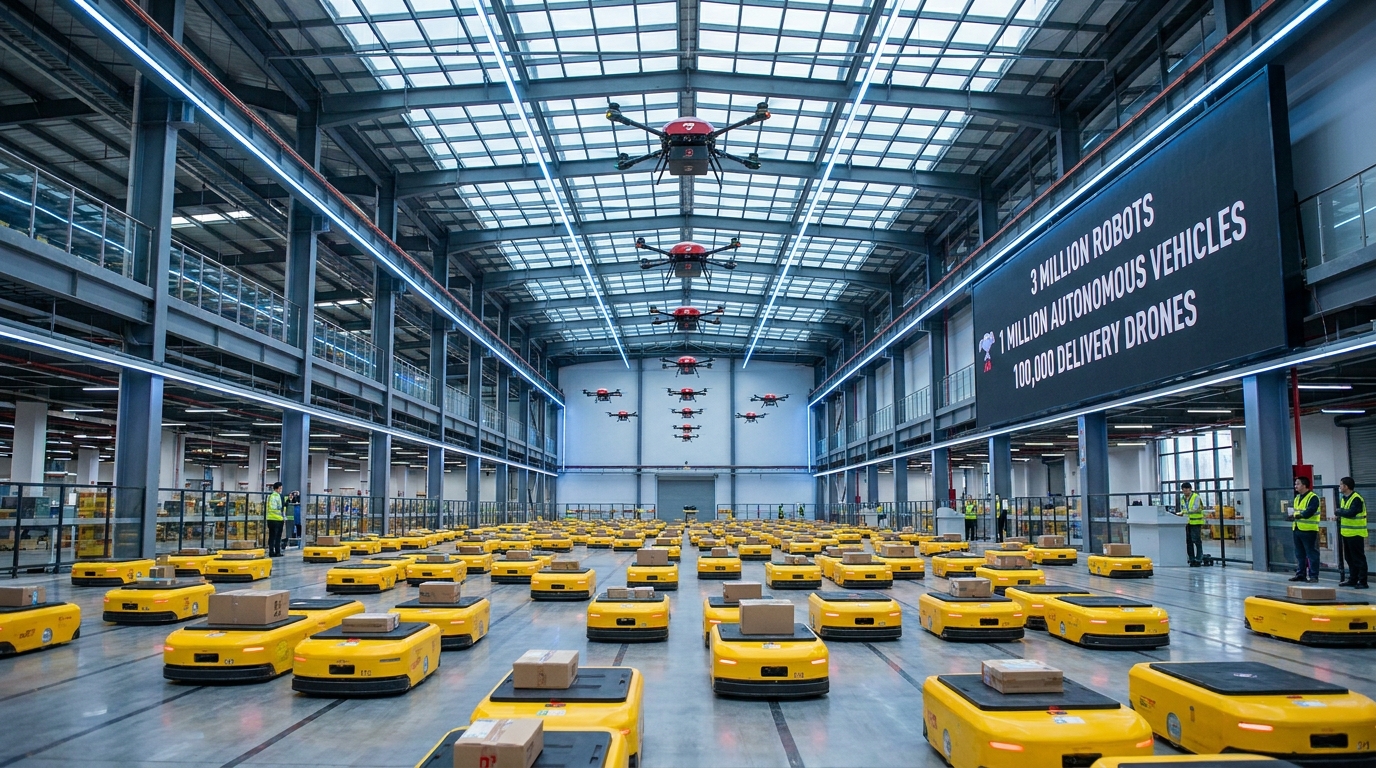
At JDDiscovery 2026 in Beijing, JD.com made official what had been building for years: a full-scale Physical AI Acceleration Plan targeting procurement of 3 million robots, 1 million autonomous vehicles, and 100,000 delivery drones across its logistics network over a five-year window. The announcement also included the debut of JD Logistics’ new industrial Wolf Robot series — purpose-built for warehouse and distribution environments.
Why “Physical AI” Is a Different Beast Entirely
It’s worth pausing on the term “physical AI,” because it signals something important about how the industry is starting to think. For most of the past decade, AI progress was measured in tokens per second, benchmark scores, parameter counts, and model leaderboard rankings. The conversation was fundamentally about software eating software — better language models, better image generators, better code assistants.
Physical AI is different in kind, not just in scale. When you deploy an autonomous robot inside a warehouse, the AI has to navigate real space, handle unpredictable physical objects, interact with human workers, and make decisions in real time where the cost of failure isn’t a bad autocomplete — it’s a dropped package, a collision, or a delayed shipment. The tolerance for error collapses. The computational demands multiply. And the feedback loop between “what the model learned” and “what the robot actually does” becomes the engineering challenge, not the model itself.
The Scale Numbers and What They Imply
3 million robots is a number worth sitting with. For context, the entire global stock of industrial robots in operation as of 2024 was estimated at around 4.28 million units according to the International Federation of Robotics. JD.com is planning to deploy, within five years, a robot fleet equivalent to roughly 70% of the entire global installed base from two years ago. Even accounting for market growth in the interim, that’s a deployment commitment of extraordinary proportions.
The 1 million autonomous vehicles target covers last-mile and warehouse-to-depot transport. The 100,000 drone commitment is specifically for delivery — not test flights, not R&D programs, but operational delivery at scale. China’s regulatory environment for drone delivery is notably more permissive than most Western markets, which partly explains why JD can make this commitment credibly.
What This Means for Competitors and Suppliers
JD’s announcement doesn’t exist in a vacuum. It’s a direct competitive signal to Alibaba’s logistics arm Cainiao, to Amazon’s robotics division, and to every third-party logistics provider operating in Asian markets. When the largest e-commerce logistics operator in China commits to this level of physical automation, it resets the cost floor for the entire industry. Competitors who don’t match the investment risk finding themselves unable to compete on delivery speed or per-unit fulfilment costs within three to four years.
For robot manufacturers, sensor companies, battery suppliers, and AI inference chipmakers, this is a procurement signal of the highest order. An order book of 3 million units doesn’t get filled by existing suppliers alone — it creates entirely new supply chains, new manufacturing capacity requirements, and new technical standards. The Wolf Robot unveil specifically indicates JD is also moving to develop proprietary hardware, not just integrating third-party robots, which is a deeper and more strategically significant commitment.
The practical takeaway for businesses watching this space: physical AI deployment at this scale will drive down the cost of autonomous logistics hardware across the board, faster than most current market models predict. If your business relies on fulfilment cost advantages, the window of those advantages is compressing.
NVIDIA + Palantir: When the Chip Maker Runs Its Own AI Supply Chain
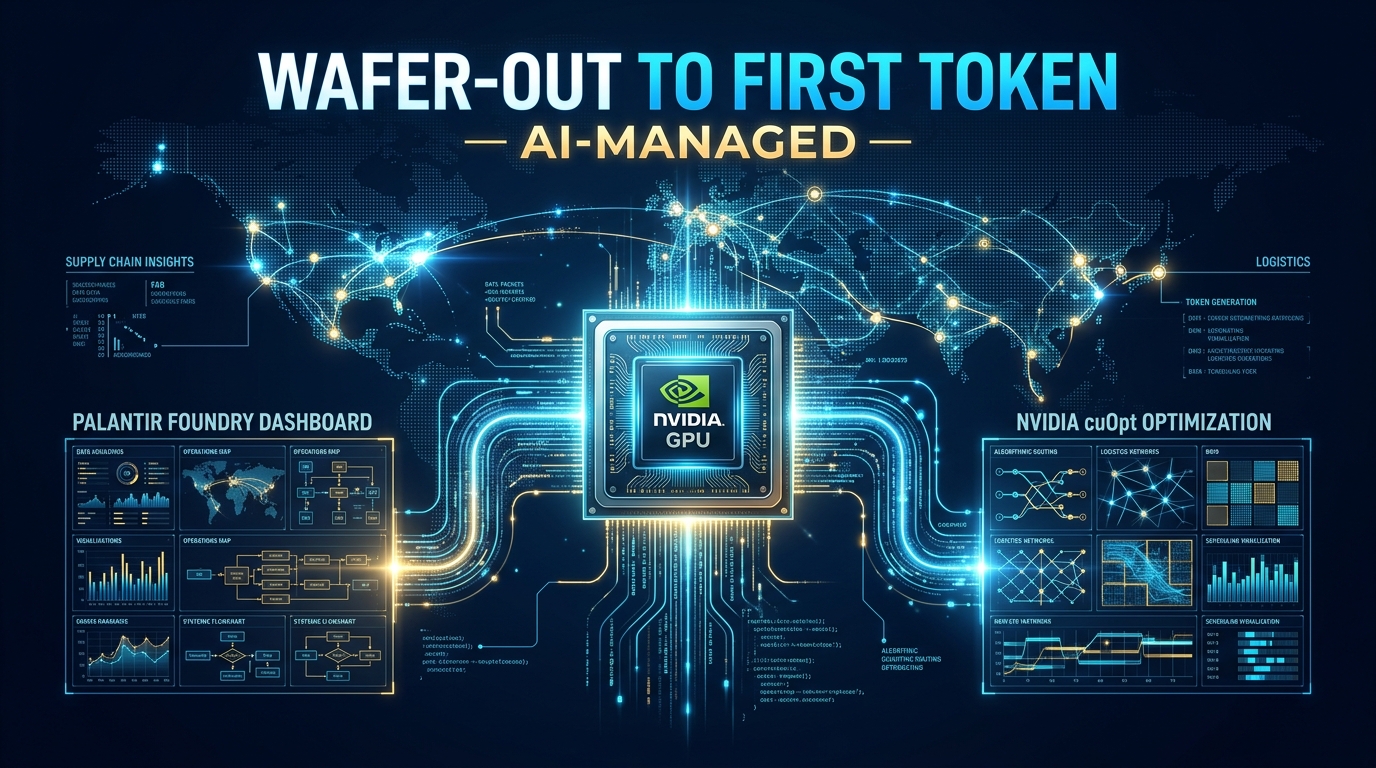
NVIDIA is now using Palantir Foundry and NVIDIA’s own cuOpt software to automate hardware supply chain allocation decisions across its global manufacturing network. The metric they’ve chosen to optimize around — “wafer-out to first token” — is itself worth unpacking, because it tells you almost everything about how NVIDIA thinks about its product and its customers.
Wafer-Out to First Token: The New Supply Chain KPI
Traditional semiconductor supply chain metrics track things like yield rates, cycle times, and on-time delivery. NVIDIA has invented a new one. “Wafer-out to first token” measures the full elapsed time from when a chip leaves the fabrication plant to the moment a customer’s model produces its first inference output in a live data centre environment. This window splits into two components:
- Time-to-rack: The transit journey from fab output to an assembled, installed data centre system — covering physical shipping, customs, data centre integration, and hardware testing.
- Time-to-token: Everything that happens after racking — power provisioning, cooling commissioning, network configuration, and day-one software deployment until the first successful model inference runs.
By collapsing these into a single end-to-end KPI and then targeting it with AI-driven allocation optimization, NVIDIA is treating its own supply chain as a product in itself. The customer experience doesn’t start when the box arrives — it starts when the first token is generated. That framing changes which bottlenecks matter and which optimizations are worth pursuing.
Why Palantir Foundry and Why cuOpt?
Palantir Foundry is a data integration and decision-making platform built specifically for complex operational environments where multiple data sources, shifting constraints, and high-stakes decisions intersect. NVIDIA’s hardware supply chain — spanning multiple fabs (primarily TSMC), assembly partners across Asia, and data centre customers worldwide — is exactly that kind of environment. The combination of Foundry’s operational data layer with cuOpt’s real-time optimization algorithms allows NVIDIA to make allocation decisions dynamically, rather than through fixed procurement schedules and waterfall planning cycles.
cuOpt itself is a GPU-accelerated optimization engine designed to solve routing, allocation, and scheduling problems at speeds that traditional linear programming approaches can’t match. When you’re managing the allocation of tens of thousands of H100 or B200 GPUs across dozens of data centre customers simultaneously, with constantly shifting delivery windows and demand signals, the combinatorial complexity of the optimization problem is genuinely massive. cuOpt was built precisely for this class of problem.
The Meta-Story Here
There’s something philosophically interesting about the world’s leading AI chip manufacturer using AI to manage the supply chain for those chips. It’s recursive in a meaningful way — and it’s also a proof-of-concept at the highest possible level of credibility. If NVIDIA believes AI-driven supply chain optimization delivers enough value to run it on their own most critical operations, that’s a stronger endorsement than any case study they could publish about a customer deployment.
It also signals something about where enterprise AI value is actually accruing right now: not in the glamorous consumer-facing applications, but in the unsexy operational layer of allocation, routing, scheduling, and constraint satisfaction. That’s where the margin gains are real and where the AI-versus-traditional-software performance gap is largest.
Samsung x Mistral: On-Premises AI Comes for Semiconductor Manufacturing
The partnership between Samsung and Mistral AI — announced at a bilateral South Korea–France state summit in Paris — deserves more attention than it’s received. Samsung will integrate Mistral’s software suite, including the Mistral Large model, directly into its semiconductor manufacturing facilities on an on-premises basis, building customized AI applications for its internal engineering and production operations.
Why On-Premises Is the Signal, Not the Partnership
Partnerships between major tech companies and AI model providers are announced almost weekly. What makes this one different is the deployment architecture: on-premises, inside semiconductor fabs. This is not a cloud API integration. This is not a SaaS contract. This is a model deployment inside some of the most security-sensitive, IP-critical manufacturing environments on earth.
Semiconductor fabs contain trade secrets worth billions of dollars — process recipes, yield optimization techniques, defect detection data, equipment configurations. The reason so few AI deployments have penetrated this sector is precisely because the IP risk of sending that data to external cloud services is unacceptable to the operators. On-premises deployment, where the model runs entirely within Samsung’s own infrastructure without data leaving the facility, is what makes AI viable in this context.
The fact that Mistral — a European AI company with a model lineup specifically engineered for enterprise deployment flexibility — is the partner Samsung chose is also significant. Mistral’s business model has always emphasized openness, deployability, and enterprise customization over API lock-in. In a world where geopolitical tensions around semiconductor technology are running high, a South Korean manufacturer choosing a European AI provider for critical manufacturing systems carries a strategic dimension beyond the purely technical.
What Gets Automated in a Semiconductor Fab?
The specific applications Samsung is building around Mistral models aren’t fully disclosed, but the publicly known AI use cases in semiconductor manufacturing give a clear picture of where the value lies. Yield optimization — identifying the process parameters most correlated with defect rates and adjusting them in real time — is one of the highest-value applications, because even a 1% improvement in chip yield at Samsung’s volumes translates to hundreds of millions of dollars annually.
Equipment predictive maintenance is another major application area: using AI to predict when photolithography machines, deposition chambers, and etching equipment will need servicing before they fail during a production run. Failure in the middle of a wafer batch doesn’t just lose that batch — it disrupts the entire production schedule downstream. AI-driven early warning systems for equipment health have documented ROI in semiconductor environments at the level of 10–20x the cost of deployment.
Engineering documentation and specification search is a third area: fabs accumulate vast libraries of technical documents, process specifications, equipment manuals, and quality records. An internal AI model that can accurately retrieve and synthesize this information — trained on and restricted to Samsung’s proprietary corpus — is immediately useful for engineering teams doing process development and troubleshooting.
Arm’s Physical AI Framework: The Standards War Nobody Is Talking About
Arm’s launch of “Arm Total Design for Physical AI” alongside a new robotics interoperability framework landed with less fanfare than it deserved. The initiative targets what Arm describes as “engineering fragmentation” across physical AI systems in mining, agriculture, manufacturing, and transport — industries that collectively represent an estimated $200 billion compute opportunity by the 2030s.
Fragmentation Is the Real Enemy of Physical AI Adoption
Here’s the practical problem Arm is trying to solve. Right now, a company deploying autonomous robots in a warehouse, autonomous vehicles on a factory floor, and AI-driven sensor networks across an agricultural property faces a fragmentation problem that goes all the way to the silicon level. Different robots run on different processor architectures. Different software stacks have incompatible interfaces. Different sensor systems speak different data protocols. The result is that each physical AI deployment is essentially a custom engineering project, which dramatically inflates cost and slows adoption.
Arm Total Design for Physical AI is an attempt to establish common standards — at the chip architecture level, since Arm’s instruction set architecture already powers the vast majority of embedded and mobile processors — that make it easier to build interoperable physical AI systems. By establishing common design reference points, software interfaces, and hardware compatibility requirements, Arm is trying to do for physical AI what USB did for computer peripherals: turn a fragmented ecosystem of incompatible parts into a coherent market where components from different vendors work together reliably.
Why This Matters More Than Most AI Framework Announcements
Standards frameworks are easy to dismiss as corporate positioning rather than genuine technical progress. But Arm’s position in the processor ecosystem gives this initiative unusual credibility. Arm’s architecture already runs in an estimated 99% of mobile phones and a rapidly growing share of data centre servers. If Arm establishes the reference design standards for physical AI compute, it creates a powerful forcing function for the entire hardware ecosystem to align around compatible specifications.
For enterprise buyers, this is potentially transformative. The ability to purchase physical AI hardware from multiple vendors and have it operate within a coherent, managed system is the difference between physical AI being a manageable capital investment and being an endless bespoke integration project. The $200 billion compute opportunity Arm is pointing to only materializes if deployment costs come down to a level where the ROI calculation works for industries outside the most capital-intensive early adopters.
Google WeatherNext 3: AI Enters the Energy Trading Floor
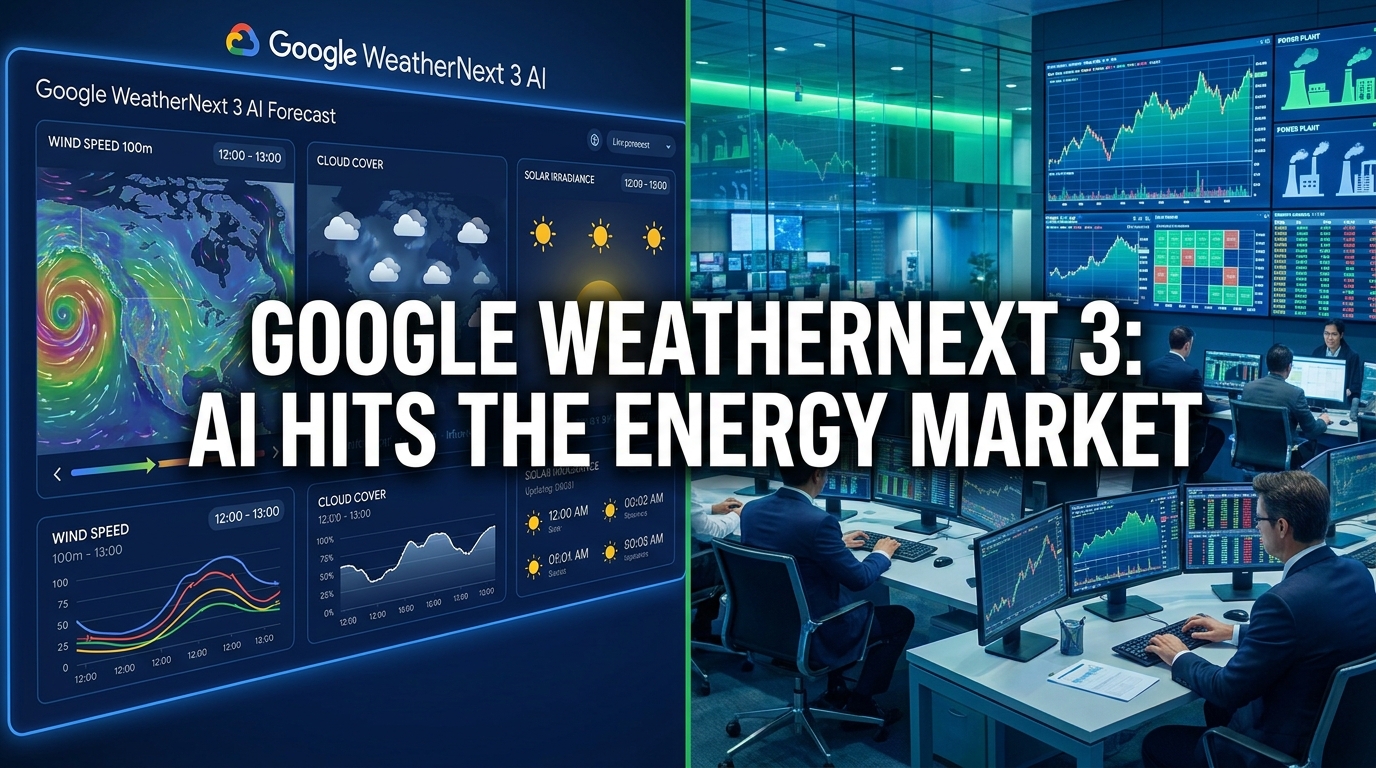
Google’s WeatherNext 3 model is the most technically specific AI weather forecasting system aimed at the energy sector to date. It predicts wind speed at 100 metres above ground — roughly the hub height of a modern onshore wind turbine — forecasts cloud cover and surface solar irradiance, and updates every hour. These are precisely the variables that wind and solar energy operators need to manage grid integration and energy trading positions.
What Energy Operators Actually Need and Why Existing Forecasts Fall Short
Energy traders and grid operators managing renewable generation have a fundamental problem: the output of wind farms and solar installations is inherently variable, and the accuracy of the forecast you use to plan your trading position directly determines your profitability and your grid balancing costs. A forecast that’s 10% off on wind speed doesn’t just miss by 10% on generation output — because power output from a wind turbine scales with the cube of wind speed, small forecasting errors at certain speed ranges translate into large generation errors.
Traditional numerical weather prediction models — the kind that have powered commercial weather services for decades — were built for meteorological accuracy across a wide range of variables and locations. They were not specifically optimized for the 100-metre height that matters most for wind power, or for the surface-level solar parameters that determine photovoltaic output. Commercial weather services have offered energy-specific forecasting products, but at a price point and update frequency that didn’t always match what operators needed.
WeatherNext 3’s hourly update cycle is particularly significant. Energy spot markets in most countries clear in intervals as short as 15 to 30 minutes. An AI weather model that updates every hour gives traders and grid operators a much tighter feedback loop between forecast revision and position adjustment than a model that updates every three or six hours.
The Competitive Dynamics Google Is Entering
Google is not walking into an empty market. Companies like The Weather Company (IBM), Meteologica, and a cluster of specialist energy weather firms already serve the wind and solar forecasting market. What Google brings is computational scale, a foundation model approach to weather prediction (building on its Graphcast and related research), and the distribution reach to make WeatherNext 3 available through Google Cloud to any energy operator already on that infrastructure.
The strategic logic is clear: as renewable energy’s share of global electricity generation grows — it accounted for 30% of global electricity in 2023 and is forecast to reach 45% by 2030 — the market for accurate renewable energy forecasting grows with it. This is AI entering a sector where its impact is measured not in productivity percentage points but in terawatts of better-managed grid capacity.
Supply Chains Detect Fast, Act Slow — and AI Agents Are Closing That Gap
One of the most analytically rich stories of the week came from the J.S. Held Global Risk Report’s finding that supply chain disruption cost businesses approximately $184 billion in 2025. The key insight in the analysis that followed was not the size of the number — it was where the failure actually happens.
Detection vs. Response: The Real Gap in Supply Chain AI
The $184 billion figure, examined carefully, reveals that most of that loss is not attributable to a failure to detect disruption. Most supply chain operators now have sophisticated monitoring systems — track-and-trace networks, inventory visibility platforms, supplier risk dashboards — that flag problems quickly. The failure is in the response. Between detecting that a port is congested, a supplier is at risk, or a shipment will be late — and actually executing the rerouting, reallocation, or rebooking decision — there are layers of human coordination that introduce delay measured in hours or days.
By the time a human team has assessed the disruption, pulled together the options, escalated to whoever has authority to approve a response, and then executed it across the relevant systems, the disruption has often cascaded into a much larger problem than the original event required. This is the “detect fast, act slow” dynamic.
Where AI Agents Change the Math
AI agents — systems capable of not just identifying a problem but autonomously taking a sequence of actions to address it — are specifically designed to close this gap. An AI agent monitoring a supply chain doesn’t just raise an alert when a supplier goes offline. It can simultaneously query alternative supplier capacity, calculate the cost differential, check contractual commitments, model the impact on downstream production schedules, draft the purchase order for the alternative supplier, and surface a recommended decision for human approval — all within minutes of detecting the original event.
The time compression here is the entire value proposition. If a disruption that previously took 48 hours to respond to can be addressed in 2 hours, the downstream cascade either doesn’t happen or is significantly smaller. The cost savings don’t come from detecting the problem earlier — they come from closing the response gap.
This dynamic is also why supply chain AI is one of the clearest positive ROI use cases in enterprise AI right now. Unlike AI writing assistants (where the value is diffuse and hard to measure) or AI coding tools (where productivity gains are real but variable), supply chain disruption response is an area where the cost of delay is quantifiable and the value of faster response is directly measurable in dollars.
M&T Bank’s 15,000-Employee AI Rollout: What Real Enterprise Scale Looks Like

M&T Bank — a US regional bank with around $200 billion in assets — has deployed AI copilots to more than 15,000 employees across internal operations, customer service, software development, and risk management. This is not a pilot program. This is a full institutional deployment at a scale that puts M&T ahead of many institutions considerably larger than itself.
The Breadth of the Deployment and What It Covers
The applications M&T has put into production span a wider range than most enterprise AI deployments tend to acknowledge. Call-centre conversation analysis is perhaps the most immediately intuitive: AI systems that listen to (or read transcripts of) customer service interactions, extract structured data about customer issues and outcomes, and surface patterns for management review and agent coaching. This application is now table stakes for any serious financial services AI program.
Report drafting — using AI to generate first drafts of internal and external reports from structured data inputs — is increasingly common at the senior operational level. The value isn’t replacing analysts; it’s compressing the time between data availability and decision-ready narrative from days to hours. For a bank that produces thousands of regulatory, risk, and performance reports annually, even a 30% reduction in drafting time is a material efficiency gain.
Code generation is the application that tends to attract the most attention in tech-adjacent discussions, but M&T’s use of it in a regulated banking environment is notable precisely because banks have historically been conservative about automated code generation given the compliance and security implications. The fact that M&T has moved this into production indicates that the governance frameworks for AI-generated code in regulated environments are maturing.
Risk portfolio analysis — using AI to flag positions, concentrations, or counterparty exposures that warrant human review — may be the highest-stakes application on the list. Getting this wrong has regulatory consequences, not just operational ones. M&T’s decision to deploy it indicates confidence in the system’s accuracy and appropriate human oversight structures.
What Distinguishes This from Theatre
Many “enterprise AI deployments” that get announced are, on examination, pilot programs running in controlled conditions with a few hundred users, measuring results that were pre-selected for their likelihood of looking positive. M&T’s deployment is different in a few important ways.
First, 15,000 employees is not a pilot number. At that scale, you are running into every edge case, every user resistance pattern, every workflow exception that pilot programs are designed to avoid. A 15,000-person deployment means the AI tools have been stress-tested against real operational complexity, not curated scenarios.
Second, the breadth of applications — spanning call centres, risk management, software development, and operational reporting — indicates a coherent institutional strategy rather than a collection of disconnected experiments. Banks that are genuinely serious about AI invest in platform infrastructure and governance frameworks that make it possible to run diverse applications under common oversight. The variety of M&T’s deployment suggests this infrastructure exists.
Third, M&T is a regional bank, not a global investment bank with unlimited technology budgets. The fact that a $200-billion-asset regional institution has reached this scale of deployment is meaningful evidence that enterprise AI has crossed a cost-and-complexity threshold where it’s viable for institutions that don’t have Google-scale engineering teams.
YouTube Appears in 53% of Google AI Overviews: How Search Is Rewiring What Gets Seen
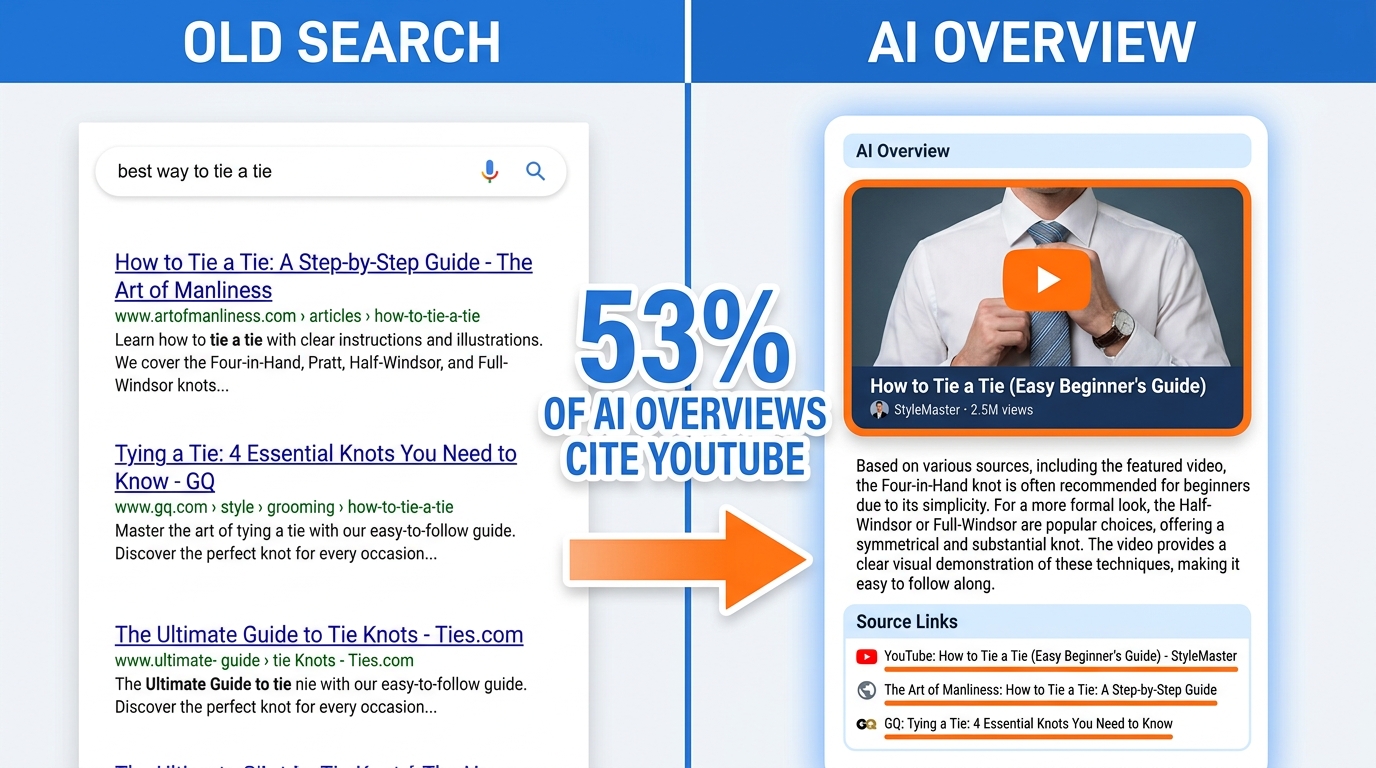
New research from Searcherries tracked 50 vitamin and supplement searches per day over a defined period, analysing which websites appeared in Google’s AI Overviews — the AI-generated answer boxes that now sit above traditional search results for an increasing proportion of queries. YouTube appeared in 186 of 350 AI-generated answers, a citation rate of 53.1%. It was the only website cited in more than half of the answers collected.
Why This Is a Bigger Deal Than It Looks
At first glance, this might look like a niche SEO data point about supplement queries. It’s actually a structural shift in how information surfaces on the internet that affects any publisher, brand, or creator who relies on Google search traffic.
Google’s AI Overviews are not just summarizing the top search results. They’re synthesizing information from sources Google’s systems judge to be authoritative, trustworthy, and well-structured for AI extraction. The citation pattern reveals which content types and which platforms Google’s AI is treating as high-quality sources — and the dominance of YouTube is striking because it suggests that structured video content with good transcripts, clear claims, and high engagement signals is performing well as an AI source in a way that text-only content from smaller publishers may not be.
The implications for content strategy are direct. If YouTube is being cited in more than half of AI Overviews in a vertical where health claims require careful substantiation (vitamins and supplements carry real medical relevance), then the signals Google is using to evaluate AI source quality clearly extend to video content and are not restricted to traditional editorial web pages.
What Content Creators and Brands Should Take From This
The research covers one vertical — vitamins and supplements — and the findings may not generalize uniformly across all query types. Navigational queries, local searches, and highly technical topics likely have different citation patterns. But the principle it illustrates is broadly applicable.
Video content that clearly articulates factual claims, that is structured in a way that AI systems can parse (clear spoken explanations, on-screen text reinforcement, topic-focused rather than meandering), and that earns genuine engagement signals is increasingly positioned as a primary source layer for AI-mediated search answers — not just a supplementary channel. For brands and creators who have been treating YouTube as secondary to their website content strategy, this data point argues for a reappraisal of that hierarchy.
There’s also a competitive implication. If YouTube content is being preferentially cited in AI Overviews, then the brands and creators who have invested in high-quality, well-structured video content now have a citation advantage in AI-generated answers that didn’t exist in traditional ranked search results. That advantage will compound over time as AI Overviews expand to cover more query types and more of the search surface.
50.5% of Americans Say AI Romance Is Cheating: The Cultural Line Nobody Expected to Draw This Fast

A survey of 2,150 US adults conducted by AI Girlfriend Coach through SurveyMonkey Audience in late August 2026 found that just over half — 50.5% — say a partner’s romantic or sexual relationship with an AI can constitute cheating. The survey analysed 1,709 responses after filtering for data quality, making it statistically robust at the population level.
What This Number Actually Tells Us
The 50.5% finding is remarkable not because infidelity norms are shifting — they’re not, at least not at this speed — but because it confirms that AI companionship systems have become culturally salient enough that people are actively forming positions about their ethical status in relationships. Three years ago, the question of whether a romantic AI relationship could constitute cheating would have struck most survey respondents as hypothetical, abstract, even slightly absurd. Today, enough people apparently know someone (or are themselves a someone) who has engaged with these systems to have a genuine opinion about where the line sits.
The AI companion market has grown significantly since the widespread adoption of conversational AI systems. Apps like Replika, Character.AI, and newer entrants have developed emotionally responsive, persistent AI characters that users interact with in romantic and emotionally intimate ways. The market for these applications has expanded beyond the isolated or lonely populations that were initially assumed to be the core demographic. People in existing relationships are also using them — which is presumably what prompted the 50.5% to form the view they hold.
The Deeper Question About What “Relationship” Means
The cultural debate this survey reflects is, at its core, a question about what constitutes relationship violation. Traditional infidelity definitions centre on physical intimacy or emotional intimacy shared with another person that displaces the primary relationship. AI companions don’t qualify as persons under any current legal or ethical framework — but they are capable of providing emotional responses that feel reciprocal, of maintaining persistent memories of past interactions, and of generating expressions of affection that are indistinguishable in their form from those a human partner might provide.
Whether the “cheating” framing makes sense philosophically is almost beside the point. What matters practically is that the 50.5% finding signals that relationship norms are now actively renegotiating AI’s role in intimate life — and that this renegotiation is happening at a speed that most social institutions (counselling, family law, relationship research) have not caught up with.
For AI developers building companion products, this survey carries a responsibility signal. If a majority of the US population considers romantic AI relationships capable of constituting relationship violation, then the design choices being made in AI companion applications — how persistent they are, how emotionally responsive they are, how they handle users in declared relationships — carry genuine social consequences. The question of whether to build guardrails into companion AI is no longer just an academic ethics question. It’s a market design question with growing social scrutiny.
The Pattern Beneath the Headlines: AI Is Becoming Infrastructure
Read individually, each of these stories is interesting. Read together, they describe something more significant: the moment when AI stops being a technology that organizations are experimenting with and starts being infrastructure that organizations are building on top of.
Infrastructure Has Different Rules Than Tools
When something is a tool, you evaluate it on its direct output. Does it do what it’s supposed to do? Is it better than the alternative? Can I replace it if something better comes along? Tool adoption is reversible and relatively low-stakes. Infrastructure is different. When you build your supply chain allocation on AI optimization systems, when you deploy AI copilots to 15,000 employees, when you run your energy trading positions off AI weather forecasts — the AI is no longer a layer on top of your operations. It is your operations. Removing or replacing it becomes an organizational transformation, not a technology swap.
Several of this week’s stories represent AI crossing from tool to infrastructure status. NVIDIA’s supply chain is now running on AI optimization. M&T Bank’s 15,000-employee deployment means AI is embedded in the daily workflow of a large fraction of the bank’s workforce. JD.com’s 3-million-robot plan means physical AI will become the operational core of the world’s largest e-commerce logistics operation. These are not reversible experiments.
The Sectors Moving Fastest — and Why
Looking across the week’s stories, a pattern emerges about which sectors are moving most aggressively toward AI-as-infrastructure, and why. Logistics and supply chain leads because the ROI case is quantifiable and large, the decision loops are defined and repeatable, and the competitive pressure from early adopters is already creating urgency for laggards. Manufacturing (Samsung’s Mistral deployment) is accelerating because on-premises AI has become viable for IP-sensitive environments. Financial services (M&T Bank) is moving because the productivity gains are real and the regulatory frameworks are developing fast enough that governance risk has reduced to a manageable level. Energy is entering (Google WeatherNext 3) because the renewable energy transition is creating enormous demand for better grid intelligence.
The sectors that are moving more slowly — healthcare, government, education — tend to share characteristics: high regulatory complexity, fragmented data environments, and significant public trust requirements that make experimentation more expensive and high-profile failures more damaging. These sectors will follow, but on a lag of two to three years relative to the leading sectors visible in this week’s news cycle.
The Social Layer Is Catching Up to the Technical Layer
Perhaps the most underappreciated theme in this week’s AI news is the evidence that social and cultural adaptation to AI is happening at a speed that tracks the technology’s adoption. The YouTube citation data shows search behaviour and content consumption patterns adapting to AI-mediated information retrieval faster than most publishers anticipated. The AI romance survey shows cultural norms around intimacy, fidelity, and relationship adapting to AI companion technology faster than ethicists and relationship researchers expected.
This social adaptation speed matters because it changes the assumption that technology moves fast and society moves slow. In the current AI adoption cycle, certain social norms — particularly those around information authority, search behaviour, and digital relationships — are adapting in real time, not on the decade-long lag that characterized previous technology adoption cycles. That faster adaptation creates opportunities for businesses and creators who understand the new landscape early, and risks for those who assume they have time to wait and see.
What to Watch in the Weeks Ahead
Based on the patterns visible in this week’s AI news cycle, here are the specific developments worth tracking closely over the next 30 to 60 days:
Physical AI Hardware Standards
Arm’s Total Design for Physical AI framework is early. Watch for which robot manufacturers, sensor companies, and systems integrators publicly commit to Arm’s reference design specifications. The speed of ecosystem alignment around this standard will determine whether it becomes the de facto architecture for physical AI or whether the sector remains fragmented for another two to three years. Any announcement from major Japanese or German industrial robot manufacturers (Fanuc, KUKA, Yaskawa) about Arm alignment would be a significant signal.
Regulatory Response to AI in Financial Services
M&T Bank’s deployment is running ahead of many regulatory clarity timelines. The US federal banking regulators (OCC, Federal Reserve, FDIC) have been developing AI governance guidance that is still evolving. Watch for any regulatory guidance updates or enforcement actions related to AI in banking that would either accelerate or complicate the path for other financial institutions to follow M&T’s model.
Renewable Energy AI Market Development
Google’s WeatherNext 3 entry into the energy forecasting market will prompt competitive responses from established weather service providers and from other cloud platforms (Microsoft Azure, AWS) that haven’t yet made similar moves. Watch for Microsoft and Amazon’s response in the energy weather forecasting space — if they accelerate equivalent product launches, it confirms the market opportunity is real and will drive rapid commoditization of AI energy forecasting.
AI Companion Regulation
The 50.5% survey finding will eventually surface in policy discussions about AI companion regulation. Watch for any state-level legislation (California, New York, or EU member states are the most likely jurisdictions) that attempts to establish disclosure requirements, relationship status guardrails, or age verification requirements for AI companion applications. The regulatory journey from “majority of people think this is a problem” to “legislation is proposed” typically runs 12 to 24 months in the AI space right now.
Conclusion: The Questions You Should Be Asking Your Organisation
This week’s AI news cycle, taken as a whole, presents a picture of a technology that has moved decisively past the hype-vs-scepticism debate and into the operational reality of large-scale deployment. The organizations in these stories — NVIDIA, JD.com, Samsung, M&T Bank, Google — are not experimenting. They are building. The systems they are deploying are not reversible pilots. They are infrastructure.
For anyone in a leadership position, in any sector, this shift raises questions that are more pressing than they may yet feel:
- Where is AI moving from tool to infrastructure in your sector? Identify the specific operational domains where AI-driven optimization is becoming the standard, not the differentiator — and assess your timeline relative to that standard.
- What is your on-premises AI strategy? Samsung’s deployment of Mistral inside its fabs is a harbinger for any IP-sensitive industry. If your competitive advantage depends on proprietary data, your AI strategy needs an on-premises component that you may not have planned for yet.
- How are you adapting your content strategy to AI-mediated search? The YouTube citation data is a concrete, measurable early signal of how AI-mediated information retrieval favours different content types than traditional search. Acting on it now, before the pattern becomes obvious to everyone, is where the advantage lies.
- What are your supply chain’s detect-to-respond gaps? The $184 billion disruption cost figure is an aggregate, but the analysis applies at every scale. If your supply chain can detect disruption in minutes but takes hours or days to respond, you have a gap that AI agents are specifically designed to close.
- What social norms around AI are your customers forming? Whether you’re building AI companion features, deploying AI customer service, or integrating AI into your brand’s consumer-facing touchpoints, the speed of social norm formation around AI in intimate and trust-dependent contexts is accelerating. What your customers think about AI in personal contexts affects what they’ll accept from you in commercial contexts.
The week of September 8–11, 2026 will probably not be remembered as a landmark week in AI history. No single announcement was so large that it dominated the conversation. But that’s precisely what makes it instructive. This was not a week of announcements from the AI research frontier. It was a week of operational reality — of systems being deployed, standards being set, partnerships being struck, and cultural norms being tested — across sectors far beyond the technology industry.
That’s the week to pay attention to. Because weeks like this one are where the real direction of the technology gets set.