
Tag: AI Compliance

  • What the EU AI Act’s Transparency Rules Actually Demand From Agent Builders Right Now

    What the EU AI Act’s Transparency Rules Actually Demand From Agent Builders Right Now

    EU AI Act transparency rules for AI agents now in force from August 2, 2026

    On 2 August 2026, the EU AI Act stopped being a planning exercise and became a live compliance obligation. Article 50 — the transparency chapter that governs how AI systems disclose themselves to users — entered full application that day. The European Commission published its final guidance in July 2026. The AI Office and Member State authorities now have the tools to enforce what is written.

    And yet, across the organisations building and deploying AI agents right now, the same three misconceptions keep surfacing. First: that transparency compliance is just a UI checkbox — slap a banner somewhere and move on. Second: that only “chatbots” are affected. Third: that whoever built the underlying model carries the liability, not the team that assembled the agent on top of it.

    All three are wrong. And the cost of getting this wrong — €15 million or 3% of global annual turnover, whichever is higher — is not a theoretical risk anymore. It is the middle band of a live enforcement regime.

    This article is not a summary of the regulation. It is a working compliance analysis for the teams actually building agentic systems: product managers scoping disclosure UX, engineers implementing machine-readable marking, legal teams drawing the provider/deployer boundary, and engineering leads trying to understand what a compliant audit trail actually looks like. We go clause by clause where it matters, and practical wherever possible.


    What Article 50 Actually Says — Versus What Most People Think It Says
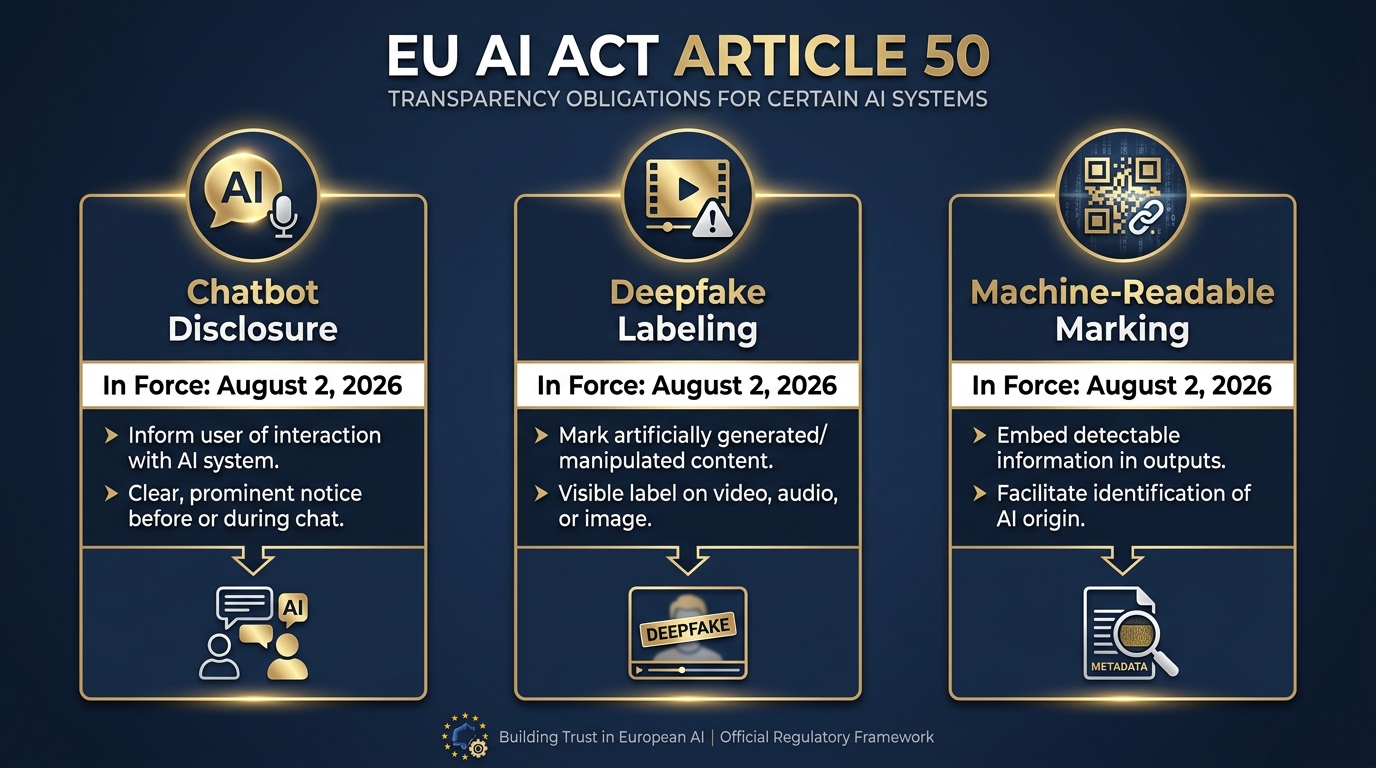
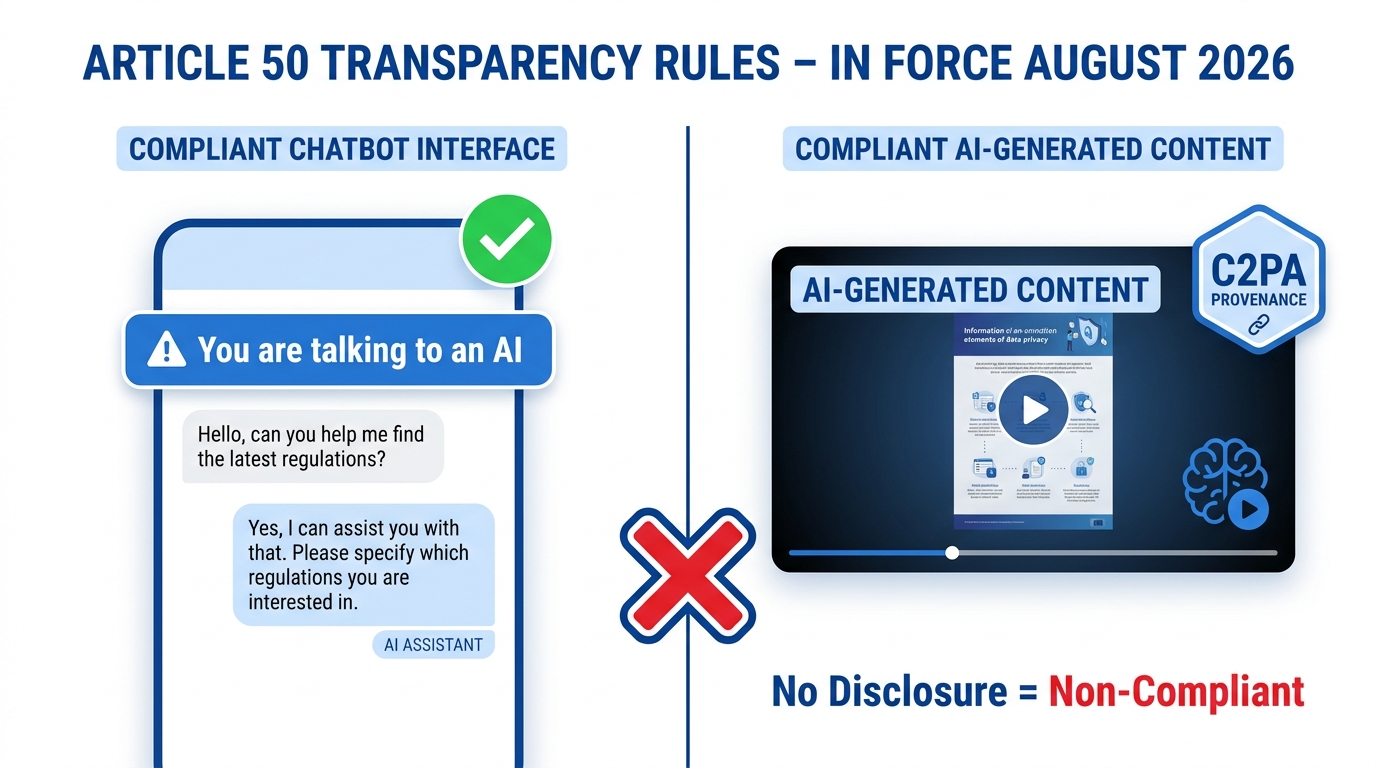
    Article 50 EU AI Act infographic showing three transparency obligations: chatbot disclosure, deepfake labeling, and machine-readable marking, all in force August 2 2026

    Article 50 of the EU AI Act contains four distinct obligations, each with its own trigger condition, responsible party, and technical implementation requirement. The regulation groups them into a single article, which has caused organisations to treat them as a single undifferentiated “transparency” task. They are not.

    Obligation 1: Disclosure That a User Is Interacting With AI (Article 50(1))

    This is the one everyone knows about. When a person interacts directly with an AI system — a chatbot, virtual assistant, or agent with a conversational interface — the provider of that system must inform the person that they are interacting with an AI system. The disclosure must happen at the latest by the first interaction. It does not need to be repeated at every message, but it must be present at the point of first contact.

    The critical qualifier is that the obligation does not apply when it is obvious from context that the user is interacting with AI. This “obvious from context” exception is not a wide loophole. The Commission’s July 2026 guidance makes clear that “obvious” is assessed from the perspective of a reasonable user, not from the perspective of a technically-informed operator who knows the system is AI-powered. If there is any plausible ambiguity — and with modern conversational agents, there almost always is — the obligation stands.

    What the obligation does not require is that the disclosure be lengthy or conspicuous. A persistent label, a brief acknowledgement at session start, or a clearly identifiable AI persona can satisfy the rule. The key is that the disclosure is present, proximate to the interaction, and comprehensible — not buried in terms of service or a privacy policy three links deep.

    Obligation 2: Disclosure That Content Is AI-Generated or AI-Manipulated (Article 50(3) and 50(4))

    This obligation targets two specific content types: deepfakes, and AI-generated text or audio on matters of public interest — election content, policy positions, scientific claims — where a reasonable person might be materially misled.

    Deepfakes that realistically portray real people, places, events, or objects must be labelled in a way that is clearly perceivable to the end user. AI-generated public-interest text — think automated news summaries, political messaging, health information — must similarly carry a disclosure that it is AI-generated. Both obligations fall on deployers, not just providers. If your organisation runs the deployment pipeline that outputs this content to end users, the labelling responsibility is yours regardless of which model you used to generate it.

    Obligation 3: Emotion Recognition and Biometric Categorisation Disclosure (Article 50(5))

    Any person exposed to an emotion recognition system or a biometric categorisation system must be informed of the operation of that system and of the fact that their data is being processed. This applies broadly — not just to dedicated emotion recognition products, but to any AI agent that incorporates such functionality as a component. If your customer service agent analyses sentiment signals or voice tone as part of its routing logic, this obligation may apply.

    Obligation 4: Machine-Readable Marking of Synthetic Outputs (Article 50(2))

    This is the obligation that has received the least operational attention, yet carries significant technical implementation complexity. Providers of AI systems that generate synthetic audio, image, video, or text must mark those outputs in a machine-readable format that makes them detectable as AI-generated or AI-manipulated. The marking must be embedded in the output itself — not just logged server-side or disclosed to the user separately. It must be effective, interoperable, robust, and reliable, as far as technically feasible.

    This obligation came into force on 2 August 2026 for new systems. For systems already on the market before that date, a grace period extends to 2 December 2026. After that, every generative AI system placing outputs into the EU market — regardless of when it launched — must comply.


    The Provider vs. Deployer Line: Where You Actually Fall Determines What You Owe
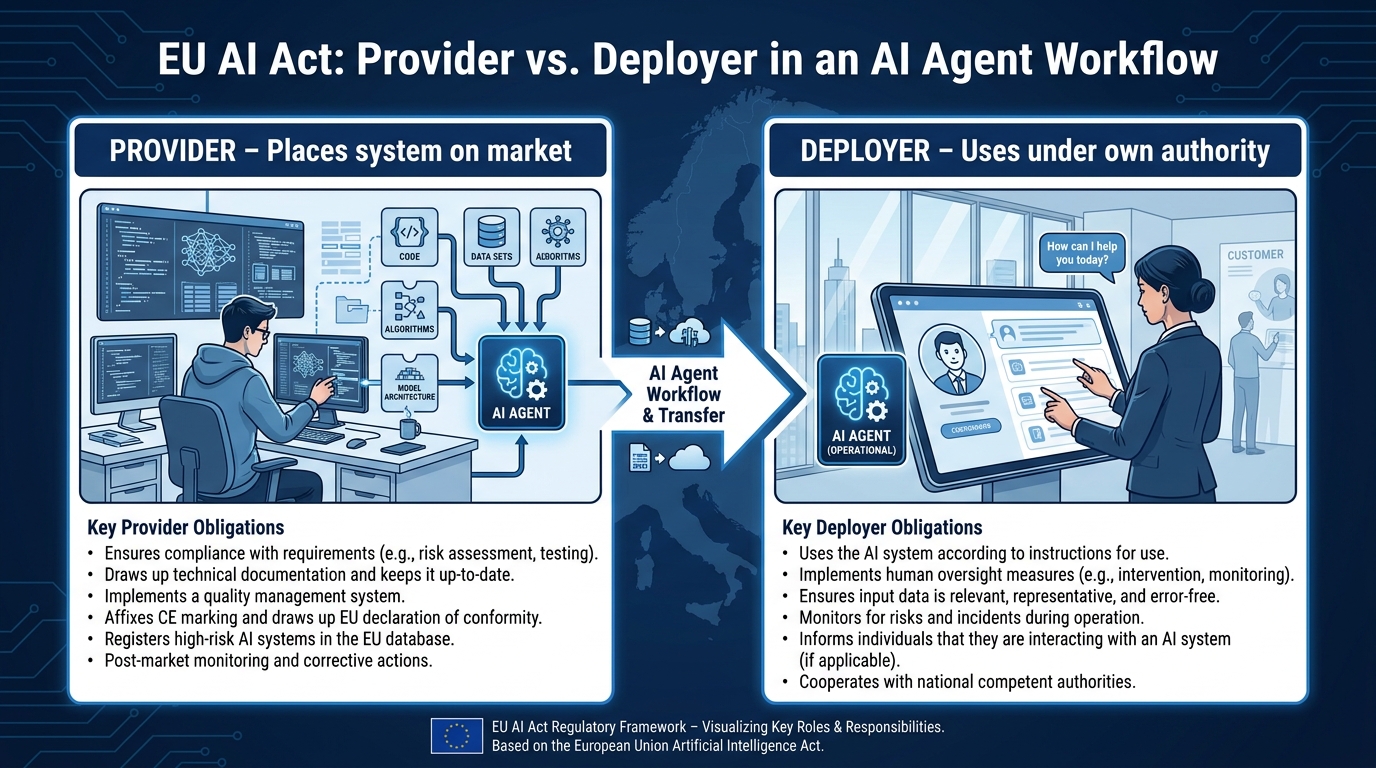
    EU AI Act provider vs deployer distinction diagram showing roles and obligations for AI agent builders and business users

    The EU AI Act distributes compliance responsibilities across two primary roles: the provider and the deployer. Misclassifying your organisation’s role is one of the fastest routes to an enforcement gap.

    What Makes You a Provider

    A provider is any natural or legal person that develops an AI system — or has one developed — and places it on the market or puts it into service under their own name or trademark. The key word is “places.” If your organisation builds an agent and then makes it available to other businesses or end users — even internally at scale, even without commercial licensing — you are functioning as a provider of that system.

    The provider classification also applies when an organisation materially modifies an existing AI system. Fine-tuning a base model on proprietary data, substantially altering its architecture or behaviour, or rebranding and redistributing it under your own name can all shift you from deployer to provider, regardless of what agreement you have with the underlying model vendor.

    As a provider, your Article 50 duties include designing the system so that it can deliver the required disclosures, implementing machine-readable marking, and ensuring that any downstream deployer receives sufficient information to comply with their own obligations.

    What Makes You a Deployer

    A deployer is any natural or legal person that uses an AI system under their own authority in a professional context. If your organisation integrates a third-party AI agent into your customer service stack, deploys it on your platform, and manages the interactions it has with your customers — you are a deployer.

    Deployers are not off the hook. For Article 50, deployers carry explicit obligations for the deepfake labelling and public-interest text disclosure requirements. They must also instruct users about the AI nature of systems they operate, and they cannot use a provider’s system in ways that circumvent or undermine the transparency obligations built into it.

    The Overlap Zone: When You Are Both

    Many organisations building AI agents in 2026 occupy both roles simultaneously. You are a deployer relative to the foundation model or API you use (OpenAI, Anthropic, Google, Mistral), and you are a provider relative to the agent product you have built on top of that model and deployed to your customers or internal users.

    This dual-role reality means you have compliance obligations flowing in both directions. You need contractual assurances from your model provider that their system delivers the upstream transparency capabilities your agent requires. And you need to ensure that your own agent system delivers the disclosure and marking obligations to the end users downstream.

    The Commission’s July 2026 guidance specifically addresses this. It notes that where a provider and deployer are different entities, the provider must give the deployer sufficient information to enable the deployer to fulfil their own transparency obligations. This has direct contractual implications: if your API terms of service do not address this information flow, you have a gap.


    The Three Disclosure Triggers That Apply Specifically to AI Agents

    Most Article 50 commentary focuses on chatbots as the paradigm case. But “AI agent” is a broader category — it encompasses autonomous or semi-autonomous systems that take actions, make decisions, and interact with users across multiple sessions and channels. The compliance picture for agents is more complex than the chatbot framing suggests.

    Trigger 1: The First Interaction Point

    For any agent that has a direct user-facing conversational interface — a customer support agent, a sales assistant, an internal enterprise assistant — the disclosure must occur at the first interaction. This is the clearest case and the one most teams are already building for.

    The implementation detail that often gets missed: “first interaction” means first interaction in a session, but if the agent initiates contact — through a proactive message, an email, a push notification — the disclosure obligation applies to that initiation, not to the user’s response. Outbound AI communications are in scope.

    Trigger 2: Identity Disclosure for Agents Acting on Behalf of Others

    This is the trigger most specific to agentic AI and the one most underappreciated in current compliance frameworks. The Commission’s July 2026 guidance specifies that AI agents must not only disclose that they are AI — they must also, where relevant, disclose who they act on behalf of.

    For an agent operating as a customer service representative of a specific company, this is straightforward: the agent discloses it is AI, and the company identity is typically apparent from the interface. But for agents operating in broker-like roles — negotiating, transacting, or representing interests in commercial or civic contexts — the disclosure of principal identity becomes a substantive obligation, not a formality.

    Consider an agent that negotiates supplier terms on behalf of a procurement team, or an agent that submits regulatory filings on behalf of an organisation. In both cases, the human or legal entity the agent represents must be identifiable from the interaction. Hiding the principal identity behind a generic AI persona in these contexts is not compliant.

    Trigger 3: Output-Level Disclosure for Generated Content

    Agents that generate written reports, summaries, legal documents, marketing copy, or any other substantive text output for onward use — and particularly for any public-interest subject matter — must apply appropriate output-level disclosure. This applies even when the agent is not conversational. A document-generation agent, a research synthesis agent, or a contract drafting agent all produce outputs that fall within the scope of the machine-readable marking obligation if those outputs leave the system and enter broader circulation.

    The practical implication: disclosure is not only a conversation-layer concern. It follows the output wherever the output goes.


    Machine-Readable Marking: The Technical Obligation Nobody Is Actually Ready For
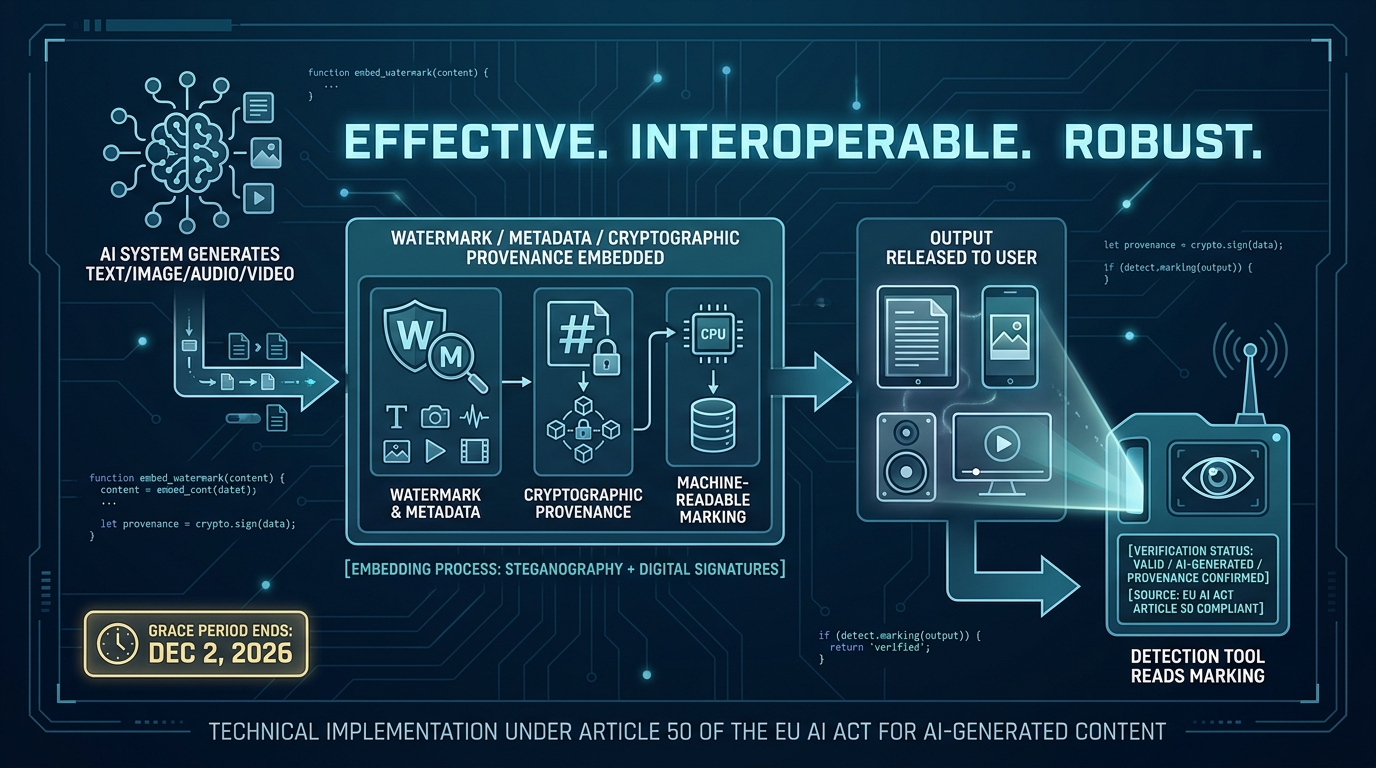
    Technical diagram showing AI content watermarking and machine-readable marking workflow under Article 50 EU AI Act, with grace period ending December 2 2026

    Of all Article 50’s obligations, machine-readable marking is the one with the largest gap between legal requirement and operational readiness. The obligation is unambiguous: synthetic audio, image, video, and text outputs must carry embedded markings that make them detectable as AI-generated or manipulated. The challenge is that the regulation does not specify a single technical standard — it requires that the approach be effective, interoperable, robust, and reliable as far as technically feasible. That qualification does a lot of work.

    What “Machine-Readable Marking” Can Mean in Practice

    The Commission’s July 2026 guidance acknowledges that no single universal standard exists yet. What it does identify is a range of technically viable approaches, each with different trade-offs:

    • Metadata embedding: Including structured provenance data in file headers or EXIF/XMP metadata. Widely supported for images and audio. Fragile under file conversion, compression, or screenshot capture. The C2PA (Coalition for Content Provenance and Authenticity) standard is the leading interoperability framework here.
    • Watermarking: Embedding imperceptible signals directly into the content payload. More robust to format conversion than metadata. Technically feasible for audio and images; for text, syntactic or statistical watermarking techniques exist but are less mature.
    • Cryptographic provenance: Signing outputs with a cryptographic hash tied to the generating system. Provides strong authenticity guarantees but requires a verification infrastructure to be meaningful.
    • Fingerprinting and logging: Maintaining server-side records of generated content that can be queried to verify AI origin. Useful as a supplemental layer; insufficient alone as the marking must travel with the content, not remain only server-side.

    The “as far as technically feasible” qualifier gives providers room to argue that certain content types present genuine implementation barriers. But regulators are expected to apply this qualifier narrowly — it is a technical feasibility exception, not a general escape hatch. If a viable technique exists for your output type, you are expected to use it.

    The Interoperability Requirement

    One of the harder requirements embedded in Article 50(2) is interoperability. The marking method you choose must be detectable not just by your own systems but by third-party detection tools. This has supply chain implications: if you are using a proprietary watermarking approach that only your own infrastructure can read, you are not meeting the interoperability standard.

    This is pushing the market toward open standards. The C2PA standard, which already has adoption from major hardware and software vendors, is the most likely candidate for harmonised implementation across image and audio. For text, no equivalent standard has achieved comparable adoption, which represents a genuine implementation challenge that the Commission’s guidance acknowledges without fully resolving.

    What Happens to Content After It Leaves Your System

    Providers are responsible for the marking at the point of output. They are not responsible for removing marks that users subsequently strip — but they are responsible for ensuring the mark was present when the content left the system. This creates a documentation and logging obligation: you need to be able to demonstrate that every output generated by your system carried the required marking at generation time.


    Multi-Agent Pipelines: Why End-to-End Is the Only Defensible Framing

    The EU AI Act was drafted before “agentic AI” — in the sense of multi-agent orchestration, tool-calling pipelines, and autonomous task completion — became a mainstream engineering pattern. The Act does not use the term “agentic AI” and does not define “multi-agent system.” This gap has led some legal teams to argue that components within a multi-agent pipeline that do not themselves have a user-facing interface are exempt from Article 50 obligations.

    That argument is technically available but operationally dangerous.

    The End-to-End System Principle

    The Commission’s July 2026 guidance addresses multi-agent architectures through a systemic lens. Where multiple AI components are functionally integrated into a single decision or interaction pipeline — where the outputs of one agent become the inputs of another, and the chain ultimately produces an output that reaches a natural person — the compliance analysis must assess the system end-to-end, not component by component.

    In practical terms, this means that if your orchestrator agent calls a subagent for research, routes the output to another subagent for drafting, and the final draft is delivered to a human user — the system as a whole is subject to Article 50 obligations. The fact that individual components are not themselves user-facing does not eliminate the obligation at the system level.

    Responsibility Allocation in Pipelines

    Within a multi-agent pipeline, the party that controls the orchestration layer and determines how the system outputs reach users is typically the entity that bears provider-level transparency obligations for the overall system. Subcomponent providers — API-accessed models and tools — carry obligations for their own components, but they are not responsible for the end-to-end disclosure unless they control the final output.

    This means the team building and operating the orchestration layer cannot delegate compliance to the model APIs they call. They own the end-to-end transparency posture of the system they have assembled. Contracts with subcomponent vendors should specify what transparency capabilities those vendors provide and guarantee — but the orchestrator’s team must ensure those capabilities are actually activated and functional in the assembled pipeline.

    Tool Use and External Action

    A distinctive feature of agentic systems is that they take actions — calling APIs, writing to databases, sending emails, submitting forms. When an agent takes an action that results in a communication being received by a natural person (for example, sending an email to a customer on behalf of a business), that communication is an AI output. If it contains synthetic text, the marking obligation applies. If the recipient might otherwise believe they are communicating with a human, the disclosure obligation applies.

    This extends the scope of Article 50 well beyond the conversational interface. Email-generating agents, document-filing agents, and report-producing agents all require compliance assessment for the outputs they generate.


    GPAI Model Transparency: What Sits Upstream of Your Agent

    Organisations deploying AI agents built on general-purpose AI models — foundation models accessed through APIs from commercial providers — have a compliance relationship that runs in both directions. Understanding what GPAI providers are obligated to disclose, and what that means for your downstream compliance posture, is essential.

    What GPAI Providers Must Give You

    Under Article 53 of the EU AI Act, providers of general-purpose AI models are required to:

    • Maintain and provide technical documentation covering the model’s capabilities, limitations, and intended uses
    • Give downstream providers and deployers sufficient information to use the model safely and compliantly, including information relevant to complying with their own obligations under the Act
    • Maintain and publish a copyright compliance policy covering training data
    • Publish a publicly available summary of the training content used

    These obligations apply from 2 August 2026 for GPAI models placed on the market after that date, with a staggered transition for earlier models. The enforcement mechanism runs through the AI Office, which has specific authority over GPAI model obligations.

    What This Means for Agent Builders Using GPAI APIs

    If you are building agents on top of a commercial GPAI model — and most organisations building agentic systems are — you need to verify that your model provider is meeting their Article 53 obligations and that they are passing the relevant information to you in a form you can actually use.

    Specifically, you need documentation from your GPAI provider covering: the model’s capabilities and known limitations relevant to your use case; guidance on appropriate use conditions; and transparency-related technical information including any built-in marking capabilities the model provides for its outputs.

    If your current API terms of service do not address these items, you should be requesting updated documentation as a matter of contract management. Regulators examining your compliance posture will look at whether you have made reasonable efforts to obtain and act on this upstream information.

    GPAI Models with Systemic Risk

    GPAI models designated as having systemic risk — those with training compute exceeding 1025 FLOPs, or designated by the AI Office based on capability assessment — carry additional obligations under Article 55, including adversarial testing, incident reporting, and cybersecurity measures. If your agent is built on a systemic-risk model, your downstream compliance obligations are affected by the provider’s compliance with Article 55. You need to understand what systemic-risk obligations your model provider is subject to and whether any of those obligations generate requirements on your end as deployer.


    The Penalty Math: What Non-Compliance Actually Costs
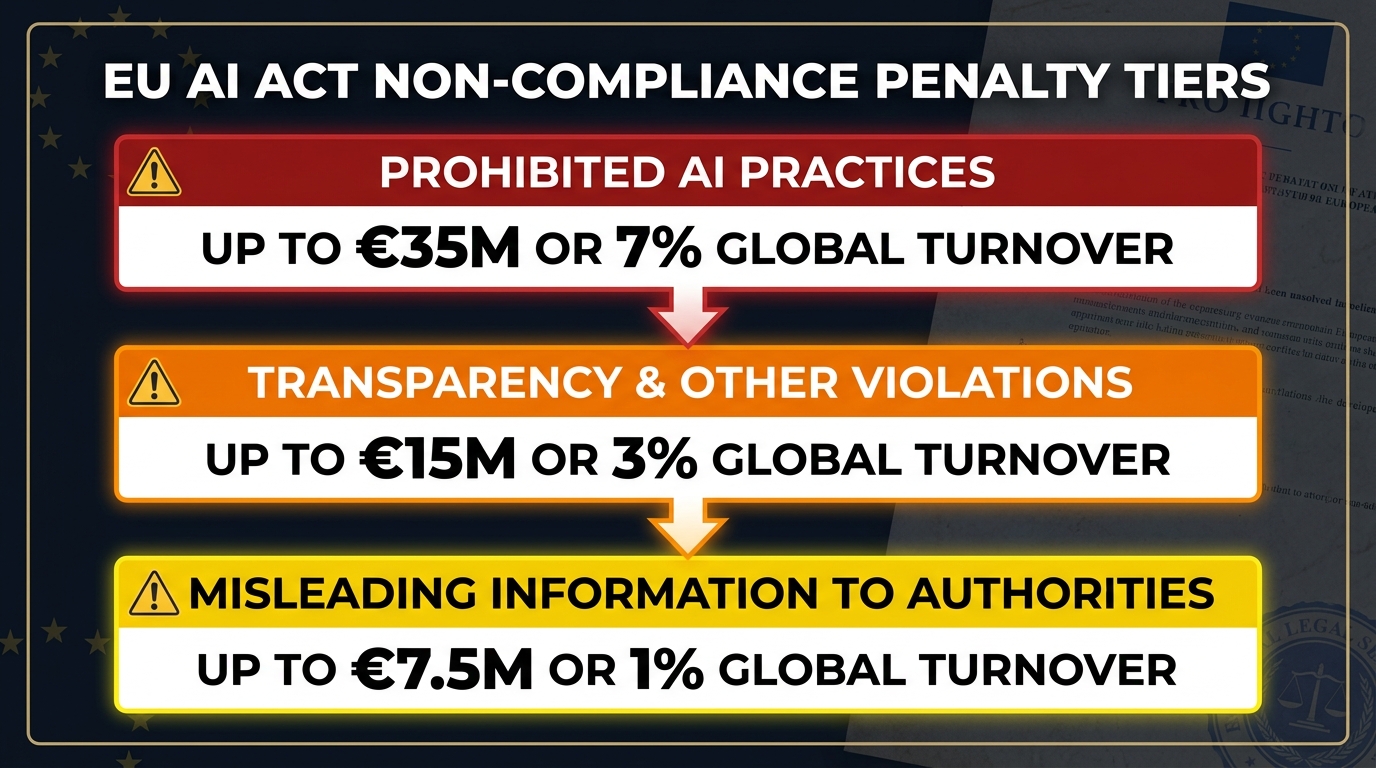
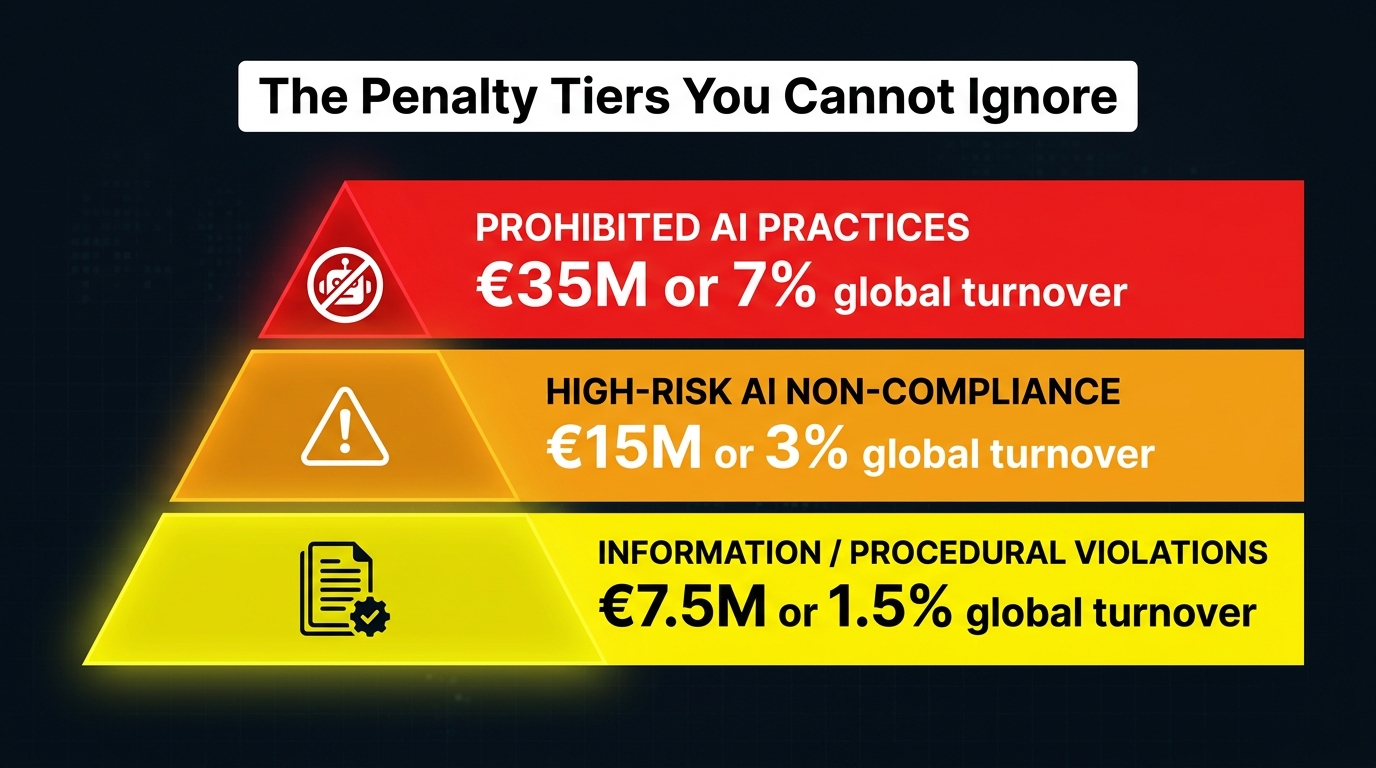
    EU AI Act penalty tiers infographic: up to €35M or 7% global turnover for prohibited practices, up to €15M or 3% for transparency violations, up to €7.5M or 1% for misleading authorities

    The EU AI Act’s penalty regime is tiered, and the positioning of transparency violations within that structure matters for how legal and risk teams should frame the compliance investment internally.

    The Three-Tier Fine Structure

    The Act establishes three penalty bands:

    • Tier 1 — Prohibited AI practices: Up to €35 million or 7% of global annual worldwide turnover, whichever is higher. Applies to systems that violate Article 5 — manipulative AI, real-time biometric surveillance in public spaces without legal basis, AI that exploits vulnerable groups.
    • Tier 2 — General non-compliance (including transparency violations): Up to €15 million or 3% of global annual worldwide turnover, whichever is higher. This is where Article 50 violations sit. Missing the chatbot disclosure, failing to label deepfakes, not implementing machine-readable marking — all fall here.
    • Tier 3 — Supplying incorrect information to authorities: Up to €7.5 million or 1% of global annual worldwide turnover, whichever is higher. Applies to misleading responses during regulatory inquiries or conformity assessments.

    The Global Turnover Basis

    The “global annual worldwide turnover” basis is not a European revenue calculation. It applies to the organisation’s total global revenue. For a large enterprise with €2 billion in global revenue, a Tier 2 violation could mean a fine of up to €60 million. For a mid-market organisation with €200 million global revenue, the ceiling is €6 million. The regulation uses whichever figure is higher — the fixed ceiling or the percentage — which means the percentage calculation is the binding constraint for most organisations with significant global revenue.

    The Proportionality Principle and Mitigating Factors

    Actual fines imposed by national authorities and the AI Office are expected to reflect proportionality. Regulators will consider the severity and duration of the infringement, whether it was intentional or negligent, whether the organisation took corrective action proactively, and whether cooperation with the investigation was forthcoming. An organisation that has documented its compliance efforts, implemented reasonable controls, and responded constructively to enforcement contact is in a materially different position than one that has no compliance programme at all.

    This is not just a legal argument — it is the practical case for building a documented compliance posture now, even if that posture is imperfect. Documented good-faith effort is a genuine mitigating factor. The absence of any compliance programme is not.

    SME Carve-Outs

    The Act includes specific provisions for small and medium-sized enterprises and startups. Member State authorities are directed to give priority to guidance over enforcement for SMEs, and fine calculations for SMEs may use a lower percentage of turnover. However, these carve-outs apply to the enforcement approach, not to the substantive obligations. SMEs must still comply with Article 50 — they simply have a different enforcement risk profile than large enterprises.


    Building a Compliance Audit Trail That Survives Enforcement

    The question regulators will ask is not only “are you compliant?” but “can you prove it?” Under the EU AI Act, the evidentiary burden in an enforcement proceeding sits with the organisation. You need documentation that demonstrates what your system does, when compliance measures were implemented, and how they function. The following elements form the minimum audit trail for Article 50 compliance.

    System Inventory and Role Classification Record

    Every AI system your organisation provides, deploys, or operates must be documented. For each system, the record must capture: the system’s function, the role your organisation occupies (provider, deployer, or both), the Article 50 obligations that apply to that system given its function and role, and the controls implemented to meet those obligations.

    This inventory is not a one-time exercise. Systems change. New agents get deployed. Existing agents get retrained or significantly modified. The inventory must be maintained as a living document with version history.

    Disclosure Implementation Records

    For every user-facing AI system, the audit trail must document how and when the Article 50(1) disclosure is delivered to users. This means capturing the specific disclosure text or interface element used, the point in the user journey at which it appears, the date the disclosure was implemented, and any changes made to the disclosure over time.

    Screenshots, design mockups, and UI specification documents all contribute to this record. The goal is to be able to demonstrate, if challenged, exactly what a user of your system would have seen at any point in time.

    Output Marking Logs

    For systems generating synthetic content subject to Article 50(2), you need logging that demonstrates outputs were marked at the point of generation. Server-side logs showing output generation events, the marking technique applied, and a timestamp are the minimum. Where technically feasible, audit samples of marked outputs should be preserved to demonstrate that the marking was effective.

    Vendor Documentation File

    The compliance chain extends to your GPAI providers. Maintain a vendor documentation file that records: the technical documentation your GPAI provider has supplied, the date it was received, and any updates or changes. If a provider fails to supply required documentation, the fact that you have requested it and followed up is relevant to your own compliance defence.

    Incident and Correction Log

    No compliance programme is perfect. When a failure is identified — a disclosure was omitted in a specific flow, a marking was not applied to a batch of outputs — what matters is that the incident is documented, the cause is identified, corrective action is taken, and the record of all of this is preserved. A compliance programme that identifies and corrects failures is substantially stronger, in a regulatory context, than a programme that claims there have been no failures.


    The 90-Day Compliance Sprint: Priorities in the Right Order
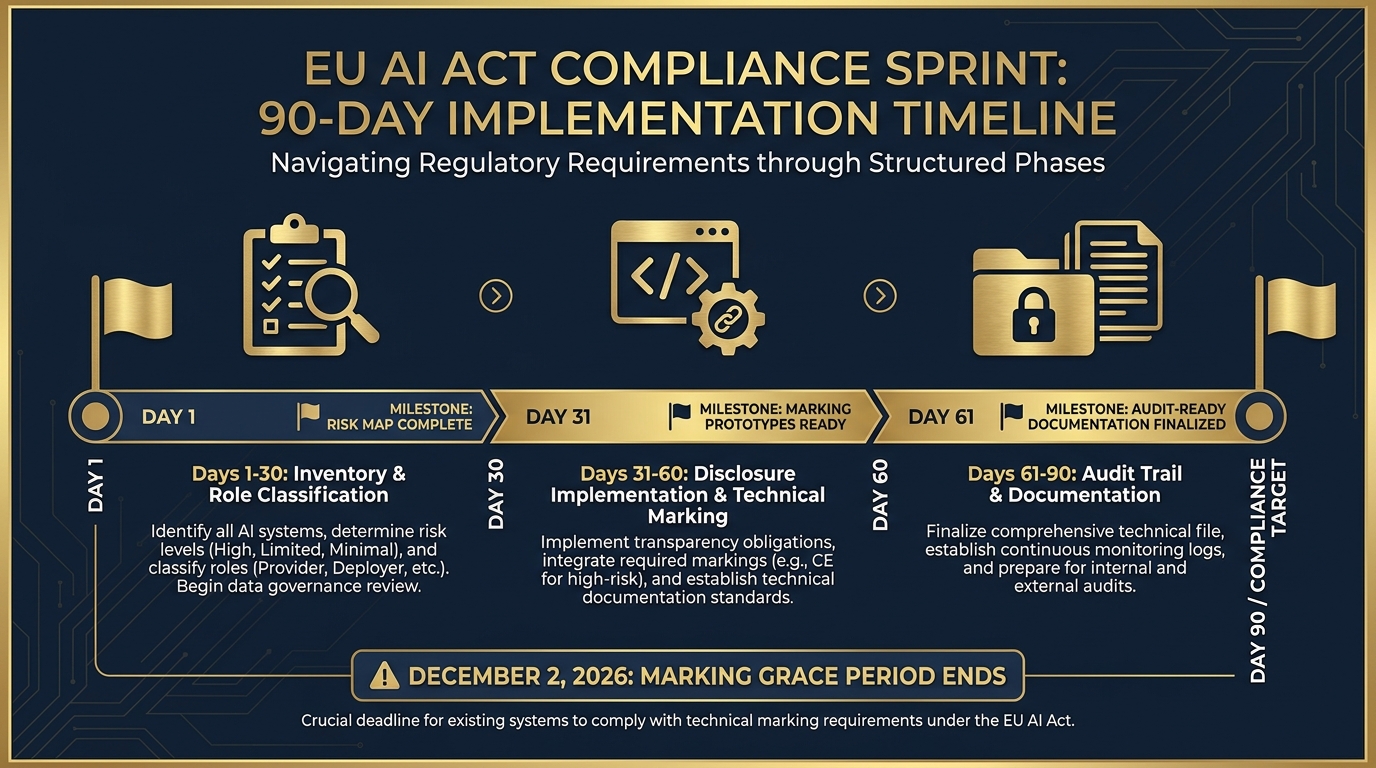
    90-day EU AI Act compliance sprint timeline showing three phases: inventory and role classification, disclosure implementation and technical marking, audit trail and documentation, with December 2 2026 marking grace period deadline

    With the December 2, 2026 grace period for machine-readable marking now approaching, compliance teams that have not yet begun structured implementation have a defined window. The following sequencing reflects both regulatory priority and practical implementation reality.

    Days 1–30: Inventory, Classification, and Gap Assessment

    The first priority is knowing what you have and where you stand. This phase should produce:

    • A complete inventory of every AI system the organisation provides, deploys, or operates — including agent systems, generative AI integrations, and any AI components embedded in non-AI products
    • A role classification for each system (provider, deployer, or both), documented with the reasoning for each classification
    • An obligation mapping for each system: which Article 50 obligations apply, and why
    • A gap assessment: for each applicable obligation, what is currently implemented and what is missing
    • A review of existing vendor contracts for GPAI providers to identify missing transparency documentation obligations

    This phase should involve legal, product, engineering, and data governance teams. It is not a legal exercise alone — legal teams cannot identify systems they do not know exist, and engineering teams cannot classify obligations without legal guidance on what the obligations mean.

    Days 31–60: Disclosure Implementation and Technical Marking

    With the gap assessment in hand, this phase focuses on implementation:

    • Design and deploy user-facing disclosures for all systems subject to Article 50(1). This includes not just the disclosure text but the UX placement — at session start, in the interface label, in the initial message — and testing to confirm the disclosure appears correctly across all access channels and devices
    • Implement deepfake and public-interest text labelling for any deployer-level obligations identified in the gap assessment
    • Select and begin implementing a machine-readable marking approach for generative output systems. The December 2 deadline makes this the most urgent technical task for organisations with existing systems that were market-deployed before August 2, 2026
    • Update or extend vendor contracts with GPAI providers to include explicit Article 53 documentation obligations
    • Draft and adopt an internal AI transparency policy that formalises the obligations identified in Phase 1 as standing operational requirements

    The machine-readable marking implementation is likely the heaviest technical lift in this phase. Allocate engineering resources accordingly and use the C2PA standard where your content types support it. For text-only outputs, document the technical feasibility assessment and the approach you are implementing — this documentation is itself part of your compliance posture.

    Days 61–90: Audit Trail, Documentation, and Governance

    The final phase converts implementation into a defensible compliance programme:

    • Formalise the system inventory as a maintained living document with an assigned owner and a review cadence (quarterly, at minimum)
    • Set up output marking logs with appropriate retention periods — 12 months minimum, aligned to applicable statute of limitations considerations
    • Establish a monitoring process for regulatory developments: the Commission’s guidance, AI Office enforcement decisions, and Member State implementation differences all have the potential to generate new obligations or clarify existing ones
    • Conduct a structured review of the disclosure and marking implementations: test them, document the test results, and correct any failures identified
    • Brief key stakeholders — board, legal, engineering leads, product managers — on the current compliance status and the ongoing monitoring programme

    At the end of this sprint, you should have: a system inventory, a role classification record, implemented disclosures, implemented (or in-progress) marking, a vendor documentation file, and an incident/correction log. That is a compliance programme. It will not be perfect. But it is a documented good-faith effort — which, in an enforcement proceeding, is the difference that matters.


    What the December Deadline Actually Changes — and What It Doesn’t

    The December 2, 2026 transition date for machine-readable marking applies only to one specific category: AI systems that were already placed on the EU market before 2 August 2026 and that are subject to the marking obligations under Article 50(2). It is a grace period for existing systems, not a general extension of the August enforcement date.

    Everything else that entered force on 2 August 2026 is already live:

    • Chatbot and interactive AI disclosure obligations are in force now and have been since August 2
    • Deepfake labelling obligations are in force now
    • Public-interest AI-generated text disclosure obligations are in force now
    • Emotion recognition and biometric categorisation disclosure obligations are in force now
    • GPAI provider obligations under Articles 53 and 55 are in force now

    The December date is a hard stop for the machine-readable marking grace period. Any system generating synthetic audio, image, video, or text that is deployed to EU users must implement compliant marking by that date, regardless of when it was first deployed.

    There is a risk that organisations view the December date as the real deadline and treat the August obligations as already behind them. That framing is wrong and dangerous. Enforcement for August-applicable obligations can begin from August 2. Any enforcement action launched before December will focus on those obligations, not the marking transition.


    Disclosure UX: Where Legal Requirements Become Product Decisions

    Compliance with Article 50 is not purely a legal and technical matter. It has significant product and user experience dimensions that determine whether an implementation meets the “clear and comprehensible” standard the regulation requires — or merely ticks a box while leaving users practically uninformed.

    What “Clear and Comprehensible” Means in Practice

    The regulation requires that disclosures be clear and comprehensible to users. This means:

    • Proximity: The disclosure must be near the interaction point, not in a separate document. A link to a terms-of-service page that mentions AI among many other topics is not clear and comprehensible disclosure of AI interaction.
    • Plain language: The disclosure must be understandable to a general user, not written in legal or technical jargon. “This service uses artificial intelligence” is acceptable. “This interface leverages a large language model fine-tuned on our proprietary dataset” is not — at least not as the primary disclosure.
    • Accessibility: The disclosure must be accessible to users with disabilities. If your interface relies on visual labels only, users with visual impairments may not receive the disclosure. Screen reader compatibility is part of the accessibility requirement.
    • Persistence: The disclosure should be present throughout the interaction in some form — not only in a popup that users dismiss before engaging. A persistent “AI-powered” label in the interface, alongside the initial disclosure, is a stronger implementation than a one-time notice.

    The Edge Cases That Require Judgment

    Some disclosure situations require product judgment rather than a simple rule application:

    Voice interfaces: Where an agent interacts via voice — telephone customer service, voice assistant — the disclosure obligation still applies but the implementation approach differs. A spoken disclosure (“You are speaking with an AI assistant”) at the start of the call is the standard approach. The timing and phrasing of this disclosure needs to be considered in the context of the call flow to ensure it is heard and registered.

    Personas with names: Many deployed agents use branded personas — “Meet Aria, your virtual assistant.” Giving an AI agent a human-sounding name does not exempt the system from disclosure. The obligation is to disclose the AI nature; the persona name is separate. The Commission’s guidance is clear that personas are not inherently deceptive if the AI disclosure is present, but the combination of a human-sounding name, photorealistic avatar, and no AI disclosure would be an enforcement risk.

    B2B professional interfaces: The “obvious from context” exception has more room to operate in B2B settings where users are sophisticated and the AI nature of the tool is intrinsic to the product’s value proposition. However, “obvious from context” remains a fact-specific assessment. Assume the exception is narrow and document the reasoning when you rely on it.


    Conclusion: Compliance Is Now an Engineering Requirement, Not Just a Legal One

    The EU AI Act’s transparency obligations have crossed from regulatory planning to operational reality. Article 50 is not a future risk to be monitored — it is a current requirement to be implemented. The grace period for machine-readable marking ends in December 2026. The obligations for chatbot disclosure, deepfake labelling, and public-interest AI text have been enforceable since August.

    The organisations that will navigate this well are the ones treating transparency compliance as an engineering requirement with legal specifications, not as a legal checkbox with engineering afterthoughts. Disclosure is a product feature. Machine-readable marking is a systems architecture decision. The provider/deployer classification affects vendor contract terms. The audit trail is a logging and retention problem.

    None of these are purely legal functions. They require coordinated action across product, engineering, legal, and data governance — and they require that action now, not at the next planning cycle.

    Key Takeaways for Agent Builders

    • Run the inventory first. You cannot comply with obligations you have not identified. Every AI system — not just the obvious chatbots — needs to be assessed against Article 50’s four distinct obligations.
    • Classify your role correctly. Building an agent on a third-party model makes you both a deployer (relative to the model) and a provider (relative to the agent). Both roles carry obligations. Both require action.
    • Don’t conflate disclosures with terms of service. Article 50 disclosure must be proximate, plain, and primary. It must be in the interaction, not in the fine print.
    • Start machine-readable marking now. The December 2 deadline is not far. Selecting an approach, integrating it into your output pipeline, and testing it takes time. The C2PA standard is the practical starting point for images and audio.
    • Treat multi-agent pipelines as a single system for compliance. The orchestrator’s team owns the end-to-end transparency posture. Delegating compliance to subcomponent vendors without verification is not a defensible position.
    • Build the audit trail as you build the compliance programme. Documentation of what you implemented, when, and why is not an afterthought — it is what converts a compliance programme into a compliance defence.
    • Get your GPAI vendor documentation in order. Request and file the technical documentation your model providers are obligated to supply under Article 53. The absence of that documentation is a gap in your own compliance posture.

    The transparency obligations in the EU AI Act are not the most technically demanding requirements in the regulation — the high-risk system obligations are substantially heavier. But they are the first ones to be enforced at scale, and they apply to every organisation deploying AI agents to EU users. There is no threshold, no sector carve-out, and no minimum size that exempts an organisation from Article 50. If you interact with EU users through AI, these rules apply to you.

    The August deadline has passed. The December deadline is visible on the horizon. The compliance sprint starts now.
  • The EU AI Act’s Moving Deadlines: What the Revised Timeline Actually Means for Your Business Right Now

    The EU AI Act’s Moving Deadlines: What the Revised Timeline Actually Means for Your Business Right Now

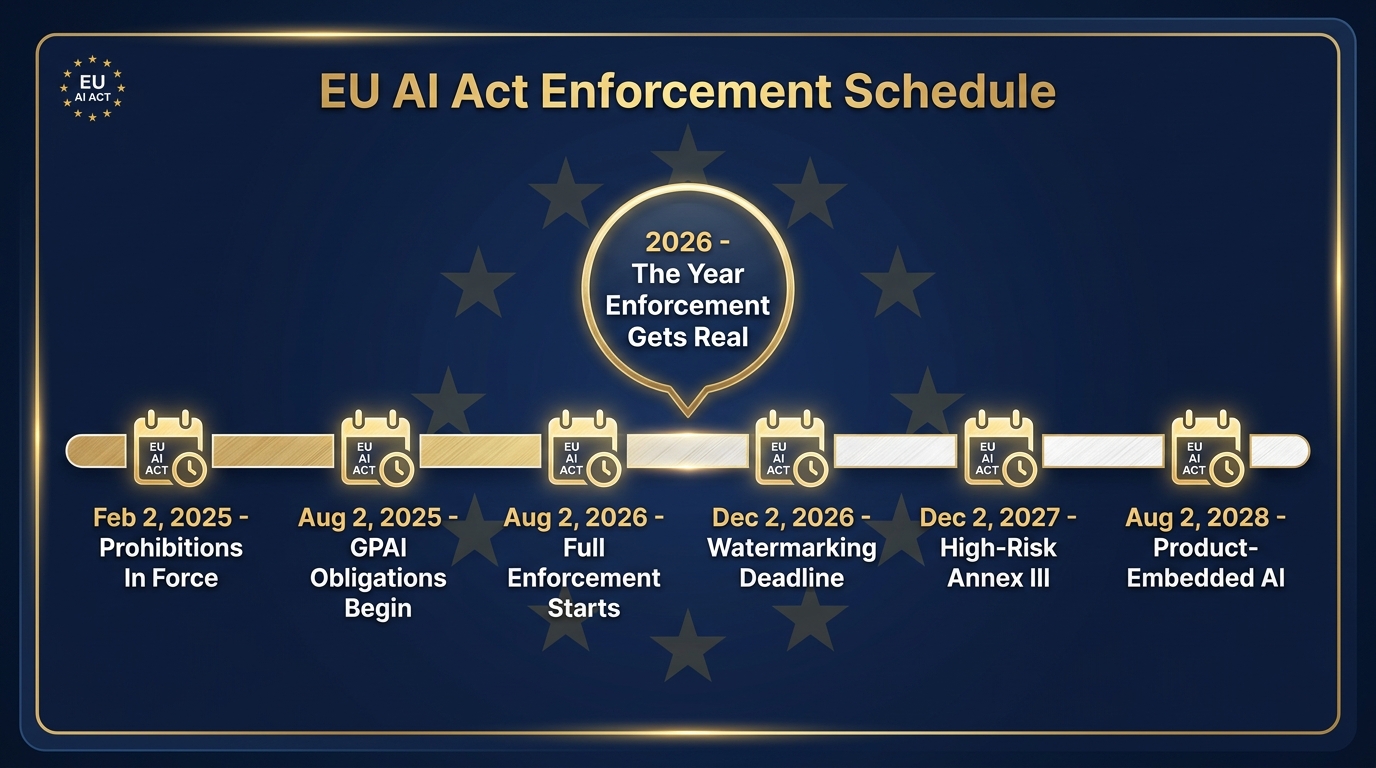
    EU AI Act enforcement timeline infographic showing key dates from 2025 through 2028

    If you have been tracking the EU AI Act, you have noticed a pattern: the deadlines keep shifting. This is not paranoia or misreading of legal text — it is a documented feature of a regulatory process that is genuinely difficult to execute at EU scale, across 27 member states, governing technology that evolves faster than parliamentary procedure. The latest round of changes, primarily driven by the so-called Digital Omnibus package negotiated in early 2026, moved several of the most consequential compliance deadlines by 16 months or more.

    The natural instinct for compliance teams — and especially for the executives who fund them — is to interpret each delay as breathing room. And for certain categories of AI system, particularly standalone high-risk applications, the extensions are real and substantive. But that reading collapses the moment you look at the full picture. The August 2, 2026 enforcement date that governs general-purpose AI models, prohibited practice bans, transparency obligations, and national enforcement powers has not moved. The penalties attached to those rules have not changed either — up to €35 million or 7% of global annual turnover for the most serious violations.

    This post is not a summary of dates. Plenty of those exist. Instead, it takes a harder look at what the revised timeline actually reveals about where regulatory pressure sits right now, where the false sense of security is forming, and what specific obligations are active and enforceable regardless of the deadline reshuffling happening around them. It also addresses the readiness gap, which by multiple survey measures remains staggering, and walks through what a realistic compliance posture looks like given the landscape that actually exists in mid-2026.

    The Timeline in Full: Original Promises vs. Current Reality

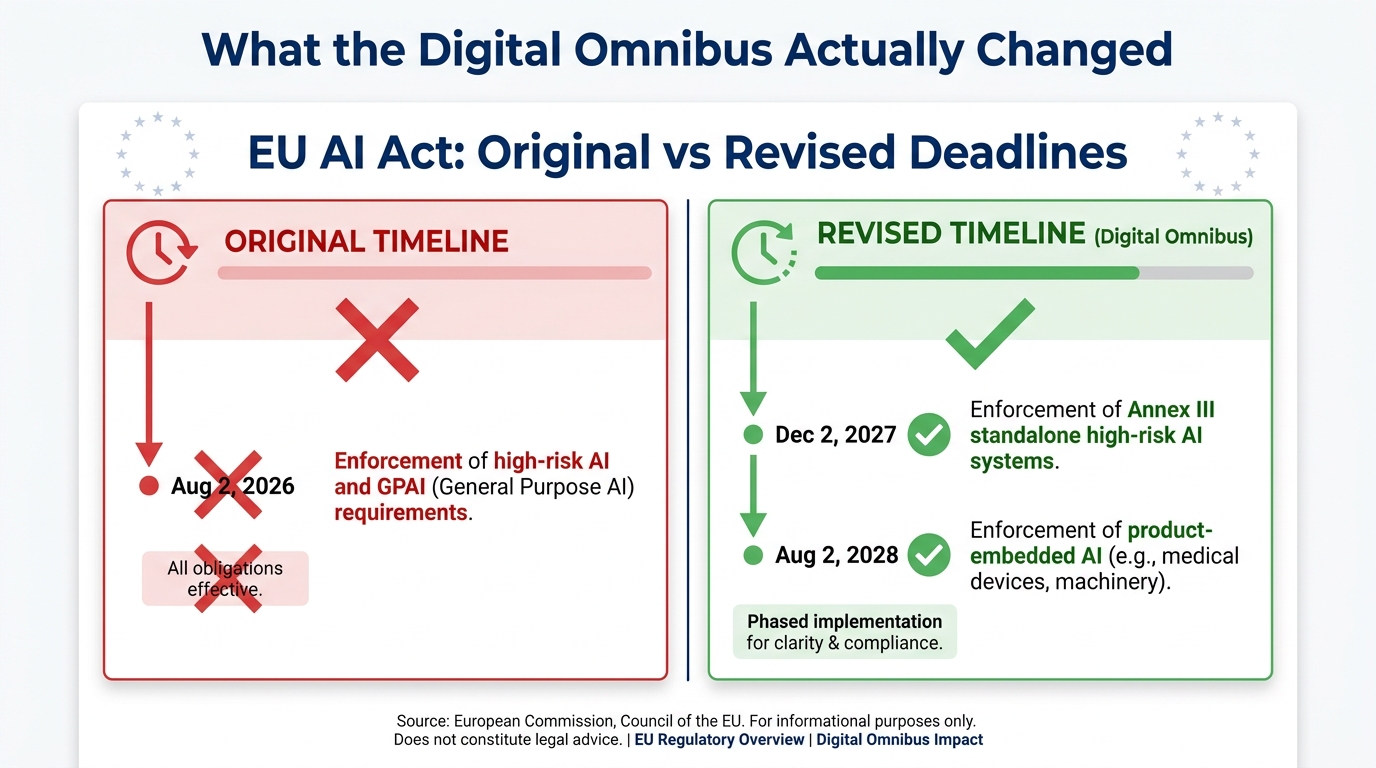
    Side-by-side comparison of EU AI Act original and revised deadlines after the Digital Omnibus

    To understand what changed, you first have to understand what was originally promised. When the EU AI Act was published in the Official Journal on July 12, 2024, the phased rollout schedule looked like this:

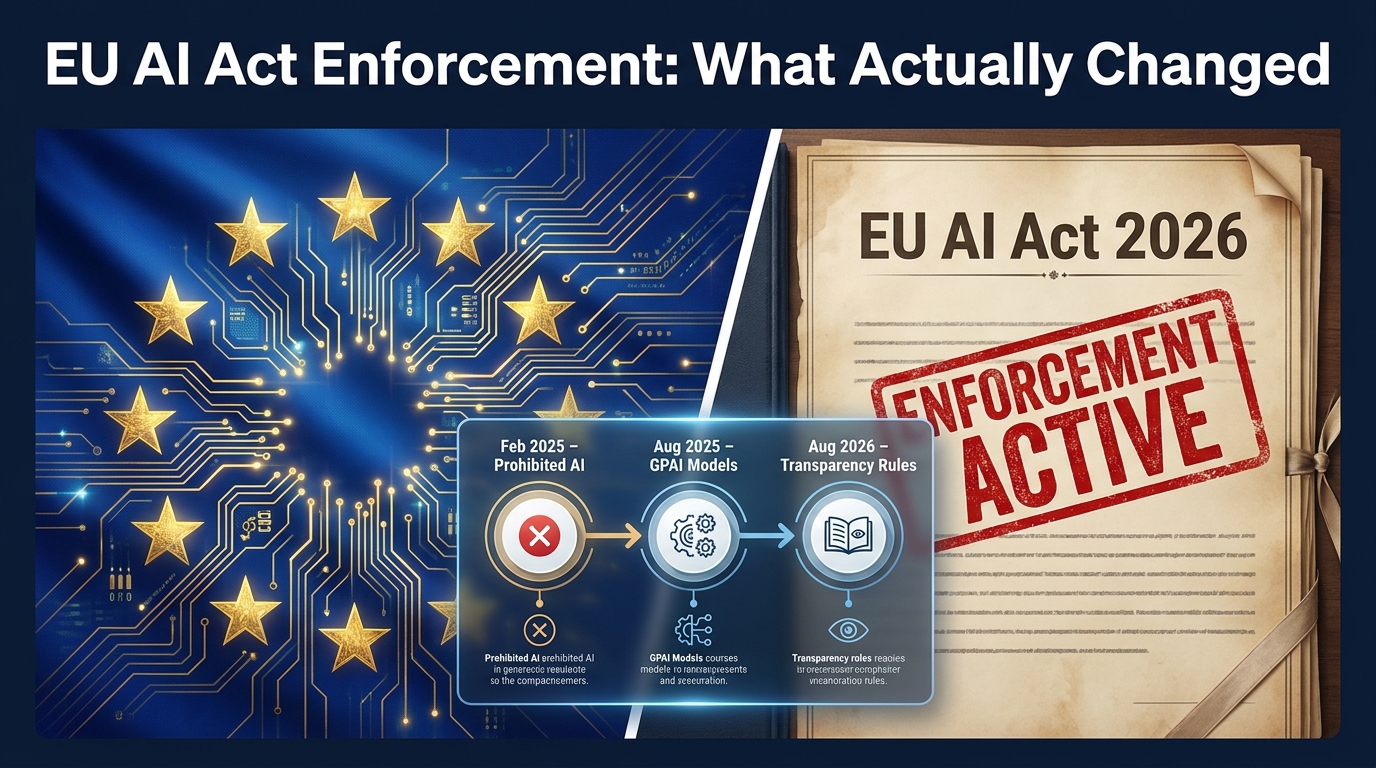
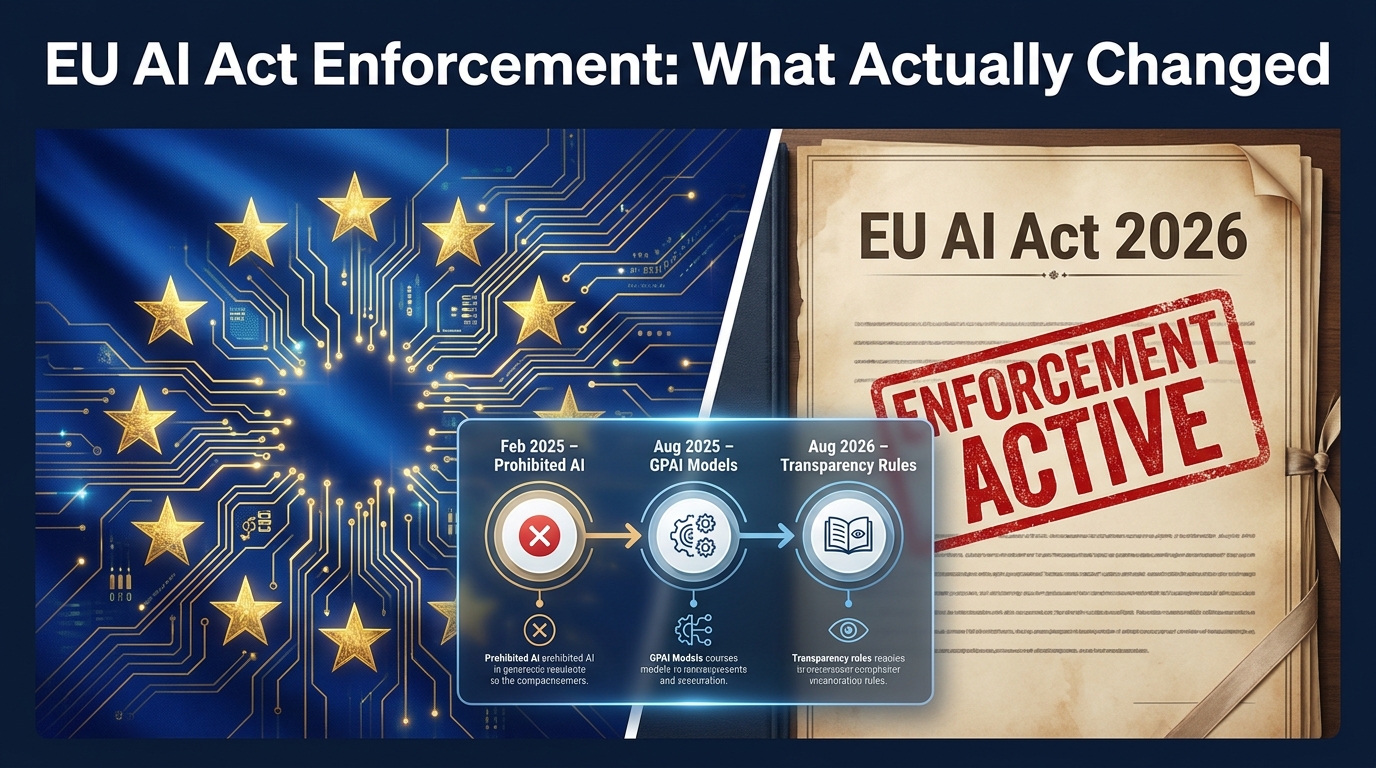
    • February 2, 2025: Prohibited AI practices (Article 5) enter into force.
    • August 2, 2025: General-purpose AI (GPAI) model obligations begin. AI literacy duties apply. National competent authorities must be designated.
    • August 2, 2026: The Act applies broadly — enforcement powers activate for GPAI, high-risk systems under Annex III, transparency rules under Article 50, penalty mechanisms become fully operational.
    • August 2, 2027: High-risk AI embedded in regulated products under Annex I must comply.

    What the Digital Omnibus Actually Changed

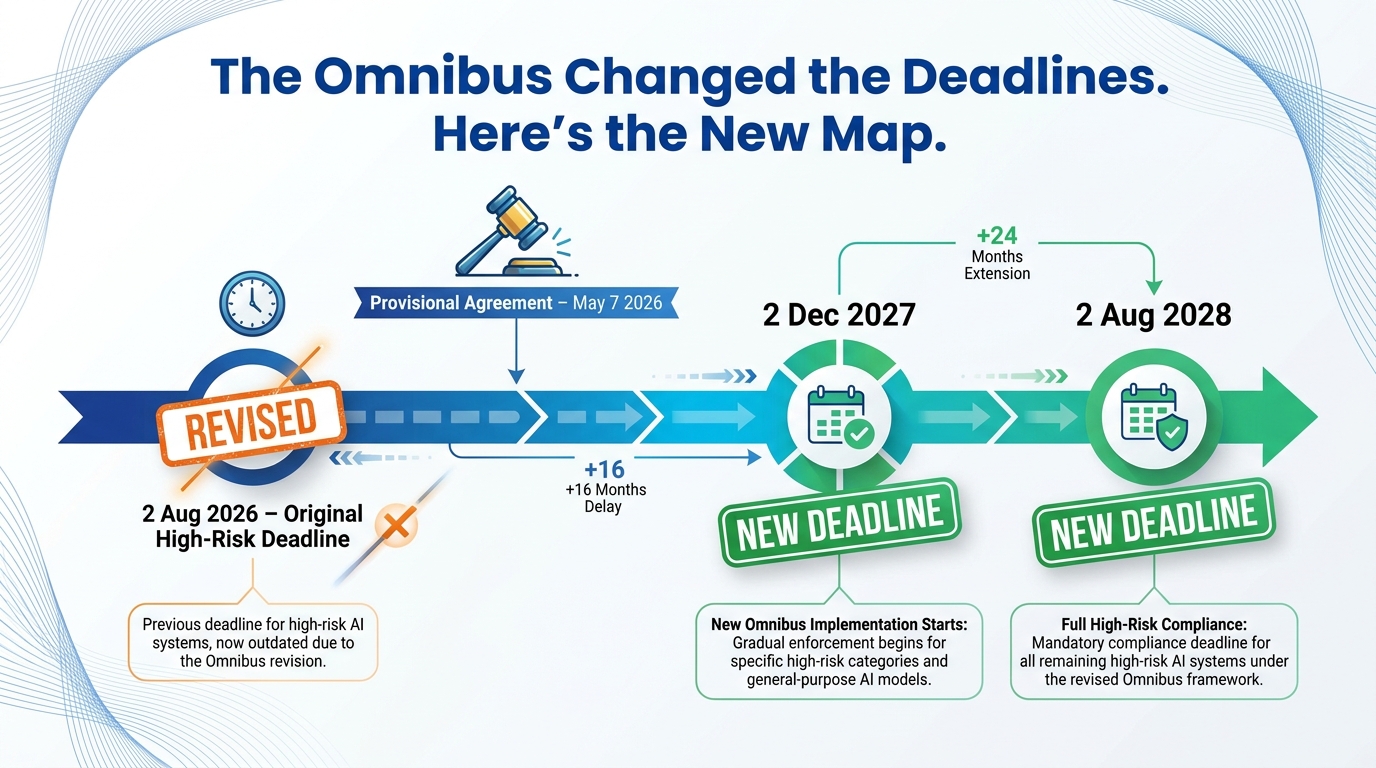
    The Digital Omnibus package — a legislative bundle intended partly to reduce regulatory burden on European businesses competing with US and Chinese AI development — introduced targeted amendments. The most significant were to the high-risk AI deadlines:

    • Annex III standalone high-risk systems (AI used in hiring, credit scoring, education, law enforcement, biometric identification, etc.) moved from August 2, 2026 to December 2, 2027 — a 16-month extension.
    • Annex I product-embedded high-risk systems (AI built into machinery, medical devices, vehicles, and similar regulated products) moved from August 2, 2027 to August 2, 2028 — a 12-month extension.
    • A narrower extension on machine-readable watermarking under Article 50 pushed that specific technical obligation to December 2, 2026 for AI systems already on the market before August 2, 2026.

    What Did Not Change

    This is where many compliance summaries fall short. The Digital Omnibus did not touch:

    • The February 2025 banned practices — those are already law.
    • The GPAI obligations that have applied since August 2025.
    • The August 2, 2026 enforcement date for transparency duties, penalty mechanisms, and the Commission’s oversight powers over GPAI providers.
    • The national AI literacy obligations that member states must implement.

    The net effect is a two-track enforcement reality. For companies using AI in HR, lending, education, or law enforcement, there is genuinely more time to build compliant systems. For companies building or deploying general-purpose AI, generating synthetic content, or running AI systems that interact with people, the August 2026 wave is here and fully active.

    What Has Been Banned Since February 2025 — And Why It Still Gets Overlooked

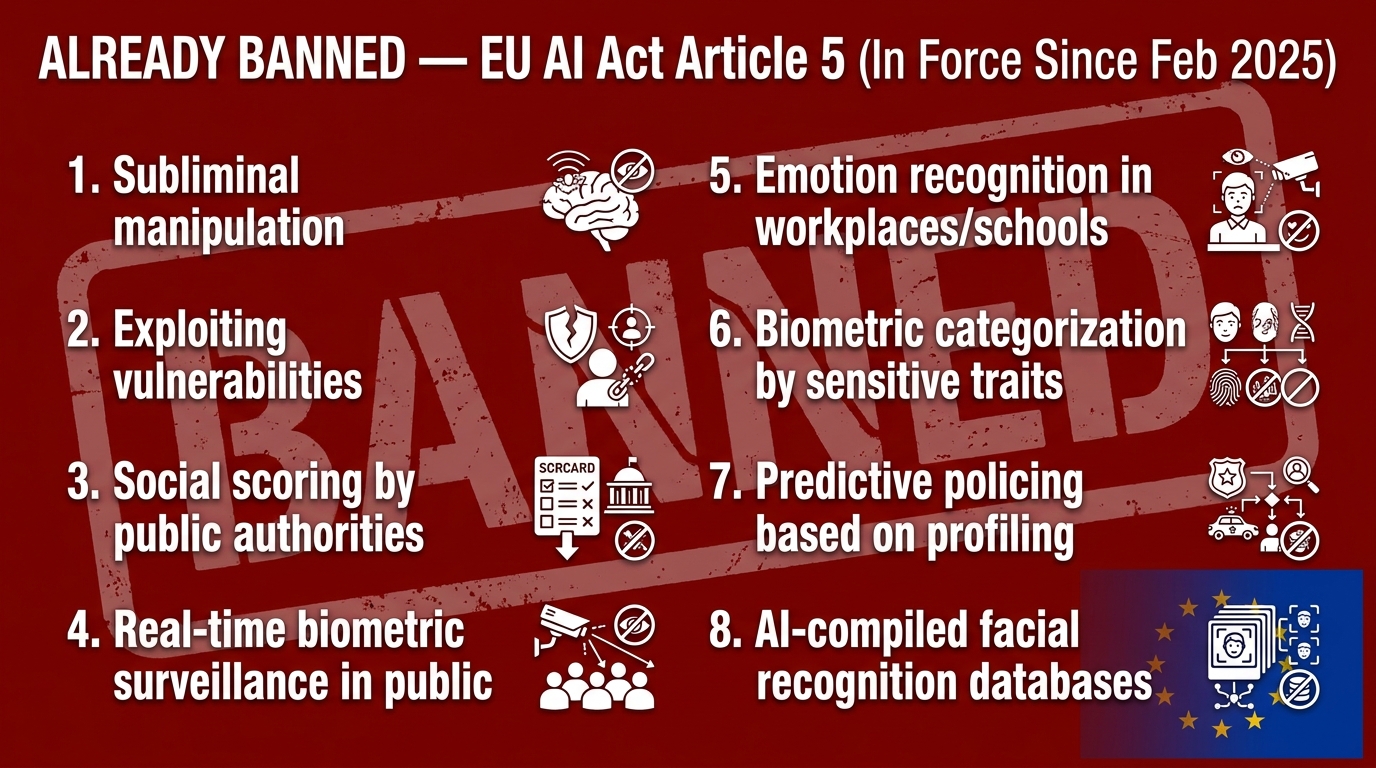
    Infographic showing 8 prohibited AI practices already banned under EU AI Act Article 5 since February 2025

    The deadline conversation has largely eclipsed the fact that the EU AI Act’s most dramatic provisions — its outright bans — have been in force for over a year. Article 5 applied from February 2, 2025. That is not a transitional or preparatory milestone. It is an active prohibition.

    The Eight Prohibited Practices

    The following AI uses are currently illegal in the EU, full stop:

    1. Subliminal or deceptive manipulation — AI systems that use techniques below the threshold of conscious awareness, or deliberately deceptive methods, to materially distort a person’s behavior in ways that cause or are likely to cause significant harm.
    2. Exploitation of vulnerabilities — AI that targets specific groups (children, people with disabilities, those in difficult economic circumstances) and exploits those vulnerabilities to influence behavior in harmful ways.
    3. Social scoring by public authorities — Governments and public bodies cannot use AI to evaluate citizens across multiple contexts and then use that score to discriminate against them in unrelated settings.
    4. Real-time biometric surveillance in public spaces — Remote biometric identification systems operating in real time in public settings are prohibited, with narrow and tightly conditioned exceptions for specific law enforcement purposes.
    5. Emotion recognition in workplaces and educational institutions — AI systems designed to infer the emotional state of workers or students based on biometric data are banned in these contexts.
    6. Biometric categorization by sensitive characteristics — Inferring race, political opinion, trade union membership, religious belief, or sexual orientation from biometric data is prohibited.
    7. Predictive policing based on profiling — AI systems that assess an individual’s risk of committing a crime based solely on profiling, personality traits, or past criminal history without a concrete causal link to actual criminal activity.
    8. Scraping of facial recognition databases — Building or expanding facial recognition databases by untargeted scraping from the internet or CCTV footage.

    Why Companies Are Still Getting This Wrong

    The reason these bans get overlooked is partly structural. Compliance programs have naturally focused on the preparation work for the larger August 2026 implementation wave. The February 2025 bans arrived before most compliance functions were even fully stood up. And because enforcement at the national level has been uneven — more on that shortly — there has been no high-profile enforcement action to trigger widespread awareness.

    But legal exposure does not depend on whether enforcement has been exercised. Companies deploying AI systems that even superficially resemble these prohibited practices — particularly emotion recognition tools, dark-pattern recommendation engines, or biometric categorization features — face genuine legal risk today, regardless of the broader deadline discussion.

    August 2, 2026: The Enforcement Inflection Point That Actually Matters

    If there is one date that the Digital Omnibus did not change and that deserves primary attention right now, it is August 2, 2026. This is when the EU AI Act transitions from a phased preparation period into a fully operational enforcement regime for a wide range of obligations.

    What Became Enforceable on August 2, 2026

    Several interconnected rules moved into active enforcement:

    General-purpose AI model obligations — GPAI providers (think the major foundation model developers and their downstream licensees) had to meet transparency, copyright compliance, and safety documentation requirements since August 2025. The difference from August 2026 onwards is that the Commission’s formal enforcement powers over those providers are now fully activated. Investigation procedures, penalties, and market access controls are all live.

    Transparency duties under Article 50 — This is the article that most businesses had been quietly ignoring, and it now applies directly. Any system that interacts with humans in ways that could reasonably mislead them into thinking they are talking to a person must disclose its AI nature. AI systems generating synthetic audio, video, or image content must include disclosures. Deepfake content requires explicit labeling.

    National enforcement infrastructure — National competent authorities in each member state now have full investigative and sanctioning powers. The AI Office at EU level has coordination and oversight authority. The full penalty regime — up to €35 million or 7% of global annual turnover for prohibited practice violations, up to €15 million or 3% for high-risk AI violations, and up to €7.5 million or 1.5% for providing incorrect information — is operational.

    AI literacy obligations — Providers and deployers of AI systems are required to take measures to ensure that their staff and other persons dealing with AI systems on their behalf have sufficient AI literacy. This is not a vague aspiration — it is a documented obligation that can be tested in a regulatory inquiry.

    What the August 2026 Date Does Not Cover

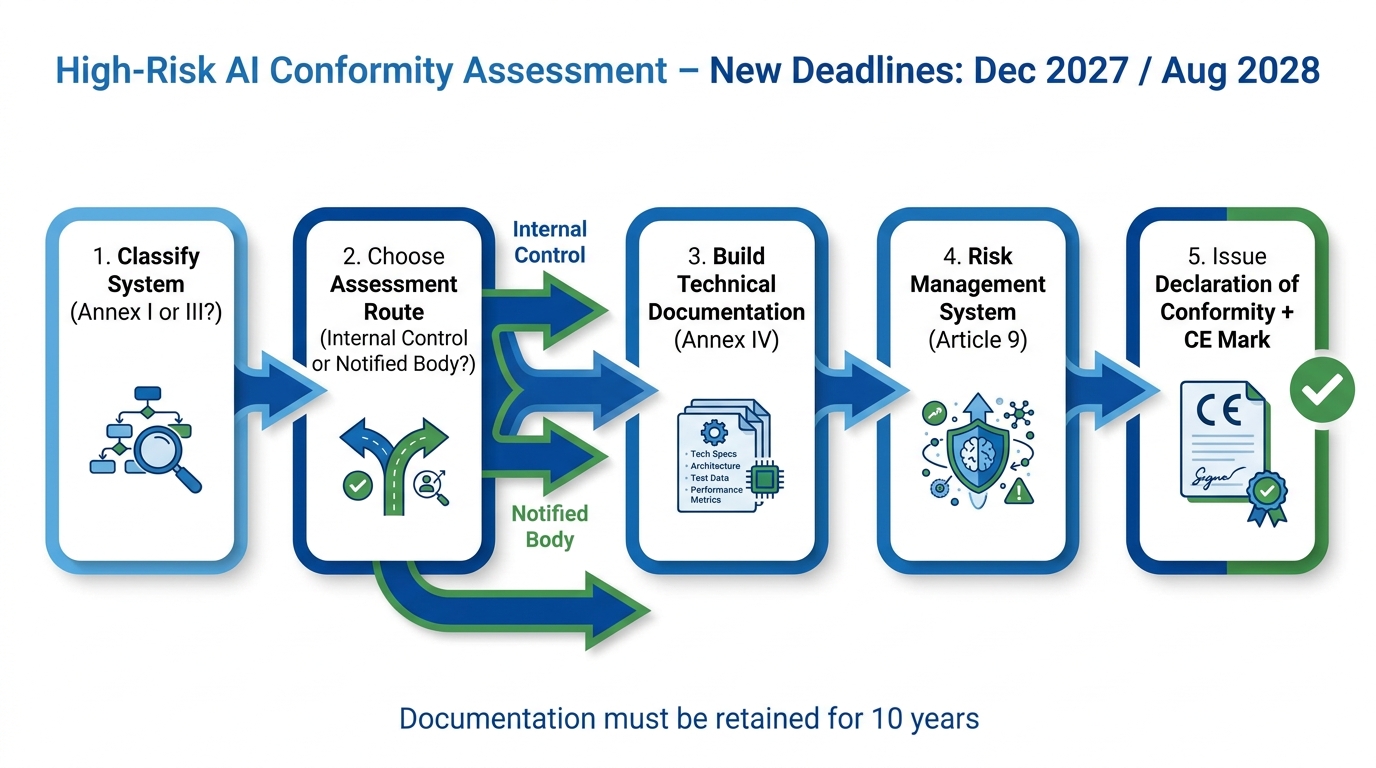
    It is equally important to be precise about what August 2, 2026 does not trigger. Because of the Digital Omnibus extensions, the full compliance requirements for high-risk Annex III systems — the detailed documentation, conformity assessments, human oversight requirements, registration in the EU database, and post-market monitoring — are not yet mandatory for most standalone high-risk applications. Those obligations arrive in December 2027 for Annex III systems and August 2028 for product-embedded AI.

    This creates a genuinely complex situation: the enforcement machinery is running, but some of the substantive rules it will eventually enforce are still on the way. The practical consequence is that companies in the August 2026 zone (GPAI, transparency, prohibitions) face immediate operational compliance pressure, while companies focused on high-risk Annex III applications have more time — but still need to be building toward the 2027 standard now, because 16 months is not as long as it sounds when conformity assessment processes are involved.

    The Digital Omnibus Deep Dive: What Was Actually Traded Away for More Time

    The Digital Omnibus did not simply push dates backward without conditions. Understanding what was added alongside the deadline extensions helps explain the regulatory logic and reveals where the future pressure points will concentrate.

    New Substantive Rules Added by the Omnibus

    Two new prohibitions were introduced alongside the deadline extensions, and they are targeted specifically at generative AI:

    Non-consensual intimate content (NCII) — AI systems that generate non-consensual synthetic intimate imagery, commonly referred to in press coverage as deepfake pornography, now face explicit prohibition. This was not in the original Article 5. Its addition as part of the Omnibus reflects the political weight that this issue had accumulated across multiple member states, and it underscores that the Omnibus was not purely deregulatory — it traded some delay in high-risk deadlines for sharper prohibitions in areas with clearer societal harms.

    Child sexual abuse material (CSAM) — The Omnibus added an explicit AI-specific ban on systems designed or used to generate AI-produced CSAM, complementing existing criminal law frameworks across member states.

    SME and Small Mid-Cap Relief

    The Omnibus also expanded access to simplified compliance pathways. Previously, SME-style lighter-touch processes were available only to companies meeting the EU’s standard SME definition (fewer than 250 employees, less than €50 million turnover). The Omnibus extended simplified compliance access to what it terms “small mid-caps” — companies that fall just outside traditional SME thresholds but are not major enterprises. This is a meaningful concession for the broad middle tier of European businesses that use AI without developing it, and it should change the compliance planning calculus for companies in that size range.

    Sandbox Expansion

    Regulatory sandboxes — controlled environments where companies can test AI systems under regulatory supervision before full deployment — were expanded and made more accessible under the Omnibus. National competent authorities are now expected to have operational sandboxes, providing a development pathway for companies that want to move toward high-risk AI applications without betting the entire compliance program on legal interpretations that have not yet been tested by regulators.

    GPAI Models: The Clock That Didn’t Move

    If one area of the EU AI Act has been most misread in the context of the Omnibus deadline changes, it is general-purpose AI. A significant number of compliance communications in early 2026 referenced the Omnibus extensions without clearly distinguishing that GPAI obligations were not included in those extensions.

    What GPAI Obligations Look Like in Practice

    The EU AI Act defines general-purpose AI models as AI models — including large generative models — trained on broad data at large scale, capable of competently performing a wide range of distinct tasks. The key rules that apply to providers of these models include:

    • Technical documentation — Providers must maintain documentation about the model, its training process, capabilities, and limitations sufficient for downstream providers to build compliant applications on top of it.
    • Copyright transparency — Summaries of the training data must be published, allowing rights holders to assess whether their content was used.
    • Acceptable use policies — GPAI providers must publish policies governing permissible downstream use.
    • Safety obligations for systemic-risk models — Models above a computational training threshold of 10²⁵ FLOPs are designated systemic-risk models and face additional obligations including adversarial testing, incident reporting to the AI Office, and cybersecurity measures.

    These obligations have applied since August 2025. The difference from August 2, 2026 onward is that the Commission’s investigative and enforcement powers over GPAI providers are now fully operational. Non-compliance is no longer a documentation gap — it is an active enforcement exposure.

    Who Is Actually a GPAI Provider Under the Act?

    This is a question that many businesses using foundation models from third-party providers have not fully worked through. The distinction matters because the obligations for GPAI providers are different from — and in some respects more extensive than — those for deployers of AI systems. A company that fine-tunes a foundation model and offers it as a commercial product may qualify as a GPAI provider under the Act’s definition, not merely a deployer. The determination turns on questions of training scale, task generality, and commercial distribution, and it is not always obvious without a careful legal analysis of how the company’s AI products are built and sold.

    Article 50 Transparency: Deepfakes, Chatbots, and the Watermarking Split

    Article 50 is the provision that most directly affects everyday product and marketing decisions for companies using AI in customer-facing applications. As of August 2, 2026, this article is fully in force — with one narrow carve-out that requires careful reading.

    What Article 50 Requires Right Now

    There are several distinct transparency duties bundled under Article 50:

    AI interaction disclosure — Providers of AI systems designed to interact directly with natural persons must ensure those systems disclose their AI nature at the start of any interaction, unless this is obvious from context. This applies to chatbots, virtual assistants, AI customer service agents, and similar products.

    Deepfake disclosure — Any deployer using an AI system to generate or manipulate image, audio, or video content that constitutes a deepfake — meaning content that portrays real people doing or saying things they did not do or say — must label that content as artificially generated or manipulated in a clear and prominent manner. This obligation applies from August 2, 2026, with no grace period.

    AI-generated synthetic content disclosure — More broadly, content generated by AI systems (including text, audio, images, and video) must be identifiable as such, with technical markers that enable automated detection.

    The Watermarking Grace Period: What It Covers and What It Doesn’t

    The narrower grace period introduced by the Omnibus affects the machine-readable marking or watermarking requirement for generative AI outputs. Specifically, AI systems that were already placed on the market before August 2, 2026 have until December 2, 2026 to implement the technical watermarking required for automated detection of synthetic content.

    This is a much narrower relief than it sounds. It does not affect the human-visible disclosure requirement for deepfakes — that applies immediately. It does not affect chatbot disclosure requirements. It covers only the technical, machine-readable marking of synthetic content for systems that were already on the market before the August 2 date. Any system launched after August 2, 2026 must meet the full watermarking requirement from day one.

    For product teams managing content generation features — AI image tools, video synthesis, voice cloning, AI writing assistants — the practical implication is immediate: if your product creates synthetic content using a pre-existing model, you have until December 2026 to implement technical watermarking, but you must already be providing human-visible disclosures where deepfake content is produced.

    The Enforcement Patchwork: Why National Readiness Is the Wild Card

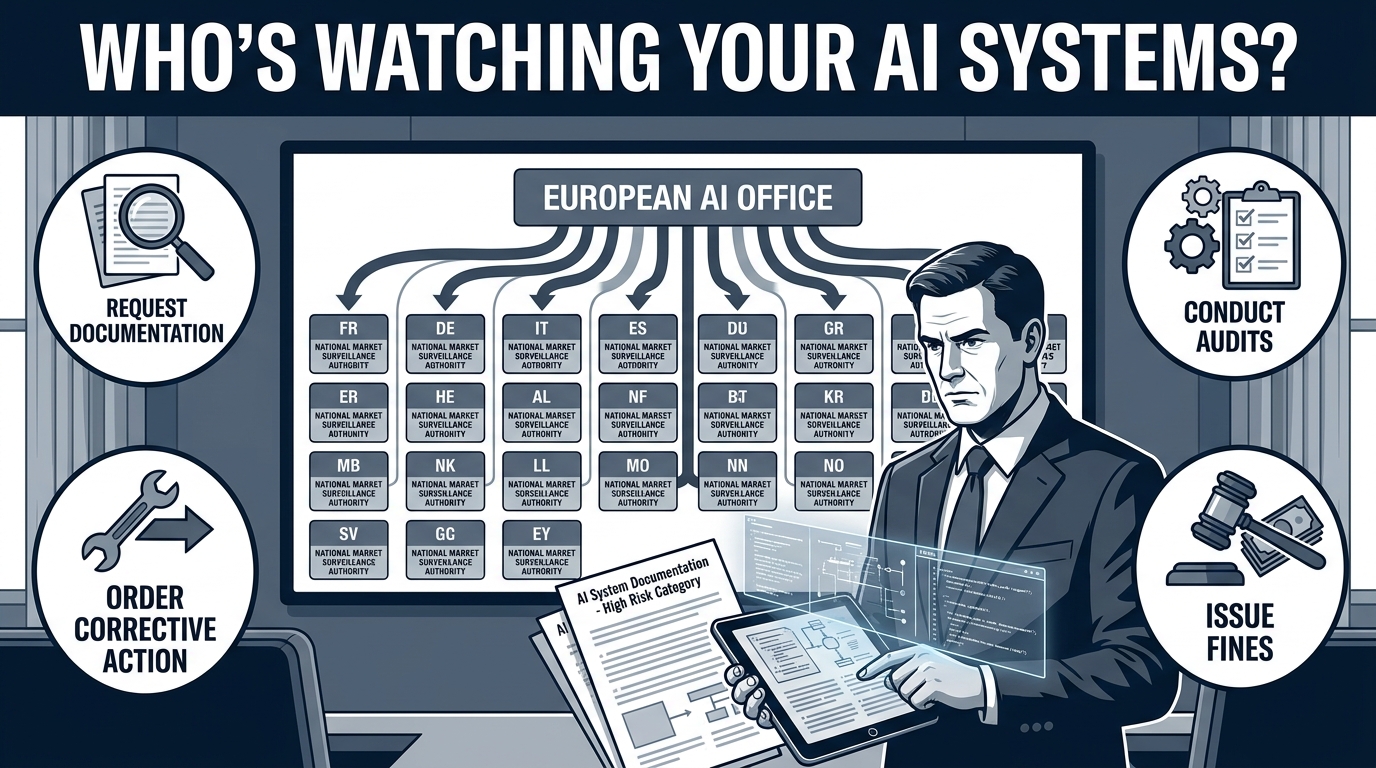
    The EU AI Act is EU-wide legislation, but it is enforced primarily through national competent authorities (NCAs) in each member state. The architectural choice to rely on national enforcement infrastructure — rather than a fully centralized EU enforcement body — creates a de facto patchwork that significantly affects how the regulation lands in practice.

    The NCA Designation Crisis

    Member states were required to designate their NCAs by August 2, 2025. According to tracking data from spring 2026, fewer than one-third of EU member states had completed the formal designation and notification process by that deadline. Countries that had made clear progress included Spain, Ireland, Italy, Germany, Lithuania, Finland, and Cyprus. Significant gaps remained in others.

    This matters operationally. An NCA that has not been formally constituted with adequate staffing, legal powers, and technical expertise cannot meaningfully investigate potential violations or assess conformity assessments. Where NCAs are not yet operational, enforcement is effectively suspended at the national level — even though the AI Office at EU level retains oversight authority, particularly over GPAI providers.

    What This Means for Companies

    The enforcement patchwork creates an asymmetric risk environment. Companies operating primarily in member states with well-resourced, operational NCAs face genuine near-term enforcement exposure. Companies in member states with limited NCA capacity face lower immediate enforcement probability — but not lower legal liability. The obligations exist regardless of enforcement capacity.

    There is also a cross-border dimension. Because AI systems typically operate across multiple member states simultaneously, a company based in Germany can be subject to the NCA of any member state where it deploys AI systems. And the AI Office at EU level — which has direct enforcement authority over GPAI providers — operates independently of national readiness.

    The strategic risk of treating uneven enforcement capacity as tacit permission to delay compliance is significant. NCAs are building capacity now. The enforcement gap in 2026 is a timing artifact, not a structural limitation. Companies that use the NCA readiness window to delay compliance work rather than accelerate it are accumulating liability against an enforcement infrastructure that will eventually mature.

    The Readiness Gap: What 78% Unprepared Actually Looks Like Inside Organizations

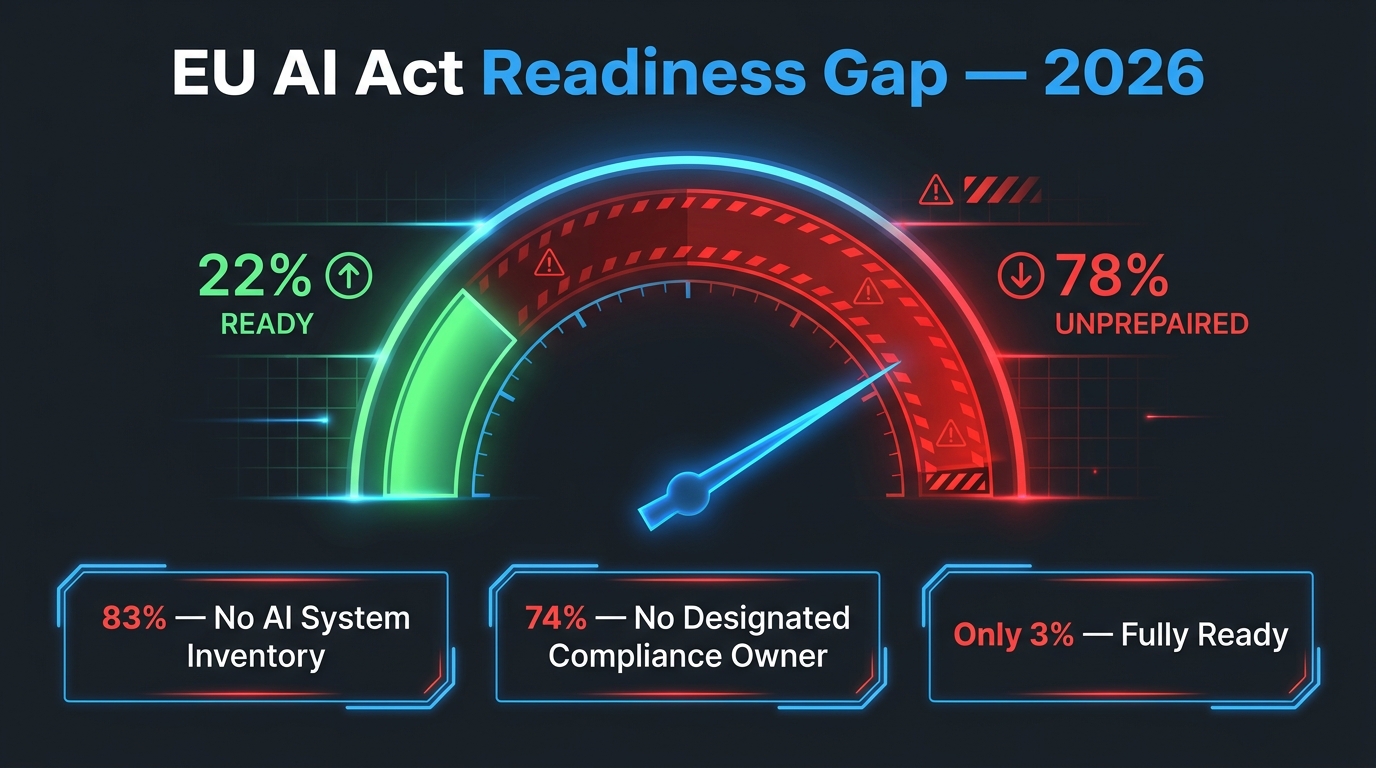
    EU AI Act readiness gap infographic showing 78% of organizations unprepared and only 3% fully ready

    Multiple surveys conducted in the first half of 2026 point to a compliance readiness picture that is, by any reasonable standard, alarming. Approximately 78% of enterprises had not taken meaningful steps toward EU AI Act compliance as of the surveys’ reference dates. One study found that only 3% of enterprises considered themselves fully ready. Among providers of high-risk AI systems specifically — the organizations for whom compliance stakes are highest — only 18% indicated they could demonstrate conformity today.

    What the Operational Gaps Look Like

    The readiness surveys do not just report aggregate unpreparedness — they identify specific operational gaps that illuminate where organizations are failing:

    83% lack a formal AI system inventory. This is the most fundamental gap, and it is also the most consequential. You cannot classify a system’s risk level, assign compliance obligations, or build governance around it if you do not know it exists. Many large organizations are discovering AI systems in procurement, HR, finance, customer service, and IT that were deployed at department level without central visibility. Shadow AI adoption during the rapid expansion of enterprise AI tooling in 2024 and 2025 has created an inventory problem that compliance teams are only beginning to map.

    74% have no designated internal owner or governance body for AI compliance. AI Act compliance spans legal, technical, procurement, HR, and executive functions. Without a named owner with cross-functional authority and budget, the obligations stall in organizational ambiguity. The gap here reflects a broader governance immaturity — many companies have AI ethics principles or responsible AI statements but no operational function that owns day-to-day compliance work.

    61% lack technical documentation processes. For high-risk AI systems, the Act requires detailed technical documentation covering the system’s purpose, capabilities, limitations, training data sources, development methodology, and performance metrics. Building these processes after the fact — retrofitting documentation onto systems that were built without it — is significantly harder than building documentation requirements into the development pipeline from the start.

    The Median Readiness Score Problem

    One benchmarking study of 50 organizations conducted in Q2 2026 found a median readiness score of 38% — meaning the typical organization in the sample had addressed roughly a third of its relevant compliance obligations. This figure is more informative than binary “ready/not ready” measures because it reflects partial progress. Many organizations have done something. They have run an internal awareness session, engaged a law firm for a preliminary assessment, or identified their highest-profile AI deployments. But partial progress is not the same as compliance, and the gap between 38% and full compliance represents months of structured, cross-functional work.

    Why Deadline Extensions Worsen the Readiness Gap

    There is a counterintuitive dynamic at work: each time a deadline extension is announced, a meaningful portion of enterprise compliance programs deprioritizes or pauses their AI Act work. The extension signals that urgency has decreased, even when the actual legal obligations have not changed. This has happened at least twice with the EU AI Act’s high-risk provisions, and the result is that organizations are farther behind in absolute preparation time even as the deadline nominally extends.

    The August 2, 2026 obligations were not extended. But the organizational attention required to address them has been diluted by the narrative around the Omnibus high-risk extensions. Teams working on AI compliance inside enterprises report that leadership often treats any deadline movement as evidence that the overall regulatory pressure is easing — a reading that simply does not hold up against the text of what is now enforceable.

    The Risk Classification Problem: Where Does Your AI Actually Sit?

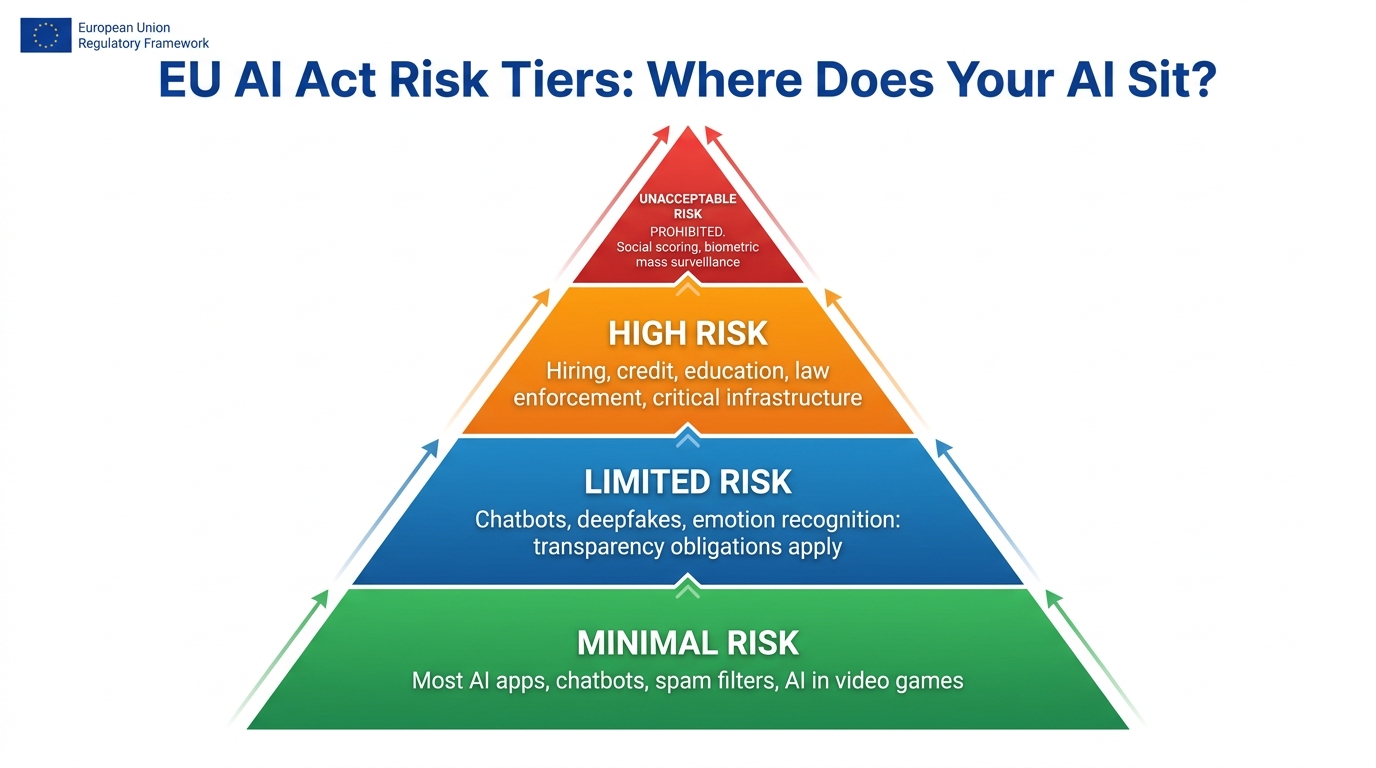
    EU AI Act four-tier risk classification pyramid showing minimal, limited, high-risk, and prohibited AI categories

    One of the most common sources of mis-assessment in EU AI Act compliance programs is incorrect risk classification. The Act’s tiered risk model — prohibited, high-risk, limited-risk, and minimal-risk — sounds straightforward in principle. In practice, it is one of the most contested and ambiguous aspects of the regulation, and getting it wrong in either direction creates problems.

    The Annex III High-Risk List Is More Specific Than It Looks

    High-risk AI under the EU AI Act is not a catch-all category for any AI system that handles important decisions. It is defined by a list of specific use cases in Annex III, which covers eight domains:

    • Biometric identification and categorization
    • Critical infrastructure (road traffic, water, gas, electricity, digital infrastructure)
    • Education and vocational training (access, assessment, monitoring)
    • Employment and workers management (recruitment, termination, task allocation, monitoring)
    • Access to essential private and public services and benefits (credit scoring, social benefits)
    • Law enforcement (individual risk assessment, polygraph-equivalent tools, crime prediction)
    • Migration, asylum, and border control management
    • Administration of justice and democratic processes

    Whether a specific AI system falls into one of these categories requires more than a surface-level reading of the use case description. The Act specifies that a system qualifies as high-risk when it is intended to be used as a safety component of a product, or as a product covered by specified EU legislation, and the product undergoes third-party conformity assessment under that legislation. Not every AI system that touches these domains is high-risk. The qualification requires a careful analysis of intended purpose and deployment context.

    The Provider/Deployer Distinction Is Doing Heavy Lifting

    Perhaps the most practically significant classification question is not risk tier but role. The EU AI Act assigns obligations differently depending on whether an organization is a provider (who places an AI system on the market or puts it into service under their own name or trademark), a deployer (who uses an AI system in the course of a professional activity), an importer, or a distributor.

    For many enterprise users of third-party AI tools, the default assumption is deployer status — and in many cases that is correct. But it can be wrong in ways that create significant unmet obligations. A company that takes a foundation model, fine-tunes it for a specific application, and markets that application commercially may be a provider. A company that uses a third-party AI model in a way not covered by the original provider’s conformity assessment steps into provider-like obligations for those use cases. Getting this analysis wrong means either assuming fewer obligations than actually apply, or investing heavily in compliance work that is actually the provider’s responsibility.

    Minimal-Risk Assumptions Are Being Tested

    At the other end of the spectrum, some companies have assumed that because their AI use cases seem obviously minimal-risk — using AI for product recommendations, internal document search, content summarization — they have no meaningful compliance work to do. This assumption is becoming harder to sustain as the transparency obligations of Article 50 apply across risk tiers. AI interaction disclosure, for example, applies to any system that interacts with humans, regardless of whether that system is classified as high-risk. A customer service chatbot that confidently tells users it is a person is not shielded from Article 50 simply because it handles low-stakes queries.

    What to Actually Do Right Now: The Compliance Action Plan

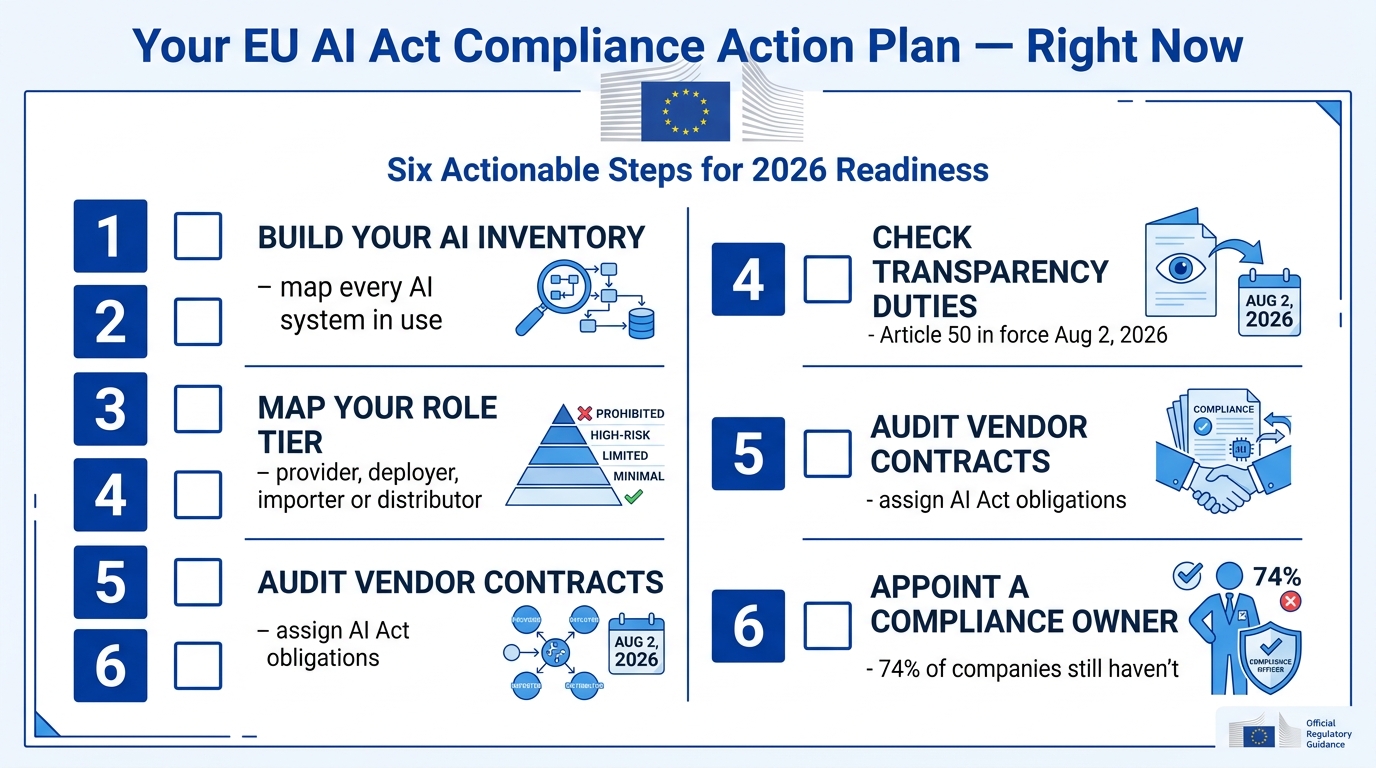
    EU AI Act compliance action plan checklist for businesses in 2026

    The deadline changes create an opportunity to sequence compliance work strategically — addressing the obligations that are already fully enforceable first, while building the operational infrastructure for the high-risk requirements that arrive in 2027 and 2028. The following action framework reflects the obligations that are currently live and the preparation work that matters most for what comes next.

    Step 1: Build Your AI Inventory — Without Exceptions

    This is the step that 83% of organizations have not completed, and it is the prerequisite for everything else. An AI inventory for EU AI Act purposes needs to capture every AI system in production use across the organization, including systems embedded in third-party software tools (not just systems the organization built itself), systems used in HR, finance, customer service, and IT operations, AI features embedded in enterprise SaaS platforms, and models used by third-party vendors who process data on the organization’s behalf.

    The inventory does not need to be technically sophisticated to start. A structured register that captures each system’s name, function, vendor (if applicable), data processed, decision types supported, and estimated user population is sufficient for the initial triage phase. The goal is to move from “we do not know what we have” to “we have a documented list of every AI system in scope.”

    Step 2: Screen for Prohibited Practices First

    Before classifying systems by high-risk or limited-risk status, run every system through a prohibited practices screen. The eight Article 5 prohibitions described earlier in this post are your checklist. Any system that even partly resembles a banned practice needs immediate legal review — not a note in a project plan for 2027. The banned practices have been in force since February 2025.

    In practice, the systems most likely to trigger this screen are emotion recognition tools used in HR or education contexts, recommendation systems that use dark-pattern techniques to influence consumer behavior, and any system that uses biometric data for categorization purposes. Vendors sometimes describe these functions using softer language (“sentiment analysis,” “engagement optimization,” “behavioral profiling”) that can obscure the underlying mechanism. The legal assessment should look at what the system does, not what the marketing materials call it.

    Step 3: Classify Risk Tier and Confirm Your Role

    For each system in your inventory, conduct a risk tier classification using the Annex III checklist, and separately determine your organization’s role for each system. These are separate analyses that need to be done in parallel. A company can be a deployer of a minimal-risk AI system and simultaneously a provider of a different high-risk AI system — each with different obligations that must be managed separately.

    For borderline classifications — systems that might or might not fall into Annex III — document your reasoning. Regulators and courts will look at whether organizations made reasonable, good-faith assessments of their obligations, and documented reasoning is evidence of that good faith even when the outcome of the assessment proves to have been incorrect.

    Step 4: Address Article 50 Compliance for Customer-Facing Systems

    For any system that interacts with end users — chatbots, virtual assistants, AI-generated content features, voice synthesis tools — conduct an Article 50 compliance check immediately. The questions to answer are:

    • Does the system disclose its AI nature at the start of each interaction?
    • If the system generates deepfake content, is that content labeled prominently?
    • For AI-generated synthetic content (images, audio, video, text), is there a mechanism for users to identify it as AI-generated?
    • If the system was placed on the market before August 2, 2026, is a machine-readable watermarking solution in development for the December 2026 deadline?

    Product teams building customer-facing AI features should embed Article 50 requirements into their feature development and design review process as a standing requirement, not a one-time audit.

    Step 5: Audit Vendor Contracts for AI Act Obligations

    The EU AI Act creates a chain of responsibility that runs through the supply chain. Where a deployer relies on a provider’s AI system, the Act expects the provider to supply the information and technical capabilities needed for the deployer to meet their own obligations. If your vendor contracts do not address this — and most contracts signed before 2025 do not — you may have gaps in your ability to meet documentation, incident reporting, and human oversight requirements.

    A focused AI Act vendor audit should identify every AI provider or vendor whose products or services you classify as AI systems under the Act, check whether existing contracts address the AI Act obligations at all, and where they do not, determine whether renegotiation is warranted or whether alternative sourcing is needed for systems with high compliance stakes.

    Step 6: Appoint a Compliance Owner and Build the Governance Structure

    The 74% of organizations without a designated AI compliance owner are exposed in a specific and recurring way: without a named owner, compliance work gets fragmented across legal, IT, and procurement teams without anyone accountable for the overall program. This is not just an organizational efficiency issue — it is a risk management failure that becomes visible the moment a regulator asks who in the organization is responsible for AI Act compliance and what they have done.

    The AI compliance owner does not need to sit in the legal department. In many organizations, a Chief Data Officer, Chief Risk Officer, or Head of Technology Governance is a more natural fit. What matters is that the role has cross-functional authority, a defined mandate that covers the full scope of AI Act obligations, and a reporting line that ensures executive visibility.

    Building Toward the 2027 High-Risk Deadline Now

    Even with the December 2027 deadline for Annex III systems, organizations should be building their compliance infrastructure for those requirements today. Conformity assessments, technical documentation, quality management systems, and human oversight mechanisms take substantial time to develop — particularly in organizations that are starting from limited compliance maturity. Sixteen months sounds comfortable. In the context of building a full conformity assessment program across multiple high-risk AI deployments, it is not a large buffer.

    The Bigger Picture: Why the Moving Deadlines Reflect a Deeper Regulatory Tension

    The EU AI Act’s serial deadline adjustments are not primarily a sign of regulatory dysfunction, though that framing has been popular in some technology industry circles. They reflect a genuinely difficult political balancing act: the EU is trying to be the first jurisdiction in the world to comprehensively regulate AI, while simultaneously trying not to drive European AI development offshore or slow the adoption of AI by European businesses competing against US and Chinese counterparts operating under less demanding regulatory conditions.

    The Digital Omnibus extensions for high-risk AI were a direct response to industry feedback that the original 2026 deadlines were not achievable — not because companies lacked motivation to comply, but because the technical and documentation requirements for high-risk AI conformity assessments require the development of standards, testing methodologies, and notified body capacity that simply did not exist at the scale needed. Pushing the deadline to December 2027 acknowledges that fact without abandoning the underlying regulatory framework.

    What this means for businesses is that the EU AI Act is not going away and is not being gutted. The Omnibus is calibration, not retreat. The core risk-based architecture, the prohibited practices, the GPAI obligations, and the transparency duties are all intact. What has been adjusted is the sequencing of when the most complex conformity requirements become mandatory — an adjustment that serves regulators as much as industry, because it gives the standards-setting bodies (CEN/CENELEC) and notified bodies time to build the infrastructure that enforcement actually depends on.

    The companies that will navigate this period well are those that treat the extended timeline for high-risk compliance not as permission to delay, but as structured time to build the foundations — inventory, governance, vendor contracts, technical documentation, and internal expertise — that the eventual conformity requirements will rest on.

    Conclusion: What the Deadline Chaos Is Actually Telling You

    The EU AI Act’s timeline has moved again. It will likely continue to be refined as standards develop, member state readiness matures, and the first enforcement actions produce precedents that clarify the regulation’s practical reach. That is the nature of a live regulatory framework governing a technology that does not sit still.

    But beneath the timeline adjustments, several things are fixed and not subject to further revision: the prohibitions that have been in force since February 2025, the GPAI obligations that have applied since August 2025, and the transparency and enforcement infrastructure that became fully operational on August 2, 2026. For most businesses using or building AI in any meaningful way, at least one of these already-active obligations applies directly.

    The practical lesson from the readiness data — 78% unprepared, 83% without an AI inventory, only 3% fully ready — is not that the EU AI Act is impractical. It is that most organizations underestimated how much internal change the regulation requires. This is not primarily a legal documentation challenge. It is a governance, inventory, and operating model challenge that runs deeper than any single compliance team can manage alone.

    The revised timeline gives organizations with exposure to high-risk AI applications a genuine opportunity to build properly. What it does not offer is an excuse for continuing to ignore the obligations that are already active and already enforceable. The enforcement machinery is running. The penalties are on the books. And the next deadline is not moving.

    Key Takeaways:

    • The Digital Omnibus extended high-risk AI (Annex III) deadlines to December 2, 2027, but left GPAI, transparency, and prohibited practice obligations unchanged.
    • Article 5 bans have been in force since February 2, 2025 — and many companies still have not screened their AI systems against them.
    • August 2, 2026 marked full enforcement activation for GPAI rules, Article 50 transparency duties, and the national NCA penalty regime.
    • 78% of enterprises were not meaningfully prepared for EU AI Act compliance as of mid-2026 surveys.
    • The most critical immediate steps are building an AI inventory, screening for prohibited practices, and achieving Article 50 compliance for all customer-facing AI interactions.
    • Deadline extensions reduce near-term compliance pressure for high-risk applications — they do not reduce legal liability or remove the need to build compliance infrastructure now.
  • EU AI Act Enforcement After the Omnibus: What Your Compliance Team Actually Needs to Do Right Now

    EU AI Act Enforcement After the Omnibus: What Your Compliance Team Actually Needs to Do Right Now

    EU AI Act Enforcement 2026 – compliance timeline showing three phases: Feb 2025, Aug 2025, and Aug 2026

    The compliance calendar that most legal and technology teams built their EU AI Act roadmaps around has shifted significantly. On 7 May 2026, the European Parliament and Council reached a provisional political agreement on the so-called Digital Omnibus on AI — a package of amendments that pushed several high-risk AI compliance deadlines by more than a year. For teams that had been sprinting toward August 2026, that might sound like breathing room. It is not.

    The relief is selective, and misreading which obligations still apply — right now, without any extension — is one of the most consequential mistakes a compliance function can make going into the second half of 2026. Prohibited AI practices have been banned since February 2025. General-purpose AI model obligations have been in force since August 2025. And the full suite of transparency rules under Article 50 go live in August 2026, regardless of the Omnibus amendments.

    This post is not a summary of the AI Act. It is a practical enforcement map — covering what has already shifted legally, which obligations are live versus delayed, how national market surveillance authorities actually investigate non-compliance, what the three-tier penalty structure means in commercial terms, and where most organisations have genuine documentation gaps that regulators will find first. The goal is to help compliance teams, legal counsel, and product owners build a credible, prioritised response — not a box-ticking exercise that looks good on paper and falls apart under audit.

    The Omnibus Shift: Why August 2026 Is No Longer the Full Story

    EU AI Act Omnibus timeline revision infographic showing new deadlines of December 2027 and August 2028 replacing the original August 2026 high-risk AI deadline

    The Digital Omnibus on AI is part of a broader EU legislative simplification effort. Its primary practical effect on the AI Act is moving the application dates for high-risk AI systems. Under the provisional agreement reached in May 2026 — pending formal adoption, which is expected before the original 2 August deadline — the timelines look materially different from what most compliance teams planned for.

    The Revised Deadline Map

    For Annex III high-risk AI systems — stand-alone applications in sensitive domains such as employment screening, credit scoring, biometric identification, law enforcement tools, education, and critical infrastructure — the application date shifts from 2 August 2026 to 2 December 2027. That is a 16-month extension from the original date.

    For Annex I high-risk AI systems — AI embedded in regulated products such as medical devices, vehicles, toys, and industrial machinery — the new deadline is 2 August 2028, a full two years beyond the original.

    For most organisations, these extensions feel substantial. But there are three crucial caveats that make “we have until 2027” a dangerous framing to carry into board-level discussions.

    What the Omnibus Does Not Change

    First, the Omnibus is still pending formal legislative adoption as of mid-2026. Until it passes, the original August 2026 deadline remains the legally applicable one. Compliance teams that stop work based on a provisional agreement that could theoretically still change are taking a significant legal risk.

    Second, the Omnibus does not affect the prohibited practices ban (in force since February 2025), GPAI model obligations (in force since August 2025), or the Article 50 transparency rules (due August 2026). These timelines are untouched.

    Third, the extension does not mean enforcement posture relaxes. National market surveillance authorities will use the intervening months to build capability, issue guidance, and signal intent. Early enforcement actions — even against more minor transparency violations — will establish precedent for what the broader high-risk regime looks like in practice.

    The Prudent Response to the Delay

    The Omnibus grants additional calendar time for high-risk AI conformity assessments and technical documentation. It does not grant permission to delay internal governance work, AI system inventorying, vendor due diligence, or the training of human oversight functions. Organisations that use the extension productively will enter the 2027 enforcement window with mature governance frameworks. Those that treat it as a pause will find themselves in the same underprepared position they were in before the summer of 2026 — just 16 months later, with fewer excuses.

    What Is Already Live: The Obligations in Force Right Now

    Before examining what is coming, compliance teams need a clear-eyed view of what has already happened. The AI Act’s phased rollout means that significant obligations have been in effect for months, and enforcement exposure already exists for companies that have not addressed them.

    Prohibited AI Practices (Since 2 February 2025)

    Article 5 of the AI Act bans a set of AI applications outright, with no transition period and no grace for SMEs. These prohibitions cover: AI systems that use subliminal techniques to manipulate behaviour in ways that cause harm; systems that exploit vulnerabilities of specific groups (children, people with disabilities, the elderly); government or public authority social scoring systems; real-time remote biometric identification in publicly accessible spaces by law enforcement (with narrow exceptions); AI used to infer emotions in workplaces or educational settings; and AI systems that scrape facial recognition data from the internet or CCTV footage to build or expand identification databases.

    Any organisation deploying systems that touch these categories — even tangentially — should have conducted a formal review of that exposure before February 2025. If that review has not happened, it should happen immediately. The penalty for a prohibited AI practice is up to €35 million or 7% of worldwide annual turnover, whichever is higher. There is no softer enforcement pathway for violations at this tier.

    GPAI Model Obligations (Since 2 August 2025)

    Providers of general-purpose AI models — any model trained on broad data that can perform a wide range of tasks and is placed on the EU market — have been subject to substantive obligations since August 2025. These obligations are not optional pending further guidance. They are in effect.

    The core GPAI requirements include: maintaining detailed technical documentation covering model architecture, training methodology, performance benchmarks, and known limitations; providing downstream providers with sufficient information to integrate the model compliantly; publishing a summary of training data content; and complying with EU copyright law, including honouring text-and-data-mining opt-outs.

    For providers of systemic-risk GPAI models — those trained on compute exceeding 10^25 FLOPs — there are additional obligations: notifying the AI Office, conducting adversarial testing, reporting serious incidents, and ensuring cybersecurity protections appropriate to the systemic risk they pose.

    The Three-Tier Penalty Structure You Cannot Afford to Misread

    EU AI Act penalty pyramid showing three tiers: €35M/7% for prohibited AI, €15M/3% for high-risk violations, €7.5M/1.5% for information violations

    Article 99 of the AI Act sets out three distinct penalty tiers. Understanding the structure — and more importantly, which behaviour triggers which tier — is not just legal housekeeping. It directly shapes how organisations should allocate their compliance investment.

    Tier One: Prohibited AI Practices

    The maximum fine for violating Article 5 (the banned practices) is €35 million or 7% of total worldwide annual turnover, whichever is higher. This is the steepest penalty tier in the AI Act, exceeding the maximum GDPR fine percentage. For a large enterprise with €5 billion in global revenue, the potential fine is €350 million. For a mid-sized technology company at €200 million in revenue, it is €14 million — still potentially catastrophic.

    The “whichever is higher” mechanism matters enormously here. Unlike fixed-cap regimes, the AI Act links maximum penalties to commercial scale. A global company cannot escape large fines simply because its EU revenue is small.

    Tier Two: High-Risk AI and GPAI Non-Compliance

    For violations of requirements applicable to high-risk AI systems and most GPAI obligations — failing to maintain a risk management system, inadequate technical documentation, absence of human oversight mechanisms, non-compliant conformity assessments — the maximum is €15 million or 3% of worldwide annual turnover. This tier applies to the majority of substantive compliance failures that organisations with AI products in sensitive domains will face.

    Tier Three: Procedural and Information Violations

    Providing incorrect, incomplete, or misleading information to notified bodies and national authorities triggers the lowest penalty tier: up to €7.5 million or 1.5% of worldwide annual turnover. This matters because compliance teams often treat documentation and information requests as secondary to substantive technical obligations. Under the AI Act, providing inaccurate information to authorities is itself a separately prosecutable offense.

    SME and Startup Proportionality

    The AI Act acknowledges that these figures could be existential for very small organisations. National authorities and the AI Office are required to take into account the size, economic situation, and market position of the infringing party when setting actual fines. SMEs and startups are eligible for reduced fines that must not exceed the stated caps but may be set substantially lower in practice. This proportionality principle does not, however, reduce the obligation to comply — only the potential penalty scale if non-compliance is found.

    Article 50: The Transparency Rules That Apply to Almost Every AI Product

    Article 50 EU AI Act transparency compliance showing chatbot AI disclosure badge and AI-generated content watermark requirements

    If there is a single obligation that catches the broadest range of organisations off-guard — including many that do not think of themselves as AI companies — it is Article 50. It applies from August 2026. It is not limited to high-risk systems. And its scope covers a strikingly large share of modern digital products.

    The Four Article 50 Triggers

    Article 50 creates transparency obligations in four distinct situations:

    1. AI systems interacting with natural persons — chatbots, virtual assistants, automated phone systems, and AI agents must inform users they are interacting with AI, unless this is obvious from context. “Obvious from context” is a narrow exception, and regulators are expected to interpret it conservatively.
    2. AI-generated synthetic content — systems that generate audio, images, video, or text must mark that content in a machine-readable format as artificially generated. This includes large language model outputs, AI image generators, and voice synthesis tools.
    3. Deepfake and manipulated media — deployers using AI to generate or manipulate content that depicts people, places, or events in ways that appear real must disclose that the content is AI-generated. Limited exceptions exist for artistic or satirical work, provided the disclosure does not undermine the purpose.
    4. Emotion recognition and biometric categorisation — systems that detect or infer emotions, or that categorise people by protected characteristics, must inform subjects that they are being processed by such a system.

    What Compliance Actually Looks Like

    For most product teams, Article 50 compliance is not a single switch to flip. It requires reviewing every AI-powered user touchpoint in a product — not just the ones that were originally classified as “AI features.” Many organisations have embedded lightweight AI interactions into customer service flows, onboarding sequences, content generation tools, and internal HR platforms without ever formally classifying them as AI interactions for regulatory purposes.

    The practical compliance tasks include: auditing all user-facing AI interactions; implementing disclosure mechanisms at the point of first contact (not buried in terms of service); implementing machine-readable marking for generated content, including exploration of standards like C2PA (Coalition for Content Provenance and Authenticity); and ensuring that disclosure language is clear, prominent, and not misleading.

    Critically, Article 50 obligations fall on both providers (who build the AI system) and deployers (who use it in a product or service). A company using a third-party chatbot API is a deployer and may carry Article 50 obligations even if it did not build the underlying model. Supply chain AI governance is, therefore, a compliance issue — not just a vendor management one.

    The Grey Zone: When Is Something “Obvious”?

    The exemption from chatbot disclosure when “obvious from context” that the user is interacting with AI will be the source of significant enforcement debate. A robot icon and the name “Bot” on a chat widget is not necessarily sufficient. Regulators are likely to focus on cases where users could reasonably be misled into thinking they were speaking with a human — particularly in customer service, healthcare, legal advice, and financial guidance contexts. The prudent position is to disclose in every case where any ambiguity exists.

    GPAI Model Obligations: What Providers Must Have Already Done

    For organisations that develop and deploy general-purpose AI models — whether proprietary foundation models, fine-tuned derivatives, or open-weight releases — the August 2025 deadline has already passed. This section is not about preparing for a future obligation. It is about assessing whether existing compliance is adequate under a regime that has been live for nearly a year.

    Technical Documentation: The Core Deliverable

    The AI Act’s technical documentation requirements for GPAI models are extensive. Providers must maintain documentation covering: the general description of the model and its intended purposes; the training data used, including sources, filtering methodology, and data governance practices; training methodology and compute resources used; model performance on relevant benchmarks; known limitations, risks, and failure modes; and information about any post-training procedures such as RLHF or fine-tuning.

    This documentation is not a one-time filing. It must be kept up to date and made available to the AI Office on request. For commercial GPAI providers, it also informs the information package that must be shared with downstream deployers — the developers and enterprises building applications on top of the model. If your API documentation is the sum total of your compliance information package for downstream users, that is almost certainly not sufficient.

    Copyright and Training Data

    One of the most actively debated GPAI obligations is the requirement to comply with EU copyright law in training data collection, specifically the requirement to honour text-and-data-mining opt-outs under the Digital Single Market Directive. Providers must document their approach to identifying and respecting opt-outs, and must publish a summary of training data content that is sufficiently detailed for downstream users to assess copyright risk.

    This obligation has attracted significant attention from rights-holders and publishers. Organisations that trained models on broad internet data without implementing robust opt-out mechanisms should take legal advice on their current exposure — because the AI Office has both the mandate and the appetite to investigate copyright-adjacent GPAI compliance issues.

    Systemic Risk Model Notification

    Providers of GPAI models trained on more than 10^25 FLOPs are classified as systemic-risk models and must notify the AI Office. This notification triggers additional obligations: conducting model evaluations and adversarial testing (including red-teaming); reporting serious incidents or malfunctions to the AI Office; implementing cybersecurity measures commensurate with systemic risk; and maintaining a documented incident response framework.

    The number of organisations meeting the compute threshold for systemic risk classification is small — this is primarily a concern for the largest AI labs and foundation model providers. But for those organisations, the obligations are materially more demanding than for standard GPAI providers.

    High-Risk AI Systems: The New Conformity Assessment Roadmap

    EU AI Act high-risk AI conformity assessment process flowchart showing five stages from system classification to Declaration of Conformity

    With the Omnibus extension moving high-risk AI compliance deadlines to December 2027 and August 2028, organisations with products in Annex III and Annex I categories have more runway. But the conformity assessment process is sufficiently complex that beginning substantive work now — rather than in 2027 — is the only realistic path to timely compliance.

    Step One: Classification

    The first step in any conformity assessment is determining whether your system actually qualifies as high-risk. Annex III lists the categories: biometric identification and categorisation of natural persons; management and operation of critical infrastructure; education and vocational training; employment, workers management, and access to self-employment; access to and enjoyment of essential private services and essential public services; law enforcement; migration, asylum, and border control management; and administration of justice and democratic processes.

    Being in one of these domains does not automatically make a system high-risk. The AI Act provides that some systems in Annex III categories are not high-risk if they do not pose a significant risk of harm to health, safety, or fundamental rights of natural persons. The Commission guidance on this classification question — originally due in February 2026 — is a key input that compliance teams should track and apply retroactively to their system inventories.

    Step Two: Choosing Your Assessment Route

    Article 43 provides two main conformity assessment pathways for high-risk AI systems. Most Annex III systems can use Route A: internal control (Annex VI), where the provider conducts and documents its own conformity assessment against the legal requirements. This is analogous to self-declaration under product safety law and does not require a third party.

    A smaller subset — primarily AI used for real-time remote biometric identification and certain Annex I product-safety systems — requires Route B: third-party assessment by a notified body (Annex VII). Notified bodies must be designated by member states, and the designation process is still maturing across the EU. Organisations expecting to need notified body involvement should begin identifying and engaging candidate bodies now, given capacity constraints that are likely to emerge as the 2027 deadline approaches.

    Step Three: Technical Documentation Under Annex IV

    Annex IV specifies the minimum content of technical documentation for high-risk AI systems. The requirements are detailed and include: a general description of the system including its purpose, the interaction with hardware or software components it relies on, and the version history; a description of the elements of the system and the development process; information on training methodology and datasets; a description of the risk management system; post-market monitoring plan; and evidence of testing results demonstrating conformity with the requirements.

    Documentation must be created before the system is placed on the market, kept current throughout the system’s lifecycle, and retained for at least ten years after the last unit is placed on the market. For software-based AI systems that update frequently, maintaining current documentation across model versions is a genuine operational challenge that requires systematic processes — not ad hoc efforts.

    Step Four: Risk Management System

    Article 9 requires that high-risk AI providers maintain a risk management system as an ongoing iterative process, not a one-time assessment. This system must identify and analyse known and foreseeable risks; estimate and evaluate the risks that emerge during testing and from intended use; adopt risk mitigation and control measures; and test against those measures to ensure they work. The risk management system must remain operational throughout the lifecycle of the AI system, including post-deployment. This is a meaningful ongoing operational requirement, not a project to complete before market launch.

    Step Five: Declaration of Conformity

    Once conformity assessment is complete, providers issue a Declaration of Conformity (DoC) — a formal statement that the system meets all applicable requirements. For Annex I systems, this is accompanied by a CE marking. The DoC must identify the system, the provider, and the specific requirements the system has been assessed against. It must be kept on file and made available to market surveillance authorities on request. Providing a false or misleading DoC is itself a violation under the Article 99 penalty framework.

    Market Surveillance Authorities: Who’s Watching and How They Investigate

    EU AI Act enforcement architecture diagram showing European AI Office at top connected to 27 national market surveillance authorities, with enforcement powers including documentation requests, audits, and fines

    Understanding enforcement architecture is not academic. It directly shapes where your first interaction with a regulator is likely to come from, how quickly an investigation could escalate, and what remediation process looks like in practice.

    The Hybrid Model: EU Level and National Level

    The EU AI Act operates through a hybrid enforcement model confirmed by the European Parliament’s Think Tank in March 2026. At the EU level, the European AI Office — housed within DG CONNECT — is responsible for supervising GPAI models, coordinating cross-border enforcement, and addressing systemic risks. It has direct investigatory powers over GPAI providers and can impose fines through the Commission.

    At the national level, each member state must designate at least one market surveillance authority (MSA). MSAs are responsible for post-market monitoring of AI systems, investigating complaints and suspected non-compliance, requesting documentation from providers and deployers, ordering corrective actions and withdrawals, and imposing fines under national law. The AI Act requires MSAs to be independent, adequately resourced, and coordinated with the AI Office — though the resource adequacy requirement is proving difficult in practice, particularly for smaller member states.

    How an Investigation Actually Starts

    MSA investigations can be triggered in several ways: complaints from individuals, civil society organisations, or competitors; market sweeps initiated by the authority itself; incident reports submitted by providers; referrals from other regulatory bodies (such as data protection authorities or financial supervisors); and cross-border coordination from other member states’ MSAs via the AI Board’s coordination mechanisms.

    An initial investigation typically involves a request for documentation — the technical file, risk management records, conformity assessment evidence, and any post-market monitoring logs. Organisations that cannot produce complete, organised documentation quickly find that an information request escalates into a formal investigation far more rapidly than those that have robust compliance infrastructure. Response time to documentation requests matters: delayed or incomplete responses are themselves procedural violations under the Tier Three penalty framework.

    Cross-Border Cases and the AI Board

    AI systems operating across multiple EU member states create multi-jurisdictional enforcement risk. The AI Board — composed of representatives from each member state’s competent authority — coordinates enforcement in cross-border cases and can refer matters to the AI Office where systemic risk or GPAI model issues are involved. For large technology companies with EU-wide products, the risk of simultaneous investigation by multiple national MSAs, coordinated by the AI Board, is real — and managing it requires a centralised compliance function with the ability to respond consistently across jurisdictions.

    The SME Problem: Why Smaller Companies Face Disproportionate Risk

    The AI Act’s proportionality provisions and SME-specific guidance give the impression that smaller organisations have a lighter regulatory burden. In practice, the opposite is often true — SMEs and scale-ups face disproportionate compliance challenges for reasons that have nothing to do with the legal text and everything to do with organisational capability.

    The “Not Applicable” Mistake

    The most common and most dangerous mistake that smaller organisations make is concluding too quickly that the AI Act does not apply to them. This error stems from two sources: a misunderstanding of the risk classification system, and a failure to recognise that “deployer” obligations apply even when you are using someone else’s model.

    A startup that uses an off-the-shelf large language model to power a customer-facing chatbot for a financial services application may not think of itself as an “AI company.” But it is a deployer of an AI system in a potentially high-risk context (financial services access), and it carries Article 50 transparency obligations, plus potentially high-risk compliance obligations once those deadlines apply. The off-the-shelf nature of the underlying technology does not eliminate the deployer’s compliance exposure.

    Vendor Due Diligence Is a Compliance Obligation

    Under the AI Act’s supply chain model, deployers must receive sufficient information from providers to meet their own compliance obligations. If a GPAI provider is not supplying adequate technical documentation, training data summaries, or performance and limitation information, the deployer cannot meet its own obligations — and cannot pass compliance responsibility back to the provider simply by pointing to a contract clause.

    SMEs should be actively reviewing their AI vendor contracts and technical documentation packages. Contracts should specify: what documentation the provider must supply; what notification process applies if the provider makes material changes to the model; and what remediation options exist if the provider’s non-compliance creates compliance risk for the deployer. This due diligence is substantive legal work, not a procurement checkbox.

    AI Literacy as a Legal Obligation

    One obligation that is already in force and affects all organisations, regardless of size, is the AI literacy requirement under Article 4. Providers and deployers must ensure that their staff have a sufficient level of AI literacy — appropriate to their roles and the context in which they use AI. This is not a training module. It is a documented organisational competency obligation. Regulators investigating a non-compliance case will ask how staff were trained to use and oversee AI systems. The answer must be substantive.

    Building Your Internal Compliance Function: More Than Checklists

    The most common framing of AI Act compliance work is as a checklist problem — gather the documentation, tick the boxes, issue the declaration. That framing consistently produces compliance programmes that look good on paper but collapse under the scrutiny of an actual investigation. Effective compliance is structural.

    The AI Inventory: Your Compliance Foundation

    You cannot manage compliance for AI systems you have not catalogued. The first substantive work any compliance function must complete is an AI system inventory — a structured register of every AI system the organisation uses or deploys, covering: what the system does; who built it; what data it processes; who it interacts with or makes decisions about; what risk category it falls under; and what obligations apply as a result.

    For most organisations with more than a few years of AI adoption behind them, this inventory will surface surprises. AI integrations made at the business unit level that legal and compliance teams were never told about. API-based AI tools embedded in SaaS products the organisation uses as a deployer. AI-assisted decision processes in HR, finance, or operations that may qualify as high-risk under Annex III. The inventory is not a one-time exercise — it needs to be maintained as a living register, updated as new systems are deployed or existing ones change materially.

    Role Clarity: Provider Versus Deployer

    The AI Act assigns different obligations to providers (who develop and place AI systems on the market) and deployers (who use AI systems in a professional context). Many organisations are both simultaneously — developing and deploying proprietary AI while also using third-party AI in their products and operations.

    Role clarity is not just a legal formality. It determines which compliance obligations the organisation owns directly, which it partially inherits from its providers, and which it can discharge through contractual requirements on the other party. Internal teams need clear ownership maps: who is accountable for provider obligations on proprietary systems, who manages deployer obligations for third-party systems, and where those two worlds overlap and create joint accountability.

    Governance Structures That Withstand Scrutiny

    Market surveillance authorities will look not just at whether documentation exists, but at whether the governance processes that generate and maintain that documentation are credible. That means: governance committees or review bodies with genuine oversight authority; escalation pathways that bring AI risk issues to appropriate decision-makers; documented processes for reviewing AI systems when they are substantially modified; and incident response procedures that include the obligation to report serious incidents to the AI Office or national authorities as required.

    The human oversight requirement under Article 14 is particularly significant for high-risk AI systems. It is not satisfied by a single human in the loop who approves AI outputs without meaningful ability to understand or override them. Regulators will examine whether oversight mechanisms are real — whether the humans responsible have the training, access, and authority to actually intervene. Documentation of how human oversight is implemented, trained, and tested is a core component of any credible compliance programme.

    The Documentation Gap: What Regulators Will Find First

    Among the practical compliance failures that regulators and legal teams are identifying in 2026 audits, documentation gaps are by far the most prevalent. Organisations often have reasonable processes in place but have not documented them in the forms that the AI Act specifies. This creates a gap between what a company is actually doing and what it can demonstrate it is doing — and in enforcement, demonstration is what matters.

    The Most Common Documentation Failures

    Based on practitioner analysis of pre-enforcement compliance gaps, the most common documentation failures are:

    • Incomplete or absent technical files. Annex IV specifies what technical documentation must contain, but many organisations’ technical files are a collection of internal engineering documents that do not map to the Annex IV structure. A regulator asking for your technical file should receive a document that is readable without prior knowledge of your internal systems and that directly addresses each Annex IV requirement.
    • Undocumented risk management processes. The Article 9 risk management system must be an ongoing documented process. Meeting logs, risk registers, mitigation decisions, and testing results all form part of the required record. Undocumented risk management — even if the organisation is doing substantive risk work — will not satisfy an MSA investigation.
    • Absent or outdated post-market monitoring logs. Article 72 requires high-risk AI providers to have a post-market monitoring system that collects and reviews data on the system’s performance after deployment. For most software AI systems, this means logging user feedback, error rates, model drift indicators, and incident data. These logs must exist, must be structured, and must be reviewed on a documented schedule.
    • Missing supplier information packages. Deployers must receive sufficient information from GPAI providers to meet their own compliance obligations. Many deployers have not requested this information formally, and many providers have not supplied it in a structured way. Both sides of this transaction need to address the gap.
    • No version control on technical documentation. AI systems change. Models are updated. Training data evolves. The technical documentation must reflect the current state of the system, not the state at initial deployment. Organisations without systematic documentation version control create a compliance gap every time they update their models.

    Retention Requirements and Audit Readiness

    Technical documentation for high-risk AI systems must be retained for ten years after the last unit is placed on the market. For software products with continuous update cycles, the retention clock may effectively never run out. Compliance teams need to establish document retention policies that reflect this requirement, with appropriate security controls and access management for stored documentation.

    Audit readiness is a distinct capability from compliance. A company may be substantively compliant but operationally unable to demonstrate that compliance within the timeframes that an MSA investigation imposes. Building the systems to retrieve, compile, and present compliance evidence quickly is as important as building the compliance processes themselves.

    Practical Compliance Checklist: Where to Start This Week

    Compliance work under the EU AI Act is not a single project with a completion date. It is an ongoing operational function. But for teams that need to prioritise, the following represents the highest-return starting points — actions that address the most immediate enforcement exposure and build the foundation for longer-term compliance maturity.

    Immediate Priorities (Before August 2026)

    1. Complete a prohibited practices audit. Review every AI system in use against the Article 5 ban list. If any system touches the banned categories — social scoring, emotion detection in workplaces, subliminal manipulation, indiscriminate biometric data scraping — get legal advice on exposure immediately. This obligation has been in force since February 2025.
    2. Assess Article 50 compliance for all user-facing AI. Map every touchpoint where AI interacts with users or generates content. Determine which ones require disclosure, implement that disclosure, and document the implementation decision for each system. August 2026 is not far off.
    3. Audit GPAI vendor documentation packages. If you use any large language model or other GPAI model in your products, request and review the provider’s technical documentation package. Confirm that it meets the AI Act’s information requirements. Flag any gaps to the provider in writing and keep the correspondence on file.
    4. Implement the Article 4 AI literacy requirement. Document the AI literacy baseline for staff who use or oversee AI systems in professional contexts. Create or commission role-appropriate training. Record completion. This is in force now.
    5. Start your AI system inventory. Even a basic structured spreadsheet identifying every AI system the organisation uses or deploys, with fields for role (provider/deployer), risk category assessment, and applicable obligations, is a materially better position than having no inventory at all.

    Medium-Term Priorities (Before December 2027)

    1. Classify all AI systems against Annex III. For systems that may qualify as high-risk, complete a formal classification assessment referencing the Commission’s Article 6 guidance when published, and document the reasoning.
    2. Begin technical documentation under Annex IV. Do not wait until 2027 to start building technical files. The process surfaces compliance gaps in your AI systems that need engineering or process work to address — work that takes time.
    3. Design your Article 9 risk management system. Establish a documented, ongoing risk management process for each high-risk AI system. Define the review cycle, the responsible parties, the risk criteria, and the escalation thresholds.
    4. Build human oversight mechanisms into product design. The Article 14 requirement for human oversight must be implemented in the design of high-risk AI systems — it is not something that can be bolted on retrospectively without significant engineering work.
    5. Engage notified bodies early if required. For systems requiring Route B conformity assessment, begin identifying and engaging notified bodies now. Capacity constraints will be significant in 2027 as high-risk AI deadlines approach.

    Conclusion: Compliance Is a Competitive Position, Not Just a Legal Obligation

    The EU AI Act represents the most comprehensive attempt by any jurisdiction to regulate AI at scale. Its phased implementation, punctuated by the significant Omnibus amendments of May 2026, has created a compliance environment that is genuinely complex — with different obligations applying on different timelines to different categories of AI system, across a hybrid enforcement architecture involving both national authorities and the AI Office.

    What makes that complexity manageable is approaching compliance not as a regulatory penalty avoidance exercise, but as an organisational capability. Companies with mature AI governance — documented risk management, comprehensive technical files, clear role accountability, functioning human oversight, and audit-ready documentation — are better-positioned not just for regulatory scrutiny, but for enterprise sales, procurement qualification, and the institutional trust that is increasingly required to deploy AI in sensitive domains.

    The Omnibus extensions on high-risk AI deadlines are real. But the enforcement infrastructure — national MSAs, the AI Office, the AI Board — is being built in parallel. The investigations that will set early precedent for how the AI Act is enforced in practice will come before the 2027 deadlines, most likely from Article 50 transparency failures, GPAI documentation gaps, and prohibited practices violations that have already been in effect for over a year.

    The organisations that will navigate this environment most effectively are those that treat the current compliance window not as permission to wait, but as an opportunity to build — governance frameworks, documentation processes, oversight mechanisms, and vendor relationships that will withstand the scrutiny that is, without question, coming.

    Key Takeaway: The Omnibus moved the high-risk AI deadlines. It did not move the enforcement intent. Article 50, prohibited practices, and GPAI obligations are live now. Start there — then use the extended runway on high-risk conformity assessments to build something that will last.