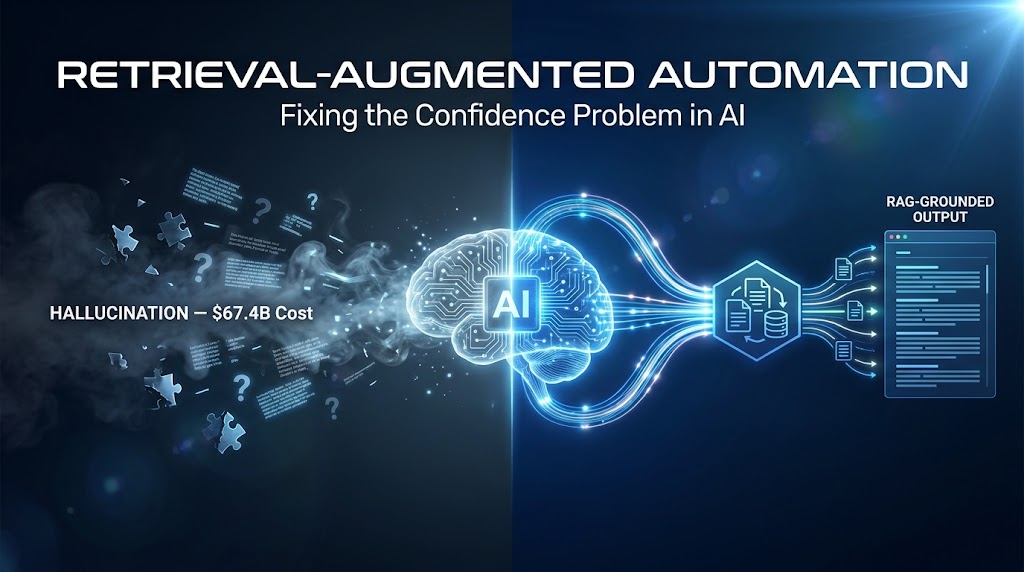
There is something uniquely dangerous about a system that is wrong with complete confidence. A person who guesses and admits it gives you a warning. A system that fabricates and presents that fabrication as settled fact does not. That is the core problem with large language models deployed inside automation workflows without grounding — they don’t know what they don’t know, and they don’t tell you when they’re making something up.
The industry has a word for this: hallucination. But that label has always felt a little too gentle, a little too neurological-metaphor-as-excuse. What we’re actually describing is a retrieval failure — an AI system generating outputs that are not supported by any real source, because it has no real source to consult. It is pattern-matching its way to an answer and presenting the result as if it were verified fact.
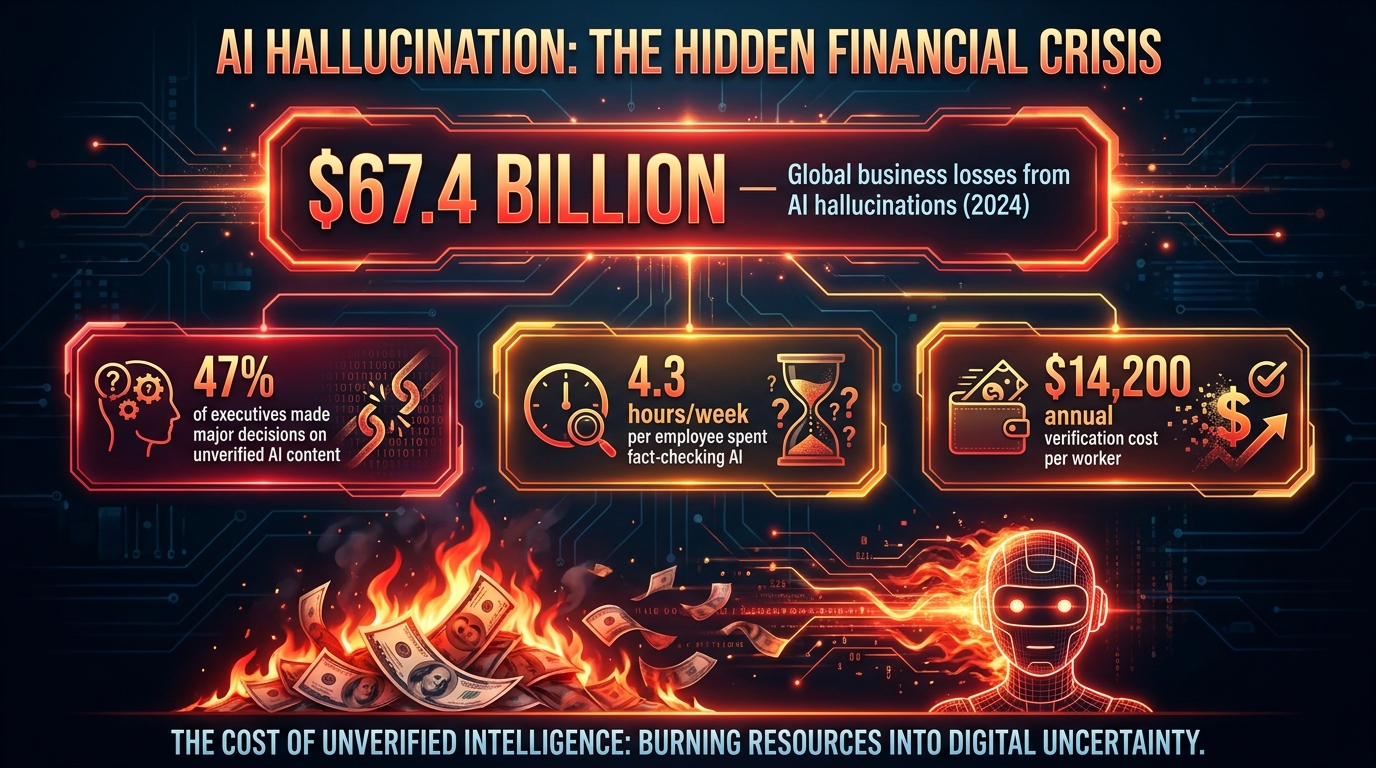
In low-stakes contexts, hallucinations are a nuisance. In automated workflows — where AI output triggers downstream decisions, populates reports, feeds into customer communications, or informs compliance documentation — they are a liability. A documented, expensive, legally consequential one. Global business losses attributed to AI hallucinations reached $67.4 billion in 2024. That figure is almost certainly larger in 2026, as enterprise AI adoption has expanded to 85% of large organizations.
Retrieval-Augmented Generation (RAG) is the architectural response to this problem. Not a model improvement, not a prompting technique, not a guardrail applied after the fact — but a structural change to how AI systems access and use information. This piece examines what RAG actually does, where it breaks down, how it’s evolving into something more powerful, and how to build automation workflows around it that hold up under real-world conditions.
What Hallucinations Actually Cost: The $67.4B Reality Check
Before addressing the solution, it’s worth being precise about the problem — because “AI makes mistakes sometimes” dramatically undersells what’s actually happening in enterprise environments.
The Numbers That Should Be on Every Executive Dashboard
According to research by AllAboutAI cited across multiple 2026 analyses, global business losses from AI hallucinations reached $67.4 billion in 2024. That’s not a projection. That’s documented cost from decisions made, contracts filed, content published, and analyses produced based on AI outputs that were factually wrong.
A Deloitte study found that 47% of business executives made major decisions based on unverified AI-generated content. Nearly half. In organizations where AI is embedded in financial forecasting, supply chain analysis, regulatory reporting, or customer communications, that statistic describes a systemic accuracy problem — not an edge case.
Employees are spending 4.3 hours per week verifying AI outputs, according to Forrester research. At an organizational scale, that translates to roughly $14,200 per employee per year in verification overhead. Companies that deployed AI to accelerate work are now paying humans to check that work — and in many cases, that cost erodes the productivity gains AI was supposed to deliver.
Hallucination Rates by Domain: The Range Is Alarming
Hallucination rates are not uniform across tasks. On simple summarization, the best frontier models achieve rates as low as 0.7% — close to acceptable for many use cases. But in the domains where AI is most actively being deployed for automation, rates climb sharply.
- Legal queries: 69–88% hallucination rate in ungrounded LLMs (Stanford HAI/RegLab). Even leading legal AI tools like Lexis+ retain ~17% error rates and Westlaw AI shows ~33%.
- Medical and clinical queries: 15–60%+ in ungrounded models; clinical decision-support errors carry per-incident costs ranging from $50,000 in customer service contexts to $2.1 million in healthcare.
- Financial analysis: 15–25% error rates, with per-incident costs in financial services ranging $50,000–$2.1 million.
- Customer service: 15–27% hallucination rate without grounding, per recent benchmarks.
- Stanford HAI 2026 AI Index: Documented hallucination rates of 22–94% across 26 models in standardized accuracy benchmarks.
The implication is stark: if your AI automation is running without retrieval grounding in any of these domains, you are not operating a productivity tool. You are operating a confident fabrication machine. The business case for RAG is not theoretical — it’s the gap between those hallucination rates and what’s achievable with proper retrieval architecture in place.
The Hidden Cost Layer: Automation Amplification
What makes hallucinations in automated workflows particularly damaging is the amplification effect. When a human analyst is wrong, they’re wrong once. When an automated system is wrong, it’s wrong at scale — across every instance of the workflow, every customer it touches, every report it generates, until someone catches the error manually. Testlio found that 82% of AI bugs stem from hallucinations, not visible system failures. Most of them aren’t caught at the point of generation. They’re caught downstream, after damage has already occurred.
Why Traditional AI Automation Fails Without Grounding
Understanding RAG requires understanding why LLMs hallucinate in the first place — and it’s not what most people assume. The common mental model is that AI “doesn’t know” something and guesses. The actual mechanism is more specific and more troubling.
The Parametric Knowledge Problem
Large language models store knowledge in their parameters — the billions of numerical weights that encode statistical relationships between tokens, learned during training. This parametric knowledge has three critical limitations for automation use cases.
It has a cutoff date. Any information generated or updated after training is invisible to the model. For enterprise environments where policies, pricing, regulations, product specifications, and procedures change regularly, this is immediately disqualifying for high-stakes automation without a grounding layer.
It generalizes, rather than specializes. A model trained on broad internet data knows a lot about general concepts but very little about your specific internal processes, your particular product line, your organization’s compliance requirements, or your customer history. When asked about these specifics, it extrapolates from general patterns — and those extrapolations are where hallucinations live.
It cannot cite what it doesn’t have. Parametric knowledge produces confident assertions without traceable sources. Even when a model happens to be correct, you cannot verify it, audit it, or trace its reasoning back to a primary document. In regulated industries, this alone disqualifies ungrounded AI from most production workflows.
Why Fine-Tuning Isn’t the Answer
Fine-tuning — the process of further training an LLM on domain-specific data — addresses some of these problems but not the core one. Fine-tuning is expensive, time-consuming, and produces a static artifact. The moment your internal data changes, your fine-tuned model is already out of date. It also doesn’t eliminate hallucination; it adjusts the model’s tendencies without providing verifiable grounding. Fine-tuned models hallucinate — they just hallucinate in more domain-appropriate-sounding language, which can actually make errors harder to detect.
RAG solves a different problem than fine-tuning solves. Fine-tuning is about style, tone, and domain fluency. RAG is about factual accuracy and source verifiability. They are not substitutes for each other, and conflating them leads to misallocated engineering effort.
RAG Explained: What Retrieval-Augmented Generation Actually Does
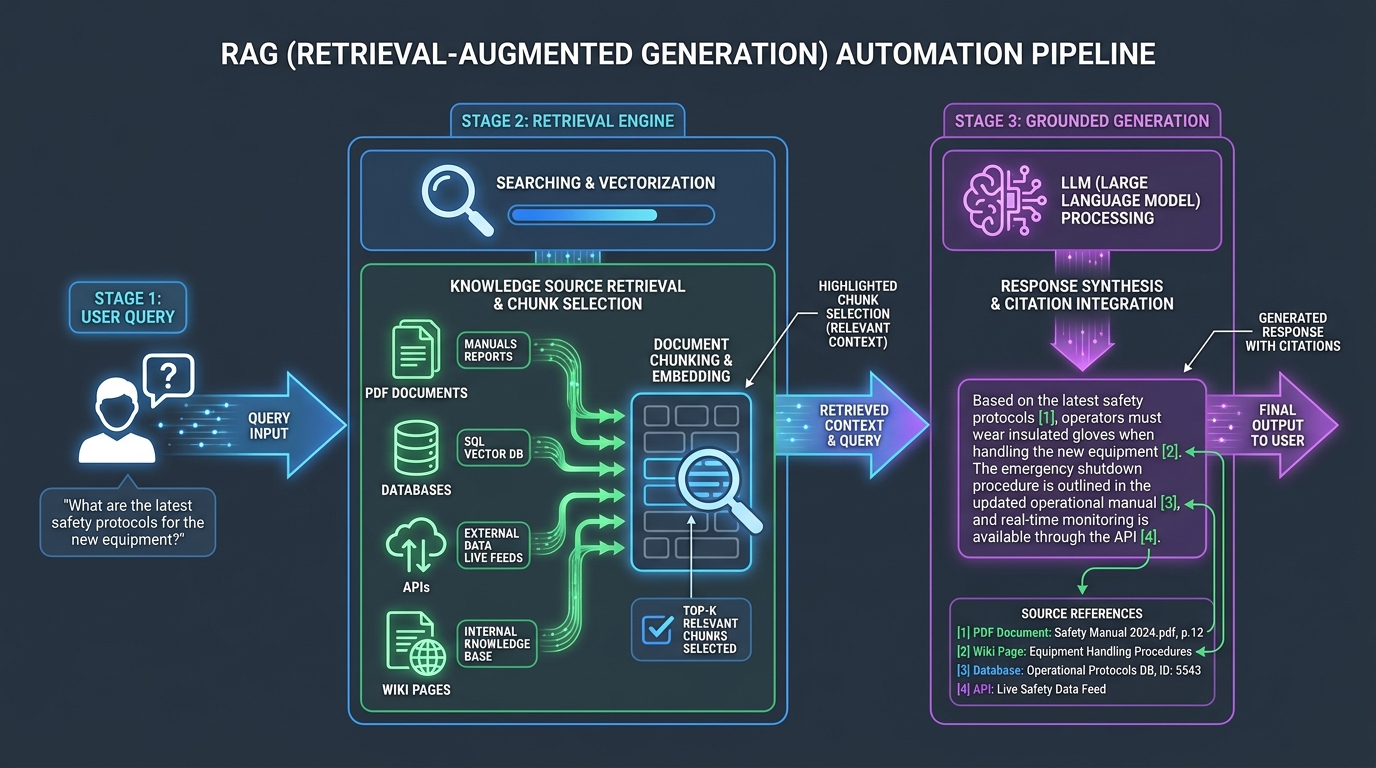
Retrieval-Augmented Generation, introduced in a 2020 paper by Lewis et al. at Meta AI, is architecturally simple in concept: before the LLM generates a response, a retrieval system fetches relevant documents from a knowledge base and injects them into the model’s context window. The model then generates its answer based on that retrieved context — not (primarily) from parametric memory.
The Three-Stage Architecture
A production RAG system operates across three distinct stages, each with its own failure modes and optimization levers:
Stage 1 — Indexing. Documents from your knowledge sources (PDFs, internal wikis, databases, APIs, policy documents, CRM records) are preprocessed, chunked into retrievable segments, converted into numerical vector representations (embeddings), and stored in a vector database. This is the foundation stage. Errors here — poor chunking, wrong embedding models, stale content — cascade forward into every subsequent retrieval.
Stage 2 — Retrieval. When a query arrives, the system converts it into a vector representation and searches the index for chunks that are semantically similar. The top-K most relevant chunks are selected and assembled into a context window. This stage is where most RAG failures in production actually originate — not in the LLM generation step.
Stage 3 — Generation. The assembled context, along with the original query, is fed to the LLM. The model generates its response based on the retrieved content and is instructed (via system prompt) to only answer based on provided context — and to acknowledge when the context doesn’t contain a sufficient answer.
The Chunking Decision That Matters More Than Model Choice
Most teams getting started with RAG spend most of their optimization effort on model selection. Research from FloTorch benchmarks suggests they’re looking in the wrong place. The chunking strategy — how documents are split before indexing — has an outsized effect on retrieval accuracy.
FloTorch’s FinanceBench data makes this concrete: semantic chunking with metadata filtering achieves 60% accuracy, compared to only 25% for fixed-size chunking with metadata. That’s not a marginal difference — it’s the difference between a system that works and one that doesn’t. Semantic chunking respects natural information boundaries in documents (paragraphs, sections, logical units) rather than splitting arbitrarily on character counts. Metadata tagging — adding document type, date, source, and topic labels to each chunk — allows the retrieval system to filter candidates before ranking them.
Hybrid Retrieval: Why Vector Search Alone Isn’t Enough
Early RAG implementations relied on dense vector search — embedding-based similarity matching. It works well when queries are semantically related to the stored content but degrades on exact-match lookups, product codes, proper nouns, and highly specific technical terminology where semantic similarity isn’t a reliable proxy for relevance.
Hybrid retrieval — combining dense vector search with sparse keyword-based retrieval (typically BM25) — closes this gap. FloTorch benchmarks show that hybrid retrieval yields 20–40% higher recall compared to dense-only approaches. The practical implication: if your RAG system uses vector search only, you are leaving significant retrieval accuracy on the table, particularly for structured data and domain-specific terminology queries.
The Three Layers Where RAG Breaks (And How to Fix Each One)
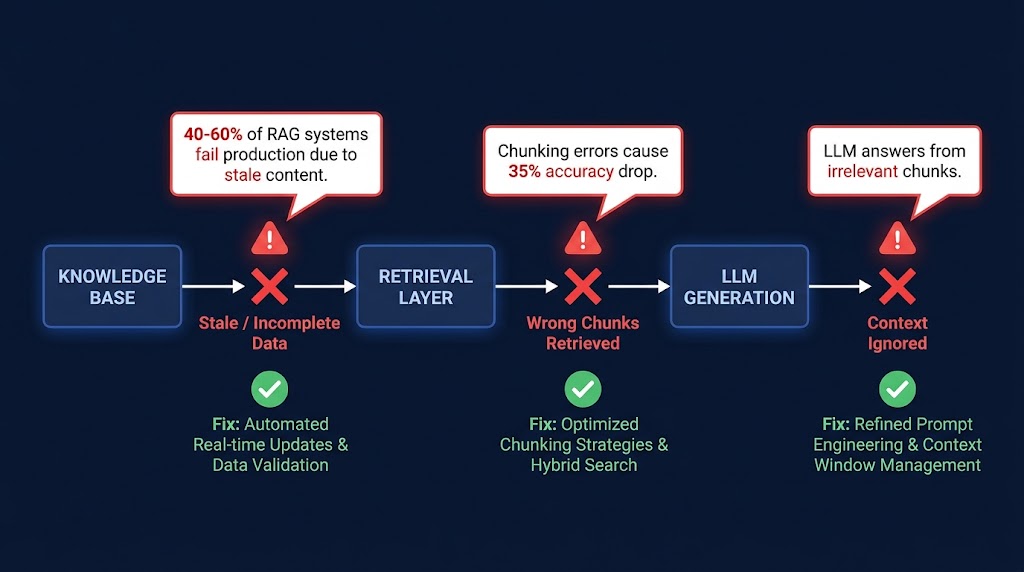
RAG is not a plug-and-play solution. Research into production RAG failures reveals a consistent pattern: teams that succeed with RAG are those who understand where retrieval fails. Teams that treat RAG as a black-box fix add it to their stack and then wonder why hallucinations persist.
Layer 1 Failure: Knowledge Base Governance
The most common — and most underappreciated — RAG failure mode has nothing to do with vector databases or embedding models. It’s stale, uncertified, or poorly structured source content.
Analysis of production RAG systems found that 40–60% fail in production due to stale content, uncertified sources, or undefined data ownership. The scenario plays out predictably: an enterprise indexes its internal documentation, deploys RAG, and gets promising results in testing. Six months later, policies have changed, procedures have been updated, and new product specifications have been issued — but the knowledge base hasn’t been updated with the same discipline. The RAG system is now confidently surfacing outdated information, grounded in real documents that are no longer accurate.
The fix: Knowledge base governance is not an IT task — it’s an ongoing operational discipline. This means assigning document ownership, establishing update SLAs for each document category, adding freshness signals (metadata timestamps with expiration triggers), and implementing automated staleness alerts. Re-rankers and sophisticated retrieval improve precision across indexed content, but they cannot compensate for content that simply shouldn’t be surfaced at all.
Layer 2 Failure: Retrieval Quality
Even with a well-maintained knowledge base, retrieval quality failures are common. The most frequent patterns identified in production audits include: embedding drift (accuracy decaying 5–8% per month as content evolves while embeddings remain static), context fragmentation from aggressive chunking, query-document terminology mismatch, and top-K parameter settings that retrieve too many low-relevance chunks that dilute the context.
Re-ranking is the primary mitigation for retrieval quality failures at this layer. After initial retrieval, a cross-encoder model re-scores each candidate chunk against the specific query — not just for semantic proximity, but for genuine relevance to the question being asked. Enterprise benchmarks show cross-encoder re-ranking improves precision by 18–42% and meaningfully reduces hallucinations by filtering out irrelevant context before it reaches the LLM.
The fix: Implement a two-stage retrieval process. Use vector search (dense + sparse hybrid) for broad candidate selection, then apply a re-ranker to narrow to the genuinely most relevant chunks. Set a confidence threshold — typically 0.7–0.8 — and configure the system to respond with an explicit “I don’t have sufficient information” when no retrieved chunk meets that threshold. Silence on low-confidence queries is not a failure; it’s a feature.
Layer 3 Failure: Generation Phase Drift
The third failure mode occurs even when the right content is retrieved: the LLM ignores or undermines the retrieved context, falling back on parametric knowledge to fill gaps or resolve ambiguities. This happens particularly when retrieved context is contradictory, when the context window is overloaded with marginally relevant information, or when prompting hasn’t established clear grounding constraints.
The fix: System prompt engineering for RAG is a distinct discipline from general prompt engineering. Effective RAG system prompts explicitly instruct the model to: (1) treat the provided context as authoritative, (2) not supplement context with parametric knowledge, (3) cite the source of claims in responses, and (4) explicitly acknowledge when the provided context does not contain a sufficient answer. Context window management — ensuring retrieved chunks are ordered by relevance, with the highest-relevance content early in the context — also significantly reduces generation drift.
From Basic RAG to Agentic RAG: The Architecture That Changes Everything
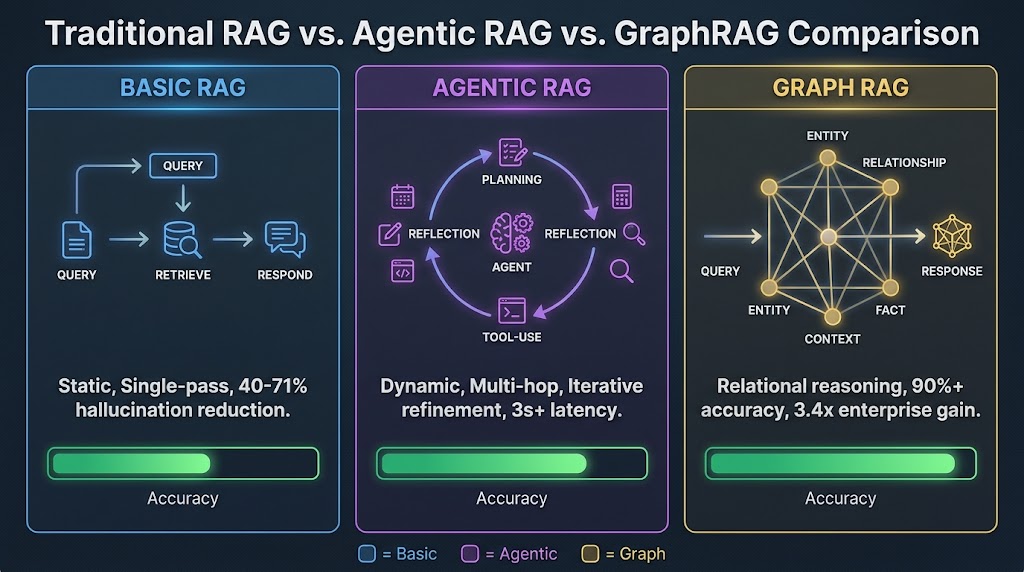
Basic RAG is a static pipeline: query arrives, retrieval runs, context is assembled, LLM generates, response is returned. This works well for straightforward question-answering over a well-maintained knowledge base. It breaks down on complex, multi-step tasks where a single retrieval pass cannot capture all the information needed to generate an accurate answer.
Agentic RAG replaces the static pipeline with an autonomous reasoning loop that can plan retrieval strategies, execute multiple queries, reflect on intermediate results, use external tools, and refine its answer iteratively before returning a final response.
The Five Workflow Patterns of Agentic RAG
Enterprise agentic RAG implementations have coalesced around five core workflow patterns, each suited to different task types:
- Prompt chaining: Sequential retrieval steps where each output feeds the next query. Ideal for multi-step analytical tasks where later questions depend on earlier answers.
- Routing: An agent classifies the incoming query and directs it to the appropriate specialized retrieval process — routing a billing question to CRM data, a policy question to the internal documentation index, and a technical question to engineering documentation, rather than searching all sources every time.
- Parallelization: Multiple retrieval queries run concurrently, with results merged before generation. Reduces latency for complex queries that require broad knowledge synthesis.
- Orchestrator-workers: A planning agent decomposes complex tasks into sub-tasks and delegates them to specialized retrieval workers, each focused on a specific knowledge domain or tool.
- Evaluator-optimizer: After initial generation, a separate evaluation agent reviews the response for factual consistency with the retrieved context and triggers additional retrieval or refinement if the answer fails quality thresholds. This pattern is what enables self-reflective RAG — the architecture that achieved 0% hallucination rates in controlled clinical consultations.
The Latency Trade-Off
Agentic RAG delivers significantly higher accuracy for complex tasks, but it comes with a cost: latency. Current benchmarks show agentic RAG averaging 3+ seconds for complex multi-hop queries. For synchronous customer-facing applications, this is a real constraint. For asynchronous automation workflows — nightly report generation, document review pipelines, compliance checking, research summarization — it’s typically irrelevant. Architecture selection should be driven by the latency tolerance of the specific workflow, not by default preference for the most sophisticated approach.
Real-World Agentic RAG Deployments
Practical agentic RAG use cases that are in production in 2026 include:
Employee support automation that handles expense policy questions by querying across HR documentation, finance policy docs, and historical exception tickets — escalating only when no retrieved context provides a definitive answer.
Developer copilots that retrieve across code repositories, API documentation, build results, and issue trackers before suggesting fixes — running linting and static analysis tools as part of the retrieval process.
Customer support agents that search CRM records, product manuals, and past ticket histories, and that explicitly re-ask or escalate when retrieved context is incomplete — rather than generating a plausible-sounding answer from parametric memory.
Legal research pipelines that decompose a complex legal question into sub-questions, retrieve across case law, regulatory texts, and internal precedent documents simultaneously, then synthesize a grounded summary with explicit citations to every source.
GraphRAG: When Relationships Matter More Than Documents
Vector-based RAG treats each document chunk as an independent unit retrieved by similarity. This works when queries can be answered from individual passages. It fails when the answer requires reasoning about relationships between entities — how a regulation affects a specific business unit, how a product recall in one market interacts with warranty policies in another, or how customer behavior data links to specific support escalation patterns.
GraphRAG addresses this by grounding retrieval in a knowledge graph rather than (or in addition to) a vector index. Instead of retrieving similar text chunks, the system traverses structured relationships between entities — products, customers, regulations, incidents, policies — to assemble a factually grounded, relationally coherent context.
What the Numbers Say About GraphRAG in Enterprise
GraphRAG’s performance advantages over traditional vector RAG are significant at scale:
- GraphRAG achieves 72–83% comprehensiveness versus traditional RAG on complex enterprise queries, with a 3.4x accuracy improvement in enterprise scenarios (Towards AI, 2026)
- Knowledge graph-backed RAG can achieve 90%+ accuracy versus approximately 60% for embeddings-only RAG on entity reasoning tasks (Graphwise research)
- For multi-hop queries — questions requiring more than one logical inference step — GraphRAG achieves 70–85% accuracy compared to 40–55% for traditional RAG (RebaseHQ benchmarks)
- LinkedIn reported a 78% accuracy improvement and 29% faster median resolution time after integrating knowledge graphs into their RAG pipeline
When to Use GraphRAG vs. Vector RAG
GraphRAG isn’t the right architecture for every use case. Building and maintaining a knowledge graph requires significantly more upfront effort than indexing documents into a vector store. The decision framework is relatively straightforward: if more than 25% of your automation’s queries involve relational reasoning — connecting entities across data domains — GraphRAG will deliver meaningful accuracy gains that justify the investment. If your queries are predominantly single-document lookups or semantic search tasks, well-optimized vector RAG with hybrid retrieval will perform adequately and at lower operational complexity.
Many production systems in 2026 run hybrid architectures: a vector store for broad document retrieval, a knowledge graph for entity-relationship queries, and routing logic that directs incoming queries to the appropriate retrieval path based on intent classification.
Measuring What You Can’t See: RAG Evaluation Frameworks
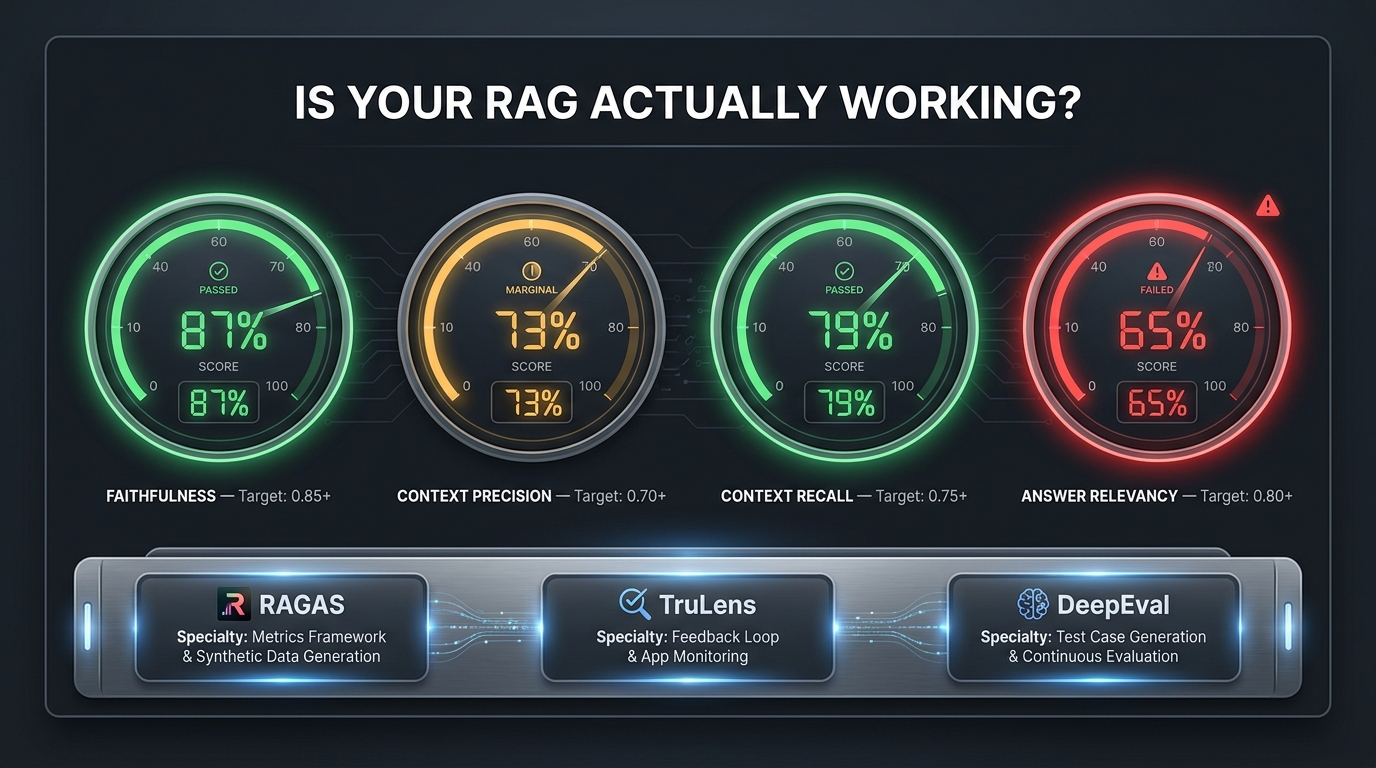
One of the most common mistakes in RAG deployment is treating successful testing as validation of production readiness. RAG systems degrade over time — as knowledge bases go stale, as query patterns shift, as embedding drift accumulates — and that degradation is often invisible without active measurement.
By 2026, RAG evaluation has matured into a specialized tooling ecosystem with three dominant frameworks, each serving a different phase of the development and operations lifecycle.
The Four Metrics That Define RAG Health
Across RAGAS, TruLens, and DeepEval — the three leading evaluation frameworks — four core metrics have emerged as the standard measures of RAG quality:
Faithfulness measures whether the claims in a generated answer are actually supported by the retrieved context. This is the primary hallucination detection metric. A faithfulness score below 0.75 indicates frequent hallucination or context drift. Production systems targeting regulated industries should aim for 0.9 or above. RAGAS computes this by decomposing generated claims and checking each against the retrieved context — a more rigorous approach than simple similarity scoring.
Context Precision measures the proportion of retrieved chunks that are actually relevant to answering the query. Low precision means the retrieval stage is pulling too much noise, which dilutes the LLM’s context and increases generation drift. Target: 0.70 or above.
Context Recall measures whether the retrieved context actually contains the information needed to answer the query. Low recall means the knowledge base is incomplete or the retrieval strategy is missing relevant documents. Target: 0.75 or above.
Answer Relevancy measures whether the generated response directly addresses the original query — catching cases where the model answers a related but different question. Target: 0.80 or above.
Choosing the Right Evaluation Tool
RAGAS is the best starting point for most teams — lightweight, reference-free (doesn’t require ground truth labels), and fast enough to run on representative query sets during development. Its primary limitation is that it doesn’t provide span-level pipeline diagnostics, making it harder to identify exactly where in the pipeline a failure occurred.
TruLens fills this gap with OpenTelemetry-based tracing that instruments each step of the retrieval pipeline. When a faithfulness score drops, TruLens can tell you whether the failure occurred at retrieval (wrong chunks), context assembly (too much noise), or generation (model drift). It integrates natively with LangChain, LlamaIndex, and Snowflake, making it the preferred monitoring tool for production systems that need failure root-cause analysis.
DeepEval leads for teams running CI/CD pipelines. With 50+ metrics, native Pytest integration, and support for RAG, agents, and multimodal systems, it’s the right choice for organizations that want automated evaluation gates before deploying updates to their RAG pipeline.
The Decay Problem: Why Evaluation Is an Ongoing Practice
Production audits of enterprise RAG systems reveal a consistent pattern: systems that are not actively monitored show 5–8% accuracy decay per month as content becomes stale, embedding models drift relative to content evolution, and query patterns shift in ways the original retrieval strategy wasn’t optimized for. Building evaluation into deployment pipelines — not just at launch — is what separates RAG implementations that maintain performance from those that degrade silently.
Industry-by-Industry: Where RAG Is Already Working
The case for RAG is most compelling not in aggregate statistics but in the domain-specific evidence. Here’s where retrieval-augmented automation is delivering documented results across industries in 2026.
Legal and Compliance
Legal AI presents one of the starkest before-and-after stories in RAG adoption. Ungrounded LLMs hallucinate at rates of 69–88% on legal queries — a rate that makes them actively dangerous for any compliance or legal research application. Stanford RegLab research documented this range across commercial legal AI tools before RAG grounding was applied.
Post-RAG, the numbers shift significantly: Lexis+ AI, with retrieval grounding, reduced its error rate to approximately 17%. That’s still not zero, and no legal professional should rely on AI without expert review — but the reduction from 69–88% to 17% represents a practical difference between a system that’s occasionally wrong and one that’s wrong most of the time.
For compliance automation specifically — policy Q&A, regulatory change monitoring, AML policy lookups — RAG’s citation capabilities are as important as its accuracy improvements. Auditable, source-traceable outputs are a compliance requirement in regulated industries. Ungrounded LLMs cannot provide them. RAG can.
Healthcare and Clinical Decision Support
Clinical AI is the domain where RAG’s accuracy improvements are most dramatic — and where the stakes of failure are highest. A PubMed study cited in 2026 RAG analyses found that self-reflective RAG in clinical decision support eliminated hallucination errors entirely (from an 8% baseline to 0%) in 100 synthetic consultations, with an 89% performance improvement over the ungrounded baseline.
Multi-evidence RAG — systems that retrieve from multiple clinical knowledge sources and require cross-corroboration before including a claim in the output — achieved a greater than 40% reduction in hallucinations in biomedical applications. Visual RAG (V-RAG) combining text and image retrieval improved F1 scores and reduced hallucinated entities in radiology reporting workflows.
These aren’t marginal improvements. They’re the difference between clinical AI that can be responsibly integrated into a care workflow under human oversight and clinical AI that can’t be deployed at all.
Financial Services
Financial services AI faces a dual challenge: high hallucination rates in ungrounded models (15–25% on financial analysis tasks) and severe per-incident costs ($50,000–$2.1 million for documented hallucination-related errors). RAG grounding combined with GraphRAG for relational reasoning across financial data has become the production standard for financial analysis automation in regulated markets.
Real-time data integration is particularly important in financial AI. Modern RAG implementations use stream processing (Apache Kafka and similar) to ingest continuously-updated market data, regulatory filings, and internal financial records — enabling responses grounded in current information rather than training data that may be months or years old.
Enterprise Knowledge Management and Support
Perhaps the most widely deployed use case for RAG in 2026 is internal knowledge management: AI-powered employee support, HR policy Q&A, and operational procedure lookup. Organizations report 60–80% reductions in hallucinations and 3x accuracy improvements on domain-specific queries after deploying RAG over their internal knowledge bases.
The driver here isn’t just accuracy — it’s the economics of scale. When AI handles 60–70% of tier-one support queries with grounded, accurate responses, the remaining volume that reaches human agents is higher-complexity and more valuable for human attention. The cost per resolved query drops, and employee time is redirected toward exceptions rather than routine lookups.
Building a RAG-Grounded Automation Stack That Holds Up
Deploying RAG in production is an engineering project with specific architectural requirements — not a feature flag. Here’s the practical framework for building automation on retrieval-augmented grounding that performs reliably over time.
Step 1: Define Your Knowledge Domains Before Touching Architecture
The most common architecture mistake is building a single monolithic knowledge base for all AI automation use cases. Different domains have fundamentally different data characteristics, update frequencies, and relevance criteria. Your internal HR documentation, product engineering specs, customer support history, and regulatory compliance library should not live in the same vector index.
Domain-specific knowledge bases with domain-aware retrieval routing deliver significantly better precision than generalist indexes. Define your knowledge domains first — their sources, ownership, update frequency, and query patterns — before designing your retrieval architecture.
Step 2: Invest in Data Quality Before Investing in Model Quality
Given that 40–60% of RAG failures originate in the knowledge base layer, the ROI on data quality work is consistently higher than the ROI on model upgrades. This means: establishing document ownership and update SLAs, implementing content certification processes, adding metadata schemas that enable filtered retrieval, and building automated staleness detection.
A RAG system running on a rigorously maintained, well-structured knowledge base with a standard embedding model will outperform a RAG system running on a poorly maintained knowledge base with a state-of-the-art embedding model. This is consistently underestimated by teams that come from a model-centric perspective.
Step 3: Build Hybrid Retrieval From the Start
Given the 20–40% recall improvement that hybrid retrieval (dense + sparse) delivers over dense-only approaches, there is rarely a good reason to build dense-only retrieval in a production system. The additional implementation complexity is modest, and the accuracy benefit is consistent across benchmarks.
A typical production configuration: 60% weight to semantic vector search, 40% weight to BM25 keyword matching, with results merged using reciprocal rank fusion before re-ranking. These weights can be tuned based on your specific query mix — queries heavy on proper nouns and exact terminology benefit from higher BM25 weighting.
Step 4: Layer in Re-Ranking Before Generation
Initial retrieval prioritizes recall — getting the right documents into the candidate set. Re-ranking optimizes precision — ensuring the LLM only sees genuinely relevant content. Cross-encoder re-ranking adds computational overhead but delivers 18–42% precision improvements consistently enough that it should be treated as a standard pipeline component, not an optional enhancement.
Step 5: Set Explicit Confidence Thresholds and Graceful Fallback
A production RAG system should know when it doesn’t know. Configuring explicit confidence thresholds — and training the system to respond with “I don’t have sufficient information to answer that reliably” when retrieved context falls below that threshold — is not a degradation of capability. It’s what makes the system trustworthy for automation.
A system that answers 70% of queries accurately and explicitly declines 30% is more useful — and vastly less dangerous — than a system that answers 100% of queries with 70% accuracy and no indication of which answers are reliable.
Step 6: Build Evaluation Into the Pipeline, Not Onto the Side
RAGAS or equivalent scoring should run continuously against a representative query set, with automated alerting when faithfulness scores drop below thresholds. For regulated industries, target faithfulness >0.9 and context precision >0.75. For general enterprise use, faithfulness >0.8 and context precision >0.7 are reasonable operational targets.
Evaluation should run before deployment (catching regressions in the retrieval pipeline) and in production (catching accuracy decay from knowledge base staleness or query pattern drift). Teams that evaluate only at deployment discover problems months after they’ve already affected users.
The Governance Layer: RAG in Regulated and Compliance-Critical Environments
For organizations operating in regulated industries — financial services, healthcare, legal, government — RAG deployment carries additional requirements beyond technical accuracy. The EU AI Act (in enforcement from August 2026) and parallel regulatory frameworks in the US and APAC markets impose specific transparency, auditability, and human oversight requirements on high-risk AI systems.
What Compliance Requires From a RAG System
Regulated RAG deployments need to address four specific compliance concerns:
Source traceability. Every AI output must be traceable to specific source documents. RAG’s native citation capability — including the chunk, the document, and the version of the document used to generate each output — is the mechanism that makes this possible. Systems that generate outputs without this audit trail do not meet compliance requirements in most regulated sectors.
Access control alignment. The documents a user can access through AI should mirror the documents they can access directly. RAG systems in enterprise environments need to implement per-query access control filtering, ensuring retrieval only surfaces content the querying user or system has authorization to see.
Human oversight touchpoints. For high-stakes automation — decisions affecting customer financial accounts, clinical recommendations, legal determinations — RAG automation should be designed as decision-support, not decision-replacement. Outputs should include confidence signals that inform human review prioritization.
Data residency and privacy. For organizations operating across jurisdictions with data residency requirements, RAG architectures need to route queries to geographically-appropriate knowledge bases and ensure that retrieval doesn’t surface data across compliance boundaries. Edge RAG deployments — where retrieval occurs on-premises or in a specific region — are an emerging architecture pattern for privacy-critical environments.
The Practical Takeaways: What to Actually Do With This
If you’re building or evaluating AI automation for 2026 deployment, retrieval-augmented grounding is not optional in any domain where accuracy, auditability, or compliance matters. Here’s a compressed decision framework:
Start with an honest hallucination audit
Before deploying any AI automation, run your specific query types through your chosen LLM and measure actual hallucination rates using RAGAS or equivalent tooling. Domain-specific rates — not benchmark rates — tell you what you’re actually working with. The gap between current rates and acceptable rates defines your RAG investment case.
Match architecture to query complexity
Basic RAG with hybrid retrieval is the right starting point for most use cases. Layer in re-ranking as a default component. Add agentic capabilities (iterative retrieval, tool use, evaluator loops) only for workflows where single-pass retrieval demonstrably falls short. Adopt GraphRAG for domains where relational reasoning across entity types is a primary query pattern.
Treat knowledge base maintenance as a core operational function
Assign document ownership. Set update SLAs. Automate staleness detection. Budget for ongoing knowledge base curation the same way you budget for database administration — because that’s effectively what it is.
Build evaluation into every stage
Faithfulness, context precision, context recall, and answer relevancy should be tracked from first deployment and monitored continuously. Set automated alerts for threshold breaches. Treat accuracy decay the same way you’d treat a service degradation — with a structured response, not reactive troubleshooting after users notice.
Conclusion: The New Baseline for Trustworthy AI Automation
The conversation about AI hallucinations too often gets stuck at the level of model benchmarks — which LLM hallucinates less, which safety training is most effective, which guardrail catches the most errors. These are useful questions, but they address symptoms rather than architecture.
RAG addresses architecture. It changes the information structure that AI operates within — from parametric memory with no verifiable source to retrieved, grounded, citable context with explicit provenance. That structural change is what drops hallucination rates from 69–88% to 17% in legal AI, from 8% to 0% in self-reflective clinical systems, from unacceptable baselines to production-viable accuracy across domains.
The $67.4 billion cost of AI hallucinations is a 2024 figure. Every organization that deployed AI automation without grounding in 2024 and 2025 contributed to it. The organizations that won’t contribute to whatever the 2026 figure turns out to be are the ones treating retrieval grounding not as an advanced technique but as the baseline requirement it has become.
RAG is not a complete solution. Knowledge base governance is hard. Retrieval optimization is ongoing. Evaluation requires dedicated infrastructure. Agentic architectures introduce latency trade-offs. GraphRAG requires significant upfront investment in knowledge modeling. None of these challenges are reasons to avoid retrieval-augmented automation — they’re the reasons building it correctly requires deliberate engineering rather than plug-and-play deployment.
The alternative — confident, fluent, unverifiable, wrong — is no longer acceptable for production AI systems. The $67.4 billion says so. So does the 47% of executives who made major decisions on AI content nobody bothered to check. Retrieval-augmented automation is not a feature addition to AI workflows. In 2026, it’s the minimum viable architecture for any AI automation that needs to be trusted.
“A system that answers 70% of queries accurately and declines the rest is more trustworthy than a system that answers everything with 70% accuracy and no indication of which answers are reliable.”
The gap between those two systems is where RAG lives. Close it deliberately, or discover it expensively.