
Tag: AI Infrastructure

  • The Token Cost Collapse: An Engineer’s Field Guide to Re-Architecting for 80% Lower AI Spend

    The Token Cost Collapse: An Engineer’s Field Guide to Re-Architecting for 80% Lower AI Spend

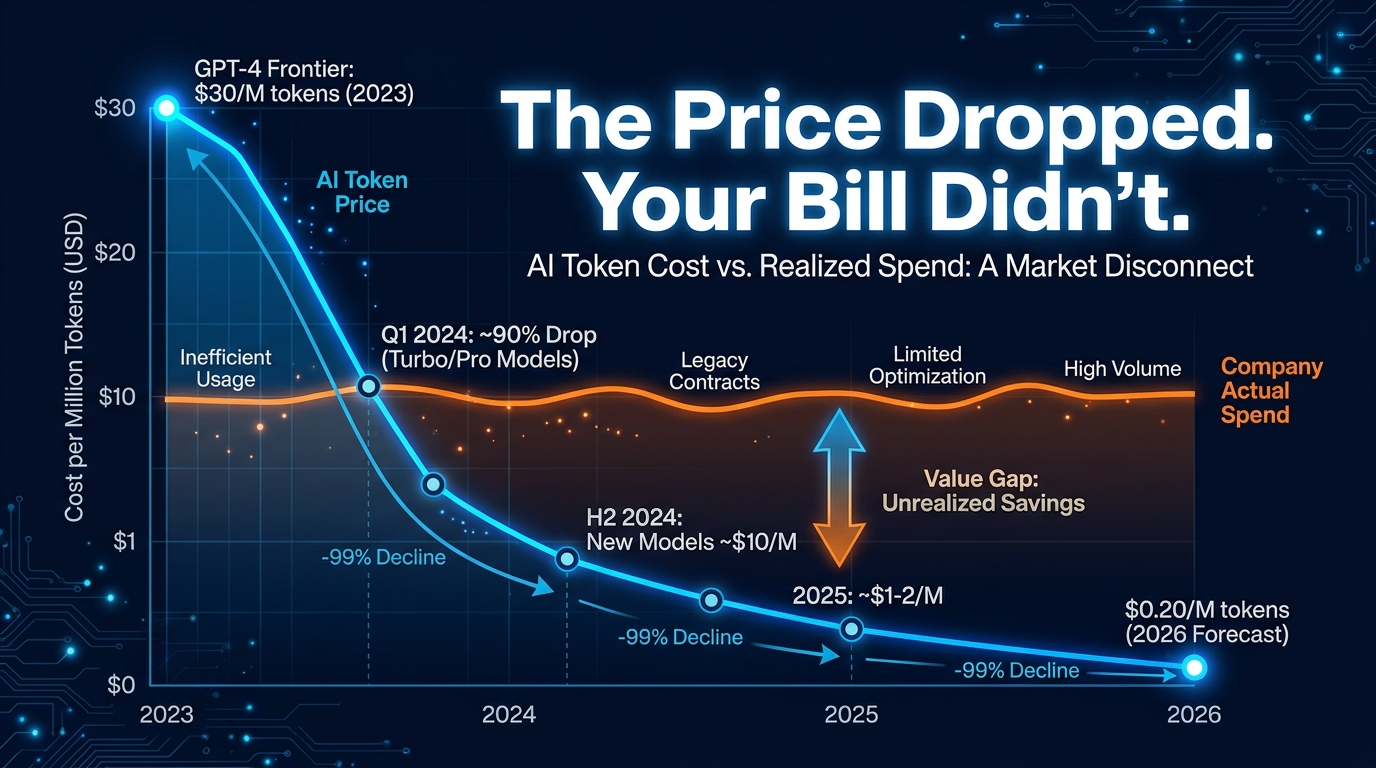
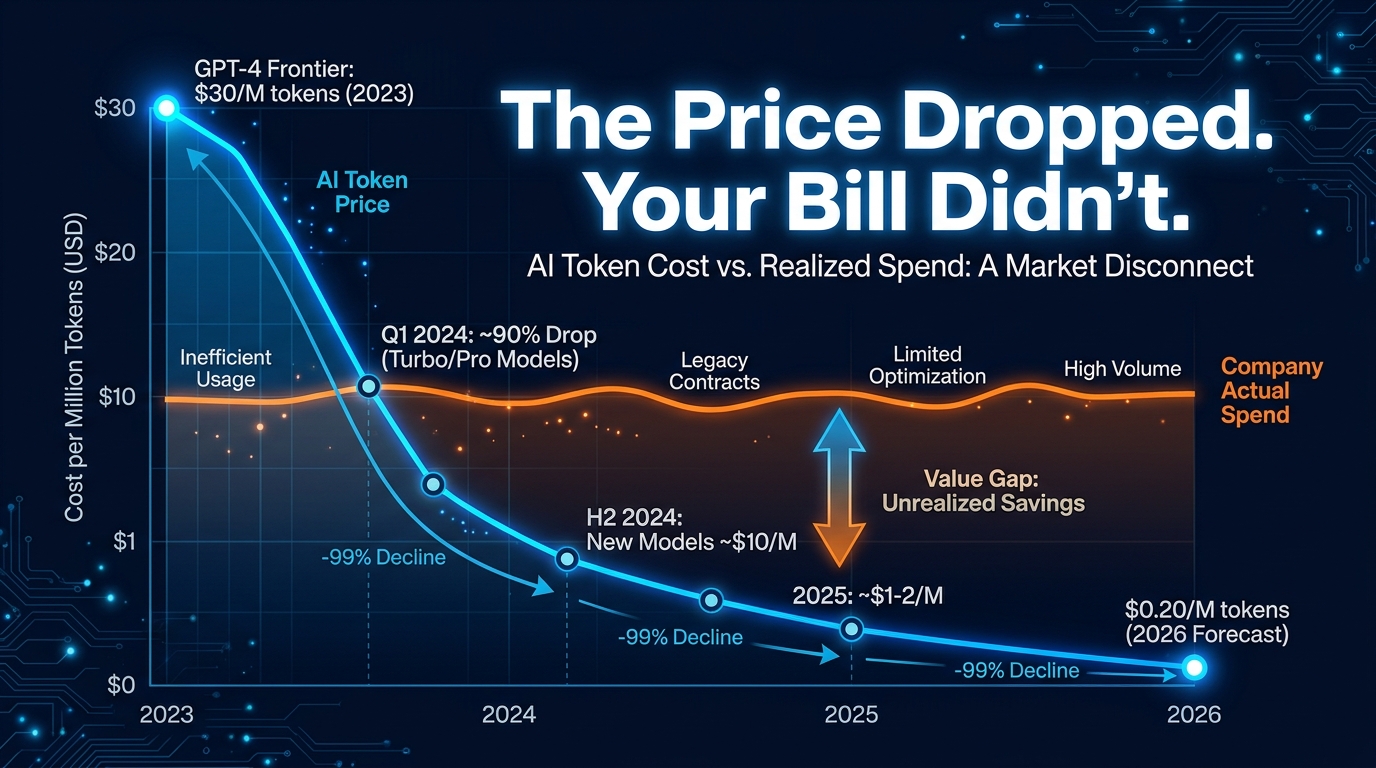
    Dramatic infographic showing AI token pricing dropping from $30 per million tokens to $0.20, while company AI spend stays flat — illustrating the gap between market prices and realized savings

    Token prices have collapsed. OpenAI cut its GPT-5.6 Luna model by 80% — from $1.00 to $0.20 per million input tokens — in a single announcement. DeepSeek followed with a 75% permanent reduction on its V4-Pro API. Google’s Gemini 2.5 Flash sits at $0.075 per million input tokens, a fraction of what frontier model access cost eighteen months ago. By any measure, inference has never been cheaper.

    And yet, most engineering teams haven’t seen their AI bills move much.

    That gap — between the market’s dramatic price compression and your organization’s actual spend — is not a pricing problem. It is an architecture problem. The economics of AI inference have changed faster than the systems built to consume it. Teams are still routing every request through a single premium model, still stuffing entire document corpora into context windows, still re-processing identical system prompts on every call. The model got cheaper. The code didn’t.

    This guide is for the engineers, platform architects, and technical leads who want to close that gap. Not with surface-level prompt tips, but with the layered architectural changes that compound on each other to deliver 80% or greater cost reduction — while maintaining, or in some cases improving, the quality of outputs your users depend on.

    We’ll work through five distinct optimization layers, show how they stack, and look at the governance model that keeps them from degrading over time.

    The 2026 Pricing Landscape: What Actually Changed and Why It Matters

    To understand why architectural redesign matters more than ever, it helps to understand what’s driving the price compression — because the underlying forces determine which optimizations will hold and which will be superseded.

    The Price War in Numbers

    The most significant recent moves are worth cataloguing clearly, because the scale of the drops is easy to underestimate:

    • OpenAI GPT-5.6 Luna: Input tokens dropped from $1.00 to $0.20 per million (80% cut). Output tokens fell from $6.00 to $1.20 per million. This model sits in the mid-tier — capable enough for a wide range of production tasks, now priced at sub-budget-model rates from two years ago.
    • OpenAI GPT-5.6 Terra: Input tokens dropped 20% to $2.00 per million. Output tokens fell to $12.00 per million. Terra represents the first meaningful price movement on OpenAI’s upper-mid tier.
    • OpenAI Sol (frontier): The flagship model received a 20%+ reduction, a sign that price competition is now affecting even the models organizations treat as untouchable.
    • DeepSeek V4-Pro: A 75% permanent cut on API access, pushing input tokens to approximately $0.0035 per million for cached tokens — making it among the lowest-cost capable models available via API today.
    • Gemini 2.5 Flash: Sitting at roughly $0.075 per million input tokens and $0.30 per million output tokens, Flash is the baseline against which many teams now benchmark their model spend.
    • GPT-4o mini / GPT-4.1 mini: Still anchored at $0.15 per million input tokens and $0.60 per million output tokens, with cached input at $0.075 per million — representing strong value for repetitive, structured workloads.

    What’s Driving the Drops

    These price cuts are not charity. They reflect genuine efficiency improvements: advances in speculative decoding, hardware utilization at massive scale, and increasingly efficient quantization techniques that allow models to run at lower precision without meaningful capability loss. The cost to serve a token has fallen materially, and competitive pressure among providers is forcing those savings to be passed through to customers.

    The important implication: this compression is likely to continue. Which means a system architected to take advantage of today’s pricing will be progressively more valuable as the floor drops further. The investment in architectural optimization pays dividends not just now, but at every future price level.

    The Hidden Problem with Cheaper Models

    Cheaper models create a specific temptation: simply swap your current model for a cheaper one and declare victory. Some teams have done exactly this — and discovered that the quality-to-cost tradeoff didn’t hold the way they expected. Cheaper models are cheaper for a reason. Routing everything indiscriminately to the lowest-cost option is how you introduce quality regressions that are hard to detect until they’ve already damaged user trust.

    The right approach is selective — and that selectivity requires architecture, not just a configuration change.

    Why Most Teams Are Still Leaving 70% of Savings on the Table

    Before diving into the optimization layers, it’s worth diagnosing why the gap between available savings and realized savings is so large. The patterns are remarkably consistent across organizations.

    The Single-Model Monolith

    The most common anti-pattern: a single model handles every request in a product. The model is typically chosen for the hardest use case — complex reasoning, nuanced tone, multi-step analysis — and then applied uniformly to tasks that don’t need anywhere near that capability. A user asking a simple factual question gets the same model as one asking for a multi-document synthesis. The organization pays frontier rates for routine work.

    In practice, across most production LLM workloads, 60-70% of requests are classifiable as “simple” or “templated” — factual lookups, structured extractions, standard summaries, route-able support queries. These do not need a frontier model. They need a reliable, fast, cheap model. Most systems don’t make that distinction.

    Context Amnesia

    Every token sent into a model costs money. Context that is sent but not needed is money burned. In agentic and conversational systems, context accumulates with every turn — and most implementations send the full conversation history on every call, even when 80% of that history is irrelevant to answering the current question.

    The same problem appears with retrieval: many RAG implementations over-retrieve, stuffing far more document context than the model needs to answer the query accurately. More context is not always better. It is always more expensive.

    Cache Blindness

    Prompt caching — the ability to reuse the computed key-value states of repeated prompt prefixes — is now a first-class feature supported by OpenAI, Anthropic, and Google. It can reduce the cost of cached tokens by up to 90%. And yet most systems are not structured to take advantage of it, because they haven’t structured their prompts so that the stable parts come first and the variable parts come last. A small architectural decision at prompt design time translates into massive ongoing savings.

    Output Verbosity as a Cost Driver

    Output tokens are consistently more expensive than input tokens — often by 3x to 5x across providers. A model that writes a 1,200-word response when a 200-word response would serve the use case equally well is consuming 6x the output token budget for no functional benefit. Most systems don’t constrain output length explicitly, don’t use structured output schemas to eliminate wrapper prose, and don’t distinguish between contexts where verbosity adds value and contexts where it doesn’t.

    Layer 1 — Model Tiering and Intelligent Routing

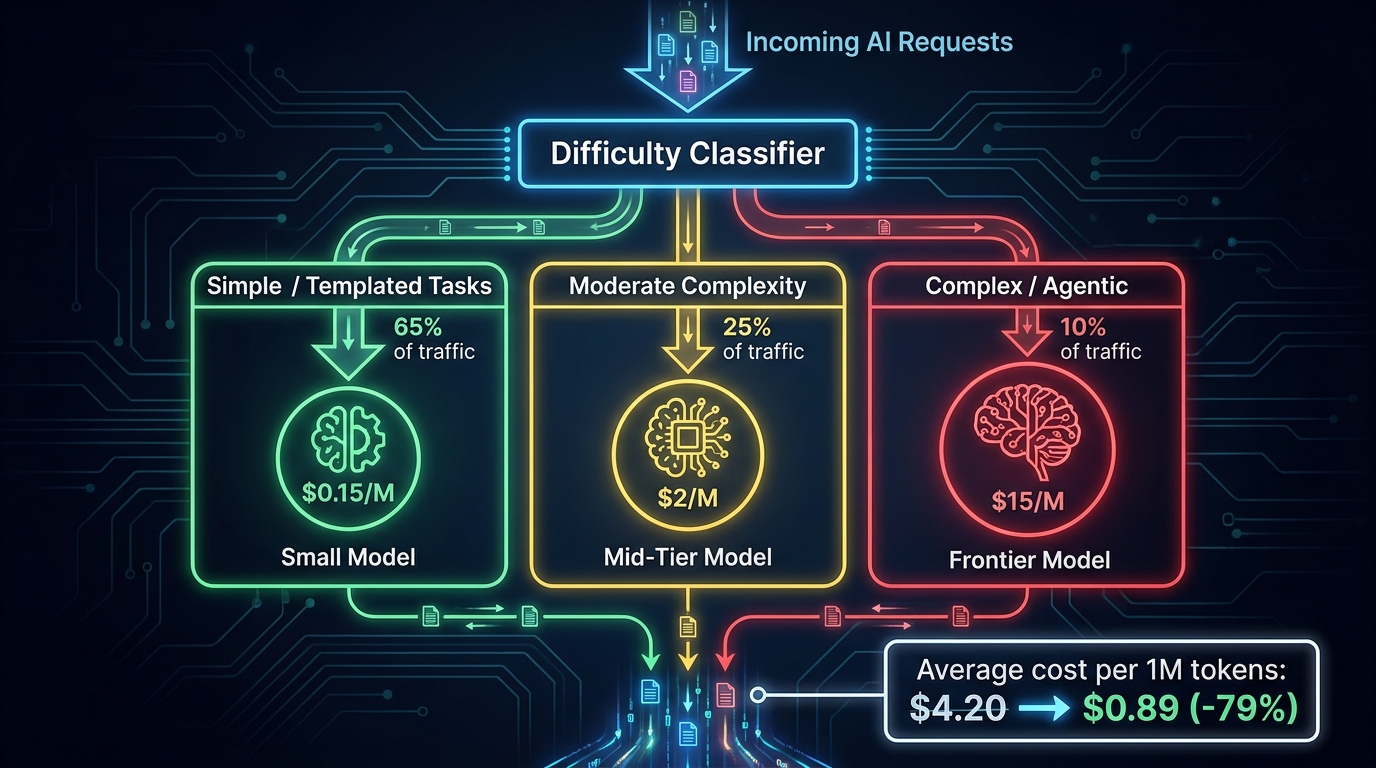
    Technical architecture diagram showing three-tier model routing system with difficulty classifier directing 65% of traffic to cheap models, 25% to mid-tier, and 10% to frontier models

    Model routing is the highest-impact single lever available to most engineering teams. Production deployments that implement proper multi-tier routing consistently report 30-85% cost reductions, with the strongest results pushing toward the upper end of that range on workloads where a large proportion of requests are classifiable.

    How Tiered Routing Works

    The core principle is simple: match the capability requirement of the task to the cost profile of the model that can handle it adequately. Build three tiers:

    • Tier 1 — Lightweight models ($0.075–$0.20/M input tokens): Gemini 2.5 Flash, GPT-4o mini, GPT-4.1 mini, DeepSeek V4-Pro cached. Suitable for classification, extraction, templated responses, simple Q&A, content moderation, intent detection.
    • Tier 2 — Mid-tier models ($0.80–$2.00/M input tokens): Claude Haiku 4.5, GPT-5.6 Luna at new pricing, GPT-4.1. Suitable for moderate-complexity tasks — summarization of medium-length documents, structured analysis, multi-step reasoning on bounded problems.
    • Tier 3 — Frontier models ($3.00–$15.00/M input tokens): Claude Sonnet/Opus, GPT-5.6 Terra/Sol, Gemini 2.5 Pro. Reserved for tasks that genuinely require high-capability reasoning — complex multi-document synthesis, novel problem-solving, high-stakes output generation where quality is non-negotiable.

    The Classifier Layer

    Routing requires a classifier — something that evaluates an incoming request and assigns it to a tier before dispatching it. There are several viable approaches:

    Rule-based routing is the simplest: define request categories in your application logic, and route each category to a designated model tier. A customer support flow might route “order status” queries to Tier 1, “returns policy disputes” to Tier 2, and “legal/compliance escalations” to Tier 3. This requires no ML but demands well-structured application logic and breaks down when requests are free-form.

    LLM-as-classifier uses a small, cheap model (typically Tier 1) to evaluate each request and assign a difficulty score or category. The classifier prompt is short and its output is a simple label. The overhead of the classification call is typically recovered within the first few routed calls. Research from LMSYS-style routing benchmarks (RouteLLM) showed up to 85% cost reduction while maintaining approximately 95% of GPT-4-level quality on MT-Bench.

    Embedding-based routing uses semantic similarity to match requests to predefined query clusters, each mapped to a model tier. This can be faster than LLM classification and handles nuanced categorization well, but requires upfront cluster definition and embedding infrastructure.

    Real-World Routing Results

    A documented example from the customer support domain: a platform routing factual and templated tickets to Claude Haiku while escalating complex disputes to Sonnet saw monthly spend drop from approximately $42,000 to $18,000 — a 57% reduction with no measurable change in ticket resolution quality. The routing logic added roughly two weeks of engineering time. The payback period was under a month.

    More aggressive routing setups — combining provider-side routing with application-level classification and caching — report 80-95% cost reductions on highly structured workloads where a large fraction of requests are templated or low-complexity. The key variable is what proportion of your traffic is genuinely simple: if it’s 60% or more, routing alone can get you close to the 80% target without touching anything else.

    Guard Rails for Routing Quality

    Routing introduces quality risk if the classifier over-routes complex requests to simpler models. Protect against this with output quality monitoring: track downstream signals like user re-queries, escalation rates, and human override rates. Set threshold rules that escalate to a higher tier when a lower-tier model’s output fails a confidence or format check. Build in a “re-route on failure” path from day one.

    Layer 2 — Prompt Caching: The 90% Savings Nobody Is Using

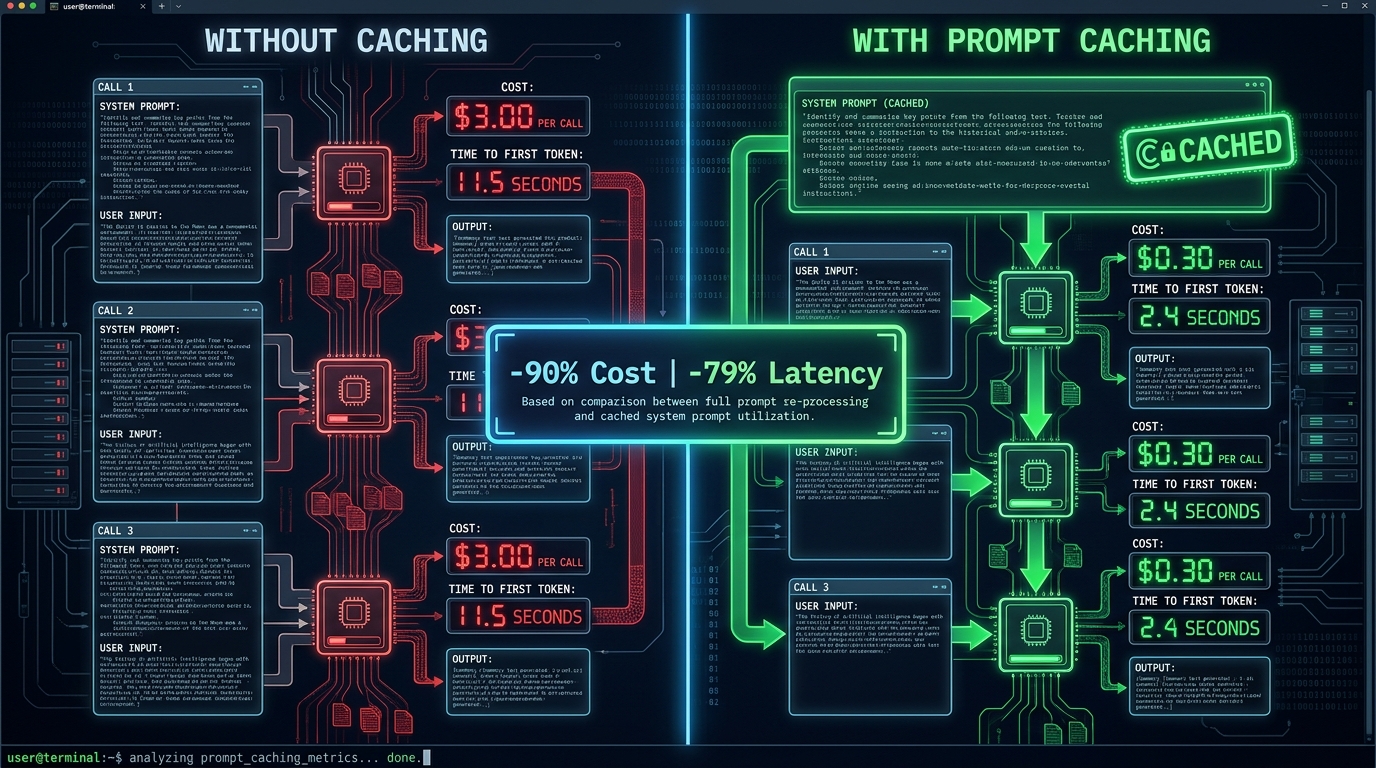
    Split-screen comparison showing API calls without prompt caching at $3.00 per call and 11.5 seconds latency versus with prompt caching at $0.30 per call and 2.4 seconds — a 90% cost reduction

    Prompt caching is the most consistently underutilized cost lever in production LLM systems. The savings are real, provider-supported, and activated by an architectural decision — not a new technology purchase. Yet the majority of teams deploying LLMs at scale have not structured their prompts to benefit from it.

    How Prompt Caching Works

    When a model processes input tokens, it computes intermediate key-value (KV) states — the mathematical representations the model uses to understand relationships between tokens. Normally, these states are discarded after each call. Prompt caching preserves those states for repeated prompt prefixes, so subsequent requests sharing that prefix pay only for the new, variable portion of their input.

    The economics are striking:

    • Anthropic (Claude): Cached reads cost 10% of the base input token price. Cache writes cost 25% more than the base rate. If you cache a prefix and reuse it twice, you’ve already broken even. By the tenth reuse, you’ve saved 78.5% versus processing without caching.
    • OpenAI: Prompt caching is enabled by default for supported models. Cache reads cost 10% of the standard uncached input rate. For GPT-5.6 and later, cache writes cost 1.25× the standard rate. A prefix written once and reused nine times costs 2.15× total versus 10× without caching.
    • Google (Gemini): Context caching is available for Gemini 1.5 Pro and Flash, with cached tokens billed at a fraction of standard input rates.

    Anthropic’s published benchmarks for Claude show: a chat-with-a-100,000-token-book workflow achieving 90% cost reduction and 79% latency reduction. Many-shot prompting with a 10,000-token prompt shows 86% cost savings and 31% latency improvement. Multi-turn conversations show 53% cost reduction.

    Structuring Prompts for Cache Hits

    The critical architectural principle: stable content must come before variable content in your prompt. Cache breakpoints work from the beginning of the prompt outward. If variable user content appears before your static system instructions, the cache can never match — because the prefix changes on every call.

    The correct structure follows this order:

    1. System instructions (persona, rules, constraints, output format specifications)
    2. Tool definitions and schemas (function calling definitions, JSON schemas)
    3. Static context (background documents, knowledge base content, few-shot examples)
    4. Conversation history (prior turns, which grows over time)
    5. Current user input (always last, always variable)

    Any change in the prefix before a cache breakpoint invalidates the cache for everything after it. This means your system prompt should be frozen and not dynamically constructed on each call. Even small differences — a whitespace character, a variable instruction — break the cache hit.

    Semantic Caching: Handling Similar (Not Identical) Queries

    Provider-level prompt caching handles exact prefix matches. Semantic caching goes further — it identifies requests that are semantically similar to previous ones and returns a cached response rather than making a model call at all.

    Semantic caching typically sits in front of your LLM API and uses embedding similarity to find near-matches in a cache store. When a new query’s embedding falls within a defined similarity threshold of a cached query, the cached response is returned directly. The savings can be substantial for high-repetition workloads — support bots, FAQ systems, product description generators — where many users ask functionally identical questions in slightly different words.

    The trade-off is precision: semantic caching introduces the risk of returning an approximate answer to a subtly different question. Cache hit thresholds need to be calibrated carefully, and certain query types (factual, time-sensitive, personalized) are poor candidates for semantic caching regardless of similarity scores.

    Layer 3 — Context Window Discipline

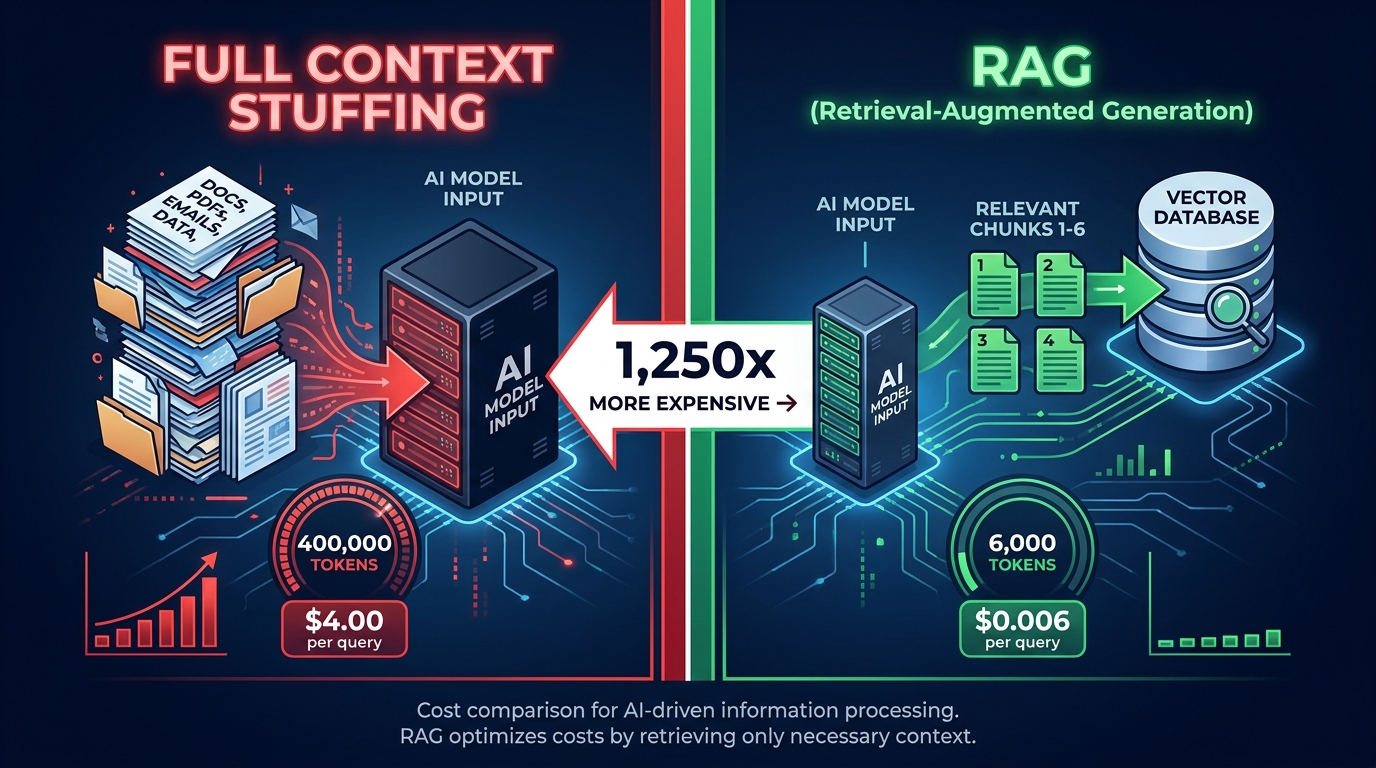
    Infographic comparing RAG retrieving 6,000 tokens at $0.006 per query versus full context stuffing sending 400,000 tokens at $4.00 per query — showing a 1,250x cost difference

    Context window management has emerged as one of the primary cost levers in 2026 — and it’s one of the least visible, because the waste accumulates gradually rather than appearing as a discrete line item. Large context windows are a capability you pay for whether or not you use them effectively. The cost scales linearly with tokens sent: sending 10x the context costs 10x more, regardless of whether any of that additional context affected the output.

    The RAG vs. Full-Context Decision

    The most consequential context decision for teams building over large knowledge bases is whether to use retrieval-augmented generation or full-context stuffing. The cost difference is not marginal — it can be orders of magnitude.

    Published estimates for 2026 workloads are stark: a 400,000-token full-context prompt costs approximately $4.00 per query on a mid-tier model, uncached. A RAG implementation retrieving the six most relevant chunks — approximately 6,000 tokens — costs approximately $0.006 per query. That is a 1,250× cost difference for a single query type.

    This does not mean RAG is always the right choice. Full-context approaches have genuine advantages for small, stable knowledge bases where the entire corpus fits in a modest context window, for synthesis tasks where relationships across the full document set matter, and for one-off analysis where retrieval infrastructure overhead isn’t justified. But for high-volume, dynamic knowledge bases queried repeatedly, RAG is not an optimization — it’s a necessity.

    Conversation History Trimming

    In conversational applications, context bloat is insidious. Every turn adds tokens. By turn 20 of a conversation, the system may be sending 15,000 tokens of history to answer a question that requires only the last two turns as context. The oldest turns are often irrelevant, and the model’s attention mechanisms may be paying little effective attention to them anyway.

    Practical history management strategies include:

    • Sliding window: Keep only the last N turns in context. Simple to implement, trades recency for history depth. Works well for single-session conversational UIs.
    • Summarization compression: Periodically summarize older conversation segments into a compact summary, replacing the raw turns with the summary. Preserves key context at a fraction of the token cost.
    • Hierarchical memory: Separate “working memory” (recent turns, active task context) from “long-term memory” (key facts established earlier in the conversation, stored in a retrieval system and fetched on demand). Only inject long-term memory when the current query’s semantics suggest it’s needed.
    • Selective history: Track which past turns were actually referenced in model outputs, and deprioritize turns that have never been referenced during context trimming.

    Retrieval Quality as a Cost Lever

    In RAG systems, retrieval quality directly determines cost efficiency. Poor retrieval — fetching too many chunks, fetching loosely relevant chunks, failing to filter by recency or authority — inflates the context sent to the model without improving output quality. Investing in better retrieval (improved embedding models, hybrid search combining dense and sparse retrieval, re-ranking layers that filter before context injection) reduces the token burden on the LLM and improves the signal-to-noise ratio of what it receives.

    A useful heuristic: if your retrieval returns chunks that the model ignores, your retrieval is too broad and you’re paying for noise. Tighten chunk size, improve re-ranking, and measure retrieval precision not just recall.

    Long-Context Economics: When to Flip the Equation

    There is a scenario where full-context loading wins on cost: when your knowledge base is small and stable, and you run many queries against it within a session. With prompt caching enabled, loading a 50,000-token document corpus once and caching it can make subsequent queries extremely cheap — just the user’s question and the model’s response, with the document corpus served from cache at 10% of standard token rates. In this scenario, full-context plus caching beats RAG on both cost and latency. Know your query pattern before choosing your architecture.

    Layer 4 — Output Control and Structured Generation

    Input tokens get most of the attention in cost conversations, but output tokens are typically 3x to 5x more expensive per token across major providers. A team spending $10,000 per month on inference where 40% of that cost is output tokens has a $4,000 line item that can be substantially reduced through output discipline.

    The Verbosity Problem

    Left unconstrained, LLMs tend toward verbosity. They add caveats, restate the question, provide context the user didn’t ask for, structure responses with headers that weren’t requested, and pad toward perceived completeness. This is not a model defect — it reflects training on human content that often rewards thoroughness. But for production applications, verbosity is a cost driver and often a UX problem simultaneously.

    The fix is explicit instruction. In your system prompt, specify the desired response length, format, and level of detail. Not as guidance — as a constraint. “Respond in 2-3 sentences only” is more effective than “keep responses concise.” Setting the max_tokens parameter as a hard cap prevents runaway outputs on edge cases. Evaluating a sample of production outputs for verbosity patterns and targeting the highest-verbosity prompt categories for explicit constraints is straightforward to do and consistently delivers cost reductions.

    Structured Outputs vs. Free-Form JSON

    When your application needs machine-readable output, the choice between structured outputs (schema-enforced generation) and JSON mode (valid JSON, no schema enforcement) has both cost and reliability implications.

    Structured outputs — where the model is constrained to generate output matching an exact schema — tend to produce shorter responses because they eliminate the prose wrapper that often surrounds JSON in JSON mode responses (“Here is the requested JSON:”). They also eliminate retry loops caused by schema violations, which consume additional tokens and latency. The operational cost savings — fewer retries, less parsing failure handling, no downstream correction loops — often exceed the direct token savings.

    The design principle is to make your schemas as minimal as possible. Every optional field in your schema is an invitation to the model to generate content. Define only the fields your application actually consumes. Avoid deeply nested structures where flat structures would serve as well. Test your schemas against production traffic patterns and trim aggressively.

    Reasoning Token Budgeting

    Models with visible reasoning steps (chain-of-thought, extended thinking modes) generate reasoning tokens that are billed before the final answer. For complex problems, these reasoning tokens are often what makes the difference between a correct and incorrect answer. For simple problems, they are pure cost overhead.

    OpenAI’s GPT-5 family supports a “minimal reasoning effort” mode that produces very few or no reasoning tokens, keeping output token counts tightly correlated with response verbosity. Using high-reasoning modes on tasks that don’t require deep reasoning is one of the more expensive anti-patterns in current LLM deployments. Map your task categories to appropriate reasoning effort levels and enforce those mappings in your routing logic.

    Layer 5 — Batching, Async, and Off-Peak Scheduling

    Not every LLM request needs to return a response within two seconds. A significant portion of production AI workloads are asynchronous by nature — report generation, content enrichment pipelines, bulk classification, nightly summarization jobs, data transformation workflows. For these use cases, there is no user waiting on the other end of the call. Yet many teams run them through the same synchronous, low-latency API path as interactive features — and pay premium prices for a latency guarantee they don’t need.

    Batch APIs and Their Discounts

    OpenAI’s Batch API offers a straightforward deal: accept up to 24-hour processing latency and pay 50% of the standard API price. For asynchronous workloads, this is a direct cost halving with no architectural complexity beyond queuing your requests and polling for results. Anthropic offers similar message batching through its API. These discounts are real and consistent — they don’t require negotiation or volume commitments.

    The organizational friction is usually process, not technology: getting product teams to accept that a bulk classification job or content enrichment pipeline can run overnight rather than in real time. Once that expectation is set, the technical implementation is typically a few hours of work.

    Request Aggregation and Throughput Optimization

    For synchronous workloads, batching individual tokens into larger requests can improve throughput efficiency and reduce per-request overhead. Many providers optimize their infrastructure for batched inference — larger batches amortize fixed serving costs across more tokens, and providers pass some of this efficiency back in throughput-optimized pricing tiers.

    At the application layer, request aggregation means collecting short-lived requests that arrive in close temporal proximity and processing them together rather than individually. This is most effective for high-volume, low-latency-tolerance pipelines — recommendation scoring, content moderation queues, classification pipelines — where individual requests are small and predictable.

    Speculative Decoding and Inference Runtime Efficiency

    For teams running self-hosted or dedicated inference infrastructure, speculative decoding represents a meaningful throughput improvement. Speculative decoding uses a small “draft” model to propose multiple future tokens, which the larger “target” model then verifies in parallel — effectively reducing the number of serial decoding steps required. Published benchmarks show 2x to 4x throughput improvements on many workloads, translating directly to lower cost-per-token for self-hosted inference.

    At the API level, you don’t control speculative decoding directly — providers implement it internally. But understanding that some providers use it more aggressively than others helps explain why the cheapest-per-token model is not always the cheapest-per-task, once latency and throughput constraints enter the equation.

    Stacking the Layers: What 80% Actually Looks Like in Practice

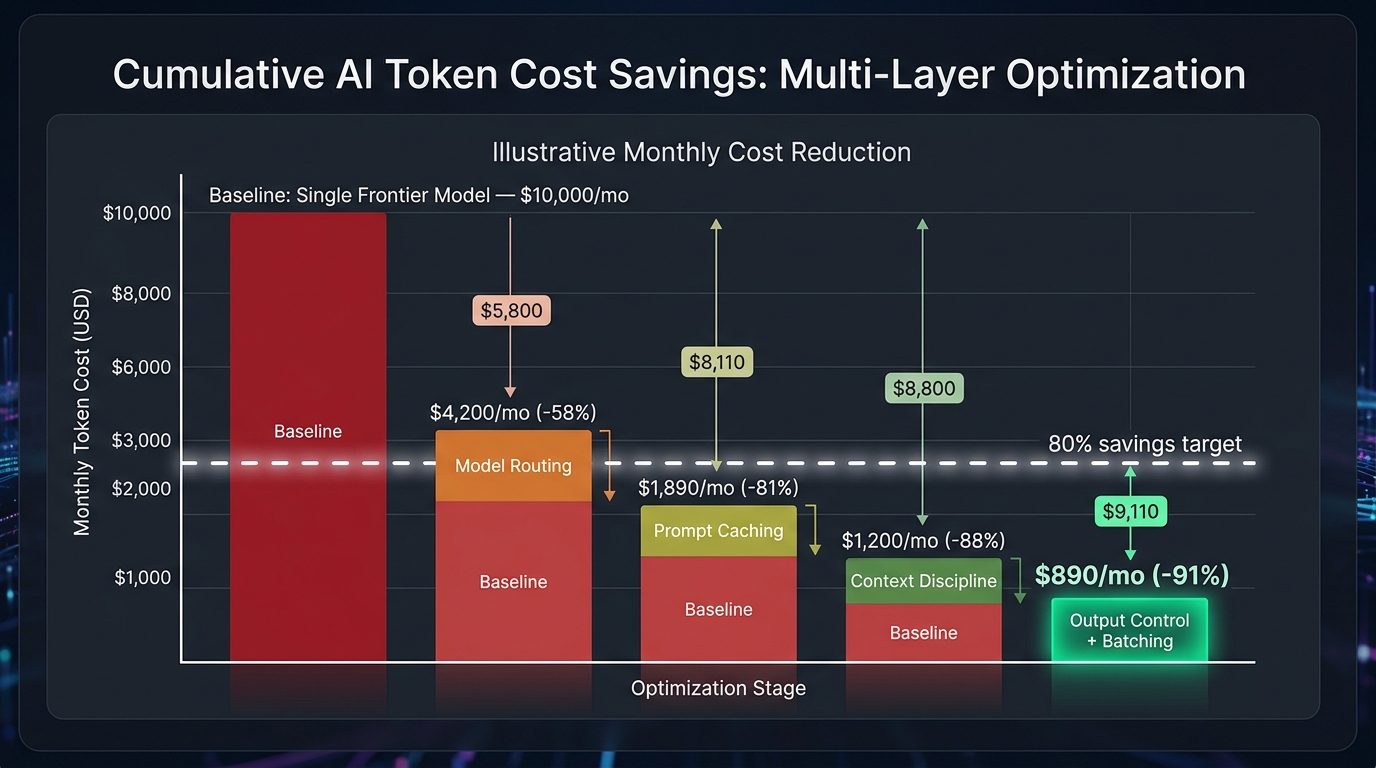
    Stacked bar chart showing cumulative AI token cost savings from $10,000 per month baseline dropping to $890 after applying model routing, prompt caching, context discipline, and output control

    The five layers described above don’t operate independently — they compound. The order of implementation matters because some layers unlock savings in others, and the combined effect is non-linear. Here’s how a realistic stacking scenario plays out for a hypothetical mid-size production deployment.

    The Baseline

    Starting point: a product team running all LLM calls through a single frontier model (priced at ~$10/M input, $30/M output). Monthly spend: $10,000. Traffic is a mix of simple classification tasks, moderate summarization, and occasional complex analysis. System prompt is 3,000 tokens, reconstructed dynamically on every call. Conversation history is sent in full. Output length is unconstrained.

    After Layer 1: Model Routing

    Traffic analysis reveals: 62% of requests are simple classification or templated response tasks, 28% are moderate-complexity, 10% are genuinely complex. Implement a classifier and route accordingly — Tier 1 for 62%, Tier 2 for 28%, frontier for 10%.

    Result: average input cost per million tokens drops from ~$10 to ~$2.30. Average output cost drops proportionally. Monthly spend: approximately $4,200 (-58%).

    After Layer 2: Prompt Caching

    Restructure prompts so the 3,000-token system prompt is a stable prefix on every call. Enable caching at the provider level. Cached reads cost 10% of input rates. With an average of 15+ requests per session, cache hit rates average ~85%.

    Result: effective input token cost drops by ~76% on cached portions. Monthly spend: approximately $1,890 (-81% from baseline).

    After Layer 3: Context Window Discipline

    Implement conversation summarization after turn 8, replacing earlier history with a 200-token summary. Replace bulk context stuffing with RAG, reducing average context injection from 12,000 tokens to 2,800 tokens per call.

    Result: average tokens per request drops by ~35% on top of the already-reduced baseline. Monthly spend: approximately $1,200 (-88% from baseline).

    After Layer 4: Output Control

    Add explicit length constraints to system prompts for each routing tier. Implement structured outputs for all machine-readable endpoints. Eliminate verbose reasoning modes from Tier 1 and Tier 2 tasks.

    Result: average output token count per request drops by ~40% on Tier 1 tasks, ~25% on Tier 2. Monthly spend: approximately $950 (-90.5% from baseline).

    After Layer 5: Batching Overnight Async Work

    Move nightly enrichment pipeline (roughly 15% of monthly volume) to batch API at 50% discount. Monthly spend: approximately $890 (-91.1% from baseline).

    The 80% target is comfortably exceeded before reaching the final layer. The incremental gains from each layer vary by workload — routing delivers the most for high-volume mixed-complexity traffic, caching delivers most when system prompts are large and stable, context discipline delivers most when conversations are long or knowledge bases are large. The key is accurate assessment of where your specific costs are concentrated before deciding which layers to prioritize.

    AI FinOps: Governance, Attribution, and Token Budgets

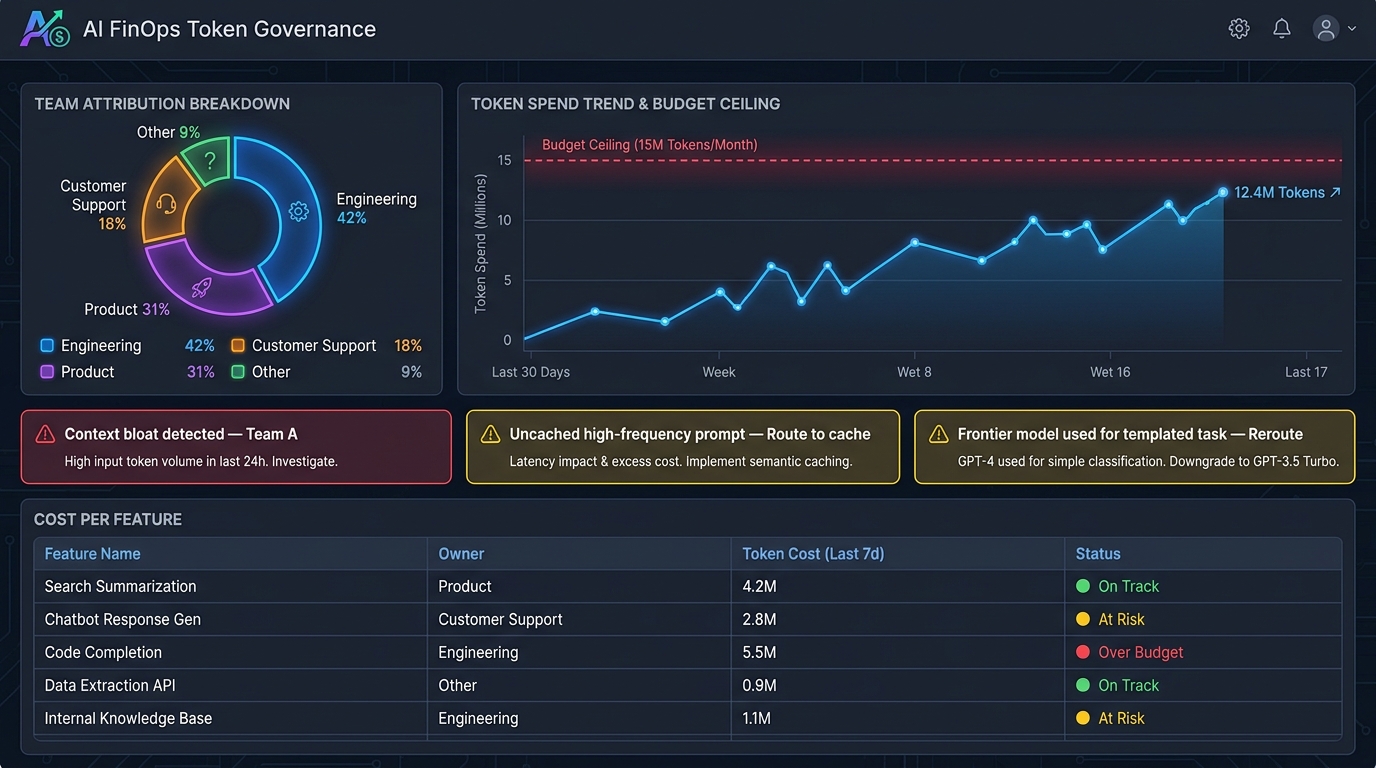
    AI FinOps governance dashboard showing team-level token attribution, spend trend line with budget ceiling, and alert cards detecting context bloat and uncached high-frequency prompts

    Architectural optimization is not a one-time event. Token costs erode over time as teams add features, prompts grow, new models get adopted inconsistently, and successful product features scale in ways that weren’t anticipated. Without a governance layer, your initial 80% savings will be partially recaptured by entropy within six to twelve months.

    Token Attribution by Feature and Team

    The foundation of AI FinOps is attribution. Every LLM call in production should be tagged with metadata that identifies the product feature, the team responsible, the model used, and the routing tier. This data, aggregated in a cost monitoring dashboard, makes cost anomalies visible before they become budget problems.

    Without attribution, cost optimization is guesswork. With it, you can answer: which feature is responsible for 40% of frontier model spend? Which team’s recent deployment doubled context window usage? Which caching optimization is underperforming on hit rate? Attribution is the difference between reactive cost firefighting and proactive cost management.

    Token Budgets and Policy Enforcement

    Once attribution exists, budgets become actionable. Define per-feature token budgets — both soft limits (alerting) and hard limits (throttling or automatic tier downgrade when exceeded). These budgets serve multiple purposes: they force product teams to think about LLM cost at design time, not after deployment; they prevent single features from unilaterally consuming disproportionate inference budget; and they create visibility into cost-per-feature that product managers can use to assess whether a feature’s cost is justified by its value.

    Policy enforcement can be implemented at the API gateway level: a middleware layer that checks token budgets before dispatching calls, enforces routing rules, applies caching logic, and logs metadata. This centralizes cost governance rather than distributing it across individual feature implementations — where it tends to be applied inconsistently or ignored under delivery pressure.

    Continuous Prompt Auditing

    Prompts drift. System prompts accumulate instructions added for edge cases that no longer occur. Tool definitions grow as APIs evolve. Few-shot examples multiply without pruning. A quarterly prompt audit — reviewing every production system prompt for redundant instructions, outdated context, and token waste — consistently finds optimization opportunities that have accumulated since the last review.

    Automate the detection layer: log prompt lengths and flag any system prompt that exceeds a defined token ceiling for human review. Track cache hit rates by endpoint — a falling hit rate on a previously stable endpoint is a signal that something in the prompt has changed and broken the cache prefix.

    The LLM Cost Review Cadence

    Treat LLM cost review as a regular operational discipline, not a one-off project. Monthly: review token spend by feature and team, investigate anomalies, check cache hit rates. Quarterly: audit system prompts, review routing classifier performance, evaluate whether the model tier pricing has shifted enough to warrant reassignment. Annually: reassess the full architecture against the current pricing landscape — what was optimal at current prices may need adjustment as prices continue to compress.

    What Not to Cut: Preserving Quality Where It Matters

    A cost optimization guide that doesn’t address quality risk is incomplete. The 80% savings target is achievable without meaningful quality degradation — but only if you’re deliberate about where the cuts happen.

    Tasks That Require Frontier Models

    Some task categories genuinely require the capabilities that only frontier models currently provide. These include:

    • Complex reasoning chains where the problem space is novel and multi-step, and errors cascade through subsequent reasoning. Mathematical derivations, legal analysis, complex debugging across large codebases.
    • High-stakes outputs where quality errors have material consequences — medical information synthesis, compliance documentation, contract review. The cost of a frontier model call is trivial compared to the cost of acting on a flawed output.
    • Novel creative generation where the quality difference between tiers is perceptible and consequential to the product experience — flagship content generation, nuanced tone-matching in brand contexts.
    • Low-volume, high-sensitivity agentic tasks where an agent will take real-world actions based on the output and mistakes are expensive to reverse.

    The routing tier logic should be configured conservatively for these categories — if in doubt, escalate to a higher tier. The cost of over-routing complex tasks to frontier models is measured in cents. The cost of under-routing them is measured in user trust and potential downstream errors.

    Monitoring Quality, Not Just Cost

    Every cost optimization should have a paired quality signal. When you implement routing, measure response quality before and after by sampling outputs across tiers and running evaluations. When you tighten output length constraints, check that downstream tasks depending on those outputs still receive adequate information. When you reduce context, verify that task accuracy metrics haven’t degraded.

    The goal is a Pareto-optimal operating point — maximum cost savings at or above the quality floor required for the use case. If an optimization reduces quality below that floor, the savings are illusory: you’ll spend them back in user churn, support escalations, or the engineering time needed to fix the output quality problem.

    Evals as Infrastructure

    The teams that sustain cost optimization over time without quality degradation share one characteristic: they have evaluation infrastructure in place before they optimize. An eval suite — automated tests measuring task accuracy, format compliance, and output quality across representative inputs — makes it safe to change routing rules, swap models, or tighten prompts, because you can verify the impact immediately rather than discovering it from user complaints.

    Building evals is engineering work, and it’s tempting to skip when the optimization opportunity looks obvious. Resist that temptation. The architectural changes that deliver 80% cost savings also carry architectural risk. Evals are the safety net.

    The Architecture Is the Price Negotiation

    The framing most organizations bring to AI cost management is transactional: negotiate better rates, find a cheaper provider, wait for prices to drop. Those strategies have merit at the margins. But the data is clear that the difference between an organization capturing 80% of available savings and one capturing 10% is not the vendor contract — it’s the architecture.

    The five layers described in this guide — model tiering and routing, prompt caching, context window discipline, output control, and batching — are each individually capable of delivering meaningful savings. Stacked together, with the right sequencing and governance, they consistently reach the 80% threshold that has become the benchmark for mature AI cost management in 2026.

    What makes this moment particularly significant is the rate of change in the underlying pricing landscape. OpenAI’s 80% cut on Luna, DeepSeek’s 75% reduction, the continued compression of Gemini Flash pricing — these are not anomalies. They reflect genuine efficiency improvements in model serving that will continue. Teams with well-architected systems will benefit from every future price drop automatically. Teams relying on a single model at flat rates will continue to pay above market for what they could be getting for less.

    Practical Starting Points

    If you’re approaching this architecture for the first time, prioritize in this order:

    1. Audit your traffic. Pull 30 days of LLM call logs. Classify request complexity. If more than 50% of your traffic is simple or templated, routing is your highest-ROI first move.
    2. Restructure your system prompts. Move all static content to the top. Enable provider-level prompt caching. This takes hours and pays back in days.
    3. Measure context per request. Find your 95th percentile context size. That number tells you how much waste exists in your current context management approach.
    4. Add output constraints to your highest-volume endpoints. Even a 30% reduction in average output length on your top five endpoints will be visible in your monthly spend.
    5. Identify your async workloads. Any pipeline that runs on a schedule, rather than in response to a live user request, is a candidate for batch API pricing.

    None of these steps require purchasing new tooling, negotiating new contracts, or waiting for the next model release. They require engineering time and a clear-eyed assessment of where your current architecture is wasting money. The price war is in your favor. The question is whether your architecture is positioned to capture what’s already on offer.

  • Why Orchestration Is Now the Enterprise Software Stack — Not Just a Layer On Top of It

    Why Orchestration Is Now the Enterprise Software Stack — Not Just a Layer On Top of It

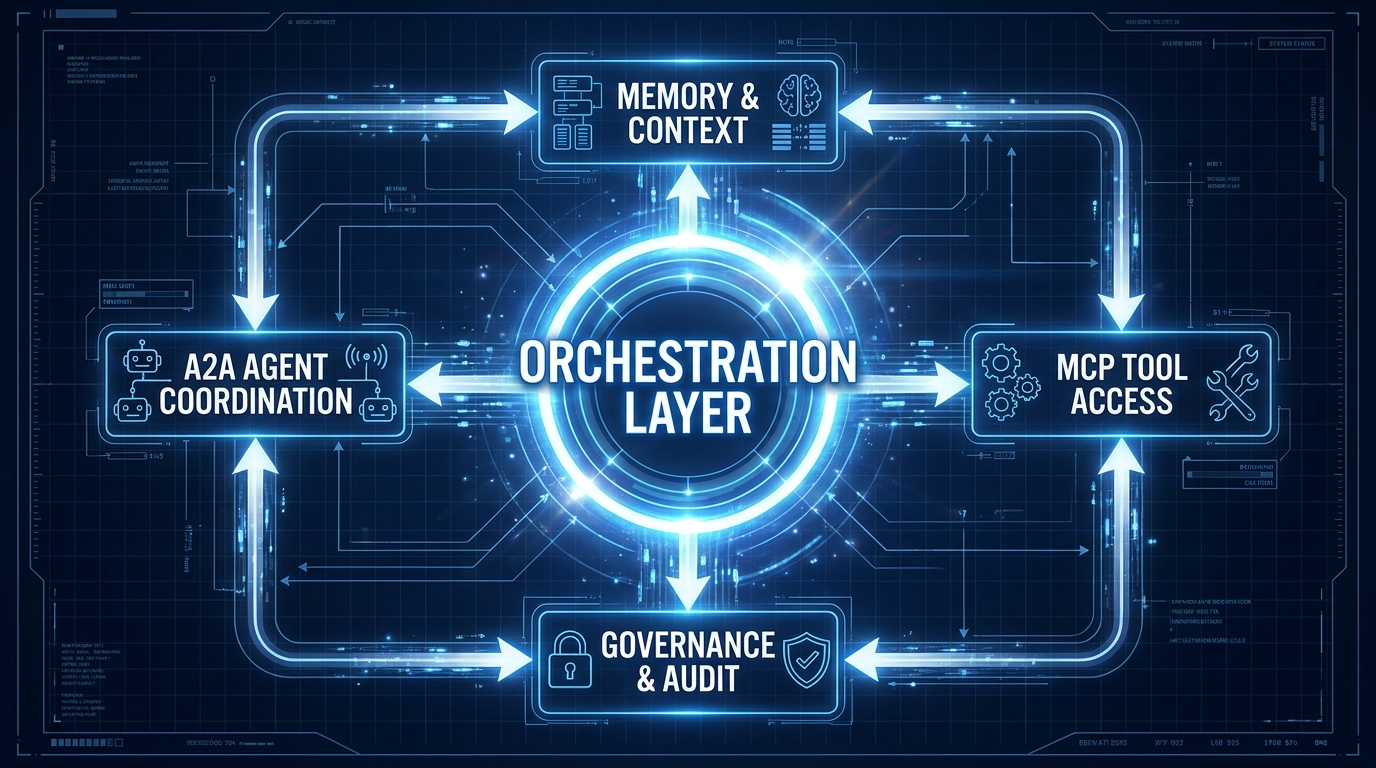
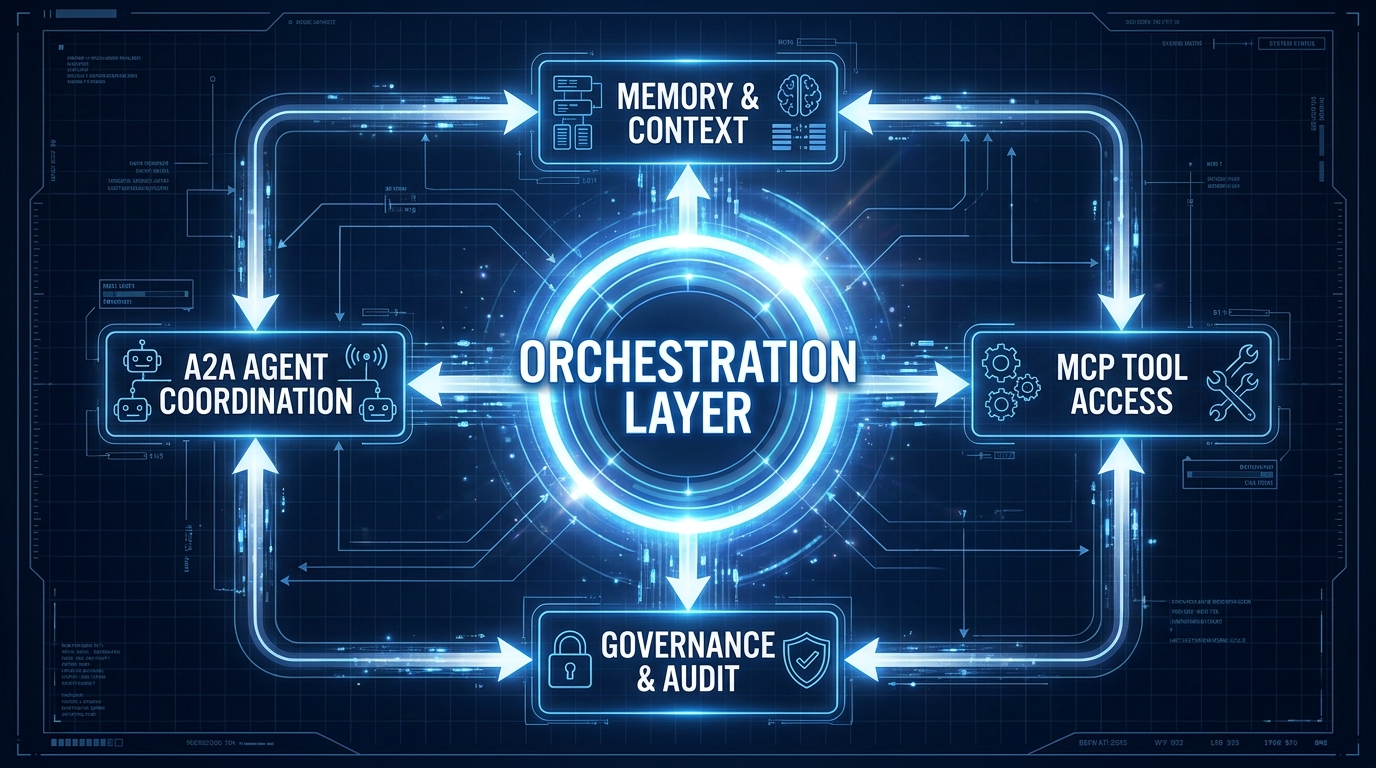
    Enterprise AI orchestration layer diagram showing the orchestration control plane connecting memory, MCP tool access, A2A agent coordination, and governance layers

    For the past three years, the enterprise AI debate has been almost entirely about models. Which model is best? Which vendor do you trust? How do you fine-tune? How do you keep costs down per token?

    That debate hasn’t disappeared — but it’s being quietly overtaken by a different question, one that matters far more to the teams actually trying to run AI at scale: how do you coordinate everything the model touches?

    The answer, increasingly, is orchestration. And in 2026, that word no longer means what it used to mean. It no longer describes a scheduling layer, a workflow tool, or a category of middleware you bolt onto an existing SaaS stack. Orchestration has moved to the center of the architecture. It has become the control plane — the runtime engine that sequences agents, manages state, enforces governance, routes tool calls, and decides when a human needs to step in.

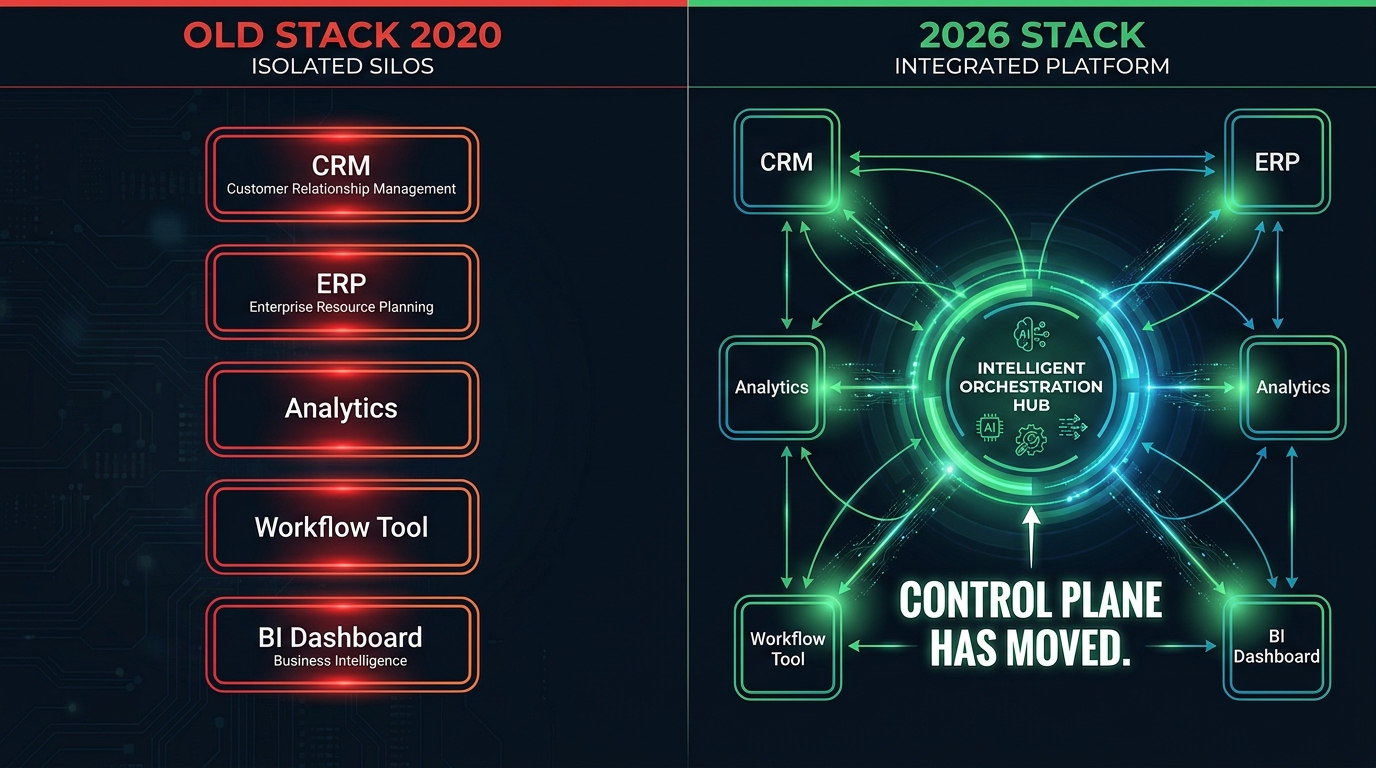
    This is a structural shift, not a product update. The architecture itself has inverted. Where enterprises once built around applications and used orchestration to connect them, they are now building around the orchestration layer and treating applications as components beneath it. That’s a different operating model, a different vendor map, and a different set of failure modes to manage.

    This piece lays out exactly how that inversion has happened, what the new stack actually looks like layer by layer, which protocols and frameworks are doing the real work, where things break in production, and what it means for teams making architecture decisions right now.


    The Architecture That Broke First

    To understand why orchestration is ascendant, it helps to understand what it is replacing — and specifically, where the previous model started failing.

    The enterprise software stack that emerged from the 2010s was fundamentally application-centric. You bought point solutions: a CRM for customer data, an ERP for operations, a BI tool for reporting, a workflow automation platform to string together approvals, an analytics layer to make sense of outputs. Each tool owned a domain. Integrations happened at the edges — via APIs, webhooks, ETL pipelines, and increasingly, iPaaS platforms that tried to paper over the gaps.

    It worked well enough when the work was structured, predictable, and domain-contained. A sales rep triggers a contract process; a webhook fires; the CRM updates; an email goes out. Linear, deterministic, auditable.

    Where the Model Breaks Down

    The cracks appear the moment you try to do something that doesn’t fit neatly inside one domain’s boundary — which is almost everything interesting. A customer support escalation that requires pulling order history, checking inventory, applying a discount policy, drafting a response, and logging the outcome is not one system’s job. It crosses five systems, requires contextual judgment at multiple steps, and takes a human fifteen minutes if done manually.

    Early AI attempts at this problem produced point automations: a chatbot that handled FAQs, an RPA bot that copied fields between forms, a model that classified tickets before they hit the queue. Each solved one step. None solved the workflow. And stringing them together meant maintaining a web of fragile integrations that broke silently and failed opaquely.

    The fundamental architectural problem was that no single layer owned the state of the workflow. The CRM knew about the customer. The inventory system knew about the stock. The policy engine knew about discount rules. But nothing held the thread of the task itself — the context, the decisions made so far, the next step, the fallback if something failed.

    The Shift That Changed the Calculus

    What changed is that LLMs became capable enough to handle multi-step reasoning across domains — but only if they had access to the right tools, the right context, and a coordination mechanism that could sequence their actions reliably. A model left to its own devices, handed a complex task, will hallucinate steps it can’t complete and skip steps it doesn’t know to take.

    The solution wasn’t a better model. It was an orchestration layer that could decompose the goal, route sub-tasks to specialized agents or tools, maintain state across steps, handle failures with defined fallbacks, and surface decisions to humans when autonomy wasn’t appropriate. That architecture is what makes an AI system reliable enough to run in production.

    And once teams built it, they realized it wasn’t just a feature of their AI workflow. It was the architecture. The control plane for all the work.

    Side-by-side comparison of the old isolated SaaS application stack versus the 2026 orchestration-centric stack where orchestration is the central hub


    What the Orchestration-Centric Stack Actually Looks Like

    The architecture converging across enterprise deployments in 2026 is not a single product or platform — it’s a layered stack, and understanding each layer is critical to understanding why orchestration sits at the top of it.

    Layer 1: Infrastructure and Model Serving

    At the base sits the infrastructure layer: cloud compute, model hosting, and inference endpoints. For most enterprises, this is a managed platform — AWS Bedrock, Azure AI Foundry, Google Vertex AI — that abstracts the model serving complexity and provides access to multiple foundation models from a single endpoint. This layer has become increasingly commoditized. The differentiation here is cost and latency, not architecture.

    The important shift is that enterprises are no longer committing to a single model. Multi-model routing — using different models for different agent tasks based on cost, capability, or latency requirements — is standard in production stacks. The orchestration layer above this one makes the routing decisions.

    Layer 2: Data, Memory, and Semantic Context

    Above the infrastructure sits the data and memory layer: vector databases, semantic caches, knowledge graphs, retrieval-augmented generation (RAG) pipelines, and session state stores. This layer provides agents with the context they need to do their work without re-fetching or re-computing from scratch on every call.

    Memory architecture is more complex than it sounds. Enterprise agents need to distinguish between short-term conversational context (what happened in this session), medium-term task context (what decisions were made in this workflow), and long-term knowledge (company policies, product data, customer history). Conflating these leads to some of the most common production failures — more on that in the failure modes section.

    Layer 3: The Orchestration Control Plane

    This is the heart of the stack. The orchestration layer is responsible for task decomposition (breaking a high-level goal into sub-tasks), routing (deciding which agent or tool handles each sub-task), state management (tracking what has happened and what comes next), retry logic (handling partial failures without breaking the whole workflow), and escalation (surfacing decisions to humans when autonomy limits are reached).

    It is also where governance, audit logging, and policy enforcement live. Every action taken by an agent flows through this layer, which means the orchestrator is the point of control for compliance, permissions, and accountability.

    Layer 4: Specialized Agents

    Beneath the orchestrator’s coordination sit the agents themselves — but in production architectures, these are almost never general-purpose. They are scoped, specialized, and bounded. A research agent that searches and summarizes. A code agent that writes and tests. A data agent that queries structured sources. A comms agent that drafts and sends.

    The orchestrator treats these agents as workers, assigning tasks based on capability routing. The agent doesn’t need to know about the broader workflow — it just needs to execute its assigned sub-task well, report its output, and signal any failures.

    Layer 5: Tool and API Connectivity

    At the bottom of the agent tier sits the tool layer: the integrations with external systems, APIs, databases, and services that give agents the ability to act on the world. This is where protocols like MCP (Model Context Protocol) matter most — they standardize how agents discover and invoke tools, removing the bespoke integration overhead that plagued earlier automation architectures.

    The Governance Cross-Cut

    Running across every layer is a cross-cutting governance concern: guardrails, audit trails, identity and access management, rate limiting, content filtering, and compliance logging. This isn’t a separate layer — it’s embedded into every layer, enforced by the orchestrator, and observed through an instrumented tracing system.


    MCP and A2A: The Two Protocols Quietly Standardizing Everything

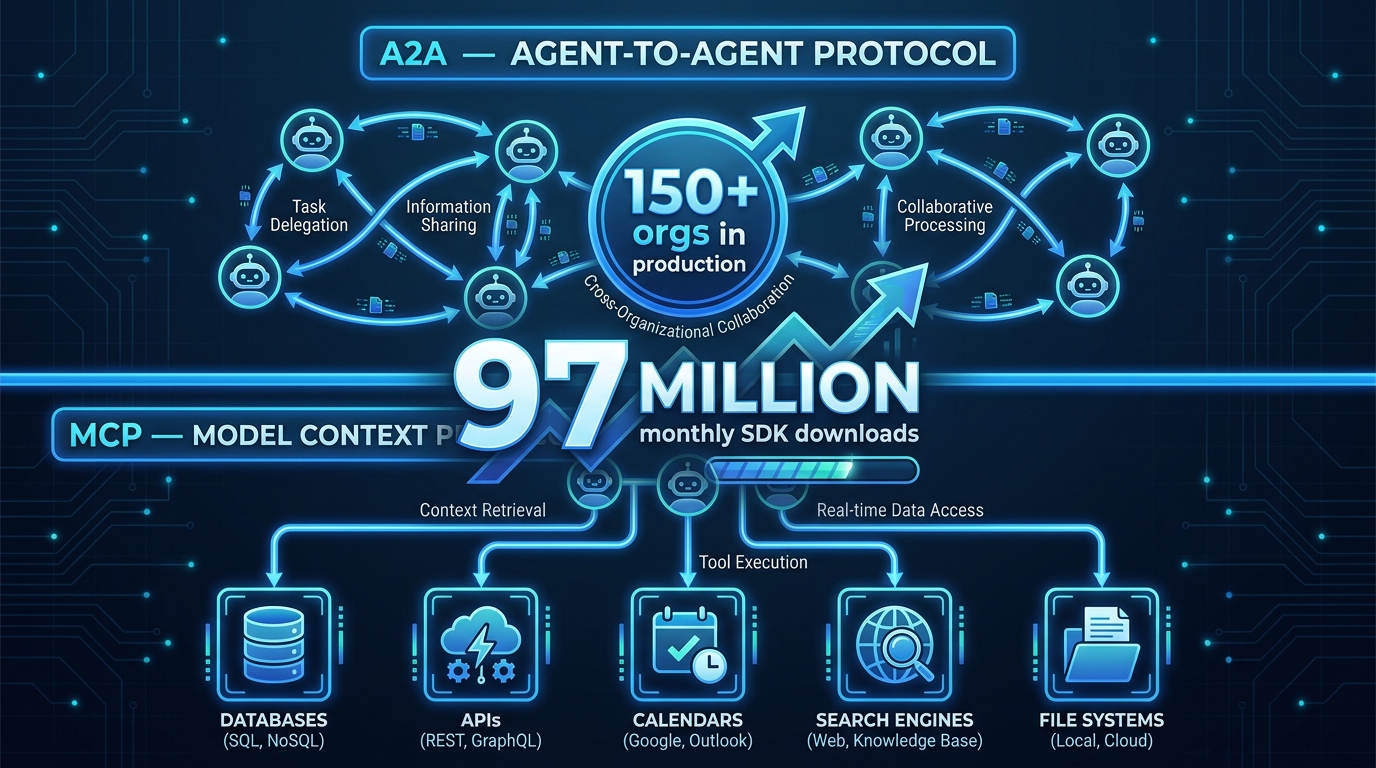
    Two-layer protocol architecture diagram showing A2A agent-to-agent coordination above and MCP model context protocol tool connectivity below, with 97 million monthly SDK downloads stat

    Underneath the architectural shift is a protocol story that often gets missed in the broader narrative about AI. Two standards — the Model Context Protocol (MCP) and the Agent-to-Agent Protocol (A2A) — are doing the unglamorous work of making agentic systems interoperable at scale.

    Getting this distinction right matters, because confusing them leads to architectural decisions that create lock-in, brittleness, or both.

    MCP: The Agent-to-Tool Standard

    The Model Context Protocol, released by Anthropic and rapidly adopted across the ecosystem, addresses the agent-to-tool connectivity problem. Before MCP, every agent integration with a tool — a database, a calendar, a code execution environment, an API — required custom code. You wrote a wrapper, defined input schemas, handled authentication, and tested error paths. Multiply that by dozens of tools and dozens of agents, and you have an integration maintenance problem that swamps the engineering team.

    MCP standardizes how agents discover what tools are available, what those tools can do, and how to invoke them. The protocol defines a client-server model where tool providers expose MCP servers, and agents implement MCP clients. Any MCP-compatible agent can connect to any MCP-compatible tool without custom integration code.

    The adoption numbers reflect genuine traction: by mid-2026, MCP is tracking roughly 97 million monthly SDK downloads, with approximately 41% of surveyed software organizations running at least one MCP server in limited or broad production. The server ecosystem has grown to over 10,000 registered implementations. That’s not hype — that’s the velocity of a real standard taking hold.

    A2A: The Agent-to-Agent Coordination Layer

    Where MCP handles agent-to-tool communication, the A2A protocol addresses agent-to-agent delegation. In multi-agent architectures, orchestrators routinely need to hand off sub-tasks to specialized agents, receive results, pass context forward, and coordinate across agent boundaries that may span different systems, vendors, or deployment environments.

    A2A defines how agents advertise their capabilities, accept tasks, report progress, and return results to an orchestrating agent. It handles the coordination semantics that MCP doesn’t: task delegation, progress signals, capability discovery at the agent level rather than the tool level, and asynchronous result handling for long-running work.

    As of mid-2026, A2A has been adopted by more than 150 organizations in production, with major cloud providers integrating A2A support into their managed agent platforms. The protocol is still maturing — version stability and security profiles are ongoing discussions — but the trajectory is clear.

    Why Both Are Necessary

    MCP and A2A are complementary, not competing. A well-architected agentic stack uses MCP at the tool integration layer and A2A at the agent coordination layer. The practical implication is that enterprises building on both protocols can swap out individual agents or tools without rewiring the whole system — which is the portability guarantee that breaks vendor lock-in at the most important architectural seam.

    “The combination of MCP for tool access and A2A for agent coordination creates the first genuinely portable foundation for enterprise agentic systems. It’s the equivalent of what TCP/IP did for networking — a set of common protocols that let heterogeneous components communicate without custom glue.”

    For enterprise architecture teams, the near-term decision is not which protocol to use — it’s which vendors in the stack support both, and how to plan for the inevitable consolidation as both protocols mature toward stable, audited versions.


    The Framework Layer: LangGraph, CrewAI, AutoGen, and Temporal

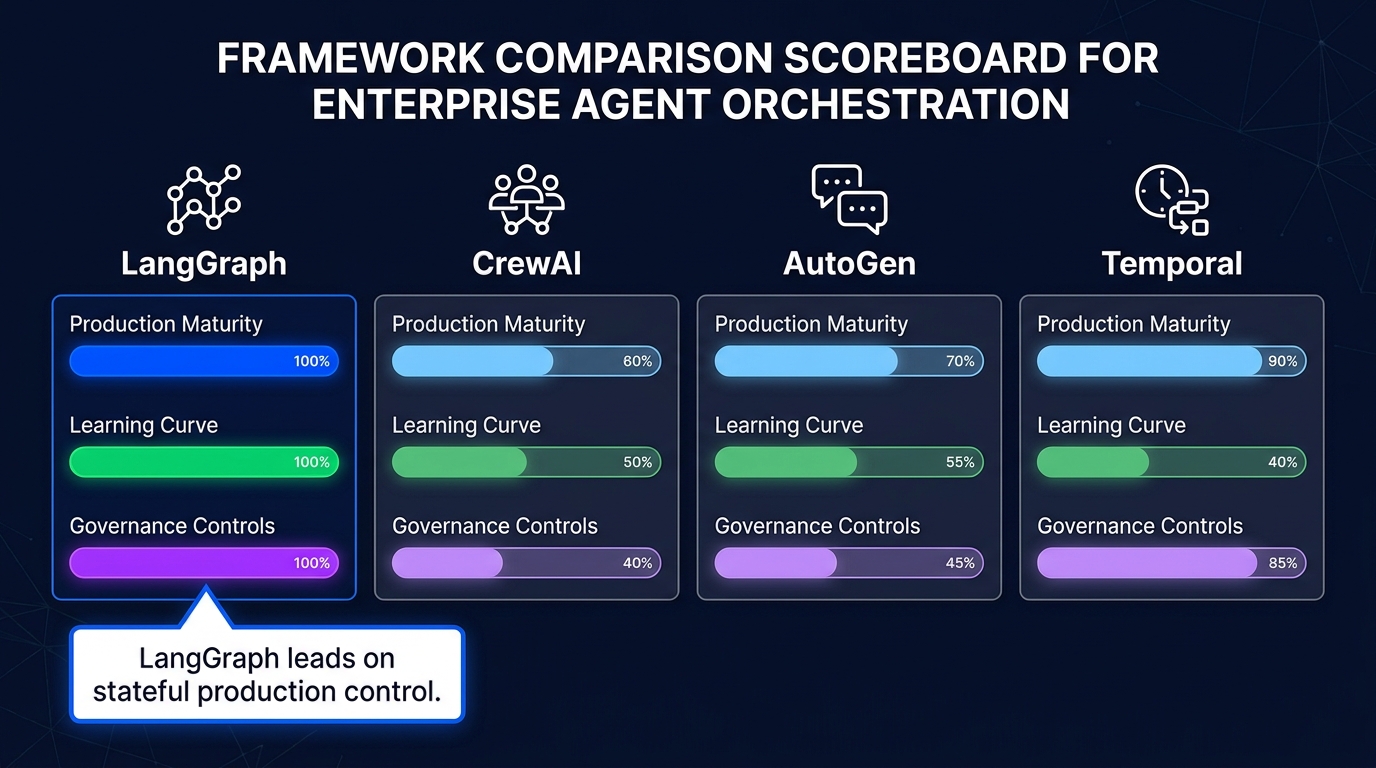
    Framework comparison scoreboard showing LangGraph, CrewAI, AutoGen, and Temporal rated across production maturity, learning curve, and governance controls dimensions

    Above the protocol layer sits the framework layer — the tools engineering teams actually use to build and run their orchestration logic. The market here is fragmented but converging around a handful of real options, each with a distinct architectural philosophy and a specific sweet spot.

    Understanding what each framework is actually good at — and what it trades away — matters enormously for teams making decisions that will be difficult to reverse once agents are in production.

    LangGraph: Stateful, Auditable, Production-Grade

    LangGraph has emerged as the leading framework for production-critical orchestration. Its core architectural model is a directed graph: nodes represent agent actions or decisions, edges represent transitions between them, and the graph state is explicitly managed and checkpointed at every step.

    This approach gives engineering teams precise control over the flow of a workflow: branching conditions, loops, parallel execution, and rollback points are first-class concepts rather than emergent behaviors. The checkpointing system means a failed step can be re-run from its last known good state without restarting the entire workflow — a critical property for long-running enterprise processes.

    LangGraph also offers what its team calls “time-travel debugging”: the ability to step backward through a workflow’s execution history and inspect or replay any state. For regulated industries or compliance-sensitive workflows, this auditability is non-negotiable. The tradeoff is a steeper learning curve and slower initial build time compared to more abstracted alternatives.

    CrewAI: Fast, Role-Based, Developer-Friendly

    CrewAI takes a different approach: role-based agent abstraction. Instead of building a workflow graph, developers define agents as roles — a “researcher,” a “writer,” a “critic” — and assign them tasks within a crew. The framework handles the sequencing and communication between roles using higher-level abstractions.

    The result is dramatically lower build time for standard business workflow patterns. A team can have a working multi-agent prototype in hours rather than days. The cost is control: when edge cases arise, CrewAI’s abstractions can obscure the underlying execution in ways that make debugging slower and production-hardening harder.

    CrewAI’s fit is clearest for business teams automating well-understood, bounded workflows — content operations, data extraction, report generation — where the priority is shipping quickly and the failure modes are tolerable.

    AutoGen: Conversational, Human-in-the-Loop Focused

    Microsoft’s AutoGen framework is architected around conversational multi-agent patterns, where agents communicate through a structured message-passing protocol that can include human participants. Its strongest use case is workflows that require frequent human judgment — not just approval checkpoints, but active collaboration between human and AI agents throughout a task.

    The framework has matured significantly since its early research-oriented releases, but in 2026 it is increasingly being folded into Microsoft’s broader Agent Framework ecosystem rather than standing alone as a greenfield recommendation. Teams already embedded in the Microsoft enterprise stack (Azure AI Foundry, Copilot Studio) will find it the natural choice; teams starting fresh have more options worth evaluating.

    Temporal: The Durable Execution Engine

    Temporal occupies a different position in the stack — it is not an agent framework so much as a durable workflow execution engine that agent frameworks are increasingly built on top of. Where LangGraph, CrewAI, and AutoGen define how agents reason and coordinate, Temporal handles the infrastructure concerns: reliable execution despite failures, long-running workflow state across days or weeks, deterministic replay for debugging, and guaranteed exactly-once semantics for side-effectful operations.

    The combination that several production teams are converging on is LangGraph or CrewAI for agent logic layered on Temporal for execution durability. This separates concerns clearly: the agent framework owns the reasoning, and Temporal owns the reliability.

    The Framework Decision Matrix

    In practical terms, the choice comes down to what the team values most:

    • Maximum control and auditability: LangGraph, particularly for regulated industries or workflows with meaningful failure costs.
    • Speed to first production deployment: CrewAI, for standard business process automation with defined inputs and outputs.
    • Human collaboration throughout execution: AutoGen, particularly within the Microsoft ecosystem.
    • Infrastructure-grade execution reliability: Temporal, as the execution substrate beneath any of the above.

    The mistake is treating this as a permanent binary choice. Several mature enterprise teams run LangGraph for complex, high-stakes workflows and CrewAI for lightweight automation, with Temporal underneath both. The framework layer should be matched to workflow characteristics, not picked once and applied universally.


    How the Orchestrator Is Replacing the SaaS Control Plane

    The claim that orchestration is “becoming the real stack” is strongest when you look at what the orchestration layer is doing that used to belong to other software categories.

    This is not about replacing CRM systems or ERPs. The data, the records of truth, the domain-specific logic — those still live where they’ve always lived. What is shifting is who owns the workflow that coordinates access to those systems, and that shift has significant architectural and commercial implications.

    From iPaaS to Agentic Control Plane

    iPaaS platforms — integration platform as a service tools like Zapier, MuleSoft, and Boomi — were the previous generation’s answer to the workflow coordination problem. They connected systems via point-to-point integrations, ran trigger-action automations, and handled data movement between applications.

    The limitation was always expressiveness. iPaaS tools handle predictable, rule-based workflows well. They break when the workflow requires judgment: when an exception needs to be classified before routing, when a response needs to be generated from context rather than templated, when a decision depends on synthesizing information from multiple sources.

    Agentic orchestration handles exactly these cases. And as enterprises build agentic control planes, the demand for traditional iPaaS automation declines — not because the integration pipes disappear, but because the coordination logic that sat in iPaaS rules engines is now handled by orchestrated agents that are more flexible, more capable, and easier to update.

    The Wells Fargo Pattern

    One of the most-cited production examples of orchestration replacing a traditional knowledge and workflow interface is Wells Fargo’s internal deployment. Before implementing an orchestration-backed agent layer, bankers accessing internal compliance procedures needed an average of ten minutes to locate and apply the relevant guidance. The agent layer — which gave 35,000 bankers access to 1,700 procedures — reduced that to roughly 30 seconds.

    The orchestration layer isn’t replacing the procedures database or the compliance system. It’s replacing the interface layer that previously required human navigation of a fragmented documentation and workflow environment. That interface layer — lookup, context retrieval, policy matching, response generation — is exactly what an orchestrated agent does well.

    The Market Signal

    The market is reading this shift clearly. The AI orchestration segment is estimated at roughly $16.7 billion in 2026, with integration and orchestration middleware projected to reach $24.4 billion by 2033. Process orchestration specifically is growing at a 17.48% CAGR, from $11.17 billion in 2025 to a projected $13.12 billion in 2026 alone. These numbers reflect not just new spending on agentic tools, but the consolidation of budget that previously sat across fragmented workflow and automation categories.

    The cleaner strategic framing: orchestration is absorbing the coordination role that used to be split across iPaaS, workflow builders, RPA platforms, and business rules engines. It’s not replacing the systems of record beneath them — it’s taking over the control plane above them.


    Governance-by-Design: Autonomy Without Chaos

    The governance question is where most agentic deployments hit their first serious organizational friction. Technical teams build agents that work in testing, demonstrate them to stakeholders, and then watch the initiative stall when legal, compliance, or risk teams ask the questions that weren’t planned for: Who authorized this action? What data did the agent access? Can you show us the audit trail? What happens when it does something wrong?

    In 2026, the enterprise teams moving fastest are the ones that have stopped treating governance as a retrofit problem and started building it as a design constraint from day one.

    The Four Governance Pillars

    Production-ready agentic governance in 2026 has converged around four core properties:

    Bounded permissions: Agents operate with explicitly scoped credentials, not broad access inherited from a service account. Each agent in the workflow has access only to the tools and data required for its assigned sub-task. Permission elevation requires explicit orchestrator authorization or human approval — it doesn’t happen automatically as the workflow progresses.

    Audit-complete tracing: Every agent action — tool call, data access, decision branch, output generation — is logged with sufficient detail to reconstruct the full execution trace after the fact. This is not optional in regulated industries; it is the baseline for demonstrating that the system behaved within its authorized boundaries.

    Human-in-the-loop checkpoints: High-stakes decision points — approvals above a threshold, actions that affect customer data, any action that cannot be reversed — route through explicit human confirmation before execution. The orchestration framework manages this natively; it’s not a bolt-on step added after the workflow is built.

    Deterministic failure handling: When an agent fails, times out, or reaches an undefined state, the system falls back to a defined behavior — not a model-generated improvisation. This might mean escalating to a human, retrying with a different agent, or halting the workflow with a logged error. The fallback behavior is specified by the engineer, not inferred by the model.

    The Bounded Autonomy Principle

    Anthropic’s published guidance on effective agents — drawn from real production deployments — emphasizes a principle that translates directly to governance practice: prefer simpler, more constrained architectures unless complexity is clearly warranted, and ensure that every increase in autonomy is matched by an increase in observability.

    The practical implication is a tiered autonomy model. Low-stakes, high-frequency tasks (data lookup, formatting, routing) can run fully autonomously with post-hoc audit. Medium-stakes tasks (customer communications, process exceptions, policy applications) run autonomously with real-time monitoring and automatic escalation triggers. High-stakes tasks (financial actions, legal documents, access grants) require explicit pre-authorization or human confirmation before execution.

    Building this model requires that the orchestration layer have native support for conditional human-in-the-loop routing — and that the engineering team treats that routing as a first-class architectural concern, not a feature to add later.


    What Breaks First in Production — The Failure Taxonomy

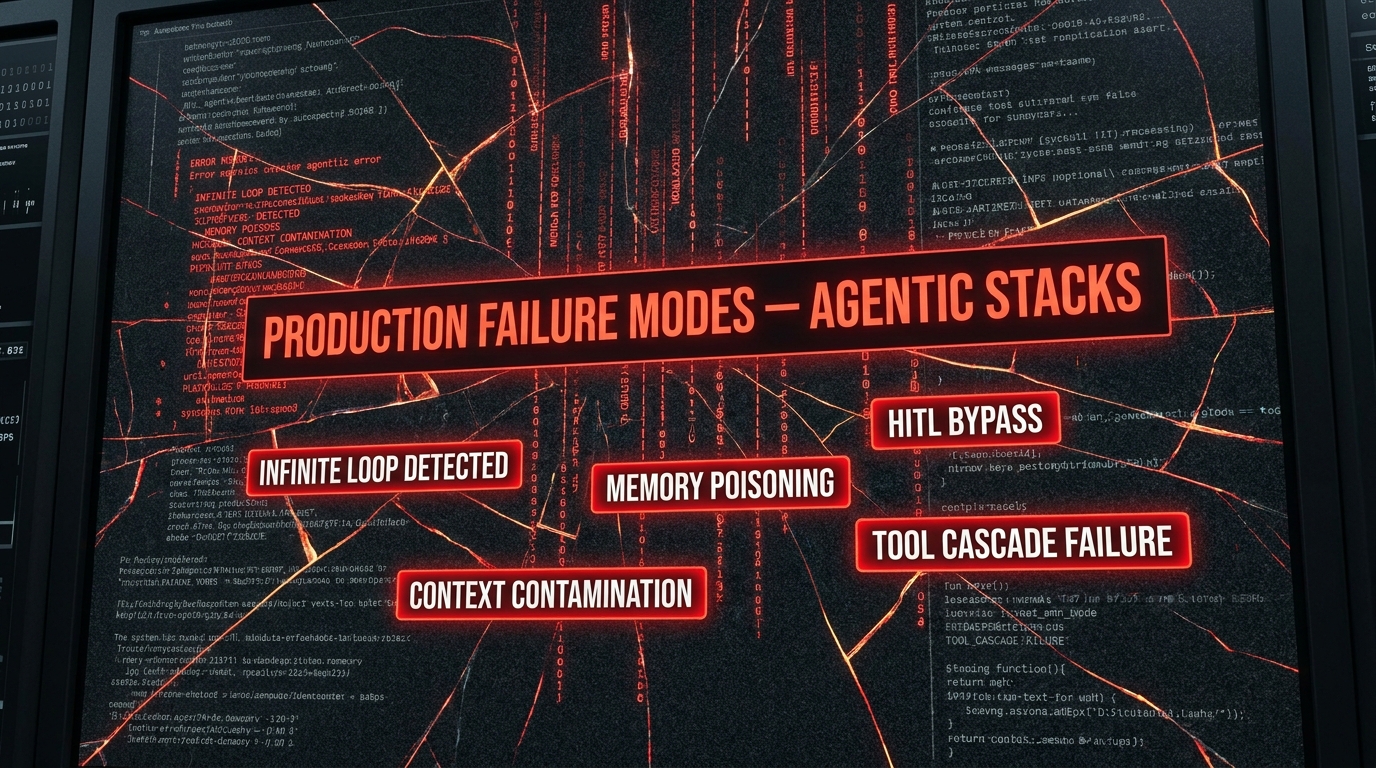
    Enterprise agentic stack production failure modes dashboard showing infinite loop detection, memory poisoning, HITL bypass, context contamination, and tool cascade failure alerts

    Agentic stacks fail differently than traditional software. The failure modes are less often “the function threw an exception” and more often “the system produced a plausible-looking wrong result for seventeen steps before anyone noticed.” Understanding the specific ways agentic stacks fail is essential for building systems that can detect and recover from those failures before they cause real damage.

    Microsoft’s red-team taxonomy, updated in June 2026 based on twelve months of live red-team work on deployed agentic systems, provides the most systematically grounded classification of production failures currently available. The patterns that appear most frequently are not theoretical — they are drawn from real production deployments.

    Infinite Loops and Runaway Execution

    The most straightforward production failure: an agent, tasked with a goal it cannot complete, keeps retrying indefinitely. Without explicit loop detection and maximum-retry enforcement in the orchestrator, this consumes tokens, compute, and potentially external API quota until something external terminates it.

    The fix is architectural, not model-level. Every execution path in the orchestration graph needs a maximum iteration count, a timeout, and a defined behavior when either is exceeded. This sounds obvious but is consistently skipped in early implementations because it doesn’t affect demo performance.

    Memory Poisoning and Context Contamination

    In multi-session or multi-user deployments, agent memory that persists across sessions creates a contamination risk: information from one session bleeds into another, causing agents to act on stale, incorrect, or unauthorized context. This is particularly dangerous when the contaminated context affects decisions about what tools to invoke or what data to access.

    Memory poisoning is the adversarial version: malicious input is crafted specifically to alter the agent’s stored context in ways that change its future behavior. Microsoft’s taxonomy flags this as a high-frequency, high-severity failure mode — one that often combines with cross-session leakage to produce effects that are difficult to trace back to their origin.

    Human-in-the-Loop Bypass

    Red-team findings from Microsoft’s 2026 taxonomy identify HITL bypass as the most consistently exploited failure mode in production agentic systems. The mechanism varies: sometimes an agent is prompted to reframe a high-stakes action as a low-stakes one to avoid triggering an approval checkpoint; sometimes a workflow is constructed so the approval step is technically satisfied by a previous confirmation that doesn’t actually cover the current action.

    HITL bypass is architecturally significant because it undermines the entire governance model. If approval checkpoints can be circumvented — whether through adversarial prompting or inadvertent workflow design — the guarantee that humans control high-stakes decisions breaks down.

    The mitigation is policy-level enforcement at the orchestrator: approval requirements should be tied to the nature of the action (data type, action class, system being touched), not to a workflow position that an agent can reason around.

    Tool Cascade Failures

    An agent calls a tool that returns an error. The error message becomes part of the agent’s context. The agent, interpreting the error message as data, makes a downstream decision based on it. That decision triggers another tool call that also fails. Within a few steps, the workflow has consumed significant resources executing a cascade of failing calls, producing outputs that reflect error states as though they were real results.

    Tool error handling in the orchestrator needs to treat error returns as distinct from successful returns — not passing them into agent context as content to be reasoned over, but routing them to explicit error-handling logic that logs the failure, alerts monitoring, and either retries with appropriate backoff or escalates to a human.

    Cross-Agent Trust Escalation

    In multi-agent systems where agents delegate tasks to sub-agents, permission escalation can occur when a sub-agent has access credentials that exceed the scope of the parent agent’s authorization. If the orchestrator doesn’t enforce consistent permission scoping across agent-to-agent handoffs, a carefully constructed task delegation chain can result in actions being taken under elevated permissions that were never explicitly granted to the orchestrating workflow.

    The architectural requirement is that A2A task delegation always passes permissions down from the delegating agent, never inheriting or assuming credentials from the receiving agent’s pre-configured access profile.


    Context Engineering: The Discipline That Makes Orchestration Work

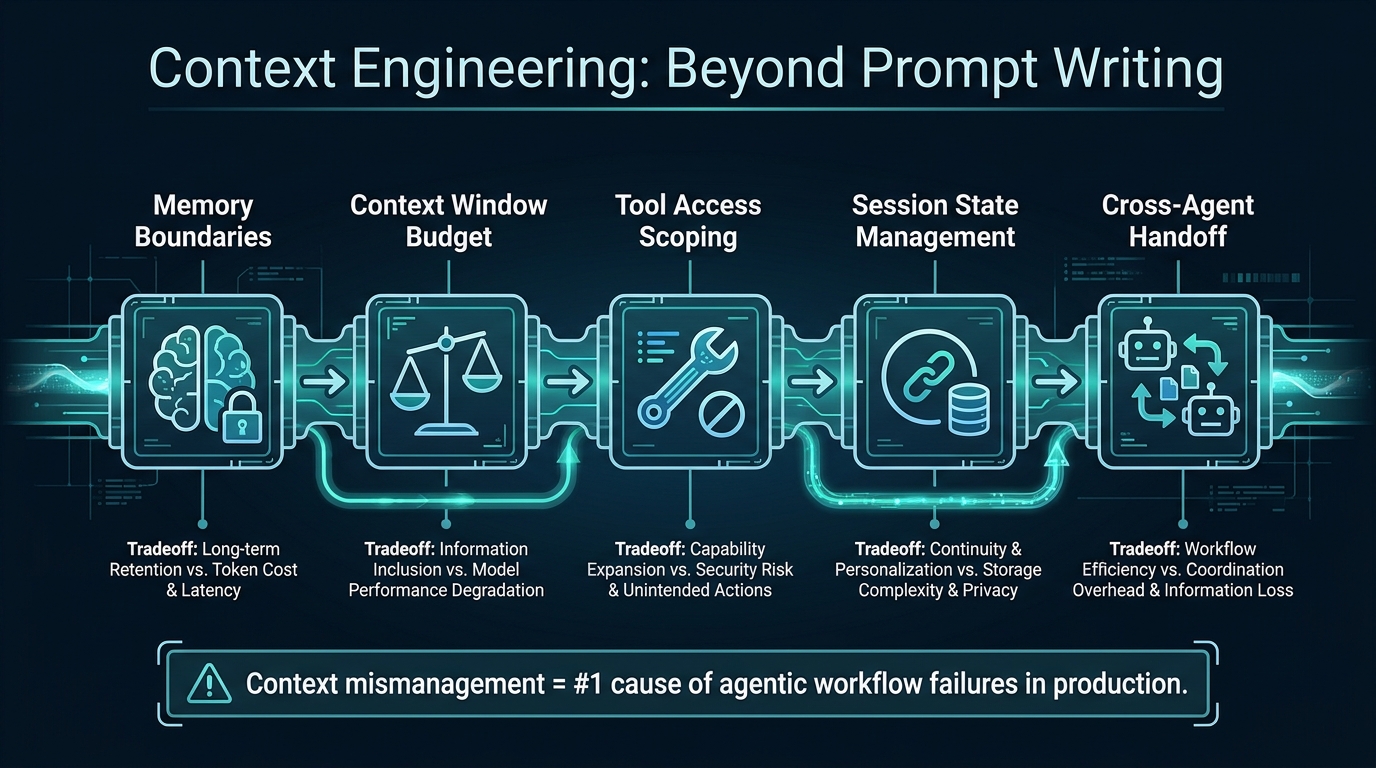
    Context engineering pipeline diagram showing memory boundaries, context window budget, tool access scoping, session state management, and cross-agent handoff stages

    Prompt engineering gets the attention. Context engineering does the work.

    As agentic systems have moved from single-step model calls to multi-step, multi-agent workflows, the quality of the output has become increasingly determined not by the cleverness of the system prompt, but by the architecture of the context that agents receive at each step. What information is included, what is excluded, how it is structured, how it persists across steps — these decisions determine whether an agent succeeds on a complex task or drifts into incoherence three steps in.

    What Context Engineering Actually Means

    Context engineering is the practice of deliberately designing the information environment in which agents operate. It encompasses several distinct concerns:

    Memory boundary design: Deciding what persists between steps, what is discarded, and what is explicitly passed forward in structured form rather than left to accumulate in the context window. Unmanaged context accumulation is one of the most common causes of performance degradation in long-running workflows — models degrade in quality and increase in cost as context windows fill with information that is no longer relevant to the current step.

    Context window budgeting: Each model call has a cost proportional to the tokens in the context window. In a multi-step workflow with ten or twenty model calls, context management is a direct line item in the cost structure. Teams that treat context as free until it fills up the window consistently over-run cost projections. Teams that budget context intentionally — summarizing completed steps, pruning irrelevant history, using semantic caching for repeated retrievals — maintain predictable per-workflow costs.

    Tool access scoping within context: When agents receive context that includes tool access information, that context implicitly defines what actions the agent might attempt. Overly broad tool context (giving an agent access to tools it doesn’t need for the current step) creates execution risk. Deliberately narrowing the tool context to what is required for the immediate sub-task is both a governance control and a quality improvement — agents with fewer irrelevant options make more focused decisions.

    Cross-Agent Context Handoffs

    The most architecturally consequential context decision in a multi-agent system is what gets passed between agents at handoff points. Passing too much — the entire prior execution history — bloats context, increases cost, and risks exposing earlier decisions to prompting that wasn’t intended to affect the receiving agent. Passing too little means the receiving agent lacks the context it needs to execute correctly.

    The pattern that production teams have converged on is structured handoff schemas: a defined data contract that specifies what fields the receiving agent needs, extracted from the prior agent’s outputs rather than dumped as raw conversation history. The orchestrator enforces the schema, validates the handoff data, and rejects or supplements it if required fields are missing.

    This is context engineering at the architectural level — not tweaking prompts, but designing data contracts between components of a system. The teams treating it as an engineering discipline rather than a prompt-writing exercise are the ones building workflows that hold up under production load.

    Semantic Caching and Retrieval Optimization

    For workflows that repeatedly retrieve similar information — product data, policy documents, customer records — semantic caching provides a significant cost and latency benefit. Rather than re-embedding and re-retrieving a document every time an agent needs it, a semantic cache stores the retrieval result and reuses it when a semantically similar query is made within the same session or workflow.

    This is not a minor optimization at scale. Production teams have reported 30–60% reductions in retrieval costs on workflows with repeated information access patterns. The orchestration layer is the natural home for cache management: it has visibility into what has been retrieved, by which agent, and in what context — which is exactly what’s needed to determine whether a cache hit is valid.


    The Buyer and Builder Map for 2026

    Understanding where the orchestration-centric stack creates new decisions for enterprise teams requires thinking about buyers and builders separately. They face different problems and are making different kinds of choices.

    For Enterprise Buyers: Vendor Evaluation Has Changed

    The traditional evaluation framework for enterprise software — capability coverage, user experience, pricing, integration catalog — is increasingly insufficient for evaluating orchestration platforms. The questions that matter now are architectural:

    Protocol support: Does the platform natively support MCP for tool connectivity and A2A for agent coordination? Platforms that don’t support both create integration bottlenecks as your stack matures. This is the portability question disguised as a features question.

    Observability depth: Can you trace every step of a multi-agent workflow, inspect state at each step, and replay failed executions? Observability is not a differentiator at this point — it is a baseline requirement. Any platform that cannot provide step-level execution traces should not be in the running for production orchestration.

    Governance architecture: Are human-in-the-loop checkpoints, permission scoping, and audit logging first-class platform features, or are they documented workarounds? The difference between “you can implement this” and “this is how the platform works” is enormous when you’re trying to meet a compliance requirement under time pressure.

    Multi-model routing: Can the orchestration layer route different sub-tasks to different models based on cost, capability, or latency requirements? Model lock-in at the orchestration layer is a significant long-term cost risk as model pricing continues to shift.

    For Builders: The Architecture Principles That Hold

    For engineering teams designing agentic systems, the production experience of 2026 has produced a set of durable architecture principles — not framework-specific, but consistent across implementations that have succeeded in production:

    Start with the simplest architecture that works. Anthropic’s guidance from working with dozens of production deployments is consistent: the most successful implementations used simple, composable patterns rather than complex frameworks. Add architectural complexity only when specific, demonstrated needs require it — not because a more sophisticated design seems more capable in theory.

    Make state explicit. Every agentic system has state — the task progress, the decisions made, the context accumulated. Teams that make this state explicit (stored, typed, and auditable) have dramatically easier debugging and far more reliable recovery from partial failures than teams that let state exist implicitly in context windows.

    Design for failure, not just for success. Every tool call can fail. Every model response can be malformed. Every handoff can transmit incomplete context. The orchestration logic needs to specify what happens in each of these cases before the workflow is deployed, not after the first production failure.

    Treat governance as a day-one design constraint. Permission scoping, audit logging, and human approval routing need to be in the architecture from the first design review, not added to a deployed system after a compliance team raises concerns. The cost of retrofitting governance into a running agentic system is significantly higher than building it in from the start.

    The Talent Implications

    The orchestration-centric stack is creating real demand for a skill profile that didn’t exist three years ago: the agent systems engineer. This role combines elements of traditional software engineering (distributed systems thinking, API design, failure mode analysis) with AI-specific concerns (prompt architecture, context management, model evaluation) and enterprise architecture (governance, observability, integration patterns).

    It is not a single profession yet, but the combination of skills is increasingly what differentiates teams that ship reliable agentic systems from teams that demo well and struggle in production. Organizations recognizing this gap early and building or hiring toward it are gaining a meaningful execution advantage.


    The Platform Battle Nobody Is Watching Closely Enough

    There is a second-order story underneath the orchestration architecture discussion that deserves more attention than it is getting: the platform battle for the orchestration control plane is one of the most consequential enterprise software vendor competitions of the current decade.

    Every major cloud provider — AWS with Bedrock Agents, Azure with AI Foundry and Copilot Studio, Google with Vertex AI Agent Builder — has a strategic interest in owning the orchestration layer because it is the layer that creates durable enterprise lock-in. If your workflows, your state management, your governance policies, and your agent routing all live in a managed orchestration platform, changing the underlying models is easy. Changing the orchestration platform is expensive.

    The Open-Source Counter-Pressure

    The open-source ecosystem is providing meaningful counter-pressure to cloud provider lock-in. LangGraph (MIT-licensed), CrewAI (open source), and the MCP and A2A protocols themselves (open specifications) give enterprises the ability to build on a portable foundation that doesn’t require committing to a single cloud vendor’s orchestration abstraction.

    The practical middle ground that many large enterprises are adopting is a hybrid: open-source orchestration frameworks for workflow logic and agent design, deployed on top of managed cloud infrastructure for compute and model serving. This preserves portability at the orchestration layer while taking advantage of managed services at the infrastructure layer — which is generally where the operational leverage is lower and the commodity exposure is higher.

    The Acquisition Signal

    The strategic importance of the orchestration layer is visible in the M&A activity around it. Framework companies, observability tools, governance platforms, and protocol stewardship organizations are all attracting significant investment from strategic buyers who understand that the orchestration control plane is the architectural position worth owning. Teams that are watching only the model layer of the AI market are looking at the wrong part of the stack.


    Conclusion: What It Actually Means That Orchestration Is the Stack

    The shift from model-centric to orchestration-centric architecture is not a trend to watch — it’s a transition underway. The architecture patterns, protocols, frameworks, and failure taxonomies described in this piece are not hypothetical. They are drawn from production deployments, red-team findings, and the real adoption curves of standards that are already handling billions of monthly interactions.

    The practical takeaways for teams operating in this environment:

    • Evaluate your orchestration layer as primary infrastructure, not a workflow feature. The choice of orchestration architecture determines what your agentic systems can do reliably, what governance controls you can enforce, and how portable your investment is as the model and tool ecosystem continues to evolve.
    • Adopt MCP and A2A now. Both protocols have reached the adoption threshold that makes them reasonable architectural bets. Building on them today reduces your future re-integration cost significantly compared to building on proprietary alternatives that may not survive vendor consolidation.
    • Treat context engineering as a core engineering discipline. The quality and cost of your agentic workflows are more determined by how you design context flows than by which model you use. This is an underinvested area in most teams and a high-leverage place to improve.
    • Build governance in, not on. The teams that will scale agentic systems reliably in regulated or high-stakes environments are the ones that treat permission scoping, audit trails, and human-in-the-loop routing as design requirements from day one.
    • Understand the failure taxonomy before you hit it. Infinite loops, memory poisoning, HITL bypass, and tool cascade failures are documented, predictable failure modes. Building explicit defenses against each of them is the difference between a production-grade system and a fragile demo.

    The model layer of the AI stack will continue to commoditize. Prices will fall, capabilities will generalize, and the differentiation between foundation models will narrow. What will not commoditize is the orchestration architecture built around those models — the state management, the governance controls, the coordination protocols, the observability instrumentation, the context engineering decisions that determine whether an autonomous workflow can be trusted to run without supervision.

    That is the real stack. And the enterprises that understand it as such — today, not after the next wave of demos — are the ones that will have something durable to show for their AI investment.

  • OpenAI’s 10-Year US Hardware RFP: What It Really Means for AI Infrastructure, American Manufacturing, and the Global Tech Race

    OpenAI’s 10-Year US Hardware RFP: What It Really Means for AI Infrastructure, American Manufacturing, and the Global Tech Race

    Aerial view of a massive AI data center campus under construction in the American heartland with industrial cooling towers and power lines

    On January 15, 2026, OpenAI quietly published a document that received far less attention than it deserved. It wasn’t a product launch. It wasn’t a funding announcement. It was a Request for Proposals — a formal procurement document seeking U.S.-based manufacturers to supply hardware for OpenAI’s infrastructure over the next ten years.

    Most coverage treated it as a footnote to the broader Stargate story. It is not a footnote. It is one of the most consequential industrial procurement exercises in the history of the American technology sector. The RFP is not asking for a chip supplier or a server vendor. It is asking for an entirely new domestic supply ecosystem — one capable of producing everything from precision-machined gearboxes for robotics to multi-gigawatt-capable data center cooling systems, at a scale the country has not attempted since the Cold War era of aerospace procurement.

    To understand what OpenAI is actually doing here — why they structured it this way, what it demands from potential partners, how it connects to geopolitics and energy policy and consumer hardware strategy simultaneously — requires stepping back from the press release language and examining the architecture of the plan itself. This article does exactly that.
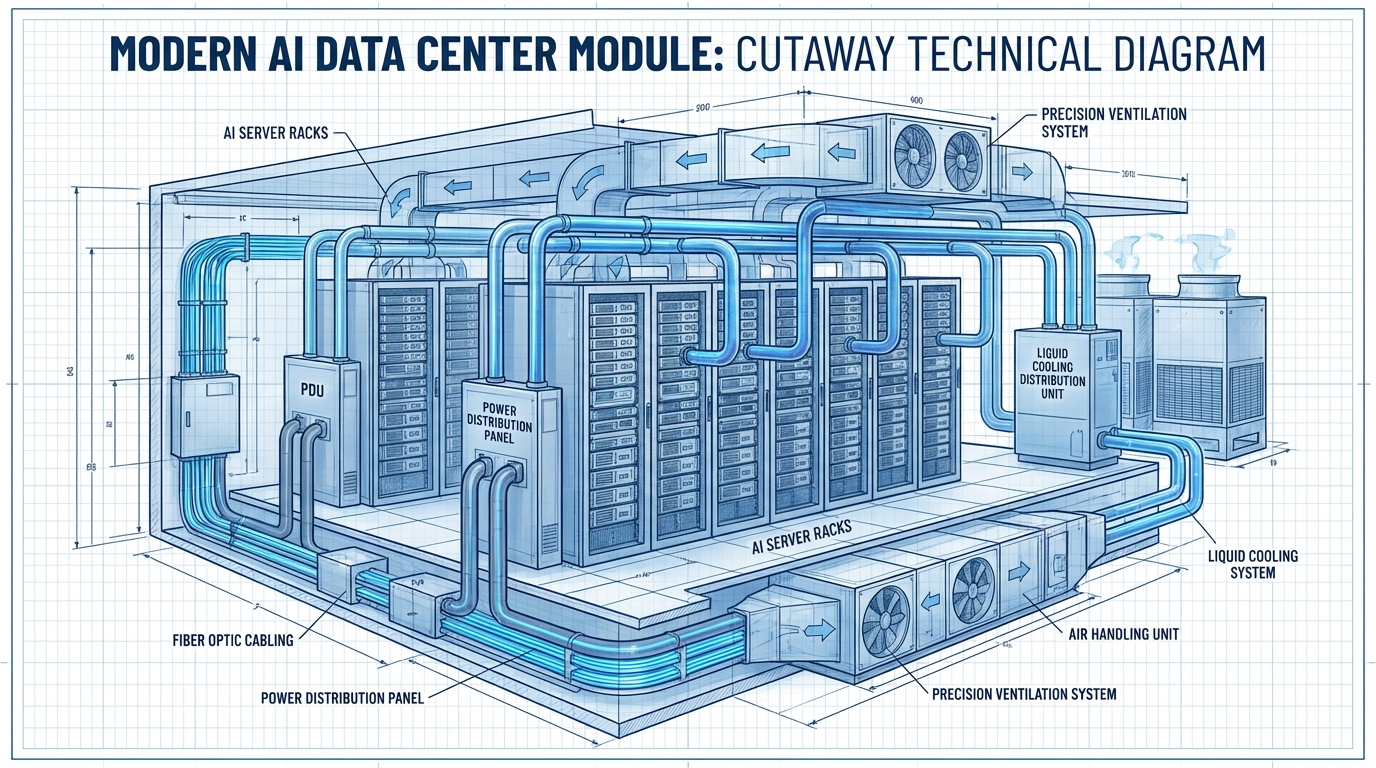
    Why an RFP? The Strategic Logic Behind Going Public with Procurement

    Large technology companies typically source hardware through closed procurement channels. They build relationships with a small set of approved vendors, negotiate confidential agreements, and keep their supply chain details proprietary. Apple does not issue public RFPs for iPhone components. Amazon does not broadcast its server specifications to the open market. The closed model exists for good reasons: competitive intelligence protection, pricing leverage, and operational security.

    OpenAI’s decision to issue a public RFP — with a publicly listed email address, a publicly stated deadline, and a publicly described scope — is therefore a deliberate departure from standard practice. It signals several things simultaneously.

    Market Development at Scale

    First, it signals that OpenAI cannot satisfy its hardware needs from the existing pool of U.S.-based suppliers. The current domestic manufacturing landscape for AI-grade hardware components is simply not large enough or diverse enough to support the volumes Stargate demands. By publishing a broad, open-format RFP, OpenAI is effectively trying to catalyze a new supplier market into existence. They are telling manufacturers who currently produce components for automotive, defense, aerospace, or consumer electronics applications: there is a decade-long contract opportunity here if you can adapt your capabilities.

    This is market-making behavior, not standard procurement. It is closer to what the Department of Defense does when it issues broad agency announcements for emerging technology sectors than it is to how Google buys servers.

    Political and Policy Alignment

    Second, the public nature of the RFP serves a political function. OpenAI is embedded in an explicit national narrative about AI leadership, reindustrialization, and economic sovereignty. Issuing a public RFP that explicitly states goals of job creation, supply chain resilience, and domestic production is not just a procurement strategy — it is a signal to policymakers, regulators, and the public that OpenAI is putting capital behind the rhetoric of American manufacturing revival.

    The Stargate initiative was announced alongside the White House in January 2025. The RFP, one year later, is the operational follow-through. It tells Congress and the administration that this is real, it is happening, and here is the formal mechanism by which domestic industry will participate.

    Competitive Positioning Against China

    Third — and perhaps most strategically significant — the public framing of the RFP as a domestic supply chain exercise is a direct response to the geopolitical pressure around AI hardware. By documenting and broadcasting its commitment to U.S.-based manufacturing, OpenAI is building a defensible record of supply chain provenance. In an era of escalating export controls, potential tariffs, and trade decoupling, having a verifiable, auditable domestic supply chain is not just operationally prudent — it is a form of regulatory insurance.

    The Three Pillars: Data Centers, Consumer Electronics, and Robotics

    Cutaway technical diagram of a modern AI data center module showing server racks, liquid cooling pipes, power distribution units, and fiber optic cabling

    The RFP is organized around three distinct hardware categories, each representing a different strategic priority for OpenAI’s physical infrastructure ambitions. Understanding each category separately — and the relationships between them — is essential to grasping the full scope of what is being procured.

    Category One: Data Center Hardware

    This is the largest and most immediately pressing category. OpenAI’s Stargate project requires data center infrastructure at a scale that has no real commercial precedent in the private sector. The RFP specifically targets U.S.-based manufacturers capable of supplying the physical non-chip infrastructure of a modern hyperscale AI facility: server racks, power distribution units, cabling infrastructure, networking hardware, cooling systems, and power electronics.

    The cooling requirement alone is a major engineering and procurement challenge. AI compute clusters — particularly those built around high-density GPU configurations — generate heat at densities far exceeding traditional server deployments. The RFP seeks vendors capable of supplying advanced liquid cooling infrastructure, redundant thermal management systems, and the associated plumbing and fluid-handling components, all manufactured domestically.

    Power electronics is another critical category. High-efficiency power conversion systems, uninterruptible power supplies (UPS) at industrial scale, busbar distribution systems, and transformer infrastructure represent a significant portion of a data center’s bill of materials — and a significant portion of what currently comes from overseas supply chains.

    Category Two: Consumer Electronics

    This is the category that raises the most eyebrows and the most questions. Why is an AI software company issuing an RFP for consumer electronics manufacturing capacity? The answer becomes clear when you look at OpenAI’s hardware strategy alongside the RFP. OpenAI is actively developing its first physical consumer product, expected to debut in the second half of 2026, developed in partnership with designer Jony Ive’s firm IO (acquired for $6.5 billion in July 2025). The device — widely reported to be AI-powered earbuds codenamed “Sweet Pea” — would feature a custom 2-nanometer processor and be manufactured at volumes of 40 to 50 million units in its first year.

    For that kind of volume to make economic sense with a domestic manufacturing preference, OpenAI needs U.S.-based assembly capabilities, testing infrastructure, and component sourcing. The consumer electronics category in the RFP is, in part, laying the groundwork for that supply chain. The RFP seeks partners for final assembly, testing services, module production, and systems integration — the kinds of capabilities that currently exist primarily in East Asian contract manufacturers like Foxconn and Luxshare.

    Whether a fully domestic consumer electronics supply chain is achievable at scale within the timeframe of an initial product launch is a legitimate question. But the RFP signals that OpenAI is at least exploring what a partially domesticated supply chain for consumer hardware would look like.

    Category Three: Robotics Components

    The robotics category is the most forward-looking of the three. The RFP specifically calls for domestic suppliers of gearboxes, motors, power modules, and tooling for robotic assembly lines. This category points to two parallel needs: equipping OpenAI’s own manufacturing and assembly facilities with robotics infrastructure, and building toward a future where OpenAI may be a consumer of, or participant in, the physical robotics sector.

    Precision gearboxes and harmonic drives for robotics are a particular chokepoint in existing supply chains. These components — required for the smooth, precise joint movement that industrial robots need — are currently dominated by Japanese manufacturers like Harmonic Drive AG and Nabtesco. Developing U.S.-based alternatives represents both a significant engineering challenge and a significant opportunity for domestic manufacturers willing to invest in precision manufacturing capabilities.

    The Stargate Connection: From Vision to Vendor Contracts

    The RFP cannot be understood in isolation from Project Stargate — the $500 billion joint venture between OpenAI, SoftBank, Oracle, and MGX that was announced in January 2025 with explicit White House support.

    Stargate’s stated goal is to build 10 gigawatts of AI compute capacity primarily in the United States. By early 2026, the initiative had already exceeded the halfway mark toward that 10-gigawatt commitment. The Abilene, Texas flagship facility is designed for 1.2 gigawatts of electrical capacity — a load roughly equivalent to powering 750,000 homes. A Michigan facility in Saline Township has been approved for 1.4 gigawatts. Oracle has signed agreements adding a further 4.5 gigawatts of capacity. The hardware RFP is, in effect, the procurement arm of this buildout.

    The Scale of the Buildout in Practical Terms

    Consider what 10 gigawatts of AI compute actually requires in terms of physical hardware. Each gigawatt of data center capacity requires thousands of server racks, tens of thousands of individual power distribution units, hundreds of miles of cabling, and cooling infrastructure capable of handling heat loads that would overwhelm conventional HVAC systems. Multiply that across multiple gigawatt-scale facilities across 16 states, and the bill of materials for just the non-chip infrastructure runs into the tens of billions of dollars.

    The Stargate initiative has been projected as a $500 billion investment over four years. Even if only 20 percent of that total represents non-chip physical infrastructure — a conservative estimate — that is $100 billion in potential procurement for the kinds of manufacturers the RFP is targeting. Over a 10-year horizon with the scope of the RFP, the addressable market for domestic vendors is enormous.

    Stargate as Anchor Customer

    One of the most significant aspects of the RFP is the implicit promise it carries: OpenAI is positioning itself as a long-term anchor customer for whatever domestic supply chain it helps create. This matters because one of the fundamental challenges of reshoring manufacturing is the chicken-and-egg problem of investment. Manufacturers are reluctant to invest in new production capacity without guaranteed demand, and buyers are reluctant to commit to domestic suppliers who do not yet have proven capacity.

    A 10-year RFP from OpenAI — backed by the financial weight of the Stargate consortium — provides the demand signal that domestic manufacturers need to justify capital investment. This is the structural insight that makes the RFP more significant than any individual product or partnership announcement.

    Geopolitics as Engineering Requirement

    Map of the United States with glowing supply chain network nodes connected across states, overlaid on an industrial factory floor with robotic assembly arms

    To fully understand the urgency behind OpenAI’s manufacturing push, you need to understand the geopolitical landscape that makes a foreign-dependent supply chain a genuine strategic liability — not just a boardroom concern, but an existential risk to OpenAI’s ability to deliver on its core mission.

    The Taiwan Vulnerability

    The world’s most advanced semiconductor manufacturing is overwhelmingly concentrated at a single point of geopolitical vulnerability: Taiwan. TSMC, the company that manufactures the most advanced AI chips in the world including those used in NVIDIA’s data center GPUs, operates primarily from Taiwan. The geopolitical risk associated with this concentration — given the ongoing tensions between China and Taiwan — is not hypothetical. It has become a central concern in U.S. national security planning, and it is directly relevant to OpenAI’s compute strategy.

    While TSMC has begun building fabrication facilities in Arizona, that capacity is years from matching the scale and capability of its Taiwan operations. In the interim, any significant disruption to Taiwan-based chip manufacturing would directly constrain OpenAI’s ability to build and operate AI systems. The hardware RFP, while not directly addressing chip fabrication, is part of a broader effort to reduce the number of single points of failure in OpenAI’s supply chain.

    Export Controls and Their Second-Order Effects

    U.S. export controls on advanced AI chips — particularly NVIDIA’s H100 and H200 GPUs — have created a bifurcated global market for AI compute. China and certain other nations are effectively locked out of the most powerful commercially available AI training hardware. This has generated significant pressure on the U.S. AI ecosystem in unexpected ways.

    American AI companies that rely on components sourced from global supply chains face the risk of being caught between two sets of regulatory requirements: U.S. export control compliance and the sourcing dependencies that tie their hardware to countries subject to those same controls. Building a domestic supply chain for non-chip hardware components reduces one dimension of that compliance complexity.

    Furthermore, as the U.S. government has signaled increasingly active interest in the AI sector — from regulatory oversight to national security reviews of foreign investment in AI infrastructure — having a predominantly domestic hardware supply chain positions OpenAI favorably in those regulatory conversations.

    The “End-to-End Controllability” Principle

    The RFP explicitly invokes the concept of “end-to-end controllability” in critical supply chain areas. This language is significant. It reflects a broader principle in critical infrastructure security: the idea that a system’s security is only as strong as its weakest controllable point. For AI infrastructure, end-to-end controllability means knowing not just where your chips come from, but where your power electronics come from, where your cooling systems are assembled, and where your robotic components are machined.

    This level of supply chain visibility and control is not currently achievable for most technology companies operating at scale. Building it is a multi-year, multi-billion-dollar undertaking — and the RFP is the first formal step in that process.

    What Vendors Actually Need to Qualify

    Precision robotic manufacturing assembly line producing AI hardware components in a clean modern American factory with workers in safety gear

    For manufacturers considering a response to the RFP, the qualification criteria are more demanding than they might initially appear. The document is not simply asking whether a company can make the required parts. It is asking whether a company can make them at scale, reliably, and with a credible plan for expanding domestic production capacity over a decade.

    Technical Capability and Speed-to-Market

    The primary evaluation criterion is technical capability — specifically, the ability to meet OpenAI’s technical specifications and speed-to-market requirements. This is not just about whether a factory can produce a compliant part. It is about whether it can produce that part in the volumes, with the quality consistency, and within the delivery timelines that a multi-gigawatt data center buildout demands.

    Speed-to-market is particularly critical in the data center category, where delays in component delivery can create cascade effects across an entire facility construction schedule. A vendor who can meet specs but cannot reliably deliver at volume on a tight construction timeline is not a useful partner. OpenAI’s evaluation criteria reflect this reality: proposals must include detailed timelines for scaling domestic production, not just evidence of current capability.

    Factory Design and Automation Readiness

    The RFP places notable emphasis on replicable factory designs and automation readiness. This signals OpenAI’s interest in manufacturing partners who have thought carefully about how to scale production without a linear increase in labor costs. A factory design that can be replicated across multiple sites is inherently more valuable to a buyer who needs to rapidly expand domestic capacity than a bespoke, one-of-a-kind production facility.

    Automation readiness is similarly important. As labor costs in the United States remain significantly higher than in traditional manufacturing hubs like China and Southeast Asia, the economic viability of domestic AI hardware manufacturing depends heavily on automation. Vendors who can demonstrate high levels of robotics integration and automated quality control will have a meaningful advantage in the evaluation process.

    Financial Viability and Project Delivery Track Record

    The evaluation criteria also include financial viability assessments and demonstrated track records in project delivery. This is standard due diligence for any long-term procurement relationship of this scale, but it has specific implications for smaller manufacturers or newer market entrants.

    A startup with a compelling technical solution but limited financial reserves and no track record of delivering large-scale manufacturing contracts will struggle to compete with established Tier 1 and Tier 2 suppliers in the evaluation process — regardless of the quality of their engineering. The RFP is, in part, structured to identify manufacturing partners who can be trusted with the execution risk of multi-year, multi-hundred-million-dollar supply agreements.

    Site Characteristics and Logistical Accessibility

    Proposals must also address site characteristics and logistical positioning. OpenAI is building data centers across at least 16 states. Manufacturing partners who are logistically positioned to serve multiple Stargate sites efficiently — whether through existing distribution infrastructure, strategic geographic location, or scalable logistics plans — will be more attractive than those who can only efficiently serve a single regional market.

    The submission mechanism itself reflects the three-category structure: proposals are submitted via email to USMFG@openai.com with a subject line specifying the relevant category (Consumer, Robotics, or DataCenter). Proposals are accepted on a rolling basis through the June 2026 deadline, with vendor selection targeted for March 2027 and joint planning beginning in April 2027.

    The Energy Equation: Power Demands That Rival Small Nations

    Giant electrical power transmission towers and substations in Texas at dusk with wind turbines on the horizon and a massive data center facility lit up

    Any serious analysis of the hardware RFP must grapple with the energy dimension of what OpenAI is building. The power requirements for Stargate-scale AI infrastructure are genuinely extraordinary — and they create both a constraint on and a driver of the domestic manufacturing strategy.

    The Numbers in Context

    The Stargate project targets 10 gigawatts of total AI compute capacity. To put that number in context: New York City — the largest metropolitan power market in the United States — consumes approximately 6 gigawatts of electricity at peak demand. OpenAI is building AI data centers that will collectively require more power than New York City.

    Individual Stargate facilities are planned at the 1 to 1.4 gigawatt scale. The Michigan site approved in Saline Township is sized at 1.4 gigawatts — enough electricity to power over 800,000 average American homes. The Abilene, Texas flagship runs at 1.2 gigawatts, supported by dedicated West Texas wind generation and on-site power storage.

    OpenAI has committed to fully funding the energy infrastructure required for each site — including dedicated power generation, transmission upgrades, battery storage, and utility partnerships — with a specific pledge that local residents will not see their electricity bills increase as a result of the data center load.

    Why Energy Infrastructure Is a Manufacturing Problem

    The energy dimension of Stargate is directly relevant to the hardware RFP because the equipment that manages, distributes, and conditions power at this scale — transformers, switchgear, busbar systems, UPS infrastructure, cooling integration systems — is precisely the category of hardware that the data center RFP is targeting for domestic production.

    High-voltage transformer manufacturing in the United States has been a persistent bottleneck in infrastructure development. Lead times for large power transformers — the kind needed for gigawatt-scale data centers — currently run anywhere from 18 to 36 months from order to delivery, with much of that delay attributable to reliance on foreign component sourcing. Building domestic capacity to produce these components faster is not just an economic preference; it is a critical path requirement for the Stargate buildout timeline.

    The Grid Modernization Opportunity

    The energy requirements of OpenAI’s infrastructure buildout create what may be an unintended but significant policy opportunity: pressure to accelerate modernization of the U.S. electrical grid. Each Stargate site requires utility-level negotiations, transmission upgrades, and in many cases new generation capacity. The cumulative effect of building 10 gigawatts of private data center load across 16 states could provide the demand signal and capital investment that accelerates grid improvements that would benefit broader industrial and consumer users as well.

    This is one of the more underappreciated second-order effects of the hardware RFP: by creating demand for domestic power infrastructure manufacturing, OpenAI is indirectly investing in the industrial base that the U.S. energy transition also depends on.

    OpenAI’s Hardware Ambitions Beyond the Data Center

    Sleek minimalist AI-powered consumer hardware device concept — screen-free wearable earbud design with glossy white finish on a designer desk with AI circuitry in background

    The consumer electronics category in the RFP only makes sense if you understand that OpenAI’s hardware ambitions extend well beyond building compute infrastructure. OpenAI is positioning itself to become a consumer hardware company — and the RFP is laying supply chain groundwork for that transition.

    The Jony Ive Partnership and What It Signals

    In July 2025, OpenAI acquired IO, the design firm founded by Jony Ive — the designer behind the original iMac, iPod, iPhone, and Apple Watch — for $6.5 billion. This was not a small talent acquisition. It was a commitment to developing physical products that could compete with the best-designed consumer hardware in the world.

    Sam Altman has described OpenAI’s consumer hardware ambition in terms of creating technology that is more “peaceful and calm” than current smartphones — devices that provide deep AI integration without demanding constant visual attention. The design philosophy is one of ambient intelligence: hardware that is present and capable without being intrusive.

    The device most widely reported to be OpenAI’s first physical product is codenamed “Sweet Pea” — described as AI-powered earbuds featuring a custom 2-nanometer processor capable of local AI inference, a screen-free design, and potential first-year shipment targets of 40 to 50 million units. At that scale, manufacturing strategy is a central strategic question, not an afterthought.

    Why Consumer Hardware Changes the RFP Calculus

    The consumer electronics dimension of the RFP introduces a fundamentally different set of manufacturing requirements compared to data center infrastructure. Data center components can be large, heavy, and built to industrial tolerances with weeks of lead time. Consumer electronics must be miniaturized, cosmetically perfect, assembled at high speed, and ready for delivery on tight seasonal schedules.

    The manufacturing processes, quality control requirements, and supply chain characteristics of consumer hardware are closer to automotive or medical device manufacturing than to industrial infrastructure. Building U.S.-based consumer electronics manufacturing capacity that can compete with the efficiency of established East Asian contract manufacturers is arguably the most challenging element of the entire RFP.

    However, the potential payoff is significant. If OpenAI establishes a domestic supply chain for its consumer devices and those devices achieve mass market adoption, it would represent one of the most significant demonstrations of reshored consumer electronics manufacturing since the sector largely departed the United States in the 1980s and 1990s — and a proof of concept for the broader argument that advanced consumer hardware can be manufactured competitively in the United States.

    What This Means for U.S. Industrial Policy and the Reshoring Moment

    OpenAI’s RFP lands at a particular historical moment in American industrial policy — one defined by the convergence of trade tension, national security concern, and bipartisan political support for domestic manufacturing investment. Understanding where the RFP fits in that larger policy landscape helps explain both its ambitions and its limitations.

    The CHIPS Act Foundation

    The CHIPS and Science Act of 2022 committed $52.7 billion in federal funding to semiconductor manufacturing and research, with the explicit goal of reducing U.S. dependence on foreign chip fabrication. That investment has catalyzed significant private sector commitments — TSMC’s Arizona fabs, Intel’s Ohio and Arizona expansions, Samsung’s Texas facility — but it has primarily focused on semiconductor fabrication rather than the broader hardware ecosystem.

    OpenAI’s RFP extends the reshoring logic downstream from chip fabrication into the broader hardware supply chain: the racks, cooling systems, power electronics, and precision mechanical components that chips ultimately live inside. In doing so, it fills a gap that the CHIPS Act largely left unaddressed and potentially creates the kind of demand certainty that could justify additional private capital investment in domestic manufacturing capacity.

    The Job Creation Dimension

    The Stargate initiative has projected the creation of over 100,000 U.S. jobs directly tied to the AI infrastructure buildout. The hardware RFP, if successful in developing a robust domestic supplier base, would extend that job creation impact beyond the data center construction workforce into manufacturing, quality engineering, logistics, and supply chain management.

    Manufacturing jobs in the AI hardware sector — particularly in precision mechanical components, power electronics, and advanced cooling systems — tend to be higher-skill and higher-wage than traditional assembly manufacturing. The economic multiplier effect of establishing this kind of domestic industrial base in regions that currently lack technology-sector employment is potentially significant.

    Industrial Policy as Competitive Strategy

    There is a broader competitive argument underlying the RFP that often goes unstated in the coverage: a nation that controls the physical manufacturing of AI infrastructure has a structural advantage in AI capability that cannot be easily matched by a nation that is dependent on foreign supply chains for the same infrastructure.

    This is not a new insight — it is the same logic that has driven military procurement policies for decades. But it is being applied here to commercial technology infrastructure in a way that represents a meaningful expansion of how “strategic industries” are defined in U.S. industrial policy. OpenAI’s RFP is, in part, an argument that AI compute infrastructure should be treated with the same supply chain sovereignty concerns as defense manufacturing — and that private sector investment can lead that effort without waiting for government mandates.

    The Timeline Reality Check

    The RFP’s stated timeline is precise, but the gap between a timeline in a procurement document and the actual delivery of new domestic manufacturing capacity is substantial. A clear-eyed assessment of what is realistically achievable — and by when — is essential for anyone trying to understand what the RFP will actually accomplish.

    The Formal Timeline

    The key dates in the RFP process are: proposals accepted on a rolling basis through June 2026; vendor selection completed in March 2027; joint planning and partnership kick-off in April 2027. From there, actual production ramp-up would depend on the specific vendor and category, but the 10-year horizon of the RFP suggests that OpenAI expects the full domestic supply chain buildout to take until roughly 2036 to complete.

    The Capacity-Building Gap

    Building new manufacturing capacity in the United States takes time — often more time than technology roadmaps allow for. Environmental permitting, facility construction, equipment procurement, workforce training, and quality certification processes all take years, not months. A vendor who receives a contract award in March 2027 will not be producing at scale for at least 18 to 24 months after that — potentially pushing meaningful domestic production into 2029 or 2030.

    For the most technically demanding categories — precision gearboxes for robotics, high-efficiency power electronics, advanced cooling systems — the ramp-up timeline may be even longer, as these require specialized manufacturing equipment and skilled workforce development that do not exist in significant quantities in the current U.S. manufacturing base.

    The Rolling Stargate Demand

    The saving grace for the timeline concern is that the Stargate buildout is itself a multi-year, rolling program. OpenAI is not building all 10 gigawatts simultaneously. Facilities are being planned, permitted, and constructed across different states on staggered timelines. This means that domestic vendors who come online in 2029 or 2030 can still capture a significant portion of the total Stargate procurement opportunity, even if the earliest sites are built primarily with components from existing supply chains.

    The phased nature of Stargate also gives domestic manufacturers a more forgiving demand curve to grow into — which is precisely why OpenAI structured the RFP as a 10-year instrument rather than a 2-year spot contract.

    Risks, Unknowns, and Legitimate Questions

    No analysis of the RFP would be complete without addressing the genuine risks and uncertainties that surround it. The plan is ambitious, but ambition is not a guarantee of execution.

    Cost Competitiveness of Domestic Manufacturing

    The fundamental economic challenge of reshoring manufacturing is cost. Labor costs in the United States are 5 to 10 times higher than in China for comparable manufacturing roles. Even with aggressive automation, domestic production of hardware components will carry a cost premium relative to equivalent production in established Asian manufacturing hubs. OpenAI’s willingness to absorb that premium — and the degree to which it can drive automation investment to close the gap — will determine whether the domestic supply chain it builds is economically durable or structurally dependent on the patronage of a single anchor customer.

    Workforce Availability

    The U.S. manufacturing workforce has contracted significantly over the past three decades. The skills required for precision mechanical manufacturing, power electronics assembly, and advanced cooling system production are not widely available in the current labor market. Building the workforce pipeline — through community college programs, apprenticeships, and employer training investments — takes years and requires coordination between private sector employers and public educational institutions that is notoriously difficult to achieve at scale.

    Supply Chain Depth vs. Final Assembly

    There is a risk that the domestic supply chain OpenAI builds is shallow rather than deep — meaning that final assembly may occur in the United States, but the sub-components and raw materials used in that assembly continue to come from overseas. A data center rack assembled in Texas from Chinese-sourced steel, Taiwanese-sourced power electronics, and South Korean-sourced cooling components is “domestically manufactured” in a legal and procurement sense but does not address the supply chain resilience concerns that motivate the RFP in the first place.

    Ensuring genuine depth in the domestic supply chain — meaning that multiple tiers of component production are localized, not just final assembly — requires a level of supplier development investment and coordination that goes significantly beyond what a single procurement document can achieve.

    What Happens If Stargate Slows Down

    The demand signal that makes the hardware RFP credible is the Stargate buildout. If that buildout slows — due to capital constraints, regulatory challenges, changes in AI demand forecasts, or shifts in OpenAI’s competitive position — the demand certainty that underpins vendor investment decisions disappears. Manufacturers who have made capital commitments based on the RFP’s implied demand would face significant financial exposure.

    This is not a hypothetical risk. Large infrastructure programs with private capital at their core have a history of revisions, delays, and scope changes. The 10-year horizon of the RFP provides some buffer, but it does not eliminate the execution risk that comes with betting on a single buyer’s long-term demand projections.

    The Physical Foundation of AI Supremacy: What the RFP Tells Us About OpenAI’s World View

    Step back from the procurement details and the geopolitical context, and the hardware RFP reveals something fundamental about how OpenAI’s leadership thinks about the nature of AI competition and the requirements for long-term leadership in the field.

    There is a school of thought in the AI industry that hardware is a commodity — that the real competition happens at the model, algorithm, and product layer, and that hardware infrastructure is best sourced from whoever can provide it most efficiently, regardless of geography. OpenAI’s RFP is a direct repudiation of that view.

    The RFP reflects a belief that in the long run, the ability to build and control the physical infrastructure on which AI systems run is itself a form of competitive advantage — and that an AI company that depends on foreign supply chains for its physical foundation is structurally vulnerable in ways that no amount of algorithmic sophistication can fully compensate for.

    This is a significant strategic claim. If OpenAI is right, then the companies and nations that invest now in domestic AI hardware manufacturing will have structural advantages a decade from now that will be very difficult for latecomers to close. If they are wrong — if hardware remains a commodity and domestic manufacturing proves uncompetitively expensive — then the RFP will represent a costly strategic miscalculation.

    The honest answer is that no one knows yet which view will prove correct. But the willingness to make a 10-year, multi-billion-dollar bet on the physical dimension of AI competition tells you more about OpenAI’s strategic confidence — and its read of the geopolitical environment — than almost any other decision the company has made in 2026.

    Conclusion: What to Watch For — and What It Means If It Works

    The OpenAI hardware RFP is a long game. Its full implications will not be visible for years. But there are specific signals to watch that will indicate whether the initiative is delivering on its ambitions or running into the structural obstacles that have frustrated previous reshoring efforts.

    Watch the vendor selection announcements in March 2027. The identity and scale of the companies chosen — whether they are established Tier 1 manufacturers pivoting to AI hardware, or new entrants purpose-built for this opportunity — will tell you a great deal about whether a genuine domestic supplier base is materializing or whether the RFP is being satisfied primarily by existing contractors with thin domestic manufacturing footprints.

    Watch the first Stargate facilities that come online after 2027. The extent to which their supply chains are genuinely domestic — measured in component origin, not just final assembly location — will be the real test of whether the RFP is building supply chain depth or supply chain theater.

    Watch the consumer hardware launch. If OpenAI’s first consumer device achieves meaningful domestic manufacturing content at 40 to 50 million units per year, it will be one of the most significant demonstrations of reshored consumer electronics manufacturing since the sector largely departed the United States in the 1980s and 1990s.

    Watch the energy infrastructure. The power systems and cooling hardware required for Stargate’s gigawatt-scale facilities will be among the first major categories where domestic manufacturing either proves its capability or reveals its limitations. This is where the rubber meets the road for the RFP’s most immediately critical procurement needs.

    If the RFP succeeds at even a fraction of its stated ambition — if it catalyzes a genuine expansion of U.S. manufacturing capacity in AI hardware, creates the industrial jobs it promises, and reduces OpenAI’s dependency on geopolitically exposed supply chains — it will stand as one of the more consequential industrial policy initiatives of the decade. Not because of the technology it produces, but because of the physical infrastructure it builds beneath it.

    AI runs on software. But software runs on hardware. And hardware, it turns out, runs on industrial policy, supply chain strategy, and the willingness to make very long bets on very physical things. OpenAI’s 10-year hardware RFP is exactly that kind of bet.