

Every week, the AI industry generates enough headlines to overwhelm even the most dedicated reader. A new model drops. A billion-dollar deal closes. A government issues a framework. A startup claims to have solved reasoning. A researcher warns of existential risk. And somewhere in the middle of all that noise, you’re supposed to figure out what actually matters for the decisions you make — in your business, your career, and your daily life.
This briefing cuts through that.
We’ve tracked the most consequential AI developments of 2026 across model performance, infrastructure investment, enterprise deployment, open-source access, regulation, hardware, workforce impact, disinformation risk, and real-world applications. Not the hype. Not the theater. The substantive shifts that are genuinely changing how AI works, who controls it, and what it’s doing in the world.
If you follow one AI news summary this year, make it this one. Here’s everything that actually matters in 2026 — organized, contextualized, and ready to use.
The Model Wars: GPT-5.4, Gemini 3.1, and Claude Opus 4.6 — Who’s Actually Winning?
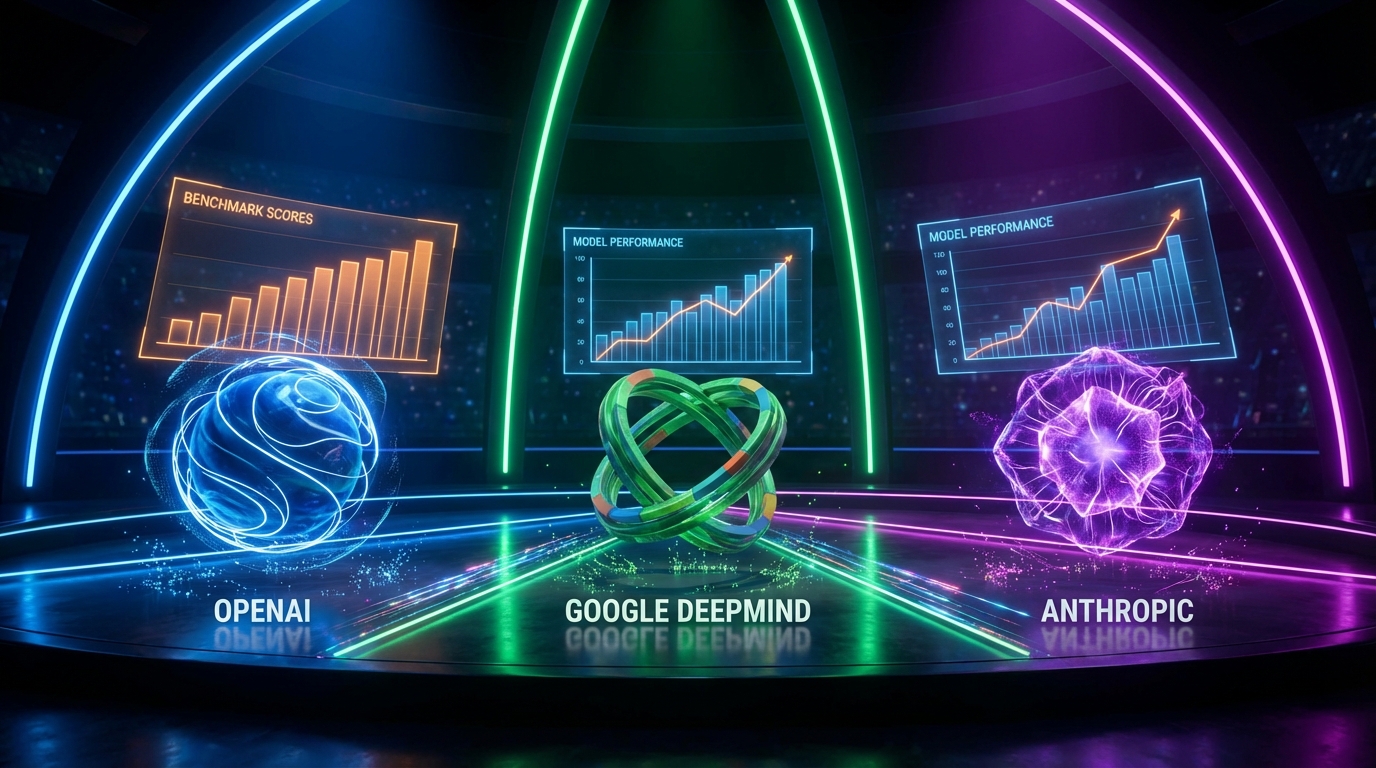
If you want to understand the AI landscape in 2026, start with the models. The flagship releases from OpenAI, Google DeepMind, and Anthropic have all landed within a few months of each other — and the benchmarks tell a more nuanced story than any single headline suggests.
OpenAI’s GPT-5.4: The General-Purpose Standard-Bearer
OpenAI released GPT-5.4 on March 5, 2026, arriving in three variants: Standard, Thinking, and Pro. The Pro tier achieved a record 83% on GDPval, a knowledge-work assessment benchmark, and topped performance on computer-use tests including OSWorld-Verified and WebArena. That means it’s the model of choice right now for complex, multi-step professional tasks — anything from legal document review to advanced code generation.
The Thinking variant is particularly notable. It applies chain-of-thought reasoning before generating outputs, which significantly reduces hallucinations on technical and factual tasks. For enterprise users who care less about raw speed and more about accuracy, GPT-5.4 Thinking is attracting serious attention as a production-grade tool for high-stakes workflows.
That said, GPT-5.4 does not dominate every benchmark. In reasoning-heavy assessments, it trails both Gemini 3.1 and Claude Opus 4.6, which matters significantly for use cases where structured logic and scientific accuracy are priorities.
Google DeepMind’s Gemini 3.1 Pro: The Reasoning Powerhouse
Released February 19, Gemini 3.1 Pro posted the most impressive benchmark performance among the three flagships, achieving 77.1% on ARC-AGI-2 — more than doubling Gemini 3 Pro’s prior score — and 94.3% on GPQA Diamond, a test of expert-level scientific knowledge. That last number is particularly striking: it suggests the model is operating at or near PhD-level accuracy on advanced STEM questions.
Gemini 3.1 also added real-time voice and image analysis capabilities, broadening its multimodal reach significantly. At $2 per million tokens, it offers strong price-performance ratios for developers building reasoning-heavy applications. Google is also reporting 750 million monthly users across its Gemini ecosystem, which gives it an enormous distribution advantage for feeding real-world usage data back into model refinement.
Anthropic’s Claude Opus 4.6: The Enterprise Safety Play
Claude Opus 4.6 (February 4) and Claude Sonnet 4.6 (February 17) occupy a slightly different position in the market. Anthropic’s flagship scored 78.7% on a key general-purpose benchmark, edging out GPT-5.4 (76.9%) and Gemini 3.1 Pro (75.6%) in that particular evaluation. On ARC-AGI-2 logical reasoning, it scored 34.44% — lower than Gemini but ahead of GPT-5.
What sets Claude apart isn’t purely benchmark numbers — it’s the model’s design philosophy around safety, interpretability, and reliable behavior in ambiguous situations. For regulated industries like healthcare, legal, and financial services, Anthropic’s focus on “Constitutional AI” principles and refusal to sacrifice safety for capability has made Claude Opus the default choice at many large enterprises that need predictable, auditable outputs.
What the Model Race Actually Means for Users
The honest answer is that the performance gap between all three flagships has narrowed to the point where the most important differentiator is no longer raw capability — it’s pricing, integration, specific task fit, and safety posture. GPT-5.4 leads in general knowledge work. Gemini 3.1 leads in reasoning and STEM. Claude Opus 4.6 leads in enterprise trust and safety. Users who pick one model and use it for everything are leaving meaningful performance gains on the table.
The practical move in 2026 is model routing: directing specific task types to the model best suited to handle them, rather than relying on a single provider. That approach is already standard practice at mature AI-forward engineering teams.
The $650 Billion Bet: What Big Tech’s Infrastructure Spending Really Means

The single biggest structural story in AI for 2026 is not a model release or a regulatory announcement. It’s a spending commitment so large it’s reshaping global energy infrastructure, supply chains, and labor markets. The four major technology companies — Amazon, Google, Meta, and Microsoft — are collectively planning approximately $650 billion in AI infrastructure investment in 2026 alone, up sharply from $410 billion in 2025.
Breaking Down the Numbers
The individual commitments tell a remarkable story of competitive urgency:
- Amazon (AWS): $200 billion in capital expenditure, a 50%+ increase from its $131 billion in 2025. Amazon is building data centers on virtually every continent, betting that cloud AI infrastructure will be as foundational as electricity for the next generation of business applications.
- Google (Alphabet): $175–185 billion in capex, roughly double its 2025 spending of $91 billion. The doubling is particularly significant given that Google is simultaneously spending heavily on both AI model development and the physical infrastructure to deliver it at scale.
- Meta: $115–135 billion in capex, also nearly double its prior year. Meta’s $600 billion U.S. infrastructure commitment through 2028 reflects a multi-year bet that AI-native social platforms and spatial computing will require compute at a scale that no existing infrastructure can currently support.
- Microsoft: Approximately $98 billion, with its OpenAI partnership accounting for roughly 45% of its cloud backlog. Microsoft’s infrastructure is increasingly indistinguishable from OpenAI’s commercial deployment layer.
Why Markets Reacted Negatively Despite the Investment
Here’s the counterintuitive part: despite strong revenue reports, Amazon stock fell 8–10%, Microsoft dropped 12%, and Meta declined post-earnings — all directly tied to the infrastructure spending announcements. Investors aren’t questioning whether AI will be valuable. They’re questioning when the returns arrive and whether the capital efficiency of building your own compute makes sense versus buying capacity from existing cloud providers.
This tension — between building for long-term dominance and delivering near-term financial returns — will define corporate AI strategy through the rest of the decade. Companies that can demonstrate clear revenue-per-dollar of compute spend will win investor confidence. Those that can’t are already seeing the market apply a discount to their AI ambitions.
The Second-Order Effects Nobody Is Talking About
$650 billion in infrastructure spend doesn’t stay in Silicon Valley. It flows into construction labor markets, electrical grid upgrades, water cooling systems, specialized semiconductor supply chains, and rural land markets where large data centers prefer to locate. Several U.S. states are already facing electricity grid strain driven primarily by AI data center demand. Some municipalities are renegotiating tax agreements with hyperscalers. The energy footprint of this AI infrastructure build-out is a story that will dominate headlines in the second half of 2026 — and it’s barely been covered yet.
Agentic AI Goes to Work: Real Enterprise Deployments and What They’re Delivering
Agentic AI — systems that make independent decisions and execute multi-step tasks without constant human direction — has crossed from concept to production in 2026. The numbers are stark: according to Gartner, less than 5% of enterprise applications had integrated AI agents in 2025. That figure is projected to reach 40% by the end of 2026. IDC forecasts a 10x increase in G2000 agent usage, with API call volumes growing 1,000x by 2027.
Those aren’t projections based on optimism — they’re extrapolations of deployment rates already happening now.
What Enterprises Are Actually Deploying
The most mature agentic deployments in 2026 are concentrated in four areas:
Customer Service and Support is the most widely deployed use case. Autonomous agents handle tier-1 and tier-2 support tickets, perform account lookups, process returns, and escalate only when genuinely novel issues arise. Organizations deploying these systems are reporting significant reductions in average handle time and first-contact resolution rates that outperform human-only teams on routine queries.
Sales Intelligence and Outreach represents a growing deployment area where AI agents monitor signals (funding announcements, leadership changes, earnings calls), generate context-specific outreach, and update CRM records without manual intervention. Early deployments yield 3–5% productivity gains, scaling to 10%+ in systems that have been running long enough to accumulate behavioral refinement data.
Supply Chain and Logistics Monitoring has become a compelling production-grade use case. Agents continuously monitor supplier signals, inventory levels, and logistics disruptions, making recommendations or taking pre-approved actions faster than any human operations team can respond. The value proposition is especially clear in organizations that operate globally and need 24/7 responsiveness to fast-moving supply disruptions.
Cybersecurity Threat Response is an area where the speed advantages of agentic AI are most tangible. Threat detection and initial containment actions that previously required a human analyst to wake up, log in, and work through a playbook can now be executed by an agent in seconds. Several enterprise security teams have moved agents from advisory to partially autonomous roles for well-defined threat categories.
The Adoption Friction Nobody Fully Expected
Despite the acceleration, surveys of enterprise AI leaders reveal consistent friction points. Trust and verification remain the most commonly cited concern — specifically, the challenge of knowing when an agent’s autonomous decision is correct versus when it’s confidently wrong. Organizations are managing this through “human-in-the-loop” approval gates, where agents propose actions above defined complexity thresholds rather than executing them. The tradeoff is capability for confidence.
Integration with legacy systems is the second major friction point. Most enterprise software was not built with AI agent access in mind, and retrofitting API connectivity to systems built in the 1990s and 2000s is genuine engineering work. The companies best positioned to capitalize on agentic AI are those that have invested in modern API-accessible infrastructure — not coincidentally, the same companies that have been cloud-migrating for the past decade.
McKinsey estimates that scaled agentic AI deployments could unlock $2.9 trillion in economic value by 2030. But that value is not evenly distributed. It flows disproportionately to organizations with the data infrastructure, technical talent, and governance frameworks to deploy agents responsibly at scale.
The Open-Source Insurgency: How Llama 4, DeepSeek, and Mistral Are Reshaping Access

One of the most consequential and least-hyped stories in AI is the degree to which open-source and open-weight models have closed the gap with proprietary flagships. In 2024, the consensus view was that GPT-4 and Claude were in a class of their own. By mid-2026, that gap has narrowed to roughly three months of release lag — meaning the best open-weight models are consistently performing at or near the level of models that OpenAI, Google, and Anthropic released a quarter earlier.
Meta’s Llama 4: The Ecosystem Play
Meta’s Llama 4 family — particularly the Scout (109B parameters, 10 million token context window) and Maverick (400B parameters) variants — has become the backbone of an enormous open-source ecosystem. The Scout’s 10 million token context is technically significant: it allows the model to process entire codebases, legal contracts, or lengthy research literature in a single pass. Thousands of community fine-tunes have proliferated since release, covering everything from medical summarization to regional language adaptation.
Llama 4 uses a Mixture-of-Experts architecture, activating only 17 billion parameters at a time despite its total parameter count. This makes inference significantly more efficient than the raw parameter numbers suggest, enabling deployment on hardware configurations that would be economically impractical for traditional dense models of equivalent capability.
Meta’s license allows commercial use for organizations with up to 700 million monthly active users — a threshold only a handful of companies globally would exceed. For virtually every business building with AI, it’s effectively free to use commercially.
DeepSeek: The Efficiency Story That Changed Industry Assumptions
DeepSeek arrived from a Chinese research organization and caused genuine disruption to the prevailing assumptions about the cost of training frontier models. DeepSeek-V3 and its reasoning-optimized R1 variant demonstrated that models with competitive performance on key benchmarks could be trained at a fraction of the cost that U.S. labs have been spending — reportedly 10–40x less, depending on the metric.
The implications run in multiple directions. For enterprise AI buyers, DeepSeek’s efficiency norms have become a reference point in vendor negotiations. For the AI industry, the realization that efficient architecture and training methodology might matter as much as raw compute spend has shifted R&D priorities. For geopolitics, a Chinese lab producing models that match or approach U.S. flagships on reasoning benchmarks has added urgency to the export control conversations in Washington.
Mistral: The European Open-Model Standard
Mistral AI has built a distinctive position around its Apache 2.0 license — one of the most permissive licenses in the industry, allowing full commercial use, modification, and redistribution without restriction. Mistral Small 3 and Large 2 have become the default open-source choices in many European enterprise deployments, where data residency requirements and regulatory compliance considerations make self-hosted models preferable to calling U.S.-based APIs.
Open-weight models now represent 62.8% of the market by model count, according to available tracking data. The combination of Llama’s ecosystem, DeepSeek’s efficiency, and Mistral’s permissiveness means that any organization — regardless of size, budget, or geography — can deploy genuinely capable AI without ongoing API costs or proprietary lock-in.
AI Regulation 2026: The Federal vs. State Showdown
The regulatory picture in the United States has grown more complicated, not simpler, in 2026. There is no federal AI law. There is, however, a growing patchwork of state-level requirements, a White House framework attempting to manage that patchwork, and a Justice Department task force specifically created to challenge state rules the administration views as overly burdensome.
The White House National Policy Framework
Released on March 20, 2026, the White House National Policy Framework for Artificial Intelligence provides nonbinding legislative recommendations to Congress for a unified federal approach. Its priorities include child safety, free speech protections, workforce training, and sector-specific oversight through existing regulatory agencies — notably, it does not propose a new dedicated AI regulator.
The framework’s most politically significant provision is its emphasis on federal preemption of state AI laws. The Trump administration’s position is that a fragmented regulatory environment — where companies must navigate 50 different state AI regimes — creates unnecessary compliance costs and inhibits the kind of rapid development that would maintain U.S. competitiveness against Chinese AI development. Critics argue this framing is used to justify weakening consumer protection standards.
California and Texas Lead State-Level Action
California implemented the most comprehensive state AI framework on January 1, 2026, covering generative AI, frontier models, chatbots, healthcare communications, and algorithmic pricing. Its requirements center on transparency, harm prevention, and oversight of high-risk AI systems. Separately, Governor Newsom signed an executive order on March 31 establishing new privacy and security standards for AI companies working with the state — a direct response to the federal preemption push.
Texas introduced its Responsible AI Governance Act, effective in 2026, focusing on enterprise AI transparency, documentation requirements, and red-teaming obligations. Texas’s approach is deliberately more business-friendly than California’s, reflecting the state’s positioning as an alternative regulatory home for AI companies considering relocating away from California’s more aggressive stance.
The EU AI Act in Effect
The European Union’s AI Act continues its phased implementation, with high-risk AI system requirements now in active enforcement. The Act creates tiered obligations based on risk classification — general-purpose AI models with significant capabilities face transparency requirements, capability thresholds, and incident reporting obligations. European enterprises deploying AI in regulated sectors are navigating a genuinely complex compliance environment, which is driving demand for AI governance platforms and third-party audit services.
For U.S.-based AI companies selling into European markets, the EU AI Act has effectively become a minimum compliance floor, regardless of what U.S. federal policy says. Building AI systems to EU standards and then relaxing controls for U.S. deployment has proven more practical than maintaining two separate compliance programs.
The Hardware Arms Race: Nvidia’s Dominance and the Challengers Gaining Ground
The AI hardware story of 2026 can be summarized quickly: Nvidia is still dominant, but the competitive dynamics are more interesting than the market share numbers suggest.
Nvidia’s Financial Position
Nvidia’s fiscal 2026 revenue reached $215.9 billion, with data center operations contributing $193.7 billion — 90% of total revenue. Its gross margin of 71.1% is extraordinary for a hardware company and reflects the degree to which Nvidia has built switching costs through its CUDA software ecosystem rather than simply selling chips. The fact that most AI models are trained and deployed on frameworks that assume CUDA availability is a structural moat that is genuinely difficult to replicate quickly.
That moat, however, is not impenetrable. It’s expensive. And the organizations that are most motivated to undercut it are precisely the ones with $200 billion annual capex budgets.
AMD’s Challenge: Real But Limited
AMD’s data center segment reached $16.6 billion in 2025 with 32% year-over-year growth — meaningful in absolute terms, but representing less than 10% of Nvidia’s equivalent segment. AMD’s MI300X GPU has secured deals with Meta and several cloud providers as a cost-competitive alternative to Nvidia’s H100 for large-scale training workloads. Its MI455 accelerator targets inference specifically, where the price sensitivity is highest.
AMD’s “AI everywhere” strategy also encompasses its Ryzen AI 400 and Max+ chips for laptops and edge devices — a bet that not all AI inference will happen in the cloud. If on-device AI processing grows as expected, AMD’s PC processor market share gives it a potential on-ramp to the edge AI market that Nvidia doesn’t naturally own.
The Custom Silicon Play
The most strategically significant hardware development may not be coming from either Nvidia or AMD. Google’s TPUs, Amazon’s Trainium and Inferentia chips, and Meta’s custom silicon programs represent a deliberate effort by hyperscalers to reduce their dependence on Nvidia by building workload-specific accelerators in-house. These chips don’t need to beat Nvidia at everything — they just need to beat it at the specific workloads each company runs most frequently, at a cost structure that justifies the engineering investment.
If this custom silicon push succeeds at scale, it creates a fascinating dynamic: the companies building the most AI infrastructure are simultaneously the biggest customers of Nvidia and its most determined competitors. The outcome of that tension will shape hardware pricing and availability for the entire AI ecosystem over the next five years.
AI and the Workforce: Real Numbers on Jobs, Skills, and What’s Actually Happening
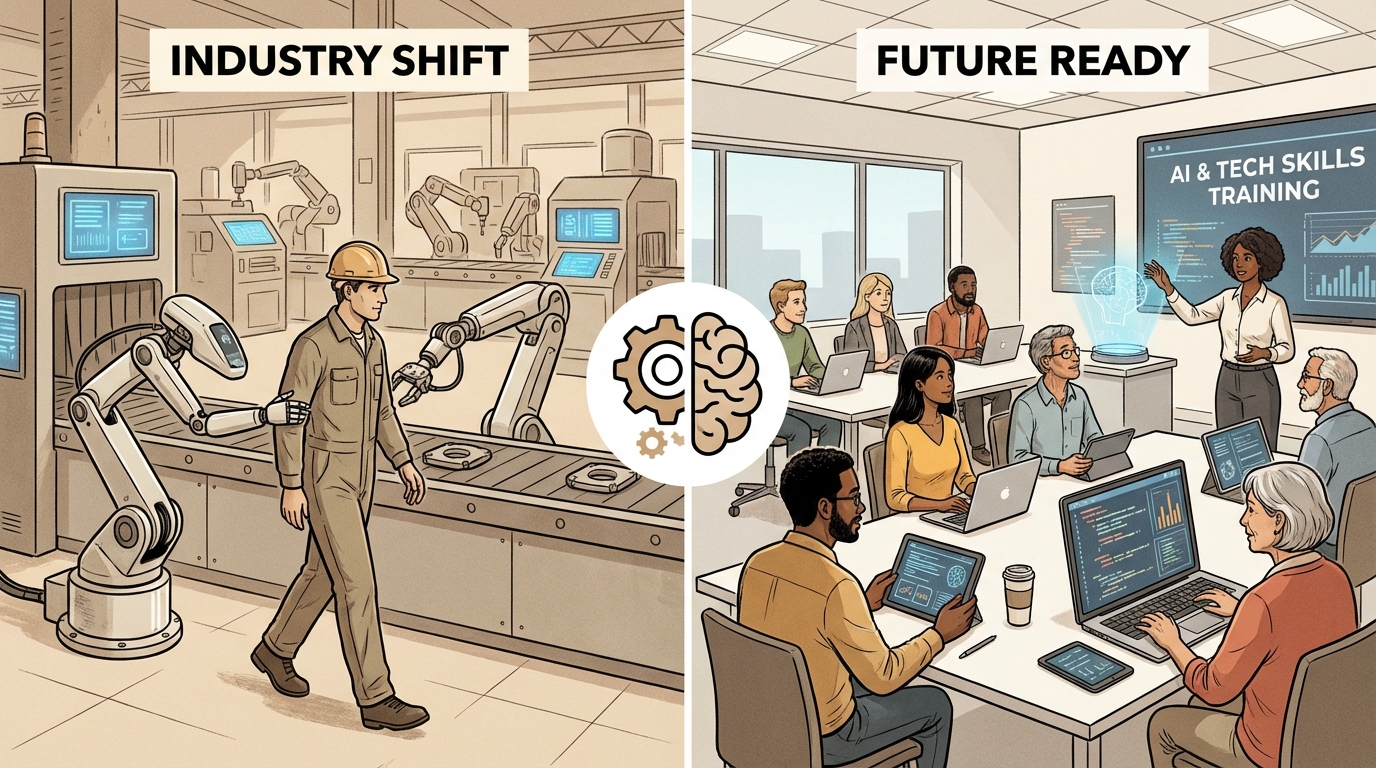
The AI workforce debate has generated more heat than light for the past three years. The actual picture — as of 2026 — is more nuanced than either the “AI will take all jobs” or “AI only creates jobs” camps suggest.
The Displacement Numbers
The World Economic Forum projects that AI will displace approximately 92 million jobs globally by 2030. Goldman Sachs research, released March 18, 2026, estimates that 6–7% of the U.S. workforce — approximately 11 million workers — will experience AI-driven displacement over the next 10 years, with 300 million global jobs meaningfully affected in terms of task composition.
The occupations currently experiencing the most acute AI-driven pressure are specific and worth naming clearly: computer programmers (where AI-assisted code generation is already replacing significant portions of entry-level and mid-level coding work), customer service representatives, data entry workers, basic bookkeeping and accounting clerks, medical coders, and manual quality assurance testers. These are not speculative future displacements — these roles are currently seeing reduced hiring and, in some organizations, active headcount reduction.
The Job Creation Side
The WEF’s same analysis projects 170 million new roles created by 2030, producing a net global job gain of approximately 78 million positions. New roles are emerging in AI training and data labeling, AI governance and compliance, prompt engineering, AI system integration, machine learning operations (MLOps), and a range of domain-specific AI specialist roles across healthcare, legal, finance, and engineering.
The challenge is that the skills required for the new roles are substantially different from the skills of the displaced workers, and the geographic distribution of new and lost jobs does not match. A customer service representative in a rural call center and an AI governance specialist in a technology hub are in different labor markets with few retraining bridges between them.
The Skills Gap Is the Real Crisis
According to data from early 2026, 77% of employers plan to require AI proficiency reskilling from their existing workforce. Yet companies consistently report an inability to fill AI and data roles even at competitive compensation levels, because the pool of workers with current, relevant AI skills is smaller than demand. The tools themselves are evolving faster than formal training programs can track.
This creates a counterintuitive moment where the organizations that most need to upskill their employees are also the ones most likely to automate the trainers who would do the upskilling. Workers who are proactively developing practical AI fluency — learning to work with AI tools rather than being replaced by them — are commanding meaningful wage premiums in nearly every sector where AI adoption is active.
The Deepfake Threat: Why the Disinformation Risk Is Accelerating in 2026

If there is one AI development that deserves more serious public attention than it currently receives, it is the deepfake problem. The World Economic Forum’s Global Risks Report 2026 ranks mis- and disinformation — driven substantially by AI-generated synthetic media — among the top short-term global risks, noting that it “catalyses all other risks” by eroding the trust infrastructure that democratic institutions, financial markets, and social cohesion depend on.
What’s Changed in 2026
The critical shift is not that deepfakes became more sophisticated — though they have. The critical shift is that creating a convincing deepfake no longer requires specialized technical skill or significant resources. Smartphone-accessible tools can produce near-indistinguishable synthetic video and audio in minutes. The earlier tell-tale signs — unnatural eye blinking, inconsistent skin texture, lip sync errors — have been largely eliminated by 2026-era generation models.
Deepfake attempts in political contexts surged 280–303% in recent election cycles. A documented case from Ireland in 2025 involved a synthetic video of a candidate falsely announcing their withdrawal from a race — distributed widely enough to suppress turnout before it was debunked. The Netherlands saw over 400 synthetic images used in a disinformation campaign. These are not edge cases. They are operational templates that will be used repeatedly in the 2026 global election cycle.
The “Liar’s Dividend” Problem
Researchers have identified a secondary effect of deepfake proliferation that is arguably as damaging as the fakes themselves: the “liar’s dividend.” When the public is aware that convincing fakes are easy to produce, legitimate evidence becomes deniable. Politicians, executives, and individuals accused of wrongdoing based on real footage can plausibly claim fabrication. The erosion of video evidence as a category of reliable proof is a profound institutional risk that has not been adequately addressed by any current policy framework.
Detection and Mitigation
The technical response to deepfakes is real but not yet adequate. Content authenticity initiatives, including C2PA (Coalition for Content Provenance and Authenticity) digital signatures, are being adopted by some publishers and platforms, embedding verifiable metadata about the origin of media. Several AI labs including Google and Microsoft have deployed deepfake detection APIs that are being used by news organizations and social platforms.
However, detection accuracy is a moving target — each improvement in detection capability drives corresponding improvements in generation quality. Platform-level policies requiring disclosure of AI-generated content are inconsistently enforced. And criminal deepfake prosecutions remain rare globally, limiting deterrence. For individuals and organizations concerned about their own exposure, proactive digital identity protection and media literacy programs are currently the most practical response.
Multimodal AI in the Real World: Healthcare, Finance, and Beyond
Multimodal AI — systems that process and reason across text, images, audio, sensor data, and other information types simultaneously — has crossed into production deployment across several industries in 2026. The global multimodal AI market is projected at $3.43 billion in 2026, growing at a 36.92% CAGR toward $12.06 billion by 2030.
Healthcare: Where Multimodal AI Is Delivering Real Clinical Value
Healthcare is the clearest demonstration of why multimodal AI matters. Medical diagnosis has always been a multimodal problem: a clinician integrates radiology images, lab results, patient history, genomic data, physical examination findings, and clinical notes to form an assessment. AI systems that can only process one of these data types at a time are fundamentally limited. Systems that process all of them together are beginning to outperform single-modality analysis in specific diagnostic contexts.
Mayo Clinic’s AI-enhanced ECG system achieves 93% accuracy in identifying asymptomatic heart failure — significantly higher than standard electrocardiogram interpretation alone. Google’s ARDA platform for retinal disease combines imaging with patient history to stratify risk in ways that improve specialist referral efficiency. Clairity’s breast cancer risk model integrates mammography imaging with genetic and demographic data to identify high-risk patients earlier than either data source alone would support.
Drug discovery is another area of genuine acceleration. Multimodal AI systems that combine protein structure prediction, clinical trial data, molecular simulation, and medical literature are compressing preclinical research timelines from years to months in several documented cases. The total value of AI-accelerated drug discovery pipelines is now tracked by pharmaceutical companies as a material asset in their financial reporting.
Finance: Fraud Detection, Risk Assessment, and Personalization
In financial services, multimodal AI is most developed in fraud detection, where integrating transaction data, behavioral patterns, document images, voice authentication, and device signals creates a significantly more reliable fraud signal than any single channel alone. Insurance claims processing — long a bottleneck of manual review — is being processed at scale using AI systems that evaluate photos of damage, policy text, location data, and historical claims simultaneously.
Personalized financial advice, long constrained by regulatory requirements and the economics of human advisory relationships, is beginning to scale through multimodal AI systems that can review a client’s full financial picture — statements, tax documents, portfolio performance, spending patterns — and generate genuinely personalized recommendations rather than generic guidance.
Physical AI: The Frontier Beyond Screens
Physical AI — systems that perceive and act in the physical world through robotics, autonomous vehicles, and industrial sensors — is the next major development frontier for multimodal AI. Boston Dynamics, Figure AI, and several other robotics companies are deploying models that combine computer vision, spatial reasoning, and physical control in manufacturing and logistics settings. The transition from AI as a software phenomenon to AI as a physical-world phenomenon is still early, but the 2026 deployments in controlled industrial environments represent genuine proof-of-concept at production scale.
What’s Coming Next: H2 2026 Signals Worth Watching
Looking at the second half of 2026, several signals are worth tracking closely — not because they’re guaranteed to materialize, but because the available evidence suggests they’ll drive significant news cycles and practical decisions for AI users and observers.
The AGI Conversation Gets More Concrete
OpenAI, Anthropic, and Google DeepMind have all indicated internal timelines for reaching what they define as “broadly applicable” AI systems — systems capable of performing the full range of cognitive tasks a professional might execute. Whether this constitutes “AGI” depends heavily on the definition used, and the definitions are not consistent across organizations. But expect the conversation to move from philosophical speculation to concrete capability demonstrations and benchmarks in H2 2026.
AI Energy Consumption Becomes a Political Issue
The energy footprint of the $650 billion infrastructure build-out is reaching the point where it will become a mainstream political and regulatory issue rather than an industry footnote. Several major data center projects are facing environmental review challenges. Electricity utilities are revising long-term demand forecasts dramatically upward based on data center growth projections. Renewable energy procurement is becoming a competitive differentiator for AI infrastructure companies as ESG pressure and state energy mandates create compliance requirements.
Agent-to-Agent Communication Standards
As multiple agentic AI systems operate within the same enterprise and sometimes across organizational boundaries, the absence of standardized protocols for agent-to-agent communication is becoming a practical problem. The industry equivalent of HTTP for AI agents — a standard communication protocol that allows agents from different vendors to collaborate on tasks — is an active area of development that could become a significant infrastructure news story in H2 2026.
Copyright and Training Data Litigation
The Penguin Random House lawsuit against OpenAI (filed in Munich, alleging copyright violation from training data) is one of dozens of active legal proceedings globally that are testing the boundaries of copyright law as applied to AI training. Several of these cases are expected to reach significant rulings in H2 2026. The outcomes will materially affect how AI companies acquire training data, the licensing market for high-quality data, and potentially the pricing structure of AI model access.
On-Device AI Matures
The shift toward running capable AI models on-device — smartphones, laptops, industrial sensors — rather than in the cloud is accelerating faster than most public coverage suggests. Apple’s continued development of Apple Intelligence, AMD’s Ryzen AI chips, and Qualcomm’s NPU integration are making on-device inference a real production option for a growing range of tasks. The implication for cloud AI providers is meaningful: not all the value of AI necessarily flows through their infrastructure. The long-term competitive dynamics of AI may depend significantly on who owns the device relationship.
How to Stay Oriented in a Fast-Moving Landscape
The pace of AI development in 2026 means that even attentive observers can fall behind within weeks. But staying genuinely informed — as opposed to merely exposed to AI headlines — is a solvable problem if you’re deliberate about how you consume information.
Separate Signal from Noise
Most AI news is either benchmark announcements (which matter primarily if you’re choosing models for specific tasks), funding announcements (which matter primarily if you’re tracking competitive dynamics), or opinion pieces about what AI might mean in the future (which have value only if grounded in current capability evidence). The developments that actually change what you should do — how you build products, how you manage your team, how you make policy — are a smaller and more specific subset.
Developing a mental filter that sorts “interesting” from “actionable” is the most valuable skill for navigating AI news in 2026. When you read a headline, ask: does this change a decision I need to make in the next 90 days? If yes, read deeper. If no, file it as background context and move on.
Build Practical Literacy, Not Just Awareness
Understanding what GPT-5.4’s benchmark numbers mean in theory is significantly less valuable than spending an hour actually using it on a work task and comparing the output to what Claude or Gemini produces. The people who are best positioned to make good AI decisions in 2026 are the ones who have direct experience with the tools, not just awareness of them. Dedicate time to hands-on experimentation — it compounds faster than reading about AI does.
Track Regulation Locally and Globally
If you operate in the U.S., the state where you’re incorporated or where your customers are located matters enormously right now. California’s AI requirements apply to companies operating in California, regardless of where they’re headquartered. If you serve European customers, the EU AI Act applies. Don’t rely on federal inaction as permission to ignore regulatory obligations — the state and international landscape is active and evolving.
Actionable Takeaways for 2026
- For AI practitioners: Model routing across GPT-5.4, Gemini 3.1, and Claude Opus 4.6 based on task type is the current best practice. Don’t commit to a single model for everything.
- For enterprise leaders: Agentic AI pilots are transitioning to production. If you don’t have at least one agentic deployment live or in serious development, you’re behind the adoption curve.
- For workers: AI fluency is not optional. The premium on practical AI skill is real, measurable, and growing across every sector with active AI adoption.
- For policy watchers: The federal vs. state regulatory battle will define the compliance landscape for 2026–2028. Follow both tracks — the White House framework and state-level enforcement actions — rather than treating either as the whole story.
- For anyone concerned about information integrity: Develop habits around source verification, especially for video and audio content. The tools to verify content provenance are available — use them.
- For builders: Open-source models have reached the capability level where proprietary APIs are not automatically the right architectural choice. Evaluate Llama 4, DeepSeek, and Mistral seriously before committing to ongoing API costs.
The AI story of 2026 is not a single story. It’s simultaneous acceleration and friction — models improving, investments soaring, agents deploying, regulation lagging, jobs shifting, risks growing, and access broadening all at the same time. The people who will navigate it best are the ones who hold all of these threads simultaneously without collapsing them into a simple narrative.
Stay curious. Stay critical. And check the benchmarks before you believe the press release.