
Every major newsroom in the world is now handling a version of the same impossible problem. The speed of online misinformation has outpaced the capacity of human fact-checkers. A fabricated video clip can circulate to five million people in the time it takes a verification team to pull up the metadata. A synthetic audio recording can become breaking news before a single source has been called.
The answer that technology companies, platform providers, and AI vendors have been selling is seductive: automate the verification layer. Use AI to triage claims, detect deepfakes, flag synthetic content, and cross-reference sources — all before a human editor ever has to make a judgment call.
The problem is that automated verification, deployed without the right architecture around it, is creating its own category of harm. False positives that flag legitimate reporting. AI assistants that repeat disinformation at double the rate they did two years ago. Disclosure labels that — when deployed generically — actively reduce reader trust in the very stories they were meant to protect.
This piece is not an argument against AI in newsroom verification. The tools are real, the efficiency gains are measurable, and the newsrooms doing it well have built genuine advantages. But the architecture matters enormously. The question is not whether to automate — it is which parts of verification can be automated without catastrophic consequences, and where the human editorial layer must remain non-negotiable. Getting that distinction wrong carries costs that go far beyond a single incorrect story. It touches the foundational credibility that makes journalism worth reading at all.
The Scale of the Problem AI Was Built to Solve
It helps to start with why AI verification tools exist in the first place, because the scale of the problem is genuinely unprecedented. The volume of digital content requiring verification in a modern newsroom is not a workflow challenge that can be solved by hiring more fact-checkers. It is structurally incompatible with human-only review.
A Misinformation Ecosystem That Keeps Accelerating
Consider what a breaking news event now looks like from the inside of a verification desk. Within minutes of a major incident, dozens of videos — pulled from TikTok, Telegram, X, and WhatsApp — begin circulating, some genuine, some repurposed from unrelated events, and an increasing proportion synthetically generated. Each piece of content requires reverse image searching, geolocation checking, metadata analysis, source tracing, and cross-corroboration. A single incident can generate hundreds of claims requiring review within an hour.
The Reuters Institute’s 2026 reporting confirms that newsroom AI use is strongest precisely in this domain: research, archive search, data analysis, accessibility, and live fact-checking support. These are tasks where the volume exceeds human bandwidth and where AI’s speed genuinely creates value.
The misinformation ecosystem has also grown more technically sophisticated. Generative AI tools that were difficult to access in 2022 are now consumer-grade. Creating a convincing synthetic video, audio clip, or fabricated document requires less technical skill than it did even eighteen months ago. The asymmetry between creating misinformation and verifying it has shifted sharply in the wrong direction.
The Operational Pressure on Fact-Checking Organizations
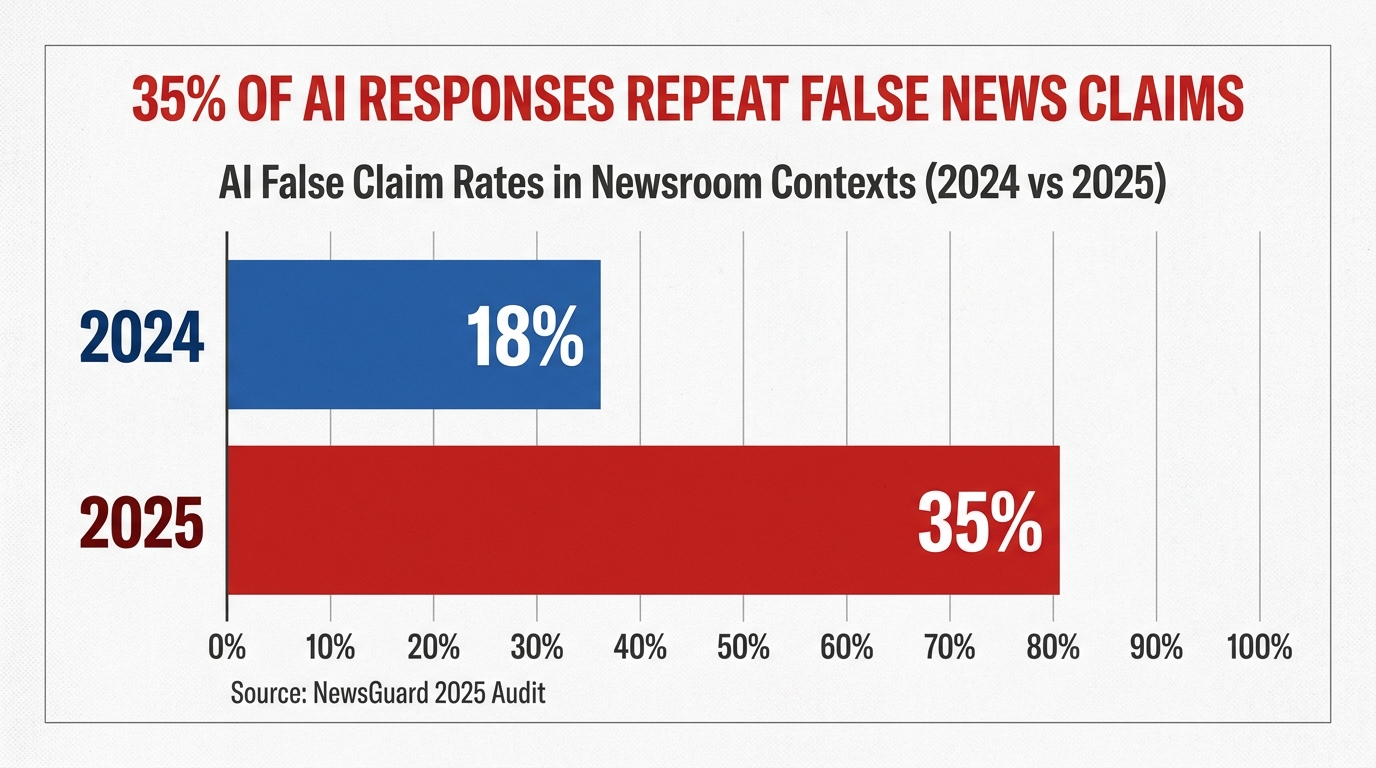
For dedicated fact-checking teams, the queue of content requiring review has expanded dramatically while staffing levels have not kept pace. NewsGuard’s 2025 audit of AI misinformation tells a specific and sobering story: leading chatbots repeated false claims in 35% of responses to news prompts in August 2025 — nearly double the 18% rate recorded in August 2024. The EBU/BBC research found that 45% of AI responses to news queries contained at least one significant issue, and 81% contained some form of problem.
These figures matter for a specific reason: newsrooms are not only trying to catch misinformation originating from external sources. They are now also having to fact-check the AI tools they use internally, because those tools are themselves prone to hallucination, incorrect attribution, and confident misstatement. The verification problem has become recursive. AI is both part of the solution and part of the source material that needs to be verified.
What “Verification” Actually Means in an AI-Augmented Newsroom
One of the most consistent errors in conversations about AI and newsroom verification is treating “verification” as a single, unified task. It is not. Verification in practice is a cluster of distinct activities, each with different error tolerances, different stakes, and different suitability for automation.
Breaking Down the Verification Stack
At the base level, there is content authentication: determining whether a photo, video, or document is what it purports to be. This includes reverse image searching, geolocation, metadata analysis, and frame-by-frame review. These tasks involve mostly pattern-matching against known data — they are amenable to AI assistance, though human review remains essential for edge cases.
The second layer is claim verification: determining whether a specific factual assertion is true or false. This is where the epistemological difficulty escalates sharply. Verifying a claim requires understanding context, assessing source credibility, evaluating the completeness of evidence, and making judgment calls about what constitutes sufficient proof. AI can surface relevant information and flag inconsistencies, but making the final determination is categorically different from spotting a duplicated video frame.
The third layer is source verification: determining whether a person, organization, or document is who or what they claim to be. This involves cross-referencing official records, contacting sources through independent channels, and applying editorial judgment about credibility. AI can assist with initial searches, but impersonation and synthetic identity creation are precisely the areas where AI tools struggle most.
Why Treating These Layers as Identical Is Dangerous
Newsrooms that deploy AI verification tools without distinguishing between these layers run into a specific failure mode: they over-rely on automated tools for claim and source verification because they are seeing genuine gains on content authentication. The confidence that comes from successfully using AI to geolocate flood footage can bleed into unwarranted confidence in AI’s ability to adjudicate complex factual disputes.
The Reuters Institute’s 2026 reporting is explicit on this point. The organizations building the most reliable verification workflows are those that have mapped their specific verification tasks against what AI can and cannot do reliably — and have drawn hard boundaries around the tasks where automated output must not be treated as a final verdict.
Understanding the verification stack also shapes how newsrooms evaluate tool performance. A tool that performs well on content authentication (flagging potentially repurposed video) may perform poorly on claim verification (determining whether a quoted statistic is accurate). Aggregated accuracy scores from vendors routinely blend performance across these distinct tasks, making meaningful evaluation difficult without task-specific benchmarking.
The False Positive Problem — When AI Gets It Wrong on Real Journalism
Perhaps the least discussed failure mode in AI-assisted newsroom verification is the false positive: the legitimate piece of reporting, the genuine source document, or the real photograph that gets flagged as suspicious by an automated tool. The industry conversation tends to focus on false negatives — the misinformation that slips through. But false positives carry their own serious costs, and in a newsroom context, they are structurally underreported.
What the Benchmarks Actually Show
Independent testing of AI verification and content-detection tools places false positive rates roughly in the 1% to 15% range under controlled benchmark conditions. In real-world newsroom environments, those rates climb considerably. Performance degrades on:
- Edited or hybrid text — copy that has been through multiple human editors, which AI detection tools often flag as “artificial” because of its structural consistency.
- Non-native English writing — a significant problem for international newsrooms, where syntax patterns that differ from standard American English can trigger false AI-content detections.
- Short-form content — headlines, captions, and social media posts, where the textual signal is too brief for reliable classification.
- Technical or specialized language — medical, scientific, and legal copy uses precise, consistent terminology that automated tools can misread as synthetic generation patterns.
A UK government review of deepfake detection tools noted that real-world redeployment commonly drops reported accuracy by 10 to 20 percentage points versus controlled laboratory conditions. For newsrooms, this gap is not theoretical — it describes the difference between a verification tool that works in a vendor demo and one that works reliably on the varied, edited, multilingual content that flows through a live news operation.
The Institutional Cost of False Positives
When an AI verification tool incorrectly flags a legitimate source document or a real photograph, the downstream consequences depend on how deeply the newsroom has embedded the tool’s output into its editorial workflow. In a human-in-the-loop architecture, a false positive becomes an extra step — a human reviewer overrides the flag and publishes. Inefficient, but recoverable.
In a more automated architecture, the false positive can delay or kill a story. It can create internal friction around a legitimate source. In adversarial situations — where a source is already cautious about their safety or exposure — having their materials flagged as potentially synthetic can damage the relationship irreparably.
The false positive problem also creates an internal culture risk. When verification tools generate too many false alarms, newsroom staff begin to ignore or dismiss alerts — a classic alert fatigue pattern. The tool that was supposed to catch misinformation ends up being tuned out, while the alerts that actually matter get lost in the noise. Calibrating sensitivity and specificity for a specific newsroom’s content mix is an ongoing engineering task that many newsrooms lack the technical capacity to perform.
AP Verify and the Hybrid Model That’s Actually Working
Against this backdrop of complexity and constraint, the Associated Press’s AP Verify platform offers one of the most well-documented examples of what a functional, operationally honest AI-assisted verification system looks like in practice.
What AP Verify Actually Does
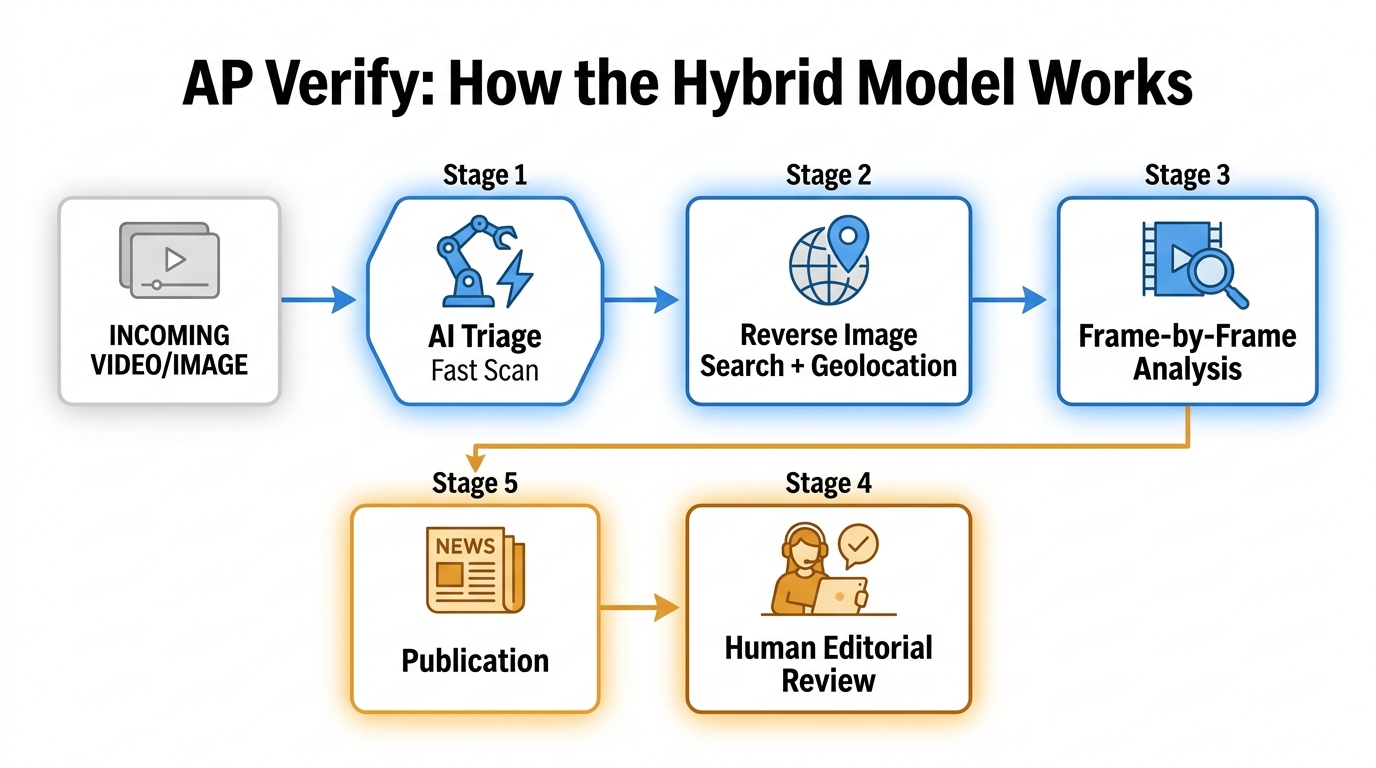
Launched in 2025, AP Verify is a newsroom verification dashboard that combines AI-powered features with established digital verification methods. The tool integrates reverse image search, frame-by-frame video analysis, shadow detection, geolocation, text extraction and translation, object and landmark recognition, transcription, and social media monitoring into a single workflow interface.
Critically, AP Verify also includes generative AI text detection alongside these traditional verification methods — so when a journalist is examining a document, they can run both content authentication checks and AI-generation screening within the same workflow. AP says the system is used daily across its global news operations.
AP has documented several specific verification cases where the tool has been applied: securing original Texas flood footage (tracing the video back to its source creator and verifying geolocation), authenticating a viral meteor sighting video, reviewing a claimed eyewitness video, and identifying a soccer violence clip that had been misattributed to the wrong country and date. These are not abstract capability demonstrations — they are the operational verification challenges that a wire service faces every day at volume.
The Non-Negotiable Human Layer
What distinguishes the AP approach from a naive “automate the verification” model is a hard editorial rule: every AI-generated output is reviewed by AP journalists before publication. The AI assists; it does not decide. AP’s updated AI standards require that AI-generated or manipulated material be clearly identified, placed in context, and disclosed when generative AI plays a material role in published content.
This is not a cautious, defensive posture — it is an operationally grounded recognition that the current generation of AI verification tools are most valuable as workflow accelerators and triage prioritizers, not as autonomous fact-arbiters. AP Verify speeds up the process of gathering evidence for a human to evaluate. It does not replace the human evaluation.
Why This Architecture Scales
The AP Verify model works at scale for a specific structural reason: it assigns tasks to the most capable agent for each task. AI handles high-volume, pattern-matching work — social listening, archive search, frame extraction, geolocation — where processing speed creates genuine value. Humans handle judgment-intensive work — assessing source credibility, weighing conflicting evidence, making publication decisions — where the stakes of error are too high to delegate.
This is also the architecture that Reuters Institute experts described when surveying the field in 2026: utility plus restraint, with tighter editorial controls and stronger demand for verification work that is transparent, auditable, and human-supervised. The newsrooms that are building durable verification capacity are the ones that have resisted the temptation to over-automate — not because they distrust AI, but because they understand precisely what it is and is not good at.
Deepfakes, Synthetic Media, and Why Single-Tool Detection Fails
Synthetic media detection deserves its own chapter in any honest assessment of AI-assisted newsroom verification, because it is simultaneously one of the most urgent problems and one of the areas where automated tools show the most significant performance gaps.
The Performance Gap Between Lab and Field
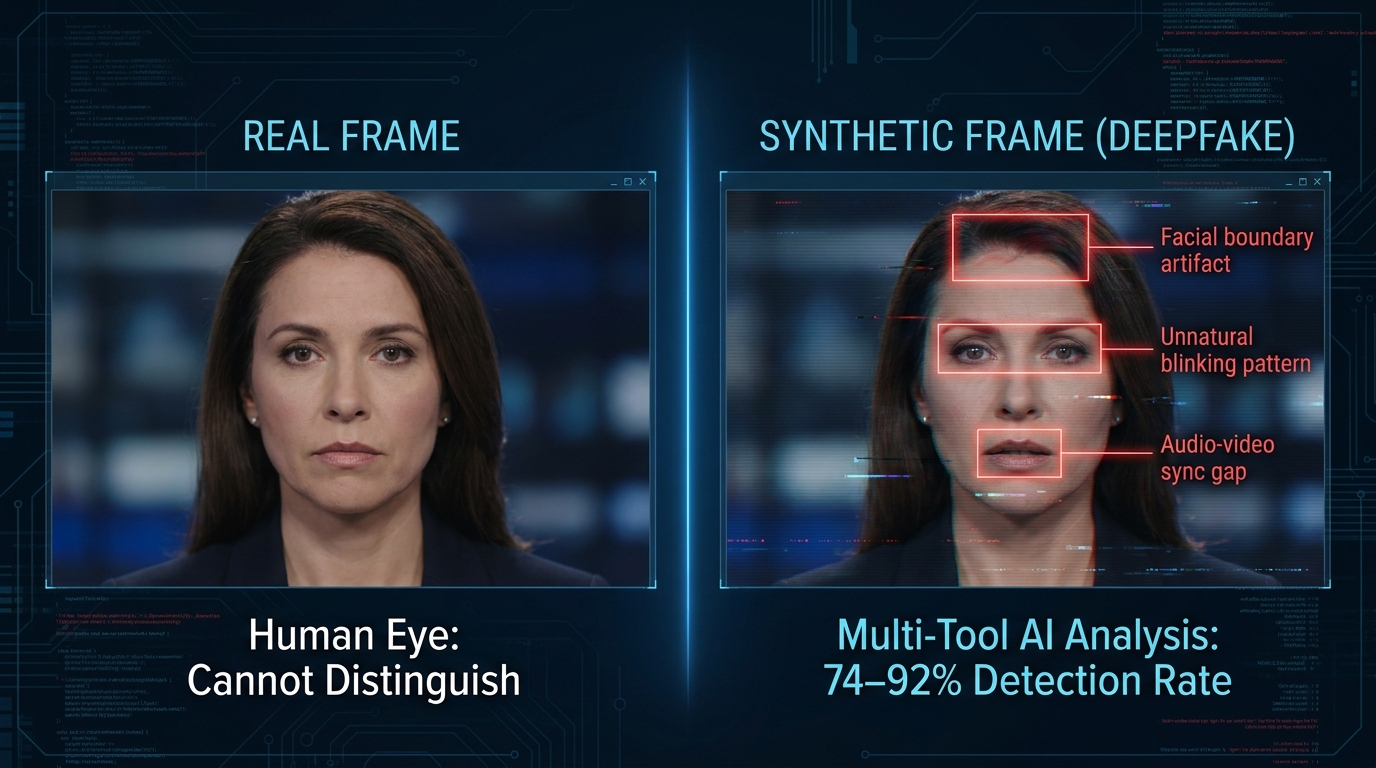
Reported 2026 accuracy figures for newsroom-focused video deepfake detection tools range from approximately 74% to 92%, depending on the tool and the test conditions. That spread — nearly 20 percentage points between the best and worst performers — matters a great deal when a newsroom is deciding how much weight to give a detection result.
More critically, performance drops sharply on the types of content that are most likely to require verification in a live newsroom environment:
- Compressed video: Social media platforms aggressively compress video files during upload. This compression removes or obscures many of the digital artifacts that deepfake detection tools use as forensic signals. A clip that a tool can reliably classify from the original file may become effectively undetectable after platform compression.
- Short clips: Many synthetic media pieces circulate as short extracts — five to fifteen seconds — which provide insufficient temporal data for detection algorithms trained on longer sequences.
- Voice-cloned audio: Audio deepfakes have outpaced video detection capabilities. Current voice cloning tools produce audio that many detection systems cannot reliably distinguish from authentic recordings, particularly after audio compression.
- Adversarially crafted content: As detection tools have become more widely used, some synthetic media creators have begun optimizing their outputs specifically to evade common detection methods — an adversarial dynamic that benchmark tests do not fully capture.
The Multi-Tool Imperative
The consensus guidance from newsroom verification specialists and the most rigorous independent reviews has converged on a clear recommendation: never rely on a single detection tool. Newsrooms should run at least two independent detectors on high-stakes synthetic media claims, because tool-to-tool variation is large enough that a clip that passes one tool may fail another.
This is not a counsel of perfection — it is a practical acknowledgment of how detection accuracy works in real-world conditions. Different tools have different training data, different model architectures, and different blind spots. Running parallel detection workflows increases the probability of catching synthetic content that any single tool would miss.
Newsroom guidance has also shifted toward combining detection tools with traditional verification methods rather than treating detection results as standalone evidence. A video that passes two deepfake detectors but cannot be traced to an original source through social listening, cannot be geolocated, or whose claimed source cannot be independently contacted should still be treated with significant skepticism — and almost certainly should not be published without additional corroboration.
The C2PA Provenance Layer — A Different Kind of Verification
While detection-based approaches to synthetic media operate forensically — looking for evidence of manipulation after the fact — provenance-based approaches work from the opposite direction. The Coalition for Content Provenance and Authenticity (C2PA) and its Content Credentials standard represent the most mature implementation of provenance-first verification currently in newsroom use.

How Provenance-First Verification Works
The C2PA standard works by embedding cryptographically signed metadata into media files at the point of creation — typically within the capture device itself (a camera or recording device that supports the standard). This provenance record travels with the file through the editorial workflow, documenting each step: who captured it, with what device, at what time, and what processing steps were applied before publication.
When a journalist or editor receives a piece of media with Content Credentials attached, they can verify the integrity of that provenance chain — confirming that the file’s metadata has not been tampered with and that the declared history of the content is intact. This does not guarantee that the content is truthful (a camera can capture genuine footage of a staged event), but it provides a strong signal that the content has not been digitally fabricated after capture.
The BBC has been a founding participant in C2PA’s predecessor project, Project Origin, and has implemented Content Credentials on news imagery and video, with a capture-to-publication workflow that has been operational since the standard’s early versions. BBC R&D has published open-source tooling to help other newsrooms implement provenance signing and verification within their own editorial pipelines.
The Adoption Gap and What It Means for Verification
C2PA’s newsroom adoption in 2026 is real but uneven. The coalition’s membership has expanded to more than 6,000 members and affiliates, with TikTok’s upgrade to Steering Committee status announced in July 2026 signaling continued platform-level investment in the standard. The IPTC published a newsroom-facing FAQ on Content Credentials for broadcasters, publishers, and news agencies, reflecting increased operational interest.
But the critical limitation of provenance-based verification is also its fundamental feature: it only works when the content’s creation was provenance-enabled from the beginning. Content captured on devices that do not support C2PA signing, content that passes through platforms that strip metadata, or content shared through channels that do not preserve provenance records cannot be verified through this mechanism.
This creates a two-tier provenance situation. Professional news media captured on C2PA-enabled camera equipment and published through C2PA-aware pipelines can carry verifiable credentials. User-generated content — which is often the most consequential content in a breaking news situation — frequently cannot, because the capture devices, sharing platforms, and distribution channels have not yet universally implemented the standard.
The practical implication for newsroom verification workflows is that C2PA should be treated as a strong positive signal when present, but the absence of Content Credentials does not mean content is suspect — it means provenance is unknown and other verification methods must do the work.
The Trust Paradox: Why Disclosure Helps and Hurts at the Same Time
The most counterintuitive finding in the 2025–2026 research on AI in journalism concerns audience trust and disclosure. The evidence creates a genuine dilemma for newsrooms: the thing they are supposed to do to build trust (disclose AI use) is also, under certain conditions, the thing that reduces it.
The Numbers Behind the Paradox
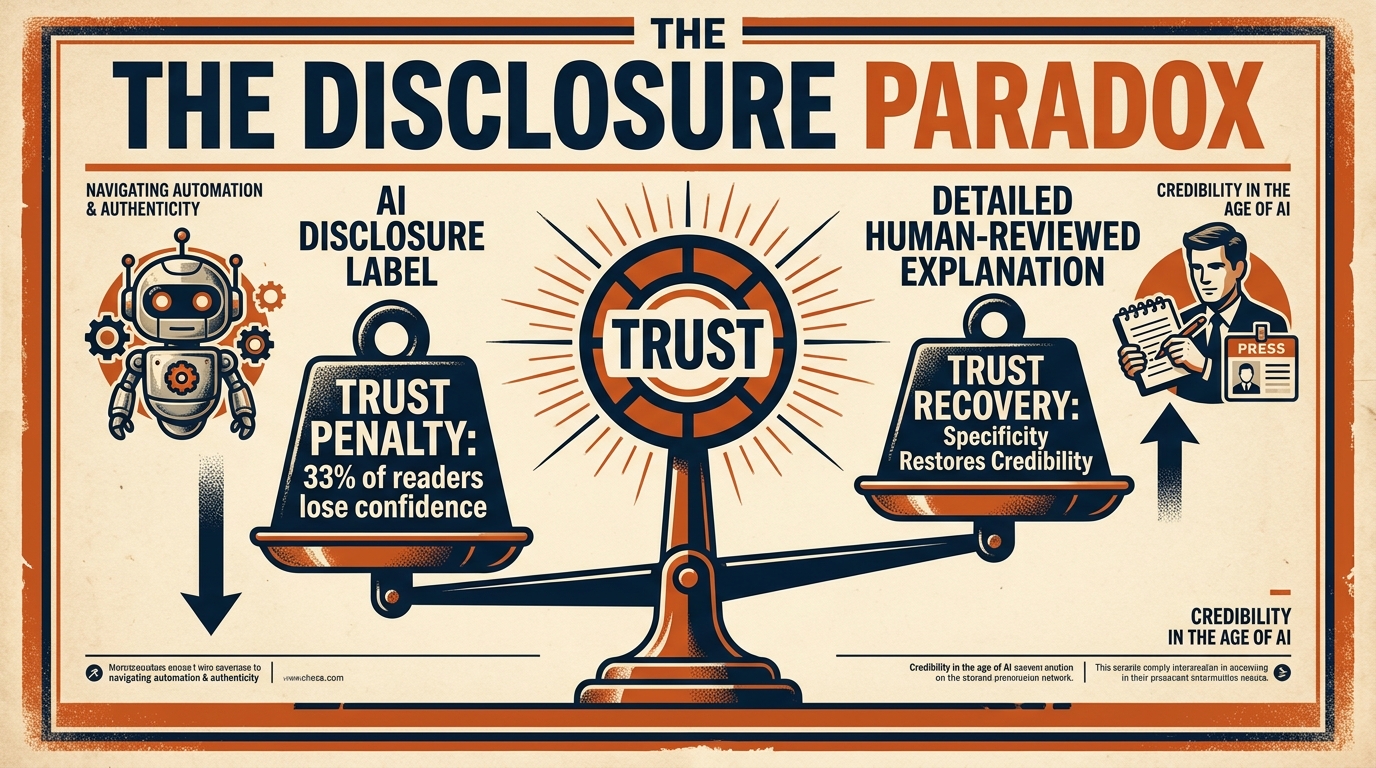
Recent survey data establishes both sides of the paradox clearly. Demand for disclosure is near-universal: 97.8% of surveyed news consumers say they want to know if a newsroom used AI, and 98.8% say a human should be involved before publication. The expectation that AI use will be declared is essentially total.
But Trusting News found that when news organizations disclosed AI use, more than a third of respondents said they lost trust in the story. A different study found that 94% wanted journalists to disclose AI use — while simultaneously showing that trust declined after disclosure in a significant proportion of cases. The demand for transparency and the trust response to transparency point in opposite directions.
The key variable, which the research is beginning to isolate, is what is disclosed and how. Generic disclosure labels — a brief note that “AI was used in the production of this content” — consistently perform poorly on trust metrics. Readers interpret them as admission of low-effort journalism or as a signal that the content cannot be fully trusted.
What Disclosure Actually Needs to Communicate
The research from Trusting News and related organizations suggests that disclosure works as a trust-builder when it answers four specific questions:
- What did AI do specifically? Transcription, archive search, geolocation assistance, and drafting support each carry different implications for content reliability. Generic “AI-assisted” labels obscure distinctions that readers actually care about.
- Why was AI used? Readers are more comfortable with AI assistance when they understand the operational rationale — processing speed, scale, accessibility — rather than assuming cost-cutting or journalistic laziness.
- How was AI output reviewed? The most trust-positive disclosures specify the human verification step: which journalist reviewed the AI output, by what standard, and with what authority to override.
- How are errors handled? A disclosed correction mechanism — a specific email address, an explicit commitment to review and update — signals accountability more effectively than any claim of accuracy.
Audiences are more comfortable with AI assistance for transcription, background research, and accessibility features than they are with AI writing stories, generating images, or making editorial judgments. This mirrors the verification architecture that AP and other major newsrooms have adopted — using AI in supporting roles where human verification remains the final step before any output reaches readers.
The disclosure paradox also has an important organizational implication: newsrooms that use AI extensively in back-end verification workflows but communicate that use poorly are paying a trust cost without capturing a transparency benefit. The label “this story was verified using AI-assisted tools” without further context tells readers very little about what actually happened, while creating the impression that the newsroom is hiding something.
Building the Right Human-in-the-Loop Architecture
The phrase “human in the loop” has become something of a journalistic cliché — invoked to signal editorial responsibility without always describing a specific, functional architecture. In practice, the quality of human oversight varies enormously, and not all human-in-the-loop systems provide equivalent protection against the failure modes that automated verification creates.
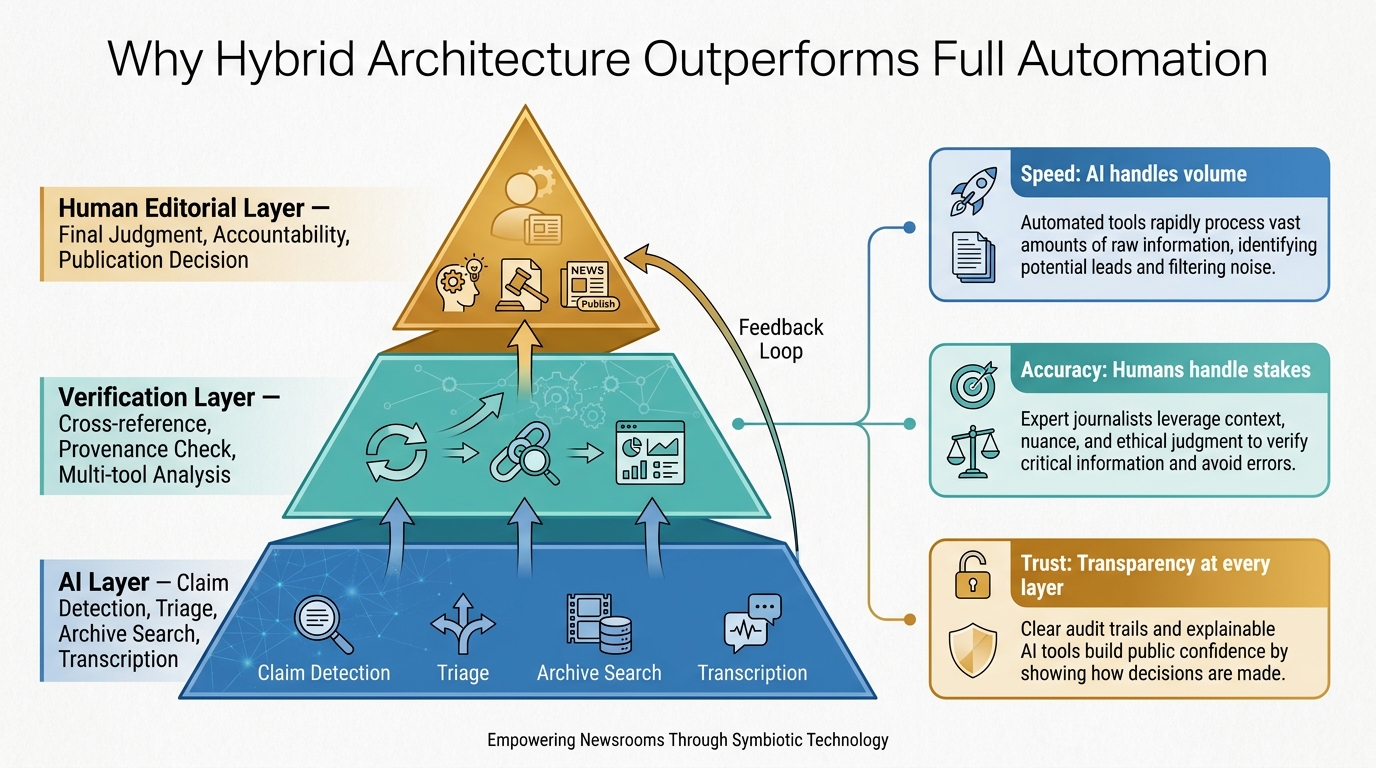
Three Levels of Human Oversight — and Why Only One Actually Works
In practice, newsrooms deploy human oversight at three different levels of depth, and the differences matter significantly for both accuracy and accountability.
Level 1: Nominal oversight — A human technically approves AI-generated verification outputs, but in practice approves them at high speed without independent review. The AI flag or score is treated as the verification; the human step is procedural rather than substantive. This architecture creates compliance theater — it satisfies a policy requirement without providing meaningful protection against AI errors.
Level 2: Selective override — A human reviews AI outputs and exercises judgment about which flags to investigate further, overriding the automation when something looks wrong. This is better than nominal oversight, but its quality depends on the human reviewer’s ability to recognize when the AI tool is wrong — which requires exactly the kind of domain expertise and verification knowledge that AI tools were brought in to supplement.
Level 3: Substantive parallel review — The human reviewer conducts an independent verification process and uses the AI output as one input among several, rather than as the primary determination. This is the architecture that major wire services and broadcasters describe when they specify their AI standards: the AI assists research, and a journalist independently evaluates and verifies.
Level 3 is also the most resource-intensive. It does not eliminate the human verification burden — it uses AI to make that work faster and more comprehensive, but it does not replace it. For newsrooms under resource pressure, the temptation to slide from Level 3 to Level 1 over time is real and requires active management at the editorial leadership level.
Escalation Rules and Bright Lines
Robust human-in-the-loop architectures also require explicit escalation rules: categories of content and verification outcomes that automatically trigger senior human review regardless of the AI tool’s confidence score. These bright lines should be defined in advance rather than left to individual editorial discretion.
Common escalation triggers include: content involving individual identification (naming a specific person in connection with an allegation), content related to elections or public health, content where synthetic media detection returns a high-confidence result, and content where source verification cannot be completed through standard channels. The specific triggers will vary by newsroom, but the architectural principle — that some categories of content require elevated human review regardless of AI confidence — is consistent across the newsrooms building the most reliable verification systems.
Escalation rules serve a secondary function beyond accuracy: they create a documented audit trail. When a verification decision is later questioned, a newsroom with defined escalation procedures can show precisely who reviewed a piece of content, at what level, and on what basis. That audit trail is increasingly important as regulatory attention on AI-assisted journalism grows in several major markets.
What Audiences Actually Want (And Where Newsrooms Are Missing It)
The gap between what audience research says readers want from AI-assisted newsrooms and what newsrooms are currently delivering is wider than most editorial teams realize. The survey data is consistent across multiple studies: audiences have developed specific, coherent preferences about AI in journalism, and those preferences are not adequately reflected in most current implementation approaches.
The Support Role vs. The Author Role
Audience research consistently shows that readers distinguish sharply between AI as a support tool and AI as a primary creator. AI assistance with transcription, background research, data analysis, and accessibility features is broadly acceptable — readers understand these as efficiency tools that do not change the human editorial substance of a story. AI writing stories, generating images for editorial content, making sourcing decisions, or authoring headlines is viewed with significant skepticism and reduces willingness to trust the content.
The practical implication is that newsrooms using AI most heavily in editorial-facing roles — writing, image generation, headline creation — are absorbing the largest trust penalties while delivering outcomes that audiences are most uncomfortable with. Meanwhile, newsrooms using AI most heavily in back-end verification workflows are delivering the efficiency gains that justify the technology while keeping the editorial face of journalism firmly human.
The Policy Visibility Gap
A second consistent finding is that readers want to see newsroom AI policies — not just in-story disclosure labels, but organization-level public commitments about what AI will and will not do, who is accountable for AI-assisted outputs, and how errors will be corrected. The current standard — a brief note at the bottom of selected stories — significantly underdelivers against this expectation.
Newsrooms that have published detailed, publicly accessible AI ethics and usage policies see better trust outcomes from AI disclosure than those that rely solely on story-level labels. The policy communicates institutional commitment; the label communicates a single instance. Readers are evaluating both, and a strong policy can provide a trust foundation that makes individual story-level disclosures land more positively.
This is an area where many newsrooms are leaving significant trust value on the table. Creating and publishing a clear, specific AI policy — covering what AI tools are used, for what purposes, with what human oversight requirements, and with what accountability for errors — is a relatively low-cost editorial investment that the research suggests pays meaningful dividends in audience trust.
The Ethical Framework Newsrooms Cannot Afford to Skip
The operational architecture of AI-assisted verification — which tools to use, how to layer human oversight, when to escalate — is only half of the picture. The other half is the ethical framework that governs these decisions: the documented principles, accountability structures, and red lines that give the operational architecture its legitimacy.
From Policy to Practice: The Implementation Gap
The Reuters Institute’s 2026 reporting identifies a growing gap between newsrooms that have adopted AI tools and those that have built coherent ethical frameworks around those tools. Many organizations have moved quickly on tool adoption — deploying AI verification assistants, content detectors, and automated transcription — without fully working through the harder questions: Who is accountable when an AI-assisted verification fails? How do error corrections work when AI was involved in the original verification chain? What are the disclosure requirements for AI use in investigative versus breaking news contexts?
These are not abstract questions. They have practical consequences for how verification failures are handled, how corrections are communicated, and how editorial accountability is assigned when AI output contributes to a published error.
Key Elements of a Defensible AI Ethics Framework for Newsrooms
Based on the practices of newsrooms that have built the most operationally robust and publicly credible AI frameworks, several elements appear consistently:
- Explicit task mapping: A documented list of which AI tools are authorized for which verification tasks, with clear specifications about what constitutes an authorized use versus one that requires additional approval.
- Named accountability: Specific editorial roles responsible for AI tool selection, oversight, and error correction — not “the newsroom” as an abstraction, but named positions with defined responsibilities.
- Mandatory training requirements: All journalists who use AI verification tools should have training on the tools’ known failure modes, not just their capabilities. Understanding when a tool is likely to be wrong is as important as understanding when it is likely to be right.
- Regular accuracy audits: Periodic internal review of AI tool performance against the newsroom’s actual content mix, rather than relying on vendor benchmark data. This requires logging AI tool outputs and comparing them against final editorial decisions over time.
- Public-facing policy updates: AI capabilities and risks change rapidly. A published AI ethics policy that was written in 2024 and has not been updated since does not reflect the current tool environment, and readers who find a stale policy may reasonably question whether the newsroom’s practices have kept pace.
The Regulatory Horizon
Newsrooms also need to be planning against a regulatory horizon that is tightening. Several major markets are developing or implementing specific requirements around AI-generated content in journalism, particularly in the context of elections and public health. The EU’s AI Act has implications for how AI tools used in high-impact contexts must be documented and audited. The UK’s ongoing media regulation review is examining AI disclosure requirements for broadcast journalism.
Newsrooms that have built robust internal ethical frameworks will be substantially better positioned to demonstrate compliance with emerging regulatory requirements than those that have relied on informal practices. Building the framework now — while the regulatory requirements are still forming — is considerably less costly than retrofitting it after the fact.
When the Architecture Works: What Good Looks Like in Practice
Taken together, the evidence from newsroom practice, audience research, and independent performance testing points toward a coherent picture of what effective AI-assisted verification actually looks like — and why it is genuinely different from both “automate everything” and “maintain human-only verification.”
The Characteristics of Effective Hybrid Verification
Newsrooms that are building genuinely effective AI-assisted verification operations share several characteristics that go beyond tool selection:
They have task-specific AI deployment. Rather than applying AI tools broadly across all verification work, they have mapped specific tools to specific tasks based on documented performance data. Reverse image search and geolocation tools are used for content authentication. Archive search and transcription tools are used to accelerate background research. Detection tools are run in parallel for synthetic media screening. Each tool operates within its demonstrated competence area.
They have structured escalation that is actually followed. The escalation rules are not suggestions — they are editorial policy with accountability attached. Content that meets escalation criteria is reviewed at senior level, and this is documented regardless of deadline pressure. The workflows are built to make escalation easier than bypassing it, not harder.
They have disclosure practices calibrated to context. Not a generic label applied to all AI-assisted content, but specific disclosure language matched to what AI actually did in each story. Transcription assistance gets different language than AI-assisted claim verification, which gets different language than AI-generated visualization.
They have public-facing AI policies that are maintained. Updated regularly, specific about tools and practices, and with named accountability. Published in a location that readers can find without journalist assistance.
They have ongoing performance monitoring. Tool outputs are logged, compared against editorial decisions, and reviewed for accuracy drift. Vendor benchmark data is treated as a starting point for internal evaluation, not as a substitute for it.
What This Architecture Is Not
It is worth being precise about what this architecture does not promise. It does not eliminate verification errors — human reviewers working with AI assistance will still make mistakes, and some misinformation will still reach publication. What it does is create an auditable, accountable, continuously improving system where errors are more likely to be caught, more likely to be corrected quickly, and more likely to be learned from systematically.
It also does not make verification faster in all cases. The AI triage layer creates significant speed advantages on high-volume, pattern-based tasks. But for complex claims, unfamiliar sources, or high-stakes investigative material, the hybrid architecture may be as slow as — or slower than — purely human verification, because it adds AI-output review to the human verification process rather than replacing it. Speed is not the right optimization target for verification work that carries significant accuracy and credibility stakes.
The Trust Equation Has Changed — Here’s How to Balance It
The central challenge facing AI-assisted newsrooms in 2026 is not a technology problem. The tools for automating parts of the verification workflow exist, they work under the right conditions, and the best implementations have demonstrated real operational value. The challenge is an institutional one: how to deploy those tools in ways that serve journalism’s core function — producing accurate, credible information that readers can rely on — without creating new categories of risk that undermine that function.
The Tension That Won’t Go Away
The tension between verification speed and verification accuracy is not going to be resolved by better AI tools alone. It is structural. Breaking news situations create pressure to publish faster than a complete verification workflow can operate. Synthetic media is evolving faster than detection tools can adapt. The volume of verifiable claims is expanding faster than any newsroom’s human capacity to review them.
This tension cannot be dissolved — it can only be managed. The newsrooms managing it best are those that have been honest about what automation can deliver and what it cannot, and have built their workflows around that honest assessment rather than around vendor capability claims or the appeal of apparent operational efficiency.
Actionable Takeaways for Editorial Teams
For newsrooms navigating this architecture, several practical priorities emerge from the evidence:
- Audit your verification stack by task type, not by tool. Map each AI tool in your verification workflow against the specific task it performs, and evaluate its performance on your actual content mix — not on vendor benchmark data.
- Build escalation rules before you need them. Define the categories of content that require senior human review regardless of AI confidence scores, and make those rules part of editorial policy rather than individual judgment.
- Replace generic disclosure labels with contextual disclosure language. Tell readers what AI did, what humans reviewed, and what the accountability chain looks like. Generic labels pay a trust cost without delivering a trust benefit.
- Publish and maintain a newsroom AI ethics policy. Make it specific, named, and publicly accessible. Update it when your tools or practices change. Treat it as a living policy document, not a one-time publication.
- Run deepfake detection in parallel, not in series. High-stakes synthetic media screening should use at least two independent tools, combined with provenance checks and traditional source verification — never a single tool’s output as the sole determination.
- Monitor C2PA adoption in your content ecosystem. As Content Credentials become more widely implemented, update your verification workflows to treat verified provenance as a strong positive signal — and to be explicit with readers when provenance is unknown rather than absent.
- Invest in training on failure modes, not just capabilities. Every journalist using AI verification tools should be trained on the specific conditions under which those tools perform poorly — non-native English, compressed video, short-form content, adversarially crafted synthetic media — not just on what the tools can do at their best.
The trust equation in journalism has always been about more than accuracy. It is about demonstrated accountability — showing readers, over time and across many stories, that the newsroom takes the truth obligation seriously enough to build real infrastructure around it. AI-assisted verification, deployed with the right architecture and the right transparency, can strengthen that demonstration. Deployed carelessly, it can undermine it faster than almost any other editorial misstep.
The newsrooms that will come through this period with their credibility intact are not the ones that automated fastest. They are the ones that understood, with clarity, exactly what they were asking automation to do — and what they were not.