Tag: AI Oversight

  • Supervision Is Expensive: How to Design Human-in-the-Loop That Scales Without Breaking Your Budget

    Supervision Is Expensive: How to Design Human-in-the-Loop That Scales Without Breaking Your Budget

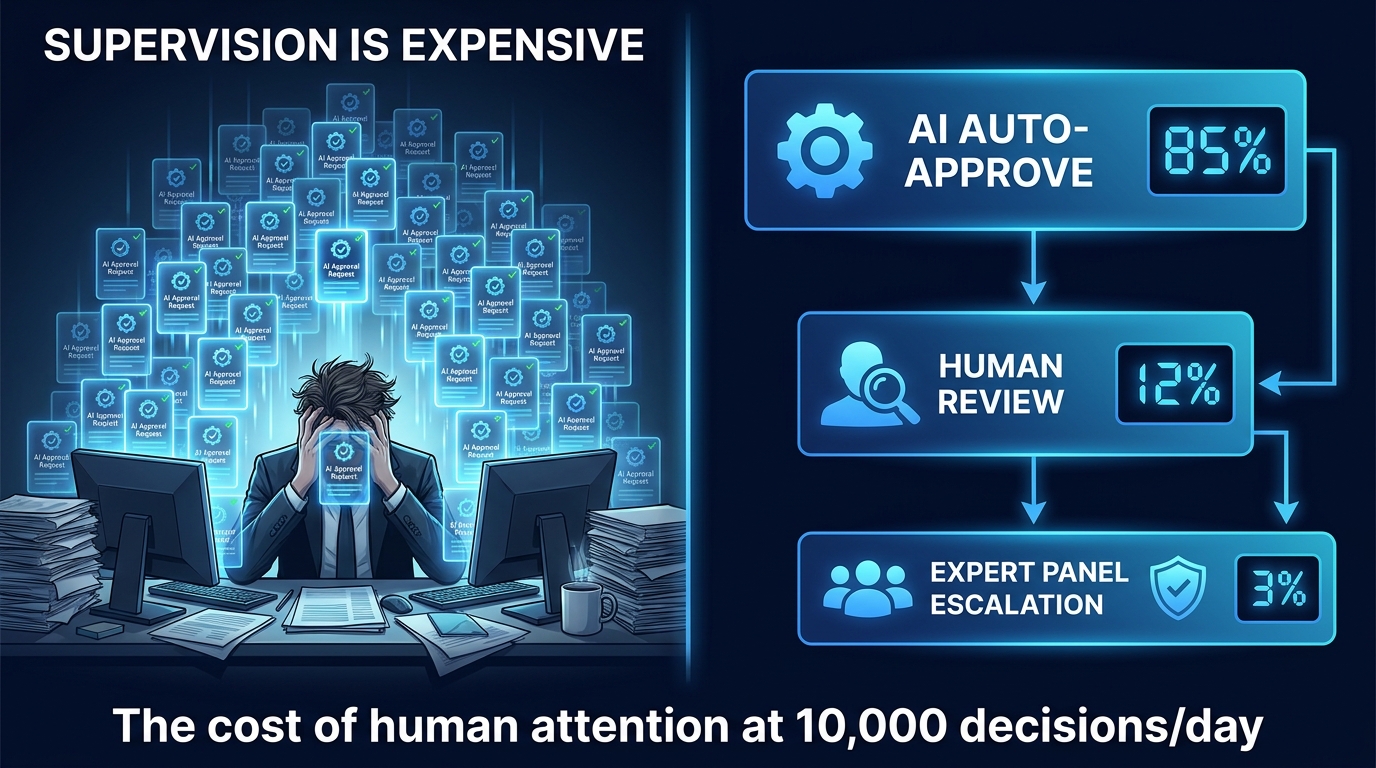
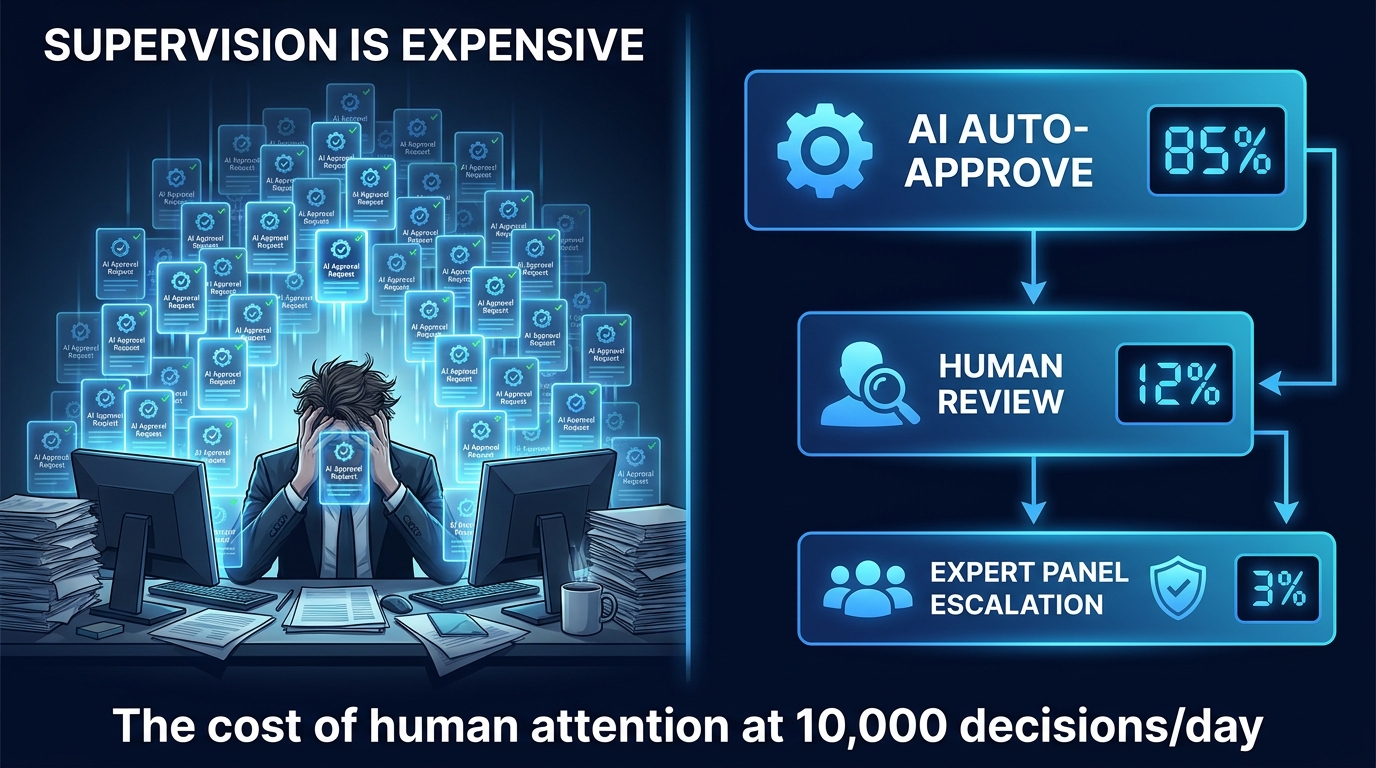
    Split-screen infographic: human reviewer overwhelmed by AI approval requests on the left vs. a clean three-tier oversight architecture on the right — illustrating the core challenge of scaling human-in-the-loop supervision

    There is a number buried inside almost every enterprise AI budget that nobody wants to talk about. It is not the GPU bill. It is not the licensing fee for the model. It is the cost of the people who watch the model work — the reviewers, approvers, auditors, and escalation handlers whose labor turns an AI system into a production-grade, accountable operation. In 2026, that number has a name: human-in-the-loop overhead, and in many organizations it has quietly grown to represent 15–25% of total AI program spend.

    At low volumes, this overhead is manageable — a few reviewers, a shared Slack channel, a spreadsheet of edge cases. But as AI systems scale from hundreds to thousands to tens of thousands of decisions per day, the math changes completely. A single knowledge-worker review costs $0.58–$0.83 per decision at fully loaded labor rates. A comparable LLM inference call costs roughly $0.003. At 5,000 decisions a day, that differential is not academic: it is a $1.4 million annual gap between a fully supervised workflow and a fully autonomous one.

    The uncomfortable reality is that most enterprises are running neither. They have built HITL systems that are too expensive to sustain at volume and too poorly designed to actually catch the errors they were supposed to prevent. This article is about how to fix that — not by removing humans from the loop, but by engineering their participation so that every hour of human attention is doing real work, not theater.

    The Unit Economics of Human Attention — A Number That Should Be on Every AI Dashboard
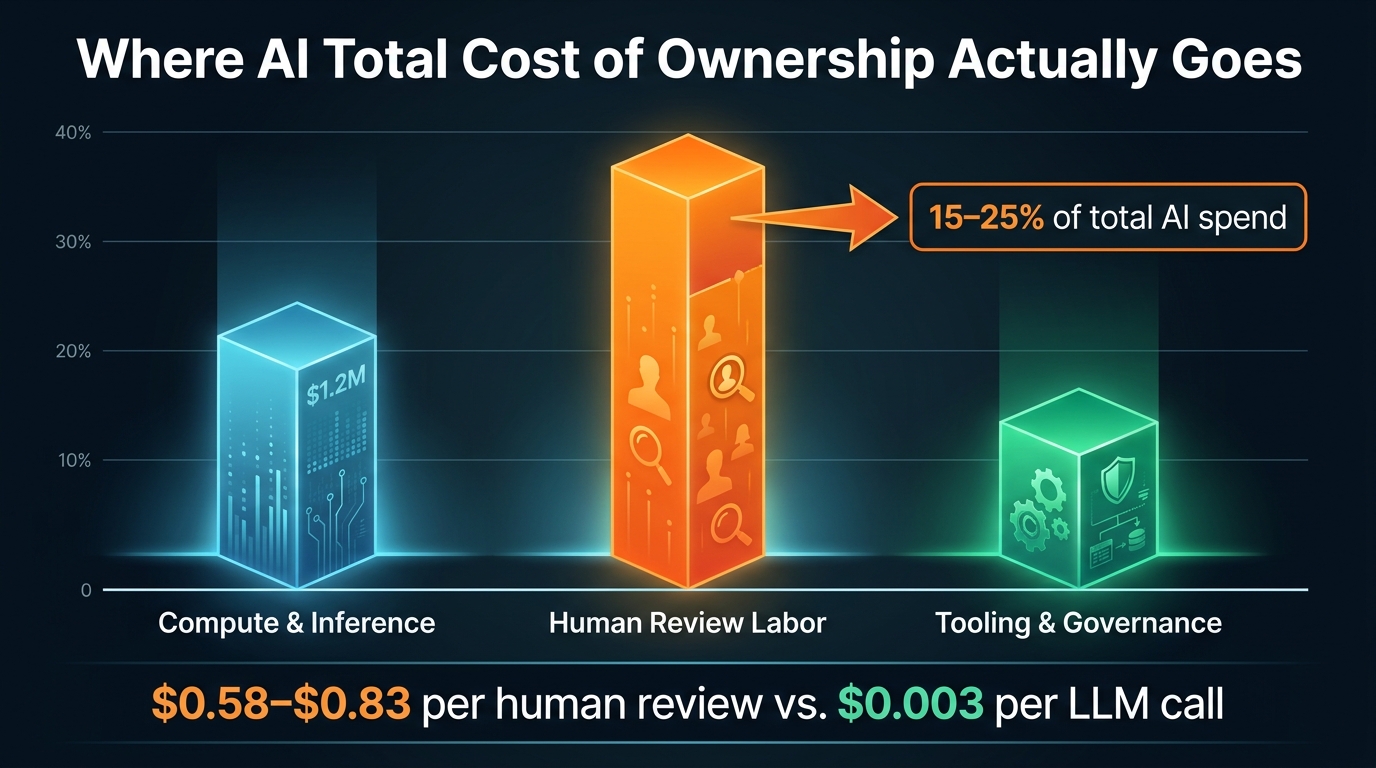
    Bar chart infographic showing where AI total cost of ownership actually goes — human review labor as the tallest bar at 15–25% of spend, with the $0.58–$0.83 per human review vs. $0.003 per LLM call comparison highlighted

    The conversation about AI costs almost always starts in the wrong place. Procurement teams negotiate model contracts. Engineers benchmark inference latency. CTOs study cloud spend dashboards. But the largest variable cost in a mature AI deployment is often none of these things — it is the fully loaded hourly cost of the humans who review, correct, approve, and escalate its outputs.

    Breaking Down the True Cost of a Single Review

    When you calculate the true cost of a human review event, you need to account for more than the reviewer’s salary. The full picture includes:

    • Direct labor: The reviewer’s time at fully loaded rates (salary plus benefits plus overhead) — typically $35–$50/hour for knowledge workers in 2026
    • Context-switching cost: Shifting attention from one task to a review queue and back degrades both activities. Research on task interruption consistently shows 15–25 minutes of productivity loss per context switch
    • Queue management overhead: Someone has to route work, handle backlogs, and manage SLA compliance — that is typically 10–15% additional headcount on top of raw reviewer capacity
    • Tooling and infrastructure: Review interfaces, audit log systems, escalation workflows, and integrations with the AI system itself
    • Rework from missed errors: When reviewers do miss something — and they will — the downstream cost of correcting that error is often 3–10x the original review cost

    Putting these together, the $0.58–$0.83 per-decision estimate cited in enterprise governance analyses is likely conservative for anything requiring genuine domain expertise. In regulated industries like healthcare, finance, or legal — where the reviewer needs professional credentials and carries personal liability — the cost per reviewed decision can easily reach $3–8.

    The Volume Inflection Point

    At 100 decisions per day, a two-person review team is manageable. At 1,000 decisions per day, you need to hire a team. At 10,000 decisions per day, you are looking at a 20–30 person operation whose annual budget rivals the entire model deployment cost. This is the volume inflection point — the moment when HITL stops being a governance safeguard and starts being a business model problem.

    The critical design question is not “do we need humans in the loop?” The answer is almost always yes, at least partially. The real question is: at exactly which decisions does human attention change the outcome, and how do we ensure humans are only spending time on those ones? Everything else is an engineering problem masquerading as a governance question.

    Computing the Opportunity Cost of Latency

    Human review does not just cost money — it costs time, and time has economic value in automated workflows. A synchronous review gate that adds 4 hours of latency to a decision chain is not just a user experience problem. In workflows where AI decisions trigger downstream processes — fulfillment, pricing, clinical triage, fraud alerts — that latency translates directly into delayed outcomes, missed SLAs, and in some cases, material business loss. Any honest accounting of HITL cost must include this latency overhead as a direct line item.

    Why “Review Everything” Is Already Broken at Scale

    The “review everything” model was the safe default when AI systems were new, confidence was low, and volumes were small enough that a small team could keep up. In 2026, it is neither safe nor sustainable — and for a counterintuitive reason: universal review does not actually produce better oversight. It produces the illusion of oversight while introducing its own failure modes.

    Reviewer Capacity Has a Hard Ceiling

    Human reviewers process decisions at a finite rate. A knowledge worker reviewing AI-generated content at a comfortable pace can typically evaluate 50–70 items per hour before quality begins to degrade. Push beyond that, and something measurable happens: review time per item compresses, approval rates climb, and error detection rates fall. This is not a character flaw in the reviewer — it is basic cognitive science. Working memory, sustained attention, and critical evaluation all have per-hour limits that cannot be overridden by urgency or good intentions.

    The practical consequence: if your AI system generates 500 decisions per hour and your reviewer can genuinely evaluate 60 per hour, you have one of three outcomes. Either you hire 8+ reviewers (expensive), allow a queue backlog to build (latency), or the reviewer starts rubber-stamping to keep up (failure mode). Most organizations, under time and budget pressure, drift toward the third option without ever formally deciding to do so.

    Queue Volume Predicts Review Quality Better Than Reviewer Skill

    This is one of the most important and underappreciated findings from recent enterprise AI governance research. Reviewer quality in high-volume queues is not primarily a function of training, expertise, or motivation. It is a function of queue depth at time of review. When reviewers can see that they are 200+ items behind, cognitive shortcuts kick in automatically. The brain shifts from analytical processing to pattern-matching based on the most recent approved items — a dynamic that creates systematic blind spots to anything that falls outside recent patterns.

    This means that a well-designed, lightly loaded review workflow staffed by moderately experienced reviewers will consistently outperform an overloaded review workflow staffed by domain experts. The implication for HITL architecture is stark: if you cannot guarantee queue depth stays below your reviewers’ cognitive overload threshold, you do not have a review process — you have an approval process, and those are very different things.

    The False Security of High Approval Rates

    Many organizations measure HITL health using approval rate as a proxy for review quality. If reviewers are approving 98% of items, the thinking goes, the AI must be doing well. This is exactly backwards. High approval rates in high-volume queues are one of the clearest signals of approval fatigue, not AI accuracy. When the approval rate for a review queue approaches 95–99%, the next question should not be “great, our AI is performing well” — it should be “is our review process still adding value, or have we built an expensive rubber-stamp?”

    Genuine review processes in well-designed HITL systems typically show approval rates between 75–90%. If yours is higher than that consistently, either the escalation threshold is set too low (sending easy cases to human review unnecessarily) or the reviewers have cognitively checked out. Both are design problems, not operational ones.

    The Automation Bias Trap: When Oversight Becomes Performance
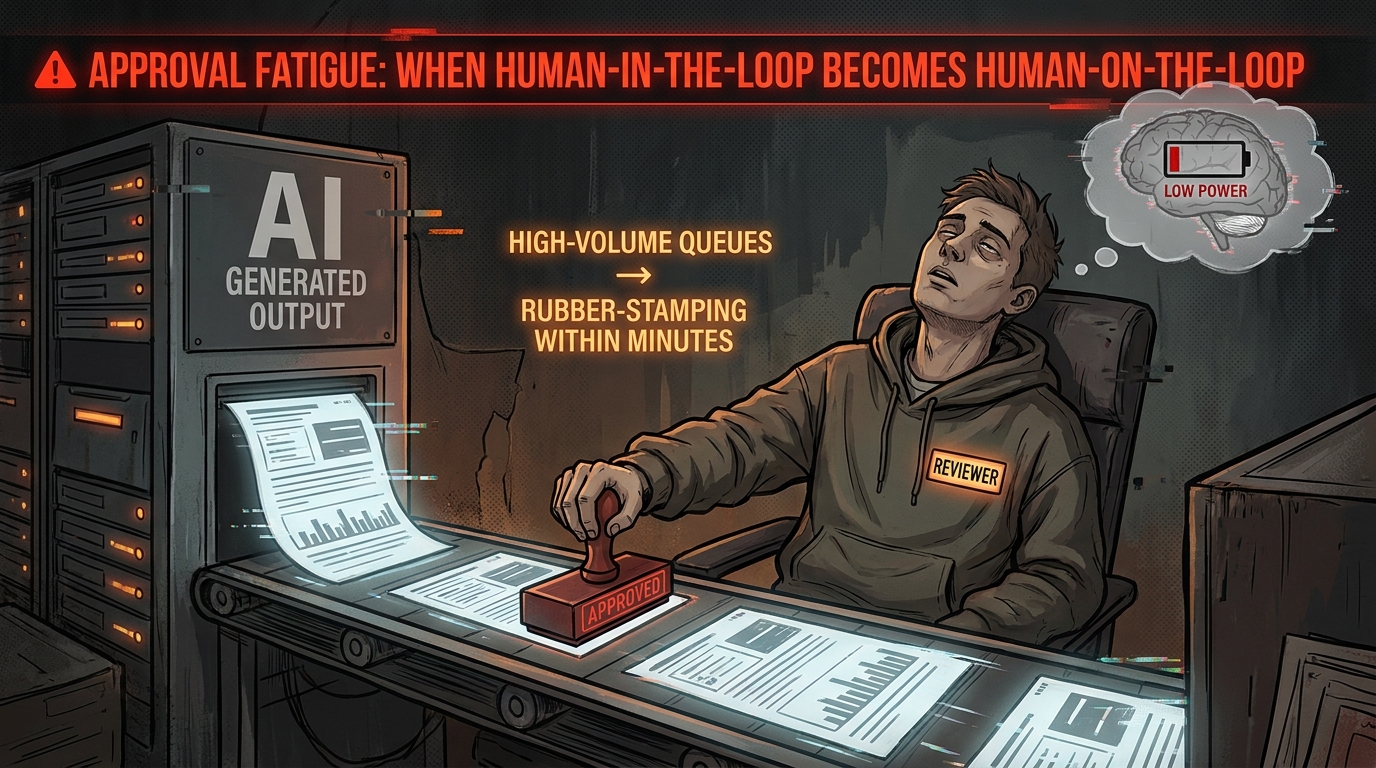
    Illustration of automation bias: a fatigued human reviewer rubber-stamping AI outputs on a conveyor belt without reading them, with the warning 'When Human-in-the-Loop Becomes Human-on-the-Loop'

    Automation bias is the tendency of humans to over-trust automated systems, defer to their outputs even when those outputs are wrong, and reduce independent verification over time. It has been documented in aviation, radiology, financial trading, and now systematically in AI oversight workflows. Understanding it is not optional for anyone designing human-in-the-loop systems at scale — it is the single most important failure mode to engineer against.

    How Automation Bias Develops in Review Workflows

    The mechanism is well-understood. When a reviewer first starts working with an AI system, they are appropriately skeptical. They check outputs carefully, catch errors, occasionally override, and develop a mental model of where the system is strong and where it fails. Over time, however, if the AI’s accuracy is reasonably high — say 87–93% — the reviewer experiences hundreds of validations for every override. The brain’s reinforcement learning system does what it is designed to do: it updates toward trusting the frequent pattern.

    Within weeks, reviewers who were carefully verifying AI outputs are spending a fraction of their original review time per item. Within months, many have effectively delegated their judgment to the system and are primarily performing confirmation — checking that the AI produced something plausible rather than something correct. This transition happens gradually and often without the reviewer being consciously aware of it.

    The “Human-on-the-Loop” Failure Mode

    Enterprise AI governance analysts now distinguish between two functionally different states that can both be labeled “human-in-the-loop”:

    • Human-in-the-loop (genuine): The human is making an independent judgment that could plausibly differ from the AI’s output. They are applying domain expertise, contextual knowledge, and critical evaluation that adds information to the decision.
    • Human-on-the-loop (theater): The human is present in the workflow and technically approves outputs, but their approval is not adding information — it is ratifying whatever the AI produced with a human’s signature, creating a liability shield while providing no actual error-catching value.

    The dangerous thing about human-on-the-loop is that it combines the worst properties of both oversight approaches. It preserves the latency cost of human review (since a human is still in the decision chain), while providing essentially none of the quality benefit. Worse, it creates a false audit trail: documentation records that a human reviewed and approved each output, which may satisfy a compliance checkbox while the actual error rate is no different from full automation.

    Detecting Automation Bias in Your Current Workflow

    There are several operational signals that automation bias has taken hold in a HITL workflow:

    • Approval rate consistently above 95% in queues with more than 50 items/hour throughput
    • Review time per item trending down over weeks without a corresponding improvement in AI accuracy or reviewer experience
    • Override rate clustering near zero for a specific reviewer while remaining healthy for others
    • Calibration drift: periodic re-injection of known errors fails to be caught at the expected rate
    • Reviewer unable to articulate decision reasoning when spot-audited: they approved the item but cannot say why

    The practical fix is not to admonish reviewers for becoming efficient — it is to redesign the workflow so that genuinely difficult cases are the only cases reaching human reviewers, keeping their cognitive load within a range where real evaluation is possible.

    Risk-Stratified Architecture: The Framework That Makes Scaling Viable
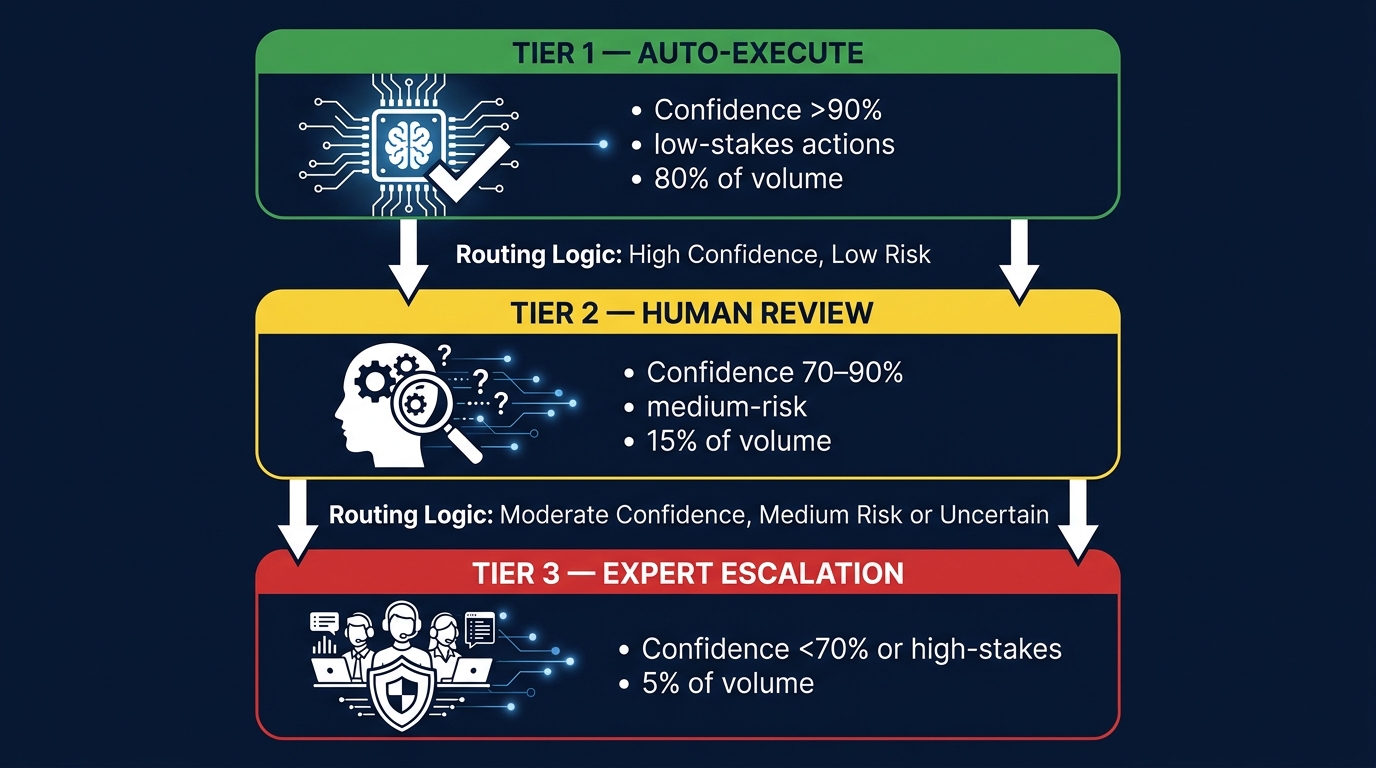
    Three-tier risk stratification architecture diagram: Tier 1 auto-execute at 80% volume in green, Tier 2 human review at 15% in yellow, Tier 3 expert escalation at 5% in red — the foundational model for scalable AI oversight

    The solution to expensive, degrading universal review is not less oversight — it is tiered oversight calibrated to actual risk. Risk stratification is the core architectural pattern that allows organizations to scale AI decision volume by an order of magnitude without proportionally scaling reviewer headcount, while maintaining or improving genuine quality control.

    The Three-Tier Model

    The most robust HITL architectures in 2026 organize oversight into three tiers, each with different routing criteria, reviewer profiles, SLAs, and tooling:

    Tier 1 — Autonomous Execution: High-confidence, low-stakes decisions that execute without human review. These cases meet a high confidence threshold (typically above 85–90%), fall within well-defined action scope limits, and have low error cost — meaning if the AI is wrong, the downstream impact is easily correctable. In a well-calibrated system, this tier should handle 75–85% of total decision volume.

    Tier 2 — Standard Human Review: Medium-confidence or medium-risk decisions that require a trained reviewer to evaluate before execution. Cases land here either because model confidence falls in a middle band (typically 65–90%), because contextual risk flags are present, or because the decision type carries inherent risk regardless of model confidence. Target volume for this tier is 10–20%, with reviewers working at a sustainable pace that allows genuine evaluation — typically no more than 30–40 items per hour in complex domains.

    Tier 3 — Expert Escalation: Low-confidence, high-stakes, or novel cases that require domain expert judgment or formal approval authority. These cases cannot be resolved by Tier 2 reviewers alone because they require specialized expertise, carry significant consequence, or represent a genuinely new pattern the model has not encountered. This tier should represent 3–8% of volume. It should never be allowed to grow significantly above that — if it does, it signals either a model performance problem or miscalibrated routing logic.

    What Makes Routing Logic Actually Work

    The routing logic that assigns decisions to tiers is the most technically demanding component of risk-stratified HITL. Naive implementations route solely on model confidence score, which is a reasonable starting point but insufficient on its own. Confidence scores are poorly calibrated for many production models — they tell you how certain the model is, not how much the model’s certainty correlates with actual accuracy.

    More robust routing combines multiple signals:

    • Model confidence score — necessary but not sufficient
    • Domain risk classification — some decision types carry inherent stakes that require human review regardless of confidence
    • Entity-level risk profile — decisions about high-value customers, large transactions, or flagged accounts escalate by default
    • Novelty detection — inputs that fall significantly outside the distribution of training data trigger escalation even if model confidence is superficially high
    • Historical accuracy by context — if the model has a documented performance weakness in specific input categories, those categories route to Tier 2 automatically

    Organizations that invest in multi-signal routing typically achieve escalation rates 30–50% lower than those using confidence-only routing, while maintaining equivalent or better defect detection rates. The engineering cost is real but pays back quickly at production volumes.

    Confidence Thresholds and the Double-Gate Pattern

    One of the most consequential decisions in HITL system design is choosing where to place confidence thresholds — the numerical cutoffs that determine whether a decision goes to Tier 1, Tier 2, or Tier 3. Get this wrong in either direction and the economics collapse: too conservative and you overload reviewers with easy cases; too aggressive and you automate decisions that should have had oversight.

    Why Single-Threshold Systems Fail

    The obvious approach — set one confidence threshold and auto-approve everything above it — has a structural flaw. It conflates two very different categories of output: cases where the model is genuinely high-confidence because the input is clear and within training distribution, and cases where the model is superficially high-confidence because it has learned to produce high confidence scores on a certain input type regardless of actual accuracy. These look identical to a single-threshold filter but have very different real-world error rates.

    A single threshold also creates a fragile cliff: cases just above the threshold are treated identically to cases far above it, even though their risk profiles are meaningfully different. And when model performance drifts over time — as it always does in production — the threshold calibration becomes stale without triggering any alert, silently increasing error rates in the autonomous tier.

    The Double-Gate Pattern

    The design pattern that has emerged as best practice in 2026 uses two confidence thresholds rather than one, creating three zones:

    • Above upper gate (e.g., 90%): Auto-execute. High confidence + acceptable action scope = autonomous.
    • Between gates (e.g., 70–90%): Route to human review. Genuine uncertainty zone where human judgment is most likely to add information.
    • Below lower gate (e.g., below 70%): Route to expert escalation or automatic rejection. Confidence is too low to trust even with human review — the model does not know what it does not know.

    The key insight behind the double-gate pattern is that different failure modes require different responses. Cases in the middle zone are genuinely uncertain — a human reviewer working with the right context can meaningfully improve the outcome. Cases below the lower gate are not uncertain in the sense of being close calls: they represent situations where the model is operating outside its competence boundary, and sending them to a standard reviewer who may not have the context to recognize that is actually more dangerous than routing them to expert escalation or rejection.

    Threshold Calibration Is Not Set-and-Forget

    Both thresholds should be treated as live operational parameters, not deployment-time configurations. Optimal threshold placement shifts as model performance evolves, as input distributions change with business growth, and as reviewer capacity fluctuates. Organizations running well-instrumented HITL systems in 2026 are recalibrating thresholds on a monthly cadence at minimum, using metrics from their review queues — actual human override rates by confidence band — to adjust where the gates sit.

    A practical rule of thumb: if the human override rate for decisions just above your upper gate is higher than the override rate for decisions well above it, your upper gate is too low. If the override rate is essentially zero for decisions just below your upper gate, your gate is too high. The goal is a threshold placement where the human override rate in the review zone is meaningfully above zero and stable — typically 8–25% — indicating that reviewers are genuinely making different calls than the model would have made autonomously.

    Asynchronous vs. Synchronous Review: Choosing the Right Mode for Each Tier

    One of the most consequential and least-discussed design decisions in HITL architecture is whether human review happens synchronously (the AI waits for human approval before proceeding) or asynchronously (the AI proceeds while the review occurs in parallel, with correction capability if needed). The choice has profound implications for latency, throughput, reviewer experience, and the types of errors that can be caught.

    Synchronous Review: When Waiting Is Worth It

    Synchronous review — sometimes called “human-in-the-loop” in the strict sense — requires the AI workflow to pause and wait for human approval before the decision executes. This is the right architecture when:

    • The decision is irreversible. If the AI’s action cannot be undone — a financial transaction, a patient medication order, a legal filing — the cost of getting it wrong before execution is higher than the cost of latency. Synchronous review is the correct default for all irreversible decisions above a materiality threshold.
    • The decision has immediate external consequences. Actions that immediately affect external parties (customers, counterparties, regulators) before any correction window closes require synchronous oversight.
    • The organization is in a calibration phase. Early in deployment when the model’s accuracy in a new domain is not yet well-characterized, synchronous review provides the most reliable signal about where the model is failing.

    The critical constraint for synchronous review is SLA management. If you commit to synchronous oversight, you are committing to a human response time that must fit within your workflow’s acceptable latency budget. A synchronous review SLA of 4 hours is fine for a nightly contract analysis workflow. It is catastrophic for a real-time fraud detection system. Matching review mode to workflow latency requirements is not optional.

    Asynchronous Review: The Overlooked Scaling Mechanism

    Asynchronous review — where the AI executes the decision while human review happens concurrently, with rollback or correction capability — is significantly underused in enterprise AI deployments. Its underuse stems from a misunderstanding: organizations conflate “asynchronous review” with “no review,” when it is actually a different timing contract rather than a lesser one.

    In an asynchronous model, the human reviewer examines outputs after execution but within a defined correction window. If they identify an error, there is a defined remediation path — a reversal, a correction notice, an override that applies to subsequent similar decisions. This architecture is genuinely appropriate for a wide range of business decisions where the consequences of a wrong output are material but not catastrophic, and where a short correction window is available.

    The throughput advantages are significant. Asynchronous review decouples reviewer capacity from workflow throughput — the AI system runs at its natural speed, and reviewers work through the output queue at a pace that allows genuine evaluation. Cognitive overload drops because reviewers are not being driven by the real-time pace of AI output generation. And because corrections apply prospectively, a single reviewer catching a systematic error in asynchronous review can prevent hundreds of identical future errors, multiplying the value of each review event.

    Making the Reversibility Assessment

    The practical decision framework for choosing between synchronous and asynchronous review comes down to a reversibility and window assessment for each decision category:

    • Can the decision be reversed within an acceptable time window if wrong? → Asynchronous is viable
    • Is there a correction window between execution and material consequence? → Asynchronous is viable
    • Does the decision immediately affect a third party in a way that cannot be corrected? → Synchronous required
    • Is the error cost of a wrong decision roughly proportional to cost of delay? → Synchronous vs. async is a cost-optimization decision

    Sampling Strategies That Preserve Quality Without Draining Capacity
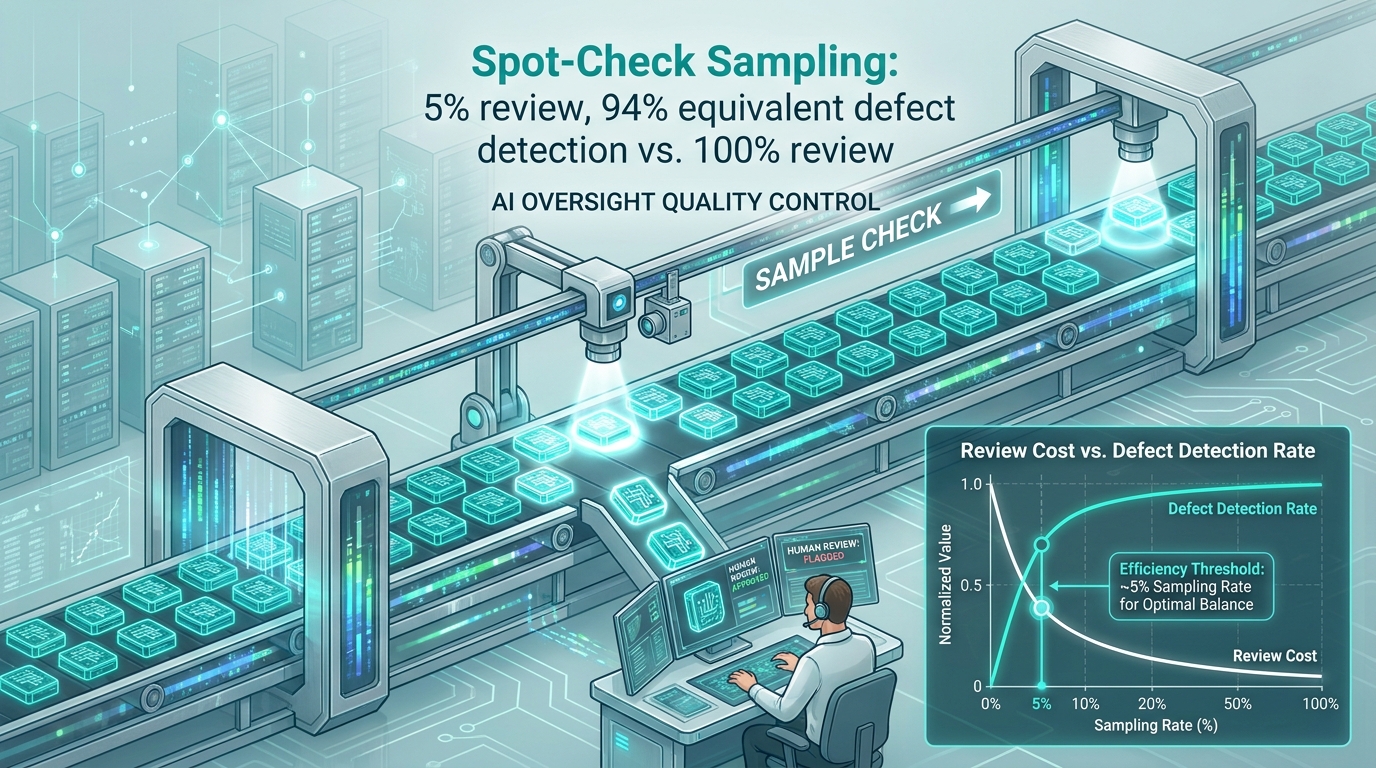
    Statistical quality control sampling visualization: AI decisions on a production line with spot-check spotlights at 5% intervals — showing targeted sampling achieves 94% equivalent defect detection at a fraction of the review cost

    For the autonomous tier (Tier 1) of a risk-stratified HITL architecture, “no human review” does not mean “no oversight.” It means moving from pre-execution gating to post-execution sampling — a statistically governed audit process that detects systematic errors and model drift without reviewing every single output.

    The Statistical Logic of Sampling-Based Oversight

    Statistical sampling for quality control has a well-understood mathematics. For detecting a defect rate of 5% or higher, a random sample of 59 items provides 95% probability of detecting at least one defect. For detecting a defect rate of 1%, you need roughly 299 samples. These numbers hold regardless of the total population size — which is counterintuitive but accurate and has significant implications for HITL economics.

    In practice: if your AI system processes 10,000 decisions per day in the autonomous tier, you need to review approximately 200–400 of them to maintain robust quality assurance with standard statistical confidence. That is a 2–4% sampling rate that provides detection power equivalent to reviewing far larger fractions of output. The cost difference — reviewing 300 items vs. reviewing 10,000 items — is the entire economic case for sampling-based oversight.

    Stratified vs. Simple Random Sampling

    Simple random sampling — randomly selecting items from the autonomous-tier queue — works well for detecting uniformly distributed errors. But most AI errors are not uniformly distributed. They cluster around specific input types, edge cases, data quality issues, or distribution shift in particular customer segments. Simple random sampling will systematically under-sample exactly these high-risk clusters.

    Stratified sampling addresses this by drawing samples proportional to risk within defined strata:

    • Confidence distribution sampling: Over-sample decisions near the upper confidence gate, where the model’s error rate is highest within the autonomous tier
    • Novel input sampling: Flag and sample decisions where input features are unusual relative to historical distributions — these are where unreported model weaknesses most often surface
    • Output distribution sampling: Sample outputs at the tails of the output distribution — unusually high or low values, unusual classifications — which are more likely to represent genuine edge cases than outputs clustering near the mean
    • Time-stratified sampling: Ensure samples are drawn across all time periods, not just recent output — this catches gradual model drift that simple recent-window sampling misses

    Sentinel Cases: The Underused Quality Signal

    One of the most effective and underused tools in sampling-based HITL oversight is the sentinel case — a deliberately injected known-answer item that is routed through the autonomous tier and caught by sampling. Sentinel cases serve two purposes: they validate that your sampling infrastructure is actually catching items from the autonomous tier (not just routing everything to review), and they provide a direct measurement of model accuracy on known cases over time.

    Well-designed sentinel programs use a library of cases with known correct answers, injected at a rate of roughly 1–2% of autonomous-tier volume. If sentinel error rates climb above a defined threshold, it triggers an escalation — either to recalibrate the confidence thresholds or to pull the autonomous tier offline for revalidation. This is the closest equivalent to a circuit breaker for AI quality, and it works without requiring human review of every output.

    Building the Oversight Stack: Roles, Tooling, and SLAs
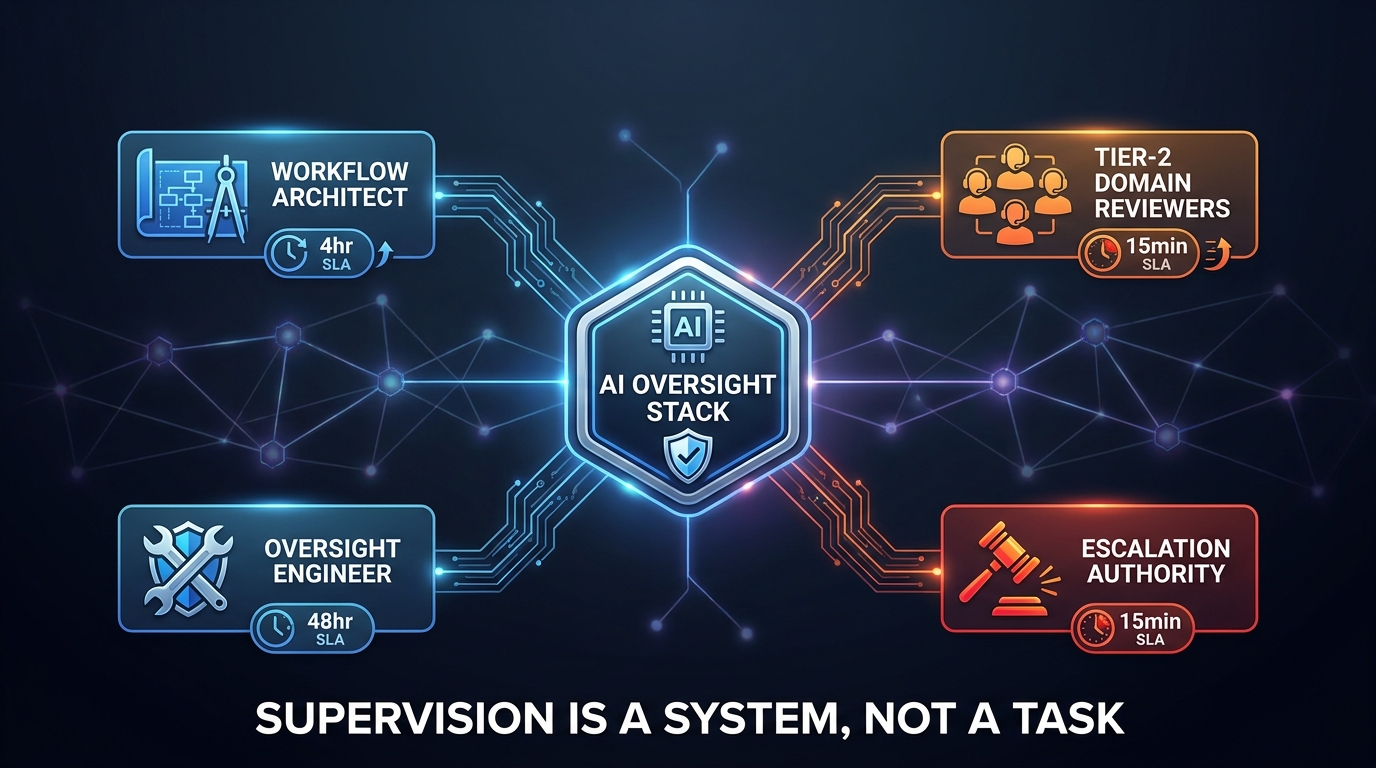
    Organizational chart of the specialized HITL oversight team: Workflow Architect, Tier-2 Domain Reviewers, Oversight Engineer, and Escalation Authority with SLA badges — showing supervision as a structured system, not an ad-hoc task

    The most persistent mistake in enterprise HITL design is treating oversight as a task that gets appended to existing job descriptions rather than as a function that requires purpose-built roles, tooling, and service-level agreements. When oversight is bolted onto other responsibilities, it consistently loses to those responsibilities under time pressure — which is precisely when oversight is most needed.

    The Specialized Roles Emerging in Production HITL Teams

    Mature HITL deployments in 2026 have begun to formalize oversight into distinct roles with explicit decision authority. The emerging structure includes four core functions:

    Oversight Engineer: Owns the technical infrastructure of the HITL system — routing logic, confidence calibration, monitoring dashboards, sampling systems, and integration between the AI pipeline and review tooling. This is a hybrid role sitting between ML engineering and operations, with accountability for whether the HITL system is functioning as designed. Not every organization has the headcount for a dedicated Oversight Engineer at launch, but someone needs to own these responsibilities explicitly — assigning them implicitly to whoever is available is how systems drift toward the “theater” failure mode.

    Workflow Architect: Designs the decision taxonomy (what types of decisions go where), defines the routing rules, and maintains the tier-assignment logic as the AI system and business context evolve. This role bridges the technical system and the business requirements, translating risk tolerance and compliance requirements into concrete routing specifications. In regulated industries, this role often sits at the intersection of AI engineering and risk management functions.

    Domain Reviewers (Tier 2): The people doing the actual work of human review. The critical shift in 2026 is treating these as specialist roles rather than generalist ones. Effective Tier 2 reviewers are domain experts with calibrated judgment in the AI system’s application area — not general-purpose employees asked to evaluate outputs in a domain they do not deeply understand. Reviewer specialization is strongly correlated with both review quality and sustainable reviewer satisfaction; generalist reviewers tend toward automation bias faster because they lack the domain knowledge to efficiently identify what is worth scrutinizing.

    Escalation Authority: A named individual or panel with the decision rights and accountability to resolve Tier 3 escalations — novel cases, edge cases, and high-stakes decisions that Tier 2 cannot resolve. Escalation Authority is not a team of full-time reviewers; it is a defined governance structure that ensures escalated cases have a clear resolution path with a defined SLA, rather than disappearing into a scheduling queue.

    Tooling Requirements That Most Teams Underestimate

    The tooling surface for a production HITL system is larger than it appears at design time. The minimum viable oversight stack includes:

    • Reviewable decision interface: A structured UI that presents the AI’s input, proposed output, confidence score, routing reason, and any relevant context in a single view — without requiring the reviewer to navigate between multiple systems. Cognitive load in the review interface directly affects review quality; every extra click is a judgment degrader.
    • Override recording with rationale capture: Not just the fact of an override, but a structured record of why. Rationale data from overrides is the primary raw material for model improvement and threshold recalibration — organizations that capture only “approved/rejected” lose the most valuable training signal.
    • Queue management with real-time depth visibility: Reviewers and queue managers need to see queue depth, age of oldest item, and throughput rate in real time. This is the instrumentation that allows workload adjustments before cognitive overload sets in, not after.
    • Audit log with tamper evidence: A complete, chronologically ordered record of every decision, its routing tier, the reviewing identity, the outcome, and the timestamp. In regulated environments, this needs to be tamper-evident and accessible to compliance functions without requiring access to the operational system.
    • Monitoring dashboard with leading indicators: Not just output metrics (accuracy, error rate) but leading indicators of HITL system health: review time per item trends, approval rate trends, queue depth over time, override rate by reviewer and by model confidence band.

    SLAs Are Not Optional

    Without defined SLAs, HITL systems develop informal norms about response time that are almost always too slow, inconsistently applied, and impossible to audit. Every tier in a risk-stratified architecture needs a defined maximum response time that is owned by a named function:

    • Tier 2 reviews: typically 15 minutes to 4 hours depending on workflow latency budget
    • Tier 3 escalations: typically 4–48 hours depending on decision urgency
    • Sampling audits: completed within defined cycles (daily, weekly) with escalation triggers for detected anomalies

    When SLAs are breached, there should be a defined response: automated alerts, escalation to the next authority, or temporary workflow modification (e.g., hold autonomous-tier execution until backlog clears). Treating SLA breaches as operational data rather than operational failures allows the system to self-correct rather than quietly degrade.

    Measuring Whether Your HITL Is Actually Working

    Most HITL programs are measured on the wrong things. They track volume (how many items were reviewed), time (how long reviews took), and cost (what reviewers were paid). These are operational hygiene metrics. They tell you the system is running — not whether it is working. A genuinely effective HITL measurement framework centers on a different set of questions.

    The Metrics That Signal Real Oversight Quality

    Human Override Rate by Confidence Band: The most important single signal of HITL system health. Measures the fraction of reviewed items where the human reviewer reaches a different conclusion than the AI’s output. Healthy override rates are typically 8–25% within the review tier, and they should be higher for items near the lower confidence gate and lower for items near the upper gate. A flat override rate across the confidence spectrum suggests reviewers are not responding to model uncertainty signals — a calibration problem.

    Downstream Error Rate by Tier: Of decisions that passed through each tier and executed, what fraction were later identified as wrong — through customer complaints, outcome tracking, audit findings, or sentinel re-injection? This is the ground-truth measure of whether each tier’s oversight level is appropriate. If Tier 1 autonomous decisions show a materially higher downstream error rate than Tier 2 reviewed decisions, the upper confidence gate is set too low (letting too many uncertain decisions through to autonomous execution).

    Review Time Trend: Average time per review item over rolling weekly periods. A declining trend in review time, absent a deliberate change in workflow complexity or reviewer experience, is a leading indicator of automation bias taking hold. Flag it before it becomes a quality problem.

    Queue Age Distribution: Not just how many items are in the queue, but how old they are. Items sitting in a review queue for more than twice the target SLA are an operational failure that most queue-depth metrics will not surface unless you specifically track age distribution. Old items tend to get bulk-approved under time pressure — exactly the wrong outcome.

    Escalation Rate Stability: The fraction of Tier 2 reviews that escalate to Tier 3 over time. An escalating trend means either model performance is degrading (more items require expert judgment) or reviewer confidence is declining (reviewers are escalating items they could resolve themselves). A declining trend is healthy — until it reaches zero, at which point reviewers have likely stopped escalating anything and the Tier 3 path is functionally dead.

    Building a HITL Health Score

    The most operationally effective teams in 2026 are building composite HITL health scores — single numbers synthesizing the above metrics into a weekly or daily readout. The construction is simple: define green/yellow/red ranges for each metric, assign weights based on consequence (override rate and downstream error rate typically weighted highest), and combine into a dashboard indicator that any stakeholder can read without navigating five separate dashboards.

    The health score does not need to be statistically sophisticated to be useful. Its primary value is creating a shared, visible signal that HITL system quality is tracked and owned — not assumed to be fine until something breaks.

    What the Economics Look Like at 10x Volume
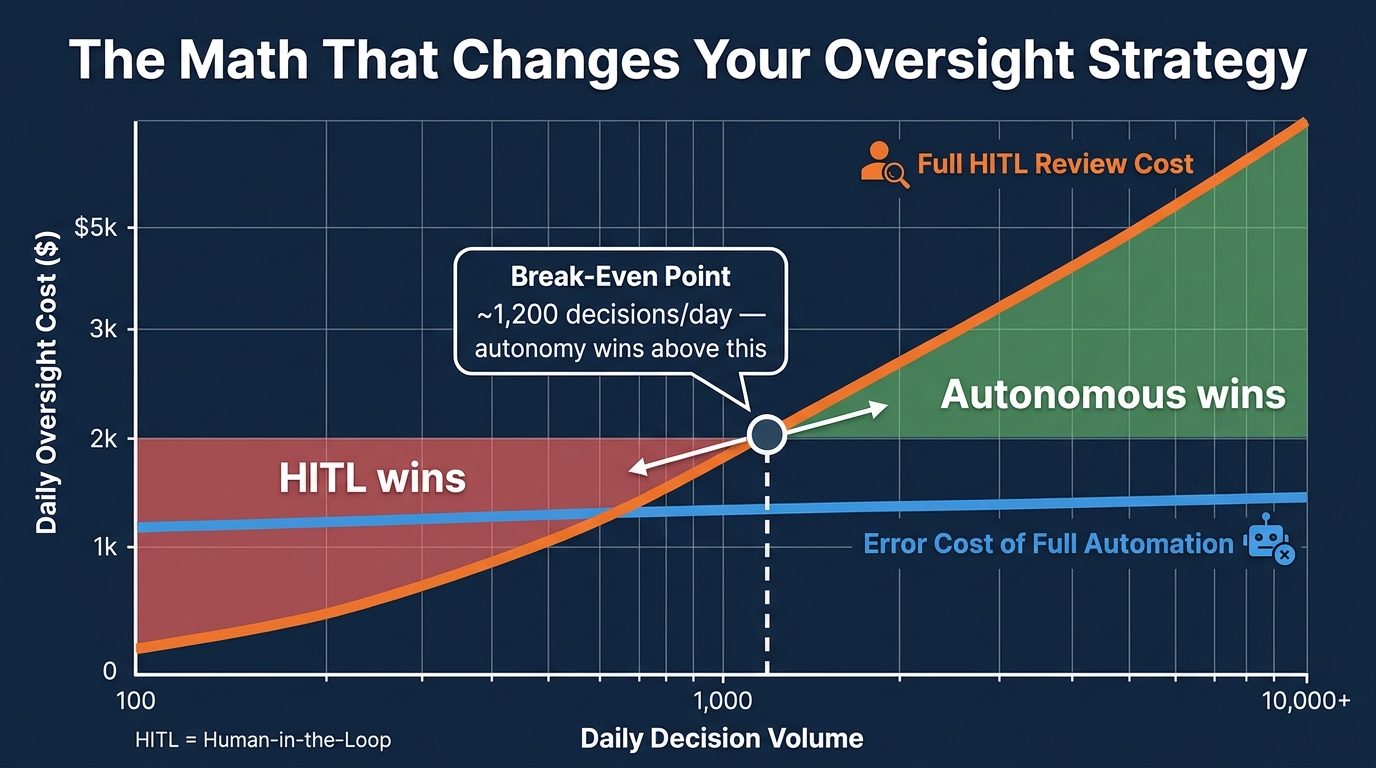
    Break-even economics graph: Full HITL Review Cost line rising steeply vs. flat Error Cost of Full Automation — crossing at approximately 1,200 decisions/day, with green 'Autonomous wins' zone to the right

    Here is the scenario most HITL design decisions need to be stress-tested against: your AI system is working. The business case held up. Volume is growing. What happens to your oversight costs and quality at 5x, 10x current volume?

    The Three Scenarios

    Consider an organization processing 1,000 AI decisions per day today, with a universal review model (every decision reviewed). At that volume, 3 reviewers can keep up with a sustainable workload at roughly 60 reviews per hour each.

    Scenario A — Scale without redesign (universal review at 10x): At 10,000 decisions per day, the same universal review model requires 30 reviewers. At fully loaded cost of $75,000–$90,000 per reviewer per year, that is $2.25M–$2.7M in reviewer salaries alone — before tooling, management, training, and overhead. The review queue’s throughput ceiling also means that unless all 30 reviewers are on the same shift, peak-hour decision volumes will exceed reviewer capacity and queue age will grow. This scenario is what most organizations are sliding toward, usually without explicitly deciding to.

    Scenario B — Risk-stratified architecture at 10x: The same 10,000 decisions per day, but routed through a three-tier system with 80% autonomous, 15% Tier 2 review, 5% Tier 3 escalation. At 1,500 decisions per day reaching human review (combined Tier 2 and Tier 3), you need 5–6 reviewers plus 2–3 domain experts for Tier 3, at a total headcount of 8–9 FTEs. Cost: approximately $600,000–$750,000 per year in reviewer labor. The saving vs. Scenario A is $1.5M–$2M annually at 10x volume.

    Scenario C — Sampling-augmented hybrid at 10x: Risk-stratified architecture plus sampling-based audit for the autonomous tier. Human review touches roughly 15% of total decisions pre-execution (Tier 2) and 5% post-execution (sampling audit). Total human decision-touching rate: 20%. Total reviewer headcount: 6–7 FTEs. Annual cost: $450,000–$525,000. The saving vs. Scenario A is $1.8M–$2.25M annually.

    The Quality Trade-off Is Smaller Than You Think

    The natural concern about reducing review coverage is error rate. Will catching fewer decisions per unit time mean more errors slip through? In well-designed systems, the answer is counterintuitive: not necessarily. The key insight is that quality in universal review systems is already seriously degraded by overload — the 30 reviewers in Scenario A are rubber-stamping most of what they see. Meanwhile, the 8 reviewers in Scenario B are evaluating genuine borderline cases and bringing real domain expertise to the decisions that need it most.

    Multiple enterprise deployments comparing pre- and post-stratification error rates have found that risk-stratified systems with 15–20% human review coverage achieve roughly equivalent downstream error rates to overloaded universal review systems at 100% coverage — and in several cases actually outperform them, because reviewers are no longer cognitively depleted by the time they encounter genuinely difficult cases.

    When the Break-Even Math Flips

    There is a volume threshold below which full HITL review is economically rational — roughly when the expected cost of undetected errors (error rate × average error cost × daily volume) exceeds the daily cost of universal review. This threshold is highly domain-dependent: in high-stakes decisions (medical, financial, legal), the error cost is so high that full review may remain justified at significant volumes. In lower-stakes automation (content moderation, recommendation generation, routine data classification), the break-even point is typically reached much sooner — often before 500–1,000 decisions per day.

    The discipline of explicitly computing this break-even for each decision category in your AI system is one of the most valuable exercises an oversight architect can run. It transforms the debate from “how much oversight is enough?” (an unanswerable philosophical question) to “at what volume does the expected value of this review tier go negative?” (a quantifiable engineering question with a specific number answer).

    The Regulatory Dimension: Compliance Requirements Without Compliance Theater

    No treatment of human-in-the-loop design in 2026 is complete without addressing the regulatory environment, which has become a significant driver of HITL architecture decisions — particularly for organizations operating under the EU AI Act, sector-specific AI guidance from financial regulators, and evolving healthcare AI oversight frameworks.

    What Regulators Actually Require

    The common misconception is that regulation requires “a human reviewed every decision.” In practice, most current regulatory frameworks require something considerably more nuanced: meaningful human oversight calibrated to the risk level of the application. The EU AI Act’s requirements for high-risk AI systems, for instance, mandate that systems be designed to allow human oversight, that humans be capable of intervening, and that appropriate measures are taken to ensure oversight is effective — not that every decision is manually reviewed.

    This distinction matters enormously. A well-designed risk-stratified HITL system with documented routing logic, defined escalation paths, maintained audit trails, and evidence-based calibration of tier thresholds typically satisfies regulatory oversight requirements far better than an overloaded universal review process in which reviewers are rubber-stamping at speed. Regulators increasingly understand the difference, and compliance teams that conflate “any human touchpoint” with “meaningful oversight” are creating both unnecessary cost and false compliance confidence.

    What Documentation Actually Needs to Exist

    For organizations in regulated industries, the documentation requirements for HITL systems are specific and non-trivial. At minimum, production HITL systems should maintain:

    • A decision taxonomy classifying each AI action type by risk tier with documented rationale
    • Threshold calibration records showing the basis for confidence gates and evidence of their effectiveness
    • Reviewer competence records linking each review authority to the qualifications required for their tier
    • Audit logs sufficient to reconstruct any individual decision’s routing path, review outcome, and reviewer identity
    • Monitoring records showing HITL system health metrics over time, with evidence that anomalies triggered appropriate responses

    Organizations that build this documentation infrastructure during initial deployment rather than retrofitting it at audit time avoid both the compliance panic and the significant cost of post-hoc documentation reconstruction.

    Designing for the Next Order of Magnitude

    The organizations getting HITL right in 2026 are not thinking about their current volume — they are designing for where they will be in 18 months. The architectural decisions made at low volume create path dependencies that are expensive to unwind later. A universal review system that was “good enough” at 500 decisions per day becomes a $2M annual problem at 5,000 decisions per day, and redesigning it under production pressure is a significantly worse option than designing it for scale from the start.

    The Architectural Decisions That Compound

    Several early HITL design decisions have outsized impact on scalability:

    Routing logic location: If your routing logic is embedded in the AI model output pipeline rather than in a dedicated routing service, recalibrating thresholds requires a pipeline change rather than a configuration change. This means threshold recalibration happens infrequently (because it’s costly) rather than continuously (because the system makes it easy). Build routing as a separate, configurable service from day one.

    Review interface design: Review interfaces built for small teams quickly become unusable at scale. The design decisions that matter — how much context is surfaced per item, how overrides are captured, how queue management works — are much easier to get right at the beginning than to retrofit into a production system with an established user base of reviewers who have adapted their workflows to whatever the interface currently does.

    Audit log schema: Audit logs that record only approved/rejected status are worthless for calibration, improvement, and compliance. Audit logs that record input features, confidence scores, routing reasons, reviewer identity, override rationales, and downstream outcomes are extraordinarily valuable. The difference in storage and implementation cost is small. The difference in downstream utility is immense.

    The AI-Assisted Review Transition

    The next frontier in scalable HITL — already in early production deployment at several large technology and financial services organizations — is AI-assisted review, where a second AI system helps the human reviewer by surfacing relevant precedents, flagging specific features of the input that drove the model’s decision, and predicting which aspects of the output are most likely to contain errors based on historical override patterns.

    This is not the same as using AI to replace human review. The human remains the decision authority. But the cognitive burden on the reviewer shifts from “evaluate this output from scratch” to “assess whether this AI-flagged concern is genuinely a concern.” Early results suggest this hybrid approach can reduce review time per item by 30–50% without reducing — and in some cases while improving — override rate and downstream error detection. As this pattern matures, it represents a plausible path to sustaining meaningful human oversight at volumes that would otherwise be unmanageable.

    Supervision as Infrastructure: The Closing Argument for Investing in HITL Design

    The frame of “human-in-the-loop as cost center” is ultimately the wrong frame, even though cost is real. The more useful frame is supervision as infrastructure — a foundational capability that enables the organization to deploy AI at scale with confidence, that provides the quality signal needed for continuous model improvement, that satisfies regulatory requirements without creating compliance theater, and that preserves institutional accountability in automated decision systems.

    Infrastructure investment decisions are made differently than operational expense decisions. When you build a payment processing system, you do not try to minimize the cost of fraud detection to zero — you invest in fraud detection as a capability that makes the entire payments system trustworthy and scalable. HITL oversight deserves the same framing: not “how little can we spend on this?” but “what is the oversight capability worth to our ability to deploy AI at scale and stand behind its outputs?”

    Actionable Takeaways for Teams Designing or Redesigning HITL Today

    1. Compute your per-decision review cost at current and projected volume before any other architectural decision. Know the number. It is almost always larger than teams assume when they include fully loaded labor costs, tooling overhead, and latency cost.
    2. Audit your current approval rates. If Tier 2 approval rates are consistently above 93–95%, you do not have a review process — you have an approval process. Diagnose whether the threshold is miscalibrated or automation bias has taken hold.
    3. Map your decision taxonomy by reversibility and error cost before choosing synchronous vs. asynchronous review mode. Not every AI decision needs pre-execution approval.
    4. Build routing logic as a standalone, reconfigurable service rather than embedding it in the model pipeline. Threshold recalibration should be a configuration operation, not a deployment event.
    5. Define explicit SLAs for each tier and assign ownership for SLA compliance. Unowned SLAs are advisory documents that will be violated as soon as volume pressure arrives.
    6. Invest in override rationale capture. The qualitative signal in reviewer overrides is the highest-ROI input to model improvement, and most HITL systems throw it away by capturing only binary outcomes.
    7. Run your HITL architecture through a 10x volume stress test before committing to a design. If it requires proportional headcount scaling, it will fail at scale. Redesign it now while the decision is cheap.

    Supervision is expensive. But poorly designed supervision is far more expensive — it costs all the money of proper oversight and delivers none of the quality. The difference between HITL as a liability and HITL as a strategic capability is almost entirely an architectural and operational design question. The organizations that figure this out early will be the ones running AI systems at the next order of magnitude without rebuilding their oversight stack from scratch every time the volume doubles.
  • Why Human-in-the-Loop Is No Longer Optional: The Engineering and Governance Reality in 2026

    Why Human-in-the-Loop Is No Longer Optional: The Engineering and Governance Reality in 2026

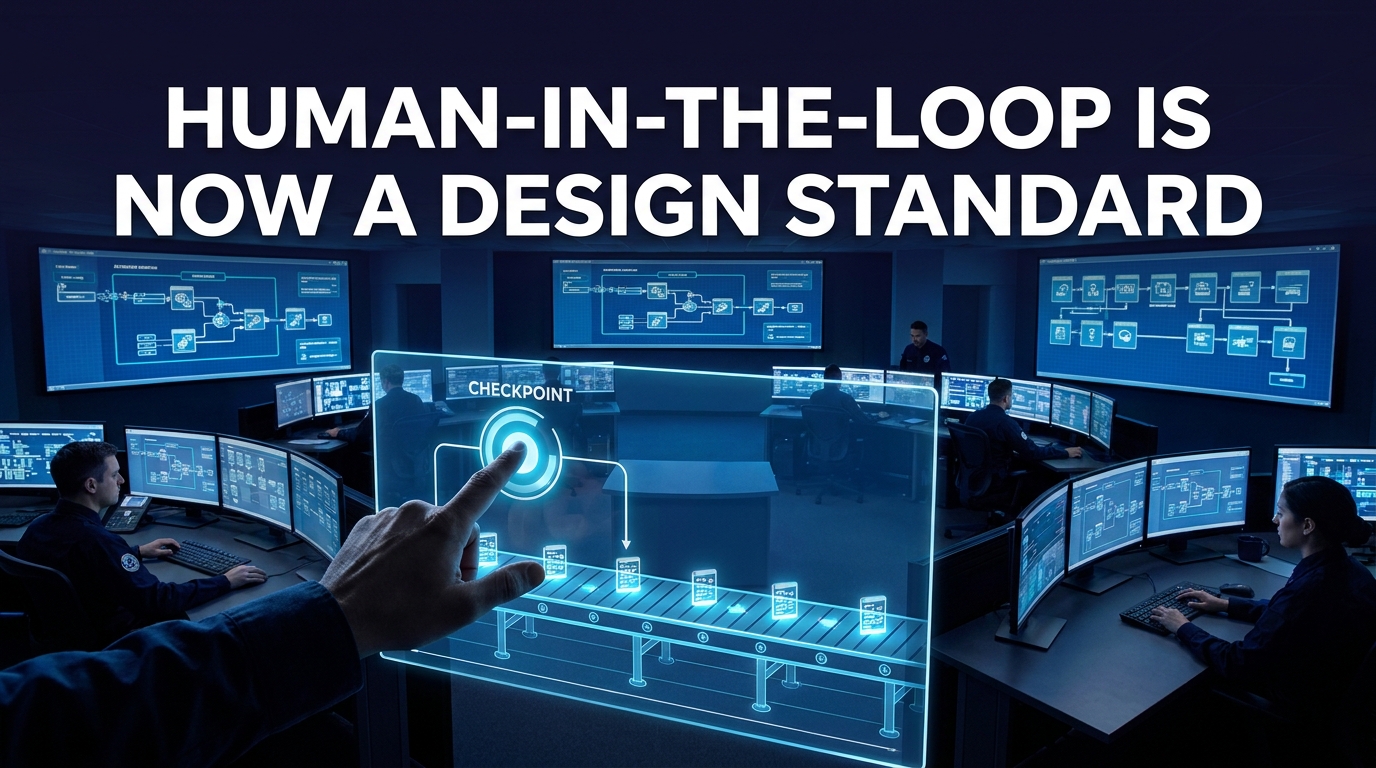
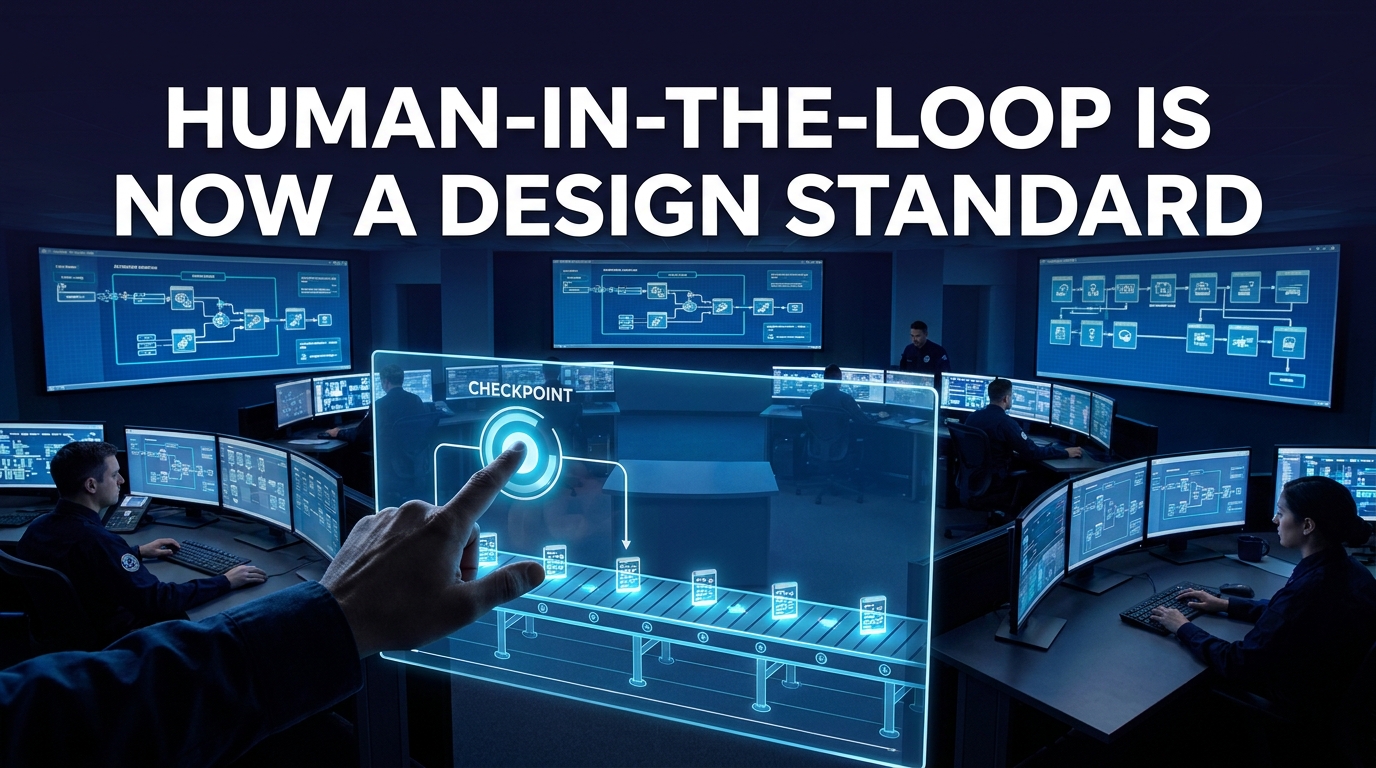
    Human-in-the-loop AI control room with a human hand pausing an automated data workflow — representing HITL as a design standard

    For the better part of the past five years, human-in-the-loop (HITL) was treated like a transitional phase. The implied logic went something like this: once our models are good enough, we can remove the human from the equation and let AI operate freely. Human oversight was scaffolding — necessary today, removable tomorrow.

    That logic is collapsing in 2026, and not slowly.

    Across regulated industries, enterprise AI deployments, and the emerging landscape of autonomous agents, human oversight is being re-engineered not as a temporary patch, but as a permanent structural feature. Regulators are codifying it into law. Engineers are building it into architecture. Product designers are treating human checkpoints as first-class UX components. The industry has quietly reached a consensus that the old framing — HITL as training wheels — was wrong.

    What’s changed is less about AI capability and more about what happens when AI acts without a human backstop on decisions that are consequential, irreversible, or contested. The failure modes aren’t hypothetical anymore. They’re showing up in production systems, in regulatory enforcement actions, in post-mortems at enterprises that moved too fast toward full automation.

    This piece isn’t about whether to include humans in AI workflows. That question is largely settled. It’s about the harder questions: where do humans belong in the loop, how do you design those checkpoints so they’re not theater, and what are the real costs — technical, organizational, and human — of getting it wrong?

    The answers are more nuanced than most frameworks acknowledge — and the gap between HITL as a policy statement and HITL as a working engineering reality is wider than most organizations want to admit.

    What “HITL by Design” Actually Means — And What It Doesn’t

    The phrase “human-in-the-loop” is older than the current AI moment. It originated in control systems and simulation engineering decades before large language models existed. But in 2026, its meaning has been substantially redefined — and the redefinition matters.

    The old understanding of HITL was relatively simple: a human reviews an AI output before it goes live or takes effect. Think of a content moderation queue, a loan approval workflow where an officer signs off on the model’s recommendation, or a radiologist checking a flagged scan. The human sat at the end of the pipe and made the final call.

    The new understanding is substantially more architectural. HITL by design means that human oversight requirements are determined before the system is built, not bolted on after deployment. It means specifying — at the system design level — which decision classes require human review, what information the human needs to make a meaningful judgment, how that judgment is recorded and audited, and what happens when humans disagree with the AI or vice versa.

    Human Oversight Is Not a Kill Switch

    One of the most persistent misconceptions about HITL is that it’s equivalent to having an emergency stop button. If the AI does something wrong, a human intervenes. That framing is dangerously insufficient.

    A kill switch is reactive. Properly designed HITL is proactive. It means the system is architected so that at predefined decision points — based on risk tier, confidence threshold, decision reversibility, or regulatory category — the AI pauses, surfaces the relevant context to a human, and waits for a qualified judgment before proceeding. The human isn’t watching for something to go wrong; they’re structurally embedded in the workflow at the points where human judgment adds irreplaceable value.

    This distinction changes how you build systems. It means HITL requirements have to be part of the initial requirements gathering, the system architecture, the data model (you need to store the state of in-progress decisions), the UX design (the review interface is a product, not an afterthought), and the operational model (someone has to own the review queue, with defined SLAs).

    The Spectrum: From Supervision to Collaboration

    Even within the “human in the loop” category, there are meaningfully different relationships between human and machine. At one end, the human is a supervisor reviewing AI recommendations and approving or rejecting them with minimal additional input. At the other end, the human and AI are genuinely collaborative — the AI proposes, the human refines, the AI re-proposes, in an iterative cycle that neither party could execute as well alone.

    The collaborative model is increasingly common in knowledge work: legal research, clinical diagnosis, code review, financial analysis. In these settings, the AI isn’t just being checked — it’s actively augmenting human capability, surfacing patterns and precedents that would take a human much longer to find independently. The human’s role isn’t diminished; it’s shifted from information retrieval to judgment and synthesis.

    Understanding where your use case sits on this spectrum determines what your HITL architecture should look like. A supervision model needs fast, clear review interfaces with good escalation paths. A collaboration model needs AI that can explain its reasoning, handle ambiguity gracefully, and iterate based on human feedback without losing context.

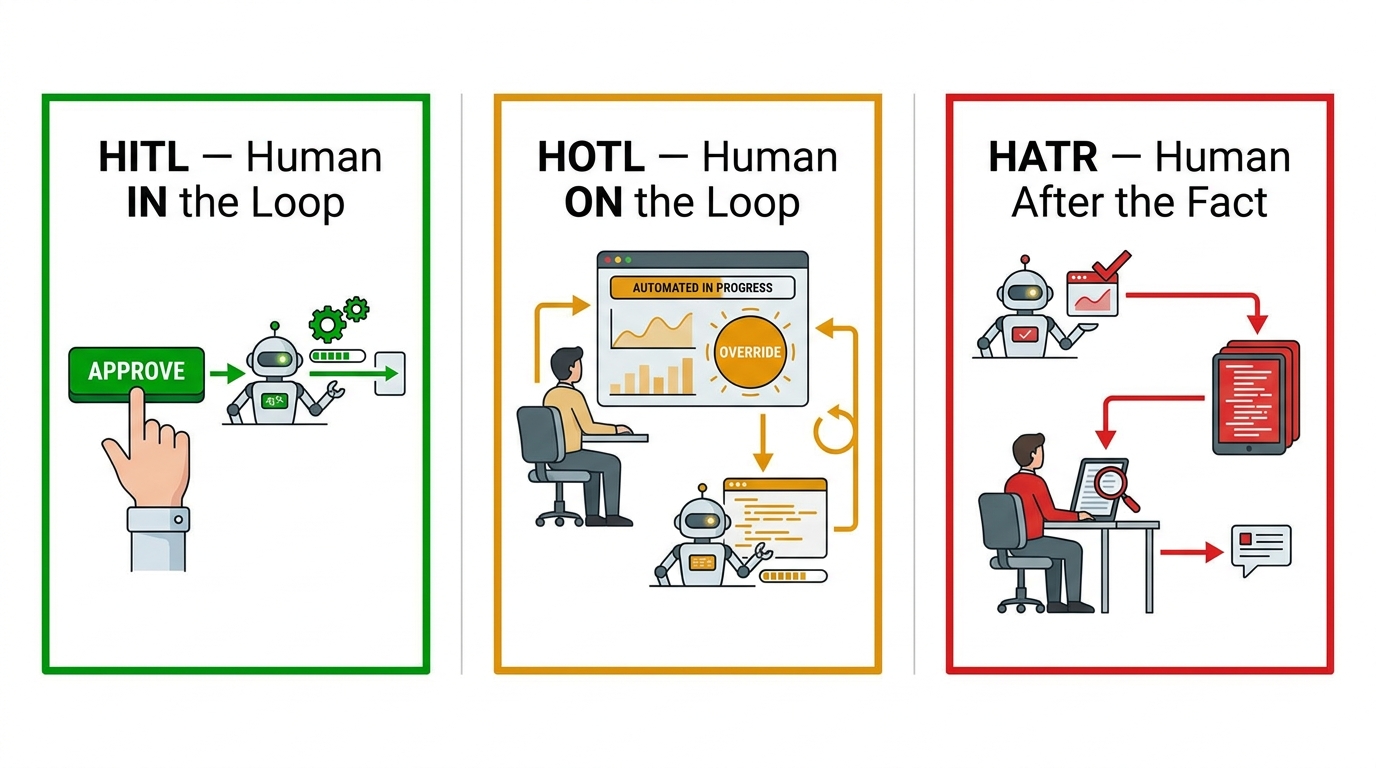
    Three AI oversight tiers compared: HITL human in the loop, HOTL human on the loop, and human after the fact review — infographic

    The Three Oversight Models: HITL, HOTL, and the Dangerous Default

    Most enterprise AI discussions collapse human oversight into a binary: either a human approves every decision, or the AI operates autonomously. In practice, the actual design space has at least three distinct modes, each appropriate for different risk and volume profiles.

    Human-in-the-Loop (HITL): Blocking Oversight

    In strict HITL, the AI cannot proceed without human approval. The workflow pauses at a defined checkpoint. A human reviews the AI’s proposed action — and the context supporting it — then approves, rejects, or modifies before execution continues. This is the highest-friction, highest-assurance model.

    HITL is appropriate when: the decision is irreversible or difficult to remediate; the stakes are high (financial loss, legal liability, physical harm); the regulatory environment requires documented human approval; or model confidence is below a defined threshold. In financial services, this means any transaction above a materiality threshold. In healthcare, it means treatment recommendations that deviate from standard protocols. In HR, it means employment decisions that could create legal exposure.

    The tradeoff is throughput and latency. Every human checkpoint is a bottleneck. If the review queue backs up, workflows stall. If reviewers are under-resourced or under-trained, the quality of oversight degrades — which can be worse than having no oversight at all, because it creates a false sense of safety.

    Human-on-the-Loop (HOTL): Supervisory Oversight

    HOTL is the middle layer. The AI acts autonomously, but humans monitor outputs in real time or near-real time via dashboards, alerts, and exception queues. Instead of approving every decision, reviewers focus on flagged anomalies, low-confidence outputs, or cases that trip predefined rules.

    This model scales significantly better than strict HITL. A single skilled reviewer can oversee a much higher volume of AI decisions because they’re only engaging with exceptions. The challenge is designing the exception logic well. If the threshold for flagging is too high, dangerous errors get missed. If it’s too low, reviewers get flooded with low-priority alerts — which leads directly to the alert fatigue problem explored later in this piece.

    HOTL is appropriate for high-volume, relatively routine workflows where errors are detectable and partially reversible: content classification, fraud scoring, customer service routing, automated document processing. It’s also the default model for most AI systems that claim to have human oversight but haven’t thought carefully about whether that oversight is meaningful.

    The Dangerous Default: Human After the Fact

    There’s a third de facto model that rarely gets named explicitly: human review happens, but only after something goes wrong. This is audit-trail oversight — logs exist, post-hoc analysis is possible, but no human is actively monitoring for errors or approving actions in advance.

    This model is common in practice, especially in organizations that deployed AI quickly and added oversight as an afterthought. It satisfies a narrow definition of accountability (“we can see what happened”) while providing almost none of the actual safety guarantees that governance language implies. By the time a human identifies a problem, the AI may have made thousands of identical erroneous decisions.

    The EU AI Act’s Article 14 makes this model legally insufficient for high-risk AI systems. But even outside regulated jurisdictions, the business case for retroactive-only oversight is weak. The remediation costs — financial, reputational, and operational — of catching problems after the fact are almost always higher than the cost of catching them at the point of decision.

    The Regulatory Forcing Function: What the EU AI Act Actually Requires

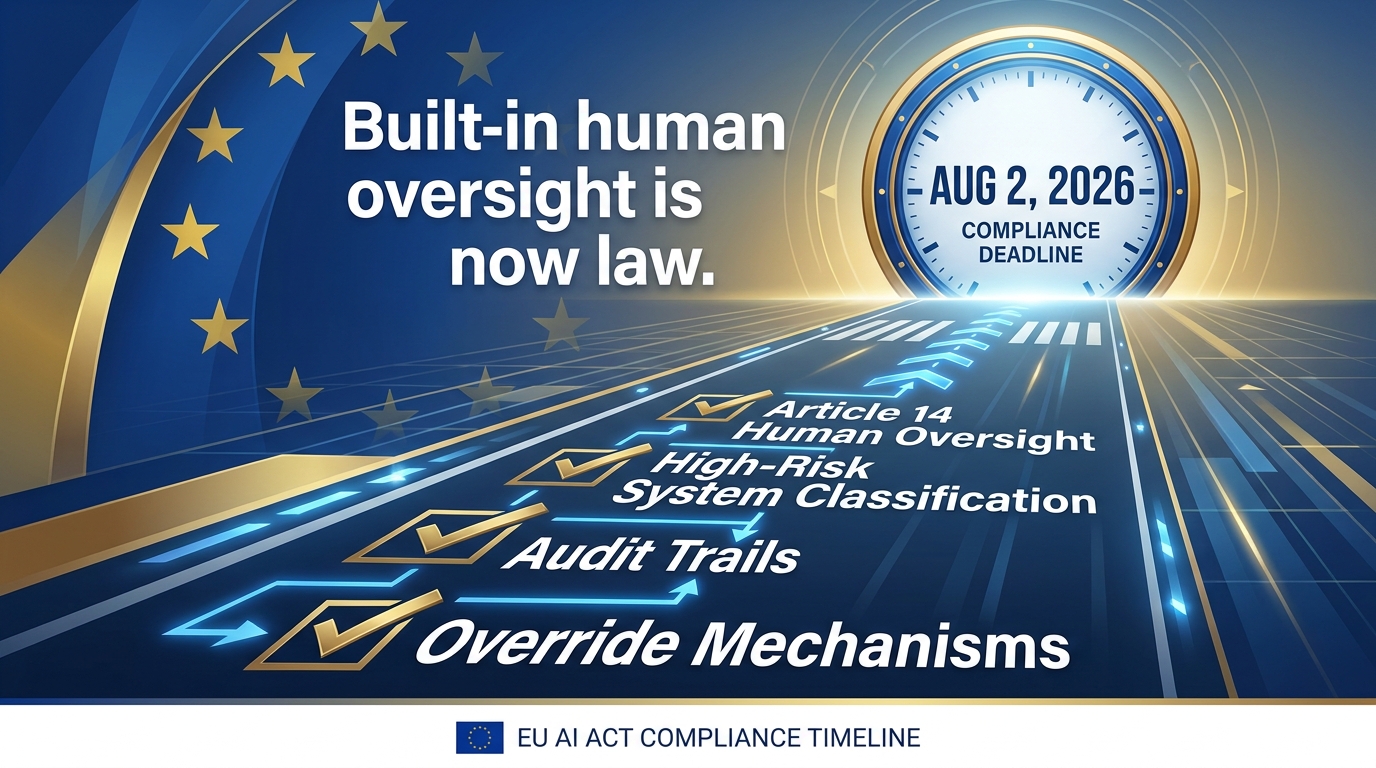
    EU AI Act Article 14 compliance countdown showing August 2 2026 deadline with human oversight checklist requirements

    The shift from voluntary best practice to mandatory design requirement has a clear legislative anchor: the EU AI Act, which began phasing in substantive obligations in 2026, with the core human oversight requirements for high-risk systems under Article 14 effective from August 2, 2026.

    Understanding what Article 14 actually requires — not what organizations think it requires — is essential for any enterprise deploying AI in EU markets or building systems for EU-based customers.

    Article 14: Beyond the Summary

    Article 14 doesn’t just say “have a human check the AI.” It specifies that high-risk AI systems must be designed and developed such that they can be effectively overseen by natural persons during the period in which the AI system is in use. Effective is the operative word.

    Specifically, providers of high-risk AI must ensure that humans can: fully understand the AI system’s capabilities and limitations; monitor its operation and detect anomalies; intervene and override outputs; and stop the system when necessary. These aren’t checkbox items — they’re functional requirements that have to be built into the system architecture.

    What makes this demanding is the word “fully.” An interface that shows a recommendation with no explanation of confidence, reasoning, or uncertainty doesn’t meet the bar. A system that can technically be overridden but where the override process is so cumbersome that no one ever uses it doesn’t meet the bar. The oversight has to be effective, and that determination will be made by regulators and courts looking at actual use, not documented intentions.

    High-Risk Classifications: Who’s Actually Affected

    The EU AI Act’s Annex III defines high-risk AI categories. The list is broader than most organizations initially assume. It includes: biometric identification systems; AI used in critical infrastructure (energy, water, transport); educational and vocational systems that determine access or assessment; employment-related systems that affect recruitment, performance evaluation, or termination; access to essential services including credit, insurance, and social benefits; law enforcement applications; migration and asylum management systems; and administration of justice.

    This scope captures a substantial fraction of enterprise AI deployment. An automated CV screening tool is high-risk. A credit scoring model is high-risk. A system that routes customer service cases to different service tiers may be high-risk. Organizations that assumed they were operating outside the regulation’s scope should revisit that assessment carefully.

    Beyond the EU: Convergent Regulatory Pressure

    While the EU AI Act is the most comprehensive regulation currently in force, it isn’t isolated. The NIST AI Risk Management Framework (AI RMF) in the United States, while voluntary, has become the de facto standard for federal contractors and many regulated industries. Its Govern, Map, Measure, and Manage functions all incorporate human oversight requirements. The UK’s AI Safety Institute has published guidance that aligns closely with the EU’s substantive requirements. India’s Digital Personal Data Protection Act, Canada’s AIDA, and sector-specific guidance from financial regulators globally are converging on similar principles.

    The practical implication: organizations building HITL architectures to meet EU AI Act requirements will find those architectures simultaneously position them well for compliance in other jurisdictions. The global regulatory trajectory is clear, even where specific legislation lags.

    Checkpoint Architecture: Where the Real Engineering Work Happens

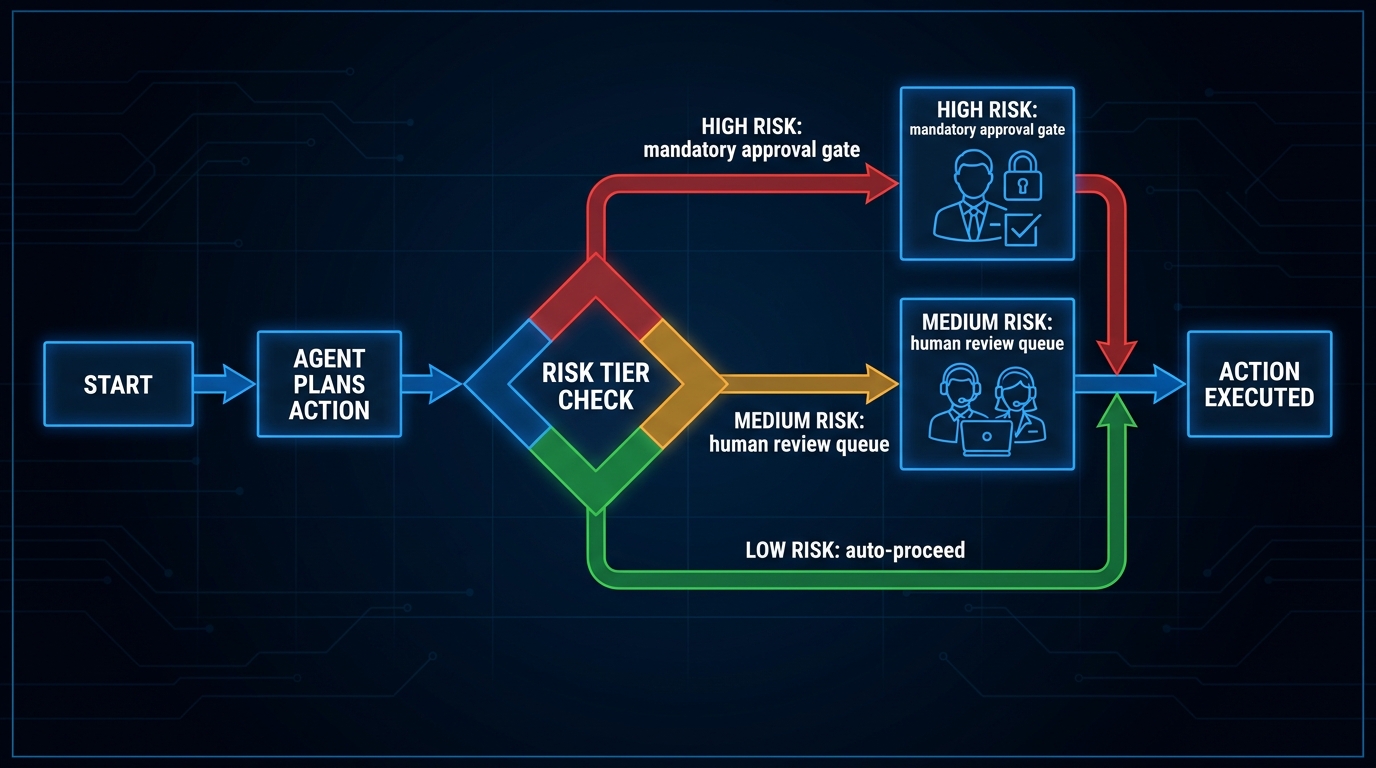
    AI agent workflow checkpoint architecture diagram showing risk-tiered decision routing: auto-proceed, human review queue, and mandatory approval gate

    Most HITL discussions stay at the policy level. They describe what human oversight should accomplish without getting specific about how to actually build it. The checkpoint architecture question — where exactly does the workflow pause, what does the human see, and how is their decision recorded and acted on — is where theory meets engineering reality.

    Defining the Pause Points

    The first design decision is identifying which actions in an AI workflow require a human checkpoint. This is harder than it sounds because the right answer isn’t static — it depends on a combination of factors that can change between instances of the same workflow.

    The key variables are: decision reversibility (can the action be undone if it’s wrong?), impact magnitude (what’s the worst-case consequence of an error?), model confidence (how certain is the AI about this specific case?), and regulatory obligation (does law or policy require human sign-off regardless of other factors?). A well-designed checkpoint system evaluates these variables dynamically, routing decisions to human review when the combination of factors exceeds a defined threshold.

    This is meaningfully different from static checkpoints where every instance of a decision class goes to human review. Dynamic routing based on confidence and risk allows high-confidence, low-stakes decisions to flow through automatically while surfacing the genuinely uncertain or high-stakes cases for attention. The result is a review queue that contains decisions where human judgment actually adds value — not a queue stuffed with cases the AI would have handled perfectly well on its own.

    Designing the Review Interface

    The review interface — what the human actually sees when a decision lands in their queue — is a full product design problem, and in most organizations it’s dramatically under-invested. A poorly designed review interface produces poor oversight even with excellent intentions.

    The interface needs to answer five questions in a format a reviewer can process quickly: What is the AI proposing to do? Why (what signals or evidence drove this recommendation)? How confident is the AI? What are the known alternatives or edge cases? And what’s the consequence of getting it wrong? Providing this context in a compressed, scannable format — without overwhelming the reviewer with raw model internals — is a significant UX challenge.

    Explainability isn’t just a nice-to-have here; it’s load-bearing. A review interface that shows “Model recommends: Approve” with no supporting rationale isn’t enabling human oversight — it’s creating a rubber stamp process where the human clicks approve because they have no basis for doing otherwise. This is exactly the dynamic that produces automation bias, which is covered in depth later.

    State Management and Audit Infrastructure

    HITL workflows require persistent state. When a workflow pauses for human review, the system needs to preserve everything about the current decision state: the AI’s recommendation, the confidence score, the data inputs, the timestamp, the reviewer assigned, and the time allowed before escalation. When the human acts, the system needs to record the decision, the reasoning if provided, and the outcome for downstream audit.

    This state management infrastructure is often underestimated. Organizations frequently discover that their existing workflow tools weren’t designed to pause mid-flow, store decision state across sessions, or maintain a complete audit trail of human interventions. Retrofitting this is expensive. Building it from scratch into new systems — while more work upfront — is almost always the right approach.

    SLAs, Escalation, and the “Stuck Decision” Problem

    One of the practical failures of HITL implementations is the stuck decision: a workflow pauses for human review, the assigned reviewer is unavailable or overwhelmed, and the case sits in queue without resolution. Downstream processes that depend on the decision are blocked. Business outcomes are delayed. In time-sensitive contexts, the cost of waiting can exceed the cost of a wrong automated decision.

    Preventing stuck decisions requires explicit SLA design. Each decision tier should have a defined response time window. After that window, the system should automatically escalate to a secondary reviewer, raise an alert, or (in some low-risk cases) apply a safe default action. Who owns the escalation path, what the safe defaults are for each decision class, and what constitutes an acceptable SLA all need to be defined before deployment — not discovered in the first production incident.

    Where HITL Works: Sector Evidence from Healthcare, Finance, and Legal

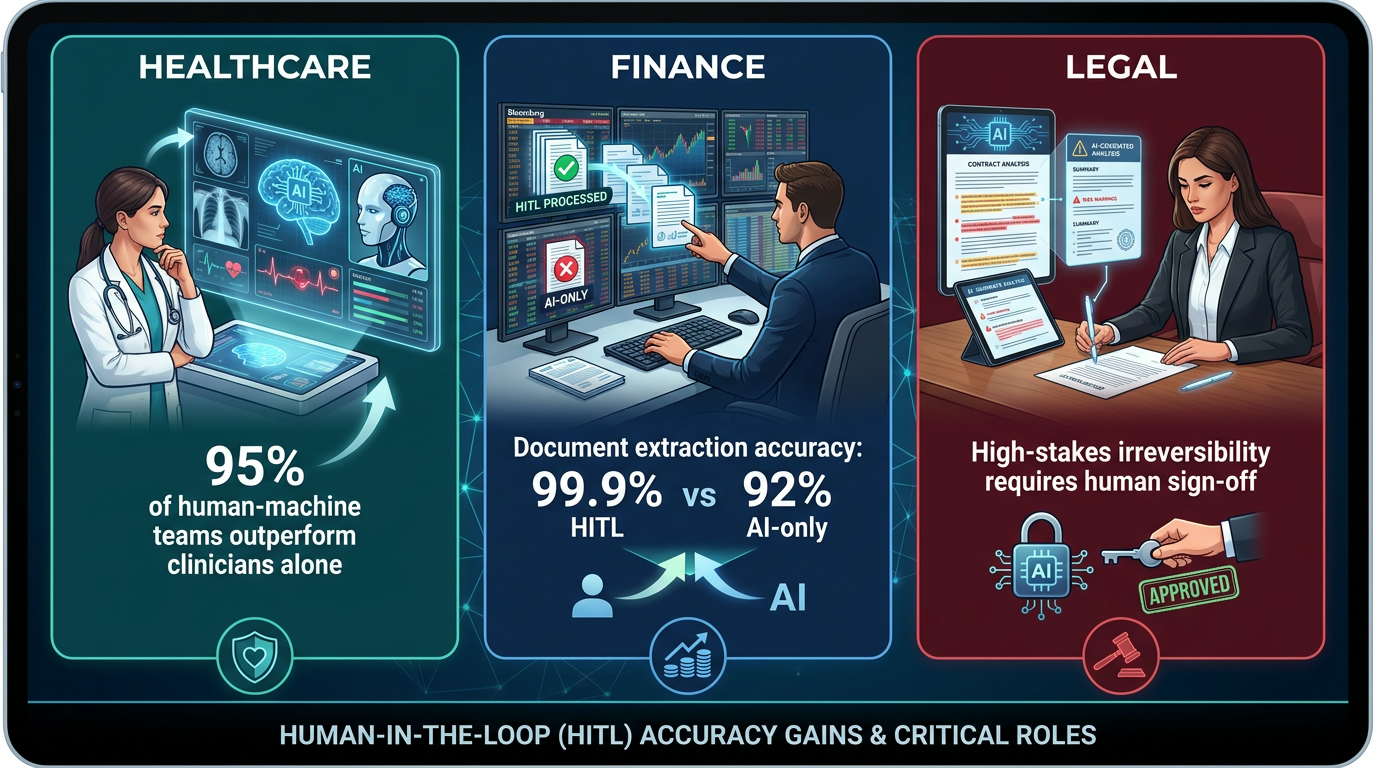
    Three-panel infographic showing HITL accuracy improvements in healthcare, finance, and legal sectors with key statistics

    The case for HITL isn’t theoretical. Across the highest-stakes sectors, there is accumulating evidence that human-machine collaboration substantially outperforms either humans or AI operating independently — and that the specific benefits depend heavily on how the collaboration is structured.

    Healthcare: When the Stakes Are Irreversible

    Healthcare is where the HITL evidence base is strongest, partly because the research infrastructure to study diagnostic accuracy already existed before AI was introduced. The findings are striking. A 2025 systematic review found that human-machine teams — where AI and clinicians each contributed to diagnosis — outperformed clinicians working alone in 95% of studied cases. HITL AI improved overall clinician diagnostic performance by an average of 7.1% across task types.

    Perhaps more importantly for practical implementation, the same review found that HITL dramatically reduced the incidence of high-confidence wrong answers — the failure mode that causes the most clinical harm. AI systems occasionally produce wrong outputs with high confidence. Clinicians catch most of these when they’re shown the AI’s recommendation alongside supporting evidence and have time to evaluate it critically. The AI catches most of the cases where a tired or overloaded clinician might miss something subtle. Neither catches everything; together, they catch substantially more than either alone.

    The documentation benefit is separate but significant. HITL-augmented clinical documentation reduced documentation time by 24 to 72 percent in multiple studies, while improving completeness and accuracy. The human remains responsible for the clinical narrative, but AI pre-fills, summarizes, and flags gaps — freeing physician attention for the genuinely complex judgment work.

    Finance: Accuracy at Scale Without Sacrificing Control

    Financial services presents a different profile. The volume of decisions is orders of magnitude higher than healthcare — millions of transactions, documents, and risk assessments daily — but many individual decisions have lower immediate consequences than clinical ones. The sector’s HITL architecture challenge is therefore primarily about selective oversight: applying human review where it materially reduces risk without creating a bottleneck that makes AI-enabled scale impossible.

    Document processing illustrates the accuracy case clearly. For structured document extraction — ingesting and parsing contracts, invoices, regulatory filings, and financial statements — HITL systems routinely achieve 99.9% accuracy compared to approximately 92% for AI-only processing. For high-volume, low-margin financial operations, that 7.9-percentage-point gap represents enormous cumulative error cost at scale. A 92% accuracy rate on ten million monthly invoice processings means roughly 800,000 errors per month requiring remediation.

    Fraud detection presents a different tradeoff. Fully automated fraud scoring operates at the millisecond speed required for real-time payment processing. Human review of flagged transactions happens asynchronously, after a provisional hold is placed. The HITL architecture in this context is a HOTL model at the transaction level (AI decides in real time whether to flag) combined with strict HITL for consequence decisions (whether to permanently block an account, initiate a fraud report, or escalate to law enforcement). The human is in the loop on the decisions that create legal and reputational exposure, not on every flag.

    Legal: The Irreversibility Standard

    Legal workflows are governed by an irreversibility standard that makes HITL essentially non-negotiable for any consequential action. Filing a legal document, entering into a contract, making a representation to a court — these actions cannot be simply undone. The professional liability framework, the ethical obligations of attorneys, and the adversarial nature of legal proceedings all demand that a qualified human is making and owning the relevant judgment calls.

    What AI has changed in legal practice is the volume and quality of information that the human can process before making those calls. Contract review workflows now routinely use AI to flag non-standard clauses, surface precedent cases, compare terms against benchmarks, and identify potential risks — all presented to the reviewing attorney in a structured interface designed to surface the highest-priority issues first. The attorney’s review time may be reduced by 40 to 60 percent. Their decision quality, informed by AI-surfaced context they would not have had time to gather independently, may be substantially higher.

    The HITL model here is explicitly collaborative: the attorney doesn’t just approve or reject the AI’s analysis. They engage with it, probe it, override it where their judgment differs, and take professional responsibility for the final work product. The AI isn’t a checker; it’s a highly capable research and analysis tool operating under human professional direction.

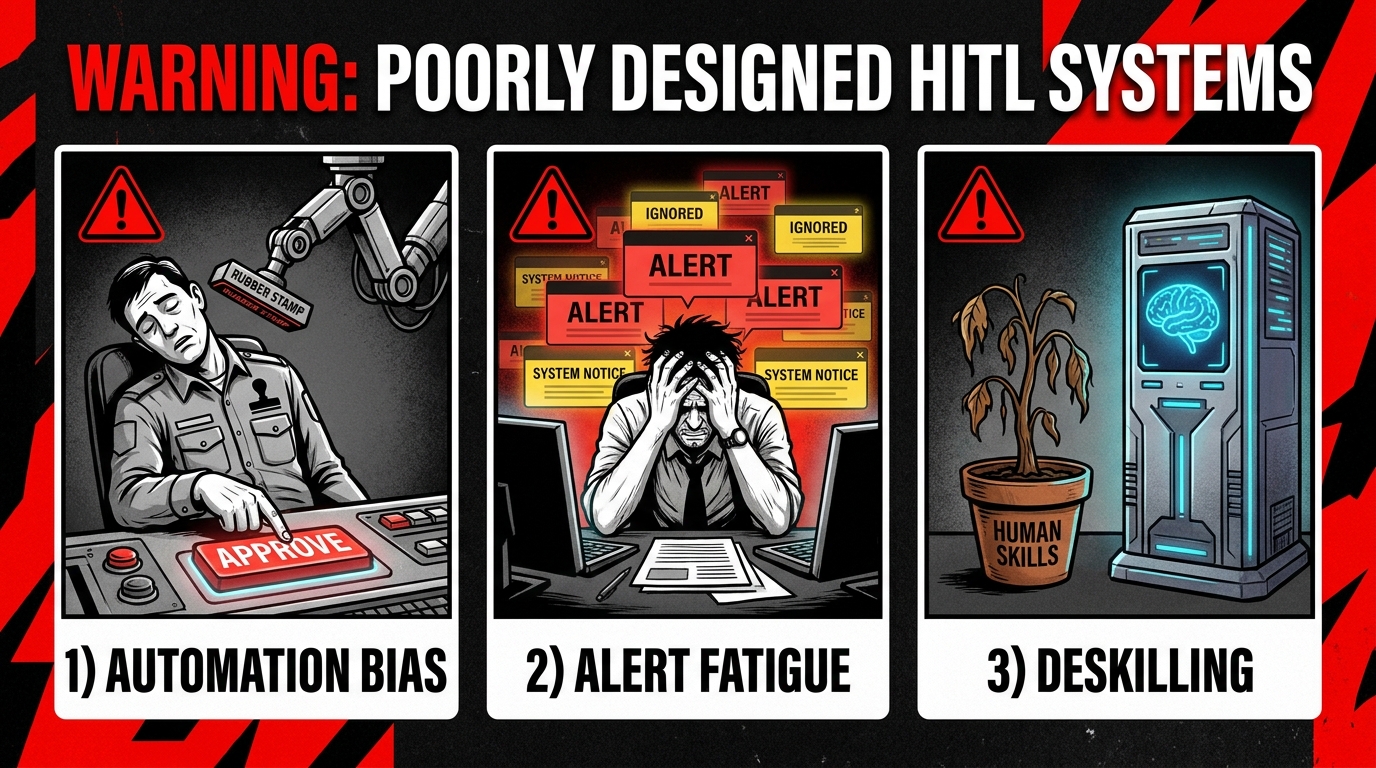
    The Hidden Costs: Automation Bias, Alert Fatigue, and Deskilling

    Three HITL failure modes illustrated: automation bias showing reflexive approvals, alert fatigue from notification overload, and deskilling of human expertise

    HITL is not automatically safe. Poorly designed HITL can be actively worse than either full automation or purely human decision-making — because it creates the appearance of human oversight without the substance. Three failure modes deserve careful attention.

    Automation Bias: The Rubber Stamp Problem

    Automation bias is the documented human tendency to over-rely on automated recommendations and under-apply independent judgment, especially when the AI presents with apparent confidence. It’s a well-studied cognitive phenomenon: when a system presents a recommendation, humans tend to anchor on that recommendation and require strong contradictory evidence to override it. In the absence of compelling contrary evidence, they default to approving what the AI suggests.

    This has been observed across multiple HITL domains. Radiologists have been shown to miss anomalies that they would have caught independently when reviewing AI-pre-screened images marked “normal.” Loan officers approve borderline applications at higher rates when the AI recommendation is “approve.” Content moderators pass more marginal content when the AI rates it “compliant.”

    The mitigation isn’t to remove the AI recommendation from the interface — that would eliminate most of the efficiency gain. It’s to design interfaces that force genuine engagement. This means: requiring reviewers to articulate their reasoning before seeing the AI’s recommendation in some fraction of cases; presenting confidence uncertainty prominently (not just the recommendation but how confident the model is); randomizing the display format to prevent pattern recognition shortcuts; and tracking individual reviewer override rates as a quality metric, with low override rates triggering calibration reviews.

    Alert Fatigue: When Oversight Volume Defeats Oversight Quality

    Alert fatigue is a throughput problem masquerading as a design problem. When the volume of review requests exceeds a reviewer’s processing capacity — or when a high percentage of alerts turn out to be low-priority — reviewers begin to treat oversight as an administrative task rather than a meaningful judgment exercise. Approval rates climb. Engagement time per review falls. Eventually, the review process exists formally but not functionally.

    The root cause is almost always miscalibrated thresholds. Organizations that set conservative escalation rules — routing too many decisions to human review to be “safe” — inadvertently flood their review queues with low-value cases and degrade the quality of review across the board. The paradox is that trying to maximize oversight by routing more to humans can result in less effective oversight per decision.

    The fix requires data. Track the distribution of outcomes for different alert tiers. If 95% of alerts in a given category result in approval with minimal review time, that’s evidence the category can be safely downgraded or removed from the human review path. Calibration of escalation thresholds should be a recurring operational practice, not a one-time setup decision.

    Deskilling: The Long-Term Risk Nobody Talks About

    Deskilling is the most insidious of the three failure modes because it operates slowly and invisibly. When AI handles the routine, pattern-recognition-intensive components of a job, and humans are left to review AI recommendations on an exception basis, the human’s opportunity to practice foundational skills decreases. Over time, that practice deficit erodes capability.

    Pilots who rely heavily on autopilot maintain lower manual flying proficiency. Clinicians who regularly review AI diagnostic recommendations show degraded independent diagnostic performance in studies where the AI is removed. Legal associates who spend years reviewing AI-drafted contracts rather than drafting from scratch develop gaps in their drafting capabilities.

    This matters because HITL’s safety value depends on the human in the loop being capable of catching what the AI gets wrong. If deskilling has degraded that capability, the human checkpoint provides less protection than it appears to. The oversight function becomes hollow.

    Organizations building long-term HITL architectures need to think about skill maintenance as an operational requirement. This might mean rotating staff through non-AI-assisted workflows periodically, designing training programs that keep foundational skills sharp, or explicitly tracking skill depth as a workforce metric alongside traditional performance indicators.

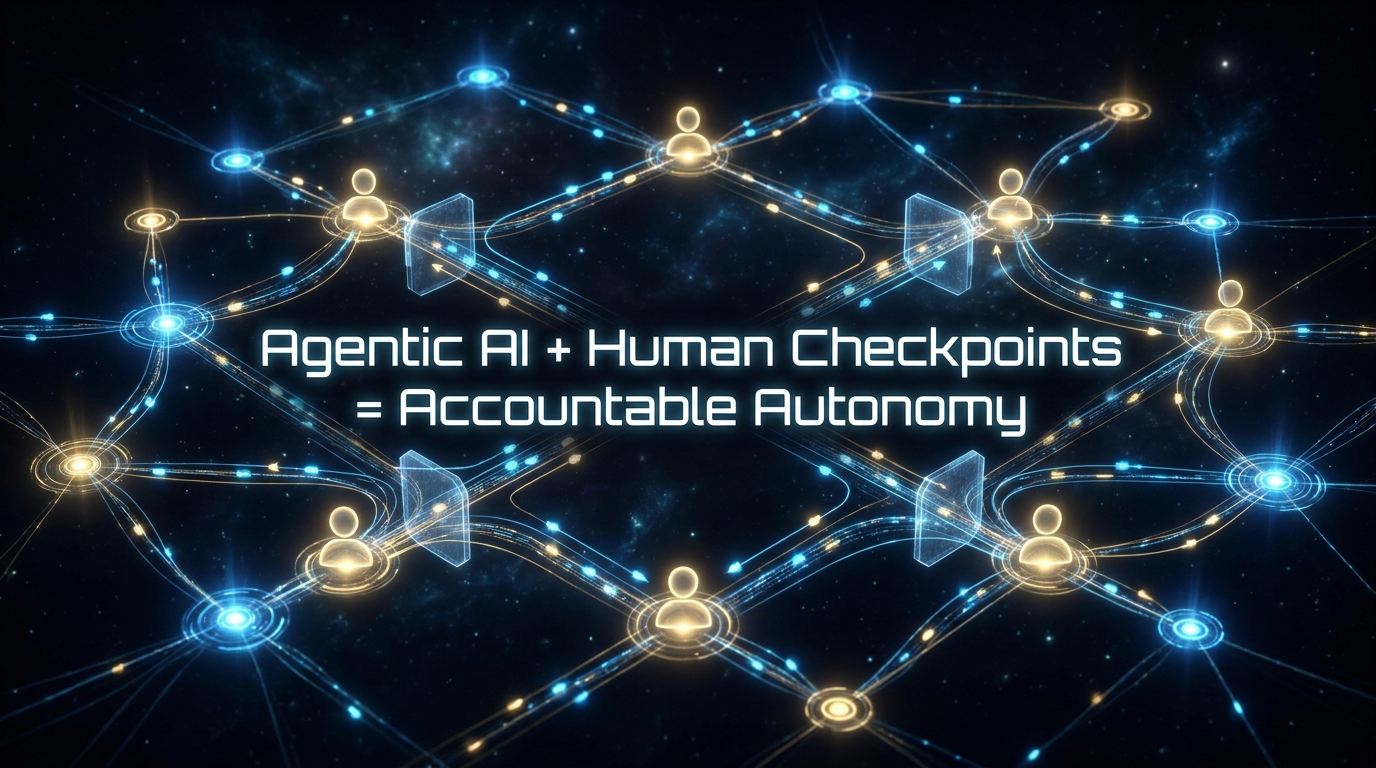
    Agentic AI and the New Oversight Problem

    Autonomous AI agent network with human checkpoint gates at critical decision nodes — visualizing accountable agentic AI oversight architecture

    Everything discussed so far has assumed a relatively bounded AI system: one that processes inputs and produces recommendations or takes discrete actions in a well-defined workflow. The emergence of agentic AI — systems that can plan multi-step tasks, invoke external tools, and operate across extended time horizons with minimal moment-to-moment human direction — creates a fundamentally different oversight challenge.

    Why Agentic AI Changes the Oversight Calculus

    With a conventional AI system, the boundary of possible action is narrow. The model takes input, produces output, a human reviews it, done. With an agentic system, a single task initiation might trigger a cascade of sub-actions: browsing the web for information, writing and executing code, sending emails, making API calls to external systems, creating documents, booking appointments, moving funds. Each sub-action builds on the last, and the compound effect of early errors — or early misinterpretations of the task objective — can propagate far before any human sees the result.

    Gartner projects that by 2030, 50% of AI agent deployment failures will stem from insufficient runtime governance and oversight. That forecast reflects a recognition that agentic systems require a qualitatively different approach to HITL, not just a quantitative extension of existing patterns.

    Checkpoint Design for Agents: The Critical Decisions

    Designing HITL for agentic systems requires answering several questions that don’t arise with conventional AI. First: at what points in a multi-step task should the agent pause for human verification? Pausing at every step defeats the purpose of agency; never pausing creates unacceptable risk. The emerging best practice is to pause at “consequence thresholds” — actions that are irreversible, involve external commitments, exceed defined value or data exposure limits, or represent a significant deviation from the initial task specification.

    Second: how do you preserve useful human oversight without requiring the reviewer to reconstruct the entire agent’s decision history? The agent may have taken fifty intermediate steps before reaching a consequence threshold. A reviewer presented with a raw action log will struggle to provide meaningful oversight. The interface needs to compress the relevant history into a reviewable summary — what the agent was trying to do, what it has done so far, what it proposes to do next, and what makes this moment a checkpoint — in a format that enables a qualified judgment in under five minutes.

    Third: what happens when an agent encounters uncertainty mid-task? The emerging design pattern is for agents to have an explicit escalation behavior — surfacing uncertainty to a human rather than guessing — whenever they encounter ambiguity about task objectives, conflicting signals, or situations outside their training distribution. This is meaningfully different from waiting for a consequence threshold; it’s the agent itself initiating oversight requests when it recognizes the limits of its own competence.

    Identity, Authorization, and Accountability Chains

    Agentic AI creates a new accountability problem. When an agent takes an action — particularly one with legal or financial consequences — who authorized it? The person who started the task? The person who reviewed the last checkpoint? The organization that deployed the agent? If the action causes harm, this question has legal standing.

    Sophisticated HITL architectures for agentic systems are incorporating identity-anchored authorization chains: each action that the agent takes is linked to an explicit authorization record showing which human approved which scope of action, at what time, under what stated task objective. This isn’t just for post-hoc accountability; it’s operationally useful because it limits what the agent can do autonomously to what a specific human has explicitly authorized for this specific task instance.

    This approach borrows from privileged access management frameworks in enterprise security. Just as you wouldn’t give a contractor unrestricted access to all production systems, you don’t give an AI agent unrestricted ability to take any action within its technical capability. Scoped authorization, linked to a human principal, creates the accountability chain that makes agentic systems governable.

    How to Design HITL That Actually Works — Not HITL Theater

    Most HITL implementations fail not because the concept is wrong, but because the design is shallow. Organizations add a review step to an existing workflow, call it HITL, and move on. What they’ve built is HITL theater — the structural appearance of oversight without the functional substance. Here’s how to build something that actually works.

    Start With Decision Architecture, Not Interface Design

    The most common mistake is starting with the interface. Teams build a review screen, add an approve/reject button, and consider the HITL work complete. But if the decision architecture upstream is wrong — if the wrong decisions are being routed to review, if the risk tiering is miscalibrated, if the confidence thresholds are arbitrary — the interface design is irrelevant.

    Decision architecture first means mapping every decision class in the workflow, characterizing each by consequence, reversibility, and regulatory status, and designing the routing logic before a single screen is designed. This is often a cross-functional exercise involving risk, compliance, legal, and operations — not just engineering. It takes longer upfront and produces substantially better outcomes.

    Treat the Review Interface as a Core Product

    The human review interface should receive the same product design investment as any customer-facing feature. It needs user research with actual reviewers. It needs usability testing. It needs iteration based on real-world use data. The questions it needs to answer — what is this, why did it land here, what do I need to decide — have to be answerable in under a minute for the oversight to be meaningful at operating throughput.

    Critically, the interface should be designed to resist automation bias. Confidence scores should be displayed with their uncertainty range, not just the point estimate. The review should surface disconfirming evidence alongside the AI’s recommendation. In high-stakes contexts, consider requiring reviewers to document their reasoning — not a long essay, but a structured selection from a checklist of decision factors — before they can submit their judgment.

    Build Measurement Into the Oversight System Itself

    HITL systems should be measured continuously, not just audited periodically. Key metrics include: reviewer override rate by decision class (are humans ever disagreeing with the AI?); review time per decision (is it long enough to indicate genuine engagement?); post-decision outcome tracking (when humans override the AI, are they right?); queue age and escalation rates (is the system flowing, or are decisions getting stuck?); and reviewer agreement rates across multiple reviewers on the same decision type (is human judgment consistent enough to be reliable?).

    These metrics are operationally useful and serve a second function: they provide the evidence base for calibrating the system over time. As the AI model improves in specific areas, human oversight requirements in those areas can be reduced. As new risk patterns emerge, escalation thresholds can be tightened. The oversight architecture should evolve continuously based on evidence from actual operations — not remain static after initial deployment.

    Design for Human Dignity and Sustainable Work

    Reviewers in HITL systems are doing cognitively demanding work, often at high volume. Organizations that treat review queues as high-throughput data entry — implicitly expecting reviewers to process large volumes as quickly as possible — will produce either automation bias (reviewers going through the motions) or burnout and turnover (reviewers who can’t sustain the cognitive load).

    Sustainable HITL design sets realistic throughput expectations based on decision complexity, not on what would be most convenient for the automated system. It provides review context that makes the work meaningful — reviewers who understand the downstream consequences of their decisions make better ones. It builds in breaks and cognitive recovery time. And it creates feedback loops so reviewers see the outcomes of their decisions — a fundamental driver of skill maintenance and judgment quality.

    The Market Taking Shape Around Human Oversight

    HITL is becoming a product category, not just an architectural pattern. The human-in-the-loop AI market was valued at approximately $2.4 billion in 2025 and is projected to reach $11.8 billion by 2034, growing at a compound annual rate of roughly 19.3%. That growth trajectory reflects genuine enterprise investment in oversight infrastructure — not just compliance spend, but operational capability.

    The Tooling Layer Is Maturing

    A year ago, most HITL infrastructure was custom-built. Engineering teams would wire together workflow orchestration, a review interface, and audit logging from disparate components. That’s changing rapidly. A new category of HITL-native platforms is emerging — tools designed from the ground up to support the pause-review-resume workflow, manage review queues, maintain decision state, and capture the audit data that compliance requires.

    These platforms are showing up at the intersection of several adjacent markets: workflow automation, AI governance tooling, and business process management. The differentiation is increasingly around the intelligence of the escalation layer — how well the platform identifies which decisions need human review — and the quality of the review interface, which determines whether oversight is genuine or performative.

    New Roles and Organizational Structures

    HITL at enterprise scale is creating new workforce requirements. The “AI reviewer” or “AI oversight specialist” role is becoming formalized in high-stakes sectors. These aren’t general-purpose employees who happen to review AI outputs; they’re specialists who understand both the domain (clinical, legal, financial) and the AI system’s behavior well enough to provide meaningful oversight rather than rubber-stamping.

    The role demands unusual cross-domain fluency: deep domain expertise, enough technical understanding of how the model works to interpret its confidence signals, and enough judgment to override confidently when warranted. Organizations are finding that this combination is hard to recruit for and hard to train toward — which is pushing some of the leading HITL platform providers toward building role-specific training and certification into their products.

    The Opportunity in Trustworthy AI Positioning

    For organizations selling AI-enabled products or services, robust HITL architecture is increasingly a competitive differentiator, not just a compliance cost. Enterprise buyers — particularly in regulated industries — are asking detailed questions about how oversight is designed, not just whether it exists. Vendors who can demonstrate genuine human oversight infrastructure, with evidence of its effectiveness, are winning deals over alternatives that offer comparable AI capability with weaker oversight stories.

    This dynamic is already visible in healthcare AI, where clinical validation studies and human oversight documentation are becoming purchase requirements rather than nice-to-haves. It’s emerging in legal tech, in financial services AI, and in any context where the AI’s actions have consequences that create liability for the deploying organization. HITL as a value proposition is arriving in parallel with HITL as a regulatory requirement — and the combination is accelerating the market.

    Human Judgment as a Product Feature: The Reframe That Changes Everything

    The most significant intellectual shift in how leading organizations are thinking about HITL is the reframe from oversight cost to product feature. Under the old model, human review was an expense — a necessary one in some cases, but fundamentally a drag on the efficiency gains that AI was supposed to deliver. Under the new model, human judgment is a feature that the product includes by design, because it produces demonstrably better outcomes than the fully automated alternative.

    This reframe has practical implications for how HITL gets funded and prioritized. When human oversight is framed as a cost center, it competes with efficiency for budget. When it’s framed as a product differentiator — something that makes the system more accurate, more trustworthy, and more defensible in regulated contexts — it gets resourced accordingly.

    The Accuracy Premium Is Real and Measurable

    The data supports the reframe. In domain after domain, human-machine collaboration produces accuracy results that neither party achieves alone. 95% of human-machine diagnostic teams outperform clinicians working independently. Document processing accuracy at 99.9% versus 92% AI-only. Legal review that surfaces more risk at lower cost than either pure human review or AI-only analysis. These aren’t marginal improvements — they’re the kind of step-change accuracy gains that become core to a product’s value proposition.

    The reframe also changes how you think about the cost of HITL. The relevant comparison isn’t “HITL versus no HITL.” It’s “the cost of human oversight versus the cost of errors that oversight prevents.” When you model that comparison honestly — including remediation cost, reputational damage, regulatory fines, and legal liability — HITL investment typically looks very different than when compared against the operating cost of a fully automated alternative.

    Trust as a Durable Competitive Asset

    There’s a longer-term dynamic worth naming explicitly. As AI becomes more pervasive, the organizations that will sustain competitive position are those that have built demonstrated, verifiable track records of reliable AI-assisted decisions. That track record is only possible with HITL infrastructure that captures the data — the decisions made, the human judgments applied, the outcomes observed — that allow you to show your system’s reliability over time.

    Fully automated systems that never involve humans provide no such track record. They can demonstrate accuracy on test sets, but they can’t demonstrate the kind of real-world, audited, outcome-tracked reliability that high-stakes enterprise buyers increasingly require. HITL architecture is, in this sense, the foundation of a trust asset that compounds over time — and that can be demonstrated to regulators, customers, and partners in ways that purely automated approaches cannot.

    What the Most Serious Teams Are Getting Right

    The organizations making HITL work in practice share some consistent characteristics. They treat oversight as a design constraint from day one, not a retrofittable feature. They staff review functions with people who have real domain expertise, not just operational throughput. They measure the quality of oversight continuously and calibrate accordingly. They build feedback loops so that the human judgments captured in the HITL system are actually used to improve model performance over time.

    And — critically — they resist the organizational pressure to loosen HITL requirements as AI confidence increases, without the data to support that loosening. Model confidence is not the same as real-world reliability across the full distribution of inputs a deployed system will encounter. The teams that maintain disciplined oversight standards, even as models improve, are the ones who avoid the regression to the mean that catches organizations off guard when their “good enough to go autonomous” AI encounters a case it handles badly.

    Conclusion: The Structural Reality of the Human-in-the-Loop Era

    Human-in-the-loop is no longer a phase in AI development. It is, for a substantial and growing fraction of enterprise AI use, a permanent architectural requirement — one driven by regulatory obligation, by evidence of outcome quality, and by the hard-won recognition that full automation of high-stakes decisions creates failure modes that are genuinely difficult to recover from.

    The organizations that will navigate this transition well aren’t the ones treating HITL as a compliance checkbox. They’re the ones that have internalized the design philosophy: that human judgment is a capability to be integrated deliberately, not an inefficiency to be minimized. That oversight quality is something you measure and improve over time, not something you declare complete and move past. That the human in the loop is not a temporary bridge to full autonomy, but a permanent contributor to outcome quality that any honest accounting of AI-assisted decisions needs to include.

    The engineering work is harder than the policy language implies. Checkpoint architecture, review interface design, state management, escalation logic, automation bias mitigation, deskilling prevention — each of these is a substantive design problem that requires real investment. None of them can be solved with a checkbox on a governance form.

    But the evidence on the other side of that investment — in accuracy, in defensibility, in regulatory compliance, in trust — is increasingly compelling. The question for most organizations in 2026 is not whether to build human oversight into their AI systems. It’s whether to build it well.

    Key Takeaways for Practitioners

    • Choose your oversight model — HITL, HOTL, or hybrid — based on decision reversibility, stakes, volume, and regulatory obligation. Don’t apply one model to all workflows.
    • Design decision architecture before designing review interfaces. Routing logic determines whether the right decisions reach human reviewers.
    • Invest in review interface quality as seriously as you invest in any customer-facing product. A bad review UX produces automation bias regardless of policy intent.
    • Measure override rates, review time, and post-decision outcomes continuously. A HITL system that never generates disagreements between humans and AI is likely not generating genuine oversight.
    • Build explicit deskilling prevention into your workforce model. The human in the loop needs maintained capability to provide the oversight that’s being relied upon.
    • For agentic AI, design consequence threshold checkpoints and identity-anchored authorization chains before deployment, not after the first incident.
    • Model the cost of HITL against the cost of errors it prevents — including remediation, liability, and regulatory exposure — not just against the operating cost of a fully automated alternative.