Most Amazon Sponsored Brands videos are made the way TV commercials get made. Someone writes a script with a hook, a story, a reveal, and a logo at the end. Someone films it, adds music, and uploads it. Then the ad goes live and quietly loses money.
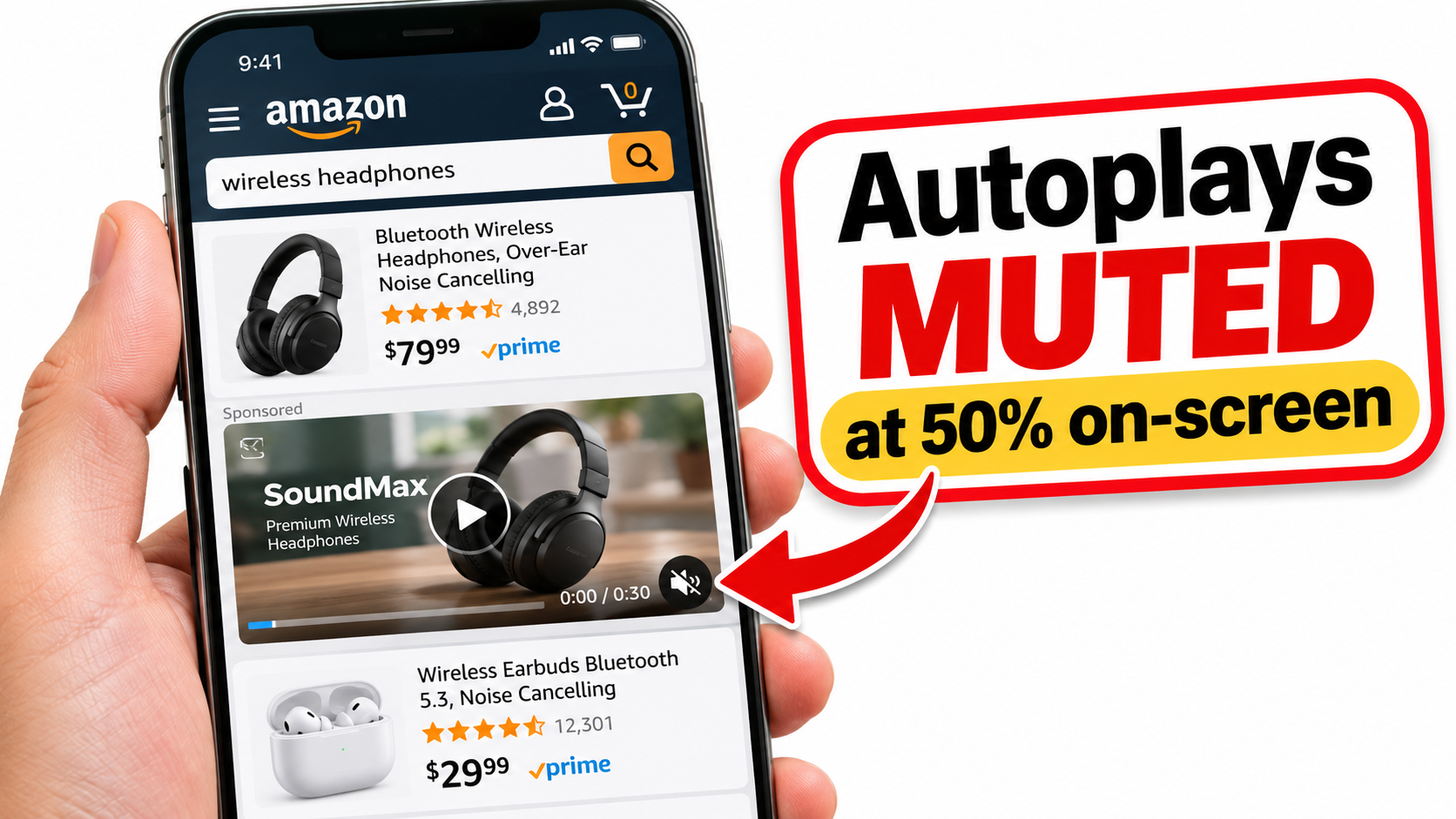
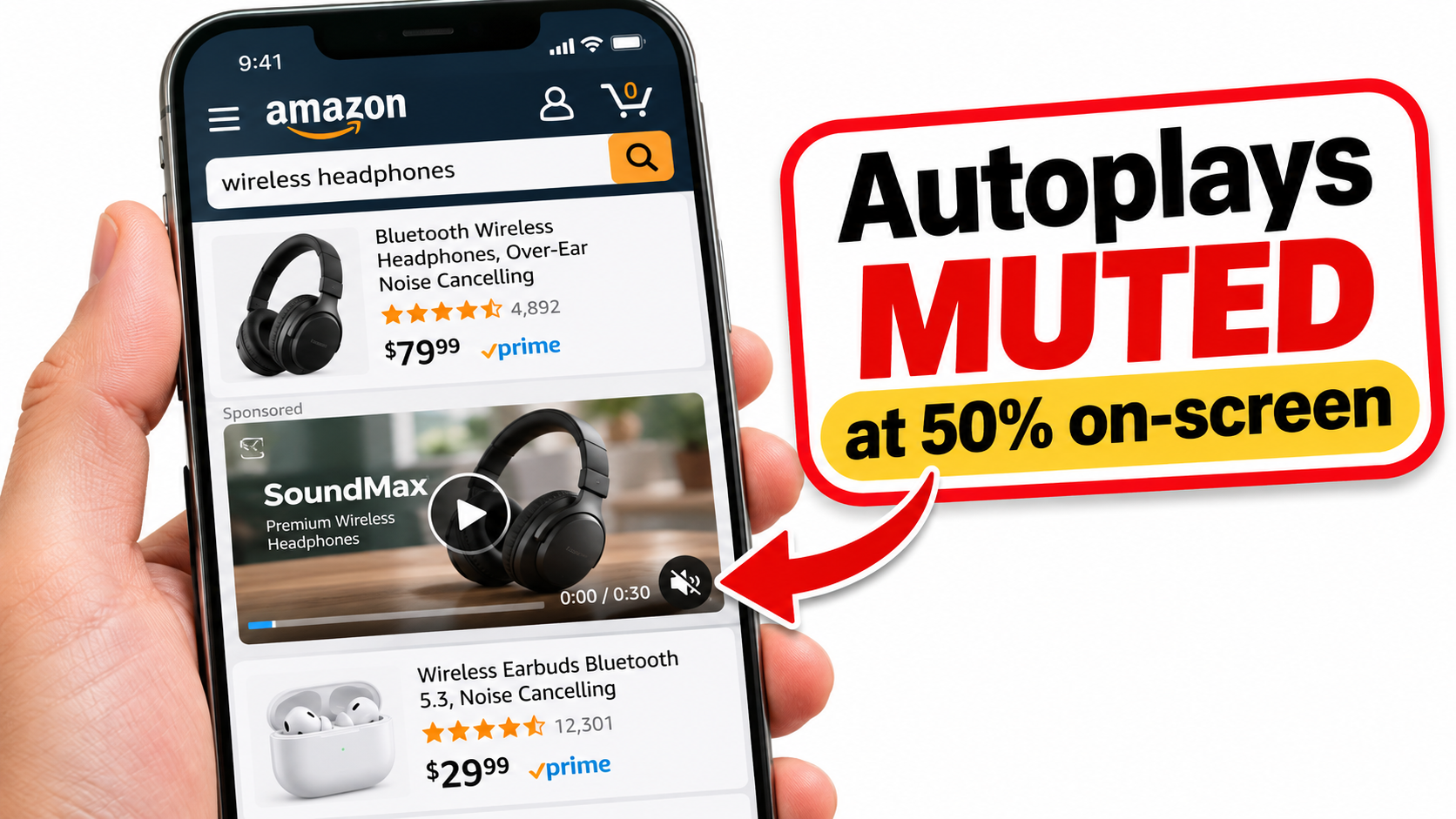
The problem usually isn’t production quality. It’s that the ad gets built for a setting it never plays in. A Sponsored Brands video doesn’t run on a TV with sound and a viewer sitting still. It runs inside a search results page. It starts playing without sound once half of it scrolls into view, next to product listings the shopper was already comparing. It is up against listings that answer questions faster than most videos do.
This guide skips the usual “video is engaging, so use video” pitch and starts from the mechanics. How does the Sponsored Brands video unit actually behave? What does Amazon fill in automatically, and what do you control? What do the 2026 specs and policies say? Which video format suits which job now that Amazon also offers Sponsored Products video, display video, and a fixed-price branded keyword option called reserve share of voice?
The approach is simple: work out how the ad really plays, then build the creative, the targeting, and the testing around that. Every spec and benchmark cited here comes from Amazon Ads’ published documentation or case studies. Where public data doesn’t exist, this guide says so and gives you a way to produce your own instead of an invented number.
The guide is written for brand-registered sellers and agency operators who already run Sponsored Products and want Sponsored Brands video to earn its share of the budget. If your current videos are getting impressions but few clicks, or clicks but a weak ACOS, the cause is almost always somewhere in the next ten sections.
1. A Sponsored Brands Video Is a Search Result, Not a Commercial
Amazon calls Sponsored Brands video a “storytelling tool” for brands to “initiate, cultivate, and maintain relationships with shoppers.” That’s accurate. But the story gets told in a very specific place, and the place determines what the story can be.
Where the ad actually runs
According to Amazon’s ad specs, Sponsored Brands video creatives show up in desktop and mobile shopping results and can also appear within product detail pages. Shoppers are reached through keyword, category, and product targeting, and the ad is billed per click. Brand Store campaigns can run both above and below the fold of search results.
So every time your video plays, the person seeing it is in the middle of a task. They typed a query or opened a product page, and they’re scanning for something that fits. Your video doesn’t interrupt entertainment. It interrupts a comparison.
Why that matters for creative
A TV spot can spend its first five seconds building atmosphere because the viewer isn’t going anywhere. A shopper in search results scrolls past anything that doesn’t instantly connect to their query. Amazon’s own creative guidance points the same way: “Showcase your product or something interesting within the first few seconds to catch the shopper’s attention,” and wait “until later in the video to include your brand name and logo.”
Read that carefully, because it runs against a lot of brand instinct. Amazon is telling advertisers not to open with the logo. In search, the product is the hook. The brand gets remembered because the product was worth noticing, not because the logo appeared early.
The question your video has to answer
Picture someone who searched “insulated water bottle for kids.” Your video plays muted beside a dozen static listings. In about two seconds, without sound, the frame has to answer: Is this the thing I searched for, and what’s different about it?
That’s a hard brief, and a very different one from “tell our brand story.” Brands that get good results from Sponsored Brands video usually treat each video as a moving product listing with some brand personality, not as a short film that happens to mention a product.
Takeaway
- Write the brief around the search query, not the brand manifesto.
- Assume the viewer is mid-comparison and gives you two seconds.
- Put the product, in use, in the first frame.
2. Anatomy of the Ad Unit: What Amazon Controls and What You Control
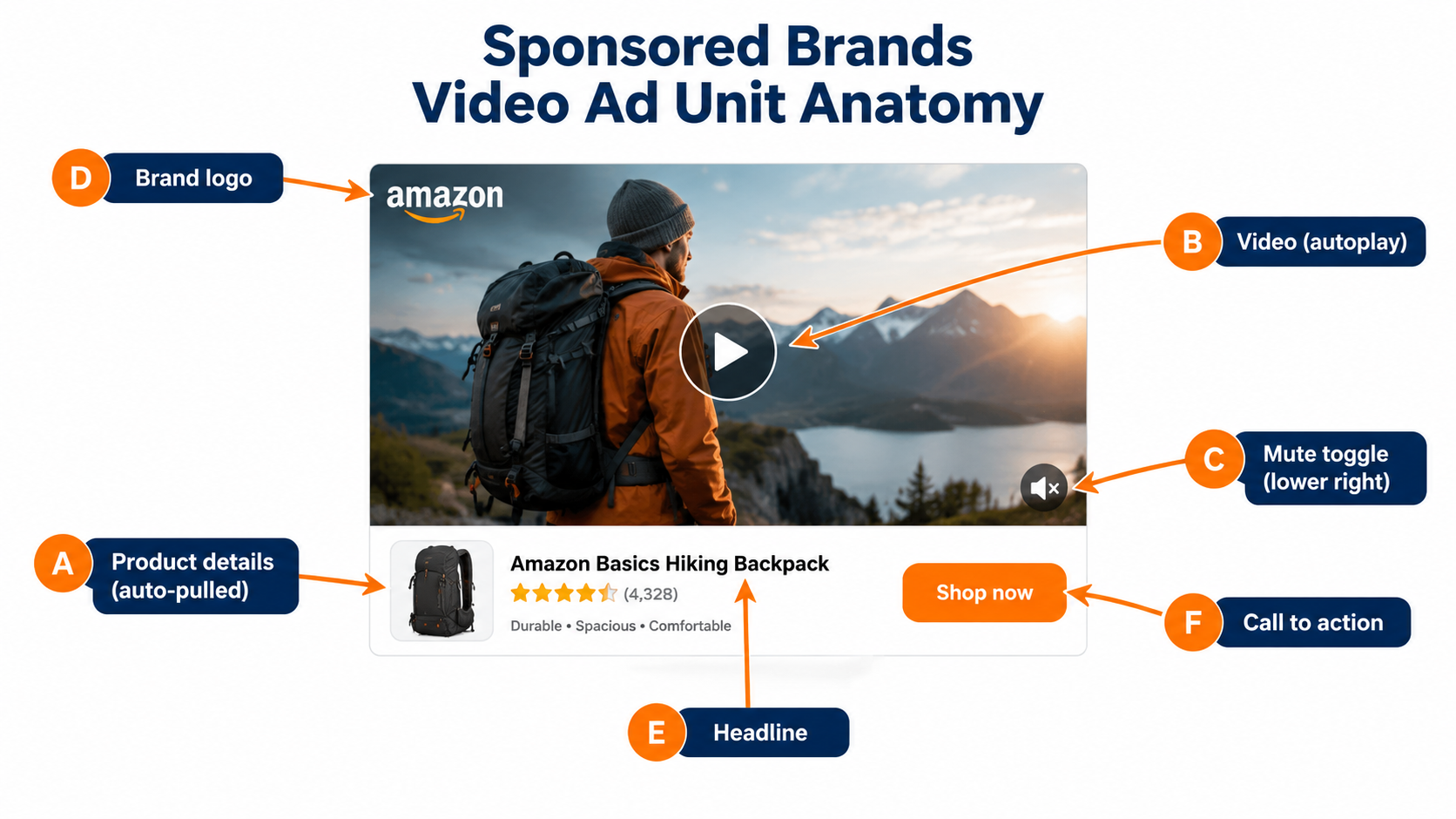
Before planning any creative, it helps to know exactly which parts of the ad you own. Amazon’s spec documentation splits the Sponsored Brands video unit into six components. Some you write, some Amazon generates, and some are fixed UI you have to design around.
The six components
- Product details (automatic). Amazon pulls the main product image and related details from the detail page. You can’t write this directly. It reflects whatever your listing shows.
- Video (yours). It autoplays once 50% of its pixels are on screen.
- Mute toggle (fixed UI). It sits over the lower-right corner. Videos always start muted, and shoppers have to tap to hear audio. If the video has no audio track, the toggle doesn’t show.
- Custom brand logo (yours). Amazon recommends a clear, readable logo.
- Headline text (yours). Custom copy that states your value.
- Call to action (Amazon-rendered). It tells shoppers an action leads to your Brand Store or product page.
The parts people forget they “own”
Component A is the one advertisers miss most. Because the product details come from the detail page, your listing is part of your ad creative. A weak main image, an unclear title, or a low rating shows up right next to your video, and no amount of editing fixes it.
So before you spend on video production, look at the listing the video will promote. If the main image wouldn’t win a click by itself, the video is starting from behind.
The parts that limit your design
The mute toggle is fixed in the lower-right corner. That’s why Amazon specifically says to avoid putting text or other important information there and offers a safe-area template. A price claim, a key feature, or a logo placed in that corner can get covered on the devices that matter most.
The autoplay trigger matters too. The video starts when half of it is visible, so on mobile the shopper may see the first second while only part of the frame is on screen. Put the key visual in the center of the frame, not at the edges.
Putting the pieces together
Think of the unit as one composition. The headline, the auto-pulled product details, and the first frame of video all appear at once. The best-performing combinations don’t repeat each other. If the headline says “Keeps drinks cold 24 hours,” the video can show ice still in the bottle at the end of a hot day instead of putting the same claim on screen again.
3. The Muted-First Creative Brief
Amazon states plainly that videos always start without audio. Shoppers can turn sound on, but you should plan as if most won’t. That single fact should change how you script, shoot, and edit.
Design for silence, add audio as a bonus
Write the script, then mute the cut and watch it. If the video doesn’t make sense, the visuals are leaning on the voiceover. Fix that in the edit before you launch, not after the data comes in.
Ways to make a silent video understandable:
- Show the result, not the setup. A stain disappearing, a cord untangling, a bag fitting into an airline sizer. Visual change reads without sound.
- Use short, large on-screen text. Three to five words per card, high contrast, away from the lower-right corner.
- Demonstrate scale. Hands, common objects, and real settings show size faster than a dimension chart.
- Cut on the action. Each shot should move the claim forward. Slow pans and lifestyle B-roll eat seconds and explain nothing.
Language rules apply to text and voice
Amazon requires videos to match the marketplace’s language: English on-screen text or voiceover for English-speaking locales, Italian for Italy, and so on. For multi-marketplace sellers, Amazon suggests subtitles or separate versions for each marketplace.
In practice, a muted-first video makes localization cheaper. When the meaning sits in visuals and a few text cards, a new market only needs new text cards, not a new shoot. That’s a real cost argument for keeping the voiceover light.
Where audio still helps
Audio isn’t useless. A shopper who taps to unmute is showing real interest, and a clear voiceover can close the sale. The rule isn’t “skip audio.” It’s “never let understanding depend on audio.”
Also remember: if your video has no audio at all, Amazon doesn’t show the mute toggle. That removes one UI element from the frame. For simple demonstration videos where sound adds nothing, that cleaner frame is worth considering.
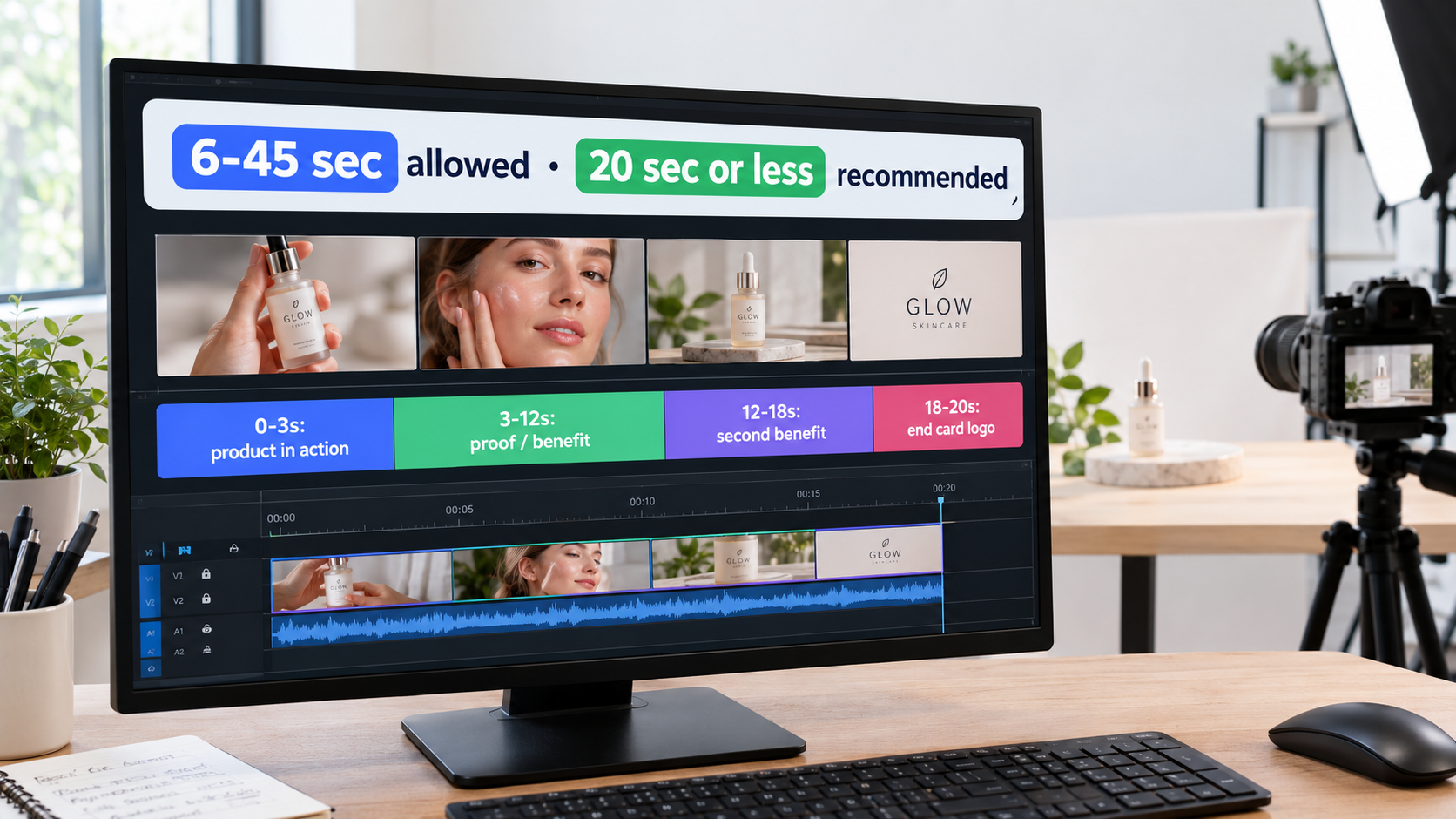
A muted-first script template
- Frame 1 (0–2s): The product doing its main job, centered, matching the target query.
- Proof beat (2–8s): One visible demonstration of the main differentiator.
- Second beat (8–15s): A secondary benefit or use case, shown not told.
- End card (15–20s): Brand name and logo, consistent colors, no critical text in the lower right.
4. Length: Why 45 Seconds Is Allowed and 20 Is the Target
Amazon’s spec permits Sponsored Brands videos between 6 and 45 seconds, with 20 seconds or less highly recommended. That gap between allowed and recommended deserves attention.
Why shorter usually fits the job
Amazon’s guidance says it directly: the video’s goal “is not to provide all the details about the product, but rather to create a sense of excitement and curiosity that will drive viewers to your product or Stores page for more information.” The detail page already holds the details. The video only needs to earn the click.
Each extra second is a second where a scrolling shopper can leave. If your strongest proof sits at second 30, most viewers will never see it. A 15-second cut that front-loads the proof will usually be seen in full more often, though you should confirm that with your own reporting.
When longer can make sense
There are fair reasons to use the extra length:
- Products that need a demonstration to be believed, such as multi-step tools or devices whose value only appears in use.
- Brand Store campaigns showing range, where a quick tour of several products may need more time.
- Detail page placements, where the shopper is already researching a related product and may be more patient.
Even then, the first few seconds have to work alone. A long video should be a short video that keeps going, not a slow build.
Use cut-downs as a test
The cheapest length test is to build both versions from one shoot. Edit a 15-second cut and a 30-second cut with the same opening frame, run them in otherwise identical ad groups, and compare click-through rate and conversion. That gives you an answer for your category, which matters more than any general rule.
Seconds-per-idea discipline
A useful editing rule: one idea per three to five seconds. A 20-second video holds four or five ideas at most, including the end card. If your script has eight selling points, it’s actually two or three videos. Split them and test which single angle pulls best.
5. Spec Traps and Rejection Risks You Can Avoid Before Upload
A rejected video costs more than the re-edit. It costs days of missing placements, often during a launch or seasonal push. Most rejections and technical failures trace back to a short list of specs and policies anyone can check in advance.
The technical specs, in one place
From Amazon’s published Sponsored Brands video specs:
- Duration: 6–45 seconds (20 seconds or less recommended)
- Dimensions: 1280×720, 1920×1080, or 3840×2160 px
- Aspect ratio: 16:9 (square pixel) only
- File size: 500 MB or less
- Format: .MP4 or .MOV
- Codec: H.264 or H.265, Main or Baseline profile
- Frame rate: 23.976, 23.98, 24, 25, 29.97, 29.98, or 30 fps
- Video bit rate: minimum 1 Mbps, 4 Mbps or higher recommended
- Scan type: progressive
- Audio: PCM, AAC, or MP3; stereo or mono; minimum 96 kbps; minimum 44.1 kHz sample rate
The vertical video trap
Here’s the trap that catches the most brands in 2026: 16:9 only. Many brands now produce mostly vertical 9:16 content for TikTok, Reels, and Shorts. The obvious shortcut is to drop that vertical clip into a horizontal frame with blurred or colored side bars.
Amazon’s policy forbids exactly that. The specs say to avoid “horizontal or vertical black, color, or blurred bars,” meaning letterboxing and pillarboxing. Social content has to be reframed or reshot for horizontal, not just padded.
If you plan shoots with this in mind, it’s easy. Film wide enough to crop both a 16:9 and a 9:16 version from the same footage, and keep the action in the center of the frame. One shoot can then supply both channels without breaking either platform’s rules.
Other common problems
- Language mismatch: English text in a video sent to a non-English marketplace, or the other way around.
- Safe-area violations: key text or claims in the lower-right corner under the mute toggle.
- Audience suitability: Amazon requires all content to suit a general audience and follow applicable laws and its creative acceptance policies.
- Interlaced exports: some older editing presets export interlaced video, but the spec requires progressive scan.
Pre-upload checklist
- Export at 1920×1080, H.264, progressive, 4+ Mbps.
- Watch the whole cut muted. Is it still clear?
- Overlay Amazon’s safe-area template. Is the lower right clear?
- Confirm no bars on any edge.
- Confirm on-screen text and voice match the target marketplace’s language.
- Review the Amazon Ads policies page for category-specific rules before submitting.
6. Detail Page or Brand Store? Picking the Destination Changes the Whole Campaign
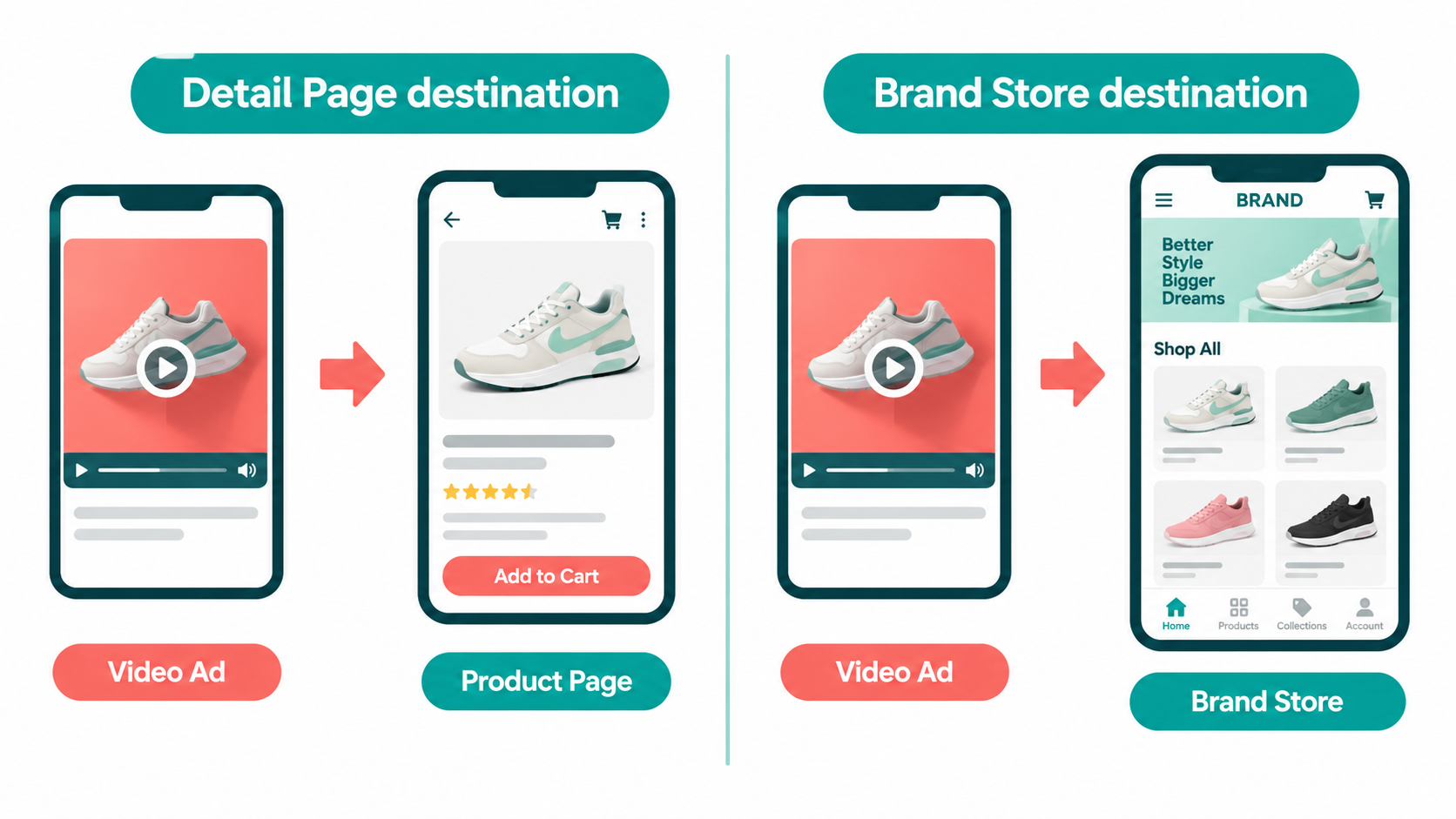
Amazon offers two ways to connect Sponsored Brands video to shoppers, and the choice changes more than the click destination.
Product Detail Page campaigns
Amazon describes the detail page campaign as “best for connecting shoppers with your product.” These ads show in shopping results and on detail pages. The path is short: video, click, product page, add to cart.
This is the right choice when:
- One hero ASIN drives most of your revenue and you want to defend or grow it.
- The target query is narrow and points to one product type.
- You’re launching a new product and need direct sales velocity.
- The video demonstrates one product’s specific feature.
Brand Store campaigns
Amazon describes the Store campaign as a way to “increase brand equity and build lasting value” by sending shoppers from shopping results to your Brand Store. Per the specs, these can show both above and below the fold in search results.
This works best when:
- The query is broad (“camping gear,” “skincare for dry skin”) and no single product clearly fits.
- Your catalog has several products that serve the same buyer.
- The goal is brand discovery and cross-selling more than one immediate conversion.
- Your Store is well built, with clear navigation and pages that match the video’s theme.
The mismatch problem
The most common destination mistake is a single-product video sending traffic to a general Store homepage. The shopper clicked because of one product, landed on a grid of twenty, and has to hunt for it. Every extra step loses buyers.
The reverse mistake also happens: a range video (“our whole kitchen line”) sending clicks to one detail page. The shopper expected choices and got one option.
Match the video’s promise to what’s on the landing page. If you choose Store, send traffic to a Store page that reflects the video’s theme, not automatically to the homepage.
What the case studies suggest
Amazon’s case studies show both models working inside a wider program. HP used Sponsored Brands video alongside Sponsored Brands, Sponsored Products, and display ads, and reported 224% year-over-year growth in impressions and a 142% year-over-year increase in clicks, with a 42% increase in clicks on Sponsored Brands video placements. The lesson isn’t that one destination wins. It’s that video worked as one part of a coordinated mix, not as a standalone test.
7. Targeting: Matching the Video to the Query
Sponsored Brands video supports keyword, category, and product targeting. Because the creative is so specific, targeting decisions have more effect here than in Sponsored Products, where the ad is basically the listing.
One video should not chase every keyword
A Sponsored Products ad adapts in a sense: the listing is the same whatever the query, and relevance comes from the listing itself. A video makes a specific visual claim. A video showing a backpack fitting under an airline seat is great for “personal item travel backpack” and largely irrelevant for “hiking daypack,” even if the product suits both.
The fix is to group keywords by shopper intent, not product, and give each intent cluster its own video. Same product, different first frame, different headline. That’s more work up front, but it’s the most direct way to raise click-through rate.
Keyword targeting approaches
- Non-branded, problem-led queries: Best paired with demonstration videos that show the problem being solved. This is where video does most of its discovery work.
- Branded queries: Shoppers already know you. The video can reinforce range, introduce new products, or block competitors. (Section 9 covers a fixed-price option for this.)
- Competitor brand queries: Use carefully. The video has to give a clear, visible reason to switch, and every claim has to be accurate and follow Amazon’s policies.
Product and category targeting
Because Sponsored Brands video can appear within detail pages, product targeting puts your video in front of shoppers looking at a specific competing or complementary product. Here the shopper has already picked a product type, so the video should answer “why this one instead?” through visible comparison of features, materials, or use cases.
Category targeting is broader and works best with videos that sell the brand or a hero product’s main differentiator without relying on one specific query.
Read the search term report as creative feedback
Your search term report isn’t only for adding negatives. It shows which queries the video actually earns clicks on. If a video built for “kids water bottle” keeps converting on “leakproof bottle for backpack,” that’s a sign: shoppers care about leaks. Your next video might open with a bottle upside down in a bag.
Takeaway
- Build ad groups around intent clusters, one video per cluster.
- Use the search term report to find the next creative angle.
- Match the claims in product-targeted videos to the competitor being targeted.
8. Sponsored Brands Video vs. Sponsored Products Video vs. Display Video: Give Each Format a Job
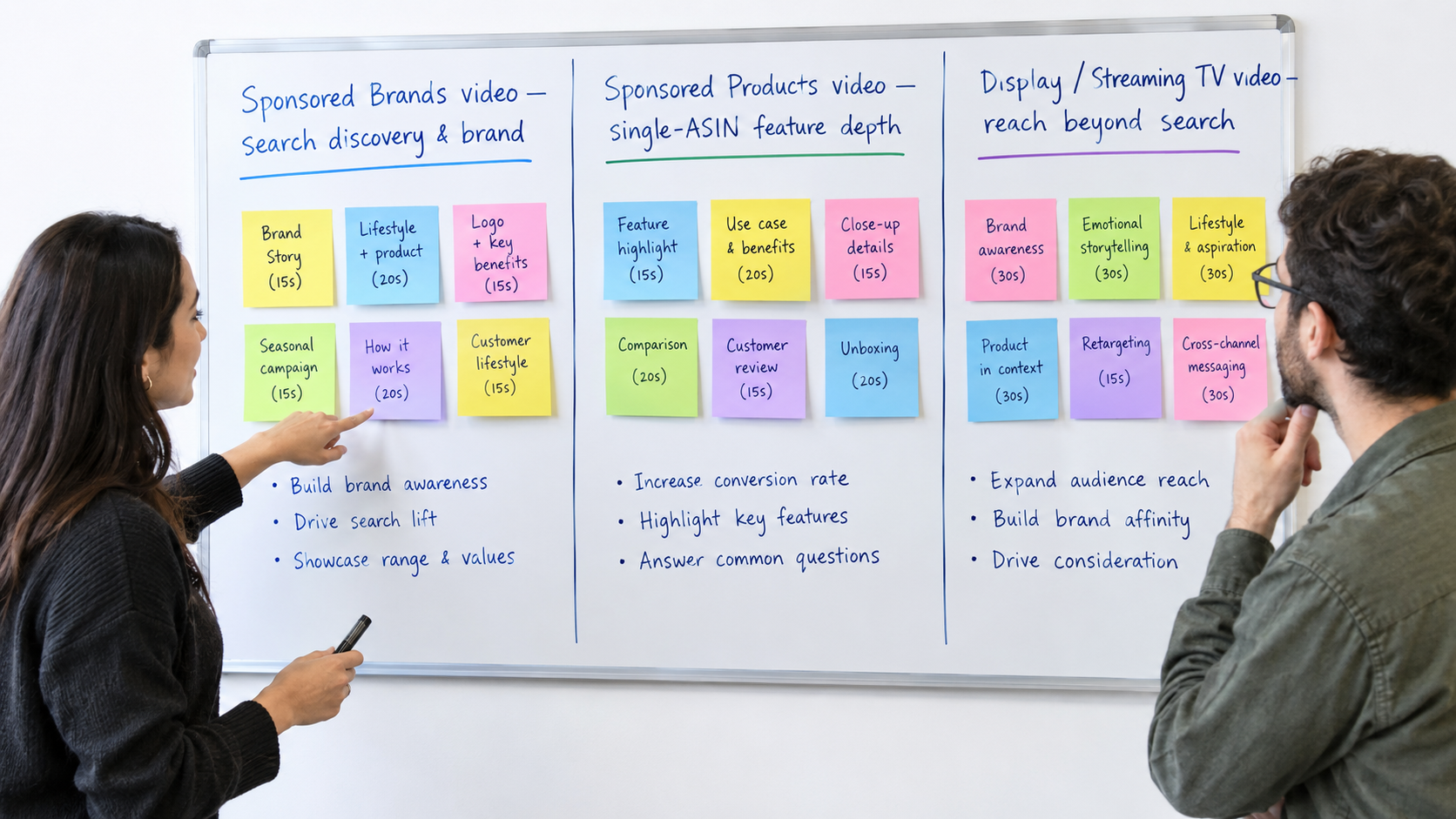
In 2026, “Amazon video ads” covers several formats. Amazon’s own video ad lineup lists Sponsored Brands video, Sponsored Products video, display ads with video, streaming TV ads (including Prime Video), online video ads, and Amazon Live. Running them all with the same clip and no clear role for each leads to overlap and muddy reporting.
How Amazon describes each format
- Sponsored Brands video: “Tell your brand story on Amazon with rich, autoplay video ads that appear in Amazon.com search results and product detail pages.”
- Sponsored Products video: “Interactive long-form video content that showcases specific product features for a single product (ASIN) across Amazon and select premium apps and websites.”
- Display ads with video: Autoplay video on the Amazon homepage and detail pages, IMDb, Amazon Publisher Services sites and apps, and other premium sites across the open internet.
- Streaming TV ads: Full-screen, non-skippable video before, during, or after streaming content on connected TV, desktop, and mobile.
A practical job split
Based on those descriptions, a sensible division of roles looks like this:
- Sponsored Brands video owns search-led discovery and brand association. Short, muted-first, built around an intent cluster, and able to send traffic to a detail page or Store.
- Sponsored Products video owns single-ASIN depth. Amazon specifically calls it long-form and feature-focused, which is a different brief from the short, curiosity-driven Sponsored Brands video. Your detailed feature walkthrough belongs here.
- Display and streaming video own reach beyond the search box. They find people who aren’t searching yet, which builds the branded search demand that Sponsored Brands can later capture.
Why the split matters for creative
Using one video everywhere means it’s tuned for nowhere. A 45-second feature tour is too slow for a muted search placement. A 12-second hook clip is too thin for a feature-focused format. Shoot once with all formats in mind, then edit separate cuts for each job.
Why the split matters for measurement
Clear roles also make reporting easier to read. If Sponsored Brands video is judged on discovery metrics such as new-to-brand performance and click-through rate on non-branded terms, while Sponsored Products video is judged on conversion for a specific ASIN, you stop comparing formats that were never meant to do the same thing.
9. Branded Search Defense: Reserve Share of Voice and Where Video Fits
One of the newer Sponsored Brands options deserves its own section because it changes how branded keywords get bought. Amazon now offers Sponsored Brands reserve share of voice, a goal-based campaign type that lets advertisers secure top-of-search visibility for branded keywords at a fixed, upfront price.
How it works
According to Amazon’s guide, you choose and reserve exact-match branded terms in Amazon Ads Agent. The system checks eligibility and quotes a fixed price based on historical traffic and availability. You set the reservation length, confirm the budget, and use existing Sponsored Brands creative, including video. When shoppers search those terms, your ad shows in the Sponsored Brands top-of-search placement on desktop and mobile.
What the beta showed
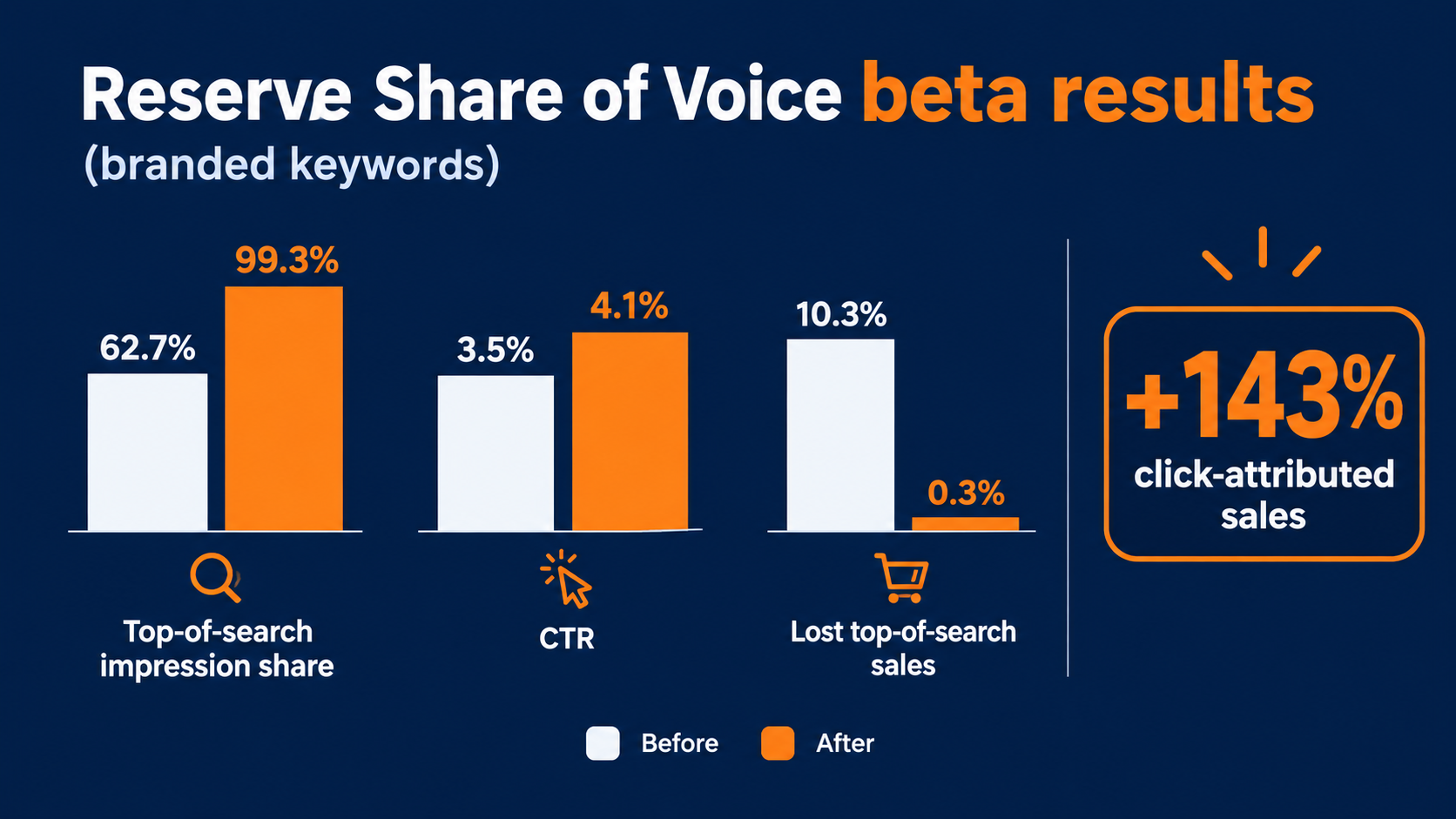
Amazon reports that in a beta comparing participants on the same branded search queries, reserve share of voice:
- Raised Sponsored Brands top-of-search impression share on reserved keywords from 62.7% to 99.3%
- Raised click-through rate from 3.5% to 4.1%
- Increased click-attributed sales by 143%
- Cut lost top-of-search sales from 10.3% to 0.3%
The first figure is the striking one. Even advertisers actively bidding on their own brand names were missing that top-of-search slot more than a third of the time. That gap is where competitors appear on searches for your name.
Where video fits
Amazon’s guide includes a pro tip to pair reserve share of voice with video. Branded searchers already know you, so the video’s job changes. It doesn’t have to explain the category. It can:
- Introduce a new product to existing fans
- Show your range so a single-product buyer finds a second item
- Reinforce what made them search for you, such as quality, design, or a signature feature
Amazon’s broader creative advice for these campaigns includes leading with brand recognition, showing best products, keeping messages simple, using the Brand Store as the destination, and refreshing creative over time. Note how this differs from non-branded video, where Amazon advises holding the logo until later. Branded and non-branded videos are different briefs, and they should be different cuts.
When to reserve
Amazon suggests reserving branded keywords before peak moments such as product launches, seasonal events, or Prime Day. Fixed pricing removes bid uncertainty during the weeks when competitor bids on your brand name are most likely to rise.
10. Measuring Sponsored Brands Video Without Fooling Yourself
Public benchmarks for Sponsored Brands video are thin and vary widely by category, price point, and season. Instead of borrowing someone else’s averages, build a measurement setup that produces benchmarks for your own account.
Judge each campaign against its job
Video campaigns get cut too early when they’re held to Sponsored Products ACOS targets. A non-branded discovery video is reaching shoppers who may never have heard of you, so expect a different cost profile than a Sponsored Products campaign on an exact-match term that already converts.
Set targets by role:
- Non-branded discovery video: click-through rate on target queries, new-to-brand share of sales, and an ACOS ceiling you can accept for customer acquisition.
- Branded defense video: top-of-search impression share, click-through rate, and conversion rate.
- Product-targeted conquest video: conversion rate and cost per acquisition compared with the competitor ASINs targeted.
For reference, Amazon’s Loftie case study reported a ROAS of $5.66 and an ACOS of 17.68% from a sponsored ads campaign. That’s one brand’s result from a broader sponsored ads program, not a Sponsored Brands video benchmark, and it shouldn’t be treated as one. It’s useful mainly as a reminder that efficient results are possible when creative, targeting, and listings line up.
Diagnose by funnel stage
When a video underperforms, find the stage where it breaks before you change anything:
- Low impressions: a bid, budget, or targeting problem, not a creative one.
- Impressions but low CTR: the first frame and headline aren’t matching the query. Fix the opening seconds.
- Clicks but low conversion: the landing page doesn’t deliver on the video’s promise, or the listing (price, reviews, images) loses the comparison. Check destination fit first.
Test one variable at a time
The most useful video test changes only the opening frame. Keep the headline, targeting, bid, and destination fixed. Swap the first two seconds between two versions and compare click-through rate over a meaningful amount of traffic. Then move to the next variable: headline, length, destination.
Testing everything at once tells you something changed. Testing one thing tells you what changed.
Refresh on a schedule
Amazon’s reserve share of voice guide recommends refreshing creative over time, and the same applies across Sponsored Brands video. Shoppers in your category see the same placements over and over. Plan a refresh cycle, and use search term reports and CTR trends to decide which angle to try next.
11. A 30-Day Launch Plan for Your Next Sponsored Brands Video
Here’s how the sections above fit into a practical launch sequence. Adjust the timing to your production capacity, but keep the order.
Days 1–5: Groundwork
- Audit the listing that will appear in the ad unit: main image, title, rating, price competitiveness.
- Pull 60–90 days of search term data and group queries into two or three intent clusters.
- Choose the destination for each cluster: detail page for narrow intent, a themed Store page for broad intent.
- List branded keywords and check whether reserve share of voice fits an upcoming launch or seasonal peak.
Days 6–14: Production
- Write one muted-first script per intent cluster using the four-beat template.
- Shoot wide so you can crop both 16:9 (Amazon) and 9:16 (social) versions without bars.
- Edit a roughly 15-second cut and a longer cut for each script.
- Build separate branded cuts with the logo earlier and range-focused content.
Days 15–17: Quality control
- Run the pre-upload checklist: specs, muted viewing, safe area, no bars, language match.
- Write headlines that add to the video instead of repeating it.
- Submit early to leave room for moderation before your target launch date.
Days 18–30: Launch and first test
- Launch one ad group per intent cluster with the shorter cut.
- Duplicate the strongest cluster with the longer cut to test length.
- Check the funnel stage (impressions, CTR, conversion) weekly, and fix the weakest stage first.
- Note the search terms that convert and turn them into the next video brief.
After day 30
By the end of the month you should have your own benchmarks: CTR by intent cluster, conversion by destination, and an early read on length. Those numbers will be more useful than any industry average, because they come from your category, your price point, and your listings.
Conclusion: Build for How the Ad Really Plays
Sponsored Brands video doesn’t underperform because video doesn’t work on Amazon. It underperforms when the creative is made for a setting it never appears in. The ad autoplays muted when half of it is on screen. It sits next to an auto-pulled product listing, under a fixed mute toggle, inside a search results page where shoppers are mid-comparison. Creative that respects those conditions has a real chance. Creative that ignores them is paying for impressions that get scrolled past.
The main points:
- Your listing is part of your ad. Fix the main image, title, and reviews before paying for production.
- Muted-first, product-first. Show the product doing its job in the first two seconds. Hold the logo for the end on non-branded campaigns.
- Aim for 20 seconds or less. Amazon allows 6–45, but the video’s job is to earn the click, not explain everything.
- 16:9 only, no bars. Shoot wide so social and Amazon cuts come from one session.
- Match the destination to the promise. Single-product videos go to detail pages. Range videos go to themed Store pages.
- One video per intent cluster. Generic videos lose to specific ones.
- Give each video format a job. Sponsored Brands video for search discovery, Sponsored Products video for single-ASIN depth, display and streaming for reach.
- Protect your brand name. Amazon’s beta data shows even active advertisers were missing top-of-search on their own branded terms a large share of the time. Reserve share of voice plus a branded video closes that gap.
- Measure by role and test one variable at a time. Build your own benchmarks instead of borrowing averages.
Start with one intent cluster, one muted-first script, and one clean test. Within a month you’ll know more about what Sponsored Brands video can do for your brand than any general benchmark can tell you.