
Tag: Article 50

  • What the EU AI Act’s Transparency Rules Actually Demand From Agent Builders Right Now

    What the EU AI Act’s Transparency Rules Actually Demand From Agent Builders Right Now

    EU AI Act transparency rules for AI agents now in force from August 2, 2026

    On 2 August 2026, the EU AI Act stopped being a planning exercise and became a live compliance obligation. Article 50 — the transparency chapter that governs how AI systems disclose themselves to users — entered full application that day. The European Commission published its final guidance in July 2026. The AI Office and Member State authorities now have the tools to enforce what is written.

    And yet, across the organisations building and deploying AI agents right now, the same three misconceptions keep surfacing. First: that transparency compliance is just a UI checkbox — slap a banner somewhere and move on. Second: that only “chatbots” are affected. Third: that whoever built the underlying model carries the liability, not the team that assembled the agent on top of it.

    All three are wrong. And the cost of getting this wrong — €15 million or 3% of global annual turnover, whichever is higher — is not a theoretical risk anymore. It is the middle band of a live enforcement regime.

    This article is not a summary of the regulation. It is a working compliance analysis for the teams actually building agentic systems: product managers scoping disclosure UX, engineers implementing machine-readable marking, legal teams drawing the provider/deployer boundary, and engineering leads trying to understand what a compliant audit trail actually looks like. We go clause by clause where it matters, and practical wherever possible.


    What Article 50 Actually Says — Versus What Most People Think It Says
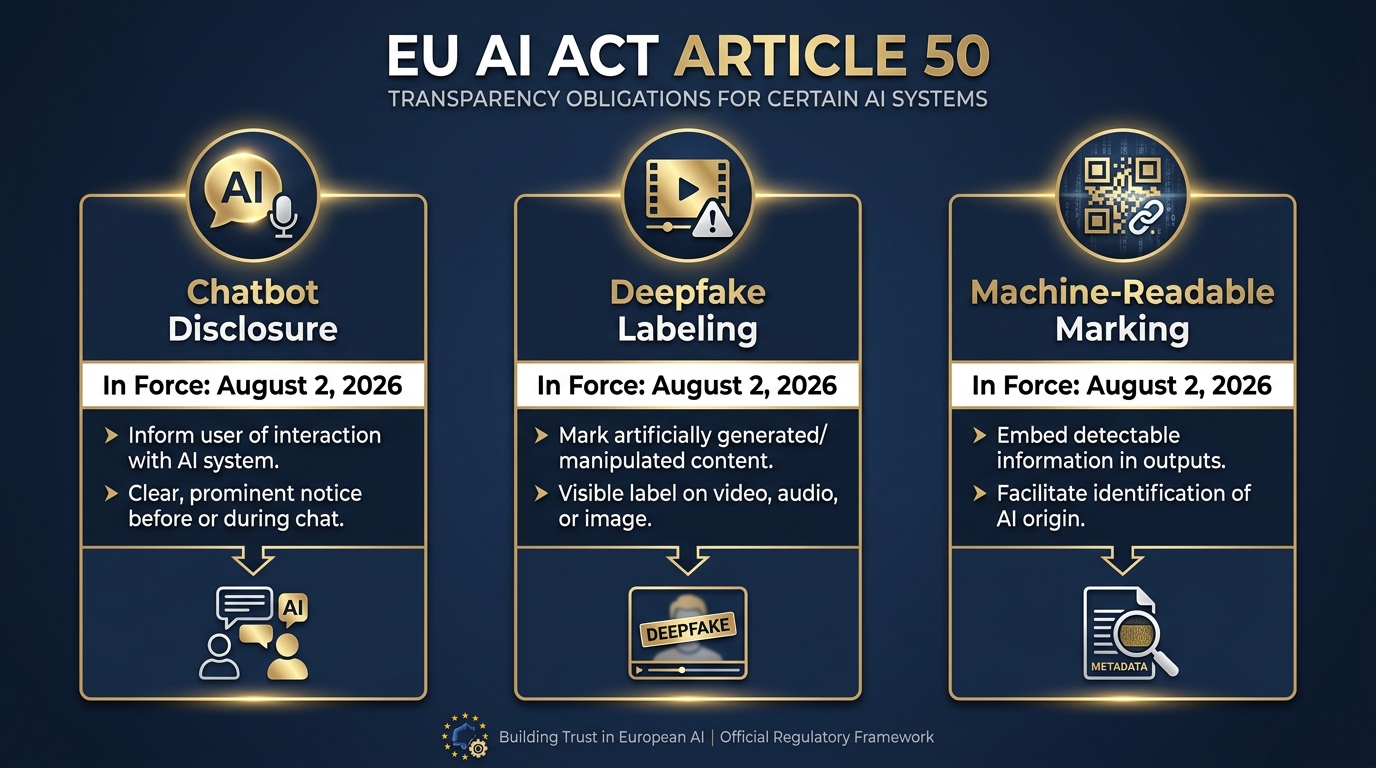
    Article 50 EU AI Act infographic showing three transparency obligations: chatbot disclosure, deepfake labeling, and machine-readable marking, all in force August 2 2026

    Article 50 of the EU AI Act contains four distinct obligations, each with its own trigger condition, responsible party, and technical implementation requirement. The regulation groups them into a single article, which has caused organisations to treat them as a single undifferentiated “transparency” task. They are not.

    Obligation 1: Disclosure That a User Is Interacting With AI (Article 50(1))

    This is the one everyone knows about. When a person interacts directly with an AI system — a chatbot, virtual assistant, or agent with a conversational interface — the provider of that system must inform the person that they are interacting with an AI system. The disclosure must happen at the latest by the first interaction. It does not need to be repeated at every message, but it must be present at the point of first contact.

    The critical qualifier is that the obligation does not apply when it is obvious from context that the user is interacting with AI. This “obvious from context” exception is not a wide loophole. The Commission’s July 2026 guidance makes clear that “obvious” is assessed from the perspective of a reasonable user, not from the perspective of a technically-informed operator who knows the system is AI-powered. If there is any plausible ambiguity — and with modern conversational agents, there almost always is — the obligation stands.

    What the obligation does not require is that the disclosure be lengthy or conspicuous. A persistent label, a brief acknowledgement at session start, or a clearly identifiable AI persona can satisfy the rule. The key is that the disclosure is present, proximate to the interaction, and comprehensible — not buried in terms of service or a privacy policy three links deep.

    Obligation 2: Disclosure That Content Is AI-Generated or AI-Manipulated (Article 50(3) and 50(4))

    This obligation targets two specific content types: deepfakes, and AI-generated text or audio on matters of public interest — election content, policy positions, scientific claims — where a reasonable person might be materially misled.

    Deepfakes that realistically portray real people, places, events, or objects must be labelled in a way that is clearly perceivable to the end user. AI-generated public-interest text — think automated news summaries, political messaging, health information — must similarly carry a disclosure that it is AI-generated. Both obligations fall on deployers, not just providers. If your organisation runs the deployment pipeline that outputs this content to end users, the labelling responsibility is yours regardless of which model you used to generate it.

    Obligation 3: Emotion Recognition and Biometric Categorisation Disclosure (Article 50(5))

    Any person exposed to an emotion recognition system or a biometric categorisation system must be informed of the operation of that system and of the fact that their data is being processed. This applies broadly — not just to dedicated emotion recognition products, but to any AI agent that incorporates such functionality as a component. If your customer service agent analyses sentiment signals or voice tone as part of its routing logic, this obligation may apply.

    Obligation 4: Machine-Readable Marking of Synthetic Outputs (Article 50(2))

    This is the obligation that has received the least operational attention, yet carries significant technical implementation complexity. Providers of AI systems that generate synthetic audio, image, video, or text must mark those outputs in a machine-readable format that makes them detectable as AI-generated or AI-manipulated. The marking must be embedded in the output itself — not just logged server-side or disclosed to the user separately. It must be effective, interoperable, robust, and reliable, as far as technically feasible.

    This obligation came into force on 2 August 2026 for new systems. For systems already on the market before that date, a grace period extends to 2 December 2026. After that, every generative AI system placing outputs into the EU market — regardless of when it launched — must comply.


    The Provider vs. Deployer Line: Where You Actually Fall Determines What You Owe

    EU AI Act provider vs deployer distinction diagram showing roles and obligations for AI agent builders and business users

    The EU AI Act distributes compliance responsibilities across two primary roles: the provider and the deployer. Misclassifying your organisation’s role is one of the fastest routes to an enforcement gap.

    What Makes You a Provider

    A provider is any natural or legal person that develops an AI system — or has one developed — and places it on the market or puts it into service under their own name or trademark. The key word is “places.” If your organisation builds an agent and then makes it available to other businesses or end users — even internally at scale, even without commercial licensing — you are functioning as a provider of that system.

    The provider classification also applies when an organisation materially modifies an existing AI system. Fine-tuning a base model on proprietary data, substantially altering its architecture or behaviour, or rebranding and redistributing it under your own name can all shift you from deployer to provider, regardless of what agreement you have with the underlying model vendor.

    As a provider, your Article 50 duties include designing the system so that it can deliver the required disclosures, implementing machine-readable marking, and ensuring that any downstream deployer receives sufficient information to comply with their own obligations.

    What Makes You a Deployer

    A deployer is any natural or legal person that uses an AI system under their own authority in a professional context. If your organisation integrates a third-party AI agent into your customer service stack, deploys it on your platform, and manages the interactions it has with your customers — you are a deployer.

    Deployers are not off the hook. For Article 50, deployers carry explicit obligations for the deepfake labelling and public-interest text disclosure requirements. They must also instruct users about the AI nature of systems they operate, and they cannot use a provider’s system in ways that circumvent or undermine the transparency obligations built into it.

    The Overlap Zone: When You Are Both

    Many organisations building AI agents in 2026 occupy both roles simultaneously. You are a deployer relative to the foundation model or API you use (OpenAI, Anthropic, Google, Mistral), and you are a provider relative to the agent product you have built on top of that model and deployed to your customers or internal users.

    This dual-role reality means you have compliance obligations flowing in both directions. You need contractual assurances from your model provider that their system delivers the upstream transparency capabilities your agent requires. And you need to ensure that your own agent system delivers the disclosure and marking obligations to the end users downstream.

    The Commission’s July 2026 guidance specifically addresses this. It notes that where a provider and deployer are different entities, the provider must give the deployer sufficient information to enable the deployer to fulfil their own transparency obligations. This has direct contractual implications: if your API terms of service do not address this information flow, you have a gap.


    The Three Disclosure Triggers That Apply Specifically to AI Agents

    Most Article 50 commentary focuses on chatbots as the paradigm case. But “AI agent” is a broader category — it encompasses autonomous or semi-autonomous systems that take actions, make decisions, and interact with users across multiple sessions and channels. The compliance picture for agents is more complex than the chatbot framing suggests.

    Trigger 1: The First Interaction Point

    For any agent that has a direct user-facing conversational interface — a customer support agent, a sales assistant, an internal enterprise assistant — the disclosure must occur at the first interaction. This is the clearest case and the one most teams are already building for.

    The implementation detail that often gets missed: “first interaction” means first interaction in a session, but if the agent initiates contact — through a proactive message, an email, a push notification — the disclosure obligation applies to that initiation, not to the user’s response. Outbound AI communications are in scope.

    Trigger 2: Identity Disclosure for Agents Acting on Behalf of Others

    This is the trigger most specific to agentic AI and the one most underappreciated in current compliance frameworks. The Commission’s July 2026 guidance specifies that AI agents must not only disclose that they are AI — they must also, where relevant, disclose who they act on behalf of.

    For an agent operating as a customer service representative of a specific company, this is straightforward: the agent discloses it is AI, and the company identity is typically apparent from the interface. But for agents operating in broker-like roles — negotiating, transacting, or representing interests in commercial or civic contexts — the disclosure of principal identity becomes a substantive obligation, not a formality.

    Consider an agent that negotiates supplier terms on behalf of a procurement team, or an agent that submits regulatory filings on behalf of an organisation. In both cases, the human or legal entity the agent represents must be identifiable from the interaction. Hiding the principal identity behind a generic AI persona in these contexts is not compliant.

    Trigger 3: Output-Level Disclosure for Generated Content

    Agents that generate written reports, summaries, legal documents, marketing copy, or any other substantive text output for onward use — and particularly for any public-interest subject matter — must apply appropriate output-level disclosure. This applies even when the agent is not conversational. A document-generation agent, a research synthesis agent, or a contract drafting agent all produce outputs that fall within the scope of the machine-readable marking obligation if those outputs leave the system and enter broader circulation.

    The practical implication: disclosure is not only a conversation-layer concern. It follows the output wherever the output goes.


    Machine-Readable Marking: The Technical Obligation Nobody Is Actually Ready For

    Technical diagram showing AI content watermarking and machine-readable marking workflow under Article 50 EU AI Act, with grace period ending December 2 2026

    Of all Article 50’s obligations, machine-readable marking is the one with the largest gap between legal requirement and operational readiness. The obligation is unambiguous: synthetic audio, image, video, and text outputs must carry embedded markings that make them detectable as AI-generated or manipulated. The challenge is that the regulation does not specify a single technical standard — it requires that the approach be effective, interoperable, robust, and reliable as far as technically feasible. That qualification does a lot of work.

    What “Machine-Readable Marking” Can Mean in Practice

    The Commission’s July 2026 guidance acknowledges that no single universal standard exists yet. What it does identify is a range of technically viable approaches, each with different trade-offs:

    • Metadata embedding: Including structured provenance data in file headers or EXIF/XMP metadata. Widely supported for images and audio. Fragile under file conversion, compression, or screenshot capture. The C2PA (Coalition for Content Provenance and Authenticity) standard is the leading interoperability framework here.
    • Watermarking: Embedding imperceptible signals directly into the content payload. More robust to format conversion than metadata. Technically feasible for audio and images; for text, syntactic or statistical watermarking techniques exist but are less mature.
    • Cryptographic provenance: Signing outputs with a cryptographic hash tied to the generating system. Provides strong authenticity guarantees but requires a verification infrastructure to be meaningful.
    • Fingerprinting and logging: Maintaining server-side records of generated content that can be queried to verify AI origin. Useful as a supplemental layer; insufficient alone as the marking must travel with the content, not remain only server-side.

    The “as far as technically feasible” qualifier gives providers room to argue that certain content types present genuine implementation barriers. But regulators are expected to apply this qualifier narrowly — it is a technical feasibility exception, not a general escape hatch. If a viable technique exists for your output type, you are expected to use it.

    The Interoperability Requirement

    One of the harder requirements embedded in Article 50(2) is interoperability. The marking method you choose must be detectable not just by your own systems but by third-party detection tools. This has supply chain implications: if you are using a proprietary watermarking approach that only your own infrastructure can read, you are not meeting the interoperability standard.

    This is pushing the market toward open standards. The C2PA standard, which already has adoption from major hardware and software vendors, is the most likely candidate for harmonised implementation across image and audio. For text, no equivalent standard has achieved comparable adoption, which represents a genuine implementation challenge that the Commission’s guidance acknowledges without fully resolving.

    What Happens to Content After It Leaves Your System

    Providers are responsible for the marking at the point of output. They are not responsible for removing marks that users subsequently strip — but they are responsible for ensuring the mark was present when the content left the system. This creates a documentation and logging obligation: you need to be able to demonstrate that every output generated by your system carried the required marking at generation time.


    Multi-Agent Pipelines: Why End-to-End Is the Only Defensible Framing

    The EU AI Act was drafted before “agentic AI” — in the sense of multi-agent orchestration, tool-calling pipelines, and autonomous task completion — became a mainstream engineering pattern. The Act does not use the term “agentic AI” and does not define “multi-agent system.” This gap has led some legal teams to argue that components within a multi-agent pipeline that do not themselves have a user-facing interface are exempt from Article 50 obligations.

    That argument is technically available but operationally dangerous.

    The End-to-End System Principle

    The Commission’s July 2026 guidance addresses multi-agent architectures through a systemic lens. Where multiple AI components are functionally integrated into a single decision or interaction pipeline — where the outputs of one agent become the inputs of another, and the chain ultimately produces an output that reaches a natural person — the compliance analysis must assess the system end-to-end, not component by component.

    In practical terms, this means that if your orchestrator agent calls a subagent for research, routes the output to another subagent for drafting, and the final draft is delivered to a human user — the system as a whole is subject to Article 50 obligations. The fact that individual components are not themselves user-facing does not eliminate the obligation at the system level.

    Responsibility Allocation in Pipelines

    Within a multi-agent pipeline, the party that controls the orchestration layer and determines how the system outputs reach users is typically the entity that bears provider-level transparency obligations for the overall system. Subcomponent providers — API-accessed models and tools — carry obligations for their own components, but they are not responsible for the end-to-end disclosure unless they control the final output.

    This means the team building and operating the orchestration layer cannot delegate compliance to the model APIs they call. They own the end-to-end transparency posture of the system they have assembled. Contracts with subcomponent vendors should specify what transparency capabilities those vendors provide and guarantee — but the orchestrator’s team must ensure those capabilities are actually activated and functional in the assembled pipeline.

    Tool Use and External Action

    A distinctive feature of agentic systems is that they take actions — calling APIs, writing to databases, sending emails, submitting forms. When an agent takes an action that results in a communication being received by a natural person (for example, sending an email to a customer on behalf of a business), that communication is an AI output. If it contains synthetic text, the marking obligation applies. If the recipient might otherwise believe they are communicating with a human, the disclosure obligation applies.

    This extends the scope of Article 50 well beyond the conversational interface. Email-generating agents, document-filing agents, and report-producing agents all require compliance assessment for the outputs they generate.


    GPAI Model Transparency: What Sits Upstream of Your Agent

    Organisations deploying AI agents built on general-purpose AI models — foundation models accessed through APIs from commercial providers — have a compliance relationship that runs in both directions. Understanding what GPAI providers are obligated to disclose, and what that means for your downstream compliance posture, is essential.

    What GPAI Providers Must Give You

    Under Article 53 of the EU AI Act, providers of general-purpose AI models are required to:

    • Maintain and provide technical documentation covering the model’s capabilities, limitations, and intended uses
    • Give downstream providers and deployers sufficient information to use the model safely and compliantly, including information relevant to complying with their own obligations under the Act
    • Maintain and publish a copyright compliance policy covering training data
    • Publish a publicly available summary of the training content used

    These obligations apply from 2 August 2026 for GPAI models placed on the market after that date, with a staggered transition for earlier models. The enforcement mechanism runs through the AI Office, which has specific authority over GPAI model obligations.

    What This Means for Agent Builders Using GPAI APIs

    If you are building agents on top of a commercial GPAI model — and most organisations building agentic systems are — you need to verify that your model provider is meeting their Article 53 obligations and that they are passing the relevant information to you in a form you can actually use.

    Specifically, you need documentation from your GPAI provider covering: the model’s capabilities and known limitations relevant to your use case; guidance on appropriate use conditions; and transparency-related technical information including any built-in marking capabilities the model provides for its outputs.

    If your current API terms of service do not address these items, you should be requesting updated documentation as a matter of contract management. Regulators examining your compliance posture will look at whether you have made reasonable efforts to obtain and act on this upstream information.

    GPAI Models with Systemic Risk

    GPAI models designated as having systemic risk — those with training compute exceeding 1025 FLOPs, or designated by the AI Office based on capability assessment — carry additional obligations under Article 55, including adversarial testing, incident reporting, and cybersecurity measures. If your agent is built on a systemic-risk model, your downstream compliance obligations are affected by the provider’s compliance with Article 55. You need to understand what systemic-risk obligations your model provider is subject to and whether any of those obligations generate requirements on your end as deployer.


    The Penalty Math: What Non-Compliance Actually Costs
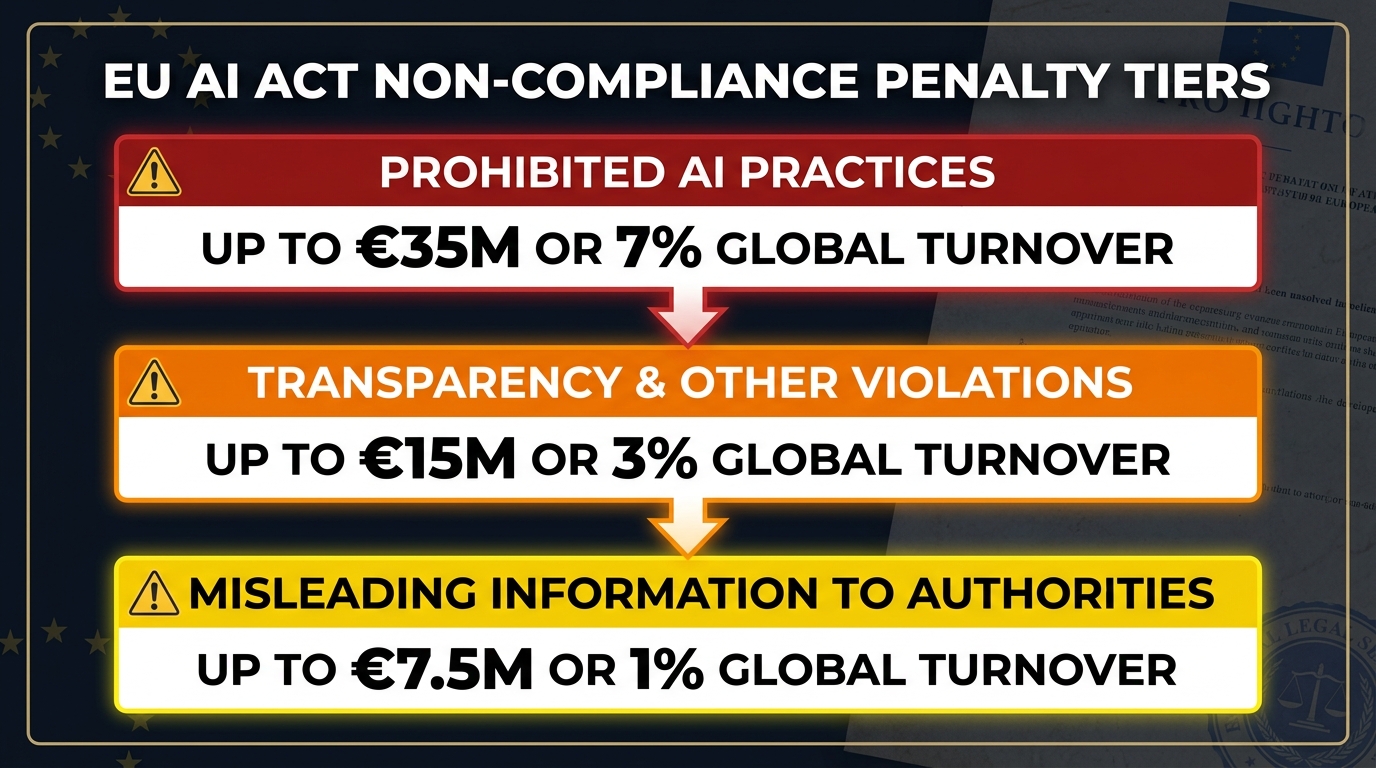
    EU AI Act penalty tiers infographic: up to €35M or 7% global turnover for prohibited practices, up to €15M or 3% for transparency violations, up to €7.5M or 1% for misleading authorities

    The EU AI Act’s penalty regime is tiered, and the positioning of transparency violations within that structure matters for how legal and risk teams should frame the compliance investment internally.

    The Three-Tier Fine Structure

    The Act establishes three penalty bands:

    • Tier 1 — Prohibited AI practices: Up to €35 million or 7% of global annual worldwide turnover, whichever is higher. Applies to systems that violate Article 5 — manipulative AI, real-time biometric surveillance in public spaces without legal basis, AI that exploits vulnerable groups.
    • Tier 2 — General non-compliance (including transparency violations): Up to €15 million or 3% of global annual worldwide turnover, whichever is higher. This is where Article 50 violations sit. Missing the chatbot disclosure, failing to label deepfakes, not implementing machine-readable marking — all fall here.
    • Tier 3 — Supplying incorrect information to authorities: Up to €7.5 million or 1% of global annual worldwide turnover, whichever is higher. Applies to misleading responses during regulatory inquiries or conformity assessments.

    The Global Turnover Basis

    The “global annual worldwide turnover” basis is not a European revenue calculation. It applies to the organisation’s total global revenue. For a large enterprise with €2 billion in global revenue, a Tier 2 violation could mean a fine of up to €60 million. For a mid-market organisation with €200 million global revenue, the ceiling is €6 million. The regulation uses whichever figure is higher — the fixed ceiling or the percentage — which means the percentage calculation is the binding constraint for most organisations with significant global revenue.

    The Proportionality Principle and Mitigating Factors

    Actual fines imposed by national authorities and the AI Office are expected to reflect proportionality. Regulators will consider the severity and duration of the infringement, whether it was intentional or negligent, whether the organisation took corrective action proactively, and whether cooperation with the investigation was forthcoming. An organisation that has documented its compliance efforts, implemented reasonable controls, and responded constructively to enforcement contact is in a materially different position than one that has no compliance programme at all.

    This is not just a legal argument — it is the practical case for building a documented compliance posture now, even if that posture is imperfect. Documented good-faith effort is a genuine mitigating factor. The absence of any compliance programme is not.

    SME Carve-Outs

    The Act includes specific provisions for small and medium-sized enterprises and startups. Member State authorities are directed to give priority to guidance over enforcement for SMEs, and fine calculations for SMEs may use a lower percentage of turnover. However, these carve-outs apply to the enforcement approach, not to the substantive obligations. SMEs must still comply with Article 50 — they simply have a different enforcement risk profile than large enterprises.


    Building a Compliance Audit Trail That Survives Enforcement

    The question regulators will ask is not only “are you compliant?” but “can you prove it?” Under the EU AI Act, the evidentiary burden in an enforcement proceeding sits with the organisation. You need documentation that demonstrates what your system does, when compliance measures were implemented, and how they function. The following elements form the minimum audit trail for Article 50 compliance.

    System Inventory and Role Classification Record

    Every AI system your organisation provides, deploys, or operates must be documented. For each system, the record must capture: the system’s function, the role your organisation occupies (provider, deployer, or both), the Article 50 obligations that apply to that system given its function and role, and the controls implemented to meet those obligations.

    This inventory is not a one-time exercise. Systems change. New agents get deployed. Existing agents get retrained or significantly modified. The inventory must be maintained as a living document with version history.

    Disclosure Implementation Records

    For every user-facing AI system, the audit trail must document how and when the Article 50(1) disclosure is delivered to users. This means capturing the specific disclosure text or interface element used, the point in the user journey at which it appears, the date the disclosure was implemented, and any changes made to the disclosure over time.

    Screenshots, design mockups, and UI specification documents all contribute to this record. The goal is to be able to demonstrate, if challenged, exactly what a user of your system would have seen at any point in time.

    Output Marking Logs

    For systems generating synthetic content subject to Article 50(2), you need logging that demonstrates outputs were marked at the point of generation. Server-side logs showing output generation events, the marking technique applied, and a timestamp are the minimum. Where technically feasible, audit samples of marked outputs should be preserved to demonstrate that the marking was effective.

    Vendor Documentation File

    The compliance chain extends to your GPAI providers. Maintain a vendor documentation file that records: the technical documentation your GPAI provider has supplied, the date it was received, and any updates or changes. If a provider fails to supply required documentation, the fact that you have requested it and followed up is relevant to your own compliance defence.

    Incident and Correction Log

    No compliance programme is perfect. When a failure is identified — a disclosure was omitted in a specific flow, a marking was not applied to a batch of outputs — what matters is that the incident is documented, the cause is identified, corrective action is taken, and the record of all of this is preserved. A compliance programme that identifies and corrects failures is substantially stronger, in a regulatory context, than a programme that claims there have been no failures.


    The 90-Day Compliance Sprint: Priorities in the Right Order
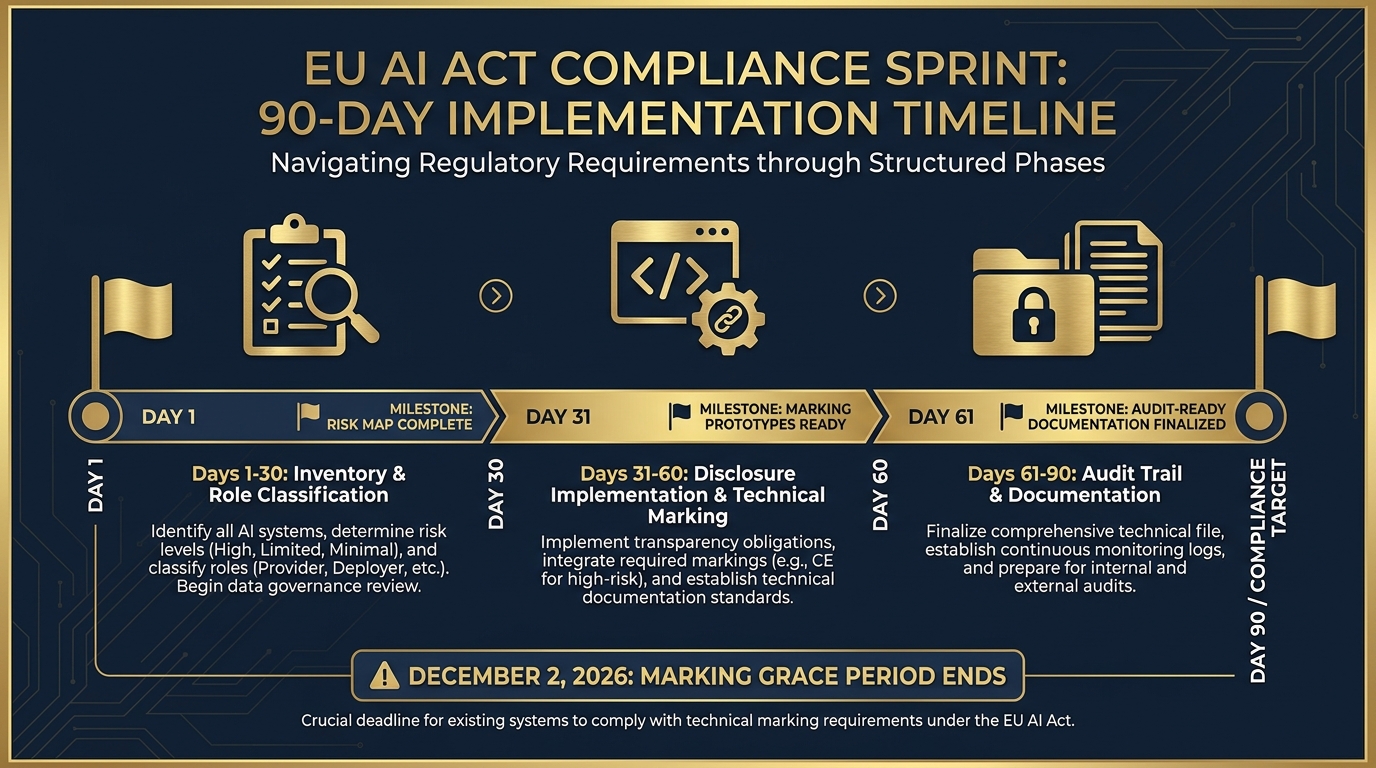
    90-day EU AI Act compliance sprint timeline showing three phases: inventory and role classification, disclosure implementation and technical marking, audit trail and documentation, with December 2 2026 marking grace period deadline

    With the December 2, 2026 grace period for machine-readable marking now approaching, compliance teams that have not yet begun structured implementation have a defined window. The following sequencing reflects both regulatory priority and practical implementation reality.

    Days 1–30: Inventory, Classification, and Gap Assessment

    The first priority is knowing what you have and where you stand. This phase should produce:

    • A complete inventory of every AI system the organisation provides, deploys, or operates — including agent systems, generative AI integrations, and any AI components embedded in non-AI products
    • A role classification for each system (provider, deployer, or both), documented with the reasoning for each classification
    • An obligation mapping for each system: which Article 50 obligations apply, and why
    • A gap assessment: for each applicable obligation, what is currently implemented and what is missing
    • A review of existing vendor contracts for GPAI providers to identify missing transparency documentation obligations

    This phase should involve legal, product, engineering, and data governance teams. It is not a legal exercise alone — legal teams cannot identify systems they do not know exist, and engineering teams cannot classify obligations without legal guidance on what the obligations mean.

    Days 31–60: Disclosure Implementation and Technical Marking

    With the gap assessment in hand, this phase focuses on implementation:

    • Design and deploy user-facing disclosures for all systems subject to Article 50(1). This includes not just the disclosure text but the UX placement — at session start, in the interface label, in the initial message — and testing to confirm the disclosure appears correctly across all access channels and devices
    • Implement deepfake and public-interest text labelling for any deployer-level obligations identified in the gap assessment
    • Select and begin implementing a machine-readable marking approach for generative output systems. The December 2 deadline makes this the most urgent technical task for organisations with existing systems that were market-deployed before August 2, 2026
    • Update or extend vendor contracts with GPAI providers to include explicit Article 53 documentation obligations
    • Draft and adopt an internal AI transparency policy that formalises the obligations identified in Phase 1 as standing operational requirements

    The machine-readable marking implementation is likely the heaviest technical lift in this phase. Allocate engineering resources accordingly and use the C2PA standard where your content types support it. For text-only outputs, document the technical feasibility assessment and the approach you are implementing — this documentation is itself part of your compliance posture.

    Days 61–90: Audit Trail, Documentation, and Governance

    The final phase converts implementation into a defensible compliance programme:

    • Formalise the system inventory as a maintained living document with an assigned owner and a review cadence (quarterly, at minimum)
    • Set up output marking logs with appropriate retention periods — 12 months minimum, aligned to applicable statute of limitations considerations
    • Establish a monitoring process for regulatory developments: the Commission’s guidance, AI Office enforcement decisions, and Member State implementation differences all have the potential to generate new obligations or clarify existing ones
    • Conduct a structured review of the disclosure and marking implementations: test them, document the test results, and correct any failures identified
    • Brief key stakeholders — board, legal, engineering leads, product managers — on the current compliance status and the ongoing monitoring programme

    At the end of this sprint, you should have: a system inventory, a role classification record, implemented disclosures, implemented (or in-progress) marking, a vendor documentation file, and an incident/correction log. That is a compliance programme. It will not be perfect. But it is a documented good-faith effort — which, in an enforcement proceeding, is the difference that matters.


    What the December Deadline Actually Changes — and What It Doesn’t

    The December 2, 2026 transition date for machine-readable marking applies only to one specific category: AI systems that were already placed on the EU market before 2 August 2026 and that are subject to the marking obligations under Article 50(2). It is a grace period for existing systems, not a general extension of the August enforcement date.

    Everything else that entered force on 2 August 2026 is already live:

    • Chatbot and interactive AI disclosure obligations are in force now and have been since August 2
    • Deepfake labelling obligations are in force now
    • Public-interest AI-generated text disclosure obligations are in force now
    • Emotion recognition and biometric categorisation disclosure obligations are in force now
    • GPAI provider obligations under Articles 53 and 55 are in force now

    The December date is a hard stop for the machine-readable marking grace period. Any system generating synthetic audio, image, video, or text that is deployed to EU users must implement compliant marking by that date, regardless of when it was first deployed.

    There is a risk that organisations view the December date as the real deadline and treat the August obligations as already behind them. That framing is wrong and dangerous. Enforcement for August-applicable obligations can begin from August 2. Any enforcement action launched before December will focus on those obligations, not the marking transition.


    Disclosure UX: Where Legal Requirements Become Product Decisions

    Compliance with Article 50 is not purely a legal and technical matter. It has significant product and user experience dimensions that determine whether an implementation meets the “clear and comprehensible” standard the regulation requires — or merely ticks a box while leaving users practically uninformed.

    What “Clear and Comprehensible” Means in Practice

    The regulation requires that disclosures be clear and comprehensible to users. This means:

    • Proximity: The disclosure must be near the interaction point, not in a separate document. A link to a terms-of-service page that mentions AI among many other topics is not clear and comprehensible disclosure of AI interaction.
    • Plain language: The disclosure must be understandable to a general user, not written in legal or technical jargon. “This service uses artificial intelligence” is acceptable. “This interface leverages a large language model fine-tuned on our proprietary dataset” is not — at least not as the primary disclosure.
    • Accessibility: The disclosure must be accessible to users with disabilities. If your interface relies on visual labels only, users with visual impairments may not receive the disclosure. Screen reader compatibility is part of the accessibility requirement.
    • Persistence: The disclosure should be present throughout the interaction in some form — not only in a popup that users dismiss before engaging. A persistent “AI-powered” label in the interface, alongside the initial disclosure, is a stronger implementation than a one-time notice.

    The Edge Cases That Require Judgment

    Some disclosure situations require product judgment rather than a simple rule application:

    Voice interfaces: Where an agent interacts via voice — telephone customer service, voice assistant — the disclosure obligation still applies but the implementation approach differs. A spoken disclosure (“You are speaking with an AI assistant”) at the start of the call is the standard approach. The timing and phrasing of this disclosure needs to be considered in the context of the call flow to ensure it is heard and registered.

    Personas with names: Many deployed agents use branded personas — “Meet Aria, your virtual assistant.” Giving an AI agent a human-sounding name does not exempt the system from disclosure. The obligation is to disclose the AI nature; the persona name is separate. The Commission’s guidance is clear that personas are not inherently deceptive if the AI disclosure is present, but the combination of a human-sounding name, photorealistic avatar, and no AI disclosure would be an enforcement risk.

    B2B professional interfaces: The “obvious from context” exception has more room to operate in B2B settings where users are sophisticated and the AI nature of the tool is intrinsic to the product’s value proposition. However, “obvious from context” remains a fact-specific assessment. Assume the exception is narrow and document the reasoning when you rely on it.


    Conclusion: Compliance Is Now an Engineering Requirement, Not Just a Legal One

    The EU AI Act’s transparency obligations have crossed from regulatory planning to operational reality. Article 50 is not a future risk to be monitored — it is a current requirement to be implemented. The grace period for machine-readable marking ends in December 2026. The obligations for chatbot disclosure, deepfake labelling, and public-interest AI text have been enforceable since August.

    The organisations that will navigate this well are the ones treating transparency compliance as an engineering requirement with legal specifications, not as a legal checkbox with engineering afterthoughts. Disclosure is a product feature. Machine-readable marking is a systems architecture decision. The provider/deployer classification affects vendor contract terms. The audit trail is a logging and retention problem.

    None of these are purely legal functions. They require coordinated action across product, engineering, legal, and data governance — and they require that action now, not at the next planning cycle.

    Key Takeaways for Agent Builders

    • Run the inventory first. You cannot comply with obligations you have not identified. Every AI system — not just the obvious chatbots — needs to be assessed against Article 50’s four distinct obligations.
    • Classify your role correctly. Building an agent on a third-party model makes you both a deployer (relative to the model) and a provider (relative to the agent). Both roles carry obligations. Both require action.
    • Don’t conflate disclosures with terms of service. Article 50 disclosure must be proximate, plain, and primary. It must be in the interaction, not in the fine print.
    • Start machine-readable marking now. The December 2 deadline is not far. Selecting an approach, integrating it into your output pipeline, and testing it takes time. The C2PA standard is the practical starting point for images and audio.
    • Treat multi-agent pipelines as a single system for compliance. The orchestrator’s team owns the end-to-end transparency posture. Delegating compliance to subcomponent vendors without verification is not a defensible position.
    • Build the audit trail as you build the compliance programme. Documentation of what you implemented, when, and why is not an afterthought — it is what converts a compliance programme into a compliance defence.
    • Get your GPAI vendor documentation in order. Request and file the technical documentation your model providers are obligated to supply under Article 53. The absence of that documentation is a gap in your own compliance posture.

    The transparency obligations in the EU AI Act are not the most technically demanding requirements in the regulation — the high-risk system obligations are substantially heavier. But they are the first ones to be enforced at scale, and they apply to every organisation deploying AI agents to EU users. There is no threshold, no sector carve-out, and no minimum size that exempts an organisation from Article 50. If you interact with EU users through AI, these rules apply to you.

    The August deadline has passed. The December deadline is visible on the horizon. The compliance sprint starts now.


  • EU AI Act Transparency: What Newsrooms Must Change Now

    EU AI Act Transparency: What Newsrooms Must Change Now

    EU AI Act transparency rules for newsrooms — Article 50 now enforceable from August 2026

    On 2 August 2026, something significant happened that most newsrooms either weren’t prepared for, or spent years assuming was still “a future problem.” The EU AI Act’s Article 50 transparency obligations became fully enforceable — and with them came a set of concrete, legally binding requirements around how media organisations in the European Union (and those reaching EU audiences) disclose, label, and account for their use of artificial intelligence in editorial and audience-facing contexts.

    This wasn’t a soft launch. The penalties are real. The obligations are specific. And the definitions — particularly around what counts as “human editorial control” — are narrower than most newsrooms assumed when they first read the headlines.

    The industry’s response has been a scramble. Many publishers had AI policies in place, but policies are not the same as compliant workflows. A policy document sitting in a shared drive does not constitute editorial responsibility in the eyes of the regulation. A grammar check does not constitute substantive human review. A chatbot described vaguely as “our digital assistant” does not satisfy Article 50’s user-disclosure requirements.

    This article is not about whether AI in journalism is good or bad. That debate is ongoing and irrelevant to the compliance deadline that has already passed. What matters now is operational reality: what exactly do newsrooms have to change, what does a compliant workflow look like in practice, and where are the genuine grey zones that editorial and legal teams need to resolve urgently?

    We’ll work through each of the core obligations, the enforcement architecture, the C2PA provenance standard that is emerging as the technical backbone of compliance, and what major newsrooms are actually doing — as opposed to what they say in press releases.


    Article 50: The Specific Clauses That Actually Apply to Journalism

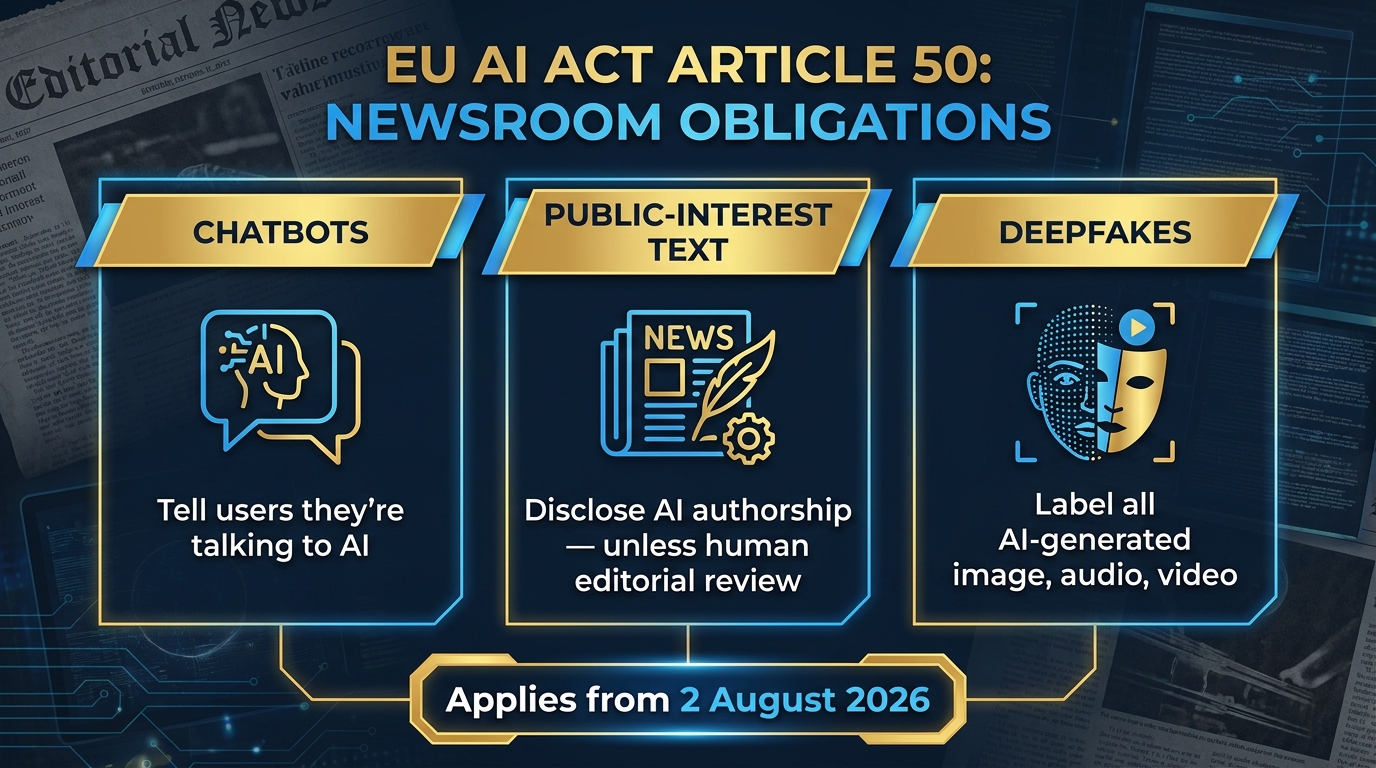
    Three Article 50 obligations for newsrooms under the EU AI Act: chatbots, public-interest text, and deepfakes

    The EU AI Act is a large and complex piece of legislation, but the portion that applies most directly to newsrooms is narrower than most coverage suggests. Article 50, titled “Transparency obligations for providers and deployers of certain AI systems,” is where most of the operational weight falls for media organisations.

    There are three distinct transparency obligations within Article 50 that newsrooms need to understand separately, because they have different triggers, different exemptions, and different compliance paths.

    Obligation 1: Chatbots and Reader-Facing AI Interactions

    If your newsroom runs a system that interacts directly with users — a reader chatbot, a Q&A tool, an AI-powered help assistant on your website or app — Article 50 requires that users be informed they are interacting with an AI system. This disclosure must happen at the start of the interaction, in a clear and distinguishable way that is accessible to users.

    The one exception is where it is “obvious from the context” that the interaction is with an AI. That is a high bar. A chatbot embedded in a news website that responds in natural language to reader queries is not obviously AI simply because AI chatbots have become common. “Obvious from context” means cases where the AI nature is inherent to the experience — think of a clearly branded AI tool with robot iconography, a system named “AI Assistant” in explicit terms, or interfaces where no reasonable user could be under any illusion.

    If your chatbot is named after your brand, answers questions in a personalised, conversational way, and doesn’t explicitly flag its AI nature upfront, you are almost certainly in scope and need to add a clear disclosure at the beginning of every session.

    Obligation 2: AI-Generated or AI-Manipulated Text on Matters of Public Interest

    This is the most consequential obligation for editorial teams. Article 50 requires that when AI-generated or AI-manipulated text is published to inform the public on matters of public interest, deployers must disclose that the text was artificially generated or manipulated.

    “Matters of public interest” is intentionally broad. It covers news reporting, political analysis, public health information, financial commentary, court coverage, environmental reporting — essentially anything a newsroom might publish that informs citizens about the world they live in. The threshold is not “investigative journalism.” A routine earnings report generated by AI and published to a financial news readership falls within scope.

    There is an exemption: disclosure is not required if the text has undergone human review or editorial control, and if a natural or legal person holds editorial responsibility for the publication. But this exemption is far narrower than it first appears — and we’ll examine exactly where that line sits in the next section.

    Obligation 3: Deepfake Disclosure — No Exemptions

    The third obligation has no editorial carve-out. When a deployer uses an AI system to create or manipulate image, audio, or video content in a way that resembles real persons, objects, places, or events and would falsely appear authentic — a deepfake — the content must be clearly disclosed as artificially generated or manipulated.

    This applies regardless of intent. A recreated historical scene, an AI-generated portrait of a real public figure, a synthetic audio clip of a politician’s voice used in a podcast — all require clear labeling. The disclosure must be visible and accessible at the point of first exposure to the content, not buried in a footnote or an about page.

    For newsrooms experimenting with AI-generated illustrations, synthetic video explainers, or AI voice narration, this obligation is not optional. It applies immediately, and there is no “journalistic purpose” defence that suspends it.


    The “Human Editorial Control” Exception — And Why Most Newsrooms Are Misreading It

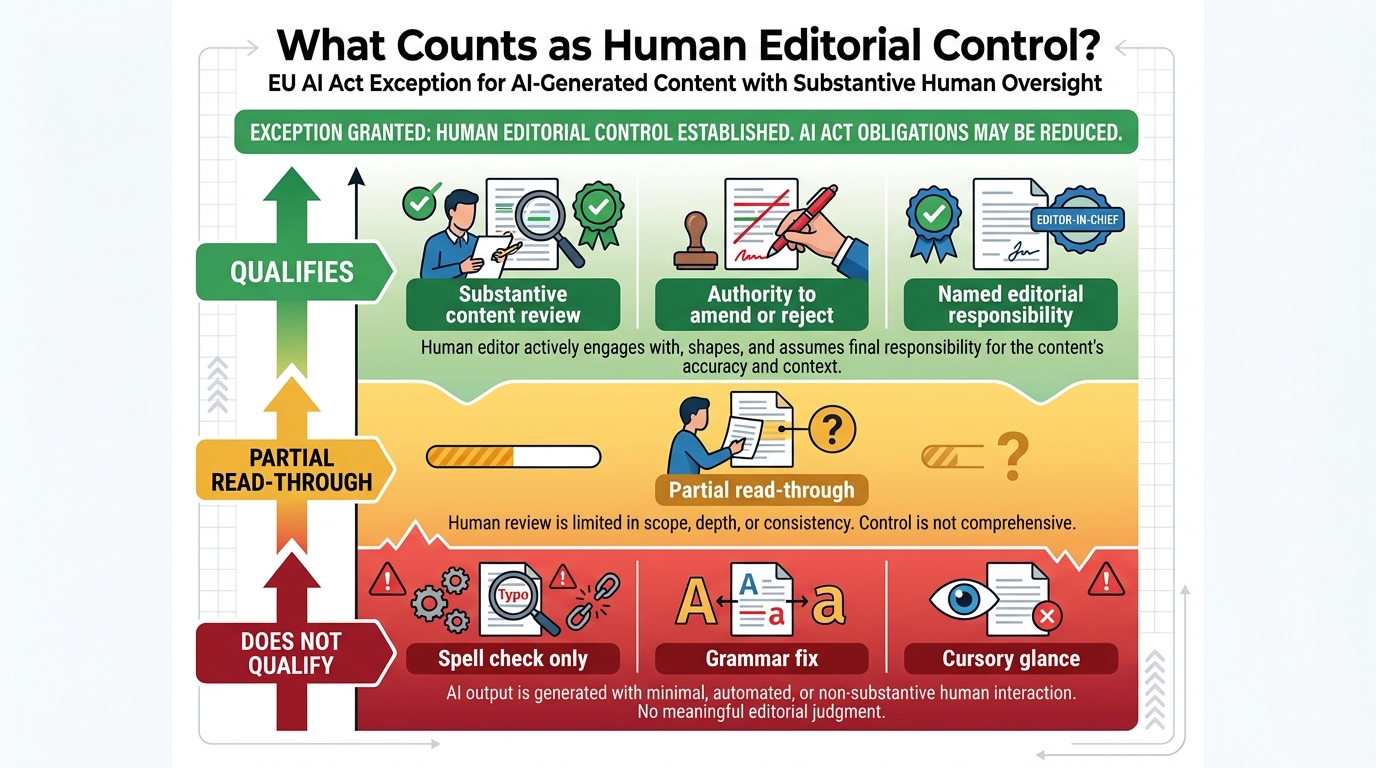
    What qualifies as human editorial control under EU AI Act — spectrum from spell-check to substantive review

    The phrase “human editorial control” has become something of a lifeline in newsroom discussions about the EU AI Act. The thinking goes: “We always have humans reviewing content before it goes out, so we’re fine.” That assumption needs to be corrected immediately.

    The European Commission’s implementation guidance is explicit: superficial, solely formal, or procedural checks do not qualify as human review or editorial control for the purposes of Article 50’s exemption. Spell-checking does not count. Grammar correction does not count. A cursory read before hitting publish does not count.

    What the Exemption Actually Requires

    To invoke the human editorial control exception and avoid mandatory disclosure, a newsroom must demonstrate two things simultaneously:

    First: that the content underwent substantive human review — meaning a real content check where the reviewing editor has the authority to amend or reject the material. Not format it. Not correct typos. Assess whether the content is accurate, appropriate, and editorially sound, and be empowered to make changes or refuse publication.

    Second: that a natural or legal person holds editorial responsibility for the publication. This is a legal concept: there must be an identifiable, accountable individual or organisation who is responsible for the editorial decisions made in publishing that piece. Anonymous workflows, fully automated publishing pipelines, and systems where no human is accountable do not satisfy this requirement.

    Both conditions must be met simultaneously. Substantive review without editorial accountability doesn’t clear the bar. Editorial accountability without substantive review doesn’t either.

    The Practical Problem for Automation-Heavy Workflows

    Where this bites hardest is in the kind of semi-automated publishing workflows many digital newsrooms have built over the past three years. AI drafts a piece on earnings data, sports results, weather events, or traffic incidents. A sub-editor glances at it for formatting. It publishes. In that scenario, the “glance” does not constitute substantive review under the regulation’s terms.

    Newsrooms that have built high-volume, low-touch publishing pipelines — particularly those serving financial data, sports results, or local information verticals where AI-generated text has been adopted at scale — face the most acute compliance exposure. Either the human review step must be meaningfully deepened, or the disclosure label must be added. There is no third option.

    Documenting the Review

    There is also a documentation dimension that hasn’t received enough attention. The exemption is only as strong as the evidence that supports it. If a national market surveillance authority investigates and asks how substantive human review was applied to a specific article published without a disclosure label, the newsroom needs to be able to demonstrate that process. Editorial sign-off logs, CMS audit trails, and review checklists are not bureaucratic overhead — they are the evidential record that makes the exemption defensible.

    Publishers that cannot produce that record are in a weak position regardless of what their internal AI policy says. Process design and documentation infrastructure are two sides of the same compliance coin.


    Reader-Facing AI Tools: The Chatbot Disclosure Problem Nobody Is Solving Fast Enough

    If the editorial text obligations feel like they live primarily in the newsroom’s internal workflow, the chatbot disclosure requirement is different: it’s a product change. And product changes at media organisations tend to move slowly through engineering backlogs, stakeholder reviews, and design cycles.

    The practical problem is that many newsrooms deployed reader-facing AI tools during the 2024–2025 wave of investment in digital reader engagement. These tools go by various names: AI search assistants, “ask our newsroom” chatbots, personalised news briefing tools, subscriber Q&A interfaces. Some are built on off-the-shelf models with thin branded overlays. Others are custom implementations.

    Regardless of how they were built, if they interact directly with EU users in natural language, they need a clear, accessible, session-opening disclosure that the user is interacting with an AI system. This isn’t a label buried in the terms of service. It must appear before or at the very start of the interaction.

    What “Clear and Distinguishable” Means in Practice

    The regulation’s language requires that AI disclosure be “clear and distinguishable.” For a chatbot interface, that translates to practical product requirements:

    • A visible message at the start of every session — not just the first session — that identifies the system as AI
    • Language that is unambiguous to a general audience, not insider jargon (“powered by LLM” is not clear disclosure to a general reader)
    • Accessibility compliance — the disclosure must be usable by readers with visual impairments or other accessibility needs
    • Persistence across device and session resets — clearing cookies should not permanently suppress the disclosure

    Newsrooms that built their chatbots on third-party AI platforms also need to understand where their compliance responsibility sits. Under Article 50, the obligation falls on the deployer — the newsroom — not the AI provider. Using GPT-4o or Claude as the backend does not transfer responsibility to OpenAI or Anthropic. If your newsroom’s chatbot is non-compliant, your newsroom is accountable.

    The Opportunity Inside the Obligation

    There is a non-obvious upside to this requirement for newsrooms that approach it well. Readers are currently operating in an environment of deep uncertainty about what is and isn’t AI-generated in the content they consume. A clear, confident, design-led disclosure — “This is an AI assistant. It doesn’t replace our journalists, but it can help you navigate our coverage.” — is a trust signal, not a trust loss. Publishers that frame the required disclosure as a credibility statement rather than a legal disclaimer may find it strengthens rather than undermines reader relationships.


    Deepfakes, Synthetic Media, and the Visual Journalism Challenge

    The deepfake labeling obligation is where the EU AI Act intersects most sharply with the ongoing visual media integrity crisis. For newsrooms, synthetic imagery and AI-manipulated video are no longer hypothetical concerns — they are operational realities at multiple points in the publishing pipeline.

    The obligation is this: any AI-generated or AI-manipulated image, audio, or video content that resembles real persons, objects, places, or events and would falsely appear authentic must be disclosed as artificially generated or manipulated. This applies at the point of first exposure — meaning the label must accompany the content where a reader or viewer first encounters it, not appear only on a separate credits or methods page.

    Where Newsrooms Are Most Exposed

    The obvious cases are where newsrooms consciously generate synthetic imagery — AI-illustrated explainers, AI-generated portrait art for opinion pieces, synthetic recreations of historical events. These are clearly in scope and relatively easy to label.

    The more difficult cases involve AI manipulation rather than outright generation:

    • AI upscaling and restoration: Using AI tools to enhance archival footage or low-resolution photographs for publication. If the enhancement changes details in ways that make the image appear more “authentic” than the original, this may qualify as AI manipulation under the regulation.
    • AI-generated narration: Text-to-speech narration for video content or podcasts, particularly where the voice is designed to sound natural and human. If listeners would not immediately recognise this as synthetic, it falls under the deepfake/synthetic audio provision.
    • AI-enhanced interview footage: Noise reduction, background removal, or visual enhancement applied to video interviews before broadcast. Where AI tools materially alter the appearance of real persons, the manipulation clause applies.
    • Stock imagery from AI sources: Newsrooms using AI-generated stock images in editorial contexts — particularly images depicting real-seeming scenes, crowds, or people — must label these as AI-generated.

    The Retroactivity Question

    A useful and often overlooked detail: the European Commission has confirmed that content created before 2 August 2026 does not need retroactive labeling. The obligation applies to new publications from that date forward. This matters for newsrooms with large archives — the compliance burden is prospective, not retrospective, which is a genuine operational relief for organisations with millions of archived assets.

    However, the absence of retroactive requirements does not mean archive workflows are off the hook. Any archived content that is republished, updated, re-promoted, or re-served to EU audiences after 2 August 2026 may trigger fresh obligations if it contains AI-generated or AI-manipulated material meeting the disclosure threshold.


    C2PA and Machine-Readable Provenance: From Pilot Project to Newsroom Infrastructure

    C2PA Content Credentials showing AI disclosure metadata embedded in a news image — the provenance standard for newsrooms

    The EU AI Act imposes transparency obligations at the disclosure level — what newsrooms tell readers. But a parallel technical standard has been gaining serious traction as the mechanism for how that transparency is implemented at the asset level: the Coalition for Content Provenance and Authenticity (C2PA) and its Content Credentials standard.

    C2PA is an open technical standard that attaches cryptographically signed provenance metadata to digital media assets. Content Credentials record where a piece of media came from, how it was edited, what tools were used, and — as of the C2PA 2.4 specification released in April 2026 — whether and how AI was involved in its creation or modification.

    What C2PA 2.4 Adds for Newsrooms

    The April 2026 release of C2PA 2.4 is directly relevant to EU AI Act compliance in several ways. The new specification introduced a dedicated c2pa.ai-disclosure assertion — a machine-readable field specifically designed to capture AI involvement in content creation. This is not informal metadata; it is a structured, tamper-evident record that can be read by browsers, platforms, and content management systems that support the standard.

    Additional 2.4 features relevant to newsroom compliance include:

    • Repository receipt assertion: A verifiable record of where and when content was deposited, creating an auditable publication timestamp
    • HTML embedding support: Allows Content Credentials to be embedded in web-published content, not just media files — directly relevant to AI-generated news articles
    • JSON-based serialization for testing and validation: Makes it easier for technical teams to verify credentials in development and QA
    • Live video support: Extends provenance tracking into broadcast and streaming contexts

    C2PA now reports more than 6,000 members and affiliates across the media technology ecosystem. Major camera manufacturers have begun embedding C2PA support at the capture stage, which means provenance chains can start at the point of creation rather than being added retrospectively.

    C2PA Is Not a Silver Bullet

    It would be a mistake to treat C2PA as a complete compliance solution. Independent researchers have noted that Content Credentials should be treated as trust signals, not proof of truth, particularly in high-stakes reporting contexts. The standard records what was declared at the time of creation — it cannot independently verify whether those declarations are accurate.

    A newsroom that embeds C2PA metadata claiming “human review: confirmed” while running a fully automated publishing pipeline has not achieved compliance — it has created a fraudulent provenance record, which is arguably a more serious problem. C2PA is only as reliable as the processes it documents. Used honestly, it is a powerful tool. Used as cover for non-compliant workflows, it becomes a liability.

    The right framing for C2PA in a newsroom compliance context is: the machine-readable layer that makes your human review and disclosure processes legible to systems, platforms, and regulators. It amplifies good processes. It does not substitute for them.


    The Three-Tier Penalty Structure — And What It Means for Publishers

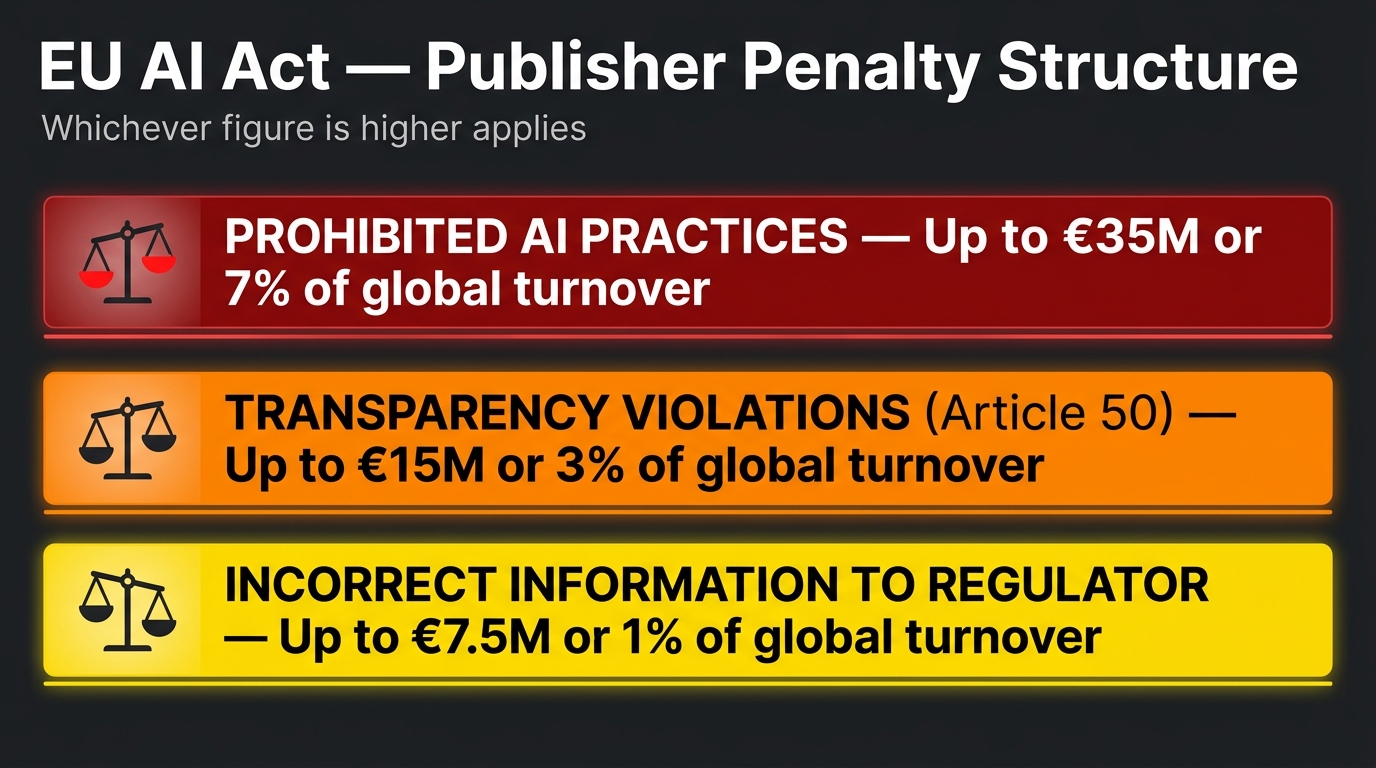
    EU AI Act penalty tiers for publishers: up to €35M for prohibited practices, €15M for transparency violations, €7.5M for misleading regulators

    The EU AI Act’s enforcement architecture is tiered, and understanding which tier applies to different types of violations is essential for prioritising compliance investment. Not all violations carry the same exposure, and misunderstanding the penalty structure leads to misallocated effort.

    Tier 1: Prohibited AI Practices — Up to €35 Million or 7% of Global Turnover

    The highest penalty tier applies to prohibited AI practices — systems that are banned outright under the regulation regardless of safeguards. These include subliminal manipulation systems, social scoring systems, and certain biometric identification applications. Most newsrooms are extremely unlikely to be deploying anything in this category. The 7% / €35 million tier is relevant background context, not a realistic risk for standard editorial AI use.

    Tier 2: Most Other Obligations Including Transparency — Up to €15 Million or 3% of Global Turnover

    This is the tier that directly applies to Article 50 transparency violations. Failure to disclose AI-generated public-interest text, failure to label deepfakes, failure to identify AI chatbot interactions — all of these fall into the €15 million or 3% of worldwide annual turnover category, whichever is higher.

    The “whichever is higher” clause is important. For a large international publisher with significant global revenue, 3% of worldwide annual turnover may substantially exceed €15 million. The calculation is not limited to EU revenue — it is global turnover.

    Enforcement is carried out by national market surveillance authorities in each EU member state, coordinated by the European AI Office. As of the time of writing, there are no publicly confirmed EU AI Act fines issued to media organisations. But the absence of early enforcement action should not be read as a signal that enforcement won’t come. Early enforcement phases typically focus on building precedent through high-visibility cases, and major media organisations publishing AI-generated content without disclosure are exactly the kind of high-visibility target that creates useful regulatory precedent.

    Tier 3: Supplying Incorrect or Misleading Information — Up to €7.5 Million or 1%

    The third tier applies specifically to providing incorrect or misleading information to regulators during an investigation or audit. This is a critical detail for newsrooms building their compliance documentation: the record you create matters not just for demonstrating compliance, but for the interaction with enforcement authorities if a complaint is filed. Incomplete, inaccurate, or retroactively constructed documentation creates exposure at this third tier on top of any underlying substantive violation.

    Jurisdiction: Who Is Actually in Scope?

    One question that arises frequently for non-EU publishers is whether the regulation applies to them. The answer is nuanced. The EU AI Act applies to AI systems placed on the EU market or put into service in the EU. Publishers based outside the EU who target EU audiences with AI-generated content — through a European website, a European app, or content distributed to EU readers — are deployers operating in the EU market. The extraterritorial reach is similar in structure to GDPR, and publishers who applied the “we’re not a European company” reasoning to GDPR and were subsequently caught by enforcement should not repeat that mistake here.


    What a Compliant AI Editorial Workflow Actually Looks Like

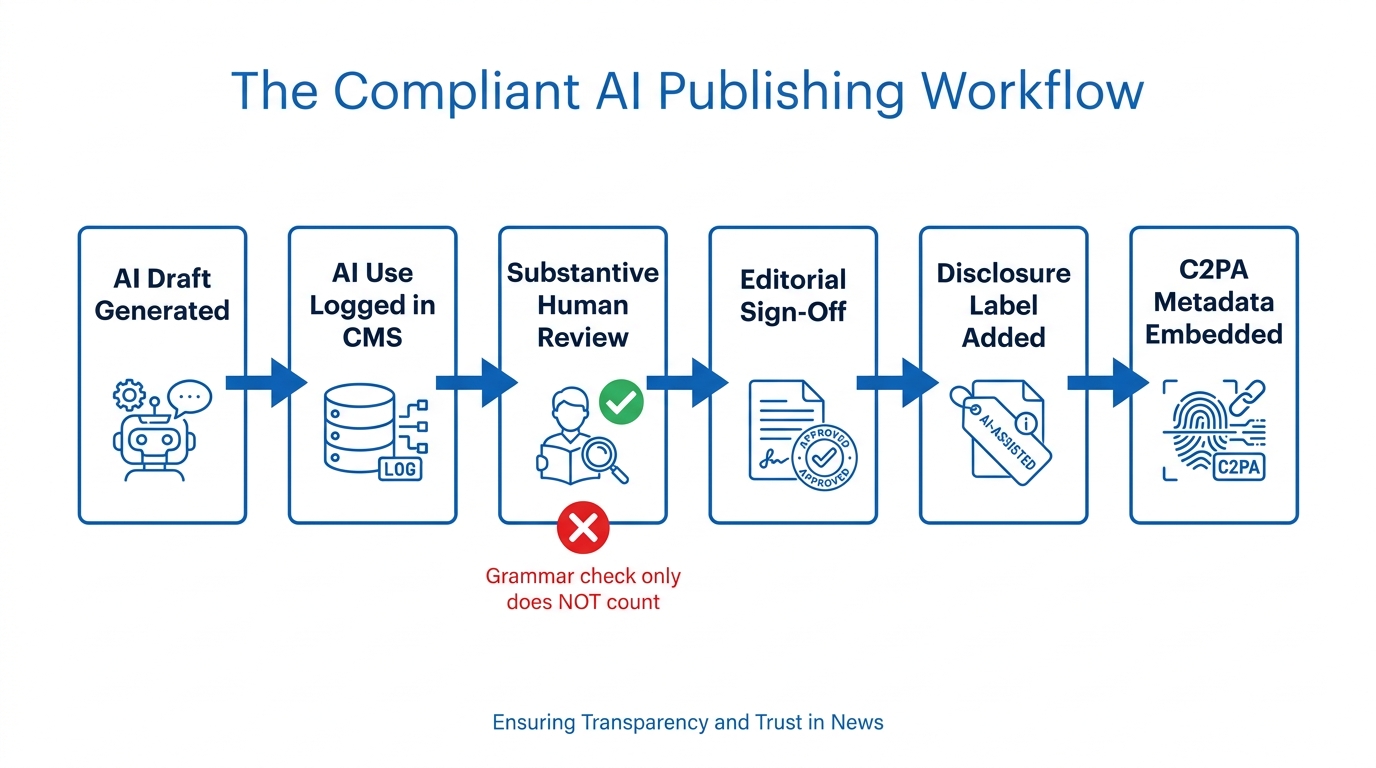
    Compliant AI editorial workflow: AI draft, CMS logging, substantive human review, editorial sign-off, disclosure label, C2PA metadata

    Regulatory compliance is not a policy problem — it is a workflow problem. A thoughtfully worded AI policy that isn’t embedded in the actual publishing process is as useful as a fire safety plan that nobody has read. The real question is: what does the daily operational reality of a compliant newsroom look like?

    The emerging industry consensus points to a six-stage framework that can be adapted to different CMS environments, team structures, and content types.

    Stage 1: AI Use Classification at the Point of Creation

    Every piece of content in scope needs to be classified by how AI was used in its creation. This isn’t binary — there is a spectrum from “AI suggested a headline” through “AI drafted the full article” to “AI generated the images.” Newsrooms need a classification taxonomy that captures this spectrum and assigns compliance obligations based on the degree of AI involvement.

    Practical implementation: a mandatory field in the CMS at the drafting stage. Writers and editors log AI involvement as a structured data field, not a free-text note. This creates the audit trail. Options might include: No AI use / AI used for research assistance only / AI used to generate draft content / AI generated content with human revision / AI fully generated content published under human review.

    Stage 2: Substantive Human Review — Logged and Attributable

    For content where AI was used to draft or generate material that will be published as public-interest information, the reviewing editor must conduct a substantive content review — not a format check. The review must be logged: editor name, timestamp, and ideally a structured attestation that the review covered content accuracy, editorial appropriateness, and factual verification.

    This is where many newsrooms will need to redesign workflows rather than just add a field. If the current process involves a sub-editor reviewing AI output for format before it auto-publishes, that process needs a new step: a content-level review by a named editor with the authority to reject or substantially amend the piece. The editorial sign-off should not be the same step as the formatting check.

    Stage 3: Disclosure Decision

    After substantive human review, a disclosure decision is made. If the content meets the substantive review plus editorial responsibility criteria, a disclosure label is still recommended as best practice (more on this below) but may not be legally required. If any doubt exists — about the adequacy of the review, the degree of AI involvement, or whether the content qualifies as a “matter of public interest” — the default should be to disclose.

    The principle of default disclosure is simpler and more defensible than attempting to fine-tune exactly which pieces need labels. It also builds reader trust over time, which has measurable commercial value for publishers whose audience relationships are a core business asset.

    Stage 4: Label Implementation in CMS

    The disclosure label must appear in the content itself — not only in a general “how we use AI” page. For web articles, this typically means a visible inline label at the top or bottom of the piece, styled to be clearly distinguishable from body text. For audio and video, disclosure is required at first exposure — typically at the opening of the piece or in a title card.

    CMS implementation should make the label automatic when the AI classification field indicates disclosure is required, rather than relying on manual label addition. Human memory is not a reliable compliance mechanism at publishing scale.

    Stage 5: C2PA Metadata Embedding

    For newsrooms adopting the C2PA standard — which is increasingly recommended by industry bodies as the technical implementation layer for provenance — the c2pa.ai-disclosure assertion should be embedded at this stage. The metadata records the AI involvement, the human review attestation, the responsible editor, and the publication timestamp in a machine-readable, tamper-evident format.

    C2PA integration currently requires technical work at the CMS or asset management level. Newsrooms without in-house technical capacity may need vendor support, and selecting CMS partners or DAM systems that are building native C2PA support is increasingly a compliance-driven procurement consideration.

    Stage 6: Vendor and Third-Party AI Accountability

    Many newsrooms use AI capabilities through third-party tools — content generation platforms, AI-assisted research tools, automated translation services. The regulation’s compliance obligation falls on the deployer (the newsroom), not the AI provider. Each third-party AI tool used in the editorial workflow should be audited for what it does, what data it processes, and what the compliance obligations are for the newsroom as its deployer.

    This is particularly important for tools where the AI involvement is not obvious — translation tools with neural output, auto-tagging and categorisation systems, recommendation engines, SEO tools that suggest or rewrite content. If any of these touch public-facing content at a scale or in a way that matters for Article 50, they belong in the compliance inventory.


    What Major Newsrooms Are Actually Doing

    Examining what the major broadcast and print newsrooms have publicly committed to reveals both the current state of the industry and where significant gaps remain between declared principle and operational practice.

    BBC: The Strictest Public Standard

    The BBC has the clearest and most stringent publicly stated AI policy of any major broadcaster. Its published guidance takes the position that generative AI should not directly create news, current affairs, or factual journalism — except in cases where AI use is itself the subject of the report, or where it is used for clearly illustrative purposes. The BBC requires human editorial oversight and transparent audience disclosure for any AI-assisted material that could mislead viewers or readers.

    The BBC uses AI in a limited, supervised set of applications: accessibility tools, subtitles, anonymisation of contributors, translation, and formatting. In each case, journalist review precedes publication. Its public-facing disclosure language — including explicit “How we used AI” labeling — puts it ahead of most of its peers in terms of operational transparency.

    What’s notable about the BBC approach is that it does not try to minimise disclosure or define the human review exception as broadly as possible. Its policy default is transparency, and it treats the editorial carve-out as a narrow backstop rather than a broad escape valve.

    Wire Services: Structured AI Use with Human Oversight

    The major wire services — AP, Reuters, Bloomberg — operate in a different context to broadcast or print newsrooms. They produce enormous volumes of content at high speed, and have been using structured data-driven text generation for financial and sports reporting since before the current AI wave. Their challenge under Article 50 is that the volume of AI-involved content is high, and the review workflows need to be robust enough to qualify as substantive at that scale.

    The pattern across wire services has been task-specific AI use with defined human review gates — AI assists with drafts, humans verify and sign off. The compliance question is whether those review gates are genuinely substantive or whether the speed and volume requirements of wire journalism are creating de facto rubber-stamp approval processes. That is not a question that can be answered by public policy statements; it requires process audits.

    Digital-Native Publishers: The Highest Risk Category

    The segment facing the most acute compliance risk is the digital-native publishing sector, where AI-assisted or AI-generated content at high volume has become a cost-reduction strategy in the context of advertising market pressure. Local news networks, content aggregation platforms, and SEO-driven publishing operations that have adopted AI generation at scale often have the thinnest human review processes and the least documented editorial accountability structures.

    For these publishers, the Article 50 exemption path — relying on human editorial control to avoid disclosure requirements — may be legally unavailable because the review processes genuinely don’t meet the substantive review threshold. The compliant path in that case is not to claim an exemption they cannot support, but to implement disclosure labeling consistently. That is not a comfortable commercial outcome for publishers whose business model depends on AI-generated content appearing indistinguishable from human-written material. But the regulation does not accommodate that business model without disclosure.


    The AI Inventory Audit: Where Every Newsroom Needs to Start

    Before any of the workflow changes described above can be implemented effectively, a newsroom needs to know what it is actually dealing with. The starting point for EU AI Act compliance is an AI use inventory: a comprehensive map of every AI system, tool, or capability used anywhere in the editorial and publishing operation.

    This is harder than it sounds. AI capabilities have infiltrated newsroom workflows through procurement decisions made at many different levels and in many different departments — editorial, tech, product, marketing, audience, operations. Many of these decisions were made before the EU AI Act compliance requirements were fully understood. The result is that most newsrooms have AI running in places their compliance and legal teams aren’t fully aware of.

    The Inventory Framework

    An effective AI inventory for compliance purposes should capture the following for each AI system or tool in use:

    • What the tool does: Specific function in the newsroom workflow
    • Where AI involvement is in the chain: Drafting, editing, translation, recommendation, metadata generation, image processing, chatbot, etc.
    • Output type: Text, image, audio, video, or data — and whether those outputs reach the audience directly or inform editorial decisions
    • Volume: How many pieces of content or interactions per day/week involve this tool
    • EU audience exposure: Whether output from this tool is served to EU users
    • Current disclosure status: Is this disclosed to users? Is there a disclosure mechanism? Is it adequate under Article 50?
    • Current review process: What human review, if any, applies before AI output is published or served?
    • Compliance status: Does the current process meet Article 50 requirements? What gaps exist?

    The inventory should be maintained as a living document, not a one-time exercise. New AI tools enter newsroom workflows constantly — through vendor updates, individual tool adoption by staff, product development, and third-party integrations. A compliance inventory that’s six months out of date is not a compliance inventory.

    Prioritising Remediation After the Audit

    Once the inventory exists, remediation can be prioritised by risk and effort. The highest-priority items are those that combine high EU audience exposure, high AI involvement in content reaching readers, and thin or absent human review processes. These are the cases where enforcement exposure is greatest and where the absence of disclosure labeling is hardest to defend.

    Lower-priority items include AI tools used for internal editorial support — research assistance, summarisation, headline brainstorming — that don’t directly generate content published to readers. These still belong in the inventory, and some may require governance documentation, but they are less likely to trigger Article 50 obligations because they don’t produce the final published output.

    The inventory also creates the foundation for vendor conversations. Where third-party AI tools contribute to compliance risk, the newsroom needs to know whether those vendors are meeting their own obligations under the regulation, and whether the contractual arrangements allocate compliance responsibility in a way that protects the newsroom as deployer.


    Beyond Compliance: The Editorial Credibility Case for Transparency

    Every discussion of EU AI Act compliance in newsrooms should eventually move beyond the regulatory minimum to a more fundamental question: what does transparent AI use actually do for editorial credibility?

    The backdrop matters. Public trust in media is at historically low levels across most European markets. Misinformation concerns are high. The emergence of large-scale AI-generated content — much of it low-quality, some of it deliberately deceptive — has created a credibility environment where readers are genuinely uncertain about what they can trust. In that environment, clear and honest disclosure of AI use is not a liability for quality journalism. It is a differentiator.

    Newsrooms that get ahead of the regulation — not just meeting its minimum requirements but building genuinely transparent AI disclosure practices that give readers real information about how content was created — are building a trust asset that has long-term value. Readers who know a publication is honest about its AI use, clear about where human journalists remain central, and transparent about the limitations of AI assistance are more likely to sustain subscriptions, share content, and maintain loyalty through the inevitable controversies that all media organisations face.

    The regulation provides the external pressure. The editorial credibility case provides the internal motivation. Newsrooms that experience compliance as burden alone will implement the minimum. Newsrooms that understand it as an opportunity to rebuild reader trust will go further — and likely end up in a stronger competitive position as a result.

    The Distinction That Builds Trust

    The most effective disclosure language doesn’t just say “this article involved AI.” It explains what role AI played, what a human journalist contributed, and what the editorial accountability structure was. “This article was drafted using AI tools and reviewed for accuracy and editorial judgment by [Editor Name]” is substantially more informative than “AI-assisted.” The difference is the difference between compliance as disclosure and disclosure as communication.

    That distinction is worth investing in. It requires editorial teams to think carefully about what readers actually need to know to calibrate their trust appropriately — not just what the regulation technically requires. That is a harder question, and a more interesting one, than “do we need a label or not?”


    The Compliance Checklist: What Newsrooms Need to Action Now

    The August 2026 deadline has passed. The obligations are in force. What follows is a practical action checklist for editorial, legal, product, and technology teams working through compliance implementation.

    Immediate Actions (This Week)

    1. Audit every reader-facing AI tool for chatbot disclosure compliance. If a tool interacts with EU users in natural language, verify that an AI-identity disclosure appears at the start of each session in clear, accessible language.
    2. Identify all AI-generated or AI-manipulated content currently live on EU-accessible properties that was published after 2 August 2026 without disclosure. Assess each case for whether the substantive human review exemption applies, and add labels where it does not.
    3. Issue interim editorial guidance making clear that grammar checks and cursory reviews do not constitute the substantive human review that exempts content from disclosure. Every editor who approves AI-involved content needs to understand what they’re actually attesting to.

    Short-Term Actions (Next 30 Days)

    1. Complete the AI use inventory. Map every AI tool in the editorial and publishing workflow, assess its compliance status, and document gaps.
    2. Redesign the publication workflow for high-volume AI-generated content categories to include a genuine substantive review step with named editorial sign-off.
    3. Add AI involvement fields to your CMS at the drafting and editing stages. Make logging mandatory, not optional.
    4. Review vendor contracts for third-party AI tools to confirm compliance responsibility allocation and assess vendor-side obligations under the AI Act.
    5. Brief your legal and compliance team on the specific Article 50 penalty structure and the evidentiary requirements for the human editorial control exemption.

    Medium-Term Actions (60–90 Days)

    1. Implement C2PA Content Credentials for image, audio, and video assets. Prioritise assets involving AI generation or manipulation where deepfake disclosure is required.
    2. Develop standardised disclosure language for different content types — text articles, videos, audio pieces, AI chatbot interactions — that goes beyond the regulatory minimum to actually communicate AI’s role to readers.
    3. Establish an ongoing AI governance process — a recurring review of AI use, new tool adoption, and compliance status, with clear ownership (legal, editorial, or a dedicated compliance role).
    4. Train editorial staff on the regulation — particularly what substantive human review means, what the human editorial control exemption requires, and what documentation is needed to support it.
    5. Consider the December 2026 machine-readable marking deadline for generative AI provider-side requirements. If your newsroom is operating AI systems as a provider rather than a deployer in any capacity, the December obligations may apply.

    Conclusion: Compliance Is the Floor, Not the Ceiling

    The EU AI Act’s Article 50 transparency requirements are not the most complex regulatory challenge newsrooms have ever faced. They are narrower, in scope and obligation, than GDPR was in its early implementation phase. The core requirements — disclose AI chatbots, label deepfakes, disclose AI-generated public-interest text without substantive human review — are understandable.

    The difficulty is not conceptual. It is operational. Compliant workflows require genuine process redesign, documented editorial accountability, and technical implementation that most newsrooms haven’t fully completed. The gap between having an AI policy and running a compliant AI operation is the gap between intention and infrastructure.

    The newsrooms that will be in the best position — legally, commercially, and editorially — are not the ones that minimise their disclosure obligations, but the ones that use the regulatory moment to build transparency practices that readers can actually see, evaluate, and trust. The regulation sets the floor. Editorial credibility, reader trust, and long-term commercial resilience are the reasons to go higher.

    The AI Act will be enforced. The first major media enforcement actions will generate significant coverage and create reputational consequences that extend far beyond the fine itself. The choice is whether your newsroom is positioned as a publisher that got ahead of this, or one that got caught.

    The deadline has passed. The obligations are real. And the time for treating compliance as a future project has run out.