The hype cycle around AI agents has been deafening. Announcements pile up, demos proliferate, and LinkedIn is full of screenshots showing “autonomous” agents doing things that took entire teams before. But somewhere between a demo and a dollar, most AI agent projects stall.
AWS Marketplace’s new AI Agents & Tools category changes that calculus — at least on paper. It offers a formal, structured path to turn an AI agent into a product that enterprise buyers can discover, purchase, and integrate directly into their AWS environments. No cold email sequences. No six-month procurement negotiation from scratch. Just a listing with a buy button attached to the most trusted B2B software marketplace on the planet.
The catch: the path to a live, revenue-generating listing is more technically and operationally demanding than most builders expect. AWS has published detailed requirements, and the review process is neither automatic nor lenient. At the same time, the incentives for getting it right — a $75,000 MDF stack, enterprise co-sell motions, and Express Private Offers that can close five-figure deals in days — are genuinely compelling.
This guide is for builders, ISVs, and technical founders who want the unvarnished facts: what listing tracks exist, what the technical contracts actually look like, how to price without leaving money on the table, and what a realistic first-90-day revenue ramp looks like on this platform. No fluff, no vendor cheerleading — just the mechanics you need to ship something that sells.
What the AWS AI Agents & Tools Marketplace Actually Is (and Isn’t)
Before diving into requirements, it’s worth being precise about what you’re dealing with. AWS Marketplace is not an app store in the consumer sense. It is a B2B procurement channel where enterprise buyers — particularly those already running workloads on AWS — can find, evaluate, and purchase third-party software. Transactions flow through existing AWS billing relationships, which is a significant adoption accelerator: the buyer doesn’t need to open a new vendor account, negotiate new payment terms, or get a new purchase order approved through a separate procurement process.
In late 2025 and accelerating into 2026, AWS formally created an AI Agents & Tools category within this marketplace. This isn’t just a cosmetic label change. The category introduced specific product types, listing requirements, and technical integration paths that didn’t exist for standard SaaS software. It also aligned directly with Amazon Bedrock and the new Bedrock AgentCore runtime, meaning buyers can now deploy your agent directly into their Bedrock environment — the same environment where they’re already running foundation models.
Product Types Now Available
Within the AI Agents & Tools category, sellers can list four distinct product types:
- API-based (SaaS) AI agents and tools — Agents exposed via REST or other HTTP APIs, billed as SaaS subscriptions or metered usage.
- Container-based AI agents — Packaged as container images, deployed into buyer infrastructure via Amazon Elastic Container Service or AWS Bedrock AgentCore Runtime.
- MCP servers — Model Context Protocol servers that expose tool capabilities to any MCP-compatible orchestrator, including Bedrock Agents.
- A2A servers — Agent-to-Agent servers built on JSON-RPC 2.0, enabling interoperability between agents in multi-agent pipelines.
What AWS Marketplace Is Not
It’s equally important to understand what the platform doesn’t do. AWS Marketplace will not market your agent for you. Discovery relies on buyers actively searching within a category, and the Marketplace doesn’t run outbound campaigns on your behalf. It’s a distribution and transaction layer, not a demand generation engine. Sellers who treat listing approval as the finish line routinely see flat revenue curves. The listing is the starting gun, not the trophy.
AWS Marketplace also doesn’t validate that your agent actually delivers business value. Listing approval confirms technical and security compliance; it does not certify ROI claims. Buyers have become savvier about this distinction, which means your listing copy and documentation need to carry the value story that the platform itself won’t tell.
The Two Core Listing Tracks — and How to Choose the Right One
The most consequential decision you’ll make before writing a single line of listing copy is which track your product belongs on. Choosing incorrectly means rework, delayed approval, and pricing models that don’t fit your delivery architecture. AWS has made the distinction reasonably clear, but the implications for your engineering and go-to-market motion are often misunderstood.
Track One: SaaS / API-Based AI Agents and Tools
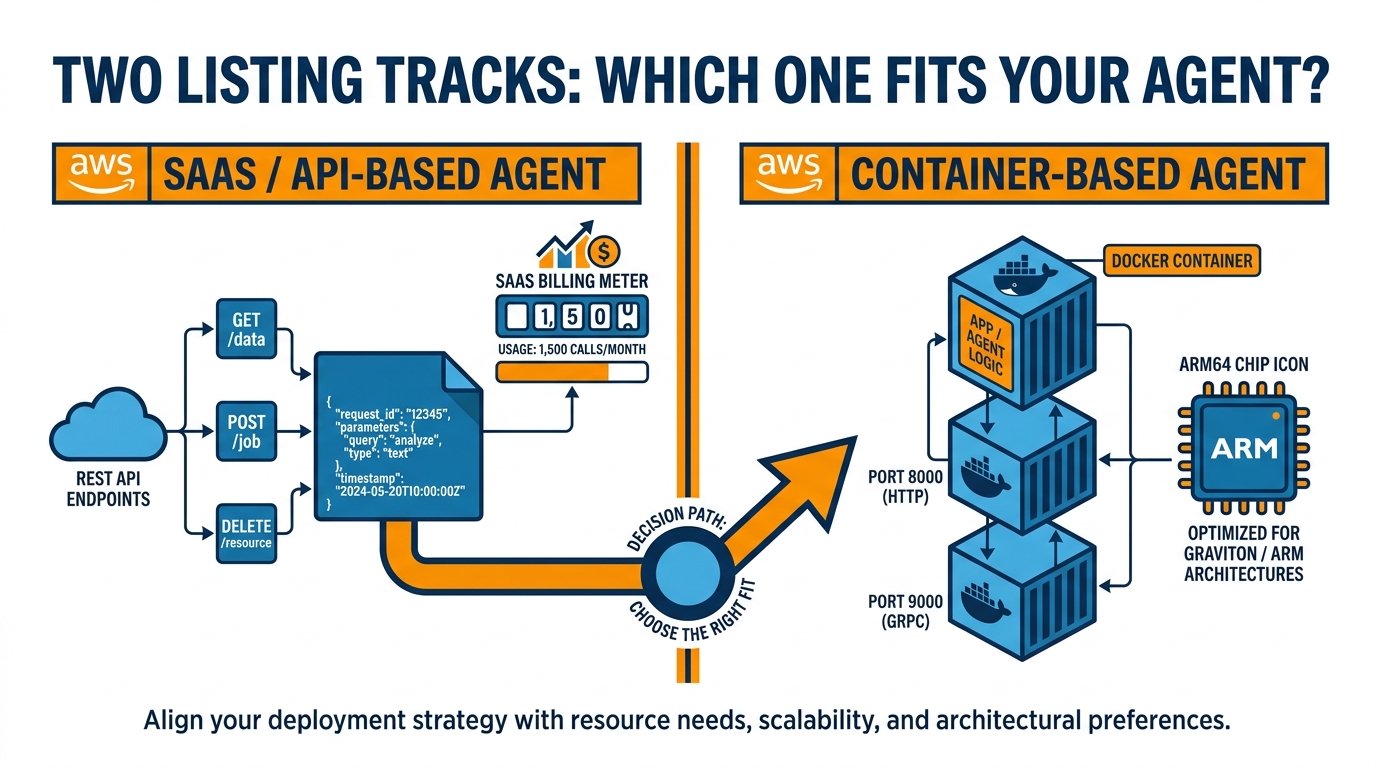
This track is for agents that run in your infrastructure and expose their capabilities through an API. The buyer subscribes to access that API; they don’t run your code in their own AWS account. Think of this as the classic SaaS model, but with AWS handling billing, metering, and entitlement checks on your behalf.
Operationally, this track requires you to maintain the availability, scalability, and security of your agent backend. If your agent goes down, your customers lose access. The tradeoff is control: you own the runtime, you can iterate quickly, and you don’t have to worry about packaging your agent to run in arbitrary customer environments.
This track suits agents where the model weights, proprietary pipelines, or data connections that make the agent valuable are things you deliberately do not want to hand over to the buyer’s environment. Legal AI agents that connect to your proprietary case law database, for example, or market intelligence agents that require real-time feeds you control.
Track Two: Container-Based AI Agents (Including AgentCore Runtime)
The container track is for agents that run inside the buyer’s AWS environment. You package your agent as a container image — typically ARM64-compatible, given AgentCore’s architecture requirements — and the buyer deploys it into their infrastructure. This gives enterprise buyers the security and data-residency guarantees they often require: your agent processes their data without it ever leaving their VPC.
This track includes the MCP and A2A server sub-types, which are specifically designed to participate in larger, multi-agent ecosystems running on Amazon Bedrock. If your agent is designed to be a component in an orchestrated pipeline rather than a standalone product, the container track with A2A capability is almost certainly where you belong.
Decision Criteria That Actually Matter
The real decision factors are three-fold. First: where does the sensitive data live? If the buyer’s data needs to stay in their environment, containers win. Second: how tightly coupled is your agent to your own proprietary infrastructure? If the magic is in your backend systems, SaaS wins. Third: who is your target buyer? Enterprise security teams nearly always prefer container deployments for agents that will process regulated data. Mid-market buyers often prefer the simplicity of an API subscription they can activate immediately.
Many sellers ultimately build both, launching with the SaaS track for faster time-to-listing and then adding a container SKU once they understand what their enterprise buyers actually need. This is a legitimate sequencing strategy, but plan for it deliberately rather than discovering it after your first enterprise deal requires data residency guarantees you can’t meet.
The Technical Requirements You Cannot Ignore Before Submitting
This is where many first-time sellers lose weeks. The AWS Marketplace technical requirements for AI agent listings are specific, non-negotiable, and not fully surfaced until you’re deep in the submission flow. The following is a consolidated view of what must be true before you click submit — particularly if you’re targeting the container track or AgentCore integration.
MCP Server Requirements
If you’re listing an MCP server for the AI Agents & Tools category — a tool that exposes capabilities to MCP-compatible orchestrators — your container must meet these exact runtime specifications:
- Host binding: The server must listen on
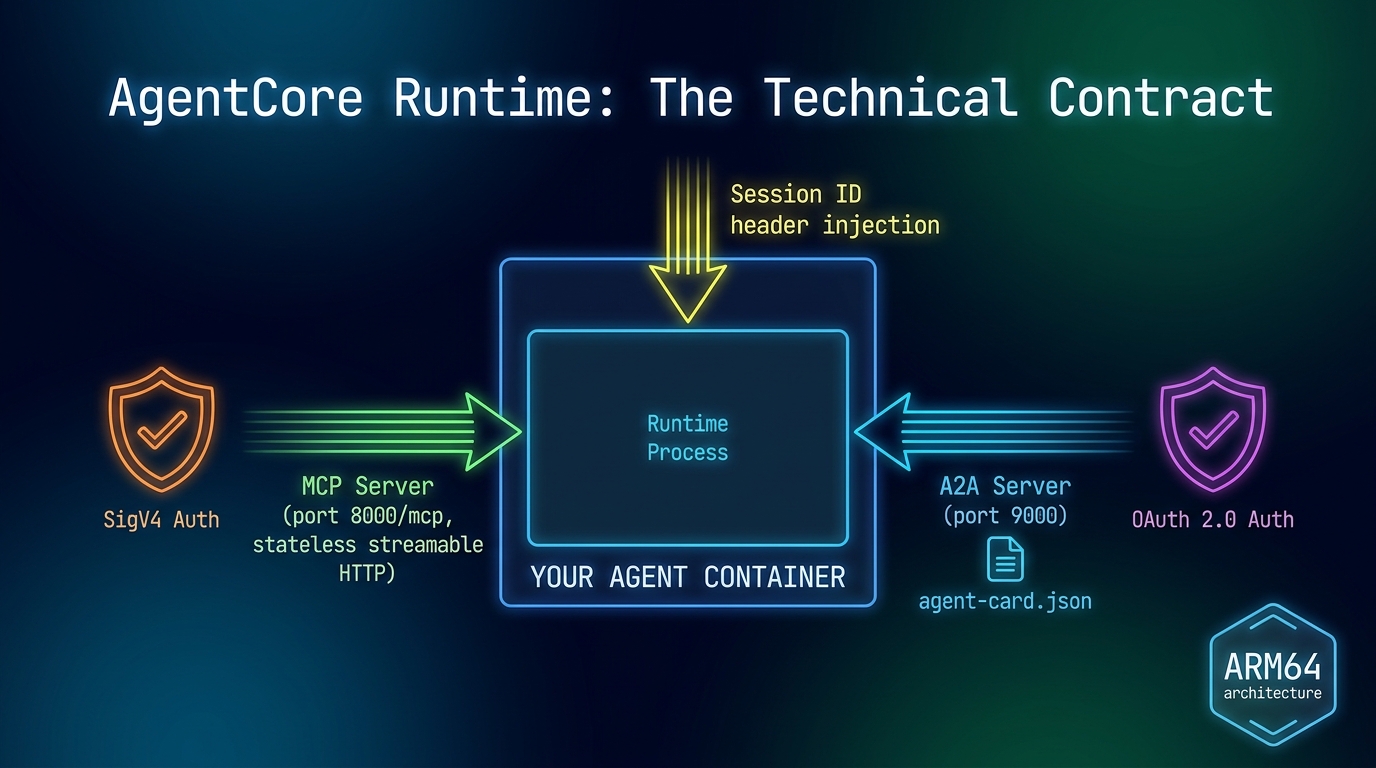
0.0.0.0(not localhost or a specific IP). - Port: MCP servers must expose port 8000.
- Path: The MCP endpoint must be accessible at
/mcp. - Protocol: Stateless streamable HTTP. AWS added support for stateful MCP in a March 2026 update, but stateless remains the default expectation unless you explicitly document stateful requirements.
- Methods: Must implement both
tools/listandtools/callat minimum. - Architecture: ARM64 container images are strongly preferred and required for native AgentCore Runtime deployment.
A2A Server Requirements
Agent-to-Agent servers follow a related but distinct set of requirements, designed for peer-to-peer agent communication in multi-agent pipelines:
- Host binding: Again,
0.0.0.0. - Port: A2A servers run on port 9000 — distinct from port 8000 (MCP) and port 8080 (plain HTTP).
- Path: Root path
/. - Protocol: JSON-RPC 2.0 over HTTP.
- Health checks: Must support
GET /pingendpoint returning a valid health response. - Agent Card: An agent card JSON document must be published at
/.well-known/agent-card.json. This is how other agents discover your agent’s capabilities in a multi-agent environment. - Authentication: Must support either SigV4 or OAuth 2.0 for inbound authentication. AgentCore injects a session header (
X-Amzn-Bedrock-AgentCore-Runtime-Session-Id) which your agent must handle correctly.
Session and State Management
One subtlety that catches builders off guard: AgentCore passes A2A requests as a transparent proxy. It does not modify the JSON-RPC payload. This means your agent is responsible for parsing the session ID from the injected header and managing any stateful context itself — AgentCore won’t do it for you. Builders expecting the runtime to handle session continuity across multi-turn conversations will need to architect explicit session stores, typically using DynamoDB or ElastiCache, before the listing will function correctly in real-world usage.
Documentation Requirements
Technical functionality alone isn’t enough. AWS reviewers also assess your listing documentation. At minimum, your listing must include:
- A clear description of the specific autonomous task your agent performs — generic descriptions citing “AI capabilities” without specifying the job to be done are a common rejection trigger.
- Usage documentation explaining how buyers integrate and invoke the agent.
- A description of what data the agent accesses, stores, and transmits, with explicit statements about buyer data handling.
- Relevant security certifications or posture documentation (SOC 2 Type II is the benchmark most enterprise buyers expect).
Pricing Your Agent for Revenue, Not Vanity Metrics
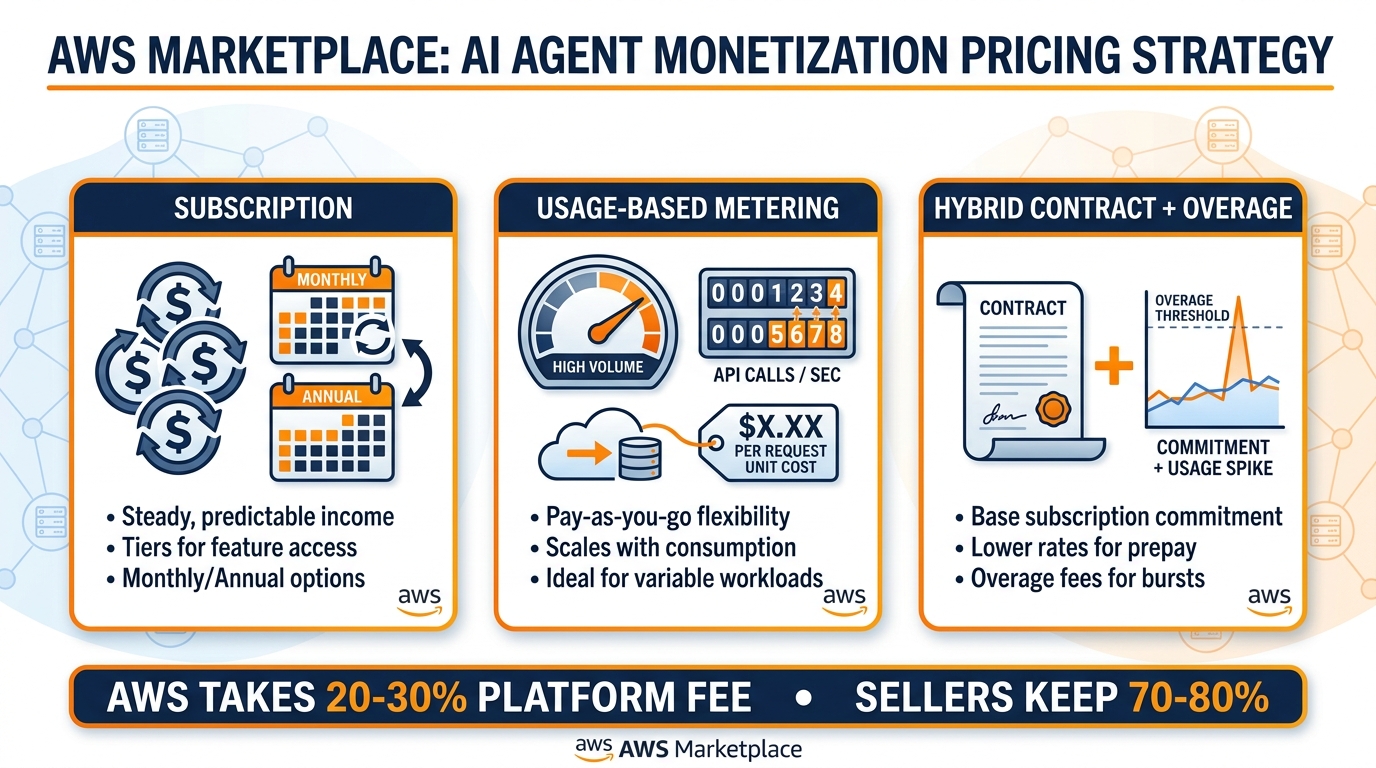
Pricing is where the most money gets left on the table in AI agent listings. Many sellers default to a flat monthly subscription because it feels safe and familiar. But AWS Marketplace’s metering infrastructure is genuinely sophisticated, and using it strategically — rather than ignoring it in favor of simplicity — is often the difference between a listing that generates mid-five-figures per month and one that plateaus at a few thousand dollars.
The Three Core Pricing Models
Contract-based pricing gives buyers an upfront entitlement — a defined quantity of agent use over a defined term. This might be a set number of conversations, documents processed, API calls, or agent-hours. Contracts are attractive for enterprise procurement because they fit into budget cycles. They’re predictable. The downside for sellers: if you underestimate usage, you’re leaving money on the table. If you overestimate, buyers feel overcharged and don’t renew.
Usage-based metering charges buyers per unit of actual consumption. AWS’s metering infrastructure supports granular dimensions: per-request, per-inference call, per page processed, per generic compute unit. The advantage is alignment — buyers only pay for what they use, which reduces friction at the initial sale. The risk is unpredictability from the buyer’s budgeting perspective, which can slow enterprise procurement.
Hybrid pricing — a base contract plus metered overages — has emerged as the dominant model for serious AI agent sellers in 2026. Buyers get the budget predictability of a contract for baseline consumption; they pay usage rates for anything above the committed tier. This model simultaneously reduces procurement friction, captures upside when agents deliver more value than expected, and creates natural expansion revenue as buyers scale usage.
The Platform Fee Math
AWS Marketplace charges sellers a platform fee that typically runs 20–30% of booked revenue, leaving sellers with 70–80%. For many sellers, this is a reasonable tradeoff given that the platform delivers qualified, AWS-credentialed buyers with existing billing relationships — but it must be factored into your unit economics from day one. An agent priced at $10,000 per month on Marketplace delivers $7,000–$8,000 to the seller after fees, not $10,000.
Pricing Dimensions That Map to Agent Value
One of the most common pricing mistakes is choosing dimensions that measure your costs (inference calls, compute time) rather than dimensions that map to buyer value (documents processed, decisions made, hours of human work replaced). A legal contract review agent, for example, creates value per contract reviewed — not per LLM inference call. Pricing per document reviewed aligns your revenue to the value the buyer perceives, which makes renewals and expansions far easier to justify.
AWS’s metering system supports custom dimensions, which means you’re not locked into generic units. Define your dimension based on what the buyer cares about, then build the metering instrumentation in your agent to track and report that dimension to the Marketplace Metering Service. This requires integration work, but it’s among the highest-ROI technical decisions you’ll make before launch.
Private Offers for Non-Standard Deals
For enterprise deals with custom pricing, volume discounts, or negotiated terms, Private Offers are the mechanism. A Private Offer is a customized listing that you extend to a specific buyer, with pricing, terms, and entitlements tailored to that deal. AWS’s Express Private Offers automation has shortened the time to create and deliver a Private Offer significantly — sellers can now generate and send customized offers without the manual back-and-forth that characterized earlier versions of the system.
Do not underestimate the enterprise procurement value of Private Offers. Large organizations that cannot approve a new vendor spend through a self-service click often can process a Private Offer through their existing AWS Enterprise Agreement. This is a significant procurement shortcut that removes one of the most common reasons large enterprise deals stall.
The Approval Process: What AWS Actually Reviews
The listing approval process for AI Agents & Tools has two distinct phases, and understanding the difference between them changes how you prepare your submission.
Phase One: Automated Listing Validation
The first phase is automated. AWS Partner Central runs checks against your listing metadata — title, description, category tags, pricing configuration, and product type selection. Common automated rejection triggers include:
- Product descriptions that don’t demonstrate “autonomous” capability (the system looks for evidence the agent operates without constant human input).
- Pricing configurations where the metered dimensions are not properly mapped to supported unit types.
- Missing or incomplete documentation fields that are marked required for the AI Agents category.
- Incorrect product type selection (for example, listing an A2A server under the SaaS track when it requires the container track).
As of June 2026, AWS has added AI-assisted listing creation within Partner Central. The Partner Assistant can generate and validate listing content from existing product assets — documentation, GitHub READMEs, architecture diagrams. This materially reduces the time required to produce a compliant first draft, but it does not guarantee approval. Human review still follows.
Phase Two: Human Review
The human review phase covers security posture, compliance documentation, and functional verification of agent capabilities. AWS reviewers are looking for three things that no automated system can fully assess:
First, whether the agent actually does what the listing claims. Functional verification means AWS will test the agent against its stated capabilities. Listings that over-claim autonomous behavior for what is effectively a glorified chatbot with a prompt wrapper get flagged here.
Second, whether the data handling practices described in the listing accurately reflect what the agent actually does with buyer data. This is where many agents with poor security architecture fail — not because they’re insecure per se, but because the listing documentation doesn’t match the actual data flows.
Third, whether the seller account and product setup meet the security requirements for the seller tier. This includes IAM role configuration, key management practices, and authentication implementation for the listed endpoints.
The Most Frequent Rejection Reasons
Based on ISV practitioner reports, the most common grounds for rejection are:
- Generic capability descriptions — Failing to specify precisely what autonomous task the agent performs.
- Security documentation gaps — Missing or vague statements about buyer data handling.
- Pricing model mismatch — The chosen pricing model doesn’t technically match the agent’s delivery architecture.
- Using personal or root AWS accounts rather than properly configured business seller accounts with IAM roles.
- Container images that don’t meet the AgentCore port/protocol specifications — A technical detail that seems minor but is a hard blocker.
Build a pre-submission checklist against these five items and you’ll eliminate the most common first-pass rejections. The review cycle takes time; getting it right on the first submission is materially faster than iterating through rejections.
Co-Sell, Private Offers, and the MDF Incentive Stack
Here’s the part that separates sellers who generate serious Marketplace revenue from those who collect listing badges. The AWS co-sell program and the MDF (Market Development Fund) incentive structure represent real money for sellers who engage with them — but the vast majority of new listers never activate them properly.
The Agentic AI Partner Growth Story
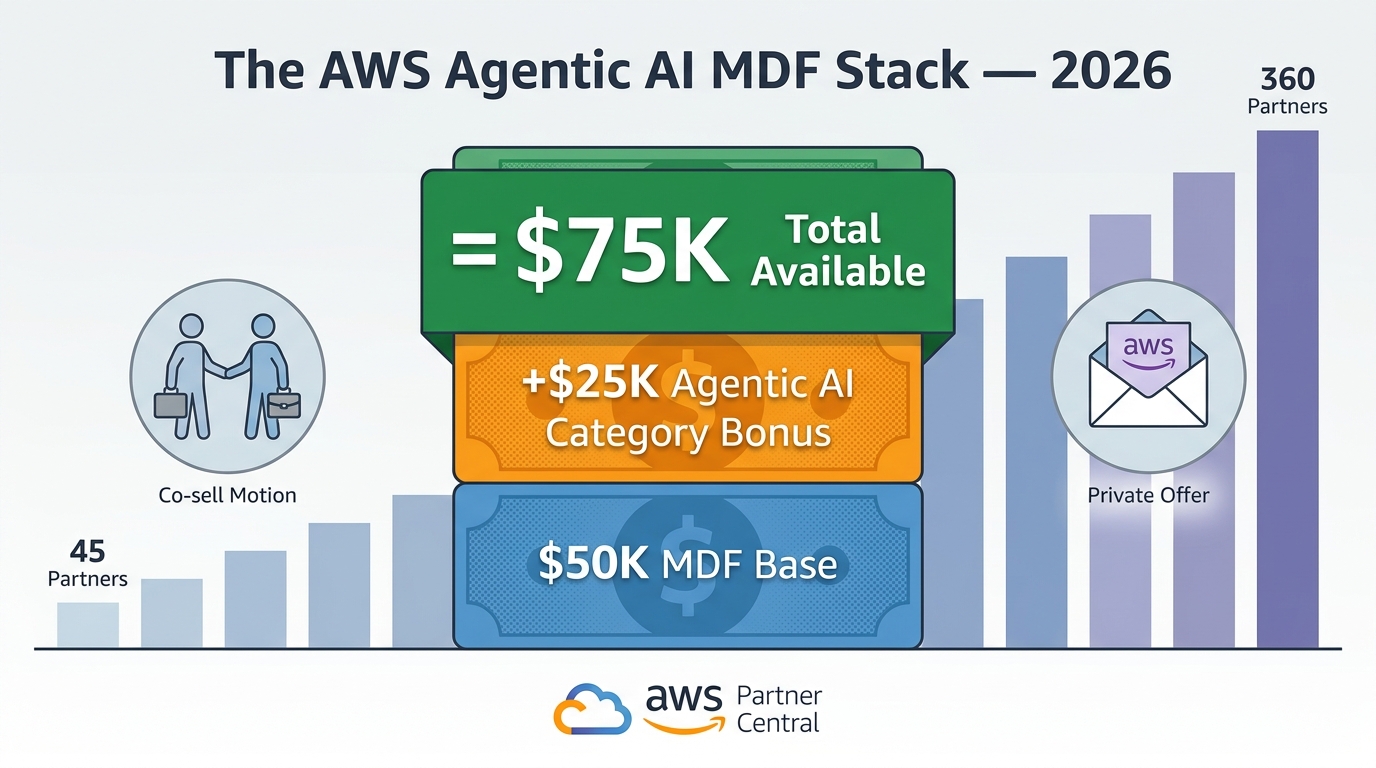
AWS’s AI Competency (launched as the Generative AI Competency in March 2024) has grown from 45 to 360 partners, supported by more than $115 million in AWS partner investment. In 2026, AWS formalized three new specialization categories within the AI Competency specifically for agentic AI:
- Agentic AI Applications — End-to-end agent products serving specific business functions.
- Agentic AI Tools — Components, infrastructure, and enabling technology for agent development.
- Agentic AI Consulting Services — Professional services for agent deployment and customization.
Partners who achieve validation in one of these agentic categories can access an additional $25,000 in MDF on top of the existing $50,000 base MDF pool — a total potential of $75,000 in co-marketing funds. This is not automatically distributed; it requires a formal MDF application and approved marketing activity plan. But for sellers willing to engage with the program, it represents a significant subsidy for demand generation activities that would otherwise come entirely out of the seller’s own marketing budget.
The Co-Sell Motion
Co-sell means partnering with AWS’s internal sales team to jointly pursue enterprise deals. The mechanism works through AWS Partner Central, where you register opportunities and request AWS seller involvement. When a qualified AWS account executive engages with your co-sell opportunity, they can introduce you to enterprise buyers through channels you cannot access independently — particularly buyers who have Enterprise Discount Program agreements with AWS and prefer transacting through Marketplace to maximize their committed spend.
AWS has deployed AI agents within Partner Central itself to accelerate co-sell motions as of 2026. Automated opportunity scoring, recommended engagement plays, and AI-assisted proposal generation are now part of the Partner Central workflow. Sellers who engage with these tools — rather than treating Partner Central as a reporting burden — get meaningfully faster deal velocity.
How Express Private Offers Change the Enterprise Sales Motion
Enterprise deals that don’t fit standard Marketplace pricing tiers used to require long manual negotiation cycles. Express Private Offers automation changes this. Sellers can now configure pricing templates and eligibility rules in advance, then generate customized Private Offers rapidly when a specific deal requires negotiated terms.
The practical impact: enterprise procurement cycles that previously took months because they required custom contract negotiations can now close in days, once the buyer has agreed on commercial terms. The Private Offer handles the procurement mechanics — billing integration, entitlement setup, contract terms — inside the buyer’s existing AWS billing relationship. Partners who have used this feature report meaningfully shorter time-to-close on large deals, with some citing five-figure transactions completing within a week of commercial agreement.
Using Your MDF for Demand Generation That Actually Works
MDF funds are not restricted to AWS-branded activities. Approved uses typically include field events, digital advertising targeting AWS customer segments, content production (webinars, technical white papers), and partner-led solution workshops. The most effective MDF deployment pattern for AI agent sellers in 2026 is investing in technical workshops where prospective buyers can integrate with a live version of your agent against their own data in a sandbox environment. This converts at significantly higher rates than traditional awareness marketing because it surfaces the agent’s value against the buyer’s actual use case.
Common GTM Mistakes That Stall Revenue in the First 90 Days
Even technically strong agents with well-structured listings can sit dormant for months if the go-to-market motion is poorly executed. These are the patterns that consistently stall revenue for first-time AWS Marketplace AI sellers.
Mistake One: Treating the Listing as the Product
The listing is a shop window, not a product. Enterprise buyers who discover your agent through Marketplace search rarely purchase without additional validation. They want documentation, case references, a free trial experience, or a technical call with someone who can answer integration questions. Sellers who optimize their listing copy but neglect to build the support infrastructure around it — trial environments, technical documentation, integration guides — consistently see high listing view rates with low conversion to paid subscriptions.
Mistake Two: Wrong Pricing Model for the Delivery Architecture
Choosing a subscription model for an agent that fundamentally delivers value per-task creates misalignment that buyers notice. A document intelligence agent priced at a flat $2,000/month doesn’t feel like good value to a buyer who processes 50 documents. The same capability priced at $40/document or $800 for a 20-document contract tier with overage rates suddenly makes the value transparent and the expansion path natural. Match the pricing dimension to what the buyer experiences as value, not to what’s administratively convenient for you to track.
Mistake Three: Neglecting the Free Trial
AWS Marketplace supports free trials natively. AI agent listings without a trial option face significantly higher purchase friction — particularly for mid-market buyers who can’t justify an enterprise procurement process for a product they’ve never run against their own data. A time-boxed or usage-capped trial that lets buyers experience the agent against their actual documents, queries, or workflows is among the highest-conversion assets you can build. Building it into your submission is a strategic decision, not an optional nicety.
Mistake Four: Ignoring Keyword Discoverability
AWS Marketplace’s search works on listing metadata — title, description, category tags, and use case labels. Sellers who write listing descriptions for human readers without considering how enterprise buyers actually search for agents miss early organic discovery. Concrete use case language (“automates Tier-1 customer support ticket routing,” “extracts structured data from unstructured legal documents”) consistently outperforms abstract capability language (“leverages large language model reasoning to…”) in both search ranking and conversion.
Mistake Five: Not Registering Co-Sell Opportunities Early
The co-sell motion requires registering opportunities in Partner Central. Sellers who wait until a deal is far advanced — or who don’t register at all — miss the AWS co-sell multiplier effect. AWS account executives cannot help you with deals they don’t know about. Register early, even for deals in early pipeline stages, and you create the opportunity for AWS to surface the relationship from their side.
Mistake Six: Underestimating Operational Readiness
An agent that gets approved and starts attracting buyers will generate support requests, integration questions, and usage edge cases that your development team isn’t ready for. Sellers who go live without documented integration guides, a support SLA, and at least basic monitoring on their agent’s availability and response quality often see early subscribers churn before the first renewal. Enterprise buyers who pay for an agent that breaks without clear support channels are not forgiving in their Marketplace reviews.
The 90-Day Revenue Ramp Framework
Based on patterns from ISVs who have launched successfully in the AI Agents & Tools category, a realistic 90-day framework looks like this. Note that “revenue” in this context means the framework for creating revenue conditions — not a guarantee that any specific revenue amount materializes, which depends heavily on agent quality, market fit, and seller execution.
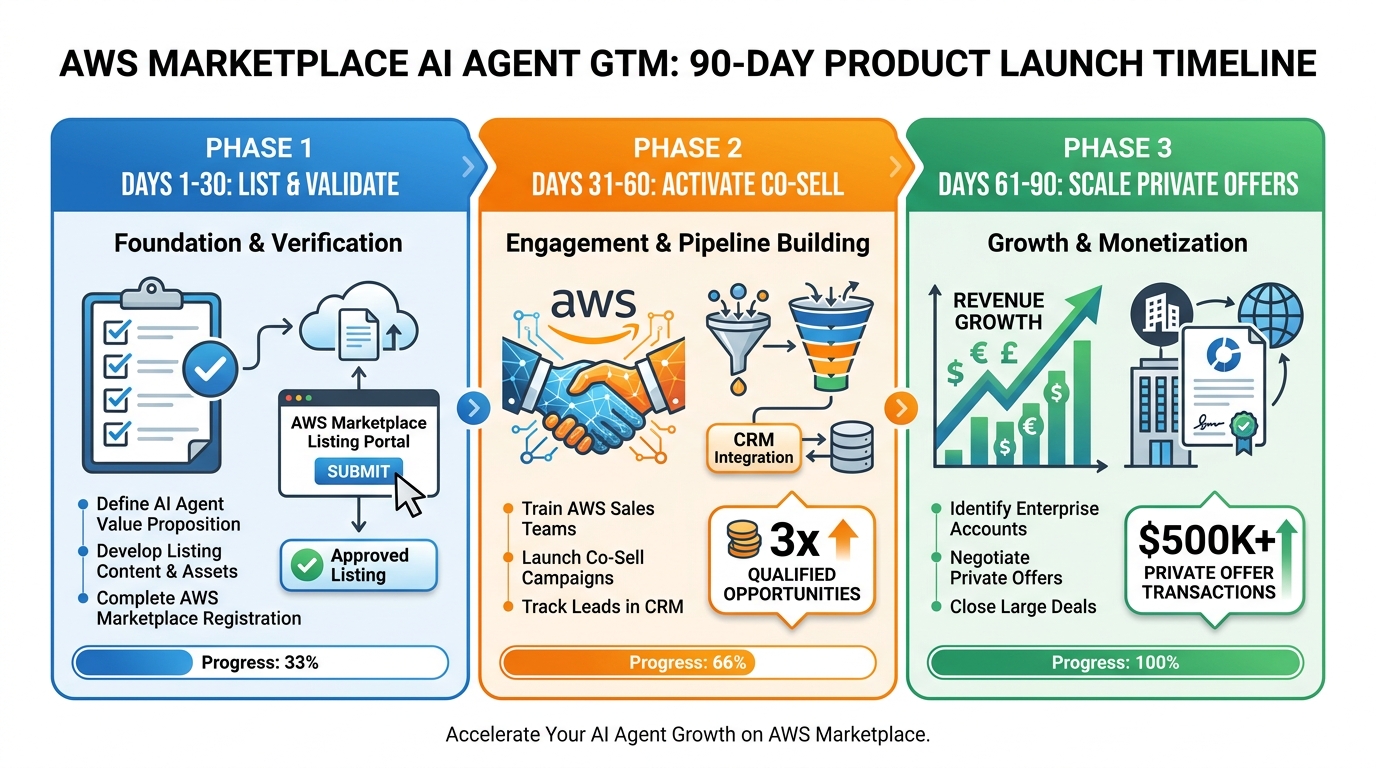
Days 1–30: Technical Readiness and Listing Submission
The first month is almost entirely technical and administrative. Priority activities:
- Finalize your listing track decision (SaaS vs. container) and build accordingly.
- Complete technical requirements: port/protocol specs, agent card, authentication, health check endpoints.
- Set up your seller account correctly: business entity, IAM roles, billing registration. Do not use a personal or root account.
- Write and validate listing documentation against the rejection checklist above.
- Build a free trial environment, even a limited one.
- Submit for review and be available to respond quickly to reviewer questions — slow response to reviewer queries is a common reason approvals take four to six weeks instead of two to three.
The goal at the end of Day 30 is a submitted listing with no outstanding technical blockers, not necessarily an approved listing. Approval timing varies and is outside your control; your documentation quality is inside your control.
Days 31–60: Activation and Early Co-Sell
Once approved — or while awaiting approval — begin activating the co-sell motion. This phase is about pipeline creation, not revenue collection:
- Apply for AWS AI Competency validation if you haven’t already. The Agentic AI category validation is the unlock for the $25K incremental MDF.
- Register your first five pipeline opportunities in Partner Central, even if they’re early-stage.
- Configure Express Private Offer templates for your most common enterprise deal structures.
- Run at least one live technical workshop with a prospective enterprise buyer using your trial environment.
- Submit your MDF application with a concrete demand generation plan.
Partners who execute this phase thoroughly consistently report three-fold increases in qualified sales opportunities relative to those who list and wait. The pipeline you build in Days 31–60 is what generates revenue in Days 61–90 and beyond.
Days 61–90: Private Offer Execution and Optimization
With pipeline established and co-sell motions active, Days 61–90 focus on converting opportunities to transactions:
- Move qualified co-sell opportunities toward Private Offers for enterprise buyers.
- Use Express Private Offers to shorten time-to-close on deals where commercial terms are agreed.
- Analyze trial conversion rates and identify friction points in the free trial experience.
- Collect and publish the first Marketplace customer review — social proof affects conversion rates for subsequent buyers.
- Refine your listing keywords and description based on actual search query data from the Marketplace seller dashboard.
ISV partners who execute all three phases report transaction volumes ranging from a handful of small subscriptions to individual Private Offer transactions exceeding $500,000 in the first 90 days. The range is wide because it depends entirely on the agent’s market fit and the seller’s co-sell execution — not on anything intrinsic to the platform itself.
Security and Compliance as a Competitive Sales Advantage
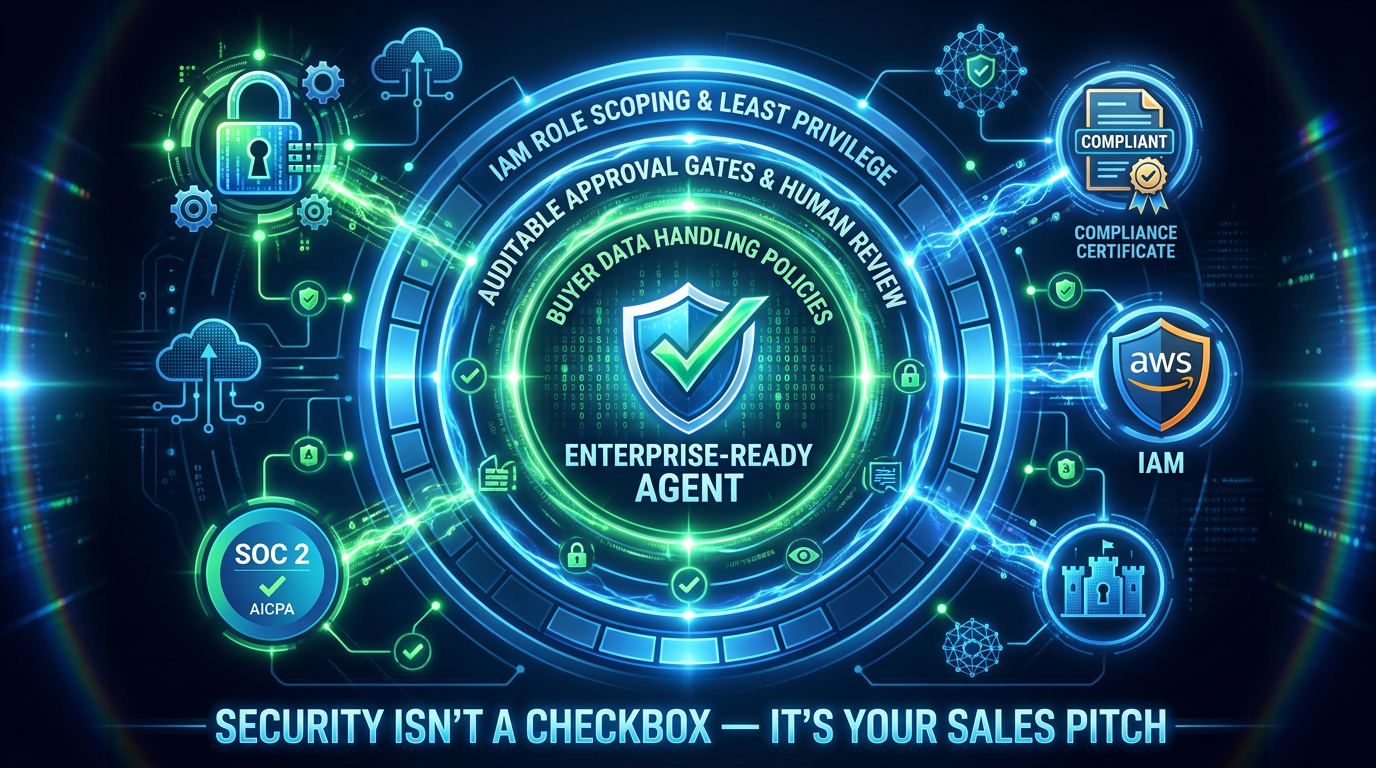
Most sellers treat security requirements as compliance overhead — a checklist to clear before they can get to the real work of selling. This framing is costly. In the enterprise market for AI agents, security posture is increasingly the primary purchase criterion, and sellers who lead with security evidence rather than burying it in a documentation tab close deals faster and at higher prices.
What Enterprise Buyers Are Actually Worried About
The enterprise security concerns around AI agents are distinct from those for traditional SaaS software. Standard software security means protecting data from unauthorized external access. Agents add a new dimension: the risk of the agent itself taking unauthorized actions on behalf of the buyer. An agent that has write access to a production database, for example, poses risks that a read-only analytics dashboard never did. Enterprise security teams are asking questions that didn’t exist two years ago:
- What actions can the agent take that cannot be undone?
- How is the agent’s access scope limited (IAM least-privilege, for example) to prevent it from accessing systems it doesn’t need?
- Is there an audit trail of every action the agent takes, in a format that the buyer’s compliance team can review?
- Can the buyer revoke the agent’s access without disrupting their production environment?
Agents that have clear, documented answers to all four questions close faster. Agents that require enterprise security teams to ask these questions during due diligence — and wait for answers — lose deals to competitors who already have the answers ready.
IAM Scoping: The Non-Negotiable
Implementing least-privilege IAM roles for your agent’s AWS access is both a Marketplace requirement and a sales enabler. Your listing documentation should explicitly state what IAM permissions your agent requires, why each permission is necessary, and what permissions it explicitly does not require. Many enterprise security architects review this list before the agent ever gets to a demo — agents with unexplained or broad permission scopes often get screened out before the sales team is even engaged.
Audit Logs as a Product Feature
Building comprehensive, queryable audit logs into your agent — and making those logs accessible to the buyer through their existing AWS CloudTrail or CloudWatch infrastructure — transforms a security requirement into a product feature. Buyers who can see exactly what their agent did, when, and on what data are far more likely to expand agent usage into sensitive workflows. Buyers who can only see aggregated metrics are cautious about giving agents access to anything critical.
Compliance Certifications and When They Matter
SOC 2 Type II is the baseline certification most enterprise buyers require. It does not make your agent secure; it demonstrates that your security practices have been independently audited. For healthcare and life sciences buyers, HIPAA Business Associate Agreement capability is often a requirement. For financial services, SOC 2 plus relevant financial services compliance frameworks matter. Map your certification roadmap to your target buyer profile — not to a generic enterprise standard — to avoid spending compliance budget on certifications your actual buyers don’t require.
Positioning Your Agent for Discovery in a Crowded Category
The AI Agents & Tools category is growing fast. AWS’s agentic AI partner base has expanded from 45 to 360 validated partners. Self-service listings are growing faster still. As the category fills, discoverability becomes the scarcest resource. Sellers who think carefully about how their agent is categorized, described, and positioned before day one have a structural advantage that is very difficult to recover later.
Category Tags and Use Case Labels
AWS Marketplace allows sellers to select industry vertical and use case tags for their listings. Many sellers select broad tags (“IT & Developer Tools,” “Machine Learning”) because they feel safer. In practice, narrower, more specific tags surface your listing to buyers who are actively looking for exactly what you do — which is far more valuable than broad exposure to buyers who aren’t specifically looking for your capability.
A document intelligence agent listed as “Legal Tech / Contract Review Automation” will show up for buyers actively searching in that category. The same agent listed as “Machine Learning Tools” competes with every ML tool in the Marketplace. Precision in categorization is a discoverability decision, not a limitation.
The Role of Marketplace Reviews
Customer reviews on AWS Marketplace carry significant weight for subsequent buyers, particularly in enterprise procurement contexts where peer validation matters. The first review is the hardest to get — it requires asking satisfied early customers to publish their experience, which many won’t do without a direct request. Build the review ask into your post-deployment customer success motion, ideally after the buyer has had a measurable success experience they can describe specifically. Generic positive reviews (“great product, easy to use”) add credibility but limited detail; specific reviews that describe the use case, the integration experience, and the measurable outcome are the ones that convert skeptical buyers.
Agent Mode and Conversational Discovery
AWS Marketplace is evolving toward conversational, agent-driven discovery — where buyers describe what they need in natural language and an AWS agent surfaces relevant listings. This changes the optimization logic for listing copy. Title and description need to match the natural language queries buyers will use when describing their problem to an agent, not just the keyword strings they’d type into a traditional search box. Writing your listing description as if explaining your agent to an intelligent but non-technical enterprise buyer — “this agent automatically reviews incoming vendor contracts for non-standard terms and flags them for legal review” rather than “LLM-powered contract analysis tool with NLP” — prepares you for both traditional search and conversational discovery.
The Honest Assessment: What This Platform Can and Cannot Do for You
AWS Marketplace’s AI Agents & Tools category is a genuinely valuable distribution channel for AI agents targeting enterprise buyers. The co-sell program, Private Offer mechanics, and procurement integration are real advantages that reduce the cost of enterprise sales. The MDF incentives are substantial. The buyer pool — enterprises with existing AWS relationships and committed spend — is among the highest-quality enterprise markets available.
But the platform has real limitations that sellers need to account for. Discovery is not guaranteed by listing. Demand generation is your problem. The platform fee is a permanent line item in your unit economics. Approval is not fast, especially for first-time sellers navigating the requirements for the first time. And the technical requirements for container-based and AgentCore-integrated agents are demanding enough that many agents that work perfectly well as standalone products need significant rearchitecting to meet the AgentCore runtime contract.
The sellers who thrive here are those who treat AWS Marketplace as one pillar of a broader go-to-market motion — not as a set-it-and-forget-it distribution magic trick. They use the Marketplace for procurement mechanics and buyer credibility, the co-sell program for pipeline development, Private Offers for deal execution, and their own demand generation for awareness. The platform amplifies that motion; it doesn’t replace it.
The agents that generate the most revenue in the first 12 months share a common pattern: they do one thing very well, they price that one thing in a way that makes the value obvious, and their documentation is good enough that enterprise security teams don’t have to ask basic questions. None of that requires an exotic technical stack. It requires deliberate, systematic execution against requirements that are, to their credit, clearly documented.
Pre-Launch Checklist: Before You Hit Submit
Use this consolidated checklist before submitting your AI Agents & Tools listing. It incorporates the most common rejection triggers, the technical requirements for AgentCore-compatible agents, and the GTM setup that determines whether your listing generates revenue or collects dust.
Technical Requirements
- ☐ Container images built for ARM64 architecture (if container track)
- ☐ MCP server listening on
0.0.0.0:8000/mcpwithtools/listandtools/callimplemented - ☐ A2A server listening on
0.0.0.0:9000/with JSON-RPC 2.0 andGET /pinghealth check - ☐ Agent Card published at
/.well-known/agent-card.json - ☐ SigV4 or OAuth 2.0 inbound authentication implemented
- ☐ Session header (
X-Amzn-Bedrock-AgentCore-Runtime-Session-Id) handled correctly - ☐ IAM roles configured with least-privilege access
- ☐ Business seller account with proper IAM setup (not personal/root account)
Listing and Pricing
- ☐ Listing title names the specific task, not just a capability category
- ☐ Description explains autonomous operation clearly
- ☐ Pricing model matches the agent’s delivery architecture and buyer value perception
- ☐ Metered dimensions map to buyer-observable value units (documents, decisions, tasks)
- ☐ Free trial configured with sufficient scope for buyers to validate against real data
- ☐ Data handling practices documented explicitly
- ☐ Security certifications (SOC 2 Type II minimum) referenced in listing
Go-to-Market Readiness
- ☐ Integration guide published (not just API documentation)
- ☐ Support SLA defined and resourced
- ☐ Monitoring and alerting active on agent availability and quality
- ☐ AWS AI Competency validation application initiated or completed
- ☐ Partner Central account configured for co-sell opportunity registration
- ☐ Express Private Offer templates configured for common enterprise deal structures
- ☐ MDF application plan prepared
Conclusion: The Platform Is Ready. Is Your Agent?
AWS’s investment in the AI Agents & Tools category is not tentative. The $115 million committed to partner AI development, the formal Agentic AI specialization tracks, the AgentCore Runtime technical infrastructure, and the Express Private Offers automation all point to a platform that AWS is treating as a long-term enterprise distribution channel — not an experiment.
For builders with genuinely capable agents, this creates a meaningful commercial opportunity. The procurement infrastructure is there. The enterprise buyer pool is there. The co-sell and MDF mechanisms are there. What’s not guaranteed is your share of it.
The agents that will define this category over the next 12–24 months will not be the most technically complex. They will be the ones that did the unglamorous work — the precise documentation, the security architecture that reduces enterprise friction, the pricing design that makes value tangible, the co-sell engagement that creates qualified pipeline rather than waiting for organic discovery. That work is available to any seller willing to do it. It just requires treating the Marketplace as seriously as you treat the engineering.
Ship something specific. Price it honestly. Document it thoroughly. Engage the co-sell motion early. The platform will handle the rest of the mechanics — but only if you give it something worth selling.