

It starts with a notification. A tariff schedule drops on the Federal Register at 4:47 PM. A sweeping executive order hits the White House wire at 6:12 AM. A Supreme Court ruling reshapes agency rulemaking authority with 24 hours’ notice. These are not edge cases — they are the operating conditions of modern policy journalism. And most newsrooms, even well-resourced ones, are still running workflows built for a slower era.
The gap is widening. Policy decisions are arriving faster, are more complex, and carry more downstream consequences than at any point in recent memory. The tariff shocks of 2025 and 2026 alone generated hundreds of pages of regulatory text that affected every major industry beat simultaneously. The AI executive orders signed in late 2025 created compliance obligations that touched newsrooms’ own editorial technology stacks while simultaneously becoming the news story they had to cover. Policy and operations collided in real time.
The newsrooms managing this well are not simply faster. They have fundamentally rethought how a coverage operation responds to a policy shock — from the moment of signal detection through to audience delivery. They have built monitoring stacks, triage protocols, verification checkpoints, and governance frameworks that treat real-time policy coverage as a distinct operational discipline, not just an accelerated version of standard reporting.
This article is not about whether AI belongs in newsrooms. That debate has largely been settled by adoption data. By 2026, 77% of newsrooms use some form of AI in their editorial workflows. The real debate — the one that separates the newsrooms doing this well from those doing it dangerously — is about where AI sits in the chain, what it is permitted to do, and when a human must intercept the process before something publishes that damages trust. That is the playbook this article sets out to map.
What a “Policy Shock” Actually Looks Like Inside a Newsroom
Before building a response framework, it is worth being precise about what a policy shock actually is — because “breaking news” covers a wide spectrum, and the workflows are meaningfully different depending on where a policy event falls on that spectrum.
The Anatomy of a Policy Shock Event
A true policy shock has three characteristics that distinguish it from ordinary breaking news. First, it is structurally complex: the event is not a single fact but a document, a ruling, or an order with multiple interconnected provisions, each carrying different implications for different beats. A 47-page tariff action affects trade reporters, business reporters, economics correspondents, and sector specialists simultaneously — often with contradictory implications across those beats.
Second, policy shocks are consequence-dense: the significance of the event cannot be understood from the headline alone. A change in the Federal Register’s tariff schedule, a new agency guidance memo, or a revised definition of regulatory thresholds may seem mundane but carry enormous downstream impact. Coverage that stops at the headline level consistently fails audiences who need to understand what the event actually means.
Third, policy shocks are time-asymmetric: market participants, lobbyists, and affected industries respond within minutes of publication, while journalists working with traditional workflows are still reading the source document. That asymmetry creates a window in which newsrooms either establish the authoritative account of what happened — or cede that ground to faster-moving actors with less obligation to accuracy.
Why Old Workflows Collapse Under Policy Shock Conditions
Traditional policy coverage follows a linear sequence: reporter obtains document, reads it, consults expert sources, drafts a story, editor reviews, legal checks where required, then publish. That process works adequately for anticipated policy events where preparation is possible. It breaks down completely when a shock arrives without warning.
In a shock scenario, the traditional model produces a predictable failure pattern. The first reporter to see the alert spends 20–30 minutes reading through a dense legal document. Expert sources are unavailable or already fielding calls from multiple outlets. The draft takes another 45–60 minutes. By the time a story publishes — often 90 minutes to three hours after the initial alert — the story has already been told elsewhere, often less accurately. The newsroom’s authoritative account arrives after the misinformation it was meant to displace.
This is the structural problem AI-assisted workflows are designed to solve. Not to replace the judgment of experienced journalists, but to compress the time between signal detection and informed human editorial decision-making to a window that actually matters.
The Three-Layer AI Monitoring Stack Every Policy Desk Needs
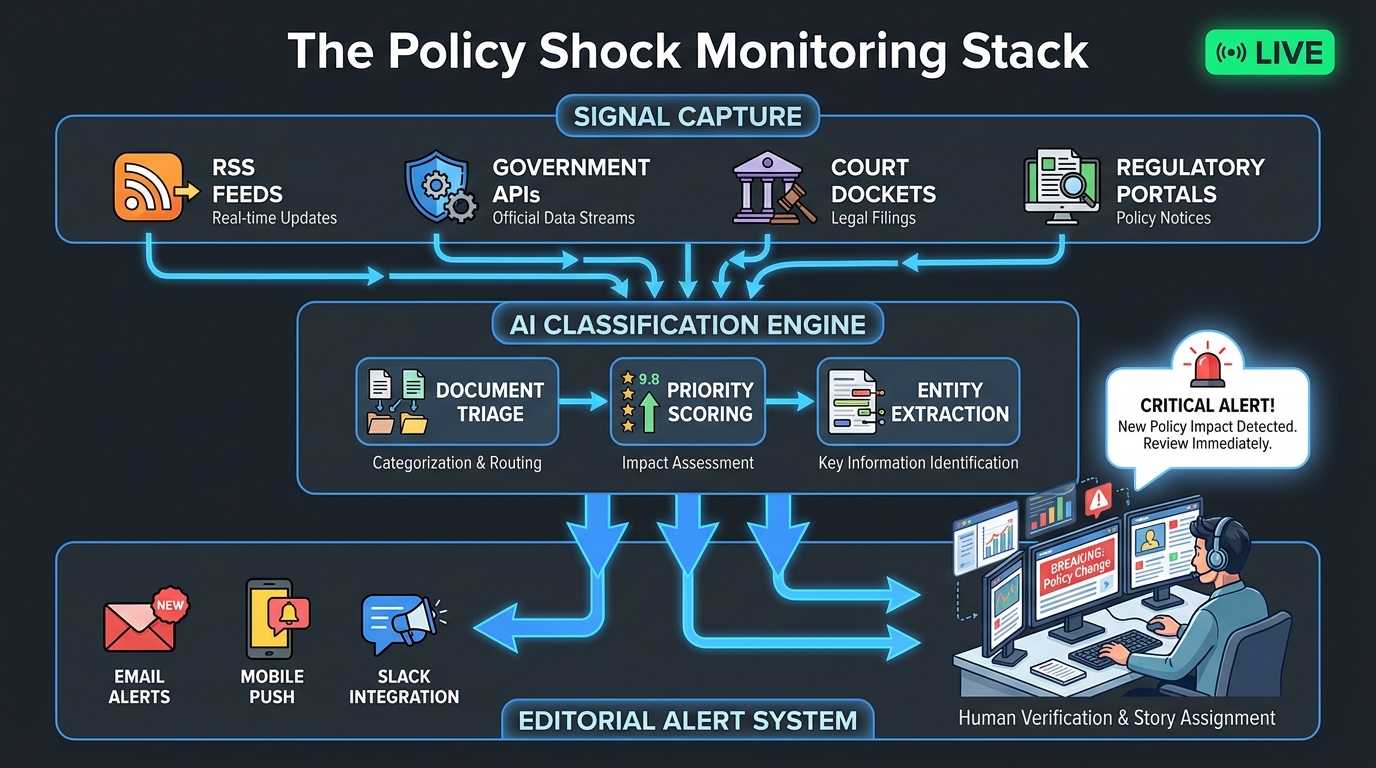
The newsrooms that respond effectively to policy shocks in 2026 are operating a layered monitoring architecture rather than relying on individual reporters to catch signals through social media or email subscriptions. This stack is not a single product — it is an intentionally assembled combination of feeds, classification tools, and alert protocols.
Layer One: Signal Capture
The first layer is about coverage — ensuring that no relevant signal slips through undetected. For a policy-focused desk, this means maintaining structured connections to the primary sources of policy action: the Federal Register, agency press rooms, court docket systems (PACER for federal cases), congressional committee feeds, executive office wire releases, and international regulatory portals for stories with cross-border dimensions.
What distinguishes high-performing newsrooms at this layer is the use of structured monitoring rather than passive RSS aggregation. Instead of pulling all updates and relying on humans to scan them, the best setups apply rule-based filtering at the ingestion stage — tagging incoming signals by agency, topic cluster, affected industry, and potential urgency. California’s CalMatters built a version of this with their Digital Democracy tool, which tracks legislation, votes, donation data, and hearing transcripts simultaneously, enabling reporters to identify patterns from live legislative data within minutes of records being published.
The signal capture layer should also include secondary source monitoring: tracking what major wire services, financial terminal systems, and industry-specific publications are flagging as significant. These signals often arrive before official government channels publish and can serve as an early warning that a primary source document is imminent.
Layer Two: AI Classification and Prioritization
Raw signal volume is the enemy of speed. A policy desk that connects to all relevant government feeds will be processing hundreds of updates per day, the vast majority of which require no editorial action. The second layer of the stack is an AI classification engine that reads incoming documents and assigns them a priority score based on relevance, urgency, and potential audience impact.
In practice, this means using a large language model tuned to the specific beats the desk covers — trade policy, financial regulation, healthcare rules, environmental standards — to extract key entities, identify which existing story threads the new document connects to, and flag whether the content represents a material change from existing policy or simply a routine update.
The classification layer is also where document structure analysis happens. A well-configured classification model can read an executive order and immediately identify: which agency it implicates, which statutory authority it cites, which specific provisions represent changes versus continuations, and which provisions are likely to face legal challenge. That structured output — not a draft article, but a structured analytical brief — is what arrives at the editorial alert stage.
Layer Three: Editorial Alert and Routing
The third layer translates AI classification outputs into human editorial decisions. This means routing the right structured brief to the right team with the right context — not just pushing a notification that something happened, but pushing a notification that tells the editor what happened, why it matters, which reporters and beats are implicated, what the AI’s confidence level is on its classification, and what the recommended immediate action is.
The best alert systems in 2026 are operating on a tiered escalation model: routine updates route to a monitoring dashboard for passive review; significant policy changes trigger a Slack or Teams notification to the relevant desk editor; high-priority policy shocks trigger an immediate direct alert to senior editors and designated policy specialists simultaneously. The routing logic is defined in advance, not improvised at the moment of the shock.
The Triage Desk Model: From Document Drop to First Draft in Minutes
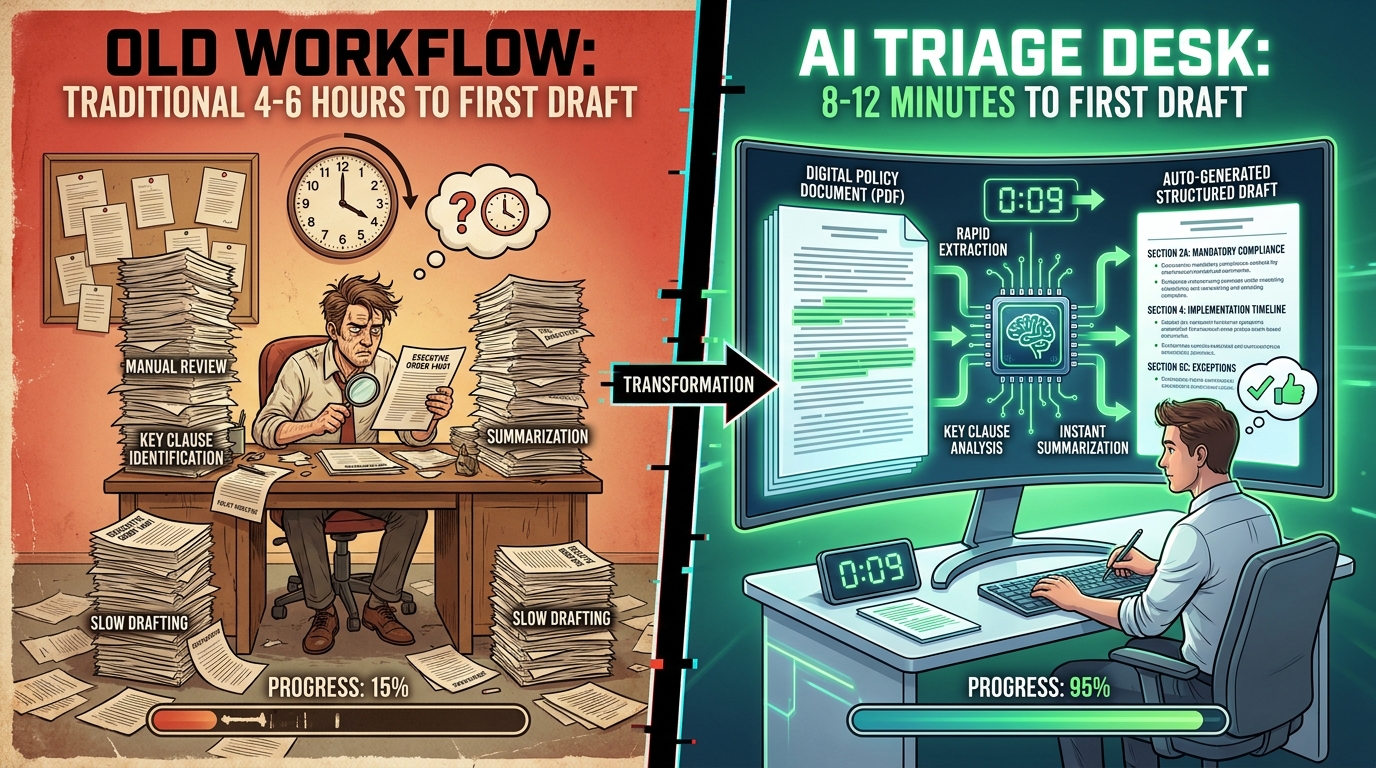
Once a policy shock has been detected and routed, the triage desk model takes over. This is where the most significant operational gains happen — and where the most significant risks also concentrate.
What the Triage Desk Actually Does
The triage desk is not a new department. It is a defined workflow role that can be staffed by existing reporters and editors during a policy shock event. Its function is to transform a raw policy document into a structured working brief that beat reporters can use to begin substantive reporting immediately, rather than spending their first hour reading source material.
The AI-assisted triage process follows a sequence. The policy document is ingested into the AI tool — a well-governed, newsroom-deployed LLM instance, not a public consumer product. The model is prompted with a structured task: extract the key provisions, identify what has changed from current policy, flag any provisions with ambiguous legal language, summarize the stated rationale, and identify which industries, geographic regions, or population groups are most directly affected.
That output is reviewed — not skimmed, reviewed — by a human editor who has enough policy domain knowledge to catch structural errors. The reviewed brief is then pushed to the reporting team as the starting document for the story. Crucially, the AI output is not published: it is an internal working document that replaces the first 90 minutes of reporter reading time, not the reporter’s judgment about what the story actually means.
The Time Compression Reality
The operational gains from this model are meaningful. Where a traditional workflow produces a first draft in 3–4 hours after a complex policy document drops, a well-run AI triage workflow is producing a substantive, editor-reviewed brief within 8–15 minutes, and a publishable first story within 30–45 minutes. That is not a marginal improvement — it is a categorical difference in whether a newsroom leads the coverage or follows it.
Newsroom leaders who have implemented this model consistently report the same observation: the time savings from AI-assisted triage are most valuable not because they allow newsrooms to publish faster in isolation, but because they create space for the verification work that traditional fast-turnaround coverage routinely skips. When a reporter does not have to spend two hours reading a complex document, those two hours become available for source calls, expert verification, and context-building — the elements that make policy coverage genuinely useful to audiences.
The Triage Stack in Practice
The tools operating in these workflows in 2026 vary by organization, but the architecture is consistent. Document ingestion typically uses a combination of the newsroom’s own LLM instance for sensitive material and external tools for public documents. The classification and extraction layer draws on models specifically fine-tuned or carefully prompted for legal and regulatory text — general-purpose models perform noticeably worse on dense statutory language without careful prompt engineering.
The human review checkpoint — which must occur before any AI output reaches reporters as a working document — is typically staffed by a senior editor with policy knowledge and explicit authority to reject or revise the AI’s structural brief. This checkpoint is not optional and is not a bottleneck: well-designed triage workflows build the review into the process at a stage where it takes minutes, not hours, because the editor is reviewing a structured brief, not a long-form draft.
Verification Cannot Be the Thing You Cut

The single most important design principle in AI-assisted policy coverage is one that sounds obvious but is consistently violated in practice: speed gains from AI must be reinvested in verification, not consumed by faster publication. This is not a philosophical position — it is an operational imperative grounded in what AI models actually do when they encounter complex legal and regulatory text.
How AI Models Fail on Policy Documents
Large language models are capable of remarkable things with policy text, but they have specific, predictable failure modes that are particularly dangerous in breaking news contexts. The most common is confident imprecision: the model produces a summary that is directionally correct but contains specific errors — wrong effective dates, misattributed provisions, incorrect agency names, subtly wrong numerical thresholds — stated with the same confident tone as accurate information.
A second failure mode is context collapse: the model summarizes a provision accurately but strips away the qualifying language, the exceptions, and the conditions that define how the provision actually works. An executive order that applies “subject to existing appropriations authority” reads very differently once you strip that qualifier, and a model under time pressure — or with a prompt that asks for a “brief” summary — will often drop exactly those qualifying phrases.
A third failure mode is particularly insidious in policy coverage: precedent confusion. When a new policy action modifies, supersedes, or operates alongside existing regulations, models can conflate the new text with the existing framework and produce summaries that misrepresent what is actually changing. In a complex regulatory landscape — trade law, financial regulation, environmental standards — this is not a rare edge case. It is a routine risk.
Building Verification Into the Workflow, Not After It
The February 2026 synthesis published by the Center for News, Technology & Innovation (CNTI), which analyzed 30 peer-reviewed papers on newsroom AI policy, found a consistent pattern: newsroom AI policies are strong on principles — transparency, human supervision, editorial control — but weak on specific procedures for how verification actually happens in practice. Many organizations had adopted AI tools before they had built the verification protocols to safely operate them.
The newsrooms operating most effectively have made verification structurally embedded, not left to individual reporter discretion. This means: every AI-generated brief is compared against the source document before it reaches reporters; any numerical claim in an AI output requires a specific source citation to the original text; and any provision that involves timing, exceptions, or conditions is verified against the primary source independently of the AI’s rendering.
Latin American newsroom leaders, cited in recent Reuters Institute research, have articulated this principle cleanly: time saved by AI must be reinvested in thorough verification, not used to publish faster with less checking. That reinvestment principle is the difference between AI-assisted journalism that builds trust and AI-assisted journalism that erodes it.
The Specific Risks of Live Policy Coverage
Live policy coverage — where journalists are providing real-time updates as a policy event unfolds, similar to a debate or a congressional hearing — compounds all of these risks. The time window for verification is compressed further, the volume of text is continuous, and the pressure to match competitor speed is at its highest. This is the context where AI hallucination risk is greatest and where governance frameworks are weakest.
The fact-checking organizations building live verification tools — including Brazilian outlet Agência Lupa’s Busca Fatos system, which provides real-time context layers during political events — represent an important model here. These tools are not AI writers producing live copy; they are AI-assisted verification aids that flag claims for human checkers to assess. The distinction matters enormously in practice.
Speed vs. Accuracy: Where Newsrooms Are Drawing the Line in 2026
The tension between speed and accuracy in journalism is not new. What is new in 2026 is that AI has changed the terms of the tradeoff in ways that require explicit editorial policy rather than informal professional judgment.
The False Dichotomy Newsrooms Need to Reject
The most damaging frame in newsroom AI discussions is the idea that speed and accuracy are fundamentally opposed — that adopting AI tools necessarily means sacrificing editorial standards for competitive velocity. This frame is wrong, and the newsrooms accepting it as a given are the ones most likely to make damaging errors.
The accurate framing is that AI changes where time is spent in the editorial process, not whether time is spent. A triage workflow that compresses document reading from two hours to fifteen minutes does not reduce the total time available for editorial work — it reallocates it. The question every newsroom needs to answer explicitly is: where do those recaptured hours go?
The newsrooms drawing clear lines in 2026 are answering that question in writing, in their editorial AI policies. The strongest policies specify that AI-generated time savings are designated for verification, source consultation, and context-building — not for accelerating the publication clock. This is a governance decision, not a technology decision.
Where Speed Actually Matters
That said, speed does matter — in specific, defined circumstances. When a policy shock drops and competitors are already filing, the window in which a newsroom can establish the authoritative account of what happened is real and narrow. Being 45 minutes behind on a major tariff announcement is not just a competitive disadvantage; it means audiences seeking information in that window are getting it from sources with different accuracy standards.
The newsrooms managing this well are making speed-accuracy tradeoffs explicitly rather than implicitly. They have defined categories of coverage where speed takes priority — initial alerts, rapid signal posts that acknowledge an event has occurred without claiming to fully explain it — and categories where accuracy must hold regardless of competitive pressure: full explainers, policy analysis, impact assessments. The AI workflow serves both categories differently: faster signal detection and alert drafting for the first, deeper document analysis and brief generation for the second.
The Two-Phase Publication Model
A practical approach many policy desks are adopting is a two-phase publication model. Phase one is a rapid “What happened” post — published within minutes of a policy event being detected, acknowledging the event, stating what is known with certainty, and explicitly noting what is still being assessed. This post is short, human-written from the AI triage alert, and carries a clear signal to readers that it is a developing story.
Phase two is the substantive explainer — the “What it means” piece that draws on the full AI-assisted triage brief, has been through source verification, and includes expert context. This publishes within 30–60 minutes of the initial post, replacing the placeholder with the authoritative account. The two-phase model manages competitive pressure without sacrificing the accuracy standards that differentiate professional journalism from first-draft social media coverage.
The Human-in-the-Loop Imperative
Every serious examination of AI in newsroom workflows arrives at the same conclusion: human editorial oversight is not optional, and in policy coverage specifically, the definition of where humans must remain in the loop requires explicit, detailed specification.
Where the Line Must Be Drawn
The research consensus in 2026 is clear on which tasks AI can assist with and which require unambiguous human control. AI can appropriately handle: document ingestion and structural parsing, entity extraction and topic classification, initial draft generation for internal working documents, alert routing based on pre-defined rules, and translation and transcription of policy material.
Human control must be maintained over: final publication decisions on any AI-assisted content, any claim that involves legal interpretation or prediction of regulatory outcome, any coverage that implicates individuals by name in connection with enforcement actions, story framing and headline decisions for policy impact pieces, and any content that will be presented as analysis rather than pure summary.
The boundary between these categories is not always obvious in practice, which is why it must be defined in advance. A journalist working under time pressure at 6 AM when a major executive order drops is not in a position to adjudicate novel edge cases about where the AI’s role ends. That judgment needs to have already been made, documented, and trained.
The Role of the Designated AI Editor
Leading newsrooms in 2026 are formalizing a role that did not exist three years ago: the AI editor or automation editor, a position responsible for maintaining the human-in-the-loop controls across the entire AI workflow stack. This is not simply a technology role — it sits at the intersection of editorial policy, technology procurement, and reporter training.
The AI editor’s responsibilities include: maintaining the prompt libraries used in the triage desk model, reviewing AI outputs for systematic errors on an ongoing basis, updating classification rules as beats evolve, running regular audits of published content that passed through AI-assisted workflows, and serving as the designated human escalation point when reporters encounter AI outputs they are uncertain about.
Major wire services and financially focused newsrooms have been earliest to formalize this role, recognizing that systematic oversight of AI-assisted workflows requires dedicated capacity, not informal ad hoc review.
Audience Delivery in a Policy Shock Moment
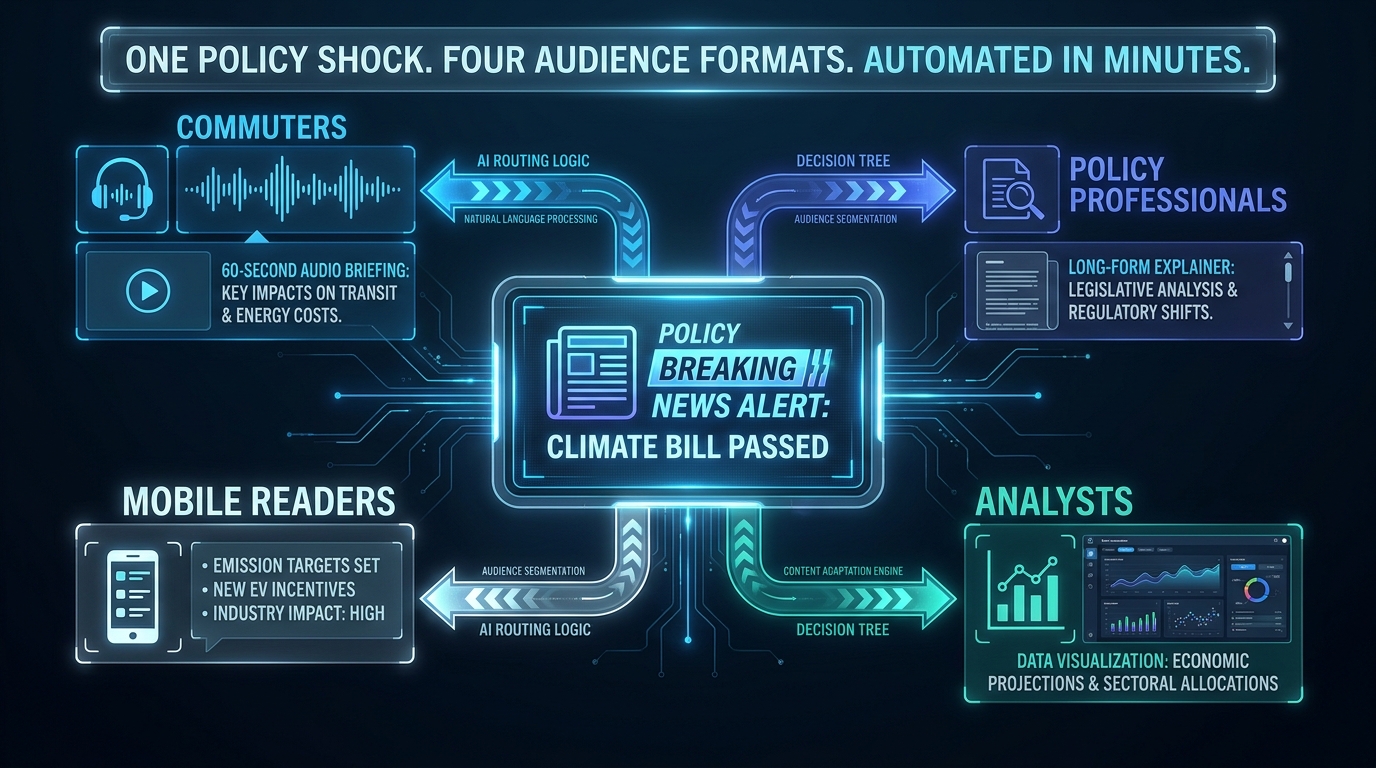
Even the best-researched, most accurately verified policy coverage fails if it does not reach the right audience in the right format at the right moment. This is the dimension of AI-assisted policy journalism that is developing fastest in 2026 and is perhaps the most underappreciated competitive differentiator.
Format Fragmentation as a Coverage Challenge
Policy coverage audiences in 2026 are radically fragmented. The same event — a major tariff action — needs to reach a financial professional who wants the immediate market implications in a terminal-style brief, a business owner who needs to understand operational impact in accessible language, a general reader who needs the political context explained without jargon, and a policy specialist who needs the statutory underpinnings analyzed in detail. These are not the same story. They are four different pieces of coverage of the same underlying event.
Traditional newsrooms produce one story and distribute it to everyone, leaving the interpretation work to each reader. AI-assisted newsrooms are beginning to generate format variants from a single underlying reporting brief — automatically producing the 60-second audio summary for commuters, the mobile-optimized three-bullet brief for push notification distribution, the long-form explainer for desktop readers, and the data-heavy version for specialist audiences.
Personalized Alert Architecture
The alert systems of the most sophisticated policy newsrooms in 2026 are not broadcasting the same notification to all subscribers when a policy shock hits. They are routing differentiated alerts based on reader-declared interest areas, historical engagement patterns, and the specific subject matter of the event. A reader who has demonstrated deep engagement with trade coverage gets a full brief on a tariff action within minutes. A general reader in a directly affected industry gets a simplified impact summary.
This personalization architecture is not complexity for its own sake — it represents a fundamental rethinking of what news organizations can deliver. When a policy affects everyone differently, coverage that acknowledges that differentiation performs demonstrably better on engagement metrics and — more importantly — serves audiences more genuinely than one-size-fits-all coverage.
The critical design constraint is that personalization cannot compromise accuracy. A simplified version of a policy story that strips out qualifying conditions, effective dates, or exceptions is not a helpful simplification — it is a harmful misrepresentation. The AI systems generating format variants must be constrained to preserve factual completeness even as they adapt reading level and length.
Building the Governance Layer: What Newsroom AI Policies Actually Need to Say

The CNTI synthesis released in early 2026 identified a gap that is visible across virtually every newsroom operating AI tools: policies are strong on principles and weak on procedures. That gap is precisely where things go wrong in practice.
Principles vs. Procedures: The Operational Gap
A newsroom AI policy that says “AI must be used with human oversight” has stated a principle. A newsroom AI policy that says “No AI-generated text may be published without review by a named editor; the reviewing editor must document their review in the CMS workflow log; any AI-generated factual claim must be traced to a specific passage in the primary source document before publication” has stated a procedure. The difference between the two is not academic — it is the difference between governance that holds under pressure and governance that collapses the moment a story breaks at an inconvenient time.
The procedural elements that AI newsroom policies most commonly lack are: specific escalation paths when AI outputs are uncertain or contradictory; clear audit requirements for AI-assisted content after publication; defined processes for corrections when AI-assisted content contains errors; explicit rules about which AI tools are approved for use on which categories of content; and training requirements for reporters using AI tools in editorial contexts.
The Coverage Categories Framework
One practical governance approach gaining traction in 2026 is a coverage categories framework that explicitly maps AI permissions to content type. Under this model, all content types are categorized by their risk profile for AI-assisted production, and different AI permissions apply to each category.
Category one (low risk): routine structured data stories, earnings summaries, weather and traffic updates, sports scores, event listings. AI drafting permitted; editor review required before publication.
Category two (medium risk): policy summaries, legislative updates, regulatory changes. AI-assisted triage and brief generation permitted; human reporter must develop the story from the brief; editor review required; source verification against primary documents required.
Category three (high risk): legal analysis, enforcement actions, named individual coverage, electoral reporting, national security matters. AI may be used for document ingestion and entity extraction only; no AI-generated text may appear in the story; senior editor sign-off required; legal review where applicable.
This framework does not eliminate AI from high-risk coverage — it defines exactly which parts of the workflow AI can assist with and where human judgment must be the exclusive driver.
Transparency Requirements
The governance layer must also address transparency — what newsrooms tell their audiences about how AI was used in a particular piece of coverage. This is not a simple question: disclosure that AI was used can itself be misleading if it does not distinguish between “AI transcribed the press conference audio” and “AI drafted the initial version of this article.”
The evolving standard in 2026 is toward more granular disclosure: not just “this content used AI tools” but a specific notation of what role AI played. Some newsrooms are experimenting with tiered disclosure labels that indicate the depth of AI involvement. The specificity of those disclosures is itself becoming a differentiator — newsrooms that can accurately tell audiences what AI did and what humans did are demonstrating a level of workflow transparency that is genuinely meaningful.
What the Leading Outlets Are Doing Differently Right Now
Beyond the architectural principles, it is worth being concrete about what the newsrooms operating most effectively in real-time policy coverage are actually doing — the specific choices that separate them from the pack.
Pre-Built Policy Context Libraries
The most operationally sophisticated policy desks are maintaining continuously updated context libraries — structured knowledge bases about the regulatory and legislative landscape in their coverage areas. When a policy shock hits, the AI triage process does not start from zero: it draws on a pre-existing structured map of existing policy, relevant statutory authority, historical precedent, and key stakeholder positions.
This context library approach dramatically improves the accuracy of AI-generated briefs because it grounds the model’s analysis in a curated, verified knowledge base rather than relying solely on the model’s training data, which may be months or years out of date on rapidly changing regulatory matters. Maintaining these libraries requires ongoing editorial investment — they must be updated as policy evolves — but the return in brief quality and accuracy is substantial.
Beat-Specific Model Tuning
General-purpose language models perform noticeably worse on dense regulatory and legal text than on general news content. The newsrooms investing in beat-specific fine-tuning or prompt engineering — building tailored prompt libraries for trade policy, financial regulation, healthcare law, environmental standards — are getting materially better outputs from their triage workflows than those using off-the-shelf tools without customization.
This does not require training a custom model from scratch. It requires building and maintaining high-quality prompt templates that include relevant regulatory context, define the specific extraction tasks clearly, and include examples of the output format required. That is editorial craft work as much as it is technical work — and the newsrooms doing it best are involving experienced policy reporters in the prompt development process, not leaving it to engineers alone.
Simulation Drills for Policy Shock Scenarios
Several leading newsrooms have begun running regular simulation exercises — treating a major policy shock as a tabletop exercise and walking the editorial team through the full workflow response. These drills surface workflow bottlenecks, identify training gaps, and allow teams to test governance protocols before they are needed under real pressure.
The analogy to emergency preparedness is apt. A newsroom that has never rehearsed its policy shock response will not perform it cleanly when the moment arrives. A newsroom that has run the drill six times knows exactly who activates the triage desk, who reviews the AI brief, who handles the expert outreach while the brief is being prepared, and who makes the publication call on the two-phase model’s first post.
The Failure Modes No One Talks About
Any honest account of AI newsroom playbooks for policy coverage must address the failure modes that are emerging in practice — not to argue against the tools, but to ensure that the newsrooms adopting them are doing so with clear understanding of where things break.
Over-Reliance on AI Prioritization
The classification layer of the monitoring stack is powerful, but it can create a dangerous blind spot: the stories the AI consistently scores as low priority. When a classification model is trained to prioritize novelty, direct economic impact, or named-entity significance, it will consistently underweight slow-moving regulatory changes, technical agency guidance, and procedural developments that experienced policy reporters recognize as significant precisely because their implications are non-obvious.
The failure mode here is not that AI misclassifies these items — it is that the newsroom stops maintaining the human monitoring capacity to catch them. If policy reporters become dependent on AI alerts to know what to cover, the stories that human expertise would have elevated but AI did not will consistently go uncovered. Maintaining experienced human pattern recognition alongside AI classification is not redundant — it is essential.
Prompt Injection and Source Manipulation
A less-discussed but growing risk in AI-assisted policy coverage is the possibility that sophisticated actors will attempt to manipulate AI triage outputs by embedding content in source documents or monitoring feeds designed to produce specific outputs from newsroom AI systems. This is not a theoretical risk — security researchers have demonstrated prompt injection attacks in multiple LLM deployment contexts, and the stakes in newsroom deployments are high.
An AI-assisted triage workflow that can be manipulated by content embedded in a government document or a third-party data feed is a significant editorial security vulnerability. Newsrooms deploying these tools need explicit security reviews of their ingestion pipelines, sandboxed AI deployment architectures that prevent injected content from influencing outputs beyond the immediate document, and human review protocols specifically designed to catch outputs that are anomalously framed or uncharacteristically directive.
Competitive Racing and Standard Erosion
Perhaps the most systemically dangerous failure mode is the competitive dynamic that can develop between newsrooms once AI-assisted policy coverage becomes standard. If the baseline speed of policy shock coverage accelerates across the industry, competitive pressure shifts to secondary dimensions — and in that dynamic, verification standards are the most vulnerable element to be deprioritized.
The newsrooms that resist this pressure by maintaining explicit governance commitments — and that are willing to accept being occasionally second with a verified story rather than first with an error — are making a strategic bet on trust as a long-term competitive asset. The evidence from audience research consistently supports this bet: the outlets that have maintained rigorous accuracy standards in AI-assisted coverage are demonstrating meaningfully higher trust scores than those that have prioritized speed at accuracy’s expense. That trust differential becomes a durable competitive advantage precisely because it is difficult to quickly rebuild once lost.
From Reactive to Ready: Building a Policy Shock Playbook That Actually Holds
The distance between a newsroom that is chronically behind on policy shocks and one that consistently leads them is not primarily a technology gap. It is an organizational readiness gap. The tools are available. The architecture is understood. What most newsrooms have not done is the organizational work that makes the technology useful under pressure.
The Four Organizational Requirements
Building genuine policy shock readiness requires investment in four areas that go beyond tool procurement. First, editorial expertise in the stack: reporters and editors who understand both the policy content they cover and the AI tools in their workflow, and can identify when the latter is producing unreliable outputs on the former. This is a training requirement, not a hiring requirement — the expertise is usually already in the newsroom.
Second, governance documentation that is actually operational: AI policies that specify procedures, not just principles; that have been tested through drills; that have clear ownership; and that are reviewed and updated as tools and practices evolve. The CNTI finding that most newsroom AI policies are procedurally thin is a solvable problem, but it requires editorial leadership to prioritize the work.
Third, a context library investment: the continuous editorial work of maintaining beat-specific knowledge bases that ground AI triage tools in accurate, current policy context. This is not glamorous work, but it is the difference between AI brief outputs that are reliably useful and ones that are systematically wrong on the details that matter most.
Fourth, audience delivery architecture: the systems and processes to translate a well-reported policy story into the multiple formats and personalized distribution paths that different audience segments need. The newsrooms delivering policy coverage as undifferentiated long-form articles are leaving most of their potential audience reach on the table.
The Structural Advantage of Early Movers
Reuters Institute research published in January 2026 noted that early-adopting newsrooms in AI-assisted workflows are gaining structural advantages over those waiting for the technology to mature or for industry standards to solidify. That structural advantage is most visible in policy coverage, where the combination of monitoring depth, triage speed, verification quality, and audience delivery architecture creates a compounding advantage: better signals detected earlier, processed more accurately, delivered more effectively to more relevant audience segments.
The newsrooms that will define what policy journalism looks like in the next five years are not necessarily the largest or best-funded. They are the ones that have done the hard organizational work of building real-time policy shock readiness — the monitoring stack, the triage protocols, the verification standards, the governance framework, the context libraries, and the audience delivery architecture — into a coherent operational playbook rather than a collection of loosely deployed tools.
The Non-Negotiables
Any honest conclusion about AI newsroom playbooks for policy coverage must name the elements that are not negotiable — the commitments that cannot be traded away for competitive speed without fundamentally compromising what journalism is for.
Verification of factual claims against primary sources remains non-negotiable. Human editorial authority over story framing, publication decisions, and interpretive claims remains non-negotiable. Transparency with audiences about how AI tools are used remains non-negotiable. And the ongoing investment in human policy expertise — the reporters who understand the beats they cover deeply enough to catch what the AI gets wrong — remains non-negotiable.
Within those constraints, the design space for AI-assisted policy journalism is wide, consequential, and still largely unmapped. The newsrooms that navigate that space thoughtfully, test their designs under pressure, and maintain the governance discipline to know where their tools are and are not trustworthy will cover the policy shocks of the coming years in ways that make a genuine difference to the audiences trying to understand a rapidly changing world.
The newsrooms winning at real-time policy coverage in 2026 are not the ones with the fastest AI tools. They are the ones with the clearest thinking about where AI ends and editorial judgment begins — and the organizational discipline to hold that line when the pressure is highest.