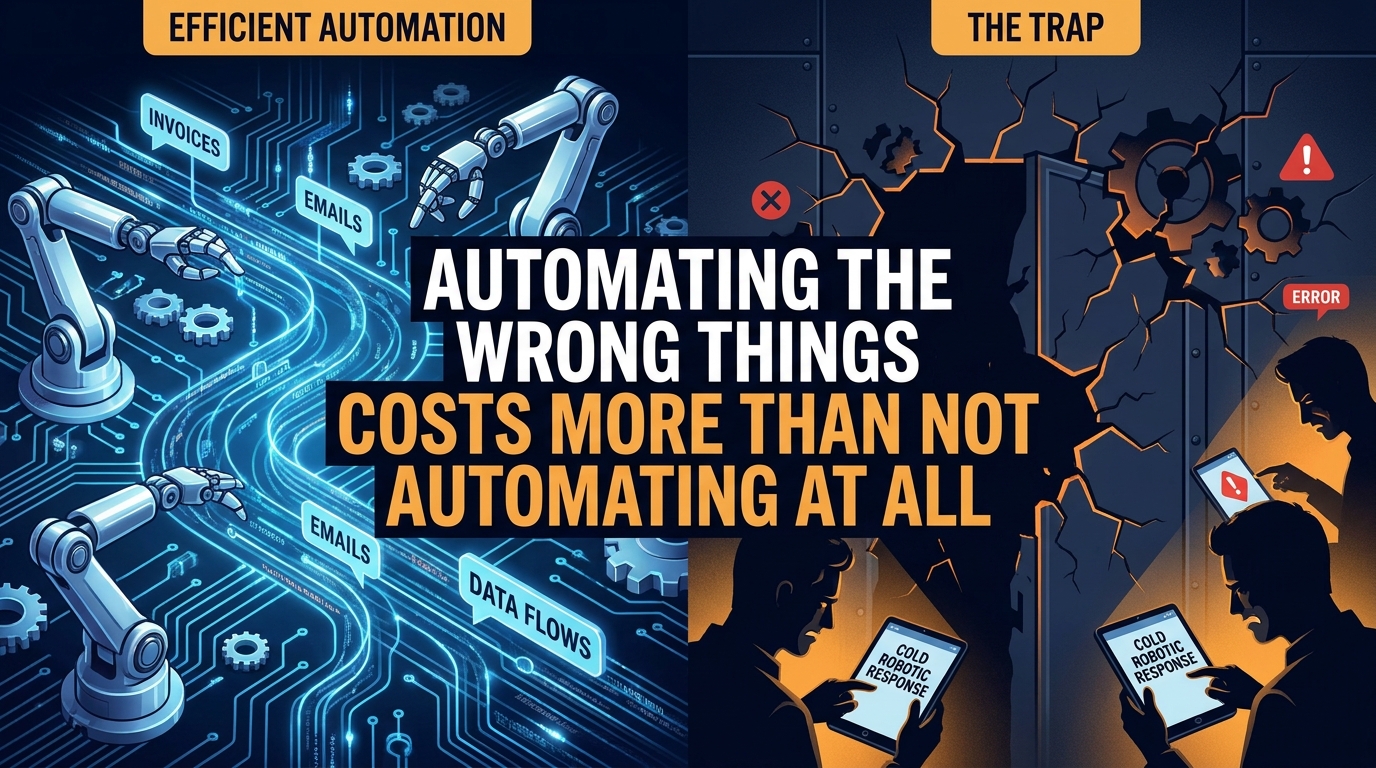
There is a particular kind of confidence that comes with deploying a new AI automation. The dashboard lights up green. The workflow fires without human input. The time-saved metric ticks upward in the weekly report. Everything looks like progress.
Until a customer sends an email saying they’re taking their business elsewhere. Until a sales prospect replies “this is clearly a bot, please don’t contact me again.” Until a candidate who would have been your next star hire gets auto-rejected because their resume contained a formatting edge case the system wasn’t trained for.
The conversation about AI automations in 2026 has been almost entirely about speed — how fast to deploy, how many processes to cover, how to move a model from pilot to production. What that conversation has largely missed is the question sitting quietly underneath all of it: which processes should you actually be automating?
This is not a post about whether AI automation works. It does, reliably and measurably, in the right contexts. This is a post about the contexts where it doesn’t — where automating a process actively makes outcomes worse, erodes trust, and costs more in downstream damage than any licensing fee you saved. And it’s a practical guide for building the decision intelligence to tell the difference before you build the workflow, not after.
The companies winning with AI automation in 2026 are not the ones automating the most. They’re the ones automating with the most precision. There’s a meaningful difference, and it’s worth understanding in detail.
What “Wrong-Fit” Automation Actually Means
The term “wrong-fit automation” describes any process that has been automated where the characteristics of the task fundamentally conflict with what automation can reliably deliver. It’s not about technology limitations — modern AI systems are impressive. It’s about a category mismatch between what the task requires and what automation, by its nature, provides.
Automation excels at tasks that are high-volume, rule-based, low-variance, and low-stakes when an individual instance goes wrong. It struggles — sometimes catastrophically — with tasks that require contextual judgment, emotional intelligence, relationship awareness, or where a single error has outsized consequences.
The Three Core Mismatches
Consistency vs. Adaptability. Automation is consistent by design. That’s usually a virtue. But some processes need to be inconsistent — they need to read the room, adjust tone, respond to an unstated subtext, or apply discretion based on signals that aren’t in the data fields. When you automate those processes, you get consistency where you needed adaptability. The result looks professional on the surface and feels wrong to the person on the receiving end.
Speed vs. Care. One of automation’s great strengths is throughput — it processes at a speed no human can match. But speed is the enemy of care in certain contexts. A customer who has just experienced a billing error doesn’t need a fast response. They need a response that communicates genuine attention to their specific situation. Automated speed in that moment registers as indifference, because it is.
Pattern recognition vs. Exception handling. AI systems trained on historical patterns perform well when new inputs resemble past inputs. The moment you’re outside the training distribution — an unusual client request, an edge case complaint, a candidate with a non-linear career path — pattern-recognition systems produce outputs that range from unhelpful to actively damaging. In high-volume, low-stakes work, these exceptions are tolerable. In high-stakes work, they’re not.
Understanding these three mismatches gives you a conceptual tool that’s more valuable than any software checklist: when a process lives primarily in adaptability, care, or exception handling, automation should be approached with extreme caution — or avoided entirely.
The Six Processes Most Companies Rush to Automate (That They Shouldn’t)
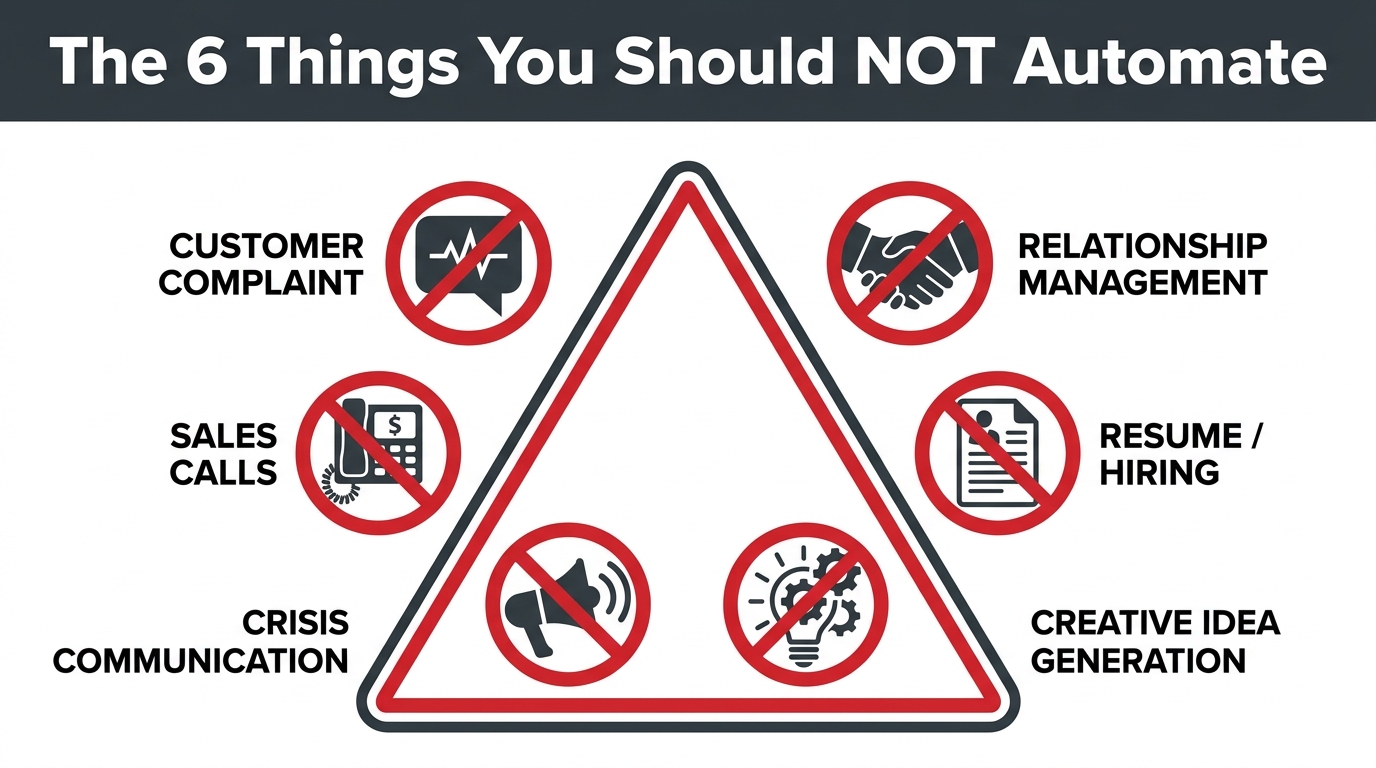
These six categories appear on almost every automation roadmap. They’re tempting targets — they’re time-consuming, repetitive-seeming, and clearly scalable. They’re also, in most organizations, exactly the wrong things to automate end-to-end.
1. Customer Complaint Resolution
Automating the intake and routing of complaints? Sensible. Automating the actual resolution of complaints — the communication of empathy, the crafting of a response to someone who is already frustrated — is a different matter entirely.
A customer lodging a complaint is not primarily seeking information. They’re seeking acknowledgment. They want to know that a real person understands what happened to them and that their experience matters enough to warrant human attention. An AI-generated response, however well-crafted, communicates the opposite: that their complaint was triaged by an algorithm and returned an output. Even when the resolution is technically correct, the experience of receiving it through automated channels often compounds the original dissatisfaction.
The data on this is consistent: customers consistently rate interactions higher when they believe they’ve spoken to a human, even when the quality of information provided is identical. Automation at the complaint resolution layer is a false economy — the cost savings on agent time are frequently offset by elevated churn and reduced lifetime value among the customers who experience it.
2. Outbound Sales Personalization
AI-generated personalization in sales outreach has become so ubiquitous that buyers have developed a finely tuned sensor for it. The opening line that references a prospect’s LinkedIn post. The closing line that mentions a shared connection. The “I noticed you recently expanded into [market]” opener. These patterns, once genuinely personal, have been commoditized to the point where they now signal automation rather than human attention.
More damaging: when the AI gets the personalization wrong — references the wrong article, misidentifies the company’s market, or uses a detail that’s six months out of date — it doesn’t just fail to impress. It actively undermines credibility. The prospect now knows with certainty that they’re receiving automated outreach, and they’ve been given evidence that the sender didn’t bother to check basic facts. That’s worse than sending nothing.
The automation that belongs in sales workflows is the backend work: CRM updates, follow-up scheduling, activity logging, lead scoring signal aggregation. The human-facing communication at the top of the funnel — where first impressions form — is worth protecting as genuinely human.
3. Early-Stage Hiring and Resume Screening
Automated resume screening tools have been in widespread use for years. The evidence on their outcomes is deeply mixed. Studies on hiring algorithm performance have repeatedly found systematic patterns of exclusion — against candidates from certain universities, certain geographic areas, certain career trajectories — that reflect historical biases baked into training data rather than actual predictors of performance.
Beyond bias, there’s the simpler problem of dimension reduction: a resume contains signals that an algorithm can parse, but it cannot capture the things most strongly associated with long-term employee performance — adaptability, intellectual curiosity, communication quality, cultural contribution. Automating candidate filtering at the earliest stage of the funnel means the people who advance are the ones who optimized for the algorithm, not necessarily the ones who would be best at the job.
This doesn’t mean automation has no place in hiring. Scheduling, reference check coordination, offer letter generation, onboarding workflows — all appropriate. The evaluation of human potential is not.
4. Creative Strategy and Brand Direction
AI has genuine utility in creative production — generating copy variants, producing visual concepts, A/B testing asset performance. Where it breaks down is in creative strategy: the decisions about what a brand stands for, what audiences to prioritize, what emotional territory to occupy, what cultural moments to lean into or stay away from.
These decisions require a depth of cultural context and judgment about brand integrity that AI systems in 2026 do not reliably possess. When companies automate the strategy layer of their creative function — letting algorithms determine messaging direction based on performance data alone — they tend to optimize for what worked recently rather than what will work long-term. Short-term engagement metrics improve. Brand equity erodes slowly and invisibly until it becomes a problem that’s expensive to fix.
5. Crisis Communication
During a reputational crisis, every word a company puts into the world is scrutinized. Tone matters as much as content. The sequencing of an apology matters. Whether the CEO’s statement reads as genuine remorse or legal positioning matters enormously. These are not decisions that can be delegated to an AI system without substantial risk.
Organizations that have pre-built automated crisis response workflows — templated statements triggered by certain keyword thresholds — have found that these systems fire at the wrong moments, produce responses that feel tonally inappropriate for the specific situation, or miss the nuance of what the crisis actually requires. A crisis response that is fast but wrong is categorically worse than one that is measured and right.
6. High-Value Client Relationship Management
For enterprise accounts and key partnerships, the relationship is the product. The trust and rapport built over years of human interaction is the primary retention mechanism. Automating touchpoints in those relationships — replacing personal check-in calls with triggered email sequences, substituting a quarterly business review with an AI-generated report — communicates to the client that they are being managed at scale rather than valued individually.
The irony is that high-value client management is exactly the kind of work that looks automatable on a spreadsheet. It’s recurring, it has defined touchpoints, it involves sending information. But the purpose of those touchpoints is relational, not informational. Automation can deliver the information while completely destroying the purpose.
How to Spot a Bad Automation Candidate: The 4-Question Test
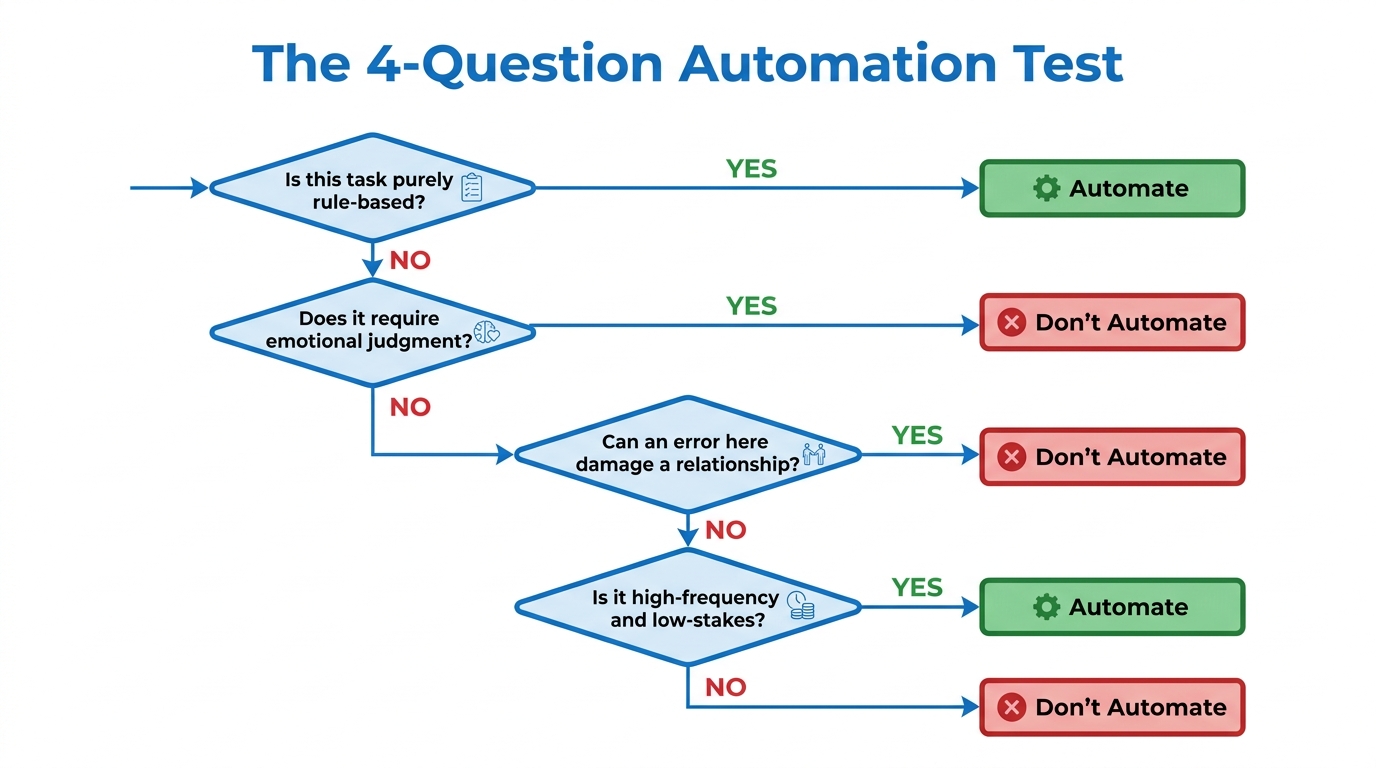
Rather than assessing automation candidates based on whether a tool exists for them (it almost certainly does), a more reliable filter is to run any candidate process through four sequential questions before building anything.
Question 1: Is the task purely rule-based?
A rule-based task is one where the correct output can be fully specified in advance. Given input A, produce output B. No judgment required. If you can write a complete decision tree — covering all meaningful variations — without reaching a branch that requires contextual discretion, the task is likely automatable.
If the correct output depends on unstructured factors — emotional tone, relationship history, cultural context, unstated intent — the task is not purely rule-based. This doesn’t automatically rule out automation, but it signals that any automation will have meaningful failure modes that require mitigation.
Question 2: Does it require emotional or relational judgment?
Tasks requiring emotional or relational judgment include: evaluating whether a customer response requires escalation based on tone, deciding whether a sales conversation should advance or pause based on subtle hesitation signals, determining whether a piece of content is culturally appropriate for a specific audience, and assessing whether a client relationship is at risk.
For any task where a human expert’s value lies primarily in their ability to read context and apply judgment — not just their knowledge of facts or rules — automated handling of that task will consistently produce outputs that are worse than a skilled human would produce. The math on this is clearer than it appears: even at high volumes, it’s worth preserving human judgment on the tasks where judgment is the product.
Question 3: Can a single error in this task damage a relationship or reputation?
Risk calibration is a dimension that most automation decision-making frameworks underweight. The question isn’t just “how likely is an error?” but “what happens when one occurs?”
For data entry or report generation, an error might require correction and cost a few hours. For a customer-facing communication during a sensitive moment, for a hiring decision, or for a response to a high-value client query, an error can terminate a relationship, create legal exposure, or generate reputational damage that compounds over time. The acceptable error rate for a task is not fixed — it depends entirely on what an error costs.
Question 4: Is it high-frequency and low-stakes when individual instances fail?
This is the positive signal: automation is well-suited to tasks that occur at high volume where any individual instance failing doesn’t matter much. Invoice matching, appointment reminders, data normalization, report generation, status update emails — these are genuinely good automation candidates because the volume is the problem and the per-instance stakes are low.
If a task is low-frequency and high-stakes per instance, the efficiency gains from automation are usually marginal while the risks are elevated. Protecting that task for human handling almost always makes more sense.
The Real Cost Accounting of Automation Mistakes
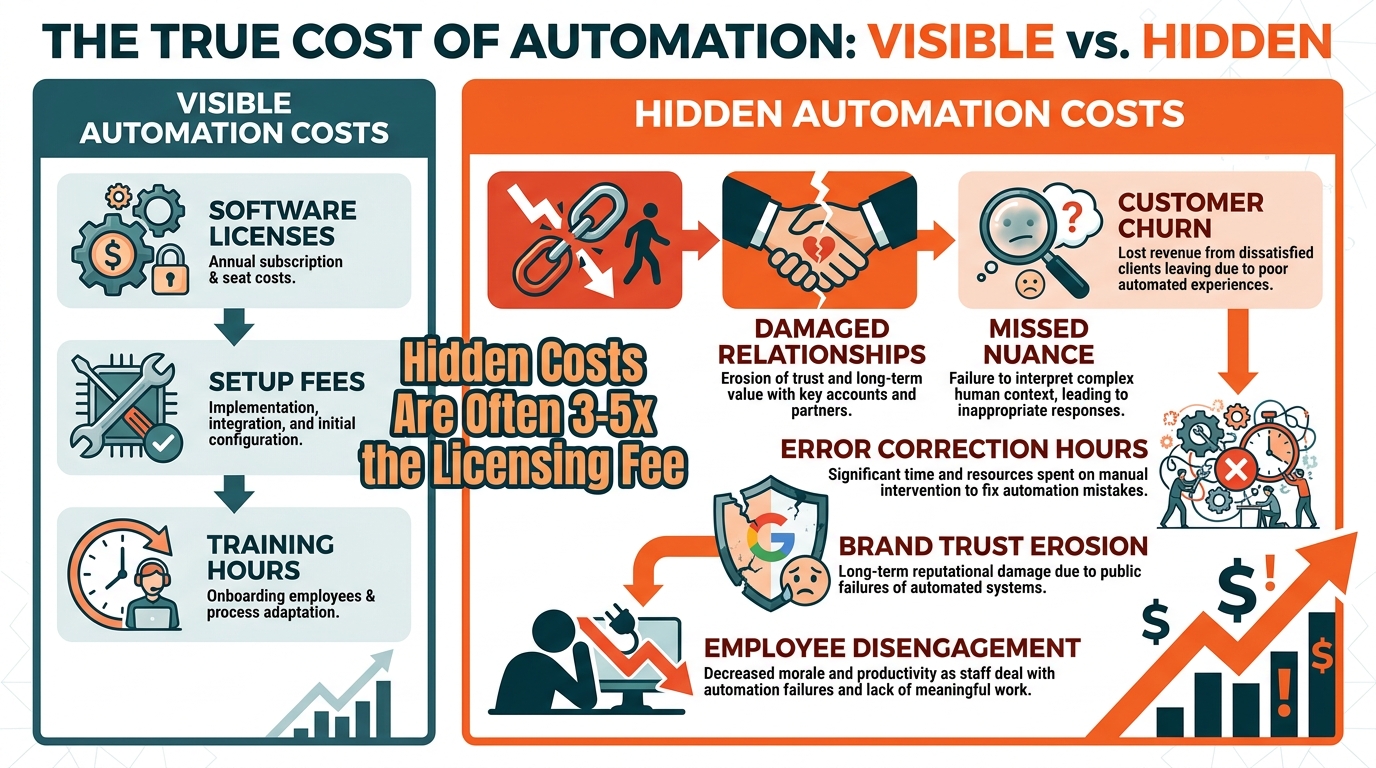
The cost-benefit analysis that typically accompanies an automation proposal focuses on visible costs and visible savings. Tool licensing, implementation hours, training time — subtracted from projected time savings multiplied by headcount cost. The resulting number looks compelling in a slide deck.
What that analysis almost never captures is the category of costs that appear downstream, often weeks or months after deployment, and that don’t show up in any automation dashboard.
Customer Churn From Impersonal Experiences
A customer who has a poor experience with an automated interaction rarely sends a complaint. They simply reduce their engagement and eventually stop buying. Customer churn attributable to service experience quality is notoriously difficult to isolate — the customer leaving in month four rarely tells you in exit data that it was the automated response to their billing query in month two that started the erosion. This makes wrong-fit automation appear free in most reporting systems, even as its cost accumulates.
Calculating this cost requires multiplying the number of customers exposed to a given automated touchpoint by the estimated lift in churn probability from a poor interaction, then multiplying by average customer lifetime value. For most companies, even a 1% increase in churn rate across a customer base of meaningful size represents a cost that dwarfs annual software licensing.
The Error Correction Multiplier
When an automated process produces an error, the cost of fixing it is usually higher than the cost of doing it correctly in the first place would have been. The error surfaces. Someone identifies it. It gets routed. A human is pulled in to correct the specific instance. The root cause is investigated. If systemic, a fix is engineered and tested. The total labor cost of this cycle — multiplied by the error rate of the automated system — often exceeds the labor cost of the human process that was replaced.
This is particularly true in customer-facing contexts, where the correction process itself becomes part of the customer experience.
Trust Erosion With Employees
Employees who witness automation deployed in contexts where they know it will perform poorly develop a specific kind of institutional cynicism about the organization’s judgment. They’ve seen the customer experience degraded. They’ve been asked to clean up the errors. They’ve watched the automation dashboard report success metrics while they handle the fallout. This erodes confidence in leadership and contributes to disengagement — a cost that appears in productivity data and eventually in attrition, neither of which will be attributed to automation decisions in any standard reporting.
Opportunity Cost of Misdirected Investment
Every dollar and hour spent building, maintaining, and managing a wrong-fit automation is a dollar and hour not spent on an automation that would have delivered genuine value. The companies that have gotten automation right in 2026 are not the ones who automated the most processes — they’re the ones who directed their investment toward the highest-yield, lowest-risk candidates and executed those exceptionally well.
The Human-in-the-Loop Paradox: When Adding Humans Back Increases Quality
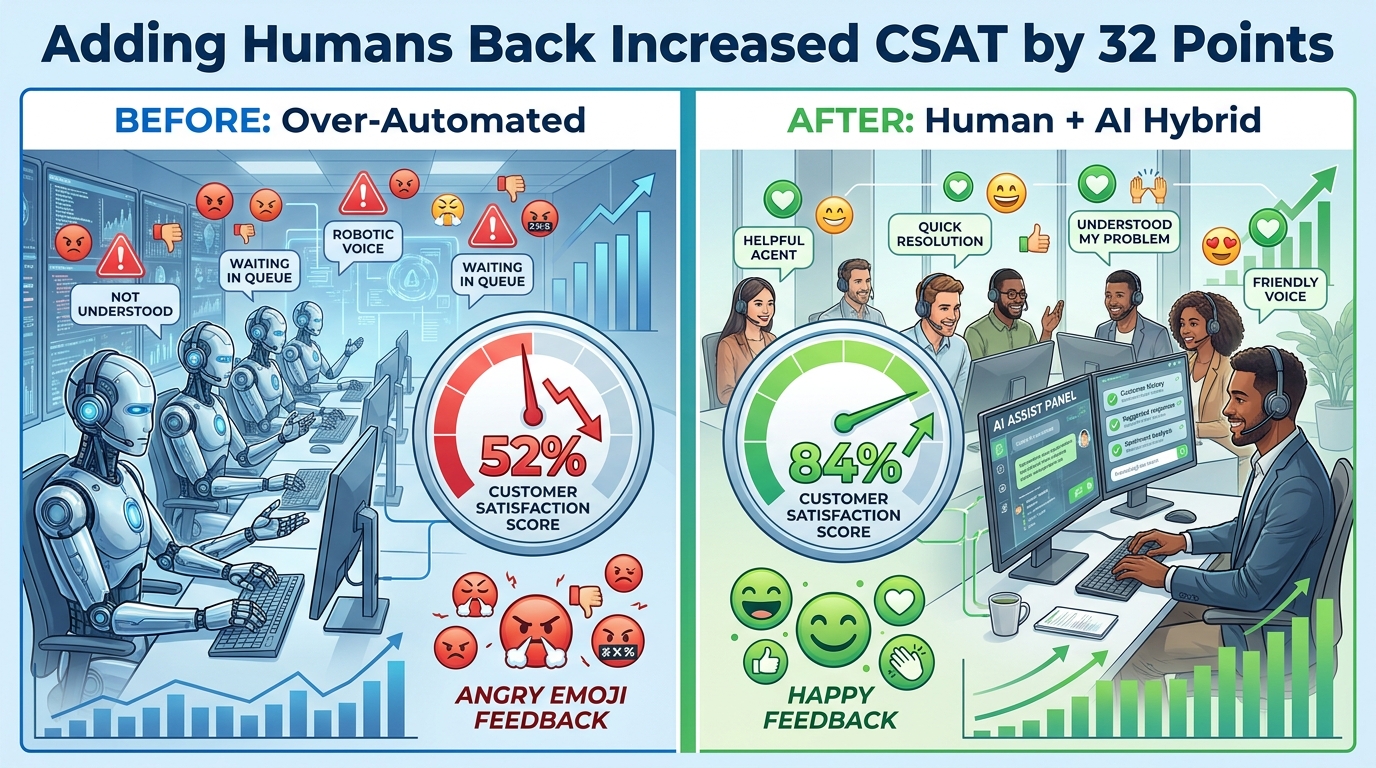
One of the counterintuitive findings from organizations that have honestly evaluated their automation performance is that selectively adding humans back into automated workflows frequently produces better outcomes — for customers, for accuracy, and sometimes even for overall throughput — than the fully automated version.
This happens for several reasons that are worth understanding.
Human Review as Quality Signal, Not Bottleneck
In a well-designed human-in-the-loop workflow, the AI handles volume processing while a human reviews outputs that fall below a confidence threshold or match specific risk criteria. This isn’t a compromise — it’s a deliberate architecture that gets you the speed benefits of automation for the majority of cases while preserving quality for the cases where quality matters most.
The key design insight is that humans in this model are not reviewing everything. They’re reviewing the right things: the outputs where the AI’s confidence is lowest, the cases that match risk flags, the edge conditions that fall outside the training distribution. A human reviewing 10% of outputs with intelligent triage performs far better than a human reviewing 100% of outputs randomly, and far better than an AI handling 100% of outputs without oversight.
The Confidence Calibration Problem
AI systems are not uniformly good at signaling their own uncertainty. A system that produces outputs confidently is not necessarily producing correct outputs confidently — it’s often producing wrong outputs confidently, which is worse than producing uncertain outputs. Human-in-the-loop architectures that use calibrated uncertainty thresholds rather than flat confidence scores tend to catch the highest-risk outputs more reliably.
Organizations that have implemented this kind of tiered review architecture — particularly in customer communications and compliance-adjacent workflows — consistently report better accuracy metrics than equivalent fully automated systems, while maintaining the throughput improvements that automation was intended to deliver.
What “Augmentation” Actually Means in Practice
The word gets used loosely. In practice, effective augmentation means the AI is handling the repetitive cognitive load while the human is handling the judgment layer. A customer service agent with an AI assistant that drafts responses can review, edit, and send in 40% of the time it would take to draft from scratch — while the response that goes to the customer is genuinely human. That’s augmentation done well. It’s different from automation done badly, and the distinction is worth maintaining clearly.
The Automation Audit: How to Review What You’ve Already Built
If you’ve been deploying AI automations at pace — as most organizations have in 2026 — the more pressing practical challenge may not be deciding what to automate next, but assessing what you’ve already built and determining what’s actually working.
An honest automation audit looks at four dimensions for each deployed workflow.
Dimension 1: Output Quality vs. Human Benchmark
For each automation, establish what the human-produced equivalent output looked like. Then pull a sample of actual automated outputs and evaluate them against the same quality criteria. Many organizations find that their automation benchmarks were set against theoretical human output rather than actual human output — and that the comparison is more flattering to automation than it should be.
The comparison should be blind where possible: evaluators shouldn’t know whether they’re reviewing an automated or human output. Blind evaluation consistently reveals quality gaps that aware evaluation misses.
Dimension 2: Error Rate and Error Cost
Document how often the automation produces an incorrect, incomplete, or inappropriate output. Then estimate the cost of correcting each error type — in direct labor hours, in customer experience impact, and in downstream relationship effects. Many automations that report high accuracy rates on process metrics have much higher effective error costs when downstream impacts are included.
Dimension 3: Customer and Stakeholder Experience
Survey customers and internal stakeholders who interact with automated touchpoints. Specifically: do they know they’re interacting with automation? How does that knowledge affect their experience? What’s the satisfaction delta between automated and human interactions for comparable situations?
This data is often revealing. Many organizations find that customers have a strong awareness of and negative reaction to automation in contexts where the organization assumed the automation was seamless.
Dimension 4: Total Cost of Ownership vs. Projected Savings
Revisit the original business case. Add all costs — including maintenance, error correction, oversight, compliance review, and downstream impacts — to the original implementation cost. Compare to actual savings realized. A significant portion of deployed automations, when honestly assessed this way, deliver far less than their original projections, and some deliver negative returns.
Decision Framework: The 3-Zone Automation Map
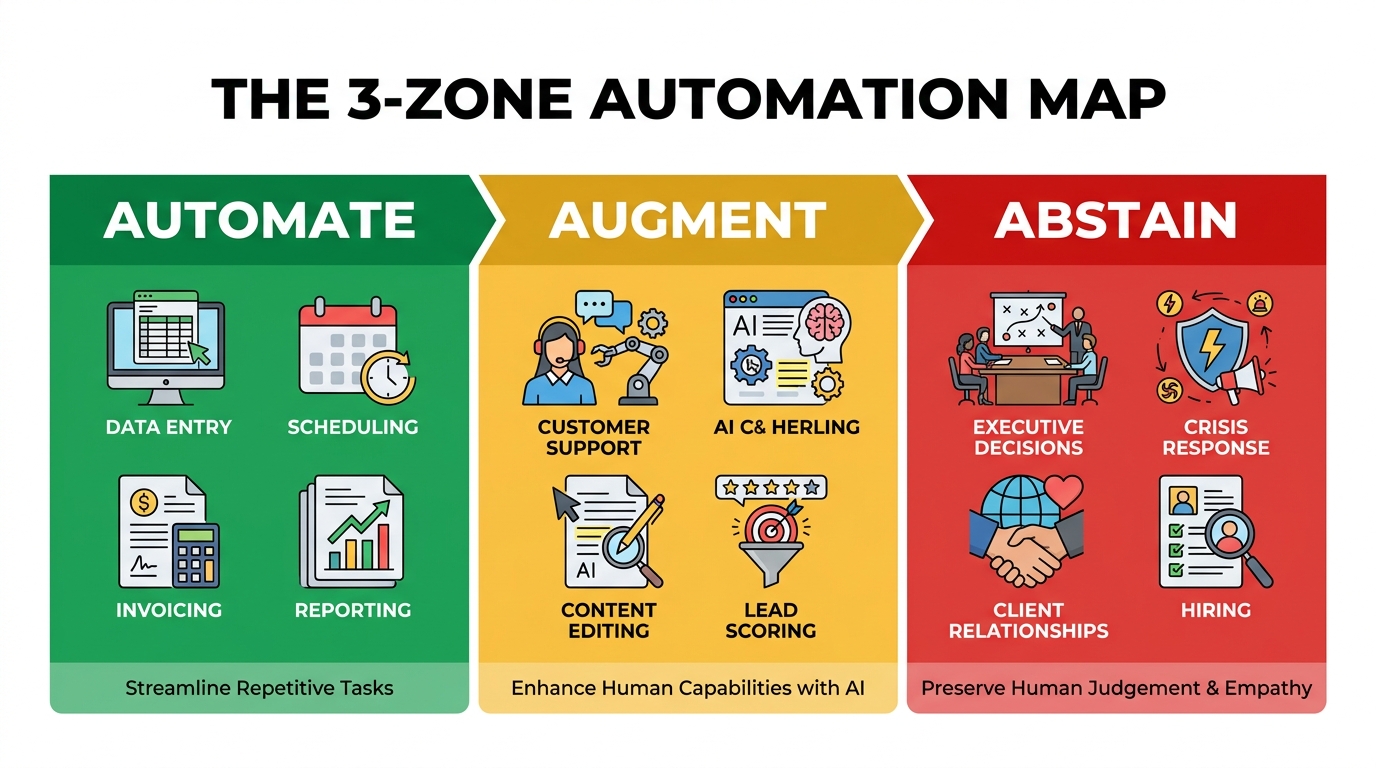
A practical alternative to case-by-case analysis is to map your organization’s processes across three zones. This gives teams a shared vocabulary and a repeatable framework that doesn’t require a full decision tree every time a new automation proposal arises.
Zone 1: Automate (Green Zone)
Processes that belong in the green zone share a set of common characteristics: they are high-volume, the correct output can be fully specified in advance, errors are low-cost and easily corrected, and the experience of the person on the receiving end is not meaningfully affected by whether a human or system produced the output.
Examples that reliably belong here:
- Invoice processing and matching
- Appointment and meeting scheduling and reminders
- Data normalization and migration between systems
- Standard report generation and distribution
- Password reset and account access workflows
- Inventory threshold alerts and reorder triggers
- Compliance document collection and routing
- Status update notifications throughout defined processes
These tasks share the characteristic that the human who was previously doing them was not providing unique value through judgment — they were performing mechanical operations that technology can perform more consistently and at lower cost. Automating these tasks genuinely frees human capacity for work where that capacity matters.
Zone 2: Augment (Amber Zone)
The amber zone is the most interesting and, when done well, the most valuable automation territory. These are processes where automation can dramatically improve throughput and consistency, but where human judgment at a key stage is what separates acceptable outputs from excellent ones.
Examples that typically belong here:
- Customer support for complex or sensitive issues (AI drafts, human reviews and sends)
- Content production (AI generates, human edits and approves)
- Lead scoring and qualification (AI signals, human decides)
- Legal document drafting (AI produces first draft, attorney reviews)
- Financial anomaly detection (AI flags, analyst investigates)
- Performance review preparation (AI aggregates data, manager interprets and writes)
The design principle in the amber zone is that AI handles the volume problem while humans handle the judgment problem. Neither component alone produces the best outcome. The design of the handoff point — when does AI work end and human work begin — is where most of the implementation complexity lives.
Zone 3: Abstain (Red Zone)
The red zone is not a permanent designation. It reflects the current state of AI capabilities relative to what specific tasks genuinely require. Some processes will move from red to amber as AI capabilities evolve. Many will not move for a long time, because what they require is not a technical capability but a human quality — genuine care, authentic judgment, embodied experience.
Examples that currently belong here:
- Executive and board-level decision-making
- Crisis communication and reputational response
- Final-stage hiring decisions, especially for leadership roles
- Key account relationship management at the strategic level
- Negotiation with major partners or clients
- Mental health and wellness support for employees
- Ethics and values-based decisions
Placing a process in the red zone is not a failure of ambition. It’s an accurate assessment of where automation adds risk rather than value, and protecting those processes for human delivery is a strategic choice that good organizations make deliberately.
What Healthy Automation Adoption Actually Looks Like in 2026
The organizations that are getting measurable, sustained value from AI automation in 2026 share a set of practices that distinguish them from the organizations that are accumulating automation debt.
They Start With Process Quality, Not Process Automation
A broken process, when automated, becomes a fast broken process. Every organization has processes that persist for historical reasons — they were designed around constraints that no longer exist, or they were optimized for a tool that was replaced years ago. Automating these processes doesn’t fix them; it enshrines their dysfunction at scale.
The organizations doing this well audit and redesign the process before building the automation. They ask: “If we were designing this from scratch today, what would it look like?” and then build automation around the answer to that question — not around the historical process that evolved organically.
They Define Success Metrics Before Deployment
It’s common for automation projects to have input metrics (time saved, headcount freed) but no output metrics (quality of outputs, customer satisfaction, error rates, downstream business impact). Without output metrics defined in advance, there’s no honest way to evaluate whether an automation is actually working.
The discipline of defining both input and output success metrics before deployment — and committing to reviewing them at 30, 60, and 90 days — separates organizations that learn from their automation experience from those that simply accumulate more of it.
They Treat Automation as a Continuous Practice, Not a Project
The project model of automation — build it, deploy it, move on — produces automation portfolios that degrade over time. Business processes change. Regulatory requirements shift. Customer expectations evolve. The AI models underlying automation tools are updated, sometimes changing their outputs in ways that break workflows designed around earlier behavior.
Healthy automation practices include ongoing monitoring, regular performance reviews, defined escalation paths when output quality drops, and a clear owner for each automation whose responsibility includes its continued performance — not just its initial deployment.
They Maintain a “Human Override” Default
Every automation they build includes a clear path for human intervention when the system detects uncertainty, when the output doesn’t meet quality thresholds, or when a human decides the situation requires it. This isn’t seen as a limitation — it’s a design principle. The best automated systems in production are the ones that know when to stop and ask.
When Over-Automation Backfires: Patterns From Real Deployments
While specific company names aren’t always attached to cautionary tales in the automation space, the patterns of failure are well-documented across the industry and provide clear guidance on where the risks concentrate.
The Customer Service Full-Automation Experiment
A recurring pattern across industries: a company deploys fully automated first-line customer support, driven by the genuine cost savings available from eliminating agent hours. Initial metrics — resolution rates, response times, cost per ticket — look strong. Six to twelve months later, customer satisfaction scores have declined, escalation rates have increased, and the customers most likely to have escalated are the highest-value segments: the ones who expect and deserve genuine attention and are most capable of taking their business elsewhere.
The correction, in every version of this pattern, involves the same solution: reintroducing human agents for defined categories of interactions, typically those involving billing disputes, account cancellations, significant technical problems, or any customer who has flagged dissatisfaction. The automation remains for straightforward, transactional inquiries. The restoration of human presence for complex or emotional cases drives measurable improvement in customer retention that more than covers the cost of the additional headcount.
The Sales Automation Overreach
Organizations that have fully automated outbound sales prospecting — from initial contact to follow-up sequences — consistently report the same outcome: reply rates that are a fraction of human-written outreach, and a reputation in their target market for impersonal, low-quality communication. Some have found their domains placed on spam blocklists as a direct result. The short-term efficiency gain produces a long-term demand generation problem.
The sustainable model that emerges from these experiences is a sharper division: automate everything behind the scenes (research, enrichment, CRM updates, scheduling, follow-up reminders), and preserve the actual communication for humans — with AI assistance available but not driving.
The Hiring Algorithm Bias Discovery
Multiple organizations across sectors have deployed AI resume screening tools and, following internal or external audits, discovered systematic patterns of exclusion that were not visible in aggregate performance metrics. Candidates from certain educational institutions were systematically underranked. Non-linear career paths were scored lower regardless of the actual quality of experience. Certain demographic indicators, when correlated with outcomes in training data, produced biased outputs that the organization had legal and reputational exposure around.
The consistent response has been to retain automation for logistics (scheduling, communication, document collection) while returning the evaluation of candidate materials to human reviewers — often with structured assessment criteria that improve consistency without the bias vulnerabilities of pattern-matching algorithms.
Building an Automation Governance Layer Without Slowing Down
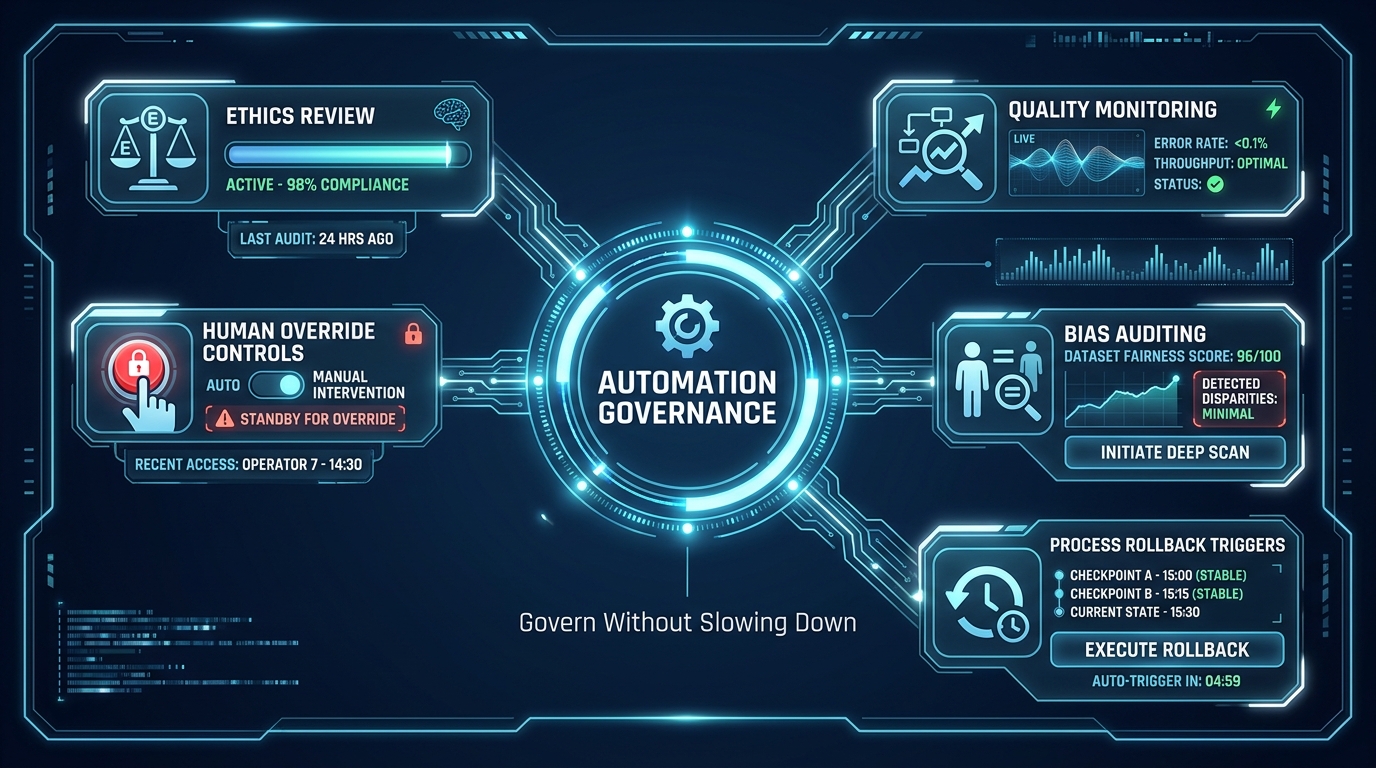
The word “governance” tends to make automation teams nervous. It implies committees, approval processes, and delays that slow down the velocity that makes automation valuable in the first place. But governance doesn’t have to mean bureaucracy. In organizations that have implemented it well, it means the opposite: a clear, lightweight system that makes fast decision-making safer and more reliable.
The Five Components of Lightweight Automation Governance
1. A classification system. A shared and well-understood framework — like the three-zone map described earlier — that allows any team member to quickly categorize a new automation candidate without requiring a formal review for every case. Green-zone automations don’t need heavy oversight. Red-zone automations require explicit approval before proceeding. The classification system does the filtering.
2. A quality monitoring requirement. Every automation in production has a defined set of output quality metrics and a defined review cadence. This can be as lightweight as a monthly 30-minute review for low-risk automations and as rigorous as weekly reviews with defined escalation triggers for high-stakes ones. The requirement exists for all automations, not just the ones that have already shown problems.
3. A human override mechanism. Every automation that produces customer-facing or employee-affecting outputs has a documented and tested path for human intervention. This mechanism is accessible to the relevant staff and does not require a ticket or approval process to activate. When a human sees an automated output that they believe is wrong, they can stop it and replace it immediately.
4. A bias and fairness review for people-adjacent processes. Any automation that affects hiring, promotion, access to services, or other decisions about individuals goes through a structured bias check before deployment and at defined intervals thereafter. This review doesn’t require external consultants — a structured internal assessment against documented criteria is sufficient for most organizations.
5. A rollback playbook. Every automation has a documented rollback procedure that allows it to be turned off cleanly and replaced with the pre-automation process within a defined time window. Automation without a rollback path creates operational lock-in that makes it impossible to course-correct when problems emerge.
Together, these five components create a governance layer that is meaningful without being slow. Automation teams that work within this structure report that it increases their confidence in what they’re deploying and reduces the time spent on incident response — which is ultimately what makes them faster, not slower.
Automate Less, Better: What This Looks Like as a Strategy
The argument being made here is not anti-automation. AI automations, in the right contexts, deliver genuine value that is hard to achieve any other way: consistency at scale, speed that humans cannot match, continuous operation without the energy cost of human attention, and the ability to process data volumes that no team could handle manually. That value is real and worth capturing.
The argument is about precision. The organizations that are building sustainable competitive advantages through automation in 2026 are not the ones with the longest list of automated processes. They’re the ones whose automated processes reliably deliver quality outputs, whose human interactions remain genuinely human where it matters, and whose automation portfolios are maintained and monitored rather than built and forgotten.
The Practical Starting Point
If you’re evaluating your current automation posture — or planning new investments — these questions are worth sitting with:
- For each automation you’ve deployed, can you show the output quality data? Not the process efficiency metrics, but actual output quality compared to what a human would produce?
- Do your customers know when they’re interacting with an automated system? And if they do know, does that knowledge improve or harm their experience?
- For your highest-value customer and partner relationships, how much of the interaction surface has been automated? And do you know whether the people on the other side of those relationships notice?
- When your automated systems produce errors, how do you find out? How quickly? And what does the correction process cost in full, including the customer experience impact?
- If you needed to turn off your three largest automations tomorrow, could you? Do you have the process knowledge and capacity to do so?
Honest answers to these questions reveal more about an organization’s automation health than any dashboard metric. They’re also the starting point for making automation genuinely work — not just appear to work in reporting, but actually deliver the quality of outputs and the business outcomes that justified the investment.
The Competitive Advantage in Being Selective
There is a real competitive advantage available to organizations that resist the pressure to automate everything and instead automate thoughtfully. In a market where automation has been applied broadly and indiscriminately, genuine human attention — deployed strategically at the moments that matter — becomes a differentiator. Customers notice. Partners notice. Candidates notice.
The organizations that will have the strongest positions in 2027 and beyond are not going to be the ones that automated the most processes. They’re going to be the ones that made their automated processes excellent and protected their human processes as a deliberate expression of what they value. That combination — precise automation plus preserved humanity — is what sustainable competitive advantage actually looks like in an AI-saturated environment.
Automating less, but better, is not a conservative posture. It’s the most sophisticated AI strategy available right now.