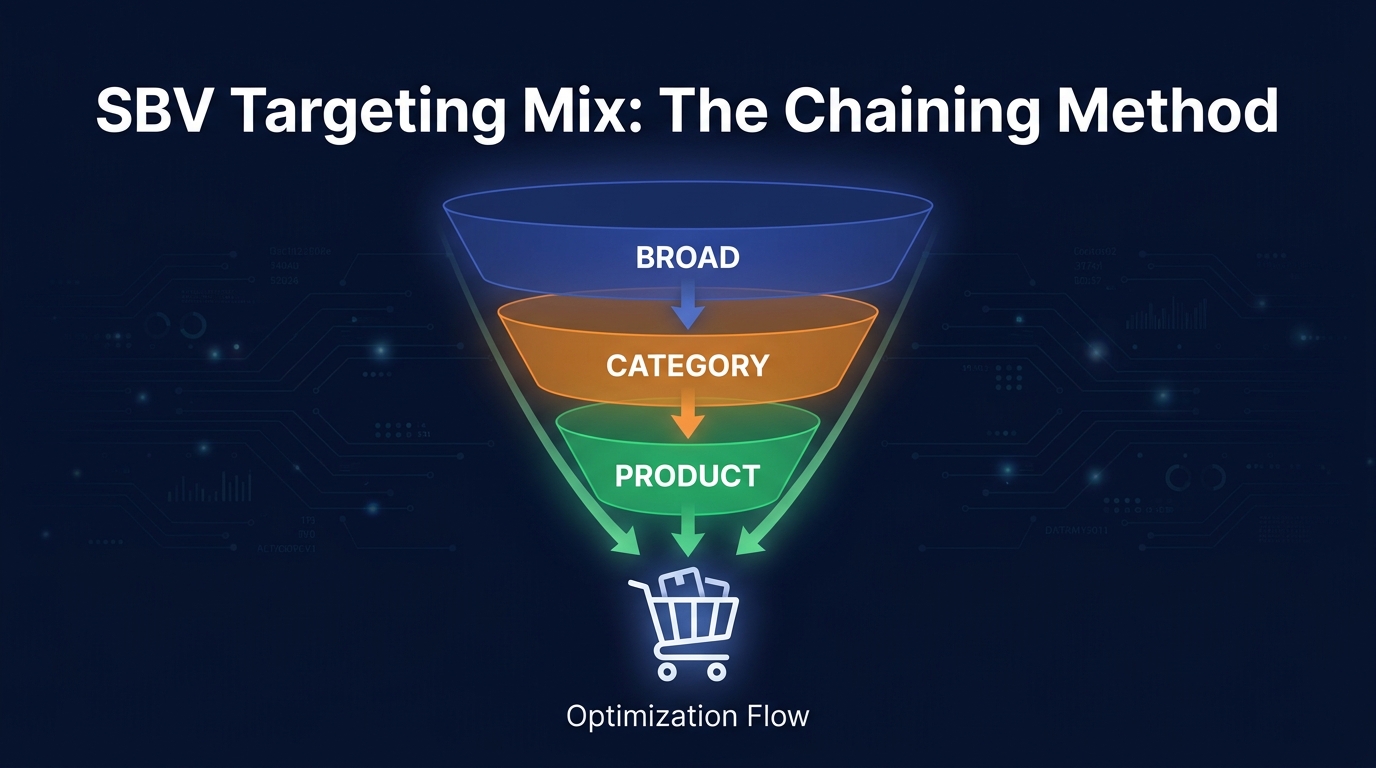
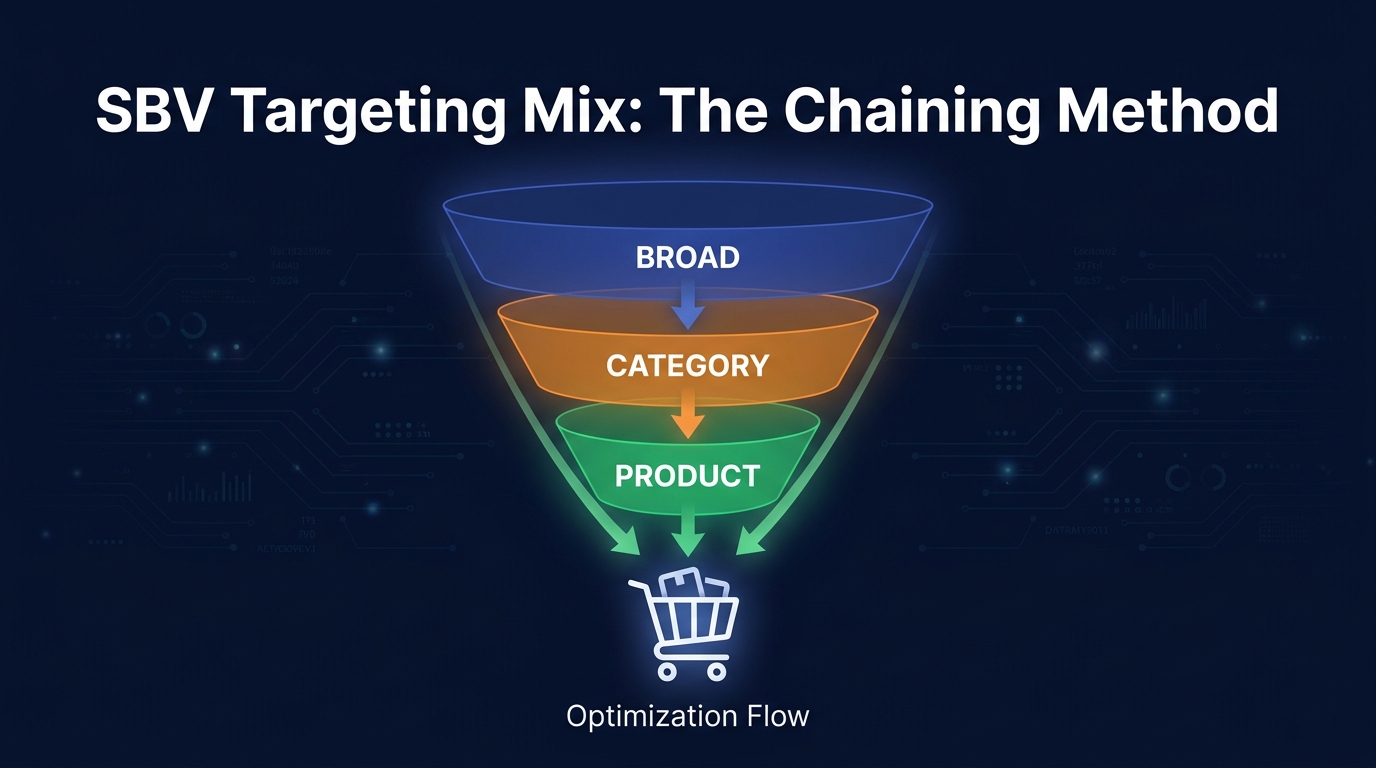
Most brands running Sponsored Brands Video on Amazon have figured out the basics: shoot a short video, pick some keywords, set a bid, and let it run. What far fewer have figured out is how to structure the targeting itself — not as a single campaign with a handful of keywords, but as a deliberate, three-layer system where broad match, category targeting, and product targeting each play a distinct role, and where the outputs of one layer actively feed the next.
That sequenced approach — what practitioners now call campaign chaining — is quietly separating the brands scaling efficiently on SBV from those spinning their wheels at a mediocre ACoS. And the gap is widening in 2026, now that SBV has graduated from an optional format to the dominant Sponsored Brands format. By Q1 2026, mature brand advertisers are directing roughly 58% of their total Sponsored Brands budget to video. The format is no longer an experiment. How you structure its targeting is the deciding factor.
This article is about that structure. We’ll break down exactly how broad, category, and product targeting differ in SBV — not just in definition, but in where they show up in the funnel, what creative they demand, what ACoS to expect, and how data flows between them. Then we’ll walk through the chaining workflow itself: a repeatable, step-by-step process for turning Sponsored Products data into SBV campaigns that already have a head start.
Whether you’re managing a growing brand account, running agency campaigns, or building out a more systematic Amazon PPC structure in 2026, the framework here will give you a concrete operating model rather than another list of generic tips.
What SBV Actually Is in 2026 — and Why It’s Now the Default SB Format
Sponsored Brands Video has technically existed since 2019, but the version running in 2026 is meaningfully different from what most advertisers first experimented with. Several structural changes have compounded to make SBV the go-to format within the Sponsored Brands family — and understanding those changes is important context before getting into targeting mechanics.
From Optional to Default
For most of SBV’s early history, it was treated as a supplementary format — something to test alongside traditional Sponsored Brands headline ads, not something to anchor your entire SB strategy around. That calculus has shifted decisively. Mature advertisers now allocate the majority of Sponsored Brands budget to video, and Amazon’s own internal guidance consistently positions SBV as the highest-performing SB creative type across most categories.
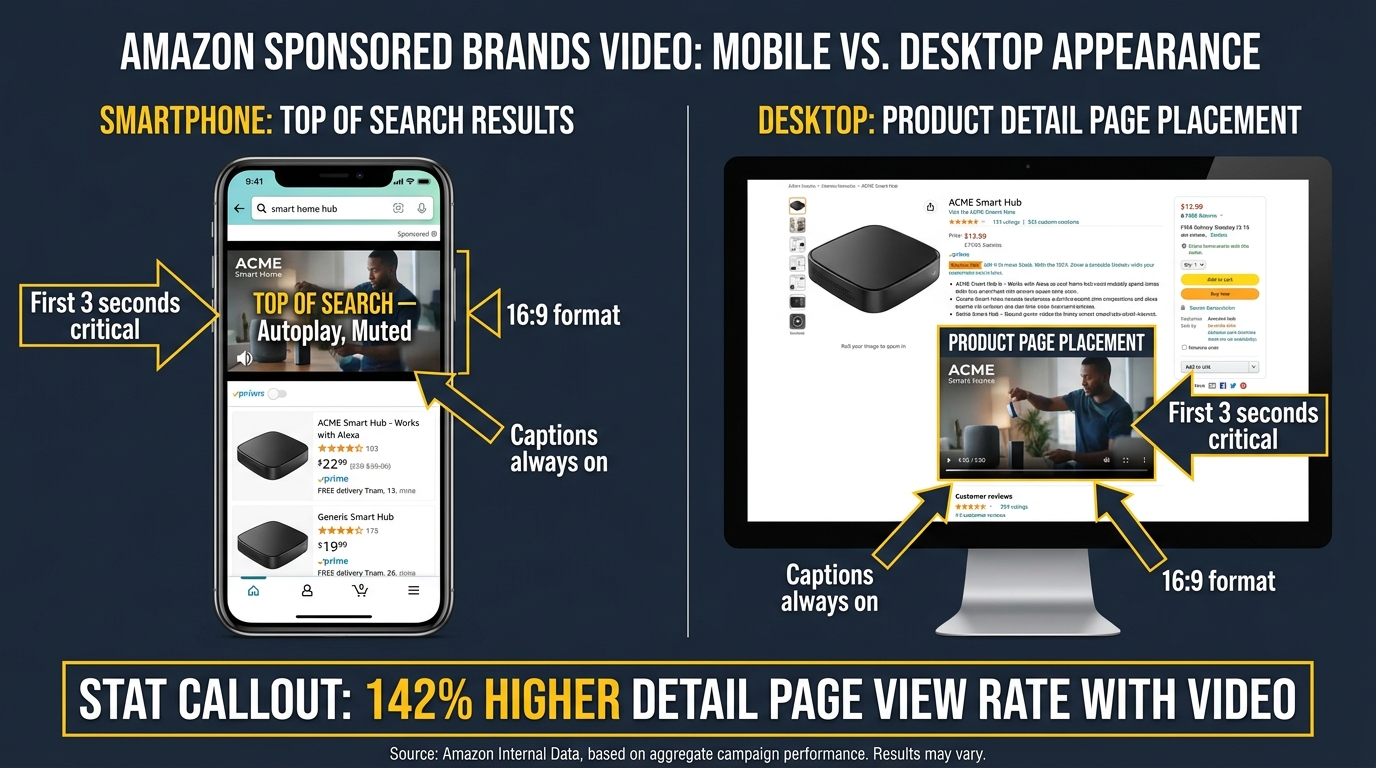
The reasons are straightforward. Video autoplays when 50% of its pixels are on screen — no click required to capture attention. In a search results feed dominated by static imagery, a moving creative is a pattern interrupt. And in top-of-search placement, SBV occupies a dominant strip of real estate that static Sponsored Brands cannot replicate.
What SBV Can Now Target
SBV now supports two primary targeting modes, each with sub-options:
- Keyword targeting: Broad match, phrase match, and exact match — all available for SBV. Each match type functions the same way it does in Sponsored Products, but now attached to a video creative.
- Product and category targeting: Target specific ASINs (individual product pages) or entire product categories and subcategories. This places your SBV ad on competitor or complementary product detail pages, or across a curated slice of the Amazon catalog.
Critically, SBV can now also drive traffic to a product detail page rather than only a Store page. This was a significant restriction for years — SBV required a Store destination. Removing that constraint opened product targeting on SBV to single-ASIN advertisers and made PDP-to-PDP conquest viable at the Sponsored Brands level.
The Multi-ASIN SBV Addition
Amazon has also expanded SBV to support up to three ASINs in a single video ad, driving to a product collection or Store. This multi-ASIN SBV is still in rolling availability, but for brands with product lines rather than hero SKUs, it opens category-level storytelling at a price point previously reserved for DSP campaigns. A video ad showcasing three complementary products across a category is structurally different from a single-product demonstration — and it changes how you think about both creative and targeting.
Placements to Know
SBV appears primarily in two placements. Top of search is the premium strip at the very top of Amazon search results — above all organic listings and Sponsored Products. Product detail page placement puts your video in the middle of a competitor or complementary ASIN’s listing page, directly in the consideration zone of an active shopper. Both placements serve different intent signals, which directly informs which targeting type belongs where — something we’ll get into in detail.
The Three Targeting Layers: How Broad, Category, and Product Actually Differ
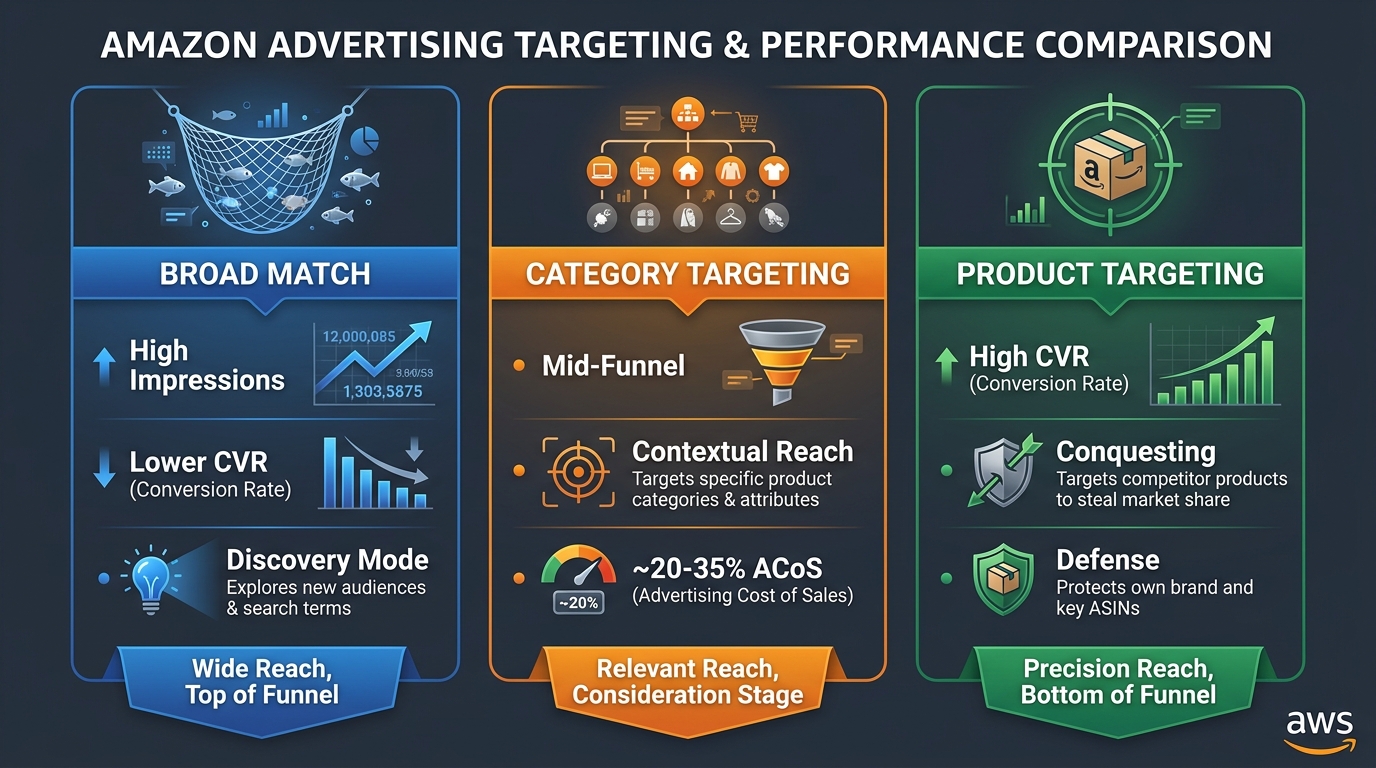
Broad, category, and product targeting get talked about as if they’re interchangeable tactical options you can pick based on mood. They’re not. Each one has a different audience entry point, a different intent signal, different volume-versus-efficiency tradeoffs, and a different relationship to your creative. Getting those distinctions right is what makes a targeting mix coherent rather than just a collection of campaigns.
Broad Match: The Discovery Layer
Broad match keyword targeting in SBV functions as your widest possible net within a search query universe. When you add “stainless steel water bottle” as a broad match keyword, Amazon will serve your video against a range of search terms that contain variations, synonyms, and related queries — not just exact instances of that phrase. The algorithm decides what’s “close enough.”
The core value proposition of broad match is volume and discovery. It’s how you find query variations you didn’t know existed. It’s how you capture long-tail intent signals you couldn’t have manually predicted. For new SBV campaigns, or for entering a new subcategory where you don’t have historical data, broad match gives the algorithm room to learn where your creative performs best.
The tradeoff is efficiency. Broad match campaigns will surface irrelevant queries. They require active search term harvesting to identify both positive keywords to promote and negative keywords to suppress. The expected ACoS on a broad match SBV campaign in 2026 is generally higher — often sitting in the 28–40% range for mid-competition categories — than more refined targeting types. That’s not a bug; it’s the cost of exploration. The discipline is treating it explicitly as a discovery mechanism, not a performance mechanism.
Who uses broad match SBV well: Brands in expansive categories with many search entry points, or advertisers actively building out their keyword list. Also useful when launching a new product and needing to identify which query families your audience actually searches from.
Category Targeting: The Contextual Mid-Funnel Layer
Category targeting shifts the logic entirely. Instead of targeting a search query, you’re targeting a segment of the Amazon catalog — a category, subcategory, or refined slice of Amazon’s product taxonomy. Your SBV ad appears on product listing pages and search result pages within that category space.
This targeting type is often misunderstood. Many advertisers try it, see lower CVR than product targeting, and abandon it. But category targeting’s job isn’t to maximize purchase rate — it’s to capture category-level consideration. It places your video in front of shoppers who are actively browsing within your product space, even if they haven’t typed a specific high-intent query yet.
Within category targeting, Amazon allows refinement by brand, price range, star rating, and Prime eligibility. These filters are powerful. A category targeting campaign for “yoga mats” filtered to price range $30–$70 and 4+ star reviews is no longer spray-and-pray — it’s a contextual campaign aimed at value-conscious, quality-validated shoppers. That’s a meaningful audience definition at the Sponsored Brands level.
Expected ACoS for category targeting SBV ranges widely but often sits in the 20–35% band for established advertisers with well-defined categories. Category campaigns tend to deliver higher impressions and broader new-to-brand reach than product targeting, but lower CVR than ASIN-level targeting. Think of it as the bridge between discovery and conversion — the layer where shoppers are aware they need something and are evaluating options.
Who uses category targeting SBV well: Brands with strong positioning relative to an entire category (price, quality, differentiation). Also powerful for brands looking to increase category share and new-to-brand customer acquisition, not just harvest existing demand.
Product Targeting: The Precision and Conquest Layer
Product targeting — ASIN-level targeting — is where SBV gets surgical. You specify exactly which product pages you want your video to appear on. That could mean your own PDPs (cross-sell and upsell), direct competitor ASINs, or complementary products whose shoppers are logical prospects for your category.
This targeting type consistently delivers the highest CVR of the three because the intent signal is as explicit as it gets: someone is actively on a specific product page, comparing options. A video ad that appears on a competitor’s listing page for someone who’s almost ready to buy is targeting the last mile of the decision journey.
Product targeting ACoS for SBV tends to run lower than broad or category — often in the 15–25% range for competitive advertisers — though this varies by category and how aggressively you’re bidding against high-volume ASINs. The tradeoff is volume. You’re limited to the traffic that individual ASINs receive. To scale, you need ASIN lists rather than single targets — typically built from Sponsored Products data, which is exactly where the chaining methodology comes in.
Three use cases for product targeting SBV:
- Conquest: Target competitor ASINs in the same subcategory to intercept comparison shoppers.
- Defense: Target your own ASINs to suppress competitor ads on your PDPs and reinforce your brand.
- Complement capture: Target adjacent ASINs whose buyers also logically need your product (e.g., targeting coffee grinder listings if you sell pour-over brewers).
Why Campaign Chaining Changes the Whole Equation
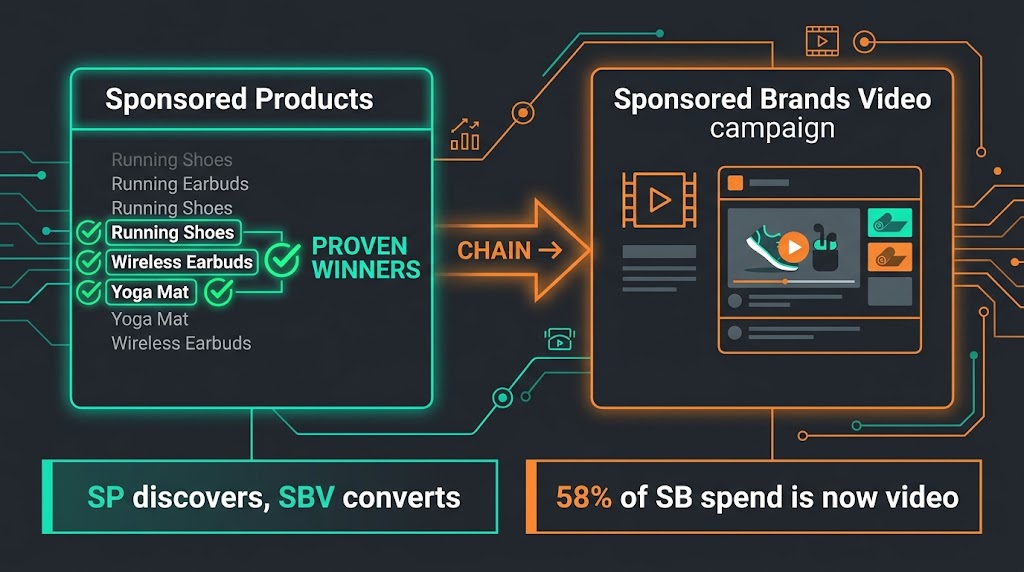
Campaign chaining is the methodology at the center of high-performance SBV in 2026. The basic principle: instead of building SBV campaigns in isolation, you use the output of campaigns that have already run — Sponsored Products, specifically — to seed your SBV targeting with targets that have already proven they convert.
This changes the risk profile of SBV dramatically. Instead of launching a broad SBV campaign and hoping the algorithm finds your buyers, you enter SBV with a shortlist of keywords and ASINs that have a documented performance track record. You’ve already paid for the learning. Chaining lets you apply it.
Why SP Is the Right Source of Truth
Sponsored Products campaigns are the workhorses of most Amazon PPC accounts. They generate the most impression volume, collect the most search term data, and typically run long enough to accumulate statistically meaningful performance signals. By the time you’re ready to scale an SBV campaign, your SP data contains months of click, purchase, and ACoS signals across hundreds or thousands of keywords and ASIN targets.
Mining that data for SBV candidates isn’t complicated — it’s systematic. Keywords that clear your ACoS threshold in SP, have at least 5–10 purchases, and show strong click-through rates are the obvious starting pool. ASIN targets from SP product targeting campaigns that show similar efficiency metrics become your product targeting seed list for SBV.
The logic is that if a keyword converts in a text-based Sponsored Products ad, it almost certainly represents genuine purchase intent. Adding a video creative to that same keyword in a Sponsored Brands Video campaign doesn’t change the intent signal — it only makes your creative more engaging. You’re betting on a stronger creative format against a proven demand signal. That’s a much better bet than broad-match guessing.
What Happens Without Chaining
Without a chaining approach, most SBV campaigns are built from intuition: advertisers pick keywords they think are relevant, set bids based on rough CPC expectations, and wait for results. This is how SBV campaigns end up running at 45% ACoS for months while accumulating no useful data — because the targeting itself was never validated before spend was committed.
The absence of chaining also produces fragmentation. Advertisers run SBV and SP campaigns against overlapping targets without coordinating them, which means they’re bidding against themselves in auctions, inflating CPCs on their best terms, and splitting credit across campaigns without understanding true incremental contribution. A chaining approach forces coordination by design: SP is the testing ground, SBV is the scaling vehicle, and the handoff between them is explicit.
Building a Broad Match SBV Campaign: Discovery at Scale
Even with a chaining workflow, broad match SBV campaigns have a legitimate place in a mature account structure. They’re not the first place to deploy budget, but they’re a necessary component for accounts that want to continue finding new keyword territory rather than only exploiting what SP has already discovered.
When to Launch a Broad Match SBV Campaign
The clearest trigger for a broad match SBV campaign is when your SP search term reports start showing diminishing returns — when the same core keywords keep appearing in winners, and new queries are rarely surfacing. This is a signal that your current keyword coverage is saturating and that new demand discovery requires a different net. Broad SBV, with its higher-impact creative, often surfaces intent patterns that broad match SP doesn’t because video engages differently than a standard text-and-image listing ad.
A second trigger is launching into a new product line or subcategory. When you have no SP data for a new ASIN, broad SBV is a legitimate first-mover strategy — you’re buying learning at the Sponsored Brands level with a creative that can build recall even when it doesn’t convert immediately.
Structural Rules for Broad Match SBV
Broad match SBV campaigns require tighter governance than other targeting types precisely because of their scope. A few structural rules that high-performing advertisers follow:
- Negative keyword management is non-negotiable. Every two weeks, pull the search term report from your broad SBV campaigns and add irrelevant queries as negatives at the campaign level. Without this, spend bleeds to unrelated queries quickly.
- Budget caps should be conservative at launch. Broad match SBV is a learning investment. Start with a daily budget no higher than 15–20% of your total SBV allocation. Scale only after clear positive signals (ACoS trending down, specific queries emerging as consistent winners).
- Seed with category-relevant themes, not brand terms. Broad match SBV for brand keywords is largely wasted budget — exact match or Sponsored Products branded campaigns handle that more efficiently. Broad SBV earns its place on non-branded category discovery terms where you’re genuinely trying to expand coverage.
- Single-ASIN creative is safer at launch. Broad match SBV sends traffic to a product detail page or Store. For discovery campaigns where you’re not sure which product will resonate most, driving to a curated Store page gives you flexibility. For pure efficiency, single-product SBV creatives with a direct PDP destination typically outperform multi-destination setups in broad targeting.
Harvesting from Broad Match SBV
The output of a broad SBV campaign isn’t just sales — it’s data. Every 2–4 weeks, extract the search term performance report from your broad SBV campaign and sort by orders and ACoS. Queries with 3+ purchases below your ACoS target are candidates to move to phrase or exact match SBV campaigns. Queries that appear in both SP reports and SBV reports with consistent performance are candidates for elevation to their own tightly targeted SBV campaign — closing the chaining loop.
Category Targeting: The Mid-Funnel Lever Most Advertisers Underuse
Category targeting in SBV occupies the most underused position in most brand advertising stacks. Advertisers who’ve tried it tend to have had one of two experiences: they targeted a category that was too broad (all of “Sports & Outdoors,” for example), got massive impressions with terrible CVR, and wrote it off. Or they targeted a tight subcategory with too little traffic and saw minimal scale. Neither outcome is the format’s fault — both reflect targeting choices, not structural flaws.
How to Size Category Targeting Correctly
The starting point for a category targeting SBV campaign is the right level of the category hierarchy. Amazon’s category taxonomy has several levels: top-level categories (like “Beauty & Personal Care”), subcategories (“Skin Care”), and sub-subcategories (“Face Moisturizers”). The sweet spot for SBV category targeting is usually two to three levels deep — specific enough to reach relevant shoppers, broad enough to have meaningful traffic volume.
For a brand selling face serums, “Face Moisturizers” is probably the right entry level for category SBV — it captures adjacent consideration shoppers while staying within the relevant product space. “Skincare” would be too broad. “Anti-Aging Serums” might be too narrow for a category campaign (product targeting is better at that level of specificity).
Applying Refinements That Actually Work
Amazon’s category targeting refinements — price range, brand, star rating, Prime eligibility — are often glossed over in PPC guides, but they’re among the most powerful tools for making category SBV efficient. Some practical applications:
- Price range filtering: If your product is priced at $45, filter the category campaign to show on products priced $30–$60. You’re capturing shoppers already in your price tier’s consideration set, not confusing budget shoppers with a premium offer.
- Star rating filtering: Excluding products with very low average ratings (under 3.5 stars) can improve efficiency. Shoppers on low-rated products are often already disappointed and in “find an alternative” mode — a potentially high-value moment. Conversely, showing on 4+ star products means competing with well-validated listings, which can be harder. Test both approaches and measure.
- Brand exclusion: You can exclude specific brands from your category targeting, which is useful for filtering out private-label products from Amazon itself or brands where the audience fit is poor. This also prevents spend against your own listings in category targeting, which can happen when your ASIN appears within the same category.
Category Targeting for New-to-Brand Acquisition
One of the most compelling use cases for category SBV is new-to-brand (NTB) customer acquisition. Amazon Advertising’s own data shows that brands using two or more video solutions see a 15% lift in incremental reach versus brands using only one. Category targeting SBV is designed for exactly this scenario: you’re reaching shoppers who are actively in your category space but haven’t encountered your brand specifically. The video format creates a brand impression that text-based Sponsored Products can’t — even if the shopper doesn’t click immediately, the exposure plants a brand signal that influences later searches.
For NTB-focused category campaigns, the creative should lean toward brand storytelling rather than pure product demonstration. You’re making an introduction, not closing a sale. This is one of the few SBV contexts where a Store destination might outperform a single PDP, since it gives the curious new shopper a full brand context rather than dropping them directly into a purchase funnel for a product they’ve just discovered.
Product Targeting: Precision, Conquesting, and Defense
Product targeting is where SBV gets closest to a traditional direct-response mechanism. The targeting is explicit, the intent signal is clear, and the feedback loops are fast. It’s also the most versatile of the three targeting types — the same structural approach applies whether you’re playing offense against competitors or defense on your own listings.
Building a Conquesting ASIN List
Competitor conquesting in SBV starts with a well-built ASIN list. A high-quality conquesting list isn’t just “every competitor ASIN in my category” — that produces bloated campaigns where most traffic is from ASINs with low relevance to your specific product. A focused conquesting list is built around:
- Direct substitutes: Products that solve the same problem at a similar price point. Shoppers on these pages have nearly identical purchase intent to your core buyer.
- Products with known weaknesses: Competitor ASINs with review patterns that highlight pain points your product solves. These shoppers are often actively looking for an alternative.
- High-traffic ASINs in your subcategory: Volume matters. Targeting 20 ASINs with 1,000 monthly sessions each beats targeting 200 ASINs with 50 sessions each. Use keyword research tools, BSR data, and your own SP competitor targeting reports to identify high-traffic targets.
Start with a list of 20–50 ASINs. Too few and you’ll have scale problems. Too many and you lose the ability to analyze which specific targets are driving performance — you end up with a blended ACoS that hides inefficiencies.
Defensive Product Targeting on Your Own ASINs
Self-targeting — running SBV product targeting against your own ASINs — is one of the most underused applications of the format. On a high-traffic listing, Amazon allows multiple ads to appear, and competitors will bid for placement on your PDPs. A defensive SBV campaign targeting your own listings means your video ad appears in the product targeting zone of your own page, reinforcing your brand and effectively crowding out competitor video placements that would otherwise occupy that space.
For brands with multiple ASINs in the same category, self-targeting also enables internal cross-sell. A shopper on your top-selling SKU sees a video featuring your expanded product line. The ACoS on self-targeting campaigns is often higher than conquesting (you’re paying to advertise to shoppers already on your page), but the strategic value — brand reinforcement, competitive suppression, and cross-sell — often justifies the cost, particularly for high-traffic hero SKUs.
Complement Targeting: The Often-Missed Play
Complement targeting is product targeting aimed at adjacent products whose buyers are likely candidates for your category. The logic: a shopper actively purchasing hiking boots is a probable prospect for hiking socks. A shopper on a premium notebook is likely interested in a quality pen. A shopper browsing espresso machines is in the market for coffee beans.
Complement targeting in SBV is particularly effective because video can quickly communicate the product relationship — “pairs perfectly with” or “the natural next step” — in 15 seconds of autoplay in a way that a static ad simply cannot. The creative becomes part of the targeting logic.
The Chaining Workflow: Step-by-Step from SP Winners to SBV Campaigns
Here’s the operational process for executing campaign chaining in practice. This isn’t theoretical — it’s a repeatable workflow that can run on a monthly or biweekly cadence for most active accounts.
Step 1: Mine Sponsored Products for Proven Winners
Pull two reports from your SP campaigns: the Search Term Report and the Targeting Report (for product/ASIN targets). Apply the following filters to each:
- Minimum 5–10 purchases in the lookback period (typically 60–90 days)
- ACoS at or below your target threshold
- Minimum 100–200 clicks (enough statistical weight to trust the data)
From the Search Term Report, you’re extracting keyword candidates for broad match and phrase match SBV campaigns. From the Targeting Report (product/ASIN targets), you’re extracting ASIN candidates for product targeting SBV campaigns. Document both lists separately — they go into different campaign types.
Step 2: Segment by Campaign Type
Sort your extracted data into three buckets:
- High-intent exact queries (5+ orders, low ACoS, specific query) → candidate for exact match SBV keyword campaign
- Broad category themes (queries that represent a family of intent rather than a single query) → candidate for phrase or broad match SBV campaign
- Proven ASIN targets (specific competitor or complement ASINs that converted in SP product targeting) → candidate for product targeting SBV campaign
This segmentation ensures you’re building SBV campaigns with intentional scope at each stage. You’re not dumping all SP winners into a single SBV campaign and hoping it works — you’re matching the scale and intent of each target type to the appropriate SBV campaign structure.
Step 3: Build the SBV Campaign Structure
Create separate campaigns for each targeting type — never mix broad keyword, category, and product targeting in the same SBV campaign. Keeping them separate preserves your ability to evaluate performance cleanly and adjust bids independently. A combined campaign where broad keyword targets and ASIN targets share a budget and blended ACoS is analytical noise.
Recommended campaign names (for organization):
- [Brand] | SBV | Broad | [Category Theme]
- [Brand] | SBV | Category | [Subcategory Name]
- [Brand] | SBV | Product | Conquest | [ASIN Group]
- [Brand] | SBV | Product | Defense | Own ASINs
Step 4: Set Starting Bids by Campaign Intent
Bid strategy for SBV differs by targeting type because the expected CPCs and conversion rates differ:
- Broad match SBV: Start conservatively — 20–30% below your SP broad match CPCs for equivalent terms. You’re paying for the video format premium but want room to optimize before committing full bids.
- Category targeting SBV: Bids here compete against other advertisers targeting the same category. Start at roughly equivalent CPCs to your SP category targeting campaigns and adjust based on impression share and ACoS after 2 weeks.
- Product targeting SBV: These often command higher bids because the intent signal is stronger and the placement (on a specific PDP) is premium. Start at a slight premium over your SP product targeting CPC for the same ASINs — typically 10–20% higher.
Step 5: Monitor, Harvest, and Promote
At 2-week intervals, evaluate each campaign layer against its intended role:
- Broad campaigns: harvest new winning queries, add negatives, promote individual winners to phrase/exact match campaigns
- Category campaigns: evaluate by subcategory performance if you’ve split by category tier; look at new-to-brand attribution and impression share
- Product targeting campaigns: sort by ASIN-level ACoS; promote top ASIN performers to higher bids, suppress underperformers
The output of this review doesn’t just optimize existing campaigns — it generates the next round of chaining targets. High-performing queries from your broad SBV become the seed list for your next exact match SBV campaign. High-converting ASINs from product targeting become priorities for bid increases and budget allocation. The cycle is self-reinforcing.
Creative Considerations for Each Targeting Type
The SBV creative — the video itself — is not one-size-fits-all across targeting types. Because each targeting layer reaches a different audience at a different stage of the purchase journey, the creative job is different at each layer. Most advertisers miss this entirely, running the same video against broad keyword, category, and product targeting campaigns without considering how the context changes what the video needs to do.
Creative for Broad Match SBV
Broad match audiences are in discovery mode. They’re exploring a category, not sure which brand they want. The creative priority here is recognition and relevance: the video needs to immediately communicate what the product is and why it’s worth considering. Brand identity matters here — logo placement, brand color consistency, and a clear product category signal in the first 2–3 seconds. This is not the video to go deep on features and specifications. It’s the video to make the brand and product memorable in a 15-second autoplay window.
Because broad match SBV autoplays muted, captions are not optional — they’re structurally necessary. Any key benefit communicated only via audio is invisible to the majority of viewers. The visual track must carry the message independently.
Creative for Category Targeting SBV
Category targeting audiences are actively browsing. They know what type of product they need — they’re evaluating which specific product and brand to choose. Creative for category SBV should emphasize differentiation: what makes your product the right choice within this category. This is the layer where benefit-led messaging (not just product demonstration) earns its place. “Why our version is better” — whether that’s ingredient quality, price-to-value, design, durability — is the creative logic for category audiences.
Creative for Product Targeting SBV
Product targeting audiences are at maximum consideration. They’re on a specific product page, actively comparing. This is the closest SBV gets to bottom-of-funnel, and the creative should reflect that with conversion intent: clear product demonstration, social proof signals (bestseller badge, star rating callout), and a direct call to action. For conquest campaigns, the creative can lean into the comparison frame implicitly — showcasing a specific advantage or value that the target product is commonly criticized for lacking. You’re not attacking the competitor explicitly (Amazon’s ad policies don’t permit that), but you’re showing your strength at exactly the moment a shopper is evaluating alternatives.
Budget Allocation Across the Three Targeting Types
Budget allocation across the SBV targeting mix isn’t a fixed formula, but there are principles that guide how mature advertisers structure their spend. The right split depends on your account stage, category competitiveness, and whether you’re in growth or efficiency mode.
The Starting Allocation Model
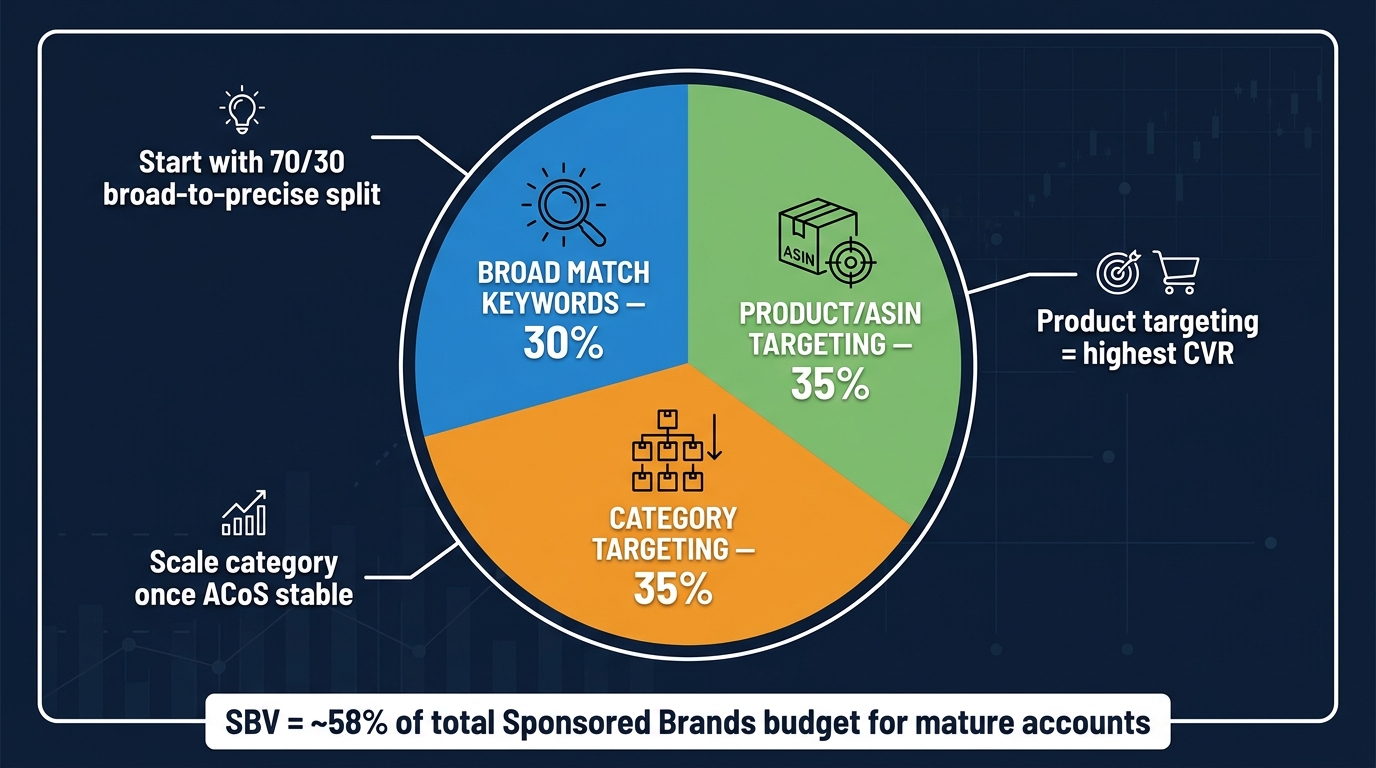
For brands new to the three-layer SBV structure, a reasonable starting split is:
- 30% to broad match keyword campaigns — treated as a learning budget, not a revenue budget
- 35% to category targeting campaigns — your mid-funnel consideration driver and NTB acquisition layer
- 35% to product targeting campaigns — your highest-efficiency, highest-CVR layer, seeded from SP data
This split acknowledges that product targeting and category targeting are typically more efficient than broad match, while reserving enough broad match budget to keep discovery active. As product targeting campaigns prove themselves (ACoS below threshold, consistent orders), budget migrates from broad to product targeting on roughly a monthly cadence.
Adjusting for Account Stage
A newer account with limited SP data should weight broad more heavily — perhaps 50% — because it doesn’t yet have the historical chaining material to build strong product and category targeting campaigns. As the SP data accumulates, that broad allocation shrinks and the product/category split grows.
A mature account with rich SP data and proven ASIN targets can often run with only 15–20% in broad match SBV, reserving the rest for category and product targeting where the learning investment has already been made. The overall SBV budget itself — typically around 58% of total Sponsored Brands spend for mature accounts — stays constant. It’s the internal distribution that shifts as data matures.
Total PPC Budget Context
For context: within a full Amazon PPC account structure, Sponsored Products typically commands 60–65% of total ad spend, with Sponsored Brands (including SBV) taking roughly 20–25%, and Sponsored Display or DSP filling the remainder. Within that SB allocation, SBV is the dominant format. So SBV’s share of total account spend is meaningful but not dominant — it’s the highest-leverage component of a Sponsored Brands strategy, not a replacement for Sponsored Products.
Measurement: What Metrics Actually Matter at Each Layer
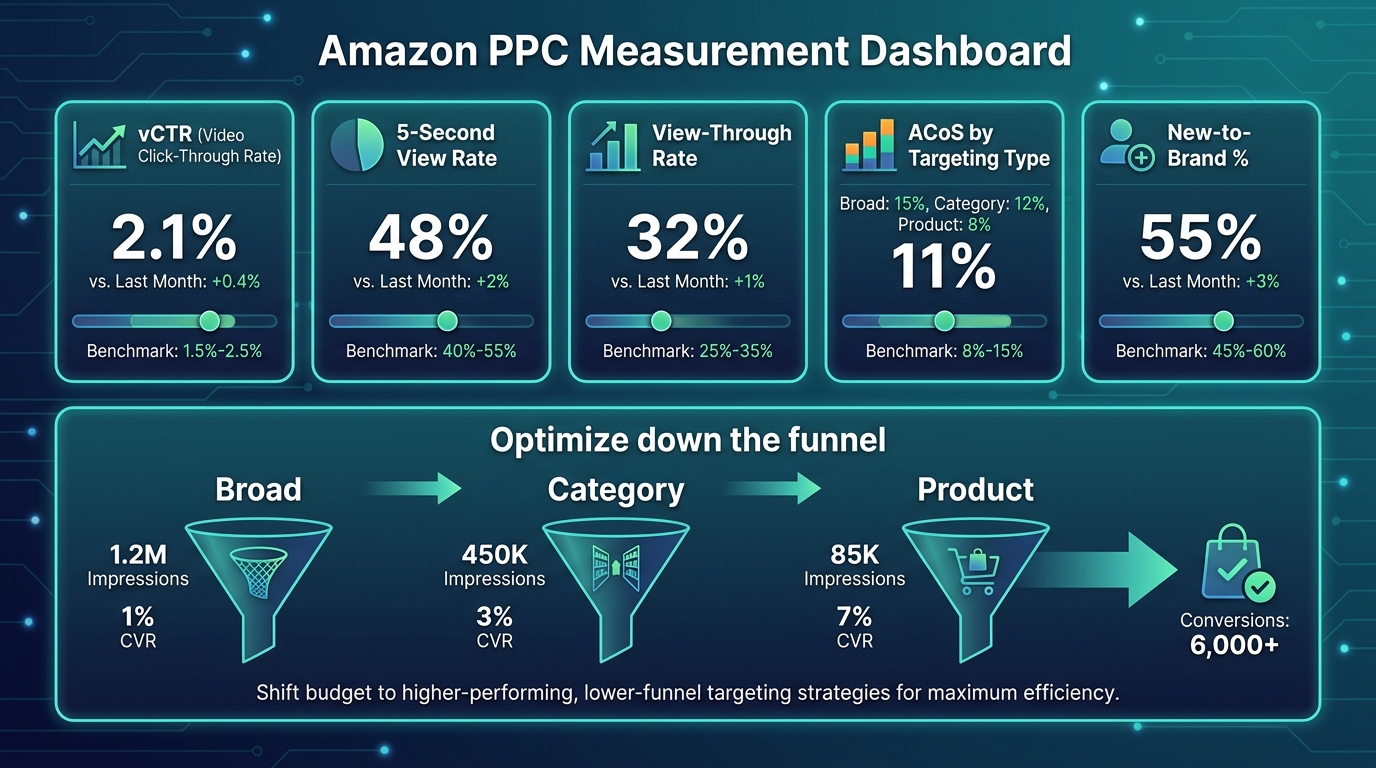
One of the most common SBV measurement mistakes is applying the same metrics equally to all three targeting types. Broad match campaigns should not be held to the same CVR and ACoS standard as product targeting campaigns — the audiences are too different. Applying uniform efficiency metrics across a multi-layer structure produces the wrong optimization decisions: you’ll kill broad campaigns that are doing their job correctly (discovery) because they look bad next to product targeting campaigns that are doing a completely different job.
Metrics by Targeting Layer
Broad match SBV — primary metrics:
- New-to-brand (NTB) purchase rate: The percentage of orders from customers who haven’t bought from you on Amazon in the last 12 months. High NTB rates in broad campaigns confirm they’re doing discovery work, not just converting existing brand buyers.
- 5-second view rate: The percentage of video impressions where the viewer watched at least 5 seconds. This is a proxy for creative relevance — low 5-second view rates on a broad campaign often signal a creative or keyword match problem, not a targeting problem.
- Search term harvest rate: How many new viable keyword candidates (below ACoS threshold) are you extracting per review cycle? Broad campaigns that stop generating new candidates are saturating and should have their budgets redeployed.
- ACoS (secondary): Important for guardrails but not the primary optimization metric for a discovery campaign. Set a ceiling (e.g., no more than 45% ACoS for broad SBV) rather than an optimization target.
Category targeting SBV — primary metrics:
- New-to-brand percentage and total NTB orders: Category campaigns should show a disproportionately high share of NTB customers. If most category SBV orders are from returning customers, the campaign is redundant with product targeting and should be restructured.
- Impression share by subcategory: Are you maintaining visibility within the category segments you’re targeting? Impression share decline without CPM changes suggests growing competition in those category segments.
- ACoS (primary): Category targeting campaigns are mid-funnel but should still perform within a defined ACoS range. The 20–35% range is typical; anything above 40% consistently suggests the category-to-product fit isn’t strong enough.
- Detail page view rate: What percentage of video impressions result in a detail page view? Low DPVR on a category campaign suggests the creative isn’t creating enough pull to move shoppers toward your listing.
Product targeting SBV — primary metrics:
- ACoS and ROAS (primary): Product targeting is the efficiency layer. These campaigns should meet or beat your account-wide ACoS target consistently. If they don’t, either the ASIN list needs pruning or the bids need adjustment.
- CVR: Conversion rate from click to purchase. Product targeting SBV should show the highest CVR of your three targeting types. Consistently low CVR in product targeting suggests either a product listing quality issue (reviews, images, pricing) or a product-to-ASIN targeting mismatch.
- ASIN-level attribution: Which specific ASINs are driving performance? Product targeting campaigns need ASIN-level reporting to identify the 20% of targets driving 80% of conversions. Those high-performers deserve bid increases and budget priority. The tail can be suppressed.
Video-Specific Metrics to Track Across All Layers
Amazon’s video attribution reporting has expanded significantly. Beyond standard PPC metrics, SBV campaigns now surface:
- vCTR (video click-through rate): Clicks divided by video impressions. For SBV, a healthy vCTR typically falls between 0.5% and 1.2% depending on category and targeting type. Product targeting SBV tends to show lower vCTR than broad match (fewer impressions, but more intent per impression) — this is expected and not a problem.
- Video completion rate (quartiles): What percentage of viewers reach 25%, 50%, 75%, and 100% of the video? A steep drop-off at the 25% mark is a creative signal — the opening isn’t compelling enough. A strong completion rate all the way through is evidence of creative quality that justifies continued budget.
- View-through attribution: Purchases attributed to viewers who watched the video but didn’t click. This metric captures brand influence that click-based attribution misses entirely — it’s particularly relevant for broad and category campaigns where the video’s role is influence, not just direct response.
Common Mistakes That Undermine the Targeting Mix
Even advertisers who understand the three-layer model intellectually often make structural mistakes in execution. These are the most common failure modes worth flagging explicitly.
Mixing Targeting Types in a Single Campaign
Putting broad keyword targets and product ASIN targets in the same SBV campaign is the most frequent structural error. The resulting blended ACoS makes it impossible to know which targeting type is performing and which is dragging. Budget can’t be allocated optimally. Bids can’t be set appropriately. The only remedy is to rebuild the campaign structure with clean separation from the start.
Treating All Three Layers as Conversion Campaigns
Holding a broad match SBV campaign to the same ACoS standard as a product targeting campaign will produce a systematic decision to cut the broad campaign the moment it underperforms — even when it’s generating valuable discovery data and new-to-brand orders. Each layer needs its own success criteria that match its role in the funnel.
Skipping the Chaining Step Entirely
Building SBV product targeting campaigns without first validating targets in Sponsored Products is expensive trial-and-error. You’re paying Sponsored Brands-level CPMs to learn which ASINs convert — something SP product targeting campaigns can determine much more cost-effectively. The chaining workflow exists precisely to avoid this waste. Use it.
Never Refreshing the ASIN List
ASIN performance shifts over time. Competitors run deals, change prices, update listings, or exit the category. An ASIN target that was a top-performer six months ago may be stale now — either because the listing has improved (harder to conquest) or because it’s lost traffic (lower-value target). ASIN lists in product targeting SBV campaigns should be reviewed quarterly, with high-performing targets prioritized and low-traffic or high-ACoS targets removed or bid-reduced.
Putting the System Together: What a Mature SBV Account Looks Like
A well-structured SBV account running the three-layer chaining model doesn’t look like a sprawling collection of campaigns — it looks like a deliberate architecture with clear roles for each component.
At the top of the structure, a small number of broad match SBV campaigns run continuously as discovery engines. Their output is managed: search term reports reviewed every two weeks, new winners extracted, negatives added. These campaigns rarely grow large in budget share; they serve as the perpetual renewal mechanism for the rest of the account.
In the middle, category targeting SBV campaigns run against 3–5 well-defined subcategories. They carry a healthy portion of the SBV budget, have their own creative assets (brand and category-level storytelling), and are evaluated on NTB orders and impression share rather than raw ACoS. They’re the account’s investment in category presence and new-customer acquisition.
At the base, product targeting SBV campaigns run against two to four ASIN groups: conquest, complement, and defense. These are the efficiency engines — tightly managed, ASIN-level reporting, high bids on proven targets, suppressed spend on underperformers. They produce the best ACoS numbers in the account because they’ve earned their targeting list through validated SP data.
The chaining cycle connects all three layers. SP data feeds the ASIN lists for product targeting. Broad SBV search terms feed phrase and exact match campaigns. Category campaigns surface new-to-brand signals that inform which product lines deserve their own conquest campaigns. Nothing is built in isolation. The whole account learns from itself.
Conclusion: The Targeting Mix Is the Strategy
Sponsored Brands Video is no longer a secondary format to test when you’ve exhausted your Sponsored Products budget. In 2026, it’s the primary Sponsored Brands format, absorbing the majority of SB spend for accounts that take it seriously. But SBV’s performance ceiling is determined almost entirely by how the targeting is structured — not the bid strategy, not even the creative, though both matter. The structure comes first.
The three-layer model — broad for discovery, category for mid-funnel consideration, product for precision and conversion — gives each targeting type a coherent role. Campaign chaining from Sponsored Products makes product targeting far less speculative and far more efficient. And holding each layer to its own metrics rather than a universal ACoS standard prevents the common mistake of optimizing the entire account toward short-term efficiency at the expense of long-term reach and NTB acquisition.
Actionable Takeaways
- Separate your targeting types into distinct SBV campaigns. Never mix broad, category, and product targeting in the same campaign. Clean separation is what makes optimization possible.
- Run Sponsored Products first, chain winners to SBV. Any product targeting in SBV should be seeded from SP Targeting Report data. Wait for 5–10 purchases per ASIN target before promoting to SBV.
- Apply different success metrics to each layer. Broad campaigns → NTB rate and search term harvest. Category campaigns → NTB orders and impression share. Product campaigns → ACoS and ASIN-level CVR.
- Design creative for the audience’s purchase stage. Discovery creative for broad. Differentiation creative for category. Conversion creative for product targeting. One video serving all three stages equally serves none of them well.
- Review and refresh your ASIN lists quarterly. Product targeting campaigns degrade as the competitive landscape shifts. Stale ASIN lists are one of the most common causes of product targeting SBV underperformance in mature accounts.
- Track view-through attribution alongside click attribution. SBV’s influence on purchase decisions is larger than click-only data suggests, especially for broad and category targeting campaigns. Video engagement metrics (5-second view rate, completion quartiles) tell a story that ACoS alone cannot.
The brands seeing the best SBV results in 2026 aren’t the ones with the biggest budgets or the most polished videos. They’re the ones who treat targeting as architecture — a deliberate system where each layer has a purpose, the layers feed each other, and the whole structure gets smarter with every review cycle. That’s the model worth building.