Tag: Catalog Management

  • Amazon’s 2026 Image Rules: The Compliance Audit Every Seller Needs Before Their Next Suppression Notice

    Amazon’s 2026 Image Rules: The Compliance Audit Every Seller Needs Before Their Next Suppression Notice

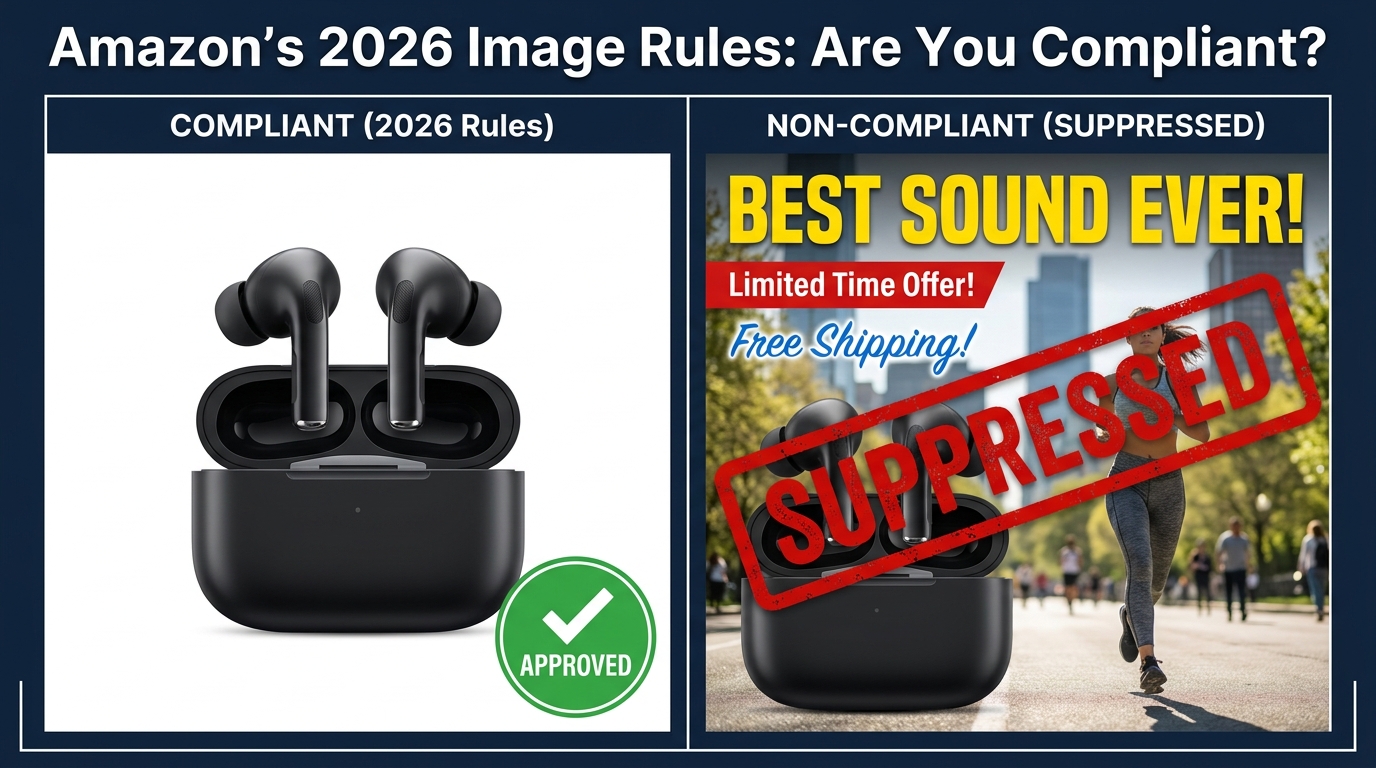
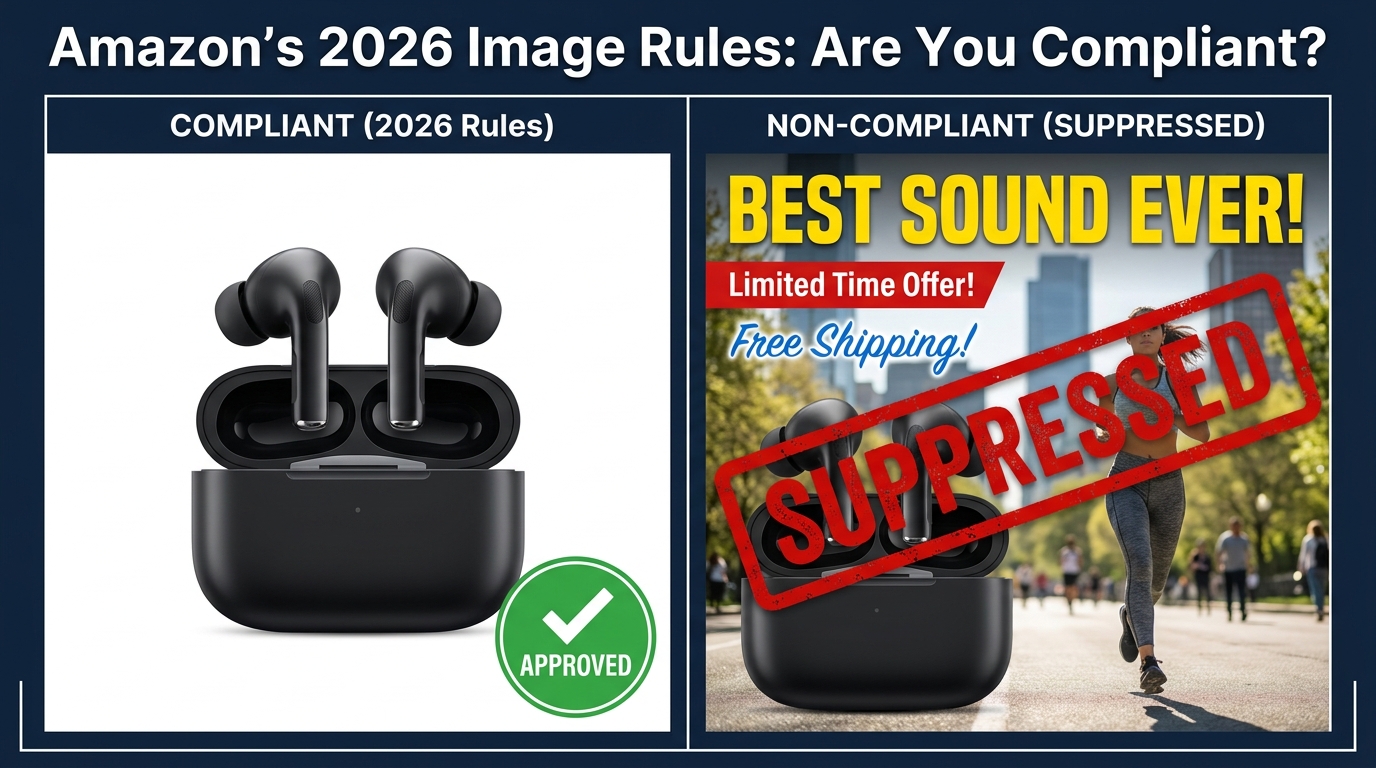
    Amazon 2026 image compliance split-screen: compliant vs suppressed listing comparison

    There’s a strange asymmetry at the heart of Amazon’s image policy. The official documentation is, in many places, years old. The pixel minimums listed in Seller Central haven’t changed. The list of banned content — nudity, offensive material, misleading claims — reads much the same as it did in 2022. Yet sellers are watching their listings disappear from search faster and more frequently than ever before.

    In the first quarter of 2026 alone, third-party estimates suggest Amazon removed more than 3.1 million listings due to image policy violations. That’s not a rounding error. That’s an enforcement posture that has quietly shifted while the rulebook remained largely the same on paper.

    The problem most sellers have is that they’re reading the documentation. They see “500 pixels minimum” and they think they’re fine. They see “pure white background” and they assume their off-white, slightly shadowed hero image will pass. They’ve never heard of the contains-synthetic-performer metadata requirement that became mandatory in mid-2026. They don’t know that category-specific rules for apparel, shoes, and jewelry operate under entirely different standards than the general product guidelines they’ve been referencing.

    This post is not a recap of the rules you already know. It’s a working audit guide — built specifically around the gap between what Amazon’s documentation says and what its enforcement systems actually catch. By the end, you’ll have a clear picture of your real compliance risk, a methodology for fixing it catalog-wide, and a workflow that holds up as enforcement continues to tighten through the rest of 2026 and into 2027.

    The Official Rule Set in Plain English — What Amazon Actually Requires in 2026
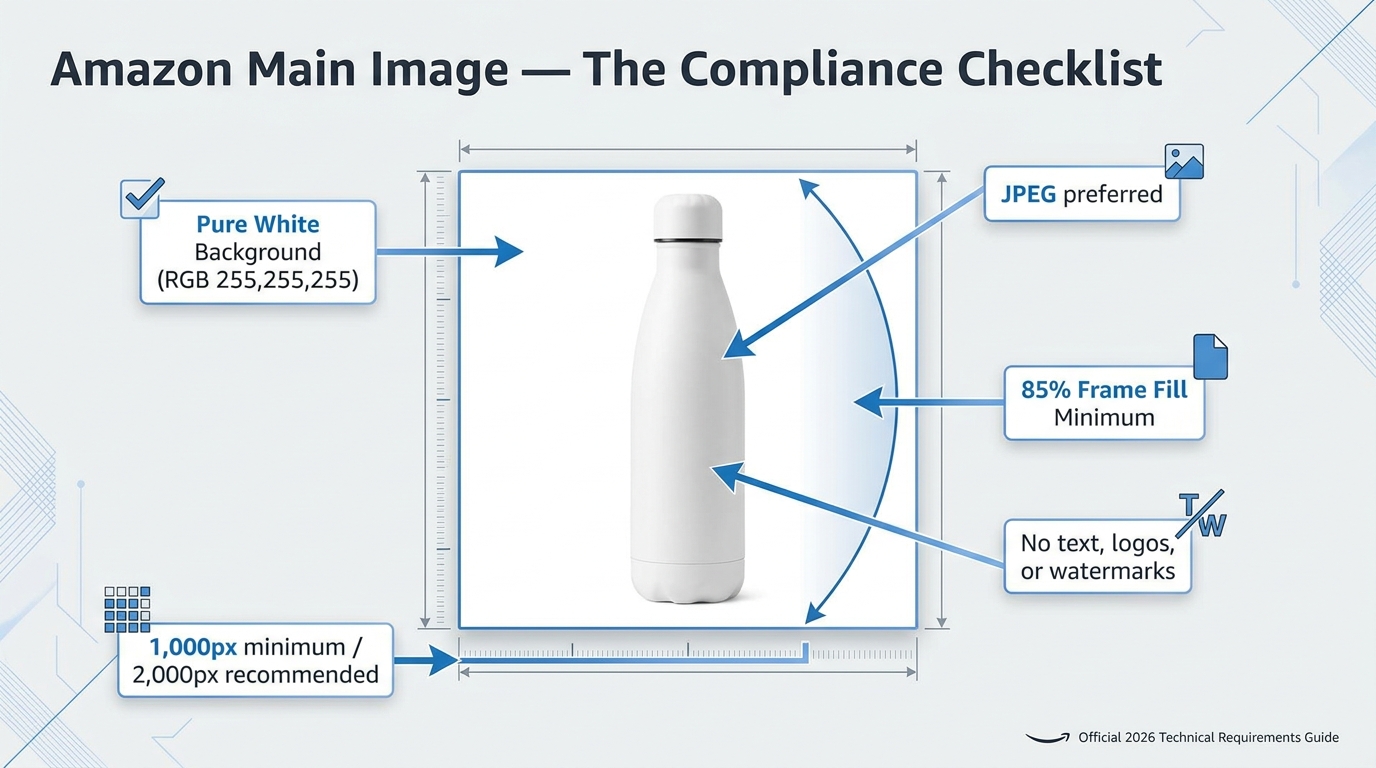
    Amazon 2026 main image compliance checklist infographic showing technical requirements with annotation arrows

    Let’s start with the foundation. Amazon’s official image requirements exist in multiple help documents, and the core technical standards haven’t changed dramatically — but that’s exactly why sellers get caught out. The baseline specs are well-known. The enforcement of those specs has become significantly more aggressive.

    Technical Specifications

    File formats: Amazon accepts JPEG (.jpg/.jpeg), TIFF (.tif/.tiff), PNG (.png), and non-animated GIF (.gif). JPEG remains the recommended format for all product images because it delivers the best combination of file size, color accuracy, and rendering speed on Amazon’s image delivery network.

    Resolution: The official documented minimum is 500 pixels on the longest side. However, the practical standard sellers need to work to is considerably higher. Amazon’s zoom feature — which activates automatically when an image reaches 1,000 pixels on the longest side — is considered a baseline expectation by Amazon’s own seller guidance teams. The widely accepted best practice in 2026 is 2,000 × 2,000 pixels for all main images, which gives you comfortable zoom headroom and ensures your images aren’t auto-downsampled in ways that damage color accuracy.

    Maximum file dimensions: Amazon caps images at 10,000 pixels on the longest side. Exceeding this doesn’t cause suppression but does trigger automatic resizing, which can introduce compression artifacts depending on the source file quality.

    File naming: Amazon requires a specific naming convention — product identifier followed by file extension, with no spaces, dashes, or special characters. A correctly named file looks like this: B000999999.jpg. Uploading files with incorrect naming conventions doesn’t always trigger an error, but it can cause images to fail to associate correctly with the right ASIN, particularly during bulk catalog uploads.

    Main Image Rules

    The main image — the one that appears in search results and at the top of the listing — is where the strictest rules apply and where the vast majority of suppressions originate. Amazon’s requirements for the main image are:

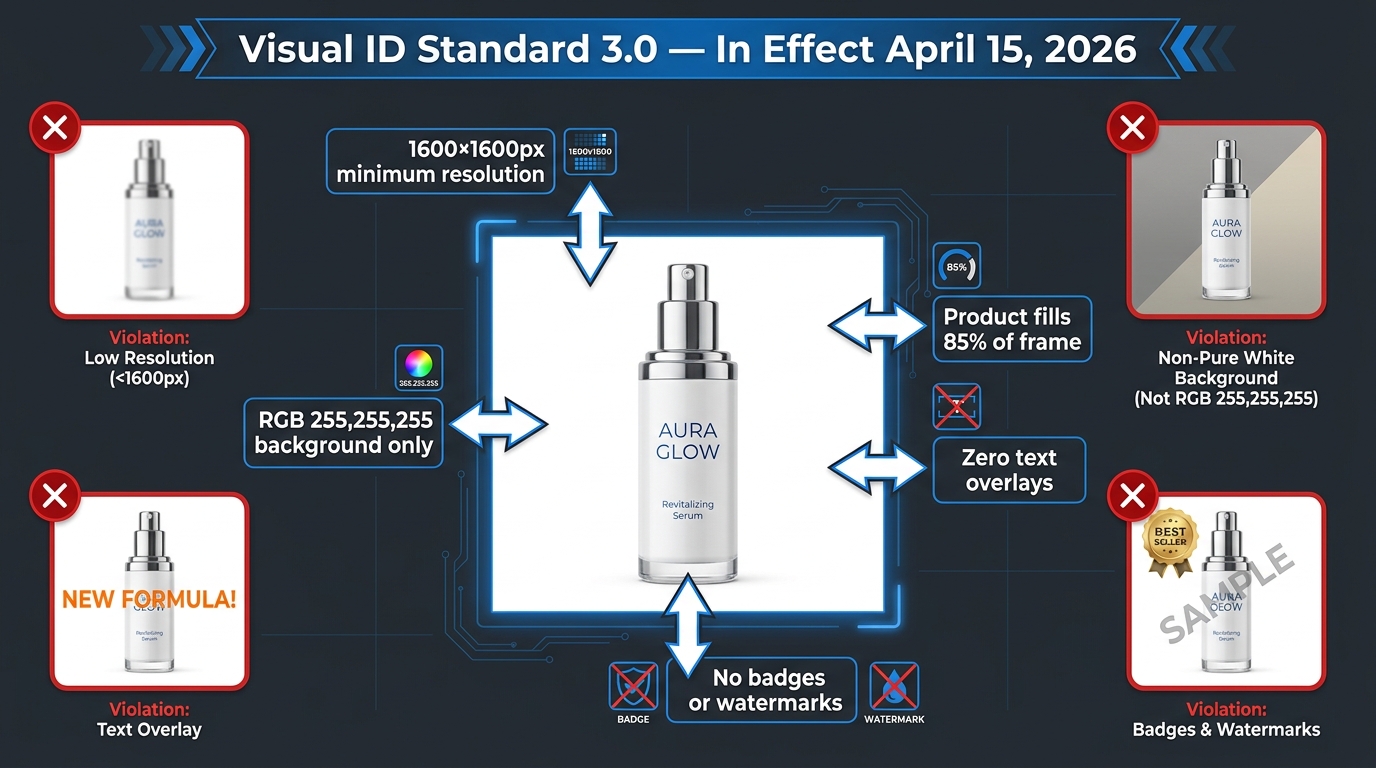
    • Pure white background only. The specification is RGB 255, 255, 255. Not off-white. Not light gray. Not a background that looks white on your monitor but registers as slightly warm or cool when analyzed by image-processing software. Pure white.
    • Product must fill approximately 85% of the image frame. A product that floats in a sea of white, filling only 50% or 60% of the frame, is non-compliant. The product needs to be dominant, centered, and well-cropped.
    • No text, graphics, or watermarks. Brand logos, promotional text, sale callouts, size guides, website URLs — none of these are permitted on the main image under any circumstances.
    • No included accessories or props unless they ship with the product. If you show a charging cable in the main image but it doesn’t ship in the box, that’s a policy violation. If you show the product next to a decorative vase that isn’t part of the purchase, that’s a violation.
    • No lifestyle context. The main image must show the product against the white background, not in use, not in a room setting, not worn on a model (with category-specific exceptions covered in a later section).
    • No packaging shown as the main image unless the packaging is itself the product. Showing a cereal box front is fine. Showing a product inside its box as the primary image, when the listing is for the product itself, is not.
    • Accurate color representation. The image must accurately show the color of the product the customer will receive. Auto-enhanced photography that significantly shifts product color is a violation and a return driver.

    Secondary Image Rules

    Amazon allows up to eight additional images beyond the main image. These operate under considerably more flexible rules — which we’ll cover in detail in the section on secondary images and A+ content. The key distinction is that the strict pure-white, no-text requirements apply specifically and exclusively to the main image.

    What Actually Triggers Suppression in 2026 — The Real Enforcement Map

    Understanding the official rules is step one. Understanding how enforcement actually works in 2026 is step two — and it’s the step most sellers skip entirely.

    Amazon uses a combination of automated image-quality checks and human review to enforce its image policy. The automated layer has become substantially more capable over the past 18 months, with machine learning models now able to detect non-white backgrounds, text overlays, and frame-fill violations at scale — across the entire catalog, not just new listings.

    This is the shift sellers aren’t accounting for. Historically, enforcement was heaviest at upload time. A listing got through review once, and it largely stayed compliant unless a competitor flagged it or a human reviewer happened to land on the page. In 2026, that assumption no longer holds. Amazon’s automated systems are running ongoing sweeps of existing catalog images, not just reviewing new submissions.

    The Most Common Suppression Triggers

    Non-white backgrounds remain the single most common trigger. This includes images with subtle drop shadows that fall outside the pure white threshold, images shot on white seamless paper that has yellowed or shifted under lighting, and images that use a near-white background (RGB 250, 250, 250) rather than true white. The automated detection systems are sensitive enough to catch these.

    Text, logos, or watermarks on the main image. This catches a surprisingly large number of sellers who add branding elements “just to the corner” of their main image, or who include a website URL along the bottom edge. Amazon’s detection systems treat these as violations regardless of size or placement.

    Insufficient product frame fill. Images where the product occupies less than roughly 80–85% of the frame are increasingly being flagged. This is particularly common for sellers who repurpose catalog images originally shot for print or other e-commerce platforms, where different aspect ratio conventions apply.

    Misleading product representation. If your main image shows a product that is clearly a different variant than what the listing is for — a red item shown on a listing for the blue variant, for example — Amazon’s systems can catch this, and it’s a policy violation regardless of whether it happens by error or intent.

    AI-generated synthetic human models without proper disclosure. This is a newer and increasingly enforced category that deserves its own section.

    How Fast Does Suppression Happen?

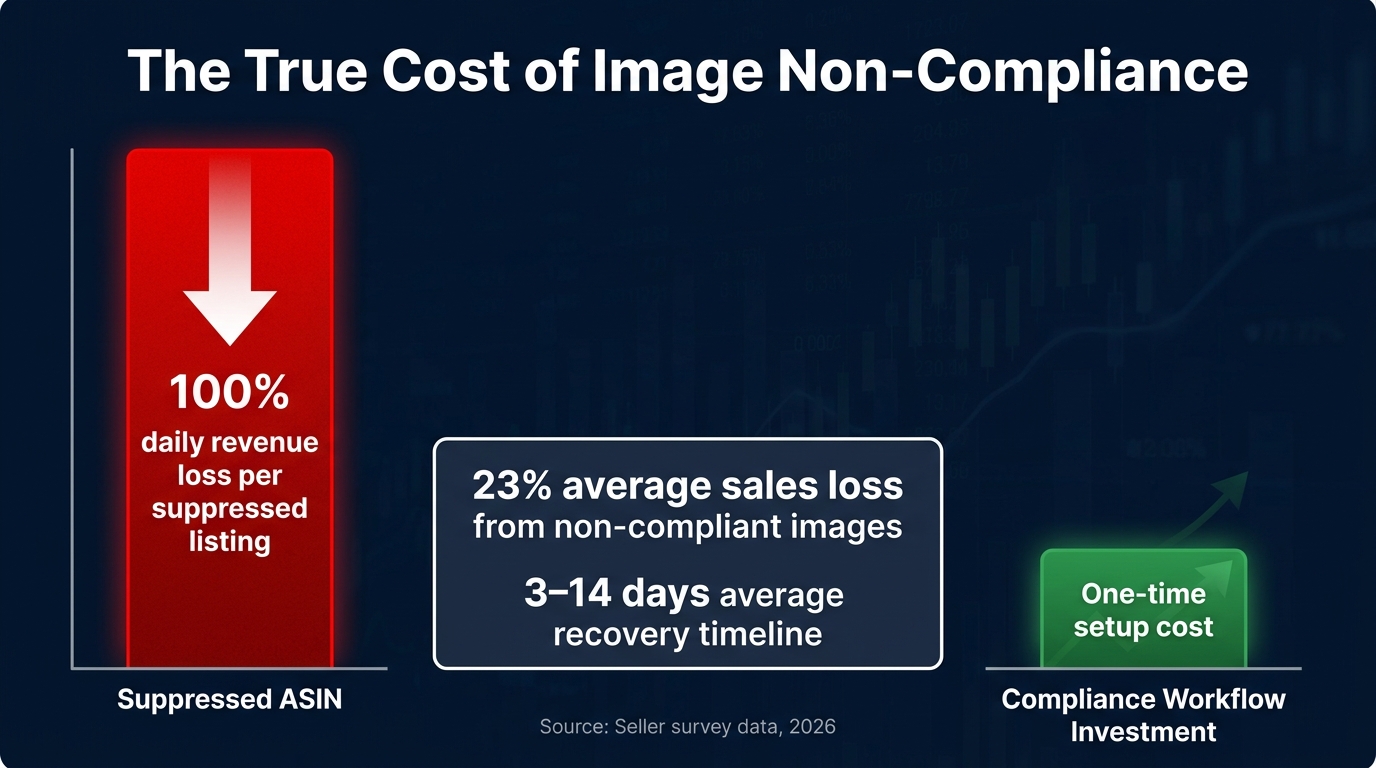
    Seller reports and industry data from 2026 consistently point to suppression timelines that are faster than sellers expect. Once a listing is flagged, search visibility typically drops within 12–24 hours. Organic session data can fall by 90 to 100% during the suppression period. Ad campaigns continue to run — and spend — but with sharply reduced visibility, meaning sellers are often burning ad budget on a listing that isn’t showing up in organic results.

    The recovery process adds another layer of time cost. Uploading a corrected image, waiting for Amazon to process it, and waiting for the listing to reappear in search results typically takes 24 to 72 hours in straightforward cases, and can take significantly longer if the listing goes into manual review or if the suppression is categorized as a more serious policy violation.

    The AI Disclosure Requirement — What the contains-synthetic-performer Rule Actually Means

    Amazon 2026 AI image disclosure rule showing contains-synthetic-performer metadata requirement and shopper-facing badge

    This is the biggest structural change to Amazon’s image policy in 2026, and the one that the fewest sellers have implemented correctly. The rule itself is not particularly complex — but it has meaningful technical implications for how sellers produce and upload images.

    What the Rule Requires

    Effective in mid-2026, Amazon requires third-party sellers to disclose when a product image, A+ content module, or product video contains a photorealistic AI-generated person. The rule does not apply to all AI-generated images — only to those containing synthetic human representations that could be mistaken for photographs of real people.

    The disclosure mechanism operates at the file metadata level. Sellers must embed the exact keyword string contains-synthetic-performer in the image file’s IPTC or XMP metadata fields before uploading to Seller Central. Amazon reads this metadata and, where applicable, surfaces a shopper-facing indicator on the listing page — a small label visible to buyers that signals AI-generated human content is present.

    For A+ Content specifically, Amazon provides a second path: a built-in “AI-generated people” checkbox within A+ Content Manager that sellers can use at the content level, removing the need to pre-embed metadata in individual image files. For all other listing assets — product images, product videos, Brand Stories, and Store content — pre-upload metadata tagging is the only available mechanism.

    What Specifically Triggers the Requirement

    The requirement applies to photorealistic AI-generated humans. This is a narrower category than it might sound, and Amazon has clarified several exclusions:

    • Real people whose images have been AI-edited (for background removal, color correction, or retouching) are not subject to the disclosure requirement.
    • Clearly stylized, illustrated, or cartoon AI-generated people are not subject to the requirement.
    • TV, video game, or movie characters are excluded from the disclosure rule.
    • AI-generated product images with no human presence — which covers the vast majority of standard product photography — are not affected.

    Where the rule most clearly applies is in apparel, beauty, home goods, and lifestyle categories where sellers have begun using AI-generated human models to show products on “real-looking” people without the cost of traditional model shoots. If the result is photorealistic — if a typical shopper looking at the image would believe it’s a photograph of a real person wearing the product — the disclosure is required.

    The Legislative Background

    The rule is directly connected to New York State’s synthetic performer disclosure law, which took effect in June 2026. New York’s law requires disclosure when AI-generated synthetic humans are used in commercial media in a way that could mislead consumers about whether they’re seeing a real person. Amazon’s policy implementation maps onto this requirement and applies it platform-wide, not just to sellers operating in New York.

    This is significant because it establishes a precedent. Amazon is now translating external regulatory requirements directly into seller-facing technical specifications. It’s reasonable to expect that as similar legislation passes in other jurisdictions — which is widely anticipated — Amazon’s disclosure requirements will expand accordingly.

    How to Implement the Metadata Tag

    Embedding IPTC/XMP metadata in image files is not a workflow most sellers have in place today. The process requires:

    1. Identifying which images in your catalog contain photorealistic AI-generated people.
    2. Opening each identified image file in a metadata-capable tool. Adobe Lightroom, Bridge, ExifTool (free, command-line), and several online metadata editors all support IPTC/XMP editing.
    3. Adding contains-synthetic-performer to the image’s subject keywords or description fields in the XMP metadata.
    4. Saving the file and re-uploading to Seller Central.

    For sellers managing large catalogs with AI-generated lifestyle imagery, building a metadata tagging step into the image production workflow — before files are finalized and uploaded — is substantially more efficient than retroactive tagging of existing assets.

    Category-Specific Rules That Sellers Routinely Overlook

    The general image guidelines apply across most product categories. But Amazon maintains category-specific style guides for a number of major verticals, and the rules in these guides can differ substantially from the general documentation. Selling in these categories and using the general rules as your compliance benchmark is a recipe for suppression.

    Apparel and Clothing

    Apparel is the category with the largest delta between general rules and category-specific requirements. The most important distinction: unlike almost every other category, apparel main images are expected to show the product on a model for most subcategories. A flat lay or ghost mannequin may be acceptable in certain subcategories, but for the majority of adult clothing, a model-worn image on a white background is the standard Amazon’s systems and reviewers expect.

    The exceptions are narrow and specific. Children’s and baby undergarments, leotards, and some swimwear must be shown without a model on the main image. Accessories — hats, scarves, bags — must not be photographed on models in the main image; they should be shown as standalone products.

    For sellers who have been using the general “product on white background” rule for clothing listings, this is a meaningful compliance gap. Model-on-white is a higher production cost, but it’s the standard the category requires.

    Footwear

    Amazon’s footwear category guidelines specify that the main image should show a single shoe (not a pair) at a specific angle — typically a three-quarter view from the front-right side. This convention exists because it shows the most visual detail of the shoe’s design in a single image. Sellers who upload pair shots, flat-lay images, or front-on views may find their listings generate more suppression notices than the general product rules would suggest.

    Jewelry and Watches

    Jewelry main images should show the product on a white background as a standalone item with no model, no hands, and no props. The product must be clean, well-lit, and show all surfaces clearly. Watches follow similar rules but with the addition that the dial should be set to show a clear time — industry convention is 10:10 — to maximize the visual clarity of the dial and hands.

    Rings are typically shown at a slight angle that shows both the band and the setting. Necklaces and bracelets are usually shown laid flat or draped in a way that shows the full piece. Earrings are typically shown as a pair in the main image (an exception to the single-item convention in footwear).

    Books, Music, and Video Media

    For media products, Amazon requires that the main image shows 100% of the cover art or disc art. The cover must fill the entire frame. The product should not be shown tilted, shadowed, propped up on a surface, or shown with any environmental context. This is one of the few categories where a full-frame, edge-to-edge presentation is the explicit requirement rather than the ~85% fill standard.

    Grocery and Health & Beauty

    Products in these categories often have specific requirements around label visibility. The main image should show the product with its primary label facing front and clearly legible. For supplements and health products specifically, Amazon increasingly cross-references the product imagery against the claims made in the listing copy — if your images show a product label that makes a health claim your listing copy doesn’t support (or vice versa), this can trigger a review.

    Secondary Images, A+ Content, and the Rules That Actually Differ
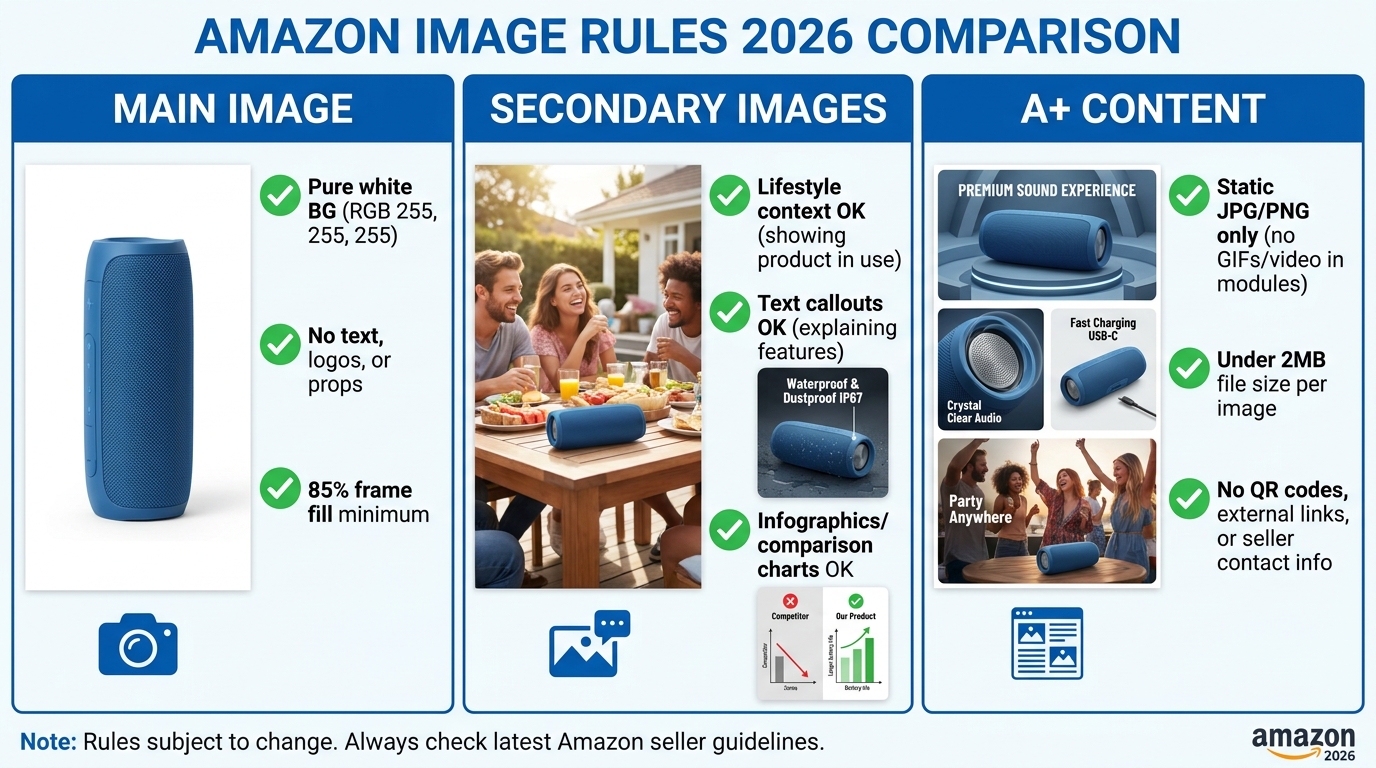
    Three-column comparison infographic showing Amazon main image vs secondary image vs A+ content rules for 2026

    One of the most common misconceptions sellers carry into their image strategy is that all Amazon images are governed by the same rules. They are not. The main image, the secondary gallery images, and A+ content each operate under distinct standards — and conflating them leads to both unnecessary compliance anxiety and genuine missed opportunities.

    Secondary Gallery Images (Images 2–9)

    Amazon allows up to eight additional images beyond the main image, giving you a total of nine slots in your product gallery. These secondary images operate under significantly more flexible creative rules:

    Lifestyle photography is explicitly allowed. You can show your product in use — in a kitchen, on a hiking trail, in the hands of a person — without violating policy. Real-world context helps buyers visualize the product in their own lives, and Amazon’s guidelines actively support this type of imagery in secondary slots.

    Text callouts and infographic overlays are permitted. You can annotate your secondary images with feature callouts, dimension diagrams, comparison charts, size guides, and benefit statements. This is the space to do the educational work that the main image cannot.

    Multiple products can appear together if the intent is to show scale, compatibility, or product family context — as long as the image accurately represents what the customer will receive and is not misleading about the offer.

    Props and environmental elements are allowed to support the product story. A cutting board shown alongside a kitchen knife, a phone stand shown on a desk — these contextual elements are fine in secondary images.

    The caveat is that Amazon’s quality standards still apply to secondary images. Images must be clear, professionally produced, and accurately represent the product. Blurry, poorly lit, or pixelated secondary images may not directly trigger suppression, but they do affect listing quality scores — and Amazon has been more aggressively promoting higher-quality listings in search results.

    A+ Content Image Requirements

    A+ Content — available to brand-registered sellers — is governed by its own distinct set of technical requirements, and they are stricter in some specific ways:

    • File formats: Only JPG, PNG, and BMP are accepted. TIFF and GIF are not supported in A+ modules.
    • Color profile: Images must be in RGB. CMYK files — common when images are prepared for print as well as digital — will be rejected.
    • File size: Each image must be under 2 MB.
    • Resolution: A minimum of 72 DPI is required, though most professional images comfortably exceed this.
    • No animated GIFs. A+ content supports only static images.
    • No watermarks, QR codes, or hyperlinks embedded in images.
    • No external redirect URLs or anything that could take a shopper off Amazon’s platform.
    • No CMYK or multi-channel color profiles.

    Each A+ module also has specific dimension requirements. Common dimensions include 970 × 300 pixels for full-width banner modules, 970 × 600 pixels for larger feature modules, and 300 × 300 pixels for comparison grid thumbnails. Submitting images that don’t match the module’s required dimensions results in automatic rejection or distorted rendering.

    One practical issue that catches many brand-registered sellers: A+ content image text must be readable on mobile screens. Amazon’s A+ Preview tool lets you see how modules render on mobile before submitting, and it’s worth checking — text that looks perfectly legible on a desktop monitor frequently becomes unreadable at mobile viewport sizes.

    The Full-Slot Strategy

    A frequently overlooked compliance-and-conversion issue: using all available image slots. Listings with fewer than five or six images consistently underperform in both search ranking and conversion compared to listings that fully utilize the available gallery slots. Amazon’s internal guidance encourages sellers to view each image slot as a conversion asset, and its algorithms appear to weight listing completeness as a quality signal.

    If your listing has empty image slots, you’re leaving both compliance (quality score) and commercial value on the table simultaneously.

    The Revenue Math of Getting Image Compliance Wrong
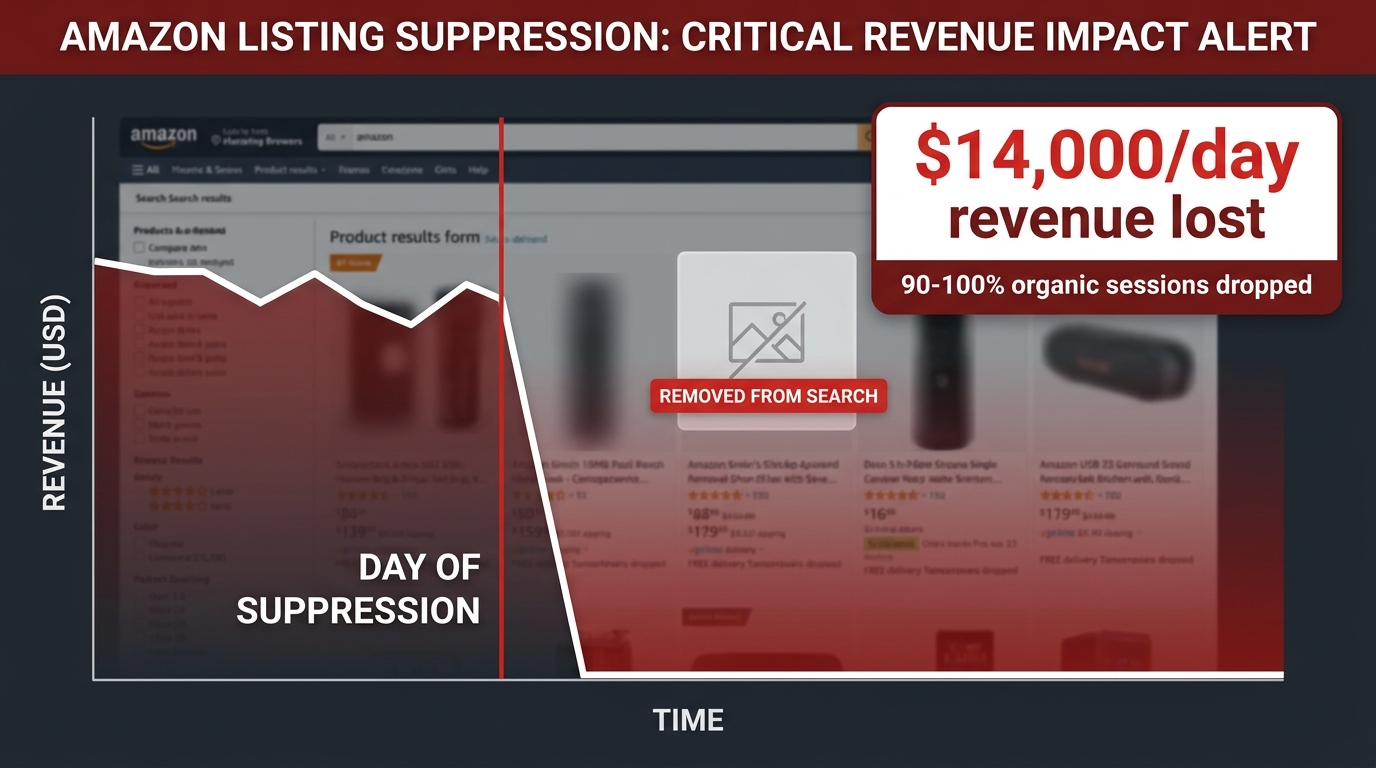
    Revenue impact chart showing sharp drop on day of Amazon listing suppression with $14,000/day loss callout

    Image compliance failures have a direct, quantifiable revenue cost. Understanding this math helps prioritize both the urgency of the audit process and the level of investment in compliant image production.

    The Scale of Enforcement in 2026

    Amazon removed more than 3.1 million listings in a single quarter of 2026 for image policy violations — a figure drawn from Marketplace Pulse data cited by multiple seller analytics platforms. Another estimate from an independent tracking service puts the number at approximately 2.3 million affected listings in a single month. Even accounting for the range of estimates, the scale is large enough to make clear that image violations are not an edge case or a risk that primarily affects poorly managed catalogs.

    These suppressions span categories and seller sizes. Large brands with mature catalogs have been affected alongside small independent sellers. The enforcement pattern in 2026 does not appear to heavily favor or disfavor any particular seller tier.

    Per-ASIN Revenue Impact

    Seller-reported case data from 2026 puts the daily revenue loss from image suppression in the following ranges:

    • Single ASIN suppressions: approximately $800 to $2,500 per day for mid-velocity sellers.
    • Multi-ASIN suppressions (10–40 affected listings): reported daily losses in the range of $5,000 to $14,000.
    • Catalog-wide suppression events (50+ ASINs): one seller forum case estimated $50,000 to $55,000 in total sales lost during a suppression event affecting 800+ listings before remediation was complete.

    These figures are self-reported and should be treated as representative rather than precise benchmarks. But the directional reality they reflect is consistent: even a small number of suppressed listings on high-velocity products can create revenue losses that dwarf the cost of fixing the images in the first place.

    The Ad Spend Bleed

    One aspect of suppression that many sellers underestimate is the advertising cost component. When a listing is suppressed from organic search, active Sponsored Product and Sponsored Brand campaigns linked to that ASIN don’t automatically pause. The campaign continues to spend — but on a listing that isn’t appearing in organic results and may have degraded placement in paid results as well.

    The result is that suppression doesn’t just cut revenue. It can simultaneously cut revenue while continuing to drain ad budget, widening the financial impact of the suppression event beyond the sales loss alone.

    The Ranking Recovery Cost

    Beyond the immediate suppression window, there’s an additional cost that’s harder to quantify: ranking recovery. Amazon’s algorithm registers the period of suppression as a low-performance window for the ASIN. Depending on the competitive pressure in the category and the duration of the suppression event, recovering to pre-suppression organic ranking positions can take weeks to months of sustained performance after the listing is reinstated.

    A listing that was suppressed for four days and lost 1,000 organic sessions during that window doesn’t automatically return to its prior ranking position when the suppression lifts. The algorithm’s view of the ASIN’s recent performance history now includes the suppression window, and recovering that ground requires active investment in both organic performance and advertising.

    How to Run a Full Catalog Image Audit in Under a Week
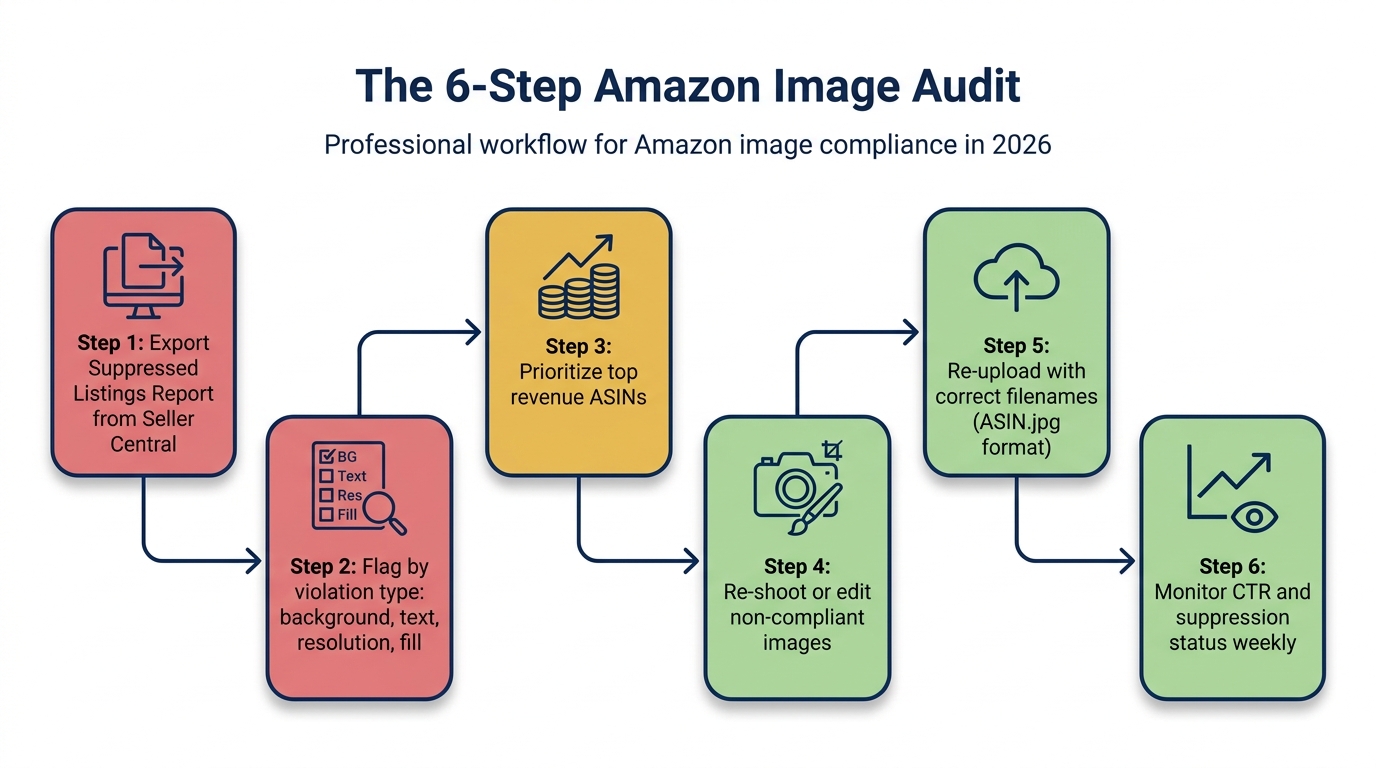
    Six-step Amazon image compliance audit workflow flowchart showing steps from suppression report export to weekly monitoring

    For sellers with large catalogs, the idea of auditing every image can feel paralyzing. The approach below is designed to make the audit tractable within a five-day working window, prioritizing by risk and revenue impact rather than attempting a wholesale catalog review from day one.

    Day 1: Pull the Suppression Report and Identify Active Violations

    Start in Seller Central. Navigate to Inventory → Manage All Inventory → Suppressed. This view shows you every ASIN that Amazon has already flagged and removed from search. Export this list.

    For each suppressed ASIN, the suppression report will typically include a reason code or a category label. Common image-related suppression codes include:

    • Main image background not white
    • Image contains text, logo, or graphic
    • Image too small or low resolution
    • Missing main image

    Sort the suppressed list by revenue (use your sales velocity data to rank ASINs) and flag all image-related suppressions in a working spreadsheet. These are your Day 1 and Day 2 priorities.

    Day 2: Triage and Prioritize by Revenue Impact

    Work from your suppressed ASIN list sorted by revenue. Assign each ASIN to one of three buckets:

    • Bucket A (Fix immediately): Top 20% of ASINs by revenue, currently suppressed. These are the listings you fix first, today.
    • Bucket B (Fix this week): All remaining suppressed ASINs and any active listings flagged by the Listing Quality report as at-risk for image quality.
    • Bucket C (Audit and update in the next 30 days): Active listings that aren’t currently suppressed but have image issues that could trigger future enforcement sweeps.

    Day 3: Systematic Image Review

    For Bucket A and B ASINs, do a direct visual review of every main image. Check each image against these five criteria:

    1. Is the background pure white (not off-white, not light gray)?
    2. Does the product fill at least 85% of the frame?
    3. Are there any text overlays, logos, watermarks, or brand marks on the image?
    4. Does the product shown match the specific variant this listing is for?
    5. Is the image at least 1,000 pixels on the longest side (2,000 × 2,000 preferred)?

    Also check: does the listing have any AI-generated human models in any image slot? If yes, add it to a separate tagging queue for the contains-synthetic-performer metadata process.

    Day 4: Remediation

    For images that need background correction, tools like Adobe Photoshop’s Select Subject plus a white fill layer, or dedicated background removal services like Remove.bg, can handle the bulk of simple white-background fixes without requiring a full reshoot. For images that are simply too small, upscaling tools (Adobe Super Resolution, Topaz Gigapixel) can bring undersized images into compliance without a reshoot — though genuine high-resolution originals will always outperform upscaled versions.

    For images that require a reshoot — because the product framing is wrong, because the product variant shown doesn’t match, or because the overall quality is poor — schedule those shoots before completing the remediation pass. Don’t re-upload partially fixed images; a listing with a questionable but not-yet-flagged image is better left live until a fully compliant replacement is ready.

    Rename all fixed files using the correct ASIN-based naming convention before upload: ASIN.jpg.

    Day 5: Re-upload, Monitor, and Build the Ongoing Tracking System

    Upload your corrected images through Seller Central’s standard image management interface, or in batch via flat file for larger catalogs. After uploading, allow 12 to 24 hours for images to process before checking suppression status.

    Set up a weekly monitoring process. The Listing Quality dashboard in Seller Central refreshes regularly and surfaces new issues as they’re identified. Building a recurring weekly check of suppression status — specifically for your top 50 revenue ASINs — into your standard operational cadence is one of the highest-ROI catalog management habits you can develop.

    Building a Suppression-Proof Image Workflow for 2026 and Beyond

    A catalog audit is a one-time fix. A sustainable image workflow is what prevents the audit from becoming an annual emergency. The goal here is to make compliance a property of the production process rather than something you achieve and then maintain reactively.

    Implement a Pre-Upload QC Checklist

    Every image — whether produced internally, by a photographer, or by a creative agency — should pass through a standardized compliance checklist before it enters your upload queue. The checklist doesn’t need to be complex; a Google Sheet or Notion table with five to eight binary yes/no questions for each image slot is sufficient.

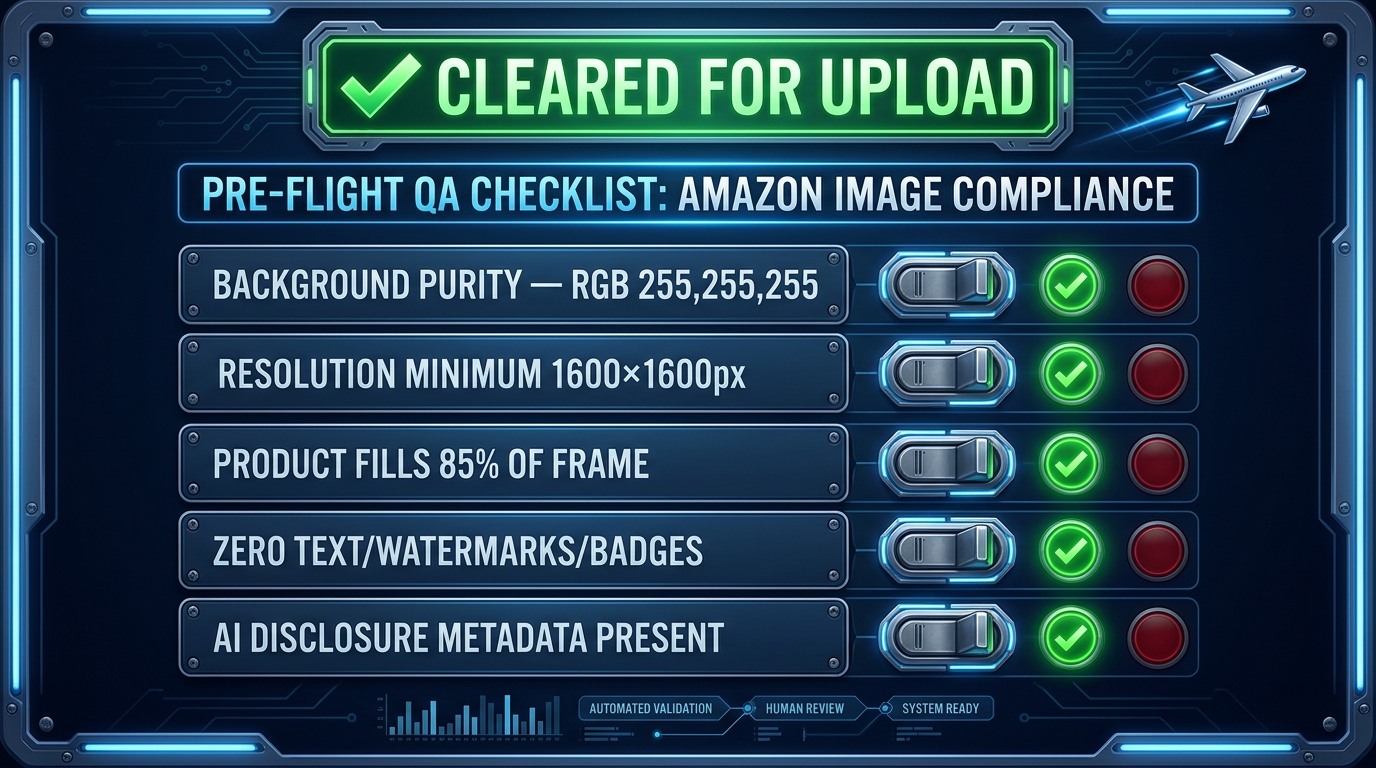
    The pre-upload checklist should cover:

    • Main image background confirmed pure white?
    • Product fill confirmed at 85%+?
    • No text, logos, or watermarks on main image?
    • Resolution at or above 2,000 × 2,000?
    • File named with correct ASIN convention?
    • Any AI-generated humans present in any image slot? (If yes, metadata tagged?)
    • All nine image slots populated?
    • Category-specific rules checked?

    Making this checklist mandatory for every new listing and every image update — not just new ASINs — closes the compliance gap at source rather than chasing it downstream.

    Build the AI Metadata Tag Into Your Production Workflow

    If any part of your image production uses AI tools to generate or modify human figures, the contains-synthetic-performer tagging step needs to be a built-in part of the final production stage, not an afterthought. The practical approach is to build metadata tagging into your image export or delivery stage.

    For teams using Adobe Creative Cloud, the metadata can be embedded in Bridge or Lightroom as part of a batch output preset. For teams using external agencies or freelancers, the contract or brief for any AI-generated creative work should explicitly require the delivery of tagged files — or the delivery of files that clearly document which images require tagging before upload.

    Establish a Category Compliance Library

    If your catalog spans multiple Amazon categories, maintain a single reference document that lists the category-specific image rules for each vertical you sell in. Update this document when Amazon publishes new style guides or when seller community reports surface new enforcement patterns.

    Category-specific rules change more frequently than the general guidelines, and Amazon doesn’t always publicize changes loudly. Following relevant seller forums (Seller Central community, relevant subreddits, third-party seller groups) and setting up Google Alerts for terms like “Amazon image requirements [category name]” provides early warning of new category-specific enforcement trends before they result in suppression notices.

    Treat Image Quality as a Competitive Asset, Not Just a Compliance Requirement

    There’s a useful reframe here that goes beyond the defensive concern of avoiding suppression. Amazon’s A9/A10 algorithm uses engagement signals — click-through rate from search results is one of the most significant — as a ranking input. Your main image is the primary driver of CTR. A fully compliant, well-framed, high-resolution main image that clearly shows the product isn’t just a compliance requirement; it’s an organic ranking lever.

    Sellers who treat the 2026 image compliance update as an opportunity to upgrade their visual assets — rather than purely a remediation exercise — consistently report improved CTR, better conversion rates, and stronger ranking velocity after the update is complete. The compliance floor and the quality ceiling are closer together than most sellers realize.

    The One Check Most Sellers Haven’t Done Yet

    Before closing out this audit guide, there’s a specific check worth calling out independently because the data suggests it’s being missed even by sellers who believe they’re compliant.

    Amazon has the ability to replace listing images under certain conditions. If Amazon’s systems determine that your main image is non-compliant and you haven’t replaced it within a defined window, Amazon may substitute an image from another part of the listing — a secondary image, a brand store asset, or in some cases an image sourced from another data provider — as the new main image. This replacement image may or may not meet main-image requirements, and it may not accurately represent your specific product variant.

    The practical consequence: your listing might not be suppressed, but it might be running with an Amazon-substituted main image you didn’t choose and may not have checked recently. Go to each of your live listings directly (not through Seller Central’s image management view) and visually confirm that the main image currently showing to shoppers is the one you intend it to be.

    This check takes approximately two minutes per ASIN on your priority list. It’s the most actionable single step you can take today.

    Conclusion: Compliance Is an Ongoing Operational Practice, Not a One-Time Fix

    Amazon’s 2026 image rules don’t represent a single sweeping policy overhaul. They represent the continuation of a multi-year trajectory toward stricter, faster, more automated enforcement of standards that have largely existed in documentation for years. The sellers who are getting caught aren’t primarily the ones who never read the rules — they’re the ones who read the rules once, implemented them once, and assumed the work was done.

    The addition of the contains-synthetic-performer disclosure requirement is the clearest signal of what’s coming next. Amazon is now codifying external regulatory requirements directly into technical seller specifications — which means the compliance landscape will continue to evolve as AI-related legislation advances globally. What’s required today is a metadata tag on photorealistic AI-generated people. Future iterations will almost certainly extend disclosure requirements further.

    The sellers who come out of 2026 in the strongest position are the ones who treat image compliance as an operational system rather than a project. That means a pre-upload QC checklist, a weekly suppression monitoring cadence, a current reference library of category-specific rules, and a clear workflow for any AI-generated or AI-edited creative.

    The cost of building and maintaining that system is a fraction of what a single multi-ASIN suppression event can cost in a single week. The math is straightforward. The operational change to act on it is what separates the sellers who will stay visible in Amazon’s search results from those who will keep getting surprised by suppression notices.

    Quick-Reference Action Checklist

    1. ✅ Export the Suppressed Listings report from Seller Central today.
    2. ✅ Sort suppressed ASINs by revenue and create a prioritized fix list.
    3. ✅ Review all main images for white background, 85%+ fill, no text/logos, and 2,000px resolution.
    4. ✅ Check every listing for AI-generated human models — if present, implement contains-synthetic-performer metadata tagging before re-upload.
    5. ✅ Verify you’re working to category-specific rules (apparel, shoes, jewelry, media) not just general guidelines.
    6. ✅ Confirm all A+ Content images are JPG/PNG/BMP in RGB, under 2 MB, with no QR codes or hyperlinks.
    7. ✅ Manually check each priority listing live in search to confirm the main image showing is the one you intended.
    8. ✅ Build a pre-upload compliance checklist and make it standard practice for every new listing and image update.
    9. ✅ Set up a weekly review cadence for your Listing Quality dashboard and top-revenue ASIN suppression status.

  • 2026 Image Policy Traps: How to Suppression-Proof Your Entire Amazon Portfolio

    2026 Image Policy Traps: How to Suppression-Proof Your Entire Amazon Portfolio

    Amazon image policy traps 2026 — suppressed listings with red warning stamps and compliance checkmarks across a product catalog

    For most of Amazon’s history, image policy violations were a nuisance. You got a warning, you fixed the image, you moved on. The penalty was a temporary inconvenience — annoying, but contained.

    That dynamic has fundamentally changed in 2026. Amazon’s image enforcement is now faster, more automated, and more sweeping than anything sellers have dealt with before. What used to be a listing-level problem has become a portfolio-level risk — one that can suppress multiple ASINs simultaneously, pause ad delivery across your entire account, erode months of organic rank, and trigger account health flags, all from a batch of images that were perfectly acceptable eighteen months ago.

    The sellers who are getting hurt most aren’t the ones deliberately cutting corners. They’re brands that uploaded compliant imagery, forgot about it, and never realised that retroactive enforcement sweeps can catch old assets that no longer meet tightened standards. They’re growing accounts that used AI image tools without understanding the specific disclosure and accuracy rules Amazon now applies. They’re multi-ASIN operators who treated image compliance as a launch-day checkbox rather than an ongoing operational function.

    This post is not a recap of Amazon’s published image requirements. Those are widely documented elsewhere. Instead, this is a systematic look at the mechanisms by which compliant-seeming portfolios get caught, the cascade of consequences that follows, and the operational systems that actually keep a catalog clean under 2026’s enforcement regime — not just at launch, but over the long run.

    Why Image Policy Has Become a Portfolio-Level Risk, Not a Listing-Level Problem

    The shift isn’t in the written policy. Amazon’s core image requirements — pure white main image background at RGB 255,255,255, product filling approximately 85% of the frame, no text or graphic overlays on the main image, no watermarks or logos, accurate representation of the actual item being sold — haven’t dramatically changed in structure. What has changed is how those rules are applied and at what scale.

    Automated Enforcement at Catalog Scale

    Amazon’s image validation systems now operate more like continuous audit loops than one-time upload gatekeepers. In earlier years, an image might pass at upload because the automated check was relatively permissive, only to be flagged later if a human reviewer happened to look at the listing. In 2026, enforcement sweeps are faster, more frequent, and algorithmically driven — meaning an image that passed six months ago can be re-evaluated against updated detection thresholds and suppressed without a new upload or any action on the seller’s part.

    This retroactive enforcement is the trap most sellers don’t see coming. Your catalog isn’t static in Amazon’s eyes, even when you haven’t touched it. Periodic automated re-audits of existing listings mean that compliance isn’t a one-time achievement — it’s a continuous requirement that must be actively maintained.

    From Warning to Suppression Without Gradual Escalation

    The older enforcement model gave sellers a reasonable grace period. A non-compliant image might generate a fix-it notification, remain live during the remediation window, and only disappear from search if the seller ignored the warning repeatedly. The 2026 model, as reported consistently across third-party seller communities and agency analyses, is considerably less forgiving. Listings are being suppressed from search results much more quickly after an image violation is detected — in some cases without a prior warning notification arriving before the suppression takes effect.

    For a single-ASIN account, that’s painful. For a multi-hundred ASIN catalog, a batch enforcement event can create simultaneous suppression across a significant portion of the inventory — with ad campaigns burning impressions on ASINs that are no longer visible in organic search, and sales velocity crashing before the account owner even knows there’s a problem.

    Account Health Is Now Downstream of Image Compliance

    The previously clean separation between “image compliance” and “account health” is blurring. Repeated or severe image violations — particularly those that involve misrepresentation of the actual product — are increasingly feeding into account health scoring mechanisms. A high enough volume of suppressed listings, or violations that Amazon interprets as intentional misrepresentation rather than innocent non-compliance, can generate account-level flags that affect selling privileges well beyond the impacted ASINs.

    This is the portfolio-level risk that demands a portfolio-level response. Treating each ASIN’s image as its own isolated compliance problem is no longer an adequate operating model.

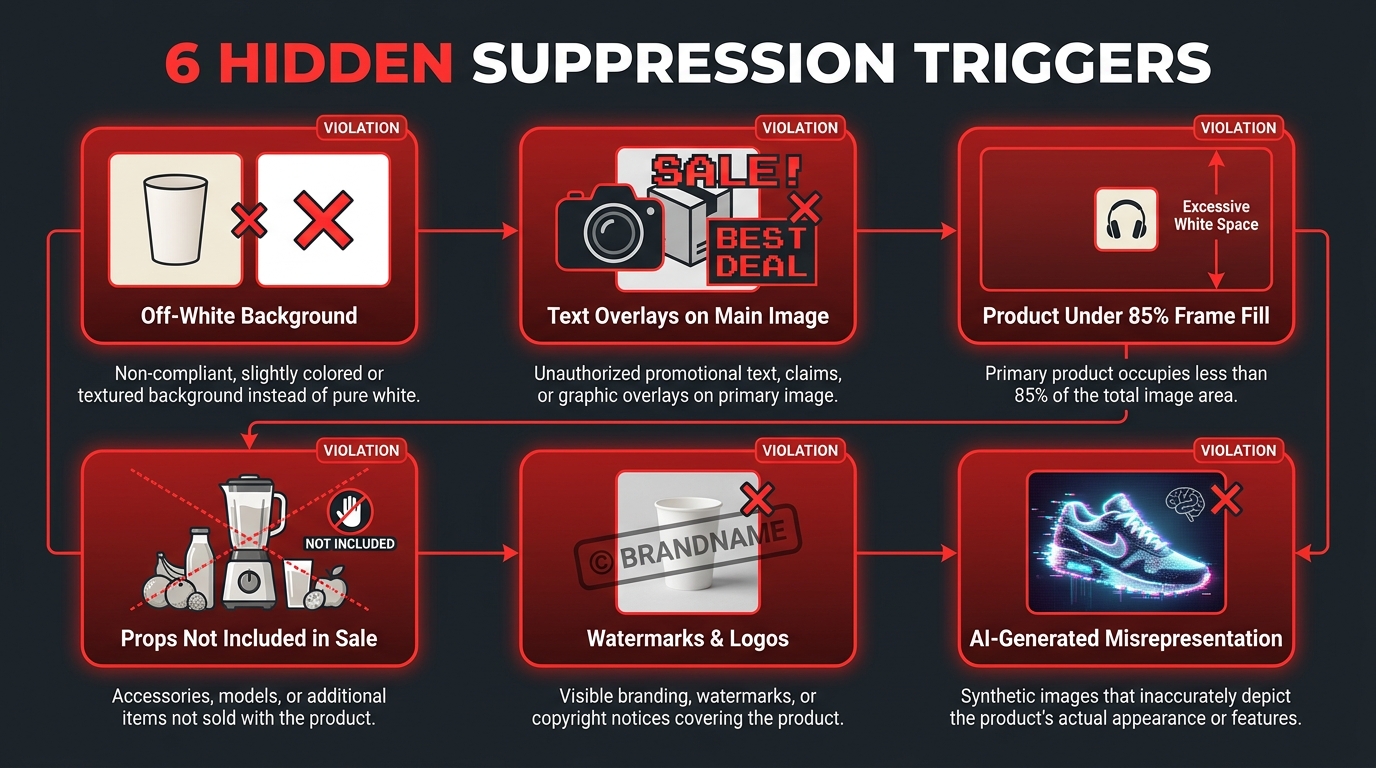
    The Six Hidden Suppression Triggers Amazon’s AI Catches That Sellers Don’t Expect

    Six hidden Amazon image suppression triggers in 2026 — infographic showing off-white background, text overlays, frame fill, props, watermarks, and AI misrepresentation violations

    Every seller knows the headline rules. What gets brands into trouble in 2026 isn’t ignorance of the obvious requirements — it’s the subtle violations that look compliant to the human eye but trip the automated detection systems Amazon has built.

    1. Off-White That Doesn’t Look Off-White

    The requirement is RGB 255,255,255. Not 254,254,254. Not 250,250,250. Not a creamy, soft white that looks perfectly clean on your monitor under warm studio lighting. Amazon’s automated detection can distinguish between true white and near-white backgrounds, and the threshold is being applied with increasing precision in 2026. Backgrounds that were accepted without issue at upload are being flagged during re-audit sweeps because the detection sensitivity has been raised.

    The practical source of this problem is often the photography workflow itself. Lightbox setups that use slightly warm-toned LED lighting, paper backdrop materials that have a natural texture or slight color cast, and editing workflows that stop at “looks white” rather than verifying the exact RGB values in post-production can all produce backgrounds that fail the threshold even though they appear compliant to the photographer’s eye.

    2. Shadows and Reflections as Background Violations

    A drop shadow beneath a product, a surface reflection on a glossy table, or a soft gradient created by the product’s own shape against the background — all of these introduce non-white pixels into the main image, and all of them are treated as background violations by Amazon’s image analysis. This is a widely reported trap that catches brands whose product photography is otherwise high quality. A beautiful, professionally lit image with a subtle shadow is still a suppression risk.

    3. Props and Context Objects “Not Included in Sale”

    Amazon’s policy is clear that the main image should show only the item being purchased. Lifestyle elements, complementary products, styling accessories, and contextual props that suggest scale or usage but aren’t included in the box are policy violations for the main image. The trap here is that many sellers use a “hero lifestyle” image as their main image — a decision that was sometimes tolerated historically but that 2026’s enforcement systems are now much more aggressive in flagging.

    Multi-piece sets and bundle products require particular care: the main image must accurately reflect exactly what’s in the box, and the grouping shown must exactly match the purchase. An image that shows a set of four items when the listing is for a set of three — even if it’s a photographic shorthand the seller never intended to be misleading — is a violation.

    4. Faint Watermarks and Edge Logos That Survived Cropping

    Brands that have used third-party image services, stock photography with embedded licensing marks, or photography vendors who added subtle branded watermarks as part of their standard delivery package can find that images contain low-opacity marks that are invisible to casual review but detectable by Amazon’s systems. Similarly, image files that were cropped from larger compositions may contain partial logos or graphic elements near the frame edge that weren’t visible in the pre-upload preview.

    5. Resolution Failures After Platform Compression

    Amazon recommends a minimum of 1,000 pixels on the longest side, with 2,000 pixels or more preferred to enable the zoom function. The trap occurs when sellers upload images that technically meet this threshold but whose effective resolution is degraded by compression artifacts, JPEG quality settings, or platform-side resizing. An image that uploaded at 1,050 pixels may display at a quality level that fails the zoom-enabled clarity standard — and Amazon’s systems can flag this during image quality audits.

    6. Inset Images, Callout Boxes, and Bundled Secondary Visuals in the Main Slot

    A surprisingly common violation involves main images that are actually composites — a primary product shot combined with a smaller inset image showing a detail, a bundled accessory, or a “what’s in the box” visual. From a seller’s perspective, this feels like useful communication. Amazon’s policy treats it as a graphics overlay violation, regardless of whether the inset contains any text. The automated detection for composite images — where the main frame contains a visually distinct embedded sub-image — has become sharper in 2026.

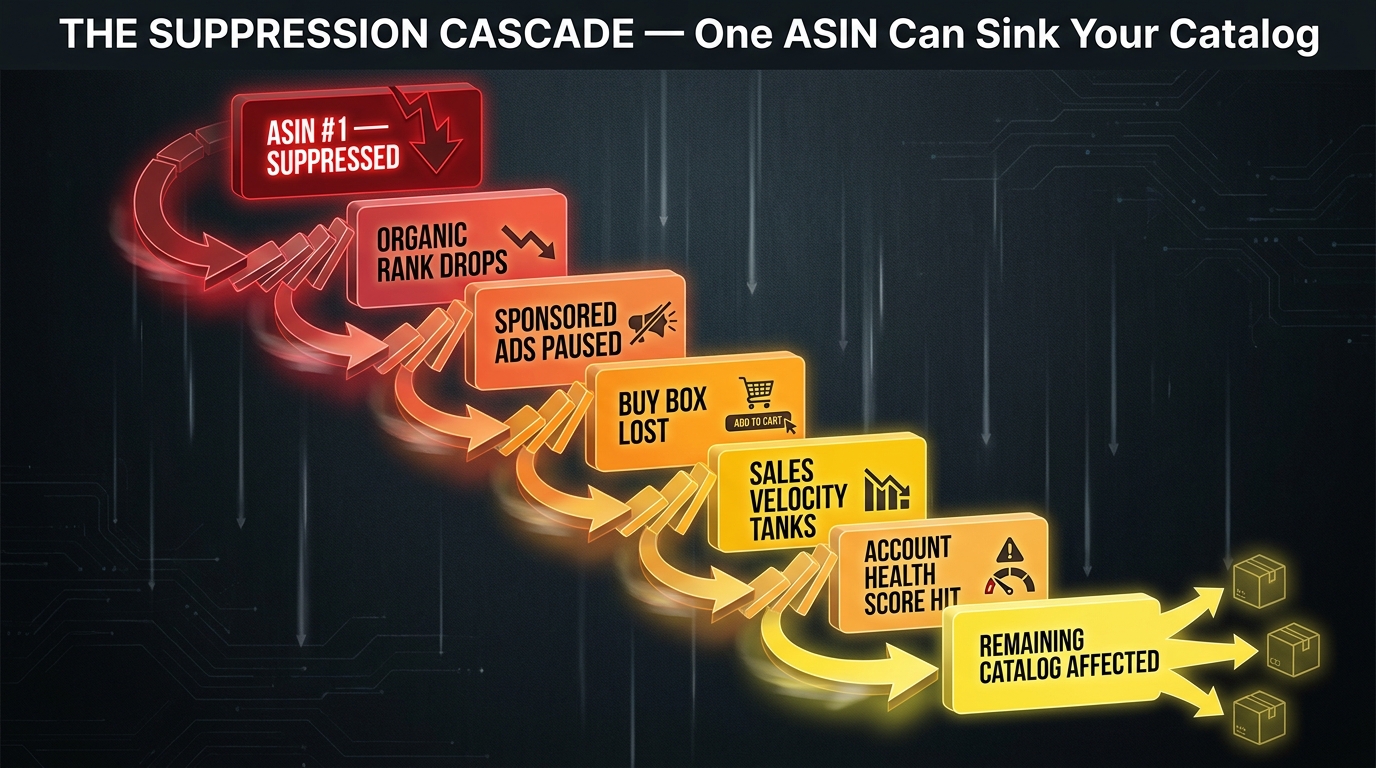
    The Cascade Effect — How One Suppressed ASIN Can Destabilize Your Entire Catalog

    Amazon suppression cascade diagram showing how one suppressed ASIN triggers organic rank drops, ad pauses, Buy Box loss, and account health deterioration

    Understanding suppression as a cascade rather than an isolated event is the conceptual shift that separates reactive sellers from genuinely protected portfolios. The cascade mechanics are worth understanding in detail because they explain why recovery is so much slower than the initial suppression.

    The Organic Rank Problem

    Amazon’s A10 algorithm uses sales velocity — among other signals — as a core input to organic ranking. A suppressed listing generates zero sales velocity, because it’s no longer appearing in search results for buyers to find and purchase. Depending on how long the suppression lasts before correction, the organic rank for that ASIN will decay. When the listing is restored after a compliant image is submitted, the organic rank doesn’t automatically reset to its previous level. It starts rebuilding from wherever it fell to — which means suppression recovery often involves not just fixing the image but re-earning rank that took months to establish.

    Ad Campaign Disruption

    Sponsored Products campaigns tied to a suppressed ASIN stop delivering impressions. This is straightforward and expected. What sellers often miss is the campaign learning disruption this causes. Advertising algorithms build performance models based on cumulative impression, click, and conversion data. A suppression-caused pause in delivery resets or degrades that accumulated learning, meaning the campaigns that restart after the listing is restored may underperform for days or weeks while the algorithm re-establishes its baseline.

    For accounts running Sponsored Brands or Sponsored Display campaigns that include the suppressed ASIN as part of a broader creative, the ripple extends further — those campaign types may see delivery disruptions or performance anomalies even for the ASINs that weren’t directly suppressed.

    Variation Parent and Child ASIN Interdependencies

    Many Amazon listings operate within variation families — a parent ASIN connected to multiple child ASINs representing different colors, sizes, or configurations. The suppression of a parent ASIN or a high-velocity child ASIN creates visibility and data problems for the entire variation family. Review aggregation, search ranking signals, and Buy Box mechanics at the variation level are all affected when a key node in the family goes dark.

    The reverse also applies: if a variation child is suppressed and its image issue is on the variation-specific image (the photo that shows the specific variant being sold), the brand may not notice as quickly because the parent listing appears to still be live. Meanwhile, customers clicking through to the suppressed variant see an incomplete listing experience, conversion suffers, and the data bleed affects the whole family’s performance signals.

    Inventory and Fulfillment Knock-Ons

    For FBA sellers, a suppressed listing that continues to hold inventory at Amazon fulfillment centers is still incurring storage fees while generating zero revenue. Extended suppression periods create a particularly damaging financial pressure: costs accumulate while the income that was supposed to offset them has stopped. For sellers operating near long-term storage fee thresholds, a suppression event can push inventory into penalty territory faster than expected.

    Category-Specific Traps That Generic Guides Never Cover

    Amazon’s image policy contains category-specific rules that layer on top of the universal requirements. These category rules are the compliance details that generic seller education typically glosses over — and that enforcement systems apply with precision.

    Apparel and Footwear: The Model and Mannequin Rules

    Amazon’s policy for most apparel categories requires that the main image show the garment on a human model or a “clean” invisible mannequin — not flat-lay photography, not folded product shots, and not display on a standard visible clothing form. This creates a compliance trap for brands that use flat-lay as their main image for aesthetic or cost reasons. The enforcement threshold for apparel main images has tightened considerably, and flat-lay images that appeared on detail pages for extended periods without issue have been swept in recent re-audit cycles.

    For footwear, the angle and orientation requirements add further specificity: shoes should generally be shown in a specific angled view that displays the upper, sole profile, and overall silhouette. Main images showing only the sole, only a side view, or only the toe box don’t meet the standard, even if the background and framing are technically perfect.

    Electronics and Technical Products: Accuracy of Included Accessories

    Electronics listings are particularly exposed to the “props not included in sale” violation because product photography in this category routinely includes cables, adapters, cases, and complementary devices for visual context and scale. If the main image shows a pair of headphones next to a smartphone for scale, but the smartphone is not included — that’s technically a violation. If the image shows a charging cable that’s included with one product variant but not another, and the same image is applied to both variants, that’s a misrepresentation violation on the variant that doesn’t include the cable.

    Grocery and Health Products: Label Legibility as Compliance

    For consumable products — supplements, food, beverages, personal care — Amazon’s content accuracy requirements intersect with image compliance in a specific way. The product label shown in the image must match the actual product label. Label updates that change ingredients, warnings, dosage instructions, or net weight create a window where the existing listing images show the old label while the actual product has the new label. This is an image accuracy violation even if the photography itself is otherwise perfectly compliant.

    Toys and Children’s Products: Safety Claim Restrictions

    Secondary images for toys and children’s products that include safety certifications, age-appropriateness badges, or compliance marks (ASTM, CPSC, CE, and similar) run into a specific content restriction: promotional badges and certification marks are prohibited in secondary images in ways that create ambiguity about what is and isn’t a compliance mark versus a promotional badge. The safe approach is to communicate safety certifications in the text content of the listing rather than embedding badges or certification logos in the images themselves.

    AI-Generated Images and the Compliance Grey Zone Sellers Are Walking Into

    Amazon does not ban AI-generated or AI-assisted product images. The policy is output-based, not tool-based — what matters is whether the final image accurately represents the actual product, meets technical specifications, and complies with content restrictions. This permissive-sounding policy is creating a false sense of safety among sellers who are using AI image generation extensively in 2026.

    The Accuracy Problem Is the Core Risk

    AI image generation tools produce images that look like the product being described, not necessarily like the actual product being sold. Generated images may alter proportions, modify colors, simplify details, add or remove design elements, or create a version of the product that is visually appealing but materially different from what the customer will receive. Amazon’s accuracy requirement — that images must truthfully represent the physical item being sold — applies with the same force to AI-generated images as to traditional photography.

    This creates a specific workflow risk: a seller who uses an AI tool to generate a “product image” for a listing that hasn’t been physically photographed, or who uses AI to produce imagery for product variants that differ only slightly from photographed versions, can end up with images that are technically accomplished but fundamentally misrepresent what’s in the box. The enforcement consequence is classification as a misrepresentation violation — a more serious category than a technical spec failure.

    AI Enhancement vs. AI Generation — A Distinction That Matters

    There’s a practical compliance difference between using AI tools to enhance a photograph of the real product (background removal, background replacement with pure white, color correction, upscaling) and using AI to generate a product image without a real photographic source. The former is generally lower risk as long as the enhancement doesn’t alter the product’s appearance in ways that misrepresent it. The latter is inherently higher risk because the output is a synthetic creation rather than a record of the actual product.

    For AI background removal and replacement specifically — a very common use case for achieving the pure white main image standard — sellers need to verify that the removal process didn’t clip the product edges, alter its apparent dimensions, or introduce artifacts that change the perceived product color or finish. These are easily introduced errors in AI-based background tools that human review of the output often misses.

    Disclosure Requirements and Evolving Expectations

    Amazon is moving toward requiring disclosure for AI-generated content in some contexts. The practical advice for 2026 is to treat AI-generated imagery with the same documentation discipline as traditional photography: keep records of what was generated, for which ASINs, using which prompts, and what accuracy verification was performed before upload. If enforcement questions arise, documented verification that the AI output accurately represents the physical product is the strongest defense available.

    Image Hijacking — The Suppression Risk You Didn’t Create But Still Own

    Image hijacking is one of the most underappreciated suppression threats in multi-seller marketplaces, and 2026’s enforcement environment has made it significantly more consequential. The mechanics are specific: in Amazon’s catalog architecture, a product detail page is shared infrastructure. Sellers listing on the same ASIN contribute to a shared content pool, and Amazon’s systems make judgments about which contributed content to display. This creates a vector for unauthorized content substitution.

    How Non-Brand Sellers Replace Your Main Image

    A third-party seller who attaches an offer to your ASIN can contribute content to that ASIN’s detail page — including images. If Amazon’s system evaluates their submitted image as higher quality, more compliant, or simply more recent than yours, it may display their image as the main image on your product detail page. This means a seller offering a counterfeit, grey-market, or materially different version of your product may effectively be showing their image — which may show a different product — as the main image for your ASIN.

    The catastrophic scenario is when the substituted image is non-compliant with Amazon’s policies. Your listing gets suppressed for a policy violation on an image you didn’t upload, didn’t approve, and may not even know exists on your product page. The suppression impact falls on your ASIN, your sales velocity, your organic rank, and potentially your account health.

    Brand Registry and Catalog Lock as Primary Defenses

    Amazon’s Brand Registry provides qualified brand owners with tools to assert control over the content displayed on their branded ASINs. The Catalog Lock feature — available to Brand Registry members — allows restriction of changes to key listing fields including the main image. When catalog lock is applied, only the brand-authenticated account can change the main image, regardless of what other sellers contributing to that ASIN submit.

    Applying catalog lock to high-revenue ASINs is not optional in 2026 — it’s a basic operational requirement. The risk of not doing so is an uncontrolled image substitution event that you may not discover until suppression has already occurred and rank has already started decaying.

    Monitoring for Unauthorized Image Changes

    Catalog lock prevents changes going forward but doesn’t retroactively notify you of changes that have already occurred. A monitoring workflow that checks the main image displayed on each high-value ASIN against a stored reference image on a regular cadence is the mechanism that catches hijacking events before they extend into suppression territory. This can be done manually for small catalogs, but for accounts with dozens or hundreds of ASINs, automated tools that screenshot product pages and compare against a reference library are operationally necessary.

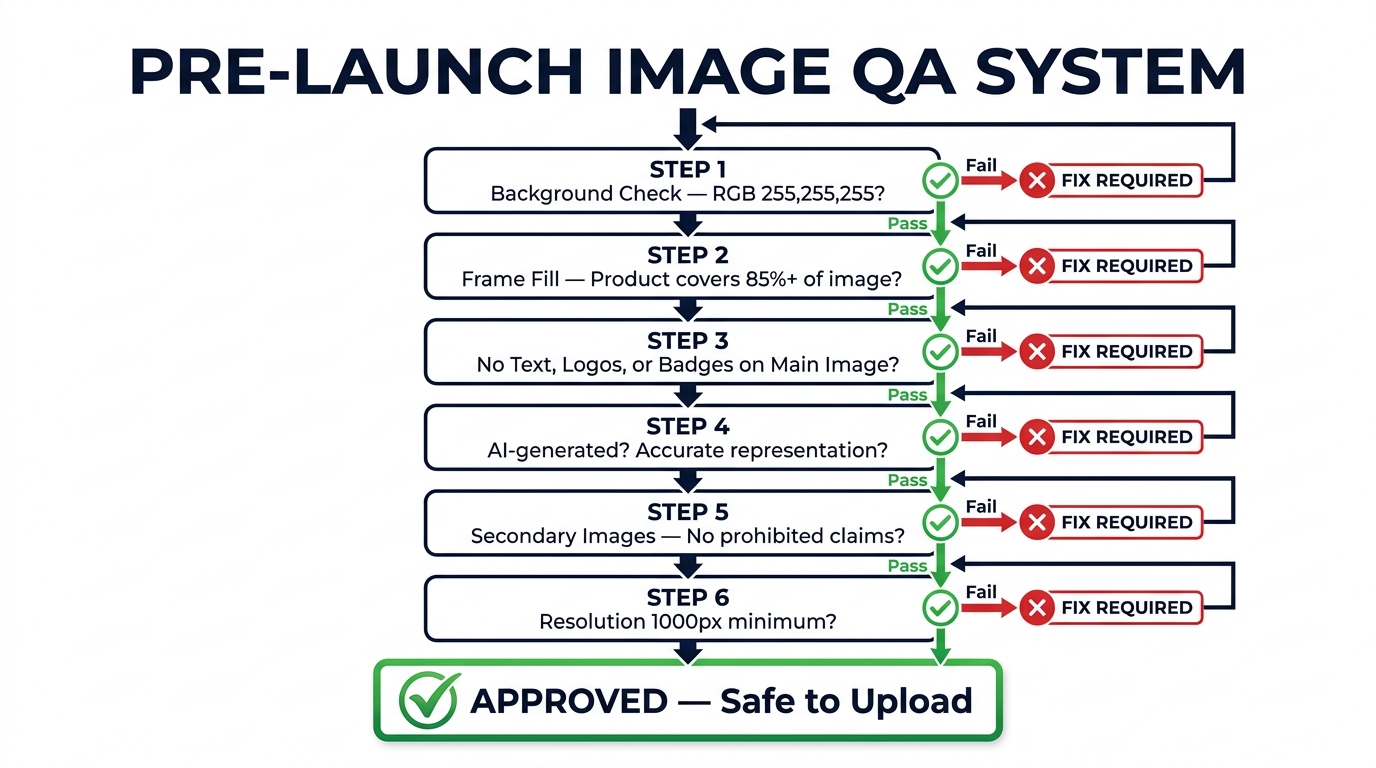
    Building a Suppression-Proof Image QA System Before Launch

    Pre-launch image QA system flowchart for Amazon 2026 compliance — step-by-step checklist from background verification to upload approval

    Prevention is categorically cheaper than recovery in the Amazon suppression context. A listing that never gets suppressed doesn’t lose rank, doesn’t pause ad delivery, doesn’t trigger account health flags, and doesn’t require the operational scramble of emergency remediation. The investment in a pre-launch QA system pays back every time it prevents a suppression event.

    The Pre-Upload Technical Checklist

    A systematic pre-upload technical check should verify every image before it enters the Amazon catalog. For the main image specifically, this checklist should be non-negotiable:

    • Background verification: Open the image in a color-accurate editing environment and use the eyedropper tool to sample multiple background points. Confirm RGB values of 255,255,255 across the full background area. Pay particular attention to areas near the product edge, which are most likely to show gray fringing from background removal tools.
    • Frame fill measurement: Using a grid overlay or selection tool, verify that the product occupies at least 85% of the image canvas by area. For high-value listings, aiming for 90–95% coverage reduces the risk of failing stricter re-audit thresholds.
    • Element check: Verify absence of text, logos, badges, watermarks, inset images, and graphic overlays. Check at 100% zoom, not at thumbnail scale — violations that are invisible at thumbnail size are still policy violations.
    • Shadow and reflection audit: Zoom into the base of the product and check for ground shadow, cast shadow, or reflective surface elements. These are the most commonly overlooked non-white background elements.
    • Resolution confirmation: Check the actual pixel dimensions of the file, not the upload dialogue — confirm 2,000+ pixels on the longest side and appropriate file size for the format being used.
    • Accuracy verification: Compare the image against the physical product for color accuracy, included accessories, packaging match, and variant-specific details. For AI-enhanced images, this comparison must be done against the actual physical product, not the source image.

    Building a Category-Aware Review Layer

    Generic technical checks aren’t sufficient for category-specific compliance. For each product category you operate in, the QA system should include a category-specific module that checks against the additional requirements that apply to that category. For apparel, this means confirming model or invisible mannequin presentation for the main image. For electronics, this means verifying that every item shown in the image is included in the purchase. For consumables, this means confirming that the label shown matches the current product formulation and packaging.

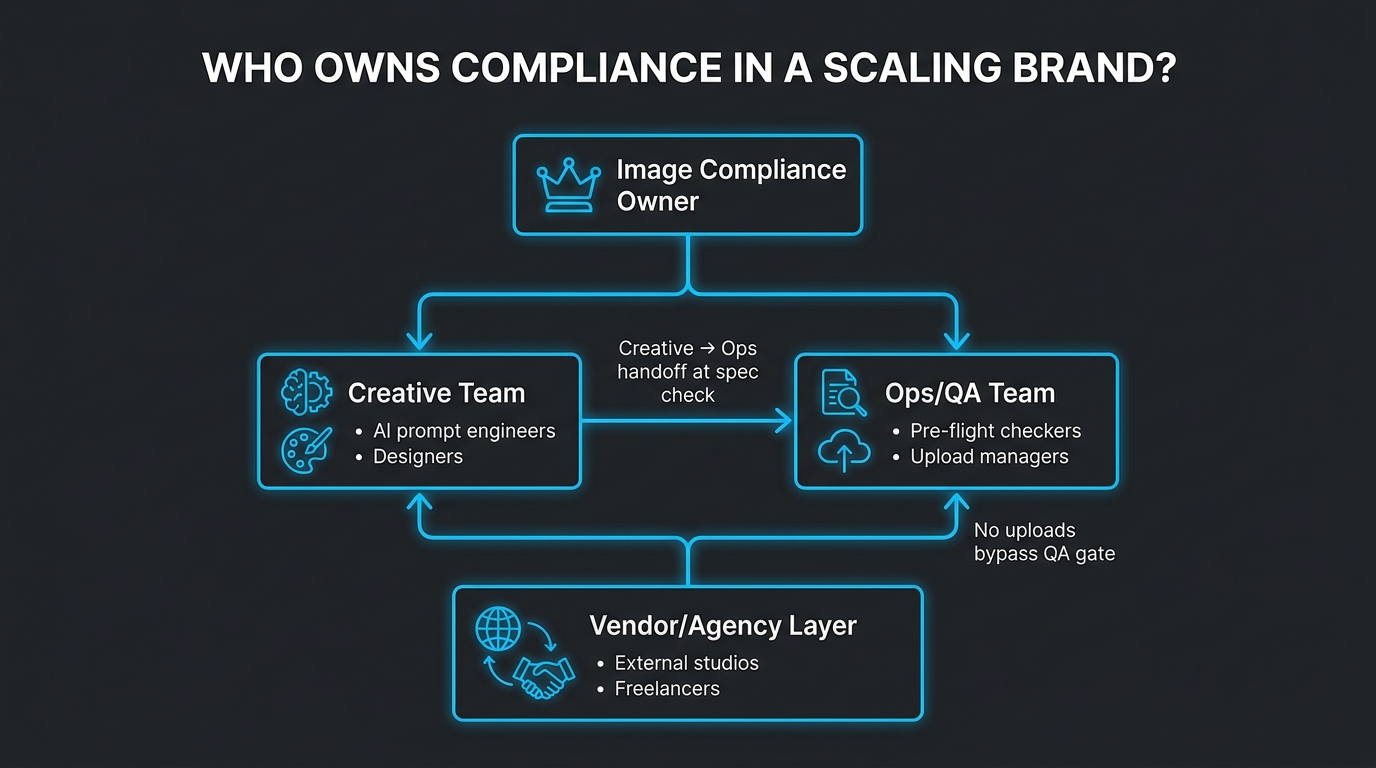
    This layer of the QA system requires someone who actually knows the category-specific rules — which is itself an argument for centralized image compliance expertise within organizations managing multi-category catalogs, rather than relying on product managers or graphic designers to self-assess compliance.

    Version Control and Asset Management

    Every image that enters the Amazon catalog should have a documented record: the file, the date it was uploaded, the ASIN it was applied to, the slot it occupies (main vs. secondary slot number), who approved it, and any notes about the version history. This documentation serves two functions: it enables fast identification and replacement when an image fails a re-audit, and it enables quick detection of unauthorized image substitutions by comparing the currently displayed image against the documented approved version.

    When You’re Already Suppressed — A Recovery Playbook That Works in 2026

    Despite best prevention efforts, suppression events happen. The recovery process in 2026 has some specific characteristics that sellers need to understand to navigate it efficiently — because the wrong remediation approach can extend the suppression duration significantly.

    Triage by Revenue Impact First

    When a batch suppression event affects multiple ASINs simultaneously, the instinct is to work through a list systematically. The 2026 reality is that speed of recovery is more important for some ASINs than others, and limited internal resources need to be directed at the ASINs where suppression is causing the greatest revenue loss and rank decay. Sort the suppressed ASIN list by average monthly revenue or sales velocity and address the top items first.

    For the highest-revenue ASINs, consider whether you have a compliant backup image already prepared. This is the argument for maintaining a “compliance-ready” version of every main image as part of your asset management system — a pre-verified, technically perfect version that can be uploaded immediately during an emergency without requiring a photography or editing workflow to execute under time pressure.

    Understanding the Suppression Cause Before Fixing the Image

    Uploading a replacement image without first diagnosing why the original image was suppressed is a common and costly mistake. If the replacement has the same underlying issue — off-white background, subtle shadow, wrong frame fill — it will fail again, restarting the suppression clock and potentially triggering escalated enforcement attention. Seller Central’s listing quality dashboard and the suppression notification details (when available) should be reviewed to identify the specific violation category before any replacement image is prepared.

    The Right Way to Submit the Replacement

    Image replacement in 2026 works best when the corrected image is submitted through the most authoritative channel available. For Brand Registry sellers, this means using the Brand content submission tools rather than standard Seller Central image upload — brand-authenticated submissions are typically evaluated faster and carry higher confidence weighting in Amazon’s system. For sellers without Brand Registry, standard image upload through the listing edit interface is the only option, but ensuring the file metadata, filename format, and upload format all meet specifications reduces processing friction.

    Contacting Seller Support in parallel with a replacement upload is advisable for high-revenue ASINs where every day of suppression represents material revenue loss. A support case creates a documented record of the remediation effort and sometimes accelerates the system’s processing of the replacement image. Be specific in the support case about what change was made and why the new image is compliant — generic “please fix my listing” messages generate slower and less useful responses than precise technical explanations.

    Post-Recovery Monitoring

    Lifting a suppression doesn’t mean the underlying system risk is resolved. After a listing is restored, monitor it daily for the following two weeks to confirm that the replacement image is stable, that the listing’s search visibility has been restored, and that ad delivery has resumed and is rebuilding toward pre-suppression performance. Watch the variation family if applicable — sometimes restoring one ASIN reveals a secondary suppression on a sibling ASIN that wasn’t immediately visible.

    Continuous Monitoring — Tools, Cadences, and What to Actually Track

    Compliance is not a one-time achievement. Amazon’s enforcement environment in 2026 requires ongoing monitoring as a permanent operational function — not because the rules change constantly, but because retroactive enforcement sweeps, image hijacking attempts, and catalog drift (where product changes make formerly accurate images inaccurate) create ongoing risk that no initial audit can permanently eliminate.

    Daily Monitoring: Account Health and Suppression Alerts

    The Account Health dashboard in Seller Central is the primary real-time signal for policy violations and enforcement actions. Checking it daily — not weekly — is the baseline for any multi-ASIN operation. Suppression notifications, policy violation alerts, and image removal notices all surface here first. Many third-party tools integrate with Seller Central APIs to send automated alerts when account health metrics change, which reduces the response time from a daily manual check to near-real-time notification.

    Specific metrics to watch daily: account health score, listing quality score changes, new policy violations, and any notifications under the “Listing Issues” section of the inventory management view.

    Weekly Monitoring: Image Integrity Checks

    A weekly check of main images displayed on all active ASINs, compared against the approved reference image in your asset management system, catches hijacking-based substitutions before they have time to generate suppression events. For accounts with large catalogs, this is where automated screenshot comparison tools become necessary rather than optional — manual verification of hundreds of product pages weekly is not a sustainable operational workflow.

    Quarterly Audits: Full Catalog Compliance Review

    Every 90 days, conduct a full catalog compliance review against current Amazon image standards. The purpose of the quarterly cadence is to catch two types of drift: enforcement threshold drift (where Amazon’s automated detection becomes stricter, making previously-accepted images newly vulnerable) and product accuracy drift (where product updates, label changes, or packaging modifications have made existing images inaccurate).

    The quarterly audit should use the same comprehensive checklist as the pre-launch QA process, applied to every image in the active catalog. Prioritize the audit by revenue impact — high-revenue ASINs first — but complete the full catalog review within the quarter. Any images identified as potentially non-compliant during the quarterly audit should be scheduled for replacement before they become active suppression triggers.

    Tools Worth Using in 2026

    Several third-party tools have developed specific capabilities for image compliance monitoring and suppression detection in the Amazon context. Datahawk, SellerApp, and Jungle Scout all offer suppression monitoring features that alert sellers when listing status changes. For image accuracy and consistency verification across large catalogs, tools that can perform pixel-level comparison between reference images and current displayed images are increasingly available within broader catalog management platforms. Amazon’s own Listing Quality Dashboard — available to Brand Registry members — surfaces image-specific quality flags that can serve as early warning indicators before formal suppression occurs.

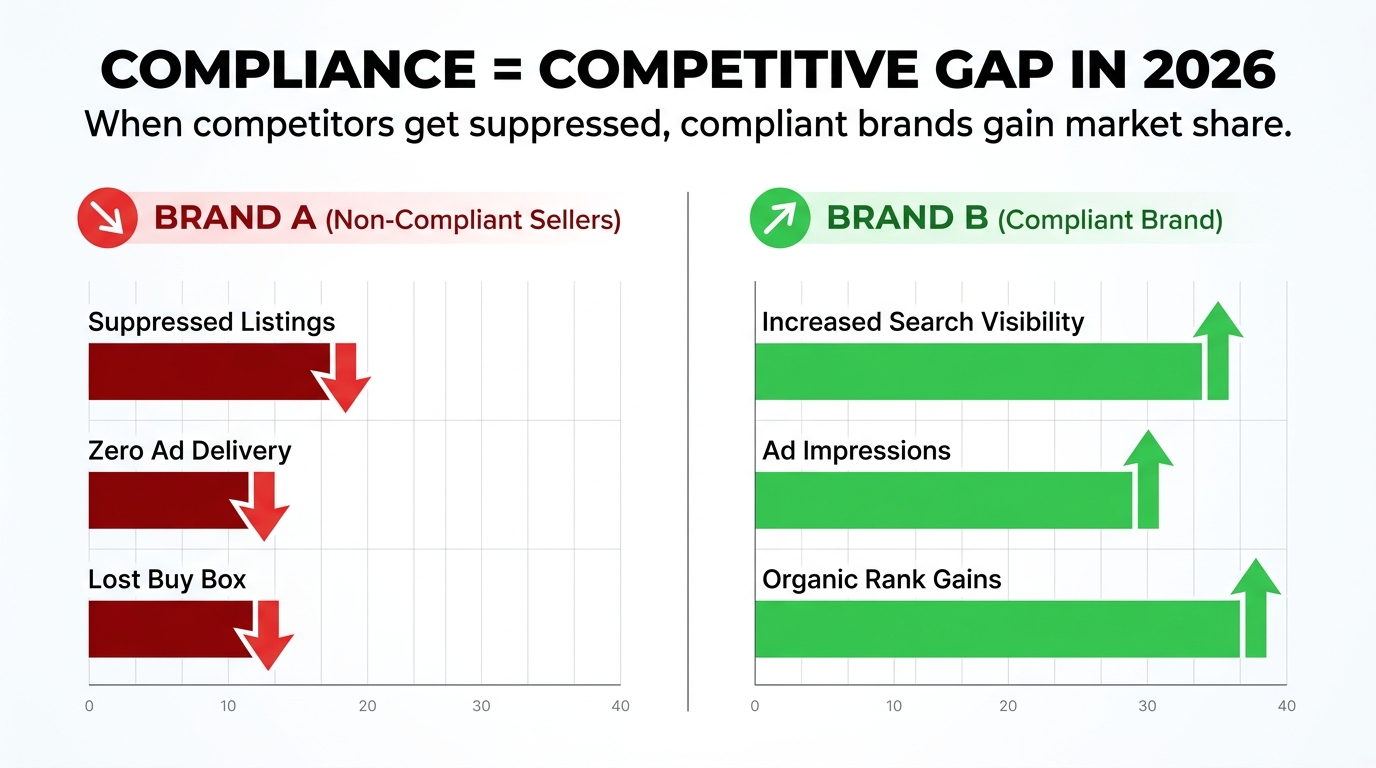
    The Opportunity Hidden in Compliance — How Strict Policy Creates Competitive Gaps

    Competitive advantage bar chart showing compliant brands gaining organic rank and ad impressions while non-compliant sellers face suppression in 2026

    There’s a strategic dimension to Amazon’s stricter image enforcement that most sellers, understandably focused on their own compliance risk, don’t fully consider. When enforcement creates suppression events at scale across a category, it disproportionately affects sellers who are least equipped to manage the operational demands of compliance — and that creates measurable opportunities for brands that maintain clean catalogs.

    Competitive Search Visibility When Rivals Go Dark

    When competing ASINs are suppressed from search results — whether for image violations or any other reason — the search result pages your customers are using don’t disappear. They just become less crowded. Organic rankings that were previously competitive become less contested, and brands with compliant, optimized listings move into visibility positions they couldn’t achieve organically against a full competitive field.

    This is not a minor effect. Category-level suppression events have been associated with measurable increases in organic rank and organic session traffic for remaining visible listings — particularly in competitive product categories where multiple sellers are battling for the same keyword positions. A brand that monitors competitor listing status and has ads pre-positioned to capture increased search traffic during competitor suppression events can generate meaningful incremental revenue from other sellers’ compliance failures.

    Ad Auction Dynamics During Suppression Events

    When competing ASINs are suppressed, their Sponsored Products campaigns stop delivering — because ads can’t drive traffic to suppressed listings. This removes their bidding pressure from the ad auction for shared keywords. For an advertiser with remaining live, compliant listings, the practical effect is lower cost-per-click for the keywords those competitors were previously contesting, at the same or higher impression volume. This is a direct ROAS improvement opportunity that requires no change to your own bidding strategy.

    The brands that capture this opportunity most effectively are those who monitor category-level suppression events as a standard part of their competitive intelligence, and who maintain adequate advertising budgets and bid structures to capitalize on the brief windows when competitor suppression creates more favorable auction conditions.

    Long-Term Brand Quality Signaling

    Amazon’s algorithm evaluates listing quality as an input to organic search ranking. Listings with consistently high image quality scores, stable compliance status, and strong click-through and conversion metrics are treated as higher-quality results and are rewarded with ranking advantages over time. The brands that build and maintain genuinely compliant, high-quality image assets aren’t just avoiding suppression — they’re accumulating a sustained ranking advantage that compounds over time relative to competitors who manage compliance reactively.

    This is the less-discussed dimension of image compliance investment: it’s not purely defensive. Done well, it’s an offensive capability that builds durable organic rank advantages and reduces the cost of maintaining visibility in competitive categories.

    Putting It Together: The 2026 Portfolio Protection Framework

    The operational reality that sellers need to internalize is that image compliance in 2026 is a permanent, ongoing cost of doing business on Amazon — not a one-time setup task. The brands that are building suppression-resilient catalogs are doing so through systems, not through one-off audits. Here’s the framework that holds up:

    Layer 1: Prevention (Pre-Launch QA)

    Every image that enters the catalog passes through a documented, category-aware technical checklist before upload. No exceptions for time pressure, budget constraints, or “this one looks fine.” The checklist covers RGB background verification, frame fill measurement, element audit, shadow check, resolution confirmation, and accuracy verification against the physical product. This layer eliminates preventable suppression events before they happen.

    Layer 2: Protection (Asset Control and Brand Registry)

    Catalog lock is applied to every high-revenue branded ASIN via Brand Registry. Approved images are stored in a version-controlled asset library with documented metadata. Brand Registry’s monitoring tools are configured to alert for unauthorized content changes. This layer eliminates the hijacking-based suppression category.

    Layer 3: Detection (Continuous Monitoring)

    Daily account health checks, weekly image integrity verification for high-value ASINs, and quarterly full-catalog compliance audits form a monitoring cadence that catches enforcement issues as early as possible. Automated alerts from Seller Central integrations reduce detection latency. This layer minimizes the duration of any suppression events that do occur despite prevention and protection efforts.

    Layer 4: Recovery (Rapid Remediation)

    Pre-prepared compliance-ready backup images for all high-revenue ASINs enable same-day replacement when suppression occurs. A documented escalation process — who does what, in what order, using which tools — means the response to a suppression event is a procedure rather than a crisis. This layer minimizes the organic rank and revenue loss from unavoidable suppression events.

    Together, these four layers create a portfolio-level system that doesn’t eliminate suppression risk entirely — Amazon’s enforcement environment is too dynamic for absolute guarantees — but that dramatically reduces both the frequency and the duration of suppression events, and positions compliant brands to capture competitive advantage when the market around them is affected by enforcement actions they’re protected against.

    Key Takeaways

    • Suppression is now retroactive and portfolio-wide. Images that passed upload checks months ago can be re-flagged during automated re-audit sweeps. Treating compliance as a launch-day task is no longer adequate.
    • The six most dangerous non-obvious triggers are off-white backgrounds that look white, product shadows, props not included in the sale, hidden watermarks, post-compression resolution failures, and composite/inset images in the main slot.
    • The cascade from a single suppressed ASIN can destroy organic rank, pause ad delivery, disrupt variation family performance, and generate account health flags — all from one non-compliant image.
    • Category-specific rules are where experienced sellers get surprised. Apparel, electronics, grocery, and children’s products all carry additional image requirements that generic compliance guides don’t fully address.
    • AI-generated images are allowed but not safe by default. The accuracy requirement applies equally to AI-generated imagery — synthetic images that don’t accurately represent the physical product are a misrepresentation violation, not just a technical one.
    • Image hijacking is a suppression risk you didn’t create but are responsible for recovering from. Catalog lock via Brand Registry is the operational control that prevents it.
    • Four-layer portfolio protection — prevention, protection, detection, and recovery — is the operational framework that makes suppression management systematic rather than reactive.
    • Compliance is competitive advantage. Every competitor suppression event is an organic rank and ad auction opportunity for brands that remain visible and compliant.
  • The Operator’s Blueprint for AI Image Workflows That Pass Amazon’s Compliance Gate Every Time

    The Operator’s Blueprint for AI Image Workflows That Pass Amazon’s Compliance Gate Every Time

    Split-screen showing chaotic rejected AI image workflow versus clean compliant pipeline with green checkmarks at every stage

    Here is where most AI image workflows for Amazon break down: not at the generation step, but at the gate. Sellers pour time and budget into AI tooling, craft elaborate prompts, generate hundreds of product images, and then watch those assets get flagged, suppressed, or silently penalized the moment they hit Seller Central’s automated review system.

    The failure is rarely about image quality in any aesthetic sense. The images often look great. The problem is structural — there was no compliance architecture built into the workflow before the first image was ever generated.

    Amazon’s Spring 2026 Visual ID Standard 3.0 update, which took full enforcement effect on April 15, 2026, turned what used to be a relatively forgiving manual-review environment into a machine-scored gauntlet. Amazon’s automated image validation system now evaluates assets across more than 127 distinct quality and policy parameters before a listing goes live. Non-compliance doesn’t just mean a flagged image anymore — it means search suppression, which means sales drop to near zero until the problem is fixed and reinstated.

    This post is not about what Amazon’s image rules say. It’s about how to engineer an AI image workflow so that compliance is baked in at every stage — not checked at the end. There’s a meaningful difference between a workflow that produces compliant images most of the time and one that cannot produce non-compliant images because the guardrails are structural, not aspirational.

    The operators who get this right are protecting catalog revenue, scaling image production without proportional headcount increases, and running far fewer emergency reinstatement appeals. Here’s how they do it.

    Why Image Compliance Is Now an Ops Problem, Not a Creative Problem

    Amazon Visual ID Standard 3.0 technical requirements diagram showing 1600px resolution, RGB 255,255,255 background, and 85% product fill rules

    For years, Amazon image compliance was treated as a creative brief problem. Give the designer the rules, tell them to follow the white-background requirements, and trust the upload to go through. When rejections happened, they were handled as one-off tickets — fix this image, re-upload, move on.

    That model does not survive contact with the 2026 enforcement environment. Amazon’s Visual ID Standard 3.0, published on March 3, 2026, and enforced from April 15, represents a qualitative shift in how the platform evaluates listing images. It’s no longer primarily a human moderation workflow. It is a machine-scored system, running automated checks that flag violations faster than any manual review queue could and triggering search suppression — not just image rejection — as the penalty for non-compliance.

    What Changed With Visual ID Standard 3.0

    The most immediate technical change is the resolution floor. Minimum primary image resolution moved from 1,000 × 1,000 pixels to 1,600 × 1,600 pixels for all primary images across all categories. The practical implication: any AI generation workflow outputting at lower resolution, or any legacy image in a catalog that hasn’t been refreshed, is now automatically out of compliance.

    Beyond resolution, the update codified stricter enforcement of background purity standards. The primary image must have a background of exactly RGB 255,255,255 — pure white with no gradient, shadow bleed, or off-white variation. Amazon’s automated system evaluates this at the pixel level, not by eyeball. An image that looks white to a human reviewer may fail the automated check if even a small portion of the background registers outside that exact RGB value.

    The update also introduced explicit requirements around AI-generated image disclosure and provenance metadata, aligning with Amazon’s broader 2026 push toward transparency in AI-generated content. Sellers using AI to produce or substantially alter product images are now required to flag that in metadata, and Amazon’s systems cross-reference whether submitted images match the physical product as represented on the detail page.

    Why This Becomes an Ops Problem

    When compliance enforcement was manual and sporadic, creative teams could manage it ad hoc. When it’s automated, continuous, and directly tied to search visibility, it becomes an operations problem. Every image in a catalog is now on a recurring evaluation cycle. A listing that passed review six months ago may be flagged under the new standards today, with no proactive notification to the seller — just a suppressed listing discovered when someone notices a traffic drop.

    Sellers with large catalogs — hundreds or thousands of ASINs — cannot manage this reactively. The operational risk is too high. A single batch upload that pushes non-compliant images across fifty ASINs can suppress an entire product line in hours. That’s not a creative mistake. That’s an operations failure.

    The answer is to stop treating image compliance as a downstream quality check and start treating it as an upstream workflow requirement — the same way engineering teams treat code quality: built-in checks, gates that block bad output before it ships, and documented standards that the whole team operates within.

    The Six Root Causes Behind AI Image Failures on Amazon

    Six root causes of AI image failures on Amazon shown as labeled workflow failure nodes — background purity, resolution gaps, overlays, provenance, misrepresentation, and batch cascade

    Before you can build a workflow that prevents failures, you need to understand exactly where failures happen. Most sellers conflate “image compliance problems” into a single bucket, but there are six distinct root causes, each requiring a different fix.

    1. Background Purity Failures

    This is the most common single cause of primary image rejection. AI image generators — even the best current models — do not reliably produce perfect RGB 255,255,255 backgrounds without explicit constraints. Stable Diffusion and Midjourney, in particular, frequently generate near-white backgrounds that read as cream, light gray, or warm white to the automated checker. The visual difference is imperceptible to the human eye. The automated rejection is immediate.

    The root cause here is usually a missing post-processing step, not a bad prompt. Even a well-prompted AI image should go through a background replacement step using a dedicated tool (Adobe Firefly’s background removal, Remove.bg, or a custom masking script) to guarantee the exact RGB value before the image enters the compliance gate.

    2. Resolution and Aspect-Ratio Gaps

    Many AI image generation tools default to output resolutions that do not meet the 1,600 × 1,600 pixel minimum. DALL-E 3, for example, outputs at 1,024 × 1,024 by default. Upscaling after generation introduces compression artifacts that can themselves trigger quality score penalties. The fix is to either use models that natively output at the required resolution or build upscaling — using tools like Topaz Gigapixel AI or Magnific — into the pipeline before the QA step, not as an afterthought.

    Aspect ratio is a related but separate issue. Amazon requires a 1:1 square format for primary images. Some AI tools default to 16:9 or portrait ratios. A cropping step needs to be automated into the workflow, not left to individual operators to remember on each run.

    3. Prohibited Overlays and Metadata Artifacts

    Text, watermarks, logos, price callouts, badges (“Best Seller,” “New,” “Sale”), and marketing copy of any kind are prohibited on primary images. This seems obvious, but AI tools — especially those trained on e-commerce imagery — will sometimes hallucinate promotional text or overlay patterns because that’s what product images in their training data contain. A prompt that doesn’t explicitly exclude these elements will occasionally produce them.

    Secondary images have more flexibility, but even there, certain overlay types trigger automated flags. Any image that emerged from a generative AI model should go through an explicit overlay-detection check as part of QA — either human review or an automated text-detection pass using tools like Google Vision API or AWS Rekognition.

    4. AI Provenance Disclosure Failures

    This is the newest and most misunderstood failure mode. Amazon’s 2026 guidelines require that images substantially generated or modified by AI be identified as such in the listing metadata. Many sellers either don’t know this requirement exists or don’t have a workflow step that captures and attaches the required disclosure flag. The image might look perfectly compliant by every other standard, but the missing provenance metadata alone can cause the listing to be flagged during audit cycles.

    5. Product Misrepresentation

    AI image generation introduces a misrepresentation risk that traditional photography does not: the generated image may not accurately reflect the physical product that arrives in the customer’s hands. Color variants, dimensions, packaging details, and material textures can all drift during generation. Amazon’s systems cross-reference detail page claims against image content, and customer return data can trigger reviews of listings where the product doesn’t match its images. This is both a compliance risk and a brand risk.

    6. Batch Upload Cascade Failures

    This is the failure mode that causes the most acute revenue damage. A seller with a catalog of 200+ ASINs runs a batch upload of freshly generated images. One overlooked parameter — background purity, for example — is wrong across the entire batch. Within hours, dozens of listings are suppressed simultaneously. There was no single point of failure; the failure was structural, built into the batch before it shipped.

    Cascade failures happen when there is no per-image compliance gate before batch upload. Fixing them requires both the immediate work of reinstating suppressed listings and the systemic work of identifying why the pre-upload check didn’t catch the issue.

    Building the Compliance Gate Before the Generation Step

    The most effective AI image workflows build compliance architecture upstream — before a single image is generated. This sounds counterintuitive. Most teams think of compliance as something you check after production. The highest-performing catalog operations invert this: if the brief is right, the image is mostly right before the prompt is written.

    The Requirement Brief: Your Compliance Contract

    Every image production run — regardless of whether it’s AI-generated or photography-based — should begin with a written Requirement Brief. This is not a creative brief. It is a compliance contract that translates Amazon’s policy requirements into specific, measurable parameters that both the human operator and the AI generation system must meet.

    A minimum Requirement Brief for Amazon main images in 2026 includes:

    • Output resolution: 1,600 × 1,600 pixels minimum, 2,000 × 2,000 pixels recommended
    • Background specification: RGB 255,255,255 — to be verified post-generation, not assumed
    • Aspect ratio: 1:1 square, no exceptions for primary images
    • Product fill requirement: Product must occupy approximately 85% of the image frame
    • Prohibited elements: No text, no watermarks, no props that aren’t part of the product, no hands, no human models (category-dependent)
    • AI provenance flag: Required for all AI-generated or AI-substantially-edited images
    • File format: JPEG, TIFF, PNG, or GIF — JPEG preferred for primary images
    • Accuracy standard: Image must represent the specific ASIN, including correct color variant, packaging, and visible features

    Category-Specific Rules Matrix

    Amazon’s image requirements are not uniform across all categories. Apparel, jewelry, grocery, electronics, and hazardous materials each have category-specific requirements that overlay the standard rules. Before any production run begins, the category-specific rules for every ASIN in scope should be documented in a rules matrix — a simple table that maps each ASIN or category to its specific restrictions. This matrix becomes the reference document for anyone working in the pipeline, including AI operators writing prompts.

    Secondary Image Mapping

    Secondary images (images 2–9) operate under different rules than the primary image. Text overlays, lifestyle context, infographic callouts, and dimensional diagrams are permitted. But many sellers fail to map out what secondary image types are both permitted and strategically valuable for each ASIN category before production begins. Building a secondary image brief alongside the primary image brief ensures the full image set is planned, compliant, and purposeful before a single generation run starts.

    Prompt Engineering for Compliance — What Most Operators Get Wrong

    Prompt engineering for Amazon compliance is a distinct skill from prompt engineering for general image quality. Most operators learn quickly how to get a model to produce a visually appealing product image. Fewer know how to structure prompts so that compliance-critical attributes are reliably preserved across a large batch run.

    Negative Prompting for Background Purity

    If you’re using a model that supports negative prompts (Stable Diffusion, many fine-tuned commercial models), your compliance negative prompt should be explicit and detailed. A baseline negative prompt for Amazon primary image compliance includes:

    off-white background, cream background, gray background, textured background, gradient background, patterned background, shadows on background, text overlays, watermarks, price tags, promotional badges, props, lifestyle context, hands, reflections extending to background, vignette edges

    Running without a structured negative prompt and relying on post-processing alone is a higher-risk approach because it produces more output that needs to be fixed, increasing processing time and human review load.

    Resolution Anchoring

    Specify the target resolution explicitly in your prompt system settings, not just in the export step. Many operators generate at a model’s default resolution and upscale at the end. A better approach is to force the generation target to match your compliance requirement. When using API-based generation (Replicate, AWS Bedrock, StabilityAI API), set width and height parameters explicitly at 1,600 × 1,600 or higher. The upscaling step then becomes a quality enhancement, not a compliance lifeline.

    Controlling Shadow and Reflection Artifacts

    A particularly common failure mode with AI-generated product images is shadow or reflection bleed — the product casts a realistic shadow onto the background, or its reflective surface creates a gradient that disrupts background purity. Prompts should explicitly call for product on pure white background, no drop shadow, no surface reflection, no cast shadow, clean white floor. Even with these controls, a post-generation shadow-detection step is advisable for reflective products (cosmetics, electronics, kitchenware).

    Model-Specific Behaviors You Need to Know

    Different AI image models have different compliance risk profiles for Amazon specifically. Understanding these differences helps you choose the right tool for your production context:

    • DALL-E 3 (via OpenAI/ChatGPT): Strong prompt adherence and clean outputs, but default resolution (1,024px) requires mandatory upscaling. Tends to add subtle environmental lighting that can affect background purity.
    • Midjourney (v6/v7): Excellent aesthetic quality, but backgrounds frequently include ambient gradients. Nearly always requires a dedicated background replacement step. Not ideal for primary image production without robust post-processing.
    • Adobe Firefly (Commerce Edition): Purpose-built for e-commerce with explicit white-background modes and brand kit integration. Highest native compliance rate for primary images among commercially available tools in 2026, though prompt flexibility is more constrained.
    • Stable Diffusion (fine-tuned product models): Highest control ceiling when properly fine-tuned, but requires the most operator expertise. Best compliance results come from models specifically fine-tuned on product photography datasets with clean backgrounds.
    • Amazon Bedrock (Titan Image Generator, Stability AI via Bedrock): Increasingly the enterprise choice for brands building AWS-native pipelines. Supports metadata logging and audit trails natively, which is valuable for AI provenance compliance.

    The Pre-Flight QA Layer — Your Last Line of Defense

    Pre-flight compliance checklist board with five green indicator lights showing background purity, resolution, product fill, no overlays, and AI disclosure all cleared for upload

    Even the best upstream compliance architecture will occasionally produce an image that fails a specific check. The pre-flight QA layer is the structured set of checks that every image must pass before it enters any upload queue — batch or individual. Think of it as the gate that separates production from publication.

    Layer 1: Automated Pixel-Level Checks

    The first tier of the pre-flight layer should be fully automated — no human involvement, no exceptions. Automated checks at this stage include:

    • Background purity verification: Sample pixels at defined coordinates across the background region. Any pixel outside the acceptable range (RGB 255,255,255 ± a small tolerance, typically ± 3 values per channel) fails automatically. Tools like IMG101’s browser-based compliance checker or custom Python scripts using Pillow can execute this check in seconds per image.
    • Dimension and aspect-ratio check: Verify that the image is exactly 1:1 and meets the minimum resolution threshold. This is a trivial automated check that costs nothing to run but catches a surprisingly common error.
    • File size and format validation: Amazon has maximum file size limits (10MB for most image types) and accepts specific formats. Automated format validation prevents submission errors before they happen.
    • Metadata completeness check: Verify that required metadata fields — including AI provenance flags where applicable — are populated. An image that passes every visual check but is missing required metadata is still a compliance failure.

    Layer 2: AI-Assisted Content Checks

    The second tier uses AI detection tools to surface content-level compliance issues that pixel-level checks cannot catch:

    • Text and overlay detection: Run images through a text detection model (Google Vision API, AWS Rekognition, or Tesseract for on-premise workflows) to identify any visible text, watermarks, or promotional overlays. Flag and route for human review if text is detected.
    • Product fill estimation: Use object segmentation to estimate what percentage of the frame the primary product occupies. Anything significantly below 85% should be flagged for crop adjustment.
    • Prohibited element detection: Check for hands, props, lifestyle backgrounds, or other prohibited elements for the specific product category. This check should be parameterized by category, not run with a single universal ruleset.

    Layer 3: Human Spot-Check

    Even with robust automated checks in Layers 1 and 2, a human spot-check layer is essential — particularly for new product categories, new AI models introduced to the workflow, or any run where the batch size exceeds a threshold your team has defined. Human reviewers at this stage are not looking at every image; they’re sampling a percentage of the batch (typically 10–20%) and reviewing any images that generated a “soft flag” (borderline pass) from the automated layers.

    The key operational discipline here is that the human spot-check layer reviews and approves to send to upload — it does not directly upload. Separating the review step from the upload action prevents the all-too-common situation where a reviewer looks at an image, approves it mentally, and then accidentally uploads the wrong file.

    Tools Worth Knowing in 2026

    Several tools have emerged as useful components of the pre-flight QA layer for Amazon sellers:

    • IMG101 Amazon Image Compliance Checker: Browser-based, pixel-level background analysis with no image upload required (images are analyzed locally). Useful for individual spot-checks and small batch validation.
    • Listing Eagle / SellerApp Catalog Health: Catalog-level monitoring tools that flag compliance issues across a full ASIN catalog, including image-related suppression alerts.
    • AWS Rekognition: Enterprise-grade image analysis for text detection, object identification, and content moderation. Can be integrated directly into a generation pipeline via Lambda functions for automated per-image checking.
    • Custom Python pipeline (Pillow + OpenCV): For teams with technical resources, a custom pipeline combining Pillow for pixel-level checks and OpenCV for object detection gives the most control and the lowest per-image cost at scale.

    Version Control and Asset Governance for Catalog Scale

    One of the most underappreciated challenges in AI image workflows for large Amazon catalogs is not generation or compliance — it’s governance. Which version of this image is live on Amazon right now? Who approved the change? What was the previous version, and can we roll it back? When every image is AI-generated and iterated rapidly, these questions become genuinely difficult to answer without a structured asset governance system.

    ASIN-Linked Asset Repositories

    Every image in your catalog should be stored in a repository that is keyed to its ASIN. This sounds obvious but is frequently ignored by teams that organize images by creative campaign, shoot date, or product category. The ASIN is the canonical identifier on Amazon’s side; it should be the canonical identifier in your asset management system too.

    A practical minimum structure for ASIN-linked asset management:

    • One folder (or equivalent storage structure) per ASIN
    • Sub-folders for primary image, secondary images 2–9, A+ content images, and archived/retired versions
    • File naming convention that includes ASIN, image slot number, version number, and date: e.g., B09XYZABC1_main_v3_20260412.jpg
    • A companion metadata file per ASIN that records: current live version, approval status, compliance check date, AI provenance flag, and the operator who approved the upload

    Change Logging and Rollback Capability

    AI image workflows move fast. When a new lifestyle image variant is tested, when a resolution refresh is run across a hundred ASINs, or when a prompt change produces a subtly different look — all of those changes need to be logged with enough detail to understand what changed, when, who authorized it, and what the previous state was.

    The rollback capability is particularly important after a suppression event. If a batch image update coincides with a suppression spike, you need to be able to immediately restore the previous compliant image for affected ASINs while the investigation into the new batch happens in parallel. Without version history, you’re stuck either waiting for the new images to be cleared or re-creating the old images from scratch under time pressure — neither of which is a good operational position.

    Approval Routing Before Upload

    No image should enter the upload queue without a documented approval step. This doesn’t need to be a lengthy review process. For teams using project management tools, a simple task state transition — from “QA Complete” to “Approved for Upload” — with the approver’s name attached is sufficient. For larger operations, tools like Monday.com, Asana, or dedicated DAM (Digital Asset Management) systems like Bynder or Brandfolder can formalize this routing.

    The key governance principle is that the approval step and the upload step are separate actions, performed with a deliberate handoff. The person who approves an image should not be the same person who performs the batch upload, wherever this separation is operationally feasible.

    When Things Go Wrong — The Suppression Recovery Workflow

    Even well-designed workflows will occasionally produce a suppression event. The suppression recovery workflow is not a failure of the compliance system — it’s the evidence that the compliance system caught something, even if too late. The measure of a mature ops team is not that suppressions never happen; it’s how fast and methodically they’re resolved when they do.

    Suppression vs. Rejection — The Distinction That Changes Your Response

    Amazon distinguishes between two different types of image-related compliance action, and the response workflow differs significantly between them:

    Image Rejection occurs during the upload validation step. The image doesn’t meet a technical specification, and Amazon returns an error. The listing may still be live with its previous image, or it may go live without any image in that slot. Image rejections are typically lower urgency because the listing hasn’t lost visibility — yet.

    Listing Suppression is when Amazon removes a listing from search results due to a compliance issue — which may include image violations. This is a higher urgency event because the listing is invisible to search traffic while suppressed. Sales effectively stop for that ASIN until the suppression is lifted.

    In 2026, Amazon’s system increasingly moves directly to suppression for image violations caught during automated audit cycles, bypassing the rejection warning phase. This is part of why the pre-flight QA layer is so critical — the penalty for getting past it with a non-compliant image has increased.

    The 72-Hour Correction Window

    Industry guidance consistently points to a recovery timeline of minutes to 72 hours after uploading a technically correct replacement image for a suppression caused by image-only issues. The fastest recoveries happen when the replacement image is clean on the first submission — no borderline pixels, no ambiguous elements, full compliance with the pre-flight checklist. Repeated resubmissions of images that continue to fail extend the recovery window and can trigger additional manual review.

    The operational implication is that when a suppression occurs, the first resubmission must be the correct one. Don’t rush a replacement image through without running it through the full pre-flight QA layer. One clean image submitted once recovers a suppressed listing faster than three imperfect attempts.

    POA Structure for Image-Related Appeals

    For suppressions that don’t resolve automatically after a corrected image upload — particularly those involving suspected misrepresentation or policy violations beyond technical specs — you may need to submit a formal Plan of Action (POA). An effective POA for an image-related appeal has a three-part structure:

    1. Root Cause Statement: What specifically caused the violation? Be precise. “Our AI-generated images contained subtle off-white background values that failed the automated background purity check” is a better root cause statement than “our images were non-compliant.”
    2. Corrective Actions Taken: What have you already done to fix this? Describe the specific changes made to the offending images and confirm that compliant replacements have been submitted. Include the ASIN list and upload timestamps if available.
    3. Preventive Controls Added: What changes have you made to your workflow to prevent this from recurring? Describe the specific QA step added, the tool or check implemented, or the standard updated. Amazon’s review team responds better to concrete process changes than to assurances that it won’t happen again.

    Preventing Cascade Failures in Large Catalogs

    For sellers with catalogs above 100 ASINs, the primary suppression risk is cascade — one workflow error affecting many listings simultaneously. Two operational practices significantly reduce cascade risk:

    Staged batch uploads: Rather than uploading an entire image batch at once, upload a representative sample (5–10 ASINs) first and verify that all images are live and in the expected state in Seller Central before uploading the remainder. This catches batch-level errors before they scale.

    Post-upload monitoring: Set up Seller Central Health report monitoring (or use a third-party catalog monitoring tool) to alert your team within hours of any new suppression events. The faster you detect a suppression, the faster you can halt the remainder of a problematic batch upload before it affects more listings.

    Building Feedback Loops That Prevent Repeat Failures

    A compliance workflow without a feedback mechanism is a static defense in a changing environment. Amazon’s rules evolve — and its enforcement behavior evolves independently of its published rules. The teams that maintain near-zero suppression rates over time aren’t doing so because their initial workflow was perfect. They’re doing so because they built mechanisms to learn from every compliance event and update their processes accordingly.

    Suppression Root-Cause Tagging

    Every suppression event should be tagged with its root cause before the recovery ticket is closed. This doesn’t need to be elaborate — a simple tagging system works: Background Purity, Resolution, Overlay, Provenance, Misrepresentation, Category Rule, Other. Over time, the distribution of root cause tags will tell you where your workflow has persistent weak points.

    A catalog team that sees 60% of its suppression events tagged as “Background Purity” needs to investigate its post-generation processing step, not its prompt engineering. A team where 40% of events are tagged “Category Rule” likely has a gap in its category-specific rules matrix. The data drives the fix.

    Monthly Image Audit Cadence

    Beyond reactive monitoring after uploads, a proactive monthly audit of a random sample of live listings is an important feedback mechanism. Amazon’s automated audit cycles mean that images that are compliant today may be flagged under updated enforcement parameters next month. A monthly human review of 5–10% of your live catalog, cross-checked against current compliance specs, catches drift before it becomes suppression.

    The monthly audit also serves as a catalog hygiene mechanism. Legacy images from before the Visual ID Standard 3.0 update — images that may have passed review under the old 1,000px minimum but now sit below the 1,600px threshold — should be identified and queued for refresh. Amazon’s automated systems may not flag these immediately, but they create ongoing compliance vulnerability that a proactive audit removes.

    Using Seller Central Health Reports

    Seller Central’s Catalog Health and Listing Quality tools provide image-related compliance signals that many sellers underuse. The “Fix Your Products” report, the “Listing Quality Dashboard,” and the “Search Suppressed” report under Inventory are all sources of structured feedback about image compliance issues across your catalog. These reports should be reviewed on a weekly cadence by whoever owns catalog ops — not just when something has already gone wrong.

    The Compliance-First Team Structure That Scales

    Organizational chart showing compliance-first image team structure with Image Compliance Owner at top, Creative and Ops teams in middle, and Vendor Layer at bottom

    The structural question most growing Amazon brands get wrong is: who owns image compliance? In most organizations, the answer is “nobody in particular” — which functionally means it’s split between a creative team that’s focused on producing good-looking assets and an ops team that’s focused on not breaking the catalog. Neither group has a clear mandate to own the full compliance lifecycle, and issues fall through the gap between them.

    The Image Compliance Owner Role

    In any catalog operation managing more than 50 ASINs with active AI image production, there should be a designated Image Compliance Owner. This is not necessarily a full-time dedicated role at the outset — for smaller teams, it can be a defined responsibility within an existing role. But it must be explicitly assigned, not assumed to be covered by general ownership of the creative or ops function.

    The Image Compliance Owner’s responsibilities include: maintaining the requirement briefs and category rules matrix, owning the pre-flight QA checklist and ensuring it reflects current policy, reviewing suppression root-cause tags and driving workflow updates based on patterns, running the monthly audit cadence, and serving as the point of contact for any suppression-related POA submissions.

    The Creative-to-Ops Handoff

    One of the highest-risk points in any AI image workflow is the handoff from the creative team (who generates and selects images) to the ops team (who runs the pre-flight checks and manages the upload). Without a defined handoff protocol, images can get uploaded directly from the creative stage without ever entering the QA layer — either because of time pressure or because team members don’t realize the handoff is required.

    The handoff should be formalized: images enter a designated “Ready for QA” state or folder, and only the ops/QA function pulls from that queue to begin pre-flight checks. No creative team member should have direct catalog upload permissions in a mature operation. This sounds like bureaucracy; in practice, it’s the single change that most consistently eliminates cascade failures in growing Amazon businesses.

    Vendor and Agency Oversight

    Many brands outsource image production to agencies or freelancers who may be using their own AI tools and workflows. This creates a compliance risk that sits outside your direct operational control. Vendor contracts and briefs should explicitly include:

    • The Amazon requirement specifications as a non-negotiable deliverable standard
    • The requirement that all AI-generated images be flagged as such in metadata
    • An acceptance criteria checklist that deliverables must pass before payment is triggered
    • A re-work clause that specifies the vendor’s responsibility to fix compliance failures identified in pre-flight QA at no additional cost

    If a vendor or agency cannot demonstrate familiarity with Amazon’s 2026 image compliance standards, treat that as a qualification gap that affects your vendor selection decision.

    The Cost Math — What Proper Workflow Investment Actually Returns

    Cost vs risk bar chart showing suppressed ASIN revenue loss versus compliance workflow investment with 23% average sales loss statistic highlighted

    The business case for investing in a structured AI image compliance workflow is not difficult to make once the numbers are on the table. The challenge is that most brands are not tracking the cost of image compliance failures explicitly, so the investment in prevention looks like overhead rather than risk management.

    The Revenue Impact of Non-Compliance

    Seller survey data cited in 2026 compliance guidance estimates that sellers lose an average of approximately 23% of potential sales when images fail Amazon’s requirements. This is not a suppression-specific number — it includes the broader impact of lower conversion rates, reduced click-through from search, and the visibility penalty that Amazon’s algorithm applies to listings with image quality issues below the scoring threshold, even when the listing is not fully suppressed.

    For a suppressed listing specifically, the revenue impact is more severe: the formula is straightforward — average daily revenue from that ASIN multiplied by the number of days suppressed. For a product generating $300/day in revenue, a 5-day suppression event represents $1,500 in lost gross revenue. A cascade failure affecting 20 ASINs averaging $150/day each for an average of 4 days represents $12,000 in lost gross revenue from a single workflow error.

    The Cost of the Recovery Cycle

    Beyond the direct revenue loss, suppression events carry operational costs that are harder to quantify but real:

    • Team time: Diagnosing, correcting, and resubmitting suppressed images typically requires 30 minutes to several hours per ASIN, depending on the complexity of the violation. A 20-ASIN cascade failure can consume 2–3 days of catalog ops capacity.
    • BSR recovery lag: Even after a listing is reinstated, its Best Seller Rank will have decayed during the suppression period. Recovering rank typically requires several days to weeks of restored sales velocity — a secondary revenue impact beyond the direct suppression period.
    • Amazon algorithm signal: Frequent suppression events may accumulate negative signals in Amazon’s catalog quality scoring, creating compounding compliance risk over time.

    What the Workflow Investment Actually Costs

    By contrast, the investment in a structured pre-flight QA workflow is modest. For a mid-sized operation managing 100–500 ASINs:

    • Tools: A combination of browser-based compliance checkers (free to low-cost), AWS Rekognition or Google Vision API for text detection ($1–3 per 1,000 images), and catalog monitoring tools ($50–200/month) represents a total tooling cost well under $500/month.
    • Time: A well-designed automated pre-flight check runs in seconds per image. The human spot-check layer adds 15–30 minutes per batch of 50 images. For most operations, this is a contained, schedulable time cost — not open-ended firefighting.
    • Training: The initial investment in documenting the requirement brief, building the QA checklist, and training the team on the workflow is a one-time fixed cost, not a recurring one.

    The ROI case is not close. A single prevented cascade failure pays for months of workflow investment. The teams that treat compliance workflow as overhead are, in effect, choosing to absorb random, large, unscheduled revenue events rather than investing in small, predictable, bounded operational costs.

    The Continuous Improvement Cycle — How the Best Operations Stay Ahead

    Amazon’s compliance environment will continue to evolve. The Visual ID Standard 3.0 will not be the last major policy update. AI detection capabilities on Amazon’s side will continue to improve. Category-specific rules will shift. New disclosure requirements for AI-generated content may expand. A workflow that is correctly calibrated for April 2026 will need to be updated for the next change cycle.

    Quarterly Policy Reviews

    Assign the Image Compliance Owner to conduct a formal quarterly review of Amazon’s current Product Image Requirements documentation in Seller Central, cross-referenced against the existing requirement briefs and QA checklists. Any delta between current policy and documented internal standards triggers a workflow update cycle, not just a mental note.

    The quarterly review should also include a review of Seller Central News and Policy Updates, Amazon Seller forums (particularly the Fulfilled by Amazon and Account Health sub-forums), and third-party seller intelligence sources for any enforcement pattern changes that may not yet be reflected in published policy.

    A/B Testing Compliant Variants

    Compliance is the floor, not the ceiling. Once a workflow reliably produces compliant images, the next layer of value is using that workflow to systematically test which compliant variants produce better conversion and click-through rates. Amazon’s Manage Your Experiments tool allows A/B testing of primary images between compliant variants, providing direct data on which visual approach performs better for a given ASIN.

    Teams that have invested in a structured compliance workflow are in a much better position to run these experiments — because they’re not burning ops capacity on suppression recovery, they can allocate attention to continuous performance optimization instead.

    Scaling the Feedback Loop

    As catalog size grows, the feedback loop infrastructure needs to scale with it. A 50-ASIN operation can manage compliance feedback through a shared spreadsheet and weekly team check-ins. A 500-ASIN operation needs structured tooling — catalog health dashboards, automated suppression alerts, and a ticketing system for tracking compliance events from detection through resolution. The investment in this infrastructure should track the growth of the catalog, not lag it.

    Conclusion: Compliance Is Infrastructure, Not a Checklist

    The framing that causes the most expensive problems in AI image workflows for Amazon is treating compliance as a checklist item — something you reference once, apply at the end, and mark done. In the 2026 enforcement environment, with automated visual scoring across 127 parameters, machine-triggered search suppression, and Visual ID Standard 3.0 as the new baseline, that framing is not just inadequate — it’s actively dangerous for catalog health.

    The operators running large catalogs with consistently low suppression rates are not doing so because they have better AI tools than everyone else. They are doing so because compliance is structural in their workflows. The requirement brief is the starting document. The category rules matrix is the standing reference. The pre-flight QA layer is a gate that cannot be bypassed. Version control makes rollback possible. The feedback loop makes improvement continuous.

    This is infrastructure thinking applied to a creative production problem. And it is the only approach that scales without accumulating compounding compliance risk as the catalog grows.

    Actionable Takeaways for Building Your Compliance Workflow

    • Start with the brief, not the prompt. No image production run should begin without a documented requirement brief that translates Amazon’s current policy into specific, measurable parameters.
    • Build the pre-flight QA layer as a gate, not a suggestion. Automated pixel-level checks, AI-assisted content detection, and human spot-check review should all be required before any image enters an upload queue.
    • Assign a named Image Compliance Owner. Distributed ownership of compliance is functionally the same as no ownership.
    • Separate the approval step from the upload action. This single change eliminates a significant class of cascade failure.
    • Tag and analyze every suppression event. The distribution of root causes across time tells you exactly where your workflow needs strengthening.
    • Review policy quarterly and update your internal standards accordingly. A compliance workflow calibrated for today needs to be recalibrated for the next enforcement update.
    • Treat compliance investment as risk management, not overhead. The math is straightforward: one prevented cascade failure covers months of workflow tooling and process investment.

    The catalog that stays visible, stays sellable. Building the workflow that guarantees that is not glamorous work — but it is the foundational work that everything else depends on.