For most of SBV’s short history, the playbook was simple: build a list of high-intent keywords, set bids, attach a video, and let the format’s inherently higher CTR do the heavy lifting. Exact match for control. Phrase match for scale. Broad match as a last resort when you needed to fill volume gaps.
That approach worked reasonably well when Sponsored Brands Video was a niche placement and competition was thin. In 2026, neither of those things is true anymore.
SBV inventory has expanded dramatically across search results and product detail pages. Video CPCs have risen 10–20% above Sponsored Products averages. And Amazon has been quietly adding new layers — audience bid adjustments, richer category targeting controls, and behavioral signals that weren’t available two years ago — that change what good SBV management actually looks like.
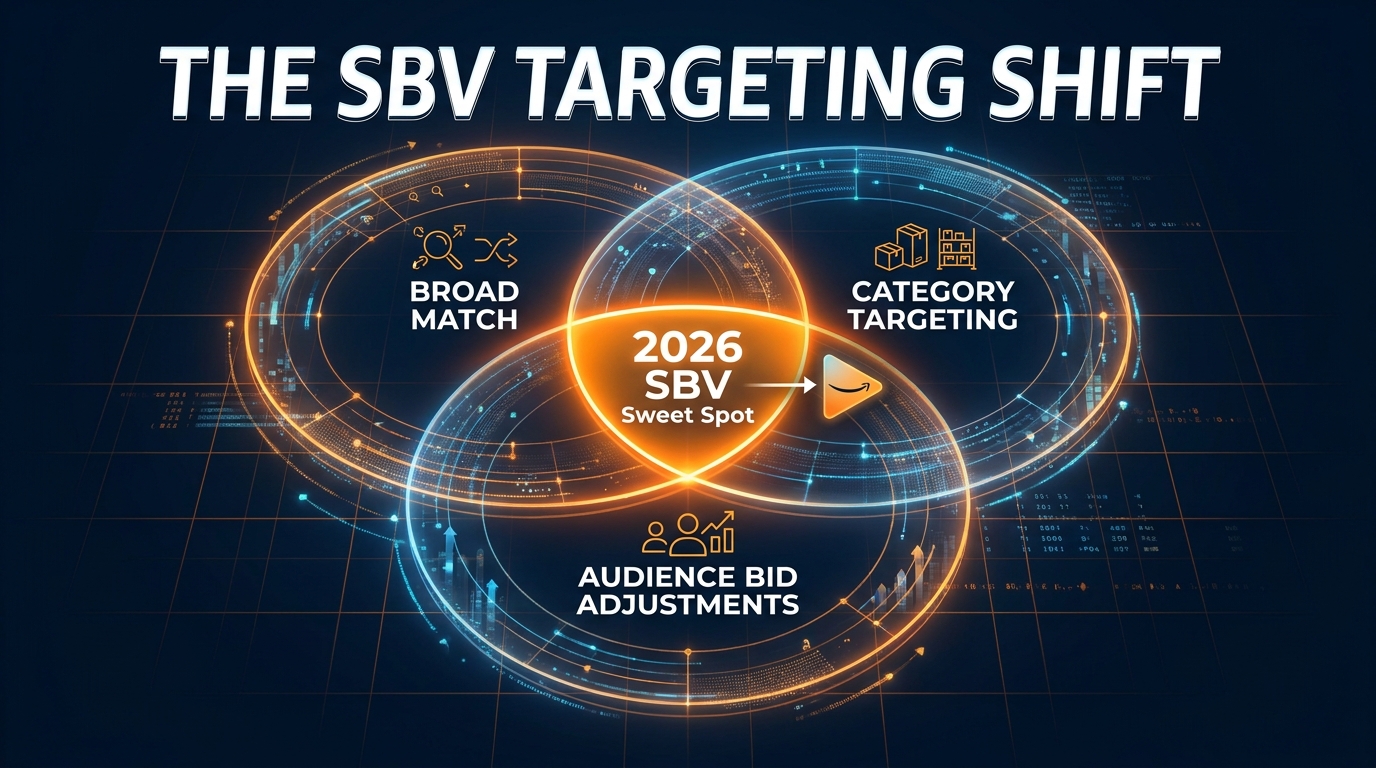
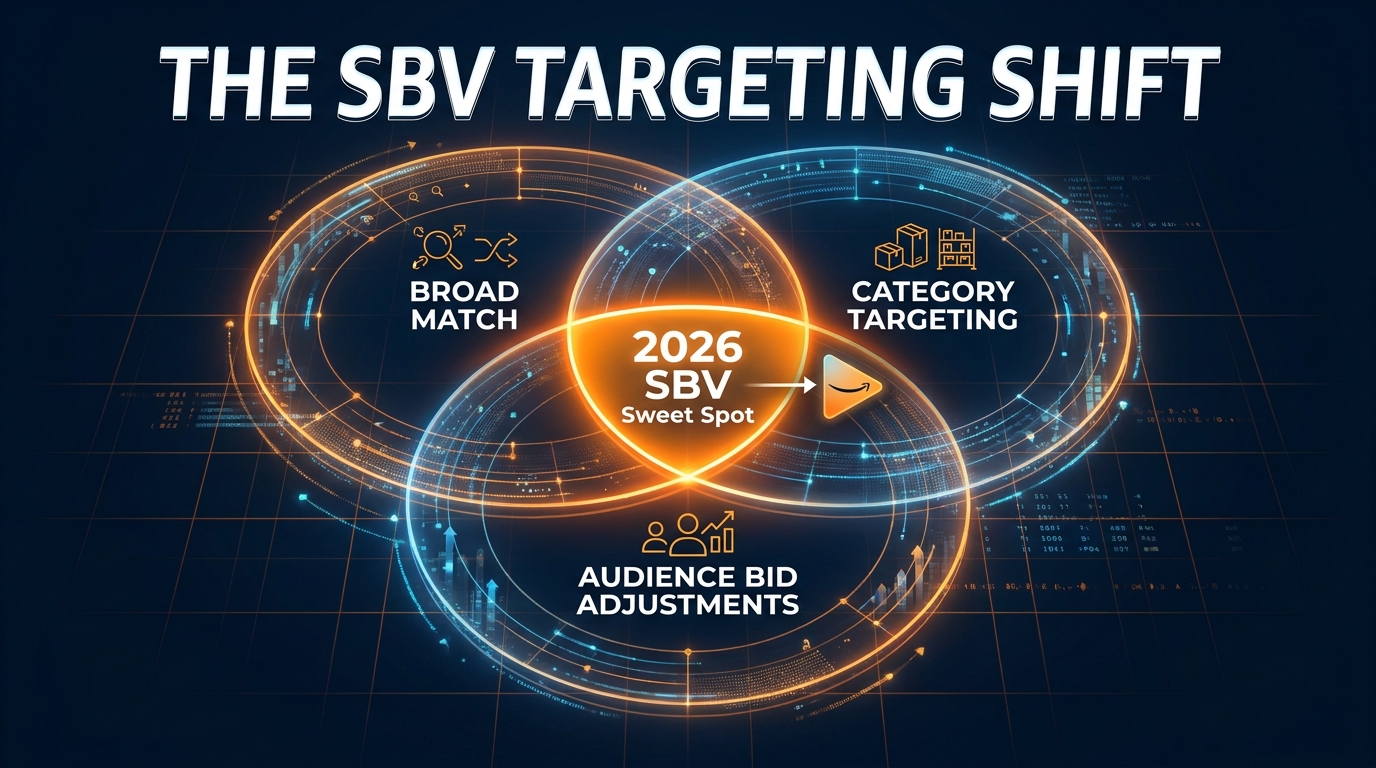
The advertisers who are still running SBV like it’s a keyword-only format are paying more for less. The ones adapting to the three-part targeting stack — broad match for discovery, category targeting for shelf-level precision, and audience bid adjustments as a conversion-intent layer — are pulling sharply better results, including ROAS figures in the 6–7x range on well-structured campaigns.
This article breaks down what that shift actually means in practice: why each layer exists, what role it plays in the purchase funnel, how to structure campaigns around all three, and what to measure when the standard ROAS number doesn’t tell the whole story. No recycled keyword tactics. No vague “use video” advice. Just a detailed look at how the format’s targeting logic has evolved — and how to use that evolution to your advantage.
What SBV Actually Is in 2026 (And Why Its Reach Has Grown)
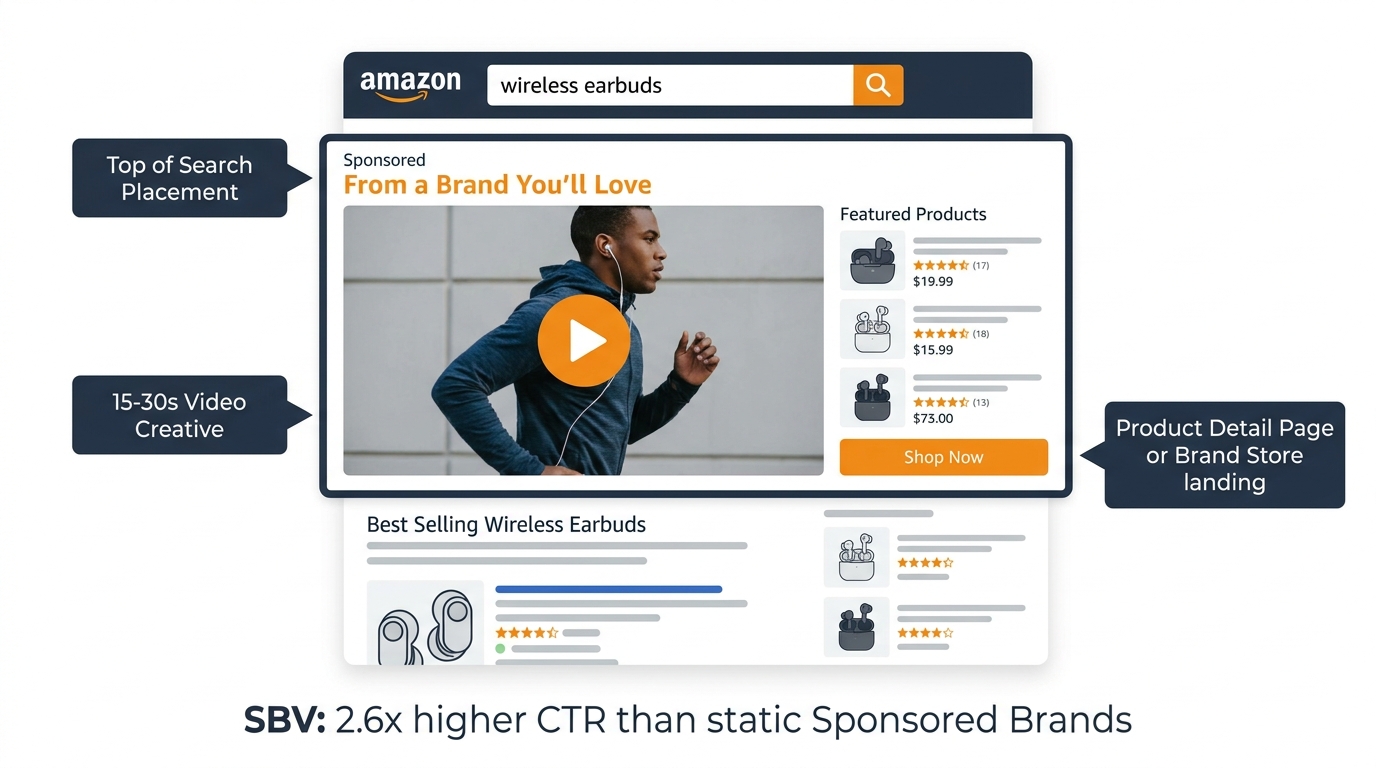
Sponsored Brands Video is Amazon’s autoplay video ad unit, available to brand-registered sellers and vendors running Sponsored Brands campaigns. Unlike Sponsored Products, SBV campaigns can drive traffic to either a product detail page or a Brand Store, giving advertisers more flexibility over the landing experience depending on campaign goals.
Where SBV Appears
In 2026, SBV runs across three distinct placement types: top of search, inline within search results (sometimes called “rest of search”), and on product detail pages. The top-of-search position is the most prominent — a full-width video unit that autoplays when the shopper scrolls past it — and typically delivers the strongest CTR due to its visual dominance on the results page.
Product detail page placement has expanded meaningfully over the past 18 months. SBV ads now appear in the “related products” and sponsored video carousels lower on PDPs, which opens up a different type of targeting opportunity: you’re reaching shoppers who are already in active evaluation mode on a competitor’s or complementary product’s page, not just searching for a category term.
The Performance Numbers That Explain the Format’s Growth
The raw performance data explains why SBV now makes up a substantial and growing share of Sponsored Brands spend across the marketplace. Current 2026 benchmarks show SBV delivering an average CTR of 0.89–1.0% — approximately 2.6 times higher than static Sponsored Brands image ads. Average conversion rates sit around 11.2%, roughly 13% above their image-based counterparts.
CPCs are higher — typically $1.10–$2.50 depending on category, compared to Sponsored Products averages — but the math tends to work in SBV’s favor when creative quality is strong, because the higher CTR and CVR compress cost-per-acquisition even as the cost-per-click rises. Average video watch time runs around 18 seconds, with completion rates near 60% for 15–30 second creatives.
Why Creative Length Still Matters
Those completion rates deserve attention because they partly explain the format’s targeting shift. When a shopper watches 18 seconds of a 20-second product video, they’ve absorbed significantly more purchase intent signal than a shopper who glanced at a static image ad. Amazon’s algorithm reads that engagement data. It feeds back into how your targeting performs — particularly when you’re running broad or category-based targeting where relevance signals matter more than they do on exact-match keyword campaigns.
Short, product-first creatives (showing the product in the first two seconds, communicating the core benefit within five) continue to outperform longer, brand-narrative styles in most categories. The video itself is a targeting asset as much as a creative one: a high-completion-rate video earns more algorithm trust, which matters disproportionately when you’re asking Amazon’s system to serve your ad broadly.
The Three-Part Targeting Stack: Broad, Category, and Audiences Defined
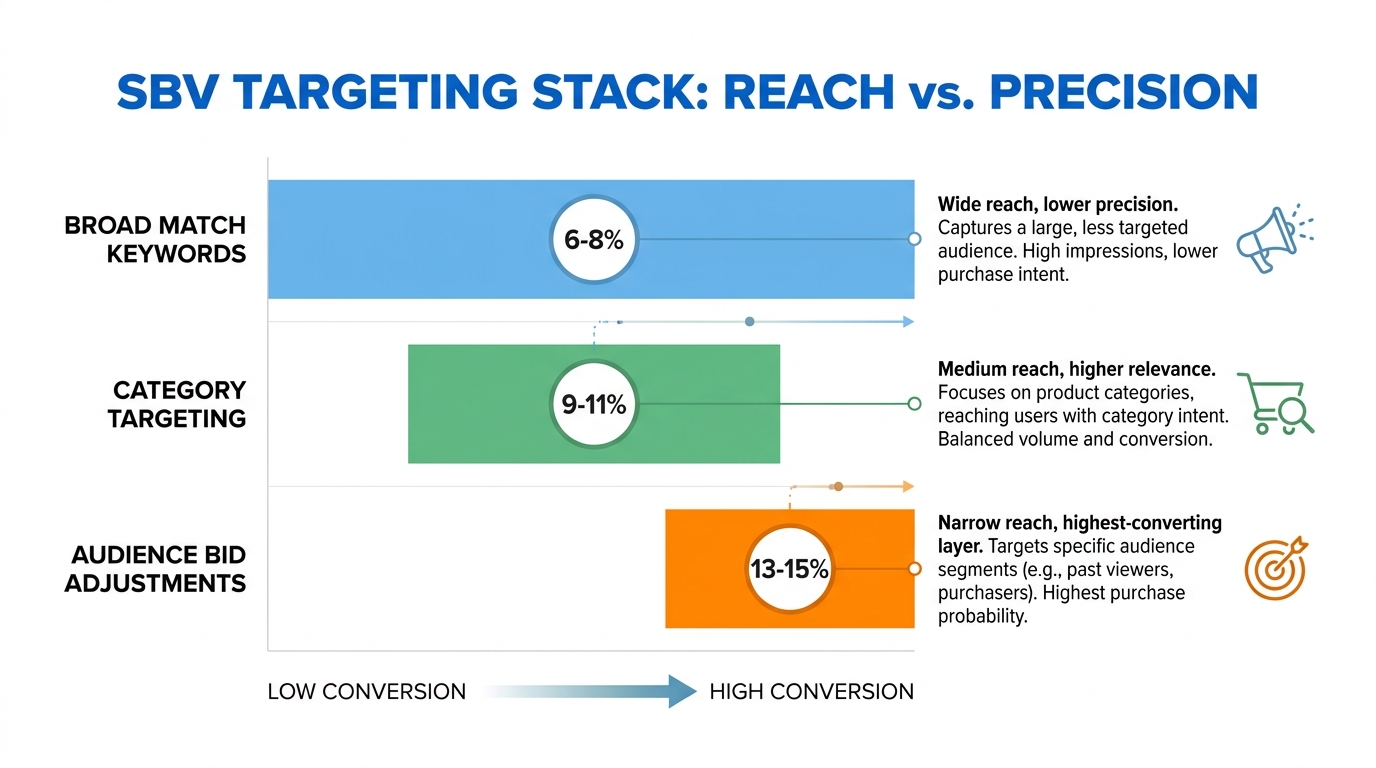
The clearest way to understand the current SBV targeting landscape is to stop thinking about broad match, category targeting, and audiences as three competing options — and start treating them as three layers in a single targeting architecture. Each layer operates on different shopper signals, serves different strategic purposes, and should be evaluated against different performance metrics.
Layer One: Broad Match Keywords
Broad match in Sponsored Brands Video works the same way it does in Sponsored Products: Amazon’s system matches your keyword to search queries that contain related terms, synonyms, plural variations, and adjacent concepts. If you’re selling a stainless steel insulated water bottle and you bid broad on “water bottle,” your ad might serve on queries like “hydration flask,” “gym bottle,” or “large reusable water container.”
The historical knock against broad match was waste. You’d burn budget on irrelevant or low-intent queries, and the search term report would fill up with noise. That criticism remains valid when broad match is used without guardrails. But in 2026, two things have changed that make broad match more viable than it was before.
First, Amazon’s matching logic has become more sophisticated. The system is better at reading purchase intent signals within a query, not just surface-level keyword similarity. A broad match on “protein powder” is less likely to serve on a completely unrelated fitness query than it would have been two or three years ago. Second, broad match has become the primary discovery mechanism for surfacing queries you don’t already know about — and with SBV’s strong CTR acting as a relevance signal, the algorithm gets feedback faster on which matched queries are actually generating engagement.
The functional role of broad match in a mature SBV account is not to drive efficient conversions directly. It’s to generate data — to discover which search terms your video creative resonates with — that you then harvest into tighter, higher-confidence campaigns. Think of broad match SBV as a paid research tool with a video creative attached.
Layer Two: Category Targeting
Category targeting in SBV lets you serve your video ad to shoppers browsing within specific Amazon product categories or subcategories, as well as on product detail pages of competing or complementary products within those categories. This is fundamentally different from keyword targeting because it decouples placement from what the shopper typed.
A shopper browsing the “Insulated Water Bottles” subcategory without having typed a specific search query is still a high-intent prospect — they’re actively evaluating products at the shelf level. Category targeting puts your video ad in front of that shopper in a way that keyword targeting, by definition, cannot.
The most effective category targeting in 2026 is tightly constrained to your own product subcategory rather than broad parent categories. Targeting the “Sports & Outdoors” parent category with an insulated water bottle video will likely produce poor ROAS because the audience is too diffuse. Targeting the “Insulated Water Bottles” or “Hydration & Water Bottles” subcategory keeps the audience relevant and the cost-per-click justifiable.
Layer Three: Audience Bid Adjustments
This is the layer most advertisers haven’t fully integrated yet, and it’s where some of the most meaningful 2026 performance gains are showing up. Amazon has expanded Sponsored Brands’ audience bid adjustment capabilities to include behavioral segments based on shopper activity: people who viewed your brand’s products, people who added your products to cart, people who purchased your brand, and — importantly for prospecting — new-to-brand shoppers who have no prior purchase history with you.
Audience bid adjustments don’t replace your underlying targeting type. You still choose keywords or categories as the base targeting mechanism. The audience bid adjustment then layers on top, telling the system to bid higher (or lower) when the shopper triggering the ad matches a specific behavioral profile. It’s a bid modifier, not a targeting swap.
The practical effect is significant: a category-targeted SBV campaign running at a $1.50 base bid might apply a 50% positive bid adjustment for shoppers who have previously viewed your brand’s products, pushing effective bids to $2.25 for that audience segment. You’re buying the same placements, but concentrating spend toward the shoppers most likely to convert.
Why Broad Match Is Performing Again — And What Changed
It’s worth spending time on why broad match fell out of favor for SBV in the first place, because understanding that history explains the conditions under which it’s now working better.
The Original Problem With Broad SBV
When SBV first became widely available, most advertisers treated it like a straightforward extension of their existing Sponsored Brands keyword campaigns. They copied keyword lists, set match types, and pointed the video at a product page. Broad match, in that context, was genuinely problematic: SBV CPCs were high relative to Sponsored Products, the format was relatively new (and therefore more expensive to experiment with), and the matching logic wasn’t refined enough to reliably find high-intent adjacent queries.
The result was that broad match SBV campaigns frequently bloated ACoS because they were serving on poorly matched queries with no negative keyword hygiene. The format got a reputation for being “hard to control” on broad targeting — which pushed most advertisers toward exact or phrase match as the safe default.
What’s Different Now
Several things have shifted the equation. Amazon’s matching algorithm improvements have increased the relevance of broad match serving — the system is now better at inferring purchase intent from query context, not just lexical similarity. This directly reduces the “irrelevant serving” problem that made broad match expensive to run.
Equally important: the video completion rate feedback loop. When a shopper watches 85% of your video, Amazon’s system registers that as a strong positive engagement signal. On broad match, that completion signal tells the algorithm that this shopper — and shoppers like them — are receptive to your ad. Over time, broad match serving gradually self-optimizes toward the query types that generate strong completion rates, not just clicks. This is a dynamic that didn’t exist (or wasn’t as pronounced) in earlier SBV campaign structures.
Practitioners running broad match SBV with rigorous negative keyword management are now reporting that the format surfaces genuinely valuable queries they wouldn’t have thought to bid on directly. The discovery value has risen as Amazon’s matching has improved, and the cost of that discovery has become more manageable as negative keyword workflows have matured.
The Non-Negotiable: Negative Keywords
Broad match SBV without a structured negative keyword process is still a budget leak. The workflow that’s working in 2026 looks like this: run broad match campaigns for two to three weeks, pull the search term report, identify irrelevant or wasteful query patterns, and add negatives at the campaign or ad group level before the next review cycle. Do this on a consistent 7–14 day cadence, and broad match SBV becomes a systematic discovery engine rather than a scatter-gun spend category.
One specific pattern to watch: broad match will sometimes serve your SBV on branded queries for competitors. That’s occasionally useful for conquesting, but it drives up CPC and often converts poorly unless your creative is explicitly positioned as a comparison or alternative. Most advertisers add competitor branded terms as negatives unless they’re running a deliberate conquesting strategy with appropriate creative.
Category Targeting: Precision at the Shelf Level
Category targeting for SBV operates on a fundamentally different logic from keyword targeting, and that difference matters for how you structure campaigns, set bids, and interpret performance data.
The Shelf-Level Intent Signal
When a shopper types a search query, they’re signaling what they’re looking for in that moment. When a shopper is browsing a product subcategory on Amazon — scrolling through the “Insulated Water Bottles” results, comparing products on detail pages, reading reviews — they’re signaling something deeper: they’re actively in a consideration and comparison phase, evaluating options against each other.
That’s a more advanced purchase stage than a cold keyword search, and it’s the core reason category targeting has become such a strong SBV lever. Your video ad appears to a shopper who is already in buy-mode for your category, not one who is tangentially related to it by query association.
Category Targeting vs. Product Targeting in SBV
It’s useful to distinguish category targeting (targeting a subcategory or parent category) from product targeting (targeting specific ASINs). Both are available in Sponsored Brands Video. Product targeting — pointing your SBV ad at specific competitor ASINs or complementary products — tends to be more precise and often delivers stronger ROAS on well-chosen targets, but it requires more active management as competitor product pages change.
Category targeting requires less ongoing curation but produces wider variance in performance. The targeting logic here is: invest time upfront in selecting the right subcategory, then let the category targeting run with bid optimization while you monitor ACoS trends. Practitioners report that keeping category targeting in SBV restricted to your own primary subcategory — rather than adjacent or parent categories — is the single biggest structural choice that separates efficient category campaigns from wasteful ones.
Using Category Targeting for Competitive Defense and Expansion
Two specific use cases stand out. First, defensive category targeting: bidding on your own subcategory ensures that when a shopper is browsing your category and a competitor’s SBV ad might otherwise dominate, you have a presence in the video placement. This is particularly important in categories where a few large competitors have significant brand recognition — their video ads can crowd out smaller brands entirely if those brands aren’t running category-targeted SBV defensively.
Second, expansion targeting: once you’ve established strong performance in your primary subcategory, testing adjacent subcategories can surface demand from shoppers who might solve the same problem with a different product type. A blender brand targeting the “Food Processors” subcategory, for example, might reach shoppers who are evaluating both options and would switch to the blender if presented with a compelling video demonstration. The key is starting narrow and expanding based on data, not pre-emptively going broad across adjacent categories.
Audience Bid Adjustments: The Layer Most SBV Campaigns Are Missing
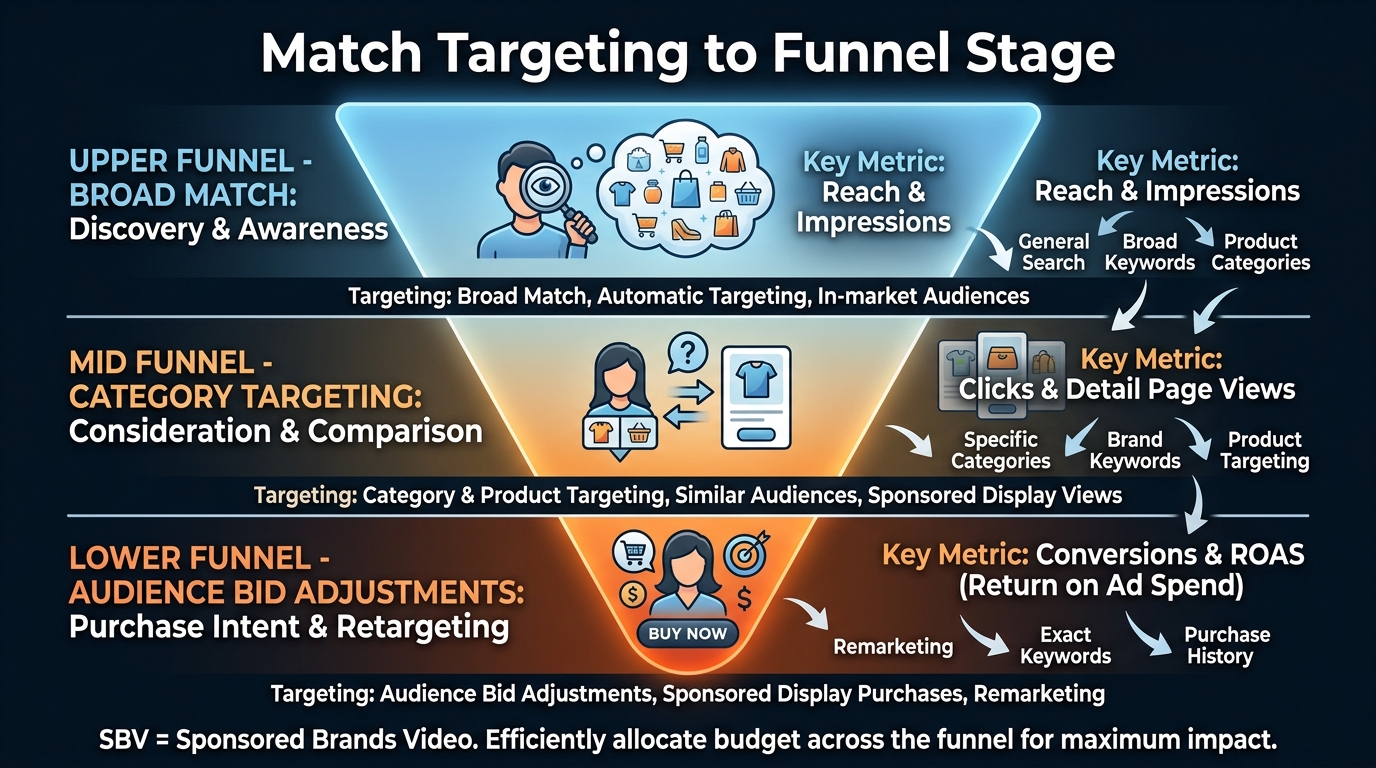
Audience bid adjustments in Sponsored Brands have expanded significantly in 2026, and most advertisers are either unaware of them or treating them as an afterthought rather than a core bid strategy lever. That’s a gap worth closing, because the performance differential between campaigns that use audience bid adjustments intelligently and those that don’t is material.
What Amazon Has Added
Amazon now supports several audience bid adjustment segments inside Sponsored Brands (including SBV) campaigns. The most recently expanded options include:
- New-to-brand shoppers: Shoppers who have not purchased from your brand in the past 12 months. Bidding up for this segment supports new customer acquisition and is directly tied to new-to-brand metrics in your reporting.
- Viewed your brand’s products: Shoppers who have visited your product detail pages but not yet purchased. These are warm prospects who have already shown interest — bidding up here recaptures consideration-stage shoppers through video.
- Added to cart: Shoppers who added your product to their cart but didn’t complete a purchase. This is a high-intent retargeting signal; a bid uplift here puts your video in front of shoppers who are very close to conversion.
- Purchased your brand’s product: Existing customers. Bidding up or down on this segment depending on whether your goal is retention/upsell or acquisition shapes your campaign’s customer mix.
The mechanics work as a percentage bid modifier. If your base bid is $1.50 and you apply a +40% adjustment for “viewed your brand’s products,” the effective bid for that shopper segment becomes $2.10. You can apply both an audience bid adjustment and a placement bid adjustment simultaneously in the same campaign, layering both signals onto your base targeting bid.
Why This Changes Campaign Logic
Before audience bid adjustments were available in Sponsored Brands, your only levers were the keyword or category bid itself and the placement bid modifier. That meant you were essentially treating all shoppers who triggered your targeting equally — whether they’d never heard of your brand or had been to your product page three times in the past week.
Audience bid adjustments break that uniformity in a way that has direct, measurable impact on conversion rates. A shopper who has previously viewed your product page and then sees your SBV ad on a broad match or category-triggered impression is in a fundamentally different conversion position than a cold shopper. Paying more to serve that shopper isn’t waste — it’s a rational bid premium for a higher-probability conversion.
New-to-Brand Bidding as a Strategic Lever
The new-to-brand bid adjustment deserves particular attention because it connects SBV to one of the most strategically important metrics in Amazon advertising: new-to-brand rate. Brands with strong organic share and repeat purchase businesses often find that their overall Amazon PPC spend is heavily weighted toward re-purchasing existing customers — efficient in the short term, but not building brand equity or market share.
Bidding up specifically for new-to-brand shoppers in SBV campaigns creates a deliberate customer acquisition mechanism that sits separately from your broader ROAS optimization. You’re paying a premium to reach people who have never bought from you before, with a video format that can introduce your brand story and product value proposition in a way that a static ad cannot. Track NTB rate and NTB revenue separately from total campaign revenue, because the economics of new customer acquisition are different — and often worth accepting a lower blended ROAS to sustain.
The Funnel Logic: Where Each Targeting Type Actually Lives
The most common SBV targeting mistake in 2026 isn’t using the wrong match type — it’s applying the wrong success metrics to the wrong targeting layer. Broad match SBV at the top of the funnel should not be judged by the same ROAS threshold as an exact-match branded keyword campaign. Category targeting at the mid-funnel should not be optimized purely for last-click conversions. Audience bid adjustments at the lower funnel should not be compared against awareness-stage CPV metrics.
Top of Funnel: Broad Match as Discovery
Broad match SBV campaigns play a top-of-funnel role. They serve on the widest range of relevant queries, exposing your brand and product to shoppers who may not have been actively searching for your specific product but whose query context suggests they might be receptive to it. The primary metrics at this layer are: impressions, reach (unique shoppers exposed), video completion rate, and new-to-brand impressions. Direct conversion rate at this layer will typically be lower than at the other two, and that’s expected.
A common error is turning off broad match SBV campaigns because their standalone ROAS looks weak. If the same campaign is driving significant new-to-brand impressions, high completion rates, and surfacing high-intent search terms that you can harvest into tighter targeting, it’s producing real value — it’s just value that doesn’t show up cleanly in a single-campaign ROAS number.
Mid Funnel: Category Targeting for Consideration
Category targeting SBV sits at the mid-funnel, reaching shoppers who are already browsing your subcategory. These shoppers are further along in the purchase process than cold keyword searchers — they’ve committed to exploring options in the category, which means the bar for persuasion is lower. The right success metrics here are conversion rate, ACoS, and category impression share. You want to understand what percentage of category browsing sessions your brand is visible in, not just whether you converted on a given impression.
Lower Funnel: Audience Adjustments for Intent
Audience bid adjustments on viewed-product and add-to-cart segments operate at the lower funnel. These shoppers have demonstrated concrete purchase intent — they’ve seen your product and didn’t immediately buy. A video ad at this stage functions as a reminder and reinforcement, addressing potential objections and maintaining brand presence during the final evaluation stage. Conversion rate and ROAS at this layer should be materially higher than at the broad match or cold category layer, and your bids should reflect that.
The discipline of keeping these three layers analytically separate — not just structurally separate in your campaign setup — is what allows you to make good budget allocation decisions across the full SBV account.
Campaign Architecture: How to Actually Structure This
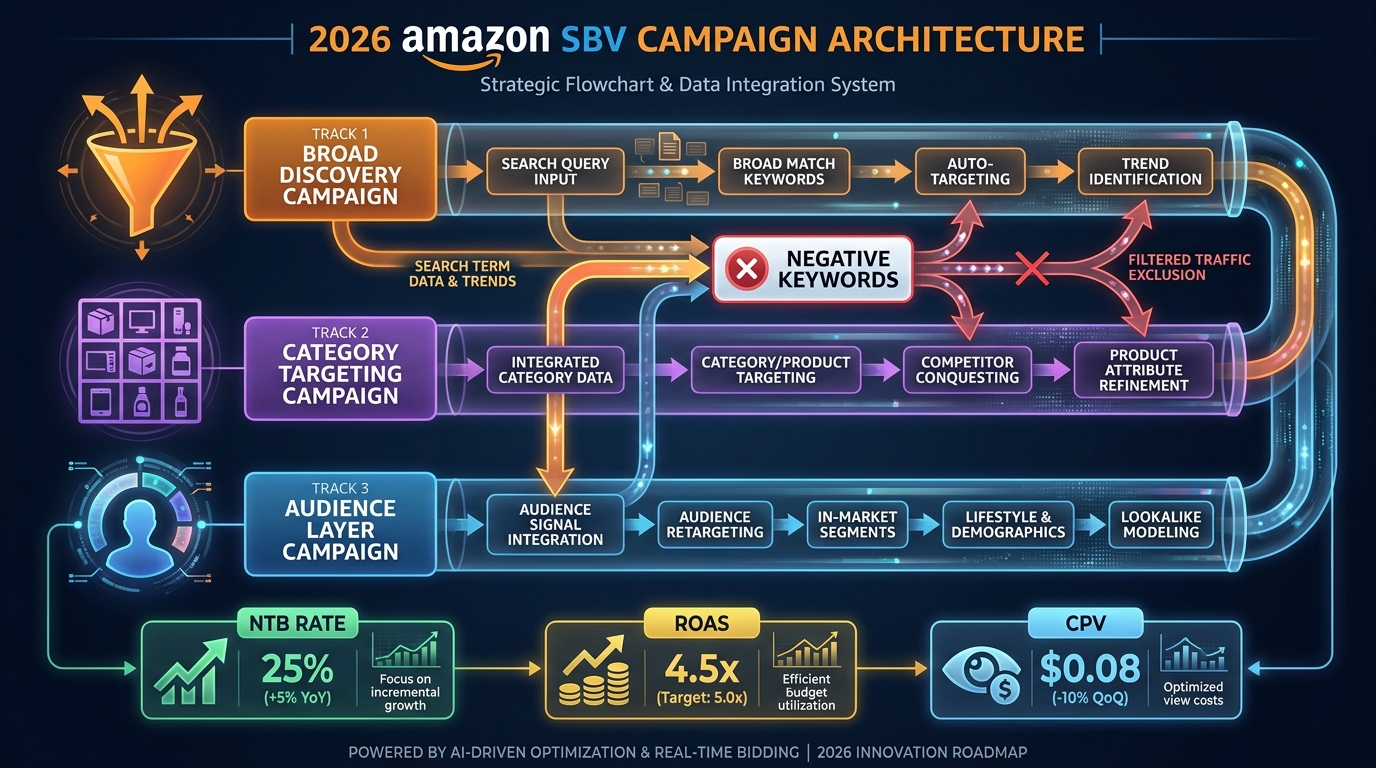
Theory is useful, but the architecture question — how do you actually build this in your Amazon Ads account — is where most advertisers struggle. The following structure reflects what’s working across mid-to-large SBV spenders in 2026.
Campaign Track 1: Broad Discovery
Build a dedicated SBV campaign with broad match keywords targeting your primary category terms and problem-solution phrases (not just product terms). Keep the keyword list focused — 15 to 25 broad match terms is sufficient for most product lines. Set bids at the lower end of your category’s competitive range, because broad match will drive volume without aggressive bidding. Apply a new-to-brand audience bid adjustment of +20–30% to bias this campaign toward first-time brand exposures. Set a fixed budget that you’re comfortable spending on discovery, not conversion.
Pull the search term report every 7–14 days. Identify any terms that have spent without converting over 30+ days and negate them. Identify any terms that have driven multiple conversions and consider migrating them to a separate, tighter phrase or exact match campaign where you can bid more aggressively and measure conversion efficiency cleanly.
Campaign Track 2: Category Targeting
Build a separate SBV campaign targeting your primary subcategory. If your category has multiple relevant subcategories, split them into separate ad groups rather than stacking them — this gives you clean performance data per subcategory and the ability to bid each independently. Run at competitive CPCs for your category. Apply a “viewed your brand’s products” bid adjustment of +30–50% to this campaign, since category browsers who’ve previously seen your product are significantly more likely to convert.
Consider running two variants of this campaign: one targeting your own subcategory (for defensive presence and loyal-browser conversion) and one targeting 2–3 close competitor subcategories or individual competitor ASINs (for conquesting). Keep the creative the same or very similar — this isn’t the place for major creative experimentation, because the audience and intent are defined by the targeting, not the creative.
Campaign Track 3: Audience-Led Remarketing
Build a third SBV campaign specifically designed to capture lower-funnel, high-intent shoppers. Use phrase or exact match keywords as your base targeting — you want these impressions on high-relevance queries. Layer add-to-cart and viewed-product audience bid adjustments at +40–60%. This campaign will serve less volume than the other two but at meaningfully higher conversion rates. ROAS here should be the highest of the three tracks.
If your brand has enough purchase history, also test a loyalty-oriented variant: same structure, but with a bid adjustment for existing customers and a creative that leads with a new product, a bundle, or a subscription offer. The landing destination here matters more than in discovery campaigns — drive to a targeted product page or a Brand Store page organized around the repeat-purchase use case.
Connecting the Tracks With Data Flow
The three-track structure only delivers its full value when you’re actively using data from the broad match track to inform the other two. The search terms that perform in broad match campaigns are signals about where real demand lives. When a broad match term consistently converts at acceptable ACoS, promote it: add it as phrase or exact match to your category or remarketing campaigns where you can apply higher bids and tighter audience controls. When a category target is consistently underperforming on ROAS but overperforming on NTB rate, don’t cut it — recategorize it in your measurement as an acquisition campaign and evaluate it against NTB metrics instead.
Measurement: What to Actually Track When ROAS Doesn’t Tell the Full Story
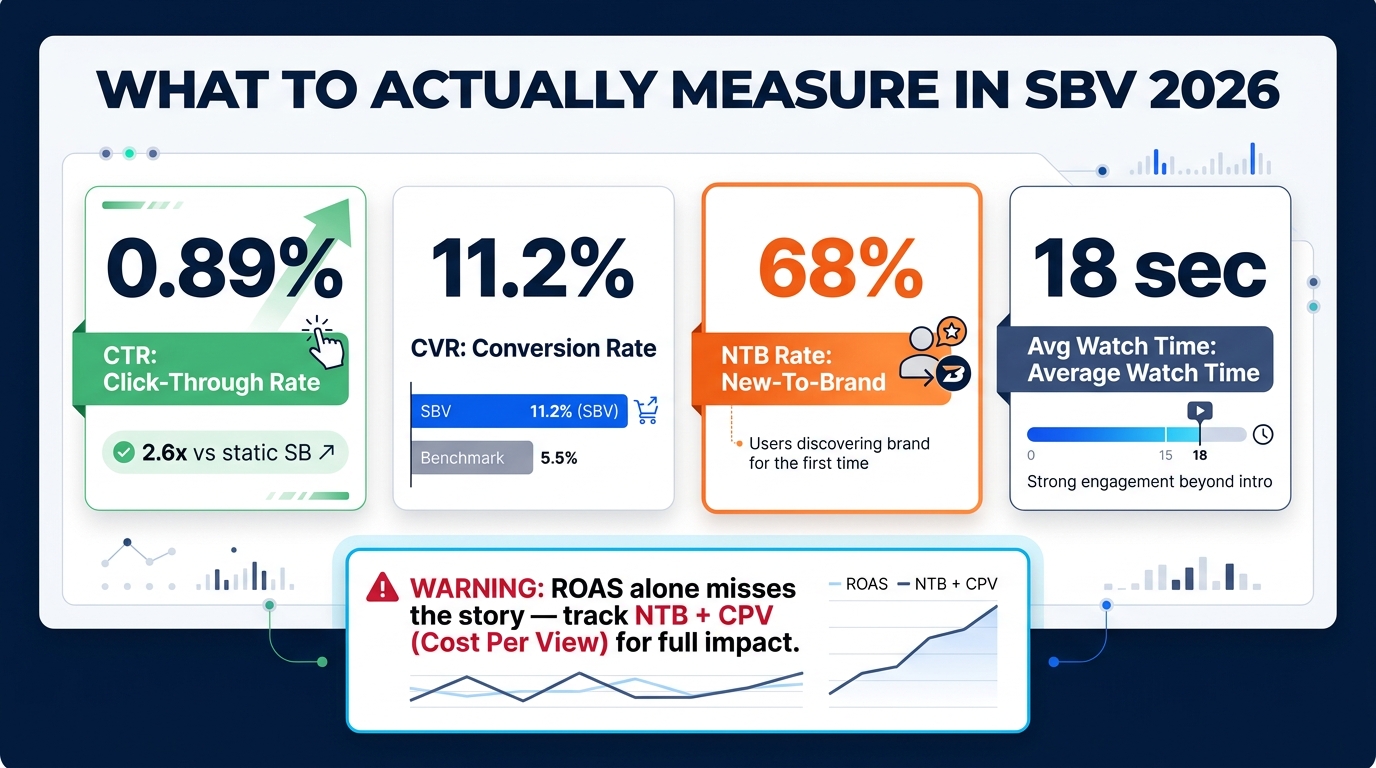
ROAS is not wrong as a metric for SBV. It’s just incomplete — and using it as the only yardstick for a multi-layer targeting structure built around different funnel stages produces systematically bad optimization decisions.
The Core SBV Metric Set
Running a comprehensive SBV account in 2026 requires tracking at least five distinct metric categories, and you should understand what each is actually measuring:
- ROAS / ACoS: Still relevant for efficiency evaluation, especially on lower-funnel and category campaigns. But set different thresholds per campaign track — your broad match discovery campaign should have a higher ACoS tolerance than your remarketing campaign.
- New-to-brand rate and NTB revenue: The percentage and absolute value of orders from shoppers who haven’t purchased your brand in the past 12 months. This is the primary measure of brand growth, not just advertising efficiency. Sponsored Brands reporting surfaces this data at the campaign level.
- Cost-per-view (CPV) and 5-second view rate: Amazon added standardized video metrics to Sponsored Brands reporting in early 2026. CPV tells you how much you’re paying per video view, while 5-second view rate tells you what percentage of impressions result in a shopper watching at least 5 seconds — a proxy for creative engagement. A declining 5-second view rate on a broad match campaign is often a signal that the targeting has drifted toward low-relevance queries.
- Video completion rate: The percentage of views where the shopper watches the full video (or at least 75–80% of it). High completion rate on a broad match campaign validates that the audience the algorithm is finding is genuinely interested. Low completion rate suggests creative-audience mismatch.
- Category impression share: Available through the Sponsored Brands impression share reports. This tells you what percentage of impressions in your category your ads are capturing relative to the total available. It’s the most direct measure of competitive visibility at the category level — and it’s the metric that category targeting campaigns should be optimized against most directly.
Building a Reporting Framework That Matches Your Campaign Structure
The three-track campaign structure described earlier maps cleanly onto a three-tier reporting framework. For the broad match discovery track, lead with NTB impressions, 5-second view rate, video completion rate, and search term discovery velocity (how many new high-intent terms you’re finding per reporting period). For the category targeting track, lead with category impression share, ACoS, and NTB rate. For the audience-led remarketing track, lead with conversion rate, ROAS, and add-to-cart recapture rate.
When you present SBV performance to internal stakeholders or clients, don’t collapse all three tracks into a single blended ROAS number and call it a day. That approach systematically undervalues the top-of-funnel work and overattributes results to the lower-funnel campaigns that are capturing demand created by the broader targeting layers. Build your reports to show the contribution of each layer separately.
The Attribution Complexity
Amazon’s default 14-day attribution window means that a shopper who sees your broad match SBV ad today and purchases 10 days later from an organic search gets partially credited to the SBV campaign. This is both a feature and a complication. It means SBV’s reported ROAS tends to be higher than pure last-click attribution would produce, but it also means some of the “ROAS” in your SBV campaigns is really capturing organic-assisted conversions from shoppers who were in the funnel already.
The cleanest way to handle this is to compare NTB rate across your campaigns alongside total ROAS. A broad match SBV campaign with a 65–70% NTB rate and a 3.5x ROAS is doing something meaningfully different from a remarketing campaign with a 15% NTB rate and a 7x ROAS — and both might be justified at the right budget allocation.
What This Looks Like in Practice: Patterns From Real Account Data
Abstract frameworks only go so far. Here’s what the broad-category-audience SBV targeting structure produces in practice, based on the types of results practitioners are reporting in 2026.
The “Category Domination” Pattern
A mid-sized supplement brand running SBV exclusively on exact-match keywords was seeing solid direct ROAS (around 4.5x) but flat category impression share and declining new-to-brand rates. The brand’s existing customer base was being retargeted efficiently, but it was barely reaching category browsers who hadn’t yet encountered the brand.
The fix was to add a category-targeted SBV campaign alongside the existing keyword campaigns, targeting two specific subcategories at competitive CPCs. Category impression share jumped from roughly 8% to about 23% over 60 days. The category-targeted campaigns ran at lower direct ROAS (around 3.2x) but drove NTB revenue that the keyword campaigns weren’t capturing. Blended account ROAS across both campaign types was slightly lower — but total revenue was up, and new customer acquisition was accelerating.
The “Broad-to-Harvest” Pattern
A home goods brand was running SBV on a tight list of exact and phrase match keywords, leaving significant search query discovery on the table. They added a broad match SBV campaign targeting 20 core category terms with a bi-weekly search term harvest workflow. Within 90 days, they had identified 14 high-converting query patterns they hadn’t previously bid on, all of which were subsequently added as phrase match keywords across both SBV and Sponsored Products campaigns. Those 14 queries collectively added meaningful incremental volume to the account — queries the brand would not have found any other way given their existing tight-match structure.
The “Audience Premium” Pattern
A consumer electronics brand added “viewed brand’s products” bid adjustments to their category-targeted SBV campaigns at a +45% premium. The audience-adjusted impressions represented about 18% of total category campaign impressions but accounted for 37% of the campaign’s conversions — a conversion rate roughly 2.4x higher than unadjusted category impressions. The effective CPC on audience-adjusted impressions was higher, but CPA was lower because the conversion rate premium more than offset the bid premium. The brand subsequently increased the audience bid adjustment to +60% and shifted budget toward the category campaign to capture more of that high-converting audience mix.
The Negatives Problem: Keeping Broad Match From Bleeding Budget
No discussion of broad match SBV is complete without addressing the structural challenge that has historically made it expensive to run: irrelevant serving and the resulting budget leakage. The 2026 approach to negative keywords in SBV is more systematic than it was two to three years ago, and that systematization is partly what’s made broad match viable again at scale.
Building a Negative Keyword Infrastructure
The most effective SBV negative keyword practice in 2026 starts with a “seed negative” list before launching the broad match campaign — a list of obviously irrelevant terms you know you don’t want to serve on based on your product category. For a premium kitchen knife brand, this list would include queries related to cheap or disposable cutlery, toy knives, or unrelated “sharp object” contexts. Seeding these negatives before the campaign goes live prevents early budget waste on clearly irrelevant queries during the initial learning phase.
After launch, the 7–14 day search term review cycle adds negatives based on actual serving data. The most important patterns to negate early are: queries with zero purchase intent (informational searches), branded competitor terms you’re not intentionally conquesting, and category-adjacent queries where your product is unlikely to be a relevant substitute.
Match Type for Negatives
Use negative phrase match rather than negative exact match for most exclusions. Negative exact match is too narrow — it only blocks the precise query — while negative phrase match blocks any query containing the phrase, which prevents the same irrelevant pattern from appearing in dozens of slightly different query variations. Save negative exact match for cases where you want to block a specific term but keep closely related variants available for serving.
Sharing Negatives Across Campaign Tracks
One underused practice: sharing validated negative keyword lists across your three SBV campaign tracks. If your broad match campaign identifies a specific query pattern as consistently irrelevant, that same pattern should probably be negated in your category targeting campaign too — it might be appearing there as well if a shopper conducted that query on a category page. A shared negative keyword list (or a structured process for propagating negatives across campaigns) prevents you from having to rediscover the same irrelevant terms in each campaign independently.
Where the Targeting Shift Is Heading Next
The broad-category-audience targeting stack described in this article reflects where SBV is right now in 2026. But the trajectory of Amazon’s product development suggests where it’s going, and advertisers who understand the direction can position their account structures accordingly.
Deeper Audience Segmentation
Amazon’s audience capabilities inside Sponsored Brands are still relatively simple compared to what’s available in Sponsored Display and DSP. The four bid adjustment segments currently available (NTB, viewed, cart, purchased) are the beginning of a more granular audience taxonomy that Amazon will likely continue expanding. Advertisers who build the habit of using and measuring audience bid adjustments now will have a structural advantage when more sophisticated segments — lifestyle audiences, in-market intent signals, lookalike-style audiences — become available in the Sponsored Brands environment.
Video Creative as a Targeting Signal
Amazon is increasingly using creative engagement signals — completion rate, 5-second views, view-through behavior — as inputs into ad serving decisions. As these signals become more integral to the algorithm, the quality and relevance of your video creative becomes a de facto targeting input. A video with a 75% completion rate serving on broad match terms will get better algorithm treatment than a video with a 30% completion rate, even at the same bid level. This means investing in creative quality isn’t separable from investing in targeting efficiency — they’re the same investment expressed through different execution paths.
Integration With Streaming and Off-Amazon Signals
Amazon’s expansion of Prime Video ads and its broader media network means that, over time, off-Amazon viewing behavior and cross-channel audience data will become more accessible inside Amazon Ads campaign targeting. For SBV specifically, this opens the possibility of serving video ads to shoppers who have shown relevant interest through streaming viewing patterns — an audience signal that has no analogue in the current keyword or category targeting stack. The groundwork for this integration is being built now in Amazon’s audience data infrastructure, even if the product-facing features aren’t fully available yet in standard Sponsored Brands campaigns.
The Actionable Framework: Getting Started With the Three-Layer Stack
If you’re currently running SBV on a primarily keyword-only basis, transitioning to the three-layer targeting structure doesn’t require rebuilding your account from scratch. The following sequence gives you a practical path to incorporating broad match, category targeting, and audience bid adjustments without disrupting your existing campaigns.
Phase 1: Audit and Baseline (Week 1–2)
Before adding new targeting layers, establish clear performance baselines for your existing SBV campaigns. Pull 90-day data on ROAS, ACoS, CTR, CVR, NTB rate, and CPV (if available). Note which campaigns are keyword-only versus those using any category or product targeting. Identify gaps: Are you capturing category impression share? Do you know your NTB rate? Are you currently using any audience bid adjustments? This audit tells you where the biggest structural gaps are and which layer to add first.
Phase 2: Add Category Targeting (Week 3–4)
Launch one new SBV campaign targeting your primary product subcategory. Keep the creative the same as your best-performing existing SBV ad — this is a targeting test, not a creative test. Set a modest daily budget (equivalent to 10–15% of your existing SBV spend) and let it run for 3–4 weeks before evaluating. Compare ACoS, NTB rate, and CPV to your existing keyword campaigns. The category campaign will likely show a different performance profile — possibly lower direct ROAS but higher NTB rate — and that difference is the data you need to make budget allocation decisions.
Phase 3: Activate Audience Bid Adjustments (Week 5–6)
Apply audience bid adjustments to your existing best-performing SBV campaigns first — don’t start with the new category campaign. Choose the “viewed your brand’s products” segment and set a conservative +25–30% adjustment. Monitor for two weeks. If the adjustment is improving conversion rate without driving CPA above your threshold, increase it to +40–50%. Then layer in the NTB adjustment for your broad match or prospecting campaigns at +20–25%.
Phase 4: Launch Broad Match Discovery (Week 7–8)
Add the broad match discovery campaign last, after you’ve established the infrastructure for negative keyword management and the reporting framework to evaluate it correctly. Set it up with a seed negative list, a modest daily budget, and a clear review cadence from day one. Give it 4–6 weeks of data before making significant structural changes — broad match needs time to accumulate enough search term data to be worth harvesting from.
By the end of this 8-week ramp, you’ll have all three targeting layers active, with baselines established for each, and a clear measurement framework that evaluates each layer against funnel-appropriate metrics rather than a single blended ROAS number. That’s the structural foundation for scaling SBV in 2026 — not more keywords, not bigger bids, but a targeting architecture that matches the complexity of how Amazon shoppers actually move through the purchase process.
Conclusion
The shift happening in Sponsored Brands Video targeting in 2026 isn’t dramatic from the outside. Amazon didn’t remove keyword targeting. The format didn’t change fundamentally. What changed is the ecosystem around it: more competition, expanded placements, more sophisticated audience tools, and a better-tuned matching algorithm that makes broader targeting types more viable and more rewarding than they were before.
The advertisers who are ahead of this shift understand something simple but consequential: SBV is no longer a keyword-management exercise. It’s a three-layer targeting system that operates across the full purchase funnel — broad match for discovery and demand intelligence, category targeting for shelf-level competitive presence, and audience bid adjustments for conversion intent amplification. Each layer has its own metrics, its own bidding logic, and its own role in the account.
Running all three layers together, with data flowing between them through a structured harvest-and-negate workflow, produces results that keyword-only SBV simply can’t replicate: better NTB rates, stronger category impression share, higher conversion rates on warm audiences, and a systematic process for continuously discovering new demand rather than recycling the same keyword list.
The format’s performance potential — 2.6x the CTR of static Sponsored Brands, 11.2% average conversion rates, meaningful NTB lift for brands willing to measure it — is real. Reaching that potential in a competitive 2026 marketplace requires using the full targeting toolkit, not just the keyword-shaped corner of it.