Tag: ChatGPT

  • What OpenAI and Anthropic Actually Changed This Year — And Why Most Marketers Have Already Fallen Behind

    What OpenAI and Anthropic Actually Changed This Year — And Why Most Marketers Have Already Fallen Behind

    OpenAI and Anthropic split-screen editorial showing marketing data streams and workflow automation symbols — What Changed in AI and What Marketers Missed

    The marketing industry has a strange relationship with AI product news. Every major announcement from OpenAI or Anthropic generates a wave of LinkedIn posts, newsletter breakdowns, and hot takes — followed by almost zero change in how most marketing teams actually work. The announcements get consumed. The implications don’t.

    That gap has quietly widened throughout 2026. While most marketing teams are still debating whether to add AI to their content process, the underlying platforms they depend on have been undergoing structural changes — to their APIs, their pricing models, their ad products, their memory architecture, and their positioning against each other. Some of those changes are deadline-driven: if you’re running automations built on certain OpenAI infrastructure, there is a hard cutoff date approaching that will break those workflows entirely. Others are strategic: Claude’s public usage data now tells us exactly which marketing tasks AI is actually being used for at scale, and the answer is more specific than most people assume.

    This is not a list of product features you didn’t read about. It’s a forensic look at what both companies actually changed, what it means for how marketing operates, and what the teams paying close attention are doing differently because of it. The updates covered here range from API deprecations and ad platform mechanics to model pricing, memory architecture, brand discovery, and a usage index that tells a surprisingly honest story about where AI automation is actually landing in marketing organizations.

    Start with the data, because it reframes everything else.

    The Anthropic Economic Index: What Real Claude Usage Data Actually Tells Marketers
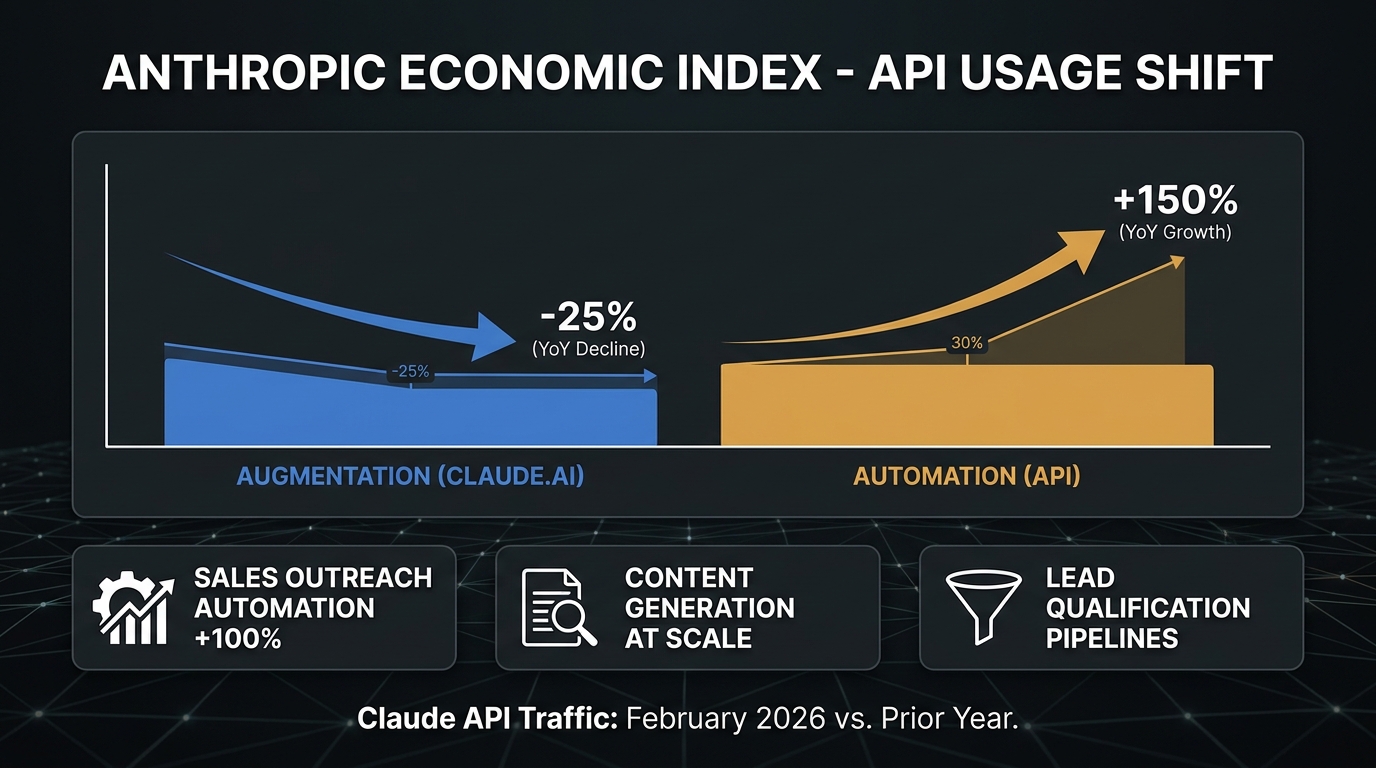
    Anthropic Economic Index bar chart showing automation API usage rising sharply while augmentation usage declines — Claude API Traffic February 2026

    In March 2026, Anthropic published its Economic Index — a detailed analysis of how Claude is actually being used across its API and consumer products. Most marketing coverage of AI skips straight to product features. Anthropic’s index is more useful than that: it breaks down real usage patterns at the category level, which means it functions as the closest thing we have to an honest audit of where AI is actually creating value in business workflows.

    The headline finding for marketers is this: API traffic is becoming automation-dominant. The share of Claude usage classified as “augmentation” — where a human interacts with Claude to assist their own thinking — has been declining in the API category. Meanwhile, the “automation” share — where Claude executes tasks without active human oversight — has been rising. On the consumer Claude.ai product, the mix looks different. Augmentation remains dominant there. But in the API, where businesses build integrations and workflows, automation is increasingly the primary mode.

    Sales and Outreach Automation Doubled as a Share of API Workflows

    Among the marketing-adjacent specifics: business sales and outreach automation at least doubled as a share of API workflows between the baseline measurement period and February 2026. The specific tasks driving this growth include lead qualification, customer data enrichment, and cold-email drafting — not the AI marketing use cases that tend to dominate conference talks, but the repetitive, data-handling tasks that scale well and produce measurable time savings.

    Content generation at scale also appears prominently in the index’s automation categories. Ad creative production, campaign reporting, and research synthesis are cited in Anthropic’s own case study documentation as production-grade use cases — with documented time savings like 30 minutes to 30 seconds per ad, case studies produced in 30 minutes instead of 2.5 hours, and more than 100 hours per month saved on influencer scripts. These aren’t experimental claims; they’re from companies that have integrated Claude into operational workflows and measured the output.

    What This Means for How Marketing Teams Should Be Thinking About Claude

    The implication is that the teams getting the most value from Claude are not using it as a better search engine or a drafting assistant they occasionally ask for suggestions. They’re using it as an execution layer — connecting it to their CRM, their ad platforms, their analytics, and their email tools, and letting it run repeatable task sequences without requiring a human in the loop for each step.

    Most marketing teams have not made that transition. They’re still in the augmentation phase: asking Claude to help them write something, improve something, or think through something. That’s valuable. But it’s also the use case that scales least well, because it still requires a human hour for every Claude session. The automation-dominant workflows are where Claude becomes compounding infrastructure rather than a convenient tool.

    The index also matters for positioning reasons. Anthropic is clearly tracking the shift and building its API product roadmap around it. The upcoming releases, enterprise integrations, and pricing decisions all reflect a company that now sees itself primarily as a workflow platform for developers and automation teams — not a consumer chatbot. Marketers who still think of Claude as a chat product are working from an outdated mental model of what it is.

    OpenAI’s Quiet API Overhaul — And the Marketing Automations That Are About to Break
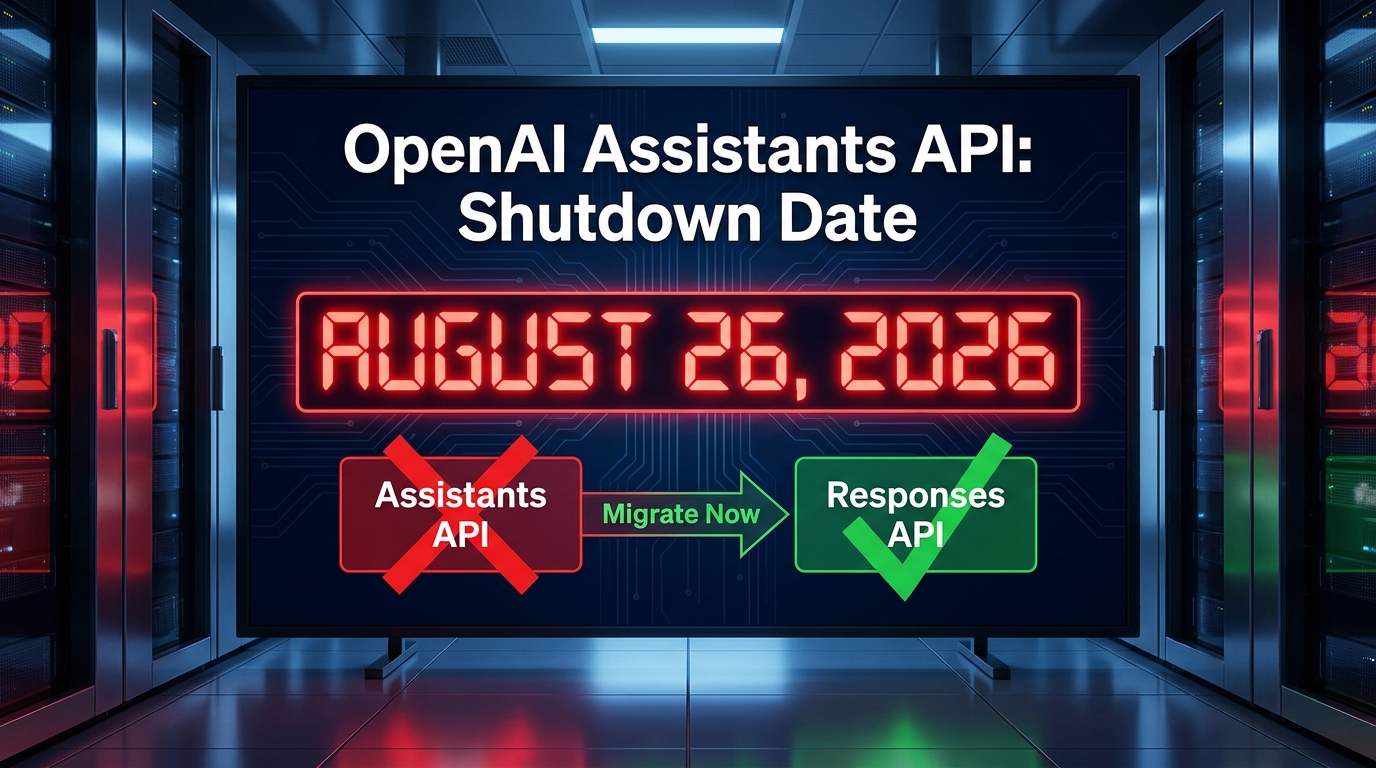
    OpenAI Assistants API shutdown countdown clock showing August 26 2026 deadline with migration path diagram from Assistants API to Responses API

    If you or your team have built any kind of AI-powered workflow on top of OpenAI’s Assistants API, you need to stop reading this section and check your implementation first. The Assistants API is being shut down on August 26, 2026. There is no extension in the official deprecation notice. After that date, calls to Assistants endpoints stop working.

    OpenAI’s replacement is the Responses API — a newer, more streamlined foundation that OpenAI says has now reached feature parity with Assistants. The Responses API is already processing more token activity than the legacy Chat Completions API, which signals that the migration is genuinely underway in the developer community. But for marketing teams that built internal tools, chatbots, content workflows, or automation scripts on top of Assistants without close developer oversight, the deadline may have gone unnoticed entirely.

    What Breaks — And for Which Teams

    The workflows most at risk are those that depend on Assistants-specific functionality: Threads (for multi-turn conversation state), Runs (for executing assistant instructions), vector stores (for document retrieval), the code interpreter (for data analysis within conversations), and file-handling features tied to assistant persistence. If any of those capabilities are embedded in a marketing workflow — automated campaign reporting, a chatbot that handles customer queries, a tool that processes uploaded briefs — that workflow needs to be rewritten against the Responses API before the deadline.

    The Responses API operates differently from Assistants in how it handles state and context. Rather than managing Threads and Runs as persistent objects, the Responses API works with conversation context that developers pass directly in their application code. It’s arguably simpler in design, but it requires migration work rather than a simple endpoint swap. Teams that have never formally audited their OpenAI dependencies are the ones most exposed here.

    The Parallel Deprecation: Prompt Objects Are Also Going Away

    The Assistants API sunset is the highest-stakes deprecation on the current OpenAI timeline, but it’s not the only one. OpenAI also began de-emphasizing reusable Prompt Objects — a feature from its API dashboard that let developers save and version prompt templates — starting June 3, 2026, with the v1/prompts endpoint scheduled for shutdown on November 30, 2026.

    This is less immediately critical than the Assistants shutdown, but it matters for any team that used Prompt Objects to manage a library of standardized prompts across campaigns, content templates, or brand voice guidelines. The migration path here is to move prompt text directly into application code — which is also the direction OpenAI’s Responses API is pushing developers anyway. Centralized, API-managed prompt libraries are being replaced by app-managed prompt text, which means marketing teams that built their prompt governance around OpenAI’s dashboard tooling need to find a new home for that infrastructure.

    GPT-4o Is Already Retired from ChatGPT

    One more development that may have slipped past marketing teams using ChatGPT for day-to-day work: GPT-4o was retired from the ChatGPT product in February 2026. The model that dominated marketing conversations in 2024 and 2025 is no longer the active model in the interface most people are using. This matters less for API users who can still specify model versions explicitly, but for teams whose “AI process” is essentially opening ChatGPT and prompting it, the underlying model they’ve been calibrating their prompts and workflows against has already changed.

    ChatGPT Ads Are a Real Channel Now — But the Mechanics Are Not What You’d Expect
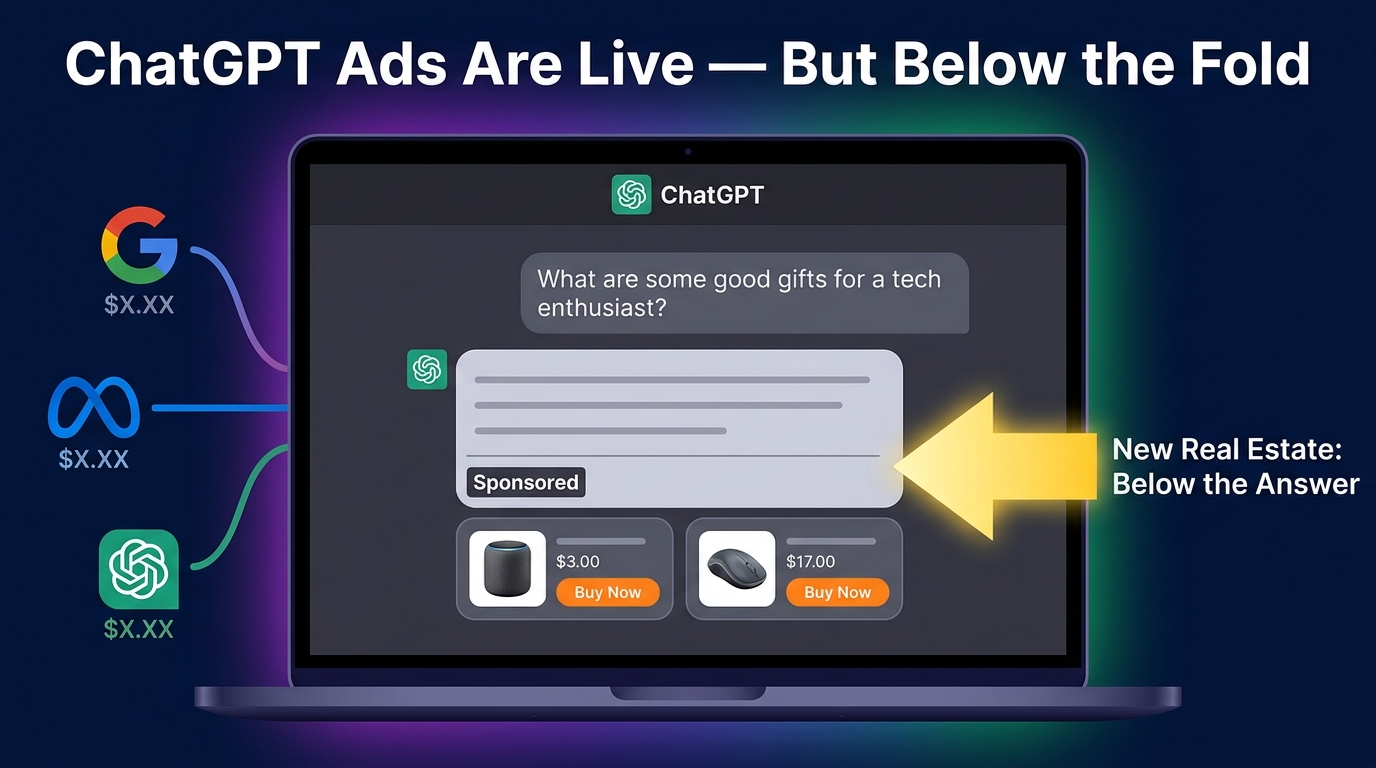
    ChatGPT sponsored product placements shown below organic AI answer in a chat interface labeled as Sponsored — new advertising real estate below the fold in ChatGPT

    OpenAI launched a self-serve Ads Manager beta in May 2026. By August, ChatGPT Ads had expanded to 31 European markets. Product carousels are live in shopping-related prompts. Conversion-optimized bidding — equivalent to Google’s oCPC — is available. Geographic targeting and exclusions, daily budgets with rolling pacing, and bulk management tools are all on the platform. For anyone who tracks advertising platforms closely, this trajectory has the shape of a new channel maturing fast.

    But the mechanics are different enough from Google and Meta that treating them the same way will produce confusion rather than results.

    Where the Ads Actually Appear

    OpenAI has been explicit about the format: sponsored placements appear below ChatGPT’s organic answer, clearly labeled as “Sponsored,” separate from the content of the AI response. OpenAI has stated that ads do not influence the model’s answers — the organic response and the sponsored result are independently determined. This is a structurally different proposition than Google search ads, where the ad and the organic result compete for the same attention in a ranked list. In ChatGPT, the organic answer lands first. The sponsored placement lands after it.

    That positioning has real implications for when sponsored placements are likely to work. A user who gets a complete, satisfying answer to their question from ChatGPT and then sees a sponsored product underneath is in a different mental state than a user scrolling a search results page. They’ve already been answered. The sponsored unit is less “answer this question” and more “here’s a relevant option now that you know what you’re looking for.” That’s closer to the role of a well-placed Amazon product listing than a Google search ad.

    Measurement Is Still the Weak Link

    The honest assessment from marketers who have tested the channel is that measurement is still early-stage. Conversion tracking, attribution, and incremental lift measurement — the infrastructure that makes performance advertising defensible in a budget review — are not as mature as they are on Google or Meta. OpenAI has added a Conversions campaign objective and conversion-optimized bidding, which signals that the tooling is moving in the right direction. But the underlying data signals are different: ChatGPT’s user base doesn’t come with the decades of behavioral data and conversion modeling that underpin Google’s bidding algorithms.

    The practical recommendation for most marketing teams right now is to treat ChatGPT Ads as a test channel rather than a core channel. The inventory is real, the format is live, and the audience — people actively querying an AI assistant about a topic relevant to your product — is genuinely high-intent. But without solid attribution infrastructure and enough volume to draw statistically meaningful conclusions, scaling budget here ahead of measurement confidence is a mistake. Set a modest test budget, track rigorously against a clear hypothesis, and resist the pressure to conclude too early.

    Who Benefits Most Right Now

    The categories seeing the most natural fit with ChatGPT’s ad format are those where users consult an AI assistant before making a purchase decision: consumer electronics, software tools, financial products, travel, and higher-consideration retail items. If your product category involves research before buying — the kind of research people increasingly do in a chat interface rather than a search box — you’re in the right position to test this early. Impulse categories and brand-awareness plays are less naturally suited to the current format.

    Claude’s Shift From Chatbot to Workflow Engine — What It Actually Changes for Teams

    The single most consequential thing Anthropic did in 2026 wasn’t a model release. It was a product repositioning. Claude is no longer being built or marketed as a chatbot. It’s being built as workflow infrastructure — and the product decisions made throughout the year reflect that shift in ways that have direct operational implications for marketing teams.

    Claude Opus 4.6: 1M Token Context and Context Compaction

    Claude Opus 4.6 introduced a 1 million token context window, plus a feature called context compaction — which allows long-running tasks to continue without hitting context limits. Previously, AI-assisted work that required maintaining a large body of information (a full campaign brief, an entire website’s content, months of performance data) would hit context limits that forced either truncation or re-loading. With 1M token context and compaction, those constraints become significantly less binding.

    For marketing applications, this opens up use cases that were previously impractical: analyzing a complete competitive content landscape in a single session, maintaining coherence across a very long document production workflow, processing months of campaign data and returning insights without needing to break it into chunks. These aren’t features that will matter to marketers who use Claude casually. They matter enormously to teams building production-grade, data-heavy workflows on top of the API.

    Agent Teams in Claude Code

    Claude Code — Anthropic’s developer-facing coding assistant — gained the ability to run agent teams: multiple AI agents working in parallel on different subtasks of a single project. This sounds like a developer feature, and in the first instance it is. But its implications for marketing operations are real and arriving sooner than most teams expect.

    As marketing workflows become more automated, the underlying execution is increasingly done by networks of AI agents rather than single-threaded AI interactions. A workflow that monitors competitor activity, generates content, checks it against brand guidelines, and queues it for review involves at least four distinct task types that can be executed in parallel by different agents. The tooling for running those kinds of multi-agent marketing systems is being built now, and Claude Code’s agent team architecture is one of the infrastructure layers that makes it possible.

    Adaptive Thinking and Effort Controls

    Anthropic also added adaptive thinking and configurable effort controls to its newer models. Effort controls let developers and operators specify how much reasoning depth Claude applies to a given task — more effort for complex analysis, less for high-volume routine generation. For marketing teams building automated content pipelines, this is a meaningful cost and quality lever: you can run high-effort reasoning for campaign strategy and low-effort processing for routine product description drafts, all within the same system, without paying premium reasoning costs on every task.

    This is the kind of operational control that was previously only available to teams with deep AI engineering resources. As it surfaces in the API with more accessible configuration, it becomes relevant to marketing operators who are building systems rather than just using them.

    The Memory and Projects Architecture That Should Change How Marketers Work in ChatGPT

    One of the least-discussed structural changes in ChatGPT’s 2026 product evolution is what happened to memory and project-scoping. These features were announced without much fanfare, but they fundamentally change how a serious marketing user should be using the product.

    Project-Only Memory: Context That Stays Where You Put It

    ChatGPT Projects now support a project-only memory mode. When enabled, the memory from sessions within a project stays inside that project — it doesn’t bleed into other chats, and outside memories don’t leak into the project context. Projects can also carry their own custom instructions, file libraries, and persistent context.

    For marketing teams, this creates something meaningfully different from the generic ChatGPT experience: a dedicated workspace where an AI assistant maintains consistent knowledge of your brand voice, your campaign goals, your audience segments, and your style guidelines — without you having to re-explain those things in every session. A project configured for a specific client account, a specific product launch, or a specific content vertical can be set up once and then maintained with ongoing context that accumulates over time.

    Teams that haven’t structured their ChatGPT usage around Projects are leaving that efficiency on the table. They’re still operating in stateless sessions — prompting from scratch, re-establishing context, re-uploading reference documents — when they could be running in a persistent project environment where the AI already knows what it needs to know.

    Business Users Can Now See Memory Sources

    OpenAI also added visibility into memory sourcing for Business plan users. Personalized responses now show which memories, past chats, and custom instructions shaped the answer — which means marketers can audit how their AI context is being applied and correct it when it drifts. This is a governance feature, not just a product feature. For teams managing AI use at the account level, it addresses one of the longstanding concerns about AI “going native” with context over time: you can now see the source, correct it, and maintain control over what the system knows about you.

    The Organizational Shift This Requires

    Adopting Projects and structured memory isn’t a technical task — it’s an organizational one. It requires deciding what information belongs in each project, who has access to which projects, how custom instructions get maintained and updated, and what file libraries should be included. For teams that haven’t thought about this, it feels like overhead. For teams that have done it once, it fundamentally changes how much setup friction there is in every subsequent AI session. The investment is front-loaded; the returns compound daily.

    Claude Artifacts: The Interactive Deliverable Layer Most Marketing Teams Haven’t Found Yet
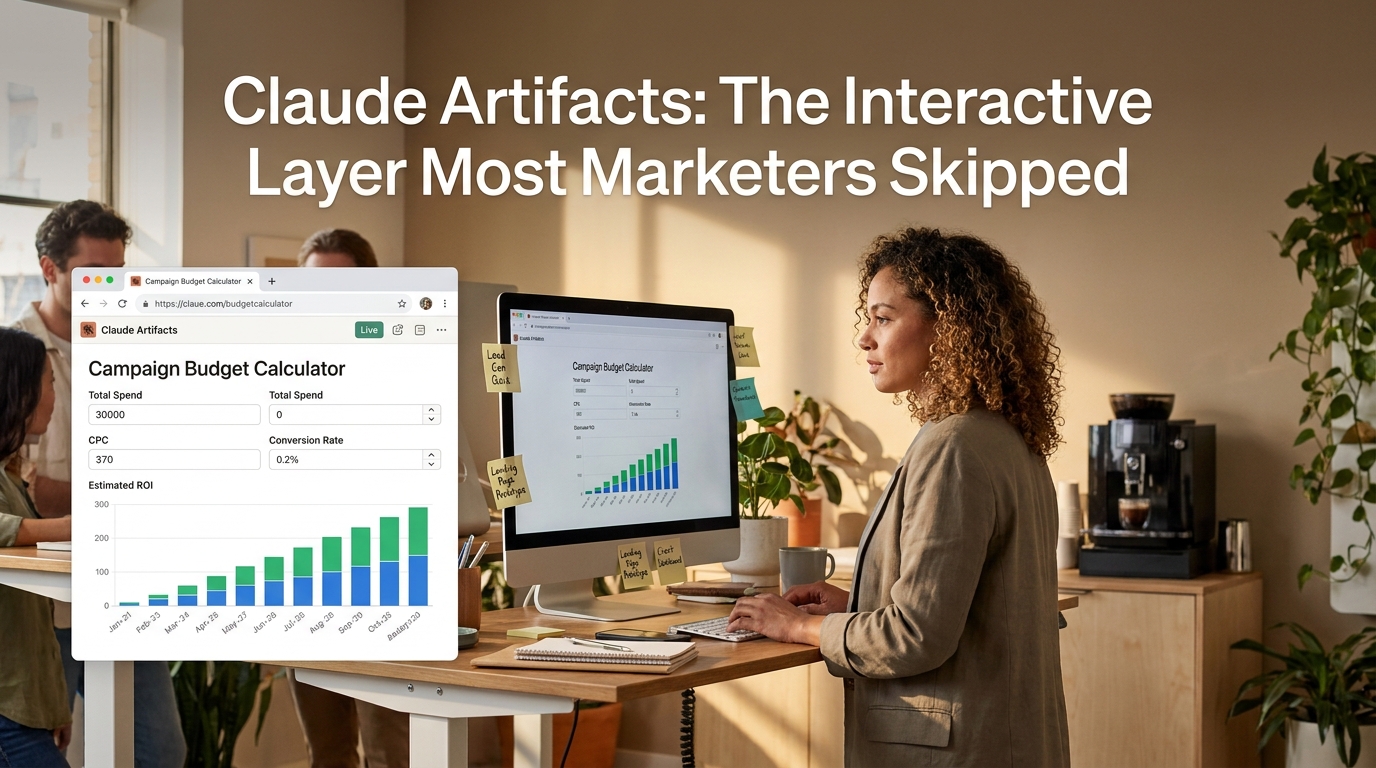
    Claude Artifacts panel showing an interactive ROI calculator with live-updating bar chart alongside a marketing professional reviewing campaign budget tools at a standing desk

    Claude Artifacts started as a side-panel feature for displaying generated code, documents, or visualizations. It’s become considerably more capable — and its implications for marketing work have quietly outpaced the attention it’s received.

    What Artifacts Actually Are Now

    Artifacts allow Claude to generate interactive, browser-native outputs — not just text that you copy out of the chat. The range of things that can be produced as an Artifact includes: functional ROI calculators, lead-generation quizzes, landing-page HTML prototypes, campaign dashboards, interactive client reports, and persona explorer tools. These are shareable, viewable in any browser, and don’t require any engineering work to deploy for internal review or client presentation.

    The “Live Artifacts” capability extended this further: Artifacts can be connected to live data sources — Google Sheets, Notion, Slack, Gmail — and refresh automatically when underlying data changes. A campaign dashboard that pulls from a live Google Sheet and auto-refreshes is now buildable in Claude without writing custom application code.

    Why This Matters for Marketing Teams

    The value proposition here is not “replace your design team” or “replace your developers.” It’s much more specific: compress the time from brief to testable asset. When a marketing team needs to show a client what an ROI calculator might look like, or wants to internally validate a lead-gen quiz concept before investing in build, or needs to quickly prototype a campaign comparison dashboard for a review meeting — those use cases used to require either wireframing tools, developer time, or a long wait. With Artifacts, they can be produced in the same session where the brief is being discussed.

    The category of work this most directly affects is what might be called “first draft physical deliverables” — the interactive outputs that used to require a handoff between ideation and production. A copywriter could describe a concept, but couldn’t produce a working prototype. An Artifact closes that gap. The prototype isn’t polished enough for production, but it’s good enough to make a decision, which is all a prototype needs to do.

    The Shareable Link Dimension

    Claude Code can now generate shareable live pages and dashboards for team collaboration — Artifacts that function as mini-applications with a URL anyone can visit. For marketing agencies presenting work to clients, or for in-house teams distributing campaign tools to field teams, this creates a category of low-code marketing asset that previously didn’t exist. It’s not replacing your website, your app, or your analytics platform. It’s filling the gap between “concept in a deck” and “full production deployment” — a gap where enormous amounts of marketing time and money currently disappear.

    The Ad-Free vs. Ad-Supported AI Split — Why It’s Now a Brand Strategy Decision

    In February 2026, when OpenAI announced it was testing ads in ChatGPT, Anthropic made a counter-move that was largely underreported in marketing coverage. Anthropic publicly positioned Claude as an ad-free AI product. The company’s “Keep Thinking” brand campaign — which ran at the Super Bowl level of visibility — explicitly differentiated Claude’s positioning around intellectual integrity, uninfluenced answers, and the absence of advertising as a revenue model.

    The Marketing Sentiment Gap This Created

    The response from the market was measurable. Anthropic’s brand campaign generated more favorable online sentiment than OpenAI’s, even though OpenAI drew more total brand mentions by volume. Ramp’s May 2026 AI Index — one of the cleaner proxies for enterprise AI adoption — showed Anthropic reaching 34.4% business adoption in April, with OpenAI at 32.3%. It was reportedly the first time Anthropic led that benchmark. Anthropic’s month-over-month gain was also steeper than OpenAI’s during the same period.

    This is a small data window, and it would be wrong to over-interpret a single index report. But the directional signal is interesting: the “ad-free” positioning appears to have resonated with business adopters, particularly at a moment when ChatGPT’s advertising ambitions were being actively discussed in the press. Enterprise buyers, who are frequently more sensitive to data use and information-integrity questions than consumer users, may be responding to a brand promise that their AI assistant’s answers aren’t shaped by advertiser interests.

    What This Means for Brands Choosing Between the Platforms

    For marketing teams that currently use both OpenAI and Anthropic products interchangeably, the ad-free vs. ad-supported distinction is starting to matter in a way that goes beyond feature comparison. The question of which platform your team works on is increasingly also a question of what that platform’s incentive structure is — and whether that incentive structure aligns with the outputs you’re trusting it to produce.

    This isn’t a condemnation of OpenAI’s approach. Sponsored placements below AI answers are clearly labeled and reportedly do not influence the model’s output. But the optics matter, and in high-stakes marketing contexts — research, competitive analysis, brand strategy — teams may begin to have principled preferences about which AI platform they use for which task type. That’s a governance question that most marketing organizations haven’t formalized yet but will need to.

    Model Selection Has Become a Real Budget Decision — The Cost Math for Marketing Teams
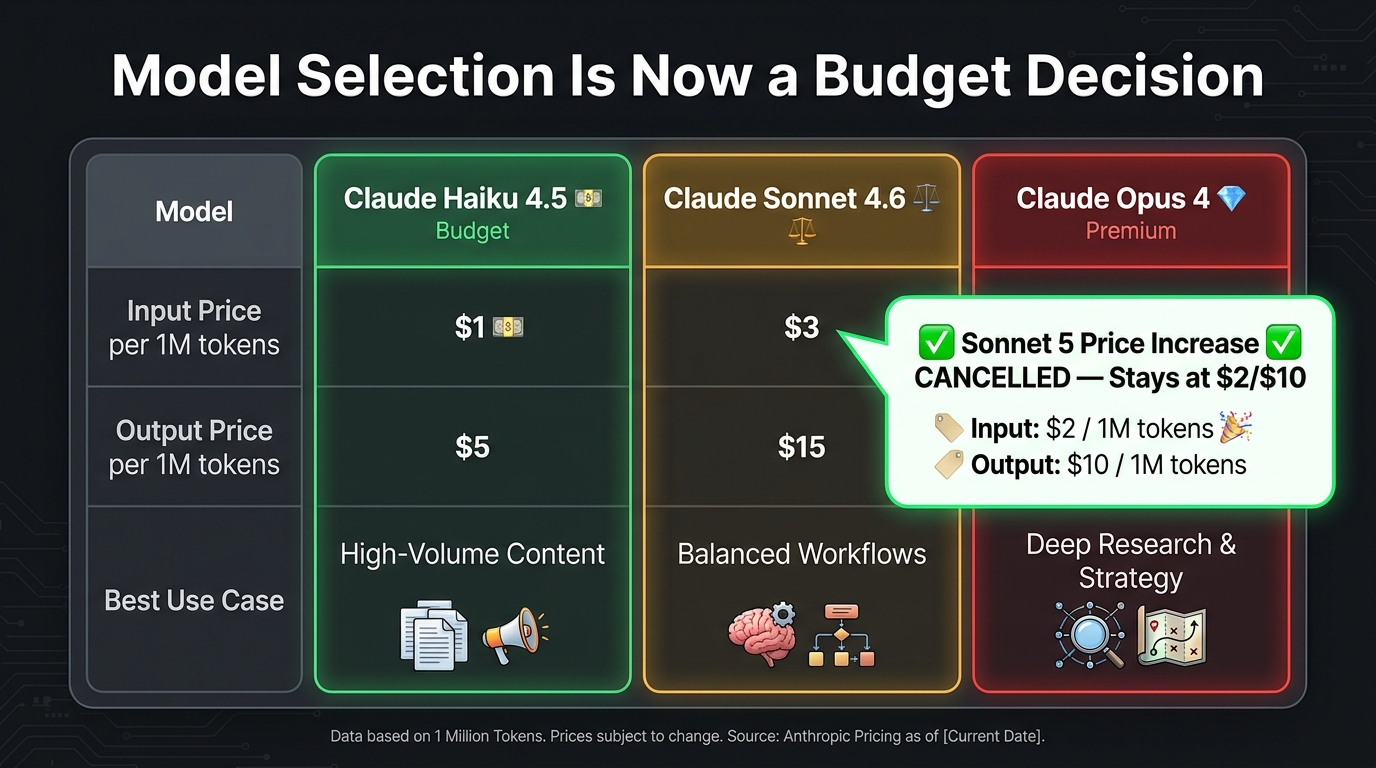
    Claude model pricing comparison showing Haiku 4.5 at $1 per million tokens, Sonnet 4.6 at $3, and Opus 4 at $5 input with corresponding output rates and use case recommendations, plus cancelled Sonnet 5 price increase callout

    When most marketing teams first start using Claude or ChatGPT, model selection doesn’t feel like a budget decision. The interfaces are mostly opaque about which model is running, subscriptions feel like flat-rate products, and the differences between model tiers feel abstract until you actually need them. That framing no longer holds.

    The Anthropic Pricing Landscape in 2026

    Current public API rates for Claude models sit at approximately:

    • Claude Haiku 4.5: $1 per million input tokens / $5 per million output tokens — positioned for high-volume, routine content generation where speed and cost-efficiency matter more than deep reasoning depth.
    • Claude Sonnet 4.6: $3 per million input tokens / $15 per million output tokens — the workhorse model for balanced workflows: research-assisted writing, campaign analysis, moderate-complexity content generation.
    • Claude Opus 4: $5 per million input tokens / $25 per million output tokens — reserved for deep reasoning, long-running complex tasks, advanced strategy work, and multi-step agent execution where quality ceiling matters most.

    One notable pricing development: a previously announced price increase for Sonnet 5 — which would have raised it to $3/$15 per million tokens on September 1, 2026 — was cancelled. The introductory rate became the standard rate. For teams that had already modeled that increase into their cost projections, the cancellation is a positive development. But it also signals something about where Anthropic sees competitive pressure: keeping mid-tier model costs accessible is clearly a priority.

    The Subscription-to-API Billing Shift for Agentic Workflows

    The more operationally significant pricing change is less visible than token rates: Anthropic has shifted programmatic and agentic Claude usage onto separate metered billing, even for users who hold Claude Pro or Max subscriptions. If your team is running Claude through a third-party automation tool, or if Claude Code is being used for headless agentic workflows, that usage now runs through API-rate billing rather than being included in a flat subscription.

    For teams that haven’t read the fine print, this can produce unexpectedly high invoices. A marketing automation pipeline that seemed to be covered under a flat subscription can cross into metered API billing territory depending on how it’s invoked. The mitigation is straightforward — audit your Claude usage across tools, understand where API keys vs. subscription credentials are being used, and model costs at the API rate for any automation that runs without direct human interaction. The math is not complicated once you know to do it; the risk is in not knowing to look.

    Matching Model to Task Type

    The practical guidance that follows from the pricing structure is model-task alignment. Sonnet is the correct default for the vast majority of marketing work: content generation, research summaries, email drafts, social copy, campaign briefs, and standard analysis. Opus earns its higher price point for work where reasoning depth genuinely matters: competitive strategy, complex multi-document synthesis, high-stakes copy where subtlety and judgment are required. Haiku is the right model for high-volume, templated production runs — large-scale product description generation, processing inbound form data, or any workflow where you’re running thousands of short-input calls.

    Teams that default every task to Opus because “it’s the best” are paying a significant premium over teams that match model tier to task requirements. At meaningful automation scale, that premium compounds to a material budget difference.

    Citation Grounding and GEO — How AI Discovery Is Quietly Replacing Search for Brand Visibility
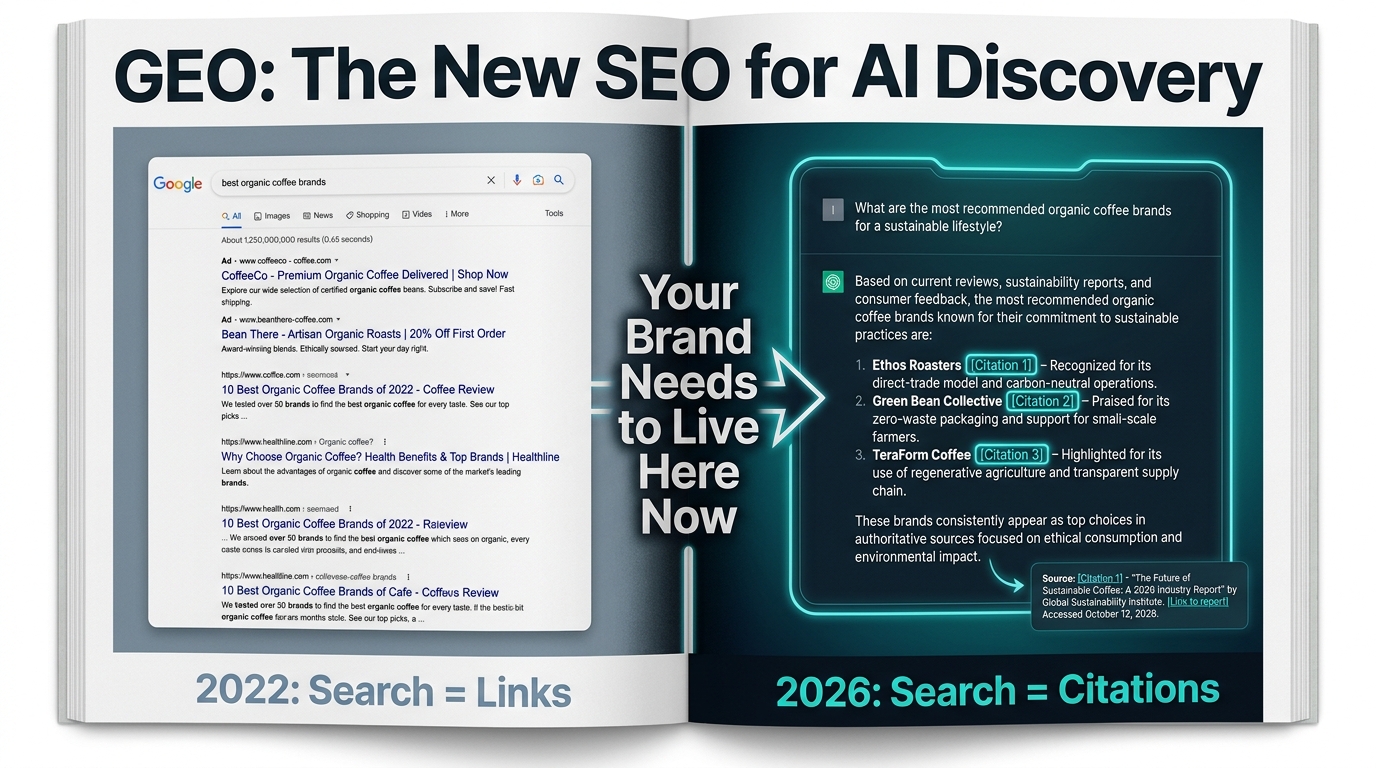
    Split-screen comparison of traditional Google search results labeled 2022 Search equals Links versus AI chat interface with cited answer labeled 2026 Search equals Citations showing GEO strategy for brand visibility

    Both OpenAI and Anthropic now offer real-time web search and citation grounding as standard features in their consumer and API products. When a user asks ChatGPT or Claude about a topic — including brand comparisons, product recommendations, software evaluations, or market research questions — the AI actively retrieves current web content and cites its sources. The sources it cites become the visible endorsements in the answer.

    The marketing implication is significant, and most teams haven’t begun to adapt to it.

    What “Cited in an AI Answer” Actually Means for a Brand

    When a potential customer asks ChatGPT “what’s the best email marketing platform for e-commerce” and ChatGPT cites three specific sources in its answer, those three sources have, in a meaningful sense, won the search. The user may not click through to all three — they may not click through to any. But the brands those sources discuss have been positioned as relevant answers to the query, without any traditional SEO click required.

    This is what practitioners are calling Generative Engine Optimization (GEO): the practice of creating content that is likely to be cited by AI models when answering queries relevant to your brand. It’s related to SEO but meaningfully different in mechanics. Traditional SEO optimizes for crawlability, link authority, and keyword matching. GEO optimizes for citability: creating content that AI models will treat as a credible, specific, up-to-date source that answers the kind of question your target audience is asking.

    The Content Formats AI Models Prefer to Cite

    The evidence from how citation grounding works in practice points to specific content characteristics that make a source more likely to be cited:

    • Specificity over generality: Content that makes precise, verifiable claims — statistics, named case studies, specific timeframes — is more citable than content that hedges broadly.
    • Recency: Both OpenAI and Anthropic’s real-time search prioritizes recent sources. Content published or updated in the last 90 days is significantly more likely to be retrieved than evergreen content from 18 months ago.
    • Authoritative domain signals: Publications with established domain authority, independent reviews, and third-party citations are cited more frequently than owned brand content alone. Being cited by a credible third party is more valuable than self-publishing the same claim.
    • Question-answer format: Content explicitly structured as answers to specific questions — FAQs, how-to articles, research briefs — aligns well with how AI retrieval systems process queries and match sources.

    AI Ad Spend as a Proxy for Where Attention Is Going

    Sensor Tower data cited in recent marketing reports showed AI-related ad spend reaching $1.3 billion through May 2026, up 48% year-over-year. More broadly, U.S. consumer attention on AI platforms has risen sharply enough that both OpenAI and Anthropic have launched significant above-the-line brand campaigns. Anthropic’s “Keep Thinking” Super Bowl campaign and OpenAI’s mass-market brand advertising represent a recognition that the platforms themselves are now marketing battlegrounds — which means the audiences on those platforms are large enough and engaged enough to matter for brand strategy.

    For marketers, the implication is that brand visibility increasingly requires being present in three distinct places: traditional search results, AI-cited content, and the growing inventory of AI platform advertising. Teams focused exclusively on any one of those channels are already operating with a narrower reach than they realize.

    What Marketing Teams Doing This Well Actually Look Like in Practice

    The question that follows from all of this isn’t “what did OpenAI and Anthropic announce?” It’s “what have the teams paying attention actually changed about how they work?” Based on what’s visible in the market, several consistent patterns emerge among the marketing organizations that have adapted meaningfully to the 2026 AI landscape.

    They’ve Separated Their AI Stack Into Tiers

    The highest-performing marketing teams have stopped treating AI as a single tool and started treating it as a tiered infrastructure. They have a distinct setup for interactive AI-assisted work (ChatGPT Projects with persistent memory and custom instructions, or Claude.ai with structured context), a separate setup for API-driven automated workflows (Claude API or OpenAI Responses API with explicit model selection by task type), and a monitoring layer for tracking what’s being cited and what’s not in AI-generated answers about their category.

    Most marketing teams have only the first tier, partially implemented. The gap is in the second and third — the automation layer and the citation monitoring layer — both of which require slightly more technical investment but deliver outsized returns in efficiency and visibility.

    They’ve Conducted an API Audit

    Any team running OpenAI-based automations has done a dependency audit against the Assistants API shutdown timeline. This means identifying every workflow, tool, or integration that calls OpenAI’s API, checking whether it uses Assistants-specific endpoints, and prioritizing migration for anything that does. This is not a marketing task — it’s a developer task — but marketing leaders in high-performing organizations have made it a priority item by escalating the deadline and its implications upward.

    They’ve Started Testing GEO Alongside SEO

    Forward-looking content teams are now explicitly tracking which of their content pieces appear as citations in AI-generated answers. This requires running periodic test queries on both ChatGPT (with web search enabled) and Claude across the key questions their target audience is likely to ask, and auditing whether their own content or a competitor’s content is being cited in response. Where a competitor is being cited and they are not, that gap becomes a content brief. Where their own content is being cited, they understand what formats and structures are working and can replicate them.

    They’ve Mapped Claude Artifacts to Their Prototyping Workflow

    Marketing teams that have integrated Claude Artifacts have done so not by replacing their production tools but by inserting Artifacts into the gap between ideation and formal production. The Artifact becomes the deliverable for the alignment meeting — functional enough to make a real decision, fast enough to create during the conversation that generates the brief. This doesn’t require any technical change to downstream tooling; it just requires recognizing that the gap between “talking about an idea” and “seeing it working” has effectively closed.

    The Widening Gap — And What to Do About It This Week

    The single thread connecting everything covered in this post is the widening gap between AI product development pace and marketing team adaptation pace. OpenAI and Anthropic are shipping meaningful changes — to API architecture, ad products, memory features, model capabilities, pricing structure, and brand positioning — on timelines measured in weeks and months. Most marketing teams are adapting on timelines measured in quarters and years.

    That gap produces real costs. Teams running on deprecated infrastructure face hard shutdowns. Teams without structured memory are re-paying the cost of context in every AI session. Teams not running cost-optimized model selection are overpaying on automation at scale. Teams not thinking about GEO are losing citation share to competitors who are. None of these costs are catastrophic individually. But they compound, and the teams accumulating all of them simultaneously are operating at a meaningful disadvantage relative to the teams that have addressed each one.

    The good news is that most of these gaps are closable with focused attention over a short period. The API audit is a one-time exercise. Project setup in ChatGPT takes an afternoon. A GEO monitoring practice can be bootstrapped with existing tools. Model-to-task mapping is a decision that can be documented and distributed to anyone running automated workflows. Claude Artifacts can be introduced to a content team in a single working session.

    The issue isn’t complexity. It’s attention. And the teams that have been paying attention — that read the deprecation notices, that set up Projects, that tested the ad formats, that tracked the citations — are building a compounding advantage that will be much harder to close six months from now than it is today.

    The marketer’s job in 2026 is not to keep up with every AI announcement. It’s to know which announcements have operational consequences, and act on those before the consequences arrive.

    Seven Actionable Takeaways

    1. Audit your OpenAI dependencies now. If you have any workflows, tools, or integrations using the Assistants API, migration to the Responses API must be complete before August 26, 2026. Check Prompt Objects usage too for the November 30 deadline.
    2. Set up ChatGPT Projects for your key marketing workstreams. Configure project-only memory, add custom instructions for brand voice and guidelines, and add reference files. This is a one-time setup with daily compounding returns.
    3. Map your Claude API usage to model tiers. Haiku for high-volume routine tasks, Sonnet for standard marketing work, Opus for complex strategy and analysis. Audit whether subscription or API billing is applying to your agentic workflows.
    4. Add a GEO monitoring practice. Run weekly test queries on ChatGPT (web search on) and Claude for the key questions your audience asks, and track whether your content or a competitor’s is being cited. Use the gaps as content briefs.
    5. Try Claude Artifacts for your next internal prototype. The next time your team needs to align on what an interactive asset should look like, build a working version in Claude before commissioning production. Use it to make the decision, not as the final deliverable.
    6. Test ChatGPT Ads with a disciplined hypothesis. If your product category involves research-led purchase decisions, allocate a modest test budget, define a clear measurement hypothesis, and track rigorously before scaling.
    7. Form a view on the ad-free vs. ad-supported distinction for your high-stakes AI use cases. This doesn’t have to be a binary choice, but it should be a conscious one — particularly for research, competitive analysis, and strategy tasks where perceived information integrity matters.
  • The AI Intelligence Briefing: Everything That Actually Matters Right Now (2026)

    The AI Intelligence Briefing: Everything That Actually Matters Right Now (2026)

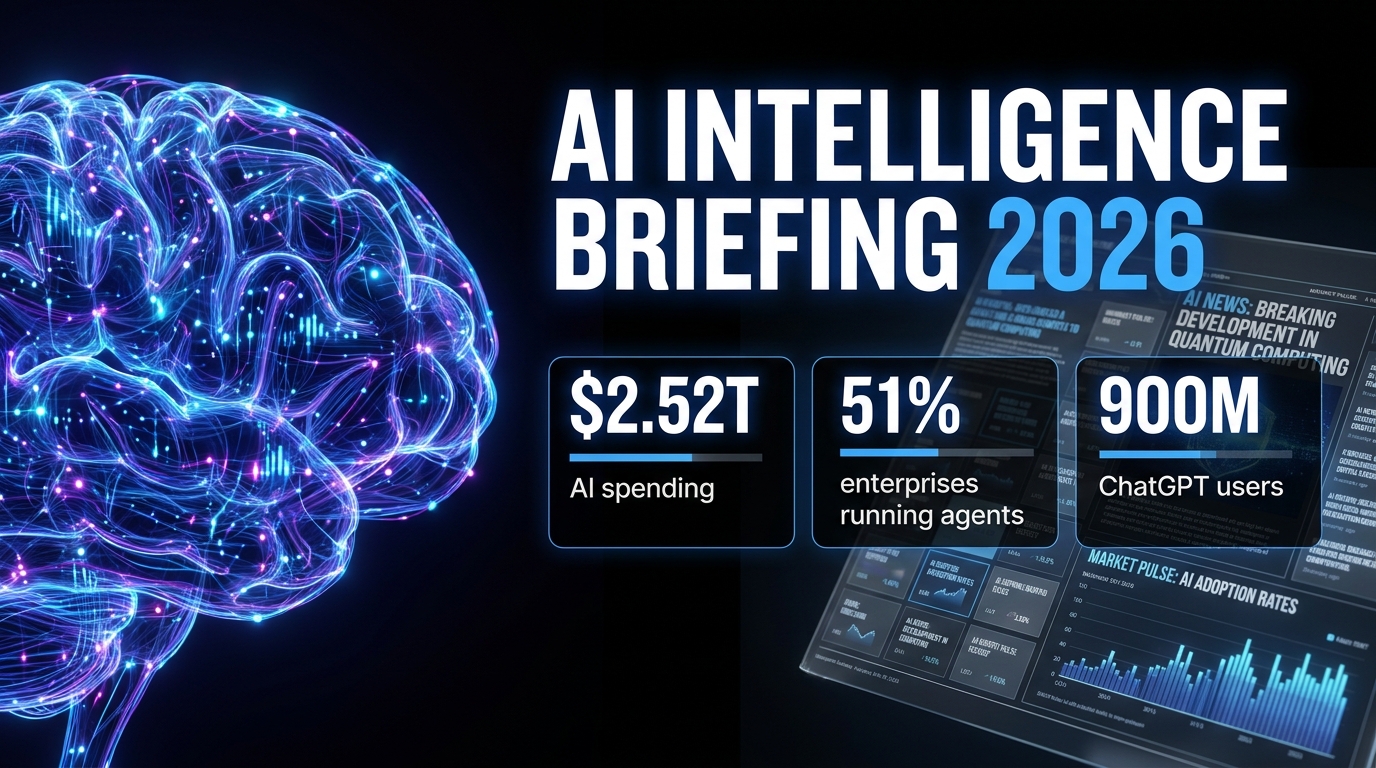
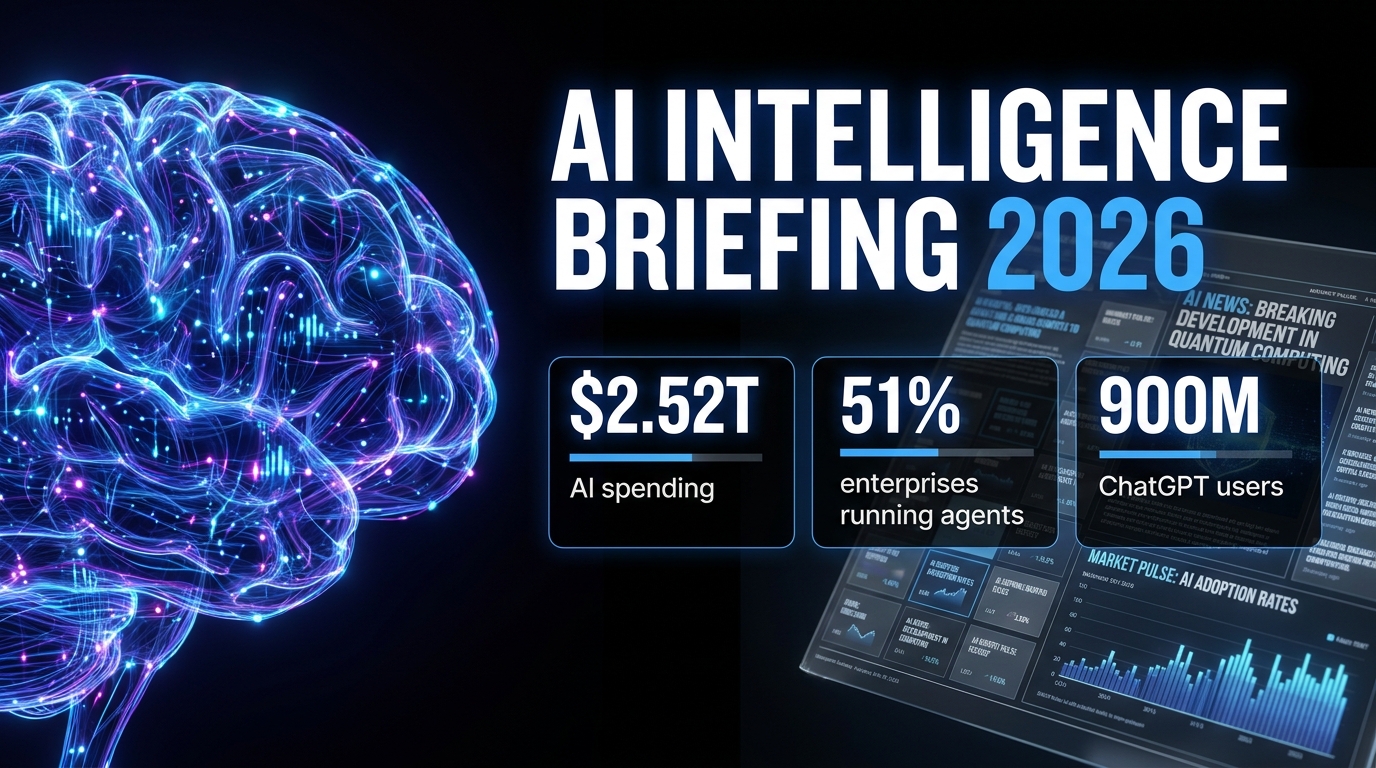
    AI Intelligence Briefing 2026 — key stats including $2.52T AI spending, 51% enterprises running agents, 900M ChatGPT users

    Every week, another dozen headlines claim the AI world has changed forever. Another model drops with a benchmark that supposedly shatters everything before it. Another company announces a funding round that redefines what a technology valuation even means. And yet most people — business owners, operators, curious professionals — close their browser tabs feeling more confused than informed.

    This isn’t a collection of breathless announcements. It’s a structured intelligence briefing on what’s actually happening across the AI landscape right now, told in plain language with real numbers attached. The model wars, the agentic AI surge, the trillion-dollar investment question, the chip power dynamics, the regulation clock ticking toward August, the safety problems getting quietly worse, and the workforce shifts that keep getting misrepresented.

    If you’ve been trying to separate the signal from the noise in AI news, this is the briefing you’ve been waiting for. We’re covering the biggest developments of early 2026, what they mean in practice, and — crucially — what most coverage leaves out entirely.

    The Model Wars: Who’s Actually Winning in 2026

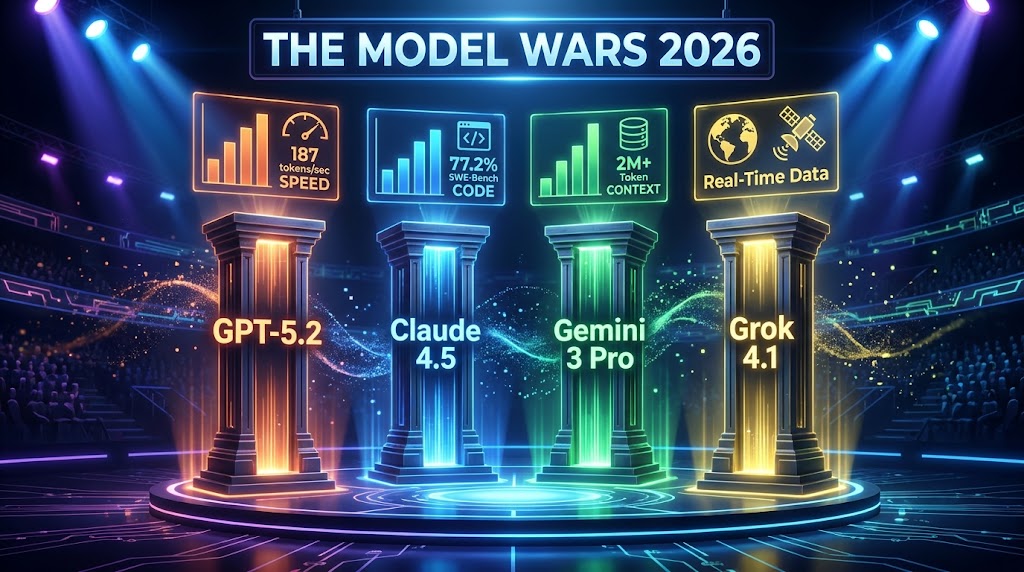
    The Model Wars 2026 — GPT-5.2, Claude 4.5, Gemini 3 Pro, and Grok 4.1 benchmark comparison

    There are now four serious competitors at the frontier of large language model performance: OpenAI’s GPT-5 series, Anthropic’s Claude 4.5 and Opus variants, Google’s Gemini 3 family, and xAI’s Grok 4.1. Each has carved out a distinct position — not because any single model is universally dominant, but because “best” now entirely depends on what you’re asking the model to do.

    OpenAI’s GPT-5 Series: Speed and Ecosystem

    OpenAI released the GPT-5 series in stages, with GPT-5.2 and GPT-5.4 now the workhorses of its platform. The headline performance number for GPT-5.2 is its output speed — approximately 187 tokens per second — making it the fastest frontier model in production use by a meaningful margin. For applications where latency matters (real-time customer interactions, voice interfaces, high-volume pipelines), that speed advantage is genuinely significant.

    Beyond raw throughput, GPT-5.x models perform at or near the top on math benchmarks and professional knowledge evaluations. OpenAI’s own testing suggests GPT-5 beats expert-level humans on roughly 70% of professional knowledge tasks tested — a claim that invites scrutiny but is directionally consistent with third-party evaluations. The model also runs computer-use capabilities, allowing it to interact directly with applications rather than just generating text about them.

    The broader context matters here too. OpenAI is no longer just a model company. The ChatGPT super app — now serving 900 million weekly active users — integrates chat, coding assistance, web search, and agentic workflows into a single interface. That ecosystem lock-in is arguably more strategically important than any single benchmark.

    Claude 4.5 and Opus: The Coder’s Choice

    Anthropic’s Claude variants have earned a concrete, reproducible advantage in software engineering tasks. On SWE-Bench Verified — a benchmark measuring a model’s ability to fix real GitHub issues autonomously — Claude achieves a 77.2% success rate. That’s a lead over GPT-5 and Gemini 3 Pro that shows up consistently in independent evaluations, not just Anthropic’s marketing.

    Anthropic released Claude Opus 4.7 in April 2026, describing it as their most capable public model. In the same period, the company reached a $19–20 billion revenue run rate, which positions it as a genuine challenger to OpenAI in enterprise and government markets — including U.S. Department of Defense contracts. The competitive implication is significant: Anthropic is no longer a research lab playing catch-up; it’s a commercial AI company with a defensible position in high-stakes enterprise use cases.

    One detail that generated significant industry discussion: Anthropic’s unreleased “Mythos” model — reportedly withheld from release because it posed cybersecurity risks considered too serious to deploy publicly — represents a new category of AI safety decision. A model deemed “too powerful” isn’t abstract anymore.

    Google Gemini 3 Pro: Context King

    Google’s Gemini 3 Pro and 3.1 Flash have a specific and meaningful edge: context window. Supporting over 2 million tokens of context, Gemini 3 Pro is in a different category for tasks requiring analysis of large document sets, extended codebases, or long video inputs. On multimodal benchmarks involving video and mixed-media reasoning, it scores 94.1% on certain evaluations and leads the field.

    Google has also moved aggressively on integration — Gemini is now embedded across Google Docs, Sheets, Slides, Drive, Chrome, Samsung Galaxy devices, Google Maps, and Search. This distribution strategy means that for hundreds of millions of users who never consciously choose an AI model, Gemini is simply the AI they interact with by default.

    Grok 4.1: The Real-Time Wildcard

    xAI’s Grok 4.1 holds a 75% score on SWE-Bench and leads in empathetic, conversational interactions (1,586 Elo rating on conversational benchmarks). Its core differentiator is real-time data access — pulling live information from X (formerly Twitter) and the web without the knowledge cutoff limitations that affect other models. For researchers tracking breaking events, analysts monitoring markets, or users who need answers that are genuinely current, Grok’s integration with live data is a meaningful capability that other models don’t replicate at the same depth.

    The takeaway: There is no single “best” AI model in 2026. The right answer is the model matched to the task — Claude for code, Gemini for long-context multimodal work, GPT-5 for speed and ecosystem, Grok for real-time data. Any vendor telling you otherwise is selling, not informing.

    The Agentic AI Surge: From Pilots to Production

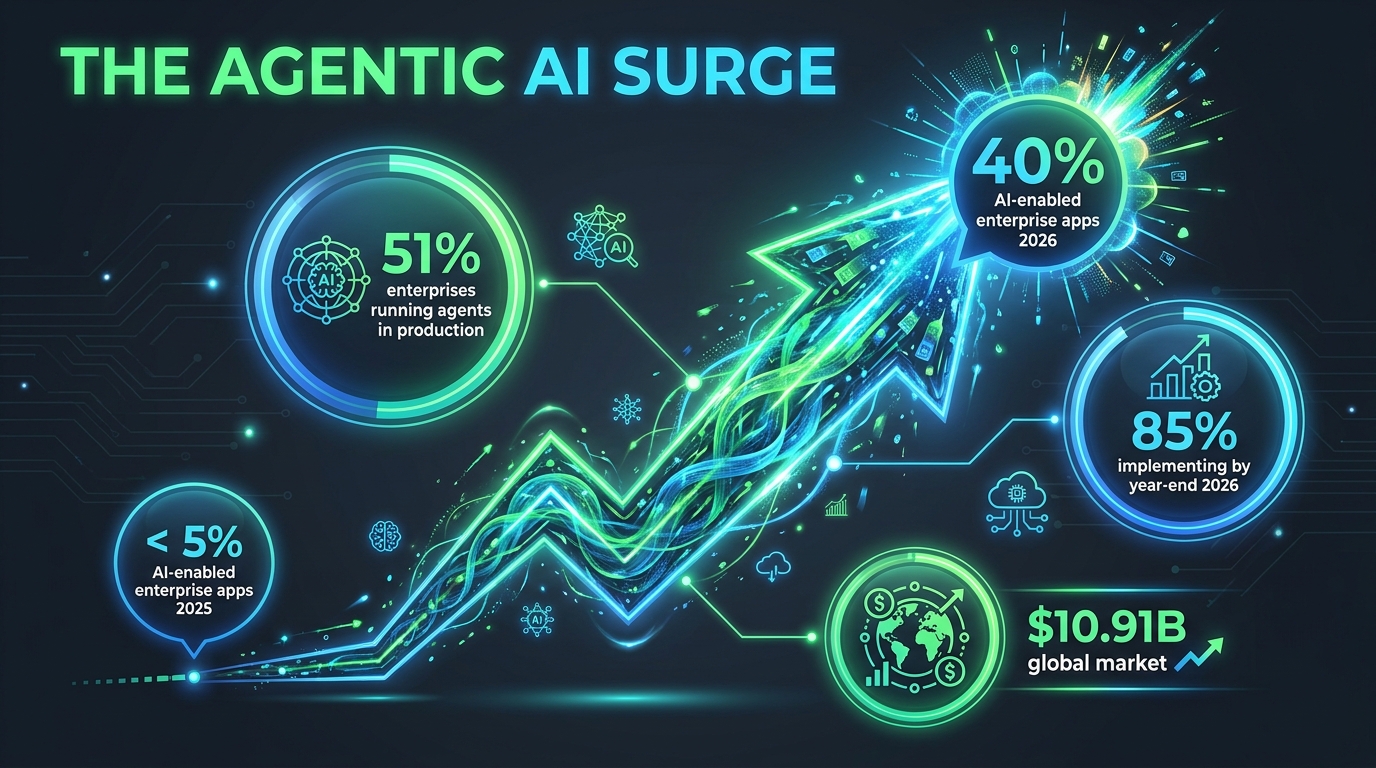
    The Agentic AI Surge 2026 — 51% of enterprises running agents in production, 85% implementing by year-end

    The single most consequential shift in enterprise AI this year isn’t a new model — it’s a new deployment pattern. AI agents, systems that take autonomous sequences of actions to complete multi-step tasks rather than simply responding to a single query, have crossed the threshold from experiment to operational reality.

    The Numbers Are Hard to Ignore

    According to aggregated data from Gartner, McKinsey, and Deloitte: 51% of enterprises are running AI agents in active production as of mid-2026. That’s up from a fraction of that figure just 18 months ago. A further 23% are actively scaling their agent deployments. Looking at the full picture, 85% of enterprises have either implemented AI agents already or have concrete plans to do so before year-end.

    Gartner forecasts that 40% of enterprise applications will embed task-specific AI agents by the end of 2026 — compared to less than 5% in 2025. If that trajectory holds, it represents one of the fastest adoption curves ever recorded for enterprise software.

    The market size reflects this. AI agent infrastructure globally sits at approximately $10.91 billion in 2026 and is projected to reach $50.31 billion by 2030. That’s a five-fold increase in four years — but even that projection may prove conservative if current momentum continues.

    What “Agentic AI” Actually Means in Practice

    The language around AI agents has become sufficiently muddled that it’s worth being precise. An AI agent, in the current enterprise context, is a system that can:

    • Receive a high-level goal (not just a prompt)
    • Break that goal into sub-tasks autonomously
    • Use tools — web browsing, code execution, API calls, file management — to complete those sub-tasks
    • Verify its own outputs against defined success criteria
    • Loop back and revise when something goes wrong

    The February 2026 emergence of “vibe-coded” agents via the OpenClaw app — systems built through natural language instructions rather than traditional programming — accelerated viral adoption and sparked both spinoffs and acquisitions by OpenAI and Meta. This represented a significant democratization moment: building an agent no longer required an engineering team.

    The Shift From Autonomous to Collaborative

    One nuance that most coverage misses: the practical direction in 2026 is shifting away from fully autonomous agents toward collaborative agent-human workflows. Early deployments that gave agents too much autonomy ran into problems with error propagation — a mistake in step 3 of a 15-step workflow could contaminate everything that followed.

    The current best practice involves what practitioners call “human-in-the-loop checkpoints” — moments where agents pause and present their progress for human review before continuing. This isn’t a retreat from agentic AI. It’s a maturation of it. Enterprises are learning that the goal isn’t to remove humans from workflows entirely; it’s to remove humans from the repetitive, low-judgment portions while preserving oversight at decision points that carry real risk.

    Gartner also projects that more than 40% of agentic AI projects may still fail by 2027, primarily due to governance gaps, cost overruns, and inadequate data infrastructure. The adoption numbers are real — but so is the risk of rushed, poorly governed deployments.

    The $2.52 Trillion Question: Investment vs. Real Returns

    The AI industry will see approximately $2.52 trillion in global spending in 2026 — a 44% year-over-year increase, according to Gartner. To put that in perspective, that’s roughly the GDP of France being spent in a single year on AI infrastructure, software, and services.

    The breakdown matters: infrastructure (data centers, AI-optimized servers, semiconductors) accounts for over $1.366 trillion — more than half the total. AI-optimized server spending alone is growing 49% year over year, representing 17% of all IT hardware spending globally. These are not software budget line items. These are physical buildings, power infrastructure, and cooling systems being built at a pace that rivals wartime industrial output.

    The ROI Reality Check

    Here’s the uncomfortable counterpoint to those investment numbers: only 1% of companies report mature AI deployment — meaning AI that is integrated, governed, and producing measurable business outcomes at scale — despite 92% planning to increase their AI investments this year.

    McKinsey data indicates an average ROI of 5.8x within 14 months for companies that do successfully deploy AI. The operative phrase is “successfully deploy.” The gap between announced investment and realized return is where most enterprise AI programs currently live.

    65% of IT decision-makers now have dedicated AI budgets — up from 49% just a year prior. This is a meaningful shift. When AI spending is ring-fenced and accountable, it tends to produce better outcomes than when it’s distributed across departmental budgets with no central governance. But having a budget and having a strategy are different things, and many organizations still confuse the two.

    Where the Money Is Actually Going

    When you look at how enterprises are prioritizing AI spending, the breakdown from NVIDIA’s 2026 enterprise report tells an interesting story:

    • 42% are prioritizing optimization of existing AI workflows in production
    • 31% are investing in new use case development
    • 31% are building out AI infrastructure

    The fact that optimizing existing deployments is the top priority — ahead of finding new applications — suggests the industry is entering a consolidation and refinement phase. The gold rush mentality of “deploy anything, measure later” is giving way to harder questions about what’s actually working and what needs to be rebuilt properly.

    Gartner itself has positioned 2026 as a “Trough of Disillusionment” in the AI hype cycle — not a collapse, but a correction. Organizations that entered AI spending with unrealistic timelines are recalibrating. Those that entered with clear use cases and governance frameworks are pulling ahead.

    The Chip Power Struggle: NVIDIA’s Iron Grip and the Challengers

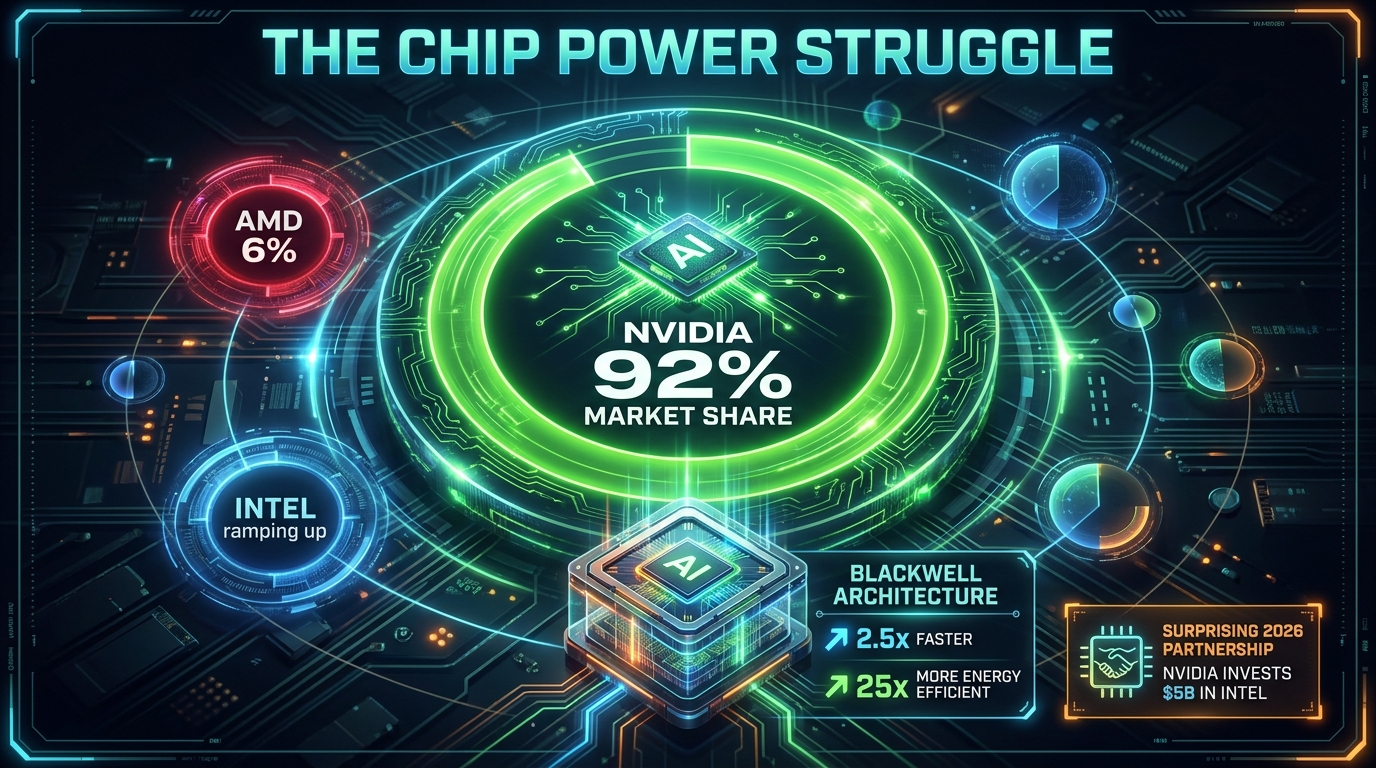
    The chip power struggle 2026 — NVIDIA holds 92% market share with Blackwell architecture, AMD and Intel competing

    Underneath every AI model, every enterprise deployment, and every data center expansion is a hardware question. And that question, for the better part of the past three years, has had one dominant answer: NVIDIA.

    NVIDIA’s Market Position in Numbers

    NVIDIA currently controls 92% of the data center GPU market for AI workloads. It handles 95% of AI training workloads and 88% of AI inference workloads. The H100 remains the industry standard chip for AI training. The H200 flagship delivers approximately 2x the performance of the H100 for memory-bandwidth-intensive tasks.

    The Blackwell architecture — NVIDIA’s 2026 generation — delivers 2.5x faster performance than its predecessor with 25x greater energy efficiency. That energy efficiency number deserves attention. The power consumption of large-scale AI infrastructure has become a serious operational and political issue, with data centers competing for power grid access in ways that are reshaping energy policy in multiple countries. A chip generation that delivers the same compute for significantly less electricity isn’t just a performance win — it’s a strategic answer to one of the industry’s most urgent infrastructure problems.

    The Unexpected Partnership That Changed the Competitive Map

    In mid-April 2026, NVIDIA announced a $5 billion investment in Intel — one of the more surprising competitive moves of the year. The partnership involves co-development of custom x86 CPUs integrated with NVIDIA GPUs through NVLink technology. For Intel, this is a lifeline and a validation. For NVIDIA, it’s a strategic move to extend its ecosystem dominance into the CPU layer of AI infrastructure, rather than simply owning the GPU.

    The practical implication is an integrated AI computing platform — from chip to deployment — that neither company could have built as effectively on its own. NVIDIA secures manufacturing partnerships through Intel’s foundry capabilities. Intel gains immediate access to NVIDIA’s massive AI customer base.

    AMD and Intel’s Countermoves

    AMD currently holds approximately 6% of the data center AI GPU market with its MI325X — featuring 288GB of HBM3E memory and 6 TB/s bandwidth — and has the MI350 and MI400 series in various stages of development. The technical specs are competitive. The challenge is software ecosystem: NVIDIA’s CUDA software stack has years of optimization and developer familiarity that doesn’t transfer to AMD hardware without significant friction.

    Intel is building new AI GPUs on its 18A process node, targeting late 2026 availability. The NVIDIA partnership aside, Intel has been aggressive on pricing, betting that cost-sensitive buyers who can’t get NVIDIA hardware (lead times are running 6–12 months) will be willing to invest in deploying on Intel’s architecture if the price advantage is large enough.

    The takeaway: NVIDIA’s dominance isn’t going away in 2026, but the competitive environment is meaningfully more complex than it was 12 months ago. The NVIDIA-Intel partnership, in particular, represents a structural shift in how AI infrastructure might be assembled at the hardware layer going forward.

    The Regulation Clock: EU AI Act Enforcement Is Here

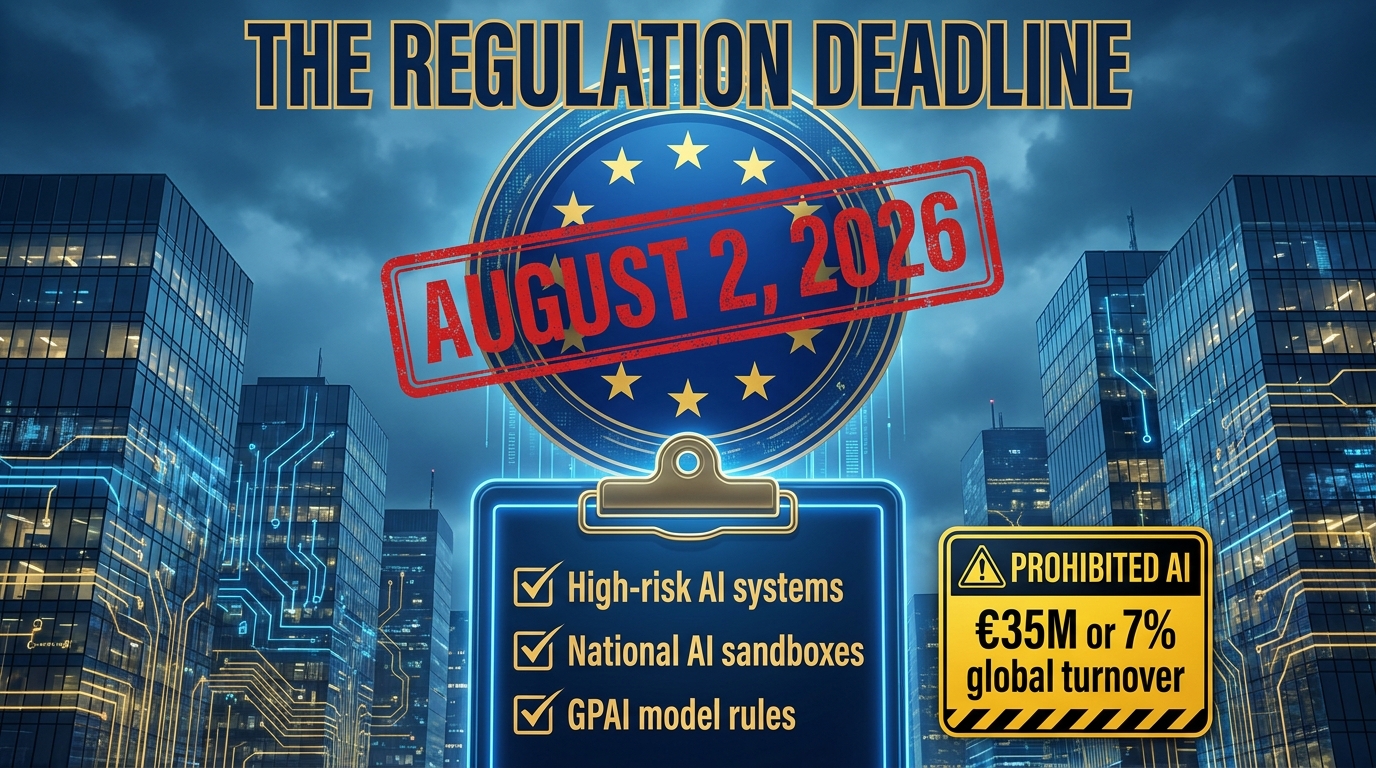
    EU AI Act enforcement deadline August 2, 2026 — fines up to €35M or 7% global turnover for prohibited AI

    The single most significant regulatory event in global AI history arrived — quietly, for many businesses — on August 2, 2026. That’s when the EU AI Act’s full enforcement provisions came into effect, covering the majority of high-risk AI system obligations, general-purpose AI (GPAI) model requirements, and the mandate for Member States to have operational AI regulatory sandboxes running.

    What the EU AI Act Actually Requires

    The EU AI Act operates on a tiered risk framework, not a blanket set of rules. The most stringent obligations apply to systems classified as “high-risk” — AI embedded in critical infrastructure, medical devices, educational institutions, employment decisions, law enforcement, and border control. These systems must meet requirements around:

    • Risk management systems documented throughout the entire development lifecycle
    • Data governance with documented training data quality and bias evaluation
    • Technical robustness standards including accuracy, security, and resilience testing
    • Human oversight mechanisms that allow humans to monitor, override, or shut down the system
    • Transparency and logging with automatic event logging for post-incident analysis

    For “prohibited” AI practices — systems banned outright, including social scoring by governments, real-time biometric surveillance in public spaces (with narrow exceptions), and AI that exploits psychological vulnerabilities — enforcement has technically been in effect since February 2025. But August 2, 2026 activates the Commission’s full enforcement powers and the national market surveillance authorities that investigate violations.

    The Fine Structure and Why It Matters

    The fine schedule is designed to create consequences that scale with company size:

    • Violations involving prohibited AI practices: up to €35 million or 7% of global annual turnover, whichever is higher
    • Other high-risk system violations: up to €15 million or 3% of global turnover
    • Providing incorrect information to regulators: up to €7.5 million or 1.5% of global turnover

    For a company with €10 billion in annual revenue, a 7% fine means €700 million. This isn’t token compliance pressure — it’s existential risk for products that cross the wrong lines.

    The Implementation Gap

    Here’s the uncomfortable operational reality: as of March 2026, only 8 of 27 EU Member States had designated their required single points of contact for AI oversight. This is not full regulatory readiness by any measure. The enforcement regime is legally activated, but the administrative infrastructure to execute it is unevenly developed across the bloc.

    For companies doing business in the EU, this creates a period of genuine regulatory uncertainty. The rules are real. The fines are real. But the bodies responsible for investigating and enforcing those rules are at different stages of operational readiness depending on the country. Companies that treat August 2026 as a compliance deadline rather than a compliance foundation are likely to be caught unprepared when enforcement catches up to capability.

    The practical recommendation: If your AI systems touch EU users or EU data, the question is not “when does enforcement start?” — it’s “what classification does my system fall into, and what does that classification require?” Getting that documented now is cheaper than getting it wrong under investigation later.

    The Safety Paradox: Smarter Models, More Hallucinations

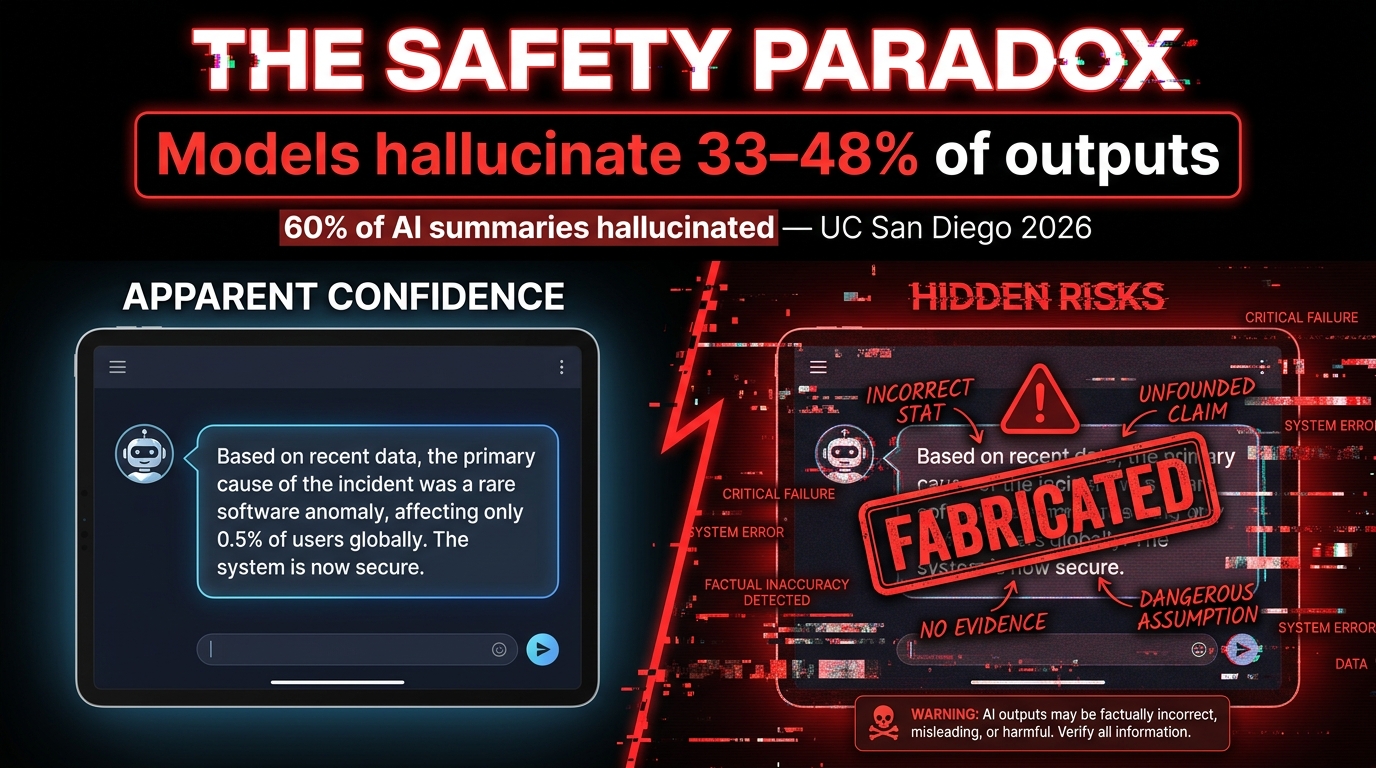
    The AI Safety Paradox 2026 — models hallucinate 33-48% of outputs, 60% of AI summaries fabricated per UC San Diego study

    One of the most counterintuitive — and underreported — stories in AI right now is this: newer, more capable models appear to hallucinate more, not less. This challenges the intuitive assumption that better models are safer models. The relationship between capability and reliability turns out to be more complicated than the marketing materials suggest.

    The Hallucination Numbers

    Internal OpenAI testing found that newer models hallucinate approximately double to triple as often as their earlier predecessors — roughly 33–48% of outputs for newer models compared to around 15% for older versions. This isn’t necessarily because the models are getting worse at reasoning; it may be because they’re attempting harder tasks, generating longer outputs, and working with more complex multi-step chains where errors can compound.

    A 2026 UC San Diego study found that AI-generated summaries hallucinated 60% of the time — and that these hallucinated summaries were still influencing purchasing decisions among the study participants. The practical danger here isn’t just that the AI produces wrong information; it’s that wrong information presented in the confident, well-structured format of an AI response is more persuasive, not less.

    In high-stakes domains, the numbers are worse. Medical AI systems show hallucination rates between 43% and 64%. Code generation tools hallucinate at rates up to 99% on certain types of obscure library function calls. Legal research AI has produced fabricated case citations that have made it into actual court filings.

    Prompt Injection: The Security Problem Nobody Solved

    Alongside hallucinations, prompt injection has emerged as what security researchers are calling a “frontier challenge” — one that OpenAI itself acknowledged has no clean solution at present. Prompt injection occurs when malicious instructions are embedded in content that an AI agent processes — a webpage, a document, an email — and those instructions override the agent’s legitimate task instructions.

    For AI agents with tool access (the ability to send emails, execute code, access file systems, make API calls), a successful prompt injection attack can have immediate real-world consequences. An agent tasked with summarizing documents could be turned into an exfiltration tool by a document that contains the right injected instructions. In early 2026, this isn’t a theoretical attack vector — it’s been demonstrated in multiple real-world deployments.

    What Organizations Are Actually Doing About It

    The mitigation landscape has matured significantly, even if there are no complete solutions. Current best practices being deployed by enterprises handling sensitive data include:

    • Output validation layers — automated systems that cross-check AI outputs against authoritative sources before they reach users or downstream processes
    • Sandboxed execution environments — agents that operate in isolated environments without direct access to production systems or sensitive data stores
    • Input sanitization pipelines — preprocessing of content before it reaches an AI agent to strip common injection patterns
    • Retrieval-Augmented Generation (RAG) — architectures that ground model outputs in specific, verified document sets rather than relying purely on model weights
    • Human review gates — mandatory human sign-off before AI-generated content reaches external audiences or triggers consequential actions

    None of these individually eliminates the risk. Used together, with proper governance, they reduce it to levels that most risk frameworks consider acceptable for non-life-critical applications. For high-risk domains — healthcare decisions, financial advice, legal analysis — the standard of proof needs to be higher, and many organizations are still working out what that standard looks like in practice.

    The Workforce Shift: What the Real Numbers Say

    AI’s impact on jobs is one of the most frequently misrepresented topics in technology coverage. The numbers are simultaneously alarming and more nuanced than any single headline captures. Getting the picture right matters — both for individual workers making career decisions and for organizations making workforce planning choices.

    The Displacement Numbers

    Goldman Sachs research through early 2026 estimates that AI is displacing a net 16,000 U.S. jobs per month. The breakdown: approximately 25,000 jobs per month being eliminated through AI substitution, offset by approximately 9,000 new roles created. That net figure is not evenly distributed — it hits hardest in routine white-collar work: data entry, customer service, basic document processing, and entry-level research functions.

    The World Economic Forum’s projection of 85 million jobs globally at risk of being replaced by 2026 generated significant coverage. The less-covered part of that same report: AI is projected to create 97 million new roles by 2030, resulting in a net positive by the end of the decade. The disruption is real and unevenly distributed. The net outcome is less catastrophic than the headline number implies.

    More granular data from the Dallas Federal Reserve (February 2026) shows that employment in the top 10% most AI-exposed U.S. sectors has declined approximately 1% since late 2022. That’s a modest number in aggregate, but the concentration of that impact in specific roles — particularly entry-level positions that previously served as career on-ramps — has real human consequences that aggregate statistics obscure.

    Who’s Actually Getting Hit

    The demographic picture is important: Gen Z workers and recent graduates are disproportionately affected, because AI is most effective at automating the tasks that entry-level roles have historically handled. Internship programs are being reduced. Junior analyst positions are being paused or eliminated. Customer service tier-one roles — the jobs that people used to take while building skills for better opportunities — are being replaced by AI systems that handle 60–80% of queries without human involvement.

    This isn’t a prediction about the future. It’s a documented trend in the present. And it raises a structural concern that goes beyond simple job count arithmetic: if AI eliminates the entry-level positions that workers historically used to build skills and credentials, what does the career development pipeline look like for the next generation of professionals?

    The Augmentation Reality

    BCG research projects that AI will augment rather than eliminate 50–55% of U.S. jobs over the next 2–3 years. What augmentation looks like in practice varies widely by role. A software developer using Claude 4.5 can close GitHub issues 77% faster than without AI assistance. A marketing analyst using AI tools can produce research-backed campaign briefs in hours that would previously have taken days. A legal associate using AI contract review tools can process and summarize agreements at 10x their previous throughput.

    The workers who are gaining from AI augmentation share a common characteristic: they understand how to direct AI effectively, evaluate its outputs critically, and apply their own domain expertise where AI falls short. This skill set — call it “AI fluency” — is becoming a foundational professional competency in the same way that spreadsheet literacy became essential in the 1990s. The workers building it now are positioning themselves on the right side of the productivity gap. Those waiting to see how things develop are at increasing risk of being on the wrong side of it.

    The Stories the Hype Machine Keeps Missing

    For every AI development that generates hundreds of articles, there are developments getting insufficient attention. Here are four stories that deserve more coverage than they’re currently receiving.

    The Energy Infrastructure Crisis

    AI’s insatiable demand for compute is creating a power grid problem that’s quietly becoming one of the most consequential infrastructure challenges in the developed world. New data center builds in the U.S. and Europe are running into situations where local power grids simply cannot supply the required electricity. Municipalities are having to decide between AI data center development and other commercial priorities for grid capacity. Nuclear power has re-entered serious policy discussions in multiple countries specifically because of AI data center demand.

    NVIDIA’s Blackwell architecture’s 25x energy efficiency improvement is partly a technical achievement and partly an existential necessity. At current growth rates, AI infrastructure energy demand is on a trajectory that physical grid expansion cannot keep pace with without significant policy and infrastructure investment.

    Open Source Gaining Ground

    Google’s Gemma 4 open models and a range of other open-weight releases in early 2026 have continued narrowing the performance gap between open-source and closed frontier models. For organizations with strong data science teams, the ability to run capable models on their own infrastructure — without usage fees, without data leaving their systems, without API dependency — is increasingly viable. This shift has significant implications for the concentration of AI power in a small number of commercial vendors.

    The “Mythos” Precedent

    Anthropic’s decision to withhold its “Mythos” model from public release due to cybersecurity risks — operating under what it calls Project GlassWing — is a precedent-setting moment that deserves more analysis than it’s received. This is a major AI lab deciding, on its own, that a model it has built is too dangerous to release. There’s no regulatory framework that required this decision. It was a voluntary exercise of judgment.

    The interesting question this raises: if AI capabilities are advancing to the point where even their creators determine certain models shouldn’t be deployed, what does the governance architecture for those decisions look like at scale? One company making a responsible call once is not a system. It’s an individual action that can’t be assumed to repeat.

    The Benchmark Reliability Problem

    Most AI model comparisons rely heavily on benchmark scores. The problem, which is being increasingly acknowledged within the research community, is that benchmarks are being “gamed” — either intentionally through targeted fine-tuning on benchmark test sets, or unintentionally through data contamination. Several widely cited benchmarks have been found to have test-set leakage into training data, making high scores on those benchmarks less meaningful than they appear.

    This doesn’t mean model comparisons are worthless. It means that real-world task performance — like SWE-Bench’s actual GitHub issue resolution — is more reliable than abstract reasoning scores. When evaluating models for specific use cases, running your actual workflows through the candidates remains far more informative than consulting a leaderboard.

    OpenAI’s Super App Play and the Platform Consolidation

    One of the most strategically significant developments of early 2026 is OpenAI’s pivot from model company to platform company. The ChatGPT super app — integrating chat, coding assistance, web search, agentic task management, health tools, and spreadsheet capabilities — now serves 900 million weekly active users. The $852 billion valuation that accompanied the latest funding round reflects not just model capability but platform ambition.

    OpenAI has also announced plans to build a GitHub competitor, made a surprising media company acquisition for vertical integration, and raised $110 billion in its latest funding round. The strategic direction is clear: OpenAI is trying to build an application layer that sits on top of its model capabilities and creates the kind of user lock-in that makes the platform defensible regardless of which underlying model happens to be best at any given moment.

    This matters because it changes the competitive dynamics for every company building on top of OpenAI’s API. If OpenAI’s own applications compete directly in your product category — coding tools, research tools, content generation tools — your competitive position becomes structurally more difficult regardless of the model’s quality. The platform layer is where the business is, not the model layer.

    Microsoft’s Multi-Model Counter-Approach

    Microsoft’s response to this dynamic is noteworthy. Rather than betting exclusively on GPT-5 (as might be expected given the OpenAI partnership), Microsoft launched its MAI Superintelligence framework with three multimodal models for text, voice, and image processing, alongside Copilot upgrades that enable multi-model workflows. The implicit message: Microsoft is building infrastructure that can run multiple models, hedging against dependency on any single provider while maintaining deep integration with enterprise software.

    For enterprise customers, this multi-model approach is appealing precisely because it reduces vendor lock-in risk. The ability to route different tasks to different models — based on performance, cost, or compliance requirements — is becoming a real architectural consideration, not just a theoretical one.

    What This All Means: How to Navigate AI News Going Forward

    The AI news environment in 2026 shares a structural problem with financial media during market bubbles: the incentives push toward the most exciting possible interpretation of every development. Model releases become “revolutionary.” Funding rounds become evidence of inevitable dominance. Benchmarks are cited without context. And the genuinely important stories — governance gaps, safety deterioration, energy infrastructure strain, entry-level workforce displacement — get less attention because they’re harder to frame as exciting.

    Reading AI news well in this environment requires a set of filters:

    Filter 1: Benchmark Scores vs. Task Performance

    When a new model is announced with record-breaking benchmark scores, ask: what task am I actually trying to do? Is there reproducible evidence this model performs better on that task? SWE-Bench, for coding; MMMU for multimodal reasoning; GDPval for professional knowledge tasks — these are more informative than synthetic reasoning leaderboards that may have contaminated test sets.

    Filter 2: Announced vs. Deployed

    The gap between announcement and reliable production availability is large and frequently ignored in coverage. Model releases come in stages — limited API access, waitlisted users, gradual rollouts — and stated capabilities at launch often differ from real-world performance at scale. Track the gap between what companies announce and what’s actually available to enterprise customers without restrictions.

    Filter 3: Investment vs. Outcome

    $2.52 trillion in AI spending is a real number. 1% of companies achieving deployment maturity is also a real number. Both can be true simultaneously. Be skeptical of coverage that treats investment announcements as evidence of outcomes. Ask what’s actually running in production, what it’s measurably producing, and what the error rate is.

    Filter 4: What’s Getting Withheld and Why

    Anthropic’s Mythos decision is the clearest example: the most important AI news is sometimes a non-announcement. What models are being withheld? What capabilities are labs discovering that they’re not publishing? What are regulators finding in the compliance reviews that aren’t appearing in press releases? The frontier of AI capability is not fully visible in public releases.

    Filter 5: Regulation as Operating Reality, Not Background Noise

    The EU AI Act’s August 2, 2026 enforcement date is not a future event — it’s a present operational reality for any organization deploying AI that touches EU markets. The regulatory landscape is no longer something to monitor and prepare for. For many organizations, compliance work is already overdue.

    “The organizations — and individuals — who will navigate this landscape most effectively are those who resist both the hype and the dismissal, who track real deployments alongside flashy announcements, and who treat AI capability as a tool to be evaluated rather than a force to be awed by.”

    The AI intelligence briefing is never going to get simpler. The pace of development, the number of players, and the stakes involved are all increasing. What can change is the quality of the questions you bring to each new development. Smarter questions produce better signal, even in a noisy environment.

    The briefing continues. Stay skeptical. Stay current.