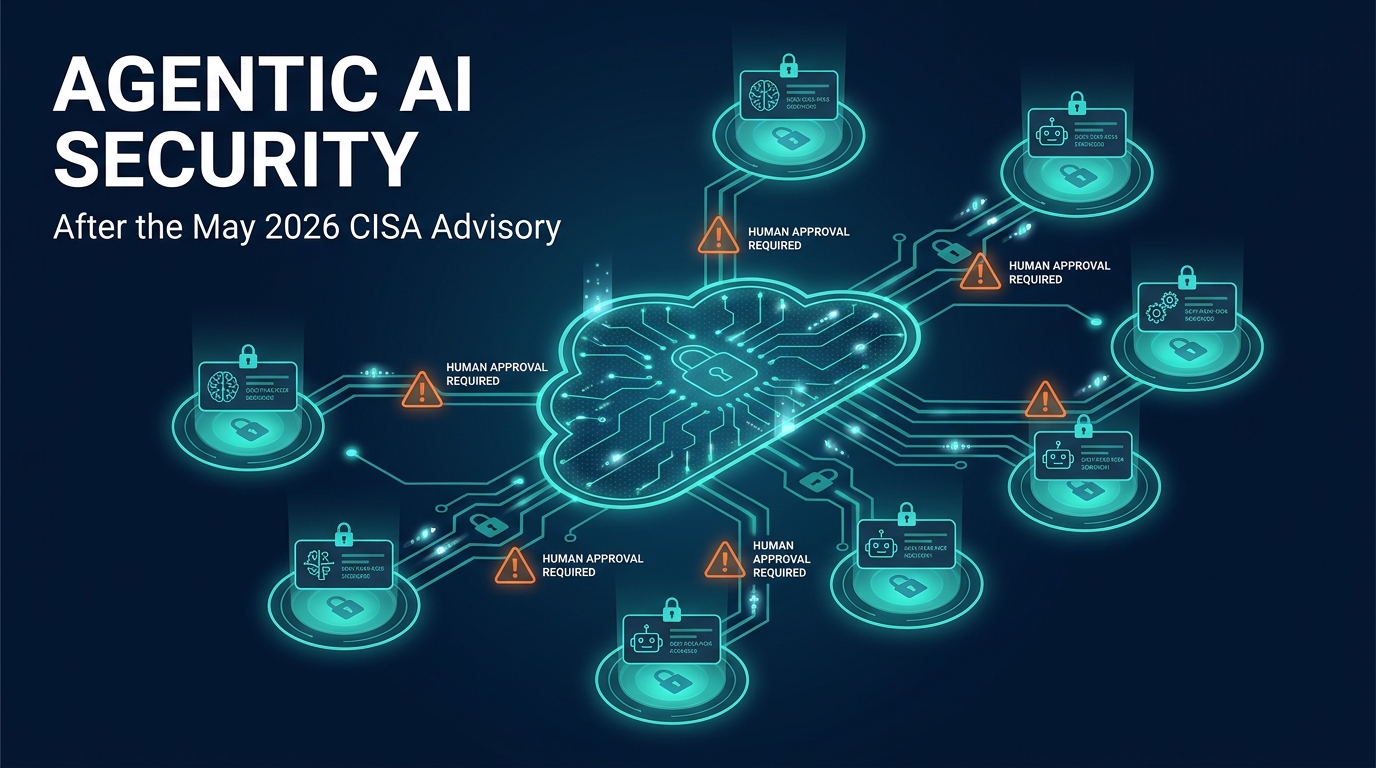
On May 1, 2026, something shifted in how governments think about AI agents. CISA, the NSA, and cybersecurity agencies from Australia, Canada, New Zealand, and the UK — collectively known as the Five Eyes — published a joint advisory titled Careful Adoption of Agentic AI Services. It wasn’t a warning about chatbots hallucinating. It wasn’t another generic AI governance checklist. It was something more specific, and for engineering teams already running agents in production, considerably more uncomfortable.
The advisory treats autonomous AI agents as a distinct security problem — fundamentally different from traditional software, SaaS tools, or even first-generation LLM integrations. It names five categories of risk unique to agentic systems, recommends that organizations limit deployment to low-risk, non-sensitive tasks until controls mature, and maps the entire problem to existing security frameworks like zero trust and least privilege. That last part matters: the guidance isn’t waiting for a new playbook. It’s saying your current security infrastructure is underequipped for what agents are already doing.
The stakes are not theoretical. A CSA survey from 2026 found that 82% of enterprises had already discovered previously unknown AI agents running in their environments. Sixty-five percent reported at least one AI-agent-related security incident in the prior twelve months. Of those incidents, 61% involved data exposure, 43% caused operational disruption, and 35% resulted in financial losses.
This post works through what the new guidance actually demands — not as a compliance exercise, but as a design problem. If you’re building, deploying, or securing AI agent workflows in cloud environments, here is what changes and why.
What the May 2026 CISA Advisory Actually Says — and What It Doesn’t
It’s worth being precise about the scope of the advisory, because a lot of organizations are either dismissing it as broad government boilerplate or overcorrecting by treating it as a prohibition on agentic AI entirely. Neither reading is accurate.
The Core Recommendation: Incremental, Not Blocked
The advisory does not say don’t use AI agents. It says don’t grant them broad or unrestricted access — especially not at the outset. The recommended posture is incremental adoption: start with low-risk, non-sensitive use cases, build and test controls in that environment, then extend scope as the control layer matures. This is a staging model, not a moratorium.
For most enterprises, that distinction matters enormously. Teams that have already deployed agents with broad API permissions, standing access to production databases, or the ability to send external communications without a human checkpoint are the ones operating furthest outside the spirit of this guidance — regardless of how the vendor packaged the product.
What Makes Agentic AI Different Enough to Warrant Its Own Advisory
Traditional software has deterministic behavior. You can audit what it does, trace its logic, and predict its outputs given a known input. AI agents are different in a specific, security-relevant way: they can receive instructions from their environment — via user prompts, retrieved documents, API responses, or tool outputs — and change their behavior accordingly. That behavioral flexibility is the entire value proposition. It is also the entire attack surface.
When a conventional app makes an API call, it executes a fixed function with fixed parameters. When an AI agent makes an API call, it’s executing a decision made by a model that may have been influenced by any content it processed during the task. The distinction is critical for thinking about access control, audit trails, and incident response.
What the Advisory Explicitly Integrates
Rather than creating a new framework, the CISA/Five Eyes guidance deliberately maps agentic AI risk onto existing security architecture concepts: zero trust, defense-in-depth, least privilege, identity and access management, logging and monitoring, and incident response. This is both practical and telling. The message is that existing cloud security controls — properly applied to agents as first-class principals — are the right foundation. The problem isn’t that the frameworks don’t fit. The problem is that almost no one is applying them to agents at all.
The Five Risk Categories Nobody Is Designing Around
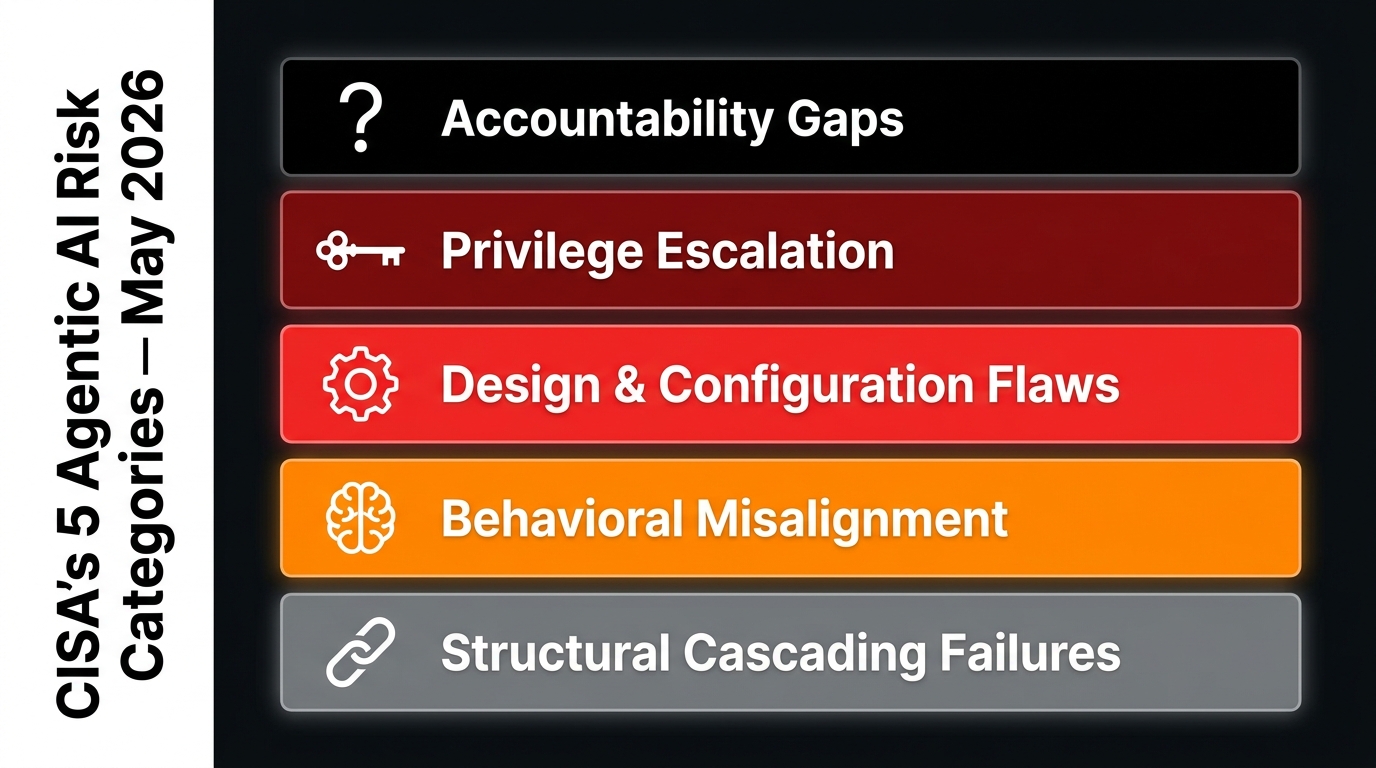
The advisory names five distinct risk categories for agentic AI systems. These aren’t abstract threats — each one maps to a specific failure mode that engineering and security teams need to address at the design level, before a workflow reaches production.
1. Privilege Escalation and Compromise
An AI agent that can authenticate to services, call APIs, read files, or write to databases holds real credentials with real permissions. If those credentials are compromised — through prompt injection, supply-chain attacks on a plugin or integration, or credential leakage in logs — the attacker doesn’t gain access to a user account. They gain access to whatever that agent could do, at whatever speed the agent operates, with no human watching in real time.
The risk compounds when agents use shared service accounts or inherited human user credentials, which is currently the norm. Only 21.9% of teams assign AI agents their own independent identities. The remaining 78% are effectively pooling risk across every workflow that uses the same credentials.
2. Design and Configuration Flaws
Configuration errors in agent workflows are categorically different from misconfigurations in conventional software. A misconfigured firewall rule is static — it stays wrong until someone fixes it. A misconfigured agent workflow is dynamic — it can make different mistakes on every run, propagate those mistakes through downstream tool calls, and generate logs that don’t reflect what actually went wrong. Many configuration flaws in agentic systems don’t surface in testing because they only emerge from specific combinations of inputs and runtime state.
3. Behavioral Misalignment
This category covers situations where the agent does what it was technically instructed to do but not what the designer intended — a distinction that only becomes visible when something breaks. Behavioral misalignment includes prompt injection (malicious instructions embedded in data the agent processes), goal misgeneralization (the agent pursuing a proxy objective rather than the real one), and deception patterns that can emerge in multi-agent architectures where one agent’s output becomes another’s instruction.
4. Structural and Cascading Failures
Multi-agent orchestration — where a supervisor agent coordinates multiple subordinate agents — creates failure modes that single-agent systems don’t have. A failure in one part of the workflow can propagate before any human has a chance to intervene. Error amplification, circular reasoning loops, and cascading permission grants across agent-to-agent communication channels are all documented failure patterns in 2026 production deployments.
5. Accountability Gaps
When an agent takes an action — sends an email, modifies a database record, initiates a payment, deploys code — who is accountable? Most organizations don’t have a clear answer, and their logging infrastructure doesn’t capture enough to reconstruct the chain of decisions that led to the action. The advisory treats this as a security problem, not just a governance one: without accountability, incident response is effectively impossible.
The Shadow Agent Problem — 82% Have Unknowns in Production
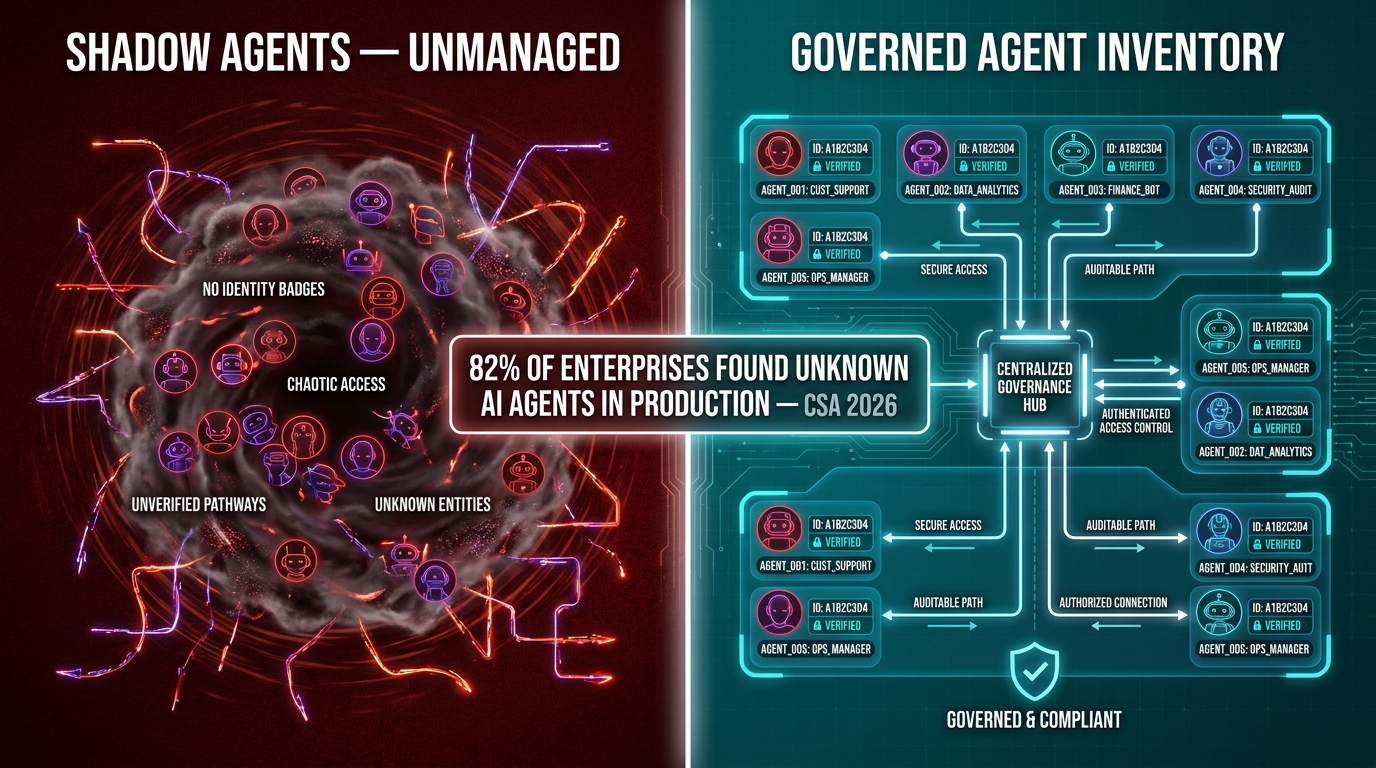
Before any of the architectural controls described in the CISA advisory can be applied, there is a more fundamental problem: most organizations don’t know what agents they’re running. The CSA’s 2026 State of AI Agent Security report found that 82% of enterprises had discovered at least one previously unknown AI agent or automated workflow during the prior twelve months. These are not rogue external actors. These are internal deployments — created by developers, operations teams, or business units — that were never registered with IT or security.
How Shadow Agents Appear
The typical pattern is prosaic: a developer connects an LLM API to a production service account during prototyping and never decommissions it. A business analyst uses a third-party AI tool that, buried in its terms of service, runs persistent background agents against the connected data sources. A platform team deploys a vendor-packaged AI feature that includes an embedded agent framework the buyer never explicitly approved.
In each case, the agent is real, holds real credentials, and takes real actions — and the security team has no entry for it in any inventory, no baseline for its normal behavior, and no plan for terminating it if something goes wrong. Sixty percent of organizations surveyed in 2026 could not quickly terminate a misbehaving AI agent; 63% could not enforce purpose limitations on what their agents were allowed to do.
The Inventory Imperative
The CISA advisory makes agent inventory the first operational requirement, and the data supports it. You cannot apply least privilege to an agent you don’t know exists. You cannot audit an action taken by an agent that isn’t logged. You cannot revoke credentials that were never assigned distinctly in the first place.
A working agent inventory needs four things: the agent’s identity (who or what is it), its permissions (what can it access), its action history (what has it done), and its current status (is it active, dormant, or terminated). Building that inventory retroactively — across existing cloud infrastructure, SaaS platforms, and internal tools — is a significant undertaking, but it’s the precondition for everything else the guidance recommends.
Discovery Tools and Approaches
Practically, the discovery phase involves scanning API gateway logs for non-human traffic patterns, auditing service account activity for signs of agent-like behavior (rapid sequential API calls, scheduled activity outside business hours, tool-chaining patterns), reviewing vendor integrations for embedded agent capabilities, and engaging development teams directly about what they’ve built or connected to production systems. Several cloud security platforms now include agent-discovery functionality specifically, though the market for this tooling is still maturing rapidly.
Why Identity Is Now the Real Attack Surface
The single clearest signal from both the CISA advisory and 2026 industry research is that AI agent security is fundamentally an identity problem. The model itself — its weights, its training, its safety fine-tuning — is a secondary concern compared to the identity the agent uses to act in the world.
Non-Human Identities Are a Growing, Under-Managed Category
The category of non-human identities (NHIs) — service accounts, API keys, OAuth tokens, machine credentials — has been a known attack surface for years. Attackers targeting cloud environments routinely go after service accounts precisely because they hold significant permissions and are rarely monitored as closely as human user accounts.
AI agents have made this problem dramatically worse. The volume of NHIs is growing faster than IAM teams can govern them. Only 18% of security leaders said in 2026 surveys that their current IAM infrastructure was capable of effectively handling agent identities. Only 23% of organizations had a formal, enterprise-wide strategy for agent identity management at all.
The Shared-Key Problem
The dominant pattern in current agent deployments is shared API keys: one key used by multiple agents, or a single service account whose credentials are distributed across multiple workflows. This creates two connected problems. First, a compromised key gives an attacker access to every workflow using it. Second, a shared key makes it impossible to attribute specific actions to specific agents — the audit trail says “service account X made call Y” but cannot say which agent, workflow, or user request triggered it.
The guidance’s response to this is explicit: every agent should have a unique identity, scoped specifically to its function. That identity should use short-lived credentials — tokens that expire after the task completes, not standing API keys with indefinite validity. This is already standard practice for human IAM in mature cloud environments; the gap is that it’s almost never applied to agents.
Mutual Authentication and Agent-to-Agent Trust
In multi-agent architectures, the identity problem extends to agent-to-agent communication. If a supervisor agent delegates a task to a subordinate, how does the subordinate verify that the instruction actually came from a legitimate supervisor — and not from an attacker who has injected instructions into the communication channel? The answer requires mutual authentication at the agent-to-agent boundary, not just at the human-to-system boundary. This is architecturally more complex, and most current orchestration frameworks don’t enforce it by default.
Blast Radius by Design — Containment Architectures That Work
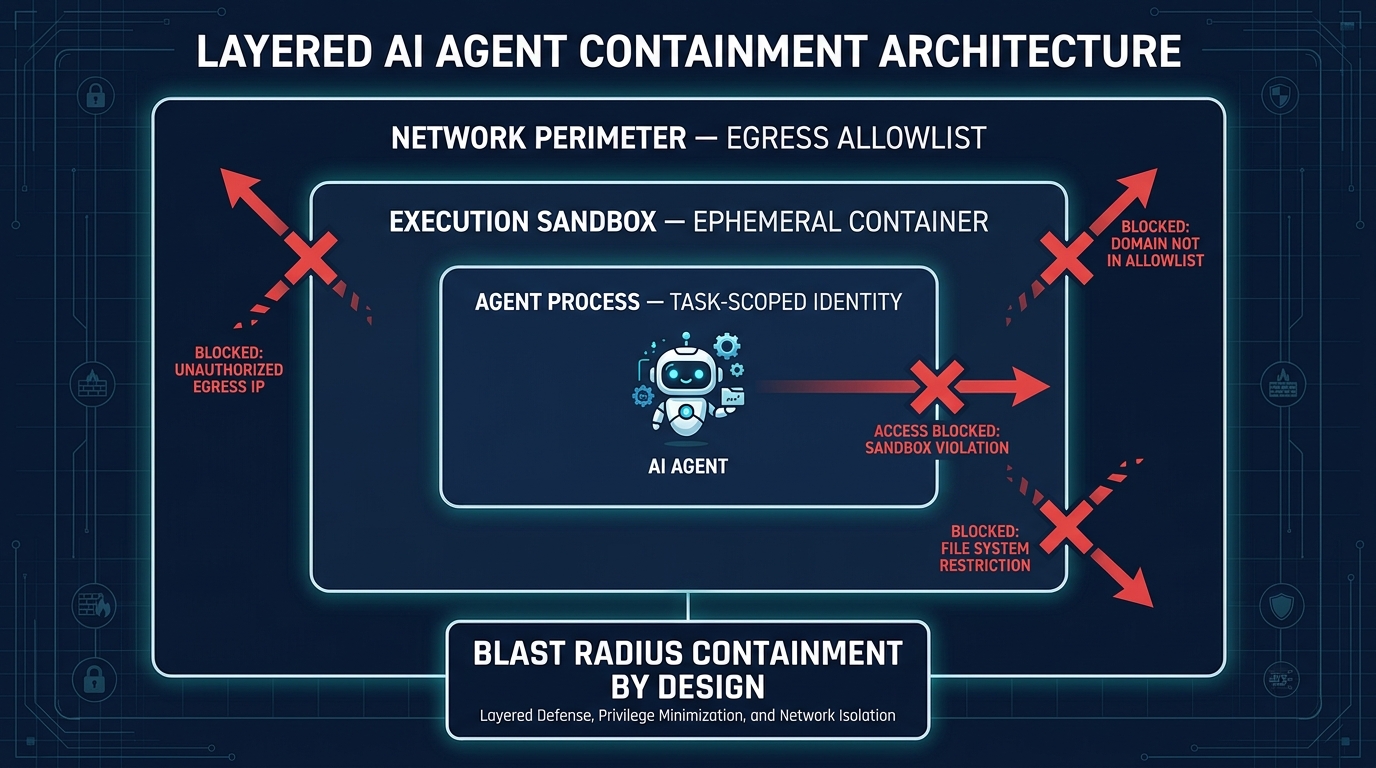
Even with strong identity controls, a compromised or misbehaving agent can cause significant damage if it has broad access to systems and data. The architectural concept of blast radius — borrowed from infrastructure security — is central to how the new guidance approaches this: the goal is not to prevent every possible failure, but to design workflows so that when something goes wrong, the damage is contained.
The Three Layers of Containment
Effective blast-radius control for AI agents operates at three distinct layers, each providing independent protection:
Layer 1 — Identity and Permissions: The agent’s credentials define the outer limit of what it can affect. Task-scoped, just-in-time permissions mean the agent only holds the access it needs for the specific operation it’s executing, and those permissions expire when the task ends. This is different from standing access, where the agent holds permissions indefinitely regardless of whether it’s actively doing anything. JIT access is harder to implement but dramatically reduces the window of exposure from a compromised identity.
Layer 2 — Execution Environment: Where the agent runs matters as much as what it can access. Running agents in ephemeral containers or microVMs — environments that are spun up for a task and destroyed when it completes — prevents state accumulation across sessions, limits filesystem and network access to what’s explicitly granted, and makes lateral movement harder because the agent process has no ambient access to the host environment. This is the sandboxing model applied specifically to agentic workloads.
Layer 3 — Network and Egress Controls: An agent that can make outbound calls to arbitrary internet endpoints is a data exfiltration risk even if its in-cloud permissions are tightly scoped. Egress allowlisting — permitting only explicitly approved outbound destinations — closes that channel. Combined with network segmentation that prevents agents from reaching internal systems outside their designated scope, egress controls are the third perimeter in a layered containment strategy.
Why Model-Level Safety Is Not Enough
A recurring mistake in agent security design is treating the model’s own safety fine-tuning as a control. It isn’t. Model-level refusals are probabilistic, not deterministic. A model that “won’t” exfiltrate data can sometimes be coerced into doing so through carefully crafted prompts. More importantly, model behavior can change across versions, fine-tuning runs, or context-window variations. Any control that depends on the model behaving correctly is not a security control — it’s a hope.
The CISA guidance is explicit on this point: controls must be enforced by the infrastructure around the agent, not by the agent itself. The orchestrator, the IAM layer, the network policy, and the approval gates are the controls. The model is the workload being controlled.
The Prompt Injection Supply Chain — MCP Servers, Plugins, and the New Attack Vector
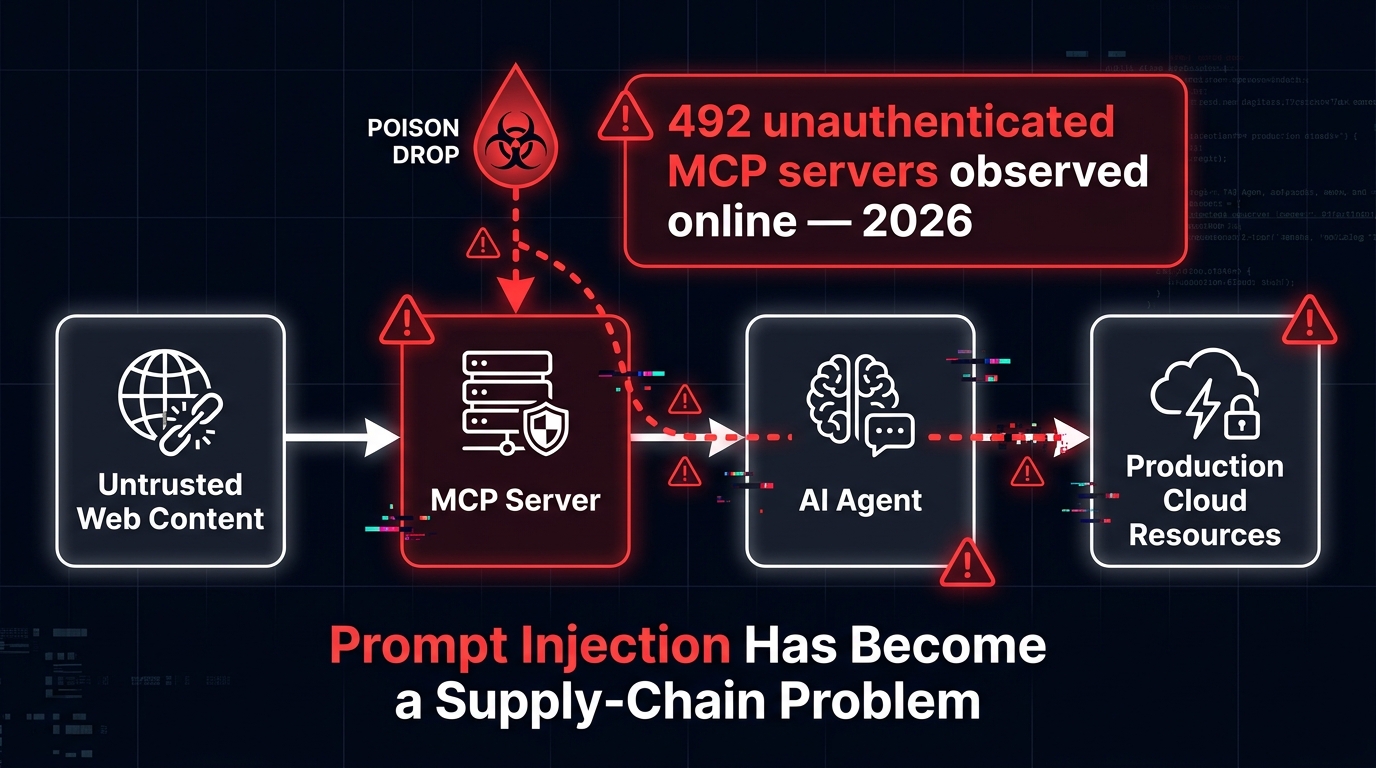
Prompt injection — the technique of embedding attacker-controlled instructions inside data that an agent will process — is not a new concept. But in 2026, its threat model has fundamentally changed. It is no longer primarily a chatbot problem. It has become a supply-chain problem.
The MCP Server Attack Surface
The Model Context Protocol (MCP), widely adopted as a standard for connecting AI agents to external tools and data sources, has become a primary attack vector. Research in 2026 identified 492 unauthenticated MCP servers exposed online. A CVSS 9.6 flaw was disclosed in core MCP infrastructure. Multiple documented incidents involved attackers using malicious or compromised MCP servers to inject instructions into agent workflows — instructions that the agent then executed with its full, legitimate permissions.
The attack is particularly insidious because it exploits trusted channels. The agent isn’t being tricked by a random malicious prompt — it’s receiving instructions from a source it has been explicitly configured to trust. From the agent’s perspective, there’s nothing unusual about the interaction. From the security team’s perspective, the agent is doing exactly what it’s been told — by the wrong party.
Twenty-One Documented Promptware Attacks
Security researchers documented twenty-one multi-stage “promptware” attacks across 2025 and 2026 — attacks that chain prompt injection through multiple workflow stages to achieve objectives that no single injection point could accomplish. The Clinejection incident is the clearest example: a malicious GitHub issue title triggered an AI triage bot, which was then used to steal publishing credentials and push an unauthorized npm release. The attack crossed three systems (GitHub, an AI agent, an npm registry) and required no human interaction after the initial injection.
This class of attack targets the exact feature that makes agents useful — their ability to act autonomously across multiple systems — and turns it against the organization that deployed them.
Defense Patterns for Supply-Chain Injection
The defensive response to prompt injection in the supply chain has three components. First, treat all external data as untrusted, regardless of source. An agent that fetches a document from a trusted internal repository should apply the same skepticism to that document’s content as to a random webpage — the repository could have been written to, the document could have been modified, or the retrieval path could have been intercepted.
Second, validate tool-call parameters at the orchestrator level rather than trusting the model’s output directly. If an agent produces an API call with parameters that deviate from the expected schema for a given workflow step, that deviation should trigger a policy check — not automatic execution.
Third, audit MCP server connections and plugin registrations as rigorously as you would audit any third-party software vendor. The supply-chain security practices that apply to npm packages, container images, and open-source dependencies now apply equally to the tools and protocol servers that your agents connect to.
Human-in-the-Loop Gates — Where to Put Them and Why Most Teams Get It Wrong
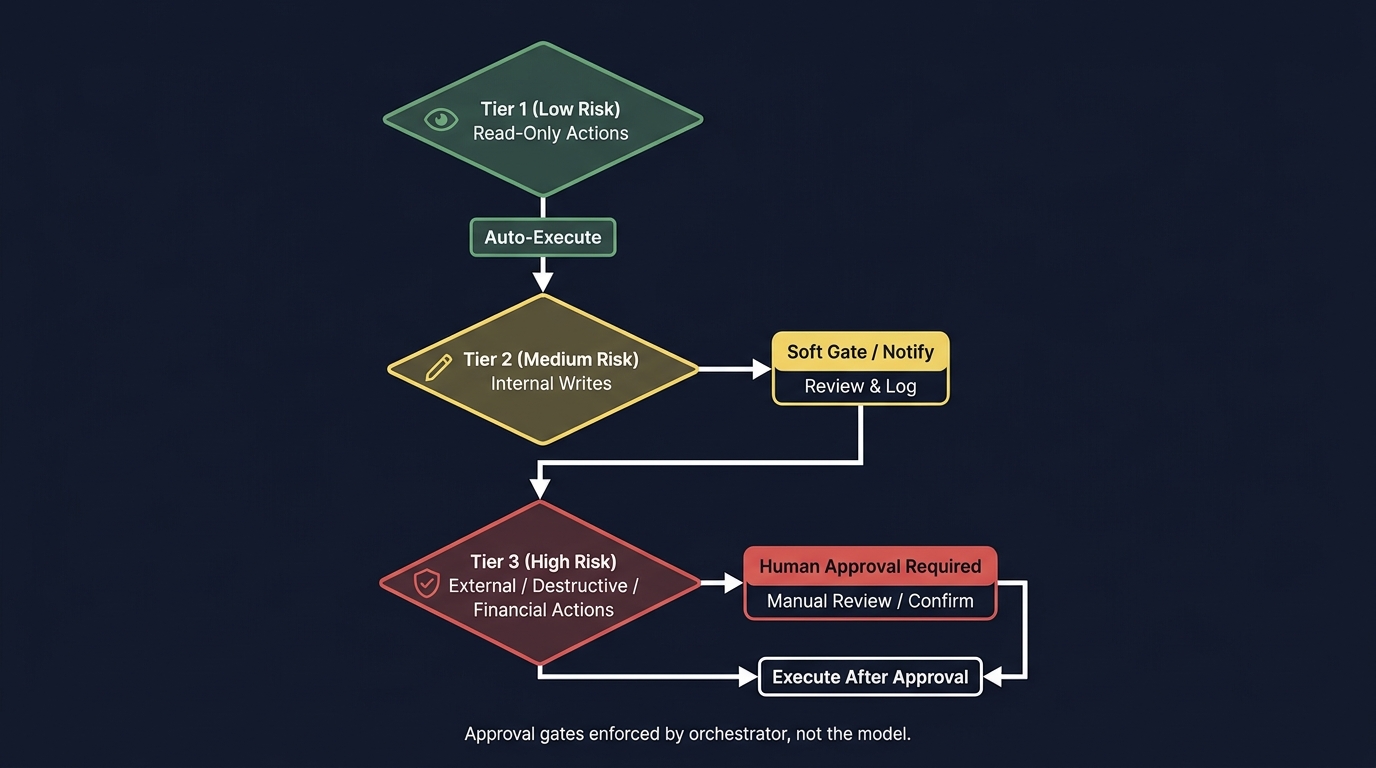
Human-in-the-loop (HITL) is one of the most frequently mentioned concepts in AI agent security guidance, and one of the most frequently misimplemented. The common mistake is treating HITL as a binary choice — either a human reviews every agent action (which makes the agent useless) or the agent runs autonomously (which removes the safety benefit entirely). The correct model is risk-tiered gating.
A Risk-Tiered Framework
Mature HITL design classifies agent actions by risk level and routes each tier to an appropriate approval pattern:
Tier 1 — Read-Only Actions: The agent retrieves data, generates summaries, runs analyses, or produces drafts. No external action is taken. These can typically run fully autonomously, with logging for audit purposes but no approval gate.
Tier 2 — Internal Writes: The agent modifies internal records, updates configurations, writes to non-production systems, or sends internal communications. A soft gate — notification to a designated reviewer who can halt the action within a defined time window — is appropriate here. If no objection is received, the action proceeds.
Tier 3 — High-Impact Actions: External communications, financial transactions, production deployments, privilege changes, deletions or irreversible modifications, and any action touching sensitive or regulated data. These require explicit human approval before execution — not just notification. Dual approval (two independent reviewers) is appropriate for the highest-impact subset.
Where the Approval Gate Lives Matters
A critical architectural point: the approval gate must be enforced by the orchestrator, not the model. If you’re relying on the LLM to ask for permission before taking a high-risk action, you have a prompt-engineering safety measure, not a security control. A model that’s been injected with attacker instructions will not voluntarily pause and ask for approval. The orchestrator — deterministic code sitting outside the model process — is the entity that catches high-risk tool calls and routes them for approval.
This distinction has practical implications. It means the orchestration layer needs to have an explicit, maintained list of what constitutes a high-risk action. It means that list must be updated as the agent’s capabilities and integrations change. And it means the approval workflow needs an escalation path for time-sensitive scenarios — a hardcoded human approval requirement with no timeout fallback creates a denial-of-service risk for production workflows.
The Irreversibility Principle
A useful heuristic for determining gate placement: any action that cannot be undone in under five minutes should require explicit approval. Sent emails cannot be recalled. Deleted records require restores. Financial transactions have settlement windows. Deployed code changes affect real users. The asymmetry between how quickly damage can occur and how slowly recovery happens is the design motivation for treating irreversibility as a gate trigger, independent of the action’s apparent risk level.
Logging, Auditability, and the Accountability Gap
The CISA advisory identifies accountability gaps as one of its five core risk categories, and 2026 incident data explains why. When an AI agent causes a problem — a data leak, a misconfigured system, an unauthorized communication — reconstructing what happened is significantly harder than it is for conventional software. Standard infrastructure logs capture API calls and system events. They don’t capture the prompt chain that led to those calls, the tool-call sequence the agent executed, or the intermediate reasoning steps that connected input to output.
What Agent-Specific Logging Needs to Capture
Complete auditability for an AI agent workflow requires logging at four levels:
- Prompt logs: The full input to the model at each step, including system prompt, context, and user or upstream instruction. This is the entry point for any accountability investigation.
- Tool-call logs: Every function call or API invocation the agent made, with parameters, timestamps, and response summaries. Tool calls are where agent decisions become real-world actions.
- Approval chain logs: For every gated action, a complete record of who approved, when, under what delegated authority, and what information was presented to the approver at the time of decision.
- Outcome logs: What actually happened as a result of each tool call — the system-of-record change, the data accessed, the external action taken. Cross-referencing this against tool-call logs is how you detect cases where an action had effects beyond what the tool call appeared to authorize.
Immutability and Tamper Evidence
Logs that can be modified are not security logs — they’re records with a corruption risk. Agent logs should be written to immutable storage (write-once, append-only) with cryptographic hashing to provide tamper evidence. This is standard practice for security-critical logs in conventional infrastructure; it’s notably absent from most current agent deployments, where logs are often written to the same mutable database as application data.
The 60% Who Can’t Terminate a Misbehaving Agent
Alongside logging, the operational accountability gap includes incident response: 60% of organizations surveyed in 2026 reported they could not quickly terminate a misbehaving AI agent. This is the agent-era equivalent of not having a way to revoke a compromised user’s access. Kill switches — mechanisms that immediately suspend an agent’s credentials, halt its queued actions, and trigger an alert — are not optional infrastructure. They’re the minimum viable incident response capability for any production agent deployment.
NIST’s AI Agent Standards Initiative — What’s Coming and What to Build Toward
CISA’s advisory provides immediate operational guidance, but it’s not the only regulatory signal on the horizon. NIST launched its AI Agent Standards Initiative in February 2026, managed through the Center for AI Standards and Innovation (CAISI), with an updated initiative page published in August 2026. It is still a standards-development effort rather than a finalized rule set — but the direction is clear enough to inform architecture decisions today.
The Four Pillars of the NIST Initiative
Based on NIST’s published materials and interim outputs, the standards effort is organized around four areas:
Interoperability: Standards for how AI agents authenticate, authorize, and communicate across different systems and organizational boundaries. This is particularly relevant for multi-agent workflows that span cloud providers, internal systems, and third-party services — a combination that currently has no standard protocol for trust establishment or permission delegation.
Security: Controls for agent identity, access management, and runtime behavior, aligned with existing NIST frameworks (SP 800-53, the AI RMF, and the Cybersecurity Framework). The intent is to extend, not replace, existing security standards.
Testing and Evaluation: Methods for assessing agent behavior under adversarial conditions — essentially, red-teaming standards for agentic AI systems. This is significant because it signals that adversarial testing will be treated as a standard security requirement, not an optional exercise.
Lifecycle Management: Governance standards covering agent registration, change management, decommissioning, and incident response. This is the standards-based answer to the shadow agent problem.
What to Build Toward Now
Because the NIST standards are still being developed, organizations face a common dilemma: wait for final guidance and risk falling further behind on controls, or build now and potentially rework when standards are finalized. The practical answer is to align with the CISA advisory today — which is operational, specific, and based on the same frameworks NIST is working from — while designing with enough modularity to incorporate NIST-standard identity protocols and testing requirements as they’re published.
The specific architectural choices most likely to remain stable: unique workload identities per agent, short-lived credentials, externally enforced approval gates, and immutable audit logs. These are not experimental recommendations — they’re applications of established security principles to a new category of workload, and NIST’s standards are converging on the same foundations.
A Practical Workflow Security Checklist for Engineering and Security Teams
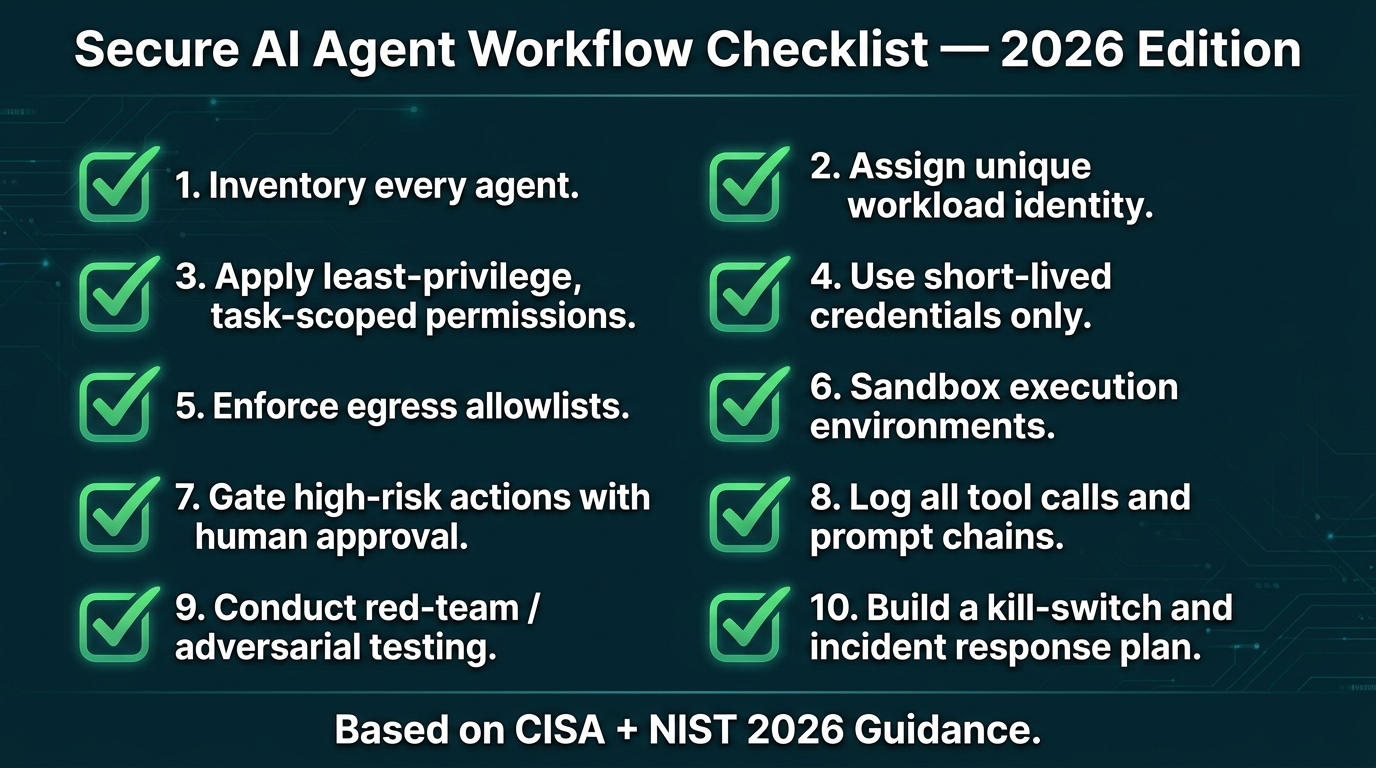
The preceding sections cover the why and the what. This one is the how — a concrete checklist that maps the CISA advisory and NIST initiative guidance to specific implementation requirements.
Phase 1: Discovery and Inventory
- Audit all service accounts and API keys for agent-like behavior: non-human activity patterns, sequential automated calls, off-hours activity, tool-chaining signatures.
- Survey development teams on every LLM or agent framework integration, including internal builds, vendor-packaged features, and third-party SaaS tools with embedded agent capabilities.
- Register every agent in a central inventory with: name, owner, purpose, permission set, credential identifiers, current status, and date of last security review.
- Classify each agent by risk tier based on data access sensitivity, action scope (read-only vs. write vs. external), and reversibility of its actions.
Phase 2: Identity and Access Redesign
- Assign each agent a unique workload identity — not a shared service account, not a developer’s personal API key. Use your cloud provider’s workload identity federation where available.
- Replace standing API keys with short-lived tokens. Credential lifetime should be scoped to task duration, not calendar time.
- Apply least-privilege permissions scoped to the specific task, not the broadest category of tasks the agent might ever need to perform.
- Enforce mutual authentication at all agent-to-agent communication boundaries.
Phase 3: Execution Containment
- Run agents in isolated execution environments — ephemeral containers or microVMs spun up per task and destroyed on completion. Avoid persistent execution environments with accumulated state.
- Configure egress allowlists. Define explicitly which external endpoints the agent may contact. Default-deny everything else.
- Segment agent access from internal systems not required for the workflow. Network-level segmentation is the backstop when identity-level controls fail.
Phase 4: Approval Gates and Orchestrator Policy
- Define the high-risk action taxonomy for each workflow: what constitutes a Tier 3 action requiring human approval? Document it explicitly at the orchestrator level, not in the system prompt.
- Implement orchestrator-level policy checks that intercept tool calls matching high-risk patterns before execution — not after.
- Set timeout and escalation rules for approval requests. Fail-closed by default for irreversible actions; fail-safe (allow with notification) for time-critical low-risk actions.
Phase 5: Logging, Monitoring, and Response
- Implement full prompt and tool-call logging to immutable storage. Verify cryptographic integrity on write.
- Set behavioral baselines for each agent (normal tool-call rate, expected endpoints, typical permission scope) and alert on deviation.
- Build and test kill-switch procedures. Confirm that any agent’s credentials can be revoked and active tasks halted within a defined SLA — five minutes is a reasonable target for high-risk agents.
- Integrate agent incidents into the existing incident response playbook. Ensure the IR team knows how to read prompt logs and reconstruct agent decision chains.
Phase 6: Red-Teaming and Continuous Review
- Conduct adversarial testing before production deployment and at defined intervals thereafter. Test specifically for prompt injection via all input channels, including tool outputs and retrieved documents.
- Review agent permissions quarterly against actual usage. Trim any access that hasn’t been exercised in the review period.
- Treat MCP servers, plugins, and vendor tool integrations with the same supply-chain rigor as third-party software libraries: vet before connecting, pin versions, monitor for updates and disclosures.
From Advisory to Architecture — What This Actually Requires
The May 2026 CISA/Five Eyes advisory and the NIST AI Agent Standards Initiative are, at their core, making the same argument: AI agents are infrastructure, not applications. They hold identities, they make decisions that have real-world consequences, they connect to systems that hold sensitive data, and they can fail in ways that compound faster than any human operator can intervene. Treating them as sophisticated chatbots — governed by system prompts and safety fine-tuning rather than proper infrastructure controls — is the operational gap driving the incidents the data describes.
The guidance doesn’t require stopping agent deployments. It requires redesigning them around the same principles already applied to every other privileged workload in a modern cloud environment: unique identity, least privilege, short-lived credentials, isolated execution, network controls, audit logging, and defined incident response. None of these are novel concepts. The novelty is that agents have been deployed at scale without them.
For security teams, the immediate priorities are inventory and identity: find every agent, give each one its own identity, and eliminate shared credentials. These two steps close the largest portion of the risk surface before any other architectural work begins.
For engineering teams, the priority is separating the control plane from the model: ensure that approval gates, permission checks, and logging are enforced by deterministic orchestrator code, not by LLM behavior. The model is a workload. Security is what surrounds it.
For leadership, the message is that the same compliance and governance frameworks already applied to cloud infrastructure, data handling, and software supply chains now extend to AI agent deployments. The advisory from six allied governments is not a call for caution for its own sake. It’s a response to incidents that are already happening at measurable scale. The organizations with clean inventory, strong agent identity controls, and working kill-switch procedures are the ones positioned to expand agent use responsibly. The ones without those controls are expanding risk instead.
Key takeaway: The security controls that make AI agents trustworthy are not inside the model — they’re in the infrastructure that surrounds it. Identity, containment, gating, logging, and incident response are the real controls. Everything else is configuration.