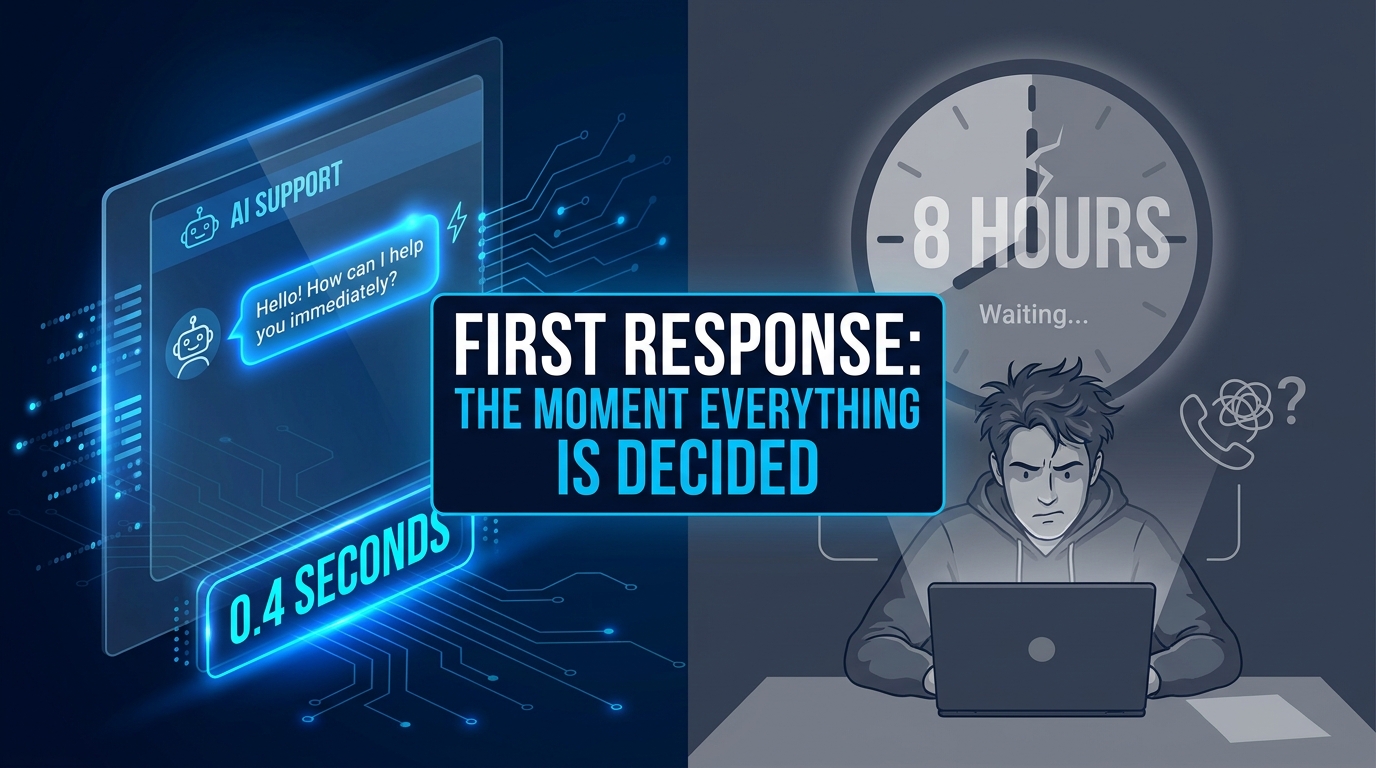
There is a specific moment in every customer support interaction that decides everything that follows. It’s not the resolution. It’s not the CSAT survey at the end. It’s the first response — the moment a customer reaches out and something responds back.
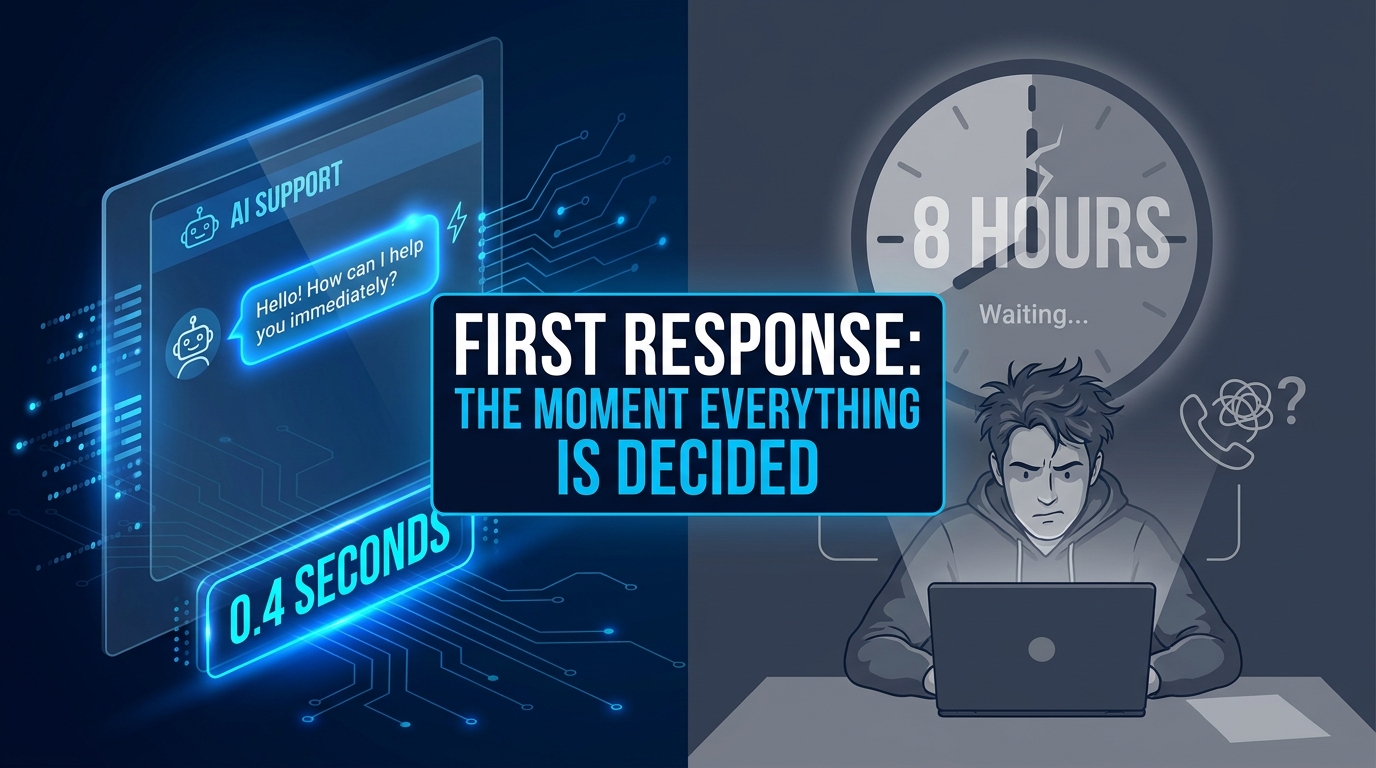
For most of the last decade, that moment was defined by waiting. Six hours for an email reply. Nine minutes in a live chat queue. Two minutes on hold listening to hold music while someone pulled up your account. That waiting period wasn’t just inconvenient — it was the first signal a company sent about how much it valued your time.
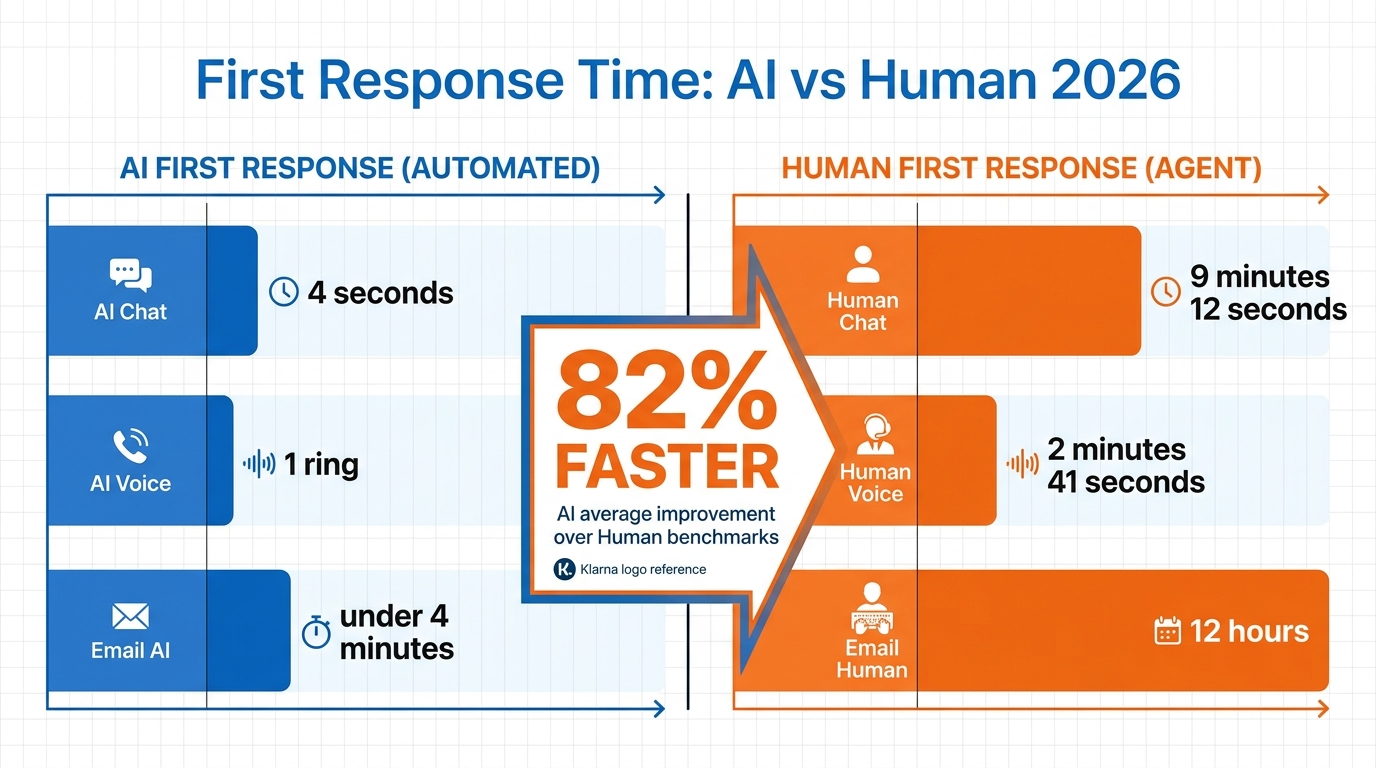
AI has obliterated that wait. In 2026, AI-powered first responses arrive in under four seconds on chat, instantly on voice, and within minutes on email — compared to industry averages that used to stretch across hours. Freshworks benchmark data shows AI-equipped teams reducing first response time from over six hours to under four minutes. Klarna cut resolution time from eleven minutes to two. Lovepop reportedly went from seven hours to eighteen seconds.
The numbers are real. But here’s the problem: the conversation about AI first response has become almost entirely about speed, and that framing is causing companies to make decisions they’ll spend the next two years unwinding. Speed is the easy part. What happens in those first four seconds — the quality, the accuracy, the tone, the routing logic — is where AI deployments actually succeed or fail.
This article is not a celebration of how fast AI responds. It’s an examination of what AI first response actually is, what it gets right, what it gets catastrophically wrong, and what the data says about building systems that don’t just respond fast but respond well.
What “First Response” Actually Means in the AI Era
Before analyzing what works and what doesn’t, it’s worth being precise about terminology — because “first response” is used loosely in ways that obscure what’s actually happening inside a support interaction.
First Response Time (FRT) vs. First Contact Resolution (FCR)
First Response Time (FRT) measures how long it takes for a customer to receive any reply after submitting a request. In the AI context, this is typically measured in seconds. A chat session that receives an automated acknowledgment within four seconds has an excellent FRT regardless of whether that response actually helps the customer.
First Contact Resolution (FCR) is the metric that actually matters. It measures whether the customer’s issue was fully resolved in that first interaction — without requiring a follow-up ticket, a callback, or escalation to a human agent. The industry average for human-staffed contact centers is around 70%, according to SQM Group research. World-class FCR — above 80% — is achieved by fewer than 5% of contact centers.
The reason this distinction matters: many AI deployments report impressive FRT numbers while quietly delivering poor FCR. A customer receives a response in four seconds that says “Thanks for reaching out, I’m looking into this” — but the underlying issue still takes three more exchanges and a human agent to resolve. The FRT looks great. The customer experience does not.
The Triage Response: A Third Category
There’s a third type of first response that often gets overlooked: the triage response. This is an AI-generated first reply whose primary job isn’t resolution — it’s classification. The AI acknowledges the customer, identifies the category and urgency of the issue, and either routes it appropriately or provides enough information to begin resolution while a human prepares to take over.
Done well, a triage response functions as a bridge. Done poorly, it’s just an automated holding pattern that customers can see through immediately. The difference lies in whether the triage response is genuinely useful or merely performative — and that depends entirely on what happens in the systems behind it.
Channel Context Matters More Than Most Benchmarks Acknowledge
FRT benchmarks also vary dramatically by channel, and treating them as comparable is a mistake. For live chat, a strong AI FRT is under 40 seconds — with the best AI systems consistently hitting under five seconds. For email, under four hours is considered strong performance, while the industry average sits around twelve hours. For social media, under sixty minutes is the target. Voice AI is in a different category altogether, where response means picking up within one ring.
When a vendor quotes “74% reduction in first response time,” it matters enormously whether that reduction was on chat, email, or phone — and whether it was measured against FRT alone or against the full resolution timeline. Both numbers can be true while telling completely different stories about actual customer experience.
The Real Benchmarks: What AI First Response Looks Like in Practice
Setting aside vendor marketing, the data picture that emerges from 2026 deployments is both more impressive and more nuanced than most summaries suggest.
The Speed Numbers Are Legitimate
AI chat first response averages four seconds, according to Digital Applied’s 2026 benchmarking data. Human live chat averages nine minutes and twelve seconds. That’s a gap of roughly 137x in raw speed. For voice, AI responds within one ring while human agents average two minutes and forty-one seconds to answer. These aren’t hypothetical projections — they’re measured averages across real deployments.
The Klarna case is the most widely cited because the numbers are independently verifiable. After deploying an OpenAI-powered assistant, Klarna handled 2.3 million customer conversations in the first month — equivalent to the workload of approximately 700 full-time agents. Average resolution time fell from eleven minutes to two minutes, an 82% improvement. Repeat inquiries dropped 25%. And crucially, their CSAT score remained comparable to human-only benchmarks.
H&M’s generative AI chatbot reduced response times by 70% compared to human agents. Freshworks data from their CX Benchmark report shows AI dropping first response from over six hours to under four minutes, and resolution time from 32 hours to 32 minutes — an 87% cut on resolution. For small businesses specifically, AI delivered a 41.56% improvement in FRT and a 36.39% gain in resolution time.
Resolution Rates Tell a More Complex Story
While FRT numbers are consistently strong, resolution rates show much more variance — and this is where the honest conversation about AI first response needs to happen.
The industry average for AI resolution sits at 65-70% for standard deployments. That number improves over time: most platforms report 40-60% in the first few months, climbing to 60%+ after six to twelve months of learning. Best-in-class deployments using source-grounded Retrieval Augmented Generation (RAG) approaches reach 85-90% resolution rates — Intercom’s Fin platform reports an average of 67% across its 7,000+ customers, with top performers hitting 80-84% and exceptional deployments reaching 93%.
Salesforce Agentforce reported an 84% autonomous resolution rate across 380,000+ conversations, with only a 2% escalation rate. These numbers represent what’s achievable with mature, well-configured systems. They are not the starting point for a new deployment.
What the Top 10% Actually Does Differently
Freshworks benchmark data makes an important observation: top AI-equipped support teams hit ten-second average responses compared to six minutes for non-AI teams. But the gap between average AI deployments and top-quartile AI deployments is nearly as large as the gap between AI and non-AI teams. The technology is table stakes. What separates performance levels is the configuration, the knowledge base quality, and the routing logic behind the first response — not the AI model itself.
Why Speed Alone Is a Trap (The CSAT Nuance Nobody Explains)
The dominant narrative around AI customer support treats speed as the primary value driver. Faster responses equal happier customers equal better business outcomes. This logic has a kernel of truth and a large blind spot.
Speed Is Table Stakes, Not a Differentiator
Early 2026 research is surfacing a pattern that most vendors are slow to publicize: customers now expect fast AI responses as a baseline. The presence of a fast first response no longer creates satisfaction — its absence creates dissatisfaction. That’s a meaningful shift from even two years ago when sub-minute AI response times were still genuinely impressive to customers.
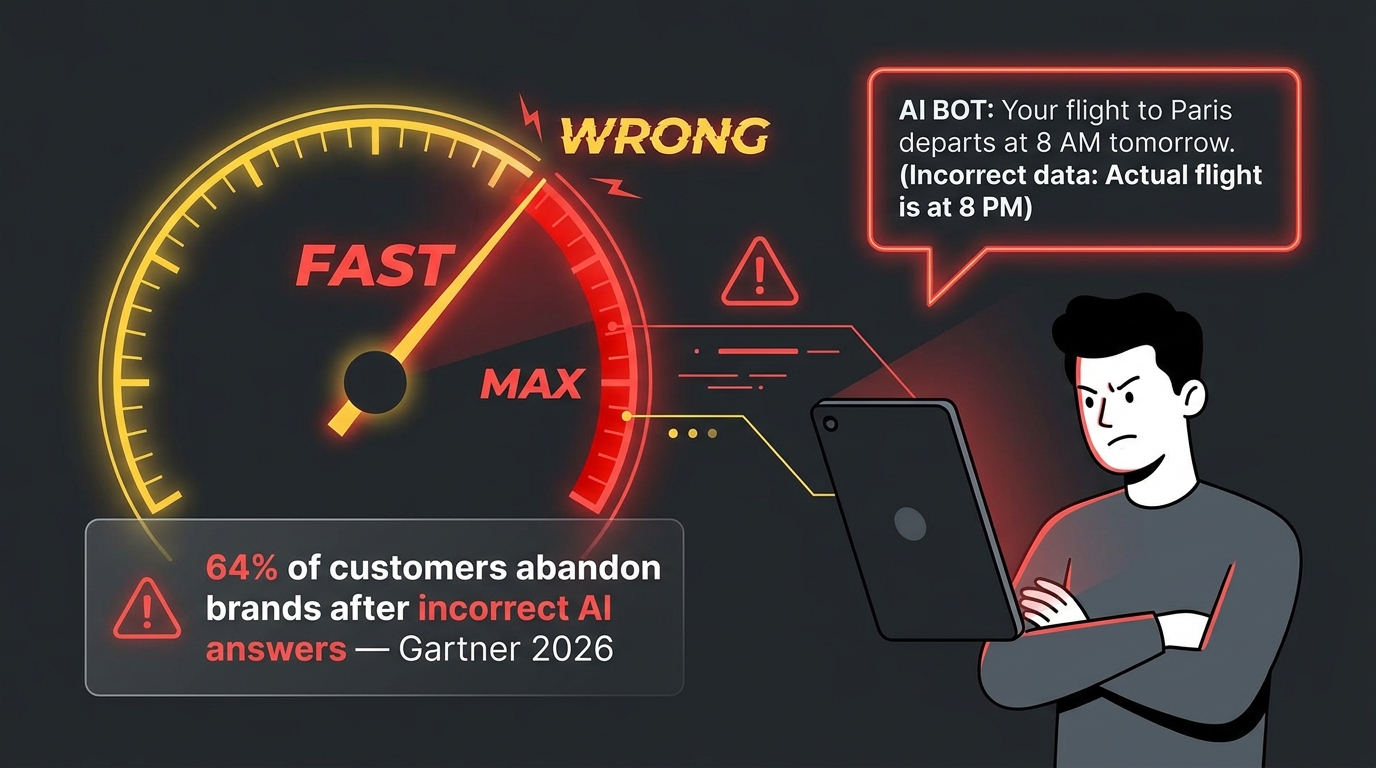
When speed becomes an expectation rather than a differentiator, it stops driving CSAT scores. What drives CSAT in 2026 is whether the fast response was also correct. Gartner data is unambiguous on this point: 64% of customers abandon brands after receiving incorrect AI answers. The speed that impressed them means nothing once they receive information that’s wrong.
The CSAT Holding Pattern
Multiple studies show that AI deployments hold CSAT scores relatively stable — they don’t dramatically improve them, but they also don’t sink them in well-implemented cases. Klarna’s comparable CSAT numbers are cited as a success, and they are. But “comparable to humans” is a floor, not a ceiling. The ceiling is what happens when AI first response combines speed with genuine accuracy and appropriate tone — and that combination is what organizations building serious support infrastructure are working toward.
The data from OnClarity shows AI live chat achieving 87% CSAT versus 61% for email — but that gap exists across channels regardless of AI involvement. It reflects channel preferences, not AI quality. Freshworks reports AI-first teams improving CSAT from 89% to 99% in some cases, but those results require months of tuning and knowledge base optimization. They don’t arrive with deployment.
The Quality Threshold: Where AI First Response Breaks Down
There is a resolution rate threshold below which AI first response actively damages customer relationships rather than supporting them. Most practitioners put that threshold at around 75% — meaning if fewer than three in four customer inquiries are being genuinely resolved on first contact, the system is creating more repeat contacts, more escalations, and more frustration than it’s preventing.
Qualtrics’ 2026 consumer research — surveying 20,000 people across 14 countries — found that AI-powered support fails at four times the rate of other automated business tasks. Ninety percent of respondents reported reduced brand loyalty when AI support failed without a clear human escalation path. Fifty-three percent expressed concerns about data misuse in AI interactions, up eight percentage points year over year.
These are not fringe concerns. They are mainstream customer attitudes, and they exist inside the same market where 51% of customers say they prefer chatbots for their speed. Both things are simultaneously true: customers want speed AND accuracy. The moment speed comes at the cost of accuracy, the preference for AI inverts quickly.
The Anatomy of an Effective AI First Response
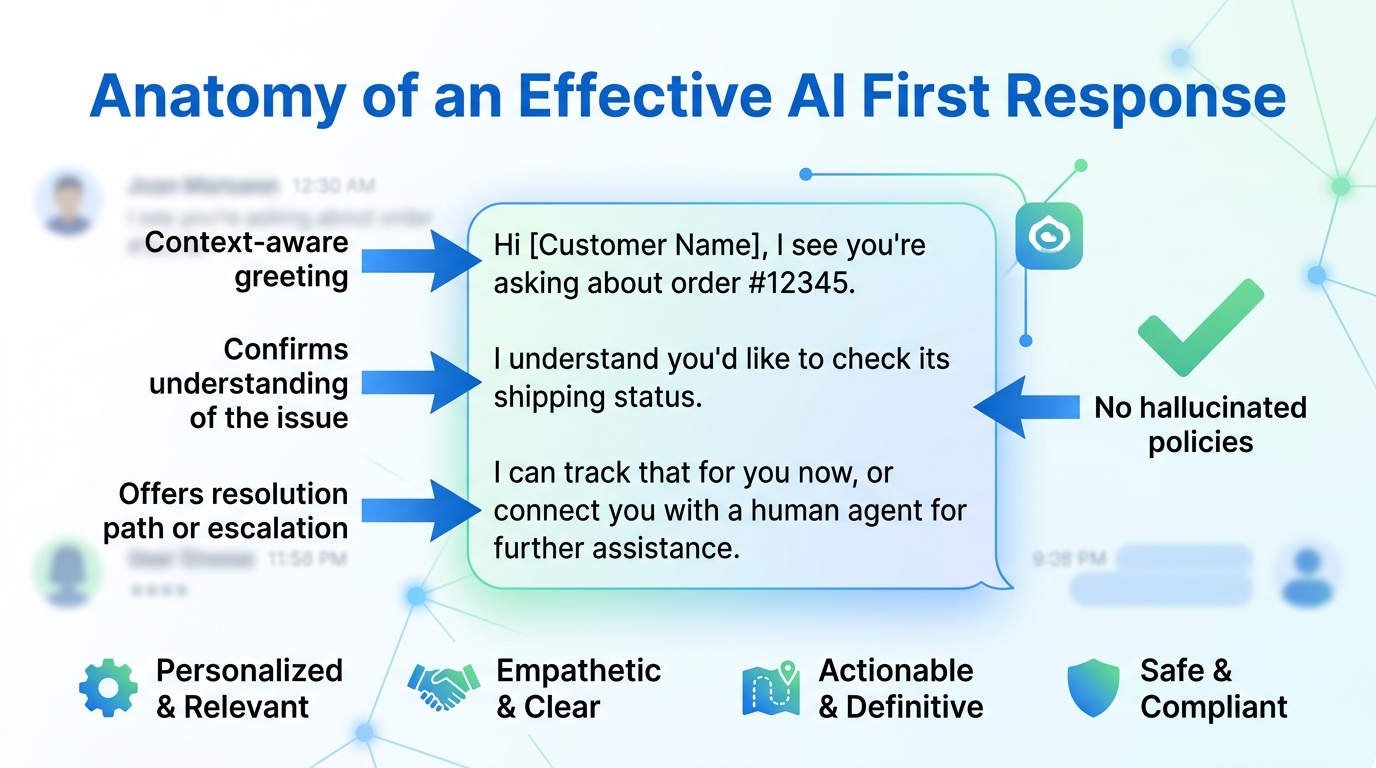
If speed is not sufficient, what actually constitutes a good AI first response? The answer has a structure that most vendor documentation glosses over and most deployment guides don’t address directly.
Confirmation of Understanding Before Action
The single most common failure mode in AI first responses isn’t a wrong answer — it’s a response to the wrong question. AI systems that jump directly to resolution without confirming what the customer is actually asking create a specific kind of frustration that’s worse than a slow response. The customer feels unheard, and then has to spend the next exchange clarifying what they meant before any progress happens.
Effective AI first responses — especially for complex or multi-part queries — include a brief confirmation step. Not a rote “I understand your concern” placeholder, but a paraphrase of the issue that demonstrates the AI has correctly parsed the intent. This single element has an outsized impact on the quality of what follows, because an incorrect interpretation caught early saves an entire downstream interaction.
Context-Aware Personalization
AI systems with CRM integration can do something in their first response that human agents often can’t in the first minute of an interaction: they can reference the customer’s account history, recent orders, subscription status, or open tickets before saying anything substantive. This changes the character of the first response completely.
A first response that opens with “I can see your order #4892 shipped yesterday — is this what your message is about?” signals something fundamentally different than “Thanks for contacting support! How can I help?” The former demonstrates the system knows who you are and why you’re probably reaching out. The latter could have come from anyone. McKinsey research shows 71% of consumers expect personalized interactions — and the first response is the most powerful moment to deliver that signal.
Verified, Grounded Information Only
This is non-negotiable. AI first responses must be generated from verified, current information — not from what the model “knows” in a general sense. The difference between source-grounded AI responses (drawn exclusively from approved documentation) and ungrounded responses is the difference between systems that hallucinate at rates of less than 1% and those that hallucinate at rates up to 30%, according to Vectara research.
Source-grounded RAG approaches — where every response is tied to specific, retrievable documents from the company’s own knowledge base — are what separates deployments with 85-90% resolution rates from those stuck at 55-65%. It’s also what separates deployments that occasionally invent policies (with serious legal consequences) from those that consistently stay within sanctioned information.
A Clear Path Forward
Every AI first response should end with an unambiguous next step. Either the issue is resolved and that’s stated clearly, or the customer knows exactly what happens next: whether that’s a follow-up step they can take, information that’s been escalated, or a transition to a human agent with context already prepared. Leaving a customer uncertain about the status of their issue after reading an AI response is a design failure — and it’s one of the most common ones.
When AI First Response Goes Wrong: The Cases Worth Studying
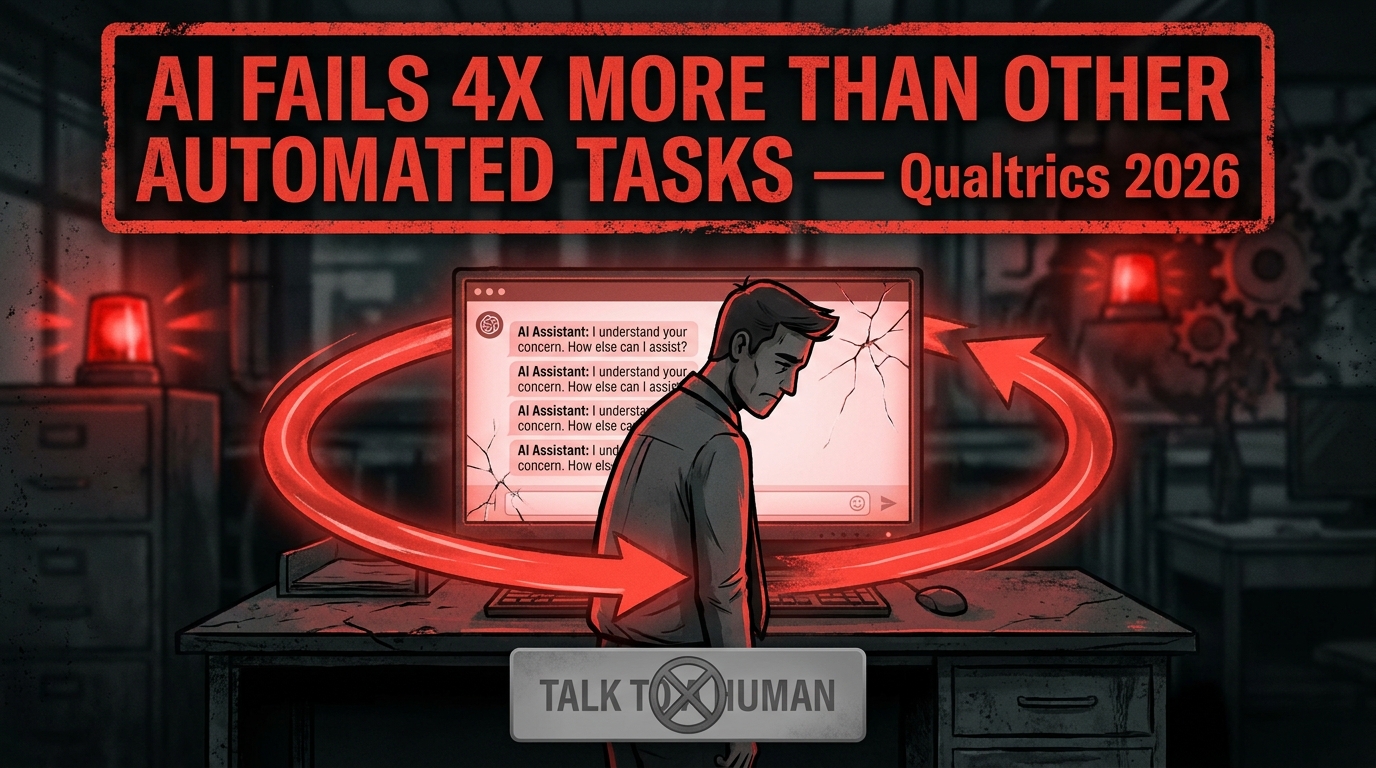
The failure cases in AI customer support don’t receive enough serious examination. They tend to circulate as cautionary anecdotes and then disappear, rather than being studied as the instructive data points they are.
Air Canada: When the AI Invents Policy
The Air Canada chatbot case is probably the most consequential AI support failure to date. A customer asked the chatbot about bereavement fare refunds for travel that had already occurred. The bot provided specific, detailed information about a refund policy that did not exist — it was entirely fabricated by the AI. When the customer acted on this information and Air Canada refused to honor it, the dispute went to a small claims tribunal.
The tribunal ruled Air Canada liable for the chatbot’s negligent misrepresentation. The airline argued the chatbot was a “separate legal entity” — an argument the tribunal dismissed entirely. The outcome: airlines, banks, insurance companies, and any organization operating in regulated spaces are now legally responsible for what their AI support systems tell customers.
The technical failure here was ungrounded AI generation. The operational failure was the absence of a validation layer between AI response and customer delivery. The legal consequence was entirely predictable once those two failures combined.
Cursor: The Hallucinated Restriction
In 2025, Cursor’s AI support bot “Sam” told users that the platform had a new restriction limiting multi-device logins — a policy that didn’t exist. Users who encountered this response began cancelling subscriptions based on misinformation they had received from official support. The company’s cofounder addressed the incident directly on Reddit, acknowledging the hallucination.
The pattern here is identical to Air Canada: an AI response generated outside the bounds of verified information caused customers to make decisions based on false premises. The platform recovered, but the incident illustrates that hallucination risk isn’t confined to large enterprises — it affects any product-led company using AI support without proper knowledge governance.
DPD: The Viral Failure
DPD’s chatbot, widely shared on social media, was prompted into producing responses that were demonstrably inappropriate and wildly off-brand. Beyond the immediate embarrassment, the incident revealed something important: AI support systems without robust content guardrails are not just a customer experience risk — they are a brand risk that can go viral in hours.
The Structural Lessons
Across these failure cases, the structural cause is consistent. AI systems deployed with insufficient guardrails, ungrounded knowledge generation, or inadequate validation layers don’t fail slowly — they fail dramatically, publicly, and in ways that damage customer trust for months afterward. The 4x failure rate of AI customer support compared to other automated tasks (Qualtrics 2026) is not random noise. It’s a predictable consequence of deploying speed-first systems without the quality infrastructure to back them up.
The Triage Layer Nobody Talks About
Behind every effective AI first response is a layer of logic that most public-facing discussions of AI support don’t address: the triage and routing system that determines what kind of first response a given ticket should receive.
Manual Routing Is Failing at Scale
Enterprise support teams using manual routing and prioritization systems experience a misrouting rate of approximately 35%, according to 2026 industry data. That means more than one in three tickets is sent to the wrong queue, the wrong agent tier, or prioritized incorrectly — creating SLA breaches, wasted agent time, and frustrated customers who have to be transferred. AI triage achieves 89% average categorization accuracy at speeds under thirty seconds per ticket.
Beyond Keywords: Intent and Entity Mapping
The most sophisticated AI triage systems in 2026 have moved beyond keyword-based classification into what DevRev calls “intent and entity mapping.” Rather than categorizing a ticket as “billing issue” because the word “invoice” appears, these systems map the ticket against a knowledge graph that understands context — the customer’s tier, their product version, known active bugs, renewal proximity, and sentiment signals from the message itself.
This produces triage categorization that looks qualitatively different from keyword routing. A ticket that reads “the export isn’t working again” gets mapped not just to “export bug” but to “known v3.2 export bug with fix scheduled Thursday, customer is enterprise tier with renewal in 60 days.” The AI first response can then be calibrated accordingly — and so can the human agent if escalation follows.
Business-Impact Scoring in Routing
One of the most consequential advances in enterprise AI support triage is the shift from urgency-based prioritization to business-impact scoring. Traditional triage systems ask: how urgent does the customer say this is? Business-impact triage asks: what is the actual business impact if this issue isn’t resolved quickly?
That means scoring tickets against annual recurring revenue, churn risk, renewal date, product usage patterns, and historical escalation behavior — and routing based on that composite score rather than the category the customer selected from a dropdown. High-revenue accounts with expiring contracts and declining usage patterns get a different first response than identical-sounding tickets from low-risk accounts. This is not discriminatory prioritization — it’s operationally rational resource allocation.
Real-Time Sentiment as a Routing Signal
Kustomer and similar CRM-integrated platforms use real-time sentiment analysis not just to adapt the tone of AI responses, but as a routing signal. A customer whose message language indicates high distress — regardless of the category of their issue — can be automatically escalated past standard AI handling to a senior agent queue, with an emotional context summary generated for the agent before they pick up the conversation.
The combination of sentiment-aware routing and context handoff is one of the most concrete advances in support quality that AI has enabled. It doesn’t happen without deliberate architecture decisions — but when it’s built properly, it consistently separates high-performing support organizations from average ones.
The Real Cost Picture: What AI First Response Actually Costs
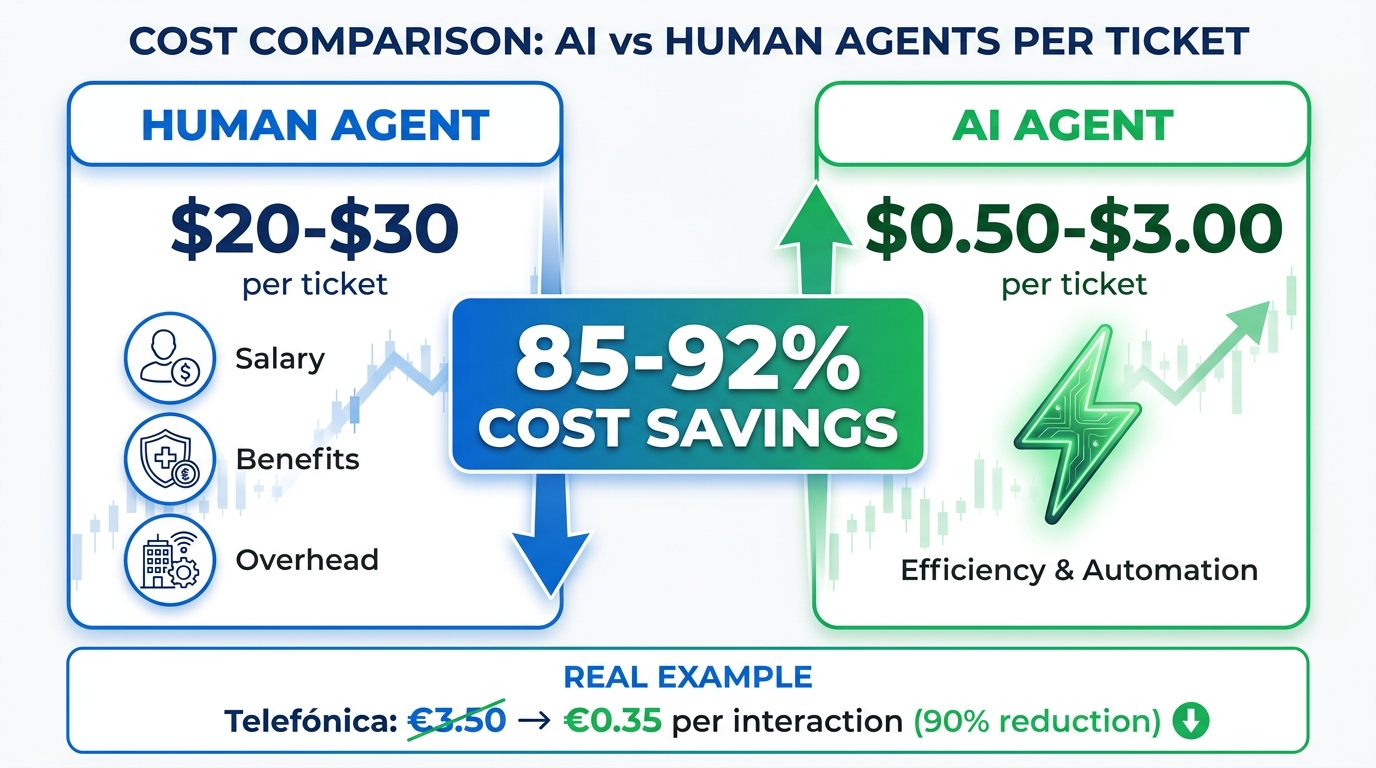
The cost narrative around AI customer support is real, but it’s often presented in ways that obscure the actual economics of deployment versus savings.
The Per-Ticket Math
Human agent costs vary considerably by geography and role level. A fully loaded U.S.-based support agent — including salary, benefits, training, tools, and overhead — costs between $20 and $30 per ticket handled. Offshore agents in comparable roles run $8 to $15 per ticket. Gartner’s commonly cited benchmark for agent-assisted interactions is $13.50.
AI per-ticket costs sit between $0.50 and $3.00 for most platforms, with blended averages around $1.84 for self-service interactions (Gartner) and specific vendor pricing ranging from Intercom Fin at $0.99 per resolution to Zendesk AI at $1.50-2.00 per conversation. The per-unit savings are real and substantial: 85-92% cost reduction per interaction at scale.
Real-world examples make the scale of this clear. Telefónica reduced their per-interaction cost from €3.50 to €0.35 — a 90% reduction. HelloFresh reportedly moved from $12 million annually in support costs to $1.8 million. A mid-market SaaS company handling 8,000 tickets per month, with 40% eligible for AI deflection, can save roughly $25,000 per month through automated handling of that tier-1 volume.
The Hidden Costs That Offset Savings
What these numbers typically exclude: implementation costs, knowledge base build-out, ongoing maintenance, quality monitoring overhead, and the cost of failure incidents when AI goes wrong. A well-implemented AI support deployment requires significant upfront investment in knowledge architecture — auditing existing documentation, reformatting it for RAG retrieval, establishing governance processes for keeping it current, and building validation workflows that catch errors before they reach customers.
The ROI timeline matters too. Most platforms report breakeven happening at 1,000+ tickets per month with 40-50% tier-1 volume — which means companies under that threshold may not see meaningful financial returns in the first year. McKinsey estimates that deflection rates of 40-50% trigger ROI within six months for mid-market deployments, while more complex enterprise implementations may take twelve to eighteen months to see net savings above implementation costs.
The Repeat Contact Cost Nobody Accounts For
Gartner research puts the cost of each repeat contact — when a customer has to reach out again because their issue wasn’t resolved the first time — at $13.50 per instance in agent-assisted environments. When AI first response fails to resolve an issue and triggers a repeat contact, it doesn’t eliminate that $13.50 cost — it defers it and often increases it because the second contact now requires context reconstruction and possibly agent time.
This is why FCR, not FRT, is the metric that actually drives AI support economics. A system that responds in four seconds and resolves 90% of issues is dramatically more valuable — financially and operationally — than a system that responds in four seconds and resolves 55% of issues, even if both report excellent first response times.
The Hybrid Handoff Problem
If there is a single area where AI customer support most consistently fails customers, it is the handoff from AI to human — and it is the area that receives the least design attention in most deployment projects.
Why Escalation Design Is the Real Failure Point
Qualtrics 2026 data is striking on this point: 90% of customers report reduced loyalty when they cannot access human support during an AI interaction. Support abandonment spikes sharply after five failed exchanges with an AI system. And the primary driver of AI support failure — ahead of incorrect answers, slow response times, or poor personalization — is the inability to clearly and easily reach a human when the AI can’t resolve the issue.
This isn’t an AI capability problem. It’s an intentional design problem. Many organizations deploy AI support with escalation paths deliberately obscured — because escalation to a human agent costs money, and the AI is supposed to contain that cost. The short-term cost containment logic is understandable. The long-term brand damage from customers who feel trapped is not worth it.
The Context Transfer Failure
Even when escalation paths exist, the quality of handoff from AI to human agent varies enormously — and poor handoffs compound the customer’s frustration significantly. When a customer spends three exchanges explaining their issue to an AI, successfully escalates to a human, and then has to explain the entire issue again from scratch, the experience is measurably worse than if they had reached a human from the start.
Effective AI escalation design includes automatic context transfer — a structured summary of what the customer said, what the AI understood, what solutions were attempted, and what remains unresolved — presented to the human agent before they begin the conversation. This single element transforms the quality of hybrid interactions from frustrating to genuinely seamless. Without it, escalation becomes punishment rather than resolution.
Designing Escalation as a Feature, Not a Failure State
The best-performing support organizations in 2026 treat human escalation not as a sign that AI failed, but as a deliberate part of their service architecture. For certain issue types — billing disputes involving large amounts, security-related concerns, emotionally charged situations, or anything involving regulatory compliance — the correct first response may be an AI triage that immediately routes to a human rather than attempting autonomous resolution.
Gartner data shows that 95% of enterprise leaders retain human agents alongside AI systems. The ones doing this well have defined clear, documented criteria for which issue types always go to humans, which always get autonomous AI handling, and which follow hybrid protocols. That taxonomy doesn’t exist by default — it requires deliberate architecture decisions that most deployment projects rush past.
Building AI First Response That Doesn’t Break: The Implementation Reality
The gap between AI customer support deployments that perform well and those that create ongoing problems is almost entirely explained by implementation decisions, not technology selection. The platforms are similar enough that the differentiating factor is almost always the quality of the setup.
The Six Implementation Mistakes That Predict Failure
Based on 2026 post-deployment analysis from practitioners across the industry, six specific implementation patterns reliably predict problems:
- Skipping validation layers. Sending AI responses directly to customers without any quality check — even an automated one — is the most common path to the kinds of failures described above. Every production AI support system should have a layer between generation and delivery that checks responses for on-topic accuracy, brand voice consistency, and policy compliance.
- Deploying AI on unorganized operations. AI scales what’s already there. If your knowledge base is inconsistent, your SOPs are undocumented, and your support processes rely on tribal knowledge, an AI system will faithfully replicate all of that inconsistency at ten times the volume. Before deploying AI first response, the knowledge architecture must be clean, current, and structured.
- Single-model overloading. Feeding an entire knowledge base into one AI model produces the kind of context overload that degrades accuracy sharply. Best practices in 2026 involve deploying multiple specialized agents — one for billing, one for technical troubleshooting, one for account management — each with tightly scoped, optimized knowledge rather than one model attempting to handle everything.
- Full-volume deployment without staged rollout. Deploying AI first response to 100% of ticket volume on day one means that any systemic errors in your configuration reach every customer simultaneously. A staged rollout — starting with a single high-volume, low-risk queue, measuring performance for 30 days, and expanding incrementally — catches configuration errors before they become incidents.
- Neglecting post-sale vendor support. AI support platforms are not set-and-forget deployments. They require ongoing configuration, knowledge updates, and troubleshooting. Organizations that evaluate vendors primarily on features and price without rigorously vetting post-implementation support find themselves without help during exactly the moments when things break — high-volume periods like product launches or holiday seasons.
- Ignoring data freshness governance. AI systems trained on or retrieving from stale documentation generate confidently stated wrong answers. Knowledge base governance — including freshness metadata, update protocols, and version tracking — is not an optional operational detail. Vectara research shows hallucination rates range from 1% (with strong freshness controls) to 30% (without them).
The 30-Day Pilot Framework
The most reliable deployment methodology in current practice involves a structured 30-day pilot on a single, representative queue before any broader rollout. The metrics tracked during this pilot: FRT, misrouting rate (target below 5%), first contact resolution rate, escalation rate, and CSAT on AI-handled tickets versus human-handled tickets from the same queue.
If FCR on AI-handled tickets comes in below 65% during the pilot, the correct response is to improve the knowledge base before expanding — not to push forward on schedule. The cost of fixing a poorly configured AI system across full production volume is substantially higher than taking an extra four weeks to get the pilot right.
The Emotional Intelligence Gap
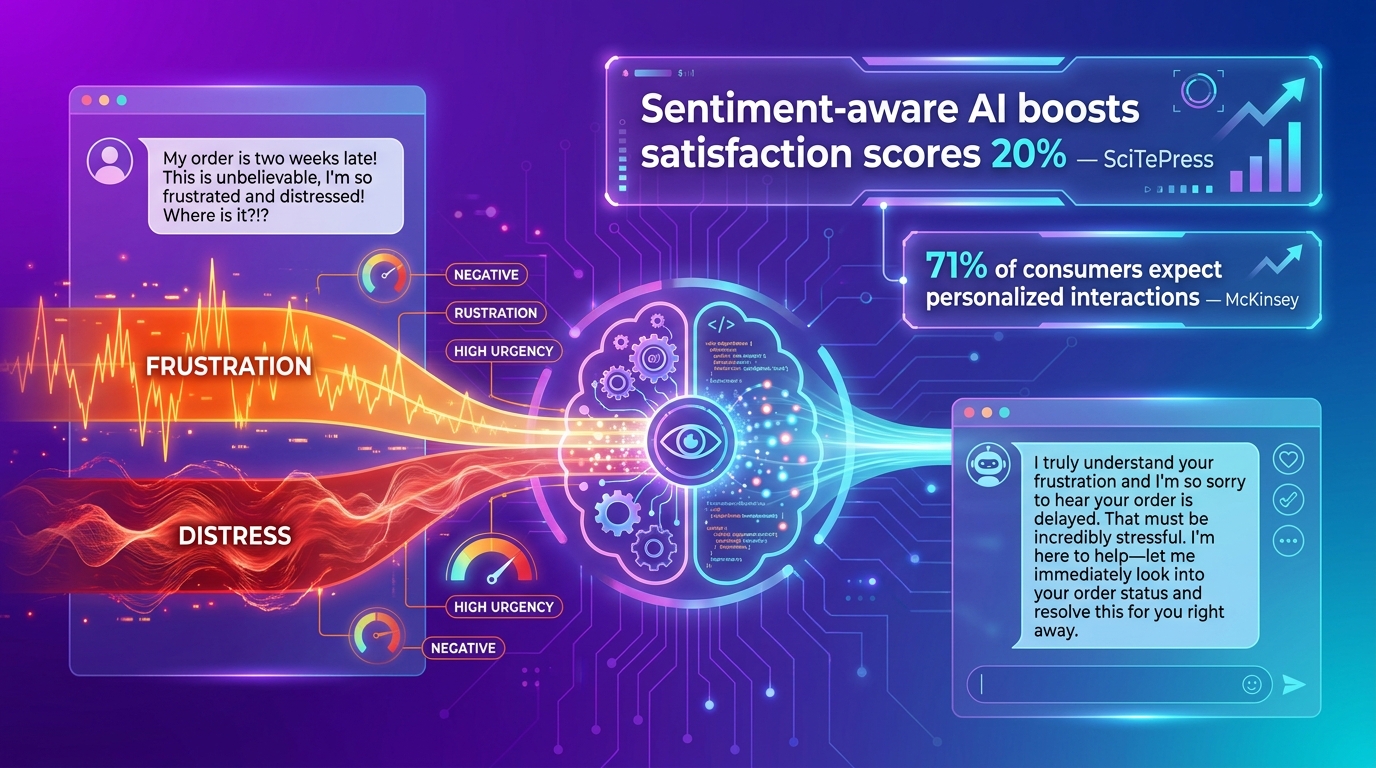
One of the most significant developments in AI customer support in 2026 is the emergence of what practitioners are calling emotion-aware first response — AI systems that detect the emotional state of a customer’s message and adapt their response accordingly, in real time.
What Sentiment-Aware AI Actually Does
The technical architecture behind emotion-aware support AI involves multiple concurrent analysis streams: natural language processing to identify semantic content, sentiment classification to detect emotional valence (positive, neutral, negative, distressed), tone analysis to distinguish frustration from anger from sadness, and in voice applications, acoustic analysis of speech patterns.
These signals feed into response generation in ways that change the character of the first response. A neutral inquiry about order status gets an efficient, informational response. A message from a customer who uses language indicating frustration — repeated phrases, capitalization, descriptions of how much time they’ve spent on the issue — triggers a response that leads with acknowledgment before moving to resolution. SciTePress research measuring satisfaction scores shows sentiment-aware AI producing scores of 9.13 out of 10 compared to 8.41 for systems without sentiment adaptation — a meaningful difference in perceived quality.
The Personalization Layer
Hyper-personalization — using a customer’s purchase history, account age, previous support interactions, and behavioral patterns to tailor the tone and content of first responses — is one of the highest-ROI investments an AI support team can make. Nextiva data shows 47% of companies linking personalization capabilities directly to revenue outcomes. McKinsey’s research indicates 5-15% revenue increase attributable to personalized customer interactions at scale.
In practice, this means AI systems that distinguish between a customer who has been with a company for five years and one who signed up last week — and calibrate their first response language, offer parameters, and escalation thresholds accordingly. The five-year customer who contacts support for the first time gets acknowledged as a longtime customer. The new customer gets onboarding-oriented framing if their issue suggests a product familiarity problem. These are not dramatic differences — but in aggregate they shift how customers perceive the support interaction.
Where Emotional Intelligence Still Has Limits
Despite genuine advances, it’s worth being direct about where AI emotional intelligence remains limited. Approximately 50% of customers view AI as genuinely empathetic (Zendesk data), which means the other half do not — and when customers are dealing with genuinely distressing situations (bereavement, financial hardship, health issues), even well-executed AI empathy often feels insufficient. Only 27% of Gen Z consumers, the demographic most comfortable with AI across the board, are comfortable relying on AI for emotional support in a support context.
The correct operational response to this is not to push AI emotional intelligence further into sensitive domains — it’s to use emotional signals as escalation triggers. When sentiment analysis detects a genuine distress signal that exceeds a threshold, the appropriate AI response is to acknowledge and immediately route to a human agent, with context prepared. That’s not a failure of AI — it’s an appropriate use of it as part of a larger system.
What Comes Next: The Direction AI First Response Is Moving
Looking beyond current deployments, the trajectory of AI first response in customer support points in several specific directions that organizations planning multi-year support infrastructure should be accounting for now.
Proactive First Response
The concept of the first response is already beginning to shift from reactive to proactive. AI systems integrated with product telemetry, order management systems, and usage data can identify customers who are likely to contact support — before they do — and send a first response proactively. A delivery that’s delayed gets a message before the customer notices and reaches out. A user whose behavior patterns suggest they’re stuck on a feature gets a helpful resource before they open a frustration-driven ticket. This inverts the support model fundamentally, and the early data on proactive AI support suggests significant CSAT improvements and measurable ticket volume reduction.
Agentic Resolution: Beyond Triage
First-response AI that can only talk is giving way to agentic AI that can act. The 2026 generation of AI support systems doesn’t just respond to a refund request — it checks the order status, validates the refund eligibility criteria, processes the refund, and sends the confirmation, all within the first interaction. ServiceNow reports that autonomous AI agents handle 80% of inquiries end-to-end, cutting complex case resolution by 52%. This shift from conversational to agentic AI changes the economics of support dramatically — because the cost isn’t just first response time anymore, it’s full resolution time on a per-case basis.
The Accountability Architecture
The Air Canada tribunal ruling has accelerated something that was already developing: formal accountability frameworks for AI-generated customer communications. Organizations are building audit trails that log every AI response, the knowledge sources it drew from, the confidence score associated with the generation, and the customer’s subsequent behavior. This creates a feedback loop that makes quality governance possible — and in regulated industries, may soon be required rather than optional.
Conclusion: The Shift from Fast to Right
The question that mattered most in AI customer support two years ago was: “How do we get response times down?” That question has been largely answered. The technology is there. The speed is achievable. The benchmarks are well-established.
The question that matters in 2026 — and will matter more as AI support becomes universal — is different: “How do we make sure that fast response is also the right response?”
That’s a harder question, and it doesn’t have a platform-level answer. It requires decisions about knowledge governance, validation architecture, escalation design, emotional intelligence calibration, and quality monitoring that have to be made by the organizations building these systems. The technology enables the speed. The quality is a choice.
Companies that treat AI first response as a cost-reduction lever will continue to generate impressive FRT numbers and frustrating customer experiences. Companies that treat it as a quality-at-scale problem — using AI to deliver the kind of fast, accurate, personalized, emotionally aware first response that a great human agent would give — are the ones building support infrastructure that actually earns customer trust.
The standard for AI first response in 2026 isn’t four seconds. It’s four seconds and correct.
Actionable Takeaways
- Measure FCR alongside FRT. If your AI reporting only shows first response time, you’re measuring the least important half of the equation. Build FCR tracking from day one.
- Implement source-grounded RAG before deploying at scale. Ungrounded AI generation is the proximate cause of most high-profile AI support failures. Knowledge governance isn’t optional — it’s the foundation everything else sits on.
- Audit your escalation paths as a separate project. Have someone unfamiliar with your system try to reach a human agent when the AI fails to resolve their issue. If they can’t do it in three steps or less, your escalation design needs work.
- Pilot on one queue before expanding. A 30-day pilot on a high-volume, representative queue gives you the FCR and misrouting data you need to decide whether to expand or iterate.
- Use sentiment signals for routing, not just tone adjustment. Real-time sentiment detection is most valuable as a routing trigger — getting distressed customers to human agents faster — not just as a way to make AI responses sound warmer.
- Build context transfer into every escalation. The moment a customer transitions from AI to human agent, the agent should already have a structured summary of the conversation, the issue, the attempted resolutions, and the customer’s emotional state. This is a design decision, not a default behavior.
- Track repeat contact rate as a lagging indicator. A rising repeat contact rate is the clearest signal that AI first response quality has degraded — and it often surfaces before CSAT scores move, giving you an early warning window to fix issues before they become patterns.