
Tag: Developer Productivity

  • GitHub Copilot’s Token Pricing Switch: What Your Team Will Actually Pay Starting June 1

    GitHub Copilot’s Token Pricing Switch: What Your Team Will Actually Pay Starting June 1

    GitHub Copilot switching from flat subscription billing to per-token usage-based pricing starting June 1 2026

    On April 17, 2026, GitHub quietly dropped a billing announcement that didn’t get nearly enough attention outside of engineering finance teams. Starting June 1, 2026, GitHub Copilot’s entire pricing infrastructure moves from a flat-rate premium request model to usage-based billing driven by token consumption. The change is called GitHub AI Credits, and it touches every plan from individual Pro accounts to large Enterprise deployments.

    If you read the headline — “subscription prices unchanged” — and moved on, you missed the part that matters. The monthly fee staying the same is almost irrelevant. What’s changed is the unit of measurement for everything beyond basic code completions. The new system doesn’t charge you per request. It charges you per token — every input character, every output character, every cached piece of context that flows through the model. And depending on how your team actually uses Copilot, that distinction could mean paying the same, paying less, or seeing your AI tooling budget spike in ways nobody budgeted for.

    This post breaks down exactly how the new model works, why GitHub made the switch when it did, which usage patterns are genuinely fine under token pricing, which ones are quietly expensive, and what enterprise admins need to configure before June 1 to avoid billing surprises. There’s also a practical cost-modeling section so you can run real numbers against your team’s actual workflow before the meter starts running.

    The Old Model: Premium Request Units and How They Actually Worked

    To understand why the switch matters, you first need to understand what it’s replacing. GitHub Copilot’s previous billing model used a unit called Premium Request Units, or PRUs. The concept was simple on the surface: when you used certain AI-powered features — chat, code review, model-powered suggestions beyond basic inline completions — the system deducted a fixed number of PRUs from your monthly allotment.

    Each plan came with a set number of PRUs per month. Copilot Business users got 300 per month. Pro+ users received 1,500. Enterprise users had 1,000 per user per month. When you ran out, you could buy extras at $0.04 per request. It felt straightforward because it appeared to be.

    The Multiplier System That Complicated Everything

    The reality was more complicated than it appeared. Not all PRU requests were equal. Different models had different multipliers that changed how many PRUs a single request actually consumed. Claude Opus 4.5 and 4.6 carried a 3x multiplier, meaning one session with Claude Opus cost three PRUs instead of one. GPT-5.4 mini, the lightweight model, had a 0.33x multiplier — three requests for the price of one. Entry-level models like GPT-4o were free entirely, with a 0x multiplier that didn’t touch your balance at all.

    In theory, this was GitHub’s attempt to abstract the real cost of running different models behind a simpler number. In practice, it created a confusing middle layer where users had to remember both how many PRUs they had left and which multiplier applied to whichever model they were currently using. A 300-request Business plan budget wasn’t 300 Claude Opus sessions — it was 100. For a team that had shifted toward running Claude for its stronger reasoning on complex refactoring tasks, the 300-request number was essentially fiction.

    The Fundamental Problem GitHub Couldn’t Ignore

    There was a deeper structural problem, too. A simple three-line code explanation in chat might generate 200 tokens total. An agent session analyzing a legacy codebase, iterating over 12 files, running tool calls, and producing a refactoring plan might generate 180,000 tokens. Under the PRU model, both consumed one request from the user’s perspective — only the multiplier adjusted for model choice, not for the scale of computation involved.

    GitHub was absorbing the difference. As more users adopted agent mode, multi-file editing, and longer context interactions, GitHub’s actual inference costs per “request” rose dramatically while its per-seat revenue stayed fixed. The switch to token-based billing isn’t primarily a revenue story — it’s an infrastructure economics story that GitHub couldn’t defer any longer.
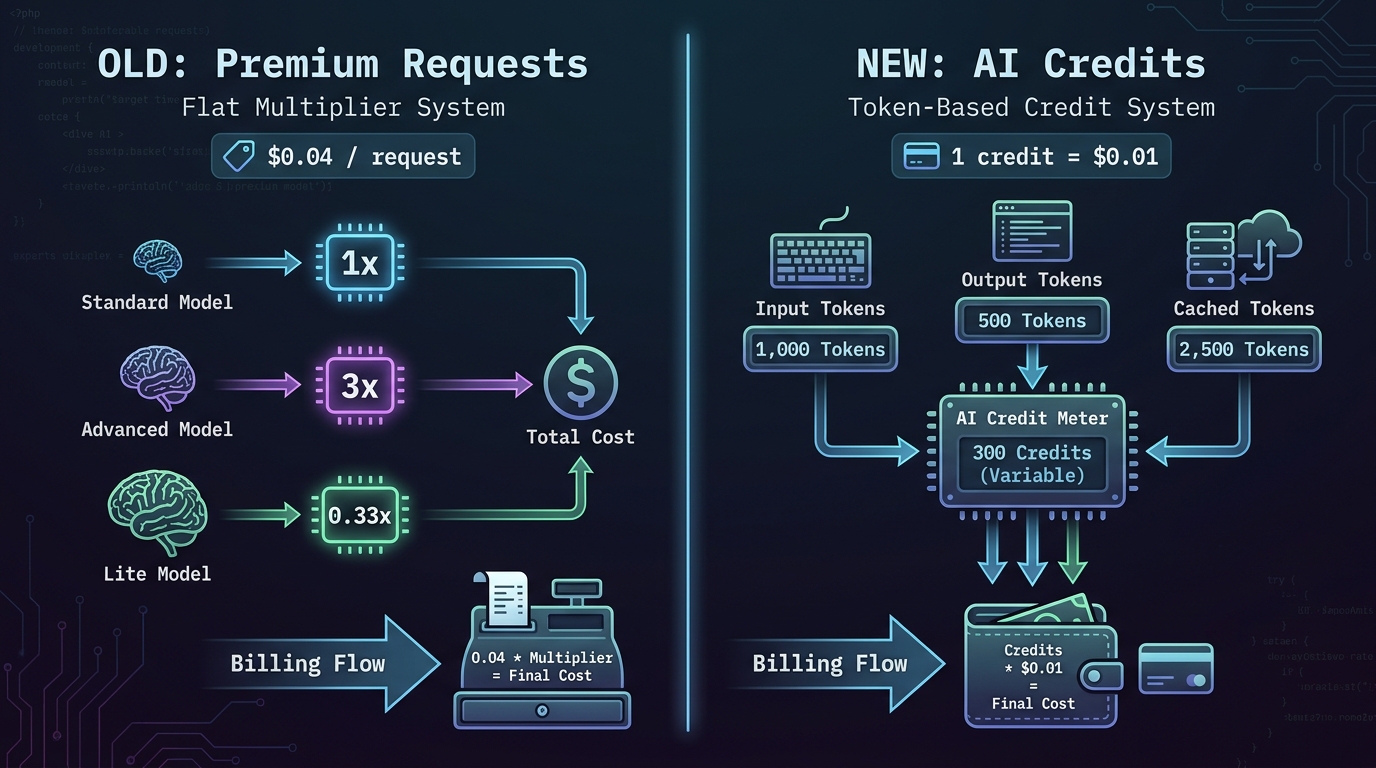
    Comparison of GitHub Copilot old Premium Request Unit billing versus new GitHub AI Credits token-based billing system

    The New Model: GitHub AI Credits and Token-Based Billing Explained

    The replacement system is built around a currency called GitHub AI Credits. The unit is straightforward: one credit equals $0.01 USD. Credits are consumed based on actual token usage — not request counts, not multipliers, not estimated usage. When you ask Copilot Chat a question, the system counts the input tokens sent to the model and the output tokens returned. Both consume credits at rates specific to whichever model processed the request.

    Each Copilot plan now includes a monthly credit allotment equal in dollar value to the plan’s subscription price. Copilot Pro at $10/month includes 1,000 credits. Pro+ at $39/month includes 3,900. Business at $19/user/month includes 1,900 credits per user. Enterprise at $39/user/month includes 3,900 credits per user.

    The Three Types of Tokens You’re Paying For

    The system measures three distinct token categories, each billed slightly differently:

    • Input tokens: Everything sent to the model — your prompt, file context, conversation history, system instructions, and tool outputs fed back into the next prompt. These are the most plentiful and often the most expensive in aggregate because context accumulates fast in long sessions.
    • Output tokens: The model’s generated response. This includes the actual text, code, analysis, or intermediate reasoning steps (if using a “thinking” model). Output tokens are typically priced higher per unit than input tokens, sometimes 5x higher for premium models.
    • Cached tokens: Context that was used in a previous interaction and can be reused without re-processing the full input. Cached tokens are priced lower than fresh input tokens and represent GitHub’s mechanism for passing some efficiency savings back to users who work in long, consistent sessions.

    Model-Specific Rates: What You Actually Pay Per Model

    The credit consumption rate depends entirely on which model handles your request. The specific published rates differ by model tier. As a rough frame of reference based on the underlying API pricing GitHub aligns to: GPT-4o-class models run in the range of $2–$8 per million tokens. Claude Opus 4.7, the most capable (and expensive) model available in Pro+, runs approximately $5 per million input tokens and $25 per million output tokens. Claude Sonnet class models sit in the middle. Lighter models like GPT-4o mini sit toward the lower end.

    Translated to credits: a one-million-token Claude Opus interaction would consume roughly 500–2,500 credits depending on the input/output split. A one-million-token interaction with a mid-tier model might consume 200–800 credits. For most individual interactions — a chat query, a single-file suggestion review — you’re consuming tens to a few hundred credits at most. The numbers only get dramatic in agent mode, which we’ll address in detail shortly.

    Why GitHub Made the Switch — And Why It Happened in 2026

    GitHub hasn’t published a loss breakdown, but the timing and the mechanics of the change tell a clear story. The adoption of agent-mode features accelerated sharply in early 2026. Developers who had previously used Copilot primarily for inline completions started running multi-turn agentic workflows: sessions where Copilot autonomously reads files, writes code, runs tests, reads the test output, adjusts the code, and repeats the loop — sometimes over a dozen iterations before the user sees a result.

    Each of those iterations sends a full context window to the model. Files read early in the session remain in context for subsequent steps. Tool call outputs feed back into later prompts. A session that looks like “one request” from the user’s perspective might involve 10–15 actual model calls, each consuming tens of thousands of tokens. Under the PRU model, that entire session cost one request (or three, with a Claude Opus multiplier). The actual compute cost to GitHub was orders of magnitude higher.

    The Sustainability Calculation

    When GitHub absorbed those costs under a flat PRU model, it was effectively cross-subsidizing heavy agent users with revenue from the majority of users who stick to completions and light chat. That cross-subsidy eroded as the proportion of agent-mode users grew. By early 2026, GitHub’s internal inference costs for Copilot were reportedly running at unsustainable levels relative to subscription revenue — the operational model had become misaligned with actual usage patterns.

    The token model solves this structurally. Heavy users who generate more compute cost now pay proportionally to their usage. Light users who mostly rely on free-tier features — completions and Next Edit Suggestions, which remain unlimited and uncharged — barely touch their credit balance. The economics become self-correcting: GitHub’s cost per user scales with each user’s actual consumption, not an abstract PRU figure.

    Why the Timing Matters for Teams

    GitHub’s decision to move fast — announcing April 17, implementing June 1, offering only a six-week window — also reflects urgency. The company paused new registrations for Pro, Pro+, and Student accounts on April 20, three days after the announcement. It simultaneously tightened usage limits and removed Claude Opus from certain Pro-tier features. These were defensive moves to limit exposure under the old pricing model while the transition infrastructure was prepared. For teams, six weeks is not much lead time to audit usage, model costs, and set budget controls.

    What’s Free, What Costs Credits, and What Nobody’s Talking About
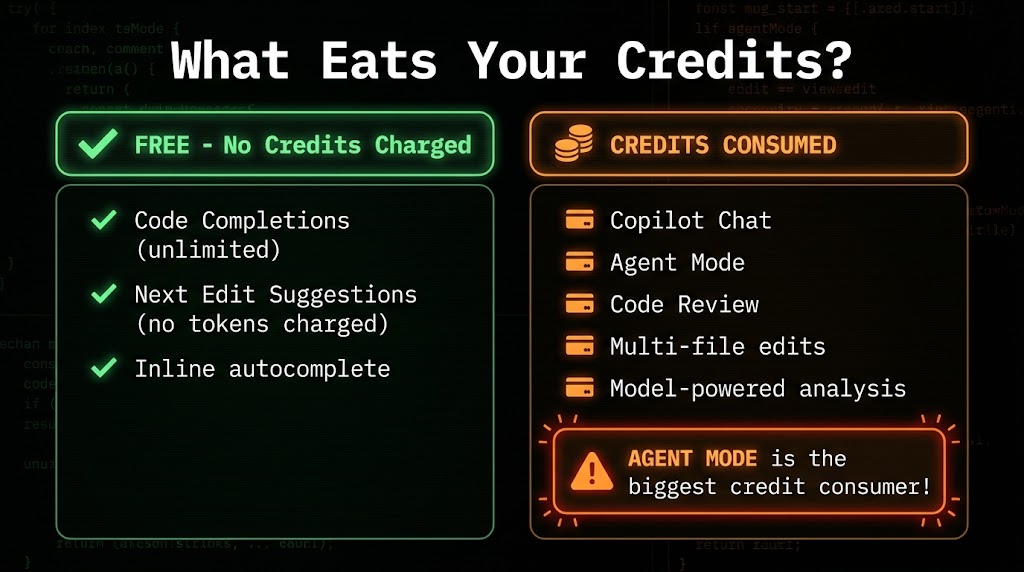
    GitHub Copilot features that are free with no token charges versus features that consume AI Credits

    The most important practical question for most developers isn’t “how does token billing work in theory?” It’s “will my day-to-day workflow actually cost more?” The answer depends almost entirely on which features you use — because the free tier of the new model is surprisingly generous for a specific type of usage.

    What Remains Unlimited and Free

    Two core features remain completely unrestricted and consume zero credits regardless of how frequently you use them:

    • Code completions: The inline autocomplete suggestions that appear as you type. This is Copilot’s original feature — single-line and multi-line completions generated in real-time as you code. Under the new model, these remain unlimited and do not draw from your credit balance at all.
    • Next Edit Suggestions: Copilot’s feature that anticipates your next intended change based on what you just edited. Also unlimited, also uncharged.

    This is a critical point that gets lost in the anxiety about token billing. For developers whose primary Copilot usage is the core tab-completion workflow — which still describes a large share of Copilot users — the new billing model changes nothing about their day-to-day experience or cost. Their credit balance could sit at zero and they’d still get completions.

    What Consumes Credits

    Everything beyond those two features draws from your credit balance. The key credit-consuming features are:

    • Copilot Chat: Any interactive Q&A session, whether in the IDE sidebar, on GitHub.com, or through the mobile app. The longer your conversation thread and the larger the context you attach, the more credits a single chat session consumes.
    • Agent Mode: Multi-step agentic workflows where Copilot autonomously iterates across files, runs tool calls, and performs iterative reasoning. This is by far the most credit-intensive feature (see the next section).
    • Code Review: Copilot’s AI-powered pull request review feature, which analyzes diffs and suggests improvements. The review depth and file count directly affect token consumption.
    • Multi-file editing and refactoring: Any prompt that involves reading or modifying multiple files in a session. Each file read adds input tokens; each modification generates output tokens.
    • Model-powered analysis: Custom instructions, workspace context, and codebase analysis features that load broad context into the model.

    The Part Nobody Talks About: Context Window Costs

    There’s a subtlety in how context accumulates that most billing announcements understate. When you have a multi-turn chat conversation and you’ve attached three files to your workspace context, those files don’t just exist “in the background.” They’re re-sent to the model with every turn of the conversation. If you have a 10,000-token context (which is genuinely small — a few medium-sized files) and you exchange 15 messages in a session, you’ve sent 150,000 input tokens just in context re-transmission, before a single word of your messages or responses is counted.

    This means a focused, long conversation with large file context can be surprisingly expensive — not because any single message was complex, but because the context window multiplies across every turn. Teams that use Copilot Chat with large attached codebases in persistent sessions need to account for this accumulation when modeling costs.

    Agent Mode: The Hidden Cost Multiplier That Will Define Your Budget
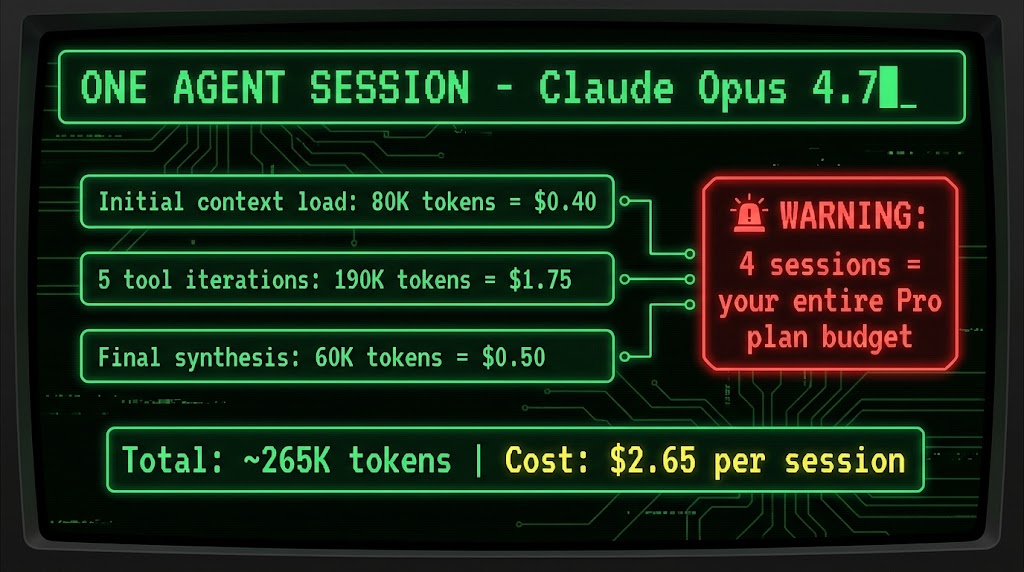
    GitHub Copilot agent mode token consumption breakdown showing 265K tokens per session costing $2.65 with Claude Opus 4.7

    If there’s one feature that changes the billing math more than any other, it’s agent mode. And given that agent mode is precisely the feature GitHub has been aggressively marketing as the future of AI-assisted development, the cost implications deserve serious attention before June 1.

    What Actually Happens Inside an Agent Session

    Agent mode is GitHub Copilot’s agentic workflow capability — the ability to give Copilot a high-level task and have it autonomously figure out what files to read, what changes to make, what tools to call, and how to iterate until the task is complete. From the user’s perspective, it looks like magic. From a token billing perspective, it looks like a very long context loop running repeatedly.

    Here’s a representative breakdown of a conservative agent session using Claude Opus 4.7:

    • Initial context load: Copilot reads the relevant files for the task — say 5–8 source files and a few configuration files. This alone can generate 80,000 input tokens (~$0.40 at Opus rates).
    • Tool iteration loop: The agent runs five iterations, each sending the full accumulated context plus tool outputs from previous steps. At roughly 150,000 input tokens and 40,000 output tokens across the five iterations, this costs approximately $1.75.
    • Final synthesis: A concluding pass to consolidate the changes and generate output — roughly 50,000 input tokens and 10,000 output tokens at another ~$0.50.

    Total for one conservatively scoped agent session: approximately 265,000 tokens, costing around $2.65 or 265 credits. Under the Pro plan’s 1,000-credit monthly allotment, that’s roughly four agent sessions before you’re in overage territory. Under the Business plan’s 1,900 credits, seven sessions. Under Enterprise’s 3,900 credits, about fifteen sessions per user per month.

    Model Choice Dramatically Changes the Math

    The scenario above uses Claude Opus 4.7, the most powerful model available and the most expensive. The same task run through a mid-tier model like Claude Sonnet would consume roughly the same number of tokens but at a much lower per-token rate — potentially cutting the cost by 60–70%. The same task on GPT-4o-mini class models could cost even less.

    This creates a genuine optimization opportunity that didn’t exist under the PRU model. Under PRUs, you could switch to a cheaper model and save nothing if the multiplier was still 1x. Under token pricing, every step down in model tier translates directly into credit savings. Teams that have defaulted to running Opus for everything because it “felt the same price” now have a concrete financial incentive to use lighter models for lighter tasks and reserve Opus for complex reasoning work that genuinely benefits from it.

    Longer Agent Tasks Scale Exponentially, Not Linearly

    It’s worth understanding that agent mode costs don’t scale linearly with task complexity. A task that’s twice as complex doesn’t necessarily cost twice as much — it can cost significantly more because longer agent sessions accumulate more context, which gets re-sent with each subsequent iteration. A session that runs 15 iterations instead of 5 doesn’t just cost 3x more. The context window grows with each iteration, so later iterations are more expensive than early ones in absolute token terms. For genuinely large refactoring tasks across 20+ files, real-world costs per session can reach $10–$20 under Opus pricing.

    Winners and Losers: Which Developers and Teams Come Out Ahead

    Token-based billing doesn’t affect all developers equally. The impact varies significantly by usage pattern, and understanding where your team falls helps predict whether June 1 will feel like a non-event or a budget shock.

    Who Comes Out Ahead (or Unaffected)

    Developers who primarily use inline completions and Next Edit Suggestions are the clearest winners. Their entire core workflow is free under the new model. They can use Copilot as aggressively as they want for autocomplete without touching their credit balance at all. The shift to token billing is irrelevant to their daily experience.

    Teams with widely varying engagement levels benefit from the credit pooling mechanism. In a 20-person Business plan team, some developers might use Copilot Chat heavily while others barely open it. Under PRUs, each user’s allotment was separate — unused requests by one person couldn’t offset excess usage by another. Under the new model, Business and Enterprise credits are pooled organization-wide. Heavy users draw from a shared pool that light users contribute to. For teams with uneven usage patterns, this pooling alone can reduce effective costs compared to the old per-seat PRU allotment.

    Organizations with disciplined model selection that use lighter models for everyday tasks and reserve premium models for high-value complex work will find token pricing cheaper than the old Opus-at-everything approach that PRU billing accidentally encouraged.

    Who Faces Higher Costs

    Developers who rely heavily on agent mode for complex, multi-file workflows are the group most at risk. If agent mode is a central part of your daily workflow — running multiple sessions per day to handle refactoring, debugging large systems, or exploring unfamiliar codebases — the 1,900–3,900 monthly credits in standard plans deplete fast. Four to fifteen Opus-based agent sessions per month is not a high bar for developers who’ve built their workflow around agentic capabilities.

    Teams using persistent long-context chat sessions — particularly those that attach large files and maintain long conversation threads — will find their credit consumption higher than expected due to the context re-transmission cost described earlier.

    Individual Pro plan users face the tightest budget. At 1,000 credits ($10 equivalent) per month, a Pro user running regular agent mode sessions with Claude Opus could exhaust their balance in three to four intensive sessions. The Pro plan was always positioned as a personal-use tier, but developers accustomed to running serious agentic workflows may need to upgrade to Pro+ (3,900 credits) or accept overage charges.

    Enterprise Budget Controls: What Admins Need to Configure Before June 1
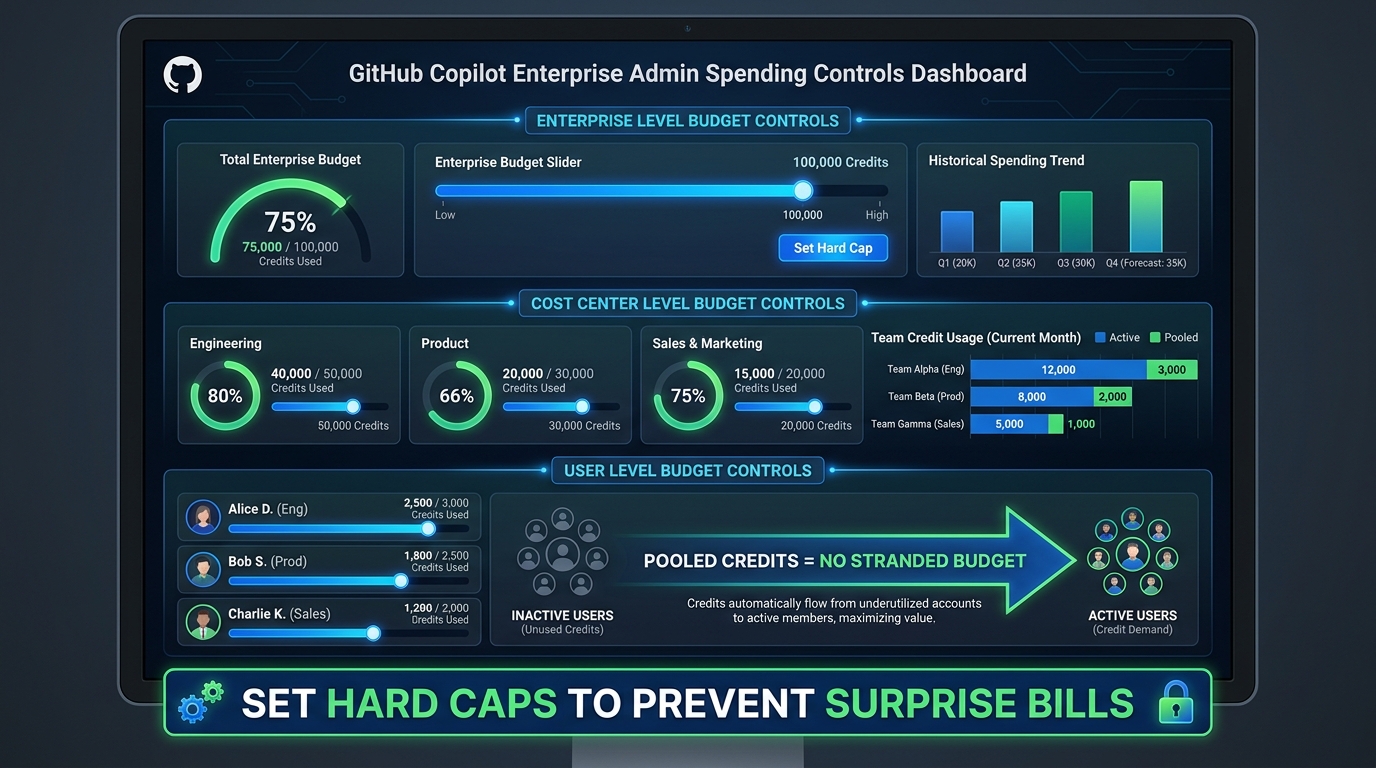
    GitHub Copilot enterprise admin dashboard showing three-level budget controls for enterprise, cost center, and user spending limits

    For organizations on Copilot Business or Enterprise, the billing shift introduces a new layer of administrative responsibility that didn’t exist under the PRU model. The good news is that GitHub has built a reasonably complete set of budget controls. The bad news is that they’re opt-in — and if you don’t configure them before June 1, your organization is operating without guardrails.

    The Three Levels of Budget Control

    GitHub has implemented a hierarchical budget control system that lets administrators manage credit spending at three distinct levels:

    Enterprise level: The broadest control. Administrators can set an overall spending cap for the entire enterprise account. When the monthly credit pool is exhausted, admins choose whether to enable overage spending (at $0.01 per credit) or enforce a hard stop that blocks further AI-powered feature usage until the next billing cycle.

    Cost center level: For enterprises with multiple teams or departments, credits can be allocated to specific cost centers with independent budgets. An engineering team can have its own credit pool separate from, say, a DevOps team or a data science group. This enables per-team accountability and prevents one high-volume team from draining the entire enterprise pool.

    User level: The most granular control. Admins can set per-user spending limits within the pooled budget. This is particularly useful for managing access to expensive premium models — an admin can allow unlimited use of lightweight models while capping per-user Opus-class spending at a defined monthly ceiling.

    What Happens When Credits Run Out

    This is where the PRU model and the new model diverge in a critical operational way. Under the PRU model, when a user exhausted their monthly premium requests, Copilot would fall back to a free base model — the experience degraded gracefully, but users kept working. Under the new token model, there is no fallback. If you exhaust your credit pool and the admin has set a hard cap, credit-consuming features stop working entirely. Copilot Chat goes dark. Agent mode is unavailable. Only the free unlimited features — completions and Next Edit Suggestions — continue to function.

    For teams that use Copilot Chat as an active part of their development workflow (not just an occasional tool), this is a meaningful operational risk. An admin who hasn’t configured overage budgets and hasn’t communicated credit expectations to the team could create a mid-month productivity disruption that’s entirely preventable.

    Converting Existing PRU Budgets

    If your organization had set custom PRU budgets under the old system, those don’t automatically carry forward in a way you can ignore. GitHub is converting existing premium request budgets to equivalent AI Credits values, but the conversion should be manually reviewed by billing admins. The conversion formula maps PRU counts to credit equivalents, but given that a PRU was never a fixed dollar amount (its cost varied by model multiplier), the mapping involves estimation. Admins should log into the billing settings in May, review the converted credit allocations, and adjust them based on your actual expected usage patterns rather than assuming the converted values are correct.

    The Promotional Credit Boost: Why June Through September Is the Best Time to Experiment
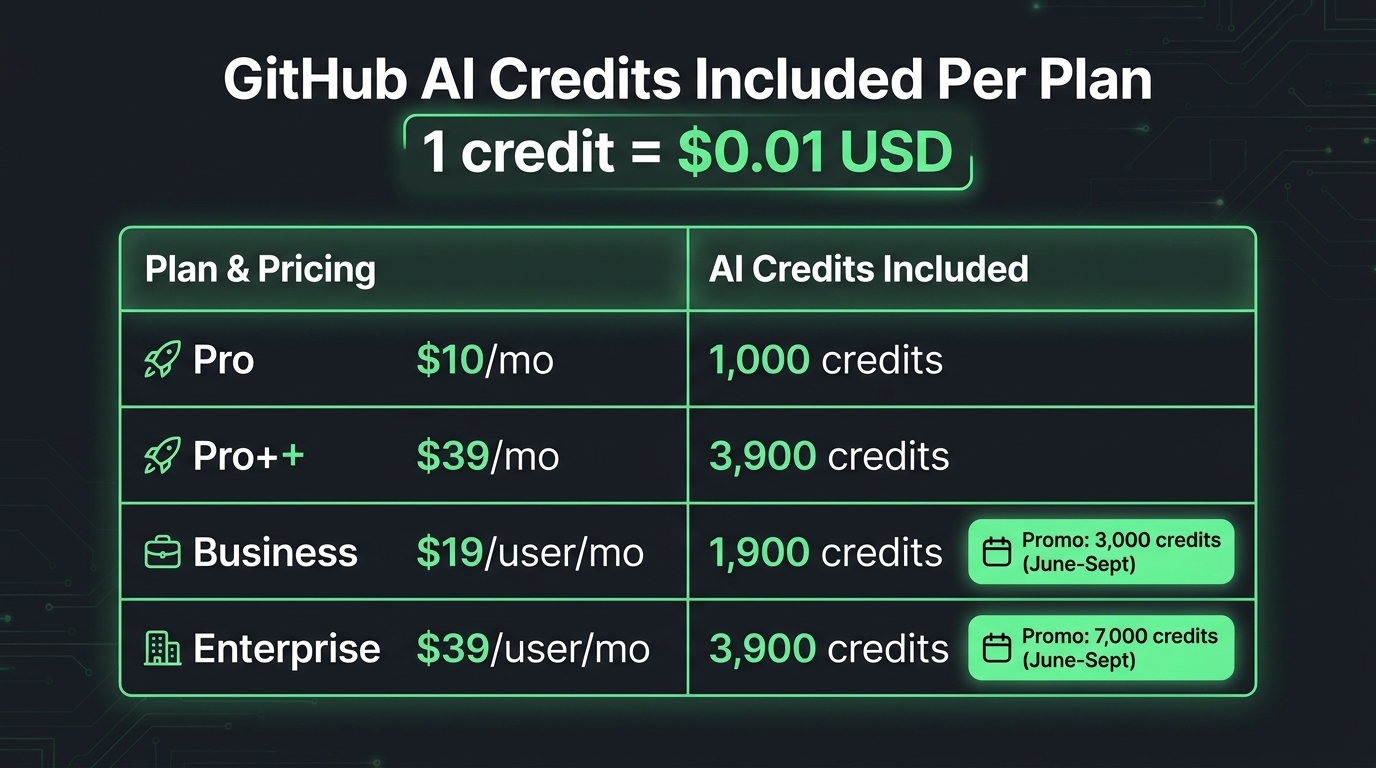
    GitHub Copilot pricing plans showing promotional AI Credits for Business and Enterprise tiers from June to September 2026

    GitHub is doing something notable to smooth the transition: both Business and Enterprise plans receive a promotional credit boost during the June–September 2026 window that’s significantly higher than the standard long-term allotment. Understanding this window matters for how you plan your team’s experimentation and workflow development.

    The Numbers During the Promotional Period

    During June through September 2026, the credit allotments are:

    • Copilot Business: 3,000 credits per user per month (compared to the standard 1,900 credits after September). That’s a 58% boost over the steady-state amount.
    • Copilot Enterprise: 7,000 credits per user per month (compared to the standard 3,900 credits). That’s nearly an 80% boost during the promotional period.

    GitHub’s stated rationale is to give existing customers time to understand their actual usage patterns under the new billing model before settling into the permanent credit allotment. It’s a reasonable customer-experience decision — and it creates an opportunity for organizations to run genuine usage audits during those four months.

    Using the Promo Window Strategically

    The promotional period should be treated as a diagnostic window, not just a billing cushion. With substantially more credits per user, teams can safely experiment with agent mode, extended chat sessions, and premium models without fear of running out mid-month. That usage data is genuinely valuable: it tells you, in real credit consumption terms, exactly how much your team’s actual workflows cost.

    The smart move is to track credit consumption per user during June and July, segment it by feature type if possible (agent mode vs. chat vs. review), and use that data to assess whether the standard allotment starting in October will be sufficient — or whether overage budgets need to be pre-set. The promotional period gives you four months of real billing data before the numbers get tighter.

    For Enterprise teams, the 7,000 monthly credits during the promotional period also offer a meaningful window to develop internal guidelines about model selection, context management, and agent mode governance before those guidelines have real financial stakes attached to them.

    How to Model Your Team’s Costs Before the Switch

    The most practical thing any team lead, engineering manager, or CTO can do right now is build a basic cost model before June 1. The math isn’t complicated, and having a rough projection is vastly better than discovering your billing situation after the first month on the new system.

    Step 1: Categorize Your Team’s Copilot Usage

    Start by getting honest about how your team actually uses Copilot. Segment developers into rough categories:

    • Completions-only users: Developers who use Copilot primarily for inline autocomplete and Next Edit Suggestions. These users will consume near-zero credits. No cost modeling needed.
    • Light chat users: Developers who use Copilot Chat a few times per day for targeted questions — explaining a function, checking a syntax pattern, asking about an API. Typical daily sessions might consume 2,000–5,000 tokens each. At mid-tier model rates, monthly usage for a light chat user might run 200–600 credits — well within all standard plan allotments.
    • Heavy chat users: Developers who use Copilot Chat extensively, with large file contexts attached and long conversation threads. These users can consume 5,000–20,000 tokens per session and may run 5–10 sessions daily. Monthly credit consumption for this profile could range from 2,000–10,000 credits depending on session length, model choice, and context size.
    • Agent mode users: Developers running multi-file, multi-iteration agentic workflows. As detailed above, each session with a premium model can consume 200–1,000+ credits. Monthly consumption can range from 3,000 to 30,000+ credits for developers who run several agent sessions per day.

    Step 2: Apply Model-Specific Rates

    Once you have your usage categories, apply model rates. The key variables are:

    • What model does each usage category typically use? (Opus, Sonnet, GPT-4o, mini?)
    • What’s the typical input/output token ratio? (Agent mode is input-heavy; generation tasks are output-heavy)
    • How large is the typical context window in each session?

    A rough rule of thumb for budgeting: plan for 500–1,000 credits per power user per day if they’re running regular agent mode with premium models. Plan for 50–200 credits per day for heavy chat users. Plan for near-zero for completions-focused users.

    Step 3: Compare Against Your Plan Allotments

    With your usage model built, compare it against what your plan provides. If your 10-person Enterprise team has 3 agent-mode-heavy developers, 4 heavy chat users, and 3 completions-focused developers, your pooled usage might look like:

    • Agent mode users (3): ~15,000 credits/month each = 45,000 credits
    • Heavy chat users (4): ~3,000 credits/month each = 12,000 credits
    • Completions users (3): ~200 credits/month each = 600 credits
    • Total estimated: ~57,600 credits/month
    • Plan provides (Enterprise, 10 users): 39,000 credits/month standard

    In this scenario, you’d likely need overage budget configured. That’s not necessarily a problem — roughly $186/month in overage for a 10-person engineering team is a small number relative to productivity value. But you need to know it’s coming and have the overage budget enabled, or you’ll hit a hard wall mid-month.

    Step 4: Set Up Billing Controls Before June 1

    Whatever your model shows, configure the billing controls before the switch date:

    1. Log into GitHub enterprise billing settings
    2. Review the auto-converted PRU-to-credit budget (don’t just accept it)
    3. Set an overage budget at the enterprise level — even a modest one prevents a complete blackout
    4. If teams have very different usage patterns, set cost center allocations
    5. Consider per-user caps for any team members you expect to be extremely high consumers
    6. Enable preview billing if GitHub offers it in May — get a look at what the meter shows before real money is on the line

    What This Shift Signals About Where AI Developer Tooling Is Heading

    GitHub’s move isn’t happening in isolation. It’s part of a broader industry shift in how AI-powered software tools are priced and managed. Understanding the direction helps teams make smarter long-term decisions about tooling investment.

    Usage-Based Billing Is Becoming the Standard

    Across AI developer tools, the flat-rate subscription model is giving way to consumption-based pricing. The pattern is consistent: tools launch with simple flat rates to minimize friction during adoption, then transition to usage-based billing once AI infrastructure costs become the dominant variable in the economics. GitHub’s move is the most prominent example in 2026, but it’s happening across coding assistants, AI testing platforms, code review tools, and documentation generators simultaneously.

    For engineering leaders, this means budgeting for AI tooling is becoming more like budgeting for cloud compute — it requires monitoring, forecasting, and governance rather than a simple line item for seat licenses. Teams that develop that operational muscle now, during the GitHub transition, will be better positioned when every AI tool in their stack eventually makes the same shift.

    Model Selection Becomes a Real Engineering Decision

    Under flat PRU pricing, model selection was mostly a quality question: which model gives the best results? Under token-based pricing, it becomes a cost-quality tradeoff: which model gives sufficient results for this task at the lowest cost? For an agentic workflow iterating over hundreds of turns, the difference between Opus and a mid-tier model is a significant budget consideration, not just a preference.

    This pushes teams toward developing model selection guidelines — rough heuristics for which models to use for which task types. Complex architectural analysis and nuanced refactoring: Opus. Explaining a function, writing a test, autocompleting a loop: GPT-4o mini or equivalent. Code review of a small PR: Sonnet. These kinds of tiered guidelines don’t just reduce costs — they also encourage more intentional use of AI assistance, which tends to produce better outcomes than defaulting to the most powerful model for everything.

    Transparency as a Double-Edged Sword

    Token-based billing creates something that didn’t exist in the PRU era: actual visibility into what AI assistance costs at a granular level. Organizations can now see exactly how many credits each feature, each team, and potentially each developer consumes. That transparency can drive better governance, more intentional tool usage, and clearer ROI conversations. It can also create friction — individual developers may feel surveillance pressure around their AI usage patterns, or teams may over-restrict access to avoid overruns rather than investing in appropriate budgets.

    The framing that leadership establishes around credit visibility matters. Is the credit data a monitoring mechanism, or is it a planning and optimization tool? Organizations that treat it as the latter will get the most value from the new billing structure.

    The Actionable Checklist: What to Do Before June 1, 2026

    With all of the above context in hand, here’s a practical checklist for teams and individuals ahead of the billing switch:

    For Individual Developers

    • Audit your actual Copilot usage: Are you primarily using completions (unaffected) or chat and agent mode (credit-consuming)? Know which category describes you.
    • Check your plan: Pro users on $10/month have 1,000 credits. If you run agent mode sessions with premium models, that runs out fast. Pro+ at $39/month gives significantly more runway.
    • Identify your “default” model in agent mode: If you’ve been defaulting to Claude Opus for everything, experiment with Sonnet or GPT-4o for tasks that don’t require Opus-level reasoning. The quality difference for simple tasks is often negligible; the cost difference is substantial.
    • Shorten context when possible: In Copilot Chat, avoid attaching files you don’t need for the specific question. Each attached file adds input tokens to every subsequent message in the session.
    • Watch preview billing in May: If GitHub releases preview billing dashboards before June 1, check them. Seeing your projected credit consumption under the new model before real charges begin is valuable calibration.

    For Engineering Managers and Team Leads

    • Identify your agent mode heavy users: Talk to developers who use agent mode regularly and understand the scale of their sessions. These are your highest-risk profiles for credit overruns.
    • Communicate the free tier explicitly: Many developers will hear “token billing” and assume all of Copilot is now metered. Clarifying that completions and Next Edit Suggestions remain unlimited prevents unnecessary anxiety and workflow disruption.
    • Build a usage model before June 1: Use the framework from the previous section. Even a rough estimate is better than none.
    • Set up cost center allocations if relevant: If you have multiple teams with very different usage intensities, separate credit pools prevent one team’s heavy usage from stranding another team.

    For Engineering Leaders and Admins

    • Access billing settings before June 1 and review the PRU conversion: Do not assume the auto-converted budget is correctly calibrated for your team’s actual usage patterns.
    • Enable overage budget at the enterprise level: Even a conservative overage budget is better than a hard stop. The cost of a mid-month Copilot Chat blackout — in lost productivity and developer frustration — vastly outweighs a few hundred dollars in credit overages.
    • Use the June–September promotional window as a diagnostic: Treat the elevated credit allotments as an opportunity to gather real usage data, not just a billing grace period.
    • Develop model selection guidelines: Work with senior developers to create lightweight guidance on which models to use for which task types. This reduces costs and creates more intentional AI usage patterns.
    • Establish a review cadence for billing data: Plan to review credit consumption data monthly during Q3 and use it to calibrate overage budgets and per-user limits for Q4 and beyond.

    Conclusion: Token Billing Is Fairer — If You’re Prepared for It

    GitHub Copilot’s shift to per-token billing is, in many ways, more rational than the system it replaces. Charging based on actual compute consumption rather than abstract request counts removes the cross-subsidies and multiplier confusions that made PRU billing difficult to reason about. Light users get a genuinely fair deal: completions remain unlimited, and light chat sessions consume a fraction of the included monthly credits. The system also makes GitHub’s economics sustainable in a way that flat PRU pricing wasn’t — a prerequisite for GitHub continuing to invest in the infrastructure behind Copilot.

    But rationality doesn’t mean simplicity, and fairness doesn’t eliminate risk. For teams that have built serious workflows around agent mode, the token model introduces cost dynamics that the PRU model never exposed. The developers most likely to be impacted — the ones running complex, multi-file, multi-iteration agentic sessions — are often the ones getting the most value from Copilot. Constraining them through insufficient credit budgets or hard caps set without context would be counterproductive.

    The key is preparation. The six-week window between announcement and go-live is tight, but it’s enough time to audit usage, configure billing controls, and build a cost model that turns June 1 from a billing surprise into a billing non-event. The teams that do that work will find the new model manageable. The teams that don’t will find out what they should have done on their July invoice.

    The promotional credit window running through September 2026 is a genuine gift for organizations willing to use it strategically. Four months of elevated allotments, real usage data, and zero consequences for burning credits while you figure out your team’s patterns — that’s a solid foundation for transitioning to sustainable token-based AI tooling management. Use it.
  • Snap’s AI Code Revolution: What the 65% Stat Really Means for Your Engineering Team

    Snap’s AI Code Revolution: What the 65% Stat Really Means for Your Engineering Team

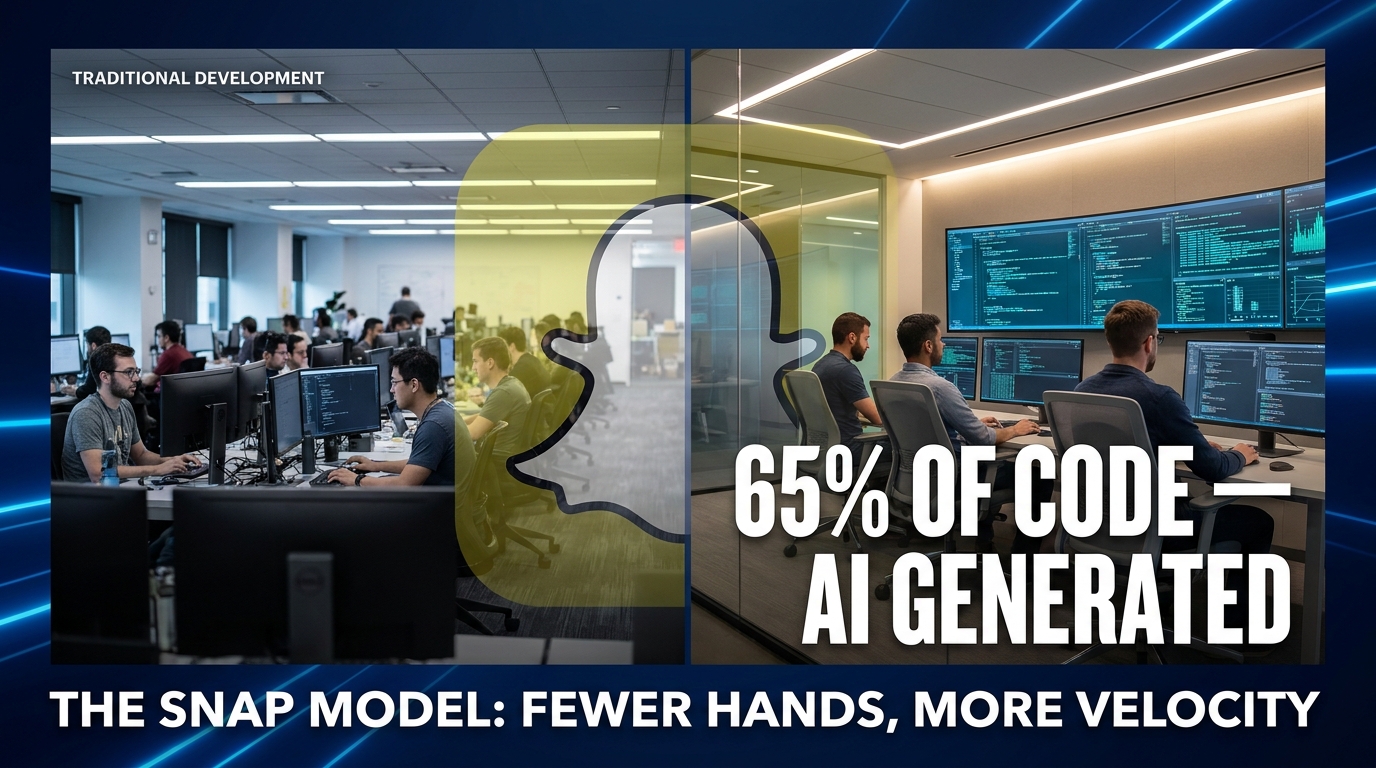
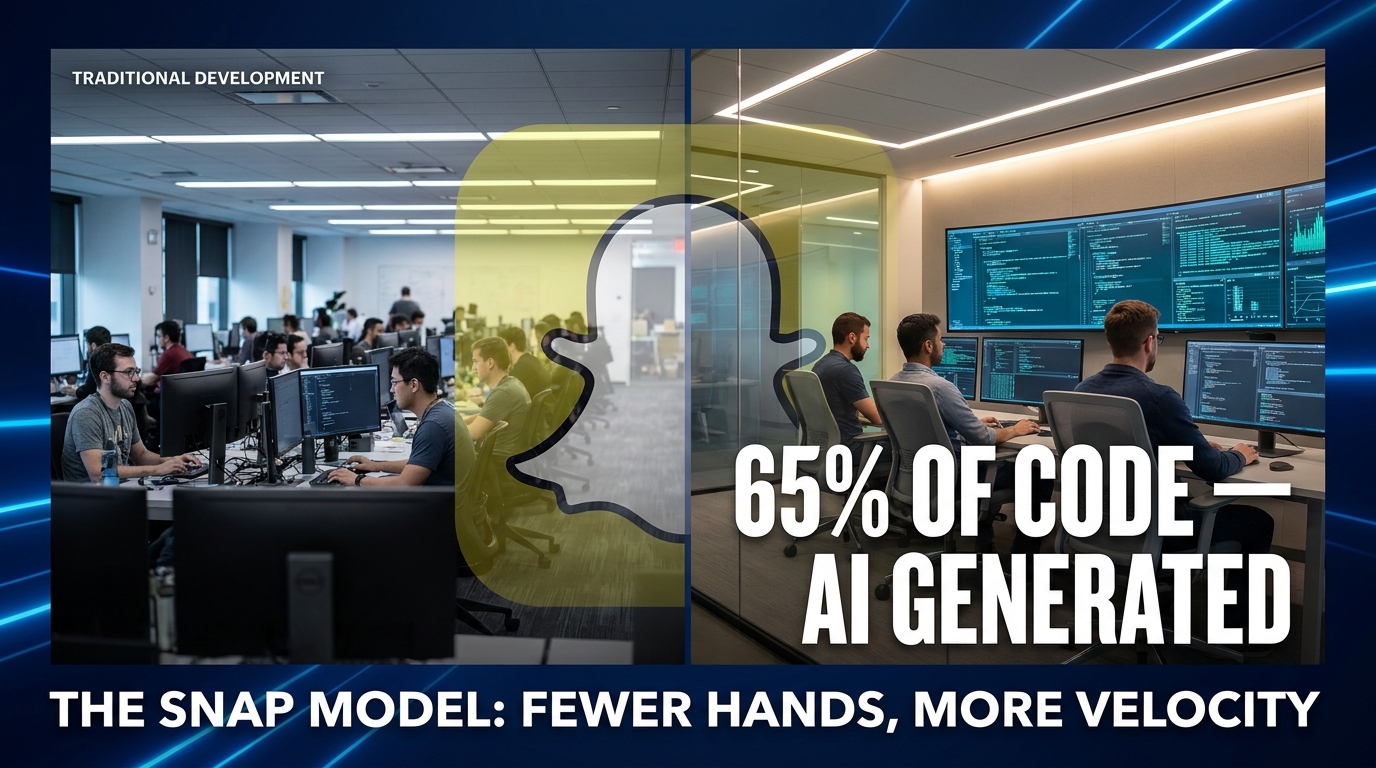
    Split composition showing traditional large engineering team versus small AI-augmented squad with 65% AI-generated code stat overlay

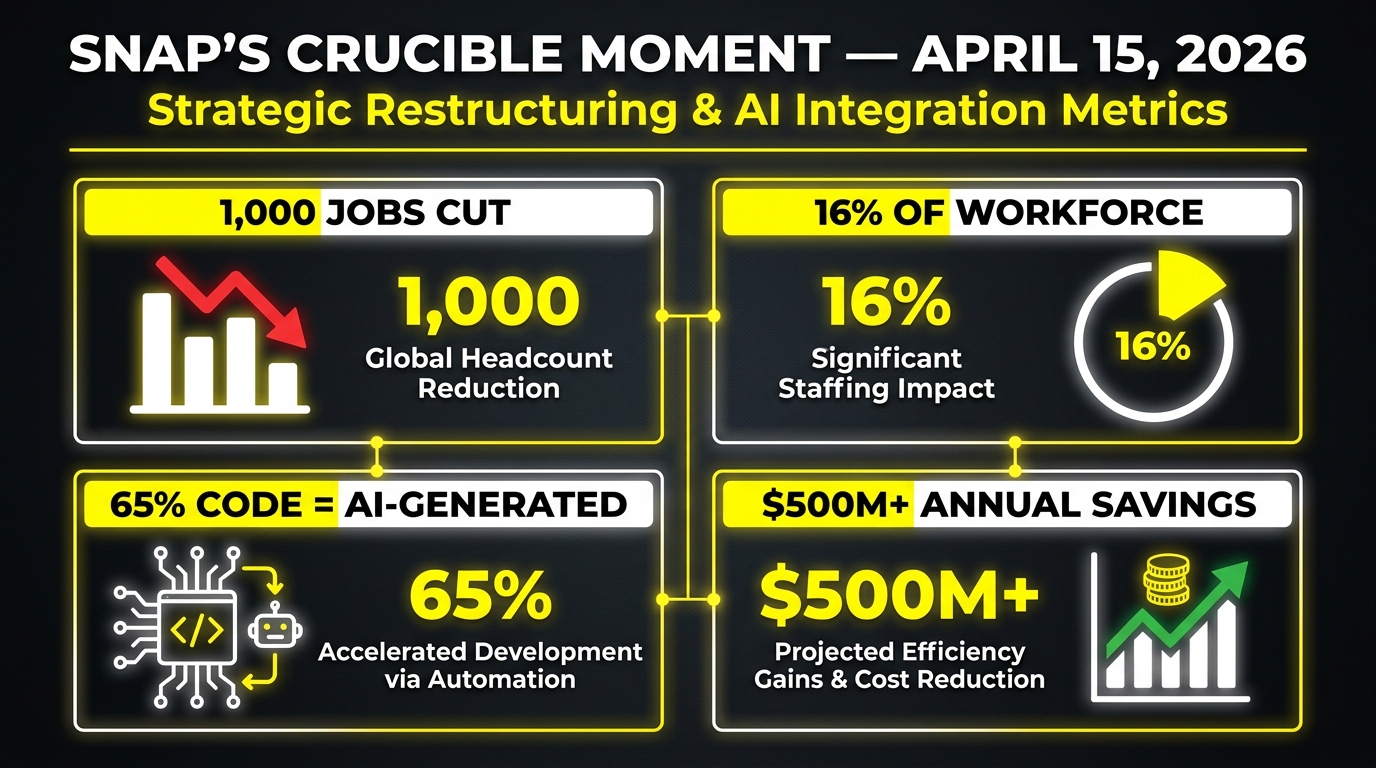
    On the morning of April 15, 2026, Evan Spiegel sent a memo to Snap’s global workforce that would ripple through every engineering leader’s inbox within hours. One thousand jobs — 16% of the company’s entire headcount — were being eliminated. Three hundred additional open roles were closed before the first applicant ever interviewed. The reason Spiegel cited wasn’t a revenue miss, a strategic pivot, or a board mandate to cut burn. It was something far more consequential: artificial intelligence now generates 65% of all new code written at Snap.

    He called it a “crucible moment.” The market called it an 8% stock pop. The engineering world called it a warning shot.

    But here’s what got lost in the noise of the layoff headlines: the actual mechanics of how Snap got to 65% AI-generated code, why that number matters far more than the layoff count, and — critically — what it would take for a mid-sized engineering team to replicate that kind of output without the collateral damage of mass restructuring.

    This isn’t a story about job cuts. It’s a story about a fundamental rewiring of how software gets built. If you run, manage, or work inside an engineering organization in 2026, Snap’s April announcement is the most important competitive benchmark you haven’t fully stress-tested yet. Here’s what it actually means — and what you should do about it.

    The Numbers Behind the Headlines: Snap’s 65% Stat Unpacked

    Infographic showing Snap's April 2026 announcement: 1,000 jobs cut, 16% of workforce, 65% AI-generated code, $500M+ annual savings

    Sixty-five percent sounds dramatic. But context matters enormously here, and the industry data around it tells a story that most breathless news articles ignored entirely.

    Where Snap Fits in the Broader Industry Picture

    According to 2026 market research, 41% of all enterprise code is now AI-generated across the industry, up from roughly 20% in early 2024. The AI coding tools market has grown to $12.8 billion in 2026 — more than double its $5.1 billion valuation in 2024. Eighty-two percent of developers now use AI tools weekly, and among elite-tier engineering teams, AI-assisted code share sits between 60% and 75%. Snap, at 65%, isn’t an outlier. It’s a bellwether: a large-scale proof that what top-performing teams achieve individually can be institutionalized company-wide.

    What makes Snap’s 65% figure different from a developer who just leans heavily on autocomplete is scope. The AI generation isn’t limited to boilerplate or unit tests. According to details from Spiegel’s memo and subsequent reporting, AI-generated code is running across Snapchat+ subscription features, the advertising platform’s infrastructure, Snap Lite builds, and core backend engineering tasks. This is production-grade, revenue-critical code — not a side experiment.

    The Financial Architecture of the Decision

    The math Snap is working with is brutal and clear. Prior to the April restructuring, Snap employed approximately 5,261 full-time staff globally. With 1,000 jobs cut and 300+ open roles closed, the company targets over $500 million in annualized cost savings by the second half of 2026. At the same time, Snap absorbed $95–130 million in pre-tax charges in Q2 2026, primarily from severance. That’s the short-term cost of a long-term structural shift toward net-income profitability.

    For engineering leaders watching from the outside, the question isn’t whether Snap’s trade-off was the right one ethically. The question is whether the productivity math actually works — and the evidence suggests that for Snap’s specific operating context, it does. The company has not reported a corresponding slowdown in product velocity. Snapchat+ sits at 24 million subscribers and climbing. Ad platform performance metrics are improving. The lights are on, and the team is smaller.

    What “AI-Generated” Actually Means

    One nuance worth drawing sharply: “AI-generated” does not mean “AI-autonomous.” At Snap’s scale and in 2026’s tooling landscape, AI-generated code still requires human engineers to prompt, review, test, and approve it. The workflow isn’t engineers watching a robot build a product. It’s engineers functioning as directors and architects — writing specifications, evaluating outputs, catching edge cases, and steering system design — while AI agents handle the volume work of implementation. The 65% number represents the authorship share of code, not the supervision share. That distinction matters enormously when you start thinking about how to replicate the model.

    Small Squads, Big Output: How Snap’s Organizational Strategy Actually Works

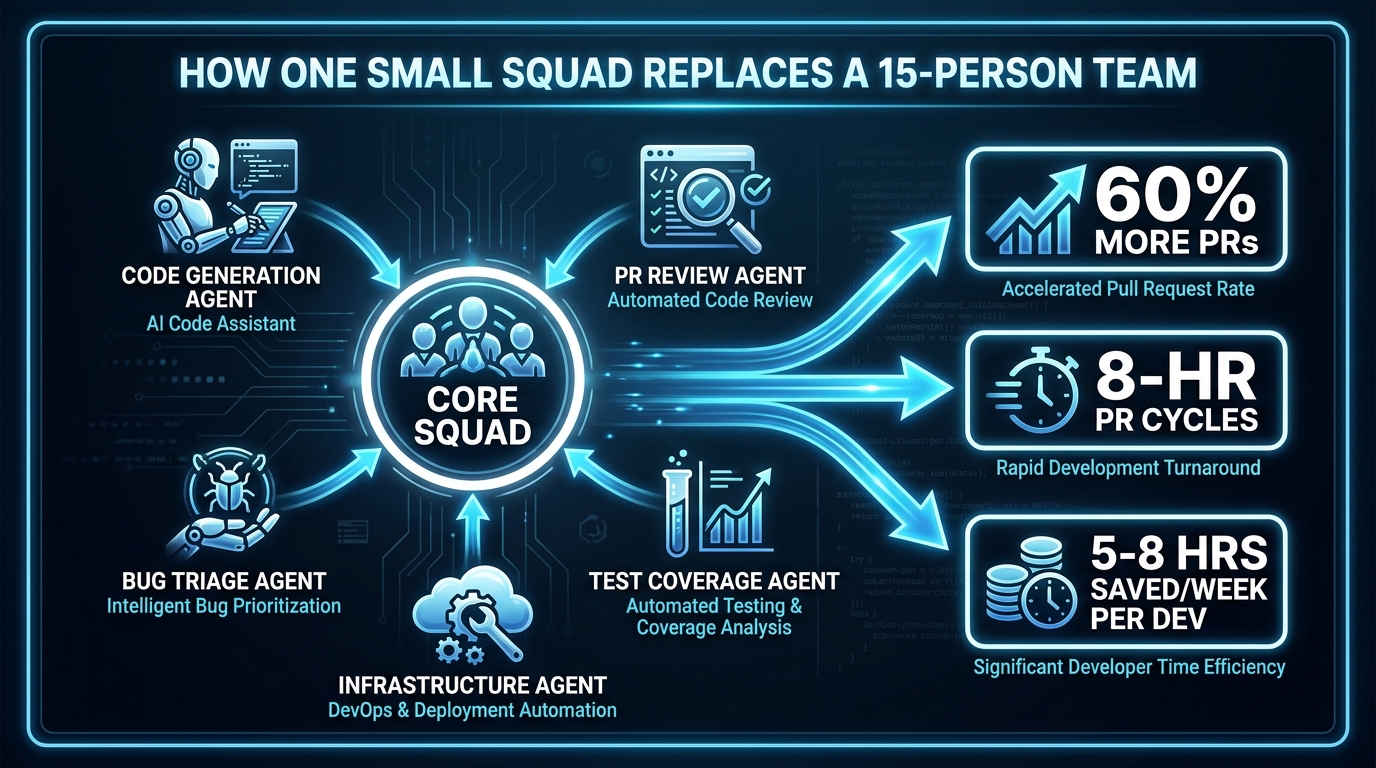
    Diagram showing small core squad of 4 engineers surrounded by AI agent types: Code Generation, PR Review, Bug Triage, Test Coverage, Infrastructure — with velocity metrics showing 60% more PRs and 8-hour PR cycles

    Inside the memo and the subsequent investor context that emerged in the weeks following the announcement, the operational concept Snap keeps returning to is “small squads.” This is more than a headcount euphemism. It’s a specific thesis about how teams at software companies should be organized when AI tools are operating at their current capability level.

    The Small Squad Model: What It Looks Like in Practice

    A traditional Snap product squad might have included four to six engineers, a product manager, a designer, and potentially a data analyst — perhaps eight to ten people total driving a feature area. Under the small squad model, that same feature area might be staffed with two to three senior engineers and a product lead, with AI agents operating as persistent collaborators on code generation, PR review, bug triage, and test coverage.

    Industry benchmarks support the viability of this structure. Elite-tier teams using AI coding tools in 2026 are achieving 60% more pull requests per engineer, with PR cycle times under eight hours compared to multi-day turnarounds in non-AI workflows. Individual developers are reclaiming five to eight hours per week that were previously consumed by repetitive implementation work. When you stack those gains across a small, highly senior team, the throughput math competes credibly with a much larger junior-heavy squad.

    The Role of Spec-Driven Engineering

    One of the less-reported keys to making small squads actually work at scale is what engineers and consultants are calling spec-driven engineering. AI coding agents perform exponentially better when they receive precise, well-structured specifications rather than loose prompts. This means that in a true small-squad model, engineers are spending significantly more time upfront writing rigorous technical specs — defining inputs, outputs, edge cases, architecture constraints, and acceptance criteria — before AI agents begin generating code.

    This shift fundamentally changes who is valuable on an engineering team. The developer who was previously valued for writing 500 lines of feature code per day becomes less central. The developer who can architect a system clearly enough to write a specification that AI can execute reliably becomes irreplaceable. Snap’s decision to primarily target product managers and partnership roles in the April layoffs — rather than senior engineers — is consistent with this dynamic.

    AI Agents Across the Full SDLC

    Snap’s efficiency gains aren’t limited to code generation at the implementation layer. Across the software development lifecycle (SDLC), AI tools are compressing timelines at multiple stages. Teams using integrated AI workflows in 2026 report 47% faster pull request reviews and 62% faster bug triage. Test generation — historically one of the most time-consuming and lowest-prestige tasks in software engineering — has been largely handed to AI agents. Infrastructure configuration, documentation drafting, and even code refactoring are all areas where AI authorship has meaningfully replaced human hours. The small squad isn’t smaller because it’s doing less. It’s smaller because AI has absorbed the volume work, leaving the humans to do the high-judgment work.

    The Tool Stack Driving It All: Cursor, Claude Code, GitHub Copilot, and Windsurf

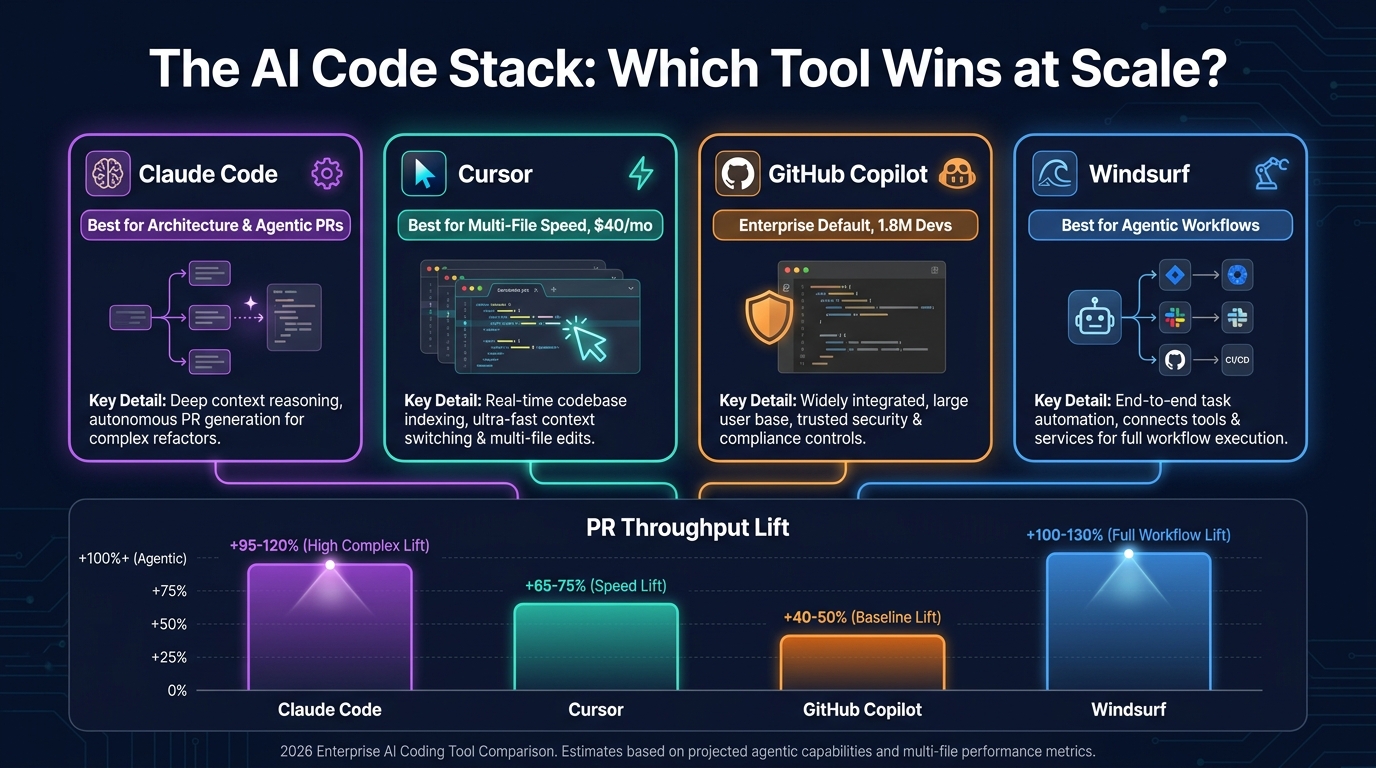
    Comparison chart of AI coding tools: Claude Code for architecture, Cursor for multi-file speed, GitHub Copilot for enterprise, Windsurf for agentic workflows — with PR throughput lift comparison bars

    Snap hasn’t publicly named every tool in its AI coding stack, but reporting and industry context make the likely composition reasonably clear. Understanding which tools drive the 65% figure — and how they differ — is critical for any team trying to replicate the model rather than just benchmark against it.

    Claude Code: The Architecture Leader

    As of early 2026, Claude Code (Anthropic’s coding-focused AI) has emerged as the market leader for complex, architectural-level coding tasks. Ninety-five percent of engineers using it report doing so weekly for at least half their work. Its strength is agentic pull requests — situations where the AI doesn’t just autocomplete a line but autonomously generates, tests, and submits a full PR based on a specification. For companies like Snap where the engineering team is doing complex, multi-system work on advertising infrastructure and consumer apps simultaneously, Claude Code’s ability to handle architectural changes without requiring constant human hand-holding makes it uniquely suited to the small-squad model.

    Cursor: The Throughput Engine

    Cursor reached $1 billion in annual recurring revenue in 2025 — a figure that would have seemed impossible for a developer tool a few years prior — and its growth trajectory has continued into 2026. Its edge is raw throughput on multi-file editing. Where some AI tools struggle with context across a large codebase, Cursor maintains coherence across multiple files simultaneously, making it particularly effective for refactoring sessions, cross-module feature work, and high-velocity iteration cycles. Enterprise teams report 60% more PRs per engineer per week when Cursor is the primary tool. At $40 per user per month for the Business tier, it’s also one of the better-value options at team scale — the ROI math tends to close quickly against the cost of a single additional engineering hire.

    GitHub Copilot: The Enterprise Default

    With 1.8 million developers and more than 50,000 organizations using it in 2026, GitHub Copilot remains the default AI coding tool for enterprises that need SOC 2 compliance, deep GitHub integration, and organization-wide governance from day one. Ninety percent of the Fortune 100 uses it. It’s not the highest-ceiling option in the stack — its autocomplete-focused design means it generates less autonomous output than Claude Code or Cursor — but for teams that need to start somewhere with low friction and auditable usage, Copilot is the practical foundation. Many high-performing teams run Copilot organization-wide as a baseline and use Cursor or Claude Code for more complex work.

    Windsurf: The Agentic Workflow Specialist

    Windsurf (formerly Codeium’s premium tier) has carved out a distinct position in 2026 as the tool best suited for agentic workflows — situations where you want an AI agent to complete an extended, multi-step engineering task with minimal interruption. This is particularly relevant for the kind of infrastructure work Snap is doing: setting up data pipeline configurations, managing deployment scripts, and handling the operational engineering tasks that are important but don’t require a senior engineer’s creative judgment. Teams using Windsurf in agentic mode report some of the most significant time savings on the infrastructure side of the SDLC.

    The Multi-Tool Reality

    The practical reality for most engineering teams is that no single tool wins across every use case. Best practice in 2026 involves selecting one to two primary coding agents paired with an analytics platform to track ROI, then layering specialist tools for specific workflow stages. The anti-pattern to avoid is tool proliferation — every engineer running a different AI tool with no standardization, no shared prompt libraries, and no common measurement framework. That approach produces anecdote rather than compound organizational learning.

    Infrastructure Beyond Code: Snap’s GPU and Data Processing Transformation

    The AI-generated code story at Snap doesn’t exist in isolation. It’s part of a broader engineering infrastructure transformation that has been running in parallel — and understanding both threads explains why Snap’s efficiency gains are structural rather than cosmetic.

    The NVIDIA cuDF Deployment

    Alongside its AI coding adoption, Snap deployed NVIDIA cuDF on Apache Spark via Google Cloud, using GPU acceleration to fundamentally change how its data infrastructure operates. The results are striking: 4x faster runtime for petabyte-scale data processing and 76% reduction in daily processing costs. The GPU requirement for A/B testing dropped from 5,500 concurrent units to 2,100 — a 62% reduction in compute footprint for the same analytical output.

    For context, Snap runs over 6,000 metrics per A/B test. The ability to process petabyte-scale datasets in hours rather than days isn’t just an infrastructure win; it directly enables the small-squad model. A team of four engineers running hundreds of product experiments needs to get results fast. When data processing takes days, you need more analysts to manage the pipeline. When it takes hours, you don’t.

    Why Infrastructure Efficiency Enables Headcount Efficiency

    This is the part of Snap’s story that tends to get separated from the AI coding narrative but belongs with it. The $500 million in annualized savings Snap is targeting comes from a combination of headcount reduction and infrastructure cost reduction running simultaneously. Engineering teams that are trying to replicate Snap’s model by only adopting AI coding tools — without also rethinking their data infrastructure, compute costs, and operational overhead — will capture only a fraction of the available efficiency.

    The real lesson from Snap isn’t “replace engineers with AI.” It’s “build an engineering organization where every layer — human, code, infrastructure, and data — is running at its most efficient configuration simultaneously.” The AI coding adoption is the most visible layer, but it’s one of four or five levers being pulled in concert.

    What the “AI Washing” Critics Get Right (and Wrong)

    The April announcement triggered an immediate and pointed debate in the tech industry. Critics — many of them engineers who had just watched colleagues receive termination notices — argued that Snap’s AI-generated code framing was “AI washing”: using AI’s momentum as a palatable narrative for what is ultimately a financial restructuring dressed up in technology language.

    The Strongest Version of the Criticism

    The critique has real merit in several areas. First, trackers noted that a significant portion of Snap’s April cuts targeted product managers and partnership roles — not software engineers. If 65% of code is AI-generated and the layoffs are primarily in non-engineering functions, the causal chain between “AI codes more” and “these specific people lose their jobs” is less direct than Spiegel’s memo implied.

    Second, the AI-washing concern is broader than Snap. Analysis of tech layoffs through mid-April 2026 found approximately 99,283 job cuts across the sector, with 47.9% attributed to AI based on public company statements — but those attributions were based on what executives said, not on verified productivity data. Block (formerly Square), under Jack Dorsey, attracted significant criticism in February 2026 when it cited “intelligence tools” to justify 4,000 layoffs, despite the company having over-hired significantly during the COVID boom and experiencing a 40% stock drop unrelated to AI productivity.

    Third, the quality risks in AI-generated code are real and documented. Research in 2026 found that AI-generated code produces 1.7 times more major bugs and carries a 2.74 times higher vulnerability rate than human-written code under equivalent conditions. Companies rushing to hit a headline AI-code percentage without robust review infrastructure are trading a headcount problem for a code quality problem — which tends to be more expensive to fix downstream.

    What the Critics Get Wrong

    That said, dismissing Snap’s transformation as pure financial theater ignores the substantive engineering reality. The productivity gains from AI coding tools are well-documented and measurable — not theoretical. GitHub’s own research has consistently shown 15–34% productivity improvements from Copilot at scale. Cursor data shows 60% more PRs per engineer per week. Claude Code’s adoption rate among professional engineers (95% weekly usage for half of all work) reflects genuine utility, not marketing.

    More importantly, the companies that dismiss the AI coding shift as hype are the ones most likely to find themselves at a serious competitive disadvantage within 18 months. Whether the specific framing around any given layoff announcement is honest or performative, the underlying productivity dynamics are real. Skepticism about the narrative is warranted. Skepticism about the technology is not.

    The Playbook for Replicating Snap’s Approach at Your Company

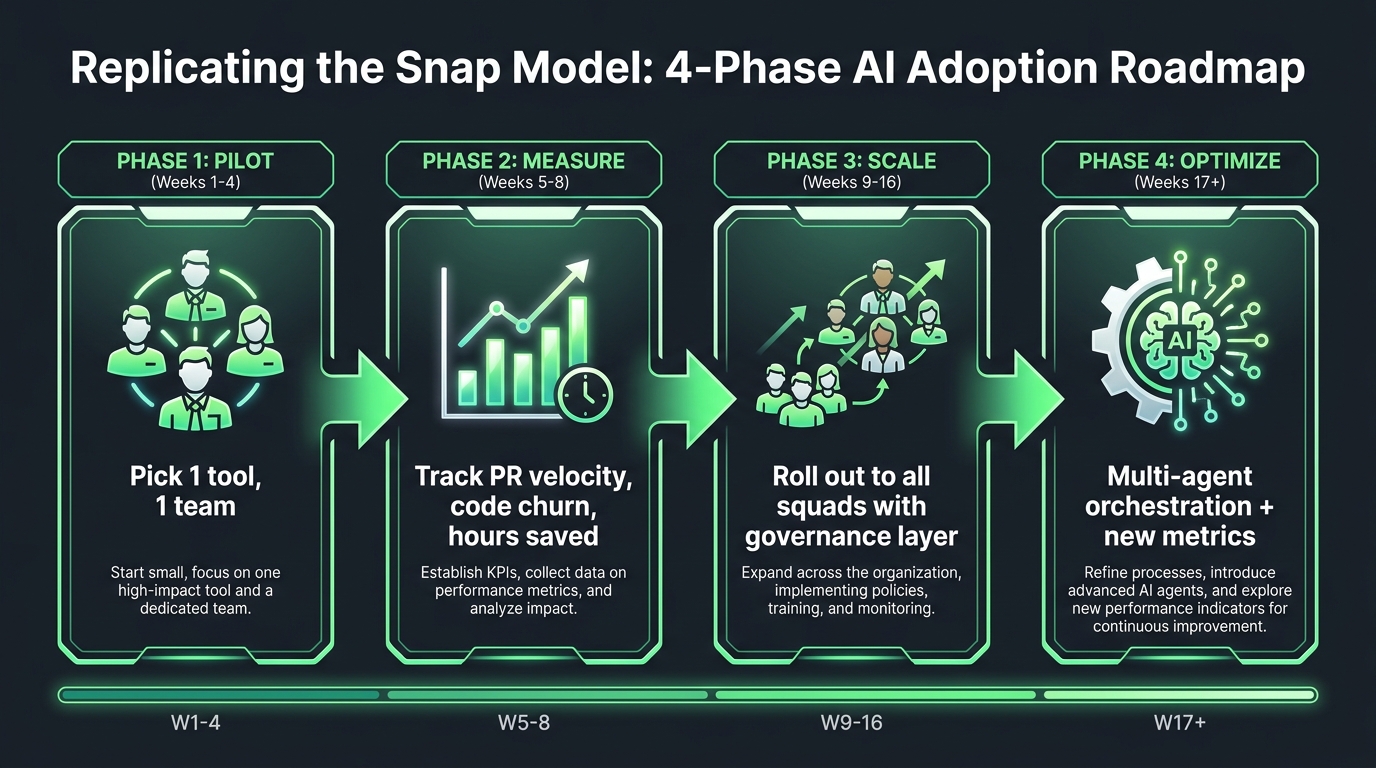
    4-phase AI adoption roadmap: Phase 1 Pilot weeks 1-4, Phase 2 Measure weeks 5-8, Phase 3 Scale weeks 9-16, Phase 4 Optimize weeks 17+

    Most engineering leaders reading about Snap’s 65% figure are not running a 5,000-person tech company with the capital to absorb $95–130 million in severance charges. The question isn’t how to replicate Snap’s restructuring. It’s how to replicate the capability that enabled it — an engineering organization genuinely running at higher output per person — regardless of your current team size or structure.

    Phase 1: The Constrained Pilot (Weeks 1–4)

    Start with one team, one tool, and a clearly defined measurement framework before touching anything else. Select a squad of three to five engineers who are already technically strong and open to changing their workflow. Deploy a single AI coding tool — Claude Code or Cursor for most teams; GitHub Copilot for organizations with strict compliance requirements. The goal in this phase is not productivity transformation. It’s baseline measurement. Track PR throughput, cycle time, and hours spent on implementation-level tasks before AI assistance. You need a before picture to measure against.

    Run this for four weeks with deliberate note-taking. What kinds of tasks is the AI handling well? Where does it slow the team down with bad suggestions or require extensive review? What does the code review burden look like on the output side? The answers to these questions will shape your Phase 2 deployment far more than any vendor benchmark can.

    Phase 2: Establish the Measurement Infrastructure (Weeks 5–8)

    Before scaling, build the measurement layer. This is the most commonly skipped step in AI coding deployments — and the most commonly regretted omission. You need visibility into:

    • AI code percentage — how much of merged code originated from AI suggestions
    • PR cycle time — time from first commit to merge
    • Code churn rate — how often newly written code is deleted or significantly rewritten within 30 days, a proxy for code quality
    • Bug introduction rate in AI-generated versus human-written code
    • Developer time savings — direct survey or time-tracking tool data

    The industry benchmark for code churn in AI-generated code is 5.7–7.1%, compared to 3–4% for experienced human developers. If your team’s AI-generated code churn is running higher, you have a prompt quality problem, a review process problem, or both — and you need to diagnose it before scaling the workflow to your full organization.

    Phase 3: Scaled Rollout with Governance (Weeks 9–16)

    Roll out across all engineering squads, but with a governance layer in place from day one. This includes: a standardized prompt library for common development patterns at your company; a code review protocol that specifically addresses AI-generated code (who reviews it, with what checklist, and what automatic rejection criteria look like for security-sensitive areas); and a shared Slack or Teams channel where engineers can share what’s working, what prompts are producing the best results for your specific codebase, and what AI is consistently getting wrong.

    The compound value in an organization-wide AI coding deployment isn’t just individual productivity gains. It’s institutional learning — each engineer’s discoveries about how to work effectively with AI feeding back into a shared knowledge base that makes the whole team faster. Organizations that skip governance typically have individual engineers who are power users and everyone else who barely uses the tools. The power users’ knowledge stays siloed, and the organization never achieves the multiplied output that Snap achieved.

    Phase 4: Multi-Agent Orchestration and the Senior-Shift (Weeks 17+)

    At the maturity end of AI coding adoption, teams stop thinking about AI as a tool individual engineers use and start thinking about AI as a layer of the engineering infrastructure. This is the multi-agent orchestration stage: code generation agents, PR review agents, test coverage agents, and infrastructure configuration agents running in concert, with human engineers serving as orchestrators rather than implementers. This is the operating model Snap is running at scale.

    Getting here requires a deliberate organizational shift. Senior engineers need to redirect a meaningful portion of their time toward writing better specifications, improving the prompts and context that AI agents receive, and building the evaluation frameworks that determine whether AI output is acceptable. This is harder to do — it requires a different kind of thinking than implementation-focused engineering — but it’s where the real productivity multiplication lives.

    Measuring What Matters: New Metrics for AI-Augmented Engineering Teams

    Traditional software engineering metrics break down badly in an AI-augmented environment. Lines of code per engineer is useless when AI can generate a thousand lines of adequate-but-not-great code in minutes. Pull requests per week can skyrocket while actual feature quality declines. Engineering leaders who try to evaluate their AI coding adoption using pre-AI KPIs will either declare false success or miss real problems.

    Metrics That Work in 2026

    AI code percentage with churn overlay: Track what percentage of merged code is AI-generated, but always view it alongside the churn rate. High AI percentage with low churn (under 5%) indicates effective integration. High AI percentage with high churn (above 7%) indicates quality problems that are generating rework overhead.

    PR cycle time: Sub-8-hour PR cycles are the benchmark for elite AI-augmented teams in 2026. If your cycle times aren’t improving meaningfully after 60 days of AI tool adoption, you have an adoption problem or a review-bottleneck problem, not a tool problem.

    Feature cycle time, end-to-end: Zoom out from PRs to full features. Track the time from specification finalization to production deployment. AI coding tools should compress this number. If they aren’t, the bottleneck has moved upstream to specification quality or downstream to QA and deployment — and that’s where your next investment should go.

    Specification completeness rate: In a spec-driven engineering environment, incomplete specs are the primary cause of poor AI output. Track how often engineering specifications have to be revised after an AI’s first pass at implementation reveals ambiguity. This is an indirect measure of your team’s spec-writing maturity — which is now a core engineering skill.

    Developer time-on-high-judgment-work: Survey engineers quarterly on what percentage of their weekly hours they’re spending on high-judgment tasks (system design, architecture decisions, complex debugging, stakeholder communication) versus low-judgment tasks (implementation, documentation, test writing). AI adoption should visibly shift this ratio. If engineers still report spending 60% of their time on implementation work after six months of AI tool deployment, adoption is shallow.

    The ROI Benchmark

    Industry data in 2026 puts the average ROI for AI coding tool adoption at 2.5–3.5x for well-run deployments, with top-quartile teams achieving 4–6x. At an industry-standard cost of $200–600 per developer per month for a multi-tool stack, a team of 20 engineers spending $4,000–$12,000 per month on AI tools should be returning $10,000–$72,000 per month in productive capacity. The break-even timeline at typical adoption rates runs 12–18 months. Companies that are still treating AI coding tools as a pilot-indefinitely experiment rather than a capital allocation decision are leaving measurable value on the table.

    The Talent Reality: Who Benefits and Who Gets Left Behind

    The human stakes of Snap’s AI coding shift extend well beyond the 1,000 people who received termination notices in April. The structural change in what makes an engineer valuable is unfolding across the entire industry, and it’s playing out at different speeds for different career stages.

    Senior Engineers: The Clear Winners (For Now)

    For senior engineers — those with strong system design skills, architectural judgment, and the ability to write precise technical specifications — the AI coding era is unambiguously good. Their comparative advantage over AI grows, not shrinks, as AI gets better at implementation. AI is excellent at writing code from a clear specification. It is not good at knowing whether the specification is the right one, whether the architecture serves the business need in three years, or whether a subtle edge case in a distributed system will cause a production incident. Those are senior-engineer skills, and they’re becoming more valuable as the implementation layer gets cheaper.

    Junior and Mid-Level Engineers: A More Complex Picture

    The picture is harder for junior and mid-level engineers. Research in 2026 projects 40–60% reductions in routine L0/L1 roles at companies moving aggressively toward AI-augmented teams. These are the roles where a developer primarily writes implementation code from a spec — precisely the function that AI now handles at high volume. The career ladder has a missing rung: the path from junior to senior used to run through years of implementation experience that built the contextual knowledge needed for architectural work. If AI absorbs the implementation work, junior developers get fewer of the repetitive reps that used to build that knowledge.

    This is a real and underappreciated problem. Companies that cut their junior pipelines to capture short-term efficiency gains may find themselves without a bench of senior engineers in four to five years. The best engineering organizations in 2026 are actively redesigning their junior developer programs to build architectural thinking and spec-writing skills from the beginning of a career, rather than treating those as skills that emerge naturally after years of implementation work.

    Product Managers and Non-Engineering Roles

    Snap’s April cuts fell heavily on product managers and partnership roles — not engineers. This tracks with a broader industry pattern: as small engineering squads gain the ability to ship more with less coordination overhead, the demand for intermediate coordination roles declines. The PMs who will thrive are the ones who write precise, testable product specifications that AI agents can act on directly. Those who add value primarily through facilitation and communication may find their role definition shifting under them faster than expected.

    Peer Pressure: How Atlassian, Pinterest, Duolingo, and Others Are Adapting

    Snap is not operating in isolation. The same forces are reshaping engineering teams across the tech industry, with different companies taking different approaches to the same underlying shift.

    Atlassian laid off approximately 1,600 employees — 10% of its workforce — in March 2026. Co-founder Scott Farquhar’s public framing was measured: he explicitly pushed back on the “AI replaces people” narrative, arguing that AI changes the efficiency of work rather than the mix of skills needed. But the financial reality is that improved productivity from AI tools does inherently reduce the number of people needed to accomplish the same output. The framing and the math are in some tension.

    Pinterest announced plans to cut 15% of its workforce in 2026, explicitly redirecting the cost savings toward AI product initiatives. Rather than framing the cuts as AI-driven, Pinterest positioned them as investment reallocation — a shift of capital from labor costs to AI tooling and infrastructure. The destination is the same; the narrative architecture is different.

    Duolingo has taken the most transparent approach: requiring managers to affirmatively demonstrate that AI cannot perform a function before approving a new hire. This is effectively a hiring-side version of Snap’s layoff-side policy. The headcount impact is the same — fewer people do equivalent work — but it arrives gradually through attrition and hiring restraint rather than through a single restructuring event. For engineering leaders managing organizations that don’t want to absorb the reputational and cultural cost of mass layoffs, Duolingo’s approach may be the more sustainable model.

    Across the sector, tech layoffs through mid-April 2026 totaled approximately 99,283 jobs, with nearly half attributed — accurately or not — to AI productivity gains. The pattern is clear: companies are using their AI coding productivity improvements to right-size their engineering organizations, whether they frame it that way or not.

    Implementation Risks: Code Quality, Security, and Organizational Debt

    Risk infographic showing AI coding risks: 1.7x more major bugs, 2.74x higher vulnerability rate in AI-generated code, and organizational risks from junior pipeline decline

    A comprehensive assessment of Snap’s AI coding model has to grapple honestly with its risks. Replicating the efficiency gains without a corresponding investment in risk mitigation is how organizations end up with a different, more expensive set of problems.

    Code Quality Degradation

    The 2026 research on AI-generated code quality is not uniformly positive. Studies measuring bug density and code churn consistently find that AI-generated code — particularly in environments where review processes haven’t been adapted for AI authorship — introduces more defects than well-written human code. The 1.7x major bug rate and 2.74x higher vulnerability rate cited in security research represent worst-case conditions (minimal review, poor specification quality), but they’re not hypothetical. They reflect what happens when organizations adopt AI coding tools without simultaneously upgrading their review infrastructure.

    The mitigation is straightforward but requires investment: dedicated AI code review checklists, automated security scanning on AI-generated code, and a culture where engineers are expected to own and understand every line of code in a PR regardless of who — or what — wrote it first. The review burden doesn’t disappear when AI writes the code. It shifts.

    Security and Compliance Risks

    AI coding tools generate code from training data that includes vast amounts of public code repositories — which means they can inadvertently reproduce patterns from vulnerable, deprecated, or license-restricted code. Organizations in regulated industries (finance, healthcare, enterprise SaaS with complex compliance requirements) need to treat AI-generated code as requiring a separate security review pass, not just a standard code review. This is particularly relevant for authentication logic, data handling, and API integration code — all areas where AI tools are confident but error rates are high.

    The Organizational Debt Problem

    Perhaps the most underappreciated risk in aggressive AI coding adoption is organizational debt: the long-term consequences of hollowing out your junior engineering pipeline faster than you can build a replacement path to experienced senior engineers. Snap has the scale and resources to absorb this risk in ways that most engineering organizations don’t. A 50-person engineering team that cuts its junior tier to achieve short-term efficiency may find itself in a hiring crisis in 2028 when it needs experienced engineers and has no internal bench to draw from.

    The responsible version of the Snap model includes a deliberate investment in reskilling — moving engineers who were doing implementation work into the specification-writing, architecture, and AI orchestration roles that the small-squad model actually needs. This is harder and slower than a layoff announcement, but it’s the approach that builds a sustainable engineering organization rather than a temporarily efficient one.

    Beyond the Headlines: Building the AI-Native Engineering Organization

    Snap’s April 2026 announcement will be studied in business schools for a decade. But the most important thing it signals isn’t about headcount or cost savings or stock prices. It’s about the pace at which the definition of an effective engineering organization is changing — and the widening gap between organizations that are actively adapting and those that are treating AI coding as an optional efficiency experiment.

    The Engineering Org You Need to Build

    The AI-native engineering organization isn’t the one that has adopted the most tools or cut the most headcount. It’s the one where:

    • Senior engineers spend the majority of their time on specification, architecture, and AI orchestration — not implementation
    • AI agents run continuously across the SDLC, not just in the code editor
    • Measurement infrastructure tracks AI code quality in real time, flagging churn and vulnerability risks before they reach production
    • Junior developers are being trained on spec-driven engineering from their first week, not learning it as a late-career skill
    • Infrastructure efficiency — compute, data, pipeline cost — is optimized in parallel with human efficiency, not as a separate initiative

    The Timeline That Matters

    Snap went from early AI coding adoption to 65% AI-generated code across its entire engineering organization within approximately two years. Given that the tools available in 2026 are substantially better than those available in 2024, the same transition should be achievable in 18 months or less for teams that start today with a deliberate strategy. For teams that haven’t started, the clock is running — and their competitors may already be several phases ahead.

    What to Do This Week

    If you’re an engineering leader who has read this far and is still uncertain about where to begin, here is the minimum viable action set:

    1. Pick one team and one tool. Start with GitHub Copilot if your organization needs compliance coverage from day one, or Cursor if you want maximum throughput on a team ready to move fast.
    2. Establish baseline metrics before launch. You cannot demonstrate ROI without a before picture. Measure PR cycle time, code churn, and developer hours on implementation tasks before the pilot begins.
    3. Add a code review protocol for AI output. Even if it’s lightweight to start, your team needs a shared understanding of how AI-generated code is evaluated differently from human-generated code.
    4. Talk to your senior engineers about spec-writing as a core skill. The shift toward specification-driven engineering is the most important cultural and capability change the AI coding era requires. Start that conversation now.
    5. Measure after 60 days and make a scaling decision. Don’t let a pilot run indefinitely without a decision point. Sixty days is enough time to see whether the productivity gains are real in your environment and whether you should accelerate adoption.

    Snap’s crucible moment was dramatic, public, and painful for many of the people involved. But the underlying message it sends to every engineering organization watching is straightforward: the teams that figure out how to work at 65% AI-generated code — or higher — will be operating at a cost and velocity profile that teams stuck at 10% or 20% simply cannot match indefinitely. The question isn’t whether this transition is coming. It’s whether you’re going to lead it or chase it.