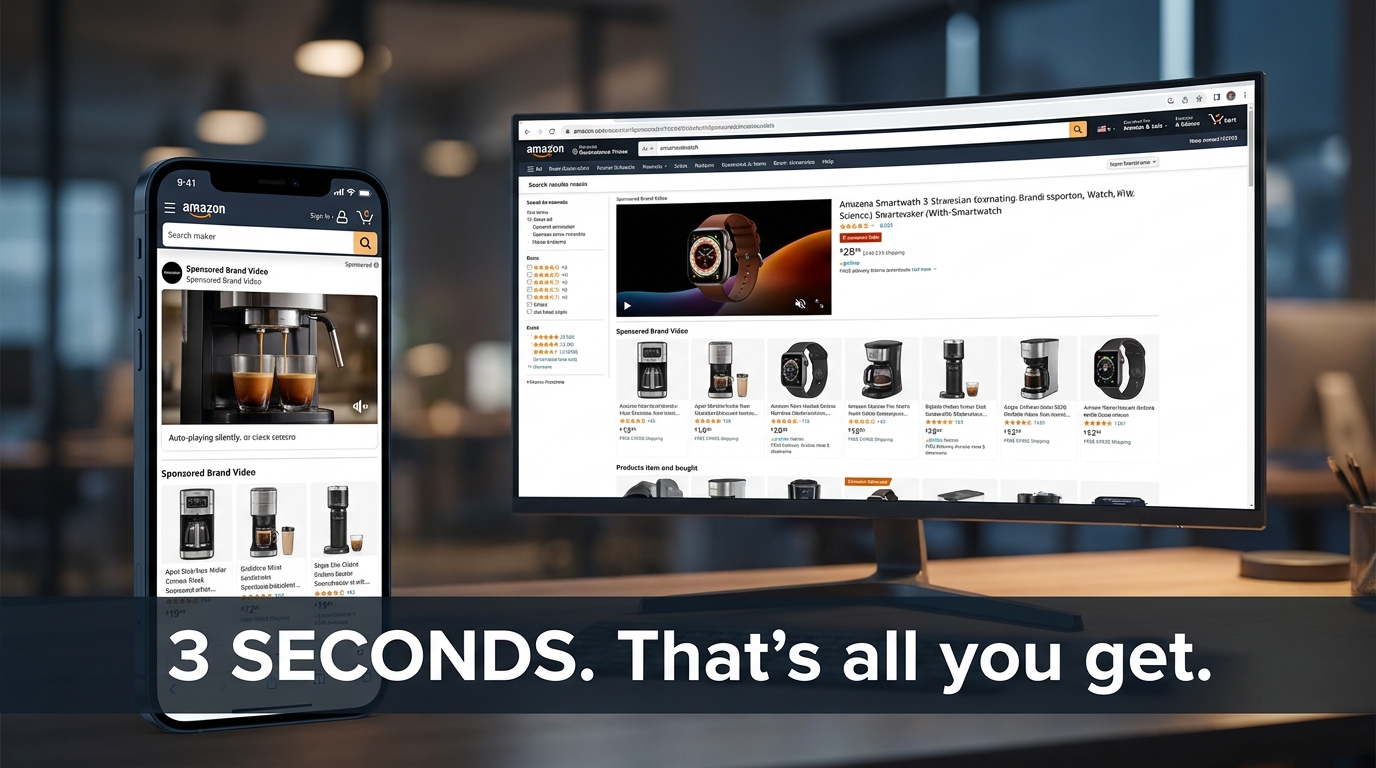
There is a quiet crisis playing out in Amazon ad accounts right now. Brands are spending real money — sometimes thousands of dollars a month — on Sponsored Brand Video campaigns that autoplay perfectly, meet every technical requirement, pass review, and still convert at a fraction of what they should. The videos look fine. The targeting seems reasonable. But the results are disappointing, and most advertisers have no clear idea why.
The answer, in most cases, comes down to the first three seconds — and the deeply counterintuitive reality of what a Sponsored Brand Video actually is in the context of Amazon’s search experience. It is not a YouTube pre-roll. It is not a social media Reel. It is a silent, autoplaying unit dropped directly into a shopper’s keyword search results, and that distinction changes everything about how the creative needs to behave.
This post is not a beginner’s guide to what Sponsored Brand Video is or how to set up a campaign in Seller Central. If you need that, Amazon’s own learning console covers it well. What this piece covers is the harder problem: why technically correct SBV campaigns consistently underperform, what the creative and structural decisions that actually drive results look like, and how to measure performance in ways that tell you something useful beyond a top-line ACoS number.
The mechanics here matter. And they are almost never discussed at the level of specificity that makes a difference.
What Amazon’s SBV Placement Actually Looks Like to a Shopper
Before you can fix your creative, you need a precise mental model of where it lives and what surrounds it. This is where most sellers go wrong before a single frame is filmed.
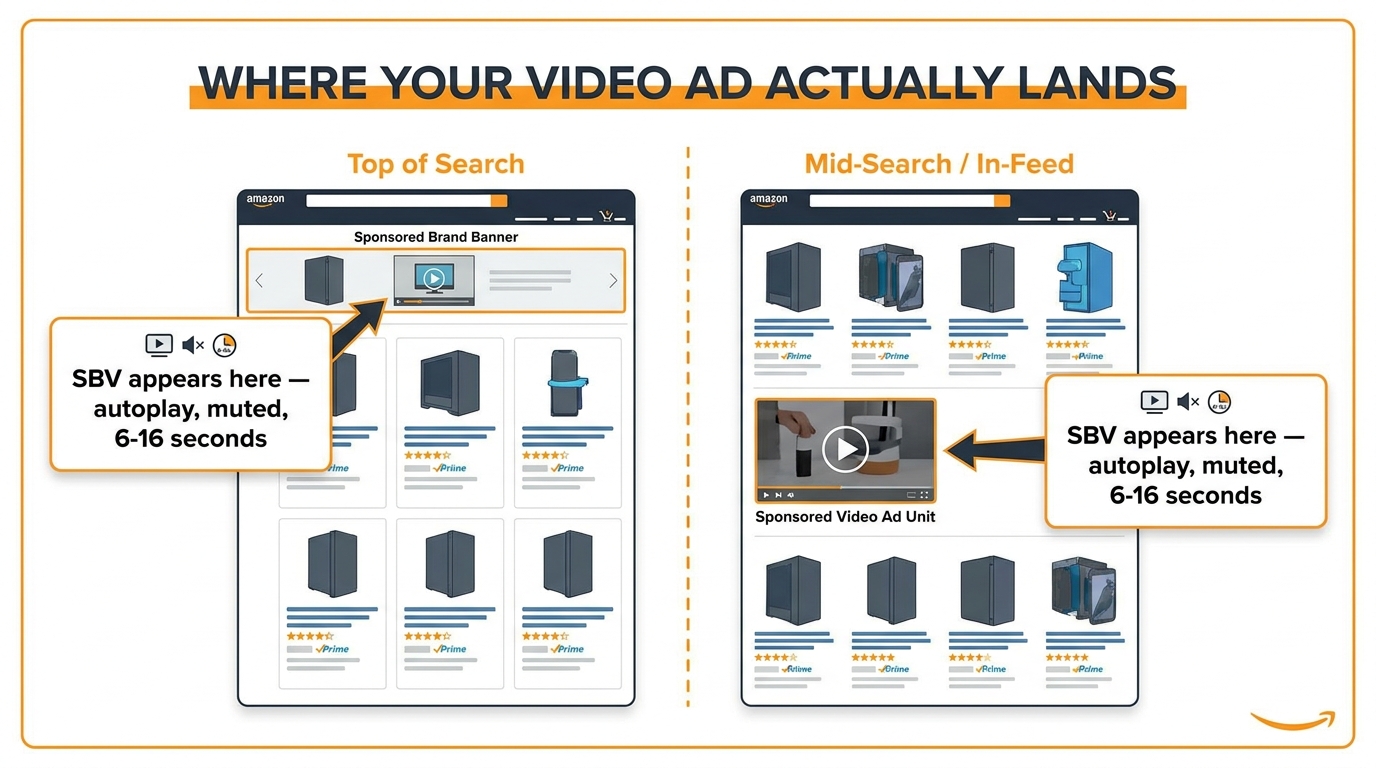
Sponsored Brand Video ads appear in two primary positions on Amazon’s search results pages. The first is the in-feed placement — your video appears between rows of organic and sponsored product listings, typically after the first or second row of results. The second, available through reserve share of voice (SOV) buying, places SBV at the top of search, above all other results.
The In-Feed Context Is the Default — and It’s Brutal
For the vast majority of advertisers running standard SBV campaigns, in-feed is where your video lands. Here is what that actually means for the shopper experience: a person has just typed a keyword into Amazon’s search bar. They are actively scanning results — usually left to right, top to bottom, in the rapid product-grid mode that years of Amazon shopping have hardwired into their behavior. Their primary cognitive task is evaluating product thumbnails, prices, star ratings, and Prime badges.
Then your video starts playing. Automatically. Without sound. While they’re already in the middle of evaluating other products.
The video appears in a 16:9 or square aspect ratio depending on format, with the product title and a “Shop now” prompt displayed beside or below the video frame. On mobile, the experience is slightly different — the video takes up more vertical real estate and can feel more immersive, but the silent autoplay behavior remains the same.
The Shopper’s Attention Is Already Divided
This is the key context that most creative briefs ignore entirely. When someone searches for “stainless steel water bottle” and scrolls past your SBV, they are not waiting to be entertained. They are not in content consumption mode. They are in decision mode. They have a purchase intent, and they are comparing options as fast as their eyes can move.
This means your video needs to accomplish something very different from what works in entertainment-adjacent placements. It needs to interrupt a scanning behavior — not invite passive viewing. That requires a completely different visual language than what most video agencies produce by default.
On desktop, the video panel typically shows alongside your headline and product ASIN. On mobile, the video is more prominent. In both cases, the viewer has not opted in. They have not pressed play. The video is simply there, running, and they have a fraction of a second to decide whether it warrants a pause in their scrolling.
The Silent Autoplay Problem: Why Your First 3 Seconds Are Everything
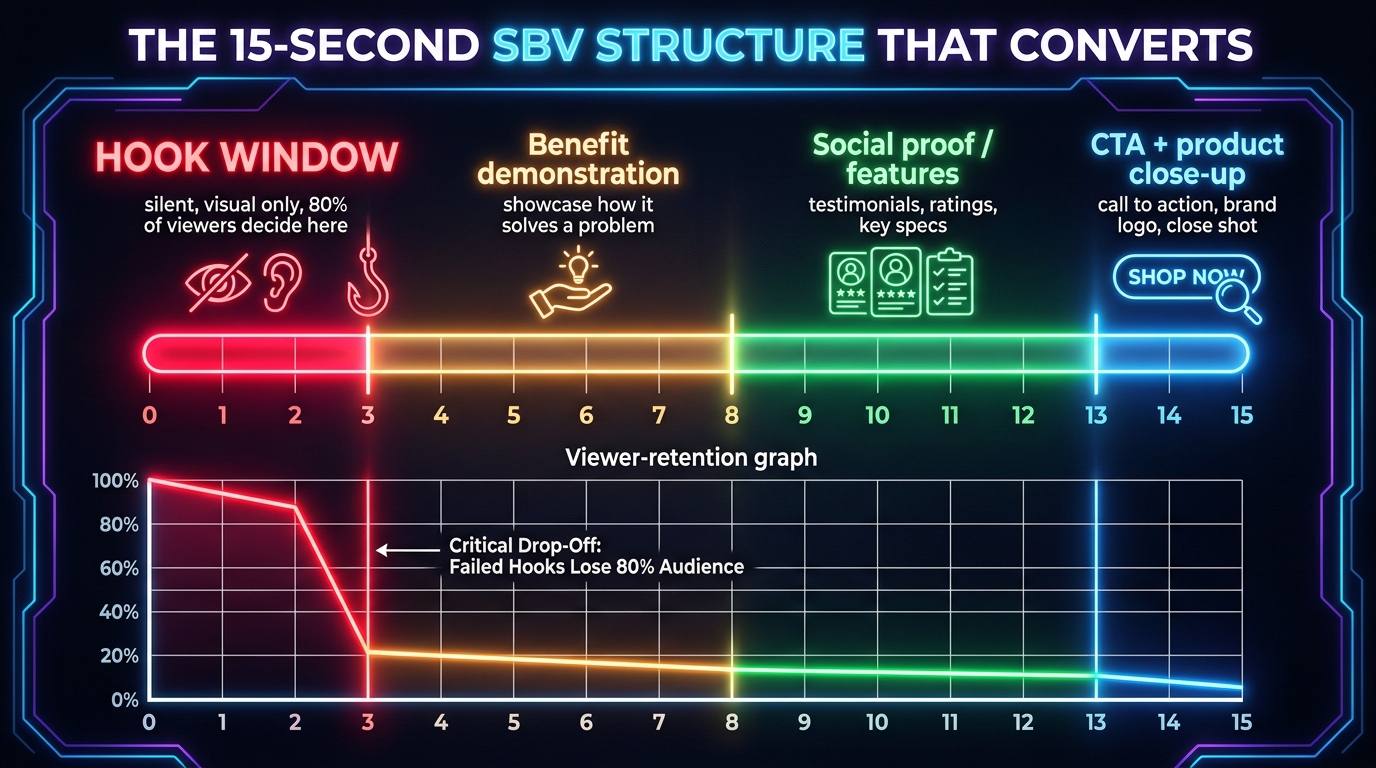
Amazon’s Sponsored Brand Video plays on mute by default. The viewer can tap or click to enable audio, but the overwhelming majority never do — particularly when the video fails to earn that action in the opening seconds. This is not a minor technical footnote. It is the single most consequential constraint on SBV creative strategy, and it is dramatically underweighted in most advertisers’ creative planning.
Think about what that means in practice: every element of your story-telling structure that depends on a voiceover — the product benefit read, the brand positioning statement, the emotional music swell — is effectively invisible to the shopper unless you have already convinced them to tap for sound. And the only thing that earns that tap is what they see in the first two to three seconds.
The 3-Second Visual Test
A useful way to audit your existing SBV creative is to mute the video, fast-forward to the very first frame, and ask: if a shopper scrolling a search results page catches just this moment — zero context, zero audio — do they immediately understand what the product is and why it’s interesting? If the answer is “probably not,” you have identified why your video’s CTR is underperforming.
The most common failure pattern is a video that opens with:
- A brand logo animation or fade-in
- A scenic B-roll shot that establishes mood but not product
- A lifestyle scene where the product is partially visible or small in frame
- Text cards that require reading (and therefore time) to process
- A talking head or spokesperson whose words you cannot hear
Every one of those approaches requires audio or time — and in the in-feed SBV context, you have been granted neither.
What the Hook Window Actually Requires
The opening three seconds of a high-performing SBV need to accomplish two things without sound: establish the product clearly (ideally in the context of the problem it solves or the desire it fulfills) and create enough visual interest that the shopper pauses the scroll. That is the entire job of the hook window. Not to explain the product. Not to build brand equity. Not to entertain. Just: stop the scroll and make the product legible.
This is why product-in-motion shots — where the item is shown being used, filled, squeezed, poured, assembled, opened, or activated — consistently outperform static reveals or beauty shots in the first few frames. Motion catches peripheral attention on a scrolling page even without sound. A water bottle being filled with ice and water tells you more about the product’s appeal in two seconds, silently, than a polished studio reveal with a brand anthem playing over it.
The practical implication: when briefing a video production team on SBV creative, the first directive should not be “tell our brand story.” It should be “what does a shopper need to see in two seconds, with no audio, to understand what this product does and why they might want it?”
The Role of On-Screen Text
On-screen text is underutilized in most SBV creative and overused in the wrong places. Text that appears within the first three seconds needs to be large, short, and immediately scannable — think three to five words maximum. “Finally sleeps through the night” over a baby monitor. “Zero leaks, guaranteed” over a water bottle. “Cuts meal prep by half” over a kitchen gadget. These are not taglines. They are visual answers to the shopper’s implicit question: “what does this product do for me, and why should I care?”
Text that appears after the third second can be denser, but should still be designed assuming no audio will ever play. Every piece of spoken copy in your voiceover track should have a visual counterpart — either on-screen text, a demonstration, or a clearly visible result.
Matching Video Creative to Search Intent, Not Just Keywords
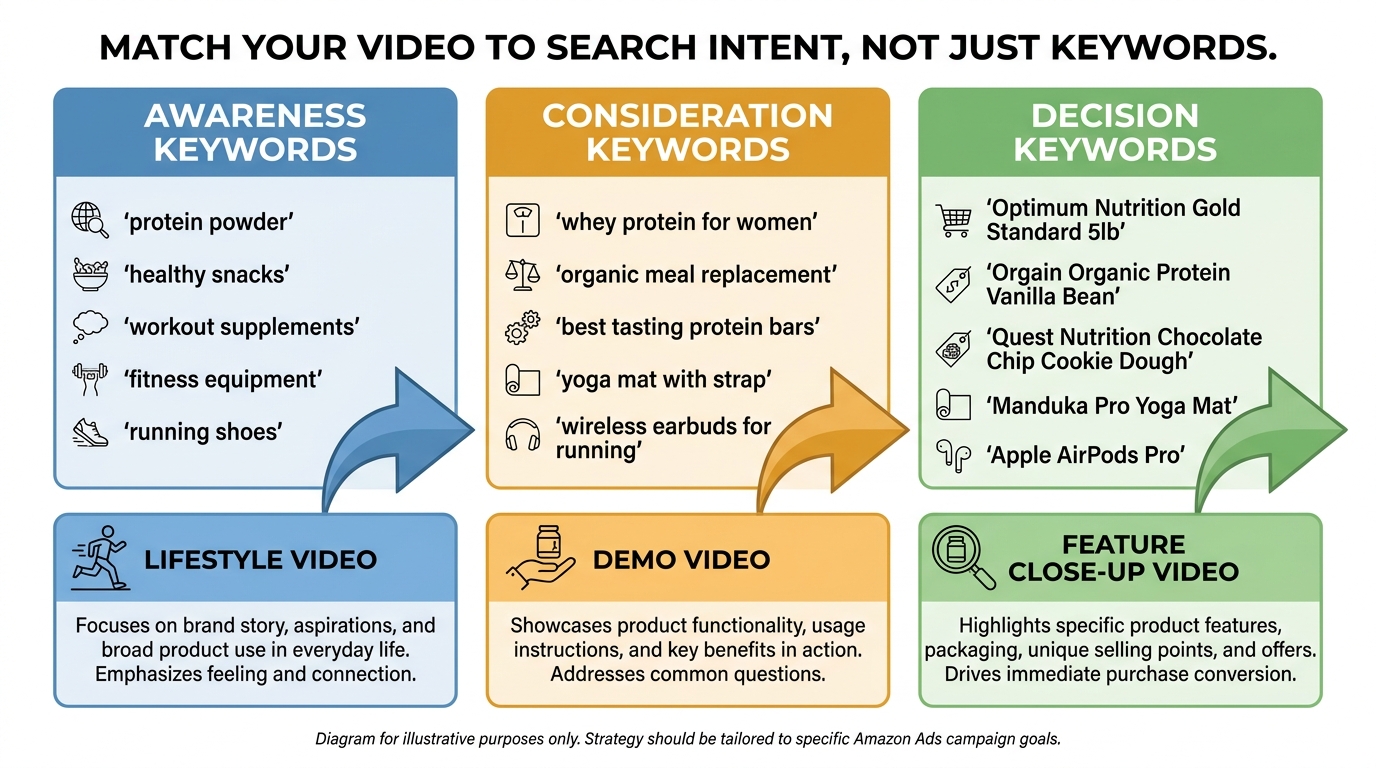
Most SBV campaigns are built around a keyword list and a single video. The video performs differently across those keywords, and most advertisers have no framework for understanding why. The reason is almost always intent mismatch: a creative designed for one stage of the buyer journey is being served to shoppers at a completely different stage.
Amazon’s search queries exist on a spectrum from broad category exploration to brand-specific purchase intent. A shopper typing “coffee grinder” is in a different mental state than one typing “Baratza Encore burr coffee grinder.” The first is browsing and comparing categories. The second is close to a purchase decision, likely comparing price and bundle options on a specific model. Serving both shoppers the same video — and expecting it to perform equally — is a structural mistake, not a creative one.
Awareness-Intent Keywords: What They Demand Creatively
Broad, category-level searches are awareness territory. The shopper doesn’t necessarily know your brand and may not have a clear product preference. For these queries, your SBV creative needs to first establish category relevance, then differentiate. A video that opens with a lifestyle scene — showing the problem being solved or the desire being fulfilled — performs better here than a feature-dense product demo.
The goal at awareness is to answer: “Why does this type of product exist, and why might I want it?” Your brand is secondary to the product category explanation. Many advertisers make the mistake of running heavily branded creative against broad terms, which produces high impressions, low clicks, and confusing ACoS data because the creative was never designed for that audience’s decision stage.
Consideration-Intent Keywords: The Sweet Spot for Most SBV
Mid-funnel queries — “best insulated water bottle,” “sous vide cooker for beginners,” “noise canceling headphones under $100” — represent the consideration stage. The shopper knows what they want in a general sense and is actively comparing options. This is where most SBV campaigns should focus their primary creative effort.
At the consideration stage, a product demonstration that shows distinguishing features is most effective. The shopper wants to understand what makes your product different from the alternatives they’re already considering. Visual comparisons (before/after, with/without, yours versus a generic alternative) work well here. The key is that the differentiation needs to be visually legible within the first five to seven seconds, before most casual scrollers have moved on.
Decision-Intent Keywords: Don’t Over-Sell What’s Already Sold
High-intent searches — brand-name queries, highly specific product searches, model numbers — represent shoppers close to purchase. Your SBV creative for these terms should be different in character: less about education, more about conversion triggers. Social proof (a quick flash of star ratings or user counts), value reinforcement (Prime shipping badge, bundle offers), and a fast path to the CTA are more appropriate here than a long benefit explanation the shopper doesn’t need.
The practical structure for managing intent mismatch is campaign separation. Run three SBV campaigns with the same ASIN destination but different keyword tiers and, ideally, different creative versions tailored to each intent level. Yes, this means producing more than one video. That upfront investment almost always pays back in measurably better CTR and conversion rates across the funnel.
Technical Specifications — and the Hidden Approval Traps
Amazon’s SBV technical requirements are published and straightforward at the surface level. But there are several less-obvious approval patterns that regularly cause campaigns to be rejected or require re-submission, costing advertisers days of live campaign time. Understanding them upfront saves real money.
The Published Requirements
Amazon requires SBV creative to meet the following baseline specifications:
- File format: MP4 or MOV
- Duration: 6 to 45 seconds (the practical sweet spot is 15-30 seconds for most product categories)
- Resolution: Minimum 1920 x 1080 pixels (1080p); 4K is accepted
- Aspect ratio: 16:9 (widescreen) is the standard; some placements now support square (1:1) and vertical (9:16) formats, particularly on mobile
- File size: Maximum 500MB
- Frame rate: 23.976, 24, 25, 29.97, or 30 fps
- Audio: Stereo, 44.1 kHz minimum, though the creative must work without audio
- Letter-boxing and pillar-boxing: Black bars are not permitted — the creative must fill the full frame
The Approval Traps Most Sellers Hit
Competitor brand mentions or visual comparisons: Amazon’s review policy prohibits explicit competitor references, including showing a competing product’s packaging, logo, or name. Comparative claims (“beats Brand X”) will trigger rejection even if they are factually accurate. This is more strictly enforced in SBV than in listing copy, largely because the video is more visible.
Superlative claims without substantiation: “The world’s best,” “the most powerful,” “the only product that” — these claims require substantiation documentation attached to the submission, or they will be rejected. Most sellers don’t realize substantiation needs to be submitted alongside the creative, not just referenced in brand copy elsewhere.
Price and promotion mentions: Displaying a specific price or promotional discount within the video itself is not permitted. “On sale now” or “$29.99” in the video frame will block approval. You can reference promotions in the headline text field adjacent to the video, but not within the creative itself.
Prohibited content categories: Even for products sold on Amazon, certain categories face additional scrutiny in video creative — this includes alcohol, supplements making specific health claims, and products with age restrictions. If your product is in one of these categories, build extra review time into your campaign launch timeline.
Low-quality audio mixed too hot: Even though most viewers never enable audio, Amazon’s review team does listen to the audio track. Music that peaks above acceptable levels, distorted voiceovers, or abrupt audio cuts can trigger a manual rejection. Ensure proper audio mastering even if you believe audio will rarely be heard.
Reducing Re-Submission Cycles
The practical way to minimize rejections is to conduct an internal creative compliance review against Amazon’s advertising policies before submission — not after production. The most expensive creative mistake is discovering a policy violation after a $5,000 video shoot and having to either re-edit significantly or re-shoot elements. Policy review should be a pre-production step, not a post-production one.
The Three Creative Frameworks That Consistently Outperform
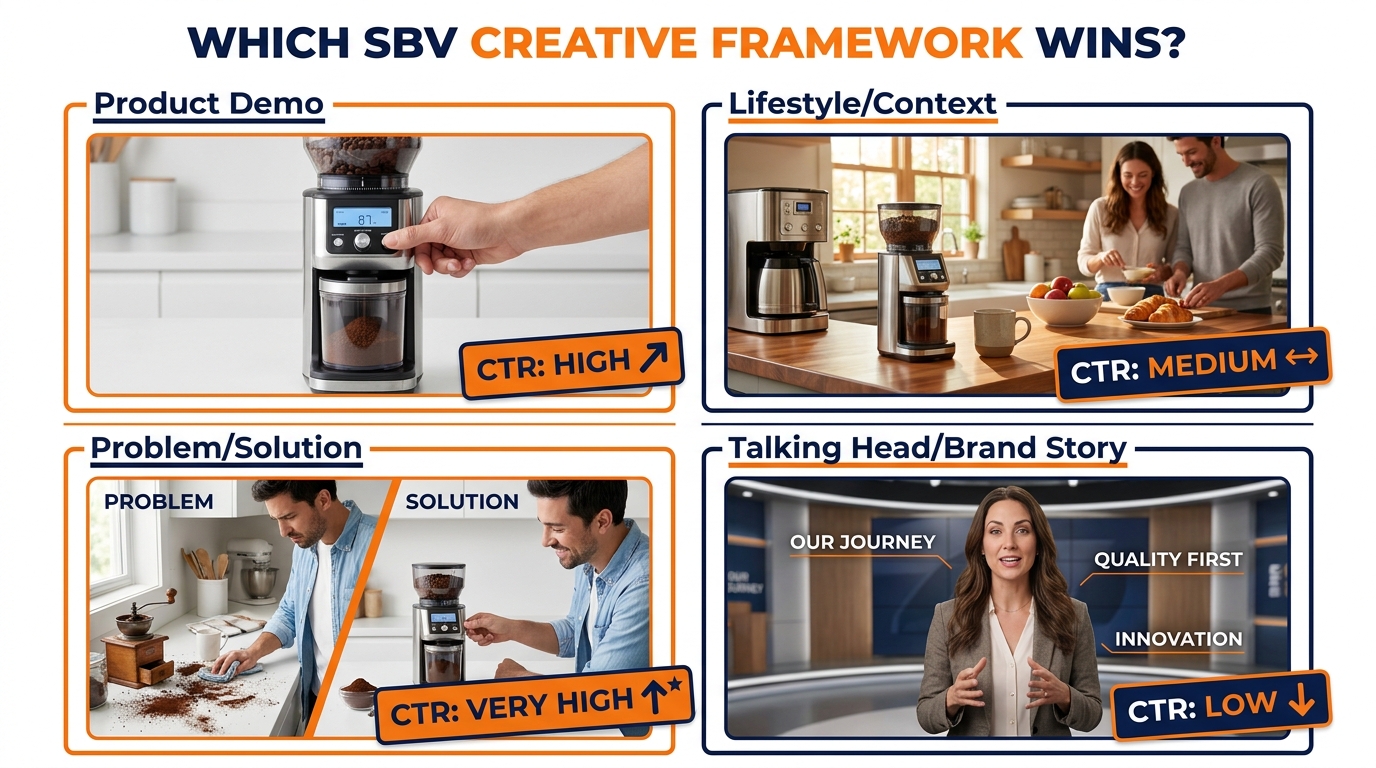
Not all video creative frameworks are equal in the SBV context. Three structures reliably outperform the rest across a broad range of product categories, and understanding why each works helps you choose the right one for your specific situation.
Framework 1: Problem → Solution
This is the highest-performing framework for SBV across most consumer product categories, primarily because it gives the shopper immediate context for why the product exists. The structure is simple: the opening two to three seconds visualize a recognizable problem or frustration — a leaky container, a tangled cord, a poor night’s sleep — and the next few seconds show the product solving it cleanly and conclusively.
What makes this framework powerful in the SBV context specifically is that the problem visualization works without audio. The viewer sees the frustration and recognizes it — or doesn’t, in which case the product probably wasn’t for them anyway. The product reveal as the solution then carries immediate meaning because the context is already established.
The mistake most brands make with this framework is spending too long on the problem. Two to three seconds on the problem is typically enough. More than that, and the shopper has already mentally moved on before the solution appears.
Framework 2: Product in Use — Feature-Forward Demo
This framework works particularly well for products with a distinctive physical feature or user experience that is hard to communicate through static images alone. Think a blender with an unusual blade mechanism, a camping gear product with a clever folding design, or a skincare device with a visible treatment function.
The structure opens directly on the product in active use — hands visible, product doing its thing — and then uses on-screen text callouts to annotate key features as they appear on screen. It’s essentially a product demonstration with running commentary, but the commentary is visual text rather than voiceover, making it fully functional in mute mode.
This framework tends to drive strong conversion rates when CTR is achieved, because shoppers who engage with a feature-forward demo already have higher purchase intent — they wanted to know how the product worked, and the video answered that directly.
Framework 3: Social Proof Montage
For established products with significant review volume (typically 1,000+ reviews at 4.5 stars or higher), a social proof framework can be highly effective. This approach opens with a bold stat — “47,000 five-star reviews” or “Rated #1 in [category]” — displayed prominently on screen in the first two seconds, then transitions into a fast montage of product use cases, happy outcomes, or diverse user contexts.
The social proof framework works because it answers the shopper’s primary purchase anxiety — “but does it actually work?” — within the first seconds, before they’ve had a chance to scroll away. The challenge is that it requires real, substantiated social proof to be honest and compliant. Fabricating or exaggerating review counts in video creative is a policy violation with real consequences.
What Doesn’t Work: The Brand Story Video
The least effective SBV creative type is the brand story video — a cinematic piece that focuses on company heritage, founder narrative, or brand mission before establishing what the product is or does. This format can work beautifully on YouTube or in Connected TV advertising, where viewers are in a content consumption context. On Amazon search results, where a shopper is actively comparing products, it almost universally underperforms.
The reason is simple: the brand story format requires the viewer to invest attention before receiving any product-relevant information. In the SBV context, that attention investment is never granted. The viewer’s scanning behavior has already moved on before the video reaches its point.
Structuring Your SBV Campaign for Actual Profitability
Creative quality is only half of the SBV performance equation. How your campaigns are structured — keyword match types, bidding strategy, portfolio organization, and negative keyword management — determines whether good creative reaches the right audience at a cost that makes the channel profitable.
The Single-Theme Campaign Structure
A common structural error is building a single SBV campaign with a broad mix of keywords — brand terms, category terms, competitor terms, and long-tail variations all in one ad group. This makes it nearly impossible to manage bids intelligently, because each keyword tier has very different conversion rates and value metrics.
A more functional structure separates SBV campaigns by keyword intent tier, as discussed in the creative section, but also by match type. Running broad match in a separate campaign from phrase and exact match allows you to control spending on discovery versus spending on performance terms, and to bid more aggressively on terms with demonstrated conversion history.
Bid Strategy: Start Manual, Earn Automatic
Amazon offers both manual and automatic campaign types for SBV. The temptation — especially for sellers already running profitable auto campaigns for Sponsored Products — is to start with automatic bidding and let the algorithm do the work. This rarely produces good results in the early phase of an SBV campaign.
The reason is data density. Automatic bidding requires a meaningful click and conversion dataset to optimize toward. In the early weeks of an SBV campaign, when impressions are building but clicks and conversions are still sparse, the algorithm has too little signal to bid intelligently. Starting with manual bidding, setting conservative CPCs, and letting data accumulate over four to six weeks before transitioning to automatic — or using manual with Amazon’s bid adjustments enabled — produces more consistent early results.
The Top-of-Search Bid Modifier Question
SBV campaigns include an option to increase bids for top-of-search placement. This is a genuinely useful lever, but it needs to be deployed with data rather than instinct. Top-of-search placement commands higher CPCs and drives more impressions, but whether those impressions convert at a rate that justifies the premium varies significantly by category and keyword.
The practical approach: run your initial SBV campaign without the top-of-search bid modifier, collect four to six weeks of placement-level data, and then evaluate whether top-of-search placement is generating proportionally better conversion rates. If it is, the premium is worth it. If top-of-search clicks convert at the same rate as in-feed clicks, you’re paying more for positioning that isn’t delivering proportional return.
Negative Keywords: The Spend Drain Most SBV Advertisers Ignore
Negative keyword management is often treated as a Sponsored Products discipline and neglected in SBV campaigns. This is a significant and measurable source of wasted ad spend. Because SBV can appear for broad and phrase match searches, your video may be serving against completely irrelevant queries — and because the video impression is effectively free (you pay per click in most SBV configurations), it’s easy to miss the problem in standard reporting until you dig into search term data.
The SBV-Specific Negative Keyword Problem
SBV campaigns can suffer from a particular type of irrelevance that doesn’t show up in impression or spend data: high-impression, low-click-rate terms that signal the video is appearing in front of shoppers who have no interest in the product but are triggering the ad through loose keyword matching. These terms don’t cost much per unit of impression, but they do affect your overall campaign quality metrics and can be a signal that your CTR benchmarks are being pulled down by irrelevant traffic.
Downloading your search term report monthly (or weekly for larger-spend campaigns) and scanning for queries with high impressions and zero clicks is an essential housekeeping task for any active SBV campaign. Add irrelevant terms as exact-match negatives at the campaign level, and review any high-spend terms that are generating clicks but not conversions — these may warrant phrase-level negative exclusions.
Competitor Campaign Negatives
If you are running SBV campaigns targeting competitor keywords — a common and legitimate strategy for building brand awareness against comparison-shopping behavior — you need to actively manage the inverse: ensuring your competitor-targeting campaign doesn’t accidentally serve against your own brand keywords, and ensuring your brand-defense campaign doesn’t pick up competitor traffic through broad match.
Cross-campaign negative keyword management at the portfolio level is one of the most overlooked structural elements in Amazon advertising. It prevents internal cannibalization, keeps CPCs lower on your own brand terms, and makes performance data cleaner to interpret.
What the HP and Loftie Case Studies Actually Teach Us
Amazon’s own published case studies for Sponsored Brand Video provide some of the clearest available benchmarks for what strong SBV performance looks like in practice — and what it takes to get there. The numbers are instructive, but so is the strategy behind them.
HP: Scale and Mix Matter as Much as Creative Quality
Hewlett-Packard’s case study in Amazon’s advertising resources showed 224% year-over-year impression growth and a 142% YoY increase in clicks from running Sponsored Brand Video alongside Sponsored Brands image and Sponsored Products campaigns. Specifically, SBV placements contributed a 42% click increase.
The primary lesson here is about advertising mix. HP wasn’t running SBV in isolation — they were running it as part of a coordinated multi-format strategy where SBV contributed upper-funnel visibility while Sponsored Products drove lower-funnel conversions. The attribution halo effect — where shoppers exposed to a Sponsored Brand Video subsequently convert through an organic click or a Sponsored Products click — is real, and single-campaign ACoS measurement misses it entirely.
For most brands, the practical implication is that SBV’s contribution to revenue cannot be accurately assessed by looking only at conversions directly attributed to SBV clicks. It needs to be evaluated against a broader set of metrics including changes in organic rank, branded search volume, and new-to-brand customer acquisition rates during periods when SBV is active versus when it’s paused.
Loftie: The Benchmark Numbers Worth Knowing
Loftie, a small brand selling a premium sleep clock, achieved a 17.68% ACoS and a $5.66 ROAS through their Amazon advertising campaign — which incorporated Sponsored Brand Video as a core element. These are strong performance numbers for a premium-priced consumer product in a competitive wellness category.
What’s significant about the Loftie numbers is the category context: a high-consideration purchase (a premium sleep device priced above the category average) where shoppers need more information than a static product image can provide before committing to a purchase. This is the product profile where SBV tends to show its clearest advantages — products with a story to tell that a thumbnail cannot communicate.
For commodity products where shoppers primarily compare on price and Prime shipping status, SBV’s relative advantage over Sponsored Products is smaller. For products that require explanation, demonstration, or emotional connection to convert — electronics, fitness equipment, premium kitchen tools, specialized outdoor gear, skincare with complex ingredients — the video format carries disproportionate conversion value because it compresses the education required for purchase.
How to Measure SBV Performance Beyond ACoS
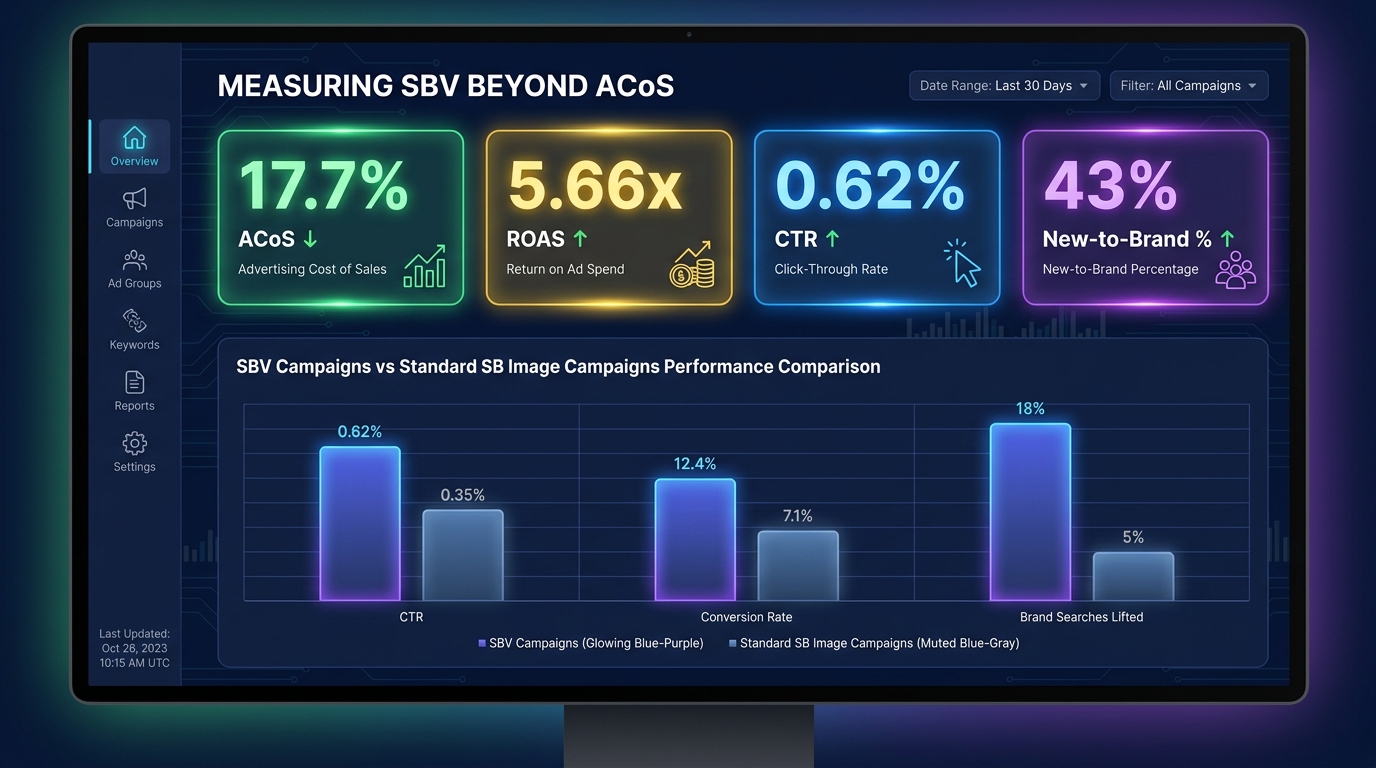
ACoS (Advertising Cost of Sale) is the default metric most Amazon advertisers use to evaluate campaign performance. For Sponsored Products, it’s a reasonably clean and actionable signal. For SBV, it’s a necessary metric but a dangerously incomplete one. Relying on ACoS alone for SBV performance evaluation leads to two predictable mistakes: prematurely pausing campaigns that are generating unmeasured value, or continuing to run campaigns that look acceptable on ACoS but are not actually building the brand metrics that justify the upper-funnel investment.
New-to-Brand Metrics: The SBV Signal That Actually Matters
Amazon provides new-to-brand (NTB) metrics for Sponsored Brand campaigns, including SBV. These metrics show what percentage of your attributed sales came from customers who had not purchased from your brand in the previous 12 months. This is the clearest available proxy for whether your SBV is doing genuine brand-building work versus capturing demand that Sponsored Products would have converted anyway.
A healthy SBV campaign in a competitive category typically shows NTB rates of 40-60% or higher. If your SBV’s NTB rate is below 30%, you are largely reaching customers who already know your brand — which means SBV is functioning as a retargeting or retention tool rather than a discovery vehicle. That’s not inherently wrong, but it should change how you evaluate its cost relative to alternatives.
Branded Search Lift as a Proxy for Awareness Effect
One underutilized measurement approach for SBV is tracking changes in branded keyword search volume during periods when SBV campaigns are active versus inactive. Amazon Brand Analytics provides branded search data, and comparing monthly trends against SBV spend periods can reveal whether your video campaigns are moving the needle on brand awareness in ways that don’t show up in direct attribution.
This approach is imperfect — branded search volume is influenced by many factors beyond advertising — but consistent, meaningful increases in branded searches during high-SBV-spend periods, followed by declines when SBV is paused, are a reasonable signal of the channel’s awareness contribution. Systematically alternating SBV on and off on a monthly cycle (while holding other campaign spend constant) can create a rough A/B framework for measuring this effect.
Click-Through Rate as Creative Quality Signal
CTR in SBV campaigns is one of the most directly actionable metrics for creative performance. While absolute CTR benchmarks vary significantly by category and keyword competition, relative CTR between your own creative variants tells you clearly which hooks, frameworks, and visual approaches are resonating with shoppers. A video with a CTR of 0.5% is performing meaningfully better than one at 0.2% in the same campaign context, and the gap almost always comes back to the first three seconds.
Track CTR weekly, not just monthly, particularly when testing new creative. The signal appears quickly — within the first 1,000 to 2,000 impressions, a meaningful pattern in CTR is usually visible.
View Rate and the Attention Quality Question
Amazon provides view-through data for SBV — showing what percentage of viewers watched a significant portion of the video. This metric is less actionable for immediate bidding decisions, but it is valuable for creative evaluation. A high CTR with a low view-through rate suggests shoppers are clicking but not engaging with the product page experience that follows. A lower CTR with a high view-through rate suggests the video is engaging those who do stop, but the hook isn’t stopping enough scrollers initially.
These patterns point to different creative fixes: hook improvement for the low-CTR case, landing page and product page optimization for the high-CTR-low-conversion case.
Common Creative Mistakes Even Experienced Sellers Make
Even advertisers who understand the basics of SBV make a consistent set of production and creative decisions that limit performance. These are the patterns that appear most frequently in underperforming campaigns.
Repurposing Social Media Video Wholesale
A significant portion of the SBV content running on Amazon today was originally produced for Instagram Reels, TikTok, or YouTube Shorts and repurposed with minimal modification. The vertical orientation may have been reformatted to 16:9, but the creative structure, pacing, and audio dependency are unchanged.
Social media video is built for a context where viewers are open to content consumption, audio is more commonly enabled (especially with earbuds), and the algorithm rewards content that generates extended watch time. Amazon SBV requires almost the opposite creative logic. Repurposing social video for SBV without rethinking the structure for the silent, scan-interrupt context typically produces mediocre results.
Ignoring the Mobile Shopper Majority
A majority of Amazon search activity in 2026 happens on mobile devices. SBV on mobile has different visual dynamics than on desktop — the video takes up more screen real estate, text needs to be larger to read comfortably on a smaller screen, and the proximity of the “Shop now” prompt to the video frame affects the click-through behavior. Creative designed and reviewed only on desktop will often look and perform differently on mobile.
The fix is straightforward but often skipped: review all SBV creative on a mobile device before submission, specifically checking that on-screen text is readable at mobile scale and that the product is clearly visible in the smaller mobile frame’s rendering context.
Running a Single Creative for Six Months
Creative fatigue is well-documented in social media advertising, and while Amazon’s ad frequency model is different (you’re targeting searches rather than audiences), the same principle applies: a single piece of creative running unchanged for months will see performance decay. The video that drove strong results in its first six weeks will typically underperform by week twenty.
Building a quarterly creative refresh cycle — whether that means a new video or a meaningfully edited variant — is part of a functional SBV program, not a luxury. The production budget for SBV does not need to be lavish; a refreshed hook sequence or a new opening three-second scenario can be produced relatively inexpensively if the underlying product footage is already available.
Building a Testing Cadence That Actually Produces Learnings
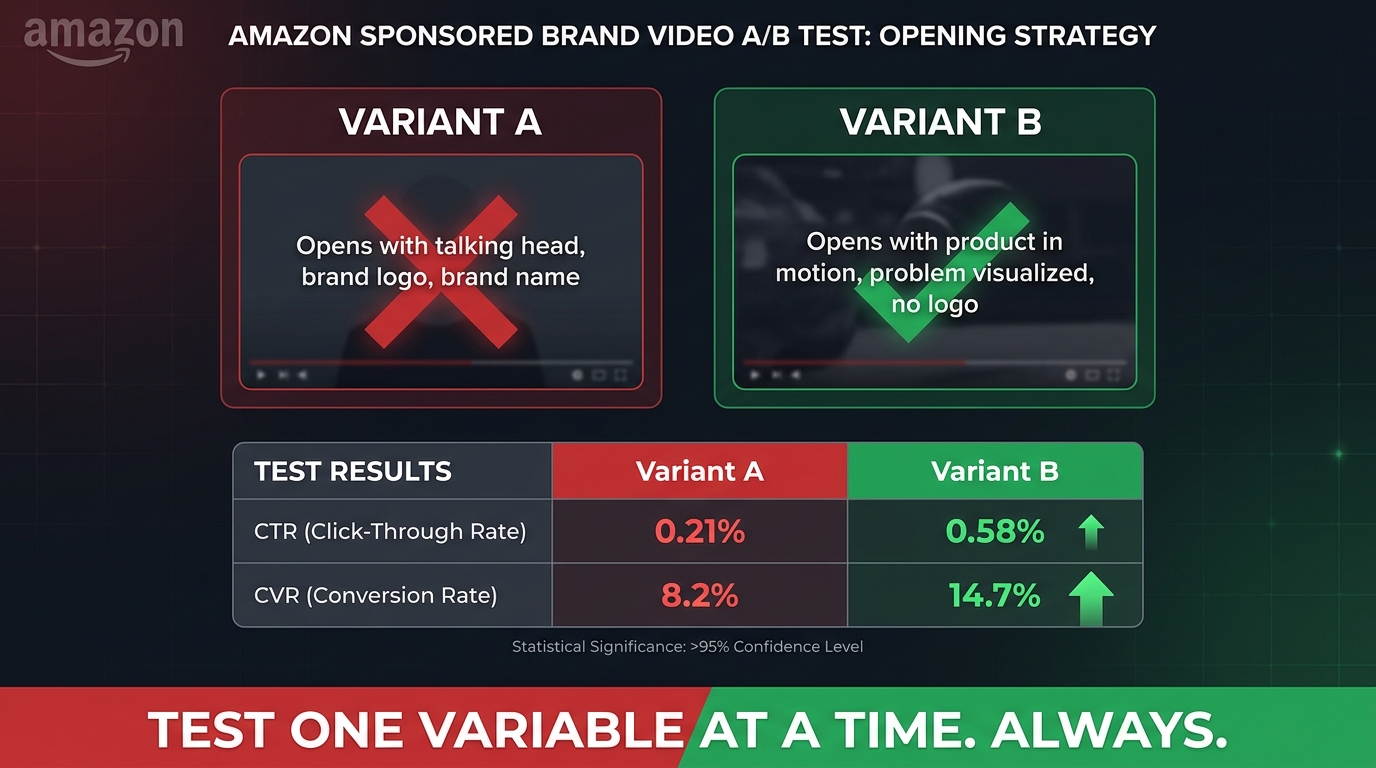
Most sellers who run SBV testing do it wrong — not because they lack discipline, but because the test structure itself is flawed in ways that prevent clean learning. Setting up SBV tests that produce genuinely actionable data requires specificity about what you’re testing, how you’re isolating variables, and how long you’re collecting data before drawing conclusions.
The One-Variable Rule
The most important principle in SBV creative testing is testing one variable at a time. This sounds obvious, but it’s violated constantly. A brand produces two videos — Video A is a product demo and Video B is a lifestyle sequence — and then runs them simultaneously. Video B wins on CTR. But did it win because of the creative framework? The opening scene? The on-screen text? The different color palette? There is no way to know, and the “learning” from the test cannot be applied reliably to the next creative.
A more productive approach is to test a single creative element at a time. Test two versions of the same video that differ only in the opening three seconds — same product, same structure, same audio, different visual hook. When one version outperforms the other, you know specifically what drove the difference: the hook. Then test the next variable. It takes longer to cycle through all the elements you want to understand, but each test produces a clean, applicable learning.
Statistical Significance and Sample Size
The temptation to pull conclusions from SBV tests too early is one of the most common mistakes in the channel. With a typical SBV CTR in the 0.2-0.6% range, you need a meaningful number of impressions to separate a real performance difference from statistical noise. As a rough rule, wait until each variant has accumulated at least 5,000 impressions and at least 20 clicks before drawing any conclusions from CTR data. For conversion rate data, you need substantially more — at least 50 attributed sales per variant before the conversion rate difference is meaningful.
For most mid-size sellers, reaching statistical confidence in an SBV test will take four to eight weeks. That timeline should be built into the testing plan from the outset, not discovered frustratingly after a premature call is made.
The Testing Metrics Hierarchy
When evaluating SBV test results, use a metrics hierarchy that reflects what you can and cannot cleanly attribute:
- CTR — cleanest signal, most directly tied to creative quality, available quickest
- Detail Page View Rate — how many clicks led to meaningful engagement with the product page
- Add-to-Cart Rate — a mid-funnel conversion signal that accumulates faster than purchase data
- Purchase Conversion Rate — the ultimate signal, but requires the most data and time to be reliable
- New-to-Brand Rate — context for whether the creative is reaching new versus existing customers
Lead with CTR for creative hooks tests. Move down the hierarchy as you have sufficient data. Don’t optimize for ACoS until you have clean signals from CTR and conversion rate separately.
When SBV Earns Its Budget — and When It Doesn’t
Honest evaluation of any ad format includes recognizing the conditions under which it delivers genuine value versus the conditions where budget might be better allocated elsewhere. SBV is a genuinely powerful format, but it is not universally the right tool for every Amazon advertising situation.
SBV Earns Its Place When
Sponsored Brand Video tends to deliver its strongest relative performance when the product has a use-case or benefit that is difficult to communicate through a static thumbnail. Products with visible, demonstrable functionality — appliances, personal care devices, fitness equipment, outdoor gear, complex kitchen tools, specialized storage solutions — show the clearest conversion lift from video versus image ads.
SBV also performs well when the brand is in active growth mode and genuinely wants to reach new customers rather than simply harvest existing demand. The new-to-brand metrics are most compelling for brands with low category awareness that need to introduce shoppers to a product type they may not yet have searched for specifically.
Finally, SBV earns its budget when the product price point creates enough consideration friction that shoppers benefit from more information before clicking. Higher-price-point products ($50+, especially $100+) in competitive categories typically show stronger SBV performance because the additional information the video provides reduces purchase hesitation more meaningfully than it would for a $12 commodity item.
Where SBV Tends to Underperform
SBV tends to deliver weaker relative performance for low-consideration commodity products where purchase decisions are driven almost entirely by price and Prime availability. If a shopper searching for “AA batteries” or “paper towels” is going to buy whatever is cheapest and Prime-eligible, a video explaining the product’s merits is unlikely to move the needle meaningfully over a straightforward Sponsored Products presence.
Highly brand-loyal categories also present a challenge for SBV as a discovery tool. If shoppers in your category search by brand name 70% of the time and almost never convert on a competitive brand’s ad, SBV’s new-to-brand acquisition proposition is weakened. In these categories, SBV might still be worth running for brand defense and repeat purchase reinforcement, but the acquisition-oriented metrics should be evaluated with that context in mind.
Building Your SBV Program for the Long Term
The most successful SBV programs on Amazon in 2026 share a few structural characteristics that go beyond any single campaign or creative decision. They treat video advertising as a recurring practice rather than a one-time campaign launch, they build a library of creative assets that can be remixed and refreshed without full re-production, and they invest in measurement infrastructure that connects SBV activity to business outcomes that matter beyond the ad console.
The Creative Asset Library Approach
Rather than commissioning a single polished video for each SBV campaign, brands that perform consistently well over time tend to build a modular asset library: a set of product footage clips, lifestyle scenes, customer testimonial snippets, and feature demonstration shots that can be assembled into different creative configurations as testing reveals what works.
This approach significantly reduces the per-video production cost of ongoing creative refresh and makes A/B testing more feasible, because producing a variant that changes only the opening hook is a simple editing task rather than a full production job. The upfront investment in comprehensive footage capture — a full day of product and lifestyle shooting that generates hours of raw material — pays for itself many times over in the flexibility it creates for ongoing creative iteration.
Connecting SBV to the Broader Funnel
The highest-performing use of SBV is not as a standalone direct-response vehicle but as the top-of-funnel layer in a coordinated Amazon advertising architecture. SBV drives awareness and consideration. Sponsored Products with brand-tailored promotion captures the conversion from shoppers who encountered the video. Brand Store traffic from SBV clicks provides a richer product discovery experience. And Amazon DSP retargeting can re-engage shoppers who watched the video but didn’t convert immediately.
Each of these layers compounds the others’ effectiveness. Shoppers who have seen your SBV creative are more likely to click your Sponsored Products ad when they encounter it in subsequent searches — even if they don’t consciously connect the two touchpoints. The video exposure creates a familiarity signal that reduces the cognitive friction of clicking on an ad from a brand they recognize, however dimly, from a previous search.
The Actionable Checklist: What to Audit in Your SBV Today
If you are running Sponsored Brand Video campaigns right now, here are the specific checks worth making before your next optimization pass:
- Watch your own video on mute, from the first frame. Ask yourself: in three seconds, without audio, does a shopper know exactly what this product does? If not, your hook needs work.
- Check your search term report. Download it, sort by impressions, and identify high-impression/zero-click terms. Add the irrelevant ones as negatives this week.
- Pull your new-to-brand rate. If it’s below 30%, your SBV is functioning as a retention tool — evaluate whether that’s the best use of that ad spend.
- Check whether you have more than one creative running. If you’ve been running the same video for more than 90 days, schedule a creative refresh or at least a hook variant test.
- Review your campaign structure. Are brand terms, competitor terms, and category terms in separate campaigns? If not, your bidding is likely miscalibrated across intent tiers.
- Look at mobile rendering. Open your ad on a smartphone and check whether your on-screen text is readable and your product is clearly visible in the mobile frame.
- Set a top-of-search bid modifier only if you have data supporting it. If you enabled the modifier at launch and haven’t checked placement-level performance since, pull that data now.
Conclusion
Sponsored Brand Video is one of the most capable advertising tools available to Amazon sellers and vendors in 2026 — and one of the most consistently underexecuted. The gap between what SBV can do and what most campaigns actually deliver is not primarily a budget problem or a platform problem. It is a creative and strategic execution problem rooted in a fundamental misreading of the format’s context.
When you treat SBV as a television commercial or a social media video that happens to run on Amazon, you get television-and-social performance: moderate impressions, weak CTR, and an ACoS number that’s hard to justify. When you treat it as what it actually is — a silent, autoplaying scroll-interruptor in a high-intent search environment — and engineer every creative and structural decision around that reality, the format rewards you with meaningfully better click-through rates, lower cost-per-new-customer, and compounding brand-awareness effects that make every other element of your Amazon advertising work better.
The first three seconds are not a teaser. They are the entire argument. Build them accordingly.