
Tag: EU AI Act

  • Why Human-in-the-Loop Is No Longer Optional: The Engineering and Governance Reality in 2026

    Why Human-in-the-Loop Is No Longer Optional: The Engineering and Governance Reality in 2026

    Human-in-the-loop AI control room with a human hand pausing an automated data workflow — representing HITL as a design standard

    For the better part of the past five years, human-in-the-loop (HITL) was treated like a transitional phase. The implied logic went something like this: once our models are good enough, we can remove the human from the equation and let AI operate freely. Human oversight was scaffolding — necessary today, removable tomorrow.

    That logic is collapsing in 2026, and not slowly.

    Across regulated industries, enterprise AI deployments, and the emerging landscape of autonomous agents, human oversight is being re-engineered not as a temporary patch, but as a permanent structural feature. Regulators are codifying it into law. Engineers are building it into architecture. Product designers are treating human checkpoints as first-class UX components. The industry has quietly reached a consensus that the old framing — HITL as training wheels — was wrong.

    What’s changed is less about AI capability and more about what happens when AI acts without a human backstop on decisions that are consequential, irreversible, or contested. The failure modes aren’t hypothetical anymore. They’re showing up in production systems, in regulatory enforcement actions, in post-mortems at enterprises that moved too fast toward full automation.

    This piece isn’t about whether to include humans in AI workflows. That question is largely settled. It’s about the harder questions: where do humans belong in the loop, how do you design those checkpoints so they’re not theater, and what are the real costs — technical, organizational, and human — of getting it wrong?

    The answers are more nuanced than most frameworks acknowledge — and the gap between HITL as a policy statement and HITL as a working engineering reality is wider than most organizations want to admit.

    What “HITL by Design” Actually Means — And What It Doesn’t

    The phrase “human-in-the-loop” is older than the current AI moment. It originated in control systems and simulation engineering decades before large language models existed. But in 2026, its meaning has been substantially redefined — and the redefinition matters.

    The old understanding of HITL was relatively simple: a human reviews an AI output before it goes live or takes effect. Think of a content moderation queue, a loan approval workflow where an officer signs off on the model’s recommendation, or a radiologist checking a flagged scan. The human sat at the end of the pipe and made the final call.

    The new understanding is substantially more architectural. HITL by design means that human oversight requirements are determined before the system is built, not bolted on after deployment. It means specifying — at the system design level — which decision classes require human review, what information the human needs to make a meaningful judgment, how that judgment is recorded and audited, and what happens when humans disagree with the AI or vice versa.

    Human Oversight Is Not a Kill Switch

    One of the most persistent misconceptions about HITL is that it’s equivalent to having an emergency stop button. If the AI does something wrong, a human intervenes. That framing is dangerously insufficient.

    A kill switch is reactive. Properly designed HITL is proactive. It means the system is architected so that at predefined decision points — based on risk tier, confidence threshold, decision reversibility, or regulatory category — the AI pauses, surfaces the relevant context to a human, and waits for a qualified judgment before proceeding. The human isn’t watching for something to go wrong; they’re structurally embedded in the workflow at the points where human judgment adds irreplaceable value.

    This distinction changes how you build systems. It means HITL requirements have to be part of the initial requirements gathering, the system architecture, the data model (you need to store the state of in-progress decisions), the UX design (the review interface is a product, not an afterthought), and the operational model (someone has to own the review queue, with defined SLAs).

    The Spectrum: From Supervision to Collaboration

    Even within the “human in the loop” category, there are meaningfully different relationships between human and machine. At one end, the human is a supervisor reviewing AI recommendations and approving or rejecting them with minimal additional input. At the other end, the human and AI are genuinely collaborative — the AI proposes, the human refines, the AI re-proposes, in an iterative cycle that neither party could execute as well alone.

    The collaborative model is increasingly common in knowledge work: legal research, clinical diagnosis, code review, financial analysis. In these settings, the AI isn’t just being checked — it’s actively augmenting human capability, surfacing patterns and precedents that would take a human much longer to find independently. The human’s role isn’t diminished; it’s shifted from information retrieval to judgment and synthesis.

    Understanding where your use case sits on this spectrum determines what your HITL architecture should look like. A supervision model needs fast, clear review interfaces with good escalation paths. A collaboration model needs AI that can explain its reasoning, handle ambiguity gracefully, and iterate based on human feedback without losing context.

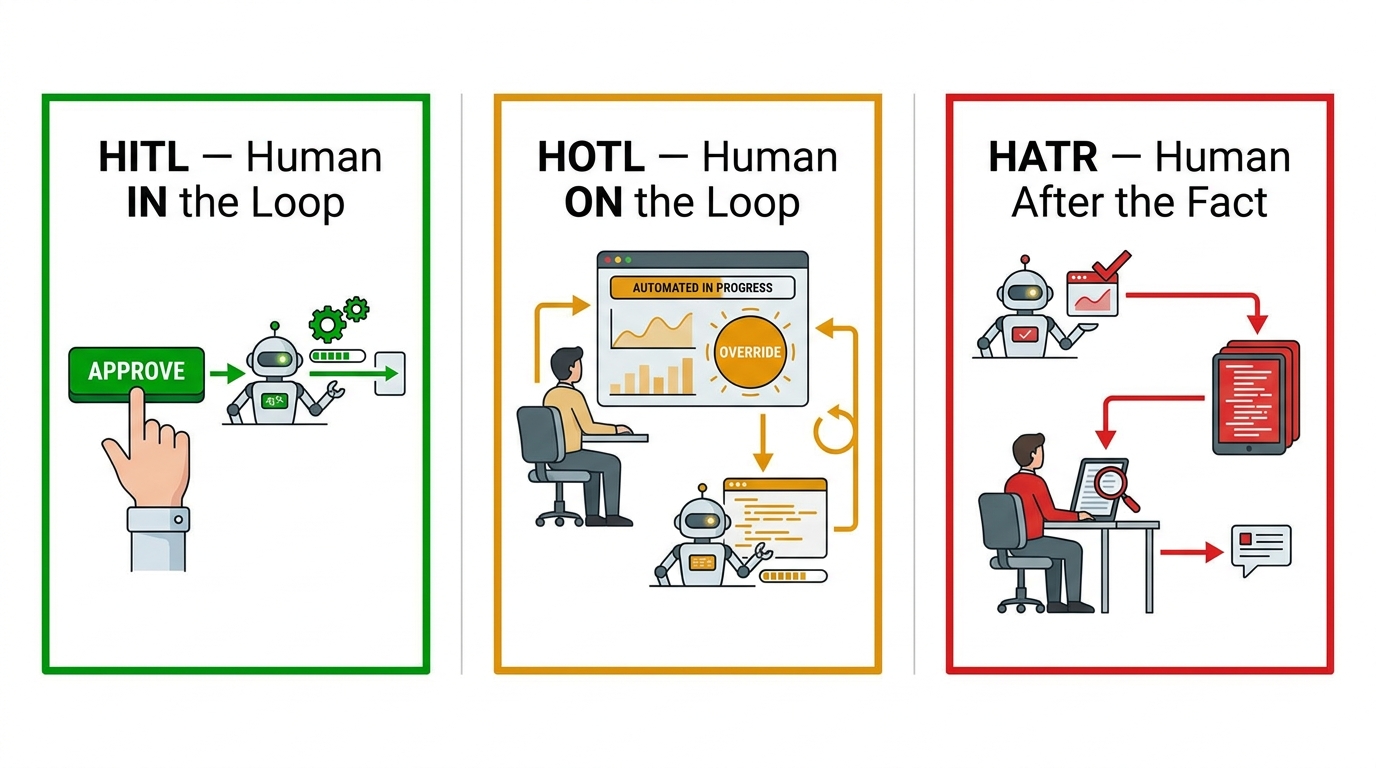
    Three AI oversight tiers compared: HITL human in the loop, HOTL human on the loop, and human after the fact review — infographic

    The Three Oversight Models: HITL, HOTL, and the Dangerous Default

    Most enterprise AI discussions collapse human oversight into a binary: either a human approves every decision, or the AI operates autonomously. In practice, the actual design space has at least three distinct modes, each appropriate for different risk and volume profiles.

    Human-in-the-Loop (HITL): Blocking Oversight

    In strict HITL, the AI cannot proceed without human approval. The workflow pauses at a defined checkpoint. A human reviews the AI’s proposed action — and the context supporting it — then approves, rejects, or modifies before execution continues. This is the highest-friction, highest-assurance model.

    HITL is appropriate when: the decision is irreversible or difficult to remediate; the stakes are high (financial loss, legal liability, physical harm); the regulatory environment requires documented human approval; or model confidence is below a defined threshold. In financial services, this means any transaction above a materiality threshold. In healthcare, it means treatment recommendations that deviate from standard protocols. In HR, it means employment decisions that could create legal exposure.

    The tradeoff is throughput and latency. Every human checkpoint is a bottleneck. If the review queue backs up, workflows stall. If reviewers are under-resourced or under-trained, the quality of oversight degrades — which can be worse than having no oversight at all, because it creates a false sense of safety.

    Human-on-the-Loop (HOTL): Supervisory Oversight

    HOTL is the middle layer. The AI acts autonomously, but humans monitor outputs in real time or near-real time via dashboards, alerts, and exception queues. Instead of approving every decision, reviewers focus on flagged anomalies, low-confidence outputs, or cases that trip predefined rules.

    This model scales significantly better than strict HITL. A single skilled reviewer can oversee a much higher volume of AI decisions because they’re only engaging with exceptions. The challenge is designing the exception logic well. If the threshold for flagging is too high, dangerous errors get missed. If it’s too low, reviewers get flooded with low-priority alerts — which leads directly to the alert fatigue problem explored later in this piece.

    HOTL is appropriate for high-volume, relatively routine workflows where errors are detectable and partially reversible: content classification, fraud scoring, customer service routing, automated document processing. It’s also the default model for most AI systems that claim to have human oversight but haven’t thought carefully about whether that oversight is meaningful.

    The Dangerous Default: Human After the Fact

    There’s a third de facto model that rarely gets named explicitly: human review happens, but only after something goes wrong. This is audit-trail oversight — logs exist, post-hoc analysis is possible, but no human is actively monitoring for errors or approving actions in advance.

    This model is common in practice, especially in organizations that deployed AI quickly and added oversight as an afterthought. It satisfies a narrow definition of accountability (“we can see what happened”) while providing almost none of the actual safety guarantees that governance language implies. By the time a human identifies a problem, the AI may have made thousands of identical erroneous decisions.

    The EU AI Act’s Article 14 makes this model legally insufficient for high-risk AI systems. But even outside regulated jurisdictions, the business case for retroactive-only oversight is weak. The remediation costs — financial, reputational, and operational — of catching problems after the fact are almost always higher than the cost of catching them at the point of decision.

    The Regulatory Forcing Function: What the EU AI Act Actually Requires

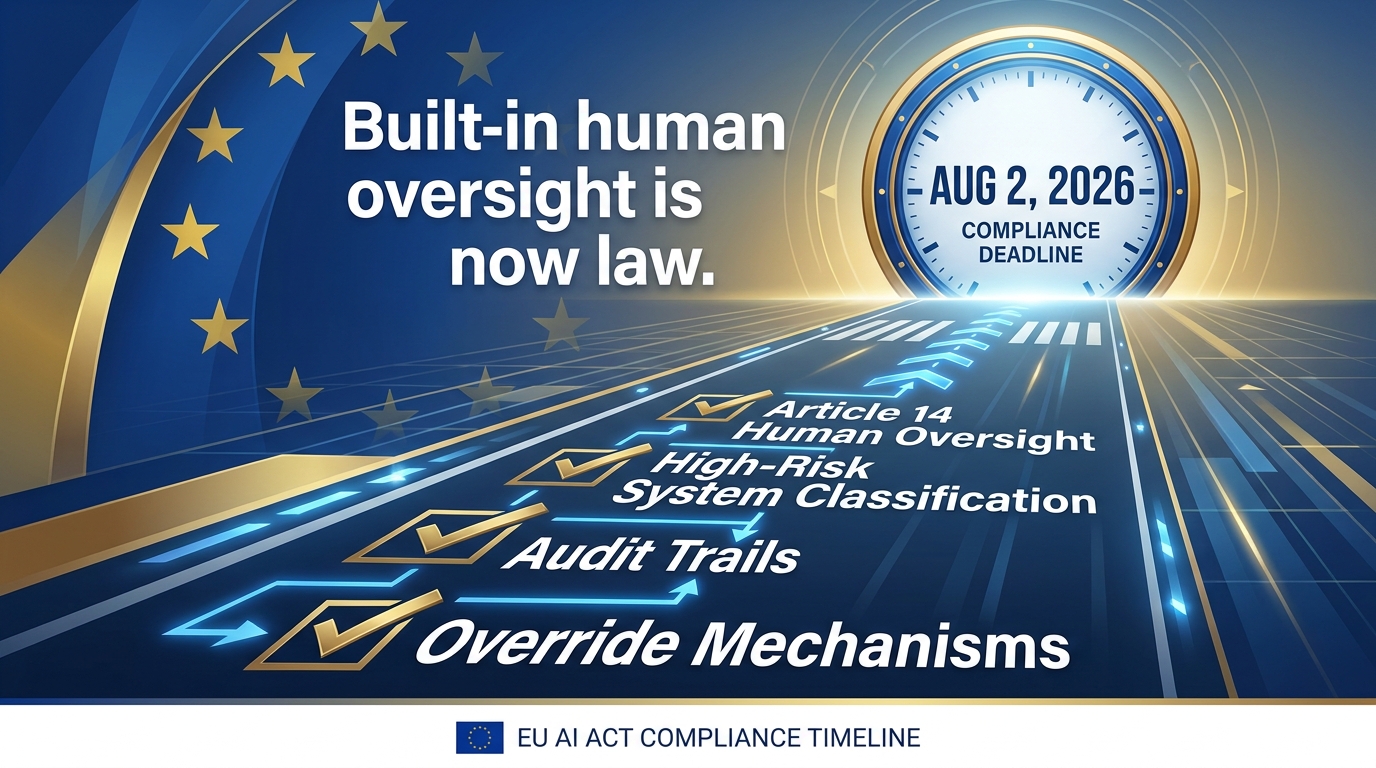
    EU AI Act Article 14 compliance countdown showing August 2 2026 deadline with human oversight checklist requirements

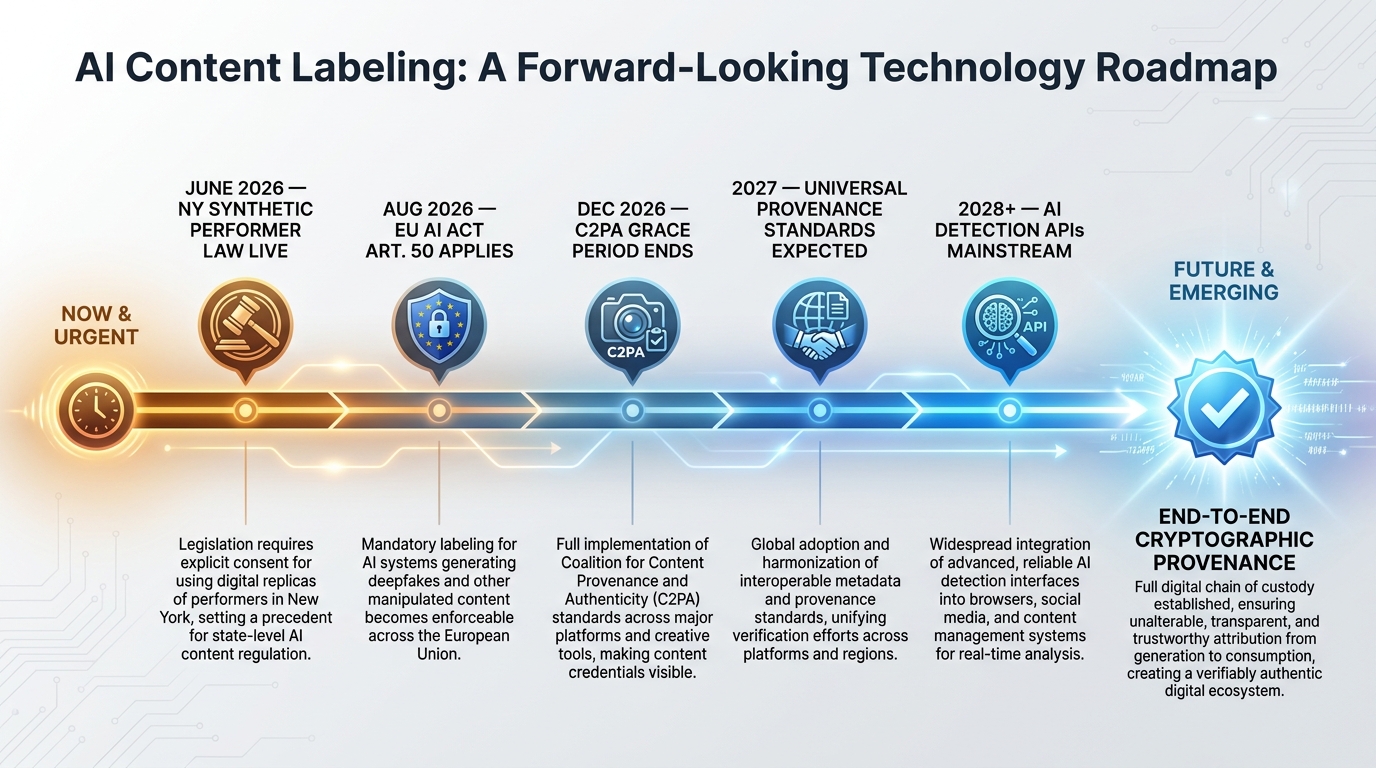
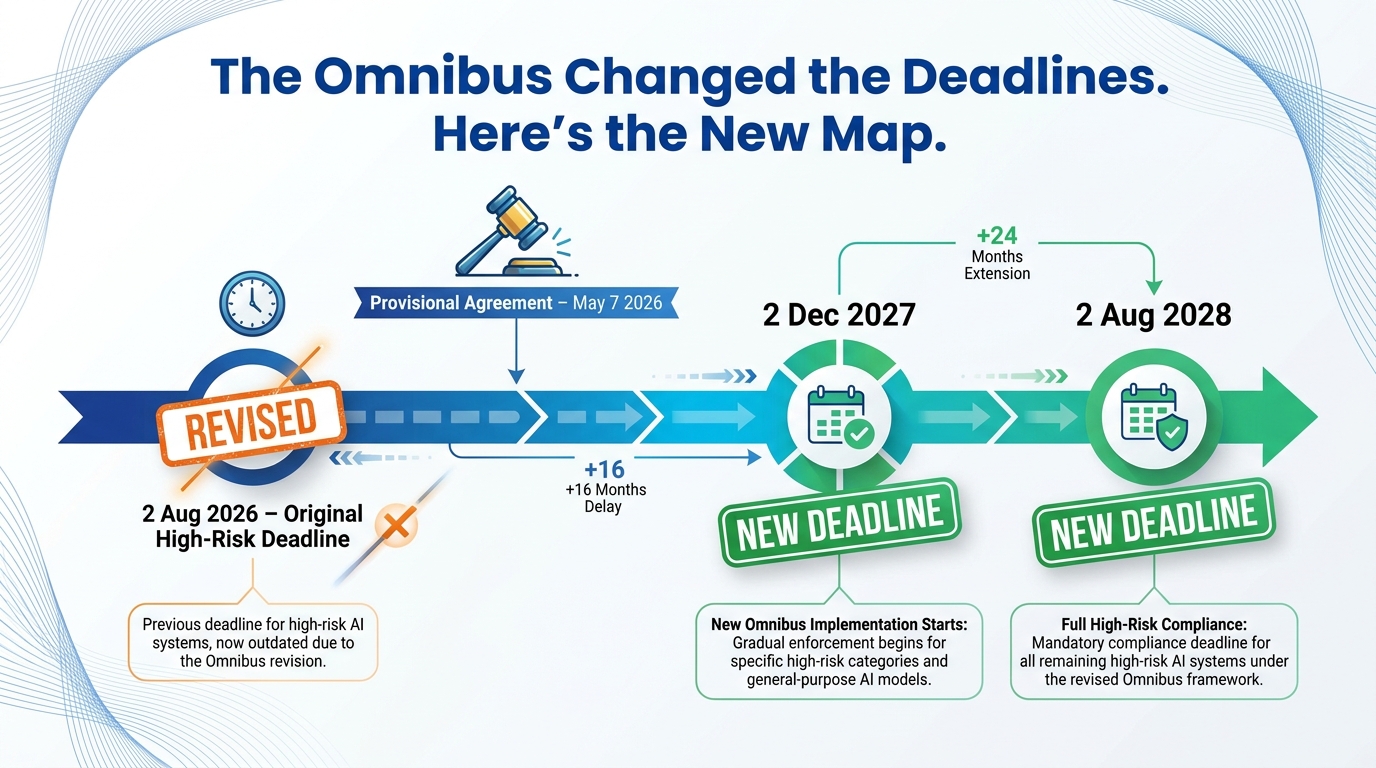
    The shift from voluntary best practice to mandatory design requirement has a clear legislative anchor: the EU AI Act, which began phasing in substantive obligations in 2026, with the core human oversight requirements for high-risk systems under Article 14 effective from August 2, 2026.

    Understanding what Article 14 actually requires — not what organizations think it requires — is essential for any enterprise deploying AI in EU markets or building systems for EU-based customers.

    Article 14: Beyond the Summary

    Article 14 doesn’t just say “have a human check the AI.” It specifies that high-risk AI systems must be designed and developed such that they can be effectively overseen by natural persons during the period in which the AI system is in use. Effective is the operative word.

    Specifically, providers of high-risk AI must ensure that humans can: fully understand the AI system’s capabilities and limitations; monitor its operation and detect anomalies; intervene and override outputs; and stop the system when necessary. These aren’t checkbox items — they’re functional requirements that have to be built into the system architecture.

    What makes this demanding is the word “fully.” An interface that shows a recommendation with no explanation of confidence, reasoning, or uncertainty doesn’t meet the bar. A system that can technically be overridden but where the override process is so cumbersome that no one ever uses it doesn’t meet the bar. The oversight has to be effective, and that determination will be made by regulators and courts looking at actual use, not documented intentions.

    High-Risk Classifications: Who’s Actually Affected

    The EU AI Act’s Annex III defines high-risk AI categories. The list is broader than most organizations initially assume. It includes: biometric identification systems; AI used in critical infrastructure (energy, water, transport); educational and vocational systems that determine access or assessment; employment-related systems that affect recruitment, performance evaluation, or termination; access to essential services including credit, insurance, and social benefits; law enforcement applications; migration and asylum management systems; and administration of justice.

    This scope captures a substantial fraction of enterprise AI deployment. An automated CV screening tool is high-risk. A credit scoring model is high-risk. A system that routes customer service cases to different service tiers may be high-risk. Organizations that assumed they were operating outside the regulation’s scope should revisit that assessment carefully.

    Beyond the EU: Convergent Regulatory Pressure

    While the EU AI Act is the most comprehensive regulation currently in force, it isn’t isolated. The NIST AI Risk Management Framework (AI RMF) in the United States, while voluntary, has become the de facto standard for federal contractors and many regulated industries. Its Govern, Map, Measure, and Manage functions all incorporate human oversight requirements. The UK’s AI Safety Institute has published guidance that aligns closely with the EU’s substantive requirements. India’s Digital Personal Data Protection Act, Canada’s AIDA, and sector-specific guidance from financial regulators globally are converging on similar principles.

    The practical implication: organizations building HITL architectures to meet EU AI Act requirements will find those architectures simultaneously position them well for compliance in other jurisdictions. The global regulatory trajectory is clear, even where specific legislation lags.

    Checkpoint Architecture: Where the Real Engineering Work Happens

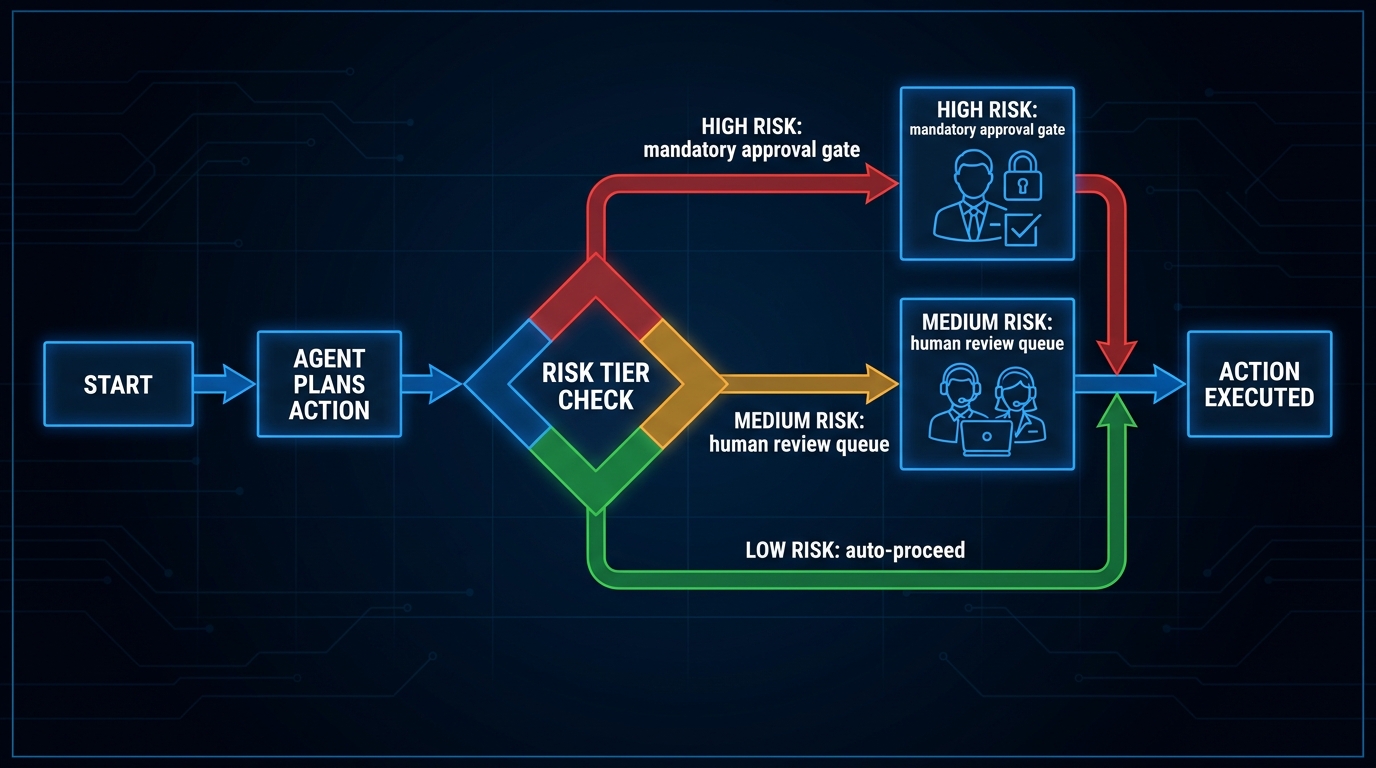
    AI agent workflow checkpoint architecture diagram showing risk-tiered decision routing: auto-proceed, human review queue, and mandatory approval gate

    Most HITL discussions stay at the policy level. They describe what human oversight should accomplish without getting specific about how to actually build it. The checkpoint architecture question — where exactly does the workflow pause, what does the human see, and how is their decision recorded and acted on — is where theory meets engineering reality.

    Defining the Pause Points

    The first design decision is identifying which actions in an AI workflow require a human checkpoint. This is harder than it sounds because the right answer isn’t static — it depends on a combination of factors that can change between instances of the same workflow.

    The key variables are: decision reversibility (can the action be undone if it’s wrong?), impact magnitude (what’s the worst-case consequence of an error?), model confidence (how certain is the AI about this specific case?), and regulatory obligation (does law or policy require human sign-off regardless of other factors?). A well-designed checkpoint system evaluates these variables dynamically, routing decisions to human review when the combination of factors exceeds a defined threshold.

    This is meaningfully different from static checkpoints where every instance of a decision class goes to human review. Dynamic routing based on confidence and risk allows high-confidence, low-stakes decisions to flow through automatically while surfacing the genuinely uncertain or high-stakes cases for attention. The result is a review queue that contains decisions where human judgment actually adds value — not a queue stuffed with cases the AI would have handled perfectly well on its own.

    Designing the Review Interface

    The review interface — what the human actually sees when a decision lands in their queue — is a full product design problem, and in most organizations it’s dramatically under-invested. A poorly designed review interface produces poor oversight even with excellent intentions.

    The interface needs to answer five questions in a format a reviewer can process quickly: What is the AI proposing to do? Why (what signals or evidence drove this recommendation)? How confident is the AI? What are the known alternatives or edge cases? And what’s the consequence of getting it wrong? Providing this context in a compressed, scannable format — without overwhelming the reviewer with raw model internals — is a significant UX challenge.

    Explainability isn’t just a nice-to-have here; it’s load-bearing. A review interface that shows “Model recommends: Approve” with no supporting rationale isn’t enabling human oversight — it’s creating a rubber stamp process where the human clicks approve because they have no basis for doing otherwise. This is exactly the dynamic that produces automation bias, which is covered in depth later.

    State Management and Audit Infrastructure

    HITL workflows require persistent state. When a workflow pauses for human review, the system needs to preserve everything about the current decision state: the AI’s recommendation, the confidence score, the data inputs, the timestamp, the reviewer assigned, and the time allowed before escalation. When the human acts, the system needs to record the decision, the reasoning if provided, and the outcome for downstream audit.

    This state management infrastructure is often underestimated. Organizations frequently discover that their existing workflow tools weren’t designed to pause mid-flow, store decision state across sessions, or maintain a complete audit trail of human interventions. Retrofitting this is expensive. Building it from scratch into new systems — while more work upfront — is almost always the right approach.

    SLAs, Escalation, and the “Stuck Decision” Problem

    One of the practical failures of HITL implementations is the stuck decision: a workflow pauses for human review, the assigned reviewer is unavailable or overwhelmed, and the case sits in queue without resolution. Downstream processes that depend on the decision are blocked. Business outcomes are delayed. In time-sensitive contexts, the cost of waiting can exceed the cost of a wrong automated decision.

    Preventing stuck decisions requires explicit SLA design. Each decision tier should have a defined response time window. After that window, the system should automatically escalate to a secondary reviewer, raise an alert, or (in some low-risk cases) apply a safe default action. Who owns the escalation path, what the safe defaults are for each decision class, and what constitutes an acceptable SLA all need to be defined before deployment — not discovered in the first production incident.

    Where HITL Works: Sector Evidence from Healthcare, Finance, and Legal

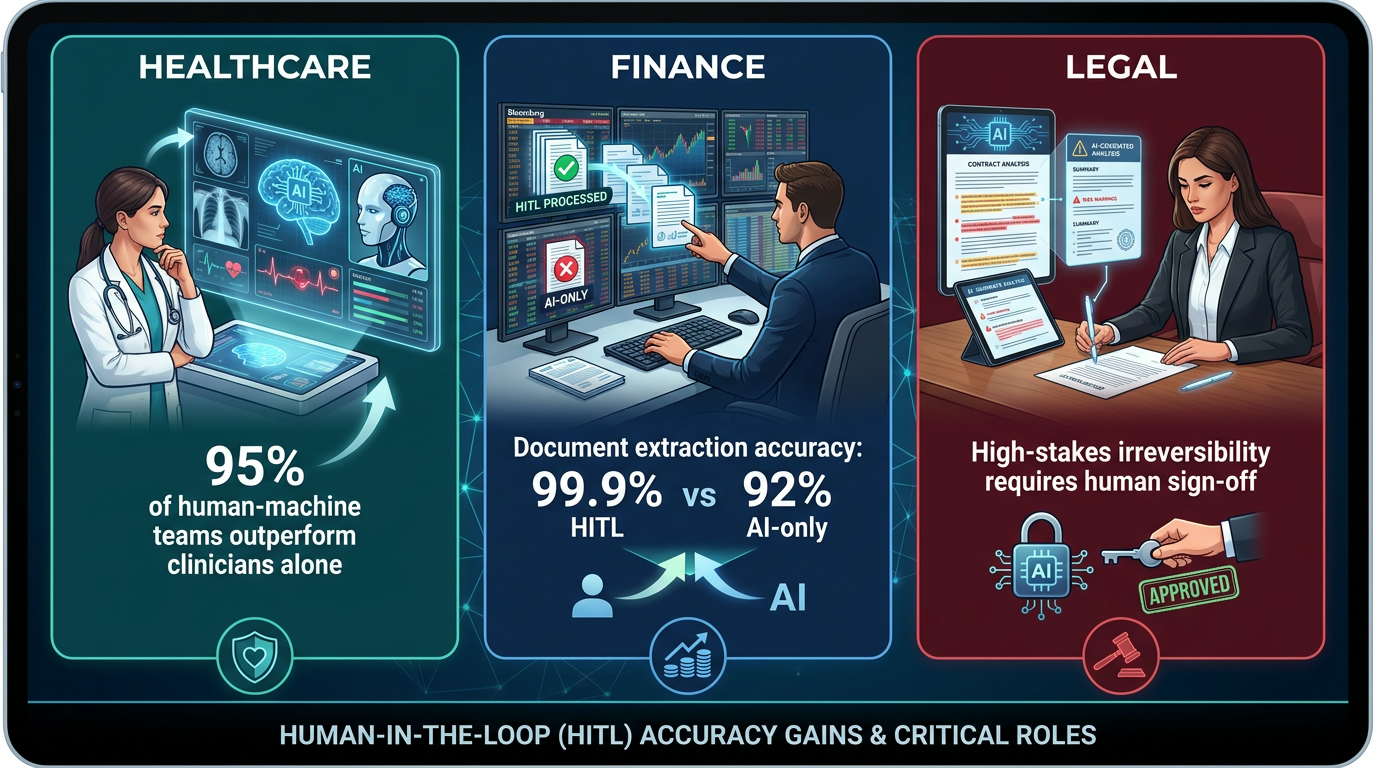
    Three-panel infographic showing HITL accuracy improvements in healthcare, finance, and legal sectors with key statistics

    The case for HITL isn’t theoretical. Across the highest-stakes sectors, there is accumulating evidence that human-machine collaboration substantially outperforms either humans or AI operating independently — and that the specific benefits depend heavily on how the collaboration is structured.

    Healthcare: When the Stakes Are Irreversible

    Healthcare is where the HITL evidence base is strongest, partly because the research infrastructure to study diagnostic accuracy already existed before AI was introduced. The findings are striking. A 2025 systematic review found that human-machine teams — where AI and clinicians each contributed to diagnosis — outperformed clinicians working alone in 95% of studied cases. HITL AI improved overall clinician diagnostic performance by an average of 7.1% across task types.

    Perhaps more importantly for practical implementation, the same review found that HITL dramatically reduced the incidence of high-confidence wrong answers — the failure mode that causes the most clinical harm. AI systems occasionally produce wrong outputs with high confidence. Clinicians catch most of these when they’re shown the AI’s recommendation alongside supporting evidence and have time to evaluate it critically. The AI catches most of the cases where a tired or overloaded clinician might miss something subtle. Neither catches everything; together, they catch substantially more than either alone.

    The documentation benefit is separate but significant. HITL-augmented clinical documentation reduced documentation time by 24 to 72 percent in multiple studies, while improving completeness and accuracy. The human remains responsible for the clinical narrative, but AI pre-fills, summarizes, and flags gaps — freeing physician attention for the genuinely complex judgment work.

    Finance: Accuracy at Scale Without Sacrificing Control

    Financial services presents a different profile. The volume of decisions is orders of magnitude higher than healthcare — millions of transactions, documents, and risk assessments daily — but many individual decisions have lower immediate consequences than clinical ones. The sector’s HITL architecture challenge is therefore primarily about selective oversight: applying human review where it materially reduces risk without creating a bottleneck that makes AI-enabled scale impossible.

    Document processing illustrates the accuracy case clearly. For structured document extraction — ingesting and parsing contracts, invoices, regulatory filings, and financial statements — HITL systems routinely achieve 99.9% accuracy compared to approximately 92% for AI-only processing. For high-volume, low-margin financial operations, that 7.9-percentage-point gap represents enormous cumulative error cost at scale. A 92% accuracy rate on ten million monthly invoice processings means roughly 800,000 errors per month requiring remediation.

    Fraud detection presents a different tradeoff. Fully automated fraud scoring operates at the millisecond speed required for real-time payment processing. Human review of flagged transactions happens asynchronously, after a provisional hold is placed. The HITL architecture in this context is a HOTL model at the transaction level (AI decides in real time whether to flag) combined with strict HITL for consequence decisions (whether to permanently block an account, initiate a fraud report, or escalate to law enforcement). The human is in the loop on the decisions that create legal and reputational exposure, not on every flag.

    Legal: The Irreversibility Standard

    Legal workflows are governed by an irreversibility standard that makes HITL essentially non-negotiable for any consequential action. Filing a legal document, entering into a contract, making a representation to a court — these actions cannot be simply undone. The professional liability framework, the ethical obligations of attorneys, and the adversarial nature of legal proceedings all demand that a qualified human is making and owning the relevant judgment calls.

    What AI has changed in legal practice is the volume and quality of information that the human can process before making those calls. Contract review workflows now routinely use AI to flag non-standard clauses, surface precedent cases, compare terms against benchmarks, and identify potential risks — all presented to the reviewing attorney in a structured interface designed to surface the highest-priority issues first. The attorney’s review time may be reduced by 40 to 60 percent. Their decision quality, informed by AI-surfaced context they would not have had time to gather independently, may be substantially higher.

    The HITL model here is explicitly collaborative: the attorney doesn’t just approve or reject the AI’s analysis. They engage with it, probe it, override it where their judgment differs, and take professional responsibility for the final work product. The AI isn’t a checker; it’s a highly capable research and analysis tool operating under human professional direction.

    The Hidden Costs: Automation Bias, Alert Fatigue, and Deskilling

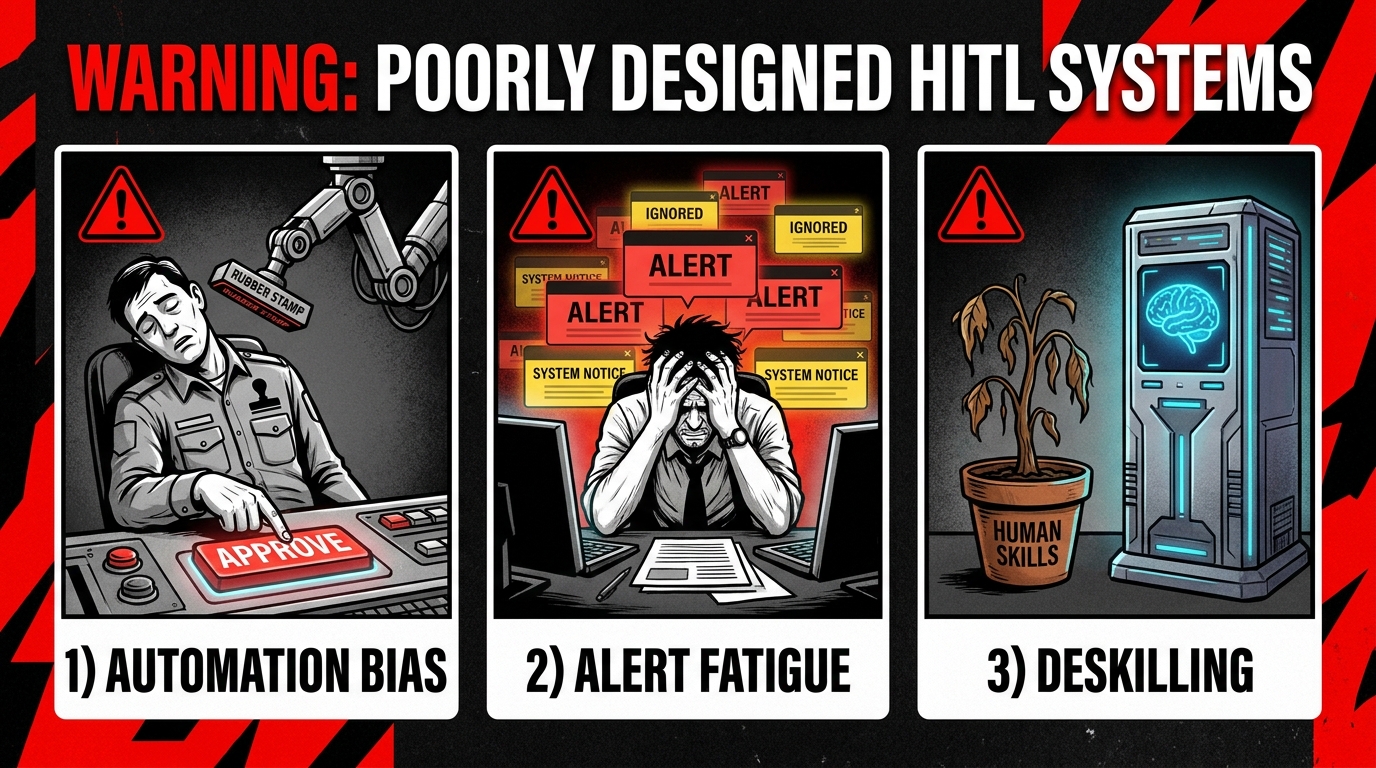
    Three HITL failure modes illustrated: automation bias showing reflexive approvals, alert fatigue from notification overload, and deskilling of human expertise

    HITL is not automatically safe. Poorly designed HITL can be actively worse than either full automation or purely human decision-making — because it creates the appearance of human oversight without the substance. Three failure modes deserve careful attention.

    Automation Bias: The Rubber Stamp Problem

    Automation bias is the documented human tendency to over-rely on automated recommendations and under-apply independent judgment, especially when the AI presents with apparent confidence. It’s a well-studied cognitive phenomenon: when a system presents a recommendation, humans tend to anchor on that recommendation and require strong contradictory evidence to override it. In the absence of compelling contrary evidence, they default to approving what the AI suggests.

    This has been observed across multiple HITL domains. Radiologists have been shown to miss anomalies that they would have caught independently when reviewing AI-pre-screened images marked “normal.” Loan officers approve borderline applications at higher rates when the AI recommendation is “approve.” Content moderators pass more marginal content when the AI rates it “compliant.”

    The mitigation isn’t to remove the AI recommendation from the interface — that would eliminate most of the efficiency gain. It’s to design interfaces that force genuine engagement. This means: requiring reviewers to articulate their reasoning before seeing the AI’s recommendation in some fraction of cases; presenting confidence uncertainty prominently (not just the recommendation but how confident the model is); randomizing the display format to prevent pattern recognition shortcuts; and tracking individual reviewer override rates as a quality metric, with low override rates triggering calibration reviews.

    Alert Fatigue: When Oversight Volume Defeats Oversight Quality

    Alert fatigue is a throughput problem masquerading as a design problem. When the volume of review requests exceeds a reviewer’s processing capacity — or when a high percentage of alerts turn out to be low-priority — reviewers begin to treat oversight as an administrative task rather than a meaningful judgment exercise. Approval rates climb. Engagement time per review falls. Eventually, the review process exists formally but not functionally.

    The root cause is almost always miscalibrated thresholds. Organizations that set conservative escalation rules — routing too many decisions to human review to be “safe” — inadvertently flood their review queues with low-value cases and degrade the quality of review across the board. The paradox is that trying to maximize oversight by routing more to humans can result in less effective oversight per decision.

    The fix requires data. Track the distribution of outcomes for different alert tiers. If 95% of alerts in a given category result in approval with minimal review time, that’s evidence the category can be safely downgraded or removed from the human review path. Calibration of escalation thresholds should be a recurring operational practice, not a one-time setup decision.

    Deskilling: The Long-Term Risk Nobody Talks About

    Deskilling is the most insidious of the three failure modes because it operates slowly and invisibly. When AI handles the routine, pattern-recognition-intensive components of a job, and humans are left to review AI recommendations on an exception basis, the human’s opportunity to practice foundational skills decreases. Over time, that practice deficit erodes capability.

    Pilots who rely heavily on autopilot maintain lower manual flying proficiency. Clinicians who regularly review AI diagnostic recommendations show degraded independent diagnostic performance in studies where the AI is removed. Legal associates who spend years reviewing AI-drafted contracts rather than drafting from scratch develop gaps in their drafting capabilities.

    This matters because HITL’s safety value depends on the human in the loop being capable of catching what the AI gets wrong. If deskilling has degraded that capability, the human checkpoint provides less protection than it appears to. The oversight function becomes hollow.

    Organizations building long-term HITL architectures need to think about skill maintenance as an operational requirement. This might mean rotating staff through non-AI-assisted workflows periodically, designing training programs that keep foundational skills sharp, or explicitly tracking skill depth as a workforce metric alongside traditional performance indicators.

    Agentic AI and the New Oversight Problem

    Autonomous AI agent network with human checkpoint gates at critical decision nodes — visualizing accountable agentic AI oversight architecture

    Everything discussed so far has assumed a relatively bounded AI system: one that processes inputs and produces recommendations or takes discrete actions in a well-defined workflow. The emergence of agentic AI — systems that can plan multi-step tasks, invoke external tools, and operate across extended time horizons with minimal moment-to-moment human direction — creates a fundamentally different oversight challenge.

    Why Agentic AI Changes the Oversight Calculus

    With a conventional AI system, the boundary of possible action is narrow. The model takes input, produces output, a human reviews it, done. With an agentic system, a single task initiation might trigger a cascade of sub-actions: browsing the web for information, writing and executing code, sending emails, making API calls to external systems, creating documents, booking appointments, moving funds. Each sub-action builds on the last, and the compound effect of early errors — or early misinterpretations of the task objective — can propagate far before any human sees the result.

    Gartner projects that by 2030, 50% of AI agent deployment failures will stem from insufficient runtime governance and oversight. That forecast reflects a recognition that agentic systems require a qualitatively different approach to HITL, not just a quantitative extension of existing patterns.

    Checkpoint Design for Agents: The Critical Decisions

    Designing HITL for agentic systems requires answering several questions that don’t arise with conventional AI. First: at what points in a multi-step task should the agent pause for human verification? Pausing at every step defeats the purpose of agency; never pausing creates unacceptable risk. The emerging best practice is to pause at “consequence thresholds” — actions that are irreversible, involve external commitments, exceed defined value or data exposure limits, or represent a significant deviation from the initial task specification.

    Second: how do you preserve useful human oversight without requiring the reviewer to reconstruct the entire agent’s decision history? The agent may have taken fifty intermediate steps before reaching a consequence threshold. A reviewer presented with a raw action log will struggle to provide meaningful oversight. The interface needs to compress the relevant history into a reviewable summary — what the agent was trying to do, what it has done so far, what it proposes to do next, and what makes this moment a checkpoint — in a format that enables a qualified judgment in under five minutes.

    Third: what happens when an agent encounters uncertainty mid-task? The emerging design pattern is for agents to have an explicit escalation behavior — surfacing uncertainty to a human rather than guessing — whenever they encounter ambiguity about task objectives, conflicting signals, or situations outside their training distribution. This is meaningfully different from waiting for a consequence threshold; it’s the agent itself initiating oversight requests when it recognizes the limits of its own competence.

    Identity, Authorization, and Accountability Chains

    Agentic AI creates a new accountability problem. When an agent takes an action — particularly one with legal or financial consequences — who authorized it? The person who started the task? The person who reviewed the last checkpoint? The organization that deployed the agent? If the action causes harm, this question has legal standing.

    Sophisticated HITL architectures for agentic systems are incorporating identity-anchored authorization chains: each action that the agent takes is linked to an explicit authorization record showing which human approved which scope of action, at what time, under what stated task objective. This isn’t just for post-hoc accountability; it’s operationally useful because it limits what the agent can do autonomously to what a specific human has explicitly authorized for this specific task instance.

    This approach borrows from privileged access management frameworks in enterprise security. Just as you wouldn’t give a contractor unrestricted access to all production systems, you don’t give an AI agent unrestricted ability to take any action within its technical capability. Scoped authorization, linked to a human principal, creates the accountability chain that makes agentic systems governable.

    How to Design HITL That Actually Works — Not HITL Theater

    Most HITL implementations fail not because the concept is wrong, but because the design is shallow. Organizations add a review step to an existing workflow, call it HITL, and move on. What they’ve built is HITL theater — the structural appearance of oversight without the functional substance. Here’s how to build something that actually works.

    Start With Decision Architecture, Not Interface Design

    The most common mistake is starting with the interface. Teams build a review screen, add an approve/reject button, and consider the HITL work complete. But if the decision architecture upstream is wrong — if the wrong decisions are being routed to review, if the risk tiering is miscalibrated, if the confidence thresholds are arbitrary — the interface design is irrelevant.

    Decision architecture first means mapping every decision class in the workflow, characterizing each by consequence, reversibility, and regulatory status, and designing the routing logic before a single screen is designed. This is often a cross-functional exercise involving risk, compliance, legal, and operations — not just engineering. It takes longer upfront and produces substantially better outcomes.

    Treat the Review Interface as a Core Product

    The human review interface should receive the same product design investment as any customer-facing feature. It needs user research with actual reviewers. It needs usability testing. It needs iteration based on real-world use data. The questions it needs to answer — what is this, why did it land here, what do I need to decide — have to be answerable in under a minute for the oversight to be meaningful at operating throughput.

    Critically, the interface should be designed to resist automation bias. Confidence scores should be displayed with their uncertainty range, not just the point estimate. The review should surface disconfirming evidence alongside the AI’s recommendation. In high-stakes contexts, consider requiring reviewers to document their reasoning — not a long essay, but a structured selection from a checklist of decision factors — before they can submit their judgment.

    Build Measurement Into the Oversight System Itself

    HITL systems should be measured continuously, not just audited periodically. Key metrics include: reviewer override rate by decision class (are humans ever disagreeing with the AI?); review time per decision (is it long enough to indicate genuine engagement?); post-decision outcome tracking (when humans override the AI, are they right?); queue age and escalation rates (is the system flowing, or are decisions getting stuck?); and reviewer agreement rates across multiple reviewers on the same decision type (is human judgment consistent enough to be reliable?).

    These metrics are operationally useful and serve a second function: they provide the evidence base for calibrating the system over time. As the AI model improves in specific areas, human oversight requirements in those areas can be reduced. As new risk patterns emerge, escalation thresholds can be tightened. The oversight architecture should evolve continuously based on evidence from actual operations — not remain static after initial deployment.

    Design for Human Dignity and Sustainable Work

    Reviewers in HITL systems are doing cognitively demanding work, often at high volume. Organizations that treat review queues as high-throughput data entry — implicitly expecting reviewers to process large volumes as quickly as possible — will produce either automation bias (reviewers going through the motions) or burnout and turnover (reviewers who can’t sustain the cognitive load).

    Sustainable HITL design sets realistic throughput expectations based on decision complexity, not on what would be most convenient for the automated system. It provides review context that makes the work meaningful — reviewers who understand the downstream consequences of their decisions make better ones. It builds in breaks and cognitive recovery time. And it creates feedback loops so reviewers see the outcomes of their decisions — a fundamental driver of skill maintenance and judgment quality.

    The Market Taking Shape Around Human Oversight

    HITL is becoming a product category, not just an architectural pattern. The human-in-the-loop AI market was valued at approximately $2.4 billion in 2025 and is projected to reach $11.8 billion by 2034, growing at a compound annual rate of roughly 19.3%. That growth trajectory reflects genuine enterprise investment in oversight infrastructure — not just compliance spend, but operational capability.

    The Tooling Layer Is Maturing

    A year ago, most HITL infrastructure was custom-built. Engineering teams would wire together workflow orchestration, a review interface, and audit logging from disparate components. That’s changing rapidly. A new category of HITL-native platforms is emerging — tools designed from the ground up to support the pause-review-resume workflow, manage review queues, maintain decision state, and capture the audit data that compliance requires.

    These platforms are showing up at the intersection of several adjacent markets: workflow automation, AI governance tooling, and business process management. The differentiation is increasingly around the intelligence of the escalation layer — how well the platform identifies which decisions need human review — and the quality of the review interface, which determines whether oversight is genuine or performative.

    New Roles and Organizational Structures

    HITL at enterprise scale is creating new workforce requirements. The “AI reviewer” or “AI oversight specialist” role is becoming formalized in high-stakes sectors. These aren’t general-purpose employees who happen to review AI outputs; they’re specialists who understand both the domain (clinical, legal, financial) and the AI system’s behavior well enough to provide meaningful oversight rather than rubber-stamping.

    The role demands unusual cross-domain fluency: deep domain expertise, enough technical understanding of how the model works to interpret its confidence signals, and enough judgment to override confidently when warranted. Organizations are finding that this combination is hard to recruit for and hard to train toward — which is pushing some of the leading HITL platform providers toward building role-specific training and certification into their products.

    The Opportunity in Trustworthy AI Positioning

    For organizations selling AI-enabled products or services, robust HITL architecture is increasingly a competitive differentiator, not just a compliance cost. Enterprise buyers — particularly in regulated industries — are asking detailed questions about how oversight is designed, not just whether it exists. Vendors who can demonstrate genuine human oversight infrastructure, with evidence of its effectiveness, are winning deals over alternatives that offer comparable AI capability with weaker oversight stories.

    This dynamic is already visible in healthcare AI, where clinical validation studies and human oversight documentation are becoming purchase requirements rather than nice-to-haves. It’s emerging in legal tech, in financial services AI, and in any context where the AI’s actions have consequences that create liability for the deploying organization. HITL as a value proposition is arriving in parallel with HITL as a regulatory requirement — and the combination is accelerating the market.

    Human Judgment as a Product Feature: The Reframe That Changes Everything

    The most significant intellectual shift in how leading organizations are thinking about HITL is the reframe from oversight cost to product feature. Under the old model, human review was an expense — a necessary one in some cases, but fundamentally a drag on the efficiency gains that AI was supposed to deliver. Under the new model, human judgment is a feature that the product includes by design, because it produces demonstrably better outcomes than the fully automated alternative.

    This reframe has practical implications for how HITL gets funded and prioritized. When human oversight is framed as a cost center, it competes with efficiency for budget. When it’s framed as a product differentiator — something that makes the system more accurate, more trustworthy, and more defensible in regulated contexts — it gets resourced accordingly.

    The Accuracy Premium Is Real and Measurable

    The data supports the reframe. In domain after domain, human-machine collaboration produces accuracy results that neither party achieves alone. 95% of human-machine diagnostic teams outperform clinicians working independently. Document processing accuracy at 99.9% versus 92% AI-only. Legal review that surfaces more risk at lower cost than either pure human review or AI-only analysis. These aren’t marginal improvements — they’re the kind of step-change accuracy gains that become core to a product’s value proposition.

    The reframe also changes how you think about the cost of HITL. The relevant comparison isn’t “HITL versus no HITL.” It’s “the cost of human oversight versus the cost of errors that oversight prevents.” When you model that comparison honestly — including remediation cost, reputational damage, regulatory fines, and legal liability — HITL investment typically looks very different than when compared against the operating cost of a fully automated alternative.

    Trust as a Durable Competitive Asset

    There’s a longer-term dynamic worth naming explicitly. As AI becomes more pervasive, the organizations that will sustain competitive position are those that have built demonstrated, verifiable track records of reliable AI-assisted decisions. That track record is only possible with HITL infrastructure that captures the data — the decisions made, the human judgments applied, the outcomes observed — that allow you to show your system’s reliability over time.

    Fully automated systems that never involve humans provide no such track record. They can demonstrate accuracy on test sets, but they can’t demonstrate the kind of real-world, audited, outcome-tracked reliability that high-stakes enterprise buyers increasingly require. HITL architecture is, in this sense, the foundation of a trust asset that compounds over time — and that can be demonstrated to regulators, customers, and partners in ways that purely automated approaches cannot.

    What the Most Serious Teams Are Getting Right

    The organizations making HITL work in practice share some consistent characteristics. They treat oversight as a design constraint from day one, not a retrofittable feature. They staff review functions with people who have real domain expertise, not just operational throughput. They measure the quality of oversight continuously and calibrate accordingly. They build feedback loops so that the human judgments captured in the HITL system are actually used to improve model performance over time.

    And — critically — they resist the organizational pressure to loosen HITL requirements as AI confidence increases, without the data to support that loosening. Model confidence is not the same as real-world reliability across the full distribution of inputs a deployed system will encounter. The teams that maintain disciplined oversight standards, even as models improve, are the ones who avoid the regression to the mean that catches organizations off guard when their “good enough to go autonomous” AI encounters a case it handles badly.

    Conclusion: The Structural Reality of the Human-in-the-Loop Era

    Human-in-the-loop is no longer a phase in AI development. It is, for a substantial and growing fraction of enterprise AI use, a permanent architectural requirement — one driven by regulatory obligation, by evidence of outcome quality, and by the hard-won recognition that full automation of high-stakes decisions creates failure modes that are genuinely difficult to recover from.

    The organizations that will navigate this transition well aren’t the ones treating HITL as a compliance checkbox. They’re the ones that have internalized the design philosophy: that human judgment is a capability to be integrated deliberately, not an inefficiency to be minimized. That oversight quality is something you measure and improve over time, not something you declare complete and move past. That the human in the loop is not a temporary bridge to full autonomy, but a permanent contributor to outcome quality that any honest accounting of AI-assisted decisions needs to include.

    The engineering work is harder than the policy language implies. Checkpoint architecture, review interface design, state management, escalation logic, automation bias mitigation, deskilling prevention — each of these is a substantive design problem that requires real investment. None of them can be solved with a checkbox on a governance form.

    But the evidence on the other side of that investment — in accuracy, in defensibility, in regulatory compliance, in trust — is increasingly compelling. The question for most organizations in 2026 is not whether to build human oversight into their AI systems. It’s whether to build it well.

    Key Takeaways for Practitioners

    • Choose your oversight model — HITL, HOTL, or hybrid — based on decision reversibility, stakes, volume, and regulatory obligation. Don’t apply one model to all workflows.
    • Design decision architecture before designing review interfaces. Routing logic determines whether the right decisions reach human reviewers.
    • Invest in review interface quality as seriously as you invest in any customer-facing product. A bad review UX produces automation bias regardless of policy intent.
    • Measure override rates, review time, and post-decision outcomes continuously. A HITL system that never generates disagreements between humans and AI is likely not generating genuine oversight.
    • Build explicit deskilling prevention into your workforce model. The human in the loop needs maintained capability to provide the oversight that’s being relied upon.
    • For agentic AI, design consequence threshold checkpoints and identity-anchored authorization chains before deployment, not after the first incident.
    • Model the cost of HITL against the cost of errors it prevents — including remediation, liability, and regulatory exposure — not just against the operating cost of a fully automated alternative.
  • The Operator’s Guide to AI-Assisted Image Workflows That Don’t Get You Flagged

    The Operator’s Guide to AI-Assisted Image Workflows That Don’t Get You Flagged

    There’s a particular kind of pain that hits ecommerce operators in the gut: you spend three weeks perfecting an AI-assisted image workflow — the backgrounds are flawless, the lifestyle shots look editorial, the variant photography is consistent across 200 SKUs — and then the platform flags half your catalog overnight. No warning. No specific reason. Just “does not comply with our image policies.”

    The frustrating part isn’t the suppression itself. It’s that nobody in your organization can explain exactly what tripped the wire. Was it the near-white background on the hero shot? The AI-generated model in the lifestyle image? The missing metadata? A phantom copyright signal from a training dataset? You don’t know, and the platform’s auto-response doesn’t tell you.

    This happens because most teams approach AI image workflows as a creative problem rather than a compliance engineering problem. They invest heavily in prompting, iteration, and visual quality — and treat policy adherence as an afterthought, something to sort out if something goes wrong. In 2026, that approach is no longer tenable.

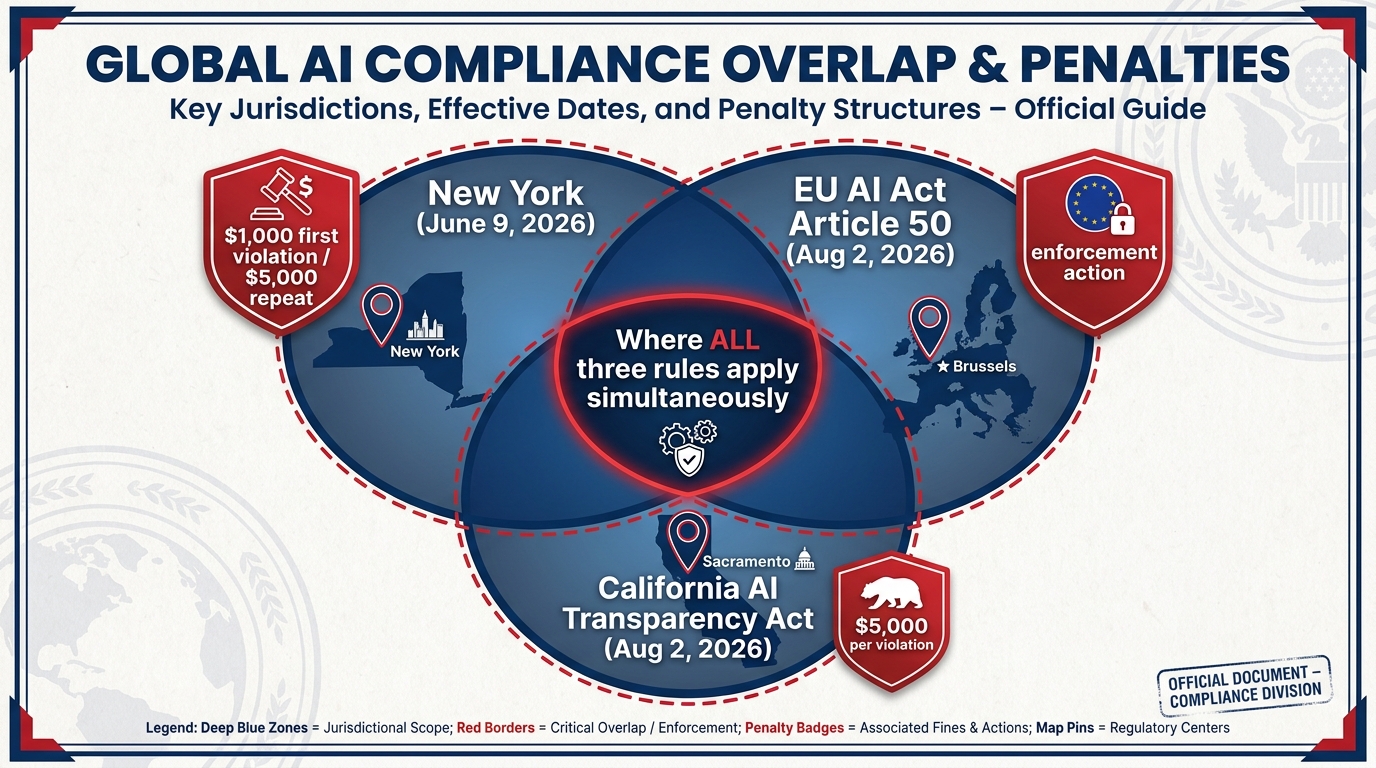
    Platforms have matured their enforcement infrastructure dramatically. Amazon, Meta, TikTok, Etsy, Walmart, and Shopify are all running multimodal AI classifiers at scale against uploaded content. The EU AI Act’s Article 50 transparency obligations came into force in August 2026, adding a layer of legal exposure that extends beyond individual platform rules. New content provenance standards like C2PA are being baked into creative tools by Adobe, Nikon, Canon, and others — and some platforms are beginning to read them.

    This guide is built for operators who are already running AI image workflows — or are planning to — and want to understand precisely what gets you flagged, how detection actually works, what compliance infrastructure you need, and how to build a workflow that survives enforcement at scale. It covers technical requirements, tool selection, metadata strategy, human review checkpoints, legal obligations, and appeal protocols. In short: everything the creative briefing deck leaves out.

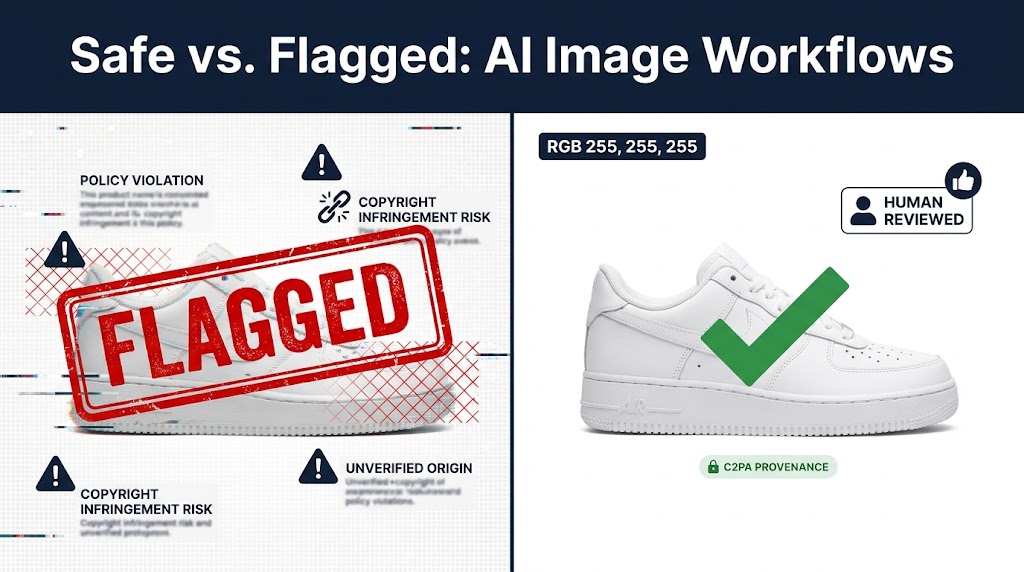
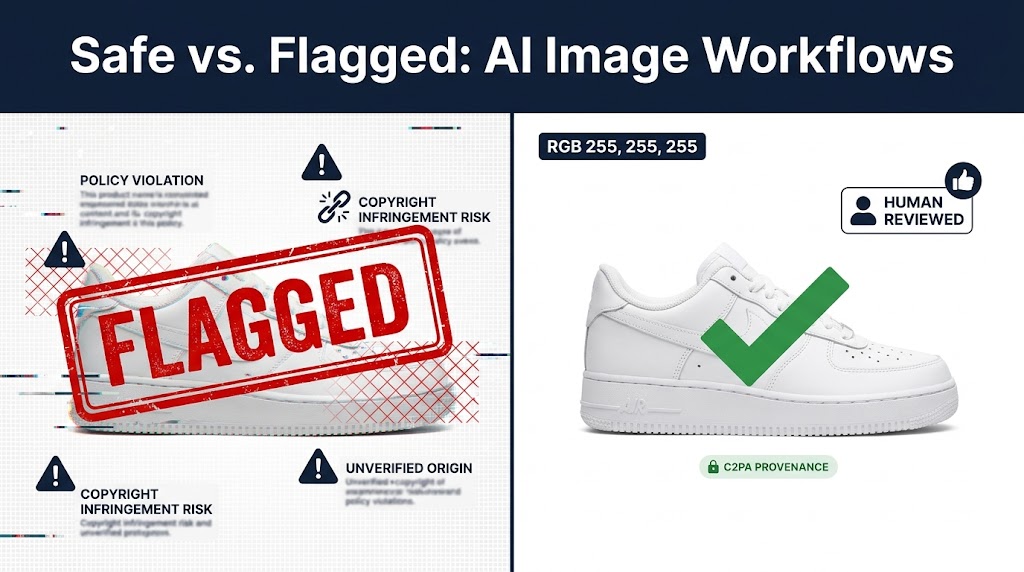
    Split-screen infographic showing flagged AI product image on left versus compliant AI-assisted product image on right with C2PA provenance badge and pure white background

    How Platforms Actually Detect AI Images in 2026 — The Technical Reality

    Most sellers operate on a mixture of myths when it comes to how platforms identify problematic AI images. The common assumption is that platforms are running some form of AI-generation detector — a classifier that reads an image and outputs a probability score that says “this was made by Midjourney.” That assumption is not entirely wrong, but it dramatically understates the sophistication and diversity of what’s actually happening at the infrastructure level.

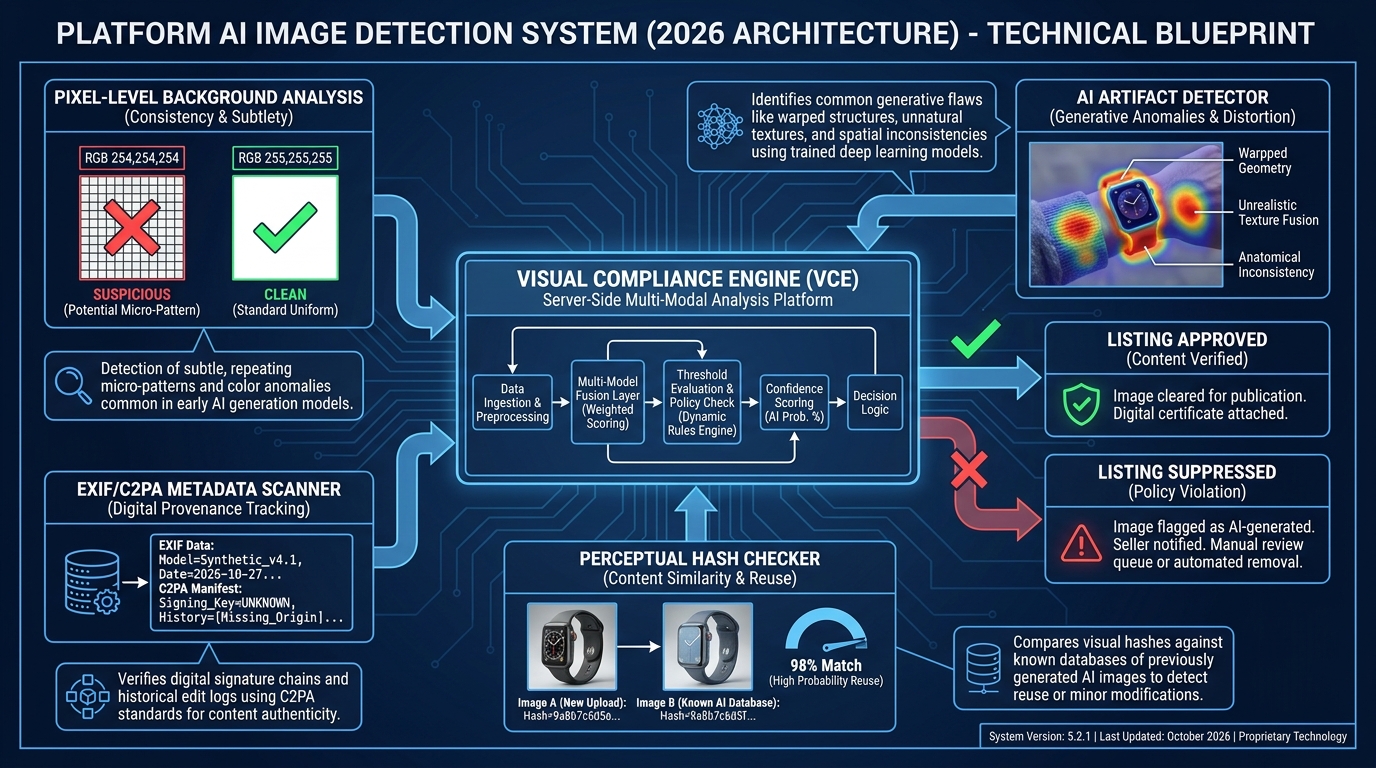
    Pixel-Level Technical Audits

    Before any AI-detection model even runs, most major marketplace platforms apply a set of deterministic technical rules. These are not AI — they’re rules engines, and they’re extremely good at their job.

    Amazon’s main image compliance system, for example, enforces a pure white background at the pixel level. “Pure white” means RGB (255, 255, 255) — exactly. Not (254, 255, 254). Not (253, 253, 253). AI background-removal tools are notorious for generating near-white backgrounds that look white to the human eye but fail this test. Some AI upscalers and generative fill tools introduce subtle color casts at the edge of the product that push background pixels away from pure white. These listings get auto-suppressed before any human reviewer sees them.

    Similar pixel-level rules govern image dimensions (minimum 1000 pixels on the longest side for Amazon’s zoom functionality), file format (JPEG, PNG, TIFF only on most platforms), and file size ceilings. AI-generated images in particular can have unusual compression artifacts, especially when output through pipelines that convert between model formats before final export. Platforms detect these as technical violations, not as “AI” violations.

    Semantic and Contextual AI Classifiers

    Above the technical rules layer sits a semantic classification layer. These multimodal AI models don’t just look at pixel values — they interpret the content of the image in relation to the product listing’s text. This is where things get more nuanced.

    Amazon’s visual compliance system cross-references the image against the product title, bullet points, and category. If your AI-generated lifestyle scene shows a kitchen appliance on a dining table set for six people, but your title says “single-serve coffee maker,” the classifier may flag the image for implying use cases or contexts that don’t match the product. If an AI-generated model appears to be wearing a watch on one wrist while your listing is for a bracelet, the classifier may flag it as showing an unadvertised accessory.

    Google’s ALF (Advertiser Large Foundation Model), deployed at scale in 2026, can achieve recall gains of over 40 percentage points versus prior systems on certain violation types, according to internal reporting cited by industry observers. Meta uses similar multimodal stacks to screen ad creatives before delivery. These systems are making fewer false positives than earlier-generation classifiers, but they’re catching many more genuine violations — including subtle ones that prior tools missed entirely.

    AI Artifact Detection

    Dedicated AI-generation detection is a third and separate layer. These classifiers look for the specific artifacts that generative models tend to produce: frequency-domain anomalies in the image (generative models produce images with characteristic spectral signatures), unnatural edge smoothness, incorrect or physically impossible lighting directions, and inconsistencies in reflections and shadows.

    The honest truth about these detectors, though, is that they are imperfect. NewsGuard reported in 2026 that leading AI-image detectors can still generate significant false-positive rates — correctly shot product photographs being flagged as AI-generated because of certain post-processing steps. This is actually a source of risk for sellers who aren’t using AI: certain lighting rigs, background choices, and post-production workflows can produce images that pattern-match to AI generation.

    Crucially, most platforms do not auto-remove content solely because AI-detection classifiers score it as AI-generated. The trigger is more often the combination of a high AI-probability score plus a policy-relevant concern (misleading imagery, background non-compliance, IP signals, etc.).

    Metadata and Provenance Scanning

    The fourth layer of detection is increasingly important and widely underestimated: metadata and provenance checking. Platforms are beginning to read EXIF data, IPTC data, and — in the early stages — C2PA Content Credentials. EXIF data from AI tools often records the originating software name (e.g., “Adobe Photoshop Generative Fill” or “Midjourney”). While no major marketplace currently auto-rejects images based solely on EXIF AI software tags, this metadata creates an evidence trail that can be used in human reviews of flagged accounts.

    Technical diagram showing platform visual compliance engine with pixel analysis, metadata scanning, AI artifact detection, and perceptual hash checker feeding into listing approved or suppressed outcomes

    The Compliance Stack: Five Layers That Separate Safe Workflows from Risky Ones

    The teams that run AI image workflows at scale without persistent flagging problems aren’t doing something exotic. They’re not finding loopholes or gaming detection systems. They’ve simply built a compliance stack with five distinct layers that work together — rather than treating compliance as a single step at the end of the creative process.

    Layer 1 — Policy Mapping Per Marketplace

    The first layer is documentation that most teams skip entirely: a live, maintained policy map for every marketplace where images are published. This isn’t a one-time read of the policy page. Marketplace image policies changed materially at least three times across major platforms between January and June 2026. The map needs to record the following for each platform:

    • Whether AI-generated or AI-edited images are permitted (and the distinction between the two)
    • Whether disclosure is required, and if so, where (product description field, metadata, image alt text, separate form)
    • Specific technical requirements: background color values, minimum dimensions, maximum file size, permitted formats
    • Whether model likeness rights need to be documented
    • The applicable policy version date (so you can demonstrate you were compliant with the rules at the time of upload)

    Someone in the workflow needs to own this document and review it actively — not just when something goes wrong. Set a calendar alert for a monthly policy audit of every active platform.

    Layer 2 — Source Asset Control

    The second layer governs what goes into the AI workflow. The most common source of compliance risk isn’t the AI output — it’s the AI input. Training images, reference photos, base product shots, and lifestyle scene references all need to be clean from an IP perspective.

    If you’re pulling reference images from the web to use as style references in Midjourney or as ControlNet inputs in Stable Diffusion, you’re introducing copyright risk at the source. If your base product photography was done under a photographer contract that doesn’t explicitly grant you rights to use those images in AI training or generation workflows, you may have a gap in your rights chain. If your lifestyle reference includes architecture, branded elements, recognizable people, or trademarked objects, those can bleed into outputs and trigger IP flags.

    Source asset control means: use only owned, licensed, or clearly cleared reference assets; maintain a register of source asset provenance; and check all inputs against your rights documentation before they enter any AI tool.

    Layer 3 — Tool Configuration and Output Standards

    The third layer covers how your AI tools are configured and how their outputs are standardized before they move downstream. This is an operational layer, not just a creative one. Output standards should be documented explicitly and enforced technically where possible.

    For main product images: pure white background (RGB 255,255,255) confirmed by eyedropper tool in post-processing — not assumed. For lifestyle images: no product inclusions beyond what’s in the ASIN, no competitor products in frame, no before/after implications, no health or results claims implied visually. For all images: minimum 1500px on the long side (leaving headroom above most platforms’ minimum), sRGB color space, JPEG at 85–90% quality to avoid compression artifacts that can trigger technical flags.

    Layer 4 — Human-in-the-Loop Review Gates

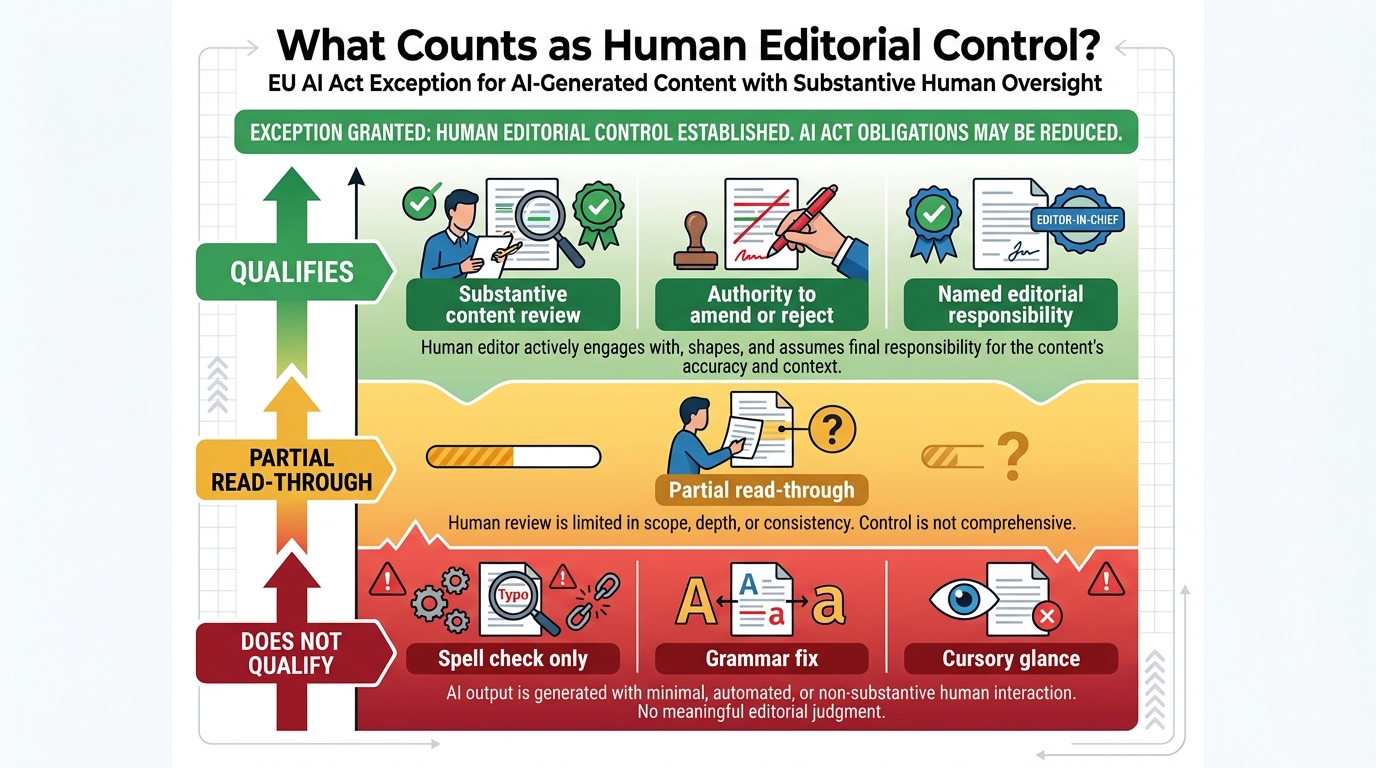
    The fourth layer is systematic human review at specific checkpoints — not a blanket “someone looks at every image.” The EU AI Act’s Article 14 formalized human oversight as a requirement for high-impact AI systems, and the principle is sound even where regulation doesn’t yet mandate it. Strategic placement of review gates is more effective than volume reviewing.

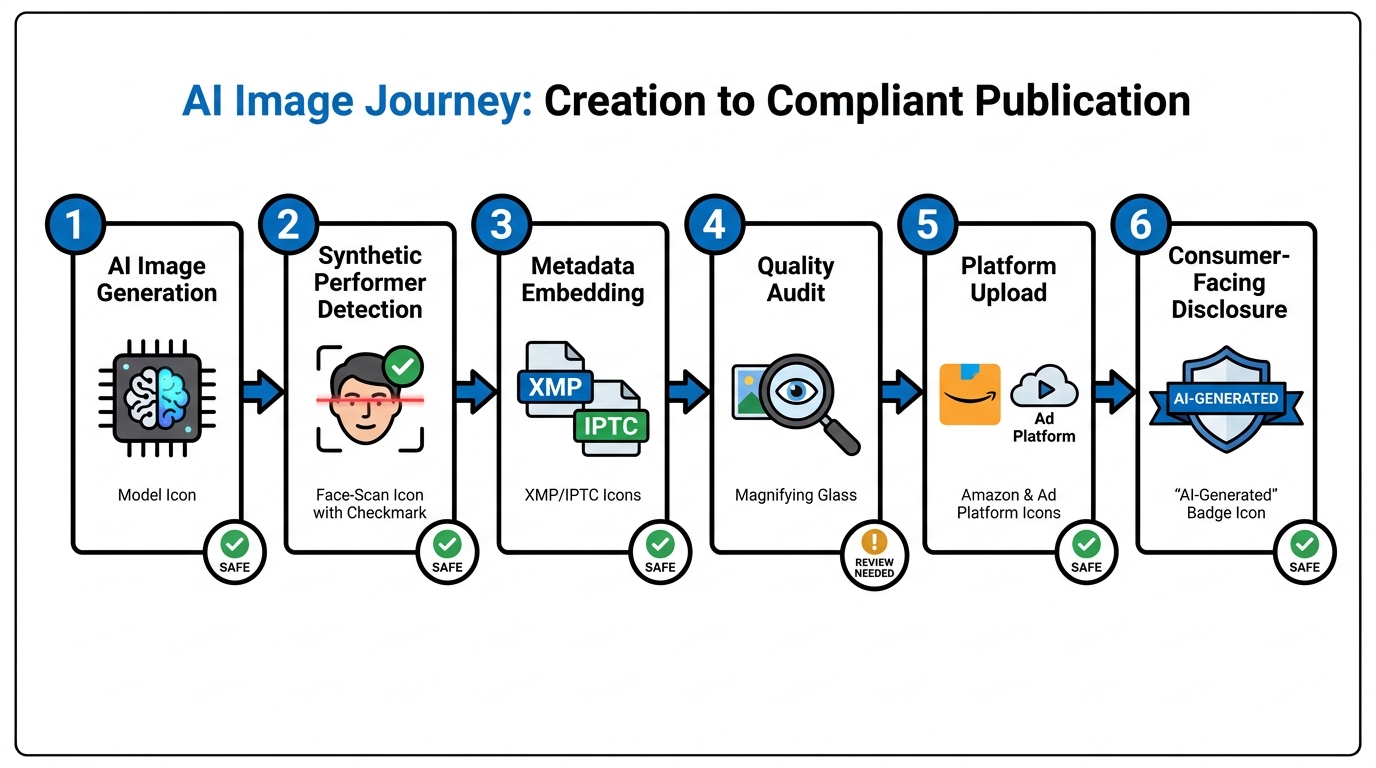
    In practice, three review gates tend to capture most risk: (1) a compliance check before any AI-generated or AI-edited asset is approved for final post-processing, (2) a technical check after post-processing is complete and before upload, and (3) a policy verification after live publication confirming the image displays correctly and hasn’t triggered any platform warnings. The people conducting each gate should have documented authority to reject and escalate — not just a passive sign-off role.

    Layer 5 — Audit Trail and Provenance Documentation

    The fifth layer is what saves you when everything else fails. An audit trail is not just a log file — it’s a structured record that lets you demonstrate the provenance, review history, and compliance status of every published image in your catalog. What needs to be captured: the source asset(s) used, the AI tool and version, the prompt or generation parameters, the date of generation, the reviewer who approved it, the policy version checked against, and the upload date and platform-specific asset ID.

    This record doesn’t need to be sophisticated. A shared spreadsheet with a row per asset per marketplace is a functional starting point. What matters is that it exists, is consistent, and is retained for at least 12 months after an asset is taken down (relevant for the EU AI Act’s record-keeping provisions and for appeal evidence purposes).

    Choosing Your AI Tools by Risk Profile: Firefly vs. Midjourney vs. Stable Diffusion

    Not all AI image tools carry the same compliance risk profile, and the selection of your core toolset has real downstream consequences for how exposed you are to flagging. The decision isn’t only about image quality — it’s about IP architecture, provenance support, commercial licensing clarity, and the kind of audit evidence each tool can generate.

    Three-column comparison chart showing Adobe Firefly as low risk, Midjourney as medium risk, and Stable Diffusion as variable risk for ecommerce product photography compliance

    Adobe Firefly: The Low-Risk Workhorse

    Adobe Firefly occupies a distinctive position in this space for one structural reason: it was trained exclusively on Adobe Stock images, openly licensed content, and public domain material. Adobe has contractually committed to indemnifying enterprise customers against copyright infringement claims arising from Firefly-generated content used within the platform’s terms. No other major generative AI tool makes this commitment as explicitly.

    For ecommerce use cases, Firefly is best deployed for: background generation and removal on real product photos, generative fill for small areas of an image (extending a canvas, filling a gap, removing an unwanted element), and creating simple lifestyle backgrounds that will be composited with real product photography. It is weaker than Midjourney for creative atmospheric shots and weaker than Stable Diffusion for highly customized or technical outputs.

    Crucially, Firefly generates C2PA Content Credentials by default — every output image carries a cryptographically signed provenance manifest identifying Adobe Firefly as the generation tool. In 2026, Adobe expanded this to enterprise workflows through GenStudio for Performance Marketing and the Content Authenticity API, including support for enterprise certificates and invisible TrustMark watermarking. This makes Firefly outputs the most provenance-legible of any major AI image tool — an advantage that will compound as platforms begin reading Content Credentials more systematically.

    Midjourney: High Quality, Medium Risk

    Midjourney consistently produces the most visually compelling lifestyle and creative imagery of any general-purpose generative tool. For hero campaign shots, editorial-style product spreads, and social media lifestyle content, it remains the tool of choice for many creative teams. The compliance risk profile, however, is more complex.

    Midjourney’s training data provenance is not fully disclosed, and the company does not offer IP indemnification. Commercial use rights are included in paid subscriptions, but “commercial use” has nuances — particularly around reproducing recognizable artistic styles, generating content that resembles specific artists’ work, or producing images that incorporate architectural or trademarked elements from the training corpus.

    Midjourney outputs do not include C2PA Content Credentials. EXIF metadata is typically minimal. This means that if a Midjourney-generated image is ever challenged, your documentation needs to come entirely from your own workflow records — prompts, generation logs, review records — rather than from embedded provenance in the file itself.

    The appropriate role for Midjourney in a compliant workflow: secondary images, lifestyle scenes, campaign visuals, and social content — not main product images, SKU-critical shots, or any image where product accuracy is essential. And every Midjourney output should be reviewed against your policy map before publication.

    Stable Diffusion: Powerful, Variable Risk

    Stable Diffusion and its ecosystem (including ComfyUI, AUTOMATIC1111, and various fine-tuned model derivatives) represent the highest-customization and highest-variability risk profile in the stack. The risk isn’t that Stable Diffusion is inherently more dangerous — it’s that the ecosystem is more diverse, which means compliance depends almost entirely on which model weights you’re running, where they came from, and what they were trained on.

    Community-fine-tuned models on platforms like Civitai frequently have unclear IP provenance. Models fine-tuned on brand-specific styles, celebrity likenesses, or copyrighted product designs could generate outputs that carry real IP liability. Additionally, NSFW model variants are sometimes distributed alongside commercial models in ways that require careful configuration management to ensure they’re not inadvertently enabled in production workflows.

    When running Stable Diffusion in a compliant enterprise workflow: use only models with clear, documented training data provenance; run your own fine-tuning on owned datasets where possible; generate metadata logs through your pipeline configuration; and pipe all outputs through the same human review and technical check gates as any other AI tool. Stable Diffusion’s strengths — precise product-on-background compositing, ControlNet-guided consistency, batch processing at scale — make it genuinely useful when managed properly.

    The Metadata Imperative: C2PA, Content Credentials, and What Provenance Actually Means for Sellers

    Content provenance was an academic concern two years ago. In 2026, it’s becoming operational infrastructure. The C2PA (Coalition for Content Provenance and Authenticity) standard — whose members include Adobe, Microsoft, Google, Sony, Nikon, Canon, BBC, and the Associated Press — defines a technical specification for cryptographically binding a provenance record to a media asset.

    How C2PA Actually Works

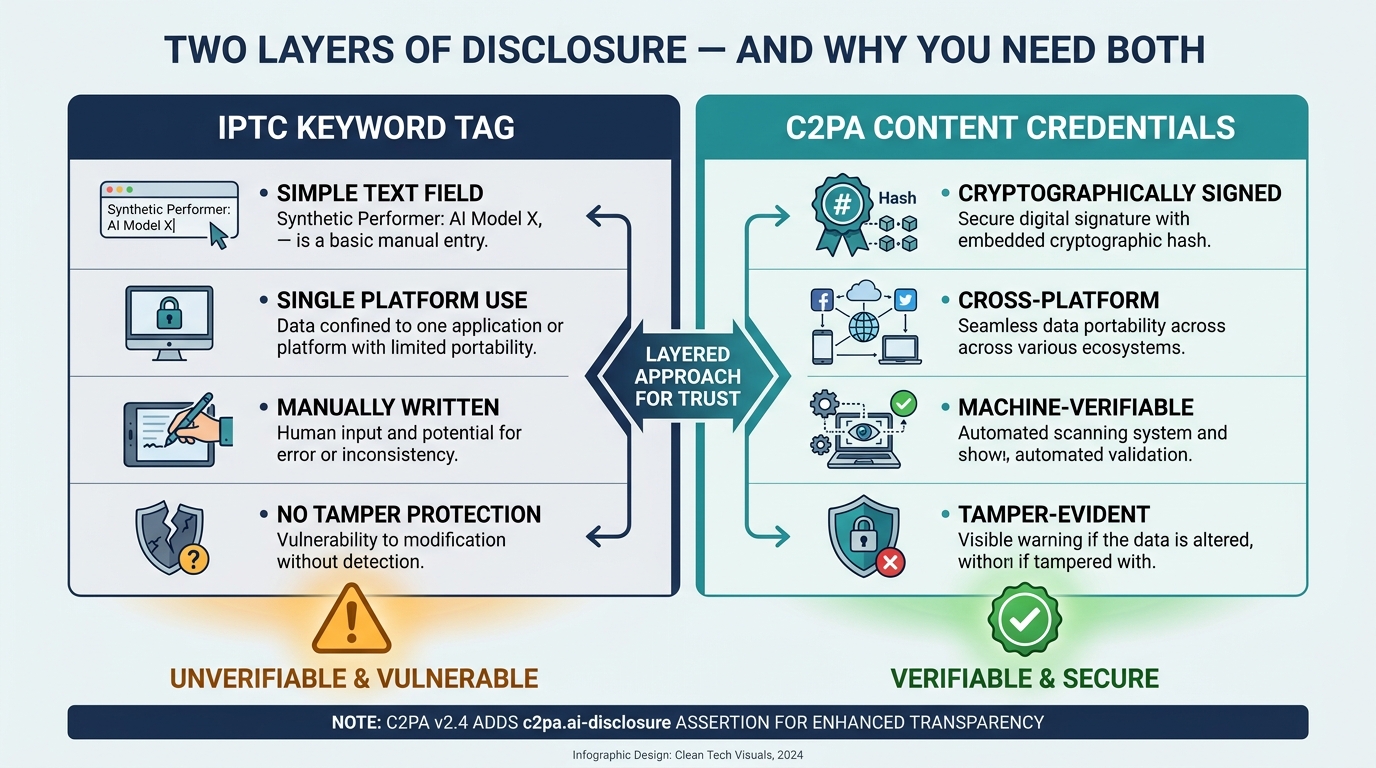
    Traditional EXIF metadata is editable and unverifiable. Anyone can open an image in a metadata editor and change the “Software” field from “Midjourney” to “Canon EOS R5.” EXIF provides context, not trust.

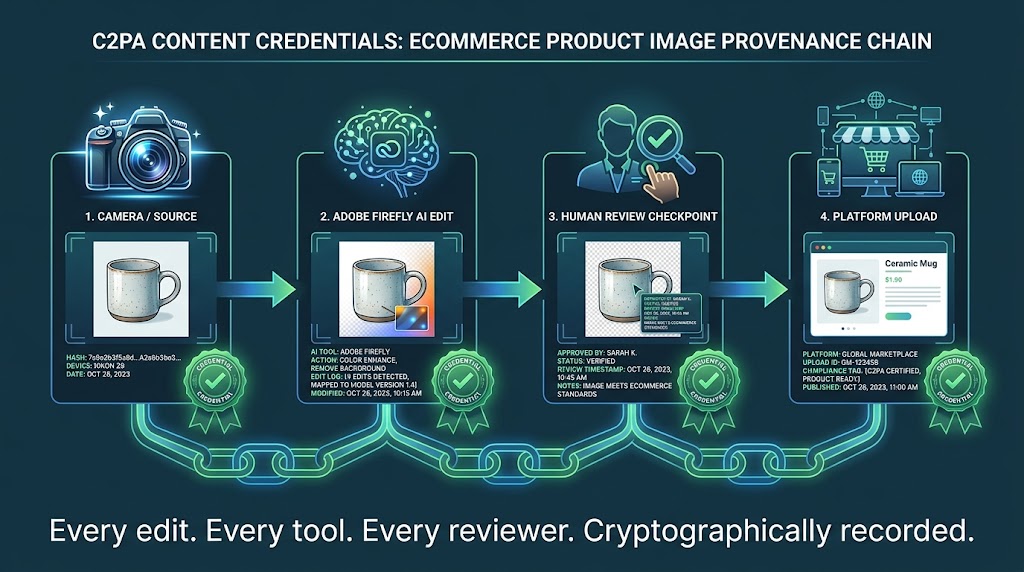
    C2PA Content Credentials work differently. They use SHA-256 hashing of the image content plus X.509 certificates and COSE signing (a cryptographic signature standard) to bind a provenance manifest to the image. The manifest records: who or what created the image, what AI tools were used, what edits were applied, and when. If the image is subsequently edited, the manifest is either updated with a new signing event or the original credential is invalidated — making tampering detectable, if not impossible.

    Because the credential is cryptographically tied to the image content hash, you can’t simply transfer credentials between images or modify the image after signing without breaking the chain. This makes C2PA a genuine trust anchor rather than just a label.

    Infographic showing C2PA Content Credentials provenance chain for a product image traveling through camera source, Adobe Firefly AI edit, human review checkpoint, and platform upload with cryptographic signatures at each step

    Where C2PA Adoption Stands in 2026

    C2PA support is now embedded in Adobe Firefly, Adobe Photoshop (for generative edits), and several camera manufacturers (Nikon, Sony, Leica) who sign images at the capture level. Cloudflare integrated C2PA into its Cloudflare Images CDN service, meaning images transformed (resized, cropped, optimized) by Cloudflare can carry forward a manifest that records both the camera signature and the CDN transformation.

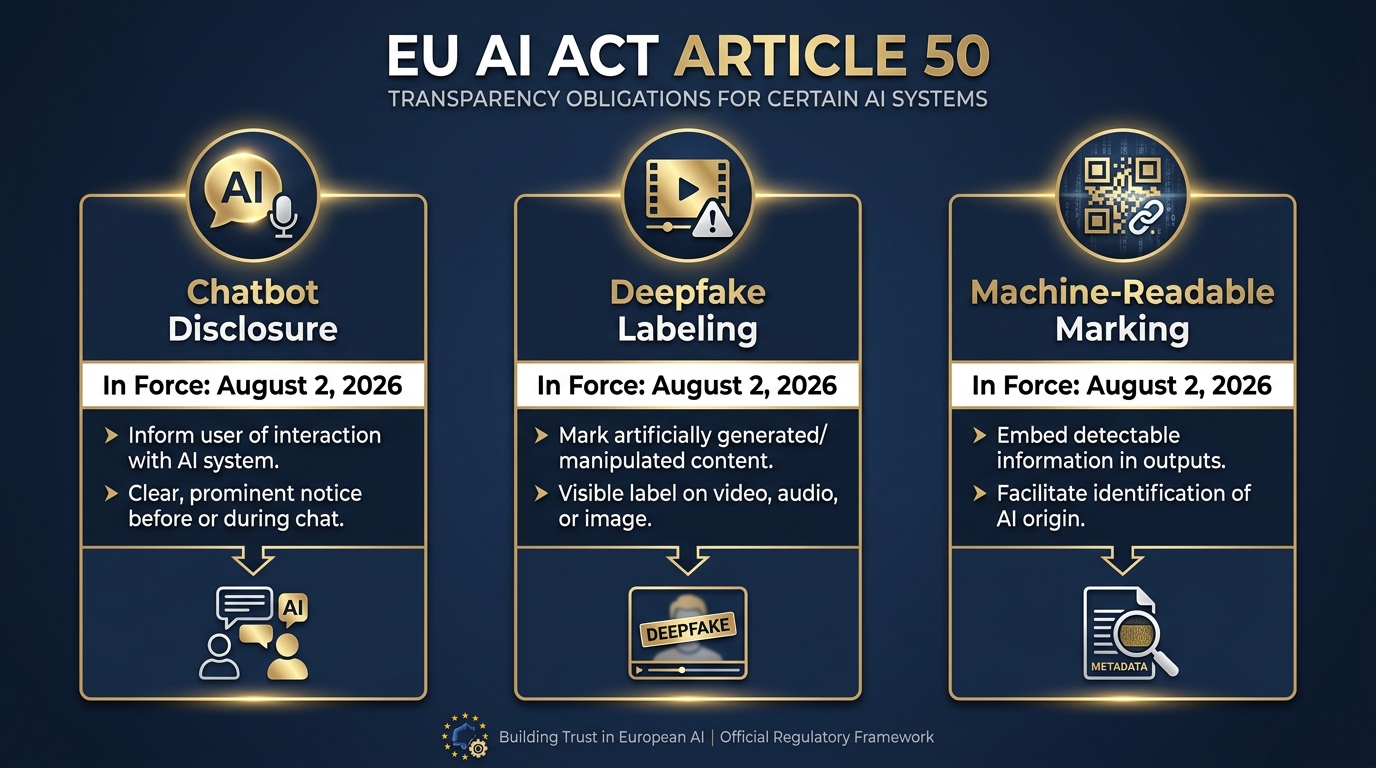
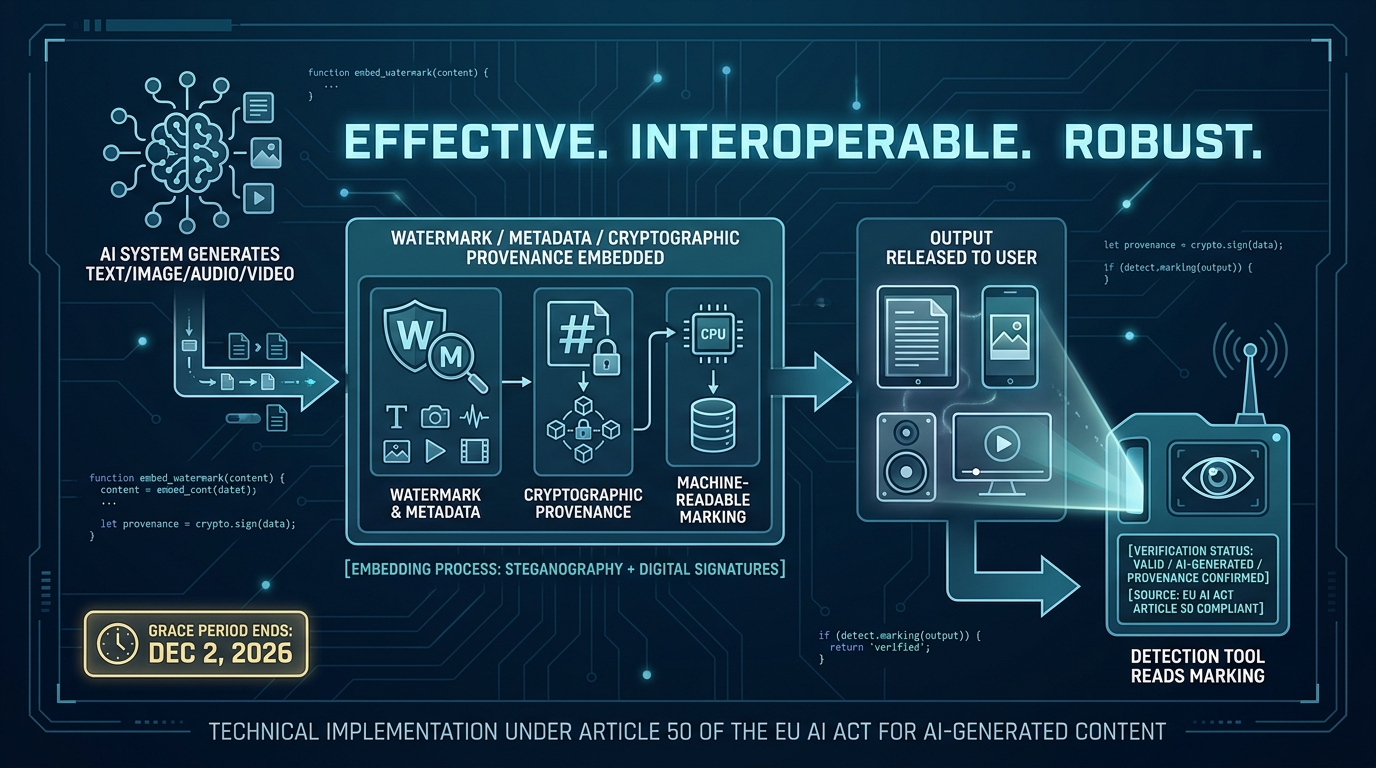
    On the platform side, adoption is in its early stages. Content Credentials are readable by Adobe’s own Content Authenticity website and by a growing set of browser extensions and verification tools. No major ecommerce marketplace currently reads C2PA as part of its primary moderation pipeline. However, the EU AI Act’s Article 50 requirement for machine-readable marking of AI-generated content explicitly aligns with C2PA as a compliant implementation approach — which means the regulatory pull toward platform adoption is building.

    The Practical Value for Sellers Today

    Even before platforms mandate C2PA reading, embedding Content Credentials in your AI image outputs provides three immediate benefits:

    First, it gives you an authoritative, tamper-resistant record of your asset’s provenance for your own audit trail — more reliable than a spreadsheet entry, because it’s embedded in the file itself. Second, in any dispute or appeal with a marketplace, a C2PA manifest showing your approved workflow is stronger evidence than a claim that you followed the right process. Third, as platforms begin reading Content Credentials, your assets will be recognized as coming from known, trusted tools — reducing the probability of false-positive flags from AI-detection classifiers that are uncertain about an image’s provenance.

    Practical implementation: where you’re using Adobe Firefly or Photoshop, Content Credentials are generated by default — ensure they’re not being stripped by your post-processing or CDN pipeline. For tools that don’t generate C2PA natively (Midjourney, most Stable Diffusion deployments), use the C2PA open-source toolkit (available at c2pa.org) to attach a manifest to your output images post-generation, recording your own organization’s signing identity.

    Human-in-the-Loop Checkpoints That Actually Prevent Flags

    Human review in AI image workflows tends to be either over-engineered (every image reviewed by three people before anything moves) or under-engineered (a final “does this look okay?” before upload). Neither extreme works well. The former creates bottlenecks that teams eventually bypass under deadline pressure; the latter misses the specific, technically defined issues that cause platform flags.

    Effective human-in-the-loop (HITL) design is about placing the right checks at the right points in the workflow, with reviewers who know specifically what they’re looking for at each gate.

    Gate 1: Pre-Processing Compliance Review

    This review happens on the raw AI output, before any post-processing. Its purpose is to catch issues that post-processing can’t fix and that downstream reviews will miss because they’re looking at the finished version.

    The reviewer at this gate should be checking: Does the AI output show any product that isn’t in this specific ASIN? Does any generated human model or body part appear in a way that could imply health results, physical transformation, or performance claims? Does the output contain any recognizable brand logos, identifiable architecture, or faces that aren’t covered by model/likeness clearances? Does the image imply any accessories, components, or items that don’t come with the product?

    This isn’t a creative review — it’s a policy compliance review. The person doing it should have the relevant platform policy pages open, not the brand brief.

    Gate 2: Technical Specification Check

    This review happens after all post-processing (background replacement, compositing, retouching, color correction) and before any export or upload. It uses a technical checklist, not human judgment.

    For main product images: confirm background is pure white (255,255,255) using an eyedropper or color picker on multiple points across the background area, not just one corner. Confirm dimensions meet or exceed platform minimums on both axes. Confirm file size is within platform limits. Confirm color profile is sRGB (not Adobe RGB or P3, which can cause color rendering issues on some marketplace displays). Confirm no text, logo, or watermark appears on the image (against Amazon and most marketplace rules for main images).

    This check can and should be partially automated with scripts or tools. But a human should confirm the output of the automation — not just trust that the script ran without errors.

    Gate 3: Live Publication Audit

    A third, often neglected review happens after the image is live. Rendering on the actual platform can differ from the image preview in your DAM or design tool. Background pure-white can appear off-white on certain display profiles. Image compression applied by the platform after upload can alter the appearance of generated edges. The listing context (title, category, bullets) can create a semantic mismatch with the image that wasn’t apparent when reviewing the image in isolation.

    This review doesn’t need to happen immediately at upload — within 24 to 48 hours is sufficient. But it should be a documented step with a pass/fail record, not an informal check.

    EU AI Act Article 50: What It Means for Your Image Pipeline

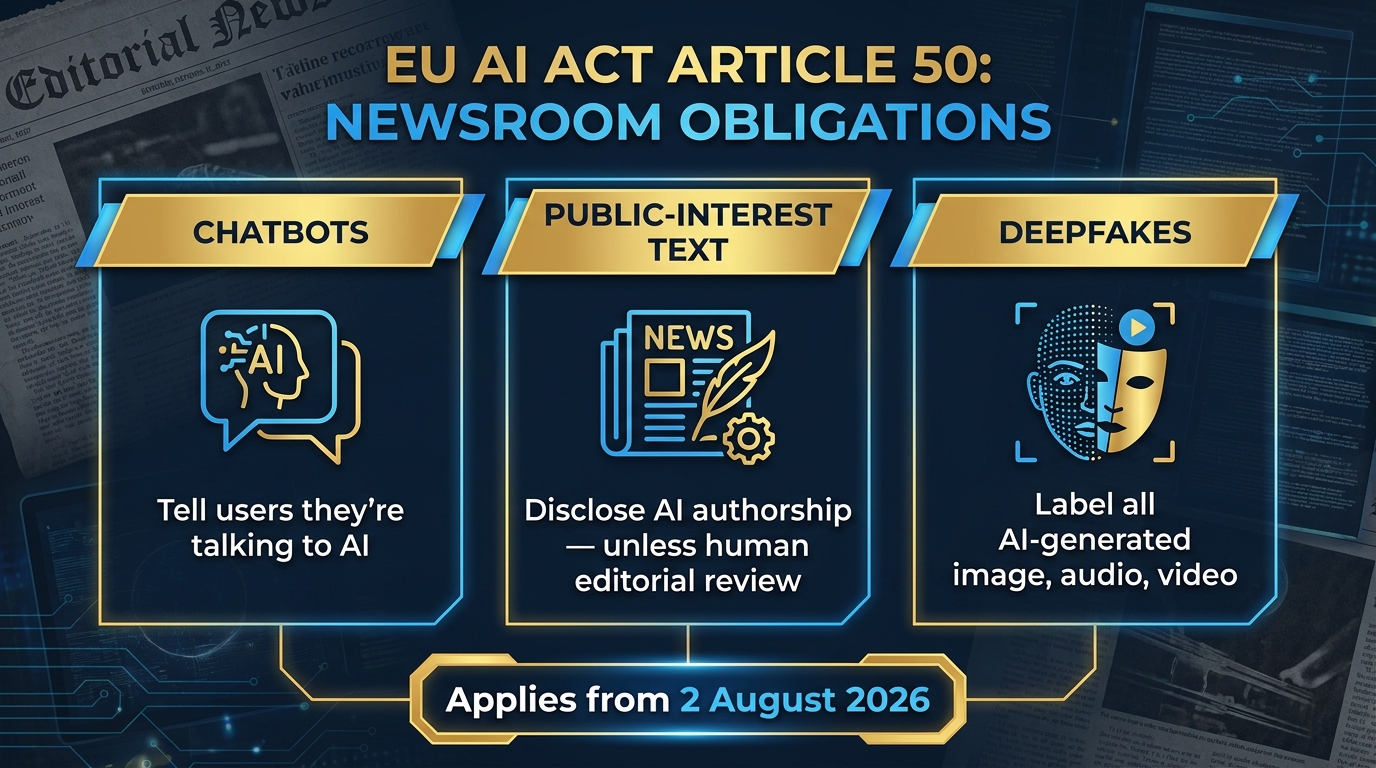
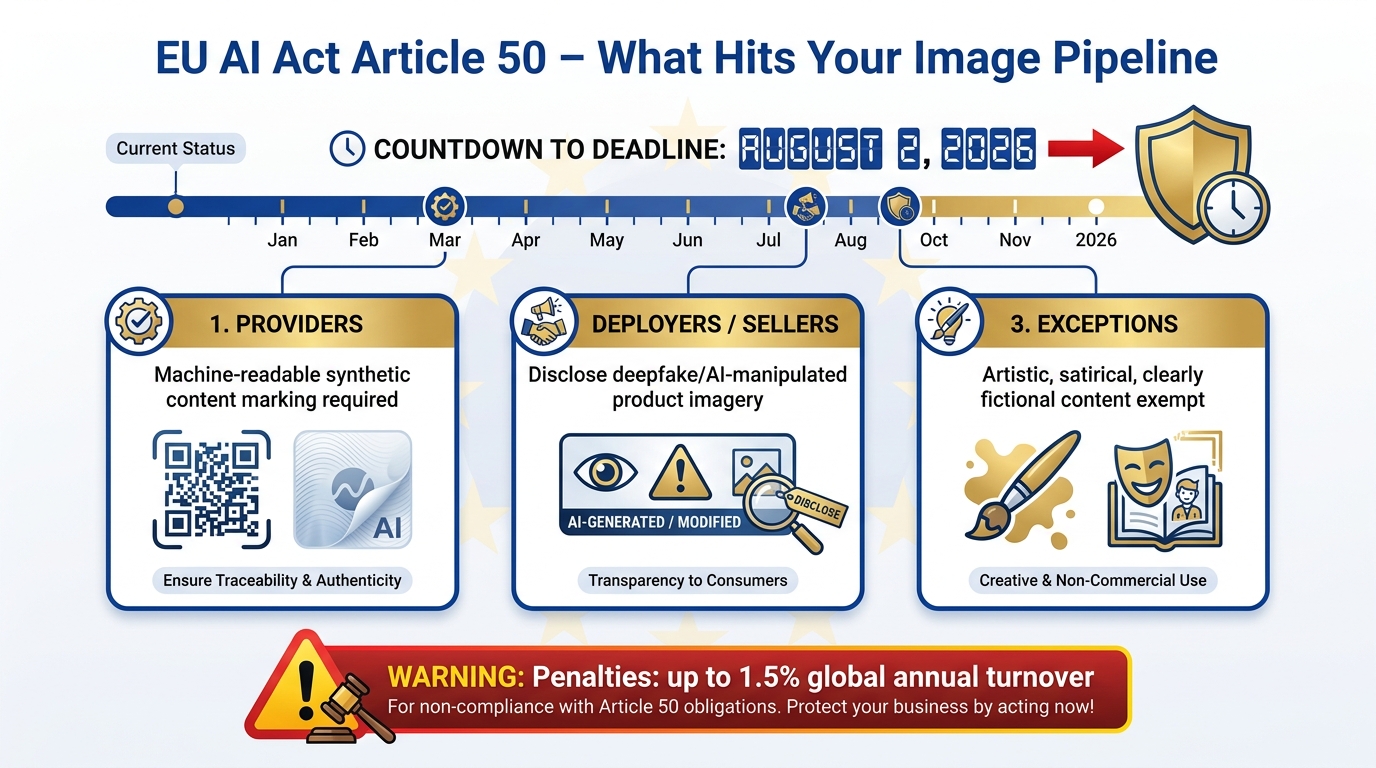
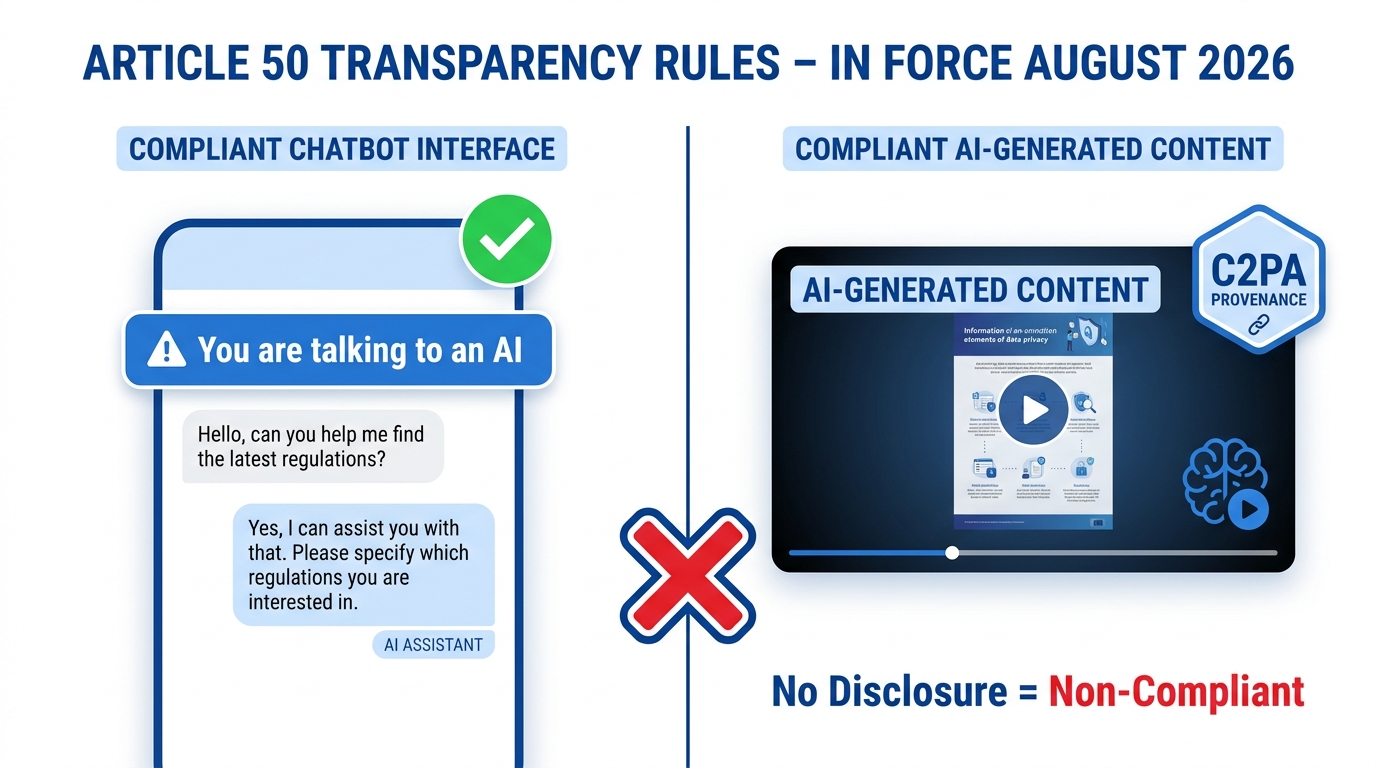
    The EU AI Act’s Chapter IV transparency obligations — specifically Article 50 — came into force in August 2026. For anyone running AI-assisted image workflows for ecommerce, this regulation introduces legal exposure that operates independently of platform-level enforcement. You can comply perfectly with Amazon’s image policies and still have Article 50 obligations.

    EU AI Act Article 50 infographic showing August 2026 deadline, provider and deployer obligations for synthetic content marking, and penalty structure up to 1.5% of global annual turnover

    Who Is Affected and How

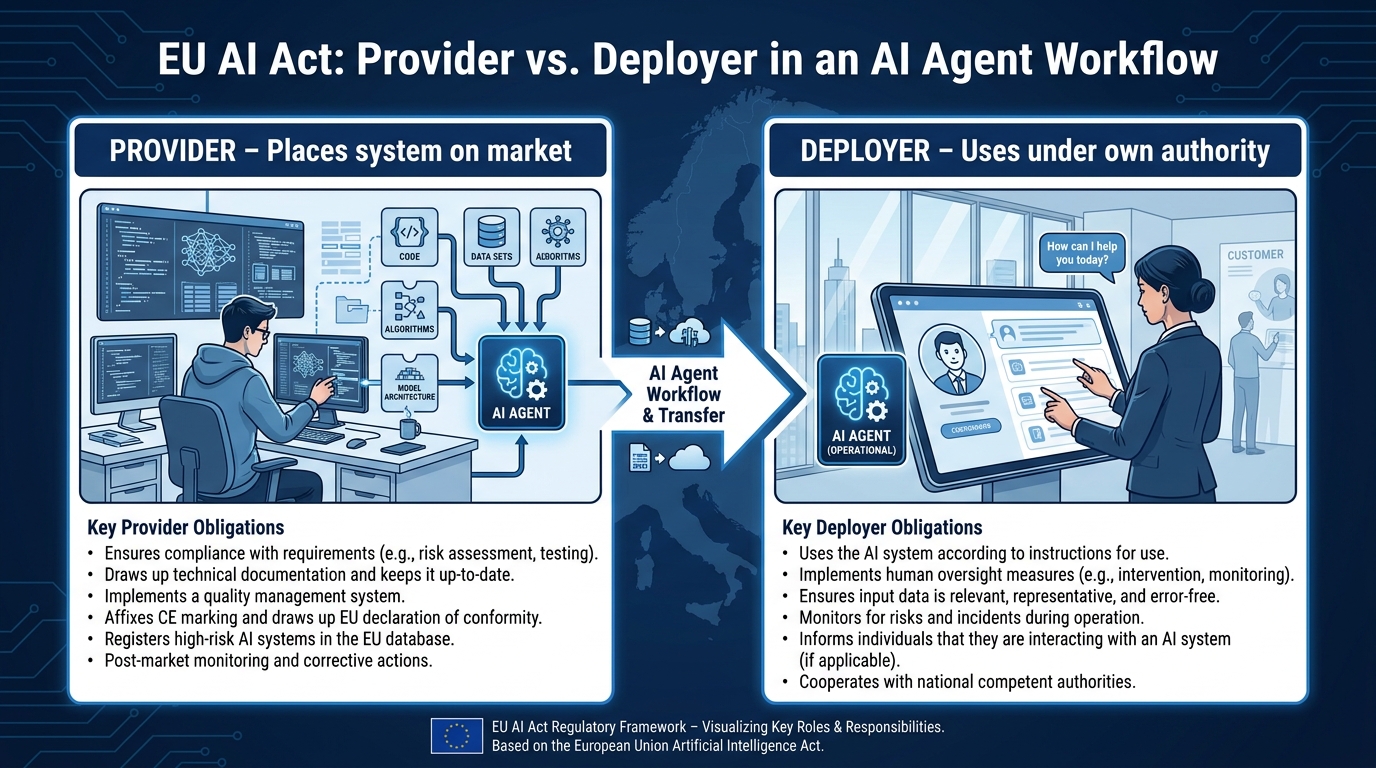
    Article 50’s obligations fall on two categories of actors: providers (companies that develop and deploy AI systems that generate synthetic content) and deployers (companies that use those AI systems to produce content for publication). If you’re an ecommerce operator using Adobe Firefly or Midjourney to create product imagery, you are a deployer under the regulation.

    Article 50(2) requires providers of AI systems that generate synthetic images to ensure their outputs are “marked in a machine-readable format and detectable as artificially generated or manipulated.” This is the obligation that falls primarily on Adobe, Midjourney, and similar tool developers — and Adobe’s C2PA integration is the clearest implementation of this requirement in the market.

    Article 50(4) extends to deployers: where content constitutes a “deepfake” — meaning AI-generated or AI-manipulated image, audio, or video content that a person could mistake for authentic — deployers must disclose that the content is AI-generated. This disclosure obligation applies unless the content is used for clearly artistic, satirical, or fictional purposes that are obvious to the viewer.

    What “Deepfake” Means in a Product Image Context

    The regulation’s use of the term “deepfake” is broader than its common colloquial meaning (face-swapping). In the Article 50(4) context, it covers AI-generated or AI-manipulated product imagery that realistically depicts a product or scene in a way that could be mistaken for a genuine photograph. A lifestyle scene generated entirely by AI that shows your product in a kitchen context that was never actually photographed may fall within scope.

    This doesn’t mean every AI background swap is a legal problem — the regulation applies to realistic synthetic depictions that could mislead, not to clearly abstract or stylized images. But the practical grey zone is large, and legal guidance from firms that have reviewed the regulation suggests erring on the side of disclosure where there is doubt.

    What Disclosure Actually Looks Like in Practice

    For ecommerce product listings, disclosure in the EU context likely means including a statement in the product description or a platform-specific disclosure field indicating that the image contains AI-generated elements. Several legal commentators note that this is a rapidly evolving compliance area — the EU is still developing detailed guidance, and there are no enforcement actions specifically targeting ecommerce product images as of mid-2026. But the legal obligation exists, and it’s prudent to build disclosure into your workflow now rather than retrofit it under pressure.

    Practically: maintain a record of which listings include AI-generated or AI-edited imagery, and include a brief disclosure in the product description section for EU-targeted listings. Something as simple as “Product lifestyle images were created with AI assistance” satisfies the spirit of the requirement and creates an evidence record if questions arise later.

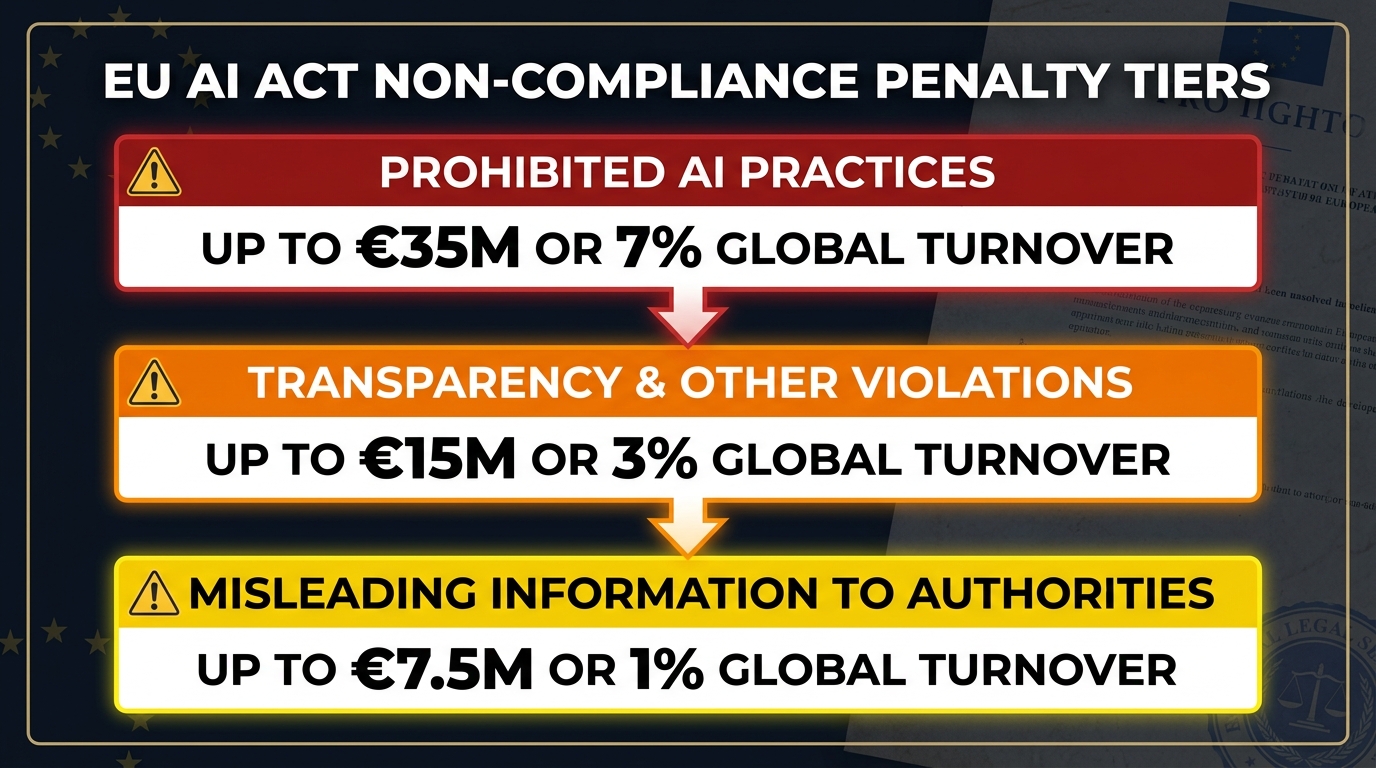
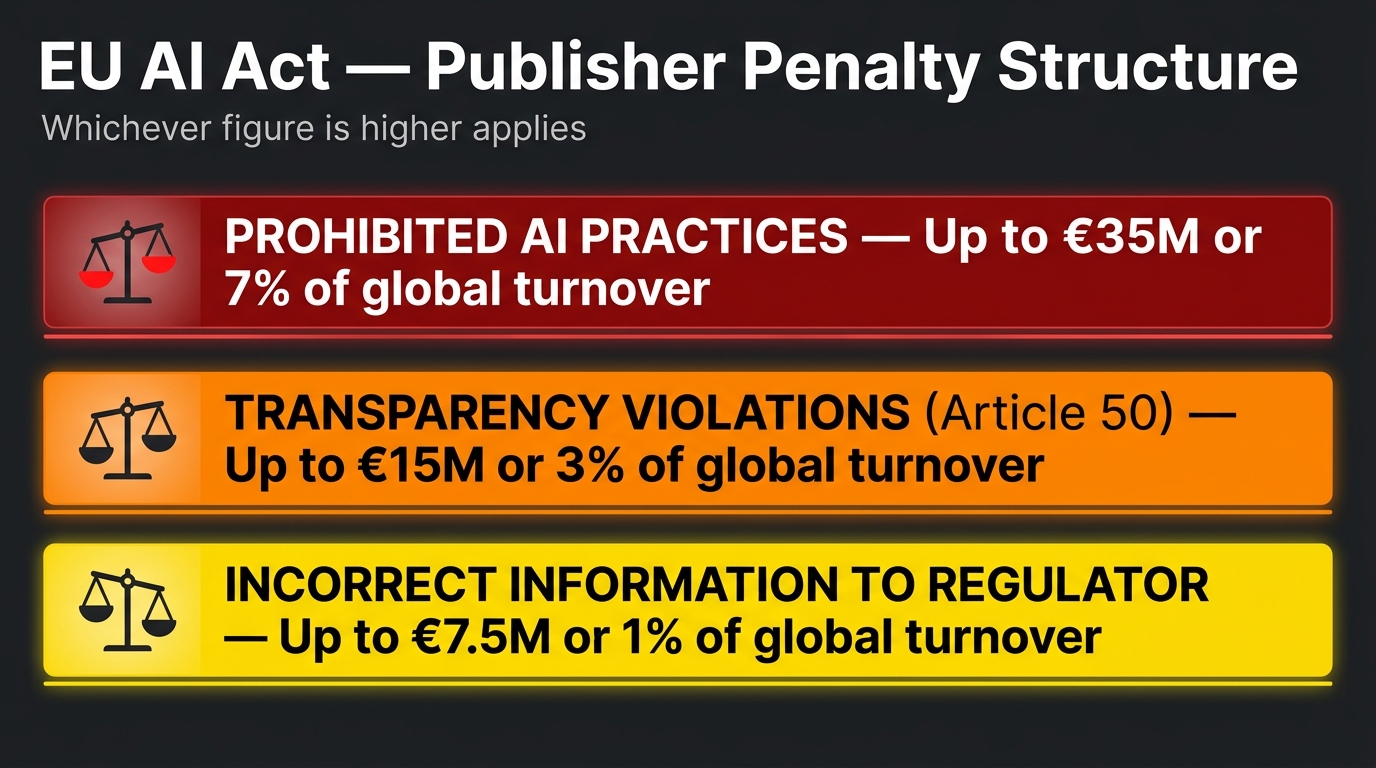
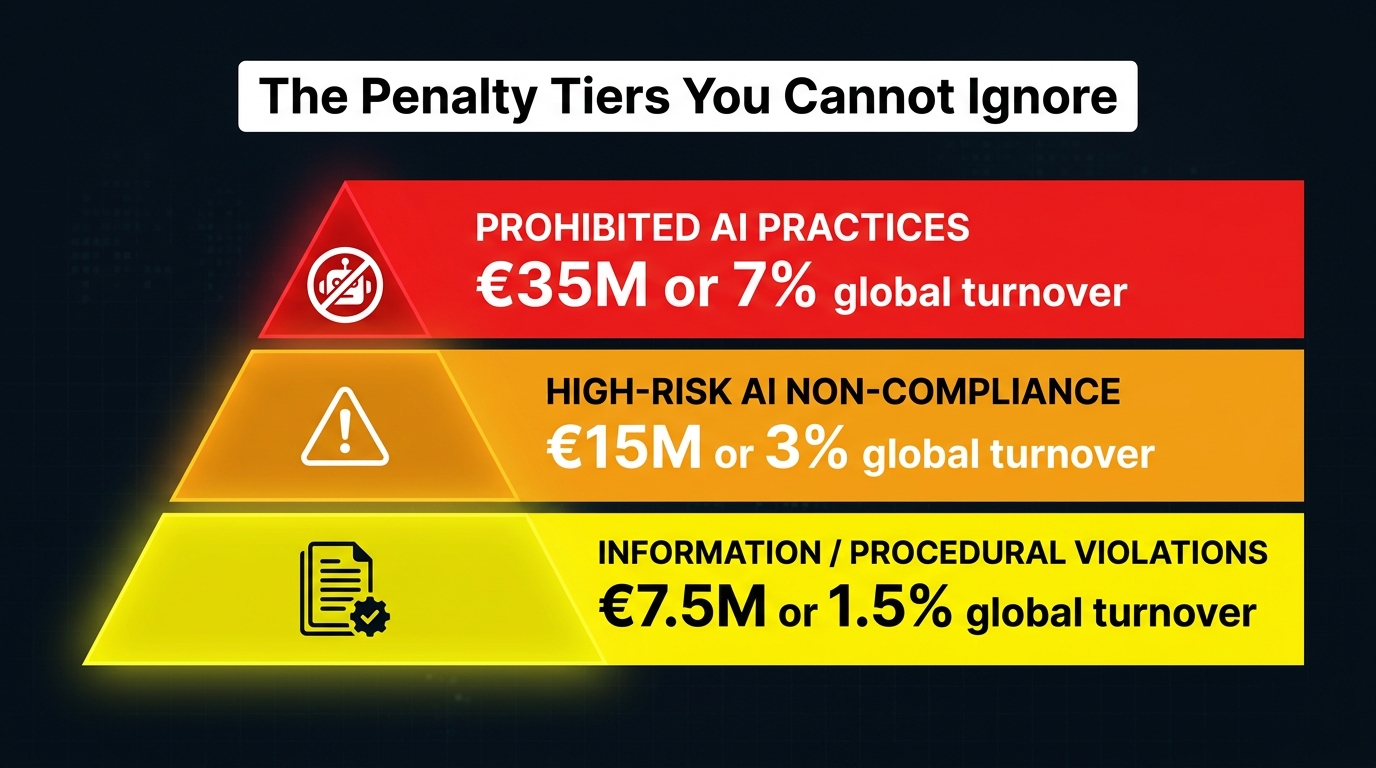
    Penalties for non-compliance with Article 50 can reach 1.5% of global annual turnover under the AI Act’s enforcement framework — a number that becomes material fast for any business operating at meaningful revenue scale.

    The Pre-Publish Checklist: What to Verify Before Any AI Image Goes Live

    The most operationally useful tool in any AI image workflow is a standardized pre-publish checklist. Not a creative brief. Not a brand style guide. A compliance checklist that asks binary, verifiable questions — pass or fail — before any image goes live on any platform.

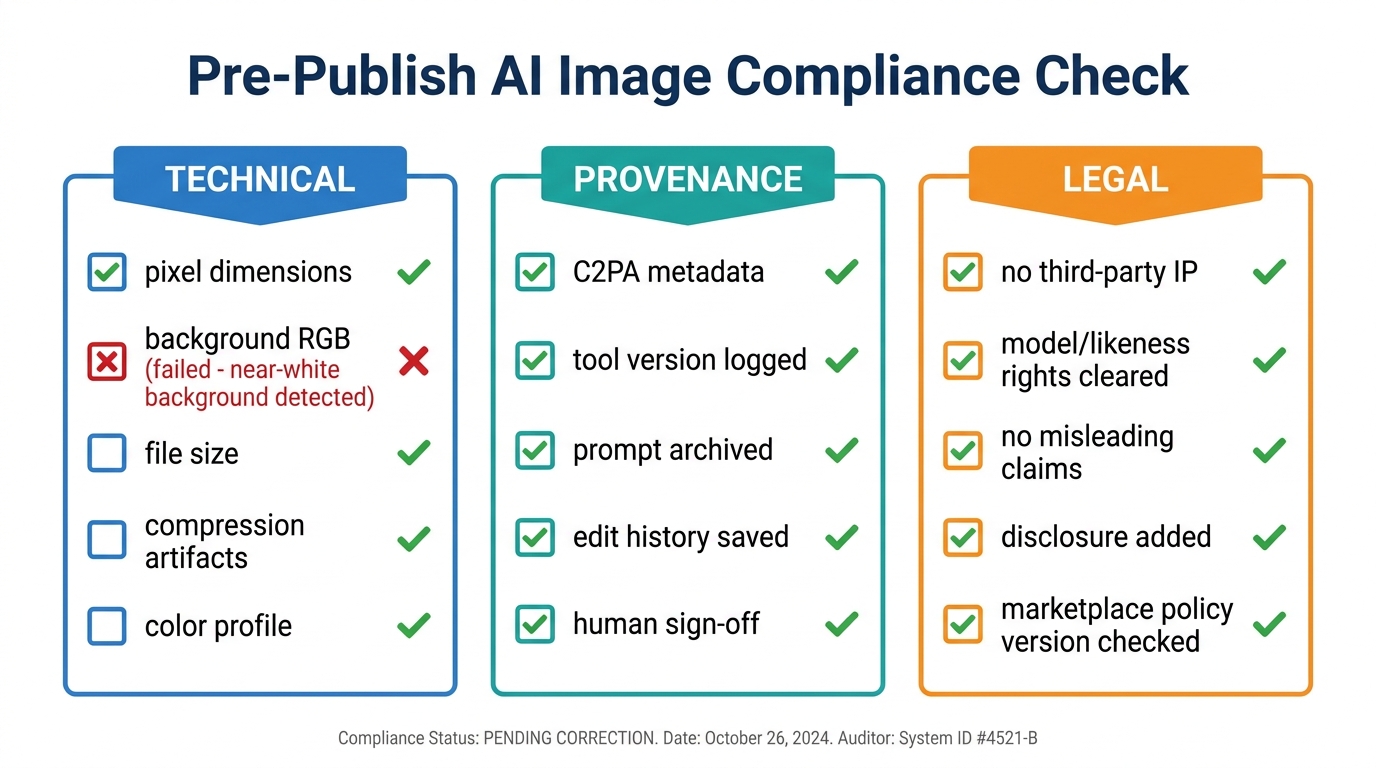
    18-point pre-publish AI image compliance checklist organized into technical, provenance, and legal columns with checkboxes, green approved marks, and one red failed flag for near-white background detection

    The checklist below synthesizes requirements across Amazon, Meta, TikTok Shop, Etsy, Walmart Marketplace, and Shopify, as well as EU AI Act Article 50 obligations. Not every item applies to every platform — flag the applicable items for each platform in your policy map.

    Technical Checks

    1. Background color (main image): Confirmed RGB 255,255,255 by pixel measurement across at least five background points, including corners and center edge regions.
    2. Dimensions: Minimum 1000px on the longest side (1500px recommended for headroom); confirm both axes for square images.
    3. File format: JPEG, PNG, or TIFF per platform requirement; no WebP for platforms that don’t support it.
    4. File size: Within the platform’s maximum (Amazon: 10MB; Meta: varies by format). Check after all post-processing — file sizes can inflate after generative edits.
    5. Color profile: sRGB confirmed in the image metadata. Not Adobe RGB. Not Display P3.
    6. Compression artifacts: No visible blocking, banding, or generative-edge artifacts around the product outline. Zoom to 100% and inspect edges.
    7. Text and overlays: No text, watermarks, or logos on main product images (Amazon, Walmart). Platform-specific exceptions for secondary images confirmed.

    Provenance and Workflow Checks

    1. Source asset log: Every source image input to the AI workflow is recorded with origin, license, and rights confirmation.
    2. AI tool and version: The specific tool, version, and generation parameters (prompt or settings) are logged in the workflow record for this asset.
    3. Edit history: All post-generation edits (background replacement, retouching, compositing, color correction) are recorded with the tool and operator.
    4. C2PA manifest: If the tool supports Content Credentials (Adobe Firefly, Photoshop generative), confirm the credential is present and not stripped by downstream processing.
    5. Human review sign-off: Both compliance review (Gate 1) and technical check (Gate 2) are recorded as complete with reviewer names and dates.
    6. Platform policy version: The policy version checked against is recorded (so you can demonstrate compliance-at-time-of-upload if rules change later).

    Legal and Policy Checks

    1. No third-party IP: No identifiable brand logos, trademarked objects, recognizable artwork, or copyrighted architectural elements are visible in the image.
    2. Model and likeness rights: Any AI-generated human model or partial likeness is confirmed as either: (a) generated without reference to a real person’s likeness, or (b) produced under a licensed model consent covering commercial use. Note: New York’s Synthetic Performer Law (in effect from June 2026) adds specific restrictions on synthetic replicas of real performers.
    3. No misleading product implications: The image does not show products, accessories, quantities, or configurations beyond what is included in the purchase. No before/after implications. No results claims (particularly for health, beauty, and supplement categories).
    4. EU disclosure: For EU-targeted listings with AI-generated or significantly AI-edited imagery, a disclosure statement is included in the product description.
    5. Platform-specific compliance confirmed: Any platform-specific category rules (e.g., Amazon medical device imaging requirements, TikTok Shop video thumbnail policies) have been checked and the image complies.

    When You Get Flagged Anyway: Appeal Workflows That Actually Work

    Even well-designed workflows produce flags. AI-detection classifiers generate false positives. Rules change and retroactively affect previously compliant images. Platform enforcement is inconsistent, and what passes review in one country’s marketplace version may be flagged in another. Having a structured appeal workflow ready before you need it is not pessimism — it’s operational maturity.

    Flowchart showing the five-step appeal workflow for flagged AI product images, from identifying the specific policy violation through gathering evidence and submitting via the correct platform channel to reinstatement or escalation

    Step 1: Identify the Specific Rule That Was Triggered

    Before doing anything else, pin down exactly which policy clause the platform says was violated. Don’t accept “does not meet our image guidelines” as a sufficient error description. Platform notifications at the listing level often include a violation code or category — find it. If you can’t locate a specific policy clause, use the platform’s seller support channel to request one before submitting an appeal.

    This matters because the appeal language needs to reference the specific rule, demonstrate you understand what it requires, show evidence of compliance, and explain any remediation. An appeal that argues “our image is fine” without reference to the specific policy is significantly less likely to succeed than one that cites the exact clause and marshals evidence against it.

    Step 2: Assemble Your Evidence Package

    Your audit trail and workflow documentation now pay off. A strong evidence package for an AI image appeal contains:

    • The original product photograph that served as the base for any AI-assisted edits (this is your “authenticity anchor” — it shows the product is real)
    • Documentation of the specific AI tool and workflow used (tool name, version, what the AI did vs. what was done manually)
    • A C2PA manifest export if available, showing the provenance chain
    • The technical specification check results for the image in question (pixel measurements, file metadata)
    • Human review records showing who approved the image, when, and against which policy version
    • Screenshots or exports of the platform’s own policy page as it existed at the time of upload

    For false-positive AI detection flags specifically: the most powerful evidence is the original, unedited product photograph that preceded the AI-assisted edits, plus documentation showing that the physical product was photographed and the AI was only used for background, post-processing, or enhancement — not to fabricate the product itself.

    Step 3: Write the Appeal Correctly

    Platform appeal interfaces are designed for brevity, not nuance. Stay focused. A good appeal states: the specific violation alleged, the specific policy clause referenced, why you believe the image complies (or what you’ve changed to bring it into compliance), and what evidence you’re providing. Keep it under 300 words. Attach evidence as the platform’s interface allows.

    Do not argue that the AI detection was “wrong” in general terms. Do not assert that your product is high quality or that you’re a good-faith seller. Both arguments are irrelevant to the technical compliance question and can signal to automated appeal-scoring systems that your response is non-specific.

    A critical caution from Meta’s own guidance applies broadly: repeated failed appeals on the same account can have a compounding negative effect on your account health score, which can make future flags more likely and future appeals less successful. Only appeal when you have substantive grounds. If the image was genuinely non-compliant, correct it and upload a new version rather than appealing.

    Step 4: Follow the Correct Channel

    Platform-specific appeal routing matters. On Amazon, listing suppression due to image non-compliance is typically addressed through Seller Central’s “Manage Your Listings” interface under “Fix Stranded Inventory” or “Suppressed Listings” depending on the flag type. Account-level flags and repeat violations escalate to the Account Health dashboard. Using the wrong channel doesn’t just slow resolution — it can route your appeal to a queue that never reaches a human reviewer.

    On Meta, ad rejections have a formal “Request Review” option within Ads Manager; on TikTok Shop, there’s a dedicated appeal path in the Seller Center under “Policy Violations.” Know these routes in advance for every platform you’re active on — not after you’re already locked out.

    Building an Audit Trail That Protects You in Disputes and Regulatory Reviews

    An audit trail is the structural backbone of every other compliance layer in this guide. It’s what transforms a good process into a defensible one. Without it, your workflow’s compliance depends entirely on human memory and the hope that platforms take your word for it. With it, you have timestamped, version-controlled evidence that can be produced on demand in any dispute, regulatory inquiry, or appeal.

    What a Functional Audit Trail Records

    The minimum viable audit trail for AI-assisted image workflows records the following fields per asset per marketplace:

    • Asset ID: A unique identifier that connects your internal record to the platform’s live listing (ASIN, product URL, ad creative ID)
    • Source asset(s): File names, origins, and license references for every input image used in the AI workflow
    • AI tool: Tool name, version, and type of AI operation (generation, generative fill, background removal, upscaling)
    • Generation parameters: Prompt text, seed, style settings, or equivalent documentation of how the output was produced
    • Operator: Who ran the generation step
    • Review records: Gate 1 reviewer, Gate 2 reviewer, dates, pass/fail results
    • Policy version: The policy document and version number checked at each review gate
    • Publication date: When the image went live on each platform
    • Status: Current status (live, replaced, removed) with reason and date for any status change

    Tooling Options for Audit Trail Management

    At small scale (under 200 active SKUs with AI-assisted imagery), a well-structured shared spreadsheet or Notion database is genuinely adequate. The discipline of consistent, complete entry matters far more than the sophistication of the tool.

    At medium scale (200–2000 SKUs), the audit trail should be integrated with your Digital Asset Management (DAM) system. Tools like Bynder, Canto, Brandfolder, and Air all support custom metadata fields that can capture workflow records against specific assets. Some DAM platforms have started offering AI-specific metadata fields in 2026 in response to regulatory pressure. The goal is that any asset in your DAM is associated with its full compliance record, not just its visual metadata.

    At large scale (2000+ SKUs or agency operations managing multiple catalogs), the audit trail needs to be an automated output of the workflow itself. Platforms like Puntt, Bannerflow, and custom-built workflow engines can generate compliance logs automatically at each production step, with human approval gates creating signed timestamps. This is the architecture described in Article 12 (Record-Keeping) and Article 17 (Quality Management System) of the EU AI Act for high-risk systems — and it’s becoming the de facto standard for enterprise marketing operations teams even below the regulatory threshold.

    Retention, Access, and the Regulatory Timeline

    How long do you need to keep audit records? The EU AI Act’s record-keeping provisions for high-risk AI systems reference a minimum of 10 years, but Article 50 (which applies to synthetic content transparency) doesn’t specify a retention period. A practical minimum for ecommerce operators is 12 months from the date an asset is taken down from all platforms — this covers the window for most platform dispute processes and is a defensible starting point for regulatory inquiries.

    Access controls on the audit trail matter too. The records should be accessible to compliance, legal, and senior operations personnel without going through the creative team — so that in the event of an escalated dispute, the evidence can be retrieved and produced without depending on the people who may be implicated in the dispute.

    From Ad-Hoc AI Use to a Compliance-Native Image Operation

    The gap between “we use AI for some images” and “we run a compliant AI image workflow” is not primarily a technical gap — it’s an organizational one. The tools exist. The standards exist. The regulatory requirements are documented. What’s missing in most operations is the deliberate structure that connects them into a coherent system.

    The Maturity Progression

    Most ecommerce teams move through a recognizable maturity progression in their AI image workflows:

    Stage 1 — Ad hoc: Individual team members or freelancers use AI tools for specific images when it’s convenient. No policy map. No audit trail. No standard outputs. High exposure to flags, no documentation to appeal with.

    Stage 2 — Tool-led: A defined set of AI tools is adopted across the team. Some informal standards exist (e.g., “we always use Firefly for backgrounds”). But compliance is still ad hoc, reviews are informal, and audit trails are incomplete. The flagging rate drops but doesn’t go away.

    Stage 3 — Process-led: Formal workflow documentation, review gates, and technical checklists are in place. A policy map is maintained. Audit trails are structured. The team can appeal flags with evidence. This is the target state for most growing ecommerce operations.

    Stage 4 — Compliance-native: Compliance logic is embedded in the tools and systems themselves — automated technical checks, DAM-integrated audit records, C2PA provenance on all outputs, automated policy monitoring. Human review is strategic rather than exhaustive. This is enterprise standard and the direction regulatory pressure is pushing the market.

    The Fastest Path to Stage 3

    You don’t need to build everything at once. The highest-leverage moves, in order, are:

    First, build and maintain your policy map. One document, one owner, reviewed monthly. This single action prevents the most common source of unexpected flags: not knowing the current rule. Second, implement Gate 2 (technical specification check) as a mandatory pre-upload step. The specific, measurable nature of technical violations means this gate catches flags that no amount of creative judgment can prevent. Third, create the minimum viable audit trail in whatever tool your team already uses. Imperfect records started now are worth far more than perfect records planned for later. Fourth, shift new image generation toward Firefly for any workflow where background creation, generative fill, or lifestyle background generation is needed — the IP indemnity and C2PA provenance are structural advantages that compound over time.

    Each of these steps can be completed in a week. Together, they move most operations from Stage 1 or 2 to something close to Stage 3 in a month.

    Conclusion: Compliance Is the New Creative Moat

    The ecommerce operators who will build durable advantages in AI image workflows over the next two to three years won’t be the ones with the most creative AI prompts or the most impressive lifestyle shots. They’ll be the ones who can produce AI-assisted imagery at volume, at speed, without losing listings to flags, without burning time on avoidable appeals, and without accumulating regulatory exposure as the EU AI Act matures into enforcement.

    That’s not a creative achievement — it’s an operational one. And it’s built from the same unglamorous materials that underlie every reliable operation: documented processes, clear ownership, consistent execution, and a paper trail that holds up when something goes wrong.

    The platforms are getting better at detection. The regulators are writing enforcement guidance. The tools are maturing to produce more provenance-legible outputs. The window to retrofit compliance onto an existing AI image operation is still open — but it’s narrowing. Teams that build the compliance stack now will spend their time creating. Teams that ignore it will spend their time appealing.

    Key Takeaways

    • Platform detection is multi-layered. Pixel-level technical rules, semantic AI classifiers, AI artifact detection, and metadata scanning all operate independently — compliance with one doesn’t guarantee compliance with all.
    • Your tool choice is a compliance decision. Adobe Firefly’s IP indemnity and C2PA support make it the lowest-risk foundation for ecommerce image workflows. Midjourney and Stable Diffusion have legitimate roles but require more robust internal controls.
    • Metadata is evidence. C2PA Content Credentials are the most defensible form of provenance documentation available. Preserve them through your pipeline; don’t let post-processing strip them.
    • Human review should be strategic, not exhaustive. Three targeted gates — compliance review, technical specification check, and live publication audit — catch more actual violations than broad, informal review of every image.
    • EU AI Act Article 50 is in force. If you’re serving EU customers with AI-generated or significantly AI-edited imagery that could be mistaken for a photograph, disclosure obligations apply regardless of what the marketplace requires.
    • Appeals work when you have documentation. The audit trail you build before a flag is the evidence package you produce after one. The two are the same thing.
    • Start with the policy map and Gate 2. These two changes alone prevent the majority of preventable flags and cost less than a day of effort to implement.
  • EU AI Act Enforcement After the Omnibus: What Your Compliance Team Actually Needs to Do Right Now

    EU AI Act Enforcement After the Omnibus: What Your Compliance Team Actually Needs to Do Right Now

    EU AI Act Enforcement 2026 – compliance timeline showing three phases: Feb 2025, Aug 2025, and Aug 2026

    The compliance calendar that most legal and technology teams built their EU AI Act roadmaps around has shifted significantly. On 7 May 2026, the European Parliament and Council reached a provisional political agreement on the so-called Digital Omnibus on AI — a package of amendments that pushed several high-risk AI compliance deadlines by more than a year. For teams that had been sprinting toward August 2026, that might sound like breathing room. It is not.

    The relief is selective, and misreading which obligations still apply — right now, without any extension — is one of the most consequential mistakes a compliance function can make going into the second half of 2026. Prohibited AI practices have been banned since February 2025. General-purpose AI model obligations have been in force since August 2025. And the full suite of transparency rules under Article 50 go live in August 2026, regardless of the Omnibus amendments.

    This post is not a summary of the AI Act. It is a practical enforcement map — covering what has already shifted legally, which obligations are live versus delayed, how national market surveillance authorities actually investigate non-compliance, what the three-tier penalty structure means in commercial terms, and where most organisations have genuine documentation gaps that regulators will find first. The goal is to help compliance teams, legal counsel, and product owners build a credible, prioritised response — not a box-ticking exercise that looks good on paper and falls apart under audit.

    The Omnibus Shift: Why August 2026 Is No Longer the Full Story

    EU AI Act Omnibus timeline revision infographic showing new deadlines of December 2027 and August 2028 replacing the original August 2026 high-risk AI deadline

    The Digital Omnibus on AI is part of a broader EU legislative simplification effort. Its primary practical effect on the AI Act is moving the application dates for high-risk AI systems. Under the provisional agreement reached in May 2026 — pending formal adoption, which is expected before the original 2 August deadline — the timelines look materially different from what most compliance teams planned for.

    The Revised Deadline Map

    For Annex III high-risk AI systems — stand-alone applications in sensitive domains such as employment screening, credit scoring, biometric identification, law enforcement tools, education, and critical infrastructure — the application date shifts from 2 August 2026 to 2 December 2027. That is a 16-month extension from the original date.

    For Annex I high-risk AI systems — AI embedded in regulated products such as medical devices, vehicles, toys, and industrial machinery — the new deadline is 2 August 2028, a full two years beyond the original.

    For most organisations, these extensions feel substantial. But there are three crucial caveats that make “we have until 2027” a dangerous framing to carry into board-level discussions.

    What the Omnibus Does Not Change

    First, the Omnibus is still pending formal legislative adoption as of mid-2026. Until it passes, the original August 2026 deadline remains the legally applicable one. Compliance teams that stop work based on a provisional agreement that could theoretically still change are taking a significant legal risk.

    Second, the Omnibus does not affect the prohibited practices ban (in force since February 2025), GPAI model obligations (in force since August 2025), or the Article 50 transparency rules (due August 2026). These timelines are untouched.

    Third, the extension does not mean enforcement posture relaxes. National market surveillance authorities will use the intervening months to build capability, issue guidance, and signal intent. Early enforcement actions — even against more minor transparency violations — will establish precedent for what the broader high-risk regime looks like in practice.

    The Prudent Response to the Delay

    The Omnibus grants additional calendar time for high-risk AI conformity assessments and technical documentation. It does not grant permission to delay internal governance work, AI system inventorying, vendor due diligence, or the training of human oversight functions. Organisations that use the extension productively will enter the 2027 enforcement window with mature governance frameworks. Those that treat it as a pause will find themselves in the same underprepared position they were in before the summer of 2026 — just 16 months later, with fewer excuses.

    What Is Already Live: The Obligations in Force Right Now

    Before examining what is coming, compliance teams need a clear-eyed view of what has already happened. The AI Act’s phased rollout means that significant obligations have been in effect for months, and enforcement exposure already exists for companies that have not addressed them.

    Prohibited AI Practices (Since 2 February 2025)

    Article 5 of the AI Act bans a set of AI applications outright, with no transition period and no grace for SMEs. These prohibitions cover: AI systems that use subliminal techniques to manipulate behaviour in ways that cause harm; systems that exploit vulnerabilities of specific groups (children, people with disabilities, the elderly); government or public authority social scoring systems; real-time remote biometric identification in publicly accessible spaces by law enforcement (with narrow exceptions); AI used to infer emotions in workplaces or educational settings; and AI systems that scrape facial recognition data from the internet or CCTV footage to build or expand identification databases.

    Any organisation deploying systems that touch these categories — even tangentially — should have conducted a formal review of that exposure before February 2025. If that review has not happened, it should happen immediately. The penalty for a prohibited AI practice is up to €35 million or 7% of worldwide annual turnover, whichever is higher. There is no softer enforcement pathway for violations at this tier.

    GPAI Model Obligations (Since 2 August 2025)

    Providers of general-purpose AI models — any model trained on broad data that can perform a wide range of tasks and is placed on the EU market — have been subject to substantive obligations since August 2025. These obligations are not optional pending further guidance. They are in effect.

    The core GPAI requirements include: maintaining detailed technical documentation covering model architecture, training methodology, performance benchmarks, and known limitations; providing downstream providers with sufficient information to integrate the model compliantly; publishing a summary of training data content; and complying with EU copyright law, including honouring text-and-data-mining opt-outs.

    For providers of systemic-risk GPAI models — those trained on compute exceeding 10^25 FLOPs — there are additional obligations: notifying the AI Office, conducting adversarial testing, reporting serious incidents, and ensuring cybersecurity protections appropriate to the systemic risk they pose.

    The Three-Tier Penalty Structure You Cannot Afford to Misread

    EU AI Act penalty pyramid showing three tiers: €35M/7% for prohibited AI, €15M/3% for high-risk violations, €7.5M/1.5% for information violations

    Article 99 of the AI Act sets out three distinct penalty tiers. Understanding the structure — and more importantly, which behaviour triggers which tier — is not just legal housekeeping. It directly shapes how organisations should allocate their compliance investment.

    Tier One: Prohibited AI Practices

    The maximum fine for violating Article 5 (the banned practices) is €35 million or 7% of total worldwide annual turnover, whichever is higher. This is the steepest penalty tier in the AI Act, exceeding the maximum GDPR fine percentage. For a large enterprise with €5 billion in global revenue, the potential fine is €350 million. For a mid-sized technology company at €200 million in revenue, it is €14 million — still potentially catastrophic.

    The “whichever is higher” mechanism matters enormously here. Unlike fixed-cap regimes, the AI Act links maximum penalties to commercial scale. A global company cannot escape large fines simply because its EU revenue is small.

    Tier Two: High-Risk AI and GPAI Non-Compliance

    For violations of requirements applicable to high-risk AI systems and most GPAI obligations — failing to maintain a risk management system, inadequate technical documentation, absence of human oversight mechanisms, non-compliant conformity assessments — the maximum is €15 million or 3% of worldwide annual turnover. This tier applies to the majority of substantive compliance failures that organisations with AI products in sensitive domains will face.

    Tier Three: Procedural and Information Violations

    Providing incorrect, incomplete, or misleading information to notified bodies and national authorities triggers the lowest penalty tier: up to €7.5 million or 1.5% of worldwide annual turnover. This matters because compliance teams often treat documentation and information requests as secondary to substantive technical obligations. Under the AI Act, providing inaccurate information to authorities is itself a separately prosecutable offense.

    SME and Startup Proportionality

    The AI Act acknowledges that these figures could be existential for very small organisations. National authorities and the AI Office are required to take into account the size, economic situation, and market position of the infringing party when setting actual fines. SMEs and startups are eligible for reduced fines that must not exceed the stated caps but may be set substantially lower in practice. This proportionality principle does not, however, reduce the obligation to comply — only the potential penalty scale if non-compliance is found.

    Article 50: The Transparency Rules That Apply to Almost Every AI Product

    Article 50 EU AI Act transparency compliance showing chatbot AI disclosure badge and AI-generated content watermark requirements

    If there is a single obligation that catches the broadest range of organisations off-guard — including many that do not think of themselves as AI companies — it is Article 50. It applies from August 2026. It is not limited to high-risk systems. And its scope covers a strikingly large share of modern digital products.

    The Four Article 50 Triggers

    Article 50 creates transparency obligations in four distinct situations:

    1. AI systems interacting with natural persons — chatbots, virtual assistants, automated phone systems, and AI agents must inform users they are interacting with AI, unless this is obvious from context. “Obvious from context” is a narrow exception, and regulators are expected to interpret it conservatively.
    2. AI-generated synthetic content — systems that generate audio, images, video, or text must mark that content in a machine-readable format as artificially generated. This includes large language model outputs, AI image generators, and voice synthesis tools.
    3. Deepfake and manipulated media — deployers using AI to generate or manipulate content that depicts people, places, or events in ways that appear real must disclose that the content is AI-generated. Limited exceptions exist for artistic or satirical work, provided the disclosure does not undermine the purpose.
    4. Emotion recognition and biometric categorisation — systems that detect or infer emotions, or that categorise people by protected characteristics, must inform subjects that they are being processed by such a system.

    What Compliance Actually Looks Like

    For most product teams, Article 50 compliance is not a single switch to flip. It requires reviewing every AI-powered user touchpoint in a product — not just the ones that were originally classified as “AI features.” Many organisations have embedded lightweight AI interactions into customer service flows, onboarding sequences, content generation tools, and internal HR platforms without ever formally classifying them as AI interactions for regulatory purposes.

    The practical compliance tasks include: auditing all user-facing AI interactions; implementing disclosure mechanisms at the point of first contact (not buried in terms of service); implementing machine-readable marking for generated content, including exploration of standards like C2PA (Coalition for Content Provenance and Authenticity); and ensuring that disclosure language is clear, prominent, and not misleading.

    Critically, Article 50 obligations fall on both providers (who build the AI system) and deployers (who use it in a product or service). A company using a third-party chatbot API is a deployer and may carry Article 50 obligations even if it did not build the underlying model. Supply chain AI governance is, therefore, a compliance issue — not just a vendor management one.

    The Grey Zone: When Is Something “Obvious”?

    The exemption from chatbot disclosure when “obvious from context” that the user is interacting with AI will be the source of significant enforcement debate. A robot icon and the name “Bot” on a chat widget is not necessarily sufficient. Regulators are likely to focus on cases where users could reasonably be misled into thinking they were speaking with a human — particularly in customer service, healthcare, legal advice, and financial guidance contexts. The prudent position is to disclose in every case where any ambiguity exists.

    GPAI Model Obligations: What Providers Must Have Already Done

    For organisations that develop and deploy general-purpose AI models — whether proprietary foundation models, fine-tuned derivatives, or open-weight releases — the August 2025 deadline has already passed. This section is not about preparing for a future obligation. It is about assessing whether existing compliance is adequate under a regime that has been live for nearly a year.

    Technical Documentation: The Core Deliverable

    The AI Act’s technical documentation requirements for GPAI models are extensive. Providers must maintain documentation covering: the general description of the model and its intended purposes; the training data used, including sources, filtering methodology, and data governance practices; training methodology and compute resources used; model performance on relevant benchmarks; known limitations, risks, and failure modes; and information about any post-training procedures such as RLHF or fine-tuning.

    This documentation is not a one-time filing. It must be kept up to date and made available to the AI Office on request. For commercial GPAI providers, it also informs the information package that must be shared with downstream deployers — the developers and enterprises building applications on top of the model. If your API documentation is the sum total of your compliance information package for downstream users, that is almost certainly not sufficient.

    Copyright and Training Data

    One of the most actively debated GPAI obligations is the requirement to comply with EU copyright law in training data collection, specifically the requirement to honour text-and-data-mining opt-outs under the Digital Single Market Directive. Providers must document their approach to identifying and respecting opt-outs, and must publish a summary of training data content that is sufficiently detailed for downstream users to assess copyright risk.

    This obligation has attracted significant attention from rights-holders and publishers. Organisations that trained models on broad internet data without implementing robust opt-out mechanisms should take legal advice on their current exposure — because the AI Office has both the mandate and the appetite to investigate copyright-adjacent GPAI compliance issues.

    Systemic Risk Model Notification

    Providers of GPAI models trained on more than 10^25 FLOPs are classified as systemic-risk models and must notify the AI Office. This notification triggers additional obligations: conducting model evaluations and adversarial testing (including red-teaming); reporting serious incidents or malfunctions to the AI Office; implementing cybersecurity measures commensurate with systemic risk; and maintaining a documented incident response framework.

    The number of organisations meeting the compute threshold for systemic risk classification is small — this is primarily a concern for the largest AI labs and foundation model providers. But for those organisations, the obligations are materially more demanding than for standard GPAI providers.

    High-Risk AI Systems: The New Conformity Assessment Roadmap

    EU AI Act high-risk AI conformity assessment process flowchart showing five stages from system classification to Declaration of Conformity

    With the Omnibus extension moving high-risk AI compliance deadlines to December 2027 and August 2028, organisations with products in Annex III and Annex I categories have more runway. But the conformity assessment process is sufficiently complex that beginning substantive work now — rather than in 2027 — is the only realistic path to timely compliance.

    Step One: Classification

    The first step in any conformity assessment is determining whether your system actually qualifies as high-risk. Annex III lists the categories: biometric identification and categorisation of natural persons; management and operation of critical infrastructure; education and vocational training; employment, workers management, and access to self-employment; access to and enjoyment of essential private services and essential public services; law enforcement; migration, asylum, and border control management; and administration of justice and democratic processes.

    Being in one of these domains does not automatically make a system high-risk. The AI Act provides that some systems in Annex III categories are not high-risk if they do not pose a significant risk of harm to health, safety, or fundamental rights of natural persons. The Commission guidance on this classification question — originally due in February 2026 — is a key input that compliance teams should track and apply retroactively to their system inventories.

    Step Two: Choosing Your Assessment Route

    Article 43 provides two main conformity assessment pathways for high-risk AI systems. Most Annex III systems can use Route A: internal control (Annex VI), where the provider conducts and documents its own conformity assessment against the legal requirements. This is analogous to self-declaration under product safety law and does not require a third party.

    A smaller subset — primarily AI used for real-time remote biometric identification and certain Annex I product-safety systems — requires Route B: third-party assessment by a notified body (Annex VII). Notified bodies must be designated by member states, and the designation process is still maturing across the EU. Organisations expecting to need notified body involvement should begin identifying and engaging candidate bodies now, given capacity constraints that are likely to emerge as the 2027 deadline approaches.

    Step Three: Technical Documentation Under Annex IV

    Annex IV specifies the minimum content of technical documentation for high-risk AI systems. The requirements are detailed and include: a general description of the system including its purpose, the interaction with hardware or software components it relies on, and the version history; a description of the elements of the system and the development process; information on training methodology and datasets; a description of the risk management system; post-market monitoring plan; and evidence of testing results demonstrating conformity with the requirements.

    Documentation must be created before the system is placed on the market, kept current throughout the system’s lifecycle, and retained for at least ten years after the last unit is placed on the market. For software-based AI systems that update frequently, maintaining current documentation across model versions is a genuine operational challenge that requires systematic processes — not ad hoc efforts.

    Step Four: Risk Management System

    Article 9 requires that high-risk AI providers maintain a risk management system as an ongoing iterative process, not a one-time assessment. This system must identify and analyse known and foreseeable risks; estimate and evaluate the risks that emerge during testing and from intended use; adopt risk mitigation and control measures; and test against those measures to ensure they work. The risk management system must remain operational throughout the lifecycle of the AI system, including post-deployment. This is a meaningful ongoing operational requirement, not a project to complete before market launch.

    Step Five: Declaration of Conformity

    Once conformity assessment is complete, providers issue a Declaration of Conformity (DoC) — a formal statement that the system meets all applicable requirements. For Annex I systems, this is accompanied by a CE marking. The DoC must identify the system, the provider, and the specific requirements the system has been assessed against. It must be kept on file and made available to market surveillance authorities on request. Providing a false or misleading DoC is itself a violation under the Article 99 penalty framework.

    Market Surveillance Authorities: Who’s Watching and How They Investigate

    EU AI Act enforcement architecture diagram showing European AI Office at top connected to 27 national market surveillance authorities, with enforcement powers including documentation requests, audits, and fines

    Understanding enforcement architecture is not academic. It directly shapes where your first interaction with a regulator is likely to come from, how quickly an investigation could escalate, and what remediation process looks like in practice.

    The Hybrid Model: EU Level and National Level

    The EU AI Act operates through a hybrid enforcement model confirmed by the European Parliament’s Think Tank in March 2026. At the EU level, the European AI Office — housed within DG CONNECT — is responsible for supervising GPAI models, coordinating cross-border enforcement, and addressing systemic risks. It has direct investigatory powers over GPAI providers and can impose fines through the Commission.

    At the national level, each member state must designate at least one market surveillance authority (MSA). MSAs are responsible for post-market monitoring of AI systems, investigating complaints and suspected non-compliance, requesting documentation from providers and deployers, ordering corrective actions and withdrawals, and imposing fines under national law. The AI Act requires MSAs to be independent, adequately resourced, and coordinated with the AI Office — though the resource adequacy requirement is proving difficult in practice, particularly for smaller member states.

    How an Investigation Actually Starts

    MSA investigations can be triggered in several ways: complaints from individuals, civil society organisations, or competitors; market sweeps initiated by the authority itself; incident reports submitted by providers; referrals from other regulatory bodies (such as data protection authorities or financial supervisors); and cross-border coordination from other member states’ MSAs via the AI Board’s coordination mechanisms.

    An initial investigation typically involves a request for documentation — the technical file, risk management records, conformity assessment evidence, and any post-market monitoring logs. Organisations that cannot produce complete, organised documentation quickly find that an information request escalates into a formal investigation far more rapidly than those that have robust compliance infrastructure. Response time to documentation requests matters: delayed or incomplete responses are themselves procedural violations under the Tier Three penalty framework.

    Cross-Border Cases and the AI Board

    AI systems operating across multiple EU member states create multi-jurisdictional enforcement risk. The AI Board — composed of representatives from each member state’s competent authority — coordinates enforcement in cross-border cases and can refer matters to the AI Office where systemic risk or GPAI model issues are involved. For large technology companies with EU-wide products, the risk of simultaneous investigation by multiple national MSAs, coordinated by the AI Board, is real — and managing it requires a centralised compliance function with the ability to respond consistently across jurisdictions.

    The SME Problem: Why Smaller Companies Face Disproportionate Risk

    The AI Act’s proportionality provisions and SME-specific guidance give the impression that smaller organisations have a lighter regulatory burden. In practice, the opposite is often true — SMEs and scale-ups face disproportionate compliance challenges for reasons that have nothing to do with the legal text and everything to do with organisational capability.

    The “Not Applicable” Mistake

    The most common and most dangerous mistake that smaller organisations make is concluding too quickly that the AI Act does not apply to them. This error stems from two sources: a misunderstanding of the risk classification system, and a failure to recognise that “deployer” obligations apply even when you are using someone else’s model.

    A startup that uses an off-the-shelf large language model to power a customer-facing chatbot for a financial services application may not think of itself as an “AI company.” But it is a deployer of an AI system in a potentially high-risk context (financial services access), and it carries Article 50 transparency obligations, plus potentially high-risk compliance obligations once those deadlines apply. The off-the-shelf nature of the underlying technology does not eliminate the deployer’s compliance exposure.

    Vendor Due Diligence Is a Compliance Obligation

    Under the AI Act’s supply chain model, deployers must receive sufficient information from providers to meet their own compliance obligations. If a GPAI provider is not supplying adequate technical documentation, training data summaries, or performance and limitation information, the deployer cannot meet its own obligations — and cannot pass compliance responsibility back to the provider simply by pointing to a contract clause.

    SMEs should be actively reviewing their AI vendor contracts and technical documentation packages. Contracts should specify: what documentation the provider must supply; what notification process applies if the provider makes material changes to the model; and what remediation options exist if the provider’s non-compliance creates compliance risk for the deployer. This due diligence is substantive legal work, not a procurement checkbox.

    AI Literacy as a Legal Obligation

    One obligation that is already in force and affects all organisations, regardless of size, is the AI literacy requirement under Article 4. Providers and deployers must ensure that their staff have a sufficient level of AI literacy — appropriate to their roles and the context in which they use AI. This is not a training module. It is a documented organisational competency obligation. Regulators investigating a non-compliance case will ask how staff were trained to use and oversee AI systems. The answer must be substantive.

    Building Your Internal Compliance Function: More Than Checklists

    The most common framing of AI Act compliance work is as a checklist problem — gather the documentation, tick the boxes, issue the declaration. That framing consistently produces compliance programmes that look good on paper but collapse under the scrutiny of an actual investigation. Effective compliance is structural.

    The AI Inventory: Your Compliance Foundation

    You cannot manage compliance for AI systems you have not catalogued. The first substantive work any compliance function must complete is an AI system inventory — a structured register of every AI system the organisation uses or deploys, covering: what the system does; who built it; what data it processes; who it interacts with or makes decisions about; what risk category it falls under; and what obligations apply as a result.

    For most organisations with more than a few years of AI adoption behind them, this inventory will surface surprises. AI integrations made at the business unit level that legal and compliance teams were never told about. API-based AI tools embedded in SaaS products the organisation uses as a deployer. AI-assisted decision processes in HR, finance, or operations that may qualify as high-risk under Annex III. The inventory is not a one-time exercise — it needs to be maintained as a living register, updated as new systems are deployed or existing ones change materially.

    Role Clarity: Provider Versus Deployer

    The AI Act assigns different obligations to providers (who develop and place AI systems on the market) and deployers (who use AI systems in a professional context). Many organisations are both simultaneously — developing and deploying proprietary AI while also using third-party AI in their products and operations.

    Role clarity is not just a legal formality. It determines which compliance obligations the organisation owns directly, which it partially inherits from its providers, and which it can discharge through contractual requirements on the other party. Internal teams need clear ownership maps: who is accountable for provider obligations on proprietary systems, who manages deployer obligations for third-party systems, and where those two worlds overlap and create joint accountability.

    Governance Structures That Withstand Scrutiny

    Market surveillance authorities will look not just at whether documentation exists, but at whether the governance processes that generate and maintain that documentation are credible. That means: governance committees or review bodies with genuine oversight authority; escalation pathways that bring AI risk issues to appropriate decision-makers; documented processes for reviewing AI systems when they are substantially modified; and incident response procedures that include the obligation to report serious incidents to the AI Office or national authorities as required.

    The human oversight requirement under Article 14 is particularly significant for high-risk AI systems. It is not satisfied by a single human in the loop who approves AI outputs without meaningful ability to understand or override them. Regulators will examine whether oversight mechanisms are real — whether the humans responsible have the training, access, and authority to actually intervene. Documentation of how human oversight is implemented, trained, and tested is a core component of any credible compliance programme.

    The Documentation Gap: What Regulators Will Find First

    Among the practical compliance failures that regulators and legal teams are identifying in 2026 audits, documentation gaps are by far the most prevalent. Organisations often have reasonable processes in place but have not documented them in the forms that the AI Act specifies. This creates a gap between what a company is actually doing and what it can demonstrate it is doing — and in enforcement, demonstration is what matters.

    The Most Common Documentation Failures

    Based on practitioner analysis of pre-enforcement compliance gaps, the most common documentation failures are:

    • Incomplete or absent technical files. Annex IV specifies what technical documentation must contain, but many organisations’ technical files are a collection of internal engineering documents that do not map to the Annex IV structure. A regulator asking for your technical file should receive a document that is readable without prior knowledge of your internal systems and that directly addresses each Annex IV requirement.
    • Undocumented risk management processes. The Article 9 risk management system must be an ongoing documented process. Meeting logs, risk registers, mitigation decisions, and testing results all form part of the required record. Undocumented risk management — even if the organisation is doing substantive risk work — will not satisfy an MSA investigation.
    • Absent or outdated post-market monitoring logs. Article 72 requires high-risk AI providers to have a post-market monitoring system that collects and reviews data on the system’s performance after deployment. For most software AI systems, this means logging user feedback, error rates, model drift indicators, and incident data. These logs must exist, must be structured, and must be reviewed on a documented schedule.
    • Missing supplier information packages. Deployers must receive sufficient information from GPAI providers to meet their own compliance obligations. Many deployers have not requested this information formally, and many providers have not supplied it in a structured way. Both sides of this transaction need to address the gap.
    • No version control on technical documentation. AI systems change. Models are updated. Training data evolves. The technical documentation must reflect the current state of the system, not the state at initial deployment. Organisations without systematic documentation version control create a compliance gap every time they update their models.

    Retention Requirements and Audit Readiness

    Technical documentation for high-risk AI systems must be retained for ten years after the last unit is placed on the market. For software products with continuous update cycles, the retention clock may effectively never run out. Compliance teams need to establish document retention policies that reflect this requirement, with appropriate security controls and access management for stored documentation.

    Audit readiness is a distinct capability from compliance. A company may be substantively compliant but operationally unable to demonstrate that compliance within the timeframes that an MSA investigation imposes. Building the systems to retrieve, compile, and present compliance evidence quickly is as important as building the compliance processes themselves.

    Practical Compliance Checklist: Where to Start This Week

    Compliance work under the EU AI Act is not a single project with a completion date. It is an ongoing operational function. But for teams that need to prioritise, the following represents the highest-return starting points — actions that address the most immediate enforcement exposure and build the foundation for longer-term compliance maturity.

    Immediate Priorities (Before August 2026)

    1. Complete a prohibited practices audit. Review every AI system in use against the Article 5 ban list. If any system touches the banned categories — social scoring, emotion detection in workplaces, subliminal manipulation, indiscriminate biometric data scraping — get legal advice on exposure immediately. This obligation has been in force since February 2025.
    2. Assess Article 50 compliance for all user-facing AI. Map every touchpoint where AI interacts with users or generates content. Determine which ones require disclosure, implement that disclosure, and document the implementation decision for each system. August 2026 is not far off.
    3. Audit GPAI vendor documentation packages. If you use any large language model or other GPAI model in your products, request and review the provider’s technical documentation package. Confirm that it meets the AI Act’s information requirements. Flag any gaps to the provider in writing and keep the correspondence on file.
    4. Implement the Article 4 AI literacy requirement. Document the AI literacy baseline for staff who use or oversee AI systems in professional contexts. Create or commission role-appropriate training. Record completion. This is in force now.
    5. Start your AI system inventory. Even a basic structured spreadsheet identifying every AI system the organisation uses or deploys, with fields for role (provider/deployer), risk category assessment, and applicable obligations, is a materially better position than having no inventory at all.

    Medium-Term Priorities (Before December 2027)

    1. Classify all AI systems against Annex III. For systems that may qualify as high-risk, complete a formal classification assessment referencing the Commission’s Article 6 guidance when published, and document the reasoning.
    2. Begin technical documentation under Annex IV. Do not wait until 2027 to start building technical files. The process surfaces compliance gaps in your AI systems that need engineering or process work to address — work that takes time.
    3. Design your Article 9 risk management system. Establish a documented, ongoing risk management process for each high-risk AI system. Define the review cycle, the responsible parties, the risk criteria, and the escalation thresholds.
    4. Build human oversight mechanisms into product design. The Article 14 requirement for human oversight must be implemented in the design of high-risk AI systems — it is not something that can be bolted on retrospectively without significant engineering work.
    5. Engage notified bodies early if required. For systems requiring Route B conformity assessment, begin identifying and engaging notified bodies now. Capacity constraints will be significant in 2027 as high-risk AI deadlines approach.
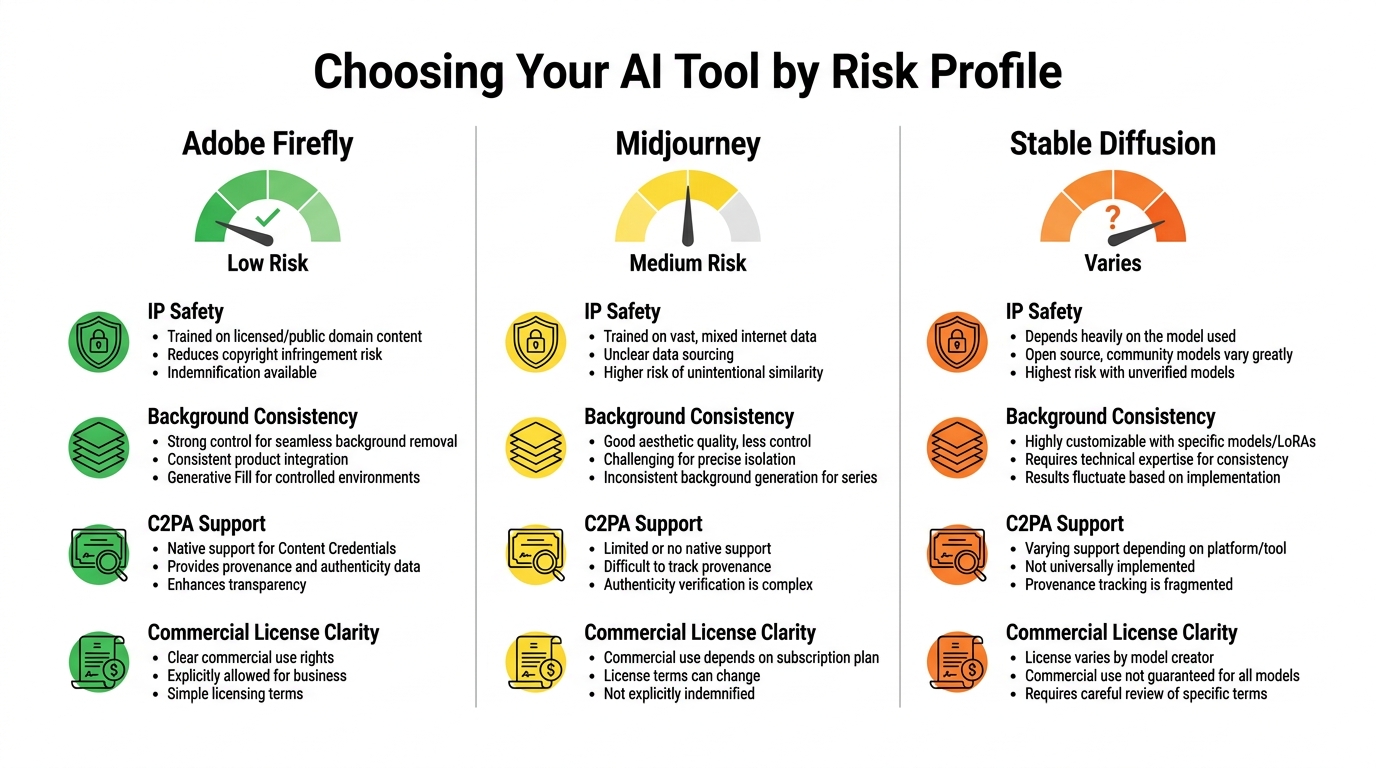
    Conclusion: Compliance Is a Competitive Position, Not Just a Legal Obligation

    The EU AI Act represents the most comprehensive attempt by any jurisdiction to regulate AI at scale. Its phased implementation, punctuated by the significant Omnibus amendments of May 2026, has created a compliance environment that is genuinely complex — with different obligations applying on different timelines to different categories of AI system, across a hybrid enforcement architecture involving both national authorities and the AI Office.

    What makes that complexity manageable is approaching compliance not as a regulatory penalty avoidance exercise, but as an organisational capability. Companies with mature AI governance — documented risk management, comprehensive technical files, clear role accountability, functioning human oversight, and audit-ready documentation — are better-positioned not just for regulatory scrutiny, but for enterprise sales, procurement qualification, and the institutional trust that is increasingly required to deploy AI in sensitive domains.

    The Omnibus extensions on high-risk AI deadlines are real. But the enforcement infrastructure — national MSAs, the AI Office, the AI Board — is being built in parallel. The investigations that will set early precedent for how the AI Act is enforced in practice will come before the 2027 deadlines, most likely from Article 50 transparency failures, GPAI documentation gaps, and prohibited practices violations that have already been in effect for over a year.

    The organisations that will navigate this environment most effectively are those that treat the current compliance window not as permission to wait, but as an opportunity to build — governance frameworks, documentation processes, oversight mechanisms, and vendor relationships that will withstand the scrutiny that is, without question, coming.

    Key Takeaway: The Omnibus moved the high-risk AI deadlines. It did not move the enforcement intent. Article 50, prohibited practices, and GPAI obligations are live now. Start there — then use the extended runway on high-risk conformity assessments to build something that will last.