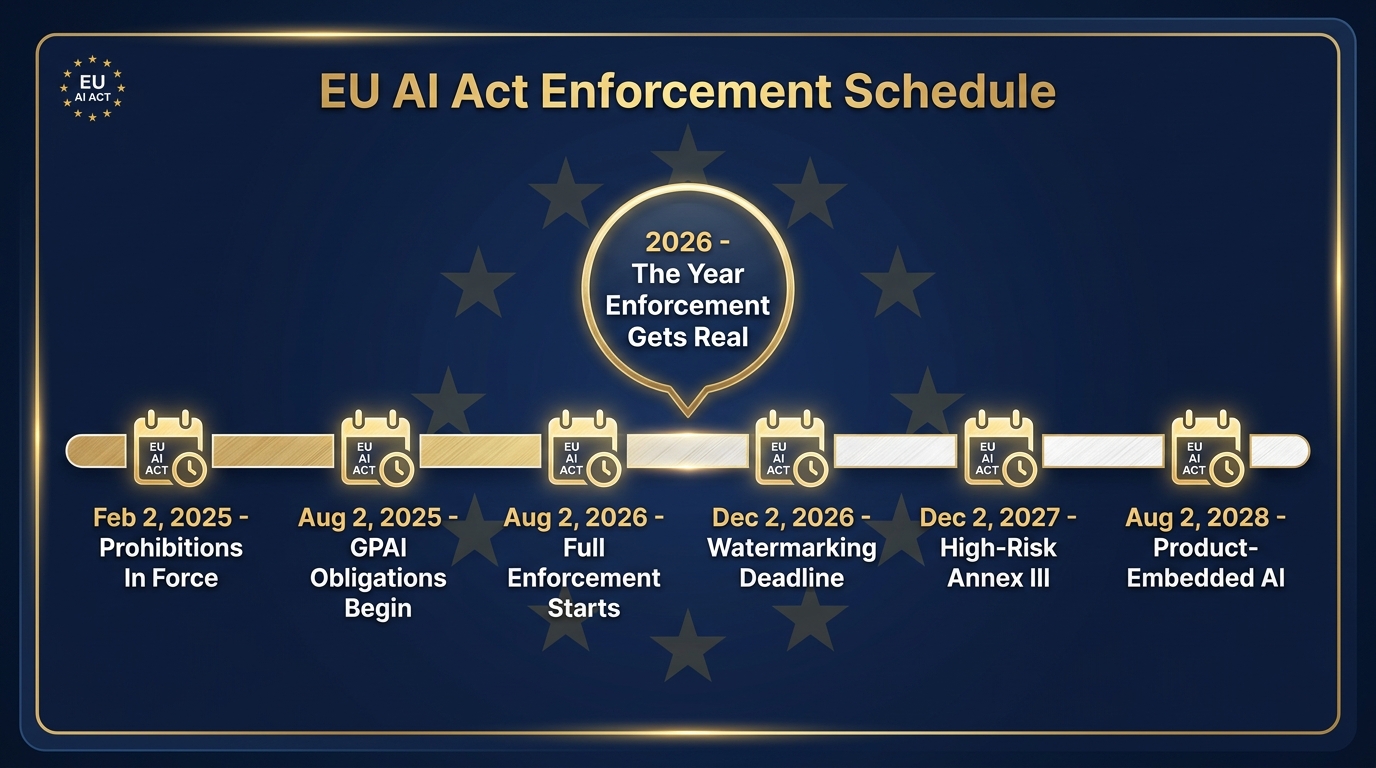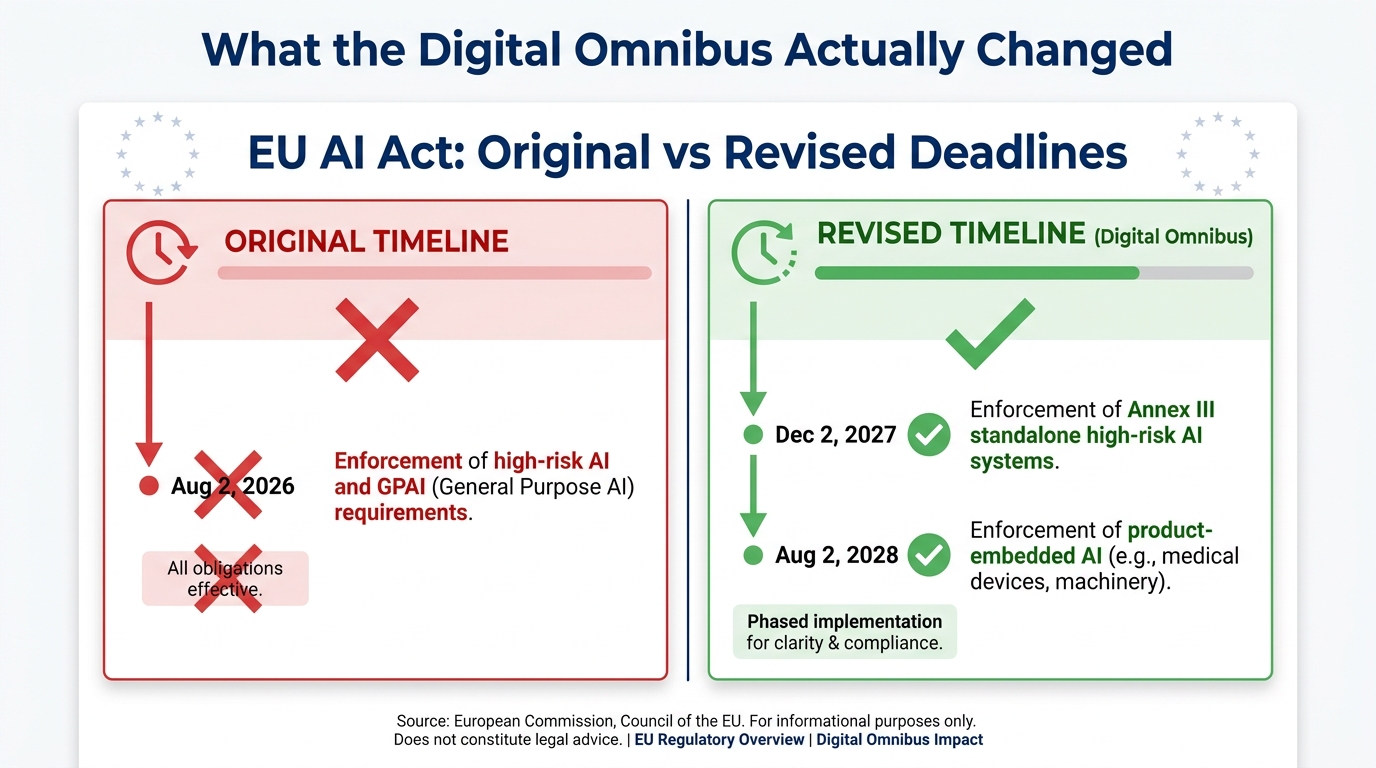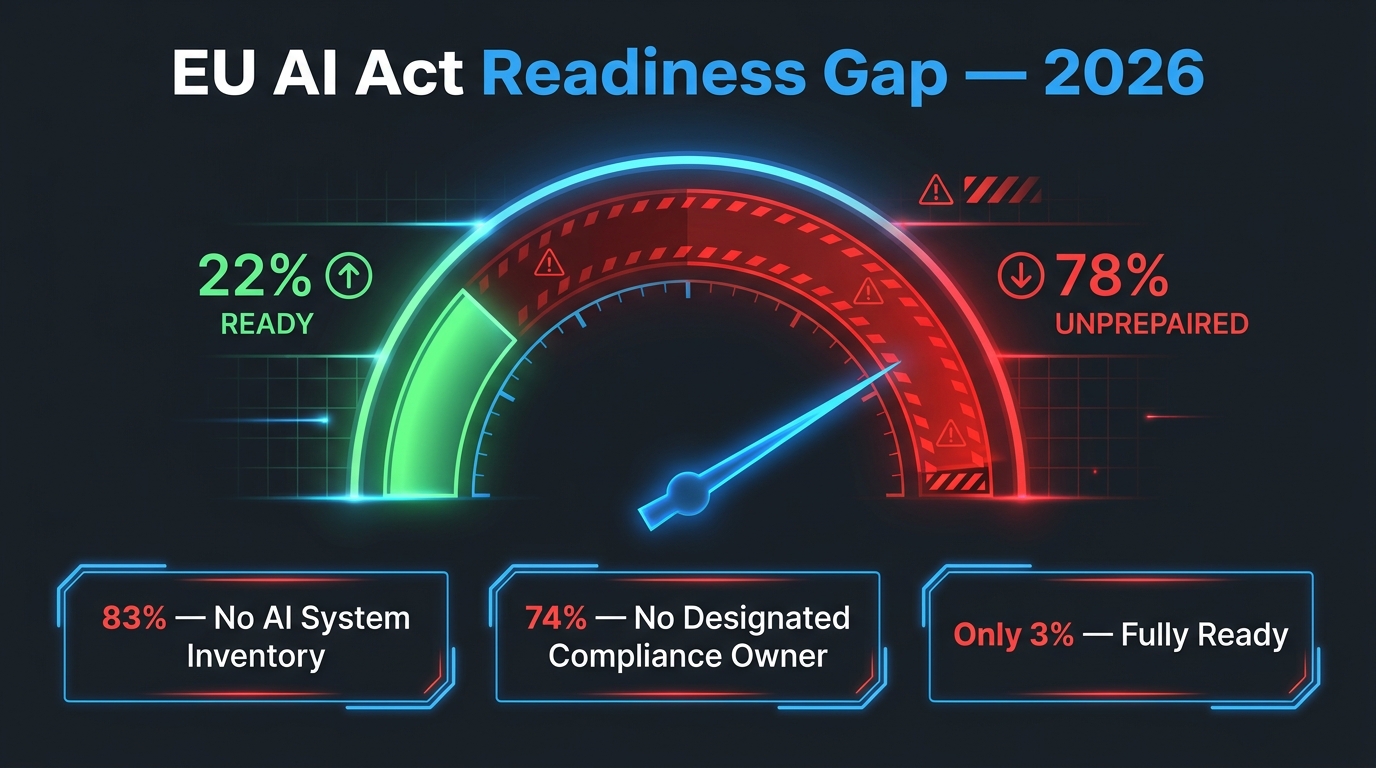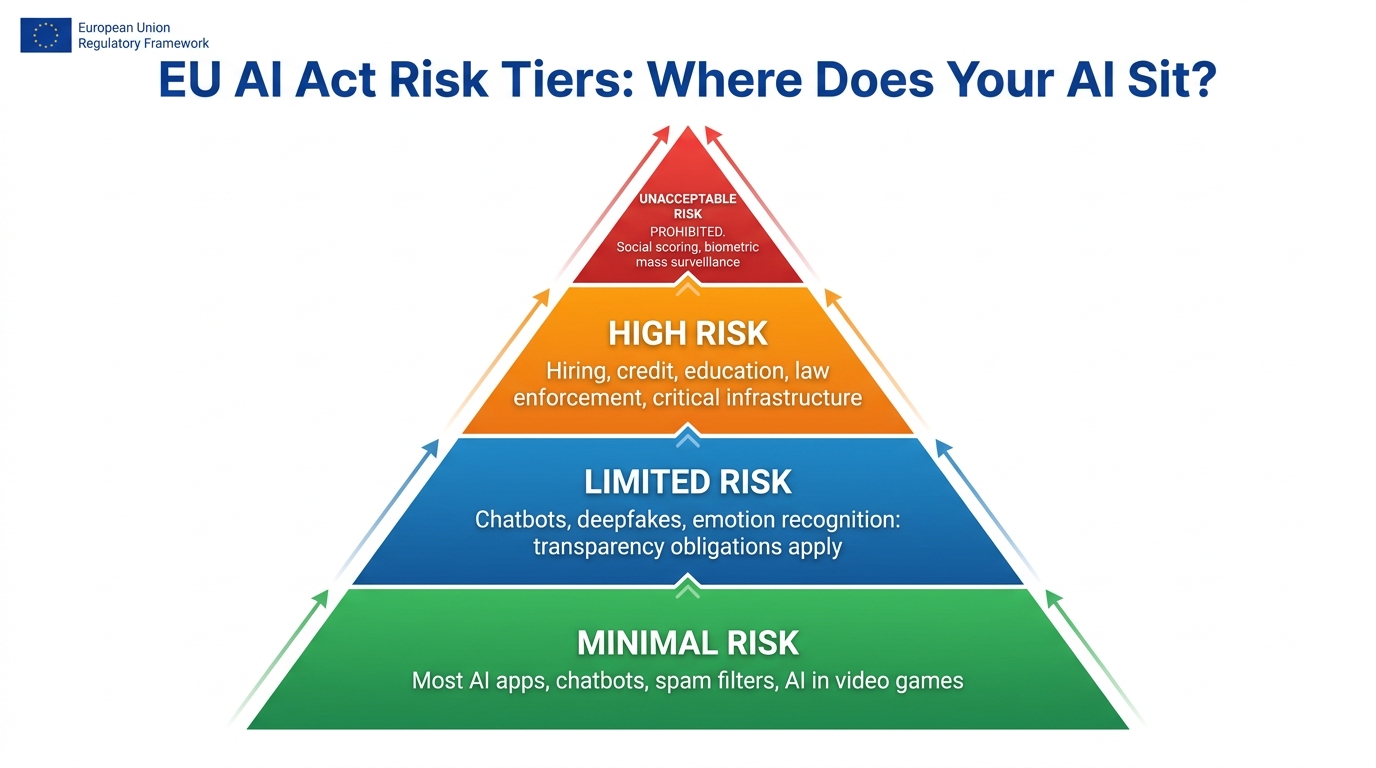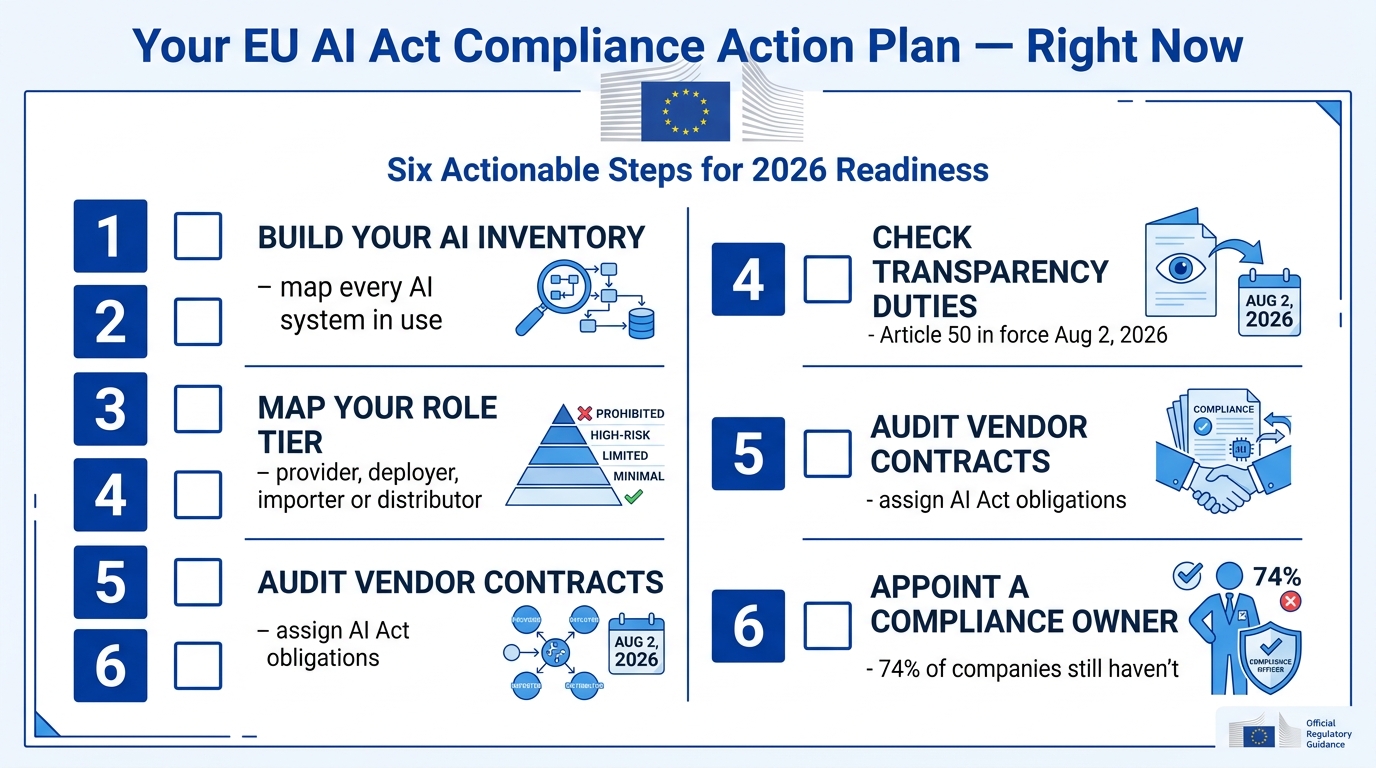

On 2 August 2026, the EU AI Act stopped being a planning exercise and became a live compliance obligation. Article 50 — the transparency chapter that governs how AI systems disclose themselves to users — entered full application that day. The European Commission published its final guidance in July 2026. The AI Office and Member State authorities now have the tools to enforce what is written.
And yet, across the organisations building and deploying AI agents right now, the same three misconceptions keep surfacing. First: that transparency compliance is just a UI checkbox — slap a banner somewhere and move on. Second: that only “chatbots” are affected. Third: that whoever built the underlying model carries the liability, not the team that assembled the agent on top of it.
All three are wrong. And the cost of getting this wrong — €15 million or 3% of global annual turnover, whichever is higher — is not a theoretical risk anymore. It is the middle band of a live enforcement regime.
This article is not a summary of the regulation. It is a working compliance analysis for the teams actually building agentic systems: product managers scoping disclosure UX, engineers implementing machine-readable marking, legal teams drawing the provider/deployer boundary, and engineering leads trying to understand what a compliant audit trail actually looks like. We go clause by clause where it matters, and practical wherever possible.
What Article 50 Actually Says — Versus What Most People Think It Says
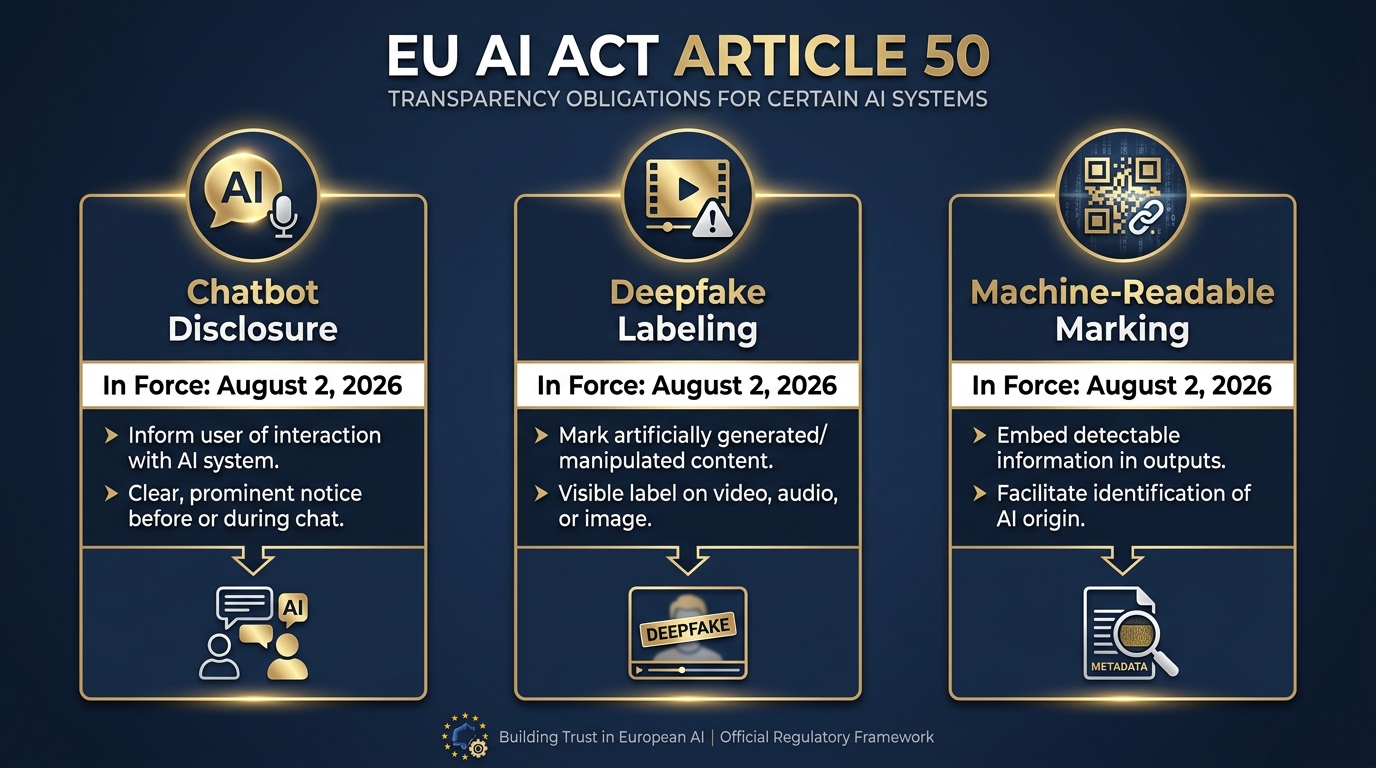
Article 50 of the EU AI Act contains four distinct obligations, each with its own trigger condition, responsible party, and technical implementation requirement. The regulation groups them into a single article, which has caused organisations to treat them as a single undifferentiated “transparency” task. They are not.
Obligation 1: Disclosure That a User Is Interacting With AI (Article 50(1))
This is the one everyone knows about. When a person interacts directly with an AI system — a chatbot, virtual assistant, or agent with a conversational interface — the provider of that system must inform the person that they are interacting with an AI system. The disclosure must happen at the latest by the first interaction. It does not need to be repeated at every message, but it must be present at the point of first contact.
The critical qualifier is that the obligation does not apply when it is obvious from context that the user is interacting with AI. This “obvious from context” exception is not a wide loophole. The Commission’s July 2026 guidance makes clear that “obvious” is assessed from the perspective of a reasonable user, not from the perspective of a technically-informed operator who knows the system is AI-powered. If there is any plausible ambiguity — and with modern conversational agents, there almost always is — the obligation stands.
What the obligation does not require is that the disclosure be lengthy or conspicuous. A persistent label, a brief acknowledgement at session start, or a clearly identifiable AI persona can satisfy the rule. The key is that the disclosure is present, proximate to the interaction, and comprehensible — not buried in terms of service or a privacy policy three links deep.
Obligation 2: Disclosure That Content Is AI-Generated or AI-Manipulated (Article 50(3) and 50(4))
This obligation targets two specific content types: deepfakes, and AI-generated text or audio on matters of public interest — election content, policy positions, scientific claims — where a reasonable person might be materially misled.
Deepfakes that realistically portray real people, places, events, or objects must be labelled in a way that is clearly perceivable to the end user. AI-generated public-interest text — think automated news summaries, political messaging, health information — must similarly carry a disclosure that it is AI-generated. Both obligations fall on deployers, not just providers. If your organisation runs the deployment pipeline that outputs this content to end users, the labelling responsibility is yours regardless of which model you used to generate it.
Obligation 3: Emotion Recognition and Biometric Categorisation Disclosure (Article 50(5))
Any person exposed to an emotion recognition system or a biometric categorisation system must be informed of the operation of that system and of the fact that their data is being processed. This applies broadly — not just to dedicated emotion recognition products, but to any AI agent that incorporates such functionality as a component. If your customer service agent analyses sentiment signals or voice tone as part of its routing logic, this obligation may apply.
Obligation 4: Machine-Readable Marking of Synthetic Outputs (Article 50(2))
This is the obligation that has received the least operational attention, yet carries significant technical implementation complexity. Providers of AI systems that generate synthetic audio, image, video, or text must mark those outputs in a machine-readable format that makes them detectable as AI-generated or AI-manipulated. The marking must be embedded in the output itself — not just logged server-side or disclosed to the user separately. It must be effective, interoperable, robust, and reliable, as far as technically feasible.
This obligation came into force on 2 August 2026 for new systems. For systems already on the market before that date, a grace period extends to 2 December 2026. After that, every generative AI system placing outputs into the EU market — regardless of when it launched — must comply.
The Provider vs. Deployer Line: Where You Actually Fall Determines What You Owe
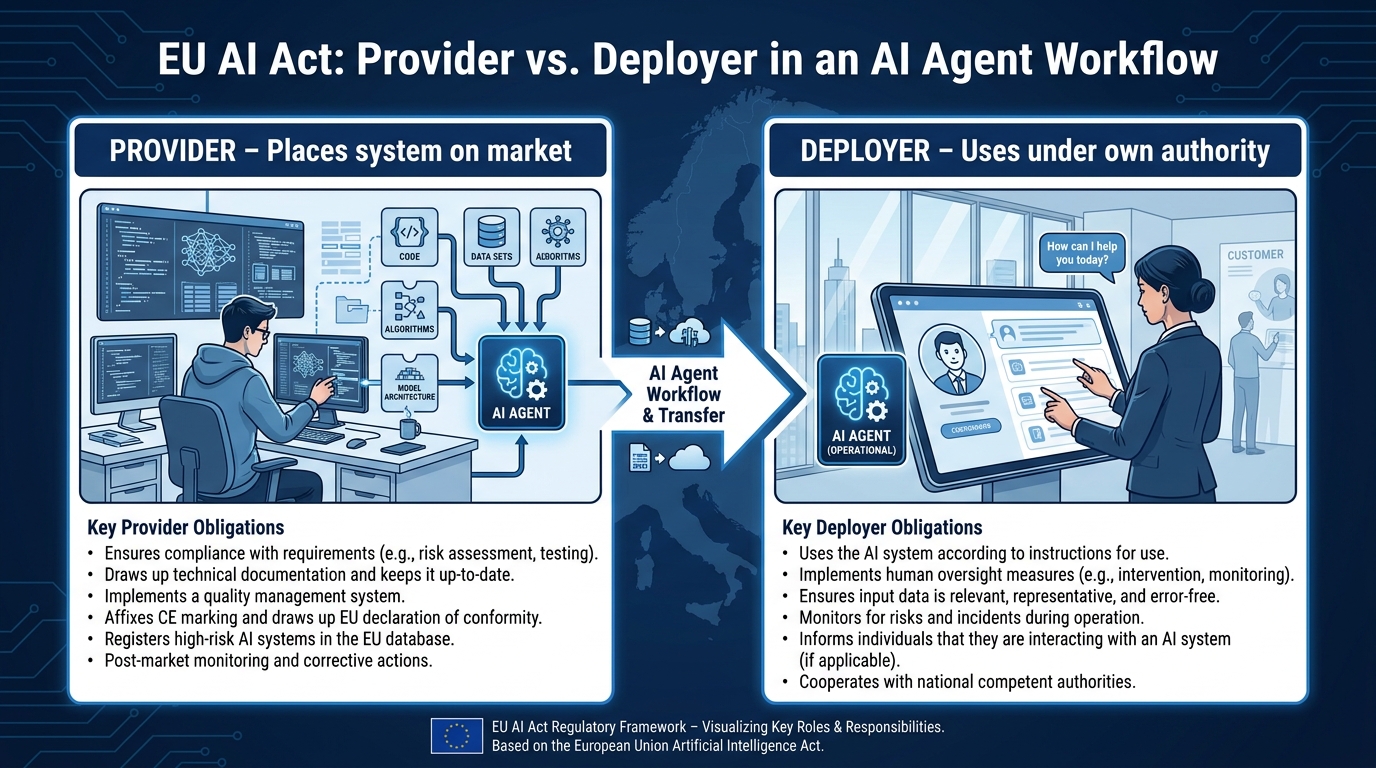
The EU AI Act distributes compliance responsibilities across two primary roles: the provider and the deployer. Misclassifying your organisation’s role is one of the fastest routes to an enforcement gap.
What Makes You a Provider
A provider is any natural or legal person that develops an AI system — or has one developed — and places it on the market or puts it into service under their own name or trademark. The key word is “places.” If your organisation builds an agent and then makes it available to other businesses or end users — even internally at scale, even without commercial licensing — you are functioning as a provider of that system.
The provider classification also applies when an organisation materially modifies an existing AI system. Fine-tuning a base model on proprietary data, substantially altering its architecture or behaviour, or rebranding and redistributing it under your own name can all shift you from deployer to provider, regardless of what agreement you have with the underlying model vendor.
As a provider, your Article 50 duties include designing the system so that it can deliver the required disclosures, implementing machine-readable marking, and ensuring that any downstream deployer receives sufficient information to comply with their own obligations.
What Makes You a Deployer
A deployer is any natural or legal person that uses an AI system under their own authority in a professional context. If your organisation integrates a third-party AI agent into your customer service stack, deploys it on your platform, and manages the interactions it has with your customers — you are a deployer.
Deployers are not off the hook. For Article 50, deployers carry explicit obligations for the deepfake labelling and public-interest text disclosure requirements. They must also instruct users about the AI nature of systems they operate, and they cannot use a provider’s system in ways that circumvent or undermine the transparency obligations built into it.
The Overlap Zone: When You Are Both
Many organisations building AI agents in 2026 occupy both roles simultaneously. You are a deployer relative to the foundation model or API you use (OpenAI, Anthropic, Google, Mistral), and you are a provider relative to the agent product you have built on top of that model and deployed to your customers or internal users.
This dual-role reality means you have compliance obligations flowing in both directions. You need contractual assurances from your model provider that their system delivers the upstream transparency capabilities your agent requires. And you need to ensure that your own agent system delivers the disclosure and marking obligations to the end users downstream.
The Commission’s July 2026 guidance specifically addresses this. It notes that where a provider and deployer are different entities, the provider must give the deployer sufficient information to enable the deployer to fulfil their own transparency obligations. This has direct contractual implications: if your API terms of service do not address this information flow, you have a gap.
The Three Disclosure Triggers That Apply Specifically to AI Agents
Most Article 50 commentary focuses on chatbots as the paradigm case. But “AI agent” is a broader category — it encompasses autonomous or semi-autonomous systems that take actions, make decisions, and interact with users across multiple sessions and channels. The compliance picture for agents is more complex than the chatbot framing suggests.
Trigger 1: The First Interaction Point
For any agent that has a direct user-facing conversational interface — a customer support agent, a sales assistant, an internal enterprise assistant — the disclosure must occur at the first interaction. This is the clearest case and the one most teams are already building for.
The implementation detail that often gets missed: “first interaction” means first interaction in a session, but if the agent initiates contact — through a proactive message, an email, a push notification — the disclosure obligation applies to that initiation, not to the user’s response. Outbound AI communications are in scope.
Trigger 2: Identity Disclosure for Agents Acting on Behalf of Others
This is the trigger most specific to agentic AI and the one most underappreciated in current compliance frameworks. The Commission’s July 2026 guidance specifies that AI agents must not only disclose that they are AI — they must also, where relevant, disclose who they act on behalf of.
For an agent operating as a customer service representative of a specific company, this is straightforward: the agent discloses it is AI, and the company identity is typically apparent from the interface. But for agents operating in broker-like roles — negotiating, transacting, or representing interests in commercial or civic contexts — the disclosure of principal identity becomes a substantive obligation, not a formality.
Consider an agent that negotiates supplier terms on behalf of a procurement team, or an agent that submits regulatory filings on behalf of an organisation. In both cases, the human or legal entity the agent represents must be identifiable from the interaction. Hiding the principal identity behind a generic AI persona in these contexts is not compliant.
Trigger 3: Output-Level Disclosure for Generated Content
Agents that generate written reports, summaries, legal documents, marketing copy, or any other substantive text output for onward use — and particularly for any public-interest subject matter — must apply appropriate output-level disclosure. This applies even when the agent is not conversational. A document-generation agent, a research synthesis agent, or a contract drafting agent all produce outputs that fall within the scope of the machine-readable marking obligation if those outputs leave the system and enter broader circulation.
The practical implication: disclosure is not only a conversation-layer concern. It follows the output wherever the output goes.
Machine-Readable Marking: The Technical Obligation Nobody Is Actually Ready For
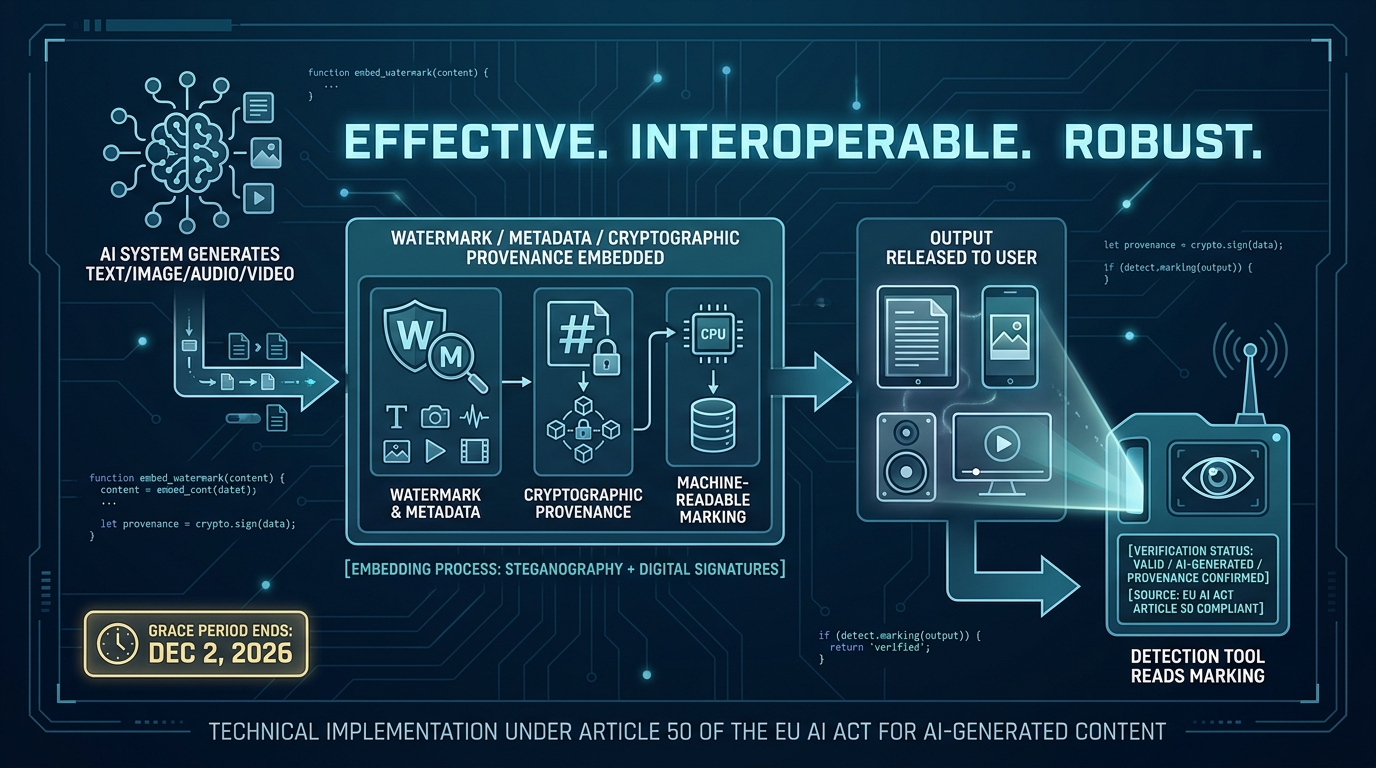
Of all Article 50’s obligations, machine-readable marking is the one with the largest gap between legal requirement and operational readiness. The obligation is unambiguous: synthetic audio, image, video, and text outputs must carry embedded markings that make them detectable as AI-generated or manipulated. The challenge is that the regulation does not specify a single technical standard — it requires that the approach be effective, interoperable, robust, and reliable as far as technically feasible. That qualification does a lot of work.
What “Machine-Readable Marking” Can Mean in Practice
The Commission’s July 2026 guidance acknowledges that no single universal standard exists yet. What it does identify is a range of technically viable approaches, each with different trade-offs:
- Metadata embedding: Including structured provenance data in file headers or EXIF/XMP metadata. Widely supported for images and audio. Fragile under file conversion, compression, or screenshot capture. The C2PA (Coalition for Content Provenance and Authenticity) standard is the leading interoperability framework here.
- Watermarking: Embedding imperceptible signals directly into the content payload. More robust to format conversion than metadata. Technically feasible for audio and images; for text, syntactic or statistical watermarking techniques exist but are less mature.
- Cryptographic provenance: Signing outputs with a cryptographic hash tied to the generating system. Provides strong authenticity guarantees but requires a verification infrastructure to be meaningful.
- Fingerprinting and logging: Maintaining server-side records of generated content that can be queried to verify AI origin. Useful as a supplemental layer; insufficient alone as the marking must travel with the content, not remain only server-side.
The “as far as technically feasible” qualifier gives providers room to argue that certain content types present genuine implementation barriers. But regulators are expected to apply this qualifier narrowly — it is a technical feasibility exception, not a general escape hatch. If a viable technique exists for your output type, you are expected to use it.
The Interoperability Requirement
One of the harder requirements embedded in Article 50(2) is interoperability. The marking method you choose must be detectable not just by your own systems but by third-party detection tools. This has supply chain implications: if you are using a proprietary watermarking approach that only your own infrastructure can read, you are not meeting the interoperability standard.
This is pushing the market toward open standards. The C2PA standard, which already has adoption from major hardware and software vendors, is the most likely candidate for harmonised implementation across image and audio. For text, no equivalent standard has achieved comparable adoption, which represents a genuine implementation challenge that the Commission’s guidance acknowledges without fully resolving.
What Happens to Content After It Leaves Your System
Providers are responsible for the marking at the point of output. They are not responsible for removing marks that users subsequently strip — but they are responsible for ensuring the mark was present when the content left the system. This creates a documentation and logging obligation: you need to be able to demonstrate that every output generated by your system carried the required marking at generation time.
Multi-Agent Pipelines: Why End-to-End Is the Only Defensible Framing
The EU AI Act was drafted before “agentic AI” — in the sense of multi-agent orchestration, tool-calling pipelines, and autonomous task completion — became a mainstream engineering pattern. The Act does not use the term “agentic AI” and does not define “multi-agent system.” This gap has led some legal teams to argue that components within a multi-agent pipeline that do not themselves have a user-facing interface are exempt from Article 50 obligations.
That argument is technically available but operationally dangerous.
The End-to-End System Principle
The Commission’s July 2026 guidance addresses multi-agent architectures through a systemic lens. Where multiple AI components are functionally integrated into a single decision or interaction pipeline — where the outputs of one agent become the inputs of another, and the chain ultimately produces an output that reaches a natural person — the compliance analysis must assess the system end-to-end, not component by component.
In practical terms, this means that if your orchestrator agent calls a subagent for research, routes the output to another subagent for drafting, and the final draft is delivered to a human user — the system as a whole is subject to Article 50 obligations. The fact that individual components are not themselves user-facing does not eliminate the obligation at the system level.
Responsibility Allocation in Pipelines
Within a multi-agent pipeline, the party that controls the orchestration layer and determines how the system outputs reach users is typically the entity that bears provider-level transparency obligations for the overall system. Subcomponent providers — API-accessed models and tools — carry obligations for their own components, but they are not responsible for the end-to-end disclosure unless they control the final output.
This means the team building and operating the orchestration layer cannot delegate compliance to the model APIs they call. They own the end-to-end transparency posture of the system they have assembled. Contracts with subcomponent vendors should specify what transparency capabilities those vendors provide and guarantee — but the orchestrator’s team must ensure those capabilities are actually activated and functional in the assembled pipeline.
Tool Use and External Action
A distinctive feature of agentic systems is that they take actions — calling APIs, writing to databases, sending emails, submitting forms. When an agent takes an action that results in a communication being received by a natural person (for example, sending an email to a customer on behalf of a business), that communication is an AI output. If it contains synthetic text, the marking obligation applies. If the recipient might otherwise believe they are communicating with a human, the disclosure obligation applies.
This extends the scope of Article 50 well beyond the conversational interface. Email-generating agents, document-filing agents, and report-producing agents all require compliance assessment for the outputs they generate.
GPAI Model Transparency: What Sits Upstream of Your Agent
Organisations deploying AI agents built on general-purpose AI models — foundation models accessed through APIs from commercial providers — have a compliance relationship that runs in both directions. Understanding what GPAI providers are obligated to disclose, and what that means for your downstream compliance posture, is essential.
What GPAI Providers Must Give You
Under Article 53 of the EU AI Act, providers of general-purpose AI models are required to:
- Maintain and provide technical documentation covering the model’s capabilities, limitations, and intended uses
- Give downstream providers and deployers sufficient information to use the model safely and compliantly, including information relevant to complying with their own obligations under the Act
- Maintain and publish a copyright compliance policy covering training data
- Publish a publicly available summary of the training content used
These obligations apply from 2 August 2026 for GPAI models placed on the market after that date, with a staggered transition for earlier models. The enforcement mechanism runs through the AI Office, which has specific authority over GPAI model obligations.
What This Means for Agent Builders Using GPAI APIs
If you are building agents on top of a commercial GPAI model — and most organisations building agentic systems are — you need to verify that your model provider is meeting their Article 53 obligations and that they are passing the relevant information to you in a form you can actually use.
Specifically, you need documentation from your GPAI provider covering: the model’s capabilities and known limitations relevant to your use case; guidance on appropriate use conditions; and transparency-related technical information including any built-in marking capabilities the model provides for its outputs.
If your current API terms of service do not address these items, you should be requesting updated documentation as a matter of contract management. Regulators examining your compliance posture will look at whether you have made reasonable efforts to obtain and act on this upstream information.
GPAI Models with Systemic Risk
GPAI models designated as having systemic risk — those with training compute exceeding 1025 FLOPs, or designated by the AI Office based on capability assessment — carry additional obligations under Article 55, including adversarial testing, incident reporting, and cybersecurity measures. If your agent is built on a systemic-risk model, your downstream compliance obligations are affected by the provider’s compliance with Article 55. You need to understand what systemic-risk obligations your model provider is subject to and whether any of those obligations generate requirements on your end as deployer.
The Penalty Math: What Non-Compliance Actually Costs
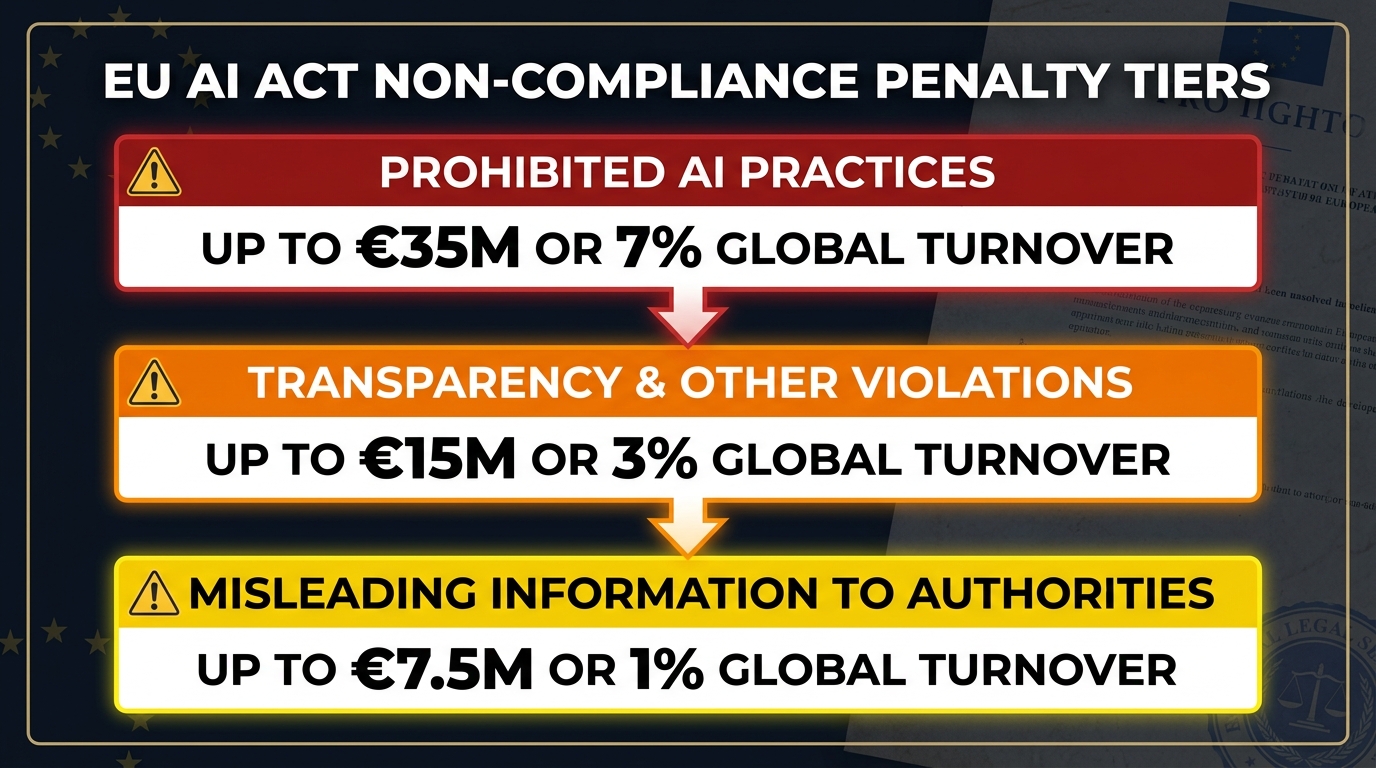
The EU AI Act’s penalty regime is tiered, and the positioning of transparency violations within that structure matters for how legal and risk teams should frame the compliance investment internally.
The Three-Tier Fine Structure
The Act establishes three penalty bands:
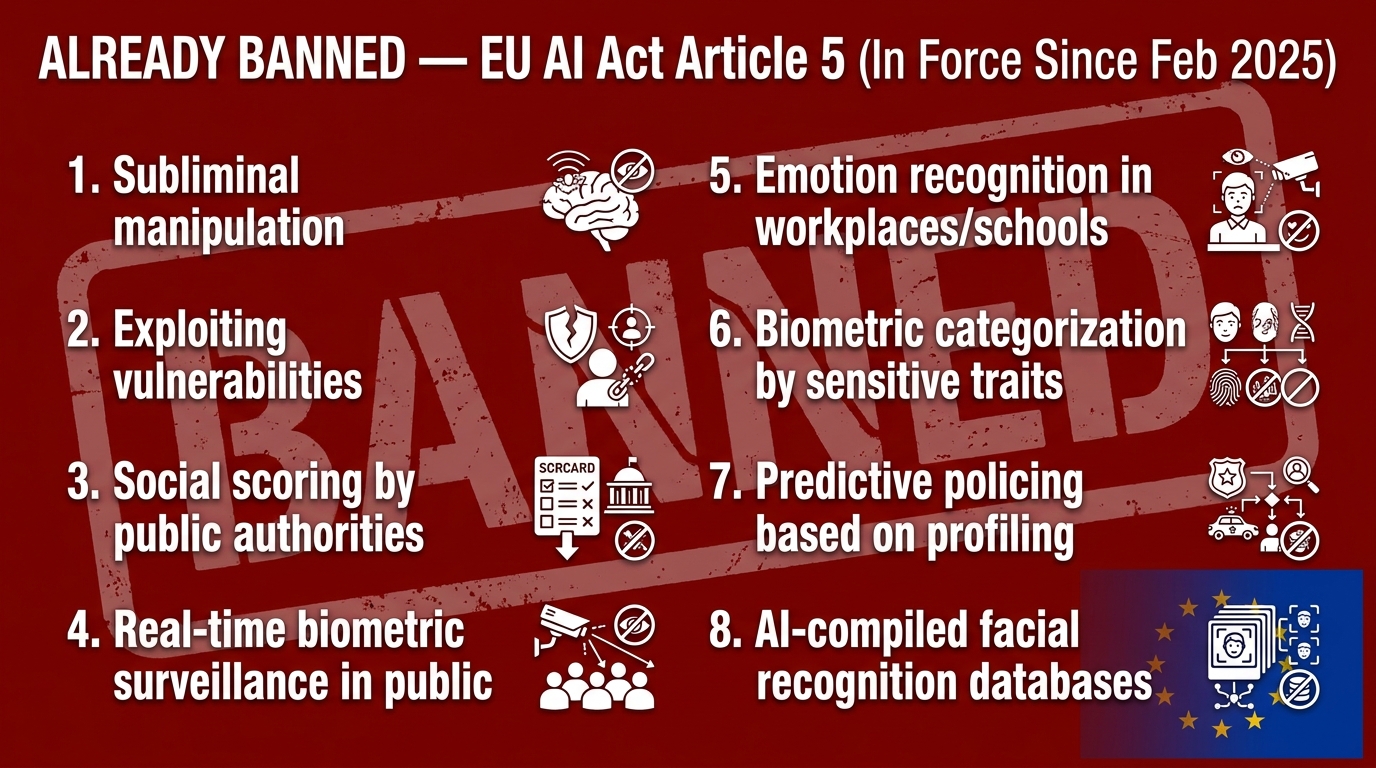
- Tier 1 — Prohibited AI practices: Up to €35 million or 7% of global annual worldwide turnover, whichever is higher. Applies to systems that violate Article 5 — manipulative AI, real-time biometric surveillance in public spaces without legal basis, AI that exploits vulnerable groups.
- Tier 2 — General non-compliance (including transparency violations): Up to €15 million or 3% of global annual worldwide turnover, whichever is higher. This is where Article 50 violations sit. Missing the chatbot disclosure, failing to label deepfakes, not implementing machine-readable marking — all fall here.
- Tier 3 — Supplying incorrect information to authorities: Up to €7.5 million or 1% of global annual worldwide turnover, whichever is higher. Applies to misleading responses during regulatory inquiries or conformity assessments.
The Global Turnover Basis
The “global annual worldwide turnover” basis is not a European revenue calculation. It applies to the organisation’s total global revenue. For a large enterprise with €2 billion in global revenue, a Tier 2 violation could mean a fine of up to €60 million. For a mid-market organisation with €200 million global revenue, the ceiling is €6 million. The regulation uses whichever figure is higher — the fixed ceiling or the percentage — which means the percentage calculation is the binding constraint for most organisations with significant global revenue.
The Proportionality Principle and Mitigating Factors
Actual fines imposed by national authorities and the AI Office are expected to reflect proportionality. Regulators will consider the severity and duration of the infringement, whether it was intentional or negligent, whether the organisation took corrective action proactively, and whether cooperation with the investigation was forthcoming. An organisation that has documented its compliance efforts, implemented reasonable controls, and responded constructively to enforcement contact is in a materially different position than one that has no compliance programme at all.
This is not just a legal argument — it is the practical case for building a documented compliance posture now, even if that posture is imperfect. Documented good-faith effort is a genuine mitigating factor. The absence of any compliance programme is not.
SME Carve-Outs
The Act includes specific provisions for small and medium-sized enterprises and startups. Member State authorities are directed to give priority to guidance over enforcement for SMEs, and fine calculations for SMEs may use a lower percentage of turnover. However, these carve-outs apply to the enforcement approach, not to the substantive obligations. SMEs must still comply with Article 50 — they simply have a different enforcement risk profile than large enterprises.
Building a Compliance Audit Trail That Survives Enforcement
The question regulators will ask is not only “are you compliant?” but “can you prove it?” Under the EU AI Act, the evidentiary burden in an enforcement proceeding sits with the organisation. You need documentation that demonstrates what your system does, when compliance measures were implemented, and how they function. The following elements form the minimum audit trail for Article 50 compliance.
System Inventory and Role Classification Record
Every AI system your organisation provides, deploys, or operates must be documented. For each system, the record must capture: the system’s function, the role your organisation occupies (provider, deployer, or both), the Article 50 obligations that apply to that system given its function and role, and the controls implemented to meet those obligations.
This inventory is not a one-time exercise. Systems change. New agents get deployed. Existing agents get retrained or significantly modified. The inventory must be maintained as a living document with version history.
Disclosure Implementation Records
For every user-facing AI system, the audit trail must document how and when the Article 50(1) disclosure is delivered to users. This means capturing the specific disclosure text or interface element used, the point in the user journey at which it appears, the date the disclosure was implemented, and any changes made to the disclosure over time.
Screenshots, design mockups, and UI specification documents all contribute to this record. The goal is to be able to demonstrate, if challenged, exactly what a user of your system would have seen at any point in time.
Output Marking Logs
For systems generating synthetic content subject to Article 50(2), you need logging that demonstrates outputs were marked at the point of generation. Server-side logs showing output generation events, the marking technique applied, and a timestamp are the minimum. Where technically feasible, audit samples of marked outputs should be preserved to demonstrate that the marking was effective.
Vendor Documentation File
The compliance chain extends to your GPAI providers. Maintain a vendor documentation file that records: the technical documentation your GPAI provider has supplied, the date it was received, and any updates or changes. If a provider fails to supply required documentation, the fact that you have requested it and followed up is relevant to your own compliance defence.
Incident and Correction Log
No compliance programme is perfect. When a failure is identified — a disclosure was omitted in a specific flow, a marking was not applied to a batch of outputs — what matters is that the incident is documented, the cause is identified, corrective action is taken, and the record of all of this is preserved. A compliance programme that identifies and corrects failures is substantially stronger, in a regulatory context, than a programme that claims there have been no failures.
The 90-Day Compliance Sprint: Priorities in the Right Order
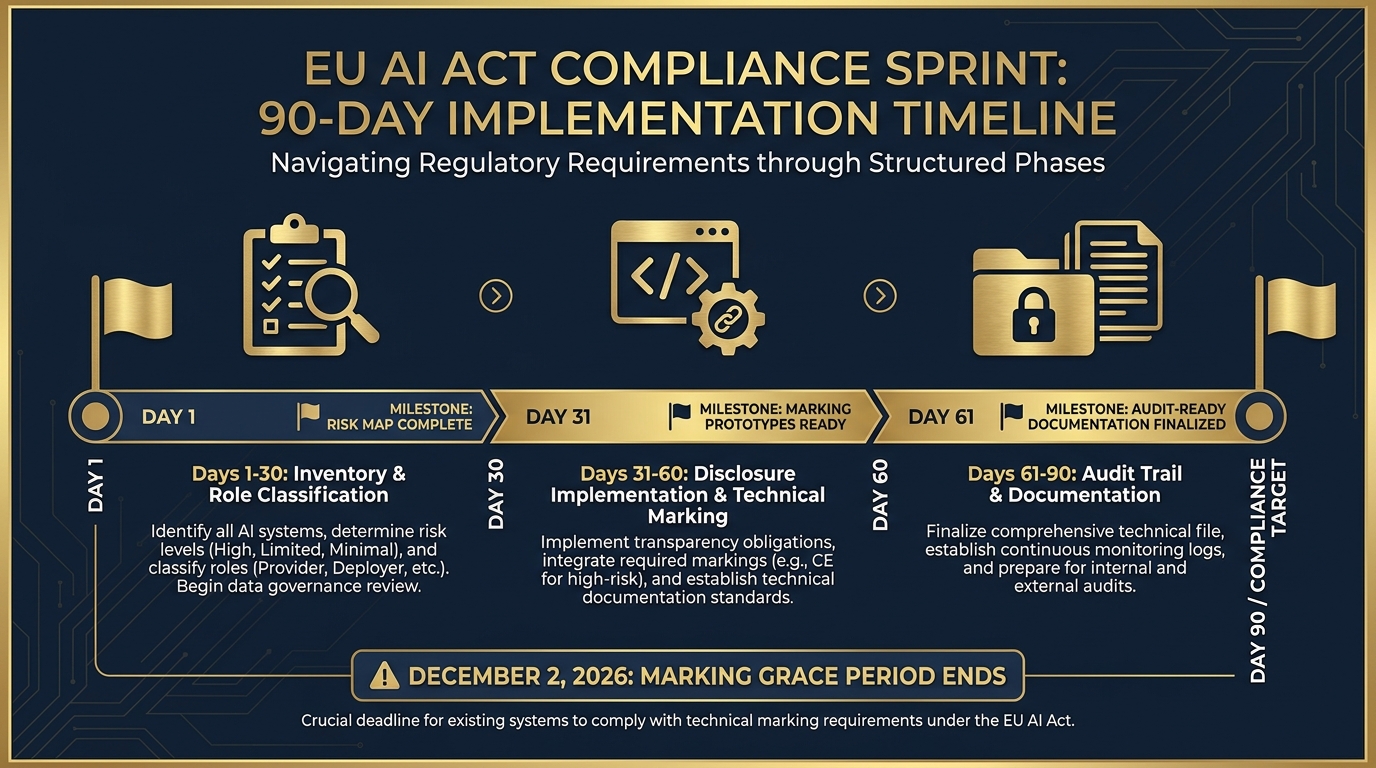
With the December 2, 2026 grace period for machine-readable marking now approaching, compliance teams that have not yet begun structured implementation have a defined window. The following sequencing reflects both regulatory priority and practical implementation reality.
Days 1–30: Inventory, Classification, and Gap Assessment
The first priority is knowing what you have and where you stand. This phase should produce:
- A complete inventory of every AI system the organisation provides, deploys, or operates — including agent systems, generative AI integrations, and any AI components embedded in non-AI products
- A role classification for each system (provider, deployer, or both), documented with the reasoning for each classification
- An obligation mapping for each system: which Article 50 obligations apply, and why
- A gap assessment: for each applicable obligation, what is currently implemented and what is missing
- A review of existing vendor contracts for GPAI providers to identify missing transparency documentation obligations
This phase should involve legal, product, engineering, and data governance teams. It is not a legal exercise alone — legal teams cannot identify systems they do not know exist, and engineering teams cannot classify obligations without legal guidance on what the obligations mean.
Days 31–60: Disclosure Implementation and Technical Marking
With the gap assessment in hand, this phase focuses on implementation:
- Design and deploy user-facing disclosures for all systems subject to Article 50(1). This includes not just the disclosure text but the UX placement — at session start, in the interface label, in the initial message — and testing to confirm the disclosure appears correctly across all access channels and devices
- Implement deepfake and public-interest text labelling for any deployer-level obligations identified in the gap assessment
- Select and begin implementing a machine-readable marking approach for generative output systems. The December 2 deadline makes this the most urgent technical task for organisations with existing systems that were market-deployed before August 2, 2026
- Update or extend vendor contracts with GPAI providers to include explicit Article 53 documentation obligations
- Draft and adopt an internal AI transparency policy that formalises the obligations identified in Phase 1 as standing operational requirements
The machine-readable marking implementation is likely the heaviest technical lift in this phase. Allocate engineering resources accordingly and use the C2PA standard where your content types support it. For text-only outputs, document the technical feasibility assessment and the approach you are implementing — this documentation is itself part of your compliance posture.
Days 61–90: Audit Trail, Documentation, and Governance
The final phase converts implementation into a defensible compliance programme:
- Formalise the system inventory as a maintained living document with an assigned owner and a review cadence (quarterly, at minimum)
- Set up output marking logs with appropriate retention periods — 12 months minimum, aligned to applicable statute of limitations considerations
- Establish a monitoring process for regulatory developments: the Commission’s guidance, AI Office enforcement decisions, and Member State implementation differences all have the potential to generate new obligations or clarify existing ones
- Conduct a structured review of the disclosure and marking implementations: test them, document the test results, and correct any failures identified
- Brief key stakeholders — board, legal, engineering leads, product managers — on the current compliance status and the ongoing monitoring programme
At the end of this sprint, you should have: a system inventory, a role classification record, implemented disclosures, implemented (or in-progress) marking, a vendor documentation file, and an incident/correction log. That is a compliance programme. It will not be perfect. But it is a documented good-faith effort — which, in an enforcement proceeding, is the difference that matters.
What the December Deadline Actually Changes — and What It Doesn’t
The December 2, 2026 transition date for machine-readable marking applies only to one specific category: AI systems that were already placed on the EU market before 2 August 2026 and that are subject to the marking obligations under Article 50(2). It is a grace period for existing systems, not a general extension of the August enforcement date.
Everything else that entered force on 2 August 2026 is already live:
- Chatbot and interactive AI disclosure obligations are in force now and have been since August 2
- Deepfake labelling obligations are in force now
- Public-interest AI-generated text disclosure obligations are in force now
- Emotion recognition and biometric categorisation disclosure obligations are in force now
- GPAI provider obligations under Articles 53 and 55 are in force now
The December date is a hard stop for the machine-readable marking grace period. Any system generating synthetic audio, image, video, or text that is deployed to EU users must implement compliant marking by that date, regardless of when it was first deployed.
There is a risk that organisations view the December date as the real deadline and treat the August obligations as already behind them. That framing is wrong and dangerous. Enforcement for August-applicable obligations can begin from August 2. Any enforcement action launched before December will focus on those obligations, not the marking transition.
Disclosure UX: Where Legal Requirements Become Product Decisions
Compliance with Article 50 is not purely a legal and technical matter. It has significant product and user experience dimensions that determine whether an implementation meets the “clear and comprehensible” standard the regulation requires — or merely ticks a box while leaving users practically uninformed.
What “Clear and Comprehensible” Means in Practice
The regulation requires that disclosures be clear and comprehensible to users. This means:
- Proximity: The disclosure must be near the interaction point, not in a separate document. A link to a terms-of-service page that mentions AI among many other topics is not clear and comprehensible disclosure of AI interaction.
- Plain language: The disclosure must be understandable to a general user, not written in legal or technical jargon. “This service uses artificial intelligence” is acceptable. “This interface leverages a large language model fine-tuned on our proprietary dataset” is not — at least not as the primary disclosure.
- Accessibility: The disclosure must be accessible to users with disabilities. If your interface relies on visual labels only, users with visual impairments may not receive the disclosure. Screen reader compatibility is part of the accessibility requirement.
- Persistence: The disclosure should be present throughout the interaction in some form — not only in a popup that users dismiss before engaging. A persistent “AI-powered” label in the interface, alongside the initial disclosure, is a stronger implementation than a one-time notice.
The Edge Cases That Require Judgment
Some disclosure situations require product judgment rather than a simple rule application:
Voice interfaces: Where an agent interacts via voice — telephone customer service, voice assistant — the disclosure obligation still applies but the implementation approach differs. A spoken disclosure (“You are speaking with an AI assistant”) at the start of the call is the standard approach. The timing and phrasing of this disclosure needs to be considered in the context of the call flow to ensure it is heard and registered.
Personas with names: Many deployed agents use branded personas — “Meet Aria, your virtual assistant.” Giving an AI agent a human-sounding name does not exempt the system from disclosure. The obligation is to disclose the AI nature; the persona name is separate. The Commission’s guidance is clear that personas are not inherently deceptive if the AI disclosure is present, but the combination of a human-sounding name, photorealistic avatar, and no AI disclosure would be an enforcement risk.
B2B professional interfaces: The “obvious from context” exception has more room to operate in B2B settings where users are sophisticated and the AI nature of the tool is intrinsic to the product’s value proposition. However, “obvious from context” remains a fact-specific assessment. Assume the exception is narrow and document the reasoning when you rely on it.
Conclusion: Compliance Is Now an Engineering Requirement, Not Just a Legal One
The EU AI Act’s transparency obligations have crossed from regulatory planning to operational reality. Article 50 is not a future risk to be monitored — it is a current requirement to be implemented. The grace period for machine-readable marking ends in December 2026. The obligations for chatbot disclosure, deepfake labelling, and public-interest AI text have been enforceable since August.
The organisations that will navigate this well are the ones treating transparency compliance as an engineering requirement with legal specifications, not as a legal checkbox with engineering afterthoughts. Disclosure is a product feature. Machine-readable marking is a systems architecture decision. The provider/deployer classification affects vendor contract terms. The audit trail is a logging and retention problem.
None of these are purely legal functions. They require coordinated action across product, engineering, legal, and data governance — and they require that action now, not at the next planning cycle.
Key Takeaways for Agent Builders
- Run the inventory first. You cannot comply with obligations you have not identified. Every AI system — not just the obvious chatbots — needs to be assessed against Article 50’s four distinct obligations.
- Classify your role correctly. Building an agent on a third-party model makes you both a deployer (relative to the model) and a provider (relative to the agent). Both roles carry obligations. Both require action.
- Don’t conflate disclosures with terms of service. Article 50 disclosure must be proximate, plain, and primary. It must be in the interaction, not in the fine print.
- Start machine-readable marking now. The December 2 deadline is not far. Selecting an approach, integrating it into your output pipeline, and testing it takes time. The C2PA standard is the practical starting point for images and audio.
- Treat multi-agent pipelines as a single system for compliance. The orchestrator’s team owns the end-to-end transparency posture. Delegating compliance to subcomponent vendors without verification is not a defensible position.
- Build the audit trail as you build the compliance programme. Documentation of what you implemented, when, and why is not an afterthought — it is what converts a compliance programme into a compliance defence.
- Get your GPAI vendor documentation in order. Request and file the technical documentation your model providers are obligated to supply under Article 53. The absence of that documentation is a gap in your own compliance posture.
The transparency obligations in the EU AI Act are not the most technically demanding requirements in the regulation — the high-risk system obligations are substantially heavier. But they are the first ones to be enforced at scale, and they apply to every organisation deploying AI agents to EU users. There is no threshold, no sector carve-out, and no minimum size that exempts an organisation from Article 50. If you interact with EU users through AI, these rules apply to you.
The August deadline has passed. The December deadline is visible on the horizon. The compliance sprint starts now.