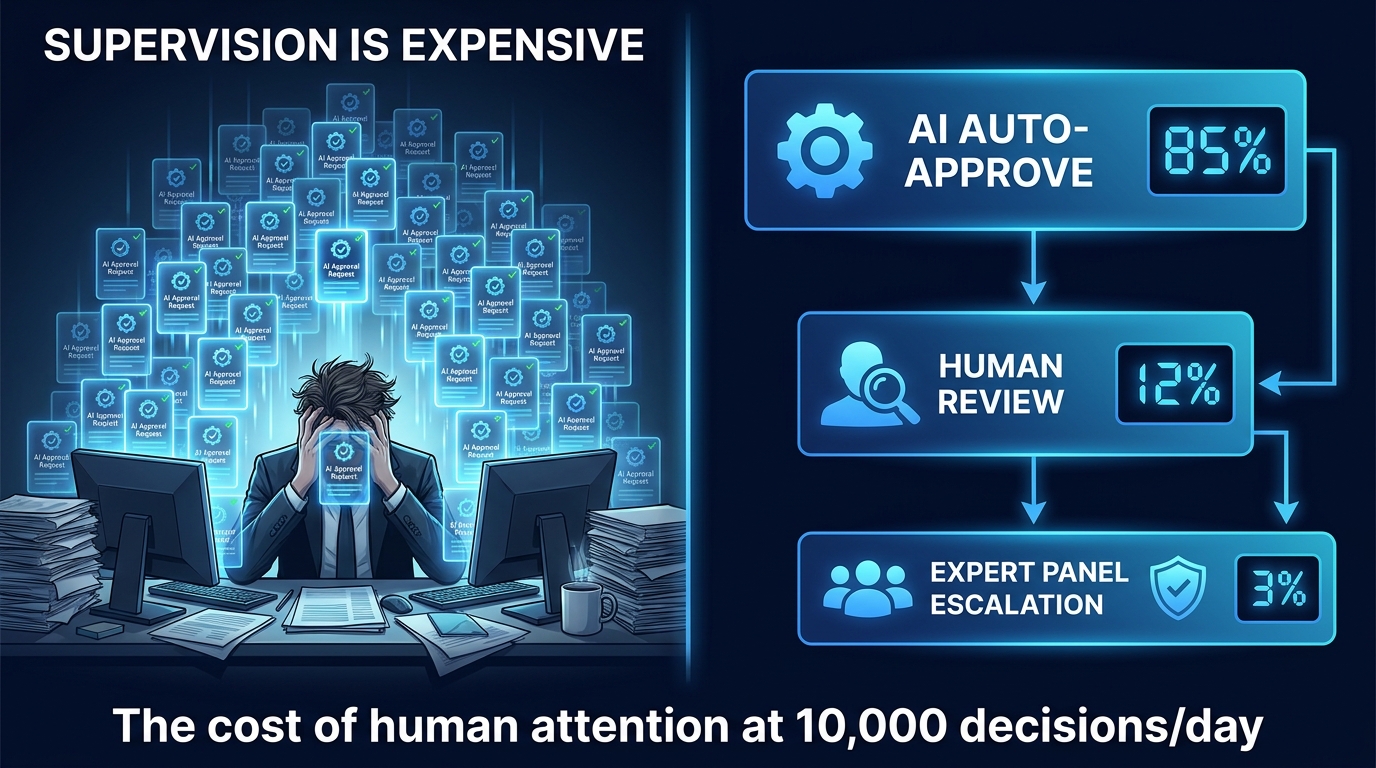
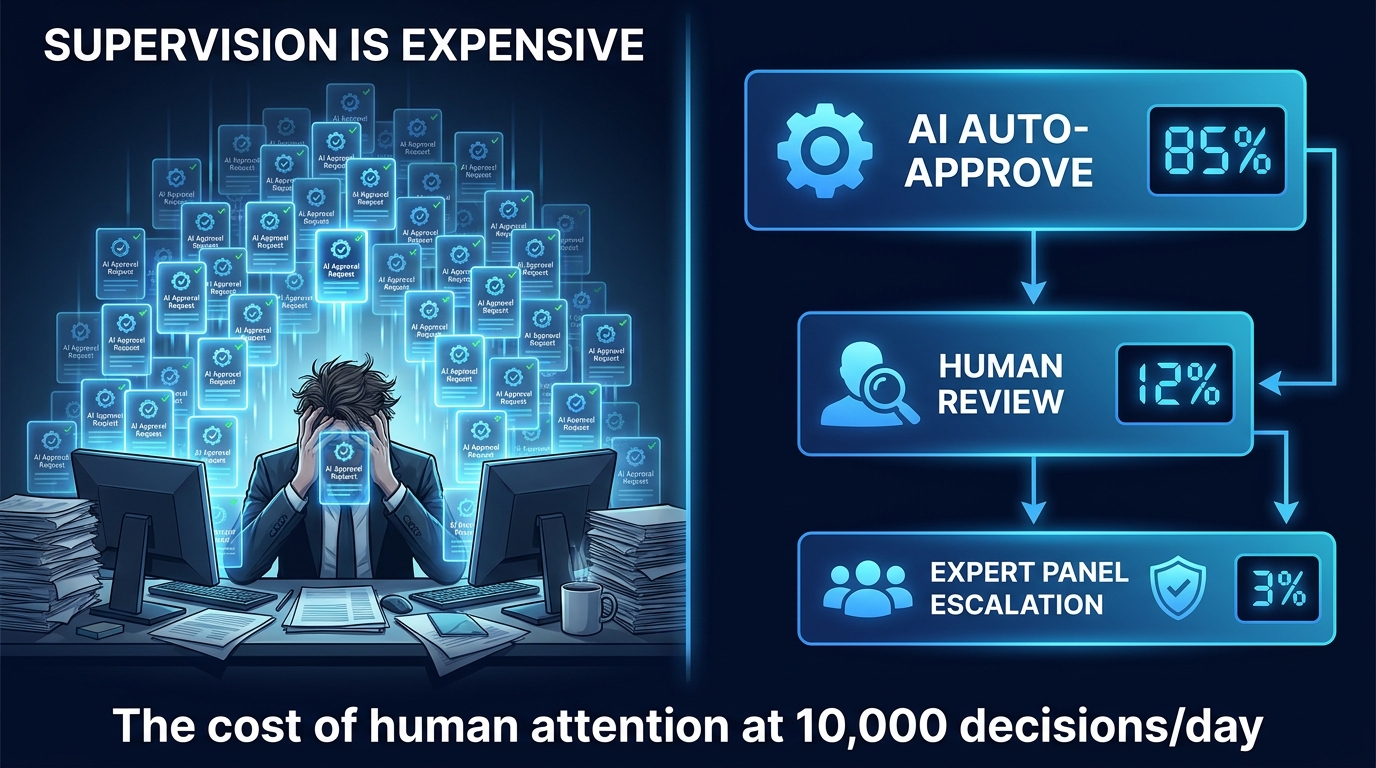
There is a number buried inside almost every enterprise AI budget that nobody wants to talk about. It is not the GPU bill. It is not the licensing fee for the model. It is the cost of the people who watch the model work — the reviewers, approvers, auditors, and escalation handlers whose labor turns an AI system into a production-grade, accountable operation. In 2026, that number has a name: human-in-the-loop overhead, and in many organizations it has quietly grown to represent 15–25% of total AI program spend.
At low volumes, this overhead is manageable — a few reviewers, a shared Slack channel, a spreadsheet of edge cases. But as AI systems scale from hundreds to thousands to tens of thousands of decisions per day, the math changes completely. A single knowledge-worker review costs $0.58–$0.83 per decision at fully loaded labor rates. A comparable LLM inference call costs roughly $0.003. At 5,000 decisions a day, that differential is not academic: it is a $1.4 million annual gap between a fully supervised workflow and a fully autonomous one.
The uncomfortable reality is that most enterprises are running neither. They have built HITL systems that are too expensive to sustain at volume and too poorly designed to actually catch the errors they were supposed to prevent. This article is about how to fix that — not by removing humans from the loop, but by engineering their participation so that every hour of human attention is doing real work, not theater.
The Unit Economics of Human Attention — A Number That Should Be on Every AI Dashboard
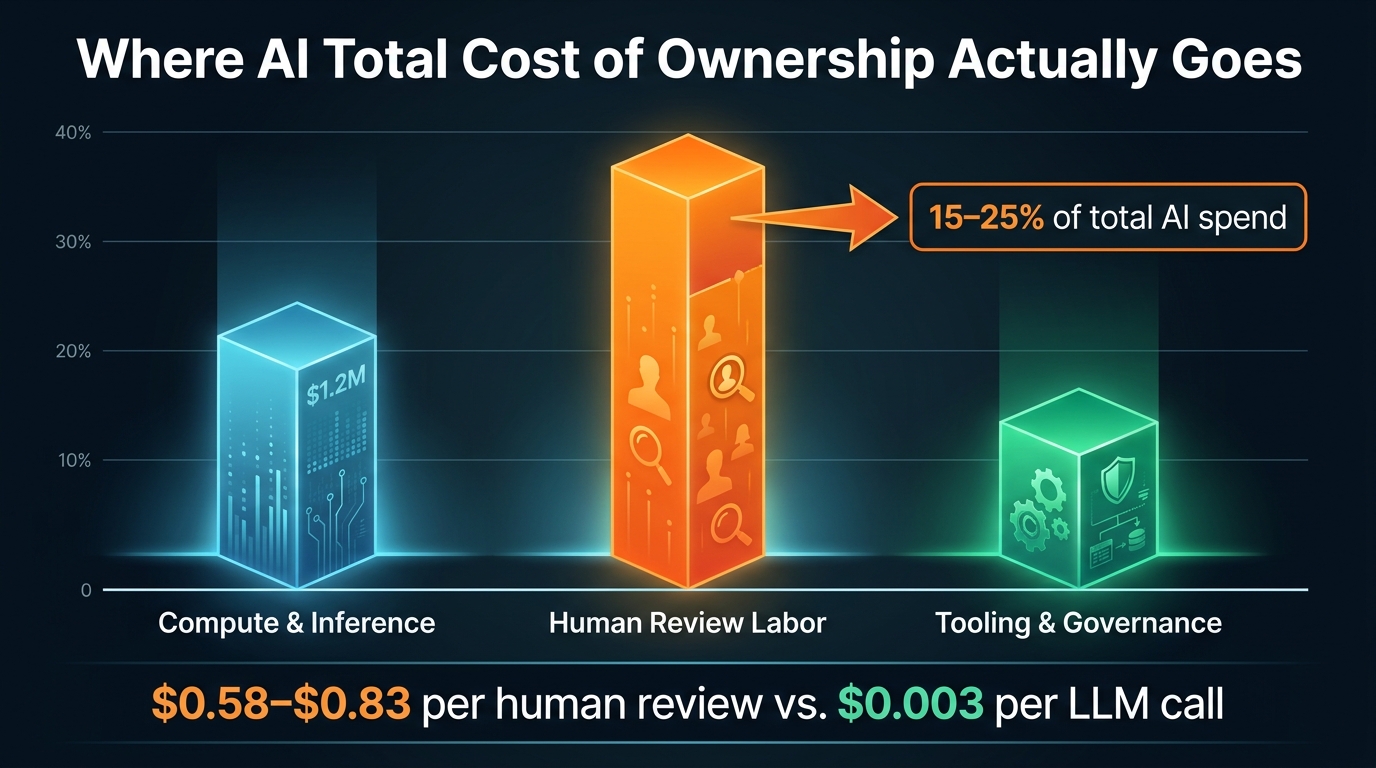
The conversation about AI costs almost always starts in the wrong place. Procurement teams negotiate model contracts. Engineers benchmark inference latency. CTOs study cloud spend dashboards. But the largest variable cost in a mature AI deployment is often none of these things — it is the fully loaded hourly cost of the humans who review, correct, approve, and escalate its outputs.
Breaking Down the True Cost of a Single Review
When you calculate the true cost of a human review event, you need to account for more than the reviewer’s salary. The full picture includes:
- Direct labor: The reviewer’s time at fully loaded rates (salary plus benefits plus overhead) — typically $35–$50/hour for knowledge workers in 2026
- Context-switching cost: Shifting attention from one task to a review queue and back degrades both activities. Research on task interruption consistently shows 15–25 minutes of productivity loss per context switch
- Queue management overhead: Someone has to route work, handle backlogs, and manage SLA compliance — that is typically 10–15% additional headcount on top of raw reviewer capacity
- Tooling and infrastructure: Review interfaces, audit log systems, escalation workflows, and integrations with the AI system itself
- Rework from missed errors: When reviewers do miss something — and they will — the downstream cost of correcting that error is often 3–10x the original review cost
Putting these together, the $0.58–$0.83 per-decision estimate cited in enterprise governance analyses is likely conservative for anything requiring genuine domain expertise. In regulated industries like healthcare, finance, or legal — where the reviewer needs professional credentials and carries personal liability — the cost per reviewed decision can easily reach $3–8.
The Volume Inflection Point
At 100 decisions per day, a two-person review team is manageable. At 1,000 decisions per day, you need to hire a team. At 10,000 decisions per day, you are looking at a 20–30 person operation whose annual budget rivals the entire model deployment cost. This is the volume inflection point — the moment when HITL stops being a governance safeguard and starts being a business model problem.
The critical design question is not “do we need humans in the loop?” The answer is almost always yes, at least partially. The real question is: at exactly which decisions does human attention change the outcome, and how do we ensure humans are only spending time on those ones? Everything else is an engineering problem masquerading as a governance question.
Computing the Opportunity Cost of Latency
Human review does not just cost money — it costs time, and time has economic value in automated workflows. A synchronous review gate that adds 4 hours of latency to a decision chain is not just a user experience problem. In workflows where AI decisions trigger downstream processes — fulfillment, pricing, clinical triage, fraud alerts — that latency translates directly into delayed outcomes, missed SLAs, and in some cases, material business loss. Any honest accounting of HITL cost must include this latency overhead as a direct line item.
Why “Review Everything” Is Already Broken at Scale
The “review everything” model was the safe default when AI systems were new, confidence was low, and volumes were small enough that a small team could keep up. In 2026, it is neither safe nor sustainable — and for a counterintuitive reason: universal review does not actually produce better oversight. It produces the illusion of oversight while introducing its own failure modes.
Reviewer Capacity Has a Hard Ceiling
Human reviewers process decisions at a finite rate. A knowledge worker reviewing AI-generated content at a comfortable pace can typically evaluate 50–70 items per hour before quality begins to degrade. Push beyond that, and something measurable happens: review time per item compresses, approval rates climb, and error detection rates fall. This is not a character flaw in the reviewer — it is basic cognitive science. Working memory, sustained attention, and critical evaluation all have per-hour limits that cannot be overridden by urgency or good intentions.
The practical consequence: if your AI system generates 500 decisions per hour and your reviewer can genuinely evaluate 60 per hour, you have one of three outcomes. Either you hire 8+ reviewers (expensive), allow a queue backlog to build (latency), or the reviewer starts rubber-stamping to keep up (failure mode). Most organizations, under time and budget pressure, drift toward the third option without ever formally deciding to do so.
Queue Volume Predicts Review Quality Better Than Reviewer Skill
This is one of the most important and underappreciated findings from recent enterprise AI governance research. Reviewer quality in high-volume queues is not primarily a function of training, expertise, or motivation. It is a function of queue depth at time of review. When reviewers can see that they are 200+ items behind, cognitive shortcuts kick in automatically. The brain shifts from analytical processing to pattern-matching based on the most recent approved items — a dynamic that creates systematic blind spots to anything that falls outside recent patterns.
This means that a well-designed, lightly loaded review workflow staffed by moderately experienced reviewers will consistently outperform an overloaded review workflow staffed by domain experts. The implication for HITL architecture is stark: if you cannot guarantee queue depth stays below your reviewers’ cognitive overload threshold, you do not have a review process — you have an approval process, and those are very different things.
The False Security of High Approval Rates
Many organizations measure HITL health using approval rate as a proxy for review quality. If reviewers are approving 98% of items, the thinking goes, the AI must be doing well. This is exactly backwards. High approval rates in high-volume queues are one of the clearest signals of approval fatigue, not AI accuracy. When the approval rate for a review queue approaches 95–99%, the next question should not be “great, our AI is performing well” — it should be “is our review process still adding value, or have we built an expensive rubber-stamp?”
Genuine review processes in well-designed HITL systems typically show approval rates between 75–90%. If yours is higher than that consistently, either the escalation threshold is set too low (sending easy cases to human review unnecessarily) or the reviewers have cognitively checked out. Both are design problems, not operational ones.
The Automation Bias Trap: When Oversight Becomes Performance
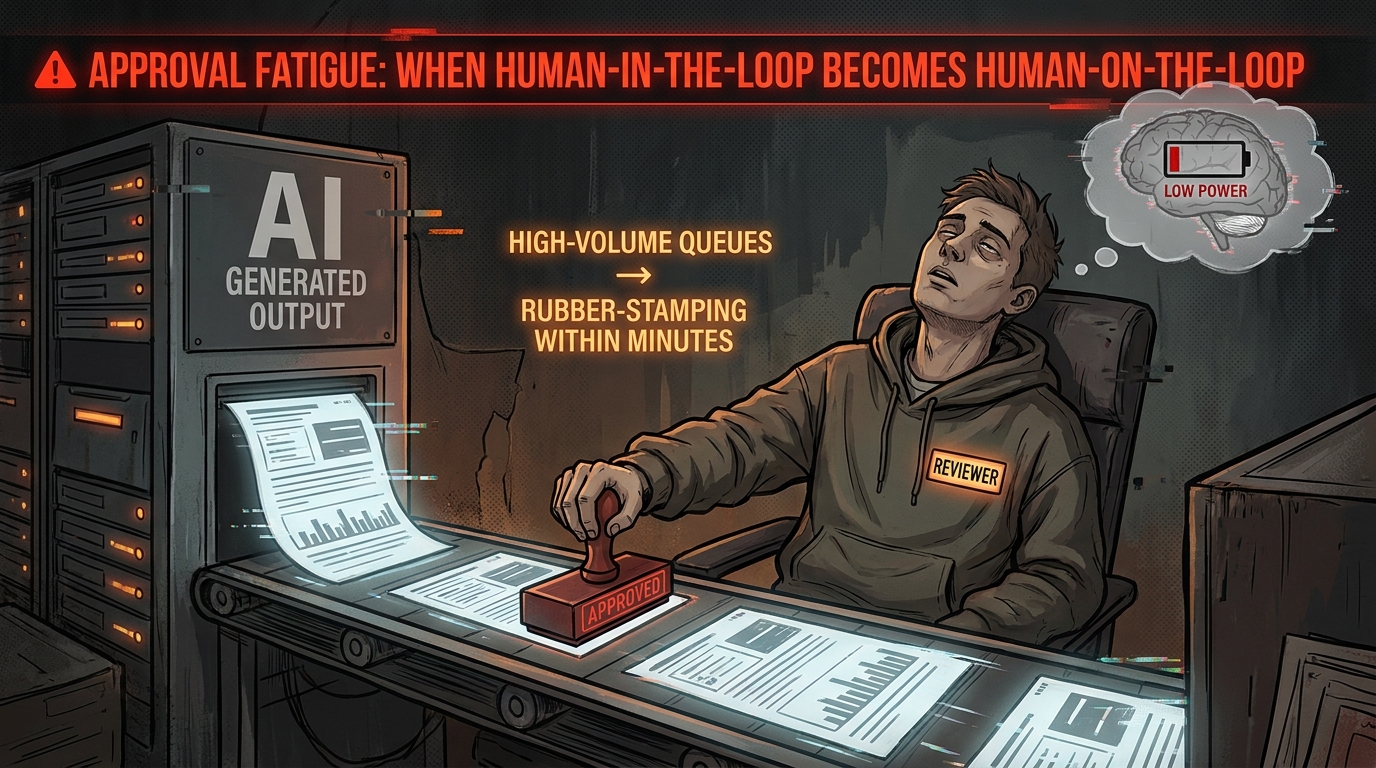
Automation bias is the tendency of humans to over-trust automated systems, defer to their outputs even when those outputs are wrong, and reduce independent verification over time. It has been documented in aviation, radiology, financial trading, and now systematically in AI oversight workflows. Understanding it is not optional for anyone designing human-in-the-loop systems at scale — it is the single most important failure mode to engineer against.
How Automation Bias Develops in Review Workflows
The mechanism is well-understood. When a reviewer first starts working with an AI system, they are appropriately skeptical. They check outputs carefully, catch errors, occasionally override, and develop a mental model of where the system is strong and where it fails. Over time, however, if the AI’s accuracy is reasonably high — say 87–93% — the reviewer experiences hundreds of validations for every override. The brain’s reinforcement learning system does what it is designed to do: it updates toward trusting the frequent pattern.
Within weeks, reviewers who were carefully verifying AI outputs are spending a fraction of their original review time per item. Within months, many have effectively delegated their judgment to the system and are primarily performing confirmation — checking that the AI produced something plausible rather than something correct. This transition happens gradually and often without the reviewer being consciously aware of it.
The “Human-on-the-Loop” Failure Mode
Enterprise AI governance analysts now distinguish between two functionally different states that can both be labeled “human-in-the-loop”:
- Human-in-the-loop (genuine): The human is making an independent judgment that could plausibly differ from the AI’s output. They are applying domain expertise, contextual knowledge, and critical evaluation that adds information to the decision.
- Human-on-the-loop (theater): The human is present in the workflow and technically approves outputs, but their approval is not adding information — it is ratifying whatever the AI produced with a human’s signature, creating a liability shield while providing no actual error-catching value.
The dangerous thing about human-on-the-loop is that it combines the worst properties of both oversight approaches. It preserves the latency cost of human review (since a human is still in the decision chain), while providing essentially none of the quality benefit. Worse, it creates a false audit trail: documentation records that a human reviewed and approved each output, which may satisfy a compliance checkbox while the actual error rate is no different from full automation.
Detecting Automation Bias in Your Current Workflow
There are several operational signals that automation bias has taken hold in a HITL workflow:
- Approval rate consistently above 95% in queues with more than 50 items/hour throughput
- Review time per item trending down over weeks without a corresponding improvement in AI accuracy or reviewer experience
- Override rate clustering near zero for a specific reviewer while remaining healthy for others
- Calibration drift: periodic re-injection of known errors fails to be caught at the expected rate
- Reviewer unable to articulate decision reasoning when spot-audited: they approved the item but cannot say why
The practical fix is not to admonish reviewers for becoming efficient — it is to redesign the workflow so that genuinely difficult cases are the only cases reaching human reviewers, keeping their cognitive load within a range where real evaluation is possible.
Risk-Stratified Architecture: The Framework That Makes Scaling Viable
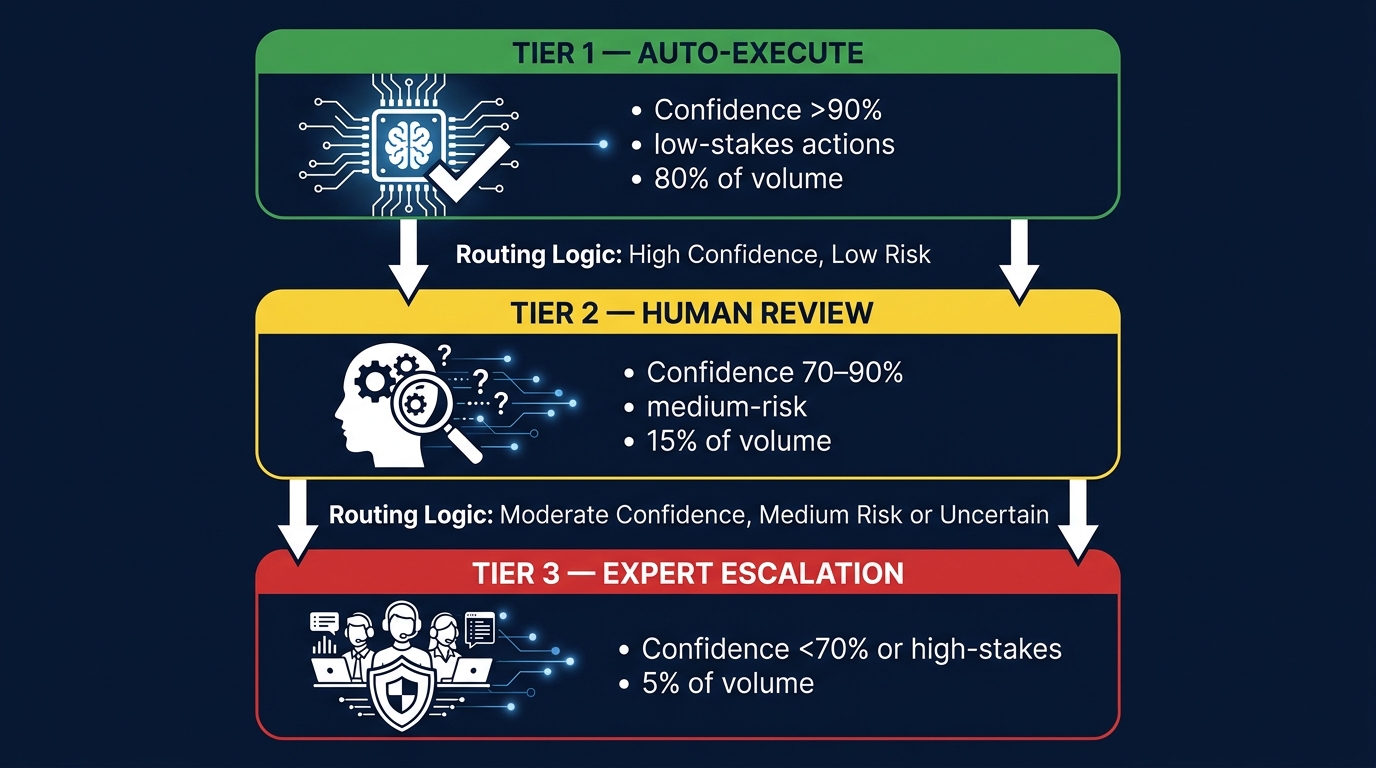
The solution to expensive, degrading universal review is not less oversight — it is tiered oversight calibrated to actual risk. Risk stratification is the core architectural pattern that allows organizations to scale AI decision volume by an order of magnitude without proportionally scaling reviewer headcount, while maintaining or improving genuine quality control.
The Three-Tier Model
The most robust HITL architectures in 2026 organize oversight into three tiers, each with different routing criteria, reviewer profiles, SLAs, and tooling:
Tier 1 — Autonomous Execution: High-confidence, low-stakes decisions that execute without human review. These cases meet a high confidence threshold (typically above 85–90%), fall within well-defined action scope limits, and have low error cost — meaning if the AI is wrong, the downstream impact is easily correctable. In a well-calibrated system, this tier should handle 75–85% of total decision volume.
Tier 2 — Standard Human Review: Medium-confidence or medium-risk decisions that require a trained reviewer to evaluate before execution. Cases land here either because model confidence falls in a middle band (typically 65–90%), because contextual risk flags are present, or because the decision type carries inherent risk regardless of model confidence. Target volume for this tier is 10–20%, with reviewers working at a sustainable pace that allows genuine evaluation — typically no more than 30–40 items per hour in complex domains.
Tier 3 — Expert Escalation: Low-confidence, high-stakes, or novel cases that require domain expert judgment or formal approval authority. These cases cannot be resolved by Tier 2 reviewers alone because they require specialized expertise, carry significant consequence, or represent a genuinely new pattern the model has not encountered. This tier should represent 3–8% of volume. It should never be allowed to grow significantly above that — if it does, it signals either a model performance problem or miscalibrated routing logic.
What Makes Routing Logic Actually Work
The routing logic that assigns decisions to tiers is the most technically demanding component of risk-stratified HITL. Naive implementations route solely on model confidence score, which is a reasonable starting point but insufficient on its own. Confidence scores are poorly calibrated for many production models — they tell you how certain the model is, not how much the model’s certainty correlates with actual accuracy.
More robust routing combines multiple signals:
- Model confidence score — necessary but not sufficient
- Domain risk classification — some decision types carry inherent stakes that require human review regardless of confidence
- Entity-level risk profile — decisions about high-value customers, large transactions, or flagged accounts escalate by default
- Novelty detection — inputs that fall significantly outside the distribution of training data trigger escalation even if model confidence is superficially high
- Historical accuracy by context — if the model has a documented performance weakness in specific input categories, those categories route to Tier 2 automatically
Organizations that invest in multi-signal routing typically achieve escalation rates 30–50% lower than those using confidence-only routing, while maintaining equivalent or better defect detection rates. The engineering cost is real but pays back quickly at production volumes.
Confidence Thresholds and the Double-Gate Pattern
One of the most consequential decisions in HITL system design is choosing where to place confidence thresholds — the numerical cutoffs that determine whether a decision goes to Tier 1, Tier 2, or Tier 3. Get this wrong in either direction and the economics collapse: too conservative and you overload reviewers with easy cases; too aggressive and you automate decisions that should have had oversight.
Why Single-Threshold Systems Fail
The obvious approach — set one confidence threshold and auto-approve everything above it — has a structural flaw. It conflates two very different categories of output: cases where the model is genuinely high-confidence because the input is clear and within training distribution, and cases where the model is superficially high-confidence because it has learned to produce high confidence scores on a certain input type regardless of actual accuracy. These look identical to a single-threshold filter but have very different real-world error rates.
A single threshold also creates a fragile cliff: cases just above the threshold are treated identically to cases far above it, even though their risk profiles are meaningfully different. And when model performance drifts over time — as it always does in production — the threshold calibration becomes stale without triggering any alert, silently increasing error rates in the autonomous tier.
The Double-Gate Pattern
The design pattern that has emerged as best practice in 2026 uses two confidence thresholds rather than one, creating three zones:
- Above upper gate (e.g., 90%): Auto-execute. High confidence + acceptable action scope = autonomous.
- Between gates (e.g., 70–90%): Route to human review. Genuine uncertainty zone where human judgment is most likely to add information.
- Below lower gate (e.g., below 70%): Route to expert escalation or automatic rejection. Confidence is too low to trust even with human review — the model does not know what it does not know.
The key insight behind the double-gate pattern is that different failure modes require different responses. Cases in the middle zone are genuinely uncertain — a human reviewer working with the right context can meaningfully improve the outcome. Cases below the lower gate are not uncertain in the sense of being close calls: they represent situations where the model is operating outside its competence boundary, and sending them to a standard reviewer who may not have the context to recognize that is actually more dangerous than routing them to expert escalation or rejection.
Threshold Calibration Is Not Set-and-Forget
Both thresholds should be treated as live operational parameters, not deployment-time configurations. Optimal threshold placement shifts as model performance evolves, as input distributions change with business growth, and as reviewer capacity fluctuates. Organizations running well-instrumented HITL systems in 2026 are recalibrating thresholds on a monthly cadence at minimum, using metrics from their review queues — actual human override rates by confidence band — to adjust where the gates sit.
A practical rule of thumb: if the human override rate for decisions just above your upper gate is higher than the override rate for decisions well above it, your upper gate is too low. If the override rate is essentially zero for decisions just below your upper gate, your gate is too high. The goal is a threshold placement where the human override rate in the review zone is meaningfully above zero and stable — typically 8–25% — indicating that reviewers are genuinely making different calls than the model would have made autonomously.
Asynchronous vs. Synchronous Review: Choosing the Right Mode for Each Tier
One of the most consequential and least-discussed design decisions in HITL architecture is whether human review happens synchronously (the AI waits for human approval before proceeding) or asynchronously (the AI proceeds while the review occurs in parallel, with correction capability if needed). The choice has profound implications for latency, throughput, reviewer experience, and the types of errors that can be caught.
Synchronous Review: When Waiting Is Worth It
Synchronous review — sometimes called “human-in-the-loop” in the strict sense — requires the AI workflow to pause and wait for human approval before the decision executes. This is the right architecture when:
- The decision is irreversible. If the AI’s action cannot be undone — a financial transaction, a patient medication order, a legal filing — the cost of getting it wrong before execution is higher than the cost of latency. Synchronous review is the correct default for all irreversible decisions above a materiality threshold.
- The decision has immediate external consequences. Actions that immediately affect external parties (customers, counterparties, regulators) before any correction window closes require synchronous oversight.
- The organization is in a calibration phase. Early in deployment when the model’s accuracy in a new domain is not yet well-characterized, synchronous review provides the most reliable signal about where the model is failing.
The critical constraint for synchronous review is SLA management. If you commit to synchronous oversight, you are committing to a human response time that must fit within your workflow’s acceptable latency budget. A synchronous review SLA of 4 hours is fine for a nightly contract analysis workflow. It is catastrophic for a real-time fraud detection system. Matching review mode to workflow latency requirements is not optional.
Asynchronous Review: The Overlooked Scaling Mechanism
Asynchronous review — where the AI executes the decision while human review happens concurrently, with rollback or correction capability — is significantly underused in enterprise AI deployments. Its underuse stems from a misunderstanding: organizations conflate “asynchronous review” with “no review,” when it is actually a different timing contract rather than a lesser one.
In an asynchronous model, the human reviewer examines outputs after execution but within a defined correction window. If they identify an error, there is a defined remediation path — a reversal, a correction notice, an override that applies to subsequent similar decisions. This architecture is genuinely appropriate for a wide range of business decisions where the consequences of a wrong output are material but not catastrophic, and where a short correction window is available.
The throughput advantages are significant. Asynchronous review decouples reviewer capacity from workflow throughput — the AI system runs at its natural speed, and reviewers work through the output queue at a pace that allows genuine evaluation. Cognitive overload drops because reviewers are not being driven by the real-time pace of AI output generation. And because corrections apply prospectively, a single reviewer catching a systematic error in asynchronous review can prevent hundreds of identical future errors, multiplying the value of each review event.
Making the Reversibility Assessment
The practical decision framework for choosing between synchronous and asynchronous review comes down to a reversibility and window assessment for each decision category:
- Can the decision be reversed within an acceptable time window if wrong? → Asynchronous is viable
- Is there a correction window between execution and material consequence? → Asynchronous is viable
- Does the decision immediately affect a third party in a way that cannot be corrected? → Synchronous required
- Is the error cost of a wrong decision roughly proportional to cost of delay? → Synchronous vs. async is a cost-optimization decision
Sampling Strategies That Preserve Quality Without Draining Capacity
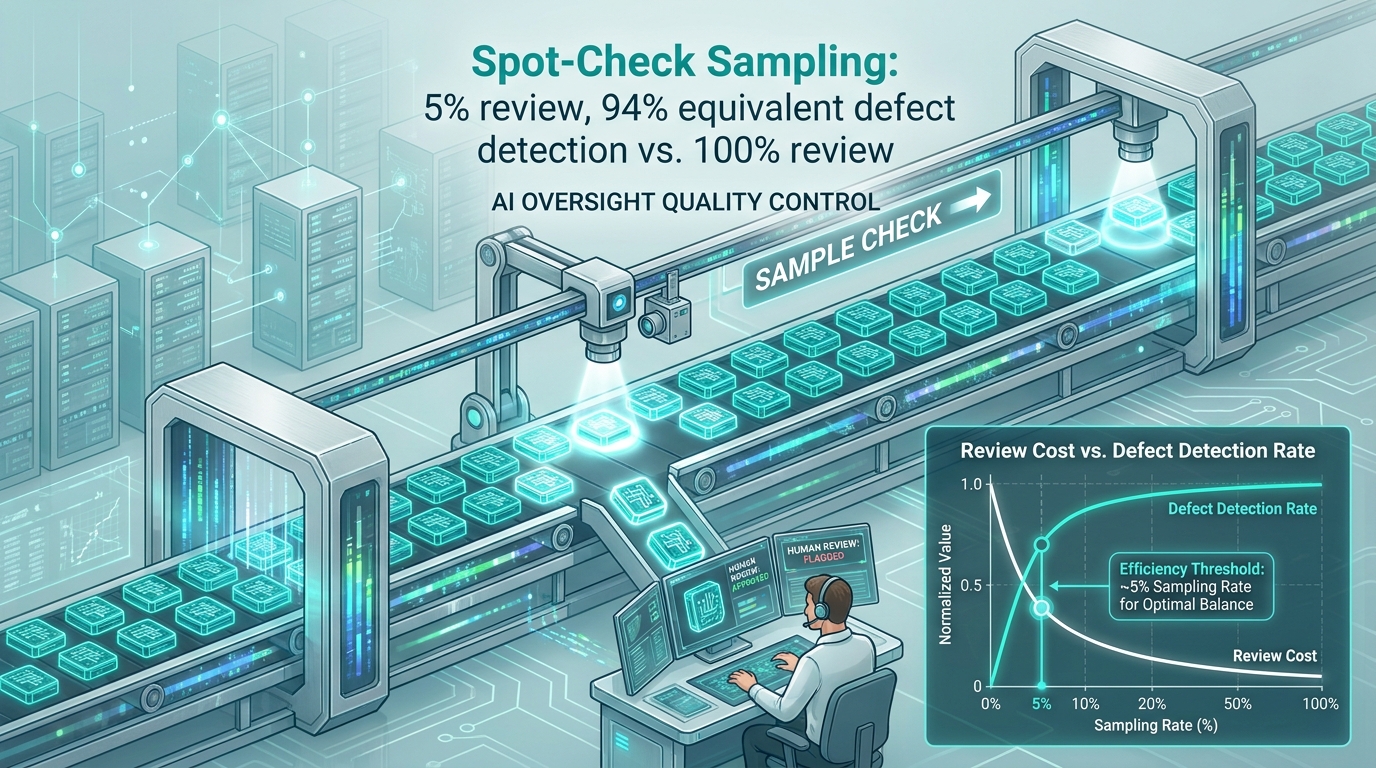
For the autonomous tier (Tier 1) of a risk-stratified HITL architecture, “no human review” does not mean “no oversight.” It means moving from pre-execution gating to post-execution sampling — a statistically governed audit process that detects systematic errors and model drift without reviewing every single output.
The Statistical Logic of Sampling-Based Oversight
Statistical sampling for quality control has a well-understood mathematics. For detecting a defect rate of 5% or higher, a random sample of 59 items provides 95% probability of detecting at least one defect. For detecting a defect rate of 1%, you need roughly 299 samples. These numbers hold regardless of the total population size — which is counterintuitive but accurate and has significant implications for HITL economics.
In practice: if your AI system processes 10,000 decisions per day in the autonomous tier, you need to review approximately 200–400 of them to maintain robust quality assurance with standard statistical confidence. That is a 2–4% sampling rate that provides detection power equivalent to reviewing far larger fractions of output. The cost difference — reviewing 300 items vs. reviewing 10,000 items — is the entire economic case for sampling-based oversight.
Stratified vs. Simple Random Sampling
Simple random sampling — randomly selecting items from the autonomous-tier queue — works well for detecting uniformly distributed errors. But most AI errors are not uniformly distributed. They cluster around specific input types, edge cases, data quality issues, or distribution shift in particular customer segments. Simple random sampling will systematically under-sample exactly these high-risk clusters.
Stratified sampling addresses this by drawing samples proportional to risk within defined strata:
- Confidence distribution sampling: Over-sample decisions near the upper confidence gate, where the model’s error rate is highest within the autonomous tier
- Novel input sampling: Flag and sample decisions where input features are unusual relative to historical distributions — these are where unreported model weaknesses most often surface
- Output distribution sampling: Sample outputs at the tails of the output distribution — unusually high or low values, unusual classifications — which are more likely to represent genuine edge cases than outputs clustering near the mean
- Time-stratified sampling: Ensure samples are drawn across all time periods, not just recent output — this catches gradual model drift that simple recent-window sampling misses
Sentinel Cases: The Underused Quality Signal
One of the most effective and underused tools in sampling-based HITL oversight is the sentinel case — a deliberately injected known-answer item that is routed through the autonomous tier and caught by sampling. Sentinel cases serve two purposes: they validate that your sampling infrastructure is actually catching items from the autonomous tier (not just routing everything to review), and they provide a direct measurement of model accuracy on known cases over time.
Well-designed sentinel programs use a library of cases with known correct answers, injected at a rate of roughly 1–2% of autonomous-tier volume. If sentinel error rates climb above a defined threshold, it triggers an escalation — either to recalibrate the confidence thresholds or to pull the autonomous tier offline for revalidation. This is the closest equivalent to a circuit breaker for AI quality, and it works without requiring human review of every output.
Building the Oversight Stack: Roles, Tooling, and SLAs
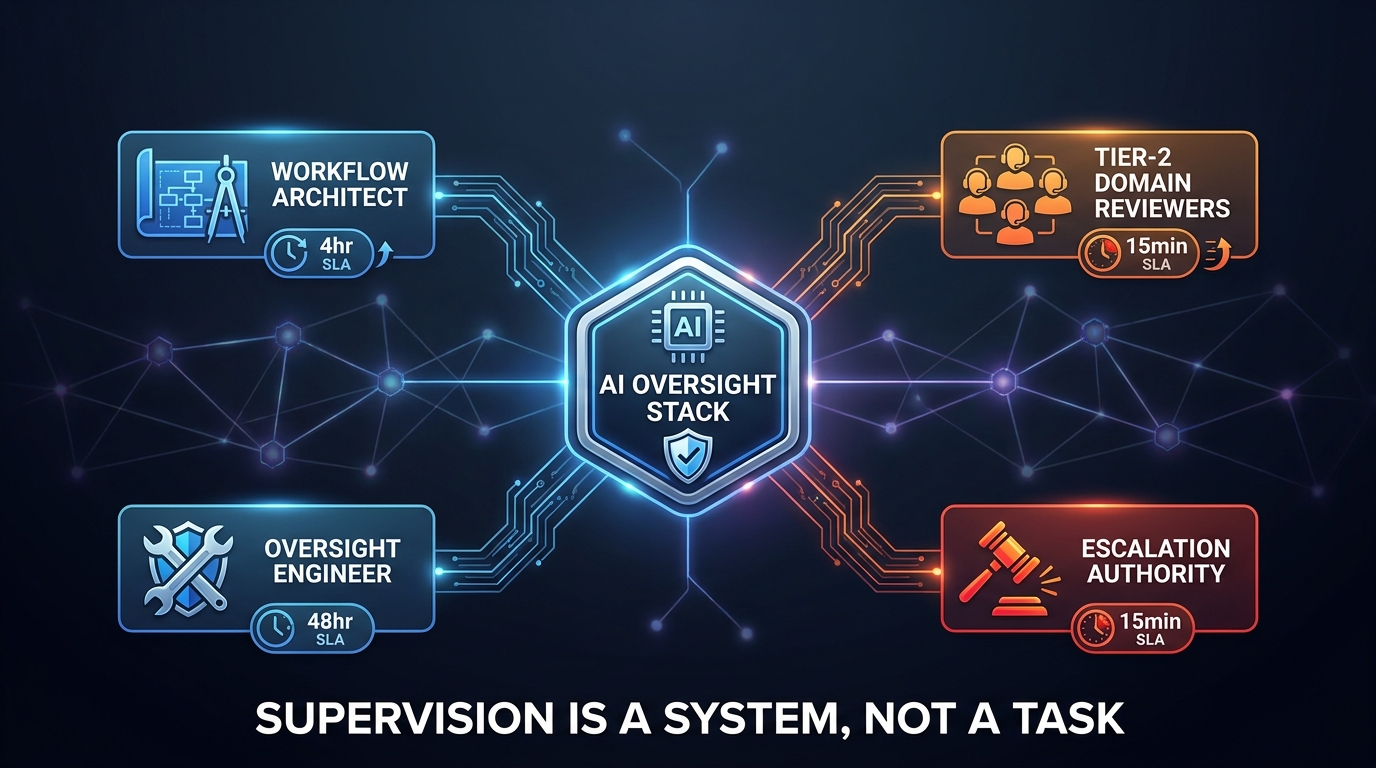
The most persistent mistake in enterprise HITL design is treating oversight as a task that gets appended to existing job descriptions rather than as a function that requires purpose-built roles, tooling, and service-level agreements. When oversight is bolted onto other responsibilities, it consistently loses to those responsibilities under time pressure — which is precisely when oversight is most needed.
The Specialized Roles Emerging in Production HITL Teams
Mature HITL deployments in 2026 have begun to formalize oversight into distinct roles with explicit decision authority. The emerging structure includes four core functions:
Oversight Engineer: Owns the technical infrastructure of the HITL system — routing logic, confidence calibration, monitoring dashboards, sampling systems, and integration between the AI pipeline and review tooling. This is a hybrid role sitting between ML engineering and operations, with accountability for whether the HITL system is functioning as designed. Not every organization has the headcount for a dedicated Oversight Engineer at launch, but someone needs to own these responsibilities explicitly — assigning them implicitly to whoever is available is how systems drift toward the “theater” failure mode.
Workflow Architect: Designs the decision taxonomy (what types of decisions go where), defines the routing rules, and maintains the tier-assignment logic as the AI system and business context evolve. This role bridges the technical system and the business requirements, translating risk tolerance and compliance requirements into concrete routing specifications. In regulated industries, this role often sits at the intersection of AI engineering and risk management functions.
Domain Reviewers (Tier 2): The people doing the actual work of human review. The critical shift in 2026 is treating these as specialist roles rather than generalist ones. Effective Tier 2 reviewers are domain experts with calibrated judgment in the AI system’s application area — not general-purpose employees asked to evaluate outputs in a domain they do not deeply understand. Reviewer specialization is strongly correlated with both review quality and sustainable reviewer satisfaction; generalist reviewers tend toward automation bias faster because they lack the domain knowledge to efficiently identify what is worth scrutinizing.
Escalation Authority: A named individual or panel with the decision rights and accountability to resolve Tier 3 escalations — novel cases, edge cases, and high-stakes decisions that Tier 2 cannot resolve. Escalation Authority is not a team of full-time reviewers; it is a defined governance structure that ensures escalated cases have a clear resolution path with a defined SLA, rather than disappearing into a scheduling queue.
Tooling Requirements That Most Teams Underestimate
The tooling surface for a production HITL system is larger than it appears at design time. The minimum viable oversight stack includes:
- Reviewable decision interface: A structured UI that presents the AI’s input, proposed output, confidence score, routing reason, and any relevant context in a single view — without requiring the reviewer to navigate between multiple systems. Cognitive load in the review interface directly affects review quality; every extra click is a judgment degrader.
- Override recording with rationale capture: Not just the fact of an override, but a structured record of why. Rationale data from overrides is the primary raw material for model improvement and threshold recalibration — organizations that capture only “approved/rejected” lose the most valuable training signal.
- Queue management with real-time depth visibility: Reviewers and queue managers need to see queue depth, age of oldest item, and throughput rate in real time. This is the instrumentation that allows workload adjustments before cognitive overload sets in, not after.
- Audit log with tamper evidence: A complete, chronologically ordered record of every decision, its routing tier, the reviewing identity, the outcome, and the timestamp. In regulated environments, this needs to be tamper-evident and accessible to compliance functions without requiring access to the operational system.
- Monitoring dashboard with leading indicators: Not just output metrics (accuracy, error rate) but leading indicators of HITL system health: review time per item trends, approval rate trends, queue depth over time, override rate by reviewer and by model confidence band.
SLAs Are Not Optional
Without defined SLAs, HITL systems develop informal norms about response time that are almost always too slow, inconsistently applied, and impossible to audit. Every tier in a risk-stratified architecture needs a defined maximum response time that is owned by a named function:
- Tier 2 reviews: typically 15 minutes to 4 hours depending on workflow latency budget
- Tier 3 escalations: typically 4–48 hours depending on decision urgency
- Sampling audits: completed within defined cycles (daily, weekly) with escalation triggers for detected anomalies
When SLAs are breached, there should be a defined response: automated alerts, escalation to the next authority, or temporary workflow modification (e.g., hold autonomous-tier execution until backlog clears). Treating SLA breaches as operational data rather than operational failures allows the system to self-correct rather than quietly degrade.
Measuring Whether Your HITL Is Actually Working
Most HITL programs are measured on the wrong things. They track volume (how many items were reviewed), time (how long reviews took), and cost (what reviewers were paid). These are operational hygiene metrics. They tell you the system is running — not whether it is working. A genuinely effective HITL measurement framework centers on a different set of questions.
The Metrics That Signal Real Oversight Quality
Human Override Rate by Confidence Band: The most important single signal of HITL system health. Measures the fraction of reviewed items where the human reviewer reaches a different conclusion than the AI’s output. Healthy override rates are typically 8–25% within the review tier, and they should be higher for items near the lower confidence gate and lower for items near the upper gate. A flat override rate across the confidence spectrum suggests reviewers are not responding to model uncertainty signals — a calibration problem.
Downstream Error Rate by Tier: Of decisions that passed through each tier and executed, what fraction were later identified as wrong — through customer complaints, outcome tracking, audit findings, or sentinel re-injection? This is the ground-truth measure of whether each tier’s oversight level is appropriate. If Tier 1 autonomous decisions show a materially higher downstream error rate than Tier 2 reviewed decisions, the upper confidence gate is set too low (letting too many uncertain decisions through to autonomous execution).
Review Time Trend: Average time per review item over rolling weekly periods. A declining trend in review time, absent a deliberate change in workflow complexity or reviewer experience, is a leading indicator of automation bias taking hold. Flag it before it becomes a quality problem.
Queue Age Distribution: Not just how many items are in the queue, but how old they are. Items sitting in a review queue for more than twice the target SLA are an operational failure that most queue-depth metrics will not surface unless you specifically track age distribution. Old items tend to get bulk-approved under time pressure — exactly the wrong outcome.
Escalation Rate Stability: The fraction of Tier 2 reviews that escalate to Tier 3 over time. An escalating trend means either model performance is degrading (more items require expert judgment) or reviewer confidence is declining (reviewers are escalating items they could resolve themselves). A declining trend is healthy — until it reaches zero, at which point reviewers have likely stopped escalating anything and the Tier 3 path is functionally dead.
Building a HITL Health Score
The most operationally effective teams in 2026 are building composite HITL health scores — single numbers synthesizing the above metrics into a weekly or daily readout. The construction is simple: define green/yellow/red ranges for each metric, assign weights based on consequence (override rate and downstream error rate typically weighted highest), and combine into a dashboard indicator that any stakeholder can read without navigating five separate dashboards.
The health score does not need to be statistically sophisticated to be useful. Its primary value is creating a shared, visible signal that HITL system quality is tracked and owned — not assumed to be fine until something breaks.
What the Economics Look Like at 10x Volume
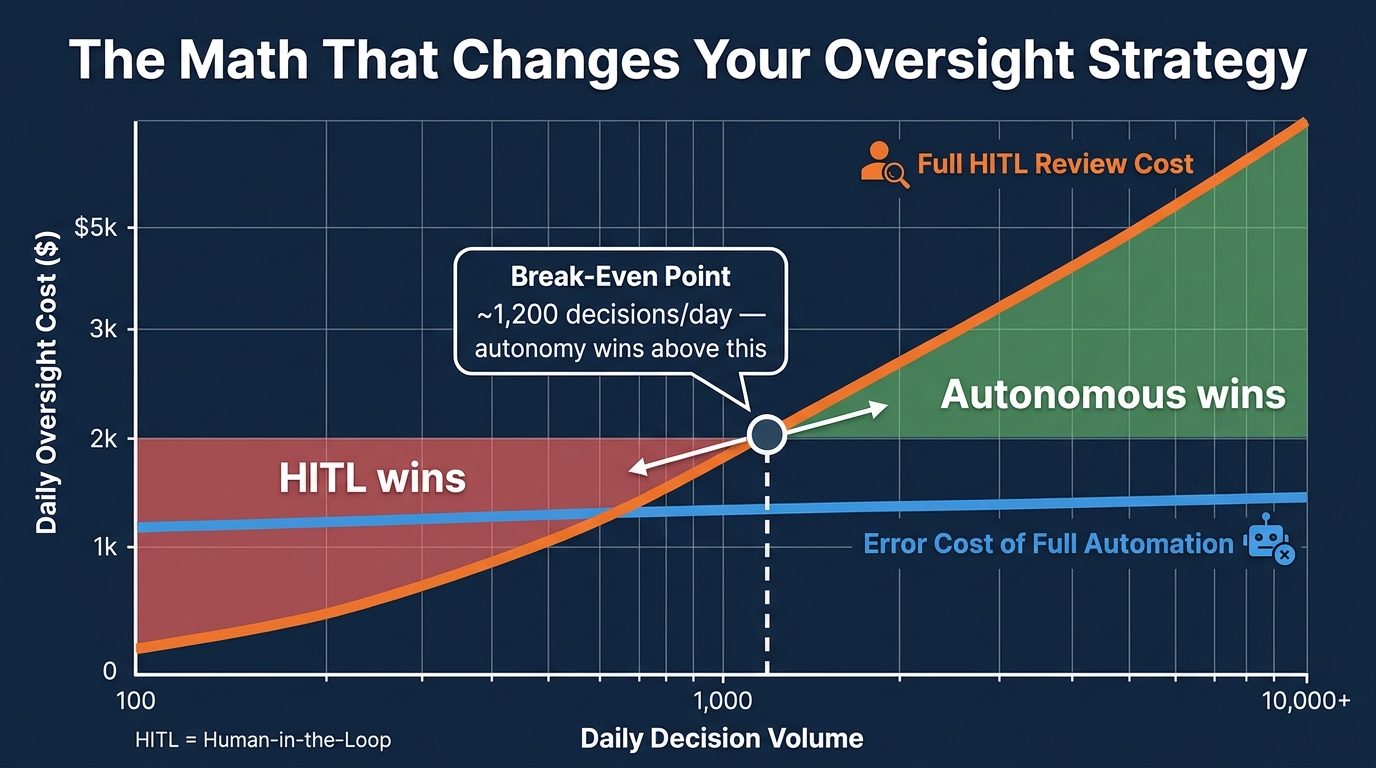
Here is the scenario most HITL design decisions need to be stress-tested against: your AI system is working. The business case held up. Volume is growing. What happens to your oversight costs and quality at 5x, 10x current volume?
The Three Scenarios
Consider an organization processing 1,000 AI decisions per day today, with a universal review model (every decision reviewed). At that volume, 3 reviewers can keep up with a sustainable workload at roughly 60 reviews per hour each.
Scenario A — Scale without redesign (universal review at 10x): At 10,000 decisions per day, the same universal review model requires 30 reviewers. At fully loaded cost of $75,000–$90,000 per reviewer per year, that is $2.25M–$2.7M in reviewer salaries alone — before tooling, management, training, and overhead. The review queue’s throughput ceiling also means that unless all 30 reviewers are on the same shift, peak-hour decision volumes will exceed reviewer capacity and queue age will grow. This scenario is what most organizations are sliding toward, usually without explicitly deciding to.
Scenario B — Risk-stratified architecture at 10x: The same 10,000 decisions per day, but routed through a three-tier system with 80% autonomous, 15% Tier 2 review, 5% Tier 3 escalation. At 1,500 decisions per day reaching human review (combined Tier 2 and Tier 3), you need 5–6 reviewers plus 2–3 domain experts for Tier 3, at a total headcount of 8–9 FTEs. Cost: approximately $600,000–$750,000 per year in reviewer labor. The saving vs. Scenario A is $1.5M–$2M annually at 10x volume.
Scenario C — Sampling-augmented hybrid at 10x: Risk-stratified architecture plus sampling-based audit for the autonomous tier. Human review touches roughly 15% of total decisions pre-execution (Tier 2) and 5% post-execution (sampling audit). Total human decision-touching rate: 20%. Total reviewer headcount: 6–7 FTEs. Annual cost: $450,000–$525,000. The saving vs. Scenario A is $1.8M–$2.25M annually.
The Quality Trade-off Is Smaller Than You Think
The natural concern about reducing review coverage is error rate. Will catching fewer decisions per unit time mean more errors slip through? In well-designed systems, the answer is counterintuitive: not necessarily. The key insight is that quality in universal review systems is already seriously degraded by overload — the 30 reviewers in Scenario A are rubber-stamping most of what they see. Meanwhile, the 8 reviewers in Scenario B are evaluating genuine borderline cases and bringing real domain expertise to the decisions that need it most.
Multiple enterprise deployments comparing pre- and post-stratification error rates have found that risk-stratified systems with 15–20% human review coverage achieve roughly equivalent downstream error rates to overloaded universal review systems at 100% coverage — and in several cases actually outperform them, because reviewers are no longer cognitively depleted by the time they encounter genuinely difficult cases.
When the Break-Even Math Flips
There is a volume threshold below which full HITL review is economically rational — roughly when the expected cost of undetected errors (error rate × average error cost × daily volume) exceeds the daily cost of universal review. This threshold is highly domain-dependent: in high-stakes decisions (medical, financial, legal), the error cost is so high that full review may remain justified at significant volumes. In lower-stakes automation (content moderation, recommendation generation, routine data classification), the break-even point is typically reached much sooner — often before 500–1,000 decisions per day.
The discipline of explicitly computing this break-even for each decision category in your AI system is one of the most valuable exercises an oversight architect can run. It transforms the debate from “how much oversight is enough?” (an unanswerable philosophical question) to “at what volume does the expected value of this review tier go negative?” (a quantifiable engineering question with a specific number answer).
The Regulatory Dimension: Compliance Requirements Without Compliance Theater
No treatment of human-in-the-loop design in 2026 is complete without addressing the regulatory environment, which has become a significant driver of HITL architecture decisions — particularly for organizations operating under the EU AI Act, sector-specific AI guidance from financial regulators, and evolving healthcare AI oversight frameworks.
What Regulators Actually Require
The common misconception is that regulation requires “a human reviewed every decision.” In practice, most current regulatory frameworks require something considerably more nuanced: meaningful human oversight calibrated to the risk level of the application. The EU AI Act’s requirements for high-risk AI systems, for instance, mandate that systems be designed to allow human oversight, that humans be capable of intervening, and that appropriate measures are taken to ensure oversight is effective — not that every decision is manually reviewed.
This distinction matters enormously. A well-designed risk-stratified HITL system with documented routing logic, defined escalation paths, maintained audit trails, and evidence-based calibration of tier thresholds typically satisfies regulatory oversight requirements far better than an overloaded universal review process in which reviewers are rubber-stamping at speed. Regulators increasingly understand the difference, and compliance teams that conflate “any human touchpoint” with “meaningful oversight” are creating both unnecessary cost and false compliance confidence.
What Documentation Actually Needs to Exist
For organizations in regulated industries, the documentation requirements for HITL systems are specific and non-trivial. At minimum, production HITL systems should maintain:
- A decision taxonomy classifying each AI action type by risk tier with documented rationale
- Threshold calibration records showing the basis for confidence gates and evidence of their effectiveness
- Reviewer competence records linking each review authority to the qualifications required for their tier
- Audit logs sufficient to reconstruct any individual decision’s routing path, review outcome, and reviewer identity
- Monitoring records showing HITL system health metrics over time, with evidence that anomalies triggered appropriate responses
Organizations that build this documentation infrastructure during initial deployment rather than retrofitting it at audit time avoid both the compliance panic and the significant cost of post-hoc documentation reconstruction.
Designing for the Next Order of Magnitude
The organizations getting HITL right in 2026 are not thinking about their current volume — they are designing for where they will be in 18 months. The architectural decisions made at low volume create path dependencies that are expensive to unwind later. A universal review system that was “good enough” at 500 decisions per day becomes a $2M annual problem at 5,000 decisions per day, and redesigning it under production pressure is a significantly worse option than designing it for scale from the start.
The Architectural Decisions That Compound
Several early HITL design decisions have outsized impact on scalability:
Routing logic location: If your routing logic is embedded in the AI model output pipeline rather than in a dedicated routing service, recalibrating thresholds requires a pipeline change rather than a configuration change. This means threshold recalibration happens infrequently (because it’s costly) rather than continuously (because the system makes it easy). Build routing as a separate, configurable service from day one.
Review interface design: Review interfaces built for small teams quickly become unusable at scale. The design decisions that matter — how much context is surfaced per item, how overrides are captured, how queue management works — are much easier to get right at the beginning than to retrofit into a production system with an established user base of reviewers who have adapted their workflows to whatever the interface currently does.
Audit log schema: Audit logs that record only approved/rejected status are worthless for calibration, improvement, and compliance. Audit logs that record input features, confidence scores, routing reasons, reviewer identity, override rationales, and downstream outcomes are extraordinarily valuable. The difference in storage and implementation cost is small. The difference in downstream utility is immense.
The AI-Assisted Review Transition
The next frontier in scalable HITL — already in early production deployment at several large technology and financial services organizations — is AI-assisted review, where a second AI system helps the human reviewer by surfacing relevant precedents, flagging specific features of the input that drove the model’s decision, and predicting which aspects of the output are most likely to contain errors based on historical override patterns.
This is not the same as using AI to replace human review. The human remains the decision authority. But the cognitive burden on the reviewer shifts from “evaluate this output from scratch” to “assess whether this AI-flagged concern is genuinely a concern.” Early results suggest this hybrid approach can reduce review time per item by 30–50% without reducing — and in some cases while improving — override rate and downstream error detection. As this pattern matures, it represents a plausible path to sustaining meaningful human oversight at volumes that would otherwise be unmanageable.
Supervision as Infrastructure: The Closing Argument for Investing in HITL Design
The frame of “human-in-the-loop as cost center” is ultimately the wrong frame, even though cost is real. The more useful frame is supervision as infrastructure — a foundational capability that enables the organization to deploy AI at scale with confidence, that provides the quality signal needed for continuous model improvement, that satisfies regulatory requirements without creating compliance theater, and that preserves institutional accountability in automated decision systems.
Infrastructure investment decisions are made differently than operational expense decisions. When you build a payment processing system, you do not try to minimize the cost of fraud detection to zero — you invest in fraud detection as a capability that makes the entire payments system trustworthy and scalable. HITL oversight deserves the same framing: not “how little can we spend on this?” but “what is the oversight capability worth to our ability to deploy AI at scale and stand behind its outputs?”
Actionable Takeaways for Teams Designing or Redesigning HITL Today
- Compute your per-decision review cost at current and projected volume before any other architectural decision. Know the number. It is almost always larger than teams assume when they include fully loaded labor costs, tooling overhead, and latency cost.
- Audit your current approval rates. If Tier 2 approval rates are consistently above 93–95%, you do not have a review process — you have an approval process. Diagnose whether the threshold is miscalibrated or automation bias has taken hold.
- Map your decision taxonomy by reversibility and error cost before choosing synchronous vs. asynchronous review mode. Not every AI decision needs pre-execution approval.
- Build routing logic as a standalone, reconfigurable service rather than embedding it in the model pipeline. Threshold recalibration should be a configuration operation, not a deployment event.
- Define explicit SLAs for each tier and assign ownership for SLA compliance. Unowned SLAs are advisory documents that will be violated as soon as volume pressure arrives.
- Invest in override rationale capture. The qualitative signal in reviewer overrides is the highest-ROI input to model improvement, and most HITL systems throw it away by capturing only binary outcomes.
- Run your HITL architecture through a 10x volume stress test before committing to a design. If it requires proportional headcount scaling, it will fail at scale. Redesign it now while the decision is cheap.
Supervision is expensive. But poorly designed supervision is far more expensive — it costs all the money of proper oversight and delivers none of the quality. The difference between HITL as a liability and HITL as a strategic capability is almost entirely an architectural and operational design question. The organizations that figure this out early will be the ones running AI systems at the next order of magnitude without rebuilding their oversight stack from scratch every time the volume doubles.