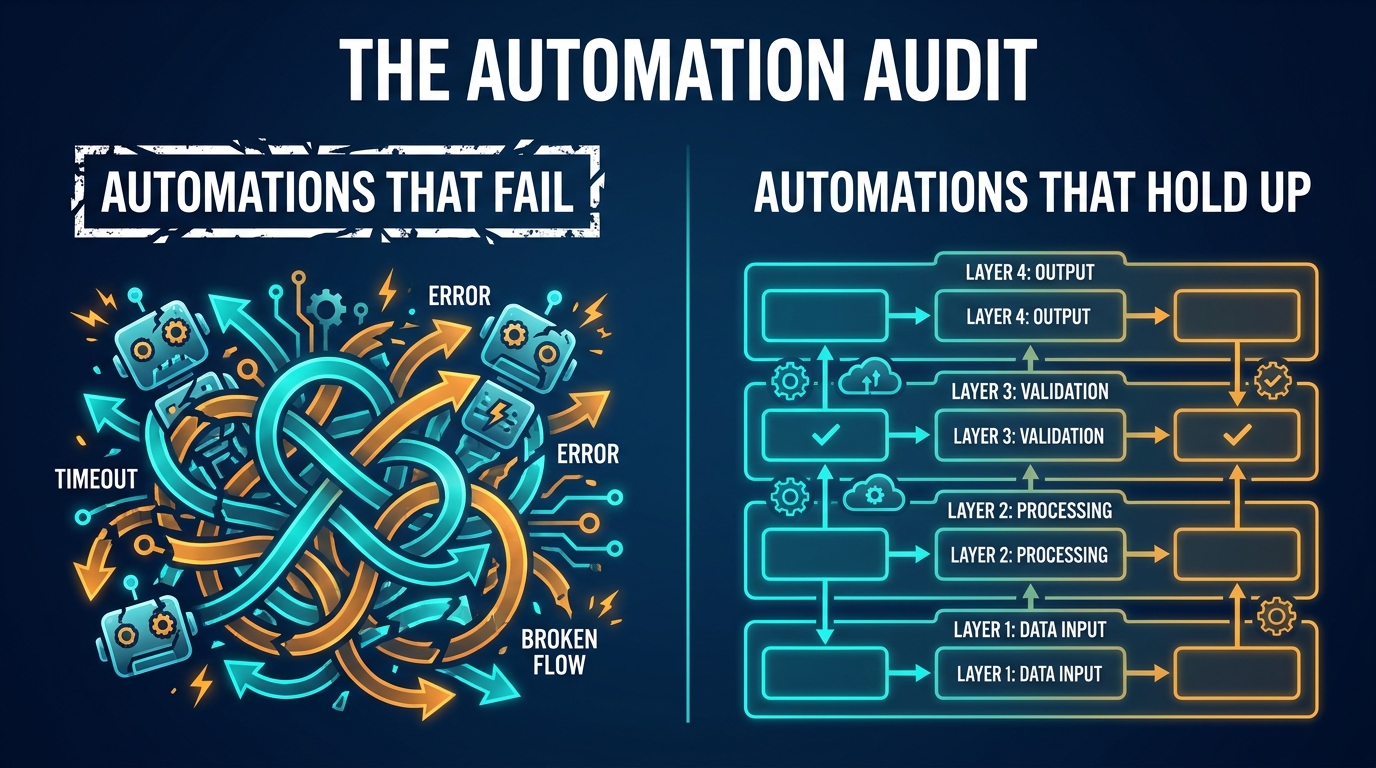
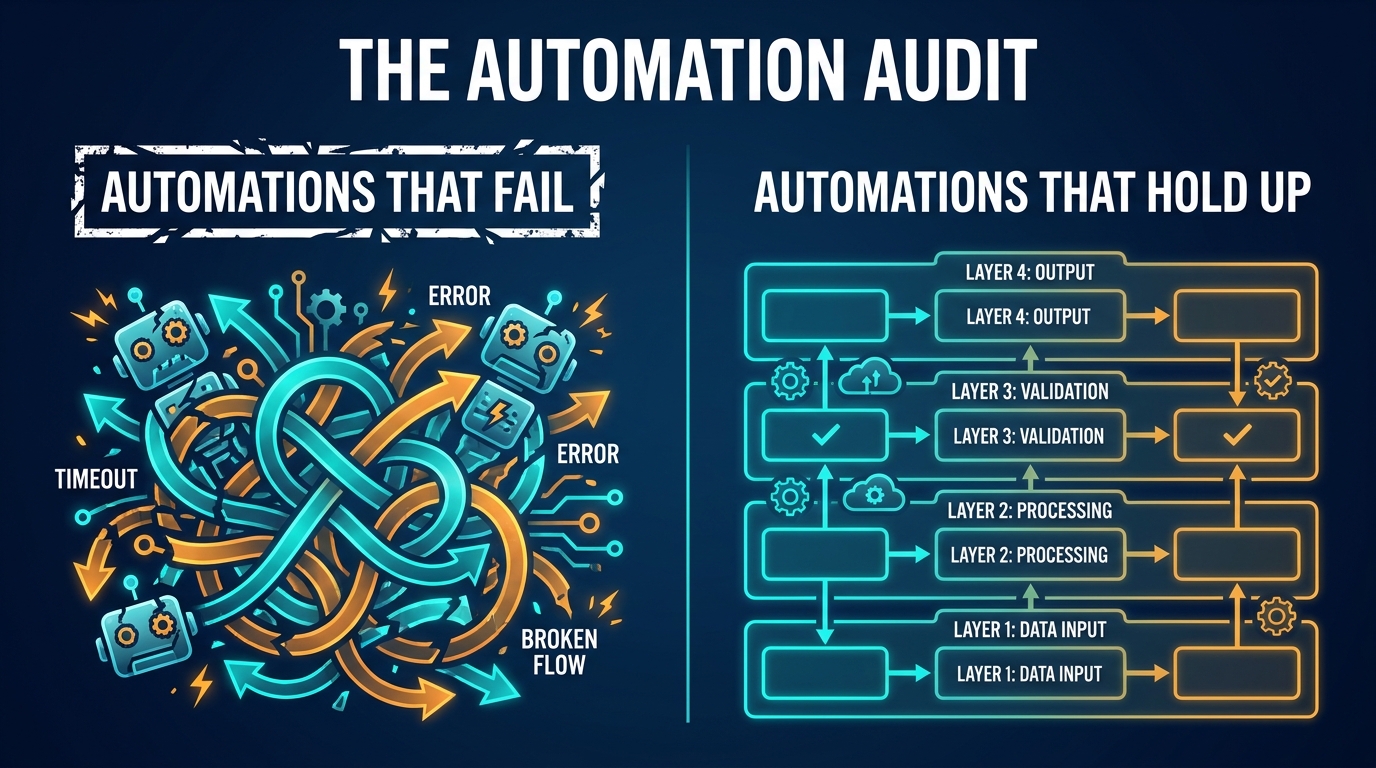
Ask most operations leaders what their AI automation strategy looks like, and you’ll get one of two answers. Either they’ll describe a sprawling, somewhat chaotic collection of bots and workflows that “sort of works,” held together by a few spreadsheets and a lot of tribal knowledge. Or they’ll admit, quietly, that they haven’t really started yet — because every time they try to figure out where to begin, the whole thing feels overwhelming.
Both are symptoms of the same root problem: most teams approach AI automation as a technology decision when it’s actually a process decision. They ask “which AI tool should we buy?” before they’ve answered “which processes are actually worth automating, in which order, and with what guardrails?”
That sequencing mistake is expensive. Gartner research has consistently found that the majority of early automation deployments underdeliver — not because the technology failed, but because the wrong processes were automated, in the wrong order, without the data quality or human oversight structures needed to sustain them.
This guide takes a different approach. Instead of cataloguing what AI can automate (the internet has no shortage of those lists), it walks through the decision science behind choosing what to automate first, why, and how to build it so it doesn’t quietly break six months later. Think of it as the engineering mindset applied to automation strategy — rigorous, methodical, and honest about what the technology can and cannot do reliably.
Whether you’re mapping your first five automations or auditing a portfolio of 50, what follows is a structured framework for building AI workflows that hold up under real operating conditions.
Why Most AI Automations Are Solving the Wrong Problem
The first and most common mistake in AI automation is picking the wrong target. This happens in a predictable pattern: a team sees a task that feels manual and annoying, decides AI should handle it, and builds a workflow around it — without ever checking whether that task is actually the right lever to pull.
The Visibility Trap
Tasks that look repetitive from the outside aren’t always good automation candidates. A customer service rep triaging emails looks repetitive — same inbox, same categories, day after day. But the actual decision-making involved might be highly contextual: flagging an email as urgent based on account value, relationship history, tone, contract status, and unspoken implication. That’s not a rules-based task. That’s nuanced judgment wrapped in a repetitive interface.
When companies automate this without accounting for that complexity, they end up with bots that mis-categorize high-value accounts, frustrate long-tenured clients, and create more cleanup work than the original manual process. The automation looks like it’s working — tickets are moving — but the quality outcomes are worse than before.
The “Pain Point” Fallacy
Another common trap: automating what hurts most rather than what will yield the most. Operations teams naturally gravitate toward their biggest pain points. But high pain doesn’t always correlate with high automation potential. A slow, frustrating process might be slow and frustrating precisely because it requires constant human judgment, exception handling, or regulatory oversight — all of which make it a poor candidate for autonomous AI execution.
The processes that should be automated first are often the unglamorous, low-visibility ones: invoice matching, data enrichment, report generation, meeting note distribution, CRM field updates. Nobody complains about these loudly. Nobody gets a promotion for fixing them. But they consume significant human time across every department, and they’re structurally well-suited for AI — high volume, consistent structure, clear success criteria, low cost of error.
The Measurement Gap
Perhaps most critically: most automation decisions are made without any baseline measurement of the current process. Teams don’t know how long the manual task actually takes, what the error rate is, or how much rework happens downstream because of those errors. Without that baseline, you can’t calculate ROI, you can’t prove the automation is working, and you can’t justify the next investment in the program.
Before you automate anything, you need to measure it. That means timing the manual process, counting errors, mapping the exceptions, and understanding what “good” looks like. That measurement step is what separates automation programs that get bigger over time from ones that stall after the first deployment.
The Four Dimensions of an Automatable Task
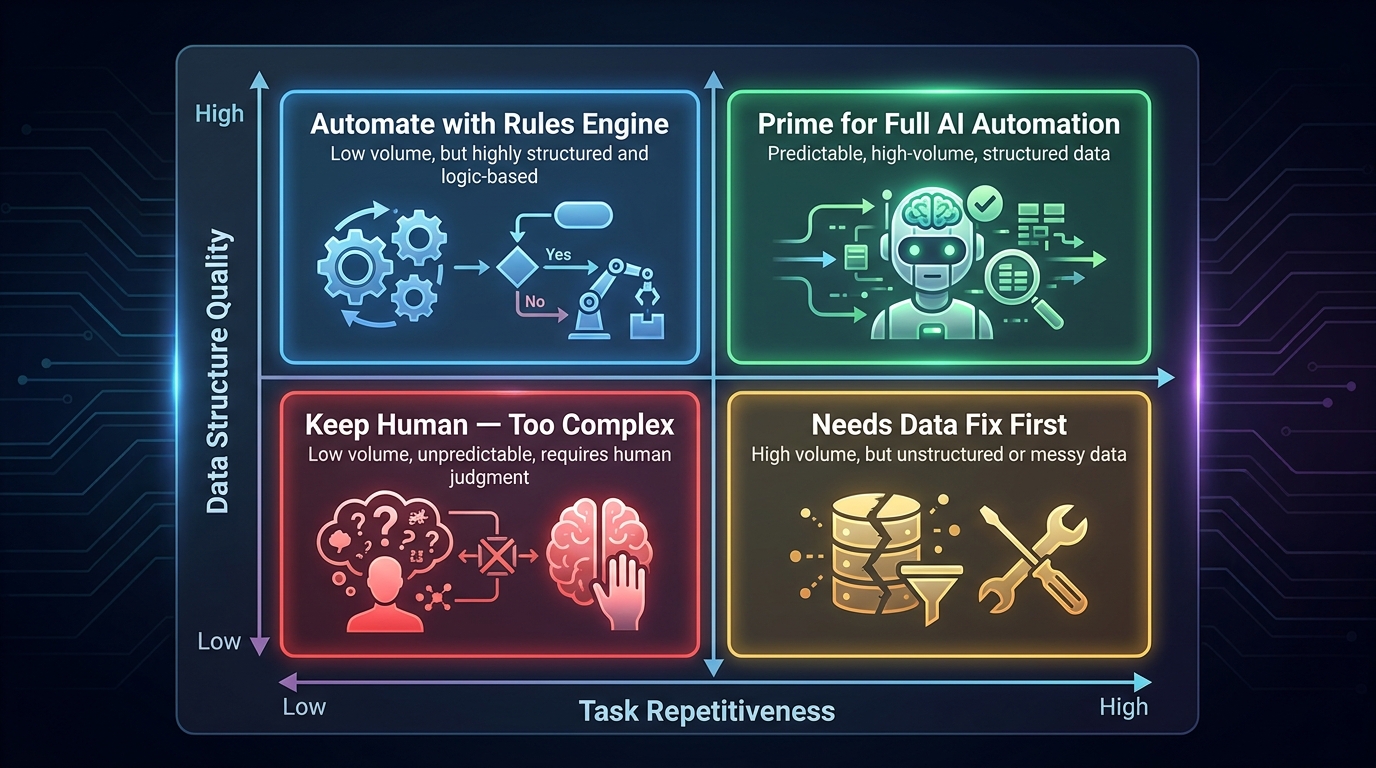
Rather than gut-checking whether something “feels” automatable, experienced automation architects evaluate tasks against a consistent set of dimensions. Four of these dimensions — taken together — give you a reliable read on whether a process is ready for AI, needs preparation work first, or should stay human for now.
Dimension 1: Structural Consistency
How consistent is the input the process receives? Does it always arrive in the same format, from the same source, with the same fields populated? Invoice processing from a set of known vendors is highly structurally consistent. Customer emails are not. The more variable the input structure, the more AI capability (specifically NLP or multimodal models) you need to handle it reliably — and the more edge cases you need to account for in your design.
Score this dimension 1–5. A process scoring below 3 either needs a pre-processing layer to normalize inputs, or it needs a more sophisticated AI model than a simple rules engine can provide.
Dimension 2: Decision Complexity
How many variables influence the outcome, and how context-dependent are they? Approving a standard purchase order under a set dollar threshold has low decision complexity — it’s essentially a yes/no based on a few checkable conditions. Deciding how to respond to a client escalation requires judgment about relationship history, strategic account value, internal capacity, precedent, and tone. That’s high decision complexity.
Low complexity tasks are safe for full automation. Medium complexity tasks are candidates for AI-assisted decisions where a human reviews and approves AI recommendations. High complexity tasks should stay largely human-driven, with AI handling data gathering and preparation rather than the decision itself.
Dimension 3: Volume and Frequency
Even a perfectly automatable task may not be worth automating if it only happens twice a month. The ROI math only works when the time savings across the year justify the build cost and ongoing maintenance overhead. A useful benchmark: if a task takes more than 2 hours per week per person performing it, or happens more than 50 times per week at the team level, it’s worth putting on the automation roadmap. Below that, the time invested in building and maintaining the automation may exceed the time saved.
Dimension 4: Cost of Error
What happens when the automation gets it wrong? This is the most underweighted dimension in most automation evaluations. A mis-labeled internal file is low cost of error. A mis-routed regulatory compliance document, an incorrect patient record update, or an automated pricing decision that undersells a high-margin product by 40% — these are high cost of error situations. The higher the error cost, the more human oversight you need to build into the design, and the longer you should run parallel manual processes before fully handing off to the machine.
Mapping every candidate process against these four dimensions gives you a defensible, data-driven prioritization that’s hard to argue with — and that will save you from expensive mistakes.
Building the Automation Audit: A Room-by-Room Walkthrough
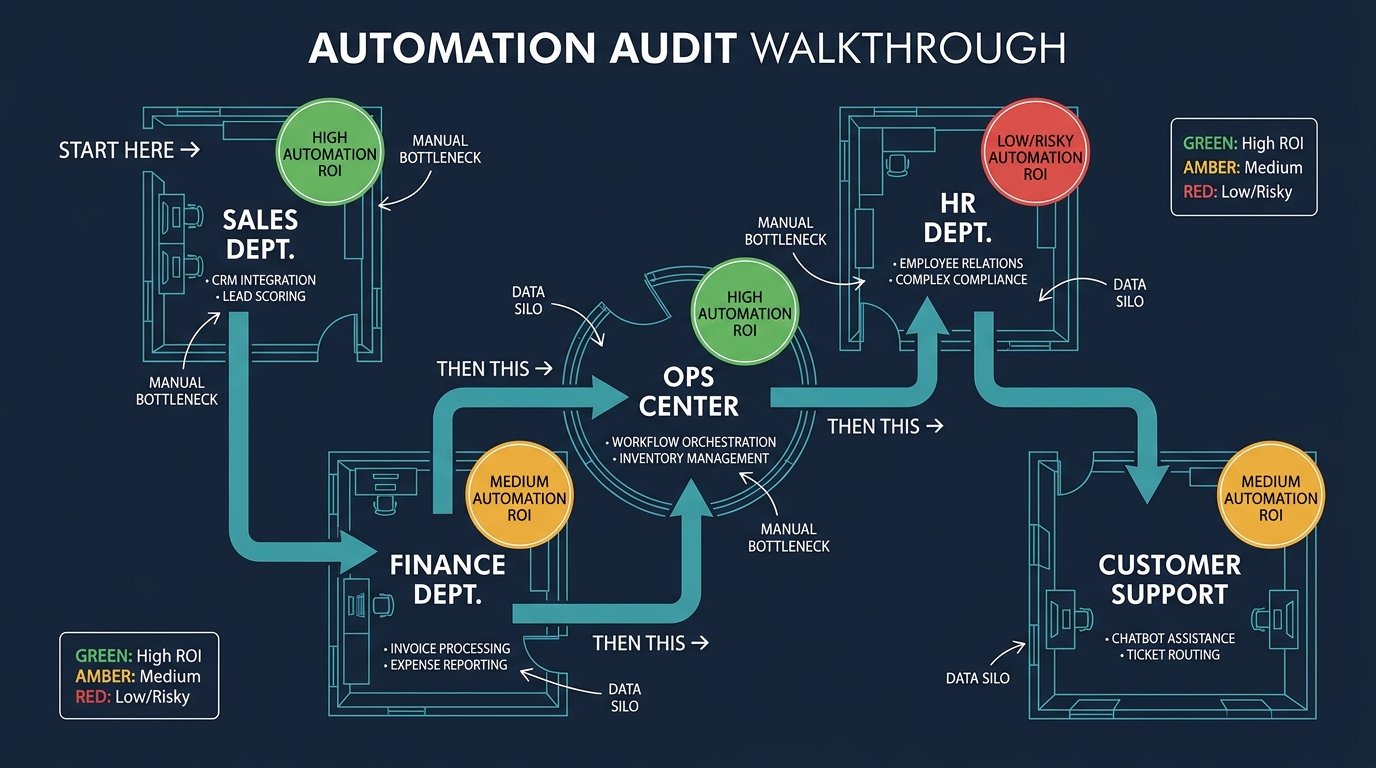
An automation audit is a systematic walkthrough of every process across your operation, evaluated against the four dimensions above. Done properly, it produces two outputs: a prioritized list of automation candidates, and a clear-eyed picture of what’s not ready (and why).
Step 1: Process Inventory
Start by listing every recurring process in each department. Don’t filter yet — just list. Include the obvious (monthly financial close, weekly sales reports) and the obscure (the spreadsheet someone manually updates every Friday morning to consolidate data from three systems that don’t talk to each other). Those obscure manual bridges between systems are often the highest-value automation targets because they’re invisible, they’re error-prone, and no one has ever thought to question why they still exist.
The inventory exercise alone is valuable. Most operations leaders are surprised by how many unofficial manual processes exist across their teams — especially in companies that have grown quickly and patched process gaps with people rather than systems.
Step 2: Score Each Process
For each item in the inventory, score it on the four dimensions: structural consistency (1–5), decision complexity (1–5 inverse — higher complexity means lower score for automation readiness), volume/frequency (1–5), and cost of error (1–5 inverse — higher error cost means more caution needed). Add the scores for a composite automation readiness number.
Processes scoring 15–20 are your immediate automation candidates. Processes scoring 10–14 need some preparation work — usually data quality improvement or process standardization — before they’re ready. Processes scoring below 10 should either remain human-driven for now or be placed in a longer-term roadmap once foundational work is complete.
Step 3: Map the Dependencies
Processes don’t exist in isolation. Before finalizing your sequence, map which processes feed into which others. If Process A outputs data that Process B consumes, automating B without automating A means your AI workflow will only be as reliable as the manual upstream process. In practice, this means you should often automate upstream data-generating processes before downstream decision-making ones — even if the downstream process has a higher composite score.
Step 4: Size the Opportunity
For each high-priority candidate, calculate a rough opportunity size: (average time per instance) × (monthly volume) × (fully-loaded hourly cost of the person doing it). This gives you an annualized labor cost that the automation will partially or fully replace. Add a quality-improvement multiplier if the process has a meaningful error rate that creates downstream rework. This number becomes your investment ceiling for that specific automation — it’s the maximum you should spend to build and maintain it before the ROI case breaks down.
The Sequencing Trap: Why Order Matters More Than Speed
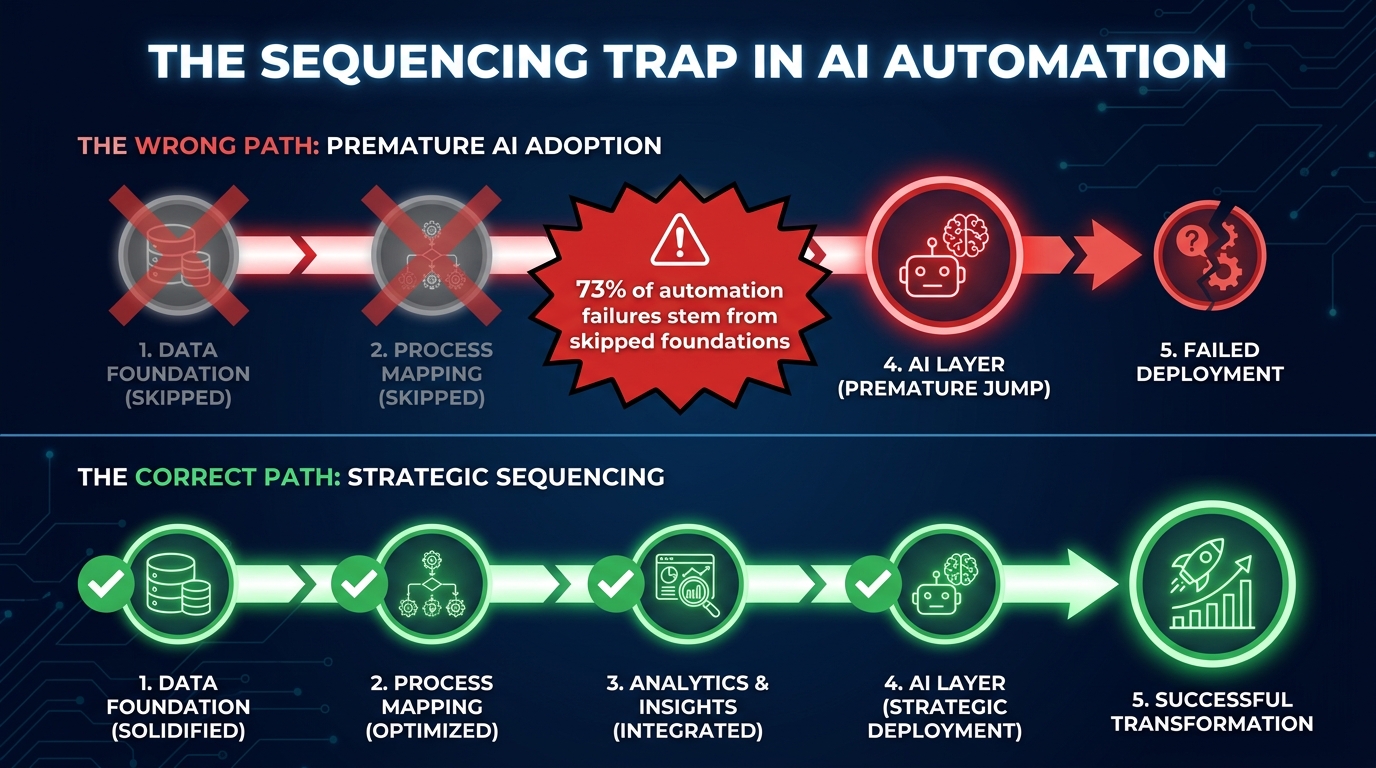
Speed is the enemy of durable automation. The pressure to show AI results fast — from boards, investors, and internal stakeholders who’ve been reading about AI for three years and want to see something — pushes teams into skipping foundational steps that matter enormously for long-term stability.
The Correct Sequence
Effective automation programs follow a consistent layered sequence. The first layer is always process standardization. Before any AI touches a workflow, the workflow itself needs to be documented, understood, and — ideally — simplified. Automating a messy process doesn’t clean it up; it makes the mess run faster and at greater scale. Any exception handling that currently happens informally in someone’s head needs to be made explicit and decision-tree-able.
The second layer is data readiness. The automation’s inputs need to be reliable, complete, and consistently formatted. This often requires cleaning up source systems, fixing integration gaps, or building normalization steps into the data pipeline. Skipping this layer and trusting the AI to handle noisy, inconsistent inputs is one of the most expensive mistakes a team can make — it’s a root cause of automations that “work in staging but break in production.”
Only once these two layers are stable should you add the third layer: the AI execution layer. This is where the actual model, bot, or intelligent workflow lives. By this point, it’s operating on clean data and a well-understood process — which dramatically increases the chance it will behave predictably.
The fourth layer is monitoring and feedback. Every automation needs a health dashboard, an alerting mechanism for when outputs fall outside expected parameters, and a feedback loop that surfaces errors back to the humans responsible for the workflow.
What Skipping Layers Looks Like in Practice
The typical failure story goes like this: a team is under pressure to show AI results by Q2. They pick a high-visibility process, skip the standardization and data readiness steps (“we’ll fix that in post”), and deploy an AI layer directly on top of a fragile manual process. The demo looks great. Two months later, the automation is producing subtle errors that nobody catches for weeks because no monitoring was set up. By the time the damage is found, there’s a mountain of cleanup work, some damaged customer relationships, and a skeptical CFO asking why the AI budget should be renewed.
The irony is that proper sequencing — which feels slower at the start — almost always produces working automation faster than rushing the build on a shaky foundation.
Choosing the Right AI Layer for Each Workflow Type
Not all AI automation is the same. Applying the wrong type of AI to a workflow — using a sophisticated large language model where a simple rules engine would do, or using a rigid rules engine where you need probabilistic judgment — is a waste of money and a source of reliability problems. Understanding the distinct layers of AI capability helps you match the right tool to each task.
Rules Engines and Conditional Logic
The most basic layer of “AI automation” is actually not AI at all — it’s deterministic conditional logic. If X, then Y. This is appropriate for processes with very clear, consistent rules and no ambiguity: route all invoices under $500 to auto-approval; flag any support ticket that contains the phrase “cancel my subscription” for priority handling; send a follow-up email if a meeting invitation hasn’t been accepted within 48 hours.
Rules engines are fast, cheap, completely predictable, and easy to audit. They should be the first tool you reach for — not the last resort after AI has failed. Many processes that teams assume need AI actually work perfectly well with well-designed conditional logic. Reserve AI for the cases where rules genuinely can’t cover the variation.
Machine Learning Models
ML models are appropriate when the decision pattern is learnable from historical data but too complex to express as explicit rules. Predicting customer churn risk, classifying support tickets by root cause from free-text descriptions, scoring leads by conversion likelihood — these are machine learning problems. The model learns the pattern from labeled historical examples and generalizes it to new inputs.
The critical prerequisite: you need enough quality labeled historical data for the model to learn from. As a rough benchmark, fewer than 1,000 labeled examples in a balanced dataset is likely to produce an unreliable model for most classification tasks. If your data volume doesn’t meet that threshold, consider a rules engine or an LLM with few-shot prompting instead.
Large Language Models (LLMs)
LLMs are appropriate for tasks involving the interpretation or generation of natural language — summarizing documents, drafting responses, extracting structured information from unstructured text, translating between formats, or answering questions from a knowledge base. Their power is genuine and significant. So are their failure modes: hallucination (confidently wrong output), inconsistency across similar inputs, and sensitivity to prompt phrasing.
LLMs should almost always have a human review layer when used in customer-facing or compliance-sensitive workflows. They work best as productivity multipliers for human workers — drafting a first version that a human refines — rather than as fully autonomous decision-makers in high-stakes contexts.
Robotic Process Automation (RPA)
RPA bots interact with software interfaces the way a human would — clicking, typing, extracting data from screens. They’re powerful for automating processes that span legacy systems with no APIs, or for moving data between tools that aren’t natively integrated. Combined with AI for input interpretation, RPA plus LLM combinations are increasingly common for automating end-to-end document processing workflows. The key caveat: RPA bots are brittle when UI layouts change. Any application update can break a bot, which makes UI change management an operational consideration alongside the technical build.
How to Stress-Test an Automation Before It Goes Live
The gap between “works in testing” and “works in production” is where automation programs most often stumble. Stress-testing is the discipline of deliberately trying to break your automation before it goes live — under realistic conditions, with realistic edge cases.
Edge Case Mapping
Before going live, spend structured time identifying every way the automation’s inputs could deviate from the happy path. What happens if the invoice arrives as a scanned image instead of a digital PDF? What if a customer email is in a language you didn’t train for? What if the CRM field that triggers a workflow is empty because a sales rep forgot to fill it in? What if the API the automation depends on goes down for 20 minutes?
For each edge case, define the desired behavior explicitly: fail gracefully and alert a human, retry once and then escalate, skip and log for review. “The automation will handle it” is not an acceptable answer for an edge case you haven’t tested. “The automation will detect this condition, flag the record for manual review, and send an alert to the workflow owner” is.
Shadow Mode Deployment
Shadow mode (also called parallel running) means running the automation alongside the existing manual process for a defined period — typically two to four weeks — without replacing the manual process. Both the automation and the human process the same inputs, and outputs are compared. Any divergence is investigated. This is the most reliable way to validate automation performance under real conditions before removing the human safety net.
The instinct to skip shadow mode because “it doubles the work for a month” is exactly backwards. Shadow mode is an insurance policy. The cost of a month of parallel running is almost always less than the cost of discovering a systematic error in a fully live automation two months after launch.
Failure Mode and Effect Analysis (FMEA)
Borrowed from engineering disciplines, FMEA asks: what are all the ways this automation could fail, how likely is each failure, and how severe would the consequences be? For each failure mode, you design a mitigation. High likelihood + high severity failures get active prevention mechanisms. Low likelihood + low severity failures get logging and periodic review. The output is a risk register for the automation — a living document that gets updated as the automation runs and new failure patterns emerge.
The Human-in-the-Loop Calculus — Where to Keep Humans and Why
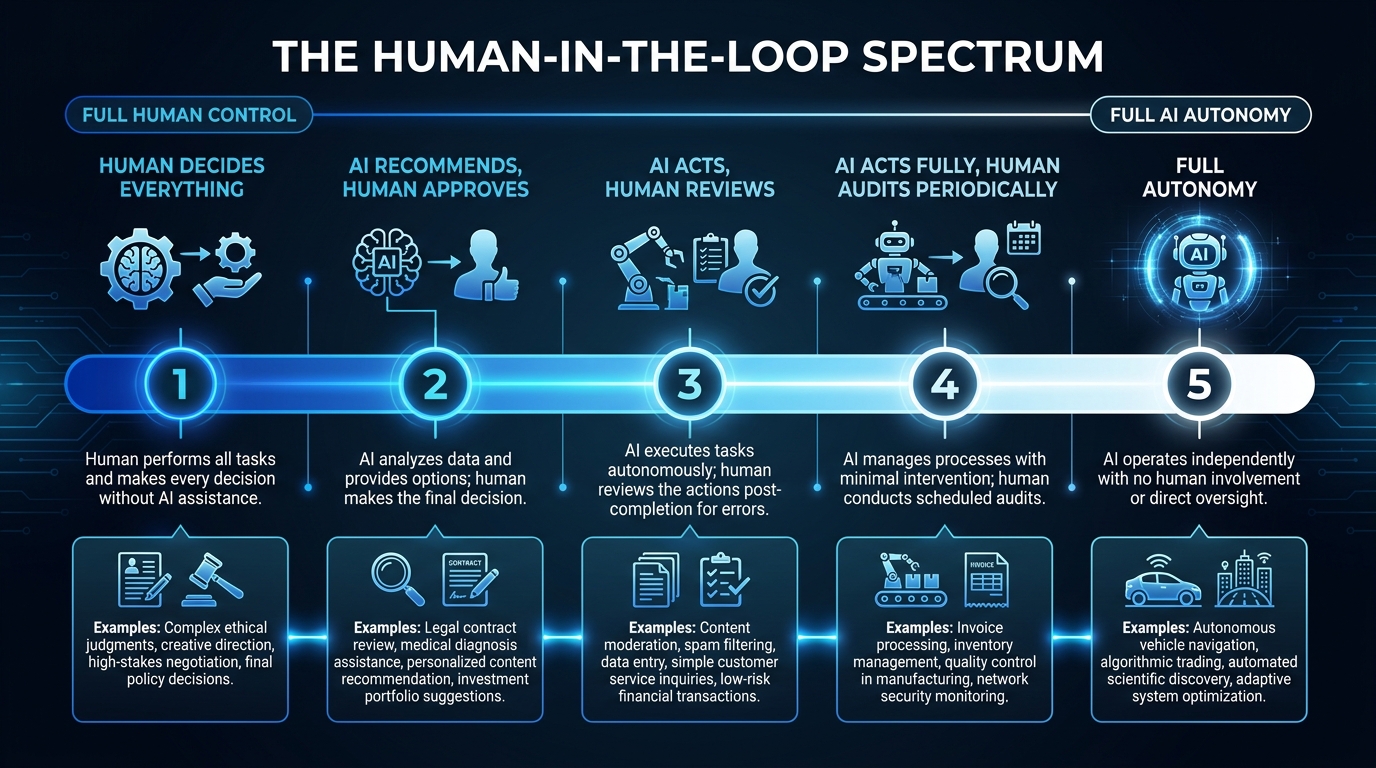
The goal of AI automation is not to remove humans from every process. In many workflows, the most effective design keeps humans meaningfully involved — not because the AI can’t perform the task, but because human involvement adds value the AI genuinely cannot replicate, or because the risk of autonomous AI action is too high to accept.
The Five Levels of Human Involvement
Level 1 — Human decides, AI informs: The human makes every decision, but AI surfaces relevant data, summarizes context, or flags anomalies to inform that decision. Best for high-stakes, low-volume decisions like strategic pricing, contract negotiation, or key account strategy.
Level 2 — AI recommends, human approves: The AI generates a recommendation with a confidence score and supporting rationale. A human reviews and approves (or overrides) before any action is taken. Best for medium-stakes decisions at moderate volume: content publishing, mid-size purchase approvals, candidate shortlisting.
Level 3 — AI acts, human reviews after: The AI takes action autonomously, but all actions are logged and a human reviews the batch at a defined interval (daily, weekly). Exceptions are escalated immediately; routine actions are retrospectively reviewed. Best for high-volume, low-stakes actions: data enrichment, routine email responses, internal ticket routing.
Level 4 — AI acts, human audits periodically: The AI operates fully autonomously in routine conditions. Human review happens on a sampling basis (10% of outputs, quarterly full audits) rather than per-transaction. Best for well-understood, stable workflows: invoice processing under known vendor/amount thresholds, scheduled report generation, routine data sync operations.
Level 5 — Full autonomy: Reserved for the smallest set of genuinely low-risk, fully deterministic processes where the failure cost is negligible and the pattern is completely stable. Even here, ongoing monitoring for drift is essential.
The Oversight Drift Problem
One of the subtler risks in mature automation programs is oversight drift — the gradual erosion of human review as team members get busy and start treating the automation as infallible. An automation that launches at Level 3 (AI acts, human reviews after) can quietly drift to Level 5 (full autonomy) simply because nobody has time to do the reviews anymore. By the time a systematic error is discovered, thousands of records may have been incorrectly processed.
Prevent oversight drift by building human review into the workflow formally — not as an optional extra, but as a step that produces a required output. A sign-off log, a review metric tracked on a dashboard, a weekly review meeting with a standing agenda item. The formalization is what keeps the review actually happening.
Data Quality: The Silent Killer of AI Automations
Every AI automation is only as good as the data it runs on. This is perhaps the most frequently stated principle in enterprise AI — and the most frequently ignored. Teams acknowledge data quality as important in the abstract, then skip the data readiness work when timelines get tight, then wonder why the automation misbehaves.
The Four Data Quality Dimensions
Data quality for automation purposes comes down to four properties. Completeness: are all required fields populated? An automation that depends on a CRM field that sales reps fill in inconsistently will produce inconsistent outputs. Accuracy: does the data reflect reality? Stale contact information, outdated product pricing, incorrect inventory counts — all will propagate errors through automated workflows at speed. Consistency: is the same concept represented the same way across systems? “United States,” “US,” “USA,” and “U.S.A.” are the same thing to a human and four different values to a data system. Timeliness: is the data fresh enough for the automation’s decision logic? A stock level from six hours ago may be fine for a weekly inventory report and catastrophically wrong for an automated purchase order trigger.
Data Quality Remediation Strategies
Depending on your data quality gaps, remediation might involve cleaning historical records in source systems, adding validation rules at data entry points, building normalization layers in the automation pipeline itself, or enriching data from external sources. The right approach depends on whether the quality problem is a historical artifact or an ongoing process issue.
Historical artifacts can sometimes be cleaned once and maintained. Ongoing process issues — like sales reps not filling in required CRM fields — require process and behavior change, not just technical fixes. If the humans feeding the system aren’t incentivized to input quality data, the automation will suffer for as long as that incentive gap exists. Fixing this is a management problem, not a technical one.
Build Data Health Monitoring In
Data quality degrades over time. Products change, vendors change, organizational structures change, and the data in your systems slowly falls out of step with reality. Every automation should have a data health check as part of its monitoring infrastructure: a regular automated assessment of input data completeness, accuracy, and freshness, with alerts when thresholds are breached. Catching data degradation early prevents the downstream automation errors that are expensive to diagnose and clean up.
Measuring Automation Health Over Time — Not Just at Launch
Launch day metrics are vanity metrics. The numbers that matter are the ones you’re looking at six months and eighteen months after deployment, when the novelty has worn off and the automation is running in genuinely uncontrolled conditions.
The Metrics That Actually Matter
Straight-through processing rate (STP rate): What percentage of inputs does the automation handle end-to-end without any human intervention or exception handling? A declining STP rate is an early warning sign that input conditions are drifting outside the parameters the automation was designed for. A well-designed automation should have an STP rate target set at design time, and monitored against it continuously.
Exception rate by category: When the automation can’t handle an input, why? Track exception reasons in structured categories. If one exception reason suddenly spikes, it tells you something has changed upstream — a new input format, a process change in an adjacent system, a new product type the automation wasn’t trained to handle. Categorized exceptions are your diagnostic signal.
Error cost: How much did automation errors cost this period — in direct correction time, in downstream rework, in customer impact? This number should be tracked alongside time-savings metrics. An automation that saves 20 hours per week but creates 8 hours of error-correction work has a true net value of 12 hours, not 20.
Model drift indicators (for ML automations): Machine learning models degrade as the world changes and the data distribution shifts away from the training data. Track model accuracy metrics on an ongoing basis and establish retraining schedules before drift becomes a performance problem. A standard practice is to set accuracy thresholds — if the model’s precision or recall on a validation set drops below a defined floor, an automatic retraining job is triggered.
Automation Review Cadences
Healthy automation programs run structured reviews at three cadences. Weekly: quick check of exception rates and alerts — is anything unusual happening? Monthly: deeper performance review against STP rate targets, error costs, and any changes to upstream processes. Quarterly: strategic review of whether the automation is still solving the right problem, whether the process it’s automating has changed significantly, and whether any redesign or expansion is warranted.
Department-by-Department: Real Automation Stacks That Work in 2026
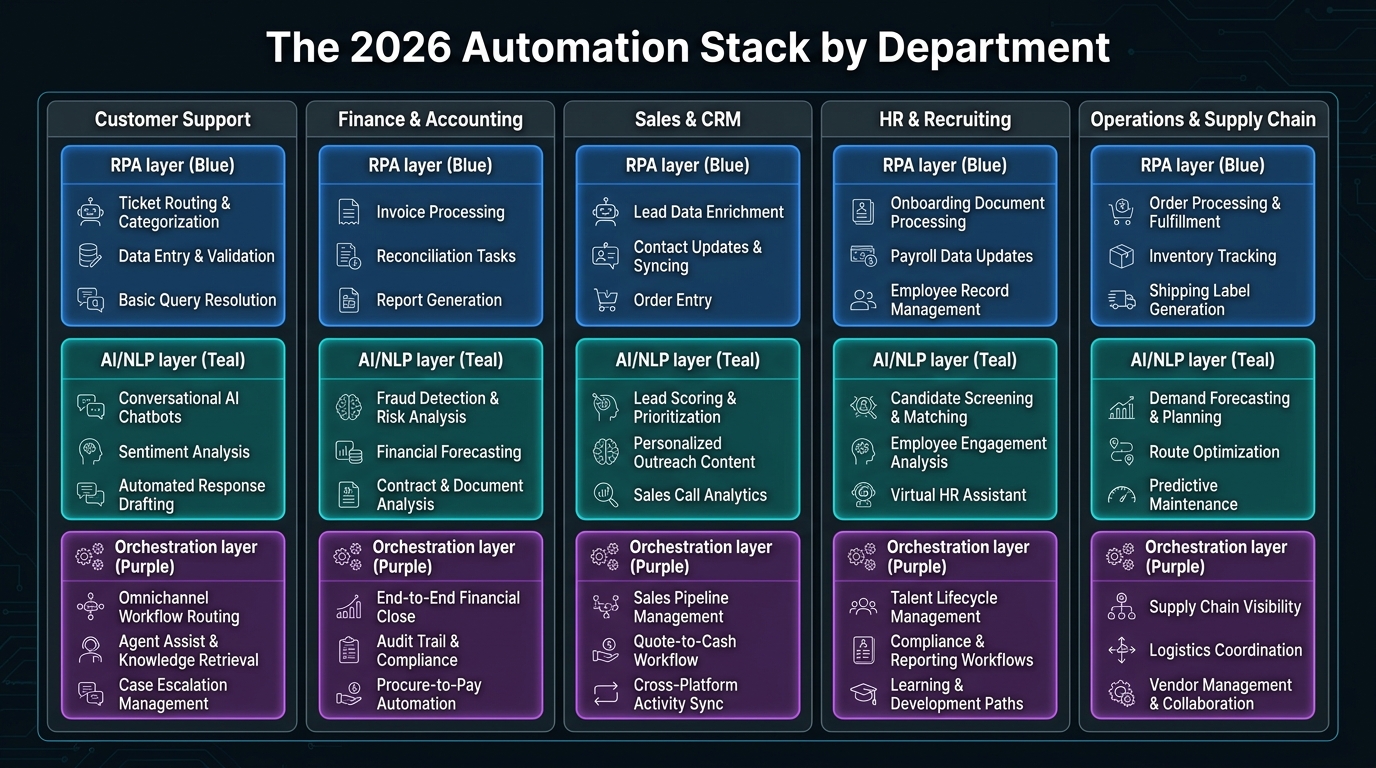
Theory is useful. Concrete examples are more useful. Here’s what effective AI automation actually looks like across five key departments in 2026 — not what vendors claim is possible, but what’s demonstrably working in practice.
Customer Support
The most mature automation use case in customer support is intelligent ticket triage: an LLM reads incoming support tickets, classifies them by issue type and urgency, extracts relevant customer account data from the CRM, and routes to the appropriate agent queue — with a summary attached so the agent doesn’t start from zero. This saves an average of 3–5 minutes per ticket in triage time, which adds up dramatically at scale.
Beyond triage, AI draft responses have become standard for tier-1 queries (password resets, order status, basic troubleshooting). An LLM generates a personalized response draft; the agent reviews, adjusts tone if needed, and sends. The key design choice: the agent always sends, not the bot. This keeps quality high and customer relationships intact.
Avoid automating: complex complaints involving emotional distress, refund negotiations above a threshold, or any interaction where the customer has explicitly requested human contact.
Finance and Accounting
Finance has some of the highest-quality automation candidates in any organization: high volume, structured inputs, clear rules, measurable accuracy. Invoice processing (capture, validate against PO, route for approval, update GL) is the flagship use case — mature, well-tooled, and delivering documented ROI across industries.
Beyond invoices: automated account reconciliation, expense report review and flagging, financial close checklists, cash flow forecasting updates, and vendor statement matching. These are all high-volume, rules-adjacent tasks with structured data sources that lend themselves to reliable AI execution.
Avoid automating: tax strategy decisions, audit response drafting, any financial statement that requires professional judgment or will be reviewed by external auditors.
Sales and CRM
Sales automation’s highest-value use cases are around data hygiene and preparation — not around replacing sales conversations. AI that automatically enriches lead records with company size, technographics, and news triggers saves SDRs significant research time. Automated meeting prep briefs (pulling CRM history, recent interactions, and relevant company news into a one-page summary before each call) are consistently rated as one of the highest-value automation wins by sales teams that use them.
CRM hygiene automation — detecting and merging duplicate records, flagging contacts with stale information, auto-populating fields from email and calendar data — addresses one of the most chronic frustrations in sales operations without requiring sales reps to change any behavior.
Avoid automating: actual sales conversations (the relationship damage from unwanted AI interactions is significant), final negotiation stages, and renewal conversations with at-risk accounts.
HR and Recruiting
Recruiting automation is effective at the front of the funnel: job posting distribution, application tracking, initial screening questionnaire administration, and interview scheduling. AI resume screening has gained traction, with appropriate caveats — it must be audited regularly for bias, and its decision criteria must be explainable and legally defensible in the jurisdictions where you operate.
Onboarding automation has strong ROI: automated provisioning checklists, day-one IT setup workflows, 30/60/90-day check-in scheduling, and benefits enrollment reminders. These are high-volume, structured processes that new hires benefit from significantly when they run reliably and on time.
Avoid automating: offer negotiation, performance improvement conversations, termination processes, or any interaction that involves significant emotional weight or legal sensitivity.
Operations and Supply Chain
Operations automation at its most effective looks like predictive rather than reactive processes. Reorder triggers based on inventory velocity rather than static thresholds, automated supplier communication for routine POs, shipment exception alerting, and quality inspection report generation from structured sensor data.
The distinctive challenge in operations automation is integration breadth: automations often need to span ERP systems, logistics platforms, supplier portals, and warehouse management systems. API availability and data model compatibility between these systems is frequently the limiting factor — which makes data layer investment especially high-value in operations contexts.
The Automation Debt Problem Nobody Talks About
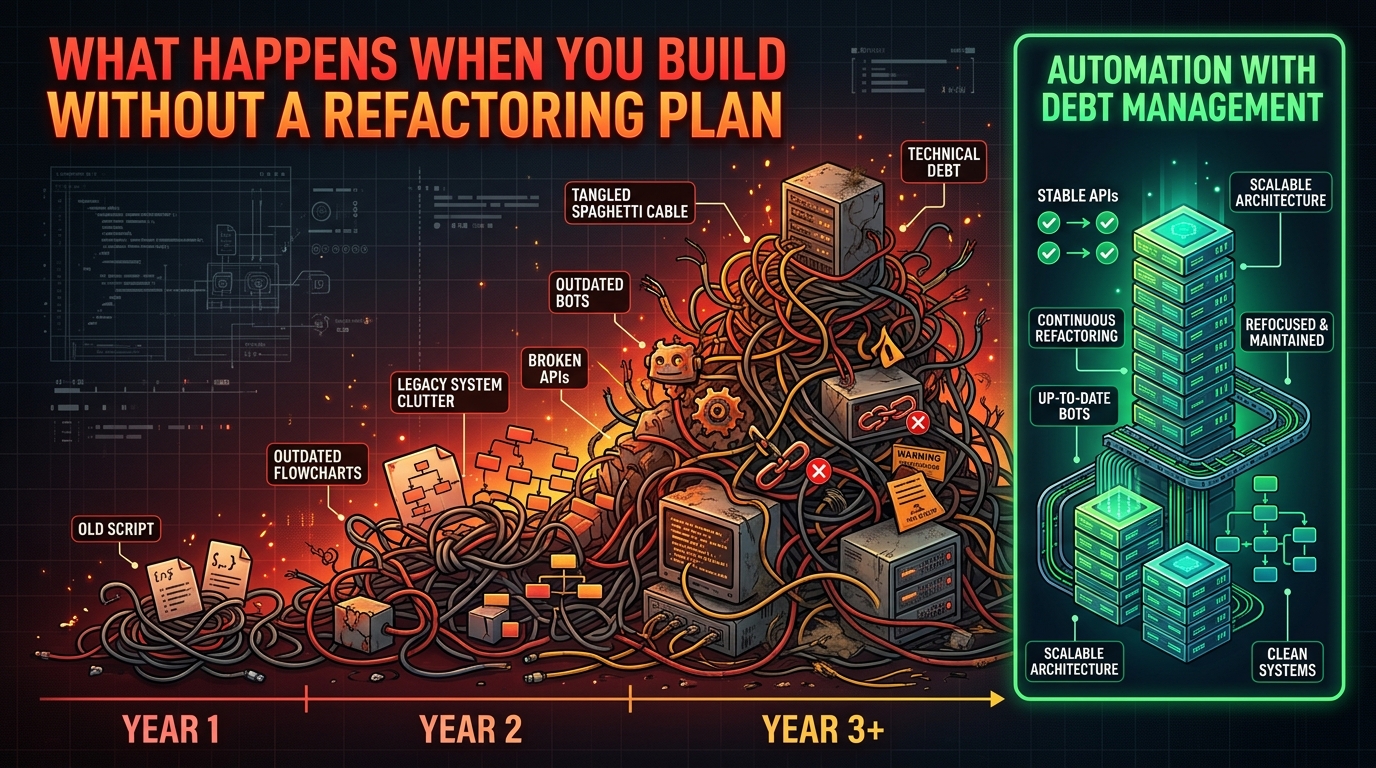
Technical debt is a familiar concept in software engineering. Automation debt is its less-discussed cousin — and it’s accumulating quietly in organizations that have been running automation programs for three or more years without a corresponding investment in maintenance and governance.
How Automation Debt Accumulates
Automation debt builds in several predictable ways. Automations that were built for a process that has since changed — but the automation hasn’t been updated to match. Workflows that depend on an API that was deprecated, now jury-rigged with a brittle workaround. Bots built by a contractor who is no longer available, with no documentation, running processes nobody fully understands anymore. Models trained on 2023 data, still making decisions in 2026 without retraining, on a distribution that has shifted significantly.
Each of these represents debt. And like financial debt, automation debt compounds. A fragile automation that’s patched rather than rebuilt becomes more fragile with each patch. A model that drifts without retraining becomes increasingly inaccurate. At some point, the cost of maintaining the debt exceeds the cost of the original investment — and the automation becomes a liability rather than an asset.
The Governance Structures That Prevent It
Debt prevention requires governance from the start. Every automation in production should have a designated owner — a person (not just a team) accountable for its performance and maintenance. It should have documented architecture, including all dependencies, data sources, and integration points. It should have a defined review schedule. And it should have a sunset policy: a pre-agreed set of conditions under which the automation will be decommissioned and rebuilt rather than patched further.
Automation catalogs — maintained registers of all automations in production, their owners, their performance metrics, and their last review date — are a simple governance tool that dramatically reduces debt accumulation. If you can’t answer “how many automations are currently running in our organization, who owns each one, and when was each one last reviewed,” you have an automation debt problem in progress.
Building an Automation Roadmap That Survives Budget Cycles
The final challenge isn’t technical — it’s organizational. Automation programs that survive and grow do so because they’ve built the internal credibility and infrastructure to justify continued investment. Programs that stall do so because they failed to demonstrate value clearly, or because key champions left the organization, or because a failed deployment spooked leadership into pulling back.
The Credibility Architecture
Build credibility through documented wins at every stage. The first automation deployed should be one you’re highly confident will succeed — moderate complexity, well-understood process, clear metrics — not the most ambitious thing on the list. A solid, measurable first win creates the internal political capital to tackle harder problems in subsequent phases.
Document ROI at the automation level, not just the program level. “Our automation program saved $2.3M last year” is less persuasive to a CFO evaluating budget than “the invoice processing automation saved 1,840 hours of AP team time at an average fully-loaded cost of $45/hour, delivering $82,800 in direct labor savings against a build cost of $34,000 — a 143% ROI in year one.” That specificity is what sustains investment through budget cycles and leadership transitions.
The Portfolio Approach
Mature automation programs manage their builds as a portfolio: some low-risk, quick-win automations to maintain momentum and credibility; some medium-complexity automations that deliver significant ROI; and a smaller number of ambitious, higher-risk builds that could deliver transformational value if successful.
This balance prevents two failure modes: the program that only ever pursues safe wins and never delivers step-change impact, and the program that swings for the fences on every build, accumulates failures, and loses executive support. The portfolio approach keeps both the wins coming and the ambitions alive — and it gives leadership a clear narrative about where the program is headed.
Making the Case to Keep Going
Automation roadmaps that survive budget cycles share one characteristic: they make the cost of not continuing visible. Quantify the processes that are still manual, the time still being spent, the errors still occurring. The question shouldn’t be “can we afford to invest in automation?” but “can we afford to keep doing this manually?” Framing the decision that way, with real numbers tied to real processes, is what moves automation from a discretionary technology budget line to an operational necessity that no one wants to defund.
Conclusion: The Discipline That Makes Automation Actually Work
The gap between organizations where AI automation consistently delivers and those where it consistently disappoints isn’t a gap in ambition, budget, or technology access. It’s a gap in discipline — the methodical, sometimes unglamorous work of auditing before building, sequencing correctly, testing rigorously, designing appropriate human oversight, and maintaining what you’ve built over time.
The frameworks in this guide don’t make automation easy. They make it reliable. And reliability, not sophistication, is what separates the automation programs that compound in value year over year from the ones that become cautionary tales.
Key Takeaways
- Audit before you automate. Score every candidate process on structural consistency, decision complexity, volume, and error cost before deciding what to build first.
- Sequence correctly. Process standardization and data readiness must precede the AI execution layer. Skipping foundational steps doesn’t save time — it creates rework.
- Match the AI type to the task. Rules engines for deterministic logic. ML models for learnable patterns with historical data. LLMs for language tasks. RPA for legacy system integration. Don’t use a sledgehammer where a scalpel will do.
- Stress-test before launch. Map edge cases, run in shadow mode, document failure modes and their mitigations. A month of parallel running is worth more than six months of post-launch firefighting.
- Design human oversight deliberately. Decide in advance which level of human involvement is appropriate for each automation, and build that oversight into the workflow formally — not as an optional extra.
- Monitor continuously, not just at launch. Track STP rate, exception categories, error cost, and model drift on defined cadences. The automations that keep working are the ones that keep getting reviewed.
- Manage automation debt. Every automation in production needs an owner, documentation, a review schedule, and a sunset policy. Ungoverned automations become liabilities.
- Build the credibility architecture. Start with wins you’re confident in, document ROI at the automation level, and manage your portfolio across risk tiers. That’s how you sustain investment — and how automation programs survive long enough to actually matter.