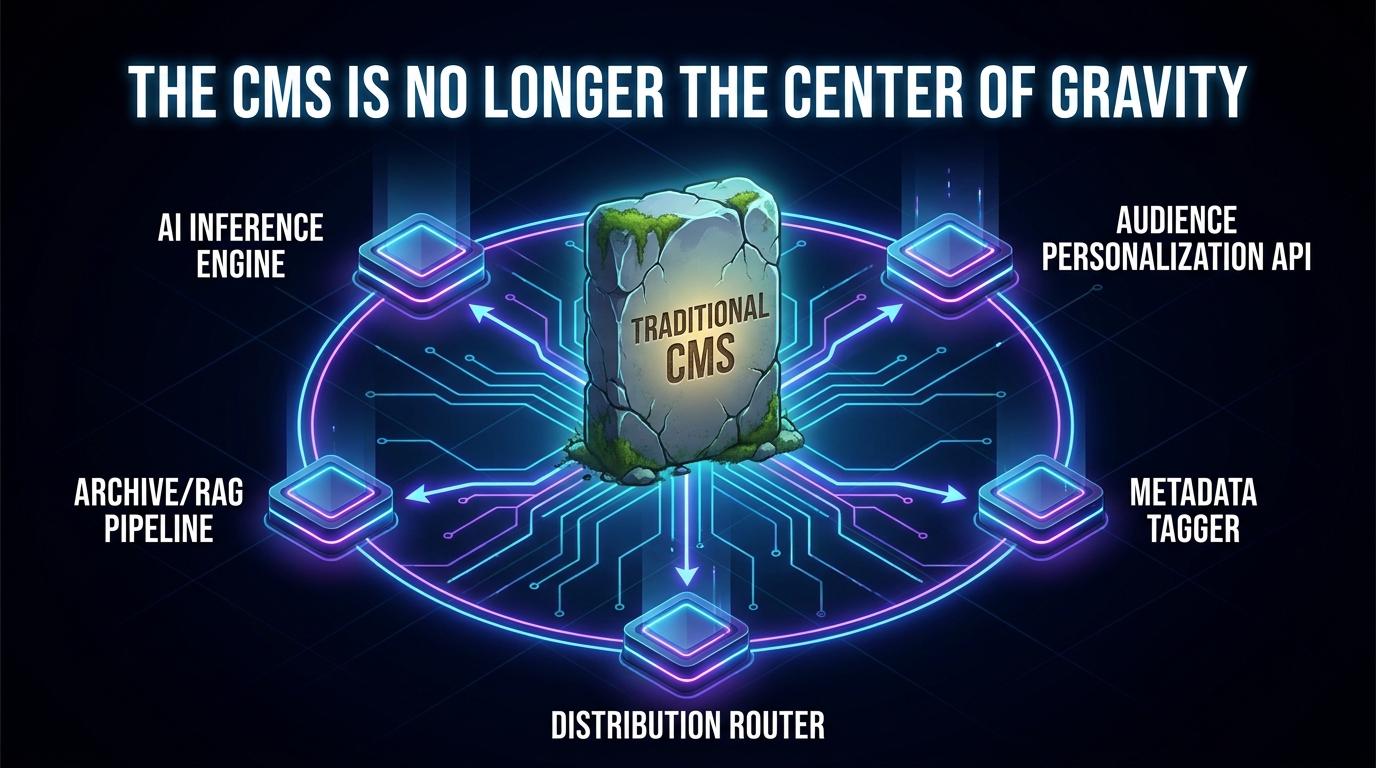

There is a version of AI fact-checking that exists mainly in conference decks and vendor demos: a system that ingests live broadcast audio, identifies every dubious claim within milliseconds, retrieves irrefutable evidence from the world’s knowledge bases, and surfaces a color-coded verdict to the editor before the guest has finished their sentence.
Then there is the version that actually runs inside newsrooms in 2026.
It is modular, slower than marketed, dependent on a carefully maintained retrieval corpus, and entirely reliant on human editors for any verdict that will carry the newsroom’s name. It is also, when built correctly, genuinely valuable — capable of processing hundreds of thousands of sentences a day, surfacing patterns that no team of humans could catch at scale, and catching repeat claims the moment a politician recycles a line they know has already been debunked.
The gap between those two versions is not primarily a model quality problem. It is a pipeline design problem, an organizational integration problem, and above all a failure to understand where in the architecture the real fragility lives. Most coverage of AI fact-checking focuses on the LLM layer — the reasoning model that produces a verdict — while paying almost no attention to the four stages upstream that determine whether the reasoning model ever receives a useful input in the first place.
This piece is about those upstream stages. It covers the full architecture of a production-grade real-time fact-checking pipeline, the specific points where each stage tends to break, the tools and organizations that have moved from pilots to operational deployment, and the governance layer that separates credible systems from liability exposure. If you are building, evaluating, or funding a newsroom AI fact-checking capability, this is what the engineering and editorial realities actually look like.
The Four-Stage Architecture That Every Real Pipeline Shares

Regardless of the vendor, the model family, or the newsroom size, every functional AI fact-checking pipeline converges on the same four-stage structure. Researchers and practitioners call these stages by slightly different names, but the functional sequence is consistent across both academic literature and production deployments.
Stage 1: Claim Detection
The pipeline ingests raw text — from live broadcast captions, wire copy, social media streams, press release feeds, podcast transcripts, or article drafts — and splits it into atomic sentences. A classifier then evaluates each sentence for checkworthiness: the degree to which the sentence makes a verifiable factual assertion, as opposed to expressing an opinion, making a prediction, or describing an emotional state.
This is not a binary decision. Checkworthiness is a score, and setting the threshold is one of the most consequential engineering choices in the entire system. Too low and you flood editors with noise. Too high and you miss the claims that matter most — often the ones worded as vague statistics or qualitative comparisons that are technically falsifiable but don’t register as obviously factual.
Stage 2: Evidence Retrieval
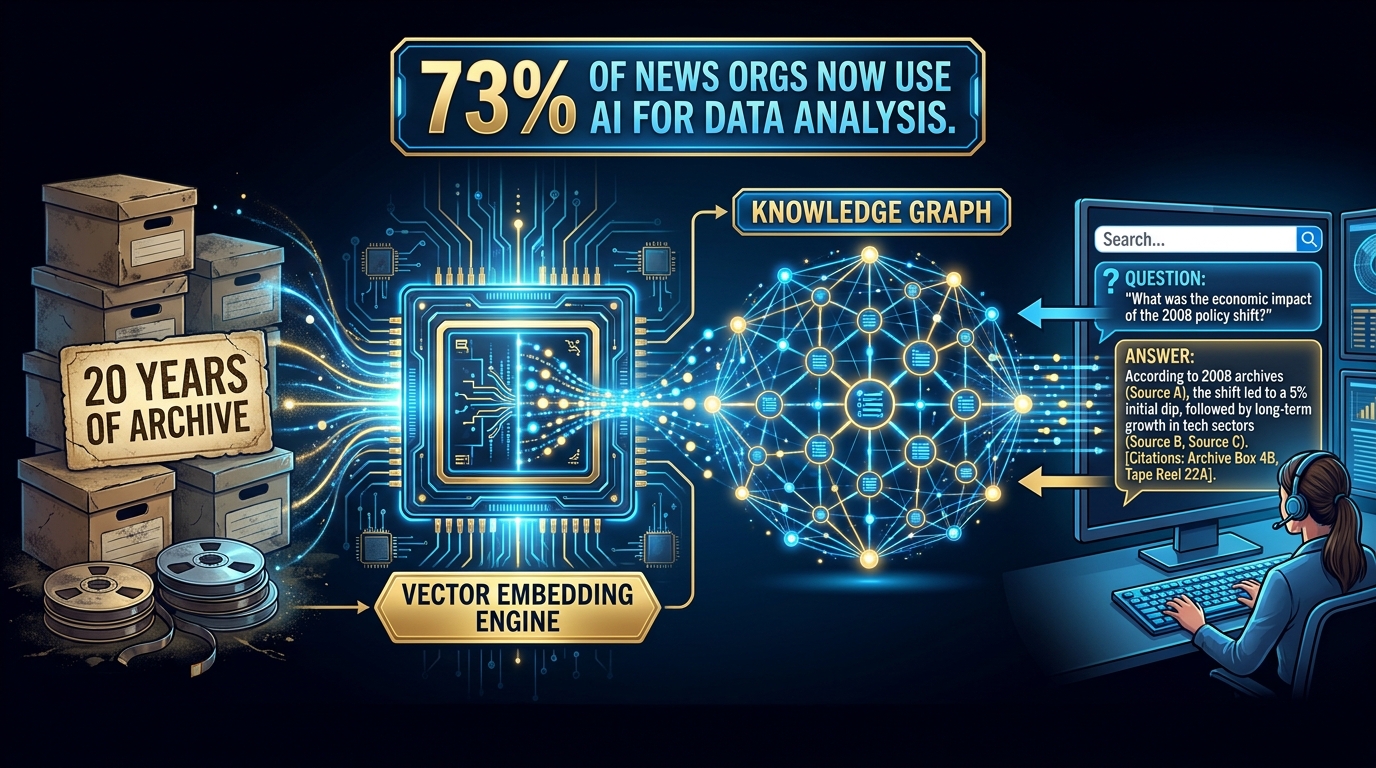
Shortlisted claims are passed to a retrieval system that searches for relevant documents, data points, prior fact checks, and structured knowledge. In 2026, this layer has moved far beyond keyword search over a static database. Leading pipelines now combine dense vector retrieval with structured knowledge graphs and a re-ranking model that evaluates document relevance before passing anything to the downstream reasoning layer.
Stage 3: Veracity Scoring
A large language model — operating with retrieval-augmented context — evaluates the evidence against the claim and produces a structured output: a confidence score, a preliminary verdict category (supported, refuted, insufficient evidence), and a citation of the evidence used. Crucially, in every responsibly deployed system, this output is a recommendation, not a publication-ready verdict.
Stage 4: Human Editor Review
The scored, sourced, contextualized claim lands in an editor dashboard. The human reviews the AI’s reasoning, checks the cited evidence, applies editorial judgment about political or cultural context the model may have missed, and either publishes a fact check, queues it for deeper investigation, or dismisses it. The human is not a rubber stamp on the AI’s output — they are the final decision-maker in a system that exists to give them better-prepared material, faster.
Understanding this four-stage sequence is prerequisite to understanding where pipelines fail. The failure modes are not distributed evenly. They cluster heavily at Stage 1, and they cascade silently through the rest of the stack.
Claim Detection: The Most Underengineered Stage in the Stack
Ask a vendor where their AI fact-checking pipeline is most accurate and they will tell you about the LLM at Stage 3. Ask a fact-checker where the pipeline most often wastes their time or misses important claims, and almost universally they will point to Stage 1.
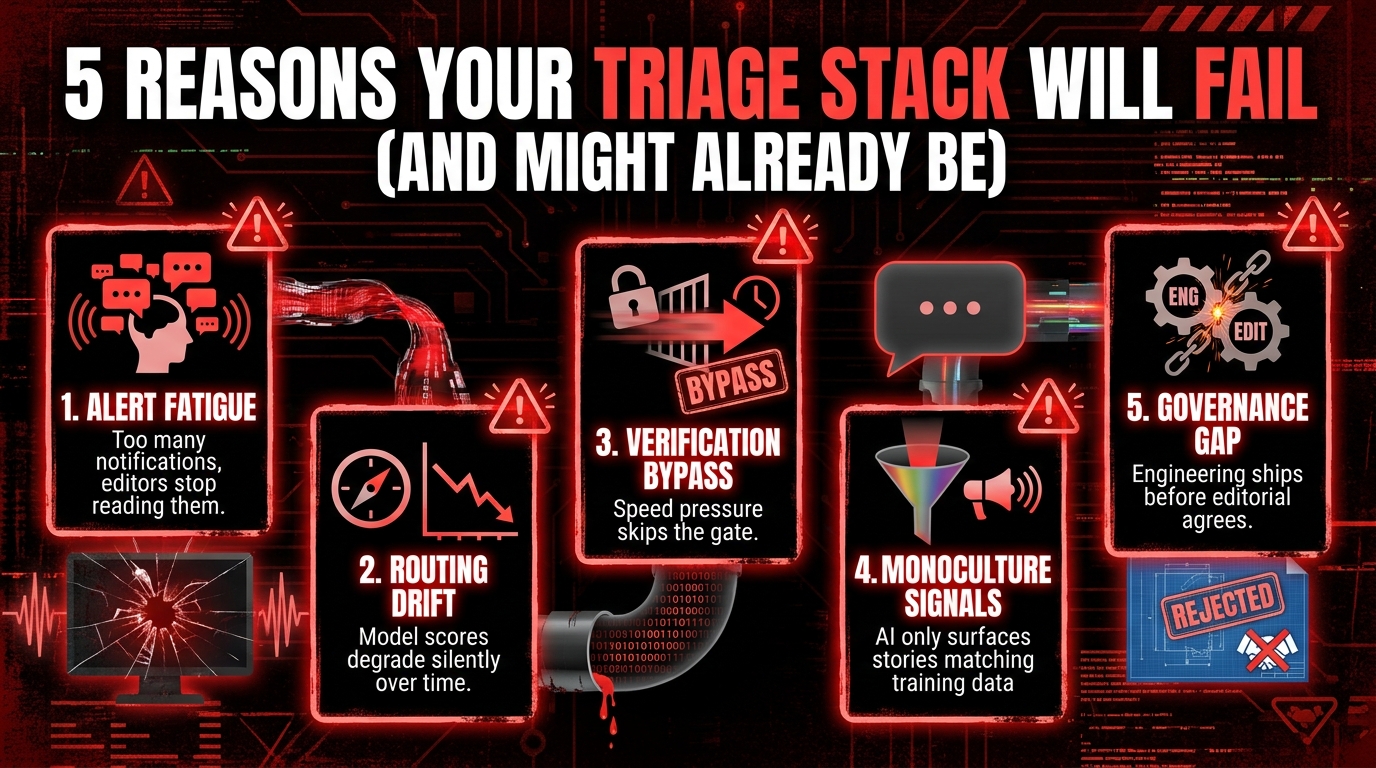
Claim detection is the first filter, and its decisions propagate through the entire system. A claim the detector misses never reaches retrieval, never reaches scoring, never reaches a human editor. A claim the detector incorrectly classifies as high-priority wastes editorial time and degrades trust in the system over time, prompting editors to tune out alerts that start to feel like noise.
The Checkworthiness Classification Problem
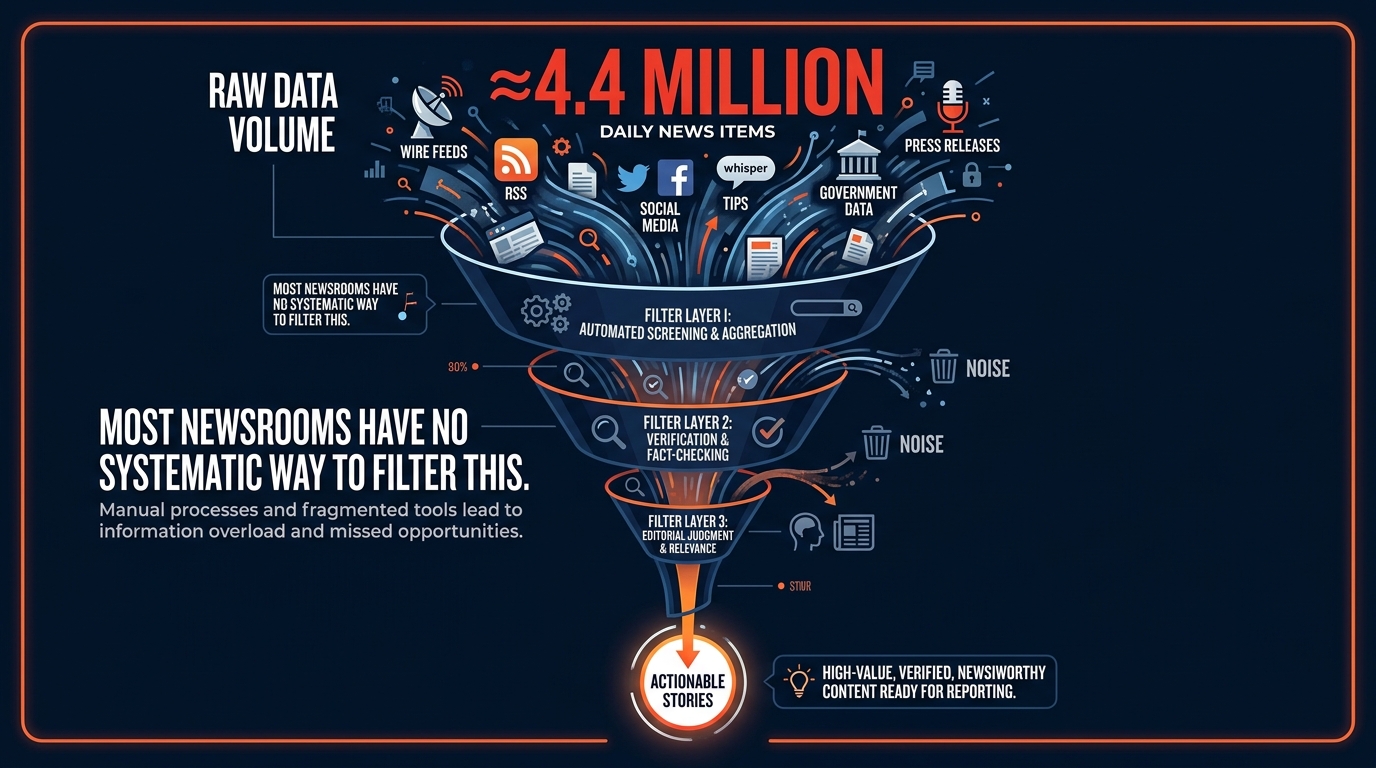
Full Fact, one of the most technically advanced fact-checking organizations in the world, uses a fine-tuned BERT model as its claim-type classifier. Their system is designed to distinguish between factual claims (checkable), opinion statements (not checkable), predictions (not checkable), and rhetorical assertions (context-dependent). On a typical weekday, their tools process approximately 300,000 sentences, filtering that corpus down to tens of thousands of claims that are worth a human editor’s attention.
That funnel is the point. Without aggressive, accurate filtering at Stage 1, the rest of the pipeline simply cannot operate at scale. But the classification is genuinely difficult for several categories of claim that appear frequently in news contexts.
The Hard Cases That Break Claim Detectors
Statistical vagueness: Claims like “crime has risen sharply” or “most economists agree” are technically checkable but phrased in ways that make the exact assertion ambiguous. BERT-based classifiers trained on annotated datasets of clearly stated factual claims often underweight these, even though they are frequently the claims most worth checking.
Implied factual assertions: A speaker who says “given that we’ve already cut taxes three times this term” is asserting a fact (the number of tax cuts) inside a subordinate clause. Sentence-level classifiers often fail to surface the embedded claim because the sentence reads as argumentative rather than factual.
Emerging terminology: Claims about new technologies, newly coined political terms, or recently named events often fall outside the training distribution of classifiers built six months earlier. The model assigns low checkworthiness to claims it doesn’t recognize — precisely the moments when fast-moving stories most need verification.
Non-English and code-switching text: Most production-grade claim detectors are dramatically less accurate outside of English. Full Fact’s expansion to 25 Arab-speaking fact-checking organizations required significant adaptation work, and even then, the tools performed differently across language variants. For newsrooms covering multilingual debates, parliamentary sessions, or diaspora communities, this gap is a structural blind spot.
The practical implication: claim detection should be treated as a continuous evaluation problem, not a one-time model selection. Classifiers need regular recalibration against the specific language domain of the newsroom deploying them, with annotators reviewing edge cases and updating training data on a monthly cadence at minimum.
Evidence Retrieval in 2026: Why Naive RAG Is No Longer Enough
In the early iterations of AI-assisted fact-checking — from roughly 2020 to 2023 — evidence retrieval meant keyword search over a curated database of prior fact checks and reference documents. The system would find articles that shared vocabulary with the claim under review and pass those articles as context to a classifier or generative model.
That approach had a single critical flaw: it confused lexical overlap with semantic relevance. A claim about “the cost of the National Health Service” would retrieve articles about NHS spending whether they supported, refuted, or were simply tangentially related to the specific claim being checked. The retrieval layer was producing context that was thematically adjacent rather than evidentially relevant.
The Shift to Dense Vector Retrieval
The introduction of dense vector retrieval — embedding both claims and documents into a shared semantic space and retrieving by cosine similarity — dramatically improved the relevance of retrieved context. Systems built on embedding models like Sentence-BERT or OpenAI’s text-embedding family could retrieve documents that were semantically related to a claim even when they shared few surface-level keywords.
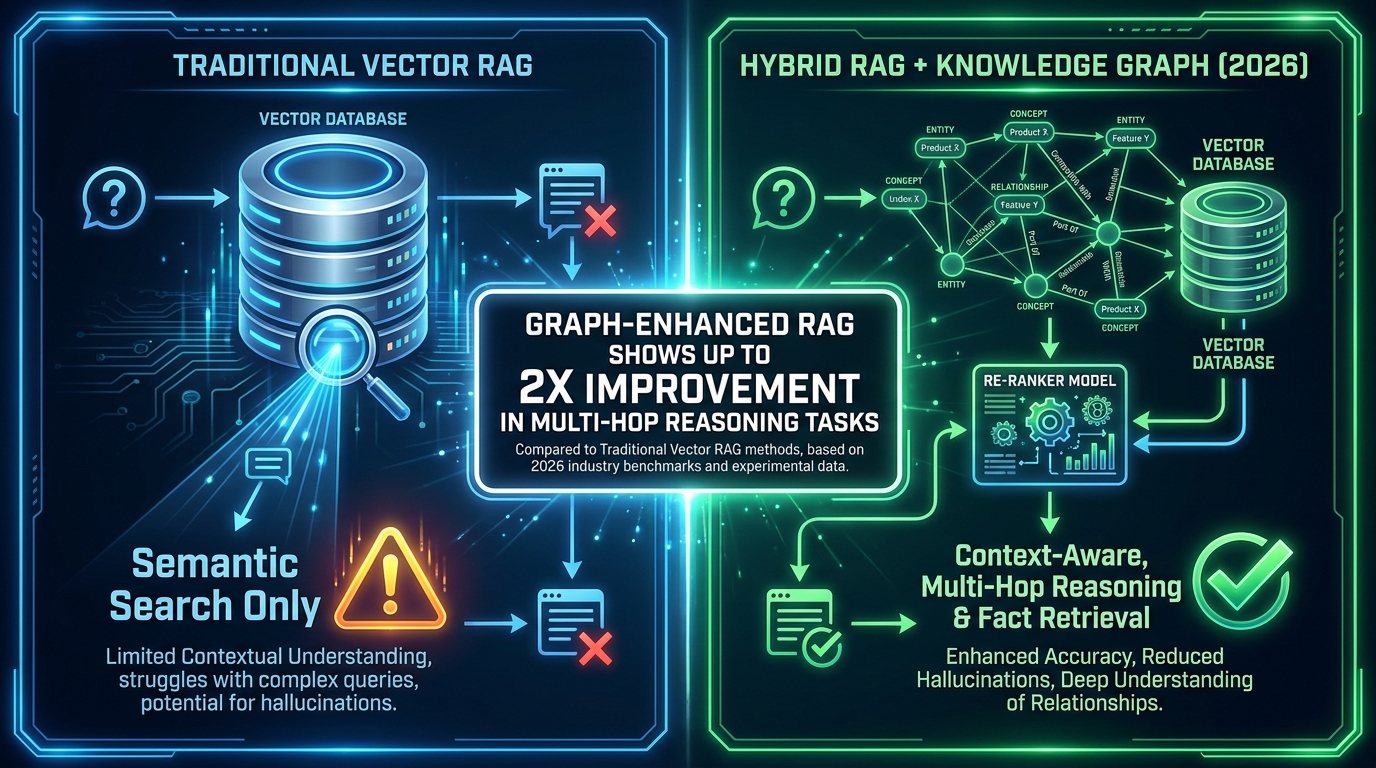
But pure vector retrieval introduced its own problem: it struggles with multi-hop reasoning. A claim like “Country X’s defense spending rose to 3.2% of GDP in the year that Minister Y was appointed” requires the retrieval system to find documents about defense spending, documents about Minister Y’s appointment date, and to reason about the relationship between them. A single embedding retrieval step retrieves documents related to one of those concepts but rarely both with appropriate weighting.
Hybrid RAG and Knowledge Graphs: The 2026 Architecture
The most capable retrieval architectures deployed in 2026 combine three components:
- Dense vector retrieval for broad semantic coverage — finding the universe of potentially relevant documents quickly.
- Structured knowledge graphs for entity relationships and provenance — connecting named entities (politicians, organizations, statistics, dates) in ways that support multi-hop reasoning. Knowledge graphs over sources like Wikidata, official government statistics databases, and curated fact-check archives provide relationship paths that embeddings alone cannot represent.
- A cross-encoder re-ranker that takes the top candidates from vector retrieval and knowledge graph lookup and evaluates each one’s actual relevance to the specific claim before passing context to the LLM.
Research comparing graph-enhanced RAG against plain vector RAG on multi-hop reasoning tasks shows meaningful accuracy improvements — particularly for the complex, relationship-dependent claims that are most common in political and financial journalism. The gains are most pronounced precisely in the domains where getting the answer wrong is most consequential.
Previously Fact-Checked Claim Retrieval (PFCR)
One of the highest-leverage components of an evidence retrieval system is a PFCR module: a dedicated index of claims that fact-checkers have already verified, tagged with their verdicts and sourcing. When an incoming claim is semantically similar to one in the PFCR index, the system can surface the prior check instantly — with its sourcing, verdict, and publication date — rather than running a full retrieval and reasoning cycle.
Full Fact’s matching system does exactly this. When a politician repeats a claim they have already been corrected on, the system flags it as a repeat of a previously debunked assertion, saving editors from re-researching the same claim and enabling the newsroom to call out deliberate repetition of known falsehoods, not just accidental misinformation. Google’s Fact Check Tools API, which aggregates ClaimReview markup from fact-checkers around the world, serves a similar function at global scale — allowing any organization with API access to query a distributed database of existing fact checks before commissioning original research.
The Latency Problem: What Real-Time Actually Requires

“Real-time” is the most abused word in fact-checking technology marketing. When a vendor says their tool provides real-time verification, they typically mean that results appear within a few minutes of a broadcast segment airing — useful for post-broadcast correction, but not the same as flagging a claim while it is still being discussed live.
True live-assist — surfacing a flagged claim to an editor while a guest is still speaking — requires an end-to-end pipeline that operates in under two seconds from audio ingestion to editor notification. Many newsroom contexts, particularly for prepared political debates and parliamentary sessions where the text is partially predictable, can operate in this range. Breaking news and off-script commentary remain harder.
The Benchmark That Matters
The emerging consensus from optimized production stacks places end-to-end claim verification latency in the range of 300 to 800 milliseconds for short, clearly stated factual claims on well-provisioned infrastructure. That window breaks down roughly as:
- Audio transcription and sentence segmentation: 20–80ms (using streaming speech-to-text with chunked output)
- Claim detection and checkworthiness scoring: 40–100ms (fine-tuned BERT-class model)
- Hybrid retrieval and re-ranking: 100–300ms (depending on index size and whether PFCR returns a hit)
- LLM reasoning and structured output generation: 150–400ms (depending on model size, quantization, and whether the response is streamed)
These numbers assume optimized infrastructure: GPU-accelerated inference, vector databases with pre-warmed indices, and claims that are contained within a single sentence. Latency degrades significantly for longer claims, for claims that require multi-document retrieval, and for claims about recent events that aren’t yet in the knowledge base.
The Recency Gap
No fact-checking pipeline is faster than its knowledge base. A claim about an event that happened two hours ago — a new economic data release, a cabinet resignation, a military development — may return no evidence from retrieval, triggering a cascade of low-confidence outputs or, worse, the retrieval of tangentially related but stale documents that point the reasoning model in the wrong direction.
This is the recency gap, and it is arguably the most serious structural limitation of all current fact-checking pipelines. The LiveFact benchmark, introduced at ACL 2026, specifically tests LLMs on time-aware, dynamic misinformation detection — evaluating how models reason under the “fog of war” conditions where evidence is incomplete, contradictory, or not yet indexed. Results show that most models degrade significantly on claims about events less than 48 hours old, even when those claims are about verifiable facts that could theoretically be checked against primary sources.
The practical response is architectural: pipelines need a live news feed integration layer that continuously updates the retrieval index, a confidence floor below which the system explicitly tells the editor “insufficient current evidence” rather than producing a potentially misleading low-confidence verdict, and a clear indicator of the age of the most recent evidence retrieved for any given claim.
Full Fact, ClaimBuster, and the Google Fact Check Tools API: A Realistic Assessment
Three tools appear more frequently than any others in descriptions of production newsroom fact-checking pipelines. Understanding what each actually does — and where each stops — is essential before evaluating any implementation plan.
Full Fact’s AI Tools
Full Fact has been building machine learning tools for fact-checking since 2016 and is among the most technically serious organizations in the field. Their suite handles data ingestion from live TV captions, online news, podcasts, and social media; sentence segmentation; claim-type classification using a fine-tuned BERT model; topic filtering; and matching against prior fact checks.
As of 2026, their tools are licensed to more than 40 fact-checking organizations operating across 30 countries in three languages. The impact is real: when expanded to 25 Arab-speaking fact-checking organizations, those organizations reported that media monitoring became materially faster, and many began live-monitoring for the first time. More than 200 fact-check articles have been published from claims surfaced by Full Fact’s tools across these partner organizations.
What Full Fact’s tools do not do is render verdicts. The system classifies, filters, matches, and presents — but does not determine truth or falsehood. That is an explicit design choice, not a technical limitation they are working to remove. Full Fact publicly states that the question of whether a claim is true requires human judgment applied to specific evidence, and that designing a system to automate that verdict would be a fundamental category error in editorial terms.
ClaimBuster
ClaimBuster, developed at the University of Texas at Arlington, focuses on the checkworthiness detection stage. It was one of the first systems to be tested in a genuinely live editorial context: during the 2016 U.S. presidential debates, ClaimBuster scored every sentence from live captions and posted top-ranked claims to its public website in near-real time. Researchers found strong correlation between ClaimBuster’s top-ranked claims and the claims that CNN, PolitiFact, and FactCheck.org chose to fact-check — suggesting the scoring model was capturing something real about journalistic judgment, even if imperfectly.
ClaimBuster’s architecture treats checkworthiness as a ranking problem rather than a binary classification, which is the correct framing. Newsrooms don’t need a list of “checkworthy” and “not checkworthy” claims — they need the most important claims to rise to the top of a prioritized queue that human fact-checkers can work through in order of significance.
The Google Fact Check Tools API and ClaimReview
The Google Fact Check Tools API is the closest thing to a global PFCR system that currently exists at scale. It aggregates ClaimReview structured markup published by fact-checking organizations worldwide, making the entire corpus searchable via API. A newsroom can query the API for any claim and retrieve matching fact checks from organizations they may never have read, published in languages their editors don’t speak.
The limitation is quality control and coverage. ClaimReview markup is only as good as the organizations publishing it, and the global distribution of fact-checking capacity is extremely uneven. Claims in major Western European languages and English have substantial coverage; claims about events in smaller countries, regional languages, or topics that aren’t politically prominent in major media markets have sparse or nonexistent coverage. The API is a powerful starting point, but it cannot substitute for a well-curated local evidence base.
Case Studies: What Has Actually Been Deployed at Reuters, AFP, and Agência Lupa
The gap between what newsrooms announce about AI and what they actually run in production is significant. The following represents what has been publicly documented about real operational deployments.
Reuters: Internal Verification Infrastructure
Reuters has moved from pilot programs to production deployment of AI-assisted verification, but their published information emphasizes the internal nature of these tools. The primary applications are archive search, translation verification, image and video provenance checking, and summary generation for researchers — not front-end claim verification with public-facing verdicts. Their newsroom AI policies are explicit that any AI-assisted content requires human editorial sign-off, and that AI outputs are not publishable without independent verification.
The Reuters Institute’s Digital News Report 2025 noted that AI is now embedded primarily in internal workflows — searching archives, transcription, translation, summaries, and verification support — rather than fully automated public-facing products. This is a pattern that holds across most tier-one news organizations: AI as internal productivity infrastructure, not automated editorial output.
AFP: Scale Verification at Wire Speed
AFP has been particularly active in AI-assisted verification, partly because wire agencies face the unique pressure of publishing faster than any editorial team can manually verify at scale. AFP’s tools focus on media verification — detecting manipulated images and videos, reverse image searching for provenance, and cross-referencing geolocations in conflict reporting. Their fact-checking arm AFP Fact Check uses AI assistance primarily for claim matching and source discovery rather than automated verdict generation.
Agência Lupa: Busca Fatos and Live Coverage
Brazil’s Agência Lupa is developing one of the most ambitious live fact-checking tools in any non-Anglophone market: Busca Fatos, described as a system designed to “fact-check live coverage and provide real-time context to audiences.” The project explicitly targets the gap between what happens in a live broadcast and when corrections can be surfaced — a gap that traditional fact-checking workflows measure in hours or days.
Busca Fatos represents a frontier case: it is trying to close the latency gap while operating in Brazilian Portuguese, with the political context, regional media landscape, and source corpus of a market that receives a fraction of the AI tooling investment of U.S. or European markets. The engineering challenges are significantly harder as a result, making it one of the most instructive examples of what real-time AI fact-checking actually requires when it cannot simply import a pretrained English-language model and call the problem solved.
Election Coverage as the Proving Ground
Across all three organizations and the broader Full Fact partner network, national elections have become the proving ground for AI fact-checking tools. Full Fact’s suite supported fact-checkers monitoring 12 national elections through 2024. The election context is structurally favorable for AI assistance: claims are often repetitive (the same statistics cited across multiple debates and speeches), the political figures are well-indexed in knowledge bases, and the fact-checking organizations have advance preparation time to calibrate their retrieval corpora before the campaign begins.
This is worth noting explicitly: AI fact-checking performs best when the subject matter is predictable, well-indexed, and repetitive. It performs worst on breaking news, novel claims, and events that have just entered the news cycle. That asymmetry should shape how newsrooms scope their deployments.
The Failure Mode Map: How Pipelines Break in Production
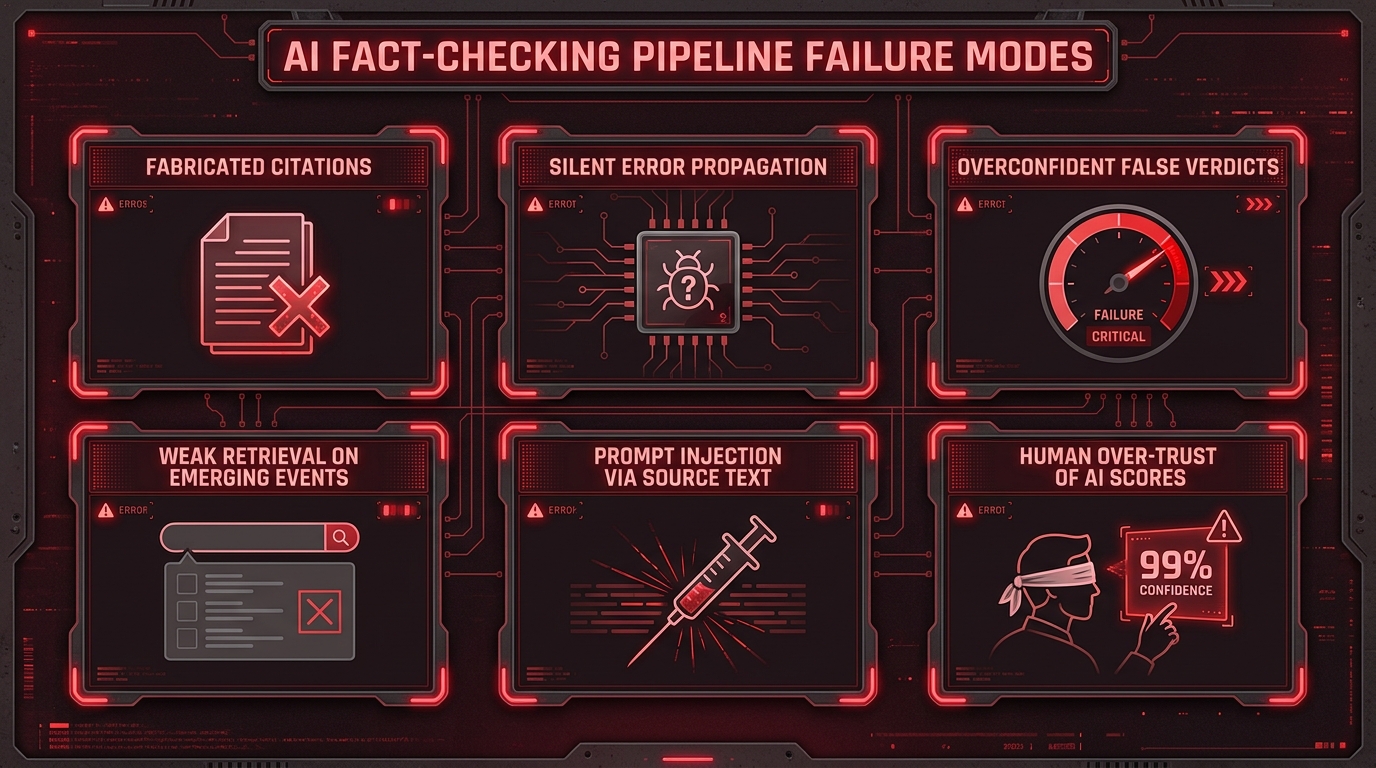
The field has moved past describing the generic risk of “AI hallucinations” toward a more useful taxonomy of specific, predictable failure modes — each of which requires a different mitigation. Treating hallucination as a single phenomenon leads to inadequate responses; treating it as a family of distinct failure types enables targeted engineering.
Fabricated Citations
The most publicized failure mode: an LLM produces a veracity assessment and cites a source that does not exist, or that exists but does not say what the model claims it says. This failure occurs when the retrieval layer fails to return relevant documents and the model falls back on parametric memory — generating plausible-sounding citations from training data rather than from retrieved context.
Mitigation: Require citation grounding as a structured output constraint. Every claim in a model-generated assessment must be linked to a specific retrieved document, verified programmatically before the output reaches the editor dashboard. If the retrieval step returns no relevant documents, the system should output “insufficient evidence” rather than proceed to generation.
Silent Error Propagation
The most dangerous failure mode because it is invisible: an error in Stage 1 (a missed or mislabeled claim) propagates through the pipeline without triggering any alert. The system doesn’t fail loudly — it simply never processes the problematic claim at all. Editors receive no flag and therefore have no reason to suspect anything went wrong.
Mitigation: Implement pipeline-level monitoring that tracks claim volume, stage throughput rates, and claim-type distribution over time. Anomalous drops in claim detection volume for a specific topic or speaker should trigger alerts, not silence. Treat zero-flag outputs as requiring active explanation, not passive acceptance.
Overconfident False Verdicts
LLMs are prone to producing high-confidence outputs even when the evidence is ambiguous. A model that assigns 92% confidence to a “refuted” verdict based on a single retrieved document that is tangentially related to the claim is more dangerous than a model that returns a low-confidence output — because the high-confidence score may reduce editorial scrutiny at Stage 4.
Mitigation: Calibrate confidence scores against actual accuracy in your specific deployment domain. A model’s raw confidence is not a calibrated probability. Use conformal prediction or held-out validation sets to establish what a given confidence score actually means in terms of real-world accuracy, and display adjusted confidence levels to editors rather than raw model outputs.
Prompt Injection via Source Text
This failure mode is underappreciated in newsroom contexts but is architecturally significant: if a retrieved document contains adversarially crafted text — specifically designed to manipulate the LLM’s behavior when that document is included in the prompt context — it can alter the model’s assessment of an entirely unrelated claim. A disinformation actor who knows that a newsroom’s fact-checking pipeline retrieves from a specific web corpus could theoretically craft content designed to poison retrieved context.
Mitigation: Implement input sanitization on retrieved documents before they are passed to the reasoning model. Establish an allowlist of trusted source domains for retrieval, with strict controls on what sources are indexed. Monitor for unusual patterns in model behavior that could indicate context manipulation.
Human Over-Trust of AI Scores
Perhaps the most consequential long-term failure mode: editorial teams that interact with a fact-checking dashboard daily begin to treat high-confidence AI scores as effectively verified facts, reducing the scrutiny they apply at Stage 4. This is a documented behavioral pattern in human-AI interaction research — automation bias, the tendency to defer to automated systems even when independent judgment would produce a different conclusion.
Mitigation: UI design choices matter here as much as engineering ones. Systems should present AI assessments as “suggested verdicts with supporting evidence” rather than color-coded verdicts. Require editors to actively review the cited evidence before approving an output, rather than clicking through a confidence indicator. Conduct periodic audits where editors review AI outputs that were published without significant modification, checking whether they would reach the same conclusion with fresh eyes.
Human-in-the-Loop Is Not a Fallback — It Is the Architecture
A persistent misconception in AI fact-checking is that human-in-the-loop oversight is a transitional arrangement — something newsrooms maintain today because AI isn’t good enough yet, but which they will eventually be able to remove as model quality improves.
This misunderstands both the nature of fact-checking and the epistemological limits of automated verification. Fact-checking is not a process of retrieving a known answer from a knowledge base and comparing it to a claim. It is an editorial judgment that involves assessing the relevance, quality, and appropriate interpretation of evidence, applying context about how claims function rhetorically in political discourse, deciding what a fair verdict label actually means for a specific claim, and taking institutional responsibility for a published correction.
None of those functions are appropriate to delegate to a model, regardless of model quality. The human is not compensating for model weakness — the human is performing a distinct function that the model is structurally unsuited to perform.
What Human Review Actually Accomplishes
When an editor reviews an AI-flagged claim in a well-designed pipeline, they are doing several things that the model cannot:
- Contextualizing the claim within the news narrative. A statistic about unemployment may be technically accurate but presented in a way that creates a misleading impression. The AI may correctly verify the number; only a human can evaluate whether the framing is honest.
- Evaluating source authority. Not all retrieved documents are equally authoritative. A government statistics release, an academic paper, a think tank report, and a wire article may all say similar things with very different levels of evidential weight. Human judgment about source hierarchy is not easily automated.
- Assessing political and cultural context. In many international contexts, what counts as a claim worth checking — and what the appropriate threshold for a “false” verdict is — depends on cultural and political context that differs significantly from the newsroom’s primary market. Human editors who know that context are essential.
- Taking institutional responsibility. Publishing a fact check carries the newsroom’s credibility. That is a decision a human must own.
Designing for Human Review Speed
If human review is the bottleneck in a fact-checking pipeline, the engineering priority is to minimize the cognitive load of that review — not to reduce the frequency of human involvement. This means claim cards that present the claim, the retrieved evidence, and the model’s reasoning in a consistent, scannable format; one-click access to the full source documents; and a clear indication of the model’s confidence calibration so editors understand what confidence levels mean in practice for their specific deployment.
The system should be designed so that an experienced fact-checker can review a well-prepared claim card in 60 to 90 seconds for straightforward verifications, with more complex claims triggering an escalation to longer-form investigation. Anything that requires the editor to re-run the research from scratch because the AI output is hard to trust or verify is a pipeline design failure, not an editorial resource problem.
Building the Governance Layer: Editorial Policies, Audit Trails, and Model Cards
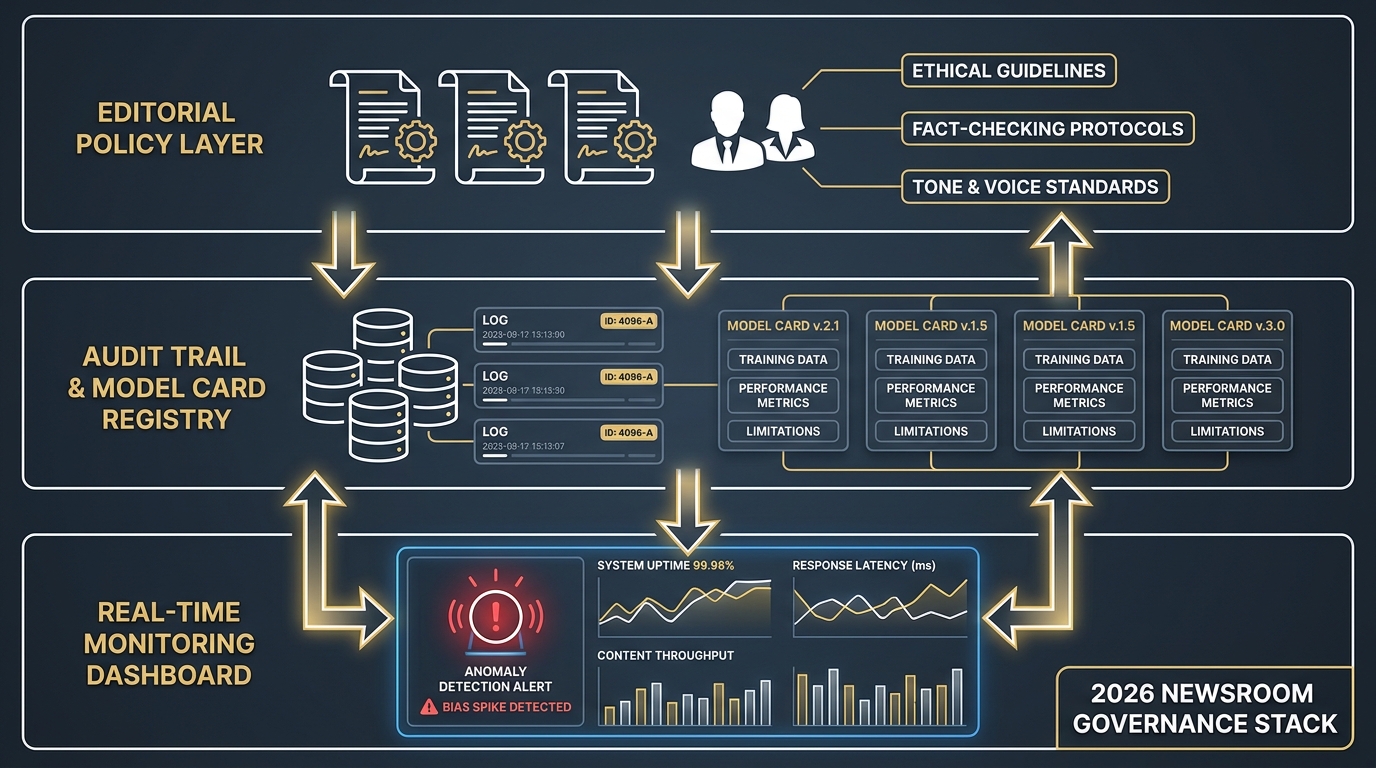
The technical architecture of a fact-checking pipeline is the part that gets discussed in engineering meetings. The governance layer is the part that determines whether the organization can be held accountable when something goes wrong — and whether the system retains editorial credibility over time.
Leading newsrooms are treating governance not as a compliance checkbox but as an active component of the pipeline architecture. This involves three specific structures.
Editorial AI Policy
Every newsroom deploying an AI fact-checking tool should publish an explicit internal policy that answers the following questions, at minimum:
- Which stages of the pipeline can produce content that enters publication without individual human review of that specific output? (The answer should be: none.)
- What is the minimum evidence standard required before an AI-assisted fact check can be published?
- What disclosures are required when AI tools were used in the production of a fact check?
- Who is responsible for reviewing the accuracy of the AI pipeline itself, and on what cadence?
- What is the escalation path when an editor disagrees with an AI-generated assessment?
The BBC, Reuters, and AP have all published variations of AI editorial guidelines for their newsrooms, though none of these documents go into the technical specifics of fact-checking pipeline governance. Smaller newsrooms implementing these systems typically have no written policy at all, which represents significant institutional risk.
Audit Trails and Model Cards
Every published fact check that involved AI assistance should be traceable to the specific model version, retrieval corpus version, and prompt configuration that generated the AI assessment. This is not primarily a legal requirement — it is an operational necessity for identifying and correcting systematic errors.
If a model update changes the pipeline’s behavior on a specific claim type, the newsroom needs to be able to identify which previously published fact checks might be affected. Without versioned audit trails, this is impossible. Model cards — standardized documentation of a model’s training data, performance characteristics, known limitations, and intended use cases — provide the factual basis for these audits.
The emerging standard is to store audit logs for every AI-assisted editorial decision for a minimum of 18 months, with logs that capture the claim text, the retrieved evidence, the model’s structured output, and the editor’s final decision. This creates the data foundation for ongoing accuracy audits and for demonstrating editorial due diligence if a published fact check is challenged.
Ongoing Performance Monitoring
Pipeline accuracy degrades over time for predictable reasons: the news landscape evolves, new political figures enter the discourse, model weights drift, retrieval corpora become stale, and the distribution of claim types shifts. A pipeline that was well-calibrated during an election cycle may perform significantly worse six months later when the political context has changed.
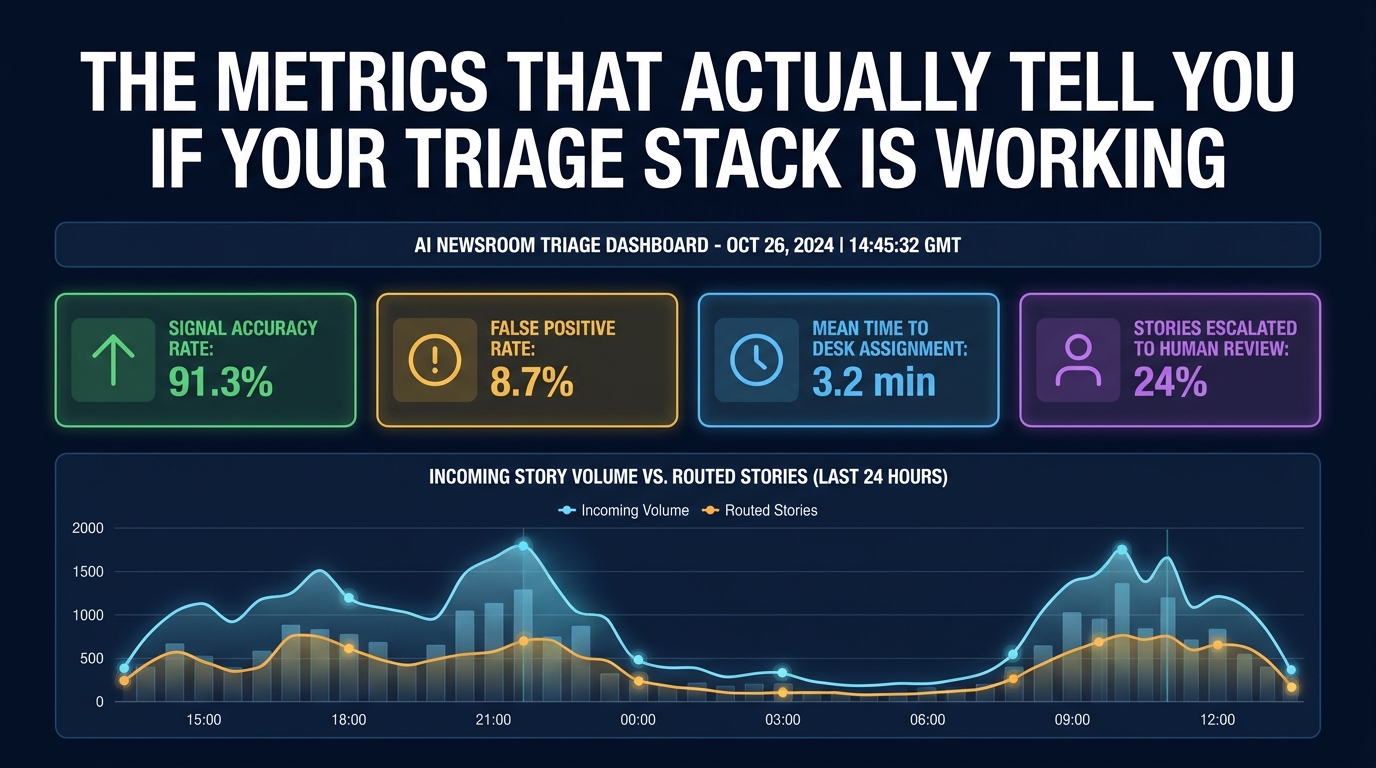
The governance response is continuous performance monitoring: tracking the fraction of AI-generated assessments that editors accept without modification, reject, or significantly revise. Rising revision rates signal model degradation. Tracking claim type coverage — identifying categories of claim that consistently return low-confidence or no-evidence outputs — surfaces gaps in the retrieval corpus that need attention.
What the 2026 Newsroom Fact-Checking Stack Actually Looks Like
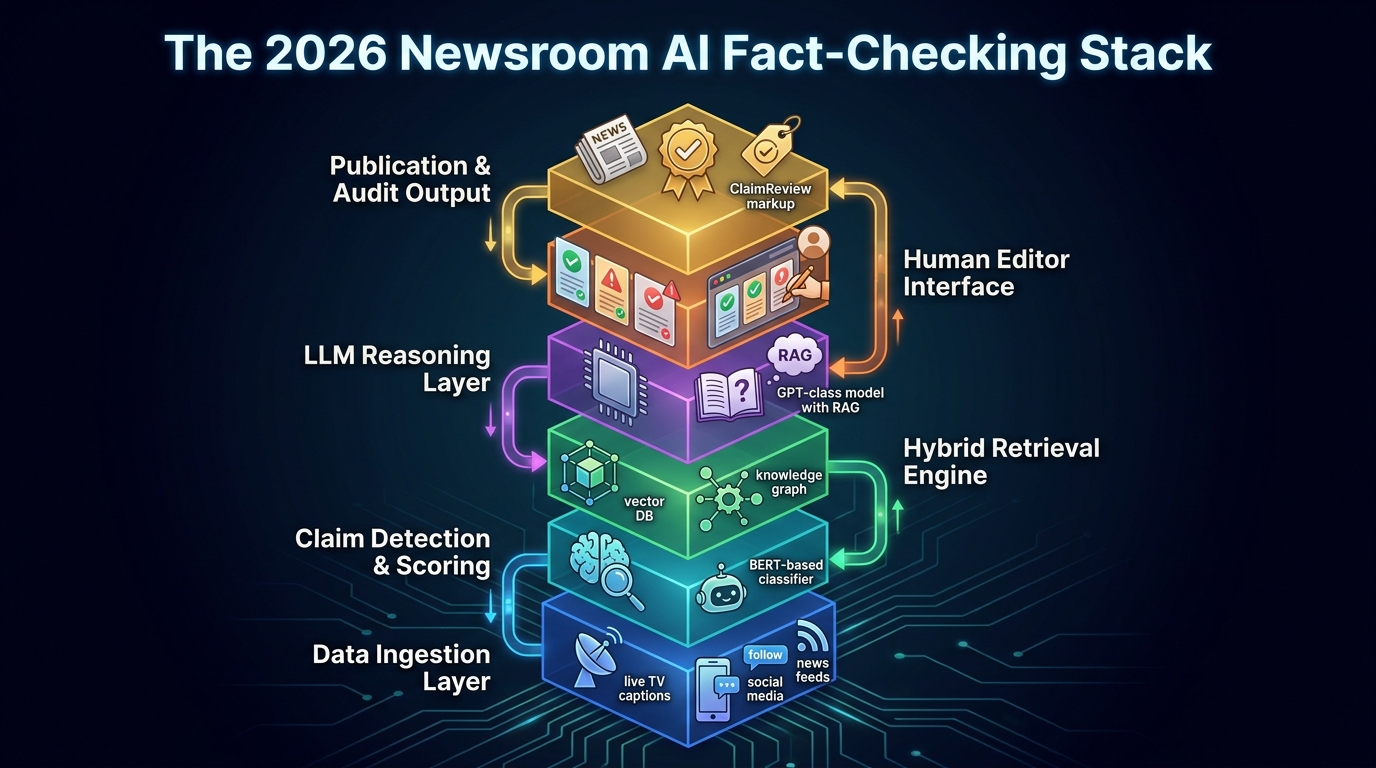
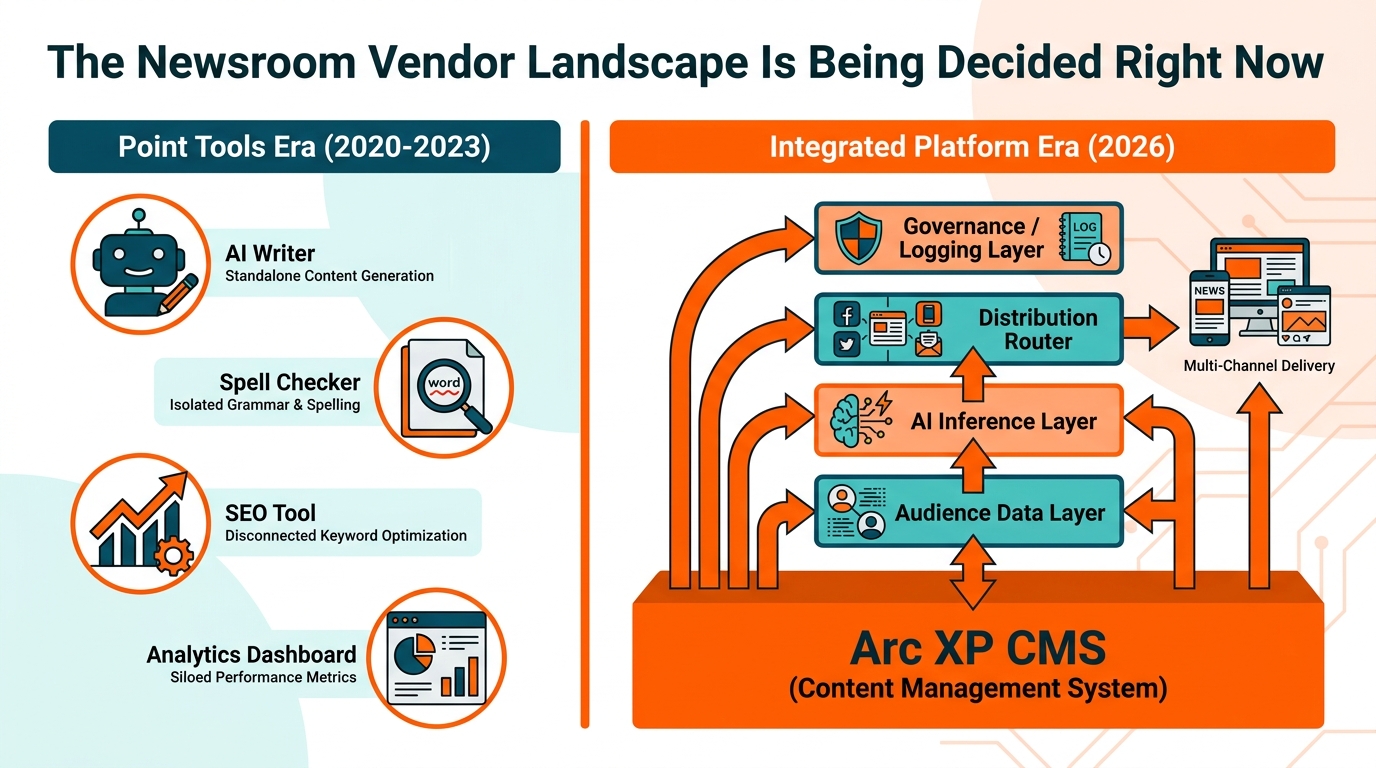
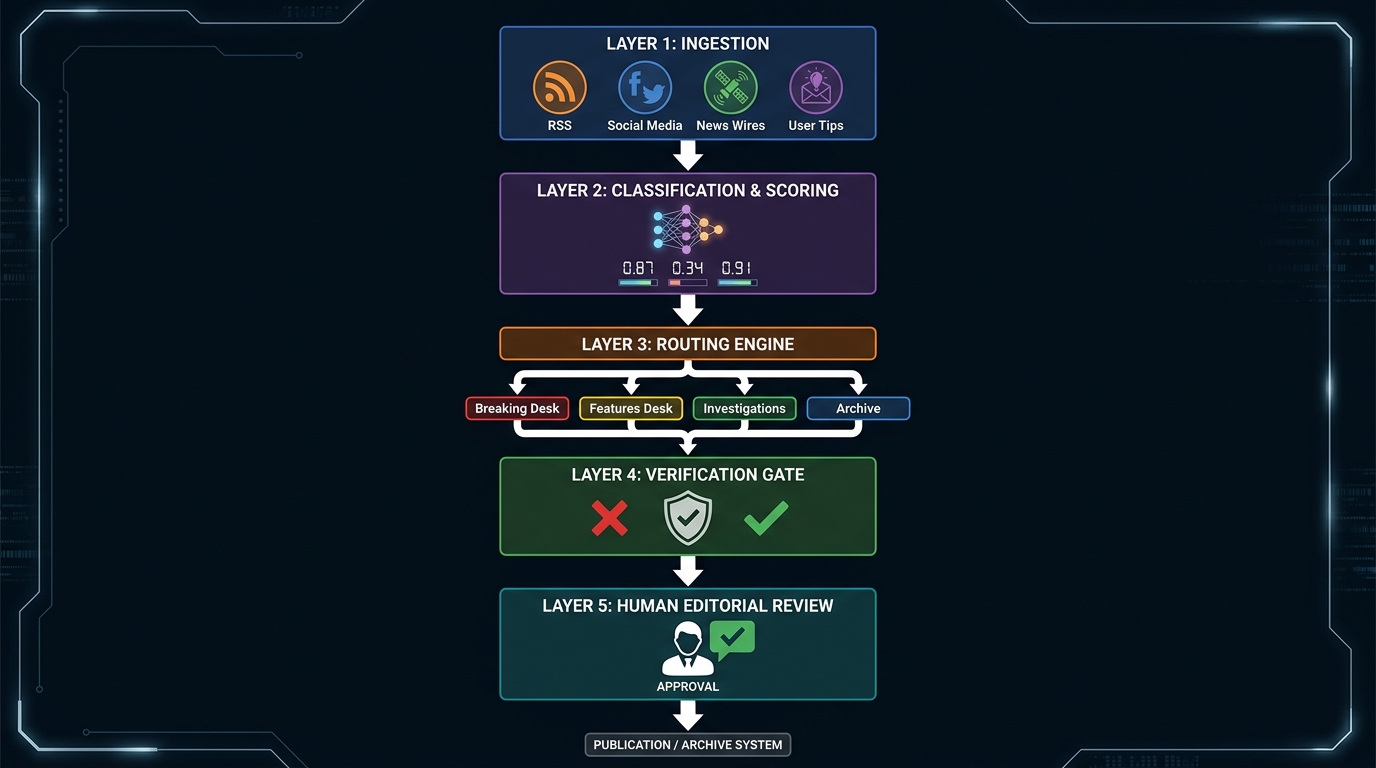
Drawing together the architecture, tooling, case studies, and failure modes described above, the following represents what a production-grade, responsibly deployed newsroom fact-checking pipeline looks like in 2026.
Layer 1: Data Ingestion
Continuous streaming ingestion from multiple source types: live broadcast captions via speech-to-text API (streaming output, not batch), wire service feeds, social media monitoring (filtered to relevant accounts and hashtags), press release aggregators, and the newsroom’s own article draft queue. All text is normalized, segmented into sentences, and timestamped before passing to the claim detection layer. Source provenance metadata is attached to every sentence and retained through all downstream layers.
Layer 2: Claim Detection and Scoring
A fine-tuned BERT-class or similar encoder model classifies sentences for claim type and checkworthiness. Outputs are a claim type label (quantity, causation, comparison, historical) and a ranked checkworthiness score. Sentences below a configurable threshold are dropped; above-threshold sentences enter a prioritized queue. Claim volume and score distribution are logged for monitoring purposes.
Layer 3: Hybrid Retrieval Engine
High-priority claims trigger a parallel retrieval operation: dense vector search against a curated news and reference corpus, knowledge graph lookup for named entity relationships, and PFCR search against the indexed archive of previously fact-checked claims. A cross-encoder re-ranker scores each retrieved document for relevance to the specific claim. Retrieved documents are returned with source domain, publication date, and relevance score attached.
Layer 4: LLM Reasoning Layer
A RAG-augmented reasoning model receives the claim, the top-ranked retrieved documents, and a structured prompt that specifies the required output format: a confidence score, a preliminary verdict category, a natural language explanation of the reasoning, and explicit citations for each evidential point made. Grounding constraints prevent the model from making claims in its output that are not supported by retrieved documents. If retrieval returns insufficient evidence, the model outputs “insufficient current evidence” rather than generating a speculative verdict.
Layer 5: Human Editor Interface
A fact-checker dashboard presents claim cards in priority order. Each card shows the original claim text with source context, the retrieved evidence with one-click access to full documents, the model’s reasoning explanation, and the preliminary verdict with calibrated confidence. Editors can approve, modify, reject, or escalate to deep investigation. All decisions are logged. Claims that have been reviewed but not yet published are visible to other editors to prevent duplicate work on the same claim.
Layer 6: Publication and Audit Output
Approved fact checks are formatted as ClaimReview structured markup for publication and indexed to the Google Fact Check Tools API. Audit records capture the full pipeline trace: claim source, retrieval corpus version, model version, editor identity, decision, and timestamp. Published fact checks include disclosure language indicating that AI tools assisted in the research process and that all verdicts were reviewed by a human fact-checker.
The Market and Competitive Context: Who Is Building This Infrastructure
The AI fact-checking tool market in 2026 is not a mature software category with established vendors and standardized products. It is a fragmented landscape of nonprofit tool builders, research lab spinouts, and large platform investments, with relatively few commercial products that a mid-sized newsroom could license and deploy without significant technical integration work.
The Nonprofit Technology Layer
Full Fact occupies an unusual position: a registered nonprofit fact-checking organization that has built production-grade tools and now licenses them to other fact-checking organizations worldwide. Their model — building tools as a fact-checker for fact-checkers, rather than as a technology company for technology buyers — gives them an editorial credibility that commercial vendors struggle to match. Their 40-organization network across 30 countries represents a significant distribution achievement for the category.
Research Institutions
ClaimBuster (UT Arlington), the Duke Reporter’s Lab, and various academic groups continue to publish state-of-the-art models and benchmarks, but translating research-grade tools into production-deployable systems remains a significant challenge. The gap between an academic system that achieves high accuracy on a benchmark dataset and a newsroom tool that handles the full volume and variety of real editorial workflows is substantial.
Platform Investments
Google’s investment in the Fact Check Tools ecosystem — including the API, the ClaimReview standard, and FactCheck Explorer — represents the most significant platform-level infrastructure investment in the space. Meta’s Third-Party Fact-Checking program channels significant resources toward partner fact-checking organizations, though the program’s design incentivizes production of fact checks rather than investment in pipeline infrastructure per se.
The Commercial Gap
There is currently no commercial product that addresses the full stack described above in a form that a regional newsroom with limited engineering resources could readily deploy. Tools that address individual stages exist; end-to-end pipelines typically require either significant internal engineering investment or a partnership with an organization like Full Fact. This gap is where most of the interesting product development activity in the category is occurring.
Conclusion: The Pipeline Is Infrastructure, Not a Feature
The most important reframe for newsrooms evaluating AI fact-checking technology in 2026 is this: the pipeline is infrastructure, not a product. A fact-checking pipeline is not something you buy, configure, and run. It is something you build, monitor, calibrate, and continuously maintain — in the same way that a newsroom maintains its sourcing standards, its editorial guidelines, and its relationships with authoritative data providers.
That reframe carries several practical implications:
- The investment is ongoing, not one-time. Retrieval corpora go stale. Models drift. Claim type distributions shift with the news cycle. A pipeline that is well-calibrated today needs active maintenance to remain accurate in six months.
- Governance is a first-class engineering concern, not an afterthought. Audit trails, model cards, and editorial AI policies are not bureaucratic overhead — they are the structures that make a fact-checking pipeline defensible when it makes an error, and that enable systematic learning when errors occur.
- The hardest problems are at Stage 1, not Stage 3. Investment in LLM quality at the reasoning layer delivers diminishing returns if the claim detection layer is poorly calibrated. Building a better reasoning model does not fix a claim detector that misses statistically vague claims, embedded assertions, or emerging terminology.
- Human editors are not a bottleneck to be engineered around — they are a core system component. Designing for editorial speed, comprehension, and appropriate skepticism at the human review stage is at least as important as optimizing model latency.
- Real-time is a constraint, not a goal. Sub-second latency on straightforward claims during predictable coverage like debates is achievable. Real-time verification of breaking news claims about events that occurred two hours ago is not. Understanding the boundary conditions of your pipeline is essential to deploying it responsibly.
The organizations that have moved from pilots to production — Full Fact’s 40-organization network, AFP’s verification infrastructure, the teams at Agência Lupa building for live Brazilian political coverage — share a characteristic that has nothing to do with the sophistication of their models. They have a clear-eyed understanding of exactly what the pipeline can and cannot do, and they have designed their editorial workflows around that understanding rather than around a more optimistic version of what they wish the technology could do.
That discipline is the actual differentiator. In a category where the technology is evolving rapidly and the vendor claims are routinely ahead of the deployment realities, the newsrooms that build durable, credible fact-checking pipelines will be the ones that approach the architecture with engineering honesty — and maintain that honesty across every layer, from claim detection to published verdict.