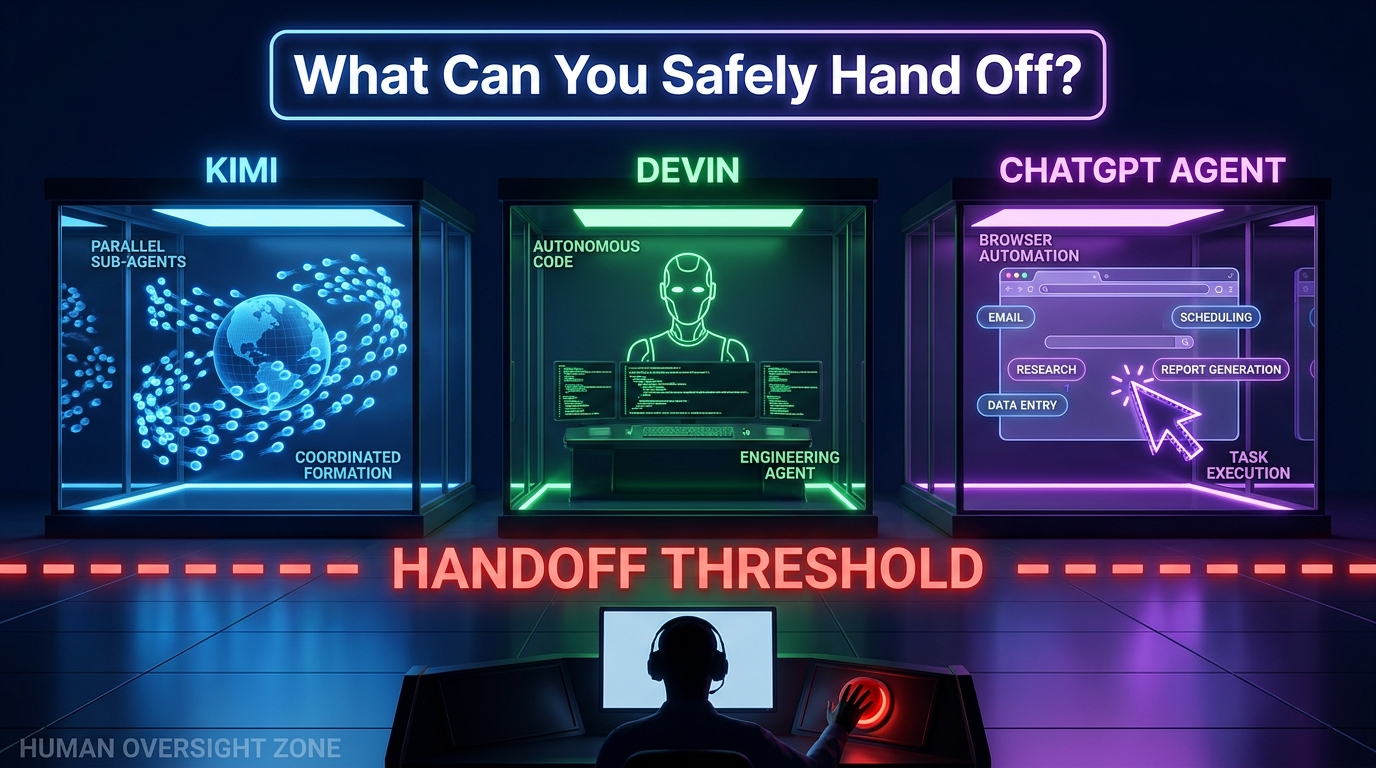
The question used to be whether AI agents could do things. That debate is over. Kimi’s K3 Agent Swarm can coordinate up to 300 parallel sub-agents across more than 4,000 tool calls for a single task. Devin autonomously plans, codes, tests, and submits pull requests in production repositories. ChatGPT Agent operates a virtual computer — browsing websites, filling forms, editing spreadsheets, and connecting to external apps — while you’re nowhere near your desk.
The new question — the harder question — is what you can safely hand off to them.
That distinction matters enormously. Because “the agent can do this” and “you should let the agent own this” are not the same sentence. The gap between those two statements is where real workflows break, where security incidents begin, and where the most promising automation projects quietly stall out after six weeks.
This piece is not a feature-by-feature comparison of three AI products. It is a practical framework for understanding the structural difference between these systems, the tasks each genuinely handles well without supervision, the failure modes that emerge when teams over-delegate, and the security and governance realities that most “AI agent” coverage skips entirely. If you are deciding what to put in front of one of these agents and what to keep in a human’s hands, this is what you need to know.
The Architecture Underneath: Why These Three Systems Are Fundamentally Different by Design
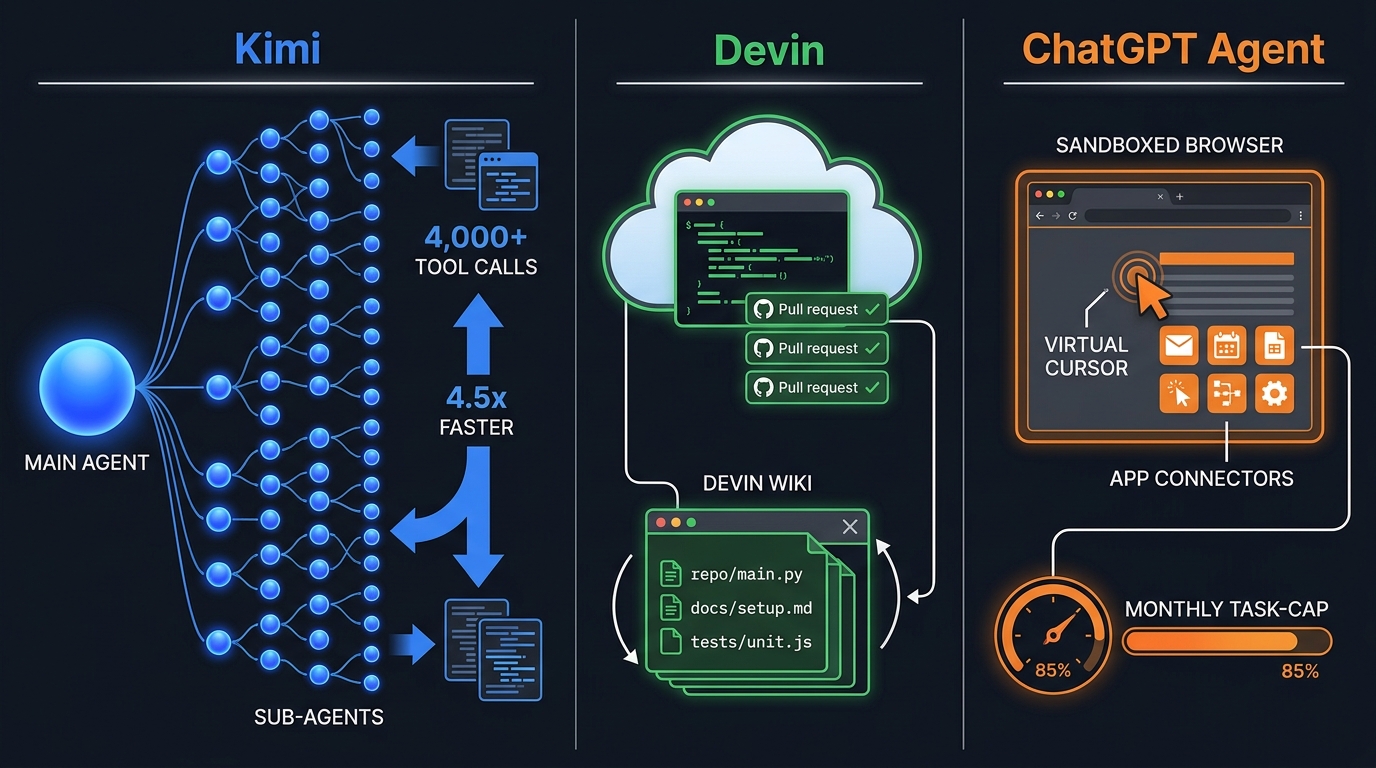
Kimi, Devin, and ChatGPT Agent are often lumped together under the same “AI agent” label, but their underlying architectures were built to solve different problems. That difference shapes everything — which task types they excel at, where their failure modes live, and crucially, how much human oversight they actually require at scale.
Kimi: A Swarm Intelligence Model
Kimi’s K3-powered agent stack operates on a horizontal scaling principle. When you give Kimi Agent a complex task, a primary controller agent decomposes it into subtasks and dynamically spins up to 300 specialized sub-agents to execute those subtasks in parallel. There are no predefined roles you configure. The system designs its own organizational structure based on what the task requires.
The scale here is not marketing hyperbole — it’s a meaningfully different architectural choice. Kimi reports that Agent Swarm completes qualifying tasks approximately 4.5 times faster than single-agent, sequential execution. The system can sustain more than 4,000 coordinated tool calls per task, which enables multi-day autonomous operation. Kimi Claw, the cloud automation layer, extends this into desktop and web application control.
The implication is that Kimi’s architecture is optimized for breadth and throughput: tasks where parallelism pays off — massive research synthesis, large-scale data enrichment, high-volume document processing, broad codebase analysis — fit naturally into this model. Narrow, judgment-heavy tasks with ambiguous success criteria do not.
Devin: A Deep Domain Specialist
Devin (Cognition) was purpose-built for one domain: software engineering. Rather than a general-purpose agent that can code among other things, Devin is an agent-native IDE: it gets its own sandboxed cloud VM, its own interactive development environment, access to your actual repositories, and the ability to submit pull requests with real code that goes into production.
Devin 2.0 introduced three structural capabilities that changed how the system is actually used: Interactive Planning (Devin researches your codebase and produces a detailed plan before touching a single line of code, which you can review and modify before it acts), Devin Search (an agentic tool for querying the structure and logic of your codebase), and Devin Wiki (an auto-generated, regularly updated knowledge base of your repositories, including architecture diagrams and documentation). You can now spin up multiple parallel Devins on concurrent tasks, each with its own isolated IDE.
What this architecture signals is that Devin was designed for depth within a defined domain. It works inside a boundary — your codebase, your tools, your PR workflow — rather than across a general-purpose action space. That constraint is actually a feature, not a limitation.
ChatGPT Agent: A General-Purpose Workflow Executor
ChatGPT Agent (previously Operator) takes the broadest approach: a sandboxed virtual computer with a browser, a code interpreter, file access, and a growing set of external app connectors. The system can research competitors across dozens of websites and return a structured report, fill out multi-step forms, pull data from a PDF and update a spreadsheet, help plan and book travel, and run scheduled monitoring tasks while you’re offline.
Its architecture prioritizes generality and accessibility. It doesn’t require a specialized environment setup or domain-specific integration. It works in a browsable internet context, which means it can interface with virtually any web-based tool. The tradeoff is that it operates with monthly task caps that vary by subscription tier, and it is fundamentally session-based — it doesn’t maintain persistent context across disconnected tasks the way a specialized system like Devin does within a codebase.
Kimi Agent Swarm: When 300 Sub-Agents Work While You Sleep
Understanding where Kimi genuinely excels requires setting aside the 300-agent headline and focusing on the structural characteristics of the tasks it handles well. The swarm architecture earns its value in situations where a single problem can be legitimately decomposed into many parallel, mostly independent subtasks — and where the output is a synthesized result rather than a single judgment call.
Where Kimi’s Swarm Architecture Actually Delivers
Large-scale information retrieval is the clearest fit. If you need competitive intelligence across 200 websites, a literature review spanning 500 research papers, or a data enrichment pass across a 50,000-row CRM export, the parallelism of Agent Swarm directly reduces the wall-clock time of the task. Each sub-agent pulls data from a subset of sources, and the main controller synthesizes the results. The 4.5x speed advantage Kimi cites is most credible in exactly these scenarios.
Long-form document production at scale — think generating 100 tailored product descriptions, producing technical documentation for a large software library, or creating a detailed research report pulling from dozens of data sources — also maps well to the swarm architecture. Sub-agents can handle individual sections or source documents in parallel, with a coordinating agent managing consistency.
Kimi K3, which now powers all agent modes and includes a 1M-token context window with native vision, also handles complex coding tasks across large repositories — though in a different style than Devin. Where Devin works deeply and iteratively inside your actual codebase with a persistent IDE session, Kimi’s strength in coding is broader codebase analysis, documentation generation, and tasks that benefit from parallel sub-agent processing of multiple files or modules simultaneously.
The Limits Kimi’s Architecture Creates
The swarm model introduces a specific class of failure mode: coordination errors. When 300 sub-agents are synthesizing information in parallel, the quality of the final output depends on how well the main controller manages consistency, contradiction resolution, and priority weighting across their outputs. For well-structured data tasks with clear success criteria, this works well. For tasks requiring nuanced judgment — where ambiguity in one sub-agent’s output should cause the system to revise its entire approach — the swarm can produce results that are voluminous but directionally wrong.
Multi-day continuous operation is technically supported, but it introduces a governance question that many teams underestimate: who is monitoring the agent over those days? What checkpoints exist? What triggers human review? Running a swarm of 300 sub-agents autonomously for 48 hours without visibility is not an AI strategy — it is an audit liability.
Devin AI: The Myth of the Autonomous Engineer vs. What’s Actually Working
Devin received significant press attention when it launched around claims of autonomous software engineering. Some of that coverage overstated what was actually happening. Getting this right matters for anyone considering deploying Devin in a real engineering workflow — because the actual performance data tells a more nuanced and ultimately more useful story.
The Benchmark Reality
On SWE-bench Verified — a standard evaluation benchmark that tests AI systems on real GitHub issues — Devin’s original published score was 13.86% autonomous resolution. That was a meaningful jump above prior autonomous agents, which typically scored between 1% and 4%. But it also means that roughly 86% of real, ambiguous GitHub issues were not resolved fully autonomously. Independent reanalyses placed the apples-to-apples figure closer to 9–10% in some configurations.
On more structured benchmarks, the numbers improve considerably: WebArena (web-based development tasks) showed 28.4% success; Terminal-bench (terminal-based tasks) showed 23.89%. These numbers reflect the pattern that consistently emerges in real-world Devin deployments: the more defined and bounded the task, the higher the success rate.
Where Devin Is Genuinely Strong
On well-scoped, clearly defined tasks, Devin’s production success rates are meaningfully higher than benchmarks suggest. Bug-fix success rates for clearly scoped issues have been documented as high as 78% in real-world testing. For repetitive engineering work — database migrations, test suite generation, boilerplate scaffolding, API integration work where the spec is clear — Devin handles 60–80% of tasks with minimal intervention.
The Interactive Planning feature in Devin 2.0 deserves specific attention because it changes the delegation dynamic in an important way. Before Devin executes anything, it researches your codebase, identifies relevant files and components, and produces a preliminary plan that you review and modify. This means the handoff is not “give Devin a task and walk away” — it is “collaborate on the plan, approve the approach, then let Devin execute.” That structure dramatically reduces the risk of Devin misunderstanding what you want and executing confidently in the wrong direction.
The parallel Devin instances feature changes team economics. Rather than one developer reviewing and managing one Devin session at a time, an engineer can manage multiple concurrent Devin tasks across different subsystems — checking in on progress, steering when needed, reviewing PRs. This is an amplifier for engineers who are good at code review and architectural direction, not a replacement for the judgment those skills require.
Where Devin Still Fails
Ambiguous, architecture-heavy problems are where Devin’s limitations are most pronounced. “Redesign our authentication flow for scalability” or “figure out why the app is slow under load and fix it” are not well-scoped tasks. They require iterative investigation, contextual judgment about tradeoffs, and the kind of accumulated institutional knowledge that doesn’t live in a repository — it lives in the engineers who built the system. Devin does not handle these reliably.
Novel problems — where there isn’t a clear prior pattern in the codebase or a well-defined success condition — also surface Devin’s limits. The system’s strength is pattern recognition and structured execution within familiar territory. When the territory is genuinely new, Devin tends to produce confidently wrong code rather than escalating for human input.
ChatGPT Agent: The General-Purpose Workhorse and Its Real-World Limits
ChatGPT Agent occupies a different position in the landscape: it is the most broadly accessible of the three systems and the one most likely to be used across a wide range of business functions rather than within a specialized technical domain. Understanding what it genuinely handles well — and where its architecture creates hard limits — matters for any team deploying it beyond basic research tasks.
What’s Actually Working in Production
Research and competitive intelligence gathering is ChatGPT Agent’s clearest strength. The ability to browse across dozens of websites, extract structured information, and return a synthesized report or populated spreadsheet is genuinely useful and works reliably when the task is well-framed. Market research, vendor comparison, pricing intelligence, and feature benchmarking all fall into this category.
Data wrangling — extracting data from PDFs or web sources, cleaning it, and updating a spreadsheet or CSV — works well when the data structure is predictable. Form-filling and structured web interactions, including vendor onboarding workflows and repetitive data-entry tasks, also work reliably when the target website doesn’t have aggressive bot detection or dynamic form behavior that trips up the agent’s click sequence.
Scheduled monitoring tasks are functional but require careful setup. ChatGPT Agent can check a set of websites for pricing changes, monitor a job board for specific listings, or pull updated data from a source on a recurring basis — but these are best thought of as monitoring and reporting tasks, not fully autonomous action tasks. The agent surfaces findings; a human decides what to do with them.
Where the Architecture Creates Real Limits
ChatGPT Agent is session-based and task-capped. This means it doesn’t maintain deep persistent context across disconnected sessions the way Devin maintains context within a codebase through its Devin Wiki and Search tools. For tasks that require continuity across days or weeks — tracking a complex negotiation thread, managing an ongoing project — the session model introduces friction.
Monthly task caps create a practical budgeting problem for teams that try to use ChatGPT Agent at scale. The caps vary by subscription tier and can be exhausted faster than expected when agents are running multi-step tasks across large datasets. Teams that don’t model their task consumption upfront often hit ceilings mid-workflow.
Judgment-heavy tasks — where the agent needs to weigh multiple competing considerations, exercise domain expertise, or make a call that depends on organizational context it doesn’t have — are where ChatGPT Agent is least reliable. It will produce an output that looks complete, but the quality of the judgment embedded in that output can be poor in ways that aren’t obvious until downstream consequences surface.
The Handoff Decision Matrix: A Practical Framework for What to Delegate
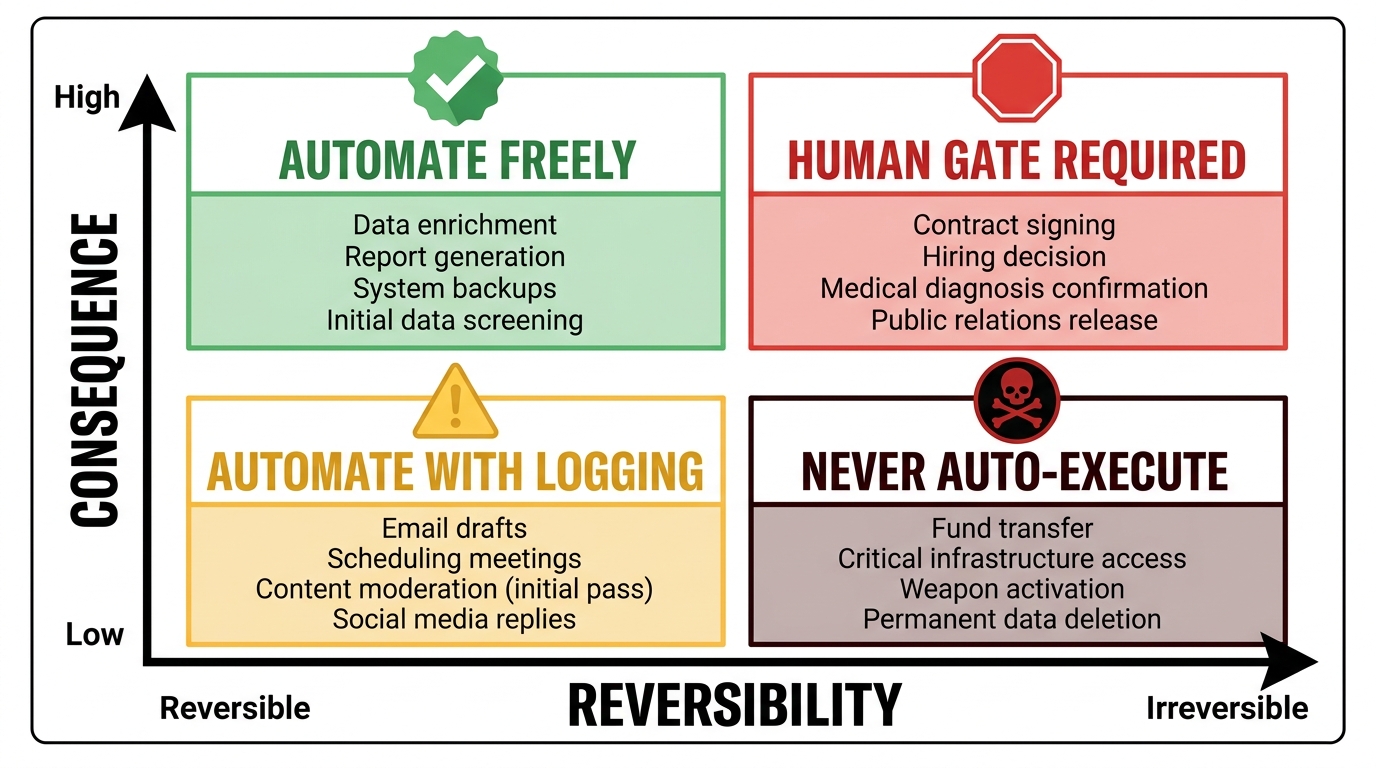
Across real enterprise deployments in 2026, a consistent pattern has emerged around what AI agents can safely own without supervision. The framework that best captures this pattern is built on two axes: reversibility (can the action be undone without significant cost?) and consequence scope (how broadly does a wrong output affect your business, your customers, or external parties?).
The Four Zones of Task Delegation
Zone 1 — Automate Freely (High Reversibility / Low Consequence): These are the tasks where full autonomy is genuinely safe. Data enrichment and deduplication. Email classification and prioritization. Ticket triage and routing — production systems show 95–96% routing accuracy in this category. Research synthesis for internal consumption. Generating first drafts of documentation. Populating templates from structured data sources. If the agent gets it wrong, the cost of correction is low and contained. These tasks should flow through AI agents without human checkpoints.
Zone 2 — Automate with Logging (High Reversibility / Medium-High Consequence): These tasks can be automated, but every action should be logged with sufficient detail to audit and reverse if needed. Updating CRM records. Publishing internal knowledge base articles. Drafting external communications that go through a final human review before sending. Code changes that go through a PR review before merging. The key discipline here is that “automate with logging” means you have an actual logging infrastructure, not just an assumption that you could retrieve records if needed.
Zone 3 — Human Gate Required (Low Reversibility / High Consequence): Here, the agent can do the preparation, analysis, and drafting — but a human must approve before anything executes. Contract terms. Customer-facing communications that carry implied commitments. Pricing changes that propagate to external channels. External API calls that trigger vendor workflows. The agent’s role is to compress the time between “decision point” and “ready to decide” — not to make the decision itself.
Zone 4 — Never Auto-Execute (Irreversible / High Consequence): Financial transactions above defined thresholds. Regulatory filings. Deletion of customer data. Actions that create legal obligations. Security configuration changes in production environments. No AI agent — Kimi, Devin, ChatGPT Agent, or any other system — should be authorized to execute these autonomously in 2026. The technology is not the constraint here; the governance logic is correct regardless of capability level.
Applying the Matrix in Practice
The practical challenge most teams encounter is that real tasks often span multiple zones. A research-to-outreach workflow might have Zone 1 research, Zone 2 draft preparation, and Zone 3 message sending — all in a single automated sequence. The failure mode is treating the whole workflow as Zone 1 because the first step is low-risk. The governance rule is that a workflow’s zone classification is determined by its highest-consequence step, not its most common step.
Industry data from 2026 deployments suggests that the practical “safe autonomy” ceiling for AI agents is roughly 70–80% of task volume — the portion of tasks that are well-bounded, reversible, and have clear success criteria. The remaining 20–30% requires human routing or approval gates, based on explicit risk signals, confidence thresholds, and contextual flags rather than a blanket rule.
Trust Boundaries and Security Risks Nobody Is Talking About Enough
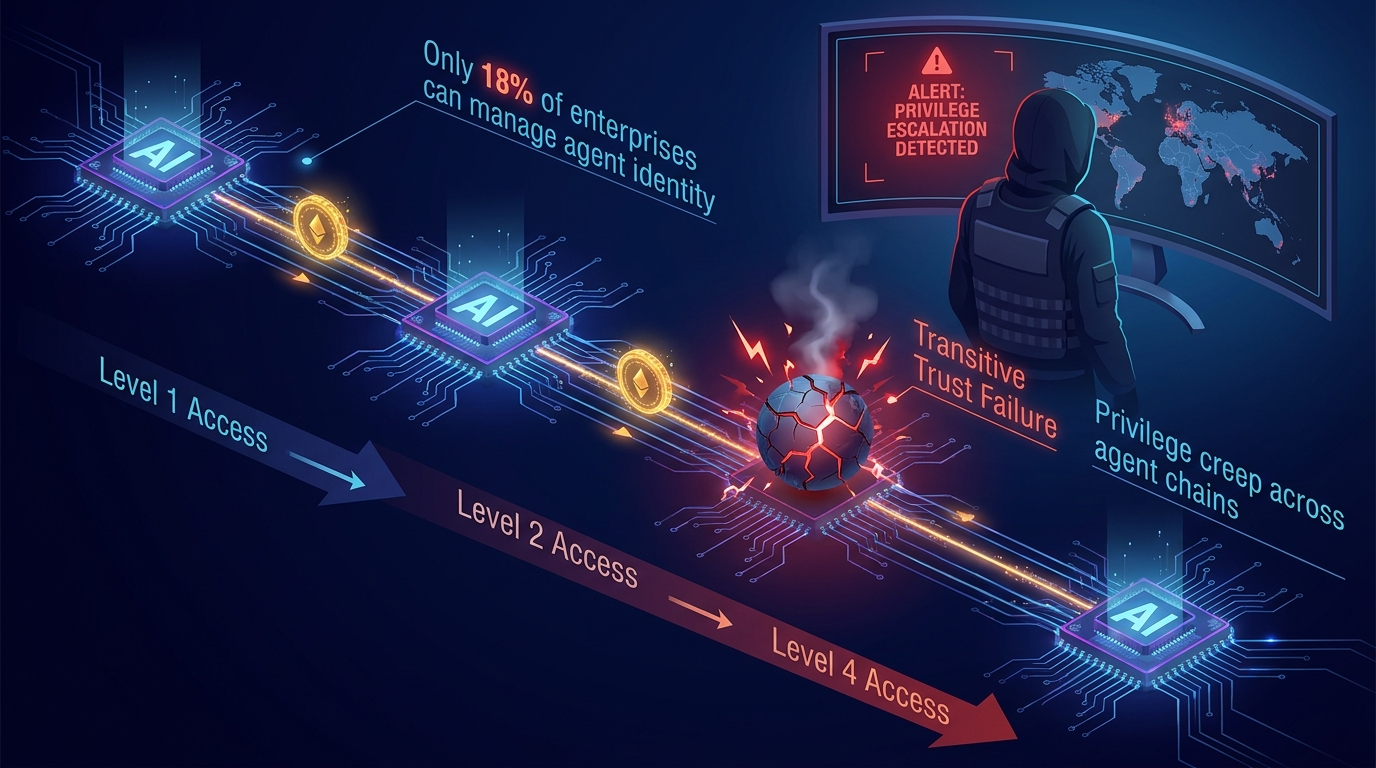
Most coverage of AI agents focuses on capability. Security professionals are focused on something different: the delegation chain itself. And the data from 2026 enterprise environments is concerning enough to warrant serious attention from anyone building or expanding an agent-based workflow.
Transitive Trust: The Problem Most Teams Don’t See Coming
When AI agents delegate to other agents — or when a main agent coordinates a swarm of sub-agents — each delegation step creates a trust handoff. The problem is that most current implementations handle this naively: sub-agents implicitly trust their parent, and agents often implicitly trust messages passed through shared tools or shared memory. This creates what security researchers are calling transitive trust escalation.
The attack pattern works like this: a low-privilege sub-agent receives a task from a compromised or manipulated source. Because it trusts the delegation chain, it executes the task. If that sub-agent has access to a tool that a higher-privilege agent also uses — a shared file store, a shared API key, a shared database connection — the compromise propagates. A low-privilege agent effectively gains high-privilege access by routing through a peer with broader permissions.
This is not a theoretical vulnerability. In 2026, multi-agent privilege escalation is a documented incident pattern in enterprise environments, and current identity and access management infrastructure was not designed to handle it. Only 18% of organizations report high confidence that their IAM infrastructure can manage agent identities effectively. Almost half of enterprises have simply extended their existing human IAM models to agents — which creates exploitable permission-scope mismatches because agents behave very differently from human users in how they acquire and exercise permissions.
The Agent Identity Problem
Traditional IAM assumes a relatively small number of identities (employees, service accounts) acting in predictable patterns. A Kimi swarm running 300 concurrent sub-agents on a single task represents 300 simultaneous identities acting across potentially thousands of tool calls. Tracking which sub-agent called which tool with which permissions, across a 4,000-step task, is not something current enterprise logging infrastructure handles well without specific architectural decisions made in advance.
Emerging standards in 2026 are moving toward cryptographic “Know Your Agent” identity layers — essentially, each agent instance carries a signed credential that traces its authority back through the delegation chain, with permissions scoped explicitly at each hop. This is the right direction architecturally, but adoption is still early and most commercial agent platforms have not fully implemented it.
Session Smuggling and Cross-Agent Injection
A specific threat vector that enterprise security teams are tracking in 2026 is “agent session smuggling” — where a malicious instruction embedded in content that an agent is processing (a webpage, a document, an email body) causes the agent to take actions outside its intended scope. When ChatGPT Agent browses a website and encounters a hidden instruction in the page’s content telling it to forward data to an external endpoint, the agent may comply if its guardrails don’t catch the instruction.
The mitigations are not complex, but they require deliberate implementation: strict permission scoping (the agent can only read data relevant to its task, and cannot write to external endpoints not pre-approved), content sanitization before agent consumption, and behavioral monitoring that flags unexpected action sequences. These are engineering disciplines, not product features — they require active decisions from the teams deploying the agents.
The Reversibility Rule: Why This Single Factor Changes Everything
Of all the dimensions in the handoff decision framework, reversibility deserves its own detailed treatment — because it is consistently the most underweighted factor in how teams actually make delegation decisions. Capability tends to dominate the conversation (“can the agent do this?”), but reversibility is what determines whether a mistake is a minor correction or a serious incident.
Defining Reversibility Precisely
Reversibility is not a binary. There are at least four meaningful categories: instantly reversible (undo the action with zero downstream consequence — a deleted draft, a reverted file change), reversible with cost (the action can be undone, but fixing it requires time, communication, or manual effort — a sent email requiring a follow-up correction, a database update that needs to be rolled back), partially reversible (some consequences can be undone, but others persist — a published article taken down still has search cache, screenshots, and RSS propagation that don’t disappear), and irreversible (the action cannot be meaningfully undone — transferred funds, deleted customer data beyond retention window, regulatory filings submitted).
The correct governance approach is to require explicit documentation of the reversibility category for every task class you’re considering delegating to an AI agent. This is not bureaucracy — it is the decision that determines your fallback options when something goes wrong. And at the success rates currently achievable, something will go wrong.
How Teams Get This Wrong
The most common error is that teams evaluate reversibility at the task level but deploy agents at the workflow level. A task that is individually reversible can become effectively irreversible when embedded in a workflow that has downstream dependencies. A Devin agent that commits code to a branch is doing something reversible. But if that branch is connected to an automated CI/CD pipeline that pushes to staging and then to production on a schedule, the reversibility of the individual code commit is not the relevant measure — the reversibility of the production deployment is. And those are very different things.
Designing agent workflows with explicit rollback procedures at each stage — not just at the task level — is a discipline that the teams running the most reliable agent deployments share. They think about “what does recovery look like if this step fails or produces bad output” before they enable automation, not after.
What Breaks When Teams Over-Delegate
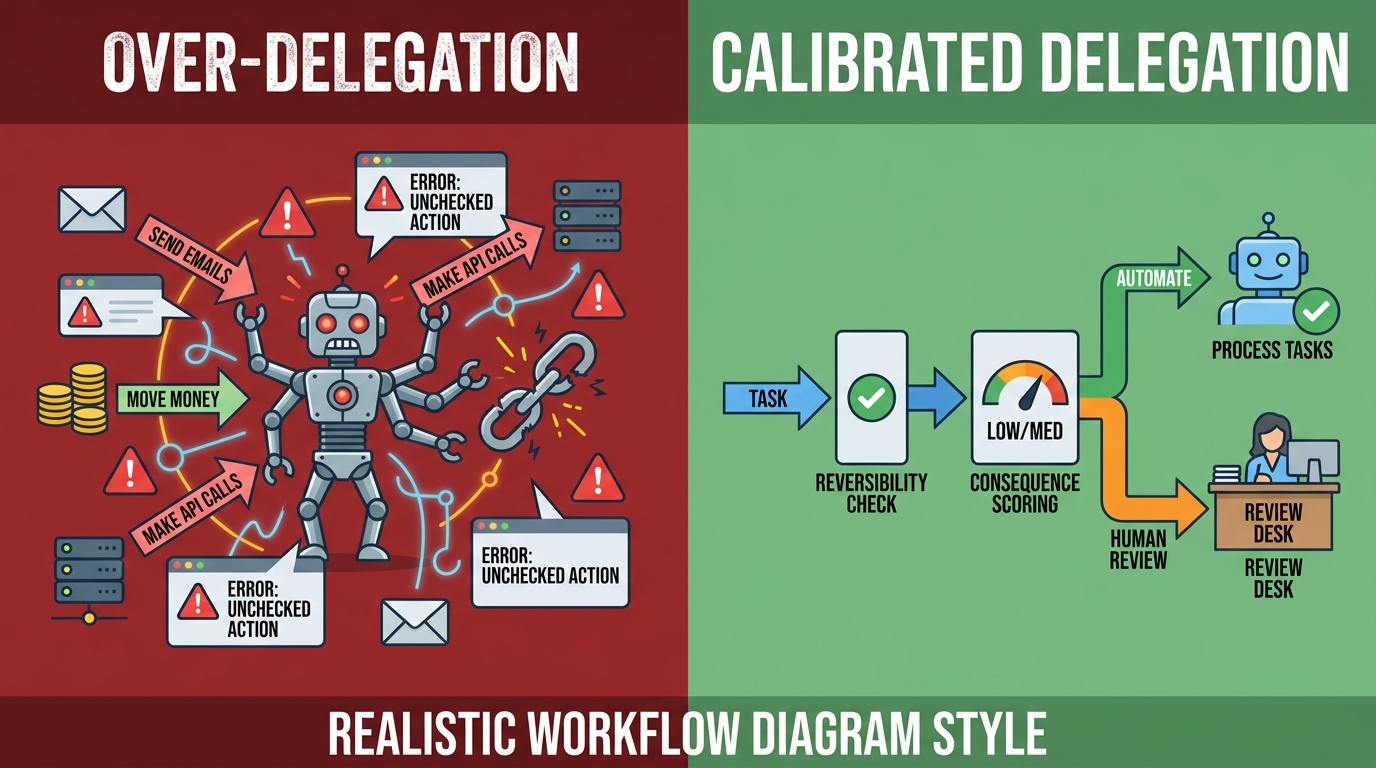
The failure mode of over-delegation is distinct from the failure mode of under-delegation. Under-delegation is wasteful — you’re not capturing available productivity gains. Over-delegation is risky — you’re creating incidents that are expensive to recover from and corrosive to organizational trust in AI systems. In 2026, the more common and more consequential failure mode is over-delegation, and it follows recognizable patterns.
Confidence Without Calibration
All three systems — Kimi, Devin, and ChatGPT Agent — can produce outputs that look authoritative regardless of whether they’re correct. This is a property of large language models: they generate fluent, confident text. But in an agent context, fluent and confident is particularly dangerous, because the system is not just generating text — it is taking actions based on reasoning that may be plausible-sounding but wrong.
Devin will write code that compiles and passes basic tests while introducing logic errors that won’t surface until edge-case inputs. Kimi’s swarm will produce a 60-page research synthesis that is internally consistent but draws incorrect conclusions because one set of sub-agents was working from low-quality sources. ChatGPT Agent will complete a vendor outreach form using data it inferred rather than data it was given, and the discrepancy won’t be visible in the output it returns to you.
The teams that manage this well build verification checkpoints into their workflows — not just “did the agent finish the task?” but “did the agent finish the task correctly?” That often means sampling outputs for quality review, running automated tests on agent-generated code, or having a domain expert spot-check synthesized research before it informs decisions.
Skill Atrophy in Supervised Domains
A less-discussed but increasingly documented consequence of over-delegation is skill atrophy in human team members. When engineers stop reviewing and writing code in certain domains because Devin handles it, they gradually lose the depth of understanding needed to catch Devin’s errors. When analysts stop doing first-pass research because Kimi’s swarm produces full reports, they lose the source evaluation habits that would flag when a synthesis is drawing from unreliable inputs.
This is not an argument against using AI agents — it is an argument for deliberate role design. The teams using these tools most effectively are distinguishing between skills that should be maintained through regular human practice (because they’re needed for verification and oversight) and tasks that can be fully delegated because the human skill is no longer needed in the workflow. That distinction requires intentional thinking, not just default delegation.
The Accountability Gap in Multi-Agent Chains
When a single human takes an action and it goes wrong, accountability is clear. When an AI agent takes an action as part of a multi-agent workflow — where the instruction came from another agent, which was acting on output from a third agent, which was processing a document retrieved by a fourth agent — accountability becomes genuinely murky. Who is responsible? The person who deployed the workflow? The team that configured the initial agent? The vendor who built the platform?
Regulators and legal counsel are increasingly treating this as an open question with potentially serious consequences. The practical response is to treat the accountability chain as a design requirement, not an afterthought: every agent-executed action should be attributable to a named human authority who approved the delegation at each level. This requires workflow design discipline and logging infrastructure, but it is the foundation that makes regulated-industry deployment legally defensible.
Building an Agent Governance Stack You Will Actually Use
Most governance frameworks for AI agents fail not because they are wrong but because they are too heavy to sustain in practice. They produce policy documents that nobody reads and approval processes that get bypassed when deadlines hit. The governance stack that actually works in 2026 has three properties: it is lightweight enough to survive contact with real teams, it is automated enough that compliance doesn’t depend on human memory, and it provides enough visibility that problems surface early rather than late.
Four Components That Matter
1. A Task Classification Policy — Written Simply. A single document that lists task categories and their zone classification (using the reversibility/consequence matrix) and the approval required before agents are deployed on each category. This should be one page. If it’s longer, it won’t be used. The key commitment is that this policy is reviewed quarterly as agent capabilities and deployment scope evolve.
2. Structured Logging at the Action Level. Not just “the agent completed the task” but: what actions did it take, what tools did it call, what decisions did it make, and with what stated reasoning? For Devin, this means PR-level audit trails with full commit history and planning session records. For Kimi, it means task-level logs of which sub-agents ran what steps. For ChatGPT Agent, it means session logs of what sites were visited, what forms were filled, and what data was passed to external connectors. This logging does not happen automatically — it must be configured.
3. Permission Scoping by Task, Not by Agent. Rather than giving an agent a broad set of permissions and trusting it to use them appropriately, scope permissions to the minimum required for the specific task it’s running. Devin should only have repository access for the repositories it’s working in, not all repositories. ChatGPT Agent should only have connector access for the apps needed for the current workflow. This reduces the blast radius when something goes wrong and limits the value of any transitive trust escalation attempt.
4. Anomaly Monitoring with Human Alert Routing. Automated monitoring that flags unexpected action sequences — an agent that was tasked with data enrichment suddenly attempting to access an external API it has no task reason to contact — and routes alerts to a named human reviewer with SLA-level expectations for response. This is the feedback loop that turns governance from a policy exercise into an operational reality.
Where This Is Heading in the Next 12 Months
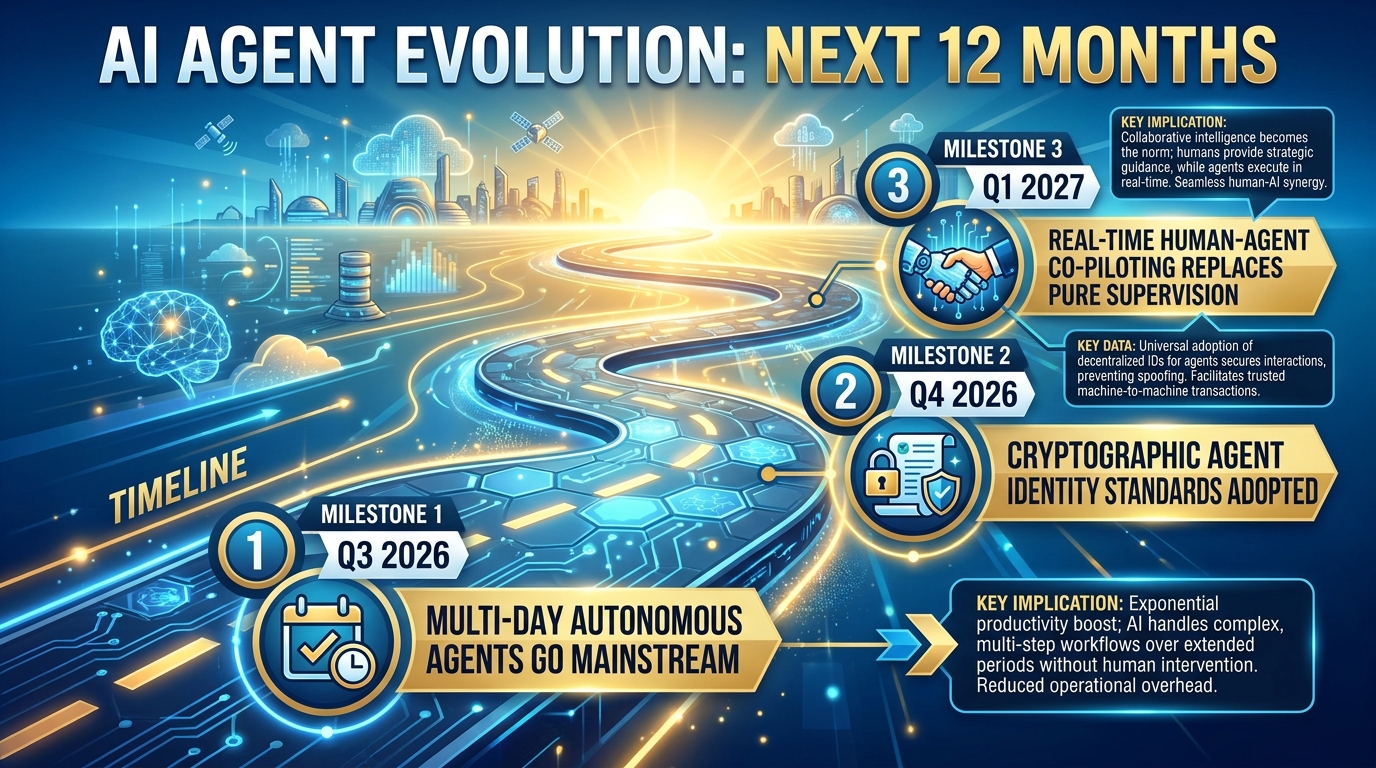
The trajectory of all three systems points toward capabilities that will raise new handoff questions — not answer the existing ones. Understanding where things are moving is important for teams designing workflows today, because the governance decisions you make now will need to accommodate architectures that look meaningfully different in 12 months.
Multi-Day Autonomous Agents Going Mainstream
Kimi’s K3 already supports multi-day continuous operation. Devin’s parallel instance model and persistent Devin Wiki make extended autonomous engineering cycles increasingly feasible. ChatGPT Agent’s scheduled task infrastructure is expanding. The direction is clear: the expectation that an agent needs to complete a task in a single session is eroding. What replaces it is an architecture where agents operate across days — sleeping, resuming, and continuing — with humans checking in at defined intervals rather than watching continuously.
This shift changes the governance model significantly. Oversight that worked for session-based tasks (you watch the agent work, you approve before it sends anything) does not scale to multi-day autonomous operation. The governance replacement is checkpoint-based review: defined milestones at which the agent produces a status summary and a human reviews and approves continuation. Teams that build this checkpoint discipline now will not have to retrofit it when multi-day agents are the default.
Cryptographic Agent Identity Standards
The “Know Your Agent” identity layer concept — where every agent instance carries a signed, traceable credential through the delegation chain — is moving from research concept toward early implementation in enterprise security tooling. As regulatory pressure on AI accountability increases, the ability to cryptographically prove which agent took which action with which authorization will shift from a competitive differentiator to a baseline compliance requirement in regulated industries.
This does not mean the three platforms discussed here will natively provide this out of the box in the next 12 months. It means that the governance infrastructure around them will need to implement it — and teams that have established structured logging practices and permission-scoping disciplines will be in a much stronger position to adopt these standards than teams that have been running agents in an ad hoc configuration.
Real-Time Human-Agent Co-Piloting
The current interaction model for all three systems is predominantly asynchronous: you assign a task, the agent works, you review the output. The direction in 2026 and into 2027 is toward real-time collaborative interfaces where the human and agent work on a task simultaneously, with the human providing judgment at key decision points while the agent handles execution velocity. Devin’s interactive planning and collaborative IDE already points in this direction. Kimi’s main-agent coordination layer has analogues in how it surfaces task decomposition for human review.
This co-piloting model is likely to prove more durable than pure delegation — because it preserves the human judgment capacity that pure delegation erodes, while still capturing most of the productivity gains. Teams that invest in understanding how to work alongside these agents effectively, rather than just configuring them to work independently, are building a skill that will remain valuable as the capabilities evolve.
The Right Way to Think About Handing Off
Kimi, Devin, and ChatGPT Agent each represent genuine capability advances — not incremental improvements to chatbots, but systems that can take meaningful autonomous action across complex, multi-step workflows in a way that was not possible two years ago. That is real, and the productivity implications for well-designed workflows are significant.
But the question “what can I safely hand off?” is not answered by reading capability documentation. It is answered by asking four questions about each task you’re considering delegating:
- How reversible is the output if the agent is wrong? Not just the task itself — every downstream step that depends on that output.
- What is the consequence scope if this fails? Internal friction, or external commitment, financial impact, legal exposure, customer harm?
- What does the accountability chain look like? Can you trace, with precision, which agent took which action, with which authorization, at whose direction?
- What is your recovery path? Not “what happens if everything works” but “what happens at step 3 when something goes wrong, and who notices, and how fast?”
Teams that can answer these four questions clearly before deploying an agent are the ones running reliable, scalable, trustworthy agentic workflows. Teams that skip the questions and focus only on what the agent can do are the ones generating the incident reports that get shared at security conferences six months later.
The threshold for safe handoff is not primarily a question of AI capability. It is a question of workflow design, governance infrastructure, and the disciplined thinking about what failure looks like before it happens. Kimi’s swarm, Devin’s IDE, and ChatGPT Agent’s virtual computer are ready to work. The question is whether the humans configuring them are ready to govern them — and in 2026, that readiness is still the rate-limiting factor for most organizations.