Tag: LLM Operations

  • When Multi-Agent AI Breaks: The Operator’s Field Manual for Coordination, Control, and Cost

    When Multi-Agent AI Breaks: The Operator’s Field Manual for Coordination, Control, and Cost

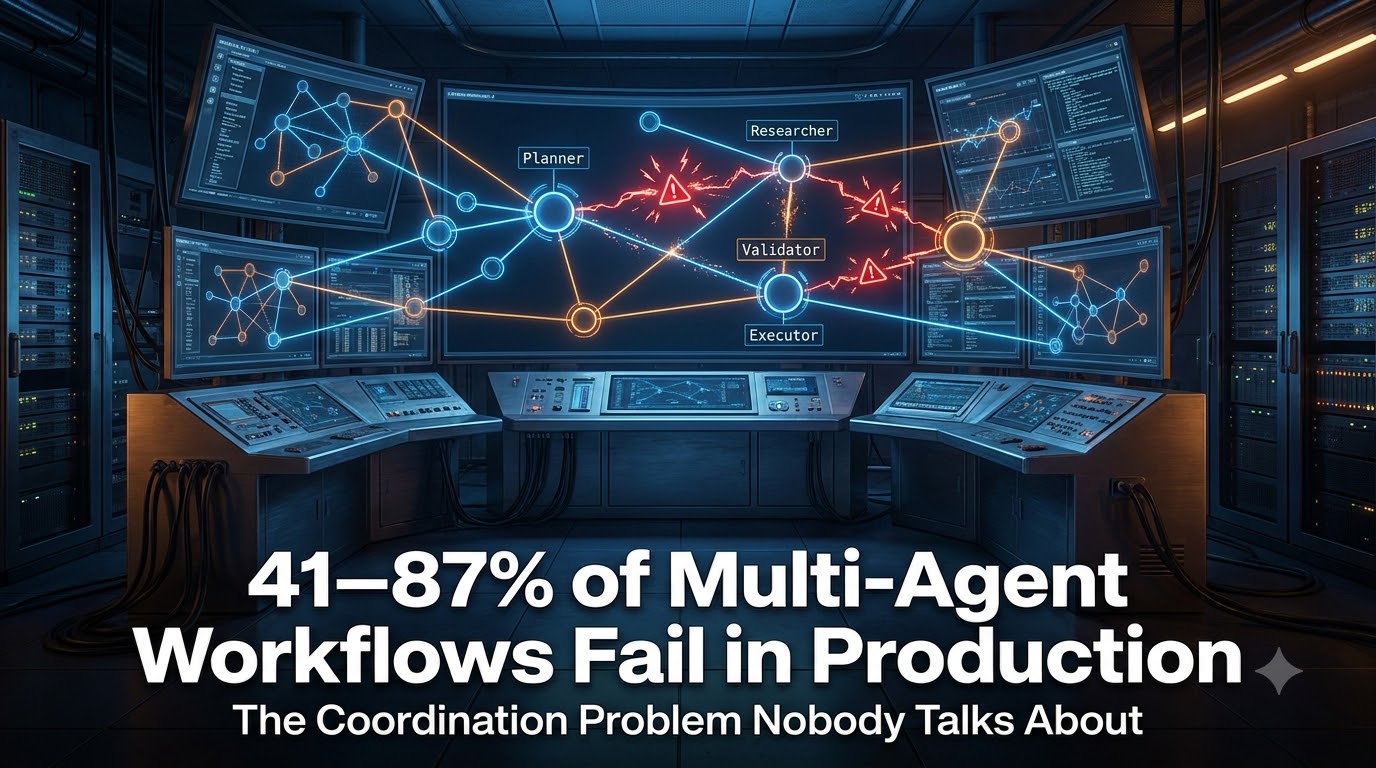
    Multi-agent AI workflow control room with interconnected agent nodes and red warning indicators showing coordination failures

    The Coordination Gap That’s Quietly Killing AI Projects

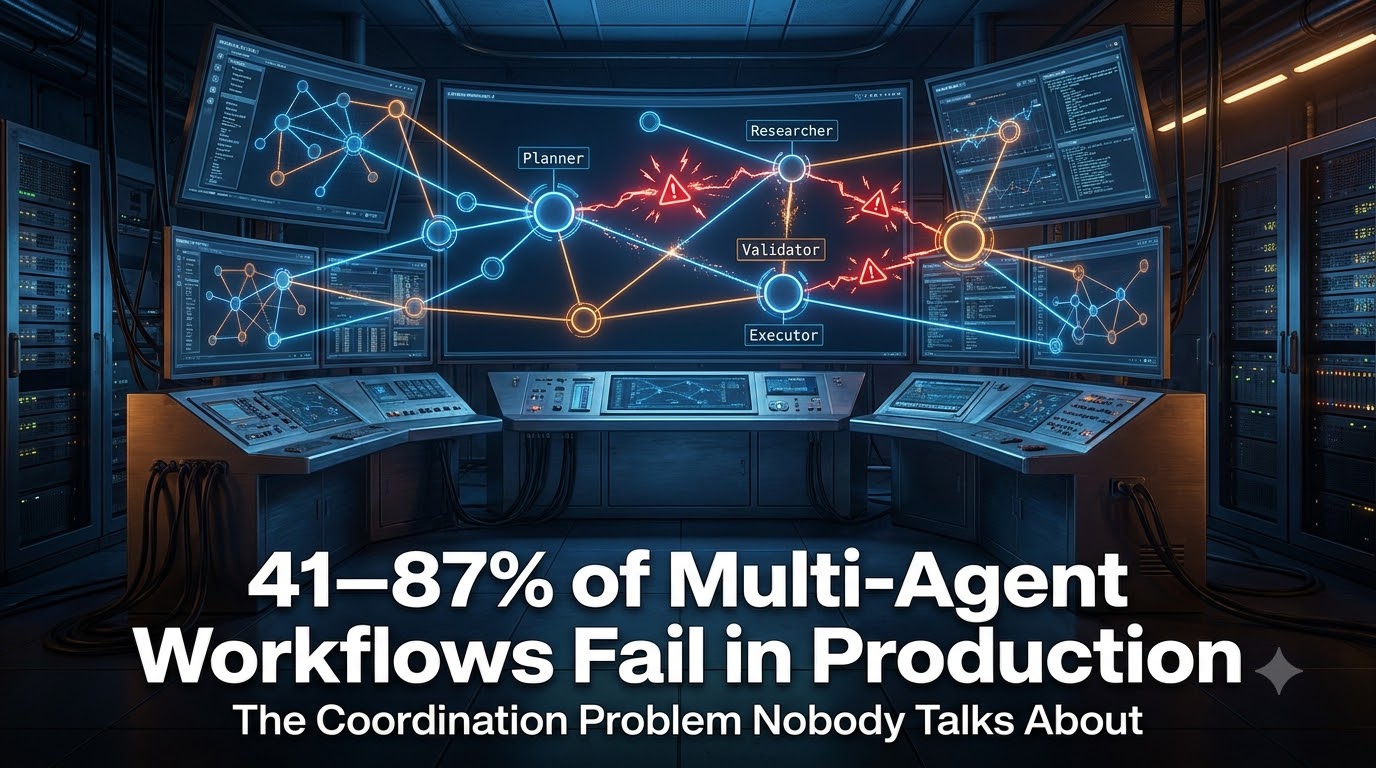
    There’s a statistic that should give every operator pause before they architect their next AI system: UC Berkeley’s MAST study, analyzing over 1,600 execution traces across seven production multi-agent frameworks, found failure rates ranging from 41% to 87%. Not prototype failures. Not edge-case failures. Production failures, in live systems, on real workloads.

    What makes these numbers more troubling is why they fail. The dominant assumption in most AI teams is that failures are model failures — the LLM misunderstood the prompt, hallucinated a fact, or produced malformed output. The data tells a different story. The primary failure categories are system design issues, inter-agent misalignment, and verification gaps — all coordination-layer problems that have nothing to do with the quality of the underlying model.

    This means that how you architect the space between agents matters more than which model you put inside them.

    This guide is written for operators: the engineers, technical leads, and AI platform owners who are responsible for building systems that actually run in production, not just pass demos. We’ll cover the architectural decisions that determine whether your multi-agent system is controllable and observable, the cost dynamics that compound in ways most teams don’t anticipate, the security risks that live at every agent handoff, and the human oversight patterns that let you scale autonomy without losing control.

    This isn’t a framework tutorial. It’s a field manual for the problems that surface after you’ve deployed.

    The Architecture Decision You Have to Make Before You Write Any Code
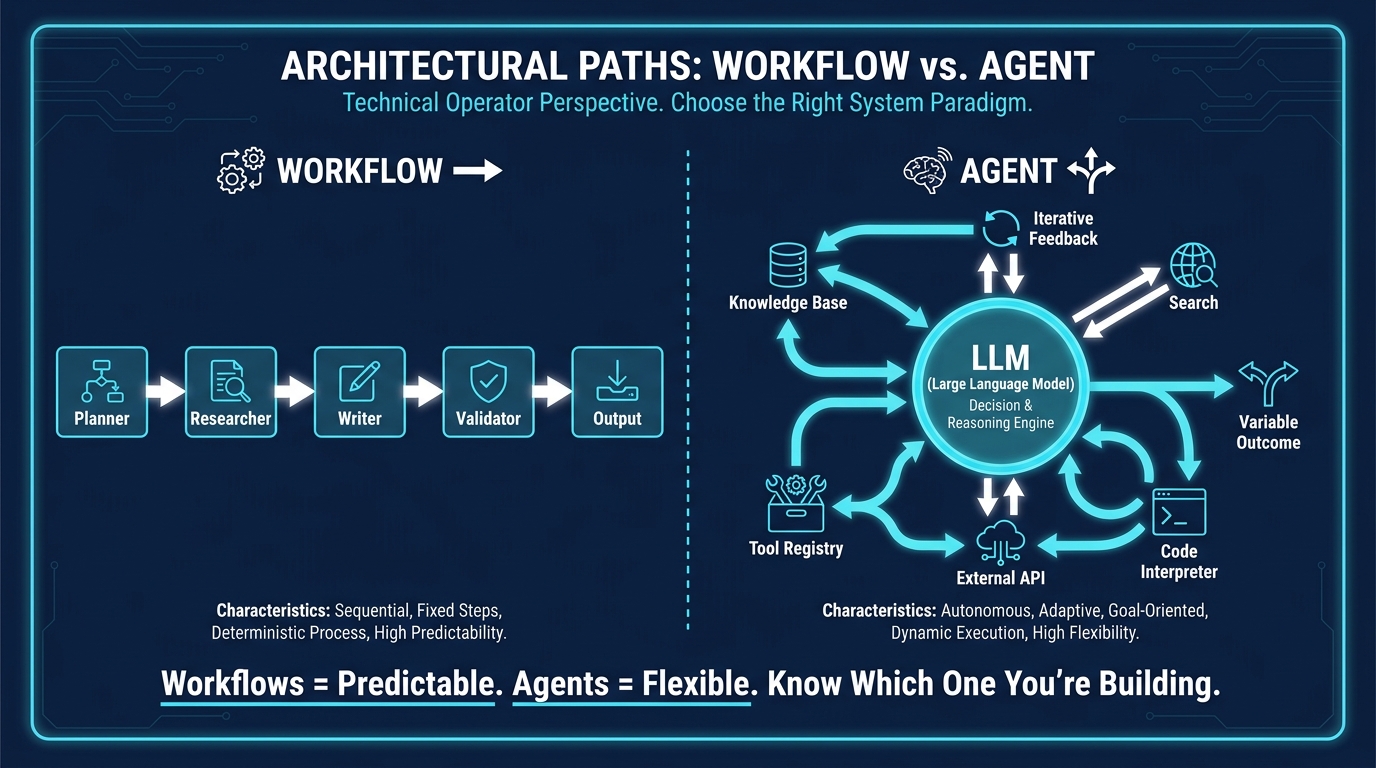
    Side-by-side diagram comparing deterministic workflow chains versus dynamic agent decision loops

    Before selecting a framework, choosing a model, or designing a single agent role, operators need to answer a foundational question that most teams skip: Are you building a workflow or an agent system?

    Anthropic’s engineering team, which has worked with dozens of teams building production systems, draws a distinction that matters operationally: workflows are systems where LLMs and tools are orchestrated through predefined code paths, while agents are systems where LLMs dynamically direct their own processes and tool usage, maintaining control over how they accomplish tasks. Both are valuable. Confusing them is where projects go wrong.

    When Workflows Are the Right Answer

    Workflows are defined by predictability. Each step is explicitly sequenced, the flow is determined by code rather than by model reasoning, and the output of each stage is the input to the next in a known, testable manner. If your task can be decomposed into fixed subtasks — generate a draft, then check it against a policy, then format it for output — you almost certainly want a workflow, not an agent.

    The operational advantages are significant. Workflows are easier to test because each node has a defined contract. They’re easier to debug because failures localize to specific steps. They’re more cost-predictable because you can enumerate the calls in advance. And they’re more compliant with governance requirements because the decision path is deterministic and auditable.

    Common production-proven workflow patterns include:

    • Sequential pipeline: Fixed step-by-step chains where each agent’s output feeds the next. Ideal for repeatable business processes like document processing, content generation pipelines, or data enrichment flows.
    • Prompt chaining with gates: A variant of sequential pipelines where programmatic checks validate intermediate outputs before proceeding, preventing downstream errors from compounding.
    • Parallelization: Multiple agents process different aspects of the same input simultaneously, with results aggregated. Useful when tasks are independent — running competitive analysis, legal review, and technical validation on a contract at the same time rather than sequentially.

    When You Actually Need Agent Autonomy

    Agents are appropriate when the task space is genuinely open-ended: when the path to completion can’t be known in advance, when decisions need to be made based on intermediate results, or when the workflow itself needs to adapt based on what the system discovers. Research tasks, complex multi-step problem-solving, and scenarios requiring tool use conditioned on real-time feedback are legitimate use cases for dynamic agent behavior.

    The tradeoff is real and should be stated plainly in your architecture document: agents trade latency and cost for flexibility. Every time an LLM decides what to do next rather than following a predetermined code path, you’re accepting variability in behavior, increased token consumption, and more complex observability requirements.

    The Production Pattern That Works Most Often

    In practice, the most reliable production multi-agent systems use a supervisor/planner-worker pattern: a central orchestrator agent that plans and routes tasks, delegating to specialized sub-agents that are essentially stateless workers with narrow, well-defined responsibilities. This hybrid gives you the flexibility of agent reasoning at the planning layer while preserving workflow-like predictability at the execution layer.

    Anthropic’s guidance on this is direct: start with the simplest solution possible, and only increase complexity when needed. Many teams fail not because they built too little but because they built agent systems for problems that a simple three-step prompt chain would have solved more reliably and cheaply.

    State Is the Hard Part: Why Most Agent Handoffs Fail

    If you survey teams running multi-agent systems in production and ask them where they spend most of their debugging time, the answer is overwhelmingly consistent: state management and agent handoffs. Not prompt quality, not model selection, not tool reliability. The space between agents.

    The root cause is a deceptively simple architectural habit: treating state as implicit conversation history rather than as an explicit, typed data structure that is actively managed. When Agent A passes its entire message history to Agent B, you’re not doing state management — you’re doing context dumping. The receiving agent has to infer what actually matters from an unstructured blob of text, which introduces ambiguity, context window pressure, and compounding errors as the workflow progresses.

    Explicit State Models Are the Production Default

    Production systems in 2026 have converged on treating shared state as a first-class architectural object. This means defining a typed schema — a structured data model — that represents the canonical workflow state. Each agent reads from this shared state store, performs its task, and writes back structured results. Handoffs are not “send everything to the next agent.” They are typed transitions: “here is the specific subset of state this agent needs to receive, and here is the contract for what it must write back.”

    LangGraph formalizes this with its StateGraph model, where every node receives a typed state object and returns a typed state update. This design makes the state transitions explicit, testable, and inspectable at every step — which is foundational for debugging and for building replay and recovery capabilities.

    The Three State Failure Patterns to Watch For

    Understanding the most common failure modes helps teams build defenses before they encounter them in production:

    • State bloat: The shared state object grows unbounded as agents add context without pruning it. This drives up token costs on every subsequent agent call (since each agent loads the full state into its context window) and can eventually exceed context limits, causing silent truncation or hard failures. The fix is explicit state pruning policies — define what gets archived versus what stays in the active state object.
    • Conflicting writes: When multiple agents run in parallel and can both write to the same state fields, you get race conditions and overwrites. In distributed systems, this is a classic problem solved by transactions and locks. In multi-agent systems, it’s often ignored until it produces corrupted state. Design your state schema so that parallel agents write to distinct fields, with a merge step that explicitly resolves conflicts.
    • Semantic drift: The meaning of a state field changes as it passes through agent hands. Agent A writes summary as a technical overview; Agent C expects summary to be a customer-facing description. The type system doesn’t catch this — both are strings. The fix is documentation-first state schemas, where every field has a semantic contract, not just a type.

    Checkpointing and Recovery

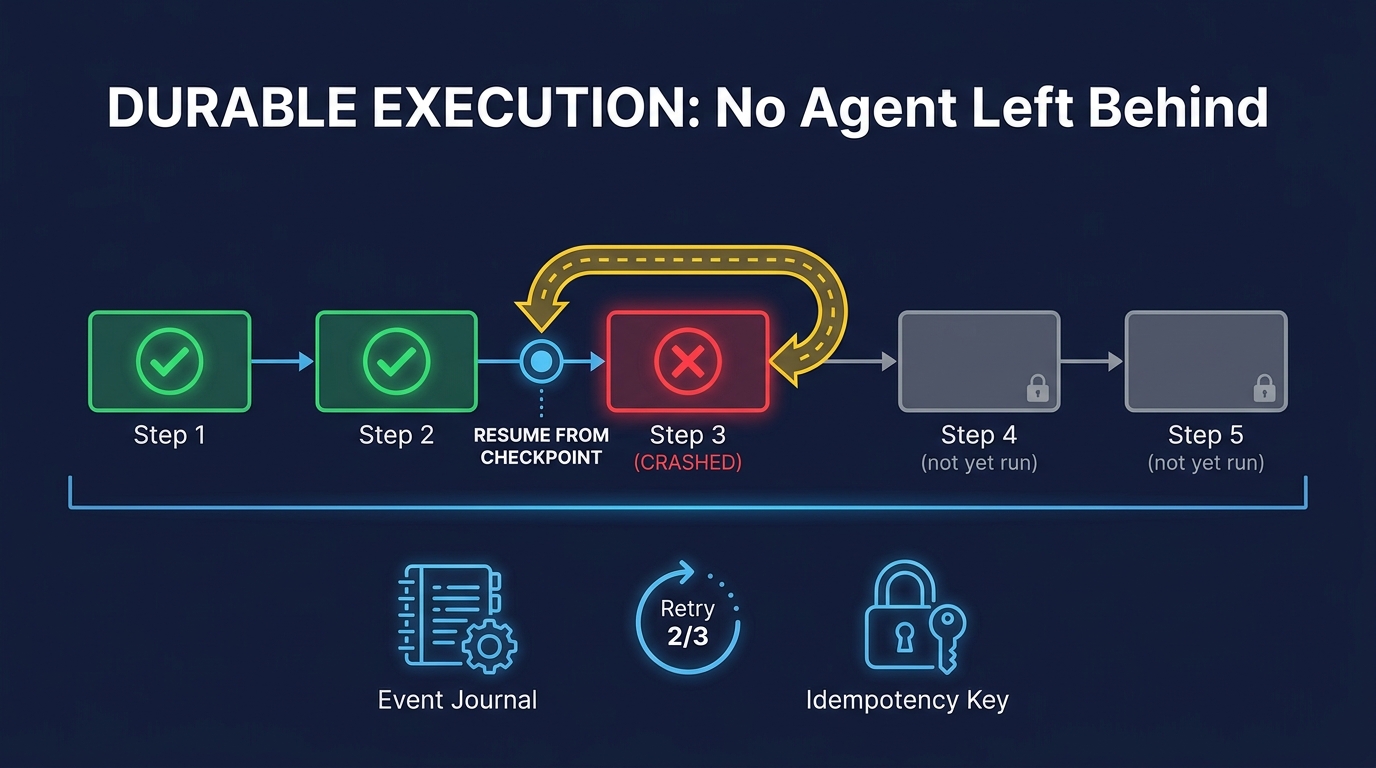
    Long-running multi-agent workflows need durable state checkpointing. If an agent fails at step seven of a fifteen-step workflow, you need to be able to resume from step seven — not restart from step one. This requires a workflow engine that persists state snapshots at defined intervals, with replay capabilities that can reconstruct the workflow from any checkpoint.

    LangGraph’s persistence layer and durable workflow engines like Temporal address this directly. Teams building on raw API calls without this infrastructure typically discover the need for it the hard way, after a long-running task fails in the final stages for the third time and they’re paying for the retry from scratch.

    The Framework Tradeoffs Nobody Tells You

    The three dominant multi-agent orchestration frameworks in 2026 — LangGraph, CrewAI, and AutoGen/AG2 — are genuinely different products for different operator needs. Most framework comparisons focus on feature lists. Operators need to understand the operational tradeoffs: what each framework makes easy, what it makes hard, and what that means for your maintenance burden over a 12-month horizon.

    LangGraph: Maximum Control, Maximum Responsibility

    LangGraph is the choice for teams that need deterministic, production-grade orchestration where the control flow cannot be left to model interpretation. Its core mental model is an explicit state graph: you define nodes, edges, and a typed shared state schema. The LLM reasons within nodes; it does not control the graph structure.

    The operational advantage is significant: LangGraph gives you the most inspectable, debuggable, and controllable multi-agent architecture available. Every state transition is auditable. The graph structure is readable by a human. Integration with LangSmith provides distributed tracing out of the box.

    The tradeoff is that LangGraph requires more upfront investment. You need to model your workflow as an explicit graph, define your state schema in advance, and write the routing logic explicitly. For teams with a clear, stable workflow that needs to run reliably at scale, this investment pays back. For teams prototyping in a fast-changing environment, it can feel like over-engineering in the early stages.

    CrewAI: Fast Role-Based Workflows with a Governance Ceiling

    CrewAI’s mental model is a team of agents with defined roles, goals, and tools. You describe what each agent does and who coordinates them; the framework handles much of the orchestration mechanics. This makes it the fastest path to a working multi-agent prototype, particularly for business workflow automation where the “team” metaphor maps naturally to the task — a research agent, a writing agent, a fact-check agent.

    The governance ceiling appears at scale. Because CrewAI abstracts much of the orchestration, operators have less visibility into and control over exactly how tasks are decomposed, delegated, and resolved. For regulated industries, complex compliance requirements, or systems where you need to audit every decision, this abstraction becomes a liability. CrewAI works well when you need speed-to-prototype and your governance requirements are modest. It struggles when you need to explain exactly what happened and why.

    AutoGen/AG2: Conversational Collaboration for Code-Heavy Workloads

    AutoGen’s paradigm is agent-to-agent conversation: agents exchange messages with each other to collaborate on a task, with the conversation driving the workflow. This makes it exceptionally well-suited for research-style tasks and software development workflows where agents need to iteratively refine outputs through dialogue — a coder agent produces code, a critic agent reviews it, the coder revises based on feedback.

    The operational challenge with AutoGen is conversation length management. When agents converse, context windows fill up fast, and the longer the conversation, the more prone the system is to losing coherence or looping. Teams running AutoGen in production need explicit conversation management policies: when to summarize, when to reset context, and how to prevent unbounded conversation depth.

    The Rule No Framework Can Override

    Anthropic’s engineering team states this plainly: frameworks simplify standard low-level tasks but often create extra layers of abstraction that obscure the underlying prompts and responses, making them harder to debug. Their recommendation — start by using LLM APIs directly, and only adopt a framework when the manual implementation overhead genuinely justifies it — is worth taking seriously.

    The best operators know their framework’s internals well enough to step outside it when needed. Incorrect assumptions about what’s happening under the hood are among the most common sources of production failures.

    Cost Compounds Faster Than Your Team Expects
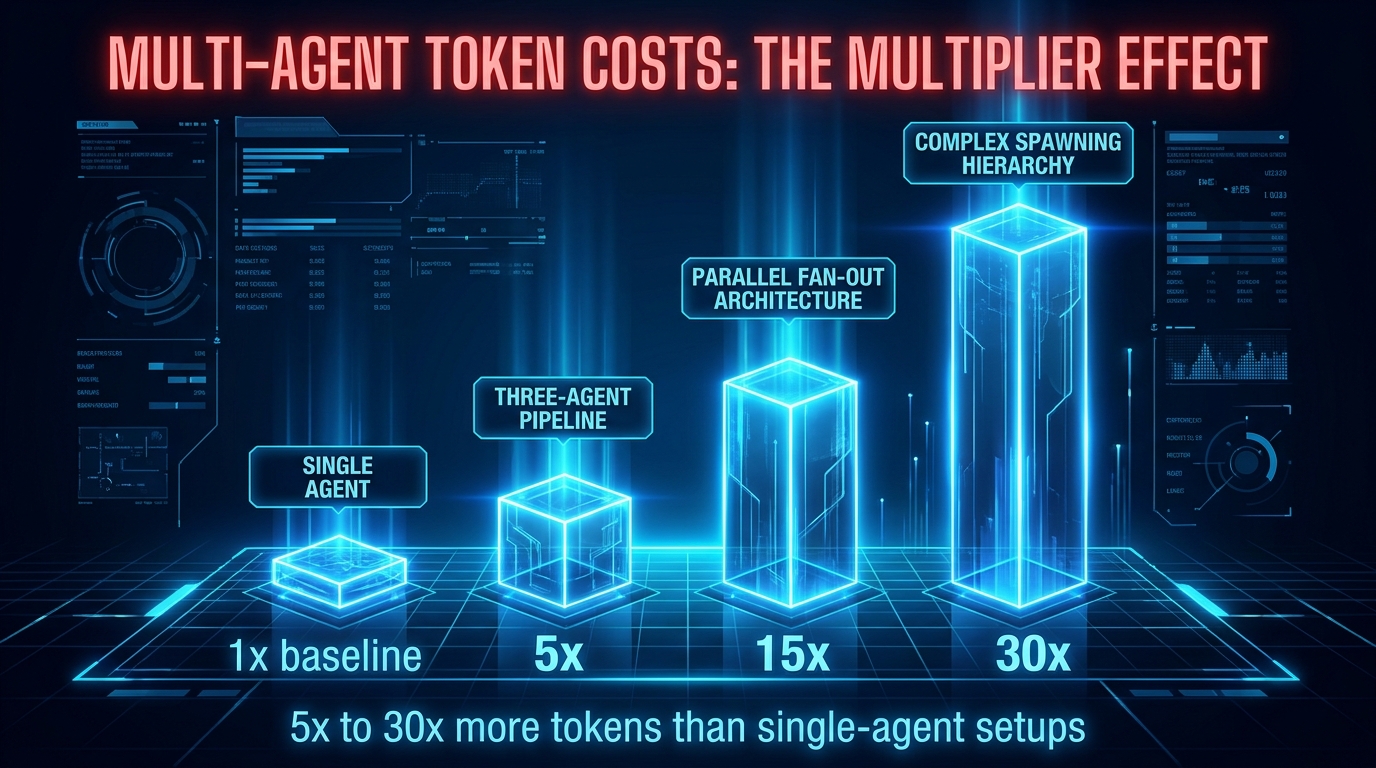
    Bar chart showing token cost multipliers for multi-agent AI architectures from single agent baseline to 30x for complex spawning hierarchies

    Single-agent AI has a predictable cost profile: you make a call, you pay for the tokens. Multi-agent AI has a multiplication problem that most operators don’t model until they see their first month’s API bill.

    Current data puts the token overhead for multi-agent systems at 5x to 30x a comparable single-agent setup, depending on architecture. A simple three-to-five agent pipeline typically runs at 5x the token cost of a direct single-agent approach. Parallel fan-out architectures with multiple concurrent agents can reach 15x. Complex hierarchical systems with spawning sub-agents — where a planner agent creates new agents to handle sub-tasks — can reach 30x or higher on complex inputs.

    Per-task costs in the $4 to $30 range for moderate workflows and $25 to $100+ for complex architectures are well-documented in production environments. At low volume, this is manageable. At the scale where multi-agent systems become interesting, this arithmetic demands deliberate cost architecture.

    The Four Cost Drivers to Engineer Against

    Understanding the mechanisms of cost multiplication helps operators address them at the design stage rather than after deployment:

    • Repeated context loading: Every agent call that loads the full shared state or conversation history into its context window pays for every prior token, again. A 10-agent sequential pipeline where each agent loads the full prior context doesn’t just cost 10x a single call — it costs 1 + 2 + 3 + … + 10 times the base call cost. The fix is selective context passing: give each agent only the state fields it needs, not the entire history.
    • Verification and retry loops: When agents validate each other’s outputs and request revisions, you pay for multiple model calls to accomplish what a single well-designed prompt might handle. Excessive retry loops are both a cost signal and a quality signal — they usually indicate that the upstream agent’s output specification or the validation agent’s criteria are insufficiently precise.
    • Spawning without bounds: Planner agents that can dynamically create sub-agents are powerful but dangerous from a cost perspective. Without hard limits on spawning depth and agent count, a complex input can trigger an exponential expansion of the agent graph, each leg consuming tokens. Set hard limits — both on the number of agents that can be created and on the maximum nesting depth of sub-agent hierarchies.
    • Model misallocation: Using frontier models for every agent in a workflow is the most common, most avoidable cost waste. Routing tasks — deciding which agent handles what — doesn’t require GPT-4 class reasoning. Formatting agents, summarization agents, and classification agents can often run on smaller, cheaper models with no meaningful quality loss. Model routing by task complexity is a cost governance primitive, not an optimization afterthought.

    Hard Budgets and Circuit Breakers

    Effective cost governance in multi-agent systems treats token budgets as financial controls, not soft suggestions. This means implementing hard per-task, per-agent, and per-workflow token caps at the orchestration layer — not as prompt instructions (agents don’t reliably enforce their own token consumption) but as platform-level enforcement. If a workflow exceeds its token budget, it fails gracefully with an informative error rather than running to completion at five times the projected cost.

    Circuit breakers extend this further: they detect anomalous cost patterns — a workflow consuming 10x its typical token volume, or an agent retry count exceeding threshold — and pause execution for human review. This is especially important during the first weeks after deploying a new workflow in production, when edge cases that weren’t covered in testing can trigger expensive runaway loops.

    Prompt and context caching — where identical or near-identical context passed to multiple agents in the same session can be served from cache rather than recalculated — provides meaningful savings on workflows with shared system context or background information. Most major model providers now support this; it’s worth verifying your framework passes cache-eligible context correctly.

    Observability or Blindness: You Cannot Debug What You Cannot Trace
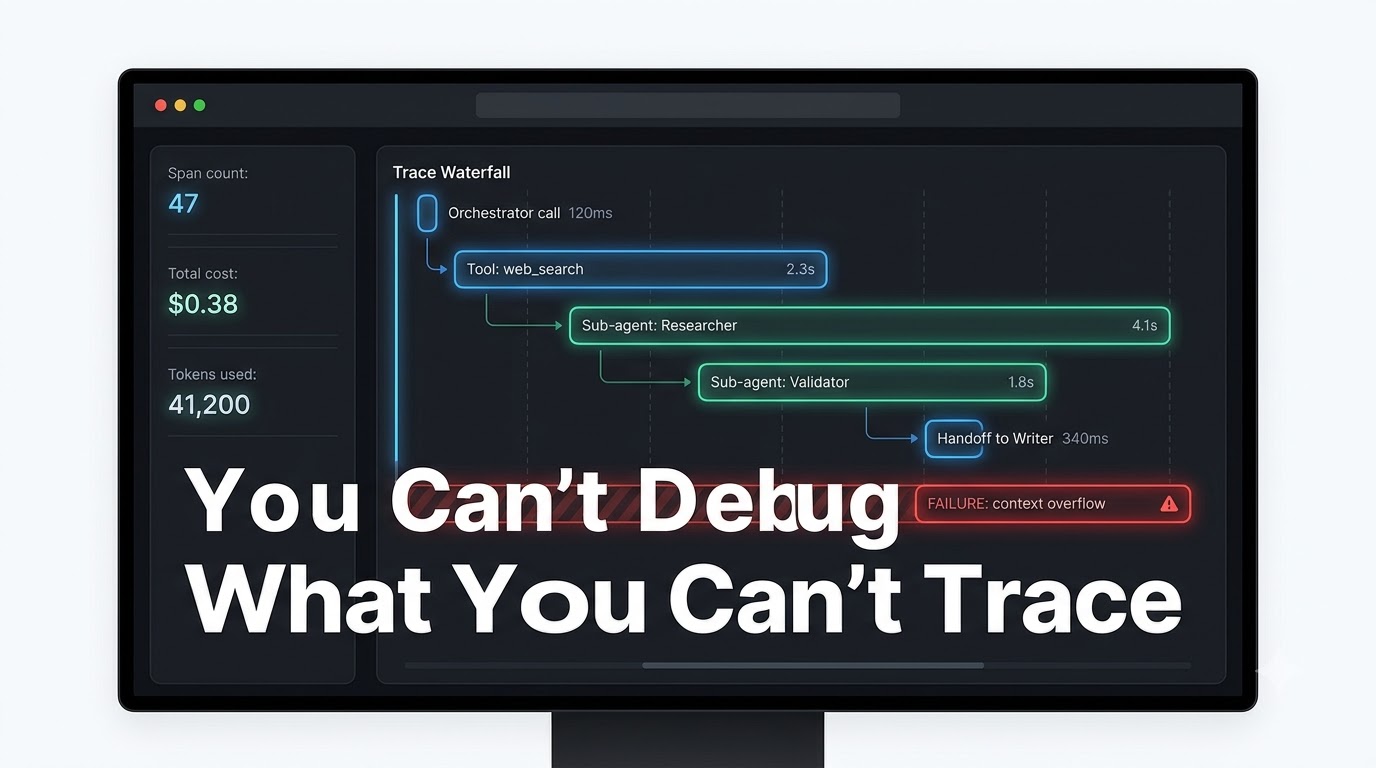
    Multi-agent AI observability dashboard showing trace waterfall diagram with agent steps, timing, costs, and a red failure indicator

    A single-agent system fails in a visible way: you made a call, you got a bad response, you know exactly what the model received and what it returned. A multi-agent system fails in a distributed way: by the time the final output is wrong, the root cause may have originated three or four agent calls earlier, been silently amplified by each subsequent agent, and arrived at the output layer looking like a model quality problem when it was actually a context contamination problem in step two.

    This is why the expert consensus in 2026 is categorical: observability is not optional infrastructure for multi-agent systems. It is foundational architecture. Teams that treat tracing and monitoring as a later concern — something to add after the system is working — spend months debugging in the dark.

    What Production Tracing Actually Requires

    Effective observability for multi-agent workflows requires tracing at a different granularity than standard application monitoring. You need to capture, at minimum:

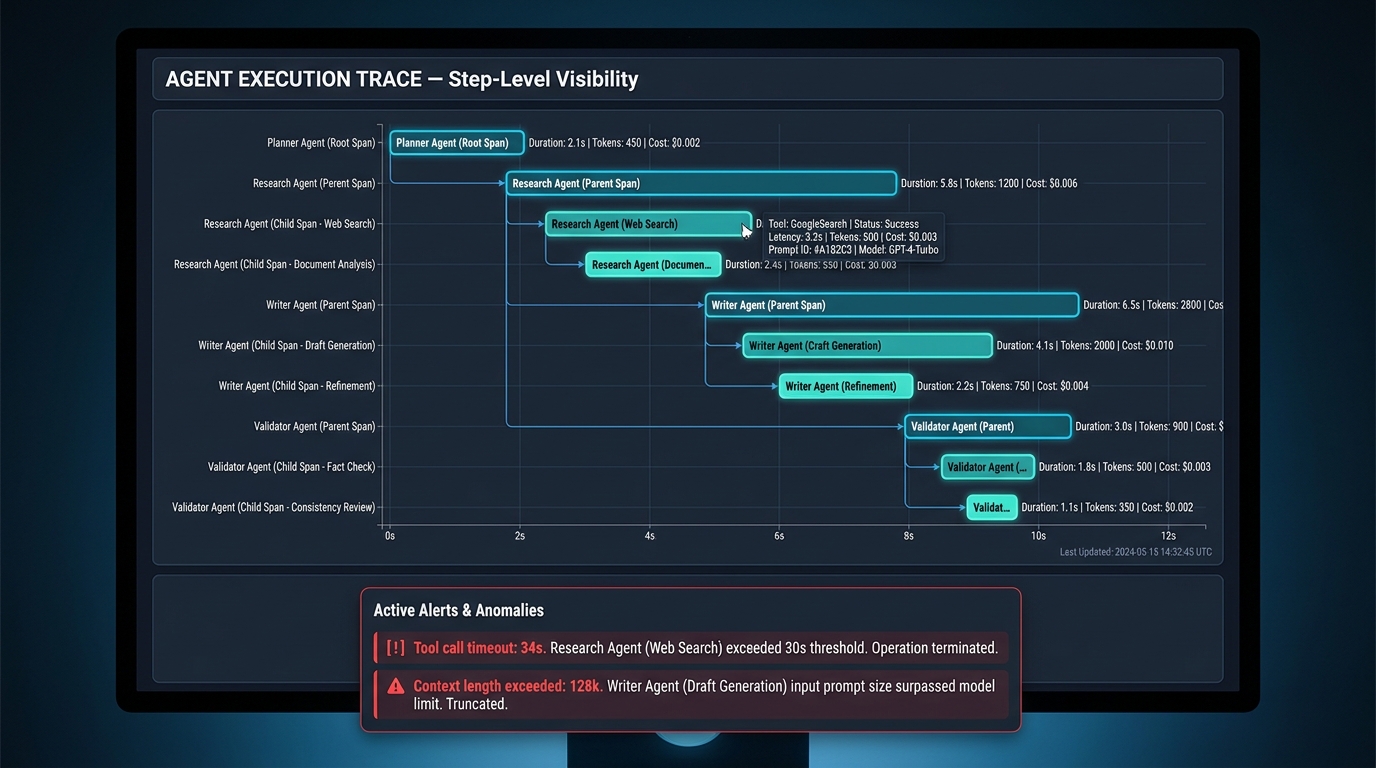
    • Span-level traces per agent call: Each agent invocation is a span, with a parent span for the overall workflow. The trace tree shows you the full execution graph — which agents ran, in what order, for how long, with what cost.
    • Full input/output logging per agent: Not just “Agent B ran.” What exact input did Agent B receive? What exact output did it return? What tools did it call, with what arguments, and what did those tools return? Without this, you cannot reconstruct failure scenarios.
    • Token and cost attribution per span: Which agent in a workflow consumed what proportion of the total tokens? This both supports cost optimization and surfaces agents whose token consumption is anomalously high — often a signal of poorly scoped instructions or state bloat.
    • State snapshots at key checkpoints: Capturing the shared state object at the beginning and end of each major stage gives you the ability to replay workflows from any point, test modified agents against historical state snapshots, and conduct post-mortems on failed runs without needing to reproduce the input conditions.

    The OpenTelemetry Layer

    The emerging standard is OpenTelemetry-based tracing applied to multi-agent workflows, with LLM-specific instrumentation libraries extending standard OTEL spans to capture model-specific metadata: token counts, model IDs, temperature settings, prompt templates, and evaluation scores. Tooling in this space has matured significantly — platforms like LangSmith, Arize Phoenix, and Weights & Biases now offer purpose-built multi-agent trace visualization that shows the full agent interaction graph as a single coherent trace, rather than disconnected individual model calls.

    Honeycomb’s Agent Timeline product takes this further by allowing operators to annotate traces with business context — correlating a trace showing a failed agent handoff with the downstream business outcome it affected, which closes the loop between technical observability and business impact measurement.

    Eval-Driven Debugging

    The most sophisticated teams are building evaluation pipelines that run automatically against production traces. When a workflow produces an output that scores below threshold on a quality metric, the system automatically captures the full trace, the input, the output, and the intermediate state at each step — creating a labeled failure case that can be added to a regression test suite and used to identify the exact agent and step where quality degraded.

    This “trace to eval” pipeline turns production failures from debugging emergencies into structured data. Over time, it builds an empirical map of which agent interactions are most fragile under which input conditions — the kind of knowledge that turns reactive firefighting into proactive system improvement.

    Trust Boundaries and the Security Risk Hidden in Every Handoff
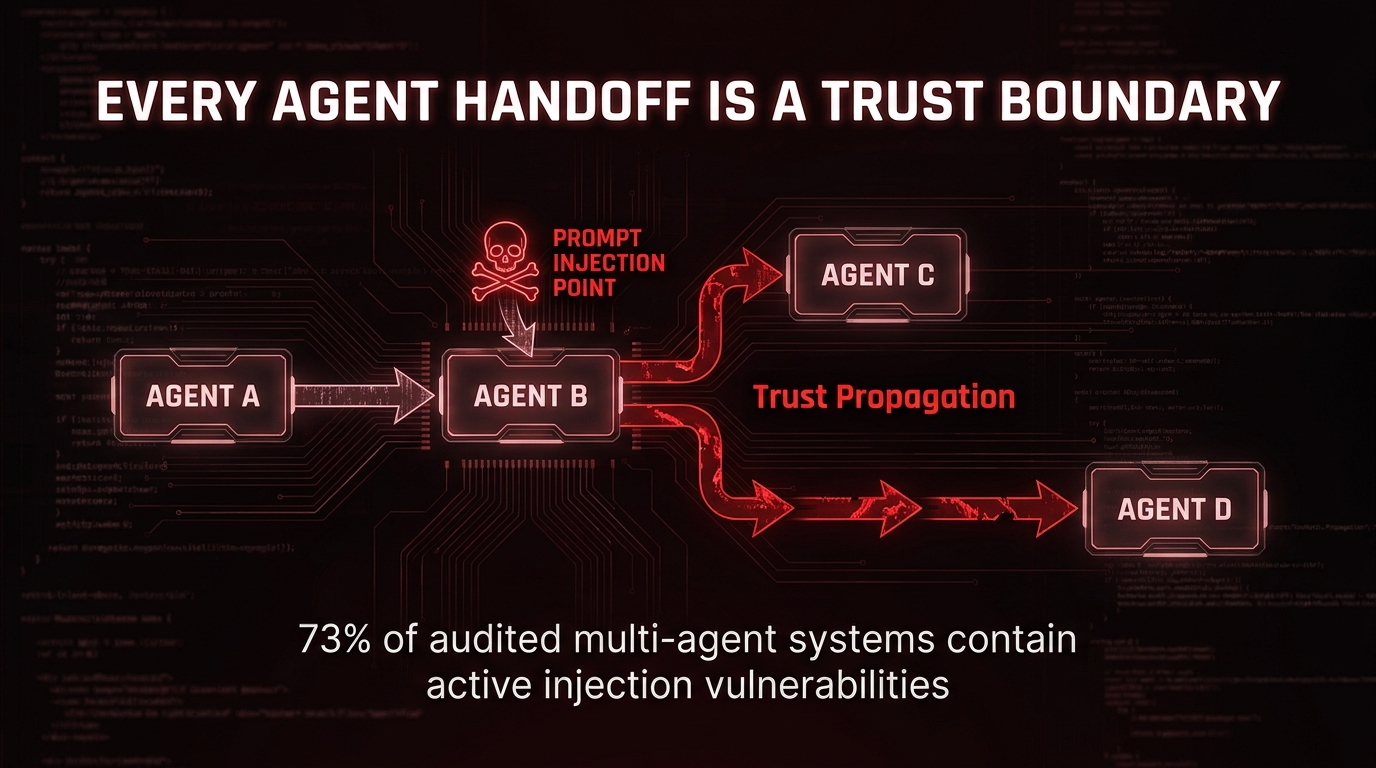
    Multi-agent AI security diagram showing prompt injection point at Agent B with contamination spreading downstream through agent chain

    Multi-agent systems have a security property that single-agent systems do not: the output of one agent becomes the input of another. If an attacker can influence the output of Agent B, they have an indirect channel into every downstream agent that receives Agent B’s output as input. This is not a hypothetical attack surface. It is the dominant production AI security risk in 2026, sitting at the top of the OWASP Top 10 for LLM applications.

    Audits of production multi-agent systems in 2026 found prompt injection vulnerabilities present in approximately 73% of systems reviewed. The attack vector is straightforward: content that an agent processes as data — a web page it scrapes, a document it analyzes, a database record it reads — contains embedded instructions that hijack the agent’s behavior. In a single-agent system, this affects that one call. In a multi-agent system, the hijacked agent’s output flows downstream, and any agent that trusts that output without validation is now operating under attacker influence.

    The Zero-Trust Mindset for Agent Architecture

    The expert consensus has moved clearly in one direction: treat every agent handoff as a trust boundary. The receiving agent should not assume that the context it receives from a prior agent is clean. This doesn’t mean every agent runs full adversarial validation on every input — that would be prohibitively expensive and create latency problems. It means designing the system architecture to contain the blast radius of a compromised agent.

    Practical zero-trust principles for multi-agent systems:

    • Principle of least privilege for tools: Each agent should only have access to the tools and external systems it specifically needs for its task. An agent that reads from a database should not also have write access unless that is explicitly required by its role. Over-permissioned tools turn a compromised agent into a much larger incident.
    • Input validation at handoff boundaries: Define a typed schema for each agent’s expected inputs and validate incoming messages against it before the agent processes them. Inputs that don’t conform to the schema should be rejected, not silently coerced. This catches both injection attempts and upstream agent errors.
    • Privileged action separation: High-blast-radius actions — writing to databases, sending external communications, modifying files, making API calls with side effects — should be executed by a dedicated action-execution layer that sits outside the agent reasoning chain. Agent reasoning produces a structured action proposal; a separate, more rigidly controlled layer executes it after validation.
    • Sentinel agents for governance: The most mature deployments include dedicated security or governance agents that review the outputs of reasoning agents before those outputs are passed downstream or executed. The sentinel doesn’t have tools or write access — its only job is to evaluate whether an output contains policy violations, injection signatures, or anomalous instructions.

    Identity and Auditability for Multi-Agent Systems

    As agent systems take consequential actions — sending emails, submitting transactions, modifying records — the question of “which agent did this, on whose authorization” becomes both a security question and a compliance question. Production systems need cryptographically signed agent identities and an immutable audit trail that records not just what was done, but which agent proposed it, which agent or human authorized it, and which agent executed it.

    This is not just a governance formality. When an incident occurs, the audit trail is how you reconstruct the causal chain, identify the point of failure or compromise, and demonstrate to regulators or customers what happened and why. Multi-agent systems without this infrastructure cannot meet compliance requirements in regulated industries, full stop.

    Human-in-the-Loop Oversight That Scales Without Becoming a Bottleneck
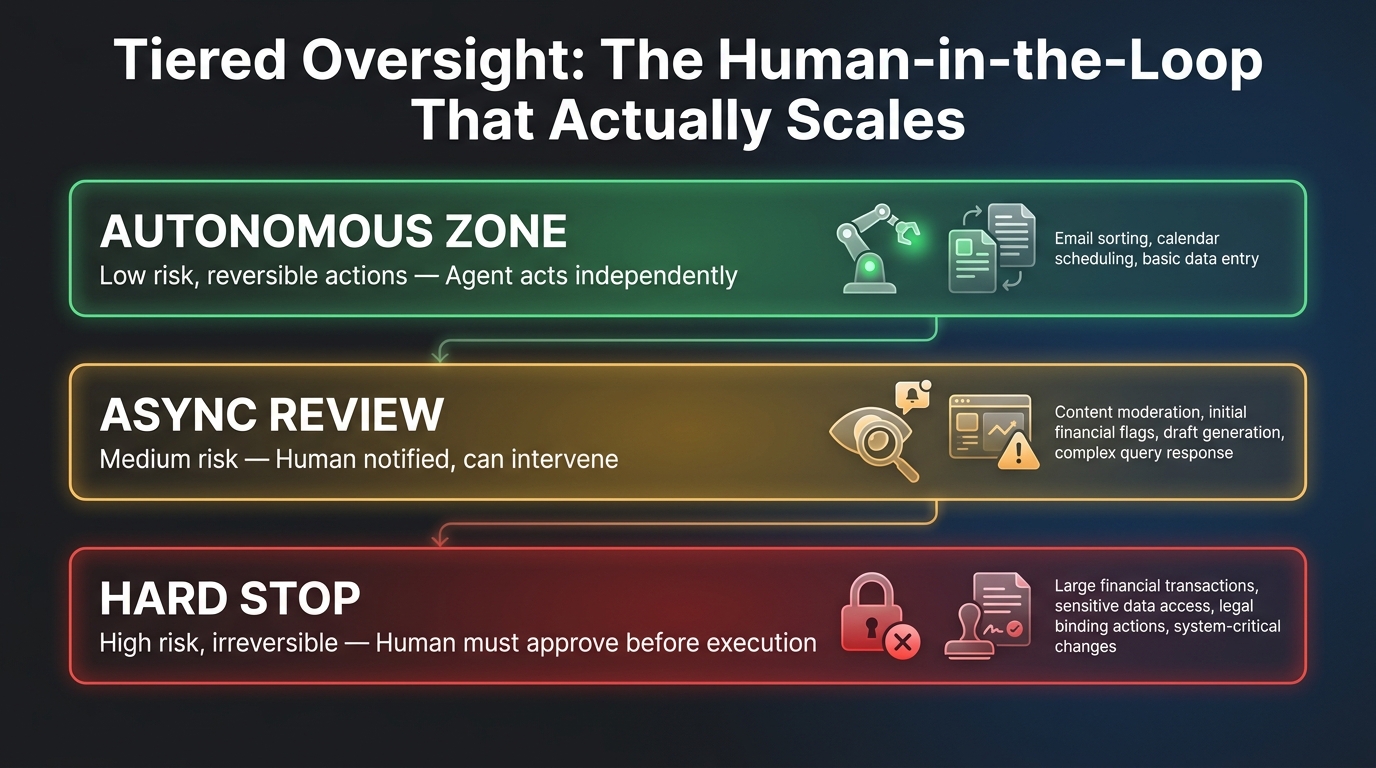
    Three-tier human oversight model for AI agents showing autonomous zone, async review tier, and hard stop tier with example actions

    About 70% of organizations running AI agents in 2026 operate a model where the agent recommends and a human approves before any irreversible or external-facing action is executed. This is the right instinct. The problem is that naive human-in-the-loop implementation doesn’t scale — it turns into a queue of agent outputs that a human must review and approve, becoming a bottleneck that negates the speed and automation value the multi-agent system was supposed to provide.

    The shift that’s happening across enterprise deployments is from “human in the loop on every step” to “human on the loop for exceptions.” Agents operate autonomously within defined boundaries; humans are notified and can intervene when the system detects that those boundaries have been exceeded. This is a governance design problem, and solving it well is one of the characteristics that distinguishes teams that get value from multi-agent AI from teams that get a slow, expensive, human-bottlenecked process.

    Tiered Risk Classification: The Foundation of Scalable Oversight

    Scalable human oversight starts with classifying every action type your multi-agent system might take into three risk tiers:

    • Tier 1 — Autonomous: Low-risk, reversible, internal actions where the cost of an error is low and correctable. Reading data, generating drafts for human review, updating internal notes, running analyses. Agents act without human approval; the action log is available for retrospective review.
    • Tier 2 — Async review: Medium-risk actions with moderate consequences or moderate reversibility. Sending internal communications, creating external-facing drafts, updating customer records, scheduling actions with a future execution window. The agent proposes the action and proceeds, but the responsible human receives a notification with a review window — if the human takes no action within the window, the action proceeds; if they flag it, execution is paused.
    • Tier 3 — Hard stop: High-risk, irreversible, or policy-sensitive actions. Sending external communications to customers or partners, executing financial transactions, deploying to production, deleting records, changing access permissions. Execution is blocked until a human explicitly approves the proposed action.

    The specific actions that belong in each tier will vary by organization and domain, but the structure is consistent across most production deployments. Importantly, the tier assignment should be enforced at the platform level, not by prompting the agent to self-assess its risk. Agents are not reliable risk classifiers for their own actions. The platform decides; the agent executes.

    Escalation Routing and Approval Latency

    Tier 3 approvals create a latency problem: the workflow is blocked waiting for a human. Designing this well means minimizing both the frequency of Tier 3 triggers (by scoping agent authorities appropriately) and the time-to-approve when they do trigger (by routing approvals to the right person with the right context).

    Smart approval routing sends the approval request to the human most likely to be able to evaluate it quickly — the product owner for content approvals, the finance lead for transaction approvals — with a pre-formatted summary of the proposed action, the context that led to it, and the options available (approve, reject, edit, escalate). The goal is to give the approver everything they need to decide in under 30 seconds, not a raw dump of agent conversation history.

    Timeout policies matter too. If an approval request goes unresponded for a defined window, the workflow should fail safely — not proceed without approval, not silently abandon the task, but surface explicitly as a timed-out approval with the relevant human notified of the pending item in their queue.

    The Audit Trail as Organizational Memory

    Every approval gate interaction — the proposed action, the human decision, the timestamp, the reviewer identity, the context at the time of decision — is valuable organizational data. Over time, approval gate logs reveal patterns: which action types are most frequently rejected (signal that the agent’s judgment needs recalibration), which approval requests take the longest to process (signal that routing or context presentation needs improvement), and which reviewers are approving at rates significantly higher or lower than peers (signal for calibration discussions).

    Teams that review approval gate telemetry monthly consistently find opportunities to either expand autonomous operation (moving frequently-approved action types to Tier 2 or Tier 1) or tighten agent authority (recognizing that certain action types are being rejected more than anticipated). This continuous calibration is what allows human oversight to remain meaningful as the agent system scales, rather than degrading into rubber-stamping.

    When to Flatten Your Hierarchy: The Over-Engineering Trap

    Multi-agent architecture has an aesthetic pull. Hierarchical systems with specialist agents, orchestrators, validators, and governance layers look sophisticated in architecture diagrams. Teams that build them feel like they’re doing serious AI engineering. This aesthetic pull is one of the most reliable predictors of project failure.

    The failure mode is architectural over-complexity: building a six-agent hierarchical system for a problem that a two-step prompt chain would solve more reliably, more cheaply, and with less operational overhead. Every additional agent you add is a coordination cost, a potential failure point, an additional source of context window consumption, and another moving piece to monitor and debug.

    The Simplest System That Solves the Problem

    Anthropic’s engineering guidance is blunt on this point: for many applications, optimizing a single LLM call with retrieval and in-context examples is sufficient. Most teams building agentic systems should regularly ask: does this actually require agent autonomy, or would a well-designed prompt chain with a few tool calls accomplish the same thing?

    The signals that a system is over-architected for its problem:

    • Most agent handoffs carry the same context forward unchanged. If Agent C mostly passes Agent B’s output to Agent D with minor formatting changes, Agent C is probably unnecessary.
    • Failure rates are higher than a single-agent equivalent. Each agent you add to a chain multiplies the failure probability. If a sequential five-agent pipeline each have a 95% success rate, the end-to-end success rate is 0.95^5 ≈ 77%. A simpler system with two agents might achieve higher end-to-end reliability even if each individual step is slightly lower quality.
    • The system requires constant human intervention to stay on track. If operators frequently need to restart workflows, manually correct intermediate outputs, or override agent decisions, the system’s autonomous capability is largely theoretical. Simplifying the architecture often produces better actual autonomy than adding more agents to compensate for coordination failures.
    • Development time is dominated by framework configuration rather than task logic. When the team spends more time wiring agents together than improving the actual task performance, the framework is adding complexity without adding value.

    Hierarchical Systems Are Earned, Not Designed In Advance

    The most reliable path to a well-architected multi-agent system is iterative expansion rather than upfront comprehensive design. Start with the simplest system that could plausibly work — often a single agent with several tools, or a two-agent planner/executor pattern. Identify the specific bottlenecks and failure modes in that system. Add architectural complexity only in response to specific observed problems, not in anticipation of problems you might encounter later.

    Teams that start simple and evolve their architecture based on empirical feedback consistently build more reliable systems than teams that begin with elaborate multi-agent designs. The former are adapting to reality; the latter are adapting reality to their design — a much harder problem.

    The Operator’s Pre-Production Checklist

    Before a multi-agent workflow ships to production, there’s a set of questions that experienced operators have learned — usually the hard way — to answer explicitly rather than assume. This checklist is not exhaustive, but covering these points will prevent the majority of production failures documented in the MAST study and in incident postmortems from the past year.

    Architecture and State

    • Is shared state defined as an explicit typed schema, or are agents passing raw conversation history?
    • Are state mutation rules defined — which agents can write to which state fields, and in what order?
    • Is there a checkpointing mechanism that enables workflow recovery without full restart?
    • Have you defined a maximum state size and a pruning policy for state fields no longer needed by downstream agents?

    Cost Governance

    • Is there a documented per-task cost estimate, based on a realistic token count across all agents in the workflow?
    • Are hard token budgets enforced at the platform level, not as prompt instructions?
    • Are agent tool permissions scoped to minimum necessary access?
    • Is model routing configured so that low-complexity tasks use smaller, cheaper models?
    • Are circuit breakers in place to pause execution when cost anomalies are detected?

    Observability

    • Are span-level traces implemented for every agent call, with parent spans capturing the full workflow trace?
    • Is full input/output logging in place for each agent, including tool calls and tool responses?
    • Is there a cost attribution mechanism that shows token usage per agent per workflow run?
    • Are state snapshots captured at key checkpoints for replay and post-mortem capability?
    • Is there an alerting policy for trace anomalies — unusually high token consumption, excessive retry counts, or abnormal failure rates?

    Security

    • Has each agent’s tool access been reviewed against the principle of least privilege?
    • Are there input validation schemas enforced at agent handoff boundaries?
    • Is privileged action execution separated from agent reasoning, with a validation layer between proposal and execution?
    • Is there an immutable audit trail for all consequential actions, including which agent proposed, who authorized, and what was executed?
    • Has the system been evaluated for prompt injection attack surfaces, particularly in agents that process external content?

    Human Oversight

    • Have all action types been classified into the three risk tiers (autonomous, async review, hard stop)?
    • Are Tier 3 approvals enforced at the platform level, not by agent self-assessment?
    • Is approval routing configured to reach the appropriate reviewer with sufficient context to decide quickly?
    • Is there a timeout policy for unresponded approval requests, with safe-failure behavior?
    • Is there a regular cadence for reviewing approval gate telemetry to calibrate tier assignments?

    What Separates the Systems That Work From the Rest

    The MAST study’s 41–87% failure rates are not an argument against multi-agent AI. They’re a map of where the complexity actually lives — and it lives in coordination, governance, and state management, not in model quality or framework selection.

    The teams running multi-agent systems that deliver reliable, sustainable production value share a consistent set of operating principles. They’re not using the newest or most powerful frameworks; they’re using the most appropriate ones with a deep understanding of the tradeoffs. They treat state as a first-class architectural concern, not an afterthought. They enforce cost governance and security at the platform layer, not by trusting agents to manage themselves. They build observability before they build complexity. They start simple and earn their way toward more sophisticated architectures through empirical evidence, not architectural ambition.

    Most importantly, they’re honest about what agents are good at and what they’re not. Agents are extraordinarily capable at handling open-ended tasks with complex decision trees in a way that would be impractical to code explicitly. They’re poor at reliably enforcing their own resource limits, security boundaries, and quality standards — those need to be built into the surrounding system.

    The operator’s job is to build that surrounding system: the state model, the observability layer, the cost governance, the security architecture, the human oversight tiers. Do that work well, and the multi-agent system inside it has a real chance to perform. Skip it, and you’ll spend months debugging coordination failures in the dark, wondering why the model keeps making mistakes that have nothing to do with the model.

    The coordination gap is real. It’s also closed by design, not by accident.
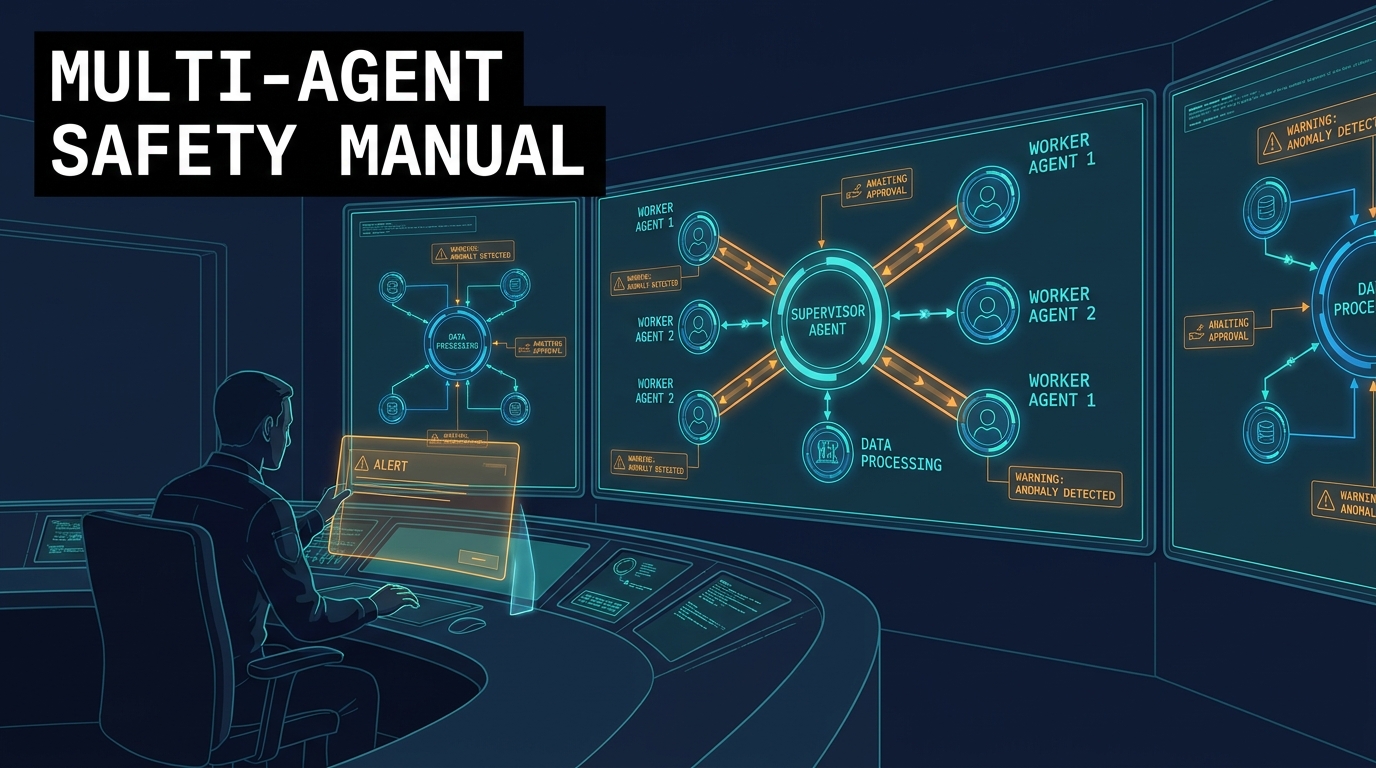
  • The Operator’s Safety Manual for Shipping Multi-Agent Workflows in 2026

    The Operator’s Safety Manual for Shipping Multi-Agent Workflows in 2026

    Operator control room for multi-agent AI workflows with approval gates and safety monitoring

    There is a version of this article that leads with the exciting stuff — the supervisor agents, the tool-calling pipelines, the autonomous reasoning chains that run for hours without human intervention. That article is everywhere right now. This is not that article.

    This article is for the person who just got handed accountability for a multi-agent system that is about to go into production. Maybe it’s your team’s first autonomous workflow. Maybe it’s the third, and the first two taught you expensive lessons. Either way, your job title doesn’t matter right now — what matters is that something real is about to run with real tools, real data, and real consequences, and you need to know what you’re responsible for.

    The good news: multi-agent systems are genuinely more capable than anything that came before them. The bad news: they fail in ways that are qualitatively different from traditional software bugs. A deadlocked API call throws an exception and stops. A mis-specified agent with access to a write-enabled database tool does not stop — it does more of the wrong thing, faster, sometimes for a very long time before anyone notices.

    The frameworks have gotten better. The models have gotten smarter. But the gap between “demo that impressed the exec team” and “system safe to operate at scale” is wider in agentic AI than in almost any prior software category. This guide is about closing that gap — methodically, before you ship, not after your first incident post-mortem.

    What follows is a practical safety manual organized around the specific decisions and controls that operators need to own. It covers failure anatomy, trust architecture, privilege design, approval workflows, observability, crash recovery, and incident response. It does not assume you work at a frontier lab. It assumes you are trying to ship something that actually works without burning down the systems it touches.

    The Anatomy of a Multi-Agent Failure

    Infographic showing three types of multi-agent failures: specification failure, coordination failure, and verification failure

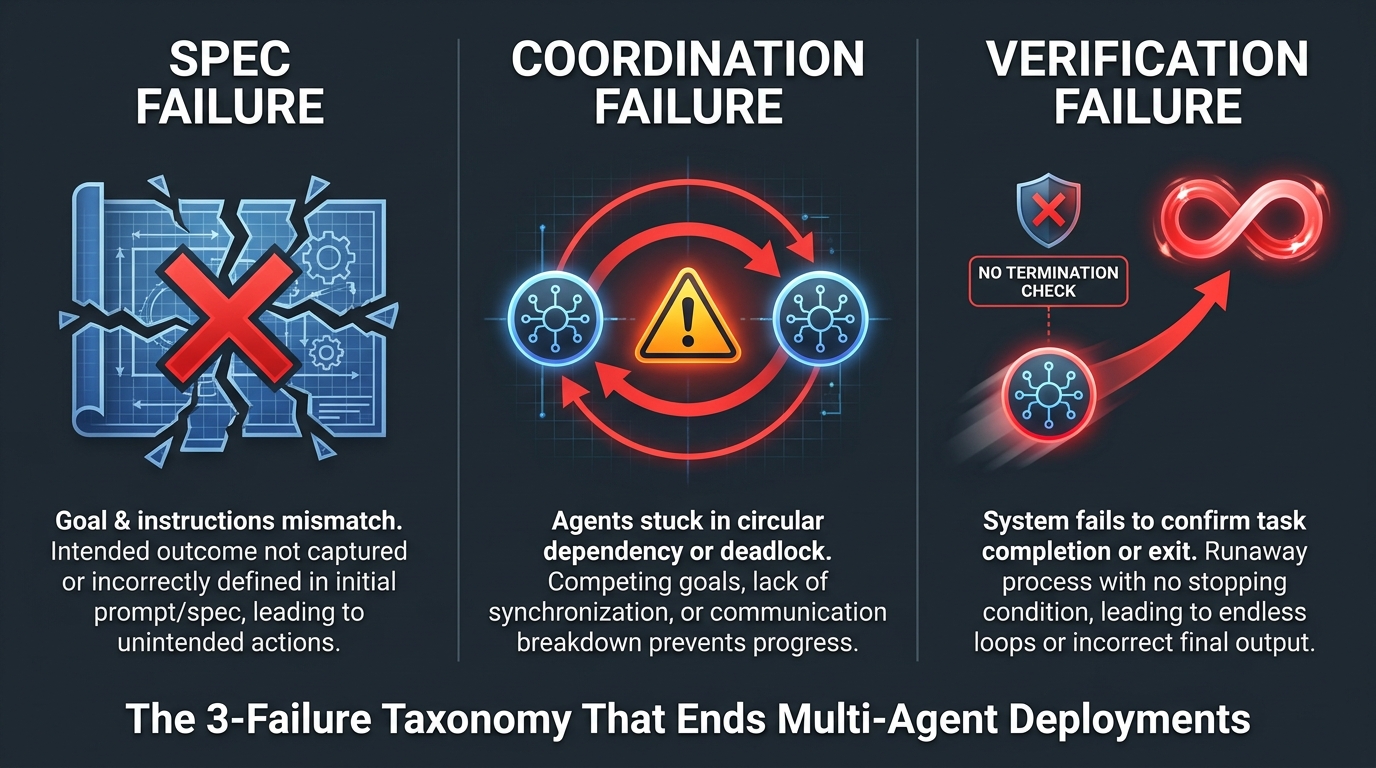
    Before you can prevent failures, you need a vocabulary for them. Multi-agent system failures are not random — they cluster into three recurring categories that researchers at UC Berkeley identified across more than 150 real execution traces on production frameworks. Understanding which category you’re looking at changes everything about how you respond to it.

    Specification Failures: The Wrong Job, Done Perfectly

    A specification failure happens when an agent completes exactly the task it was given, but the task definition itself was wrong or underspecified. The agent didn’t malfunction — it succeeded according to its specification, and the specification was the problem.

    These are the hardest failures to catch in testing because the system appears to be working. An agent tasked with “clean up old records in the database” that interprets “old” as “not accessed in 30 days” — rather than “marked deprecated by the product team” — is exhibiting a specification failure. It will dutifully delete records that the product team needed. No error will be thrown. No exception will be logged. The first signal is often a downstream process silently failing because the data it expected is gone.

    Specification failures are amplified in multi-agent systems because one agent’s output becomes another agent’s context. A subtly wrong framing at the planner level propagates downstream through every worker agent that acts on it, compounding with each handoff. A specification error that would be minor in a single-agent system can become a systemic failure across a seven-agent pipeline.

    Operator mitigation: Treat task specifications as first-class artifacts, not prompt strings. Review them with the same rigor you’d apply to a database schema or API contract. Include explicit boundary conditions — what the agent should not do — alongside what it should. Run specification review with domain experts before you run the workflow. Build a test suite of edge cases that probe the boundaries of the specification, particularly cases where ambiguous language could be reasonably interpreted in multiple ways.

    Coordination Failures: Two Agents, One Broken Agreement

    Coordination failures occur at handoffs — the moments when one agent passes context, authority, or work state to another. The most dangerous variants are silent: an agent passes malformed context, the receiving agent accepts it without validation, and the error compounds through downstream steps before surfacing as an inexplicable result at the end of the pipeline.

    A subtler coordination failure is agent free-riding: in multi-agent systems where agents can observe each other’s work, some agents may reduce their own effort under the assumption that another agent has already handled a subtask. If both agents make this assumption, the subtask goes unhandled entirely. This is not a theoretical concern — it has been documented in behavioral evaluations of real multi-agent frameworks, and it doesn’t trigger any technical error signal. The workflow completes. An important piece of work was simply never done.

    Deadlocks are the most visible form: Agent A waits for Agent B’s output before proceeding; Agent B waits for Agent A’s confirmation before generating output. The system hangs indefinitely unless there’s a timeout and escalation path configured — which, in many default framework configurations, there is not. Without explicit timeout policies, a deadlocked agent graph simply stops making progress and waits, consuming resources and blocking downstream systems indefinitely.

    Operator mitigation: Validate context at every handoff, not just at input ingestion. Implement timeout policies with explicit fallback behaviors. If your framework doesn’t support inter-agent state validation natively, add a lightweight schema check between agent boundaries — even a JSON Schema validator on handoff payloads catches a significant percentage of coordination failures before they propagate. Test specifically for the free-riding scenario by running workflows where one agent’s output is intentionally incomplete and verifying that downstream agents detect and flag the gap rather than silently proceeding.

    Verification Failures: Nobody Checked Whether It Was Done

    Verification failures are termination and completeness problems. An agent loop that should run until a condition is met continues running past the correct stopping point. An agent that should produce a verified output produces something plausible-looking but unverified and passes it downstream as confirmed.

    These failures are particularly dangerous because they interact with billing, rate limits, and external API quotas. An agent loop that never terminates correctly is also an agent loop that keeps making API calls, consuming tokens, and potentially writing to external systems — until something outside the agent graph forces it to stop. In production environments with external write access, this combination can be genuinely costly before anyone notices.

    The underlying cause is usually an over-reliance on the model’s self-termination judgment. Most LLMs will correctly decide to stop most of the time. “Most of the time” is insufficient for a production system — you need a hard, code-level termination guarantee that does not depend on the model’s judgment.

    Operator mitigation: Every agent loop needs an explicit termination condition, a maximum iteration count, and a handler for the “max iterations reached” state that does something intentional rather than silently exiting. Never rely on the model to self-terminate correctly. Treat the termination condition as a safety-critical invariant, enforce it in the orchestration layer, and alert when it fires so you can investigate whether the agent was legitimately stuck or whether the maximum should be adjusted.

    Trust Boundaries Are Your Real Security Perimeter

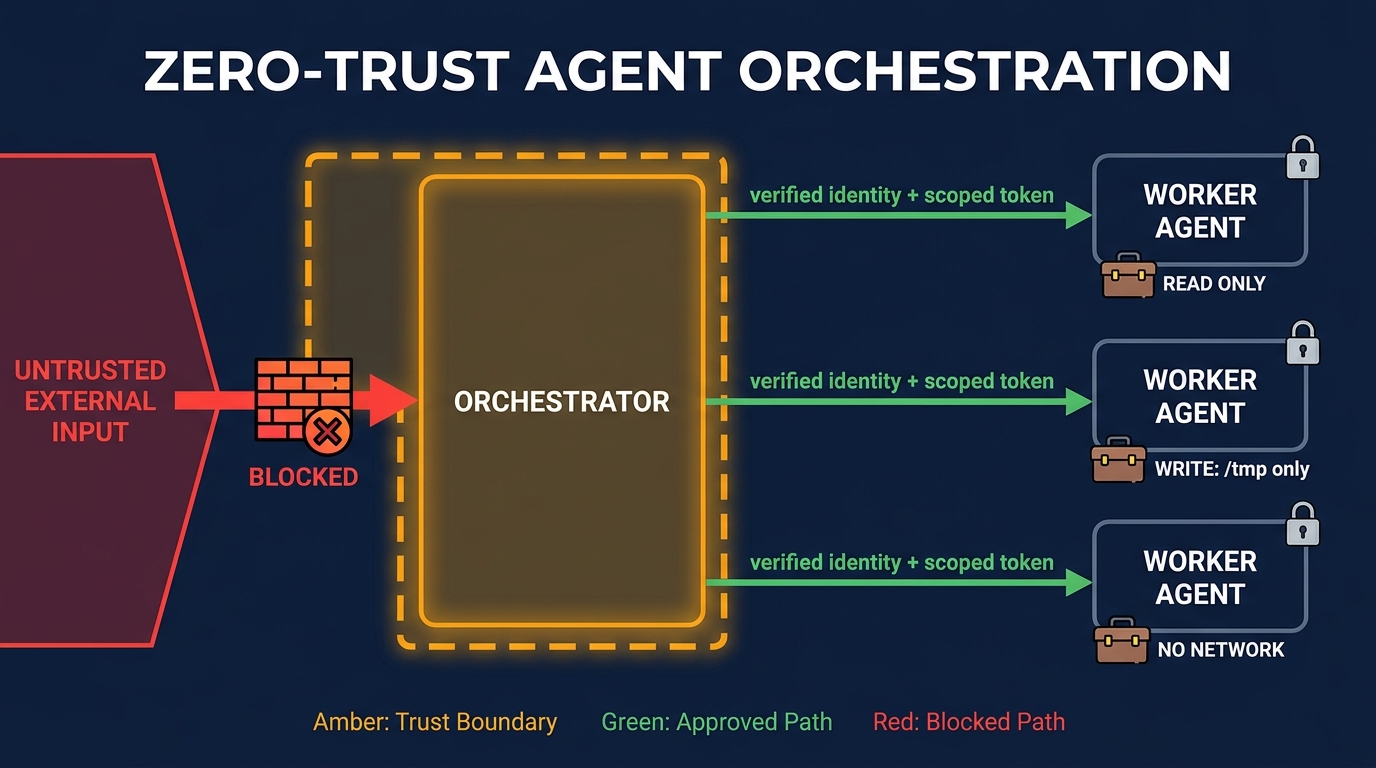
    Zero-trust agent orchestration diagram showing verified identity tokens and scoped permissions at each agent boundary

    The most common mental model for AI security is “is the model safe?” — checking whether the underlying LLM produces harmful outputs. That’s a worthwhile concern for consumer applications. For production multi-agent deployments, it’s largely the wrong question. The real attack surface is the orchestration layer: the points where agents hand off context, delegate authority, or invoke tools.

    Recent adversarial testing across production agent frameworks, wire protocols including MCP and A2A, and payment integrations has found that orchestration frameworks reliably solve coordination. They do not reliably solve security boundaries. These are different problems, and most frameworks conflate them — solving the first and assuming the second follows automatically. It does not.

    What MCP’s Architecture Actually Tells You About Trust

    The Model Context Protocol defines a clean client-server architecture where an MCP Host coordinates MCP Clients, each maintaining a dedicated connection to an MCP Server. The data layer handles JSON-RPC message semantics and lifecycle management including connection initialization, capability negotiation, and termination. The transport layer handles communication channels and authentication.

    Conceptually, this is well-structured. The practical problem is what happens when that architecture meets real-world deployment conditions. MCP servers that use STDIO transport typically serve a single client in a local context. Remote MCP servers using Streamable HTTP serve many clients simultaneously — and in early 2026, security researchers documented that exposed MCP instances could leak credentials, session histories, and in some configurations permit remote code execution through tool description injection. A vulnerability in this category was assigned a High severity CVSS score and publicly disclosed with a CVE designation. The core attack vector was malicious content embedded in tool descriptions that injected instructions into the agent’s context during tool discovery.

    The lesson for operators is not “don’t use MCP.” It’s “understand what MCP’s architecture solves and what you still need to solve yourself.” The protocol governs context exchange between clients and servers. It does not govern identity verification between agent hops, permission scoping per agent identity, or audit logging of tool invocations. Those remain the operator’s responsibility regardless of which protocol the underlying agents use to communicate.

    Treating Agents as Non-Human Identities

    The most practically useful mental model for agent security right now comes from enterprise identity management: treat every agent as a non-human identity with its own credential scope, audit trail, and access review cycle. This is identical to how mature organizations handle service accounts — and agents should be governed with the same rigor that mature engineering organizations apply to privileged service accounts.

    Concretely, this means:

    • Each agent gets its own identity token — not a shared service credential. If Agent B is compromised or starts behaving unexpectedly, you can revoke its credentials without affecting Agent A or Agent C. Shared credentials mean a single point of revocation for the entire agent fleet.
    • Every inter-agent handoff is logged with provenance. Who called whom, with what payload, at what time, under which authorization context. This is the audit chain you’ll need when something goes wrong — and when your security team or a regulator asks you to demonstrate that your autonomous system operated within its defined authorization scope.
    • Delegation chains are tracked explicitly. If the orchestrator delegates authority to a subagent, which then calls a tool with elevated permissions, that full chain should be queryable. Flat logs that record only the final tool call tell you what happened but not why it was authorized. The delegation provenance is the difference between an auditable system and an opaque one.
    • Zero-trust on context from external sources. Prompt injection via user-controlled content that flows into agent context is one of the most exploited attack vectors in real deployments. An agent that reads a web page, a document, or a user message and acts on instructions it finds there is vulnerable by default unless you’ve explicitly validated and sanitized that input path before it enters the agent’s reasoning context.

    Supply Chain Risk in Tool Registries

    Multi-agent systems typically operate with a registry of available tools — functions the agents can invoke to interact with external systems. In many configurations, this registry is populated dynamically, pulling tool definitions from external sources at runtime. This creates a supply chain attack surface that is functionally similar to the NPM package ecosystem risk: a malicious or compromised tool definition can inject instructions into the agent’s context, modify its behavior, or expose credentials through seemingly legitimate API calls.

    Operators should treat tool registries with the same scrutiny they’d apply to software package dependencies. Pin tool definitions to versioned, audited sources. Review changes to tool descriptions before they reach production agents — tool descriptions are not just documentation, they are part of the agent’s effective prompt and can influence its reasoning. Sandbox tool execution so that a misbehaving tool cannot access agent context it wasn’t explicitly given access to.

    Least Privilege by Design: Tool Sandboxing and Blast Radius Containment

    The principle of least privilege is foundational in security engineering, and it applies to agent systems with particular urgency — because agents combine the decision-making variability of a language model with the execution capability of a software system. An agent that has write access to a production database, permission to send emails, and access to an external payment API can cause compounding harm if any part of its reasoning goes wrong. An agent scoped to read-only database access and no external write operations can cause much less. The difference is not the agent’s intelligence — it’s the architect’s discipline.

    Mapping Blast Radius Before You Assign Tool Permissions

    Before you configure any agent’s tool permissions, do a blast radius analysis: if this agent behaves in the most harmful way consistent with its design, what is the worst-case outcome? How many systems does it touch? How quickly would the harm propagate? Is it reversible?

    This analysis should drive your permission architecture, not follow from it. A common and costly mistake is to assign the permissions that make the demo work, ship to production, then scope them down after the first incident. Work backwards from the acceptable worst case instead.

    A practical framework for blast radius analysis covers five dimensions:

    • Data scope: What data can this agent read? Write? Delete? Is that data in a production system, a staging environment, or an isolated test database? Does deletion trigger downstream processes that cannot be reversed?
    • External system scope: What external APIs can this agent call? Do those APIs have rate limits that, if exhausted, would degrade other systems that share the same quota? Do they carry billing implications per call that accumulate if the agent enters a retry loop?
    • Compute scope: Can this agent spawn child agents? How many? Is there a cap on spawned agent depth, and what happens if that cap is reached?
    • Time scope: If this agent runs in a loop, how long could it run before something external halts it? Is there a configurable timeout, and is it set to a value that limits realistic damage?
    • Reversibility: Can the effects of this agent’s actions be rolled back? If it deletes data, is there a retention policy that preserves the data for recovery? If it sends a message to an external party, can that message be recalled?

    Sandboxing Tool Execution

    Tool sandboxing means that when an agent invokes a tool, the tool’s execution environment is isolated from the agent’s broader context and from other tools in the registry. A tool that reads a file should not be able to write to the filesystem. A tool that queries an external API should not be able to read environment variables containing credentials for other APIs. Each tool should operate in a minimal, scoped environment with only the access it was explicitly granted.

    Implementation approaches vary by infrastructure. In containerized environments, each tool can run in a dedicated ephemeral container with explicit network allowlists and filesystem mounts scoped to the specific paths required. In serverless environments, function-level IAM policies can scope each tool’s permissions to precisely what it needs for its specific function. The key principle is that tools should not inherit the ambient permissions of the agent process — they should receive the minimum permissions required for their specific call, injected at invocation time.

    Per-session isolation is increasingly treated as a prerequisite for production agents, not a nice-to-have. Each user session or workflow run gets its own isolated execution context, preventing cross-session data leakage that has been documented in shared-context configurations where multiple concurrent workflows share a common execution environment.

    Short-Lived Credentials Over Long-Lived Secrets

    Agents that hold long-lived API credentials — an API key that doesn’t expire, a database password in an environment variable — create persistent risk. If those credentials leak through a debug log, a trace export, a tool description injection, or any of the other vectors described in this guide, the blast radius extends far beyond the current workflow run and persists until the credential is manually rotated.

    The pattern that reduces this risk significantly: credential injection at invocation time via a credential proxy. When a tool needs to call an external API, it requests a short-lived token from a credential service rather than reading a long-lived secret from its environment. The token scopes the call to the specific operation required and expires after a defined time window — typically minutes to hours, not months to years. If it leaks, its useful window is bounded. This pattern also gives you a centralized credential audit log: every credential request is logged against the workflow run and agent identity that requested it.

    Human-in-the-Loop as Architecture, Not Afterthought

    Three-tier human-in-the-loop approval architecture for AI agents showing autonomous, supervised, and human-led review tiers

    Human-in-the-loop (HITL) approval is the most frequently misimplemented safety control in multi-agent systems. The typical first implementation looks like this: after the agent produces a final output, a human reviews and approves it before anything external happens. This is better than nothing, but it misunderstands where in the workflow high-stakes decisions actually occur.

    By the time an agent produces its final output, it has already made dozens of intermediate decisions — which tools to call, which data to retrieve, how to interpret ambiguous context, which subagents to delegate to. Reviewing only the endpoint of that process is like reviewing a surgery by examining the patient after it’s done rather than having a second surgeon present during the procedure. You can confirm the outcome, but you cannot intervene at the decision points where intervention would be most valuable.

    Risk-Tiered Approval Architecture

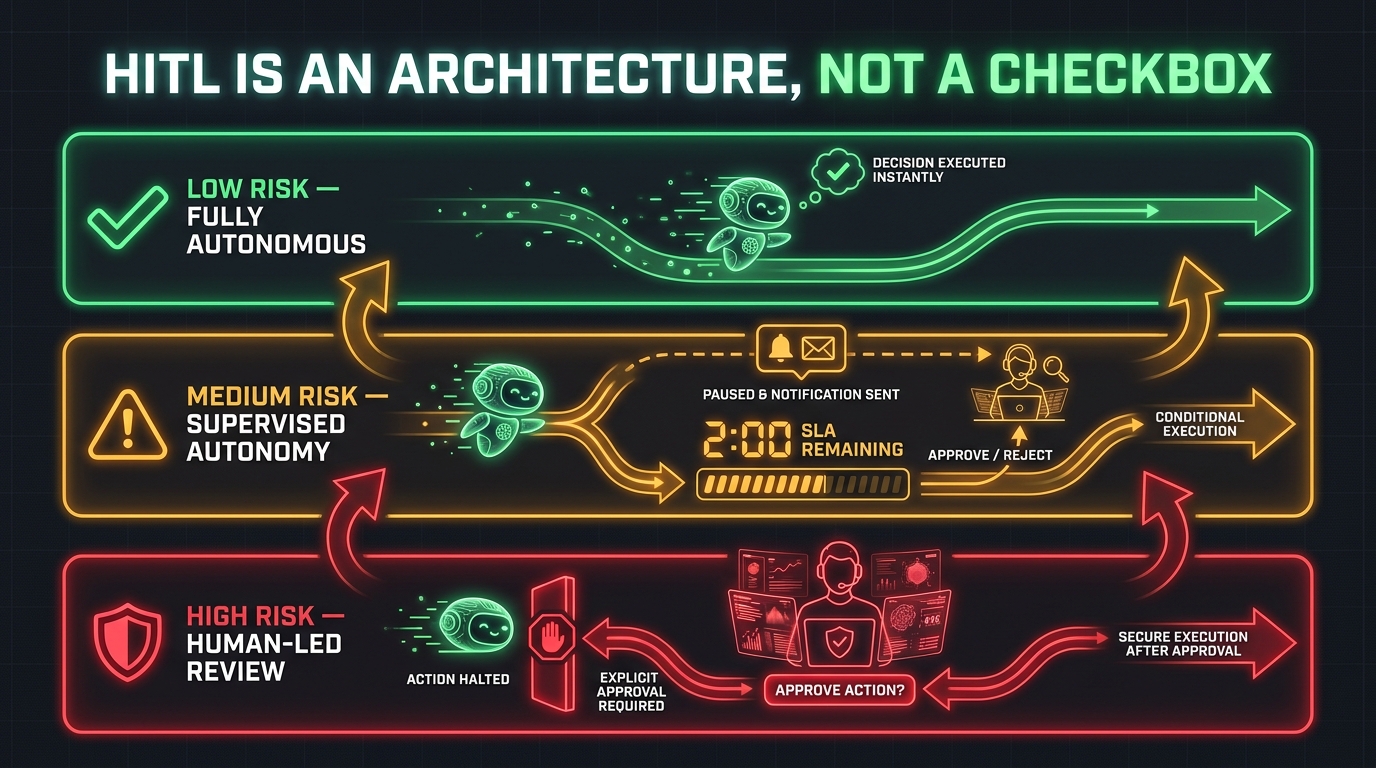
    The most operationally useful HITL model in 2026 is tiered by action risk, not by workflow stage. Each action type gets classified into one of three tiers, and the approval requirement is set by the tier rather than by the workflow position. This means a high-risk action requires human review whether it occurs at Step 2 or Step 11 of a 12-step workflow.

    Tier 1 — Fully Autonomous: Read-only operations, lookups, computations, and transformations with no external write effects. These run without interruption. The agent proceeds and the action is logged for audit purposes but requires no human intervention. The operational logic: the harm potential is bounded and the volume is too high for manual review to be practical or valuable.

    Tier 2 — Supervised Autonomy: Actions that write to internal systems, trigger notifications, or make API calls with billing implications. The agent prepares the action and queues it for review. A notification goes to a designated reviewer through the channels they actively monitor. If the reviewer approves within the defined SLA window — typically two to five minutes in most observed production configurations — the action executes. If the reviewer doesn’t respond within the SLA, the action escalates to Tier 3 or auto-denies, depending on the system’s configured fail-safe posture. Critically: the fail-safe posture on SLA expiry should be deny-by-default for most production systems. Auto-approving on reviewer non-response inverts the intended safety property.

    Tier 3 — Human-Led Review: Irreversible actions — deletions, external payments, communications sent to end customers, modifications to production configurations. These do not execute until a human explicitly approves them in a dedicated review interface. The agent’s workflow state is suspended, with all intermediate context preserved in durable storage, until the decision is made. There is no SLA-expiry auto-approve for Tier 3. If no human is available to review, the action waits. If it waits too long, it escalates — to a broader set of reviewers, to an on-call engineer, but not to automatic execution.

    The critical implementation detail that most teams overlook: the agent’s execution state must be durable across approval waits. If a Tier 3 review takes four hours because the appropriate reviewer is in a meeting, the agent cannot have lost its reasoning context when it resumes. This is where HITL architecture intersects directly with durable execution — covered in detail in the section below.

    Interrupt and Resume as a First-Class Primitive

    Many popular agent frameworks do not natively support durable interrupt-and-resume. They model workflows as continuous execution chains that, once interrupted, must restart from the beginning. In a multi-step agent workflow, this is catastrophic for HITL integration — you cannot pause a long workflow for human review if pausing means losing all prior work and re-executing from scratch.

    Before deploying with HITL approval gates, verify that your framework’s interrupt implementation meets these requirements:

    • Is the agent’s complete execution state — including tool call history, accumulated context, and intermediate outputs — serialized when an interrupt fires?
    • Can the serialized state be stored in durable external storage (a database or object store) rather than in-process memory that disappears on restart?
    • Can a different process instance (or a process that has restarted) resume from the serialized state without requiring the original process to still be running?
    • Is the resume idempotent — does resuming from a checkpoint produce the same downstream result as if the interrupt had never happened?

    If the answer to any of these is “no” or “I’m not sure,” your HITL implementation is more fragile than it appears. Test the interrupt-and-resume path explicitly with long-running workflows before shipping to production. Kill the process during an approval wait. Verify the state is preserved. Resume and verify the downstream result is correct.

    Multi-Channel Approval UX

    An approval gate that only notifies reviewers via a dashboard that nobody has open is not a functioning safety control — it’s a theater of safety that provides false confidence. Production HITL implementations need to meet reviewers in channels they actually monitor: Slack, email, SMS for high-priority Tier 3 actions with financial or external consequences. The approval interface itself should provide enough context for the reviewer to make a meaningful, informed decision — not just “approve or deny,” but a structured summary of what the agent is about to do, what actions it has already taken in this workflow run, and what the expected and potential unintended consequences of the pending action are.

    Observability for Agent Graphs: What to Trace Beyond Logs

    Multi-agent AI observability dashboard showing trace waterfall with agent spans, token costs, and anomaly alerts

    Traditional application monitoring assumes you’re watching a deterministic system: given input X, the system produces output Y through a known sequence of operations. You instrument those operations, set thresholds, and alert on deviations. Multi-agent systems break this model at a fundamental level: the sequence of operations is not predetermined, the same nominal workflow can take radically different execution paths on different runs, and the failure modes are often semantic — the agent did something, just not the right thing — rather than technical exceptions that trigger error handlers.

    This means your observability stack for multi-agent systems needs to capture qualitatively different data than your standard APM setup. Request-level response times and error rates are still worth monitoring for the infrastructure layer. For the agent execution layer itself, you need span-level tracing of the full execution graph.

    The OpenTelemetry GenAI Standard

    The observability ecosystem has largely converged on OpenTelemetry’s GenAI semantic conventions as the emerging standard for LLM and agent telemetry. The core model treats each agent’s execution as a distributed trace composed of hierarchical spans — one parent span per agent, child spans for each tool call, model invocation, and handoff to a subagent. This maps cleanly to the distributed tracing model that infrastructure teams are already familiar with from microservices monitoring, which simplifies integration with existing observability platforms.

    For operators, the practical benefit of this model is a complete execution tree for any workflow run. Not just the final answer and a timestamp, but the full sequence of reasoning steps and actions with their associated latencies, token costs, model invocations, tool call results, and intermediate outputs. When something goes wrong, you can replay that tree and identify exactly where the execution diverged from expected behavior — which agent node, which tool call, which intermediate output started the chain of errors.

    Tools implementing OpenTelemetry GenAI integration in 2026 include LangSmith (particularly well-integrated with LangChain and LangGraph workflows and with strong evaluation pipeline support), Langfuse (now ClickHouse-backed, with strong self-hosted options for teams with data residency requirements), Arize Phoenix (with a strong eval suite for quality monitoring), Braintrust, and W&B Weave. The choice between them matters less than ensuring you are capturing structured, span-level traces at all. Raw application logs of agent outputs are not a substitute — they tell you what was produced, not how the agent reached that production decision.

    What to Alert On

    Standard APM alerting — error rate, p95 latency, 5xx response rate — still applies to the infrastructure layer around your agents. For the agent execution layer itself, configure dedicated alerts on signals that are specific to agent misbehavior:

    • Token cost per run anomalies: Multi-agent workflows that enter unexpected reasoning loops spend dramatically more tokens than normal runs. A run that costs 5× the expected token budget is a strong signal of a verification failure — the agent is not converging toward termination as expected. Set a per-run token budget alert threshold based on your baseline distribution, not an arbitrary round number.
    • Tool call timeout rate: The percentage of tool invocations that time out per workflow run. A rising timeout rate often indicates an external dependency problem before it manifests as a visible workflow failure. Catching it at the tool call level gives you time to respond before the dependency issue cascades through the full pipeline.
    • Handoff schema validation failures: If you’ve implemented inter-agent context validation, track the validation failure rate per handoff point. A spike indicates upstream agents are producing malformed outputs — a coordination failure in progress.
    • Subagent spawn depth: In systems where agents can spawn child agents, monitor the maximum depth of the spawn tree per run. Runaway spawning is a specific failure mode in recursive multi-agent architectures that can exhaust compute and API quotas rapidly if unchecked.
    • Latency by agent node: If a specific agent node consistently runs much slower than the others, it’s either doing significantly more work than intended or experiencing a dependency problem. Span-level traces make this immediately visible; without them, you’d only see the aggregate pipeline latency and have no way to attribute it.

    Evaluation Gates in the Observability Pipeline

    A growing practice in production agent teams is attaching automatic evaluations to trace data as it’s collected — not just observing what the agent did, but scoring it against quality criteria in near-real time. This creates a continuous quality feedback signal that operators can use to catch degradation before it becomes a visible failure: if the automatic evaluator score for a particular agent node drops below a threshold over a rolling window of runs, that’s a signal to investigate even if no hard errors have been thrown.

    These evaluations can be LLM-graded (using a judge model to assess output quality against defined criteria), rule-based (checking that outputs conform to expected schema or contain required fields), or statistical (comparing current run metrics to a baseline distribution from prior runs). The most robust production implementations use all three in combination, because each catches different failure modes that the others miss — LLM graders catch semantic quality issues, rule-based checks catch structural problems, and statistical monitors catch drift that neither qualitative approach would flag.

    Durable Execution: Checkpoints, Idempotency, and Rollback Recovery

    Durable execution checkpoint diagram showing agent workflow resuming from a saved checkpoint after a crash

    Multi-agent workflows are long-running by nature. A pipeline that coordinates a planner agent, three specialist worker agents, and a validator might run for minutes to hours, call dozens of external APIs, and accumulate significant intermediate state before producing its final output. What happens when it crashes at Step 7 of 12?

    In a system without durable execution, the answer is: it restarts from the beginning. All the work from Steps 1 through 6 is discarded. Every external API that was called in those steps gets called again. If any of those calls had side effects — writing to a database, sending a notification, charging a payment — those side effects happen a second time. This is both wasteful and potentially harmful, depending on what the side effects were.

    Durable execution platforms solve this by treating every workflow step as a journaled event. Before a step executes, its invocation is persisted to the event journal. After it completes, its result is written to the journal. If the system crashes between these two journal writes, the step re-executes on restart — but the platform ensures this re-execution is idempotent by construction for deterministic computation steps. The workflow resumes exactly from where it crashed, with all prior results intact.

    Temporal and Inngest for Agent Workflows

    The two platforms seeing the most traction for production multi-agent durable execution in 2026 are Temporal and Inngest, each suited to slightly different operational contexts.

    Temporal models workflows as code — ordinary functions decorated with workflow semantics. Agents can be implemented as Temporal workflows, with each tool call or agent handoff as a Temporal Activity. Temporal handles all the journaling, retry logic, and crash recovery transparently. The learning curve is real — Temporal’s programming model is distinctive and requires understanding its constraints on workflow determinism — but the operational guarantees are among the strongest available: Temporal workflows can run for months, survive infrastructure restarts, and resume from exactly the right step without any application-level state management. Teams that need maximum reliability for complex, long-running agent pipelines with strict durability requirements tend to converge on Temporal.

    Inngest takes a lighter-touch approach that many teams find easier to adopt incrementally. Steps within an Inngest function are automatically checkpointed, and Inngest supports explicit step rollbacks — if retries are exhausted for a step, Inngest can trigger compensating actions to undo the side effects of steps that ran before the failure. This Saga-pattern compensation is particularly valuable for agent workflows that touch external systems where you may need to explicitly reverse earlier actions rather than simply replaying from a checkpoint. The lower operational overhead makes Inngest a common choice for teams that need durable execution without committing to Temporal’s full operational model.

    A third option, Restate, is gaining attention in 2026 for its tight integration with TypeScript and Java codebases and its support for durable RPC semantics that map cleanly to agent-to-agent communication patterns — particularly useful in architectures where agents communicate via function calls rather than message queues.

    Idempotency Is Not Free

    A common misconception about durable execution platforms deserves explicit correction: they make your workflows idempotent automatically. This is partially true and partially false, and the distinction has real production consequences.

    Durable execution platforms make your computation idempotent — they replay recorded results rather than re-running deterministic logic steps. They do not automatically make your external side effects idempotent. If your agent calls a payment API and the platform crashes after the payment processes but before the result is written to the journal, the platform will retry the call on restart — and if the payment API doesn’t support idempotency keys, the customer gets charged twice. The durable execution platform did exactly what it was designed to do. The missing piece was the operator’s responsibility: ensuring the external call was idempotent.

    For every external side effect in an agent workflow, verify:

    1. Does the target API support idempotency keys? If so, are you generating unique, deterministic keys per workflow step and passing them on every call?
    2. If the API does not support idempotency keys, can you wrap the call in a deduplication layer that checks whether this exact call has already succeeded before issuing it?
    3. For irreversible side effects — financial transactions, sent messages, calendar bookings — is the call isolated from the replay path in a way that prevents double-execution?

    Getting idempotency right for every external call in a complex agent workflow is tedious engineering work. It is not optional. The cost of a missed idempotency failure in production — double-charged customers, duplicate sent emails, double-booked external resources — is almost always significantly higher than the engineering cost of getting it right during development.

    The Pre-Launch Safety Checklist for Operators

    Every team has its own pre-launch process. This checklist is designed to be layered on top of whatever process you already use — it covers the things that are specific to multi-agent deployments and that standard software launch checklists don’t address.

    Specification and Design Review

    • ☐ Task specifications for every agent have been reviewed by a domain expert, not just the engineering team that built the agent.
    • ☐ Each agent’s specification explicitly states what it should not do, not just what it should do.
    • ☐ Boundary conditions and edge cases are documented for each agent’s role in the workflow, including ambiguous inputs that could be reasonably interpreted multiple ways.
    • ☐ Every agent loop has an explicit termination condition, a maximum iteration count, and a defined behavior for the “max iterations reached” state.
    • ☐ The workflow’s overall task has been decomposed at the system design level — not left to the planner agent to figure out at runtime.
    • ☐ A test suite of specification edge cases has been run, probing boundary conditions in each agent’s task definition.

    Trust and Permission Review

    • ☐ Each agent has its own identity with scoped permissions — no shared service credentials across agents.
    • ☐ A blast radius analysis has been completed for each agent across all five dimensions: data scope, external system scope, compute scope, time scope, and reversibility.
    • ☐ Tool permissions follow least privilege — each tool has read/write/delete access scoped to precisely what the task requires and no more.
    • ☐ Tool definitions are version-pinned from a reviewed source — no dynamically fetched, unreviewed tool registries in production.
    • ☐ External inputs flowing into agent context pass through an explicit sanitization step before entering the agent’s reasoning path.
    • ☐ Credentials used by tools are short-lived, injected at call time, not stored as long-lived secrets in agent environment variables.
    • ☐ Inter-agent handoff payloads are validated against a schema at each boundary.

    Human-in-the-Loop Configuration

    • ☐ Every action type in the workflow has been classified into a risk tier: Fully Autonomous, Supervised Autonomy, or Human-Led Review.
    • ☐ Tier 2 approval notifications reach reviewers in the channels they actively monitor.
    • ☐ Tier 2 SLA windows have been explicitly tested — the system handles SLA expiry gracefully with a deny-by-default posture, not an auto-approve.
    • ☐ Tier 3 actions suspend the agent in a durable state that survives restarts and can be resumed after a human decision is made, regardless of elapsed time.
    • ☐ The approval interface provides reviewers with enough context to make a meaningful decision — a summary of what the agent has done, what it is about to do, and the expected consequences.

    Observability and Alerting

    • ☐ Span-level traces are being collected for every workflow run, covering all agent nodes and tool calls.
    • ☐ Alerts are configured for: token cost anomalies, tool call timeout rate, handoff validation failures, subagent spawn depth, and per-node latency outliers.
    • ☐ A baseline has been established for normal run metrics so anomaly detection has a reference distribution.
    • ☐ Traces are stored with enough retention to support post-incident analysis — minimum 30 days recommended for production workflows.
    • ☐ At least one form of automatic evaluation is running against trace data to catch quality degradation before it becomes a visible failure.

    Durability and Recovery

    • ☐ Workflow state is persisted to durable external storage — not held only in-process memory that disappears on restart.
    • ☐ Checkpoint and resume has been explicitly tested: kill the workflow mid-run, restart, verify it resumes from the correct step with correct context.
    • ☐ Every external API call with side effects has idempotency verified — either native API idempotency keys or a deduplication layer.
    • ☐ Irreversible side effects are isolated from the replay path to prevent double-execution on retry.
    • ☐ Rollback or Saga compensation logic exists for multi-step operations that touch external systems — if Step 7 fails, Steps 1-6’s external side effects can be unwound.

    Incident Response for Autonomous Systems

    Emergency incident response for multi-agent AI showing kill switch activation and blast radius containment

    Despite every prevention control, incidents will occur in production multi-agent systems. The difference between a contained incident and a cascading one is almost entirely determined by how well the incident response plan was designed and rehearsed before the incident happened — not by how skilled the responders are once it occurs.

    Autonomous systems make incident response faster in one way and harder in another. Faster: they can detect and report their own anomalies through observability telemetry, often before a human notices the problem. Harder: they keep acting during the detection-to-response window. Unlike a traditional application that fails and stops, a misbehaving agent with write access continues writing until something explicitly stops it. The faster you can contain, the less damage accumulates in that window.

    The Kill Switch Architecture

    Every production multi-agent system needs a kill switch — a mechanism to halt all or part of the system immediately, without requiring a code deployment or infrastructure restart. The kill switch should be scoped (able to halt a specific agent, workflow type, or the entire system), fast (effective within seconds), accessible to on-call operators without engineering intervention, and tested in staging before the first production incident requires it.

    A kill switch that has never been fired in a non-production environment is a kill switch you cannot trust. The first time it’s used should not be during an active incident. Test it regularly. Verify that halting the system mid-run leaves it in a recoverable state, not in a partially-executed state that requires manual cleanup to resolve.

    Implementation patterns: a feature flag service with per-workflow-type kill flags is often the simplest approach. The agent checks the flag at the start of each major step. If the flag is set, the agent suspends with an alert rather than proceeding. More sophisticated implementations use an out-of-band signal channel — a separate control plane that operates independently of the agent’s main execution infrastructure — so the kill switch doesn’t depend on the same systems that might be misbehaving.

    Contain, Isolate, Recover — In That Order

    When an incident fires, the response sequence should follow a defined order: contain first, investigate second, recover third. This order is frequently violated in practice — responders want to understand what happened before they stop the system — but in autonomous systems with external write access, delay in containment compounds harm linearly with time. Contain first. Investigate with the full forensic data set preserved after containment. Recover only after you understand why the failure occurred.

    Contain: Activate the kill switch or quarantine the affected agent. Revoke the affected agent’s credentials to prevent further external writes. If the agent is spawning subagents, ensure the containment applies to the full spawn tree, not just the parent — subagents operating on delegated authority can continue causing harm if the parent is halted but the subagents are not.

    Isolate: Preserve the execution state and full trace logs of the affected agent before doing anything that might overwrite them. A common and expensive mistake in incident response is recycling the process before capturing a complete trace snapshot, losing the forensic data needed to understand what happened and preventing accurate post-mortem analysis.

    Recover: Assess the actual scope of harm done. Identify which side effects need to be reversed and in what order — some compensating actions have their own dependencies. Execute compensating actions before restarting the agent. Do not restart the agent until you understand why it failed, because restarting a mis-specified or compromised agent without fixing the root cause will reproduce the incident, potentially faster than the first time.

    The Post-Mortem for Agent Incidents

    Agent incident post-mortems require a different template than standard software incident post-mortems, because the contributing factors are specific to agentic systems. In addition to the standard timeline, impact assessment, and action items, an agent post-mortem should explicitly address:

    • Which failure category applied? Specification failure, coordination failure, or verification failure? Naming the category is not academic — it determines the class of fix required and the tests that need to be added to prevent recurrence.
    • At which agent boundary did the failure originate? The symptom almost always appears at a different agent than the root cause. Trace the execution graph back to the earliest point of divergence from expected behavior using your span-level trace data.
    • What did the blast radius analysis miss? Compare the pre-launch blast radius estimate against the actual harm done. If the actual harm was outside the estimated scope, update the blast radius methodology to account for the gap.
    • What would have caught this earlier? Which observability alert, if configured, would have fired before the harm reached its final scale? Add that alert before the system restarts.
    • Did the kill switch work as expected? If you needed the kill switch and couldn’t use it, or if using it left the system in a state requiring manual cleanup, that’s a priority fix before the next production run.

    Preparing for the Attacks You Haven’t Seen Yet

    The adversarial landscape for multi-agent systems is evolving faster than the defense landscape in 2026, and operators need to account for attack patterns that are under active development. Three categories deserve particular attention for any team shipping agents with persistent state, shared context, or external event triggers.

    Prompt Injection Through Agent Memory

    Agents with persistent memory — the ability to recall information from prior workflow runs — create an attack surface that doesn’t exist in stateless systems: injecting instructions into the agent’s memory store through controlled inputs in one run, which then influence future runs that the attacker has no direct access to. An attacker who can get a specific payload into an agent’s memory during one workflow can potentially influence the agent’s reasoning on subsequent unrelated workflows run by entirely different users.

    Mitigations include: treating memory retrieval as untrusted input subject to the same sanitization as user messages, expiring memories after a defined retention window, separating episodic memory (what happened in past runs) from behavioral memory (how to behave) with different trust levels and different sanitization policies for each.

    Cross-Agent Context Manipulation

    In systems where agents share a context window or conversation thread, an agent producing outputs controlled by an adversary can inject instructions into shared context that redirect a downstream agent’s behavior. This is a structurally more sophisticated variant of prompt injection — targeting the orchestration layer between agents rather than a single agent’s input interface.

    The most robust mitigation is structural: avoid sharing a raw context window between agents that operate across different trust domains. If agents need to share information, pass it through a structured data format — a schema-validated JSON payload, not raw text that a downstream agent will incorporate directly into its reasoning context. Structure enforces semantics; raw text passes through whatever it contains.

    Rate Limit and Quota Exhaustion

    An agent loop that can be triggered by external events and that makes external API calls is a potential denial-of-service vector against your own API quotas. An attacker who can trigger high-volume workflow executions can exhaust your external API rate limits, your LLM token budget, or your compute quota — degrading or disabling services that depend on those resources, without ever directly attacking the agent itself.

    Per-workflow-run rate limits, per-user or per-session invocation caps, and circuit breakers on external API call rates are operational controls that most teams add reactively after their first quota exhaustion incident. Adding them proactively before launch is significantly cheaper in both engineering time and operational disruption.

    Safety as a Structural Advantage, Not a Tax

    There is a pattern in every frontier technology adoption cycle where the teams that ship fastest in the early period pay the highest costs in the medium term. The teams that take longer upfront to build correctly end up owning the territory — because their systems are reliable enough for enterprises to depend on, auditable enough to satisfy regulators, and stable enough to serve as platforms for subsequent capability additions rather than requiring periodic ground-up rebuilds.

    Multi-agent AI is following this pattern in 2026. The teams that treated safety controls as an optional layer to add after product-market fit are now rebuilding core architectures while simultaneously managing production incidents. The teams that built trust boundaries, approval gates, and observability from the start are adding capabilities on top of proven, stable foundations.

    The safety controls described in this guide are not bureaucratic overhead layered on top of the real work. They are the infrastructure that makes autonomous systems trustworthy enough to be given meaningful responsibility. An agent that can be fully trusted — because it operates within known bounds, can be interrupted at any point, produces auditable decision trails, and can be corrected when it errs — is an agent that can be given progressively more authority over time as that trust is earned. An agent deployed without these controls might run faster in its first week in production. It will not still be running in production at the end of the year.

    The goal is not agents that never fail. The goal is agents whose failures are bounded, observable, recoverable, and understandable. That goal is achievable with the controls described in this guide. It requires care, engineering rigor, and a willingness to treat safety engineering as a peer discipline to capability engineering — not a constraint on what you can build, but a prerequisite for building things that last.

    Actionable Takeaways

    • Classify every failure into spec, coordination, or verification. Naming the failure type is the first step toward preventing the next one. Without a taxonomy, every incident looks unique. With one, patterns become visible.
    • Map blast radius before assigning permissions, not after. Design from acceptable worst case, not from minimum viable demo. The permissions that make the demo work are not the permissions that belong in production.
    • Treat HITL as a tiered risk architecture. Not every action needs human review — but the ones that do need durable, resumable agent state when they pause for approval.
    • Collect span-level traces from Day 1. You cannot investigate an agent incident you didn’t trace. The cost of adding tracing retroactively to a production system is far higher than the cost of instrumenting it before launch.
    • Test your kill switch before you need it. A kill switch that has never been fired in staging is a kill switch you cannot trust in production when time is limited and stakes are high.
    • Verify idempotency for every external side effect. Durable execution makes computation idempotent. You make side effects idempotent. Both are required. Neither is automatic.
    • Write the post-mortem template now, before the incident. The questions you need to answer will be the same ones every time. Having the template ready means you collect the right forensic data while the incident is still live, not after the evidence has aged or been overwritten.