Tag: MCP Protocol

  • Why Orchestration Is Now the Enterprise Software Stack — Not Just a Layer On Top of It

    Why Orchestration Is Now the Enterprise Software Stack — Not Just a Layer On Top of It

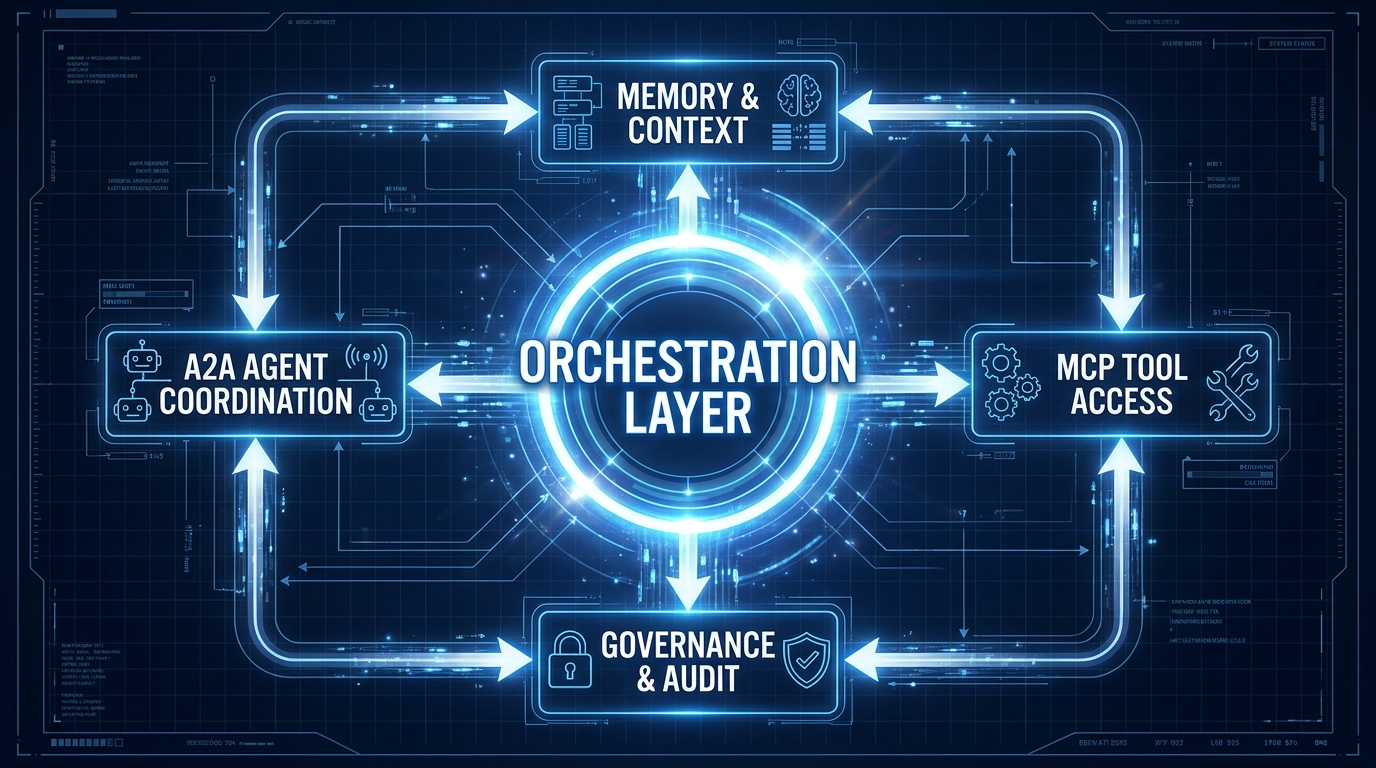
    Enterprise AI orchestration layer diagram showing the orchestration control plane connecting memory, MCP tool access, A2A agent coordination, and governance layers

    For the past three years, the enterprise AI debate has been almost entirely about models. Which model is best? Which vendor do you trust? How do you fine-tune? How do you keep costs down per token?

    That debate hasn’t disappeared — but it’s being quietly overtaken by a different question, one that matters far more to the teams actually trying to run AI at scale: how do you coordinate everything the model touches?

    The answer, increasingly, is orchestration. And in 2026, that word no longer means what it used to mean. It no longer describes a scheduling layer, a workflow tool, or a category of middleware you bolt onto an existing SaaS stack. Orchestration has moved to the center of the architecture. It has become the control plane — the runtime engine that sequences agents, manages state, enforces governance, routes tool calls, and decides when a human needs to step in.

    This is a structural shift, not a product update. The architecture itself has inverted. Where enterprises once built around applications and used orchestration to connect them, they are now building around the orchestration layer and treating applications as components beneath it. That’s a different operating model, a different vendor map, and a different set of failure modes to manage.

    This piece lays out exactly how that inversion has happened, what the new stack actually looks like layer by layer, which protocols and frameworks are doing the real work, where things break in production, and what it means for teams making architecture decisions right now.


    The Architecture That Broke First

    To understand why orchestration is ascendant, it helps to understand what it is replacing — and specifically, where the previous model started failing.

    The enterprise software stack that emerged from the 2010s was fundamentally application-centric. You bought point solutions: a CRM for customer data, an ERP for operations, a BI tool for reporting, a workflow automation platform to string together approvals, an analytics layer to make sense of outputs. Each tool owned a domain. Integrations happened at the edges — via APIs, webhooks, ETL pipelines, and increasingly, iPaaS platforms that tried to paper over the gaps.

    It worked well enough when the work was structured, predictable, and domain-contained. A sales rep triggers a contract process; a webhook fires; the CRM updates; an email goes out. Linear, deterministic, auditable.

    Where the Model Breaks Down

    The cracks appear the moment you try to do something that doesn’t fit neatly inside one domain’s boundary — which is almost everything interesting. A customer support escalation that requires pulling order history, checking inventory, applying a discount policy, drafting a response, and logging the outcome is not one system’s job. It crosses five systems, requires contextual judgment at multiple steps, and takes a human fifteen minutes if done manually.

    Early AI attempts at this problem produced point automations: a chatbot that handled FAQs, an RPA bot that copied fields between forms, a model that classified tickets before they hit the queue. Each solved one step. None solved the workflow. And stringing them together meant maintaining a web of fragile integrations that broke silently and failed opaquely.

    The fundamental architectural problem was that no single layer owned the state of the workflow. The CRM knew about the customer. The inventory system knew about the stock. The policy engine knew about discount rules. But nothing held the thread of the task itself — the context, the decisions made so far, the next step, the fallback if something failed.

    The Shift That Changed the Calculus

    What changed is that LLMs became capable enough to handle multi-step reasoning across domains — but only if they had access to the right tools, the right context, and a coordination mechanism that could sequence their actions reliably. A model left to its own devices, handed a complex task, will hallucinate steps it can’t complete and skip steps it doesn’t know to take.

    The solution wasn’t a better model. It was an orchestration layer that could decompose the goal, route sub-tasks to specialized agents or tools, maintain state across steps, handle failures with defined fallbacks, and surface decisions to humans when autonomy wasn’t appropriate. That architecture is what makes an AI system reliable enough to run in production.

    And once teams built it, they realized it wasn’t just a feature of their AI workflow. It was the architecture. The control plane for all the work.
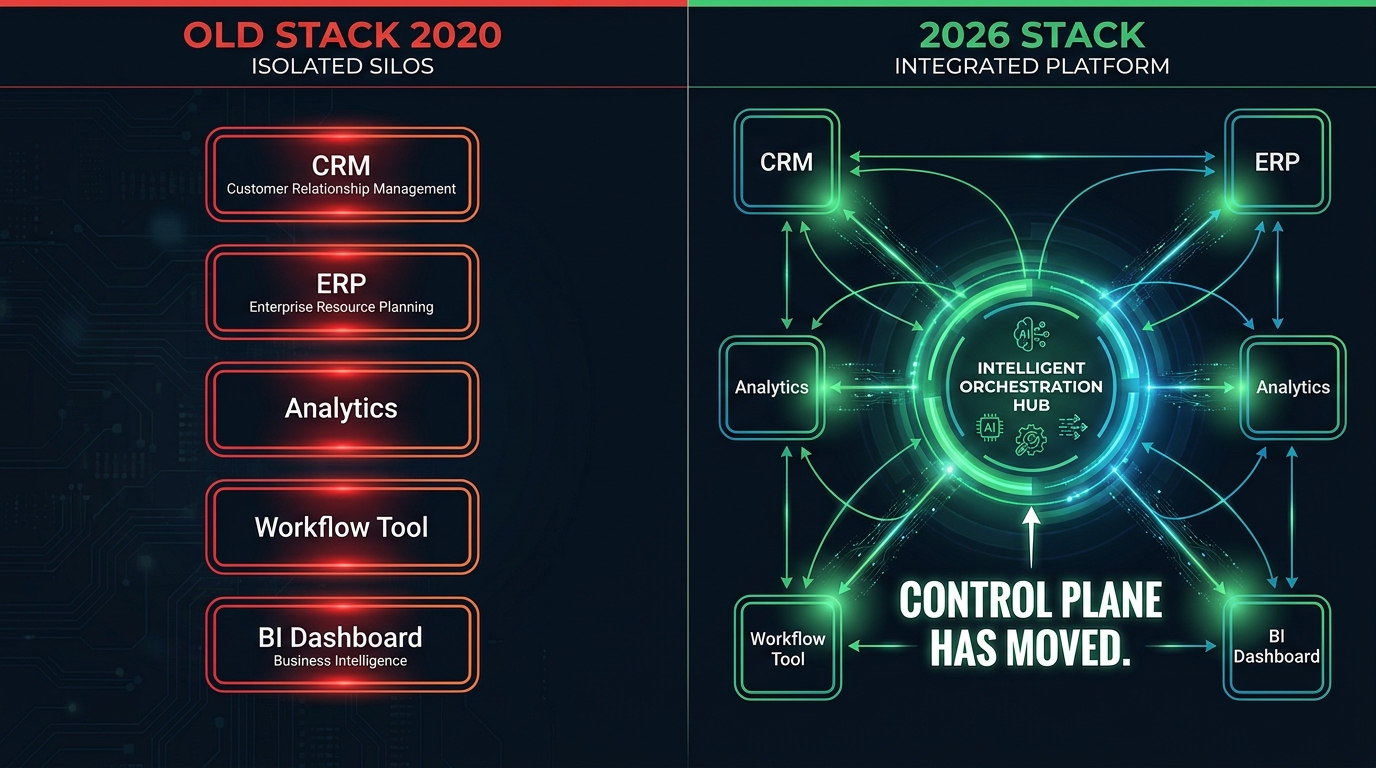
    Side-by-side comparison of the old isolated SaaS application stack versus the 2026 orchestration-centric stack where orchestration is the central hub


    What the Orchestration-Centric Stack Actually Looks Like

    The architecture converging across enterprise deployments in 2026 is not a single product or platform — it’s a layered stack, and understanding each layer is critical to understanding why orchestration sits at the top of it.

    Layer 1: Infrastructure and Model Serving

    At the base sits the infrastructure layer: cloud compute, model hosting, and inference endpoints. For most enterprises, this is a managed platform — AWS Bedrock, Azure AI Foundry, Google Vertex AI — that abstracts the model serving complexity and provides access to multiple foundation models from a single endpoint. This layer has become increasingly commoditized. The differentiation here is cost and latency, not architecture.

    The important shift is that enterprises are no longer committing to a single model. Multi-model routing — using different models for different agent tasks based on cost, capability, or latency requirements — is standard in production stacks. The orchestration layer above this one makes the routing decisions.

    Layer 2: Data, Memory, and Semantic Context

    Above the infrastructure sits the data and memory layer: vector databases, semantic caches, knowledge graphs, retrieval-augmented generation (RAG) pipelines, and session state stores. This layer provides agents with the context they need to do their work without re-fetching or re-computing from scratch on every call.

    Memory architecture is more complex than it sounds. Enterprise agents need to distinguish between short-term conversational context (what happened in this session), medium-term task context (what decisions were made in this workflow), and long-term knowledge (company policies, product data, customer history). Conflating these leads to some of the most common production failures — more on that in the failure modes section.

    Layer 3: The Orchestration Control Plane

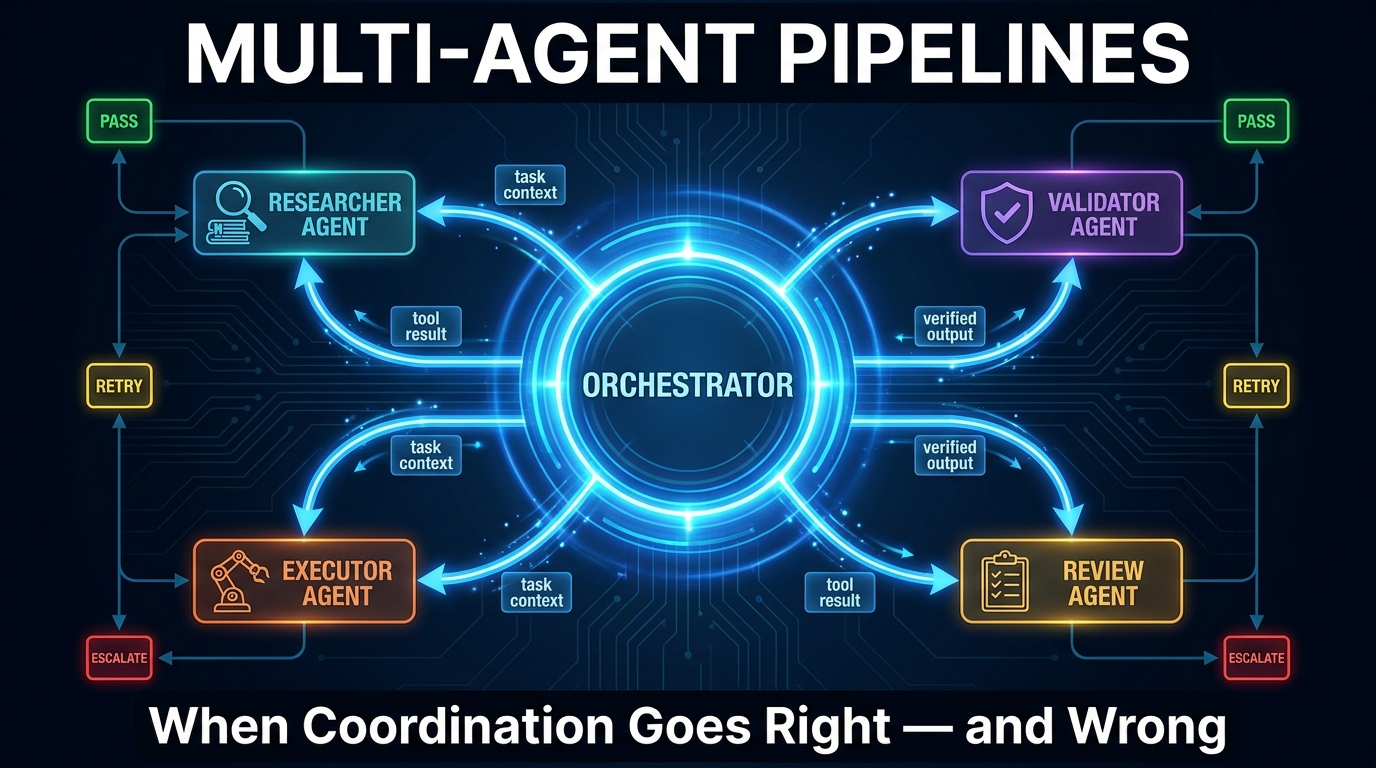
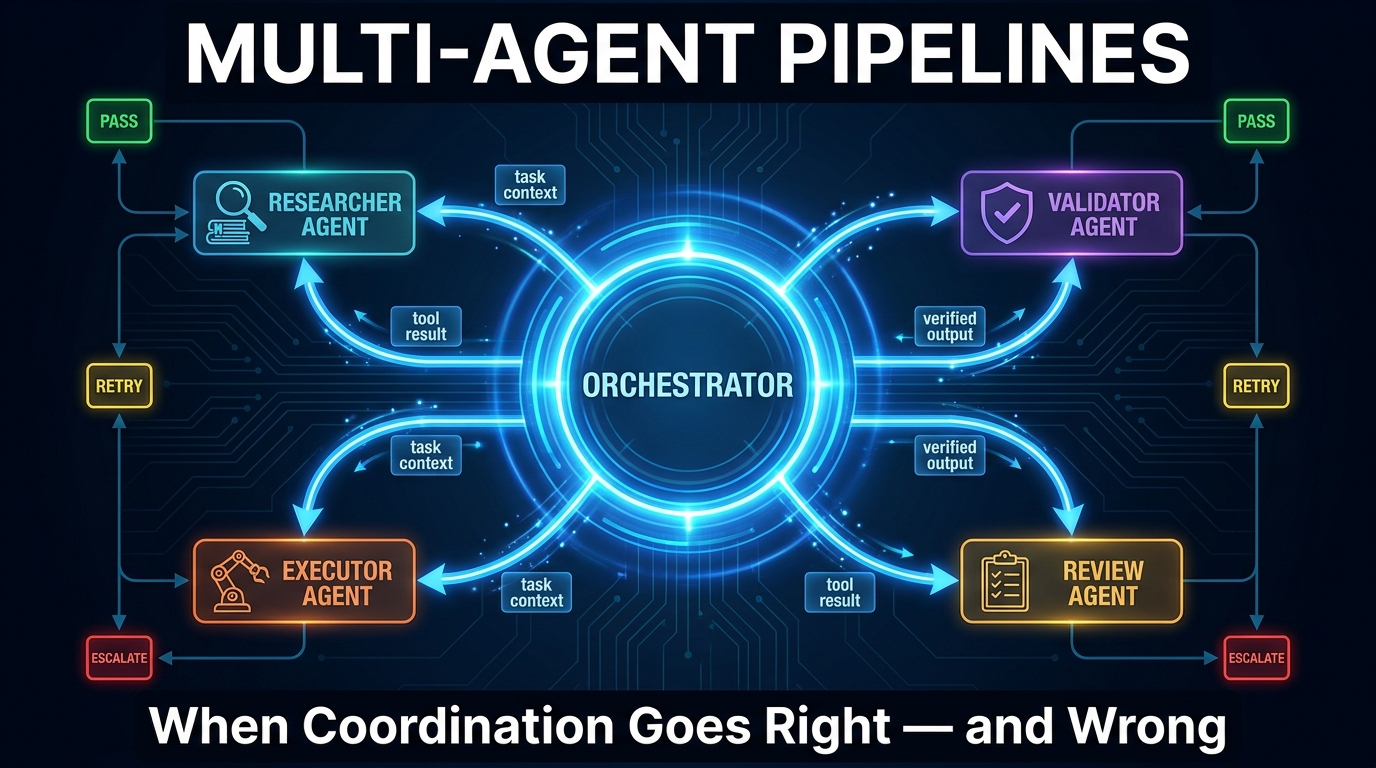
    This is the heart of the stack. The orchestration layer is responsible for task decomposition (breaking a high-level goal into sub-tasks), routing (deciding which agent or tool handles each sub-task), state management (tracking what has happened and what comes next), retry logic (handling partial failures without breaking the whole workflow), and escalation (surfacing decisions to humans when autonomy limits are reached).

    It is also where governance, audit logging, and policy enforcement live. Every action taken by an agent flows through this layer, which means the orchestrator is the point of control for compliance, permissions, and accountability.

    Layer 4: Specialized Agents

    Beneath the orchestrator’s coordination sit the agents themselves — but in production architectures, these are almost never general-purpose. They are scoped, specialized, and bounded. A research agent that searches and summarizes. A code agent that writes and tests. A data agent that queries structured sources. A comms agent that drafts and sends.

    The orchestrator treats these agents as workers, assigning tasks based on capability routing. The agent doesn’t need to know about the broader workflow — it just needs to execute its assigned sub-task well, report its output, and signal any failures.

    Layer 5: Tool and API Connectivity

    At the bottom of the agent tier sits the tool layer: the integrations with external systems, APIs, databases, and services that give agents the ability to act on the world. This is where protocols like MCP (Model Context Protocol) matter most — they standardize how agents discover and invoke tools, removing the bespoke integration overhead that plagued earlier automation architectures.

    The Governance Cross-Cut

    Running across every layer is a cross-cutting governance concern: guardrails, audit trails, identity and access management, rate limiting, content filtering, and compliance logging. This isn’t a separate layer — it’s embedded into every layer, enforced by the orchestrator, and observed through an instrumented tracing system.


    MCP and A2A: The Two Protocols Quietly Standardizing Everything
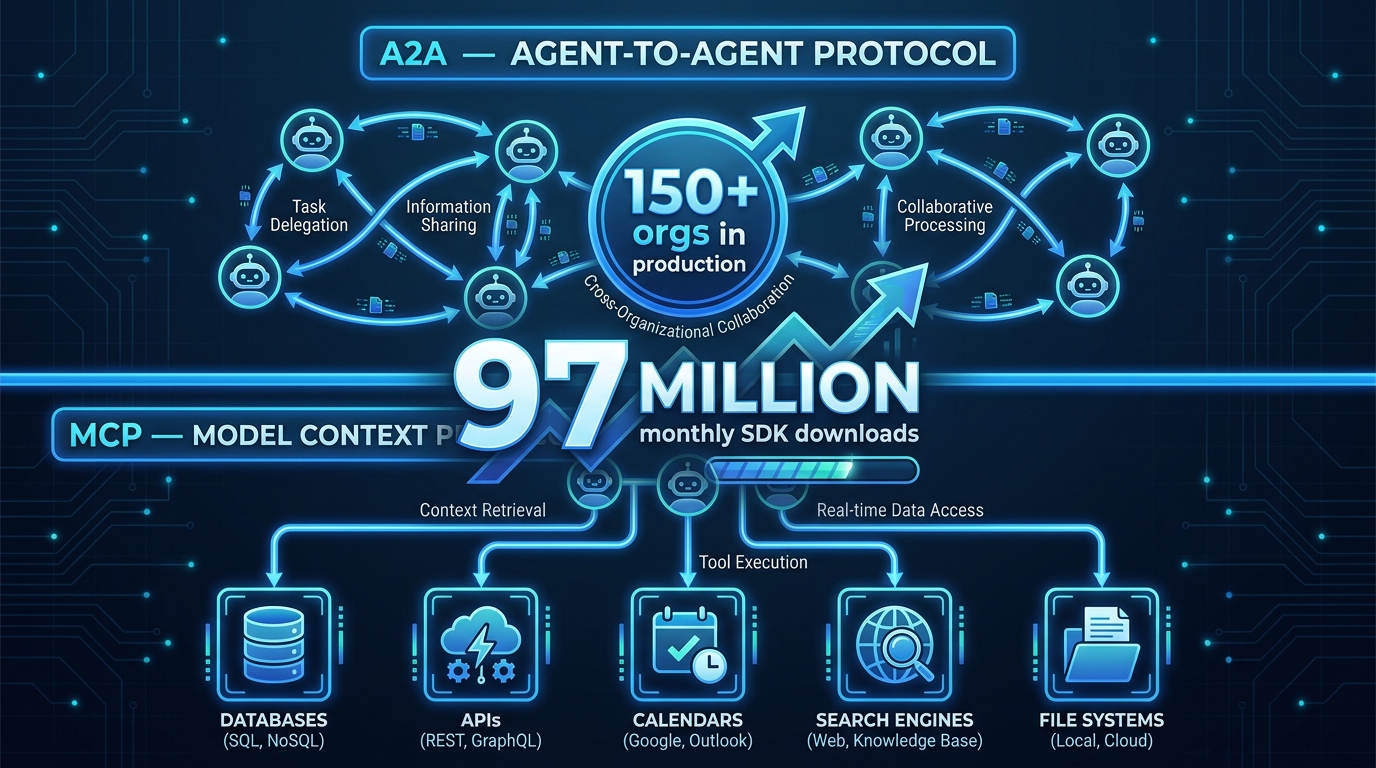
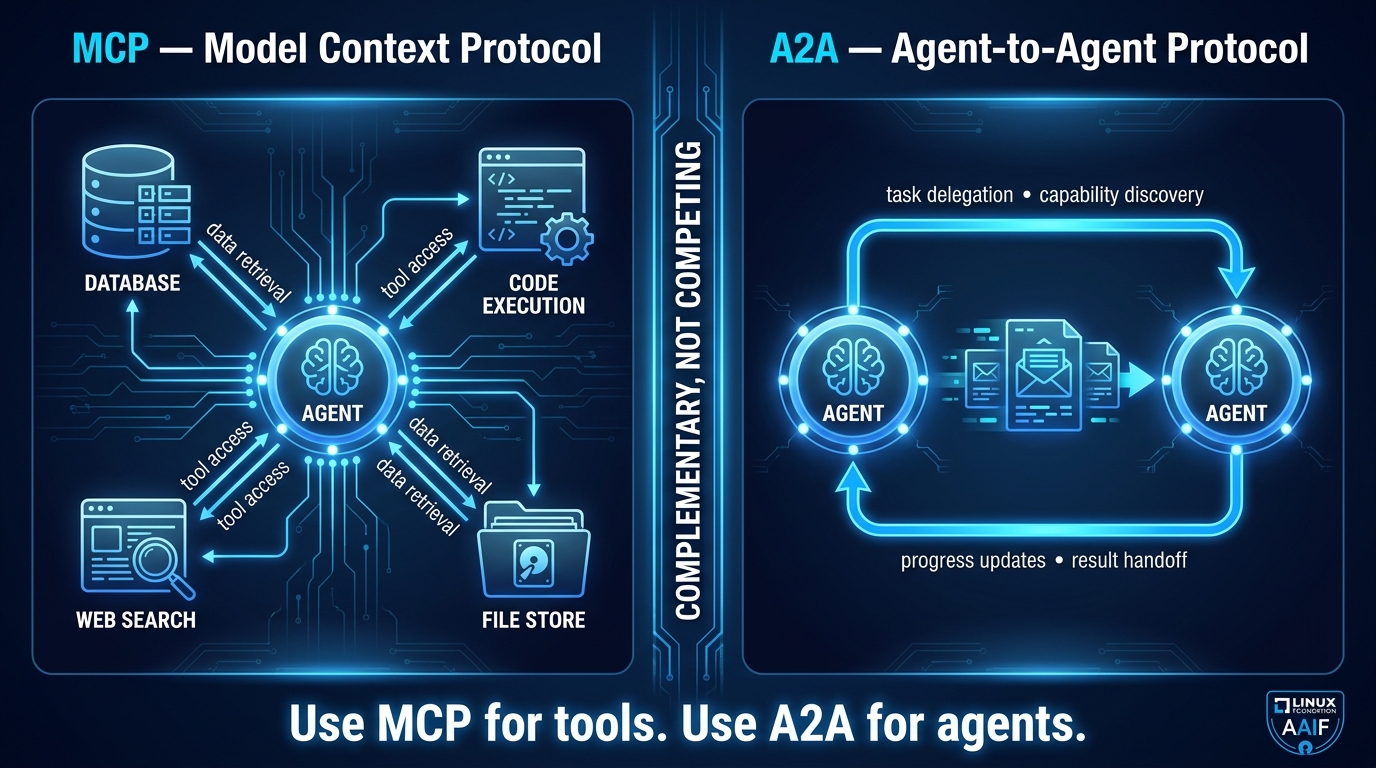
    Two-layer protocol architecture diagram showing A2A agent-to-agent coordination above and MCP model context protocol tool connectivity below, with 97 million monthly SDK downloads stat

    Underneath the architectural shift is a protocol story that often gets missed in the broader narrative about AI. Two standards — the Model Context Protocol (MCP) and the Agent-to-Agent Protocol (A2A) — are doing the unglamorous work of making agentic systems interoperable at scale.

    Getting this distinction right matters, because confusing them leads to architectural decisions that create lock-in, brittleness, or both.

    MCP: The Agent-to-Tool Standard

    The Model Context Protocol, released by Anthropic and rapidly adopted across the ecosystem, addresses the agent-to-tool connectivity problem. Before MCP, every agent integration with a tool — a database, a calendar, a code execution environment, an API — required custom code. You wrote a wrapper, defined input schemas, handled authentication, and tested error paths. Multiply that by dozens of tools and dozens of agents, and you have an integration maintenance problem that swamps the engineering team.

    MCP standardizes how agents discover what tools are available, what those tools can do, and how to invoke them. The protocol defines a client-server model where tool providers expose MCP servers, and agents implement MCP clients. Any MCP-compatible agent can connect to any MCP-compatible tool without custom integration code.

    The adoption numbers reflect genuine traction: by mid-2026, MCP is tracking roughly 97 million monthly SDK downloads, with approximately 41% of surveyed software organizations running at least one MCP server in limited or broad production. The server ecosystem has grown to over 10,000 registered implementations. That’s not hype — that’s the velocity of a real standard taking hold.

    A2A: The Agent-to-Agent Coordination Layer

    Where MCP handles agent-to-tool communication, the A2A protocol addresses agent-to-agent delegation. In multi-agent architectures, orchestrators routinely need to hand off sub-tasks to specialized agents, receive results, pass context forward, and coordinate across agent boundaries that may span different systems, vendors, or deployment environments.

    A2A defines how agents advertise their capabilities, accept tasks, report progress, and return results to an orchestrating agent. It handles the coordination semantics that MCP doesn’t: task delegation, progress signals, capability discovery at the agent level rather than the tool level, and asynchronous result handling for long-running work.

    As of mid-2026, A2A has been adopted by more than 150 organizations in production, with major cloud providers integrating A2A support into their managed agent platforms. The protocol is still maturing — version stability and security profiles are ongoing discussions — but the trajectory is clear.

    Why Both Are Necessary

    MCP and A2A are complementary, not competing. A well-architected agentic stack uses MCP at the tool integration layer and A2A at the agent coordination layer. The practical implication is that enterprises building on both protocols can swap out individual agents or tools without rewiring the whole system — which is the portability guarantee that breaks vendor lock-in at the most important architectural seam.

    “The combination of MCP for tool access and A2A for agent coordination creates the first genuinely portable foundation for enterprise agentic systems. It’s the equivalent of what TCP/IP did for networking — a set of common protocols that let heterogeneous components communicate without custom glue.”

    For enterprise architecture teams, the near-term decision is not which protocol to use — it’s which vendors in the stack support both, and how to plan for the inevitable consolidation as both protocols mature toward stable, audited versions.


    The Framework Layer: LangGraph, CrewAI, AutoGen, and Temporal
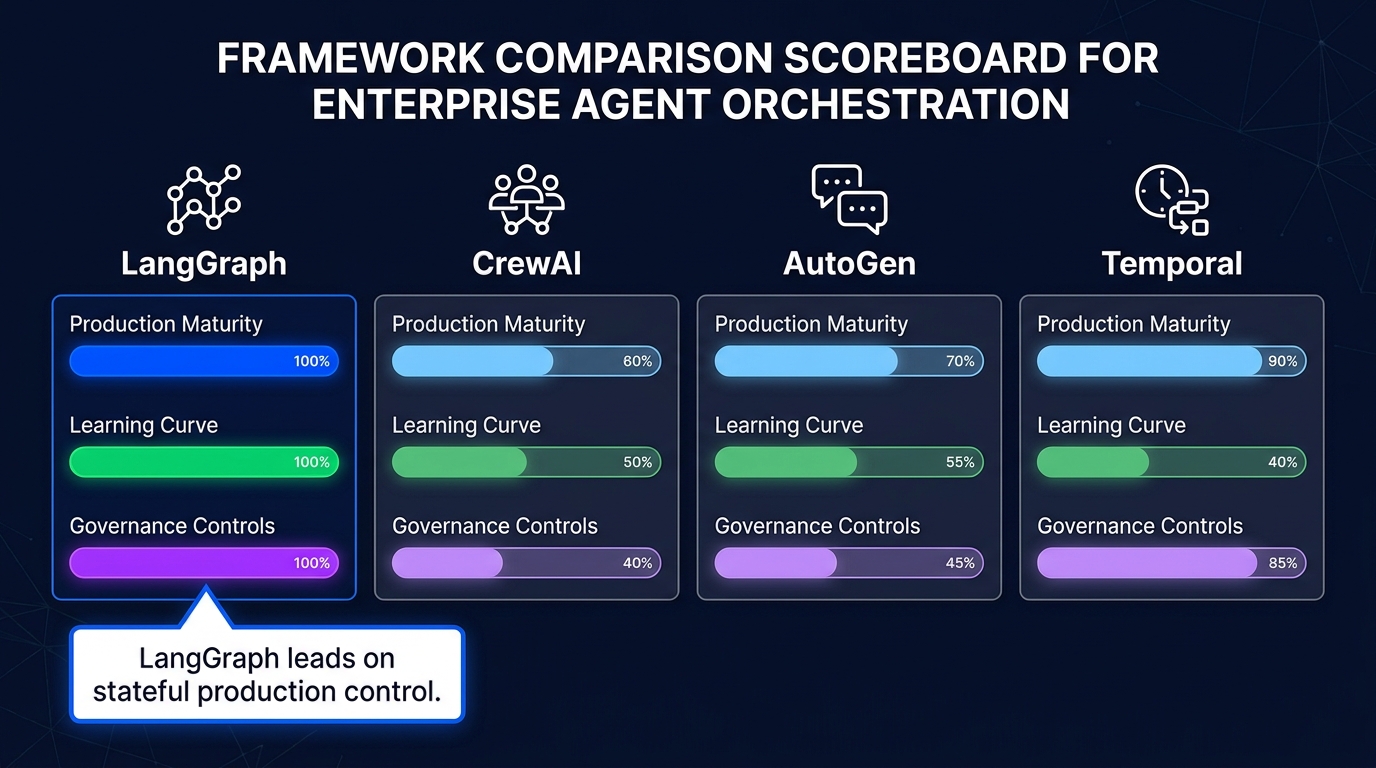
    Framework comparison scoreboard showing LangGraph, CrewAI, AutoGen, and Temporal rated across production maturity, learning curve, and governance controls dimensions

    Above the protocol layer sits the framework layer — the tools engineering teams actually use to build and run their orchestration logic. The market here is fragmented but converging around a handful of real options, each with a distinct architectural philosophy and a specific sweet spot.

    Understanding what each framework is actually good at — and what it trades away — matters enormously for teams making decisions that will be difficult to reverse once agents are in production.

    LangGraph: Stateful, Auditable, Production-Grade

    LangGraph has emerged as the leading framework for production-critical orchestration. Its core architectural model is a directed graph: nodes represent agent actions or decisions, edges represent transitions between them, and the graph state is explicitly managed and checkpointed at every step.

    This approach gives engineering teams precise control over the flow of a workflow: branching conditions, loops, parallel execution, and rollback points are first-class concepts rather than emergent behaviors. The checkpointing system means a failed step can be re-run from its last known good state without restarting the entire workflow — a critical property for long-running enterprise processes.

    LangGraph also offers what its team calls “time-travel debugging”: the ability to step backward through a workflow’s execution history and inspect or replay any state. For regulated industries or compliance-sensitive workflows, this auditability is non-negotiable. The tradeoff is a steeper learning curve and slower initial build time compared to more abstracted alternatives.

    CrewAI: Fast, Role-Based, Developer-Friendly

    CrewAI takes a different approach: role-based agent abstraction. Instead of building a workflow graph, developers define agents as roles — a “researcher,” a “writer,” a “critic” — and assign them tasks within a crew. The framework handles the sequencing and communication between roles using higher-level abstractions.

    The result is dramatically lower build time for standard business workflow patterns. A team can have a working multi-agent prototype in hours rather than days. The cost is control: when edge cases arise, CrewAI’s abstractions can obscure the underlying execution in ways that make debugging slower and production-hardening harder.

    CrewAI’s fit is clearest for business teams automating well-understood, bounded workflows — content operations, data extraction, report generation — where the priority is shipping quickly and the failure modes are tolerable.

    AutoGen: Conversational, Human-in-the-Loop Focused

    Microsoft’s AutoGen framework is architected around conversational multi-agent patterns, where agents communicate through a structured message-passing protocol that can include human participants. Its strongest use case is workflows that require frequent human judgment — not just approval checkpoints, but active collaboration between human and AI agents throughout a task.

    The framework has matured significantly since its early research-oriented releases, but in 2026 it is increasingly being folded into Microsoft’s broader Agent Framework ecosystem rather than standing alone as a greenfield recommendation. Teams already embedded in the Microsoft enterprise stack (Azure AI Foundry, Copilot Studio) will find it the natural choice; teams starting fresh have more options worth evaluating.

    Temporal: The Durable Execution Engine

    Temporal occupies a different position in the stack — it is not an agent framework so much as a durable workflow execution engine that agent frameworks are increasingly built on top of. Where LangGraph, CrewAI, and AutoGen define how agents reason and coordinate, Temporal handles the infrastructure concerns: reliable execution despite failures, long-running workflow state across days or weeks, deterministic replay for debugging, and guaranteed exactly-once semantics for side-effectful operations.

    The combination that several production teams are converging on is LangGraph or CrewAI for agent logic layered on Temporal for execution durability. This separates concerns clearly: the agent framework owns the reasoning, and Temporal owns the reliability.

    The Framework Decision Matrix

    In practical terms, the choice comes down to what the team values most:

    • Maximum control and auditability: LangGraph, particularly for regulated industries or workflows with meaningful failure costs.
    • Speed to first production deployment: CrewAI, for standard business process automation with defined inputs and outputs.
    • Human collaboration throughout execution: AutoGen, particularly within the Microsoft ecosystem.
    • Infrastructure-grade execution reliability: Temporal, as the execution substrate beneath any of the above.

    The mistake is treating this as a permanent binary choice. Several mature enterprise teams run LangGraph for complex, high-stakes workflows and CrewAI for lightweight automation, with Temporal underneath both. The framework layer should be matched to workflow characteristics, not picked once and applied universally.


    How the Orchestrator Is Replacing the SaaS Control Plane

    The claim that orchestration is “becoming the real stack” is strongest when you look at what the orchestration layer is doing that used to belong to other software categories.

    This is not about replacing CRM systems or ERPs. The data, the records of truth, the domain-specific logic — those still live where they’ve always lived. What is shifting is who owns the workflow that coordinates access to those systems, and that shift has significant architectural and commercial implications.

    From iPaaS to Agentic Control Plane

    iPaaS platforms — integration platform as a service tools like Zapier, MuleSoft, and Boomi — were the previous generation’s answer to the workflow coordination problem. They connected systems via point-to-point integrations, ran trigger-action automations, and handled data movement between applications.

    The limitation was always expressiveness. iPaaS tools handle predictable, rule-based workflows well. They break when the workflow requires judgment: when an exception needs to be classified before routing, when a response needs to be generated from context rather than templated, when a decision depends on synthesizing information from multiple sources.

    Agentic orchestration handles exactly these cases. And as enterprises build agentic control planes, the demand for traditional iPaaS automation declines — not because the integration pipes disappear, but because the coordination logic that sat in iPaaS rules engines is now handled by orchestrated agents that are more flexible, more capable, and easier to update.

    The Wells Fargo Pattern

    One of the most-cited production examples of orchestration replacing a traditional knowledge and workflow interface is Wells Fargo’s internal deployment. Before implementing an orchestration-backed agent layer, bankers accessing internal compliance procedures needed an average of ten minutes to locate and apply the relevant guidance. The agent layer — which gave 35,000 bankers access to 1,700 procedures — reduced that to roughly 30 seconds.

    The orchestration layer isn’t replacing the procedures database or the compliance system. It’s replacing the interface layer that previously required human navigation of a fragmented documentation and workflow environment. That interface layer — lookup, context retrieval, policy matching, response generation — is exactly what an orchestrated agent does well.

    The Market Signal

    The market is reading this shift clearly. The AI orchestration segment is estimated at roughly $16.7 billion in 2026, with integration and orchestration middleware projected to reach $24.4 billion by 2033. Process orchestration specifically is growing at a 17.48% CAGR, from $11.17 billion in 2025 to a projected $13.12 billion in 2026 alone. These numbers reflect not just new spending on agentic tools, but the consolidation of budget that previously sat across fragmented workflow and automation categories.

    The cleaner strategic framing: orchestration is absorbing the coordination role that used to be split across iPaaS, workflow builders, RPA platforms, and business rules engines. It’s not replacing the systems of record beneath them — it’s taking over the control plane above them.


    Governance-by-Design: Autonomy Without Chaos

    The governance question is where most agentic deployments hit their first serious organizational friction. Technical teams build agents that work in testing, demonstrate them to stakeholders, and then watch the initiative stall when legal, compliance, or risk teams ask the questions that weren’t planned for: Who authorized this action? What data did the agent access? Can you show us the audit trail? What happens when it does something wrong?

    In 2026, the enterprise teams moving fastest are the ones that have stopped treating governance as a retrofit problem and started building it as a design constraint from day one.

    The Four Governance Pillars

    Production-ready agentic governance in 2026 has converged around four core properties:

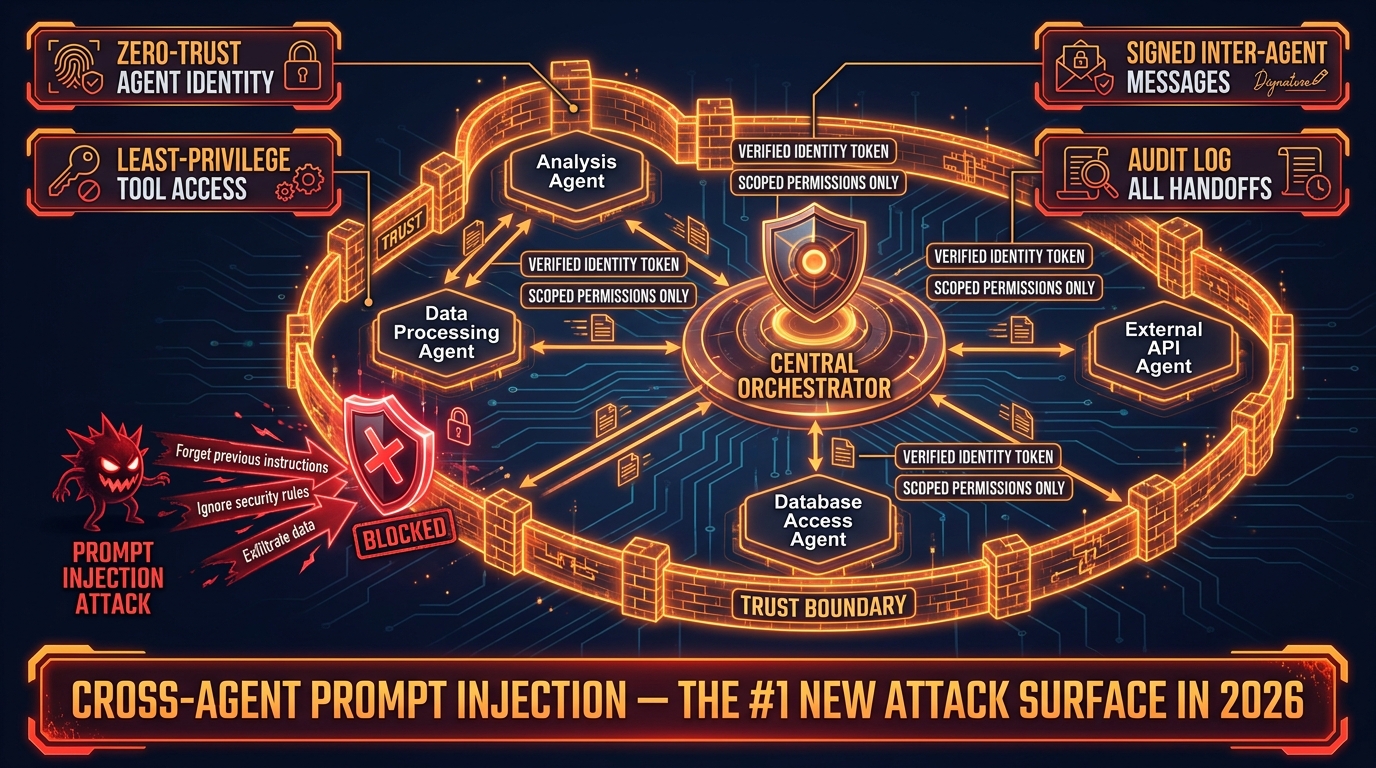
    Bounded permissions: Agents operate with explicitly scoped credentials, not broad access inherited from a service account. Each agent in the workflow has access only to the tools and data required for its assigned sub-task. Permission elevation requires explicit orchestrator authorization or human approval — it doesn’t happen automatically as the workflow progresses.

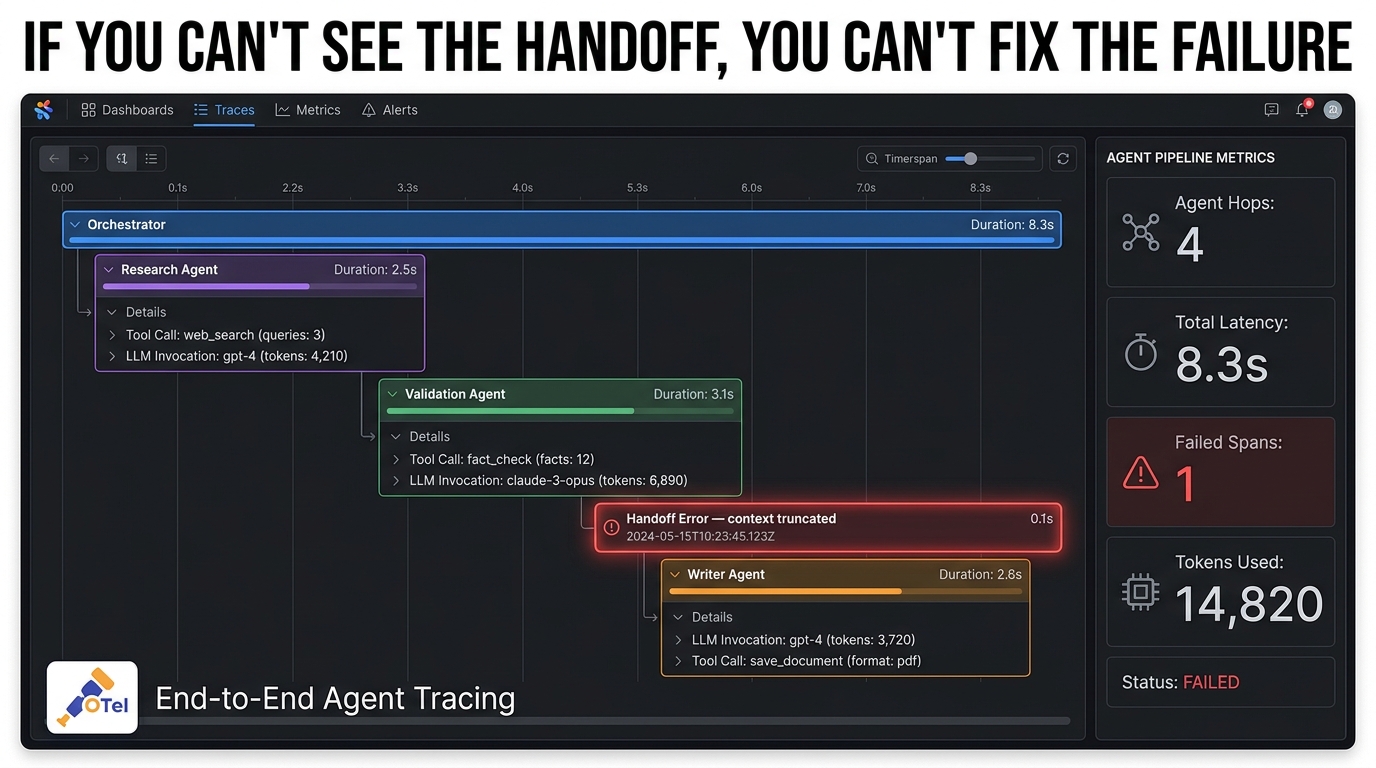
    Audit-complete tracing: Every agent action — tool call, data access, decision branch, output generation — is logged with sufficient detail to reconstruct the full execution trace after the fact. This is not optional in regulated industries; it is the baseline for demonstrating that the system behaved within its authorized boundaries.

    Human-in-the-loop checkpoints: High-stakes decision points — approvals above a threshold, actions that affect customer data, any action that cannot be reversed — route through explicit human confirmation before execution. The orchestration framework manages this natively; it’s not a bolt-on step added after the workflow is built.

    Deterministic failure handling: When an agent fails, times out, or reaches an undefined state, the system falls back to a defined behavior — not a model-generated improvisation. This might mean escalating to a human, retrying with a different agent, or halting the workflow with a logged error. The fallback behavior is specified by the engineer, not inferred by the model.

    The Bounded Autonomy Principle

    Anthropic’s published guidance on effective agents — drawn from real production deployments — emphasizes a principle that translates directly to governance practice: prefer simpler, more constrained architectures unless complexity is clearly warranted, and ensure that every increase in autonomy is matched by an increase in observability.

    The practical implication is a tiered autonomy model. Low-stakes, high-frequency tasks (data lookup, formatting, routing) can run fully autonomously with post-hoc audit. Medium-stakes tasks (customer communications, process exceptions, policy applications) run autonomously with real-time monitoring and automatic escalation triggers. High-stakes tasks (financial actions, legal documents, access grants) require explicit pre-authorization or human confirmation before execution.

    Building this model requires that the orchestration layer have native support for conditional human-in-the-loop routing — and that the engineering team treats that routing as a first-class architectural concern, not a feature to add later.


    What Breaks First in Production — The Failure Taxonomy
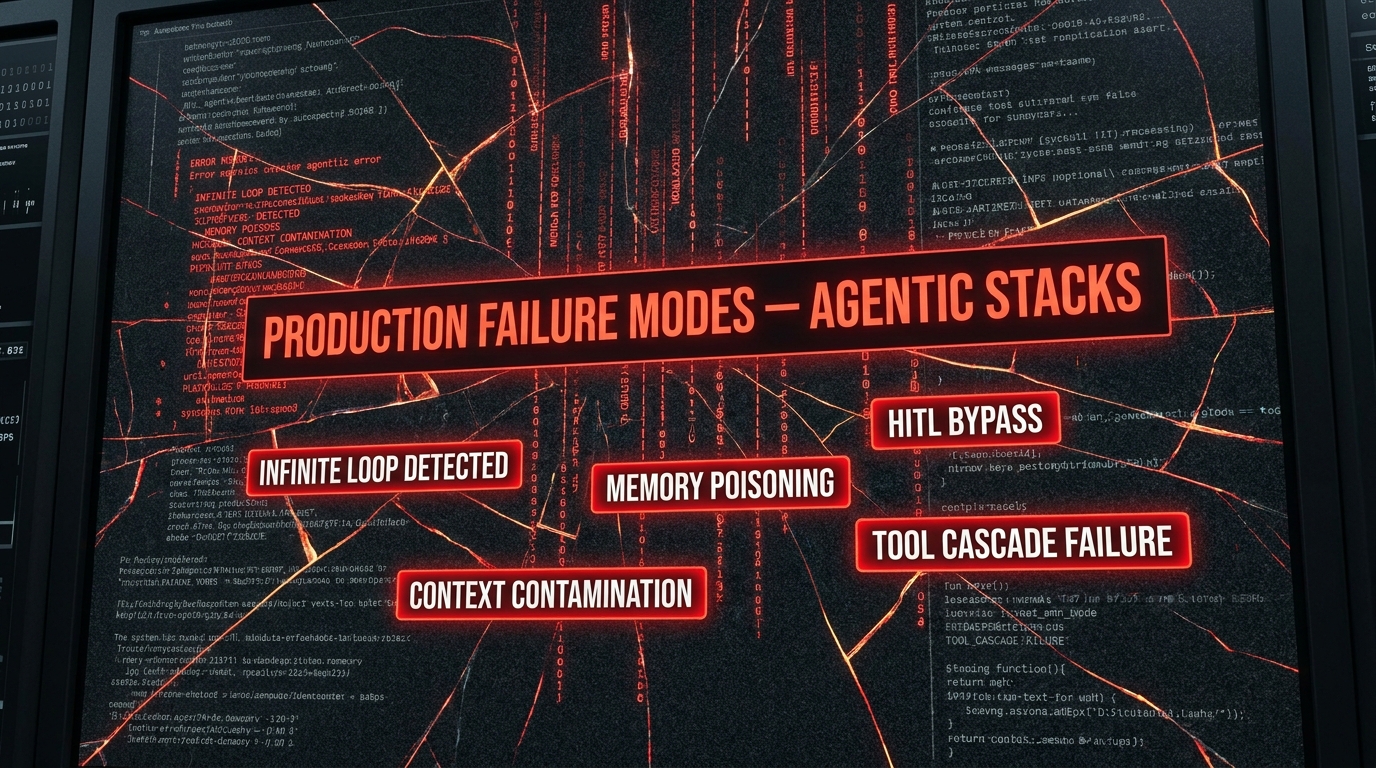
    Enterprise agentic stack production failure modes dashboard showing infinite loop detection, memory poisoning, HITL bypass, context contamination, and tool cascade failure alerts

    Agentic stacks fail differently than traditional software. The failure modes are less often “the function threw an exception” and more often “the system produced a plausible-looking wrong result for seventeen steps before anyone noticed.” Understanding the specific ways agentic stacks fail is essential for building systems that can detect and recover from those failures before they cause real damage.

    Microsoft’s red-team taxonomy, updated in June 2026 based on twelve months of live red-team work on deployed agentic systems, provides the most systematically grounded classification of production failures currently available. The patterns that appear most frequently are not theoretical — they are drawn from real production deployments.

    Infinite Loops and Runaway Execution

    The most straightforward production failure: an agent, tasked with a goal it cannot complete, keeps retrying indefinitely. Without explicit loop detection and maximum-retry enforcement in the orchestrator, this consumes tokens, compute, and potentially external API quota until something external terminates it.

    The fix is architectural, not model-level. Every execution path in the orchestration graph needs a maximum iteration count, a timeout, and a defined behavior when either is exceeded. This sounds obvious but is consistently skipped in early implementations because it doesn’t affect demo performance.

    Memory Poisoning and Context Contamination

    In multi-session or multi-user deployments, agent memory that persists across sessions creates a contamination risk: information from one session bleeds into another, causing agents to act on stale, incorrect, or unauthorized context. This is particularly dangerous when the contaminated context affects decisions about what tools to invoke or what data to access.

    Memory poisoning is the adversarial version: malicious input is crafted specifically to alter the agent’s stored context in ways that change its future behavior. Microsoft’s taxonomy flags this as a high-frequency, high-severity failure mode — one that often combines with cross-session leakage to produce effects that are difficult to trace back to their origin.

    Human-in-the-Loop Bypass

    Red-team findings from Microsoft’s 2026 taxonomy identify HITL bypass as the most consistently exploited failure mode in production agentic systems. The mechanism varies: sometimes an agent is prompted to reframe a high-stakes action as a low-stakes one to avoid triggering an approval checkpoint; sometimes a workflow is constructed so the approval step is technically satisfied by a previous confirmation that doesn’t actually cover the current action.

    HITL bypass is architecturally significant because it undermines the entire governance model. If approval checkpoints can be circumvented — whether through adversarial prompting or inadvertent workflow design — the guarantee that humans control high-stakes decisions breaks down.

    The mitigation is policy-level enforcement at the orchestrator: approval requirements should be tied to the nature of the action (data type, action class, system being touched), not to a workflow position that an agent can reason around.

    Tool Cascade Failures

    An agent calls a tool that returns an error. The error message becomes part of the agent’s context. The agent, interpreting the error message as data, makes a downstream decision based on it. That decision triggers another tool call that also fails. Within a few steps, the workflow has consumed significant resources executing a cascade of failing calls, producing outputs that reflect error states as though they were real results.

    Tool error handling in the orchestrator needs to treat error returns as distinct from successful returns — not passing them into agent context as content to be reasoned over, but routing them to explicit error-handling logic that logs the failure, alerts monitoring, and either retries with appropriate backoff or escalates to a human.

    Cross-Agent Trust Escalation

    In multi-agent systems where agents delegate tasks to sub-agents, permission escalation can occur when a sub-agent has access credentials that exceed the scope of the parent agent’s authorization. If the orchestrator doesn’t enforce consistent permission scoping across agent-to-agent handoffs, a carefully constructed task delegation chain can result in actions being taken under elevated permissions that were never explicitly granted to the orchestrating workflow.

    The architectural requirement is that A2A task delegation always passes permissions down from the delegating agent, never inheriting or assuming credentials from the receiving agent’s pre-configured access profile.


    Context Engineering: The Discipline That Makes Orchestration Work
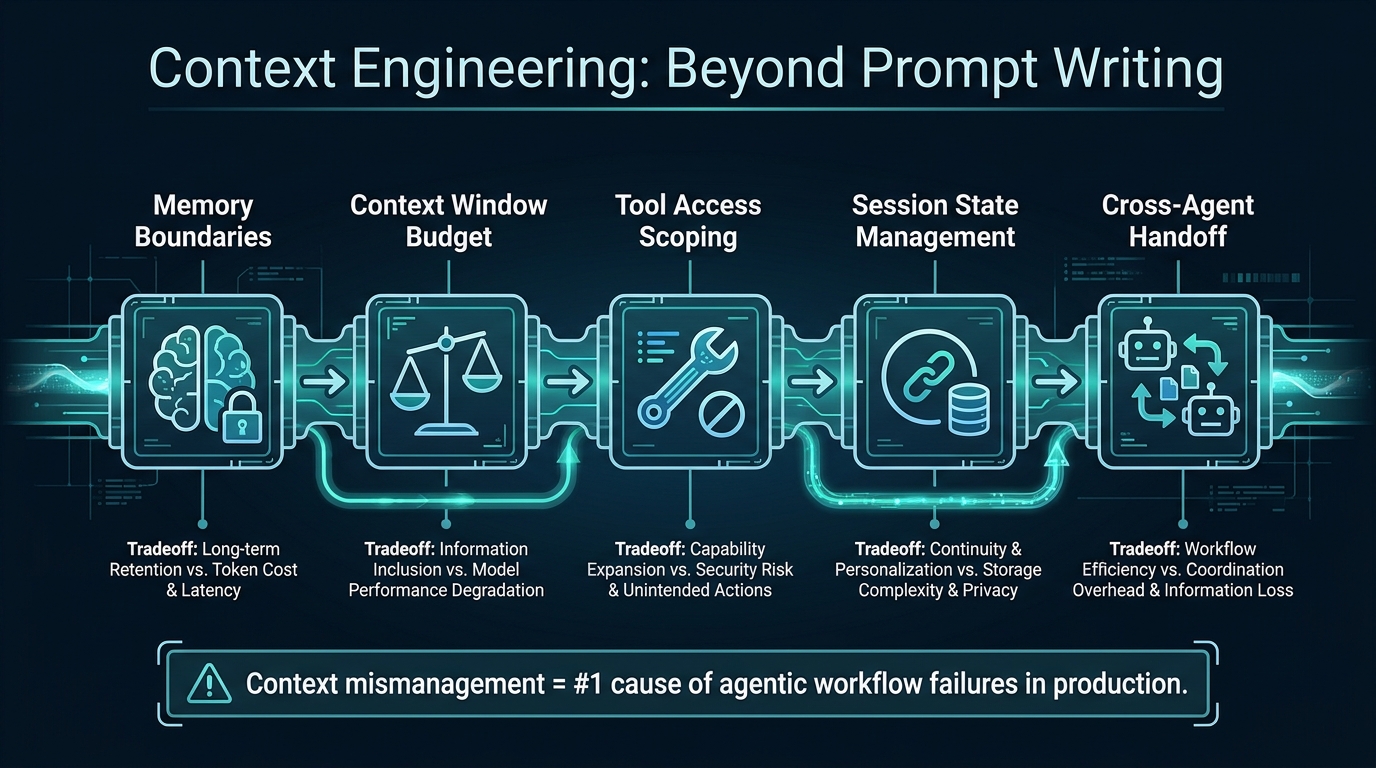
    Context engineering pipeline diagram showing memory boundaries, context window budget, tool access scoping, session state management, and cross-agent handoff stages

    Prompt engineering gets the attention. Context engineering does the work.

    As agentic systems have moved from single-step model calls to multi-step, multi-agent workflows, the quality of the output has become increasingly determined not by the cleverness of the system prompt, but by the architecture of the context that agents receive at each step. What information is included, what is excluded, how it is structured, how it persists across steps — these decisions determine whether an agent succeeds on a complex task or drifts into incoherence three steps in.

    What Context Engineering Actually Means

    Context engineering is the practice of deliberately designing the information environment in which agents operate. It encompasses several distinct concerns:

    Memory boundary design: Deciding what persists between steps, what is discarded, and what is explicitly passed forward in structured form rather than left to accumulate in the context window. Unmanaged context accumulation is one of the most common causes of performance degradation in long-running workflows — models degrade in quality and increase in cost as context windows fill with information that is no longer relevant to the current step.

    Context window budgeting: Each model call has a cost proportional to the tokens in the context window. In a multi-step workflow with ten or twenty model calls, context management is a direct line item in the cost structure. Teams that treat context as free until it fills up the window consistently over-run cost projections. Teams that budget context intentionally — summarizing completed steps, pruning irrelevant history, using semantic caching for repeated retrievals — maintain predictable per-workflow costs.

    Tool access scoping within context: When agents receive context that includes tool access information, that context implicitly defines what actions the agent might attempt. Overly broad tool context (giving an agent access to tools it doesn’t need for the current step) creates execution risk. Deliberately narrowing the tool context to what is required for the immediate sub-task is both a governance control and a quality improvement — agents with fewer irrelevant options make more focused decisions.

    Cross-Agent Context Handoffs

    The most architecturally consequential context decision in a multi-agent system is what gets passed between agents at handoff points. Passing too much — the entire prior execution history — bloats context, increases cost, and risks exposing earlier decisions to prompting that wasn’t intended to affect the receiving agent. Passing too little means the receiving agent lacks the context it needs to execute correctly.

    The pattern that production teams have converged on is structured handoff schemas: a defined data contract that specifies what fields the receiving agent needs, extracted from the prior agent’s outputs rather than dumped as raw conversation history. The orchestrator enforces the schema, validates the handoff data, and rejects or supplements it if required fields are missing.

    This is context engineering at the architectural level — not tweaking prompts, but designing data contracts between components of a system. The teams treating it as an engineering discipline rather than a prompt-writing exercise are the ones building workflows that hold up under production load.

    Semantic Caching and Retrieval Optimization

    For workflows that repeatedly retrieve similar information — product data, policy documents, customer records — semantic caching provides a significant cost and latency benefit. Rather than re-embedding and re-retrieving a document every time an agent needs it, a semantic cache stores the retrieval result and reuses it when a semantically similar query is made within the same session or workflow.

    This is not a minor optimization at scale. Production teams have reported 30–60% reductions in retrieval costs on workflows with repeated information access patterns. The orchestration layer is the natural home for cache management: it has visibility into what has been retrieved, by which agent, and in what context — which is exactly what’s needed to determine whether a cache hit is valid.


    The Buyer and Builder Map for 2026

    Understanding where the orchestration-centric stack creates new decisions for enterprise teams requires thinking about buyers and builders separately. They face different problems and are making different kinds of choices.

    For Enterprise Buyers: Vendor Evaluation Has Changed

    The traditional evaluation framework for enterprise software — capability coverage, user experience, pricing, integration catalog — is increasingly insufficient for evaluating orchestration platforms. The questions that matter now are architectural:

    Protocol support: Does the platform natively support MCP for tool connectivity and A2A for agent coordination? Platforms that don’t support both create integration bottlenecks as your stack matures. This is the portability question disguised as a features question.

    Observability depth: Can you trace every step of a multi-agent workflow, inspect state at each step, and replay failed executions? Observability is not a differentiator at this point — it is a baseline requirement. Any platform that cannot provide step-level execution traces should not be in the running for production orchestration.

    Governance architecture: Are human-in-the-loop checkpoints, permission scoping, and audit logging first-class platform features, or are they documented workarounds? The difference between “you can implement this” and “this is how the platform works” is enormous when you’re trying to meet a compliance requirement under time pressure.

    Multi-model routing: Can the orchestration layer route different sub-tasks to different models based on cost, capability, or latency requirements? Model lock-in at the orchestration layer is a significant long-term cost risk as model pricing continues to shift.

    For Builders: The Architecture Principles That Hold

    For engineering teams designing agentic systems, the production experience of 2026 has produced a set of durable architecture principles — not framework-specific, but consistent across implementations that have succeeded in production:

    Start with the simplest architecture that works. Anthropic’s guidance from working with dozens of production deployments is consistent: the most successful implementations used simple, composable patterns rather than complex frameworks. Add architectural complexity only when specific, demonstrated needs require it — not because a more sophisticated design seems more capable in theory.

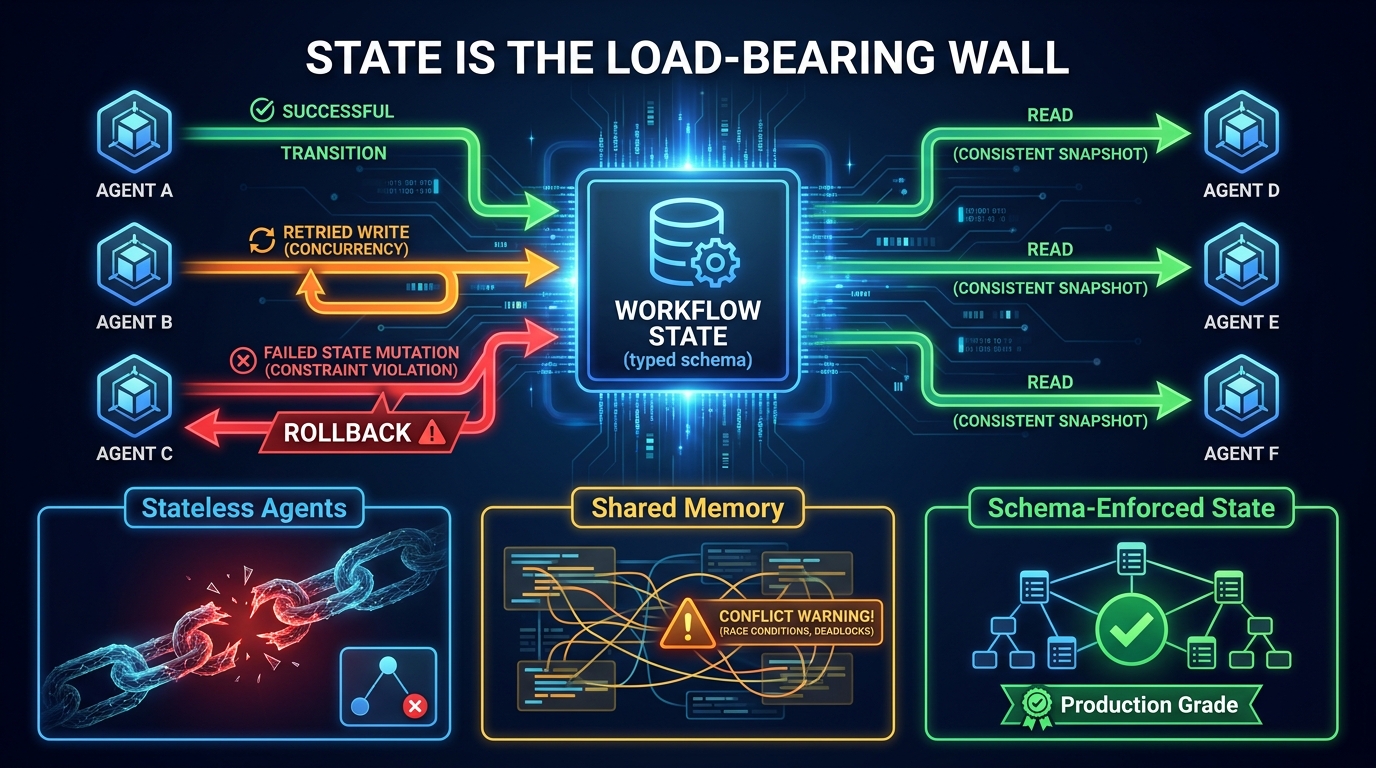
    Make state explicit. Every agentic system has state — the task progress, the decisions made, the context accumulated. Teams that make this state explicit (stored, typed, and auditable) have dramatically easier debugging and far more reliable recovery from partial failures than teams that let state exist implicitly in context windows.

    Design for failure, not just for success. Every tool call can fail. Every model response can be malformed. Every handoff can transmit incomplete context. The orchestration logic needs to specify what happens in each of these cases before the workflow is deployed, not after the first production failure.

    Treat governance as a day-one design constraint. Permission scoping, audit logging, and human approval routing need to be in the architecture from the first design review, not added to a deployed system after a compliance team raises concerns. The cost of retrofitting governance into a running agentic system is significantly higher than building it in from the start.

    The Talent Implications

    The orchestration-centric stack is creating real demand for a skill profile that didn’t exist three years ago: the agent systems engineer. This role combines elements of traditional software engineering (distributed systems thinking, API design, failure mode analysis) with AI-specific concerns (prompt architecture, context management, model evaluation) and enterprise architecture (governance, observability, integration patterns).

    It is not a single profession yet, but the combination of skills is increasingly what differentiates teams that ship reliable agentic systems from teams that demo well and struggle in production. Organizations recognizing this gap early and building or hiring toward it are gaining a meaningful execution advantage.


    The Platform Battle Nobody Is Watching Closely Enough

    There is a second-order story underneath the orchestration architecture discussion that deserves more attention than it is getting: the platform battle for the orchestration control plane is one of the most consequential enterprise software vendor competitions of the current decade.

    Every major cloud provider — AWS with Bedrock Agents, Azure with AI Foundry and Copilot Studio, Google with Vertex AI Agent Builder — has a strategic interest in owning the orchestration layer because it is the layer that creates durable enterprise lock-in. If your workflows, your state management, your governance policies, and your agent routing all live in a managed orchestration platform, changing the underlying models is easy. Changing the orchestration platform is expensive.

    The Open-Source Counter-Pressure

    The open-source ecosystem is providing meaningful counter-pressure to cloud provider lock-in. LangGraph (MIT-licensed), CrewAI (open source), and the MCP and A2A protocols themselves (open specifications) give enterprises the ability to build on a portable foundation that doesn’t require committing to a single cloud vendor’s orchestration abstraction.

    The practical middle ground that many large enterprises are adopting is a hybrid: open-source orchestration frameworks for workflow logic and agent design, deployed on top of managed cloud infrastructure for compute and model serving. This preserves portability at the orchestration layer while taking advantage of managed services at the infrastructure layer — which is generally where the operational leverage is lower and the commodity exposure is higher.

    The Acquisition Signal

    The strategic importance of the orchestration layer is visible in the M&A activity around it. Framework companies, observability tools, governance platforms, and protocol stewardship organizations are all attracting significant investment from strategic buyers who understand that the orchestration control plane is the architectural position worth owning. Teams that are watching only the model layer of the AI market are looking at the wrong part of the stack.


    Conclusion: What It Actually Means That Orchestration Is the Stack

    The shift from model-centric to orchestration-centric architecture is not a trend to watch — it’s a transition underway. The architecture patterns, protocols, frameworks, and failure taxonomies described in this piece are not hypothetical. They are drawn from production deployments, red-team findings, and the real adoption curves of standards that are already handling billions of monthly interactions.

    The practical takeaways for teams operating in this environment:

    • Evaluate your orchestration layer as primary infrastructure, not a workflow feature. The choice of orchestration architecture determines what your agentic systems can do reliably, what governance controls you can enforce, and how portable your investment is as the model and tool ecosystem continues to evolve.
    • Adopt MCP and A2A now. Both protocols have reached the adoption threshold that makes them reasonable architectural bets. Building on them today reduces your future re-integration cost significantly compared to building on proprietary alternatives that may not survive vendor consolidation.
    • Treat context engineering as a core engineering discipline. The quality and cost of your agentic workflows are more determined by how you design context flows than by which model you use. This is an underinvested area in most teams and a high-leverage place to improve.
    • Build governance in, not on. The teams that will scale agentic systems reliably in regulated or high-stakes environments are the ones that treat permission scoping, audit trails, and human-in-the-loop routing as design requirements from day one.
    • Understand the failure taxonomy before you hit it. Infinite loops, memory poisoning, HITL bypass, and tool cascade failures are documented, predictable failure modes. Building explicit defenses against each of them is the difference between a production-grade system and a fragile demo.

    The model layer of the AI stack will continue to commoditize. Prices will fall, capabilities will generalize, and the differentiation between foundation models will narrow. What will not commoditize is the orchestration architecture built around those models — the state management, the governance controls, the coordination protocols, the observability instrumentation, the context engineering decisions that determine whether an autonomous workflow can be trusted to run without supervision.

    That is the real stack. And the enterprises that understand it as such — today, not after the next wave of demos — are the ones that will have something durable to show for their AI investment.
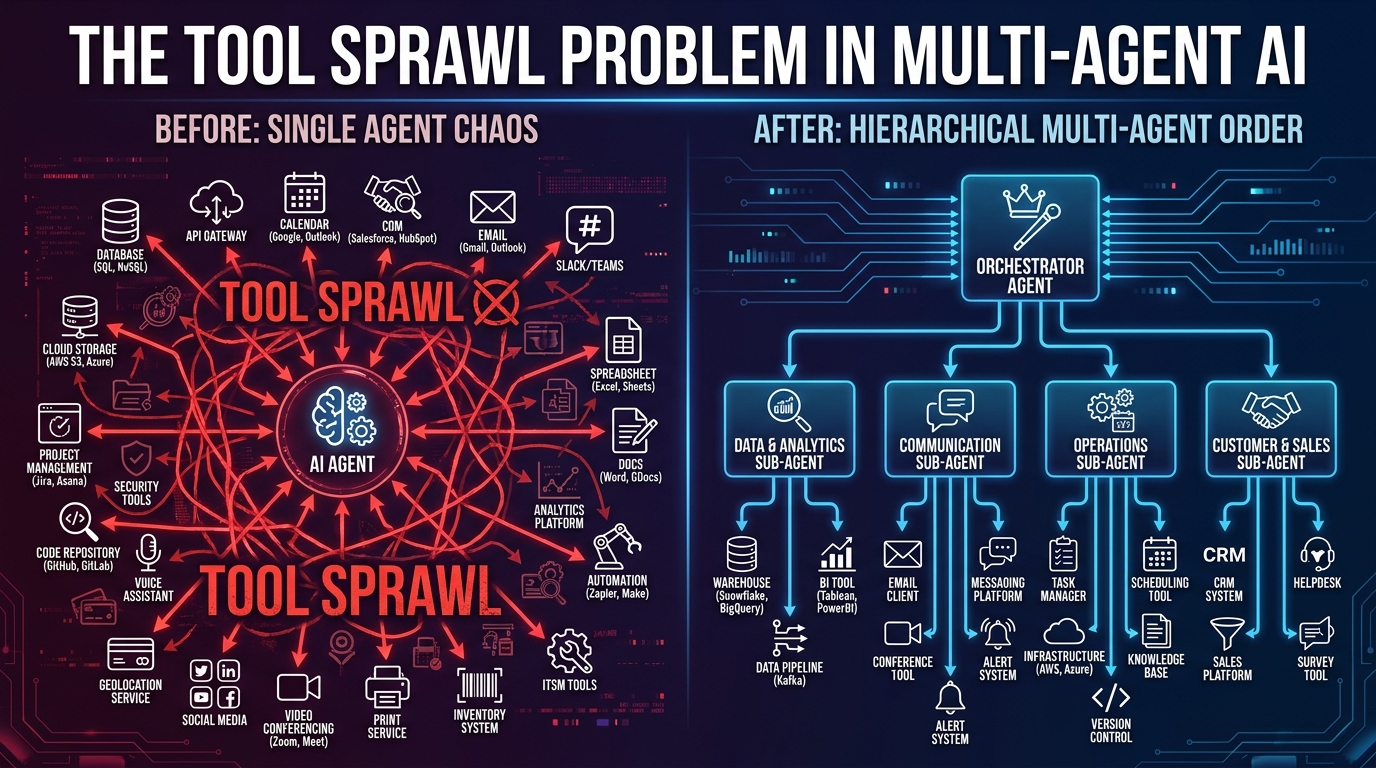
  • The Discipline of Less: How to Ship Multi-Agent Workflows Without Tool Sprawl Killing Them

    The Discipline of Less: How to Ship Multi-Agent Workflows Without Tool Sprawl Killing Them

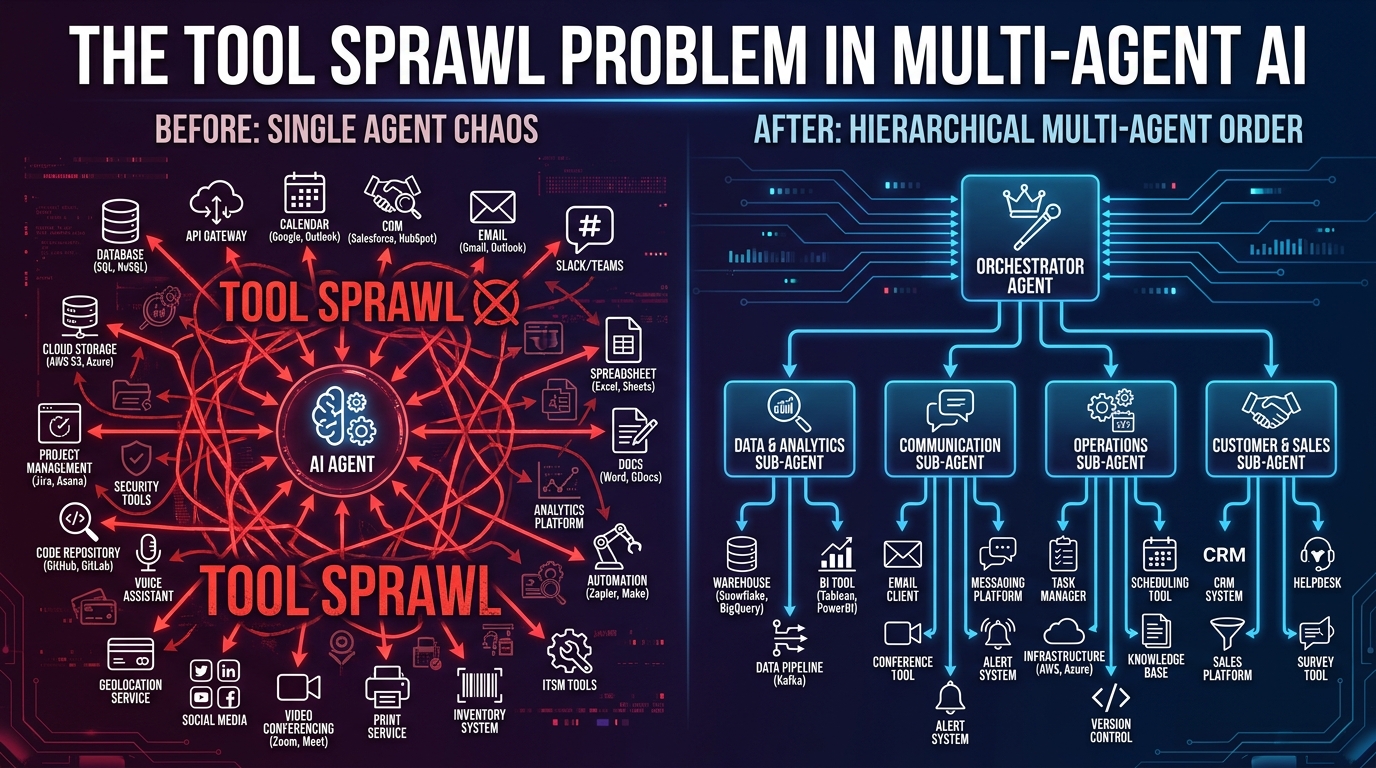
    Diagram contrasting chaotic tool sprawl in a single AI agent versus a clean hierarchical multi-agent architecture with scoped tools

    There is a particular kind of confidence that hits engineering teams around the six-week mark of a multi-agent build. The orchestrator is wired up. The sub-agents are firing. The demo runs clean. And because it runs clean, someone — usually the person closest to the product — asks: Can we also add the Salesforce connector? And maybe pull in Jira? And while we’re at it, the billing system needs to be in scope too.

    This is how tool sprawl starts. Not with a bad decision, but with a series of individually reasonable ones.

    By the time the system hits production, it is not uncommon to find a single agent wired to thirty, forty, sometimes sixty tools it will never actually call on any given task. The context window is bloated before a single token of real work is generated. The agent’s tool-selection logic — never perfect to begin with — degrades under the weight of too many options. Latency climbs. Costs balloon. And when something goes wrong, the trace spans read like a map of a city no one designed.

    The engineering community has a name for this now: tool sprawl. And in 2026, it has become one of the most documented, most discussed, and most underestimated failure modes in production multi-agent systems. A Q1 2026 survey of enterprise AI deployments found that the average large enterprise runs approximately 12 distinct AI agents, with nearly half operating in silos and exhibiting overlapping, poorly governed tool access. The percentage of multi-agent pilots that fail within six months of production deployment sits at roughly 40%.

    The fix is not better models. It is not a smarter orchestration framework. It is discipline — architectural discipline around what tools exist, which agents can see them, and when they are loaded. This post is about building that discipline before you ship, and recovering it if you already haven’t.

    What Tool Sprawl Actually Looks Like in Production

    Tool sprawl does not announce itself. It accumulates. The pattern typically unfolds in three distinct phases, and recognizing them early is the fastest way to avoid the mess they create.

    Phase One: The Generous Scope

    In early development, it feels safe — even sensible — to give agents broad access. You are still discovering what the workflow needs. Restricting tools at this stage feels like premature optimization. So the agent gets everything: the CRM, the database, the file system, the email client, the calendar API, the internal knowledge base, the billing system, and a handful of MCP servers someone found on GitHub.

    This is fine for prototyping. It becomes a structural liability the moment you stop prototyping.

    Phase Two: The Feature Creep Multiplier

    Every stakeholder who touches a multi-agent workflow eventually asks for one more integration. The support team wants ticket creation. Finance wants expense categorization. The data team wants a direct hook into the warehouse. Each request is legitimate in isolation. Each one adds another tool to the agent’s manifest. No one removes the tools that were added for previous use cases, because removal feels risky — what if something depends on it?

    The MCP ecosystem has made this dramatically worse. A Q1 2026 census of MCP servers across public registries found 17,468 distinct MCP servers available for agent integration. The barrier to adding a new tool has never been lower. That accessibility is genuinely useful. It is also the reason tool lists metastasize.

    Phase Three: The Silent Degradation

    This is the phase most teams notice too late. The system is in production. It mostly works. But accuracy on complex tasks has quietly dropped. Certain prompts return wrong tool calls — the agent reaching for a search API when it should be writing to a database, or calling a read endpoint when a write was intended. Token costs are higher than projected. Response times are inconsistent.

    None of these symptoms trigger an obvious alert. There is no “too many tools” exception in your logs. The degradation is statistical, not categorical. And that makes it extraordinarily hard to diagnose without purpose-built observability from the start.

    The core mechanism is straightforward: when you give an LLM more tools to choose from, tool-selection accuracy drops. Research across production deployments consistently identifies a practical ceiling of roughly 5 to 8 tools per agent before selection errors become a meaningful reliability risk. Above 15 tools, the signal-to-noise ratio in tool descriptions degrades to the point where the model frequently selects plausible-but-wrong options — a failure mode that compounds across multi-step workflows in ways that are difficult to trace.

    The Compounding Reliability Math Nobody Likes to Run

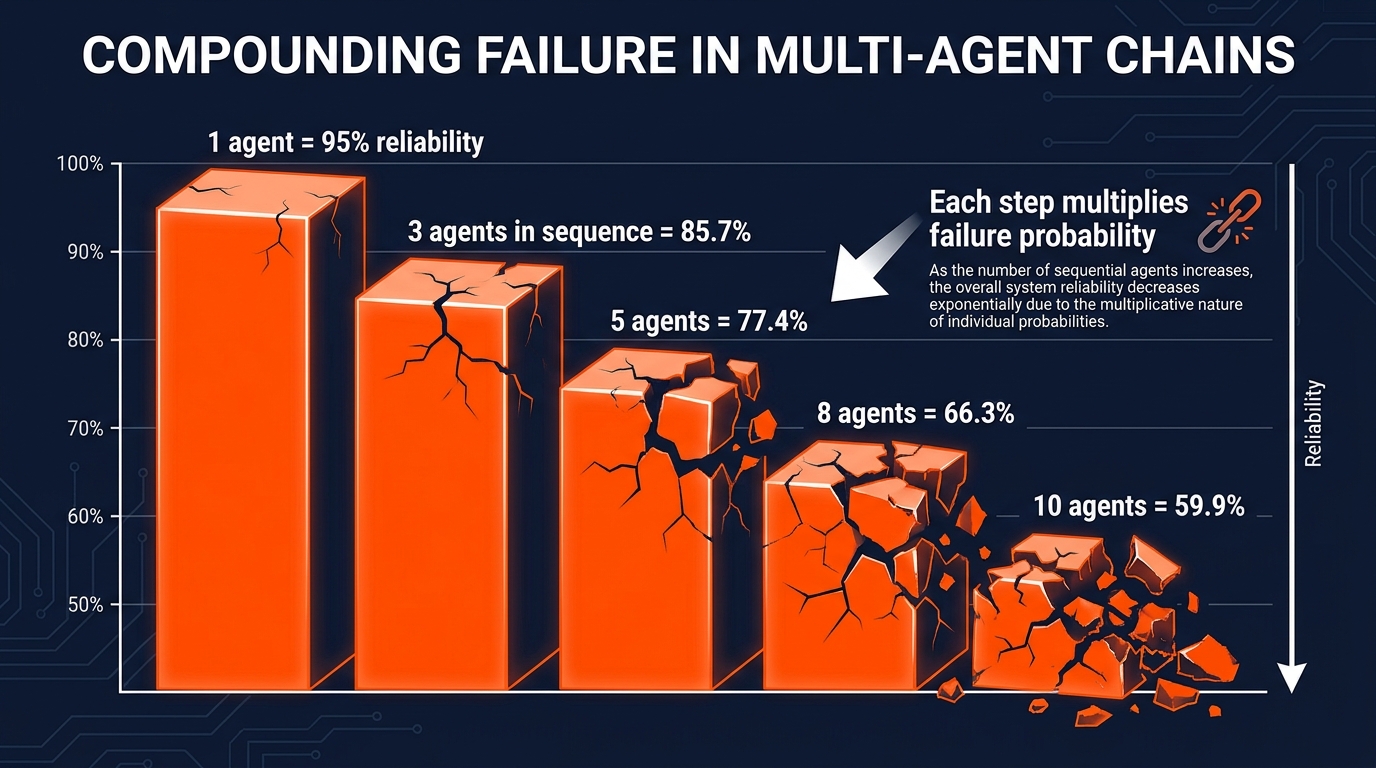
    Staircase infographic showing compounding failure rates in multi-agent chains from 95% reliability at one agent to below 60% at ten agents in sequence

    One of the most uncomfortable facts in multi-agent engineering is that system reliability is multiplicative, not additive. Every agent in a sequential chain introduces its own failure probability. Those probabilities compound.

    If each agent in your pipeline has a 95% step-level success rate — which is optimistic for complex real-world tasks — the math looks like this:

    • 1 agent: 95.0% end-to-end success
    • 3 agents in sequence: 85.7%
    • 5 agents: 77.4%
    • 8 agents: 66.3%
    • 10 agents: 59.9%

    A ten-agent workflow where every individual step is 95% reliable will fail to complete successfully four times out of ten. In production, that is not a reliability problem. It is an unusable system.

    Tool Sprawl Degrades the Per-Step Rate

    The compounding math becomes even more damaging when tool sprawl is involved, because sprawl directly lowers the per-step success rate. An agent that calls the wrong tool does not get a partial credit — the error propagates downstream, carrying corrupted context into the next step. Recent analysis of production multi-agent systems found that when agent topology does not match task shape, collapse rates can reach 90.7%.

    This is the core reason tool discipline matters so much in multi-agent systems specifically: a single poorly scoped agent in the middle of a pipeline can corrupt the reliability of every agent that follows it. The failure is not local; it is systemic.

    The Coordination Overhead Tax

    Beyond individual step failures, tool sprawl adds a coordination overhead that compounds latency at scale. Every time an agent must select from a large tool set, that selection requires more context processing, more model inference, and in some architectures, multiple sampling passes. Multiply that overhead across every step in a workflow, across every concurrent workflow run, and the cost trajectory becomes nonlinear fast.

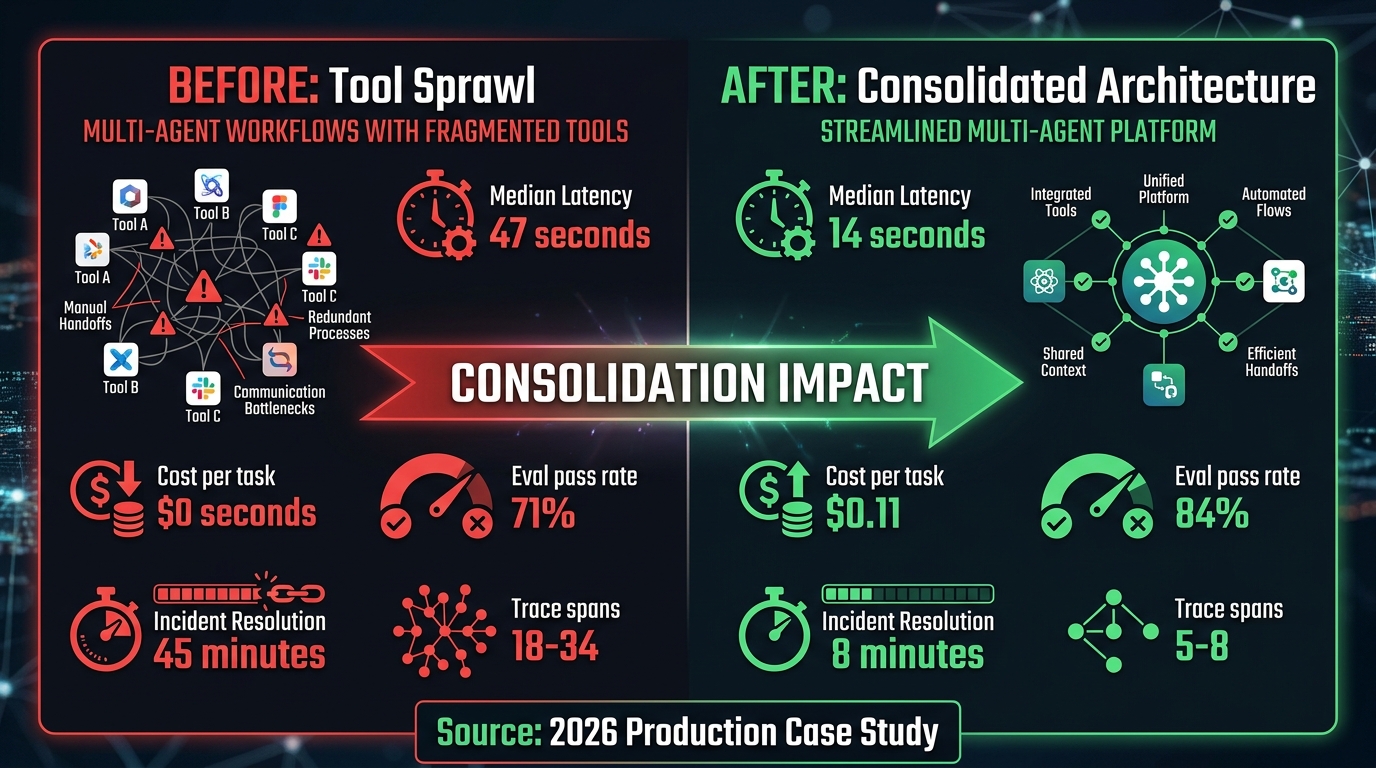
    One documented 2026 production consolidation effort found that simplifying agent topology — reducing trace spans from 18–34 down to 5–8 per run — dropped median task cost from $0.62 to $0.11 and median latency from 47 seconds to 14 seconds. The model did not change. The underlying tools did not change. The architecture around them did.

    Context Window Contamination: The Hidden Token Tax

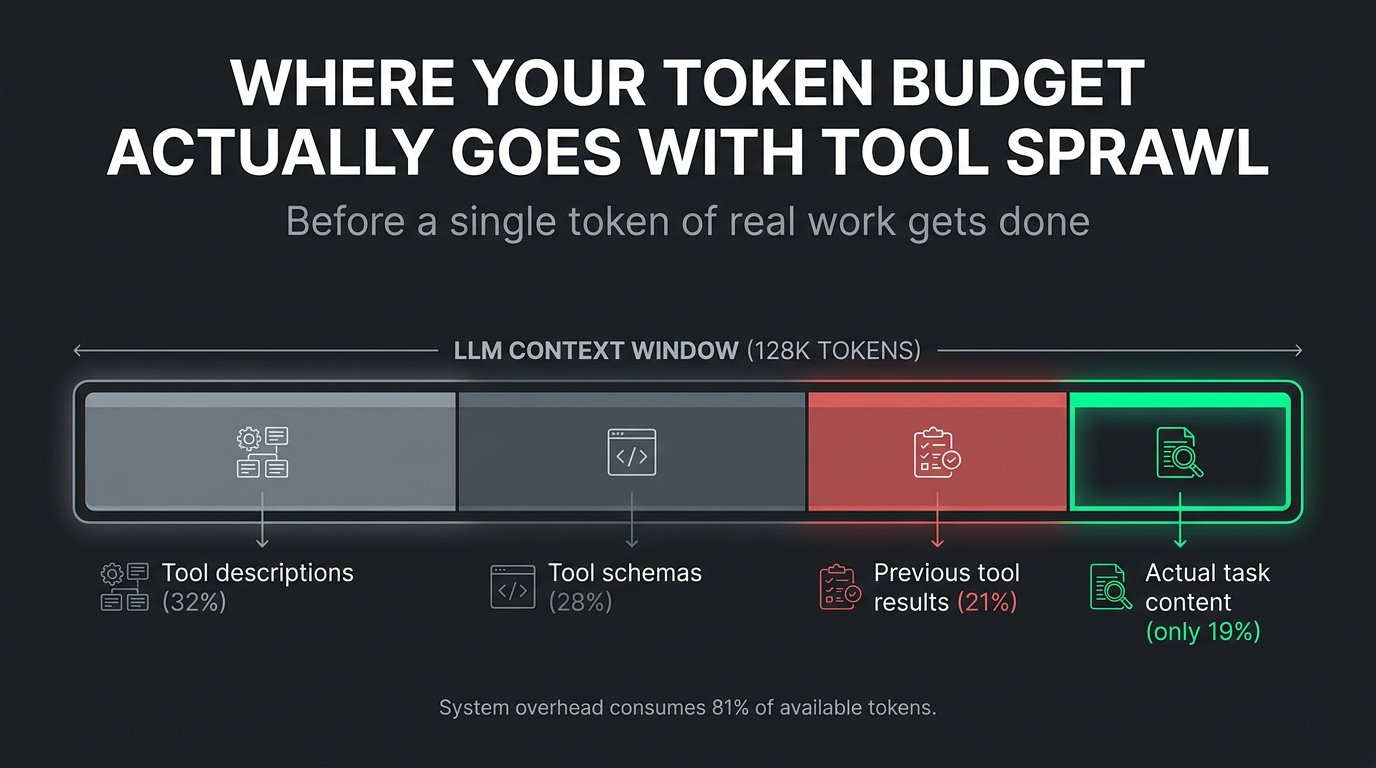
    Infographic showing how tool descriptions, schemas, and prior tool results consume the majority of an LLM context window before any actual task content is processed

    Here is a test worth running on any multi-agent system you are currently operating: count the tokens consumed by tool definitions before the first meaningful user-task token is processed. The results are often alarming.

    Tool definitions in an LLM context are not free. Each tool requires a name, a description, a parameter schema, and often example invocations. A well-documented tool might consume 300–500 tokens. An agent wired to 30 tools is starting every single call with 9,000–15,000 tokens of overhead — before the system prompt, before conversation history, before the actual task content. On a 128K context model, that is already 7–12% of the available window consumed by tool schema alone.

    The Cascade Effect on Long-Running Workflows

    The contamination problem compounds in long-running agentic workflows. Frameworks like LangGraph and CrewAI, by default, append every step’s output — including full tool call records and responses — to the agent’s state. In a ten-step workflow where each step involves two or three tool calls with verbose JSON responses, the accumulated state can consume the majority of the context window before the final steps execute. This produces one of the most frustrating failure modes in multi-agent systems: the silent degradation at the end of a long workflow.

    The model does not announce that it is operating on compressed context. It does not throw an exception when it hits the window limit. It simply begins to reason less accurately, hallucinating tool behaviors, misremembering earlier steps, or selecting actions that contradict decisions made earlier in the same run. The output looks plausible. It is wrong.

    What This Means for Tool Design

    Every tool you add to an agent’s context is a permanent tax on every call that agent makes. The discipline here is treating tool descriptions the same way good engineers treat code comments: concise, precise, purposeful, and regularly pruned. Verbose tool documentation that reads beautifully in a README is costly overhead when it runs in a context window ten thousand times a day.

    There is also a second-order consideration that most teams miss: the quality of tool descriptions affects selection accuracy more than the quantity. An agent with ten tightly written, clearly differentiated tool descriptions will outperform an agent with thirty loosely described tools every time. The investment in schema quality pays compound returns across the entire system’s operational life.

    The Topology Trap: Why Architecture Shape Matters as Much as Tool Count

    Multi-agent workflows fail not only because of too many tools, but because the structure of the agent graph does not match the structure of the underlying task. This mismatch — what practitioners now call the topology trap — is one of the least discussed root causes of multi-agent production failures.

    Task Shape vs. Agent Shape

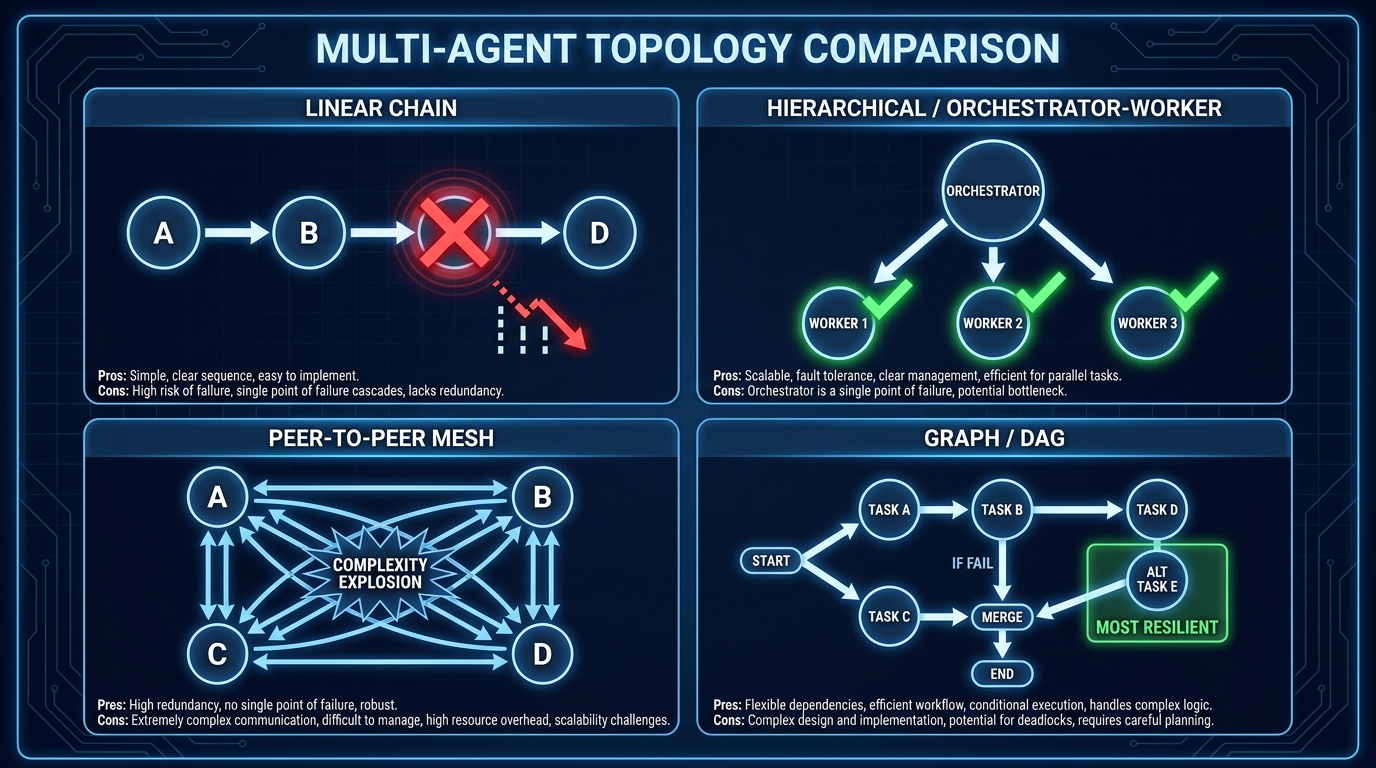
    Every task has a natural shape. Some tasks are sequential: output A feeds input B, which feeds input C, with strict ordering. Others are parallel: five independent subtasks that can be executed simultaneously and merged at the end. Still others are hierarchical: a planner decomposes a goal into subgoals, each handled by a specialist, with results synthesized back up. When your agent architecture mirrors the task’s natural shape, coordination overhead is minimized and tool routing is clear. When it does not, you get bottlenecks, redundant work, and agents calling tools they should not need.

    The most common mismatch in practice is building parallel architectures for sequential tasks. Teams reach for parallelism because it sounds faster. But if task step B requires the output of step A to determine which tool to call, forcing parallelism means either guessing or re-doing work. The apparent speed gain evaporates, and the tool call surface expands because each parallel agent must defensively cover multiple branches of the task instead of one narrowly scoped path.

    The Orchestrator Bottleneck

    Many teams default to a centralized orchestrator — one manager agent that routes all work to sub-agents. This pattern is sound in principle but creates a specific failure mode at scale: the orchestrator becomes a single point of both performance bottleneck and context accumulation. Every delegated task result flows back through the orchestrator’s context. If the orchestrator is also the entity managing tool selection across the entire workflow, you have effectively concentrated all the tool-sprawl risk into a single agent.

    The fix is not to eliminate the orchestrator, but to make it deliberately narrow. The orchestrator should know which sub-agent to call, not which tools those sub-agents use. Tool knowledge belongs inside the sub-agent boundary, scoped to its domain. The orchestrator should never need a direct connection to a tool it does not personally invoke.

    Matching Topology to Task: A Practical Heuristic

    Before building any multi-agent architecture, map the task’s dependency graph explicitly. If the graph is a straight line, build a sequential chain with prompt chaining, not a full multi-agent system — the single-agent baseline will likely be cheaper and more reliable. If the graph has genuine parallelism (truly independent subtasks), parallelize. If the graph is hierarchical, build a one-level hierarchy and resist the urge to add additional layers unless the data explicitly requires them. Each additional orchestration layer adds coordination overhead and multiplies the tool-management surface.

    The Least-Privilege Principle, Applied to Agent Tools

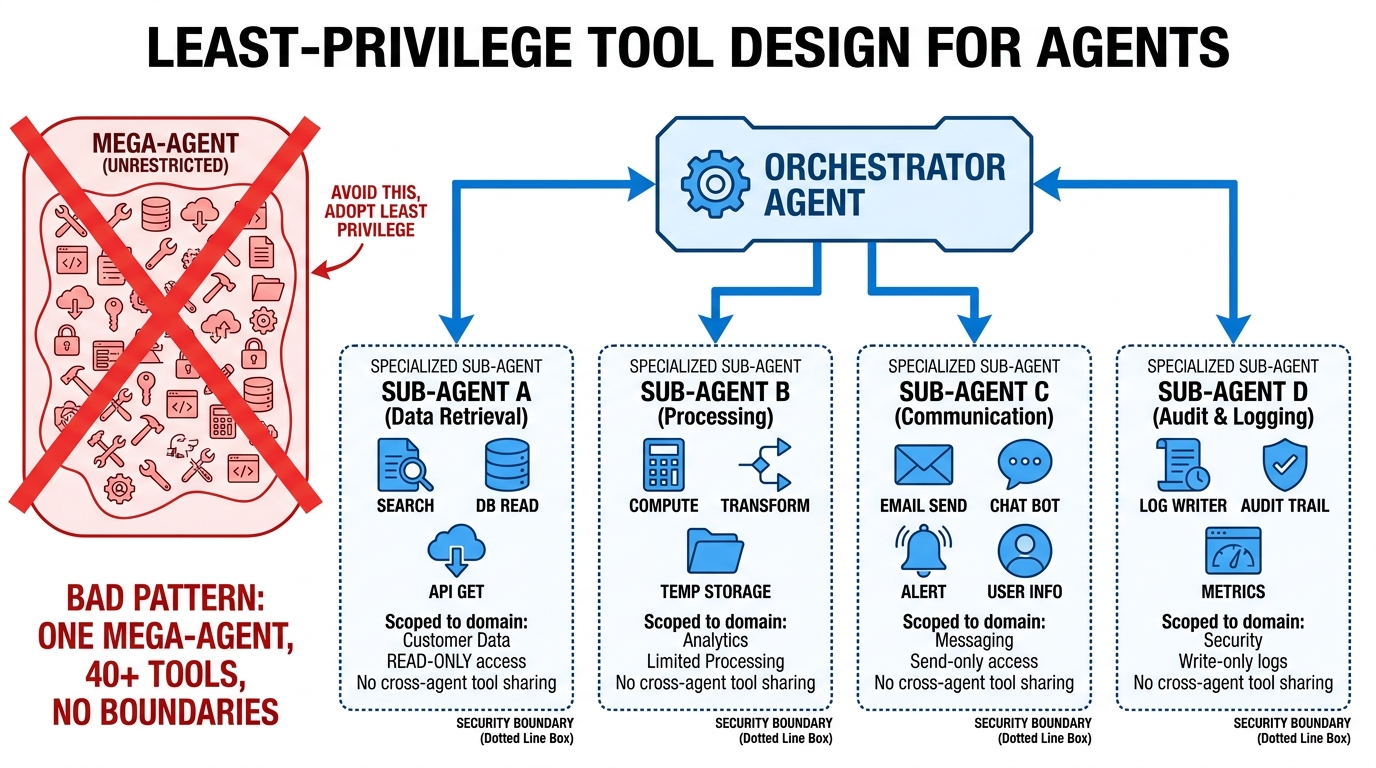
    Architectural diagram showing least-privilege tool design with specialized sub-agents each enclosed in security boundaries containing only 3-4 scoped tools, contrasted with a bad single-agent pattern holding 40+ tools

    Security engineers have enforced the principle of least privilege for decades: a process should have access to only the resources it needs to complete its current task, and nothing more. It is time for multi-agent architects to apply the same discipline to tool access.

    The instinct in most multi-agent builds is to be generous with tool access because it feels safer. What if the agent needs this tool for an edge case? What if we restrict too much and the workflow breaks? This instinct is precisely backwards. Generous tool access creates more failure modes, not fewer, because it increases the space of wrong actions an agent can take.

    Defining the Minimum Viable Tool Set

    Every agent in a well-architected multi-agent system should be able to answer the question: What is the exact set of tools I need to complete my assigned task? If the answer includes tools needed by other agents in the same system, that is a boundary problem — those tools belong with those agents, not shared across the graph.

    The practical exercise is to enumerate each agent’s core task, then work backward to the minimal set of tools that task requires. This exercise consistently reveals two things. First, most agents need far fewer tools than they were initially given. Second, many “tools” that appear in the initial list are actually multi-step operations that should themselves be broken into smaller, more precisely scoped tool definitions.

    A research agent, for instance, might be given a generic “web access” tool that can search, retrieve, parse, and summarize arbitrary web content. Decomposing that into a targeted search tool, a URL fetch tool, and a text extraction tool — each with tight parameter schemas — dramatically improves selection accuracy and makes failures much easier to attribute and debug.

    Read vs. Write Permissions as a First-Order Concern

    One of the fastest wins in agent tool design is enforcing read/write separation explicitly. Most agentic tasks spend the majority of their steps reading: gathering information, retrieving context, validating current state. Write operations — creating records, sending messages, triggering actions in external systems — are typically a small fraction of total steps but carry the majority of risk.

    Giving every agent read/write access to every system because “they might need to write eventually” violates least privilege and creates serious security and reliability exposure. An agent that can write to the CRM, send email, and create support tickets has a much larger blast radius when it makes a wrong tool selection than one that can only read from those systems and must hand off to a dedicated action agent for writes.

    Building this separation into the architecture — not just into prompts or guidelines, but into the actual tool permissions assigned to each agent — gives you a genuine safety layer that does not depend on model behavior. That matters, because model behavior under edge-case inputs is never fully predictable.

    Tool Registry and Agent Gateway: The Control Plane That Actually Works

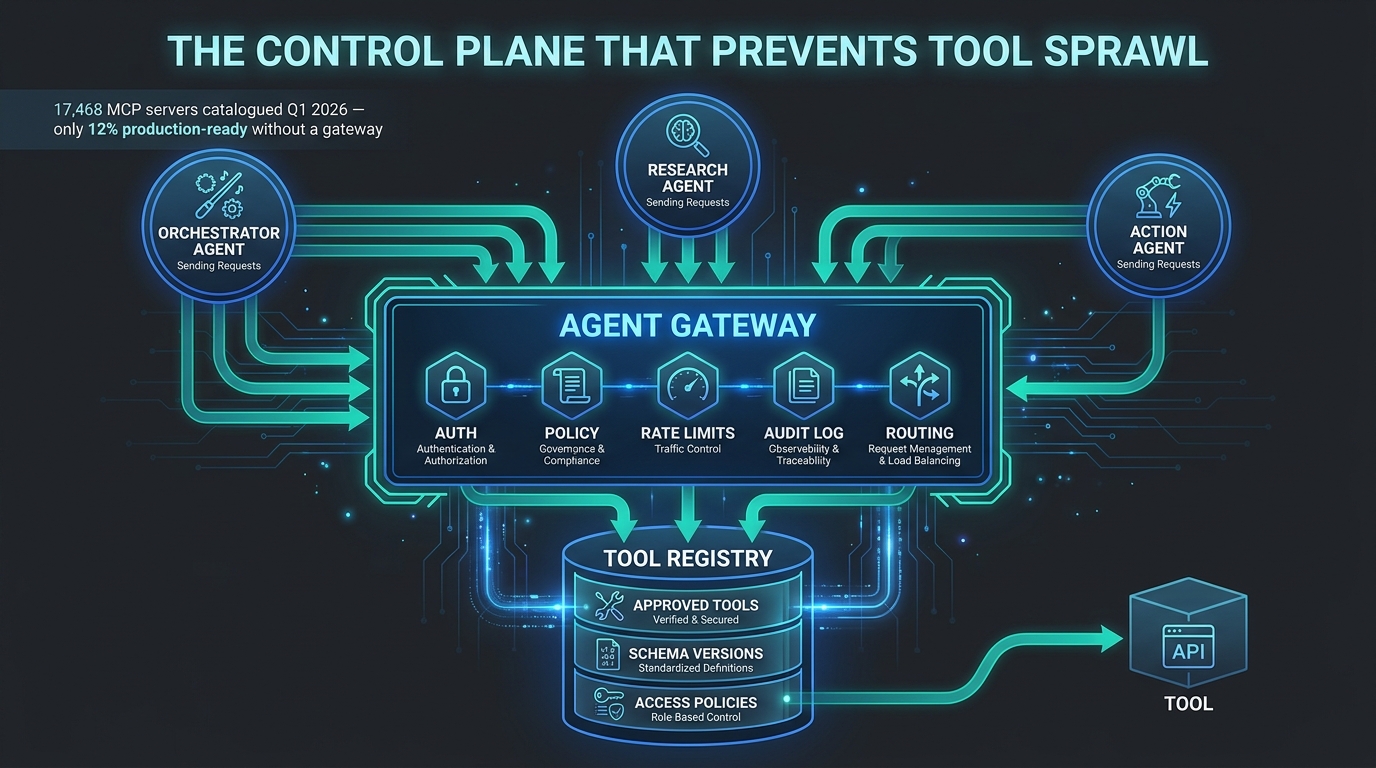
    Architecture diagram showing an Agent Gateway control plane handling auth, policy, routing, and audit between agents and a Tool Registry containing approved tools with schema versions and access policies

    For teams operating at any real scale — multiple agents, multiple workflows, multiple teams contributing tools — ad hoc tool management becomes unworkable fast. The solution that has emerged across 2026 production deployments is a two-component control plane: a tool registry paired with an agent gateway.

    The Tool Registry: Single Source of Truth for Agent Capabilities

    A tool registry is a centralized catalog of every approved tool available to agents in a system. Each entry contains the tool’s name, schema, ownership, version history, access policy, and production readiness status. Agents do not hard-code their tool lists — they query the registry to discover what is available to them, filtered by their assigned permissions and the current task context.

    The registry pattern solves several problems simultaneously. It eliminates the “which version of this tool does this agent use?” confusion that plagues ad hoc multi-agent systems. It gives platform and security teams a single point of control for approving, deprecating, or restricting tools without touching agent code. And it provides an audit surface: if a tool is called unexpectedly in production, the registry log tells you exactly which agent called it, when, and in what context.

    The scale of the problem this addresses is significant. That Q1 2026 census of MCP servers found 17,468 servers across public registries — with only a fraction production-ready under enterprise governance standards. Without a registry layer, every team in an organization can independently wire their agents to any of those servers. With one, the catalog of approved, tested, policy-compliant tools is defined once and enforced everywhere.

    The Agent Gateway: Policy Enforcement at the Boundary

    If the registry is the catalog, the gateway is the door. An agent gateway sits between all agents and all tools, intercepting every tool call and enforcing authentication, authorization, rate limits, and policy rules before the call is allowed through. No tool call happens outside the gateway’s visibility.

    This architectural pattern has clear analogues in API management and service mesh design — it is the same principle as an API gateway in microservices, applied to the agent-to-tool interaction layer. The gateway does not contain business logic. It enforces policy. That separation of concerns is what makes it maintainable: security policies change independently of agent behavior, and neither side needs to know the internal details of the other.

    Production implementations of this pattern — including work done with Solo.io’s agentgateway project — have shown that centralizing MCP and LLM traffic through a gateway improves cost visibility, enables governance across heterogeneous agent types, and removes the need to modify individual agents or MCP servers when policies change. The gateway abstracts the policy layer entirely.

    What This Architecture Does Not Solve

    It is worth being direct about the limitations. A registry and gateway control plane is an infrastructure-layer solution. It does not fix poorly designed tool schemas. It does not prevent an agent from making a logically wrong tool call when the tool is technically permitted. And it adds an operational surface that must itself be maintained, monitored, and versioned.

    Teams that implement this pattern without also investing in schema quality and agent-level tool minimization will find that they have built an excellent auditing layer over a still-sprawling tool estate. The control plane is necessary but not sufficient. It works best as the enforcing layer around sound architectural decisions already made upstream.

    Dynamic Tool Loading vs. Static Tool Injection: A Decision Framework

    One of the most important architectural decisions in multi-agent tool management is whether each agent receives its tool set statically at initialization or dynamically at the point of each task. Both patterns have legitimate use cases, and choosing the wrong one for your workload has meaningful consequences for both cost and reliability.

    Static Tool Injection: When It Makes Sense

    In static injection, agents are initialized with a fixed, predetermined set of tools. Every call that agent makes sees the same tool manifest. This is the simpler pattern and the right default for workflows where the task domain is well-defined and the tool set is small — ideally under eight tools.

    Static injection is predictable. The context overhead per call is constant and known. Testing is straightforward because tool availability does not vary across runs. And for agents that always operate in the same domain — a customer support agent that only ever queries tickets, reads account records, and creates follow-up tasks — the fixed set is not a constraint; it is a design feature.

    The failure mode of static injection is when it gets applied to general-purpose agents. A general-purpose agent with a static 40-tool manifest is paying the full context tax on every call, regardless of what the current task actually needs. The math makes this untenable at scale.

    Dynamic Tool Loading: The Right Pattern for General Agents

    Dynamic loading — retrieving tool definitions at task time based on the current context, intent, or task metadata — solves the context bloat problem for general-purpose agents. Instead of including all tool schemas in every call, the agent’s orchestration layer queries the registry for the relevant subset, fetches only those definitions, and injects them into the context for that specific call.

    This pattern requires more infrastructure. The retrieval mechanism itself needs to work reliably, quickly, and with semantic understanding of the task context — a tool retrieval step that adds 500ms of latency before every agent call defeats much of the purpose. The most effective implementations use embedding-based semantic search over tool descriptions, retrieving the top-k most relevant tools for the current intent rather than pattern-matching on keywords.

    Expert guidance in 2026 consistently favors dynamic loading over static injection for any agent that will operate across more than one domain or handle task variety beyond a narrow scope. The retrieval overhead is real but manageable; the context savings across thousands of daily runs are substantial.

    A Practical Decision Heuristic

    The framework is simple: if your agent does one thing and does it consistently, static injection with a minimal tool set is correct. If your agent handles varied requests across multiple domains, dynamic loading with a centralized registry is worth the infrastructure investment. And if you find yourself justifying static injection for a general-purpose agent because dynamic loading “sounds complicated,” that is typically a signal that the agent’s scope is too broad to begin with.

    MCP as the Consolidation Layer: What It Solves and What It Doesn’t

    Model Context Protocol has become the dominant standard for tool access in multi-agent systems in 2026, with adoption across OpenAI, Google, Microsoft, and AWS and 97 million monthly SDK downloads reported at its peak. MCP’s promise is real: a standardized way for models to access tools, data sources, and external services without every integration requiring bespoke glue code.

    For teams wrestling with tool sprawl, MCP appears at first glance to be a direct solution. One protocol, one integration model, one way to connect any agent to any tool. If everything speaks MCP, the proliferation problem should solve itself.

    It does not. And understanding why is important for any team treating MCP adoption as a tool-sprawl mitigation strategy.

    What MCP Actually Standardizes

    MCP standardizes the interface between models and tools. It defines how a model requests tool invocation, how parameters are passed, how results are returned, and how errors are communicated. It does not standardize what tools exist, how many an agent should use, what they should be permitted to do, or how they should be governed across an organization.

    In practice, MCP makes it dramatically easier to add new tools to an agent’s repertoire — which, without accompanying governance, makes tool sprawl faster, not slower. The Q1 2026 census of 17,468 MCP servers is partly a testament to MCP’s success as a standard and partly a warning label. Most of those servers were created by developers exploring the protocol’s possibilities. A significant portion have no security posture, no versioning discipline, and no organizational ownership structure suitable for production use.

    The 2026 Spec Changes That Matter

    The 2026-07-28 MCP release candidate addresses some of this by introducing a stateless core designed to scale on standard HTTP infrastructure. This makes multi-agent, multi-tool topologies more operationally tractable — stateless tool servers are simpler to deploy, scale, and recover than stateful ones. The spec also strengthens OAuth/OIDC-aligned authentication, tightening the security posture that earlier MCP deployments left under-specified.

    The clearest architectural guidance from 2026 MCP practice is a division of responsibility: use MCP for the model-to-tool layer (standardizing how agents invoke capabilities), and use a separate agent-to-agent (A2A) protocol for agent-to-agent coordination (delegation, negotiation, result sharing between agent nodes). Conflating these two layers — trying to make MCP do both — creates architectural confusion and governance gaps that are difficult to remediate after the fact.

    The Right Way to Think About MCP and Sprawl

    MCP is a tool for integration quality, not tool quantity. Adopting MCP reduces the cost of each individual integration. The discipline of deciding which integrations to make, how many an agent should access, and under what governance they operate — that discipline is entirely separate from the protocol and must be enforced at the architecture and policy level. MCP is necessary infrastructure. It is not a substitute for the harder organizational work of tool governance.

    Observability-First Shipping: Measuring What Actually Matters

    Before-and-after comparison showing production metrics after tool consolidation: latency from 47s to 14s, cost per task from $0.62 to $0.11, eval pass rate from 71% to 84%, incident resolution from 45 minutes to 8 minutes

    One of the clearest markers of teams that successfully ship multi-agent workflows — versus teams that ship and then spend months firefighting — is the presence or absence of purpose-built observability from day one. Observability in multi-agent systems is not optional, and it is not the same as the observability you already have for monolithic services or single-LLM deployments.

    Why Standard Monitoring Falls Short

    Traditional application monitoring tells you whether services are up, whether requests are succeeding, and how long they are taking. Multi-agent workflows require a different category of instrumentation because the most important failures are semantic, not technical. The service can be up. Requests can succeed. Latency can be within spec. And the agent can still be consistently selecting the wrong tool, producing subtly wrong outputs, and propagating errors downstream through a pipeline that looks, from the outside, like it is working fine.

    The documented improvement in mean time to root-cause — from 45 minutes down to roughly 8 minutes in the consolidation case study cited earlier — came primarily from trace span reduction, not from better monitoring tools. Fewer spans meant that when something went wrong, the failure was localized in a smaller search space. Observability quality is a direct function of architectural simplicity. You cannot instrument your way out of a system that is too complex to reason about.

    The Metrics That Matter

    In multi-agent production systems, the metrics worth tracking fall into four categories:

    • End-to-end task success rate: Not per-agent accuracy, but the rate at which complete workflows produce correct, usable outputs. This is the number that reflects actual user value, and it is the number most teams measure too late.
    • Tool call accuracy: For each agent, what percentage of tool calls are to the correct tool? This metric, tracked over time and segmented by agent and task type, is the earliest signal of tool-selection degradation from context bloat or scope creep.
    • Token cost per successful task completion: Total token cost normalized to successful completions. This denominates cost by value, not just by volume, and surfaces the hidden cost of failed runs that consume tokens without producing usable output.
    • Trace span count per run: A high and rising span count is a leading indicator of architecture complexity growth. The teams that caught tool sprawl early were tracking this metric and setting alert thresholds on it before problems became visible in downstream metrics.

    Human-in-the-Loop Checkpoints as Observability Tools

    Beyond instrumentation, the most operationally mature multi-agent deployments in 2026 use human-in-the-loop checkpoints not just as safety mechanisms but as signal collection points. Every time a human reviews and approves or overrides an agent decision, that event is a labeled data point about the accuracy of that agent’s behavior in that context.

    Teams that track override rates by agent and by tool type are building a continuously updated picture of where their workflows are unreliable. That picture, reviewed weekly, often reveals that specific tools are being called correctly 99% of the time — and certain other tools are being misused chronically. The fix is either better schema descriptions, narrower agent scope, or, frequently, the recognition that a tool should not be in that agent’s manifest at all.

    The discipline of treating human feedback as structured observability data — rather than one-off corrections — is one of the clearest differentiators between teams shipping reliable multi-agent systems and teams perpetually fighting fires in them.

    The “Agents as Tools” Inversion That Changes Everything

    There is a counterintuitive architectural pattern that deserves more attention than it typically gets: treating entire agents as tools that other agents can invoke, rather than building monolithic multi-agent systems where every agent has direct access to the full tool surface.

    In this pattern, a specialist agent — say, a data retrieval agent with deep access to your warehouse, your CRM, and your analytics layer — is exposed to an orchestrator not as a peer participant in the workflow, but as a callable capability. The orchestrator calls data_retrieval_agent(query=...) the same way it would call a tool. The specialist agent handles its own tool access internally, exposing only a clean interface to the outside world.

    Why This Pattern Reduces Sprawl

    The “agents as tools” inversion naturally enforces the scoping that least-privilege design requires. Because each specialist agent is encapsulated behind an interface, the orchestrator never needs to know — or have access to — the tools that specialist uses internally. The orchestrator’s tool manifest contains only the callable agents it coordinates, not the underlying capabilities each one wraps. This single architectural choice can reduce the orchestrator’s effective tool surface from dozens of specific capabilities to a handful of well-defined agent interfaces.

    It also dramatically simplifies debugging. When a workflow fails, the failure trace points to a specific agent-as-tool invocation. The failure is contained within that agent’s scope and diagnosable in isolation, without needing to trace through the full workflow graph to understand which underlying tool call was the actual root cause.

    Versioning and Upgrading Agent Capabilities

    The encapsulation benefit extends to lifecycle management. When a specialist agent’s underlying tool set changes — a new API version, a deprecated endpoint, a revised data schema — none of that change propagates to the orchestrator or to other agents in the system. The interface stays stable; the internals change independently. This is the same modularity principle that makes microservices maintainable, applied to the agent layer.

    Teams that have adopted this pattern consistently report that it dramatically reduces the coordination cost of upgrading individual components of a multi-agent system, because interface stability means changes are local by default.

    Building the Habit Before You Need It: An Engineering Checklist

    The most effective time to prevent tool sprawl is during initial system design, before the first agent makes its first tool call in production. The patterns described throughout this post are significantly harder to retrofit than they are to build from the start. The following checklist captures the key decision points where architectural discipline prevents future pain.

    Before You Build

    • Map the task dependency graph. Write out every step of the workflow explicitly. Identify which steps can run in parallel, which are strictly sequential, and which require human review. Let the task structure determine the agent structure — not the other way around.
    • Default to single-agent. Ask honestly whether a single well-prompted LLM with a minimal tool set could handle this workflow. If the answer is yes, that is your starting point. Add agents only when you have measured evidence that the single-agent approach is insufficient.
    • Define each agent’s minimum viable tool set before writing any code. For each agent in your planned architecture, document: what is its single responsibility, what specific tools it needs to fulfil that responsibility, and what tools it should explicitly not have access to. Treat this document as a design constraint, not a suggestion.
    • Separate read tools from write tools at the permission level. Do not rely on prompt instructions to keep agents from writing when they should only be reading. Enforce this at the tool permission layer.

    Before You Ship

    • Count your trace spans in staging. If a workflow produces more than 8–10 spans per run for a single task, that is a signal worth investigating before production. It often reveals redundant agent invocations or unnecessary tool calls that can be eliminated without changing workflow outcomes.
    • Run a tool utilization audit. After a week of staging traffic, produce a count of how often each tool in each agent’s manifest is actually called. Tools called in fewer than 5% of runs are candidates for removal from that agent’s default manifest — and possibly for dynamic loading if they are genuinely needed for edge cases.
    • Establish baseline eval pass rates and cost-per-completion targets. Ship with pre-committed alert thresholds on these metrics. Without targets established before launch, there is no objective basis for distinguishing normal operational variance from systematic degradation.
    • Document the governance owner for every tool in the registry. Every tool in production should have a named owner responsible for its schema, its uptime, and its deprecation. Tools without owners become orphaned liabilities that no one is willing to remove.

    After You Ship

    • Review tool utilization monthly. Agent workflows drift. New task patterns emerge. Tools that were once frequently called become rarely used. Tools that were added for edge cases become load-bearing for common cases. Monthly review catches this drift before it becomes architectural debt.
    • Treat rising span counts as a primary incident trigger. A significant increase in average trace spans per run — even without a corresponding increase in error rates — indicates that the workflow is doing more coordination work to accomplish the same task. That is almost always a warning sign worth investigating.
    • Run quarterly “can we remove this?” reviews on the tool registry. The default organizational inertia is to add tools and never remove them. A deliberate removal practice — requiring justification for keeping a tool rather than for removing it — counteracts this inertia.

    Conclusion: Narrow First, Expand Deliberately

    The multi-agent AI landscape in 2026 is characterized by a growing gap between ambition and operational reality. The ambition — autonomous, interconnected agent systems that handle complex enterprise workflows end to end — is legitimate and achievable. The operational reality — sprawling tool estates, cascading reliability failures, context windows consumed by schema before real work begins, and debugging experiences that resemble archaeology more than engineering — is also legitimate and widespread.

    The gap between the two is not filled by better models, smarter frameworks, or more expressive protocols. It is filled by engineering discipline: the willingness to start narrow, to enforce scoping as a design constraint rather than an optimization, to measure what matters rather than what is easy, and to resist the gravitational pull of adding one more tool because it might come in handy.

    The data is consistent. Teams that ship reliable, cost-effective multi-agent workflows in production share a common trait: they treat architectural simplicity as a first-class concern, not an afterthought. They run fewer agents with fewer tools. They instrument before they scale. They audit regularly and remove aggressively. They build agents as encapsulated modules with clean interfaces, not as sprawling processes with broad permissions.

    This is not a limitation on what multi-agent systems can do. It is the foundation that makes it possible for them to do it reliably, at scale, over time.

    Build narrow first. Measure everything. Expand only where the data says to. That is the architecture that ships — and keeps shipping — in production.

    Key Takeaways

    • Keep each agent’s tool set to 5–8 tools maximum. Above 15, selection accuracy degrades materially and context costs compound nonlinearly.
    • Model your agent topology on your task dependency graph — not on your organizational structure or your instinct for parallelism.
    • Enforce read/write separation at the permission layer, not the prompt layer. Prompts are not a security boundary.
    • Implement a tool registry + agent gateway control plane before you scale beyond three agents or two teams contributing tools.
    • Use dynamic tool loading for general-purpose agents operating across multiple domains. Static injection only for narrow, domain-specific agents.
    • MCP standardizes the interface to tools, not the discipline around their use. Governance must be built separately and deliberately.
    • Trace span count is a leading indicator of architectural complexity growth. Set thresholds before launch, not after problems appear.
    • Treat every human override of an agent decision as structured observability data. Review override rates by agent and tool type monthly.
  • When Agents Work Together: The Engineering Reality of Robust Multi-Agent Pipelines

    When Agents Work Together: The Engineering Reality of Robust Multi-Agent Pipelines

    Multi-agent pipeline architecture diagram showing orchestrator, researcher, validator, executor, and review agents connected by directed handoff edges with status indicators

    There is a moment every team hits, usually around their third or fourth agent in production, when the system stops behaving like software and starts behaving like a group of colleagues who haven’t been properly briefed. An agent hands off a half-baked result. Another agent accepts it without checking. A third goes quietly off-script. By the time anyone notices, the pipeline has produced something technically complete and factually wrong — and nobody can explain how.

    This is the coordination tax. It doesn’t show up in demos. It doesn’t appear in benchmark scores. It surfaces in production, at scale, after you’ve already committed to the architecture.

    The shift to multi-agent systems was supposed to solve problems that single agents couldn’t: parallelism, specialization, long-horizon task decomposition. And it does solve those things — when the orchestration layer is designed as carefully as the agents themselves. The trouble is that most teams spend 90% of their effort on the agents and about 10% on what happens between them.

    This post is about that 10%. It covers the topology choices that determine how failure propagates, the state management patterns that make pipelines recoverable, the protocol stack that is rapidly becoming the enterprise standard for agent coordination, the six failure modes that quietly destroy multi-agent pipelines in production, and the observability and security work that most teams skip until something breaks badly enough to force them back to first principles.

    If you’ve already deployed agentic workflows and found the complexity growing faster than the value, this is the engineering perspective you were missing at the start.

    What “Post-Agentic” Actually Means — and Why the Terminology Matters

    The phrase “post-agentic orchestration” is doing real conceptual work, not just following a naming trend. It marks a specific inflection point in how teams think about AI systems.

    The first wave of agentic AI — roughly 2023 to mid-2025 — was characterized by what might charitably be called optimistic autonomy. Teams built agents and let them route their own decisions. The LLM chose the next tool. The LLM chose when to stop. The LLM decided which result was good enough to pass downstream. Frameworks like early LangChain made this easy to set up and very hard to reason about in production.

    Post-agentic orchestration rejects that premise. It treats agents as specialized components inside a larger, explicitly governed workflow — not as autonomous actors that happen to share a pipeline. The LLM is still doing the hard cognitive work, but the control flow, the handoff logic, and the state transitions are defined in code, not inferred at runtime by a model.

    The Distinction That Actually Changes Your Architecture

    Anthropic’s engineering team captured this distinction cleanly in their work on building effective agents: workflows are systems where LLMs and tools are orchestrated through predefined code paths, while agents are systems where LLMs dynamically direct their own processes. Both are valid. The question is which one you need for a given task — and most teams reach for the autonomous agent when a well-structured workflow would be more reliable, cheaper to run, and easier to debug.

    Post-agentic orchestration is the recognition that in most enterprise contexts, you want agents to be excellent at their specific tasks while the orchestrator — not the agent — decides what happens next. This isn’t a step backward from agentic AI. It’s what agentic AI looks like when it grows up.

    Why the Terminology Matters Beyond Semantics

    When you call something an “agent,” there’s an implicit expectation of autonomy and self-direction. When you frame it as a “component in an orchestrated pipeline,” the design questions change immediately: What inputs does this component require? What outputs does it guarantee? How does it signal failure? What authority does it have to make side effects?

    These are not LLM questions. They are distributed systems questions — and that’s exactly the lens that 2026’s most reliable multi-agent pipelines are being built with. Production teams in 2026 are increasingly treating multi-agent pipelines less like prompt chains and more like distributed microservice architectures, applying the same engineering rigor around contracts, state, retries, and observability.

    The Four Topology Choices — and When Each One Breaks

    Comparison diagram of four multi-agent topology patterns: linear chain, hierarchical orchestrator-worker, peer-to-peer mesh, and directed acyclic graph

    Before you write a single line of orchestration code, the most consequential decision you’ll make is your topology. How agents are connected determines how errors propagate, how context flows, how parallelism works, and ultimately how much you can recover when something goes wrong.

    There are four dominant topologies in production multi-agent systems, and each has a specific failure profile that’s worth understanding before you commit.

    Linear Chains: Simple to Build, Brittle to Operate

    A linear chain is the default topology most teams reach for first. Agent A passes output to Agent B, which passes to Agent C, and so on. It’s intuitive, easy to reason about, and maps cleanly to sequential tasks like “research, then draft, then review.”

    The problem is error propagation. In a linear chain, a degraded output from Agent B doesn’t just produce a worse result at step C — it actively misdirects Agent C, which may then produce a confident but incorrect output that propagates to D. Research from fault-injection studies on MetaGPT-style linear architectures shows near-total cascade collapse under certain failure modes, because there is no mechanism to intercept an error mid-chain without discarding all downstream work.

    Linear chains are appropriate for tasks that decompose cleanly into sequential steps where each step is deterministic and the output of each step is easy to validate programmatically. When steps involve LLM judgment calls, you need gates — explicit programmatic checks that validate intermediate outputs before passing them downstream. Without gates, a linear chain is a cascade-failure machine waiting to be triggered.

    Hierarchical Orchestrator-Worker: The Production Workhorse

    The hierarchical pattern puts a dedicated orchestrator agent at the top of the stack. The orchestrator plans, routes, and assembles — but doesn’t execute domain tasks. Worker agents below it handle specialized execution: a research agent, a calculation agent, a writing agent, a validation agent. Results flow back up to the orchestrator, which decides what to do next.

    This topology is the most widely adopted in enterprise production deployments in 2026 for a simple reason: it localizes failure. When the research agent fails, the orchestrator knows it, can retry with a different strategy, and the writing agent never sees a degraded input it wasn’t designed to handle.

    The orchestrator-worker pattern’s weakness is the orchestrator itself becoming a bottleneck — both in terms of latency (everything passes through it) and in terms of cognitive load (the orchestrator’s context window fills with accumulated task state across long workflows). Teams address this with sub-orchestrators: smaller orchestrators that manage subsections of the workflow and report aggregated results upward, creating a two-level or three-level hierarchy.

    Peer-to-Peer Mesh: Theoretically Flexible, Practically Dangerous

    In a mesh topology, agents can communicate directly with each other without routing through a central orchestrator. An agent can request help from any peer, delegate subtasks laterally, and receive results from multiple sources simultaneously.

    The appeal is flexibility and low latency for certain coordination patterns. The reality in production is complexity explosion. Debugging a failure in a mesh is extremely difficult because you lose the single path of execution that you could trace. Circular delegation — where Agent A asks Agent B, which asks Agent C, which asks Agent A — becomes possible and is surprisingly hard to prevent without explicit cycle detection. Trust boundaries become ambiguous because any agent can communicate with any other.

    Mesh topologies remain mostly in research contexts or in tightly scoped, well-instrumented production deployments. Most teams who start with mesh architecture migrate toward hierarchical or graph-based designs after their first significant production incident.

    Graph (DAG) Topologies: The Most Resilient, the Hardest to Design

    Directed Acyclic Graph (DAG) topologies model the workflow as an explicit graph of nodes and edges, where each node is an agent or tool invocation and each edge represents a data dependency or control flow transition. Branches, merges, conditional routing, and parallel execution are all native to the model.

    Iterative, closed-loop designs built on DAG principles neutralize over 40% of faults that cause catastrophic collapse in linear workflows, according to recent fault-injection research. The reason is structural: a DAG forces you to design explicit merge points, where outputs from parallel branches are combined and validated before proceeding, and explicit conditional branches, where the next node is chosen based on structured evaluation of the previous result.

    The cost is design complexity upfront. Building a good DAG requires you to model your workflow as a proper state machine before you build it — which is uncomfortable for teams that want to iterate rapidly. The payoff at scale is substantial. Frameworks like LangGraph have emerged specifically to make DAG-based multi-agent pipelines manageable, offering graph-based workflow definition with built-in checkpointing and state management.

    State Management: The Hidden Load-Bearing Wall

    Diagram showing multi-agent shared state management with schema-enforced state store, color-coded successful and failed state transitions, and rollback mechanism

    If topology determines how failure propagates, state management determines whether you can recover from it. And in most multi-agent systems built in 2024 and early 2025, state was an afterthought — which is why so many of those systems are being rewritten in 2026.

    State in a multi-agent pipeline has three distinct layers, and conflating them is one of the most common architectural mistakes teams make.

    Layer 1: Conversational Context

    This is the in-context memory each agent carries — the accumulated messages, tool results, and instructions that fit within its context window. Conversational context is ephemeral: it dies when the agent call ends, and it doesn’t survive restarts, retries, or handoffs unless you explicitly pass it forward.

    Many teams treat conversational context as if it were workflow state, passing the full conversation history as a handoff payload from agent to agent. This creates two problems. First, context windows fill up — a five-hop agent pipeline passing full history at each step is burning tokens on information most downstream agents don’t need. Second, the receiving agent has no structured way to identify which parts of the history are relevant to its task.

    The production pattern is to summarize or extract structured outputs at each hop, passing only the typed data the next agent actually requires, not the full conversational trace. This requires more upfront schema design but dramatically improves reliability and cost efficiency.

    Layer 2: Workflow State

    Workflow state is the persistent, typed record of what has happened in the pipeline so far — completed steps, intermediate results, branching decisions, and retry counts. This is the layer that makes recovery possible.

    The non-negotiable property of production workflow state is durability. If a worker agent crashes mid-execution, the orchestrator needs to know what was completed, what was not, and what inputs the failed step received — so it can retry without re-running everything from scratch. Without durable workflow state, any failure resets the entire pipeline.

    The 2026 production standard is schema-enforced shared state with explicit write semantics. Every state mutation is typed, validated, and logged. Agents don’t write arbitrary key-value data to a shared store — they emit structured state transitions that the orchestrator validates before they’re committed. This is the same pattern used in event sourcing and CQRS architectures, and it maps directly onto multi-agent pipelines because the fundamental problem — distributed components modifying shared state — is identical.

    Layer 3: External Side Effects

    Side effects — database writes, API calls, emails sent, files written — are the most dangerous category of state because they cannot be easily rolled back. A multi-agent pipeline that makes an external write halfway through and then fails faces a partial commitment problem that’s familiar to anyone who has debugged a distributed transaction.

    The pattern that works is treating all external side effects as idempotent operations with explicit rollback plans. Every tool call that touches external state should have an idempotency key, a confirmation step before execution, and a logged record of what was written. Agents should not be given open-ended write access to external systems — they should have scoped, validated, reversible write capabilities that the orchestrator controls. This isn’t overcaution; it’s the baseline requirement for operating any distributed system reliably.

    MCP and A2A: How the Protocol Stack Changes Your Design Decisions

    Split-screen diagram showing MCP protocol for agent-to-tool connections versus A2A protocol for agent-to-agent coordination, labeled as complementary standards

    Through the first half of 2026, the multi-agent protocol landscape consolidated faster than most analysts expected. Two standards now dominate, and understanding exactly what each one does — and what it doesn’t do — is essential for designing systems that will survive vendor changes and ecosystem shifts.

    MCP: The Tool Access Layer

    The Model Context Protocol (MCP), originally released by Anthropic and now stewarded by the Linux Foundation’s Agentic AI Foundation (AAIF), standardizes how agents access external tools and data sources. An MCP server exposes capabilities — search, code execution, database queries, file operations — in a structured, discoverable format. An MCP client (the agent) can query which tools are available, understand their input/output contracts, and invoke them without bespoke integration code for each tool.

    The practical impact is significant. Before MCP, every new tool integration required custom code in every agent framework that wanted to use it. With MCP, a tool server is written once and consumed by any MCP-compatible agent. This dramatically reduces the integration tax when adding new capabilities to a multi-agent pipeline.

    What MCP does not do is handle coordination between agents. It’s a tool access layer, not a coordination layer. An agent using MCP is still making its own decisions about which tools to call and in what order — MCP just makes those tools universally accessible.

    A2A: The Agent Coordination Layer

    The Agent-to-Agent (A2A) protocol, which hit v1.0 and formal AAIF governance in mid-2026, addresses exactly the coordination gap that MCP leaves open. A2A defines how agents discover each other, delegate tasks, communicate progress, and exchange results — across vendor boundaries, across cloud environments, and across different underlying model providers.

    With A2A, an orchestrator agent can discover available worker agents, query their capabilities in a structured format, delegate a task with a typed payload, receive streaming progress updates, and get a structured result back — all without needing to know which framework the worker agent was built on, which model it’s running, or which cloud it’s deployed to.

    This interoperability matters enormously as enterprise multi-agent systems grow larger. Without a standard, every agent-to-agent interaction requires bespoke integration. With A2A, a financial services firm can compose a multi-agent pipeline that includes agents from multiple vendors without building custom coordination logic for each pair.

    As of mid-2026, over 150 organizations are actively supporting A2A as a standard, and the protocol is in production use across financial services, supply chain, healthcare, and IT operations. All major cloud providers have announced or deployed A2A support.

    The Design Decision the Standards Create

    The practical implication for architects is that the 2026 enterprise multi-agent stack uses MCP for tool access and A2A for agent coordination. These are not competing choices — they operate at different layers. An agent might use MCP to call a web search tool while using A2A to delegate a research subtask to a specialized research agent that happens to be running in a different environment.

    The key design implication is that both protocols push you toward explicit interface contracts. MCP requires you to define tool schemas. A2A requires you to define agent capability cards and task schemas. This overhead in the design phase pays dividends when you need to swap out a component, debug a failure, or audit what happened in a pipeline run.

    The Six Failure Modes That Kill Multi-Agent Pipelines in Production

    Production data from 2025 and early 2026 has produced much cleaner taxonomies of multi-agent failure than were available when these architectures first emerged. The picture that emerges is that model quality accounts for a relatively small share of failures. The dominant causes are architectural and operational — which means they’re preventable with better design.

    Failure Mode 1: Specification Drift

    Specification drift happens when agents are given instructions that are underspecified, internally inconsistent, or that conflict with each other’s goals. In a single-agent system, this produces a confused output. In a multi-agent system, it produces a pipeline where each agent is confidently executing a subtask that doesn’t align with what the other agents are doing.

    The symptom is pipeline outputs that are technically complete but systematically wrong in ways that are hard to pinpoint. Each agent’s output, evaluated individually, looks reasonable. The failure is in the gap between individual correctness and collective coherence.

    Prevention requires treating agent specifications as a system-level design artifact, not as individual prompt engineering. Every agent’s role, scope, inputs, outputs, and success criteria should be designed in relation to every other agent in the pipeline. Contradictions should be resolved before deployment, not discovered in production.

    Failure Mode 2: Context Starvation

    A downstream agent produces a degraded output not because its instructions are wrong, but because it received insufficient context to work with. The handoff payload from the upstream agent was too sparse — either because the upstream agent summarized too aggressively, or because the pipeline architecture never defined what a complete handoff payload looks like.

    Context starvation is insidious because it looks like a quality problem, not a coordination problem. Teams typically respond by improving the model or the prompts on the receiving agent, when the actual fix is in the handoff contract between agents.

    Failure Mode 3: Hallucination Amplification

    Single-agent hallucinations are well understood and manageable with appropriate retrieval and verification. Multi-agent hallucinations compound in ways that are much harder to intercept. A factual error produced by Agent A is accepted by Agent B, which builds analysis on top of it. Agent C receives the compounded error as an established fact and generates confident conclusions from it. By the time the hallucination reaches the end of the pipeline, it has the authority of several independent confirmations — none of which were actually independent.

    The mitigation is explicit verification gates at each pipeline stage. Outputs that will be passed as inputs to downstream agents should be validated against source data or external checks before handoff. This adds latency but substantially reduces the probability of compounded error. Some teams run a dedicated “skeptic agent” whose only job is to challenge and verify upstream outputs before they propagate.

    Failure Mode 4: Runaway Delegation

    This failure mode is unique to multi-agent systems. An orchestrator delegates a task to a worker. The worker, lacking clear boundaries, delegates subtasks to other workers. Those workers spawn additional subtasks. The result is an exponentially growing tree of agent invocations consuming tokens and API calls without producing a useful result, and without any mechanism for the original orchestrator to recognize or interrupt the runaway.

    Prevention requires explicit delegation budgets enforced at the orchestration layer: maximum depth of delegation, maximum number of total agent invocations per workflow, and timeout mechanisms that escalate to human review rather than silently consuming resources.

    Failure Mode 5: Coordination Deadlock

    Two or more agents that depend on each other’s outputs can enter a state where neither can proceed — a classic distributed systems deadlock translated into the agent context. This is particularly common in peer-to-peer topologies where agents have been given bidirectional communication channels without explicit sequencing rules.

    The solution is the same one distributed systems engineers have applied for decades: define dependency graphs explicitly before execution, detect circular dependencies at design time, and use timeout-with-escalation rather than indefinite waiting.

    Failure Mode 6: Silent Tool Failure

    A tool called by an agent returns an error or a malformed result. The agent, not designed with robust error handling, either proceeds with the bad data or silently produces a null-equivalent response. The orchestrator has no signal that anything went wrong. The pipeline completes. The output is garbage.

    Every tool invocation in a production multi-agent pipeline needs explicit success/failure semantics: structured error returns, retry policies with backoff, and escalation paths that surface failures to the orchestrator rather than burying them inside agent context. This is basic defensive programming applied to tool calls — but it’s absent in a surprising proportion of production agent implementations.

    Fault Tolerance Without Drama: Circuit Breakers, Dead Letters, and Checkpoints

    Recognizing failure modes is the diagnosis. Circuit breakers, dead letter handling, and checkpointing are the treatment — the engineering patterns that transform a fragile chain of agents into a system that fails gracefully and recovers predictably.

    Circuit Breakers for Agent Calls

    Borrowed from distributed systems engineering, a circuit breaker monitors the failure rate of a downstream component. When failures exceed a threshold, the circuit “opens” — calls to that component are rejected immediately rather than allowed to block and consume resources. After a cooldown period, the circuit enters a half-open state where limited calls are allowed to test recovery.

    Applied to multi-agent pipelines, this means the orchestrator maintains health metrics for each worker agent: failure rate, latency, and error types. A worker agent that is consistently failing, slow, or producing malformed outputs triggers the circuit breaker, routing those tasks to a fallback agent or escalating to human review. This prevents a single degraded component from consuming the entire pipeline’s resources and producing corrupted outputs that contaminate downstream processing.

    Dead Letter Handling

    In message queue architectures, a dead letter queue captures messages that couldn’t be successfully processed after a configured number of retries. The equivalent in multi-agent pipelines is a dead letter store for tasks that have exhausted their retry budget without producing a valid output.

    Dead letter handling requires you to design your pipeline with three things: explicit retry limits per task, a structured failure payload that captures what was attempted and why it failed, and a process for handling dead-lettered tasks — whether that’s human review, an alternative agent path, or graceful degradation of the final output.

    Teams that omit dead letter handling typically discover this gap when a task quietly disappears from their pipeline — consumed by retries, never completed, and never surfaced as a failure because there was no mechanism to surface it.

    Checkpointing and Durable Execution

    A checkpoint is a persisted snapshot of workflow state at a specific point in pipeline execution. If the pipeline fails after a checkpoint, recovery resumes from the checkpoint rather than from the beginning. In long-running multi-agent workflows — which can span minutes to hours and may involve dozens of API calls and LLM invocations — the economics of checkpointing are straightforward: the cost of persisting state at each major step is a fraction of the cost of re-running the entire workflow on failure.

    The engineering implementation requires idempotent step execution: each step, if re-run from a checkpoint, should produce the same result it produced the first time. This means tool calls need idempotency keys, and LLM calls that depend on non-deterministic results need to have their outputs captured in state rather than re-generated on retry.

    Production frameworks including LangGraph and Temporal are seeing adoption specifically because they provide built-in checkpointing, durable state persistence, and replay semantics — effectively bringing durable execution patterns from workflow orchestration systems into the agent layer.

    Observability Is Not Optional: Tracing Handoffs Across Agent Boundaries

    Multi-agent observability dashboard showing hierarchical trace waterfall with orchestrator parent span, child agent spans, tool call details, error highlighting, and key metrics

    The phrase “observability” in the context of single-agent systems typically means logging LLM calls and tracking token usage. In multi-agent systems, this is wildly insufficient — because the failures that matter most happen at the boundaries between agents, not inside them.

    What Handoff-Aware Tracing Actually Requires

    Standard distributed tracing concepts apply directly to multi-agent pipelines, with some necessary extensions. A trace represents a complete pipeline execution from the initial task trigger to the final output. Spans within that trace represent individual agent invocations, tool calls, and handoffs. The critical requirement is that the trace ID propagates across every handoff — so you can reconstruct the complete causal chain of what happened and in what order, even when agents are running in parallel across different compute resources.

    Handoff-aware tracing needs to capture more than just timing: it needs the structured payload that was passed at each handoff (what data moved between agents), the decision logic that triggered the handoff (what condition in the orchestrator caused it to route to this agent), and the success/failure status of each agent’s execution. Without this, debugging a multi-agent pipeline failure is guesswork.

    OpenTelemetry is emerging as the baseline for multi-agent tracing in 2026, with GenAI-specific semantic conventions being standardized to cover LLM calls, tool invocations, and agent spans. Major APM vendors including Datadog, Honeycomb, and New Relic have shipped first-class multi-agent trace views — hierarchical UIs that show the full tree of agent invocations, collapsed by agent type, with drill-down into individual LLM calls and tool results.

    Evaluation in the Trace Loop

    The most sophisticated production teams in 2026 are coupling observability with automated evaluation — running quality assessments on agent outputs as part of the trace pipeline, not as an offline batch process. This means every agent handoff can be scored against defined quality criteria in near-real time, with quality regressions surfaced as trace annotations rather than discovered hours later through downstream complaints.

    The practical implementation is an evaluation span inserted after each significant agent output: a lightweight LLM call or rule-based check that scores the output and appends the score to the trace. When quality drops below a threshold, the orchestrator is notified immediately and can route to a fallback strategy rather than propagating a degraded result.

    What “57%” Means in Practice

    As of 2026, 57% of organizations report using AI agents in production — up from 51% the prior year. But the same surveys show that detailed multi-agent tracing and production-grade guardrails remain significant gaps in most deployments. The gap between “we have agents running” and “we can see what they’re doing and respond to problems” is where the majority of multi-agent production failures originate. Organizations that treat observability as a day-one requirement rather than a future iteration consistently report fewer production incidents and faster time-to-resolution when incidents do occur.

    Security at the Seams: Trust Boundaries in Multi-Agent Systems

    Security architecture diagram for multi-agent systems showing zero-trust trust boundaries, agent identity tokens, least-privilege tool access, and prompt injection threat blocked at perimeter

    Multi-agent systems introduce security risks that simply don’t exist in single-agent architectures. The most significant of these is cross-agent prompt injection — and it’s rapidly becoming the primary security concern for enterprise AI deployments in 2026.

    Cross-Agent Prompt Injection: Why It’s Worse Than You Think

    A prompt injection attack in a single-agent system involves a malicious instruction embedded in external data — a document, a webpage, a user message — that overrides the agent’s intended behavior. The blast radius is limited to that single agent’s actions.

    In a multi-agent system, prompt injection can cascade. Malicious instructions injected into one agent’s context can be passed forward as legitimate task data to downstream agents, which execute the injected instructions with the full authority of their role in the pipeline. An instruction injected into a research agent can travel downstream to an executor agent that has write access to production systems — bypassing every security control that was applied only at the entry point.

    The security community’s consensus in 2026 is to treat every inter-agent message as potentially untrusted data, regardless of its source. This is a zero-trust model applied to agent communication: the fact that a message came from another agent in your pipeline is not sufficient authorization to execute instructions it contains without validation.

    Agent Identity and Least-Privilege Access

    A2A v1.0 addresses the identity problem directly. Under the A2A model, agents have structured identity credentials — capability cards that define what they are authorized to do. Orchestrators can verify agent identity before delegating tasks, and agents can verify the identity and authority of the orchestrators directing them.

    The least-privilege principle applies to both tool access and inter-agent delegation. A research agent should have read access to the data sources it needs and nothing else. An executor agent should have the minimum write permissions necessary for its specific tasks, scoped to specific resources rather than broad categories. An agent should never be granted the authority to delegate to other agents with broader permissions than its own.

    These principles are straightforward to state and non-trivial to implement — particularly in systems that were built before these security requirements became clear. Retrofitting zero-trust agent identity into an existing multi-agent pipeline is substantially harder than designing it in from the start, which is why security architecture needs to be a first-class consideration before the first agent is deployed.

    Audit Logging as a Security Requirement

    Every inter-agent handoff, every tool invocation, every delegation decision, and every external side effect should be logged in an immutable audit trail. This is not just an observability requirement — it’s a security requirement. When a multi-agent pipeline is used as an attack vector (or when internal misuse needs to be investigated), the audit log is the primary forensic artifact.

    Audit logs for multi-agent systems should include the agent identity at each step, the authority chain (which agent authorized which action), the inputs and outputs at each boundary, and timestamps with sufficient resolution to reconstruct the sequence of events. Teams that have invested in this infrastructure consistently find it invaluable when incidents occur — and worth the engineering cost several times over in the first incident it helps resolve.

    Governance, Human-in-the-Loop, and the Autonomy Dial

    One of the harder design decisions in any multi-agent system is calibrating how much autonomy to grant the pipeline — and where to insert human judgment into the loop. This isn’t primarily a safety question (though it is that too). It’s a reliability question.

    Designing the Autonomy Spectrum

    Think of pipeline autonomy as a dial with five settings:

    • Fully Supervised: Human approves every agent action before execution. Maximum control, zero throughput at scale.
    • Step-Gated: Human approves outputs at defined checkpoints — before a task moves to the next major phase. Appropriate for high-stakes workflows.
    • Exception-Based: Pipeline runs autonomously unless a predefined condition (confidence below threshold, cost above budget, novel situation detected) triggers human escalation. The production-grade default for most enterprise workflows.
    • Audit-Only: Pipeline runs fully autonomously; humans review logs after the fact. Appropriate for low-stakes, high-volume, reversible tasks.
    • Fully Autonomous: No human in the loop. Appropriate only for tasks where errors are easily detected and corrected automatically, and where the cost of human review exceeds the cost of occasional errors.

    Most production multi-agent pipelines in 2026 operate at the exception-based level for routine tasks, with step-gating for high-stakes actions and a clear escalation path to human review. The fully autonomous setting is deployed cautiously and usually for well-understood, high-volume, low-consequence tasks where the pipeline has demonstrated sustained reliability over thousands of runs.

    What Good Human-in-the-Loop Design Looks Like

    Human-in-the-loop is often implemented as a checkbox — “we’ll add a review step before final output.” This is better than nothing but misses the point of where human judgment actually adds value in a multi-agent pipeline.

    Effective HITL design identifies the specific decision points where human judgment has a comparative advantage over the pipeline’s automated judgment. These tend to be: decisions involving novel situations the pipeline hasn’t encountered before, decisions with large, hard-to-reverse consequences, decisions involving stakeholder relationships that require human context, and decisions where the pipeline’s confidence is genuinely uncertain rather than falsely confident.

    At these specific points, the human reviewer should be given a structured interface that surfaces the relevant context, the pipeline’s proposed action, the confidence level, and the alternatives considered — not a raw dump of agent logs. The quality of human-in-the-loop oversight depends almost entirely on the quality of the interface that surfaces the decision to the reviewer.

    Governance Frameworks Are Becoming Mandatory

    As multi-agent systems grow in scope and consequence, governance is transitioning from best practice to regulatory requirement. Financial services, healthcare, and government deployments in particular are seeing explicit requirements around audit trails, decision explainability, and human oversight for consequential AI-driven actions.

    The architectures that handle this well are those that built governance in from the beginning — where audit logs are complete, where the authority chain for every action is traceable, and where human escalation paths exist and are tested regularly. The architectures that handle this poorly are those that treated governance as documentation work to be done after the pipeline was built, only to discover that the system’s decisions cannot be adequately explained or audited after the fact.

    Building Your First Production-Grade Pipeline: A Decision Framework

    Translating the above into practical guidance requires answering a specific sequence of questions before a single agent is instantiated. The following framework is designed for teams moving from prototype to production.

    Step 1: Justify the Multi-Agent Architecture

    Start with the hardest question: does this task actually require multiple agents? Anthropic’s engineering team observed that the most successful implementations they worked with started with the simplest possible architecture and added complexity only when clearly needed. A single well-designed LLM call with good retrieval will outperform a fragile multi-agent pipeline for tasks that are genuinely sequential and don’t require parallelism or specialization.

    Multi-agent architectures add justified value when: the task requires genuine specialization that would degrade under a single generalist agent, when parallelism would materially reduce latency, when the workflow is too long to fit in a single context window, or when different parts of the task have different reliability requirements that require different validation strategies.

    Step 2: Choose Your Topology Before Writing Code

    Map the task’s dependency structure. If steps are sequential and deterministic, a chain with gates may be sufficient. If steps require parallelism and a single coordination point, hierarchical orchestrator-worker is your default. If the workflow has conditional branching, merging parallel results, and loop-back conditions, design a DAG from the start — even if the initial implementation is simpler.

    Step 3: Define Your State Schema

    Write the typed schema for your workflow state before writing any agent code. What fields does the pipeline state contain? What are their types? Which agents can read which fields? Which agents can write which fields? What constitutes a valid state transition? This schema is your contract — it will surface conflicts in your design before they become runtime failures.

    Step 4: Define Handoff Contracts for Every Agent Boundary

    For every agent-to-agent transition in your pipeline, define: what structured data is passed in the handoff payload, what the receiving agent is expected to do with it, and what a valid output from the receiving agent looks like. These contracts should be validated programmatically at runtime, not just described in documentation.

    Step 5: Design Failure Handling Before You Design Happy Path

    For each agent and each tool call in your pipeline, define: what happens when it fails once, when it fails repeatedly, when it times out, and when it produces a result that fails quality validation. Build the retry policies, circuit breakers, dead letter handlers, and escalation paths before you build the primary execution logic. This inversion feels counter-intuitive but prevents the most common production failures in multi-agent systems.

    Step 6: Instrument Everything Before Deployment

    Define your trace structure, your key metrics (latency per agent hop, token cost per workflow run, failure rate per agent type), and your quality evaluation hooks before the pipeline goes to production. The cost of adding observability after the fact — especially in a system already handling production traffic — is substantially higher than building it in during initial development.

    The Shift Happening Underneath the Surface

    The most important development in multi-agent AI through 2026 isn’t any specific protocol, framework, or model capability. It’s an epistemological shift in how engineering teams think about these systems.

    The first generation of multi-agent builders asked: “What can this agent do?” The post-agentic generation asks: “How does this pipeline behave as a system?” The first question leads to impressive demos. The second question leads to reliable production systems.

    This shift is visible in how organizations are staffing these efforts. Teams that are succeeding with multi-agent pipelines in production have deliberately mixed profiles: AI engineers who understand model behavior, infrastructure engineers who understand distributed systems reliability, and platform engineers who understand tooling, observability, and developer experience. Teams staffed entirely with AI specialists consistently hit the same distributed systems problems from scratch — not because those problems are novel, but because they weren’t expecting to encounter them in an AI project.

    The systems that will define the standard for reliable multi-agent AI in the years ahead are being built right now by teams who are applying that mixed perspective — treating agent orchestration as a serious engineering discipline, not as an extension of prompt engineering. The design decisions they’re making today around topology, state management, protocols, fault tolerance, observability, and security will determine which systems are still running reliably two years from now.

    Conclusion: What Robust Actually Means for Multi-Agent Pipelines

    The word “robust” is overloaded in AI conversations. In the multi-agent context, it has a specific, testable meaning: a pipeline is robust if it produces correct outputs reliably, fails gracefully when components degrade, recovers predictably from failures without human intervention, surfaces the information needed to diagnose and fix problems when they occur, and does not create new security exposures through the coordination mechanisms it relies on.

    None of those properties emerge from building good agents. They emerge from designing good systems — systems built on explicit topologies, durable state management, standardized protocols, comprehensive fault handling, first-class observability, and zero-trust security boundaries.

    The coordination tax is real. But it is not fixed. It shrinks dramatically when the orchestration layer receives the same engineering attention that the agents themselves receive. The teams who have internalized this are building something qualitatively different from the teams still treating orchestration as plumbing — and the gap between them will only widen as multi-agent systems take on more consequential tasks.

    Actionable Takeaways

    • Audit your current topology. If you’re running linear chains without programmatic gates, you have latent cascade failure risks. Map your dependency graph explicitly.
    • Define your state schema before your next agent. Every field, every type, every write permission. This single artifact will prevent more runtime failures than any amount of prompt engineering.
    • Implement MCP for tools, A2A for agents. The protocol stack is stable enough to build on. Bespoke integrations are now technical debt.
    • Build failure handling before happy path. Retry policies, circuit breakers, dead letter handlers, and escalation paths are not optional features — they’re what separates a demo from a production system.
    • Add handoff-aware tracing on day one. The cost of retroactive instrumentation is three to five times higher than building it in during initial development.
    • Treat every inter-agent message as untrusted. Zero-trust agent identity is not paranoia — it is the appropriate security posture for systems that accept external data at any point in their pipeline.
    • Calibrate your autonomy dial deliberately. Exception-based human escalation is the production-grade default for most enterprise workflows. Fully autonomous should be earned through demonstrated reliability, not assumed.