

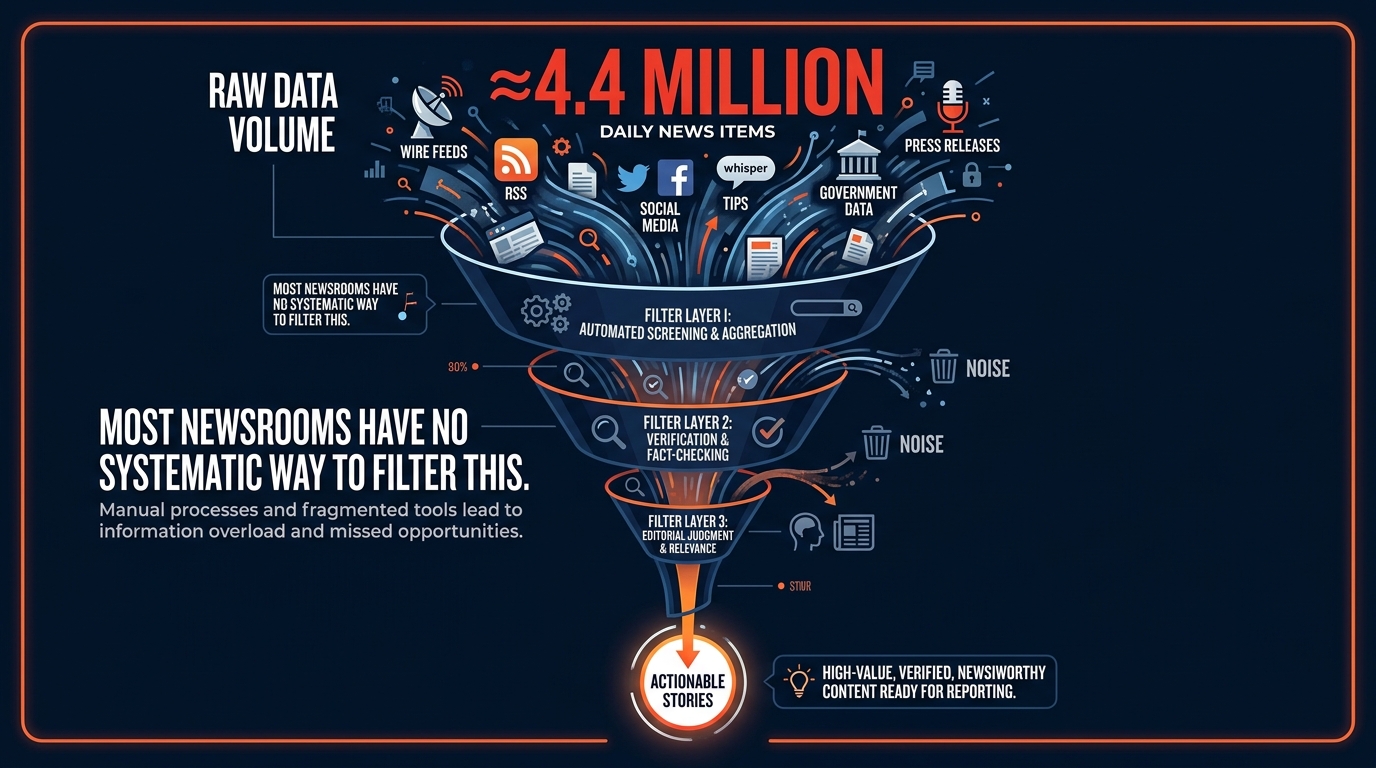
Every newsroom has the same problem. It just has different names for it. Some call it “the firehose.” Others call it “the noise problem.” Beat reporters call it “the reason I missed that story.” Editors call it “Thursday.” The fundamental challenge is this: the volume of incoming information that could be newsworthy is growing faster than any team’s capacity to evaluate it manually — and that gap is now large enough to constitute an existential operational risk for many organizations.
In 2026, a mid-size regional newsroom monitors anywhere from dozens to hundreds of wire feeds, social media streams, government data sources, press release wires, tip lines, and reader submissions simultaneously. A wire service like AP or Reuters processes thousands of items per day. A newsroom running social listening tools is ingesting signals from platforms generating hundreds of millions of posts per hour. The math is unworkable if the only filtering mechanism is a human sitting at a desk hitting refresh.
AI offers a way out — but not the way most newsrooms initially imagine. The instinct is to reach for a chatbot or an automated writer. The actual need is for a triage stack: a layered system that sits between the raw information flood and the editorial team, separating signal from noise, scoring urgency and relevance, routing items to the right people, and flagging anything that needs human verification before it moves further. Building it well is an operational engineering challenge as much as it is an editorial one.
This guide is for the newsrooms — and the editors, heads of product, and engineering leads inside them — who have moved past “should we use AI?” and landed on the harder question: “How do we architect this properly so it actually works at production speed without burning trust or missing the story that matters?”
We’re going layer by layer.
The Triage Problem Nobody Puts Numbers On
Before designing a solution, it helps to be precise about the actual problem — which most newsrooms aren’t. “There’s too much to keep up with” is not an operational specification. It’s a feeling. And building infrastructure around feelings produces architectures that feel good but don’t solve the right problem.
The triage problem in a modern newsroom has at least four distinct dimensions that each require different technical responses.
Volume: The Raw Intake Problem
Dataminr, one of the most widely deployed signal-detection platforms in journalism, ingests data from over one million public real-time sources and processes approximately 43 terabytes of raw data per day. That’s not the scale of a social platform — that’s the scale at which journalism’s inputs now operate. Roughly 1,500 newsrooms worldwide use Dataminr or similar tools to help surface signal from that volume, but most still lack any systematic layer between the tool’s outputs and the editorial team.
The AP feeds alone generate thousands of alerts, dispatches, and updates across a business day. Add in AFP, Reuters, PRNewswire, state government feeds, scanner audio, weather services, court record APIs, and your own tip inbox, and a newsroom of twenty journalists is looking at an intake volume that would have required a wire room of fifty in the pre-digital era.
Velocity: The Speed-Accuracy Tradeoff
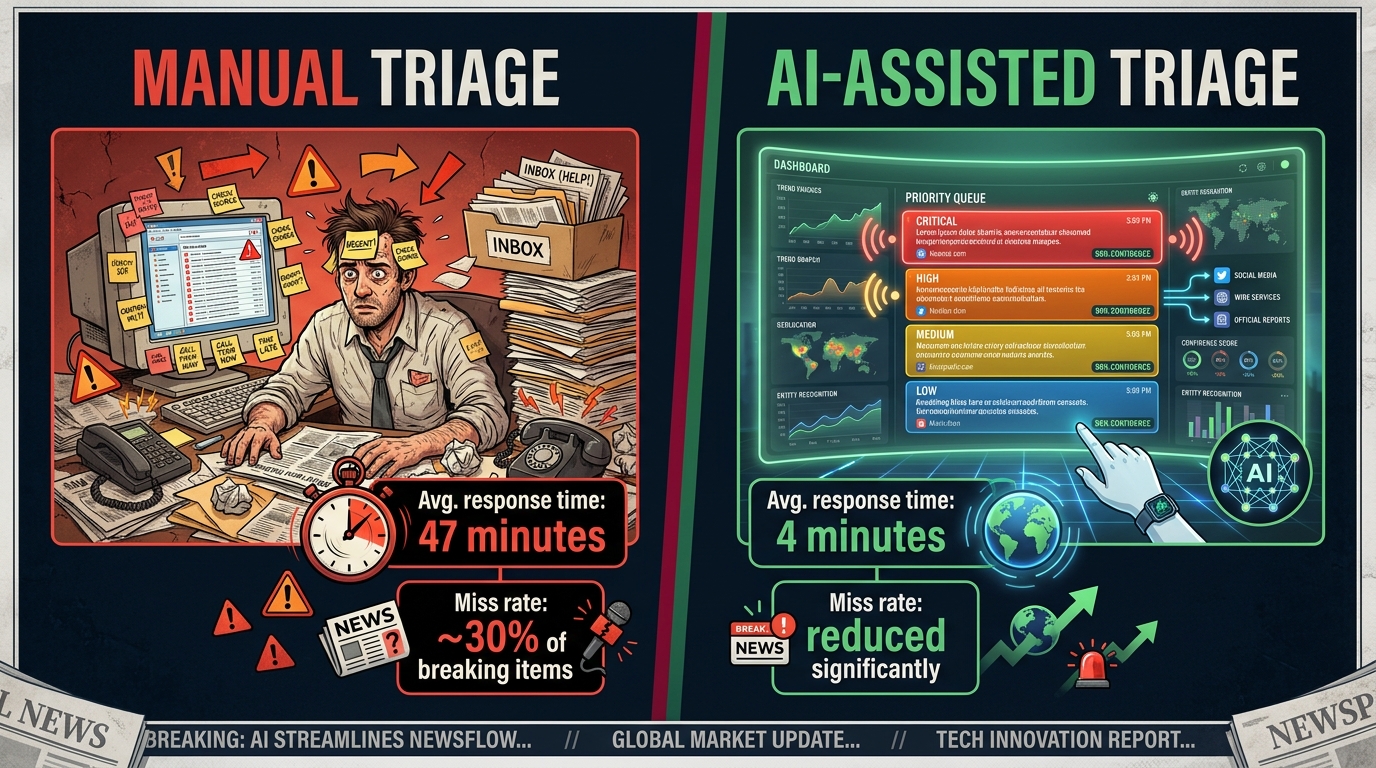
The second dimension of the problem is time pressure. Breaking news doesn’t wait for a thorough editorial evaluation. But publishing on a bad signal creates its own category of harm — corrections, credibility damage, and in extreme cases, direct public harm. The window between “signal arrives” and “editor needs to decide whether to act on it” is increasingly measured in minutes, not hours.
This creates the core triage tension: speed and accuracy are inversely related at the edges of performance. A triage system that prioritizes speed will surface false signals. One that prioritizes accuracy will be too slow. The architecture’s job is to narrow that tradeoff — to give editors high-confidence, quickly-surfaced signals that still carry enough metadata for fast human verification.
Relevance: The Coverage-Area Mismatch
Not all signals are relevant to all newsrooms. A wire alert about a municipal bond default in Louisiana is high priority for a Louisiana local newsroom and irrelevant noise for a Toronto-based technology publication. A triage stack that doesn’t account for editorial identity — the specific beats, geographies, audiences, and coverage mandates of a particular newsroom — produces a generic alert stream that editors quickly learn to ignore.
This is one of the central design failures in early-generation AI newsroom tools. They were built to be broadly useful rather than specifically relevant. The result was alert fatigue at scale: systems that cried wolf often enough that editors developed immunity to their outputs.
Quality: The Downstream Trust Problem
The fourth dimension is the hardest to quantify but the most consequential: when AI is part of the information pathway, its errors compound. A misclassified signal that gets routed to the wrong desk may sit unread. A signal with fabricated context that gets routed to the right desk may be acted upon. The Reuters Institute’s 2026 Journalism, Media and Technology Trends and Predictions survey found that while 44% of senior news leaders describe their AI initiatives as “promising,” 42% describe them as disappointing. The gap between those groups is largely explained by whether they built quality controls into the stack from the beginning — or bolted them on after something went wrong.
What a Triage Stack Actually Is (vs. What People Think It Is)
The term “AI newsroom triage stack” gets used in a lot of different ways, and the definitional sloppiness creates real confusion when teams go to build one. It’s worth being precise.
A triage stack is not an AI writer. It is not a chatbot that journalists query. It is not a recommendation engine for what to publish next. It is not a single tool, a single vendor, or a single model. It is not a replacement for editorial judgment.
A triage stack is a layered technical system that manages the intake and initial processing of incoming information signals. Its purpose is to answer four questions automatically and continuously:
- Is this worth looking at? (Relevance and urgency scoring)
- What is it? (Classification — topic, beat, geography, format, risk level)
- Who should see it? (Routing — desk assignment, journalist assignment, archive)
- How confident are we? (Verification confidence scoring — does this need a human check before action?)
Everything downstream of those four questions — whether to pursue the story, how to frame it, what to publish — remains fully in human editorial hands. The stack’s job is not to make editorial decisions. It is to make human editorial decisions possible at scale and speed without requiring humans to manually process every intake item.
The “Stack” Metaphor and Why It Matters
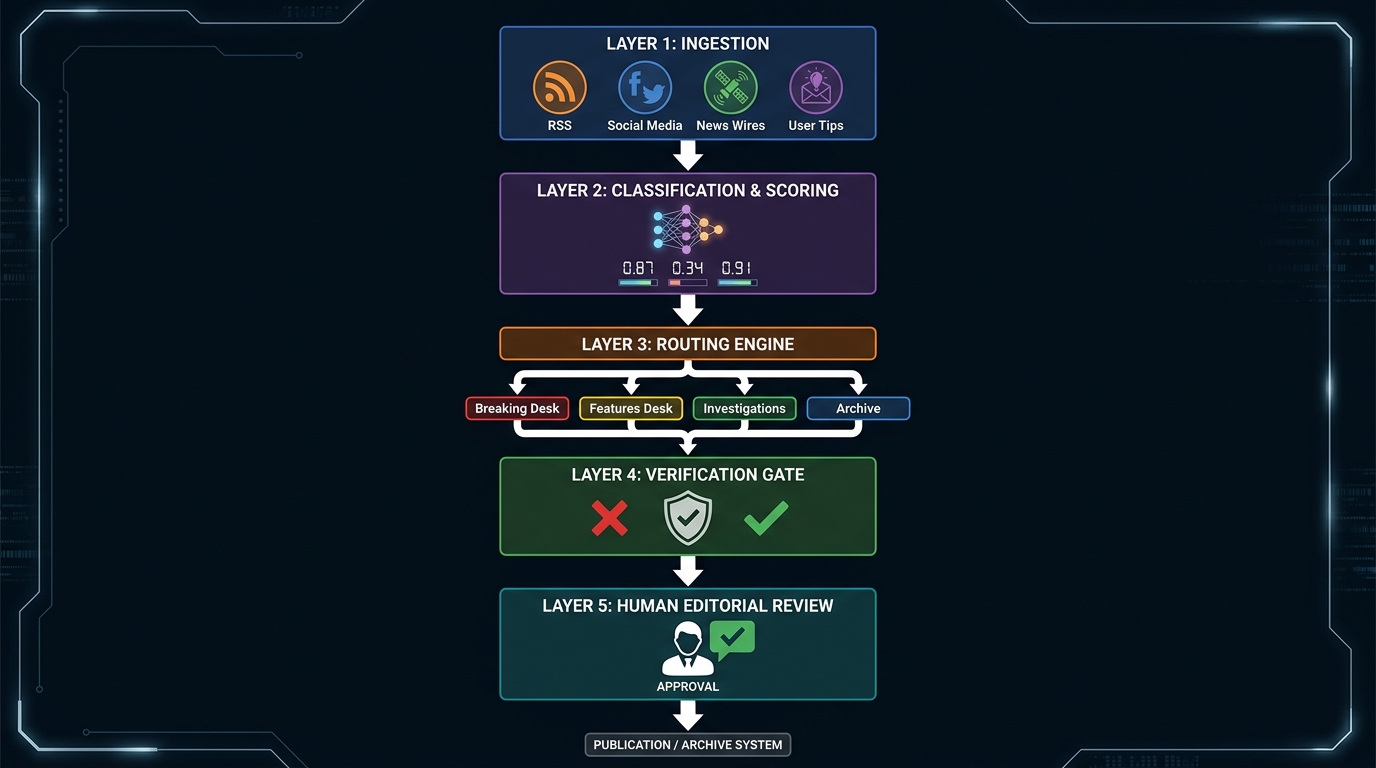
The word “stack” is intentional and important. Like a technology stack in software engineering, a newsroom triage stack is a set of layered components that each do a specific job and pass outputs to the next layer. You can swap out individual components without rebuilding the whole system. You can add layers without breaking what exists. You can test and measure each layer independently.
This is architecturally significant because it means the stack can grow with your organization’s capabilities. A newsroom just starting out might only build layers 1 and 2 — ingestion and basic classification. A more mature operation adds routing logic, then a verification gate, then feedback loops that improve model performance over time. The stack is a roadmap as much as it is a system.
The Reuters Institute’s 2026 survey data supports this layered approach. Among news leaders, 97% say back-end automation is important to their organization — but only a minority have fully deployed multi-layer systems. Most organizations have one or two functional layers and are working toward integration. Understanding the full architecture helps teams build intentionally toward it rather than accumulating disconnected tools.
Layer 1 — Ingestion: The Art of Getting Everything In
Every triage stack begins with an ingestion layer, and it’s the layer most organizations underinvest in. The temptation is to skip ahead to the interesting parts — the AI classification, the smart routing. But a triage stack built on an incomplete or poorly structured ingestion layer is like a fire department that only monitors some of the city’s smoke detectors. You won’t know what you’re missing until you miss it.
The Source Inventory Problem
The first job of ingestion design is defining the universe of sources your newsroom needs to monitor. This is harder than it sounds because it requires editorial input, not just engineering input. The list of sources that should flow into a newsroom’s triage system is a reflection of that newsroom’s coverage mandate — which means it needs to be defined by editors, not derived algorithmically.
A practical source inventory exercise looks something like this: start with your current beat structure and ask, for each beat, what are the authoritative real-time data sources that would generate a newsworthy signal? Wire services (Reuters, AP, AFP) are the obvious starting point. But a courts beat needs court filing systems. A local government beat needs council agenda monitors, public record APIs, and planning application feeds. An environment beat needs regulatory filing databases and emissions sensor networks. A breaking news desk needs scanner audio transcription, social media monitoring, and emergency services feeds.
The ingestion layer needs to accommodate all of these, which means handling a diverse set of formats: structured data (APIs, JSON feeds, XML), semi-structured data (RSS, email newsletters, PDF documents), and unstructured data (social media posts, audio transcriptions, tip line submissions).
Normalization: The Unglamorous Foundation
Every source delivers data differently. Wire services use industry-standard IPTC metadata schemas. Social platforms deliver flat JSON with platform-specific fields. Government data comes in Excel spreadsheets, PDFs, and occasionally fax-derived HTML. Tip line submissions are free-text email.
The normalization step transforms all of this into a unified internal schema before anything downstream tries to process it. At minimum, every normalized item in the system should carry: a source identifier, a timestamp, a raw content field, a geography tag (even if null), a content type, and an intake channel. This is not glamorous work, but every layer above it depends on it being done correctly and consistently.
A poorly normalized ingestion layer — one where some items arrive with rich metadata and others arrive as plain text strings — forces every downstream model to make assumptions about data it doesn’t have. Those assumptions accumulate into classification errors that are difficult to trace back to their root cause.
Rate Control and Deduplication
Two operational problems that surface quickly in production: burst rate handling and deduplication. Wire services do not send items at a steady rate. Major breaking news events generate surges that can be orders of magnitude above baseline volume — exactly the moment when your triage stack is most important and most likely to be overwhelmed.
The ingestion layer needs a queue architecture (typically a message queue like Kafka or a managed equivalent) that decouples intake speed from processing speed. Items arrive in the queue as fast as sources generate them; downstream layers process them at whatever rate they can sustain. During surges, the queue buffers the difference, ensuring nothing is dropped.
Deduplication is equally important. The same breaking news event will generate signals across multiple sources simultaneously. Without deduplication logic, the classification layer will process the same story five times and route five separate alerts to the same editor, which is both noisy and trust-eroding. Deduplication can be as simple as content fingerprinting (catching near-identical text from different wire sources) or as sophisticated as semantic clustering (identifying that different-language items are reporting on the same event).
Layer 2 — Classification and Scoring: Teaching the System What Matters
Once items are normalized and in the queue, the classification layer answers the question: “What is this, and how much does it matter?” This is where most of the AI-specific engineering work lives — and where most of the design decisions with the largest downstream consequences are made.
The Classification Schema
Classification without a clear schema produces outputs that are technically accurate and editorially useless. Before building any model, the newsroom needs a defined classification taxonomy — a structured set of labels that every item can be assigned to, which reflects how the newsroom actually organizes its work.
A typical classification schema for a general-interest newsroom includes at minimum: topic category (politics, business, crime, health, science, sports, etc.), geographic scope (local, regional, national, international), content type (breaking news, developing story, feature opportunity, data release, press release, reader tip), and audience relevance (scored against the newsroom’s specific coverage areas).
Some organizations add a “news value” dimension — an attempt to score items on traditional newsworthiness criteria like proximity, prominence, impact, and novelty. This is the hardest dimension to automate reliably, and there’s reasonable debate about whether it should be. News value judgments are where editorial identity lives, and automating them entirely risks producing a homogenized, algorithmically average definition of news that serves no particular audience well.
Model Architecture Choices
The classification layer typically combines two types of models. A fine-tuned language model (often a smaller, faster model rather than a frontier-scale LLM) handles the initial topic and content-type classification, operating on the normalized text of each item. These models can be trained on the newsroom’s own historical coverage decisions — “stories we published” vs. “stories we didn’t” — which produces classification that reflects the organization’s specific editorial identity rather than a generic definition of news.
Above that sits an LLM enrichment step for items that score above a relevance threshold. Rather than running every single item through an expensive frontier model, the architecture uses the fast classifier to filter first, then applies LLM reasoning only to items that have already been identified as potentially significant. This LLM step generates a structured summary, extracts entities (people, organizations, locations, dates), and produces a context note — essentially a first-pass briefing that an editor can scan in seconds rather than reading the full source item.
Urgency Scoring: The Time Dimension
Classification tells you what something is. Urgency scoring tells you how fast you need to act on it. These are different dimensions that require different model logic.
Urgency scoring draws on signals like: the rate at which other sources are picking up the same event (velocity), the severity of the event type (a natural disaster ranks higher urgency than a quarterly earnings release), the time sensitivity of the content (court filing deadlines, election results), and whether the item updates or contradicts something already in the system (a correction to a story already in progress is urgent regardless of topic).
The output of the scoring step is a composite number — typically a 0-1 score — that the routing layer uses to determine what happens next. Items above 0.8 get flagged as “breaking” and routed immediately to the on-duty breaking desk with a push notification. Items between 0.5 and 0.8 go into the standard priority queue. Items below 0.5 are either archived for context or routed to a slow queue for batch review at the daily editorial meeting.
Layer 3 — Routing Logic: Getting the Right Story to the Right Person
Routing is where the triage stack interfaces directly with how the newsroom is organized, which makes it simultaneously the most valuable layer and the most organizationally complex one to build. An item with a perfect classification and a correct urgency score still produces no value if it lands in the wrong inbox.
Routing Rules vs. Routing Models
The routing layer can be implemented as rule-based logic, model-based logic, or a hybrid — and the choice matters for different organizations at different stages of maturity.
Rule-based routing is deterministic and auditable. “If topic = crime AND geography = [our coverage area] AND urgency > 0.7, route to breaking desk.” Rules are easy to explain to editors, easy to modify, and easy to debug when they produce the wrong output. They’re also brittle: a crime story that is actually a political story about police accountability may route incorrectly. Rules don’t handle edge cases or nuance.
Model-based routing uses learned routing decisions — typically trained on historical assignment data showing which desk handled which type of story — to handle the ambiguous cases that rules miss. Models generalize better across edge cases but are harder to inspect. When a model routes something to the wrong desk, it’s not always clear why.
The practical recommendation for most newsrooms is a hybrid: deterministic rules for the high-confidence, clearly-defined cases (which represent the majority of volume), and model-based routing for the ambiguous items that rules can’t classify cleanly. This keeps most of the routing logic transparent and explainable while using model capability where it actually adds value.
Availability State and Capacity Awareness
A routing system that ignores the real-world availability of the humans it’s routing to is a routing system that creates bottlenecks. If the breaking desk already has three active stories in progress and the system routes a fourth item there, the fourth item may not get the attention it needs.
More sophisticated routing implementations integrate with the newsroom’s assignment desk or project management system to maintain a real-time picture of capacity. A journalist flagged as “on deadline” doesn’t receive new assignments. A desk with high queue depth triggers an escalation to the senior editor for re-allocation. AP’s Local News AI initiative has documented pilots like WFMZ-TV’s incoming tips sorter, where AI-assisted routing matched tip type to available reporter capacity rather than defaulting to a single tips inbox — a design that meaningfully reduced time from tip receipt to reporter assignment.
Soft Routing: Context Delivery
Routing an item to a desk is necessary but not sufficient. The item also needs to arrive with the context that enables fast editorial evaluation. This is what differentiates a triage stack from a sophisticated alert system.
Every routed item should arrive at the desk with a structured package: the source item, the LLM-generated summary from the classification layer, the entity extraction (who is involved, where, what organization), the urgency score and rationale, any prior coverage from the newsroom’s archive on the same entities or topic, and a confidence indicator showing how sure the system is about its classification and routing decision. The editor opening this package should be able to make an initial “pursue or pass” decision in under thirty seconds without reading the raw source material.
Layer 4 — The Verification Gate: Zero-Trust for Editorial Signals
Here is where many triage stacks fail silently. The verification layer is the piece that separates a responsible AI-assisted newsroom from an organization that has simply automated the ways it can get things wrong faster.
What the Verification Gate Checks
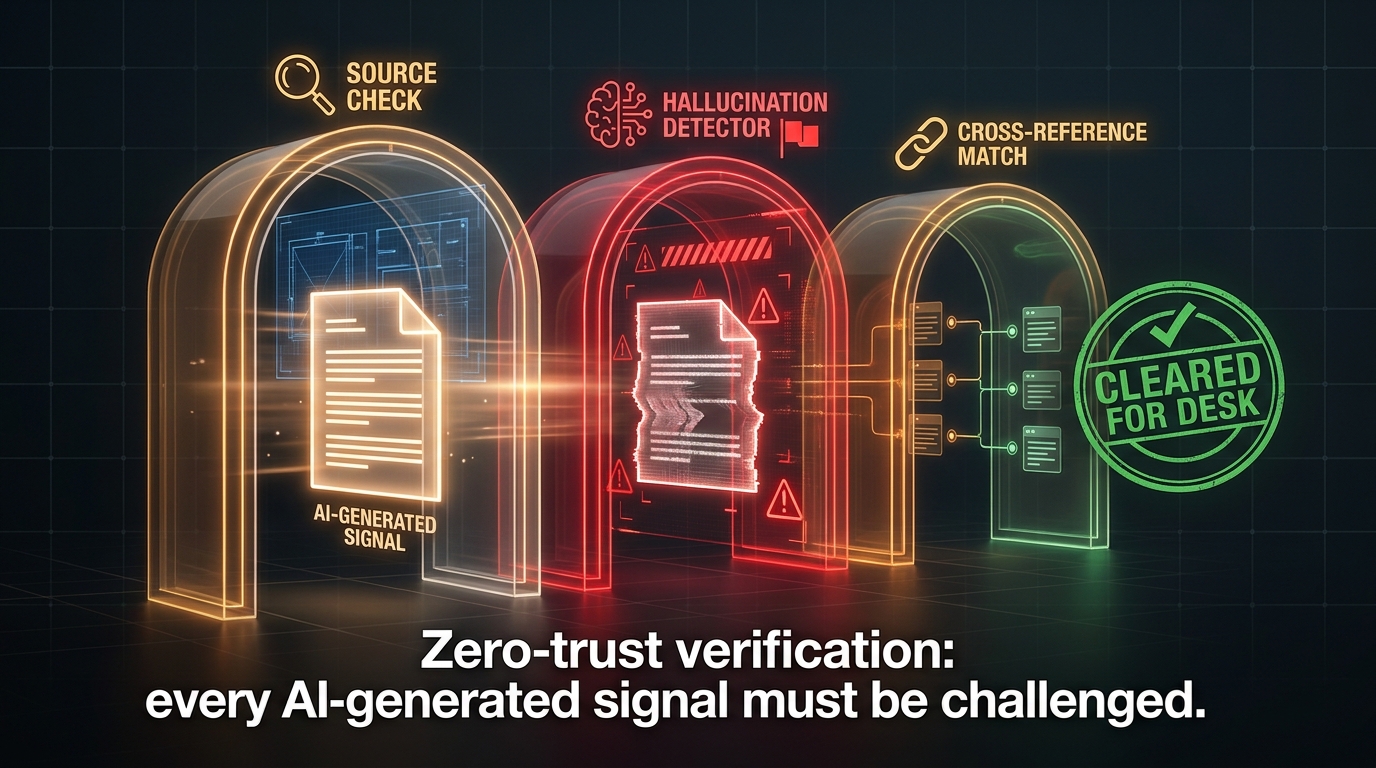
The zero-trust principle, borrowed from cybersecurity architecture, states that no signal should be trusted by default, regardless of its source. In the context of a newsroom triage stack, this means: even if a signal came from a reliable wire service and was classified with high confidence, the verification layer still runs a set of checks before the item is cleared for editorial action.
These checks fall into several categories:
Source provenance verification. Is this item from the source it claims to be from? Wire feed spoofing and cloned feed injection attacks are real threats in an environment where newsrooms are ingesting hundreds of sources automatically. The verification layer should validate source authentication against a whitelist, flag items from sources that haven’t been explicitly approved, and alert on anomalous patterns from known sources (sudden volume spikes, unusual metadata, content that doesn’t match the source’s known editorial patterns).
Hallucination detection in LLM-generated summaries. Any item that passed through an LLM enrichment step in the classification layer has a non-trivial probability of containing fabricated details, invented quotes, or incorrect entity associations. Magid’s AccuracyCheck, which launched in 2026 as the first hallucination detector built specifically for newsroom workflows, operates on this principle — flagging content transformations where LLM outputs diverge from the source material in ways that could be factually harmful. Equivalent verification logic needs to be built into any triage stack that uses LLMs for enrichment.
Cross-reference matching. Does this item conflict with existing, verified information already in the newsroom’s knowledge base? A breaking alert claiming a particular public figure made a statement that directly contradicts verified reporting from three hours ago should not route to the desk as a clean signal — it should route as a “potential conflict, verify before acting.”
Deepfake and synthetic media flagging. For triage stacks that ingest social media content, image and video verification has become a non-optional layer in 2026. The Reuters Institute’s 2026 trends survey specifically flagged “AI slop, deepfakes, and misinformation” as a tier-one concern for news leaders. Any item arriving with associated media from social sources should pass through a synthetic media detection check before the media is treated as documentary evidence of the event.
Confidence Scores and Escalation Thresholds
The verification gate’s output is not a binary pass/fail. It produces a confidence score for each check, and the combination of those scores determines the escalation threshold. Items that pass all checks with high confidence move to the routing layer with minimal friction. Items that trigger any check below the confidence threshold are flagged for mandatory human verification before any editorial action can be taken.
Setting these thresholds is an editorial policy decision, not an engineering decision. The engineering team can build the threshold mechanism; the editor-in-chief (or their designated editorial standards lead) defines what confidence levels are acceptable for different content types. Breaking news from a trusted wire source under verified authentication might proceed with a lower cross-reference confidence threshold. UGC content from social media should have much higher verification requirements before editorial action.
Layer 5 — Human Escalation and Override Design
The triage stack’s job is to reduce the volume of items that require human attention, not to eliminate human judgment from the process. Layer 5 is not an afterthought — it is a designed interface between the automated system and the editorial team, and its design quality determines whether editors treat the system as a trusted tool or learn to work around it.
The Escalation Interface
Every item that reaches human review should arrive in a priority-ordered queue with a consistent structure. Editors should never have to guess why something was escalated or what action is being requested of them. The interface design should make the required decision explicit: “Do you want to assign this to a reporter?” “Is this story still developing — flag for follow-up?” “Should this be discarded?” Each action option should take one click or keystroke.
The escalation interface also needs a feedback mechanism that flows back into the stack. When an editor discards an item that the system flagged as high priority, that is a training signal. When an editor assigns a story that the system scored as low relevance, that is a training signal in the other direction. These feedback loops are what allow the stack to improve over time — and they only work if the interface makes providing feedback fast enough that editors actually do it during normal workflow rather than treating it as an additional burden.
Override Logic: When Humans Rewrite the Rules
Breaking news is by definition unpredictable. A triage stack built only on historical patterns will systematically undervalue truly novel events — the first occurrence of a new type of crisis, an unexpected development in a dormant story, a signal category the system has never seen before. These are precisely the stories where editorial judgment is most valuable and where algorithmic confidence is lowest.
The override design allows editors to escalate any item — regardless of system score — to urgent status, to manually route items the system misclassified, and to trigger a “newsroom state change” that modifies global routing and scoring behavior for a defined period. When a major breaking story is confirmed, the editor activating this mode signals to the entire stack that routing priorities should shift: all items related to this topic should now escalate immediately, items about other topics can buffer longer, and the verification gate should apply the highest-stringency checks to any new claims about the developing event.
The 75% Threshold and Why It Matters
The Reuters Institute’s 2026 survey found that 75% of senior news leaders expect “agentic tools” — autonomous AI systems that monitor, summarize, and propose actions — to have a large impact on their organizations. This is an important number, but it needs to be read carefully. Expectation of impact is not the same as confirmation that autonomous operation is desirable. The most successful triage stack implementations in 2026 are those that use agentic AI to dramatically reduce what humans need to review, while maintaining clear human authority over every item that moves past the system into editorial action.
The goal is not a fully autonomous newsroom. It is a newsroom where human attention is concentrated on the decisions that actually require human judgment, rather than diluted across thousands of intake items that could have been processed automatically.
Tooling Decisions: Build, Buy, or Integrate?
One of the most common questions newsroom leaders face when designing a triage stack is whether to build custom components, purchase vendor solutions, or integrate existing tools into a coherent architecture. The honest answer is that most organizations will do all three — but the right mix depends on where editorial differentiation lives.
What to Buy
The ingestion and signal-detection layer is generally where vendor solutions provide the best ROI. Tools like Dataminr (used in over 1,500 newsrooms), Google News Initiative’s real-time monitoring tools, and various social listening platforms have built ingestion infrastructure at a scale that no individual newsroom could replicate cost-effectively. Buying these capabilities at the ingestion layer makes sense — the signal-detection problem is not where editorial differentiation lives.
Verification tools are also increasingly available as purchasable components. Magid’s AccuracyCheck offers hallucination detection purpose-built for journalism. Deepfake detection is available through several vendors as an API. Source authentication can be handled through established content authentication protocols like C2PA, which major news organizations have already adopted for their own content production.
What to Build
The classification schema and routing logic are where newsrooms should invest in custom builds. These layers encode editorial identity — what stories your newsroom covers, how it defines newsworthiness, which desks exist, and how they’re organized. A vendor’s out-of-the-box routing solution will be built around a generic definition of newsroom structure that likely doesn’t match yours.
The feedback loop mechanism — the system that captures editorial decisions and flows them back into model training — is almost always a custom build. It needs to integrate with your specific editorial workflow tools, your publishing system, your assignment desk software. This integration surface is different for every organization.
What to Integrate
The LLM enrichment step in the classification layer is typically handled through API integration with a frontier model provider. OpenAI, Anthropic, Google, and others offer APIs suitable for this use case. The architecture should abstract this integration behind an interface that allows swapping providers without rebuilding the rest of the stack — a principle that’s become increasingly important as the LLM market continues to evolve and pricing structures change.
Arc XP (now one of the dominant content management platforms in news) has built AI integration points into its editorial workflow that several newsrooms are using as the interface layer between their triage stack outputs and their publishing systems. For organizations already running Arc, this is the integration path of least resistance.
Measuring Your Stack: The Metrics That Actually Matter
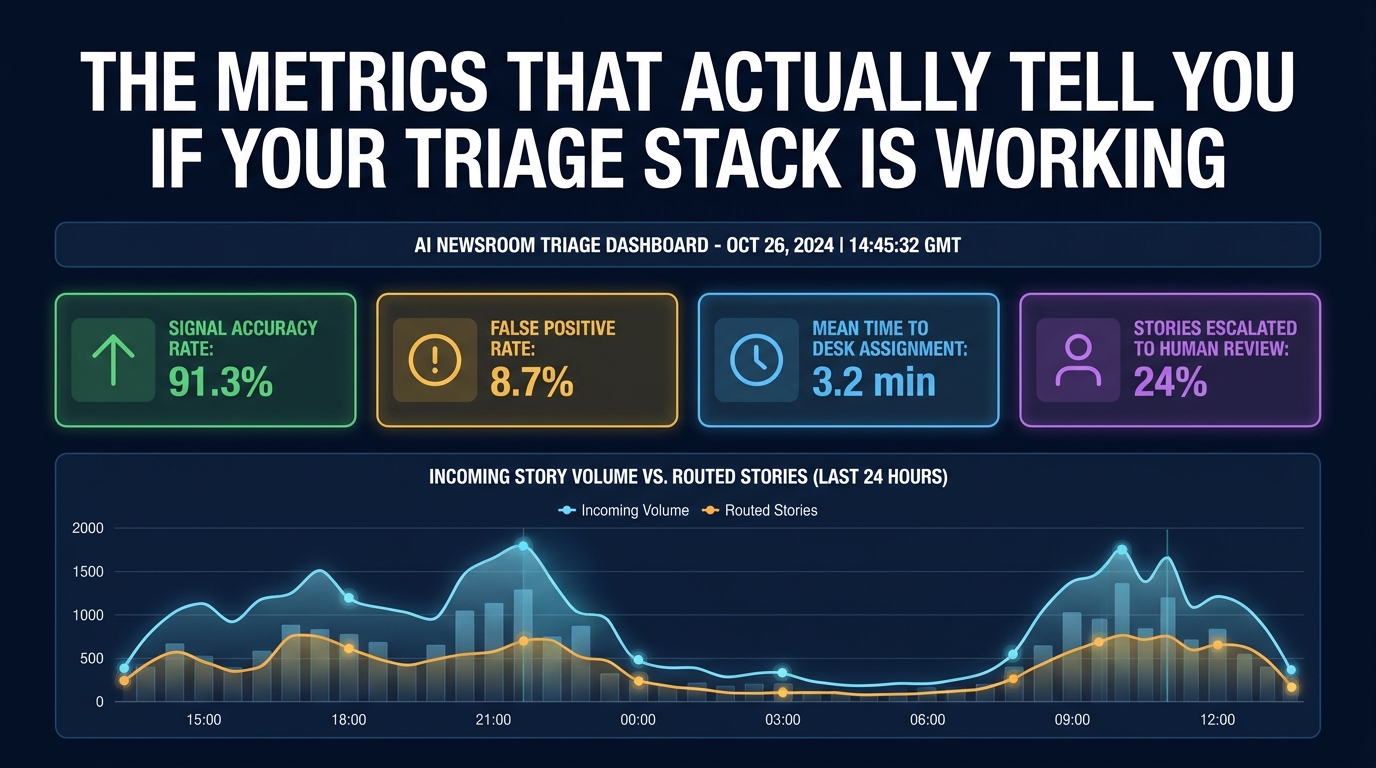
A triage stack that isn’t measured isn’t managed. Most organizations that have deployed early AI newsroom tools have no formal measurement framework — which means they have no way to know whether the system is improving, degrading, or drifting away from editorial intent over time. The metrics framework below addresses the four performance dimensions of a triage stack: throughput, accuracy, speed, and editorial alignment.
Throughput Metrics
Intake volume by source. How many items per day flow through each ingestion source? This baseline metric identifies when sources are unexpectedly quiet (possible feed failure) or unusually noisy (possible data quality issue).
Escalation rate. What percentage of intake items are escalated to human review rather than auto-processed or archived? A healthy escalation rate depends on the newsroom’s capacity and mandate, but most organizations target somewhere between 15-30%. If it drifts higher, the system is generating too much work for humans. If it drifts lower, the system may be incorrectly discarding items that should reach editors.
Editor action rate on escalated items. Of items that reach human review, what percentage result in editorial action (assignment, follow-up, publication)? This metric measures the relevance of the escalation layer. If editors are regularly discarding items the system escalated as high priority, the classification model needs retraining.
Accuracy Metrics
Classification accuracy. Measured against a human-labeled test set, how accurately does the classification layer assign topic, geography, and content type? Target accuracy benchmarks will vary by category — geography classification is typically simpler than news value scoring — but any classification error rate above roughly 10-15% for primary categories creates meaningful routing problems downstream.
False positive rate in verification. What percentage of items flagged by the verification gate as requiring human review turn out to be clean signals? A false positive rate above 20-30% in the verification layer degrades editor trust in the gate’s outputs — editors stop taking the flags seriously and start bypassing verification review, which defeats the gate’s entire purpose.
Miss rate. The hardest metric to measure and the most important. How often does the system fail to surface a story that human review (in a post-hoc audit) would have identified as significant? This requires periodic retrospective auditing: reviewing items the system archived or scored as low relevance to check whether any significant stories were missed. Even a monthly audit of a random sample provides valuable signal about model degradation.
Speed Metrics
Mean time from intake to desk assignment. The elapsed time between an item entering the ingestion queue and arriving at a journalist’s or editor’s queue. This is the metric that directly captures the speed value of the triage stack relative to manual processing.
Breaking news response latency. Specifically for high-urgency items, how long between item arrival and editor notification? This metric should be tracked separately from general throughput speed because it reflects the performance of the system under the conditions where it matters most.
Editorial Alignment Metrics
Coverage area match rate. What percentage of items routed to a given desk actually fall within that desk’s defined coverage mandate? High match rates indicate the routing logic is accurately reflecting editorial structure. Low match rates indicate routing model drift.
Feedback loop utilization rate. What percentage of escalated items receive explicit editor feedback (action taken, dismissed, re-routed)? Low utilization means the feedback mechanism isn’t being used, which means the model isn’t improving from editorial signal. This is often a UI problem — the interface for providing feedback is too slow or disruptive to use in normal workflow.
The Governance Layer: Where Editorial Policy Meets Engineering
The governance layer is not a technical component of the triage stack. It is the organizational framework that defines how the stack is allowed to operate — what decisions it can make autonomously, what decisions require human approval, and who is accountable when things go wrong. Most newsroom triage failures in 2026 trace back not to technical errors but to governance gaps.
The Accountability Question
When a triage stack misclassifies a signal, routes an unverified claim to the wrong desk, and that claim gets published before a human catches the error, who is accountable? The engineering team that built the classifier? The editor who didn’t read the verification flag? The news director who approved the stack’s deployment without defining escalation protocols? This question needs to be answered before the stack is deployed, not after the incident.
Most mature implementations adopt a clear principle: the stack produces recommendations; humans make decisions. Under this framework, any editorial failure that results in publication is accountable to the human in the chain who approved the action, regardless of the AI inputs that led to that decision. This preserves editorial accountability structures while still allowing the system to operate with genuine autonomy at the triage level.
Model Governance: Version Control and Audit Trails
Every model deployed in the stack — classifiers, routing models, LLM enrichment calls — should be under version control with documented deployment logs. When a model is updated or retrained, the change should be recorded, tested against a held-out editorial test set, and approved by both the engineering lead and an editorial representative before deployment. This is not optional overhead; it is the mechanism that allows the organization to trace classification changes back to specific model updates when auditing for miss rates or false positive spikes.
The audit trail is also necessary for regulatory compliance in jurisdictions where AI-assisted editorial decisions are subject to transparency requirements — a legal landscape that is evolving rapidly in 2026 across the EU, UK, and several US states.
The Editorial Policy Document
The governance layer requires a written editorial policy that defines: which intake sources are approved for automated processing; which content types require mandatory human verification before editorial action; what the escalation thresholds are for different urgency levels; how overrides work; and how the organization discloses AI assistance in its editorial process to its audience. This document is a living artifact — it should be reviewed quarterly as the stack evolves — and it should be jointly owned by editorial leadership and the engineering or product team, not authored unilaterally by either.
The Reuters Institute’s 2026 survey found that newsrooms with explicit written AI governance policies were significantly more likely to describe their AI initiatives as “promising” rather than “disappointing.” The document itself isn’t the solution, but writing it forces the organizational clarity that makes coherent implementation possible.
Common Stack Failure Modes (and How to Avoid Them)
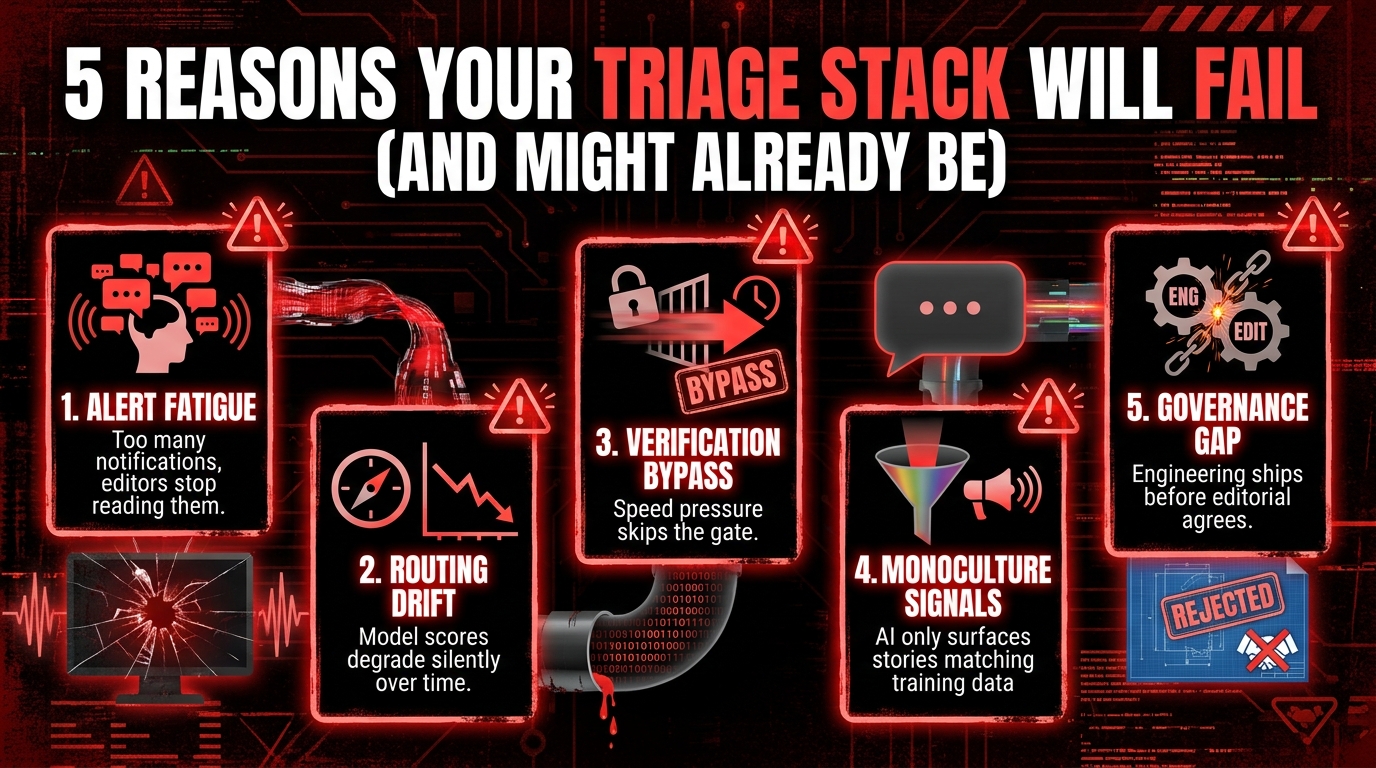
The failure modes of AI newsroom triage stacks fall into a small number of recognizable patterns. Understanding them before you build is significantly cheaper than discovering them after you’ve deployed.
Alert Fatigue: The Death of Trust
Alert fatigue is the failure mode that kills more triage stacks than any technical problem. It happens when the system surfaces too many items to the human review layer — either because the relevance thresholds are set too low, because the classification model is underperforming, or because the escalation rate metric isn’t being monitored. Editors who receive fifty “priority” alerts per day and find that fewer than ten of them were worth acting on will, within weeks, stop treating any of them as priority. At that point, the stack has become noise on top of noise.
The countermeasure is ruthless calibration of escalation thresholds during initial deployment. Start with the threshold set high — only escalate items with very high urgency and relevance scores — and lower it gradually as you gather data on editor action rates. It is far better to miss some stories in the first weeks of operation and build editor confidence in what does surface than to flood the queue and train editors to ignore it.
Routing Drift: The Silent Degradation
Classification models degrade over time as the news environment evolves. A routing model trained on six months of historical assignment data from early 2026 will have learned patterns that reflect the news topics of that period. As story types, coverage priorities, and desk structures change, the model’s routing decisions drift away from current editorial intent without any obvious failure — items still get routed, they just increasingly go to the wrong place.
The countermeasure is scheduled retraining and the coverage area match rate metric described earlier. Set a calendar trigger for quarterly model review and use the match rate data to identify which routing categories are drifting before the drift becomes operationally significant.
Verification Bypass: The Speed Trap
During breaking news events, when editorial speed pressure is highest and the triage stack is working hardest, the verification layer is most likely to be bypassed. Editors under pressure to publish before a competitor can rationalize skipping the verification gate for items that “look right.” This is exactly backward — high-speed, high-stakes events are when verification is most important, because errors published under breaking news conditions spread fastest and are hardest to correct.
The countermeasure is both technical and cultural. Technically, the highest-urgency items should trigger the most stringent verification checks automatically, with UI-level friction that makes bypassing the gate a deliberate, logged action rather than a passive omission. Culturally, editorial leadership needs to establish clearly that publication speed is never a justification for bypassing verification — and that the stack is designed to provide verified signals fast enough that the speed argument doesn’t hold.
Monoculture Signals: The Training Data Problem
If the triage stack is trained primarily on a newsroom’s own historical coverage decisions, it will learn to surface stories that resemble stories you’ve already covered. This is appropriate for core beat coverage. It is actively harmful for identifying emerging stories, underrepresented communities, or novel event types that fall outside historical patterns.
The countermeasure is diversity in training signal. Supplement internal historical data with editorial input on coverage areas the newsroom wants to develop, not just maintain. Explicitly weight the classification schema to include signals from sources that serve audiences not well represented in existing coverage. Build a periodic “cold start” review that surfaces items the system scored below escalation threshold to human review — a random sample process that can catch patterns the model has been systematically missing.
The Governance Gap: When Engineering Ships Without Editorial
The most damaging failure mode is organizational rather than technical: a triage stack built and deployed by an engineering or product team without genuine joint ownership from editorial leadership. When this happens, the system reflects engineering assumptions about news value and editorial workflow that may not match how the newsroom actually operates. Editors encounter a system that routes items to the wrong people, uses classification categories that don’t match their mental model, and generates verification flags for things they consider obvious while passing things they would have caught. Trust evaporates quickly.
The countermeasure is co-design from the start. The classification schema, routing rules, verification thresholds, and escalation interface should all be co-designed by an engineering lead and an editorial representative working in genuine partnership. The editorial representative isn’t a stakeholder who reviews deliverables — they are an owner of the system’s editorial logic, with authority to change it.
The Stack Is Not the Strategy: A Closing Argument
It’s worth ending with a counterintuitive note. A well-built AI triage stack will make your newsroom significantly more operationally capable. It will reduce the volume of items that require human attention, improve the speed at which significant signals reach editors, and produce structured context that enables faster, better-informed editorial decisions. These are meaningful gains.
But a triage stack does not tell you what to do with the signals it surfaces. It does not replace editorial judgment about newsworthiness. It does not resolve questions about coverage priorities, resource allocation, or editorial identity. And it does not substitute for the relationships — with sources, communities, and audiences — that produce the stories that matter most and that no automated system will ever reliably surface from a wire feed.
The 42% of news leaders in the Reuters Institute’s 2026 survey who describe their AI initiatives as disappointing are not, for the most part, dealing with technical failures. They are dealing with the gap between what the technology can do and what the organization hoped it would do. A triage stack reduces the operational burden of intake. It does not resolve the deeper question of what a newsroom is for, who it serves, and why those people should trust it.
That question remains entirely human. The stack just creates the conditions in which humans have more time to answer it well.
Actionable Takeaways
- Start with a source inventory. Before writing a single line of code, map every source your newsroom should be monitoring. Have an editor drive this exercise, not an engineer.
- Build the classification schema before the model. The taxonomy of topics, geographies, content types, and urgency levels you define will shape everything downstream. Get editorial buy-in on this schema before building anything that depends on it.
- Set escalation thresholds conservatively and adjust upward. It is easier to earn editor trust by surfacing fewer but more relevant items than to rebuild trust after alert fatigue sets in.
- Treat the verification gate as non-negotiable. Every LLM enrichment output should pass through a hallucination detection check before it reaches an editor. This is not optional overhead — it is the mechanism that keeps AI-generated context from becoming a source of errors rather than a source of speed.
- Instrument your stack from day one. False positive rate, escalation rate, editor action rate, and mean time to desk assignment should all be tracked in a dashboard that both engineering and editorial leadership can see. Measurement drives improvement; absence of measurement drives drift.
- Write the governance policy before you launch. The document that defines what the stack can do autonomously, what requires human approval, and who is accountable for editorial failures is easier to write before deployment than to retrofit after an incident.
- Plan for model retraining from day one. The classification model you ship on launch day will need to be retrained within three to six months as the news environment and your coverage priorities evolve. Budget for this operationally before you start, not as an afterthought when performance starts to drift.