There is a version of Sponsored Brands Video that most Amazon advertisers are still running. It goes like this: pick your best-performing keywords from Sponsored Products, duplicate them into an SBV campaign, set a bid, point it at the product detail page, and hope the video does something useful. Measure it on ACoS. Shrug when the ACoS looks high. Pause. Repeat.
That approach was never particularly strategic. In 2026, it is actively limiting. The reason isn’t that SBV has gotten more competitive — though it has. It’s that the underlying targeting infrastructure has changed in ways that reward a fundamentally different way of thinking about campaigns.
Amazon has quietly expanded what SBV can do: product detail page targeting is now a primary placement type, not an afterthought. Theme-based AI matching has reduced reliance on exhaustive keyword lists. Amazon Marketing Cloud has moved from a reporting novelty to a genuine audience-activation layer. And audience bid modifiers — including a +900% ceiling for specific shopper segments — have made campaign segmentation far more consequential than it used to be.
Put those pieces together and what you get is a system that is explicitly designed to reward advertisers who think about who they are reaching before they think about what keywords they are bidding on. That’s what persona-first SBV means in practice. This article breaks down what changed, why the keyword-first default no longer works, and how to rebuild your SBV campaigns around buyer types rather than match types.
The Problem With Running SBV Like a Keyword Campaign
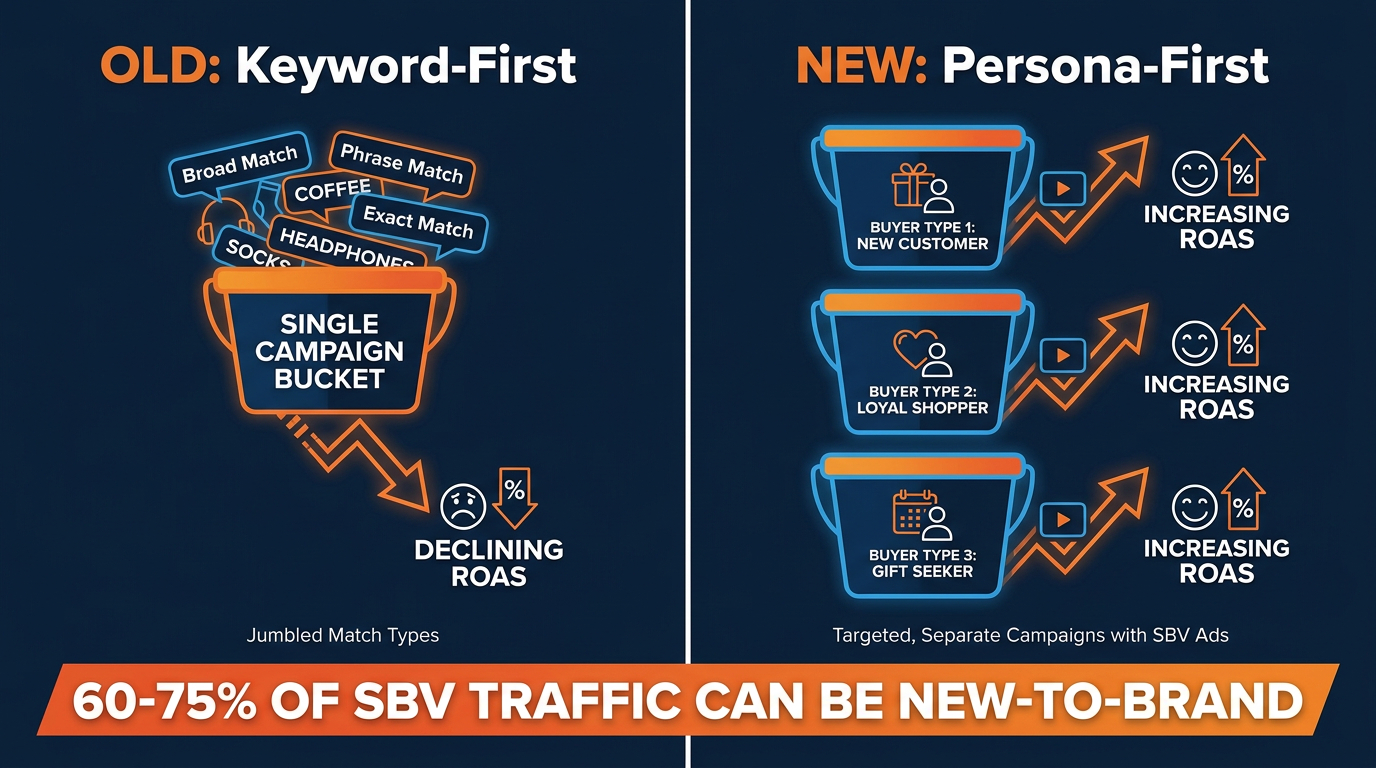
The original logic of running SBV from a keyword list made sense when SBV was simply a richer version of a static Sponsored Brands banner. You had the same targeting levers, the same match types, the same search-result placement logic. The video was the creative upgrade; the keyword strategy stayed the same.
The problem is that this created a structural mismatch between the ad format and the strategy behind it. Video is a mid-funnel, awareness-building format. Keywords — especially the high-intent, close-in keywords that perform best in Sponsored Products — are a bottom-of-funnel tool. When you run a discovery-oriented format against a conversion-oriented keyword set, you either pay too much to reach buyers who were going to find you anyway, or you reach genuinely new audiences without any mechanism to handle them differently.
The ACoS Trap
Measuring SBV on ACoS compounds this problem. ACoS is a direct-response metric. It divides ad spend by attributed revenue and produces a number that tells you nothing about what SBV actually does well — which is introducing your brand to shoppers who have never bought from you, influencing consideration during a multi-session research process, and building the kind of brand recall that eventually shows up as organic search volume for your brand name.
Brands that measure SBV on ACoS will almost always find it underperforms relative to Sponsored Products. That comparison is essentially meaningless. It’s like measuring a trade show booth by how many sales happened at the booth itself, rather than how many leads walked out the door and converted over the following weeks.
This is why new-to-brand rate has become the leading KPI for sophisticated SBV advertisers. Industry data puts SBV NTB rates between 60% and 75% for many categories — meaning the majority of SBV-attributed orders are coming from shoppers who had never purchased from that brand on Amazon before. That’s the metric that tells you whether SBV is doing its actual job.
Why Keyword Lists Can’t Capture Buying Stages
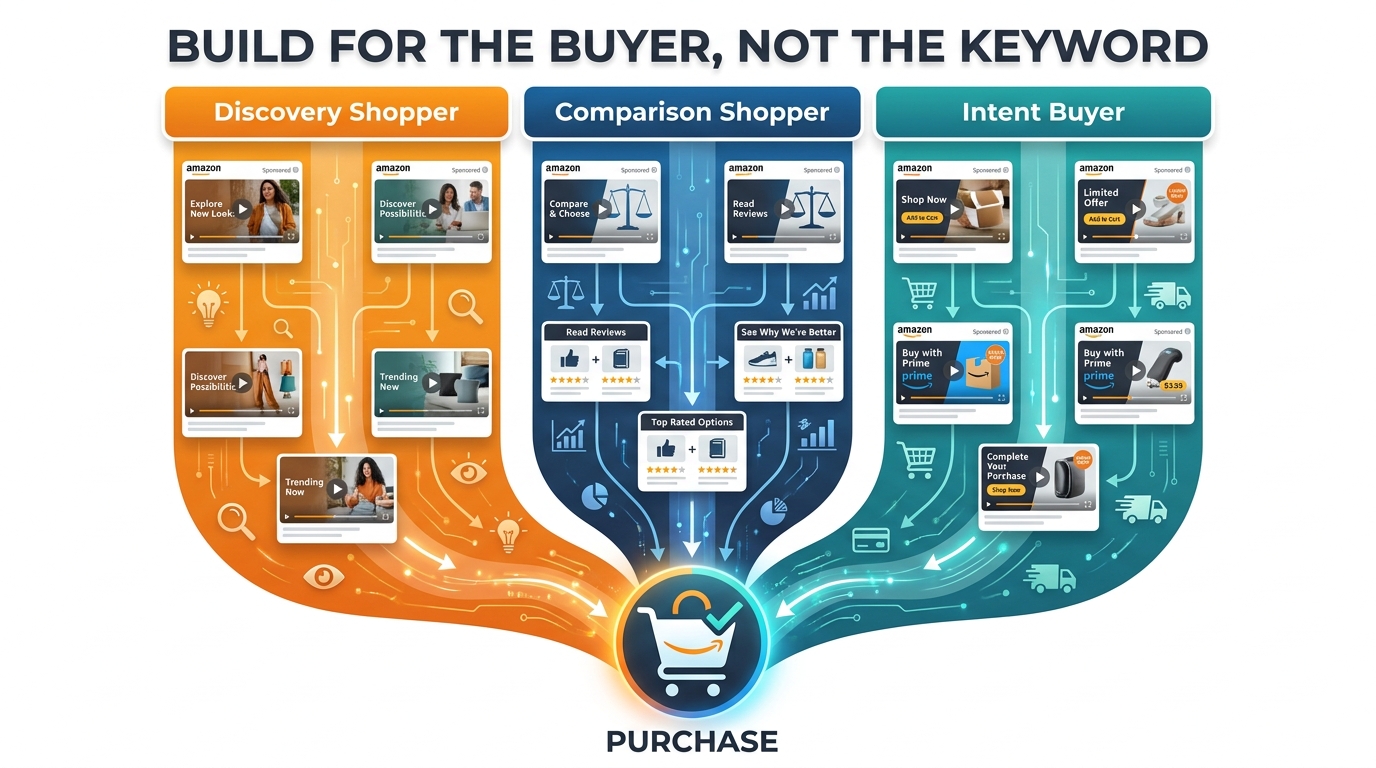
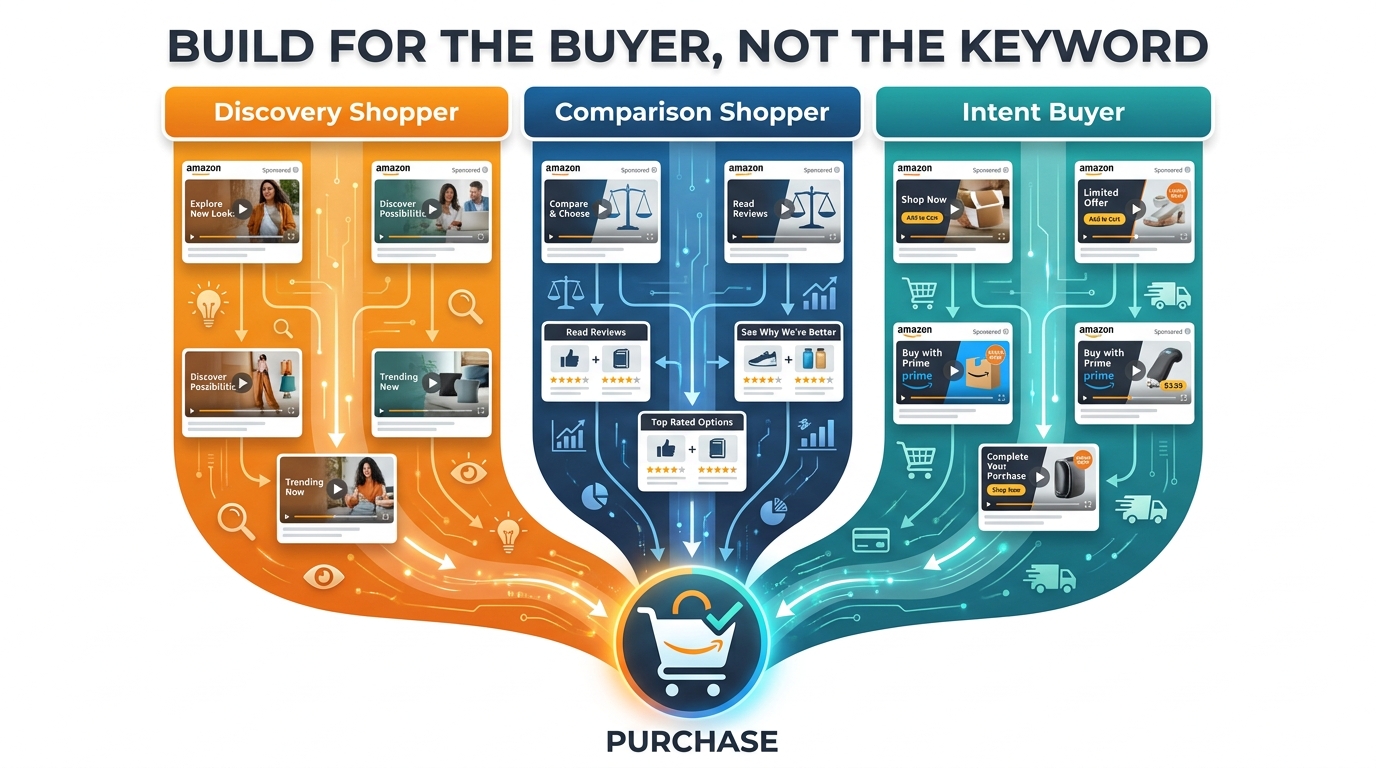
A keyword like “wireless earbuds” tells you a shopper searched for a category. It tells you almost nothing about where they are in the purchase journey. Are they browsing options for the first time? Comparing three shortlisted products? Ready to buy but checking price? All three shoppers might type the same query, but they need very different messages, and they represent very different economic value to your campaign.
A keyword-first campaign treats all three the same. A persona-first campaign structures around the reality that these are three distinct audiences who should be reached with different creative angles, different bidding logic, and different downstream measurement.
This is the foundational shift. Keywords become inputs to persona buckets — not the organizing principle of the campaign itself.
What the New SBV Targeting Landscape Actually Looks Like
Before getting into strategy, it’s worth mapping the actual targeting options available in SBV as of 2026 — because the menu has expanded considerably from the basic keyword/category/product triad that most advertisers started with.
Keyword Targeting: Still the Foundation, Now a Signal Source
Keywords remain available across broad, phrase, and exact match types in SBV. The change isn’t that keywords have been removed — it’s that advanced advertisers now treat them less as campaign organizers and more as intent signals that feed into larger audience logic. Your high-converting broad-match keywords are still valuable, but their primary function is now surfacing search term data that helps you understand what kind of shopper is reaching you, not defining which campaign bucket a particular piece of spend lives in.
The practical implication: keyword lists in SBV should be curated specifically for the persona they’re meant to attract. A campaign targeting first-time category explorers should use different keyword sets than a campaign targeting shoppers who’ve demonstrated product-specific intent. Same keywords, different campaigns, different bids, different creative.
Product and Category Targeting: Now a Primary Placement Driver
Product detail page (PDP) targeting — placing your SBV ad on a competitor’s or complementary product’s detail page — has become a significantly more important placement type in 2026. Amazon has expanded PDP placements for Sponsored Brands and video, and performance data from practitioners consistently shows strong conversion rates from this placement, particularly when the targeting is precise.
The logic here is straightforward: a shopper on a competitor’s detail page has already demonstrated category intent and is actively evaluating options. Your SBV unit appearing at that moment, with creative that speaks directly to a comparison-stage buyer, is one of the highest-leverage places you can spend SBV budget.
Category targeting works similarly but casts a wider net — useful for awareness campaigns where the goal is broad-category discovery rather than direct comparison.
Theme Targeting and AI-Assisted Matching
Amazon’s theme-based targeting — sometimes called AI-assisted or automated relevance matching — represents the newest layer of the SBV targeting stack. Rather than requiring advertisers to manually build exhaustive keyword lists, theme targeting lets Amazon’s algorithm find relevant placements based on the semantic theme of the campaign, the product being advertised, and real-time shopper intent signals.
This is not a “set and forget” mechanism — it still requires close monitoring of where impressions are going and what the resulting traffic quality looks like. But for advertisers who have historically missed discovery opportunities because their keyword lists were too narrow, theme targeting opens reach in a controlled way. The practical approach most agencies recommend is to run theme targeting in a separate campaign with its own budget, review the placement report weekly, and use negative targeting to suppress irrelevant placements while feeding good ones back into manual campaigns.
Audience Bid Adjustments: The Multiplier Layer
Amazon now supports three built-in audience segments for Sponsored Brands bid adjustments: new-to-brand shoppers, shoppers who clicked or added the brand’s product to cart, and shoppers who previously purchased the brand’s product. Bid boosts can be applied up to +900% above the base bid for these audiences.
This is where campaign segmentation becomes financially consequential. A +900% bid modifier on a returning purchaser in a replenishment category means you are willing to bid nearly ten times more to reach someone you already know is a high-probability buyer. Applied thoughtfully, these modifiers let you essentially run auction strategies that are invisible in the headline campaign structure but doing significant work under the hood.
How Amazon Marketing Cloud Changes the Persona Game
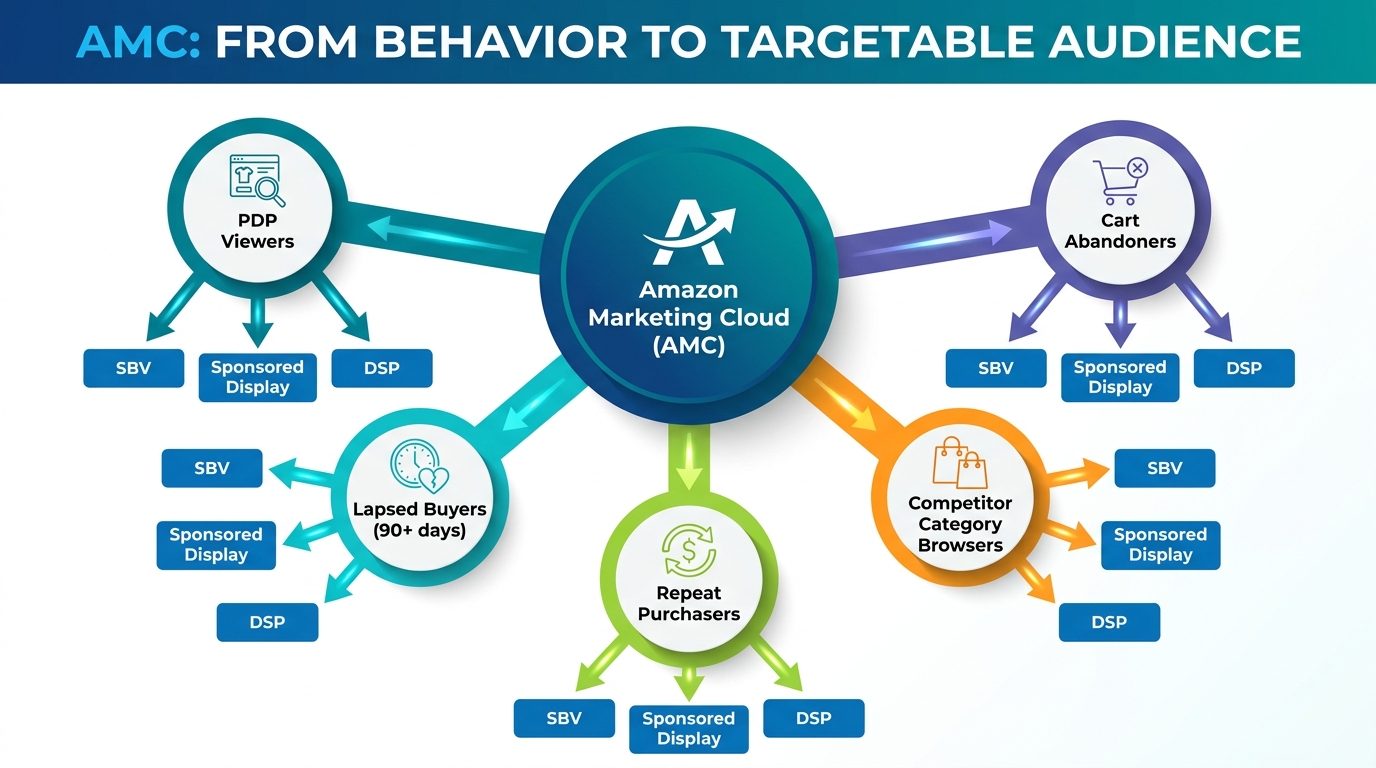
Amazon Marketing Cloud was, for most of its early life, a reporting and attribution tool. Advertisers used it to answer questions like “how many touchpoints preceded a conversion?” and “what is the true ACoS when I account for multi-campaign paths?” These are useful questions. But the more significant evolution in 2026 is AMC’s role as an audience activation layer, not just an analytics layer.
AMC now lets advertisers build custom audiences from behavioral signals — product detail page views, cart adds, repeat purchases, lapsed buyers who haven’t converted in 90+ days, shoppers who browsed a specific category but didn’t purchase — and push those audiences directly into Sponsored Products, Sponsored Brands, SBV, Sponsored Display, and DSP campaigns.
This closes the loop between insight and action in a way that wasn’t previously possible. You’re no longer using AMC to understand what happened and then making educated guesses about what to do next. You’re using AMC to identify a specific behavioral cohort, build a campaign audience from it, and deploy that audience in an SBV campaign that speaks directly to where those shoppers are in their journey.
The No-Code Audience Builder: Lower Barrier, Higher Stakes
Amazon’s introduction of a no-code audience builder within AMC has materially lowered the technical barrier to doing this kind of segmentation. You no longer need SQL query skills to build custom audiences. The practical implication is that more advertisers now have access to AMC audience activation — which means the competitive advantage goes to those who are more thoughtful about what audiences they build and how they deploy them, not just to those with the technical resources to access the tool at all.
The segments most consistently cited as high-value by practitioners: shoppers who viewed your product detail page in the last 30 days but did not purchase (warm retargeting), shoppers who purchased once in the last 90-180 days (loyalty development), shoppers who viewed competitor ASINs in your category (competitive conquest), and first-party customer lists re-engaged via Sponsored Display.
Connecting AMC Audiences to SBV Creative Strategy
Here is where most advertisers leave significant value on the table. They build AMC audiences, they layer them into campaigns, they apply bid modifiers — but they run the same creative to every audience. That eliminates most of the strategic benefit of persona segmentation in the first place.
If you have separate audiences for first-time category explorers and for competitive switchers, those two audiences have different objections, different levels of brand awareness, and different reasons to choose your product over the alternatives. The video that works for a cold discovery audience — focused on introducing what the product is, establishing the category problem it solves — is a different video than the one that works for a shopper who just viewed a competitor’s detail page and is now comparison shopping.
Persona-first SBV means aligning the creative brief to the audience brief. When those two are matched, the format performs dramatically better than when they’re misaligned.
Building Your Three Core Persona Buckets
Not every brand needs a dozen persona segments. The complexity ceiling in campaign management is real, and over-segmentation creates as many problems as under-segmentation. For most brands, three core persona buckets provide enough granularity to make meaningful strategic distinctions without making campaign management unmanageable.
Bucket One: Discovery Personas
These are shoppers who are entering the category for the first time, or who are broadly aware of the category but haven’t yet formed strong brand preferences. They’re using generic, high-volume search terms. They’re browsing category pages. They’re on informational product pages doing preliminary research. AMC signals that identify discovery personas include first-time category keyword searches (no prior category purchase history in the lookback window), broad category PDP views without cart actions, and shoppers who’ve been exposed to upper-funnel streaming TV or Prime Video ads without subsequent product engagement.
The right campaign mechanics for discovery personas: broad-to-phrase keyword targeting, category targeting, theme targeting with careful placement monitoring, and creative that leads with the category problem and introduces your product as a solution. Bids should be conservative — this audience is the top of the funnel, and efficiency expectations should reflect that. NTB rate is the primary KPI; ACoS is largely irrelevant here.
Bucket Two: Comparison Personas
Comparison personas have already done initial research and are now evaluating specific options. They’re searching for product-specific terms — often including competitor brand names or specific features (ASIN-level or attribute-level searches). They’ve viewed multiple PDPs in the category. AMC can identify these shoppers via multi-product-view sequences, cart-add-without-purchase signals, and repeat category searches within a tight timeframe.
Campaign mechanics: product targeting against competitor ASINs (PDP placement SBV is particularly powerful here), keyword targeting on competitor brand terms and feature-specific queries, and creative that speaks to differentiation — why your product specifically vs. the alternatives. This is also the segment where audience bid modifiers on “new-to-brand shoppers” are most impactful: you’re willing to bid more to win a comparison shopper who has never bought your brand before, because converting them is worth more than converting someone who was already heading to your listing.
Bucket Three: Intent and Loyalty Personas
Intent personas are close to purchase: they’ve viewed your PDP recently, added to cart, or are prior purchasers showing replenishment signals. These are the highest-commercial-value shoppers in the SBV ecosystem. The bid modifiers that can go up to +900% are most justifiably applied here — you are paying a premium for shoppers who have already demonstrated high purchase intent or loyalty, and the conversion economics support it.
Creative for intent and loyalty personas can be more direct: product reminders, social proof, limited-time offers, or replenishment nudges. The campaign structure here often overlaps with Sponsored Display retargeting, which creates a sequencing opportunity — SBV for the video touchpoint, Sponsored Display for the persistent reminder, with AMC tracking the path from impression to conversion across both.
Campaign Architecture: Separating NTB From Retargeting
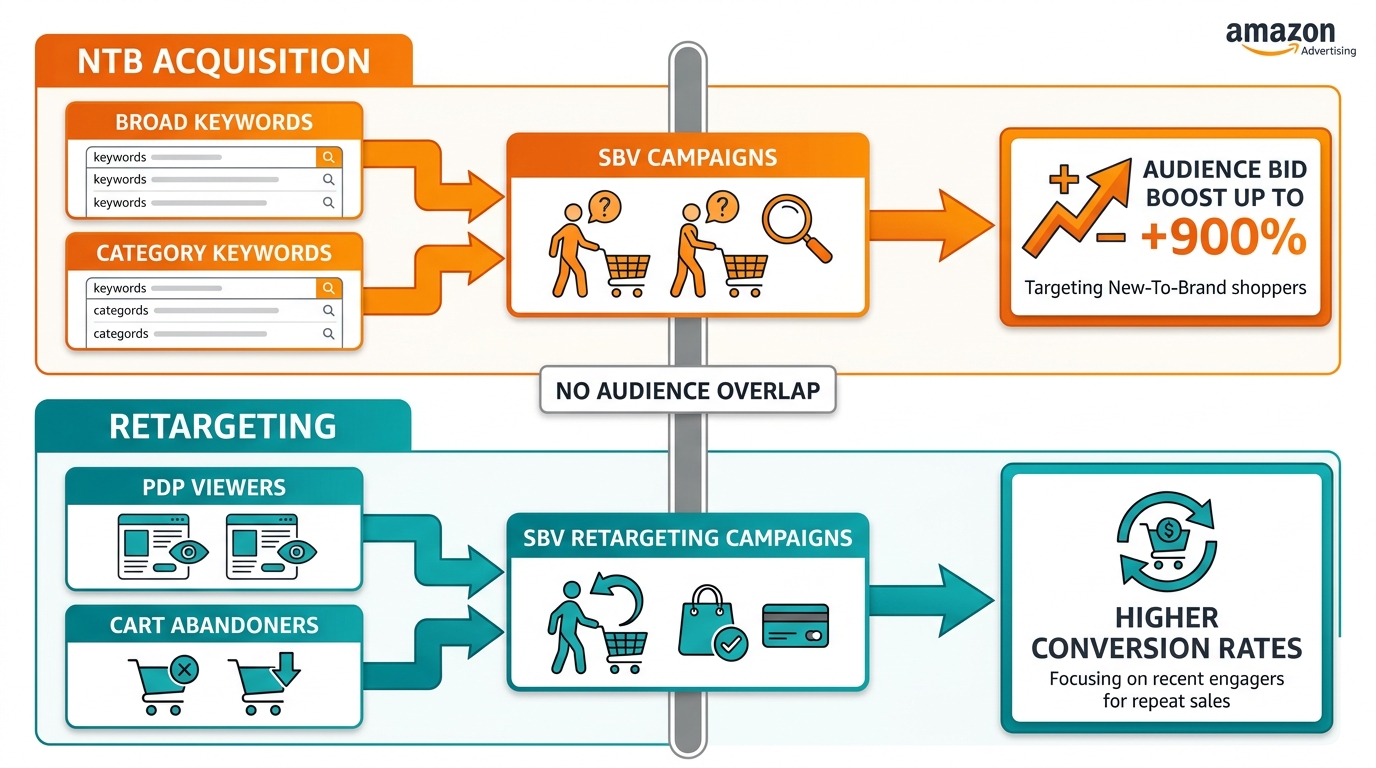
The most structurally important decision in persona-first SBV is the one that often gets skipped: keeping new-to-brand acquisition and retargeting in separate campaigns, with separate budgets, separate bids, and separate creative.
Why does this matter? Because when NTB and retargeting exist in the same campaign, the budget optimizes toward whichever audience is cheaper to reach and convert in the short term — which is almost always retargeting. Warm audiences convert faster and at higher rates. If they share a budget pool with cold prospecting, retargeting will consume the majority of the spend, and you’ll effectively stop running a discovery program while still believing you have one.
The Structural Rules
Keep NTB campaigns free of audience bid modifiers set to favor returning purchasers. Use negative audience exclusions to remove your existing customer base from NTB SBV campaigns where possible — you don’t want to spend top-of-funnel budget reaching shoppers you’ve already converted. Use AMC audiences to identify and exclude recent purchasers and PDP viewers from discovery campaigns, and instead channel them into the retargeting track.
The retargeting track should carry tighter creative aligned to purchase signals: more product-specific messaging, stronger call-to-action, shorter video that assumes category awareness and gets straight to the value proposition.
Budget allocation guidance that appears consistently in practitioner frameworks: roughly 60–70% of SBV budget on acquisition (discovery + comparison personas) and 30–40% on retargeting and loyalty. This reflects SBV’s core value as a new-audience acquisition format while still capturing the efficiency of warm retargeting. The exact split should be calibrated to your brand’s actual NTB rate — if your AMC data shows your current SBV is already predominantly reaching existing customers, that’s a signal your acquisition allocation needs to increase.
Placement Allocation Within Each Track
For acquisition campaigns, top-of-search placement deserves a higher share of bids — this is where discovery shoppers are. For retargeting campaigns, PDP placement is often more efficient, since retargeting audiences are more likely to be in the product research phase and actively viewing detail pages.
Amazon allows bid adjustments by placement type within Sponsored Brands campaigns. Use placement-level bid adjustments to reinforce this logic: boost top-of-search bids in acquisition campaigns, boost PDP bids in retargeting campaigns. Stack this with audience bid modifiers and you have a two-axis bid strategy that is much more precise than adjusting a single headline bid.
Theme Targeting and AI Matching: Reading the Algorithm
Theme targeting deserves its own treatment because it operates differently from every other SBV targeting type. While keyword and product targeting are advertiser-directed — you specify what you want to target — theme targeting is system-directed. You define a theme (essentially a cluster of related search and browse intent) and Amazon’s algorithm decides where to show the ad based on its interpretation of that theme in real-time auction contexts.
The advantage is reach expansion without the overhead of manually building keyword lists that cover every relevant query variation. The risk is reaching irrelevant contexts if the AI’s interpretation of your theme doesn’t match your actual target customer.
How to Use Theme Targeting Without Losing Control
The safest operational model for theme targeting in a persona-first campaign is to treat it as a prospecting layer within the discovery persona bucket, running in its own campaign with a strictly defined budget cap. This keeps theme targeting from cannibalizing spend from manually controlled campaigns.
Review the placement and search term reports for theme-targeted campaigns weekly in the first month. Identify placements and search terms that are driving meaningful click and view behavior versus those generating impressions without engagement. Add irrelevant terms as negatives at the campaign level. Use high-performing terms from theme targeting to inform and expand the keyword lists in your manually controlled discovery campaigns.
Over time, theme targeting can function as a continuously self-updating discovery layer — surfacing relevant intent signals that manual keyword research would have missed. But it requires active management to stay relevant, especially in categories where product taxonomy and shopper language evolve quickly.
What AI Matching Is Actually Optimizing For
Amazon’s AI-assisted matching in SBV is becoming more product-detail-aware and less purely keyword-triggered. The algorithm increasingly factors in the quality and relevance of the landing page — your product detail page — as part of the ad relevance score. Brands with strong PDPs (rich images, complete bullets, A+ content, high review velocity) get access to better AI-matched placements because the system has higher confidence that the landing experience will satisfy the shopper intent it matched.
This creates a direct link between your PDP quality and your SBV targeting efficiency that most advertisers haven’t fully internalized. Investment in listing quality isn’t just a conversion rate optimization — it affects the reach and efficiency of AI-matched SBV placements. A weak PDP limits where the algorithm is willing to show your ad, regardless of how strong your keyword or theme targeting setup is.
Creative That Works for Personas: Sound-Off, Mobile-First, Message-Matched
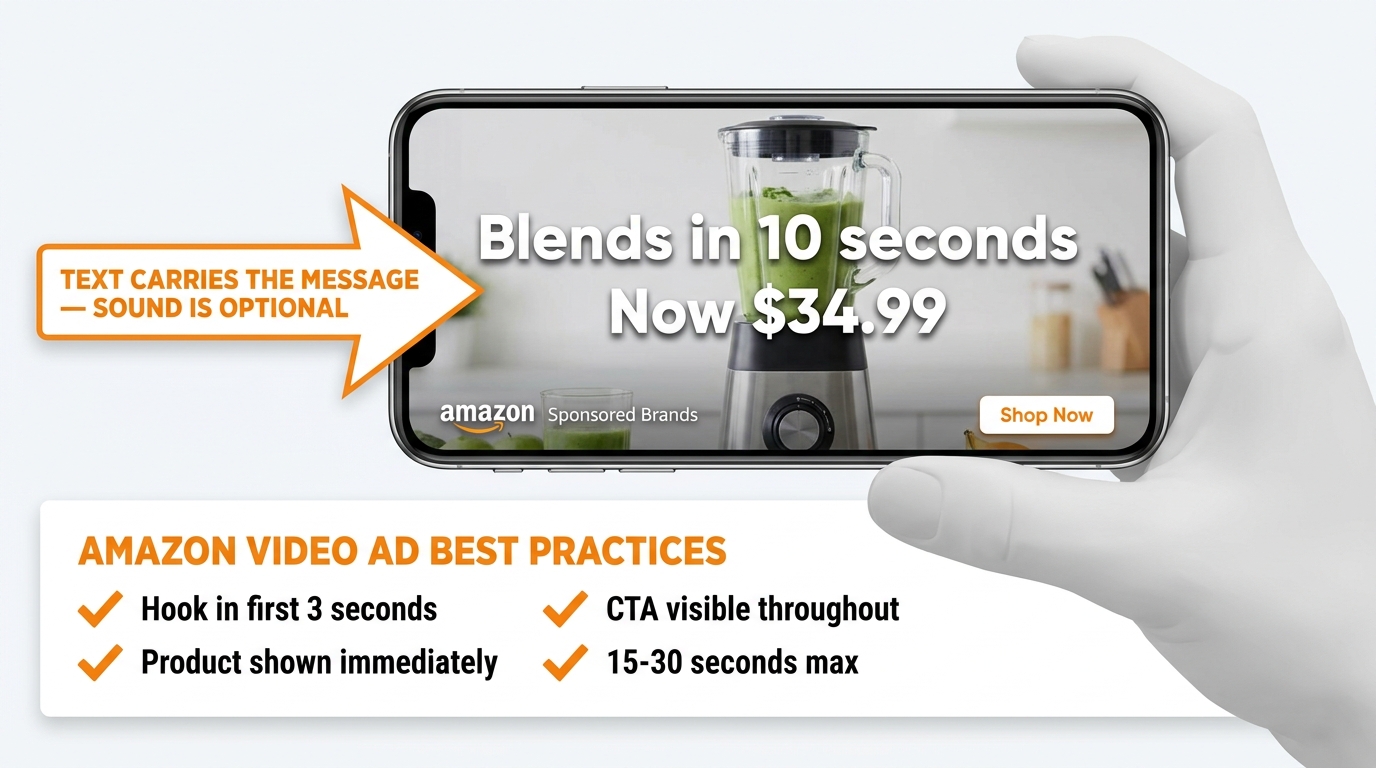
If persona-first SBV targeting is the strategic layer, persona-matched creative is where that strategy either lands or falls apart. The creative brief has to be derived from the persona brief, not developed independently of it.
Amazon’s SBV format has some hard constraints that shape all creative decisions before persona-specific choices come into play. Videos auto-play muted — either on scroll (mobile) or when at least 50% in view. The vast majority of impressions are delivered without audio. This means the video must communicate its core message through visuals and text overlays alone, without relying on voiceover or music.
The Sound-Off Imperative
Designing for silent viewing is not optional — it’s the baseline. Every critical message element (what the product is, the key benefit, the call to action) must be communicated visually. Text overlays carry messages that voiceover would handle in a traditional video format. Captions should be large, legible at mobile screen sizes, and timed to the visual pacing of the product demonstration.
The practical discipline this requires: watch your SBV creative with the sound completely off and ask whether someone who has never heard of your product could understand what it is and why they should click within the first three seconds. If the answer is no, the creative needs revision regardless of how good it sounds with audio.
First-Three-Second Architecture
Amazon and most experienced practitioners cite the first two to three seconds as the decisive creative window for SBV. The product should appear on screen by second two at the latest. The category problem or key benefit should be communicated within three seconds via either visual demonstration or on-screen text. Anything that delays the product reveal — brand logo intros, abstract lifestyle scenes, slow fades — costs attention that most shoppers won’t give back.
The structure that consistently performs well: product in frame immediately, key benefit stated via on-screen text within three seconds, demonstration or proof point in the middle section, clear call-to-action and product/brand close in the final two to four seconds. Total length: 15 to 30 seconds for most categories. Longer formats work for high-consideration purchases where shoppers are willing to invest more attention, but 15 seconds is the safe default.
Matching Creative to Persona Stage
Discovery persona creative should introduce the category problem first, then position the product as the solution. These shoppers may not know your brand at all — the creative needs to earn attention from zero rather than assuming any prior brand awareness. Hook lines like “The problem with [category]” or “Why [common frustration] keeps happening” can work well because they validate the discovery shopper’s unmet need before presenting the product.
Comparison persona creative should lead with differentiation. This audience already knows they want a product in this category — what they’re trying to figure out is why your specific product over the alternatives. Feature comparisons, social proof indicators (review counts, bestseller badges, awards), and direct attribute callouts (“the only [product] with [specific feature]”) all address the comparison stage question of “why this one?”
Intent and loyalty persona creative can afford to be more direct and conversion-focused. A product reminder with a strong CTA (“Back in stock” / “Free shipping today” / “Subscribe and save 15%”) works well for this audience because you’re not doing brand-building work — you’re providing a timely nudge to an already-warm decision.
Measurement Frameworks: What to Track Beyond ACoS
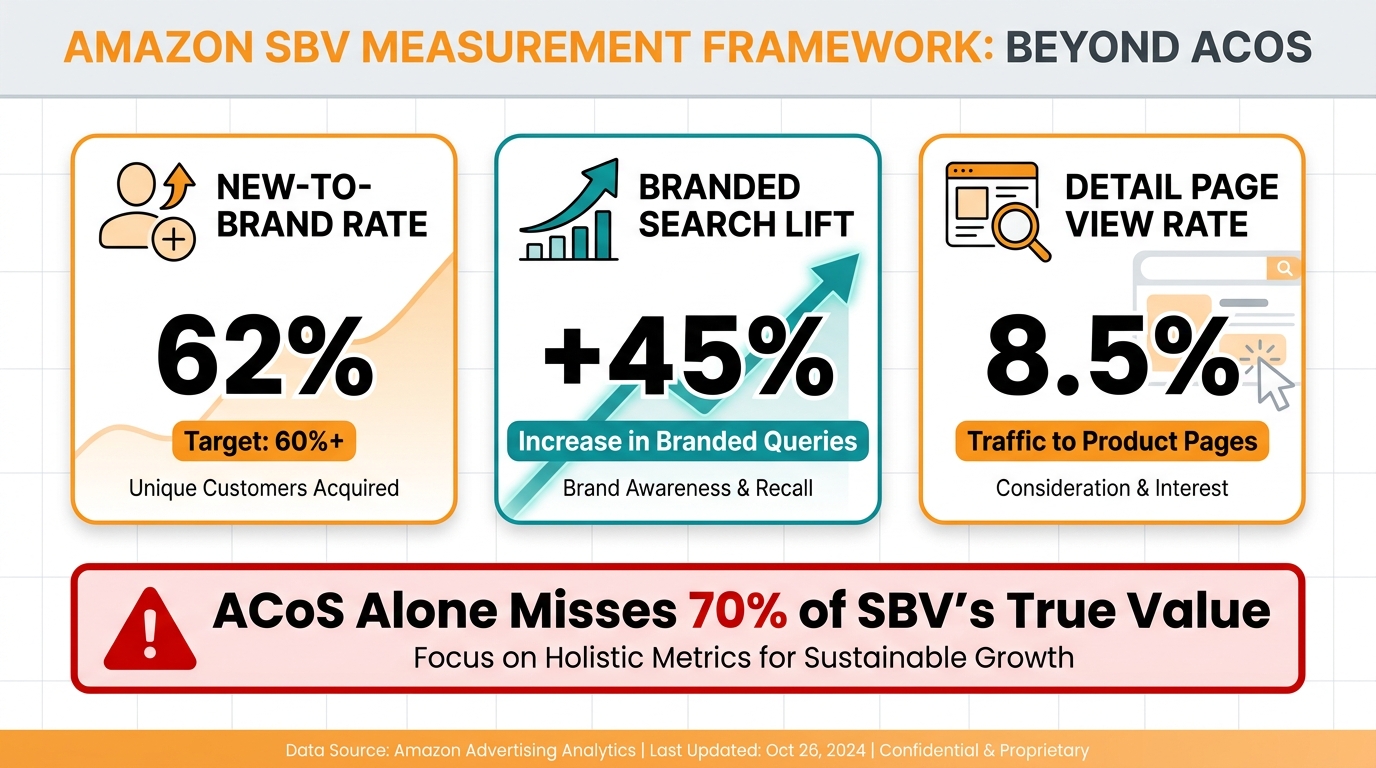
Measuring SBV with the same framework used for Sponsored Products is one of the most durable mistakes in Amazon advertising. The format is different, the funnel position is different, the buyer journey impact is different. The measurement framework needs to reflect all three.
Primary Metrics by Persona Bucket
For discovery campaigns, the primary metrics are new-to-brand order rate and new-to-brand revenue percentage. Secondary metrics include detail page view rate (DPVR) — the percentage of ad impressions that result in a product detail page view — and branded search volume trend (tracked via AMC or Brand Analytics, looking for organic branded search lift correlated with SBV impression volume). ACoS is a tertiary metric at most; NTB ACoS (which divides ad spend by new-to-brand revenue specifically) is more meaningful than blended ACoS for this bucket.
For comparison campaigns, ACoS becomes more relevant but should still be viewed alongside conversion rate from PDP visits (are comparison shoppers who arrived from SBV converting at the rate you’d expect for high-intent traffic?) and competitive conquest rate (what share of PDP-targeted traffic is coming from competitor ASINs vs. your own?). A healthy comparison campaign is driving substantial traffic from competitor product pages and converting it at meaningful rates.
For intent and loyalty campaigns, traditional direct-response metrics apply more directly. ACoS, ROAS, and conversion rate are all meaningful here because the audience is purchase-stage. But even for this bucket, supplement with AMC data on purchase frequency and average order value — loyalty SBV should be improving both, not just capturing clicks that would have converted anyway.
The AMC Attribution Window Adjustment
One of the most useful measurement techniques available through AMC for SBV is adjusting the attribution window beyond Amazon’s default 14-day click window. SBV’s role as a mid-funnel awareness format means many of its conversions happen on timelines longer than two weeks — particularly for high-consideration categories where the research-to-purchase cycle spans 30, 60, or even 90 days.
AMC allows custom attribution window analysis. Running an AMC query that looks at 30-day and 60-day conversion paths for SBV-exposed shoppers will typically show materially higher attributed conversion than the default 14-day window. This doesn’t mean you over-claim SBV credit — it means you’re measuring it on a timeline that actually reflects how shoppers interact with the format.
Halo Effect Measurement
SBV’s most undervalued contribution is brand search lift — the increase in organic search volume for your brand name that follows SBV impression campaigns. This effect is real and has been documented in case studies across multiple categories, but it’s invisible in campaign-level reporting because it shows up in organic results rather than as directly attributed ad revenue.
Measuring it requires comparing branded organic search volume (available in Brand Analytics) before and after significant SBV campaigns, ideally in AMC where you can segment by geographic market or product category to build a more rigorous comparison. Brands that have done this analysis consistently find that SBV’s total revenue influence — including organic halo — is significantly larger than what campaign-attributed revenue alone suggests.
The Bid Modifier Stack: Layering Without Cannibalization
Audience bid modifiers in SBV are powerful enough to be dangerous if applied without a coherent architecture. The +900% ceiling means a single misconfigured modifier could drive your effective CPC to levels that make no economic sense. The goal of bid modifier strategy is precision — applying the right premium to the right audience in the right campaign, without creating overlap that causes your different campaigns to bid against each other.
The Audience Exclusion Principle
Before applying any bid modifiers, establish your audience exclusion logic. If your NTB acquisition campaign has no audience exclusions, it will reach existing customers — and if you have a +500% bid modifier on “previously purchased” audiences in that campaign, you’ll be paying a massive premium for a customer interaction that belongs in your loyalty campaign instead.
The cleanest architecture: NTB campaigns exclude any audience that has purchased or viewed your brand in the last 365 days. Retargeting and loyalty campaigns are built specifically around those excluded audiences. This creates mutually exclusive lanes where each campaign is reaching the audience it was designed for, and bid modifiers within each campaign are applied to sub-segments of that audience rather than creating cross-campaign competition.
The Two-Axis Bid Stack
For each campaign in your SBV portfolio, you have two independent bid adjustment levers: placement-level adjustments (top-of-search vs. PDP) and audience-level adjustments (within the campaign’s primary audience, boosting specific sub-segments). Applying both creates a compound effect.
Example: in a discovery campaign, you might set a top-of-search placement boost of +30% to prioritize that placement for first-time search impressions. Within that campaign, you might apply a +200% bid modifier on the “new-to-brand shoppers” audience segment. The result is that when a new-to-brand shopper is in a top-of-search context, your effective bid is substantially higher than for any other combination — you are paying the most to win the impression most likely to result in a high-value new customer acquisition.
This kind of bid logic can’t be set and forgotten. It requires regular review of impression share, conversion rates, and CPCs at the placement and audience level to ensure the modifiers are working as intended and the economics remain defensible.
Common Mistakes Brands Make When Shifting to Persona-First SBV
The appeal of persona-first SBV is that it offers a more sophisticated, more accountable approach to video advertising. The execution risk is that sophistication brings complexity, and complexity creates new failure modes. These are the ones that show up most consistently when brands make this transition.
Building Personas From Demographics Rather Than Behavior
Demographic personas — “our customer is a 35–45 year old woman interested in wellness” — are useful for brand strategy but nearly useless for Amazon PPC architecture. Amazon doesn’t offer demographic targeting in Sponsored Ads. Your personas need to be built from behavioral signals: what did this person search for, view, add to cart, purchase? Only behavior-derived personas can be operationalized into actual campaign structures via AMC audiences and bid modifiers.
Over-Segmenting Too Early
Starting with eight persona buckets when you have modest monthly SBV spend will spread budget too thin across too many campaigns. Each campaign needs sufficient impression and click volume to generate statistically meaningful performance data — if campaigns are getting 50–100 clicks per month, you can’t make reliable optimization decisions. Start with three buckets (discovery, comparison, intent/loyalty), establish budget minimums that give each meaningful data volume, and expand segmentation only as overall spend scales.
Running the Same Creative Across All Personas
Covered in the creative section, but worth restating as a mistake category: if you build the targeting infrastructure for persona-first SBV but run identical video creative across all three buckets, you’re capturing only about half the strategic benefit. The targeting half is in place; the message-matching half isn’t. Creative production investment is the bottleneck that often prevents advertisers from fully executing persona-first strategy — the solution is to prioritize creative versioning even if it means starting with stripped-down video formats (slideshow-style video, product demo clips) that can be produced faster than full brand video productions.
Not Setting Exclusions Before Launching
Launching NTB and retargeting campaigns simultaneously, in the same account, without audience exclusions between them is the fastest way to create budget overlap and muddy your attribution data. Set up exclusion audiences in AMC before you launch separate campaign tracks, verify that the exclusion audiences are populating correctly, and do a test week at modest spend before committing full budget to the new structure.
Using ACoS to Optimize Discovery Campaigns
If you or your agency is pausing or reducing bids on discovery SBV campaigns because the ACoS looks high relative to Sponsored Products benchmarks, you are optimizing out the format’s primary value. Discovery campaigns are supposed to have higher ACoS by direct-response metrics — that’s not a bug, it’s an accurate reflection of what they’re doing in the funnel. The discipline required here is organizational as much as technical: stakeholders who approve ad budgets need to understand why discovery SBV is measured differently and what metrics actually indicate it’s working.
Putting It Together: A Phased Implementation Roadmap
The full persona-first SBV architecture described in this article is not something most brands can implement in a single sprint. The realistic path is a phased rollout that prioritizes the highest-impact changes first and builds complexity incrementally as data accumulates and the team becomes comfortable with the new structure.
Phase One: Separate NTB and Retargeting (Weeks 1–4)
The single highest-impact structural change is separating new-to-brand acquisition from retargeting into distinct campaigns with distinct budgets. Even without AMC audience activation or sophisticated bid modifier stacks, this alone changes how you measure SBV and prevents retargeting from consuming discovery budget. Start here. Establish audience exclusions, set NTB rate as the primary KPI for acquisition campaigns, and begin baseline measurement before making further changes.
Phase Two: Activate AMC Audiences (Weeks 5–8)
Once the NTB/retargeting separation is in place and you have four weeks of baseline data, begin building AMC custom audiences. Start with the highest-value segments: PDP viewers (last 30 days), cart abandoners (last 14 days), and recent single purchasers (last 90 days). Activate these audiences in your retargeting campaigns. Set bid modifiers conservatively at first — +50% to +100% — and increase based on conversion rate data over the following weeks.
Phase Three: Persona Bucket Expansion and Creative Matching (Weeks 9–16)
With the foundational structure in place, introduce the comparison persona bucket as a distinct campaign — typically built around product targeting on competitor ASINs and feature-specific keyword targeting. Develop creative versions matched to each active persona bucket. Introduce theme targeting as a prospecting layer within the discovery campaign, with its own sub-budget and weekly placement review discipline.
Phase Four: Measurement Refinement and Optimization (Ongoing)
At this point the structure is in place and optimization becomes the ongoing work: refining bid modifiers based on audience-level conversion data, expanding or contracting each persona bucket’s budget allocation based on AMC attribution analysis, updating creative based on DPVR and engagement data, and using branded search lift analysis to quantify the organic halo effect of discovery campaigns. This phase doesn’t end — it’s the continuous improvement loop that separates SBV programs that compound in value over time from those that plateau.
Conclusion: The Compounding Advantage of Persona Intelligence
The shift from keyword-first to persona-first SBV is not a one-time campaign restructuring exercise. It’s a different theory of what Amazon video advertising is for and how it creates value. Keywords tell you what a shopper typed. Personas tell you who the shopper is, where they are in their journey, and what they actually need to hear to take the next step.
When you build campaigns around that level of understanding — when the targeting, the creative, the bidding logic, and the measurement framework are all aligned to buyer type rather than to match type — SBV stops being a format you run because it’s available and starts being a format that does specific, measurable work in your funnel.
The new targeting infrastructure Amazon has built — AMC audience activation, audience bid modifiers, PDP placement targeting, AI-assisted theme matching — is not a set of independent features. It’s a coherent system designed to reward advertisers who bring a persona-level understanding of their buyer to the campaign build. The brands seeing the strongest NTB rates, the best branded search lift, and the most defensible long-term customer acquisition economics from SBV are the ones who recognized this shift early and restructured accordingly.
The question is not whether persona-first SBV is worth doing. The data on NTB contribution, branded search halo, and full-funnel attribution makes a strong case that it is. The question is how quickly your organization can shift from running video ads to running video strategy — and how much of the competitive window remains available while that shift is happening.
Key Takeaways: Separate NTB and retargeting campaigns before any other change. Build personas from behavioral signals in AMC, not demographics. Match creative to persona stage, not to campaign structure. Measure discovery campaigns on NTB rate and branded search lift, not ACoS. Use the two-axis bid stack (placement + audience modifiers) to create compound precision in your bidding. Start with three persona buckets and scale complexity only as budget and data volume support it.