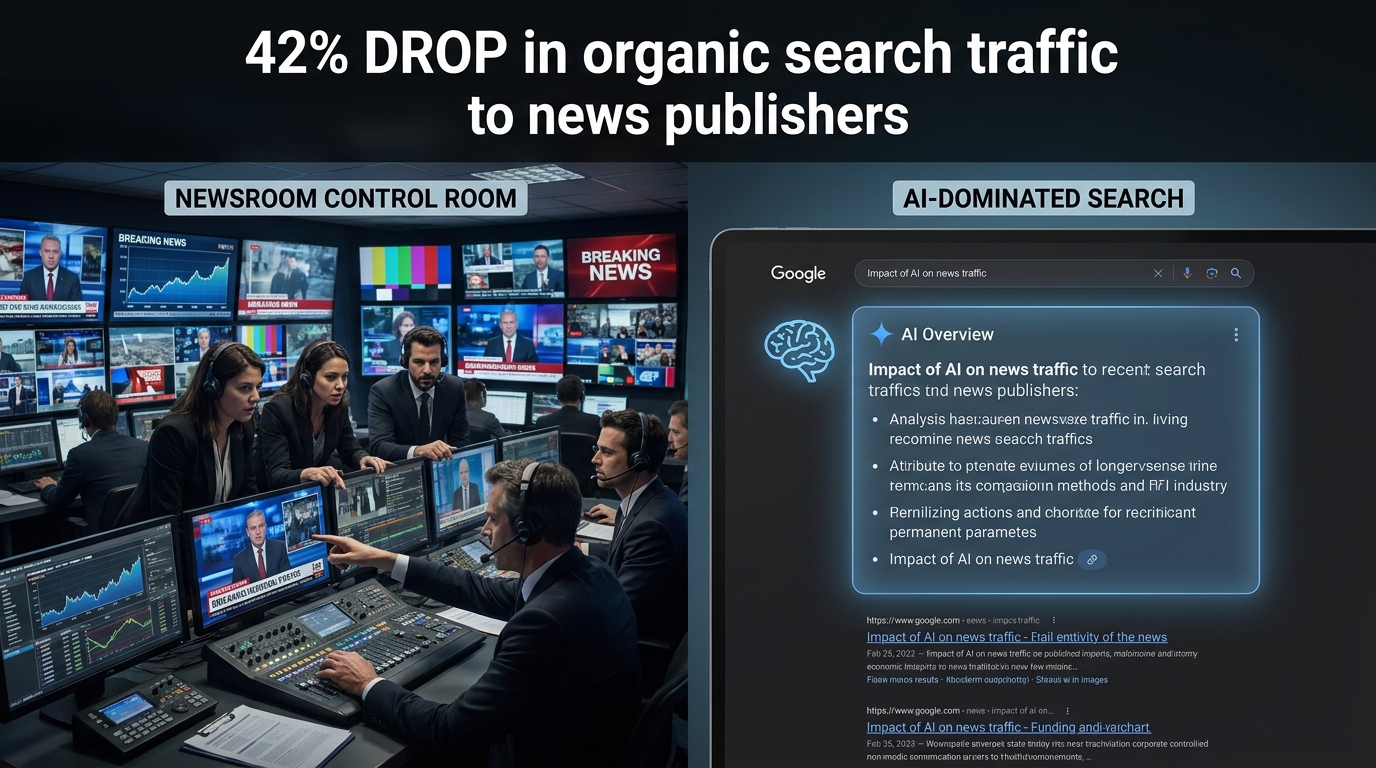
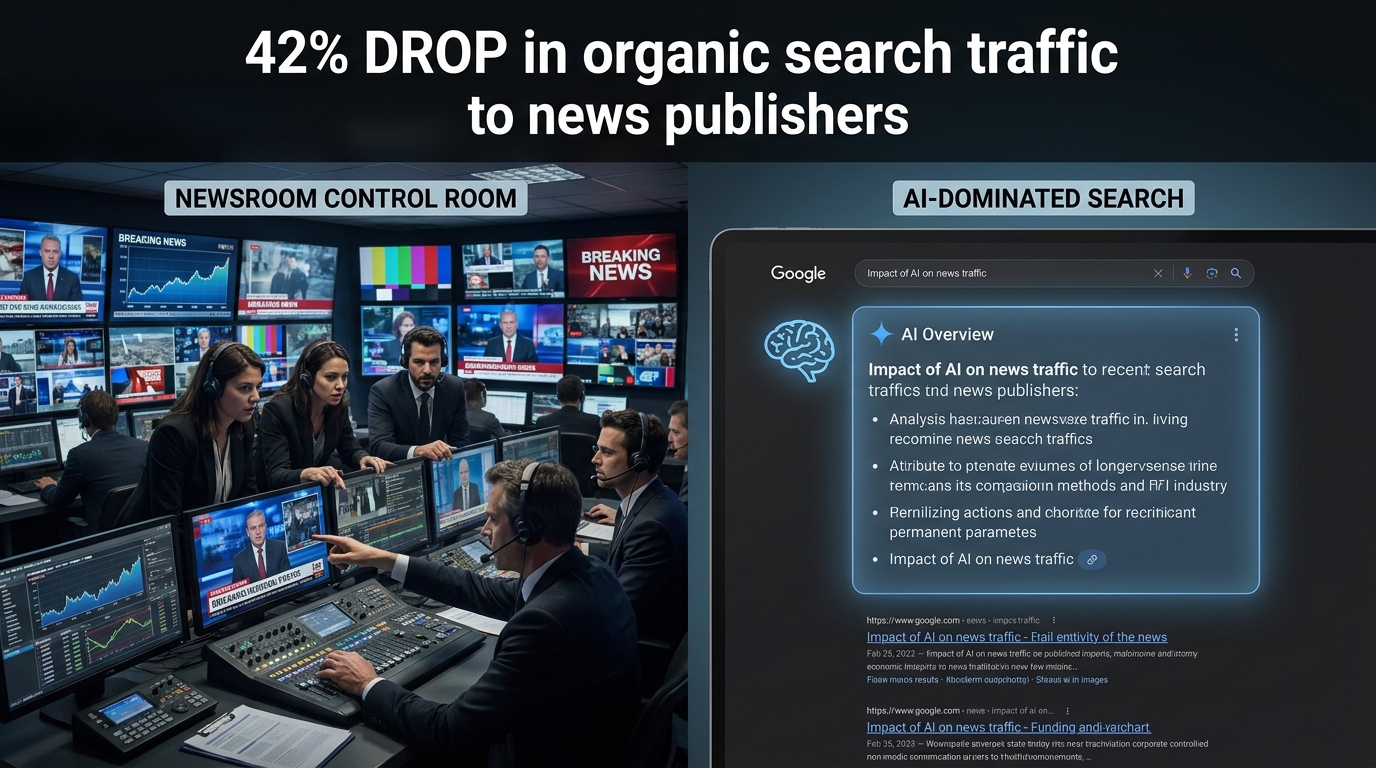
The headline numbers have been circulating for months. Organic search traffic to news publishers down 42%. Zero-click searches at 60% of all Google queries. Business Insider’s monthly search traffic off by 55% across three years. If you work in a newsroom and you follow digital metrics, you’ve almost certainly seen a version of these figures cross your desk.
What those numbers don’t tell you is why the math changed, which parts of it are actually reversible, and — most critically — what specific decisions are separating publishers that are adapting successfully from those that are continuing to bleed audience.
Google’s AI search overhaul isn’t a single event. It’s a stacking of structural shifts: AI Overviews answering informational queries before a user clicks anything, AI Mode replacing the classic blue-link interface for users who opt in, Google Discover emerging as the dominant referral channel for breaking news, and a nascent “citation economy” taking shape that determines which newsrooms get named and linked inside AI-generated answers.
This piece pulls apart each of those layers. It uses the most current publisher data available from Define Media Group, Similarweb, NewzDash, and Digital Content Next — along with patterns emerging from newsrooms that are actively restructuring around these new realities. The goal isn’t to litigate whether these changes are good or bad for journalism. The goal is to give editors, digital directors, and strategy leads the clearest possible picture of what the new traffic plumbing actually looks like — and what they can do about it right now.
The Traffic Split That Caught Newsrooms Off Guard
The most important thing to understand about Google’s AI search changes in 2026 is that they didn’t produce a uniform traffic decline across all news content. They produced a split — one that most newsroom analytics dashboards weren’t configured to detect until well after it had already reshaped audience patterns.
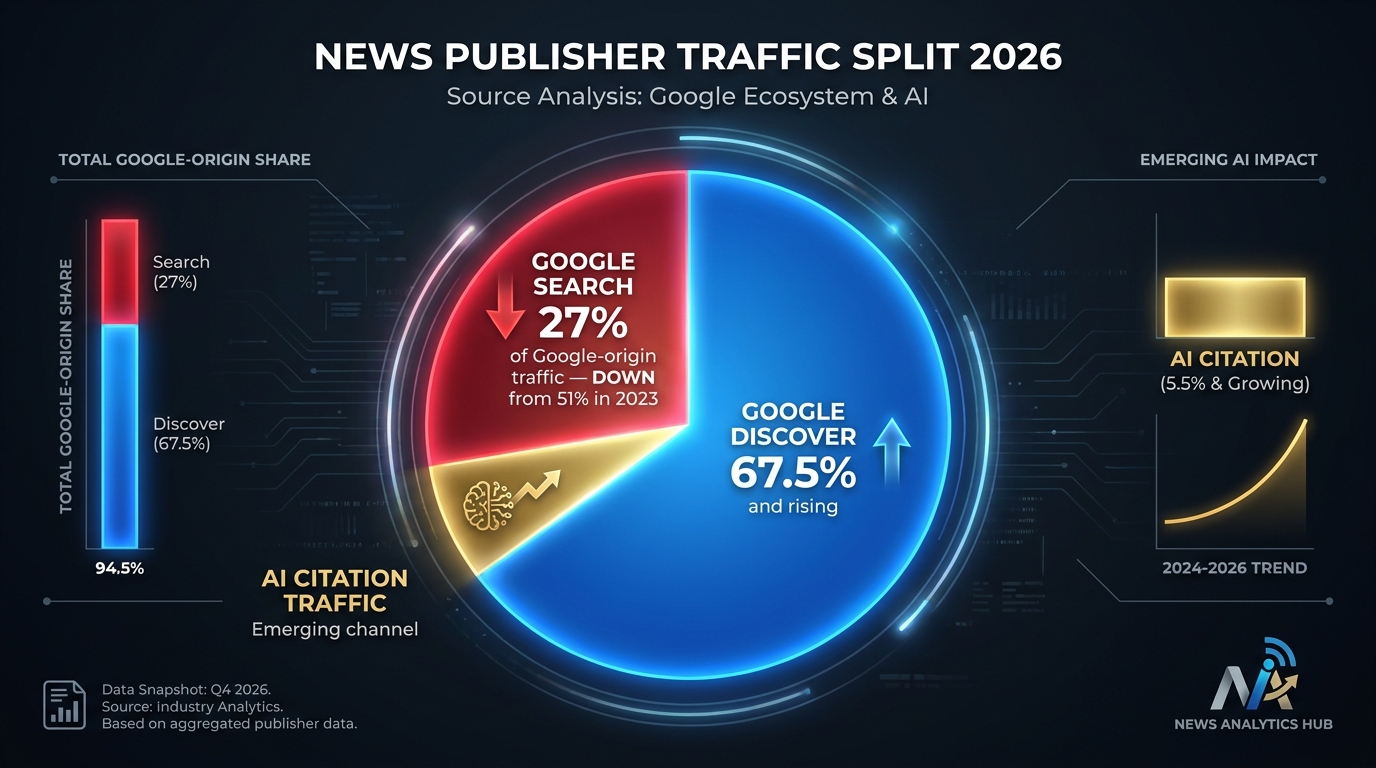
The clearest picture of that split comes from a Define Media Group panel tracking 64 major U.S. publishers. The panel found organic search traffic down 42% overall since AI Overviews launched at scale. That’s the headline. But embedded in the same data was a fact that got far less attention: breaking news traffic for those same publishers rose 103% over the same period, with most of that growth driven by a single channel — Google Discover.
NewzDash data tells a similar structural story from a different angle. Google Web Search’s share of Google-origin traffic to news sites dropped from 51% in 2023 to approximately 27% by 2025–26. Google Discover now accounts for roughly 67.5% of Google-origin news traffic. That’s a near-inversion of the relationship that governed news SEO for the previous decade.
What This Means for How Newsrooms Were Built
Most newsroom digital operations were engineered around traditional search. SEO teams optimized for keyword rankings in Google Web Search. Content calendars prioritized evergreen topics — how-to guides, explainers, comparison pieces, reference articles — because these ranked consistently and generated steady organic traffic over time. Revenue models relied on high page-view volume from that steady stream to sustain programmatic advertising.
Every one of those assumptions has been destabilized at once. Evergreen content is precisely what AI Overviews answer directly and completely, with no click required. Traditional keyword rankings now sit below AI Overview blocks that satisfy user intent before the blue links are even visible. And programmatic revenue from that evergreen traffic base has followed the traffic down.
What’s taken their place — as a traffic driver — is speed, freshness, and breaking news authority. Which is a different kind of editorial operation, staffed differently, measured differently, and monetized differently. Newsrooms that were already built around fast, authoritative, original breaking coverage found themselves in an accidentally advantageous position. Those that had shifted resources toward content marketing and evergreen SEO found the floor drop out.
The Segmentation Nobody Measured
One underappreciated consequence of this split: publishers whose analytics platforms aggregated “Google traffic” into a single bucket missed the signal entirely during the early months of the shift. Search traffic was declining. Discover traffic was rising. The two lines crossed somewhere in mid-2024 and Discover became the dominant Google channel for many news outlets — but if your dashboard only showed total Google referrals, the transition looked like moderate volatility rather than a structural realignment.
The operational fix — separating Google Search, Google Discover, and AI-referred traffic into distinct analytics segments with distinct performance benchmarks — is now table stakes for any digital news operation. But most newsrooms were months or even quarters late in making that change, and they paid for it in decision lag.
Zero-Click Is Not the Whole Story: The 83% Stat in Context
The 83% figure — the share of AI Overview searches that end with no click — has become one of the most-quoted statistics in the publishing industry’s AI anxiety cycle. It deserves more scrutiny than it usually gets, because the way it’s typically deployed obscures something important about how AI Overviews actually interact with different categories of search intent.
AI Overviews are not distributed evenly across search query types. Google’s own documentation, along with independent research, consistently shows that AI Overviews appear most frequently on informational queries: definitions, general knowledge questions, comparison searches, how-to queries. These are precisely the categories where users are most likely to be satisfied by a direct answer without needing to click through to a source.
For newsrooms, this matters because breaking news and time-sensitive queries behave differently. Google has historically been more cautious about deploying AI Overviews on rapidly changing, high-stakes topics — election results, disaster coverage, developing crime stories, live market data — where the risk of a summarized answer being out of date or factually incomplete is highest. The AI Overview that confidently explains what a subpoena is poses a different accuracy risk than one that tries to summarize a story still developing hour by hour.
What the Zero-Click Number Actually Tells You
The practical implication for content strategy is that 83% zero-click isn’t a uniform tax on all news content — it’s a near-total squeeze on informational evergreen content, combined with a far less severe impact on original reporting and breaking coverage. The types of articles most likely to disappear into AI Overview answers are also the types least likely to have produced meaningful reader relationships or subscription conversions in the first place.
Similarweb’s data showing a 26% decline in news-site traffic in the 12 months after AI Overviews launched confirms the aggregate damage. But aggregate statistics average together evergreen informational content (where losses are severe) with breaking news (where losses are milder or, in Discover, reversed). Newsrooms that benchmark their performance against aggregate industry figures without this segmentation are comparing unlike things.
The Query-Type Diagnostic
The most actionable response to the zero-click reality is a content audit segmented by query intent. For every major content category a newsroom produces, there’s a question worth asking: is this the kind of query where a user would be satisfied by a four-sentence AI Overview, or does the answer genuinely require reading the full article? Original reporting, investigation, live updates, exclusive data, and analysis with named sources and attributed quotes tend to fall in the second category. Generic explainers, product comparisons, health Q&As, and reference content tend to fall in the first.
That diagnostic won’t tell every newsroom to abandon non-breaking content entirely. But it should inform where editorial investment is most likely to generate reader relationships rather than single-session visits that AI Overviews can eventually absorb.
Google Discover’s Takeover of Breaking News Distribution

Google Discover is the feature most publishers understood least before 2024, and the one they most urgently need to understand now. It’s the personalized news and content feed that appears on the Google app homepage and on Android devices — not a search-initiated experience, but an algorithmically surfaced one. Users don’t type a query. Google predicts what they’ll want to read based on their interests, location, prior reading behavior, and a rotating set of freshness and quality signals.
The 168% growth in Discover traffic versus November 2024, documented in the Define Media Group publisher panel, represents the largest positive traffic signal in news distribution since social media’s referral peak in the early 2010s. But unlike social media’s peak — which was built on easily manipulated virality mechanics — Discover’s current growth appears tied to more durable quality signals, which makes it both harder to game and more worth genuinely investing in.
The February 2026 Discover Update
Google’s February 2026 Discover-specific algorithm update introduced changes that are still being documented by SEO analysts, but several patterns have emerged clearly from publisher traffic data. The update shifted Discover’s ranking signals in three notable directions:
- Local relevance weighting increased. Coverage with a clear geographic or community angle is surfacing more frequently in users’ feeds, particularly for regional news outlets with demonstrated local authority.
- Anti-clickbait signals tightened. Headlines that over-promise, use sensationalist framing, or withhold critical context that users expect to find in the article are being penalized more aggressively than before the update.
- Loyalty signals matter more. Publishers whose users habitually return — through newsletters, app installs, or direct-typed URL visits — appear to receive a Discover boost that publishers with purely one-time traffic patterns don’t get. Google appears to be using return-visit behavior as a proxy for content quality and trust.
What Discover-Optimized Newsrooms Are Doing Differently
The publishers seeing the strongest Discover growth in 2026 share several editorial practices that differ meaningfully from traditional SEO-driven content operations. Their headlines are accurate and specific rather than engagement-baited — they describe what the story actually contains, rather than teasing at it. Their articles are published fast on breaking topics, with clear timestamps, frequent updates marked explicitly, and author bylines linked to established profile pages.
Image quality matters disproportionately on Discover, because the feed is image-led. Publishers investing in original photography and distinctive visual presentation for top stories are seeing higher Discover click-through rates than those relying on stock imagery or wire-syndicated photos. Google’s image requirements for Discover (minimum 1200px wide, marked with max-image-preview:large in robots meta) aren’t new, but enforcement through the algorithm’s quality signals appears to have sharpened.
The uncomfortable implication is that Discover rewards behaviors that good journalism already practices — accuracy, timeliness, visual quality, audience loyalty — and punishes the content farm behaviors that helped some publishers inflate search traffic in previous years. That’s either good news or an indictment, depending on what your content operation actually looked like before 2024.
The Citation Economy: How AI Overviews Actually Pick Their Sources
Alongside the traffic decline in traditional blue-link clicks, a new form of visibility has emerged inside Google’s AI Overviews: the citation link. When an AI Overview cites a specific source alongside its synthesized answer, that source gets a small but measurable amount of referred traffic — and, arguably more significantly, brand authority that may influence whether users seek out that outlet directly in the future.
The citation economy is still young and its traffic numbers are modest compared to what organic search used to deliver. But the patterns of who gets cited, and how often, are already being tracked — and they reveal a winner-take-most dynamic that should alarm any newsroom not already in the top tier.
The Concentration Problem
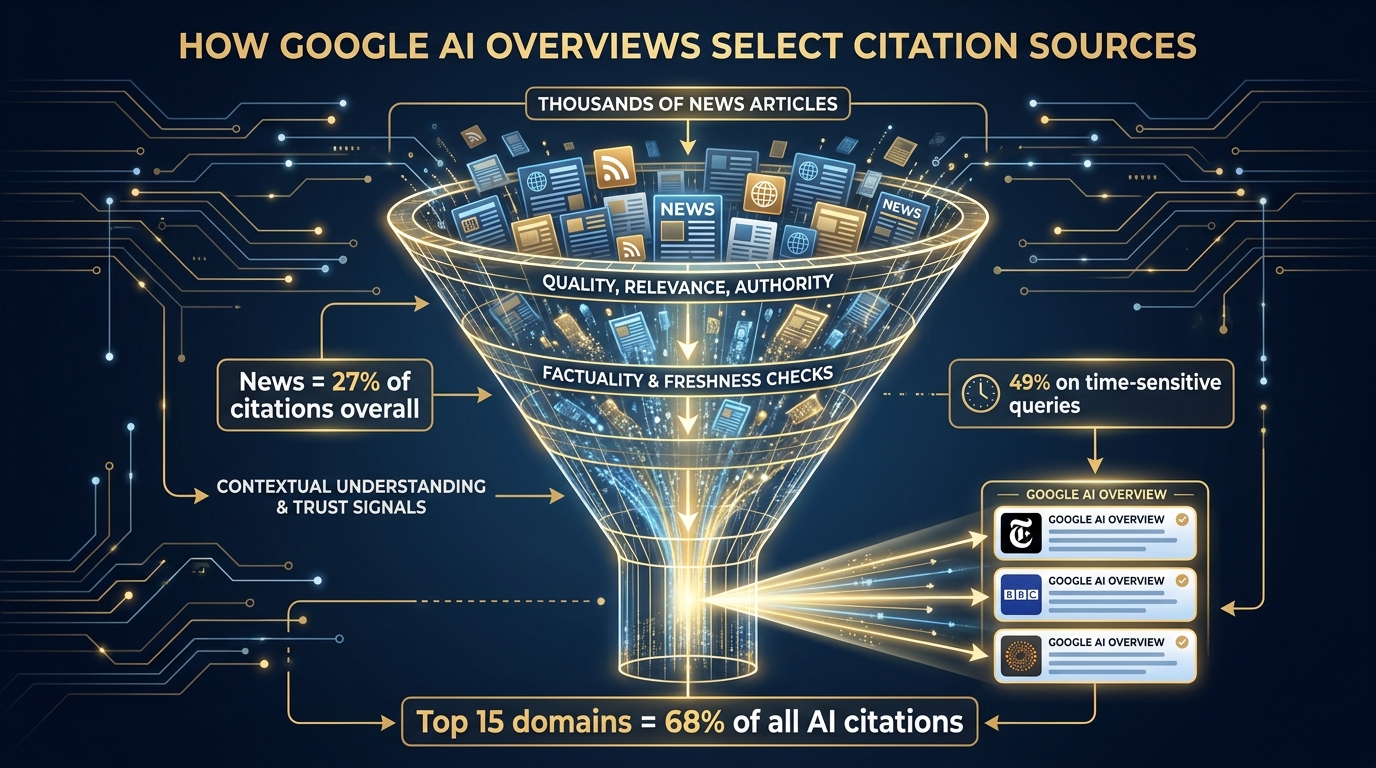
Research tracking citation patterns across Google AI Overviews, ChatGPT, Gemini, Claude, and Perplexity finds that the top 15 domains capture approximately 68% of all AI citation share. That degree of concentration is severe. It means that an AI search landscape that theoretically gives every publisher an equal chance of being cited in a synthesized answer is, in practice, directing the overwhelming majority of AI-visible attribution to a very small number of brands.
News publishers collectively account for about 27% of all citations across major AI systems — rising to approximately 49% on time-sensitive news queries, where the AI systems recognize that Wikipedia and Reddit are less reliable sources for rapidly changing information. That 49% figure is the market newsrooms need to compete for. The question is which newsrooms get cited, and which are invisible despite producing relevant, accurate, original journalism.
What the Cited Sources Have in Common
Analysis of citation patterns across Google AI Overviews points to several structural characteristics shared by frequently-cited news sources. Reuters, the Financial Times, The New York Times, and Forbes consistently appear among the top-cited news brands. What they share isn’t just size or brand recognition — it’s a set of technical and editorial signals that AI systems can reliably detect and verify:
- Consistent schema markup: Articles from regularly-cited publishers are tagged with NewsArticle or Article schema that gives Google’s systems clean metadata — author name, publication date, headline, description — that can be easily extracted and quoted.
- Stable author attribution: Stories are consistently attributed to named journalists whose bylines appear both on the article and in linked author profiles, with credentials or beats noted explicitly.
- Factual density and sourcing: Frequently-cited articles tend to contain explicit attributions — named individuals, specific data sources, institutional quotes — rather than vague characterizations. AI systems appear to prefer content they can quote directly and attribute precisely.
- Domain authority and inbound links: High-citation publishers have massive existing link equity that predates AI Overviews. This creates a compounding advantage that newer or smaller outlets struggle to close.
The Misattribution Problem
One underreported aspect of the citation economy is misattribution. Multiple independent analyses have found that Google AI Overviews sometimes cite syndicated versions of articles — stories that ran on wire services or content partners — rather than the original publisher. A local news outlet that breaks a story, syndicates it through AP, and then watches an AI Overview cite the AP wire version rather than the original article is receiving zero visible credit for the work. This isn’t an edge case. It appears to affect a meaningful share of regional and specialist publishers whose content is distributed through syndication networks.
The fix is partly technical — canonical URL implementation needs to be airtight — but also structural. Publishers whose original articles are the most authoritative, well-linked, and technically sound versions of a story are more likely to be the cited version. Publishers who rely heavily on syndication without maintaining clear technical primacy of their original articles are most exposed to citation misattribution.
Generative Engine Optimization: The Discipline Newsrooms Are Scrambling to Learn
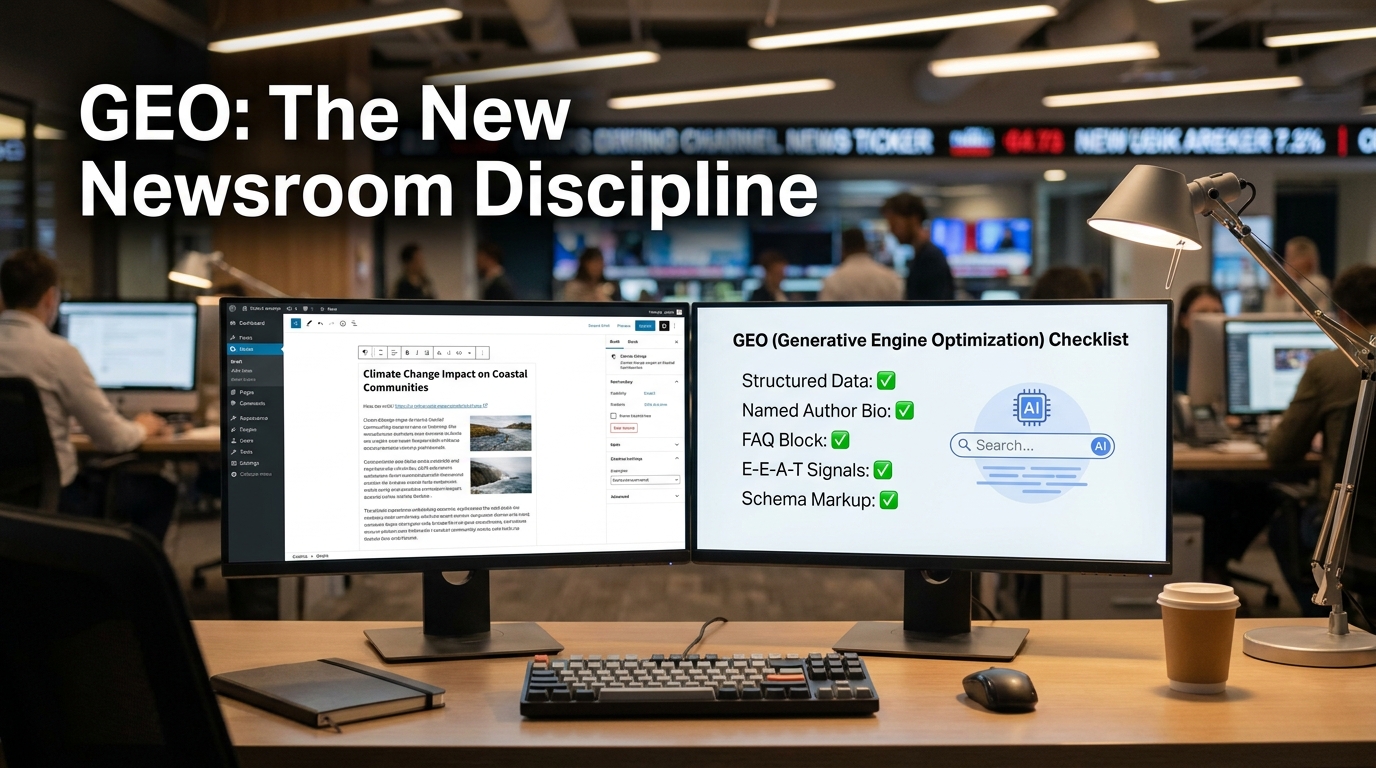
Traditional SEO asked one central question: how do we get this article to rank as high as possible in Google’s list of blue links? Generative Engine Optimization (GEO) asks a different question: how do we make this article the preferred source that AI systems extract, quote, and cite in their generated answers?
The distinction sounds subtle. Its operational implications are not. GEO is reshaping how newsrooms think about article architecture, metadata, author credentialing, fact presentation, and even the structural grammar of journalism — what should appear in a pull quote, how data should be presented, how expert attribution should be formatted so that AI systems can reliably parse and re-use it.
The Machine-Readable Article
The core GEO shift for newsrooms is from writing for human readers alone to writing for both human readers and machine readers simultaneously. This doesn’t mean stripping articles of nuance or making them robotic. It means applying a layer of structural clarity that makes it easy for an AI system to identify the key facts, the source of those facts, the author, and the publication date — without ambiguity.
In practice, newsrooms investing in GEO are implementing the following changes at an article and CMS level:
- FAQ blocks: Adding a structured Q&A section at the bottom of major articles, particularly those on topics where users frequently ask follow-up questions. Google’s AI systems tend to extract from clearly labeled Q&A sections when generating overview answers.
- Defined data presentation: Presenting statistics in a format that makes them easy to extract and quote — specific numbers, explicit source attribution in the text, clear date context. “More than half of publishers saw a decline” is harder for AI to cite precisely than “54% of publishers saw traffic declines of more than 20%, according to a February 2026 Similarweb analysis.”
- Short-answer lead paragraphs: Writing opening paragraphs that provide a direct, quotable answer to the implied question of the article — followed by the detail and context. This mirrors the structure AI systems prefer to extract from when generating summaries.
- Consistent internal linking to author profiles: Ensuring every byline links to a robust author bio page that lists credentials, beat coverage, years of experience, and social/professional profiles. This feeds into the experience and expertise components of E-E-A-T evaluation.
Measuring What GEO Is Actually Doing
One challenge facing newsrooms implementing GEO is measurement. Traditional SEO has decades of tooling — rank trackers, click data, impression metrics — that make its performance legible. GEO measurement is still primitive by comparison. Publishers tracking their AI citation frequency are largely doing so manually, using queries across ChatGPT, Gemini, Perplexity, and AI Overviews to check whether their stories are being cited on relevant topics.
Several third-party tools have emerged in 2026 to automate AI citation tracking, including Share of Voice measurement across generative platforms. But adoption is still uneven across newsroom types. Large digital-native publishers with dedicated product and analytics teams are instrumenting AI citation tracking. Regional newsrooms with small digital teams are still largely flying blind on this metric.
The newsrooms investing in GEO now are doing so on the bet that AI-referred traffic, though small today, will grow as AI Mode and AI Overviews become the default Google experience for more users. That bet is increasingly well-evidenced by the trajectory of AI search adoption curves through early 2026.
E-E-A-T in the AI Era: What Google’s Systems Are Actually Measuring
Google’s E-E-A-T framework — Experience, Expertise, Authoritativeness, Trustworthiness — predates AI Overviews by several years and was originally designed as a quality rater guideline for human reviewers assessing search result quality. In the AI era, it has taken on a different function: it now describes the signals that Google’s AI systems use to determine which content is trustworthy enough to cite, summarize, and surface inside AI-generated answers.
For newsrooms, the most consequential shift in how E-E-A-T is applied in AI search is the move from domain-level trust to article-level verifiability. Having a strong domain reputation still matters — but it’s no longer sufficient on its own to guarantee citation visibility. Individual articles now need to demonstrate their trustworthiness through explicit signals that AI systems can detect without relying on background knowledge of the publication’s reputation.
The Four E-E-A-T Signals That Matter Most for Newsrooms
Experience in a news context translates to demonstrated firsthand knowledge. Articles written by journalists who were present at the event, who conducted original interviews, or who have documented beat expertise rank differently from articles that aggregate existing reporting. First-person attribution (“spoke exclusively with,” “reviewed documents obtained by”) signals experience in a way that AI systems can detect.
Expertise for news publishers is communicated through author credentials, publication history, and institutional affiliation. Named authors with explicit beat credentials perform better in AI citation contexts than anonymous articles or articles attributed to generic staff accounts. The specificity matters: “Sarah Chen, the outlet’s Supreme Court correspondent since 2019” signals more expertise than “Staff Writer.”
Authoritativeness is built over time through consistent coverage, citations from other authoritative sources, and the volume of inbound links from credible domains. This is the most difficult E-E-A-T dimension for smaller publishers to close quickly, because it depends on network effects that accumulate slowly. The implication for editorial strategy is focus: publishers that concentrate their coverage on a defined beat or geographic area build authoritativeness faster than those trying to cover everything.
Trustworthiness is measured through a combination of technical signals (HTTPS, clear correction policies, privacy policy, accessible contact information) and editorial signals (transparent sourcing, correction history, distinguishing news from opinion). Publishers with explicit correction policies and documented sourcing practices perform better in trustworthiness assessments than those without.
The On-Page Trust Architecture
One underappreciated operational implication of E-E-A-T in the AI era is that many of the signals Google’s systems use to assess trustworthiness need to be visible on the article page itself — not just in the site’s about section or in the background knowledge Google has accumulated about the publication. Author bios need to appear on article pages. Source attributions need to be explicit within the article text. Publication and last-updated dates need to be machine-readable in schema as well as human-visible. Correction notices need to appear on articles that have been corrected, not just logged in a separate corrections section.
These aren’t radical changes for newsrooms that already practice high-quality journalism. But they require CMS-level implementation and consistent editorial workflow enforcement. The gap between understanding what E-E-A-T signals matter and actually having them present on every article at scale is where most mid-size publishers are currently losing ground.
The Licensing Fault Line: AP, Pilots, and the Compensation Debate
Google’s commercial relationship with the news industry over AI is, by the standards of most business negotiations, remarkably opaque. The clearest documented arrangement is Google’s licensing deal with the Associated Press — the only publicly confirmed agreement in which AP content is explicitly licensed for use in training the models behind Gemini and AI-powered Google features. Beyond that, a broader pilot program with an undisclosed group of publishers compensates participants for involvement in AI feature experiments, but the terms aren’t public and the program hasn’t been widely described as a training-data licensing agreement.
For the vast majority of news publishers, there is currently no compensation from Google for the use of their journalism in AI Overview generation, for the traffic displacement those overviews cause, or for the use of their content in training the underlying models. This is the central economic fault line in the AI-news relationship, and it’s being contested on multiple fronts simultaneously.
Publisher Coalitions and Regulatory Pressure
Digital Content Next — whose members include The New York Times, Condé Nast, and Vox Media — has been among the most vocal coalitions pushing for a formal compensation framework. The argument is structurally straightforward: AI systems derive value from journalism to generate answers that displace the traffic that would otherwise flow to the publications that produced the journalism. The value creation and the value extraction are happening at different points in the chain, with publishers absorbing the costs and Google capturing the benefits.
The regulatory response has been uneven globally. Australia’s News Media Bargaining Code created a template for mandatory negotiation, though its effectiveness has been debated. Canada’s Online News Act produced direct backlash — Meta blocked Canadian news links entirely — suggesting that one-size approaches to platform-publisher negotiations have significant downside risks. European lawmakers are watching the Canadian and Australian experiments while working on their own AI Act implications for news content.
What Publishers Are Actually Getting Today
In the absence of broad licensing frameworks, some publishers are pursuing individual negotiations with Google. The leverage is limited but not zero: publishers who are among the most-cited sources in AI Overviews have demonstrated value to Google’s product. Publishers who have the option of blocking Google’s crawlers — and can credibly threaten to exercise it — have at least some negotiating position.
The practical reality in 2026 is that most publishers are getting nothing. Those in Google’s pilot program are getting access to technology and some direct compensation, but the terms aren’t sufficient to replace lost ad revenue from traffic displacement. The AP has a deal whose terms aren’t public. Everyone else is operating in a compensation vacuum while the traffic impact compounds.
Newsroom Workflow Changes That Are Actually Moving Metrics
Enough about what’s happening to newsrooms. What are the specific workflow changes that newsrooms actively adapting to the AI search landscape are implementing — and which of those changes are showing up in measurable results?
Pulling from the patterns visible across publisher panels, SEO case studies, and editorial director interviews that have surfaced over the past six months, several operational pivots appear to be generating meaningful performance improvements rather than just theoretical alignment with best practices.
The Two-Track Editorial Calendar
A growing number of digital news operations are explicitly splitting their editorial calendar into two tracks that operate on different logic and target different distribution channels. Track one is breaking and real-time coverage — optimized for Discover, speed, and topical authority signals. Track two is deep original reporting and investigations — optimized for GEO citation eligibility, E-E-A-T authority, and subscription conversion.
The content that has largely disappeared from strategic editorial investment at many of these outlets is the middle category: evergreen SEO-driven informational content that was profitable in the blue-link era but is increasingly absorbed entirely by AI Overviews. The question isn’t whether to produce evergreen content at all — there are still legitimate audience reasons to do so. The question is whether to produce it at the volume and resource investment that made sense when it reliably generated search traffic.
Speed as an Editorial Priority, Not Just a Delivery Mechanism
For publishers investing heavily in Discover and breaking-news authority, publication speed has become an editorial priority rather than merely a production target. The February 2026 Discover update’s apparent weighting of freshness signals means that the difference between being the first credible publisher to cover a developing story and being third can translate to significantly different Discover distribution outcomes.
This has led several newsrooms to restructure morning editorial meetings around real-time signal monitoring — tracking trending search queries, Google Trends data, and social acceleration signals — to identify breaking topics earlier and mobilize coverage faster. Tools that flag when a topic is beginning to spike in Discover-relevant query volume give editors a few minutes’ early warning that can translate into meaningful distribution advantages.
Structured Publishing Workflows
At the CMS level, the most frequently cited workflow change among publishers seeing GEO improvements is the addition of structured content modules to the article creation process. These include required FAQ sections for articles over a specified word count, mandatory author bio inclusion on every article, automated schema markup validation before publication, and canonical URL auditing as part of the pre-publication checklist.
These changes require upfront investment in CMS development and editorial training, and they create friction in the publishing workflow that some editors resist. The newsrooms that have moved furthest on implementation are those where senior editorial leadership has explicitly framed GEO compliance as a quality standard rather than a technical add-on — treating it the same way they treat copyediting standards or sourcing requirements.
The Revenue Model Reckoning: What Replaces Ad Traffic at Scale
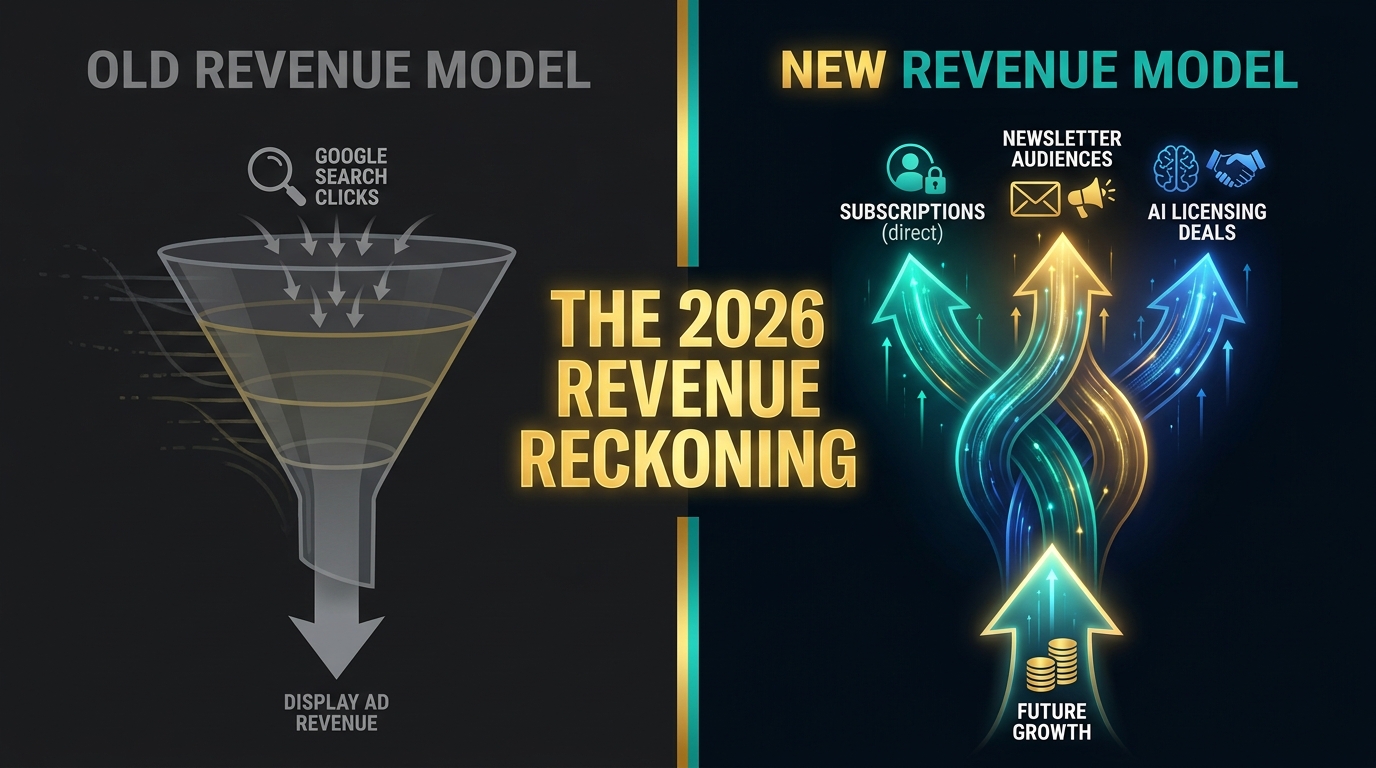
Traffic decline is painful. Revenue decline is existential. And because the relationship between these two things isn’t perfectly linear — losing 42% of organic search traffic doesn’t automatically mean losing 42% of revenue — newsrooms need to be precise about which revenue streams are actually threatened and which aren’t.
Programmatic display advertising, which is bought against page-view volume, is the most directly threatened model. If AI Overviews reduce the volume of search clicks that land on publisher pages, the inventory available for programmatic ads shrinks proportionally. Publishers who built large revenue bases on high-volume programmatic inventory from SEO-driven content have no clean path to replacing that revenue through the same mechanism under the new search economics.
Subscription Models Gaining Ground
The sustained, if slow, shift toward reader revenue through subscriptions and memberships has been underway in the news industry for years. Google’s AI search changes are accelerating the economic logic of that transition. Traffic from AI Overview searches — even the 17% of cases where a user does click through — skews toward shallow, one-time visits from users who had a specific informational need satisfied by the AI answer. This traffic is a poor substrate for subscription conversion.
The traffic that is converting to subscriptions comes increasingly from users who discovered a publication through deep original reporting, followed a newsletter, or returned multiple times because of consistent Discover recommendations. These are high-intent, high-loyalty users — smaller in number than the old SEO traffic volumes, but far more valuable on a per-user basis. Publishers successfully navigating the AI transition are restructuring their entire conversion funnel around capturing and deepening relationships with these users rather than maximizing total page views.
Newsletter as the Audience Preservation Layer
Email newsletters have become the single most strategically important audience retention tool for news publishers adapting to AI search disruption. Newsletter subscribers represent direct audience relationships that exist entirely outside Google’s distribution architecture. They can’t be affected by algorithm changes. They can’t be displaced by AI Overviews. They represent audience that a publisher has genuinely owned rather than rented from a platform.
The correlation between newsletter audience size and resilience to AI search traffic disruption is strong enough that it’s now influencing editorial investment decisions at leading publishers. Resources that might previously have gone into SEO content production are being reallocated to newsletter production, reader engagement programs, and subscriber-exclusive content that makes newsletter sign-up more compelling.
AI Licensing as a New Revenue Line
The AP’s licensing deal with Google and the emerging class of AI content licensing agreements represent a genuinely new revenue line for publishers who can negotiate access to it. The business logic is different from traditional licensing: what AI companies value isn’t just the right to display content to human readers, but the right to use content in training models and powering answers. The authoritative, original, well-sourced journalism that newsrooms produce is exactly what makes AI systems more accurate — which means the journalism has commercial value to AI systems that needs to be reflected in licensing terms.
Publishers with the strongest negotiating position for AI licensing deals are those with the largest archives of original, authoritative journalism, the clearest technical infrastructure for content delivery at scale, and the most credible ability to withhold content (through paywalls or robots.txt blocking) if deals aren’t satisfactory. Building toward that negotiating position is now part of the strategic calculus at major news organizations, even while most individual publishers are still too small to have meaningful leverage.
The Discover + Citation Dual Strategy: A Framework for 2026
The clearest strategic framework emerging from the newsrooms adapting most effectively to AI search changes in 2026 treats Google Discover and AI Overview citations as two separate, parallel objectives that require different editorial and technical investments — not as two faces of a single “Google strategy.”
Discover optimization and citation optimization don’t always pull in the same direction. Discover rewards freshness, speed, compelling images, and breaking-news authority. Citation rewards depth, structural clarity, named sourcing, and demonstrable E-E-A-T. The article formats that perform best on each channel are genuinely different, which means newsrooms can’t optimize for both simultaneously on the same piece of content. They need a portfolio approach.
The Portfolio Allocation
Publishers with the resources to implement a deliberate portfolio approach are allocating content effort roughly as follows: a significant share of daily production toward speed-driven breaking coverage aimed at Discover distribution; a smaller share of weekly or monthly editorial effort toward deep, citation-optimized original investigations and data-driven analyses aimed at AI Overview inclusion; and a further allocation toward direct-audience-building content (newsletters, podcasts, subscriber-exclusive reporting) that doesn’t depend on Google at all.
The exact proportions vary by outlet type. A regional news operation with deep local authority and a breaking-news mandate leans heavily toward the Discover track. A specialist policy or financial outlet with a subscription base and deep investigative capacity leans toward the citation track. The common thread is the explicit recognition that these are different channels requiring different approaches — not a single “Google” strategy that can be applied uniformly across all content.
The Metrics That Tell You It’s Working
For Discover performance, the key metrics are: Discover impressions (available in Google Search Console), Discover click-through rate, and the percentage of total traffic arriving via Discover versus Search. A healthy Discover-focused publisher in 2026 should see Discover impressions growing, CTR stable or improving, and Discover representing an increasing share of Google-origin referrals.
For citation performance, metrics are harder to automate but include: AI Overview appearance rate on owned-topic queries (manually checked or tracked through emerging tools), AI-referred traffic in analytics (identifiable through UTM parsing and referrer analysis), and Share of Voice in AI search results across major platforms. Citation metrics should be tracked weekly and benchmarked against competitors on key coverage beats, not just tracked in isolation.
What the Numbers Say About Who’s Winning Right Now
Across the data available from publisher panels, analytics providers, and independent research through mid-2026, a clear picture is forming of which types of news operations are navigating the AI search transition most successfully — and it isn’t simply the largest publishers.
The publishers absorbing the deepest damage are those that built significant revenue on high-volume, SEO-optimized evergreen and lifestyle content targeted at top-of-funnel informational queries. Business Insider’s 55% monthly search traffic decline between 2022 and 2025 is an extreme example, but the directional pattern repeats across dozens of publishers that built their digital strategy around content volume, keyword coverage, and programmatic monetization.
Regional Publishers Finding an Unlikely Advantage
One of the counterintuitive findings in 2026 publisher performance data is that certain regional news operations — particularly those with genuine local authority, dedicated beat reporters, and established community trust — are holding up better than some national digital-first outlets. The February 2026 Discover update’s increased weighting of local relevance signals appears to be a real factor here. Local publications covering municipal politics, regional business, community events, and local crime are surfacing in Discover for users in their geographic areas in ways that weren’t previously measurable.
This doesn’t mean regional news is thriving broadly — the financial pressure on local journalism from declining print advertising long predates AI search and remains severe. But it does suggest that the AI Overviews disruption, for all its damage to evergreen national content, has not uniformly disadvantaged all types of journalism.
The Authority Concentration Risk
The largest concern visible in the citation data is the concentration risk for the industry overall. If 68% of AI citation share flows to just 15 domains, and a handful of major brands capture most of the news-specific citation share, the AI search landscape could accelerate the bifurcation of the news industry into a small tier of highly visible, well-cited major brands and a very large tier of publishers that are effectively invisible in the most important new distribution layer.
The stakes of that bifurcation go beyond business performance. AI-cited journalism shapes public knowledge. If the sources AI systems cite are systematically narrow — both in terms of brand diversity and in terms of the geographic, political, and demographic perspectives they represent — the epistemic consequences extend well beyond traffic metrics. That’s a concern that Google has acknowledged in principle but has not yet resolved through any systematic approach to citation diversity.
Where the Industry Goes From Here
The trajectory through the rest of 2026 and into 2027 depends heavily on two variables that are still genuinely uncertain: how widely AI Mode is adopted as users’ default Google experience, and whether any meaningful licensing or compensation framework emerges from the ongoing publisher-platform negotiations.
On AI Mode adoption, the early 2026 U.S. rollout showed rapid uptake among heavy Google users and younger demographics — the same users whose search behavior already skewed toward mobile-first, Discover-heavy patterns. If AI Mode becomes the default Google experience for the majority of users within the next 12 months, the zero-click dynamic currently visible in AI Overview searches will intensify significantly.
On licensing, the realpolitik is that Google has limited structural incentive to create broad compensation frameworks absent regulatory compulsion. Individual deals like the AP arrangement will continue. Pilot programs with select publishers will continue. But a transparent, industry-wide compensation mechanism for AI use of news content is not materializing from voluntary negotiation alone.
The newsrooms most likely to be viable through that uncertainty are those that have diversified distribution across Discover, newsletters, and AI citations; built direct subscriber relationships that generate revenue independent of search traffic; developed genuine topical or geographic authority that makes them difficult to substitute; and invested in the technical infrastructure — schema, structured data, E-E-A-T signals — that positions them for citation visibility in whatever AI search looks like a year from now.
Conclusion: The New Operational Reality for News in the AI Search Age
Google’s AI search overhaul has not killed journalism. What it has done is fundamentally alter the operational math of news distribution — changing which content gets found, through which channels, and with what commercial value. The newsrooms that treat this as a temporary disruption requiring minor tactical adjustments are underestimating the structural depth of the change. The newsrooms that treat it as an opportunity to shed unsustainable content-volume strategies and invest in genuine editorial authority are finding paths forward.
The key takeaways for digital news operations in 2026:
- Segment your analytics immediately. Google Search, Google Discover, and AI-referred traffic are three different channels with different audiences, different content affinities, and different revenue implications. Aggregating them obscures the real performance story.
- Treat Discover as a primary distribution channel, not a secondary one. The February 2026 Discover update rewarded quality, freshness, and local relevance. These are also the qualities that build reader trust and subscription conversion.
- Build toward citation eligibility, not just search rankings. Schema markup, named authorship, structured data, and factual density are the levers. The citation economy rewards the same journalism practices that the profession’s best standards already require.
- Reduce dependency on any single Google surface. The most resilient publishers in 2026 have meaningful newsletter audiences, direct traffic from loyal readers, and revenue streams that don’t depend on search traffic volume.
- Don’t wait for licensing frameworks to materialize. Build the technical and editorial infrastructure that would give your newsroom leverage in future negotiations — strong archives, clear content ownership signals, and the ability to restrict access if terms are unsatisfactory.
The AI search transition is still happening in real time. The data from publisher panels is being updated monthly. The Discover algorithm is being refined quarterly. AI Mode’s user adoption curve hasn’t plateaued. Newsrooms navigating this environment successfully are doing so with analytical precision and editorial clarity — understanding exactly what the numbers show, making deliberate choices about where to invest, and building audience relationships that can survive whatever Google’s next change turns out to be.
That’s not a guarantee of survival. But it’s the clearest available path through a structural shift that has no easy exits.