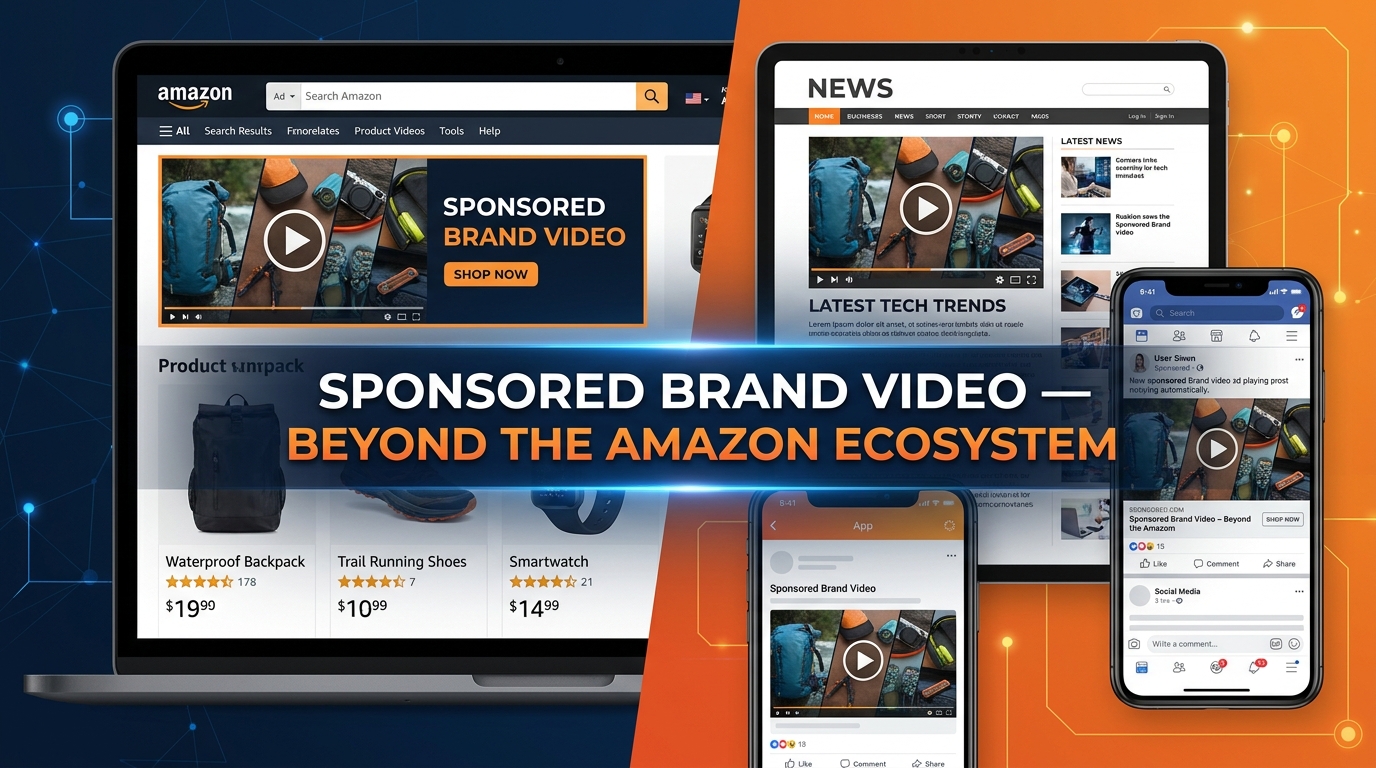
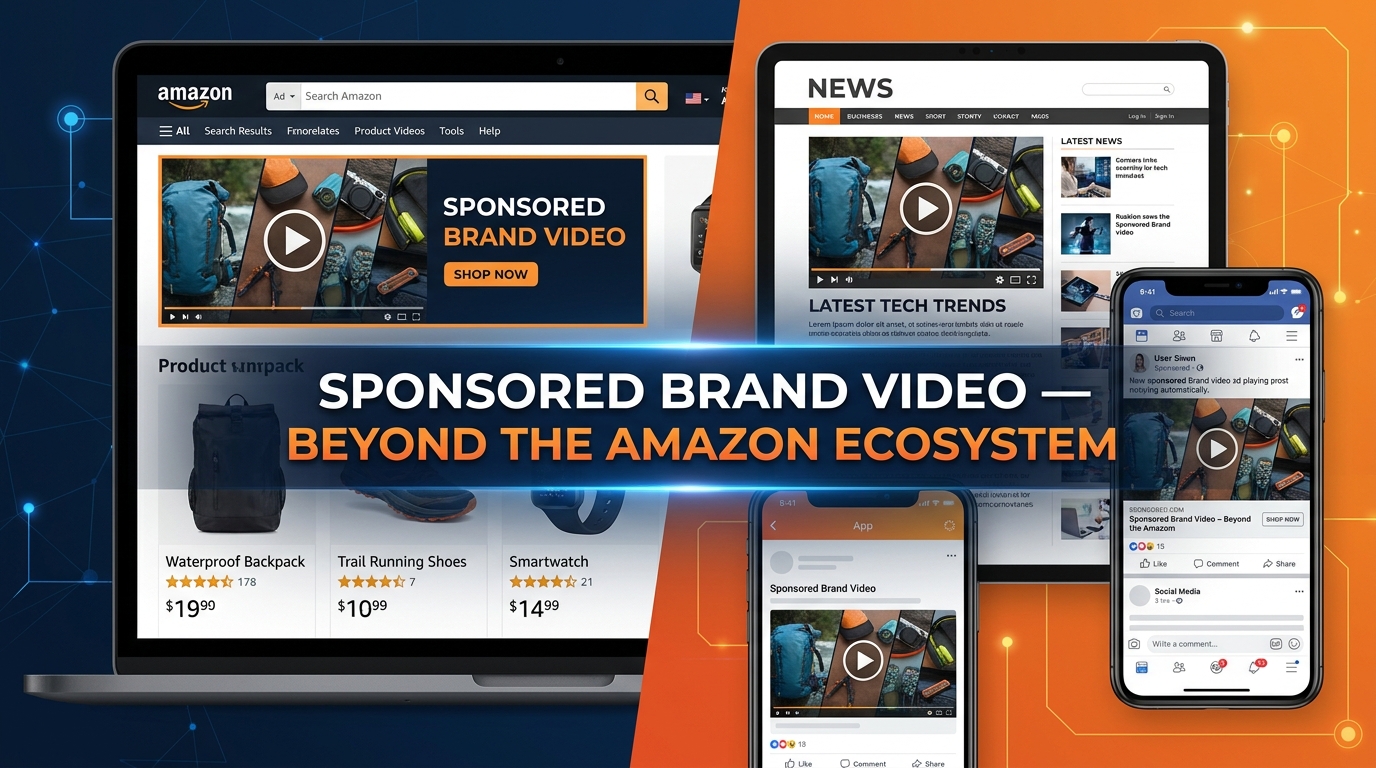
There is a version of Sponsored Brand Video that most advertisers know well: the autoplay unit that fires at the top of Amazon search results, product in frame within the first two seconds, sound off, text overlay telling the viewer exactly what they’re buying before they’ve even decided they want it. It converts. It scales. It is one of the most defensible CPCs in self-serve advertising.
Then there’s the other version — the one that Amazon quietly serves beyond its own domain, into third-party apps, publisher sites, and off-platform inventory — and the story there is considerably more complicated.
The promise is straightforward: extend your brand’s video reach beyond Amazon’s walls, capture shoppers earlier in their journey, and drive them back to your listings with higher purchase intent than a cold paid-social impression ever could. The reality, as practitioners are discovering through placement reports and AMC queries, is messier. Off-Amazon SBV placements can carry higher ACoS, lower conversion rates, and significantly murkier attribution than the search-result placements that made the format famous.
That doesn’t mean you should ignore them. It means you need to understand exactly what you’re buying, how to measure it honestly, and when — for your specific catalog, category, and funnel — off-platform video makes financial sense. This article covers all of it, without the hype.
What “Off-Amazon Placements” Actually Means for Sponsored Brand Video
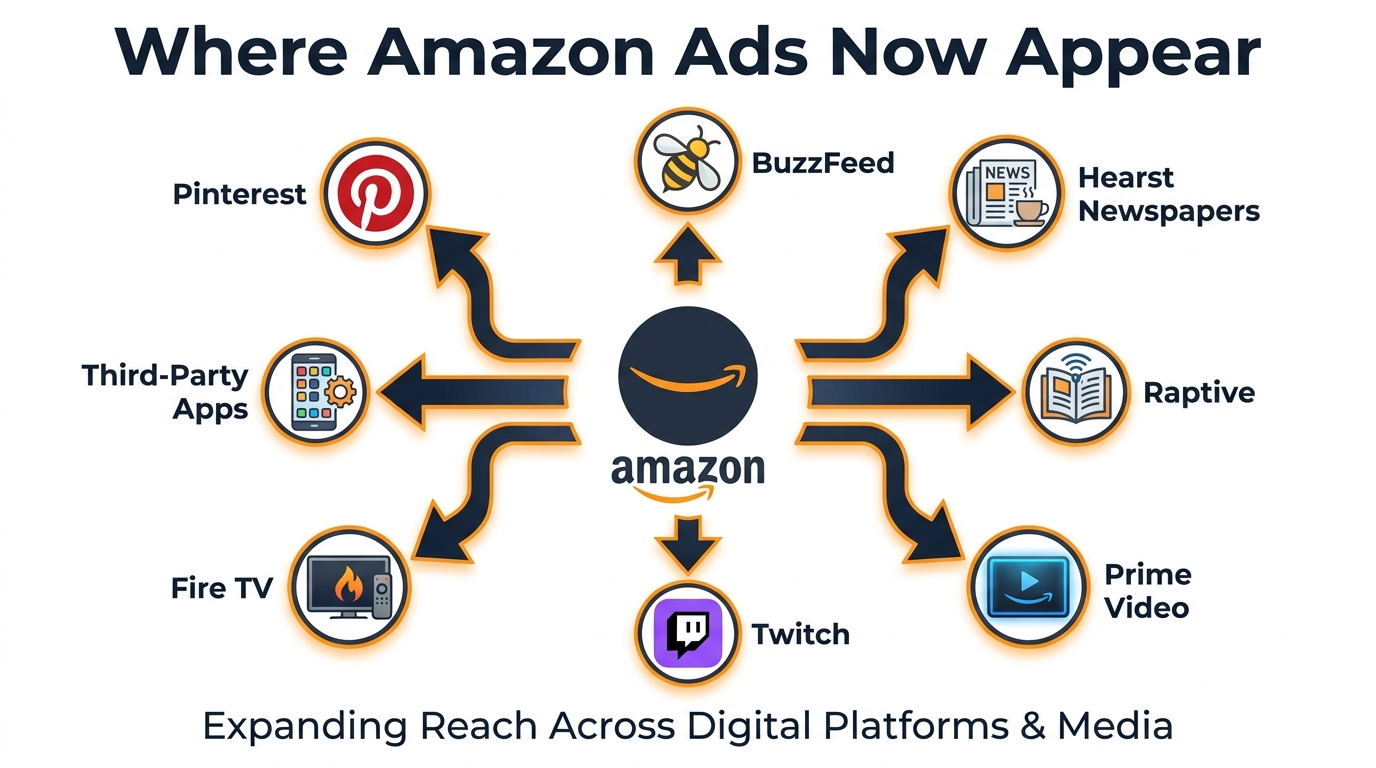
Before discussing performance, you need a clear map of what “off-Amazon” actually encompasses in 2026. The term covers substantially different inventory types, with different audiences, different intent signals, and different attribution mechanics. Treating them as a single category is where most advertisers make their first analytical mistake.
The Three Distinct Off-Amazon Contexts
Amazon-owned off-Amazon properties. This is the largest and most measurable segment. It includes Fire TV, Fire Tablet, IMDb, Twitch, and Alexa-adjacent surfaces. These are technically “off Amazon.com” but still within Amazon’s walled garden, meaning first-party audience data remains intact and attribution is relatively clean. Sponsored Brands Video does not natively run here — that’s primarily Amazon DSP and Streaming TV territory — but understanding this segment matters because it represents the gold standard of off-Amazon intent quality that purely external placements can’t replicate.
Amazon’s third-party publisher network. This is where Sponsored Products off-Amazon placements live, and where the most practitioner confusion originates. Amazon serves ads on premium publishers including Pinterest, BuzzFeed, Hearst Newspapers, Raptive, Lifehacker, Mashable, and a growing list of Ziff Davis properties. The rollout began in 2023 for Sponsored Products. By 2026, this network has expanded considerably, though the extent to which Sponsored Brands Video — as opposed to Sponsored Products — flows through this publisher network is a question Amazon has not fully answered in public documentation.
Browser and app-level remnant inventory. Through programmatic delivery and the broader reach of Amazon DSP, video can reach users on thousands of apps and websites outside Amazon’s premium network. This is distinct from SBV proper but forms part of the “off-Amazon video” conversation for advertisers thinking about cross-channel strategy.
What SBV’s Official Spec Sheet Actually Says
Amazon’s official Sponsored Brands Video documentation describes the format primarily as a search-results ad. The standard placement is top-of-search on Amazon, where intent is highest and the format genuinely earns its cost-per-click premium. However, placement reports available in the Amazon Ads console do surface an “Off Amazon” line item for some campaigns, indicating that budget is occasionally being allocated to placements beyond Amazon.com — even when advertisers haven’t explicitly chosen to go there.
This is the central tension for most advertisers: off-Amazon placements for SBV are not always a deliberate strategic choice. Sometimes they’re a default, and the budget allocation to them can quietly erode campaign efficiency if placement reports aren’t reviewed regularly. The first practical step for any SBV advertiser is simply knowing whether their campaigns are serving off-Amazon at all — and at what share of spend.
The Architecture of Amazon’s Expanding Ad Network
To understand why off-Amazon placements exist and why Amazon is aggressively expanding them, you need to understand Amazon’s competitive position in digital advertising circa 2026. Amazon is now the third-largest digital advertising platform globally, trailing only Google and Meta. Its core advantage has always been purchase-intent data — no other platform can tie an ad impression directly to a product purchase with first-party data at scale. But there’s a ceiling on how much ad inventory Amazon.com itself can generate. The search results page has finite real estate. The product detail page has competing formats fighting for attention.
Why Amazon Needs Off-Platform Reach
Off-Amazon inventory solves a structural problem: Amazon has more advertising demand than its own platform can absorb at the CPCs and CPMs advertisers are willing to pay at the margin. Expanding to external publishers creates new inventory, new reach, and a rationale for advertisers to consolidate more of their media budget within Amazon’s ecosystem rather than splitting it between Amazon, Google Shopping, and paid social.
The pitch to advertisers is compelling in theory: Amazon’s shopper purchase-intent data, applied to audiences on third-party sites, should produce better targeting than a generic programmatic buy. When a user who searched for “insulated water bottle” on Amazon in the last 30 days sees your SBV unit on a Hearst lifestyle article, they are, in theory, a higher-value prospect than someone reached via a lookalike audience on a demand-side platform with no purchase-signal backbone.
The Publisher Network’s Current Reality
In practice, the rollout of Amazon’s off-Amazon ad network through third-party publishers has been uneven. The early evidence from Sponsored Products off-Amazon placements — which expanded before SBV — showed that conversion rates drop sharply when shoppers are reached outside the purchase-intent context of Amazon search. A user browsing a BuzzFeed article about summer recipes and encountering a product ad is in a fundamentally different mental state than the same user typing a specific query into Amazon’s search bar. The purchase signal that makes Amazon inventory so valuable comes precisely from active shopping behavior. Off-platform, that signal dilutes significantly.
Some practitioners running Sponsored Products campaigns have reported off-Amazon ACoS running at two to four times their on-Amazon benchmarks, with conversion rates that are a fraction of search-result placements. Sponsored Brand Video, with its heavier creative requirements and slightly longer engagement window, may perform better than static product ads in off-Amazon contexts — but the fundamental intent-gap problem doesn’t disappear because the ad has motion.
Why SBV Was Built for On-Amazon — And What That Means Off-Platform

Sponsored Brand Video was designed around a very specific user behavior: a shopper who has typed a keyword into Amazon’s search bar, scrolled past the top organic result, and encountered an autoplay video that — if the creative is done right — answers the implicit question behind their search query before they’ve had to read a single word of product copy.
That interaction model is extraordinarily efficient. The shopper has already self-selected into purchase consideration. The video doesn’t need to create desire from scratch; it just needs to confirm relevance and differentiate the product. This is why SBV’s on-Amazon performance metrics — typically CTR in the 0.8–1.2% range, conversion rates of 8–12% for well-structured campaigns, and ACoS targets achievable in the 20–35% range for most categories — are so strong relative to other video formats.
The Intent Architecture That Makes On-Amazon SBV Work
Consider what the on-Amazon SBV placement actually captures. The shopper has expressed category intent through their search query. They’re actively evaluating options. The product display around the video ad reinforces the shopping context. The click goes directly to a product detail page or Brand Store, where purchase infrastructure — Prime shipping badging, reviews, A+ content, Buy Box — all works to complete the conversion. Every element of that chain is optimized for the transaction. Remove the shopper from Amazon’s context and that entire infrastructure disappears.
Off-platform, even with Amazon’s audience targeting applied, the journey looks different. The shopper may have expressed purchase intent earlier — perhaps they did search on Amazon weeks ago, and Amazon’s retargeting machinery has identified them as an in-market audience. But “in-market” is not the same as “in-session.” A shopper reading the news has a much higher re-engagement cost than one already in the shopping funnel. The video has to do more work, and clicking an ad means leaving the current browsing context, navigating to Amazon, and reorienting to a purchase decision — a significant drop in probability at each step.
Creative Requirements Change Off-Platform
Amazon’s official best practices for SBV creative — product visible within the first two seconds, function demonstrated within five seconds, sound-off optimized, strong text overlay, 15–30 seconds total with 20 seconds or less strongly recommended — are calibrated for an audience in active purchase mode. Off-platform audiences need a different creative approach: more storytelling context, a clearer reason to click away from their current content, and a value proposition strong enough to interrupt browsing behavior rather than complement it.
This is a genuine creative divergence. The best-performing on-Amazon SBV often features tight product shots, feature-forward editing, and a direct CTA to “Shop Now.” That creative, served to someone halfway through a recipe article on a lifestyle site, may not generate the response rate the placement report suggests it should. If you’re going to run video off-Amazon deliberately, you need to think about whether your current creative assets are built for that audience context — or whether you’re running on-Amazon creative in a context it wasn’t designed for.
The Off-Amazon Placement Data Problem: What You Can and Can’t Measure
One of the most significant barriers to making rational decisions about off-Amazon SBV placements is the data gap. Amazon’s placement reports do surface off-Amazon spend data, and the Amazon Ads console has improved its reporting significantly in 2025–2026. But the granularity that would allow advertisers to make truly informed allocation decisions — which specific publishers are receiving budget, what the completion rate of video is on those placements, what the post-click behavior looks like by external domain — remains largely unavailable in self-serve reporting.
What Your Placement Report Actually Shows You
In the Amazon Ads console, the placement report for Sponsored Brands campaigns breaks performance into broad buckets: top of search, other on-Amazon placements, and off-Amazon. The off-Amazon bucket aggregates all external placement performance into a single row. You can see spend, clicks, orders, CPC, and ACoS for that aggregate off-Amazon pool — but you cannot see which individual publishers drove which clicks, which placements had the highest view-through rates, or how the traffic from off-Amazon placements differed in downstream behavior from on-Amazon clickers.
This aggregation makes optimization difficult. You know the total off-Amazon ACoS — if it’s 80% while your on-Amazon ACoS is 25%, you know something is wrong. But you don’t have the data to surgically fix it at the placement level the way you might exclude poorly performing keywords from a search campaign.
The Placement Modifier Limitation
Amazon does allow bid modifiers for different placement types, including the ability to set specific bid adjustments for top-of-search versus other placements. However, the control options for specifically reducing or eliminating off-Amazon delivery have historically been blunt. Advertisers who want to effectively exclude off-Amazon placements often need to use workarounds, including setting very low or zero bid modifiers for non-search placements, and monitoring placement reports weekly to detect any drift in off-Amazon spend share. This is not the kind of surgical placement control that, say, Meta’s Advantage+ or Google’s Performance Max campaign types now offer with their exclusion tools.
Amazon Marketing Cloud Fills Some Gaps
For advertisers with access to Amazon Marketing Cloud (AMC) — which requires either a managed service relationship or a direct AMC setup — the picture improves considerably. AMC allows you to run custom SQL queries across your full Amazon advertising dataset, including path-to-purchase analysis that can distinguish the contribution of off-Amazon placements versus on-Amazon touch points in multi-touch conversion journeys. You can run incrementality analyses to assess whether off-Amazon SBV impressions are generating sales lift above what would have occurred organically. AMC won’t tell you which publisher showed your ad, but it will tell you whether the population of users exposed to off-Amazon placements converted at rates meaningfully different from unexposed users — which is the question that actually matters for budget allocation.
DSP Video vs. Sponsored Brand Video Off-Amazon: Picking the Right Tool

If you want Amazon’s audience data applied to video inventory beyond Amazon.com, you have two fundamentally different tools available. Understanding why they’re different — and which one is actually appropriate for your objective — is critical before spending a dollar on off-Amazon video.
Sponsored Brand Video: The Self-Serve CPC Format
SBV operates on a cost-per-click model, is available to any seller or vendor enrolled in Brand Registry, requires no minimum spend, and is managed entirely within the Amazon Ads console. Its native habitat is Amazon search results. When SBV budget spills into off-Amazon placements, it is typically via Amazon’s automated delivery — the algorithm deciding that external inventory represents an opportunity to spend your budget at a favorable CPC before returning to on-Amazon inventory. You’re still paying cost-per-click, but the conversion rate on that click is likely materially lower than on-Amazon, which is why ACoS tends to run higher in the off-Amazon placement bucket.
For advertisers primarily focused on efficient, last-click conversion, SBV’s off-Amazon delivery is more likely a problem to manage than an opportunity to pursue. The format wasn’t designed for off-site prospecting, and its CPC pricing model doesn’t account for the lower purchase probability of external traffic.
Amazon DSP Video: The Purpose-Built Off-Amazon Format
Amazon DSP video — including Online Video (OLV) on third-party sites and Streaming TV on Prime Video, Twitch, IMDb, and Fire TV — was specifically designed for off-Amazon delivery. It operates on a CPM basis, is priced and optimized for reach and awareness objectives, and gives advertisers far more placement control than self-serve SBV. Minimum spend thresholds apply (typically $10,000 or more for self-service DSP, higher for managed), making it inaccessible to smaller advertisers but meaningful for mid-to-large brands.
DSP video with Amazon audience segments — in-market shoppers, lifestyle segments, competitive ASIN retargeting — is the correct vehicle for off-Amazon video reach when reach is actually the objective. Typical ROAS benchmarks for DSP video prospecting run in the 2–3x range; retargeting campaigns that hit audiences who have already visited product pages or add-to-cart audiences can deliver 4–8x ROAS. These numbers don’t match on-Amazon SBV’s lower-funnel efficiency, but they’re measuring a different objective: incremental reach to audiences who may not yet be in-market, rather than harvesting intent from shoppers already in the purchase funnel.
The Practical Decision Framework
The cleanest way to think about the choice: if your objective is conversion, maximize on-Amazon SBV and minimize or eliminate off-Amazon SBV delivery. If your objective is awareness and upper-funnel reach, use Amazon DSP video with the inventory targeting and audience segments it was built for. The mistake is using SBV as an off-Amazon awareness play because it’s cheaper to set up — it’s measuring success with ACoS when the actual goal is reach and brand recall, and it’s running bottom-funnel creative in a top-funnel context. That mismatch produces disappointing results and misleading data.
Creative Strategy for Video That Works Across Contexts
Whether you’re managing SBV placement spill or deliberately building off-Amazon video strategy via DSP, the creative decisions you make will have a larger impact on off-platform performance than any bid adjustment or targeting parameter. On-Amazon, a mediocre video with strong keyword targeting will still convert reasonably well because the intent context carries it. Off-Amazon, where the surrounding environment is providing no purchase signal reinforcement, the creative has to carry the full load.
The On-Amazon Creative Checklist (Baseline)
For SBV running in its primary habitat — top of Amazon search results — the evidence-backed creative approach is well-established. Show the product within the first two seconds; demonstrate its key function within five seconds; assume no audio (studies consistently show the majority of users browsing Amazon are in sound-off environments or using the app in public); include text overlays for every key message; end with a clear call to action. At 15–30 seconds total length, with Amazon’s own recommendation capping at 20 seconds for highest performance, this is a tight format that rewards ruthless clarity over creative ambition.
Brands that have documented strong SBV performance — including HP’s 224% year-over-year impression growth in SBV placements and Loftie achieving 5.66 ROAS on SBV campaigns — consistently cite product-first creative execution as the common thread. These are not brand films. They are demonstration videos with a buy button attached.
Adapting Creative for Off-Amazon Contexts
Off-Amazon audiences need more. They haven’t signaled purchase intent, so your video needs to create it. That means a slightly longer tolerated introduction — you may need two to three seconds of context before the product reveal, because the viewer doesn’t know they’re looking at a shopping ad. Emotional or aspirational hooks work better in external browsing environments than pure feature lists; you’re interrupting content consumption, not complementing search behavior.
Consider a two-creative approach if you’re running any significant budget off-Amazon: a tight, conversion-focused version for on-Amazon placements (15–20 seconds, product-first, feature overlay) and a slightly richer awareness version for off-Amazon (25–35 seconds, problem-solution narrative, softer CTA). Amazon’s creative serving doesn’t natively separate these by placement type in SBV campaigns, which is another argument for separating off-Amazon spend into DSP campaigns where you have full creative control by placement.
Technical Specs That Matter
For SBV, Amazon’s current technical requirements call for a 16:9 or 1:1 aspect ratio, minimum resolution of 1280×720 pixels, MP4 or MOV file format, maximum file size of 500MB, and audio mix optimized for both playback and mute scenarios. Closed captions are now effectively mandatory for any ad serving on mobile environments; the completion rate improvement from properly captioned video relative to uncaptioned is significant across all Amazon video formats. For DSP video, specs vary by placement type, with Streaming TV requiring a 16:9 aspect ratio and professional broadcast-quality audio since it’s playing on connected TVs where users are more likely to have sound enabled.
Amazon Marketing Cloud: The Missing Link in Cross-Channel Attribution

The single biggest shift in how sophisticated Amazon advertisers think about off-Amazon video in 2026 is the maturation of Amazon Marketing Cloud as a measurement infrastructure. For years, the attribution challenge with off-Amazon video was fundamental: you could see the impressions on one side and the Amazon sales on the other, but connecting them required either trusting Amazon’s own last-click attribution model (which undersells upper-funnel touchpoints) or running external incrementality studies that were expensive and slow.
AMC changes that equation materially — for advertisers with the technical capability to use it.
What AMC Actually Enables
Amazon Marketing Cloud is a privacy-safe clean room environment that holds event-level Amazon Ads data. Advertisers can submit SQL queries against this dataset to surface insights not available in the standard reporting console. For off-Amazon video measurement, the key use cases are:
- Path-to-purchase analysis: Understanding how many converting customers were exposed to off-Amazon video touch points before their on-Amazon purchase, and how that exposure affected time-to-conversion and average order value.
- Reach and frequency reporting: Measuring the incremental audience reach delivered by off-Amazon video versus on-Amazon formats, identifying how much of the off-Amazon delivery was reaching net-new audiences versus retargeting shoppers already in the funnel.
- Incrementality measurement: Comparing conversion rates between exposed and unexposed audience cohorts to isolate the actual sales lift attributable to off-Amazon placements, separate from organic purchase behavior.
- Cross-channel overlap analysis: Identifying what percentage of SBV-exposed audiences were also reached by DSP video, Streaming TV, or external traffic sources, enabling frequency cap management across channels.
The AMC Access Problem
The limitation with AMC is access. Setting up an AMC instance requires either working through Amazon’s managed service team or an Amazon Ads-verified partner, and extracting meaningful insights requires SQL fluency or a tool built on top of the AMC API. For the majority of Amazon sellers — particularly those in the sub-$1M annual ad spend tier — this capability is either unavailable or economically impractical without agency support. The practical implication is that smaller advertisers making off-Amazon placement decisions are flying largely on aggregate placement report data, while larger competitors are making those same decisions with multi-touch attribution data three levels deeper. That’s a meaningful information asymmetry.
Workarounds for Advertisers Without AMC
For brands that can’t yet leverage AMC, Amazon Attribution tags offer a partial solution. Attribution tags let you track external traffic sources — including any media you’re buying outside Amazon — and measure the downstream Amazon conversion events (detail page views, add-to-carts, purchases) driven by that external source. This doesn’t give you the path-to-purchase granularity of AMC, but it does allow you to quantify the conversion value of off-Amazon media buys in a way that goes beyond impression counting. Combined with careful monitoring of Brand Store analytics — which show referral traffic sources and their conversion behavior — Amazon Attribution can provide a directional picture of off-Amazon video ROI even without full AMC access.
Campaign Structure for Off-Amazon Video Reach
If you’ve decided that off-Amazon video delivery is a deliberate part of your strategy rather than a byproduct of your SBV budget, the way you structure campaigns significantly affects both performance and your ability to measure it accurately. Running off-Amazon video objectives through the same campaigns as your on-Amazon SBV conflates metrics in ways that make optimization difficult and give false readings on both sets of placements.
Separating Campaigns by Objective and Placement
The most defensible structure is to run dedicated campaigns for distinct placement objectives:
- Campaign 1: SBV Top-of-Search (Conversion Focus). Keyword-targeted, bid aggressively on top-of-search placement, monitor ACoS weekly. Placement modifier for “other placements” set to reduce or eliminate budget flowing to non-search positions. This campaign’s success metric is ACoS and ROAS.
- Campaign 2: SBV Detail Page (Retargeting / Defense). Product-targeted or category-targeted, running on detail pages of your own ASINs and potentially competitor pages. ACoS target slightly higher than top-of-search given lower conversion rates, but still primarily a conversion-focused placement.
- Campaign 3: DSP Online Video (Prospecting). For deliberate off-Amazon reach, run this as a separate DSP line item with audience segments (in-market, lifestyle) and CPM bidding. Success metrics are reach, frequency, video completion rate, and view-through conversion rate — not last-click ACoS.
- Campaign 4: DSP Streaming TV (Brand Awareness). Prime Video, Twitch, IMDb, Fire TV placements. Evaluated on reach, frequency, brand search lift, and AMC-based halo analysis.
This structure keeps metrics meaningful. When SBV and off-Amazon DSP are lumped together, a spike in DSP prospecting impressions can make the blended ROAS look weaker than it is — causing premature cuts to a strategy that may actually be driving incremental revenue when measured with appropriate attribution windows.
Budget Allocation Guidance
There’s no universal rule for how much budget belongs in off-Amazon video versus on-Amazon SBV, but the general principle is that off-Amazon should be additive — funded from incremental budget, not redirected from on-Amazon spend that’s already performing well. A common approach among experienced Amazon advertisers is to allocate 70–80% of video budget to on-Amazon SBV (where intent is highest and measurement is cleanest), 10–15% to DSP online video for prospecting and retargeting, and 5–10% to Streaming TV for upper-funnel brand work. These ratios shift based on category competitiveness, brand awareness stage, and whether the business is in growth mode versus efficiency mode.
When Off-Amazon SBV Placements Are Worth It (And When They Aren’t)

Rather than a blanket recommendation to embrace or avoid off-Amazon SBV delivery, the more useful framework is a conditional one: certain business conditions make off-Amazon placements a reasonable experiment, while others make them a straightforward drain on an otherwise efficient campaign.
Scenarios Where Off-Amazon Delivery May Add Value
High-consideration purchases with long research cycles. If your product category involves significant pre-purchase research — home appliances, premium fitness equipment, supplements with specific health claims — shoppers often leave Amazon during their research phase, consult review sites, watch YouTube comparisons, and read editorial content. Being visible during that research journey, even at lower conversion rates than on-Amazon, can influence the final purchase decision. Off-Amazon reach in these categories has a legitimate role in the purchase journey.
New product launches before organic ranking is established. A product with no ranking history, few reviews, and low organic visibility struggles to compete for top-of-search SBV impressions on competitive keywords at an efficient ACoS. Off-Amazon awareness building — driving early traffic and brand searches that can feed back into Amazon’s relevance signals — can support a launch strategy, provided you’re measuring success by downstream signals (brand search volume, detail page view rate, conversion rate from traffic) rather than immediate last-click ROAS.
Competitive displacement in saturated categories. If a competitor dominates top-of-search in your category with aggressive SBV spend, their bid may make efficient on-Amazon impressions expensive. Reaching potential customers earlier in their journey, before they’ve anchored on a competitor, can shift category consideration. This is harder to prove with standard reporting but measurable via AMC brand consideration studies.
Scenarios Where Off-Amazon SBV Is Simply Leaking Budget
Tight ACoS targets in competitive categories. If your campaign operates with an ACoS target below 30% and you’re in a category with aggressive on-Amazon competition, off-Amazon placement spill is typically adding spend at ACoS levels that would get any keyword paused in a properly managed search campaign. The appropriate action is placement report monitoring and bid adjustments that limit off-Amazon budget allocation.
Commoditized or impulse-purchase products. Products bought on impulse — inexpensive consumables, accessories, trending items — don’t benefit from pre-funnel off-Amazon exposure the way high-consideration purchases do. The shopper who needs another set of USB cables isn’t spending time on a Hearst lifestyle site researching their options. Off-Amazon reach for these products is unlikely to change purchase behavior; it’s just impressions on audiences who would either find your product through search anyway or wouldn’t buy it regardless.
Limited creative assets. Running SBV off-Amazon with on-Amazon creative assets — tight, feature-focused, no emotional hook — in external browsing contexts is likely to generate low engagement rates that may eventually impact how Amazon’s algorithm values your creative quality. If you don’t have the budget or capability to develop context-appropriate creative for off-Amazon audiences, that’s a signal to concentrate on on-Amazon placements where your existing assets are optimized.
Measuring What Actually Matters: A Metrics Framework
The mistake most advertisers make when evaluating off-Amazon video placements is applying on-Amazon success metrics to a fundamentally different audience context. ACoS — advertising cost of sale — is the right primary metric for on-Amazon SBV because you’re directly harvesting purchase intent. Off-Amazon, where the objective is reach and upper-funnel influence, ACoS as a primary metric will always look terrible, because you’re measuring a bottom-funnel metric against a top-funnel activity.
The Metrics Hierarchy for Off-Amazon Video
Primary metrics (did the ad reach the right audience?):
- Unique reach and frequency — how many net-new users did your video reach, and how often?
- Video completion rate (VCR) — what percentage of viewers watched to or near the end? For a 15–30 second video, rates above 60% indicate the creative is holding attention in the external context.
- Viewability — was the video actually in-view when it played, or was it below the fold and auto-playing unseen?
Secondary metrics (did reach generate meaningful engagement?):
- Branded search lift — after running off-Amazon video, did branded search volume on Amazon increase for your brand name or product category terms? This is measurable through Brand Analytics and AMC.
- Detail page view rate — are users who were exposed to off-Amazon video visiting your product pages at a higher rate than unexposed audiences? AMC path-to-purchase queries can answer this.
- New-to-brand (NTB) customer rate — what percentage of conversions attributed to off-Amazon-exposed audiences are first-time buyers? NTB rate is available in Sponsored Brands reporting and helps distinguish whether off-Amazon placements are actually expanding your customer base or just retargeting existing buyers.
Efficiency metrics (are you spending sustainably?):
- Total advertising cost of sale (TACoS) — blended across all ad spend against total revenue, including organic. Off-Amazon activity that drives organic search rank improvement or brand awareness will show up in improved TACoS even if SBV placement-level ACoS looks weak.
- Customer acquisition cost (CAC) — for NTB customers specifically, what are you paying to acquire them through off-Amazon video versus your best on-Amazon new-customer channel? If off-Amazon is bringing in NTB customers at a comparable or better CAC, it’s justifiable even with weak ACoS.
Setting Realistic Time Horizons
Off-Amazon video influence on Amazon purchase behavior doesn’t happen instantly or show up in weekly ACoS reports. A reasonable measurement window for evaluating upper-funnel video impact is 30–90 days, with AMC analyses comparing conversion behavior before and after a sustained off-Amazon video push. Evaluating a two-week off-Amazon campaign by its in-period ACoS and shutting it down is like judging a billboard campaign by the next day’s web traffic. The effects accumulate over time and across touchpoints — which is both the strength of the approach and the challenge of proving its value to stakeholders who think in weekly ROAS reports.
The Road Ahead: Where Amazon’s Off-Platform Video Is Heading

Amazon’s advertising strategy makes its direction clear enough to plan around, even where specific product announcements haven’t materialized. The trend lines running through 2023 to 2026 — Sponsored Products off-Amazon expansion, Prime Video ad-supported tier, DSP premium publisher network growth, AMC measurement infrastructure maturation — all point in the same direction: Amazon wants to be a full-funnel advertising platform that reaches shoppers across the entire digital ecosystem, not just on its own properties.
Prime Video as the Premium Off-Amazon Canvas
The most significant development in Amazon’s off-Amazon video story isn’t what’s happening with SBV — it’s what’s happening with Prime Video. The introduction of an ad-supported tier on Prime Video in 2024, which by 2026 has significantly grown its advertising inventory, gives Amazon a premium CTV environment with first-party audience data that neither Google nor Meta can match in the shopping-intent domain. This is where Amazon’s off-Amazon video ambitions are most fully realized: a large screen, captive attention, household-level audience data, and a direct path from ad exposure to Amazon purchase attribution.
For advertisers who want off-Amazon video reach with Amazon’s data advantage, Prime Video advertising via DSP is now the highest-quality expression of that strategy. It has the attention quality of traditional TV (completion rates on CTV average well above 90%), the purchase-attribution capability of digital, and the audience precision of Amazon’s shopper data stack. Brands that have historically allocated TV budgets to reach and awareness objectives are finding that Prime Video as a DSP buy now offers a more measurable, commerce-attributable alternative.
Retail Media Network Interoperability
Longer term, the conversation around off-Amazon video advertising connects to a broader trend in retail media network interoperability. Multiple retail media standards bodies and industry initiatives are working toward cross-network audience matching that would allow, for example, a CPG brand to reach Amazon-identified in-market audiences through Walmart’s media network inventory, or vice versa. Amazon’s participation in these discussions — and the extent to which it opens its first-party audience data to external activation — will significantly shape what “off-Amazon video” means in 2027 and beyond.
For now, Amazon keeps its most valuable audience signals within its own ecosystem. Off-Amazon reach through Amazon-sourced audience segments is available only through Amazon DSP — not through independent programmatic pipes or third-party demand-side platforms. That walled-garden approach limits adoption among advertisers who prefer open-web programmatic buying, but it protects the data advantage that makes Amazon’s off-Amazon targeting proposition meaningful in the first place.
AI-Driven Placement Optimization
Amazon’s advertising AI is increasingly taking an active role in where budget flows across placement types. The Performance+ and related automated campaign types Amazon has been building into its console are designed to find the most efficient placement mix across on- and off-Amazon inventory automatically, without advertisers specifying placement strategies in advance. For efficiency-focused campaigns, this automation can be beneficial — the machine will find high-converting off-Amazon placements and avoid poor-performing ones faster than manual placement report analysis allows.
The tension is that automation optimizes for the objective you specify (typically ROAS or ACoS), which can be short-sighted for full-funnel strategy. If the algorithm sees off-Amazon placements converting at lower efficiency and pulls budget back to on-Amazon, it may be making the right last-click decision while leaving incremental reach and brand-building value on the table. Understanding what the automation is doing — and when to override it with manual placement controls — will be an increasingly important skill for Amazon advertising practitioners as these automated systems become more prevalent.
Key Takeaways for Advertisers in 2026
The honest summary on Sponsored Brand Video in off-Amazon placements is that the format’s core performance advantage — the ability to intercept high-intent shoppers at the moment of active search — is intrinsically tied to being on Amazon. Off-Amazon, that advantage diminishes because the intent context that makes top-of-search SBV so efficient disappears. But that doesn’t make off-Amazon video worthless. It makes it a different tool for a different objective — one that requires a different creative approach, a different metrics framework, and a different seat in the budget allocation conversation.
Here’s what the evidence actually supports:
- Audit your placement reports now. If you’re running SBV campaigns without checking the “Off Amazon” placement row, you may be allocating budget to external placements at ACoS levels that would justify pausing any keyword in your search campaigns. This is the most immediate action item and costs nothing but time.
- Don’t use SBV as your off-Amazon awareness vehicle. If off-Amazon reach is genuinely a strategic objective, Amazon DSP video is the purpose-built format — it has the placement controls, the CPM pricing model, and the inventory quality that SBV campaigns don’t deliver in off-site contexts.
- Match creative to context. On-Amazon SBV creative — product-first, sound-off, 15–20 seconds — is optimized for intent harvesting. Off-Amazon audiences browsing editorial content need a different hook, a different pacing, and a different CTA that acknowledges they’re not currently in a shopping mindset.
- Invest in AMC if your spend justifies it. The brands winning at off-Amazon video measurement in 2026 are the ones using AMC to run path-to-purchase analysis, incrementality studies, and branded search lift measurement. Without that infrastructure, you’re making off-Amazon budget decisions with dangerously incomplete information.
- Use the right success metrics by placement type. ACoS is the right metric for on-Amazon SBV. New-to-brand rate, branded search lift, detail page view rate, and video completion rate are the right metrics for off-Amazon video. Applying ACoS to an awareness placement is like measuring a billboard by its click-through rate — technically possible, practically meaningless.
- Watch Prime Video ad inventory closely. For brands with budgets that can access DSP, Prime Video is currently the highest-quality off-Amazon video environment in Amazon’s ecosystem — premium attention, first-party audience data, and measurable commerce attribution. It’s where Amazon’s off-platform video ambitions are most fully delivered today.
Off-Amazon placements for Sponsored Brand Video are neither the growth lever some vendors will tell you they are, nor the budget black hole that a single bad placement report might suggest. They’re a contextual tool — valuable in the right conditions, for the right objectives, with the right creative and measurement infrastructure in place. Getting that context right is what separates advertisers who build durable Amazon advertising programs from those who chase placements and question why the numbers never add up.