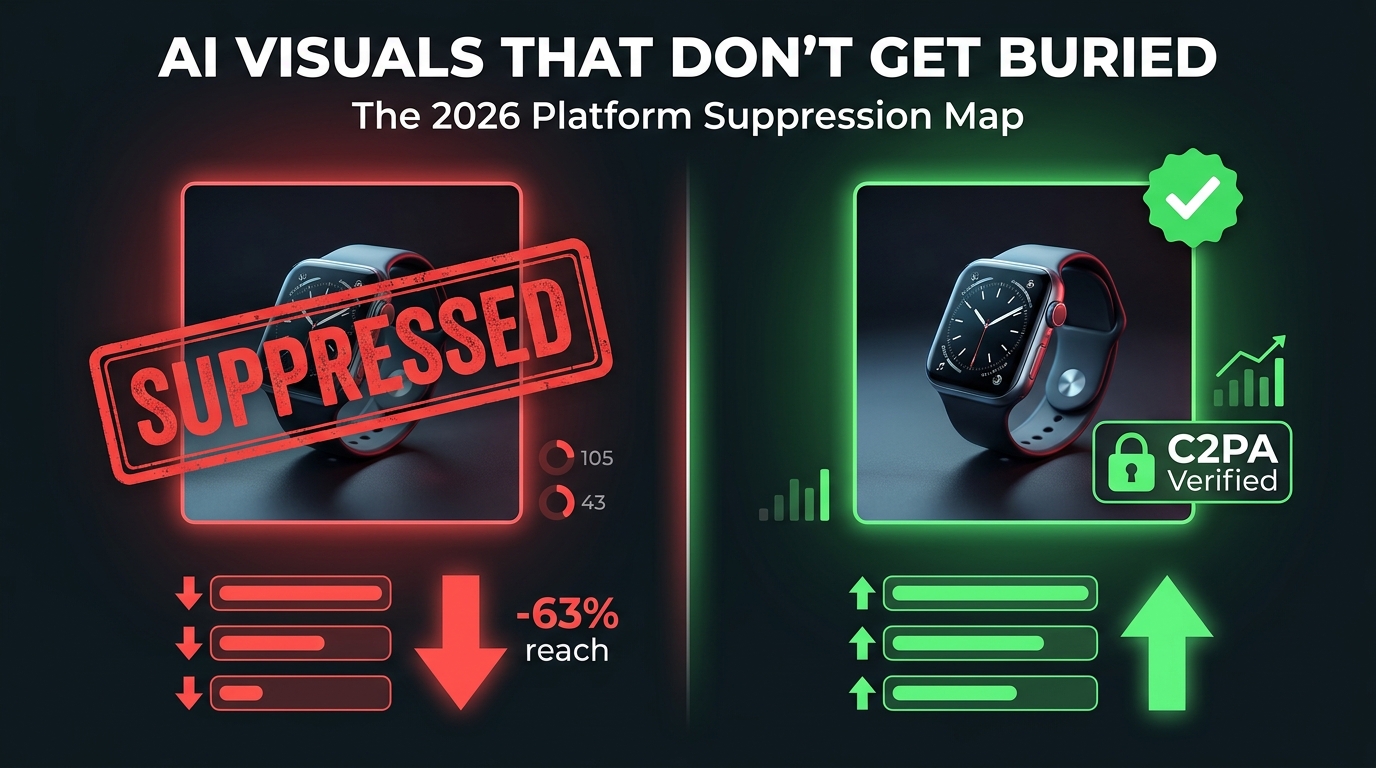
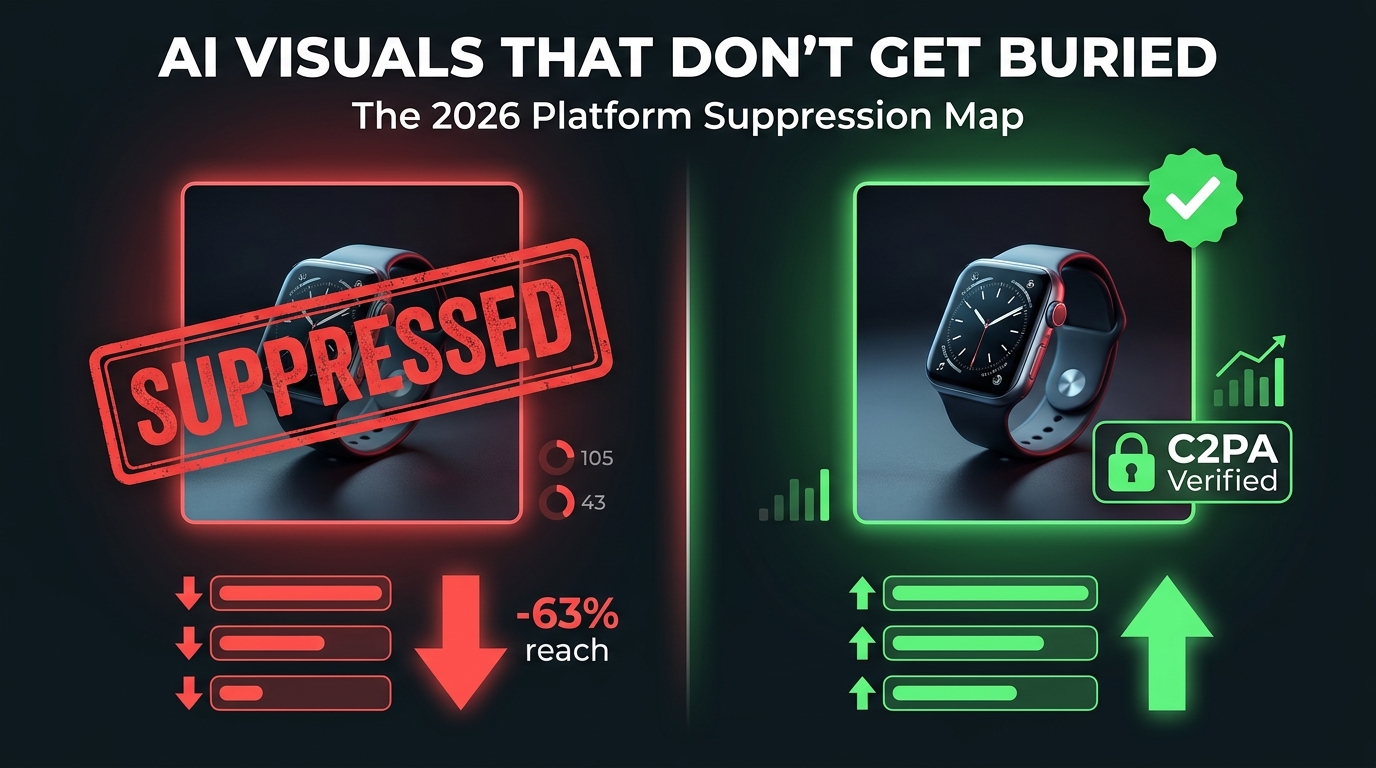
You followed the tutorials. You used the right tools. You generated a batch of clean, professional AI visuals, scheduled them across your platforms, and waited for the reach to roll in. Instead, your posts flatlined. Impressions were a fraction of normal. Engagement barely moved. No violation notice, no appeal link — just silence.
This is not a niche problem. Across Instagram, TikTok, LinkedIn, and YouTube, AI-generated visual content is running into a new and poorly understood set of suppression mechanisms in 2026. Some of these are explicit policy rules — label requirements, disclosure mandates, outright bans on deepfakes. But the more consequential suppression is quieter: algorithmic downranking based on authenticity signals, engagement quality scoring, metadata fingerprinting, and account trust tiers that platforms rarely document publicly.
Most of the advice circulating about this problem is either too vague (“just be authentic!”) or too focused on the obvious violations — the realistic deepfakes, the political impersonations, the NSFW content that platforms are clearly targeting. What’s missing is practical, technical guidance for the creators and brands operating in the legal middle ground: people generating product images, marketing visuals, conceptual illustrations, and branded content with AI tools, only to find that their content is being quietly buried.
This playbook is for that group. It covers how platform detection actually works, where the false positive problem is causing real damage, what the C2PA and watermarking standards mean in practice, and how to build a workflow that produces AI visuals capable of reaching the audience they were made for — without triggering the systems designed to suppress the ones that weren’t.
How Platforms Actually Detect AI Visuals (It’s More Than Just Metadata)
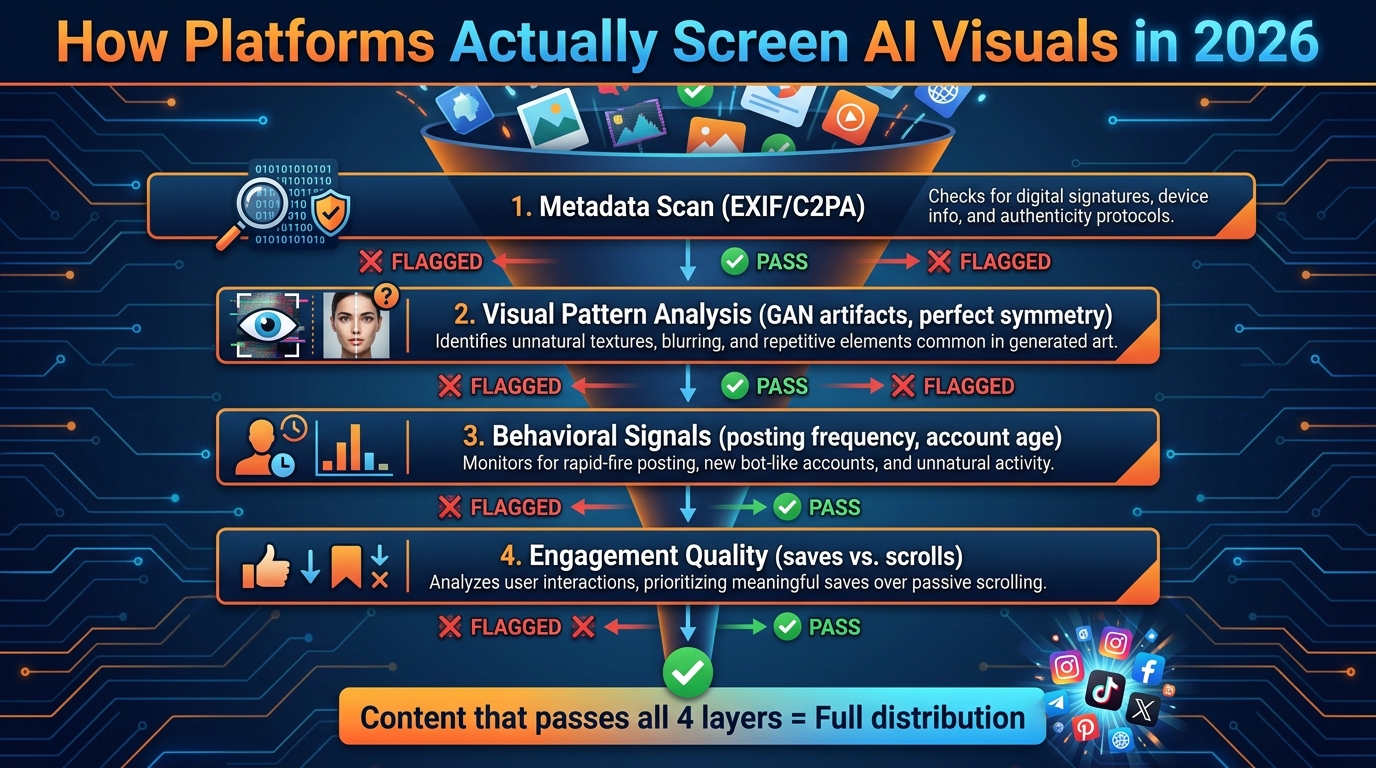
The common assumption is that platforms detect AI-generated images by checking for a specific tag or watermark embedded in the file. That’s one layer — but it’s far from the whole picture. In 2026, the detection infrastructure across major platforms is multi-layered, and each layer operates on different signals with different levels of reliability.
Layer 1: Metadata and Provenance Signals
The most straightforward detection check is metadata. AI-generated images typically lack the EXIF data that camera-captured photographs carry — information like camera model, GPS coordinates, aperture, shutter speed, and lens data. Platforms including LinkedIn have been reported to flag images as probable AI when EXIF camera metadata is absent and the visual characteristics match AI generation patterns.
More structurally, platforms are increasingly reading C2PA Content Credentials — a cryptographically signed metadata standard that logs the origin, tools used, and editing history of an image. If an image was generated by Adobe Firefly or exported from a C2PA-compliant tool, that provenance chain is readable by platforms that have integrated the standard. The absence of any provenance metadata on an image that has the visual fingerprint of AI generation is itself a signal.
Layer 2: Visual Pattern Analysis
Beyond metadata, platforms and their third-party detection partners run visual analysis on uploaded images. AI image generators — even the most advanced 2026 models — still produce statistically detectable artifacts under certain conditions. These include unnaturally perfect symmetry in faces, anomalous texture rendering in hair and fabric, subtle geometry errors in hands and backgrounds, and frequency domain patterns that differ from optical lens captures.
Benchmark accuracy for AI image detection tools in clean, unedited conditions reaches 85–95% according to 2026 evaluations. However, this figure drops sharply under real-world conditions. When images are compressed during upload, resized, filtered, or run through any additional editing step, detection accuracy in practice falls to the 60–85% range. This degradation is significant: it means platforms cannot reliably distinguish AI from human-made content purely on visual grounds, which is one reason they increasingly combine visual signals with other data layers.
Layer 3: Behavioral and Account Trust Signals
This is the layer most creators don’t think about — and arguably the one with the most practical impact. Platform algorithms assess not just the individual image but the behavioral context surrounding it. Key signals include:
- Posting frequency and content diversity: Accounts that suddenly post high volumes of visually similar content are flagged for potential spam or mass AI generation. TikTok reporting in 2026 indicates that five or more flagged AI videos within a seven-day window can trigger automated posting restrictions.
- Account age and historical trust: Newer accounts with no engagement history posting AI content face steeper suppression thresholds than established accounts with strong track records.
- Content variation patterns: Uploading images that share telltale similarities — identical aspect ratios, matching lighting temperatures, near-identical compositions — signals mass generation even if individual images appear clean.
- Negative feedback rates: Users who click “not interested” or report content as misleading signal to the algorithm that the content is low-quality or inauthentic, which compounds any existing AI-related suppression.
Layer 4: Engagement Quality Scoring
The final and increasingly dominant detection layer is not really about AI detection at all — it’s about content quality as measured by audience behavior. Saves, shares, comments, and dwell time all signal that content is worth distributing. Scrolls, skips, and low watch time do the opposite. In 2026, platforms are explicit that “originality” and “authentic human value” are ranking criteria — language that creates systematic headwinds for mass-produced AI content regardless of its visual quality.
Understanding that these four layers operate simultaneously and independently is the foundation of any suppression-avoidance strategy. Passing one layer is not enough. Compliant metadata won’t save low-engagement AI content. Strong engagement won’t protect an account that’s posting at spam-like volume with zero content variation.
The False Positive Crisis: When Real Photos Get Buried Too

Before diving into how to protect AI-generated content from suppression, it’s worth examining a problem that complicates this entire conversation: platform detection systems are wrongly flagging authentic, human-made photos at rates that should concern any creator — AI or otherwise.
The Numbers Are Worse Than Most People Know
A 2026 audit of leading AI image detection tools found that approximately 13% of genuine photographs were misclassified as AI-generated. A separate evaluation of a cloud-based image safety system produced what may be the most striking data point of 2026: 435 false positives out of 436 total flagged images in a single moderation run — an accuracy rate of less than 0.3% in that specific dataset context.
Broader 2026 research puts real-world false positive rates for practical creator workflows in the 10–40% range, depending on the type of imagery, the editing history, and the detection tool. These are not edge cases. Stock photographers using HDR processing, product photographers using studio lighting rigs that produce “too-perfect” results, and photographers shooting with modern mirrorless cameras that apply heavy in-body processing are all generating images with visual characteristics that overlap with AI generation signatures.
Why This Matters for AI Content Creators
The false positive problem has two direct implications for creators working with AI visuals.
First, it means that suppression cannot be reliably predicted by looking at your content and deciding “this doesn’t look AI.” Detection systems don’t work the way human eyes do. An image that looks obviously hand-crafted to a person can look statistically AI-like to a pattern-matching algorithm. This makes understanding the underlying signals — not just the surface appearance — essential.
Second, it means that the suppression problem is not a matter of platforms cleanly separating “authentic” from “fake” content. The detection layer is imprecise by design, which shifts the practical burden to creators. Passing the detection filter is not about making your AI images look less like AI images — it’s about surrounding your content with signals that increase algorithmic confidence in its legitimacy, regardless of how it was made.
The Practical Response
The most reliable response to false positive risk — whether you’re shooting real photos or generating AI visuals — is to build a content presence with strong provenance signals. This means consistent EXIF data where applicable, C2PA credentials on AI-generated work, account-level trust built over time, and engagement patterns that demonstrate genuine audience value. The false positive problem is largely unsolvable at the image level. It’s much more manageable at the workflow and account level.
The C2PA and Watermarking Stack: What It Actually Does for You
In January 2026, the Content Authenticity Initiative published its State of Content Authenticity report, marking what CAI called “a turning point for Content Credentials, interoperable provenance, and trust in an AI-driven media world.” By mid-2026, the organization had grown to over 5,000 members, and the Singapore Content Authenticity Summit brought together nearly 200 policymakers, technologists, and platform representatives to align on implementation.
If you’re working with AI visuals at any scale, understanding what C2PA actually does — and what it doesn’t do — is now a practical requirement, not an optional technical deep-dive.
What C2PA Content Credentials Are
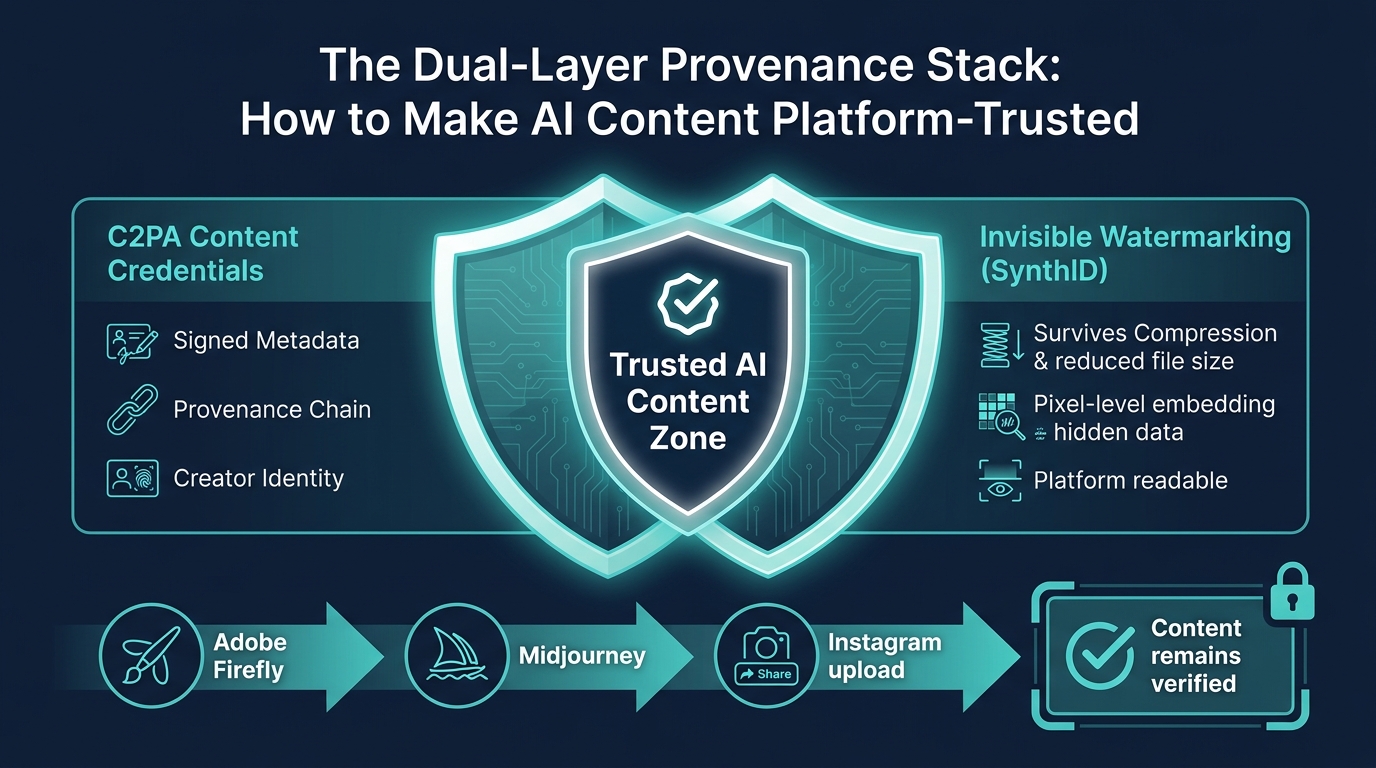
C2PA (Coalition for Content Provenance and Authenticity) is an open technical standard for attaching a cryptographically signed provenance record to a digital file. When you generate an image with a C2PA-compliant tool like Adobe Firefly, the image is embedded with a manifest that records what tool created it, what inputs were used, when it was created, and any subsequent editing steps. This manifest is cryptographically signed, meaning it can’t be retroactively altered without breaking the signature.
Platforms that integrate C2PA can read this manifest and use it to display provenance information to viewers — the “Made with AI” labels you see on Instagram and YouTube are increasingly being populated from C2PA data rather than user self-disclosure. For platforms, this shifts the disclosure burden from creator compliance to technical verification, which is more reliable and more scalable.
What Invisible Watermarking Adds
The practical limitation of C2PA metadata is that it’s stored in the file container, not in the image pixels themselves. Social platforms routinely strip metadata during upload and recompression. An image that carries a clean C2PA manifest when you download it from Firefly may arrive at Instagram’s servers without that manifest, depending on the platform’s image processing pipeline.
This is where invisible watermarking — primarily Google’s SynthID for AI-generated content — becomes important. SynthID embeds an imperceptible signal directly into the image pixels, not in the metadata layer. This watermark survives typical compression, resizing, and resampling operations. It can be read by platforms that have integrated SynthID detection even after the EXIF and C2PA metadata have been stripped.
The 2026 industry standard that’s emerged is the dual-layer approach: C2PA credentials for platforms and viewers that can read them, plus watermarking for resilience against the metadata stripping that happens routinely in upload pipelines. The two technologies solve different parts of the provenance problem.
The Practical Takeaway for AI Visual Creators
If you’re generating images with Adobe Firefly, DALL-E 3 via API, or other C2PA-compliant generators, your content already carries credentials. The key decisions you control are:
- Don’t strip metadata before uploading. If you’re running images through editing tools before posting, verify that your workflow preserves the C2PA manifest. Some third-party editors break provenance chains.
- Choose generators that output SynthID-compatible watermarks where available. For content that will go through heavy reprocessing, the watermark layer provides resilience that metadata can’t.
- Understand that credentials don’t prevent all suppression — they prevent misclassification. C2PA marks your content as “declared AI” not as “high-quality content.” The distribution benefits come from accurate labeling allowing the algorithm to treat your content appropriately rather than penalizing it for being unidentifiable synthetic media.
Platform-by-Platform Suppression Triggers in 2026
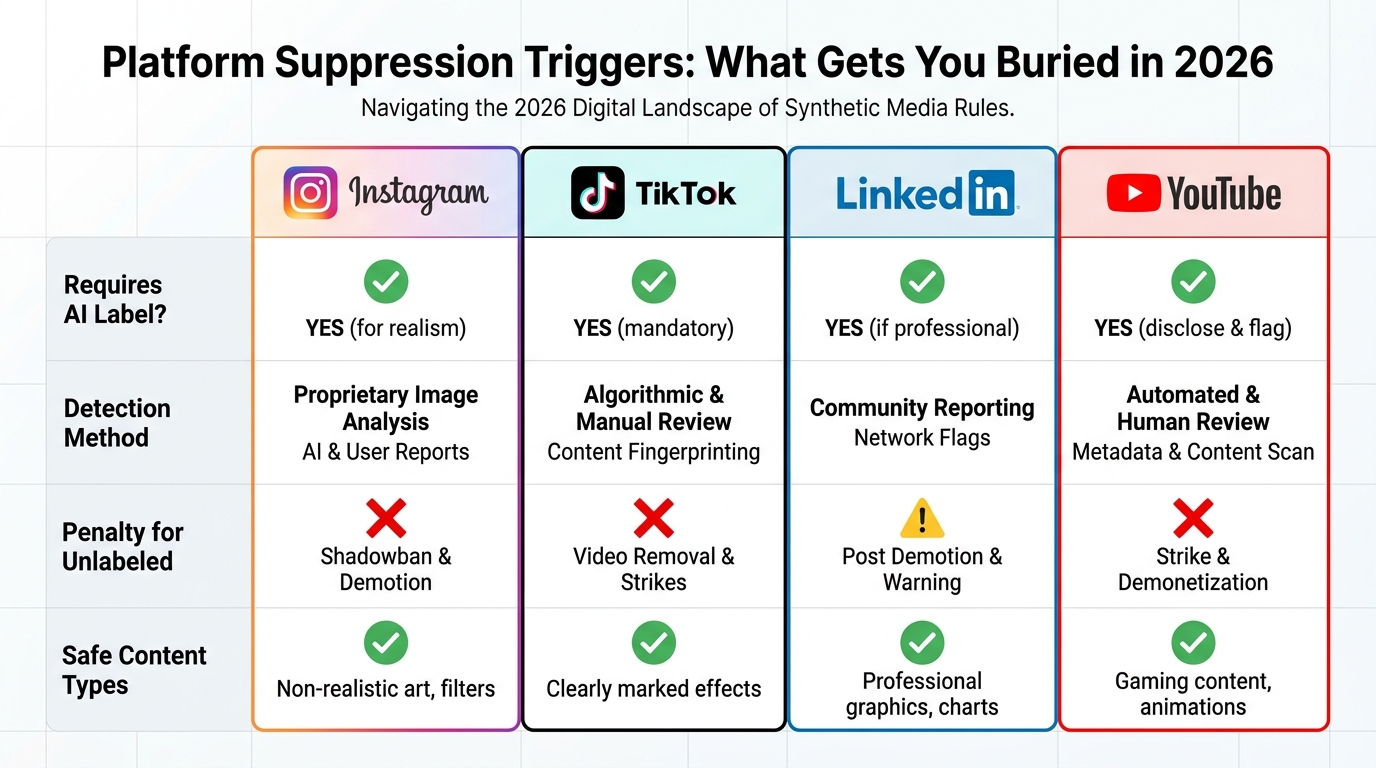
Platform policies on AI-generated visual content diverged significantly in 2026. Understanding that Instagram, TikTok, LinkedIn, and YouTube each have distinct suppression triggers — and distinct levels of enforcement — is essential for anyone managing content across multiple channels.
Instagram and Meta
Meta’s publicly stated position is that AI-generated content labeled with the “AI Info” disclosure is not algorithmically penalized. This is technically accurate but practically incomplete. What Meta does suppress is AI content that is unlabeled, misleading, or that falls into the “Made with AI” detection threshold without a matching disclosure. The system applies a label — and potentially restricted distribution — when its automated detection concludes an image is AI-generated and the creator hasn’t disclosed it.
The more significant suppression pathway on Instagram is quality-based rather than AI-specific. Instagram’s recommendation algorithm has moved firmly toward “originality” as a ranking criterion. Mass-produced AI content — even if labeled — that generates high skip rates and low save rates will see suppressed distribution in Reels, Explore, and feed recommendations. Creator accounts posting large volumes of visually similar AI-generated images have reported engagement declines of 30–50% on affected posts, though Meta has not published specific penalty data.
Key rules to follow on Instagram: Use the AI label proactively via the Creator tool at upload rather than waiting for automated detection to apply it. Avoid batching identical-style AI images into a rapid posting cadence. Anchor AI visuals to strong captions and calls-to-action that generate comments and saves, since engagement quality significantly mediates any detection-related reach impacts.
TikTok
TikTok’s Synthetic Media Policy in 2026 is among the most detailed and actively enforced of any major platform. The platform requires a creator-applied label for any “realistic” AI-generated or heavily AI-manipulated video or image content. Automated detection runs independently and can apply labels or restrict distribution even if creators don’t self-disclose. TikTok also reads C2PA metadata where present.
The most consequential enforcement mechanism on TikTok isn’t individual post suppression — it’s account-level throttling triggered by repeated violations. Five or more AI-content issues within a seven-day window can activate posting restrictions that limit distribution across an entire account, including content that has nothing to do with AI generation. This cascading effect makes TikTok the highest-stakes platform for AI visual workflow design.
Key rules to follow on TikTok: Always apply the AI label for any content that depicts realistic people, locations, or events synthetically. For clearly stylized or illustrated AI content — artwork, animations, abstract product visuals — the risk of automated flagging is lower, but when in doubt, label. Never mass-upload AI content batches; space AI-generated posts across multiple days and mix them with non-AI content to avoid behavioral suppression triggers.
LinkedIn’s AI content moderation is less formally documented than Instagram or TikTok, but in practice it operates through a combination of EXIF-based metadata analysis and engagement quality signals. LinkedIn’s algorithm has been reported to flag images lacking camera metadata and displaying visual characteristics associated with AI generation, with reduced distribution in feed and search surfaces.
LinkedIn’s audience also skews toward professional skepticism around AI-generated content, which creates an organic engagement headwind. AI-generated imagery in LinkedIn posts tends to generate lower saves and shares than real photography among professional audiences, compounding any algorithmic suppression with an audience-behavior suppression effect.
Key rules to follow on LinkedIn: Use AI visuals for conceptual illustration rather than for depicting realistic professional scenarios. When using AI-generated images of people, use clearly non-photorealistic styles. Supplement AI visuals with authentic context — real company data, actual quotes, genuine expertise — so the content value is clearly human-generated even if the visual is AI-assisted.
YouTube
YouTube’s approach to AI-generated visual content is primarily disclosure-focused in the context of Shorts and video thumbnails. The platform requires creators to disclose when AI has been used to generate realistic content that could be mistaken for real. Thumbnail images generated by AI are subject to the same disclosure requirements as video content in 2026.
YouTube’s suppression mechanism for AI content is more closely tied to click-through rate and audience retention than to detection per se. AI-generated thumbnails that don’t match video content — or that appear misleading — trigger negative audience feedback that algorithmically reduces distribution. The enforcement is behavioral first, policy-based second.
The Human-in-the-Loop Principle: Why AI-Only Workflows Keep Getting Penalized
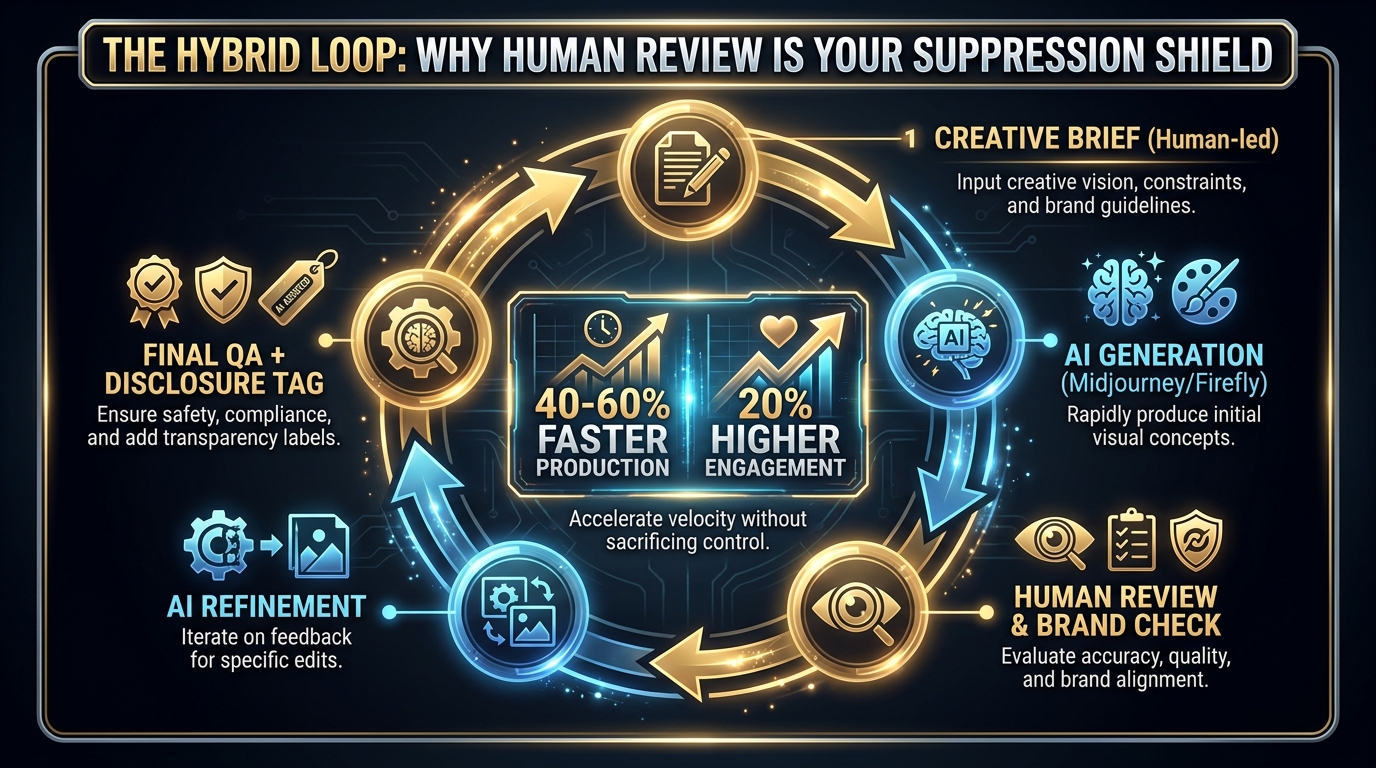
The most consistent finding across 2026 research into AI visual content performance is that hybrid human-AI workflows outperform AI-only pipelines on every measurable dimension — reach, engagement, brand safety incidents, and suppression rates. The data suggests hybrid approaches deliver 40–60% faster production than traditional creative workflows while achieving 20% higher engagement than AI-only visual strategies.
This isn’t a coincidence. Platform suppression systems are explicitly designed to target the content patterns that emerge from fully automated AI pipelines.
What AI-Only Workflows Get Wrong
When a team builds an AI visual pipeline that runs from brief to published content without meaningful human intervention, several suppression-triggering patterns emerge almost inevitably.
Volume without variation. Automated pipelines optimized for throughput generate large batches of visually similar content. Even when individual images are technically distinct, the compositional and stylistic similarity across a batch creates behavioral fingerprints that platform algorithms associate with spam and low-quality content generation.
No quality gates. AI generators don’t know when an image is off-brand, culturally inappropriate for a specific audience, or visually bland. Without human review, below-threshold content reaches audiences and generates the negative engagement signals (skips, “not interested” reports, low saves) that compound into algorithmic suppression.
Missing contextual judgment. Platform safety systems increasingly evaluate whether content makes sense in context — whether it’s being posted by an account that has historically created relevant, value-adding content. AI-only pipelines that generate and post content without strategic editorial judgment break the contextual coherence that trust-scoring systems look for.
What Human-in-the-Loop Actually Means in Practice
The hybrid loop is not about adding a rubber-stamp review step at the end of an AI pipeline. The research on what works points to human involvement at specific high-leverage stages:
Brief and creative direction (fully human-led). The strategic framing of what you’re trying to communicate, to whom, and why. This sets the context that makes AI-generated content feel intentional rather than generic.
Generation filtering (human selects from AI outputs). Rather than automatically posting the first AI output, humans select from a batch — choosing the images that have genuine visual interest, brand alignment, and a quality that’s likely to generate saves rather than skips.
Editorial refinement (human edits AI output). Even light editing — a crop, a color adjustment, an added text element — does two things. It improves the visual and creates a mixed-provenance signal that reduces the AI-detection confidence score. Images that have clearly been touched by human editing are harder to classify as purely AI-generated.
Disclosure and contextual copy (human-authored). The caption, the disclosure label, the surrounding copy — these are the human layer that platforms and audiences read to make sense of a visual. Strong, specific, genuine captions are one of the most effective suppression shields available.
Building the Loop Into Your Team Structure
The practical question is where human review sits in a workflow that’s trying to maintain speed and volume. The answer depends on what you’re producing. For high-volume social content, a single experienced editor reviewing and selecting from AI batches can process 30–50 images per hour, which is fast enough to maintain meaningful oversight without creating a bottleneck. For brand-critical or audience-facing content, deeper review cycles with specific brand safety checklists are worth the additional time. The key is that “human-in-the-loop” doesn’t mean “slow” — it means thoughtful at the right stages.
Prompt Engineering for Platform Safety
Most prompt engineering advice focuses on getting better-looking images from AI generators. Very little of it addresses a different goal: generating images that are less likely to trigger platform suppression systems. These are not always the same objective — and understanding the difference matters.
What Makes an Image Algorithmically Safe
Platform suppression at the visual analysis layer is triggered by specific image characteristics. The following prompt engineering principles reduce exposure to those triggers:
Reduce photorealism where you don’t need it. The highest-risk visual category for AI content suppression is photorealistic images of people, places, and events that could be mistaken for real. Prompts that push into illustration, stylized rendering, graphic design, or clearly conceptual territory generate images that are less likely to be flagged as misleading synthetic media, and less likely to confuse platform detection systems. “Illustrated,” “infographic-style,” “watercolor,” “vector art,” and “flat design” are useful style modifiers for content that doesn’t require photorealism.
Avoid prompting for real identifiable locations and people. Even when you’re not intentionally generating deepfake content, prompts that include recognizable architecture, brand logos, or characteristics of real individuals create output that can be flagged under impersonation and misleading content rules. Keep your prompts in clearly synthetic territory.
Use consistent style anchors across your content series. Paradoxically, consistency in visual style is both a suppression risk (if it signals mass generation) and a brand safety asset (if it signals intentional design). The key is establishing a distinctive visual identity — a specific color palette, a particular rendering style, a consistent compositional approach — rather than generating visually varied images from the same generic prompt. Branded consistency reads differently to platform algorithms than cookie-cutter mass output.
Build in imperfection intentionally. Platform research has identified that the most suppressed AI content tends to be visually “over-perfect” — images with too-smooth textures, impossibly perfect lighting, and zero contextual noise. Adding intentional imperfection through prompts (natural lighting variations, slight depth of field, candid-style compositions) produces output that is both more visually interesting and less algorithmically suspicious.
The Prompt Review Checklist
Before submitting any prompt at scale, run it through these four questions:
- Does this prompt require generating realistic humans? If yes, shift to illustration or use model-released AI avatar tools specifically designed for this use case.
- Does this image need to depict a real place or event? If yes, use clearly stylized or clearly labelled representation rather than photorealistic recreation.
- Am I generating a batch of 10+ visually similar images? If yes, introduce deliberate variation in composition, palette, and framing — don’t use the same base prompt repeatedly.
- Does this output serve a clear audience value? If the honest answer is “it fills space,” it will perform like filler — low engagement, high suppression risk, brand damage.
The Engagement Gap: Why AI Visuals Underperform and What Fixes It
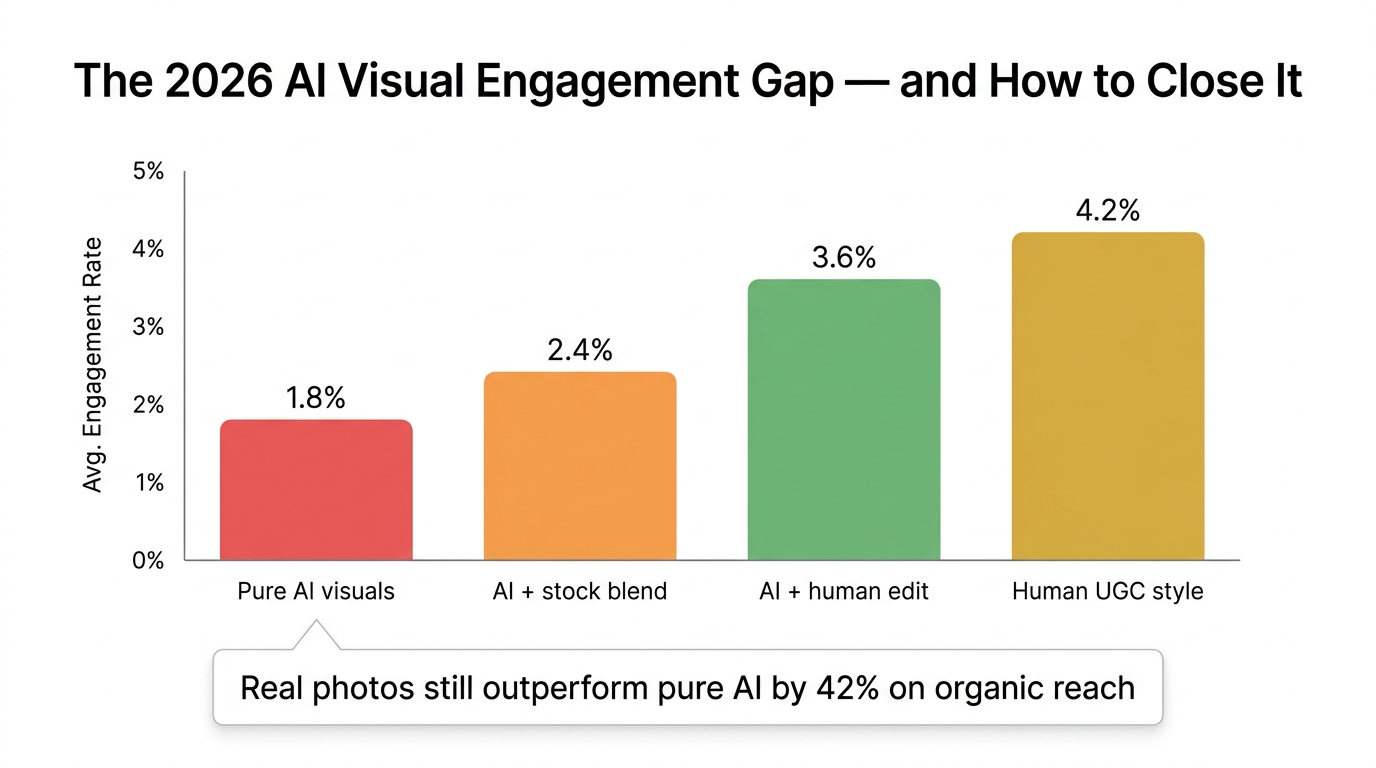
The most consistent data point in 2026 research on AI visual content is one that many AI enthusiasts don’t want to hear: authentic human-made photos still outperform purely AI-generated images by approximately 42% in organic engagement rate across platforms and industries. This isn’t a trivial gap — it’s the difference between content that the algorithm distributes and content that it quietly deprioritizes.
Understanding why this gap exists is more useful than arguing about whether it does. Because once you understand the mechanisms, you can address them specifically.
Why the Gap Exists
The engagement gap between AI and human visuals in 2026 is driven by three reinforcing factors that are distinct from detection and suppression.
Audience intuition. People don’t need to consciously identify an image as AI-generated to respond differently to it. The subtle uncanny valley effects in AI imagery — the too-smooth skin, the slightly-off shadows, the backgrounds that don’t quite cohere — register below conscious awareness and reduce the emotional response that drives saves and shares. Audiences interact with AI content more passively than with content that feels human and contextually real.
Context mismatch. Human-created content tends to carry authentic contextual signals — a real location, a specific moment, an identifiable person — that AI content typically lacks. On social platforms where audiences are looking for genuine experiences and relatable perspectives, the absence of authentic context creates a fundamentally weaker emotional hook.
Quantity effect. The low marginal cost of AI image generation has flooded feeds with AI visuals. Audience fatigue with generic AI aesthetics is measurable in 2026 engagement data. The visual styles that AI generators defaulted to in 2024 and 2025 — the hyperpolished product shots, the luminous landscape renders, the idealized portrait styles — are now overrepresented to the point of invisibility. Content that looks like everyone else’s AI content gets scrolled past at the same rate as content that is everyone else’s AI content.
How to Close the Gap
The engagement gap is not a reason to abandon AI visuals — it’s a brief for using them differently. The data on what performs well points in a clear direction.
Hybrid production for flagship content. Use AI as a starting point and human editing, real photography overlays, or genuine context-addition as the closing step. Images that combine AI generation with human editorial touch perform closer to authentic human photography than to pure AI output on engagement metrics. The AI provides the efficiency; the human provides the authenticity signal that engagement algorithms reward.
AI visuals for functional content. AI-generated images perform well — and sometimes outperform human-created alternatives — in specific content categories: product visualization, infographic illustration, conceptual diagram, and abstract brand imagery. These are use cases where photorealism and emotional authenticity are less critical than clarity and visual impact. This is where AI visual investment delivers the best return without fighting the engagement gap.
Style distinctiveness over aesthetic quality. Generic high-quality AI visuals underperform because they’re indistinguishable from other generic high-quality AI visuals. Developing a distinctive visual style — a specific color palette, a signature compositional approach, an unusual rendering technique — creates content that stands out in feeds even when viewers can identify it as AI-generated. Distinctiveness, not quality alone, is what drives the saves and shares that protect distribution.
Pair visuals with strong editorial content. Across every platform, the single most consistent engagement driver for AI visual content is high-quality written or spoken context that surrounds the image. Captions that provide specific information, personal perspective, or genuine expertise compensate for the emotional distance that AI visuals sometimes create. Think of the visual as the stop-scroll mechanic and the surrounding content as the engagement driver.
Building a Compliant AI Visual Workflow in 2026
The practical question for most teams isn’t “should we use AI visuals?” — that decision is effectively made for most content operations by the time and cost advantages. The real question is how to build an AI visual workflow that is compliant with platform policies, resilient to detection errors, capable of producing engaging content, and sustainable at scale without creating suppression debt that compounds over time.
The Core Workflow Architecture
A compliant AI visual workflow in 2026 has six components, each of which addresses a specific suppression risk:
1. Tool selection with provenance in mind. Choose AI image generators that are built on licensed datasets, that output C2PA Content Credentials by default, and that are either SynthID-compatible or use an equivalent transparent watermarking approach. Adobe Firefly is the current benchmark for this combination. DALL-E 3 via the OpenAI API supports C2PA credentials in its current configuration. Generators with no provenance output create content that arrives at platforms with no authenticity signal — which is a suppression risk by default.
2. Metadata preservation in your editing pipeline. If you use Photoshop, Lightroom, Canva, or any other editing tool between generation and upload, verify that C2PA credential chains are preserved. Adobe’s tools maintain C2PA manifests through their native editing pipeline. Third-party tools vary — some explicitly strip metadata as a processing step. Run test images through your full editing workflow and check the metadata output before deploying at scale.
3. Human review gates at generation and pre-publish. Establish two mandatory review points: once immediately after batch generation (to select and reject), and once immediately before publishing (to verify compliance, caption quality, and contextual appropriateness). These gates prevent the low-quality output that drives engagement-based suppression.
4. Content calendar design that avoids behavioral flags. Structure your AI visual content in your publishing calendar to avoid the rapid-batch-posting patterns that trigger account-level suppression. A maximum of two to three AI-generated visual posts per week per platform is a conservative guideline for accounts without established high-trust signals. Interleave AI content with non-AI content — photography, video, text-based posts — to create the behavioral diversity that distinguishes an editorial content operation from an AI content farm.
5. Disclosure as a standard operating procedure. Apply AI disclosure labels at upload for any content generated primarily by AI. Do this proactively rather than waiting for automated detection to apply it, for two reasons: proactive disclosure builds audience trust and demonstrates editorial integrity, and it prevents the scenario where automated detection applies a label to unlabeled content, which can trigger additional scrutiny and restrict distribution.
6. Performance monitoring with suppression-awareness. Track not just engagement metrics but distribution metrics — impressions relative to follower count, reach rate, and exploration vs. follower reach split. Early suppression signals show up in distribution data before they appear in engagement data. Establishing baseline distribution benchmarks for your accounts lets you detect suppression events quickly and trace them to specific content variables.
Tool Stack Recommendations
For a compliant 2026 AI visual stack, consider this configuration based on current platform compatibility:
- Primary generation: Adobe Firefly (best-in-class C2PA support, trained on licensed data, native Creative Cloud integration for metadata preservation)
- Supplementary generation: DALL-E 3 via API with C2PA output enabled for content requiring different aesthetic capabilities
- Editing and finalization: Adobe Photoshop or Lightroom with C2PA chain preservation enabled
- Content scheduling: Platforms that don’t strip metadata during scheduling — verify this for any scheduling tool you use; some third-party schedulers reprocess images in ways that strip provenance data
- Provenance verification: Adobe’s Content Credentials Verify tool (verify.contentauthenticity.org) to check credential chains before publishing
Disclosure Done Right: How to Label AI Content Without Killing Your Reach
The instinct among many creators when facing new disclosure requirements is to comply minimally — apply the required label in the least visible way, with the least informative text, as late in the process as possible. This is exactly the wrong approach, both strategically and practically.
Why Proactive Disclosure Outperforms Reactive Compliance
Platform suppression systems in 2026 increasingly distinguish between content that is transparently disclosed as AI-generated and content where AI labels are applied by automated detection after the fact. The latter category triggers additional scrutiny and restricted distribution at higher rates than the former — partly because unlabeled AI content that gets auto-labeled has already demonstrated an intent signal that algorithms read as potentially deceptive.
More practically, audience reception of AI-disclosed content has shifted significantly in 2026. The widespread awareness that AI visual tools exist means audiences aren’t shocked by disclosure — they expect it. What builds trust is not hiding AI generation but being honest about it while being clear about the human value being added. A disclosed AI visual accompanied by a strong expert caption performs better than an undisclosed AI visual accompanied by generic filler text, in both audience trust and algorithmic distribution.
How to Write AI Disclosure That Works
Disclosure language that preserves trust and engagement should do three things: acknowledge the AI tool, state the human purpose it serves, and make clear what genuine value the content provides.
Generic: “Created with AI.”
Better: “Visual created with Adobe Firefly to illustrate this data — the analysis and recommendations are ours.”
Generic: “AI-generated image.”
Better: “We used AI to visualize this concept — here’s why it matters in practice: [substantive insight].”
The pattern is consistent: lead with the AI disclosure, follow immediately with the human contribution. This framing positions AI as a tool in service of human expertise rather than a replacement for it — which is how audiences read trustworthy AI content in 2026.
Platform-Specific Disclosure Mechanics
Instagram: Use the “AI Info” creator label at upload time via the advanced settings menu. This populates the platform label and prevents automated detection from applying a different label later. In your caption, optional but recommended: a brief one-line acknowledgment.
TikTok: Apply the “AI-generated content” toggle at upload. For video content that uses AI-generated still images, this applies to the video post overall.
LinkedIn: LinkedIn does not currently have a native AI disclosure tool. The community norm and best practice is a brief caption disclosure. A parenthetical “(visual created with AI)” at the end of your caption is sufficient and increasingly standard among professional creators on the platform.
YouTube: Use the AI Disclosure option in the YouTube Studio details panel at upload. This is required for realistic content and best practice for any AI-assisted visual in thumbnails or within videos.
The Account Trust Investment: Building the Suppression Resistance That Takes Time
Platform algorithms don’t evaluate every piece of content in isolation. They evaluate it in the context of the account that posted it — its history, its consistency, its audience relationship, and its track record of producing content that audiences value. This account-level trust score functions as a suppression modifier: high-trust accounts get more distribution benefit of the doubt; low-trust or new accounts face tighter suppression thresholds.
This creates a counterintuitive reality for AI visual strategy: the most important investment you can make in protecting AI-generated content from suppression is not in the AI content itself. It’s in the non-AI content that builds the account trust that protects all of your content.
How to Build Account Trust Alongside AI Production
Anchor accounts in authentic human content first. Accounts that launch with exclusively AI-generated visuals have no authenticity history. Platforms signal the inverse — human-made content that establishes authentic engagement patterns creates a trust buffer that makes subsequent AI content less likely to be aggressively suppressed.
Maintain consistent publishing behavior. Erratic posting patterns — long dormancy followed by sudden high-volume AI content batches — are among the strongest behavioral suppression signals. Consistency in posting frequency, even at lower volume, builds the account regularity that trust-scoring systems reward.
Engage with your audience genuinely. Platform algorithms measure not just how audiences respond to your content but how you respond to your audience. Accounts that reply to comments, engage with followers, and demonstrate active community participation have higher trust scores than passive broadcast accounts. This is particularly important for accounts that post AI visuals at scale — the human engagement signal compensates for the potentially automated-feeling content pipeline.
Protect negative feedback rates. The “not interested” report and the unfollow triggered by low-quality content are among the most damaging suppression signals available to audiences. For AI visual content, this means ruthlessly filtering low-quality AI output before it reaches your audience. One batch of poorly-received AI content can erode account trust that takes months to rebuild.
What Staying Visible Actually Requires: The Honest Summary
The suppression challenge for AI-generated visual content in 2026 is real, multi-layered, and not going away. Platforms are not accidentally catching AI content in their moderation nets — they are deliberately moving toward authenticity-biased ranking systems that favor content with strong provenance signals, genuine audience value, and human editorial intentionality.
The creators and brands navigating this successfully are not doing so by hiding the AI provenance of their content or by finding suppression loopholes to exploit. They’re doing it by building workflows that make AI generation serve genuinely human creative and editorial purposes — and by making that human purpose visible to both audiences and algorithms.
The Non-Negotiable Foundation
If you take nothing else from this playbook, these five practices are the foundation of suppression-resilient AI visual content in 2026:
- Use C2PA-compliant generators and preserve provenance through your editing pipeline. This is not optional bureaucracy — it’s the technical foundation that allows platforms to accurately classify your content rather than suppressing it for ambiguity.
- Build human review into your workflow at the selection stage, not just the approval stage. Humans choosing from AI outputs perform better than humans rubber-stamping AI outputs. The selection judgment is where editorial quality gets built.
- Disclose AI use proactively and frame it around the human value being added. This is both ethically correct and algorithmically advantageous. Transparency and reach are not in conflict when disclosure is done well.
- Design your content calendar to avoid behavioral suppression patterns. Volume, velocity, and variation matter as much as individual image quality. A thoughtful content calendar is part of your suppression defense.
- Invest in non-AI content to build the account trust that protects all of your content. AI visual strategy is not separable from overall account health strategy. The trust you build with authentic content protects the AI content you produce alongside it.
Where This Is Heading
Platform policies on AI visual content are tightening, not loosening. India’s 2026 regulatory amendments on synthetic content, the Singapore Content Authenticity Summit’s cross-platform provenance alignment, and the rapid growth of C2PA adoption across tool and platform ecosystems all point toward a future where provenance is table stakes, not a differentiator. The creators who build compliant, human-grounded AI visual workflows now will be operating in an environment they understand when the next round of policy tightening arrives. The ones who don’t will be navigating each new restriction reactively — and losing distribution every time.
AI-generated visuals are a permanent and powerful part of the content creation toolkit. The question was never whether they’d survive platform scrutiny — it was always about building the right workflow to make them thrive within it.