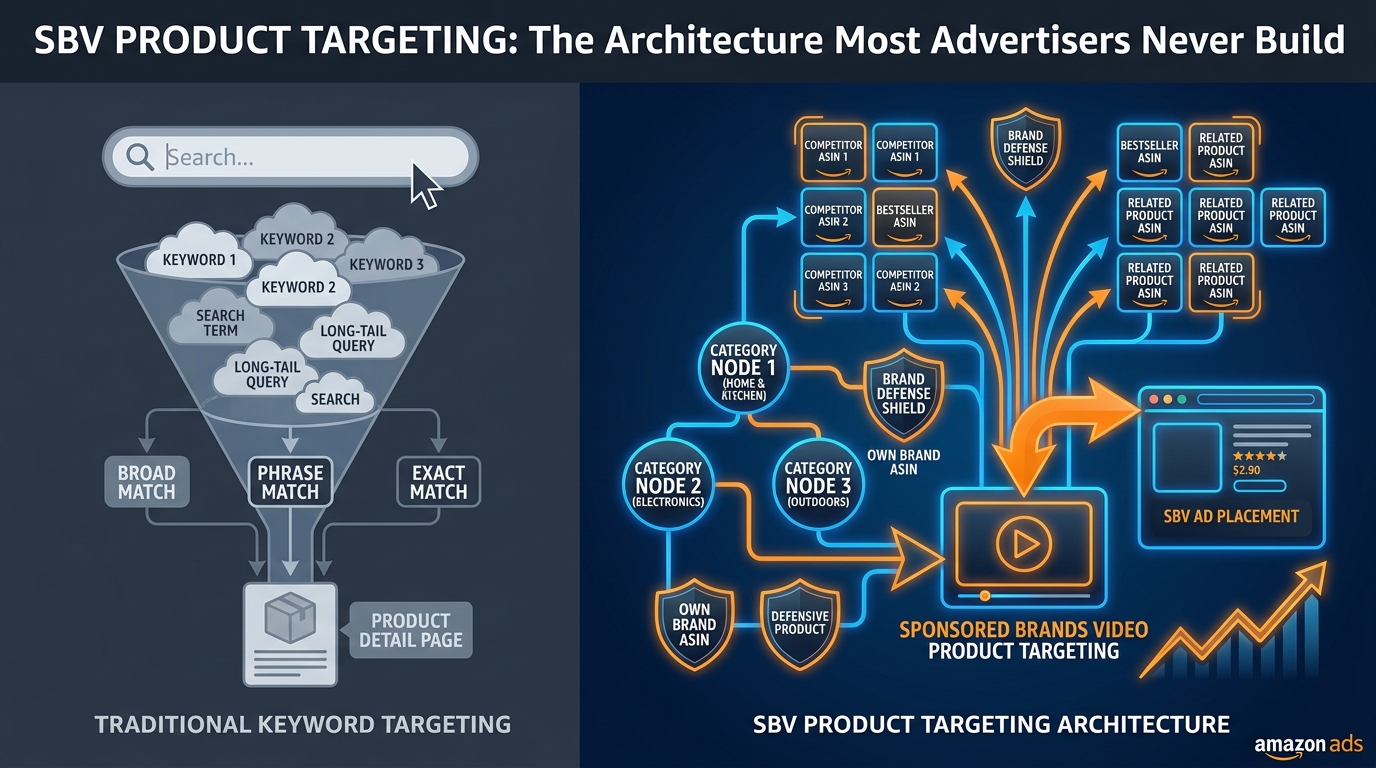
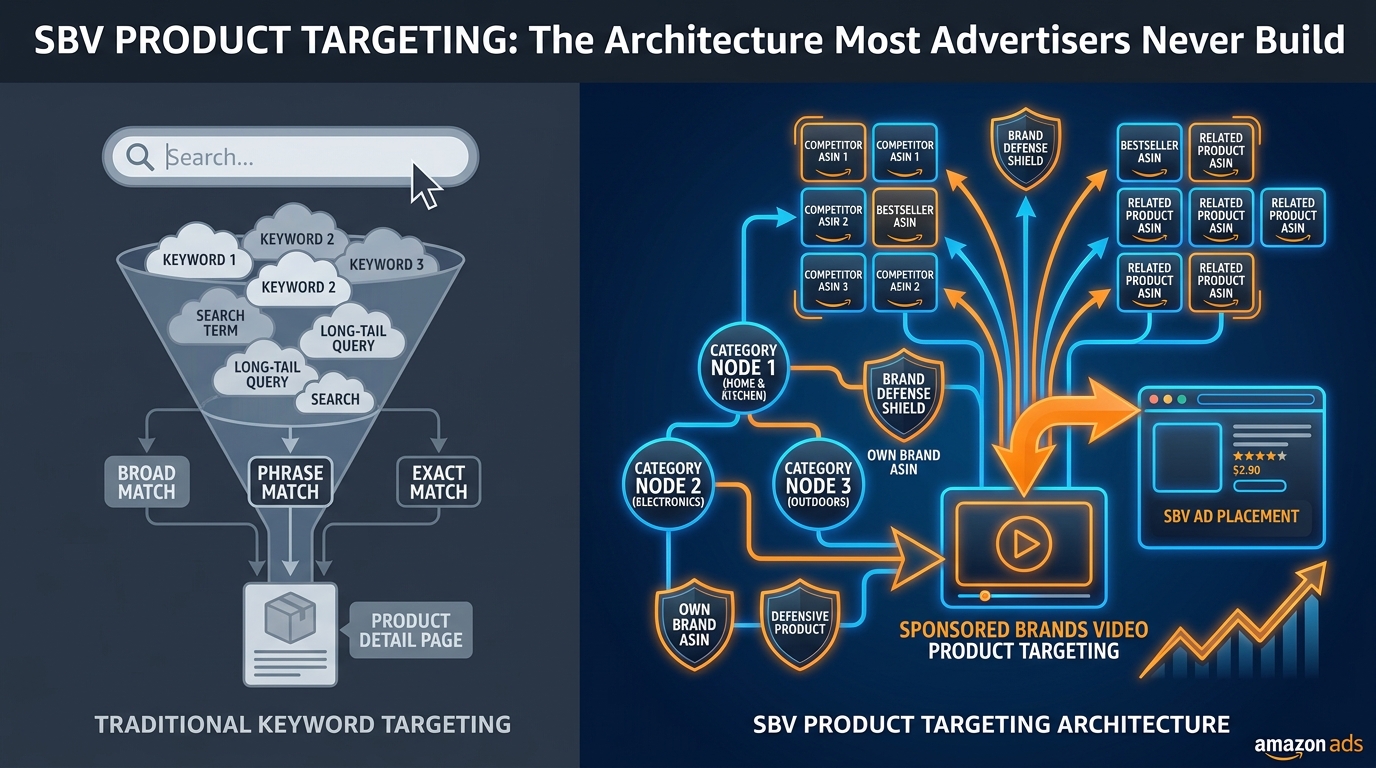
Most Amazon advertisers who run Sponsored Brands Video are only operating at half capacity. They set up their SBV campaigns against a keyword list, point the creative at a product detail page or Brand Store, check the ACOS weekly, and call it a strategy. The video format gets the credit — or the blame — while the targeting layer goes almost completely unexamined.
That’s a significant structural gap, and it’s one that’s widening in 2026. As more brands pile into SBV with keyword-centric campaigns, the product targeting side of the format is becoming one of the least-contested, highest-potential spaces in Amazon advertising. The inventory is different, the intent signals are different, the creative requirements are different, and — critically — the measurement framework needs to be completely different too.
This isn’t a post about why SBV is good or how to make a video. It’s a deep dive into the product targeting architecture specifically: how it works mechanically, how to structure campaigns around objective-based segments rather than ad group dumps, how to set bids that actually reflect placement behavior, and how to measure what matters when your audience isn’t searching for you — they’re actively looking at a competitor.
If you’ve already moved some SBV budget into product targeting and seen mixed results, this is for you. If you haven’t started, this will show you exactly why you’re leaving measurable efficiency gains on the table.
Why SBV Product Targeting Is a Fundamentally Different Channel
The default mental model for Sponsored Brands Video is a search channel. A shopper types a query, a video unit appears at the top or inline within results, and the shopper either clicks or doesn’t. That model works — SBV consistently outperforms static Sponsored Brands on CTR in search environments, with multi-account analyses showing video CTR running roughly 2–3× higher than image-based formats on equivalent keywords.
Product targeting breaks this model entirely. When you run SBV with product or category targeting, your ad is no longer appearing to someone in search mode. It’s appearing to someone in evaluation mode — someone who has already clicked through to a product detail page and is actively deciding whether to buy that specific item. The psychology, the buying stage, and the competitive dynamic are all different.
The Intent Gap Between Search and PDP
Consider what a shopper is doing when they land on a competitor’s ASIN page. They’ve already navigated past the search results. They’ve chosen to invest time in evaluating a specific product. They’re reading reviews, examining images, comparing prices, and deciding. This is not a passive audience — it’s arguably the highest-intent audience on the entire platform, and they’re sitting on someone else’s listing.
That’s what product-targeted SBV is actually reaching: a shopper who is milliseconds from making a purchase decision, but hasn’t committed yet. The creative job is completely different from search. You’re not trying to get attention. You’re trying to interrupt an evaluation and create a better alternative in the moment.
Where Product-Targeted SBV Actually Appears
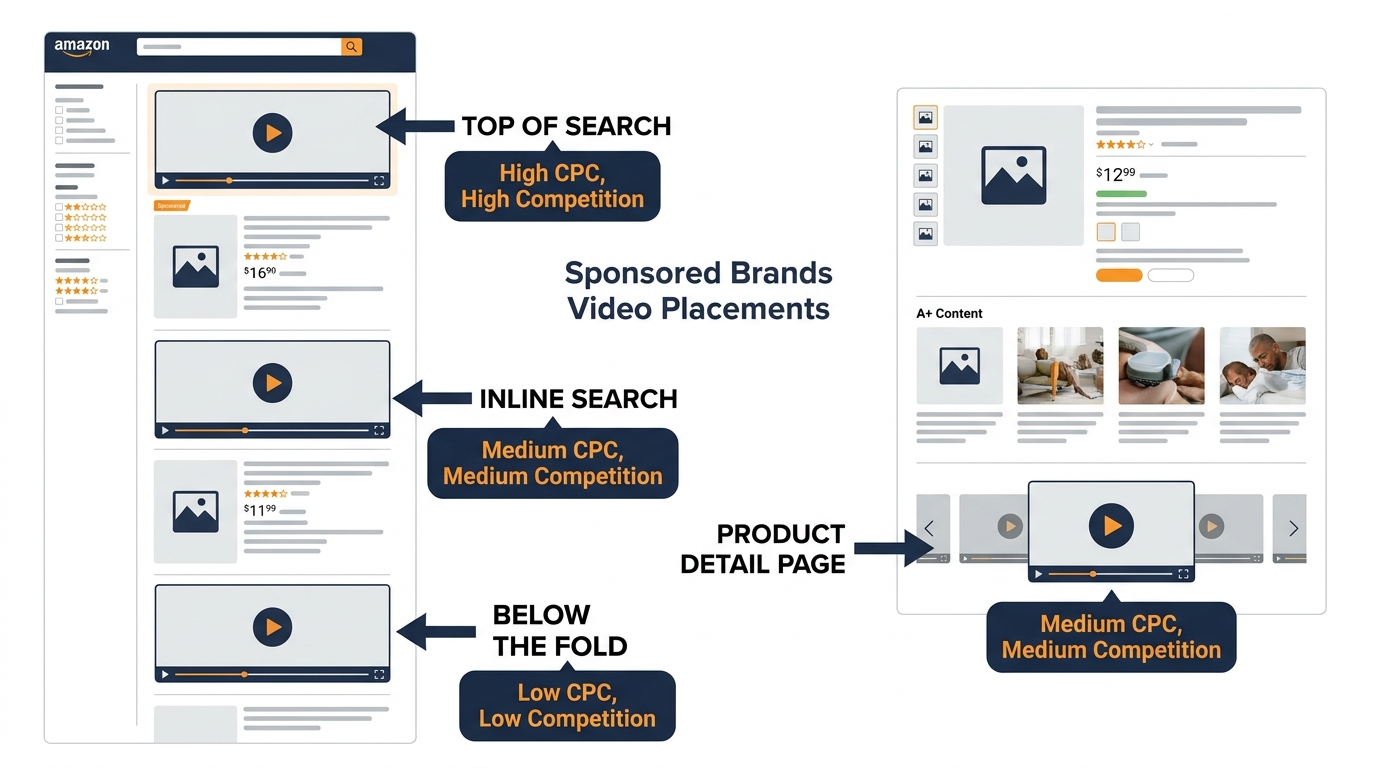
Amazon’s placement inventory for product-targeted SBV has expanded meaningfully. The primary placement is below A+ content on the product detail page itself, where a video carousel surfaces to shoppers who are deep into their product review. But product-targeted SBV also feeds into inline search placements, meaning the same campaign targeting competitor ASINs can also appear in search results for the queries those ASINs rank for.
This dual-placement behavior is one of the more underappreciated mechanics of the format. You’re not just buying PDP inventory when you product-target — you’re also getting adjacent search exposure without fighting in the top-of-search keyword auction. That’s a meaningful cost advantage in high-competition categories.
The CPC Difference — And Why It’s Structural
Product-targeted SBV CPCs consistently run lower than top-of-search keyword CPCs in competitive categories. This is partly a supply-demand story — fewer advertisers are using this targeting method — but it’s also structural. PDP placements don’t trigger the same aggressive bidding behavior as keyword auctions because fewer brands have set up dedicated product-targeting campaigns with serious budget allocation. The floor is lower, and the ceiling is higher for efficiency-minded buyers who get there first.
The Three Campaign Archetypes: Defensive, Conquesting, and Cross-Sell
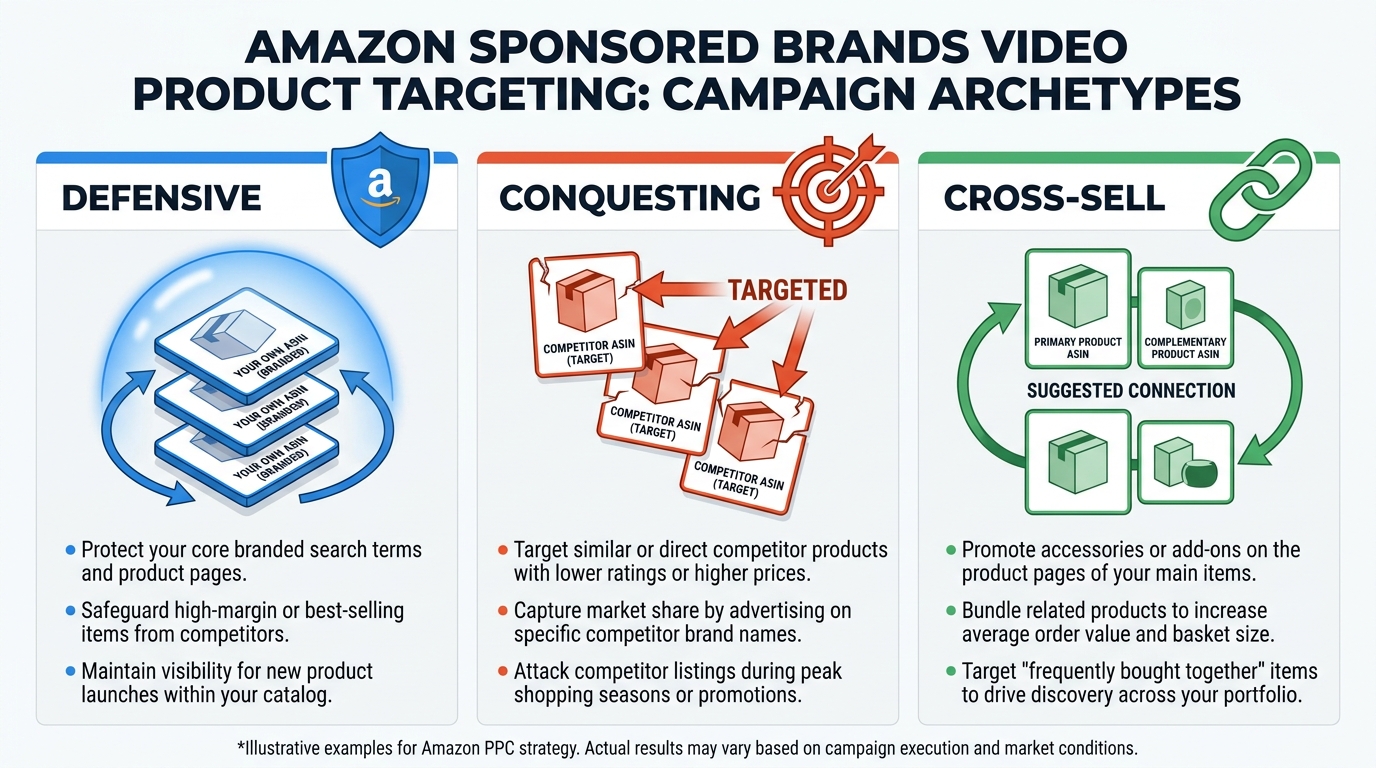
The single biggest structural mistake in SBV product targeting is treating it as one undifferentiated campaign type. Advertisers who are seeing inconsistent results typically have one campaign mixing competitor ASINs, their own ASINs, and vague category targets — all measured against the same ACOS target. That’s a recipe for budget waste and misleading performance data.
Advanced practitioners in 2026 are building SBV product targeting around three distinct campaign archetypes, each with different ASIN lists, different bid levels, different creative, and different success metrics. Here’s how each one works.
Archetype 1: Defensive Product Targeting
Defensive campaigns target your own ASINs. The goal is to prevent competitor video ads from appearing on your product detail pages while reinforcing the purchase decision for shoppers who are already on your listing. This is often the first type of SBV product targeting an account should set up, because it protects existing conversion paths before you go on offense elsewhere.
Defensive campaign setup involves targeting your own top-selling ASINs (and their variations) with your SBV creative. Since these shoppers are already on your page, the creative can be softer — focused on reassurance, key differentiators, and social proof. The conversion rate in defensive campaigns tends to be higher than in any other product targeting type because the audience is already warm and already intent-matched to your product.
Key metrics to watch in defensive campaigns: conversion rate, spend efficiency (ACOS), and — if you have Brand Analytics access — the ratio of shoppers who view your ad on your own PDP but then proceed to a competitor. A defensive campaign doing its job keeps that exit rate low.
Bidding philosophy for defensive campaigns: you can often sustain higher bids here than in conquesting campaigns because the audience is higher quality and you’re protecting existing revenue rather than acquiring new. Think of it like defending territory you already own — the cost of losing it is higher than the cost of holding it.
Archetype 2: Conquesting Product Targeting
Conquesting campaigns target competitor ASINs. This is the most talked-about use case for SBV product targeting, but also the most frequently misexecuted. The common mistake is targeting every competitor ASIN in the category without any filtering logic, which produces bloated impression counts, low conversion rates, and a misleading ACOS story.
Effective conquesting requires ASIN selection criteria, not just ASIN lists. The strongest-performing conquesting targets share specific characteristics:
- Price parity or slight premium: Targeting ASINs priced significantly higher than your product creates natural comparison advantage. Targeting ASINs priced lower usually backfires — you’re interrupting shoppers who are looking for a cheaper option and won’t convert on your higher-priced alternative.
- Review vulnerability: ASINs with ratings below 4.1, or those with a significant volume of recent 1- and 2-star reviews mentioning specific issues you don’t have, are high-value conquesting targets. Shoppers in doubt are shoppers who can be redirected.
- Adjacent feature gaps: Competitor ASINs that lack features your product has — and where those features are prominent in customer reviews — are ideal targets for video creative that leads with that specific differentiator.
- Stockout or inventory risk signals: Competitors experiencing frequent stockouts or long shipping delays are among the best short-term conquesting opportunities.
Conquesting campaign metrics must be held to different standards than defensive. The conversion rate will be lower — you’re reaching shoppers who had already chosen a different product. The success metric is not ACOS in isolation; it’s new-to-brand order rate and customer acquisition cost relative to other awareness channels. More on this in the measurement section below.
Archetype 3: Cross-Sell Product Targeting
Cross-sell campaigns target your own ASINs or complementary products with creative that promotes a different ASIN — typically a bundle item, an accessory, or the next tier up. If you sell coffee equipment and someone is on your grinder listing, a well-placed video for your pour-over kettle is a natural extension of their purchase journey.
Cross-sell campaigns are the most overlooked of the three archetypes, but they often deliver the strongest ROAS because the audience is already proven — they’re buying in your category, often from your brand. The creative brief is different: the hook is the connection between what they’re looking at and what you’re showing, not a head-to-head comparison.
Cross-sell SBV also creates a valuable data feedback loop. When you see which ASIN pairings drive the strongest cross-sell conversion, that data informs your listing content, bundle strategy, and even your A+ content cross-links. The campaign becomes both a revenue driver and a product development signal.
ASIN Targeting vs. Category Targeting — The Strategic Decision Matrix
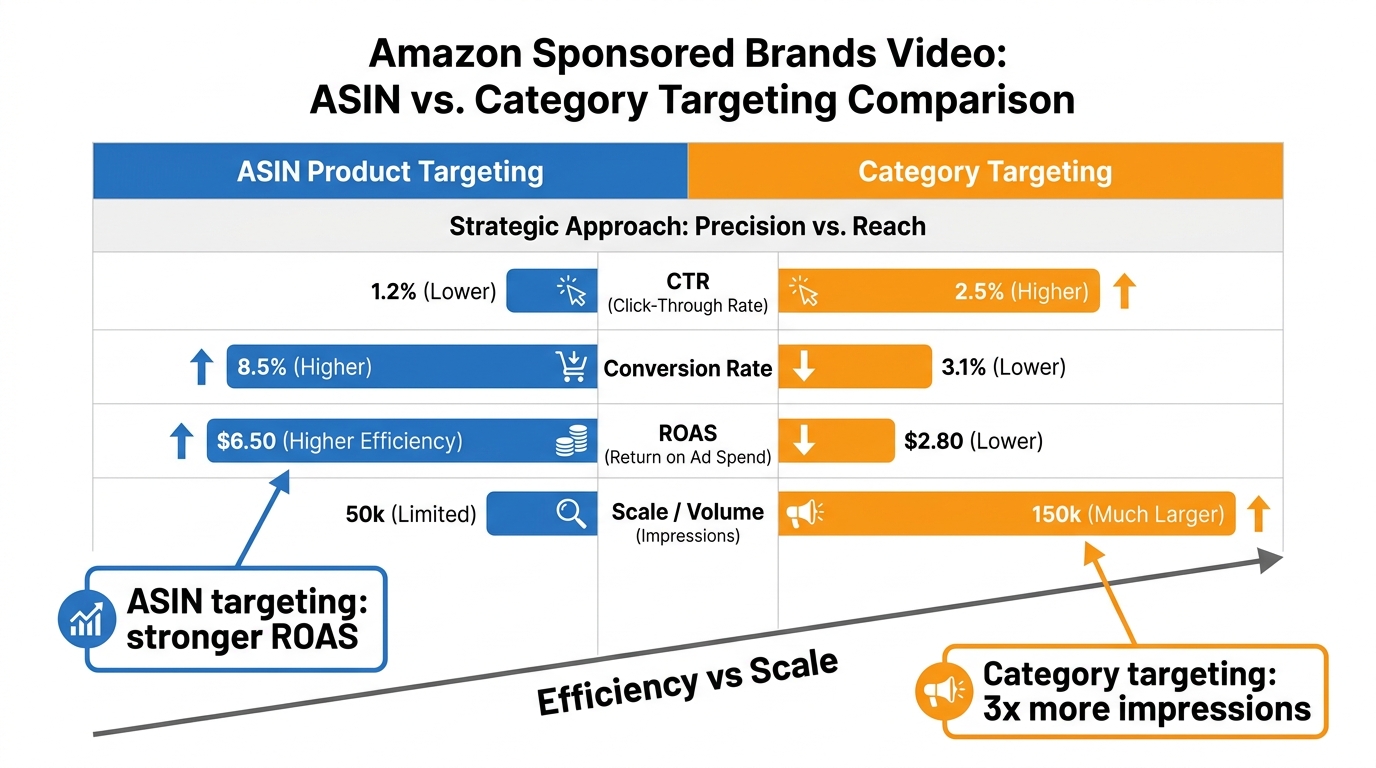
Within SBV product targeting, Amazon gives you two main levers: target specific ASINs, or target product categories (with optional refinements by price range, brand, rating, and Prime eligibility). These are not interchangeable, and mixing them without a clear logic creates campaigns that are impossible to read and optimize.
When ASIN Targeting Is the Right Tool
ASIN targeting is the precision instrument. Use it when you have specific, data-identified targets that meet your conquesting criteria — competitor ASINs with the characteristics described above, your own defensive ASIN list, or specific cross-sell pairings. ASIN targeting gives you exact placement control, exact impression attribution, and clean performance data at the target level.
The primary downside of ASIN targeting is scale. A list of 20–50 carefully selected competitor ASINs will only serve so many impressions. As those ASINs receive your ads and their shoppers either convert or don’t, you exhaust the inventory relatively quickly. This is why ASIN targeting campaigns require active curation — you need to continuously add new targets as market conditions shift and remove targets that are either converting too poorly or showing budget exhaustion.
Best practice: keep ASIN-targeted campaigns at a size you can actually review weekly. For most accounts, that means segmented lists of 30–100 ASINs per campaign, broken out by product line or competitive cluster. Larger lists become unmanageable and obscure performance signals.
When Category Targeting Makes More Sense
Category targeting is the volume lever. Use it when you want to reach the broadest possible in-category audience — particularly in new-to-brand customer acquisition scenarios — without the curation overhead of maintaining ASIN lists. Category targeting with refinements (price range, minimum rating, Prime eligible only) can produce surprisingly tight audiences while maintaining much higher impression volume than ASIN lists.
The tradeoff is relevance noise. A category target by definition includes ASINs that may be only tangentially related to your product, or that serve audiences with different intent profiles. Your creative has to work harder because the match between audience and message is less precise. CTR will typically run higher in category campaigns (more inventory = more impressions from browsing shoppers), but conversion rates will lag ASIN-targeted campaigns.
The Hybrid Structure Most Advanced Accounts Use
The most effective SBV product targeting architecture combines both within a single objective, run as separate campaigns with shared learnings:
- Phase 1 — Category Discovery: Run a category-targeted SBV campaign with broad refinements. Let it gather impression and click data across the category for 3–4 weeks.
- Phase 2 — ASIN Mining: Pull the Search Term Report (which, in product targeting mode, shows you which specific ASINs served your ad and at what efficiency). Identify the top-performing individual ASINs from the category campaign.
- Phase 3 — Graduated to ASIN Targeting: Migrate your best category performers into a dedicated ASIN-targeted campaign with more aggressive bids, where you can control placement and budget with surgical precision.
This phased approach uses category targeting as a discovery engine and ASIN targeting as the scaled, optimized execution layer. It avoids the guesswork of building ASIN lists from scratch and prevents you from allocating serious budget to targets you haven’t validated yet.
Bid Architecture: Why Flat Bids in Product Targeting Campaigns Are Leaving Money on the Table
The majority of Amazon advertisers running SBV product targeting are using flat bids — one CPC applied uniformly across all targets in a campaign, with maybe a coarse placement modifier on top. This approach ignores the dramatic differences in conversion value across different placement types and different target segments.
Understanding Placement Behavior in Product Targeting
SBV product targeting campaigns serve across multiple placements, each with different user intent profiles and conversion rates:
- Product Detail Page (PDP) placements: Below A+ content in the video carousel. These are typically mid-to-high intent — the shopper is deep in evaluation. Conversion rates here are among the highest for product-targeted campaigns.
- Top of Search placements: Even with product targeting enabled, SBV can surface at the top of search results for relevant queries. These impressions have high visibility but lower specificity — the intent is search-driven, not evaluation-driven.
- Rest of Search / Below Fold: Impressions lower in the search results page. These tend to deliver more volume at lower CPCs, with moderate conversion rates.
Amazon’s placement bid modifiers — which let you increase or decrease bids for top-of-search and product detail page placements specifically — are the levers to use here. But most advertisers apply modifiers based on habit or best guesses rather than actual performance data.
How to Build a Data-Driven Bid Tier Structure
The correct approach is to run a placement analysis first. After 3–4 weeks of campaign data, pull the Placement Report and segment performance by placement type. This will show you cost-per-click, conversion rate, and ACOS or ROAS for each placement independently. From this data, you can calculate an implied justified bid per placement based on your target ACOS.
If your PDP placement is converting at twice the rate of your top-of-search placement, your base bid + PDP modifier should reflect that — not be set at an arbitrary 50% uplift because that “feels right.” The math should drive the modifier.
Practically, advanced practitioners are segmenting bids across three tiers:
- Tier 1 — Defensive PDP (own ASINs): Highest bid, because conversion rate is strongest and cost of losing the placement to a competitor is highest.
- Tier 2 — Conquesting PDP (competitor ASINs): Mid-range bid, with tighter ACOS targets and emphasis on NTB metrics rather than immediate ROAS.
- Tier 3 — Category/Search hybrid placements: Lower base bid, placement modifiers suppressed or neutral, volume-focused with discovery intent.
This tier structure makes it possible to hold each campaign to an appropriate, objective-specific standard rather than blending everything into an account-average ACOS that masks which segments are actually performing.
The Negative ASIN Layer: The Single Most Overlooked Optimization in SBV
Ask most advertisers running SBV product targeting how their negative ASIN strategy works, and you’ll get a blank stare. The majority of product targeting campaigns have no negative ASIN list whatsoever. This is a significant missed optimization, and in 2026 it’s one of the clearest differentiators between accounts running SBV at intermediate versus advanced levels.
Why Negative ASINs Matter More in Product Targeting Than Keyword Campaigns
In keyword campaigns, negative keywords filter out irrelevant search queries. In product targeting campaigns, negative ASINs filter out specific product pages where your ad should not appear — competitor listings that are too far outside your price range, categories that generate clicks but never convert, your own product variants that would create internal cannibalization, or ASINs associated with audiences who have fundamentally different needs than your ideal buyer.
Without negative ASINs, your campaign is effectively serving on every page in the category or ASIN list with equal weight. This means a portion of your budget consistently flows to placements that have never converted and never will — but because the data is blended, it’s invisible in aggregate performance numbers.
Building Your Negative ASIN List: Four Categories to Address
1. Price-Mismatched ASINs
If your product is priced at $45, targeting ASINs priced at $12–18 creates an audience mismatch. Shoppers on budget product pages are budget-motivated; your video ad appearing with a $45 product will rarely convert them. Pull the ASIN targeting report, filter by ASINs with high impressions and zero conversions, cross-reference with pricing data, and negative-match the price outliers.
2. Own-Brand Cannibalization ASINs
If your conquesting campaign is accidentally appearing on your own product pages (which can happen in broad category campaigns), you’re paying to reach your own customers. Negative-match your entire brand ASIN catalog from any conquesting or category campaigns.
3. High-Click, Zero-Convert Chronic Underperformers
After 30+ days of data, identify ASINs in your targeting that have accumulated 15+ clicks with zero conversions. Some of these will eventually convert; many won’t. Apply a spending threshold (e.g., 2× your target CPA with no order) and systematically negative-match chronic underperformers. Review and update this list monthly.
4. Category Bleed ASINs
When using category targeting with broad category nodes, Amazon sometimes serves your ad on loosely related sub-categories that aren’t actually your competitive set. Identify sub-category ASINs that are generating spend but are clearly off-target (wrong product type, wrong audience) and negative-match those ASIN prefixes or specific products.
Negative ASIN Review Cadence
Best practice is to audit your negative ASIN lists on a 30-day cycle, not as a one-time setup. Market conditions change, competitor ASINs change (new products, pricing shifts, review changes), and what was a valid target six weeks ago may now be a chronic money drain. Build negative ASIN review into your monthly PPC workflow as a standing agenda item alongside bid reviews.
Creative That Actually Works in Product Targeting Environments
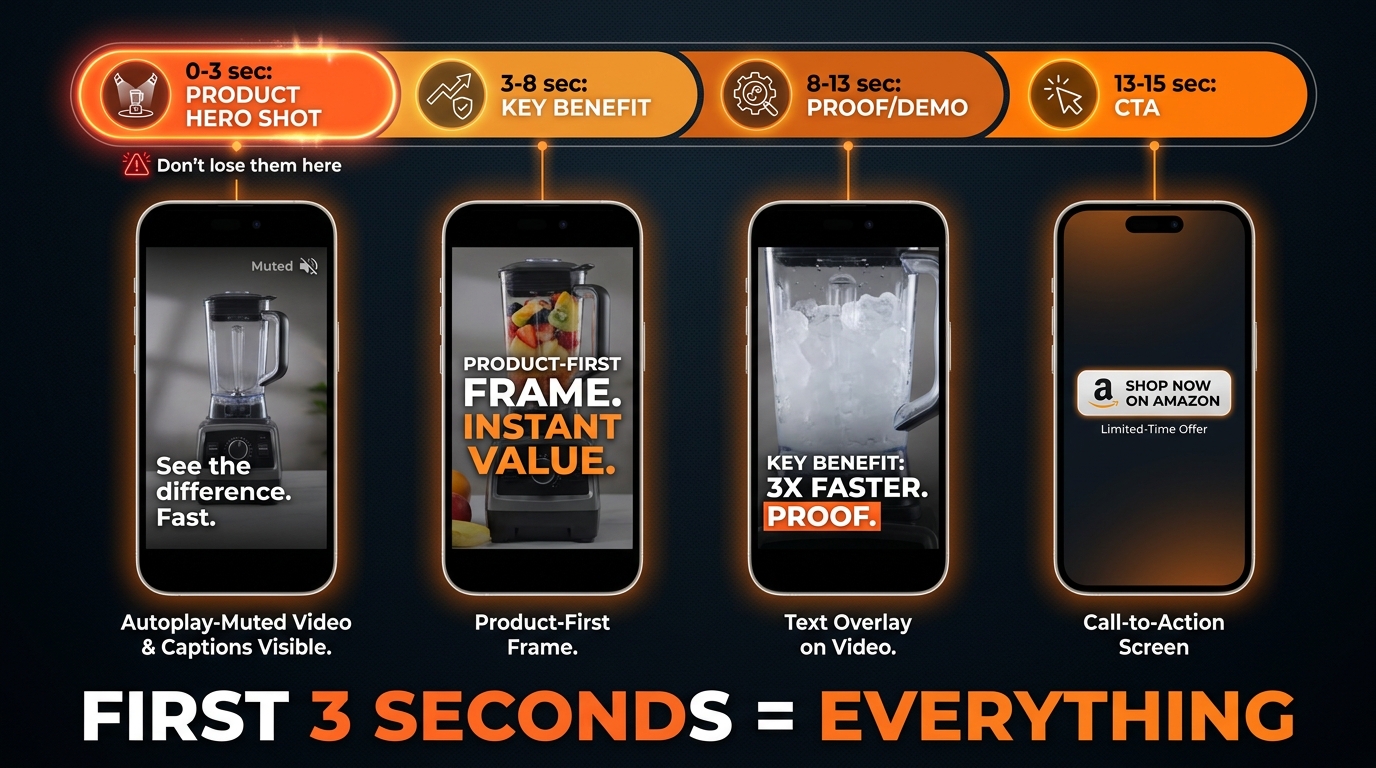
SBV product targeting introduces creative requirements that don’t apply in keyword environments — and getting the creative wrong is the fastest way to waste a well-built targeting structure. The mechanics of how your video appears on a product detail page versus in search results create distinct behavioral contexts that most advertisers don’t account for in production.
The Autoplay-Muted Problem
All SBV ads autoplay on mute. This is a known format behavior, but its creative implications are frequently underweighted. When your video appears on a competitor’s product detail page, the shopper is reading — they’re scanning reviews, looking at images, checking Q&A sections. Your video starts playing silently in the lower portion of the page.
This means your video must communicate its core message visually within the first 3 seconds — not just audio-visually. On-screen text, bold product close-ups, and motion that signals the product category are non-negotiables. A video that opens with a lifestyle scene, ambient music, and no text overlay is a video that disappears into the background noise of the page. A video that opens with a clear product shot and a one-line text hook earns a tap to unmute and a click.
The First-3-Seconds Rule in Product Targeting Context
Amazon’s own research and practitioner data consistently affirm that the first three seconds of an SBV creative determine whether a viewer engages further. In a PDP placement, this is even more stark: the shopper is already mentally engaged with a different product. Your video is an interruption. That interruption needs to be worth their attention immediately — not after a slow intro or a logo reveal.
High-performing product-targeted SBV creatives typically follow this structure:
- 0–3 seconds: Product clearly visible, bold text overlay with a problem statement or differentiator, no slow zoom or fade-in. The product is the first frame, not the third.
- 3–8 seconds: Key benefit articulated visually and in text — show the product doing the thing, not a person looking satisfied in an abstract setting.
- 8–13 seconds: Proof layer — star rating callout, specific feature demonstration, before/after, or a testimonial-style text overlay.
- 13–15 seconds: Clear call to action. “Shop Now.” “Compare.” “See the difference.” Short, direct, matching the competitive context.
Why Product Targeting Creative Should Differ From Search Creative
This is the creative strategy gap most brands don’t close. Advertisers who build one SBV video and run it across both keyword campaigns and product targeting campaigns are treating fundamentally different placement contexts with the same message. Search creative can afford a slightly softer hook because the shopper typed a query that signals intent — you already have some relevance. Product targeting creative has to earn relevance in the first moment because the shopper didn’t ask to see you.
The most effective approach is to build separate creative variants for each campaign archetype:
- Defensive creative: Reinforcement-focused. Lead with social proof, key features, reassurance. The shopper is already on your page — the creative job is confirmation, not conquest.
- Conquesting creative: Comparison-friendly but not aggressive. Lead with your differentiator relative to the type of product you’re appearing on. If you’re conquesting a competitor with poor reviews for durability, open with a product demonstration that speaks directly to that gap.
- Cross-sell creative: Context-connector. The hook is the pairing, not the product itself. Connect what the shopper is looking at to what you’re showing them, and the relevance does the heavy lifting.
Amazon’s video production specs allow 6–45 seconds for SBV, with 15–30 seconds consistently recommended as the sweet spot. In product targeting placements, 15 seconds is often sufficient — the creative job is more surgical than in brand awareness contexts.
Measuring What Actually Matters: NTB Metrics, AMC, and Incrementality
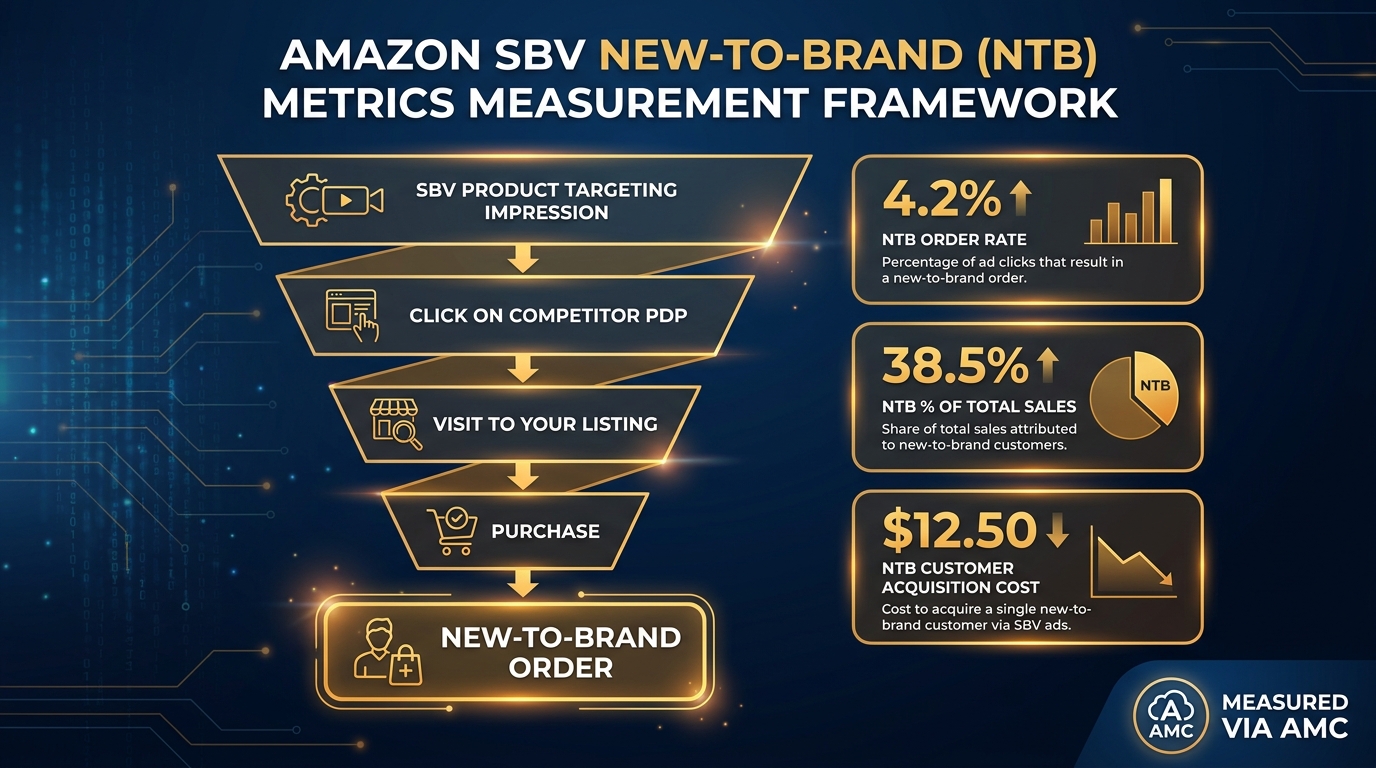
The measurement failure in most SBV product targeting accounts is applying keyword campaign metrics to product targeting campaigns. ACOS as a primary success metric is meaningful in search — where the shopper had purchasing intent baked in from the query. In product targeting, where you’re reaching shoppers who were going to buy a competitor’s product moments ago, ACOS as a standalone metric is actively misleading.
New-to-Brand Metrics: The Right Primary KPI for Conquesting Campaigns
Amazon makes new-to-brand (NTB) metrics natively available for Sponsored Brands campaigns, including SBV. These metrics report the number of orders from customers who haven’t purchased from your brand in the past 12 months, as well as NTB sales volume and NTB percentage of total orders.
For conquesting campaigns, NTB rate should be the first metric you look at — not ACOS. A conquesting campaign with a 45% ACOS and a 78% NTB order rate is doing something fundamentally valuable: it’s finding new customers who wouldn’t have discovered your brand otherwise. Evaluated purely on ACOS, that campaign looks inefficient. Evaluated on customer acquisition cost relative to your average customer lifetime value, it may be one of the most profitable campaigns in the account.
NTB metrics also help you separate genuine acquisition performance from cross-sell noise. If your “conquesting” campaign is actually driving repeat buyers (low NTB rate), it’s not conquesting at all — it’s retargeting existing customers, which means your ASIN selection is off and you’re showing up on listings your own customers are also browsing.
Amazon Marketing Cloud: The Attribution Intelligence Layer
Amazon Marketing Cloud (AMC) is the SQL-based data clean room that allows advertisers to run cross-channel attribution queries against impression, click, and conversion data that isn’t available in standard Campaign Manager reports. For SBV product targeting, AMC enables two analysis types that are not possible with native reporting:
Overlap analysis: AMC can show you what percentage of shoppers who were exposed to your SBV product targeting campaign were also exposed to Sponsored Products or Sponsored Display campaigns targeting the same audiences. If there’s significant overlap, you may be over-spending by reaching the same shoppers multiple times across formats — AMC makes this visible so you can deconflict campaigns or adjust frequency caps.
Path-to-purchase analysis: AMC can show how SBV product targeting fits into the full customer journey. For many brands, the data reveals that SBV product targeting functions as a mid-funnel touchpoint — shoppers who see a SBV ad on a competitor’s page don’t always convert immediately, but they’re more likely to convert when later exposed to a keyword ad or when they return to the product directly. This path-level view makes SBV’s contribution legible in a way that last-click attribution models completely miss.
The Incrementality Question
The hardest question in SBV product targeting measurement is: would these sales have happened anyway? For defensive campaigns targeting your own ASINs, a version of this question is always lurking — if you weren’t running the defensive campaign, how many of those purchases would your competitor have captured?
Incrementality testing for SBV is possible through geographic holdout structures or Amazon’s own lift study options (available to larger-budget advertisers through managed accounts). But for accounts that don’t have access to formal lift studies, the practical proxy is to monitor your conversion rate on defended ASINs relative to ASINs where you’ve deliberately paused defensive coverage. The delta provides a directional estimate of what the campaign is actually protecting.
Mining Existing Campaign Data to Build Your Product Target Lists
One of the most common questions practitioners ask is: where do I get the ASINs to target? The answer is almost always in data you already have — you’re just not looking in the right reports.
The Sponsored Products Search Term Report
If you’re running Sponsored Products with product targeting already, your Search Term Report contains a goldmine of ASIN-level data. In product targeting mode, the report shows you which specific ASINs triggered your Sponsored Products ads — including competitor ASINs where your ads appeared, and critically, which ones converted. Start your SBV product target list with the top-converting ASINs from your SP product targeting report. These are validated targets with proven purchase intent correlation.
Brand Analytics Competitor Data
Amazon Brand Analytics provides the Market Basket analysis (what items customers buy together) and the search frequency report (which ASINs rank for the same queries your products rank for). The Market Basket data identifies natural cross-sell targets for your cross-sell archetype campaigns. The query-based overlap data identifies which competitor ASINs are fighting for the same search traffic you are — prime conquesting targets.
Sponsored Display Report Mining
If you’re running Sponsored Display with product targeting, those campaigns have been collecting conversion data on ASIN-level targets for potentially months. Pull the Targeting Report from your Sponsored Display campaigns and sort by conversion rate and orders. The top performers are high-confidence SBV product targets. You already know they convert — now put a video creative in front of those placements and give the format’s higher CTR a chance to amplify the results.
Reverse-Engineering Competitors’ Targeting
One underutilized signal is your own listing’s traffic data. In Seller Central’s traffic reports and Brand Analytics, you can see which search terms are driving shoppers to your PDP. Many of those shoppers are also browsing competitor ASINs that rank for the same terms. Use the overlap between your top traffic-driving terms and the ASINs that rank in the top 5 for those terms to build a conquesting ASIN list anchored to validated, high-intent search queries.
The Five Most Common SBV Product Targeting Mistakes
Even well-intentioned advertisers consistently make the same structural errors in SBV product targeting. Recognizing these patterns is often faster than building a new strategy from scratch.
Mistake 1: One Campaign for All Three Archetypes
Combining defensive, conquesting, and cross-sell targets in a single campaign makes it impossible to set appropriate bids, measure against the right success metrics, or optimize creative relevance. The campaign performance looks mediocre in aggregate because you’re blending three fundamentally different audience types. The fix: segment into three separate campaigns from the start, even if the initial budgets are small.
Mistake 2: Applying ACOS Targets That Were Built for Keywords
Your keyword SBV campaigns are measured against an ACOS target calibrated to search intent conversion rates. Applying that same target to conquesting product targeting campaigns will cause you to pause campaigns that are actually acquiring valuable new customers at a healthy long-term cost. Build separate ACOS benchmarks for each archetype, or shift primary measurement to NTB metrics for conquesting specifically.
Mistake 3: Static ASIN Lists That Never Get Updated
Amazon’s competitive landscape shifts continuously. Products get stocked out, prices change, review profiles evolve, new competitors enter the category. A conquesting ASIN list built once and left untouched for six months is likely targeting some ASINs that no longer exist, some that have materially changed, and missing new vulnerabilities that opened up since the list was built. Monthly ASIN list maintenance is not optional — it’s core to making product targeting work at scale.
Mistake 4: No Segmentation Within Category Targets
Running a top-level category target with no refinements is essentially broadcasting your ad to every ASIN in the category, regardless of price, rating, or relevance. Amazon’s category targeting refinements — minimum/maximum price, minimum star rating, Prime eligibility — are meaningful filters that should always be applied to narrow category campaigns toward your actual competitive set. An unrefined category target can inflate impression counts while delivering poor efficiency.
Mistake 5: Using Search-Optimized Creative for PDP Placements
As covered in the creative section, the video that works in keyword search environments is not the same video that works on a competitor’s product detail page. Running a single creative across both environments means both are underoptimized. Even a simple adjustment — adding product-name text overlay in the first frame and swapping the hook from an awareness message to a comparison message — can meaningfully lift CTR in PDP placements without rebuilding the creative from scratch.
Building the SBV Product Targeting Engine: A Structural Checklist
The most effective SBV product targeting programs share a common structural foundation. Here’s the checklist that advanced practitioners use as a baseline before scaling spend:
Campaign Architecture
- Separate campaigns for defensive, conquesting, and cross-sell objectives — never mixed
- ASIN targeting and category targeting in separate campaigns, not mixed in the same ad group
- Budget allocation weighted toward the archetype with strongest validated performance, not based on assumption
- Negative ASIN list active from launch, not added as an afterthought
Targeting Hygiene
- Conquesting ASIN list sourced from SP Search Term Report, Brand Analytics competitor data, and category ranking overlap
- Conquesting ASIN list filtered by price parity, rating vulnerability, and category relevance
- Category refinements applied: minimum rating 4.0+, price band aligned to your competitive tier, Prime eligible
- Monthly ASIN list review cadence scheduled in advance
- Negative ASIN list reviewed monthly and updated based on 30-day performance data
Bid Structure
- Placement report reviewed after 3–4 weeks of data to understand PDP vs. search performance split
- Placement modifiers set based on actual conversion rate data, not default assumptions
- Separate bid tiers for defensive (higher), conquesting (mid-range), and category discovery (lower)
Measurement Framework
- NTB order rate tracked as primary KPI for all conquesting campaigns
- ACOS used as a secondary efficiency guardrail, not the primary go/no-go metric
- AMC overlap analysis run quarterly to identify cross-format audience duplication
- Defensive campaigns evaluated by conversion rate protection and observable PDP exit rate signals
Creative
- Separate creative variants for PDP placements and search placements where budget allows
- First 3 seconds: product visible, text overlay present, no silent ambient opener
- Captions or text overlays that communicate the message fully without audio
- Creative reviewed and refreshed every 60–90 days to prevent engagement fatigue in high-frequency placements
Conclusion: Product Targeting Is Where SBV Actually Gets Interesting
Sponsored Brands Video is frequently discussed as a creative format — a way to stand out in search with motion and sound. That framing is accurate but incomplete. The format’s highest structural potential isn’t in keyword targeting at all. It’s in the product targeting layer, where intent signals are sharper, competitive displacement is direct, and the measurement story can actually reflect the full value of customer acquisition rather than just click-through efficiency.
The brands that will pull ahead in SBV product targeting over the next 12–18 months aren’t the ones with the biggest video production budgets. They’re the ones that build the architectural discipline first: three campaign archetypes with distinct objectives, ASIN lists that are actively curated, bids calibrated to placement behavior, and measurement frameworks that look at NTB rate and long-term customer value rather than last-click ACOS.
Most of your competitors are running SBV on keywords. Fewer are running it on products. Almost none have built the full architecture described here. That gap is opportunity — but it’s narrowing as more sophisticated advertisers migrate their budgets toward product targeting inventory in 2026.
The structural playbook exists. The data infrastructure to execute it is available to most Seller Central accounts. What’s missing, for most, is the deliberate decision to treat product targeting as a first-class citizen of the SBV strategy rather than a secondary checkbox on the campaign setup screen.
Start with one archetype — defensive is usually the lowest-risk entry point — build the measurement framework before you scale, and let data drive your ASIN list evolution from there. The architecture described above scales cleanly from a few hundred dollars a month to six-figure monthly budgets. The structural decisions made early determine how cleanly it scales later.