Tag: SBV Targeting

  • Search-Term-First SBV Targeting: Mining Your SP Data for Amazon Video Ad Wins

    Search-Term-First SBV Targeting: Mining Your SP Data for Amazon Video Ad Wins

    Search-Term-First SBV Targeting — Turn SP Data Into Amazon Video Ad Wins

    Most Amazon advertisers approach Sponsored Brands Video the wrong way. They start with the creative — picking a product, shooting a video, and then going into the campaign builder to think about keywords as an afterthought. The result is a beautifully produced video ad chasing keywords that have never proven they can convert, burning budget against intent signals it hasn’t earned the right to target yet.

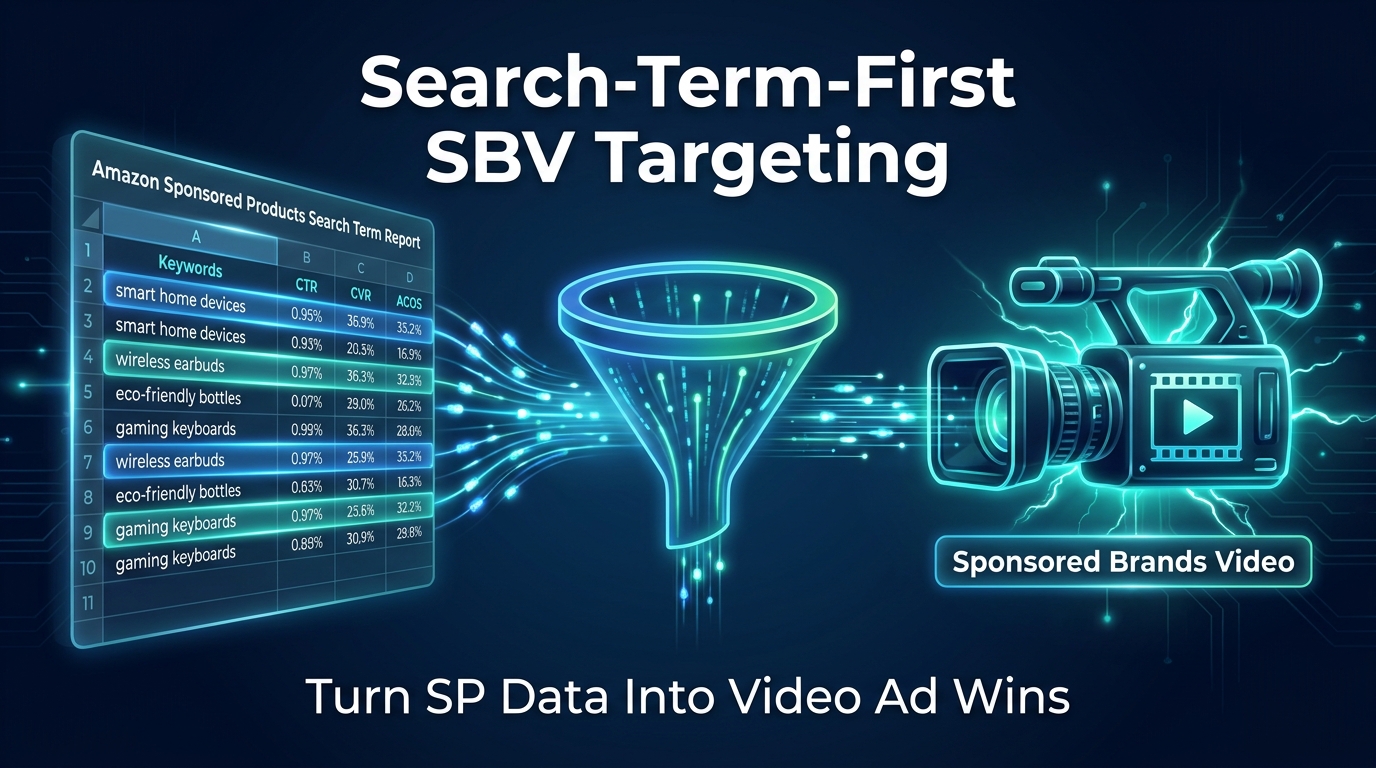
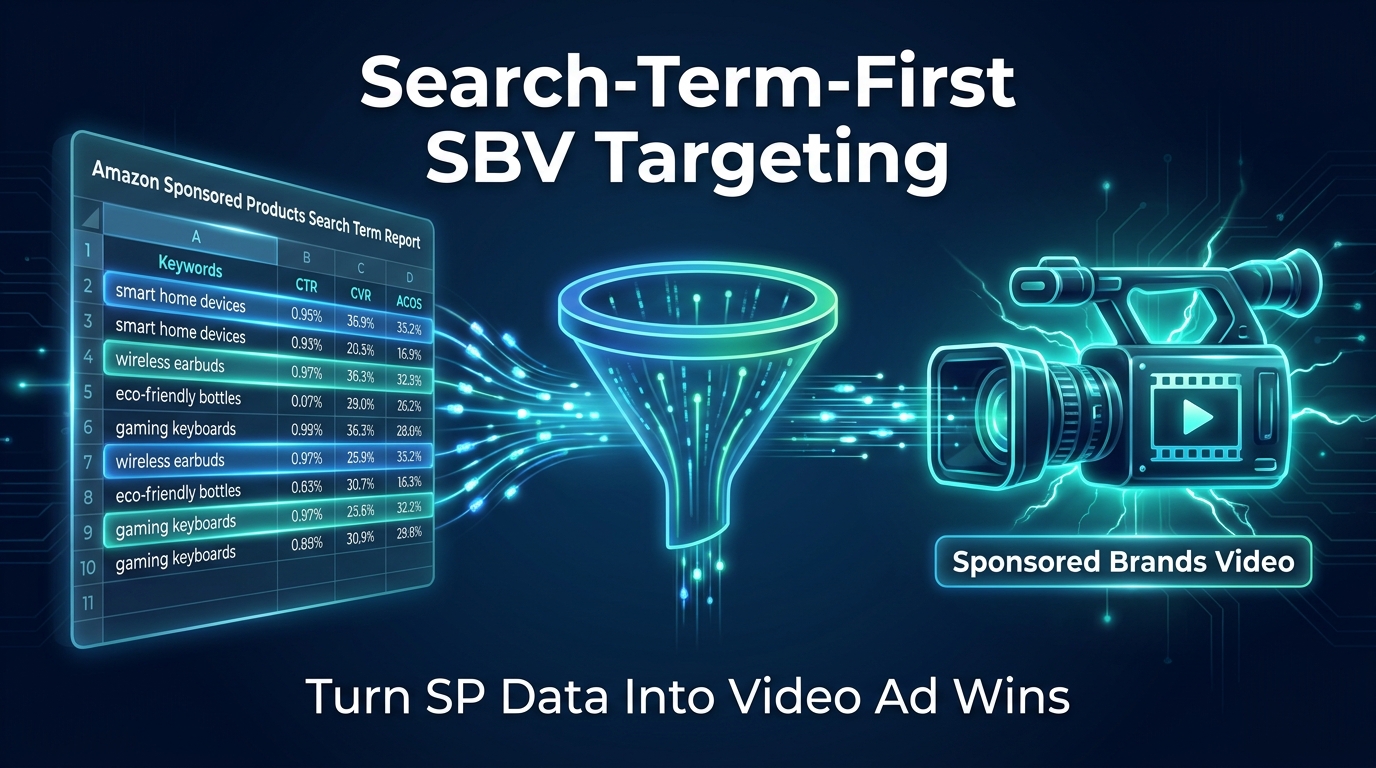
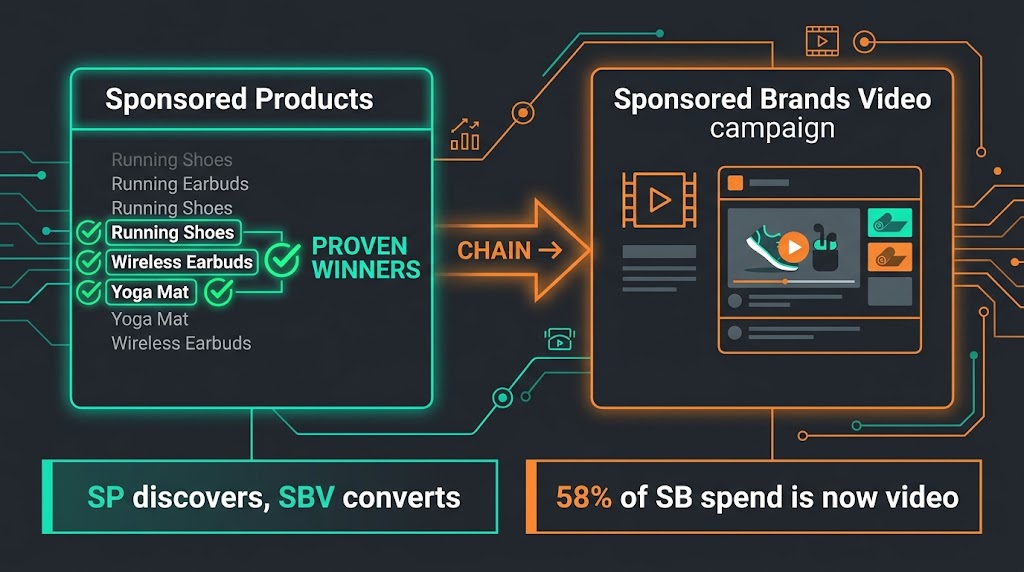
    The smarter path runs in the opposite direction. You start with the data you already have — specifically, the search term report sitting inside your Sponsored Products campaigns right now — and you use it to identify exactly which customer queries have demonstrated the ability to drive purchases before you spend a dollar on video. Then, and only then, do you build your SBV campaigns around those proven terms.

    This is what search-term-first SBV targeting actually means. It is not a creative-led strategy with keywords bolted on at the end. It is a data-led strategy where every video placement you run is anchored to a query that has already passed a conversion test in a lower-cost environment. The creative serves the term. The bid serves the term. The campaign structure serves the term.

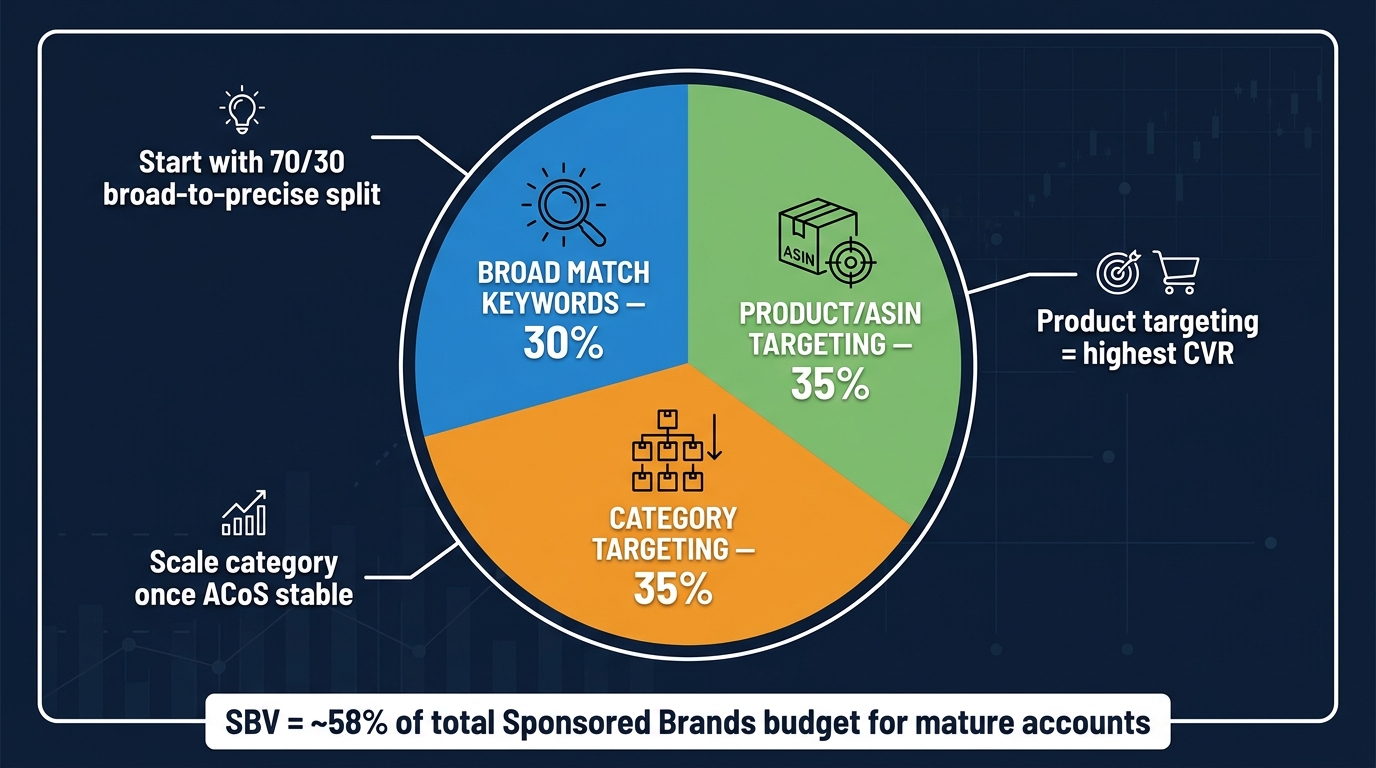
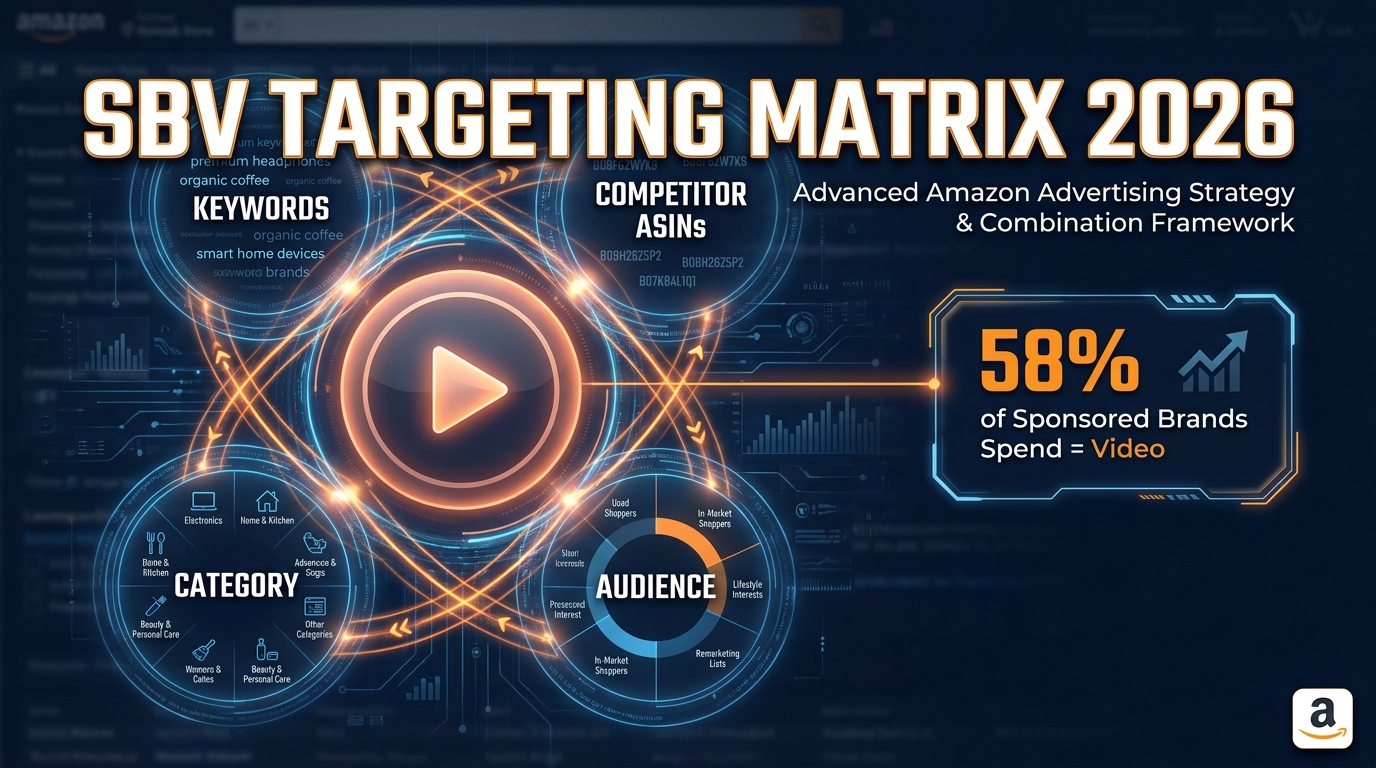
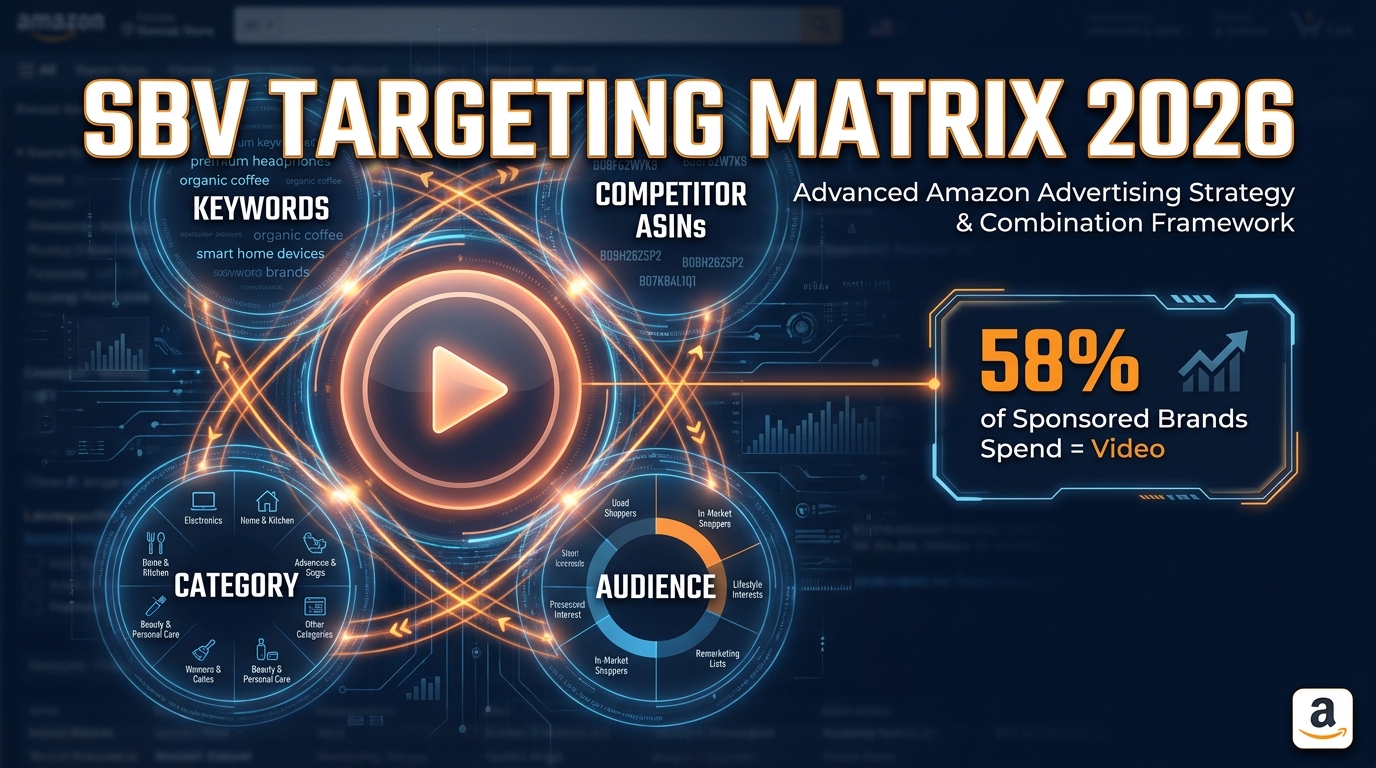
    As of 2026, Sponsored Brands Video accounts for roughly 58% of total Sponsored Brands spend across managed Amazon advertising accounts — making it the default format rather than a specialty option. The opportunity is real. But so is the waste for advertisers who haven’t built a systematic way to decide which search terms deserve a video impression in the first place. This post builds that system from the ground up.

    Why SBV Has Earned Its Place at the Top of the Funnel

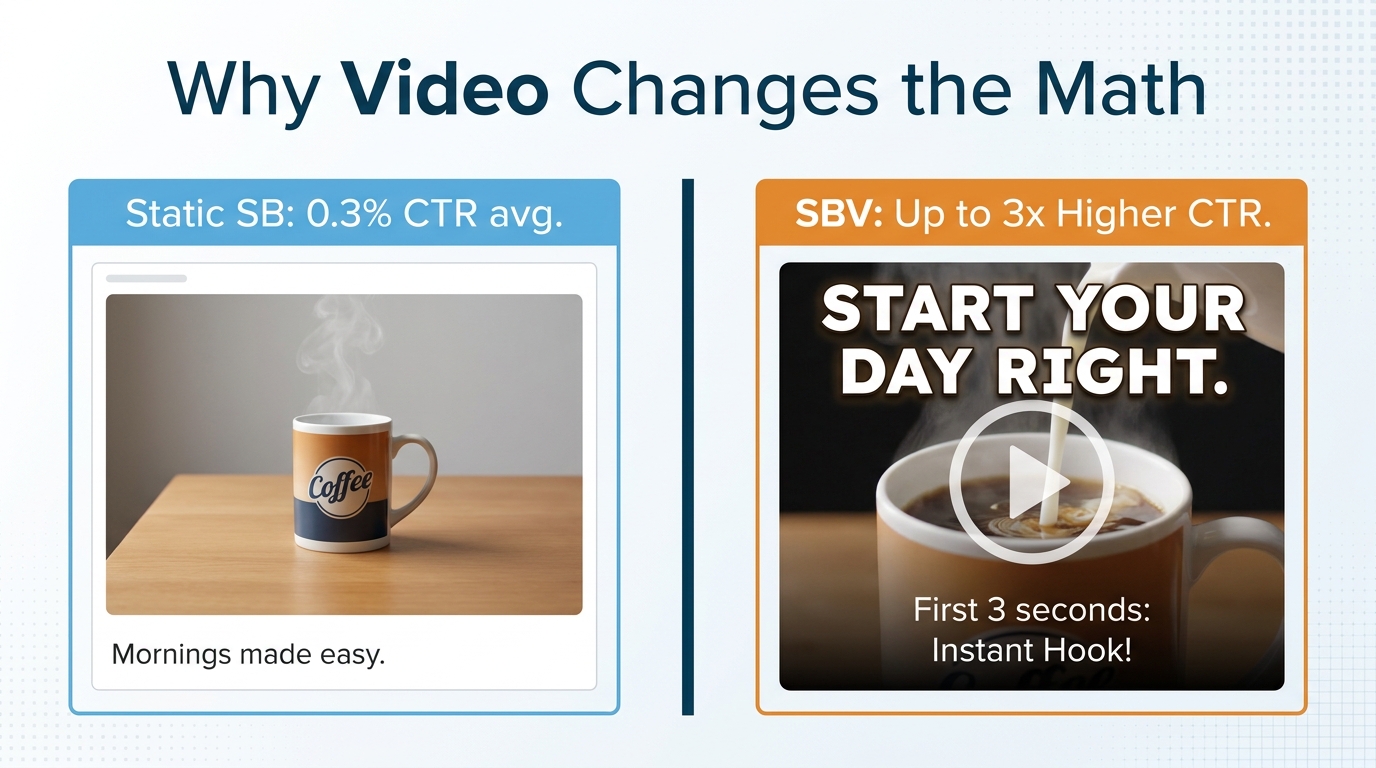
    Static Sponsored Brands versus Sponsored Brands Video CTR comparison — SBV delivers up to 3x higher click-through rates

    Before getting into the mechanics of mining SP data, it’s worth being precise about what makes SBV different enough to warrant its own keyword strategy — because the answer is more specific than “video performs better than images.”

    The Placement Is the Differentiator

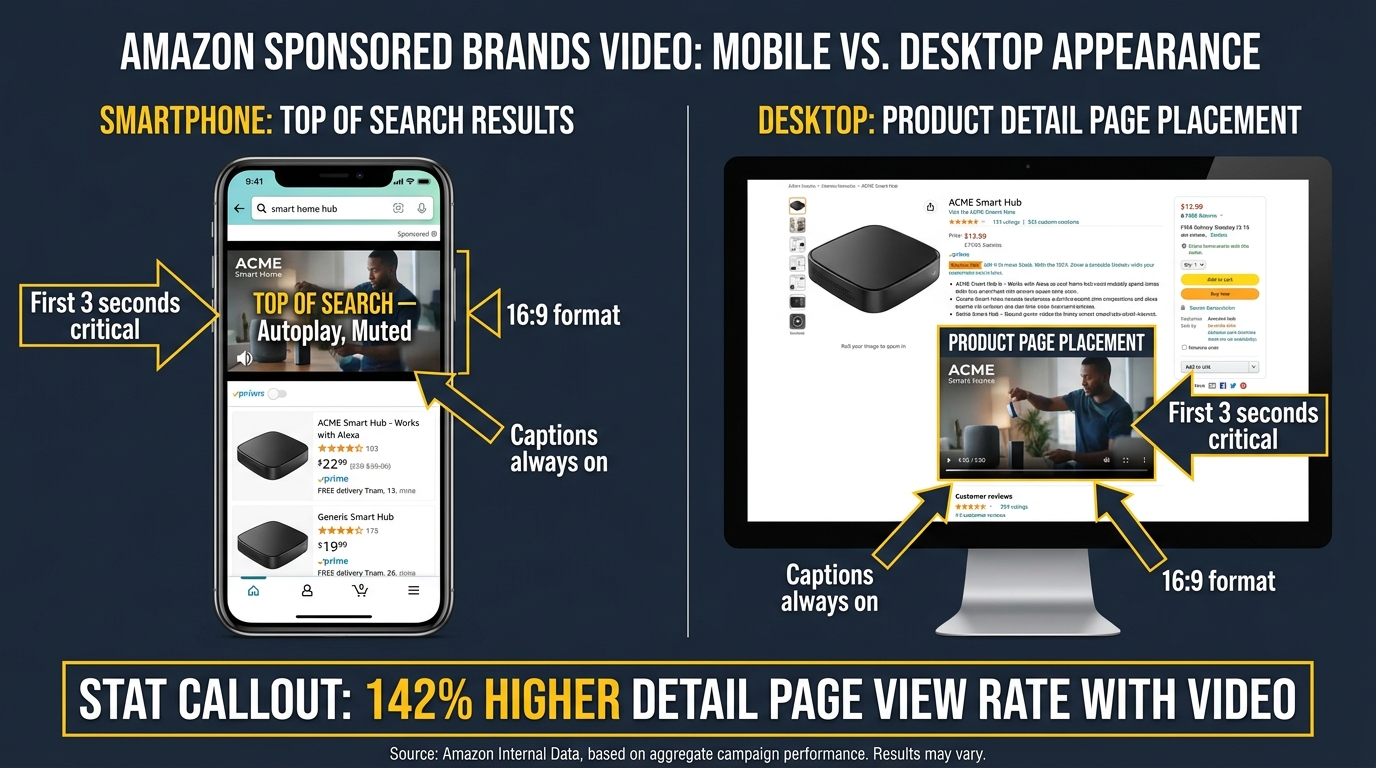
    Sponsored Brands Video occupies a distinct placement that static Sponsored Brands ads and Sponsored Products ads cannot. It appears as an autoplay video strip within the organic search results — not above them, not beside them, but embedded directly inside the page that shoppers are actively reading. That placement creates a fundamentally different interaction dynamic.

    A shopper browsing search results for “stainless steel insulated water bottle” is in a comparison state of mind. They are evaluating products side by side. A static banner above those results asks them to stop and look upward. An SBV placement asks for nothing — it begins playing in their peripheral view as they scroll, and it either earns attention through motion and clarity or it doesn’t. This is why SBV’s click-through rate advantage over static Sponsored Brands is consistently reported in the 1.5x to 3x range.

    An Amazon Science study spanning 15 countries found CTR lifts of 17x for SBV versus static image formats in controlled conditions. Real-world account data is more moderate — most practitioners report 1.5x to 2.5x lift in their actual campaigns — but even the conservative end of that range changes the CPC economics significantly. More clicks at the same CPC means more conversion opportunities, which is why SBV’s conversion rate also runs roughly 10% to 30% above equivalent static Sponsored Brands campaigns for the same terms.

    The Format Rewards Intent, Not Just Awareness

    One of the common misconceptions about video advertising is that it belongs at the awareness stage of the funnel — that it is inherently a brand-building tool rather than a performance tool. SBV demolishes that framing. Because it is keyword-targeted and appears within search results, it reaches shoppers who have already expressed intent through their query. The video format doesn’t move them away from purchase consideration — it accelerates it by delivering richer product information in the moment of search.

    This is the core insight that makes search-term-first SBV targeting so powerful: when you put a video behind a high-intent keyword, you are not trading performance for brand — you are stacking both in the same impression. The term captures the intent. The video converts it.

    SBV Is Now the Default, Not the Exception

    The 58% share-of-Sponsored-Brands-spend figure cited above reflects a structural shift that has been building since 2024. Amazon has progressively made SBV easier to launch — simplifying the creative specifications, lowering the technical bar for video production, and expanding the placement to more device types. In competitive categories like home goods, supplements, pet supplies, and personal care, SBV placements now appear on almost every major search page, which means not running SBV is effectively ceding premium in-search real estate to competitors who are.

    The strategic question is no longer whether to run SBV. It’s which terms to run it on, and how to decide. That answer lives inside your SP data.

    The SP Search Term Report as a Targeting Intelligence Engine

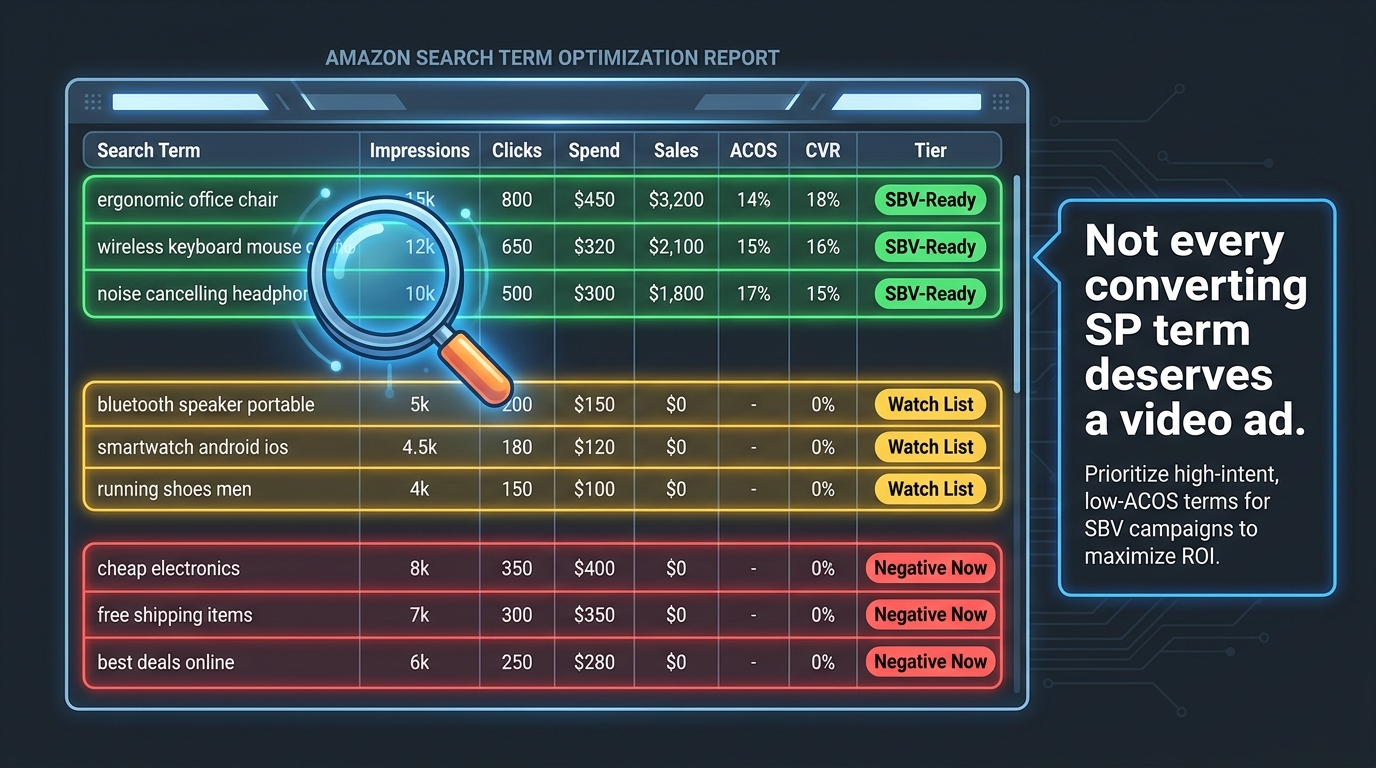
    Amazon search term report with color-coded qualification tiers — SBV-Ready, Watch List, and Negative Now

    Your Sponsored Products campaigns are, functionally, a keyword testing lab. Every day they are running broad match, phrase match, and auto-targeting, they are collecting data on which exact customer queries led to clicks, which of those clicks led to purchases, and at what cost. This data is captured in the search term report, and it represents something genuinely valuable: real shopper behavior, not projected behavior.

    What the Report Actually Contains

    The Amazon Ads search term report shows the actual queries customers typed before clicking your SP ads. For each query, you can see impressions, clicks, click-through rate, spend, attributed orders, attributed sales revenue, and cost-per-click. Critically, you can also see the keyword that matched the query — meaning you can distinguish between a query that your broad match keyword triggered versus one your phrase match keyword triggered, which has implications for confidence in the data.

    Amazon retains up to 65 days of search term data accessible in the native reporting interface, and the Ads Console UI allows export for the past 90 days. For SBV keyword seeding purposes, a 30 to 60-day window is the most actionable — long enough to have statistically meaningful data, recent enough to reflect current demand patterns and seasonal relevance.

    The Data Hierarchy That Matters for SBV

    Not all columns in the search term report are equally important when you are mining for SBV candidates. The metrics that matter most, in order of priority:

    • Orders attributed: This is the bedrock qualifier. A query that has never produced an order has not proven purchase intent, regardless of its click volume. For SBV, where CPCs tend to run higher than SP, only proven converters justify the investment.
    • ACoS (Advertising Cost of Sale): Calculated as spend divided by attributed sales. A term that converts but at an ACoS far above your target is a conversion signal with poor efficiency — it may still qualify for SBV if you believe the creative improvement will reduce CPC, but it needs a tighter bid structure.
    • Click-through rate relative to impressions: High impressions with low CTR can indicate poor listing-page relevance or competitive listing quality. A term with excellent CVR but middling CTR is actually a strong SBV candidate — because better creative (video versus static) is exactly what can close the gap.
    • Conversion rate (CVR): Orders divided by clicks. This is the most reliable signal of query-to-purchase alignment. Terms with CVR significantly above your account average are priority SBV candidates because they demonstrate that shoppers who arrive via that query are predisposed to buy.

    Downloading and Preparing the Report

    To access the data, navigate to Amazon Ads Console → Reports → Create Report → Sponsored Products → Search Term. Set the date range to the past 30 to 60 days, select all available metrics, and export to CSV. From there, the analysis process is the same whether you work in Excel, Google Sheets, or a dedicated PPC tool — filter, sort, and score terms against the qualification criteria detailed in the next section.

    One important note: the report shows customer search terms at the campaign level. If your SP campaigns are not already segmented by product category or match type, your data may be difficult to interpret because high-performing terms from different product categories or intent stages will be mixed together. If your SP campaign architecture is messy, cleaning it up first will make your SBV keyword mining significantly more accurate.

    Setting the Right Filters — What Actually Qualifies a Term for SBV Promotion

    The most common mistake when mining SP data for SBV is using too low a bar. A term that converted twice in 30 days at a borderline ACoS is not an SBV keyword — it’s a keyword that needs more data in SP before it earns a more expensive placement. Being selective at this stage is not cautious; it’s what keeps your SBV campaigns from becoming a vehicle for testing on expensive impressions.

    The Three-Gate Qualification Framework

    Apply these gates sequentially. A term must pass all three to qualify for SBV promotion:

    Gate 1 — Minimum Conversion Activity: The term must have generated at least 3 to 5 orders in the reporting window. Below this threshold, conversion data is too noisy to act on. Some practitioners use a higher threshold of 5 to 10 orders for high-competition categories where CPCs are elevated. The specific number matters less than having a minimum that filters out statistical noise.

    Gate 2 — Acceptable Efficiency: The term’s ACoS must be at or below 150% of your target ACoS. So if your target ACoS is 20%, terms up to 30% ACoS can qualify with the assumption that SBV’s creative improvement may reduce CPC and improve CVR enough to bring it into range. Terms above this threshold need remediation in SP first — fixing bids, improving listing conversion rate, or both — before they deserve a video placement.

    Gate 3 — Volume Adequacy: The term must have generated at least 100 to 200 impressions in the reporting window. Terms with very low impression counts, even if they converted, do not have enough volume to sustain an SBV campaign. SBV CPCs are typically higher than SP CPCs, and low-impression terms often have thin search volume that will not deliver meaningful scale.

    Secondary Scoring for Prioritization

    After applying the three gates, you will typically have a list of qualified terms that is longer than your initial SBV budget can support. Prioritize by scoring each term on a combination of:

    • CVR premium: How much does this term’s conversion rate exceed your SP account average? Higher premium = higher priority.
    • Revenue per click: Attributed sales divided by total clicks. Higher revenue per click terms produce more value per SBV impression regardless of CPC.
    • Competitive sensitivity: Is this a generic category term, a branded competitor term, or your own brand term? Each category has a different priority logic for SBV (covered in more detail in the campaign architecture section below).

    The output of this scoring process is a tiered list: your top-priority SBV exact match candidates, your second-tier phrase match candidates, and a watch list of terms that are close to qualifying but need another 30 days of SP data before promotion.

    Campaign Architecture — Building SBV Campaigns Around Harvested Terms

    Three-tier SBV campaign architecture diagram — Exact Match proven converters, Phrase Match expansion, SP Auto/Broad discovery

    Once you have your qualified, scored list of SBV-ready search terms, the campaign structure you build around them determines whether the system is manageable, measurable, and improvable over time.

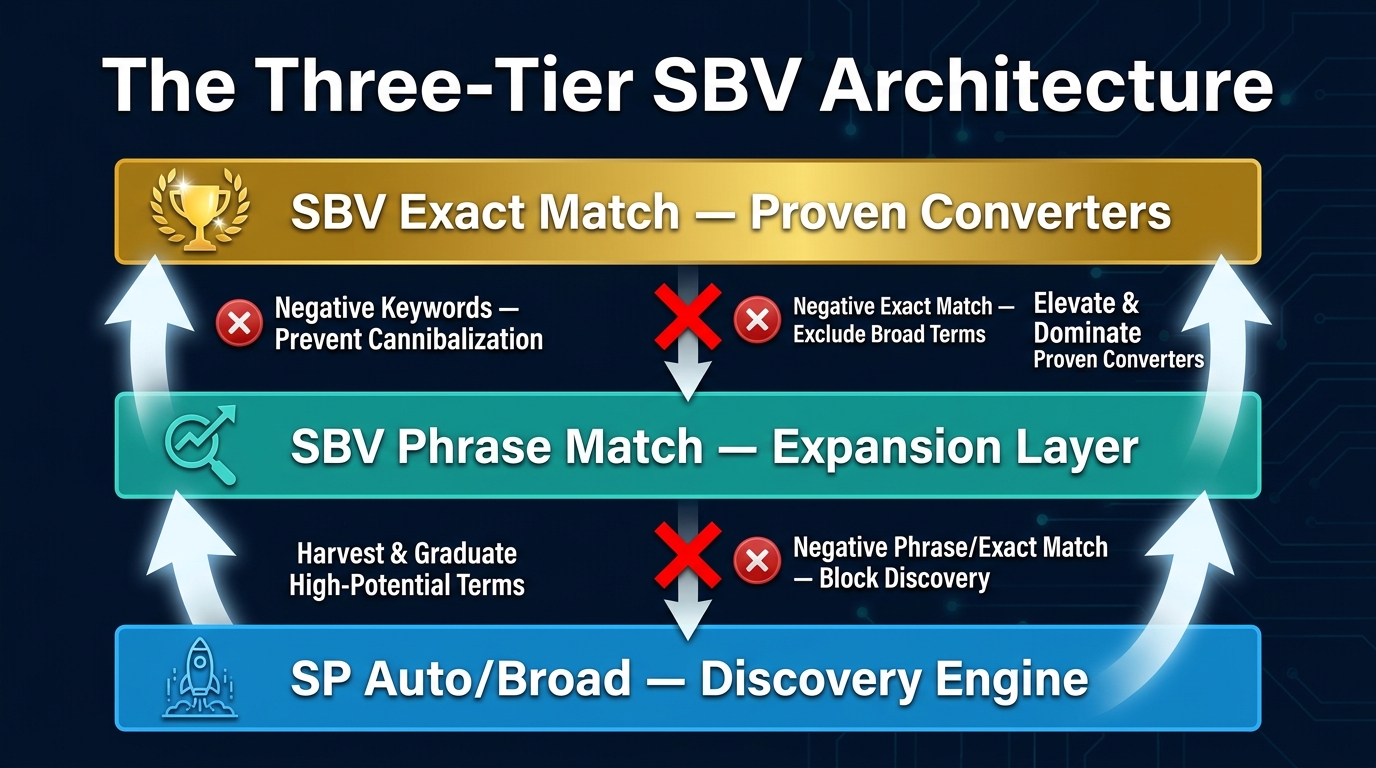
    The Three-Campaign Stack

    The cleanest SBV architecture for search-term-first targeting uses three distinct campaign types, each with a defined role:

    Tier 1 — SBV Exact Match (Proven Converters): This is where your highest-priority terms go. Exact match gives you precise control — you know exactly which query triggered the impression, you can set specific bids per keyword, and you can measure performance at the term level with confidence. Budget allocation here should be your heaviest, as these are the terms with demonstrated purchase intent and the highest confidence in their conversion behavior.

    Tier 2 — SBV Phrase Match (Expansion Layer): Your second-tier terms — those that qualified but with lower scores — go here as phrase match keywords. Phrase match allows close variants and additional words around your core term, which creates controlled volume expansion. You will collect new search term data at the SBV level that can feed future exact match promotions or negative keyword additions.

    Tier 3 — SP Auto/Broad (Discovery Engine — not SBV): This is your existing SP infrastructure, continuing to do what it does best: discover new search terms through broad match and auto targeting. This tier feeds qualified new terms upward into the SBV tiers on a regular review cadence (typically every 30 days).

    Ad Group Architecture Within SBV Campaigns

    Within your SBV exact match campaign, resist the temptation to pile all keywords into a single ad group. Segmenting ad groups by intent cluster allows you to align creative more precisely with the shopper’s mindset and, importantly, allows you to run different video creatives for different query types.

    Practical intent clusters that work well for SBV ad group segmentation:

    • Category-generic terms (e.g., “insulated water bottle”) — high volume, competitive, discovery intent
    • Feature-specific terms (e.g., “leak proof water bottle with straw”) — lower volume, higher CVR, feature-match intent
    • Use-case terms (e.g., “hiking water bottle 40oz”) — mid volume, lifestyle intent, strong upsell/lifestyle creative potential
    • Competitor brand terms (e.g., “Hydro Flask alternative”) — high intent, conquest context, requires specific creative framing

    Each cluster gets its own ad group, its own video creative (where budget allows), and its own performance benchmarks. This granularity is what allows you to see not just “does SBV work?” but “which intent context does SBV perform best in?” — which is the question that drives meaningful optimization.

    Budget Allocation Across Tiers

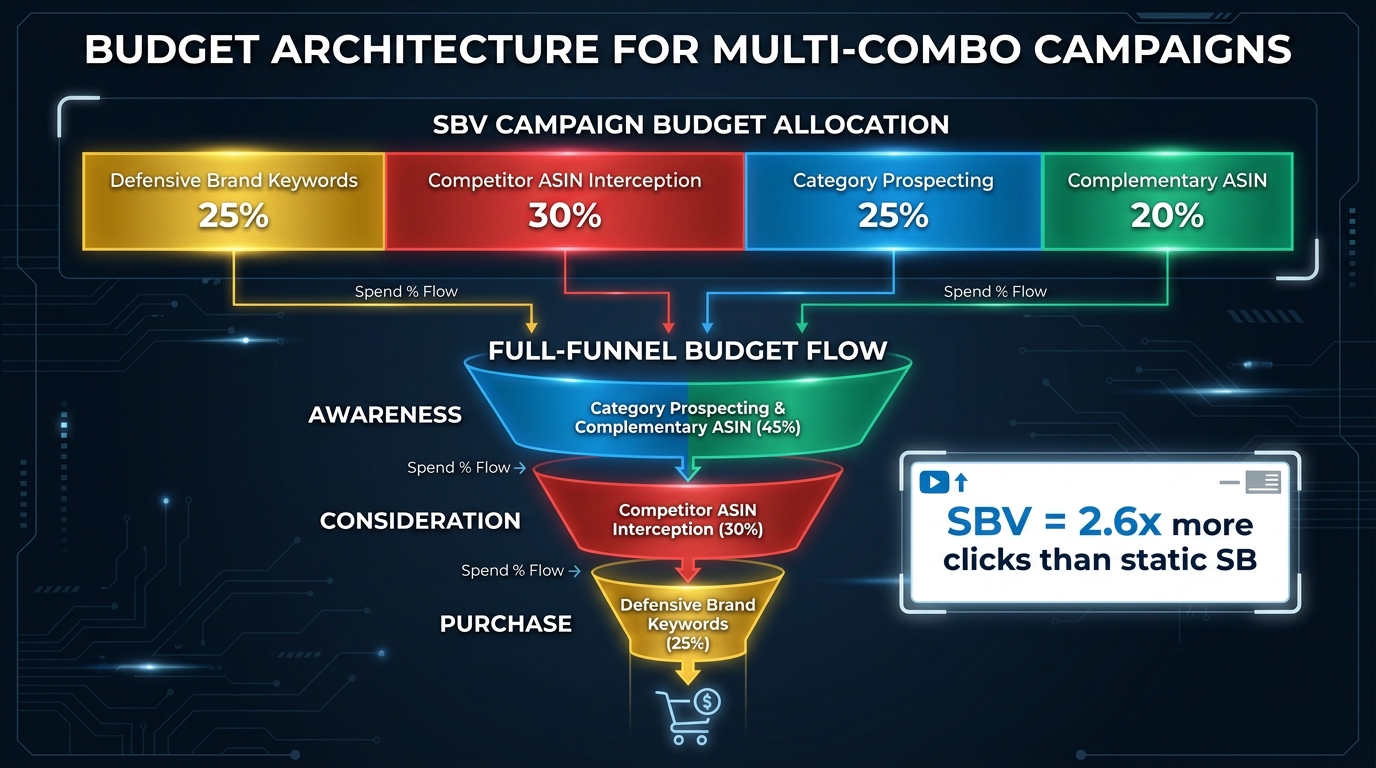
    A practical starting split for accounts new to search-term-first SBV targeting: 70% of SBV budget to Tier 1 exact match, 30% to Tier 2 phrase match. As exact match campaigns accumulate sufficient data and you’ve confirmed performance, you can increase total SBV budget while maintaining this ratio, or shift more toward exact match as phrase match terms graduate.

    Keep SBV campaigns separate from static Sponsored Brands campaigns. Mixing formats within the same campaign prevents clean performance analysis and makes bid management unnecessarily complex. The separation also makes it much easier to track SBV-specific metrics like view rates and the new-to-brand percentage that video tends to generate.

    Match Type Strategy: Why Exact-First Thinking Governs the Whole System

    There is a recurring debate in Amazon PPC circles about whether to launch SBV campaigns broad or narrow. Some practitioners argue for starting broad to collect data quickly. Others argue for starting narrow to control spend. When you’re operating a search-term-first system sourced from SP data, this debate resolves itself: you already have the data. You don’t need broad match to discover what works — you know what works. Exact-first is not caution; it’s precision informed by evidence.

    Why Exact Match Is the Right Starting Point for SBV Candidates

    When you promote a term from SP into SBV exact match, you have a specific piece of knowledge: this exact customer query, typed in this exact way, has driven purchases at an acceptable efficiency in your SP campaigns. Exact match in SBV preserves that precision. You know your ad will appear when shoppers type that query (and close variants), and you can set your bid based on the CVR and revenue-per-click data you already have.

    Launching those same terms as phrase or broad match in SBV introduces variability — the ad may appear for queries that look similar but behave differently. A phrase match on “stainless steel insulated water bottle” will also trigger for “stainless steel insulated water bottle for kids” and “best stainless steel insulated water bottle 2026” — queries you may not have data on. If those variants don’t convert, you are paying SBV CPC rates for impressions that your SP data would have told you to avoid.

    When to Introduce Phrase Match in SBV

    Phrase match becomes appropriate in SBV under two conditions: First, when your exact match campaigns are hitting budget limits regularly, indicating your exact match terms are too restrictive for the available demand. Second, when you want to deliberately expand coverage to related intent variants that you haven’t yet tested in SP — essentially using SBV phrase match as a slightly more expensive version of SP discovery.

    If you use SBV phrase match for discovery, treat the SBV search term reports from those campaigns as a secondary source of exact match candidates — for both SBV and, potentially, for expansion in SP where the CPC will be lower and data collection more cost-efficient.

    Broad Match in SBV: Handle with Care

    Broad match in SBV campaigns is best avoided for terms that haven’t proven their performance in SP first. Amazon’s broad match can trigger for queries with significant semantic distance from your target term, and at SBV CPC rates, that discovery cost is high. If you want to use SBV for pure brand discovery (reaching shoppers with no prior SP data), that is a legitimate strategy — but it should be in a separate campaign with a separate budget, clearly labeled as awareness-stage spend, and measured with different KPIs than your performance SBV campaigns.

    Creative That Actually Converts at the Keyword Level

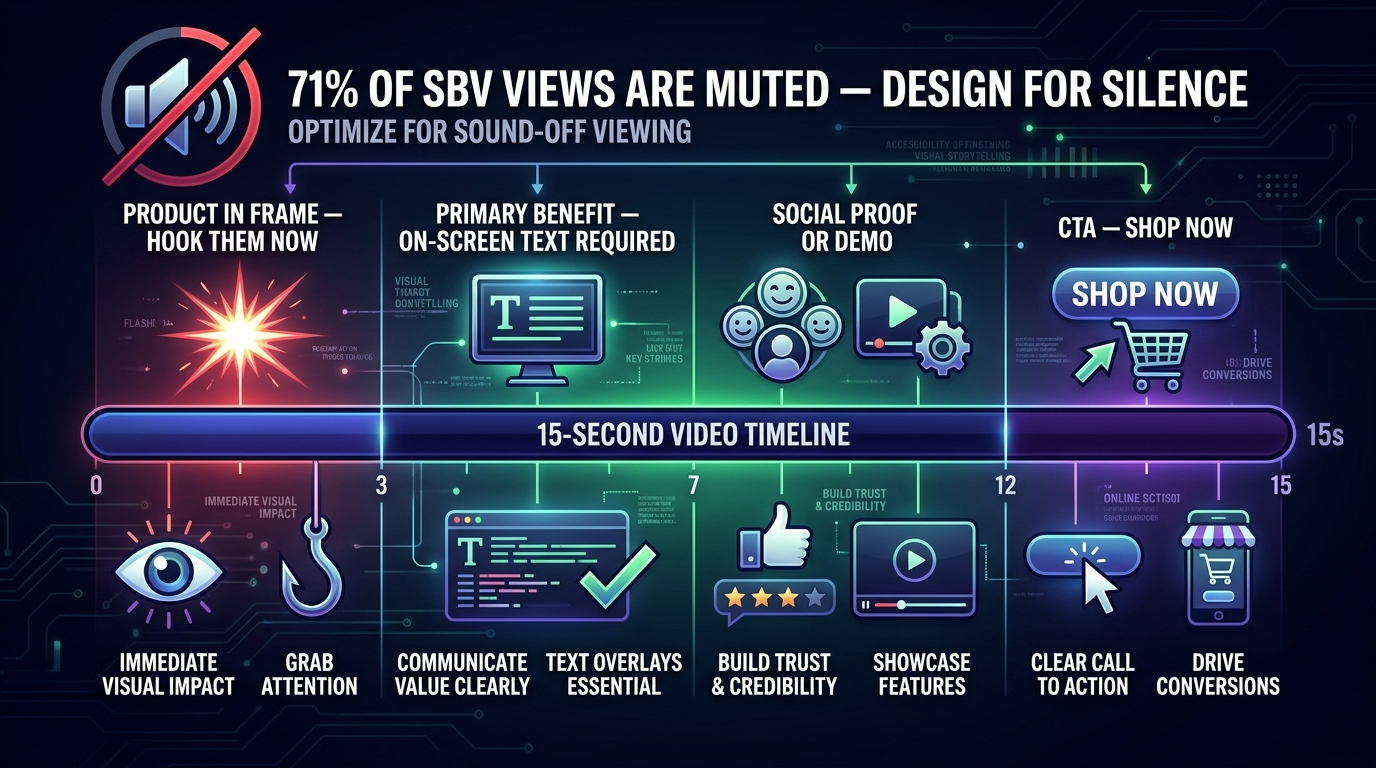
    15-second SBV video timeline showing the four key segments with muted-viewing design principles — 71% of SBV views are muted

    Search-term-first targeting tells you where to run your video. It doesn’t tell you what the video should say. The creative layer is where the targeting logic and the shopper experience connect — and getting it wrong can negate the advantages of even the most carefully selected keyword set.

    Design for Muted Viewing First

    As of 2026, an estimated 71% of SBV views are played with sound off, up from roughly 64% two years prior. The trend toward muted autoplay viewing is structural — it reflects how people shop on Amazon in real-world environments (offices, public transit, shared spaces). This means your SBV creative must be fully comprehensible without audio. If the primary message of your video relies on a voiceover that a muted viewer will never hear, the video is failing the majority of its audience.

    The practical rule: close-caption every piece of speech in the video, and more importantly, put the core product benefit statement as a large, readable on-screen text element that appears within the first three to four seconds. Don’t treat captions as an accessibility afterthought — treat them as the primary communication layer.

    The 15-Second Timeline That Works

    Amazon allows SBV formats ranging from 6 to 45 seconds, but practitioner data consistently points to 15 to 20 seconds as the sweet spot for search-result placements. Longer videos may perform well on product detail pages, but in the search results context, shorter is better because the format competes with organic listings and the shopper’s primary goal is evaluation, not entertainment.

    A practical 15-second structure that aligns with search-result intent:

    • Seconds 0–3: Product clearly in frame. No logo reveal, no cinematic opening. The product should be recognizable within the first two seconds. This is when most drop-off decisions happen.
    • Seconds 3–8: Primary benefit stated on-screen in readable text. This should answer the implicit question behind the keyword. A shopper who typed “leak proof water bottle” should see “100% Leak Proof, Guaranteed” within the first five seconds.
    • Seconds 8–13: Supporting proof — a quick product demo, a use-case shot, or a secondary benefit. This is where lifestyle context can help without replacing product clarity.
    • Seconds 13–15: Call to action. “Shop Now” is the standard. Consider including a brief differentiation statement here — “Free shipping on Prime orders” or a specific offer — that creates urgency without overpromising.

    Aligning Creative to Keyword Intent

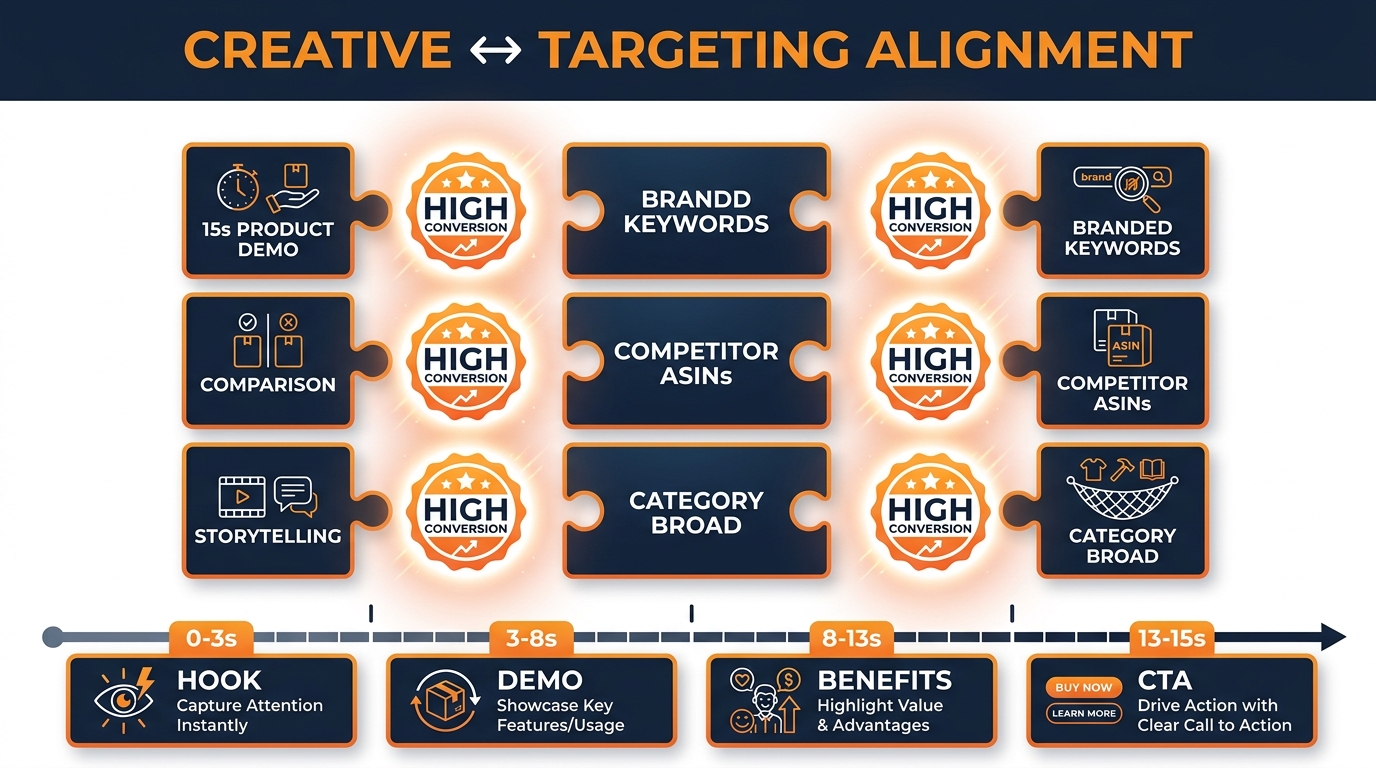
    This is the operational implication of search-term-first targeting that most advertisers miss: if you have segmented your SBV ad groups by intent cluster (as described in the campaign architecture section), you should be running different video creative for different clusters where budget allows.

    A shopper who typed “hiking water bottle 40oz” is in a different mental context than one who typed “stainless steel water bottle office.” The first shopper wants to see outdoor usage context — rugged terrain, a trail, a daypack. The second shopper wants to see clean design, desk compatibility, professional aesthetics. Running the same generic product video against both terms is leaving persuasion efficiency on the table.

    You don’t need an unlimited video production budget to do this. Simple video variants — changing the opening shot, swapping the benefit headline text, showing a different use context in seconds 8 to 13 — can be produced as edits of a core video asset rather than entirely separate productions. The key is matching the opening frames and the benefit headline to the specific shopper intent cluster you’re targeting.

    Amazon’s Autoplay Loop and the Scroll Behavior Problem

    SBV autoplays and loops continuously as shoppers scroll past. This is both an advantage (multiple exposures per page load) and a creative constraint (the video must make sense when entered at any point in the loop, not just from the beginning). Design your creative so the product and primary benefit are visible throughout the video, not just in the final seconds. Treat the loop as a feature, not an afterthought — a shopper who catches the second playthrough should understand your product as well as one who saw it from the start.

    Bidding Logic for SBV — Why SP Benchmarks Don’t Translate Directly

    One of the most common errors in SBV campaign setup is taking the CPC benchmarks from SP campaigns and applying them unchanged to SBV bids. The two formats operate in different auction environments with different competitive dynamics, and treating them as interchangeable will either leave impressions on the table (underbidding) or erode margin (overbidding).

    Why SBV CPCs Are Structurally Different

    SBV ads compete in a separate auction from Sponsored Products. The bidders are fewer — not every advertiser running SP on a given keyword is also running SBV — and the placements are more prominent (in-stream, high-visibility, autoplay). This creates variable CPC dynamics by category:

    • In categories where SBV adoption is high (supplements, beauty, home goods), SBV CPCs can be close to or exceed SP CPCs because competition for the placement is active.
    • In categories where SBV is less adopted, CPCs may be meaningfully lower than SP while delivering significantly higher CTR — an exceptionally favorable efficiency combination.
    • Branded keyword SBV is typically the most efficient placement in terms of CPC-to-conversion ratio, because brand-loyal shoppers click at high rates and competitors are less likely to bid aggressively on your own brand terms.

    Building a Starting Bid Framework from SP Data

    Use your SP data to calculate revenue-per-click for each qualified SBV term: attributed sales divided by total clicks over the reporting period. This gives you the maximum CPC you can afford at breakeven on that specific term, assuming the same conversion rate applies in SBV. Then apply a discount factor to account for the assumption that SBV conversion rates may not exactly match SP conversion rates initially — a common starting factor is 0.7 to 0.85 (bidding 70% to 85% of your calculated maximum CPC).

    As your SBV campaigns accumulate data over the first 30 days, compare actual SBV CVR to the SP CVR assumption. If SBV is converting at a higher rate (common due to the creative improvement), you can increase bids toward the maximum. If it’s converting at a lower rate (sometimes seen when the video creative isn’t well-matched to the keyword intent), investigate the creative alignment before adjusting bids.

    Dayparting and Budget Pacing in SBV

    SBV campaigns tend to perform differently by time of day than SP campaigns, reflecting the different attention states shoppers bring to video content. Late morning and early evening hours typically show the strongest SBV engagement rates — shoppers who are in a more deliberate browsing mode rather than quick mobile searches. Amazon’s own campaign scheduling tools allow budget adjustments by day, though not yet by hour in all markets. Monitor your SBV impression and click data by day of week during the first month to identify any meaningful patterns in your specific category.

    Measuring SBV Performance Beyond ROAS

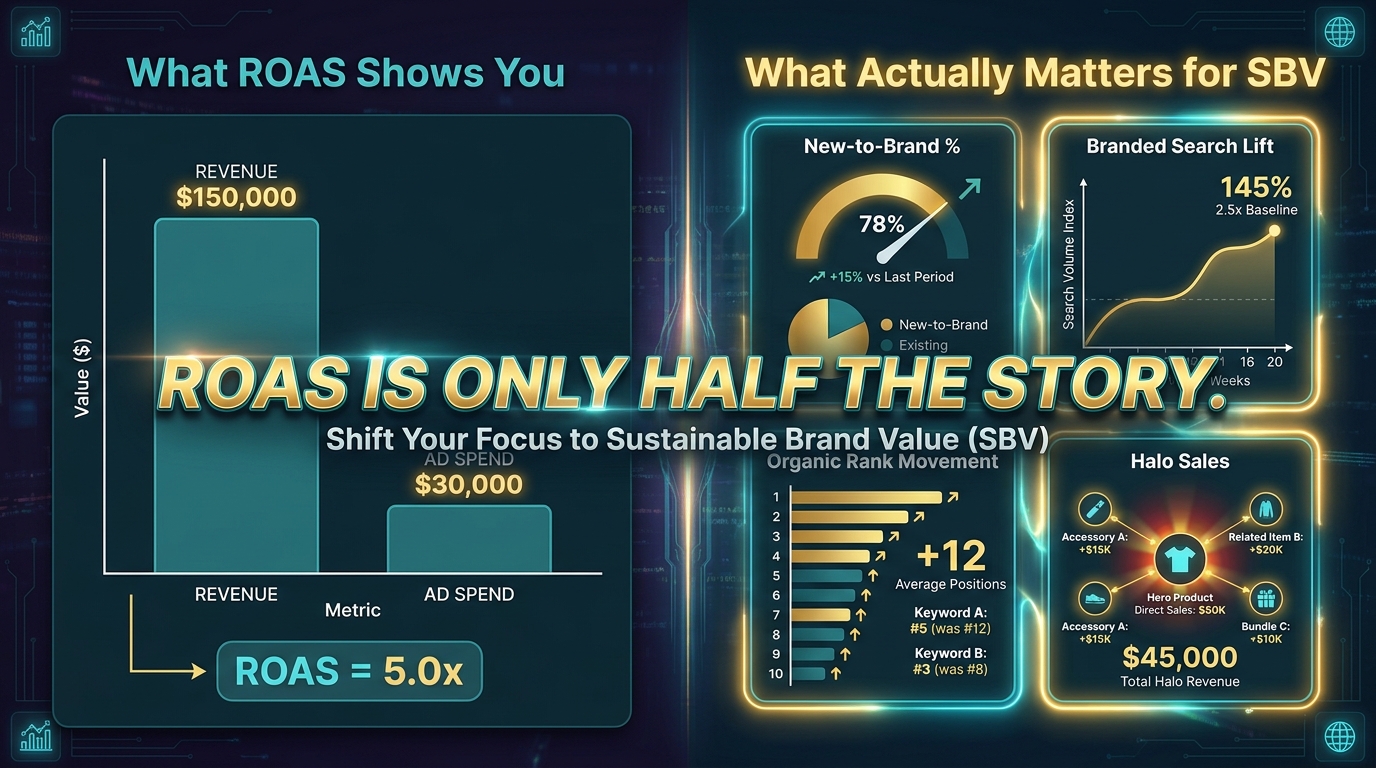
    SBV measurement dashboard showing ROAS versus New-to-Brand, Branded Search Lift, and Organic Rank — ROAS is only half the story

    ACoS and ROAS are the metrics Amazon advertisers default to because they are familiar, comparable across campaigns, and easy to understand. For SBV, they are also incomplete. Relying on ROAS alone to evaluate SBV performance leads to two systematic errors: undervaluing campaigns that deliver strong brand growth alongside modest direct ROAS, and over-pruning keyword targets that are building brand equity that will show up in organic performance weeks later.

    New-to-Brand Metrics: The Primary Incremental Signal

    Amazon’s new-to-brand (NTB) metric tracks orders from customers who have not purchased from your brand within the past 12 months. This is, in practical terms, a proxy for incremental customer acquisition — the metric that reflects whether your advertising is reaching genuinely new customers or simply recapturing existing ones who would have purchased anyway.

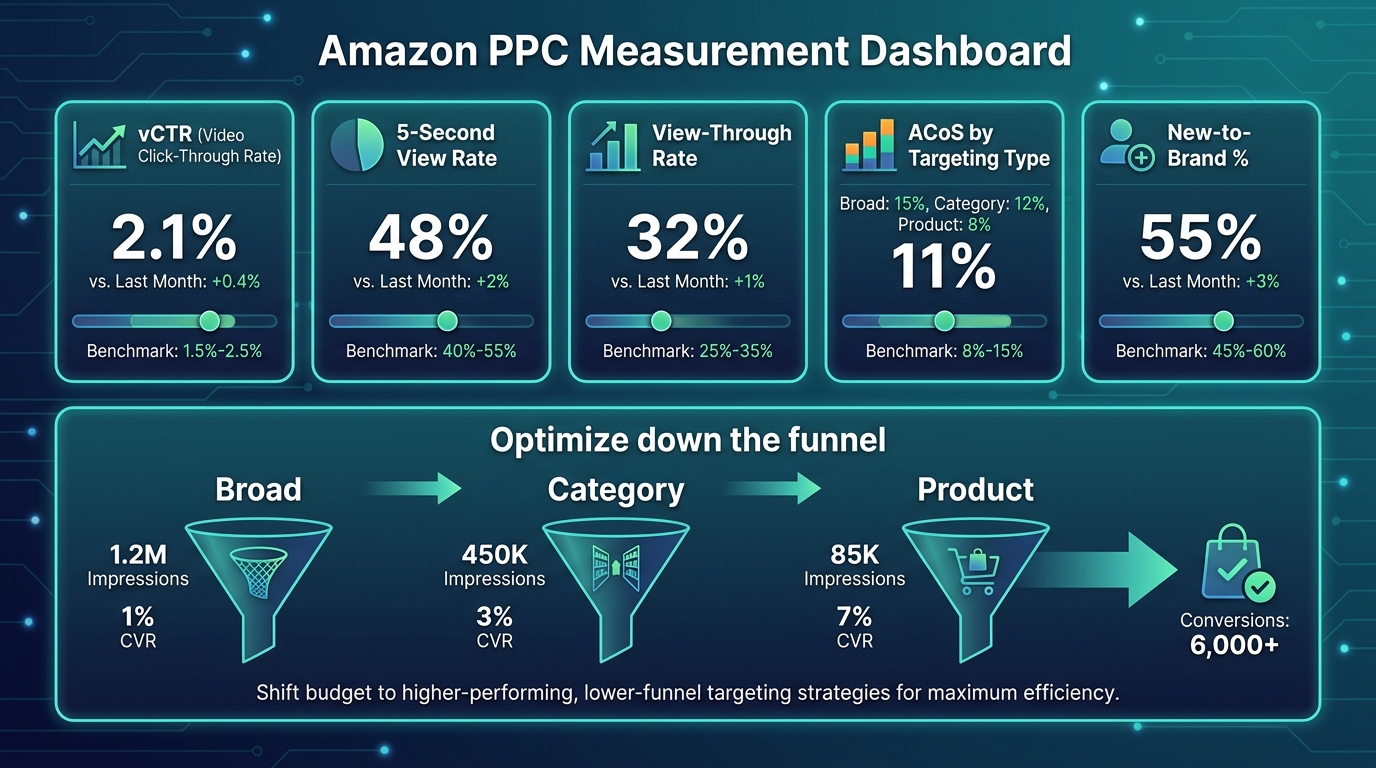
    SBV consistently shows higher NTB percentages than Sponsored Products campaigns for the same keywords. This makes structural sense: SBV’s prominent, autoplay placement is more likely to capture attention from shoppers who are still in evaluation mode versus those who are specifically seeking your brand. A campaign that delivers a 45% NTB rate is doing something different and more valuable than one with a 20% NTB rate, even if their headline ROAS figures are identical.

    Track NTB % per keyword cluster, not just per campaign. This granularity reveals which intent clusters are driving customer acquisition (typically category-generic and feature-specific terms) versus which are capturing repeat purchase intent (often brand terms). Neither pattern is inherently better, but they call for different measurement frameworks and different success benchmarks.

    Branded Search Lift as a Lagging Indicator

    One of SBV’s most economically significant — and least measured — effects is its impact on branded search volume. When shoppers see your brand video in search results for a category term, some portion of them who don’t click immediately will later search specifically for your brand. This creates a halo effect in branded search that shows up as increased impression share on your own branded terms in SP and SBV.

    To measure this, track weekly branded search impression volume in your SP brand campaigns. If you launch SBV on high-volume category terms and branded search impressions begin rising two to four weeks later, that is likely a SBV halo effect. Amazon’s Brand Analytics tool — specifically the Search Query Performance report — can show you branded query growth over time if you are enrolled in the relevant Brand Registry tier.

    Organic Rank Correlation

    A well-structured SBV campaign running on high-volume category terms can indirectly support organic rank by driving increased sales velocity, which is one of the signals Amazon’s ranking algorithm considers. This is not a guaranteed or direct effect, but categories and ASINs where SBV has been running aggressively on category terms for 60 or more days sometimes show organic rank improvements that cannot be fully explained by SP activity alone.

    Measure this by tracking organic rank for your target keywords using a rank tracking tool (or manual search snapshots at consistent intervals) and correlating movements with SBV campaign spend levels. Be cautious about drawing causal conclusions from short time windows — rank data is noisy — but over 60 to 90 days, meaningful patterns do emerge for well-run SBV campaigns.

    View-Through Metrics: What to Track and What to Ignore

    Amazon provides video-specific metrics in SBV campaigns: impressions, video views, view-through rate (VTR), and first quartile, midpoint, and complete view percentages. These metrics are useful for diagnosing creative performance — a video with a very low midpoint completion rate is losing viewers before the core message lands — but they are secondary to conversion metrics for keyword-level optimization decisions. Track VTR at the ad group level to assess creative quality; track CVR and NTB at the keyword level to make targeting decisions.

    Negative Keyword Discipline — The Step Most SBV Builders Skip

    Building a high-quality SBV campaign is half about which terms you target and half about which terms you actively exclude. Negative keyword management in SBV is less discussed than in SP, partly because SBV’s higher CPC makes wasted impressions less tolerable, and partly because the search term data in SBV campaigns provides a second layer of qualification data that requires active management.

    Cross-Campaign Negatives to Prevent Cannibalization

    When you promote a term from SP exact match into SBV exact match, both campaigns are now eligible to show for that query. If both trigger simultaneously, you are bidding against yourself — driving up the CPC you pay in the auction and potentially showing two of your own ads on the same results page (which can look redundant to shoppers and is inefficient from a spend perspective).

    The solution is to add the promoted term as a negative exact match keyword in your SP campaigns when it graduates to SBV. This is the “graduation and negation” principle: promote the term upward, negate it in the originating campaign. The term now lives exclusively in your SBV exact match campaign, where it will receive the video placement, and the SP campaign continues searching for new terms through broader match types.

    SBV Internal Negatives: Managing Phrase and Broad Match Bleed

    If you are running SBV phrase match alongside exact match, add your exact match terms as negative exact keywords in your phrase match campaign to prevent the phrase match campaign from triggering on queries already covered by exact match. Without this, your phrase match campaign will generate impressions on your best-performing terms at a less controlled bid, muddying your performance data and potentially overpaying.

    This cross-campaign negative structure is sometimes called a “waterfall” or “cascading negative” setup. The logic is that each tier only sees queries not already captured by the tier above it. Implementing this properly ensures that each campaign in your SBV stack is doing distinct work: exact match handles proven terms at precise bids, phrase match handles expansion terms at slightly looser bids, and neither overlaps with the other.

    Category-Level Negatives Based on SBV Search Term Reports

    After four to six weeks of running, pull the search term reports from your SBV phrase match campaigns. You will find queries that triggered the ads but showed no conversion — and some that showed very high CPC with very low CTR, indicating poor query relevance. Add these as negative phrase match keywords. This pruning process, repeated monthly, progressively tightens the quality of your SBV targeting and reduces the percentage of spend going to non-converting impressions.

    Pay particular attention to navigational queries (shoppers looking for a specific brand they already know), informational queries (shoppers in research mode, not purchase mode), and unrelated product queries that share surface-level word similarity with your keywords. These three categories are responsible for the majority of wasted SBV spend in accounts without active negative management.

    Scaling the System — When to Expand, When to Hold, When to Kill

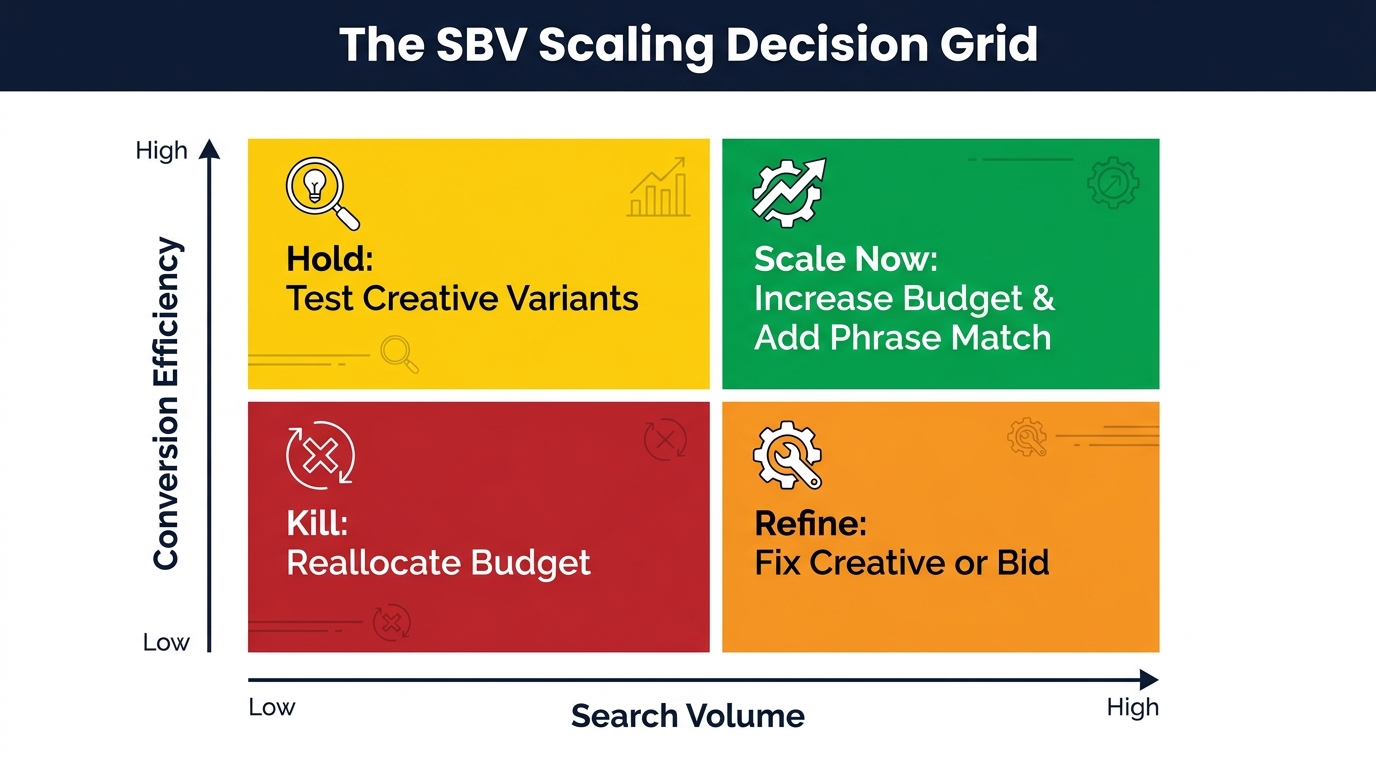
    SBV scaling decision matrix — four quadrants based on search volume and conversion efficiency, from Scale Now to Kill

    A search-term-first SBV system is not set-and-forget. It is a living structure that requires periodic review to determine which keywords deserve more investment, which need creative intervention before scaling, and which should be removed entirely to protect budget efficiency.

    The Four-Quadrant Scaling Framework

    Evaluate each keyword cluster in your SBV campaigns against two axes: search volume (the available impression pool) and conversion efficiency (actual CVR relative to your target). This creates four decision quadrants:

    • High volume, high efficiency: Scale immediately. Increase bids toward your maximum CPC (calculated from revenue-per-click), add phrase match variants, and consider additional video creative variants to test different hooks or benefit messages.
    • Low volume, high efficiency: Hold and watch. These terms are performing well but may have a small addressable audience. Don’t cut budget, but don’t dramatically increase it either. Focus instead on ensuring creative is strong so you capture all available impressions efficiently. Monitor for volume growth over time.
    • High volume, low efficiency: Investigate before cutting. High-volume terms with poor efficiency have a diagnosis problem before they have a spend problem. Common causes: bid is too high relative to actual CVR, creative is not aligned to the query intent, or the product listing page has a conversion issue independent of the ad. Fix the diagnosis first, then reassess efficiency.
    • Low volume, low efficiency: Remove and reallocate. These terms are consuming budget at an inefficient rate on a small audience. Return them to SP phrase or broad match for further testing at lower cost and revisit in 60 days.

    The 30-Day Review Cadence

    SBV campaigns need at minimum a monthly review cycle to function efficiently at scale. The review covers three activities: pulling the search term report from phrase match campaigns to find new exact match candidates, auditing bid levels against updated revenue-per-click calculations, and checking creative metrics for signs that video performance is declining (dropping VTR or rising CPC with flat CVR often signals creative fatigue in high-frequency categories).

    Some high-spend advertisers move to bi-weekly review cycles. The right cadence depends on budget scale — a $1,000/month SBV account can afford monthly reviews; a $50,000/month account cannot. In general, review frequency should scale with the dollar amount at risk in the period between reviews.

    Expanding Into New Term Categories

    Once your initial SBV exact match campaigns are performing well, the next expansion opportunity is term categories you haven’t yet targeted. The most systematic way to identify these is to look at your SP auto-targeting campaigns and extract any intent clusters that have not yet been promoted to SBV — use case terms, accessory-related terms, problem-state terms (terms describing the problem your product solves rather than the product itself). Run these through the same three-gate qualification process described earlier. If they qualify, promote them into SBV with appropriate creative.

    Competitor brand terms deserve their own consideration. They typically require specific creative framing — positioning your product as an alternative or comparison rather than simply demonstrating product benefits — and they often show different CVR patterns than generic category terms. If your SP data shows strong conversion on competitor brand terms, they can be viable SBV candidates, but budget them separately and track them with their own benchmarks.

    Common Mistakes That Undermine Search-Term-First SBV Campaigns

    The system described in this post is logical when laid out in sequence, but in practice several failure patterns appear repeatedly in SBV campaigns that claim to be data-driven but aren’t truly operating search-term-first.

    Using SP Impression Data Instead of Conversion Data as the Primary Filter

    High-impression terms in SP are attractive — they suggest there is a large audience for the query. But impressions without conversion data only tell you that the query has volume, not that it converts. SBV built around high-impression, low-conversion terms will generate views but not orders. Always filter on conversion activity first. Volume is a secondary consideration.

    Skipping the Negative Keyword Setup at Launch

    New SBV campaigns are often launched without any negative keywords because the thinking is “we’ll add negatives once we see what’s converting.” This is backwards. At a minimum, you should add known irrelevant terms as negatives at launch — terms that triggered in SP with zero conversions, informational queries, and competitor navigational terms. Waiting until the SBV campaign generates its own wasteful data means paying SBV rates to discover what your SP data already told you.

    Running a Single Video Creative Across All Intent Clusters

    Generic product videos that perform adequately across all keyword types perform excellently for none of them. If your budget only allows for one video initially, accept that constraint and plan for creative variants as the campaign matures. But don’t rationalize one creative as “good enough” — it is a starting point, not an endpoint. Creative alignment to keyword intent is one of the highest-leverage optimization opportunities available in SBV.

    Measuring SBV on the Same Efficiency Target as SP

    Setting the same ACoS target for SBV and SP campaigns systematically undervalues SBV’s contribution. Because SBV drives higher NTB percentages and creates branded search halo effects, its true economic contribution exceeds what last-click ACoS captures. Set SBV efficiency targets at a modest premium — typically 20% to 35% higher ACoS tolerance than your SP target — and evaluate NTB and organic impact alongside ACoS to justify the differential.

    Letting the SP Data Source Go Stale

    The SP search term report that seeded your initial SBV keywords was relevant when you pulled it. Customer search behavior evolves, seasonal demand shifts, and your SP campaigns continue generating new data. A SBV campaign built on a one-time SP data pull will gradually drift out of alignment with current demand. Build the 30-day SP-to-SBV review into your standard operating cadence. Treat it as an ongoing feed, not a one-time setup step.

    Building the Repeatable System — From One-Time Setup to Ongoing Flywheel

    The most durable competitive advantage from search-term-first SBV targeting comes not from the initial setup but from the flywheel effect created when the system runs continuously: SP discovers and tests terms at lower cost, the strongest terms graduate to SBV for higher-visibility placement, SBV generates additional search term data and NTB customers, branded search lift feeds back into brand campaign efficiency, and organic rank improvements from increased sales velocity reduce the reliance on paid placement over time.

    This flywheel only spins consistently if the process is documented, assigned, and repeatable. The practical operational requirements:

    • A monthly SP search term report pull with documented qualification criteria applied consistently
    • A clear handoff process for new terms entering SBV (campaign placement, match type assignment, bid calculation, negative keyword deployment)
    • A performance review template that covers ACoS, CVR, NTB%, view metrics, and bid adjustments for each SBV keyword cluster
    • A creative review process triggered when view-through metrics decline or CPC-to-CVR ratios deteriorate
    • A scaling review that assesses each keyword against the four-quadrant framework monthly

    Teams that treat SBV targeting as a one-time project tend to see initial performance gains followed by gradual degradation as the keyword set becomes stale and creative grows repetitive. Teams that build it as a repeatable system compound their advantage month over month — each review cycle improving keyword precision, creative alignment, and bid accuracy simultaneously.

    The Competitive Reality: What Happens If You Don’t Build This System

    The argument for search-term-first SBV targeting is sometimes framed as an offensive opportunity — a way to take share, build brand awareness, and accelerate growth. But it is equally important to understand the defensive dimension: in competitive categories where your rivals are running SBV on the high-intent keywords you’ve proven, your organic and SP placements are being surrounded by video content from other brands. Shoppers who search for terms where you rank well organically are seeing competitor SBV ads before they ever reach your organic listing.

    The SP data you’re sitting on right now tells you which keywords deserve video defense. It tells you where competitors are most likely building their SBV campaigns, because those are the high-intent terms that every serious advertiser in your category is watching. Acting on that data before competitors fill those placements is the strongest timing argument for urgency in building this system.

    SBV placements are finite — there is typically one video placement per search results page per query. First-mover advantage in SBV targeting for a given keyword cluster is real and meaningful. The brand that occupies the in-stream video position on a high-intent search term consistently, over weeks and months, builds a visual association advantage that is difficult to displace once established.

    Conclusion: Data First, Video Second — Always

    The core argument of search-term-first SBV targeting is simple even if the execution is detailed: video is a powerful format, but format alone doesn’t win. The terms you choose to run video against determine whether that format power is directed at shoppers who are predisposed to purchase or at a broad audience with unclear intent. Your SP search term data is the most reliable tool you have for making that determination — because it is based on actual customer behavior, not projected demographics or estimated demand.

    Build the qualification process before you build the campaign. Build the campaign structure before you build the creative. Set up negatives before you collect waste. Measure NTB and organic halo alongside ROAS. Review the SP data feed every 30 days to keep the keyword set current. And when you’re ready to scale, use the four-quadrant framework to make decisions that are evidence-based rather than instinct-based.

    The advertisers winning in SBV-dominant categories in 2026 are not necessarily the ones with the biggest video production budgets or the most creative teams. They are the ones who have built the most systematic, data-informed approach to deciding which search terms deserve a video impression in the first place. That system starts in your SP search term report. Everything else follows from there.

    Key Takeaways

    • Start with SP data, not creative: Qualify search terms through a three-gate filter (minimum orders, acceptable ACoS, adequate impressions) before committing them to SBV.
    • Use exact match first: Proven SP converters deserve exact match SBV placement. Phrase match is for controlled expansion, not initial targeting.
    • Segment by intent cluster: Different ad groups for category-generic, feature-specific, use-case, and competitor terms — with aligned creative where budget allows.
    • Deploy negatives at launch: Don’t wait for SBV to discover waste your SP data already flagged. Add known non-converters as negatives from day one.
    • Measure NTB alongside ROAS: New-to-brand percentage is the primary signal of SBV’s incremental value beyond last-click attribution.
    • Build the 30-day review cycle: The system compounds when SP data continuously feeds new qualified terms into SBV. One-time setup is not enough.
    • Apply the four-quadrant scaling framework: Scale high-volume, high-efficiency terms; investigate high-volume, low-efficiency terms; remove low-volume, low-efficiency terms.
  • Why SBV’s Biggest Targeting Shift in 2026 Has Nothing to Do With Keywords

    Why SBV’s Biggest Targeting Shift in 2026 Has Nothing to Do With Keywords

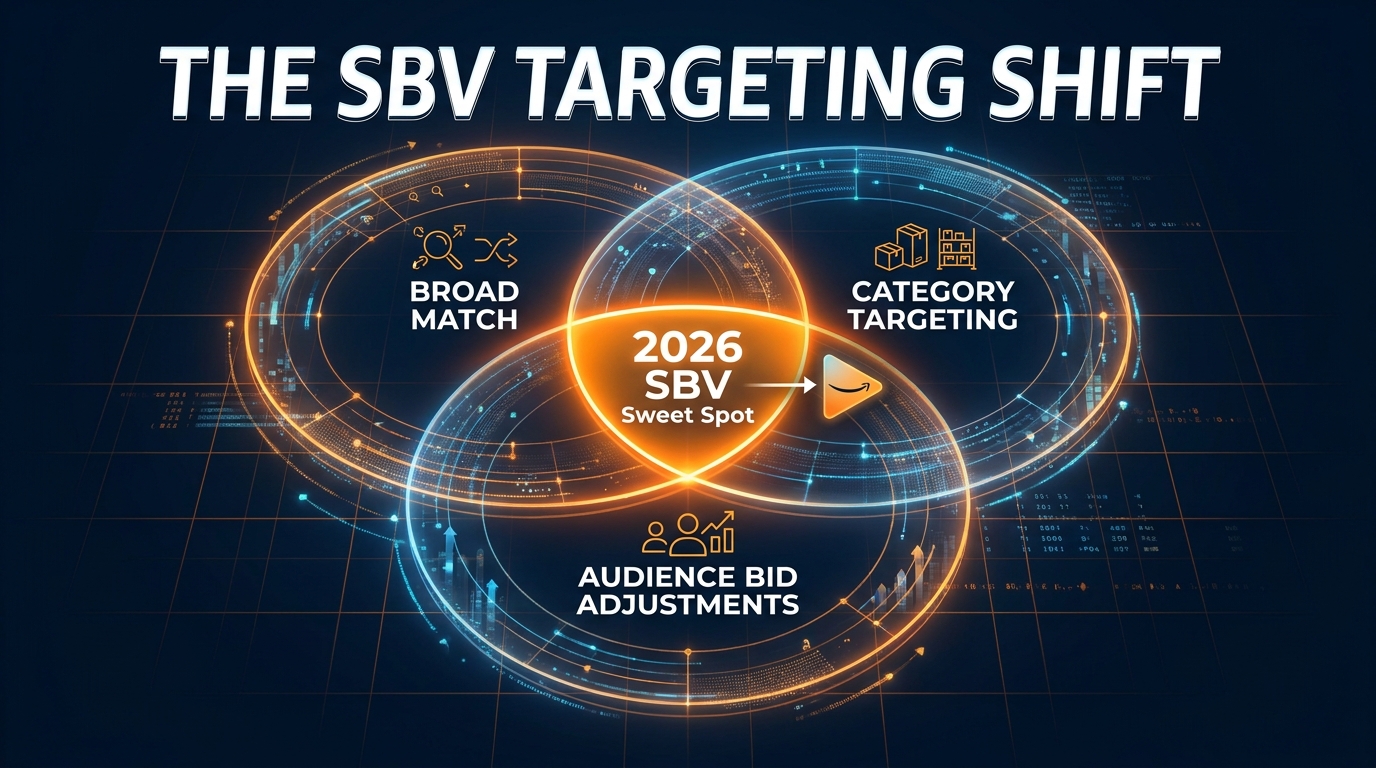
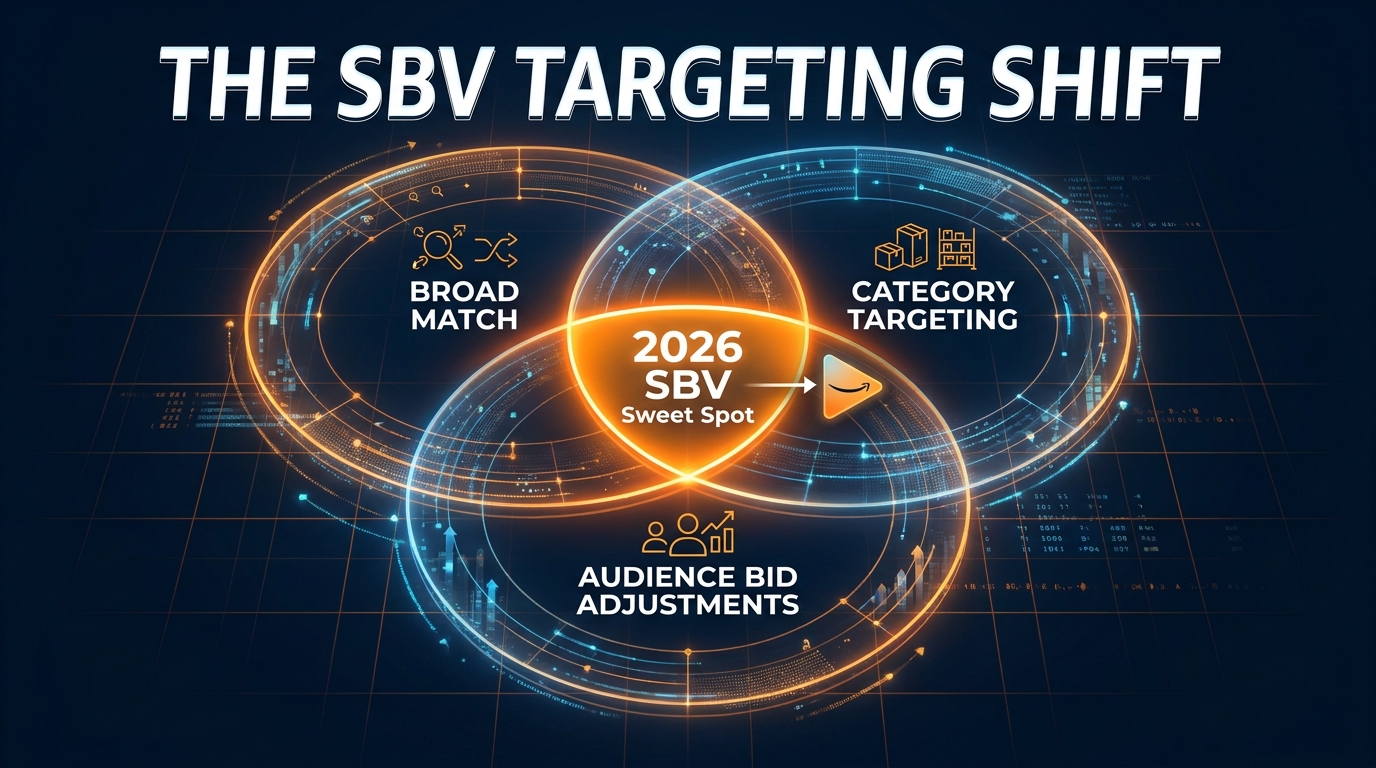
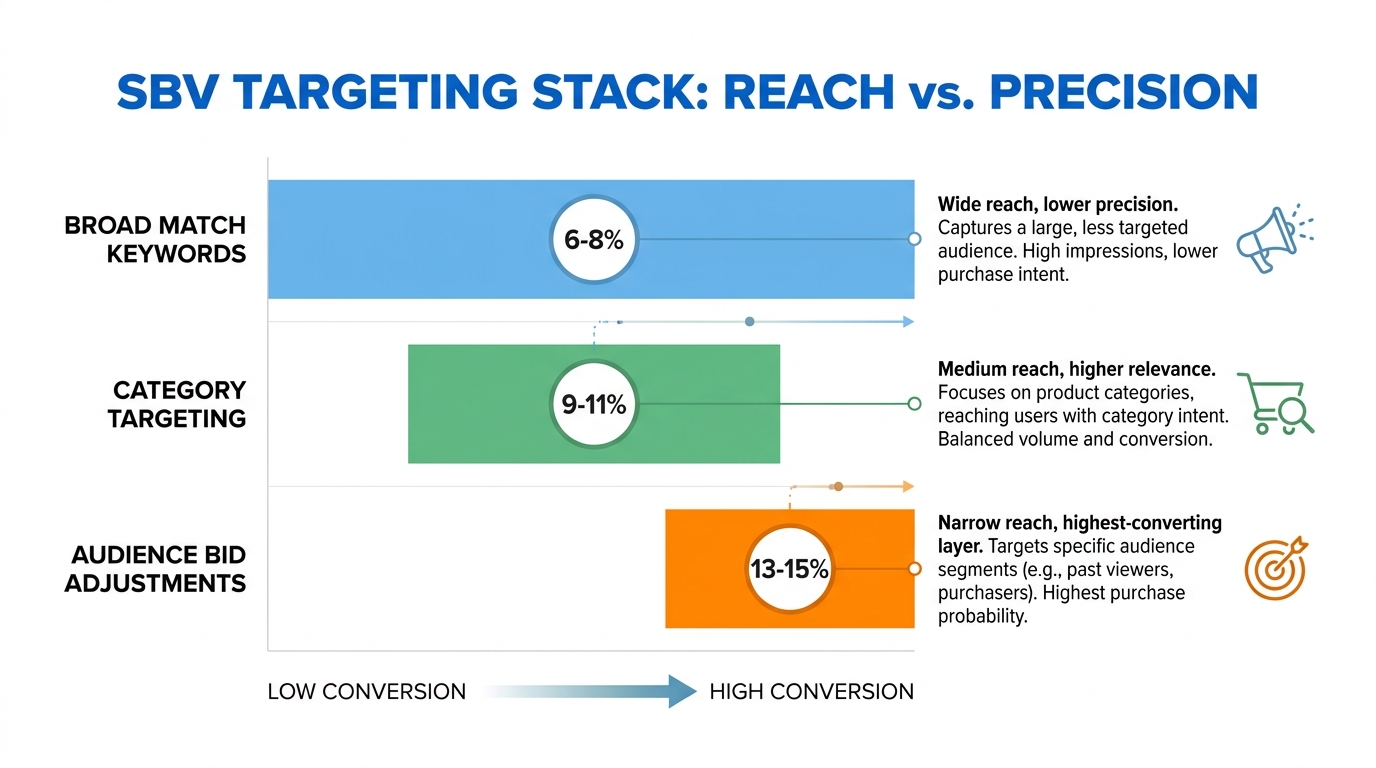
    2026 SBV Targeting Shift: Broad Match, Category Targeting, and Audience Bid Adjustments converge as the new SBV sweet spot

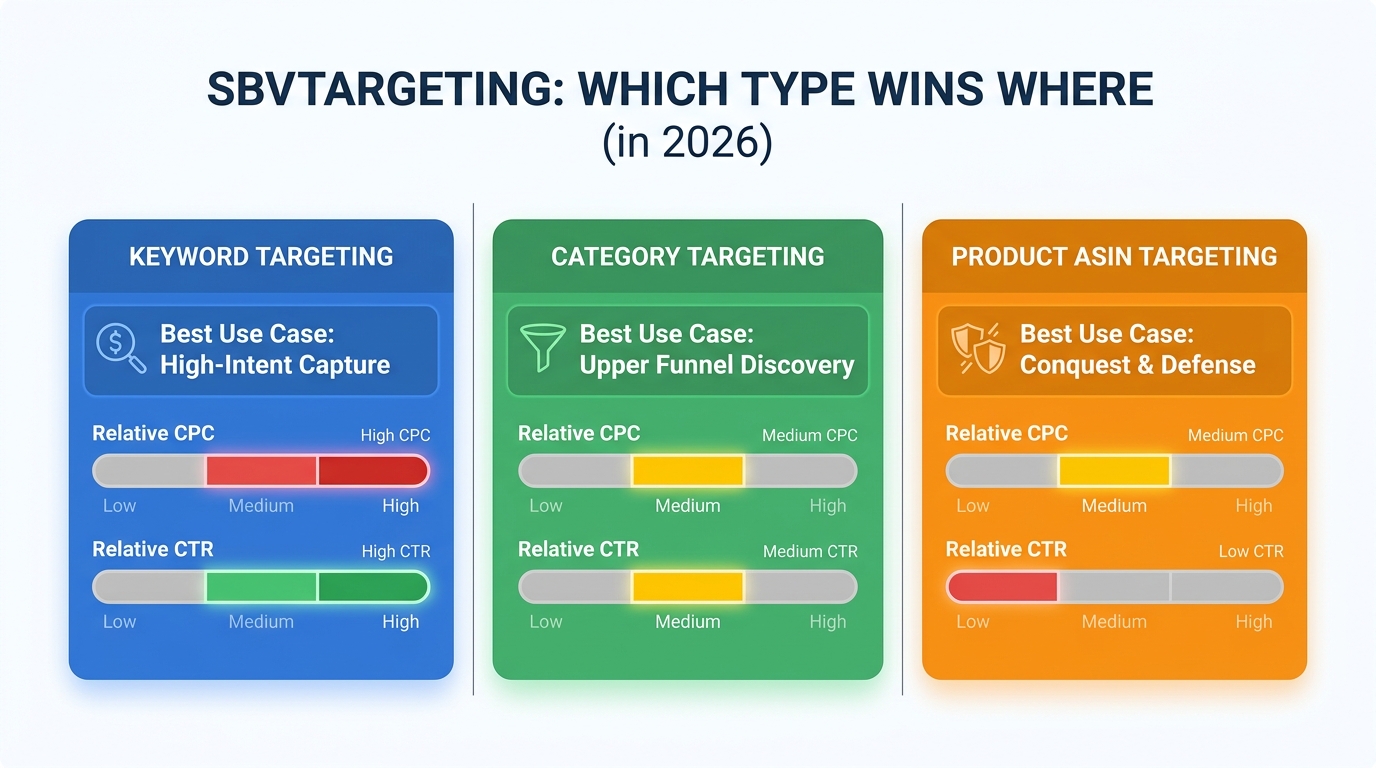
    For most of SBV’s short history, the playbook was simple: build a list of high-intent keywords, set bids, attach a video, and let the format’s inherently higher CTR do the heavy lifting. Exact match for control. Phrase match for scale. Broad match as a last resort when you needed to fill volume gaps.

    That approach worked reasonably well when Sponsored Brands Video was a niche placement and competition was thin. In 2026, neither of those things is true anymore.

    SBV inventory has expanded dramatically across search results and product detail pages. Video CPCs have risen 10–20% above Sponsored Products averages. And Amazon has been quietly adding new layers — audience bid adjustments, richer category targeting controls, and behavioral signals that weren’t available two years ago — that change what good SBV management actually looks like.

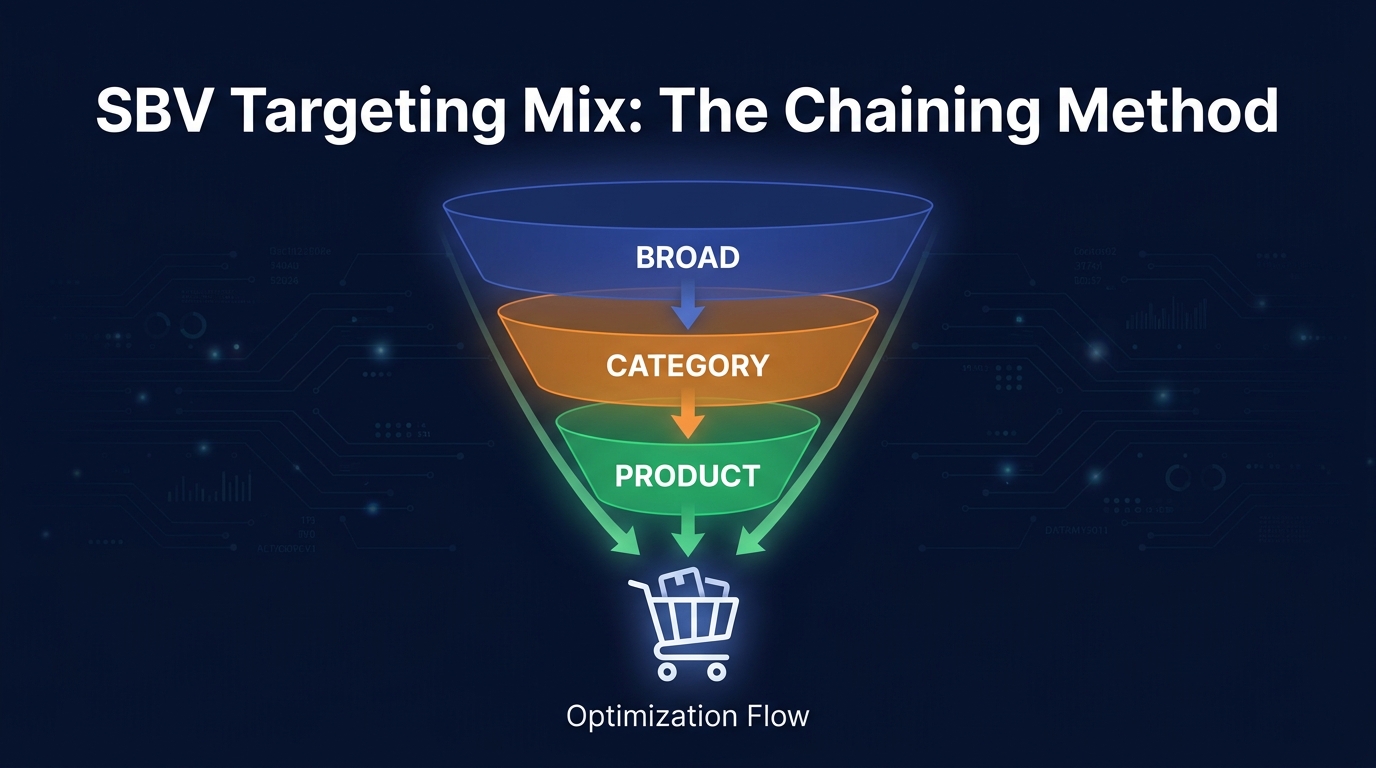
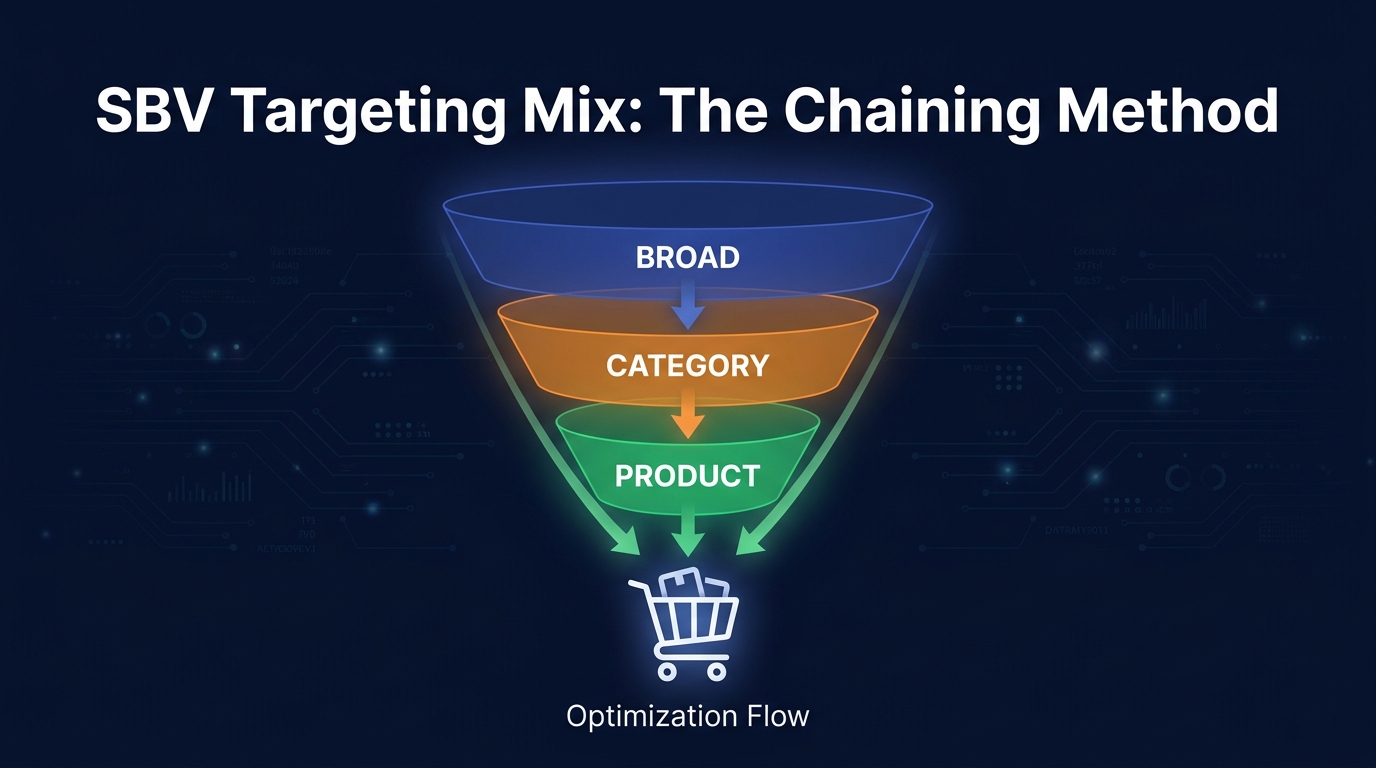
    The advertisers who are still running SBV like it’s a keyword-only format are paying more for less. The ones adapting to the three-part targeting stack — broad match for discovery, category targeting for shelf-level precision, and audience bid adjustments as a conversion-intent layer — are pulling sharply better results, including ROAS figures in the 6–7x range on well-structured campaigns.

    This article breaks down what that shift actually means in practice: why each layer exists, what role it plays in the purchase funnel, how to structure campaigns around all three, and what to measure when the standard ROAS number doesn’t tell the whole story. No recycled keyword tactics. No vague “use video” advice. Just a detailed look at how the format’s targeting logic has evolved — and how to use that evolution to your advantage.

    What SBV Actually Is in 2026 (And Why Its Reach Has Grown)

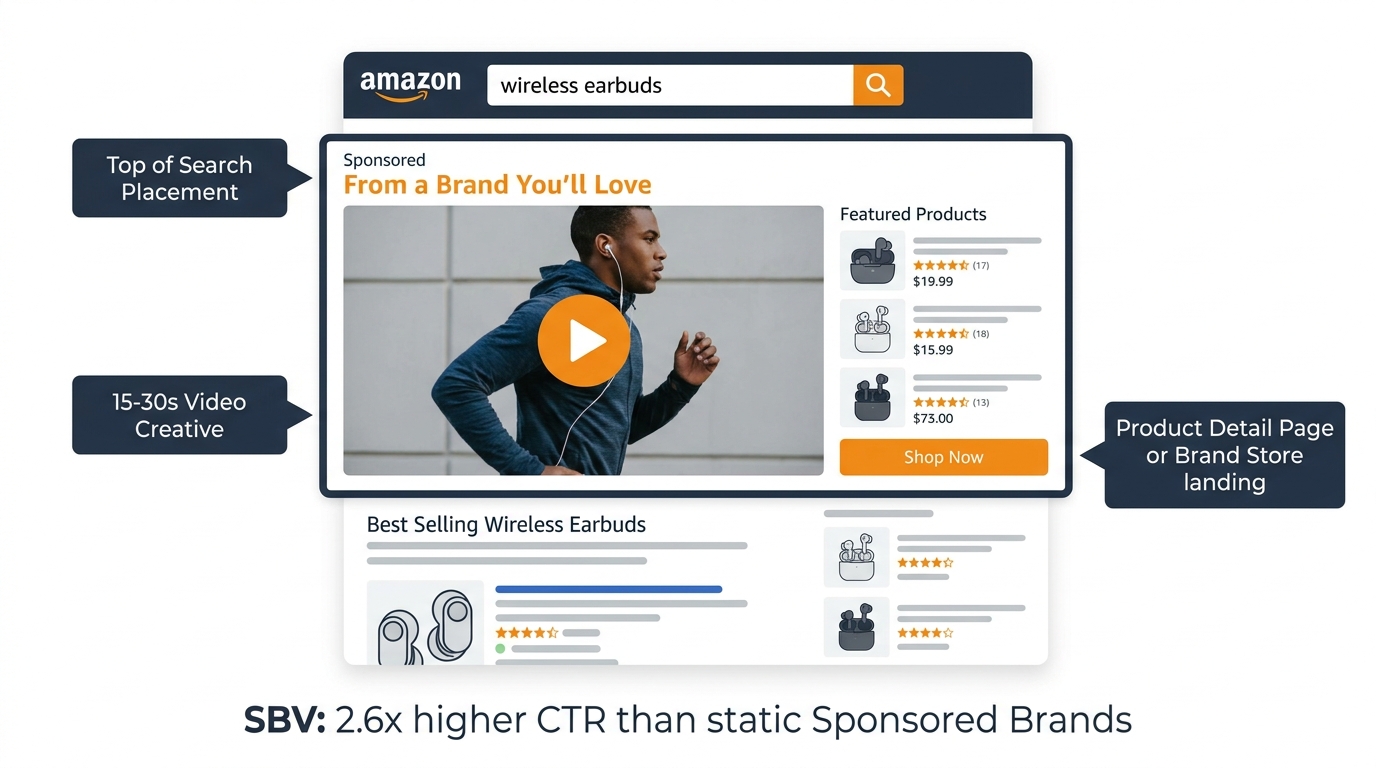
    Amazon Sponsored Brands Video ad placement at top of search results with 2.6x higher CTR than static Sponsored Brands

    Sponsored Brands Video is Amazon’s autoplay video ad unit, available to brand-registered sellers and vendors running Sponsored Brands campaigns. Unlike Sponsored Products, SBV campaigns can drive traffic to either a product detail page or a Brand Store, giving advertisers more flexibility over the landing experience depending on campaign goals.

    Where SBV Appears

    In 2026, SBV runs across three distinct placement types: top of search, inline within search results (sometimes called “rest of search”), and on product detail pages. The top-of-search position is the most prominent — a full-width video unit that autoplays when the shopper scrolls past it — and typically delivers the strongest CTR due to its visual dominance on the results page.

    Product detail page placement has expanded meaningfully over the past 18 months. SBV ads now appear in the “related products” and sponsored video carousels lower on PDPs, which opens up a different type of targeting opportunity: you’re reaching shoppers who are already in active evaluation mode on a competitor’s or complementary product’s page, not just searching for a category term.

    The Performance Numbers That Explain the Format’s Growth

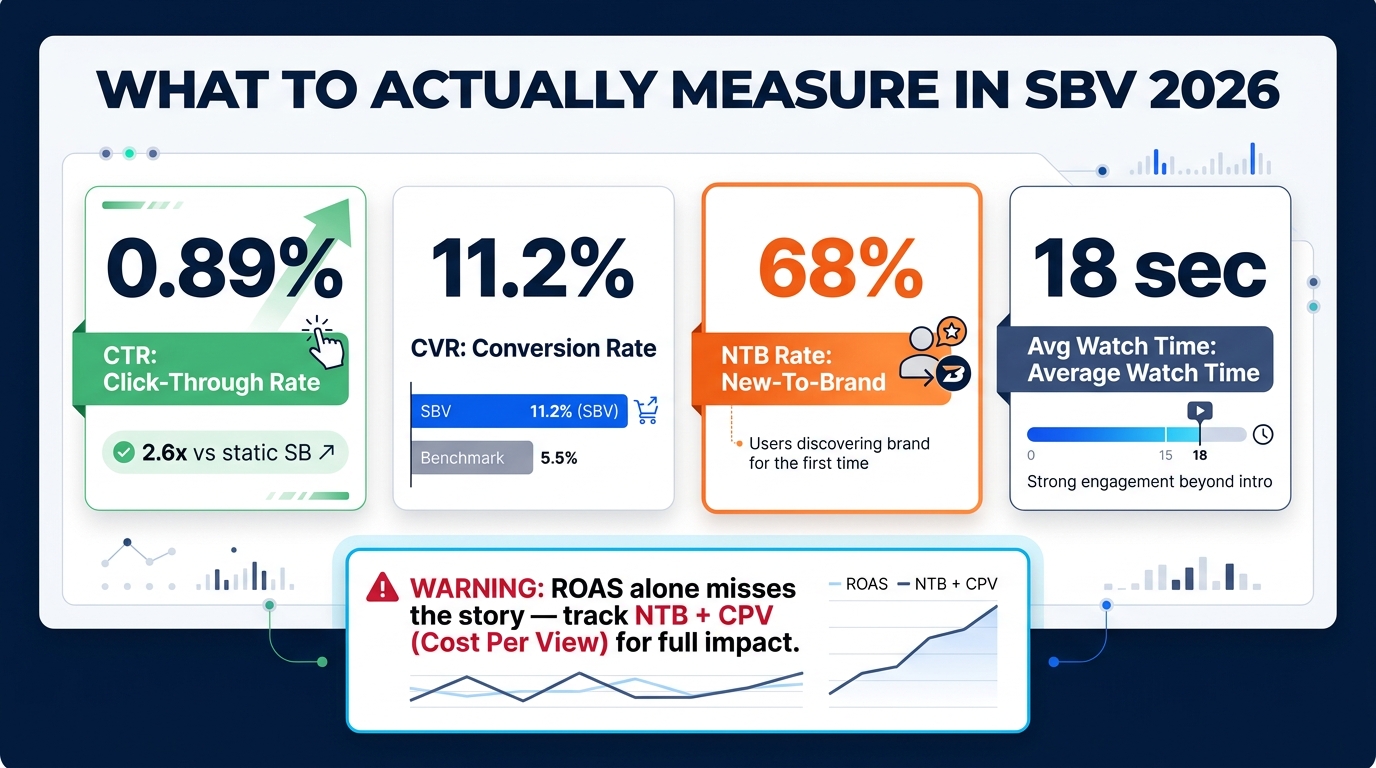
    The raw performance data explains why SBV now makes up a substantial and growing share of Sponsored Brands spend across the marketplace. Current 2026 benchmarks show SBV delivering an average CTR of 0.89–1.0% — approximately 2.6 times higher than static Sponsored Brands image ads. Average conversion rates sit around 11.2%, roughly 13% above their image-based counterparts.

    CPCs are higher — typically $1.10–$2.50 depending on category, compared to Sponsored Products averages — but the math tends to work in SBV’s favor when creative quality is strong, because the higher CTR and CVR compress cost-per-acquisition even as the cost-per-click rises. Average video watch time runs around 18 seconds, with completion rates near 60% for 15–30 second creatives.

    Why Creative Length Still Matters

    Those completion rates deserve attention because they partly explain the format’s targeting shift. When a shopper watches 18 seconds of a 20-second product video, they’ve absorbed significantly more purchase intent signal than a shopper who glanced at a static image ad. Amazon’s algorithm reads that engagement data. It feeds back into how your targeting performs — particularly when you’re running broad or category-based targeting where relevance signals matter more than they do on exact-match keyword campaigns.

    Short, product-first creatives (showing the product in the first two seconds, communicating the core benefit within five) continue to outperform longer, brand-narrative styles in most categories. The video itself is a targeting asset as much as a creative one: a high-completion-rate video earns more algorithm trust, which matters disproportionately when you’re asking Amazon’s system to serve your ad broadly.

    The Three-Part Targeting Stack: Broad, Category, and Audiences Defined

    SBV targeting stack comparison: broad match vs category targeting vs audience bid adjustments showing reach vs precision tradeoffs

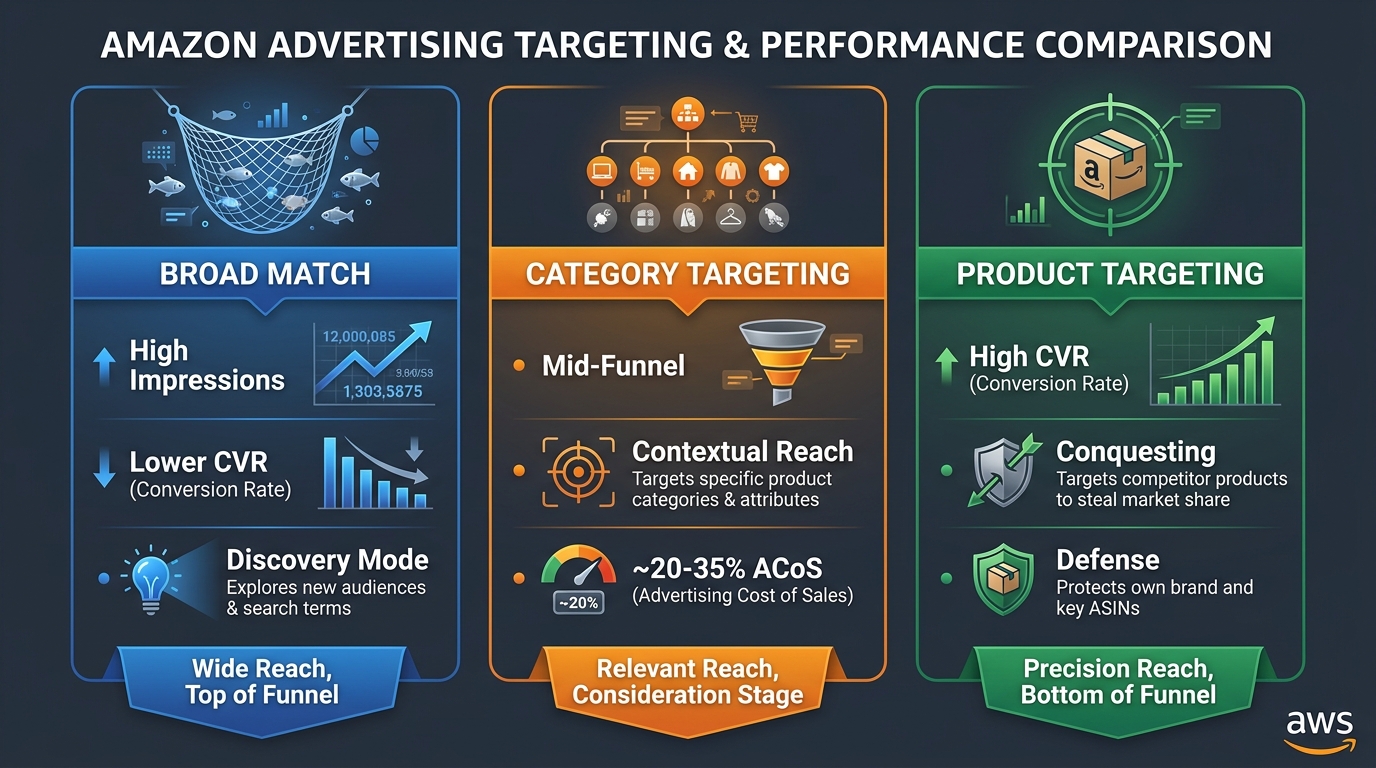
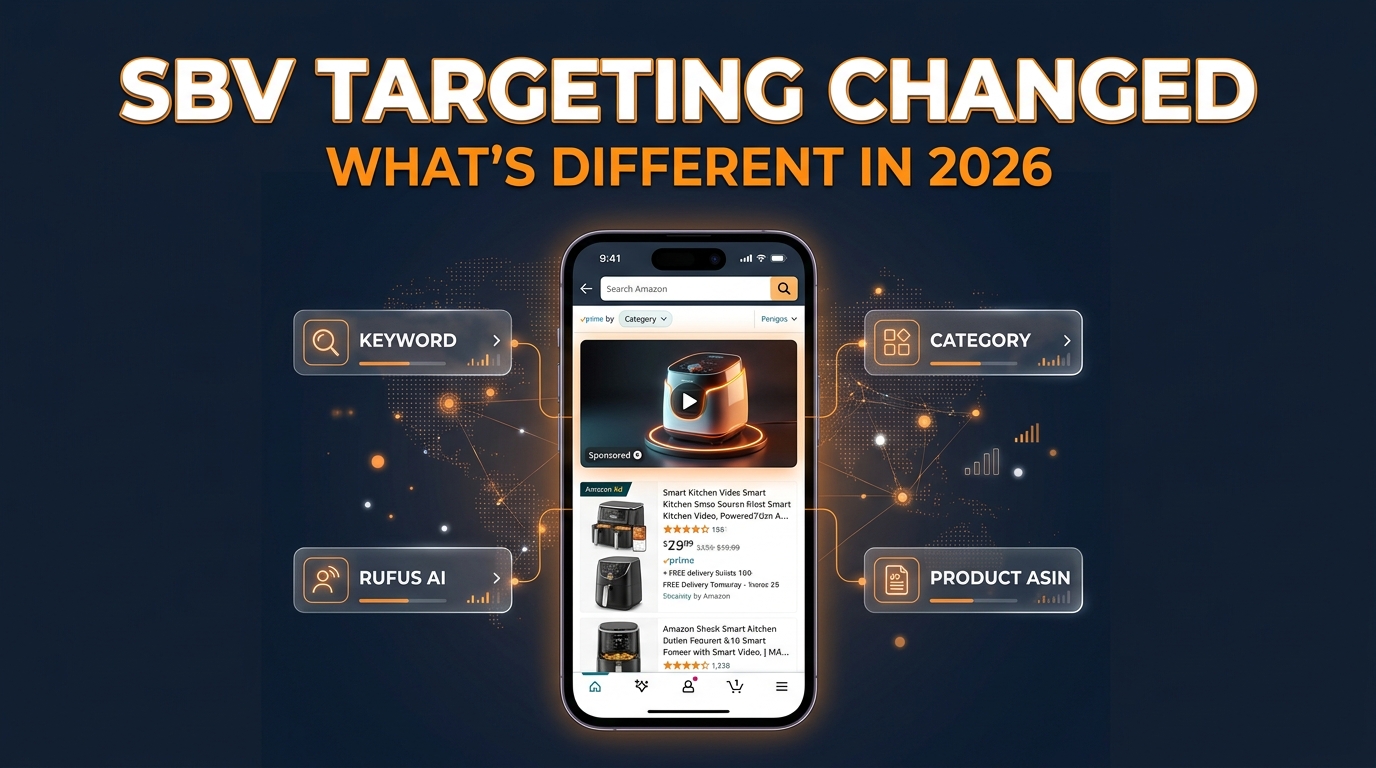
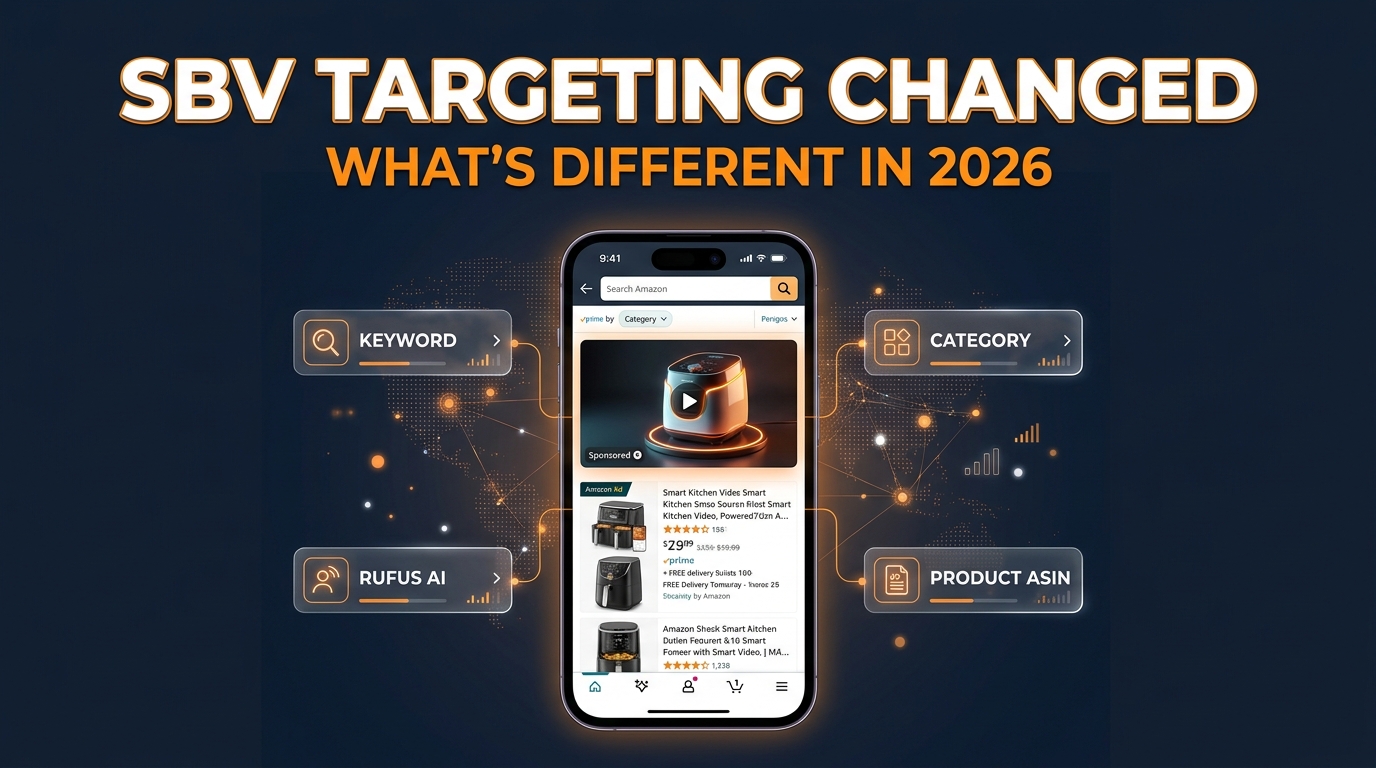
    The clearest way to understand the current SBV targeting landscape is to stop thinking about broad match, category targeting, and audiences as three competing options — and start treating them as three layers in a single targeting architecture. Each layer operates on different shopper signals, serves different strategic purposes, and should be evaluated against different performance metrics.

    Layer One: Broad Match Keywords

    Broad match in Sponsored Brands Video works the same way it does in Sponsored Products: Amazon’s system matches your keyword to search queries that contain related terms, synonyms, plural variations, and adjacent concepts. If you’re selling a stainless steel insulated water bottle and you bid broad on “water bottle,” your ad might serve on queries like “hydration flask,” “gym bottle,” or “large reusable water container.”

    The historical knock against broad match was waste. You’d burn budget on irrelevant or low-intent queries, and the search term report would fill up with noise. That criticism remains valid when broad match is used without guardrails. But in 2026, two things have changed that make broad match more viable than it was before.

    First, Amazon’s matching logic has become more sophisticated. The system is better at reading purchase intent signals within a query, not just surface-level keyword similarity. A broad match on “protein powder” is less likely to serve on a completely unrelated fitness query than it would have been two or three years ago. Second, broad match has become the primary discovery mechanism for surfacing queries you don’t already know about — and with SBV’s strong CTR acting as a relevance signal, the algorithm gets feedback faster on which matched queries are actually generating engagement.

    The functional role of broad match in a mature SBV account is not to drive efficient conversions directly. It’s to generate data — to discover which search terms your video creative resonates with — that you then harvest into tighter, higher-confidence campaigns. Think of broad match SBV as a paid research tool with a video creative attached.

    Layer Two: Category Targeting

    Category targeting in SBV lets you serve your video ad to shoppers browsing within specific Amazon product categories or subcategories, as well as on product detail pages of competing or complementary products within those categories. This is fundamentally different from keyword targeting because it decouples placement from what the shopper typed.

    A shopper browsing the “Insulated Water Bottles” subcategory without having typed a specific search query is still a high-intent prospect — they’re actively evaluating products at the shelf level. Category targeting puts your video ad in front of that shopper in a way that keyword targeting, by definition, cannot.

    The most effective category targeting in 2026 is tightly constrained to your own product subcategory rather than broad parent categories. Targeting the “Sports & Outdoors” parent category with an insulated water bottle video will likely produce poor ROAS because the audience is too diffuse. Targeting the “Insulated Water Bottles” or “Hydration & Water Bottles” subcategory keeps the audience relevant and the cost-per-click justifiable.

    Layer Three: Audience Bid Adjustments

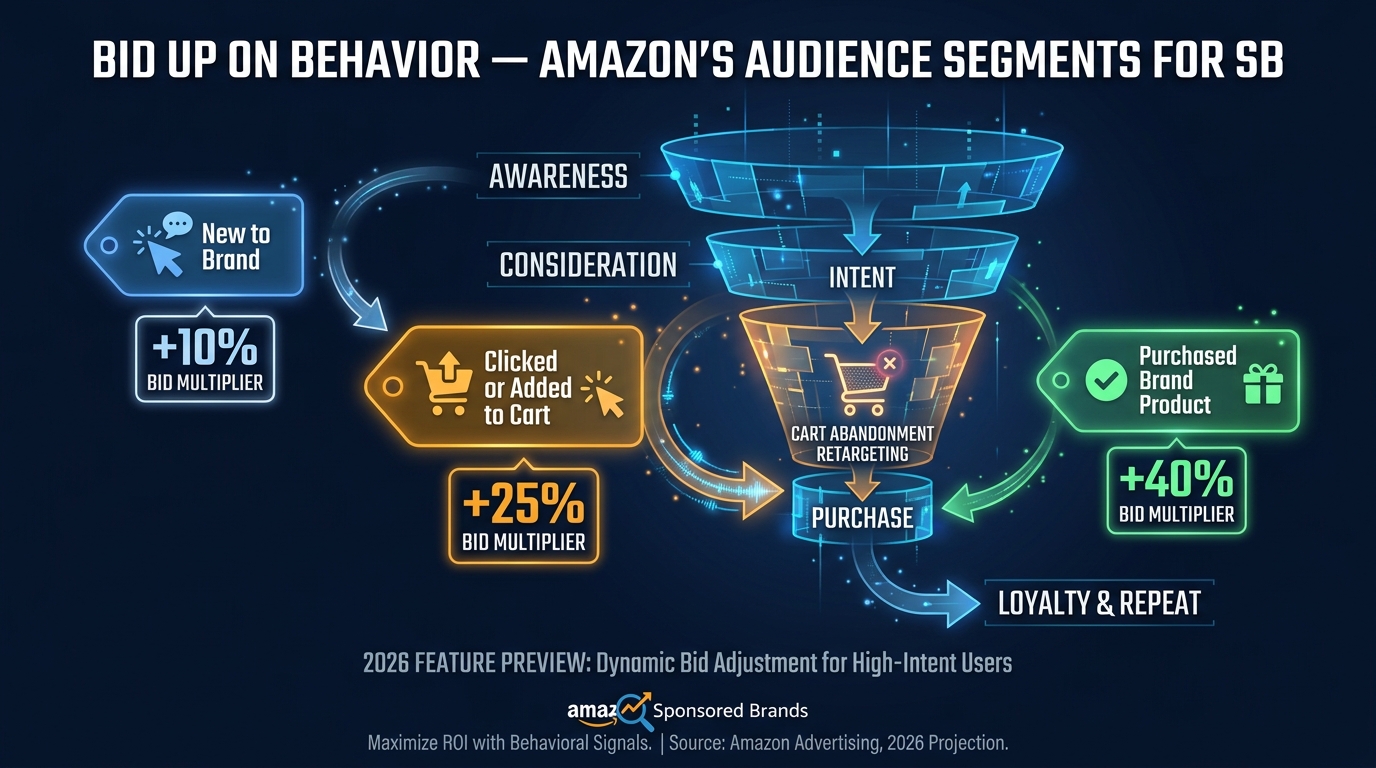
    This is the layer most advertisers haven’t fully integrated yet, and it’s where some of the most meaningful 2026 performance gains are showing up. Amazon has expanded Sponsored Brands’ audience bid adjustment capabilities to include behavioral segments based on shopper activity: people who viewed your brand’s products, people who added your products to cart, people who purchased your brand, and — importantly for prospecting — new-to-brand shoppers who have no prior purchase history with you.

    Audience bid adjustments don’t replace your underlying targeting type. You still choose keywords or categories as the base targeting mechanism. The audience bid adjustment then layers on top, telling the system to bid higher (or lower) when the shopper triggering the ad matches a specific behavioral profile. It’s a bid modifier, not a targeting swap.

    The practical effect is significant: a category-targeted SBV campaign running at a $1.50 base bid might apply a 50% positive bid adjustment for shoppers who have previously viewed your brand’s products, pushing effective bids to $2.25 for that audience segment. You’re buying the same placements, but concentrating spend toward the shoppers most likely to convert.

    Why Broad Match Is Performing Again — And What Changed

    It’s worth spending time on why broad match fell out of favor for SBV in the first place, because understanding that history explains the conditions under which it’s now working better.

    The Original Problem With Broad SBV

    When SBV first became widely available, most advertisers treated it like a straightforward extension of their existing Sponsored Brands keyword campaigns. They copied keyword lists, set match types, and pointed the video at a product page. Broad match, in that context, was genuinely problematic: SBV CPCs were high relative to Sponsored Products, the format was relatively new (and therefore more expensive to experiment with), and the matching logic wasn’t refined enough to reliably find high-intent adjacent queries.

    The result was that broad match SBV campaigns frequently bloated ACoS because they were serving on poorly matched queries with no negative keyword hygiene. The format got a reputation for being “hard to control” on broad targeting — which pushed most advertisers toward exact or phrase match as the safe default.

    What’s Different Now

    Several things have shifted the equation. Amazon’s matching algorithm improvements have increased the relevance of broad match serving — the system is now better at inferring purchase intent from query context, not just lexical similarity. This directly reduces the “irrelevant serving” problem that made broad match expensive to run.

    Equally important: the video completion rate feedback loop. When a shopper watches 85% of your video, Amazon’s system registers that as a strong positive engagement signal. On broad match, that completion signal tells the algorithm that this shopper — and shoppers like them — are receptive to your ad. Over time, broad match serving gradually self-optimizes toward the query types that generate strong completion rates, not just clicks. This is a dynamic that didn’t exist (or wasn’t as pronounced) in earlier SBV campaign structures.

    Practitioners running broad match SBV with rigorous negative keyword management are now reporting that the format surfaces genuinely valuable queries they wouldn’t have thought to bid on directly. The discovery value has risen as Amazon’s matching has improved, and the cost of that discovery has become more manageable as negative keyword workflows have matured.

    The Non-Negotiable: Negative Keywords

    Broad match SBV without a structured negative keyword process is still a budget leak. The workflow that’s working in 2026 looks like this: run broad match campaigns for two to three weeks, pull the search term report, identify irrelevant or wasteful query patterns, and add negatives at the campaign or ad group level before the next review cycle. Do this on a consistent 7–14 day cadence, and broad match SBV becomes a systematic discovery engine rather than a scatter-gun spend category.

    One specific pattern to watch: broad match will sometimes serve your SBV on branded queries for competitors. That’s occasionally useful for conquesting, but it drives up CPC and often converts poorly unless your creative is explicitly positioned as a comparison or alternative. Most advertisers add competitor branded terms as negatives unless they’re running a deliberate conquesting strategy with appropriate creative.

    Category Targeting: Precision at the Shelf Level

    Category targeting for SBV operates on a fundamentally different logic from keyword targeting, and that difference matters for how you structure campaigns, set bids, and interpret performance data.

    The Shelf-Level Intent Signal

    When a shopper types a search query, they’re signaling what they’re looking for in that moment. When a shopper is browsing a product subcategory on Amazon — scrolling through the “Insulated Water Bottles” results, comparing products on detail pages, reading reviews — they’re signaling something deeper: they’re actively in a consideration and comparison phase, evaluating options against each other.

    That’s a more advanced purchase stage than a cold keyword search, and it’s the core reason category targeting has become such a strong SBV lever. Your video ad appears to a shopper who is already in buy-mode for your category, not one who is tangentially related to it by query association.

    Category Targeting vs. Product Targeting in SBV

    It’s useful to distinguish category targeting (targeting a subcategory or parent category) from product targeting (targeting specific ASINs). Both are available in Sponsored Brands Video. Product targeting — pointing your SBV ad at specific competitor ASINs or complementary products — tends to be more precise and often delivers stronger ROAS on well-chosen targets, but it requires more active management as competitor product pages change.

    Category targeting requires less ongoing curation but produces wider variance in performance. The targeting logic here is: invest time upfront in selecting the right subcategory, then let the category targeting run with bid optimization while you monitor ACoS trends. Practitioners report that keeping category targeting in SBV restricted to your own primary subcategory — rather than adjacent or parent categories — is the single biggest structural choice that separates efficient category campaigns from wasteful ones.

    Using Category Targeting for Competitive Defense and Expansion

    Two specific use cases stand out. First, defensive category targeting: bidding on your own subcategory ensures that when a shopper is browsing your category and a competitor’s SBV ad might otherwise dominate, you have a presence in the video placement. This is particularly important in categories where a few large competitors have significant brand recognition — their video ads can crowd out smaller brands entirely if those brands aren’t running category-targeted SBV defensively.

    Second, expansion targeting: once you’ve established strong performance in your primary subcategory, testing adjacent subcategories can surface demand from shoppers who might solve the same problem with a different product type. A blender brand targeting the “Food Processors” subcategory, for example, might reach shoppers who are evaluating both options and would switch to the blender if presented with a compelling video demonstration. The key is starting narrow and expanding based on data, not pre-emptively going broad across adjacent categories.

    Audience Bid Adjustments: The Layer Most SBV Campaigns Are Missing

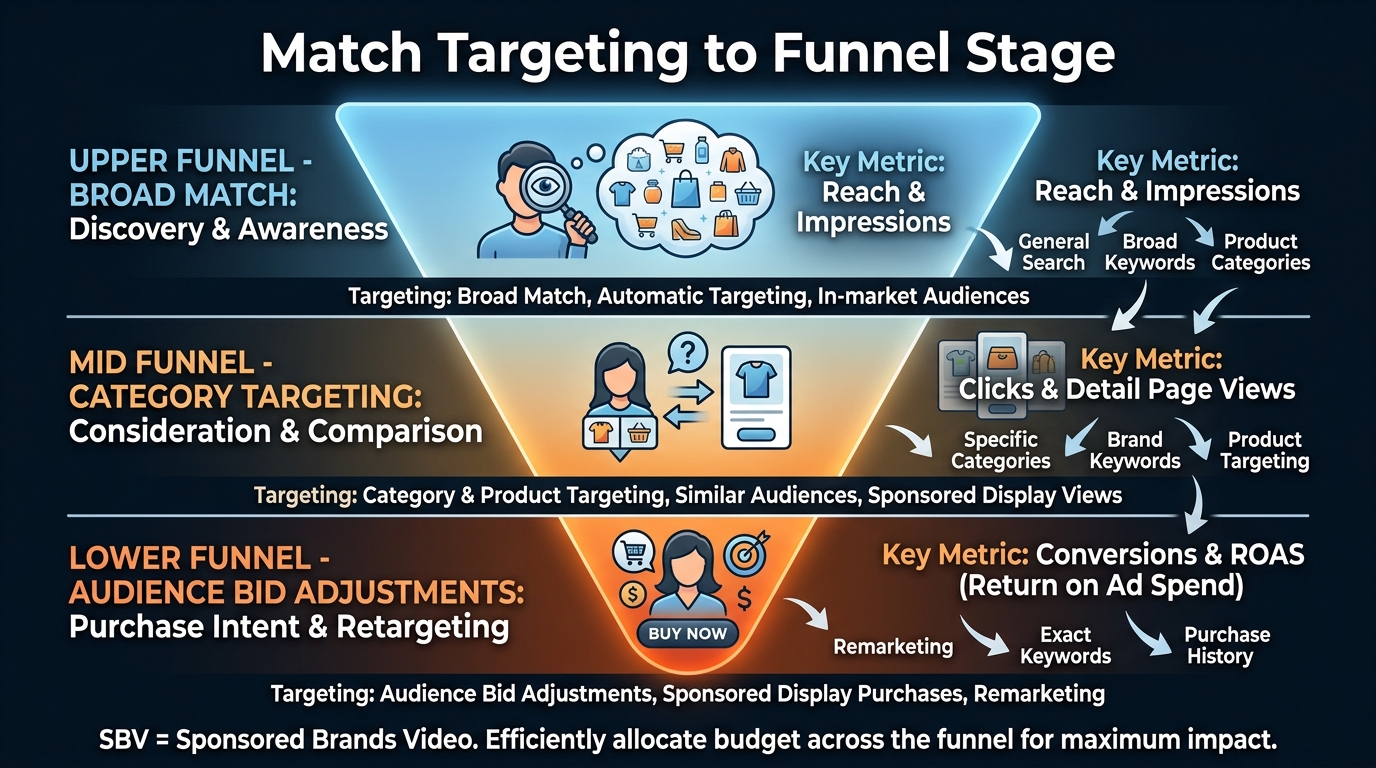
    Purchase funnel showing broad match at top, category targeting in middle, and audience bid adjustments at bottom with conversion rates by stage

    Audience bid adjustments in Sponsored Brands have expanded significantly in 2026, and most advertisers are either unaware of them or treating them as an afterthought rather than a core bid strategy lever. That’s a gap worth closing, because the performance differential between campaigns that use audience bid adjustments intelligently and those that don’t is material.

    What Amazon Has Added

    Amazon now supports several audience bid adjustment segments inside Sponsored Brands (including SBV) campaigns. The most recently expanded options include:

    • New-to-brand shoppers: Shoppers who have not purchased from your brand in the past 12 months. Bidding up for this segment supports new customer acquisition and is directly tied to new-to-brand metrics in your reporting.
    • Viewed your brand’s products: Shoppers who have visited your product detail pages but not yet purchased. These are warm prospects who have already shown interest — bidding up here recaptures consideration-stage shoppers through video.
    • Added to cart: Shoppers who added your product to their cart but didn’t complete a purchase. This is a high-intent retargeting signal; a bid uplift here puts your video in front of shoppers who are very close to conversion.
    • Purchased your brand’s product: Existing customers. Bidding up or down on this segment depending on whether your goal is retention/upsell or acquisition shapes your campaign’s customer mix.

    The mechanics work as a percentage bid modifier. If your base bid is $1.50 and you apply a +40% adjustment for “viewed your brand’s products,” the effective bid for that shopper segment becomes $2.10. You can apply both an audience bid adjustment and a placement bid adjustment simultaneously in the same campaign, layering both signals onto your base targeting bid.

    Why This Changes Campaign Logic

    Before audience bid adjustments were available in Sponsored Brands, your only levers were the keyword or category bid itself and the placement bid modifier. That meant you were essentially treating all shoppers who triggered your targeting equally — whether they’d never heard of your brand or had been to your product page three times in the past week.

    Audience bid adjustments break that uniformity in a way that has direct, measurable impact on conversion rates. A shopper who has previously viewed your product page and then sees your SBV ad on a broad match or category-triggered impression is in a fundamentally different conversion position than a cold shopper. Paying more to serve that shopper isn’t waste — it’s a rational bid premium for a higher-probability conversion.

    New-to-Brand Bidding as a Strategic Lever

    The new-to-brand bid adjustment deserves particular attention because it connects SBV to one of the most strategically important metrics in Amazon advertising: new-to-brand rate. Brands with strong organic share and repeat purchase businesses often find that their overall Amazon PPC spend is heavily weighted toward re-purchasing existing customers — efficient in the short term, but not building brand equity or market share.

    Bidding up specifically for new-to-brand shoppers in SBV campaigns creates a deliberate customer acquisition mechanism that sits separately from your broader ROAS optimization. You’re paying a premium to reach people who have never bought from you before, with a video format that can introduce your brand story and product value proposition in a way that a static ad cannot. Track NTB rate and NTB revenue separately from total campaign revenue, because the economics of new customer acquisition are different — and often worth accepting a lower blended ROAS to sustain.

    The Funnel Logic: Where Each Targeting Type Actually Lives

    The most common SBV targeting mistake in 2026 isn’t using the wrong match type — it’s applying the wrong success metrics to the wrong targeting layer. Broad match SBV at the top of the funnel should not be judged by the same ROAS threshold as an exact-match branded keyword campaign. Category targeting at the mid-funnel should not be optimized purely for last-click conversions. Audience bid adjustments at the lower funnel should not be compared against awareness-stage CPV metrics.

    Top of Funnel: Broad Match as Discovery

    Broad match SBV campaigns play a top-of-funnel role. They serve on the widest range of relevant queries, exposing your brand and product to shoppers who may not have been actively searching for your specific product but whose query context suggests they might be receptive to it. The primary metrics at this layer are: impressions, reach (unique shoppers exposed), video completion rate, and new-to-brand impressions. Direct conversion rate at this layer will typically be lower than at the other two, and that’s expected.

    A common error is turning off broad match SBV campaigns because their standalone ROAS looks weak. If the same campaign is driving significant new-to-brand impressions, high completion rates, and surfacing high-intent search terms that you can harvest into tighter targeting, it’s producing real value — it’s just value that doesn’t show up cleanly in a single-campaign ROAS number.

    Mid Funnel: Category Targeting for Consideration

    Category targeting SBV sits at the mid-funnel, reaching shoppers who are already browsing your subcategory. These shoppers are further along in the purchase process than cold keyword searchers — they’ve committed to exploring options in the category, which means the bar for persuasion is lower. The right success metrics here are conversion rate, ACoS, and category impression share. You want to understand what percentage of category browsing sessions your brand is visible in, not just whether you converted on a given impression.

    Lower Funnel: Audience Adjustments for Intent

    Audience bid adjustments on viewed-product and add-to-cart segments operate at the lower funnel. These shoppers have demonstrated concrete purchase intent — they’ve seen your product and didn’t immediately buy. A video ad at this stage functions as a reminder and reinforcement, addressing potential objections and maintaining brand presence during the final evaluation stage. Conversion rate and ROAS at this layer should be materially higher than at the broad match or cold category layer, and your bids should reflect that.

    The discipline of keeping these three layers analytically separate — not just structurally separate in your campaign setup — is what allows you to make good budget allocation decisions across the full SBV account.

    Campaign Architecture: How to Actually Structure This

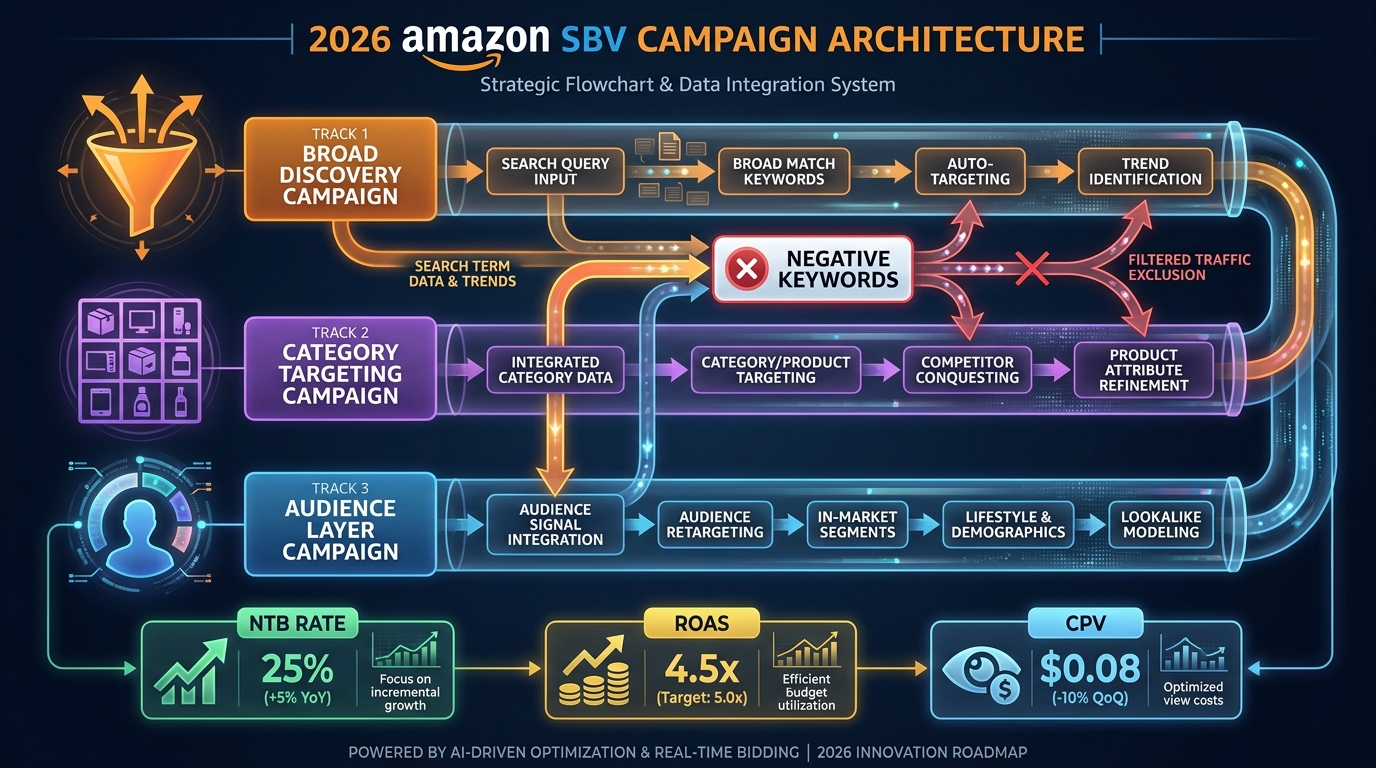
    SBV campaign architecture diagram showing three parallel campaign tracks for broad discovery, category targeting, and audience layers with data flow between them

    Theory is useful, but the architecture question — how do you actually build this in your Amazon Ads account — is where most advertisers struggle. The following structure reflects what’s working across mid-to-large SBV spenders in 2026.

    Campaign Track 1: Broad Discovery

    Build a dedicated SBV campaign with broad match keywords targeting your primary category terms and problem-solution phrases (not just product terms). Keep the keyword list focused — 15 to 25 broad match terms is sufficient for most product lines. Set bids at the lower end of your category’s competitive range, because broad match will drive volume without aggressive bidding. Apply a new-to-brand audience bid adjustment of +20–30% to bias this campaign toward first-time brand exposures. Set a fixed budget that you’re comfortable spending on discovery, not conversion.

    Pull the search term report every 7–14 days. Identify any terms that have spent without converting over 30+ days and negate them. Identify any terms that have driven multiple conversions and consider migrating them to a separate, tighter phrase or exact match campaign where you can bid more aggressively and measure conversion efficiency cleanly.

    Campaign Track 2: Category Targeting

    Build a separate SBV campaign targeting your primary subcategory. If your category has multiple relevant subcategories, split them into separate ad groups rather than stacking them — this gives you clean performance data per subcategory and the ability to bid each independently. Run at competitive CPCs for your category. Apply a “viewed your brand’s products” bid adjustment of +30–50% to this campaign, since category browsers who’ve previously seen your product are significantly more likely to convert.

    Consider running two variants of this campaign: one targeting your own subcategory (for defensive presence and loyal-browser conversion) and one targeting 2–3 close competitor subcategories or individual competitor ASINs (for conquesting). Keep the creative the same or very similar — this isn’t the place for major creative experimentation, because the audience and intent are defined by the targeting, not the creative.

    Campaign Track 3: Audience-Led Remarketing

    Build a third SBV campaign specifically designed to capture lower-funnel, high-intent shoppers. Use phrase or exact match keywords as your base targeting — you want these impressions on high-relevance queries. Layer add-to-cart and viewed-product audience bid adjustments at +40–60%. This campaign will serve less volume than the other two but at meaningfully higher conversion rates. ROAS here should be the highest of the three tracks.

    If your brand has enough purchase history, also test a loyalty-oriented variant: same structure, but with a bid adjustment for existing customers and a creative that leads with a new product, a bundle, or a subscription offer. The landing destination here matters more than in discovery campaigns — drive to a targeted product page or a Brand Store page organized around the repeat-purchase use case.

    Connecting the Tracks With Data Flow

    The three-track structure only delivers its full value when you’re actively using data from the broad match track to inform the other two. The search terms that perform in broad match campaigns are signals about where real demand lives. When a broad match term consistently converts at acceptable ACoS, promote it: add it as phrase or exact match to your category or remarketing campaigns where you can apply higher bids and tighter audience controls. When a category target is consistently underperforming on ROAS but overperforming on NTB rate, don’t cut it — recategorize it in your measurement as an acquisition campaign and evaluate it against NTB metrics instead.

    Measurement: What to Actually Track When ROAS Doesn’t Tell the Full Story

    SBV measurement dashboard showing CTR 0.89%, CVR 11.2%, NTB Rate 68%, and average watch time 18 seconds with warning that ROAS alone misses the story

    ROAS is not wrong as a metric for SBV. It’s just incomplete — and using it as the only yardstick for a multi-layer targeting structure built around different funnel stages produces systematically bad optimization decisions.

    The Core SBV Metric Set

    Running a comprehensive SBV account in 2026 requires tracking at least five distinct metric categories, and you should understand what each is actually measuring:

    • ROAS / ACoS: Still relevant for efficiency evaluation, especially on lower-funnel and category campaigns. But set different thresholds per campaign track — your broad match discovery campaign should have a higher ACoS tolerance than your remarketing campaign.
    • New-to-brand rate and NTB revenue: The percentage and absolute value of orders from shoppers who haven’t purchased your brand in the past 12 months. This is the primary measure of brand growth, not just advertising efficiency. Sponsored Brands reporting surfaces this data at the campaign level.
    • Cost-per-view (CPV) and 5-second view rate: Amazon added standardized video metrics to Sponsored Brands reporting in early 2026. CPV tells you how much you’re paying per video view, while 5-second view rate tells you what percentage of impressions result in a shopper watching at least 5 seconds — a proxy for creative engagement. A declining 5-second view rate on a broad match campaign is often a signal that the targeting has drifted toward low-relevance queries.
    • Video completion rate: The percentage of views where the shopper watches the full video (or at least 75–80% of it). High completion rate on a broad match campaign validates that the audience the algorithm is finding is genuinely interested. Low completion rate suggests creative-audience mismatch.
    • Category impression share: Available through the Sponsored Brands impression share reports. This tells you what percentage of impressions in your category your ads are capturing relative to the total available. It’s the most direct measure of competitive visibility at the category level — and it’s the metric that category targeting campaigns should be optimized against most directly.

    Building a Reporting Framework That Matches Your Campaign Structure

    The three-track campaign structure described earlier maps cleanly onto a three-tier reporting framework. For the broad match discovery track, lead with NTB impressions, 5-second view rate, video completion rate, and search term discovery velocity (how many new high-intent terms you’re finding per reporting period). For the category targeting track, lead with category impression share, ACoS, and NTB rate. For the audience-led remarketing track, lead with conversion rate, ROAS, and add-to-cart recapture rate.

    When you present SBV performance to internal stakeholders or clients, don’t collapse all three tracks into a single blended ROAS number and call it a day. That approach systematically undervalues the top-of-funnel work and overattributes results to the lower-funnel campaigns that are capturing demand created by the broader targeting layers. Build your reports to show the contribution of each layer separately.

    The Attribution Complexity

    Amazon’s default 14-day attribution window means that a shopper who sees your broad match SBV ad today and purchases 10 days later from an organic search gets partially credited to the SBV campaign. This is both a feature and a complication. It means SBV’s reported ROAS tends to be higher than pure last-click attribution would produce, but it also means some of the “ROAS” in your SBV campaigns is really capturing organic-assisted conversions from shoppers who were in the funnel already.

    The cleanest way to handle this is to compare NTB rate across your campaigns alongside total ROAS. A broad match SBV campaign with a 65–70% NTB rate and a 3.5x ROAS is doing something meaningfully different from a remarketing campaign with a 15% NTB rate and a 7x ROAS — and both might be justified at the right budget allocation.

    What This Looks Like in Practice: Patterns From Real Account Data

    Abstract frameworks only go so far. Here’s what the broad-category-audience SBV targeting structure produces in practice, based on the types of results practitioners are reporting in 2026.

    The “Category Domination” Pattern

    A mid-sized supplement brand running SBV exclusively on exact-match keywords was seeing solid direct ROAS (around 4.5x) but flat category impression share and declining new-to-brand rates. The brand’s existing customer base was being retargeted efficiently, but it was barely reaching category browsers who hadn’t yet encountered the brand.

    The fix was to add a category-targeted SBV campaign alongside the existing keyword campaigns, targeting two specific subcategories at competitive CPCs. Category impression share jumped from roughly 8% to about 23% over 60 days. The category-targeted campaigns ran at lower direct ROAS (around 3.2x) but drove NTB revenue that the keyword campaigns weren’t capturing. Blended account ROAS across both campaign types was slightly lower — but total revenue was up, and new customer acquisition was accelerating.

    The “Broad-to-Harvest” Pattern

    A home goods brand was running SBV on a tight list of exact and phrase match keywords, leaving significant search query discovery on the table. They added a broad match SBV campaign targeting 20 core category terms with a bi-weekly search term harvest workflow. Within 90 days, they had identified 14 high-converting query patterns they hadn’t previously bid on, all of which were subsequently added as phrase match keywords across both SBV and Sponsored Products campaigns. Those 14 queries collectively added meaningful incremental volume to the account — queries the brand would not have found any other way given their existing tight-match structure.

    The “Audience Premium” Pattern

    A consumer electronics brand added “viewed brand’s products” bid adjustments to their category-targeted SBV campaigns at a +45% premium. The audience-adjusted impressions represented about 18% of total category campaign impressions but accounted for 37% of the campaign’s conversions — a conversion rate roughly 2.4x higher than unadjusted category impressions. The effective CPC on audience-adjusted impressions was higher, but CPA was lower because the conversion rate premium more than offset the bid premium. The brand subsequently increased the audience bid adjustment to +60% and shifted budget toward the category campaign to capture more of that high-converting audience mix.

    The Negatives Problem: Keeping Broad Match From Bleeding Budget

    No discussion of broad match SBV is complete without addressing the structural challenge that has historically made it expensive to run: irrelevant serving and the resulting budget leakage. The 2026 approach to negative keywords in SBV is more systematic than it was two to three years ago, and that systematization is partly what’s made broad match viable again at scale.

    Building a Negative Keyword Infrastructure

    The most effective SBV negative keyword practice in 2026 starts with a “seed negative” list before launching the broad match campaign — a list of obviously irrelevant terms you know you don’t want to serve on based on your product category. For a premium kitchen knife brand, this list would include queries related to cheap or disposable cutlery, toy knives, or unrelated “sharp object” contexts. Seeding these negatives before the campaign goes live prevents early budget waste on clearly irrelevant queries during the initial learning phase.

    After launch, the 7–14 day search term review cycle adds negatives based on actual serving data. The most important patterns to negate early are: queries with zero purchase intent (informational searches), branded competitor terms you’re not intentionally conquesting, and category-adjacent queries where your product is unlikely to be a relevant substitute.

    Match Type for Negatives

    Use negative phrase match rather than negative exact match for most exclusions. Negative exact match is too narrow — it only blocks the precise query — while negative phrase match blocks any query containing the phrase, which prevents the same irrelevant pattern from appearing in dozens of slightly different query variations. Save negative exact match for cases where you want to block a specific term but keep closely related variants available for serving.

    Sharing Negatives Across Campaign Tracks

    One underused practice: sharing validated negative keyword lists across your three SBV campaign tracks. If your broad match campaign identifies a specific query pattern as consistently irrelevant, that same pattern should probably be negated in your category targeting campaign too — it might be appearing there as well if a shopper conducted that query on a category page. A shared negative keyword list (or a structured process for propagating negatives across campaigns) prevents you from having to rediscover the same irrelevant terms in each campaign independently.

    Where the Targeting Shift Is Heading Next

    The broad-category-audience targeting stack described in this article reflects where SBV is right now in 2026. But the trajectory of Amazon’s product development suggests where it’s going, and advertisers who understand the direction can position their account structures accordingly.

    Deeper Audience Segmentation

    Amazon’s audience capabilities inside Sponsored Brands are still relatively simple compared to what’s available in Sponsored Display and DSP. The four bid adjustment segments currently available (NTB, viewed, cart, purchased) are the beginning of a more granular audience taxonomy that Amazon will likely continue expanding. Advertisers who build the habit of using and measuring audience bid adjustments now will have a structural advantage when more sophisticated segments — lifestyle audiences, in-market intent signals, lookalike-style audiences — become available in the Sponsored Brands environment.

    Video Creative as a Targeting Signal

    Amazon is increasingly using creative engagement signals — completion rate, 5-second views, view-through behavior — as inputs into ad serving decisions. As these signals become more integral to the algorithm, the quality and relevance of your video creative becomes a de facto targeting input. A video with a 75% completion rate serving on broad match terms will get better algorithm treatment than a video with a 30% completion rate, even at the same bid level. This means investing in creative quality isn’t separable from investing in targeting efficiency — they’re the same investment expressed through different execution paths.

    Integration With Streaming and Off-Amazon Signals

    Amazon’s expansion of Prime Video ads and its broader media network means that, over time, off-Amazon viewing behavior and cross-channel audience data will become more accessible inside Amazon Ads campaign targeting. For SBV specifically, this opens the possibility of serving video ads to shoppers who have shown relevant interest through streaming viewing patterns — an audience signal that has no analogue in the current keyword or category targeting stack. The groundwork for this integration is being built now in Amazon’s audience data infrastructure, even if the product-facing features aren’t fully available yet in standard Sponsored Brands campaigns.

    The Actionable Framework: Getting Started With the Three-Layer Stack

    If you’re currently running SBV on a primarily keyword-only basis, transitioning to the three-layer targeting structure doesn’t require rebuilding your account from scratch. The following sequence gives you a practical path to incorporating broad match, category targeting, and audience bid adjustments without disrupting your existing campaigns.

    Phase 1: Audit and Baseline (Week 1–2)

    Before adding new targeting layers, establish clear performance baselines for your existing SBV campaigns. Pull 90-day data on ROAS, ACoS, CTR, CVR, NTB rate, and CPV (if available). Note which campaigns are keyword-only versus those using any category or product targeting. Identify gaps: Are you capturing category impression share? Do you know your NTB rate? Are you currently using any audience bid adjustments? This audit tells you where the biggest structural gaps are and which layer to add first.

    Phase 2: Add Category Targeting (Week 3–4)

    Launch one new SBV campaign targeting your primary product subcategory. Keep the creative the same as your best-performing existing SBV ad — this is a targeting test, not a creative test. Set a modest daily budget (equivalent to 10–15% of your existing SBV spend) and let it run for 3–4 weeks before evaluating. Compare ACoS, NTB rate, and CPV to your existing keyword campaigns. The category campaign will likely show a different performance profile — possibly lower direct ROAS but higher NTB rate — and that difference is the data you need to make budget allocation decisions.

    Phase 3: Activate Audience Bid Adjustments (Week 5–6)

    Apply audience bid adjustments to your existing best-performing SBV campaigns first — don’t start with the new category campaign. Choose the “viewed your brand’s products” segment and set a conservative +25–30% adjustment. Monitor for two weeks. If the adjustment is improving conversion rate without driving CPA above your threshold, increase it to +40–50%. Then layer in the NTB adjustment for your broad match or prospecting campaigns at +20–25%.

    Phase 4: Launch Broad Match Discovery (Week 7–8)

    Add the broad match discovery campaign last, after you’ve established the infrastructure for negative keyword management and the reporting framework to evaluate it correctly. Set it up with a seed negative list, a modest daily budget, and a clear review cadence from day one. Give it 4–6 weeks of data before making significant structural changes — broad match needs time to accumulate enough search term data to be worth harvesting from.

    By the end of this 8-week ramp, you’ll have all three targeting layers active, with baselines established for each, and a clear measurement framework that evaluates each layer against funnel-appropriate metrics rather than a single blended ROAS number. That’s the structural foundation for scaling SBV in 2026 — not more keywords, not bigger bids, but a targeting architecture that matches the complexity of how Amazon shoppers actually move through the purchase process.

    Conclusion

    The shift happening in Sponsored Brands Video targeting in 2026 isn’t dramatic from the outside. Amazon didn’t remove keyword targeting. The format didn’t change fundamentally. What changed is the ecosystem around it: more competition, expanded placements, more sophisticated audience tools, and a better-tuned matching algorithm that makes broader targeting types more viable and more rewarding than they were before.

    The advertisers who are ahead of this shift understand something simple but consequential: SBV is no longer a keyword-management exercise. It’s a three-layer targeting system that operates across the full purchase funnel — broad match for discovery and demand intelligence, category targeting for shelf-level competitive presence, and audience bid adjustments for conversion intent amplification. Each layer has its own metrics, its own bidding logic, and its own role in the account.

    Running all three layers together, with data flowing between them through a structured harvest-and-negate workflow, produces results that keyword-only SBV simply can’t replicate: better NTB rates, stronger category impression share, higher conversion rates on warm audiences, and a systematic process for continuously discovering new demand rather than recycling the same keyword list.

    The format’s performance potential — 2.6x the CTR of static Sponsored Brands, 11.2% average conversion rates, meaningful NTB lift for brands willing to measure it — is real. Reaching that potential in a competitive 2026 marketplace requires using the full targeting toolkit, not just the keyword-shaped corner of it.

  • The SBV Targeting Mix That Most Brands Get Wrong: Broad, Category & Product Chaining Explained

    The SBV Targeting Mix That Most Brands Get Wrong: Broad, Category & Product Chaining Explained

    SBV Targeting Mix infographic showing Broad, Category, and Product layers in a funnel structure

    Most brands running Sponsored Brands Video on Amazon have figured out the basics: shoot a short video, pick some keywords, set a bid, and let it run. What far fewer have figured out is how to structure the targeting itself — not as a single campaign with a handful of keywords, but as a deliberate, three-layer system where broad match, category targeting, and product targeting each play a distinct role, and where the outputs of one layer actively feed the next.

    That sequenced approach — what practitioners now call campaign chaining — is quietly separating the brands scaling efficiently on SBV from those spinning their wheels at a mediocre ACoS. And the gap is widening in 2026, now that SBV has graduated from an optional format to the dominant Sponsored Brands format. By Q1 2026, mature brand advertisers are directing roughly 58% of their total Sponsored Brands budget to video. The format is no longer an experiment. How you structure its targeting is the deciding factor.

    This article is about that structure. We’ll break down exactly how broad, category, and product targeting differ in SBV — not just in definition, but in where they show up in the funnel, what creative they demand, what ACoS to expect, and how data flows between them. Then we’ll walk through the chaining workflow itself: a repeatable, step-by-step process for turning Sponsored Products data into SBV campaigns that already have a head start.

    Whether you’re managing a growing brand account, running agency campaigns, or building out a more systematic Amazon PPC structure in 2026, the framework here will give you a concrete operating model rather than another list of generic tips.

    What SBV Actually Is in 2026 — and Why It’s Now the Default SB Format

    Sponsored Brands Video has technically existed since 2019, but the version running in 2026 is meaningfully different from what most advertisers first experimented with. Several structural changes have compounded to make SBV the go-to format within the Sponsored Brands family — and understanding those changes is important context before getting into targeting mechanics.

    From Optional to Default

    For most of SBV’s early history, it was treated as a supplementary format — something to test alongside traditional Sponsored Brands headline ads, not something to anchor your entire SB strategy around. That calculus has shifted decisively. Mature advertisers now allocate the majority of Sponsored Brands budget to video, and Amazon’s own internal guidance consistently positions SBV as the highest-performing SB creative type across most categories.

    The reasons are straightforward. Video autoplays when 50% of its pixels are on screen — no click required to capture attention. In a search results feed dominated by static imagery, a moving creative is a pattern interrupt. And in top-of-search placement, SBV occupies a dominant strip of real estate that static Sponsored Brands cannot replicate.

    What SBV Can Now Target

    SBV now supports two primary targeting modes, each with sub-options:

    • Keyword targeting: Broad match, phrase match, and exact match — all available for SBV. Each match type functions the same way it does in Sponsored Products, but now attached to a video creative.
    • Product and category targeting: Target specific ASINs (individual product pages) or entire product categories and subcategories. This places your SBV ad on competitor or complementary product detail pages, or across a curated slice of the Amazon catalog.

    Critically, SBV can now also drive traffic to a product detail page rather than only a Store page. This was a significant restriction for years — SBV required a Store destination. Removing that constraint opened product targeting on SBV to single-ASIN advertisers and made PDP-to-PDP conquest viable at the Sponsored Brands level.

    The Multi-ASIN SBV Addition

    Amazon has also expanded SBV to support up to three ASINs in a single video ad, driving to a product collection or Store. This multi-ASIN SBV is still in rolling availability, but for brands with product lines rather than hero SKUs, it opens category-level storytelling at a price point previously reserved for DSP campaigns. A video ad showcasing three complementary products across a category is structurally different from a single-product demonstration — and it changes how you think about both creative and targeting.

    Placements to Know

    SBV appears primarily in two placements. Top of search is the premium strip at the very top of Amazon search results — above all organic listings and Sponsored Products. Product detail page placement puts your video in the middle of a competitor or complementary ASIN’s listing page, directly in the consideration zone of an active shopper. Both placements serve different intent signals, which directly informs which targeting type belongs where — something we’ll get into in detail.

    SBV placement diagram showing top-of-search and product detail page video ad placements with 142% higher detail page view rate callout

    The Three Targeting Layers: How Broad, Category, and Product Actually Differ

    Broad, category, and product targeting get talked about as if they’re interchangeable tactical options you can pick based on mood. They’re not. Each one has a different audience entry point, a different intent signal, different volume-versus-efficiency tradeoffs, and a different relationship to your creative. Getting those distinctions right is what makes a targeting mix coherent rather than just a collection of campaigns.

    Three-column infographic comparing Broad Match, Category Targeting, and Product Targeting for Amazon SBV with ACoS and CVR benchmarks

    Broad Match: The Discovery Layer

    Broad match keyword targeting in SBV functions as your widest possible net within a search query universe. When you add “stainless steel water bottle” as a broad match keyword, Amazon will serve your video against a range of search terms that contain variations, synonyms, and related queries — not just exact instances of that phrase. The algorithm decides what’s “close enough.”

    The core value proposition of broad match is volume and discovery. It’s how you find query variations you didn’t know existed. It’s how you capture long-tail intent signals you couldn’t have manually predicted. For new SBV campaigns, or for entering a new subcategory where you don’t have historical data, broad match gives the algorithm room to learn where your creative performs best.

    The tradeoff is efficiency. Broad match campaigns will surface irrelevant queries. They require active search term harvesting to identify both positive keywords to promote and negative keywords to suppress. The expected ACoS on a broad match SBV campaign in 2026 is generally higher — often sitting in the 28–40% range for mid-competition categories — than more refined targeting types. That’s not a bug; it’s the cost of exploration. The discipline is treating it explicitly as a discovery mechanism, not a performance mechanism.

    Who uses broad match SBV well: Brands in expansive categories with many search entry points, or advertisers actively building out their keyword list. Also useful when launching a new product and needing to identify which query families your audience actually searches from.

    Category Targeting: The Contextual Mid-Funnel Layer

    Category targeting shifts the logic entirely. Instead of targeting a search query, you’re targeting a segment of the Amazon catalog — a category, subcategory, or refined slice of Amazon’s product taxonomy. Your SBV ad appears on product listing pages and search result pages within that category space.

    This targeting type is often misunderstood. Many advertisers try it, see lower CVR than product targeting, and abandon it. But category targeting’s job isn’t to maximize purchase rate — it’s to capture category-level consideration. It places your video in front of shoppers who are actively browsing within your product space, even if they haven’t typed a specific high-intent query yet.

    Within category targeting, Amazon allows refinement by brand, price range, star rating, and Prime eligibility. These filters are powerful. A category targeting campaign for “yoga mats” filtered to price range $30–$70 and 4+ star reviews is no longer spray-and-pray — it’s a contextual campaign aimed at value-conscious, quality-validated shoppers. That’s a meaningful audience definition at the Sponsored Brands level.

    Expected ACoS for category targeting SBV ranges widely but often sits in the 20–35% band for established advertisers with well-defined categories. Category campaigns tend to deliver higher impressions and broader new-to-brand reach than product targeting, but lower CVR than ASIN-level targeting. Think of it as the bridge between discovery and conversion — the layer where shoppers are aware they need something and are evaluating options.

    Who uses category targeting SBV well: Brands with strong positioning relative to an entire category (price, quality, differentiation). Also powerful for brands looking to increase category share and new-to-brand customer acquisition, not just harvest existing demand.

    Product Targeting: The Precision and Conquest Layer

    Product targeting — ASIN-level targeting — is where SBV gets surgical. You specify exactly which product pages you want your video to appear on. That could mean your own PDPs (cross-sell and upsell), direct competitor ASINs, or complementary products whose shoppers are logical prospects for your category.

    This targeting type consistently delivers the highest CVR of the three because the intent signal is as explicit as it gets: someone is actively on a specific product page, comparing options. A video ad that appears on a competitor’s listing page for someone who’s almost ready to buy is targeting the last mile of the decision journey.

    Product targeting ACoS for SBV tends to run lower than broad or category — often in the 15–25% range for competitive advertisers — though this varies by category and how aggressively you’re bidding against high-volume ASINs. The tradeoff is volume. You’re limited to the traffic that individual ASINs receive. To scale, you need ASIN lists rather than single targets — typically built from Sponsored Products data, which is exactly where the chaining methodology comes in.

    Three use cases for product targeting SBV:

    1. Conquest: Target competitor ASINs in the same subcategory to intercept comparison shoppers.
    2. Defense: Target your own ASINs to suppress competitor ads on your PDPs and reinforce your brand.
    3. Complement capture: Target adjacent ASINs whose buyers also logically need your product (e.g., targeting coffee grinder listings if you sell pour-over brewers).

    Why Campaign Chaining Changes the Whole Equation

    Campaign chaining is the methodology at the center of high-performance SBV in 2026. The basic principle: instead of building SBV campaigns in isolation, you use the output of campaigns that have already run — Sponsored Products, specifically — to seed your SBV targeting with targets that have already proven they convert.

    This changes the risk profile of SBV dramatically. Instead of launching a broad SBV campaign and hoping the algorithm finds your buyers, you enter SBV with a shortlist of keywords and ASINs that have a documented performance track record. You’ve already paid for the learning. Chaining lets you apply it.

    Campaign chaining diagram showing Sponsored Products proven winners being cloned into SBV campaigns with performance stats

    Why SP Is the Right Source of Truth

    Sponsored Products campaigns are the workhorses of most Amazon PPC accounts. They generate the most impression volume, collect the most search term data, and typically run long enough to accumulate statistically meaningful performance signals. By the time you’re ready to scale an SBV campaign, your SP data contains months of click, purchase, and ACoS signals across hundreds or thousands of keywords and ASIN targets.

    Mining that data for SBV candidates isn’t complicated — it’s systematic. Keywords that clear your ACoS threshold in SP, have at least 5–10 purchases, and show strong click-through rates are the obvious starting pool. ASIN targets from SP product targeting campaigns that show similar efficiency metrics become your product targeting seed list for SBV.

    The logic is that if a keyword converts in a text-based Sponsored Products ad, it almost certainly represents genuine purchase intent. Adding a video creative to that same keyword in a Sponsored Brands Video campaign doesn’t change the intent signal — it only makes your creative more engaging. You’re betting on a stronger creative format against a proven demand signal. That’s a much better bet than broad-match guessing.

    What Happens Without Chaining

    Without a chaining approach, most SBV campaigns are built from intuition: advertisers pick keywords they think are relevant, set bids based on rough CPC expectations, and wait for results. This is how SBV campaigns end up running at 45% ACoS for months while accumulating no useful data — because the targeting itself was never validated before spend was committed.

    The absence of chaining also produces fragmentation. Advertisers run SBV and SP campaigns against overlapping targets without coordinating them, which means they’re bidding against themselves in auctions, inflating CPCs on their best terms, and splitting credit across campaigns without understanding true incremental contribution. A chaining approach forces coordination by design: SP is the testing ground, SBV is the scaling vehicle, and the handoff between them is explicit.

    Building a Broad Match SBV Campaign: Discovery at Scale

    Even with a chaining workflow, broad match SBV campaigns have a legitimate place in a mature account structure. They’re not the first place to deploy budget, but they’re a necessary component for accounts that want to continue finding new keyword territory rather than only exploiting what SP has already discovered.

    When to Launch a Broad Match SBV Campaign

    The clearest trigger for a broad match SBV campaign is when your SP search term reports start showing diminishing returns — when the same core keywords keep appearing in winners, and new queries are rarely surfacing. This is a signal that your current keyword coverage is saturating and that new demand discovery requires a different net. Broad SBV, with its higher-impact creative, often surfaces intent patterns that broad match SP doesn’t because video engages differently than a standard text-and-image listing ad.

    A second trigger is launching into a new product line or subcategory. When you have no SP data for a new ASIN, broad SBV is a legitimate first-mover strategy — you’re buying learning at the Sponsored Brands level with a creative that can build recall even when it doesn’t convert immediately.

    Structural Rules for Broad Match SBV

    Broad match SBV campaigns require tighter governance than other targeting types precisely because of their scope. A few structural rules that high-performing advertisers follow:

    • Negative keyword management is non-negotiable. Every two weeks, pull the search term report from your broad SBV campaigns and add irrelevant queries as negatives at the campaign level. Without this, spend bleeds to unrelated queries quickly.
    • Budget caps should be conservative at launch. Broad match SBV is a learning investment. Start with a daily budget no higher than 15–20% of your total SBV allocation. Scale only after clear positive signals (ACoS trending down, specific queries emerging as consistent winners).
    • Seed with category-relevant themes, not brand terms. Broad match SBV for brand keywords is largely wasted budget — exact match or Sponsored Products branded campaigns handle that more efficiently. Broad SBV earns its place on non-branded category discovery terms where you’re genuinely trying to expand coverage.
    • Single-ASIN creative is safer at launch. Broad match SBV sends traffic to a product detail page or Store. For discovery campaigns where you’re not sure which product will resonate most, driving to a curated Store page gives you flexibility. For pure efficiency, single-product SBV creatives with a direct PDP destination typically outperform multi-destination setups in broad targeting.

    Harvesting from Broad Match SBV

    The output of a broad SBV campaign isn’t just sales — it’s data. Every 2–4 weeks, extract the search term performance report from your broad SBV campaign and sort by orders and ACoS. Queries with 3+ purchases below your ACoS target are candidates to move to phrase or exact match SBV campaigns. Queries that appear in both SP reports and SBV reports with consistent performance are candidates for elevation to their own tightly targeted SBV campaign — closing the chaining loop.

    Category Targeting: The Mid-Funnel Lever Most Advertisers Underuse

    Category targeting in SBV occupies the most underused position in most brand advertising stacks. Advertisers who’ve tried it tend to have had one of two experiences: they targeted a category that was too broad (all of “Sports & Outdoors,” for example), got massive impressions with terrible CVR, and wrote it off. Or they targeted a tight subcategory with too little traffic and saw minimal scale. Neither outcome is the format’s fault — both reflect targeting choices, not structural flaws.

    How to Size Category Targeting Correctly

    The starting point for a category targeting SBV campaign is the right level of the category hierarchy. Amazon’s category taxonomy has several levels: top-level categories (like “Beauty & Personal Care”), subcategories (“Skin Care”), and sub-subcategories (“Face Moisturizers”). The sweet spot for SBV category targeting is usually two to three levels deep — specific enough to reach relevant shoppers, broad enough to have meaningful traffic volume.

    For a brand selling face serums, “Face Moisturizers” is probably the right entry level for category SBV — it captures adjacent consideration shoppers while staying within the relevant product space. “Skincare” would be too broad. “Anti-Aging Serums” might be too narrow for a category campaign (product targeting is better at that level of specificity).

    Applying Refinements That Actually Work

    Amazon’s category targeting refinements — price range, brand, star rating, Prime eligibility — are often glossed over in PPC guides, but they’re among the most powerful tools for making category SBV efficient. Some practical applications:

    • Price range filtering: If your product is priced at $45, filter the category campaign to show on products priced $30–$60. You’re capturing shoppers already in your price tier’s consideration set, not confusing budget shoppers with a premium offer.
    • Star rating filtering: Excluding products with very low average ratings (under 3.5 stars) can improve efficiency. Shoppers on low-rated products are often already disappointed and in “find an alternative” mode — a potentially high-value moment. Conversely, showing on 4+ star products means competing with well-validated listings, which can be harder. Test both approaches and measure.
    • Brand exclusion: You can exclude specific brands from your category targeting, which is useful for filtering out private-label products from Amazon itself or brands where the audience fit is poor. This also prevents spend against your own listings in category targeting, which can happen when your ASIN appears within the same category.

    Category Targeting for New-to-Brand Acquisition

    One of the most compelling use cases for category SBV is new-to-brand (NTB) customer acquisition. Amazon Advertising’s own data shows that brands using two or more video solutions see a 15% lift in incremental reach versus brands using only one. Category targeting SBV is designed for exactly this scenario: you’re reaching shoppers who are actively in your category space but haven’t encountered your brand specifically. The video format creates a brand impression that text-based Sponsored Products can’t — even if the shopper doesn’t click immediately, the exposure plants a brand signal that influences later searches.

    For NTB-focused category campaigns, the creative should lean toward brand storytelling rather than pure product demonstration. You’re making an introduction, not closing a sale. This is one of the few SBV contexts where a Store destination might outperform a single PDP, since it gives the curious new shopper a full brand context rather than dropping them directly into a purchase funnel for a product they’ve just discovered.

    Product Targeting: Precision, Conquesting, and Defense

    Product targeting is where SBV gets closest to a traditional direct-response mechanism. The targeting is explicit, the intent signal is clear, and the feedback loops are fast. It’s also the most versatile of the three targeting types — the same structural approach applies whether you’re playing offense against competitors or defense on your own listings.

    Building a Conquesting ASIN List

    Competitor conquesting in SBV starts with a well-built ASIN list. A high-quality conquesting list isn’t just “every competitor ASIN in my category” — that produces bloated campaigns where most traffic is from ASINs with low relevance to your specific product. A focused conquesting list is built around:

    • Direct substitutes: Products that solve the same problem at a similar price point. Shoppers on these pages have nearly identical purchase intent to your core buyer.
    • Products with known weaknesses: Competitor ASINs with review patterns that highlight pain points your product solves. These shoppers are often actively looking for an alternative.
    • High-traffic ASINs in your subcategory: Volume matters. Targeting 20 ASINs with 1,000 monthly sessions each beats targeting 200 ASINs with 50 sessions each. Use keyword research tools, BSR data, and your own SP competitor targeting reports to identify high-traffic targets.

    Start with a list of 20–50 ASINs. Too few and you’ll have scale problems. Too many and you lose the ability to analyze which specific targets are driving performance — you end up with a blended ACoS that hides inefficiencies.

    Defensive Product Targeting on Your Own ASINs

    Self-targeting — running SBV product targeting against your own ASINs — is one of the most underused applications of the format. On a high-traffic listing, Amazon allows multiple ads to appear, and competitors will bid for placement on your PDPs. A defensive SBV campaign targeting your own listings means your video ad appears in the product targeting zone of your own page, reinforcing your brand and effectively crowding out competitor video placements that would otherwise occupy that space.

    For brands with multiple ASINs in the same category, self-targeting also enables internal cross-sell. A shopper on your top-selling SKU sees a video featuring your expanded product line. The ACoS on self-targeting campaigns is often higher than conquesting (you’re paying to advertise to shoppers already on your page), but the strategic value — brand reinforcement, competitive suppression, and cross-sell — often justifies the cost, particularly for high-traffic hero SKUs.

    Complement Targeting: The Often-Missed Play

    Complement targeting is product targeting aimed at adjacent products whose buyers are likely candidates for your category. The logic: a shopper actively purchasing hiking boots is a probable prospect for hiking socks. A shopper on a premium notebook is likely interested in a quality pen. A shopper browsing espresso machines is in the market for coffee beans.

    Complement targeting in SBV is particularly effective because video can quickly communicate the product relationship — “pairs perfectly with” or “the natural next step” — in 15 seconds of autoplay in a way that a static ad simply cannot. The creative becomes part of the targeting logic.

    The Chaining Workflow: Step-by-Step from SP Winners to SBV Campaigns

    Here’s the operational process for executing campaign chaining in practice. This isn’t theoretical — it’s a repeatable workflow that can run on a monthly or biweekly cadence for most active accounts.

    Step 1: Mine Sponsored Products for Proven Winners

    Pull two reports from your SP campaigns: the Search Term Report and the Targeting Report (for product/ASIN targets). Apply the following filters to each:

    • Minimum 5–10 purchases in the lookback period (typically 60–90 days)
    • ACoS at or below your target threshold
    • Minimum 100–200 clicks (enough statistical weight to trust the data)

    From the Search Term Report, you’re extracting keyword candidates for broad match and phrase match SBV campaigns. From the Targeting Report (product/ASIN targets), you’re extracting ASIN candidates for product targeting SBV campaigns. Document both lists separately — they go into different campaign types.

    Step 2: Segment by Campaign Type

    Sort your extracted data into three buckets:

    1. High-intent exact queries (5+ orders, low ACoS, specific query) → candidate for exact match SBV keyword campaign
    2. Broad category themes (queries that represent a family of intent rather than a single query) → candidate for phrase or broad match SBV campaign
    3. Proven ASIN targets (specific competitor or complement ASINs that converted in SP product targeting) → candidate for product targeting SBV campaign

    This segmentation ensures you’re building SBV campaigns with intentional scope at each stage. You’re not dumping all SP winners into a single SBV campaign and hoping it works — you’re matching the scale and intent of each target type to the appropriate SBV campaign structure.

    Step 3: Build the SBV Campaign Structure

    Create separate campaigns for each targeting type — never mix broad keyword, category, and product targeting in the same SBV campaign. Keeping them separate preserves your ability to evaluate performance cleanly and adjust bids independently. A combined campaign where broad keyword targets and ASIN targets share a budget and blended ACoS is analytical noise.

    Recommended campaign names (for organization):

    • [Brand] | SBV | Broad | [Category Theme]
    • [Brand] | SBV | Category | [Subcategory Name]
    • [Brand] | SBV | Product | Conquest | [ASIN Group]
    • [Brand] | SBV | Product | Defense | Own ASINs

    Step 4: Set Starting Bids by Campaign Intent

    Bid strategy for SBV differs by targeting type because the expected CPCs and conversion rates differ:

    • Broad match SBV: Start conservatively — 20–30% below your SP broad match CPCs for equivalent terms. You’re paying for the video format premium but want room to optimize before committing full bids.
    • Category targeting SBV: Bids here compete against other advertisers targeting the same category. Start at roughly equivalent CPCs to your SP category targeting campaigns and adjust based on impression share and ACoS after 2 weeks.
    • Product targeting SBV: These often command higher bids because the intent signal is stronger and the placement (on a specific PDP) is premium. Start at a slight premium over your SP product targeting CPC for the same ASINs — typically 10–20% higher.

    Step 5: Monitor, Harvest, and Promote

    At 2-week intervals, evaluate each campaign layer against its intended role:

    • Broad campaigns: harvest new winning queries, add negatives, promote individual winners to phrase/exact match campaigns
    • Category campaigns: evaluate by subcategory performance if you’ve split by category tier; look at new-to-brand attribution and impression share
    • Product targeting campaigns: sort by ASIN-level ACoS; promote top ASIN performers to higher bids, suppress underperformers

    The output of this review doesn’t just optimize existing campaigns — it generates the next round of chaining targets. High-performing queries from your broad SBV become the seed list for your next exact match SBV campaign. High-converting ASINs from product targeting become priorities for bid increases and budget allocation. The cycle is self-reinforcing.

    Creative Considerations for Each Targeting Type

    The SBV creative — the video itself — is not one-size-fits-all across targeting types. Because each targeting layer reaches a different audience at a different stage of the purchase journey, the creative job is different at each layer. Most advertisers miss this entirely, running the same video against broad keyword, category, and product targeting campaigns without considering how the context changes what the video needs to do.

    Creative for Broad Match SBV

    Broad match audiences are in discovery mode. They’re exploring a category, not sure which brand they want. The creative priority here is recognition and relevance: the video needs to immediately communicate what the product is and why it’s worth considering. Brand identity matters here — logo placement, brand color consistency, and a clear product category signal in the first 2–3 seconds. This is not the video to go deep on features and specifications. It’s the video to make the brand and product memorable in a 15-second autoplay window.

    Because broad match SBV autoplays muted, captions are not optional — they’re structurally necessary. Any key benefit communicated only via audio is invisible to the majority of viewers. The visual track must carry the message independently.

    Creative for Category Targeting SBV

    Category targeting audiences are actively browsing. They know what type of product they need — they’re evaluating which specific product and brand to choose. Creative for category SBV should emphasize differentiation: what makes your product the right choice within this category. This is the layer where benefit-led messaging (not just product demonstration) earns its place. “Why our version is better” — whether that’s ingredient quality, price-to-value, design, durability — is the creative logic for category audiences.

    Creative for Product Targeting SBV

    Product targeting audiences are at maximum consideration. They’re on a specific product page, actively comparing. This is the closest SBV gets to bottom-of-funnel, and the creative should reflect that with conversion intent: clear product demonstration, social proof signals (bestseller badge, star rating callout), and a direct call to action. For conquest campaigns, the creative can lean into the comparison frame implicitly — showcasing a specific advantage or value that the target product is commonly criticized for lacking. You’re not attacking the competitor explicitly (Amazon’s ad policies don’t permit that), but you’re showing your strength at exactly the moment a shopper is evaluating alternatives.

    Budget Allocation Across the Three Targeting Types

    Budget allocation across the SBV targeting mix isn’t a fixed formula, but there are principles that guide how mature advertisers structure their spend. The right split depends on your account stage, category competitiveness, and whether you’re in growth or efficiency mode.

    SBV budget allocation pie chart showing 30% broad match, 35% category targeting, 35% product targeting split with strategic callouts

    The Starting Allocation Model

    For brands new to the three-layer SBV structure, a reasonable starting split is:

    • 30% to broad match keyword campaigns — treated as a learning budget, not a revenue budget
    • 35% to category targeting campaigns — your mid-funnel consideration driver and NTB acquisition layer
    • 35% to product targeting campaigns — your highest-efficiency, highest-CVR layer, seeded from SP data

    This split acknowledges that product targeting and category targeting are typically more efficient than broad match, while reserving enough broad match budget to keep discovery active. As product targeting campaigns prove themselves (ACoS below threshold, consistent orders), budget migrates from broad to product targeting on roughly a monthly cadence.

    Adjusting for Account Stage

    A newer account with limited SP data should weight broad more heavily — perhaps 50% — because it doesn’t yet have the historical chaining material to build strong product and category targeting campaigns. As the SP data accumulates, that broad allocation shrinks and the product/category split grows.

    A mature account with rich SP data and proven ASIN targets can often run with only 15–20% in broad match SBV, reserving the rest for category and product targeting where the learning investment has already been made. The overall SBV budget itself — typically around 58% of total Sponsored Brands spend for mature accounts — stays constant. It’s the internal distribution that shifts as data matures.

    Total PPC Budget Context

    For context: within a full Amazon PPC account structure, Sponsored Products typically commands 60–65% of total ad spend, with Sponsored Brands (including SBV) taking roughly 20–25%, and Sponsored Display or DSP filling the remainder. Within that SB allocation, SBV is the dominant format. So SBV’s share of total account spend is meaningful but not dominant — it’s the highest-leverage component of a Sponsored Brands strategy, not a replacement for Sponsored Products.

    Measurement: What Metrics Actually Matter at Each Layer

    One of the most common SBV measurement mistakes is applying the same metrics equally to all three targeting types. Broad match campaigns should not be held to the same CVR and ACoS standard as product targeting campaigns — the audiences are too different. Applying uniform efficiency metrics across a multi-layer structure produces the wrong optimization decisions: you’ll kill broad campaigns that are doing their job correctly (discovery) because they look bad next to product targeting campaigns that are doing a completely different job.

    SBV measurement dashboard showing vCTR, 5-second view rate, ACoS by targeting type, and new-to-brand metrics with funnel optimization labels

    Metrics by Targeting Layer

    Broad match SBV — primary metrics:

    • New-to-brand (NTB) purchase rate: The percentage of orders from customers who haven’t bought from you on Amazon in the last 12 months. High NTB rates in broad campaigns confirm they’re doing discovery work, not just converting existing brand buyers.
    • 5-second view rate: The percentage of video impressions where the viewer watched at least 5 seconds. This is a proxy for creative relevance — low 5-second view rates on a broad campaign often signal a creative or keyword match problem, not a targeting problem.
    • Search term harvest rate: How many new viable keyword candidates (below ACoS threshold) are you extracting per review cycle? Broad campaigns that stop generating new candidates are saturating and should have their budgets redeployed.
    • ACoS (secondary): Important for guardrails but not the primary optimization metric for a discovery campaign. Set a ceiling (e.g., no more than 45% ACoS for broad SBV) rather than an optimization target.

    Category targeting SBV — primary metrics:

    • New-to-brand percentage and total NTB orders: Category campaigns should show a disproportionately high share of NTB customers. If most category SBV orders are from returning customers, the campaign is redundant with product targeting and should be restructured.
    • Impression share by subcategory: Are you maintaining visibility within the category segments you’re targeting? Impression share decline without CPM changes suggests growing competition in those category segments.
    • ACoS (primary): Category targeting campaigns are mid-funnel but should still perform within a defined ACoS range. The 20–35% range is typical; anything above 40% consistently suggests the category-to-product fit isn’t strong enough.
    • Detail page view rate: What percentage of video impressions result in a detail page view? Low DPVR on a category campaign suggests the creative isn’t creating enough pull to move shoppers toward your listing.

    Product targeting SBV — primary metrics:

    • ACoS and ROAS (primary): Product targeting is the efficiency layer. These campaigns should meet or beat your account-wide ACoS target consistently. If they don’t, either the ASIN list needs pruning or the bids need adjustment.
    • CVR: Conversion rate from click to purchase. Product targeting SBV should show the highest CVR of your three targeting types. Consistently low CVR in product targeting suggests either a product listing quality issue (reviews, images, pricing) or a product-to-ASIN targeting mismatch.
    • ASIN-level attribution: Which specific ASINs are driving performance? Product targeting campaigns need ASIN-level reporting to identify the 20% of targets driving 80% of conversions. Those high-performers deserve bid increases and budget priority. The tail can be suppressed.

    Video-Specific Metrics to Track Across All Layers

    Amazon’s video attribution reporting has expanded significantly. Beyond standard PPC metrics, SBV campaigns now surface:

    • vCTR (video click-through rate): Clicks divided by video impressions. For SBV, a healthy vCTR typically falls between 0.5% and 1.2% depending on category and targeting type. Product targeting SBV tends to show lower vCTR than broad match (fewer impressions, but more intent per impression) — this is expected and not a problem.
    • Video completion rate (quartiles): What percentage of viewers reach 25%, 50%, 75%, and 100% of the video? A steep drop-off at the 25% mark is a creative signal — the opening isn’t compelling enough. A strong completion rate all the way through is evidence of creative quality that justifies continued budget.
    • View-through attribution: Purchases attributed to viewers who watched the video but didn’t click. This metric captures brand influence that click-based attribution misses entirely — it’s particularly relevant for broad and category campaigns where the video’s role is influence, not just direct response.

    Common Mistakes That Undermine the Targeting Mix

    Even advertisers who understand the three-layer model intellectually often make structural mistakes in execution. These are the most common failure modes worth flagging explicitly.

    Mixing Targeting Types in a Single Campaign

    Putting broad keyword targets and product ASIN targets in the same SBV campaign is the most frequent structural error. The resulting blended ACoS makes it impossible to know which targeting type is performing and which is dragging. Budget can’t be allocated optimally. Bids can’t be set appropriately. The only remedy is to rebuild the campaign structure with clean separation from the start.

    Treating All Three Layers as Conversion Campaigns

    Holding a broad match SBV campaign to the same ACoS standard as a product targeting campaign will produce a systematic decision to cut the broad campaign the moment it underperforms — even when it’s generating valuable discovery data and new-to-brand orders. Each layer needs its own success criteria that match its role in the funnel.

    Skipping the Chaining Step Entirely

    Building SBV product targeting campaigns without first validating targets in Sponsored Products is expensive trial-and-error. You’re paying Sponsored Brands-level CPMs to learn which ASINs convert — something SP product targeting campaigns can determine much more cost-effectively. The chaining workflow exists precisely to avoid this waste. Use it.

    Never Refreshing the ASIN List

    ASIN performance shifts over time. Competitors run deals, change prices, update listings, or exit the category. An ASIN target that was a top-performer six months ago may be stale now — either because the listing has improved (harder to conquest) or because it’s lost traffic (lower-value target). ASIN lists in product targeting SBV campaigns should be reviewed quarterly, with high-performing targets prioritized and low-traffic or high-ACoS targets removed or bid-reduced.

    Putting the System Together: What a Mature SBV Account Looks Like

    A well-structured SBV account running the three-layer chaining model doesn’t look like a sprawling collection of campaigns — it looks like a deliberate architecture with clear roles for each component.

    At the top of the structure, a small number of broad match SBV campaigns run continuously as discovery engines. Their output is managed: search term reports reviewed every two weeks, new winners extracted, negatives added. These campaigns rarely grow large in budget share; they serve as the perpetual renewal mechanism for the rest of the account.

    In the middle, category targeting SBV campaigns run against 3–5 well-defined subcategories. They carry a healthy portion of the SBV budget, have their own creative assets (brand and category-level storytelling), and are evaluated on NTB orders and impression share rather than raw ACoS. They’re the account’s investment in category presence and new-customer acquisition.

    At the base, product targeting SBV campaigns run against two to four ASIN groups: conquest, complement, and defense. These are the efficiency engines — tightly managed, ASIN-level reporting, high bids on proven targets, suppressed spend on underperformers. They produce the best ACoS numbers in the account because they’ve earned their targeting list through validated SP data.

    The chaining cycle connects all three layers. SP data feeds the ASIN lists for product targeting. Broad SBV search terms feed phrase and exact match campaigns. Category campaigns surface new-to-brand signals that inform which product lines deserve their own conquest campaigns. Nothing is built in isolation. The whole account learns from itself.

    Conclusion: The Targeting Mix Is the Strategy

    Sponsored Brands Video is no longer a secondary format to test when you’ve exhausted your Sponsored Products budget. In 2026, it’s the primary Sponsored Brands format, absorbing the majority of SB spend for accounts that take it seriously. But SBV’s performance ceiling is determined almost entirely by how the targeting is structured — not the bid strategy, not even the creative, though both matter. The structure comes first.

    The three-layer model — broad for discovery, category for mid-funnel consideration, product for precision and conversion — gives each targeting type a coherent role. Campaign chaining from Sponsored Products makes product targeting far less speculative and far more efficient. And holding each layer to its own metrics rather than a universal ACoS standard prevents the common mistake of optimizing the entire account toward short-term efficiency at the expense of long-term reach and NTB acquisition.

    Actionable Takeaways

    1. Separate your targeting types into distinct SBV campaigns. Never mix broad, category, and product targeting in the same campaign. Clean separation is what makes optimization possible.
    2. Run Sponsored Products first, chain winners to SBV. Any product targeting in SBV should be seeded from SP Targeting Report data. Wait for 5–10 purchases per ASIN target before promoting to SBV.
    3. Apply different success metrics to each layer. Broad campaigns → NTB rate and search term harvest. Category campaigns → NTB orders and impression share. Product campaigns → ACoS and ASIN-level CVR.
    4. Design creative for the audience’s purchase stage. Discovery creative for broad. Differentiation creative for category. Conversion creative for product targeting. One video serving all three stages equally serves none of them well.
    5. Review and refresh your ASIN lists quarterly. Product targeting campaigns degrade as the competitive landscape shifts. Stale ASIN lists are one of the most common causes of product targeting SBV underperformance in mature accounts.
    6. Track view-through attribution alongside click attribution. SBV’s influence on purchase decisions is larger than click-only data suggests, especially for broad and category targeting campaigns. Video engagement metrics (5-second view rate, completion quartiles) tell a story that ACoS alone cannot.

    The brands seeing the best SBV results in 2026 aren’t the ones with the biggest budgets or the most polished videos. They’re the ones who treat targeting as architecture — a deliberate system where each layer has a purpose, the layers feed each other, and the whole structure gets smarter with every review cycle. That’s the model worth building.

  • The SBV Targeting Matrix: How to Build Sponsored Brand Video Combos That Actually Win in 2026

    The SBV Targeting Matrix: How to Build Sponsored Brand Video Combos That Actually Win in 2026

    SBV Targeting Matrix 2026 — Sponsored Brand Video targeting combos dashboard

    Sponsored Brand Video is no longer a novelty format sellers reluctantly test with leftover budget. In 2026, it commands 58% of total Sponsored Brands spend across major Amazon advertising accounts, and agencies managing $4 million or more in monthly Amazon ad spend now route 90–95% of their Sponsored Brands budget directly into SBV. The format has earned that trust. It generates 2.6 times more clicks than static Sponsored Brands creatives. It autoplays directly in search results, captures mobile scroll attention faster than any banner, and it puts your product in motion at the exact moment a shopper is forming a purchase decision.

    But here’s what most coverage of Sponsored Brand Video misses entirely: the format itself isn’t the advantage anymore. At this point, every serious Amazon advertiser knows SBV outperforms static SB. The new battleground is targeting architecture — specifically, which targeting inputs you combine, in which campaign structures, against which shopper intents.

    A single-layer SBV campaign running broad keywords will pick up volume. But it won’t win the category. The advertisers who are extracting the best ACoS numbers, the strongest new-to-brand customer rates, and the most durable ROAS from SBV in 2026 are running deliberate targeting combos: specific pairings of keyword types, product targets, category refinements, and audience layers that are matched — intentionally — to specific shopper moments and video creative types.

    This article breaks down the four highest-performing targeting combos in SBV for 2026, the structural logic behind each, how to align your creative to your targeting intent, and how to build a budget architecture that lets all four run simultaneously without cannibalizing each other.


    Why Targeting Combos Matter More Than the Format Itself

    The Combo Logic — single targeting vs multi-layer targeting comparison for Sponsored Brand Video

    The case for targeting combinations in SBV isn’t abstract. It comes from a fundamental truth about how Amazon’s ad auction works: the platform rewards relevance, and relevance is contextual. A shopper searching “best stainless steel water bottle” is in a different decision state than someone browsing an ASIN page for a competing brand’s product. Both are potential buyers. But they respond to different creative angles, they convert at different rates, and they carry different lifetime value profiles.

    A single targeting approach treats them identically. A well-constructed targeting combo treats them differently — serving each segment the most relevant version of your SBV campaign, with appropriate bids, appropriately tuned creative signals.

    The Structural Problem with Single-Layer SBV

    When you run a Sponsored Brand Video campaign with only broad keyword targeting and no product targeting layer, you’re essentially fishing with one hook. You’ll catch what swims past it. You won’t intercept anything, position against anyone, or defend anything proactively.

    The consequences show up in your data in predictable ways: high impression volume, mediocre CTR on competitive terms, and a search term report that’s a mix of high-intent buyers and window-shoppers. Your budget gets distributed across all of them at roughly the same efficiency — or worse, at worse efficiency — because broad match is capturing terms you haven’t optimized against.

    Meanwhile, competitors who’ve built structured targeting combos are appearing on the same search pages with tighter message-to-query alignment, lower wastage, and in the case of product targeting, on product detail pages where your brand name never even appears in the organic auction.

    What Amazon’s 2026 Auction Rewards

    Amazon’s ad auction in 2026 has become significantly more signal-rich. Product targeting — which requires the “Drive page visits” objective in SBV campaigns — now unlocks placement on both search results and product detail pages simultaneously. Category targeting with refinement filters (price range, star rating, brand exclusions) narrows the competitive set Amazon is placing you against. Audience layering via DSP and in-market signals introduces behavioral context that pure keyword targeting can’t reach.

    The platforms that consistently deliver the lowest-cost qualified traffic in 2026 are those that match targeting signal to shopper intent with precision. The combo approach is how you do that inside a single advertising channel.


    The Foundation: Campaign Structure That Supports Combo Targeting

    Before getting into the specific combos, it’s worth being precise about the structural requirements that allow them to work. You cannot run all four targeting types inside a single SBV campaign and expect clean data. The goal of combo targeting isn’t to throw everything at one campaign — it’s to run separate, deliberately structured campaigns that each own a specific targeting intent and a specific shopper moment.

    One Product Per Campaign, One Intent Per Ad Group

    The highest-performing SBV structures in 2026 follow a consistent pattern: one product (or tightly related product variant) per SBV campaign, and one intent — keyword or product targeting — per ad group within that campaign. This structure enables clean performance attribution. When campaign A (keyword targeting, exact match, branded terms) is performing differently from campaign B (competitor ASIN product targeting), you know precisely why and can act on each independently.

    Mixing keyword and product targeting within the same ad group conflates two different shopper contexts. The CTR patterns are different, the conversion paths are different, and the optimal bid strategies are different. Keep them separate from the start and you avoid having to untangle them later.

    Campaign Objectives: “Drive Page Visits” Is Not Optional

    This is a structural prerequisite that often trips up advertisers who came up in Sponsored Products: to access product targeting in Sponsored Brand Video, you must select the “Drive page visits” campaign objective — not “Grow impression share.” If you launch an SBV campaign under “Grow impression share,” product targeting is simply unavailable. You’re locked into keyword-only targeting, which is half the capability set.

    The practical implication is that most effective SBV combo strategies default to “Drive page visits” across the board. The click destination should be a single product detail page, not your Storefront. Sending traffic to a Store adds a navigation step between the click and the conversion, and most advanced practitioners in 2026 have moved away from Store linking for SBV unless the campaign objective is explicitly brand awareness at scale.

    Match Type Segmentation Within Keyword Campaigns

    Within keyword-based SBV campaigns, match type segmentation still matters — but not for the reason beginners assume. The reason to separate exact, phrase, and broad match into different campaigns (or at minimum different ad groups) isn’t bid control alone. It’s search term visibility. Broad match and phrase match campaigns will surface new search terms continuously. Exact match campaigns will tell you precisely which known terms are converting at what cost. Running them together without segmentation means your search term report is a blended picture where you can’t accurately attribute performance to a specific match type’s contribution.

    In practice: start discovery-oriented campaigns (broad/phrase) at moderate bids, harvest converting search terms into exact match campaigns at elevated bids, and use negative keywords aggressively in broad campaigns to prevent the two audiences from overlapping.


    Combo #1 — The Interception Play: Exact Keywords + Competitor ASIN Product Targeting

    Combo 1: Exact Keyword plus Competitor ASIN targeting — the SBV interception play

    This is the most aggressive targeting combo in the SBV toolkit, and it’s also the one that most directly threatens competitors’ ad spend efficiency. The logic: exact keyword campaigns capture shoppers actively searching for a product type with declared intent; competitor ASIN product targeting campaigns intercept the same shopper profile on a competitor’s product detail page, during the comparison phase. Together, they cover the shopper at two critical decision moments — search and comparison — with your SBV creative as the interruption.

    Why the Two Layers Reinforce Each Other

    Shoppers who enter a high-intent search query and see your SBV in results but don’t click immediately will often end up on a competitor product page moments later — especially if the competitor’s organic listing wins that search result. Without competitor ASIN product targeting, you disappear from that shopper’s experience entirely at the comparison stage. With it, your video re-enters their view while they’re actively reading competitor reviews, studying competitor price points, and most critically, looking for reasons to switch.

    This is the interception mechanic: your SBV doesn’t need to win the first impression to convert the shopper. It needs to be present at the decision moment. Competitor ASIN targeting ensures you are.

    Building Your Competitor ASIN Target List

    Effective competitor ASIN targeting requires a well-researched target list, not a mass blast. The highest-performing approach uses three tiers of targets:

    • Direct substitutes: Products in your exact category and price band with strong review counts (500+ reviews, 4.0–4.5 stars). These shoppers are actively comparing and haven’t decided. Your video can be the differentiating demonstration they’re looking for.
    • Weak competitors: Products in your category with sub-4.0 ratings, older review dates, or noticeably weaker imagery. These shoppers are often quietly disappointed by what they’re looking at — your video arrives at exactly the right moment of receptiveness.
    • High-volume category leaders: The ASINs getting the most organic traffic in your category. Bidding on these is more expensive but the traffic volume justifies it if your product has a genuine differentiation story to tell in 15–20 seconds.

    Bid Strategy for the Interception Combo

    Keyword and ASIN targeting bids should be set independently based on their respective conversion data, not at parity. Exact keyword campaigns generally bid higher because search intent is explicit and conversion windows are shorter. Competitor ASIN product targeting typically requires slightly lower bids, because the shopper’s intent is real but the context is comparison rather than active search — conversion rates are often 15–30% lower than exact keyword campaigns, and your bid ceiling should reflect that.

    A common mistake is over-bidding competitor ASIN targeting to “win every placement” on a top competitor’s page. This inflates spend without proportionally improving conversions. Set initial bids conservatively — 60–70% of your equivalent exact keyword bid — then adjust upward only for the specific ASINs showing strong conversion data after 2–3 weeks.

    Creative Alignment for the Interception Combo

    The SBV creative running against this combo needs to do one specific job: win a direct comparison fast. The first 3 seconds must establish your product visually and signal superiority over the category. Avoid purely brand-building intros (your logo for 3 seconds, then a slow reveal) — those work against you when the shopper is actively on a competitor’s page. Lead with the strongest differentiator: durability test, material quality, feature comparison, or verified social proof from a real use case.


    Combo #2 — The Filter Funnel: Category Targeting + Price and Star Rating Refinements

    Combo 2: Category targeting with price and star rating filter funnel for Sponsored Brand Video

    Category targeting without refinement is a scatter gun. You’re bidding to appear next to every product in a category, which can mean appearing next to sub-$10 commodities when you’re a premium product, or appearing next to highly-rated market leaders when your product has 150 reviews and a 4.2-star average. Both scenarios waste spend and suppress CTR because the shopper context mismatches your value proposition.

    The filter funnel solves this by layering refinements onto category targeting — creating a narrower but significantly more qualified audience for your SBV to reach.

    Price Range Refinement: The Positioning Signal

    Price range filters in category targeting aren’t just about efficiency — they’re a strategic positioning tool. By setting minimum and maximum price thresholds for the products your SBV will appear next to, you’re selecting the competitive set you want to be seen against.

    For premium products: set the filter floor at your price point or slightly below it. You’re appearing next to competitors at similar price tiers, which means the shopper has already self-selected for price tolerance — they’re not bargain hunting, they’re evaluating value. Your SBV creative’s job is to win the quality argument, not the price argument.

    For value-tier products: consider targeting a slightly higher price band than your own product. A shopper browsing a $45 product who sees your SBV advertising a $29 alternative with comparable features is an extremely receptive audience. The price differential becomes part of your conversion argument without you needing to explicitly state it in the video.

    Star Rating Refinement: Qualifying the Audience Quality

    Star rating filters cut two ways in the filter funnel combo. Setting a floor of 4.0 stars means your SBV appears next to products that are performing well — but that’s actually where you want to be for consideration-stage shoppers. A shopper on a 4.2-star product is in genuine deliberation mode. They’re comparing, they haven’t committed, and they’re receptive to seeing an alternative make its case.

    Setting a ceiling of 4.5 stars (avoiding 5-star products with thousands of reviews) is a practical efficiency tactic: hyper-dominant listings with near-perfect review profiles attract highly loyal shoppers who are essentially going through a checkout confirmation motion. Your conversion rate will be low there regardless of how good your video is.

    A strong filter funnel setup looks like this: target your core category, set price range to 80–150% of your product’s price, and filter for 4.0–4.6 star products. This concentrates your impressions on the segment of the market where genuine switching behavior is most likely.

    When to Run Filter Funnel vs. Competitor ASIN Targeting

    These two combos are not in competition — they serve different scaling purposes. Competitor ASIN targeting gives you precision against specific known targets and is ideal for products where you’ve done detailed competitive research. The filter funnel scales reach across a broader qualified audience without requiring you to enumerate every specific ASIN. Use both: competitor ASIN targeting for your top 15–25 direct rivals, and filter funnel category targeting as a wider net that captures emerging competitors and shoppers you haven’t specifically mapped yet.


    Combo #3 — The Loyalty Fence: Branded Keyword Defense + Complementary ASIN Targeting

    Most Amazon advertisers run some version of branded keyword defense — bidding on their own brand name to protect search real estate from competitor conquest campaigns. Fewer think about pairing that defense with complementary ASIN targeting to close the loyalty loop. This combo isn’t about conquest. It’s about retention, upsell, and expanding wallet share from an already-warm audience.

    Branded Keyword Defense With SBV: Different Goals, Different Metrics

    When you run SBV against branded keywords, the conversion rate is typically the highest of any SBV campaign — because the shopper has already named you. They’re not browsing; they’re looking for you specifically. This should change how you think about the SBV creative for this campaign. It doesn’t need to win a comparison. It doesn’t need to establish brand recognition. It needs to reinforce the purchase decision the shopper has already made and move them to checkout efficiently.

    Branded defense SBV creative works best when it showcases specific product benefits the shopper may not have fully considered — a bundle option, a key feature they might have missed, or social proof from verified buyers that confirms they’re making a good choice. The 15-second version of “you’ve already decided well, here’s why that’s true” is a more effective branded defense than a general brand awareness video.

    The ACoS on branded SBV campaigns will often look the best in your account — but be careful not to let that create over-dependency on branded spend. These shoppers may have converted anyway without the ad. The real test is incrementality: check your new-to-brand rate on branded SBV campaigns. If it’s near zero, the campaign is primarily accelerating existing intent rather than creating new demand.

    Complementary ASIN Targeting: Expanding the Basket

    Complementary ASIN targeting is the underused half of this combo. Instead of targeting competitors, you target products that work with yours — accessories, consumables that pair with your device, protective cases for your electronics product, refill pods for your product system, replacement parts, or simply products in an adjacent use-case category that the same customer would logically buy.

    A shopper on the product detail page of a compatible product is in a purchase mindset. They’re not comparing you to anything — there’s no competitive tension. Your SBV arrives as a relevant, useful discovery: “You’re buying this. You might also need this.” The conversion mechanics here are closer to a cross-sell than a conquest.

    Building a good complementary ASIN list requires thinking through your customer’s use case holistically. If you sell yoga mats, target yoga blocks, straps, and bags. If you sell coffee subscriptions, target French press brewers, pour-over equipment, and coffee grinders. If you sell laptop stands, target mechanical keyboards, webcams, and USB hubs. The broader your complementary ecosystem, the more surface area this combo creates.

    Bidding and Budget for the Loyalty Fence

    Branded keyword defense typically commands high bids — competitors are actively trying to conquest your brand terms, and the conversion value justifies paying to defend. Complementary ASIN targeting, by contrast, is often significantly underpriced because fewer advertisers are competing for those placements. Starting bids 40–50% below your branded keyword CPCs and scaling based on conversion data is the right approach. You may find some complementary ASIN placements converting at lower ACoS than your highest-performing keyword campaigns — because the shopper context is already purchase-ready.


    Combo #4 — The Prospecting Engine: Broad Match Keywords + In-Market Audience Signals

    The first three combos are primarily mid-to-bottom funnel: they target shoppers in active consideration. The prospecting engine combo reaches earlier — finding shoppers who are in-category but haven’t yet searched your specific product type, or who have shown behavioral signals of being in-market without entering an explicit search query. This is where SBV’s awareness capabilities are most useful, and where most advertisers leave the most volume on the table.

    What Broad Match Actually Captures in 2026

    Broad match keyword targeting in SBV has changed meaningfully since 2024. Amazon’s match type algorithms have become significantly more semantic — a broad match keyword like “outdoor cooking” may now serve your SBV for searches like “portable grill for camping,” “best charcoal smoker,” or “backyard BBQ equipment” depending on your product’s category context. This is both the power and the risk of broad match: reach is genuinely expanded, but the quality of that reach varies widely.

    The key to making broad match work in a prospecting combo is treating it as a discovery mechanism rather than a conversion mechanism. Set expectations accordingly: broad match SBV campaigns will have lower CTR, higher spend per click, and longer conversion windows than exact match campaigns. Their job is to surface new search terms, build brand recall in a wide audience, and feed harvested terms into your exact match campaigns. Judge them on those metrics, not on direct ACoS alone.

    In-Market Audience Layering via Amazon DSP

    Amazon’s in-market audience segments allow advertisers to layer behavioral intent signals — derived from browsing and purchase history — on top of keyword-based targeting. In 2026, Amazon’s AI-powered targeting has made these signals increasingly granular: in-market segments can now be as specific as “shoppers who viewed 3+ products in category X in the last 14 days without purchasing” or “repeat purchasers in category Y with a history of trading up to premium price tiers.”

    For SBV specifically, this layering is most effective when used with broad match keyword campaigns. A broad match SBV campaign running alone will cast a wide net that captures a lot of general traffic. Layering in-market audience signals narrows that net toward the shoppers who already have behavioral indicators of purchase intent — making your broad match spend significantly more efficient without sacrificing the discovery function.

    Note: full audience layering on SBV requires a DSP relationship or integration. Advertisers running purely through Seller Central don’t have access to the same audience depth. But even within the Seller Central environment, Amazon’s standard product targeting and category targeting options now incorporate some behavioral signal weighting that approximates audience layering for sellers without DSP access.

    The Flywheel Effect of the Prospecting Combo

    The prospecting engine combo, run consistently, creates a flywheel for your other campaigns. As broad match SBV generates impressions and clicks from a wide audience, Amazon’s systems accumulate conversion signal data on your product — which improves quality score, which lowers your effective CPCs across all match types, which improves organic ranking signal. The brand recall effect from high impression volume also means shoppers who don’t click the first time are more likely to convert when they encounter your product in organic results or in exact match campaigns later.

    This is the most capital-intensive combo to run correctly — broad match campaigns with proper audience layering require a larger budget tolerance and a longer measurement window — but it’s also the combo that creates compounding returns over time in ways the other three combos alone cannot.


    Creative-to-Targeting Alignment: Your Video Must Match the Intent You’re Targeting

    Sponsored Brand Video creative to targeting alignment — puzzle showing video type matched to targeting intent

    The four targeting combos above require four different creative approaches. Running identical video creative across all four campaigns is one of the most common and costly mistakes in advanced SBV strategy. Each targeting context creates a different shopper moment, and the video creative that performs best in each context is specifically calibrated to that moment.

    The 15-Second Framework by Targeting Combo

    Amazon’s official specifications allow SBV creative to run 6–45 seconds, with 20 seconds or less strongly recommended. Independent performance data from agencies running at scale in 2026 consistently points to 15–20 seconds as the optimal window. Here’s how to structure those seconds differently for each combo:

    Interception combo (Exact Keywords + Competitor ASINs): The first 2–3 seconds must be a visual product reveal that communicates superiority immediately. Don’t open with your logo. Open with the product doing the thing the shopper is trying to solve. Seconds 4–10: feature demonstration with on-screen text callouts (size, material, durability, speed — whatever the decision variable is). Seconds 11–15: social proof (star rating, number of reviews, or a direct comparison claim).

    Filter funnel combo (Category + Refinements): These shoppers are browsing, not searching for you specifically. The opening needs to establish relevance to the category first, then transition to your differentiation. Seconds 1–4: product in natural use environment (contextual relevance). Seconds 5–12: key benefit demonstration with comparison language (“unlike standard [category product], ours…”). Seconds 13–15: clean CTA with price point visible.

    Loyalty fence combo (Branded Keywords + Complementary ASINs): Two different creatives are ideal here. For branded keywords: open with the product they already know, then lead into the feature they might have missed or the bundle option. For complementary ASINs: lead with the pairing story (“perfect with your [related product]”), show the combined use case, then the individual product. These are the most narrative-friendly of the four combo types.

    Prospecting engine combo (Broad Match + In-Market): Top-of-funnel creative. Brand visibility matters more here than direct conversion triggers. Open with problem identification (the pain the shopper might have), transition to product as solution, end with brand recall elements. Don’t over-optimize for immediate CTR — this creative’s job is to plant recognition seeds that mature across touchpoints.

    Technical Creative Requirements That Kill Performance

    Beyond strategy, the technical execution of SBV creative has direct performance implications that get overlooked. Key requirements for 2026:

    • Silent-first design: SBV autoplays without sound on most placements. If your video’s entire value proposition is in spoken dialogue, you’re invisible to the majority of shoppers. Every key message needs to be communicated visually or through on-screen text overlays.
    • Mobile-first composition: The majority of Amazon shopping in 2026 happens on mobile. Vertical or square product compositions in the video frame outperform wide-shot, landscape compositions on mobile placements. Products should be large in frame, not small subjects in a wide scene.
    • Text overlay legibility at speed: On-screen text that communicates features, specifications, or social proof must be readable within 1–2 seconds of appearance. Use high-contrast text (white on dark background or dark on light background), large font sizes, and limit each text card to 5–7 words maximum.
    • No black frames at the start: Amazon’s guidelines explicitly discourage opening with black frames. The very first frame of your SBV is competing against every other element on the search results page for visual attention. Lead with movement, color, or product visibility from frame one.

    Negative Targeting as a Precision Instrument

    Negative targeting in SBV campaigns is not a cleanup task. It’s a precision instrument that, when used proactively, changes the competitive dynamics of your targeting combos. Advertisers who treat negative targeting as a reactive step — adding negatives only after seeing wasted spend in the search term report — are permanently one step behind. The advertisers running the tightest SBV operations in 2026 build negative keyword and negative ASIN lists before campaigns launch.

    Strategic Negative Keywords by Campaign Type

    Each of the four targeting combos has a predictable set of negative keywords that should be applied from day one:

    Interception combo: Negative out your own branded keywords. You don’t want your competitor-targeting ASIN campaign spending budget on shoppers searching for you by name — you have a dedicated branded campaign for that. Also negative out heavily modified queries that indicate off-category intent: “repair kit,” “replacement part,” “manual” (if you’re targeting product browsers, not people trying to fix something they already own).

    Filter funnel combo: Negative out terms indicating price sensitivity below your threshold (“cheap,” “affordable,” “budget,” “under $X” if X is below your price point). Also negative out brand names — both your own and specific competitors — to prevent your category campaign from overlapping with your targeted campaigns.

    Loyalty fence combo: Negative out non-branded queries from the branded keyword defense campaign to keep it clean. From complementary ASIN campaigns, negative out your own ASINs (you don’t want to pay to appear on your own product pages in competition with organic placement).

    Prospecting engine combo: Apply your entire harvested negative list from existing campaigns at launch. Every unproductive search term you’ve already identified across other ad types should be negative in your broad match SBV from day one. This saves you the cost of rediscovering known dead ends.

    Negative ASIN Targeting

    Negative ASIN targeting — excluding specific product pages from your product targeting campaigns — is underused and high-value. Common targets for negative ASINs include:

    • Your own product ASINs (prevent self-cannibalization in category and competitor ASIN campaigns)
    • ASINs in the wrong price tier (if your filter funnel isn’t granular enough, manual negative ASIN exclusions can remove the specific low-price outliers that get through)
    • Out-of-stock or “currently unavailable” competitor ASINs (these generate impressions but near-zero conversions since the shopper has no immediate alternative need)
    • ASINs with predominantly negative reviews (sub-3.0 stars) — shoppers on these pages are often in “return research” mode, not purchase mode

    Budget Architecture for Multi-Combo SBV Campaigns

    Budget architecture for multi-combo Sponsored Brand Video campaigns — allocation chart across targeting types

    Running four targeting combos simultaneously requires deliberate budget architecture. Without it, Amazon’s optimization algorithms will naturally favor the campaigns with the highest historical conversion rate — typically branded keyword defense — and underspend on prospecting campaigns that have inherently longer conversion windows. Left unchecked, this self-reinforcing cycle produces an account that’s efficient on paper but stagnant in growth.

    A Starting Budget Allocation Framework

    There’s no universal allocation that works across all categories, product maturity stages, or competitive intensities. But the following starting framework is consistent with what high-performing accounts managing SBV at scale in 2026 tend to use as a baseline:

    • Interception combo (Exact Keywords + Competitor ASINs): ~30% — This is the primary conversion engine and typically earns a significant budget share, especially in competitive categories.
    • Filter funnel combo (Category + Refinements): ~25% — Scalable reach at qualified efficiency; this is where growth campaigns live.
    • Loyalty fence combo (Branded Keywords + Complementary ASINs): ~20–25% — Higher conversion rates justify consistent spend; complementary ASIN budget can flex up if basket-building data is strong.
    • Prospecting engine combo (Broad Match + In-Market): ~20–25% — This is the investment budget. Lower immediate ROAS, longer-term flywheel effect. Underfunding this consistently stunts new-to-brand acquisition.

    These percentages should shift based on product lifecycle stage. A newly launched product needs a heavier prospecting and filter funnel allocation (50–60% of budget toward awareness and consideration). A mature product with strong organic ranking can weight more heavily toward interception and loyalty fence combos (defending and converting established demand).

    Portfolio Bidding vs. Individual Campaign Bidding

    Portfolio bidding — Amazon’s feature that allows you to set budget caps and bid optimization rules across a group of campaigns — has become more useful for multi-combo SBV management in 2026. You can create a portfolio for each combo type and set portfolio-level budget caps that prevent any single combo from consuming the full SBV budget when Amazon’s algorithm over-serves one campaign type.

    The practical setup: one portfolio per combo, with a budget cap set at 10–15% above the intended allocation. This gives each combo room to take advantage of high-opportunity traffic moments without blowing the budget ceiling. Review portfolio spend allocation weekly and rebalance when actual spend drifts more than 20% from target allocation.

    Day-Parting and Day-of-Week Adjustments

    Amazon’s bid adjustment features allow time-of-day and day-of-week multipliers on certain campaign types. In 2026, the data from large SBV accounts shows consistent patterns: prospecting campaigns perform better on weekday mornings (10am–2pm), when shoppers are browsing leisurely. Interception campaigns (competitor ASIN targeting specifically) perform better on evenings and weekends, when comparison shopping is more deliberate and less time-pressured. Branded defense campaigns have relatively flat performance curves by time of day.

    These patterns will vary by category — consumer electronics, for example, shows different temporal behavior than consumables or pet products. Use at least 30 days of hourly impression and conversion data before applying time-of-day adjustments, and treat them as optimizations rather than defaults.


    Measuring What Actually Matters in SBV Targeting Combos

    The metrics that matter for multi-combo SBV campaigns are not the same as the metrics for Sponsored Products optimization. The tendency to judge every Amazon ad campaign by ACoS alone produces systematically bad SBV strategy — because SBV, particularly in the prospecting and filter funnel combos, creates value across a longer time horizon than its immediate attributed conversions capture.

    New-to-Brand Rate: The Metric That Separates Growth from Recycling

    Amazon’s new-to-brand (NTB) metric tracks the percentage of purchases attributed to an ad campaign that came from first-time buyers of your brand on Amazon. For SBV combos specifically, this is the most important indicator of whether a campaign is growing your customer base or recirculating existing demand.

    Benchmark NTB rates by combo type:

    • Prospecting engine combo: Should show NTB rates of 70%+ consistently. If it’s below 60%, your broad match terms are capturing too much existing demand rather than finding new buyers.
    • Interception combo: Should show NTB rates of 50–70%. You’re targeting competitor-adjacent shoppers — most should be first-time brand buyers.
    • Filter funnel combo: Similar to interception, NTB 50–65% is a healthy target.
    • Loyalty fence combo: NTB here should be lower — 20–40% for branded keyword defense, 50–65% for complementary ASIN campaigns. Lower NTB on branded defense is normal; higher NTB on complementary ASIN is a healthy indicator.

    Return on Ad Spend vs. Total Advertising Cost of Sale

    Both ROAS and ACoS are incomplete pictures for SBV combo assessment. Total ACoS (TACoS) — which factors organic revenue into the denominator — is a better metric for evaluating the full impact of SBV, because the brand recall and impression volume generated by well-run SBV combos has measurable impact on organic conversion rates over time.

    Track TACoS at the product level, not just the campaign level. As SBV spending increases, a product’s TACoS should trend downward over 60–90 days if the campaign structure is working — because organic conversion improves as the product gains awareness and social proof reinforcement. If TACoS stays flat or increases despite growing SBV investment, the creative or targeting alignment needs diagnosis.

    Video Completion Rate and Its Role in Targeting Diagnostics

    Amazon provides view-through rate (VTR) data for SBV — the percentage of impressions where the video was watched to completion. Most sellers ignore this metric entirely. Used correctly, it’s a targeting quality diagnostic.

    When VTR is high but CTR is low on a particular targeting combo, the creative is engaging but the targeting context is misaligned — shoppers are watching but not converting, which often means the video is reaching the wrong segment. When both VTR and CTR are low, the creative isn’t engaging enough for the context. When VTR is low but CTR is high, you have an unusually strong call-to-action that’s driving clicks before full video view — that’s actually fine, but test a shorter creative version.

    Use VTR and CTR together as a 2×2 diagnostic matrix across your four targeting combos. The combinations will tell you clearly where the creative-targeting alignment is working and where it isn’t.


    Putting It All Together: A Four-Week Launch Protocol

    The targeting combos described in this article are most effective when launched in a specific sequence. Launching all four simultaneously without data creates budget competition and messy performance signals. This four-week protocol sequences launches to build a clean data foundation.

    Week 1 — Launch branded defense + exact keyword campaigns only. These are your highest-signal campaigns with predictable conversion behavior. They establish a performance baseline and generate the first rounds of search term data. Set bids at category average CPCs and let data accumulate.

    Week 2 — Add competitor ASIN targeting and complementary ASIN targeting. Now you have product targeting layers running alongside your keyword campaigns. Watch for budget cannibalization — if the ASIN targeting campaigns spend all their daily budget before 10am, your bids are too high or your ASIN list needs refinement. Adjust to ensure all active campaigns reach their daily budget cap naturally over a full day of serving.

    Week 3 — Launch filter funnel category targeting with refinements. Use price and star rating data from Week 1–2 competitor analysis to set your filter parameters. Run this in parallel but in a separate portfolio with its own budget cap so it doesn’t compete directly with the precision campaigns from Weeks 1–2.

    Week 4 — Add broad match prospecting campaigns with in-market layering where available. By Week 4, you have three weeks of search term, ASIN performance, and category data. Use this to pre-populate your broad match negative keyword list extensively. The broad match campaign now launches with dozens of negatives applied, which significantly reduces the time and spend required for the initial discovery phase.

    After the four-week launch sequence, establish a biweekly optimization rhythm: harvest new search terms from broad campaigns into exact campaigns, update negative lists, rebalance bid multipliers based on accumulated conversion data, and review portfolio budget allocation versus actual spend.


    What to Watch as Amazon’s SBV Capabilities Evolve

    Amazon continues to expand Sponsored Brand Video capabilities in ways that will directly affect targeting combo strategy in 2026 and beyond. Several developments are worth tracking closely:

    Dynamic TV Creative integration: Amazon’s 2026 Upfronts announcement of Dynamic TV Creative — which uses browsing and shopping data to personalize repeat ad exposures across Prime Video and retail media — signals that the same behavioral data that powers SBV targeting will eventually be applied to a unified full-funnel creative delivery system. Advertisers already familiar with SBV targeting combos will be better positioned to leverage this when it reaches the self-serve layer.

    Broader audience signal access for Seller Central advertisers: Amazon has been incrementally expanding the audience targeting features available to Seller Central advertisers, reducing the gap between what DSP advertisers can do and what self-serve advertisers can access. In-market audience layering, currently more robust through DSP, will likely become more accessible through Campaign Manager over time.

    Video format diversification: Amazon is testing multiple SBV placement types, including product page video placements that are distinct from search results placements. As these expand, the structural logic of separating campaigns by placement type — currently common in Sponsored Products — will apply equally to SBV. Start thinking about SBV placement segmentation now, before it becomes a required optimization.

    AI-driven creative personalization: Amazon’s creative services and third-party tools are beginning to automate A/B testing of SBV creative elements — thumbnail variations, opening frame options, on-screen text variations — at the campaign level. As this capability matures, the creative-targeting alignment principles described in this article will be applied dynamically rather than manually, but the underlying logic (right message for right intent) remains the same.


    Conclusion: The Targeting Combo Mindset

    The Sponsored Brand Video format is not a strategy. It’s a vehicle. What you put in it — which shoppers you reach, at which moment, with which creative message, at which bid level — determines whether that vehicle gets you somewhere worth going or circles the same intersection burning fuel.

    The targeting combos outlined in this article represent the four primary shopper moments where SBV can win in 2026: active search interception, category browse qualification, loyalty reinforcement, and top-of-funnel prospecting. Each requires a different targeting architecture, a different creative approach, and a different measurement lens. Running all four simultaneously, with deliberate budget allocation and a four-week staggered launch, creates the kind of multi-layer market presence that compounds over time.

    The accounts doing this well in 2026 are not necessarily outspending competitors. Many of them are outspending on a few campaigns while dramatically underinvesting in others. The advantage comes from spending the right amount in the right targeting context — which starts with knowing which targeting context you’re actually in.

    Your Immediate Action Checklist

    • Audit your current SBV campaigns: are you running keyword-only, or do you have product targeting campaigns (requires “Drive page visits” objective)?
    • Build your competitor ASIN target list across three tiers: direct substitutes, weak competitors, and high-volume category leaders.
    • Set up filter funnel category targeting with price range (80–150% of your product’s price) and star rating (4.0–4.6) refinements.
    • Create separate SBV creatives for each targeting combo — particularly differentiate your interception creative (comparison-focused) from your prospecting creative (problem-solution focused).
    • Audit your negative keyword lists across existing SBV campaigns and expand proactively before launching new combos.
    • Establish new-to-brand rate tracking as a primary metric, alongside TACoS at the product level, for all SBV campaign performance reviews.
    • Review video creative for silent-first compliance: does your video communicate its full value proposition visually, without relying on audio?

    The gap between SBV accounts that perform and those that merely spend is, in most cases, not the format. It’s the targeting architecture. Build the combos, align the creatives, and measure what actually moves.