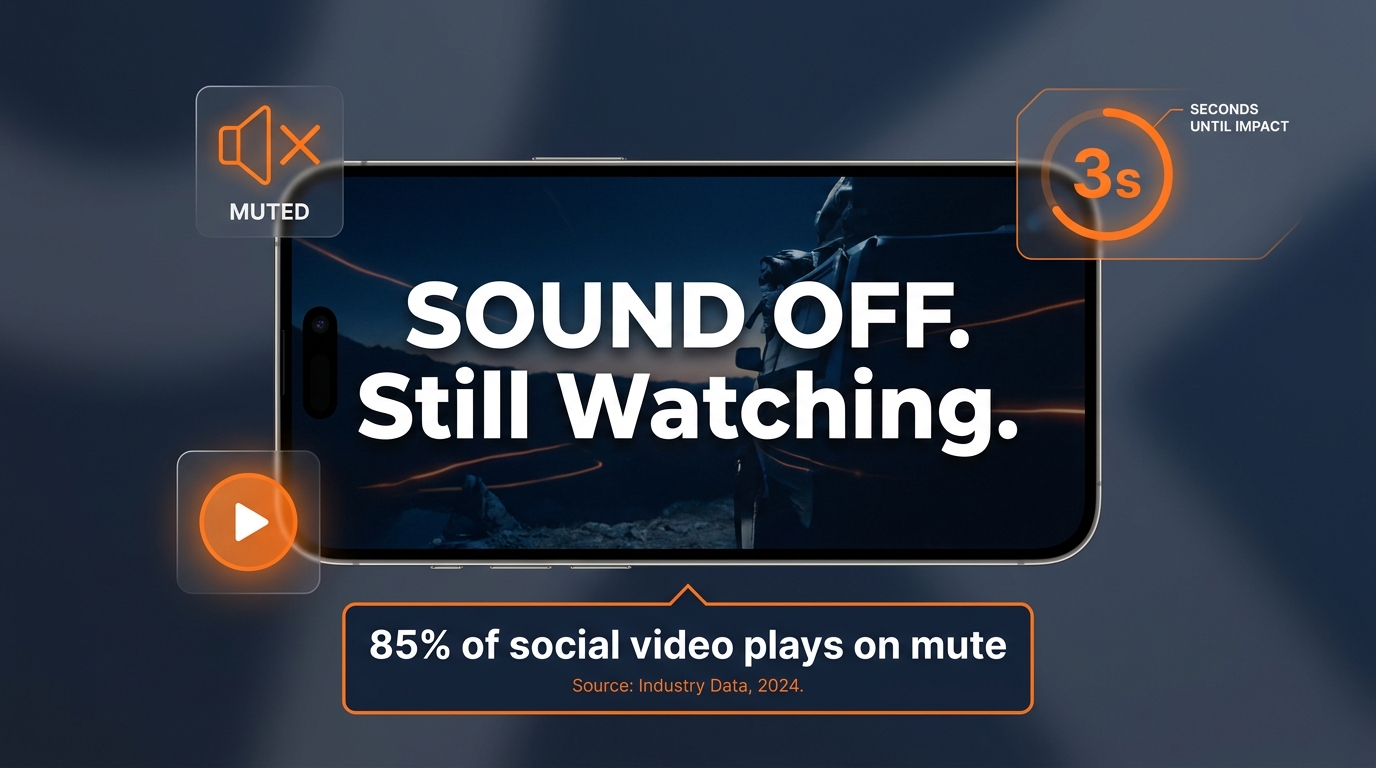
Here is the uncomfortable truth about your Sponsored Brands Video ads: the majority of shoppers who see them will never hear a single word you say. No voiceover. No product jingle. No carefully crafted audio cue. The sound is off, the scroll is on, and your ad has roughly three seconds to say something — visually — before the shopper moves on forever.
This is not a niche edge case. Across major social and shopping platforms, between 70% and 85% of video impressions begin autoplayed and muted. On Amazon specifically, Sponsored Brands Video (SBV) autoplays without sound by default; audio only kicks in if a shopper actively taps. Most never do. The format is, by design, a silent medium.
Yet most SBV creatives are still built the other way around. Teams spend budget on professional voiceovers, write scripts that depend on spoken narrative, and treat captions as an afterthought — a box to check for accessibility rather than the primary communication layer. The result is an ad that works fine in a quiet living room and is essentially invisible everywhere else.
This post is about fixing that at a systems level. Not just adding captions. Not just putting text on screen. Building an end-to-end production and testing framework — a hook library, a modular shoot structure, a variant testing protocol, and a feedback loop — that treats silence as the baseline condition your creative must survive before anything else.
The numbers make a compelling case for getting this right. SBV currently delivers a click-through rate of approximately 0.89%–1.0%, which is roughly 2.6 times higher than static Sponsored Brands headline ads. Conversion rates sit around 11%. Those are category-level averages, which means the gap between a well-built silent hook and a poorly built one is considerably wider than those benchmarks suggest. This post is about closing that gap systematically.
Why SBV Lives and Dies in the First 3 Seconds (and Sound Has Nothing to Do With It)
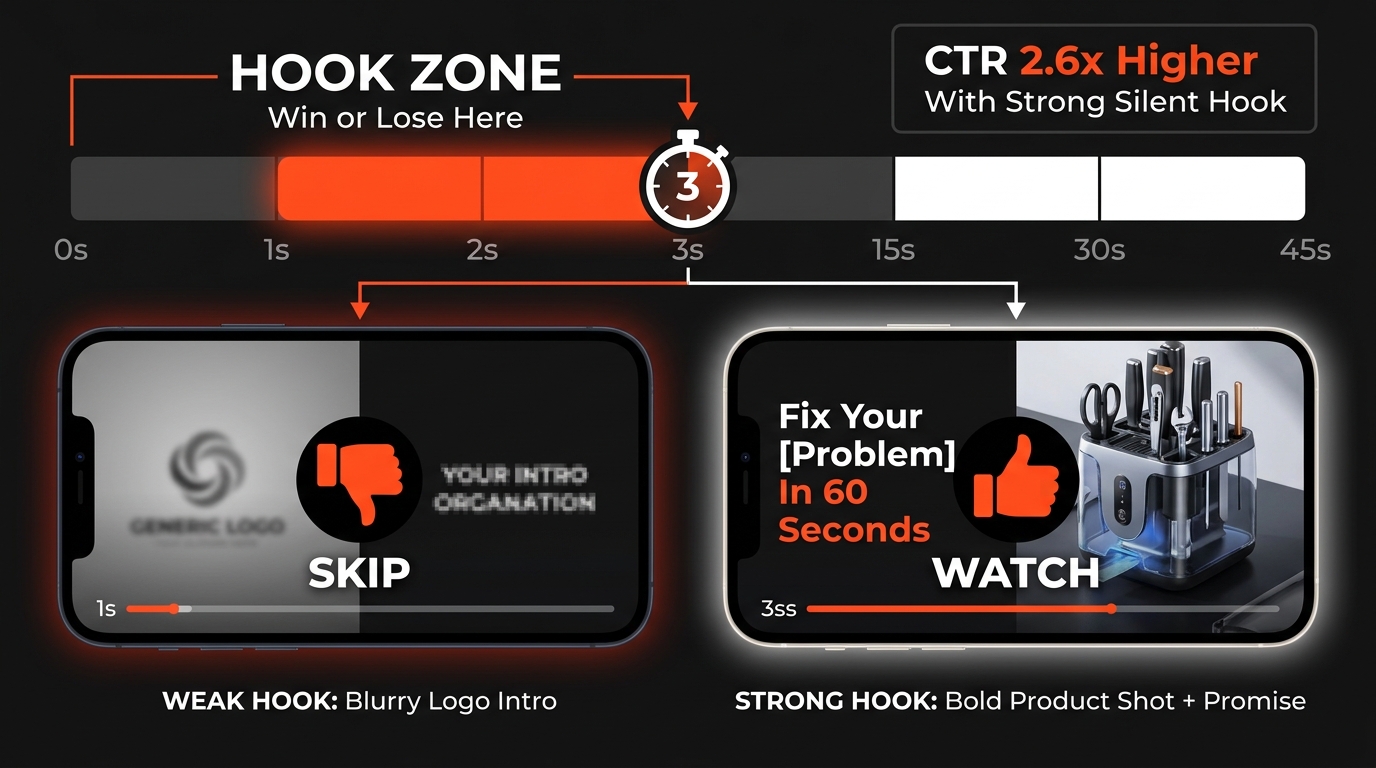
The three-second window is not a metaphor. It is a measurable, documented behavioral boundary that determines whether a video ad gets a click or disappears into the feed without a trace. Understanding exactly why that window exists — and what is happening inside it — is the foundation of building a reliable hook system.
The Cognitive Economics of Muted Autoplay
When a shopper is scrolling through Amazon search results or a social feed, they are operating in a high-decision-velocity environment. Every impression is evaluated in a fraction of a second. The brain’s first question is not “do I want this product?” It is a much simpler, more primitive question: “Is this worth a moment of my attention?”
Sound does not get to participate in that question. By the time the brain has processed the first frame visually and made a preliminary continue/scroll decision, the audio — even if it were playing — would not have had enough time to deliver a meaningful signal. The visual channel is simply faster. This is why the silent-first constraint is not a bug in SBV. It is a clarifying design brief: make the first frame carry the entire initial value proposition, because nothing else will.
The practical implication is that your opening frame is functioning more like a print ad than a video ad. It needs to communicate a clear benefit, show the right subject, and create a reason to keep watching — all before motion, music, or voice have contributed anything. Teams that internalize this distinction build fundamentally better hooks.
What the Data Says About the Drop-Off Curve
Video retention data consistently shows a steep drop-off in the first two to three seconds, followed by a much flatter curve for viewers who make it past that initial window. This pattern holds across SBV, TikTok, Reels, and YouTube Shorts. The implication is binary: either your hook is strong enough to clear the initial threshold, or the video’s quality beyond that point is irrelevant to most of your audience.
For SBV specifically, the 6-to-45-second allowed duration creates an interesting strategic tension. The format supports longer storytelling. But the vast majority of viewers will never experience the second half of even a 15-second ad unless the first three seconds earned their continued attention. Completion rates for well-optimized 15-to-30-second SBV creatives run around 60%, which sounds respectable until you factor in that the hook was the gatekeeper who let those viewers in.
The Sound-On Minority Is Not Your Primary Design Constraint
This is a point that needs to be stated plainly because it runs counter to how most video production teams are trained to think. Sound-on viewers are a minority, and they are not the constraint that determines your ad’s scalable performance. Design for the muted majority first. If your hook works silently, sound-on viewers get a bonus layer of information. If your hook only works with sound, you have already lost the majority of your impressions before a word is spoken.
This does not mean audio is unimportant — far from it. But in the hook-building context, audio is a reinforcement layer, not a primary communication channel. Build the visual and text layer to carry the full weight first, then layer audio on top to enhance the experience for those who choose to engage with it.
The Four Hook Archetypes That Drive SBV Performance
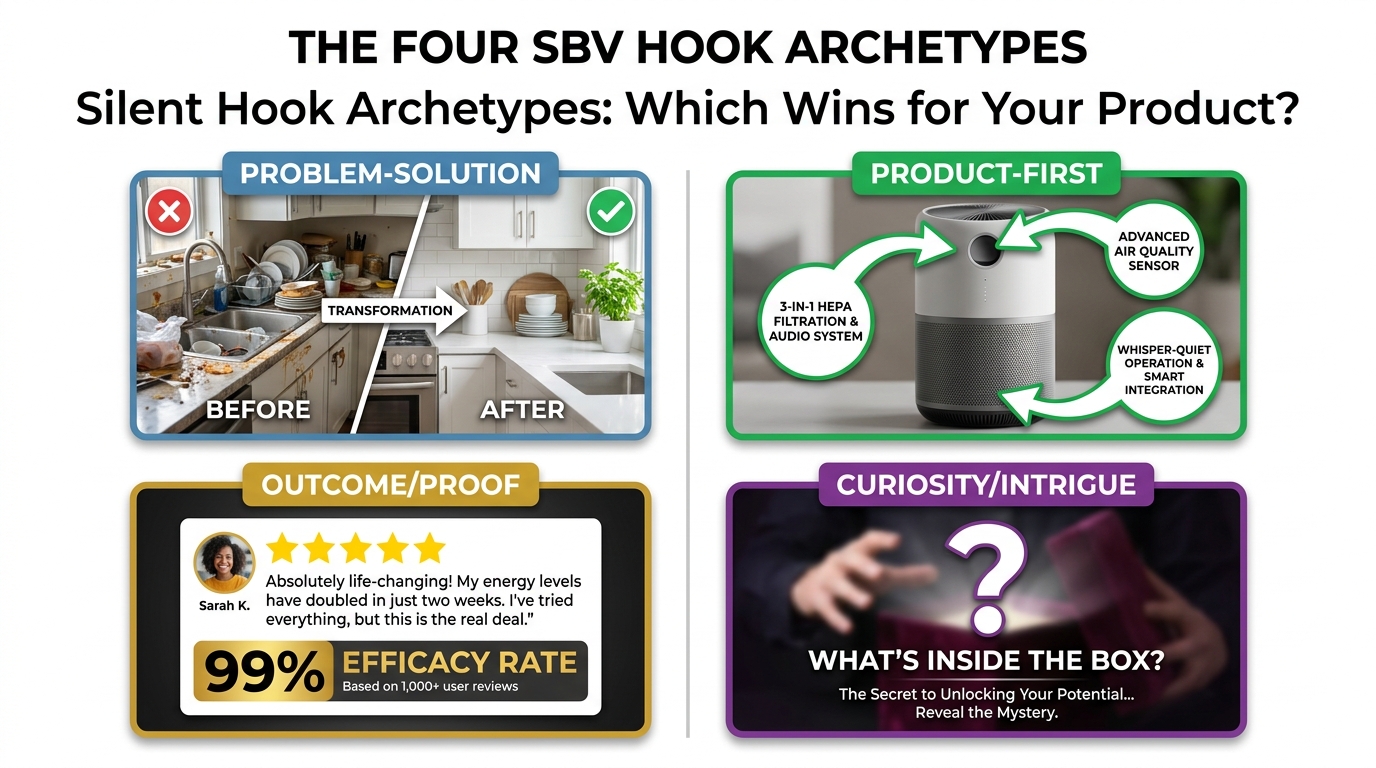
Not all hooks work the same way or for the same products. Before you can build a systematic hook library, you need to understand the structural vocabulary of hook types — what each one does mechanically, which product categories and buying stages they serve, and how they translate into a silent visual format.
There are four archetypes that dominate high-performing SBV creative, and the best hook libraries contain examples of all four.
Archetype 1: Problem-Solution
The problem-solution hook opens with the pain, not the product. Frame one names or visualizes a frustration that the target shopper actually experiences, then — within two to three seconds — positions the product as the resolution. The silent version of this typically works as a two-panel or before/after visual with a short text overlay naming the problem explicitly: “Cord tangling driving you insane?” or a visual of the problem state itself with zero text needed because the problem is instantly legible.
This archetype works especially well for products solving practical, familiar frustrations: kitchen organization, back pain, pet mess, sleep quality, time waste. The emotional recognition is instantaneous and requires no audio explanation. The viewer sees their own problem reflected back at them, which creates a micro-moment of identification that earns continued attention.
The critical execution risk with problem-solution hooks is dwelling too long on the problem. In a silent-first context, you have approximately one second to establish the problem before the viewer’s pattern recognition kicks in and they want to see the solution. Two seconds on the problem, one second on the resolution reveal — that is the cadence to aim for.
Archetype 2: Product-First
The product-first hook opens with the hero product in a visually strong, immediately recognizable shot — ideally in motion or showing its defining characteristic. There is no setup, no context-building, no narrative preamble. The product appears on screen within half a second, accompanied by a single bold text overlay naming the primary benefit or differentiator.
This archetype works best for products with strong visual identity — items where the product itself is the hook because it looks different from what the shopper expected to find. Premium kitchenware, distinctive gadgets, visually bold apparel, and unique packaging are natural fits. It also performs well in lower-funnel retargeting contexts where the shopper already knows the category and needs only to be reminded of this specific product’s standout quality.
The execution discipline required here is ruthless simplicity. One product, one dominant feature, one text claim, all delivered before the first second is complete. Any additional visual information in frame one competes with the primary message and weakens the hook.
Archetype 3: Outcome-Proof
The outcome-proof hook leads with a result, not a product feature. The opening frame shows a demonstrable outcome — a before/after transformation, a completed result, a testimonial screenshot with a specific data point — and the product is introduced as the mechanism that produced it. In the silent format, this typically manifests as a results visual (a clean organized space, a fitness transformation, a completed project) with a text overlay quantifying the outcome: “Assembled in 8 minutes flat” or “From zero to 4.8 stars in 60 days.”
This archetype is particularly effective for products where skepticism is a purchase barrier. When a shopper has been disappointed by similar products before, leading with the outcome bypasses their defensive filters more effectively than leading with the product or the problem. It answers the question “but does it actually work?” before the question is even formed.
Archetype 4: Curiosity-Intrigue
The curiosity hook opens with an incomplete visual or a text overlay that raises a question without immediately answering it. It leverages the brain’s natural discomfort with informational gaps — the Zeigarnik effect — to compel continued watching. “You’ve never seen a [product category] do this” or a close-up of an unusual product application where the product itself is not yet identifiable both create the kind of cognitive itch that keeps the scroll finger still.
This archetype requires the most careful execution in a silent context because it depends entirely on visual intrigue, not audio storytelling. The reveal must come within two to three seconds or the viewer disengages. It works best for genuinely novel products or for demonstrating unexpected product capabilities that the shopper would not anticipate from the category.
First-Frame Engineering: What Your Opening Shot Must Accomplish
If there is a single discipline that separates brands running mediocre SBV from those running high-performing SBV, it is first-frame engineering — the deliberate, systematic design of the opening shot as a standalone communication unit capable of doing its entire job in isolation.
The Five-Element Framework for Frame One
Every opening frame of a well-built silent-first hook needs to accomplish five things simultaneously. These are not sequential steps — they must all be present in a single frame:
1. Subject clarity. The viewer must immediately understand what they are looking at. Ambiguity in the subject kills hooks faster than almost any other error. If your product is in the frame, it must be identifiable. If the problem is in the frame, it must be recognizable. A blurry, tight, or confusingly composed opening shot fails this test even if the text overlay is perfect.
2. Motion or tension. A static frame is harder to hold attention on than one that contains motion or visual tension. Even a subtle move — a product rotating, a hand entering the frame, a reveal beginning — gives the visual cortex something to track and creates a forward-pulling momentum that earns the second second of watch time.
3. A dominant text element. In a silent context, text in frame one is not optional. It is the primary spoken voice of the ad. This element should be large enough to read at a glance on a mobile screen, short enough to process in under two seconds (five to seven words maximum for the primary hook), and positioned in a zone that does not get obscured by UI elements on the platform.
4. Contrast and legibility. Bold text on a low-contrast background is invisible to a scanning eye. The text layer in your hook needs to be designed for the worst-case viewing conditions: small screen, bright ambient light, sub-second attention. This typically means a semi-transparent dark background bar behind white text, or large enough type that it creates its own contrast against any background.
5. An implicit question. The strongest opening frames leave one thing unanswered — a visual thread that only continuing to watch will resolve. This creates the micro-commitment that converts passive scrollers into active viewers, even if only for five more seconds.
What to Eliminate From Frame One
Equally important is understanding what frame one must not contain. Brand logos in the opening frame have been consistently shown to reduce hook performance — they signal “advertisement” before a value proposition has been established, triggering the mental skip reflex. Save the logo for the end card. Similarly, text-heavy information dumps in the opening frame — three bullet points, a feature list, competing headlines — create cognitive overload that causes the viewer to make a negative decision simply because processing costs too much in a fast-scroll environment.
The opening frame is not a brochure. It is a door. Its only job is to get the viewer to step through it.
Building Your Text Overlay Layer: Rules, Hierarchy, and Rhythm
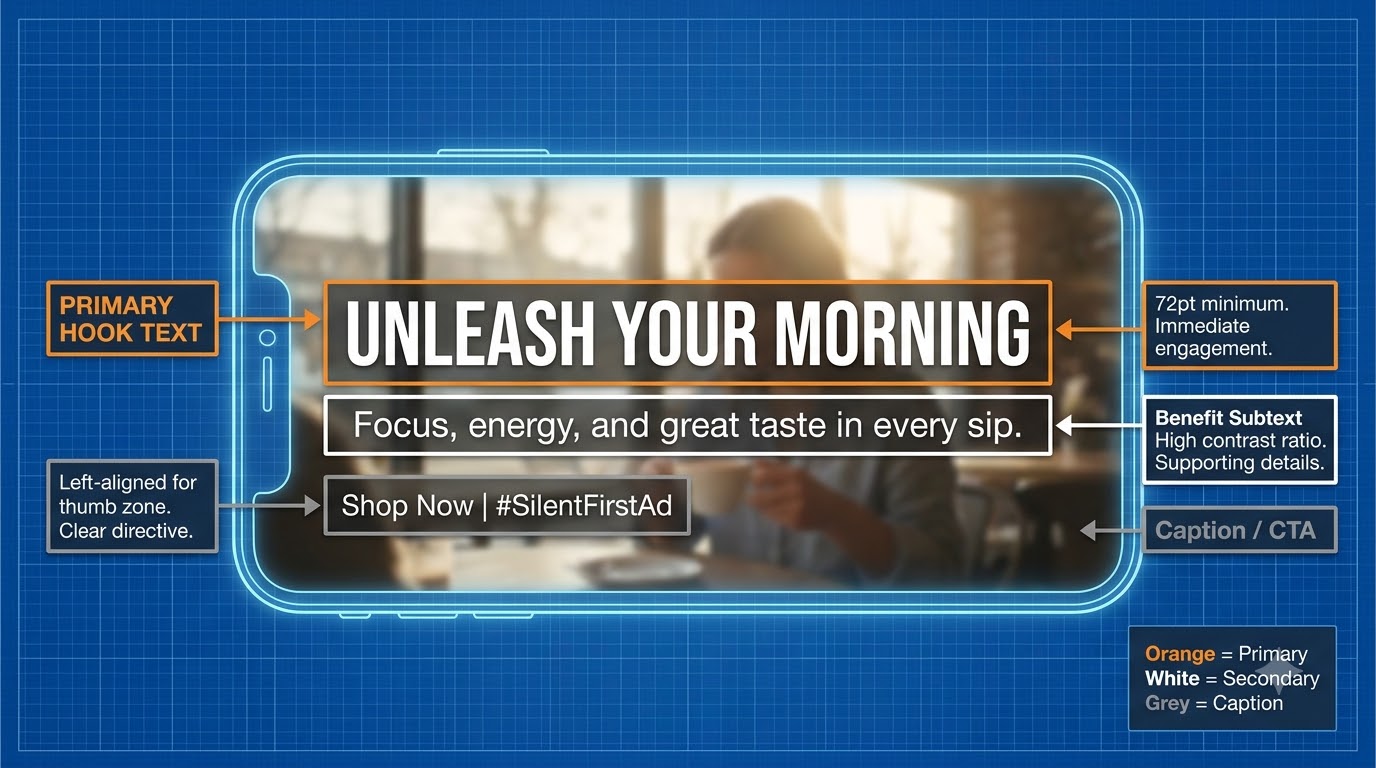
Text overlays in a silent-first video are not subtitles. They are not a transcript of the voiceover. They are an independent communication layer with its own hierarchy, pacing, and design logic — and treating them like subtitles is one of the most common and costly mistakes in SBV production.
The Three-Layer Text Architecture
Effective silent-first text overlay design uses a three-layer architecture that maps to the viewer’s cognitive journey through the ad:
Layer 1: The Hook Line (0–2 seconds). This is the largest, most prominent text in the video. It appears in frame one and its job is to stop the scroll. Five to seven words maximum. It communicates the primary hook — the problem, the claim, the question, or the differentiator. Typography should be bold, minimum 72pt equivalent at export resolution, and positioned in the upper or center zone of the frame.
Layer 2: The Benefit Statement (2–8 seconds). This layer expands on the hook line with a secondary piece of information — typically a specific benefit, a product name, or a key differentiating detail. It appears after the hook line has had a moment to land, and it is smaller than Layer 1 but still clearly readable on mobile. Think of this as the body copy in a print ad: it exists for the viewer who engaged with the headline and wants to know more.
Layer 3: Caption Track (throughout). Auto-captions or burned-in captions that transcribe spoken audio are essential for accessibility and for the subset of viewers who want full context without turning on sound. These should be styled to match the ad’s visual tone — not the default auto-caption box, which is often visually jarring — and positioned at the lower third in a way that does not overlap with the product or the first two layers.
Text Pacing and On-Screen Timing
One of the least-discussed variables in silent video hook design is the timing of text appearance. Text that appears and disappears too fast creates anxiety and prevents reading. Text that stays on screen too long becomes background noise and loses emphasis. The working rule is: if a viewer at average reading speed cannot comfortably read the text twice during the time it is on screen, the timing is too fast. For a five-word hook line, that means a minimum of 1.5 to 2 seconds on screen.
There is also a pacing rhythm to consider across the full 15-to-20-second SBV window. Text that appears at regular intervals — roughly every three to four seconds — maintains reading engagement throughout the ad. Extended visual segments with no text in a muted context create dead zones where viewers who entered silently have nothing to parse.
Typography and Font Choices
For SBV and short-form video, sans-serif fonts with high stroke contrast — bold weights of geometric typefaces — read fastest and clearest on mobile screens at the small sizes at which these ads are typically viewed. Decorative fonts, thin weights, and all-italic text all reduce legibility under scrolling conditions. If your brand font does not meet these criteria for the hook layer, use it only for the end card branding and choose a legible system font for the primary text overlays.
The Hook Library: Treating Creative as an Asset, Not a One-Off
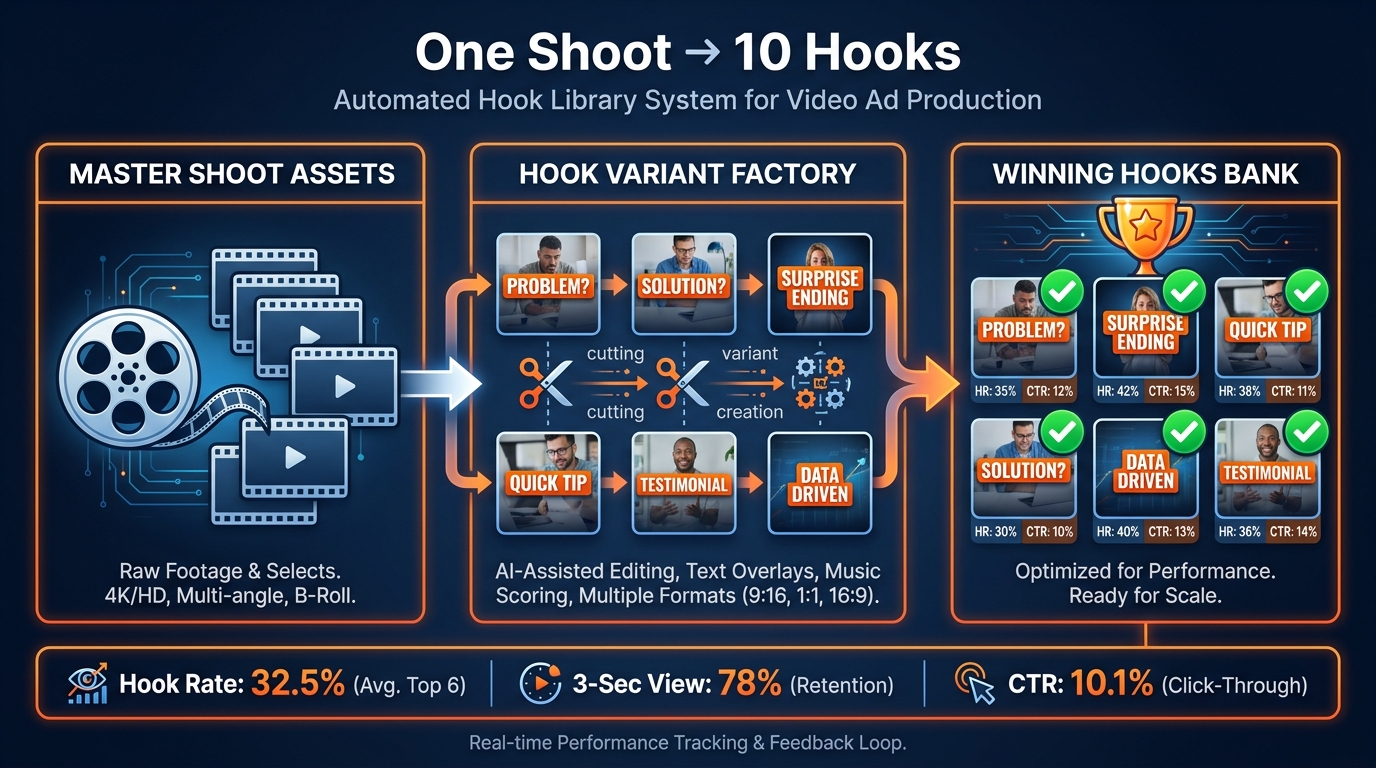
Most brands approach SBV as a project: a one-time creative effort that produces a video, runs until performance degrades, and then requires a new project to replace it. This project mindset is the structural reason most SBV underperforms. High-performing advertisers treat SBV as a system: a continuously evolving library of tested, categorized hook assets that can be recombined, updated, and replaced without starting from scratch.
What a Hook Library Actually Contains
A mature hook library is not just a folder of video files. It is a structured asset database with each hook catalogued by archetype, product category, target audience segment, test status, and performance data. At minimum, each entry should include:
- The hook clip (the first 3–5 seconds of the video, as a standalone file)
- The hook type (problem-solution, product-first, outcome-proof, curiosity-intrigue)
- The primary text overlay copy (the exact words on screen)
- The body content it was paired with (so you can distinguish hook performance from body performance)
- Test date and campaign context
- Performance data: hook rate, 3-second view rate, CTR, CVR
- Status: untested, in test, winner, retired
This structure allows your team to answer questions that a folder of videos cannot: “Which hook archetype performs best for this product category?” “Which text overlay formulas have we never tried?” “What does our fastest-growing segment respond to that our main audience doesn’t?”
The Modular Hook Architecture
The production efficiency of a hook library depends on building hooks as modular, interchangeable components. The standard approach is to create a single strong “body” for each SBV campaign — the product demonstration, benefit explanation, and CTA that form the core of the ad — and then produce multiple hook variants that can be swapped onto the front of that body without re-editing the rest of the ad.
This modular structure means that a single two-hour shoot can produce enough raw material to build 8–12 distinct hook variants, each testing a different archetype, text overlay, or opening visual. The edit time per variant drops significantly because only the first three to five seconds changes between versions. Testing becomes faster. Iteration cycles compress from weeks to days.
Seeding the Library: How Many Hooks to Start With
For a new product or campaign, the minimum viable hook library for meaningful testing is three variants representing at least two different archetypes. With fewer than three variants, you do not have enough data range to draw conclusions about which direction to invest in further. With more than six variants live simultaneously, most teams do not have the budget distribution to reach statistical significance on individual variants quickly enough to act on the data.
The practical starting point is four hooks: two problem-solution variants with different opening visuals, one product-first variant, and one outcome-proof variant. Let them run for a minimum of seven to ten days before drawing conclusions. The winners from that initial test become the seeds of your next production batch.
Production Ops for Silent-First Video: A Practical Workflow
The gap between understanding silent-first principles and consistently producing creatives that apply them is almost always an operational gap, not a knowledge gap. Teams know what good looks like. The friction is in translating that knowledge into a repeatable production workflow that does not depend on remembering to do things differently each time.
The Pre-Production Brief Template
Every SBV shoot should begin with a pre-production brief that includes a silent-first design section as a mandatory component. This section should specify:
- The planned opening frame: what is visible, what motion occurs, and the exact text overlay copy for Layer 1
- Hook archetype for each planned variant
- Product visibility timing: at what second the hero product is first clearly visible
- Text overlay timing plan: when each text layer appears and disappears
- Sound-off watchability score: a mandatory pre-shoot question — “If we mute this ad completely, does the core benefit story still land?”
Making this section mandatory in the brief — not optional or aspirational — is the operational intervention that changes production behavior. It forces the creative team to solve the silent-first problem before the camera rolls, rather than trying to fix it in post.
Shoot Day: Capturing Hook-Specific Raw Material
A silent-first shoot requires specific raw material that a standard product video shoot does not prioritize. Beyond the standard product beauty shots and demonstrations, the hook-optimized shoot list should include:
Problem visualization shots — visual representations of the problem the product solves, without the product present. These are often neglected on standard shoots but are essential for problem-solution hooks.
Extreme close-ups of defining product features — the detail that makes this product visually distinctive. These fuel product-first hooks and curiosity-intrigue hooks.
Result/outcome shots — the after state, the completed result, the transformed environment. These power outcome-proof hooks and are frequently left off shoot lists because they require imagining the ad structure in advance.
Multiple opening motion options — at least three different ways to begin the video, captured as separate takes. This gives the editor genuine options when building hook variants rather than forcing a single direction.
Post-Production: The Hook-First Edit Review
In most video production workflows, the edit review process evaluates the complete ad from beginning to end. The hook-first workflow adds a mandatory first review step: watch only the first three seconds of each variant, with sound muted, and evaluate whether the hook communicates value independently. If it does not pass this three-second muted test, the edit goes back before the full review is completed.
This sounds simple. In practice, it requires deliberately breaking the habitual video review process, which naturally tends toward watching the full ad and then evaluating the opening in the context of the whole. The hook-first review inverts this — the opening is evaluated in isolation because that is how shoppers experience it.
A/B Testing Hooks at Scale: The Metrics That Actually Matter
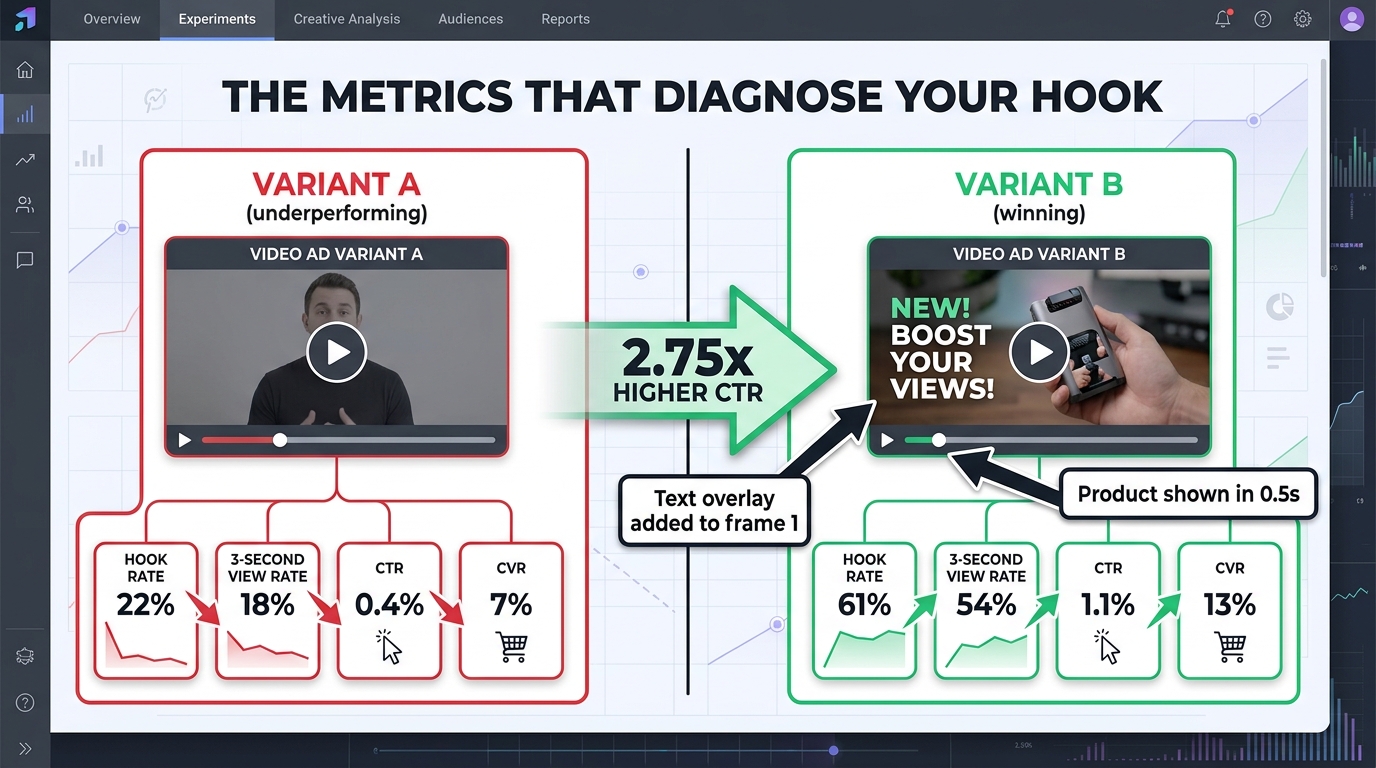
Testing hooks without a clear measurement framework produces data that looks comprehensive but cannot actually tell you what to do next. The key is identifying which metrics measure hook performance specifically — as distinct from body content performance, product-market fit, or pricing — and building your test structure around those metrics.
The Metrics Hierarchy for Silent Hook Testing
Hook Rate (primary hook metric). Hook rate measures the percentage of people who watched past the first two to three seconds out of those who had the video in view. This is the most direct measure of hook effectiveness because it captures the binary continue/scroll decision. A hook rate above 50% is generally considered strong for SBV. Below 30% is a signal to change the hook before drawing conclusions from any other metric.
3-Second View Rate (platform hook metric). On Amazon and most social platforms, a “view” is counted at three seconds. The three-second view rate — views divided by impressions — is the platform’s own hook quality signal. It also determines how your ad gets distributed algorithmically on platforms that use engagement signals for pacing. Low three-second view rates mean you are effectively paying for impressions that never register as views.
CTR (post-hook engagement metric). Click-through rate measures what happens after the hook has done its job. It reflects the quality of the full ad experience, not just the hook, which means CTR alone cannot diagnose a hook problem. A low CTR with a high hook rate means the problem is in the body or the CTA, not the hook. A low CTR with a low hook rate means you have not yet solved the opening.
CVR (conversion metric). Conversion rate — the percentage of clicks that result in a purchase — is largely determined by factors outside the ad itself: product-market fit, pricing, listing quality, reviews. Include it in your testing dashboard but do not use it as the primary metric for hook evaluation. Hook changes rarely move conversion rate significantly. They move CTR volume, which moves total conversions.
Test Structure: Isolating the Hook Variable
The cardinal rule of hook testing is to change only the hook and keep everything else constant. Same body content, same CTA, same targeting, same budget allocation. This sounds obvious, but it breaks down frequently in practice when teams want to also test a new lifestyle shot or a different offer in the same test round. Resist the temptation. When multiple variables change simultaneously, you cannot attribute performance differences to the hook specifically.
The recommended test structure for a new product SBV campaign is:
- Set a minimum impression threshold before making decisions — typically 10,000–15,000 impressions per variant at minimum, to avoid drawing conclusions from statistically thin data.
- Run variants with equal budget allocation for the first seven to ten days.
- After the threshold is reached, pause the bottom 50% of variants by hook rate.
- Increase budget on the top performers and introduce one new hook variant to replace each paused variant.
- Repeat the cycle every two to three weeks.
This iterative cycle — test, measure by hook rate, rotate out losers, introduce new challengers — is the engine that drives continuous hook library improvement. Teams that run one round of testing and declare a winner are leaving significant optimization on the table.
Reading Failure Signals
Hook data tells specific, actionable stories when you know how to read it. Low hook rate combined with normal impressions means the opening frame is failing — the subject, motion, or text is not stopping the scroll. High hook rate combined with low CTR means the hook is interesting but the product promise is not compelling enough to drive a click. High CTR combined with low CVR points to a listing problem, not a creative problem. Mapping these signal patterns to their root causes is what allows teams to make precise interventions rather than rebuilding everything when performance dips.
Platform-Specific Adaptations: Amazon SBV vs. Reels vs. TikTok
The silent-first principle applies across platforms, but the execution details differ meaningfully by platform context. A hook that works on Amazon SBV does not automatically transfer to TikTok Reels without adaptation, and understanding the behavioral and technical differences between platforms is essential for teams running multi-platform video creative.
Amazon SBV: The Shopping-Intent Context
Amazon SBV appears on search results pages and product detail pages — environments where the shopper already has purchase intent. They searched for something. They are actively evaluating options. This changes the hook calculus significantly compared to social platforms.
On Amazon, the hook does not need to create desire from scratch. It needs to differentiate from the other results on the page and answer the question “why this one over the alternatives?” The most effective SBV hooks in a shopping-intent context are therefore product-first and outcome-proof hooks that speak directly to the decision being made, not curiosity-intrigue hooks that try to manufacture interest in an unfamiliar product.
Amazon’s technical specs add additional constraints: SBV must be 6–45 seconds, with specific aspect ratio and file format requirements. The ad also runs in a placement that is often partially visible before being scrolled into view, which makes the very first frame — the thumbnail frame — critical. Many teams overlook the thumbnail as a hook element, treating it as a default first frame rather than a deliberately designed entry point.
Instagram Reels and TikTok: The Discovery Context
On social discovery platforms, the viewer has no declared purchase intent. The hook has a harder job: it must first earn attention in a competitive feed, then create product awareness, and only then guide toward intent. This shifts the optimal hook archetype away from product-first toward problem-solution and curiosity-intrigue — approaches that engage the viewer emotionally or intellectually before asking them to care about a specific product.
The text overlay conventions also differ. On TikTok, large full-screen text overlays in the style of native TikTok content — bold, centered, with the TikTok aesthetic — dramatically outperform text styles that read as clearly branded advertising. Matching the platform’s native visual language in the silent text layer reduces the “ad detection” response that causes viewers to disengage before evaluating the content.
YouTube Shorts: The Middle Ground
YouTube Shorts occupies a behavioral middle ground — some viewers are in discovery mode, others are in search-and-evaluate mode. For SBV-style creatives repurposed to Shorts, a hybrid approach tends to work best: open with the problem or intrigue (discovery mode) and transition quickly to the product and outcome (evaluation mode) within the first three to five seconds.
YouTube Shorts also allows for slightly longer text overlays to remain on screen, because the viewing context is somewhat more patient than TikTok’s fast-scroll environment. This gives slightly more room for the benefit statement layer to communicate before disappearing.
Common Silent Hook Failures (and How to Diagnose Them Fast)
Understanding what failure looks like in silent-first hooks is just as valuable as understanding what success looks like. Most hook failures fall into one of five recognizable patterns, and each pattern points to a specific fix rather than requiring a complete creative rebuild.
Failure Pattern 1: The Logo-First Trap
Opening with a brand logo or title card is the most common SBV hook failure pattern, and it is persistent because it feels professional and brand-safe. The logic seems reasonable: establish the brand, then make the pitch. The data consistently shows the opposite result. Logo-first opens signal “advertisement” to the viewer’s pattern-recognition system before any value has been established, triggering the mental skip reflex even in viewers who cannot articulate why they disengaged.
Fix: Move the brand element to the end card. Open with the product, the problem, or the outcome. Earn the brand impression by delivering value first.
Failure Pattern 2: Text That Cannot Be Read
Small text, low-contrast text, decorative fonts, text placed in the lower third where it competes with platform UI, and text that appears and disappears too quickly are all common variations of this failure. In a silent context where text is the primary communication channel, illegible text is equivalent to muted audio — the message simply does not land.
Fix: QA every SBV creative on an actual mobile device at arm’s length, in normal ambient lighting. If you cannot read the hook text in under one second without squinting, it is too small, too light, or too brief on screen.
Failure Pattern 3: The Late Product Reveal
Some SBV creatives open with atmospheric B-roll, lifestyle footage, or contextual scenes before showing the product. This is a narrative storytelling convention borrowed from longer-form video content. In a three-second decision window, it is a fatal pacing error. If the viewer cannot identify what is being advertised within the first two seconds, they have no reason to continue watching.
Fix: The product — or the clearly recognizable problem the product solves — must be visible or directly implied by frame one. Context can follow. Establishment cannot precede the core communication.
Failure Pattern 4: The Generic Benefit Statement
Text overlays that say “High Quality” or “The Best [Category] You’ll Find” or “Perfect for Any Occasion” are functionally invisible. They communicate nothing that distinguishes the product and they do not create any reason to continue watching. In a silent context where text is the only voice, generic benefit language is worse than no text — it actively undermines credibility.
Fix: Replace generic benefit statements with specific, concrete claims: “Charges 3 devices simultaneously,” “Fits under a standard door — no gap tape needed,” “Rated #1 by independent lab testing.” Specific claims pass the silent hook test; generic claims do not.
Failure Pattern 5: The Sound-Dependent Payoff
This failure is less visible but highly damaging: ads where the emotional or informational payoff of the hook is delivered through audio — a punchline, a surprising stat, a compelling endorsement — that muted viewers will never receive. The visual portion of the hook creates curiosity, but the resolution of that curiosity requires sound. This structure punishes the 70–85% majority of muted viewers by leaving their cognitive loop open.
Fix: Map the full emotional and informational arc of the hook in text and visual form before adding audio. Every payoff, every resolution, every key claim should be readable and viewable. Audio then amplifies an already complete experience.
From One Master Shoot to Ten Hook Variants: A Step-by-Step System
The practical question most teams face when adopting a hook library approach is: how do we actually produce this volume of variants without proportionally increasing production costs? The answer is a structured extraction workflow that turns a single well-planned master shoot into a full library of testable hooks.
Step 1: The Hook-First Shoot Planning Session
Before any production planning begins, convene a one-hour hook planning session. The output of this session is a hook matrix: a grid with hook archetypes across the top (problem-solution, product-first, outcome-proof, curiosity-intrigue) and hook variants down the side (variant A, B, C, D for each archetype). For each cell in the matrix, the team agrees on the opening visual and the Layer 1 text overlay copy.
This session should produce a list of 10–15 planned hook variants, each specified precisely enough that the videographer knows exactly what raw material needs to be captured to make each one possible. Many teams skip this step and plan the shoot around the product narrative, then attempt to extract hooks in post. The extraction is always more constrained and less varied than hooks planned at the source.
Step 2: The Double-Shoot Protocol
For each scene in the standard product shoot, capture a second take specifically designed for the hook version. The hook take is typically a tighter framing, earlier motion start, or more exaggerated visual that creates the stop-scroll impact the full-ad version does not need. This double-take protocol adds approximately 20–30% to shoot time but produces raw material that cannot be created any other way in post-production.
Step 3: The Modular Edit Structure
Build the master edit as three distinct, exportable components: the hook segment (0–4 seconds), the body segment (4–12 seconds), and the end card (12–20 seconds). Structure the project file so that any hook segment can be swapped onto the front of the body/end card combination and exported as a complete ad without restructuring the timeline. This modular architecture makes producing variant ten as fast as producing variant two, rather than requiring an increasingly complex edit with each new variant.
Step 4: Text Overlay Variations Without Re-Shooting
One of the fastest ways to expand hook variant count without additional shooting is to create multiple text overlay versions of the same opening visual. The same three-second product-first clip can support three distinct hook lines: a problem-oriented overlay (“Still dealing with [pain point]?”), a benefit-oriented overlay (“Charges in 45 minutes flat”), and a curiosity-oriented overlay (“Engineers called this impossible”). These three versions test fundamentally different hook strategies using the same visual raw material, at near-zero marginal production cost.
Step 5: The Weekly Hook Review Cadence
The system only functions as a system if there is a regular cadence for reviewing hook performance data and making production decisions. A weekly thirty-minute hook review meeting — attended by whoever manages campaigns, whoever manages creative, and whoever manages production scheduling — is the minimum viable cadence for keeping the hook library current. The agenda is simple: review hook rate and three-second view rate for all live variants, pause underperformers, identify what new variants to introduce, and confirm production timeline for the next batch.
Teams that run this cadence consistently build compounding advantages. Each iteration cycle produces a slightly better average hook rate, because losing hooks are replaced by new challengers informed by what the data revealed about what works. After three to six months of consistent iteration, the performance gap between these teams and teams running static SBV creative becomes very difficult to close.
Conclusion: The Silent Majority Is Your Most Important Audience
The central shift that silent-first thinking requires is not technical — it is strategic. It asks teams to stop designing for the ideal viewing condition (headphones in, full attention, quiet room) and start designing for the modal viewing condition (muted, distracted, three seconds of patience). Most shoppers experiencing your SBV creative live in the modal condition, not the ideal one. Building for them is not lowering your standards. It is accepting reality and designing to meet it.
The four archetypes give your hook library its vocabulary. First-frame engineering gives each hook its structure. The text overlay layer gives it its voice when audio is not available. The modular production workflow makes the system affordable to run at volume. The A/B testing framework tells you which direction to go next. And the weekly cadence keeps it all moving.
None of these pieces is individually novel. The discipline is in connecting them into a functioning system rather than treating each element as a separate creative decision. When they work together, SBV stops being a format you occasionally publish content in and starts being a measurable, iterative performance channel.
Actionable Takeaways:
- Audit your existing SBV creative: mute every ad and watch only the first three seconds. If the core value proposition does not land, it needs a hook rebuild before any other optimization.
- Build your first hook matrix before the next shoot. Specify at least four hook variants across two archetypes before the camera rolls.
- Add hook rate and three-second view rate to your SBV reporting dashboard as primary metrics, above CTR.
- Structure your project files modularly — hook segment, body, end card — so variant production is a minutes-long task, not a days-long edit.
- Run a minimum weekly review of hook performance data and make rotation decisions based on those metrics, not on how long the ad has been live.
- Test text overlay copy variations against the same visual hook before spending on additional raw production — many meaningful lifts are available without a single new shoot day.
The majority of shoppers watching your ads right now are doing so in silence. The ones who stay are the ones you reached through what they could see. Building a system to reach more of them — systematically, testably, repeatably — is one of the highest-leverage investments available to SBV advertisers in 2026.