Tag: Video Ad Creative

  • What Shoppers Actually See in a Sponsored Brands Video (And Why Most Brands Edit for the Wrong Viewer)

    What Shoppers Actually See in a Sponsored Brands Video (And Why Most Brands Edit for the Wrong Viewer)

    Most Amazon Sponsored Brands video ads are made for a viewer who doesn’t exist.

    That imagined viewer sits through the whole clip with the sound on, sees the brand intro, follows the story, and clicks at the end. The person actually in front of your ad is scrolling a search results page on a phone. They’re looking for something specific. Your video starts playing only once half of it is on screen, and it plays without sound unless they tap a small button in the corner.

    That gap explains a lot of Sponsored Brands video (SBV) campaigns that look fine in the editing suite and do poorly in the account. The creative is good, but it was built for a TV-style viewer. Amazon’s own ad specs describe a very different setting: autoplay that kicks in at 50% pixel visibility, audio off by default, a mute toggle sitting on the lower-right corner, and a strict 16:9 frame with no letterboxing allowed.

    This article doesn’t go over the usual “why video matters” points. It starts from the ad unit itself, using Amazon’s published specs, and works backward to creative, landing page choice, targeting, measurement, and testing. The idea is simple. If you understand exactly what the shopper sees, in what order, and under what conditions, most creative decisions stop being matters of taste and become engineering problems.

    Each section covers one constraint of the ad unit and what it means for the decisions you make. There’s a checklist at the end you can use before your next upload.
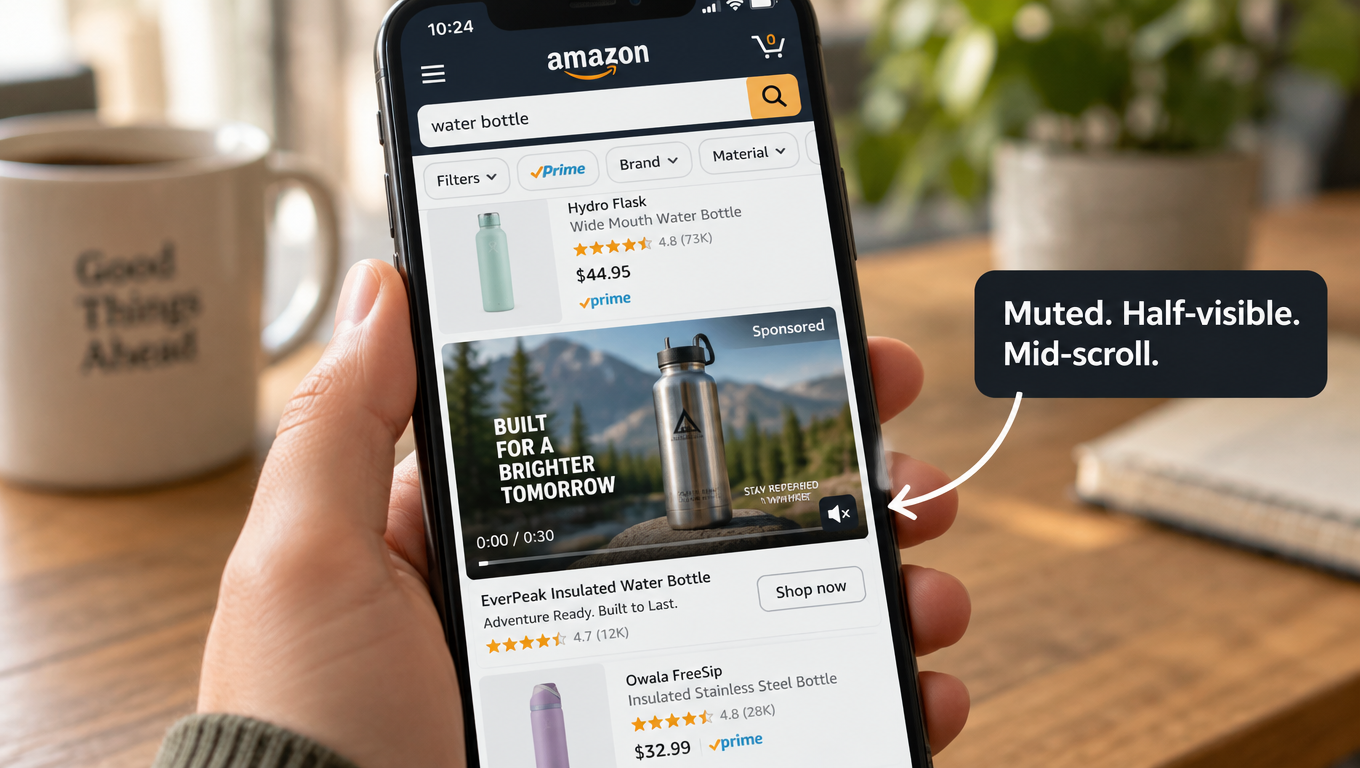
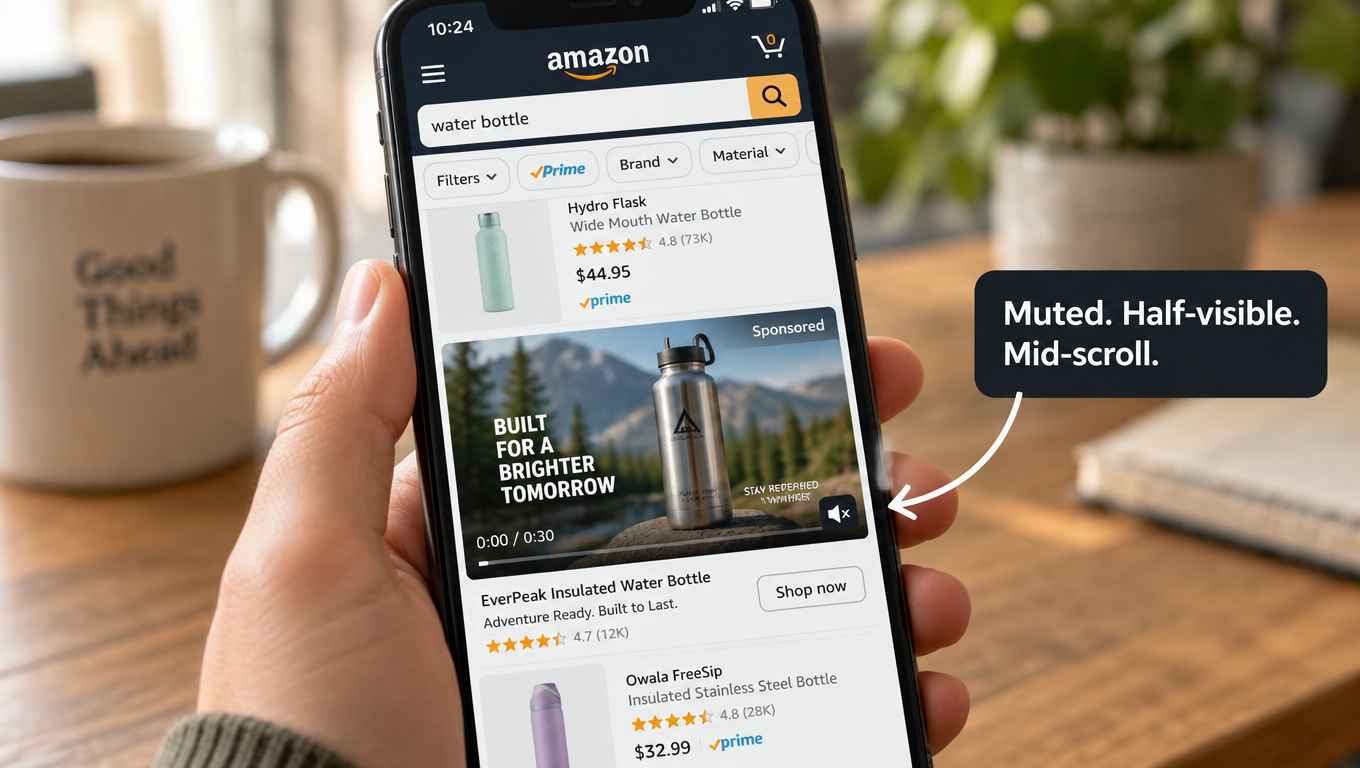
    Smartphone showing an Amazon mobile search page mid-scroll with a muted Sponsored Brands video ad autoplaying

    1. The Viewer You’re Really Editing For

    Before talking about specs, it helps to describe the viewing situation honestly. Sponsored Brands video ads show up in shopping results on desktop and mobile. Amazon’s ad specs say they can also appear inside product detail pages. In both places the shopper came to buy something, not to watch something.

    The shopper is task-focused

    Someone who searches “insulated water bottle 32 oz” has already decided on a category and is narrowing down options. Your video is competing with product titles, star ratings, prices, Prime badges, and the organic results under it. It isn’t competing with other entertainment.

    That’s a different mindset from social video. On a social feed, people are open to being distracted. On Amazon search, a distraction only works if it answers the shopper’s question faster than the listings around it.

    The shopper is moving

    Search results are scrolled. Your video may get a second or two of partial visibility before the thumb moves on. Each frame in those first seconds has to make sense when viewed alone.

    The shopper is probably silent

    Amazon’s specs say plainly that “by default, videos always start without audio.” The shopper has to tap the mute toggle to hear anything. Some will, most likely after something on screen has already caught their attention. So sound can add to a video that already works, but it can’t carry the message.

    What this means in practice

    Put together, these three conditions describe the real viewer: task-focused, moving, and silent. Each creative choice later in this article can be checked against that description. A slow brand intro fails for the task-focused shopper. A detail that only shows up in the last frame fails for the moving one. A voiceover that carries the main benefit fails for the silent one.

    Amazon’s guidance points the same way. Its creative best practices tell advertisers to “showcase your product or something interesting within the first few seconds” and to “wait until later in the video to include your brand name and logo.” Brand-first is the habit from TV advertising, and Amazon is explicitly recommending the reverse.

    2. Anatomy of the Ad Unit: The Video Is Only One of Six Parts

    A common mistake is to treat SBV as “a video.” Amazon’s spec sheet breaks the ad unit into six components, and the video is just one of them. Knowing what the other five do shows you what the video doesn’t need to do.
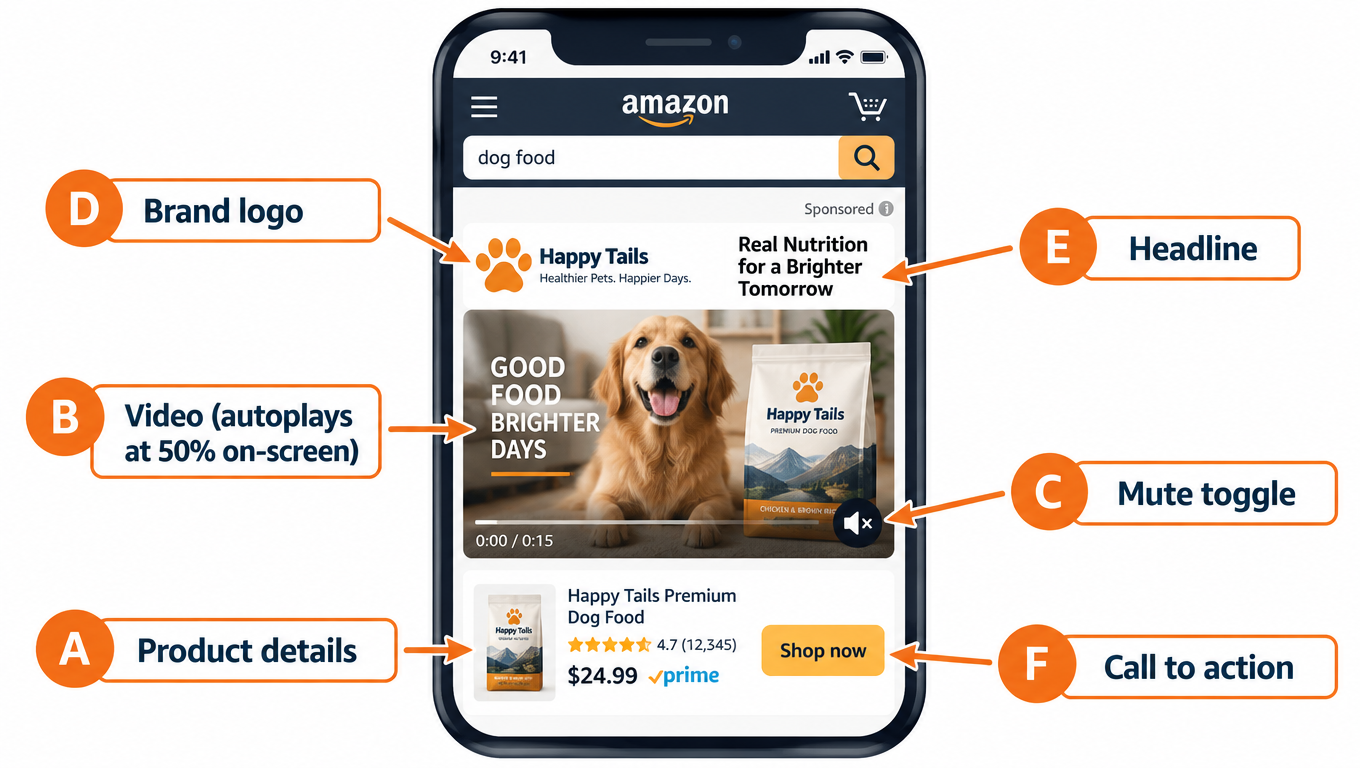
    Labeled diagram of the six components of an Amazon Sponsored Brands video ad unit

    The six components

    1. Product details. The main product image and related information from the detail page are pulled in automatically.
    2. Video. It plays automatically once 50% of its pixels are on screen.
    3. Mute toggle. It sits over the lower-right corner of the video. It isn’t shown if the video has no audio.
    4. Custom brand logo. Amazon describes it as something that “makes a lasting impression.”
    5. Headline text. Custom copy that states your brand’s value.
    6. Call to action. It tells shoppers that an action is needed to reach the destination, such as your Brand Store.

    Stop making the video repeat the rest of the unit

    Product details like the image, price context, and rating signals come from the listing automatically. That means your video doesn’t have to show the price or list specs the shopper can already see beside it. The logo and headline are separate elements too, so the video doesn’t need a long branded opening to establish who you are.

    This changes how you allocate the video’s time. If the surrounding unit already handles identity and the basic facts, the video’s job gets narrower: show the one thing still images and text can’t show. That’s usually motion, scale, texture, a before-and-after change, or the product working in a real setting.

    Write the headline and video together

    Because the headline and video appear side by side, they should work as a pair. If the headline says “Keeps drinks cold for 24 hours,” the video’s opening frames shouldn’t make a different claim. They should show evidence for that one: ice still in the bottle, condensation-free steel, a time-lapse overlay. When they match, the shopper reads and watches one argument, not two competing ones.

    One practical habit is to write the headline first and then storyboard the video as visual proof of it. This also makes testing cleaner, which comes up again in Section 9.

    The CTA depends on the destination

    The call to action leads somewhere, and Amazon offers two kinds of destination for SBV: a Product Detail Page or a Brand Store. That choice matters enough that Section 6 covers it on its own. For now, the point is that the ad unit is a small system, and the video is the part that moves inside it.

    3. The 50% Rule: How Autoplay Turns Your First Seconds Into the Whole Ad

    Amazon’s specs state that the video “will play automatically when 50% of pixels are on-screen.” That one sentence has more effect on creative strategy than anything else on the spec sheet.

    What the trigger means

    Playback doesn’t start when the page loads. It starts when the ad scrolls far enough into view. On mobile, the shopper’s thumb is usually still moving at that point. The first frames play while the ad is sliding into place and often while it’s only partly visible.

    In practice, your first second plays to someone who isn’t fully looking yet. Your next second or two decides whether they stop scrolling. If the opening is a fade-in from black, a logo animation, or a slow establishing shot, it’s spent on a viewer who isn’t paying attention yet.

    Open on the product doing something

    The opening that holds up best under these conditions is the product, already in motion, already doing its job. A few examples:

    • A vacuum already picking up a visible line of debris, not a vacuum sitting in a hallway.
    • A skincare serum already being dropped onto skin, not a bottle on a marble counter.
    • A phone mount already holding a phone steady over a bumpy road, not a mount in its packaging.
    • A storage bin already being stacked into a tidy closet, not an empty bin turning on a white background.

    In each case, a viewer who only catches a fraction of a second still learns what the product does. That’s the test to use: pause the video at any point in the first two seconds and ask whether a stranger could tell what’s being sold and why.

    Front-load visual contrast

    Search results are visually busy, with white backgrounds, product cutouts, and rows of text. Opening frames that differ from that environment, through color, real-world settings, close-up texture, or people, have a better chance of being noticed than frames that look like another product image.

    Don’t swing too far and make the opening so abstract or stylized that the product disappears. Contrast is there to get attention for the product, not to replace it.

    Use loops carefully

    Some advertisers design SBV to loop cleanly so the last frame flows back into the first. That can work for short, product-focused clips. The more important question is whether the video still works when someone joins it partway through. Viewers who scroll past and come back may catch it mid-play. Clips where every segment shows the product clearly hold up better than clips that rely on narrative order.

    The brand reveal goes last, not first

    Amazon’s guidance to put the brand name and logo later in the video fits this. The logo is already in the ad unit. A branded end card, which Amazon also recommends (“include an ‘end card’ prominently displaying your brand name and logo”), is for viewers who stayed through the clip, and those viewers are the most likely to click. The first seconds belong to the product.

    4. Silent by Default: Building a Video That Sells With No Sound

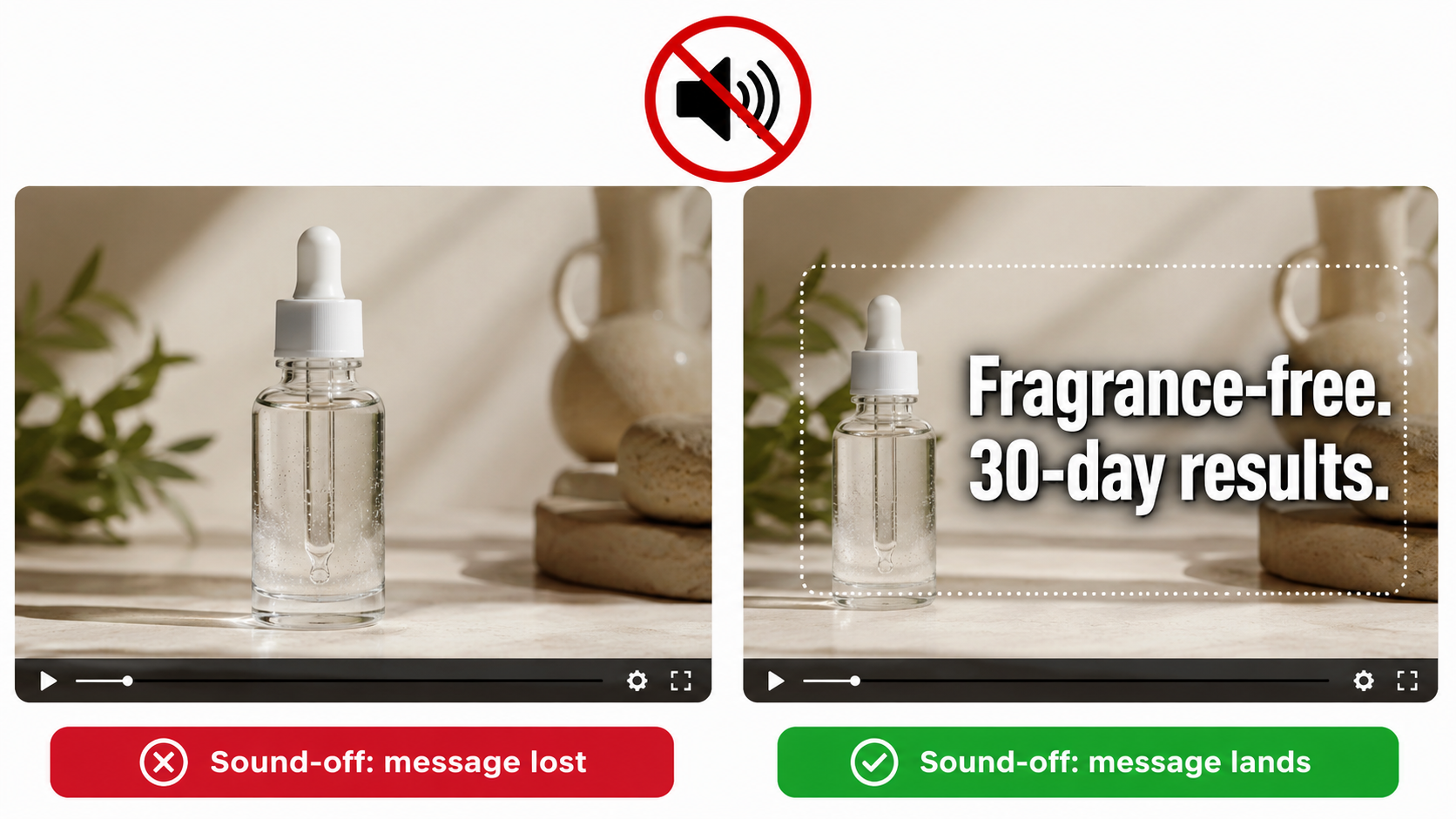
    If the video starts muted and the shopper has to tap a toggle to hear it, the visual track has to carry the full message. Audio is extra.
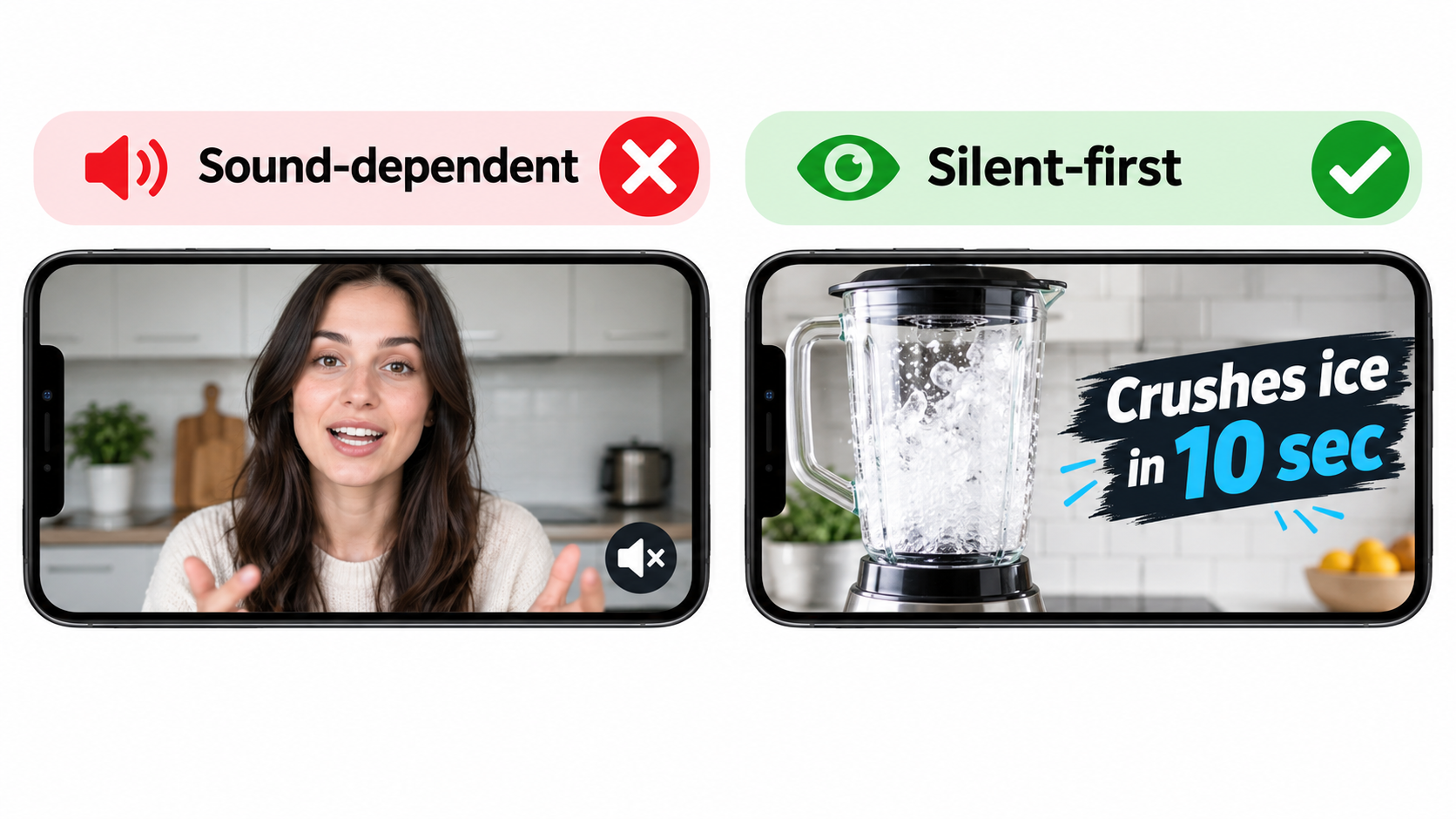
    Comparison of a sound-dependent talking-head ad versus a silent-first product demo with on-screen text

    The silent-viewing audit

    Before you upload, watch the final cut with sound off from start to finish. Then ask:

    1. Is the main benefit clear without audio?
    2. Is any important claim spoken but not shown or written on screen?
    3. Does any scene only make sense with the voiceover, such as a talking head or an explanation over generic footage?
    4. Is there a moment where the viewer has to read a lot of text very quickly?

    If the answer to 2 or 3 is yes, the video depends on sound, and most viewers will get only part of it.

    On-screen text: short, large, and well placed

    On-screen text is the main tool for silent viewing, but it’s easy to overdo. A few principles help:

    • One idea per text card. “Cold for 24 hrs” works. “Double-wall vacuum insulation keeps beverages cold for up to 24 hours and hot for 12” is too much at scroll speed.
    • Size for mobile. The ad unit is small on a phone. Text that reads well on a desktop monitor can be illegible at thumbnail size.
    • Keep it on screen long enough. A text card that disappears before it can be read hasn’t done its job.
    • Stay out of the lower-right corner. That’s where the mute toggle sits, and Amazon specifically warns against putting text or other key information there (more in Section 5).

    Captions versus designed text

    If your video has a voiceover, you might just burn in captions. That’s better than nothing, but captions written for speech are often too long for the format. Text written specifically for the screen usually works better: shorter, punchier, and timed to the visuals, not to the narrator.

    When audio is worth including

    Audio still matters. A shopper who taps unmute is showing interest, and the soundtrack should reward that. Product sounds can carry real information: the click of a well-built latch, the hum of a quiet motor, the crunch of a blender crushing ice. A voiceover that adds detail beyond the on-screen text gives engaged viewers more.

    Amazon’s specs set minimum audio standards: PCM, AAC, or MP3 codec; stereo or mono; at least 96 kbps bit rate; and a sample rate of at least 44.1 kHz. A fully silent video is also allowed. In that case Amazon notes the mute toggle won’t appear, which clears that corner of the frame.

    Does a fully silent video make sense?

    For some products it does. If audio wouldn’t add any information, as with many apparel, home décor, or accessory products, a silent video avoids a toggle that implies there’s something to hear. For products where sound shows quality or function, like audio equipment, kitchen appliances, or tools, a well-mixed soundtrack is a real advantage for viewers who unmute. Choose based on what the product needs, not on habit.

    5. Treat the Spec Sheet as a Creative Brief

    Most teams treat Amazon’s video specs as a technical checklist to clear right before upload. It works better to read them at the start of production, because several specs constrain the creative itself, not just the file.
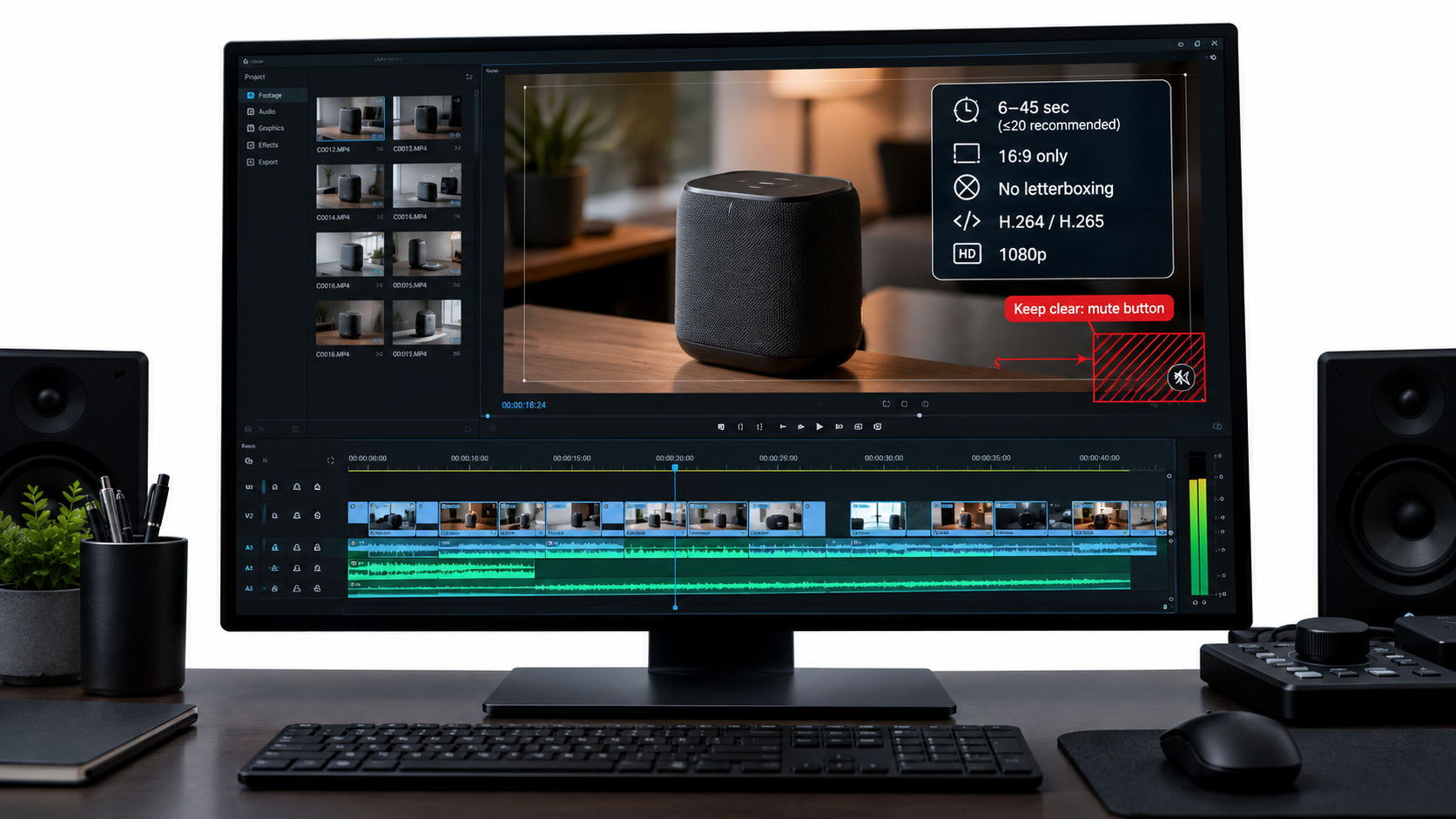
    Video editing monitor highlighting the lower-right safe area and Sponsored Brands video specifications

    The full spec list

    According to Amazon Ads’ published Sponsored Brands video specs:

    • Duration: 6 to 45 seconds, with 20 seconds or less “highly recommended”
    • Dimensions: 1280×720, 1920×1080, or 3840×2160 px
    • Aspect ratio: 16:9 (square pixel) only
    • File size: 500 MB or less
    • Format: .MP4 or .MOV
    • Codec: H.264 or H.265, Main or Baseline profile
    • Frame rate: 23.976, 23.98, 24, 25, 29.97, 29.98, or 30 fps
    • Video bit rate: minimum 1 Mbps, with 4 Mbps or higher recommended
    • Scan type: progressive

    Constraint 1: 16:9 only, and no bars

    This one has the biggest effect on production. Many brands now shoot mainly vertical (9:16) for social platforms. Amazon’s SBV spec allows only 16:9 and specifically says to avoid “horizontal or vertical black, color, or blurred bars.” You can’t drop a vertical TikTok clip into a blurred 16:9 frame and upload it.

    If you plan to use footage across channels, shoot wide enough to crop both ways. Frame the product with plenty of space around it so you can export a 16:9 version and a 9:16 version from the same footage. Doing this at the shoot is much cheaper than reshooting later.

    Constraint 2: the lower-right safe area

    Amazon tells advertisers to “avoid placing text and other important information in the lower right corner of the video” and provides a safe-area template. That’s where the mute toggle appears. Text, product details, or a key demonstration in that corner can be partly hidden.

    Add this to your edit templates. Many teams set up a guide overlay in their editing software marking the restricted zone so nobody has to remember it on every project.

    Constraint 3: the 20-second recommendation

    The allowed range runs to 45 seconds, but Amazon “highly recommends” 20 seconds or less. That matches the scrolling-viewer reality from Section 1. Amazon’s guidance also says the video’s purpose “is not to provide all the details about the product, but rather to create a sense of excitement and curiosity that will drive viewers to your product or Stores page for more information.”

    So the video isn’t a mini detail page. The detail page is one tap away. A good working structure for a 15–20 second SBV:

    • 0–2s: product in action, visual hook
    • 2–10s: one or two benefits shown visually, each with a short text card
    • 10–15s: a use case or result, ideally with a person or a real setting
    • Final seconds: branded end card with logo

    Constraint 4: bit rate and resolution

    The minimum is 1 Mbps, but Amazon recommends 4 Mbps or more. Fine product detail like textures, small text, and stitching breaks down quickly when heavily compressed. Exporting at 1080p with a healthy bit rate is a simple way to protect visual quality, which Amazon connects directly to trust: “A polished, high-quality, professionally-produced video is an effective way to convey the quality of your product and instill trust in your brand.”

    A pre-production checklist built from the specs

    1. Is the shot list framed for 16:9 with crop room for other formats?
    2. Do the text card positions avoid the lower-right corner?
    3. Is the script timed to 20 seconds or less?
    4. Is any on-screen text in the marketplace’s language?
    5. Is the export preset set to H.264/H.265, progressive, an approved frame rate, and 4 Mbps or more?

    6. Product Detail Page vs. Brand Store: Two Destinations, Two Different Videos

    Amazon describes two ways to connect SBV with shoppers, and they aren’t interchangeable. Choosing the destination should come before you write the script, because each one calls for a different video.
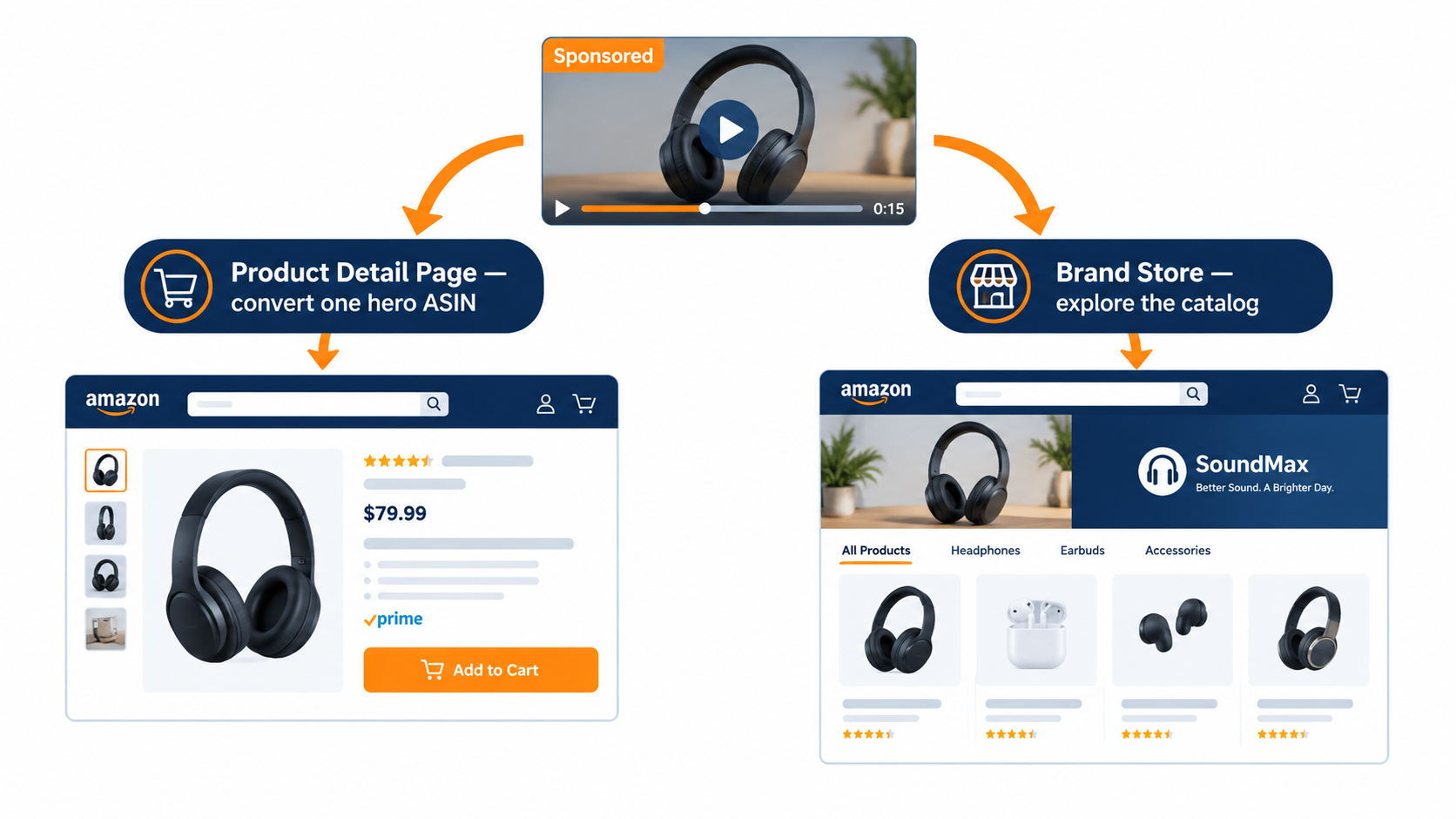
    Diagram comparing Sponsored Brands video campaigns that send traffic to a Product Detail Page versus a Brand Store

    Product Detail Page campaigns

    Amazon describes this type as “best for connecting shoppers with your product,” with ads appearing in shopping results and on detail pages. The click goes straight to one product listing.

    Here the video should be a single-product argument. Every second should support buying this specific ASIN. Showing other products from your catalog only distracts, because the shopper can’t reach them from the click.

    This campaign type suits:

    • Hero products with strong reviews and conversion history
    • Products whose main benefit is visual and easy to show in a short clip
    • Defending branded search terms or competing on high-intent category keywords

    Brand Store campaigns

    Amazon positions this type as “an effective way to increase brand equity and build lasting value by directly connecting shoppers to your Brand Store.” Amazon also says these campaigns “can be featured both above and below the fold of search results.”

    The video’s job changes here. It’s selling the brand and the range, not one item. Effective Brand Store videos tend to:

    • Set up a clear brand idea, such as a material, a design approach, or a problem you solve across products
    • Show variety, like colorways, sizes, or related items, so the click into a store makes sense
    • Promise something the store delivers, so the landing experience matches the ad

    The mismatch problem

    One common failure is a single-product demo sending traffic to a Brand Store homepage. The shopper clicks expecting the product they saw and lands on a page where they have to find it. Each extra step adds friction.

    The reverse is also a problem: a broad brand-story video that sends shoppers to one product page. Someone drawn in by the range finds a single option and may leave.

    A simple rule: the last thing the video promises should be the first thing the landing page shows.

    Building the store to receive video traffic

    If you use Brand Store destinations, make sure the store can handle the traffic. Amazon presents Sponsored Brands and Brand Stores as working together. Its product page says that “paired with Brand Stores, it drives discovery, consideration, and long-term engagement with your brand.” A store with a vague homepage, missing categories, or out-of-stock products will waste paid clicks regardless of how good the video is.

    A practical step: if a campaign’s video features one product line, consider sending traffic to a store subpage dedicated to that line, if your store structure and the campaign settings allow it, instead of the generic homepage.

    7. How Targeting Should Shape the Script

    Amazon’s spec page notes that SBV lets you “target shoppers through keywords, categories, and products.” Most advertisers treat targeting and creative as separate jobs. Usually the media buyer handles targeting and the creative team handles video. That split leaves performance on the table, because the right video depends on what the shopper was doing just before they saw it.

    Keyword targeting: answer the query

    With keyword targeting, you know what the shopper typed. That’s useful creative information. A shopper searching “quiet blender for smoothies” and one searching “high-power blender for nut butter” want different proof, even if your blender fits both.

    If budget allows, group keywords by shopper intent and give each group a video variant that opens on the matching benefit. The quiet-blender group sees a low-noise demonstration first. The power group sees thick nut butter blended smooth first. The footage can come from the same shoot, and only the order and text cards change.

    Branded keywords: reassure, don’t introduce

    Shoppers searching your brand name already know you. A brand-introduction video wastes their time. For branded terms, think about creative that shows the range, a new release, or a reason to buy from your official listing. For these shoppers the task is to confirm a decision they’re already leaning toward.

    Product targeting: the comparison context

    Amazon notes that SBV can appear inside detail pages. When you target specific products, including competitors’, the shopper is already looking at an alternative. The video becomes a comparison, whether or not you call it that.

    The best creative for this context shows a clear point of difference that matters to someone considering the targeted product. Stay within Amazon’s ad policies on comparative claims, and review the Amazon Ads Policies page before making any claim that references another brand, but focus the video on what makes your product the better choice for the shopper’s situation.

    Category targeting: broad audience, broad benefit

    Category targeting reaches a wider, less specific audience. Here the strongest benefit for the whole category usually works better than a niche one. Save niche angles for keyword groups where you know the shopper cares about them.

    A simple targeting-to-creative map

    • Generic category keywords → Video leads with the product’s main differentiator
    • Feature-specific keywords → Video leads with that exact feature in action
    • Branded keywords → Video shows range, newness, or the official-listing reason to buy
    • Competitor product targets → Video shows a clear, policy-compliant point of difference
    • Category targets → Video leads with the broadest, most universal benefit

    Not every brand can produce five variants right away. Even two, one for high-intent generic and one for competitor targets, is a clear improvement over sending one video to every audience.

    8. Reading the Numbers: What Video Metrics Actually Tell You

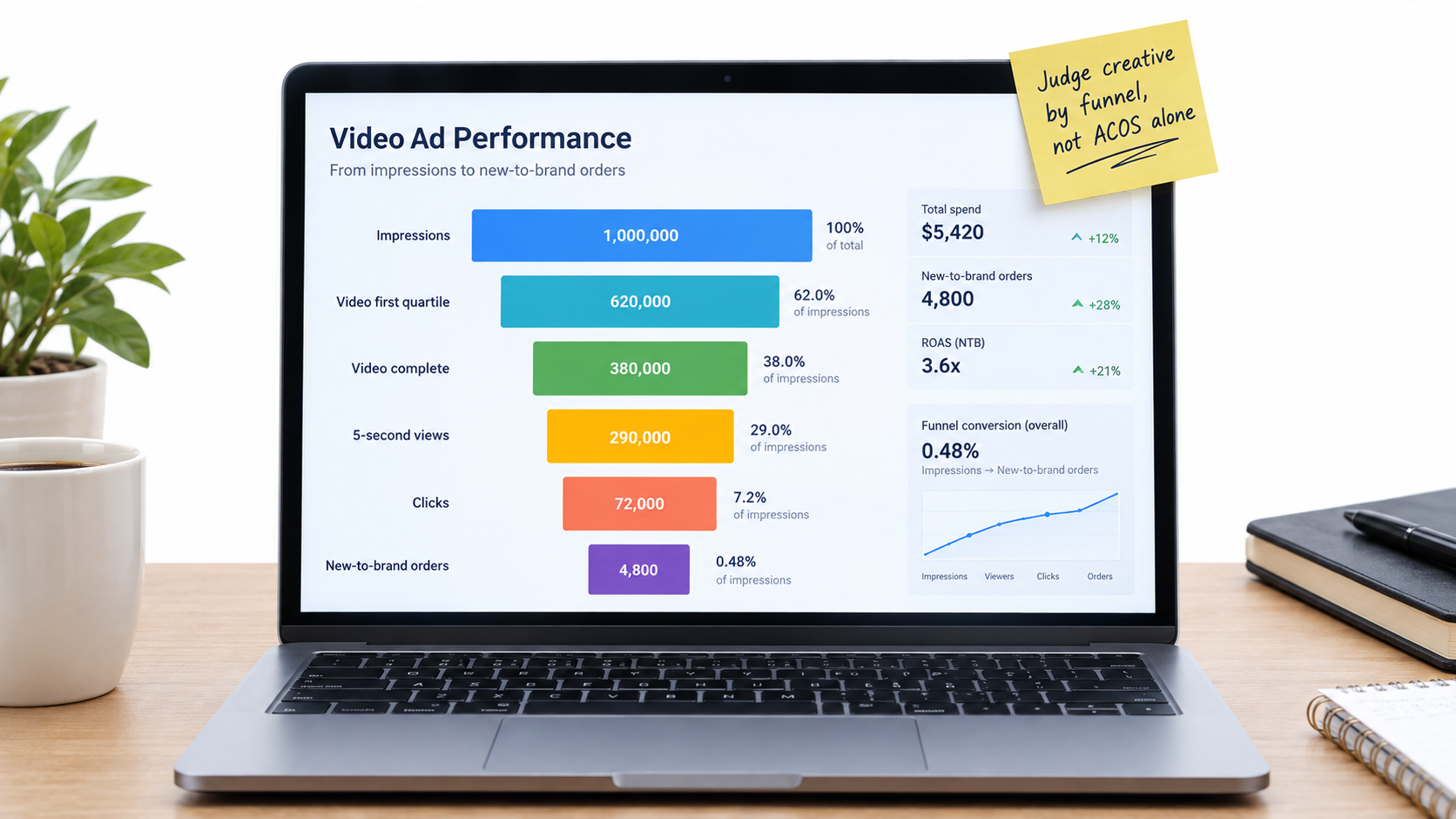
    Sponsored Brands video reporting adds video-specific engagement metrics on top of the usual impressions, clicks, spend, and sales. Exact column names can differ by report type and interface version, but they typically include things like 5-second views, quartile completion (25%, 50%, 75%), complete views, view-through rate, and video unmutes. Together these give you a diagnostic funnel that standard PPC metrics can’t.
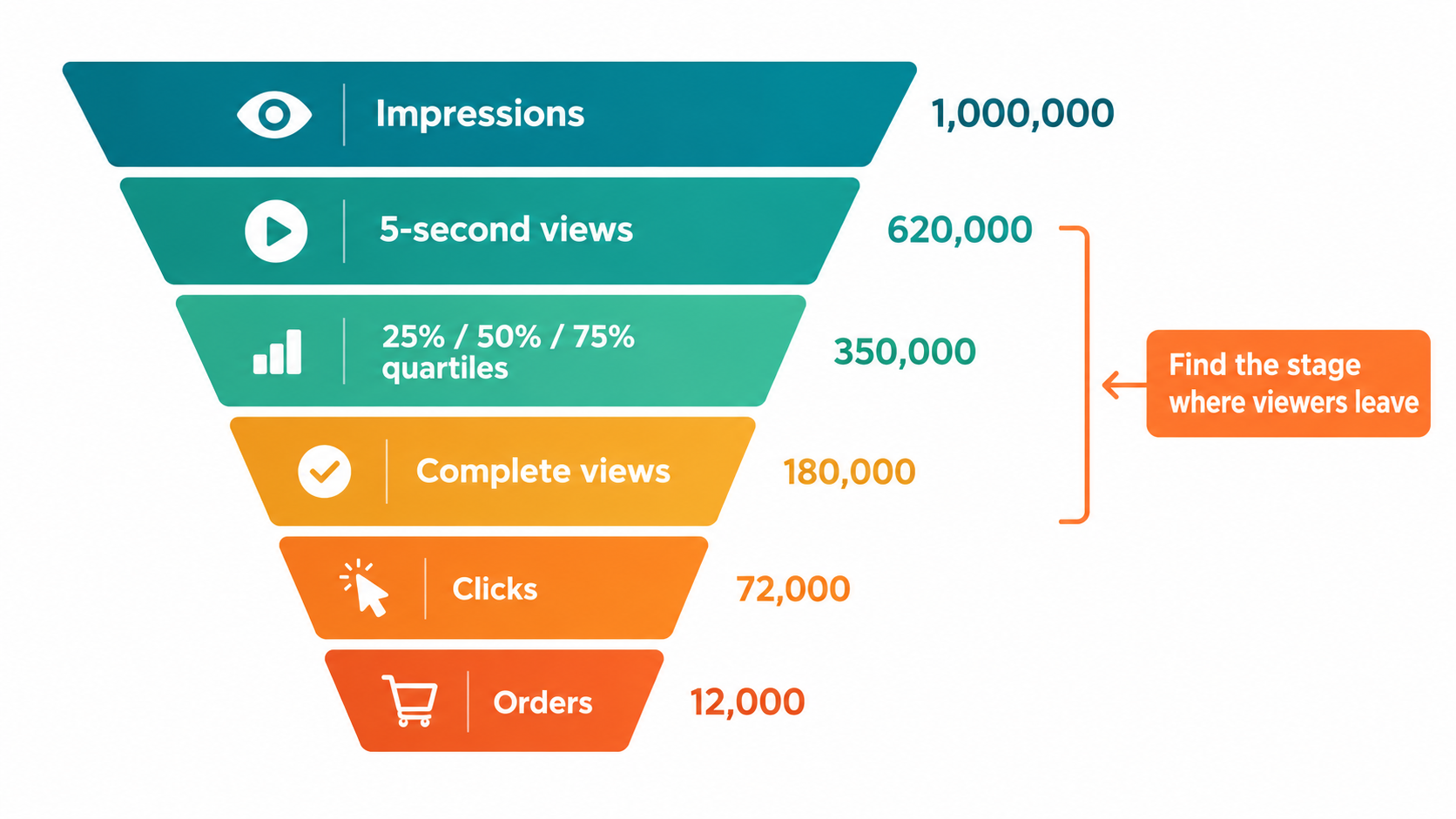
    Funnel chart of Sponsored Brands video metrics from impressions through views, quartiles, clicks, and orders

    Read the funnel from top to bottom

    Each step points to a different part of the creative:

    • Impressions → early views: Did the opening stop the scroll? A weak ratio here suggests a problem with the first one or two seconds, as covered in Section 3.
    • Early views → quartile completion: Did the middle hold attention? A sharp drop between quartiles shows where the story loses people. Often it’s a slow scene, a confusing transition, or a long text card.
    • Complete views: Did people reach the end card? If few do, your branding may never be seen, so consider moving key brand cues earlier or shortening the video.
    • Unmutes: A signal of curiosity. If unmutes are high relative to views, the visuals are creating interest. Make sure the audio rewards it.
    • Clicks and orders: Did attention turn into action, and did the destination convert?

    Separate creative problems from targeting problems

    The funnel lets you tell apart problems that look the same from the outside. Low sales might come from:

    1. Weak hook: few early views relative to impressions. Fix the opening.
    2. Weak story: good early views, steep quartile drop-off. Fix the middle or shorten it.
    3. Weak click motivation: good completion, low click-through. The video entertains but doesn’t make the next step feel needed. Tighten the benefit and the headline pairing.
    4. Weak landing: good clicks, poor conversion. The problem is likely the destination (listing, price, reviews, store layout), or a mismatch between the ad’s promise and the landing page.
    5. Weak targeting: healthy video engagement but spend going to irrelevant queries. Check search term reports.

    Without video metrics, all five look like “ACOS is too high.” With them, you can identify which fix to make.

    Context from Amazon’s case studies

    Amazon’s published case studies give a sense of what’s possible when SBV is part of a wider program. Amazon reports that HP, using Sponsored Brands video together with Sponsored Brands, Sponsored Products, and display ads, saw impressions grow 224% year over year and clicks increase 142%, including a 42% increase in clicks for Sponsored Brands video placements. Separately, Amazon reports that small business Loftie achieved a ROAS of $5.66 and an ACOS of 17.68% from its sponsored ads campaign.

    Read these carefully. They’re vendor-published success stories, and the results come from multi-format programs, not SBV alone. They’re useful as examples, not as benchmarks you should expect. Your own funnel data is a much more reliable guide.

    Watch the time frame

    Sponsored Brands is positioned as a brand-building format. Amazon’s product page highlights measuring “your brand-building efforts” and getting “insights into how and which shoppers engage with your ads.” Some of SBV’s value, including new-to-brand customers, later branded searches, and store visits, may not show up in the same session’s attributed sales. Look at last-click ROAS alongside those longer-term signals before deciding a video “doesn’t work.”

    9. A Testing System That Actually Teaches You Something

    Many brands “test” SBV by uploading a new video every few weeks and comparing the results to the last one. That approach rarely teaches anything, because too many things change at once: creative, season, bids, competition, and inventory.

    Change one variable at a time

    Good creative testing isolates one change. For SBV, the useful variables, roughly in order of likely impact, are:

    1. The opening two seconds, with different hook scenes and the rest identical
    2. The main benefit shown, for example durability versus convenience
    3. Length, such as a 15-second cut against a 30-second cut of the same footage
    4. On-screen text approach, such as minimal text against benefit-heavy text
    5. Human presence, product-only against product-in-hand or lifestyle
    6. Headline pairing, same video with a different headline

    Because the hook gets the most exposure and fails most often, start there. One shoot can supply several opening variants with the rest of the video unchanged.

    Keep the comparison fair

    Run variants at the same time, not one after another, so seasonality and competition affect both equally. Keep targeting, bids, and budgets matched. Give each variant enough impressions to see a real difference before you decide. Early results based on a small sample are mostly noise.

    Decide what “winning” means beforehand

    Choose your success metric before the test starts. If you’re testing hooks, early view rate is the most direct measure. If you’re testing benefits, click-through rate and conversion matter more. Deciding the winner after looking at the data invites cherry-picking.

    Build a creative library, not a pile of one-off ads

    The real value of disciplined testing builds up over time. After a few rounds you’ll know which kinds of openings work in your category, which benefits make shoppers click, and what length your audience tolerates. Record each finding in a shared document so the next shoot starts from evidence, not guesswork.

    Where AI creative tools fit

    Amazon’s Sponsored Brands page mentions AI-powered image generation “at no cost to produce branded creatives.” Tools like this, and similar ones across the industry, can make it cheaper to produce variants of supporting assets. They don’t replace the discipline described here. Making more variants only helps if each one tests a clear hypothesis and you measure it properly. Also check that any AI-generated or AI-edited material shows your actual product accurately, because misleading product depictions create policy and customer-trust risks.

    10. Selling Across Marketplaces: Localization Is a Policy Issue, Not a Nice-to-Have

    Brands selling in more than one Amazon marketplace often want to reuse one SBV everywhere. Amazon’s specs make clear that this is a compliance problem, not just a creative preference.

    What the language rule says

    Amazon’s guidance: “Make sure your videos match the language of the marketplace they are being shown in.” Its example is that English-speaking locales need English on-screen text or voiceover, and the Italian marketplace needs Italian on-screen text or voiceover. Amazon suggests that sellers in multiple marketplaces “consider adding subtitles or creating different versions of the video tailored to each marketplace.”

    Design for localization from the start

    The silent-first approach from Section 4 helps a lot here. If the video carries its message through visuals and a few short text cards, localizing means swapping text layers, not re-recording a voiceover or reshooting.

    Practical steps:

    • Keep text on separate editable layers in the project file, never baked into footage.
    • Leave room for longer translations. Some languages need considerably more characters than English for the same idea. A text card that just fits in English may overflow in German or French.
    • Avoid text inside the footage (signs, packaging close-ups in one language) where it’s central to the message, unless you have localized packaging to film.
    • Check units and conventions. Ounces versus milliliters and Fahrenheit versus Celsius are easy to overlook in a quick translation.

    Local relevance beyond language

    Translation is the minimum. Use cases, settings, and benefits that matter may differ between marketplaces. A cooling product shown in summer heat makes sense in one region and season and less in another. Where budget allows, consider whether the lead benefit itself should change by market, not just the words on screen.

    11. Avoiding Moderation Problems Before They Cost You a Launch Window

    Every SBV campaign goes through moderation against Amazon’s creative acceptance policies for sponsored ads. Amazon states that “all content must be suitable for a general audience and must comply with all relevant laws and regulations,” and that ads not meeting these policies “will not be accepted.” A rejection right before a seasonal push can cost far more than the time it takes to fix.

    Problems that are easy to prevent

    Several issues come straight from the published specs and are simple to catch internally:

    • Letterboxing or pillarboxing: any black, colored, or blurred bars. A common cause is reformatted vertical footage.
    • Wrong aspect ratio: anything other than 16:9.
    • Language mismatch: on-screen text or voiceover that doesn’t match the marketplace.
    • Out-of-range duration: under 6 seconds or over 45 seconds.
    • Technical spec failures: unsupported frame rates, interlaced scan, codecs outside H.264/H.265, or files over 500 MB.

    Problems that need judgment

    Other issues depend on policy interpretation. Claims about performance, health, or comparisons with other products should be supportable and should follow Amazon’s policies. Amazon recommends reviewing the Amazon Ads Policies page before launch, saying it “can help you ensure that your ad is ready for Sponsored Brands video.” Doing that review before production, not after, means problematic claims never make it into the edit.

    Build moderation time into your calendar

    Moderation isn’t instant, and a rejection means revising and resubmitting. For important dates like product launches, Prime events, and seasonal peaks, plan to submit creative well ahead and keep a backup version on hand. One simple safeguard is a “conservative cut”: a version of the video with fewer claims and plain on-screen text that you can submit quickly if the main version runs into trouble.

    Use an internal QA checklist

    Before any upload, one person who didn’t edit the video should go through a fixed checklist: specs, safe area, language, claims, duration, and a full sound-off viewing. A second reviewer with fresh eyes catches problems the editor has stopped noticing after many passes through the timeline.

    12. Putting It Together: The Pre-Upload Checklist

    Sponsored Brands video gives brands one of the most noticeable placements in the Amazon shopping experience: moving, branded creative at the top of search and inside detail pages. That visibility doesn’t guarantee results on its own. It pays off when the creative fits how the ad unit actually works: autoplay at 50% visibility, muted by default, a toggle in the corner, a strict 16:9 frame, and a shopper who’s looking for something to buy.

    The main point of this article is that Amazon’s spec sheet works as a creative brief. Read that way, most of the decisions follow from it. Open on the product in action. Make the visuals carry the message without sound. Keep it to around 20 seconds. Save the logo for the end card. Match the video to the destination and the targeting. Read the funnel, not just ACOS. Test one variable at a time.

    Your pre-upload checklist

    Creative fundamentals

    • Does the first two seconds show the product in use, clearly enough to understand from one frame?
    • Does the video make sense with sound off from start to finish?
    • Is each on-screen text card a single idea, readable at mobile size, and on screen long enough?
    • Is the lower-right corner free of text and key visuals?
    • Do the brand name and logo appear mainly in the end card, not the opening?
    • Is the runtime 20 seconds or less, unless you have tested evidence for longer?

    Strategy alignment

    • Does the video match the destination: single product for a PDP, range and brand for a Brand Store?
    • Does the headline make the same claim the video shows?
    • Is the opening benefit matched to the targeting group (keyword intent, branded, competitor, or category)?
    • If it’s a Brand Store campaign, does the landing page show first what the video promised last?

    Technical and compliance

    • Is it 16:9 with no letterboxing, pillarboxing, or blurred bars?
    • Is it 1080p or higher, H.264/H.265, progressive scan, an approved frame rate, and 4 Mbps or more?
    • Is it 6 to 45 seconds and under 500 MB?
    • Do the on-screen text and voiceover match the target marketplace’s language?
    • Have the claims been checked against Amazon Ads policies?
    • Is a backup “conservative cut” ready for time-sensitive launches?

    Measurement and testing

    • Is the success metric defined before launch?
    • Are variants running at the same time with matched targeting and budget?
    • Are you tracking the full funnel (early views, quartiles, completes, unmutes, clicks, orders), not just ACOS?
    • Is each test result recorded in a shared creative-learning document?

    Final thought

    Brands that consistently do well with Sponsored Brands video aren’t necessarily the ones with the biggest production budgets. They’ve accepted what the format is: a silent, short, scroll-interrupted demonstration placed next to a headline, a logo, and a buy button. Build for that viewer and you’ll stop paying for impressions that were never going to turn into a click.
  • The First Two Seconds: A Frame-by-Frame Approach to Amazon Sponsored Brands Video

    The First Two Seconds: A Frame-by-Frame Approach to Amazon Sponsored Brands Video

    Most Amazon sellers treat Sponsored Brands video as a production problem. They hire a videographer, film a polished 30-second clip, upload it, and wait. When results stall, they blame the bid, the keyword list, or the algorithm.

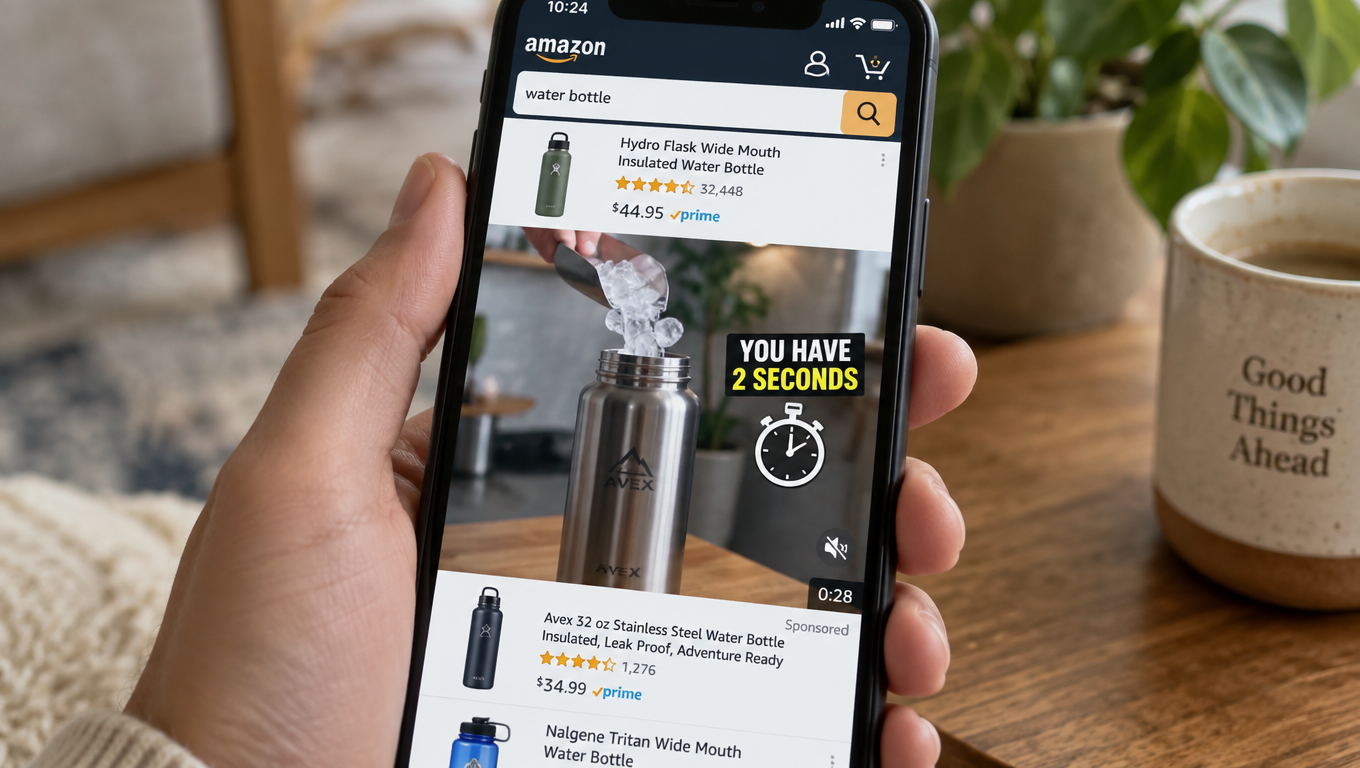
    The real problem usually shows up much earlier. It sits in the first two seconds of the video, while a shopper is scrolling a search results page on their phone with the sound off. That’s where Sponsored Brands video (SBV) campaigns are won or lost. Everything after that moment only matters if the opening frames did their job.

    This article approaches Sponsored Brands video from a different angle than most guides. It isn’t a campaign setup walkthrough or a list of general tips. It’s a frame-by-frame look at how SBV creative actually gets consumed on Amazon. It covers how placement shapes what your video needs to say, how to storyboard for muted autoplay, which metrics tell you where viewers drop off, and how to run a testing cycle that keeps creative fresh without burning budget.

    The stakes are real. Amazon’s own case studies show what well-executed video can do. HP, running Sponsored Brands video alongside Sponsored Brands, Sponsored Products, and display ads, reported a 224% year-over-year increase in impressions and a 142% increase in clicks, including a 42% increase in clicks specifically on Sponsored Brands video placements, according to Amazon Ads. Smaller brands have seen results too. Sleep-tech company Loftie reported a ROAS of $5.66 and an ACOS of 17.68% on a sponsored ads program with Amazon Ads.

    Those results didn’t come from uploading any video and hoping for the best. They came from creative that fits the way shoppers actually see it. Let’s break down what that means in practice.

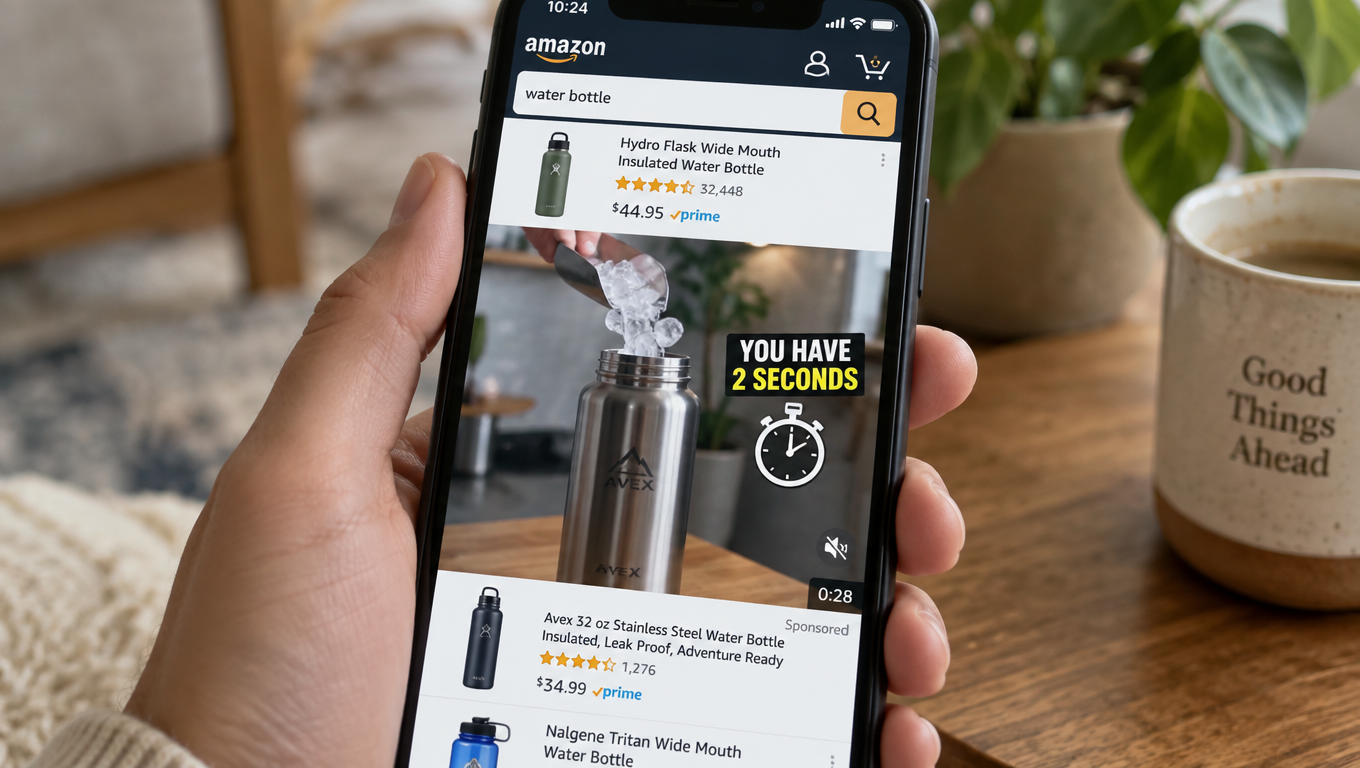
    Shopper scrolling Amazon search results on a phone with a muted autoplaying Sponsored Brands video ad and a 'You have 2 seconds' overlay

    Why Sponsored Brands Video Is a Different Animal from Other Amazon Ads

    Sponsored Products ads borrow the look of an organic listing. A shopper sees a main image, a title, a price, star ratings, and a small “Sponsored” label. The ad works because it blends in.

    Sponsored Brands video works for the opposite reason. It stands out. It’s the only moving element on a page full of static thumbnails, and it autoplays as soon as it scrolls into view. That’s a big advantage for grabbing attention. It’s also a liability if the motion doesn’t communicate anything useful.

    What Amazon says the format is for

    Amazon Ads describes Sponsored Brands as a solution “built to help customers discover your brand within the Amazon store,” with “rich display and video creatives that put your brand front and center.” It calls Sponsored Brands video “a powerful storytelling tool for brands to initiate, cultivate, and maintain relationships with shoppers.”

    That framing matters. Amazon positions SBV as a discovery and consideration format first and a conversion format second. In practice, it does both. But if you judge it only on the same ACOS target you use for exact-match Sponsored Products campaigns, you’ll likely underfund it or shut it off too soon.

    The eligibility gate

    Sponsored Brands, including video, is available to sellers enrolled in Amazon Brand Registry, as well as vendors and agencies that work with them. If you’re not brand-registered, this format isn’t available to you. That’s one reason SBV placements tend to be less crowded than Sponsored Products in many categories: fewer advertisers are eligible to compete for them.

    Three structural differences that change your approach

    • Motion creates attention, not persuasion. Autoplay gets eyes on the ad. The content still has to earn the click.
    • Video is usually watched muted. Amazon autoplays SBV without sound in search results. Unless a shopper actively taps to unmute, your audio track does nothing.
    • The ad sits beside competitors’ static listings. Shoppers compare your video against the products around it in real time. Your first frames are competing with price tags and star ratings a few pixels away.

    Each of these differences leads to a specific creative decision, which the rest of this article covers.

    Placement Dictates Creative: Where SBV Actually Appears

    According to Amazon Ads, Sponsored Brands creatives “appear in prominent placements like top of search and product pages,” and may be shown “above, alongside, or within shopping results” on desktop and mobile. For video specifically, that usually means three types of environments. Each puts the shopper in a different frame of mind.

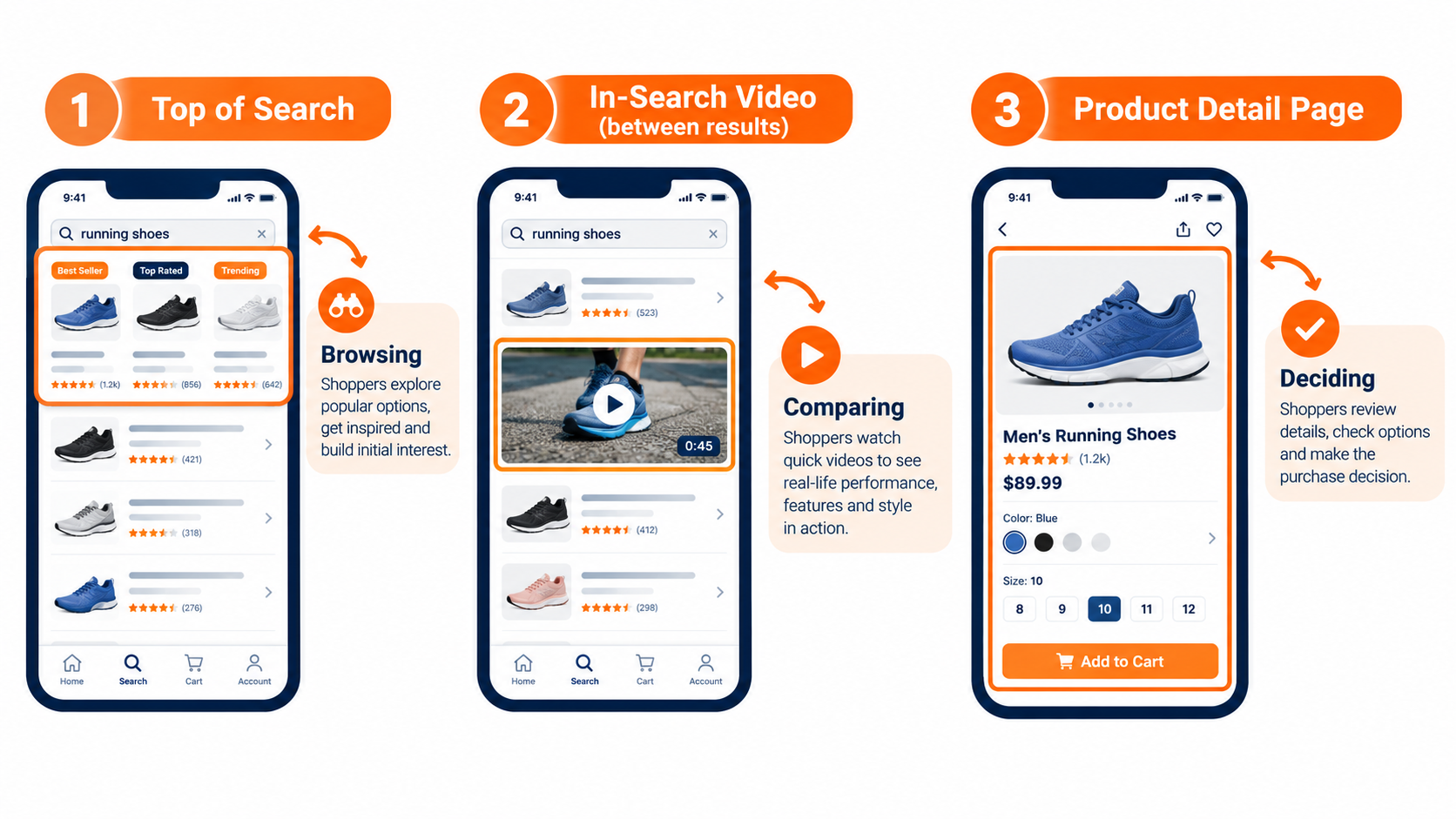
    Diagram of Sponsored Brands video placements: top of search, in-search video between results, and product detail page, each matched to a shopper mindset

    In-search placements: the browsing mindset

    The most familiar SBV placement is the video unit that appears between rows of search results. The shopper has typed a query, such as “insulated water bottle,” and is scanning options. They haven’t decided anything yet.

    Here, your video’s job is to answer one question quickly: why should I stop scrolling for this one? A clear visual of the product in use, paired with one distinguishing claim, usually beats a brand story. The shopper isn’t interested in your founding story at this stage. They want to know whether this product is different from the eight others on the screen.

    Top-of-search placements: the first impression

    When video appears at or near the top of results, it’s often the first thing a shopper sees after searching. That position carries weight because it frames how the shopper reads everything below it. If your video sets the standard, such as “this is what a leak-proof lid should look like,” competing listings get judged against it.

    Top-of-search visibility is valuable enough that Amazon offers a reserve share of voice option for Sponsored Brands. Brands can use it to secure top-of-search visibility for chosen keywords. For launches or seasonal peaks, that can be worth exploring. It’s a premium tactic, though, and should come after you’ve proven your creative works.

    Product detail page placements: the comparison mindset

    On product pages, the shopper is already looking at a specific item, often a competitor’s. Your video is interrupting a decision that’s already underway. That calls for a different message.

    Comparison-oriented creative tends to fit here: a feature the competitor lacks, a size or capacity advantage, or a demonstration of durability. You can’t name competitors in Amazon ads, and moderation will reject disparaging claims. But you can show what your product does well in a way that invites the comparison.

    The practical takeaway

    One video rarely fits all three contexts equally well. You don’t need three fully separate productions, though. You need one set of footage cut into versions with different opening frames and on-screen text. The in-search version leads with the product in action. The detail-page version leads with the standout feature. Same shoot, different edits.

    The Muted Autoplay Constraint (and Why It’s Actually Useful)

    Because SBV autoplays silently in search, sound is optional for the viewer. That one fact rules out a large share of conventional video advertising techniques. Voiceover-driven explainers, spokesperson monologues, and music-dependent emotional builds all lose most of their meaning without audio.

    Many brands still make the mistake of repurposing a video made for YouTube, a website hero banner, or a TV spot. Those videos were designed for audio. On Amazon, they become a person silently moving their mouth next to a product.

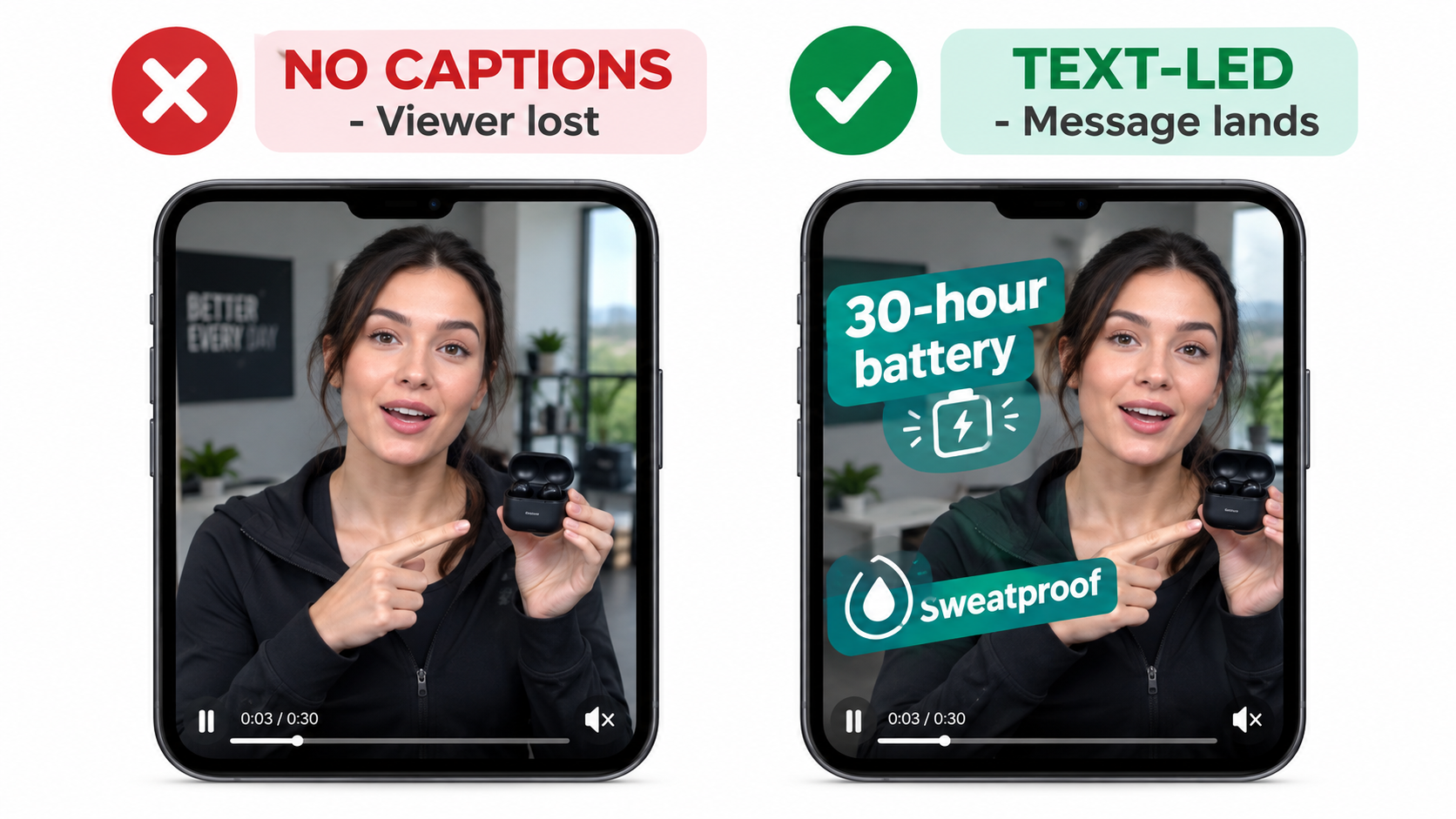
    Split-screen comparison of a muted video ad with no captions versus a text-led version with on-screen claims like 30-hour battery and sweatproof

    Design for silence first

    The fix is simple to state and harder to execute: build the video so it makes complete sense with the sound off. Then add audio as a bonus layer for the small share of viewers who unmute.

    In practice, that means:

    • On-screen text carries the message. Short phrases of three to six words, large enough to read on a phone screen, held on screen long enough to be read twice.
    • Visual demonstration replaces narration. Instead of saying “our blender crushes ice in seconds,” show ice going in and smooth liquid coming out.
    • Captions for any spoken content. If you do include a speaker, burn in captions. Don’t rely on the platform to add them.
    • Motion that tells a story. Before-and-after sequences, pouring, folding, assembling, and stress tests communicate without words.

    Why this constraint helps you

    Muted-first design forces clarity. When you can’t lean on a voiceover, you have to identify the single visual that proves your product’s value. That discipline often produces better creative than a sound-dependent script would.

    It also makes your video more reusable. A silent-first SBV cut works well in Sponsored Display video, on your Brand Store, in your listing’s video slot, and on social platforms where muted autoplay is also common. You’re producing one asset with several uses.

    A quick muted test

    Before uploading any SBV creative, watch it on your phone with the sound off at arm’s length. Then ask someone unfamiliar with the product to do the same and tell you, in one sentence, what the product is and why it’s better. If they can’t, the video isn’t ready.

    A Frame-by-Frame Storyboard for Sponsored Brands Video

    Amazon’s published guidance has generally recommended shorter videos for Sponsored Brands, with many advertisers working in the 15-to-30-second range. Whatever length you choose, the structure matters more than the runtime. Below is a four-part storyboard built around how attention actually decays in a scrolling feed.

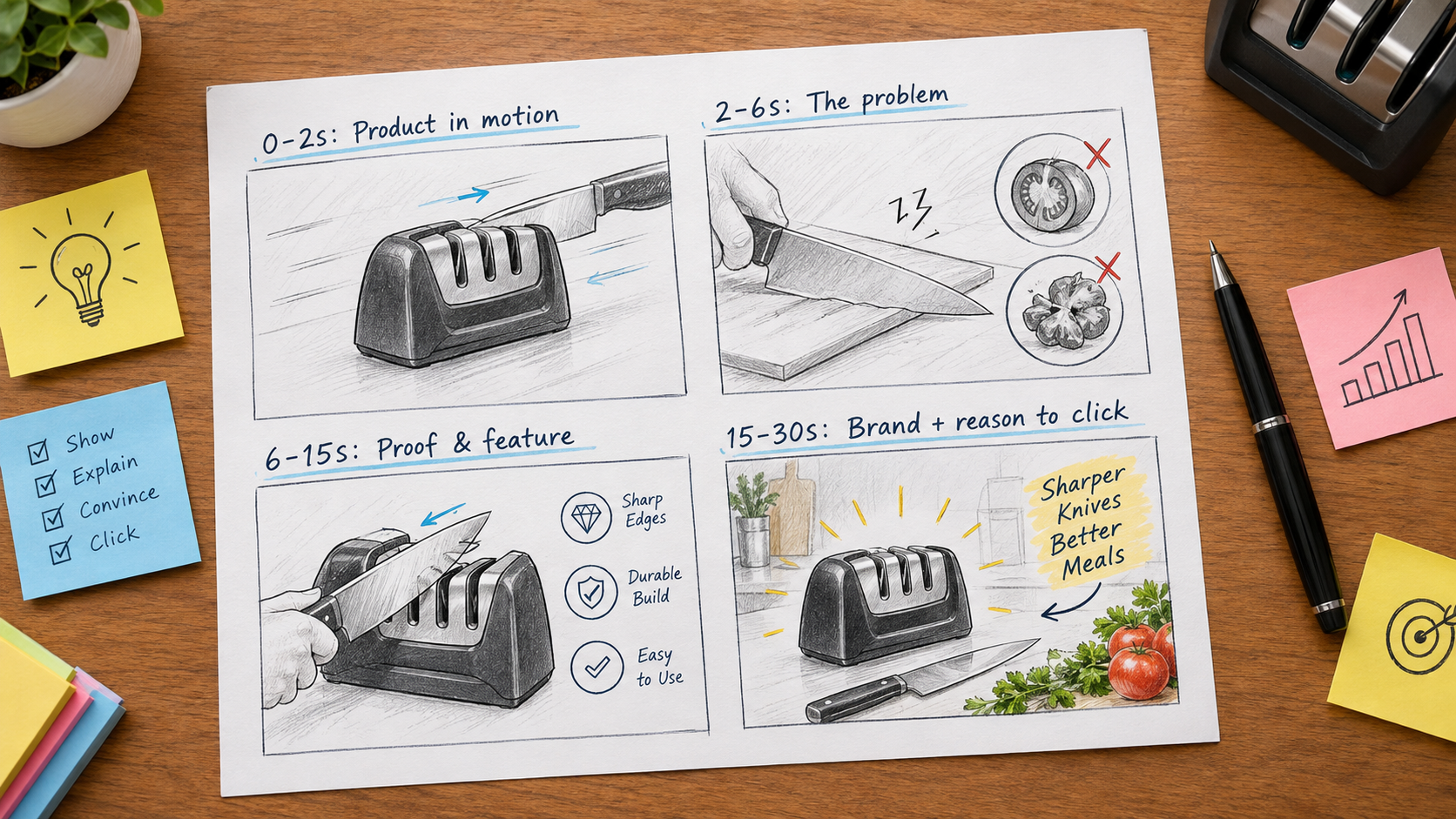
    Four-panel video storyboard for a Sponsored Brands video: product in motion, the problem, proof and feature, brand and reason to click

    Frames 0–2 seconds: the product in motion

    The opening must show the product, and it should already be moving. No logo animation, no lifestyle establishing shot, no slow fade-in from black. Those openings waste the only moment you’re guaranteed to have.

    Strong openings include the product being used mid-action, a close-up of the key feature working, or a dramatic visual contrast. Think coffee pouring into a mug that stays hot, a knife slicing a tomato cleanly, or a backpack being overstuffed and zipped shut. The shopper should recognize the product category in the first second.

    Frames 2–6 seconds: the problem or the promise

    Once you have attention, establish why it matters. This is where a short on-screen text line appears: a problem the shopper recognizes (“Tired of lukewarm coffee by 10 a.m.?”) or a clear promise (“Hot for 12 hours”).

    Keep it to one idea. Many videos try to list four features here. The viewer retains none of them. One problem, one promise, clearly shown.

    Frames 6–15 seconds: proof and differentiation

    Viewers who make it this far are interested. Now show proof. This section can hold two or three supporting features, each paired with a visual demonstration. It’s also where social proof can appear, such as a mention of awards or certifications, as long as the claims are accurate and can be substantiated for moderation.

    Avoid star ratings or review quotes unless you’ve confirmed they meet current Amazon advertising policies. Claims about reviews, pricing, and “best seller” status are common reasons for rejection.

    Frames 15–30 seconds: brand and reason to click

    The final stretch reinforces your brand and gives a reason to take action. Show the logo clearly, restate the core benefit, and if relevant, show the product range. That’s especially useful if the ad links to your Brand Store.

    Note that Amazon restricts certain call-to-action language and urgency claims in ads, so skip “Buy now, limited time!” style overlays. A simple closing frame showing the product, logo, and core benefit works well.

    Loop awareness

    SBV may loop in some placements. Design your last frame so it transitions reasonably into your first. An abrupt jump from logo card to action shot can look glitchy. A clean end frame that cuts naturally back to the product in motion keeps the loop watchable.

    Technical Specs and Moderation: Where Good Videos Get Rejected

    A strong creative concept is worthless if it doesn’t clear moderation. Amazon reviews every Sponsored Brands video before it goes live, and rejections can add days to a launch.

    Technical specifications to confirm before export

    Amazon updates its ad specs periodically, so always check the current Sponsored Brands video specification page before final export. Historically, the requirements have followed this general pattern:

    • Aspect ratio: 16:9 landscape has been the standard for SBV.
    • Resolution: HD minimum, with 1920×1080 widely used as the working standard.
    • File format: MP4 or MOV.
    • File size: A maximum limit applies (historically up to 500 MB).
    • Length: A minimum and maximum duration apply. Check the current limits, as they’ve changed over time.
    • No letterboxing or black bars, and no blank frames at the start or end.

    The common rejection triggers

    Beyond technical specs, most rejections come from content issues. Watch out for these in particular:

    • Blurry or low-quality footage. Upscaled phone clips often get flagged.
    • Unsubstantiated claims. “#1 rated,” “best on Amazon,” and “clinically proven” all require support.
    • Pricing and promotions in the video. Prices change; baked-in prices quickly become inaccurate.
    • Text that’s too small or on screen too briefly. Amazon expects on-screen text to be legible.
    • Content that doesn’t match the landing page. The product in the video should be the product shoppers land on.
    • Restricted categories and claims. Health, supplements, and personal care products face stricter review.

    Build a pre-moderation checklist

    Brands that launch video often save time with an internal checklist that mirrors Amazon’s policies. Before any upload, someone other than the editor reviews every claim, every text overlay, and the final frames. It’s a small step that prevents the most frustrating kind of delay: a rejection you could have caught yourself.

    Choosing the Destination: Product Page, Brand Store, or Multi-Product

    Where your SBV sends shoppers affects what the video should say and how you should judge its performance. Amazon notes that Sponsored Brands can drive “traffic to your Brand Store or detail pages,” supporting both product evaluation and catalog discovery.

    Single product detail page

    This is the most direct path. The video features one product, and a click takes the shopper straight to that listing. It’s the easiest setup to measure and usually the best fit for hero products with strong conversion rates.

    The creative should focus narrowly on that single product. Your listing then has to finish the job: strong main image, clear bullets, competitive price, and solid reviews. If the detail page is weak, a great video just sends shoppers to a disappointing destination.

    Brand Store destination

    Sending traffic to your Brand Store makes sense when the goal is discovery across a catalog. Think a cookware brand with pans, lids, utensils, and storage, or an apparel brand with multiple styles. Amazon explicitly pairs Sponsored Brands with Brand Stores to drive “discovery, consideration, and long-term engagement.”

    Expect lower immediate conversion rates from Store traffic compared to detail page traffic. Shoppers browse before buying. Judge Store-destination SBV with metrics like new-to-brand orders and total brand sales over a longer window, not just same-session ACOS.

    Multi-product video formats

    Amazon has expanded Sponsored Brands video to support formats where a video appears alongside several products from your catalog. This lets a brand show its range while still giving shoppers direct paths to individual listings.

    This approach works well for brands with product families, such as variants in different sizes, or bundles of complementary items. The video can tell a broader brand story while the product tiles handle the specifics.

    Match the message to the destination

    A simple rule helps here: the narrower the destination, the narrower the message. Single-product destinations need single-product videos. Store destinations can afford broader brand storytelling. Mismatches, like a brand-story video linked to one product page, confuse shoppers and waste clicks.

    Targeting Architecture Built for Video

    Sponsored Brands video supports keyword targeting and product targeting, which Amazon describes as ways to “reach shoppers who matter most to your business.” How you structure that targeting should reflect what video does well.

    Separate campaigns by intent

    Combining branded, category, and competitor keywords in a single SBV campaign makes it very hard to read performance. Each intent type behaves differently:

    • Branded keywords (your brand name plus product terms) usually convert well and cost less. Video here defends your territory against competitors bidding on your name.
    • Category keywords (“stainless steel water bottle,” “ergonomic office chair”) are where video’s attention advantage matters most. Shoppers are open to options, and a strong video can win them.
    • Competitor keywords and product targets are the hardest to convert but offer the best chance to win new customers. Comparison-style creative works best here.

    Running each in its own campaign lets you set different budgets, bids, and success criteria. It also lets you pair each intent with the creative version built for it.

    Start with mid-funnel category terms

    For most brands launching SBV, the most informative starting point is a focused set of mid-funnel category keywords. These are specific enough to signal buying intent but broad enough to reach new shoppers. Examples include “32 oz insulated water bottle with straw” instead of “water bottle” or your brand name.

    These terms give you clean data on whether your creative can win attention against unfamiliar competitors. That’s the core question you need answered before scaling budget.

    Product targeting for detail pages

    Product targeting lets your SBV appear on specific competitor or complementary listings. Choose targets carefully. The best candidates are products with higher prices, lower ratings, or weaker feature sets than yours, where a side-by-side comparison favors you.

    Complementary product targeting also works. A phone case brand might target specific phone models. A coffee grinder brand might target popular espresso machines. The shopper is already buying into a category where your product fits naturally.

    Use search term reports to refine

    Review the search term report regularly. Add converting search terms as new targets, and add irrelevant or consistently wasteful terms as negatives. Video budgets can drain quickly on broad terms that generate views without purchase intent.

    Reading the Video Metrics: Where Viewers Drop Off

    Sponsored Brands video reporting includes metrics beyond clicks and sales. Amazon says advertisers can “get insights into how and which shoppers engage with your ads to understand your brand’s impact.” These video-specific metrics are where you learn what’s actually going on inside your creative.

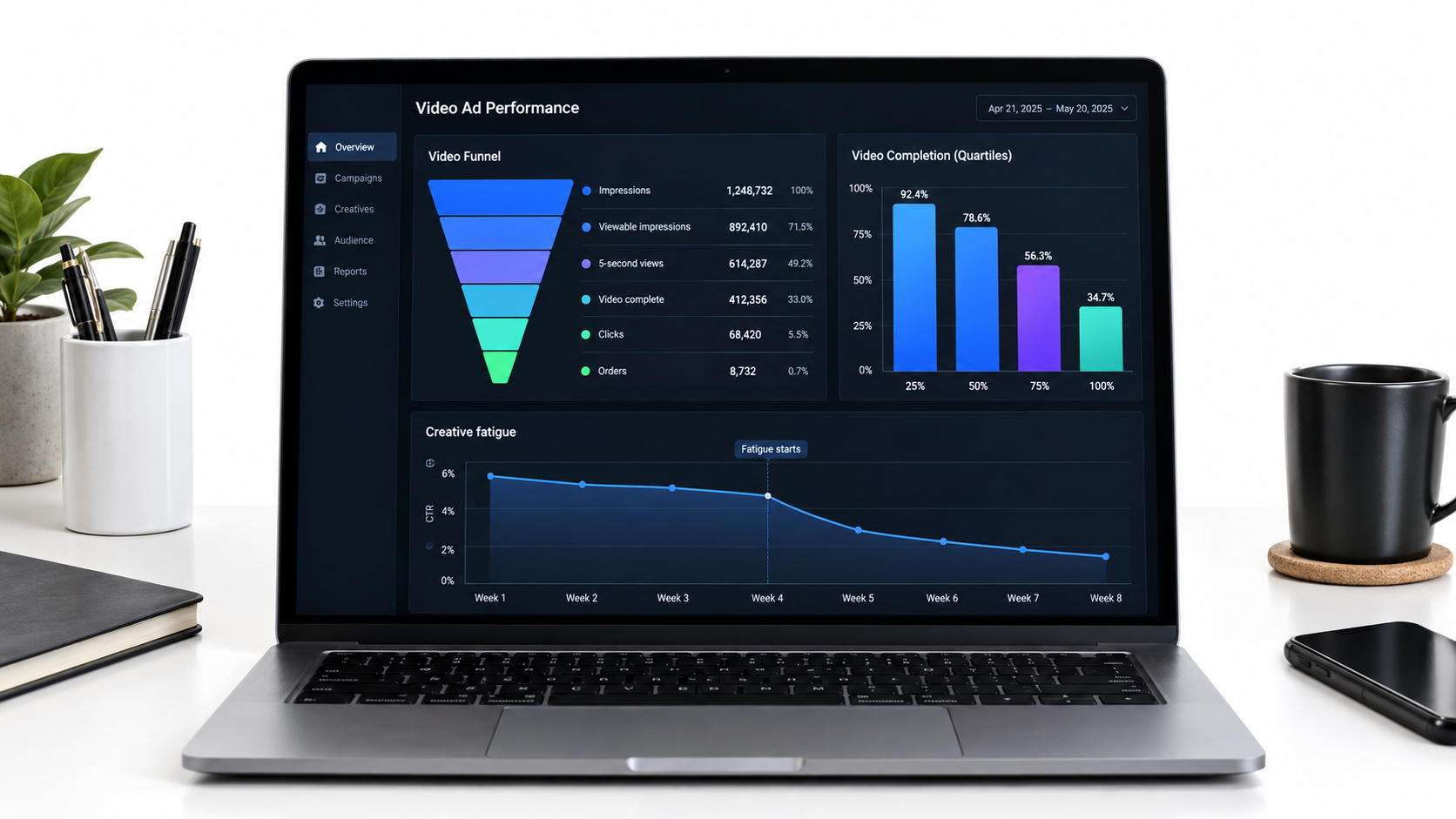
    Analytics dashboard showing Sponsored Brands video metrics funnel, quartile completion rates, and a creative fatigue trend line

    The key video metrics

    • Viewable impressions: Impressions where the video was actually visible on screen according to viewability standards. This is a more honest denominator than raw impressions.
    • 5-second views and 5-second view rate: How many viewers watched at least five seconds. This is your clearest read on whether your opening frames work.
    • Quartile completions: The share of viewers reaching 25%, 50%, 75%, and 100% of the video. These show where attention drops.
    • Viewable click-through rate (vCTR): Clicks divided by viewable impressions. A cleaner measure of creative appeal than standard CTR.
    • Unmutes: How many viewers tapped to turn on sound. Useful as an interest signal, and a reminder of how few viewers hear your audio.
    • New-to-brand metrics: Orders and sales from customers who haven’t bought from your brand in the lookback period.

    Diagnosing problems by where the drop happens

    Each metric points to a specific part of the storyboard:

    1. Low 5-second view rate: The opening isn’t working. Your first two seconds aren’t stopping the scroll. Recut the opening with a stronger product-in-motion shot.
    2. Good 5-second rate, sharp drop before 50%: The hook works, but the middle loses people. Your problem or promise section is probably too slow or too cluttered.
    3. Strong completion rate, low vCTR: People watch but don’t click. The ending lacks a clear reason to act, or the product doesn’t match what the video promised.
    4. Strong vCTR, weak conversion rate: The video works; the landing page doesn’t. Fix the detail page or Store before spending more on video.

    Don’t benchmark blindly

    Published benchmarks for video metrics vary widely by category, price point, and season. A 5-second view rate that’s strong for replacement vacuum filters may be weak for fashion accessories. The most reliable benchmark is your own history. Compare creative versions against each other within the same campaign, targeting, and time window.

    Attribution windows and new-to-brand

    Video often influences purchases that happen later. Sponsored Brands uses a 14-day attribution window for sales. New-to-brand metrics help show whether SBV is reaching fresh customers or just recapturing existing buyers. For brand-building campaigns, a rising new-to-brand share can justify a higher ACOS than you’d accept on a pure conversion campaign.

    Creative Testing and Fatigue: Keeping Video Fresh

    No video performs well forever. Shoppers in your category see the same ad repeatedly, and response declines over time. This creative fatigue is predictable, and a good testing process plans for it instead of reacting to it.

    Test one variable at a time

    When comparing video versions, change only one major element per test. If version A and version B have different openings, different text, and different music, you won’t know which change made the difference.

    The most useful variables to test, roughly in order of impact:

    1. Opening shot (first two seconds)
    2. Primary on-screen claim
    3. Video length (a shorter cut against a longer cut)
    4. Featured benefit order
    5. Closing frame and brand treatment

    Start at the top. Opening shots usually have the biggest influence on 5-second view rate, which affects everything downstream.

    Structure tests fairly

    Run competing creative versions in parallel campaigns or ad groups with identical targeting, bids, and budgets. Let each accumulate enough viewable impressions and clicks before drawing conclusions. Ending a test after two days on a handful of clicks usually leads to wrong conclusions.

    Amazon has also rolled out creative experimentation tools for some ad types, which let you split traffic between versions within the console. Check whether these are available for your account and campaign type. They make fair comparisons much easier.

    Spotting fatigue early

    Fatigue shows up as a gradual decline in 5-second view rate and vCTR while targeting and bids stay constant. When you see that trend over several weeks, it’s time to rotate in fresh creative.

    A practical approach is to keep a pipeline of two or three alternative cuts ready at all times. Because they come from the same footage, they’re cheap to produce. When the current winner starts to fade, swap in the next version and keep testing.

    Seasonal creative

    Seasonal refreshes also help. A water bottle video can feature hiking in summer and office use in the fall. A blanket brand can shift from gifting in December to cozy-home themes in January. The product stays the same; the context changes to match what shoppers are searching for.

    Budgeting and Bidding for Video Campaigns

    Sponsored Brands video is typically sold on a cost-per-click basis, with Amazon also offering impression-based options for certain campaign goals, such as growing brand impression share. The right approach depends on your objective.

    Match the bid strategy to the goal

    If your goal is sales efficiency, use CPC bidding and judge the campaign on ACOS and ROAS, accounting for a 14-day attribution window. If your goal is visibility and brand awareness, impression-based bidding and reserve share of voice options can make sense. Judge those on reach, viewable impressions, and new-to-brand metrics.

    Don’t mix goals within the same campaign. A campaign judged on both awareness and ACOS will disappoint on at least one.

    Set a learning budget

    New SBV creative needs enough traffic to generate meaningful data. Set aside a defined learning budget for the first few weeks and treat it as research spend. Its purpose is to answer questions: does this opening stop the scroll? Does this claim drive clicks? Does this targeting convert?

    Once you know which creative and targeting combinations work, move budget toward them and hold them to efficiency targets.

    Placement bid adjustments

    Sponsored Brands campaigns offer placement-level controls, including bid adjustments for top-of-search in many setups. If your data shows video performs much better in one placement, adjust bids accordingly. Review placement reports regularly, because placement mix can shift as competitors change strategy.

    Think in portfolio terms

    SBV rarely works best alone. HP’s reported results came from combining Sponsored Brands video with Sponsored Brands, Sponsored Products, and display ads. Video creates awareness and interest. Sponsored Products captures shoppers who come back to search more specifically. Display retargets those who viewed but didn’t buy.

    When evaluating SBV, look at its effect on your total brand performance, including branded search volume and overall new-to-brand orders, not just its own attributed sales.

    A 30-Day Rollout Plan for Your Next Sponsored Brands Video

    Here’s a practical sequence for launching or relaunching Sponsored Brands video, built on everything above.

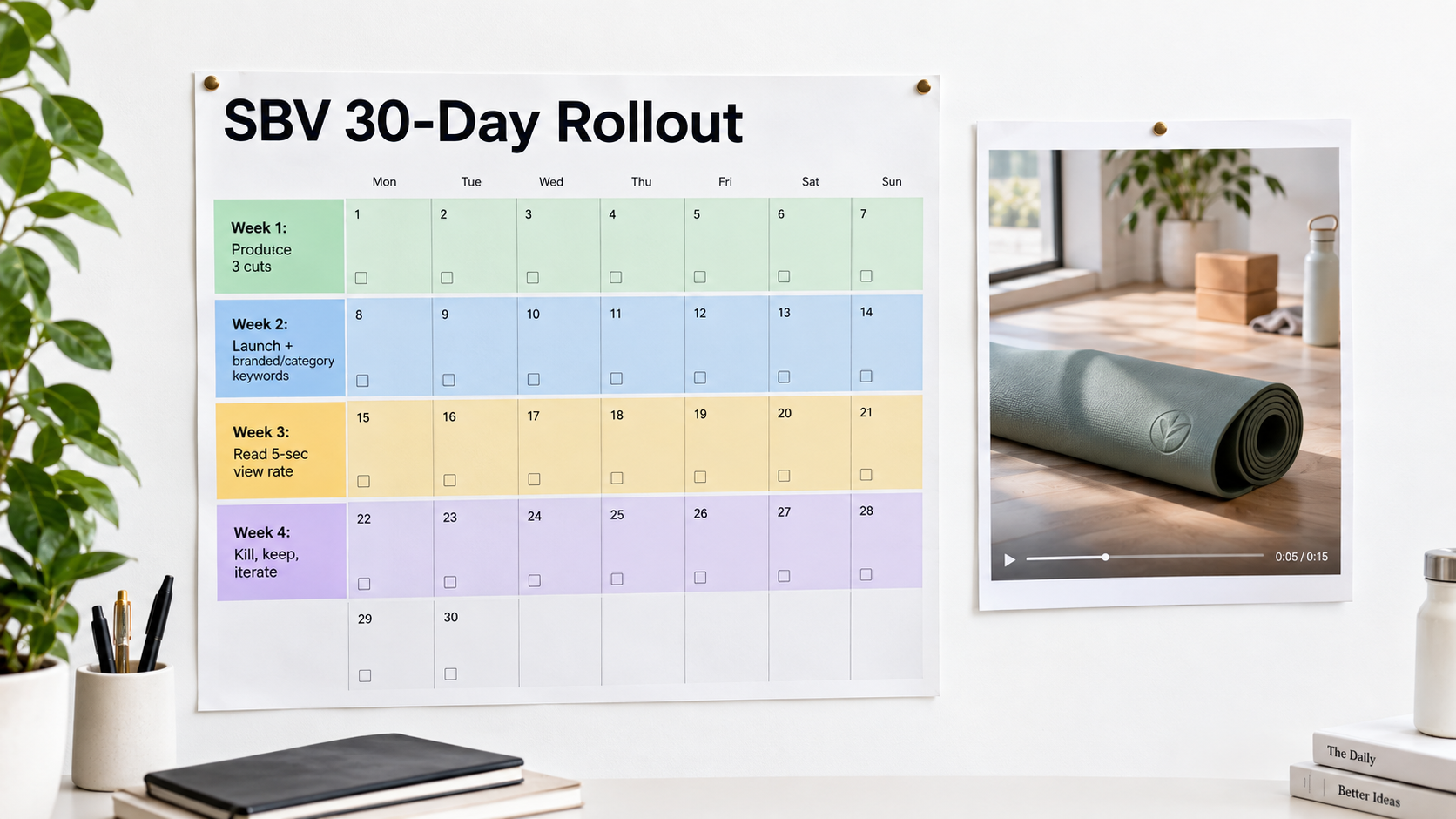
    30-day Sponsored Brands video rollout calendar: produce three cuts, launch on branded and category keywords, read 5-second view rate, then kill, keep, and iterate

    Week 1: Plan and produce

    • Pick one hero product with a strong detail page, good reviews, and healthy inventory.
    • Identify the single visual that best proves its value.
    • Shoot enough footage for at least three different openings.
    • Edit three cuts: a product-in-motion opening, a problem-led opening, and a feature-led opening.
    • Run the muted phone test on each cut with someone outside your team.
    • Check every claim and text overlay against Amazon’s current ad policies and specs.

    Week 2: Launch with clean structure

    • Submit all three cuts for moderation early to leave room for revisions.
    • Create separate campaigns for branded keywords and a focused set of mid-funnel category keywords.
    • Run the three creative versions with identical targeting and budgets.
    • Set a defined learning budget for the test period.

    Week 3: Read the early signals

    • Compare 5-second view rates across the three openings.
    • Check quartile completion to spot where viewers leave.
    • Review vCTR and conversion rate to identify whether the problem is the creative or the landing page.
    • Pull the search term report and add negatives for irrelevant terms.

    Week 4: Decide and iterate

    • Pause the weakest version.
    • Move budget toward the winning cut.
    • Build a new challenger that changes one variable from the winner.
    • Add product targeting campaigns using comparison-style creative.
    • Set a recurring review to watch for fatigue signals going forward.

    At the end of 30 days, you won’t have a perfect video. You’ll have something more valuable: a clear read on what your shoppers respond to and a repeatable process for improving on it.

    Conclusion: Treat the First Two Seconds as the Whole Ad

    Sponsored Brands video is one of the few Amazon ad formats that can actually stop a shopper mid-scroll. It moves in a feed of static images, it holds prominent placements, and it’s only available to brand-registered sellers. The competition is thinner and the attention potential is higher than in most of the ad console.

    That potential is wasted when brands treat SBV as a place to recycle TV spots or website videos. The format has its own rules: muted autoplay, placement-specific shopper mindsets, strict moderation, and metrics that show exactly where attention breaks down.

    Key takeaways

    • Win the first two seconds. Open with the product already in motion. No logo intros, no slow fades.
    • Design for silence. Make on-screen text and visual demonstrations carry the entire message. Treat audio as optional.
    • Cut for placement. Use the same footage to create different openings for in-search, top-of-search, and detail-page contexts.
    • Match message to destination. Single-product videos go to product pages. Brand stories go to Stores or multi-product formats.
    • Separate targeting by intent. Branded, category, and competitor campaigns each need their own budgets, creative, and success metrics.
    • Diagnose with video metrics. 5-second view rate tells you about the hook. Quartiles show the middle. vCTR and conversion rate show the ending and the landing page.
    • Plan for fatigue. Keep two or three alternative cuts ready and test one variable at a time.
    • Judge SBV as part of a portfolio. Measure its effect on new-to-brand orders and total brand sales, not just its own ACOS.

    The brands getting results from Sponsored Brands video in 2026 aren’t necessarily the ones with the biggest production budgets. They’re the ones who’ve worked out what a shopper sees in a muted, two-second glance and built everything else around that moment.

  • Your Sponsored Brands Video Is a Search Result, Not a Commercial — So Stop Building It Like One

    Your Sponsored Brands Video Is a Search Result, Not a Commercial — So Stop Building It Like One

    Most Amazon Sponsored Brands video ads fail before anyone sees the product. That isn’t because the footage looks bad. Often it’s beautiful: slow product reveals, lifestyle scenes, a logo animation, a voiceover with a clear story. The trouble is that the ad was built for the wrong place.

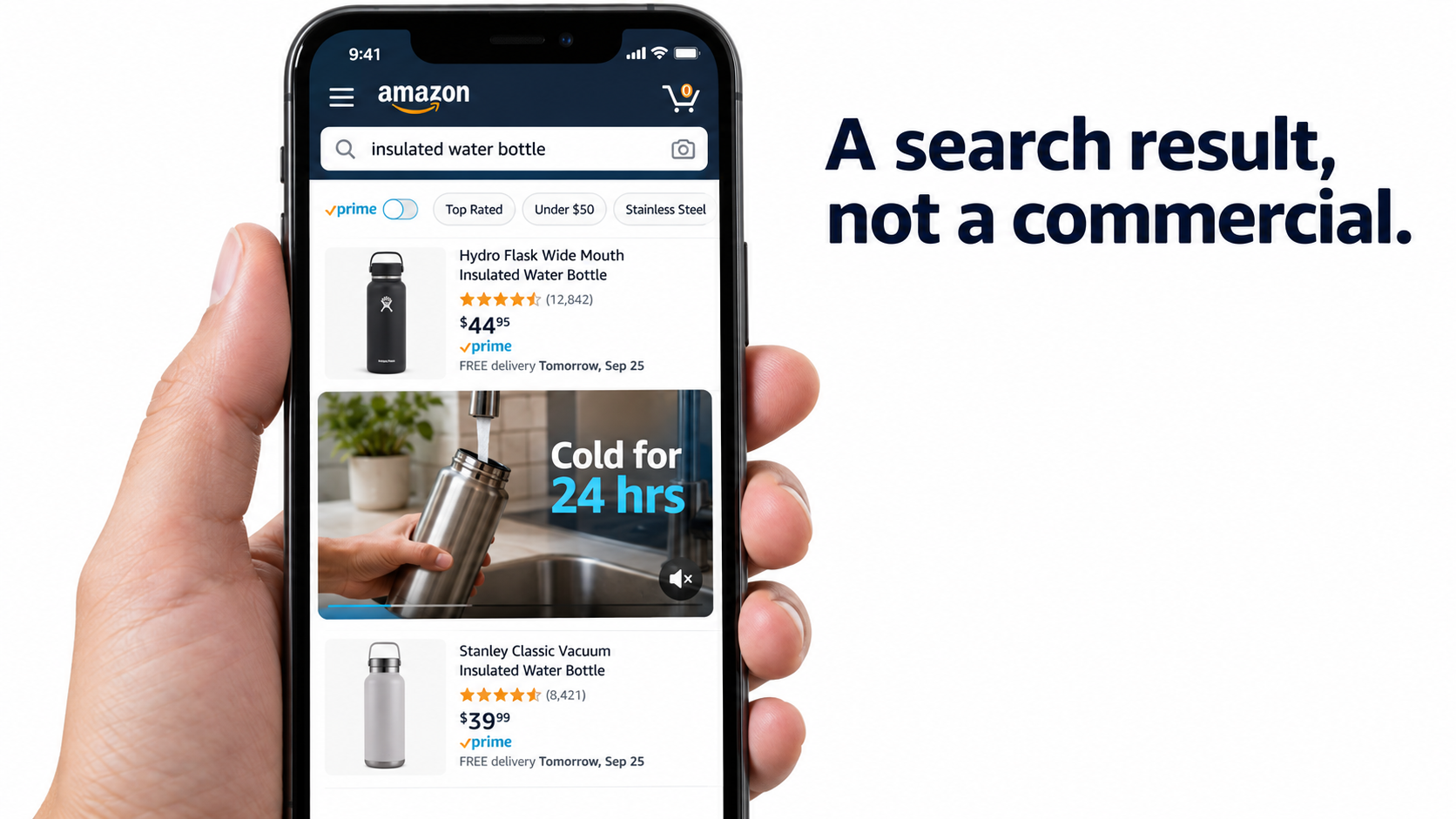
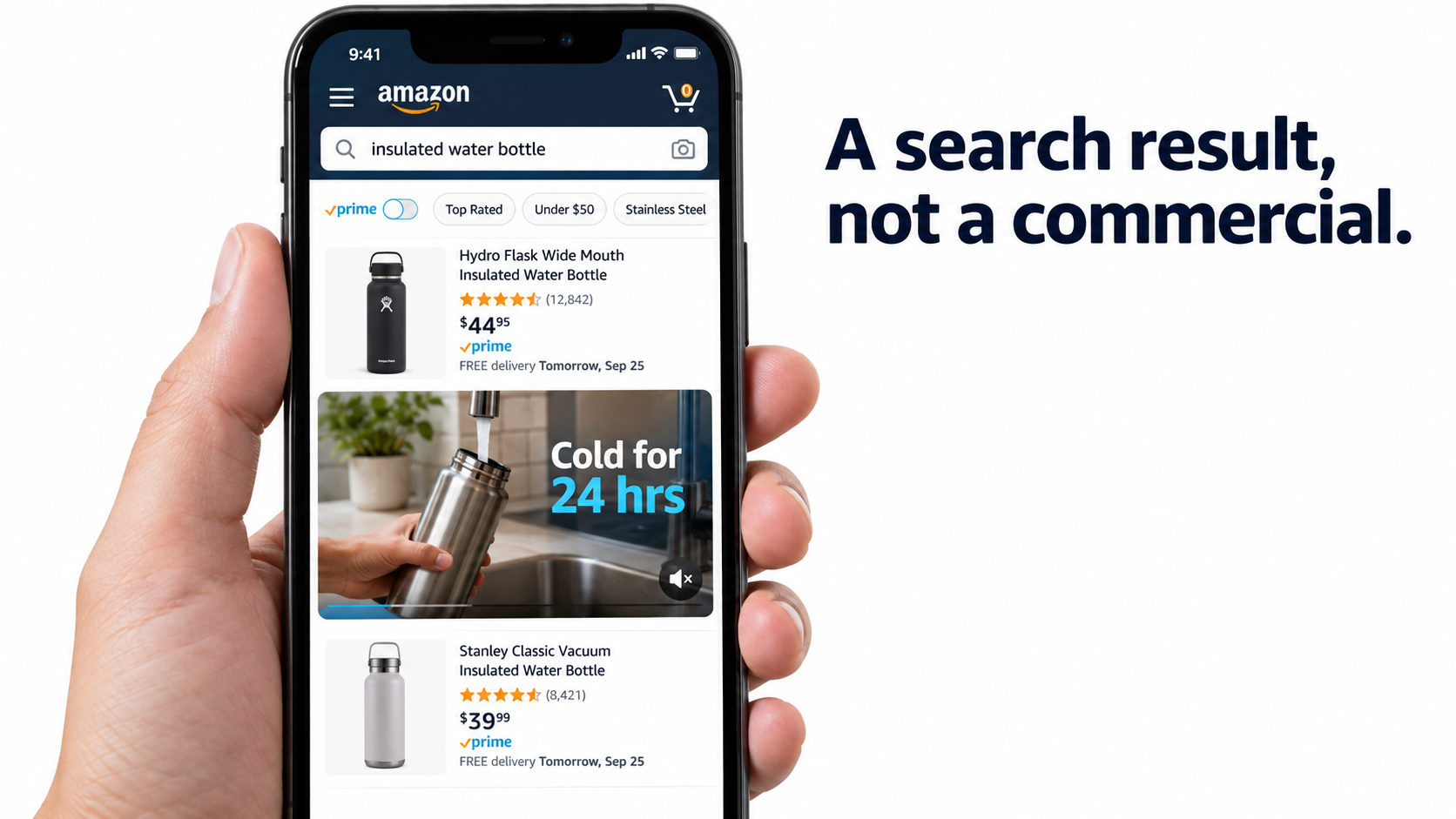
    A Sponsored Brands video (SBV) doesn’t play before a show or in a social feed where people are relaxing. It plays inside a list of search results, with the sound off, next to competing products that show prices, star ratings, and Prime badges. The shopper typed a query a second ago and is scanning fast. Your video is one more result they can scroll past.

    That changes how you should plan, shoot, edit, target, and measure these ads. You’re not making a commercial that happens to run on Amazon. You’re making a moving search result. It has to answer the query faster and more clearly than the static listings around it.

    This guide works through that idea from start to finish. It covers how the placement actually behaves, why every video should map to a group of related searches, what the first two seconds must do, how to design for silent autoplay, which creative choices get ads rejected, how to choose between the detail page and the Brand Store as the destination, how to set up campaigns and bids, and which metrics tell you whether the creative is working.

    The approach is practical. Where Amazon has published data, it’s cited. Where the advice comes from how the format works, it’s labeled that way. Specs and policies change, so treat any numbers here as a starting point and check them against the current Amazon Ads console before you spend money on production.

    Smartphone showing an Amazon mobile search results page with a muted autoplaying Sponsored Brands video of a water bottle and the overlay text Cold for 24 hrs

    Why Sponsored Brands Video Gets Misunderstood

    Amazon describes Sponsored Brands as an ad product that helps “shoppers discover your brand with video, image, or collections,” with ads appearing “above, alongside, or within shopping results” on desktop and mobile. That description is the most useful thing to remember about the format. The ad lives among the results.

    Many brands still hand SBV briefs to agencies or editors whose experience is in YouTube pre-roll, connected TV, or social ads. Those formats reward emotional build-up, brand storytelling, and sound design. Search results don’t. The confusion shows up in three recurring mistakes.

    Mistake 1: Treating the video as brand awareness only

    Amazon does position Sponsored Brands as a way to grow brand discovery, and the video format helps with that. But the shopper who sees it has already told Amazon what they want. A search for “insulated water bottle 32 oz” is close to a purchase. A video that spends ten seconds on mood before showing the bottle wastes the strongest intent signal in digital advertising.

    Mistake 2: Assuming someone is watching

    On TV, the viewer is watching the screen by default. In search, the shopper is looking at a grid. Your video competes with thumbnails, prices, and review counts. Every frame has to earn attention, and the very first frame most of all.

    Mistake 3: Using one video for every keyword

    A commercial is made once and shown to everyone. A search result is relevant to one query. Brands that run a single “hero” SBV across hundreds of keywords end up with an ad that loosely fits everything and clearly answers nothing. Relevance, not production value, is what gets the click.

    The rest of this guide follows one principle: build each SBV to be the best answer to a specific set of searches, readable with the sound off, in under three seconds.

    Anatomy of the Placement: Where SBV Runs and How It Behaves

    Before you write a script, understand the conditions your video plays in. These conditions matter more to creative decisions than any brand guideline does.

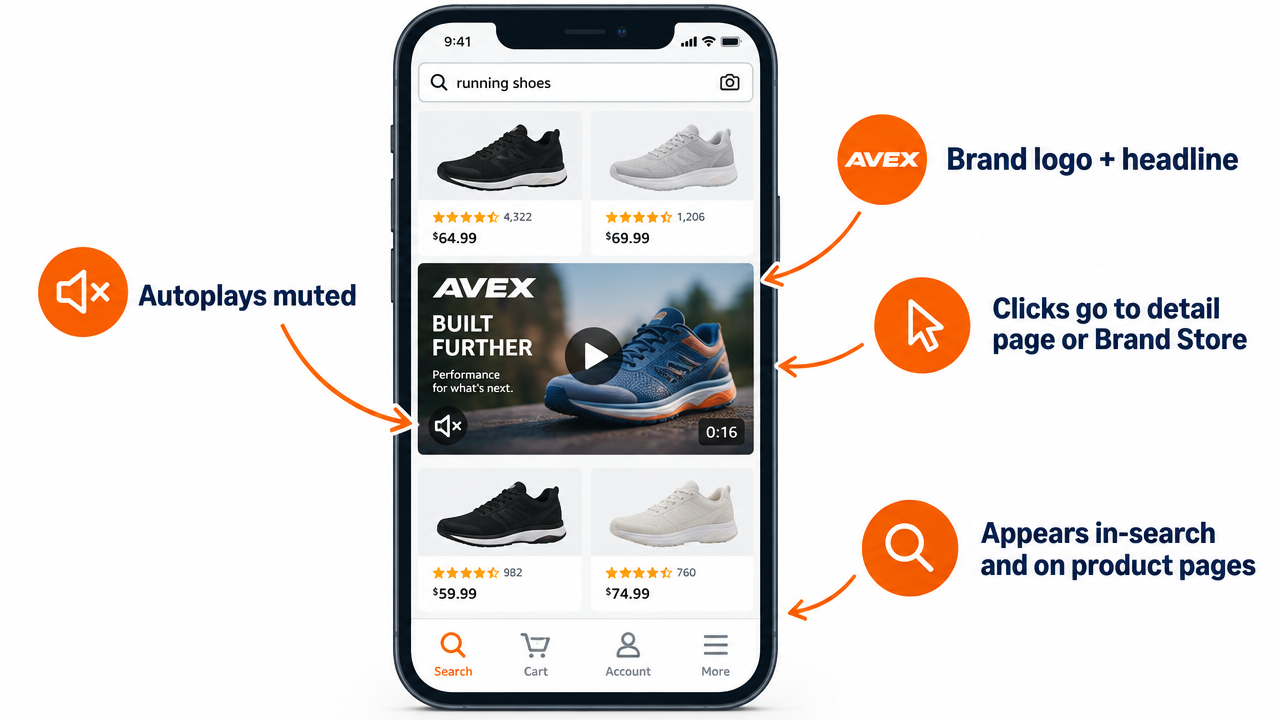
    Infographic of a mobile search grid with a 16:9 Sponsored Brands video tile labeled autoplays muted, brand logo and headline, clicks go to detail page or Brand Store

    Where the ads appear

    Amazon says Sponsored Brands ads can appear at the top of search results, within results, and on product pages, on both desktop and mobile. In practice, SBV most often appears as a wide video unit placed among the organic results rather than above them. It can also show on product detail pages when you use product targeting.

    That in-grid position is why the “search result” framing matters. Your video isn’t a banner above the results. It interrupts the list the shopper is scrolling through, so it needs to look like it belongs there.

    How playback works

    SBV autoplays muted once it’s on screen. Shoppers can unmute, and Amazon reports unmutes as a metric, but you should assume most impressions happen in silence. Any message carried only by voiceover or dialogue will reach very few people.

    The unit usually shows the video with your brand logo or name, a short headline in some formats, and the featured product’s listing details: title, price, star rating, and Prime eligibility. So the shopper sees your creative next to the same decision signals they see on organic listings. If your rating or price isn’t competitive, great video won’t fully make up for it.

    Format options

    Amazon’s Sponsored Brands video offering has grown over time. Broadly, you’ll find:

    • Single-product video: The video features one ASIN, and clicks usually go to that product’s detail page. This is the most common and most direct setup.
    • Brand or multi-product video: The video appears alongside several products, and clicks can go to your Brand Store or a Store subpage. This suits brands with a range of related products.

    Format names and options change as Amazon updates the console. Check what’s available in your marketplace and account type when you build the campaign.

    What this means for creative

    Put together, the placement conditions give you a clear brief. The video must:

    1. Show the product in the first frame, because autoplay starts right away and scrolling is fast.
    2. Communicate without sound, because it’s muted by default.
    3. Match the query, because it sits among results the shopper judges for relevance.
    4. Support the listing signals shown next to it, not contradict them.

    The Intent-Cluster Principle: One Video Per Group of Searches

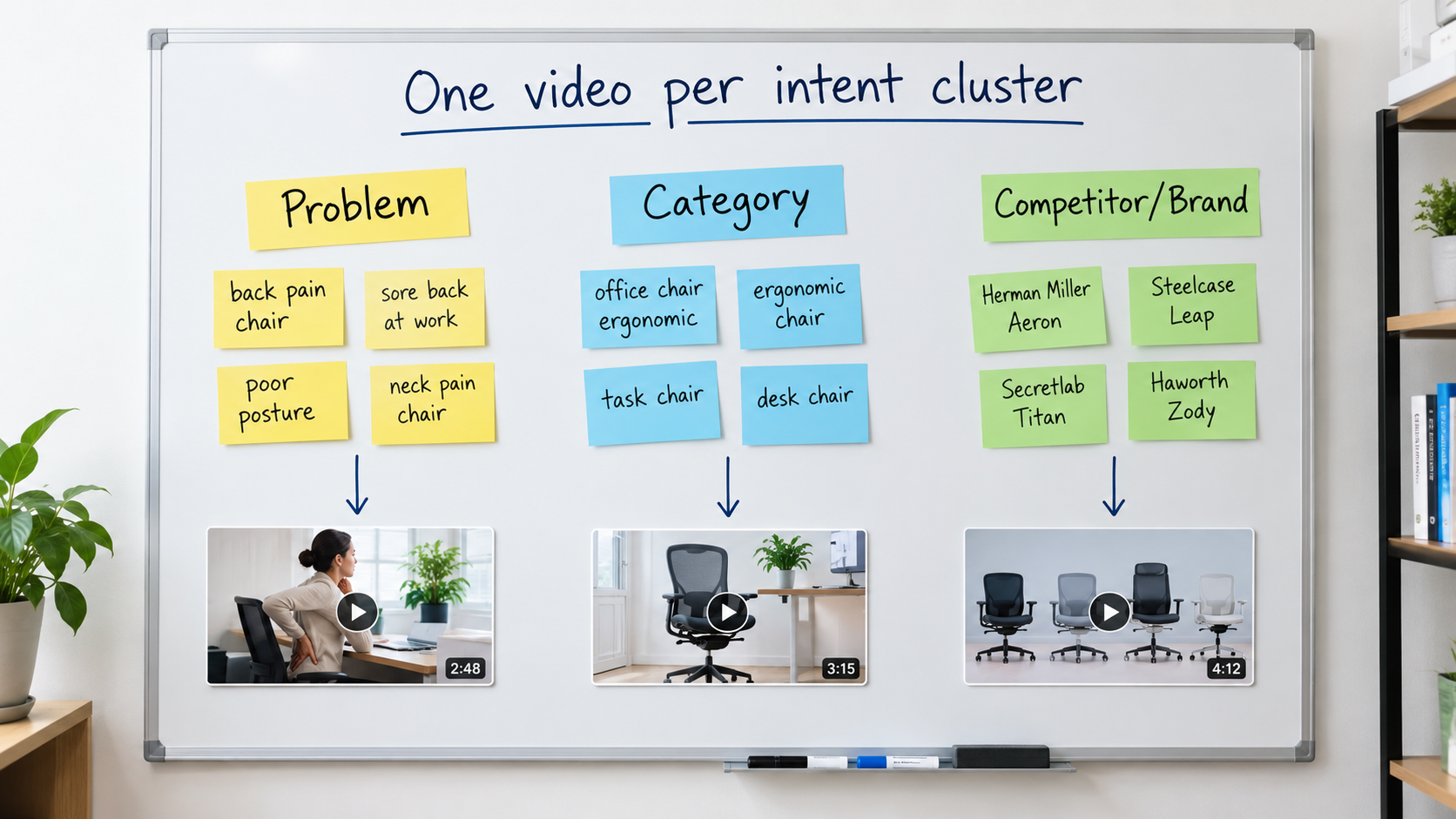
    This is the biggest strategic change most SBV programs can make, and the one that most separates the “search result” mindset from the “commercial” mindset. Instead of one video for the whole product, build several videos and match each to a group of searches that share the same underlying need.

    Whiteboard with keyword clusters for problem, category, and competitor searches, each connected to its own video thumbnail, headed One video per intent cluster

    What an intent cluster looks like

    Take a hypothetical ergonomic office chair. Its search terms usually fall into a few groups:

    • Problem-led searches: “chair for lower back pain,” “office chair lumbar support.” These shoppers care about relief.
    • Category searches: “ergonomic office chair,” “mesh desk chair.” These shoppers are comparing options and care about features and value.
    • Use-case searches: “gaming chair for long hours,” “home office chair small space.” These shoppers care about fit for their situation.
    • Competitor or brand searches: Terms that include other brand names. These shoppers already have a reference point and need a reason to switch.

    A single video can’t lead with back-pain relief, a feature comparison, compact size, and a competitive advantage all at once. Each group needs a different opening message.

    How to build clusters from your own data

    You probably already have what you need. Pull your Sponsored Products search term report and your Brand Analytics search query data if you have access. Then:

    1. Filter to terms with meaningful impressions and at least some conversions.
    2. Label each term by the need it expresses, not just by the words in it.
    3. Group terms with the same label and add up the impressions for each group.
    4. Rank groups by volume and conversion rate. The top two or three become your first video briefs.

    Writing the brief per cluster

    For each cluster, write one sentence that answers the shopper’s unspoken question. For the back-pain cluster, that might be “Adjustable lumbar support that moves with you.” For the small-space cluster, “Fits under a 26-inch desk.” That sentence becomes the first text overlay and shapes the opening shot.

    The rest of the video can share footage across versions. Often only the first three to five seconds and the text overlays change. That keeps production costs manageable while making each version clearly relevant to its searches.

    Mapping clusters to campaigns

    Give each cluster its own campaign or ad group with its matching video, so relevance stays tight and reporting stays clean. If you mix clusters in one ad group, you won’t be able to tell whether a video worked because of its creative or despite a poor keyword fit.

    The First Two Seconds: Passing the Frame-One Test

    If SBV is a search result, frame one is its thumbnail. For many shoppers who scroll past, the opening second is all they’ll see. That makes the first frame the most valuable real estate in your creative, and it’s the part most often wasted.

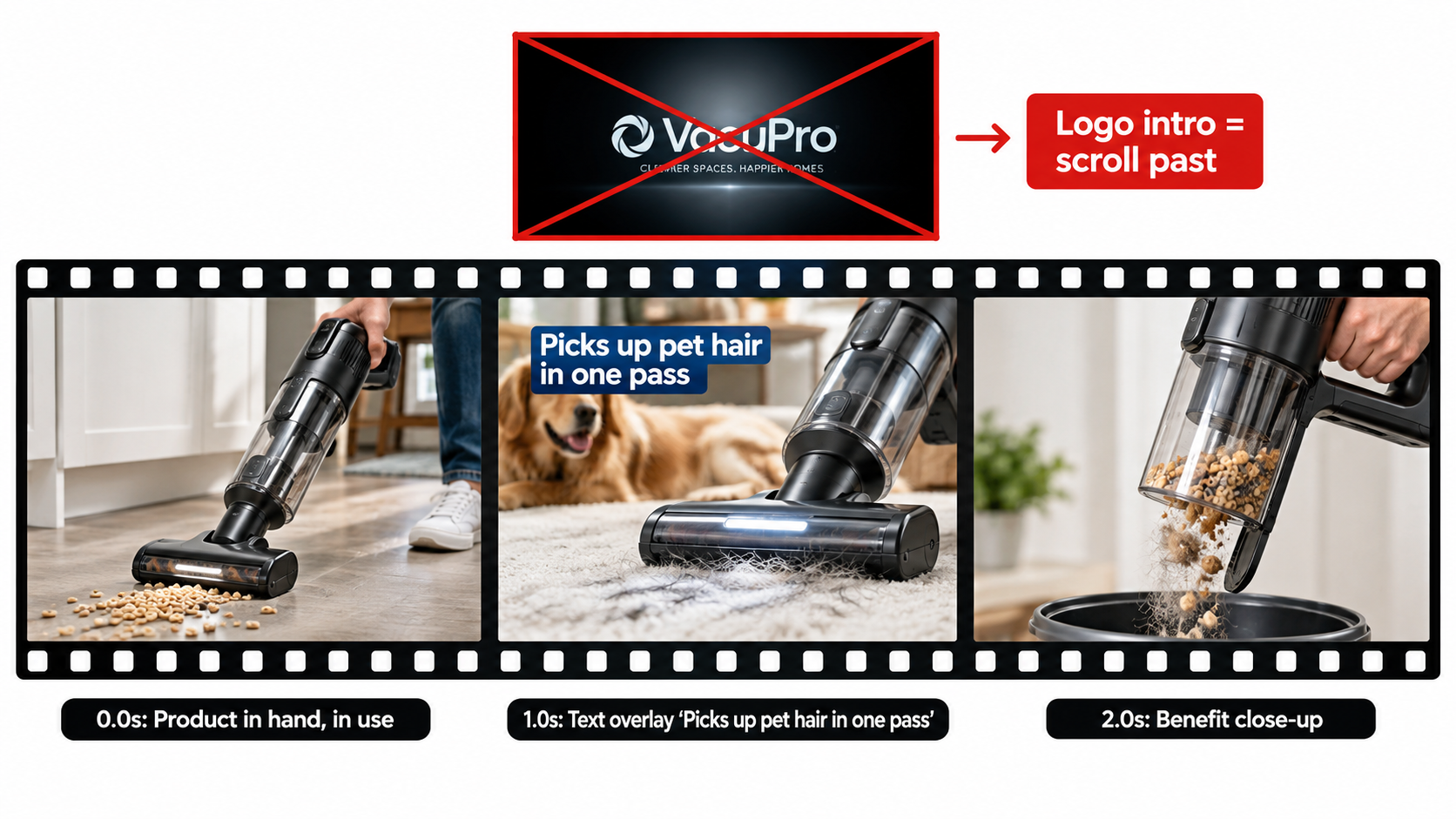
    Storyboard of the first three frames of a cordless vacuum video ad with product in use at 0 seconds, a benefit text overlay at 1 second, and a crossed-out logo intro frame

    What frame one should show

    Use a simple test. Pause the video at 0.0 seconds and show the still to someone who has never seen your product. Can they say within a second what the product is and roughly why it’s useful? If not, the opening doesn’t work.

    Openings that pass the test usually have these things in common:

    • The product is visible and fills a large part of the frame. Not a hand reaching toward something off-screen, not a wide room shot with the product in a corner.
    • It’s shown in use or in context where that helps. A vacuum picking up debris explains itself faster than a vacuum on a white background.
    • Contrast with the page is high. Amazon’s result pages are mostly white. Openings with strong color or clear subject separation are easier to notice in the grid.

    What to cut from the opening

    Some habits carried over from other video formats hurt SBV:

    • Logo intros. Your brand name already appears in the ad unit. A two-second animated logo uses the most valuable seconds on information the shopper already has.
    • Fade-ins from black. A black or blank first frame looks like a loading error in the grid. Amazon’s creative guidance has also pointed advertisers away from blank or black opening frames.
    • Slow lifestyle build-ups. A person waking up, stretching, and making coffee before the product appears works on TV. In search, the shopper has usually scrolled on by the time the product shows up.

    Structure after the opening

    Once the opening has stopped the scroll, a simple structure works well for most products:

    1. 0–2 seconds: Product in view with the cluster’s main benefit as a text overlay.
    2. 2–8 seconds: Show that benefit happening, with proof you can see.
    3. 8–15 seconds: Two or three supporting features, each with a short overlay.
    4. Final seconds: A clean product shot that leads into the listing details shown in the ad unit.

    Short videos tend to suit this format because shoppers are scanning, not settling in to watch. Amazon has historically accepted videos across a range of lengths, and many practitioners aim for about 15 to 30 seconds. Whatever length you choose, make sure the main point lands early. Treat the later seconds as a bonus for the few who keep watching.

    Designing for the loop

    Because the video may replay while on screen, a shopper who pauses on the unit can catch the opening more than once. A clean cut from the last frame back to the first reinforces the message. Endings that fade to black or linger on a logo slate make the loop feel clumsy.

    Designing for Silence: Text, Captions, and Safe Zones

    Muted autoplay is the default, so text on screen isn’t optional. For most viewers, the text overlays are the script. Treat sound as a bonus for the small share of shoppers who unmute.

    Split comparison of a skincare serum video frame without text labeled message lost versus with a caption inside a safe zone labeled message lands

    The sound-off script

    Write the overlay copy first and the voiceover second, if you use one at all. A good test is to watch the edit muted, at phone size, on a busy background. If you can’t follow the product story, the video isn’t ready.

    Good overlay copy for SBV tends to be:

    • Short. Three to seven words per card. Shoppers read overlays in a glance, not like paragraphs.
    • Specific. “Holds 40 lbs” beats “Super strong.” “Dishwasher-safe lid” beats “Easy to clean.”
    • Timed to the visuals. The overlay should name what the footage is showing at that moment. When text and image say the same thing, the message lands faster.
    • On screen long enough. A common rule of thumb is to leave each card up long enough to read twice at a normal pace.

    Legibility at small sizes

    On mobile, the video unit may be only a few centimeters tall. Text that looks fine on an editing monitor can become unreadable. Use a heavy, simple sans-serif font. Keep strong contrast with a solid or semi-transparent backing bar. Avoid thin strokes and script fonts.

    Amazon’s moderation has also rejected ads where on-screen text is too small, blurry, or cut off, so legibility affects approval as well as performance.

    Safe zones

    Parts of the video frame may be covered by interface elements or cropped differently across placements and devices. Keep key text and the product itself away from the edges, inside a central safe area. Letterboxing (black bars added to fit a different aspect ratio) looks unpolished and is typically not allowed. Shoot or reframe for the required 16:9 aspect ratio from the start rather than fixing it in the edit.

    Audio still matters, but less

    Audio isn’t worthless. Shoppers who unmute are showing strong interest, and a clear voiceover can help close the sale. Just make sure the audio supports the overlays and doesn’t carry information they leave out. Keep music unobtrusive and properly licensed. Rights problems with music are a practical risk for any brand running ads at scale.

    Specs and Moderation: Why Good Videos Get Rejected

    A strong video that sits in moderation review, or gets rejected, earns nothing. Much of the SBV frustration sellers talk about comes from preventable rejections. Building to spec and policy from the brief stage saves weeks.

    Technical specs to plan around

    Amazon publishes a Sponsored Brands video spec sheet, and it gets updated. Historically the main requirements have included:

    • Aspect ratio: 16:9.
    • Resolution: HD minimum (1280×720), with 1920×1080 or higher preferred.
    • Length: A set range of seconds. Amazon has generally allowed videos from a few seconds up to around 45 seconds for this format.
    • File type and size: Common formats such as MP4 or MOV, with a maximum file size.
    • Frame rate and audio: Standard frame rates and audio sampling requirements.

    Always confirm current specs in the Amazon Ads console or the official spec page before you export. Building to outdated specs is a common and avoidable delay.

    Common content-policy problems

    Moderation rejections usually come from content, not technical specs. Areas that often cause trouble include:

    • Unsupported claims. Superlatives like “#1,” “best,” or “clinically proven” typically need substantiation Amazon can verify, or they get flagged.
    • Time-sensitive or pricing messages. Text such as “Sale ends Friday” or specific discount claims can go out of date and create policy problems. Let the ad unit handle price.
    • Customer review quotes and star graphics. Showing reviews or ratings inside the creative is restricted and is a frequent reason for rejection.
    • Off-Amazon references. URLs, social handles, or “visit our website” calls to action conflict with the ad’s purpose on Amazon.
    • Mismatch with the advertised product. The video must clearly relate to the ASIN or products being advertised. Showing a different model, variant, or bundle than the one linked can trigger rejection.
    • Quality issues. Blurry footage, black frames, clipped text, or poor audio can all lead to rejection.
    • Restricted categories. Some product categories face extra rules or need additional approvals.

    A pre-submission checklist

    Before uploading, check the edit against a short list:

    1. Is the advertised product clearly visible and the same variant that’s linked?
    2. Can every claim on screen be backed by documentation?
    3. Is there any pricing, dates, review content, or off-Amazon reference?
    4. Does the first frame show content (not black or blank)?
    5. Is all text legible at phone size and inside safe margins?
    6. Do the file specs match the current console requirements?

    Keep a log of every rejection and the reason Amazon gives. Over time, that log becomes your brand’s internal guide to what passes, and it will speed up future production a lot.

    Choosing the Destination: Detail Page or Brand Store?

    Where a click goes affects conversion rate, the shopper’s experience, and how you measure performance. Many brands pick a destination by default. It should be a deliberate choice for each cluster.

    When the detail page makes sense

    Sending clicks straight to a product detail page is the most direct path to purchase. It fits when:

    • The search intent is specific and one product clearly answers it.
    • The product has a strong rating, good review count, and competitive price.
    • You’re measuring against a return-on-ad-spend or cost-of-sale goal and need clean attribution to one ASIN.

    For most problem-led and specific category clusters, the detail page is the natural destination. The video promises a solution, and the product page delivers it.

    When the Brand Store makes sense

    Amazon notes that Sponsored Brands can drive traffic to your Brand Store and that, “paired with Brand Stores,” the product supports discovery and longer-term engagement. A Store destination fits when:

    • The search is broad (for example, “camping gear”) and a range of products fits better than one.
    • Your products come in sizes, bundles, or complementary items that shoppers benefit from comparing.
    • You want to build brand familiarity and repeat purchases, not just a single sale.

    The risk is friction. A shopper who expected one product and lands on a busy Store page may leave. If you use a Store destination, send clicks to a focused subpage that matches the video’s message, not your Store homepage.

    Match the destination to the promise

    The rule is simple: the first thing the shopper sees after clicking should continue what the video promised. If the video leads with “fits under a 26-inch desk,” the landing page should make that dimension easy to find, ideally in the main image or first bullet. A mismatch between ad and landing page quietly drags down conversion, and it’s easy to miss because each piece looks fine on its own.

    Measurement differences

    Detail page traffic makes attribution easier because sales tie back to a specific product. Store traffic spreads sales across several ASINs and sometimes across longer consideration windows. When you compare the two, look beyond immediate cost of sale. Include new-to-brand orders and the mix of products bought, or Store campaigns will look worse than they really are.

    Campaign Architecture and Bidding for Video

    Creative gets the attention, but campaign structure decides whether the right video shows for the right search at a sensible cost. The intent-cluster principle should guide structure as well as creative.

    Keyword targeting

    Keyword-targeted SBV campaigns are the natural home for cluster-matched videos. A setup that works for many brands:

    • One campaign per cluster, each with its matching video.
    • Exact and phrase match for high-converting core terms, so relevance stays tight.
    • Broad match in a separate, lower-bid campaign to find new terms. Move winning terms into the exact-match cluster campaigns.
    • Negative keywords to stop clusters overlapping, so the back-pain video doesn’t compete with the small-space video on the same search.

    Product targeting

    Product targeting puts your video on competitor or complementary product pages. This is where the “competitor cluster” video belongs. On a rival’s detail page, your opening should state a clear, supportable difference, such as a larger capacity, a longer warranty, or a feature they don’t have, without naming or disparaging the competitor in ways policy doesn’t allow.

    Targeting your own product pages is a defensive option too. It keeps competitor ads off your listings and can steer shoppers toward bundles or higher-tier versions.

    Bidding considerations

    SBV has historically been bought mostly on a cost-per-click basis, and Amazon has added impression-based (vCPM) buying for some Sponsored Brands goals focused on awareness and reach. Choose the model that fits the job:

    • CPC for performance-focused cluster campaigns, where you pay for shoppers who show intent by clicking.
    • Impression-based buying for reach or share-of-voice goals, where being seen on key searches matters as much as the click.

    Amazon also offers Sponsored Brands reserve share of voice, which lets brands secure top-of-search visibility. That fits big launches or peak seasons better than everyday campaigns.

    Budget separation

    Keep SBV budgets separate from Sponsored Products and static Sponsored Brands. Video usually has different click-through and conversion patterns. If budgets are pooled, a strong Sponsored Products campaign can hide a weak video, or the other way around, and you lose the ability to judge each fairly.

    Reading the Metrics: What Tells You the Creative Is Working

    SBV gives you more diagnostic data than static ads do, because you can see how shoppers interacted with the video before clicking. Most advertisers look only at cost of sale and ignore the rest. That leaves them unable to tell a creative problem from a targeting problem or a listing problem.

    Laptop dashboard with a video ad funnel from impressions through quartile views, 5-second views, clicks, and new-to-brand orders, with a sticky note reading judge creative by funnel not ACOS alone

    The video funnel

    Sponsored Brands video reporting includes metrics such as:

    • Impressions and viewable impressions: How often the ad loaded and how often it was actually on screen.
    • Video quartile views: How many views reached 25%, 50%, 75%, and 100% of the video.
    • 5-second views and 5-second view rate: How many shoppers watched at least five seconds, a useful signal that the opening held attention.
    • Video unmutes: How many shoppers turned the sound on, a sign of strong interest.
    • Clicks and click-through rate: Whether attention turned into action.
    • New-to-brand orders and sales: Purchases from customers who hadn’t bought from your brand recently.

    Metric names and availability can change, so check your console’s reporting columns.

    Diagnosing problems stage by stage

    Read the funnel in order. Where it drops off tells you what to fix:

    • Low 5-second view rate: The opening isn’t stopping the scroll. Rework frame one and the first overlay.
    • Good early views, sharp drop by midpoint: The middle section is slow or repetitive. Tighten the edit or shorten the video.
    • Healthy views, low CTR: The video holds attention but doesn’t prompt action. The message may be interesting but not relevant to the search, or the listing signals next to it (price, rating) may be putting shoppers off.
    • Good CTR, weak conversion: The problem is probably after the click, such as a mismatched landing page, weak listing content, or pricing. Changing the creative won’t fix that.

    Beyond cost of sale

    Judging SBV only on advertising cost of sale (ACOS) can undervalue it. Video often reaches shoppers earlier in their decision and brings in customers new to the brand. New-to-brand metrics help show that. If a video campaign has a slightly higher ACOS but a much higher share of new-to-brand orders, it may be building future repeat sales that a narrow ACOS view misses.

    Branded search volume is another useful signal to watch. If searches for your brand name rise after you scale video, the ads are likely building awareness even when direct attribution looks modest.

    Give tests enough data

    Video metrics bounce around at low volume. Don’t pause a video after a few hundred impressions. Set a minimum threshold, such as a set number of clicks or a set spend per variant, before deciding. Compare variants within the same cluster and time period so seasonality and targeting don’t skew the results.

    Testing Cadence and the Economics of Production

    The cluster approach means more videos. That raises a fair question: how do you produce enough variants without a big budget? The answer is to rethink how you produce video, not to lower the quality bar.

    Build a modular footage library

    Rather than commissioning finished videos one by one, shoot a library of modular clips in a single session:

    • Several opening shots, each showing a different benefit or use case.
    • Close-ups of each major feature in action.
    • Context shots showing the product in different settings and with different users.
    • Clean closing product shots.

    From one library, an editor can put together many cluster-specific versions by swapping openings and overlays. The cost of each extra variant drops sharply once the library exists.

    Use Amazon’s creative tools where they fit

    Amazon Ads now offers AI-powered creative tools in the console. The Sponsored Brands page, for example, highlights free AI image generation for branded creatives, and Amazon has added video generation tools as well. These can be useful for quick tests, seasonal refreshes, or smaller brands without production budgets. Treat AI-generated output like any other creative. Check it against the frame-one test, the silent-viewing test, and moderation policies before launch.

    A sensible testing cadence

    A workable rhythm for many brands looks like this:

    1. Launch: Two openings per top cluster, same body footage, run side by side.
    2. First review: Once each variant passes your data threshold, compare 5-second view rate and CTR. Keep the winner.
    3. Iterate: Test a new challenger against the winner, changing one thing at a time, such as the opening shot, the first overlay, or the length.
    4. Refresh: Watch for creative fatigue. If a proven video’s performance slips over time with steady targeting, bring in a new variant.

    Change one thing at a time

    If you change the opening, overlays, music, and length together, you won’t know what caused a result. Disciplined, single-variable tests build knowledge you can reuse across products. After a few rounds, you’ll learn patterns specific to your category, such as whether in-use openings beat close-up openings or whether numbers in overlays beat descriptive words.

    What the Published Case Studies Actually Show

    Amazon publishes Sponsored Brands case studies, and they’re worth reading carefully: for what they report, and for what they don’t.

    HP: reach and clicks across a broad catalog

    Amazon reports that HP, using Sponsored Brands video together with Sponsored Brands, Sponsored Products, and display ads, saw impressions grow 224% year over year and clicks rise 142% year over year. That included a 42% increase in clicks for Sponsored Brands video placements.

    The takeaway is that video worked as part of a combined program, not alone. HP ran video alongside other sponsored ad types, so the results reflect a coordinated approach. For most brands, the lesson is to treat SBV as one layer in a full-funnel plan, not as a stand-alone fix.

    Loftie: efficiency for a small business

    Amazon’s case study on Loftie, described as a small business, reports a sponsored ads campaign with a return on ad spend of $5.66 and an advertising cost of sale of 17.68%. Those figures show that sponsored ads, Sponsored Brands included, can deliver efficient returns for smaller brands, not just large enterprises.

    NF Imports: long-term brand building

    Amazon also highlights NF Imports, a brand in Japan that has used sponsored ads since 2015. Amazon reports that 80% of its sales came from new customers over a multi-year period and that sales grew 30% across the period studied. The pattern is consistent use over years, not short bursts.

    How to read case studies sensibly

    Case studies are chosen to show success. They don’t tell you the median result, and they rarely break down which creative choices drove the numbers. Use them as evidence of what’s possible and as clues about structure. The recurring themes are combined ad types, consistent investment, and attention to new customers. Don’t treat them as benchmarks your campaigns should hit.

    Your own data, gathered through disciplined cluster-based testing, is a far better guide than any published case study. The playbook in this article is built to help you produce that data quickly.

    Putting It Together: A Practical SBV Workflow

    Here is the approach condensed into a workflow you can run for each product line.

    Step 1: Research

    Pull search term and search query data. Group terms into intent clusters and rank them by volume and conversion. Pick the top two or three clusters.

    Step 2: Brief

    For each cluster, write the one-sentence answer to the shopper’s question. Define the opening shot and first overlay. Note any claims that need documentation.

    Step 3: Produce

    Shoot a modular library in one session. Edit cluster versions by swapping openings and overlays. Check every cut against the frame-one test, the silent-viewing test, current specs, and moderation policies.

    Step 4: Structure

    Build one campaign per cluster with tight match types and cross-cluster negatives. Choose the destination (detail page or focused Store subpage) based on the video’s promise. Keep video budgets separate.

    Step 5: Measure

    Read the full funnel: 5-second view rate, quartile completion, CTR, conversion, and new-to-brand share. Find where the drop-off happens and fix that stage.

    Step 6: Iterate

    Run single-variable tests against the current winner. Refresh when performance fades. Keep a rejection log and a learnings log that the whole team can use.

    Conclusion: Win the Search, Not the Screening

    The brands that get the most from Sponsored Brands video aren’t necessarily the ones with the biggest production budgets. They’re the ones that understand where their video plays: muted, among competing results, in front of a shopper who just said exactly what they want.

    That understanding changes almost every decision. It moves the product into the first frame. It turns text overlays into the main script. It splits one hero video into several cluster-matched versions. It links each video to a landing page that continues its promise. And it replaces a single cost-of-sale number with a funnel that shows where things are going wrong.

    Key takeaways to act on:

    • Treat SBV as a search result. Build each video to answer a specific set of searches better than the listings around it.
    • Map videos to intent clusters. Start with your two or three highest-value clusters and give each its own opening and overlays.
    • Pass the frame-one test. Product visible, benefit clear, no logo intro, no black frames.
    • Design for silence. Write overlays first, keep them short and specific, and make them readable at phone size.
    • Prevent rejections early. Check claims, pricing, reviews, off-Amazon references, and current specs before export.
    • Match destination to promise. Use detail pages for specific intent and focused Store pages for broad intent.
    • Read the whole funnel. Use 5-second views, quartiles, CTR, and new-to-brand data to find the real bottleneck.
    • Test one variable at a time. Build a modular footage library so variants are cheap to make.

    Specs, formats, and policies on Amazon will keep changing through 2026 and beyond. The underlying logic won’t: a shopper scanning search results rewards the ad that answers the query fastest. Build your videos to be that answer, and the format works for you rather than against you.