Most Amazon sellers treat Sponsored Brand Video as a production problem. They spend weeks sourcing footage, debating color grades, arguing over background music, and finally uploading something that looks genuinely impressive — then watch it generate mediocre click-through rates and wonder what went wrong.
The problem is rarely the production quality. It’s a physics problem.
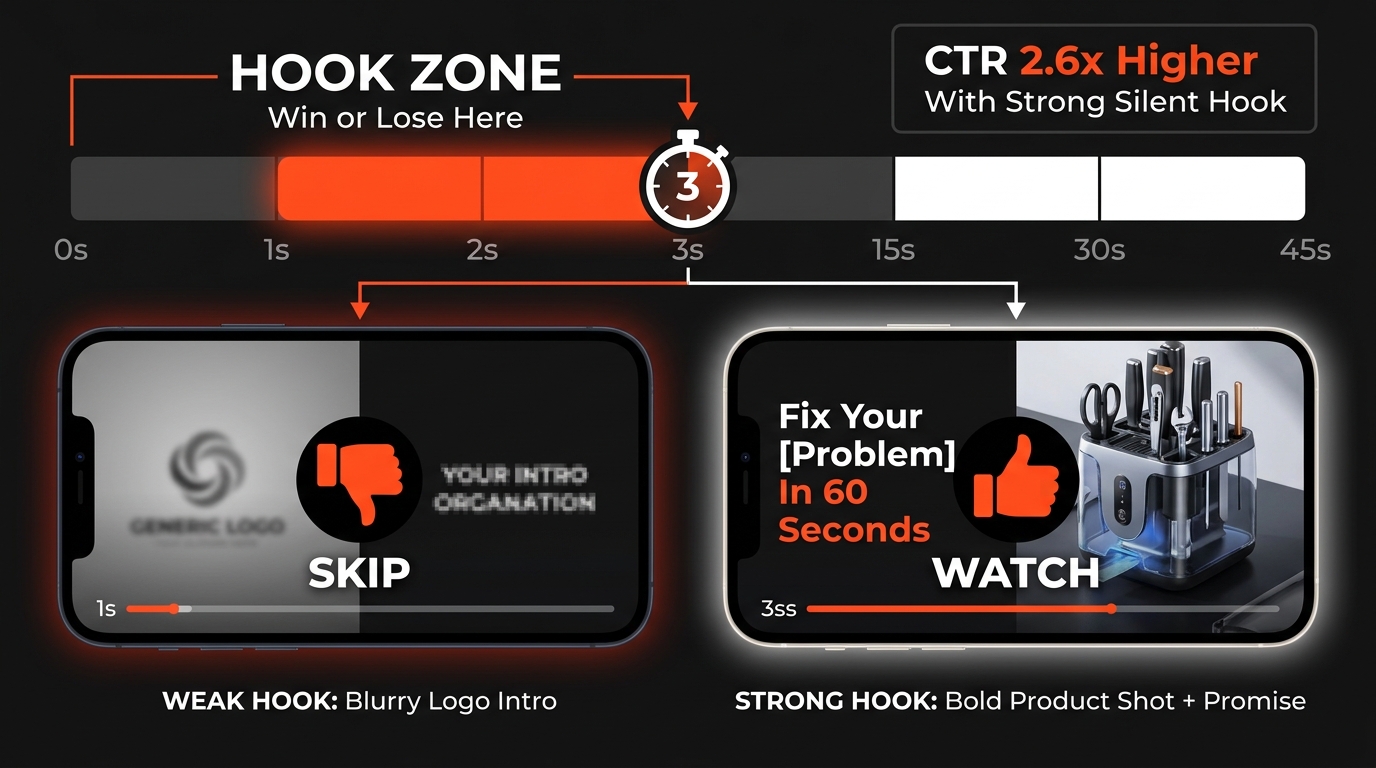
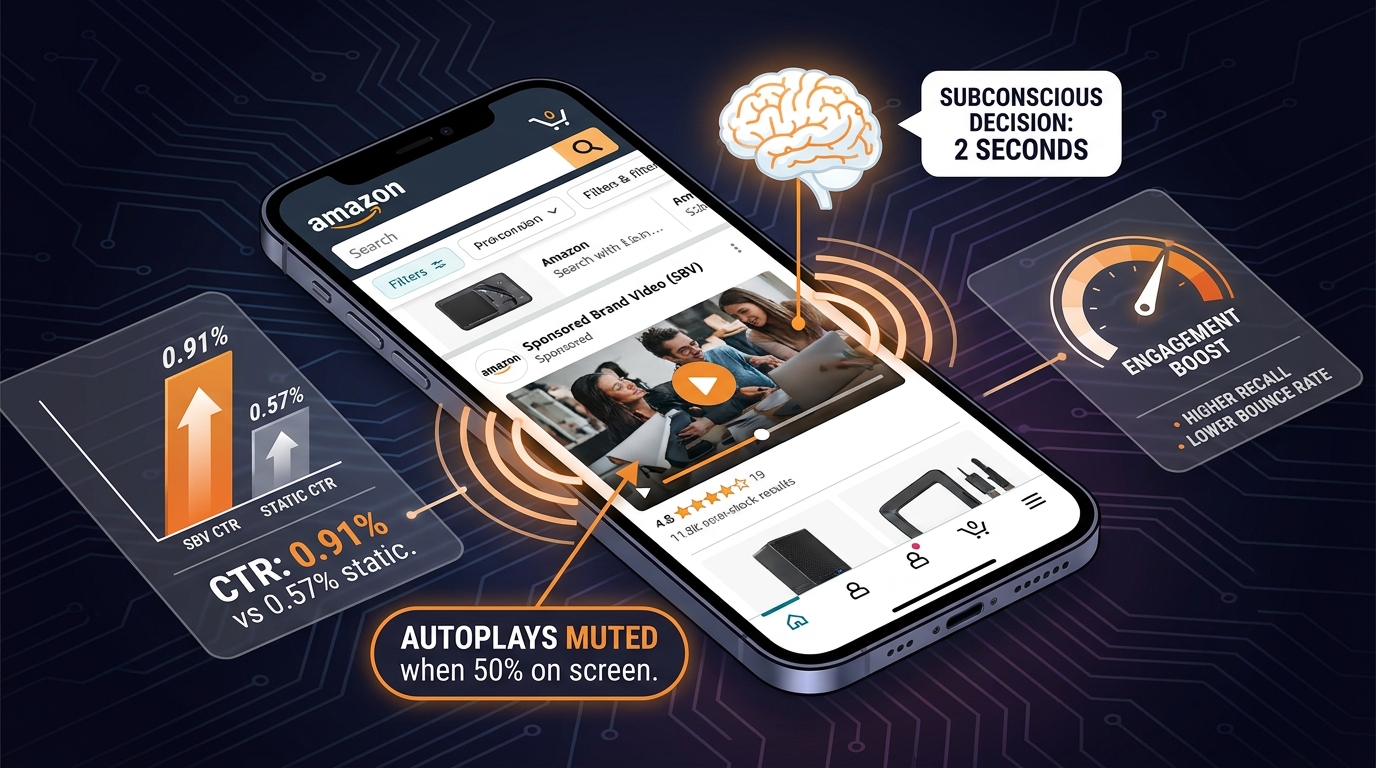
Sponsored Brand Videos exist in one of the most cognitively hostile advertising environments ever designed: a muted, autoplay strip sitting inside a search results page where the shopper’s attention is already split between evaluating organic listings, comparing prices, reading star ratings, and deciding whether to scroll further. Your video doesn’t get a polite introduction. It gets approximately three seconds of peripheral attention before the shopper’s eye makes a yes/no decision and moves on.
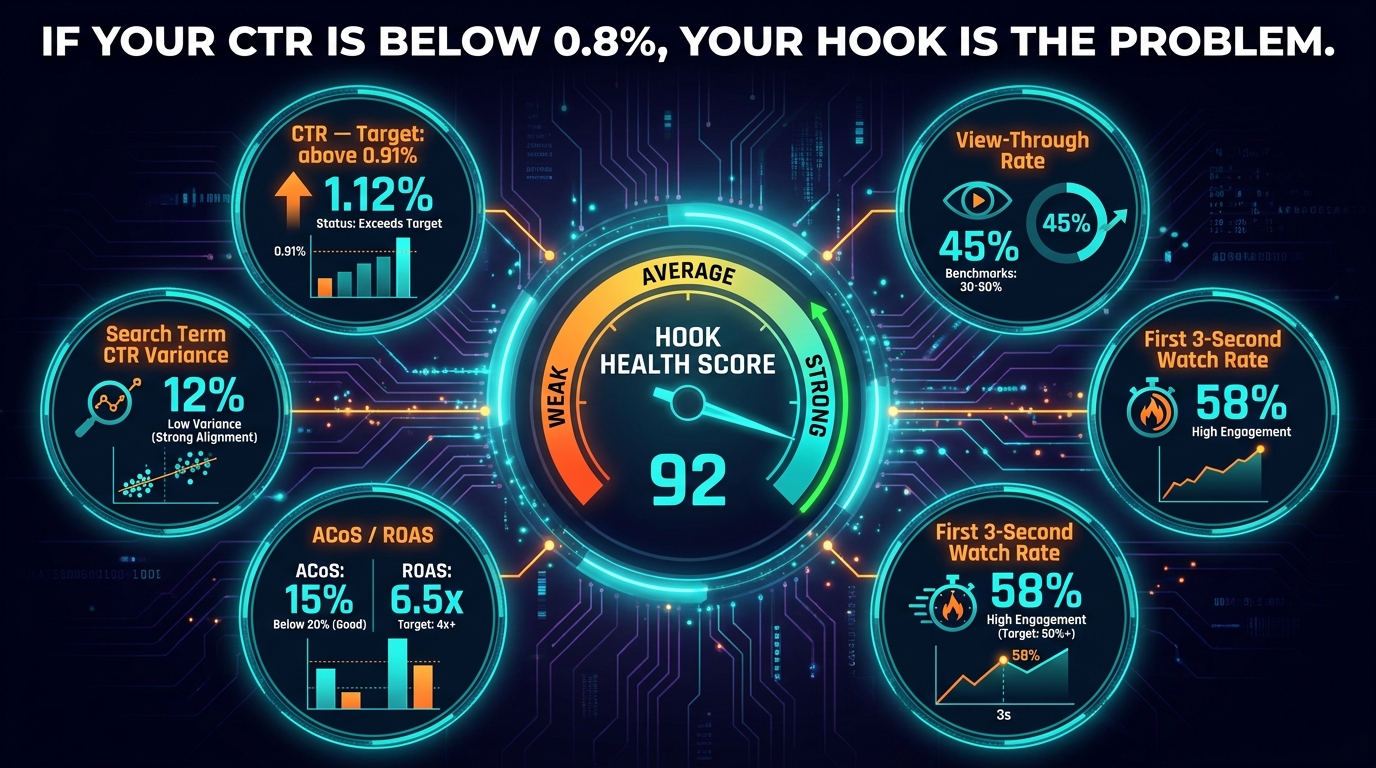
That three-second window changes everything about how you should plan, script, shoot, and structure your SBV creative. It means the rules of traditional video advertising — build tension, tell a story, reveal the product — are actively counterproductive. It means sound design, voiceover, and ambient music are nearly irrelevant to your first-pass performance. And it means the gap between a video that pulls a 0.3% CTR and one that pulls 1.2% often comes down to decisions made in the storyboard phase, not the edit bay.
This post breaks down exactly where most SBV campaigns lose, what the top-performing creatives are actually doing inside those 6 to 45 seconds, and how to build a repeatable creative system that compounds over time — rather than recycling the same underperforming video for 18 months and wondering why ACoS won’t budge.
The Muted Autoplay Reality That Changes Every Creative Decision
Before discussing creative tactics, it’s worth spending real time understanding the environment your SBV ad actually lives in — because most sellers have never truly reckoned with how alien it is compared to every other video context they’re familiar with.
Where SBV Actually Appears
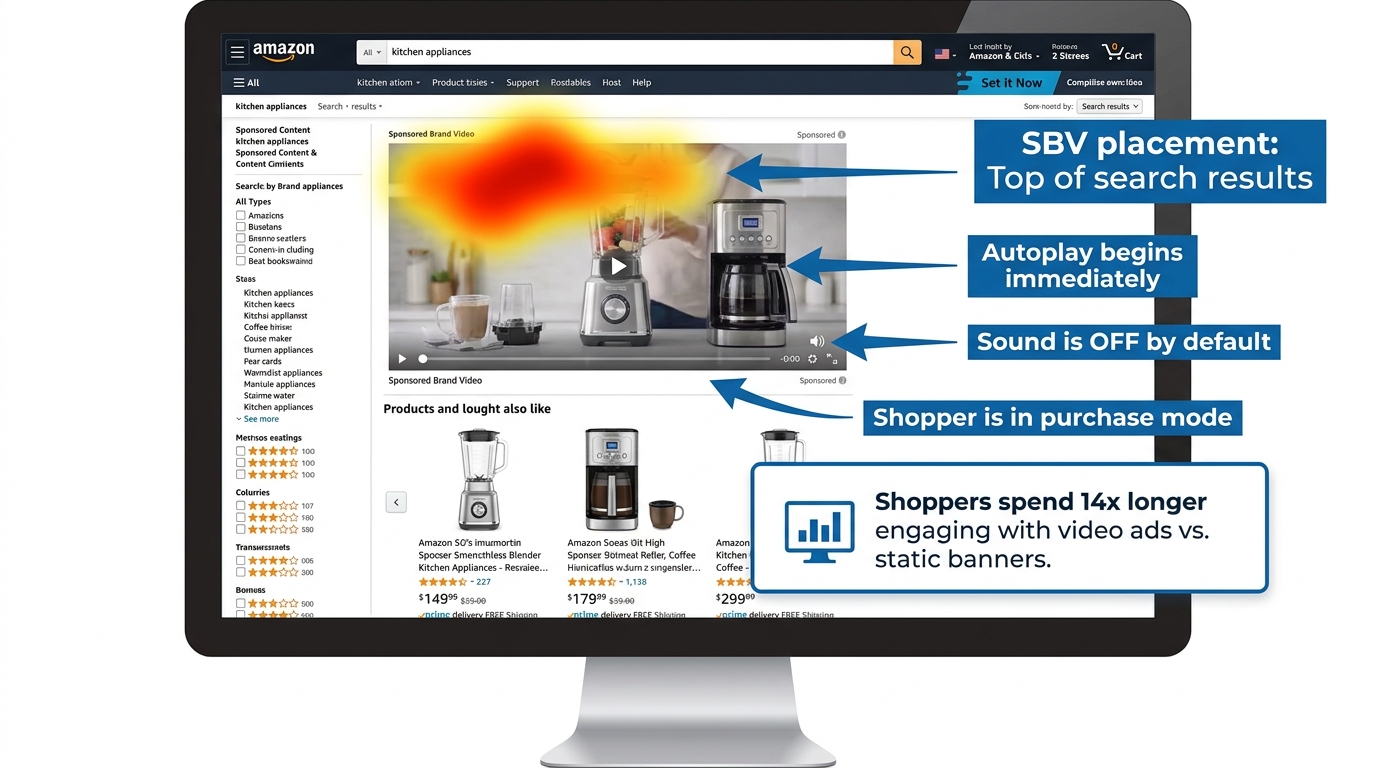
Sponsored Brand Videos appear at the top of Amazon search results, below the first row of organic results, and on product detail pages. On desktop, the video strip is prominent — spanning the full width of the search results column, with the product title, brand name, star rating, price, and a product image displayed directly alongside the video. On mobile, the placement is similarly high-visibility, typically appearing within the first full scroll of a search results page.
Critically, the video autoplays the moment it enters the viewport. It does not wait for the shopper to click play. It does not announce itself with a preview thumbnail. It simply starts playing, silently, the instant it becomes visible on screen. The shopper didn’t ask to see it. They didn’t lean forward to engage with it. They’re in the middle of evaluating search results, and your video is playing whether they want it to or not.
The Sound-Off Default: Not an Edge Case
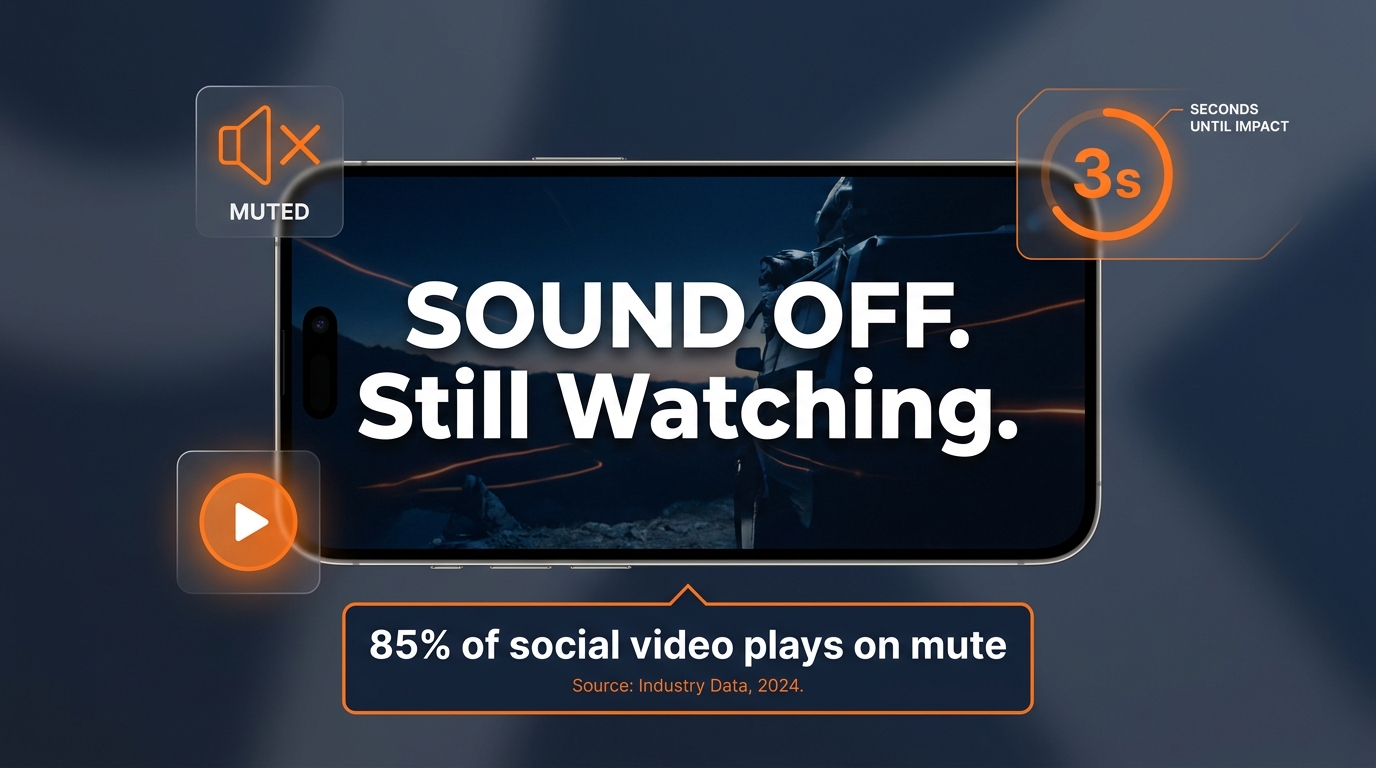
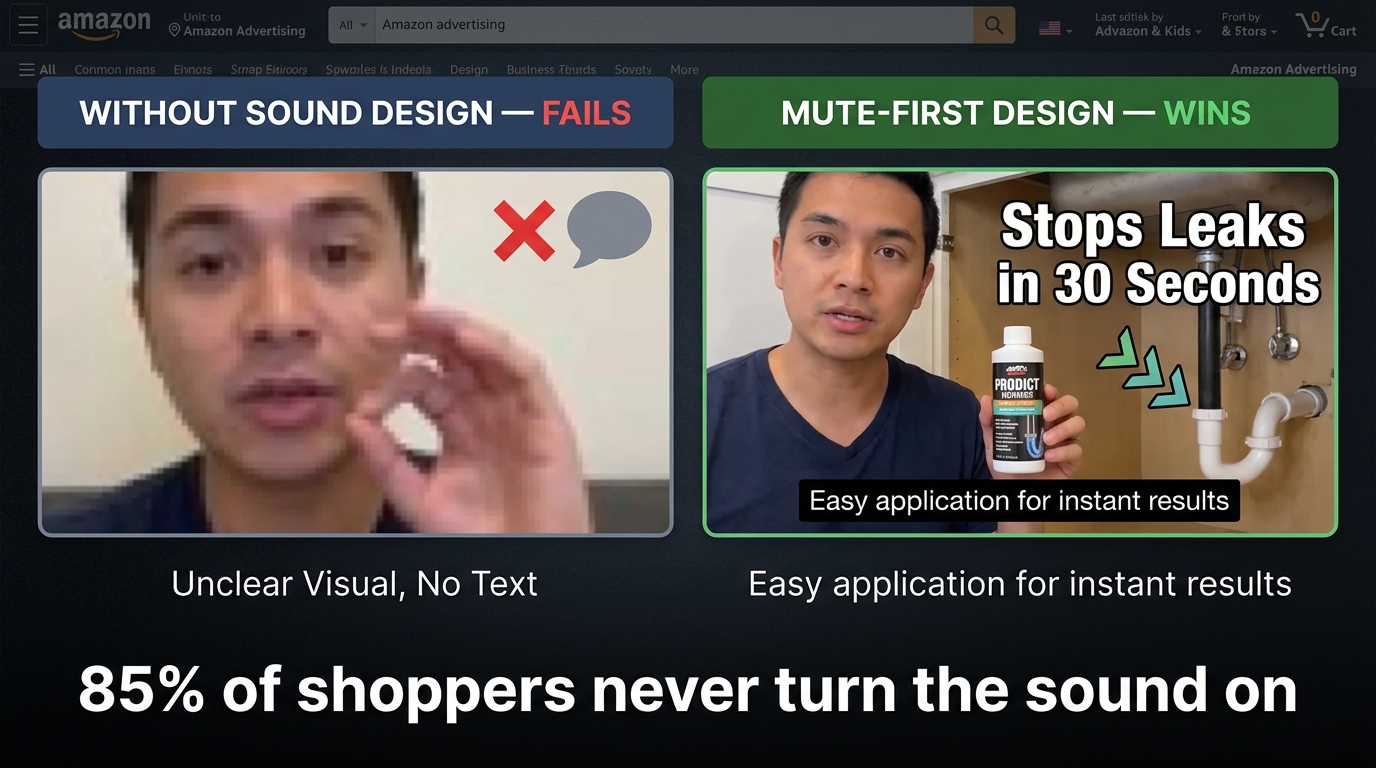
Amazon mutes all SBV ads by default. Sound only activates if the shopper explicitly clicks the volume icon. Industry data consistently shows that the overwhelming majority of autoplay video ads across digital platforms — typically 85% or more — are watched without sound being enabled at any point. On Amazon specifically, where shoppers are in active comparison mode and often browsing in public or work environments, the sound-off rate is almost certainly at or above that threshold.
This has one enormous implication: any messaging that lives in your audio track is essentially invisible to most shoppers. If your video relies on a voiceover to explain what the product does, who it’s for, why it’s different from competitors, or why the viewer should click through, you’re communicating that information to a tiny fraction of your actual audience. The rest are watching a series of moving images with no context.
The Scroll-Interruption Dynamic
Unlike a YouTube pre-roll or a Facebook feed video — where the user’s attention is at least nominally aligned with content consumption — an Amazon search results page is a decision-making environment. Shoppers arrive with a specific intent: find a product that meets their criteria. Their cognitive load is already high. They’re processing price signals, review counts, Prime badges, and listing images simultaneously.
Your SBV ad doesn’t get their full attention. It gets a fraction of their peripheral vision while they’re doing something else. The video has to earn engagement from a divided, task-focused audience — which means the first frame needs to be immediately, unambiguously relevant to what they just searched for. Not charming. Not cinematic. Relevant.
What This Means for Every Creative Decision Downstream
Once you internalize these three realities — autoplay without invitation, muted by default, watched by a shopper with split attention — every other creative decision becomes clearer. The opening frame needs to communicate product identity in under a second. Every scene needs to carry its own weight visually. Text overlays aren’t a nice-to-have; they’re the primary communication channel. And the overall video arc needs to deliver its full value proposition before most shoppers decide to look away — typically within the first three to five seconds.
How Shoppers Actually Engage With Your Video: Attention in Three Phases
Understanding shopper attention in SBV placements means thinking in phases rather than treating the video as a continuous narrative that viewers consume linearly. Research into video ad engagement patterns consistently shows that attention is not evenly distributed across an ad’s runtime — it spikes at the beginning, drops sharply, and then either falls off completely or recovers based on what the viewer sees in that first window.
Phase 1: The Half-Second Glance (0–0.5 seconds)
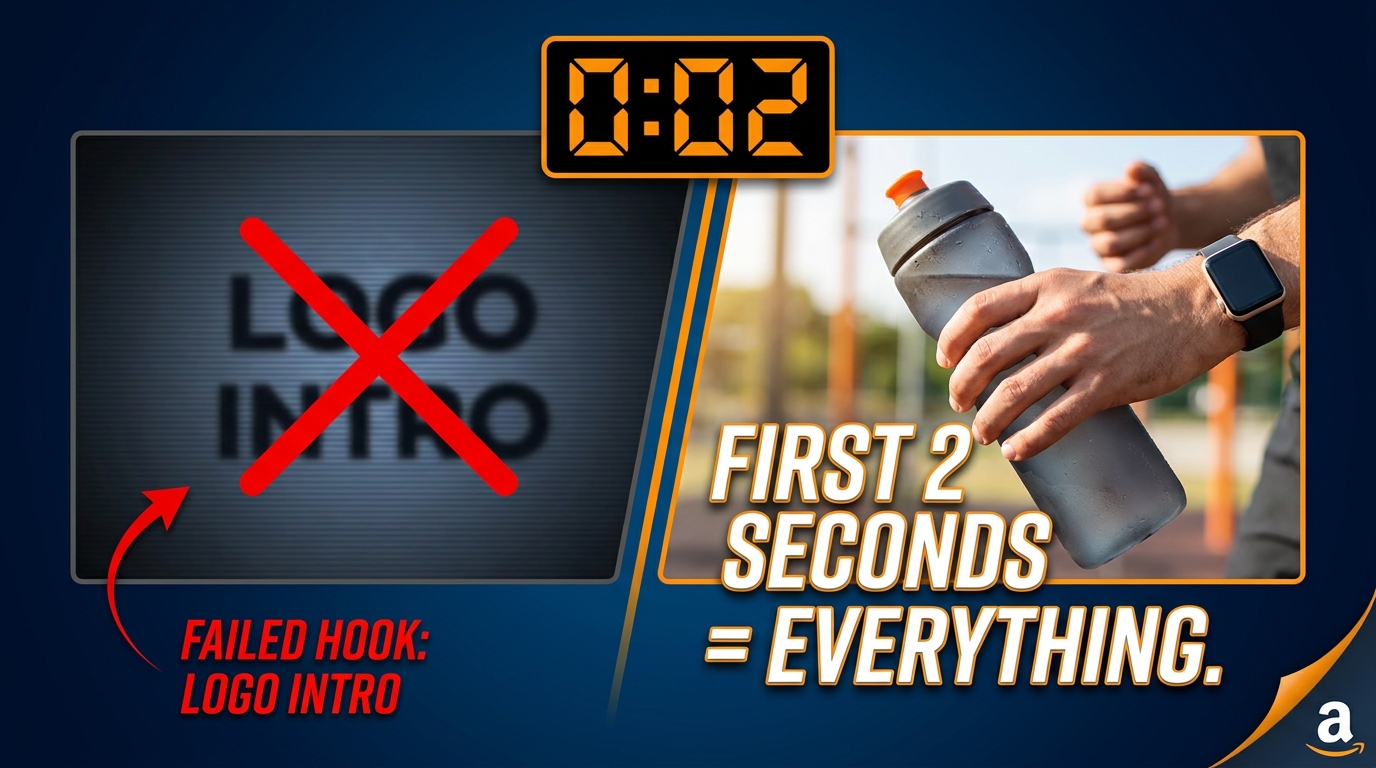
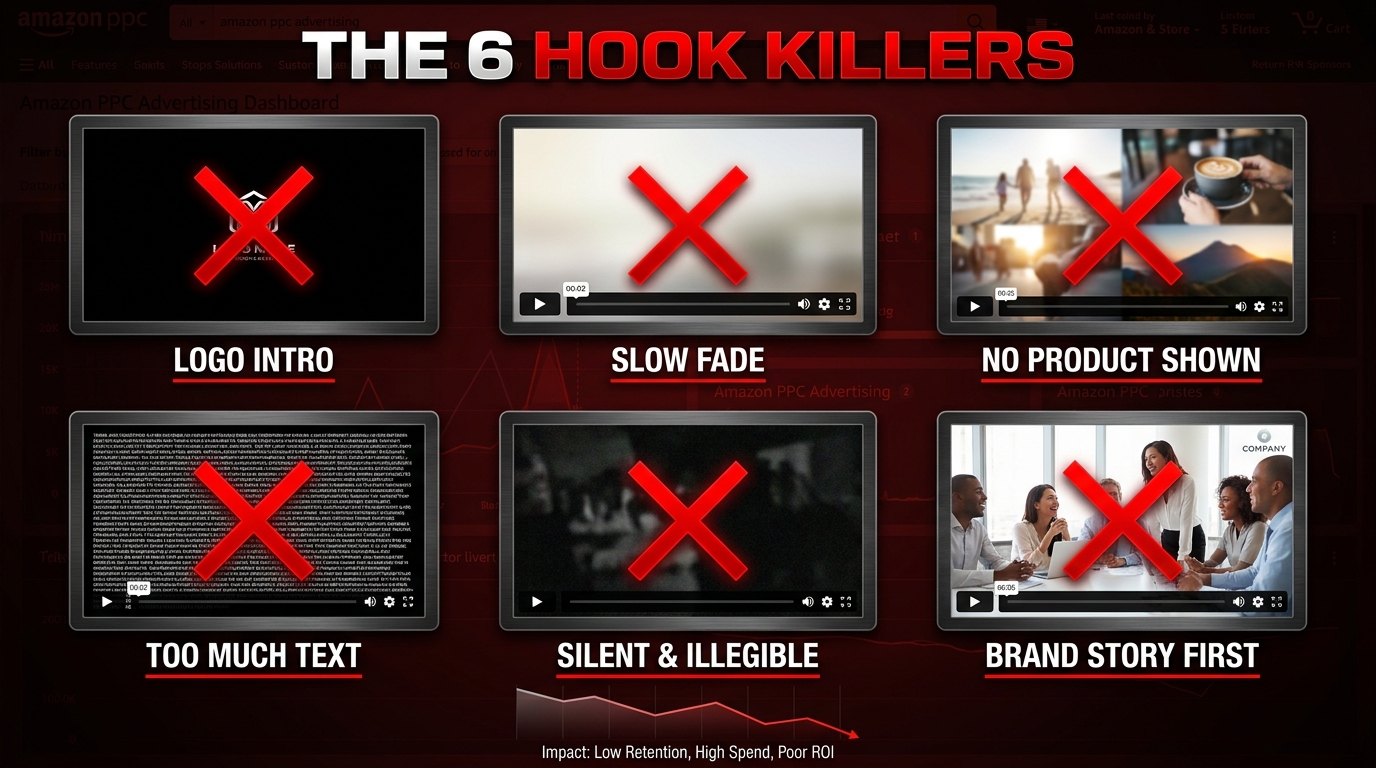
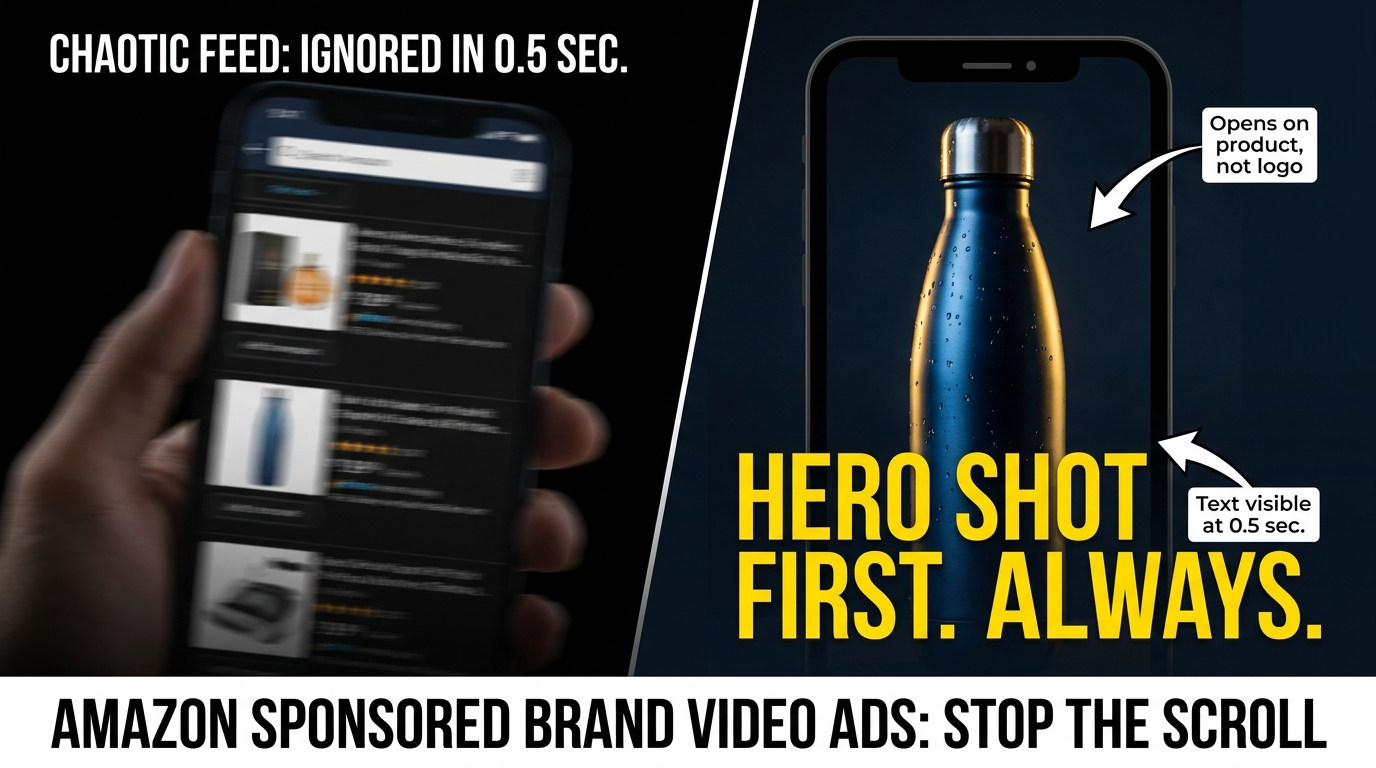
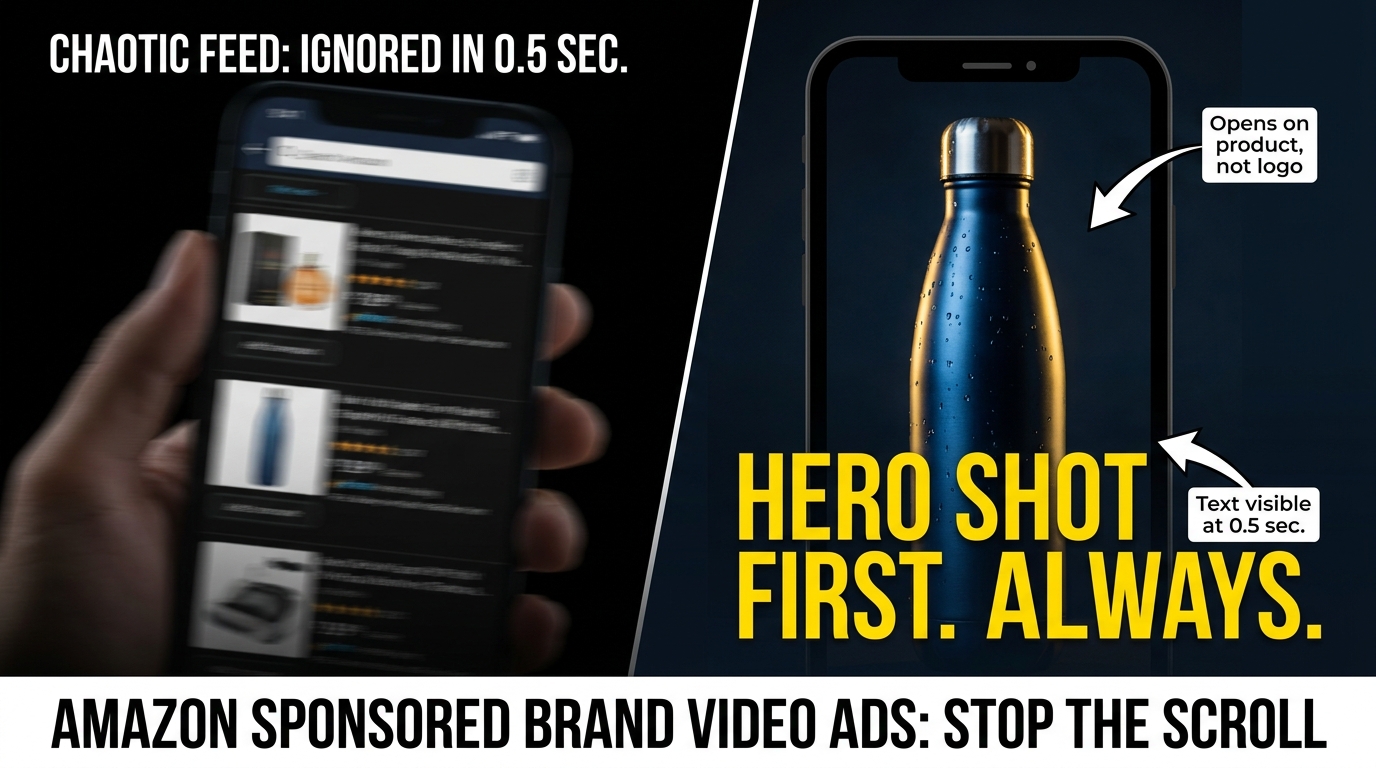
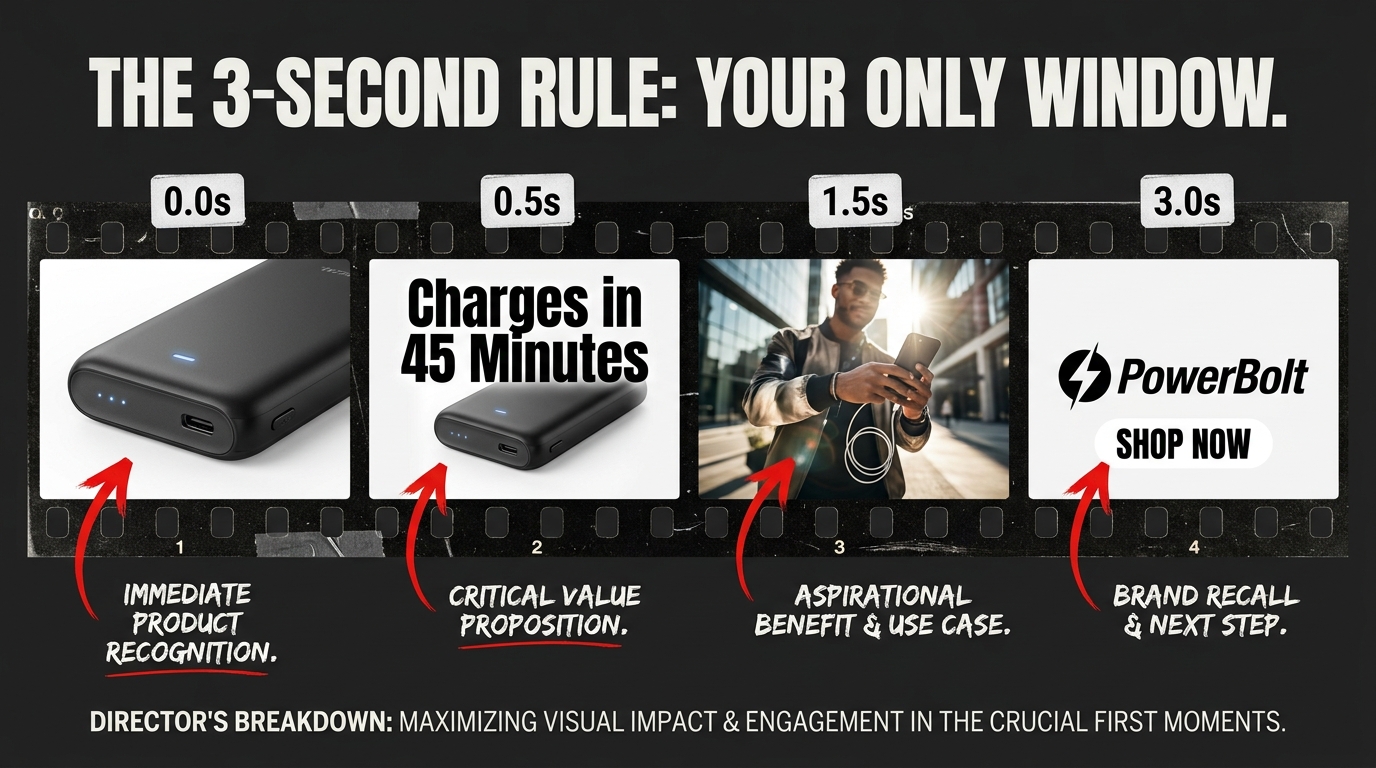
This is the phase that determines whether the shopper’s eye stays on your ad or continues scanning the organic listings. In this window, the shopper’s visual system is doing one thing: pattern matching. Is this relevant to what I searched for? If your video opens on a logo animation, a wide lifestyle shot with no clear product, a dark moody scene, or any frame where the actual product is small, absent, or ambiguous — you’ve likely lost the shopper before they’ve consciously registered your ad at all.
The products that win in this phase open with the product itself filling the majority of the frame, ideally against a clean or high-contrast background. The product should be recognizable as the category the shopper is searching within. If someone just typed “stainless steel travel mug” and your video opens on a forest scene with a person hiking before the mug appears at second four, that shopper’s brain has already categorized your ad as “not immediately relevant” and redirected attention elsewhere.
Phase 2: The Three-Second Assessment (0.5–3 seconds)
Shoppers who get past the half-second glance enter an active but brief assessment phase. In this window, they’re asking: “Does this product actually match what I’m looking for, and is there a reason to click?” This is where your first text overlay needs to land. Not a tagline. Not a brand statement. A specific, concrete claim about the product that the shopper can evaluate against their search intent.
Examples of Phase 2 text overlays that work: “Holds Temperature for 12 Hours.” “Fits Standard Cupholder.” “BPA-Free Lid.” “Ships Same Day.” These are decision-relevant claims. They speak directly to the criteria the shopper is evaluating. A text overlay that reads “Experience the Difference” or “Quality You Can Trust” communicates nothing that changes the click decision.
Phase 3: The Conversion Window (3–15 seconds)
Shoppers who reach Phase 3 are genuinely engaged. They’ve been recruited past the scroll-or-ignore decision and are now watching with some intent. This is where you can introduce more product features, demonstrate the product in use, address common objections visually, and build enough confidence to drive a click. Even here, though, the sound-off reality means every single scene needs visual clarity — ideally with sequential text overlays that build a case the same way a retail salesperson would: feature, benefit, proof, next step.
The entire video, however long it runs (Amazon allows 6 to 45 seconds), should be engineered with the understanding that most of your impressions will only see Phase 1 and Phase 2. Phase 3 is your conversion engine for the fraction of shoppers who get there. Phase 1 is your gatekeeper for all the impressions that determine whether Phase 3 ever happens at all.
The 3-Second Visual Hook: Constructing the Opening Frame
The opening frame of your SBV is not a creative decision — it’s a strategic one. And it’s arguably the most important single frame in your entire advertising program, because it governs how much of the rest of your investment gets seen at all.
The Product-First Principle
The most consistently effective opening for SBV creatives across categories is the hero product shot: the product, clearly lit, positioned prominently against a clean or high-contrast background, taking up 60–80% of the frame. This is not accidental. It directly mirrors what the shopper is looking for — a product that matches their search — and confirms relevance in the half-second glance window described above.
Many brands resist this approach because it feels “uncreative” or “too product-catalog.” That instinct comes from a TV commercial mindset, where the viewer is a passive audience already committed to watching. On Amazon, the opening frame is a relevance signal, not a narrative device. Leading with your product isn’t a creative compromise — it’s the correct answer to the question “What is this ad about?” before the shopper can think to ask it.
Motion as an Attention Device
Because the video autoplays in a static page environment, any motion at all will draw the eye. The question is whether that motion is meaningful or distracting. A slow camera push toward the product, a subtle rotation, or a clean product-reveal from white — these use motion to hold attention without pulling the eye away from product recognition. Rapid cuts, flashy transitions, or kinetic text animations in the first two seconds can actually backfire by drawing the eye while failing to deliver any useful information about what the product is.
The goal is motion that directs attention toward the product, not motion for its own sake. A revolving packshot. A satisfying slow-motion pour. A close-up pan across a key product feature. These openings use motion purposefully without confusing the viewer about what they’re looking at.
The Logo Delay Problem
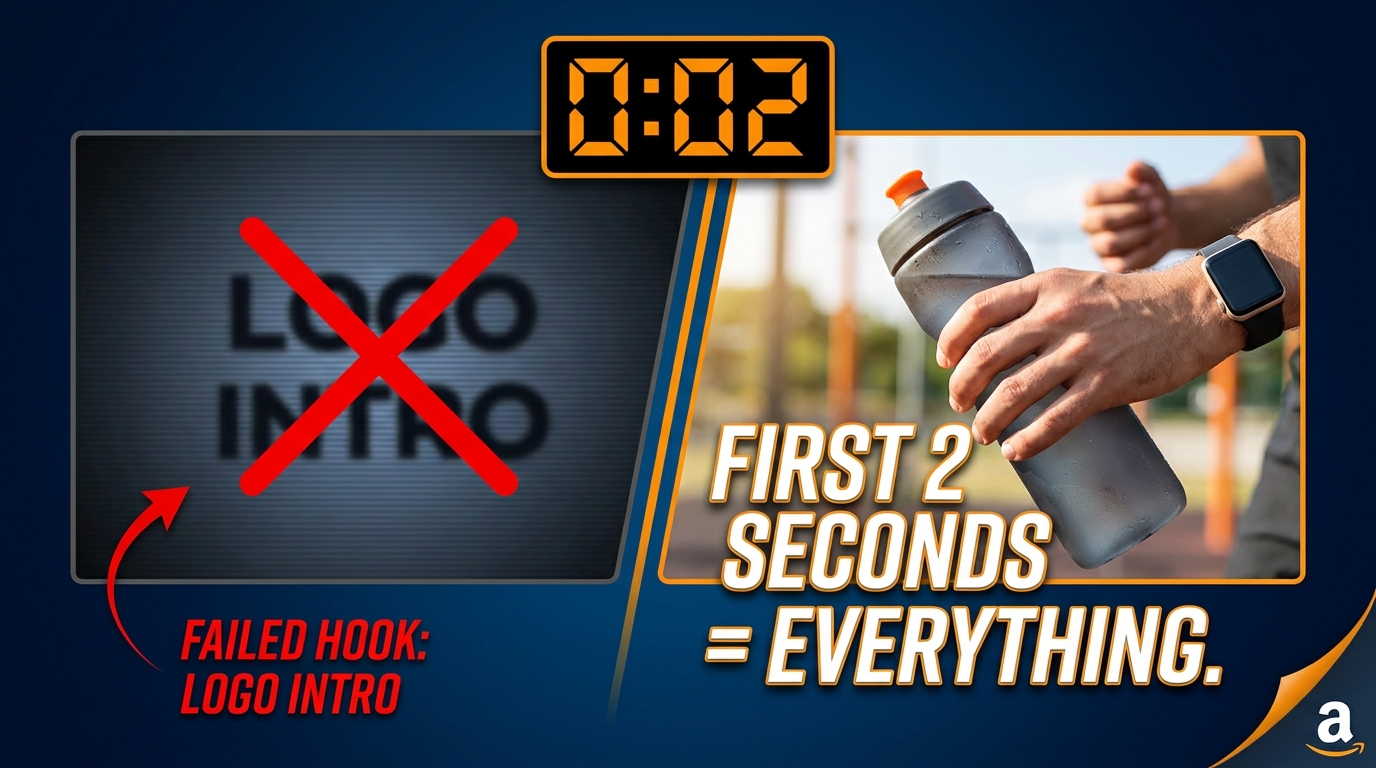
A persistent mistake across SBV creatives is opening with a brand logo or animated ident. This is borrowed behavior from TV commercials and YouTube ads, where brand recall is a primary objective and the viewer is broadly receptive. In the SBV context, the logo opening has a specific problem: shoppers who haven’t yet heard of your brand don’t have any association to attach to the logo. It costs you the precious first second — your relevance window — to communicate nothing the shopper can act on.
Logos belong later in the video, not at the start. In the first three seconds, you are competing to be the product the shopper reaches for. Being the brand the shopper remembers is a secondary win that comes after they’ve already decided the product might be right for them. Lead with product, earn the right to introduce your brand.
The Clean Background Advantage
Amazon’s own research and the creative guidelines for Sponsored Brand Video both suggest that clean, uncluttered backgrounds perform better for opening frames — particularly white, light gray, or high-contrast single-color backgrounds. The reason is signal clarity: on a search results page already dense with visual information, an ad that introduces additional visual complexity in its opening frame competes with its own environment for the shopper’s attention. A product on a clean background pops out of the page. A product in a complex scene blends back in.
Reading the Room: Matching Video Creative to Keyword Intent
One of the most underused strategies in SBV campaigns is aligning the creative’s tone and content to the specific intent signal embedded in the keyword that triggered the ad. Most brands run a single SBV creative against every keyword in their campaign — from broad discovery terms to highly specific, comparison-style searches. This is a missed opportunity, because the shopper searching “protein powder” is in a completely different headspace from the shopper searching “protein powder lactose free low carb unflavored.”
Broad Discovery Keywords: Lead With Category and Brand Energy
For broad, high-volume keywords with relatively low intent specificity, the shopper is still exploring. They may not know exactly what they want. Your SBV creative here can afford slightly more brand storytelling — a faster-paced lifestyle sequence that communicates who your product is for and what kind of person uses it. The goal is category association and brand memorability, because conversion probability is lower but future recall is higher.
In these campaigns, spending slightly more time on the product in a lifestyle context — someone using it in a real situation — creates the association that makes a subsequent branded search more likely. This is where SBV functions more as an awareness investment than a direct-response tool.
Specific Intent Keywords: Lead With the Matching Claim
For keywords where the shopper has already narrowed their criteria — size, color, material, compatibility, dietary restriction, use case — the opening visual and first text overlay should directly address that specific criterion. If the keyword is “car phone mount for dashboard MagSafe,” your opening frame should show the mount on a dashboard, and your first text overlay should confirm compatibility. The shopper has essentially told you what they’re evaluating. Confirming it immediately is the fastest path to a click.
This approach requires creating multiple versions of your SBV creative, or at minimum building flexible templates where the opening frame and first text overlay can be swapped while the rest of the video remains consistent. It’s more production work upfront, but the performance difference across intent-matched versus generic creatives is typically significant enough to justify it.
Competitor Keywords: Lead With the Differentiation Claim
When targeting competitor brand keywords — a legitimate and common SBV strategy — the opening frame and narrative need to do something different again. Here, the shopper is already brand-aware and actively considering an alternative. Your video needs to give them a specific reason to reconsider in the first three seconds: a feature the competitor lacks, a price advantage, a rating comparison, or a unique benefit only you can offer. Vague quality claims won’t move a shopper who’s already predisposed toward a different brand. Specific, verifiable differentiation will.
The Sound-Off Story Arc: Building a Complete Narrative Without Audio
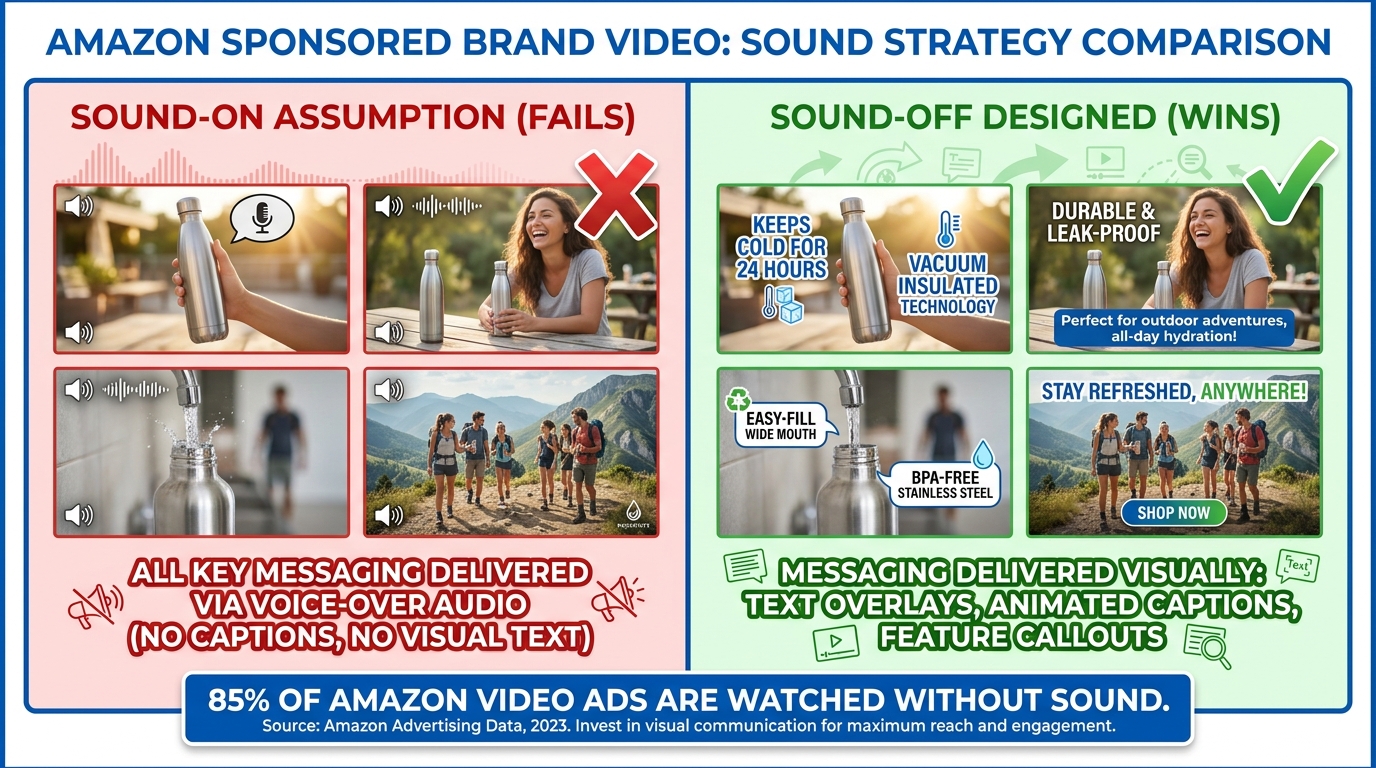
Designing a video that works without sound is not the same as making a silent film. It requires a specific structural discipline: every second of your video needs to be able to communicate its intended message through visuals and on-screen text alone, without relying on voiceover, music, or sound effects to carry meaning.
The Text Overlay Architecture
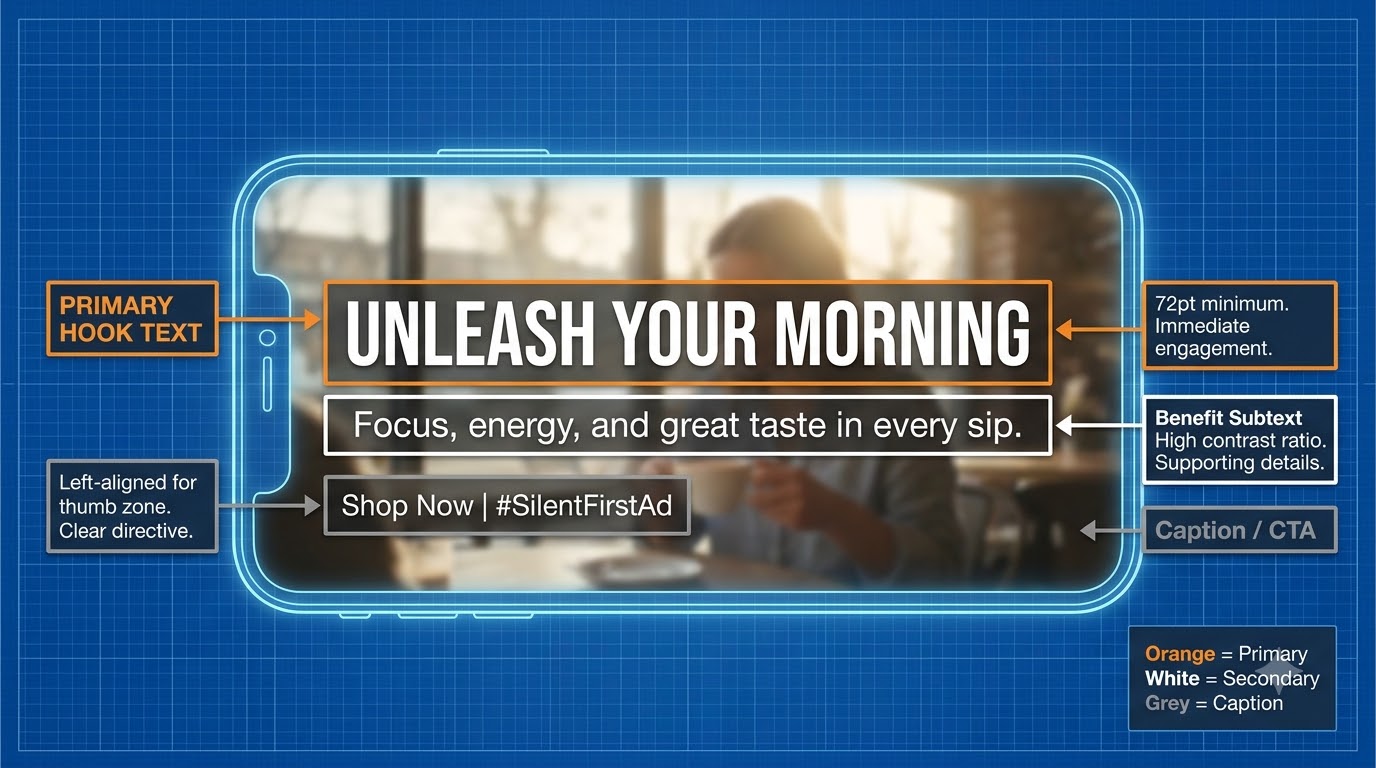
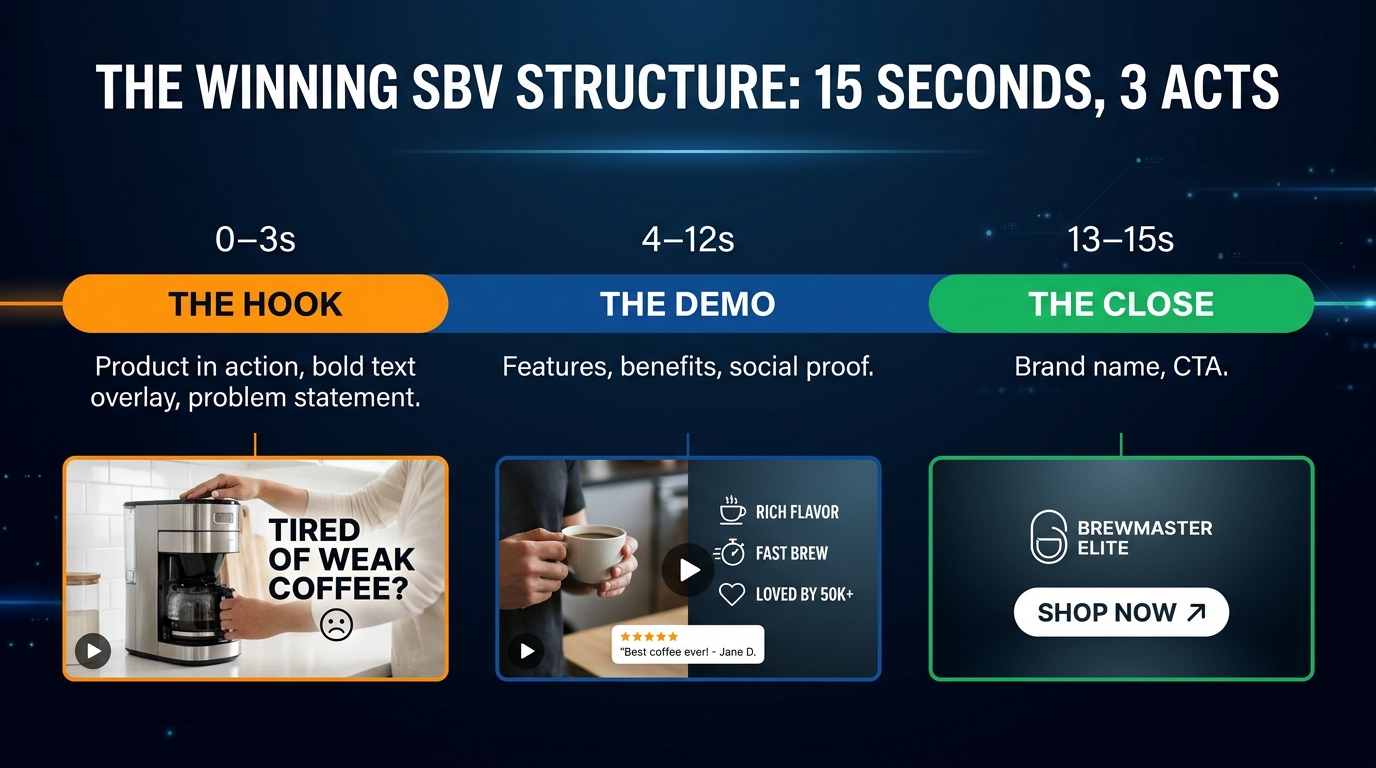
Think of your text overlays as subtitles for your value proposition — not captions of what a voiceover is saying, but standalone statements that a shopper reading the screen (with no audio) would find complete and persuasive on their own. A strong SBV text overlay architecture typically follows this pattern:
- 0–2 seconds: Category-confirming product shot + primary feature claim (“Waterproof to 50M”)
- 2–6 seconds: Supporting feature or use-case (“Works for Swimming, Surfing, and Trail Running”)
- 6–12 seconds: Social proof or credibility signal (“4.7 Stars · 12,000+ Reviews”)
- 12–20 seconds: Unique differentiator or comparison point (“2X More Battery Than Standard Models”)
- Final 3–5 seconds: Brand name + product name + implicit or explicit CTA
This architecture means a shopper who watches any five-second slice of your video will receive at least one complete, standalone claim they can evaluate. They don’t need to watch from the beginning to extract value from the middle. And crucially, they never need to turn on sound to understand what they’re being offered.
Typography as a Conversion Tool
The readability of on-screen text in an SBV ad is not a design detail — it’s a functional requirement. Text that’s too small to read on a mobile device screen, too low in contrast against the background, or on-screen for fewer than two seconds is effectively invisible. Amazon recommends that text in SBV creatives be large enough to read without zooming and present long enough for a viewer to read it once through.
High-performing SBV ads typically use bold, sans-serif fonts with high contrast (white or black text, often with a subtle background shadow or color block behind it). Animated text entry — text that slides in or fades in rather than appearing instantly — is effective for drawing the eye to new information as it appears, which helps maintain attention during the body of the video.
The Captions Question
If your SBV does have meaningful spoken dialogue — a product demonstration, a customer testimonial, or a narrator — adding captions (either burned-in or as text overlays) is worth the production effort. Captions do two things: they preserve the meaning of spoken content for the sound-off majority, and they give the viewer two simultaneous channels of the same information (audio + visual), which research on learning and persuasion suggests increases retention among viewers who do have sound on.
Which Creative Format Wins in Which Category
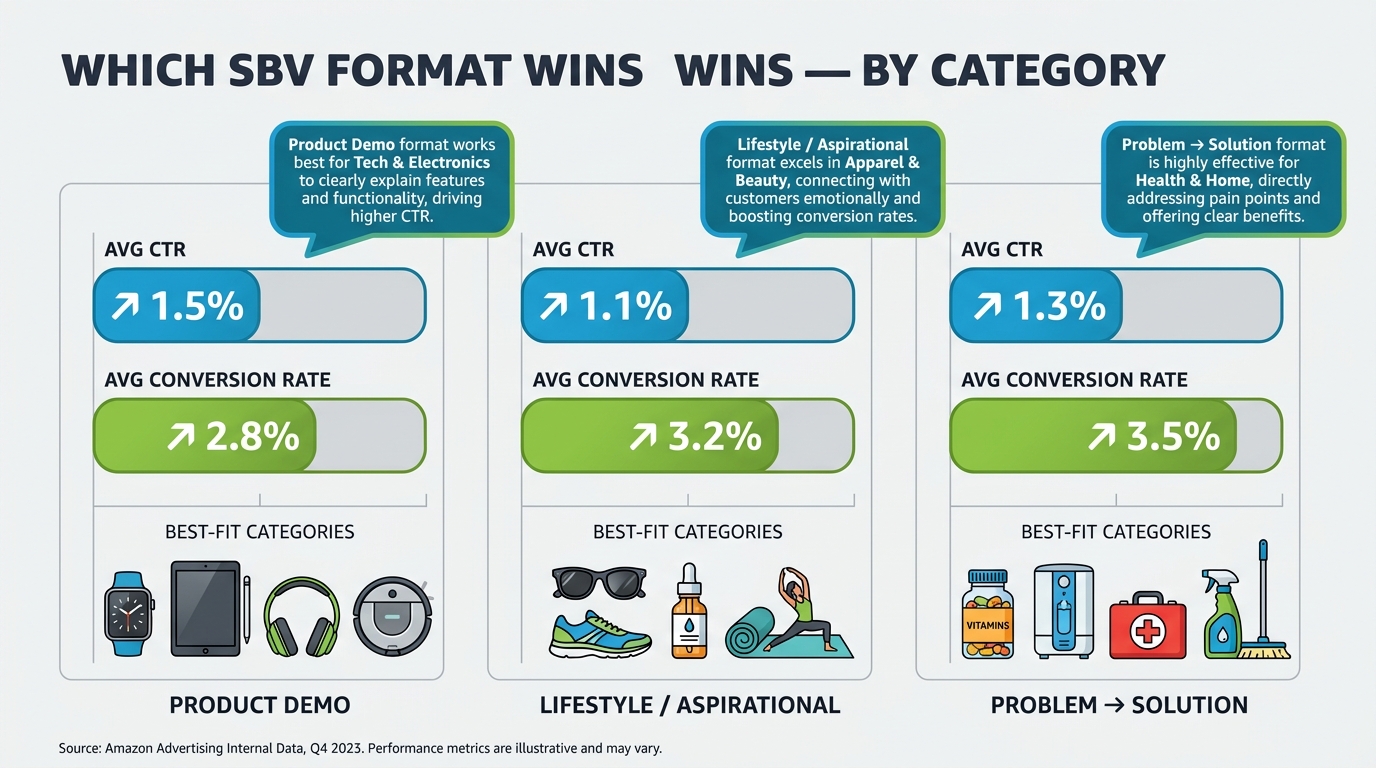
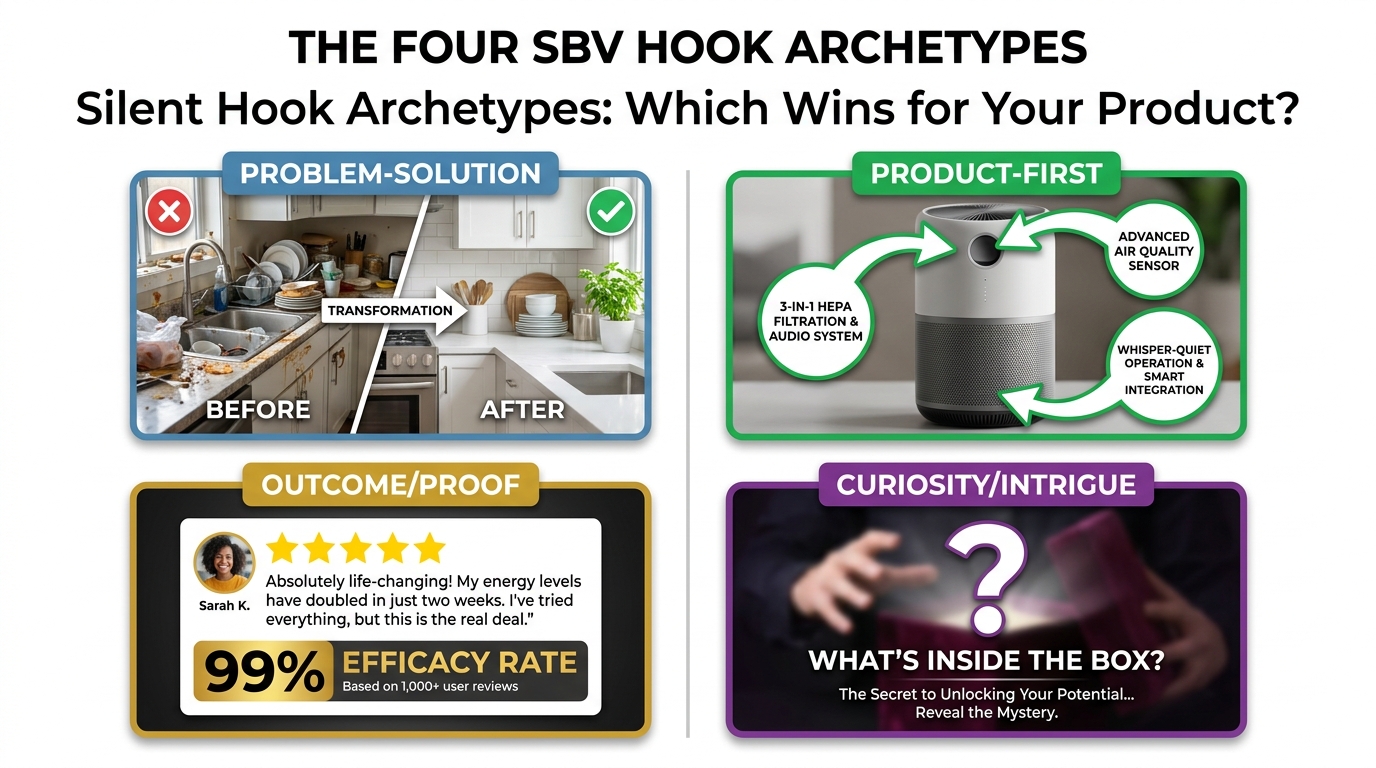
Not all SBV formats perform equally across all product categories. The three dominant SBV formats — product demonstration, lifestyle/aspirational, and problem/solution — each have category contexts where they consistently outperform the alternatives.
Product Demonstration: Best for Technical and Functional Categories
A product demo video shows the product being used, in real time or close to it, with emphasis on how it works and what it produces. This format excels in categories where the mechanism of the product is a key purchase driver: kitchen gadgets, tools, electronics accessories, cleaning products, and fitness equipment. The demo answers the question “Does this actually work?” that shoppers in these categories are asking most urgently.
The most effective demos in the SBV context are tightly edited — they skip setup and preamble and jump directly to the moment of function. A blender ad that opens on the blender in action, already running, surrounded by the ingredients it just processed, answers the question in one frame. A blender ad that opens on someone unpacking the product, reading the instructions, and assembling it before finally pressing the button has buried its proof point behind unnecessary setup that loses the majority of viewers before they see it.
Lifestyle/Aspirational: Best for Identity-Based and Aspiration-Driven Categories
Lifestyle videos emphasize the person using the product rather than the product itself. They show an aspirational version of the customer’s life — more organized, more active, more fashionable, more at ease — in which the product plays a supporting role. This format works best in categories where the purchase is as much about self-expression or identity as it is about function: apparel, outdoor recreation, home decor, personal care, and premium consumables.
The challenge with lifestyle creative in the SBV context is the attention physics problem described earlier: if the product is too small or too peripheral in the opening frame, the shopper may not recognize the ad as relevant to their search. The best lifestyle SBV ads solve this by opening with a tight shot of the product in a compelling contextual moment — worn during a run, styled in a beautifully lit room, held in a relatable everyday scene — before pulling wider to establish the aspirational context.
Problem/Solution: Best for Health, Home, and Practical Improvement Categories
The problem/solution format opens with a recognizable pain point — a messy cable drawer, a restless night’s sleep, a cluttered kitchen counter — and then immediately presents the product as the resolution. This format has the advantage of creating emotional relevance before the product appears: the shopper recognizes their own problem in the opening frame, which creates immediate investment in what comes next.
In the SBV context, the problem establishment needs to be extremely brief — one or two seconds at most — before the product appears as the solution. A longer problem sequence risks losing viewers who don’t connect the opening with their search intent quickly enough. The most effective problem/solution SBV ads make the problem and the product visible simultaneously, or within a single cut, so the connection is immediate rather than narrative.
A Fourth Format Worth Watching: The Comparison
A growing format in competitive categories is the direct comparison video: split-screen or sequential shots comparing your product against a generic competitor or “the old way of doing things.” This format works well for products with a clear, demonstrable performance advantage — a filter that removes more contaminants, a pan that heats more evenly, a battery that lasts longer. It brings the differentiation claim into the visual itself rather than relying on the shopper to infer it from text.
Bidding Logic: How SBV Pricing Actually Works (and How to Use It)
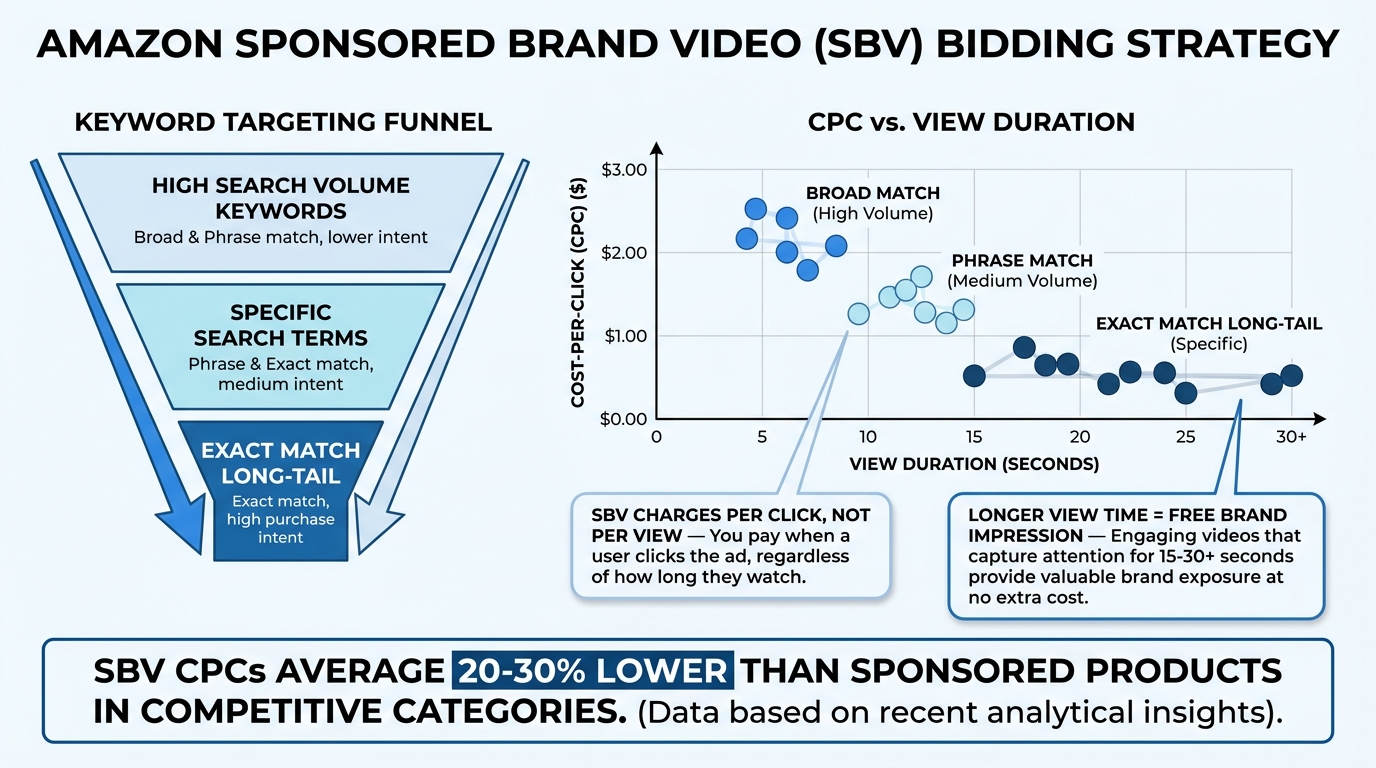
One of the most misunderstood aspects of Sponsored Brand Video is its cost model — and understanding it correctly changes how you approach both bidding strategy and creative optimization.
CPC, Not CPV: You Pay for Clicks, Not Views
Amazon Sponsored Brand Video operates on a cost-per-click (CPC) model, not a cost-per-view (CPV) model. This is a crucial distinction. Every time your ad plays in the search results — every impression where a shopper sees your video autoplay, even if they watch it for 20 seconds — you pay nothing unless they click through. You only pay when the shopper clicks the ad to visit your product page or Brand Store.
This pricing structure has a counterintuitive implication: a high-engagement, long-view-duration video that doesn’t generate clicks is generating brand impressions at zero cost to you. Shoppers who watch your full 30-second video and then don’t click have still been exposed to your product, your claims, and your brand — and you’ve paid nothing for that exposure. This is a meaningful hidden value of SBV that pure ROAS calculations completely miss.
CPC Benchmarks and Competitive Dynamics
In many categories, SBV CPCs run meaningfully lower than equivalent Sponsored Products CPCs for the same keywords. This is partly because SBV is a less crowded auction — not every seller in a category is running SBV campaigns, which means less competition for that specific placement — and partly because the SBV placement is somewhat separated from the core organic results, reducing direct head-to-head auction pressure from the highest-bidding competitors.
This CPC differential creates a specific opportunity: keywords that are prohibitively expensive to win in Sponsored Products may be more accessible through SBV bidding, while still capturing top-of-search visibility. Brands competing in hyper-competitive categories — supplements, consumer electronics, home and kitchen — often find SBV provides more affordable top-of-page exposure than Sponsored Products for the same keyword set.
Bid Strategy: Start Broad, Refine With Data
Because SBV campaigns provide impression data even when click volume is low, you can gather useful search term performance data even at modest budgets. A recommended starting structure is:
- Launch one broad-match campaign and one phrase-match campaign with a modest daily budget and moderately aggressive bids across your core keyword set.
- Run for two to three weeks to accumulate search term data.
- Identify which specific search terms are generating impressions with no clicks (revealing creative-intent mismatches or irrelevant traffic) versus which terms generate both impressions and clicks (revealing high-relevance placements worth increasing bids on).
- Migrate high-performing search terms to exact-match campaigns with higher bids and tighter targeting.
- Negative-match irrelevant terms at the campaign level.
This iterative refinement process — standard practice in Sponsored Products campaigns — is applied less consistently to SBV, partly because sellers underestimate how much search term data SBV generates and how actionable it is.
The Budget Allocation Question
A common question is how much of the total Amazon advertising budget should go toward SBV versus Sponsored Products. There’s no universal answer, but a useful heuristic is: SBV budget should be proportional to the degree to which your product requires demonstration or explanation to convert. Products that are visually self-explanatory (a simple commodity like a USB cable) benefit less from video creative than products where seeing the product in action materially changes the shopper’s purchase confidence (a collapsible food container, a cordless vacuum, a skin care tool).
Targeting Strategy: Keyword vs. Product Targeting for SBV
SBV campaigns support two primary targeting modes: keyword targeting (reaching shoppers based on what they searched for) and product targeting (reaching shoppers who are viewing a specific ASIN’s product detail page). Each has distinct strategic logic and performs differently across campaign objectives.
Keyword Targeting: The Primary SBV Engine
Keyword targeting is the core strategy for most SBV campaigns because it aligns the ad’s placement with active search intent. The shopper who just typed a relevant query is the most purchase-ready audience you can reach — they’ve self-selected into the category by initiating a search. SBV with keyword targeting puts your video in front of that high-intent moment at the top of the search results page.
Within keyword targeting, the match type mix matters. Broad and phrase match terms expand reach and surface new, unconsidered search terms — valuable for discovery and data gathering. Exact match terms are more predictable in their placement context and typically deliver more consistent performance metrics. A mature SBV keyword strategy typically runs all three match types in separate campaigns with different bid levels, using broad and phrase to feed exact-match refinement over time.
Product Targeting: The Competitive Intercept
Product targeting for SBV allows you to show your video ad on the product detail pages of specific competitor ASINs or across an entire competitor sub-category. This is a fundamentally different strategic context: the shopper is not in a search results environment — they’re already on a product page, actively evaluating a specific product. Your SBV ad appears here as an alternative they’re being shown while in that consideration moment.
For product targeting to work in the SBV context, your creative needs to function as a direct alternative pitch: “While you’re looking at that, have you considered this?” The first three seconds need to acknowledge the implicit comparison without disparaging the competitor — typically by leading with your most compelling differentiating feature or a strong credibility signal (rating, bestseller badge, unique attribute).
Product targeting often delivers lower CTR than keyword targeting (because the shopper is mid-evaluation of something else), but it intercepts high-intent shoppers at a critical decision point and can drive significant switching behavior for products with a clear competitive advantage.
Creative Testing at Scale: A/B Testing SBV Without Burning Budget
Creative testing for SBV is structurally different from testing Sponsored Products bids, because the variable you’re testing is the video content itself rather than a keyword or bid parameter. This requires a specific testing methodology to generate meaningful data without wasting spend.
What to Test First: The Opening Frame
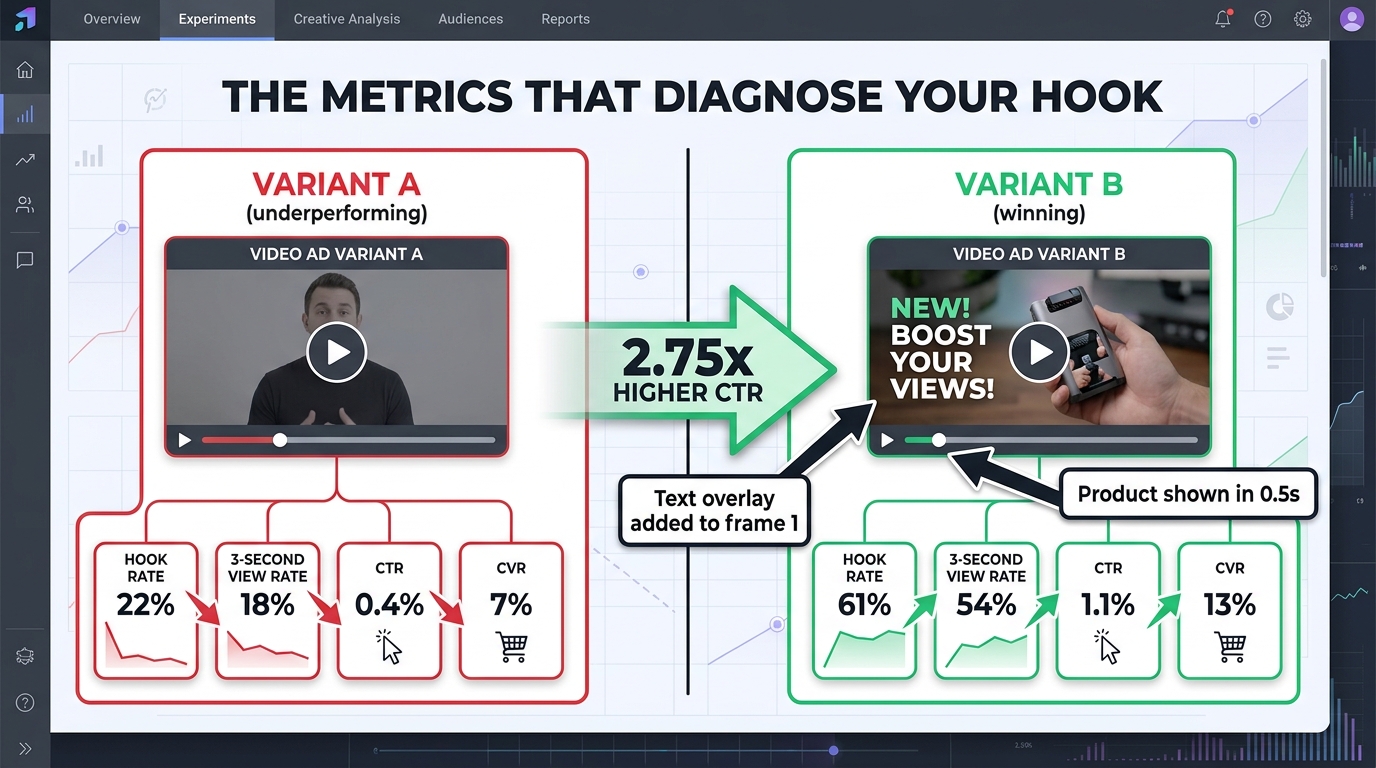
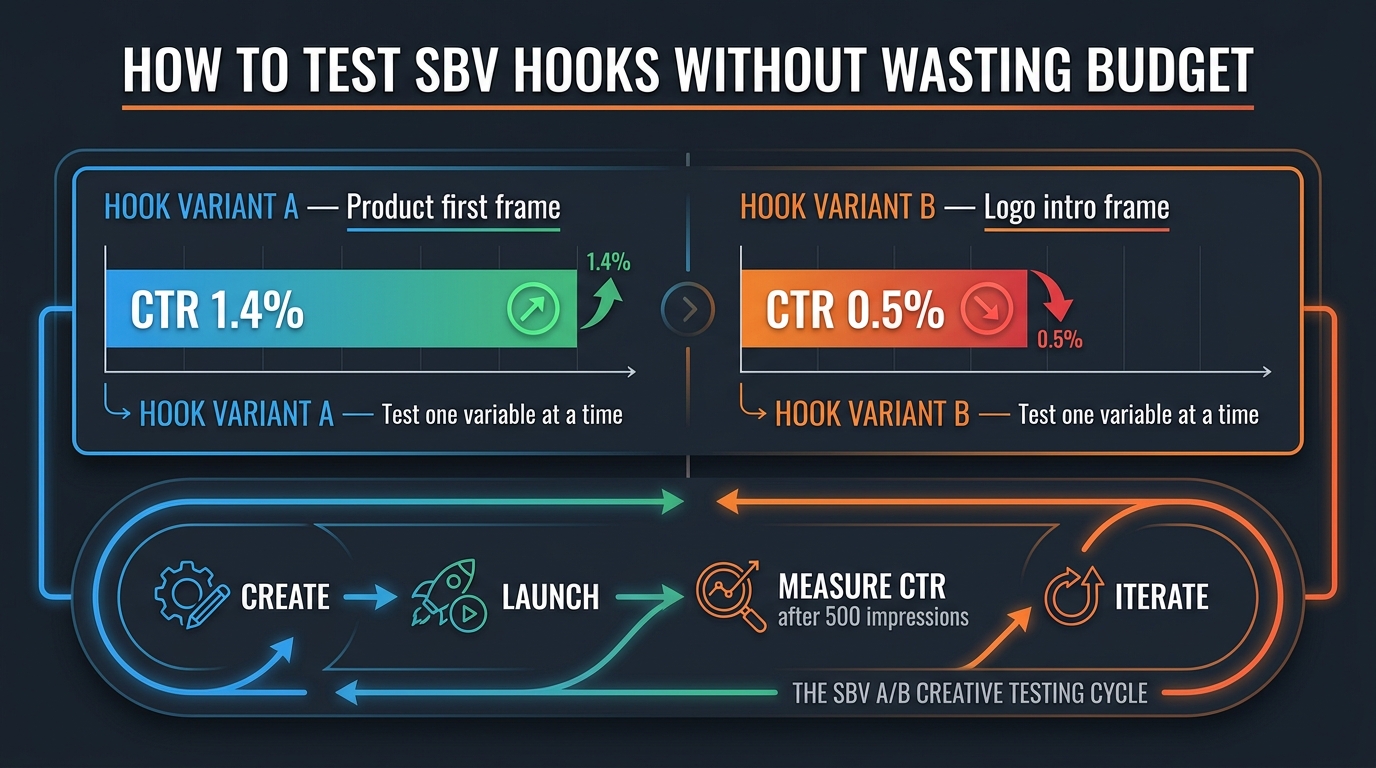
Because the opening frame has disproportionate influence on CTR (the metric that determines everything else), the highest-leverage variable to test in any SBV creative is the first one to two seconds. Create two versions of your video that are identical from the three-second mark onward, but differ in their opening frame — product hero shot versus lifestyle opening, for example, or two different product orientations. Run both against the same keyword set at the same bid with equal budget. The version with higher CTR wins.
This approach isolates the variable you’re testing (the opening) while controlling for everything else. It also requires relatively modest impression volume to reach statistical significance, because CTR differences between a strong and weak opening frame are often large enough to detect within two to three weeks of active campaign data.
The Impression-to-Click Ratio as a Diagnostic
Before comparing conversion rates or ROAS between two SBV creatives, look at CTR. If one creative has materially higher CTR than another but similar conversion rate, the higher-CTR creative is likely sending more of the right audience to the product page. If two creatives have similar CTR but different conversion rates, the difference is more likely attributable to audience quality or landing page factors than to the video itself.
This diagnostic framework — isolating which part of the funnel a creative is influencing — prevents the common mistake of pulling a video that has strong brand-building impact (high view rate, moderate CTR) in favor of a video with slightly better short-term ROAS but lower audience engagement.
Rotating Creative to Combat Fatigue
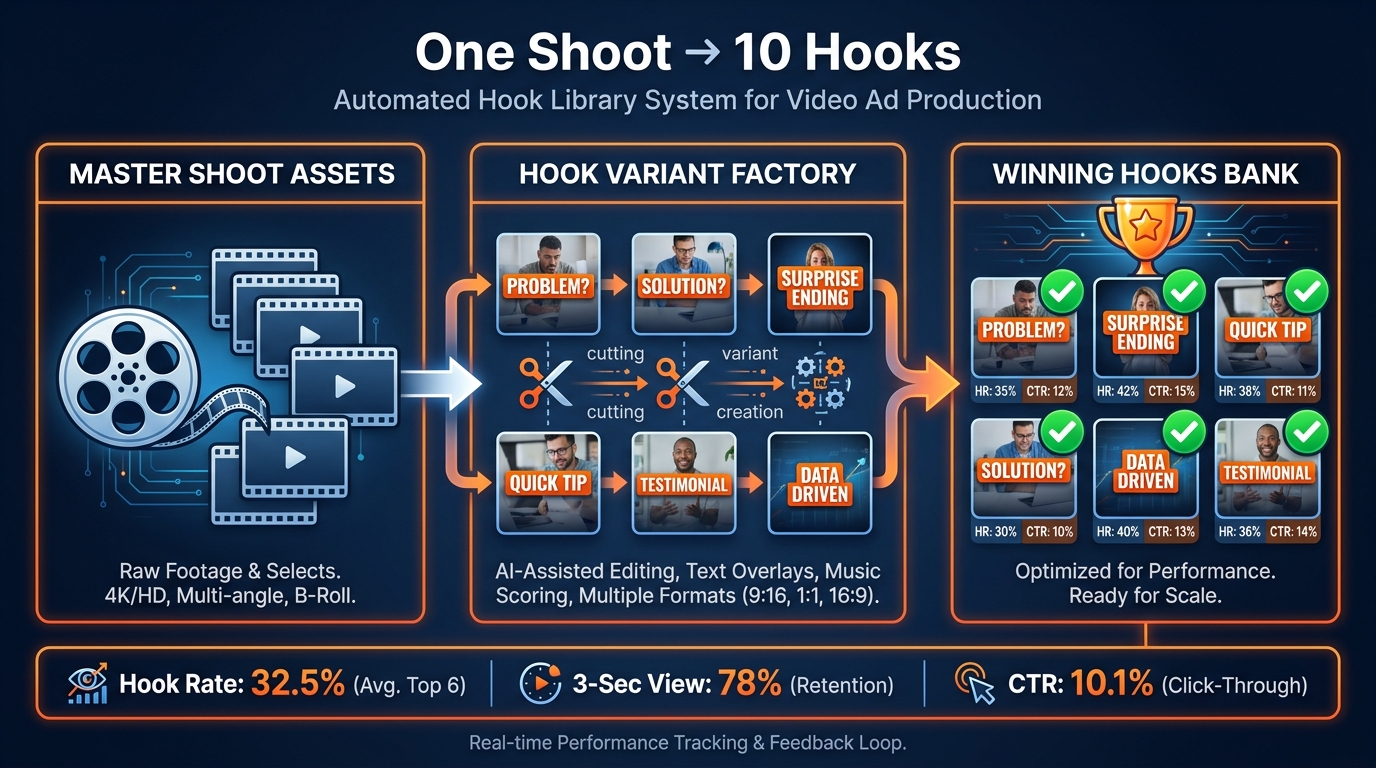
SBV creative fatigue is real but often misdiagnosed. When an SBV campaign’s CTR begins declining after weeks of consistent performance, many sellers assume they need a completely new video. Often, what’s needed is a variation — a different opening frame, an updated text overlay set, or a new lead feature claim — rather than a full creative rebuild. Building modular video assets (a consistent middle and end section with swappable openings) allows for more frequent creative refreshes at lower production cost.
Measuring SBV Beyond ROAS: The Metrics That Show the Full Picture
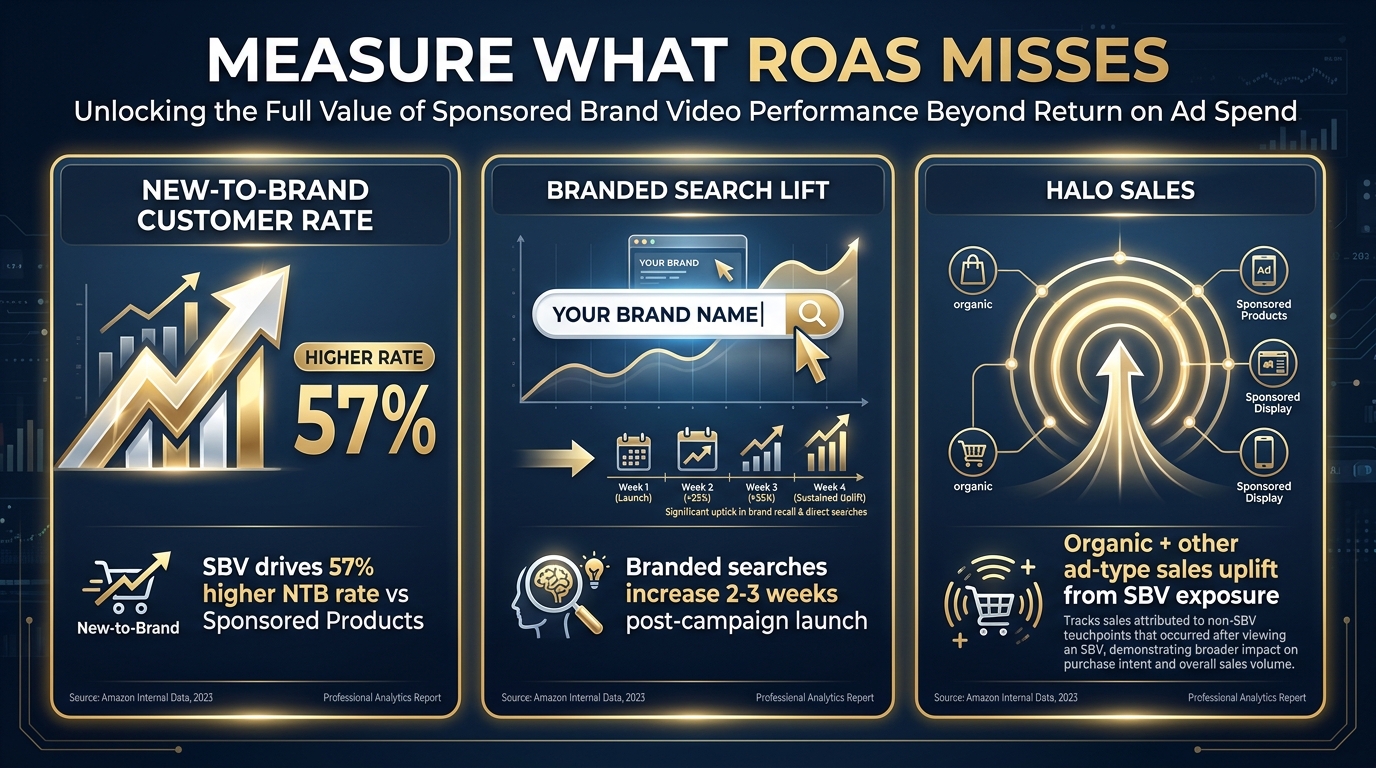
ROAS is a useful performance metric for direct-response campaigns, but applying a pure ROAS lens to SBV campaigns systematically undervalues their contribution — particularly in three areas that ROAS calculation doesn’t capture.
New-to-Brand Customer Rate
Amazon’s advertising console reports a “New-to-Brand” (NTB) metric for Sponsored Brand campaigns — the percentage of attributed orders that come from customers who have not purchased from your brand on Amazon in the past 12 months. This is a fundamentally different kind of value than repeat purchases: NTB customers represent top-of-funnel growth, category expansion, and long-term customer lifetime value.
Amazon’s own data, cited in their advertising resources, indicates that Sponsored Brands campaigns (including SBV) generate a meaningfully higher NTB customer rate than Sponsored Products campaigns. This makes intuitive sense: SBV placements intercept shoppers who are still in discovery mode at the top of search, before they’ve clicked into any product page — which makes them more likely to be new to a brand than shoppers who arrive via a bottom-funnel Sponsored Products click. Evaluating SBV without considering its NTB rate understates its strategic value to catalog growth.
Branded Search Lift
One of the most consistent secondary effects of sustained SBV campaigns is an increase in branded search volume — shoppers who are exposed to your brand through SBV and later return to search directly for your brand name. This halo effect shows up in your organic search metrics and in Sponsored Products campaign data as branded keyword conversion rates, but it’s rarely attributed back to the SBV campaign that created the brand awareness in the first place.
To measure branded search lift, track your branded keyword search volume and organic rank for your brand name terms before and after launching or scaling SBV campaigns. A meaningful lift in branded searches after 3–6 weeks of active SBV spend is a strong signal that the video impressions are building durable brand recognition, even among shoppers who didn’t click through on their first exposure.
Halo Effects on Non-Advertised ASINs
When an SBV campaign drives a shopper to your Brand Store or to a single product’s detail page, Amazon tracks what that shopper does next. Sales attributed to ASINs other than the one directly advertised — what the industry calls “halo sales” — are reported in the Sponsored Brands attribution window and can represent a significant share of the campaign’s total revenue contribution.
Brands with larger catalogs tend to see higher halo ratios from SBV campaigns, particularly when the campaign drives traffic to a Brand Store rather than a single product detail page. This is an argument for using Brand Store destinations rather than single-ASIN landing pages in SBV campaigns: Brand Store visitors can browse the full catalog, increasing both halo purchase probability and basket size.
View-Through Attribution: The Invisible Layer
Amazon does not currently offer native view-through attribution for SBV — meaning purchases by shoppers who watched your video but didn’t click are not reported in your campaign metrics. This is a known measurement gap that means standard SBV performance metrics undercount actual influence on purchase decisions. Shoppers who see your video, don’t click, but later search for your brand and buy through an organic listing or a Sponsored Products ad are counted in those other channels, not in SBV.
The practical implication is that SBV campaigns generate more revenue influence than their attributed ROAS suggests — often substantially more. Recognizing this gap is important when making budget decisions about SBV versus other ad formats: the true cost of cutting SBV budget may include a downstream reduction in branded search volume and halo sales that won’t show up in the SBV campaign’s own metrics.
Building a Video Creative Pipeline That Compounds Over Time
Most sellers treat SBV as a single creative event: produce one video, launch it, run it indefinitely, and revisit it only when performance has deteriorated significantly. The brands that build durable, compounding SBV performance treat video creative as a continuous production process — constantly testing, iterating, and refreshing the asset library rather than running a static creative until it’s exhausted.
The Modular Production Framework
Building modular SBV creative means producing video components that can be recombined rather than producing monolithic finished ads. A modular framework might look like this:
- Opening module: Four to six different first-three-second sequences — product hero, lifestyle, problem hook, comparison, feature callout, unboxing — each ending with the product clearly in frame.
- Body module: Three to four different feature sequences that can follow any opening — each covering a different feature cluster of the product.
- Close module: Two to three different end sequences — brand store CTA, product name + rating, seasonal offer — that can cap any combination of opening + body.
This framework means that producing six openings, four body sequences, and two closes gives you 48 potential creative combinations from what would otherwise be a three-production-shoot investment. Testing which opening performs best takes two to three weeks. Testing which opening + body combination performs best takes a few weeks more. The ongoing creative program is now a structured testing and refinement process rather than an ad-hoc production cycle.
Seasonal Creative Refreshes
SBV creative performs differently across seasonal peaks, and brands that refresh their creative with seasonally relevant versions consistently see performance lift during peak periods. The Q4 holiday window is the most obvious — adding holiday-themed text overlays (“Perfect Holiday Gift”), gift-context lifestyle shots, or promotional callouts to existing creative. But seasonal relevance applies year-round: back-to-school in August, outdoor season in spring, fitness reset in January, summer entertaining in June.
These seasonal refreshes don’t require full reproductions. Swapping an opening module, updating text overlays, and adding a seasonal close to an existing body sequence can be done with minimal production cost while meaningfully improving relevance for seasonal shoppers.
The Category Leader Mindset
Ultimately, the brands that dominate their categories through SBV don’t do so because they produced one exceptional video. They do so because they run a continuous creative program that generates ongoing learnings about what their specific audience responds to — which feature claims resonate, which visual formats drive clicks, which text overlays convert — and they compound those learnings into progressively better creative over 12, 18, and 24 months.
The compounding effect of this approach is significant. A brand that tests a new opening every six weeks and retires underperformers will, after 12 months, have identified and be running the top-performing creative configuration from a pool of eight or more tested variations. A brand that has run the same video for 18 months has one data point. In a competitive category, that creative intelligence gap becomes a meaningful performance gap — in CTR, in conversion rate, and ultimately in market share.
Technical Requirements: Getting Your Video Through Approval
No creative strategy matters if your video doesn’t get approved for SBV placement. Amazon’s review process for SBV creative has specific requirements that trip up many first-time submitters, adding delay and forcing costly re-edits.
Format and Specification Requirements
As of 2026, Amazon’s SBV technical requirements include:
- Duration: 6 to 45 seconds
- Aspect ratio: 16:9 (horizontal orientation only)
- Resolution: Minimum 1920 × 1080 pixels (1080p)
- File format: MP4 or MOV
- File size: Maximum 500MB
- Frame rate: 23.976, 24, 25, 29.97, or 30fps
- Audio: Stereo recommended (though remember: it autoplays muted)
Content Policy Guardrails
Beyond technical specs, Amazon’s content policies for SBV include several restrictions that catch brands off-guard:
- No price or promotion claims that would require time-sensitive updates (e.g., “On Sale Now,” “$19.99 Today Only”). These require ongoing monitoring to remain accurate and violate Amazon’s dynamic content policies.
- No competitor brand names mentioned by name in the video or text overlays, even in comparison contexts.
- No customer review content shown as direct quotes from individual reviewers (though aggregate star ratings and review counts are acceptable).
- No claims of “Amazon’s Choice” or “#1 Bestseller” unless current and verifiable — these badges change frequently and hardcoded claims in video are difficult to keep current.
- Product must be clearly identifiable within the first few seconds — videos where the product is ambiguous or appears too late in the runtime are commonly rejected.
The fastest path through approval is building these guardrails into your creative brief before production begins, rather than discovering violations during the review process. A creative brief that includes a compliance checklist — reviewed against Amazon’s current advertising policies before shooting — prevents the frustrating scenario of a finished video failing approval for a fixable policy reason.
Conclusion: The Creative Physics Advantage
Amazon Sponsored Brand Video is not a difficult advertising format to access. Brand registration, a qualifying product catalog, and a video file are essentially all you need to get started. The difficulty — and the competitive opportunity — is in understanding the specific physics of the environment those videos appear in and designing creative that works with those physics rather than against them.
The sellers who treat SBV as “TV ads for Amazon” — building narrative arcs, leading with brand stories, optimizing for production polish — consistently underperform relative to their spend because they’re designing for an audience that doesn’t exist in the SBV placement. The shopper in a search results page is not watching TV. They’re scanning for a reason to click, they have sound off, and they’ll make that decision in roughly three seconds.
The sellers who treat SBV as a visual communication challenge — front-loading product clarity, building complete value propositions in text overlays, matching creative tone to search intent, and running continuous creative tests — consistently outperform on both CTR and downstream conversion, because they’ve designed for the audience that actually exists.
The actionable takeaways from this analysis are clear:
- Audit your opening frame first. Is the product identifiable in under half a second? If not, that’s the highest-leverage edit you can make.
- Design for sound-off. Remove every voiceover claim from your mental script and ask whether the video communicates the same message in text overlays alone.
- Match creative to intent. Specific search terms deserve specific creative. A single video running across all keywords is leaving performance on the table.
- Build modular assets. One video is a data point. A library of modular components is a testing program.
- Measure beyond ROAS. New-to-brand rate, branded search lift, and halo sales are real SBV contributions that standard reporting misses.
- Treat SBV as a continuous program, not a one-time production. The compounding return on creative intelligence is the real competitive moat.
The three-second window is not a limitation. It’s the design constraint that, once understood, separates the brands building durable Amazon presence from the ones perpetually chasing their ACoS target with the same underperforming video.