Tag: Video Creative Testing

  • How to Build a Silent-First SBV Hook Test: The 5-Variant Framework That Finds Winners Without Wasting Budget

    How to Build a Silent-First SBV Hook Test: The 5-Variant Framework That Finds Winners Without Wasting Budget

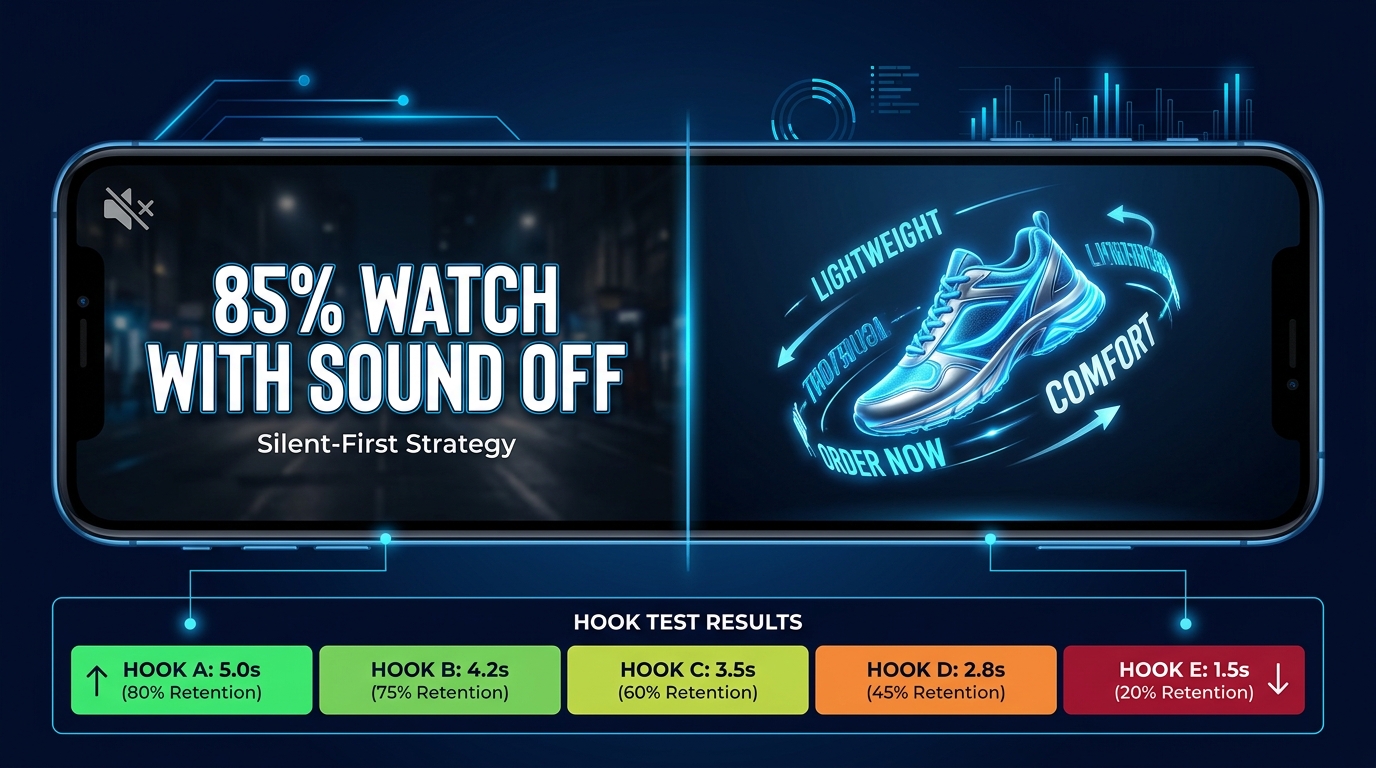
    Split-screen showing 85% of video ads watched with sound off alongside a 5-hook test result bar chart

    There is a foundational assumption baked into most Sponsored Brands Video creative: that someone is listening. The voiceover explains the benefit. The background music sets the mood. The on-screen demonstration gets narrated in real time. The whole production is engineered around a viewer who has tapped to unmute — a viewer who, in practice, almost never exists.

    Amazon SBV autoplays without audio by default. That single sentence should reshape every creative decision you make, and yet the majority of SBV ads in circulation still treat sound as a load-bearing pillar. The voiceover is doing the heavy lifting. The text overlay is an afterthought. The first frame is a logo.

    Silent-first creative is not a workaround for the muted-feed reality. It is the correct starting point. It means designing your video so that a shopper who never unmutes still gets the full message — and more importantly, still stops scrolling in the first second. When you add sound to a video that already works silently, you enhance it. When you rely on sound in a video that does not work silently, you have already lost most of your audience before the voiceover begins.

    This is where structured hook testing becomes essential. Not testing for its own sake, but specifically testing the first two to three seconds as the primary performance variable. Everything else — the product demo, the proof sequence, the CTA card — can remain constant. The hook is what determines whether any of that content gets seen at all.

    This post walks through a specific, executable framework: a five-hook test plan built for silent-first SBV creative. It covers which hook types to test, how to structure the test itself, what metrics actually predict downstream performance, and how to make the kill/iterate/scale decision without guessing.

    What “Silent-First” Actually Means — and What It Doesn’t

    Silent-first is a design constraint, not a creative style. It does not mean your video should be free of music or voiceover. It means that if you removed all audio from your ad entirely, the message should still land completely — and the first frame should still stop the scroll.

    The numbers that underpin this constraint are not new, but they remain consistently underestimated. Feed video on Facebook is consumed without sound roughly 85% of the time. Instagram Feed sits around 70% sound-off. Even on platforms with higher sound-on rates, like TikTok and Reels, autoplay default behavior and social environments (commuting, open offices, public spaces) mean a significant share of impressions play out in silence.

    For Amazon SBV specifically, the constraint is baked directly into the platform’s mechanics. These ads autoplay muted in search results. Amazon’s own creative guidance recommends making the core message comprehensible without sound and showing the product within the first two seconds. The implication is that any SBV ad that has not been explicitly designed for silent viewing is not just underperforming — it is structurally misaligned with how the placement works.

    The Three Layers of Silent-First Design

    Breaking down what silent-first actually requires reveals three distinct layers, each affecting different parts of the video.

    Layer 1: The first frame. This is the image a viewer sees before the video begins playing, and also what they see in the first fraction of a second of autoplay. It must function as a standalone signal — communicating category, benefit, or problem before a single word is read or heard. A close-up of a product on a white background fails here. A product mid-use, a before/after composition, or a striking visual anomaly starts to work.

    Layer 2: On-screen text hierarchy. Since narration cannot be counted on, text overlays carry the narrative load. The first text element that appears needs to match or reinforce the visual hook — not explain it, not introduce the brand, not set up a joke. It should land the core message or raise the core question in five to eight words. Typography needs to be legible at thumb-size: minimum 48px on a 1080×1920 frame, high contrast, positioned in the center 80% of the frame vertically to avoid platform UI overlap.

    Layer 3: Motion pacing. Silent video moves differently from audio-led video. Without sound to create rhythm, the visual rhythm has to do more work. Quick cuts, kinetic text animations, and clear visual progressions (setup → problem → resolution) guide the viewer’s attention in place of audio cues. A slow, lingering first frame that expects a voiceover to carry interest will lose the muted viewer within two seconds.

    Understanding these three layers matters because each one can become a hook testing variable — but only one should be tested at a time. The five-hook framework described below focuses primarily on hook type and first-frame concept, while holding Layer 2 and Layer 3 execution as consistent as possible across variants.

    Why SBV Is the Ideal Hook Testing Environment

    Not all ad formats are equally good testing grounds for creative hypotheses. Some placements mix too many variables — audience behavior differs by time of day, by device, by intent signal. Some formats have too little volume to generate statistically useful data within a reasonable budget. Some platforms make it difficult to isolate creative as the only changing variable.

    Amazon SBV avoids most of these problems for a specific reason: placement intent is relatively homogeneous. People see SBV ads because they searched for something. The intent signal is real and active. A viewer who sees your ad searched for a keyword that matched your targeting. That creates a more controlled test environment than most social feed placements, where audience behavior varies dramatically by mood, context, and passive vs. active browsing.

    The Search-Intent Advantage

    When your ad reaches someone who typed in a relevant search query, you have already passed the relevance filter. The test you are running is not “is this product relevant to this person?” — that question has been largely answered by the keyword match. The test becomes purer: “Does this hook stop this already-relevant shopper in the first three seconds?”

    This distinction matters enormously for hook test validity. On social platforms, a weak hook might reflect a targeting problem rather than a creative problem. On SBV, if your hook rate is low, the hook is almost certainly the issue. That makes SBV one of the cleanest environments available for isolating creative performance from audience performance.

    CTR as a Meaningful SBV Signal

    SBV benchmarks in 2026 show click-through rates in the range of 0.89% to 1.0%, compared to 0.3% to 0.4% for static Sponsored Brands formats. The gap matters for testing because it gives you more signal per impression — a higher base CTR means you hit meaningful thresholds faster and with less spend. Running a five-hook test across $50 to $60 of test budget (roughly $10 to $12 per variant) can generate directional data within a few days in most categories. That testing velocity is difficult to match in other video placements.

    The combination of search intent, format-level CTR advantage, and structural simplicity (15-second videos are fast to produce in multiple variants) makes SBV the most efficient hook testing format available to product advertisers right now.
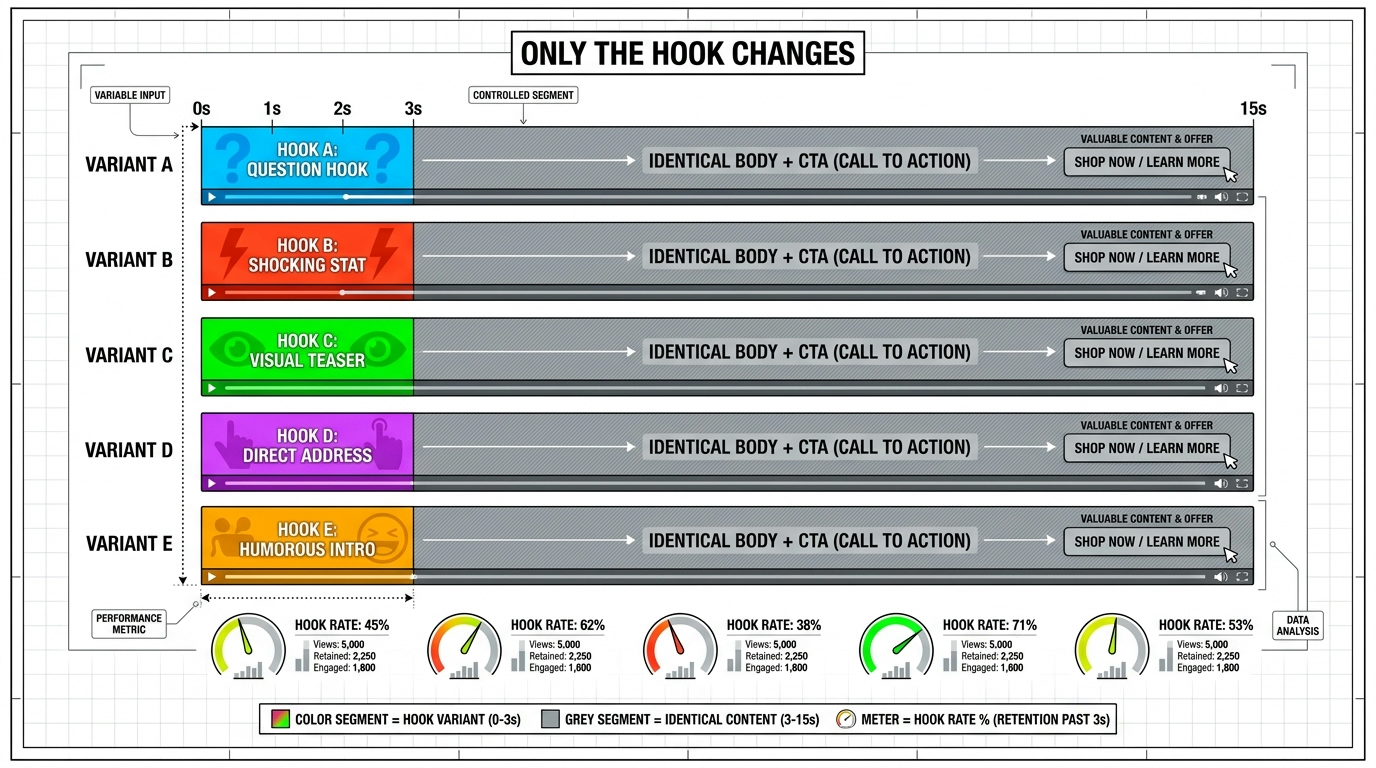
    A/B testing diagram showing five video timelines where only the first 3 seconds (hook) changes across variants while the body and CTA remain identical

    The 5 Hook Types: What They Are and Why Each Earns Its Slot

    The five-variant test plan is not arbitrary. Each hook type tests a fundamentally different psychological mechanism for stopping the scroll. Running all five simultaneously against the same body content gives you a read on which mechanism resonates most strongly with your specific audience and category — and that information has compounding value across every future creative you produce.

    Here is the breakdown of each hook type, why it works in a silent-first context, and how to execute it on SBV.

    Hook 1: The Pattern Interrupt

    The pattern interrupt works by making the first frame visually inconsistent with what the viewer expects to see in their feed. It wins on pure attention mechanics: the brain flags unexpected stimuli as high-priority and pauses the scroll automatically before conscious decision-making kicks in.

    In silent-first execution, this means your first frame needs to be visually jarring — not offensive, but unexpected. This could be an extreme close-up of a texture, a product shot from an unusual angle, a color that cuts sharply against the surrounding page aesthetic, or a rapid-cut cold open that begins mid-action rather than setting a scene. One 2026 dataset ranked pattern interrupts as the strongest hook type for early retention and thumb-stop rate, with some reports noting 72%+ better watch time versus generic product reveal openers in direct comparisons.

    The text overlay in a pattern interrupt hook should deepen the confusion rather than explain it away. Something like “Wait — this is not what you think it is” or a single provocative word overlaid on the unexpected image pushes the viewer further into the video before they can consciously decide whether to continue.

    Best fit: Visually distinctive products, categories where the standard creative looks similar across brands, and any product with a surprising mechanism or ingredient.

    Hook 2: The Problem Demo

    The problem demo opens by showing the pain point — not by describing it, but by demonstrating it visually. This hook type works because it creates instant relevance for shoppers who have the problem. If your product solves a specific frustration, showing that frustration in action in the first two seconds creates a recognition response: “that’s me.”

    Silent-first execution of the problem demo relies entirely on the visual. Showing a leaking water bottle, a tangled cable, a skincare product pilling on skin, or a disorganized desk communicates the problem before any text appears. The text overlay then names it explicitly — “Still dealing with this?” or “That’s not supposed to happen” — and immediately transitions to the product as the resolution.

    Problem demos are particularly effective on SBV because the search context amplifies the relevance. A shopper who searched “leak-proof water bottle” is already in problem-solution mode. Showing the problem they just searched to solve creates an extremely tight attention-capture loop.

    Best fit: Products that solve a specific, visually demonstrable frustration. Kitchen, fitness, home organization, beauty, and pet categories all have strong problem-demo potential.

    Hook 3: The Direct Benefit Statement

    Where the pattern interrupt and problem demo work by creating a gap that pulls the viewer forward, the direct benefit statement does the opposite: it leads with the answer and earns attention through the specificity and credibility of the claim.

    The key word is specific. “Moisturizes your skin” is not a direct benefit statement — it is a category description. “Clinically shown to reduce redness in 48 hours” is a direct benefit statement. The specificity signals credibility, which signals that the next 12 seconds of video are worth watching to see how the claim is supported.

    In silent-first execution, this hook lives almost entirely in the on-screen text of the first two to three seconds, supported by a visual that either shows the outcome (after state) or shows the product clearly. The text should be large, centered, and immediately readable — no animation delay on the first frame. The shopper needs to read the claim before they can consciously decide to continue.

    Best fit: Products with strong clinical, quantitative, or customer validation. Supplements, skincare, performance tools, and products with third-party certifications all perform well here.

    Hook 4: The Curiosity Gap

    The curiosity gap hook works by withholding information the viewer has just been made to want. It creates a knowledge asymmetry — you hint at something meaningful without delivering it — and the desire to resolve the asymmetry is what drives continued viewing.

    On SBV, curiosity gap hooks tend to start with a provocative incomplete statement: “Most people who buy this get it wrong.” or “The reason this ingredient is different from every other brand.” The visual supports the intrigue without resolving it. Partial product reveals, cropped frames that obscure the full image, and visual metaphors that raise questions all work.

    The critical execution risk with curiosity gap hooks is the payoff. If the rest of the video does not deliver an answer that feels commensurate with the setup, completion rate drops and downstream CTR suffers. This hook type requires the body content to deliver on the promise within 10 to 12 seconds. In a 15-second SBV, that is achievable — but only if the scriptwriting is disciplined.

    Best fit: Products with a genuinely interesting mechanism, formulation, or backstory. Works well in supplements, specialty food, tech accessories, and premium personal care.

    Hook 5: The Social Proof Anchor

    Social proof hooks lead with the size and sentiment of existing customer validation. The logic is borrowed from behavioral economics: when shoppers are uncertain, they default to what other people have chosen. Opening with a credible proof signal bypasses that uncertainty immediately.

    In silent-first execution, the social proof anchor is almost always a bold text overlay in the first frame: “47,000 five-star reviews,” “The #1 best seller in this category for 3 years,” or a customer quote pulled to the front of the video before any product context is given. The visual should reinforce the social proof framing — customer imagery, review screenshots, or a badge — not compete with it.

    Social proof hooks rank below pattern interrupts and problem demos on raw stop-rate in most 2026 benchmark data. Their strength is in conversion quality: the viewers who continue past a social proof hook are pre-qualified by the signal. The hook self-selects for shoppers who weight peer validation — who tend to have higher purchase intent when they do click through.

    Best fit: Products with substantial verified review counts, award recognition, or notable celebrity/media mentions. Less effective for new products or low-review ASINs where the proof signal is thin.
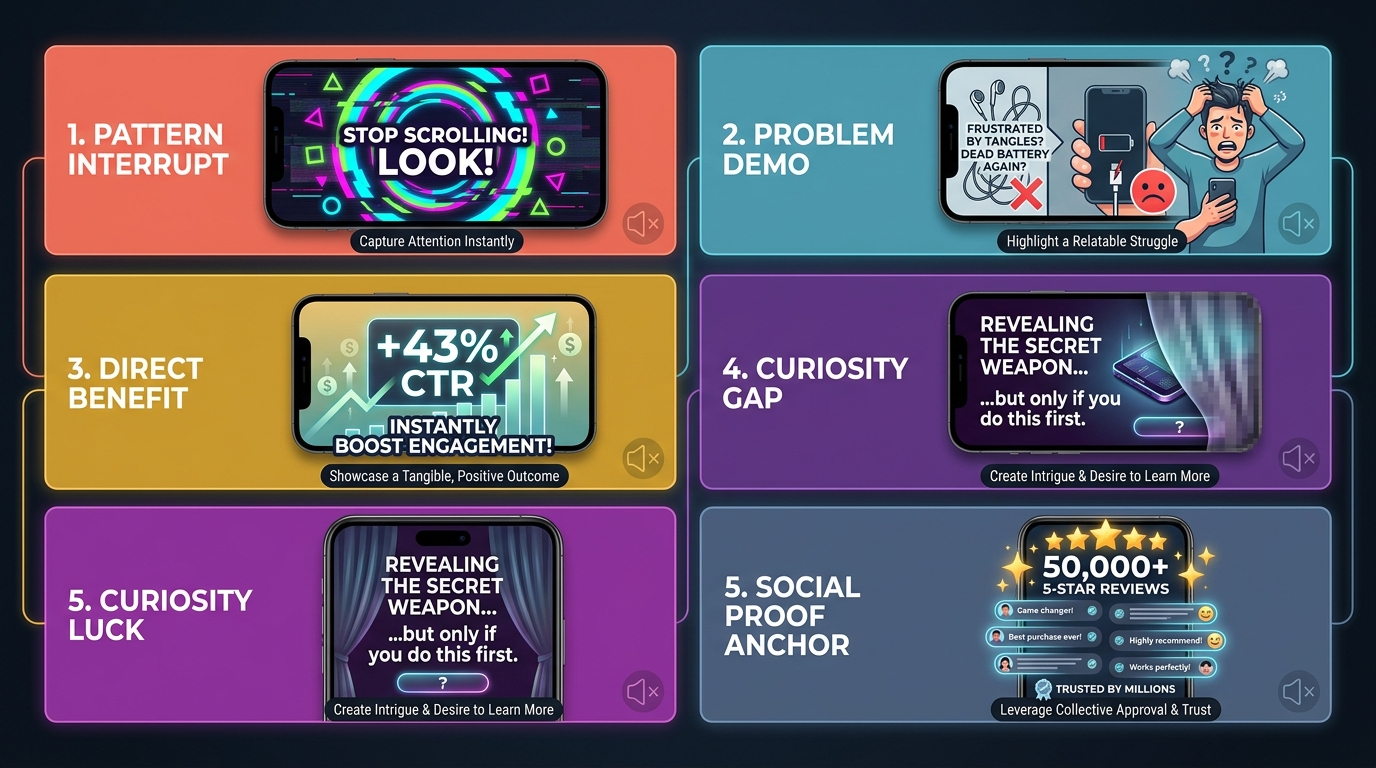
    Five hook types for silent video ad creative — Pattern Interrupt, Problem Demo, Direct Benefit, Curiosity Gap, and Social Proof Anchor — shown as color-coded panels

    Building the Test: What Stays Fixed, What Changes

    The validity of any hook test rests entirely on isolation. If you change the hook and also change the background music, the product sequence, the CTA wording, or the end card — you no longer have a hook test. You have a random creative comparison that will produce results you cannot learn from.

    A rigorous five-hook test has exactly one changing variable: the first two to three seconds. Everything else is held constant across all five variants.

    The Fixed Variables

    The following elements must be identical across every variant in the test:

    • Body content (seconds 4–12): The product demonstration sequence, the benefit build, the visual storytelling — all identical. Same footage, same edit, same pacing.
    • CTA and end card (seconds 13–15): Same text, same visual treatment, same audio if sound is used. Do not change the call to action between variants.
    • Audio treatment: If you use background music in the body, it should be the same track across all variants. If one variant uses a sound effect in the hook, replicate the equivalent sonic weight in other hook variants where possible — or strip audio from all hooks and let the body audio carry the sound layer.
    • Campaign targeting: Same keywords, same match types, same bid strategy, same budget allocation. Run all five variants in the same campaign or ad group with equal budget distribution.
    • Flight timing: Launch all five variants simultaneously. Staggered launches introduce time-of-day and day-of-week confounds that will skew your comparison.
    • Product page destination: All five variants should link to the same ASIN and the same product page. If the landing page differs, you cannot attribute CTR or conversion differences to the hook.

    What Changes: The Hook Window

    The hook window for SBV is the first two to three seconds of video. Within that window, you have three levers to vary across your five hook types:

    1. Opening visual: The first frame image or motion sequence that appears before any text is visible.
    2. First text overlay: The initial on-screen copy element — the hook headline in five to eight words.
    3. Visual-to-text timing: Whether the text appears in the first 0.1 to 0.5 seconds (immediate read) or after a beat of visual impact (0.5 to 1.5 seconds). This timing choice affects whether you lead with visual punch or verbal clarity.

    Each of your five hook variants will combine these levers differently to express a different hook type. The pattern interrupt might lead with an unusual visual for 0.8 seconds before text appears. The direct benefit statement might put bold text on screen within 0.2 seconds against a clean product background. The curiosity gap might show a provocative incomplete sentence over a partially obscured product reveal.

    Write each of the five hook concepts completely before production begins. If any two hook concepts feel like variations of the same idea — slightly different phrasing of the same mechanism — revise until all five are genuinely distinct. The test loses diagnostic value when two variants are essentially measuring the same hook archetype.

    Budget and Run Time

    The directional threshold for hook testing on SBV is approximately 500 to 1,000 impressions per variant, which typically translates to $5 to $12 of spend per variant at current SBV CPM levels. A five-variant test can generate directional data for $25 to $60 total. For categories with higher CPMs, budget accordingly — but resist the temptation to run variants at very different spend levels, which will introduce delivery bias.

    Run the test for a minimum of five days to account for day-of-week behavioral variation. Do not call a winner based on two days of data. Do not let any variant run for more than 14 days before reviewing — creative fatigue in small test budgets is real, and extended runs can produce misleading trend data.

    The Metrics That Actually Matter — and the Ones You Should Ignore

    Hook testing produces a range of data points, and not all of them are equally predictive of downstream performance. The most common mistake in creative testing is optimizing for metrics that are easy to see rather than metrics that actually connect to business outcomes.

    Tier 1: Hook Rate (3-Second View Rate)

    The primary metric for a hook test is hook rate — the percentage of viewers who watch at least three seconds of the ad. This is sometimes called thumb-stop rate or 3-second view rate depending on the platform. It directly measures whether the hook accomplished its job: preventing the scroll.

    2026 benchmark thresholds for hook rate:

    • Below 20%: Weak. The hook is not stopping the scroll for a meaningful share of relevant shoppers. Kill or fundamentally redesign.
    • 20–30%: Average. The hook has some stopping power but is not exceptional. Iterate — identify the weakest element (visual, text, or timing) and revise.
    • 30–40%: Strong. The hook is performing above the median. Eligible for promotion pending CTR confirmation.
    • 40%+: Exceptional. Scale with confidence. Investigate what made this hook work and apply the principle to future creative development.

    Tier 2: Outbound CTR

    Hook rate tells you whether people watched. Outbound CTR tells you whether they acted. A hook can have a strong hook rate but weak CTR if it attracts the wrong type of attention — entertainment rather than purchase consideration. This is particularly important for curiosity gap and pattern interrupt hooks, which sometimes generate high retention but lower click rates because the intrigue satisfies itself within the video.

    SBV outbound CTR benchmarks:

    • Below 0.7%: Investigate whether the hook is attracting shoppers with actual purchase intent.
    • 0.7–0.9%: Acceptable, approaching benchmark average.
    • 0.9–1.2%: Strong. Hook is generating both attention and intent.
    • Above 1.2%: Exceptional performance — analyze and document what drove this for replication.

    Tier 3: Completion Rate

    Completion rate (the percentage of viewers who watch the full 15 seconds) is a secondary signal for hook tests. It measures the quality of the body content more than the hook itself, since the hook’s job is done by second three. However, if completion rate varies significantly across hook variants while the body content is identical, it suggests that different hooks attract different quality audiences — some of whom are more engaged by the product story than others.

    Metrics to Deprioritize in Hook Tests

    Impressions and reach: These are delivery metrics, not creative performance metrics. They tell you how much your ad ran, not whether it worked.

    Average watch time: Too easily distorted by a small number of full-view completions. Use the retention curve and 3-second rate instead.

    Conversion rate from ad: Important eventually, but too noisy in a small hook test. Conversion rates require significantly more volume to produce statistically reliable reads. Use CTR as a leading indicator in the test phase and measure conversion after you have promoted a winner.

    Likes, saves, comments: Engagement metrics on SBV are not primary performance signals for a direct response creative test. Do not let vanity metrics influence which hook you promote.
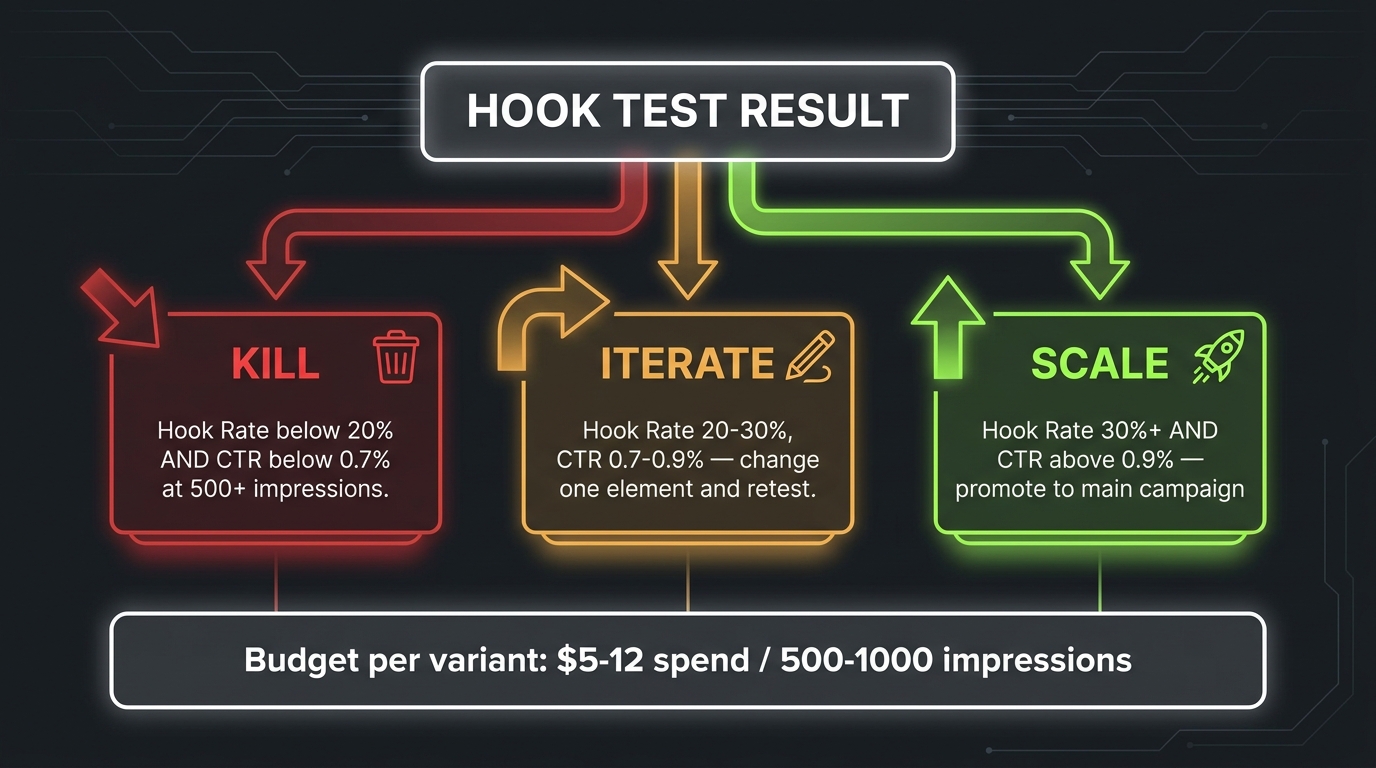
    Decision flowchart for video hook test results showing Kill, Iterate, and Scale paths with specific threshold criteria

    Kill, Iterate, or Scale: A Decision Framework with Real Thresholds

    The test data means nothing without a pre-committed decision framework. Define your kill, iterate, and scale criteria before you launch — not after the data comes in. Post-hoc rationalization is one of the most common ways teams end up running the wrong creative for months.

    The Three-Gate Decision System

    Gate 1 is the impression floor: do not make any decision until each variant has cleared at least 500 impressions. Below that threshold, performance numbers are noise. If you are hitting the impression floor but a variant has a 0% hook rate — literally no one watched three seconds — that variant is a confirmed kill regardless of impression count.

    Gate 2 is the hook rate check. Apply the tier thresholds defined above. Any variant below 20% hook rate at 500+ impressions goes to kill (or deep iteration if you have a hypothesis about what to fix). Variants in the 20–30% range go to iterate. Variants at 30%+ advance to Gate 3.

    Gate 3 is the outbound CTR check. Of the hooks that cleared Gate 2, compare outbound CTR. A hook with a 38% hook rate but a 0.5% CTR is generating attention from the wrong audience. A hook with a 31% hook rate and a 1.1% CTR is your winner. Scale that one.

    When Multiple Hooks Pass All Three Gates

    Occasionally — particularly with well-developed product creative — two or three hook variants will both clear all three gates. In this case, do not simply pick the single best performer and retire the others. Run the top two in an extended head-to-head at higher spend to confirm the leader. The second-place hook may also have category or audience sub-segment applications where its specific mechanism outperforms — keep it available as a rotation option.

    When No Hook Passes Gate 2

    If all five variants come in below 20% hook rate, the problem is not which hook type you chose. The problem is likely one of three things: the visual execution of the first frame is weak across all variants, the product category has a very low average hook rate on SBV (some do), or the ad is reaching the wrong audience. Before redesigning all five hooks, check that your targeting is genuinely matched to search intent. A low hook rate on the wrong audience tells you nothing about the hooks themselves.

    Iterating on a Hook Variant

    When a hook lands in the 20–30% iterate zone, resist the temptation to rewrite it entirely. Identify the weakest element and change only that. If the visual opening is strong but the text overlay is weak, revise the text only. If the text concept is right but the visual is generic, replace the visual only. Keeping one element fixed per iteration means you are still running a valid single-variable test — you just moved the test one level deeper.

    The 5-Frame First-Second Blueprint: Visual Design for Muted Feeds

    Understanding hook types at a conceptual level is necessary but not sufficient. The actual execution of each hook’s first second lives in specific, implementable visual design choices. This section covers the craft decisions that determine whether a strong hook concept translates into a strong hook rate.
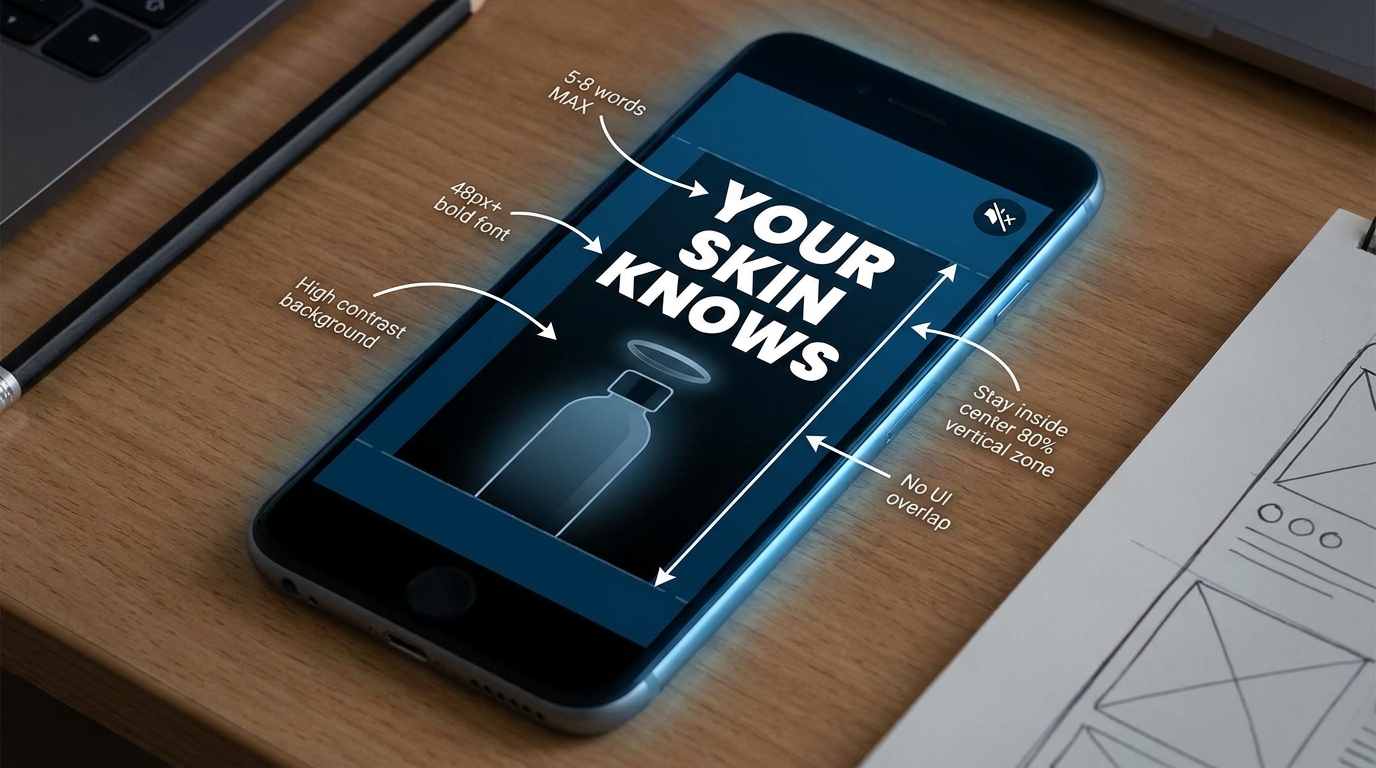
    Annotated mobile phone mockup showing the design blueprint for a silent-first video ad first frame with typography and layout specifications

    Typography Rules for Silent-First Hooks

    Text that appears in the hook window needs to be instantly readable under three conditions simultaneously: small screen, one hand, no audio. That means size, contrast, and simplicity are non-negotiable.

    • Minimum 48px at 1080×1920 resolution for hook text. Primary hook headlines benefit from 60–72px or larger. Secondary text that appears in the hook window (product name, benefit label) should not compete with the headline — use it at 36–44px maximum.
    • High contrast always. White on dark, dark on light, or use a high-opacity backdrop behind text that appears over complex visual backgrounds. Never use medium-contrast combinations where the text blends into the background.
    • Five to eight words maximum for the hook headline. If you cannot express the hook concept in eight words, you have not distilled it enough. Longer text in the first two seconds requires more cognitive load and slower reading — both of which increase the probability of a scroll before the text is processed.
    • Text-safe zones: Place hook text between 10% and 80% of the frame height (leaving the top 10% and bottom 20% clear for platform UI elements like the search bar and ad label). Horizontally, keep text within the center 90% of the frame width.

    Motion Design for the First Second

    The motion choices in the first second are separate from the hook type but equally important for silent-first performance.

    In-motion openers (where the video starts mid-action rather than with a static image) consistently outperform static first frames on hook rate. The movement itself triggers the perceptual system to pay attention before the viewer has consciously decided to watch. For pattern interrupt hooks, extreme or unexpected motion amplifies the hook effect. For problem demo hooks, showing the problem in mid-occurrence creates an immediate what-is-happening-here response.

    Text animation should be simple and fast. Fade-ins that take more than 0.3 seconds delay the hook read. Pop/scale animations that complete in 0.1 to 0.2 seconds work well. Avoid decorative text entrances (typewriter effects, slide-from-off-screen) in the hook window — they add time before the text is fully readable, and that time is precious.

    Color and Contrast Against the Amazon Feed Environment

    Amazon’s search results page has a predominantly white background with black text. SBV ads appear within this environment. Creative that also uses a white background blends into the feed — the opposite of pattern interruption. Dark-background hooks, high-saturation color blocks, and visually rich first frames all stand out more strongly against the typical Amazon SERP aesthetic than light, minimal creative does.

    This does not mean all SBV should use dark backgrounds. But it does mean that the contrast of your first frame should be evaluated against the platform’s ambient visual environment, not in isolation on a design tool canvas.

    From Test Winner to Evergreen Asset: The Iteration Cycle

    The five-hook test is not a one-time exercise. The real value of the framework is what it produces over time: a growing body of data about which hook mechanisms work for your specific product, category, and audience. Each test cycle informs the next, and the cumulative effect is a creative development process that gets measurably faster and more accurate with each iteration.
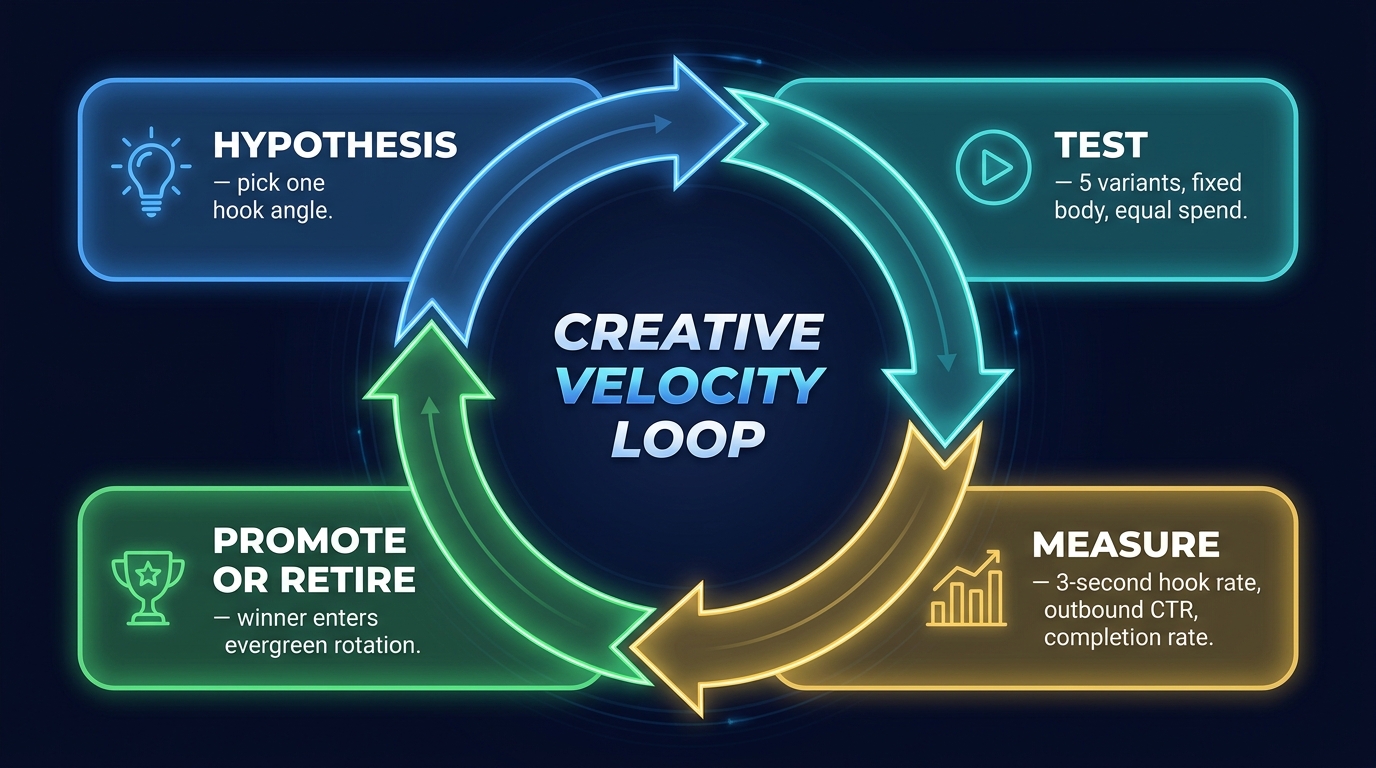
    Creative velocity loop diagram showing the four-stage cycle of Hypothesis, Test, Measure, and Promote or Retire for video hook testing

    How to Transition a Winner into Production Scale

    When a hook variant clears all three decision gates, the transition to production scale involves several steps that are easy to overlook.

    First, document the winner in detail before scaling. What is the exact visual in the first frame? What is the on-screen text, including exact wording, font, size, and position? What is the timing of text appearance? What visual motion leads the hook? This documentation means you can recreate the hook structure for future products or seasonal variations without relying on memory or guesswork.

    Second, produce the winner at full production quality if the test was done with rough edits. Hook tests can legitimately be done with lower-cost production — even with smartphone footage — as long as the creative concept is clear. But the scaling version of the ad should be produced with the same care as your primary brand creative. The hook concept has been validated, but the execution quality still affects performance at scale.

    Third, set a creative fatigue monitoring cadence. Even strong hooks degrade over time as the same audience sees the same ad repeatedly. Monitor hook rate and CTR at weekly intervals once you scale a winner. When hook rate drops more than 20% below its peak performance, it is time to launch the next test cycle.

    The Second-Generation Test

    Once you have a winning hook type identified — say, problem demo consistently outperforms the other four for your product — the second-generation test goes one level deeper. Instead of testing five different hook types, you test five different problem demo executions. Different problems. Different visual framings of the same problem. Different emotional registers (humor versus frustration versus surprise).

    This progressive refinement is what distinguishes teams that get compounding creative improvement from teams that run occasional tests and call it optimization. Each generation of testing narrows the question, making the answers more precise and more actionable.

    Cross-Channel Application of Hook Winners

    SBV hook test winners have immediate application beyond Amazon. A problem demo hook that converts searchers on Amazon is almost certainly worth testing as a TikTok Shop ad, a Meta Reels placement, or a YouTube pre-roll. The specific edit may need to change (aspect ratio, pacing, caption style), but the core hook concept — the type of first-frame visual, the text mechanism, the opening emotional beat — is platform-agnostic.

    Teams that maintain a hook learnings repository (a simple document tracking which hook types won, by product, by quarter, with performance numbers attached) can accelerate creative briefing across every channel. Rather than starting from scratch each time, a brief can specify “use a problem demo hook, specifically showing the product failure in the first 1.5 seconds” and the creative team has a validated structural foundation to build from.

    Common Mistakes That Corrupt Your Hook Data

    Even teams with the right framework make execution errors that compromise the validity of their test results. These are the most common — and most costly — mistakes in hook testing practice.

    Changing More Than the Hook

    The most frequent error: variants that differ in the hook and also in the body content, the music, the CTA, or some other element. Usually this happens because the editor makes small improvements across the whole video during production rather than locking the non-hook elements and only cutting the hook. The fix is to produce the body and CTA first, lock that edit, and then cut five different hook sequences onto the front of the same locked edit. Do not go back to the body once the hook production begins.

    Calling a Winner Too Early

    After 50 impressions, one variant might show a 45% hook rate and another a 12% hook rate. That is not statistically meaningful data. Small sample sizes produce wild performance swings. The 500-impression minimum threshold exists for this reason. The impulse to call an early winner and reallocate budget to it is understandable but destroys the test. Equal budget and equal runtime until the threshold is cleared — no exceptions.

    Running Tests in Separate Campaigns or Ad Groups

    If each hook variant is in its own campaign with different budget caps, different bid settings, or different targeting parameters, you are no longer comparing hooks — you are comparing campaigns. All five variants need to compete for impressions under the same conditions. A single campaign with equal budget allocation across five ad variations is the correct setup.

    Testing Hooks That Are Not Actually Different

    A test that compares “your skin will glow in 30 days” against “see a glow within 30 days” is not a five-hook test — it is a copywriting refinement. Genuine hook type differences mean the underlying mechanism is different: one hook creates pattern interruption, another creates a problem recognition response, another triggers social proof reasoning. If two variants feel similar to a viewer, collapse them into one and create a genuinely different hook type for the freed slot.

    Ignoring the Platform Context During Review

    Review hook test results in the context of where the ad was actually seen. If your SBV ran against a specific set of search keywords, consider whether the keywords themselves could be confounding performance. A highly competitive keyword set will have lower average CTR due to more options competing for the click. If one variant happened to get more impressions against competitive keywords, its CTR will be artificially suppressed versus a variant that ran more often against lower-competition terms. Check keyword-level data in your campaign reporting before concluding that a hook underperformed due to creative quality alone.

    Why Sound Still Matters — Even in a Silent-First Framework

    Silent-first design is a priority constraint, not a prohibition. A video designed for muted viewing is not one that should sound bad when unmuted. The subset of shoppers who do tap to activate audio — or who have autoplay-with-sound enabled — will experience your ad with full audio, and that experience should be intentional, not an afterthought.

    The practical implication is that your hook test should be reviewed in two modes: sound off (the primary test condition) and sound on (the secondary polish condition). A winning hook variant that has strong visual and text execution should also have coherent, brand-appropriate audio when sound is active. This might mean a brief tonal sound design moment in the first second — not a voiceover, but a satisfying audio cue that reinforces the visual hook rather than replacing it.

    Music selection matters more in the body (seconds 4–12) than in the hook window. A track that creates tension or energy in the body reinforces the problem-to-resolution narrative structure. The hook window audio (if any) should not compete with the text or visual for attention — subtle, directional, and brief.

    The broader principle: design for silence, enhance with sound. Sound-on viewers should get a richer experience than sound-off viewers, not a fundamentally different one. If the message changes when sound is active — if the voiceover says something that the on-screen text does not capture — you have a silent-first design failure that needs to be corrected before the ad scales.

    Building a Hook Testing Culture, Not Just a Hook Testing Process

    The five-hook test plan is a process, and processes only produce results if they are actually used consistently. The larger challenge for most advertising teams is not designing the test — it is institutionalizing the discipline to run it before scaling creative, and to learn from the results rather than moving on to the next ad without capturing what was discovered.

    What This Requires Organizationally

    Hook testing at meaningful cadence — one test cycle every four to six weeks per active SBV program — requires that creative production be structured modularly. If every SBV ad is produced as a single monolithic edit, running five hook variants requires five full production runs. That is expensive and slow. If production is structured so the body content is produced once and hooks are produced as short, separate segments that are assembled onto the body in post, the cost and time per test cycle drops dramatically.

    This modular production approach also has a beneficial side effect: it forces cleaner creative thinking. When you must articulate the hook as a discrete, three-second concept separate from the body, you are forced to ask whether the hook actually works independently of the product context. Hooks that only make sense when the product is already on screen are not true hooks — they are transitions. That distinction becomes obvious when you produce the hook segment in isolation.

    What to Track Across Cycles

    Maintain a hook learnings log with at minimum: the hook type tested, the specific visual and text execution, the hook rate achieved, the outbound CTR achieved, the campaign context (product, keywords, flight dates), and the decision made (kill, iterate, scale). Over six to twelve months of testing, patterns will emerge — hook types that consistently outperform for your product category, visual treatments that have higher stopping power, text formulas that generate stronger CTR — and those patterns become the intellectual property of your creative program.

    Teams that do this well do not start from a blank page when briefing new SBV creative. They start from a validated playbook of what has worked, and they use new tests to explore the edges of that playbook rather than re-discovering the center of it from scratch each time.

    Conclusion: The First Three Seconds Are the Product

    Every second of your SBV ad after the third one is contingent on the first three. The product demo, the social proof sequence, the CTA card — all of it is invisible to any shopper who scrolled before the hook landed. In a silent-first environment where most viewers will never tap for audio, those first three seconds must carry the complete burden of capturing attention and establishing relevance through visuals and text alone.

    The five-hook test plan is the most direct method available for identifying which attention mechanism works for your specific product, audience, and competitive context. Pattern interrupt, problem demo, direct benefit, curiosity gap, and social proof are not interchangeable — each speaks to a different psychological trigger, attracts a different viewer profile, and sets up a different expectation for the body content that follows. Testing all five simultaneously against a fixed body gives you a direct comparison of those mechanisms under identical conditions.

    The data from a single well-executed five-hook test cycle has value that extends far beyond the current campaign. It tells you something fundamental about how your audience prefers to receive information. That insight compounds across every ad you build afterward — not just SBV, but across all video placements where silent-first, hook-led structure applies.

    Run the test. Document the winners. Apply the principles. And when performance degrades — as it inevitably will — run the next generation of the test one level deeper. The compounding effect of that cycle is not a minor efficiency gain. It is the difference between a creative program that learns and one that just spends.

    Actionable Takeaways

    • Treat the first two to three seconds as the single highest-leverage creative variable in any SBV ad. Design and test it separately from the body.
    • Produce your body content once, lock it, and cut five different hook sequences onto the front. Modular production is the only efficient way to run five-variant hook tests consistently.
    • Pre-define your decision thresholds before the test launches: kill below 20% hook rate, iterate at 20–30%, scale at 30%+ with CTR above 0.9%.
    • Wait for 500 impressions per variant before reviewing any performance data. Early reads are noise, not signal.
    • Test all five variants simultaneously, in the same campaign, with equal budget. Any deviation from this introduces confounds that corrupt the comparison.
    • Document every test result — hook type, execution specifics, performance numbers, decision made — and build a learnings log that your entire creative team can access and reference.
    • Review every hook in silent mode first. If the message does not land with the sound off, the ad is not ready for the Amazon SBV placement.
    • Use winning hook types from SBV to brief creative across other paid video channels. The hook mechanism is platform-agnostic even if the execution needs to adapt.
  • Why Your SBV Hook Is Losing the Search Shuffle Before the First Second Is Over

    Why Your SBV Hook Is Losing the Search Shuffle Before the First Second Is Over

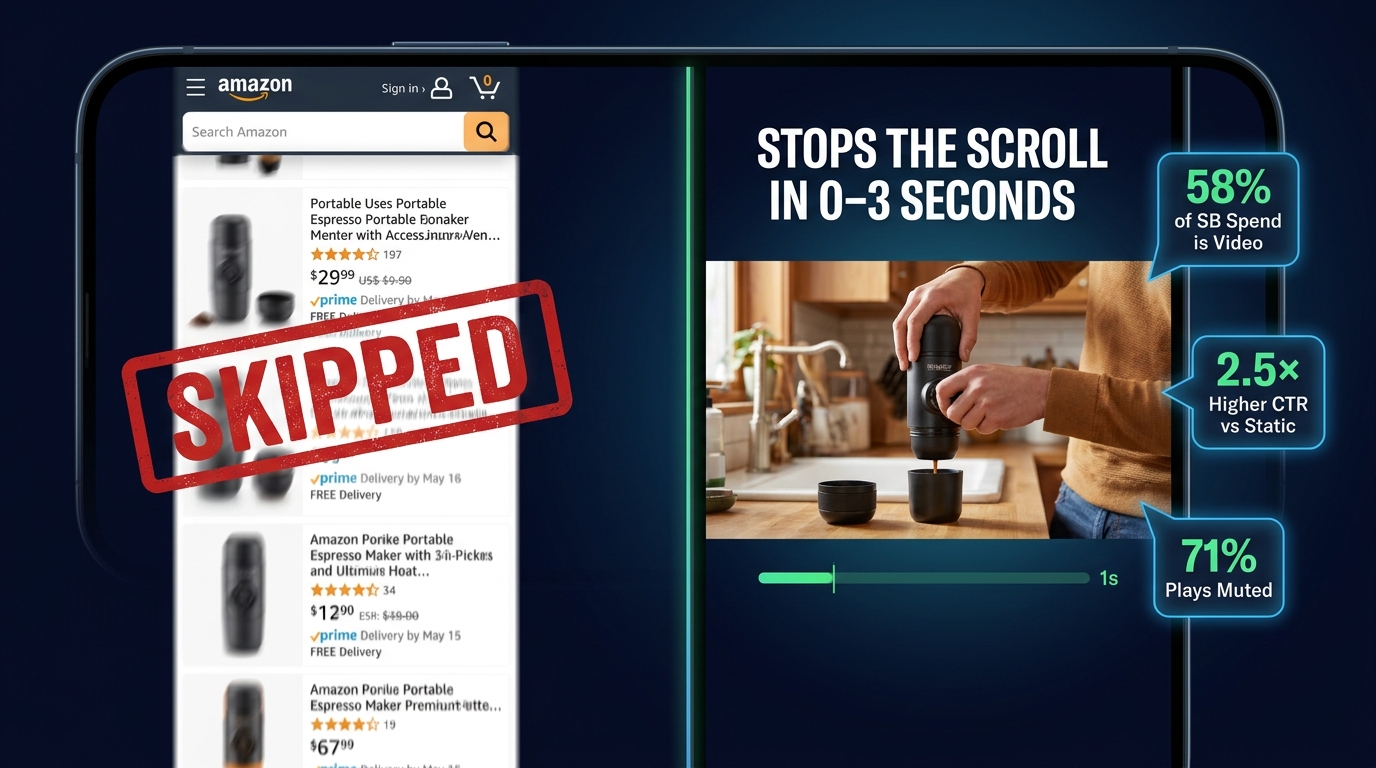
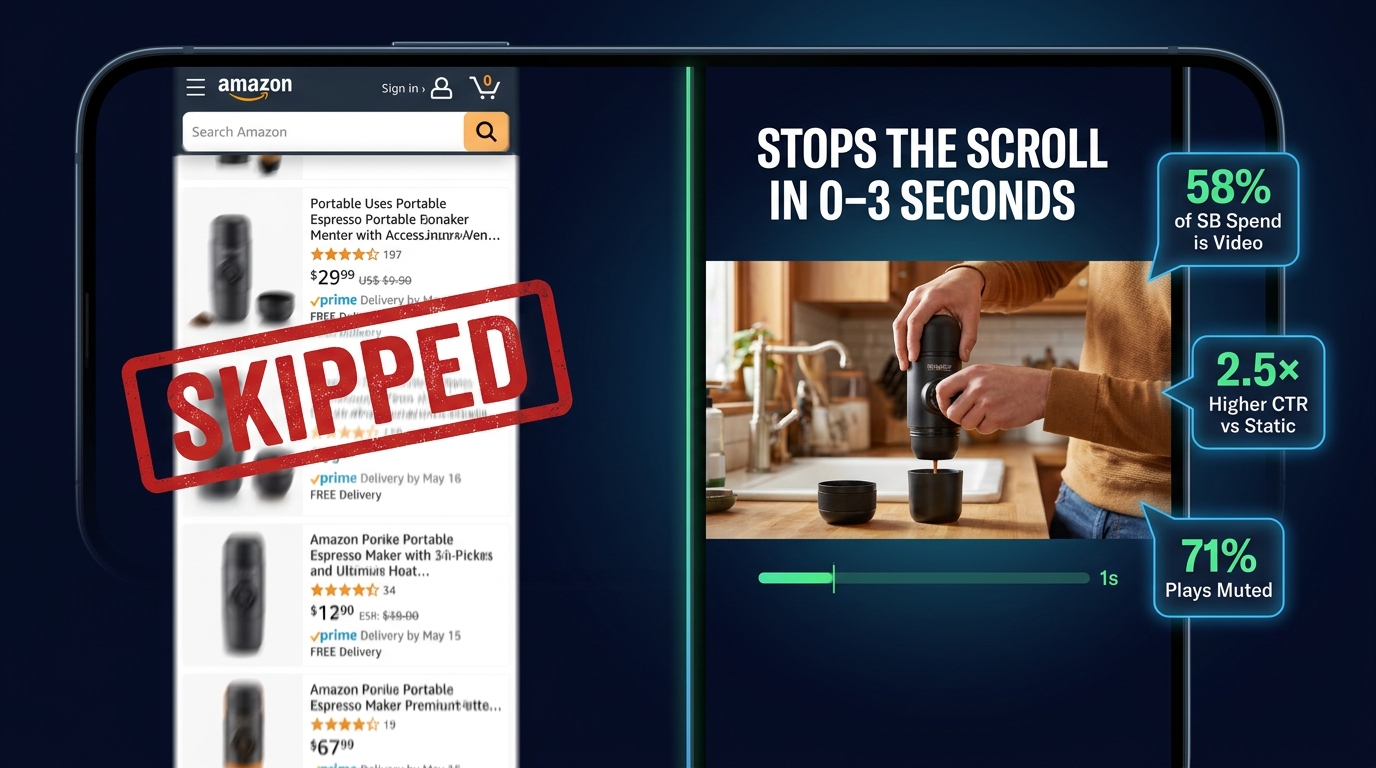
    Split-screen showing a static Amazon listing being skipped versus an SBV ad stopping the scroll with product visible at 1 second, with callouts showing 58% of SB spend is video, 2.5x higher CTR, and 71% plays muted

    Here is a situation that plays out on Amazon thousands of times every second: a shopper types a query into the search bar, the results page loads, and your Sponsored Brands Video ad autoplays in the top-of-search slot — muted, looping, competing with every other listing on the page. The shopper’s thumb is already moving. You have, at most, three seconds to register. Usually less.

    If your creative was built around a single, generic hook — product logo fading in, brand name appearing at the top, slow lifestyle b-roll filling the frame — you have already lost. The shopper’s thumb has moved on. Your ad ran, your impression was counted, and your cost-per-click goes toward a session that converted for someone else.

    This is the reality of what practitioners now call the search shuffle: the dynamic, constantly rotating environment in which Amazon’s ad auction places your SBV creative against shifting shopper intent signals, different query variants, and an ever-changing competitive stack. Sponsored Brands Video now accounts for roughly 58% of total Sponsored Brands spend across managed accounts as of Q1 2026. It delivers approximately 2.5 times the click-through rate of static Sponsored Product ads in the same placement. Yet most brands running SBV treat the creative as a one-time production asset rather than a living, testable, intent-matched performance lever.

    This post is about fixing that. Specifically, it covers how the search shuffle actually works, what a scroll-stopping hook looks like at the mechanical level, how to match different hook types to different keyword intent clusters, how to build a testing architecture that isolates the first three seconds as a variable, and when to refresh versus when to rebuild. By the end, you’ll have a framework you can apply to every SBV campaign in your account — not just your best performer.

    What the Search Shuffle Actually Means for Your SBV Campaigns

    Diagram illustrating the Amazon Search Shuffle concept with the same keyword triggering different creative slots for different shopper intent signals

    The term “search shuffle” does not appear in any Amazon documentation. It’s a practitioner phrase that captures something real: the fact that your SBV ad is not serving a static, predictable audience. It’s serving a constantly rotating cast of shoppers who typed varying versions of your target keyword, at different stages of their purchase journey, with different levels of brand awareness and different amounts of patience.

    Intent Drift Within a Single Keyword

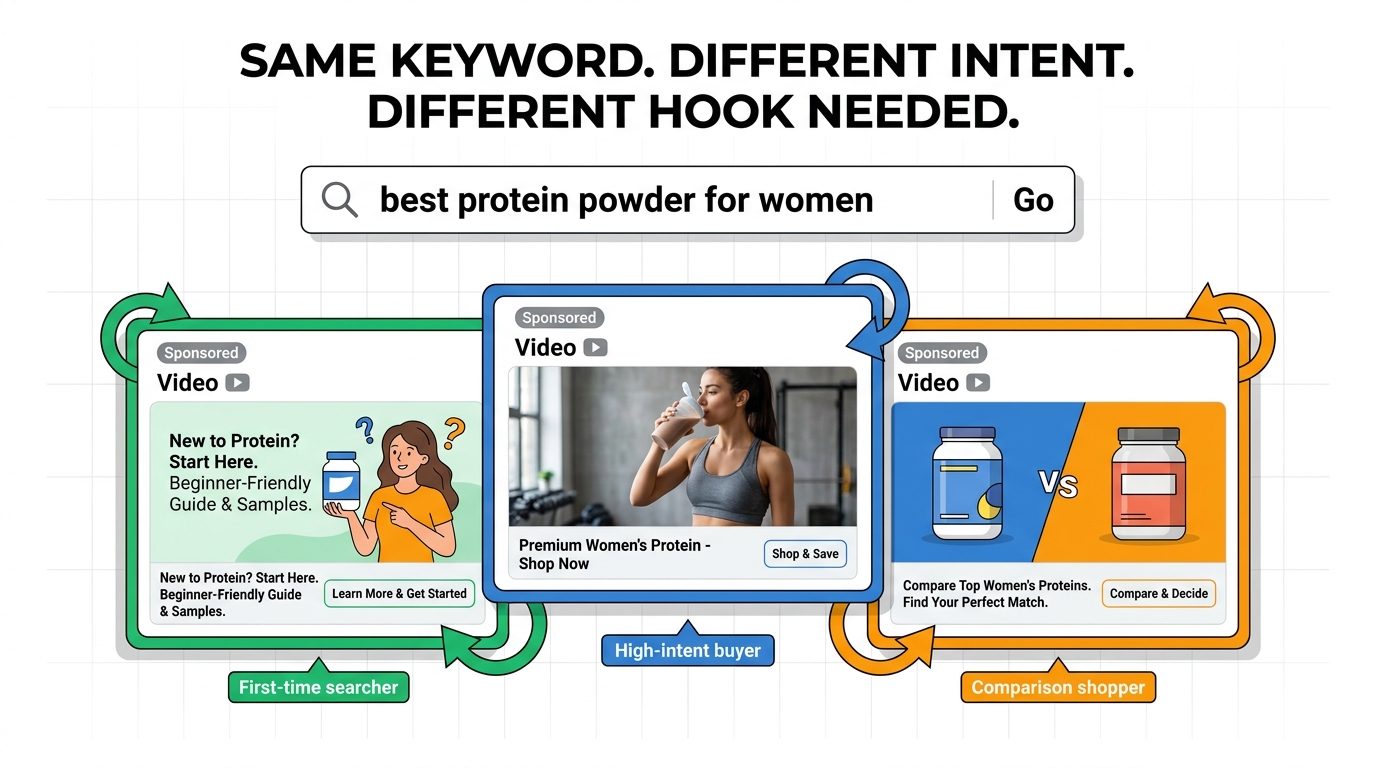
    Consider a brand running SBV against the broad-match keyword “stainless steel water bottle.” That one keyword pulls in dozens of distinct search queries: “best stainless steel water bottle,” “stainless steel water bottle 40oz,” “stainless steel water bottle vs plastic,” “stainless steel water bottle for hiking,” “cheap stainless steel water bottle,” and so on. Each query represents a meaningfully different shopper. The person searching “best stainless steel water bottle” is in comparison mode. The person searching “40oz” knows exactly what they want. The person searching “vs plastic” is still forming a worldview about the category.

    Amazon’s broad and phrase match systems have become increasingly “semantic” in 2026, meaning they interpret intent rather than matching purely on literal keyword strings. The practical effect is that your creative ends up serving audiences whose actual intent may be quite different from the intent you optimised for when you wrote the hook.

    Auction Dynamics and Creative Rotation

    Beyond intent variation, there’s the competitive shuffle itself. Because Amazon runs a real-time auction for every search, the set of ads your shopper sees changes with every query. Your SBV might win the top slot for “stainless steel water bottle insulated” but lose it for “best insulated water bottle.” In the slots where you do appear, you’re competing with different creative from different brands — meaning the “pattern interrupt” that worked last week might look identical to three competitor ads this week.

    This is why creative refresh is not a nice-to-have for SBV: it’s a structural requirement of the environment. The search shuffle rewards brands that treat their video creative as a rotating portfolio, not a permanent asset.

    The Muted Autoplay Constraint Changes Everything

    Layer one more reality on top: approximately 71% of SBV plays in 2026 happen with sound off, up from 64% in 2024. Amazon autoplays video ads muted by default. This means that every word your voiceover says in the first three seconds is functionally invisible to the majority of your audience. If your hook relies on a spoken benefit claim, a brand spokesperson’s opening line, or an audio cue to create emotional impact, you are losing more than two-thirds of your impressions before the hook even lands.

    The search shuffle environment is therefore defined by three simultaneous pressures: diverse and shifting shopper intent, rotating competitive creative context, and a muted-first viewing experience. A hook strategy that ignores any one of these three factors is working at a significant disadvantage.

    The Anatomy of a Hook That Stops a Muted Scroll

    A “hook” in the SBV context is not the entire video. It is specifically the first two to four seconds — the window in which a shopper decides whether to keep watching or scroll past. Everything that happens after the hook only matters if the hook worked. So let’s break down what a scroll-stopping hook actually consists of at the frame level.

    Frame 0–1: Product or Outcome in Frame Immediately

    Amazon’s own creative guidance is unusually direct on this point: show the product, or something interesting about the product, in the very first frame. Not a logo. Not a brand name. Not a color wash or mood sequence. The product itself, doing something meaningful.

    Why does this matter so much in a search context? Because the shopper is looking at a results page where every listing is already showing them a product image. Your SBV plays inline within that results page. If the first frame of your video is a blank screen, a logo fade, or an abstract visual, you are showing a shopper who is actively scanning for products — nothing but a brand statement they didn’t ask for.

    The data bears this out. Videos that open with the product in frame tend to outperform product-delayed videos on CTR across virtually every category benchmarked in 2026. The effect is especially pronounced on mobile, where the video takes up a significant portion of the screen and there’s no ambient context to carry the brand’s identity.

    Frames 1–3: The Benefit Claim With On-Screen Text

    Once the product is established, the next one to two seconds need to answer the implicit question every shopper is asking: “Why does this matter to me right now?” This is where the benefit claim lives — and critically, where it needs to appear as on-screen text, not just voiceover.

    The most effective text overlays in SBV are short (five to seven words maximum), high-contrast (white or yellow text on a darker background or with a subtle drop shadow), and positioned in the upper two-thirds of the frame to avoid the lower-right corner where Amazon places its own UI elements. The claim should be a single, specific benefit — not a brand philosophy, not a feature list, not a tagline.

    Compare these two approaches:

    • Weak: “Premium Quality. Made to Last.” — generic, no specificity, does not answer any search intent.
    • Strong: “Stays Cold 24 Hours — Even in 90° Heat” — specific, outcome-oriented, matches “insulated water bottle” search intent directly.

    The second version connects the visual (product in frame) to a specific, verifiable benefit that maps directly to why the shopper searched in the first place. That alignment between search query intent and hook message is the core mechanic of high-performing SBV in the search shuffle environment.

    Frames 3–5: The Curiosity or Tension Layer

    If the first two seconds stop the scroll and the next two deliver the benefit, seconds three through five need to create enough curiosity or tension to justify the remaining ten to twenty seconds of watch time. This is where a problem demonstration, a before/after transition, a use-case reveal, or a surprising visual can extend the hold rate.

    Hold rate — the percentage of viewers who watch past a given second mark — is one of the most revealing signals in SBV performance. A video that stops the scroll but immediately loses viewers in seconds three to five is a hook problem; a video that retains viewers through the first five seconds but loses them in the middle is a content problem. Keeping these phases analytically separate is how you diagnose which part of the creative to fix.

    The Five Hook Archetypes — Matching the Right One to Keyword Intent

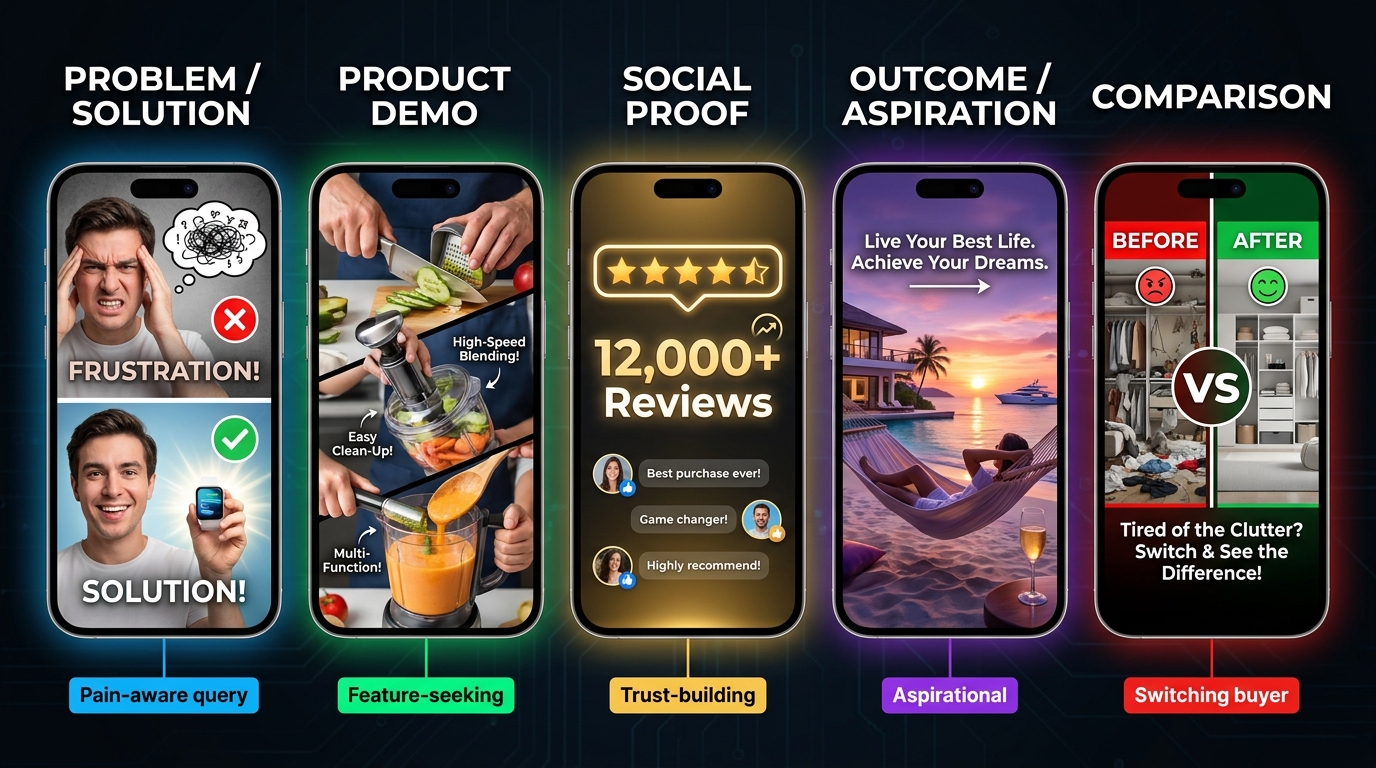
    Five SBV hook archetypes shown across five smartphone screens: Problem/Solution, Product Demo, Social Proof, Outcome/Aspiration, and Comparison, each matched to its ideal keyword intent type

    Most SBV creative briefs default to whichever hook format the creative team is most comfortable producing. The more strategic approach is to start from the keyword intent cluster and work backwards to the hook type that best serves that intent. There are five primary archetypes worth understanding.

    1. The Problem/Solution Hook

    Structure: Opens with a visually recognisable version of the pain point, then cuts immediately to the product as the resolution. The on-screen text in the opening frames names the problem; the text in the middle frames names the solution.

    Best match: Pain-aware query terms. “Back pain relief,” “leaky protein shaker,” “tangled earphone cables,” “mosquito bite itch.” These are shoppers who already understand the problem and are actively scanning for a product that addresses it. A hook that mirrors their pain in the first two seconds creates an immediate “this is for me” moment.

    Common mistake: Spending too long in the “problem” phase. Two to three seconds of problem context is all you need before transitioning to the solution. Longer than that and the hook feels like a lecture rather than a recognition.

    2. The Product Demo Hook

    Structure: Opens directly with the product in use — hands operating it, the mechanism in motion, the result happening in real time. There’s no narrative setup; the action is the hook.

    Best match: Feature-specific or use-case queries. “Standing desk with memory settings,” “air fryer with rotisserie,” “fountain pen with converter.” Shoppers here are past the awareness stage; they know what they want and they’re evaluating execution. A demo hook that shows the specific feature they searched for in the first two seconds is a direct answer to their query.

    Common mistake: Demo hooks that open with the product sitting still on a surface rather than in action. The whole point of a demo hook is motion and function — a static product reveal belongs in a product image carousel, not an SBV opening frame.

    3. The Social Proof Hook

    Structure: Opens with a testimonial quote, a review count, a star rating, or a credential as the dominant visual element. The proof mechanism is the first thing the shopper sees.

    Best match: Trust-building queries and hesitant buyers. Category terms where risk perception is high (supplements, baby products, medical devices, expensive electronics) tend to see social proof hooks perform well because the shopper’s first question isn’t “what does it do?” but “can I trust this brand?”

    Important caveat: Social proof hooks work when the proof itself is substantial and specific. “Loved by millions” is not proof. “12,847 five-star reviews” with the number visually prominent in the first frame is. The specificity is what creates credibility in the two to three seconds of attention you’ve earned.

    4. The Outcome/Aspiration Hook

    Structure: Opens on the desired result — the organised kitchen, the toned physique, the clutter-free desk, the glowing complexion — before revealing the product as the path to that outcome. The aspirational image precedes the product itself.

    Best match: Lifestyle and aspirational queries where the shopper is buying an identity or a state of being as much as a product. “Home gym setup,” “minimalist desk accessories,” “skincare for glowing skin.” Be careful here: this hook type requires genuinely compelling visual execution. A low-quality aspiration shot reads as generic stock footage and destroys the credibility you need.

    5. The Comparison/Contrast Hook

    Structure: Opens with a side-by-side, a before/after, or an “old way vs new way” frame. The comparison is visible immediately in the first two seconds without needing narration.

    Best match: Switching-intent queries and competitor conquesting terms. Shoppers who search “alternative to [Competitor Brand]” or “better than [Product Category] standard” are explicitly in evaluation mode. A comparison hook speaks directly to that evaluative mindset. It also tends to work well for conquesting campaigns where you’re bidding on competitor brand terms, since those shoppers are already considering a switch.

    Why One Hook Can’t Serve Every Keyword Cluster

    The most common structural error in SBV campaign management is using a single creative across the entire keyword portfolio. A brand has one video — usually their “best” one, whichever that means to the team that made it — and that video runs against brand terms, category generics, competitor terms, and long-tail feature searches all at once.

    The problem is not just that different keywords attract different shoppers. It’s that the same shopper might have completely different intent depending on how they typed their query. A shopper searching your brand name already has awareness and is seeking reassurance. A shopper searching a generic category term is in discovery mode and needs education. A shopper searching a specific feature is further down the funnel and needs functional confirmation. One hook cannot simultaneously be a reassurance message, a discovery invitation, and a functional proof point.

    The Intent Gap Between Your Hook and the Search Query

    When the hook’s intent doesn’t match the search query’s intent, the damage is subtle but measurable. The ad may still generate clicks — shoppers can misread a creative’s intent in the first moment and click through anyway. But the conversion rate drops because the shopper who arrives on the product detail page doesn’t feel the continuity between what the ad implied and what the page confirms.

    This is sometimes called “creative-to-landing-page misalignment,” but it more precisely starts earlier: it’s a hook-to-query misalignment. The shopper searched for a specific thing, the hook addressed a different thing, and the gap creates cognitive friction that conversion rate cannot easily overcome.

    The Cost of Intent Mismatch on ACoS

    The financial impact compounds over time. A generic hook running against a mix of intent segments will perform adequately in aggregate — good enough that you don’t pull the campaign, not good enough to ever reach its potential. Meanwhile, a correctly segmented creative structure might serve the same total impression volume with meaningfully different ACoS outcomes per cluster: brand defense terms converting at 12–15% ACoS, category generics at 25–30%, and competitor conquesting at 30–40%, each within their acceptable range rather than blended into a single mediocre average.

    The arithmetic of segmented creative is not glamorous but it is real. Advertisers who build intent-matched hooks per cluster routinely report that their best-performing cluster ACoS drops to levels they previously considered impossible for that keyword category. The hook matching does not just improve CTR; it improves the quality of the traffic that arrives, which improves the conversion rate that follows.

    Building the Creative Matrix: Mapping Hooks to Keyword Themes

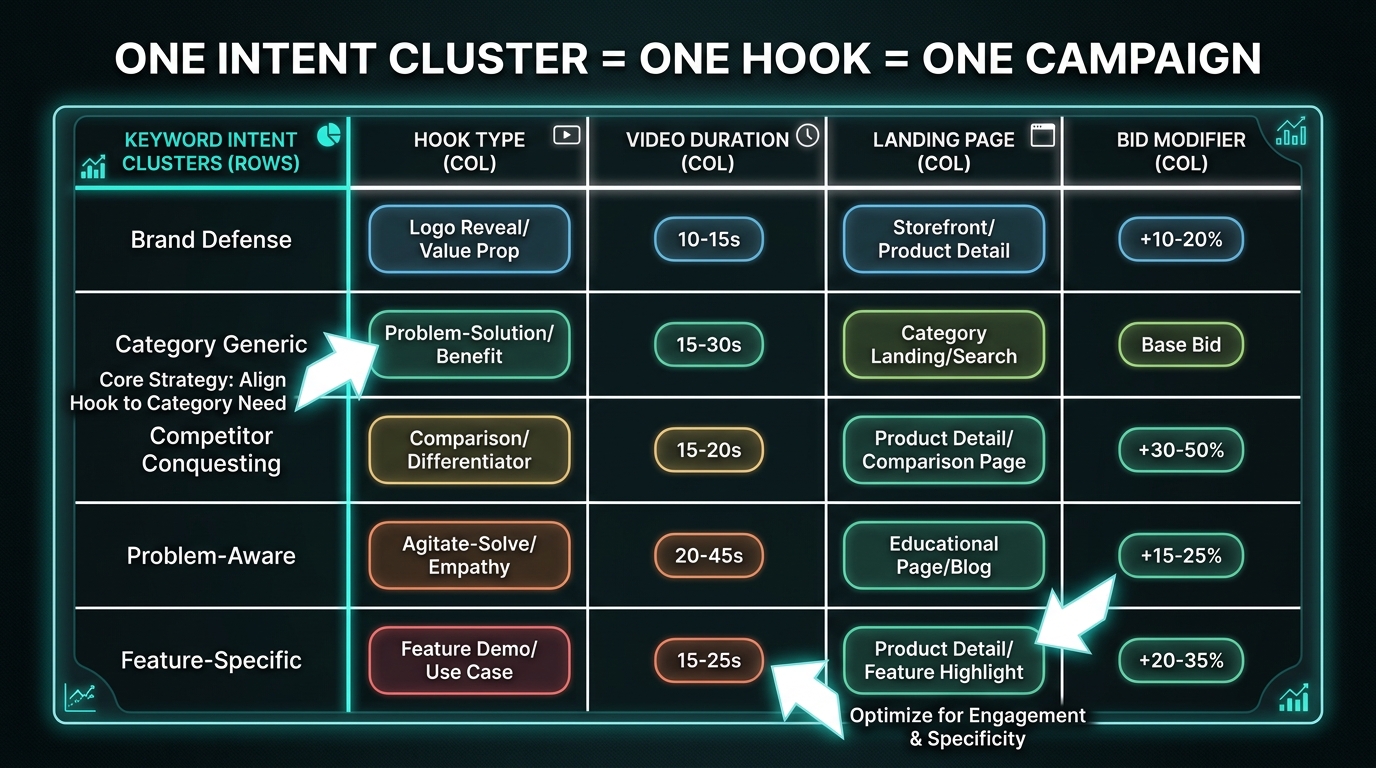
    Campaign structure matrix mapping five keyword intent clusters — Brand Defense, Category Generic, Competitor Conquesting, Problem-Aware, Feature-Specific — to hook types, video duration, landing page, and bid modifiers

    Translating the intent segmentation principle into an actual campaign structure requires a concrete planning tool. The creative matrix is a simple framework: a grid that maps each keyword intent cluster to the hook type, video duration, landing page destination, and bid strategy appropriate for that cluster. Here’s how to build it.

    Step 1: Segment Your Keyword Portfolio Into Five Intent Clusters

    Pull your current SBV search term report. Filter for all converting terms in the last 90 days and group them into five clusters:

    1. Brand defense: Any search that includes your brand name or a close variant. These shoppers know you. Your hook should reinforce the choice they’re already leaning toward — social proof and outcome hooks tend to perform strongest here.
    2. Category generic: Broad category terms with no brand or feature specificity (“protein powder,” “running shoes,” “desk lamp”). Discovery-mode shoppers; problem/solution or aspiration hooks work best because they differentiate the product from the category.
    3. Feature-specific: Searches that include specific technical or functional attributes (“protein powder with 30g protein per serving,” “running shoes wide fit,” “desk lamp with USB charging”). Demo hooks that show the specific feature in the first two seconds win here.
    4. Problem-aware: Pain-point queries (“protein powder for weight loss,” “running shoes for knee pain,” “desk lamp for eye strain”). Problem/solution hooks are almost always the right structure.
    5. Competitor conquesting: Searches for a competitor’s brand or product name. Comparison hooks are the natural fit, though you must be careful not to name the competitor directly — frame it as a category upgrade, not a brand attack.

    Step 2: Assign a Hook Type and Video Version to Each Cluster

    For each cluster, specify: (a) which of the five hook archetypes you’ll use, (b) what the on-screen text in the first three seconds will say, (c) what the product action will be in frames 0–1, and (d) what the CTA and end card will reinforce. Document this in your creative brief before production begins.

    Ideally, you are producing a minimum of three video versions per product: one for brand defense, one for category generic/problem-aware, and one for feature-specific/conquesting. Three versions is not an excessive production burden when you consider that the videos share the same middle section and end card — only the first five to seven seconds differ between versions. With a competent video team, this structure can be built as a modular production where you shoot three hook sequences in one session and stitch them to a shared core.

    Step 3: Create Separate Campaigns Per Cluster (Not Per Keyword)

    A single SBV campaign should contain one creative and one intent cluster. This is not the same as a single-keyword ad group structure. You may have ten keywords in a “problem-aware” campaign — that’s fine, as long as all ten share the same shopper intent and your hook addresses that intent directly.

    Separating by cluster rather than keyword keeps your campaign count manageable while still giving you clean data. When CTR drops in your “category generic” campaign, you know it’s either a hook fatigue issue or a competitive context shift in that specific intent environment — not a blended signal across four different intent types that’s impossible to act on.

    Step 4: Assign Landing Pages Intentionally

    The creative matrix should also specify where each cluster lands. Brand defense campaigns can land on a custom Store page that reinforces the brand identity and shows the full product range — the shopper already knows you, so expanding the basket is the right move. Feature-specific campaigns should land directly on the product detail page for the specific feature variant — any extra step or extra choice creates friction for a shopper who has already decided on the feature they want. Problem-aware campaigns can land on a curated Store page that tells the problem-to-solution story with supporting imagery and copy before the shopper reaches the product listing.

    Creative Fatigue Math: When to Refresh vs When to Rebuild

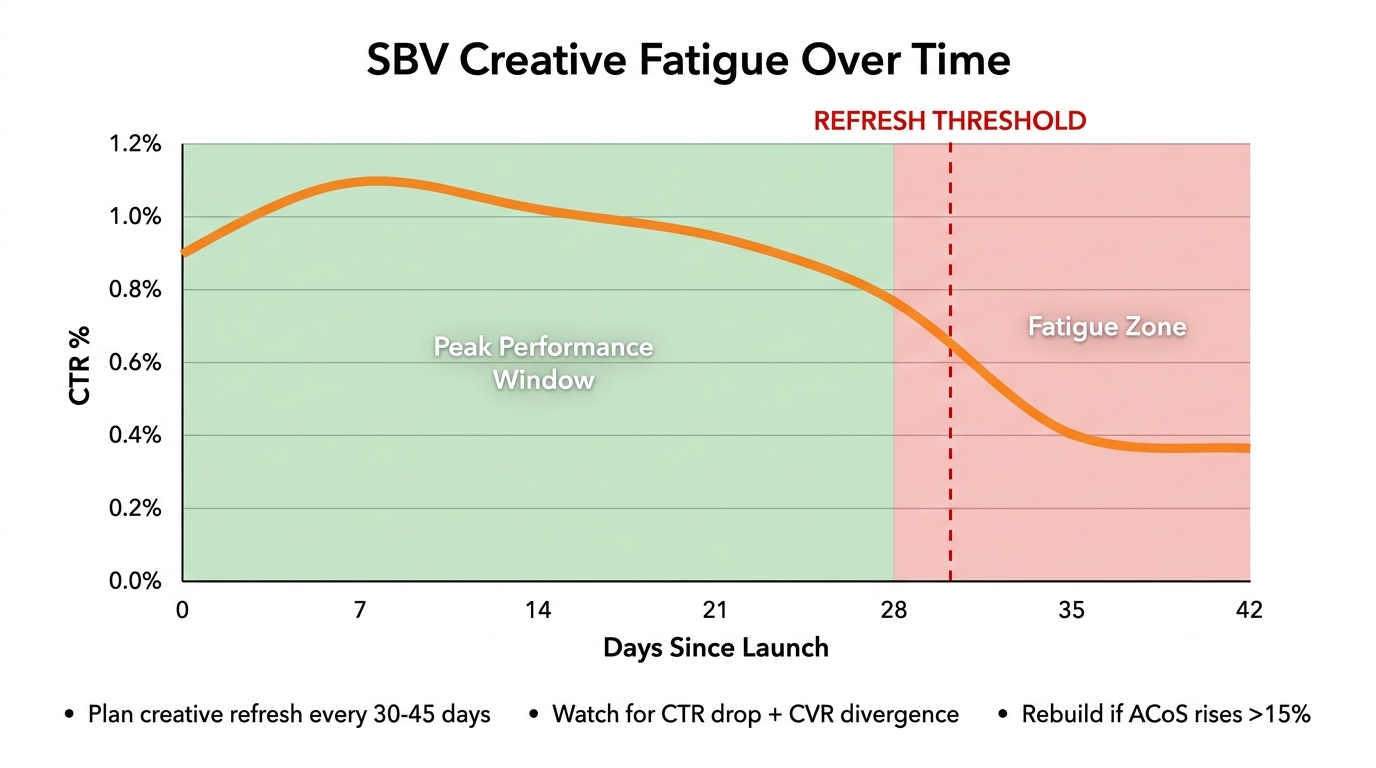
    Performance chart showing SBV creative fatigue curve over 42 days, with CTR peaking at day 7 and declining sharply after day 28 into the fatigue zone, with the refresh threshold marked at day 30

    One of the most consistent findings in SBV performance data is the fatigue window: the period during which a given creative performs near its peak before declining. Across managed accounts and practitioner benchmarks in 2026, the pattern is remarkably consistent — SBV creatives typically peak in performance somewhere between days 5 and 14 of their run, then gradually fade, with most experiencing material CTR and CVR degradation by weeks four to six.

    The Two Types of Creative Fatigue

    Not all SBV performance drops signal the same underlying problem. There are two distinct types of fatigue, and they require different responses.

    Hook fatigue occurs when the specific opening sequence has been seen enough times by enough shoppers in your impression pool that the pattern interrupt no longer works. The creative was effective; it just got old. The signal is a CTR decline while CVR holds reasonably steady — shoppers who still watch past the hook still convert, but fewer shoppers are stopping to watch. The fix is a hook refresh: reshoot or recut the first five seconds with a new visual approach, new on-screen text angle, or new product action, while keeping the rest of the video intact.

    Message fatigue occurs when the benefit claim or hook angle is no longer compelling in the current competitive context — either because competitors have adopted similar messaging, the benefit has become table stakes in the category, or the shopper’s priorities have shifted seasonally. The signal is CTR declining AND CVR declining simultaneously. The fix is a full creative rebuild, because the message itself needs to change, not just the visual execution of it.

    The Fatigue Dashboard: Four Metrics to Watch

    Set weekly review checkpoints on these four metrics for each SBV campaign:

    • CTR — your earliest warning signal. A week-over-week decline of more than 15% from the previous period warrants investigation.
    • CVR (conversion rate) — if CTR drops but CVR holds, you have hook fatigue. If both drop together, you have message fatigue.
    • ACoS trajectory — rising ACoS with declining CTR is the most actionable combined signal. If your ACoS rises more than 20% from its four-week average, treat that as a hard trigger for creative action.
    • Video view-through metrics — Amazon now exposes video engagement metrics in Campaign Manager for Sponsored Brands, including partial view rates. A sudden drop in viewers who watch past the three-second mark is a direct flag on hook performance.

    Planning the Refresh Calendar

    Rather than waiting for fatigue signals before scheduling creative work, the most effective approach is to build a refresh calendar at the start of the quarter. With a 30 to 45-day average fatigue window, a quarterly SBV plan should include at minimum two full hook versions per cluster per quarter, scheduled to rotate in before the previous version’s metrics show hard decline. The goal is to be in the market with a fresh hook before the old one fatigues, not after.

    In highly competitive categories — supplements, electronics accessories, home goods — where impression volumes are high and category creative looks increasingly similar, teams shorten this cycle to every 21 to 28 days. In lower-volume categories, the 45-day window may hold for an entire quarter. Know your impression volume; it’s the primary determinant of how fast your audience exhausts exposure to any given hook.

    The Testing Architecture That Isolates Hook Performance

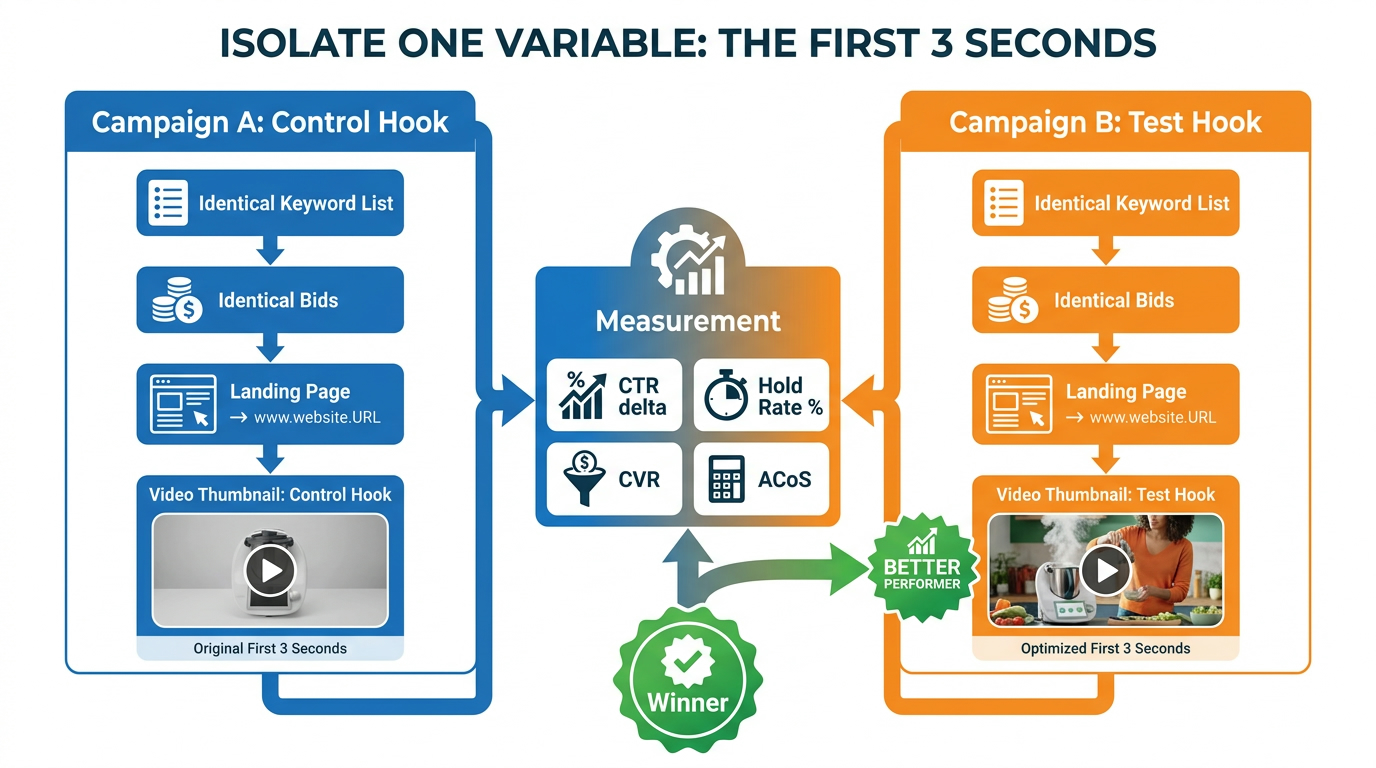
    A/B testing architecture for Amazon SBV hook testing showing two parallel campaigns with identical keywords, bids, and landing pages but different first-3-second hook sequences, measured by CTR delta, hold rate, CVR, and ACoS

    The single most common mistake in SBV testing is changing too many variables at once. A brand produces a new video — different hook, different voiceover, different product being featured, different landing page — launches it alongside the old one, and declares the winner based on which campaign performed better. What that test tells you is almost nothing about why one video outperformed the other, which means you can’t apply the learning to your next creative.

    The Isolation Principle

    Effective hook testing requires that the hook be the only variable that changes between the control and the test. Everything else — keyword list, match types, bids, landing page, video duration, end card, call to action, ASINs being featured — must be identical. The creative matrix structure described earlier makes this straightforward: because each campaign already contains a single intent cluster with a single creative, you can launch a “hook test” version of any campaign by duplicating the campaign exactly and substituting only the first three to five seconds of the video.

    This modular production approach (shared core video, swappable hook sequences) is not just efficient for production — it’s the structural foundation of valid hook testing. When you know the only thing that changed was the hook, a CTR or CVR difference between the two campaigns is attributable to the hook.

    Sample Size and Test Duration

    The most common reason SBV hook tests produce inconclusive data is not the creative — it’s the test running for too long or too short a period. Run the test for too short a time and Amazon’s delivery algorithm hasn’t finished optimizing impression distribution across the two campaigns. Run it too long and the more naturally clicking campaign starts getting a higher share of impressions, biasing the results.

    A practical guideline for SBV hook tests: run both campaigns simultaneously for a minimum of two full weeks, with a minimum of 500 impressions per campaign per day. If your campaigns don’t reach that impression volume, extend to three weeks before evaluating. Assess performance using CTR and CVR as co-equal primary metrics, with ACoS as a secondary confirmation. Avoid declaring a winner purely on CTR — a hook that generates many clicks but poor conversion is not a winning hook; it’s a misleading one.

    The Two-Week Read and the Holdover Effect

    One nuance worth acknowledging: SBV campaigns typically have a brief “learning” phase in the first three to five days during which Amazon’s algorithm is calibrating delivery. Performance during this window tends to be noisier than the steady-state that follows. When reading the results of a two-week test, weight days 7 through 14 more heavily than days 1 through 6 to avoid making decisions based on delivery noise rather than genuine creative signal.

    Mute vs Sound: The Hidden Performance Split

    Given that 71% of SBV impressions play muted, the intuitive conclusion is to deprioritise audio entirely. But that’s not quite right — and understanding the nuance here can give you a meaningful edge in categories where most advertisers have overcorrected in the other direction.

    Designing for the Muted 71% First

    The baseline principle remains: every hook must work completely, communicating the full benefit claim and product context, without any reliance on audio. If you removed all sound from your video and someone watched the first five seconds, they should understand exactly what the product is, what it does for them, and why they should care. If they can’t, your text overlay strategy is insufficient.

    Common failures in muted-first design include:

    • A spokesperson who opens the video speaking a benefit claim that isn’t mirrored in on-screen text
    • An ASMR or sound-dependent product demonstration where the audio is the whole point and the visual lacks equivalent impact
    • A jingle or brand music that establishes mood without any visual anchor to product or benefit
    • Product name and description that only appear in the video’s audio track, not as visible text

    When Sound Actually Adds Measurable Lift

    The 29% of SBV plays that do have sound enabled are not a random distribution. Shoppers who enable sound are typically watching on a desktop or laptop where unmuting is habitual, or they’re so engaged with a muted video that they actively choose to unmute it to get more information. Both of these are high-intent shopper signals.

    This means audio quality and audio strategy disproportionately affect your most engaged viewers — exactly the segment most likely to convert. A video that has compelling visuals-first and then rewards a shopper who unmutes with excellent audio (a clear voiceover that adds information not in the text overlay, rather than just reading the text overlay aloud) tends to outperform a video where the audio track simply duplicates what’s already on screen.

    The practical implication: design your text overlays to carry the full message for the 71%, then write your audio track as a complement to the visuals — adding context, emotional texture, or specific product details that the on-screen text didn’t have space for. Think of the audio track as a bonus layer for your most engaged viewers, not a substitute for your text strategy.

    Measuring What Matters: Metrics Beyond CTR for SBV in Search

    CTR is the most watched SBV metric and the least diagnostic one on its own. It tells you whether your hook stopped the scroll, but it tells you nothing about the quality of the attention you earned, whether that attention converted, or which part of the creative journey broke down. Building a more complete measurement framework requires four additional lenses.

    Hold Rate: The Hook’s True Report Card

    Hold rate measures the percentage of video viewers who watch past a specific second mark — typically 3 seconds, 5 seconds, or 15 seconds (the halfway point of a 30-second video). Amazon’s Sponsored Brands video reporting now surfaces partial view rates, giving you a granular view of where viewers drop off.

    A high CTR combined with a low 3-second hold rate is a classic false positive: the thumbnail or first frame attracted a click (or the autoplay attracted a watch start), but the hook failed to maintain attention. This pattern often indicates that the first frame was visually arresting but the next two to three seconds didn’t deliver a coherent follow-through. The fix is in the hook’s middle frames, not the opening visual.

    Branded Search Lift: The Awareness Proxy

    For brand defense and category generic SBV campaigns, one of the most valuable but underutilised measurements is branded search volume before and after a major creative push. When SBV creative is working effectively as an awareness and recall mechanism, you should see a measurable uplift in direct searches for your brand name in the 30 days following a significant SBV spend period.

    This is not a campaign-level metric you can read directly from your advertising console — you need to cross-reference your brand keyword search volume trends in your organic search term report against your SBV impression volume timeline. But the correlation, when it exists, is compelling evidence that your SBV hooks are creating brand-level impact beyond the clicks they directly generate.

    Page Visit Quality: What Happens After the Click

    Amazon offers a metric called “detail page view rate” — the percentage of ad clicks that result in a product detail page view. For SBV specifically, a significant gap between total clicks and detail page views suggests that shoppers are clicking through but abandoning on the Store page or the search results before reaching a product listing. This is a landing page routing problem, not a hook problem.

    Similarly, add-to-cart rate (available in Amazon Attribution reports and, in some cases, in Campaign Manager’s attributed metrics) tells you whether the shopper who viewed the product after clicking your ad found what they expected. A low add-to-cart rate with a high click rate and reasonable page view rate is the clearest signal that your hook promised something your listing doesn’t fully deliver — a message alignment problem that starts in the creative brief.

    Common Hook Mistakes That Are Killing Your Search Shuffle Performance

    The most useful way to audit an existing SBV portfolio is to check each creative against the most common structural errors. These are not production quality issues — they’re strategic errors that persist regardless of budget spent on the video.

    The Logo-First Opening

    Starting with a logo fade or brand name reveal is almost always wrong for search placements. The shopper didn’t search for your brand (unless it’s a brand defense campaign). They searched for a product. Opening with a logo tells them you prioritise your brand awareness over their search intent — and they scroll past accordingly.

    The fix is simple: move the brand identification to the end card. Let the product and the benefit hook hold the opening. Your logo and brand name can appear as a lower-third watermark throughout if brand recall is important, but they should never take precedence over product context in the first two seconds.

    Slow Product Reveals

    Some creative teams believe that building anticipation before the product reveal creates engagement. In a 30-second TV spot, this logic has merit. In an autoplay SBV running against a competitive search results page with muted playback, it creates an empty first two seconds that your competitor’s instantly visible product visual fills instead.

    The search context is radically different from any other video format. The shopper is not in a lean-back viewing state; they are in an active scanning state. “Building anticipation” with a pre-product opening doesn’t land as anticipation — it lands as irrelevance, and the shopper moves on before the reveal ever happens.

    Generic Benefit Claims That Match Every Competitor

    If your hook text says “Premium Quality” or “Best in Class” or “Made with Care,” you have written a hook that could appear on any product in your category. The search shuffle environment means your ad appears next to multiple competitor ads, all of which are likely using similarly generic language. In that context, generic hooks produce generic differentiation — which is to say, none at all.

    The cure is specificity. Instead of “Premium Quality,” say “316 Surgical-Grade Steel — Not 304.” Instead of “Best in Class,” say “Rated #1 in 28 Independent Lab Tests.” The more specific the claim, the more it functions as a genuine differentiator. The more it differentiates, the more it earns the click from the shopper who cares about that specific dimension — which is exactly the shopper you want.

    Running One Hook Against Your Entire Keyword Footprint

    As discussed in the creative matrix section, this is arguably the most expensive structural mistake in SBV management. The damage is invisible in aggregate reporting — your overall SBV ACoS looks acceptable because the campaigns where the hook accidentally matches intent compensate for the campaigns where it doesn’t. But the opportunity cost is real: the clusters where intent mismatch is suppressing conversion rate are paying click costs for traffic that never converts at potential.

    The audit for this is straightforward: segment your SBV search term report by the five intent clusters described earlier and check whether the keywords in each cluster share the same creative. If they do, you have an immediate and actionable optimisation waiting to be executed.

    The SBV Creative Refresh Cadence as a Competitive Moat

    There is a persistent misconception that SBV creative is a production cost — an input you pay once and then deploy until it stops performing. The brands building durable SBV performance in 2026 treat it differently: as a system, with a cadence, a test-and-learn infrastructure, and a production pipeline that keeps fresh creative rotating into market before the current version fatigues.

    What a Mature SBV Creative Operation Looks Like

    A brand with three to five product lines running SBV across five intent clusters, refreshing hooks every 30 to 45 days, is not running a glamorous creative operation. They’re running a disciplined one. It looks like this: a quarterly shoot day that produces hook sequence variations for each product, a modular edit structure where new hook sequences are cut onto a shared video core in a day or two rather than requiring full reproductions, a weekly metrics review against the four fatigue indicators described above, and a clear decision rule for when to refresh versus when to rebuild.

    The brands that execute this system consistently — even imperfectly — build a structural advantage over competitors who are still reacting to performance drops with emergency creative requests. They’re always ahead of fatigue rather than behind it. Their campaign performance curves are smoother, their ACoS trajectories are more predictable, and their CTR benchmarks compound upward over time as each test cycle produces a slightly better-performing hook variant.

    The Compounding Effect of Hook Learning

    Every hook test that runs cleanly produces a learning: this angle outperformed that angle, this benefit framing outperformed that framing, this visual structure held attention longer than that one. Over the course of two or three quarters of systematic testing, a brand accumulates a library of validated hook principles specific to their product, their category, and their shopper intent profile.

    This learning library is genuinely defensible. A competitor can copy your current hook — they can see your ads in search, they can note what works, they can produce similar creative. But they cannot easily replicate the accumulated test data and learned creative principles that your hook-testing system has produced. By the time they’ve caught up to your current approach, you’ve already moved to the next iteration.

    Where to Start This Week

    If you’re running SBV campaigns today without an intent-segmented structure, the highest-leverage action you can take immediately is a search term report audit. Pull 90 days of search term data from your existing SBV campaigns, tag each term by intent cluster, and identify which clusters are currently being served a hook that doesn’t match their intent. That gap analysis is your production brief for the next round of creative.

    If you already have segmented campaigns but haven’t refreshed creative in more than 45 days, pull your CTR trend by week for each campaign. If any campaign shows a steady week-over-week CTR decline across the last three weeks, the hook has fatigued. You don’t need to rebuild the entire video — you need a new opening five seconds. That’s a production task that, done modularly, can be turned around in days rather than weeks.

    The search shuffle doesn’t care how long you’ve been running your current creative. Every new search query is a fresh three-second audition. The only question is whether your hook shows up prepared.

    Key Takeaways

    • SBV now dominates Sponsored Brands: ~58% of SB spend is video as of Q1 2026, delivering ~2.5× higher CTR than static formats — the format has matured from an option to a default.
    • 71% of plays are muted: Every hook must communicate product context and the primary benefit claim entirely through visuals and on-screen text. Audio is a supplement for engaged viewers, not a strategy for the majority.
    • Product in frame by second one: In a search context, a delayed product reveal does not build anticipation — it creates an empty frame that a competitor’s visible product fills instead.
    • Match hook type to keyword intent cluster: Problem/solution, product demo, social proof, outcome/aspiration, and comparison hooks each serve a different shopper intent. One hook across a mixed keyword portfolio leaves intent-specific performance on the table.
    • One intent cluster per campaign: Structural segmentation keeps your diagnostic data clean and your hook learnings actionable. A blended campaign produces blended, unreadable signals.
    • Plan for fatigue at 30–45 days: Build a refresh calendar at the start of each quarter as a proactive production schedule, not a reaction to declining performance. Modular production makes this operationally feasible at scale.
    • Test one variable at a time: A valid hook test changes only the first three to five seconds between control and test campaigns, with everything else held constant. Any other change produces a result you cannot act on.
    • Accumulated hook learning is a moat: Competitors can copy your current creative. They cannot easily copy the tested, validated creative principles your system has produced over multiple quarters of disciplined testing.