Tag: Augmented Reality

  • Why Your Amazon Listings Are Invisible to Your Best Customers (And How 360° and AR Images Fix That)

    Why Your Amazon Listings Are Invisible to Your Best Customers (And How 360° and AR Images Fix That)

    360° and AR product images on Amazon — the conversion edge most sellers miss

    There is a fundamental problem baked into every Amazon product listing: the customer cannot pick up the product. They cannot turn it over, peer at the stitching, feel the weight, or hold it up to the light. Every purchase is an act of faith — and the only thing standing between that faith and a click away is your product imagery.

    Most sellers know this in theory. In practice, the vast majority of Amazon listings still rely on the same three or four flat, static photographs that haven’t changed since the ASIN was first created. Meanwhile, a growing number of brand-registered sellers are quietly watching their conversion rates climb — not because they rewrote their bullet points, launched another PPC campaign, or chased review velocity — but because they changed how shoppers experience their product visually before buying.

    This article is not about making your images “look nicer.” It’s about the specific mechanics of 360-degree spin views, 3D model uploads, and Amazon’s AR features — what the data actually shows, who qualifies, how to execute without a large production budget, and how to build a visual asset stack that does measurable work at every stage of the shopper’s decision process.

    If you have already read generic advice about “using high-quality images,” this is something different. What follows is the operational reality of visual commerce on Amazon in 2026 — including a policy shift in early 2024 that most sellers still haven’t caught up with.

    The Visual Trust Gap: Why Shoppers Need More Than a Pretty Photo

    Before getting tactical, it’s worth understanding the psychological problem that 360° and AR imagery actually solves — because the solution only makes sense when you see how deep the problem runs.

    According to the Amazon Shopper Report, which surveyed 1,000 shoppers across the US, UK, Germany, France, Spain, and Italy, 92% of Amazon shoppers cite detailed product images as a key factor in converting their interest into a purchase — second only to price at 95%. That ranking puts imagery ahead of reviews, shipping speed, and brand reputation. Shoppers, in other words, are looking at your images before they read a single word of your listing.

    The “imagination gap” in online retail

    Neuroscience and consumer behavior research consistently show that buying decisions are driven by the buyer’s ability to mentally simulate ownership of a product. When you pick up a chair in a furniture store, your brain is already placing it in your living room. When you hold a pair of shoes, you’re imagining them on your feet. Online shopping strips out this simulation entirely — and a flat photograph does almost nothing to rebuild it.

    This is why static images, no matter how professionally shot, create what researchers call an “imagination gap”: a residual uncertainty about whether the product will actually look, fit, and function as expected in the buyer’s real-world context. That uncertainty is one of the main reasons shoppers add items to carts and never check out. It’s also why 22% of all e-commerce returns are triggered specifically by products not matching their photos — not defects, not sizing issues, but a failure of visual representation.

    The mobile multiplier

    The problem is compounded by the device most shoppers now use. With 73% of Amazon shoppers regularly browsing via smartphone, the limitations of a 1,200-pixel static JPEG are even more severe. On a small screen, details disappear. Texture becomes indistinguishable from color. Scale becomes guesswork. Research shows mobile shoppers abandon listings 2.1 times faster than desktop shoppers when they encounter visual friction — unclear sizing, missing lifestyle context, or no way to examine product details up close.

    Interactive imagery — the kind that lets a shopper spin a product, zoom into a seam, or drop a piece of furniture into a photo of their own living room — collapses the imagination gap. It replaces uncertainty with simulated experience, and simulated experience is far closer to the certainty of holding a physical product than any static shot can achieve.
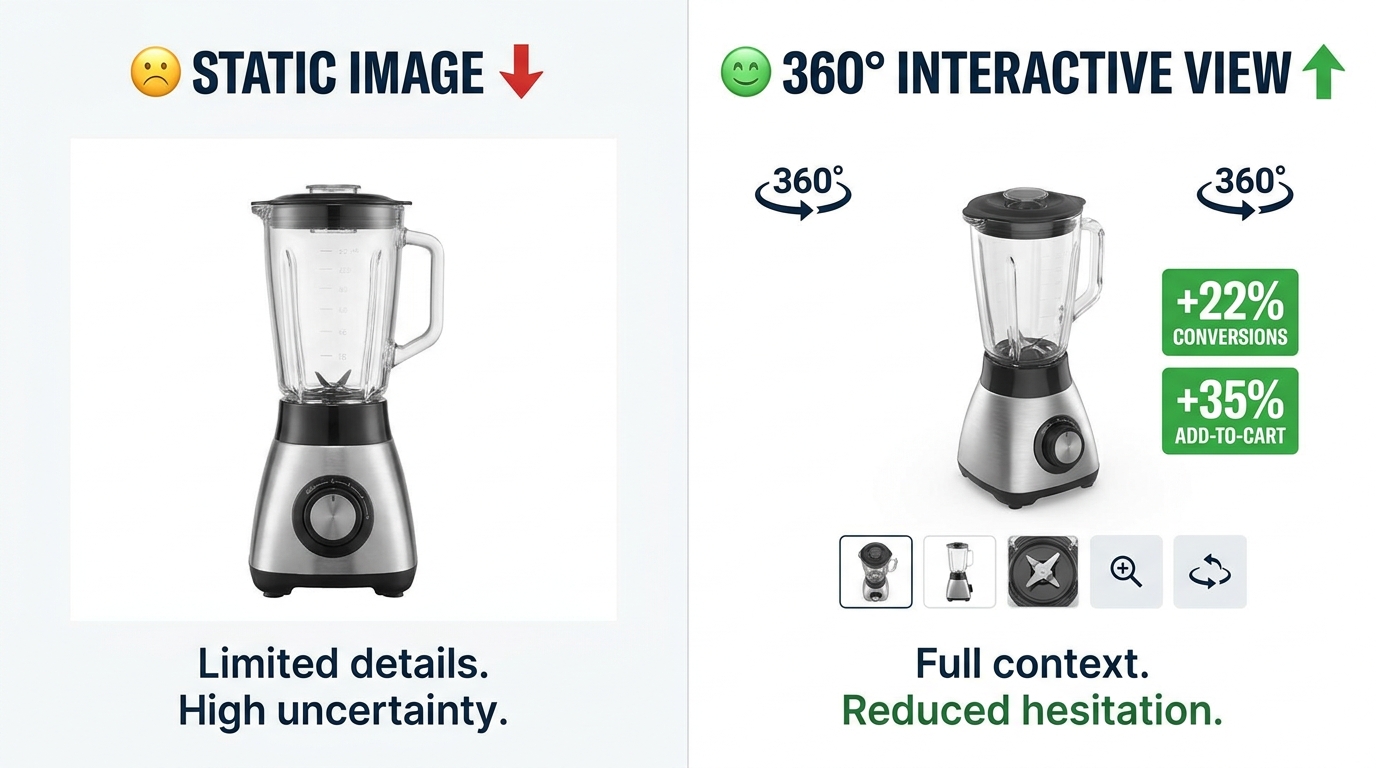
    Static images versus 360° interactive views: conversion rate comparison showing +22% conversions and +35% add-to-cart

    What Happened When Amazon Killed Traditional 360° Photography in January 2024

    In January 2024, Amazon made a policy change that most sellers are still trying to fully understand: the platform formally discontinued support for the traditional 360-degree product photography format — the animated GIF-style spinning images that had become common on many listings. This wasn’t a minor update buried in Seller Central. It was a deliberate architectural shift in how Amazon intends for interactive product views to work going forward.

    The reasoning was straightforward. Traditional 360-degree photography — which involves capturing 24 to 72 individual frames and stitching them into a spinning animation — produces large file sizes, loads slowly on mobile, and cannot be adapted for augmented reality features. Amazon’s infrastructure had moved on. The platform is now built around 3D models as the primary vehicle for interactive product visualization.

    Why many sellers missed the memo

    The discontinuation of 360° photography created a knowledge gap that persists into 2026. Sellers who had invested in 360° photo rigs or paid agencies for spinning images found themselves with assets that couldn’t be uploaded. Many responded by doing nothing — reverting to static images and assuming the feature was simply gone. Others conflated “360° photography” with “interactive spin view” and assumed the entire capability had been removed.

    Neither assumption is correct. The interactive spin experience is alive, well, and delivering stronger results than ever. It’s just delivered through a different medium. Instead of a spinning animation built from dozens of photographs, Amazon’s interactive views are now rendered from 3D models — digital objects that can be spun in real time, zoomed, lit from any angle, and placed into an augmented reality environment by the shopper’s own smartphone camera.

    What this means for competitive positioning

    The transition to 3D models created a short-term competitive gap that still exists today. Because 3D model creation has a steeper learning curve and higher upfront cost than traditional photography, many sellers have opted out entirely. This means that in most product categories, the share of listings with interactive spin views or AR capability is still very low — which means sellers who do make the investment stand out substantially in search results and on listing pages.

    The January 2024 policy shift, in other words, didn’t end the opportunity for sellers who embrace interactive imagery. It filtered out the sellers who weren’t willing to adapt, leaving more visible runway for those who are.

    The 3D Model Era: How Amazon’s Spin View Actually Works Today

    Understanding how Amazon’s current interactive imagery system works is essential before investing time or money into it. The feature is often described loosely as “360-degree views,” but the technical reality is more precise — and more powerful.

    From photographs to digital objects

    When Amazon displays a “spin view” of a product today, it is rendering a 3D model file in real time inside the browser or app. The shopper can grab and rotate the product with their finger or cursor, zoom in to examine texture and detail at any angle, and in eligible categories, activate the “View in Your Room” AR feature to place the product in their own physical space using their device’s camera.

    This is fundamentally different from a spinning animation. A 3D model is not a sequence of photographs — it is a mathematical representation of the product’s geometry, surface materials, and textures. Amazon renders it on the fly, which means the shopper controls the experience rather than watching a pre-set rotation.

    File requirements and technical specifications

    Amazon accepts 3D models in GLB or GLTF format. The GLB format (Binary GL Transmission Format) is generally preferred because it packages all textures and geometry into a single file. Key technical requirements as of 2026 include:

    • Polygon count: Maximum 1 million triangles per model; Amazon’s recommended sweet spot is 150,000–200,000 for optimal loading performance
    • No cameras attribute: The model must not include embedded camera objects
    • No KHR_materials_specular extensions or other incompatible shader types
    • Textures: Accurate material textures that represent real-world product appearance — Amazon will reject submissions that appear inaccurate
    • Reference photos: 2–10 high-quality photographs of the actual physical product submitted alongside the model to verify accuracy
    • Dimensions: Accurate real-world dimensions required for AR placement to work correctly

    Files can be validated before submission using the Khronos glTF Validator, a free open-source tool that identifies technical errors before Amazon’s review team sees them — saving the two-week review turnaround on easily fixable mistakes.

    The submission process step by step

    Upload happens through Seller Central under Catalog → Upload Images → Image Manager tab. Search for the ASIN or SKU, verify that the Registered Brand Owner icon is showing (this step is required), and select 3D Models → Upload 3D Model. Submit the GLB file alongside reference photos and product dimensions. Amazon’s review team typically takes up to two weeks to approve or reject the submission, with feedback provided on rejections. Once approved, the spin view and AR badge appear on the listing automatically.

    Brand Registry enrollment is non-negotiable. Sellers without it cannot access the 3D model upload feature at all.
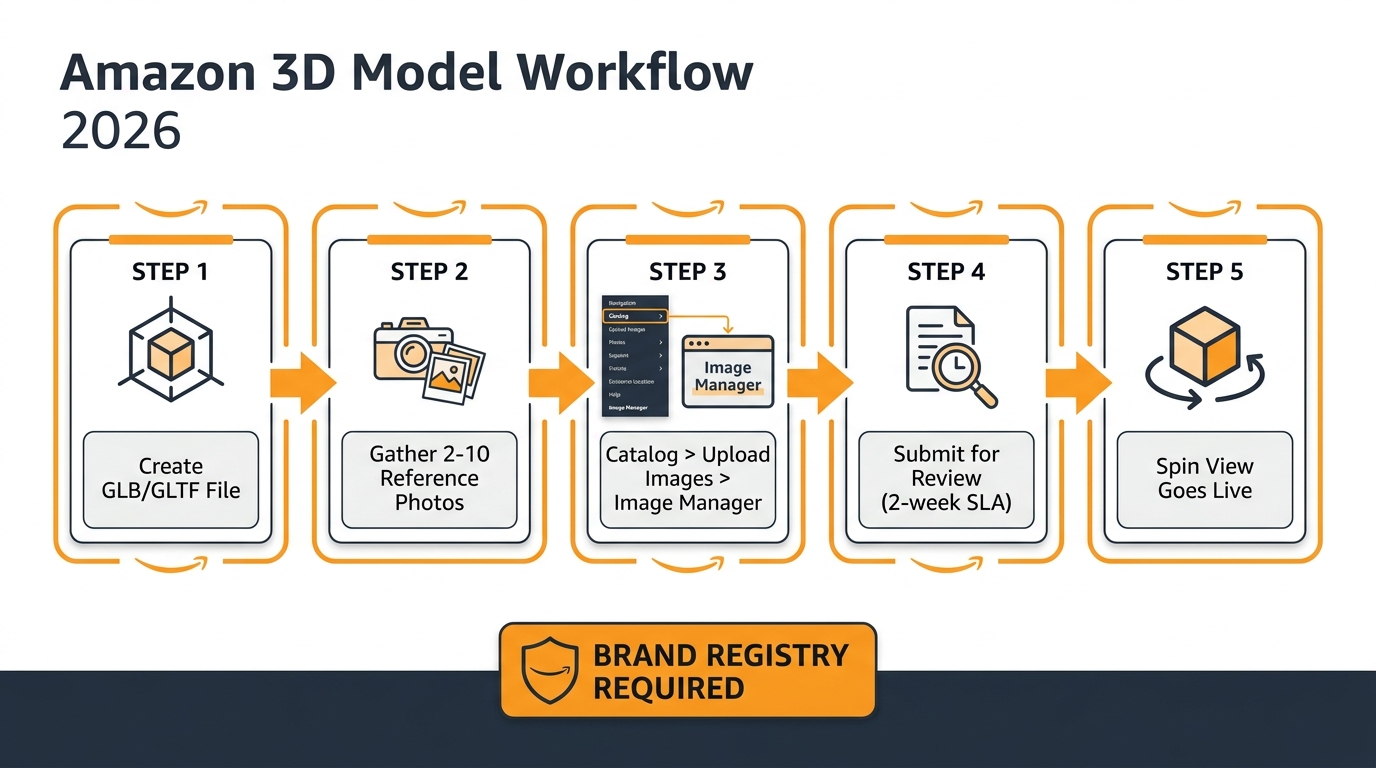
    Amazon 3D model upload workflow for Seller Central — 5-step process from GLB file creation to live spin view

    “View in Your Room” and “View in 3D” — Who Qualifies and How to Enable It

    Amazon operates two distinct interactive visualization features that are often confused with each other. Understanding the difference — and which one applies to your product — is important for setting the right production and submission expectations.

    View in 3D: the spin experience on listing pages

    “View in 3D” is the interactive spin capability that appears on the main product detail page. When activated, shoppers see an icon on the image gallery inviting them to rotate and zoom the product in 3D. This feature is available across a wide range of categories including:

    • Shoes and footwear
    • Eyewear (sunglasses, glasses frames)
    • Home and furniture
    • Consumer electronics
    • Beauty and personal care
    • Baby products
    • Sports and outdoor equipment
    • Toys and games
    • Pet supplies
    • Automotive accessories

    This list is expanding. Amazon has been systematically broadening the eligible categories as 3D model production becomes more widespread and its review infrastructure scales up.

    View in Your Room: the full AR experience

    “View in Your Room” is a separate, more powerful feature that uses the shopper’s device camera to place the product into their actual physical environment using augmented reality. The shopper points their phone at their floor, table, or wall, and sees a true-to-scale 3D rendering of the product appear in their space — positioned accurately, casting realistic shadows, and viewable from any angle by moving the phone.

    Eligibility is more specific: any product that would naturally sit on a floor or table, or be mounted to a wall or vertical surface. Practically, this covers the bulk of the furniture, home décor, lighting, kitchen appliance, and storage categories. Supported marketplaces include amazon.com, amazon.ca, amazon.co.uk, amazon.de, amazon.es, amazon.fr, and amazon.it.

    When Amazon analyzed listings using “View in Your Room” in a 2023 study, the feature delivered an average 9% improvement in sales for enrolled products. In high-consideration categories like furniture and home décor, results are considerably more dramatic: AR visualization for furniture has been cited in Adobe and industry research at conversion lift figures as high as 250% over static images, as shoppers who can place a sofa in their living room before buying eliminate virtually all scale and color uncertainty.

    The “Virtual Try-On” features for fashion and beauty

    Amazon also operates category-specific AR try-on features that sit slightly outside the standard 3D model workflow. Virtual Try-On for Shoes (launched 2022) uses the device camera to overlay shoe imagery onto the shopper’s actual feet. Similar functionality exists for eyewear. These features are managed through Amazon’s fashion and brand programs rather than the standard 3D model upload path, and eligibility is typically connected to brand participation agreements rather than a standard self-service upload process.

    Amazon describes all of these AR features as ongoing experiments and does not publish category-level conversion data. What is known from Amazon’s own public statements is that products with 3D views or virtual try-on features saw purchase rates approximately double compared to listings without them in the period following their introduction, and that eight times more customers engaged with AR-viewed products between 2018 and 2022.

    The Return Rate Problem That Nobody Talks About (And Why Visuals Are the Fix)

    Most sellers think about product imagery purely in terms of conversion. Getting more shoppers to click “Add to Cart” is the obvious goal. But there is a second, equally important dimension to the imagery problem that rarely makes it into the seller conversation: returns.

    Returns are expensive in a way that doesn’t always show up cleanly in an advertising dashboard. FBA return fees, restocking costs, the likelihood of returned inventory being graded as unsellable, and the downstream impact on seller metrics — all of this compounds quickly. In categories like apparel, furniture, and electronics, return rates can reach 15–30% of all units sold. A meaningful fraction of those returns is not the product’s fault at all. It’s the listing’s fault.

    The data on image-driven returns

    Research consistently points to a direct link between image quality and return rates. The key statistics from 2024–2026 data:

    • 22% of e-commerce returns are triggered by products not matching their photographs or descriptions — not defects, sizing errors, or buyer’s remorse, but a failure of visual expectation-setting
    • Professional multi-angle photography reduces return rates by 23% compared to basic single-angle images
    • Adding 360-degree or interactive views on top of multi-angle photography reduces returns by a further 15%
    • 3D model and AR visualization tools deliver return reductions of up to 40% in categories where spatial context matters most (furniture, home goods)
    • 34% of all product returns across e-commerce are linked directly to poor product presentation

    Put simply: every dollar invested in better imagery does double work. It increases the number of buyers who convert, and it decreases the number of buyers who convert and then return. The economics of this compound in a way that makes visual investment one of the highest-return line items in a seller’s budget.

    The category-specific return problem

    Returns driven by visual mismatch are not distributed evenly across categories. They are most severe in categories where real-world context matters most — where a buyer needs to know how something fits in a space, how a color reads under natural light rather than studio lighting, or how a texture feels relative to other materials in the image. Furniture, rugs, curtains, lighting, apparel, footwear, and electronics accessories are the highest-risk categories. Counterintuitively, these are also the categories where 3D and AR solutions deliver the most dramatic return-rate reductions, because the solution directly addresses the source of the uncertainty.
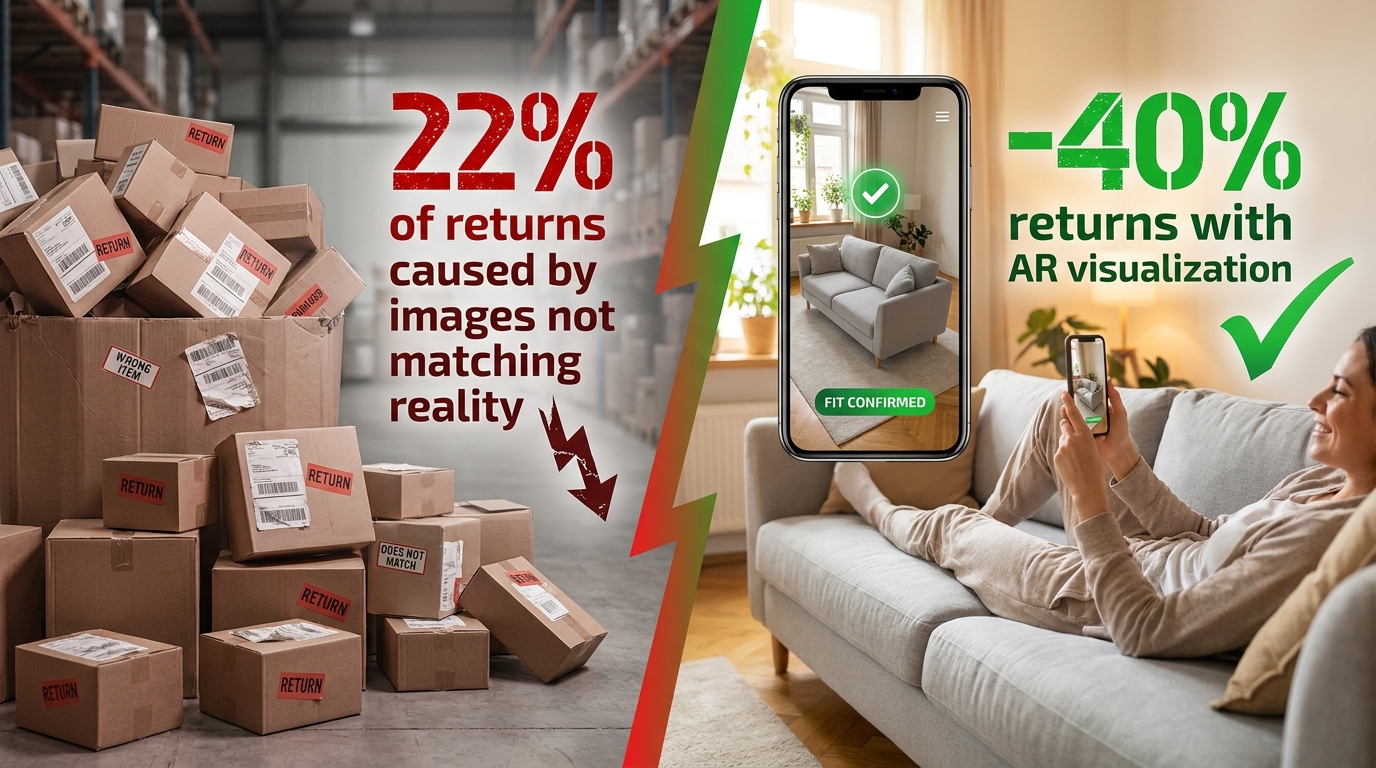
    Returns caused by poor product images versus AR visualization reducing return rates by up to 40%

    The Categories Where 360°/AR Has the Biggest Impact — and Where It Doesn’t

    Not every product benefits equally from 360-degree and AR imagery. Understanding where the ROI is highest — and where additional visual investment delivers diminishing returns — helps sellers prioritize their production budgets intelligently.

    Highest-impact categories

    Furniture and home décor is the category where AR delivers the most transformative results. Scale uncertainty — “will this sofa fit in my living room?” — is the single biggest barrier to purchase in this category. AR’s ability to place a true-to-scale rendering of a product in the shopper’s actual room eliminates that barrier entirely. Amazon’s own data shows a 9% average sales improvement from “View in Your Room,” and category-specific research puts the conversion lift from AR visualization in the 200–250% range over static images for high-consideration pieces.

    Footwear and apparel benefit enormously from interactive spin views and virtual try-on features. The ability to rotate a shoe 360 degrees to inspect the sole, heel construction, and profile addresses the most common pre-purchase questions. Fashion retailers using 360-degree rotation imagery have documented conversion improvements of up to 27% over static front-and-back shots.

    Consumer electronics and gadgets benefit from spin views because buyers want to understand port placement, button locations, connection points, and physical scale before committing. A laptop bag, for example, sells much better when a shopper can rotate it to see every pocket, zipper, and strap attachment point rather than relying on separate flat images of each angle.

    Eyewear and accessories are strong candidates for virtual try-on features where available, and for spin views more broadly. The physical shape and profile of a pair of sunglasses from multiple angles is difficult to represent in two or three static images alone.

    Lower-impact categories

    Commodity consumables — vitamins, cleaning products, batteries, and similar items — see minimal conversion benefit from interactive imagery because purchasing decisions are driven almost entirely by price, reviews, and brand recognition. The product’s shape is largely irrelevant to the purchase decision, and there is no spatial context needed.

    Books, digital media, and software are similarly immune to the benefits of interactive visualization for obvious reasons.

    Highly standardized components — screws, cables, replacement parts sold by spec number — convert on specification matching, not visual exploration. A buyer purchasing a specific HDMI cable by length and specification does not need to rotate the cable in 3D.

    The general rule: the more the purchase decision depends on understanding how a product looks from multiple angles, how it fits in a space, or how it sits on or with the buyer’s body, the more interactive imagery will move the conversion needle.
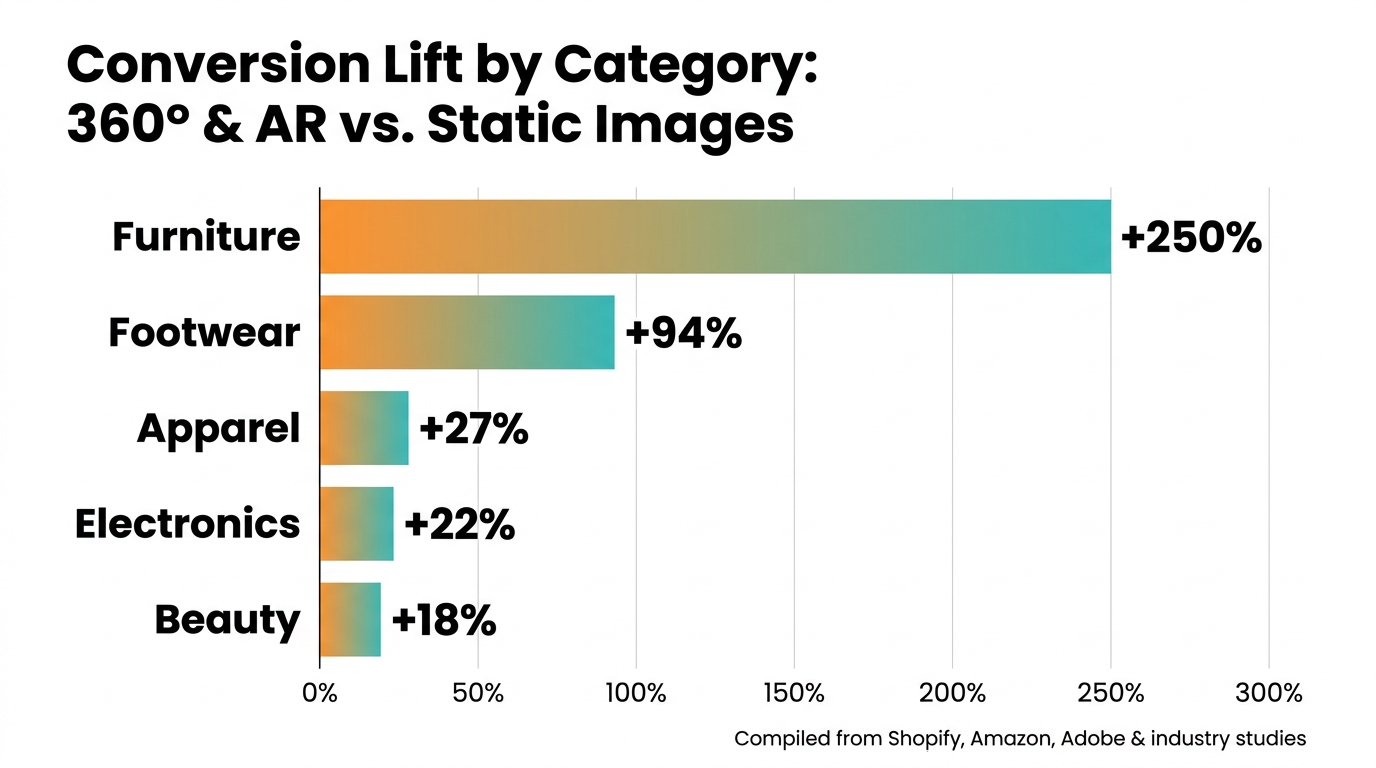
    Conversion lift by category using 360° and AR versus static images: furniture, footwear, apparel, electronics, beauty

    How to Create 3D Models Without a Studio Budget

    The single most common reason sellers cite for not pursuing 3D model uploads is cost. Traditional 3D modeling — commissioning a CAD artist to build a product from reference photographs — can run anywhere from $150 to $1,500+ per model depending on product complexity. For a catalog of 50 SKUs, that math gets uncomfortable quickly. But the production landscape has changed substantially in the last two years.

    Photogrammetry: turning a smartphone into a 3D scanner

    Photogrammetry is the process of creating a 3D model by photographing an object from dozens of angles and using software to stitch those images into a 3D mesh. What was once a process requiring expensive camera rigs and specialized software is now achievable with a smartphone and accessible software tools.

    The workflow is straightforward: place the product on a turntable or clean surface, capture 40–100 photos covering every angle and height, then process those images through software such as RealityCapture, Meshroom (free and open-source), or Polycam (mobile app). The output is a GLB file that can be cleaned up and submitted to Amazon. For products with relatively simple geometry — most consumer goods fall into this category — photogrammetry delivers results that meet Amazon’s accuracy requirements at dramatically lower cost than traditional 3D modeling.

    CGI and product visualization agencies

    For products that don’t photograph well (highly reflective surfaces, transparent materials, very small or intricate objects), computer-generated 3D models built from product specifications and reference images are often the better path. The market for this service has grown considerably alongside Amazon’s 3D feature rollout, and pricing has become more competitive. Specialist agencies offering Amazon-optimized GLB models now exist at multiple price points, with some offering per-SKU packages starting around $75–$150 for simple products.

    Manufacturer files: the overlooked shortcut

    Many manufacturers — particularly in electronics, furniture, and consumer goods — already have CAD or 3D model files of their products that were used in the design and tooling process. Private label sellers sourcing from manufacturers, especially larger factories, should ask explicitly whether product 3D files are available. These files often need format conversion and texture cleanup before they meet Amazon’s GLB requirements, but the base geometry is already there — saving significant production time and cost.

    Amazon’s own AI generation tools

    Amazon has been expanding its internal tools for sellers. In 2026, Amazon’s generative AI capabilities — including the Nova Canvas model — include functionality that can synthesize product imagery, lifestyle images, and virtual try-on composites directly from existing product photos. These AI-generated assets are permitted in secondary images and A+ Content (not in the main product image, where Amazon’s white-background rules still apply). While AI-generated assets don’t yet fully replace professional 3D model uploads for spin views, they represent a growing toolkit for sellers who need to produce high volumes of visual content without per-image photography costs.

    A/B Testing Your Visual Assets: The Framework Serious Sellers Use

    Investing in 3D models and interactive imagery is a significant decision. The sellers who extract the most value from that investment are the ones who treat it as a controlled experiment rather than a one-time production project. Amazon’s “Manage Your Experiments” tool — available to brand-registered sellers in Seller Central — makes this unusually achievable without external testing platforms.

    What you can and cannot test

    Manage Your Experiments supports A/B testing on main product images, secondary images, titles, bullet points, and A+ Content. For the purposes of visual testing, the most impactful tests in order of return are:

    1. Main image variation — This is the highest-leverage test because it directly affects click-through rate from search results. A main image change affects every impression your listing receives. Test angle (3/4 vs. straight-on), background style (pure white vs. contextual lifestyle for categories where it’s permitted), and scale (product filling the frame vs. showing packaging or accessories).
    2. Secondary image sequence — Once the main image is optimized, test the order and composition of supporting images. Does a lifestyle image as the second image outperform an infographic? Does a size comparison image earlier in the stack reduce returns measurably?
    3. Spin view vs. no spin view — For sellers who have uploaded a 3D model, testing the before/after impact on unit session percentage (conversion rate) provides clean attribution data for the investment in 3D production.

    Test duration and traffic requirements

    Amazon recommends running experiments for a minimum of four weeks to achieve statistical significance. Shorter tests — two to three weeks — can provide directional signals on high-traffic ASINs, but should not be treated as conclusive. Manage Your Experiments requires sufficient traffic to generate statistically valid results; low-traffic ASINs may need to run experiments for eight to twelve weeks before the data is reliable. Amazon provides a confidence indicator within the tool that shows when the winning variant has reached statistical significance.

    The metrics that matter

    When evaluating the results of visual experiments on Amazon, focus on three metrics in descending order of priority:

    • Unit Session Percentage (conversion rate): The proportion of page visits that result in a purchase. This is the most direct measure of visual impact on buying behavior.
    • Click-Through Rate (CTR) from search: For main image tests, this measures how effectively the image draws shoppers from search results to the listing page. An image that generates 20% more clicks at the same conversion rate produces 20% more sales with no change to anything else.
    • Return rate over time: This is not visible in Manage Your Experiments directly, but should be tracked manually against visual changes. A main image that dramatically understates the product’s true appearance may lift short-term conversion while increasing returns — a net negative result that only appears if you’re watching the full picture.

    The most common A/B testing mistakes

    Sellers who run visual experiments on Amazon tend to make a handful of predictable errors. The most costly is testing multiple elements simultaneously — changing the main image, two secondary images, and the title at the same time. When one variant wins, you have no idea which change drove the result. The second most common mistake is ending experiments early when one variant is trending ahead — Amazon’s confidence indicators exist for a reason, and early results frequently reverse as more data comes in. Third is ignoring segment differences: a main image that converts well for mobile shoppers may underperform for desktop shoppers, and vice versa.

    Building an Image Stack That Converts at Every Stage of the Funnel

    One of the most useful frameworks for thinking about Amazon product imagery is the “image stack” — the idea that different images in your listing’s gallery serve different functions for shoppers at different stages of their decision process. A listing that treats all nine image slots as equivalent is leaving conversion on the table. A listing built with a deliberate stack converts at every stage.
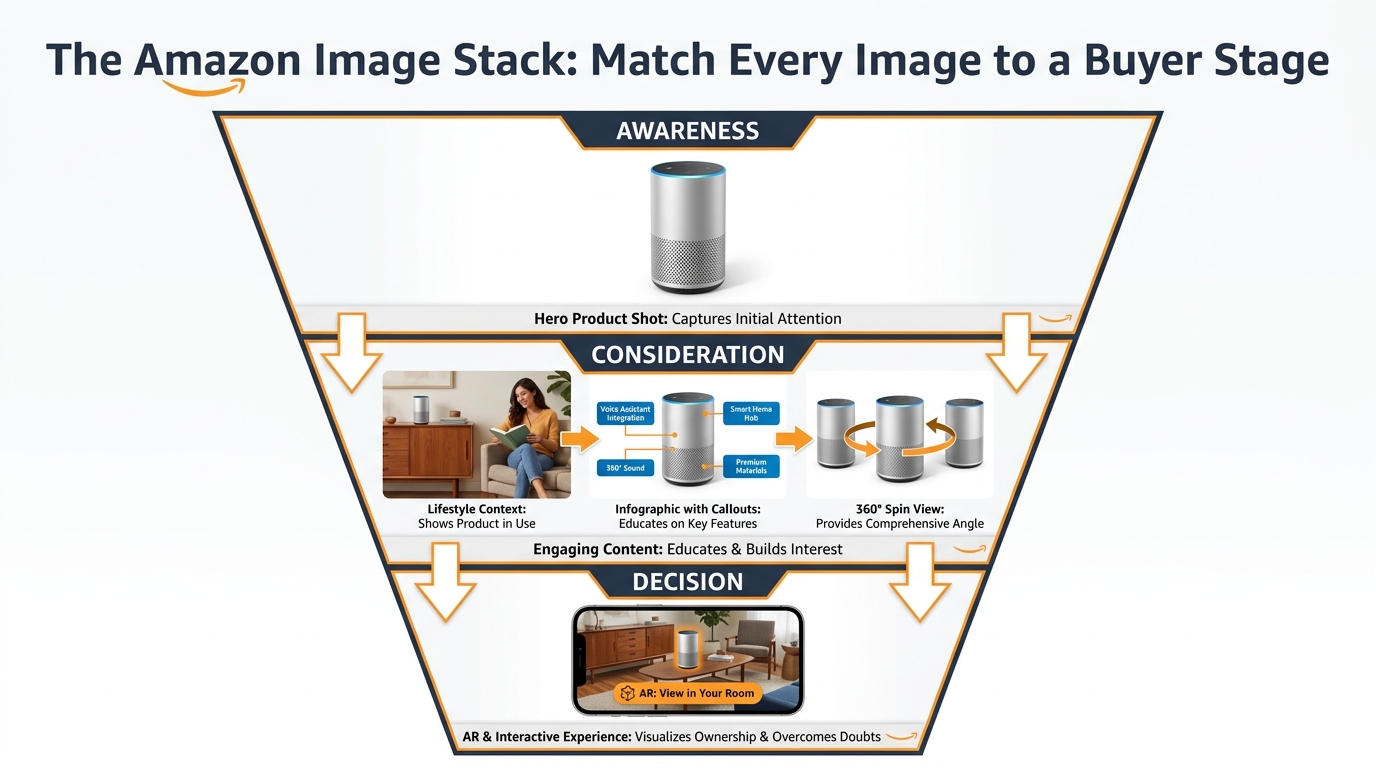
    Amazon listing image stack: matching each image to a buyer stage from awareness through consideration to purchase decision

    Image 1 (Main Image): The click-driver

    This image has one job: stop the scroll and earn the click from a search results page. Amazon’s rules are strict — pure white background (RGB 255, 255, 255), no text, no graphics, no props, product occupying at least 85% of the frame. Within those constraints, the optimization levers are angle, lighting, and the visual hierarchy of the product itself. Professional lighting that creates depth and dimension consistently outperforms flat studio lighting. A 3/4 angle that shows depth and three-dimensionality typically outperforms a straight-on flat view. Research from eBay Labs found that listings with five to eight high-quality images see conversion lifts of up to 65% over listings with one or two images — and it starts with the main image earning the click.

    Images 2–3: The orientation and detail images

    Once a shopper clicks through to the listing, they need to build a comprehensive mental picture of the product. Images two and three should systematically cover angles and details that the main image could not. For most products, this means a back/side view, a close-up of the highest-value detail (a zipper, a connector port, a distinctive design element), or a scale reference shot that shows the product next to a hand, a common household object, or a labeled dimension overlay.

    Images 4–5: The lifestyle and context images

    Lifestyle images serve a different psychological function than product detail images. They don’t answer “what does this look like?” — they answer “can I picture this in my life?” Showing a product in a realistic, aspirational real-world setting gives shoppers permission to project themselves into ownership. A well-executed lifestyle image for a coffee mug is not a photograph of a coffee mug. It is a photograph of a morning — the mug is just in it. These images work particularly hard for home goods, apparel, fitness equipment, and any product with a strong lifestyle association.

    Images 6–7: The infographic images

    Amazon allows text, callouts, comparison charts, and labeled diagrams in secondary images (not the main image). These slots are best used for information that is difficult to convey in bullet points alone — size charts, compatibility guides, material comparisons, before/after results, or feature callouts with measurements. Mobile shoppers who don’t scroll to read bullet points often do engage with well-designed infographic images. Keeping text mobile-readable (minimum 16pt equivalent when viewed on a phone) is critical.

    Images 8–9: The trust and social proof images

    The final images in the stack can carry review highlights, certifications, brand story elements, or comparison grids against competing products (where Amazon policies permit). For newer brands or products in a trust-sensitive category (supplements, baby products, safety equipment), images that communicate third-party testing, material sourcing, or manufacturing standards do real conversion work in this position.

    Where the spin view fits in the stack

    When a 3D model is approved, Amazon adds the interactive spin view as an additional option within the image gallery — typically surfaced as an overlay on the main image or as a separate tab. It doesn’t replace any of the nine standard image slots. Think of it as image 10: a bonus interactive layer that sits on top of the static gallery. Shoppers who engage with the spin view demonstrate significantly higher purchase intent, making the spin view most valuable for mid-funnel shoppers who are seriously considering the product but not yet committed.

    What’s Coming Next: Amazon Nova Canvas, AI Try-On, and the 2026 Visual Stack

    The landscape of product visualization on Amazon is moving faster in 2026 than at any point in the platform’s history. Understanding where the technology is heading allows sellers to make smarter decisions about where to invest now and what to build toward.
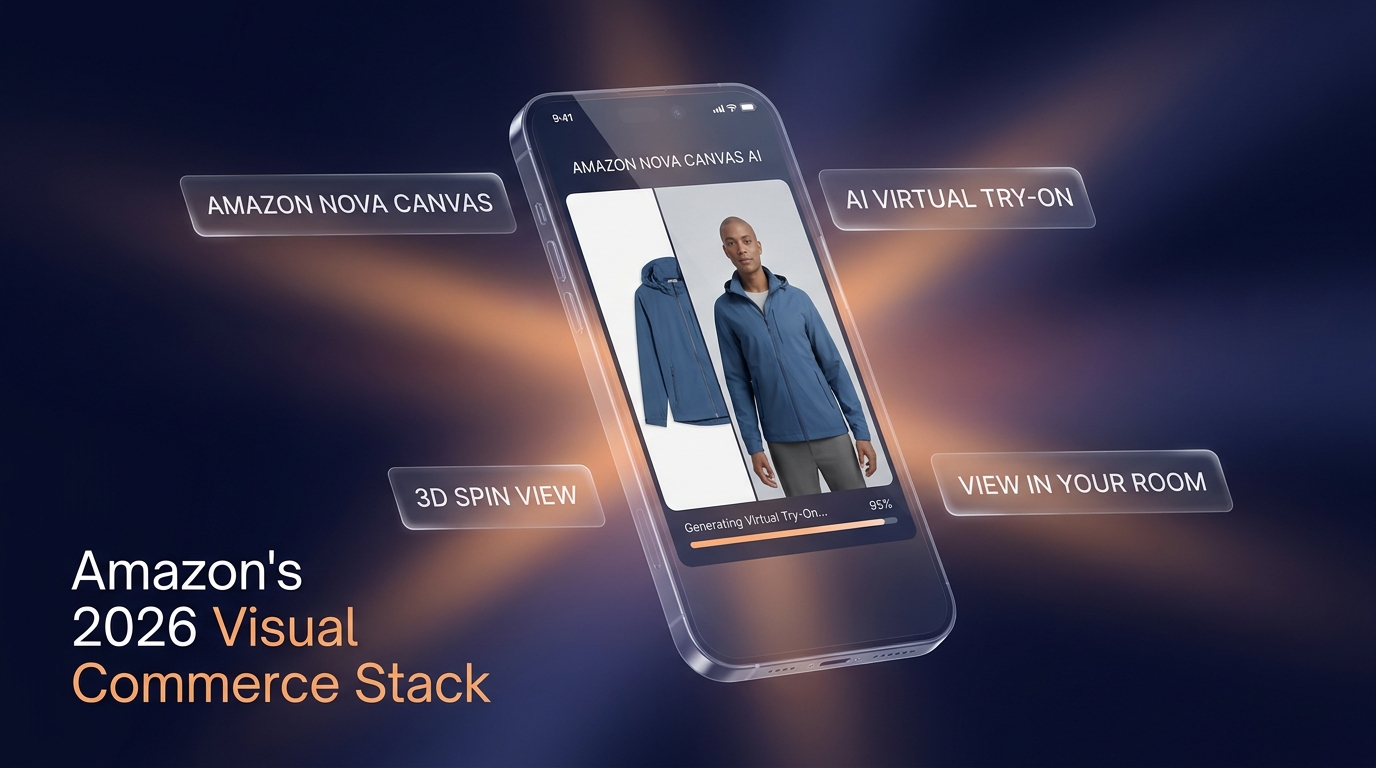
    Amazon's 2026 visual commerce stack: Nova Canvas AI, virtual try-on, 3D spin view, and View in Your Room AR features

    Amazon Nova Canvas and AI-generated product imagery

    Amazon’s Nova Canvas generative AI model is available through AWS and increasingly integrated into seller-facing tools. Its capabilities relevant to product sellers include generating lifestyle background images around existing product shots (placing a product into a kitchen scene, a bedroom, or an outdoor setting without a physical photoshoot), creating color and variant images from a single physical product photograph, and — in its most advanced application — generating virtual try-on composites that show apparel or accessories on a model without a live photoshoot.

    These AI-generated images are explicitly permitted in Amazon listings as secondary images and in A+ Content, as of 2026 guidelines. They are not permitted as the main product image, which must still represent the actual physical product accurately. For sellers managing large catalogs with many color variants, the ability to generate secondary lifestyle images at scale using Nova Canvas — rather than paying for individual photoshoots per variant — represents a significant operational cost reduction.

    The Rufus AI layer and visual search

    Amazon’s Rufus AI shopping assistant, which became a significant part of the Amazon shopping experience in 2025, introduces a new dimension to visual content strategy. Data from the holiday quarter of 2025 showed that Rufus-assisted shopping sessions converted at 3.5 times the rate of non-assisted sessions. What this means for visual content: Rufus can engage with product images, A+ Content, and 3D model information when generating responses to shopper queries. Listings with richer visual assets give Rufus more accurate and detailed information to draw from, which translates into more confident and specific recommendations to shoppers asking questions like “show me sofas under $500 that would work in a small living room.”

    The trajectory of AR in Amazon’s roadmap

    Amazon has been incrementally expanding AR feature eligibility since “View in Your Room” launched in 2017. The pace of that expansion is accelerating. Fashion categories began receiving category-specific virtual try-on features starting in 2022 and have continued to expand. The direction of travel is clear: Amazon intends for AR visualization to be a standard feature across most high-consideration product categories, not a specialty feature for furniture alone.

    Sellers who invest in building accurate 3D models today are positioning their catalogs for multiple future feature rollouts, not just the current set of AR capabilities. A 3D model created and approved today becomes the foundation for whatever Amazon’s AR feature set looks like in 2027 and beyond — including features that don’t exist yet.

    The competitive window is narrowing

    The adoption curve for 3D models on Amazon follows the same pattern as virtually every new seller capability: early adopters gain disproportionate benefits while the feature is underused, then those benefits compress as adoption becomes mainstream and the feature becomes a parity expectation rather than a differentiator. Right now, 3D models and interactive spin views are genuinely differentiating. A listing with a spin view badge in a category where competitors have none stands out visibly. A “View in Your Room” badge on a furniture listing is still unusual enough that shoppers notice and engage with it.

    That window will not stay open indefinitely. The sellers who build this capability into their listing infrastructure in 2026 will have the advantage of experience, established workflows, and catalog coverage before it becomes a standard baseline expectation.

    The Practical Roadmap: Prioritizing Your Visual Investment

    For sellers looking at their catalog and trying to figure out where to start, the decision framework is straightforward. Not every ASIN warrants the investment in a 3D model. The right sequence is to audit, prioritize, produce, and iterate.

    Step 1: Audit your current visual assets against the benchmark

    Pull your unit session percentage (conversion rate) data from Seller Central for every ASIN in your catalog. Sort by traffic volume (highest-traffic listings first) and identify listings with conversion rates below your category benchmark. Amazon’s average conversion rate across categories runs 10–20%, with high performers exceeding 25%. Listings with significant traffic but below-average conversion are the highest-priority candidates for visual improvement.

    For each of those priority ASINs, answer three questions: Does this product have a spatial context problem (scale, fit, placement)? Is it in a category where interactive imagery is eligible? Does it currently have fewer than six substantive images? A “yes” to any two of those three flags an ASIN for immediate visual investment.

    Step 2: Fill the static image stack first

    Before investing in 3D model production, ensure every priority ASIN has a complete, high-quality static image stack. The data shows that moving from one or two images to six or more high-quality images delivers conversion improvements that rival or exceed the benefit of adding a spin view in isolation. The image stack is the foundation; interactive features are a multiplier on top of it.

    Step 3: Prioritize 3D models by category and revenue concentration

    Once the static stack is solid, prioritize 3D model production for your top revenue ASINs in categories where AR and spin views have the highest impact. Start with your two or three best-selling products in home goods, furniture, footwear, or electronics accessories — categories where the conversion data is clearest and the ROI is fastest. Use the learnings from those first submissions to refine your production workflow before scaling to a larger portion of your catalog.

    Step 4: Run controlled experiments and reinvest

    Use Manage Your Experiments to measure the actual conversion impact of new visual assets on each ASIN. Document the results — your unit session percentage before and after, your return rate, and your click-through rate from search. Use that data to build a business case for expanded 3D production across a wider set of ASINs, and to identify which categories and product types in your specific catalog respond most strongly to interactive imagery.

    Conclusion: The Sellers Who Win on Imagery Win on the Fundamentals

    It is easy to treat product photography as a cost of doing business — a box to check during listing setup, a budget line to minimize. The data tells a different story. In a marketplace where 92% of shoppers cite imagery as a top conversion factor, where a 22% conversion lift from interactive views is a documented and reproducible outcome, and where up to 40% of the return problem traces directly back to visual failures, imagery is not a cost. It is one of the most compounding investments a seller can make.

    The specific opportunity in 2026 is sharper than it has ever been. Amazon’s transition away from traditional 360° photography toward 3D models created a knowledge gap that filtered out many sellers who weren’t paying attention. The sellers who do understand how the system works today — the GLB file requirements, the Seller Central upload path, the category eligibility for “View in Your Room,” the A/B testing framework for measuring impact — are operating in a window where this capability is still genuinely differentiating rather than table stakes.

    That window will close. The sellers who build these capabilities into their standard listing workflow now will not only capture the conversion benefits today. They will also be positioned for whatever Amazon’s visual commerce infrastructure looks like next year, and the year after that — because the 3D models they create today are the foundation for every AR feature Amazon has not yet launched.

    The camera cannot replace the in-store experience entirely. But a well-built 3D model on an Amazon listing comes considerably closer than anything that came before it. The question is not whether your competitors will eventually figure this out. The question is whether you figure it out first.

    Key Takeaways

    • Amazon discontinued traditional 360° photography in January 2024. The interactive spin view now requires a 3D model in GLB/GLTF format.
    • 360°/interactive imagery lifts conversion rates 22–27% on average, with furniture seeing up to 250% in AR-specific studies.
    • 3D model and AR visualization reduce return rates by up to 40%, attacking one of the most significant hidden cost drivers for FBA sellers.
    • Brand Registry enrollment is required to upload 3D models. The file must be GLB or GLTF format, max 1 million triangles, with 2–10 reference photos submitted alongside.
    • “View in Your Room” is available for floor/table/wall-mounted products across major Amazon marketplaces, and averages a 9% sales improvement per Amazon’s own data.
    • Use Manage Your Experiments to measure conversion impact before rolling out 3D production across your full catalog.
    • AI tools including Amazon Nova Canvas now allow AI-generated lifestyle imagery in secondary slots and A+ Content — a significant catalog-scale cost reduction for variant-heavy listings.
    • The competitive window for 3D model differentiation is open now, and will narrow as adoption becomes mainstream.
  • AR Features in Amazon Listings: The Seller’s Practical Guide to 3D Models, Virtual Try-On, and What It Actually Does to Your Conversion Rate

    AR Features in Amazon Listings: The Seller’s Practical Guide to 3D Models, Virtual Try-On, and What It Actually Does to Your Conversion Rate

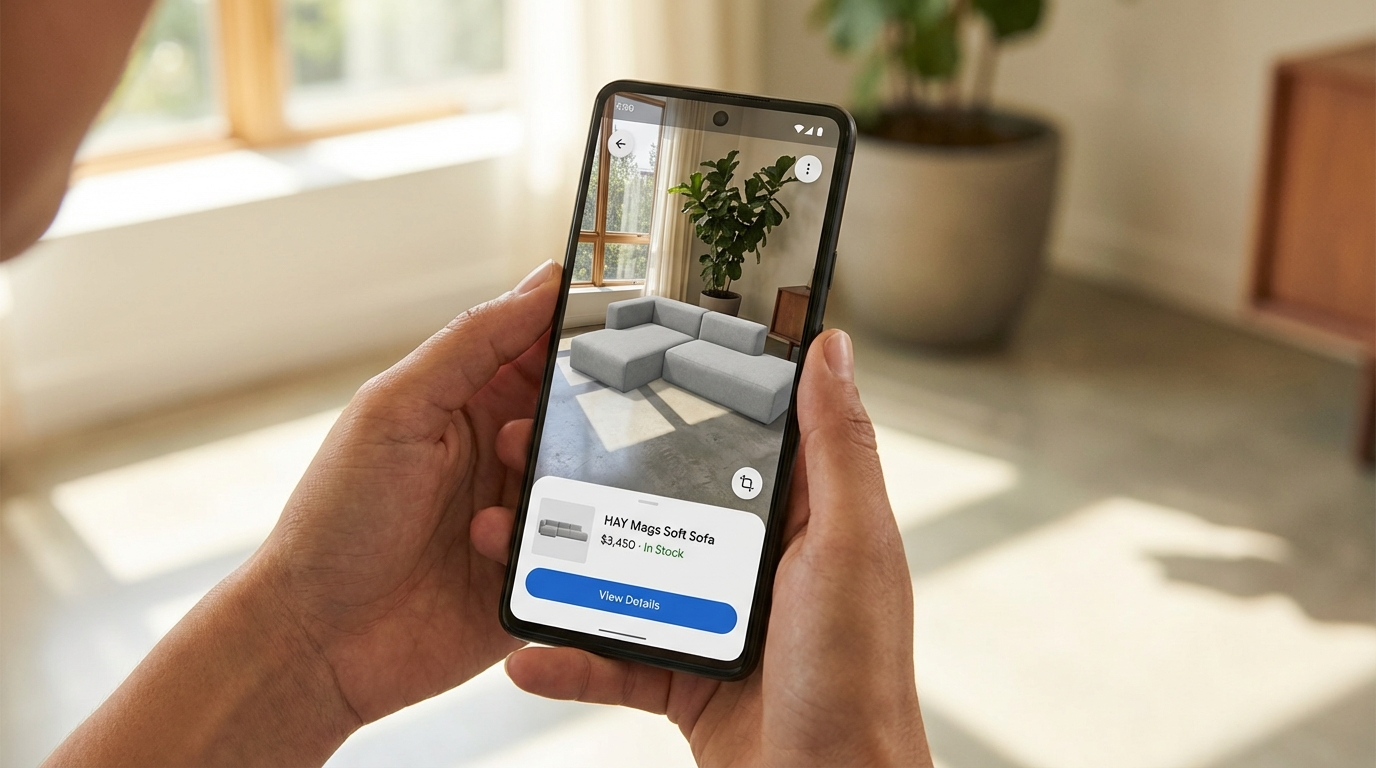
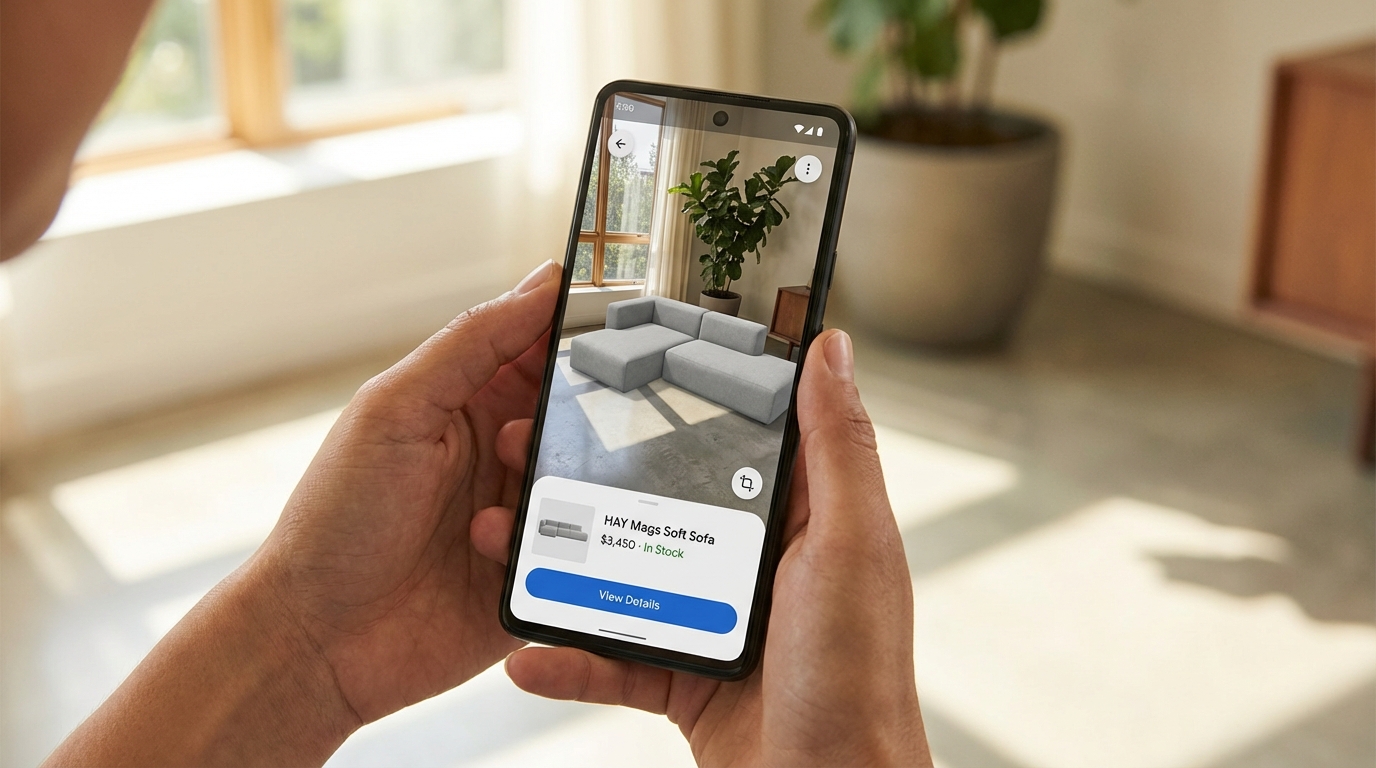
    A smartphone displaying an augmented reality furniture shopping experience, showing a modern sofa being virtually placed in a bright, minimalist living room through the phone's camera

    Most Amazon sellers talk about augmented reality features the same way they talked about A+ Content five years ago — as a “nice to have” that sounds impressive in a mastermind but never quite makes it onto the priority list. That’s a mistake, and increasingly a costly one.

    Amazon’s AR ecosystem has quietly grown into a multi-tool suite covering furniture, footwear, eyewear, tabletop items, and general product visualization — and the brands actively using it are seeing measurable results while their competitors are still debating whether it’s worth the effort. Across the broader e-commerce landscape, products with AR or 3D content see conversion rate lifts in the range of 15–94% depending on category and engagement level, and return rates drop by 22–40% for shoppers who interact with AR before buying.

    But the real story isn’t the headline numbers. It’s the mechanics — specifically, what Amazon’s AR tools are, which sellers can actually access them, what the technical requirements look like in practice, what it costs to get set up, and where the genuine opportunity sits right now in 2026. That’s what this guide covers.

    This isn’t an overview of what augmented reality is. It’s a working resource for brand-registered sellers who want to understand Amazon’s AR tools at the level of implementation, not concept. Whether you sell furniture, shoes, kitchen appliances, electronics, or anything in between, there’s something actionable here — starting with clearing up the common misconception that AR on Amazon is one single feature.

    What Amazon’s AR Suite Actually Looks Like — Three Distinct Tools

    The first thing to understand is that “AR on Amazon” is not one feature. It’s a suite of at least three separate tools, each targeting a different shopping context and product type. Sellers often conflate them, which leads to either chasing eligibility that doesn’t apply to their category or missing the tool that does apply.

    View in Your Room

    This is Amazon’s flagship AR placement tool. It uses your phone’s camera to overlay a to-scale, photorealistic 3D model of a product directly into your physical environment. You point the camera at a space — a corner of your living room, a desk, a kitchen counter — and the product appears in that space, sized accurately, rotatable, and movable.

    Originally launched for furniture and large home décor, Amazon has since expanded it to include tabletop items: lamps, coffee makers, small appliances, and similar products that sit on surfaces rather than floors. The update that enabled tabletop placement was significant because it extended AR viability to a much broader set of home and kitchen sellers who previously couldn’t use the feature.

    Users access it through the Amazon Shopping app (iOS and Android) by tapping the “View in Your Room” button on eligible product detail pages. They can arrange multiple products together in the same virtual space, save their room layouts for later, and add items to their cart directly from the AR view. That last point matters: the path from visual engagement to purchase is frictionless by design.

    Virtual Try-On

    This tool lets shoppers see how wearable items look on their own body before purchasing. The feature currently covers shoes, eyewear, and apparel (specifically T-shirts as of 2026). For footwear, the camera overlays the shoes on the shopper’s actual feet in real time. For eyewear, the same logic applies to the face using the front-facing camera.

    Major brands including Puma, Reebok, Adidas, New Balance, UGG, Birkenstock, and Saucony participate in the shoes program. The feature launched for footwear in June 2022 and has gradually expanded its brand roster and category coverage since. Access for smaller sellers is more restricted here than with View in 3D — Virtual Try-On appears to operate through brand partnership arrangements, particularly through Amazon Fashion, rather than a standard self-serve upload process.

    View in 3D

    This is the most widely accessible of the three. View in 3D allows shoppers to rotate, zoom, and examine a 3D model of a product directly within the product detail page — without needing to point their camera at a physical space. It’s essentially a 360-degree interactive model viewer embedded in the listing.

    For sellers, this is the most realistic entry point into AR because it’s self-serve (for brand-registered sellers), covers the broadest range of eligible categories, and works on both mobile and desktop. It doesn’t require the shopper to be in a specific environment or have their camera active. They simply interact with the model on screen.

    All three features share one underlying requirement: a high-quality 3D model in GLB or GLTF format. That’s where the practical work happens.

    The Imagination Gap: Why Visual Uncertainty Is Costing You Sales

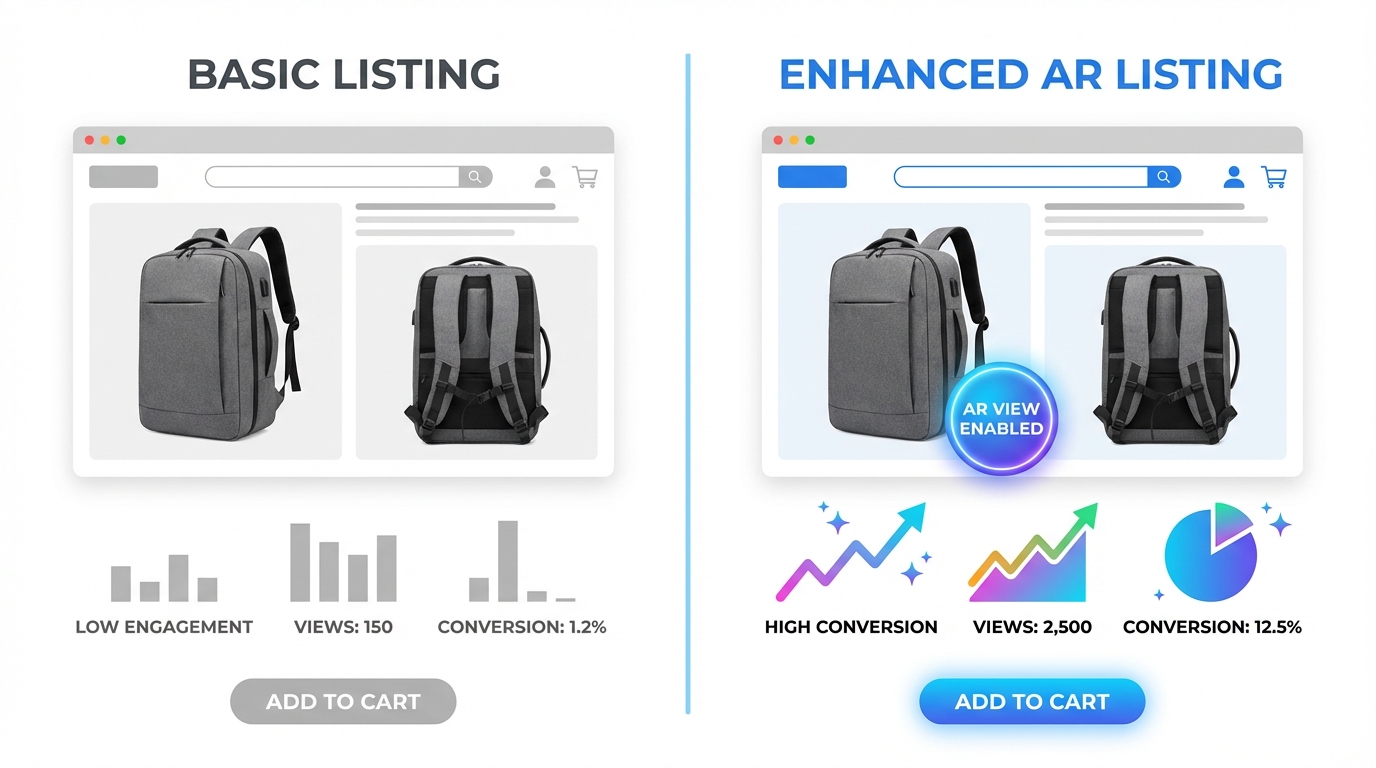
    Split-screen comparison showing two identical product listings side by side, one with basic flat photos and low engagement metrics, the other with an AR-enabled listing and high conversion charts

    There’s a concept in e-commerce called the “imagination gap” — the cognitive distance between what a shopper sees in product images and what they can realistically picture in their own home, on their own body, or in their specific context. This gap is one of the primary drivers of purchase hesitation, cart abandonment, and post-purchase returns.

    Traditional product photography, even excellent photography, only partially closes this gap. A well-lit photo of a sofa on a white background tells you what the sofa looks like. It does not tell you whether the sofa will fit between your TV stand and your window, whether the grey will clash with your existing rug, or whether the arms will clear your coffee table. Shoppers have to guess — and many of them choose not to guess at all.

    Returns as a Measure of the Imagination Gap

    Online return rates in the U.S. have become a significant cost center for e-commerce businesses. The majority of returns in categories like furniture, apparel, and home goods are driven by items that arrived looking different than expected or didn’t fit the physical space as imagined. This is the imagination gap made concrete — and returnable.

    Data from retail AR deployments consistently shows a 22–40% reduction in return rates when shoppers have used AR to preview a product before purchasing. That’s not a marginal improvement. For a seller moving $500K annually with a 12% return rate, even a 25% reduction in returns translates to meaningful cost recovery — both in direct return processing costs and in inventory condition degradation.

    Why Flat Images Reach a Ceiling

    There is a ceiling on what static photography can accomplish in closing the imagination gap. You can add lifestyle images, you can shoot from multiple angles, you can include a reference shot with a person to show scale — and all of that helps. But it still requires the shopper to mentally translate what they’re seeing to their specific context.

    AR eliminates that translation requirement. The product is literally placed into the shopper’s actual environment. The scale question is answered. The fit question is answered. The colour question — in real lighting, not studio lighting — is answered. That’s a qualitatively different experience, and the engagement metrics reflect it: shoppers who interact with AR features are converting at roughly double the rate of those who view standard listing images only.

    The Trust Signal Effect

    Beyond the practical utility, AR features carry a secondary benefit that’s harder to quantify but genuinely real: they signal confidence. A brand that offers View in Your Room for its furniture is implicitly telling the shopper, “We’re confident enough in what this looks like that we’ll let you see it in your own space before buying.” That confidence is contagious. Shoppers internalize it as a quality signal, which softens hesitation in the same way a strong return policy does — except AR reduces the need for returns in the first place.

    View in Your Room: What Sellers Need to Know Beyond the Surface

    Most coverage of View in Your Room stops at “it lets you see furniture in your room.” For sellers actually trying to get their products into this feature, the important details are more granular.

    Eligible Product Categories

    View in Your Room eligibility covers a wide range of home-adjacent categories. The core categories include:

    • Furniture: sofas, chairs, tables, beds, shelving, storage
    • Home décor: rugs, art, mirrors, decorative objects
    • Lighting: floor lamps, table lamps, pendant fixtures
    • Small appliances and tabletop items: coffee makers, air fryers, blenders, toasters (added in recent updates)
    • Consumer electronics: TVs, monitors, desktop speakers
    • Home office: desks, chairs, monitor stands, storage units

    What doesn’t work well with View in Your Room: products with highly translucent, transparent, or reflective surfaces that are technically difficult to render accurately (glass vases, crystal items, highly polished metals). These can still be approved for View in 3D, but the AR placement accuracy may be lower.

    The Multiple-Item Room Feature

    One of the less-discussed capabilities of View in Your Room is the ability for shoppers to place multiple products simultaneously and build out a virtual room. A shopper can place a sofa, then add a coffee table, then place a lamp on an end table — all in the same AR session. Each product comes from its respective listing and can be added to cart independently.

    This has an interesting implication for brands with complementary product lines. If a shopper is decorating a room virtually with your sofa, they’re more likely to also place your matching coffee table, your lamp, and your rug. Amazon’s recommendation engine actively suggests compatible products within the AR view. For sellers with full room collections, this creates a meaningful cross-sell pathway that doesn’t require any additional ad spend.

    Desktop Saving and Editing

    Virtual room layouts created in the mobile AR view can be saved and accessed across devices. A shopper who builds a room arrangement on their phone can return to it on desktop, edit it, share it, and complete the purchase later. This is relevant to sellers because it extends the engagement window well beyond a single session — your product may sit in a saved virtual room for days before the purchase decision is made. That’s a form of considered-purchase support that doesn’t exist in standard listings.

    Virtual Try-On: Categories, Access, and What Smaller Sellers Should Know

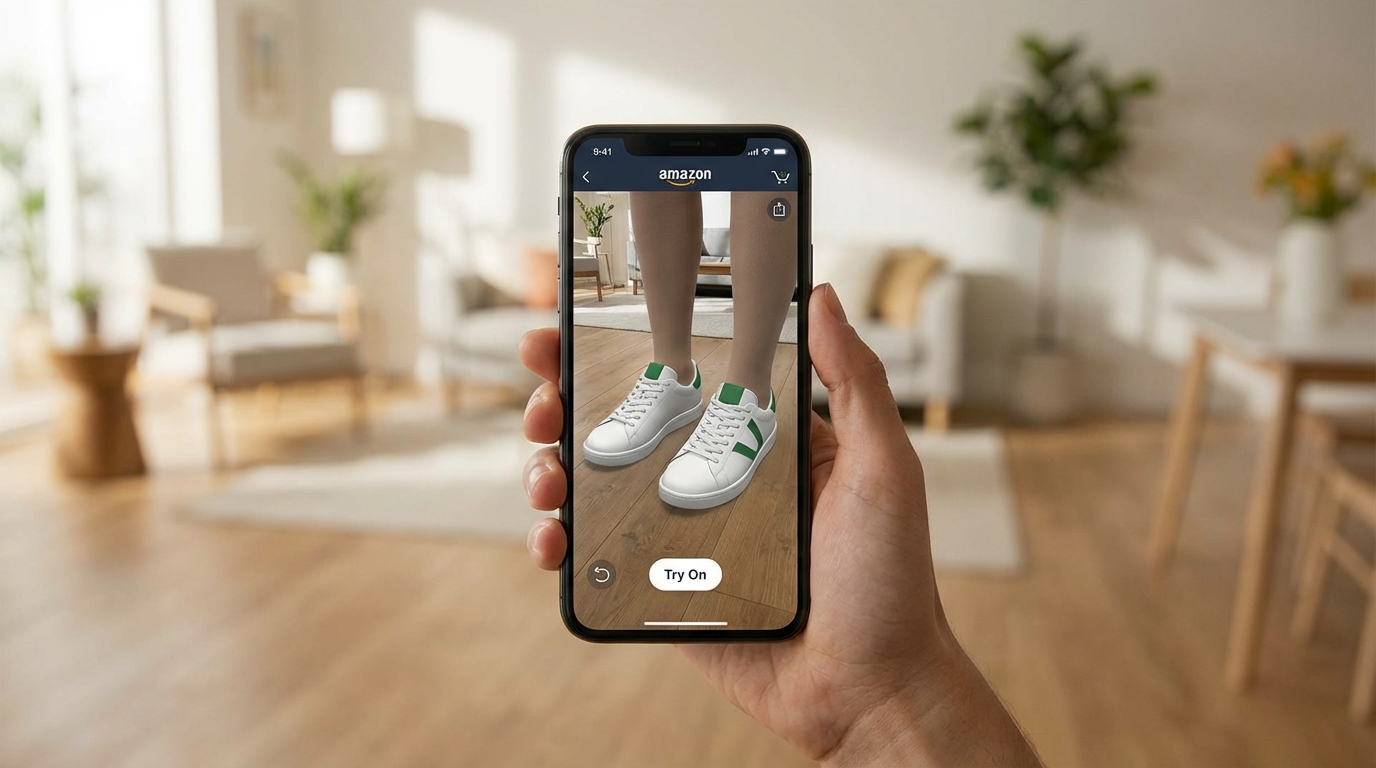
    Close-up of a person holding a smartphone showing a virtual shoe try-on augmented reality feature with the shoe appearing overlaid on their feet in real scale

    Virtual Try-On is the most category-constrained of Amazon’s AR tools, and it’s worth being clear about what’s realistic for different types of sellers in 2026.

    Current Category Coverage

    The three categories with live Virtual Try-On support are footwear, eyewear, and apparel (T-shirts). Footwear is the most mature implementation, with thousands of styles across major brands. The feature uses the phone’s rear camera to overlay shoes on the user’s feet in real time — you physically point the camera at your feet and the shoes appear on them, sized correctly and responsive to your movements.

    For eyewear, the front-facing camera is used to map the user’s face and display how sunglasses or glasses frames will look when worn. This is particularly effective in a category where fit and aesthetic are both highly personal and historically difficult to assess online.

    T-shirts are the most recent addition, though as of 2026 this category is still developing in terms of brand roster and technical accuracy. The rendering of fabric drape and body-specific fit is a harder problem than shoe placement, and it shows in the current iteration.

    Access for Smaller Brands

    This is where sellers need honest expectations. Virtual Try-On for shoes and eyewear appears to operate largely through partnership arrangements between Amazon and established brands rather than a fully open self-serve enrollment. Brands like Puma, Adidas, New Balance, and Birkenstock are participating because they have the production capacity to create high-quality 3D models for their entire footwear lineup and the negotiating leverage to be part of launch partnerships.

    Smaller, independent footwear or eyewear brands should not assume Virtual Try-On is immediately available to them through Seller Central. The path to participation may require working through Amazon Fashion’s brand partnerships team rather than a standard self-serve upload. That said, Amazon has a commercial incentive to expand Virtual Try-On participation, and access for smaller brands is likely to broaden over time.

    The AWS Nova Canvas Alternative

    For sellers who want virtual try-on functionality but can’t access Amazon’s native feature yet, Amazon Web Services offers Nova Canvas — an AI tool that generates try-on visualizations from two uploaded images (a person/space and a product). While this isn’t a live AR experience in the way Virtual Try-On is, it generates realistic static visualizations that can be used in listing images, A+ Content, and social media. For smaller apparel and accessories brands, this is currently the more accessible route to showing products in context on a human body.

    View in 3D: The Accessible AR Entry Point Most Sellers Overlook

    A 3D wireframe model of a kitchen appliance being built digitally on a computer screen with 3D modeling software interface

    If View in Your Room is the headline feature and Virtual Try-On is the partnership feature, View in 3D is the working seller’s AR tool — and it’s underused relative to the value it provides.

    What It Enables

    View in 3D embeds an interactive 3D model directly on the product detail page. Shoppers can rotate the product 360 degrees, zoom in on specific details, and examine it from any angle — all without leaving the listing or activating their camera. On mobile, they can also switch into the AR placement mode, which is the View in Your Room experience.

    This means a single 3D model asset powers multiple experiences: the interactive on-page viewer, the room placement AR feature, and — in some cases — the “View in 3D” banner that appears in search results for eligible listings. That last point is worth noting: 3D-enabled listings can display a visual indicator in search results that distinguishes them from standard listings at the discovery stage, before a shopper even reaches your product page.

    Why It Works Across More Categories

    View in 3D eligibility is broader than View in Your Room because it doesn’t require placement in a physical space — it’s just an interactive model viewer. This means products that wouldn’t logically fit the “put it in your room” use case — a backpack, a kitchen knife set, a skincare device, a power tool — can still benefit from 3D interactivity on their listing page. Shoppers can examine the construction, zoom in on textures, inspect seams, hinges, ports, or handles, and build a much richer mental model of the product than flat photography allows.

    For products where fine details drive purchase decisions — jewellery, hardware, electronics accessories, sporting goods — this capability is particularly relevant.

    How It Appears on the Listing

    When a product has an approved 3D model, it appears in the image carousel on the product detail page alongside standard photos and video. Shoppers see a “View in 3D” option they can tap or click, which launches the interactive viewer in-page. On mobile, the same prompt can offer the option to switch to AR placement if the product category supports it.

    The placement in the image carousel matters because that is prime listing real estate. A 3D model in position two or three of the image stack gets early exposure to shoppers who are actively swiping through product assets — typically the most engaged and highest-converting segment of your traffic.

    The Numbers Behind AR: What the Data Actually Shows

    Performance data for AR in e-commerce comes from multiple sources — Amazon’s own limited public data, third-party platform studies, and brand case studies. It’s worth presenting these with appropriate context rather than treating every number as directly applicable to every seller’s situation.

    Conversion Rate Impact

    The most commonly cited figure is a 94% higher conversion rate for products with 3D/AR content, drawn from Shopify’s analysis of merchants using 3D product models. This is a significant lift, but it reflects a comparison between listings with and without 3D models rather than an isolated test of the 3D feature itself — other listing quality differences may be present between the two groups.

    More conservative estimates from retail AR deployments across major platforms put the conversion lift at 15–30% for shoppers who actively engage with AR features. Amazon-specific data for View in Your Room engagement suggests that users who interact with the AR view convert at approximately double the rate of those who don’t — though this includes selection bias, since shoppers who engage with AR are likely already more purchase-intent than average.

    The practical takeaway: expect meaningful conversion improvement, especially in categories where product fit, size, or appearance in context is a major purchase decision factor. Don’t expect a lift equivalent to a category where the shopper is buying a commodity item with no visual uncertainty.

    Return Rate Reduction

    Return rate data is more consistently supported across sources. Build.com (home improvement) reported a 22% reduction in returns for AR users. Furniture retailers using similar AR placement tools have seen returns drop from the 5–7% industry average to under 2%. The mechanism is straightforward: shoppers who’ve seen exactly how a product fits their space before buying are less likely to be surprised when it arrives.

    For categories with structurally high return rates — furniture (typically 10–15%), apparel (20–30%), footwear (up to 35%) — a 25–40% reduction in returns is a material cost recovery. Return processing costs on Amazon include both direct fees and downstream impacts on inventory health, seller metrics, and IPI scores. Every return prevented is worth more than its face value.

    Revenue Per Visitor

    Studies across apparel virtual try-on deployments report approximately 15% higher revenue per user when shoppers engage with try-on features. This is driven partly by higher conversion rates and partly by higher average order values, as shoppers who engage with AR are more likely to purchase confidently at full price rather than adding to cart at a discount to reduce risk.

    Engagement Duration

    Shoppers who interact with AR features spend meaningfully more time on product pages than those who don’t. While extended time-on-page isn’t a direct purchase signal, it does indicate active evaluation rather than passive browsing — and active evaluation is where purchase decisions happen. Amazon’s algorithm measures engagement signals including session duration and interaction depth, which means AR engagement has at least an indirect relationship with listing performance over time.

    How to Get Eligible: Brand Registry, File Specs, and the Two Upload Paths

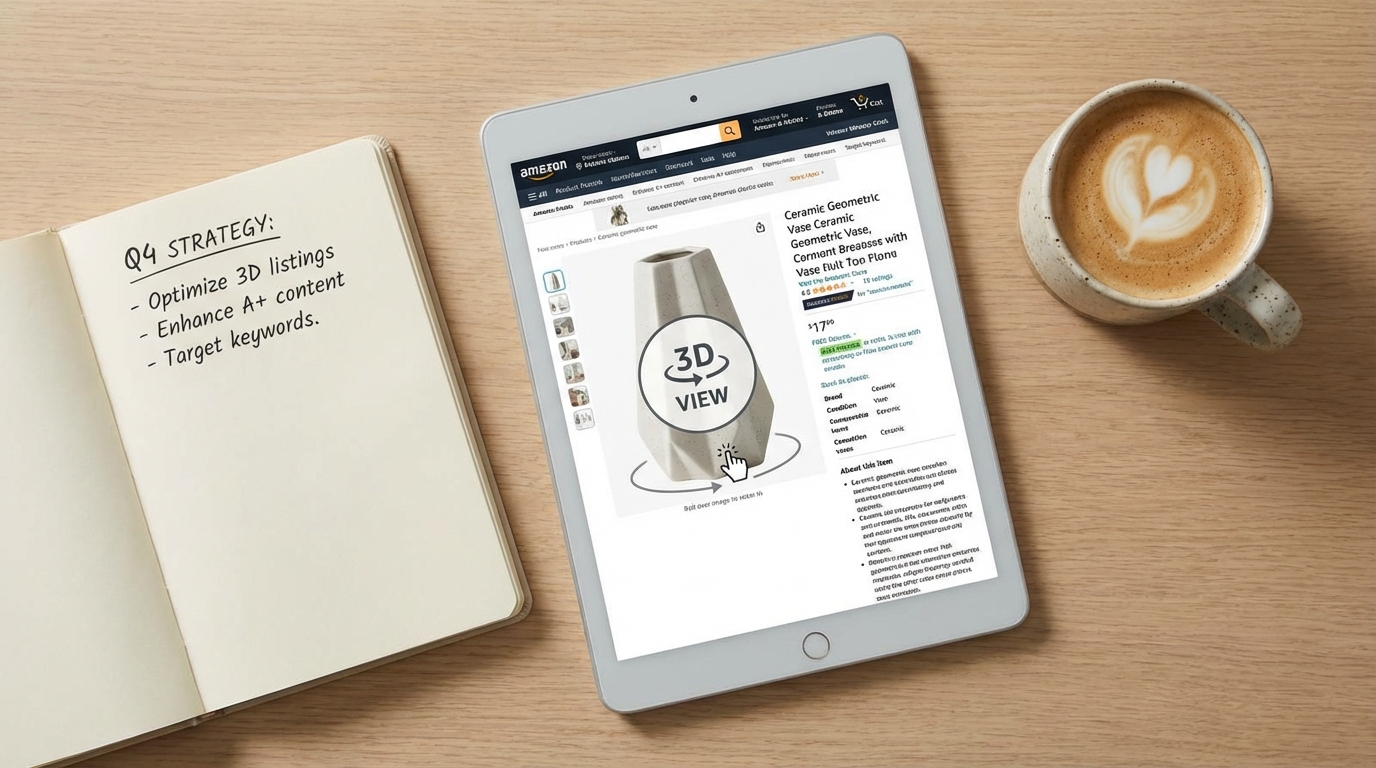
    A clean flat-lay photo showing a tablet displaying an Amazon product detail page with a 3D rotate-and-view interface, surrounded by a notebook with strategy notes and a coffee mug

    Access to Amazon’s AR and 3D listing features is gated behind two requirements: Brand Registry enrollment and a qualifying product model. Both are concrete, achievable steps — but sellers should understand exactly what each involves before allocating budget and time.

    Brand Registry: The Non-Negotiable Starting Point

    Amazon Brand Registry is the gateway to all self-serve AR and 3D listing features. Only the registered brand owner can upload 3D models for a product listing. This means if you’re a reseller, a distributor, or a seller who hasn’t completed Brand Registry, you cannot add AR content to your listings — even if you’re the product’s primary seller.

    Brand Registry requires an active, registered trademark (either in the U.S. or in the marketplace where you’re selling). The trademark can be word-based or image-based. Amazon typically processes Brand Registry applications within 2–10 business days once trademark verification is complete. If you haven’t started the trademark process yet, the typical timeline to a granted trademark is 12–18 months in the U.S. — a legitimate long-term investment, not a short-term tactic.

    Once enrolled in Brand Registry, your account gains access to the 3D model upload tools, alongside other benefits like A+ Content, Sponsored Brand ads, the Brand Dashboard, and the Brand Analytics suite.

    Technical Specifications for 3D Models

    Amazon accepts 3D models in GLB (preferred) or GLTF format. Key technical requirements include:

    • Polygon count: Under 1,000,000 triangles (lower is better for load performance; target 100K–300K for most products)
    • File size: Under 1GB, though smaller files produce better in-app performance
    • Texture quality: High-resolution textures that accurately represent material properties — colour, roughness, metallicity, and normal mapping for surface detail
    • Scale accuracy: The model must reflect exact real-world dimensions; inaccurate scale is the most common rejection reason for View in Your Room models
    • No camera or light attributes: External cameras and lighting setups embedded in the model file cause rejection
    • Material accuracy: The model should represent how the product actually looks — colour, finish, and texture must match the physical product

    Upload Path One: The Seller App Scanning Tool

    Amazon offers a built-in 3D model creation tool in the iOS Seller app (available to brand-registered sellers in the U.S.). The tool guides you through scanning your physical product with your iPhone camera, creating a basic 3D model automatically. The process takes 5–10 minutes and requires holding the phone at multiple angles around the product to capture all surfaces.

    The resulting model goes through Amazon’s automated review process (typically 24–72 hours). The tool works best for products with non-reflective surfaces, clear defined edges, and consistent textures. It struggles with glass, highly reflective metals, very small products (under 10cm), and items with very fine surface details that a phone camera can’t capture adequately.

    For sellers with a qualifying product who want to test AR integration before investing in professional 3D creation, the scanning tool is a legitimate free starting point. Don’t expect photorealistic results — expect a serviceable model that gives shoppers a basic spatial understanding of the product.

    Upload Path Two: Seller Central Image Manager

    Professional 3D models created externally (by you or a third-party provider) can be uploaded via Seller Central through the Image Manager. The path is: Catalog → Upload Images → Manage Images → 3D Models tab. You’ll enter the product’s exact dimensions and upload the GLB file. Amazon’s review team then assesses the model against quality and accuracy standards, with a typical review window of one to two weeks.

    Models uploaded via this path tend to be higher quality than app scans because they’re built by professional 3D artists with dedicated tools, but they cost more upfront. The two-week review window means you should plan your launch timeline accordingly — don’t finalize a listing around an AR feature that’s still in review.

    Creating Your 3D Model: DIY Scanning Versus Third-Party Providers

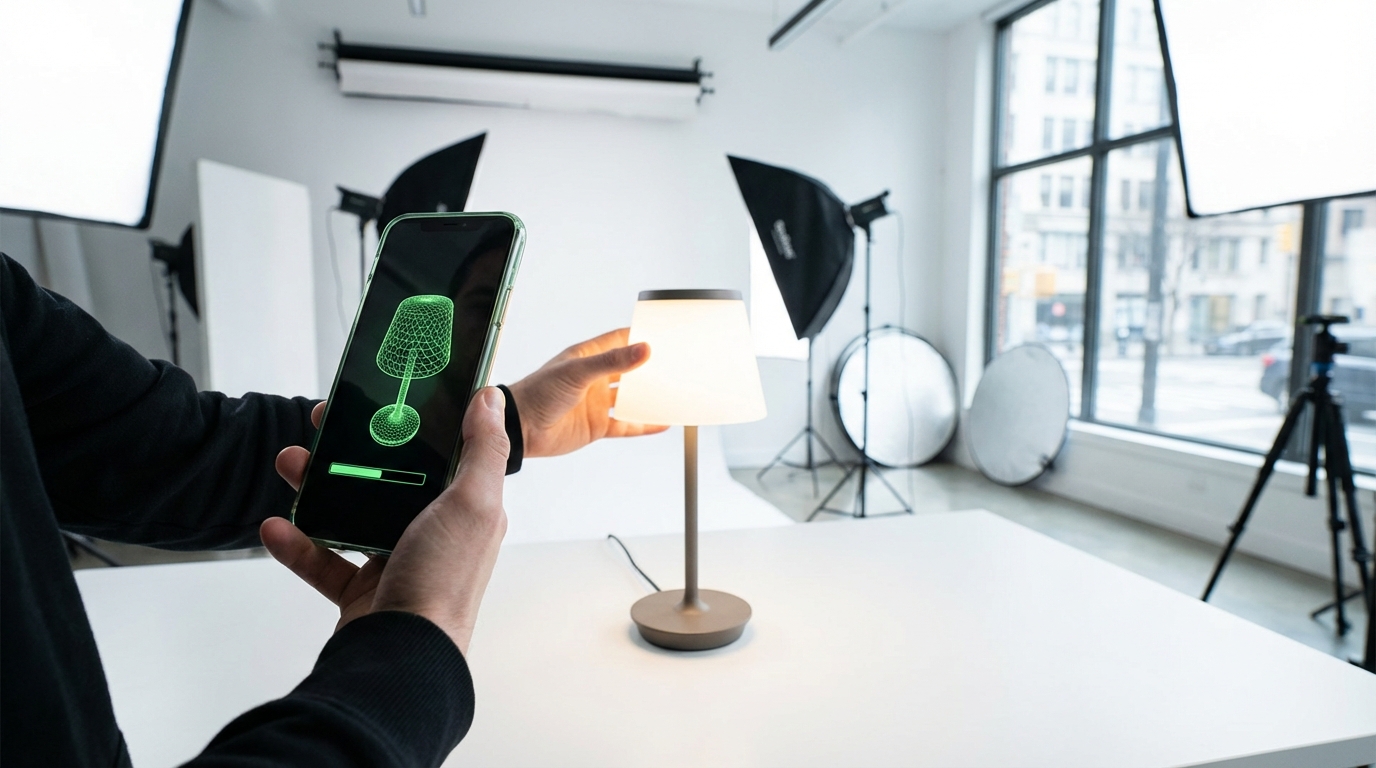
    A person using a smartphone to scan a small tabletop product for 3D model creation, the phone screen shows a scanning progress overlay with a glowing green mesh

    The model creation decision is where many sellers stall — not because the options are complicated, but because the costs and quality trade-offs aren’t clearly laid out. Here’s what the realistic landscape looks like.

    Option 1: Amazon’s Built-In Mobile Scanning

    Cost: Free.
    Time: 5–10 minutes per product (plus 24–72 hours review).
    Quality: Basic to moderate — adequate for View in 3D, variable results for View in Your Room.

    Best for: Sellers who want to test AR integration with minimal investment, products with straightforward geometry (boxes, cylinders, flat panels), and initial market testing before committing to professional model creation.

    Limitations: iOS only, US-only (currently), quality ceiling that may not represent the product accurately enough for high-stakes categories, and limited control over texture and finish rendering.

    Option 2: Freelance 3D Artists

    Cost: $50–$350 per model for simple products; $350–$1,000+ for complex products.
    Time: 2–7 business days depending on complexity and revision rounds.
    Quality: Variable — highly dependent on the individual artist’s experience with Amazon-spec models.

    Freelance platforms host 3D artists with Amazon-specific experience who understand the GLB format requirements, the triangle count limits, and the texture specifications. The most important criterion when hiring a freelance 3D artist for Amazon is whether they’ve had models approved before — ask for specific examples of live Amazon listings they’ve created models for.

    Provide the artist with: exact product dimensions, high-resolution product photography from all angles, material specifications (colour codes, finish type, texture samples), and any technical data sheets. The more information you provide, the higher the accuracy of the first draft and the fewer revision rounds you’ll need.

    Option 3: Specialist Amazon 3D Agencies

    Cost: $300–$2,000 per model (often packaged with renders and lifestyle images).
    Time: 3–14 business days depending on agency and product complexity.
    Quality: High — these agencies specialize in Amazon-compliant 3D models and often offer revision guarantees and resubmission support if Amazon rejects the initial upload.

    Agencies like Advertflair, Data4Amazon, and vetted AWS partners (Hexa3D, Threedium) operate in this space. The higher cost often includes a suite of deliverables beyond just the 3D model: CGI product renders, lifestyle scene renders, 360-degree spin animations, and the GLB file — assets that can be used across your listing images, A+ Content, and off-Amazon marketing materials.

    For sellers with a strong-performing product where incremental conversion improvement translates to meaningful revenue, the $500–$2,000 investment in a professional model is easy to justify. For a product generating $30,000/month, a 15% improvement in conversion rate on a subset of traffic is a significant number.

    Option 4: In-House 3D Modeling Software

    If you or someone on your team has 3D modeling experience, tools like Blender (free), Cinema 4D, or Autodesk Maya can be used to create GLB-compatible models from product CAD files or scratch. This is the most cost-effective long-term solution for sellers with large product catalogs, but it requires a meaningful skill investment or a dedicated in-house resource.

    For brands with existing CAD files from product manufacturing, converting those files to consumer-grade 3D models for Amazon is often faster and cheaper than starting from scratch — the geometry exists, it just needs texturing, material mapping, and format conversion to GLB.

    AR Features and Amazon’s Algorithm: What It Affects (and What It Doesn’t)

    The relationship between AR features and Amazon’s A10 ranking algorithm is real but indirect — and it’s important to understand the distinction between direct ranking signals and downstream performance signals.

    What AR Does Not Do Directly

    Amazon has not publicly documented AR or 3D model presence as a direct ranking factor in the way that review count, keyword relevance, or sales velocity are. If your product has a 3D model and an identical competitor listing does not, you should not expect to automatically outrank that competitor based on the 3D model alone.

    Sellers who pitch AR primarily as an “algorithm hack” are overstating the relationship. That framing sets up disappointment and misallocates the genuine value of the feature.

    What AR Does Affect (Indirectly)

    Where AR creates algorithmic benefit is through its impact on the performance signals that Amazon’s A10 algorithm does weight heavily:

    • Click-through rate (CTR): Listings with the “View in 3D” or AR badge visible in search results may generate higher CTR than equivalent listings without it, as the visual differentiator attracts attention in crowded search pages.
    • Conversion rate (CVR): Amazon heavily weights CVR in its ranking model. If AR engagement increases your conversion rate — and the data suggests it consistently does for engaged shoppers — that improvement feeds directly into your ranking signals over time.
    • Return rate: Amazon monitors return rates by seller and by product. Elevated return rates can trigger listing suppression, restricted categories, or additional fees. A genuine reduction in returns from AR engagement improves your standing on this metric.
    • Session duration and engagement depth: Amazon’s algorithm processes engagement signals beyond just purchase events. Shoppers who spend more time on your listing, interact with more content types, and engage with the AR viewer are contributing behavioural signals that indicate a high-quality listing.

    The Listing Quality Score Connection

    Amazon uses an internal Listing Quality Score (LQS) that influences how confidently the algorithm recommends your product across different placements. While the exact composition of LQS isn’t public, it is understood to incorporate listing completeness signals — images, video, A+ Content, accurate attributes. A 3D model in the image stack contributes to listing completeness and likely to the LQS, which has downstream effects on placement in recommendation surfaces, deal eligibility, and algorithm confidence in the listing.

    Category-by-Category Opportunity Map: Where AR Adoption Is Still Low

    One of the genuinely underappreciated aspects of Amazon’s AR feature suite is how unevenly adoption is distributed across categories. In furniture and high-end footwear, AR-enabled listings are becoming common. In other eligible categories, the majority of brand-registered sellers haven’t added 3D content at all.

    Less than 1% of Amazon’s brand-registered sellers are estimated to have 3D models on their listings as of 2026. That creates significant differentiation opportunity in categories where the feature is both eligible and underused.

    High Opportunity, Low Current Adoption

    Kitchen and tabletop appliances: With the recent expansion of View in Your Room to tabletop items, coffee makers, air fryers, blenders, and similar products are now eligible for room placement AR. Very few sellers in this category have moved on this. A 3D-enabled listing for a coffee maker that lets shoppers see exactly how it looks on their kitchen counter — in their actual kitchen — is a meaningful differentiator in a crowded category.

    Sporting goods and fitness equipment: Dumbbells, kettlebells, yoga equipment, benches, and compact gym gear are eligible for View in 3D and in some cases View in Your Room. Shoppers trying to gauge whether a piece of equipment will fit their home gym or apartment space have a genuine use case for AR visualization. Adoption in this category remains low.

    Consumer electronics accessories: Headphones, speakers, keyboards, mice, and desk accessories benefit from 3D viewing for detail inspection. A shopper trying to decide between two similarly priced wireless headphones has a much richer experience rotating a 3D model and examining the ear cushions, hinge mechanisms, and build quality than viewing three standard photos.

    Home office: Desks, chairs, monitor stands, and storage units are in the sweet spot of View in Your Room eligibility with relatively low adoption among smaller brands in the space.

    Baby and nursery: Cribs, changing tables, high chairs, and strollers are categories where parents are making high-consideration purchases and want to see products in their specific nursery space. AR fit checks are highly relevant here, and adoption is minimal outside of major brands.

    Categories with Growing Competition

    Furniture (large items), premium footwear, and premium eyewear are the categories where AR adoption is highest and where the differentiation value of having 3D content is eroding as more brands adopt it. In these categories, not having AR is increasingly the risk — while having it is becoming table stakes. If you’re in furniture or shoes and you haven’t added 3D models yet, you’re already behind the curve in terms of shopper expectation management.

    Common Mistakes Sellers Make With AR Listings

    Based on how Amazon’s 3D model requirements and review processes work, there are several consistent failure patterns worth avoiding before you invest time and money in model creation.

    Submitting Models with Scale Errors

    The most common reason for View in Your Room rejection is inaccurate product scale. If your 3D model’s dimensions don’t precisely match the actual product’s real-world measurements, Amazon will reject it for the room placement feature — because a sofa that appears three feet shorter than it actually is creates exactly the kind of post-purchase surprise that AR is supposed to prevent.

    Always provide exact manufacturer dimensions when briefing a 3D artist or when setting up your model. Double-check the model in a preview before submission. Scale errors are entirely avoidable with proper briefing.

    Ignoring Material and Texture Accuracy

    A 3D model that looks significantly different from the physical product — wrong colour rendering, flat textures on a product that has visible grain or weave, generic materials applied to a product with specific finishes — may pass Amazon’s review but will disappoint shoppers who interact with it. The whole point of AR is to reduce the imagination gap; a model that’s inaccurate in material or colour can create a new type of expectation mismatch.

    Invest in accurate texture mapping. For products where colour accuracy is critical (upholstered furniture, apparel, rugs, painted wood), provide your 3D artist with colour-accurate reference photography taken in daylight or with proper colour calibration. The Pantone or RAL colour codes for your product finishes are extremely useful.

    Using the App Scan for Complex Products

    The mobile scanning tool is genuinely useful for the right products, but sellers sometimes try to use it for products where it structurally can’t produce adequate results: glass items, chrome-finished products, products smaller than a fist, products with complex internal structures visible through the casing. The result is a low-quality model that may create a negative first impression rather than a positive one.

    Match the creation method to the product. If your product has challenging material properties, invest in professional modeling rather than relying on mobile scanning.

    Not Updating Models After Product Changes

    If you update your product — new colour option, revised packaging, changed dimensions, updated branding — your 3D model needs to be updated too. An outdated 3D model showing a discontinued colour option or old design creates confusion. Build model maintenance into your product update workflow, not as an afterthought.

    Treating the Model as a Set-and-Forget Asset

    A 3D model is a living listing asset that benefits from monitoring. Track whether your View in 3D engagement rate changes after model upload. Watch your return rate in the weeks following AR activation. Compare conversion rates between traffic segments that engaged with the AR feature and those that didn’t. Amazon’s Brand Analytics includes some of this data; supplement it with your own tracking where possible. If a model isn’t driving the expected engagement, it’s worth investigating whether it’s appearing correctly on all devices and in all marketplaces you’re selling in.

    Building AR Into Your Listing Strategy for the Long Term

    AR features on Amazon aren’t a campaign — they’re listing infrastructure. Like A+ Content, video, and review management, they’re assets that compound over time rather than delivering a one-time lift. That framing changes how you should prioritize and sequence the investment.

    Sequence: Start with Your Highest-Return Products

    If you have a catalog of 50+ SKUs and can’t afford to create 3D models for everything immediately, prioritize based on return rate and return-driven costs. Your highest-return products are the ones where the AR investment has the clearest ROI case: every percentage point reduction in returns on a $200 furniture item is worth more in absolute terms than the same reduction on a $20 item.

    Second priority: your highest-traffic, highest-conversion products. These are the listings where the incremental improvement in conversion rate delivers the most revenue. The model investment on a listing that drives $80,000/year is justified at a much higher threshold than one driving $8,000/year.

    Align Model Creation with New Product Launches

    For new product launches, building the 3D model into the pre-launch production workflow is far more efficient than retrofitting it after launch. When you’re already briefing photographers and creating packaging, the 3D model brief can be developed in parallel. CAD files from your manufacturer can seed the model creation, reducing the 3D artist’s work significantly.

    Launching with a 3D model in place means your listing is fully equipped from day one of indexed traffic — including the AR badge in search results and the interactive viewer on the detail page. For products entering competitive categories, this is a meaningful early differentiation.

    Plan for Multi-Marketplace Deployment

    Amazon’s 3D model feature is available across multiple marketplaces, not just Amazon.com. If you sell on Amazon UK, Germany, Canada, Australia, or Japan, the same 3D model file can typically be used across marketplaces. The review process applies separately in each marketplace, but the asset creation is a one-time cost with multi-market deployment potential.

    This is particularly relevant for international expansion plans. A brand entering Amazon Europe with AR-enabled listings from launch day is positioned ahead of most competitors who haven’t yet implemented 3D models in those markets.

    Leverage 3D Assets Beyond Amazon

    The GLB file and the photorealistic renders your 3D artist produces are reusable assets. The same model can power AR previews on your Shopify or WooCommerce store, 3D spin animations for your product emails, CGI lifestyle imagery for your social media, and interactive embeds on your brand website. Many sellers limit their thinking to the Amazon use case and leave the broader asset value on the table.

    When briefing a 3D agency, ask explicitly for high-resolution renders, 360-degree turntable animations, and any scene variants you’ll need for your other channels. Getting all of this from a single model creation project significantly improves the cost-per-use of the asset.

    What to Expect: A Realistic Timeline and Outcome Framework

    For sellers considering AR features for the first time, here’s an honest outline of what the process and outcomes typically look like.

    Months 1–2: Foundation

    • Confirm Brand Registry status (apply if not already enrolled)
    • Audit your catalog for AR-eligible products and prioritize candidates
    • Brief a 3D artist or agency — or use the mobile scan tool for initial testing
    • Submit models for Amazon review via Seller Central Image Manager
    • Allow 1–2 weeks for Amazon’s review and approval

    Months 2–4: Live and Measuring

    • Monitor View in 3D engagement via Brand Analytics and listing traffic data
    • Compare return rates before and after AR activation
    • Track conversion rate changes for AR-activated listings vs. baseline period
    • Note any search ranking changes — though attribute these cautiously given multiple variables

    Months 4–12: Scaling the Investment

    • Expand 3D models to additional products based on performance data from initial rollout
    • Incorporate model creation into new product launch workflow
    • Deploy existing 3D assets to other Amazon marketplaces
    • Leverage 3D renders in A+ Content, video, and off-Amazon channels

    Realistic Outcome Expectations

    For sellers in furniture, home décor, lighting, and similar high-imagination-gap categories: expect the clearest and fastest impact. Return rate improvements in the 15–30% range for AR-engaged shoppers, and conversion rate lifts in the 10–25% range, are supported by data from comparable deployments.

    For sellers in electronics accessories, sporting goods, and kitchen appliances: expect moderate but measurable improvement in engagement and conversion, with a slower timeline to see statistically clear return rate effects (lower baseline return rates mean smaller absolute changes).

    For sellers in low-consideration categories (commodity goods, consumables, replenishment items): the AR investment may not be justified. If your customers aren’t making a spatially or aesthetically complex purchase decision, AR doesn’t address the friction in their buying journey.

    Conclusion: AR Is Infrastructure, Not a Trend

    The conversation around augmented reality in e-commerce has been dominated for years by hype cycles and ambitious projections that haven’t always landed on schedule. That history has made some sellers appropriately sceptical. But Amazon’s AR suite — View in Your Room, Virtual Try-On, and View in 3D — is not speculative technology. It’s live, it’s self-serve for brand-registered sellers, it costs nothing in Amazon fees to upload, and the performance data from deployments across e-commerce consistently supports meaningful improvements in both conversion rates and return rates.

    The sellers who are hesitating aren’t being cautious — they’re waiting for a queue of missed opportunities to get longer. Less than 1% of brand-registered Amazon sellers have 3D models on their listings. In a marketplace where differentiation is increasingly expensive to achieve through advertising and increasingly difficult to achieve through listing optimisation alone, that gap is a genuine opening.

    Key Takeaways for Amazon Sellers

    • AR on Amazon is three separate tools: View in Your Room (space placement), Virtual Try-On (wearable visualization), and View in 3D (interactive on-page model). Each has different category eligibility and access paths.
    • Brand Registry is the prerequisite for self-serve AR and 3D model uploads. If you haven’t enrolled, that’s the first step — everything else follows from it.
    • GLB/GLTF format, accurate scale, and material fidelity are the three pillars of a model that gets approved and performs well in AR.
    • Two upload paths exist: the free iOS Seller app scan (quick, basic quality) and the Seller Central Image Manager upload (professional quality, 1–2 week review).
    • Professional model creation costs $50–$2,000 depending on product complexity and whether you need additional renders. Amazon charges no fee for the upload or AR integration itself.
    • The greatest opportunity sits in kitchen appliances, sporting goods, home office, electronics accessories, and baby/nursery — categories with AR eligibility and very low current adoption.
    • AR’s impact on rankings is indirect — it works through improved conversion rates, lower return rates, and stronger engagement signals, not through a direct algorithmic ranking boost.
    • 3D model assets are reusable across marketplaces, channels, and marketing materials. Plan the full scope of use when commissioning model creation.

    The window for early differentiation through AR on Amazon remains open — but it won’t stay open indefinitely. Sellers who move now get the full compounding benefit of better conversion metrics, lower return rates, and early-mover positioning before AR becomes as standard as A+ Content. Sellers who wait will still be able to add it eventually, but they’ll be doing so in a landscape where it no longer stands out.