Tag: Process Automation

  • The Bot Estate Is Changing: How Agentic AI Reshapes What Automation Actually Means

    The Bot Estate Is Changing: How Agentic AI Reshapes What Automation Actually Means

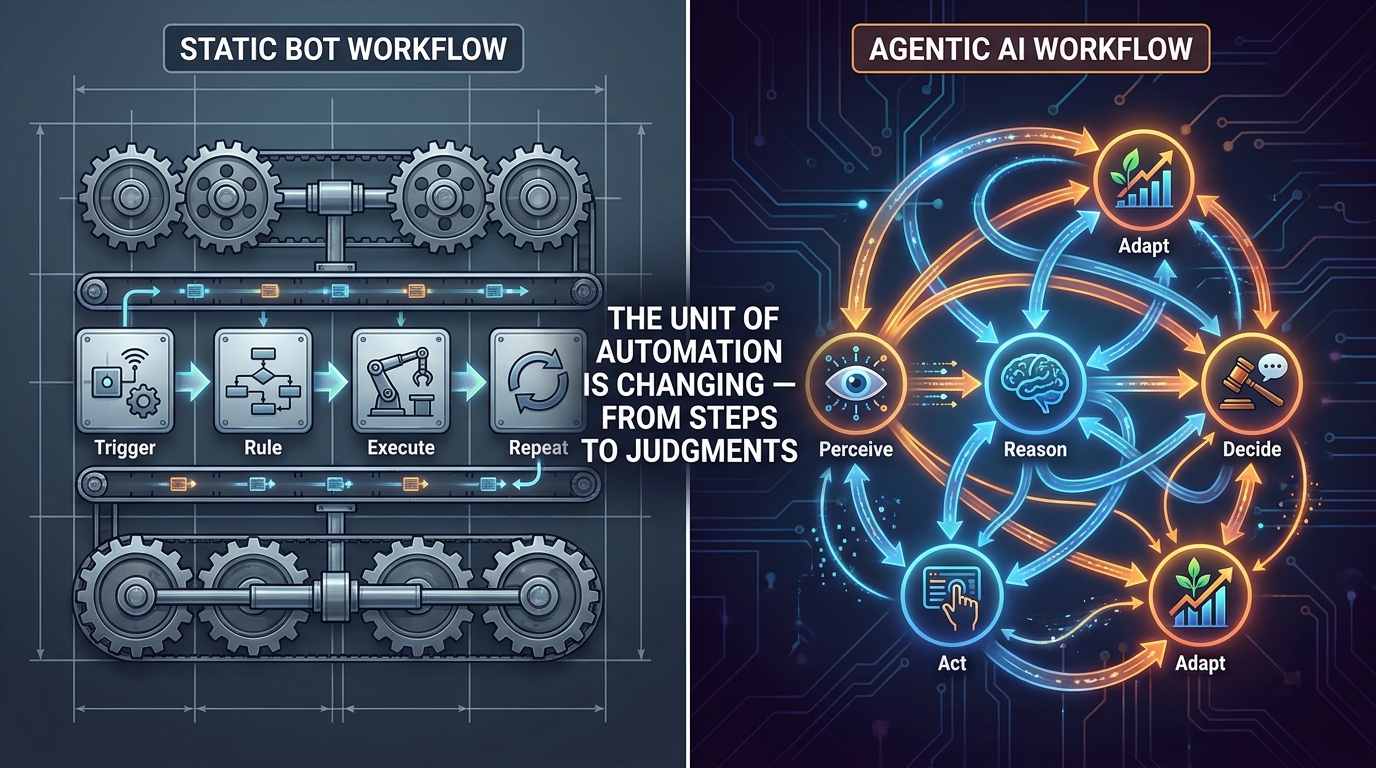
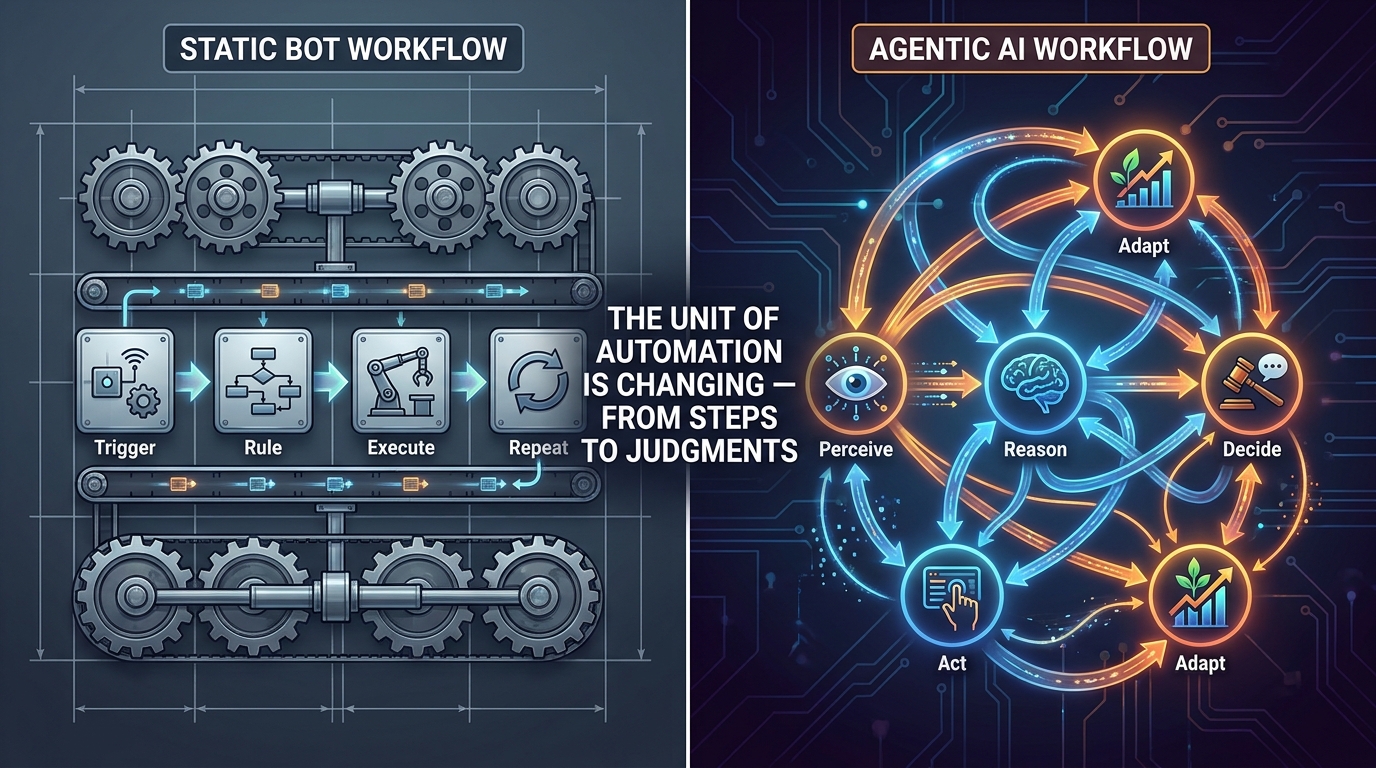
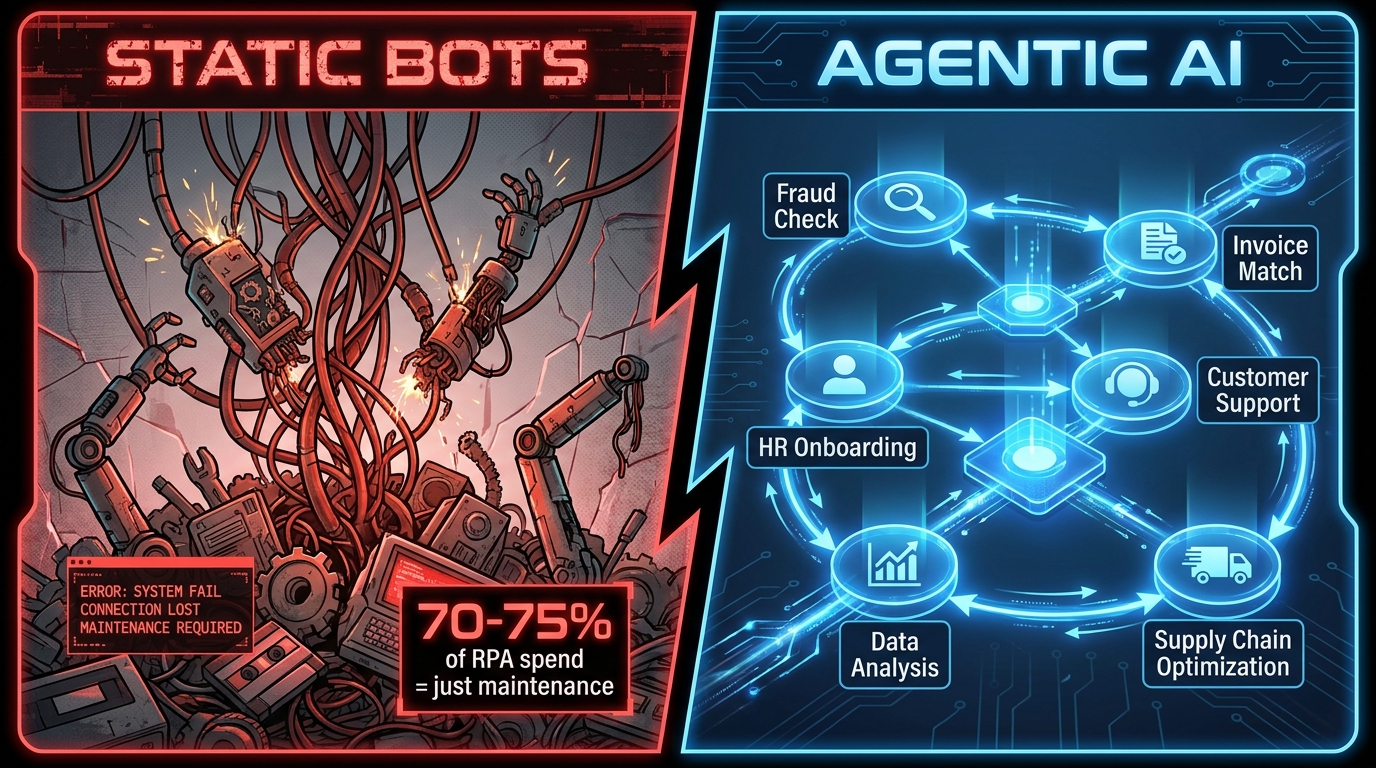
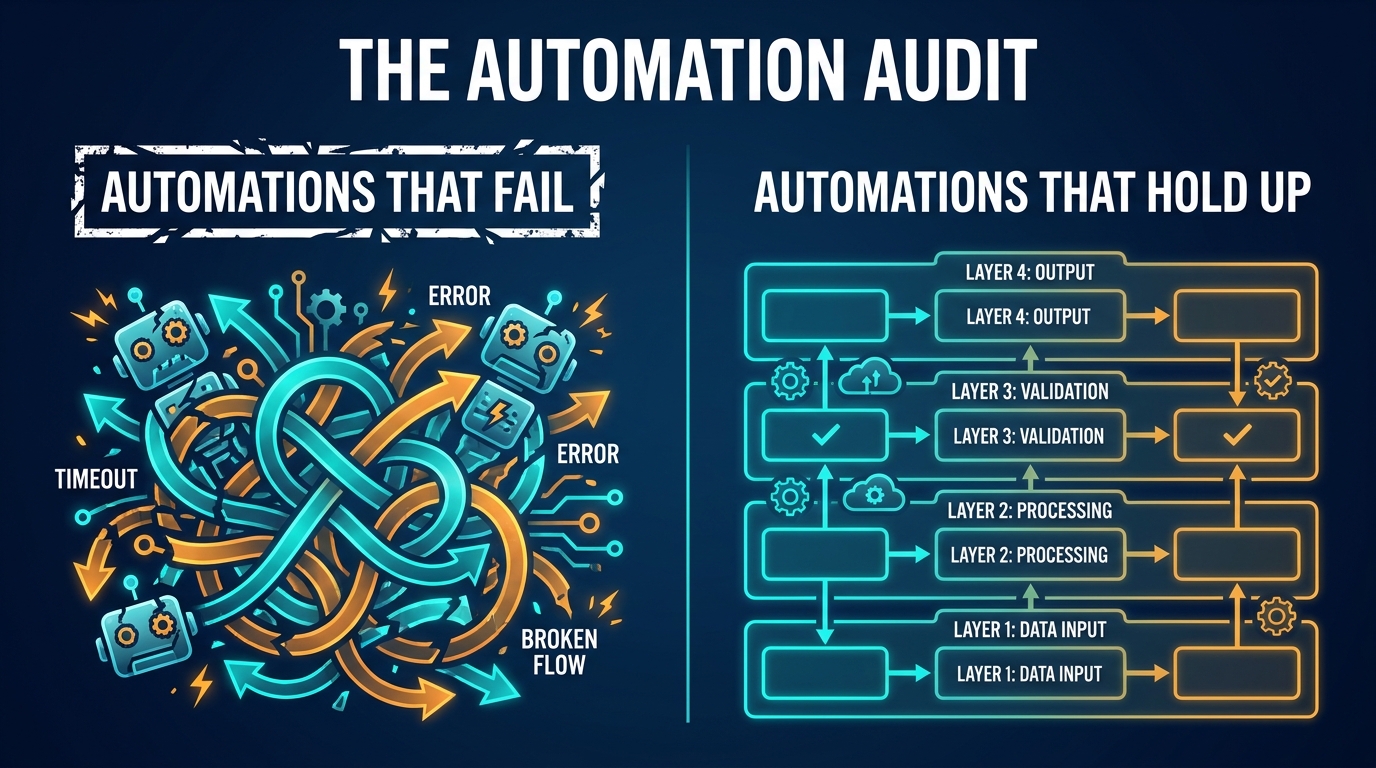
    Split-screen diagram showing static bot workflow on the left with rigid linear steps and agentic AI workflow on the right with branching reasoning nodes — the unit of automation is changing from steps to judgments

    Most conversations about agentic AI begin with a replacement narrative: bots are dumb, agents are smart, therefore agents will take over. It’s a clean story. It’s also incomplete in ways that matter enormously if you’re the person responsible for an organisation’s actual automation stack.

    The reality unfolding across enterprise floors in 2026 is messier and more interesting than a simple swap. Robotic process automation (RPA) bots are not being retired en masse. Workflow automation platforms are not switching off their rule engines. Instead, something more structural is happening — the fundamental unit of automation is changing. For two decades, automation meant automating a step. Increasingly, it means automating a judgment.

    That distinction sounds philosophical until you sit down with a process that generates 40% exception rates, depends on unstructured email chains, and touches six systems that don’t share a common API. Suddenly, the question is not “should I replace my bot?” but “what part of this workflow is actually automatable in each paradigm, and what governance do I need around the part that isn’t?”

    This post works through that question seriously. It covers the structural difference between static bots and agentic systems, the hybrid architecture that is quietly becoming the enterprise default, the new failure modes that agents introduce (and that nobody’s old playbooks account for), and the concrete methodology for auditing your existing bot estate against agentic readiness. No vendor sales pitches. Just the operational logic of what’s actually changing and why.

    The Problem With Bots Has Always Been the Same

    To understand why agentic AI is gaining ground, you have to understand precisely where RPA bots break — and they have always broken in the same place. The technical term is brittleness at the process boundary. The practical translation: bots are excellent at doing exactly what you told them to do, and catastrophically bad at everything slightly outside that definition.

    This is not a failure of RPA as a technology. It is the design contract. A bot executes a predefined sequence of steps against structured, predictable inputs. When those conditions hold, bots are extraordinary: fast, tireless, perfectly consistent, fully auditable, and cheap to run at scale. A well-built RPA bot processing invoices from a single ERP system with a consistent format can operate for years with minimal human oversight and near-zero error rates.

    Where the Design Contract Breaks

    The problem is that most real-world enterprise processes don’t hold those conditions for long — and many never held them at all. Consider what happens when:

    • An invoice arrives as a scanned PDF with handwritten amendments rather than a clean digital file.
    • A supplier changes their layout mid-year, shifting field positions by two columns.
    • An approval workflow depends on whether the total exceeds a threshold that varies by business unit, currency, and fiscal quarter — and that logic lives in a spreadsheet owned by the Finance Director.
    • An exception requires pulling context from three separate systems — an ERP, a CRM, and a SharePoint folder — and synthesising a decision that isn’t in any rulebook.

    In each of these cases, the bot does one of two things: it fails and halts the process, or it applies the wrong rule and produces a silently incorrect output. Both outcomes require human intervention. The second is worse because you often don’t catch it until downstream.

    The Exception Rate Problem Is Bigger Than Anyone Admits

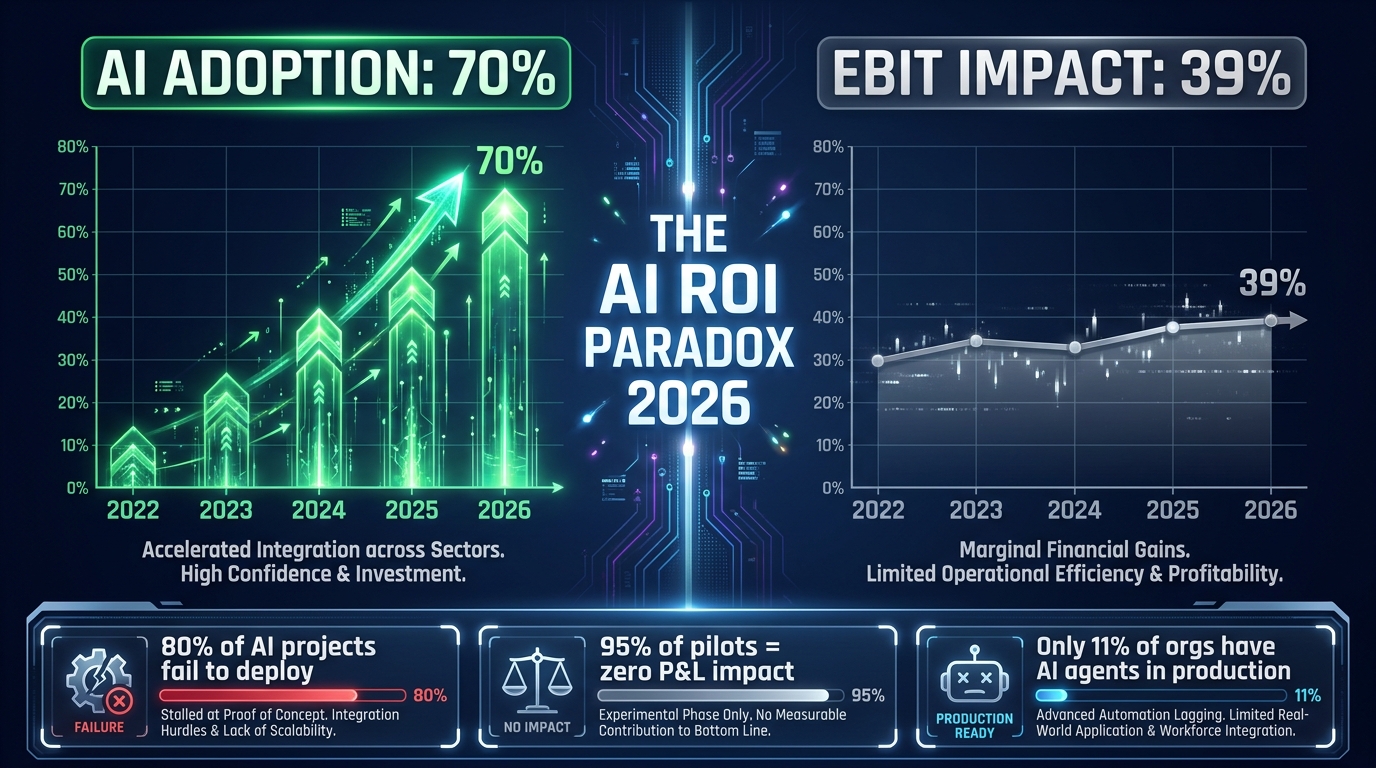
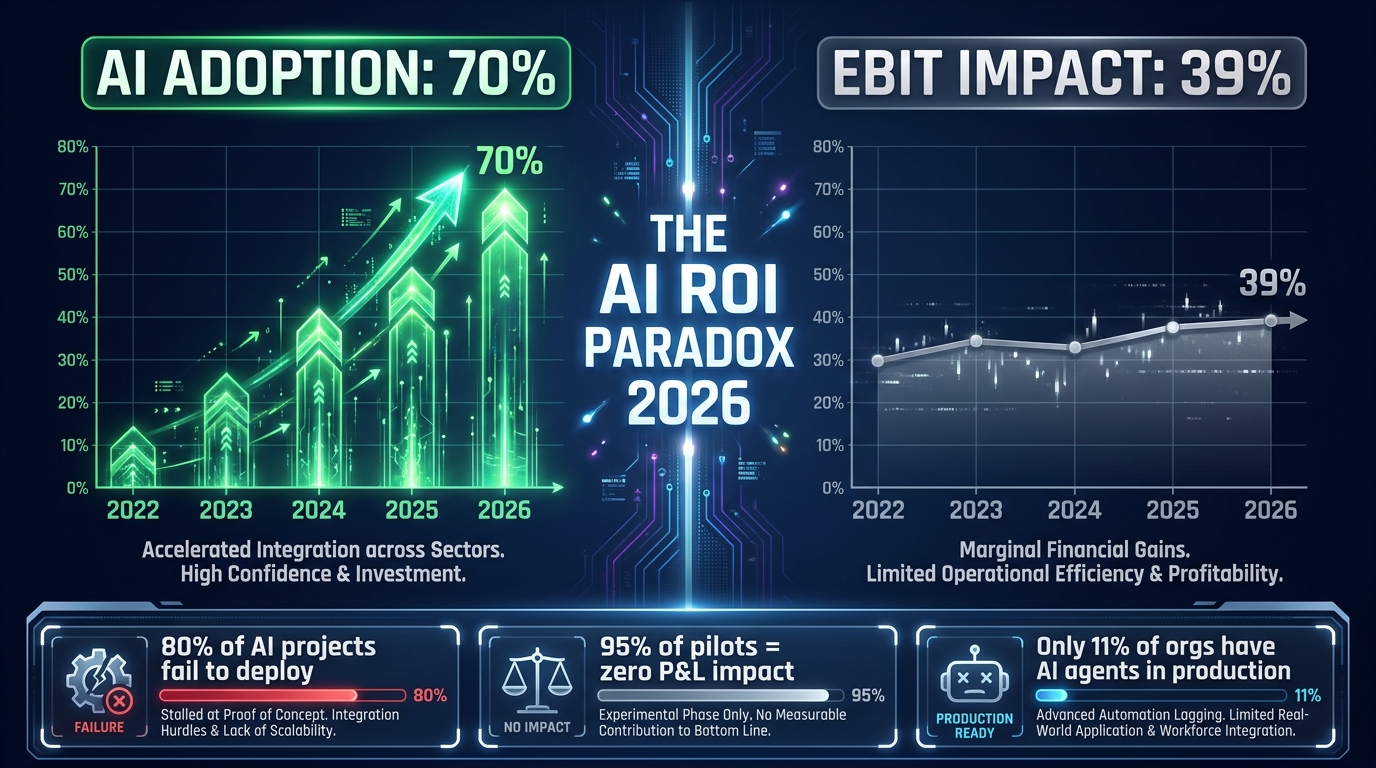
    Industry benchmarks on RPA exception rates vary widely depending on how the process was scoped and maintained. But most automation practitioners will privately acknowledge that exception-handling is where bot programmes quietly haemorrhage cost and credibility. Processes that looked like 95% automation rate on paper often deliver 65% in practice once you account for the cases that fall through the rules, the ongoing maintenance burden when source systems change, and the human oversight required to keep the bot from propagating errors through the stack.

    This is the structural backdrop for agentic AI’s appeal. Not that agents are smarter in some abstract sense — but that they are specifically designed to handle the exact class of problem that bots have always failed at: ambiguous inputs, variable process paths, and decisions that require context-synthesis rather than rule-lookup.

    What “Agentic” Actually Means — And What It Doesn’t

    The word “agentic” has been overloaded by marketing to the point where it sometimes means little more than “AI that does things.” That vagueness is dangerous for anyone trying to make architectural decisions. Here is a more precise definition that holds up in practice.

    An agentic AI system is one that: perceives its environment (through data, documents, system states, or user input); formulates or maintains a goal; plans a sequence of actions to achieve that goal; executes those actions using tools (APIs, code, web browsers, databases); evaluates the results of each action; and adjusts its plan based on what it learns. The key word in that chain is “adjusts.” A static workflow cannot adjust. It follows the path you laid out at build time. An agent can replan mid-run.

    The Autonomy Spectrum

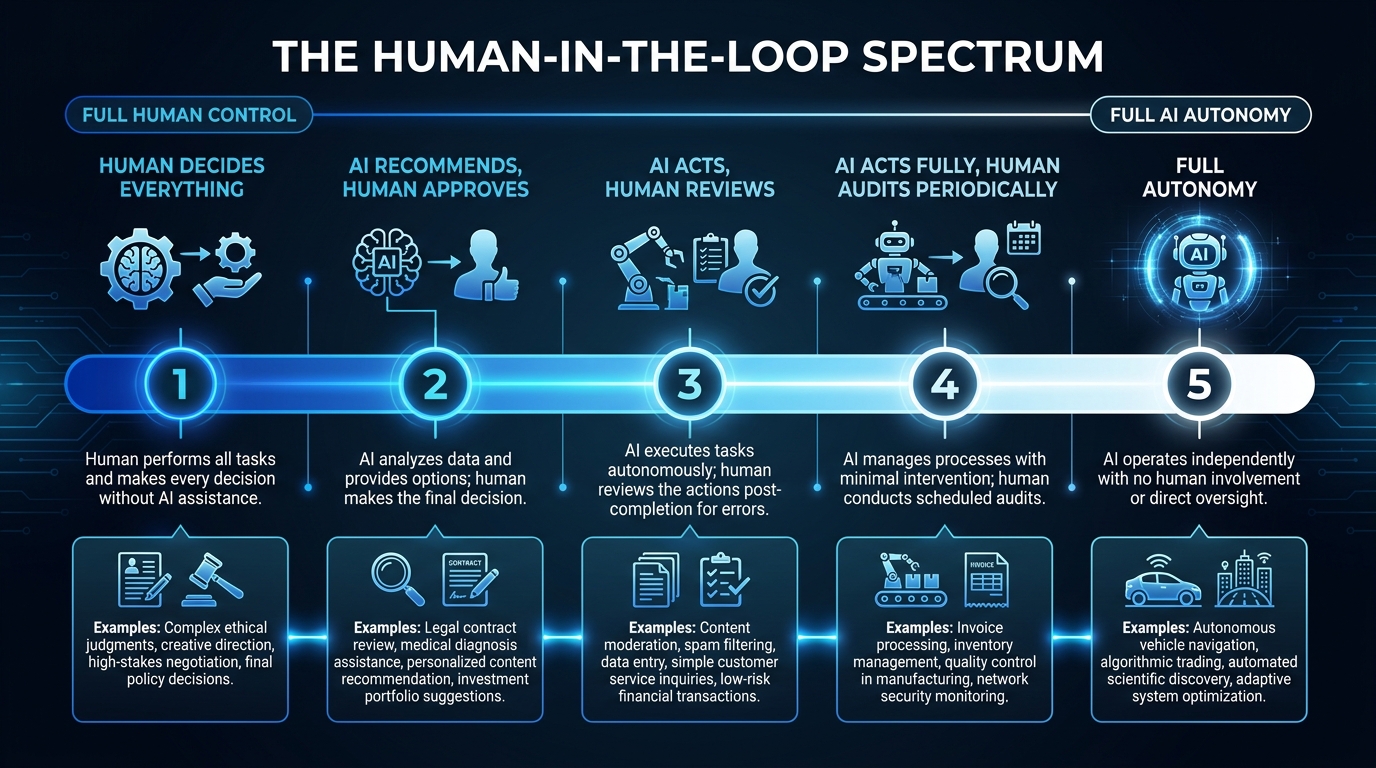
    What makes this definition practically useful is recognising that “agentic” is not binary. There is a spectrum of autonomy, and where a system sits on that spectrum has enormous implications for governance and risk:

    • Level 1 — AI-assisted: A human initiates and approves every step. The AI suggests actions. Think Copilot-style autocomplete in a workflow tool.
    • Level 2 — Supervised automation: The agent executes multiple steps autonomously but requires human approval at defined checkpoints — typically for irreversible or high-risk actions.
    • Level 3 — Bounded autonomy: The agent completes entire workflow segments independently within defined guardrails. Humans review outputs rather than approving actions. This is where most mature enterprise deployments sit in 2026.
    • Level 4 — Full autonomy: The agent plans, executes, and adapts end-to-end with no human checkpoints. Reserved for low-risk, fully reversible processes with strong observability. Rare in production.

    When a vendor tells you their product is “fully agentic,” ask which level on this spectrum they actually mean. The answer will tell you far more about fit for your use case than any benchmark they quote.

    What Agentic AI Is Not

    It’s equally worth being clear about what does not qualify as agentic, despite vendor framing. A chatbot that can answer questions from a knowledge base is not agentic — it has no action capability. A workflow with an LLM-powered classification step bolted in front of a static rule engine is not fully agentic — it’s a static workflow with an AI pre-processor. A recommendation engine that surfaces options for humans to act on is not agentic — it has no execution capability.

    Genuine agentic systems have both reasoning and action capability, with a feedback loop between them. That combination is what changes the economics and the risk profile.

    The Decision Surface: Why the Unit of Automation Is Changing

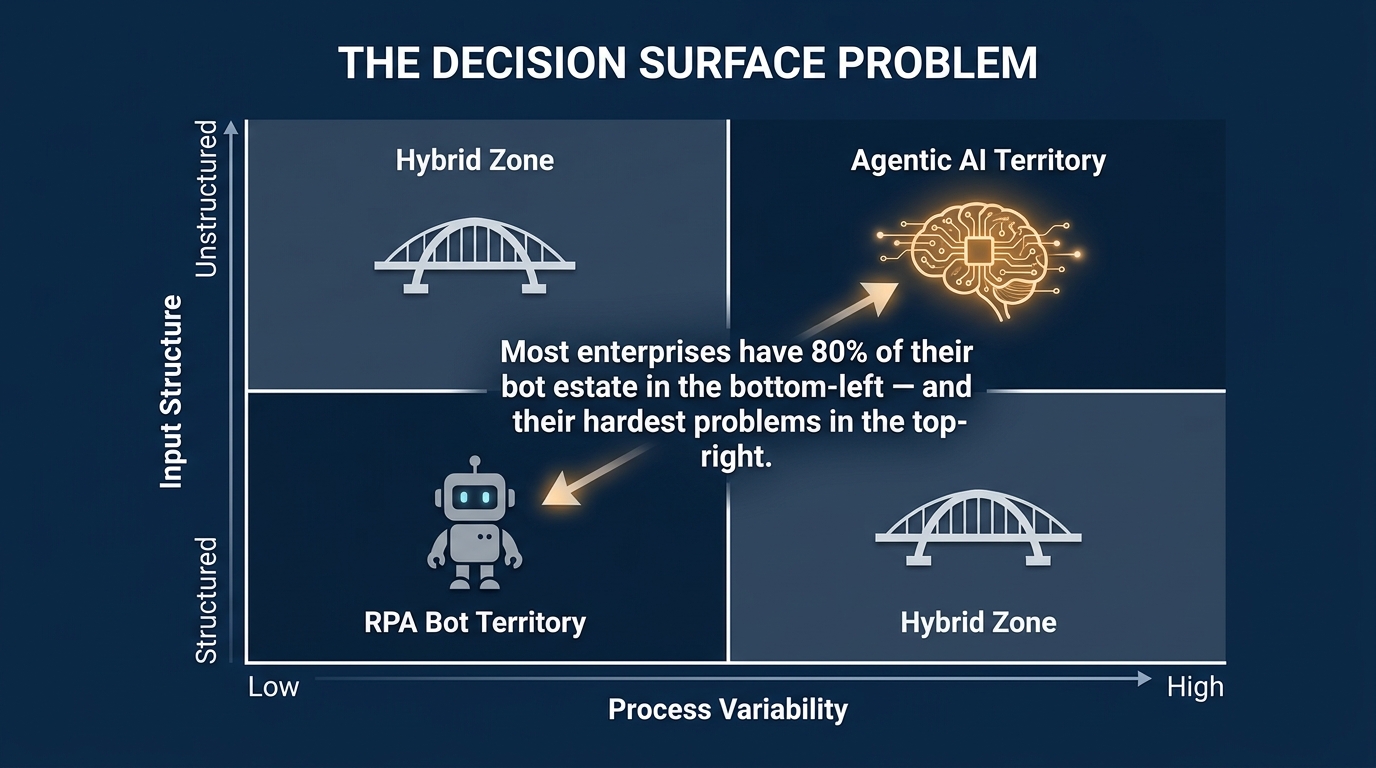
    2x2 matrix showing Decision Surface — RPA Bot Territory in bottom-left quadrant for low variability structured inputs, Agentic AI Territory in top-right for high variability unstructured inputs, with Hybrid Zone in between

    The most useful mental model for understanding the transition from static bots to agentic AI is what practitioners are increasingly calling the decision surface. Every automated workflow has a decision surface: the total set of conditions, inputs, and states the automation must handle to complete its job without human help.

    RPA bots have a narrow, explicitly defined decision surface. Every fork in the path is mapped at build time. Every input format is specified. Every exception outcome is pre-coded. The bot can only succeed within that surface. Anything outside it creates a failure or an escalation.

    Agentic AI systems have a wide, dynamically navigated decision surface. The system can interpret novel inputs, select from multiple action paths, and handle cases it hasn’t seen before — within the capabilities of its underlying model and the tools it has access to. The surface expands as context does.

    The Two Axes That Determine Your Fit

    Mapping your processes against two axes gives you a clear read on which automation paradigm fits where:

    Axis 1: Process Variability. How often does the logical path through the process change? Invoices from a single vendor in a standard format = low variability. Customer complaint resolution across product lines, jurisdictions, and escalation paths = high variability. The higher the variability, the more a static bot’s predefined logic becomes a liability rather than an asset.

    Axis 2: Input Structure. How predictable and machine-readable are the inputs the process receives? Structured database records or fixed-format files = structured. Emails, documents, voice transcripts, handwritten forms = unstructured. Mixed = everything in between. Static bots were built for structured inputs. Agentic systems can reason about unstructured ones — a fundamental capability difference.

    The Four Quadrants in Practice

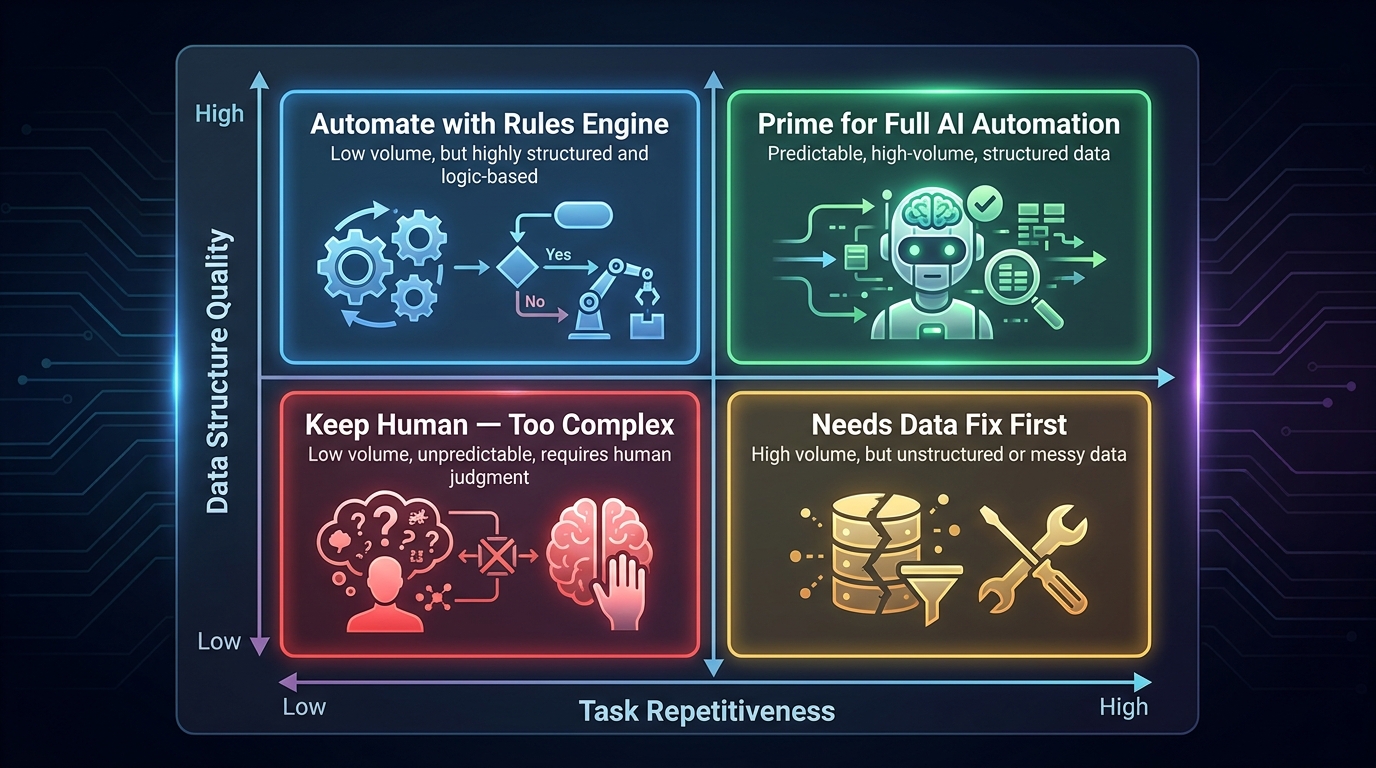
    Plotting processes on these two axes produces a rough four-quadrant map that most operations and automation leaders will immediately recognise from their own portfolios:

    • Low variability + structured inputs (bottom-left): Classic RPA territory. Invoice processing, payroll calculations, data migration between systems, scheduled report generation. These processes don’t need agents. They need well-maintained bots and stable APIs. Introducing agentic complexity here adds cost and risk with no benefit.
    • High variability + unstructured inputs (top-right): Agentic AI’s natural domain. Contract review, customer escalation handling, procurement exception management, research and synthesis tasks, cross-system reconciliation with missing data. Bots fail here reliably. Agents can operate here — with the right guardrails.
    • Low variability + unstructured inputs (top-left): A common hybrid zone. The process path is predictable, but the inputs require interpretation — think document extraction feeding a fixed approval workflow. An AI pre-processor (classifier or extractor) feeding a static bot is often the right solution here.
    • High variability + structured inputs (bottom-right): Another hybrid zone. Inputs are clean but the decision logic is complex and context-dependent — think dynamic pricing approval or regulatory compliance routing. An orchestration agent making routing decisions, handing execution to deterministic bots per path, often wins here.

    The uncomfortable insight from this framework is that most large enterprises have concentrated the majority of their bot estate in the bottom-left quadrant — and parked their hardest operational problems in the top-right, managing them with humans. Agentic AI opens the top-right quadrant for automation. That is where the real productivity opportunity lives.

    Three Classes of Work and Which Approach Fits Each

    Beyond the two-axis model, it helps to think in terms of three fundamental classes of enterprise work — each of which has a distinct automation fit profile in 2026.

    Class 1: Execution Work

    Execution work is deterministic, repeatable, and fully specifiable in advance. It has a known input format, a defined logical path, and a predictable output. Examples: transferring data between two systems on a schedule, generating a standard report, updating a record when a trigger fires, sending a notification when a threshold is crossed.

    The right tool for execution work is still, overwhelmingly, static automation — whether that’s RPA, a workflow automation platform, a scheduled script, or an API integration. Adding an AI layer here is engineering complexity with no upside. The work is already being done correctly and cheaply. Don’t touch it.

    Class 2: Interpretation Work

    Interpretation work requires understanding inputs that don’t come in a standardised format. Reading a contract and extracting key terms. Classifying inbound customer emails by intent and urgency. Parsing a vendor proposal and comparing it against internal criteria. Summarising a long document thread into a decision brief.

    This is where AI augmentation of static workflows often pays off first. An LLM-powered extraction or classification step converts unstructured input into structured data — then a static bot or simple workflow handles the rest. The AI does interpretation; the deterministic logic handles execution. This class of work has the fastest, most predictable ROI in the current wave of enterprise AI adoption, because it solves a real bottleneck without requiring full agentic autonomy.

    Class 3: Judgment Work

    Judgment work involves ambiguous goals, incomplete information, multi-step reasoning, and action sequences where the right path can’t be fully specified in advance. Customer dispute resolution. Procurement exception handling. Incident triage and response. Strategic research and synthesis. These are processes where experienced humans make calls that can’t be reduced to rules without losing too much nuance to be useful.

    This is where genuine agentic AI starts to show its value — not by replacing human judgment wholesale, but by operating semi-autonomously on the clear cases while escalating the genuinely ambiguous ones to humans, with full context prepared. A well-designed agent in this space can handle 60–75% of cases end-to-end at current maturity levels, with that number improving as models and tooling improve. For high-volume judgment work, that number represents enormous operational leverage.

    The Hybrid Architecture Nobody Shows You in the Vendor Decks

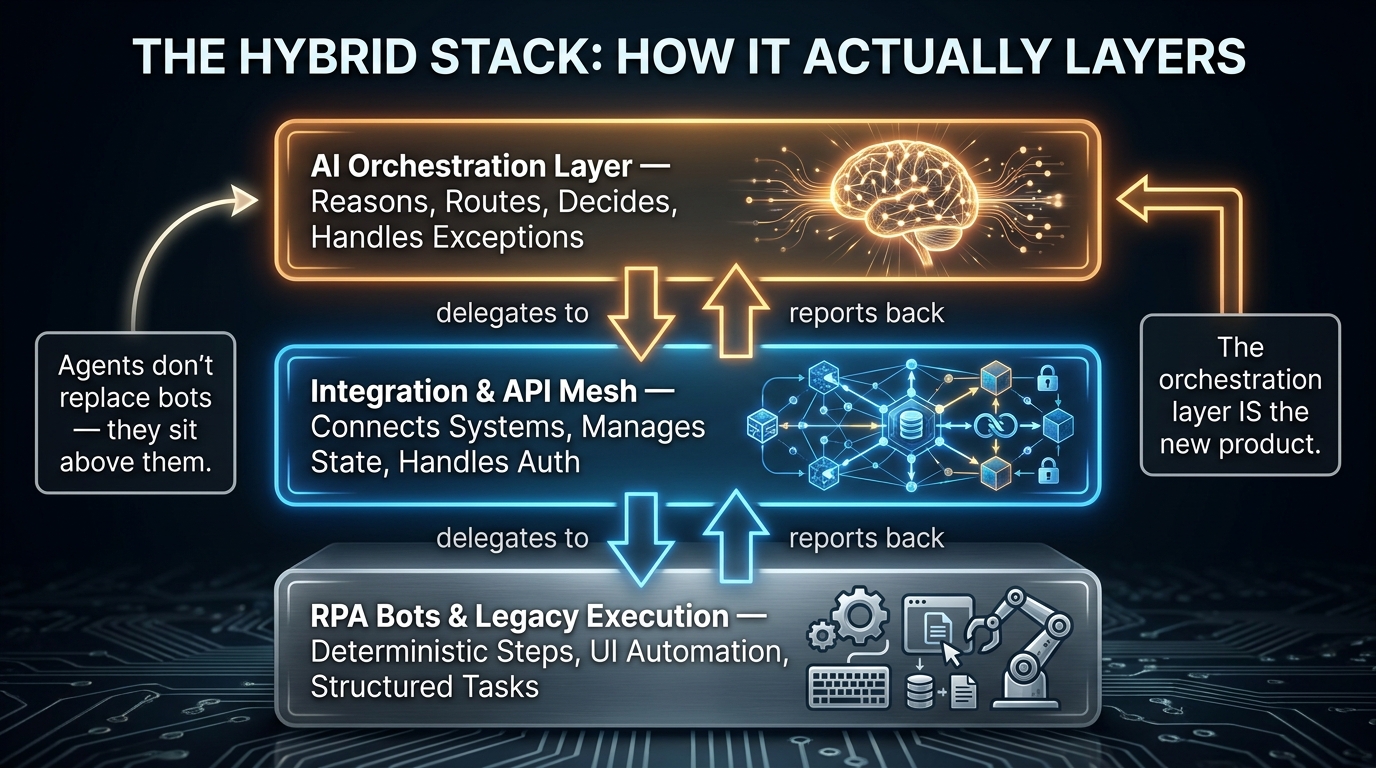
    Three-tier hybrid architecture diagram showing AI Orchestration Layer on top reasoning and routing, Integration and API Mesh in the middle, and RPA Bots and Legacy Execution at the bottom — agents sit above bots, they don't replace them

    The vendor narrative tends toward a clean before/after: you had bots, now you have agents, life is better. The actual architecture emerging in mature enterprise deployments is considerably more layered — and considerably more useful once you understand it.

    The pattern that is quietly becoming the default for complex workflows is a three-tier automation stack. Each tier has distinct responsibilities and distinct technology fits.

    Tier 1: The AI Orchestration Layer

    At the top sits the intelligence layer. This is where agentic AI operates: perceiving incoming work, interpreting context, planning action sequences, routing to the appropriate execution resources, handling exceptions, and deciding when to escalate to humans. The orchestration layer is not executing individual steps — it’s coordinating them. It understands the goal and adapts the path to reach it.

    In 2026 architectures, this layer is typically built on foundation model APIs (GPT-4o, Claude, Gemini, or enterprise-deployed open models) with an orchestration framework managing tool calls, memory, and multi-agent coordination. LangChain, LlamaIndex, Microsoft AutoGen, and proprietary vendor platforms like Salesforce Agentforce and ServiceNow AI Agents are all operating at this layer.

    The orchestration layer is increasingly described by practitioners as the new product layer — the place where business logic lives in a form that’s readable, auditable, and adaptable, rather than buried in hard-coded bot scripts that only the original developer fully understands.

    Tier 2: The Integration and API Mesh

    The middle tier is the connective tissue: the integration layer that manages authentication, state, data transformation, and routing between the orchestration layer and the execution systems below it. This is where iPaaS platforms (MuleSoft, Boomi, Workato) and API management infrastructure sit.

    The integration layer is often the unglamorous blocker that limits how much the orchestration layer can actually do. An agent can only act on systems it has clean API access to. Where APIs don’t exist — in legacy systems, on-premises platforms, or vendor tools that never opened their interfaces — you’re dependent on the execution layer to bridge the gap.

    Tier 3: RPA Bots and Legacy Execution

    At the bottom of the stack, doing what they have always done well, are RPA bots and other deterministic execution tools. In the hybrid architecture, these are not competitors to agentic AI — they are the execution arm that the orchestration layer delegates to when the target system requires UI automation or when the task is fully structured and the path is known.

    This is the insight that most vendor decks bury: agents don’t replace bots; they instruct them. A well-designed hybrid system uses the agent to decide what needs to happen, the integration layer to route the instruction, and the RPA bot to carry out the action against a legacy system that still doesn’t have a clean API.

    Why the Layering Matters for Investment Decisions

    Understanding this three-tier model changes the investment calculus significantly. Organisations that have invested heavily in RPA don’t necessarily need to write that off. If the bots are running stable, structured execution tasks, they may well have a long life ahead of them in the execution tier. What the organisation needs to add is the intelligence layer above them — along with the governance infrastructure to manage the whole stack safely.

    The question to ask is not “should I retire my bots?” but “do my bots have clean enough interfaces to receive instructions from an orchestration layer, and do I have the observability tools to supervise the full stack end-to-end?”

    The New Failure Modes That Replace the Old Ones

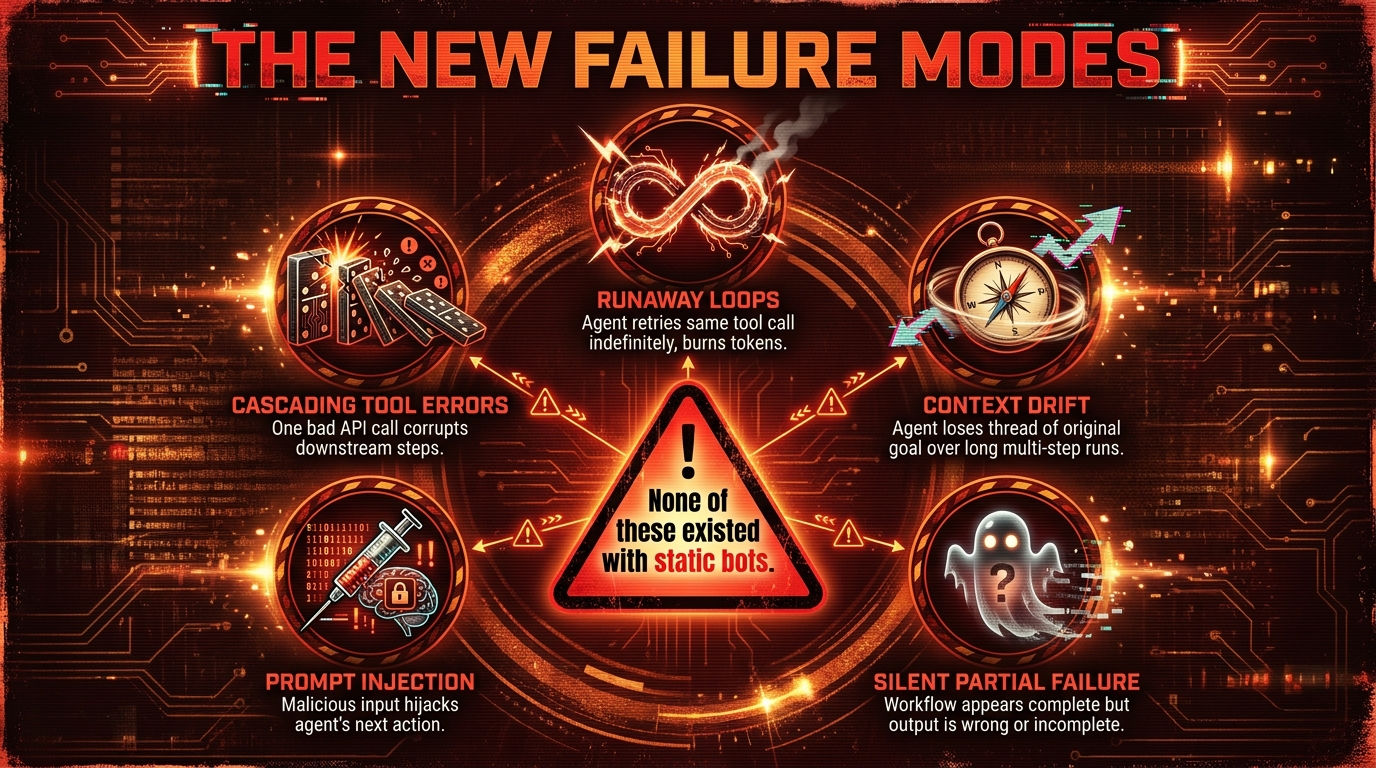
    Warning diagram showing five new agentic AI failure modes: Runaway Loops, Context Drift, Silent Partial Failure, Prompt Injection, and Cascading Tool Errors — none of which existed with static bots

    Static bots have well-understood failure modes. They halt when inputs deviate from the expected format. They produce incorrect outputs when rules are applied to edge cases they weren’t designed for. They break when source system UIs change. These failures are annoying but visible — they tend to generate loud errors, empty output files, or human escalations. You know something went wrong.

    Agentic AI introduces a different class of failure modes, and the most dangerous ones are the ones that don’t announce themselves. Every operations or technology leader deploying agents in 2026 needs to understand these failure modes before they encounter them in production.

    Runaway Loops and Retry Storms

    An agentic system that encounters an obstacle — an API that returns an ambiguous response, a tool call that fails with a retryable error, a step that produces an output the model isn’t sure is correct — may decide to try again. And again. And again. Without explicit termination conditions and token budgets built into the orchestration layer, an agent can consume enormous compute resources, rack up substantial API costs, and still produce no useful output. The technical term is a “retry storm.” In practice, it looks like an agent that ran for six hours and spent $340 in API calls to do nothing.

    Context Drift in Long Multi-Step Runs

    Large language models have finite context windows, and even with extended context lengths, they can lose coherence over very long runs. In a multi-step workflow where the agent is managing dozens of tool calls and keeping track of intermediate results across a complex process, the model can begin to lose the thread of its original goal. It may start optimising for a proxy of the goal rather than the goal itself. It may begin treating intermediate results as final outcomes. The workflow “completes” but the output is wrong in ways that are subtle enough to pass casual review.

    Silent Partial Failures

    One of the most operationally dangerous failure modes is a workflow that appears to complete successfully but has actually failed partway through. An agent updating records across three systems might successfully update two and fail on the third — but report overall success because its tool call returned a 200 status code from a system that silently queued the update rather than executing it. Unlike a static bot that fails loudly when a step doesn’t complete, an agent may evaluate a partial state as “good enough” and move on. The downstream consequences don’t surface until much later.

    Prompt Injection and Tool Misuse

    Because agentic systems act on instructions derived from their inputs, they are vulnerable to a class of attack that static bots are not: prompt injection. A malicious or accidental payload embedded in an input document — an email, a web page the agent browses, a document it reads — can cause the agent to execute unintended actions. The attacker doesn’t need code execution access to the system. They just need to get the right text in front of the agent’s context window.

    Tool misuse is a closely related failure mode: the agent calls a tool with incorrect parameters, misidentifying what the tool does or passing the wrong arguments. In a system with broad tool permissions, this can have significant consequences — sending emails to the wrong recipients, updating records with incorrect data, or initiating transactions that weren’t intended.

    Cascading Tool-Call Errors

    In a multi-step workflow, each tool call depends on the outputs of previous ones. An error at step three — even a subtle one, like a slightly malformed data structure — can propagate through the rest of the workflow, corrupting every downstream step. Unlike a static bot where you can replay from a known checkpoint, an agentic workflow may not have clean rollback semantics. Undoing cascaded errors across multiple systems can be significantly harder than fixing a single failed step.

    The Governance Implication

    All of these failure modes have a common thread: they require observability infrastructure that didn’t exist in most RPA deployments. You need complete, structured logs of every tool call, every intermediate output, every decision the agent made and why. You need alerting on runaway cost and latency. You need idempotency and rollback mechanisms for irreversible actions. You need sandboxed permissions that limit what tools an agent can call and what data it can access. And you need eval frameworks that continuously test agent behaviour against expected outputs in your specific process context.

    Without this infrastructure, deploying agentic AI in production is not brave — it’s negligent.

    Measuring What Actually Matters in Agentic Workflows

    One of the places enterprise agentic AI deployments go wrong is measurement. Teams apply the metrics they used for RPA (automation rate, process cycle time, cost per transaction) to agentic systems and get confusing results that don’t capture the real performance picture. Agentic workflows need a different measurement framework.

    The Metrics That Matter

    Task completion rate (end-to-end). What percentage of initiated workflows reach a successful end state without human intervention? This is the top-line metric. Mature agentic deployments in enterprise settings are targeting 90%+ task completion rates. Early-stage deployments typically see 60–75%. Below 60% suggests the process scope is too broad for current agent capability, or the observability and error handling are insufficient to catch and recover from failures.

    Human intervention rate (by type). When the system does require human help, why? There is a critical difference between a human intervention that handles a genuinely novel edge case (healthy — this is the expected escalation path) and one that’s correcting an agent error (unhealthy — this is a system quality signal). Tracking intervention by type tells you whether your automation rate is improving because your process is actually getting more autonomous, or because you’re silently excluding hard cases from the agent’s scope.

    Tool-call correctness rate. What percentage of tool calls produce the expected output with the correct parameters? This is the agent’s equivalent of step accuracy in an RPA bot. A low tool-call correctness rate usually points to either model capability limits, poor tool documentation in the system prompt, or ambiguous context in the inputs.

    Hallucination and plan-adherence rate. Does the agent follow its intended reasoning path, or does it take unexpected detours? This is harder to measure but critical for compliance-sensitive workflows. You need eval datasets that represent your actual process scenarios — not generic benchmarks — to get meaningful read on this.

    Cost per completed workflow. Unlike RPA bots, which have relatively flat marginal costs once deployed, agentic workflows have variable costs driven by model inference, tool call frequency, and compute. A workflow that costs $0.80 per completed case in month one may cost $0.40 in month three as prompt engineering improves — or $2.20 if the agent starts spawning unnecessary sub-tasks. Track this carefully alongside task completion rate. An agent that achieves 92% task completion at $4.00 per case may be less economically attractive than one that achieves 85% at $0.60.

    The Metric You Should Stop Using

    Stop reporting raw automation rate as though it means what it used to mean. An automation rate that excludes all the cases that were quietly routed to humans before the agent even saw them is not an automation rate — it’s a cherry-picking rate. Report end-to-end task completion rate against the full intended process scope. That number will be lower and more honest, and it will tell you where your agent actually needs more work.

    The Bot Estate Audit: How to Map What You Have Against What’s Coming

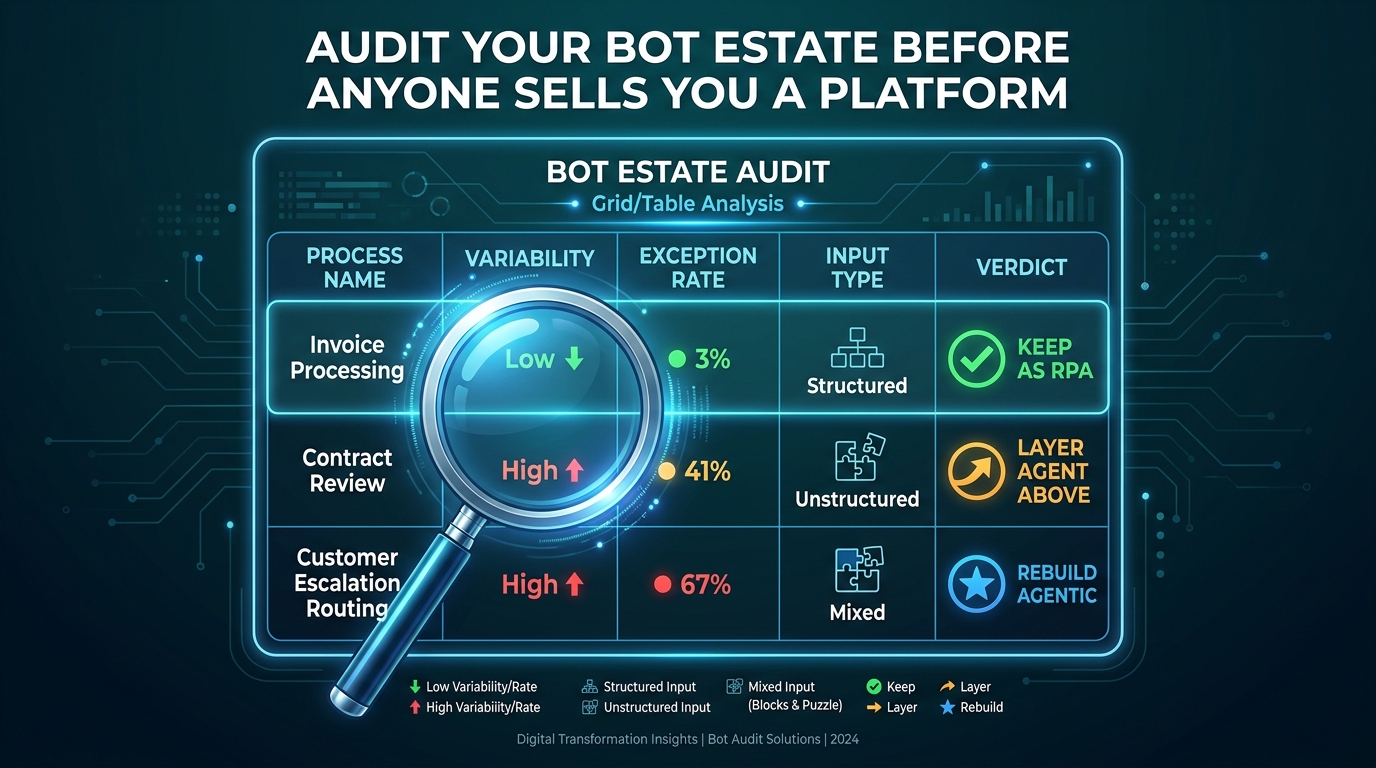
    Bot estate audit grid showing three example processes — Invoice Processing kept as RPA, Contract Review with agent layered above, Customer Escalation Routing rebuilt as agentic — with columns for variability, exception rate, input type, and verdict

    Before any organisation can make rational decisions about where agentic AI fits in their automation architecture, they need a clear picture of what they actually have. Most enterprises with more than two years of RPA deployment have a bot estate that evolved faster than it was documented — a mix of well-maintained production bots, half-finished pilots, legacy automations nobody wants to touch, and processes that were automated once and never revisited.

    A structured bot estate audit is the foundation for making sound architectural decisions rather than reactive purchases.

    Step 1: Inventory Every Automated Process

    Create a complete register of every automated process in the estate. For each, capture: the business process it serves, the systems it touches, the volume of transactions it handles per month, who owns it operationally, when it was last updated, and what happens when it fails. This step alone often surfaces bots that have been quietly broken for months, automations running at a fraction of their original volume, and processes nobody can explain anymore because the person who built them left two years ago.

    Step 2: Score Each Process on the Two Axes

    For each process in the register, score it on the two dimensions from the decision surface model: process variability (1–5, where 1 is entirely deterministic and 5 is highly variable) and input structure (1–5, where 1 is fully structured and 5 is entirely unstructured). Add a third score: current exception rate — the percentage of cases that require human intervention. This is usually the most revealing number in the whole exercise, because it is the direct measure of where the existing automation is actually failing.

    Step 3: Classify Each Process Into One of Four Verdicts

    Using the scores from Step 2, assign each process one of four verdicts:

    • KEEP AS-IS: Low variability, structured inputs, exception rate below 5%. These bots are working. They need maintenance, not reinvention. Don’t introduce AI complexity to a process that doesn’t need it.
    • ADD AI PRE-PROCESSING: Low-to-medium variability, unstructured or mixed inputs, exception rate between 5–20%. The process logic is sound but the front-end interpretation is failing. Add an AI classification or extraction step upstream; keep the downstream bot logic. Fastest ROI class in the current environment.
    • LAYER ORCHESTRATION AGENT ABOVE: Medium-to-high variability, mixed inputs, exception rate between 20–50%. The process needs dynamic routing and context-aware decision-making, but still has deterministic execution steps that RPA handles well. Build an orchestration agent that delegates to existing bots for structured execution. Don’t rebuild from scratch — layer intelligence on top.
    • REBUILD AGENTIC: High variability, unstructured inputs, exception rate above 50%. The existing automation is not working at a useful level. The process requires end-to-end agentic handling. Retire the bot, design the process for agentic execution, and build with governance and observability from day one.

    Step 4: Prioritise by Value at Stake

    Not every process in the “REBUILD AGENTIC” or “LAYER ORCHESTRATION” categories should be addressed at once. Prioritise by multiplying the monthly transaction volume by the current exception rate by the cost per human-handled exception. This gives you a rough dollar value of the automation gap — the money being spent on human handling of cases that should be automated. Build your roadmap around closing the highest-value gaps first.

    Step 5: Assess Integration Readiness

    For every process selected for agentic migration, assess whether the systems it touches have APIs that an agent can call. No APIs means the integration tier needs to be built before the orchestration layer can function — a significant cost that must be factored into the business case. Many organisations discover during this step that their biggest agentic opportunities are locked behind legacy systems with no API surface. That doesn’t kill the project, but it redefines the implementation sequence.

    The Workforce Recomposition Nobody Is Talking About Honestly

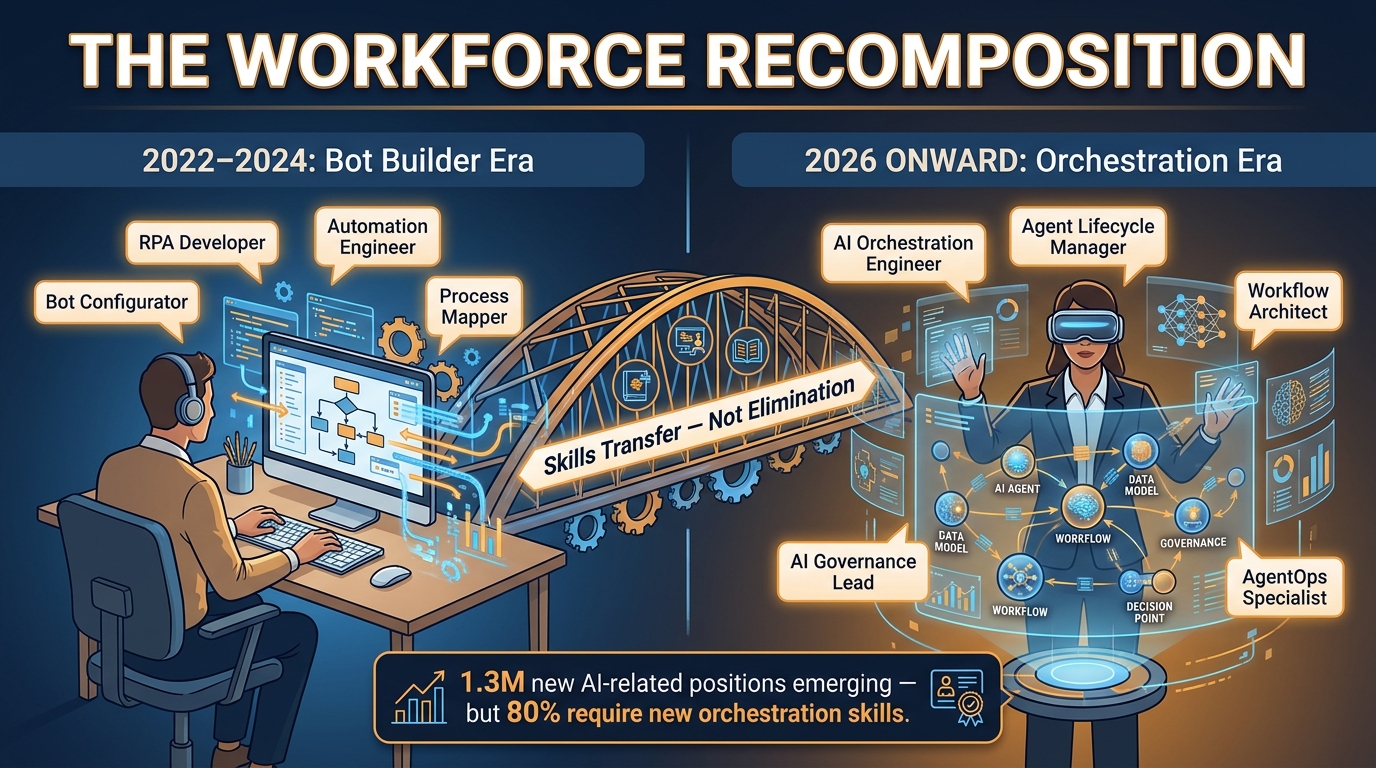
    Split illustration showing the Bot Builder Era from 2022 to 2024 with RPA Developer and Automation Engineer roles on the left, and the Orchestration Era from 2026 onward with AI Orchestration Engineer, Agent Lifecycle Manager, and AI Governance Lead roles on the right, connected by a bridge labeled Skills Transfer Not Elimination

    No discussion of agentic AI replacing static bots is complete without addressing the workforce dimension — and most public discourse on this topic sits at one of two unhelpful extremes. Either it’s breathless job-loss projections that treat every automation advance as a direct headcount reduction, or it’s reassuring “humans will always be needed” talking points that ignore the real reshaping that’s underway.

    The honest picture in 2026 is more nuanced than either narrative — and it has concrete implications for technology leaders managing both technical and human capital.

    What Is Actually Being Compressed

    The work categories most directly affected by agentic AI are the ones that sit at the intersection of interpretation and routing — the cognitive labour that has been too ambiguous to automate with bots but too repetitive to be a growth career. Customer service triage, document processing review, first-line compliance checking, basic research and data synthesis, and junior process analysis roles are all seeing meaningful pressure as agents improve at handling Class 2 and Class 3 work.

    Within technology teams, routine bot-building work is compressing. The work of creating a simple RPA automation — mapping the process, configuring the tool, testing the steps — is increasingly being absorbed into lower-code platforms and AI-assisted development tools. The “junior automation developer” role that was thriving in 2021–2023 is under genuine pressure in 2026.

    What Is Growing

    The demand picture on the other side of this transition is genuinely strong, but it requires different skills. The fastest-growing role categories in automation in 2026 are:

    • AI Orchestration Engineers: People who design and maintain multi-agent systems, manage tool call architecture, handle memory and state, and build the orchestration layer that sits above existing automation. This requires depth in both AI systems and enterprise integration — a combination that is genuinely scarce.
    • Agent Lifecycle Managers: Practitioners responsible for the ongoing health of agentic systems in production — monitoring performance, managing model updates, running continuous evaluations, handling failure mode analysis, and managing the escalation paths between agents and humans.
    • AI Governance Leads: Specialists managing the policy, audit, compliance, and risk dimensions of autonomous AI systems. As agents gain more action capability and broader system access, governance is not a nice-to-have — it’s a regulatory requirement in a growing number of jurisdictions.
    • Workflow Architects: Generalists who can map business processes against the three-tier automation stack, identify the right combination of static and agentic components for each workflow, and design systems that humans can actually oversee and trust.

    The Skills Transfer Problem

    The uncomfortable gap in this picture is that the skills being compressed (configuring RPA tools, mapping linear workflows, managing bot scripts) do not translate directly into the skills that are growing (AI orchestration, agent observability, governance architecture). The tooling is different. The mental models are different. The debugging approaches are different.

    For organisations managing large automation teams, this means that a reskilling investment — not just a rebranding of job titles — is required to retain the institutional process knowledge that experienced automation practitioners carry while building the new technical capabilities the agentic layer demands. The organisations getting this right are running structured reskilling programmes alongside their agentic AI deployments, not waiting until the workforce gap becomes a delivery problem.

    What Gets Retired, What Gets Layered, and What Gets Rebuilt

    Grounding all of this in practical decision-making: when faced with a specific automation in your estate, the question is always which of three paths it should take. Each has a different cost profile, risk profile, and timeline.

    What Gets Retired

    Bots that should be retired are those that are failing to deliver useful automation (exception rate above 50%), touching processes that have been redesigned since the bot was built, running on systems that are being decommissioned, or serving a business need that no longer exists at the same scale. Retiring a bot is not a failure — it is recognising that the automation was either wrong for the process or has reached the end of its useful life.

    The trap is keeping failing bots running because decommissioning feels like admitting a sunk cost. Bad bots that generate constant exceptions, require regular human intervention, and sit on technical debt are not “something” compared to “nothing.” They are an active cost, a support burden, and often a source of subtle data quality problems in downstream systems.

    What Gets Layered

    The largest category in most mature bot estates is processes where the execution logic is sound but the intelligence layer is missing. These processes should neither be retired nor fully rebuilt — they should have an orchestration or AI pre-processing layer added above them. This is the fastest route to value in most organisations because it preserves sunk investment in working bot logic while adding the judgment capability that closes the exception gap.

    Layering requires clean interfaces between the new intelligence layer and the existing bots. If your existing bots are black-box scripts with no structured input/output contracts, you’ll need to add that interface work before you can layer effectively. Budget for it — it’s typically 20–40% of the total implementation effort but it’s foundational.

    What Gets Rebuilt

    Processes with high variability, unstructured inputs, and exception rates that make the existing automation economically useless should be rebuilt from scratch using an agentic design. Rebuilding is the highest-cost option in the short term, but it is also the option that creates the most durable value — because an agentic system designed from the ground up for the process it serves will outperform a retrofitted hybrid in both capability and maintainability.

    Rebuilding decisions should be paired with a serious conversation about process scope. The temptation when designing an agentic system is to give it a broad remit — handle everything. The better approach is to define tight boundaries for the initial deployment (bounded autonomy at Level 2 or 3), demonstrate performance on that scope, and expand incrementally as the system earns trust and as observability confirms it is behaving correctly.

    The Real Transition: Not a Swap, a Re-Architecture

    The frame of “agentic AI replacing static workflow bots” is not wrong — but it is incomplete in ways that lead to bad decisions. It implies a substitution: one thing in, another thing out. The actual transition is more demanding and more rewarding than that. It is a re-architecture of the entire automation stack, from the execution layer through to the intelligence layer, with a new governance and observability infrastructure running through all of it.

    Gartner’s projection that 40% of enterprise applications will embed task-specific AI agents by the end of 2026 — up from under 5% at the start of 2025 — is not a prediction that 40% of existing bots will be retired. It is a prediction that intelligence will be woven into processes that previously ran on deterministic logic alone. Most of the time, the bot underneath will still be there, executing structured steps. What changes is the layer above it.

    The Organisations Getting This Right

    The common thread among organisations that are successfully navigating this transition is not that they picked the right vendor or the best foundation model. It is that they did the structural thinking first. They audited their process estate. They classified work by type rather than by system. They built the observability infrastructure before they needed it. They designed governance and escalation paths into their agentic systems at the architecture stage rather than bolting them on after a production incident.

    They also resisted the pressure to frame this as a bot-versus-agent binary. The most capable teams are running RPA bots, AI pre-processors, orchestration agents, and human-in-the-loop workflows within the same operational stack — choosing the right tool for each layer of each process, rather than standardising on one paradigm because the vendor relationship is comfortable or the technology is new and exciting.

    The Timeline Is Not Linear

    One final reality check: this transition is not on a smooth curve. Current agentic AI systems are genuinely capable in certain bounded domains and genuinely unreliable in others. Task completion rates of 60–75% for general-purpose agents across complex enterprise workflows means 25–40% of cases still need human handling. That’s not good enough for mission-critical processes with low tolerance for error.

    The implication is that the transition from static bots to agentic systems will proceed at different speeds for different process classes. Interpretation work with a deterministic execution back-end is ready for AI augmentation today, at scale. Fully autonomous judgment work across critical business processes will take longer — and should take longer. The organisations trying to compress this timeline by giving agents too much autonomy too fast are the ones generating the governance incidents that slow adoption across the whole industry.

    Build for bounded autonomy now. Build the observability. Build the evaluation frameworks. Expand the autonomy as performance data justifies it. That is not a cautious strategy — it is the strategy that produces durable, compounding value rather than a pilot that looked great and then failed in production three months later.

    Key Takeaways: Making Practical Decisions in 2026

    If you are responsible for an organisation’s automation architecture in 2026, here are the decisions that will define your outcomes over the next 18 months:

    1. Do the bot estate audit before you buy anything. Map every automated process against the variability and input-structure axes. Score exception rates. Classify into the four verdict categories. That exercise will save you from both the mistake of retiring working bots and the mistake of defending broken ones with new technology labels.
    2. Distinguish between the three classes of work. Execution work stays with deterministic automation. Interpretation work gets an AI pre-processing layer. Judgment work gets an agentic architecture. Don’t apply the same solution to all three.
    3. Adopt the three-tier stack as your mental model. Orchestration layer, integration mesh, execution bots. Design the interfaces between the tiers. Invest in the integration layer — it is the most underestimated cost and the most common blocker.
    4. Build observability before you build autonomy. You cannot govern what you cannot see. Complete tool-call logging, cost monitoring, intervention rate tracking, and eval frameworks must be in place before you expand agent scope in production.
    5. Understand the new failure modes and design against them. Runaway loops, context drift, silent partial failures, prompt injection, and cascading tool errors are all preventable with the right architectural choices. Design for them; don’t discover them in production.
    6. Run the workforce recomposition as a skills programme, not a headcount calculation. The institutional process knowledge that experienced automation practitioners carry is genuinely valuable. The organisations that win this transition will invest in translating that knowledge into the new paradigm rather than treating the transition as a reduction opportunity.
    7. Measure end-to-end task completion rate, not automation rate. The difference between these two numbers is the size of the gap you’re not admitting to yourself. Close that gap, and you’ll know exactly where your agentic investment needs to go.

    The automation era isn’t ending. It’s expanding — into territory that was previously too ambiguous, too variable, and too judgment-dependent to automate at all. The organisations that approach that expansion with structural clarity will build automation stacks that compound in value over time. Those that approach it as a technology replacement cycle will spend the next three years rebuilding pilots that didn’t survive production — and wondering why their competitors keep pulling ahead.

  • When Bots Break: The Real Economics of Replacing Static Workflow Automation with Agentic AI

    When Bots Break: The Real Economics of Replacing Static Workflow Automation with Agentic AI

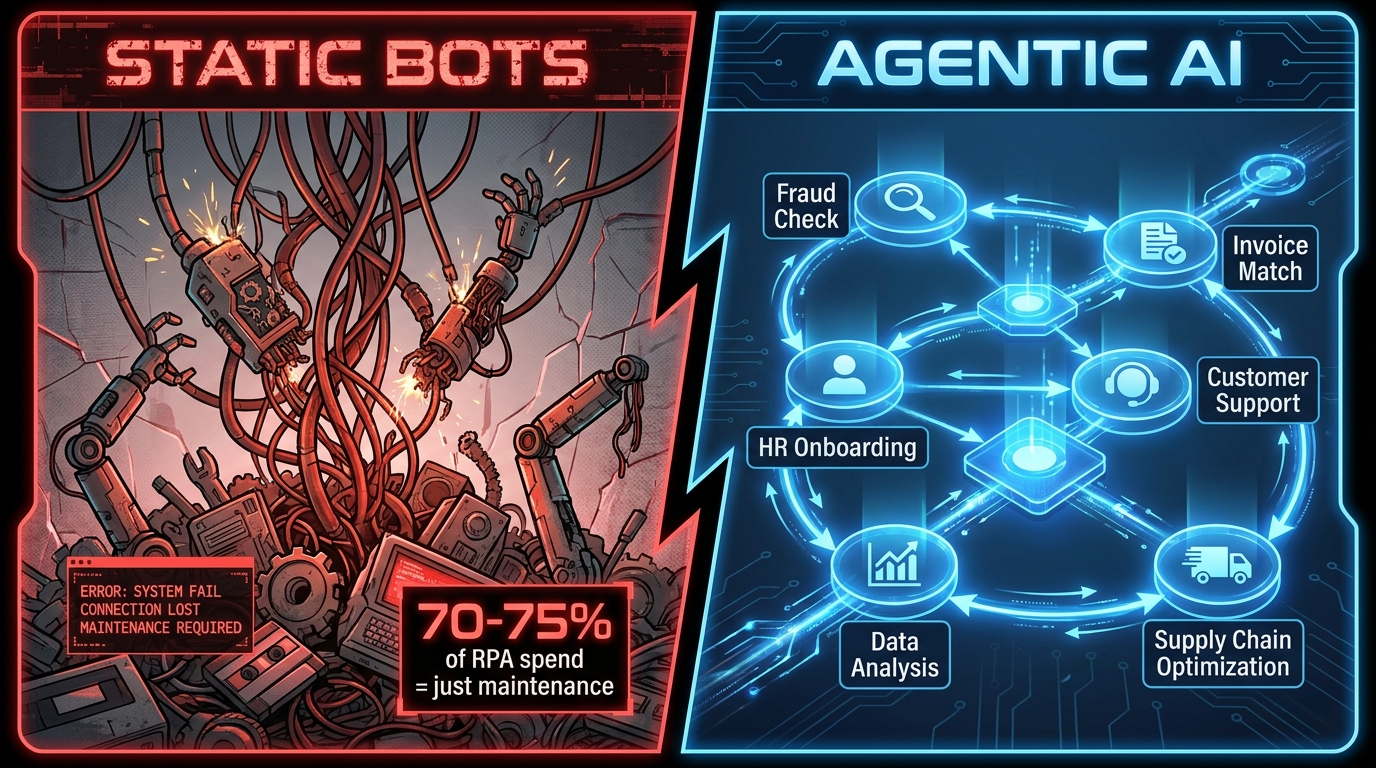
    Split scene showing broken static RPA bots on the left versus a connected agentic AI network on the right, illustrating the shift from brittle automation to intelligent agents

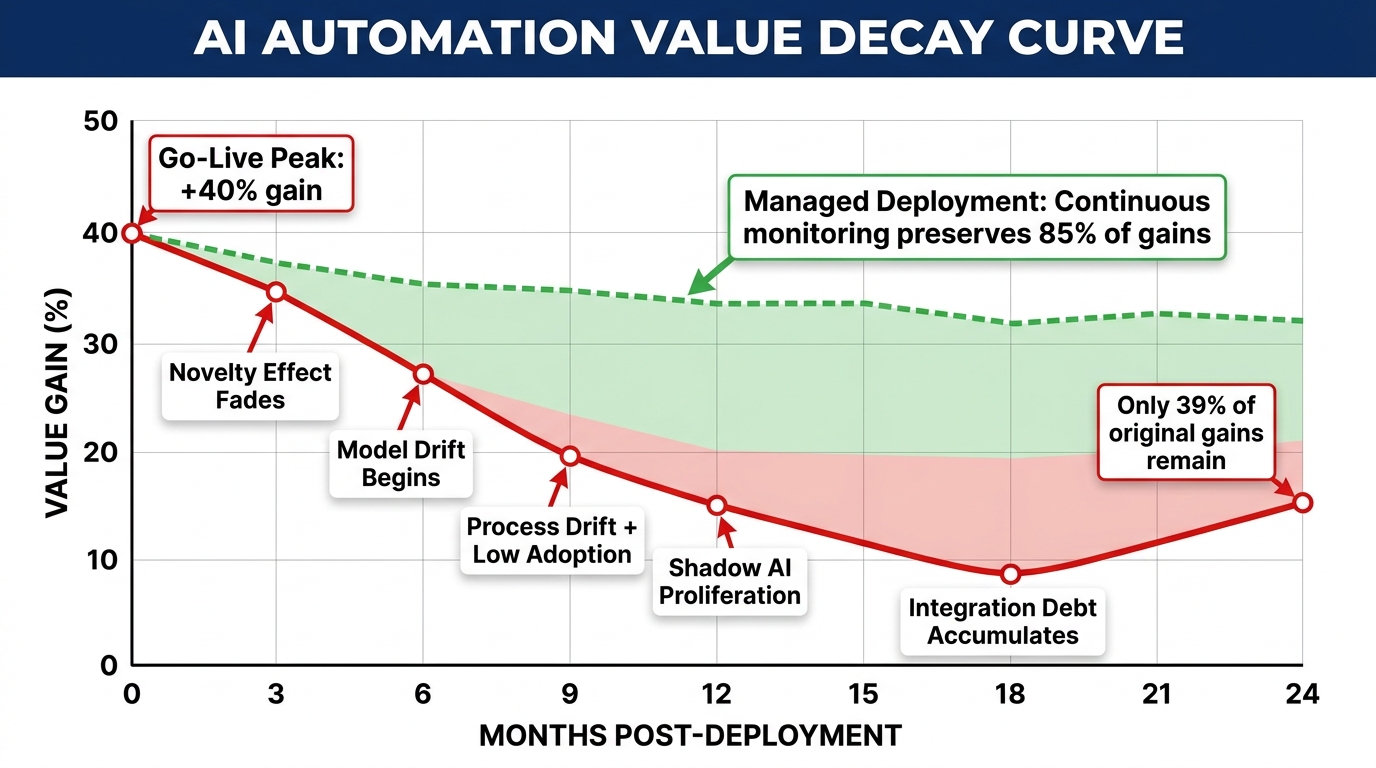
    Somewhere in your organization, there is probably a bot that nobody talks about anymore. It was built two years ago to handle a specific process — invoice matching, maybe, or new-hire account provisioning. It worked for about eight months. Then a vendor upgraded their portal, a browser extension changed, or someone restructured a spreadsheet column, and the bot quietly started failing.

    Now it lives on a server that three different teams claim ownership of, costs a developer four hours a month to patch, and handles maybe 60% of what it was originally designed to do. The remaining 40% gets kicked to a human queue that never quite empties.

    This is not a technology failure story. It is an economics story — and the economics of static workflow automation are quietly collapsing under the weight of their own maintenance burden. Enterprises built RPA estates on the assumption that “automate once, benefit forever” was a realistic proposition. It rarely is. What most organizations actually built was a fleet of fragile scripts that require constant tending just to maintain the status quo.

    Agentic AI is entering this space not as a flashy upgrade but as a structural solution to a problem that the industry has been reluctant to name clearly: static bots are not a solved problem. They are a recurring cost center dressed up as a capital investment. The question for 2026 is not whether agentic AI is better in a demo. The question is whether the transition economics actually work — and for which workflows, in what order, with what governance in place.

    This article breaks down the real cost of the bot status quo, explains what makes agentic architectures structurally different, and lays out the transition strategy that separates the 23% of enterprises successfully scaling agents from the majority still running on brittle scripts.

    The Bot Graveyard: Why RPA Promised More Than It Could Deliver

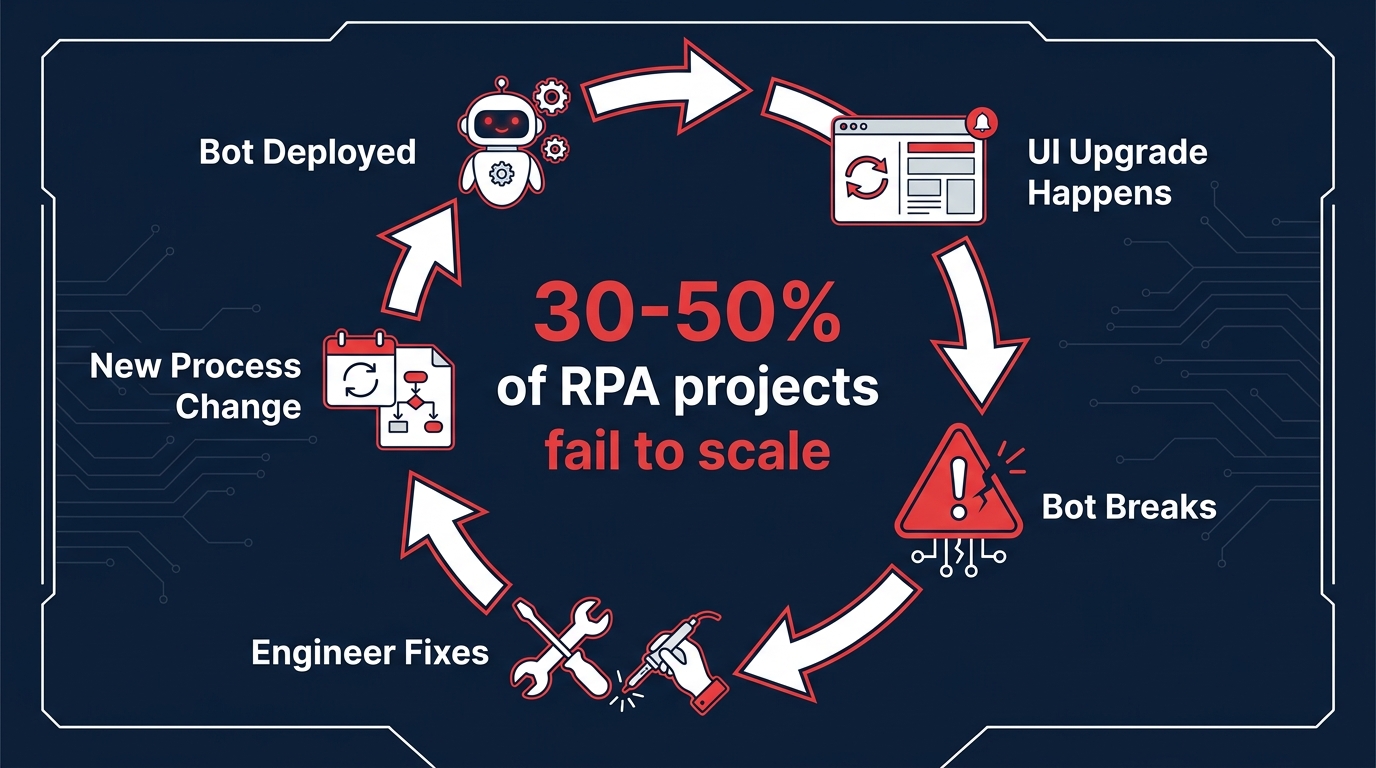
    Circular diagram showing the failure cycle of a static RPA bot: deployed, UI changes, bot breaks, engineer fixes, repeat — with stat showing 30-50% of RPA projects fail to scale

    Robotic Process Automation arrived in enterprise technology circles with a compelling pitch: mimic human keystrokes and mouse movements to automate rule-based tasks, without needing to integrate directly with underlying systems. No API required. No custom development. Just record the steps and let the bot run.

    For a certain category of task, it worked. Copying data between legacy systems that lacked APIs, running end-of-month reconciliations on fixed formats, generating standard reports from predictable data sources — these were genuine wins, and many organizations correctly captured ROI from them.

    But the assumption embedded in the RPA model was quietly catastrophic: that the processes being automated would stay stable. They almost never do.

    The Three Failure Modes That Eat RPA Estates Alive

    UI dependency. Traditional RPA bots operate by interacting with screen elements — buttons, fields, dropdown menus — identified by their position, label, or selector. When the application is updated, rebranded, or restructured, the bot can no longer find what it is looking for. This is not an edge case. It is a near-certainty over any 12-to-18-month horizon, and it means every application upgrade on every system your bots touch generates a wave of break-fix work.

    Exception intolerance. Static bots follow predetermined decision trees. When reality deviates from the expected path — an invoice arrives in a non-standard format, a field is missing, an approval is pending from someone out of office — the bot has no mechanism to adapt. It either fails silently, errors out, or, in the worst case, processes the exception incorrectly. The resulting human exception queues often grow larger than the process the bot was supposed to eliminate.

    Unstructured data blindness. The majority of enterprise information does not arrive in neat, structured formats. Emails, PDFs, scanned documents, free-text fields, voice memos — these are the connective tissue of real business processes. Traditional RPA has almost no ability to interpret unstructured content without pairing it with additional OCR or NLP tools, and even then, the integration is brittle and version-sensitive.

    The Scale of the Problem

    The failure statistics are not soft industry rumors. Research consistently puts the share of RPA projects that fail to scale or are abandoned within approximately two years at 30 to 50 percent. That is a remarkably high failure rate for technology that has been positioned as proven and mature.

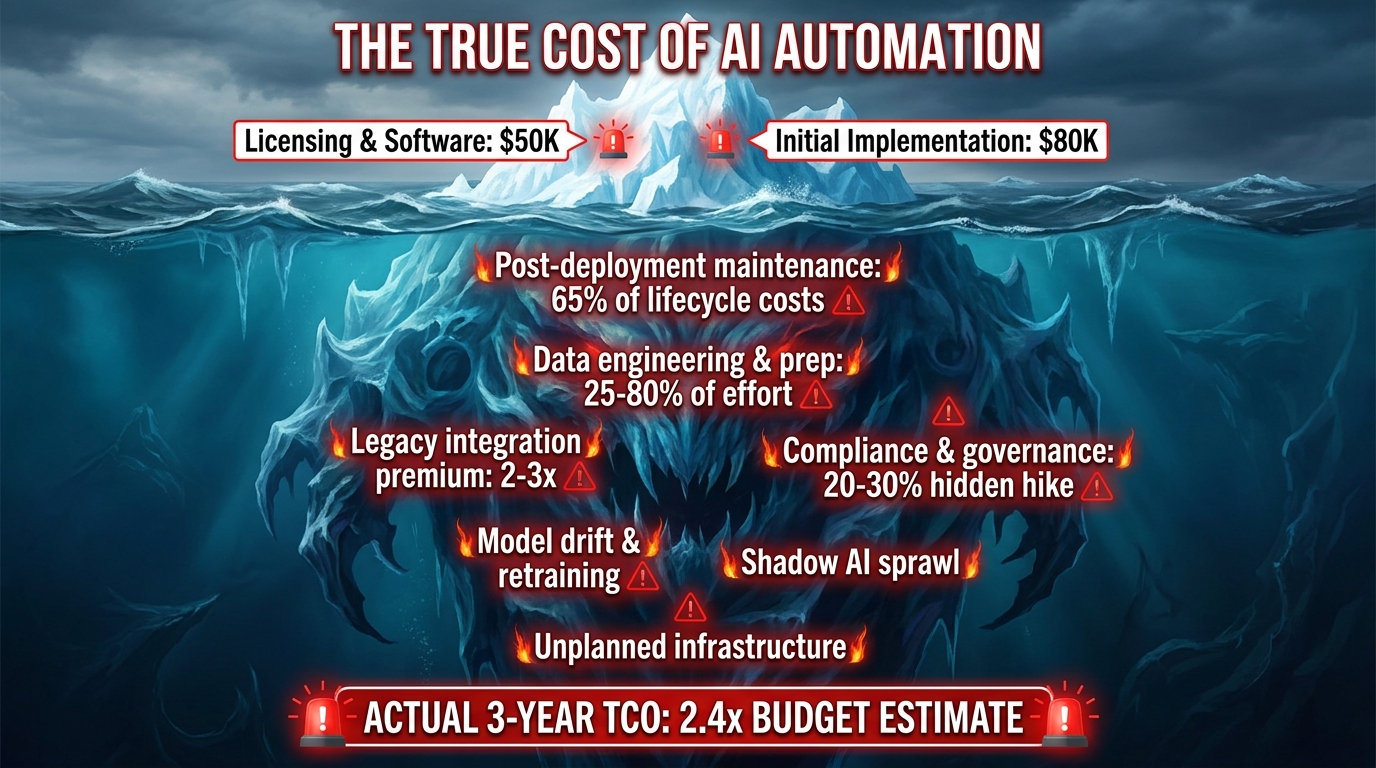
    More instructively, organizations that do successfully deploy RPA at scale often find that the ongoing maintenance burden reshapes their ROI calculation in ways the original business case never anticipated. Industry data puts total RPA maintenance and support costs — including engineering labor, monitoring, incident response, and break-fix cycles — at 70 to 75 percent of total program spend. Licensing, the line item that dominates procurement discussions, typically represents only 20 to 25 percent of what enterprises actually pay to keep RPA running.

    The result is a fleet of bots that requires roughly 15 to 25 percent of initial development cost, per bot, per year, just to maintain at current capability — with no improvement in scope, no expansion of coverage, and no ability to handle the exceptions that the bot was never designed to manage.

    “The real problem with our RPA estate wasn’t the bots that failed loudly. It was the ones that were technically running but only handling 55% of the volume they were supposed to, and nobody had noticed.”
    — Enterprise automation lead, financial services sector (2026)

    That silent underperformance is the most insidious aspect of the static bot model. Failures are visible and generate tickets. Quiet coverage erosion — where a bot handles fewer and fewer cases as the process drifts from the original design — accumulates invisibly until someone runs the numbers.

    What Makes Agentic AI Structurally Different

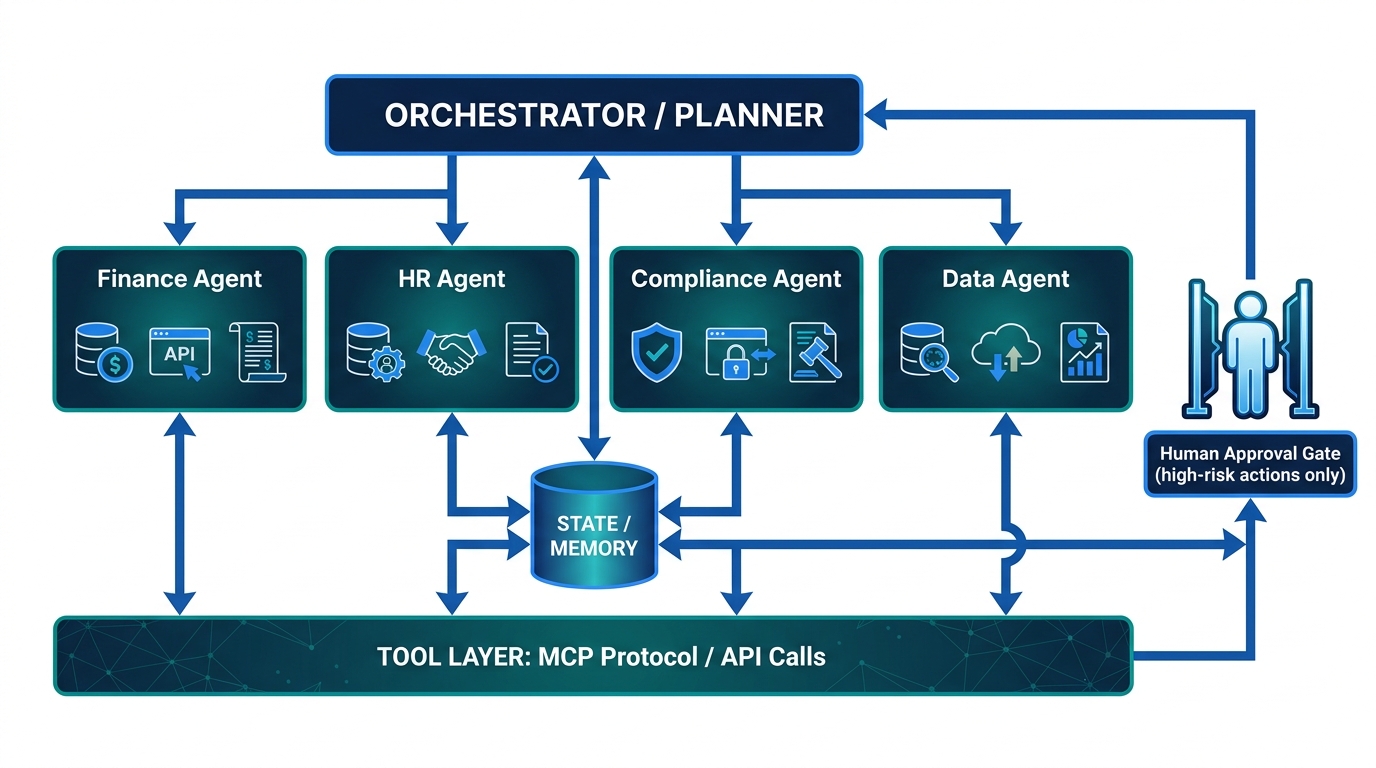
    Architecture diagram of a multi-agent agentic AI system showing an orchestrator directing specialist agents through a tool layer with a human approval gate for high-risk actions

    The term “agentic AI” has accrued enough marketing gloss that it risks meaning nothing. Before examining where it beats static bots, it is worth being precise about what the architecture actually is and why that architecture behaves differently when processes change.

    The Core Architecture: Orchestrator Plus Specialists

    A production agentic AI system in 2026 is not a single model running a single task. It is typically a layered architecture with three functional components working in concert.

    At the top sits an orchestrator or planner — a model or controller that receives a high-level goal, decomposes it into subtasks, determines the sequence and routing of those tasks, and manages shared state across the workflow. The orchestrator does not execute actions directly. It decides what happens next, tracks what has happened, and handles failures by retrying, rerouting, or escalating.

    Below the orchestrator sit specialist agents — purpose-built for specific domains or task types. A finance agent might be configured with access to ERP APIs, trained on invoice formats, and constrained to specific approval thresholds. An HR agent might have access to HRIS systems and knowledge of onboarding checklists. Each specialist operates within a defined scope, receives only the context it needs for its task, and returns a structured result to the orchestrator.

    The third layer is the tool and execution layer — the APIs, databases, and external systems that agents actually interact with. In 2026, the Model Context Protocol (MCP) has emerged as the dominant standard for tool discovery and invocation, allowing agents to dynamically identify and call tools without hard-coded integration logic. This is a meaningful shift from RPA: rather than scripting exact UI interactions, agents query a tool catalog, select the appropriate interface, and make structured API calls that are far more resilient to application-layer changes.

    Why This Architecture Handles Change Differently

    The critical behavioral difference between a static bot and an agentic system is not intelligence per se. It is adaptability at the exception boundary.

    When a static bot encounters a situation outside its decision tree, it stops. When an agentic system encounters an unexpected input — a missing field, a format variation, an ambiguous approval state — it can reason about the situation, consult additional context, attempt alternative paths, or escalate to a human with a structured summary of what it found and what decision is needed. The human approval gate becomes a feature rather than a failure mode.

    This is also why agentic systems handle unstructured data categorically better than their RPA predecessors. A large language model underlying an agent can read a PDF invoice, extract the relevant fields, reconcile them against a purchase order, identify a discrepancy in line item 7, draft a query to the vendor, and route the whole package to an accounts payable manager — without requiring the document to arrive in a specific template or format.

    State and Memory: The Feature Nobody Talks About Enough

    One underappreciated structural advantage of agentic architectures is persistent state management. Static bots are typically stateless — each execution is independent, and context does not carry across sessions. Agentic systems maintain working memory and can track a multi-day workflow across multiple interactions, handoffs, and system calls.

    For enterprise processes that span days or involve multiple approval stages — supplier onboarding, compliance reviews, contract negotiations — this is not a minor improvement. It is the difference between a system that handles a single transaction and one that owns a business process end to end.

    The Maintenance Trap: Why 70–75% of RPA Spend Is Just Keeping Bots Alive

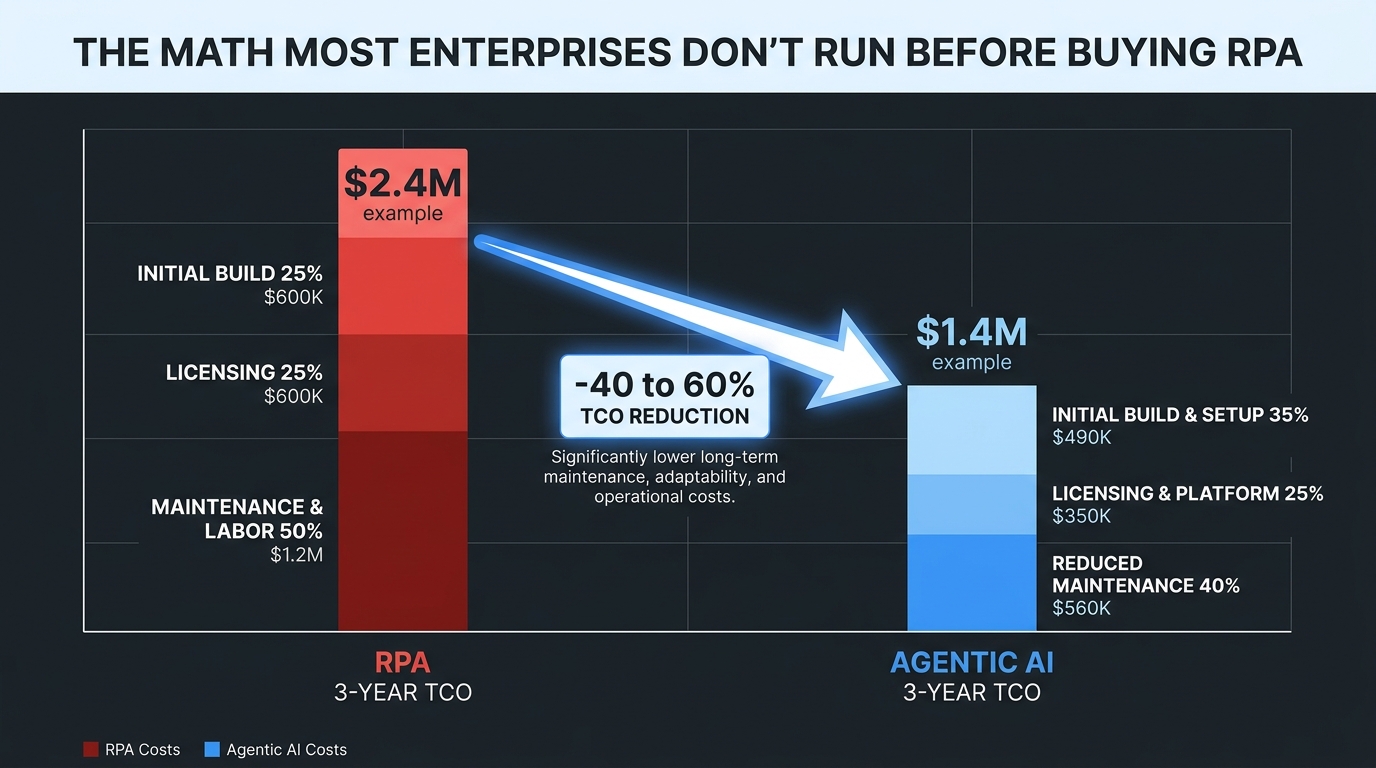
    Bar chart comparing 3-year total cost of ownership for RPA versus agentic AI, showing 40-60% TCO reduction potential from lower maintenance costs

    If there is a single data point that should reset how enterprises think about automation economics, it is this: in most mature RPA programs, the majority of total spend goes not toward creating new capability, but toward maintaining existing capability at its current level.

    This is an extraordinary misallocation of engineering talent, and it compounds over time in ways that are structurally difficult to escape.

    How the Maintenance Spiral Works

    The dynamic plays out in a predictable pattern. An enterprise builds a bot fleet of, say, 80 automations over two years. Each bot is tested against the current state of the application it interacts with. Initial performance is strong. The business case closes. The automation team receives approval for further expansion.

    Twelve months later, application upgrades, process changes, and organizational restructuring have introduced break points across a significant share of the bot estate. Developers who should be building new automations are instead triaging failures. The bot estate has become its own maintenance backlog, competing for the same engineering resources as the expansion pipeline.

    By year three, many organizations find that their automation team is effectively a bot maintenance operation with a small new-build function on the side. The original value proposition — continuous delivery of new efficiency — has stalled. The estate is stable enough to justify its existence on cost-per-transaction metrics, but it is not growing, and its ability to handle modern process complexity is visibly limited.

    Running the Real Numbers

    The standard benchmark for annual RPA maintenance is 15 to 25 percent of initial development cost, per bot, per year. For a bot that cost $40,000 to build, that represents $6,000 to $10,000 in annual upkeep. Across an estate of 80 bots with an average build cost of $35,000, the annual maintenance bill runs to roughly $420,000 to $700,000 — before accounting for the opportunity cost of the developer hours consumed.

    Add licensing (typically 20 to 25 percent of total spend), infrastructure, and the labor associated with monitoring and incident response, and the total cost of ownership for a mature RPA estate regularly exceeds twice the initial capital investment over a three-year period — often without any net expansion of automation coverage.

    The three-year TCO comparison with agentic AI is not simple, and any vendor claiming a clean apples-to-apples figure should be viewed skeptically. But the structural case is credible: agentic systems that interact with systems via APIs rather than UI scripts are substantially less sensitive to application-layer changes, meaning the maintenance burden for stable, well-governed agent workflows is materially lower than equivalent RPA automations in dynamic environments. Enterprises that have made selective migrations report total cost reductions in the 40 to 60 percent range over three years for the specific workflows transitioned.

    The Hidden Cost: Developer Talent Drain

    There is a softer but real cost that the spreadsheet rarely captures: what experienced automation engineers actually want to work on. In a tight market for technical talent, assigning developers to an endless cycle of bot patching is an attrition risk. The organizations that are successfully scaling agentic AI are, without exception, organizations where automation engineers have been retasked from maintenance to architecture — and that shift in work quality is having a measurable effect on retention.

    Where Agentic AI Actually Wins Today: Use Cases With Real Production Data

    The temptation when discussing agentic AI is to list every possible application domain and gesture toward future potential. The more useful exercise in 2026 is to identify specifically where agents are in production, performing reliably, and delivering measurable results — rather than where they might eventually work.

    Three enterprise functions have emerged as the clearest early wins: finance operations, HR administration, and customer-facing service workflows.

    Finance Operations: Invoice-to-Pay and Exception Handling

    Accounts payable is one of the most thoroughly documented agentic AI success stories in enterprise operations, and for good reason: it is a workflow that combines structured requirements (match invoice to PO, validate line items, post to ERP) with a high volume of real-world variation (different invoice formats, missing fields, quantity discrepancies, vendor query handling).

    A static bot can handle the straight-through cases reliably. But in most AP operations, the straight-through rate for complex invoices sits below 70 percent, meaning more than 30 percent of invoices require some form of human intervention. The traditional bot either fails on these or routes them immediately to a human queue — defeating much of the automation value.

    An agentic AP system changes the equation substantially. The agent reads invoices in any format via document understanding models, matches them against PO records, flags specific discrepancies with structured reasoning (not just “error — unmatched field” but “line item 3 shows $4,200 against PO value of $3,800 — likely partial delivery, querying vendor”), routes exception-ready summaries to approvers, and updates ERP records once approved. Enterprises deploying agentic AP report straight-through rates climbing to 85 to 90 percent for previously exception-heavy invoice streams.

    HR Administration: Onboarding and Service Desk

    Employee onboarding is a process that looks deceptively simple from a workflow chart but consistently breaks static automation in practice. New hires join with varied backgrounds, role variations trigger different system access requirements, start dates shift, and onboarding steps that appear sequential often have implicit dependencies on actions from multiple parties.

    HR agents in 2026 handle the full onboarding sequence — provisioning accounts across IT systems, coordinating training assignments, managing document collection, triggering payroll setup, and routing background check steps — while tracking completion status and managing exceptions when steps are delayed or incomplete. The agent does not just execute tasks; it manages the state of the process, proactively identifying blockers and escalating them before they delay the new hire’s start date.

    For the HR service desk specifically, agentic AI has reduced average ticket resolution time by 40 to 60 percent in documented enterprise deployments, largely by resolving the long tail of questions that are too contextual for a static FAQ bot but too routine to warrant full human handling — policy queries with specific personal circumstances, benefit calculation questions that require pulling data from multiple systems, and leave request scenarios that involve overlapping approvals.

    Customer-Facing Operations: The Klarna Data Point

    Klarna’s much-cited deployment of an AI-powered customer service agent provides the clearest large-scale evidence of what happens when agentic AI replaces a combination of static chatbots and human agents. The system handled 2.3 million customer conversations in its first operational month — roughly two-thirds of all support volume — with average resolution time dropping from 11 minutes to under 2 minutes, and repeat inquiry rates falling 25 percent.

    The more instructive detail from Klarna’s experience is what happened next. After achieving those headline results, the company moved toward a hybrid human-AI model after identifying that the fully automated system underperformed on complex, emotionally charged cases — disputes, fraud claims, and situations requiring nuanced judgment about customer circumstances. The lesson is not that agentic AI failed. It is that the optimal architecture is not zero humans. It is the right humans, handling the right cases, with AI handling everything else.

    That is a fundamentally different labor model than either “humans do everything” or “bots do everything” — and it is the model that is actually working at scale in 2026.

    The Transition Playbook: Augment First, Then Replace

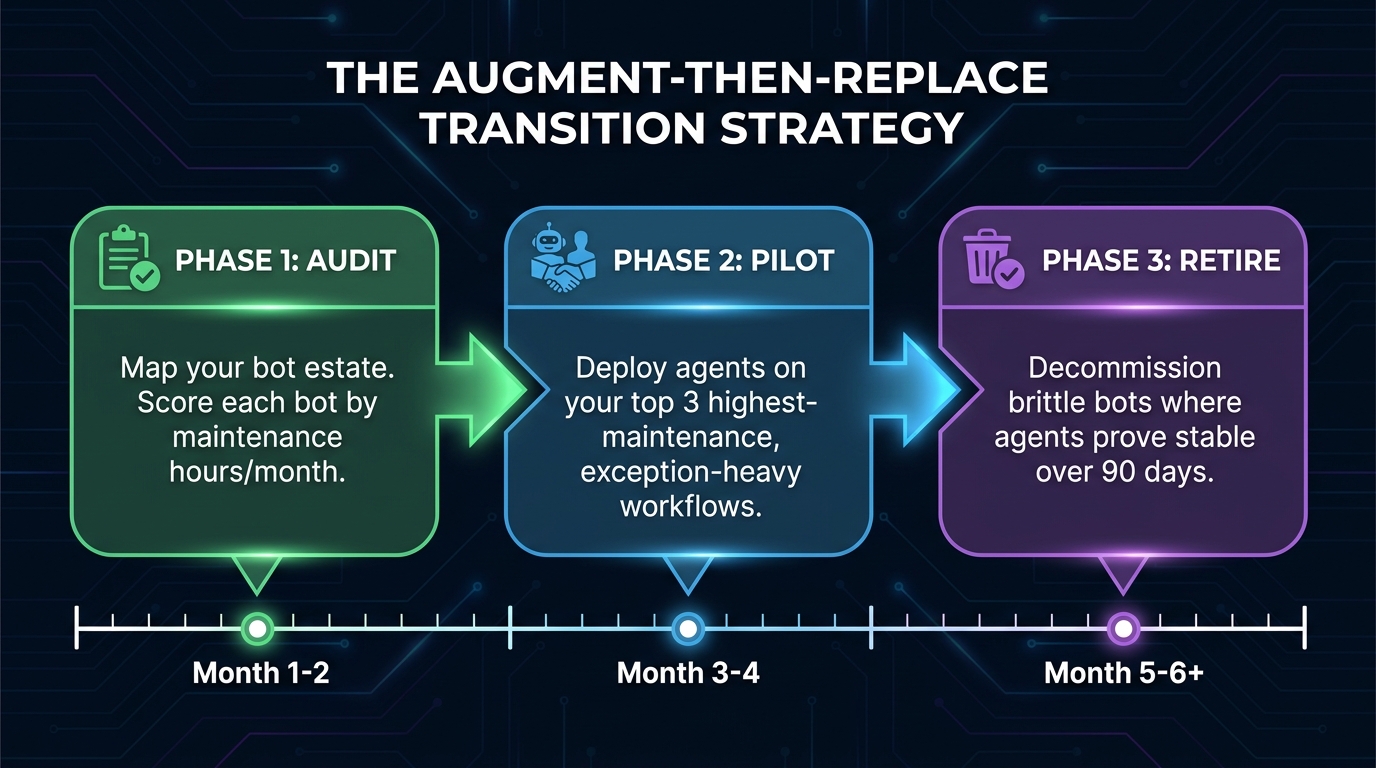
    Three-phase transition roadmap from static RPA bots to agentic AI: Audit your bot estate, Pilot on high-maintenance workflows, Retire brittle bots once agents prove stable

    The dominant enterprise pattern in 2026 is not ripping out RPA and replacing it wholesale with agents. Organizations that attempted aggressive rip-and-replace strategies in 2024 and 2025 largely found that the disruption cost exceeded the efficiency gain, at least in the short term. The strategy that is actually working is more deliberate: augment existing automation where agents can add immediate value, then selectively retire the bots that agents demonstrably outperform.

    Phase 1: Audit and Score Your Bot Estate

    The transition starts not with technology selection but with honest accounting of the existing automation portfolio. Every bot in the estate should be scored against two dimensions: maintenance cost (engineer hours per month, incident frequency, average time to restore after failures) and exception rate (the percentage of cases the bot cannot handle and routes to humans).

    This scoring exercise typically reveals a clear distribution. A minority of bots — often 20 to 30 percent of the estate — account for the majority of maintenance effort and exception volume. These are the bots that are the highest-fit candidates for agentic replacement: they are expensive to maintain, they handle a shrinking share of their intended volume, and they sit on processes that require the kind of contextual reasoning that agents handle well.

    A second tier — often the largest category — consists of bots that are stable, low-maintenance, and handling structured, predictable processes. These are the bots that RPA was designed for. There is no economic case for replacing them with agents unless the underlying process is scheduled to change. Leave them alone.

    A third tier consists of bots that are marginal performers — low volume, unclear ownership, uncertain ROI. These warrant decommissioning regardless of what replaces them, because they are consuming infrastructure and monitoring resources without meaningful output.

    Phase 2: Pilot on Your Highest-Pain Workflows

    With the audit complete, the transition team can identify the two or three workflows that represent the best case for an agent pilot. The selection criteria should be explicit: high exception rate, high monthly maintenance hours, business-critical enough to have executive attention, but not so operationally central that a failed pilot causes significant disruption.

    The pilot should be structured as a parallel run. The existing bot continues to handle the workflow while the agent runs alongside, processing the same volume independently. At the end of 60 to 90 days, the comparison is straightforward: straight-through rate, exception handling accuracy, cycle time, and total engineer hours consumed by each system.

    Parallel running is critical for two reasons. First, it generates clean side-by-side evidence for the business case, which matters when requesting budget for expansion. Second, it allows the team to discover the governance and guardrail requirements specific to that workflow before the agent is operating without a safety net.

    Phase 3: Retire Brittle Bots Where Agents Prove Stable

    Once an agent has run in parallel for 90 days with consistently better metrics, the decommissioning decision becomes a data-driven one rather than a technology opinion. The bot is retired, the agent takes full ownership of the workflow, and the maintenance budget previously allocated to that bot is freed up for the next phase of expansion.

    This cycle — audit, pilot, retire, expand — typically delivers measurable ROI from the first workflow transition within six to nine months, generating both financial returns and organizational confidence for subsequent phases. The enterprises that are now scaling agents enterprise-wide started with exactly this methodical approach. They did not begin by declaring RPA dead. They began by finding the bots that were already dying and replacing them with something better.

    The Governance Gap: Why Autonomy Without Guardrails Is a Risk Category of Its Own

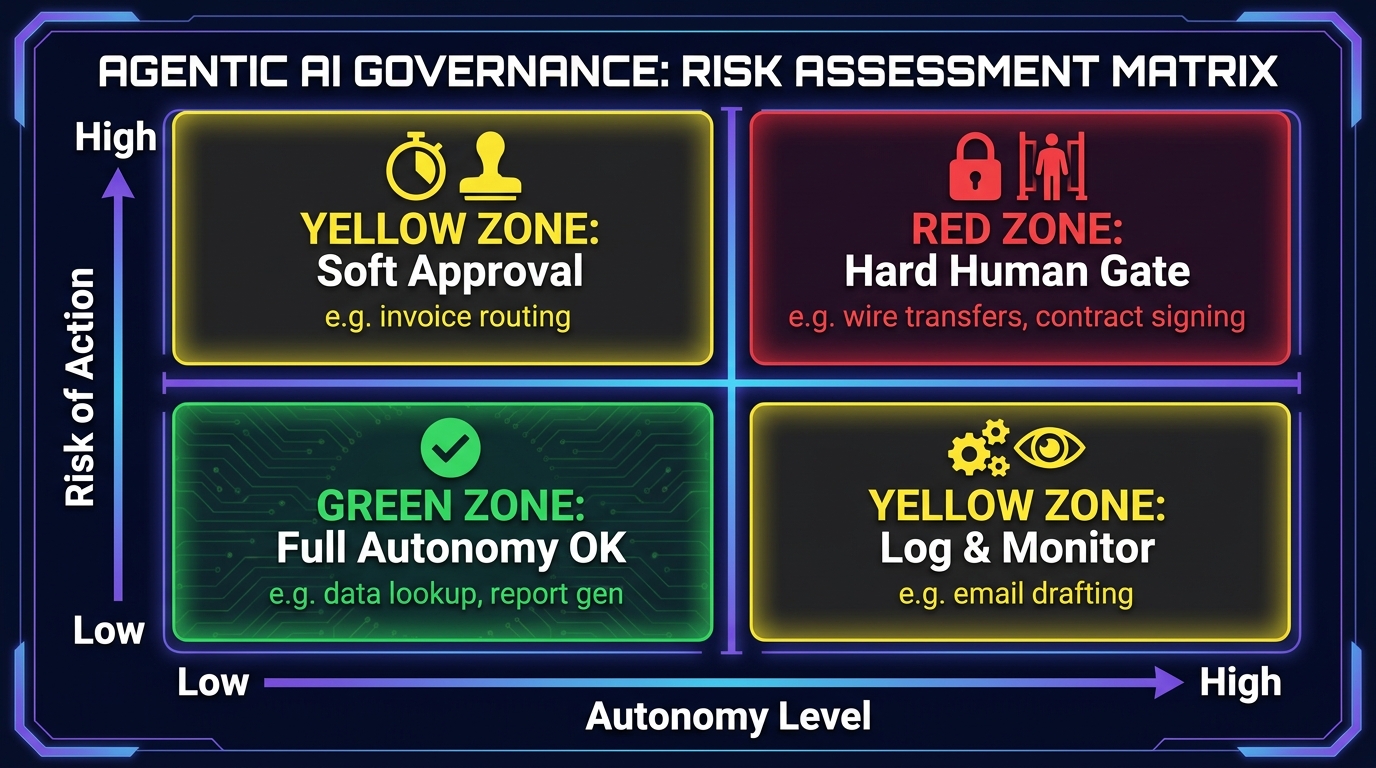
    Risk assessment matrix for agentic AI governance showing four quadrants from full autonomy permitted to mandatory human approval gate based on autonomy level and action risk

    Static bots fail loudly and predictably. They error out on recognizable failure modes. Agentic AI introduces a different risk profile: the risk of confident, well-reasoned wrong actions — decisions that look correct at each individual step but compound into significant errors at the workflow level.

    This is not a hypothetical. Organizations that deployed agents without adequate guardrails in 2024 and 2025 reported incidents where agents completed multi-step actions — routing payments, modifying records, triggering external communications — based on ambiguous inputs that a human would have flagged for clarification. The agents were not malfunctioning. They were behaving exactly as designed: completing the task as efficiently as possible. The problem was that “completing the task” in ambiguous situations required judgment calls that the governance framework had not anticipated.

    The Risk-Tiered Approval Framework

    The governance pattern that is emerging as best practice in 2026 is not “human in the loop for everything” — that destroys the efficiency case — nor is it “full autonomy for everything.” It is a risk-tiered framework that calibrates human involvement to the reversibility and consequence of the action being taken.

    Low-risk, reversible actions — data lookups, report generation, drafting communications for human review, reading and summarizing documents — can operate with full autonomy. The consequence of an error is limited and easily corrected.

    Medium-risk actions — sending external communications, routing items for approval, updating internal records — operate with logging and monitoring. No human approval is required before execution, but every action is recorded in an immutable audit trail, and anomaly detection flags patterns that deviate from expected behavior.

    High-risk, potentially irreversible actions — wire transfers, contract execution, payroll modifications, external commitments above defined thresholds — require an explicit human approval gate before execution. The agent prepares the action completely and presents it for sign-off. It does not proceed until approval is recorded.

    This tiered model allows agents to operate at speed on the 80 to 90 percent of workflow steps that are low-risk, while maintaining appropriate control over the minority of actions that require human judgment.

    Identity, Least Privilege, and Auditability

    Beyond approval gates, effective agentic governance requires treating agents as distinct identities within the enterprise security perimeter. Each agent should have its own credential set with narrowly defined permissions — access only to the systems and data required for its specific task scope. This “least privilege by default” approach limits the blast radius of any individual agent failure or security incident.

    Equally important is auditability. Every agent action — every tool call, every decision branch, every data access — should be logged in a form that supports incident investigation and regulatory review. In regulated industries (financial services, healthcare, insurance), auditability is not a best practice. It is a prerequisite for deployment.

    Organizations that have governance infrastructure in place before deploying agents at scale report significantly fewer incidents and faster recovery times when issues do occur. Organizations that deploy agents quickly and retrofit governance afterward tend to face a much harder remediation process — particularly if an agent has taken consequential actions that are difficult to reverse.

    Reading the 2026 Vendor Landscape: Who Is Building What

    The vendor landscape for enterprise automation in 2026 reflects the hybrid reality of the market. Traditional RPA vendors — UiPath, Automation Anywhere, Blue Prism — have all repositioned their products to incorporate agentic capabilities, framing their platforms as the orchestration layer that connects existing bot estates with new AI-native workflows. The pitch is continuity: extend your existing investment rather than replace it.

    AI-native platforms — including frameworks like LangGraph, CrewAI, Microsoft AutoGen (now AG2), and Google’s ADK — approach the space from the opposite direction: building orchestration-first architectures with AI reasoning at the core and plugging into execution systems via API. These platforms require more architectural work to implement but offer substantially more flexibility for complex, multi-system workflows.

    The Cloud Hyperscaler Play

    AWS, Microsoft Azure, and Google Cloud have all entered the agentic orchestration market with managed services — AWS Bedrock AgentCore, Azure AI Foundry, and Google Vertex AI Agent Builder, respectively. These managed runtimes lower the operational burden of running multi-agent architectures at scale, handling state persistence, retry logic, monitoring, and scaling infrastructure.

    For enterprises already committed to a primary cloud provider, the managed agent runtime from that provider will often be the path of least resistance — particularly for teams that do not have deep MLOps capability in-house. The trade-off is vendor lock-in at the orchestration layer, which can limit flexibility as the market continues to evolve rapidly.

    The MCP Standardization Shift

    One development that deserves more enterprise attention than it currently receives is the emergence of the Model Context Protocol as a de facto standard for agent-to-tool communication. MCP allows agents to discover and invoke tools through a standardized interface, meaning a well-designed agentic system can add new tool integrations without rebuilding the agent logic.

    For procurement and architecture teams, this matters because it reduces the switching costs associated with agentic infrastructure. An agent built on MCP-compliant tooling is substantially more portable across platforms than one built on vendor-specific integration layers — a lesson that RPA buyers learned the hard way when they found their bot estates locked to specific vendors.

    Point Solutions vs. Platform Bets

    A growing category of vertical-specific agentic AI vendors — targeting specific functions like AP automation, legal document review, IT service management, or compliance monitoring — offers a middle path between DIY agent frameworks and broad platform commitments. These point solutions deliver faster time-to-value for specific workflows but require careful integration planning when the goal is enterprise-wide orchestration.

    The selection principle that is proving durable in 2026: evaluate vendors on the quality of their audit trails and governance tooling first, their agent reasoning quality second, and their roadmap claims last. The organizations that are struggling with agentic deployments are almost universally struggling with observability and control, not with the intelligence of the underlying models.

    The 3-Year TCO Calculation Nobody Does Before Buying RPA

    The economics of automation technology selection deserve more rigorous treatment than most procurement processes provide. The standard approach is to compare licensing costs and implementation fees — the visible, contractual numbers — and largely ignore the ongoing operational cost profile. This is the calculation error that has trapped many enterprises in expensive, underperforming RPA estates.

    Building a Realistic Total Cost of Ownership Model

    A defensible 3-year TCO model for any automation investment — RPA or agentic — should include the following cost categories:

    • Initial implementation cost: vendor fees, internal developer time, integration work, testing, documentation. For RPA, this typically runs $25,000 to $80,000 per bot depending on complexity. For agentic workflows, the range is wider and depends heavily on the integration surface and the maturity of the tool layer.
    • Annual licensing: typically 20 to 25 percent of RPA spend. Agent platform costs vary significantly; managed cloud runtimes often price on consumption rather than fixed licenses, which can work favorably or unfavorably depending on volume patterns.
    • Annual maintenance labor: the line item that most TCO models underestimate. For RPA, budget 15 to 25 percent of initial development cost per bot per year for maintenance alone, excluding new development. For agentic systems, this number is lower for workflows where the API layer is stable, but should not be assumed to be zero — model updates, prompt drift, and tool API changes all require ongoing attention.
    • Exception handling labor: the human cost of managing the cases the automation cannot handle. This should be measured at current state for the process being automated, then modeled against the expected exception rate of the proposed automation technology.
    • Governance and compliance overhead: audit trail management, policy reviews, incident response. Often omitted from initial TCO models. For agentic systems in regulated industries, this can be a significant line item.

    What the Model Reveals

    When enterprises run this model honestly — before selecting a technology, not after — the result often significantly shifts the relative attractiveness of agentic AI for exception-heavy workflows. The higher upfront implementation cost of an agentic system is frequently offset within 18 to 24 months by lower maintenance labor costs and higher straight-through processing rates, which reduce the ongoing human exception handling cost.

    For simple, stable, structured processes, RPA still wins on this model. The implementation is faster, the predictability is higher, and the governance requirements are lower. This is why the recommendation from practitioners who have worked through these calculations is consistently hybrid: keep RPA where it works, replace it where it doesn’t.

    The organizations that regret their RPA investments are not organizations that deployed RPA on the wrong technology. They are organizations that deployed RPA on the wrong processes — specifically, processes that were complex enough to generate persistent exceptions but not complex enough to justify the upfront investment in a more capable system. They chose the path of least resistance at implementation time and discovered the true cost at maintenance time.

    What the 23% Scaling Agents Are Doing Differently

    Enterprise data from 2026 shows a clear adoption split: approximately 72 percent of enterprises have AI agents in production or pilot in some form, but only around 23 percent have scaled an agentic system enterprise-wide. The gap between “we have a pilot” and “we have a scaled program” is where most organizations are currently stuck — and the practices of the organizations that have crossed that gap are instructive.

    They Started With Operations, Not Innovation

    Organizations that are successfully scaling agents almost universally started in back-office operations rather than in customer-facing or revenue-generating contexts. Finance, HR, IT service management, and compliance were the entry points, not sales, marketing, or product development. The reason is straightforward: operational workflows have clearer definitions of success, more predictable volumes, better-documented exception handling requirements, and lower brand risk if something goes wrong.

    This sequencing also generates the financial results that fund expansion. A successful AP automation agent that demonstrably reduces processing costs and exception volume creates an internal ROI narrative that procurement and finance leadership can audit. That narrative unlocks budget for the next deployment. Organizations that started with ambitious customer-facing or analytical use cases often found the value harder to measure and the organizational support harder to sustain.

    They Invested in Observability Before They Invested in Capability

    The 23% that are scaling treat observability — the ability to see what every agent is doing, why, and with what result — as infrastructure, not an afterthought. Before a new agent workflow goes live, they have dashboards showing throughput, exception rates, decision rationale, and anomaly alerts. Before they scale an agent to a new business unit, they verify that the audit trail for that agent meets the regulatory and operational requirements of that unit.

    This approach slows initial deployment timelines but dramatically reduces incident rates and remediation costs. It also builds organizational trust at a pace that supports continued expansion, rather than triggering the risk committee review that tends to freeze programs after a highly visible failure.

    They Treat the Agent Portfolio Like an Engineering Product, Not an IT Project

    The most consistent organizational difference between enterprises that scale agents and those that plateau at pilot is whether the agent program is run like an engineering product — with dedicated ownership, a roadmap, a feedback loop, and ongoing iteration — or like an IT project that gets handed off after implementation.

    Agents are not static. The processes they operate in change. The tools they access change. The models they run on are updated. Organizations that assign permanent product ownership to their agent portfolio — with engineers responsible for monitoring performance and iterating on prompt logic, tool configuration, and exception handling — sustain performance over time. Organizations that treat agent deployment as a one-time implementation event find their systems degrading in ways that mirror the RPA maintenance trap they were trying to escape.

    They Measured Process Coverage, Not Just Task Accuracy

    A subtle but important measurement distinction separates organizations that scale agents effectively from those that plateau. The less effective organizations measure agent performance on task accuracy — does the agent complete the task correctly when it accepts it? The more effective organizations measure process coverage — what percentage of the total incoming volume does the agent handle end-to-end, including the cases it routes out?

    A 98 percent task accuracy rate sounds excellent. But if the agent only accepts 60 percent of incoming cases and routes the other 40 percent to humans, the net automation rate is 59 percent — which may not be materially better than the bot it replaced. Organizations that optimize for process coverage rather than task accuracy consistently achieve higher net efficiency gains and more defensible business cases for expansion.

    From Automation to Orchestration: The Shift That Changes Everything

    There is a conceptual frame shift embedded in the transition from static bots to agentic AI that deserves explicit attention, because it changes not just the technology but the way organizations should think about what automation can do.

    Static bots automate tasks. Agentic AI orchestrates processes. These are not the same thing, and the distinction matters for how organizations scope, fund, and measure their automation investments.

    A task is a discrete, bounded action: extract these fields, compare these values, update this record. A process is a sequence of decisions, actions, and handoffs that collectively achieve a business outcome: a new employee is hired and fully onboarded, a supplier invoice is validated and paid, a customer complaint is resolved and documented.

    RPA programs have always been implicitly measured at the task level, because that is the unit of work a static bot can reliably own. The resulting metrics — tasks automated, FTE equivalents saved, process steps touched — are real but limited. They capture what happened within the automation boundary, not what happened to the process overall.

    Agentic systems, because they can own multi-step processes with decision logic and exception handling, invite measurement at the process level: end-to-end cycle time, straight-through rate for the full process, cost per completed outcome, and compliance accuracy across the entire workflow. These are metrics that business leaders understand and care about in a way that “number of tasks automated” never quite achieved.

    This reframing is why the transition from static bots to agentic AI is less of an upgrade and more of a repositioning of what automation is for. The goal shifts from “automating steps that humans used to do” to “owning processes that humans used to manage.” The scope is larger, the governance requirements are higher, and the business impact is proportionally greater when done well.

    Conclusion: The Decision Framework for 2026

    The question facing automation leaders in 2026 is not whether agentic AI is better than static bots in the abstract. In exception-heavy, unstructured, multi-step workflows, it demonstrably is. The practical question is which workflows to transition, in what sequence, with what investment, and with what governance infrastructure in place.

    The framework that the data supports is not complicated, but it requires honesty about the current state of the bot estate and discipline about the order of operations:

    1. Audit first. Score every bot in the estate by maintenance burden and exception rate. This is not a lengthy exercise — most automation teams can complete it in two to three weeks — but it is essential for making transition decisions based on evidence rather than vendor enthusiasm.
    2. Target the high-maintenance, high-exception bots first. These are the cases where the economic case for transition is clearest and where the improvement in performance will be most visible. Do not start with the easy bots that are already working well.
    3. Build governance before scale. Audit trails, approval gates, and monitoring dashboards are not optional extras. They are the infrastructure that allows agentic systems to operate in enterprise environments without generating the kind of incidents that freeze programs. Build them into the first pilot, not as a retrofit after scale.
    4. Measure process coverage, not just task accuracy. The metric that matters is what percentage of total incoming volume the agent handles end-to-end. A highly accurate agent that handles a small fraction of volume is not a successful automation.
    5. Treat the portfolio as a product. Assign permanent ownership. Build an iteration cadence. Expect agent workflows to require ongoing attention as processes, models, and tools evolve.

    The enterprises that invested in RPA as a durable solution discovered that durable automation requires a different architecture than scripts running against static UIs. The enterprises investing in agentic AI today are, in the best cases, building with that lesson in mind — governing carefully, measuring honestly, and transitioning methodically from the systems that are already failing toward ones that are structurally better suited to the complexity of real enterprise processes.

    The bots are not dead yet. But the ones in your estate that are expensive to maintain, slow to recover, and handling a shrinking fraction of their intended volume? Those are already dying. The decision is simply whether to replace them intentionally, on your terms, or to wait until the maintenance burden makes the decision for you.

  • The AI Automation ROI Reckoning: Why 79% of Enterprises See Zero EBIT Impact — and the Measurement Architecture That Changes the Math

    The AI Automation ROI Reckoning: Why 79% of Enterprises See Zero EBIT Impact — and the Measurement Architecture That Changes the Math

    The AI ROI Paradox 2026: 70% adoption vs 39% EBIT impact split-screen infographic

    Here is one of the more uncomfortable truths circulating in enterprise boardrooms in 2026: 70% of large organizations have adopted generative AI in some form, yet 79% report no measurable EBIT impact from it. That is not a typo. An AIMG Benchmark Study of 2,048 decision-makers found that after years of pilots, proofs of concept, vendor deployments, and internal builds, most companies cannot point to their bottom line and show AI changed it.

    The RAND Corporation analyzed over 2,400 AI initiatives and found that 80% of them fail to deliver intended business value — double the failure rate of conventional IT projects. MIT’s Project NANDA put an even sharper point on it: 95% of generative AI pilots produce zero measurable P&L impact. S&P Global found that 42% of companies abandoned at least one AI initiative in 2025, up from 17% the prior year.

    And yet budgets keep growing. Enthusiasm keeps building. Vendors keep promising.

    The problem is not the technology. The problem is how organizations define, measure, and sustain value from AI automation. Most businesses treat ROI as a destination — something you calculate once at go-live and file away. The organizations actually generating returns treat ROI as an architecture — a continuous system of measurement, governance, and process intelligence that runs in parallel with every automation they deploy.

    This article does not rehash the standard “how to calculate ROI” content that fills vendor white papers. Instead, it dissects the specific measurement failures, cost blindspots, and structural gaps that explain why the adoption-impact paradox exists — and what the companies generating real returns are doing differently.

    The Adoption-Impact Paradox: What the Numbers Are Actually Telling You

    When McKinsey asked enterprises about their AI deployments, 88% reported regular AI use. Only 39% reported measurable EBIT impact. IBM’s data is equally sobering: 25% of AI initiatives met their ROI targets, and only 16% scaled enterprise-wide. These figures do not come from AI-skeptic organizations — they come from companies that believed in the technology enough to invest substantially in it.

    Understanding this gap requires separating three different failure modes that companies routinely conflate:

    Failure Mode 1: The Measurement Vacuum

    Gartner research found that organizations with structured ROI tracking report 5.2 times higher confidence in their AI investments than those without. Yet fewer than 20% of companies properly track GenAI KPIs, according to McKinsey. Most measure adoption — login rates, feature utilization, user satisfaction scores — rather than business outcomes. These are activity metrics, not impact metrics. You can have 100% adoption of a tool that produces no financial benefit.

    The distinction matters enormously. When 81% of enterprises report that AI ROI is difficult to quantify (per Larridin’s research), the honest interpretation is not that ROI is inherently unmeasurable — it is that most companies never built the measurement infrastructure to capture it.

    Failure Mode 2: The Pilot-Production Chasm

    Across multiple studies, the data converges on a grim number: 88% of AI proofs of concept never make it to production. The average pilot takes 14 months to complete, and only 25% survive to deployment. The rest die somewhere between “this works in a controlled environment” and “this works at scale with real data, real edge cases, and real organizational friction.”

    The companies that close this gap do so by treating production readiness as a design criterion from day one — not an afterthought once the pilot succeeds.

    Failure Mode 3: The Value Evaporation Problem

    Even among the deployments that reach production, value erodes over time in ways most organizations do not track. Well-functioning Q1 deployments often show economically different profiles by Q4. Model drift, process drift, declining user adoption, shadow AI proliferation, and rising compute costs all chip away at initial gains — silently, without triggering any alerts, because nobody built systems to catch them.

    Why the Standard ROI Formula Is Structurally Broken

    The conventional ROI formula taught in every MBA program — (Gains − Costs) / Costs × 100 — is not wrong. It is incomplete. Applied to AI automation, it produces dangerously optimistic pre-deployment projections that collapse on contact with operational reality.

    The Input Problem

    Most ROI calculations use three inputs: licensing cost, implementation cost, and projected time savings. Each of these inputs is systematically underestimated before deployment.

    Licensing costs are straightforward on paper but grow with scale. A 50-person pilot becomes a 500-person rollout. Token-based pricing models mean costs scale with usage, not headcount. Hidden overage charges, API call costs, and model upgrade fees accumulate in ways that initial contracts do not surface.

    Implementation costs are where the real surprises live. Enterprise AI budget estimates are consistently undershot by 40-60%, according to Hypersense’s 2026 TCO analysis. A project scoped at €158,000 realistically costs €368,000 over three years once integration, data engineering, change management, and governance overhead are included. The 73% of enterprises that exceed their initial AI budgets do so by an average of 2.4x, generating an average $2.3 million in unplanned expenses per program.

    The Output Problem

    On the gains side, the formula typically captures only first-order time savings: hours saved × hourly cost. This misses quality improvements, error reduction (and the downstream cost of errors avoided), revenue acceleration effects, capacity reallocation benefits, and risk reduction value. It also overstates gains by assuming that time saved automatically converts to value — when in reality, reclaimed hours only become productive if they are redirected to higher-value work.

    A customer service agent who resolves tickets 15% faster is not automatically generating 15% more revenue. Unless management actively reallocates that capacity, the gain lives on paper but not on the income statement.

    The True Cost of AI Automation iceberg diagram showing hidden TCO costs below the waterline

    The True Cost Architecture: TCO vs. What You Budgeted

    Total Cost of Ownership for AI automation has a unique characteristic that separates it from conventional software: post-deployment costs dominate the lifecycle. While traditional enterprise software stabilizes after implementation, AI systems generate continuous cost obligations that grow with usage, data volume, and organizational complexity.

    The 65% Rule: What Happens After Go-Live

    Post-deployment maintenance represents approximately 65% of AI automation lifecycle costs, according to analysis from Keyhole Software and Hypersense. This includes model performance monitoring, retraining cycles, compliance updates, regression testing when upstream systems change, and the user support infrastructure required to maintain adoption. Most organizations budget for none of this explicitly — they assume that once the system is live, the only ongoing cost is the license fee.

    The reality is that a model trained on your Q1 data may behave significantly differently by Q3 as customer behavior patterns, product catalogs, regulatory requirements, and business processes shift. Each shift requires either retraining (15-25% additional compute overhead per cycle, per SoftwareSeni’s analysis) or manual intervention to catch the cases the model no longer handles correctly.

    Data Engineering: The Chronically Underestimated Cost

    Data preparation and engineering consume 25% to 80% of total project effort and spend, depending on the state of the organization’s data infrastructure. In enterprises with well-structured, accessible data pipelines, this figure lands in the lower range. In organizations with fragmented legacy systems, siloed databases, inconsistent data standards, and manual data entry dependencies — which describes the majority of mid-to-large enterprises — it skews toward the upper end.

    The consequence: organizations that budget $500,000 for an AI automation initiative and expect $200,000 of that to cover data work frequently find the data work consuming $350,000 before a single model goes live. This is not an edge case. Only 19% of enterprises report full data readiness for AI deployment, limiting 75% to deploying one to three AI use cases rather than the portfolio-level automation programs their ROI projections assume.

    Legacy Integration: The 2-3x Premium

    Connecting AI automation systems to legacy enterprise infrastructure — ERP systems, CRM platforms, proprietary databases, and decades-old transaction processing systems — commands a 2-3x cost premium over greenfield integration. This premium exists because legacy APIs were not designed for the volume, speed, or data format requirements of AI systems; because documentation is often incomplete or inaccurate; and because testing requirements expand dramatically when existing business-critical systems are touched.

    Organizations consistently underestimate this figure, in part because vendor demos invariably show clean integration with modern SaaS platforms rather than the 1990s-era systems that actually run enterprise operations.

    The Value Decay Problem: How Gains Erode After Go-Live

    One of the least-discussed dynamics in AI automation is what happens to gains over time when organizations do not actively manage them. The pattern is consistent enough across enough deployments that it deserves a name: value decay.

    AI Automation Value Decay Curve showing ROI erosion over 24 months post-deployment with managed vs unmanaged comparison

    The Novelty Effect

    Initial productivity gains from AI tools often include a novelty premium. Users invest extra attention in learning the system, exploring its capabilities, and finding ways to make it work for their specific tasks. This investment period generates above-baseline gains that are not sustainable once the novelty wears off. By month three to four post-deployment, usage patterns typically settle into a lower steady-state that reflects genuine workflow integration rather than enthusiastic exploration.

    Organizations that measure ROI at the 30-day mark and extrapolate annually are capturing novelty-inflated numbers, not sustainable operational value.

    Model Drift and Process Drift

    AI models degrade when the real-world data they process diverges from the training data they learned from. This is model drift — and it is inevitable. The question is how quickly it happens and how quickly organizations detect and correct it.

    Process drift is a parallel phenomenon on the human side: the business processes the AI was designed to support change over time, through product updates, policy changes, regulatory requirements, and organizational restructuring. An AI automation built around a specific workflow may find that workflow has been modified without any corresponding update to the automation — generating incorrect outputs, missed cases, or silent errors that accumulate undetected.

    McKinsey’s finding that 88% of organizations use AI but only 39% see EBIT impact is partly explained by these two forms of drift operating simultaneously on deployments that were never designed to be monitored for them.

    Adoption Decay and Shadow AI

    The Flexera 2026 AI Pulse Report documents a consistent pattern: initial adoption rates for AI automation tools decline 15-30% in the 6-12 months post-deployment unless actively supported. Users who struggled with the initial learning curve revert to manual workflows. Managers who saw the tool as a solution to a problem that has since evolved stop enforcing its use. New employees join who were never properly onboarded to the system.

    Simultaneously, shadow AI proliferates — employees who are not satisfied with the officially deployed tool adopt unofficial AI tools that solve their specific problem. This creates fragmented, ungoverned AI usage that generates no measured benefit for the organization while introducing security and compliance risks.

    Process Selection Science: Which Workflows Actually Pay Back

    Given how widely ROI varies across AI automation deployments, process selection is one of the highest-leverage decisions an organization makes before writing a single line of code or signing a single contract. The research identifies four filters that reliably separate high-return automation candidates from low-return ones.

    Filter 1: Volume × Cost per Error

    The most reliable predictor of strong AI automation ROI is the combination of high transaction volume and meaningful cost per error or per unit. Customer support ticket handling, invoice processing, and document classification score high on this filter — they happen thousands of times per day, and each instance of suboptimal handling has a quantifiable cost in labor time or downstream errors.

    Processes that happen infrequently, even if individually complex, rarely generate compelling ROI because the absolute value of improvement is limited regardless of the percentage gain.

    Filter 2: Process Boundary Clarity

    Automation succeeds where inputs and outputs are well-defined. Processes with clear triggers, structured data inputs, and verifiable outputs automate predictably. Processes that require judgment about ambiguous inputs, contextual reasoning, or stakeholder negotiation resist automation and generate unpredictable output quality.

    This is why coding assistance (55.8% faster task completion, per Alice Labs’ 2026 benchmark) and customer support routing (15% productivity gain) outperform more open-ended knowledge work automation in virtually every study. The task boundaries are clear enough to measure, monitor, and trust.

    Filter 3: Data Availability and Quality

    Only 19% of enterprises have the data infrastructure ready for AI deployment. Before selecting a process for automation, the honest question is: does training-quality data exist for this process, and can it be accessed, labeled, and maintained without heroic effort? Processes with rich historical data and structured records advance to production faster and generate ROI sooner. Processes that require extensive data collection, cleaning, or labeling consume budget before any automation benefit accumulates.

    Filter 4: Scalability Beyond the Pilot

    Harmony.ai’s 2026 decision framework adds a critical filter: is the process scalable beyond the pilot population? A workflow that only exists in one department, or that depends on the specific behavior of a small team, generates ROI only at the pilot scale. Prioritizing processes that run across multiple departments, business units, or customer segments multiplies the return on the implementation investment without proportionally multiplying the cost.

    High-confidence automation candidates identified across the evidence base include: customer support (15% productivity gain), professional document processing (40% faster throughput), software development assistance (55.8% faster coding, 26% more tasks completed), HR self-service (IBM achieved 40% HR cost reduction), and finance close operations (35-50% cycle time acceleration in finance-sector deployments).

    The Layered ROI Measurement Framework

    Four-layer AI ROI measurement pyramid from task level through enterprise level

    The organizations generating real, sustained returns from AI automation share a measurement architecture that operates at four distinct levels. Alice Labs’ 2026 benchmark report, which analyzed 47 public metrics from studies and surveys, articulates this structure more clearly than any vendor framework: ROI is not a single number — it is a layered stack of metrics that must be tracked simultaneously at different organizational levels.

    Layer 1: Task-Level Productivity

    This is the layer most organizations measure, and measuring it is genuinely important. Task-level metrics include: time per task completion (before and after automation), accuracy rates, throughput volume, and process completion rates. These are the 15-56% productivity gains that appear in headline benchmarks.

    The mistake is treating Layer 1 as sufficient. Task-level productivity gains do not automatically translate to worker-level, team-level, or enterprise-level value. They are a necessary precondition, not a proof of business impact.

    Baseline measurement is critical here. Organizations that deploy AI without establishing pre-deployment baselines cannot measure Layer 1 gains at all — they end up estimating, which CFOs correctly treat as guesswork.

    Layer 2: Worker-Level Capacity

    Layer 2 asks: what are workers doing with the time and cognitive capacity that automation returns to them? The answer to this question determines whether task-level gains generate real financial value or simply disappear.

    Research from Microsoft’s Copilot deployments and similar enterprise tools consistently shows 1.9 to 4.0 hours saved per worker per week. The organizations generating ROI from this figure are the ones that deliberately redirect that capacity — into higher-value customer interactions, complex problem-solving, creative work, or volume scaling that generates additional revenue.

    The organizations not generating ROI are the ones that reclaim the time without directing it anywhere, resulting in a slightly more relaxed workforce but no EBIT impact.

    Layer 3: Team and Workflow Economics

    Layer 3 measures the end-to-end workflow — not individual tasks or individual workers, but the complete process from trigger to output. This is where 20-90% process time reduction benchmarks live, where error rate reductions show up as downstream cost savings, and where SLA improvements translate to customer satisfaction and retention effects.

    Finance close operations that accelerate from 12 days to 7 days generate measurable effects on days-sales-outstanding, working capital, and auditor fees. Customer support workflows that resolve 84% of queries without human escalation generate measurable effects on support headcount requirements and customer churn. These are Layer 3 metrics, and they are the ones that start to get CFO attention.

    Layer 4: Enterprise-Level Financial Impact

    Layer 4 is where EBIT impact lives — AI revenue attribution (averaging 15-25% in high-performing deployments, per SecondTalent research), Return on AI Investment (ROAI, averaging 41% for the overall population and 171% for the highest performers), and total cost avoidance ratios (2.7:1 in well-managed programs).

    Reaching Layer 4 requires that Layers 1-3 are not just measured but actively managed. The 79% of enterprises reporting no EBIT impact are stalled somewhere between Layer 1 and Layer 3, measuring task productivity while the financial impact dissipates in the space between measurement points.

    Industry Payback Benchmarks: What the Data Actually Shows

    AI automation payback periods by industry and use case comparison chart 2026

    Bain’s 2026 Agentic AI Benchmark study (n=1,840) provides the clearest industry-level payback data available. Gartner independently confirms that 41% of AI deployments now hit positive ROI within 12 months — up from 23% in 2024 — suggesting the field is genuinely maturing in execution quality.

    Customer Service and Support

    Median payback period: 4.1 months. This is consistently the fastest-returning AI automation category across multiple studies. The reasons are structural: high transaction volume, clear task boundaries, measurable output quality, and direct linkage between automation quality and customer satisfaction scores that are already tracked.

    TELUS’s deployment serves as a representative case: over 500,000 hours saved and $90 million in documented benefits. ServiceNow’s internal deployment saved 410,000 hours and generated $17.7 million in cost avoidance. These are not projections — they are audited operational figures from companies that built the measurement infrastructure to capture them.

    Marketing Operations

    Median payback period: 6.7 months. Content generation, campaign optimization, personalization at scale, and research synthesis all represent processes with clear before-and-after comparisons and direct revenue linkage through campaign performance metrics. The caveat: output quality measurement requires human review infrastructure that most teams underinvest in.

    Engineering and Development

    Median payback period: 9.3 months. The 55.8% faster coding benchmark from Alice Labs is consistent across multiple independent studies, but the payback period is longer than customer service because implementation costs are higher, the scope of deployment is typically larger, and the value capture mechanism (faster product delivery, reduced defect rates, smaller team requirements) takes longer to manifest in financial statements.

    Finance Operations

    Payback period: 12-18 months. Finance-sector deployments show 35-50% process acceleration in accounts payable, invoice processing, financial close, and compliance reporting. IBM’s HR automation case achieved 40% HR cost reduction. The longer payback timeline reflects heavier compliance requirements, more complex integration with existing financial systems, and higher data quality standards that extend implementation timelines.

    Manufacturing

    Payback period: 18-24 months. Predictive maintenance, quality control automation, and supply chain optimization generate 30-40% cost reductions in successful deployments, but the capital requirements, integration complexity, and safety validation requirements extend the investment horizon substantially.

    Healthcare Clinical

    Payback period: 18-24+ months, with bottom-quartile deployments still pre-payback at month 24, according to Bain’s benchmark data. Clinical AI automation faces the highest regulatory burden, the most complex data standards (interoperability between EHR systems remains a persistent challenge), and the greatest institutional risk tolerance for automation — all of which extend the timeline to positive returns.

    The Portfolio Approach: Stacking AI Automations for Compounding Returns

    AI automation portfolio network diagram showing compounding returns from multi-process deployment

    Gartner’s research on simultaneous broad automation reveals a counterintuitive finding: organizations that deploy AI automation across many processes simultaneously without strategic prioritization achieve only 8-12% productivity gains — less than half the gains of organizations that automate 20% of their highest-volume tasks strategically. Deloitte’s figure is 25-40% for the strategic approach.

    The explanation is structural. Broad, simultaneous automation fragments attention, creates competing integration demands, strains change management capacity, and prevents the deep measurement infrastructure work required to capture value at each layer. Strategic portfolio construction is not about doing less — it is about sequencing and connecting automations so they build on each other.

    Why Sequencing Matters

    The compounding returns in AI automation portfolios come from three mechanisms that only operate when deployments are sequenced intelligently:

    Data network effects: Each automation deployment generates structured operational data. A customer support automation creates labeled interaction data. A document processing automation creates structured content data. Subsequent automations that can use this data as input are cheaper to build, faster to train, and more accurate from day one because the data infrastructure already exists.

    Integration reuse: The expensive work of connecting AI systems to legacy infrastructure, establishing data pipelines, and building monitoring frameworks can be amortized across multiple automations if they share architectural foundations. Organizations that build a reusable integration layer for their first automation spend 40-60% less on the second and third.

    Organizational capability accumulation: The humans managing AI automation — process owners, data engineers, model monitors, governance reviewers — develop skills with each deployment that accelerate subsequent deployments. The first automation program takes the longest. Each subsequent one benefits from institutional knowledge that does not appear in any ROI calculation but is real and valuable.

    Building the Automation Portfolio

    The research-backed approach is to begin with one high-volume, clearly bounded, data-rich process that generates quick payback (customer service, document processing, or HR self-service, depending on your industry). Use that deployment to build the measurement infrastructure, governance framework, and organizational capabilities that all subsequent deployments will use. Then expand to adjacent processes that share data inputs or integration architecture.

    This approach treats AI automation as a capability accumulation program, not a series of independent projects. The difference in long-term ROI is substantial.

    Building the Measurement Infrastructure Before You Deploy

    The single most impactful operational decision in AI automation ROI is establishing comprehensive baselines before any tool goes live. This is not glamorous work. It does not generate press releases or executive presentations. But the organizations that skip it are the ones filling the “79% with no measurable EBIT impact” statistic.

    What Baselines Must Cover

    For each process targeted for automation, pre-deployment measurement should capture: current cycle time (end-to-end, not just the specific task being automated), error rates and downstream cost of errors, labor cost per transaction, volume by time period, SLA performance rates, and downstream business outcomes (customer satisfaction, revenue per interaction, compliance incident rate — whatever the relevant outcome metric is for that process).

    This baseline data serves three functions. It makes ROI measurement possible. It identifies hidden bottlenecks that automation alone will not solve (and that will limit ROI if not addressed). And it gives process owners the ability to detect value decay early, before it has compounded across 12 months of unmonitored drift.

    Continuous Monitoring Architecture

    The Flexera 2026 AI Pulse Report identifies a consistent pattern in high-ROI AI programs: they treat continuous monitoring as a first-class operational requirement, not an optional add-on. This means model performance dashboards that alert on output quality degradation, usage analytics that flag declining adoption before it becomes adoption collapse, cost tracking that surfaces spending anomalies before they breach budgets, and quarterly structured reviews that compare current performance against baseline and original ROI projections.

    Organizations that build this monitoring architecture from deployment day one spend approximately 15-20% more on initial setup. They recoup that investment within the first year by catching and correcting performance degradation that would otherwise have gone undetected — and by having the evidence they need to secure continued investment from finance and leadership.

    From Pilot to Production: Closing the Value Realization Gap

    The 88% pilot-to-production failure rate is not primarily a technical failure — it is an organizational failure. The AIMG Benchmark Study’s analysis of 2,048 decision-makers found that the top three barriers to AI value realization were insufficient talent and skills (rated 4.65/5.0), model governance and transparency (4.55/5.0), and data quality and availability (4.45/5.0). Technology performance ranked lower than all three.

    The Skills Gap Is Real and Quantifiable

    Only 19% of enterprises have the technical talent to fully operationalize AI automation programs. The gap is not in AI research or model building — it is in the intersection of process knowledge and AI implementation capability. The people who understand business processes deeply enough to redesign them around AI capabilities are often not the same people who know how to build and manage AI systems. Organizations that bridge this gap — through targeted hiring, training programs, or external partnerships — progress from pilot to production at significantly higher rates.

    Governance as an Enabler, Not a Bottleneck

    The 42% of companies that abandoned AI initiatives did so in many cases because governance requirements emerged after deployment and were treated as roadblocks to an already-live system rather than as designed-in operational requirements. Retrofitting governance onto deployed AI systems is expensive and disruptive. Building governance frameworks into the deployment architecture from the start — clear ownership of model performance, defined escalation procedures for edge cases, audit trails that satisfy compliance requirements, and regular review cycles — generates better outcomes and lower total cost.

    Compliance requirements add approximately 20-30% to governance overhead in regulated industries. This is not avoidable. But it is plannable — and organizations that plan for it avoid the emergency remediation costs that compliance surprises generate.

    The Governance Layer Nobody Budgets For

    In the rush to show results quickly, governance consistently gets deprioritized. It rarely shows up as a line item in initial AI automation budgets. It rarely has a dedicated owner before deployment. And it almost never has performance metrics of its own that leadership tracks.

    This is financially significant. Beyond compliance costs, ungoverned AI automation generates several categories of quantifiable financial risk that organizations systematically fail to budget for:

    Model Quality Liability

    When AI automation produces incorrect outputs — wrong invoice amounts, misclassified customer inquiries, inaccurate document summaries — those errors have downstream costs. In customer-facing applications, they affect NPS scores and retention rates. In financial processes, they generate reconciliation work and compliance risk. In healthcare and legal applications, they can generate regulatory liability. A governance framework that detects output quality issues early contains these costs. Without it, errors accumulate and compound before anyone catches them.

    Data Governance and Privacy Risk

    AI automation systems are data-intensive by nature. They ingest, process, and in some cases store significant volumes of operational data. Without clear data governance policies — defining what data the AI system can access, how long it retains inputs, what logging occurs, and how personal data is handled — organizations create GDPR, CCPA, and sector-specific compliance exposure that can generate regulatory fines substantially larger than the ROI the automation was designed to generate.

    Vendor Lock-In and Portability Risk

    CXToday’s 2026 analysis identifies vendor lock-in as an underappreciated AI risk. Organizations that build critical workflows around proprietary AI platforms with no portability strategy face switching costs — in migration effort, data reformatting, retraining on new architectures, and business continuity during transitions — that can absorb years of accumulated ROI if a vendor relationship needs to change. A governance framework that includes an annual lock-in assessment and maintains data portability standards from deployment day one significantly reduces this long-term financial exposure.

    The ROI Reckoning: An Honest Measurement Checklist

    Based on the research and case evidence assembled here, the organizations generating real, sustained, defensible ROI from AI process automation share a common set of operational disciplines that distinguish them from the majority seeing minimal impact. The gap is not in the quality of AI they deploy — it is in the rigor with which they measure, manage, and sustain value from what they deploy.

    Before Deployment

    • Establish comprehensive process baselines covering cycle time, error rates, labor cost per transaction, volume, and downstream outcome metrics — before any AI tool is introduced.
    • Pressure-test the TCO estimate by adding 40-60% to the initial vendor quote to account for data engineering, legacy integration, governance, and post-deployment maintenance.
    • Validate process selection against the four filters: volume × error cost, process boundary clarity, data availability, and cross-functional scalability.
    • Design the monitoring architecture before writing deployment code — including model performance alerts, usage analytics, cost tracking, and quarterly review cadences.
    • Define capacity reallocation plans for the hours automation will return to workers, so that Layer 2 ROI is captured rather than evaporating into unfocused time.

    At and After Deployment

    • Measure ROI at all four layers from week one: task productivity, worker capacity, workflow economics, and enterprise financial impact.
    • Set 30/60/90-day ROI checkpoints with explicit triggers for intervention if performance diverges from baseline projections.
    • Track adoption rates as a leading indicator of value decay — declining adoption in months 3-6 is the earliest warning sign that gains are at risk.
    • Budget explicitly for post-deployment maintenance at 65% of lifecycle costs, not as an afterthought but as a first-class budget line.
    • Assess and manage vendor lock-in risk annually, maintaining data portability as a non-negotiable design requirement.

    For Portfolio Construction

    • Sequence automations to build shared infrastructure — data pipelines, integration layers, monitoring frameworks — that reduce per-deployment costs over time.
    • Target 20% of highest-volume processes for automation before expanding broadly, capturing the Deloitte-documented 25-40% productivity gain threshold that scattered deployment does not reach.
    • Treat governance as a portfolio-level function, not a per-project checkbox, so that standards compound across deployments rather than being recreated from scratch each time.

    Conclusion

    The AI adoption-impact paradox — 70% adoption, 39% EBIT impact — is not a technology problem. The technology works. The benchmarks prove it: 55.8% faster coding, 15% customer support productivity gains, $90 million in documented benefits at TELUS, 410,000 hours saved at ServiceNow. These are not marketing claims; they are audited outcomes from organizations that built the infrastructure to capture them.

    The problem is measurement architecture. Most organizations treat ROI as a calculation made once at the beginning of an AI project and filed in a business case document that nobody reviews after go-live. The organizations generating real returns treat ROI as an ongoing operational discipline — a continuous measurement system that operates at four layers simultaneously, tracks value decay and catches it early, applies honest TCO accounting that includes the 65% post-deployment costs that vendor quotes omit, and sequences automations to compound returns rather than fragment attention.

    The financial stakes are significant. Enterprise AI budgets that underestimate TCO by 40-60% and deploy without governance or measurement frameworks generate the statistics that fill industry reports: 95% of pilots with zero P&L impact, 80% of projects failing to deliver intended value, 42% of companies abandoning initiatives entirely. The average sunk cost from failed AI programs exceeds $150,000 per initiative before abandonment.

    The alternative is not a slower or more cautious approach to AI automation — it is a more rigorous one. Establish baselines. Build monitoring infrastructure. Apply honest TCO accounting. Select processes using evidence-based filters. Measure at all four layers. Manage value decay actively. Build portfolios with compounding architecture.

    The gap between the 79% and the 21% is not closed by deploying better AI. It is closed by deploying AI with better measurement.