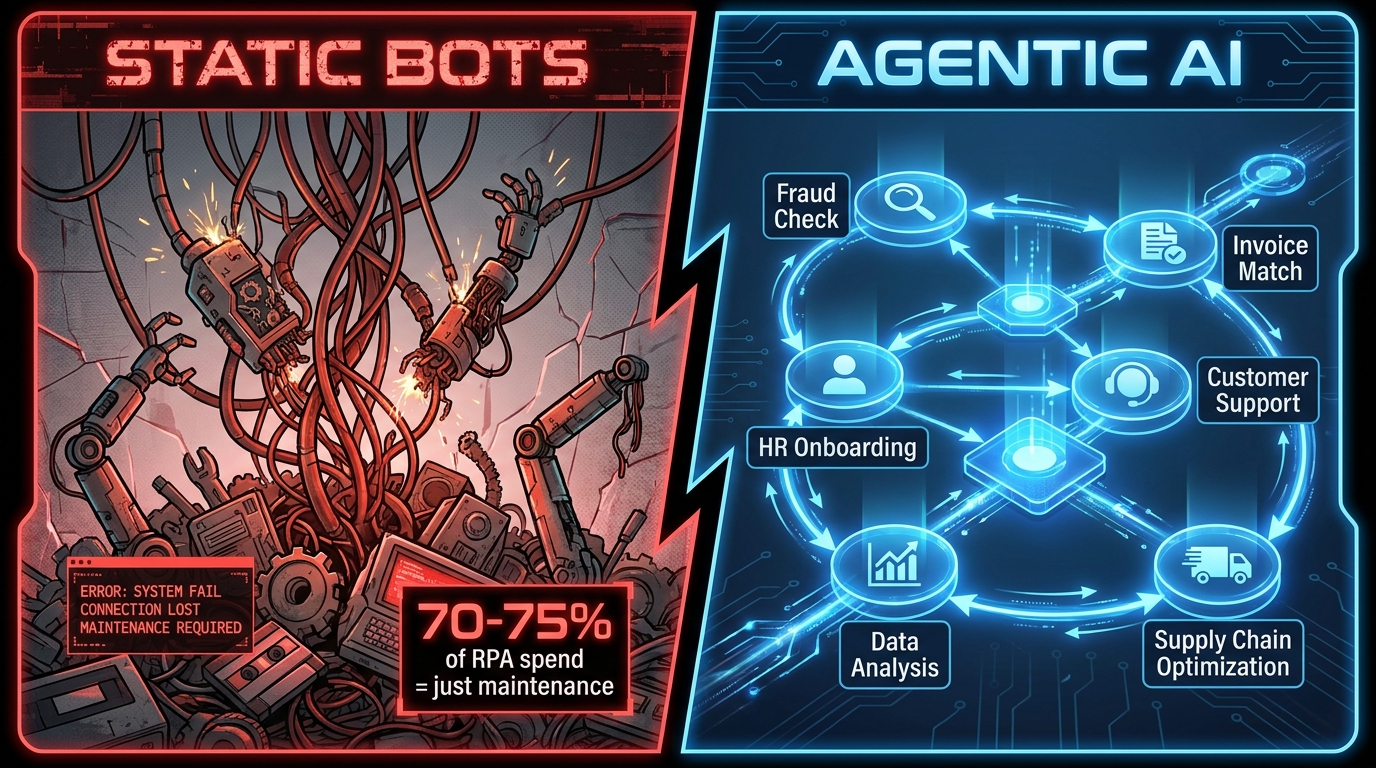
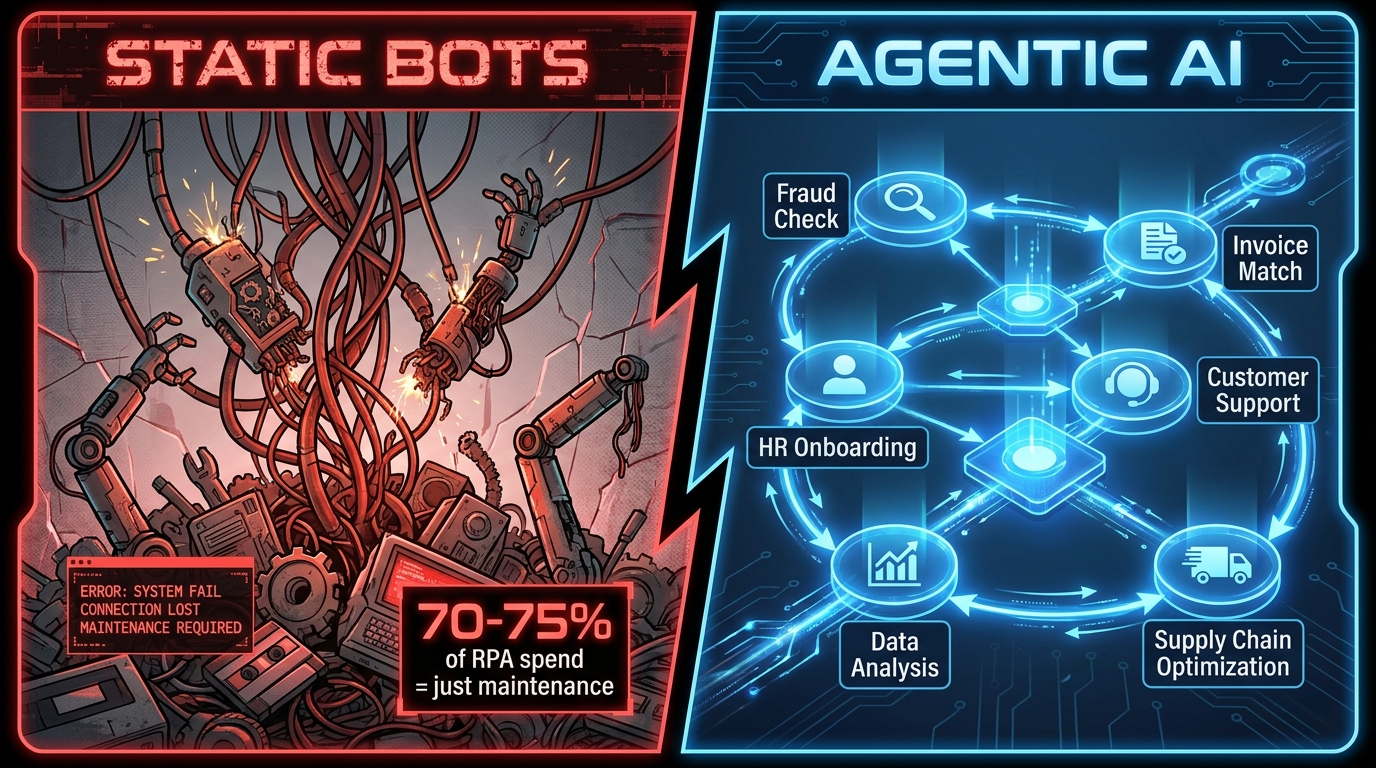
Somewhere in your organization, there is probably a bot that nobody talks about anymore. It was built two years ago to handle a specific process — invoice matching, maybe, or new-hire account provisioning. It worked for about eight months. Then a vendor upgraded their portal, a browser extension changed, or someone restructured a spreadsheet column, and the bot quietly started failing.
Now it lives on a server that three different teams claim ownership of, costs a developer four hours a month to patch, and handles maybe 60% of what it was originally designed to do. The remaining 40% gets kicked to a human queue that never quite empties.
This is not a technology failure story. It is an economics story — and the economics of static workflow automation are quietly collapsing under the weight of their own maintenance burden. Enterprises built RPA estates on the assumption that “automate once, benefit forever” was a realistic proposition. It rarely is. What most organizations actually built was a fleet of fragile scripts that require constant tending just to maintain the status quo.
Agentic AI is entering this space not as a flashy upgrade but as a structural solution to a problem that the industry has been reluctant to name clearly: static bots are not a solved problem. They are a recurring cost center dressed up as a capital investment. The question for 2026 is not whether agentic AI is better in a demo. The question is whether the transition economics actually work — and for which workflows, in what order, with what governance in place.
This article breaks down the real cost of the bot status quo, explains what makes agentic architectures structurally different, and lays out the transition strategy that separates the 23% of enterprises successfully scaling agents from the majority still running on brittle scripts.
The Bot Graveyard: Why RPA Promised More Than It Could Deliver
Robotic Process Automation arrived in enterprise technology circles with a compelling pitch: mimic human keystrokes and mouse movements to automate rule-based tasks, without needing to integrate directly with underlying systems. No API required. No custom development. Just record the steps and let the bot run.
For a certain category of task, it worked. Copying data between legacy systems that lacked APIs, running end-of-month reconciliations on fixed formats, generating standard reports from predictable data sources — these were genuine wins, and many organizations correctly captured ROI from them.
But the assumption embedded in the RPA model was quietly catastrophic: that the processes being automated would stay stable. They almost never do.
The Three Failure Modes That Eat RPA Estates Alive
UI dependency. Traditional RPA bots operate by interacting with screen elements — buttons, fields, dropdown menus — identified by their position, label, or selector. When the application is updated, rebranded, or restructured, the bot can no longer find what it is looking for. This is not an edge case. It is a near-certainty over any 12-to-18-month horizon, and it means every application upgrade on every system your bots touch generates a wave of break-fix work.
Exception intolerance. Static bots follow predetermined decision trees. When reality deviates from the expected path — an invoice arrives in a non-standard format, a field is missing, an approval is pending from someone out of office — the bot has no mechanism to adapt. It either fails silently, errors out, or, in the worst case, processes the exception incorrectly. The resulting human exception queues often grow larger than the process the bot was supposed to eliminate.
Unstructured data blindness. The majority of enterprise information does not arrive in neat, structured formats. Emails, PDFs, scanned documents, free-text fields, voice memos — these are the connective tissue of real business processes. Traditional RPA has almost no ability to interpret unstructured content without pairing it with additional OCR or NLP tools, and even then, the integration is brittle and version-sensitive.
The Scale of the Problem
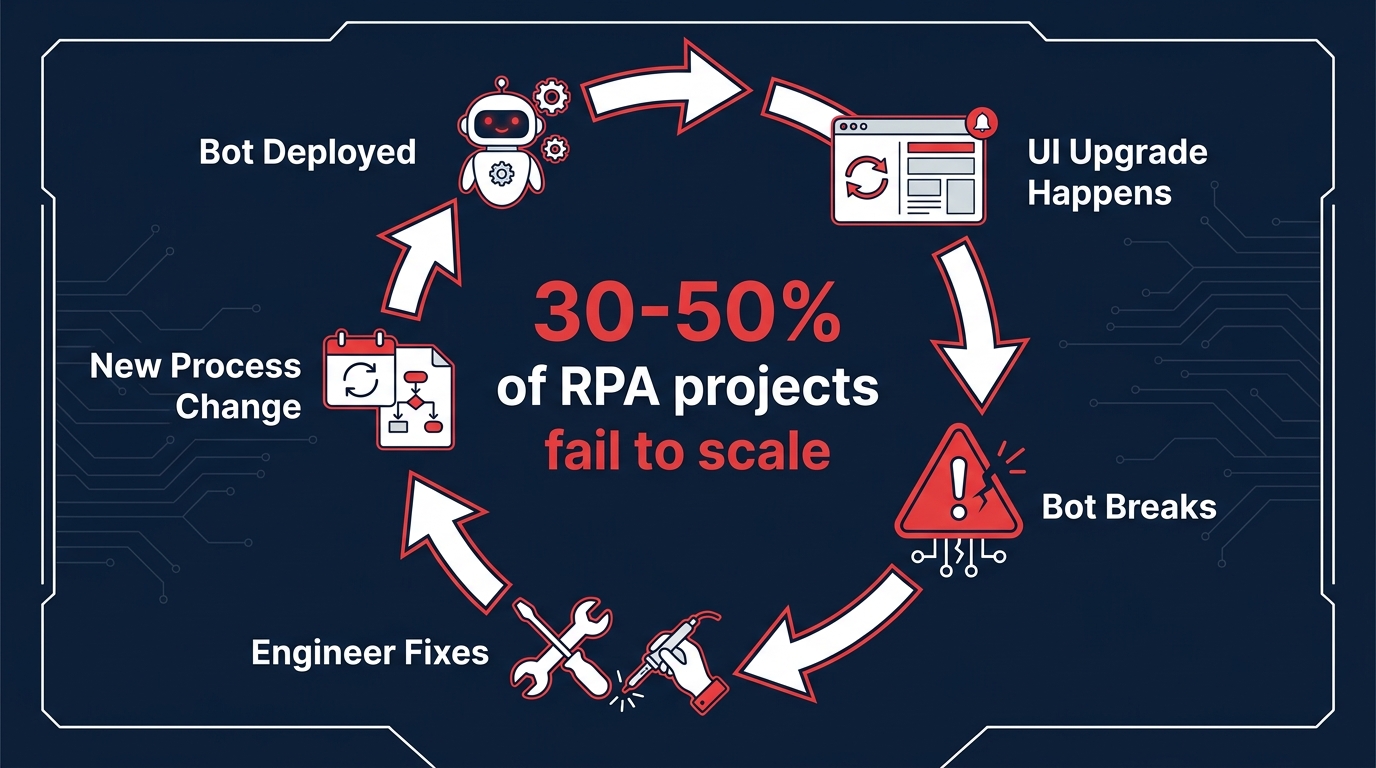
The failure statistics are not soft industry rumors. Research consistently puts the share of RPA projects that fail to scale or are abandoned within approximately two years at 30 to 50 percent. That is a remarkably high failure rate for technology that has been positioned as proven and mature.
More instructively, organizations that do successfully deploy RPA at scale often find that the ongoing maintenance burden reshapes their ROI calculation in ways the original business case never anticipated. Industry data puts total RPA maintenance and support costs — including engineering labor, monitoring, incident response, and break-fix cycles — at 70 to 75 percent of total program spend. Licensing, the line item that dominates procurement discussions, typically represents only 20 to 25 percent of what enterprises actually pay to keep RPA running.
The result is a fleet of bots that requires roughly 15 to 25 percent of initial development cost, per bot, per year, just to maintain at current capability — with no improvement in scope, no expansion of coverage, and no ability to handle the exceptions that the bot was never designed to manage.
“The real problem with our RPA estate wasn’t the bots that failed loudly. It was the ones that were technically running but only handling 55% of the volume they were supposed to, and nobody had noticed.”
— Enterprise automation lead, financial services sector (2026)
That silent underperformance is the most insidious aspect of the static bot model. Failures are visible and generate tickets. Quiet coverage erosion — where a bot handles fewer and fewer cases as the process drifts from the original design — accumulates invisibly until someone runs the numbers.
What Makes Agentic AI Structurally Different
The term “agentic AI” has accrued enough marketing gloss that it risks meaning nothing. Before examining where it beats static bots, it is worth being precise about what the architecture actually is and why that architecture behaves differently when processes change.
The Core Architecture: Orchestrator Plus Specialists
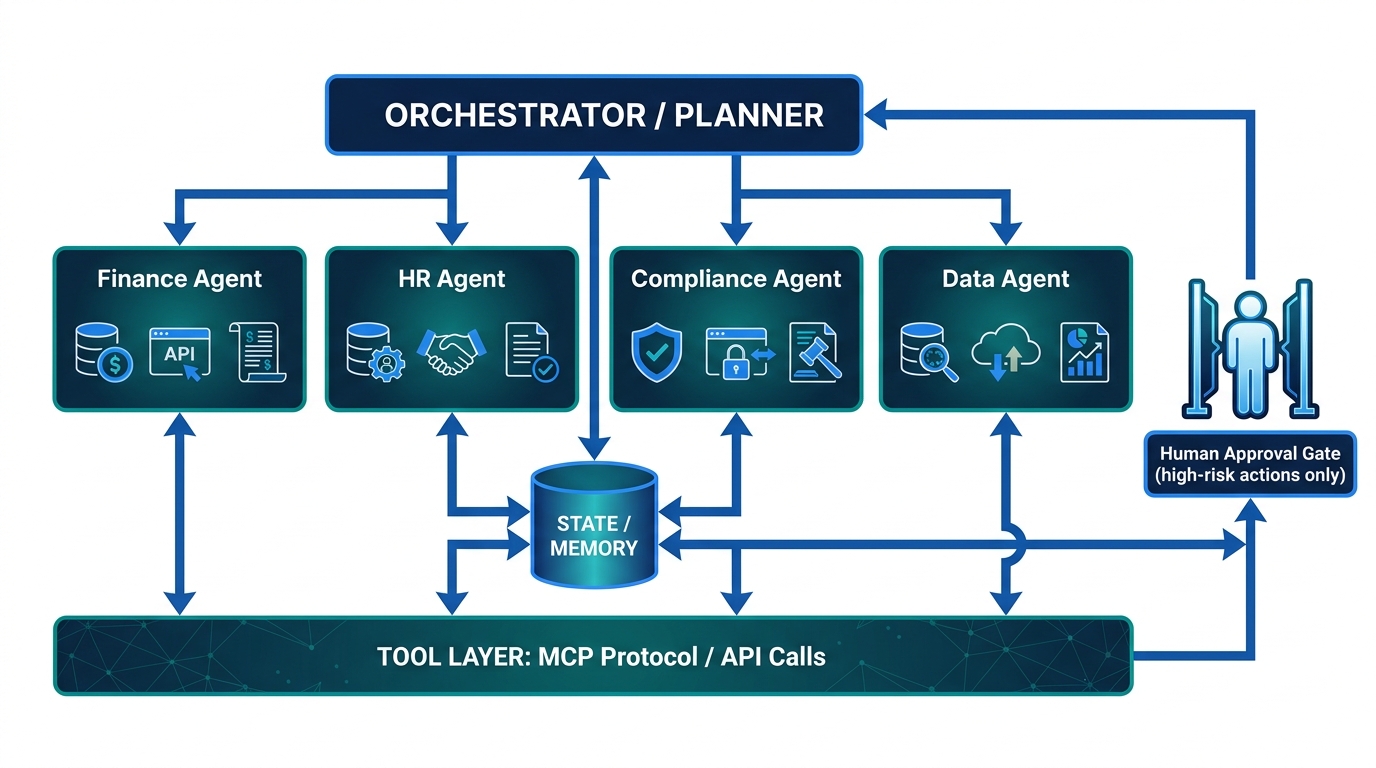
A production agentic AI system in 2026 is not a single model running a single task. It is typically a layered architecture with three functional components working in concert.
At the top sits an orchestrator or planner — a model or controller that receives a high-level goal, decomposes it into subtasks, determines the sequence and routing of those tasks, and manages shared state across the workflow. The orchestrator does not execute actions directly. It decides what happens next, tracks what has happened, and handles failures by retrying, rerouting, or escalating.
Below the orchestrator sit specialist agents — purpose-built for specific domains or task types. A finance agent might be configured with access to ERP APIs, trained on invoice formats, and constrained to specific approval thresholds. An HR agent might have access to HRIS systems and knowledge of onboarding checklists. Each specialist operates within a defined scope, receives only the context it needs for its task, and returns a structured result to the orchestrator.
The third layer is the tool and execution layer — the APIs, databases, and external systems that agents actually interact with. In 2026, the Model Context Protocol (MCP) has emerged as the dominant standard for tool discovery and invocation, allowing agents to dynamically identify and call tools without hard-coded integration logic. This is a meaningful shift from RPA: rather than scripting exact UI interactions, agents query a tool catalog, select the appropriate interface, and make structured API calls that are far more resilient to application-layer changes.
Why This Architecture Handles Change Differently
The critical behavioral difference between a static bot and an agentic system is not intelligence per se. It is adaptability at the exception boundary.
When a static bot encounters a situation outside its decision tree, it stops. When an agentic system encounters an unexpected input — a missing field, a format variation, an ambiguous approval state — it can reason about the situation, consult additional context, attempt alternative paths, or escalate to a human with a structured summary of what it found and what decision is needed. The human approval gate becomes a feature rather than a failure mode.
This is also why agentic systems handle unstructured data categorically better than their RPA predecessors. A large language model underlying an agent can read a PDF invoice, extract the relevant fields, reconcile them against a purchase order, identify a discrepancy in line item 7, draft a query to the vendor, and route the whole package to an accounts payable manager — without requiring the document to arrive in a specific template or format.
State and Memory: The Feature Nobody Talks About Enough
One underappreciated structural advantage of agentic architectures is persistent state management. Static bots are typically stateless — each execution is independent, and context does not carry across sessions. Agentic systems maintain working memory and can track a multi-day workflow across multiple interactions, handoffs, and system calls.
For enterprise processes that span days or involve multiple approval stages — supplier onboarding, compliance reviews, contract negotiations — this is not a minor improvement. It is the difference between a system that handles a single transaction and one that owns a business process end to end.
The Maintenance Trap: Why 70–75% of RPA Spend Is Just Keeping Bots Alive
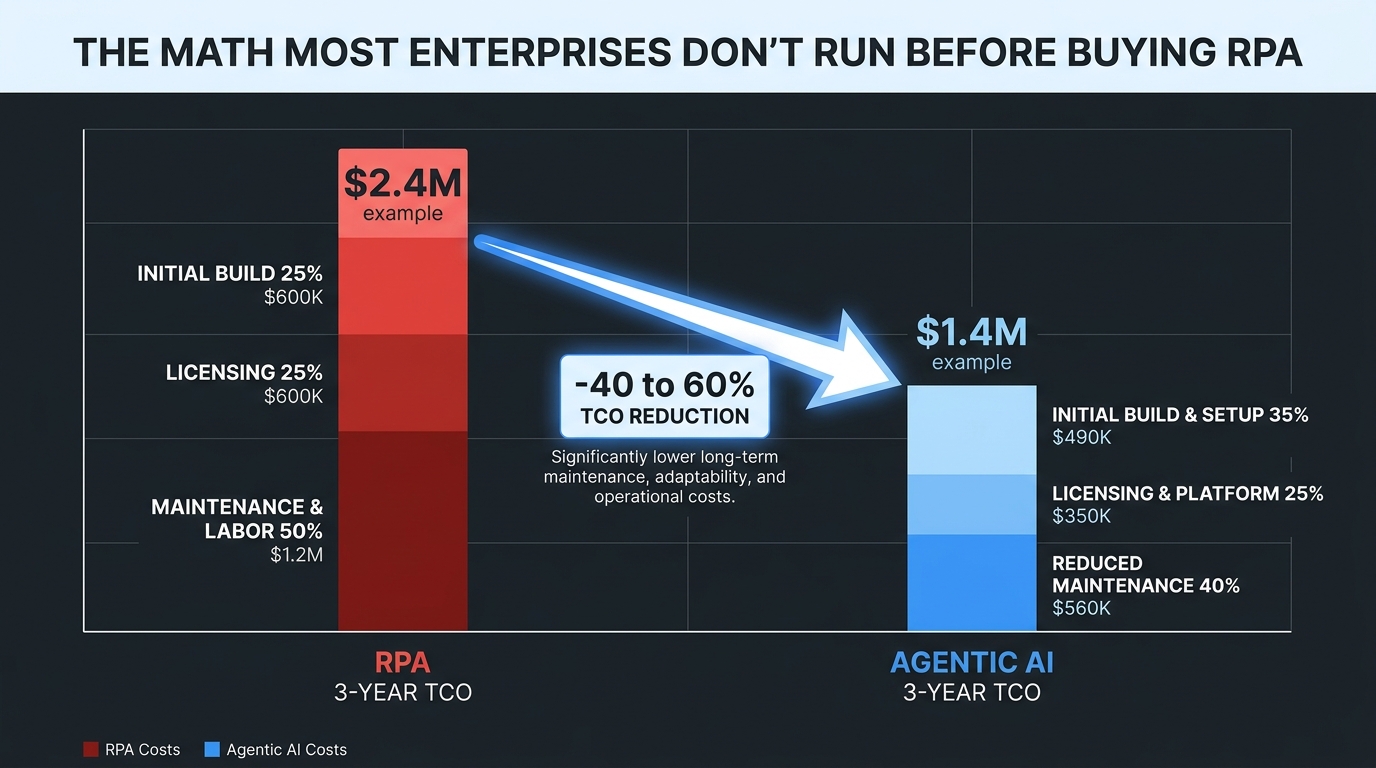
If there is a single data point that should reset how enterprises think about automation economics, it is this: in most mature RPA programs, the majority of total spend goes not toward creating new capability, but toward maintaining existing capability at its current level.
This is an extraordinary misallocation of engineering talent, and it compounds over time in ways that are structurally difficult to escape.
How the Maintenance Spiral Works
The dynamic plays out in a predictable pattern. An enterprise builds a bot fleet of, say, 80 automations over two years. Each bot is tested against the current state of the application it interacts with. Initial performance is strong. The business case closes. The automation team receives approval for further expansion.
Twelve months later, application upgrades, process changes, and organizational restructuring have introduced break points across a significant share of the bot estate. Developers who should be building new automations are instead triaging failures. The bot estate has become its own maintenance backlog, competing for the same engineering resources as the expansion pipeline.
By year three, many organizations find that their automation team is effectively a bot maintenance operation with a small new-build function on the side. The original value proposition — continuous delivery of new efficiency — has stalled. The estate is stable enough to justify its existence on cost-per-transaction metrics, but it is not growing, and its ability to handle modern process complexity is visibly limited.
Running the Real Numbers
The standard benchmark for annual RPA maintenance is 15 to 25 percent of initial development cost, per bot, per year. For a bot that cost $40,000 to build, that represents $6,000 to $10,000 in annual upkeep. Across an estate of 80 bots with an average build cost of $35,000, the annual maintenance bill runs to roughly $420,000 to $700,000 — before accounting for the opportunity cost of the developer hours consumed.
Add licensing (typically 20 to 25 percent of total spend), infrastructure, and the labor associated with monitoring and incident response, and the total cost of ownership for a mature RPA estate regularly exceeds twice the initial capital investment over a three-year period — often without any net expansion of automation coverage.
The three-year TCO comparison with agentic AI is not simple, and any vendor claiming a clean apples-to-apples figure should be viewed skeptically. But the structural case is credible: agentic systems that interact with systems via APIs rather than UI scripts are substantially less sensitive to application-layer changes, meaning the maintenance burden for stable, well-governed agent workflows is materially lower than equivalent RPA automations in dynamic environments. Enterprises that have made selective migrations report total cost reductions in the 40 to 60 percent range over three years for the specific workflows transitioned.
The Hidden Cost: Developer Talent Drain
There is a softer but real cost that the spreadsheet rarely captures: what experienced automation engineers actually want to work on. In a tight market for technical talent, assigning developers to an endless cycle of bot patching is an attrition risk. The organizations that are successfully scaling agentic AI are, without exception, organizations where automation engineers have been retasked from maintenance to architecture — and that shift in work quality is having a measurable effect on retention.
Where Agentic AI Actually Wins Today: Use Cases With Real Production Data
The temptation when discussing agentic AI is to list every possible application domain and gesture toward future potential. The more useful exercise in 2026 is to identify specifically where agents are in production, performing reliably, and delivering measurable results — rather than where they might eventually work.
Three enterprise functions have emerged as the clearest early wins: finance operations, HR administration, and customer-facing service workflows.
Finance Operations: Invoice-to-Pay and Exception Handling
Accounts payable is one of the most thoroughly documented agentic AI success stories in enterprise operations, and for good reason: it is a workflow that combines structured requirements (match invoice to PO, validate line items, post to ERP) with a high volume of real-world variation (different invoice formats, missing fields, quantity discrepancies, vendor query handling).
A static bot can handle the straight-through cases reliably. But in most AP operations, the straight-through rate for complex invoices sits below 70 percent, meaning more than 30 percent of invoices require some form of human intervention. The traditional bot either fails on these or routes them immediately to a human queue — defeating much of the automation value.
An agentic AP system changes the equation substantially. The agent reads invoices in any format via document understanding models, matches them against PO records, flags specific discrepancies with structured reasoning (not just “error — unmatched field” but “line item 3 shows $4,200 against PO value of $3,800 — likely partial delivery, querying vendor”), routes exception-ready summaries to approvers, and updates ERP records once approved. Enterprises deploying agentic AP report straight-through rates climbing to 85 to 90 percent for previously exception-heavy invoice streams.
HR Administration: Onboarding and Service Desk
Employee onboarding is a process that looks deceptively simple from a workflow chart but consistently breaks static automation in practice. New hires join with varied backgrounds, role variations trigger different system access requirements, start dates shift, and onboarding steps that appear sequential often have implicit dependencies on actions from multiple parties.
HR agents in 2026 handle the full onboarding sequence — provisioning accounts across IT systems, coordinating training assignments, managing document collection, triggering payroll setup, and routing background check steps — while tracking completion status and managing exceptions when steps are delayed or incomplete. The agent does not just execute tasks; it manages the state of the process, proactively identifying blockers and escalating them before they delay the new hire’s start date.
For the HR service desk specifically, agentic AI has reduced average ticket resolution time by 40 to 60 percent in documented enterprise deployments, largely by resolving the long tail of questions that are too contextual for a static FAQ bot but too routine to warrant full human handling — policy queries with specific personal circumstances, benefit calculation questions that require pulling data from multiple systems, and leave request scenarios that involve overlapping approvals.
Customer-Facing Operations: The Klarna Data Point
Klarna’s much-cited deployment of an AI-powered customer service agent provides the clearest large-scale evidence of what happens when agentic AI replaces a combination of static chatbots and human agents. The system handled 2.3 million customer conversations in its first operational month — roughly two-thirds of all support volume — with average resolution time dropping from 11 minutes to under 2 minutes, and repeat inquiry rates falling 25 percent.
The more instructive detail from Klarna’s experience is what happened next. After achieving those headline results, the company moved toward a hybrid human-AI model after identifying that the fully automated system underperformed on complex, emotionally charged cases — disputes, fraud claims, and situations requiring nuanced judgment about customer circumstances. The lesson is not that agentic AI failed. It is that the optimal architecture is not zero humans. It is the right humans, handling the right cases, with AI handling everything else.
That is a fundamentally different labor model than either “humans do everything” or “bots do everything” — and it is the model that is actually working at scale in 2026.
The Transition Playbook: Augment First, Then Replace
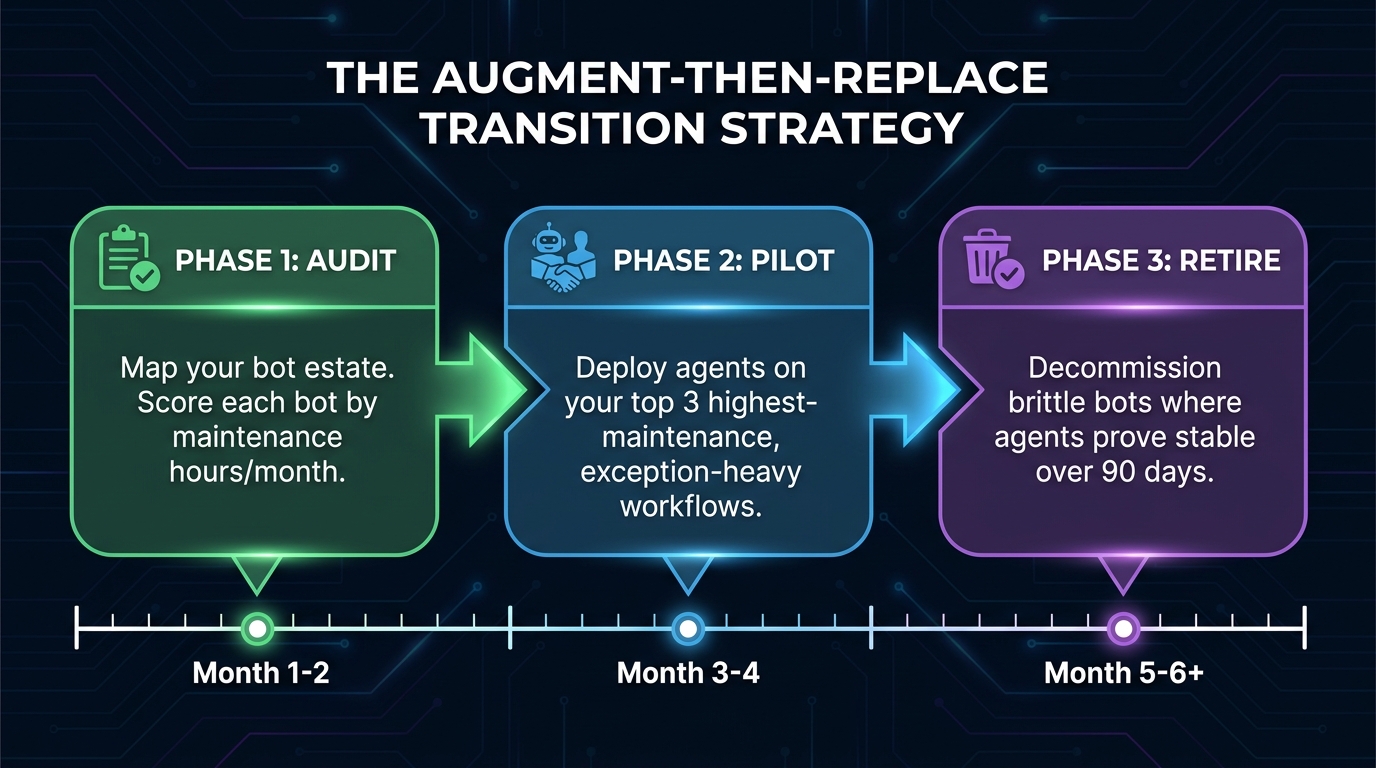
The dominant enterprise pattern in 2026 is not ripping out RPA and replacing it wholesale with agents. Organizations that attempted aggressive rip-and-replace strategies in 2024 and 2025 largely found that the disruption cost exceeded the efficiency gain, at least in the short term. The strategy that is actually working is more deliberate: augment existing automation where agents can add immediate value, then selectively retire the bots that agents demonstrably outperform.
Phase 1: Audit and Score Your Bot Estate
The transition starts not with technology selection but with honest accounting of the existing automation portfolio. Every bot in the estate should be scored against two dimensions: maintenance cost (engineer hours per month, incident frequency, average time to restore after failures) and exception rate (the percentage of cases the bot cannot handle and routes to humans).
This scoring exercise typically reveals a clear distribution. A minority of bots — often 20 to 30 percent of the estate — account for the majority of maintenance effort and exception volume. These are the bots that are the highest-fit candidates for agentic replacement: they are expensive to maintain, they handle a shrinking share of their intended volume, and they sit on processes that require the kind of contextual reasoning that agents handle well.
A second tier — often the largest category — consists of bots that are stable, low-maintenance, and handling structured, predictable processes. These are the bots that RPA was designed for. There is no economic case for replacing them with agents unless the underlying process is scheduled to change. Leave them alone.
A third tier consists of bots that are marginal performers — low volume, unclear ownership, uncertain ROI. These warrant decommissioning regardless of what replaces them, because they are consuming infrastructure and monitoring resources without meaningful output.
Phase 2: Pilot on Your Highest-Pain Workflows
With the audit complete, the transition team can identify the two or three workflows that represent the best case for an agent pilot. The selection criteria should be explicit: high exception rate, high monthly maintenance hours, business-critical enough to have executive attention, but not so operationally central that a failed pilot causes significant disruption.
The pilot should be structured as a parallel run. The existing bot continues to handle the workflow while the agent runs alongside, processing the same volume independently. At the end of 60 to 90 days, the comparison is straightforward: straight-through rate, exception handling accuracy, cycle time, and total engineer hours consumed by each system.
Parallel running is critical for two reasons. First, it generates clean side-by-side evidence for the business case, which matters when requesting budget for expansion. Second, it allows the team to discover the governance and guardrail requirements specific to that workflow before the agent is operating without a safety net.
Phase 3: Retire Brittle Bots Where Agents Prove Stable
Once an agent has run in parallel for 90 days with consistently better metrics, the decommissioning decision becomes a data-driven one rather than a technology opinion. The bot is retired, the agent takes full ownership of the workflow, and the maintenance budget previously allocated to that bot is freed up for the next phase of expansion.
This cycle — audit, pilot, retire, expand — typically delivers measurable ROI from the first workflow transition within six to nine months, generating both financial returns and organizational confidence for subsequent phases. The enterprises that are now scaling agents enterprise-wide started with exactly this methodical approach. They did not begin by declaring RPA dead. They began by finding the bots that were already dying and replacing them with something better.
The Governance Gap: Why Autonomy Without Guardrails Is a Risk Category of Its Own
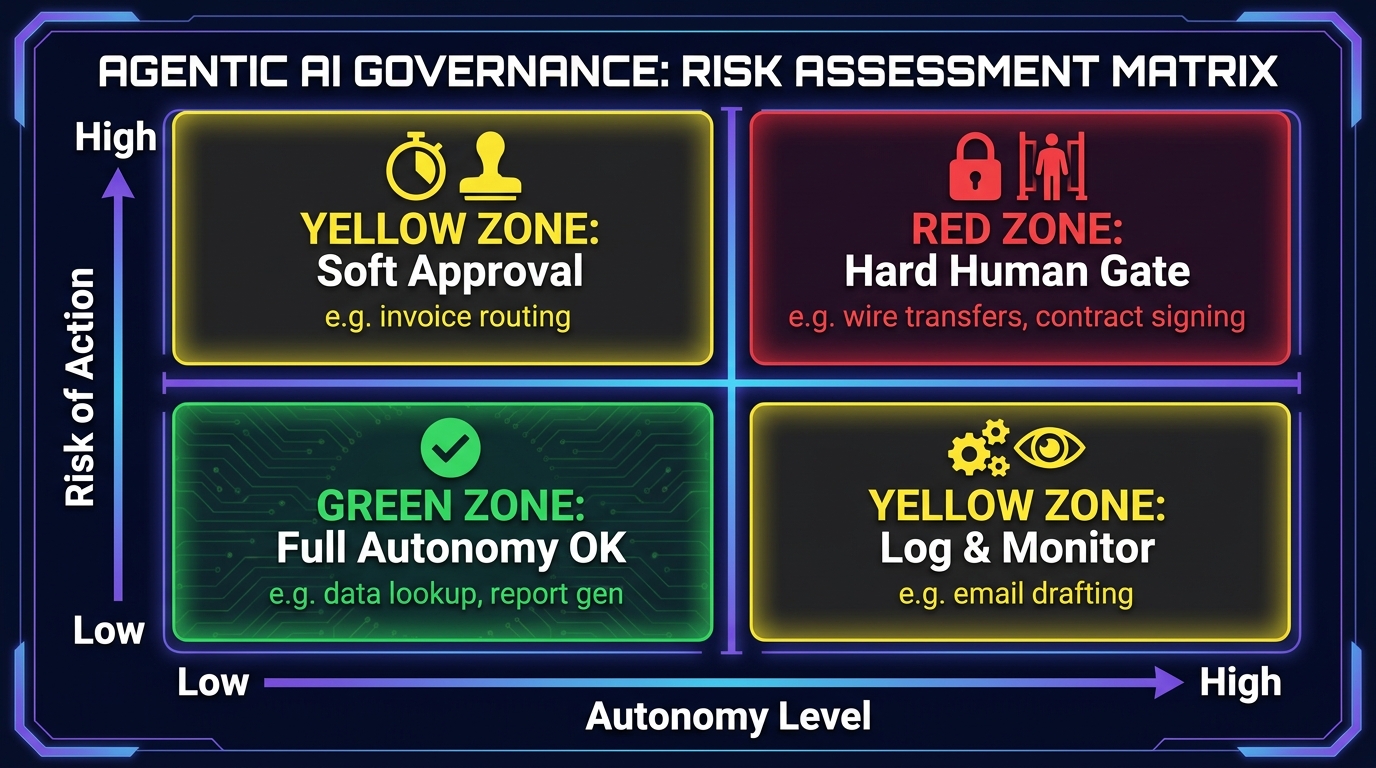
Static bots fail loudly and predictably. They error out on recognizable failure modes. Agentic AI introduces a different risk profile: the risk of confident, well-reasoned wrong actions — decisions that look correct at each individual step but compound into significant errors at the workflow level.
This is not a hypothetical. Organizations that deployed agents without adequate guardrails in 2024 and 2025 reported incidents where agents completed multi-step actions — routing payments, modifying records, triggering external communications — based on ambiguous inputs that a human would have flagged for clarification. The agents were not malfunctioning. They were behaving exactly as designed: completing the task as efficiently as possible. The problem was that “completing the task” in ambiguous situations required judgment calls that the governance framework had not anticipated.
The Risk-Tiered Approval Framework
The governance pattern that is emerging as best practice in 2026 is not “human in the loop for everything” — that destroys the efficiency case — nor is it “full autonomy for everything.” It is a risk-tiered framework that calibrates human involvement to the reversibility and consequence of the action being taken.
Low-risk, reversible actions — data lookups, report generation, drafting communications for human review, reading and summarizing documents — can operate with full autonomy. The consequence of an error is limited and easily corrected.
Medium-risk actions — sending external communications, routing items for approval, updating internal records — operate with logging and monitoring. No human approval is required before execution, but every action is recorded in an immutable audit trail, and anomaly detection flags patterns that deviate from expected behavior.
High-risk, potentially irreversible actions — wire transfers, contract execution, payroll modifications, external commitments above defined thresholds — require an explicit human approval gate before execution. The agent prepares the action completely and presents it for sign-off. It does not proceed until approval is recorded.
This tiered model allows agents to operate at speed on the 80 to 90 percent of workflow steps that are low-risk, while maintaining appropriate control over the minority of actions that require human judgment.
Identity, Least Privilege, and Auditability
Beyond approval gates, effective agentic governance requires treating agents as distinct identities within the enterprise security perimeter. Each agent should have its own credential set with narrowly defined permissions — access only to the systems and data required for its specific task scope. This “least privilege by default” approach limits the blast radius of any individual agent failure or security incident.
Equally important is auditability. Every agent action — every tool call, every decision branch, every data access — should be logged in a form that supports incident investigation and regulatory review. In regulated industries (financial services, healthcare, insurance), auditability is not a best practice. It is a prerequisite for deployment.
Organizations that have governance infrastructure in place before deploying agents at scale report significantly fewer incidents and faster recovery times when issues do occur. Organizations that deploy agents quickly and retrofit governance afterward tend to face a much harder remediation process — particularly if an agent has taken consequential actions that are difficult to reverse.
Reading the 2026 Vendor Landscape: Who Is Building What
The vendor landscape for enterprise automation in 2026 reflects the hybrid reality of the market. Traditional RPA vendors — UiPath, Automation Anywhere, Blue Prism — have all repositioned their products to incorporate agentic capabilities, framing their platforms as the orchestration layer that connects existing bot estates with new AI-native workflows. The pitch is continuity: extend your existing investment rather than replace it.
AI-native platforms — including frameworks like LangGraph, CrewAI, Microsoft AutoGen (now AG2), and Google’s ADK — approach the space from the opposite direction: building orchestration-first architectures with AI reasoning at the core and plugging into execution systems via API. These platforms require more architectural work to implement but offer substantially more flexibility for complex, multi-system workflows.
The Cloud Hyperscaler Play
AWS, Microsoft Azure, and Google Cloud have all entered the agentic orchestration market with managed services — AWS Bedrock AgentCore, Azure AI Foundry, and Google Vertex AI Agent Builder, respectively. These managed runtimes lower the operational burden of running multi-agent architectures at scale, handling state persistence, retry logic, monitoring, and scaling infrastructure.
For enterprises already committed to a primary cloud provider, the managed agent runtime from that provider will often be the path of least resistance — particularly for teams that do not have deep MLOps capability in-house. The trade-off is vendor lock-in at the orchestration layer, which can limit flexibility as the market continues to evolve rapidly.
The MCP Standardization Shift
One development that deserves more enterprise attention than it currently receives is the emergence of the Model Context Protocol as a de facto standard for agent-to-tool communication. MCP allows agents to discover and invoke tools through a standardized interface, meaning a well-designed agentic system can add new tool integrations without rebuilding the agent logic.
For procurement and architecture teams, this matters because it reduces the switching costs associated with agentic infrastructure. An agent built on MCP-compliant tooling is substantially more portable across platforms than one built on vendor-specific integration layers — a lesson that RPA buyers learned the hard way when they found their bot estates locked to specific vendors.
Point Solutions vs. Platform Bets
A growing category of vertical-specific agentic AI vendors — targeting specific functions like AP automation, legal document review, IT service management, or compliance monitoring — offers a middle path between DIY agent frameworks and broad platform commitments. These point solutions deliver faster time-to-value for specific workflows but require careful integration planning when the goal is enterprise-wide orchestration.
The selection principle that is proving durable in 2026: evaluate vendors on the quality of their audit trails and governance tooling first, their agent reasoning quality second, and their roadmap claims last. The organizations that are struggling with agentic deployments are almost universally struggling with observability and control, not with the intelligence of the underlying models.
The 3-Year TCO Calculation Nobody Does Before Buying RPA
The economics of automation technology selection deserve more rigorous treatment than most procurement processes provide. The standard approach is to compare licensing costs and implementation fees — the visible, contractual numbers — and largely ignore the ongoing operational cost profile. This is the calculation error that has trapped many enterprises in expensive, underperforming RPA estates.
Building a Realistic Total Cost of Ownership Model
A defensible 3-year TCO model for any automation investment — RPA or agentic — should include the following cost categories:
- Initial implementation cost: vendor fees, internal developer time, integration work, testing, documentation. For RPA, this typically runs $25,000 to $80,000 per bot depending on complexity. For agentic workflows, the range is wider and depends heavily on the integration surface and the maturity of the tool layer.
- Annual licensing: typically 20 to 25 percent of RPA spend. Agent platform costs vary significantly; managed cloud runtimes often price on consumption rather than fixed licenses, which can work favorably or unfavorably depending on volume patterns.
- Annual maintenance labor: the line item that most TCO models underestimate. For RPA, budget 15 to 25 percent of initial development cost per bot per year for maintenance alone, excluding new development. For agentic systems, this number is lower for workflows where the API layer is stable, but should not be assumed to be zero — model updates, prompt drift, and tool API changes all require ongoing attention.
- Exception handling labor: the human cost of managing the cases the automation cannot handle. This should be measured at current state for the process being automated, then modeled against the expected exception rate of the proposed automation technology.
- Governance and compliance overhead: audit trail management, policy reviews, incident response. Often omitted from initial TCO models. For agentic systems in regulated industries, this can be a significant line item.
What the Model Reveals
When enterprises run this model honestly — before selecting a technology, not after — the result often significantly shifts the relative attractiveness of agentic AI for exception-heavy workflows. The higher upfront implementation cost of an agentic system is frequently offset within 18 to 24 months by lower maintenance labor costs and higher straight-through processing rates, which reduce the ongoing human exception handling cost.
For simple, stable, structured processes, RPA still wins on this model. The implementation is faster, the predictability is higher, and the governance requirements are lower. This is why the recommendation from practitioners who have worked through these calculations is consistently hybrid: keep RPA where it works, replace it where it doesn’t.
The organizations that regret their RPA investments are not organizations that deployed RPA on the wrong technology. They are organizations that deployed RPA on the wrong processes — specifically, processes that were complex enough to generate persistent exceptions but not complex enough to justify the upfront investment in a more capable system. They chose the path of least resistance at implementation time and discovered the true cost at maintenance time.
What the 23% Scaling Agents Are Doing Differently
Enterprise data from 2026 shows a clear adoption split: approximately 72 percent of enterprises have AI agents in production or pilot in some form, but only around 23 percent have scaled an agentic system enterprise-wide. The gap between “we have a pilot” and “we have a scaled program” is where most organizations are currently stuck — and the practices of the organizations that have crossed that gap are instructive.
They Started With Operations, Not Innovation
Organizations that are successfully scaling agents almost universally started in back-office operations rather than in customer-facing or revenue-generating contexts. Finance, HR, IT service management, and compliance were the entry points, not sales, marketing, or product development. The reason is straightforward: operational workflows have clearer definitions of success, more predictable volumes, better-documented exception handling requirements, and lower brand risk if something goes wrong.
This sequencing also generates the financial results that fund expansion. A successful AP automation agent that demonstrably reduces processing costs and exception volume creates an internal ROI narrative that procurement and finance leadership can audit. That narrative unlocks budget for the next deployment. Organizations that started with ambitious customer-facing or analytical use cases often found the value harder to measure and the organizational support harder to sustain.
They Invested in Observability Before They Invested in Capability
The 23% that are scaling treat observability — the ability to see what every agent is doing, why, and with what result — as infrastructure, not an afterthought. Before a new agent workflow goes live, they have dashboards showing throughput, exception rates, decision rationale, and anomaly alerts. Before they scale an agent to a new business unit, they verify that the audit trail for that agent meets the regulatory and operational requirements of that unit.
This approach slows initial deployment timelines but dramatically reduces incident rates and remediation costs. It also builds organizational trust at a pace that supports continued expansion, rather than triggering the risk committee review that tends to freeze programs after a highly visible failure.
They Treat the Agent Portfolio Like an Engineering Product, Not an IT Project
The most consistent organizational difference between enterprises that scale agents and those that plateau at pilot is whether the agent program is run like an engineering product — with dedicated ownership, a roadmap, a feedback loop, and ongoing iteration — or like an IT project that gets handed off after implementation.
Agents are not static. The processes they operate in change. The tools they access change. The models they run on are updated. Organizations that assign permanent product ownership to their agent portfolio — with engineers responsible for monitoring performance and iterating on prompt logic, tool configuration, and exception handling — sustain performance over time. Organizations that treat agent deployment as a one-time implementation event find their systems degrading in ways that mirror the RPA maintenance trap they were trying to escape.
They Measured Process Coverage, Not Just Task Accuracy
A subtle but important measurement distinction separates organizations that scale agents effectively from those that plateau. The less effective organizations measure agent performance on task accuracy — does the agent complete the task correctly when it accepts it? The more effective organizations measure process coverage — what percentage of the total incoming volume does the agent handle end-to-end, including the cases it routes out?
A 98 percent task accuracy rate sounds excellent. But if the agent only accepts 60 percent of incoming cases and routes the other 40 percent to humans, the net automation rate is 59 percent — which may not be materially better than the bot it replaced. Organizations that optimize for process coverage rather than task accuracy consistently achieve higher net efficiency gains and more defensible business cases for expansion.
From Automation to Orchestration: The Shift That Changes Everything
There is a conceptual frame shift embedded in the transition from static bots to agentic AI that deserves explicit attention, because it changes not just the technology but the way organizations should think about what automation can do.
Static bots automate tasks. Agentic AI orchestrates processes. These are not the same thing, and the distinction matters for how organizations scope, fund, and measure their automation investments.
A task is a discrete, bounded action: extract these fields, compare these values, update this record. A process is a sequence of decisions, actions, and handoffs that collectively achieve a business outcome: a new employee is hired and fully onboarded, a supplier invoice is validated and paid, a customer complaint is resolved and documented.
RPA programs have always been implicitly measured at the task level, because that is the unit of work a static bot can reliably own. The resulting metrics — tasks automated, FTE equivalents saved, process steps touched — are real but limited. They capture what happened within the automation boundary, not what happened to the process overall.
Agentic systems, because they can own multi-step processes with decision logic and exception handling, invite measurement at the process level: end-to-end cycle time, straight-through rate for the full process, cost per completed outcome, and compliance accuracy across the entire workflow. These are metrics that business leaders understand and care about in a way that “number of tasks automated” never quite achieved.
This reframing is why the transition from static bots to agentic AI is less of an upgrade and more of a repositioning of what automation is for. The goal shifts from “automating steps that humans used to do” to “owning processes that humans used to manage.” The scope is larger, the governance requirements are higher, and the business impact is proportionally greater when done well.
Conclusion: The Decision Framework for 2026
The question facing automation leaders in 2026 is not whether agentic AI is better than static bots in the abstract. In exception-heavy, unstructured, multi-step workflows, it demonstrably is. The practical question is which workflows to transition, in what sequence, with what investment, and with what governance infrastructure in place.
The framework that the data supports is not complicated, but it requires honesty about the current state of the bot estate and discipline about the order of operations:
- Audit first. Score every bot in the estate by maintenance burden and exception rate. This is not a lengthy exercise — most automation teams can complete it in two to three weeks — but it is essential for making transition decisions based on evidence rather than vendor enthusiasm.
- Target the high-maintenance, high-exception bots first. These are the cases where the economic case for transition is clearest and where the improvement in performance will be most visible. Do not start with the easy bots that are already working well.
- Build governance before scale. Audit trails, approval gates, and monitoring dashboards are not optional extras. They are the infrastructure that allows agentic systems to operate in enterprise environments without generating the kind of incidents that freeze programs. Build them into the first pilot, not as a retrofit after scale.
- Measure process coverage, not just task accuracy. The metric that matters is what percentage of total incoming volume the agent handles end-to-end. A highly accurate agent that handles a small fraction of volume is not a successful automation.
- Treat the portfolio as a product. Assign permanent ownership. Build an iteration cadence. Expect agent workflows to require ongoing attention as processes, models, and tools evolve.
The enterprises that invested in RPA as a durable solution discovered that durable automation requires a different architecture than scripts running against static UIs. The enterprises investing in agentic AI today are, in the best cases, building with that lesson in mind — governing carefully, measuring honestly, and transitioning methodically from the systems that are already failing toward ones that are structurally better suited to the complexity of real enterprise processes.
The bots are not dead yet. But the ones in your estate that are expensive to maintain, slow to recover, and handling a shrinking fraction of their intended volume? Those are already dying. The decision is simply whether to replace them intentionally, on your terms, or to wait until the maintenance burden makes the decision for you.
Leave a Reply