Tag: AI Governance

  • The Organizational Rewiring: How AI Agents Are Redrawing Who Owns What Inside Your Business

    The Organizational Rewiring: How AI Agents Are Redrawing Who Owns What Inside Your Business

    Split view showing traditional human-run office workflows on the left versus AI agent-powered automated workflows on the right, with the question 'Who Owns the Workflow Now?'

    The conversation about AI agents in the enterprise has been dominated by two narratives. The first: agents are automating tasks, saving hours, cutting costs. The second: agents are dangerous, unreliable, and not ready for prime time. Both miss the more fundamental shift happening right now inside thousands of organizations.

    AI agents are not just doing work faster. They are taking ownership of entire workflows — the multi-step, cross-system, decision-laden processes that used to be orchestrated entirely by humans. That is a different kind of change. It is not about efficiency. It is about who, or what, is responsible for getting something done from start to finish.

    By mid-2026, roughly 40% of enterprise applications are expected to embed task-specific AI agents according to Gartner projections. Around 79% of enterprises report adopting AI agents in some form. Yet only 11–15% of those pilots have actually reached production at scale. The gap between experimentation and real operational ownership is wide — and the organizations closing that gap are not doing it through better models or faster hardware. They are doing it by redesigning who owns what inside their organizational structure.

    This post is about that redesign. Not the tools, not the models, not the vendor landscape — but the organizational logic of how work ownership is shifting, where the fault lines are forming, and what enterprises that are succeeding in this transition are actually doing differently.

    From Task Execution to Workflow Ownership: What Actually Changed

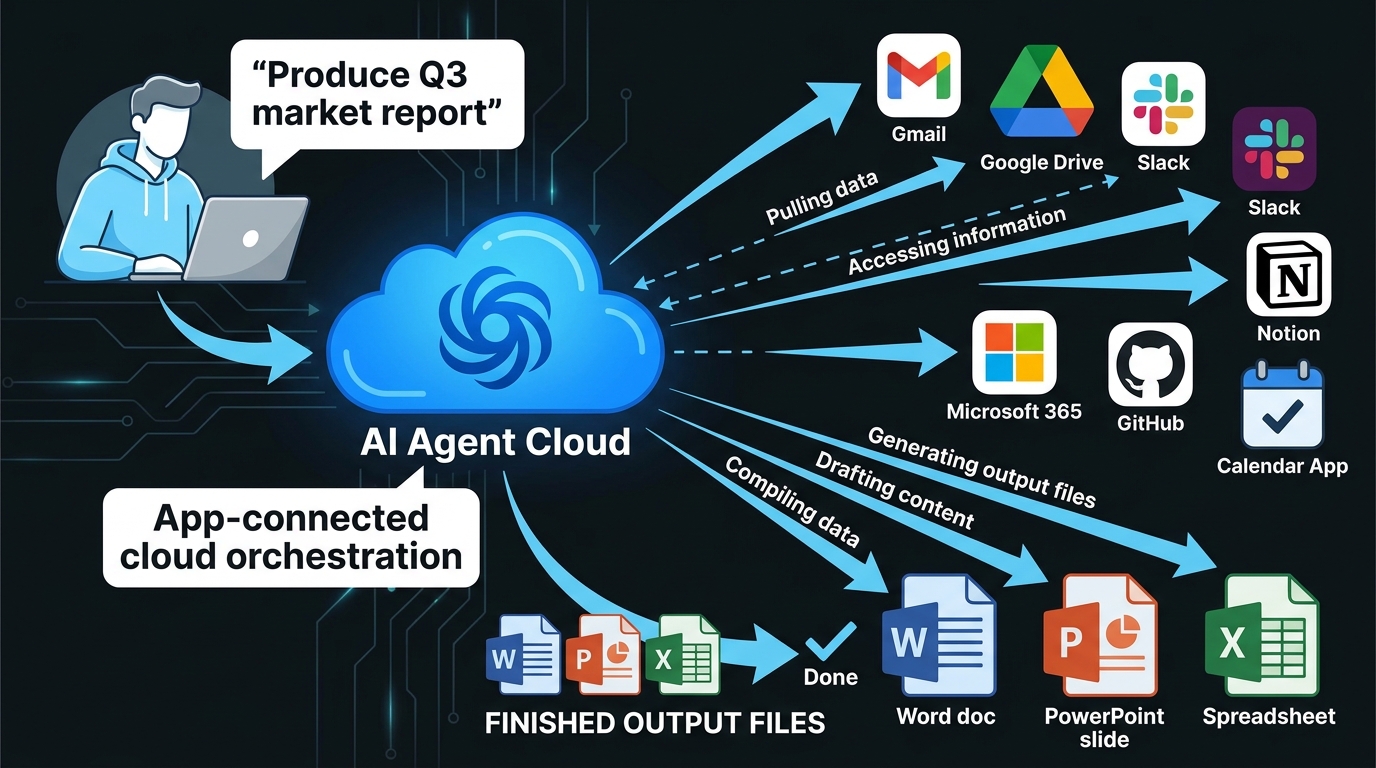
    The distinction between task execution and workflow ownership is not semantic. It is the difference between a copilot that helps a human write an email and an agent that receives an inbound customer complaint, queries the order management system, determines eligibility for a refund based on policy rules, initiates the refund, sends a confirmation, updates the CRM, and flags the case for quality review — all without a human touching it.

    That second scenario is what “workflow ownership” looks like. The agent does not assist. It runs the process. It coordinates systems. It makes decisions within defined boundaries. And it hands off to a human only when a genuine exception or high-stakes judgment call requires it.

    The Shift From Prompt-and-Response to Goal-Directed Execution

    Early enterprise AI deployments were predominantly prompt-based. A user asks a question, the system returns an answer. Useful, but still human-directed at every step. The user still owned the workflow — the AI just helped with individual moments inside it.
    Agentic AI changes the architecture. Instead of responding to prompts, agents receive goals. “Process all incoming invoices received before 5pm.” “Monitor this customer segment for churn signals and trigger outreach when threshold is met.” “Review all open support tickets older than 48 hours and escalate those that match these criteria.” The agent interprets the goal, breaks it into steps, calls the tools it needs, handles intermediate decisions, and reports back on outcomes.

    This is a fundamental transfer of workflow orchestration authority. Organizations accustomed to having a human responsible for every handoff between systems and steps are now asking whether that responsibility can be transferred — and under what conditions.

    Why This Shift Is Happening Now

    Three converging factors explain the timing. First, large language models have become capable enough to reason about multi-step tasks with sufficient reliability for structured business processes. Second, the tooling layer — API integrations, function calling, memory systems, orchestration frameworks — has matured to the point where connecting agents to real enterprise systems is achievable without rebuilding everything from scratch. Third, and perhaps most importantly, competitive pressure is forcing organizations to act. When a competitor’s AI agent processes 10,000 invoices overnight while yours requires a team of eight people doing the same work over two weeks, the business case is no longer a spreadsheet exercise.

    The result is a market-wide shift from “AI as assistant” to “AI as workflow owner” — and it is happening faster in some functions than others.

    Where Agents Have Actually Taken Root: A Department-by-Department Reality Check

    Bar chart showing AI agent penetration by business department in 2026: Customer Service leads at 85%, followed by Finance Ops, Sales/CRM, Supply Chain, and HR Operations

    Not all departments are equal in this transition. The depth of AI agent penetration varies significantly based on how well-structured the underlying workflows are, how available and clean the relevant data is, and how much organizational tolerance exists for autonomous action in that function.

    Customer Service: The Deepest Penetration

    Customer service has the most mature, broadest AI agent deployment of any enterprise function. Platforms like Salesforce Agentforce, Zendesk AI, Intercom Fin, and others have moved well past chatbot functionality into agents that handle end-to-end ticket resolution. In practice, this means an agent that can receive a customer query, access account history, determine what action is warranted, take that action, communicate the outcome to the customer, and close the ticket — without human intervention for the majority of cases.

    The economics are compelling. Contact centers typically see agents resolve 60–80% of inbound cases autonomously, reserving human agents for escalations that require genuine empathy, complex judgment, or regulatory sensitivity. The productivity gain is not incremental. For high-volume operations, it represents a structural cost reduction that changes the entire unit economics of the support function.

    Critically, the success in customer service was built on a specific advantage: the workflows were already heavily documented, the decision rules were largely explicit (refund policies, SLA tiers, escalation criteria), and the data systems (CRM, order management, ticketing) were already integrated. Agents did not have to improvise — they had the scaffolding to execute against.

    Finance Operations: The Fastest-Moving Back-Office Function

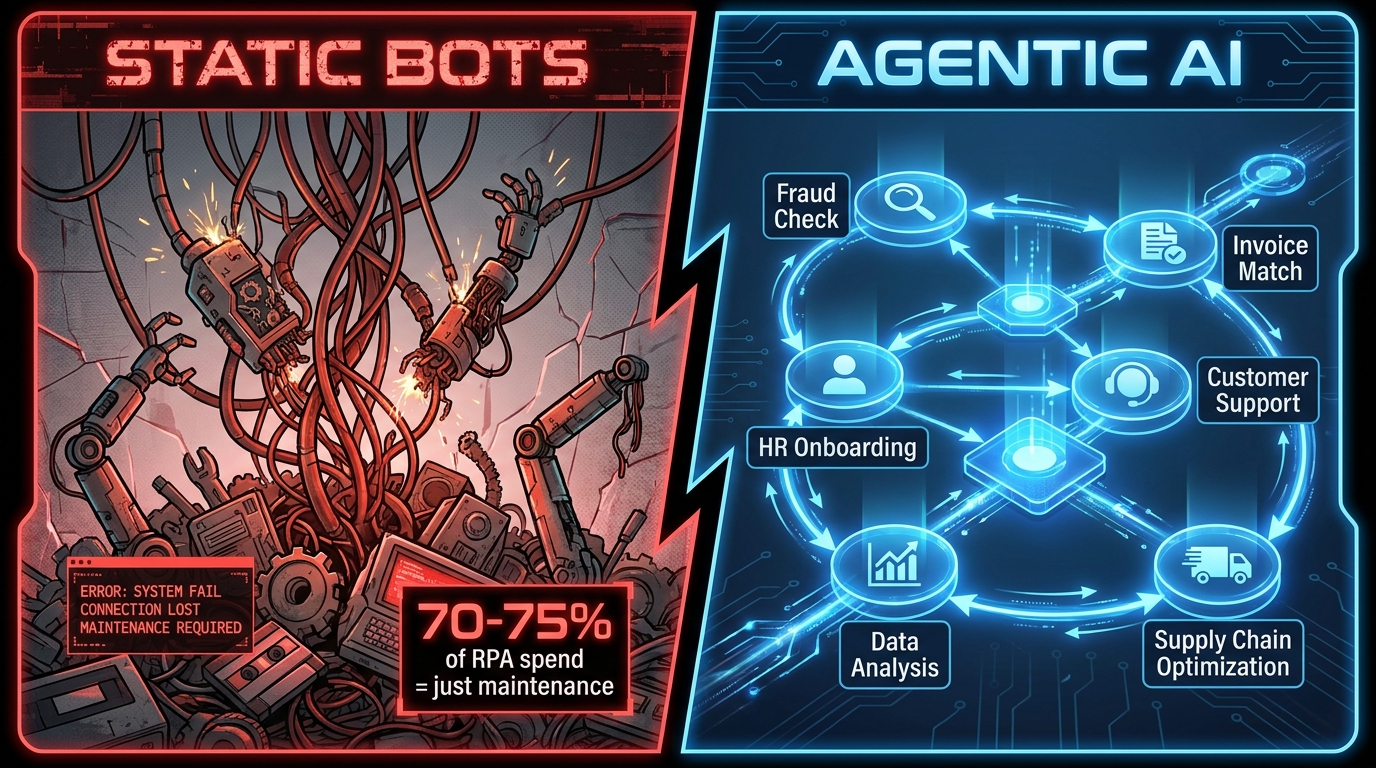
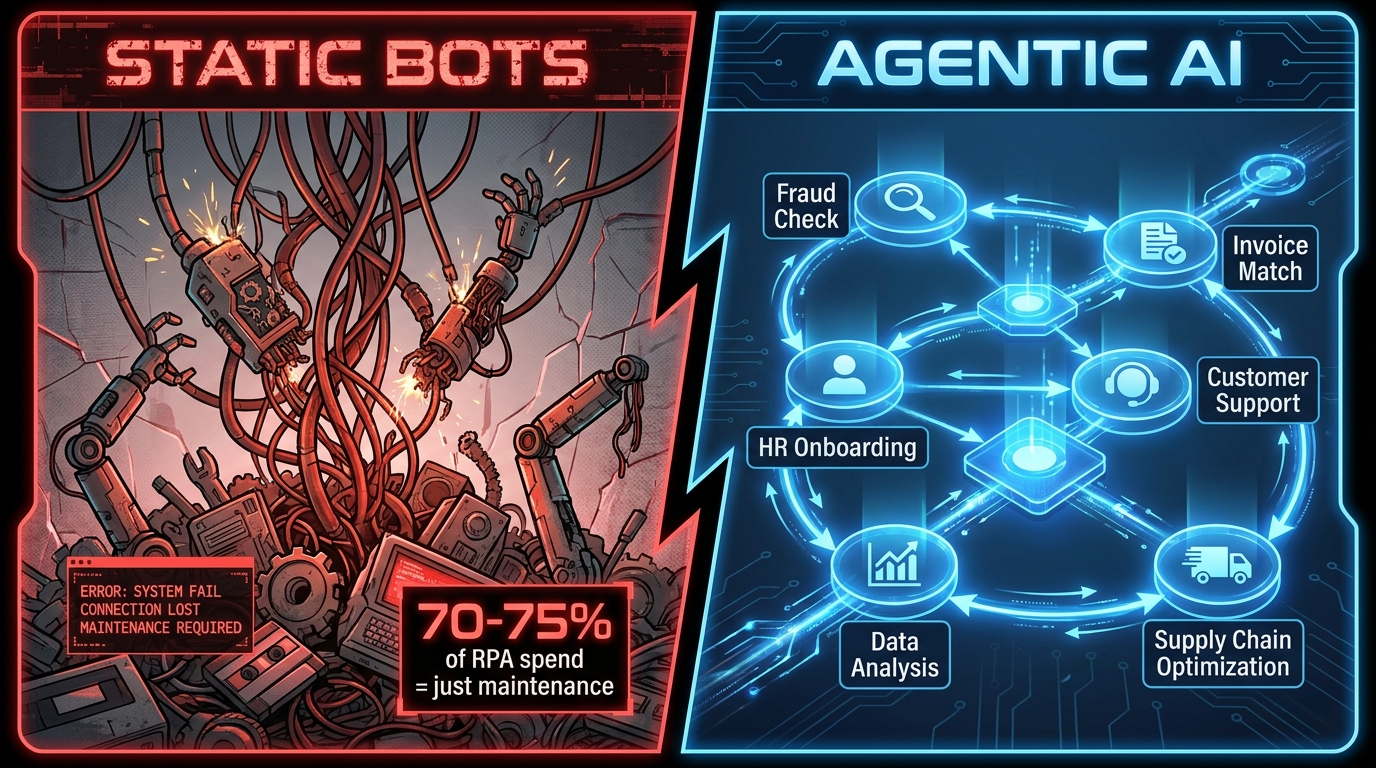
    Finance is experiencing the most rapid shift toward agent ownership of any back-office function. Invoice processing, accounts payable, reconciliation, expense management, and financial reporting are all seeing significant automation through AI agents — not just rule-based RPA, but agents capable of handling the unstructured exceptions that traditional automation always choked on.

    The benchmark data is striking. Enterprises using AI agents for invoice processing report 70–90% reductions in processing time per invoice. Organizations running agents on accounts reconciliation workflows report reducing cycle times from multiple days to under four hours. The core breakthrough is that modern AI agents can handle the messy middle of financial workflows: the vendor invoice that does not match the purchase order exactly, the expense report that requires checking multiple policy criteria, the reconciliation item that needs a human-readable explanation before it can be escalated.

    Finance agents are also moving into financial forecasting support — not replacing the CFO’s judgment, but aggregating data across systems, running preliminary analyses, and presenting structured options with supporting data that used to require significant analyst time to prepare.

    Supply Chain and Procurement: Rapidly Catching Up

    Supply chain workflows are structurally well-suited for AI agents — high volume, rule-heavy, multi-system, with clear optimization objectives and measurable outcomes. Agents are being deployed across demand forecasting, purchase order processing, supplier communication, logistics coordination, and inventory management.

    What makes supply chain interesting from an ownership perspective is the increasing deployment of agents that span organizational boundaries. An agent managing procurement does not just operate inside one company’s systems — it communicates with supplier APIs, monitors external signals like lead time data or commodity prices, and adjusts internal plans accordingly. This inter-organizational workflow ownership is a frontier that is just beginning to be explored at scale.

    Sales and CRM: Agent-Augmented, Not Agent-Owned

    Sales workflows have significant AI agent activity, but the ownership pattern is different. In high-touch B2B sales, agents augment rather than replace the human. They qualify leads, enrich prospect data, draft outreach sequences, schedule meetings, update CRM records, and surface buying signals — but the relationship and the close remain human-led. The exception is high-volume transactional sales, where end-to-end agent handling of the full cycle is increasingly viable.

    HR: The Cautious Adopter

    HR functions are adopting AI agents more slowly, primarily due to sensitivity around employment decisions and the regulatory complexity of labor law in different jurisdictions. Where agents have taken root is in clearly process-bound HR workflows: benefits enrollment administration, onboarding document processing, leave request handling, and first-level employee query resolution. Anything touching hiring decisions, performance assessment, or compensation is subject to much stricter human oversight requirements — and appropriately so.

    The Decision Rights Problem Nobody Is Talking About

    Decision Rights Pyramid for AI agents: bottom tier shows Agent Autonomy for routine tasks, middle tier shows Human Review for moderate-risk actions, top tier shows Human Decision for high-stakes choices

    Here is the problem that most organizations deploying AI agents are not solving cleanly, and it is responsible for more project failures than poor model selection, bad data pipelines, or inadequate tooling combined.

    When an AI agent owns a workflow, who is responsible for the decisions that workflow produces?

    This is not a philosophical question. It is an operational one. If an AI agent processes a refund incorrectly, who is accountable? If an agent makes a procurement commitment on behalf of the company, who authorized it? If an agent sends a customer communication that misrepresents the company’s position, who is responsible for the compliance violation?

    Traditional organizations have clear, if imperfect, answers to these questions because humans own every material decision. A procurement manager approves a purchase order. A finance director signs off on a refund above a threshold. A legal reviewer checks a customer communication before it goes out. When agents enter the picture, these ownership chains break down — and most organizations have not rebuilt them deliberately.

    The Three Decision Rights Failures

    Across the pattern of enterprise AI agent deployments, three decision rights failures recur consistently.

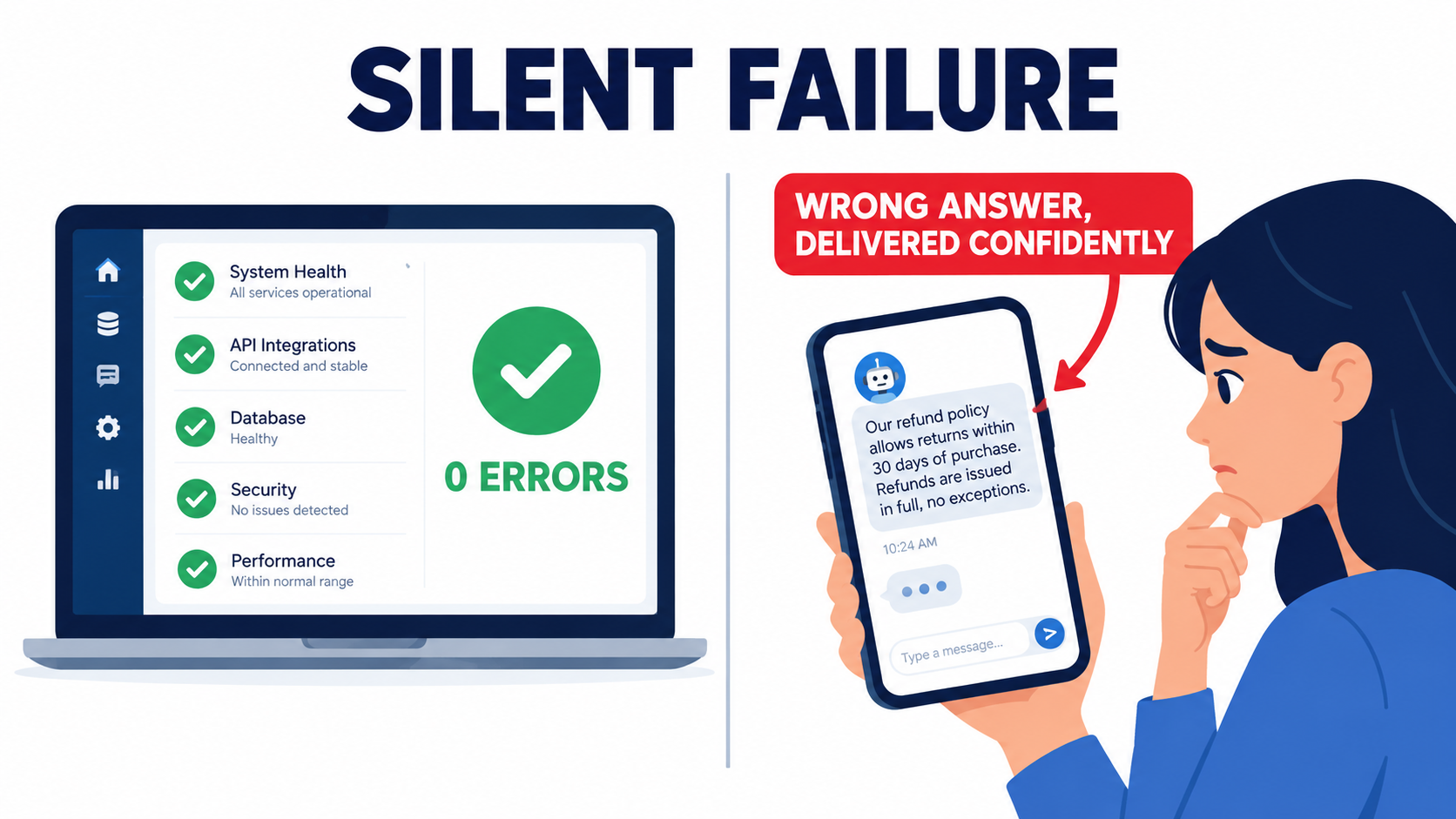
    The assumption of equivalence. Organizations assume that an agent making a “routine” decision is the same as no decision being made — that automating a low-stakes action removes it from the governance framework. It does not. Even routine decisions, when executed at scale by an agent, can produce significant aggregate consequences. An agent that slightly misapplies a discount policy 10,000 times a day creates a very different problem than a human applying it incorrectly once.

    The accountability vacuum. When something goes wrong with an agent-run workflow, organizations discover that no human was formally assigned responsibility for that process outcome. The agent does not have accountability. The engineer who built it does not typically own business outcomes. The process owner who used to run the workflow manually was “freed up” when the agent took over. Nobody owns the failure. This is not a hypothetical scenario — it has played out repeatedly in early production deployments.

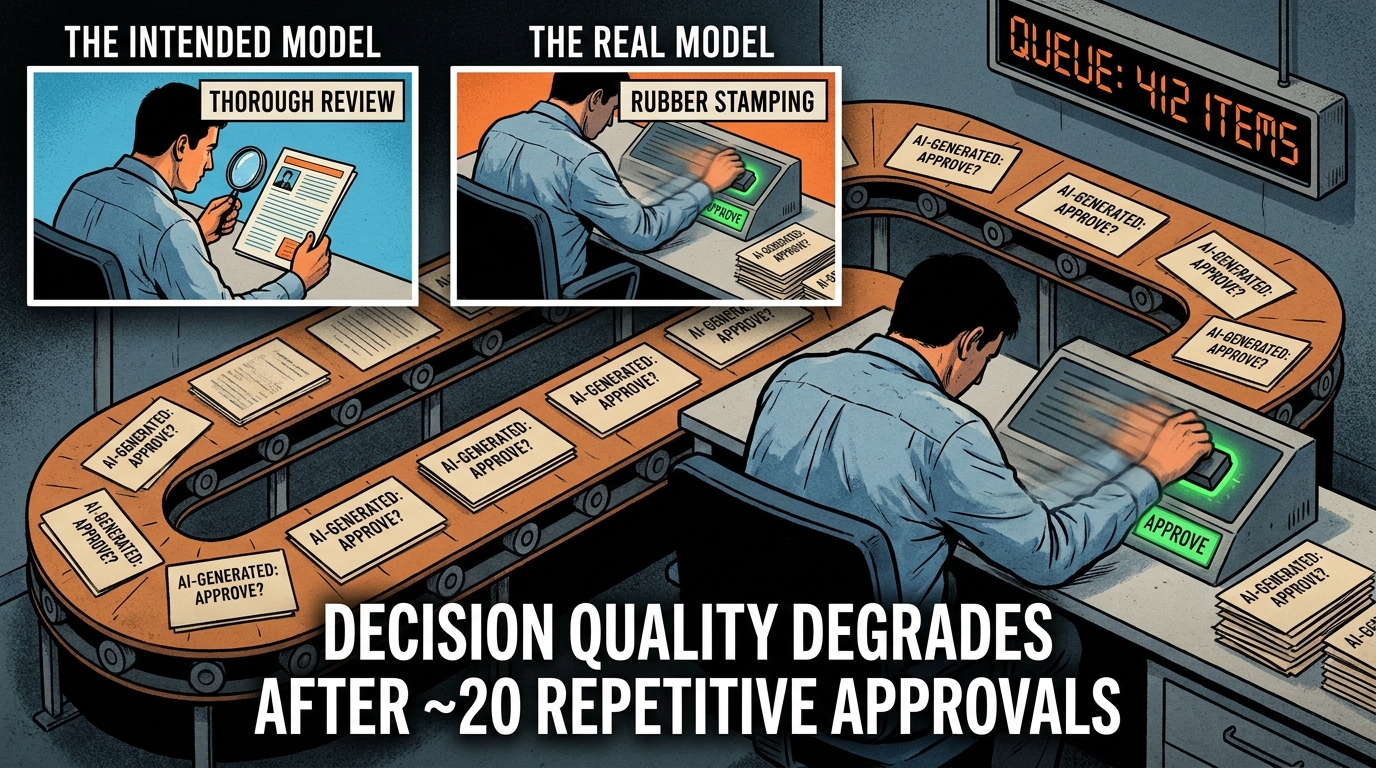
    The escalation design gap. Agents are commonly deployed with escalation paths that are either too narrow (the agent escalates almost nothing, creating unchecked autonomy) or too broad (the agent escalates so frequently that the human oversight is swamped and becomes rubber-stamping). Effective decision rights design requires precision: specific triggers, specific escalation channels, specific response time expectations, and specific consequences for when escalations are not resolved.
    What Deliberate Decision Rights Design Looks Like

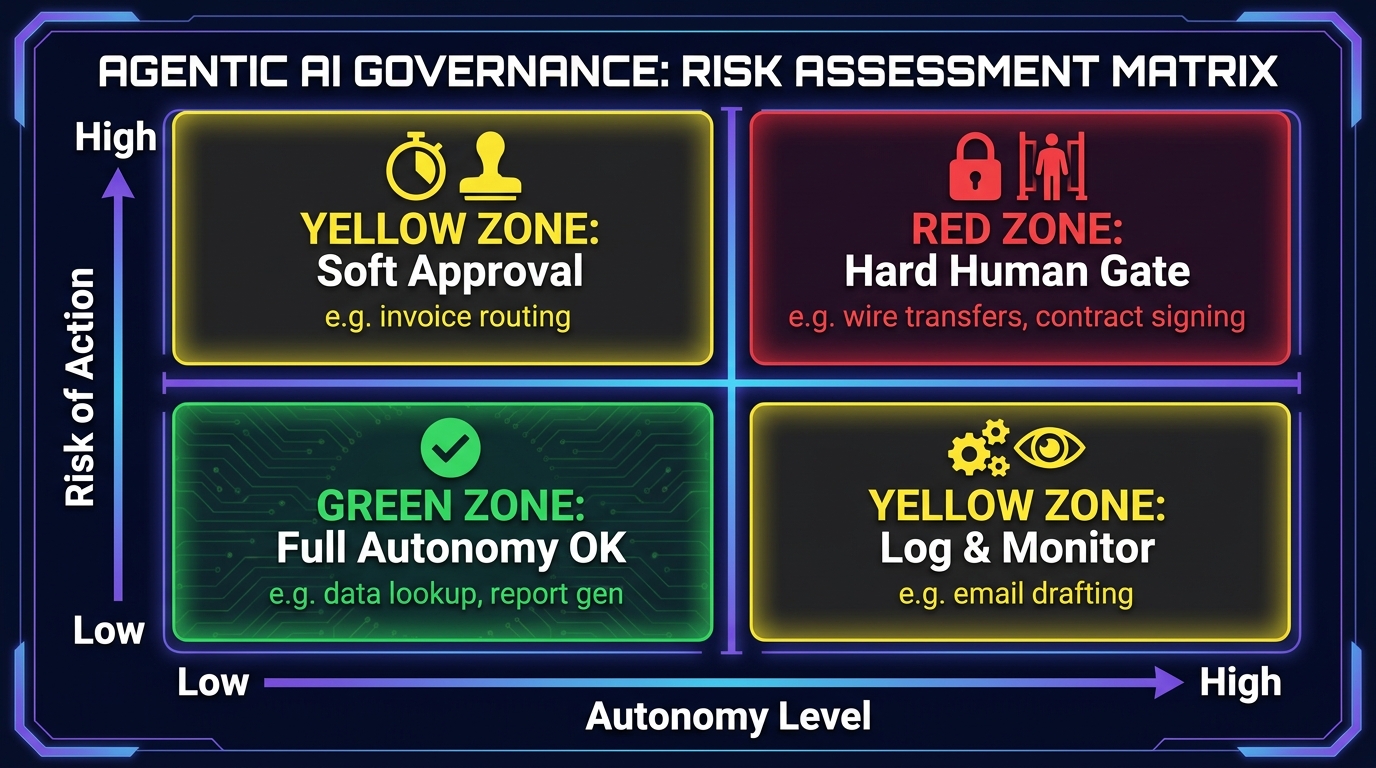
    The organizations getting this right are building explicit decision rights frameworks before deploying agents, not after. They define three categories for every agent workflow: decisions the agent can make autonomously, decisions the agent can propose but a human must confirm, and decisions the agent cannot make at all and must route immediately. These are not default settings in any platform — they are deliberate design choices that require deep understanding of the workflow, the risk profile of each decision type, and the regulatory context.

    Deloitte’s 2026 Global Human Capital Trends research specifically calls out “decision rights modernization for AI” as a core organizational design discipline — defining override privileges, escalation paths, and consensus rules so that humans and agents coordinate who decides, when, and on what basis. Organizations treating this as a technology configuration problem rather than an organizational design problem are consistently underperforming those who treat it as a governance priority.

    Why Legacy Process Design Is an Agent Killer

    Comparison of Legacy process design with many manual bottlenecks versus AI-native workflow design showing parallel agent tasks running 70-90% faster

    The single most predictable cause of enterprise AI agent project failure is not model quality, data availability, or technology integration. It is deploying an AI agent into a process that was designed to be run by humans.

    This sounds obvious in retrospect but is routinely ignored in practice. An organization identifies a workflow they want to automate. They document the existing process. They configure an agent to follow those steps. And then they wonder why the agent produces worse outcomes than the human team it replaced.

    The issue is that human-designed processes are full of implicit knowledge, informal coordination, and compensating behaviors that never appear in the process documentation. When a human accounts payable clerk sees an invoice that does not match a purchase order, they do not follow a rigid decision tree — they draw on institutional knowledge, pick up the phone, look at the vendor’s history, make a judgment call. The process documentation says “escalate exceptions.” The reality is that humans resolve most of those exceptions through informal channels that the documentation does not capture.

    The “Automated Failure” Trap

    When an AI agent executes a poorly designed process faster, it does not improve the process — it amplifies its failures. A workflow that produces exceptions because human compensating behaviors are masking structural flaws will produce more exceptions when an agent runs it, not fewer. The agent executes the documented process with fidelity. The undocumented human patches disappear. The result is what practitioners increasingly call “automated failure” — the same broken process, running at machine speed.

    The research data confirms this pattern starkly. The most commonly cited failure points in enterprise agentic AI projects are not model quality or integration complexity — they are upstream data readiness, legacy workflow design, and governance sequencing gaps. These are organizational and process problems, not technology problems.

    What AI-Native Process Design Requires

    AI-native process design starts from a different premise: not “how do we automate this process?” but “if we were designing this process for an agent to own, what would it look like?”

    That reframe has practical implications. AI-native workflows make all decision rules explicit — the informal patches become documented policies. They restructure data flows so agents receive structured inputs, not the ambiguous text-heavy handoffs that humans navigate intuitively. They redesign the exception taxonomy so that genuine exceptions that require human judgment are clearly distinguishable from routine complexity that an agent can handle with the right information.

    Perhaps most importantly, AI-native process design separates the sequential, gate-based structure of human workflows — where one step cannot begin until a human completes the previous one — from parallel, concurrent architectures where multiple agent actions can proceed simultaneously. A process that took three days with humans not because the work was slow, but because humans had to pass approvals sequentially and wait for each other, can run in four hours when those sequencing constraints are removed.

    Organizations that are seeing 70–90% cycle time reductions from AI agents are almost always doing this redesign work first. Those seeing marginal improvements are almost always skipping it.

    Tiered Autonomy: The Governance Architecture That Actually Works

    The governance question for AI agents is not binary. It is not “fully autonomous” versus “human-in-the-loop for everything.” Organizations that try to implement either extreme consistently fail — the fully autonomous deployment creates unchecked risk, and the “human approves everything” approach negates most of the efficiency gain and drowns human reviewers in a volume they cannot meaningfully process.

    The governance model that is working in practice is tiered autonomy: a structured framework that assigns different levels of human involvement based on the risk profile of each decision type within a workflow.

    The Three Tiers in Practice

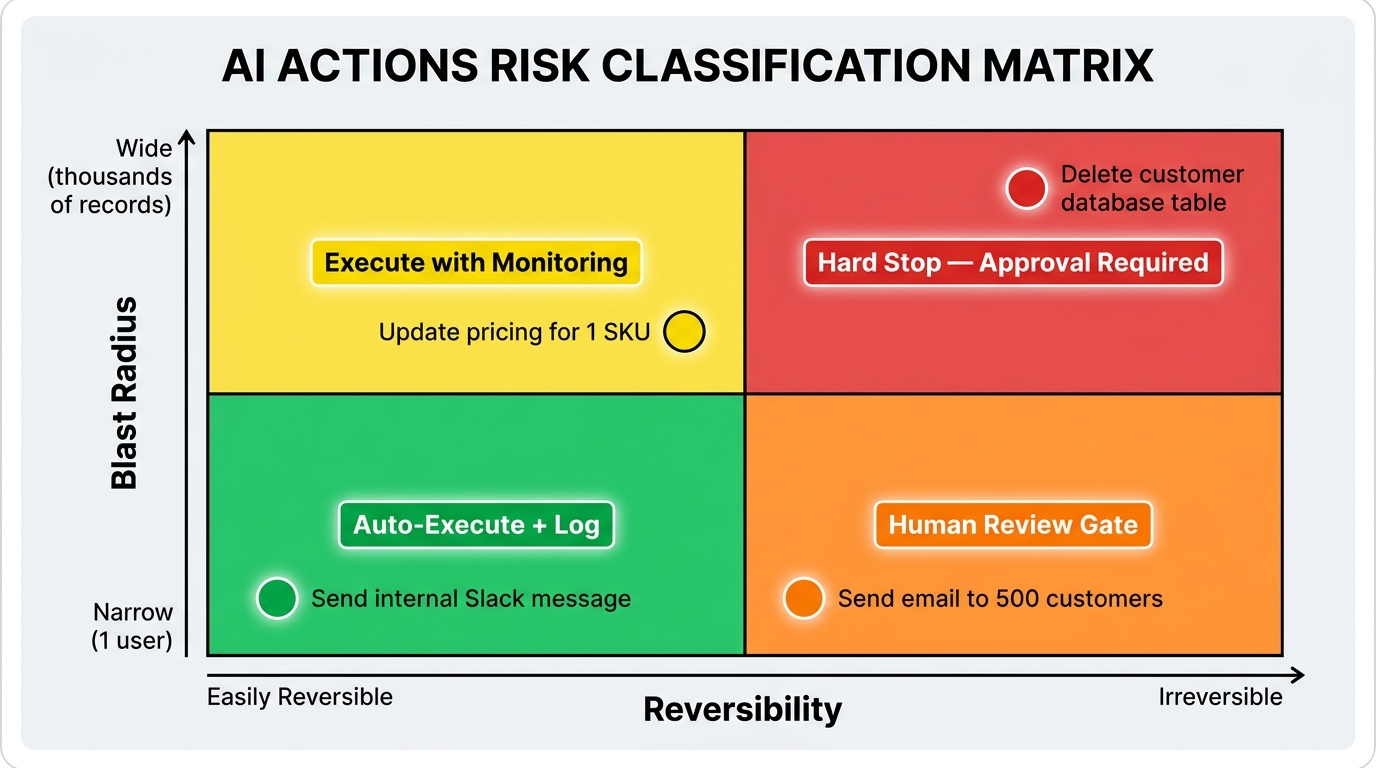
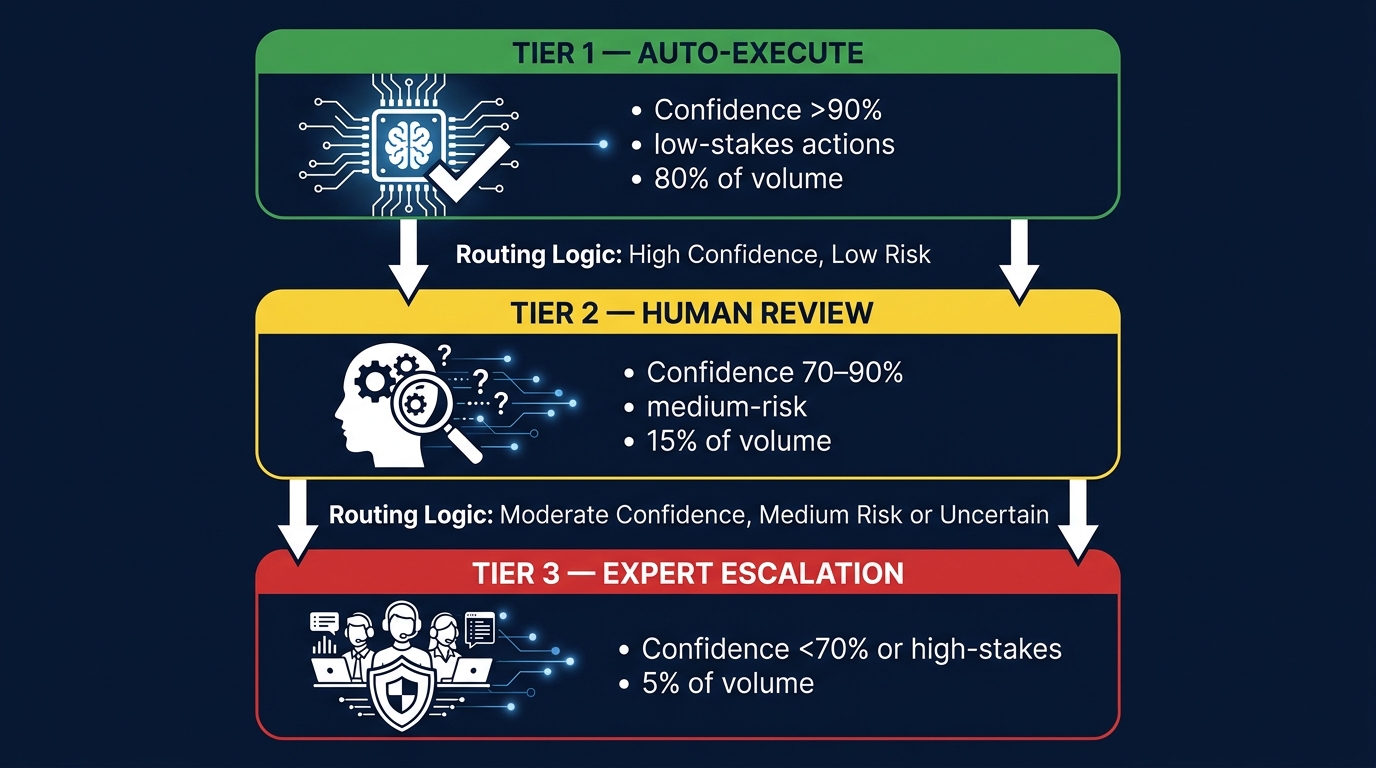
    Tier 1 — Full Agent Autonomy. Low-risk, high-volume, fully reversible actions that the agent executes without human review. Examples: querying data systems, generating internal drafts, routing tickets to queues, logging records, sending standard notifications based on confirmed triggers. The key criteria for Tier 1 are reversibility and materiality — actions that can be undone if wrong and that carry limited individual impact even at scale.

    Tier 2 — Asynchronous Human Review. Moderate-risk actions where the agent proposes a course of action and a human confirms within a defined time window before execution. Examples: customer refunds above a threshold, vendor payments outside normal parameters, outbound customer communications with legal implications, configuration changes in production systems. The agent prepares everything — the rationale, the supporting data, the recommended action — and the human’s job is to confirm or redirect, not to re-do the analysis. This design keeps humans meaningfully in the loop without requiring them to be involved in real-time execution.

    Tier 3 — Mandatory Human Decision. High-risk actions that the agent cannot execute and cannot propose without a full human review and explicit authorization. Examples: employment decisions, legal commitments above defined value thresholds, regulatory filings, public communications on sensitive topics, security-classified system changes. The agent’s role here is to prepare and organize the information that supports the human decision, not to make the decision or influence the outcome through its framing.

    Risk Tiering Is a Living Document, Not a Static Configuration

    One of the most important operational insights from organizations running mature AI agent governance programs is that risk tiers need to be revisited regularly. As agents demonstrate track records in production — as their error rates become quantifiable, their failure modes become understood, and their behaviors in edge cases become documented — the appropriate tier for specific decision types may shift. A decision type that required Tier 2 review for the first three months may earn Tier 1 status after accumulating a statistically significant track record with minimal errors. Conversely, a Tier 1 decision that produces an unexpected failure pattern may be temporarily elevated to Tier 2 pending investigation.

    This dynamic recalibration is how organizations build justified confidence in their agents over time, rather than treating trust as an all-or-nothing proposition.

    Multi-Agent Orchestration: The New Infrastructure Bottleneck

    Multi-agent enterprise architecture showing a central orchestrator agent connected to six specialized agents including Finance, Customer Service, Compliance, Data, Supply Chain, and HR agents

    Single-agent deployments solve isolated workflow problems. The genuinely transformative deployments — the ones that are beginning to reshape how businesses operate at a structural level — involve multiple agents coordinating across different systems, functions, and data domains. And that coordination layer is where most of the hard problems live in 2026.

    Databricks research published in 2026 reported over 300% growth in multi-agent workflow deployments as enterprises moved from pilots into production. Yet the same research showed that the primary barriers to scaling those deployments were not model performance issues — they were orchestration, observability, and cross-agent governance challenges.

    What Multi-Agent Orchestration Actually Involves

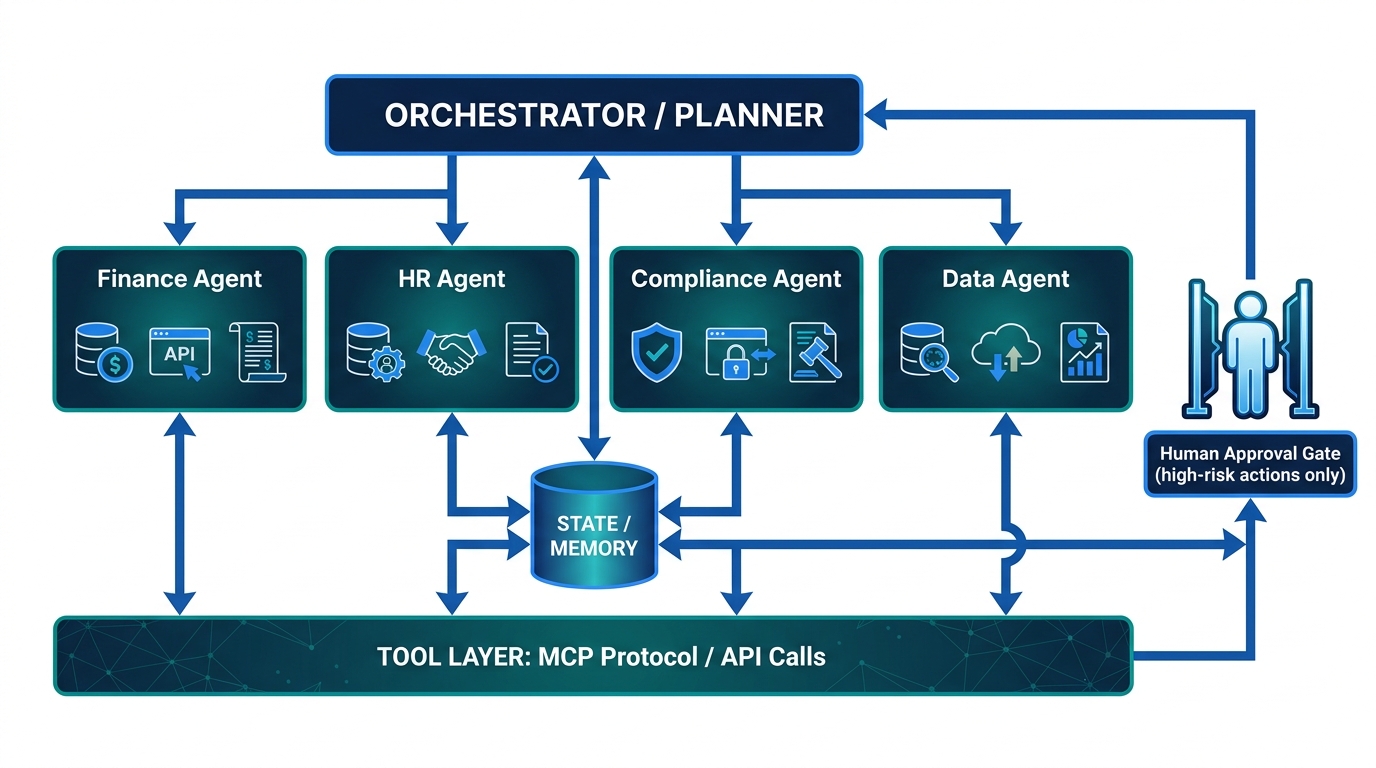
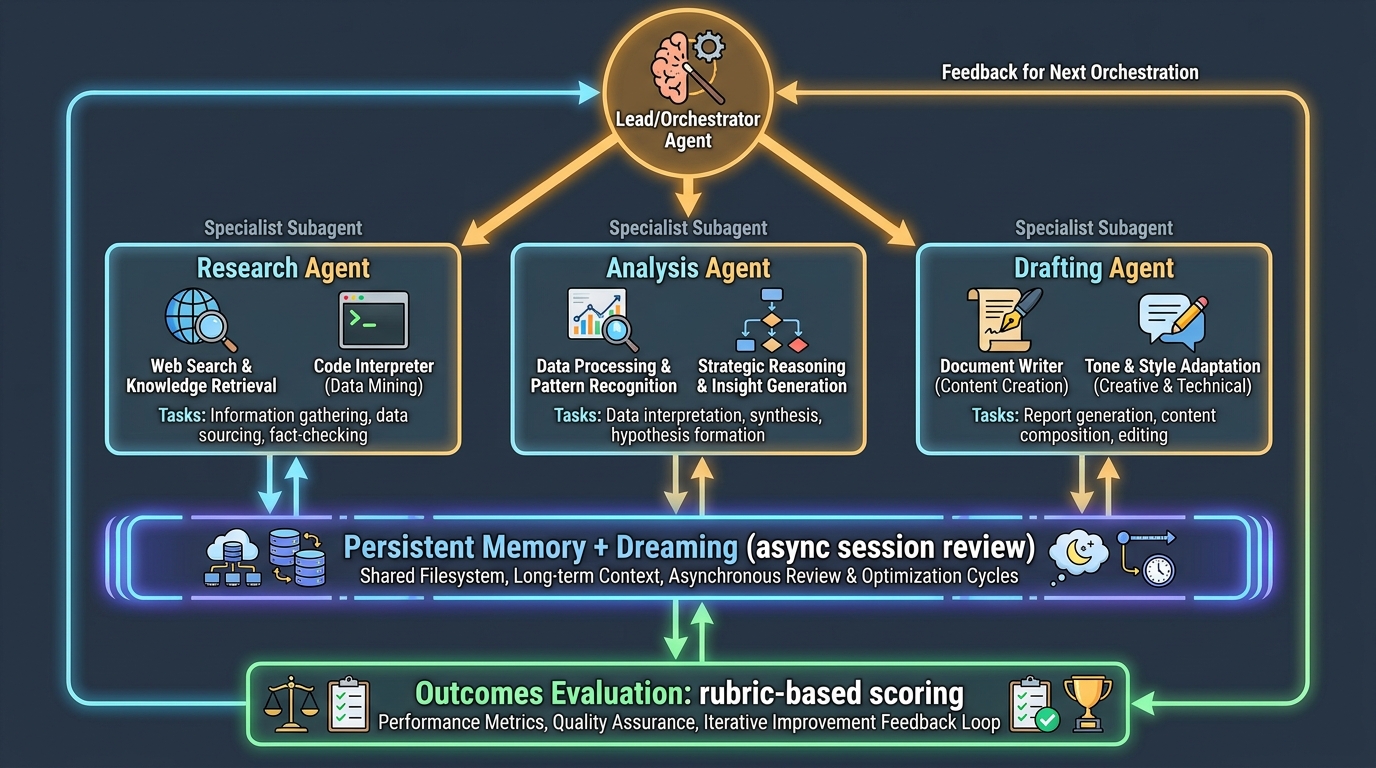
    In a multi-agent architecture, a primary orchestrating agent receives a high-level goal and decomposes it into sub-tasks that are assigned to specialized sub-agents. The customer service agent handles the interaction. The data agent queries the relevant systems. The compliance agent checks the proposed action against policy. The finance agent processes the transaction. The orchestrator integrates their outputs and determines what happens next.

    The technical challenges of this architecture are significant. Agents need to communicate state reliably — if one agent’s action changes the state of a system, every agent working in that context needs to know about it. Failures need to be handled gracefully — if one sub-agent fails or returns an uncertain result, the orchestrator needs to handle that uncertainty appropriately rather than proceeding on flawed assumptions. Costs need to be tracked — multi-agent systems can consume significant compute resources, and runaway agent loops (where agents call each other in cycles that never resolve) are a real production risk.

    The Observability Gap

    One of the most practically significant challenges in multi-agent production deployments is observability — the ability to understand what an agent system actually did, why it made each decision, and where failures originated when something goes wrong.

    In a single-agent deployment, tracing failures is relatively manageable. In a five-agent system where each agent is calling multiple tools, accessing multiple data sources, and making multiple intermediate decisions, the trace of a single workflow execution can involve hundreds of individual steps. When that workflow produces a wrong outcome, identifying which agent made which incorrect decision, based on what information, is not trivial. It requires purpose-built observability tooling — agent-specific logging and tracing systems that capture not just what happened but the intermediate reasoning that led to each action.

    Organizations that are succeeding in multi-agent production deployments are investing in this observability infrastructure before scaling. Those that skip it find themselves unable to diagnose failures reliably, which means they cannot improve agent behavior systematically or satisfy audit requirements when issues occur.

    Vendor Lock-In as a Strategic Risk

    The orchestration layer has also become a significant vendor lock-in risk. Most enterprise AI agent platforms — Salesforce Agentforce, ServiceNow AI Agents, Microsoft Copilot Studio, and others — provide proprietary orchestration mechanisms that are not interoperable. An enterprise that builds a multi-agent workflow on one platform’s orchestration layer faces significant migration costs if it needs to change vendors or integrate agents built on different platforms.

    Forward-looking architecture decisions in 2026 are therefore prioritizing standards-based integration patterns, abstraction layers between agents and their orchestration infrastructure, and modular agent designs that can be rehosted if the underlying platform changes. This is a more complex initial build, but it preserves strategic flexibility as the vendor landscape continues to consolidate and shift.

    The Real Productivity Numbers vs. the Marketing Claims

    Comparison chart showing vendor productivity claims versus what enterprises actually measure with AI agents in 2026, highlighting the gap between promised and real results

    Enterprise technology has a long history of productivity claims that look spectacular in case studies and disappoint in production. AI agents are no exception, but the picture is more nuanced than either the enthusiast or the skeptic position suggests. There are real, significant productivity gains in specific contexts — and there is genuine exaggeration in others.

    Where the Numbers Are Real

    The most credible, consistently replicated productivity gains from AI agents in enterprise workflows cluster in specific types of tasks:

    High-volume, rule-structured document processing. Invoice processing, contract review, onboarding document verification, expense report processing. Documented cycle time reductions of 70–90% are consistent and credible in this category because the baseline process is slow, the work is repetitive, and errors are measurable. An organization processing 50,000 invoices a month is not reporting a 70% cycle time reduction based on a 20-invoice pilot — they have statistically meaningful data.

    Multi-channel customer query resolution. Organizations running AI agents on first-line customer support reliably report 60–80% autonomous resolution rates for structured query types. The productivity math is straightforward: if an agent handles 70% of the volume that previously required a human agent, and the agent’s accuracy rate on that 70% is 95%+, the economics are clearly positive even accounting for the cost of managing the remaining 30% with greater human attention.

    Knowledge worker research and synthesis tasks. Research consistently shows that knowledge workers using AI agents for information gathering, synthesis, and structured output generation save 8–12 hours per week. This finding is robust across multiple independent studies and appears not to be heavily dependent on the specific domain or industry.

    Where the Numbers Are Inflated

    The productivity claims that are most frequently overstated fall into a different pattern:

    End-to-end process ownership claims that omit the human work still required. An agent “owning” an end-to-end workflow often means the agent handles 70–80% of the steps, with humans still engaged in a meaningful portion of the exceptions, edge cases, and quality reviews. The marketing claim presents this as full automation. The operational reality includes a restructured human role that is less immediately visible but still resource-intensive.

    Pilot-to-production extrapolations. A common pattern is a controlled pilot that operates on clean, pre-screened data and straightforward cases — which produces impressive metrics — followed by a production deployment that encounters the full messiness of real data and real edge cases, which produces markedly inferior performance. The cited figures are often from the pilot phase.

    ROI calculations that exclude implementation and maintenance costs. Agent deployments require ongoing tuning, data pipeline maintenance, monitoring, and governance activities. These are real costs that are frequently excluded from the headline ROI figures in vendor case studies. A workflow that saves $500,000 annually in direct labor may require $200,000 in ongoing maintenance and oversight — still a positive ROI, but not the 5× figure the initial headline suggests.

    The Role Redesign Imperative: What Humans Do in an Agent-Run Workflow

    A human professional reviewing strategic dashboards and exception alerts on holographic screens while AI agents run automated workflows, showing the new human role as judgment-focused rather than execution-focused

    When an AI agent takes ownership of a workflow that a human previously owned, what does the human do? This question is being answered badly in most enterprises right now — either by not asking it at all (the human’s role evaporates and they are simply redeployed elsewhere with no structured transition) or by defining the human role reactively as “fix what the agent breaks.”

    Neither answer produces a sustainable operating model. The organizations building durable agent-integrated operations are defining the post-agent human role deliberately, along three distinct dimensions.

    Exception Judgment: The Cases Agents Cannot Handle

    When agents own workflows, human work concentrates in the genuinely hard cases — situations that fall outside the decision rules, involve unusual context, require empathy or relationship knowledge, or carry regulatory implications that require accountable human sign-off. These are not the mundane exceptions that human workers spent most of their time on previously. They are the genuinely complex situations that require experience, judgment, and professional accountability.

    This means that human roles in agent-integrated workflows tend to require higher competency, not lower. The routine work disappears. What remains demands more. Organizations that staff the “exception handler” role with their least experienced people, because it seems like a residual role, consistently find their exception queues degrading in quality and their agents failing to improve because the feedback loop that depends on good human judgments on exceptions is broken.

    Intent Setting: Defining What Agents Are Trying to Achieve

    AI agents execute toward goals. Someone has to define those goals — and more importantly, update them as business conditions change. The human role of “intent setter” — determining what outcomes the agent is optimizing for, what constraints apply, and when the objectives need to change — is one of the most valuable and least well-understood roles in agent-integrated operations.

    This is not a technical role. It requires deep business knowledge, strategic clarity, and an understanding of how the agent’s behavior connects to business outcomes. When a customer service agent is optimized for resolution speed and begins making customers feel rushed, someone needs to recognize that the objective needs adjustment — and have the authority to make that adjustment. That is an intent-setting function, and it needs to be explicitly assigned to a person with both the knowledge and the authority to exercise it.

    Governance and Accountability: Owning the Outcomes

    As discussed in the decision rights section, agent workflows need human accountability for their outcomes — not for every individual action, but for the aggregate performance and compliance of the workflow over time. This “workflow steward” role monitors key performance indicators, investigates anomalies, ensures the agent’s behavior remains compliant with evolving policies and regulations, and owns the escalation when something materially goes wrong.

    The workflow steward is not the engineer who built the agent and is not the operations manager who ran the process before. It is a new role that combines operational knowledge with enough technical literacy to interpret agent performance data and sufficient organizational authority to make consequential decisions about agent behavior.

    Building the Human-AI Handoff Architecture

    The mechanics of how work transitions between agents and humans — and back again — is where good governance theory meets operational reality. Poor handoff design is one of the most common sources of value destruction in otherwise well-conceived AI agent deployments.

    Designing for Asymmetric Context

    When an agent escalates to a human, the human typically does not have the context the agent has been accumulating throughout the workflow. The agent has queried multiple systems, considered multiple conditions, run multiple evaluations. The human sees the escalation notification. This asymmetry creates an information gap that, if not designed against, produces poor human decisions on escalated cases.

    High-performing handoff architectures solve this by packaging the escalation. When an agent escalates to a human, it delivers not just the item requiring a decision, but a structured summary of the relevant context: what triggered the escalation, what the agent’s recommended action is, what information the agent considered, what options are available and their likely consequences, and what the agent will do next based on each decision path. The human’s cognitive load is minimized. The decision they are asked to make is scoped clearly. The time required is reduced.

    This design principle — “never make the human reconstruct what the agent already knows” — dramatically improves both the quality of human decisions on escalated cases and the human’s experience of working alongside an agent. The resistance to agent-integrated workflows that comes from human team members is frequently not about the agent doing their job — it is about being given inadequate context to do the residual parts of the job effectively.

    Handoff Latency and SLA Design

    Agent workflows move at machine speed. When an agent escalates to a human, the workflow pauses — and the duration of that pause depends on how quickly the human responds. In customer-facing workflows, this pause is directly visible to the customer. In financial workflows, it may affect settlement timing or compliance deadlines. In supply chain workflows, it may impact procurement cycles.

    Effective handoff architecture requires explicit SLA design for human response to escalations. When an agent escalates, what is the expected response time? What happens if that time is exceeded — does the agent take a default action, does the case get rerouted to a different human reviewer, does the customer receive an interim communication? These are not edge cases. They are routine operational scenarios that need to be designed for explicitly, with clear consequences specified in advance.

    The Feedback Loop: How Humans Improve Agent Behavior

    Human decisions on escalated cases represent the most valuable training signal available for improving agent performance. When a human overrides an agent’s recommended action, that is a data point. When the human resolution of an escalated case produces a better outcome than the agent’s proposed action would have, that difference is information. Capturing that information systematically and feeding it back into agent evaluation and tuning is how organizations build agents that improve over time rather than stagnating at their initial performance level.

    Most enterprise agent deployments do not have this feedback loop built in. Human decisions are made, cases are closed, and the information disappears. The agent continues making the same pattern of mistakes on similar cases because nobody connected the dots between human override decisions and agent behavior patterns. This is a significant, correctable source of underperformance in deployed agent systems.

    The Accountability Gap: The Risk Enterprises Are Not Pricing In

    Enterprise AI agent deployments in 2026 are operating in a regulatory environment that has not fully caught up with the pace of deployment. The EU AI Act provides the most developed regulatory framework, but its agent-specific provisions are still being interpreted and enforced. In other jurisdictions, the regulatory picture is even less defined. Organizations are making significant operational commitments to agent-owned workflows in a governance landscape that will look meaningfully different in 12–24 months.

    The Liability Assignment Problem

    When an AI agent makes a decision that produces a harmful outcome — a discriminatory credit decision, a regulatory violation in a financial transaction, a safety-relevant error in a supply chain — who is liable? The current legal frameworks do not give a clean answer. The agent vendor may bear some responsibility for the model’s behavior. The enterprise deploying the agent bears responsibility for the deployment decisions and governance. The specific human who was supposed to oversee the relevant decision may bear individual professional liability.

    These are not theoretical scenarios for 2030. They are happening in 2026, in early form, and the organizations that are exposed are those that deployed agents into consequential workflows without explicitly assigning human accountability for those workflows’ outcomes. The accountability vacuum described in the decision rights section is not just an operational problem. In the emerging regulatory environment, it is a legal exposure.

    Audit Trail Design as a Non-Negotiable

    Regardless of the specific regulatory framework an organization operates under, one requirement is consistent across all of them: the ability to explain, after the fact, what decisions were made, why, and by whom or what. This is the audit trail requirement, and it is one that AI agent deployments frequently underinvest in.

    Agent actions need to be logged at a level of granularity that supports post-hoc explanation. Not just “the agent processed this invoice” but “the agent queried these three data sources, evaluated these four conditions, applied this policy rule, and took this action, at this time, with these inputs.” Building this level of logging into agent systems from the start is significantly less costly than retrofitting it after deployment — and the retrofit is painful, as several large enterprises discovered in early 2026 when audit requests arrived for agent-processed transactions that had inadequate logging.

    Governance as Competitive Advantage, Not Compliance Overhead

    The organizations framing agent governance as purely a compliance burden are systematically underinvesting in it. The organizations framing it as a source of competitive advantage are taking a different view: robust governance — clear accountability, documented decision logic, reliable audit trails, systematic feedback loops — is what allows agents to be trusted with progressively more consequential workflows over time. It is the organizational infrastructure that determines how quickly the trust in an agent system can be justified and extended.

    An agent system that runs in a governance vacuum may produce impressive short-term results. But it cannot be verified, cannot be audited, cannot be defended in a regulatory examination, and cannot be trusted with higher-stakes decisions until the governance infrastructure is built. The investment in governance is not separate from the investment in agent capability — it is a multiplier on it.

    What Separates Organizations That Are Getting This Right

    Across the pattern of enterprise AI agent deployments in 2026, the organizations reaching sustainable production at scale share a set of characteristics that are distinguishable from those still cycling through failed pilots.

    They treat workflow redesign as a prerequisite, not a parallel track. They do not deploy agents onto existing processes. They redesign the process for agent ownership first — making decision rules explicit, restructuring data flows for machine readability, eliminating informal human patches that agents cannot replicate, and designing the exception taxonomy that determines what goes to agents and what goes to humans.

    They define decision rights before deployment, not in response to failures. Who is accountable for the outcomes of every agent-owned workflow is specified before the agent goes live. Override authorities, escalation paths, and response time requirements are documented and enforced. The accountability vacuum does not exist because they closed it deliberately.

    They invest in observability infrastructure proportional to the stakes of the workflow. Agents running high-volume, lower-stakes workflows have standard logging. Agents making consequential decisions have comprehensive audit trails, performance monitoring, and anomaly detection. The observability investment is not uniform — it is risk-calibrated.

    They build feedback loops that connect human override decisions back to agent improvement. Human judgments on escalated cases are captured systematically. Patterns in human overrides are analyzed. Agent behavior is updated based on what humans consistently decide differently. The agent gets better over time in production, not just in controlled test environments.

    They staff the human residual roles deliberately. Exception handlers, intent setters, and workflow stewards are not afterthoughts — they are explicitly designed roles with clear responsibilities, appropriate seniority, and the organizational authority to act on what they see. The human roles that remain when agents take over workflow execution are treated as consequential, not residual.

    The Organizational Rewiring Is Not Optional

    The framing of AI agent adoption as a technology deployment decision misses the organizational reality. Deploying an AI agent that owns a core business workflow is an organizational redesign decision. It changes accountability structures, decision rights, human roles, and the operating model of the affected function. Organizations that approach it as a technology decision consistently underperform those that approach it as an organizational one.

    The good news is that the organizational redesign work is achievable, and the enterprises that have done it are producing real, durable results — not pilot-phase metrics that evaporate in production, but sustained performance improvements that compound over time as agents improve and human roles evolve around them.

    The question for every leadership team looking at AI agents in 2026 is not “do these tools work?” At this point, in the right context, with the right organizational infrastructure, they demonstrably do. The question is whether the organization is willing to do the harder work that makes the tools perform: redesigning the process, defining the decision rights, building the governance infrastructure, and deliberately shaping the human roles that remain.

    The organizations that answer yes to that question are not just deploying better technology. They are building a fundamentally different operating model — one in which the boundaries between human work and machine work are explicit, governed, and deliberately designed to deliver outcomes that neither can produce alone.

    Actionable Takeaways for Leadership Teams

    • Audit your highest-volume workflows for AI agent candidacy — prioritize those where decision rules are explicit, data is structured, and cycle times are slow relative to theoretical minimums.
    • Before deploying any agent into a core workflow, document who is accountable for that workflow’s outcomes post-deployment. Close the accountability vacuum before it becomes a liability.
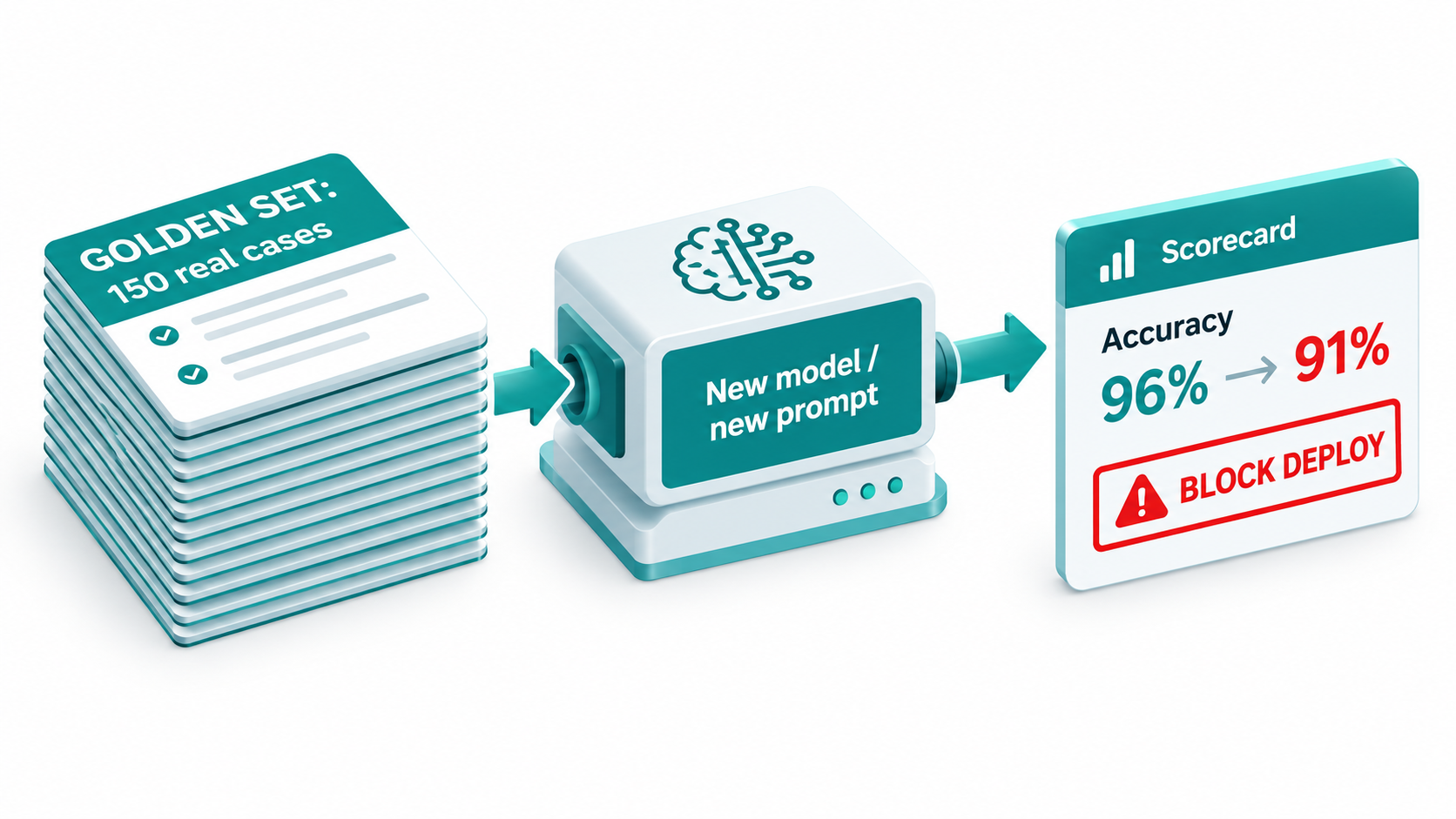
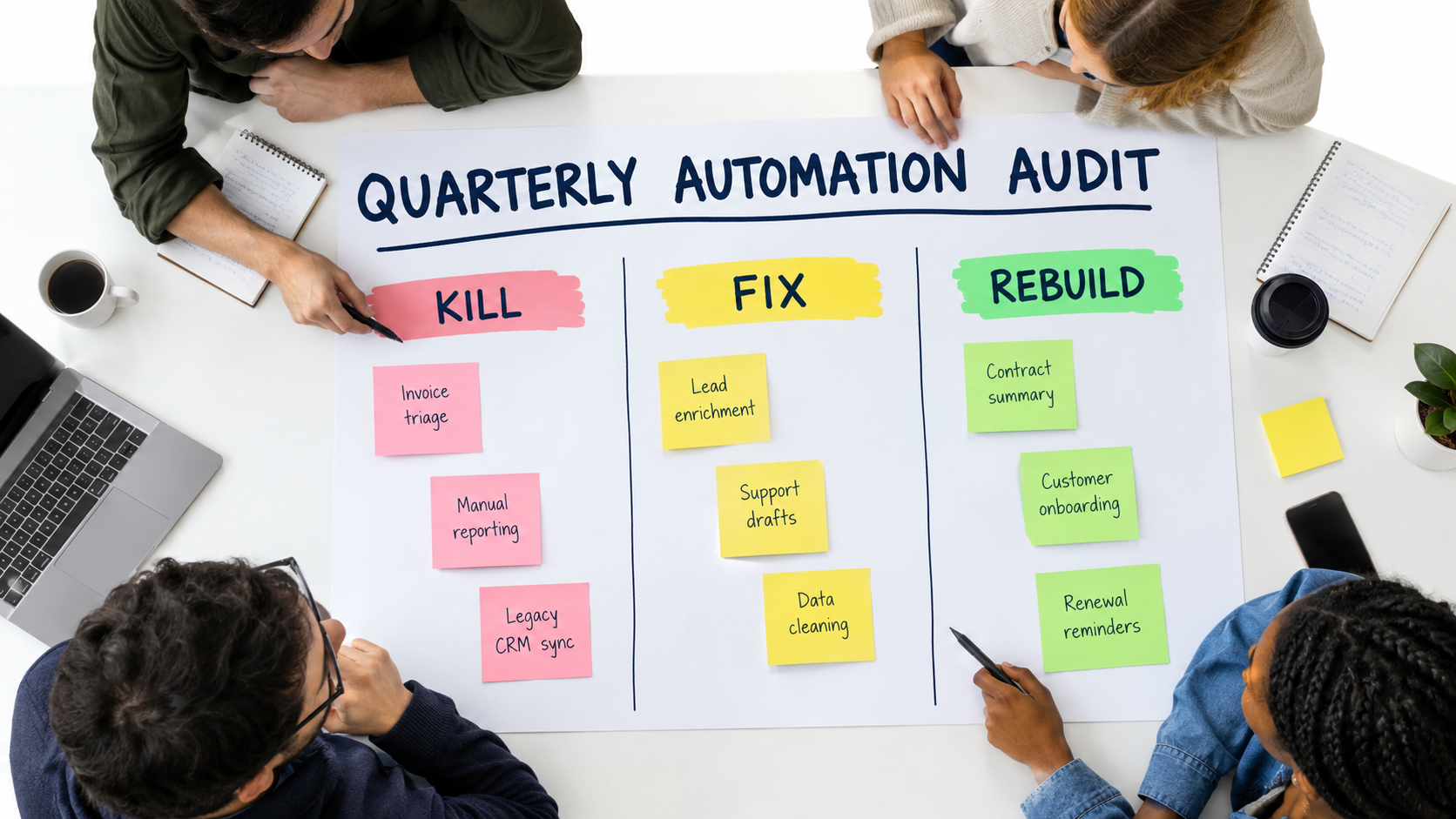
    • Build a decision rights framework for every agent deployment: Tier 1 (agent acts autonomously), Tier 2 (agent proposes, human confirms), Tier 3 (agent cannot act). Review and recalibrate this framework quarterly based on performance data.
    • Do not treat workflow redesign as optional. Deploy agents into processes designed for agents, not processes designed for humans.
    • Define the post-agent human roles explicitly. Exception judgment, intent setting, and workflow stewardship are real functions that require skilled people — not afterthoughts.
    • Build feedback loops that connect human escalation decisions back to agent performance improvement. This is the fastest path to agents that get meaningfully better in production.
    • Invest in observability and audit trail infrastructure proportional to the stakes of each agent workflow. This is both a governance requirement and the foundation of justified trust expansion over time.
  • Why Human-in-the-Loop Is No Longer Optional: The Engineering and Governance Reality in 2026

    Why Human-in-the-Loop Is No Longer Optional: The Engineering and Governance Reality in 2026

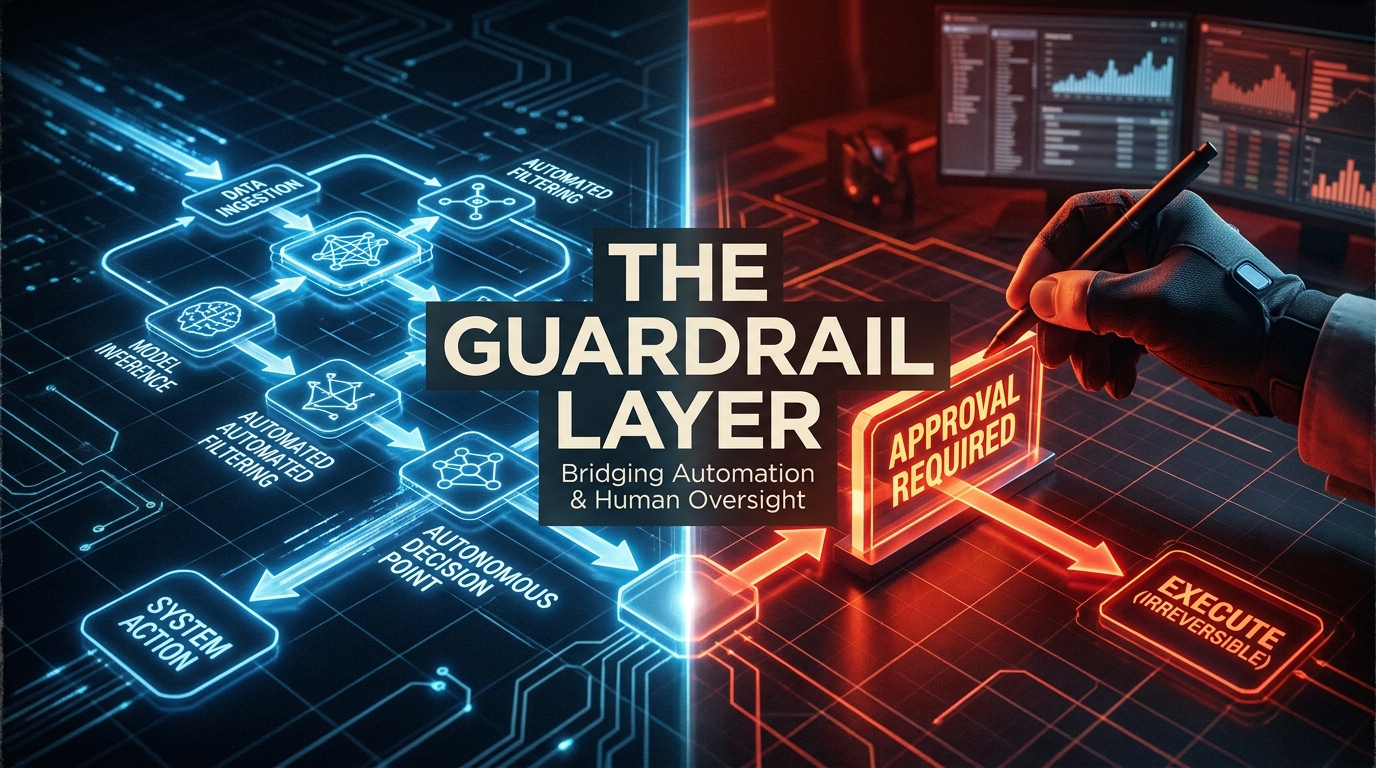
    Human-in-the-loop AI control room with a human hand pausing an automated data workflow — representing HITL as a design standard

    For the better part of the past five years, human-in-the-loop (HITL) was treated like a transitional phase. The implied logic went something like this: once our models are good enough, we can remove the human from the equation and let AI operate freely. Human oversight was scaffolding — necessary today, removable tomorrow.

    That logic is collapsing in 2026, and not slowly.

    Across regulated industries, enterprise AI deployments, and the emerging landscape of autonomous agents, human oversight is being re-engineered not as a temporary patch, but as a permanent structural feature. Regulators are codifying it into law. Engineers are building it into architecture. Product designers are treating human checkpoints as first-class UX components. The industry has quietly reached a consensus that the old framing — HITL as training wheels — was wrong.

    What’s changed is less about AI capability and more about what happens when AI acts without a human backstop on decisions that are consequential, irreversible, or contested. The failure modes aren’t hypothetical anymore. They’re showing up in production systems, in regulatory enforcement actions, in post-mortems at enterprises that moved too fast toward full automation.

    This piece isn’t about whether to include humans in AI workflows. That question is largely settled. It’s about the harder questions: where do humans belong in the loop, how do you design those checkpoints so they’re not theater, and what are the real costs — technical, organizational, and human — of getting it wrong?

    The answers are more nuanced than most frameworks acknowledge — and the gap between HITL as a policy statement and HITL as a working engineering reality is wider than most organizations want to admit.

    What “HITL by Design” Actually Means — And What It Doesn’t

    The phrase “human-in-the-loop” is older than the current AI moment. It originated in control systems and simulation engineering decades before large language models existed. But in 2026, its meaning has been substantially redefined — and the redefinition matters.

    The old understanding of HITL was relatively simple: a human reviews an AI output before it goes live or takes effect. Think of a content moderation queue, a loan approval workflow where an officer signs off on the model’s recommendation, or a radiologist checking a flagged scan. The human sat at the end of the pipe and made the final call.

    The new understanding is substantially more architectural. HITL by design means that human oversight requirements are determined before the system is built, not bolted on after deployment. It means specifying — at the system design level — which decision classes require human review, what information the human needs to make a meaningful judgment, how that judgment is recorded and audited, and what happens when humans disagree with the AI or vice versa.

    Human Oversight Is Not a Kill Switch

    One of the most persistent misconceptions about HITL is that it’s equivalent to having an emergency stop button. If the AI does something wrong, a human intervenes. That framing is dangerously insufficient.

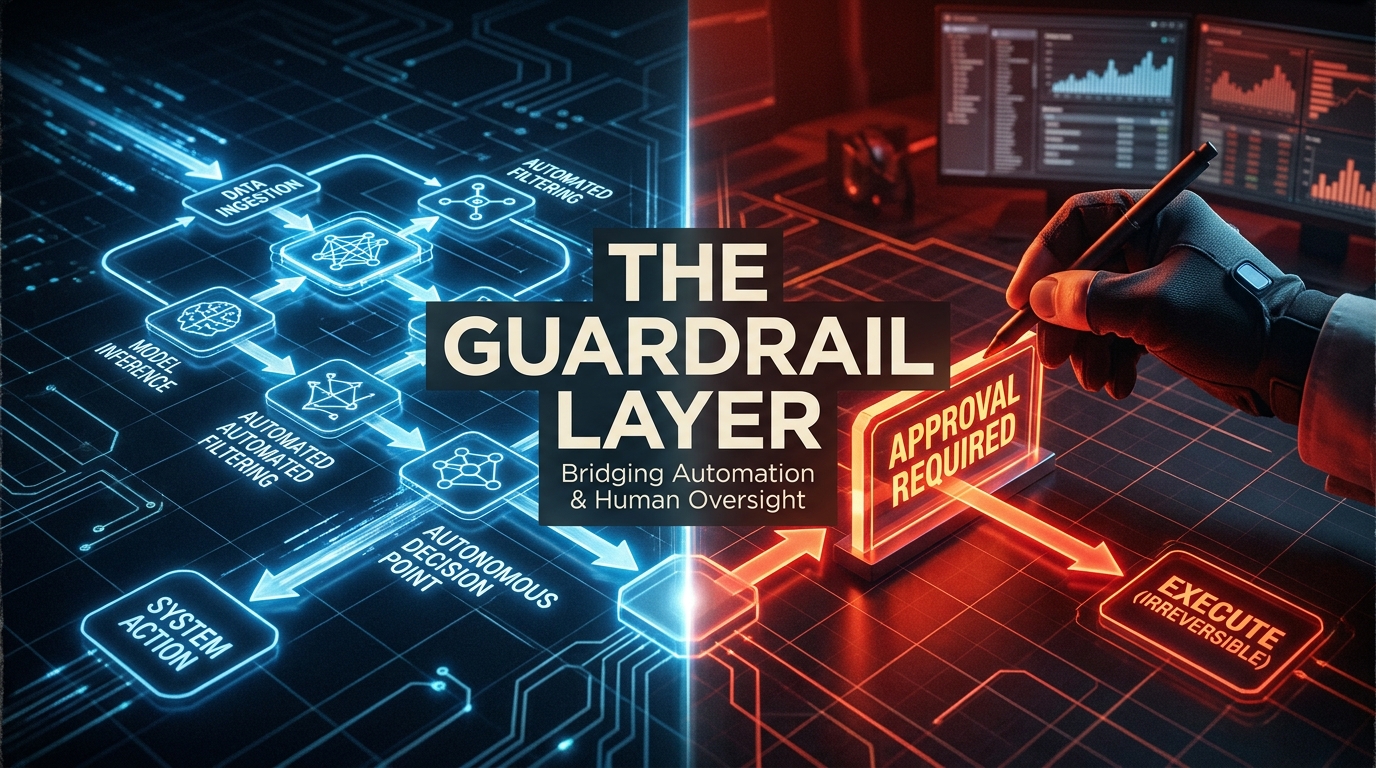
    A kill switch is reactive. Properly designed HITL is proactive. It means the system is architected so that at predefined decision points — based on risk tier, confidence threshold, decision reversibility, or regulatory category — the AI pauses, surfaces the relevant context to a human, and waits for a qualified judgment before proceeding. The human isn’t watching for something to go wrong; they’re structurally embedded in the workflow at the points where human judgment adds irreplaceable value.

    This distinction changes how you build systems. It means HITL requirements have to be part of the initial requirements gathering, the system architecture, the data model (you need to store the state of in-progress decisions), the UX design (the review interface is a product, not an afterthought), and the operational model (someone has to own the review queue, with defined SLAs).

    The Spectrum: From Supervision to Collaboration

    Even within the “human in the loop” category, there are meaningfully different relationships between human and machine. At one end, the human is a supervisor reviewing AI recommendations and approving or rejecting them with minimal additional input. At the other end, the human and AI are genuinely collaborative — the AI proposes, the human refines, the AI re-proposes, in an iterative cycle that neither party could execute as well alone.

    The collaborative model is increasingly common in knowledge work: legal research, clinical diagnosis, code review, financial analysis. In these settings, the AI isn’t just being checked — it’s actively augmenting human capability, surfacing patterns and precedents that would take a human much longer to find independently. The human’s role isn’t diminished; it’s shifted from information retrieval to judgment and synthesis.

    Understanding where your use case sits on this spectrum determines what your HITL architecture should look like. A supervision model needs fast, clear review interfaces with good escalation paths. A collaboration model needs AI that can explain its reasoning, handle ambiguity gracefully, and iterate based on human feedback without losing context.

    Three AI oversight tiers compared: HITL human in the loop, HOTL human on the loop, and human after the fact review — infographic

    The Three Oversight Models: HITL, HOTL, and the Dangerous Default

    Most enterprise AI discussions collapse human oversight into a binary: either a human approves every decision, or the AI operates autonomously. In practice, the actual design space has at least three distinct modes, each appropriate for different risk and volume profiles.

    Human-in-the-Loop (HITL): Blocking Oversight

    In strict HITL, the AI cannot proceed without human approval. The workflow pauses at a defined checkpoint. A human reviews the AI’s proposed action — and the context supporting it — then approves, rejects, or modifies before execution continues. This is the highest-friction, highest-assurance model.

    HITL is appropriate when: the decision is irreversible or difficult to remediate; the stakes are high (financial loss, legal liability, physical harm); the regulatory environment requires documented human approval; or model confidence is below a defined threshold. In financial services, this means any transaction above a materiality threshold. In healthcare, it means treatment recommendations that deviate from standard protocols. In HR, it means employment decisions that could create legal exposure.

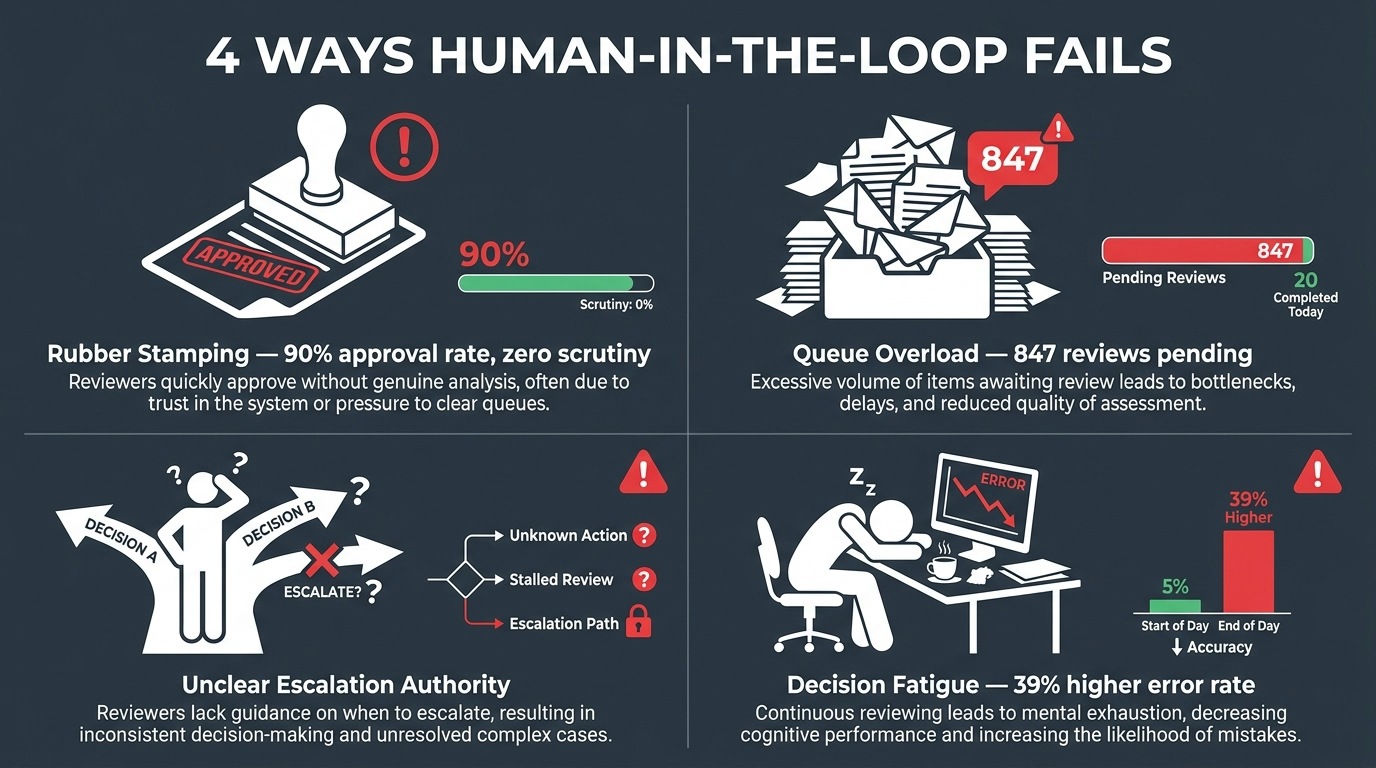
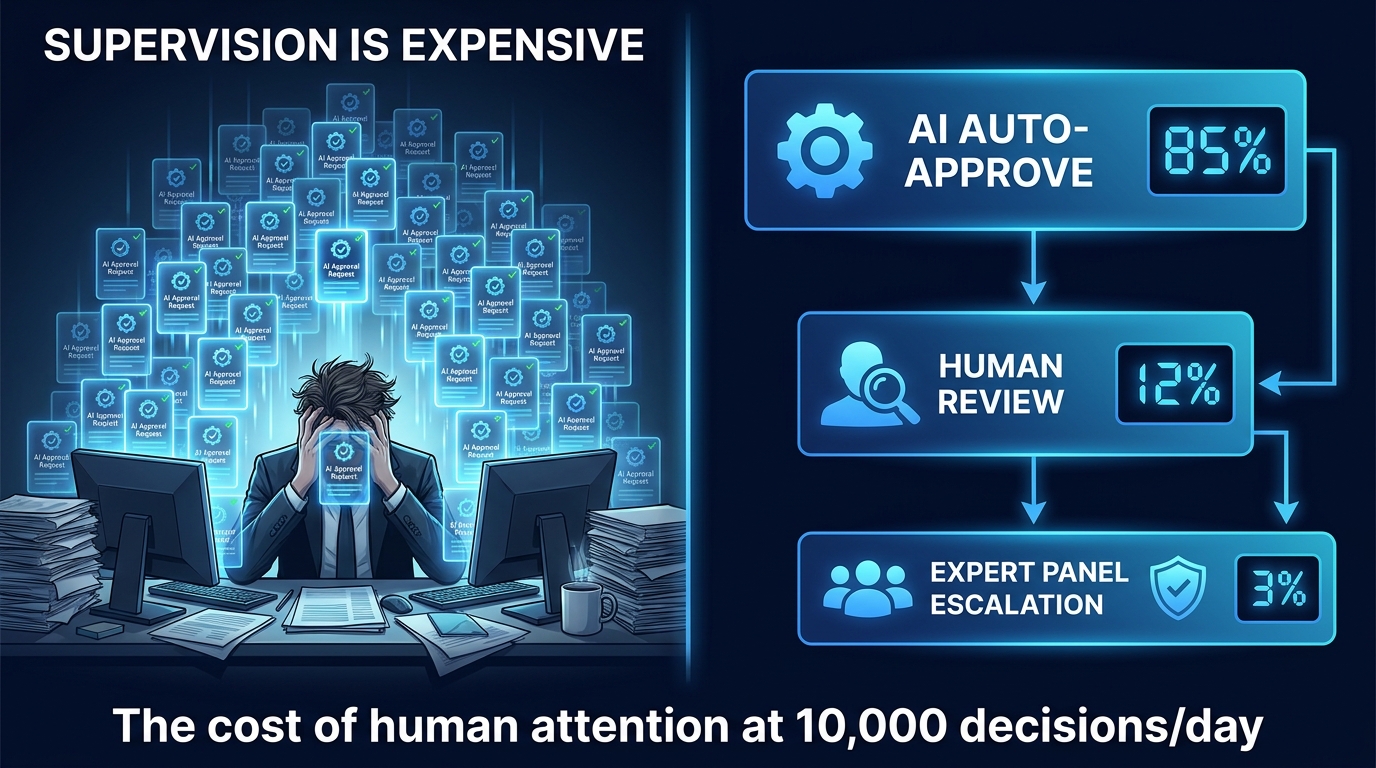
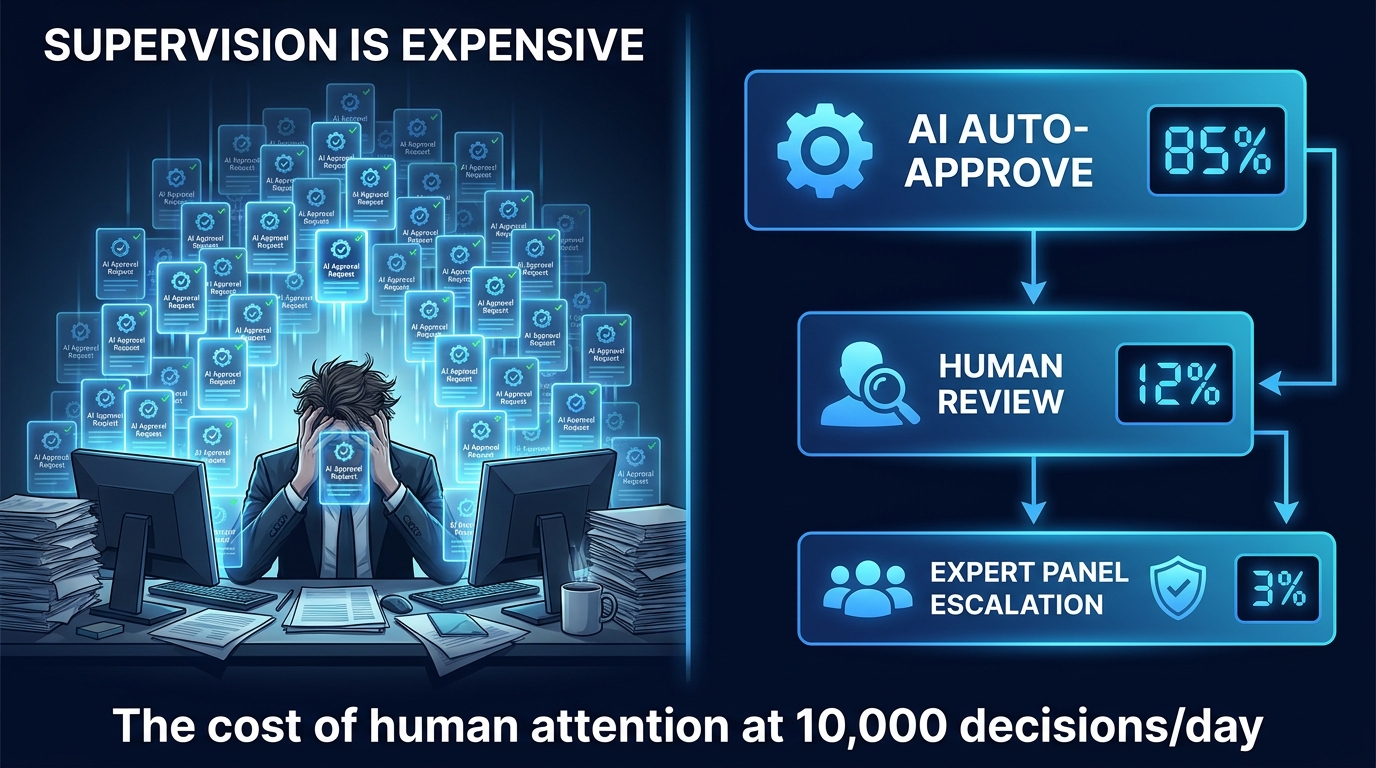
    The tradeoff is throughput and latency. Every human checkpoint is a bottleneck. If the review queue backs up, workflows stall. If reviewers are under-resourced or under-trained, the quality of oversight degrades — which can be worse than having no oversight at all, because it creates a false sense of safety.

    Human-on-the-Loop (HOTL): Supervisory Oversight

    HOTL is the middle layer. The AI acts autonomously, but humans monitor outputs in real time or near-real time via dashboards, alerts, and exception queues. Instead of approving every decision, reviewers focus on flagged anomalies, low-confidence outputs, or cases that trip predefined rules.

    This model scales significantly better than strict HITL. A single skilled reviewer can oversee a much higher volume of AI decisions because they’re only engaging with exceptions. The challenge is designing the exception logic well. If the threshold for flagging is too high, dangerous errors get missed. If it’s too low, reviewers get flooded with low-priority alerts — which leads directly to the alert fatigue problem explored later in this piece.

    HOTL is appropriate for high-volume, relatively routine workflows where errors are detectable and partially reversible: content classification, fraud scoring, customer service routing, automated document processing. It’s also the default model for most AI systems that claim to have human oversight but haven’t thought carefully about whether that oversight is meaningful.

    The Dangerous Default: Human After the Fact

    There’s a third de facto model that rarely gets named explicitly: human review happens, but only after something goes wrong. This is audit-trail oversight — logs exist, post-hoc analysis is possible, but no human is actively monitoring for errors or approving actions in advance.

    This model is common in practice, especially in organizations that deployed AI quickly and added oversight as an afterthought. It satisfies a narrow definition of accountability (“we can see what happened”) while providing almost none of the actual safety guarantees that governance language implies. By the time a human identifies a problem, the AI may have made thousands of identical erroneous decisions.

    The EU AI Act’s Article 14 makes this model legally insufficient for high-risk AI systems. But even outside regulated jurisdictions, the business case for retroactive-only oversight is weak. The remediation costs — financial, reputational, and operational — of catching problems after the fact are almost always higher than the cost of catching them at the point of decision.

    The Regulatory Forcing Function: What the EU AI Act Actually Requires

    EU AI Act Article 14 compliance countdown showing August 2 2026 deadline with human oversight checklist requirements

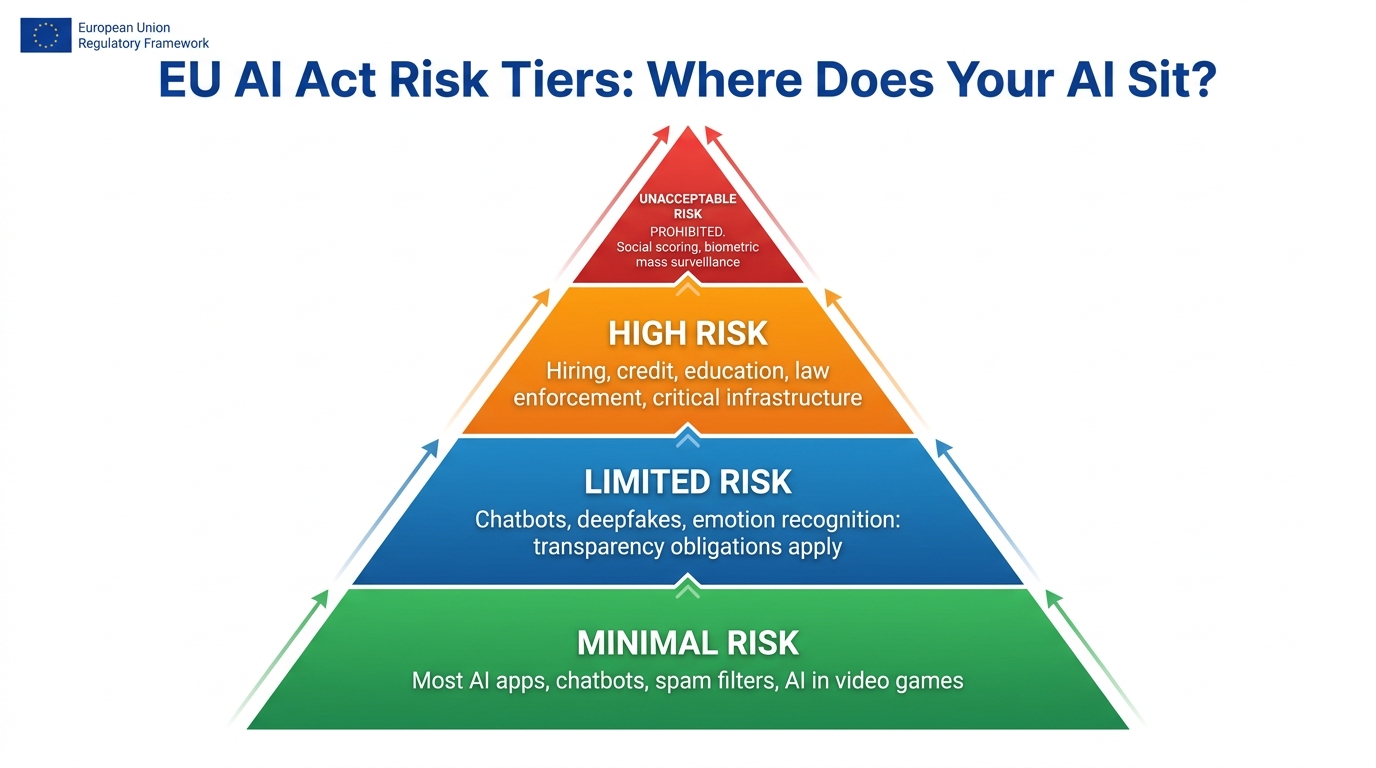
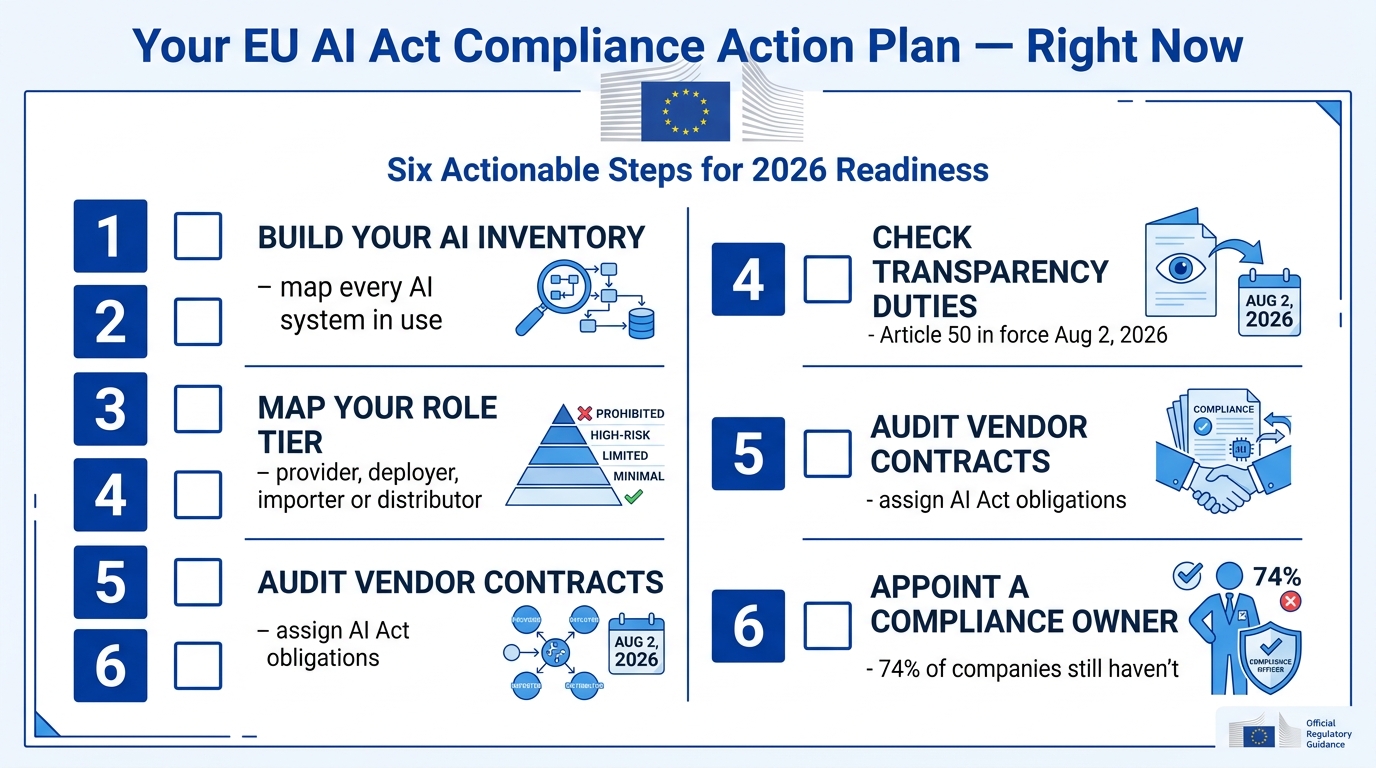
    The shift from voluntary best practice to mandatory design requirement has a clear legislative anchor: the EU AI Act, which began phasing in substantive obligations in 2026, with the core human oversight requirements for high-risk systems under Article 14 effective from August 2, 2026.

    Understanding what Article 14 actually requires — not what organizations think it requires — is essential for any enterprise deploying AI in EU markets or building systems for EU-based customers.

    Article 14: Beyond the Summary

    Article 14 doesn’t just say “have a human check the AI.” It specifies that high-risk AI systems must be designed and developed such that they can be effectively overseen by natural persons during the period in which the AI system is in use. Effective is the operative word.

    Specifically, providers of high-risk AI must ensure that humans can: fully understand the AI system’s capabilities and limitations; monitor its operation and detect anomalies; intervene and override outputs; and stop the system when necessary. These aren’t checkbox items — they’re functional requirements that have to be built into the system architecture.

    What makes this demanding is the word “fully.” An interface that shows a recommendation with no explanation of confidence, reasoning, or uncertainty doesn’t meet the bar. A system that can technically be overridden but where the override process is so cumbersome that no one ever uses it doesn’t meet the bar. The oversight has to be effective, and that determination will be made by regulators and courts looking at actual use, not documented intentions.

    High-Risk Classifications: Who’s Actually Affected

    The EU AI Act’s Annex III defines high-risk AI categories. The list is broader than most organizations initially assume. It includes: biometric identification systems; AI used in critical infrastructure (energy, water, transport); educational and vocational systems that determine access or assessment; employment-related systems that affect recruitment, performance evaluation, or termination; access to essential services including credit, insurance, and social benefits; law enforcement applications; migration and asylum management systems; and administration of justice.

    This scope captures a substantial fraction of enterprise AI deployment. An automated CV screening tool is high-risk. A credit scoring model is high-risk. A system that routes customer service cases to different service tiers may be high-risk. Organizations that assumed they were operating outside the regulation’s scope should revisit that assessment carefully.

    Beyond the EU: Convergent Regulatory Pressure

    While the EU AI Act is the most comprehensive regulation currently in force, it isn’t isolated. The NIST AI Risk Management Framework (AI RMF) in the United States, while voluntary, has become the de facto standard for federal contractors and many regulated industries. Its Govern, Map, Measure, and Manage functions all incorporate human oversight requirements. The UK’s AI Safety Institute has published guidance that aligns closely with the EU’s substantive requirements. India’s Digital Personal Data Protection Act, Canada’s AIDA, and sector-specific guidance from financial regulators globally are converging on similar principles.

    The practical implication: organizations building HITL architectures to meet EU AI Act requirements will find those architectures simultaneously position them well for compliance in other jurisdictions. The global regulatory trajectory is clear, even where specific legislation lags.

    Checkpoint Architecture: Where the Real Engineering Work Happens

    AI agent workflow checkpoint architecture diagram showing risk-tiered decision routing: auto-proceed, human review queue, and mandatory approval gate

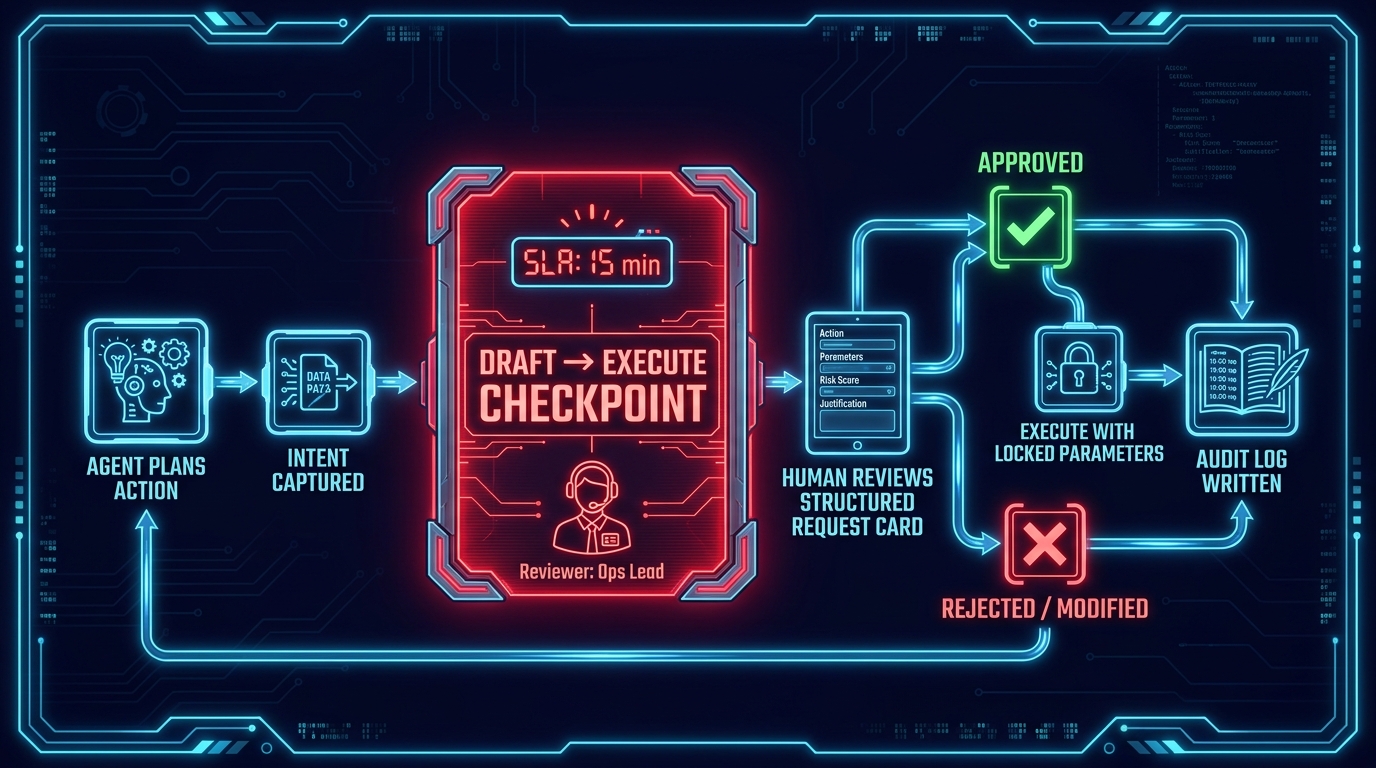
    Most HITL discussions stay at the policy level. They describe what human oversight should accomplish without getting specific about how to actually build it. The checkpoint architecture question — where exactly does the workflow pause, what does the human see, and how is their decision recorded and acted on — is where theory meets engineering reality.

    Defining the Pause Points

    The first design decision is identifying which actions in an AI workflow require a human checkpoint. This is harder than it sounds because the right answer isn’t static — it depends on a combination of factors that can change between instances of the same workflow.

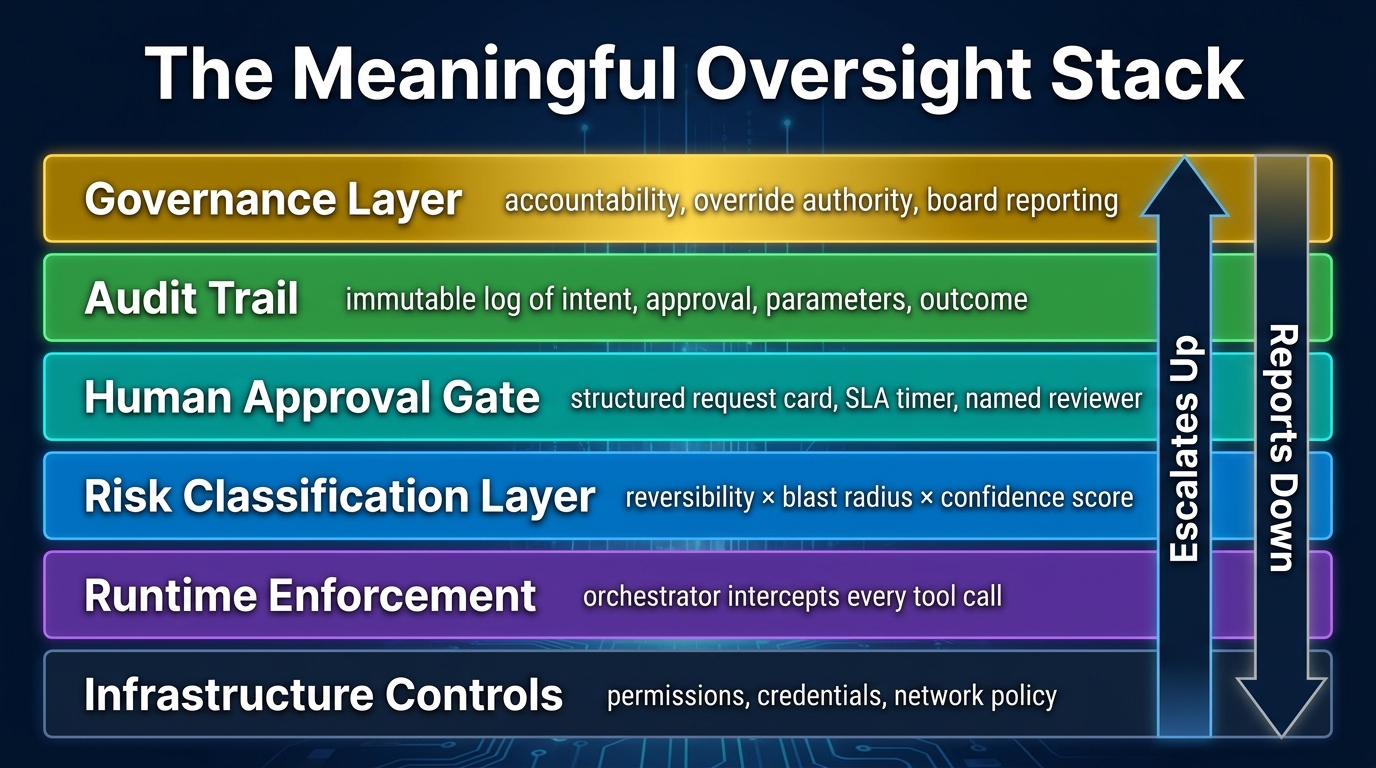
    The key variables are: decision reversibility (can the action be undone if it’s wrong?), impact magnitude (what’s the worst-case consequence of an error?), model confidence (how certain is the AI about this specific case?), and regulatory obligation (does law or policy require human sign-off regardless of other factors?). A well-designed checkpoint system evaluates these variables dynamically, routing decisions to human review when the combination of factors exceeds a defined threshold.

    This is meaningfully different from static checkpoints where every instance of a decision class goes to human review. Dynamic routing based on confidence and risk allows high-confidence, low-stakes decisions to flow through automatically while surfacing the genuinely uncertain or high-stakes cases for attention. The result is a review queue that contains decisions where human judgment actually adds value — not a queue stuffed with cases the AI would have handled perfectly well on its own.

    Designing the Review Interface

    The review interface — what the human actually sees when a decision lands in their queue — is a full product design problem, and in most organizations it’s dramatically under-invested. A poorly designed review interface produces poor oversight even with excellent intentions.

    The interface needs to answer five questions in a format a reviewer can process quickly: What is the AI proposing to do? Why (what signals or evidence drove this recommendation)? How confident is the AI? What are the known alternatives or edge cases? And what’s the consequence of getting it wrong? Providing this context in a compressed, scannable format — without overwhelming the reviewer with raw model internals — is a significant UX challenge.

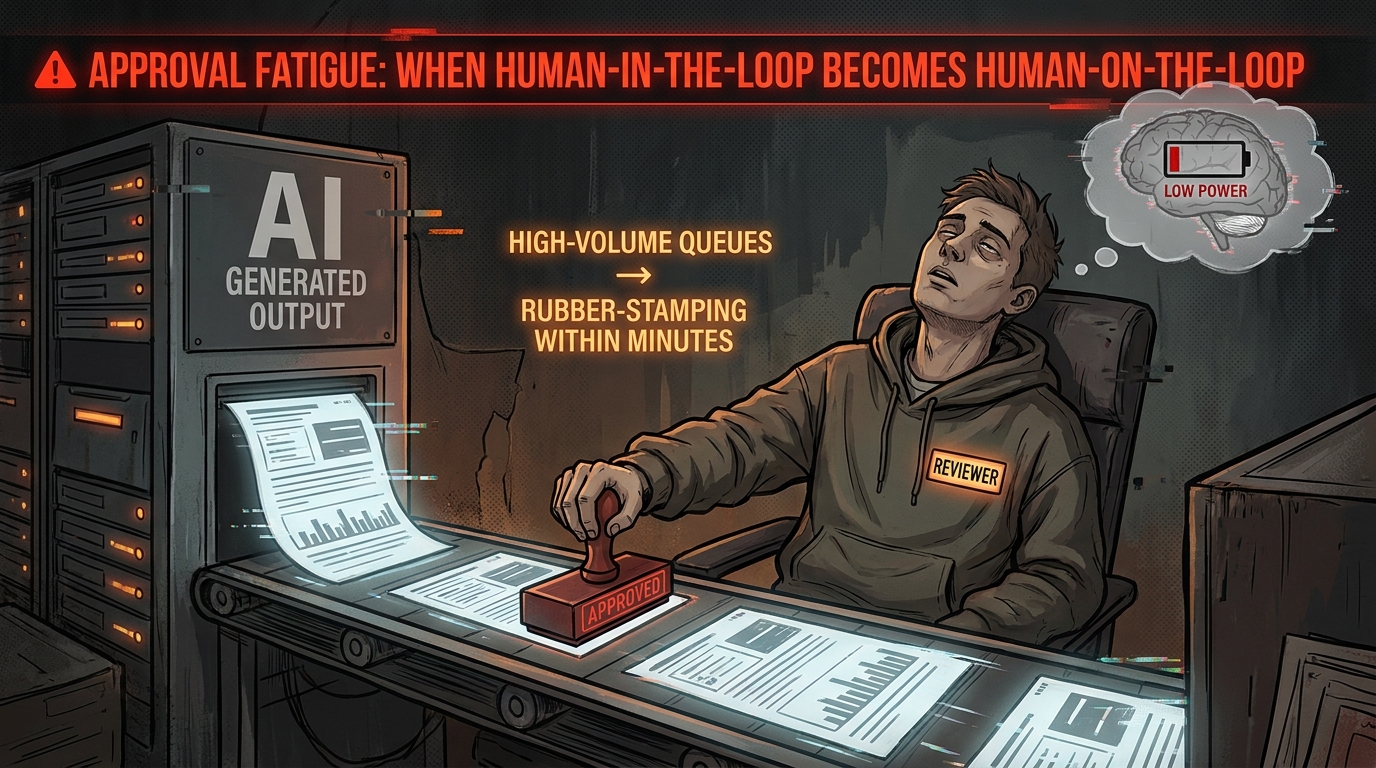
    Explainability isn’t just a nice-to-have here; it’s load-bearing. A review interface that shows “Model recommends: Approve” with no supporting rationale isn’t enabling human oversight — it’s creating a rubber stamp process where the human clicks approve because they have no basis for doing otherwise. This is exactly the dynamic that produces automation bias, which is covered in depth later.

    State Management and Audit Infrastructure

    HITL workflows require persistent state. When a workflow pauses for human review, the system needs to preserve everything about the current decision state: the AI’s recommendation, the confidence score, the data inputs, the timestamp, the reviewer assigned, and the time allowed before escalation. When the human acts, the system needs to record the decision, the reasoning if provided, and the outcome for downstream audit.

    This state management infrastructure is often underestimated. Organizations frequently discover that their existing workflow tools weren’t designed to pause mid-flow, store decision state across sessions, or maintain a complete audit trail of human interventions. Retrofitting this is expensive. Building it from scratch into new systems — while more work upfront — is almost always the right approach.

    SLAs, Escalation, and the “Stuck Decision” Problem

    One of the practical failures of HITL implementations is the stuck decision: a workflow pauses for human review, the assigned reviewer is unavailable or overwhelmed, and the case sits in queue without resolution. Downstream processes that depend on the decision are blocked. Business outcomes are delayed. In time-sensitive contexts, the cost of waiting can exceed the cost of a wrong automated decision.

    Preventing stuck decisions requires explicit SLA design. Each decision tier should have a defined response time window. After that window, the system should automatically escalate to a secondary reviewer, raise an alert, or (in some low-risk cases) apply a safe default action. Who owns the escalation path, what the safe defaults are for each decision class, and what constitutes an acceptable SLA all need to be defined before deployment — not discovered in the first production incident.

    Where HITL Works: Sector Evidence from Healthcare, Finance, and Legal

    Three-panel infographic showing HITL accuracy improvements in healthcare, finance, and legal sectors with key statistics

    The case for HITL isn’t theoretical. Across the highest-stakes sectors, there is accumulating evidence that human-machine collaboration substantially outperforms either humans or AI operating independently — and that the specific benefits depend heavily on how the collaboration is structured.

    Healthcare: When the Stakes Are Irreversible

    Healthcare is where the HITL evidence base is strongest, partly because the research infrastructure to study diagnostic accuracy already existed before AI was introduced. The findings are striking. A 2025 systematic review found that human-machine teams — where AI and clinicians each contributed to diagnosis — outperformed clinicians working alone in 95% of studied cases. HITL AI improved overall clinician diagnostic performance by an average of 7.1% across task types.

    Perhaps more importantly for practical implementation, the same review found that HITL dramatically reduced the incidence of high-confidence wrong answers — the failure mode that causes the most clinical harm. AI systems occasionally produce wrong outputs with high confidence. Clinicians catch most of these when they’re shown the AI’s recommendation alongside supporting evidence and have time to evaluate it critically. The AI catches most of the cases where a tired or overloaded clinician might miss something subtle. Neither catches everything; together, they catch substantially more than either alone.

    The documentation benefit is separate but significant. HITL-augmented clinical documentation reduced documentation time by 24 to 72 percent in multiple studies, while improving completeness and accuracy. The human remains responsible for the clinical narrative, but AI pre-fills, summarizes, and flags gaps — freeing physician attention for the genuinely complex judgment work.

    Finance: Accuracy at Scale Without Sacrificing Control

    Financial services presents a different profile. The volume of decisions is orders of magnitude higher than healthcare — millions of transactions, documents, and risk assessments daily — but many individual decisions have lower immediate consequences than clinical ones. The sector’s HITL architecture challenge is therefore primarily about selective oversight: applying human review where it materially reduces risk without creating a bottleneck that makes AI-enabled scale impossible.

    Document processing illustrates the accuracy case clearly. For structured document extraction — ingesting and parsing contracts, invoices, regulatory filings, and financial statements — HITL systems routinely achieve 99.9% accuracy compared to approximately 92% for AI-only processing. For high-volume, low-margin financial operations, that 7.9-percentage-point gap represents enormous cumulative error cost at scale. A 92% accuracy rate on ten million monthly invoice processings means roughly 800,000 errors per month requiring remediation.

    Fraud detection presents a different tradeoff. Fully automated fraud scoring operates at the millisecond speed required for real-time payment processing. Human review of flagged transactions happens asynchronously, after a provisional hold is placed. The HITL architecture in this context is a HOTL model at the transaction level (AI decides in real time whether to flag) combined with strict HITL for consequence decisions (whether to permanently block an account, initiate a fraud report, or escalate to law enforcement). The human is in the loop on the decisions that create legal and reputational exposure, not on every flag.

    Legal: The Irreversibility Standard

    Legal workflows are governed by an irreversibility standard that makes HITL essentially non-negotiable for any consequential action. Filing a legal document, entering into a contract, making a representation to a court — these actions cannot be simply undone. The professional liability framework, the ethical obligations of attorneys, and the adversarial nature of legal proceedings all demand that a qualified human is making and owning the relevant judgment calls.

    What AI has changed in legal practice is the volume and quality of information that the human can process before making those calls. Contract review workflows now routinely use AI to flag non-standard clauses, surface precedent cases, compare terms against benchmarks, and identify potential risks — all presented to the reviewing attorney in a structured interface designed to surface the highest-priority issues first. The attorney’s review time may be reduced by 40 to 60 percent. Their decision quality, informed by AI-surfaced context they would not have had time to gather independently, may be substantially higher.

    The HITL model here is explicitly collaborative: the attorney doesn’t just approve or reject the AI’s analysis. They engage with it, probe it, override it where their judgment differs, and take professional responsibility for the final work product. The AI isn’t a checker; it’s a highly capable research and analysis tool operating under human professional direction.

    The Hidden Costs: Automation Bias, Alert Fatigue, and Deskilling

    Three HITL failure modes illustrated: automation bias showing reflexive approvals, alert fatigue from notification overload, and deskilling of human expertise

    HITL is not automatically safe. Poorly designed HITL can be actively worse than either full automation or purely human decision-making — because it creates the appearance of human oversight without the substance. Three failure modes deserve careful attention.

    Automation Bias: The Rubber Stamp Problem

    Automation bias is the documented human tendency to over-rely on automated recommendations and under-apply independent judgment, especially when the AI presents with apparent confidence. It’s a well-studied cognitive phenomenon: when a system presents a recommendation, humans tend to anchor on that recommendation and require strong contradictory evidence to override it. In the absence of compelling contrary evidence, they default to approving what the AI suggests.

    This has been observed across multiple HITL domains. Radiologists have been shown to miss anomalies that they would have caught independently when reviewing AI-pre-screened images marked “normal.” Loan officers approve borderline applications at higher rates when the AI recommendation is “approve.” Content moderators pass more marginal content when the AI rates it “compliant.”

    The mitigation isn’t to remove the AI recommendation from the interface — that would eliminate most of the efficiency gain. It’s to design interfaces that force genuine engagement. This means: requiring reviewers to articulate their reasoning before seeing the AI’s recommendation in some fraction of cases; presenting confidence uncertainty prominently (not just the recommendation but how confident the model is); randomizing the display format to prevent pattern recognition shortcuts; and tracking individual reviewer override rates as a quality metric, with low override rates triggering calibration reviews.

    Alert Fatigue: When Oversight Volume Defeats Oversight Quality

    Alert fatigue is a throughput problem masquerading as a design problem. When the volume of review requests exceeds a reviewer’s processing capacity — or when a high percentage of alerts turn out to be low-priority — reviewers begin to treat oversight as an administrative task rather than a meaningful judgment exercise. Approval rates climb. Engagement time per review falls. Eventually, the review process exists formally but not functionally.

    The root cause is almost always miscalibrated thresholds. Organizations that set conservative escalation rules — routing too many decisions to human review to be “safe” — inadvertently flood their review queues with low-value cases and degrade the quality of review across the board. The paradox is that trying to maximize oversight by routing more to humans can result in less effective oversight per decision.

    The fix requires data. Track the distribution of outcomes for different alert tiers. If 95% of alerts in a given category result in approval with minimal review time, that’s evidence the category can be safely downgraded or removed from the human review path. Calibration of escalation thresholds should be a recurring operational practice, not a one-time setup decision.

    Deskilling: The Long-Term Risk Nobody Talks About

    Deskilling is the most insidious of the three failure modes because it operates slowly and invisibly. When AI handles the routine, pattern-recognition-intensive components of a job, and humans are left to review AI recommendations on an exception basis, the human’s opportunity to practice foundational skills decreases. Over time, that practice deficit erodes capability.

    Pilots who rely heavily on autopilot maintain lower manual flying proficiency. Clinicians who regularly review AI diagnostic recommendations show degraded independent diagnostic performance in studies where the AI is removed. Legal associates who spend years reviewing AI-drafted contracts rather than drafting from scratch develop gaps in their drafting capabilities.

    This matters because HITL’s safety value depends on the human in the loop being capable of catching what the AI gets wrong. If deskilling has degraded that capability, the human checkpoint provides less protection than it appears to. The oversight function becomes hollow.

    Organizations building long-term HITL architectures need to think about skill maintenance as an operational requirement. This might mean rotating staff through non-AI-assisted workflows periodically, designing training programs that keep foundational skills sharp, or explicitly tracking skill depth as a workforce metric alongside traditional performance indicators.

    Agentic AI and the New Oversight Problem

    Autonomous AI agent network with human checkpoint gates at critical decision nodes — visualizing accountable agentic AI oversight architecture

    Everything discussed so far has assumed a relatively bounded AI system: one that processes inputs and produces recommendations or takes discrete actions in a well-defined workflow. The emergence of agentic AI — systems that can plan multi-step tasks, invoke external tools, and operate across extended time horizons with minimal moment-to-moment human direction — creates a fundamentally different oversight challenge.

    Why Agentic AI Changes the Oversight Calculus

    With a conventional AI system, the boundary of possible action is narrow. The model takes input, produces output, a human reviews it, done. With an agentic system, a single task initiation might trigger a cascade of sub-actions: browsing the web for information, writing and executing code, sending emails, making API calls to external systems, creating documents, booking appointments, moving funds. Each sub-action builds on the last, and the compound effect of early errors — or early misinterpretations of the task objective — can propagate far before any human sees the result.

    Gartner projects that by 2030, 50% of AI agent deployment failures will stem from insufficient runtime governance and oversight. That forecast reflects a recognition that agentic systems require a qualitatively different approach to HITL, not just a quantitative extension of existing patterns.

    Checkpoint Design for Agents: The Critical Decisions

    Designing HITL for agentic systems requires answering several questions that don’t arise with conventional AI. First: at what points in a multi-step task should the agent pause for human verification? Pausing at every step defeats the purpose of agency; never pausing creates unacceptable risk. The emerging best practice is to pause at “consequence thresholds” — actions that are irreversible, involve external commitments, exceed defined value or data exposure limits, or represent a significant deviation from the initial task specification.

    Second: how do you preserve useful human oversight without requiring the reviewer to reconstruct the entire agent’s decision history? The agent may have taken fifty intermediate steps before reaching a consequence threshold. A reviewer presented with a raw action log will struggle to provide meaningful oversight. The interface needs to compress the relevant history into a reviewable summary — what the agent was trying to do, what it has done so far, what it proposes to do next, and what makes this moment a checkpoint — in a format that enables a qualified judgment in under five minutes.

    Third: what happens when an agent encounters uncertainty mid-task? The emerging design pattern is for agents to have an explicit escalation behavior — surfacing uncertainty to a human rather than guessing — whenever they encounter ambiguity about task objectives, conflicting signals, or situations outside their training distribution. This is meaningfully different from waiting for a consequence threshold; it’s the agent itself initiating oversight requests when it recognizes the limits of its own competence.

    Identity, Authorization, and Accountability Chains

    Agentic AI creates a new accountability problem. When an agent takes an action — particularly one with legal or financial consequences — who authorized it? The person who started the task? The person who reviewed the last checkpoint? The organization that deployed the agent? If the action causes harm, this question has legal standing.

    Sophisticated HITL architectures for agentic systems are incorporating identity-anchored authorization chains: each action that the agent takes is linked to an explicit authorization record showing which human approved which scope of action, at what time, under what stated task objective. This isn’t just for post-hoc accountability; it’s operationally useful because it limits what the agent can do autonomously to what a specific human has explicitly authorized for this specific task instance.

    This approach borrows from privileged access management frameworks in enterprise security. Just as you wouldn’t give a contractor unrestricted access to all production systems, you don’t give an AI agent unrestricted ability to take any action within its technical capability. Scoped authorization, linked to a human principal, creates the accountability chain that makes agentic systems governable.

    How to Design HITL That Actually Works — Not HITL Theater

    Most HITL implementations fail not because the concept is wrong, but because the design is shallow. Organizations add a review step to an existing workflow, call it HITL, and move on. What they’ve built is HITL theater — the structural appearance of oversight without the functional substance. Here’s how to build something that actually works.

    Start With Decision Architecture, Not Interface Design

    The most common mistake is starting with the interface. Teams build a review screen, add an approve/reject button, and consider the HITL work complete. But if the decision architecture upstream is wrong — if the wrong decisions are being routed to review, if the risk tiering is miscalibrated, if the confidence thresholds are arbitrary — the interface design is irrelevant.

    Decision architecture first means mapping every decision class in the workflow, characterizing each by consequence, reversibility, and regulatory status, and designing the routing logic before a single screen is designed. This is often a cross-functional exercise involving risk, compliance, legal, and operations — not just engineering. It takes longer upfront and produces substantially better outcomes.

    Treat the Review Interface as a Core Product

    The human review interface should receive the same product design investment as any customer-facing feature. It needs user research with actual reviewers. It needs usability testing. It needs iteration based on real-world use data. The questions it needs to answer — what is this, why did it land here, what do I need to decide — have to be answerable in under a minute for the oversight to be meaningful at operating throughput.

    Critically, the interface should be designed to resist automation bias. Confidence scores should be displayed with their uncertainty range, not just the point estimate. The review should surface disconfirming evidence alongside the AI’s recommendation. In high-stakes contexts, consider requiring reviewers to document their reasoning — not a long essay, but a structured selection from a checklist of decision factors — before they can submit their judgment.

    Build Measurement Into the Oversight System Itself

    HITL systems should be measured continuously, not just audited periodically. Key metrics include: reviewer override rate by decision class (are humans ever disagreeing with the AI?); review time per decision (is it long enough to indicate genuine engagement?); post-decision outcome tracking (when humans override the AI, are they right?); queue age and escalation rates (is the system flowing, or are decisions getting stuck?); and reviewer agreement rates across multiple reviewers on the same decision type (is human judgment consistent enough to be reliable?).

    These metrics are operationally useful and serve a second function: they provide the evidence base for calibrating the system over time. As the AI model improves in specific areas, human oversight requirements in those areas can be reduced. As new risk patterns emerge, escalation thresholds can be tightened. The oversight architecture should evolve continuously based on evidence from actual operations — not remain static after initial deployment.

    Design for Human Dignity and Sustainable Work

    Reviewers in HITL systems are doing cognitively demanding work, often at high volume. Organizations that treat review queues as high-throughput data entry — implicitly expecting reviewers to process large volumes as quickly as possible — will produce either automation bias (reviewers going through the motions) or burnout and turnover (reviewers who can’t sustain the cognitive load).

    Sustainable HITL design sets realistic throughput expectations based on decision complexity, not on what would be most convenient for the automated system. It provides review context that makes the work meaningful — reviewers who understand the downstream consequences of their decisions make better ones. It builds in breaks and cognitive recovery time. And it creates feedback loops so reviewers see the outcomes of their decisions — a fundamental driver of skill maintenance and judgment quality.

    The Market Taking Shape Around Human Oversight

    HITL is becoming a product category, not just an architectural pattern. The human-in-the-loop AI market was valued at approximately $2.4 billion in 2025 and is projected to reach $11.8 billion by 2034, growing at a compound annual rate of roughly 19.3%. That growth trajectory reflects genuine enterprise investment in oversight infrastructure — not just compliance spend, but operational capability.

    The Tooling Layer Is Maturing

    A year ago, most HITL infrastructure was custom-built. Engineering teams would wire together workflow orchestration, a review interface, and audit logging from disparate components. That’s changing rapidly. A new category of HITL-native platforms is emerging — tools designed from the ground up to support the pause-review-resume workflow, manage review queues, maintain decision state, and capture the audit data that compliance requires.

    These platforms are showing up at the intersection of several adjacent markets: workflow automation, AI governance tooling, and business process management. The differentiation is increasingly around the intelligence of the escalation layer — how well the platform identifies which decisions need human review — and the quality of the review interface, which determines whether oversight is genuine or performative.

    New Roles and Organizational Structures

    HITL at enterprise scale is creating new workforce requirements. The “AI reviewer” or “AI oversight specialist” role is becoming formalized in high-stakes sectors. These aren’t general-purpose employees who happen to review AI outputs; they’re specialists who understand both the domain (clinical, legal, financial) and the AI system’s behavior well enough to provide meaningful oversight rather than rubber-stamping.

    The role demands unusual cross-domain fluency: deep domain expertise, enough technical understanding of how the model works to interpret its confidence signals, and enough judgment to override confidently when warranted. Organizations are finding that this combination is hard to recruit for and hard to train toward — which is pushing some of the leading HITL platform providers toward building role-specific training and certification into their products.

    The Opportunity in Trustworthy AI Positioning

    For organizations selling AI-enabled products or services, robust HITL architecture is increasingly a competitive differentiator, not just a compliance cost. Enterprise buyers — particularly in regulated industries — are asking detailed questions about how oversight is designed, not just whether it exists. Vendors who can demonstrate genuine human oversight infrastructure, with evidence of its effectiveness, are winning deals over alternatives that offer comparable AI capability with weaker oversight stories.

    This dynamic is already visible in healthcare AI, where clinical validation studies and human oversight documentation are becoming purchase requirements rather than nice-to-haves. It’s emerging in legal tech, in financial services AI, and in any context where the AI’s actions have consequences that create liability for the deploying organization. HITL as a value proposition is arriving in parallel with HITL as a regulatory requirement — and the combination is accelerating the market.

    Human Judgment as a Product Feature: The Reframe That Changes Everything

    The most significant intellectual shift in how leading organizations are thinking about HITL is the reframe from oversight cost to product feature. Under the old model, human review was an expense — a necessary one in some cases, but fundamentally a drag on the efficiency gains that AI was supposed to deliver. Under the new model, human judgment is a feature that the product includes by design, because it produces demonstrably better outcomes than the fully automated alternative.

    This reframe has practical implications for how HITL gets funded and prioritized. When human oversight is framed as a cost center, it competes with efficiency for budget. When it’s framed as a product differentiator — something that makes the system more accurate, more trustworthy, and more defensible in regulated contexts — it gets resourced accordingly.

    The Accuracy Premium Is Real and Measurable

    The data supports the reframe. In domain after domain, human-machine collaboration produces accuracy results that neither party achieves alone. 95% of human-machine diagnostic teams outperform clinicians working independently. Document processing accuracy at 99.9% versus 92% AI-only. Legal review that surfaces more risk at lower cost than either pure human review or AI-only analysis. These aren’t marginal improvements — they’re the kind of step-change accuracy gains that become core to a product’s value proposition.

    The reframe also changes how you think about the cost of HITL. The relevant comparison isn’t “HITL versus no HITL.” It’s “the cost of human oversight versus the cost of errors that oversight prevents.” When you model that comparison honestly — including remediation cost, reputational damage, regulatory fines, and legal liability — HITL investment typically looks very different than when compared against the operating cost of a fully automated alternative.

    Trust as a Durable Competitive Asset

    There’s a longer-term dynamic worth naming explicitly. As AI becomes more pervasive, the organizations that will sustain competitive position are those that have built demonstrated, verifiable track records of reliable AI-assisted decisions. That track record is only possible with HITL infrastructure that captures the data — the decisions made, the human judgments applied, the outcomes observed — that allow you to show your system’s reliability over time.

    Fully automated systems that never involve humans provide no such track record. They can demonstrate accuracy on test sets, but they can’t demonstrate the kind of real-world, audited, outcome-tracked reliability that high-stakes enterprise buyers increasingly require. HITL architecture is, in this sense, the foundation of a trust asset that compounds over time — and that can be demonstrated to regulators, customers, and partners in ways that purely automated approaches cannot.

    What the Most Serious Teams Are Getting Right

    The organizations making HITL work in practice share some consistent characteristics. They treat oversight as a design constraint from day one, not a retrofittable feature. They staff review functions with people who have real domain expertise, not just operational throughput. They measure the quality of oversight continuously and calibrate accordingly. They build feedback loops so that the human judgments captured in the HITL system are actually used to improve model performance over time.

    And — critically — they resist the organizational pressure to loosen HITL requirements as AI confidence increases, without the data to support that loosening. Model confidence is not the same as real-world reliability across the full distribution of inputs a deployed system will encounter. The teams that maintain disciplined oversight standards, even as models improve, are the ones who avoid the regression to the mean that catches organizations off guard when their “good enough to go autonomous” AI encounters a case it handles badly.

    Conclusion: The Structural Reality of the Human-in-the-Loop Era

    Human-in-the-loop is no longer a phase in AI development. It is, for a substantial and growing fraction of enterprise AI use, a permanent architectural requirement — one driven by regulatory obligation, by evidence of outcome quality, and by the hard-won recognition that full automation of high-stakes decisions creates failure modes that are genuinely difficult to recover from.

    The organizations that will navigate this transition well aren’t the ones treating HITL as a compliance checkbox. They’re the ones that have internalized the design philosophy: that human judgment is a capability to be integrated deliberately, not an inefficiency to be minimized. That oversight quality is something you measure and improve over time, not something you declare complete and move past. That the human in the loop is not a temporary bridge to full autonomy, but a permanent contributor to outcome quality that any honest accounting of AI-assisted decisions needs to include.

    The engineering work is harder than the policy language implies. Checkpoint architecture, review interface design, state management, escalation logic, automation bias mitigation, deskilling prevention — each of these is a substantive design problem that requires real investment. None of them can be solved with a checkbox on a governance form.

    But the evidence on the other side of that investment — in accuracy, in defensibility, in regulatory compliance, in trust — is increasingly compelling. The question for most organizations in 2026 is not whether to build human oversight into their AI systems. It’s whether to build it well.

    Key Takeaways for Practitioners

    • Choose your oversight model — HITL, HOTL, or hybrid — based on decision reversibility, stakes, volume, and regulatory obligation. Don’t apply one model to all workflows.
    • Design decision architecture before designing review interfaces. Routing logic determines whether the right decisions reach human reviewers.
    • Invest in review interface quality as seriously as you invest in any customer-facing product. A bad review UX produces automation bias regardless of policy intent.
    • Measure override rates, review time, and post-decision outcomes continuously. A HITL system that never generates disagreements between humans and AI is likely not generating genuine oversight.
    • Build explicit deskilling prevention into your workforce model. The human in the loop needs maintained capability to provide the oversight that’s being relied upon.
    • For agentic AI, design consequence threshold checkpoints and identity-anchored authorization chains before deployment, not after the first incident.
    • Model the cost of HITL against the cost of errors it prevents — including remediation, liability, and regulatory exposure — not just against the operating cost of a fully automated alternative.
  • The Operator’s Safety Manual for Shipping Multi-Agent Workflows in 2026

    The Operator’s Safety Manual for Shipping Multi-Agent Workflows in 2026

    Operator control room for multi-agent AI workflows with approval gates and safety monitoring

    There is a version of this article that leads with the exciting stuff — the supervisor agents, the tool-calling pipelines, the autonomous reasoning chains that run for hours without human intervention. That article is everywhere right now. This is not that article.

    This article is for the person who just got handed accountability for a multi-agent system that is about to go into production. Maybe it’s your team’s first autonomous workflow. Maybe it’s the third, and the first two taught you expensive lessons. Either way, your job title doesn’t matter right now — what matters is that something real is about to run with real tools, real data, and real consequences, and you need to know what you’re responsible for.

    The good news: multi-agent systems are genuinely more capable than anything that came before them. The bad news: they fail in ways that are qualitatively different from traditional software bugs. A deadlocked API call throws an exception and stops. A mis-specified agent with access to a write-enabled database tool does not stop — it does more of the wrong thing, faster, sometimes for a very long time before anyone notices.

    The frameworks have gotten better. The models have gotten smarter. But the gap between “demo that impressed the exec team” and “system safe to operate at scale” is wider in agentic AI than in almost any prior software category. This guide is about closing that gap — methodically, before you ship, not after your first incident post-mortem.

    What follows is a practical safety manual organized around the specific decisions and controls that operators need to own. It covers failure anatomy, trust architecture, privilege design, approval workflows, observability, crash recovery, and incident response. It does not assume you work at a frontier lab. It assumes you are trying to ship something that actually works without burning down the systems it touches.

    The Anatomy of a Multi-Agent Failure

    Infographic showing three types of multi-agent failures: specification failure, coordination failure, and verification failure

    Before you can prevent failures, you need a vocabulary for them. Multi-agent system failures are not random — they cluster into three recurring categories that researchers at UC Berkeley identified across more than 150 real execution traces on production frameworks. Understanding which category you’re looking at changes everything about how you respond to it.

    Specification Failures: The Wrong Job, Done Perfectly

    A specification failure happens when an agent completes exactly the task it was given, but the task definition itself was wrong or underspecified. The agent didn’t malfunction — it succeeded according to its specification, and the specification was the problem.

    These are the hardest failures to catch in testing because the system appears to be working. An agent tasked with “clean up old records in the database” that interprets “old” as “not accessed in 30 days” — rather than “marked deprecated by the product team” — is exhibiting a specification failure. It will dutifully delete records that the product team needed. No error will be thrown. No exception will be logged. The first signal is often a downstream process silently failing because the data it expected is gone.

    Specification failures are amplified in multi-agent systems because one agent’s output becomes another agent’s context. A subtly wrong framing at the planner level propagates downstream through every worker agent that acts on it, compounding with each handoff. A specification error that would be minor in a single-agent system can become a systemic failure across a seven-agent pipeline.

    Operator mitigation: Treat task specifications as first-class artifacts, not prompt strings. Review them with the same rigor you’d apply to a database schema or API contract. Include explicit boundary conditions — what the agent should not do — alongside what it should. Run specification review with domain experts before you run the workflow. Build a test suite of edge cases that probe the boundaries of the specification, particularly cases where ambiguous language could be reasonably interpreted in multiple ways.

    Coordination Failures: Two Agents, One Broken Agreement

    Coordination failures occur at handoffs — the moments when one agent passes context, authority, or work state to another. The most dangerous variants are silent: an agent passes malformed context, the receiving agent accepts it without validation, and the error compounds through downstream steps before surfacing as an inexplicable result at the end of the pipeline.

    A subtler coordination failure is agent free-riding: in multi-agent systems where agents can observe each other’s work, some agents may reduce their own effort under the assumption that another agent has already handled a subtask. If both agents make this assumption, the subtask goes unhandled entirely. This is not a theoretical concern — it has been documented in behavioral evaluations of real multi-agent frameworks, and it doesn’t trigger any technical error signal. The workflow completes. An important piece of work was simply never done.

    Deadlocks are the most visible form: Agent A waits for Agent B’s output before proceeding; Agent B waits for Agent A’s confirmation before generating output. The system hangs indefinitely unless there’s a timeout and escalation path configured — which, in many default framework configurations, there is not. Without explicit timeout policies, a deadlocked agent graph simply stops making progress and waits, consuming resources and blocking downstream systems indefinitely.

    Operator mitigation: Validate context at every handoff, not just at input ingestion. Implement timeout policies with explicit fallback behaviors. If your framework doesn’t support inter-agent state validation natively, add a lightweight schema check between agent boundaries — even a JSON Schema validator on handoff payloads catches a significant percentage of coordination failures before they propagate. Test specifically for the free-riding scenario by running workflows where one agent’s output is intentionally incomplete and verifying that downstream agents detect and flag the gap rather than silently proceeding.

    Verification Failures: Nobody Checked Whether It Was Done

    Verification failures are termination and completeness problems. An agent loop that should run until a condition is met continues running past the correct stopping point. An agent that should produce a verified output produces something plausible-looking but unverified and passes it downstream as confirmed.

    These failures are particularly dangerous because they interact with billing, rate limits, and external API quotas. An agent loop that never terminates correctly is also an agent loop that keeps making API calls, consuming tokens, and potentially writing to external systems — until something outside the agent graph forces it to stop. In production environments with external write access, this combination can be genuinely costly before anyone notices.

    The underlying cause is usually an over-reliance on the model’s self-termination judgment. Most LLMs will correctly decide to stop most of the time. “Most of the time” is insufficient for a production system — you need a hard, code-level termination guarantee that does not depend on the model’s judgment.

    Operator mitigation: Every agent loop needs an explicit termination condition, a maximum iteration count, and a handler for the “max iterations reached” state that does something intentional rather than silently exiting. Never rely on the model to self-terminate correctly. Treat the termination condition as a safety-critical invariant, enforce it in the orchestration layer, and alert when it fires so you can investigate whether the agent was legitimately stuck or whether the maximum should be adjusted.

    Trust Boundaries Are Your Real Security Perimeter

    Zero-trust agent orchestration diagram showing verified identity tokens and scoped permissions at each agent boundary

    The most common mental model for AI security is “is the model safe?” — checking whether the underlying LLM produces harmful outputs. That’s a worthwhile concern for consumer applications. For production multi-agent deployments, it’s largely the wrong question. The real attack surface is the orchestration layer: the points where agents hand off context, delegate authority, or invoke tools.

    Recent adversarial testing across production agent frameworks, wire protocols including MCP and A2A, and payment integrations has found that orchestration frameworks reliably solve coordination. They do not reliably solve security boundaries. These are different problems, and most frameworks conflate them — solving the first and assuming the second follows automatically. It does not.

    What MCP’s Architecture Actually Tells You About Trust

    The Model Context Protocol defines a clean client-server architecture where an MCP Host coordinates MCP Clients, each maintaining a dedicated connection to an MCP Server. The data layer handles JSON-RPC message semantics and lifecycle management including connection initialization, capability negotiation, and termination. The transport layer handles communication channels and authentication.

    Conceptually, this is well-structured. The practical problem is what happens when that architecture meets real-world deployment conditions. MCP servers that use STDIO transport typically serve a single client in a local context. Remote MCP servers using Streamable HTTP serve many clients simultaneously — and in early 2026, security researchers documented that exposed MCP instances could leak credentials, session histories, and in some configurations permit remote code execution through tool description injection. A vulnerability in this category was assigned a High severity CVSS score and publicly disclosed with a CVE designation. The core attack vector was malicious content embedded in tool descriptions that injected instructions into the agent’s context during tool discovery.

    The lesson for operators is not “don’t use MCP.” It’s “understand what MCP’s architecture solves and what you still need to solve yourself.” The protocol governs context exchange between clients and servers. It does not govern identity verification between agent hops, permission scoping per agent identity, or audit logging of tool invocations. Those remain the operator’s responsibility regardless of which protocol the underlying agents use to communicate.

    Treating Agents as Non-Human Identities

    The most practically useful mental model for agent security right now comes from enterprise identity management: treat every agent as a non-human identity with its own credential scope, audit trail, and access review cycle. This is identical to how mature organizations handle service accounts — and agents should be governed with the same rigor that mature engineering organizations apply to privileged service accounts.

    Concretely, this means:

    • Each agent gets its own identity token — not a shared service credential. If Agent B is compromised or starts behaving unexpectedly, you can revoke its credentials without affecting Agent A or Agent C. Shared credentials mean a single point of revocation for the entire agent fleet.
    • Every inter-agent handoff is logged with provenance. Who called whom, with what payload, at what time, under which authorization context. This is the audit chain you’ll need when something goes wrong — and when your security team or a regulator asks you to demonstrate that your autonomous system operated within its defined authorization scope.
    • Delegation chains are tracked explicitly. If the orchestrator delegates authority to a subagent, which then calls a tool with elevated permissions, that full chain should be queryable. Flat logs that record only the final tool call tell you what happened but not why it was authorized. The delegation provenance is the difference between an auditable system and an opaque one.
    • Zero-trust on context from external sources. Prompt injection via user-controlled content that flows into agent context is one of the most exploited attack vectors in real deployments. An agent that reads a web page, a document, or a user message and acts on instructions it finds there is vulnerable by default unless you’ve explicitly validated and sanitized that input path before it enters the agent’s reasoning context.

    Supply Chain Risk in Tool Registries

    Multi-agent systems typically operate with a registry of available tools — functions the agents can invoke to interact with external systems. In many configurations, this registry is populated dynamically, pulling tool definitions from external sources at runtime. This creates a supply chain attack surface that is functionally similar to the NPM package ecosystem risk: a malicious or compromised tool definition can inject instructions into the agent’s context, modify its behavior, or expose credentials through seemingly legitimate API calls.

    Operators should treat tool registries with the same scrutiny they’d apply to software package dependencies. Pin tool definitions to versioned, audited sources. Review changes to tool descriptions before they reach production agents — tool descriptions are not just documentation, they are part of the agent’s effective prompt and can influence its reasoning. Sandbox tool execution so that a misbehaving tool cannot access agent context it wasn’t explicitly given access to.

    Least Privilege by Design: Tool Sandboxing and Blast Radius Containment

    The principle of least privilege is foundational in security engineering, and it applies to agent systems with particular urgency — because agents combine the decision-making variability of a language model with the execution capability of a software system. An agent that has write access to a production database, permission to send emails, and access to an external payment API can cause compounding harm if any part of its reasoning goes wrong. An agent scoped to read-only database access and no external write operations can cause much less. The difference is not the agent’s intelligence — it’s the architect’s discipline.

    Mapping Blast Radius Before You Assign Tool Permissions

    Before you configure any agent’s tool permissions, do a blast radius analysis: if this agent behaves in the most harmful way consistent with its design, what is the worst-case outcome? How many systems does it touch? How quickly would the harm propagate? Is it reversible?

    This analysis should drive your permission architecture, not follow from it. A common and costly mistake is to assign the permissions that make the demo work, ship to production, then scope them down after the first incident. Work backwards from the acceptable worst case instead.

    A practical framework for blast radius analysis covers five dimensions:

    • Data scope: What data can this agent read? Write? Delete? Is that data in a production system, a staging environment, or an isolated test database? Does deletion trigger downstream processes that cannot be reversed?
    • External system scope: What external APIs can this agent call? Do those APIs have rate limits that, if exhausted, would degrade other systems that share the same quota? Do they carry billing implications per call that accumulate if the agent enters a retry loop?
    • Compute scope: Can this agent spawn child agents? How many? Is there a cap on spawned agent depth, and what happens if that cap is reached?
    • Time scope: If this agent runs in a loop, how long could it run before something external halts it? Is there a configurable timeout, and is it set to a value that limits realistic damage?
    • Reversibility: Can the effects of this agent’s actions be rolled back? If it deletes data, is there a retention policy that preserves the data for recovery? If it sends a message to an external party, can that message be recalled?

    Sandboxing Tool Execution

    Tool sandboxing means that when an agent invokes a tool, the tool’s execution environment is isolated from the agent’s broader context and from other tools in the registry. A tool that reads a file should not be able to write to the filesystem. A tool that queries an external API should not be able to read environment variables containing credentials for other APIs. Each tool should operate in a minimal, scoped environment with only the access it was explicitly granted.

    Implementation approaches vary by infrastructure. In containerized environments, each tool can run in a dedicated ephemeral container with explicit network allowlists and filesystem mounts scoped to the specific paths required. In serverless environments, function-level IAM policies can scope each tool’s permissions to precisely what it needs for its specific function. The key principle is that tools should not inherit the ambient permissions of the agent process — they should receive the minimum permissions required for their specific call, injected at invocation time.

    Per-session isolation is increasingly treated as a prerequisite for production agents, not a nice-to-have. Each user session or workflow run gets its own isolated execution context, preventing cross-session data leakage that has been documented in shared-context configurations where multiple concurrent workflows share a common execution environment.

    Short-Lived Credentials Over Long-Lived Secrets

    Agents that hold long-lived API credentials — an API key that doesn’t expire, a database password in an environment variable — create persistent risk. If those credentials leak through a debug log, a trace export, a tool description injection, or any of the other vectors described in this guide, the blast radius extends far beyond the current workflow run and persists until the credential is manually rotated.

    The pattern that reduces this risk significantly: credential injection at invocation time via a credential proxy. When a tool needs to call an external API, it requests a short-lived token from a credential service rather than reading a long-lived secret from its environment. The token scopes the call to the specific operation required and expires after a defined time window — typically minutes to hours, not months to years. If it leaks, its useful window is bounded. This pattern also gives you a centralized credential audit log: every credential request is logged against the workflow run and agent identity that requested it.

    Human-in-the-Loop as Architecture, Not Afterthought

    Three-tier human-in-the-loop approval architecture for AI agents showing autonomous, supervised, and human-led review tiers

    Human-in-the-loop (HITL) approval is the most frequently misimplemented safety control in multi-agent systems. The typical first implementation looks like this: after the agent produces a final output, a human reviews and approves it before anything external happens. This is better than nothing, but it misunderstands where in the workflow high-stakes decisions actually occur.

    By the time an agent produces its final output, it has already made dozens of intermediate decisions — which tools to call, which data to retrieve, how to interpret ambiguous context, which subagents to delegate to. Reviewing only the endpoint of that process is like reviewing a surgery by examining the patient after it’s done rather than having a second surgeon present during the procedure. You can confirm the outcome, but you cannot intervene at the decision points where intervention would be most valuable.

    Risk-Tiered Approval Architecture

    The most operationally useful HITL model in 2026 is tiered by action risk, not by workflow stage. Each action type gets classified into one of three tiers, and the approval requirement is set by the tier rather than by the workflow position. This means a high-risk action requires human review whether it occurs at Step 2 or Step 11 of a 12-step workflow.

    Tier 1 — Fully Autonomous: Read-only operations, lookups, computations, and transformations with no external write effects. These run without interruption. The agent proceeds and the action is logged for audit purposes but requires no human intervention. The operational logic: the harm potential is bounded and the volume is too high for manual review to be practical or valuable.

    Tier 2 — Supervised Autonomy: Actions that write to internal systems, trigger notifications, or make API calls with billing implications. The agent prepares the action and queues it for review. A notification goes to a designated reviewer through the channels they actively monitor. If the reviewer approves within the defined SLA window — typically two to five minutes in most observed production configurations — the action executes. If the reviewer doesn’t respond within the SLA, the action escalates to Tier 3 or auto-denies, depending on the system’s configured fail-safe posture. Critically: the fail-safe posture on SLA expiry should be deny-by-default for most production systems. Auto-approving on reviewer non-response inverts the intended safety property.

    Tier 3 — Human-Led Review: Irreversible actions — deletions, external payments, communications sent to end customers, modifications to production configurations. These do not execute until a human explicitly approves them in a dedicated review interface. The agent’s workflow state is suspended, with all intermediate context preserved in durable storage, until the decision is made. There is no SLA-expiry auto-approve for Tier 3. If no human is available to review, the action waits. If it waits too long, it escalates — to a broader set of reviewers, to an on-call engineer, but not to automatic execution.

    The critical implementation detail that most teams overlook: the agent’s execution state must be durable across approval waits. If a Tier 3 review takes four hours because the appropriate reviewer is in a meeting, the agent cannot have lost its reasoning context when it resumes. This is where HITL architecture intersects directly with durable execution — covered in detail in the section below.

    Interrupt and Resume as a First-Class Primitive

    Many popular agent frameworks do not natively support durable interrupt-and-resume. They model workflows as continuous execution chains that, once interrupted, must restart from the beginning. In a multi-step agent workflow, this is catastrophic for HITL integration — you cannot pause a long workflow for human review if pausing means losing all prior work and re-executing from scratch.

    Before deploying with HITL approval gates, verify that your framework’s interrupt implementation meets these requirements:

    • Is the agent’s complete execution state — including tool call history, accumulated context, and intermediate outputs — serialized when an interrupt fires?
    • Can the serialized state be stored in durable external storage (a database or object store) rather than in-process memory that disappears on restart?
    • Can a different process instance (or a process that has restarted) resume from the serialized state without requiring the original process to still be running?
    • Is the resume idempotent — does resuming from a checkpoint produce the same downstream result as if the interrupt had never happened?

    If the answer to any of these is “no” or “I’m not sure,” your HITL implementation is more fragile than it appears. Test the interrupt-and-resume path explicitly with long-running workflows before shipping to production. Kill the process during an approval wait. Verify the state is preserved. Resume and verify the downstream result is correct.

    Multi-Channel Approval UX

    An approval gate that only notifies reviewers via a dashboard that nobody has open is not a functioning safety control — it’s a theater of safety that provides false confidence. Production HITL implementations need to meet reviewers in channels they actually monitor: Slack, email, SMS for high-priority Tier 3 actions with financial or external consequences. The approval interface itself should provide enough context for the reviewer to make a meaningful, informed decision — not just “approve or deny,” but a structured summary of what the agent is about to do, what actions it has already taken in this workflow run, and what the expected and potential unintended consequences of the pending action are.

    Observability for Agent Graphs: What to Trace Beyond Logs

    Multi-agent AI observability dashboard showing trace waterfall with agent spans, token costs, and anomaly alerts

    Traditional application monitoring assumes you’re watching a deterministic system: given input X, the system produces output Y through a known sequence of operations. You instrument those operations, set thresholds, and alert on deviations. Multi-agent systems break this model at a fundamental level: the sequence of operations is not predetermined, the same nominal workflow can take radically different execution paths on different runs, and the failure modes are often semantic — the agent did something, just not the right thing — rather than technical exceptions that trigger error handlers.

    This means your observability stack for multi-agent systems needs to capture qualitatively different data than your standard APM setup. Request-level response times and error rates are still worth monitoring for the infrastructure layer. For the agent execution layer itself, you need span-level tracing of the full execution graph.

    The OpenTelemetry GenAI Standard

    The observability ecosystem has largely converged on OpenTelemetry’s GenAI semantic conventions as the emerging standard for LLM and agent telemetry. The core model treats each agent’s execution as a distributed trace composed of hierarchical spans — one parent span per agent, child spans for each tool call, model invocation, and handoff to a subagent. This maps cleanly to the distributed tracing model that infrastructure teams are already familiar with from microservices monitoring, which simplifies integration with existing observability platforms.

    For operators, the practical benefit of this model is a complete execution tree for any workflow run. Not just the final answer and a timestamp, but the full sequence of reasoning steps and actions with their associated latencies, token costs, model invocations, tool call results, and intermediate outputs. When something goes wrong, you can replay that tree and identify exactly where the execution diverged from expected behavior — which agent node, which tool call, which intermediate output started the chain of errors.

    Tools implementing OpenTelemetry GenAI integration in 2026 include LangSmith (particularly well-integrated with LangChain and LangGraph workflows and with strong evaluation pipeline support), Langfuse (now ClickHouse-backed, with strong self-hosted options for teams with data residency requirements), Arize Phoenix (with a strong eval suite for quality monitoring), Braintrust, and W&B Weave. The choice between them matters less than ensuring you are capturing structured, span-level traces at all. Raw application logs of agent outputs are not a substitute — they tell you what was produced, not how the agent reached that production decision.

    What to Alert On

    Standard APM alerting — error rate, p95 latency, 5xx response rate — still applies to the infrastructure layer around your agents. For the agent execution layer itself, configure dedicated alerts on signals that are specific to agent misbehavior:

    • Token cost per run anomalies: Multi-agent workflows that enter unexpected reasoning loops spend dramatically more tokens than normal runs. A run that costs 5× the expected token budget is a strong signal of a verification failure — the agent is not converging toward termination as expected. Set a per-run token budget alert threshold based on your baseline distribution, not an arbitrary round number.
    • Tool call timeout rate: The percentage of tool invocations that time out per workflow run. A rising timeout rate often indicates an external dependency problem before it manifests as a visible workflow failure. Catching it at the tool call level gives you time to respond before the dependency issue cascades through the full pipeline.
    • Handoff schema validation failures: If you’ve implemented inter-agent context validation, track the validation failure rate per handoff point. A spike indicates upstream agents are producing malformed outputs — a coordination failure in progress.
    • Subagent spawn depth: In systems where agents can spawn child agents, monitor the maximum depth of the spawn tree per run. Runaway spawning is a specific failure mode in recursive multi-agent architectures that can exhaust compute and API quotas rapidly if unchecked.
    • Latency by agent node: If a specific agent node consistently runs much slower than the others, it’s either doing significantly more work than intended or experiencing a dependency problem. Span-level traces make this immediately visible; without them, you’d only see the aggregate pipeline latency and have no way to attribute it.

    Evaluation Gates in the Observability Pipeline

    A growing practice in production agent teams is attaching automatic evaluations to trace data as it’s collected — not just observing what the agent did, but scoring it against quality criteria in near-real time. This creates a continuous quality feedback signal that operators can use to catch degradation before it becomes a visible failure: if the automatic evaluator score for a particular agent node drops below a threshold over a rolling window of runs, that’s a signal to investigate even if no hard errors have been thrown.

    These evaluations can be LLM-graded (using a judge model to assess output quality against defined criteria), rule-based (checking that outputs conform to expected schema or contain required fields), or statistical (comparing current run metrics to a baseline distribution from prior runs). The most robust production implementations use all three in combination, because each catches different failure modes that the others miss — LLM graders catch semantic quality issues, rule-based checks catch structural problems, and statistical monitors catch drift that neither qualitative approach would flag.

    Durable Execution: Checkpoints, Idempotency, and Rollback Recovery

    Durable execution checkpoint diagram showing agent workflow resuming from a saved checkpoint after a crash

    Multi-agent workflows are long-running by nature. A pipeline that coordinates a planner agent, three specialist worker agents, and a validator might run for minutes to hours, call dozens of external APIs, and accumulate significant intermediate state before producing its final output. What happens when it crashes at Step 7 of 12?

    In a system without durable execution, the answer is: it restarts from the beginning. All the work from Steps 1 through 6 is discarded. Every external API that was called in those steps gets called again. If any of those calls had side effects — writing to a database, sending a notification, charging a payment — those side effects happen a second time. This is both wasteful and potentially harmful, depending on what the side effects were.

    Durable execution platforms solve this by treating every workflow step as a journaled event. Before a step executes, its invocation is persisted to the event journal. After it completes, its result is written to the journal. If the system crashes between these two journal writes, the step re-executes on restart — but the platform ensures this re-execution is idempotent by construction for deterministic computation steps. The workflow resumes exactly from where it crashed, with all prior results intact.

    Temporal and Inngest for Agent Workflows

    The two platforms seeing the most traction for production multi-agent durable execution in 2026 are Temporal and Inngest, each suited to slightly different operational contexts.

    Temporal models workflows as code — ordinary functions decorated with workflow semantics. Agents can be implemented as Temporal workflows, with each tool call or agent handoff as a Temporal Activity. Temporal handles all the journaling, retry logic, and crash recovery transparently. The learning curve is real — Temporal’s programming model is distinctive and requires understanding its constraints on workflow determinism — but the operational guarantees are among the strongest available: Temporal workflows can run for months, survive infrastructure restarts, and resume from exactly the right step without any application-level state management. Teams that need maximum reliability for complex, long-running agent pipelines with strict durability requirements tend to converge on Temporal.

    Inngest takes a lighter-touch approach that many teams find easier to adopt incrementally. Steps within an Inngest function are automatically checkpointed, and Inngest supports explicit step rollbacks — if retries are exhausted for a step, Inngest can trigger compensating actions to undo the side effects of steps that ran before the failure. This Saga-pattern compensation is particularly valuable for agent workflows that touch external systems where you may need to explicitly reverse earlier actions rather than simply replaying from a checkpoint. The lower operational overhead makes Inngest a common choice for teams that need durable execution without committing to Temporal’s full operational model.

    A third option, Restate, is gaining attention in 2026 for its tight integration with TypeScript and Java codebases and its support for durable RPC semantics that map cleanly to agent-to-agent communication patterns — particularly useful in architectures where agents communicate via function calls rather than message queues.

    Idempotency Is Not Free

    A common misconception about durable execution platforms deserves explicit correction: they make your workflows idempotent automatically. This is partially true and partially false, and the distinction has real production consequences.

    Durable execution platforms make your computation idempotent — they replay recorded results rather than re-running deterministic logic steps. They do not automatically make your external side effects idempotent. If your agent calls a payment API and the platform crashes after the payment processes but before the result is written to the journal, the platform will retry the call on restart — and if the payment API doesn’t support idempotency keys, the customer gets charged twice. The durable execution platform did exactly what it was designed to do. The missing piece was the operator’s responsibility: ensuring the external call was idempotent.

    For every external side effect in an agent workflow, verify:

    1. Does the target API support idempotency keys? If so, are you generating unique, deterministic keys per workflow step and passing them on every call?
    2. If the API does not support idempotency keys, can you wrap the call in a deduplication layer that checks whether this exact call has already succeeded before issuing it?
    3. For irreversible side effects — financial transactions, sent messages, calendar bookings — is the call isolated from the replay path in a way that prevents double-execution?

    Getting idempotency right for every external call in a complex agent workflow is tedious engineering work. It is not optional. The cost of a missed idempotency failure in production — double-charged customers, duplicate sent emails, double-booked external resources — is almost always significantly higher than the engineering cost of getting it right during development.

    The Pre-Launch Safety Checklist for Operators

    Every team has its own pre-launch process. This checklist is designed to be layered on top of whatever process you already use — it covers the things that are specific to multi-agent deployments and that standard software launch checklists don’t address.

    Specification and Design Review

    • ☐ Task specifications for every agent have been reviewed by a domain expert, not just the engineering team that built the agent.
    • ☐ Each agent’s specification explicitly states what it should not do, not just what it should do.
    • ☐ Boundary conditions and edge cases are documented for each agent’s role in the workflow, including ambiguous inputs that could be reasonably interpreted multiple ways.
    • ☐ Every agent loop has an explicit termination condition, a maximum iteration count, and a defined behavior for the “max iterations reached” state.
    • ☐ The workflow’s overall task has been decomposed at the system design level — not left to the planner agent to figure out at runtime.
    • ☐ A test suite of specification edge cases has been run, probing boundary conditions in each agent’s task definition.

    Trust and Permission Review

    • ☐ Each agent has its own identity with scoped permissions — no shared service credentials across agents.
    • ☐ A blast radius analysis has been completed for each agent across all five dimensions: data scope, external system scope, compute scope, time scope, and reversibility.
    • ☐ Tool permissions follow least privilege — each tool has read/write/delete access scoped to precisely what the task requires and no more.
    • ☐ Tool definitions are version-pinned from a reviewed source — no dynamically fetched, unreviewed tool registries in production.
    • ☐ External inputs flowing into agent context pass through an explicit sanitization step before entering the agent’s reasoning path.
    • ☐ Credentials used by tools are short-lived, injected at call time, not stored as long-lived secrets in agent environment variables.
    • ☐ Inter-agent handoff payloads are validated against a schema at each boundary.

    Human-in-the-Loop Configuration

    • ☐ Every action type in the workflow has been classified into a risk tier: Fully Autonomous, Supervised Autonomy, or Human-Led Review.
    • ☐ Tier 2 approval notifications reach reviewers in the channels they actively monitor.
    • ☐ Tier 2 SLA windows have been explicitly tested — the system handles SLA expiry gracefully with a deny-by-default posture, not an auto-approve.
    • ☐ Tier 3 actions suspend the agent in a durable state that survives restarts and can be resumed after a human decision is made, regardless of elapsed time.
    • ☐ The approval interface provides reviewers with enough context to make a meaningful decision — a summary of what the agent has done, what it is about to do, and the expected consequences.

    Observability and Alerting

    • ☐ Span-level traces are being collected for every workflow run, covering all agent nodes and tool calls.
    • ☐ Alerts are configured for: token cost anomalies, tool call timeout rate, handoff validation failures, subagent spawn depth, and per-node latency outliers.
    • ☐ A baseline has been established for normal run metrics so anomaly detection has a reference distribution.
    • ☐ Traces are stored with enough retention to support post-incident analysis — minimum 30 days recommended for production workflows.
    • ☐ At least one form of automatic evaluation is running against trace data to catch quality degradation before it becomes a visible failure.

    Durability and Recovery

    • ☐ Workflow state is persisted to durable external storage — not held only in-process memory that disappears on restart.
    • ☐ Checkpoint and resume has been explicitly tested: kill the workflow mid-run, restart, verify it resumes from the correct step with correct context.
    • ☐ Every external API call with side effects has idempotency verified — either native API idempotency keys or a deduplication layer.
    • ☐ Irreversible side effects are isolated from the replay path to prevent double-execution on retry.
    • ☐ Rollback or Saga compensation logic exists for multi-step operations that touch external systems — if Step 7 fails, Steps 1-6’s external side effects can be unwound.

    Incident Response for Autonomous Systems

    Emergency incident response for multi-agent AI showing kill switch activation and blast radius containment

    Despite every prevention control, incidents will occur in production multi-agent systems. The difference between a contained incident and a cascading one is almost entirely determined by how well the incident response plan was designed and rehearsed before the incident happened — not by how skilled the responders are once it occurs.

    Autonomous systems make incident response faster in one way and harder in another. Faster: they can detect and report their own anomalies through observability telemetry, often before a human notices the problem. Harder: they keep acting during the detection-to-response window. Unlike a traditional application that fails and stops, a misbehaving agent with write access continues writing until something explicitly stops it. The faster you can contain, the less damage accumulates in that window.

    The Kill Switch Architecture

    Every production multi-agent system needs a kill switch — a mechanism to halt all or part of the system immediately, without requiring a code deployment or infrastructure restart. The kill switch should be scoped (able to halt a specific agent, workflow type, or the entire system), fast (effective within seconds), accessible to on-call operators without engineering intervention, and tested in staging before the first production incident requires it.

    A kill switch that has never been fired in a non-production environment is a kill switch you cannot trust. The first time it’s used should not be during an active incident. Test it regularly. Verify that halting the system mid-run leaves it in a recoverable state, not in a partially-executed state that requires manual cleanup to resolve.

    Implementation patterns: a feature flag service with per-workflow-type kill flags is often the simplest approach. The agent checks the flag at the start of each major step. If the flag is set, the agent suspends with an alert rather than proceeding. More sophisticated implementations use an out-of-band signal channel — a separate control plane that operates independently of the agent’s main execution infrastructure — so the kill switch doesn’t depend on the same systems that might be misbehaving.

    Contain, Isolate, Recover — In That Order

    When an incident fires, the response sequence should follow a defined order: contain first, investigate second, recover third. This order is frequently violated in practice — responders want to understand what happened before they stop the system — but in autonomous systems with external write access, delay in containment compounds harm linearly with time. Contain first. Investigate with the full forensic data set preserved after containment. Recover only after you understand why the failure occurred.

    Contain: Activate the kill switch or quarantine the affected agent. Revoke the affected agent’s credentials to prevent further external writes. If the agent is spawning subagents, ensure the containment applies to the full spawn tree, not just the parent — subagents operating on delegated authority can continue causing harm if the parent is halted but the subagents are not.

    Isolate: Preserve the execution state and full trace logs of the affected agent before doing anything that might overwrite them. A common and expensive mistake in incident response is recycling the process before capturing a complete trace snapshot, losing the forensic data needed to understand what happened and preventing accurate post-mortem analysis.

    Recover: Assess the actual scope of harm done. Identify which side effects need to be reversed and in what order — some compensating actions have their own dependencies. Execute compensating actions before restarting the agent. Do not restart the agent until you understand why it failed, because restarting a mis-specified or compromised agent without fixing the root cause will reproduce the incident, potentially faster than the first time.

    The Post-Mortem for Agent Incidents

    Agent incident post-mortems require a different template than standard software incident post-mortems, because the contributing factors are specific to agentic systems. In addition to the standard timeline, impact assessment, and action items, an agent post-mortem should explicitly address:

    • Which failure category applied? Specification failure, coordination failure, or verification failure? Naming the category is not academic — it determines the class of fix required and the tests that need to be added to prevent recurrence.
    • At which agent boundary did the failure originate? The symptom almost always appears at a different agent than the root cause. Trace the execution graph back to the earliest point of divergence from expected behavior using your span-level trace data.
    • What did the blast radius analysis miss? Compare the pre-launch blast radius estimate against the actual harm done. If the actual harm was outside the estimated scope, update the blast radius methodology to account for the gap.
    • What would have caught this earlier? Which observability alert, if configured, would have fired before the harm reached its final scale? Add that alert before the system restarts.
    • Did the kill switch work as expected? If you needed the kill switch and couldn’t use it, or if using it left the system in a state requiring manual cleanup, that’s a priority fix before the next production run.

    Preparing for the Attacks You Haven’t Seen Yet

    The adversarial landscape for multi-agent systems is evolving faster than the defense landscape in 2026, and operators need to account for attack patterns that are under active development. Three categories deserve particular attention for any team shipping agents with persistent state, shared context, or external event triggers.

    Prompt Injection Through Agent Memory

    Agents with persistent memory — the ability to recall information from prior workflow runs — create an attack surface that doesn’t exist in stateless systems: injecting instructions into the agent’s memory store through controlled inputs in one run, which then influence future runs that the attacker has no direct access to. An attacker who can get a specific payload into an agent’s memory during one workflow can potentially influence the agent’s reasoning on subsequent unrelated workflows run by entirely different users.

    Mitigations include: treating memory retrieval as untrusted input subject to the same sanitization as user messages, expiring memories after a defined retention window, separating episodic memory (what happened in past runs) from behavioral memory (how to behave) with different trust levels and different sanitization policies for each.

    Cross-Agent Context Manipulation

    In systems where agents share a context window or conversation thread, an agent producing outputs controlled by an adversary can inject instructions into shared context that redirect a downstream agent’s behavior. This is a structurally more sophisticated variant of prompt injection — targeting the orchestration layer between agents rather than a single agent’s input interface.

    The most robust mitigation is structural: avoid sharing a raw context window between agents that operate across different trust domains. If agents need to share information, pass it through a structured data format — a schema-validated JSON payload, not raw text that a downstream agent will incorporate directly into its reasoning context. Structure enforces semantics; raw text passes through whatever it contains.

    Rate Limit and Quota Exhaustion

    An agent loop that can be triggered by external events and that makes external API calls is a potential denial-of-service vector against your own API quotas. An attacker who can trigger high-volume workflow executions can exhaust your external API rate limits, your LLM token budget, or your compute quota — degrading or disabling services that depend on those resources, without ever directly attacking the agent itself.

    Per-workflow-run rate limits, per-user or per-session invocation caps, and circuit breakers on external API call rates are operational controls that most teams add reactively after their first quota exhaustion incident. Adding them proactively before launch is significantly cheaper in both engineering time and operational disruption.

    Safety as a Structural Advantage, Not a Tax

    There is a pattern in every frontier technology adoption cycle where the teams that ship fastest in the early period pay the highest costs in the medium term. The teams that take longer upfront to build correctly end up owning the territory — because their systems are reliable enough for enterprises to depend on, auditable enough to satisfy regulators, and stable enough to serve as platforms for subsequent capability additions rather than requiring periodic ground-up rebuilds.

    Multi-agent AI is following this pattern in 2026. The teams that treated safety controls as an optional layer to add after product-market fit are now rebuilding core architectures while simultaneously managing production incidents. The teams that built trust boundaries, approval gates, and observability from the start are adding capabilities on top of proven, stable foundations.

    The safety controls described in this guide are not bureaucratic overhead layered on top of the real work. They are the infrastructure that makes autonomous systems trustworthy enough to be given meaningful responsibility. An agent that can be fully trusted — because it operates within known bounds, can be interrupted at any point, produces auditable decision trails, and can be corrected when it errs — is an agent that can be given progressively more authority over time as that trust is earned. An agent deployed without these controls might run faster in its first week in production. It will not still be running in production at the end of the year.

    The goal is not agents that never fail. The goal is agents whose failures are bounded, observable, recoverable, and understandable. That goal is achievable with the controls described in this guide. It requires care, engineering rigor, and a willingness to treat safety engineering as a peer discipline to capability engineering — not a constraint on what you can build, but a prerequisite for building things that last.

    Actionable Takeaways

    • Classify every failure into spec, coordination, or verification. Naming the failure type is the first step toward preventing the next one. Without a taxonomy, every incident looks unique. With one, patterns become visible.
    • Map blast radius before assigning permissions, not after. Design from acceptable worst case, not from minimum viable demo. The permissions that make the demo work are not the permissions that belong in production.
    • Treat HITL as a tiered risk architecture. Not every action needs human review — but the ones that do need durable, resumable agent state when they pause for approval.
    • Collect span-level traces from Day 1. You cannot investigate an agent incident you didn’t trace. The cost of adding tracing retroactively to a production system is far higher than the cost of instrumenting it before launch.
    • Test your kill switch before you need it. A kill switch that has never been fired in staging is a kill switch you cannot trust in production when time is limited and stakes are high.
    • Verify idempotency for every external side effect. Durable execution makes computation idempotent. You make side effects idempotent. Both are required. Neither is automatic.
    • Write the post-mortem template now, before the incident. The questions you need to answer will be the same ones every time. Having the template ready means you collect the right forensic data while the incident is still live, not after the evidence has aged or been overwritten.
  • The Quiet Ship: How Operators Are Embedding AI Agents Into Client Ops Without Blowing Up the Relationship

    The Quiet Ship: How Operators Are Embedding AI Agents Into Client Ops Without Blowing Up the Relationship

    AI agents quietly integrating into client operations dashboard at night — no disruptions detected

    There was no press release. No kickoff meeting with slides about “the AI journey.” No change management consultant brought in at $400 an hour to prepare the team for transformation. One day, the tickets started resolving faster. The reports landed in inboxes before anyone asked for them. The follow-up emails went out on time, every time, without a reminder.

    That’s what a well-executed AI agent deployment actually looks like from the client side: unremarkable. Frictionless. Invisible in the best possible sense.

    In 2026, the operators who are winning at AI aren’t the ones running the loudest pilot programs or publishing the most ambitious AI roadmaps. They’re the ones shipping agents quietly into client workflows — wrapping them around existing tools, constraining them carefully, measuring obsessively, and expanding scope only after the trust is earned. It’s not glamorous. It doesn’t make for great conference presentations. But it’s producing the only thing that ultimately matters: compounding operational value that clients can’t imagine going without.

    This piece is about how that quiet ship actually works — the deployment patterns, the trust mechanics, the governance realities, the billing shifts, and the specific failure modes that turn “quiet” into “catastrophic.” If you’re an operator, agency, or in-house team trying to move AI agents from demo to production inside someone else’s workflow, this is the operating manual no one hands you.


    Why “Quiet” Became the Dominant Deployment Strategy

    Comparison between Big-Bang AI Launch with resistance versus Quiet Ship Strategy with smooth adoption

    The instinct, when you’ve built something genuinely useful, is to announce it. To build excitement, align stakeholders, and generate organizational momentum. This instinct is almost always wrong when you’re deploying AI agents into someone else’s operations.

    The announcement approach creates a threat surface. It surfaces every latent concern — about job displacement, data privacy, vendor lock-in, and loss of control — before the agent has had a chance to prove it’s harmless. You’re fighting those concerns with a pitch deck and a demo, not with three months of evidence that the system works.

    The Organizational Physics of Change Resistance

    Change resistance in organizations is proportional to the size and visibility of the change being announced. A “we’re rolling out an enterprise AI agent platform” announcement triggers CTO reviews, HR consultations, union conversations (in applicable environments), and a raft of stakeholder meetings that can add months to a deployment timeline before a single line of code runs in production.

    Contrast that with embedding a narrow agent that auto-classifies incoming support tickets inside a helpdesk system the team already uses. Nobody calls a meeting about a classification feature. It ships on a Tuesday. By Friday, resolution times have dropped noticeably and the team is asking when the next update lands.

    This isn’t deception — it’s sequencing. The difference is whether you’re asking for permission to try something, or whether you’re demonstrating value first and expanding the conversation from a position of proven results.

    The Budget Reallocation Dynamic

    There’s a structural reason why quiet deployment is accelerating in 2026: a significant share of AI agent budgets isn’t new money. According to a Redpoint CIO survey cited widely in enterprise tech circles, roughly 45% of new AI agent budget is coming from existing SaaS line items being reallocated — not from net-new procurement decisions. That means agents are often being slipped into workflows as feature upgrades within tools clients are already paying for, rather than as new vendor relationships requiring fresh approval processes.

    This has profound implications for how agents get introduced. When the agent lives inside Salesforce, ServiceNow, or Microsoft 365 — tools the client already owns and trusts — the deployment conversation is fundamentally different. It’s not “should we adopt AI?” It’s “should we turn on this feature?” The answer to the second question is almost always yes.

    The Proof-Then-Discuss Model

    The teams making the most consistent progress with client-side agent deployments have internalized a simple sequencing rule: demonstrate value at small scale, build a data story, then surface the conversation about what’s actually happening. By the time clients learn they’ve been running an AI agent for six weeks, they’ve also seen a 25% drop in resolution times, a 15% improvement in response accuracy, or a 40-hour monthly reduction in manual reporting. The data reframes the conversation entirely.

    This isn’t universally applicable — regulated industries, data-sensitive environments, and clients with explicit AI disclosure requirements need different approaches, which we’ll cover later. But for a wide swath of business operations, the proof-then-discuss model outperforms the announce-then-prove model by a significant margin when it comes to sustained adoption.


    The Anatomy of a Shadow-Mode Rollout

    Shadow mode is the technical and operational pattern that makes quiet deployment possible. It’s not a single configuration or product feature — it’s a philosophy of deployment that runs an agent in parallel with existing workflows without yet giving it the authority to act on its own conclusions.

    What Shadow Mode Actually Means in Practice

    In a shadow-mode deployment, the agent observes, processes, and generates outputs — but those outputs go to a human reviewer rather than directly to the end system. The agent might draft a reply to every incoming customer email, but a human sends (or modifies) the actual response. The agent might generate a daily financial reconciliation report, but a finance manager reviews it before it’s filed.

    The operational benefits of this phase are often underappreciated. Shadow mode is simultaneously a quality assurance layer and a training ground. You’re collecting data on where the agent performs well and where it needs calibration. You’re identifying edge cases that weren’t visible in development. And crucially, you’re building an accuracy record that becomes the foundation for expanding the agent’s autonomy later.

    Teams that skip shadow mode in favor of going directly to autonomous production often discover the hard way that “worked perfectly in the demo environment” and “works correctly on real client data, at volume, without supervision” are two very different things. The gap between those two states is what shadow mode is designed to surface safely.

    The Shadow-to-Production Transition

    The transition from shadow mode to supervised autonomy — where the agent acts independently on a defined subset of tasks — typically hinges on an accuracy threshold. Operators who are doing this well set explicit criteria before shadow mode begins: something like “when the agent’s suggested response matches human-reviewed output with 95% accuracy across 500 cases, we transition to autonomous handling for that case type.” This removes the transition decision from subjective judgment and anchors it in data, which also makes the conversation with clients much cleaner.

    The subset selection matters enormously here. The first tasks you hand to autonomous agent operation should be the highest-volume, lowest-stakes, most-repetitive category in the workflow — the stuff that’s genuinely low-risk to automate and where errors, if they occur, are easy to catch and cheap to correct. For customer support, this typically means password resets, order status inquiries, and knowledge base lookups. For finance ops, it’s routine invoice matching against purchase orders. For content operations, it’s metadata tagging and asset routing.

    Observability From Day One

    The technical requirement that separates sustainable shadow-mode deployments from ones that quietly accumulate debt is observability. Every agent interaction should produce a logged trace: what the agent received as input, what it queried or retrieved, what decision logic it applied, what output it generated, and — if applicable — what a human did with that output. This isn’t optional overhead. It’s the data substrate that makes the entire deployment defensible, improvable, and auditable.

    In practice, this means choosing agent infrastructure that emits structured logs, instrumenting custom workflows to capture decision traces, and building simple dashboards that surface accuracy rates, escalation rates, and anomaly patterns. The goal is that at any moment, you can answer the question: “What did the agent do this week, and how do we know it was correct?” If you can’t answer that question, you don’t have a production agent — you have a liability.


    Which Client Ops Functions Actually Welcome Agents First

    Not all operational functions are equally receptive to agent embedding. The ones that adopt most readily share a cluster of characteristics: high task volume, high repetition, clear correctness criteria, and low political sensitivity around the specific work being automated. Understanding this landscape is critical for choosing where to start — and where to be patient.

    Customer Support and Ticket Operations

    This is the single most mature area for agent deployment, and the ROI data is the clearest. Enterprises with production-grade customer support agents are reporting 60–80% of Level 1 tickets resolved autonomously, with average resolution times dropping from the multi-hour range to under 15 minutes. Customer satisfaction scores are improving alongside these efficiency gains rather than degrading, which addresses the most common objection to support automation.

    The reason support works so well is that it maps perfectly to agent capabilities: there’s a high volume of structurally similar tasks, the right answer is usually discoverable from existing documentation and systems, and the feedback loop is fast. When an agent handles a ticket incorrectly, the customer typically says so immediately, which makes the error recoverable and creates a clean training signal.

    Finance and Back-Office Reconciliation

    Finance operations teams are among the quietest early adopters of agents, which is somewhat counterintuitive given the sensitivity of the work. The pattern that’s emerging isn’t agents replacing financial judgment — it’s agents eliminating the mechanical data-gathering and matching work that consumes enormous volumes of skilled finance time without requiring any of that skill.

    A typical entry point here is accounts payable automation: an agent that reads incoming invoices, matches them against purchase orders in the ERP system, flags discrepancies for human review, and routes clean matches for approval. The human touch remains for exceptions and judgment calls. The agent handles the high-volume routine matching that previously required a full-time AP clerk or two. The transition to autonomous operation on clean-match cases is relatively low-risk and often doesn’t require any stakeholder announcement at all — it looks, from the team’s perspective, like the AP software got smarter.

    Sales and CRM Support

    CRM hygiene is a perennial pain point in sales organizations — the gap between the data that should be in Salesforce and the data that actually is in Salesforce is a constant source of friction. Agents that observe sales rep activity (email sends, meeting notes, call transcripts) and automatically update CRM records are one of the cleanest current deployment patterns because the value proposition is immediately visible to the people whose workflow it’s improving.

    Sales teams don’t resist tools that save them from data entry. This creates a natural adoption pathway that doesn’t require top-down mandate. The agent improves daily life for the people using it, which generates organic advocacy that tends to accelerate deployment into adjacent functions.

    IT Service Management

    IT ops is another high-velocity adoption area. The helpdesk function in particular — password resets, access provisioning, hardware requests, software license management — is structurally identical to customer support in terms of the agent deployment pattern. Organizations running agents in ITSM workflows are reporting 50–70% reduction in ticket resolution times for Tier 1 issues, with significant secondary benefits in team focus and morale as IT staff are freed from mechanical request fulfillment for higher-complexity work.


    The Trust Ladder: From Observation to Autonomy

    The Trust Ladder: five-rung diagram from Shadow Mode observation through to Full Production Agent autonomy

    The single most useful mental model for managing agent deployment in client operations is the trust ladder — a staged progression of autonomy levels that each agent earns through demonstrated performance rather than inherits from a launch plan.

    Rung 1: Shadow Mode (Observe Only)

    At this stage, the agent runs in parallel with the human workflow but has no ability to act on its outputs. It reads, processes, and generates — but everything it produces goes to a reviewer, not to a destination system. The primary purpose here is calibration: does the agent’s understanding of the task match reality? Where does it perform well? Where does it hallucinate, miss context, or apply the wrong logic? Shadow mode should be the default starting position for any new agent in a new environment, regardless of how well the agent performed in development or staging.

    Rung 2: Co-Pilot (Suggest, Human Approves)

    The agent’s outputs are now surfaced to human operators as suggested actions, drafts, or recommendations — but the human explicitly approves before anything is sent or executed. This is a critical rung because it builds familiarity and trust with the people in the workflow while still maintaining full human accountability. It also creates excellent feedback data: when a human modifies an agent suggestion, that modification is a signal about where the agent’s model needs refinement.

    Rung 3: Supervised Autonomy (Act, Human Audits)

    The agent now acts independently on defined task categories, but humans review its actions on a regular audit cadence rather than approving each one individually. This is a significant shift in operational pattern — the human is no longer in the critical path of execution, only in the quality assurance path. The audit process should be structured: a regular sample review (say, 10% of agent actions, reviewed weekly) with explicit criteria for what triggers a correction or rollback.

    Rung 4: Scoped Autonomy (Independent in Defined Lanes)

    At this rung, the agent operates fully autonomously within a precisely defined operational scope, with no routine human review required. The guardrails are system-level: the agent has access only to the data and systems it needs for its defined tasks, it can take only the actions within its permitted action space, and any attempt to act outside that scope triggers an automatic escalation to human review. This is the sweet spot for most current production deployments — meaningful automation with meaningful boundaries.

    Rung 5: Full Production Agent (Self-Governing with Kill-Switch)

    This is a full autonomous agent with broad operational scope, self-monitoring capabilities, and the ability to reason about its own action boundaries. Very few client ops deployments should be at this rung in 2026 — the infrastructure, governance, and track record requirements are substantial. But for specific, well-understood, heavily monitored workflows (certain financial reconciliation pipelines, high-volume data processing operations), this level of autonomy is achievable and increasingly justified by ROI.

    The critical point across all rungs: promotion up the trust ladder should always be triggered by performance data, never by schedule or budget pressure. Moving an agent to the next rung before it’s earned that autonomy is how quiet deployments become very loud problems.


    The Governance Gap: What It Actually Looks Like in Production

    Donut chart: 80.9% of AI agent teams are in live deployment while only 14.4% have full IT and security approval — the governance gap in 2026

    Here’s the uncomfortable reality sitting underneath the “quiet deployment” trend: governance is not keeping pace with deployment. Not even close.

    According to a 2026 survey by Gravitee, 80.9% of technical teams are past planning and actively testing or running agents in live environments. The same survey found that only 14.4% of organizations have full IT and security approval for their agent fleet. Separately, Microsoft’s February 2026 Cyber Pulse report found that 29% of employees have used unsanctioned AI agents for work tasks — agents that IT neither approved nor monitors.

    The Three Governance Failures That Keep Happening

    Over-permissioned access. Agents are frequently granted broader data and system access than they actually need to perform their defined tasks. This is often a convenience decision made during setup that nobody revisits after deployment. An agent that has read-write access to the entire CRM when it only needs to update contact fields in one object type is an unnecessary liability — both as a security surface and as a potential source of unintended data modifications.

    Absent identity controls. In multi-agent environments, agents are sometimes operating without clear identity scoping — which means there’s no clean answer to “which agent took that action and why?” This matters for incident investigation, regulatory audit, and simply for understanding what’s happening inside a complex workflow. Every agent in production should have a distinct identity with scoped permissions, not shared credentials or inherited environment access.

    No observability, no incident protocol. This is the most operationally dangerous gap. Teams deploying agents without structured logging and monitoring are essentially flying blind. When something goes wrong — and in any sufficiently complex deployment, something eventually goes wrong — they have no way to reconstruct what happened, no mechanism for fast remediation, and no data for preventing recurrence. The absence of an incident response protocol specifically for AI agent failures is particularly common, because organizations adapted their incident playbooks for software bugs and infrastructure failures, not for cases where an autonomous agent made a series of contextually plausible but factually incorrect decisions at volume.

    The Regulator Is Watching

    The EU AI Act’s operational requirements are increasingly shaping governance practices for any organization with European clients or operations. High-risk AI system classifications are being applied to agents that participate in credit decisions, HR workflows, and certain customer-facing operations — which brings documentation, audit trail, and human oversight requirements that many current deployments would fail to satisfy. Even organizations outside the EU’s direct jurisdiction are finding that enterprise clients with EU exposure are pushing AI governance requirements down into their vendor and agency agreements.

    The practical implication: governance documentation is now a sales asset, not just a compliance cost. Operators who can present a clear agent governance framework — identity controls, permission scoping, audit logs, escalation protocols, incident playbooks — are increasingly differentiated in client acquisition conversations, particularly in financial services, healthcare, and regulated manufacturing.


    How Billing Models Shift When Agents Do the Work

    Before-and-after billing model transformation: from traditional hourly agency invoicing to AI-augmented tiered pricing pyramid

    When an agent handles what used to be 40 hours of human labor, billing on hours becomes economically incoherent. This is the central commercial tension that agencies and service operators are navigating as AI agents mature inside client workflows.

    The Hours Problem

    Traditional service billing — hours multiplied by rate — breaks in two directions when agents enter the picture. Either you bill the same hours for dramatically less work (which clients eventually notice and resent), or you bill for the actual hours spent (which are now a fraction of what they were, compressing revenue even as you deliver more value). Neither outcome is sustainable. The model has to change.

    What’s emerging in practice across agencies and managed service providers deploying agents for clients is a three-layer hybrid structure:

    • Setup fee: A one-time or annual charge for agent design, integration, configuration, and initial calibration. This captures the upfront engineering investment and sets a clear value anchor for the engagement.
    • Monthly retainer: An ongoing fee for monitoring, optimization, governance maintenance, and strategic iteration on the agent’s behavior. This is the recurring revenue base — and it should be scoped around the outcomes being sustained, not the hours being worked.
    • Outcome or usage component: A variable fee tied to agent activity volume or specific business outcomes — tickets handled, leads qualified, documents processed, invoices reconciled. This component scales with client growth and directly links agency revenue to client value.

    The Margin Math

    The economics of this model are compelling when properly constructed. An agency that previously delivered a client ops service with three full-time team members can often achieve better outcomes with one senior strategist, one agent engineer, and a well-configured agent stack. The labor cost drops significantly while the value delivered stays constant or improves. If billing is anchored to value and outcome rather than hours, margin expands substantially.

    The key risk in the transition is underpricing the retainer relative to the value being delivered. There’s a tendency to anchor new pricing to old labor costs — to say “we used to charge $15,000/month for three people, now we’ll charge $8,000/month for the agent setup plus one person.” That math reflects the input cost reduction without capturing the output value improvement. A better framing: what would a client pay to achieve the operational outcomes the agent is delivering? Price toward that number, then work backward to ensure your margin is sustainable.

    Client Conversations About Efficiency Gains

    There’s a version of this conversation that’s awkward and a version that isn’t. The awkward version is when a client discovers that the 40 hours they’re paying for is now being done in 8, and feels like they’ve been overcharged. The clean version is when the conversation shifts to: “We can now deliver X outcome reliably, at this service level, for this price — and we can show you exactly how.” The agent becomes a capability and reliability story, not an hours story. Operators who make this reframe early — ideally before the agent deploys, as part of the scope-setting conversation — protect the commercial relationship rather than straining it.


    The RPA Trap: Why Silent Rollouts Fail the Same Way Twice

    Graveyard of failed tech deployments — RPA 2018, chatbots 2020, shadow AI 2023 — with a new AI agent carrying guardrails walking past

    If you were operating in enterprise tech in 2018, the current AI agent moment will feel familiar in uncomfortable ways. Robotic Process Automation went through nearly identical dynamics: rapid initial deployment, impressive demo-environment results, widespread confidence that this time the technology was mature enough to skip the boring governance work — followed by a wave of expensive failures as bots broke on real-world data variability, process changes, and brittle integration points.

    The organizations that had the worst RPA outcomes in 2018–2020 were, almost universally, the ones that moved fastest from proof of concept to scale without building the operational infrastructure to support what they were scaling. The same pattern is emerging with AI agents in 2026, and it’s important enough to name directly.

    The Four Recurring Failure Patterns

    “Demo worked, production broke.” Agents perform well against clean, curated test data. Real client environments have messy, inconsistent, poorly structured data — and agents that weren’t tested against production data quality will hit edge cases that weren’t anticipated and may fail silently in ways that are worse than obvious errors. The fix is mandatory production data testing before any live deployment, with a representative sample of real operational inputs.

    Process change without agent update. An agent configured against a workflow at time T will behave as if the workflow is still configured at time T indefinitely, unless someone explicitly updates it when the workflow changes. In RPA, this produced “zombie bots” that were processing transactions according to rules that no longer reflected business reality, sometimes for months before anyone noticed. With AI agents, the failure mode is more subtle — the agent doesn’t crash, it just quietly applies outdated logic to current operations. The operational requirement is explicit process change management that includes an “update the agent” step whenever underlying workflows change.

    No owner, no accountability. RPA implementations frequently failed because nobody owned them after deployment. The implementation team moved on, the agent ran unsupervised, and when something went wrong there was no institutional knowledge about how it worked or how to fix it. AI agents need operational owners — named individuals or teams who are responsible for monitoring, updating, and maintaining each agent in production. Without this, agents degrade quietly until they cause a problem loudly.

    Scaling before hardening. The temptation to scale a successful proof of concept quickly, before building robust governance and monitoring infrastructure, is the pattern that turns manageable small-scale deployments into large-scale crises. The companies that are doing this correctly in 2026 treat initial production deployment as a separate phase from scale — they harden the deployment in the initial environment, gather operational data, build the support infrastructure, and only then expand to adjacent functions or additional clients.

    The 78% Stuck-at-Pilot Problem

    Current data suggests approximately 78% of enterprises report having AI agent pilots in some form, but fewer than 15% successfully scale those pilots to full production deployment. This “pilot purgatory” isn’t primarily a technology problem — it’s a governance and organizational problem. The pilots that stay in pilot are usually ones where the deployment infrastructure (observability, ownership, change management, billing model) was never built alongside the agent itself. Building the operational wrapper around the agent isn’t slower than shipping the agent first — it’s the same timeline, when done correctly from the start.


    Building the Ops Stack That Makes Quiet Deployment Stick

    Quiet deployment doesn’t mean minimal infrastructure. In fact, it requires more careful infrastructure design than high-visibility deployments, precisely because the agent is operating without the ongoing scrutiny that announced programs typically receive. The stack has to do the oversight that humans aren’t actively performing.

    The Four Infrastructure Requirements

    Structured logging and traceability. Every agent action needs a structured log entry that captures: timestamp, input received, tool calls made, data sources accessed, decision logic applied, output generated, and confidence or certainty signals where available. This log is the foundation of every other governance capability — auditing, incident response, performance analysis, compliance documentation. Deploying an agent without structured logging is operationally indefensible.

    Permission-scoped identity. Each agent should have a dedicated service identity with permissions scoped precisely to the data and systems it needs — and nothing beyond that. This isn’t just a security practice; it’s an operational clarity practice. When you know that Agent A has read access to the ticketing system and write access only to the “resolved” status field, you have a clear picture of what that agent can and cannot do. That clarity matters enormously when you’re debugging anomalies or explaining agent behavior to a client.

    Kill-switch and circuit breaker mechanisms. Every production agent needs a fast, reliable mechanism for stopping it immediately if something goes wrong. This is the operational equivalent of a circuit breaker in electrical systems — a mechanism that sacrifices one component’s functionality to protect the overall system from damage. The kill-switch should be documented, tested, and practiced. If it takes more than five minutes to stop a misbehaving agent, the kill-switch design needs to be rethought.

    Escalation routing for edge cases. Agents should be designed to recognize when they’re encountering situations outside their training distribution and route those cases to human reviewers rather than attempting to handle them autonomously. This requires explicit out-of-distribution detection in the agent design — rules or model-level signals that trigger escalation when confidence falls below a threshold or when input patterns don’t match expected categories. The alternative — an agent that attempts to handle every input regardless of whether it understands it — is the design that produces the incidents that end client relationships.

    Choosing the Right Orchestration Layer

    In 2026, the orchestration landscape for production agent deployments has consolidated somewhat around a few key patterns. Agents built on top of established enterprise platforms (Microsoft Copilot Studio, Salesforce Agentforce, ServiceNow Now Assist) benefit from the security, identity, and audit infrastructure already built into those platforms. This is often the right choice for client environments that already have these platforms in place — the governance infrastructure is substantially pre-built.

    Custom agent stacks built on frameworks like LangChain, LlamaIndex, or proprietary orchestration layers offer more flexibility but require more governance work to be built from scratch. The right choice depends on the client environment, the specific workflow being automated, and the governance requirements — not on which framework is most exciting to the engineering team.


    Measuring What Matters When Agents Are Invisible

    AI Agent ROI by use case: customer support 4.1 months payback, marketing ops 6.7 months, engineering 9.3 months — only 41% achieve positive ROI within 12 months

    Quiet deployment creates a measurement challenge that loud deployment doesn’t: there’s no shared baseline event (the launch) from which everyone is measuring improvement. When an agent deploys invisibly into an existing workflow, the before-and-after comparison requires retrospective baseline data — and if you didn’t capture that baseline data before deployment, the ROI story becomes difficult to tell convincingly.

    Establishing the Pre-Deployment Baseline

    Before any agent goes into shadow mode, at minimum four baseline metrics should be captured and documented for the specific workflow being targeted:

    • Volume: How many transactions, tickets, tasks, or interactions does this workflow process per day/week/month?
    • Cycle time: How long does it take from input to output on an average case? What’s the range (95th percentile vs. median)?
    • Error rate or quality rate: What percentage of outputs require correction, rework, or escalation in the current human-driven workflow?
    • Labor cost: How many hours of human time does the workflow consume, and at what fully-loaded cost?

    These four numbers, captured before deployment, create the denominator for every ROI calculation you’ll ever want to make about this agent. Without them, you’re arguing from anecdote rather than evidence — which works fine for early stakeholder enthusiasm but fails at renewal conversations and program expansion discussions.

    The ROI Benchmarks That Are Holding in 2026

    Current data on AI agent payback timelines in client operations is giving operators a realistic expectation-setting framework. Customer support agents are showing the fastest payback — a median of approximately 4.1 months to positive ROI in mature deployments. Marketing operations agents (content routing, campaign data management, lead qualification support) are averaging around 6.7 months to payback. Engineering operations (PR review assistance, documentation automation, CI/CD pipeline management) are taking approximately 9.3 months.

    Across all categories, only about 41% of deployments achieve positive ROI within 12 months. That’s not a failure rate — it’s a reflection of the fact that deployments that treat agents as drop-in automation tools, without investing in the operational infrastructure and ongoing optimization that mature deployments require, tend to plateau at modest efficiency gains rather than compounding toward the 3–6x returns that well-managed deployments achieve.

    The Metrics That Catch Silent Failures

    Standard productivity metrics (tickets resolved, time saved, labor cost reduced) are necessary but not sufficient for managing agent-embedded workflows. Silent failures — cases where the agent is technically operating but producing systematically incorrect outputs — won’t show up in volume or time metrics. The metrics that catch silent failures are:

    • Escalation rate trend: If the rate at which cases escalate to human review is drifting upward, the agent is encountering more cases it can’t handle — either because the workflow evolved, the data quality changed, or the underlying model is decaying against new input patterns.
    • Re-open rate: In support workflows, if customers are reopening tickets that the agent marked as resolved, that’s a quality signal that something in the agent’s resolution logic isn’t working.
    • Human correction rate in audit samples: If the percentage of agent actions being corrected in audit reviews is increasing, that’s an early warning of systematic drift that needs investigation before it becomes a client-facing problem.

    The Conversation You Eventually Have to Have

    Here’s the thing about quiet deployment: it’s a starting strategy, not a permanent one. At some point — usually around the 60–90 day mark in a healthy deployment — the agent’s presence becomes visible enough that the conversation shifts from implicit to explicit. Either the client notices the improvement and asks what changed, or you proactively surface the story because you need their input on expanding scope.

    How you handle this conversation largely determines whether quiet deployment was a smart sequencing decision or a trust-eroding deception. The difference is entirely in the framing.

    Framing the Reveal as a Value Story, Not a Confession

    The wrong framing: “We’ve actually been running an AI agent in your workflow for the past eight weeks without telling you.” This activates every concern about autonomy, transparency, and control that a careful stakeholder would reasonably have.

    The right framing: “Over the past eight weeks, we’ve been testing a new workflow automation capability in observation mode, calibrating it carefully against your specific data and processes. Here’s what we’ve measured. Here’s the accuracy data. Here’s what it’s been handling. At this point, we think there’s a significant opportunity to expand its scope — and we wanted to walk you through the results before we have that conversation.”

    The difference isn’t spin. It’s accurate characterization of what actually happened. Shadow mode is testing, not deployment. Co-pilot is assisted operation, not autonomous action. The language of careful, measured iteration is both accurate and palatable in a way that “we deployed AI into your ops without asking” simply isn’t.

    What Clients Actually Want to Know

    When clients learn they’ve been running agents, the questions they actually ask — as opposed to the objections that might never materialize — tend to center on a small set of practical concerns:

    • Can I see what it’s been doing? (Observability documentation answers this.)
    • What happens when it gets something wrong? (Escalation protocol and error correction process answer this.)
    • Who’s responsible for it? (Operational ownership structure answers this.)
    • Can I turn it off? (Kill-switch documentation answers this.)
    • Is our data safe? (Permission scoping and data handling documentation answer this.)

    These are all answerable questions if the deployment was built with proper governance from the start. Operators who have the governance infrastructure can answer them in one meeting and accelerate rather than stall the relationship. Operators who deployed quickly without governance infrastructure are in a very difficult position when these questions come up — and they always come up eventually.

    The Clients Who Need the Conversation First

    It’s worth being explicit about when the quiet approach isn’t appropriate. Regulated industries — healthcare (HIPAA), financial services (SOC 2, relevant financial regulation), legal, and any environment subject to the EU AI Act’s high-risk provisions — typically have explicit disclosure requirements for automated decision-making systems. Deploying agents in these environments without upfront governance conversations and documented compliance frameworks isn’t just commercially risky; it may be directly non-compliant.

    Similarly, any client workflow that touches end-user data in ways that could implicate privacy regulation (GDPR, CCPA, applicable state laws) requires upfront clarity about how agent-processed data is handled, stored, and auditable. Getting this conversation right at the beginning is substantially easier than explaining a compliance gap after the fact.


    Ship Quietly, Govern Loudly

    The most successful AI agent operators in 2026 share a counterintuitive operating philosophy: they’re maximally conservative about deployment noise and maximally serious about operational governance. They ship quietly not because they’re hiding something, but because they’ve learned that value demonstrated is more persuasive than value announced. They govern loudly not because regulators are forcing them to, but because governance is what makes quiet deployments sustainable instead of fragile.

    The practical takeaways from this model are concrete:

    • Start in shadow mode, always. Not because you don’t trust the agent, but because you need real data from the real environment before you expand autonomy. No production environment is the same as the development environment.
    • Earn each rung of the trust ladder through performance data. Timeline pressure is not a valid reason to promote an agent to the next autonomy level. Data is.
    • Build governance before you need it. Structured logging, permission scoping, and escalation protocols are not overhead — they’re the infrastructure that makes the deployment defensible, scalable, and client-safe.
    • Capture your baseline before you ship. Volume, cycle time, error rate, and labor cost — four numbers, documented before deployment, that make every future ROI conversation clean and convincing.
    • Evolve the billing model toward outcomes. Hours billing breaks when agents are doing the hours. The sooner you reframe around value and outcomes, the cleaner the commercial relationship will be as deployment matures.
    • Know when to have the conversation first. Regulated environments and data-sensitive clients need governance alignment upfront, not after the fact. Quiet deployment is a strategy for specific contexts, not a universal approach.

    The organizations that are building durable AI agent capabilities inside client operations aren’t the ones making the most noise about it. They’re the ones whose clients simply notice, at some point, that things work better than they used to — and who, when asked what changed, have a clear, data-backed, governance-documented answer ready to give.

    That’s the quiet ship. And in 2026, it’s the ship that’s actually arriving at port.

  • EU AI Act Enforcement After the Omnibus: What Your Compliance Team Actually Needs to Do Right Now

    EU AI Act Enforcement After the Omnibus: What Your Compliance Team Actually Needs to Do Right Now

    EU AI Act Enforcement 2026 – compliance timeline showing three phases: Feb 2025, Aug 2025, and Aug 2026

    The compliance calendar that most legal and technology teams built their EU AI Act roadmaps around has shifted significantly. On 7 May 2026, the European Parliament and Council reached a provisional political agreement on the so-called Digital Omnibus on AI — a package of amendments that pushed several high-risk AI compliance deadlines by more than a year. For teams that had been sprinting toward August 2026, that might sound like breathing room. It is not.

    The relief is selective, and misreading which obligations still apply — right now, without any extension — is one of the most consequential mistakes a compliance function can make going into the second half of 2026. Prohibited AI practices have been banned since February 2025. General-purpose AI model obligations have been in force since August 2025. And the full suite of transparency rules under Article 50 go live in August 2026, regardless of the Omnibus amendments.

    This post is not a summary of the AI Act. It is a practical enforcement map — covering what has already shifted legally, which obligations are live versus delayed, how national market surveillance authorities actually investigate non-compliance, what the three-tier penalty structure means in commercial terms, and where most organisations have genuine documentation gaps that regulators will find first. The goal is to help compliance teams, legal counsel, and product owners build a credible, prioritised response — not a box-ticking exercise that looks good on paper and falls apart under audit.

    The Omnibus Shift: Why August 2026 Is No Longer the Full Story

    EU AI Act Omnibus timeline revision infographic showing new deadlines of December 2027 and August 2028 replacing the original August 2026 high-risk AI deadline

    The Digital Omnibus on AI is part of a broader EU legislative simplification effort. Its primary practical effect on the AI Act is moving the application dates for high-risk AI systems. Under the provisional agreement reached in May 2026 — pending formal adoption, which is expected before the original 2 August deadline — the timelines look materially different from what most compliance teams planned for.

    The Revised Deadline Map

    For Annex III high-risk AI systems — stand-alone applications in sensitive domains such as employment screening, credit scoring, biometric identification, law enforcement tools, education, and critical infrastructure — the application date shifts from 2 August 2026 to 2 December 2027. That is a 16-month extension from the original date.

    For Annex I high-risk AI systems — AI embedded in regulated products such as medical devices, vehicles, toys, and industrial machinery — the new deadline is 2 August 2028, a full two years beyond the original.

    For most organisations, these extensions feel substantial. But there are three crucial caveats that make “we have until 2027” a dangerous framing to carry into board-level discussions.

    What the Omnibus Does Not Change

    First, the Omnibus is still pending formal legislative adoption as of mid-2026. Until it passes, the original August 2026 deadline remains the legally applicable one. Compliance teams that stop work based on a provisional agreement that could theoretically still change are taking a significant legal risk.

    Second, the Omnibus does not affect the prohibited practices ban (in force since February 2025), GPAI model obligations (in force since August 2025), or the Article 50 transparency rules (due August 2026). These timelines are untouched.

    Third, the extension does not mean enforcement posture relaxes. National market surveillance authorities will use the intervening months to build capability, issue guidance, and signal intent. Early enforcement actions — even against more minor transparency violations — will establish precedent for what the broader high-risk regime looks like in practice.

    The Prudent Response to the Delay

    The Omnibus grants additional calendar time for high-risk AI conformity assessments and technical documentation. It does not grant permission to delay internal governance work, AI system inventorying, vendor due diligence, or the training of human oversight functions. Organisations that use the extension productively will enter the 2027 enforcement window with mature governance frameworks. Those that treat it as a pause will find themselves in the same underprepared position they were in before the summer of 2026 — just 16 months later, with fewer excuses.

    What Is Already Live: The Obligations in Force Right Now

    Before examining what is coming, compliance teams need a clear-eyed view of what has already happened. The AI Act’s phased rollout means that significant obligations have been in effect for months, and enforcement exposure already exists for companies that have not addressed them.

    Prohibited AI Practices (Since 2 February 2025)

    Article 5 of the AI Act bans a set of AI applications outright, with no transition period and no grace for SMEs. These prohibitions cover: AI systems that use subliminal techniques to manipulate behaviour in ways that cause harm; systems that exploit vulnerabilities of specific groups (children, people with disabilities, the elderly); government or public authority social scoring systems; real-time remote biometric identification in publicly accessible spaces by law enforcement (with narrow exceptions); AI used to infer emotions in workplaces or educational settings; and AI systems that scrape facial recognition data from the internet or CCTV footage to build or expand identification databases.

    Any organisation deploying systems that touch these categories — even tangentially — should have conducted a formal review of that exposure before February 2025. If that review has not happened, it should happen immediately. The penalty for a prohibited AI practice is up to €35 million or 7% of worldwide annual turnover, whichever is higher. There is no softer enforcement pathway for violations at this tier.

    GPAI Model Obligations (Since 2 August 2025)

    Providers of general-purpose AI models — any model trained on broad data that can perform a wide range of tasks and is placed on the EU market — have been subject to substantive obligations since August 2025. These obligations are not optional pending further guidance. They are in effect.

    The core GPAI requirements include: maintaining detailed technical documentation covering model architecture, training methodology, performance benchmarks, and known limitations; providing downstream providers with sufficient information to integrate the model compliantly; publishing a summary of training data content; and complying with EU copyright law, including honouring text-and-data-mining opt-outs.

    For providers of systemic-risk GPAI models — those trained on compute exceeding 10^25 FLOPs — there are additional obligations: notifying the AI Office, conducting adversarial testing, reporting serious incidents, and ensuring cybersecurity protections appropriate to the systemic risk they pose.

    The Three-Tier Penalty Structure You Cannot Afford to Misread

    EU AI Act penalty pyramid showing three tiers: €35M/7% for prohibited AI, €15M/3% for high-risk violations, €7.5M/1.5% for information violations

    Article 99 of the AI Act sets out three distinct penalty tiers. Understanding the structure — and more importantly, which behaviour triggers which tier — is not just legal housekeeping. It directly shapes how organisations should allocate their compliance investment.

    Tier One: Prohibited AI Practices

    The maximum fine for violating Article 5 (the banned practices) is €35 million or 7% of total worldwide annual turnover, whichever is higher. This is the steepest penalty tier in the AI Act, exceeding the maximum GDPR fine percentage. For a large enterprise with €5 billion in global revenue, the potential fine is €350 million. For a mid-sized technology company at €200 million in revenue, it is €14 million — still potentially catastrophic.

    The “whichever is higher” mechanism matters enormously here. Unlike fixed-cap regimes, the AI Act links maximum penalties to commercial scale. A global company cannot escape large fines simply because its EU revenue is small.

    Tier Two: High-Risk AI and GPAI Non-Compliance

    For violations of requirements applicable to high-risk AI systems and most GPAI obligations — failing to maintain a risk management system, inadequate technical documentation, absence of human oversight mechanisms, non-compliant conformity assessments — the maximum is €15 million or 3% of worldwide annual turnover. This tier applies to the majority of substantive compliance failures that organisations with AI products in sensitive domains will face.

    Tier Three: Procedural and Information Violations

    Providing incorrect, incomplete, or misleading information to notified bodies and national authorities triggers the lowest penalty tier: up to €7.5 million or 1.5% of worldwide annual turnover. This matters because compliance teams often treat documentation and information requests as secondary to substantive technical obligations. Under the AI Act, providing inaccurate information to authorities is itself a separately prosecutable offense.

    SME and Startup Proportionality

    The AI Act acknowledges that these figures could be existential for very small organisations. National authorities and the AI Office are required to take into account the size, economic situation, and market position of the infringing party when setting actual fines. SMEs and startups are eligible for reduced fines that must not exceed the stated caps but may be set substantially lower in practice. This proportionality principle does not, however, reduce the obligation to comply — only the potential penalty scale if non-compliance is found.

    Article 50: The Transparency Rules That Apply to Almost Every AI Product

    Article 50 EU AI Act transparency compliance showing chatbot AI disclosure badge and AI-generated content watermark requirements

    If there is a single obligation that catches the broadest range of organisations off-guard — including many that do not think of themselves as AI companies — it is Article 50. It applies from August 2026. It is not limited to high-risk systems. And its scope covers a strikingly large share of modern digital products.

    The Four Article 50 Triggers

    Article 50 creates transparency obligations in four distinct situations:

    1. AI systems interacting with natural persons — chatbots, virtual assistants, automated phone systems, and AI agents must inform users they are interacting with AI, unless this is obvious from context. “Obvious from context” is a narrow exception, and regulators are expected to interpret it conservatively.
    2. AI-generated synthetic content — systems that generate audio, images, video, or text must mark that content in a machine-readable format as artificially generated. This includes large language model outputs, AI image generators, and voice synthesis tools.
    3. Deepfake and manipulated media — deployers using AI to generate or manipulate content that depicts people, places, or events in ways that appear real must disclose that the content is AI-generated. Limited exceptions exist for artistic or satirical work, provided the disclosure does not undermine the purpose.
    4. Emotion recognition and biometric categorisation — systems that detect or infer emotions, or that categorise people by protected characteristics, must inform subjects that they are being processed by such a system.

    What Compliance Actually Looks Like

    For most product teams, Article 50 compliance is not a single switch to flip. It requires reviewing every AI-powered user touchpoint in a product — not just the ones that were originally classified as “AI features.” Many organisations have embedded lightweight AI interactions into customer service flows, onboarding sequences, content generation tools, and internal HR platforms without ever formally classifying them as AI interactions for regulatory purposes.

    The practical compliance tasks include: auditing all user-facing AI interactions; implementing disclosure mechanisms at the point of first contact (not buried in terms of service); implementing machine-readable marking for generated content, including exploration of standards like C2PA (Coalition for Content Provenance and Authenticity); and ensuring that disclosure language is clear, prominent, and not misleading.

    Critically, Article 50 obligations fall on both providers (who build the AI system) and deployers (who use it in a product or service). A company using a third-party chatbot API is a deployer and may carry Article 50 obligations even if it did not build the underlying model. Supply chain AI governance is, therefore, a compliance issue — not just a vendor management one.

    The Grey Zone: When Is Something “Obvious”?

    The exemption from chatbot disclosure when “obvious from context” that the user is interacting with AI will be the source of significant enforcement debate. A robot icon and the name “Bot” on a chat widget is not necessarily sufficient. Regulators are likely to focus on cases where users could reasonably be misled into thinking they were speaking with a human — particularly in customer service, healthcare, legal advice, and financial guidance contexts. The prudent position is to disclose in every case where any ambiguity exists.

    GPAI Model Obligations: What Providers Must Have Already Done

    For organisations that develop and deploy general-purpose AI models — whether proprietary foundation models, fine-tuned derivatives, or open-weight releases — the August 2025 deadline has already passed. This section is not about preparing for a future obligation. It is about assessing whether existing compliance is adequate under a regime that has been live for nearly a year.

    Technical Documentation: The Core Deliverable

    The AI Act’s technical documentation requirements for GPAI models are extensive. Providers must maintain documentation covering: the general description of the model and its intended purposes; the training data used, including sources, filtering methodology, and data governance practices; training methodology and compute resources used; model performance on relevant benchmarks; known limitations, risks, and failure modes; and information about any post-training procedures such as RLHF or fine-tuning.

    This documentation is not a one-time filing. It must be kept up to date and made available to the AI Office on request. For commercial GPAI providers, it also informs the information package that must be shared with downstream deployers — the developers and enterprises building applications on top of the model. If your API documentation is the sum total of your compliance information package for downstream users, that is almost certainly not sufficient.

    Copyright and Training Data

    One of the most actively debated GPAI obligations is the requirement to comply with EU copyright law in training data collection, specifically the requirement to honour text-and-data-mining opt-outs under the Digital Single Market Directive. Providers must document their approach to identifying and respecting opt-outs, and must publish a summary of training data content that is sufficiently detailed for downstream users to assess copyright risk.

    This obligation has attracted significant attention from rights-holders and publishers. Organisations that trained models on broad internet data without implementing robust opt-out mechanisms should take legal advice on their current exposure — because the AI Office has both the mandate and the appetite to investigate copyright-adjacent GPAI compliance issues.

    Systemic Risk Model Notification

    Providers of GPAI models trained on more than 10^25 FLOPs are classified as systemic-risk models and must notify the AI Office. This notification triggers additional obligations: conducting model evaluations and adversarial testing (including red-teaming); reporting serious incidents or malfunctions to the AI Office; implementing cybersecurity measures commensurate with systemic risk; and maintaining a documented incident response framework.

    The number of organisations meeting the compute threshold for systemic risk classification is small — this is primarily a concern for the largest AI labs and foundation model providers. But for those organisations, the obligations are materially more demanding than for standard GPAI providers.

    High-Risk AI Systems: The New Conformity Assessment Roadmap

    EU AI Act high-risk AI conformity assessment process flowchart showing five stages from system classification to Declaration of Conformity

    With the Omnibus extension moving high-risk AI compliance deadlines to December 2027 and August 2028, organisations with products in Annex III and Annex I categories have more runway. But the conformity assessment process is sufficiently complex that beginning substantive work now — rather than in 2027 — is the only realistic path to timely compliance.

    Step One: Classification

    The first step in any conformity assessment is determining whether your system actually qualifies as high-risk. Annex III lists the categories: biometric identification and categorisation of natural persons; management and operation of critical infrastructure; education and vocational training; employment, workers management, and access to self-employment; access to and enjoyment of essential private services and essential public services; law enforcement; migration, asylum, and border control management; and administration of justice and democratic processes.

    Being in one of these domains does not automatically make a system high-risk. The AI Act provides that some systems in Annex III categories are not high-risk if they do not pose a significant risk of harm to health, safety, or fundamental rights of natural persons. The Commission guidance on this classification question — originally due in February 2026 — is a key input that compliance teams should track and apply retroactively to their system inventories.

    Step Two: Choosing Your Assessment Route

    Article 43 provides two main conformity assessment pathways for high-risk AI systems. Most Annex III systems can use Route A: internal control (Annex VI), where the provider conducts and documents its own conformity assessment against the legal requirements. This is analogous to self-declaration under product safety law and does not require a third party.

    A smaller subset — primarily AI used for real-time remote biometric identification and certain Annex I product-safety systems — requires Route B: third-party assessment by a notified body (Annex VII). Notified bodies must be designated by member states, and the designation process is still maturing across the EU. Organisations expecting to need notified body involvement should begin identifying and engaging candidate bodies now, given capacity constraints that are likely to emerge as the 2027 deadline approaches.

    Step Three: Technical Documentation Under Annex IV

    Annex IV specifies the minimum content of technical documentation for high-risk AI systems. The requirements are detailed and include: a general description of the system including its purpose, the interaction with hardware or software components it relies on, and the version history; a description of the elements of the system and the development process; information on training methodology and datasets; a description of the risk management system; post-market monitoring plan; and evidence of testing results demonstrating conformity with the requirements.

    Documentation must be created before the system is placed on the market, kept current throughout the system’s lifecycle, and retained for at least ten years after the last unit is placed on the market. For software-based AI systems that update frequently, maintaining current documentation across model versions is a genuine operational challenge that requires systematic processes — not ad hoc efforts.

    Step Four: Risk Management System

    Article 9 requires that high-risk AI providers maintain a risk management system as an ongoing iterative process, not a one-time assessment. This system must identify and analyse known and foreseeable risks; estimate and evaluate the risks that emerge during testing and from intended use; adopt risk mitigation and control measures; and test against those measures to ensure they work. The risk management system must remain operational throughout the lifecycle of the AI system, including post-deployment. This is a meaningful ongoing operational requirement, not a project to complete before market launch.

    Step Five: Declaration of Conformity

    Once conformity assessment is complete, providers issue a Declaration of Conformity (DoC) — a formal statement that the system meets all applicable requirements. For Annex I systems, this is accompanied by a CE marking. The DoC must identify the system, the provider, and the specific requirements the system has been assessed against. It must be kept on file and made available to market surveillance authorities on request. Providing a false or misleading DoC is itself a violation under the Article 99 penalty framework.

    Market Surveillance Authorities: Who’s Watching and How They Investigate

    EU AI Act enforcement architecture diagram showing European AI Office at top connected to 27 national market surveillance authorities, with enforcement powers including documentation requests, audits, and fines

    Understanding enforcement architecture is not academic. It directly shapes where your first interaction with a regulator is likely to come from, how quickly an investigation could escalate, and what remediation process looks like in practice.

    The Hybrid Model: EU Level and National Level

    The EU AI Act operates through a hybrid enforcement model confirmed by the European Parliament’s Think Tank in March 2026. At the EU level, the European AI Office — housed within DG CONNECT — is responsible for supervising GPAI models, coordinating cross-border enforcement, and addressing systemic risks. It has direct investigatory powers over GPAI providers and can impose fines through the Commission.

    At the national level, each member state must designate at least one market surveillance authority (MSA). MSAs are responsible for post-market monitoring of AI systems, investigating complaints and suspected non-compliance, requesting documentation from providers and deployers, ordering corrective actions and withdrawals, and imposing fines under national law. The AI Act requires MSAs to be independent, adequately resourced, and coordinated with the AI Office — though the resource adequacy requirement is proving difficult in practice, particularly for smaller member states.

    How an Investigation Actually Starts

    MSA investigations can be triggered in several ways: complaints from individuals, civil society organisations, or competitors; market sweeps initiated by the authority itself; incident reports submitted by providers; referrals from other regulatory bodies (such as data protection authorities or financial supervisors); and cross-border coordination from other member states’ MSAs via the AI Board’s coordination mechanisms.

    An initial investigation typically involves a request for documentation — the technical file, risk management records, conformity assessment evidence, and any post-market monitoring logs. Organisations that cannot produce complete, organised documentation quickly find that an information request escalates into a formal investigation far more rapidly than those that have robust compliance infrastructure. Response time to documentation requests matters: delayed or incomplete responses are themselves procedural violations under the Tier Three penalty framework.

    Cross-Border Cases and the AI Board

    AI systems operating across multiple EU member states create multi-jurisdictional enforcement risk. The AI Board — composed of representatives from each member state’s competent authority — coordinates enforcement in cross-border cases and can refer matters to the AI Office where systemic risk or GPAI model issues are involved. For large technology companies with EU-wide products, the risk of simultaneous investigation by multiple national MSAs, coordinated by the AI Board, is real — and managing it requires a centralised compliance function with the ability to respond consistently across jurisdictions.

    The SME Problem: Why Smaller Companies Face Disproportionate Risk

    The AI Act’s proportionality provisions and SME-specific guidance give the impression that smaller organisations have a lighter regulatory burden. In practice, the opposite is often true — SMEs and scale-ups face disproportionate compliance challenges for reasons that have nothing to do with the legal text and everything to do with organisational capability.

    The “Not Applicable” Mistake

    The most common and most dangerous mistake that smaller organisations make is concluding too quickly that the AI Act does not apply to them. This error stems from two sources: a misunderstanding of the risk classification system, and a failure to recognise that “deployer” obligations apply even when you are using someone else’s model.

    A startup that uses an off-the-shelf large language model to power a customer-facing chatbot for a financial services application may not think of itself as an “AI company.” But it is a deployer of an AI system in a potentially high-risk context (financial services access), and it carries Article 50 transparency obligations, plus potentially high-risk compliance obligations once those deadlines apply. The off-the-shelf nature of the underlying technology does not eliminate the deployer’s compliance exposure.

    Vendor Due Diligence Is a Compliance Obligation

    Under the AI Act’s supply chain model, deployers must receive sufficient information from providers to meet their own compliance obligations. If a GPAI provider is not supplying adequate technical documentation, training data summaries, or performance and limitation information, the deployer cannot meet its own obligations — and cannot pass compliance responsibility back to the provider simply by pointing to a contract clause.

    SMEs should be actively reviewing their AI vendor contracts and technical documentation packages. Contracts should specify: what documentation the provider must supply; what notification process applies if the provider makes material changes to the model; and what remediation options exist if the provider’s non-compliance creates compliance risk for the deployer. This due diligence is substantive legal work, not a procurement checkbox.

    AI Literacy as a Legal Obligation

    One obligation that is already in force and affects all organisations, regardless of size, is the AI literacy requirement under Article 4. Providers and deployers must ensure that their staff have a sufficient level of AI literacy — appropriate to their roles and the context in which they use AI. This is not a training module. It is a documented organisational competency obligation. Regulators investigating a non-compliance case will ask how staff were trained to use and oversee AI systems. The answer must be substantive.

    Building Your Internal Compliance Function: More Than Checklists

    The most common framing of AI Act compliance work is as a checklist problem — gather the documentation, tick the boxes, issue the declaration. That framing consistently produces compliance programmes that look good on paper but collapse under the scrutiny of an actual investigation. Effective compliance is structural.

    The AI Inventory: Your Compliance Foundation

    You cannot manage compliance for AI systems you have not catalogued. The first substantive work any compliance function must complete is an AI system inventory — a structured register of every AI system the organisation uses or deploys, covering: what the system does; who built it; what data it processes; who it interacts with or makes decisions about; what risk category it falls under; and what obligations apply as a result.

    For most organisations with more than a few years of AI adoption behind them, this inventory will surface surprises. AI integrations made at the business unit level that legal and compliance teams were never told about. API-based AI tools embedded in SaaS products the organisation uses as a deployer. AI-assisted decision processes in HR, finance, or operations that may qualify as high-risk under Annex III. The inventory is not a one-time exercise — it needs to be maintained as a living register, updated as new systems are deployed or existing ones change materially.

    Role Clarity: Provider Versus Deployer

    The AI Act assigns different obligations to providers (who develop and place AI systems on the market) and deployers (who use AI systems in a professional context). Many organisations are both simultaneously — developing and deploying proprietary AI while also using third-party AI in their products and operations.

    Role clarity is not just a legal formality. It determines which compliance obligations the organisation owns directly, which it partially inherits from its providers, and which it can discharge through contractual requirements on the other party. Internal teams need clear ownership maps: who is accountable for provider obligations on proprietary systems, who manages deployer obligations for third-party systems, and where those two worlds overlap and create joint accountability.

    Governance Structures That Withstand Scrutiny

    Market surveillance authorities will look not just at whether documentation exists, but at whether the governance processes that generate and maintain that documentation are credible. That means: governance committees or review bodies with genuine oversight authority; escalation pathways that bring AI risk issues to appropriate decision-makers; documented processes for reviewing AI systems when they are substantially modified; and incident response procedures that include the obligation to report serious incidents to the AI Office or national authorities as required.

    The human oversight requirement under Article 14 is particularly significant for high-risk AI systems. It is not satisfied by a single human in the loop who approves AI outputs without meaningful ability to understand or override them. Regulators will examine whether oversight mechanisms are real — whether the humans responsible have the training, access, and authority to actually intervene. Documentation of how human oversight is implemented, trained, and tested is a core component of any credible compliance programme.

    The Documentation Gap: What Regulators Will Find First

    Among the practical compliance failures that regulators and legal teams are identifying in 2026 audits, documentation gaps are by far the most prevalent. Organisations often have reasonable processes in place but have not documented them in the forms that the AI Act specifies. This creates a gap between what a company is actually doing and what it can demonstrate it is doing — and in enforcement, demonstration is what matters.

    The Most Common Documentation Failures

    Based on practitioner analysis of pre-enforcement compliance gaps, the most common documentation failures are:

    • Incomplete or absent technical files. Annex IV specifies what technical documentation must contain, but many organisations’ technical files are a collection of internal engineering documents that do not map to the Annex IV structure. A regulator asking for your technical file should receive a document that is readable without prior knowledge of your internal systems and that directly addresses each Annex IV requirement.
    • Undocumented risk management processes. The Article 9 risk management system must be an ongoing documented process. Meeting logs, risk registers, mitigation decisions, and testing results all form part of the required record. Undocumented risk management — even if the organisation is doing substantive risk work — will not satisfy an MSA investigation.
    • Absent or outdated post-market monitoring logs. Article 72 requires high-risk AI providers to have a post-market monitoring system that collects and reviews data on the system’s performance after deployment. For most software AI systems, this means logging user feedback, error rates, model drift indicators, and incident data. These logs must exist, must be structured, and must be reviewed on a documented schedule.
    • Missing supplier information packages. Deployers must receive sufficient information from GPAI providers to meet their own compliance obligations. Many deployers have not requested this information formally, and many providers have not supplied it in a structured way. Both sides of this transaction need to address the gap.
    • No version control on technical documentation. AI systems change. Models are updated. Training data evolves. The technical documentation must reflect the current state of the system, not the state at initial deployment. Organisations without systematic documentation version control create a compliance gap every time they update their models.

    Retention Requirements and Audit Readiness

    Technical documentation for high-risk AI systems must be retained for ten years after the last unit is placed on the market. For software products with continuous update cycles, the retention clock may effectively never run out. Compliance teams need to establish document retention policies that reflect this requirement, with appropriate security controls and access management for stored documentation.

    Audit readiness is a distinct capability from compliance. A company may be substantively compliant but operationally unable to demonstrate that compliance within the timeframes that an MSA investigation imposes. Building the systems to retrieve, compile, and present compliance evidence quickly is as important as building the compliance processes themselves.

    Practical Compliance Checklist: Where to Start This Week

    Compliance work under the EU AI Act is not a single project with a completion date. It is an ongoing operational function. But for teams that need to prioritise, the following represents the highest-return starting points — actions that address the most immediate enforcement exposure and build the foundation for longer-term compliance maturity.

    Immediate Priorities (Before August 2026)

    1. Complete a prohibited practices audit. Review every AI system in use against the Article 5 ban list. If any system touches the banned categories — social scoring, emotion detection in workplaces, subliminal manipulation, indiscriminate biometric data scraping — get legal advice on exposure immediately. This obligation has been in force since February 2025.
    2. Assess Article 50 compliance for all user-facing AI. Map every touchpoint where AI interacts with users or generates content. Determine which ones require disclosure, implement that disclosure, and document the implementation decision for each system. August 2026 is not far off.
    3. Audit GPAI vendor documentation packages. If you use any large language model or other GPAI model in your products, request and review the provider’s technical documentation package. Confirm that it meets the AI Act’s information requirements. Flag any gaps to the provider in writing and keep the correspondence on file.
    4. Implement the Article 4 AI literacy requirement. Document the AI literacy baseline for staff who use or oversee AI systems in professional contexts. Create or commission role-appropriate training. Record completion. This is in force now.
    5. Start your AI system inventory. Even a basic structured spreadsheet identifying every AI system the organisation uses or deploys, with fields for role (provider/deployer), risk category assessment, and applicable obligations, is a materially better position than having no inventory at all.

    Medium-Term Priorities (Before December 2027)

    1. Classify all AI systems against Annex III. For systems that may qualify as high-risk, complete a formal classification assessment referencing the Commission’s Article 6 guidance when published, and document the reasoning.
    2. Begin technical documentation under Annex IV. Do not wait until 2027 to start building technical files. The process surfaces compliance gaps in your AI systems that need engineering or process work to address — work that takes time.
    3. Design your Article 9 risk management system. Establish a documented, ongoing risk management process for each high-risk AI system. Define the review cycle, the responsible parties, the risk criteria, and the escalation thresholds.
    4. Build human oversight mechanisms into product design. The Article 14 requirement for human oversight must be implemented in the design of high-risk AI systems — it is not something that can be bolted on retrospectively without significant engineering work.
    5. Engage notified bodies early if required. For systems requiring Route B conformity assessment, begin identifying and engaging notified bodies now. Capacity constraints will be significant in 2027 as high-risk AI deadlines approach.

    Conclusion: Compliance Is a Competitive Position, Not Just a Legal Obligation

    The EU AI Act represents the most comprehensive attempt by any jurisdiction to regulate AI at scale. Its phased implementation, punctuated by the significant Omnibus amendments of May 2026, has created a compliance environment that is genuinely complex — with different obligations applying on different timelines to different categories of AI system, across a hybrid enforcement architecture involving both national authorities and the AI Office.

    What makes that complexity manageable is approaching compliance not as a regulatory penalty avoidance exercise, but as an organisational capability. Companies with mature AI governance — documented risk management, comprehensive technical files, clear role accountability, functioning human oversight, and audit-ready documentation — are better-positioned not just for regulatory scrutiny, but for enterprise sales, procurement qualification, and the institutional trust that is increasingly required to deploy AI in sensitive domains.

    The Omnibus extensions on high-risk AI deadlines are real. But the enforcement infrastructure — national MSAs, the AI Office, the AI Board — is being built in parallel. The investigations that will set early precedent for how the AI Act is enforced in practice will come before the 2027 deadlines, most likely from Article 50 transparency failures, GPAI documentation gaps, and prohibited practices violations that have already been in effect for over a year.

    The organisations that will navigate this environment most effectively are those that treat the current compliance window not as permission to wait, but as an opportunity to build — governance frameworks, documentation processes, oversight mechanisms, and vendor relationships that will withstand the scrutiny that is, without question, coming.

    Key Takeaway: The Omnibus moved the high-risk AI deadlines. It did not move the enforcement intent. Article 50, prohibited practices, and GPAI obligations are live now. Start there — then use the extended runway on high-risk conformity assessments to build something that will last.

  • Inside the AI Factory: How Engineering Teams Are Cutting Model-to-Production Time from Months to Days

    Inside the AI Factory: How Engineering Teams Are Cutting Model-to-Production Time from Months to Days

    AI factory data center floor with GPU server racks and engineers monitoring model deployment dashboards

    The data scientist finishes training the model on a Tuesday. Twelve months later, it still hasn’t reached production.

    This isn’t a story about a dysfunctional team or a poorly scoped project. It’s one of the most common trajectories in enterprise AI — and it happens at companies with talented engineers, meaningful budgets, and real executive buy-in. The model exists. The results look good. And yet, somewhere between the Jupyter notebook and the production API endpoint, everything stalls.

    According to Gartner, more than 85% of AI and machine learning projects never make it to production. A separate survey of 650 enterprise leaders found that while 78% are running AI agent pilots, only 14% have successfully scaled those pilots into production systems. The average pilot stalls after 4.7 months — not because the model failed, but because the infrastructure, processes, and organizational structures needed to carry it across the finish line simply didn’t exist.

    The companies closing that gap in 2026 aren’t doing it by hiring more data scientists. They’re doing it by building AI factories: purpose-built production systems that treat model deployment the same way a manufacturing plant treats product output — with repeatable processes, standardized tooling, continuous quality control, and the discipline to ship at speed without sacrificing reliability.

    This post breaks down exactly how those factories are structured, what each layer of the stack actually does, where most teams go wrong, and what it genuinely takes to get from model training to live inference in days rather than months. No hype, no vague frameworks — just the architecture, the decisions, and the tradeoffs that determine whether your AI investments produce working software or expensive slide decks.

    What an AI Factory Actually Is (and What It Isn’t)

    The term “AI factory” gets used loosely, which causes real confusion about what you’re actually building. At one end of the spectrum, vendors use it to describe their compute hardware — NVIDIA’s Vera Rubin NVL72 rack systems, for instance, are marketed as AI factories because they produce tokens the way factories produce units. At the other end, consultants use it to describe any structured approach to building AI at scale.

    For the purposes of this post, an AI factory is the combination of infrastructure, tooling, processes, and team structures that allows an organization to repeatedly take a trained model from development into production — and then monitor, update, and retire it — without heroic individual effort every time.

    The Manufacturing Analogy Is More Literal Than You Think

    MIT’s work on the AI factory concept, developed by Thomas Davenport and others, draws a direct parallel to industrial manufacturing. In a traditional factory, you don’t rebuild the assembly line every time you want to produce a new product variant. You have a line, you configure it for the variant, and it runs. The marginal cost of the second product is dramatically lower than the first because the infrastructure already exists.

    This is exactly what most AI teams are missing. They treat every model deployment as a greenfield project — building new infrastructure, writing new monitoring code, manually coordinating handoffs between data engineering, data science, and DevOps. Each deployment costs roughly the same as the last because nothing is being standardized and reused.

    A functioning AI factory flips that equation. The MLOps platform is already there. The feature store is already there. The model registry is already there. The CI/CD pipeline that runs validation checks, pushes artifacts, and handles canary releases is already there. When a new model is ready, the team plugs it into a system that already knows how to handle it.

    What “Scale” Actually Means Here

    Scale in an AI factory context doesn’t just mean “big compute.” It means managing hundreds or thousands of models simultaneously — each with its own data dependencies, drift monitoring requirements, compliance constraints, and business stakeholders. Organizations like JPMorgan reportedly run thousands of individual AI models across their operations. That number is unmanageable with bespoke deployment processes. It requires industrial-grade tooling with centralized visibility and consistent governance.

    The MLOps market reflects this urgency: currently valued at approximately $4.39 billion in 2026, it’s projected to reach $89.91 billion by 2034 — a compound annual growth rate of 45.8%. That’s not a tooling trend; it’s a fundamental shift in how AI gets built.

    Split comparison infographic: Traditional deployment taking 9-12 months vs AI factory approach taking 2-4 weeks, with stat that 85% of AI projects never reach production

    The Five-Layer Stack You Must Build Before Writing Model Code

    One of the most persistent mistakes in enterprise AI is treating the model as the primary engineering challenge. The model is often the easiest part. The hard work is building the system around it — and that system has distinct layers that each need to be deliberately designed.

    NVIDIA CEO Jensen Huang framed this at Davos in 2026 as a “five-layer cake” — though the layers he described are most applicable to hyperscale compute environments. For enterprise teams building internal AI factories, the layering looks somewhat different in practice, and understanding the distinction matters when scoping what you actually need to build.

    The 5-layer AI factory stack diagram showing Energy and Compute, Chips and Hardware, Infrastructure Platform, Models and Data, and Applications layers with data flow arrows

    Layer 1: Compute and Infrastructure

    This is the physical and virtual foundation — the GPU clusters, cloud instances, Kubernetes orchestration, and networking that everything else runs on. For many enterprises, this starts with cloud providers (AWS SageMaker, Google Vertex AI, Azure ML) rather than on-premise hardware. The critical design decision here isn’t which cloud — it’s whether your infrastructure is defined as code.

    Infrastructure-as-Code (IaC) using tools like Terraform, Pulumi, or CloudFormation ensures that your compute environment is reproducible, version-controlled, and not dependent on manual configuration steps that vary between environments. Without IaC, the “it works on my machine” problem simply moves from the developer’s laptop to the staging cluster.

    Layer 2: Data Infrastructure

    The data layer is where most AI factories stall before they’re even built. According to Deloitte’s 2026 manufacturing outlook, 78% of enterprises automate less than half of their critical data transfers. Legacy systems — ERP platforms, operational databases, flat-file exports — operate in isolation from the ML training pipeline, which means every new model project starts with a multi-month data integration project.

    A functioning data layer includes not just raw data ingestion but also data validation (automated schema and quality checks using tools like Great Expectations), data versioning (DVC or similar), and lineage tracking so that every model can trace exactly which data version it was trained on. This last point is non-negotiable for compliance — and we’ll return to it when discussing governance.

    Layer 3: Feature Engineering and Storage

    Feature stores are the underrated backbone of any mature AI factory. A feature store is a centralized repository for computed features — the engineered inputs to your models — that serves both the offline training pipeline and the online serving infrastructure from a single source. This eliminates one of the most common sources of production failures: training-serving skew, where features computed during training differ from features computed at inference time because two separate teams wrote two separate pieces of code.

    Uber’s Michelangelo system popularized the feature store concept. Databricks, Feast, Tecton, and several cloud-native options have since made it accessible for enterprise teams without the need to build from scratch. The key benefit isn’t just consistency — it’s reusability. Once a feature has been computed and stored, any team in the organization can use it for their model without rebuilding the computation logic.

    Layer 4: Model Training and Experimentation

    This is the layer most data scientists already have some version of. Experiment tracking tools — MLflow, Weights & Biases, Neptune — log hyperparameters, metrics, and artifacts so that runs are reproducible and results are comparable. The factory-level discipline here is ensuring that every training run is logged, not just the ones that look promising, and that experiment configuration is version-controlled alongside the code.

    Layer 5: Deployment, Serving, and Monitoring

    The final layer is where models become products. This includes the model registry, the deployment pipelines, the serving infrastructure (REST endpoints, batch jobs, streaming processors), and the monitoring systems that watch for performance degradation, data drift, and concept drift in production. This layer is where most enterprise AI factories are weakest — and it’s the subject of most of the remaining sections of this post.

    The Model Registry: The Piece Most Teams Skip Until It’s Too Late

    Ask most data science teams where their production models are, and you’ll get a range of answers: “in the S3 bucket,” “in the repo somewhere,” “ask DevOps,” “I think it’s the file named model_final_v3_ACTUAL_FINAL.pkl.” This is not hyperbole. It is the standard state of model management in organizations that haven’t built a proper model registry.

    A model registry is a centralized versioned store for trained model artifacts, including their associated metadata: training data version, hyperparameters, evaluation metrics, who approved deployment, which environment they’re deployed to, and their current status (staging, production, deprecated). Think of it as Git for your models — without it, you have no meaningful version control, no audit trail, and no way to safely roll back when something goes wrong in production.

    What a Model Registry Enables

    The practical impact of a model registry goes beyond organization. When a model registry is integrated with your CI/CD pipeline and serving infrastructure, several critical capabilities become possible:

    • Reproducibility: Any model version can be rebuilt from its stored training configuration and data pointer. This is essential for debugging production incidents and satisfying audit requirements.
    • Approval workflows: High-risk models (credit decisions, healthcare triage, fraud flagging) can require sign-off from model risk management or legal before the registry promotes them to production status. This creates an auditable governance checkpoint without slowing down deployment of lower-risk models.
    • Automated canary promotion: Once a model is registered, the deployment pipeline can automatically route a fraction of live traffic to it and monitor business metrics against predefined thresholds before promoting to full production — all without manual intervention.
    • Cross-team reuse: A registered model can be reused across multiple applications without different teams deploying separate copies, which reduces infrastructure waste and prevents versioning divergence.

    MLflow, SageMaker Model Registry, and Vertex AI — Choosing the Right Tool

    MLflow’s model registry is the most commonly used open-source option and integrates cleanly with most experiment tracking setups. AWS SageMaker Model Registry and Google Vertex AI Model Registry are the managed equivalents for teams already committed to those clouds. For organizations running regulated workloads with complex approval requirements, purpose-built platforms like Domino Data Lab or DataRobot provide additional governance features on top of registry fundamentals.

    The tooling choice matters less than the discipline of actually using one. Organizations that implement model registries report 60-80% faster deployment cycles and a significant reduction in the “where is the production model?” questions that consume senior engineering time.

    Building the ML CI/CD Pipeline: Not Just Continuous Delivery for Software

    Software CI/CD is well understood. You commit code, tests run automatically, and if they pass, the build is deployed. ML CI/CD follows the same logic but has to account for a fundamental difference: in ML, the code, the data, and the model are all independently versioned artifacts that must all be validated and managed as part of the pipeline.

    A change to the training data can break a model just as surely as a change to the model architecture. A change to feature computation logic can silently degrade production performance without triggering any code-level test failures. ML CI/CD must catch all three classes of change — and that requires a different pipeline design than standard software delivery.

    MLOps CI/CD pipeline diagram showing data validation, model training, evaluation and testing, model registry, canary deployment, and full production release stages with auto-rollback capability

    The Three Stages of ML Continuous Integration

    Stage 1 — Data Validation: Before a training run even begins, the pipeline validates the incoming data. This means checking schema consistency, testing for unexpected null rates or distributional shifts, validating referential integrity for joins, and confirming that the data version being used is the expected one. Tools like Great Expectations or Soda Core automate these checks and fail the pipeline if they detect data quality issues. This single stage prevents the majority of “the model was fine but production data was different” failures.

    Stage 2 — Training and Evaluation: The CI system triggers an automated training run and evaluates the resulting model against a suite of tests — not just aggregate accuracy metrics, but slice-based performance checks (how does it perform on the minority class? on this geographic segment? on recent data?), bias detection checks (demographic parity, equalized odds), and regression tests against the current production model’s performance. If the challenger model doesn’t beat the champion by a predefined threshold on all required dimensions, the pipeline fails and the deployment stops.

    Stage 3 — Integration and Contract Testing: Once a model passes evaluation, the pipeline tests that it integrates correctly with the serving infrastructure — that the input schema matches what the application will send, that response latency is within acceptable bounds under load, and that the model output conforms to the downstream application’s expected format. Breaking the serving contract silently is one of the most common causes of production incidents that take days to diagnose.

    Continuous Training: The Third “C” Most Teams Forget

    Standard CI/CD covers continuous integration and continuous delivery. ML requires a third C: Continuous Training (CT). In production, the world keeps changing — user behavior shifts, the distribution of inputs drifts away from the training data, and model performance silently degrades. Without automated retraining triggers, you discover this when the business reports that the predictions “don’t seem to be working anymore.”

    Continuous training systems monitor production data distributions against training baselines and trigger automated retraining runs when drift exceeds a defined threshold. The retrained model goes through the same CI/CD pipeline as any other model change — no special handling, no manual bypass. When it works well, models stay fresh without requiring constant human attention. When it detects an anomaly that’s too large to handle automatically, it escalates to a human reviewer rather than silently deploying a potentially degraded model.

    Canary Releases, Blue-Green Deployments, and Rollback Discipline

    The single biggest risk in ML deployment isn’t the model itself — it’s deploying a change to a system that’s handling live traffic without a safe way to limit blast radius and reverse course quickly. Software teams learned this lesson years ago and developed a set of progressive deployment patterns that have become standard practice. ML deployment is only beginning to adopt them consistently.

    Canary Deployments

    A canary deployment routes a small percentage of live traffic — typically 5-10% — to the new model version while the remaining traffic continues to the current production model. The system monitors business-level metrics (not just technical health metrics like latency and error rate, but also conversion rates, fraud catch rates, customer satisfaction scores — whatever the model is supposed to move) across both populations. If the new model performs at or above the current model across all monitored metrics, traffic is progressively shifted: 10% → 25% → 50% → 100%. If any metric degrades, traffic is instantly routed back to the current production model and the deployment is paused for investigation.

    The key discipline here is defining success criteria before deployment begins, not after. Teams that review metric dashboards retrospectively and debate whether a 0.3% drop in precision is “acceptable” are making governance decisions under pressure and usually get them wrong. Pre-defined rollback thresholds remove the ambiguity.

    Blue-Green Deployments

    Blue-green deployments maintain two identical production environments — one running the current model (blue), one running the new model (green). Traffic is switched from blue to green all at once, but the blue environment remains live and idle so that traffic can be instantly switched back if a problem is detected post-cutover. This pattern is better suited to models where you need atomic cutover (regulatory requirements, breaking schema changes) rather than gradual rollout. The tradeoff is the cost of running two full production environments simultaneously, which makes it less appropriate for compute-heavy serving infrastructure.

    Shadow Mode Testing

    Before either canary or blue-green deployment, shadow mode (or “dark launch”) is a powerful validation technique. In shadow mode, the new model receives a copy of every production request and generates predictions — but those predictions are not returned to the user or acted upon by the system. They’re logged and compared against the production model’s predictions. This allows teams to validate model behavior on real production traffic without any risk of affecting users. When shadow mode results are satisfactory, the team has much higher confidence going into a live canary deployment.

    Governance, Compliance, and the EU AI Act Reality in 2026

    AI governance has moved from optional best practice to legal requirement. The EU AI Act’s enforcement provisions, which take effect in August 2026, require organizations deploying high-risk AI systems to maintain comprehensive documentation: model cards describing architecture, performance, and known limitations; centralized catalogs of deployed AI systems; version tracking with lineage back to training data; and evidence of human oversight mechanisms.

    Non-compliance carries fines of up to 7% of global annual revenue — a figure that gets executive attention in a way that “MLOps best practices” typically does not. For enterprise teams building AI factories in 2026, governance infrastructure is no longer a separate workstream to tackle later. It needs to be built into the factory architecture from day one.

    AI governance control room with screens showing model drift alerts, bias detection dashboards, EU AI Act compliance checklist, audit trail logs, and model inventory catalog

    What Governance Infrastructure Looks Like in Practice

    Model cards: Every model in the registry should have an associated model card — a structured document capturing training data provenance, evaluation results across key demographic and performance slices, known failure modes, intended use cases, and out-of-scope use cases. Generating model cards automatically as part of the training pipeline (rather than asking data scientists to write them manually after the fact) dramatically increases compliance and accuracy.

    Audit trails: The factory must log every significant event in a model’s lifecycle — when it was trained, on what data, who approved it, when it was deployed, what traffic it received, when it was updated, and when it was retired. These logs need to be immutable, timestamped, and queryable. Systems like MLflow, with appropriate access controls, handle this reasonably well. For regulated industries like financial services or healthcare, purpose-built model risk management platforms offer additional features.

    Bias detection: Automated bias checks should run at multiple points in the pipeline — during training evaluation, during shadow mode, during canary deployment, and continuously in production. The specific metrics depend on the use case (demographic parity for hiring models, equalized odds for lending decisions, calibration for risk scoring), but the principle is the same: bias testing must be systematic and documented, not ad hoc and optional.

    The Human-in-the-Loop Requirement

    Agentic AI systems — models that take autonomous actions rather than just returning predictions — face particularly stringent governance requirements. Moody’s reported that human-in-the-loop agentic AI cut production time by 60% by surfacing concise, decision-ready information for human reviewers rather than attempting fully automated decisions in high-stakes contexts. This isn’t a technical limitation; it’s a governance choice that maintains compliance, auditability, and appropriate human accountability for consequential decisions.

    Building human oversight checkpoints into automated pipelines — particularly for models that affect credit, healthcare, employment, or law enforcement — is a design requirement, not an afterthought. The factory architecture should make it easy to route model outputs through human review queues for specific decision categories, with clean logging of both the model’s recommendation and the human’s final decision.

    Real Deployment Benchmarks: What’s Actually Achievable

    The gap between “what’s theoretically possible with perfect MLOps” and “what organizations actually achieve when they build real AI factories” is significant. Here’s what the documented evidence shows.

    AI factory deployment benchmarks infographic showing 90% faster deployment with MLOps, Ecolab 12 months to 30 days, MakinaRocks 6 months to 4 weeks, McKinsey 9+ months to 2-12 weeks, and 300-500% ROI within 12 months

    Documented Case Results

    Ecolab: Reduced model deployment time from 12 months to 25-30 days by implementing cloud-based MLOps pipelines, automated service accounts, and systematic monitoring. The key change wasn’t a single technology — it was standardizing the process so that the same pipeline handled every new model rather than each project team building their own deployment approach.

    MakinaRocks (manufacturing): Cut deployment from over 6 months to approximately 4 weeks — roughly an 80% reduction — while simultaneously reducing the MLOps setup manpower required by 50%. The efficiency gain came from building reusable pipeline components that manufacturing teams could configure for new use cases without starting from scratch.

    Moody’s with Domino Data Lab: Deployed risk models 6x faster (months-long timelines reduced to weeks) using an enterprise MLOps platform that standardized APIs, enabled instant redeployment from beta testing feedback, and centralized model management across teams.

    McKinsey’s documented benchmark: Organizations with mature MLOps practices take ideas from concept to live deployment in 2-12 weeks, compared to 9+ months traditionally, without requiring additional headcount. The speed gain is almost entirely from eliminating repetitive manual work and waiting time.

    What Mature MLOps Actually Delivers vs. Where Teams Start

    Industry data from multiple sources suggests a consistent pattern. Organizations without structured deployment tooling get roughly 20% of trained models into production. Organizations with integrated MLOps infrastructure raise that to 60-70%. The remaining 30-40% of “failures” aren’t technical failures — they’re models that fail evaluation gates, fail business case reviews, or are superseded by better approaches before deployment completes. That’s the system working as intended.

    ROI from MLOps investment follows a J-curve pattern: the first 6-12 months require significant infrastructure build cost with limited direct model output benefit. Once the factory is operational, Forrester-cited estimates put realized ROI at 300-500% within the first year of production operation, with individual deployments generating direct productivity and cost savings that compound as more models are added to the factory.

    What “Days” Deployment Actually Requires

    The headline benchmarks of deploying new models in “days” need context. That timeline is achievable — but it assumes the entire factory infrastructure is already in place and the new model fits within existing patterns (same data sources, same serving requirements, same monitoring approach). Truly novel models requiring new data pipelines, new serving endpoints, or new monitoring logic still require longer timelines. The factory accelerates iteration and deployment of models within established patterns; it doesn’t eliminate infrastructure work for genuinely new use cases.

    The Compute Architecture Question: Cloud, On-Premise, and Hybrid

    Where you run the compute for your AI factory is increasingly a strategic decision rather than a purely technical one. The answer depends on your regulatory environment, data sovereignty requirements, cost profile, and the nature of your workloads.

    Cloud-Native AI Factories

    For most enterprises starting from zero, managed cloud platforms — AWS SageMaker, Google Vertex AI, Azure ML — offer the fastest path to a functioning factory. They provide integrated feature stores, experiment tracking, model registries, deployment endpoints, and monitoring in pre-built, managed form. The tradeoff is cost predictability at scale and data residency constraints for regulated industries.

    DigitalOcean’s March 2026 AI factory launch in Richmond, powered by NVIDIA B300 HGX systems with 400Gbps RDMA fabric and NVIDIA Dynamo 1.0 (which claims a 3x cost reduction over previous generation Hopper GPUs), shows that competitive managed GPU compute is no longer exclusively the domain of hyperscalers. Mid-market organizations have more options than they did 24 months ago.

    On-Premise and Hybrid Architectures

    Financial services, healthcare, and government organizations frequently face data residency requirements that preclude full cloud deployment. For these organizations, hybrid architectures — with training and sensitive data processing on-premise and model serving potentially split between on-prem and cloud endpoints — have become the standard answer. The complexity cost is real: hybrid architectures require more sophisticated networking, identity federation, and data movement tooling. The governance benefit justifies that cost for regulated workloads.

    NVIDIA’s reference architecture for enterprise AI factories — using Blackwell and Vera Rubin hardware, NIM microservices for model serving, and Run:ai for workload orchestration — provides a structured blueprint for on-premise deployments that mirrors the manageability of cloud platforms. NVIDIA’s own internal deployment reportedly scaled hundreds of isolated AI pilots into a unified, secure workflow using this stack, with 1.1 billion documents ingested via customized RAG architecture.

    Rack-Scale Systems and What They Change

    The shift to rack-scale AI systems — NVIDIA’s NVL72 (72 GPUs and 36 CPUs in a single rack, delivering 35x token throughput over the previous Hopper generation at equivalent power), Groq’s LPX rack with 256 Language Processing Units — fundamentally changes the economics of inference at the infrastructure layer. When a single rack can serve that volume of model requests, the per-token cost of inference drops significantly, and the case for running high-volume inference workloads on-premise vs. paying per-call cloud API rates shifts. For organizations with high inference volume (millions of model calls per day), this is a meaningful cost calculus change in 2026.

    The Team Structure That Actually Ships Models

    Technology alone doesn’t build a functioning AI factory. The team structure and ownership model determines whether the infrastructure gets used or becomes another internal platform that everyone ignores because it’s too complex to navigate without help.

    The Platform Team Model

    The most effective structure in large organizations is a dedicated ML Platform team — separate from the data science teams that build models — whose job is to build and maintain the factory itself. This team owns the feature store, the model registry, the CI/CD pipelines, the serving infrastructure, and the monitoring systems. They provide these as internal services that domain-specific data science teams consume through self-service tooling.

    This separation solves a persistent organizational problem: without a dedicated platform team, infrastructure work gets neglected because data scientists are incentivized to build models (the visible output), not pipelines (the invisible plumbing). When the platform team exists and is measured on platform adoption and deployment velocity rather than model performance, the incentives align correctly.

    Self-Service Is the Goal, Not the Starting Point

    True self-service — where a data scientist can take a trained model and deploy it to production without requiring assistance from the platform team or DevOps — is the target state for a mature AI factory. But it typically takes 12-18 months of platform investment to get there. Teams that try to build self-service platforms before they have operational experience with what data scientists actually need end up building the wrong abstractions.

    The better path is starting with high-touch support (the platform team helps each team deploy their first model), building reusable components from that experience, and progressively automating the handholding until the platform genuinely serves itself. Addepto’s documented experience with enterprise MLOps platforms shows this trajectory clearly: the first deployment with platform support takes weeks; by the tenth deployment on the same platform, teams that understand the system can move in days.

    Ownership After Deployment

    One of the most consistent failure modes in enterprise AI is the “who owns it in production?” problem. The data scientist who built the model has moved on to the next project. The DevOps team doesn’t understand the model well enough to triage business-logic failures. The application team assumes the model team handles retraining. Nobody is watching the drift metrics. The model slowly degrades over months until a business stakeholder notices that “the predictions seem off.”

    AI factories need explicit ownership assignment for every production model — a named team or individual who is accountable for production performance, drift responses, scheduled retraining, and eventual retirement. This is organizational policy, not technology. But without it, even the best technical infrastructure produces models that aren’t actually maintained.

    Common Failure Modes — and How to Avoid Each One

    After examining dozens of enterprise AI deployment efforts, several recurring failure patterns stand out. These aren’t obscure edge cases. They’re the dominant reasons that well-resourced teams fail to build functioning AI factories.

    Failure Mode 1: Building the Factory After the Models

    Many organizations start deploying individual models ad hoc — manually, bespoke, one at a time — with the intention of “building proper infrastructure later.” The factory never gets built because by the time the team returns to it, they’re already committed to maintaining all the bespoke deployments they created. Start with the factory. Deploy your first production model through it, even if that means the first deployment takes longer than a manual approach would have. The discipline of building the infrastructure first pays off from the second model onward.

    Failure Mode 2: Monitoring Only Technical Metrics

    Latency, error rates, and throughput are necessary monitoring signals — but they’re insufficient. A model can be technically healthy (fast, low error rate, high uptime) while performing terribly on the business metric it was deployed to move. Production monitoring must include business KPIs: conversion rate impact, fraud detection rate, recommendation click-through, risk score accuracy against realized outcomes. Teams that monitor only technical health discover model drift from business stakeholder complaints rather than automated alerts.

    Failure Mode 3: Treating Generative AI Differently

    Many organizations have separate, informal deployment processes for LLMs and generative AI models because “they’re different from traditional ML.” The functional requirements are different in some ways — prompt versioning, response quality evaluation, and hallucination monitoring require different tooling — but the governance and operational requirements are the same or stricter. Generative AI models in production need model registries, version control, drift monitoring, approval workflows, and rollback capability just as much as any classification or regression model.

    Failure Mode 4: Skipping Staging Environments

    The number of organizations that push ML model updates directly to production because “it passed unit tests in dev” is striking. Production data almost always differs from training and dev data in ways that can’t be fully anticipated. A staging environment that receives a continuous feed of production-representative traffic — with production-grade monitoring and load — catches the majority of “it worked in dev but broke in prod” failures before they reach users. The cost of running a staging environment is trivially small compared to the cost of a production model incident.

    Failure Mode 5: Data Fragmentation Without a Resolution Plan

    Only 20% of organizations feel fully prepared to scale AI despite 98% exploring it. The #1 reason is data fragmentation — ERP systems, CRMs, data warehouses, and operational databases that don’t integrate cleanly with the ML training pipeline. No factory architecture can overcome fundamentally broken data infrastructure. Before investing in MLOps tooling, organizations need an honest assessment of whether their data layer can reliably feed the models they’re trying to build. If it can’t, the first investment needs to be data infrastructure, not model deployment.

    What Building It Actually Looks Like: A Phased Approach

    For teams starting from minimal MLOps infrastructure, building a full AI factory isn’t a single project — it’s a phased investment that spans 12-24 months. Here’s a realistic sequence based on documented enterprise implementations.

    Phase 1 (Months 1-3): Foundations

    Focus entirely on the basics that every subsequent capability depends on. Stand up experiment tracking (MLflow is the lowest-friction start). Implement version control for training code and data. Deploy your first model through a manual but documented process. Create a simple model registry spreadsheet if nothing else — get into the habit of tracking what’s in production before automating it. Identify and fix the three worst data quality issues in your highest-priority use case.

    Phase 2 (Months 4-9): Automation

    Build the CI/CD pipeline around the process you documented in Phase 1. Automate data validation. Automate training runs triggered by data updates. Add the model registry as a real system. Set up basic drift monitoring for production models. Get your second and third model deployed through the pipeline — the automation pays dividends immediately. Establish the platform team or assign clear ownership for factory maintenance.

    Phase 3 (Months 10-18): Scale and Governance

    Implement the feature store. Add canary deployment and automated rollback. Build the model card and audit trail infrastructure. Begin migrating existing bespoke model deployments onto the factory. Develop self-service documentation. Add business metric monitoring alongside technical monitoring. Address the governance requirements your compliance and legal teams need for the EU AI Act or equivalent regulations in your jurisdiction.

    Phase 4 (Month 18+): Optimization and Self-Service

    By this point the factory is operational and the focus shifts to reducing friction. Streamline onboarding so a new data scientist can deploy their first model through the factory in a single day rather than a week. Add automated capacity management. Build feedback loops from production performance back to training pipeline improvements. Begin exploring more advanced capabilities: online learning, multi-armed bandit frameworks for model comparison, automated hyperparameter optimization triggered by drift detection.

    Conclusion: The Factory Mindset Is the Strategy

    The organizations producing measurable AI value in 2026 share a common characteristic: they stopped treating model deployment as an engineering task and started treating it as a manufacturing capability. The question isn’t “can our team deploy a model?” — it’s “how many models can our infrastructure deploy per quarter, with what average lead time, at what confidence level that each one meets quality and compliance standards?”

    That shift in framing changes everything: what you invest in, how you staff, what metrics you track, and how you explain AI ROI to the business. A data scientist who can train better models is valuable. A platform that can systematically convert trained models into production systems is an enterprise capability with compounding returns.

    The benchmarks are clear and consistent across industries: organizations with mature AI factory infrastructure deploy in days rather than months, get 60-70% of trained models into production rather than 20%, and document ROI of 300-500% on MLOps investment within 12 months of operation. None of those numbers are marketing figures — they come from documented case studies at real companies that built the plumbing before they built the models.

    Actionable Takeaways

    • Start with a model registry today. Even a simple, structured tracking system for what models are in production, what data they were trained on, and who owns them changes the operational maturity of your AI practice immediately.
    • Define rollback criteria before every deployment. Know exactly which metric dropping by exactly how much triggers an automatic rollback. Remove the discretion — it’s slower and less reliable under pressure.
    • Invest in data validation before MLOps tooling. No deployment pipeline makes up for training and serving on different data distributions. Fix the data layer first.
    • Assign explicit production owners. Every model in production needs a named person or team accountable for its ongoing health. Without that, even the best factory degrades into an unmaintained graveyard of slowly rotting models.
    • Build governance in, not on. Model cards, audit trails, and bias checks added retroactively are painful and incomplete. Architect them into the pipeline from the beginning — especially in light of EU AI Act requirements taking effect in 2026.
    • Measure the factory, not just the models. Track deployment lead time, production success rate, and time-to-rollback alongside model accuracy. The factory metrics tell you whether you’re building a capability or just accumulating technical debt in a new location.

    Building an AI factory is not glamorous work. It’s infrastructure work — the kind that nobody celebrates when it’s running well but that everyone feels acutely when it isn’t. But it is the work that determines whether the next twelve months of AI investment produces working software or another collection of promising-but-undeployed experiments. The technology exists. The patterns are proven. The only variable left is whether your organization chooses to build the factory or keep wondering why the models never seem to make it out.