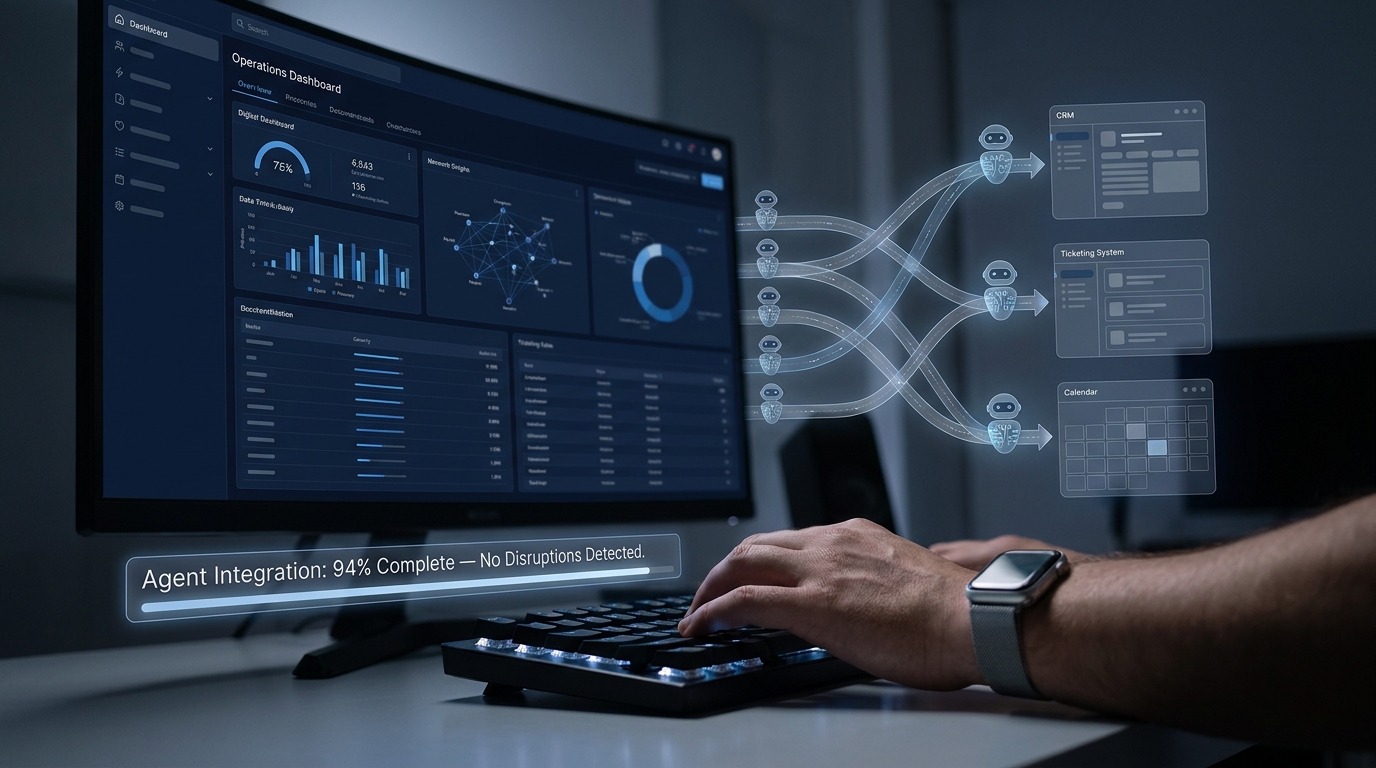
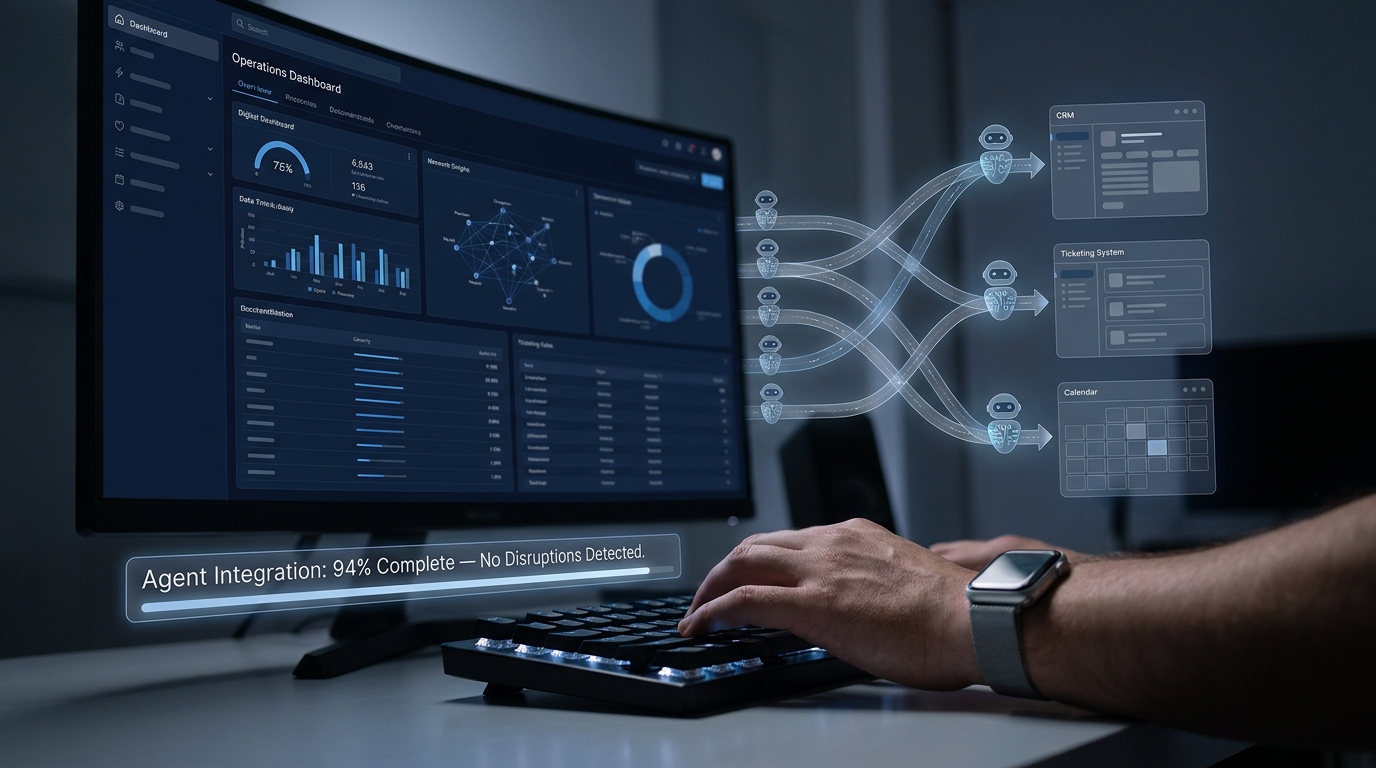
There was no press release. No kickoff meeting with slides about “the AI journey.” No change management consultant brought in at $400 an hour to prepare the team for transformation. One day, the tickets started resolving faster. The reports landed in inboxes before anyone asked for them. The follow-up emails went out on time, every time, without a reminder.
That’s what a well-executed AI agent deployment actually looks like from the client side: unremarkable. Frictionless. Invisible in the best possible sense.
In 2026, the operators who are winning at AI aren’t the ones running the loudest pilot programs or publishing the most ambitious AI roadmaps. They’re the ones shipping agents quietly into client workflows — wrapping them around existing tools, constraining them carefully, measuring obsessively, and expanding scope only after the trust is earned. It’s not glamorous. It doesn’t make for great conference presentations. But it’s producing the only thing that ultimately matters: compounding operational value that clients can’t imagine going without.
This piece is about how that quiet ship actually works — the deployment patterns, the trust mechanics, the governance realities, the billing shifts, and the specific failure modes that turn “quiet” into “catastrophic.” If you’re an operator, agency, or in-house team trying to move AI agents from demo to production inside someone else’s workflow, this is the operating manual no one hands you.
Why “Quiet” Became the Dominant Deployment Strategy
The instinct, when you’ve built something genuinely useful, is to announce it. To build excitement, align stakeholders, and generate organizational momentum. This instinct is almost always wrong when you’re deploying AI agents into someone else’s operations.
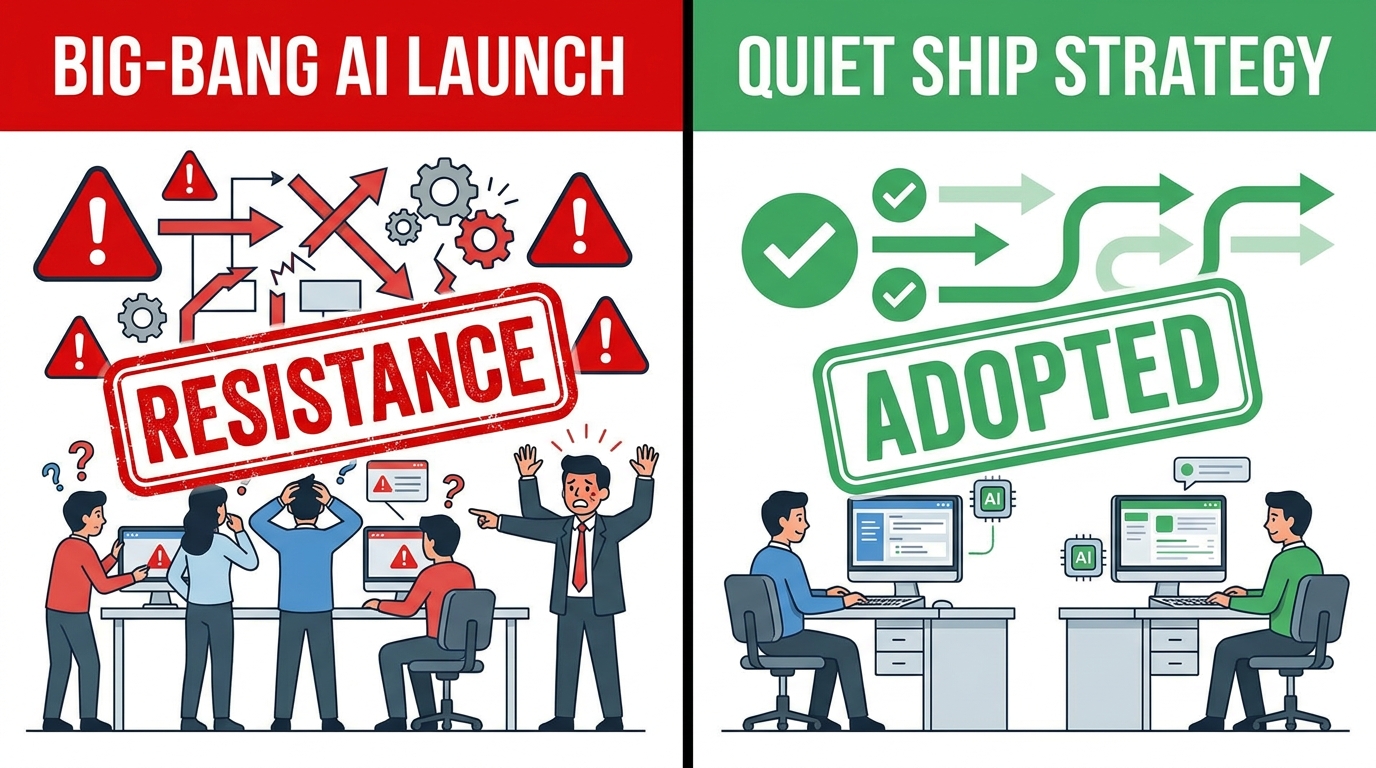
The announcement approach creates a threat surface. It surfaces every latent concern — about job displacement, data privacy, vendor lock-in, and loss of control — before the agent has had a chance to prove it’s harmless. You’re fighting those concerns with a pitch deck and a demo, not with three months of evidence that the system works.
The Organizational Physics of Change Resistance
Change resistance in organizations is proportional to the size and visibility of the change being announced. A “we’re rolling out an enterprise AI agent platform” announcement triggers CTO reviews, HR consultations, union conversations (in applicable environments), and a raft of stakeholder meetings that can add months to a deployment timeline before a single line of code runs in production.
Contrast that with embedding a narrow agent that auto-classifies incoming support tickets inside a helpdesk system the team already uses. Nobody calls a meeting about a classification feature. It ships on a Tuesday. By Friday, resolution times have dropped noticeably and the team is asking when the next update lands.
This isn’t deception — it’s sequencing. The difference is whether you’re asking for permission to try something, or whether you’re demonstrating value first and expanding the conversation from a position of proven results.
The Budget Reallocation Dynamic
There’s a structural reason why quiet deployment is accelerating in 2026: a significant share of AI agent budgets isn’t new money. According to a Redpoint CIO survey cited widely in enterprise tech circles, roughly 45% of new AI agent budget is coming from existing SaaS line items being reallocated — not from net-new procurement decisions. That means agents are often being slipped into workflows as feature upgrades within tools clients are already paying for, rather than as new vendor relationships requiring fresh approval processes.
This has profound implications for how agents get introduced. When the agent lives inside Salesforce, ServiceNow, or Microsoft 365 — tools the client already owns and trusts — the deployment conversation is fundamentally different. It’s not “should we adopt AI?” It’s “should we turn on this feature?” The answer to the second question is almost always yes.
The Proof-Then-Discuss Model
The teams making the most consistent progress with client-side agent deployments have internalized a simple sequencing rule: demonstrate value at small scale, build a data story, then surface the conversation about what’s actually happening. By the time clients learn they’ve been running an AI agent for six weeks, they’ve also seen a 25% drop in resolution times, a 15% improvement in response accuracy, or a 40-hour monthly reduction in manual reporting. The data reframes the conversation entirely.
This isn’t universally applicable — regulated industries, data-sensitive environments, and clients with explicit AI disclosure requirements need different approaches, which we’ll cover later. But for a wide swath of business operations, the proof-then-discuss model outperforms the announce-then-prove model by a significant margin when it comes to sustained adoption.
The Anatomy of a Shadow-Mode Rollout
Shadow mode is the technical and operational pattern that makes quiet deployment possible. It’s not a single configuration or product feature — it’s a philosophy of deployment that runs an agent in parallel with existing workflows without yet giving it the authority to act on its own conclusions.
What Shadow Mode Actually Means in Practice
In a shadow-mode deployment, the agent observes, processes, and generates outputs — but those outputs go to a human reviewer rather than directly to the end system. The agent might draft a reply to every incoming customer email, but a human sends (or modifies) the actual response. The agent might generate a daily financial reconciliation report, but a finance manager reviews it before it’s filed.
The operational benefits of this phase are often underappreciated. Shadow mode is simultaneously a quality assurance layer and a training ground. You’re collecting data on where the agent performs well and where it needs calibration. You’re identifying edge cases that weren’t visible in development. And crucially, you’re building an accuracy record that becomes the foundation for expanding the agent’s autonomy later.
Teams that skip shadow mode in favor of going directly to autonomous production often discover the hard way that “worked perfectly in the demo environment” and “works correctly on real client data, at volume, without supervision” are two very different things. The gap between those two states is what shadow mode is designed to surface safely.
The Shadow-to-Production Transition
The transition from shadow mode to supervised autonomy — where the agent acts independently on a defined subset of tasks — typically hinges on an accuracy threshold. Operators who are doing this well set explicit criteria before shadow mode begins: something like “when the agent’s suggested response matches human-reviewed output with 95% accuracy across 500 cases, we transition to autonomous handling for that case type.” This removes the transition decision from subjective judgment and anchors it in data, which also makes the conversation with clients much cleaner.
The subset selection matters enormously here. The first tasks you hand to autonomous agent operation should be the highest-volume, lowest-stakes, most-repetitive category in the workflow — the stuff that’s genuinely low-risk to automate and where errors, if they occur, are easy to catch and cheap to correct. For customer support, this typically means password resets, order status inquiries, and knowledge base lookups. For finance ops, it’s routine invoice matching against purchase orders. For content operations, it’s metadata tagging and asset routing.
Observability From Day One
The technical requirement that separates sustainable shadow-mode deployments from ones that quietly accumulate debt is observability. Every agent interaction should produce a logged trace: what the agent received as input, what it queried or retrieved, what decision logic it applied, what output it generated, and — if applicable — what a human did with that output. This isn’t optional overhead. It’s the data substrate that makes the entire deployment defensible, improvable, and auditable.
In practice, this means choosing agent infrastructure that emits structured logs, instrumenting custom workflows to capture decision traces, and building simple dashboards that surface accuracy rates, escalation rates, and anomaly patterns. The goal is that at any moment, you can answer the question: “What did the agent do this week, and how do we know it was correct?” If you can’t answer that question, you don’t have a production agent — you have a liability.
Which Client Ops Functions Actually Welcome Agents First
Not all operational functions are equally receptive to agent embedding. The ones that adopt most readily share a cluster of characteristics: high task volume, high repetition, clear correctness criteria, and low political sensitivity around the specific work being automated. Understanding this landscape is critical for choosing where to start — and where to be patient.
Customer Support and Ticket Operations
This is the single most mature area for agent deployment, and the ROI data is the clearest. Enterprises with production-grade customer support agents are reporting 60–80% of Level 1 tickets resolved autonomously, with average resolution times dropping from the multi-hour range to under 15 minutes. Customer satisfaction scores are improving alongside these efficiency gains rather than degrading, which addresses the most common objection to support automation.
The reason support works so well is that it maps perfectly to agent capabilities: there’s a high volume of structurally similar tasks, the right answer is usually discoverable from existing documentation and systems, and the feedback loop is fast. When an agent handles a ticket incorrectly, the customer typically says so immediately, which makes the error recoverable and creates a clean training signal.
Finance and Back-Office Reconciliation
Finance operations teams are among the quietest early adopters of agents, which is somewhat counterintuitive given the sensitivity of the work. The pattern that’s emerging isn’t agents replacing financial judgment — it’s agents eliminating the mechanical data-gathering and matching work that consumes enormous volumes of skilled finance time without requiring any of that skill.
A typical entry point here is accounts payable automation: an agent that reads incoming invoices, matches them against purchase orders in the ERP system, flags discrepancies for human review, and routes clean matches for approval. The human touch remains for exceptions and judgment calls. The agent handles the high-volume routine matching that previously required a full-time AP clerk or two. The transition to autonomous operation on clean-match cases is relatively low-risk and often doesn’t require any stakeholder announcement at all — it looks, from the team’s perspective, like the AP software got smarter.
Sales and CRM Support
CRM hygiene is a perennial pain point in sales organizations — the gap between the data that should be in Salesforce and the data that actually is in Salesforce is a constant source of friction. Agents that observe sales rep activity (email sends, meeting notes, call transcripts) and automatically update CRM records are one of the cleanest current deployment patterns because the value proposition is immediately visible to the people whose workflow it’s improving.
Sales teams don’t resist tools that save them from data entry. This creates a natural adoption pathway that doesn’t require top-down mandate. The agent improves daily life for the people using it, which generates organic advocacy that tends to accelerate deployment into adjacent functions.
IT Service Management
IT ops is another high-velocity adoption area. The helpdesk function in particular — password resets, access provisioning, hardware requests, software license management — is structurally identical to customer support in terms of the agent deployment pattern. Organizations running agents in ITSM workflows are reporting 50–70% reduction in ticket resolution times for Tier 1 issues, with significant secondary benefits in team focus and morale as IT staff are freed from mechanical request fulfillment for higher-complexity work.
The Trust Ladder: From Observation to Autonomy
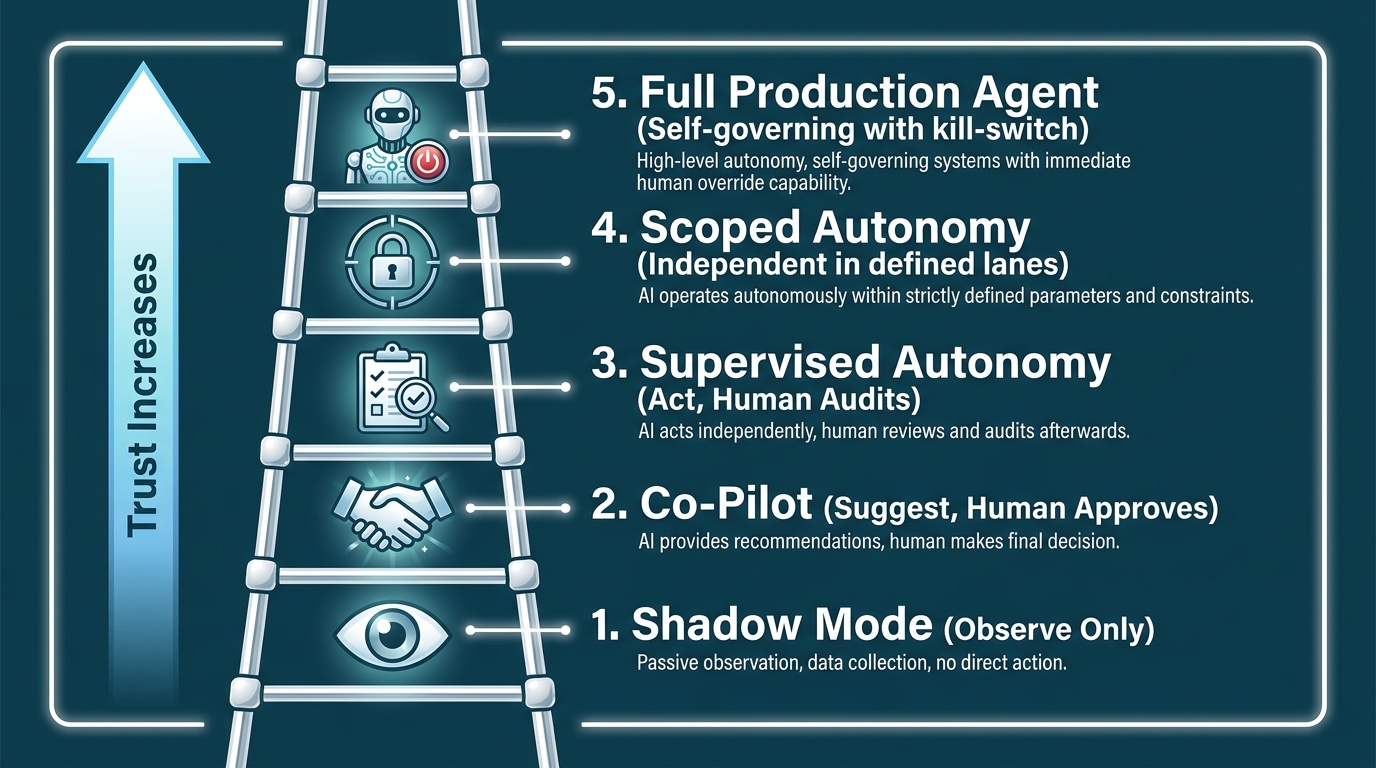
The single most useful mental model for managing agent deployment in client operations is the trust ladder — a staged progression of autonomy levels that each agent earns through demonstrated performance rather than inherits from a launch plan.
Rung 1: Shadow Mode (Observe Only)
At this stage, the agent runs in parallel with the human workflow but has no ability to act on its outputs. It reads, processes, and generates — but everything it produces goes to a reviewer, not to a destination system. The primary purpose here is calibration: does the agent’s understanding of the task match reality? Where does it perform well? Where does it hallucinate, miss context, or apply the wrong logic? Shadow mode should be the default starting position for any new agent in a new environment, regardless of how well the agent performed in development or staging.
Rung 2: Co-Pilot (Suggest, Human Approves)
The agent’s outputs are now surfaced to human operators as suggested actions, drafts, or recommendations — but the human explicitly approves before anything is sent or executed. This is a critical rung because it builds familiarity and trust with the people in the workflow while still maintaining full human accountability. It also creates excellent feedback data: when a human modifies an agent suggestion, that modification is a signal about where the agent’s model needs refinement.
Rung 3: Supervised Autonomy (Act, Human Audits)
The agent now acts independently on defined task categories, but humans review its actions on a regular audit cadence rather than approving each one individually. This is a significant shift in operational pattern — the human is no longer in the critical path of execution, only in the quality assurance path. The audit process should be structured: a regular sample review (say, 10% of agent actions, reviewed weekly) with explicit criteria for what triggers a correction or rollback.
Rung 4: Scoped Autonomy (Independent in Defined Lanes)
At this rung, the agent operates fully autonomously within a precisely defined operational scope, with no routine human review required. The guardrails are system-level: the agent has access only to the data and systems it needs for its defined tasks, it can take only the actions within its permitted action space, and any attempt to act outside that scope triggers an automatic escalation to human review. This is the sweet spot for most current production deployments — meaningful automation with meaningful boundaries.
Rung 5: Full Production Agent (Self-Governing with Kill-Switch)
This is a full autonomous agent with broad operational scope, self-monitoring capabilities, and the ability to reason about its own action boundaries. Very few client ops deployments should be at this rung in 2026 — the infrastructure, governance, and track record requirements are substantial. But for specific, well-understood, heavily monitored workflows (certain financial reconciliation pipelines, high-volume data processing operations), this level of autonomy is achievable and increasingly justified by ROI.
The critical point across all rungs: promotion up the trust ladder should always be triggered by performance data, never by schedule or budget pressure. Moving an agent to the next rung before it’s earned that autonomy is how quiet deployments become very loud problems.
The Governance Gap: What It Actually Looks Like in Production
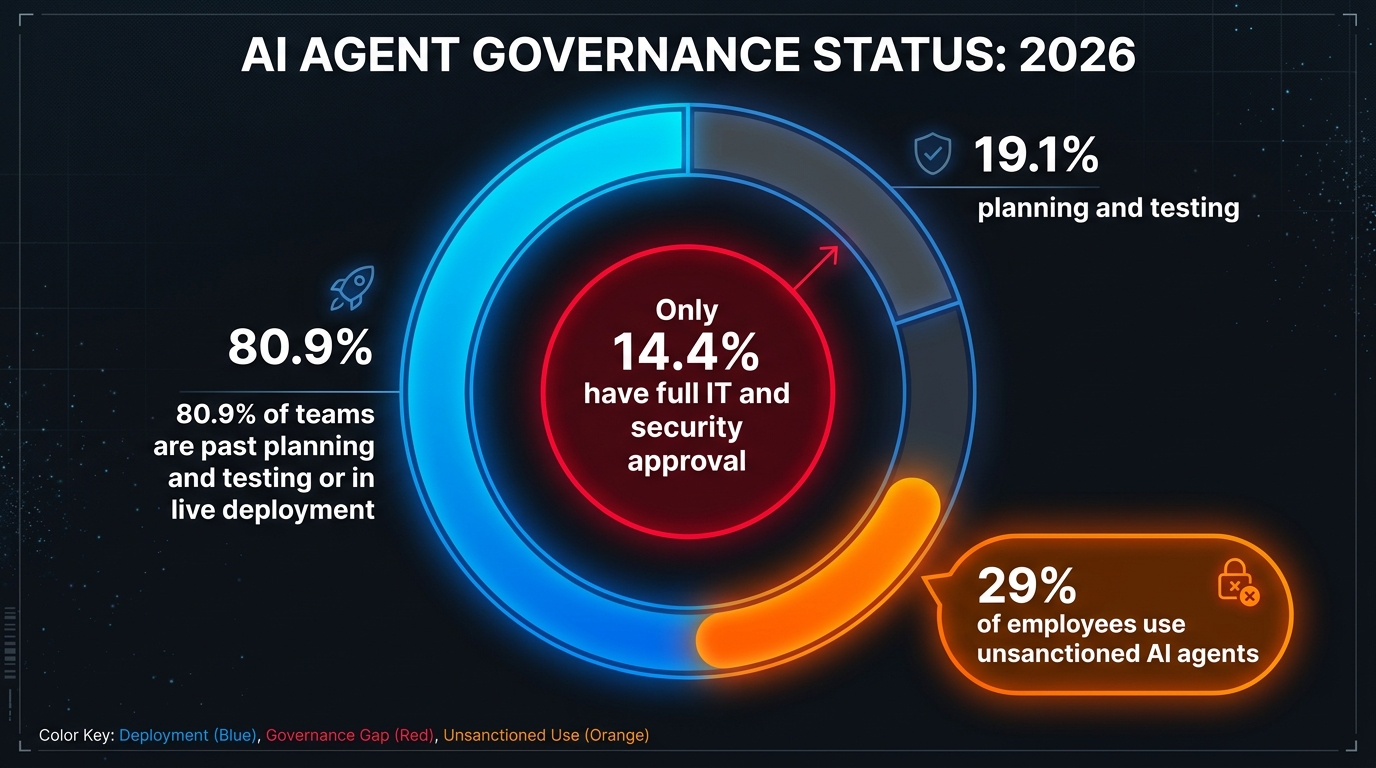
Here’s the uncomfortable reality sitting underneath the “quiet deployment” trend: governance is not keeping pace with deployment. Not even close.
According to a 2026 survey by Gravitee, 80.9% of technical teams are past planning and actively testing or running agents in live environments. The same survey found that only 14.4% of organizations have full IT and security approval for their agent fleet. Separately, Microsoft’s February 2026 Cyber Pulse report found that 29% of employees have used unsanctioned AI agents for work tasks — agents that IT neither approved nor monitors.
The Three Governance Failures That Keep Happening
Over-permissioned access. Agents are frequently granted broader data and system access than they actually need to perform their defined tasks. This is often a convenience decision made during setup that nobody revisits after deployment. An agent that has read-write access to the entire CRM when it only needs to update contact fields in one object type is an unnecessary liability — both as a security surface and as a potential source of unintended data modifications.
Absent identity controls. In multi-agent environments, agents are sometimes operating without clear identity scoping — which means there’s no clean answer to “which agent took that action and why?” This matters for incident investigation, regulatory audit, and simply for understanding what’s happening inside a complex workflow. Every agent in production should have a distinct identity with scoped permissions, not shared credentials or inherited environment access.
No observability, no incident protocol. This is the most operationally dangerous gap. Teams deploying agents without structured logging and monitoring are essentially flying blind. When something goes wrong — and in any sufficiently complex deployment, something eventually goes wrong — they have no way to reconstruct what happened, no mechanism for fast remediation, and no data for preventing recurrence. The absence of an incident response protocol specifically for AI agent failures is particularly common, because organizations adapted their incident playbooks for software bugs and infrastructure failures, not for cases where an autonomous agent made a series of contextually plausible but factually incorrect decisions at volume.
The Regulator Is Watching
The EU AI Act’s operational requirements are increasingly shaping governance practices for any organization with European clients or operations. High-risk AI system classifications are being applied to agents that participate in credit decisions, HR workflows, and certain customer-facing operations — which brings documentation, audit trail, and human oversight requirements that many current deployments would fail to satisfy. Even organizations outside the EU’s direct jurisdiction are finding that enterprise clients with EU exposure are pushing AI governance requirements down into their vendor and agency agreements.
The practical implication: governance documentation is now a sales asset, not just a compliance cost. Operators who can present a clear agent governance framework — identity controls, permission scoping, audit logs, escalation protocols, incident playbooks — are increasingly differentiated in client acquisition conversations, particularly in financial services, healthcare, and regulated manufacturing.
How Billing Models Shift When Agents Do the Work
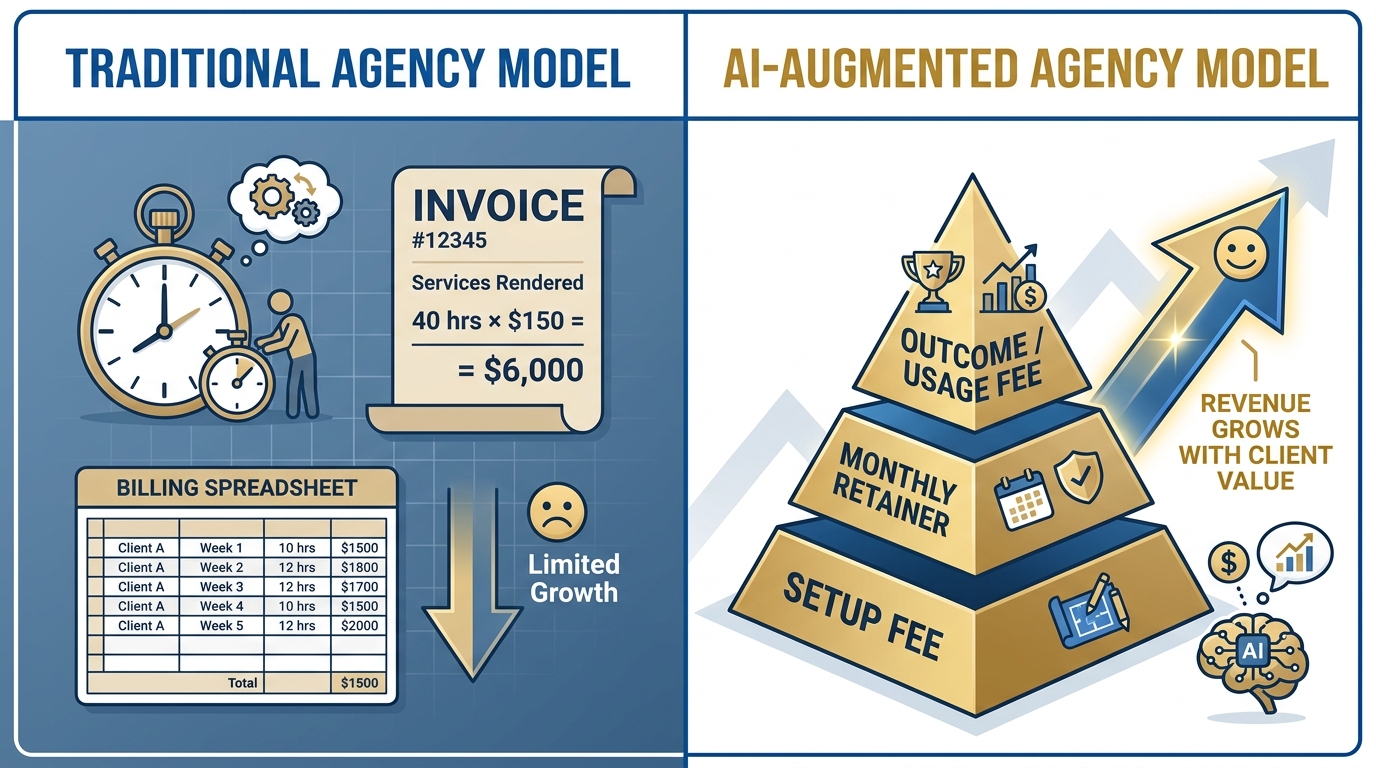
When an agent handles what used to be 40 hours of human labor, billing on hours becomes economically incoherent. This is the central commercial tension that agencies and service operators are navigating as AI agents mature inside client workflows.
The Hours Problem
Traditional service billing — hours multiplied by rate — breaks in two directions when agents enter the picture. Either you bill the same hours for dramatically less work (which clients eventually notice and resent), or you bill for the actual hours spent (which are now a fraction of what they were, compressing revenue even as you deliver more value). Neither outcome is sustainable. The model has to change.
What’s emerging in practice across agencies and managed service providers deploying agents for clients is a three-layer hybrid structure:
- Setup fee: A one-time or annual charge for agent design, integration, configuration, and initial calibration. This captures the upfront engineering investment and sets a clear value anchor for the engagement.
- Monthly retainer: An ongoing fee for monitoring, optimization, governance maintenance, and strategic iteration on the agent’s behavior. This is the recurring revenue base — and it should be scoped around the outcomes being sustained, not the hours being worked.
- Outcome or usage component: A variable fee tied to agent activity volume or specific business outcomes — tickets handled, leads qualified, documents processed, invoices reconciled. This component scales with client growth and directly links agency revenue to client value.
The Margin Math
The economics of this model are compelling when properly constructed. An agency that previously delivered a client ops service with three full-time team members can often achieve better outcomes with one senior strategist, one agent engineer, and a well-configured agent stack. The labor cost drops significantly while the value delivered stays constant or improves. If billing is anchored to value and outcome rather than hours, margin expands substantially.
The key risk in the transition is underpricing the retainer relative to the value being delivered. There’s a tendency to anchor new pricing to old labor costs — to say “we used to charge $15,000/month for three people, now we’ll charge $8,000/month for the agent setup plus one person.” That math reflects the input cost reduction without capturing the output value improvement. A better framing: what would a client pay to achieve the operational outcomes the agent is delivering? Price toward that number, then work backward to ensure your margin is sustainable.
Client Conversations About Efficiency Gains
There’s a version of this conversation that’s awkward and a version that isn’t. The awkward version is when a client discovers that the 40 hours they’re paying for is now being done in 8, and feels like they’ve been overcharged. The clean version is when the conversation shifts to: “We can now deliver X outcome reliably, at this service level, for this price — and we can show you exactly how.” The agent becomes a capability and reliability story, not an hours story. Operators who make this reframe early — ideally before the agent deploys, as part of the scope-setting conversation — protect the commercial relationship rather than straining it.
The RPA Trap: Why Silent Rollouts Fail the Same Way Twice
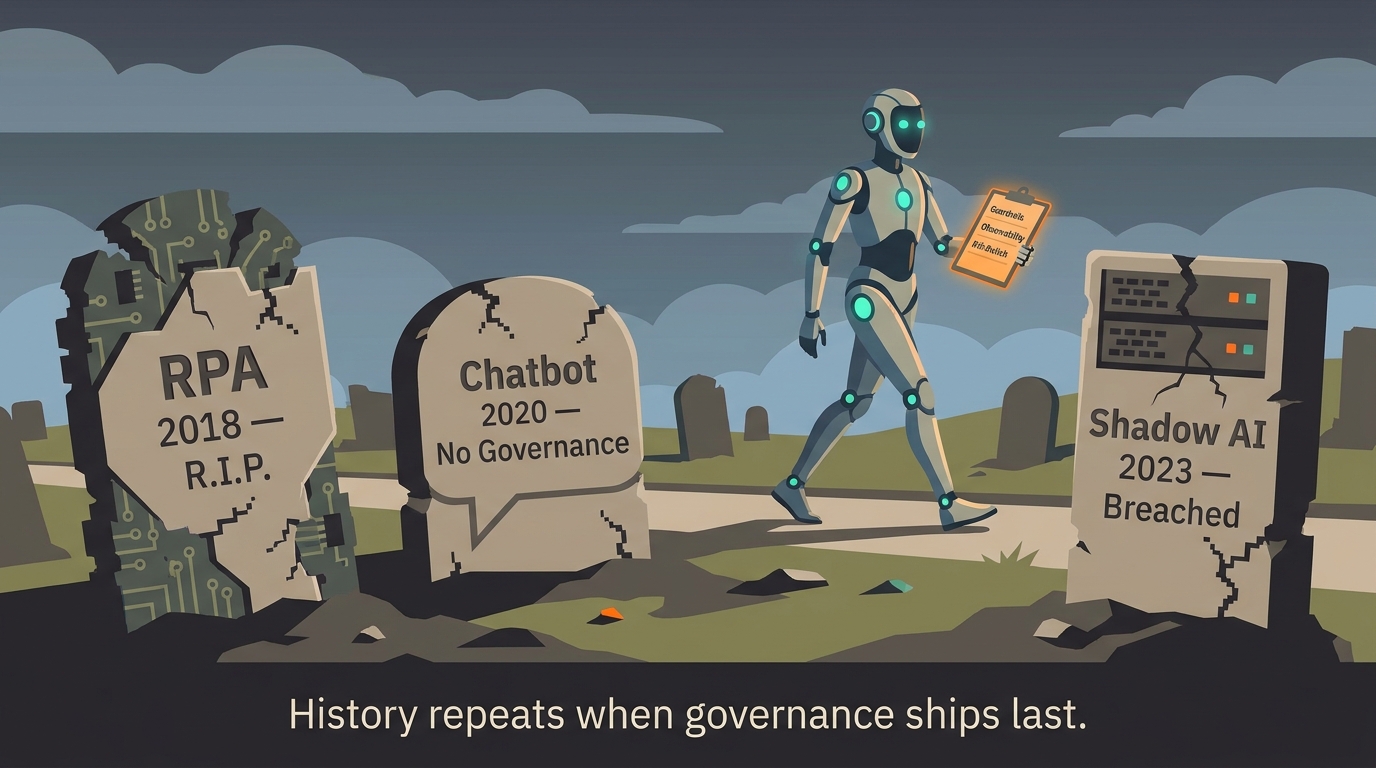
If you were operating in enterprise tech in 2018, the current AI agent moment will feel familiar in uncomfortable ways. Robotic Process Automation went through nearly identical dynamics: rapid initial deployment, impressive demo-environment results, widespread confidence that this time the technology was mature enough to skip the boring governance work — followed by a wave of expensive failures as bots broke on real-world data variability, process changes, and brittle integration points.
The organizations that had the worst RPA outcomes in 2018–2020 were, almost universally, the ones that moved fastest from proof of concept to scale without building the operational infrastructure to support what they were scaling. The same pattern is emerging with AI agents in 2026, and it’s important enough to name directly.
The Four Recurring Failure Patterns
“Demo worked, production broke.” Agents perform well against clean, curated test data. Real client environments have messy, inconsistent, poorly structured data — and agents that weren’t tested against production data quality will hit edge cases that weren’t anticipated and may fail silently in ways that are worse than obvious errors. The fix is mandatory production data testing before any live deployment, with a representative sample of real operational inputs.
Process change without agent update. An agent configured against a workflow at time T will behave as if the workflow is still configured at time T indefinitely, unless someone explicitly updates it when the workflow changes. In RPA, this produced “zombie bots” that were processing transactions according to rules that no longer reflected business reality, sometimes for months before anyone noticed. With AI agents, the failure mode is more subtle — the agent doesn’t crash, it just quietly applies outdated logic to current operations. The operational requirement is explicit process change management that includes an “update the agent” step whenever underlying workflows change.
No owner, no accountability. RPA implementations frequently failed because nobody owned them after deployment. The implementation team moved on, the agent ran unsupervised, and when something went wrong there was no institutional knowledge about how it worked or how to fix it. AI agents need operational owners — named individuals or teams who are responsible for monitoring, updating, and maintaining each agent in production. Without this, agents degrade quietly until they cause a problem loudly.
Scaling before hardening. The temptation to scale a successful proof of concept quickly, before building robust governance and monitoring infrastructure, is the pattern that turns manageable small-scale deployments into large-scale crises. The companies that are doing this correctly in 2026 treat initial production deployment as a separate phase from scale — they harden the deployment in the initial environment, gather operational data, build the support infrastructure, and only then expand to adjacent functions or additional clients.
The 78% Stuck-at-Pilot Problem
Current data suggests approximately 78% of enterprises report having AI agent pilots in some form, but fewer than 15% successfully scale those pilots to full production deployment. This “pilot purgatory” isn’t primarily a technology problem — it’s a governance and organizational problem. The pilots that stay in pilot are usually ones where the deployment infrastructure (observability, ownership, change management, billing model) was never built alongside the agent itself. Building the operational wrapper around the agent isn’t slower than shipping the agent first — it’s the same timeline, when done correctly from the start.
Building the Ops Stack That Makes Quiet Deployment Stick
Quiet deployment doesn’t mean minimal infrastructure. In fact, it requires more careful infrastructure design than high-visibility deployments, precisely because the agent is operating without the ongoing scrutiny that announced programs typically receive. The stack has to do the oversight that humans aren’t actively performing.
The Four Infrastructure Requirements
Structured logging and traceability. Every agent action needs a structured log entry that captures: timestamp, input received, tool calls made, data sources accessed, decision logic applied, output generated, and confidence or certainty signals where available. This log is the foundation of every other governance capability — auditing, incident response, performance analysis, compliance documentation. Deploying an agent without structured logging is operationally indefensible.
Permission-scoped identity. Each agent should have a dedicated service identity with permissions scoped precisely to the data and systems it needs — and nothing beyond that. This isn’t just a security practice; it’s an operational clarity practice. When you know that Agent A has read access to the ticketing system and write access only to the “resolved” status field, you have a clear picture of what that agent can and cannot do. That clarity matters enormously when you’re debugging anomalies or explaining agent behavior to a client.
Kill-switch and circuit breaker mechanisms. Every production agent needs a fast, reliable mechanism for stopping it immediately if something goes wrong. This is the operational equivalent of a circuit breaker in electrical systems — a mechanism that sacrifices one component’s functionality to protect the overall system from damage. The kill-switch should be documented, tested, and practiced. If it takes more than five minutes to stop a misbehaving agent, the kill-switch design needs to be rethought.
Escalation routing for edge cases. Agents should be designed to recognize when they’re encountering situations outside their training distribution and route those cases to human reviewers rather than attempting to handle them autonomously. This requires explicit out-of-distribution detection in the agent design — rules or model-level signals that trigger escalation when confidence falls below a threshold or when input patterns don’t match expected categories. The alternative — an agent that attempts to handle every input regardless of whether it understands it — is the design that produces the incidents that end client relationships.
Choosing the Right Orchestration Layer
In 2026, the orchestration landscape for production agent deployments has consolidated somewhat around a few key patterns. Agents built on top of established enterprise platforms (Microsoft Copilot Studio, Salesforce Agentforce, ServiceNow Now Assist) benefit from the security, identity, and audit infrastructure already built into those platforms. This is often the right choice for client environments that already have these platforms in place — the governance infrastructure is substantially pre-built.
Custom agent stacks built on frameworks like LangChain, LlamaIndex, or proprietary orchestration layers offer more flexibility but require more governance work to be built from scratch. The right choice depends on the client environment, the specific workflow being automated, and the governance requirements — not on which framework is most exciting to the engineering team.
Measuring What Matters When Agents Are Invisible
Quiet deployment creates a measurement challenge that loud deployment doesn’t: there’s no shared baseline event (the launch) from which everyone is measuring improvement. When an agent deploys invisibly into an existing workflow, the before-and-after comparison requires retrospective baseline data — and if you didn’t capture that baseline data before deployment, the ROI story becomes difficult to tell convincingly.
Establishing the Pre-Deployment Baseline
Before any agent goes into shadow mode, at minimum four baseline metrics should be captured and documented for the specific workflow being targeted:
- Volume: How many transactions, tickets, tasks, or interactions does this workflow process per day/week/month?
- Cycle time: How long does it take from input to output on an average case? What’s the range (95th percentile vs. median)?
- Error rate or quality rate: What percentage of outputs require correction, rework, or escalation in the current human-driven workflow?
- Labor cost: How many hours of human time does the workflow consume, and at what fully-loaded cost?
These four numbers, captured before deployment, create the denominator for every ROI calculation you’ll ever want to make about this agent. Without them, you’re arguing from anecdote rather than evidence — which works fine for early stakeholder enthusiasm but fails at renewal conversations and program expansion discussions.
The ROI Benchmarks That Are Holding in 2026
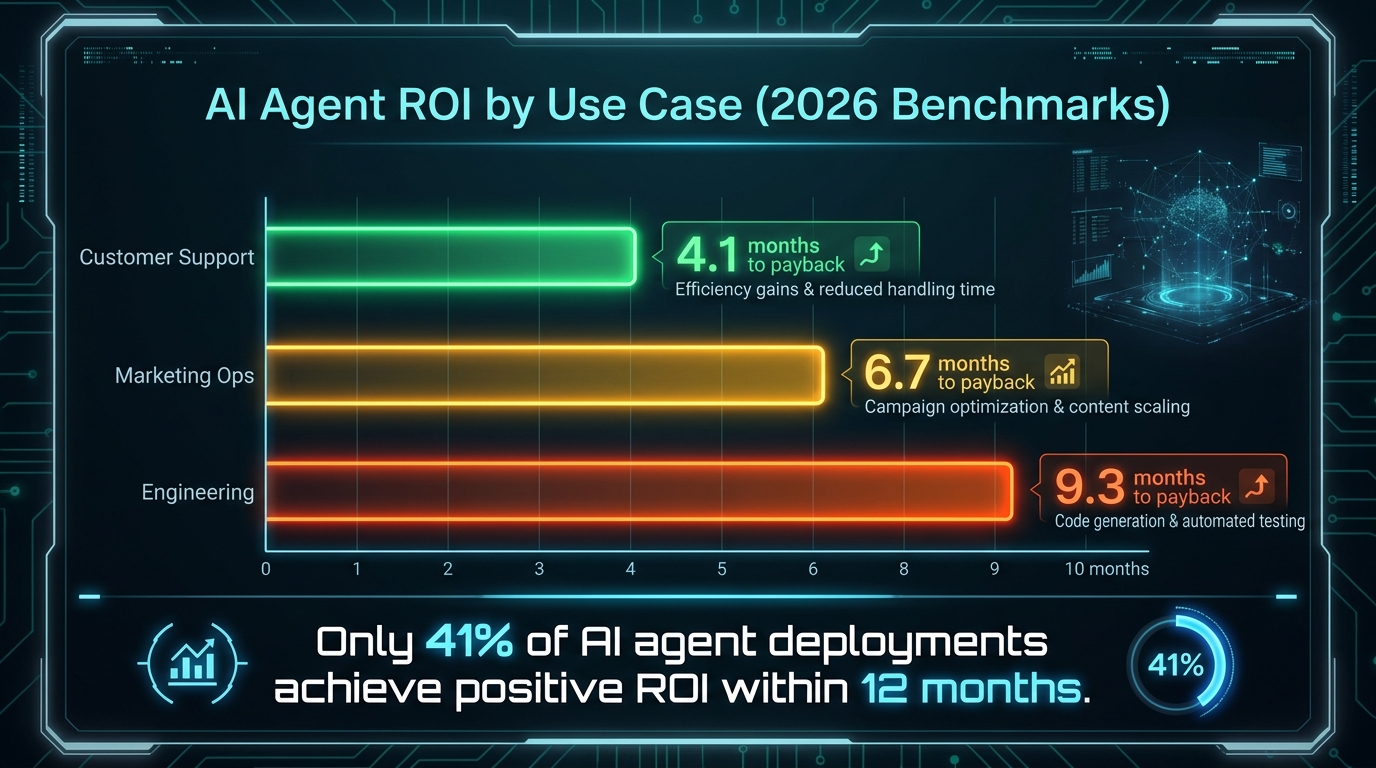
Current data on AI agent payback timelines in client operations is giving operators a realistic expectation-setting framework. Customer support agents are showing the fastest payback — a median of approximately 4.1 months to positive ROI in mature deployments. Marketing operations agents (content routing, campaign data management, lead qualification support) are averaging around 6.7 months to payback. Engineering operations (PR review assistance, documentation automation, CI/CD pipeline management) are taking approximately 9.3 months.
Across all categories, only about 41% of deployments achieve positive ROI within 12 months. That’s not a failure rate — it’s a reflection of the fact that deployments that treat agents as drop-in automation tools, without investing in the operational infrastructure and ongoing optimization that mature deployments require, tend to plateau at modest efficiency gains rather than compounding toward the 3–6x returns that well-managed deployments achieve.
The Metrics That Catch Silent Failures
Standard productivity metrics (tickets resolved, time saved, labor cost reduced) are necessary but not sufficient for managing agent-embedded workflows. Silent failures — cases where the agent is technically operating but producing systematically incorrect outputs — won’t show up in volume or time metrics. The metrics that catch silent failures are:
- Escalation rate trend: If the rate at which cases escalate to human review is drifting upward, the agent is encountering more cases it can’t handle — either because the workflow evolved, the data quality changed, or the underlying model is decaying against new input patterns.
- Re-open rate: In support workflows, if customers are reopening tickets that the agent marked as resolved, that’s a quality signal that something in the agent’s resolution logic isn’t working.
- Human correction rate in audit samples: If the percentage of agent actions being corrected in audit reviews is increasing, that’s an early warning of systematic drift that needs investigation before it becomes a client-facing problem.
The Conversation You Eventually Have to Have
Here’s the thing about quiet deployment: it’s a starting strategy, not a permanent one. At some point — usually around the 60–90 day mark in a healthy deployment — the agent’s presence becomes visible enough that the conversation shifts from implicit to explicit. Either the client notices the improvement and asks what changed, or you proactively surface the story because you need their input on expanding scope.
How you handle this conversation largely determines whether quiet deployment was a smart sequencing decision or a trust-eroding deception. The difference is entirely in the framing.
Framing the Reveal as a Value Story, Not a Confession
The wrong framing: “We’ve actually been running an AI agent in your workflow for the past eight weeks without telling you.” This activates every concern about autonomy, transparency, and control that a careful stakeholder would reasonably have.
The right framing: “Over the past eight weeks, we’ve been testing a new workflow automation capability in observation mode, calibrating it carefully against your specific data and processes. Here’s what we’ve measured. Here’s the accuracy data. Here’s what it’s been handling. At this point, we think there’s a significant opportunity to expand its scope — and we wanted to walk you through the results before we have that conversation.”
The difference isn’t spin. It’s accurate characterization of what actually happened. Shadow mode is testing, not deployment. Co-pilot is assisted operation, not autonomous action. The language of careful, measured iteration is both accurate and palatable in a way that “we deployed AI into your ops without asking” simply isn’t.
What Clients Actually Want to Know
When clients learn they’ve been running agents, the questions they actually ask — as opposed to the objections that might never materialize — tend to center on a small set of practical concerns:
- Can I see what it’s been doing? (Observability documentation answers this.)
- What happens when it gets something wrong? (Escalation protocol and error correction process answer this.)
- Who’s responsible for it? (Operational ownership structure answers this.)
- Can I turn it off? (Kill-switch documentation answers this.)
- Is our data safe? (Permission scoping and data handling documentation answer this.)
These are all answerable questions if the deployment was built with proper governance from the start. Operators who have the governance infrastructure can answer them in one meeting and accelerate rather than stall the relationship. Operators who deployed quickly without governance infrastructure are in a very difficult position when these questions come up — and they always come up eventually.
The Clients Who Need the Conversation First
It’s worth being explicit about when the quiet approach isn’t appropriate. Regulated industries — healthcare (HIPAA), financial services (SOC 2, relevant financial regulation), legal, and any environment subject to the EU AI Act’s high-risk provisions — typically have explicit disclosure requirements for automated decision-making systems. Deploying agents in these environments without upfront governance conversations and documented compliance frameworks isn’t just commercially risky; it may be directly non-compliant.
Similarly, any client workflow that touches end-user data in ways that could implicate privacy regulation (GDPR, CCPA, applicable state laws) requires upfront clarity about how agent-processed data is handled, stored, and auditable. Getting this conversation right at the beginning is substantially easier than explaining a compliance gap after the fact.
Ship Quietly, Govern Loudly
The most successful AI agent operators in 2026 share a counterintuitive operating philosophy: they’re maximally conservative about deployment noise and maximally serious about operational governance. They ship quietly not because they’re hiding something, but because they’ve learned that value demonstrated is more persuasive than value announced. They govern loudly not because regulators are forcing them to, but because governance is what makes quiet deployments sustainable instead of fragile.
The practical takeaways from this model are concrete:
- Start in shadow mode, always. Not because you don’t trust the agent, but because you need real data from the real environment before you expand autonomy. No production environment is the same as the development environment.
- Earn each rung of the trust ladder through performance data. Timeline pressure is not a valid reason to promote an agent to the next autonomy level. Data is.
- Build governance before you need it. Structured logging, permission scoping, and escalation protocols are not overhead — they’re the infrastructure that makes the deployment defensible, scalable, and client-safe.
- Capture your baseline before you ship. Volume, cycle time, error rate, and labor cost — four numbers, documented before deployment, that make every future ROI conversation clean and convincing.
- Evolve the billing model toward outcomes. Hours billing breaks when agents are doing the hours. The sooner you reframe around value and outcomes, the cleaner the commercial relationship will be as deployment matures.
- Know when to have the conversation first. Regulated environments and data-sensitive clients need governance alignment upfront, not after the fact. Quiet deployment is a strategy for specific contexts, not a universal approach.
The organizations that are building durable AI agent capabilities inside client operations aren’t the ones making the most noise about it. They’re the ones whose clients simply notice, at some point, that things work better than they used to — and who, when asked what changed, have a clear, data-backed, governance-documented answer ready to give.
That’s the quiet ship. And in 2026, it’s the ship that’s actually arriving at port.
Leave a Reply