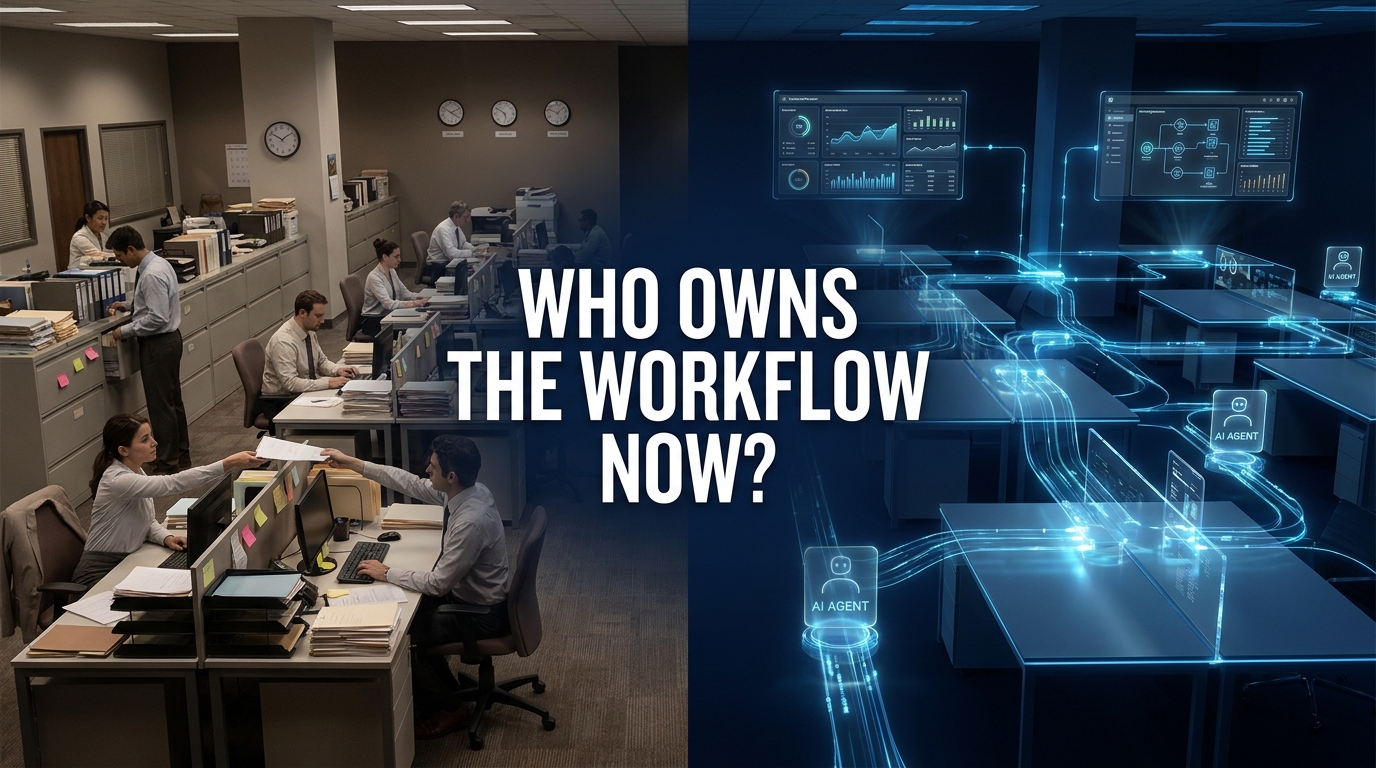
The conversation about AI agents in the enterprise has been dominated by two narratives. The first: agents are automating tasks, saving hours, cutting costs. The second: agents are dangerous, unreliable, and not ready for prime time. Both miss the more fundamental shift happening right now inside thousands of organizations.
AI agents are not just doing work faster. They are taking ownership of entire workflows — the multi-step, cross-system, decision-laden processes that used to be orchestrated entirely by humans. That is a different kind of change. It is not about efficiency. It is about who, or what, is responsible for getting something done from start to finish.
By mid-2026, roughly 40% of enterprise applications are expected to embed task-specific AI agents according to Gartner projections. Around 79% of enterprises report adopting AI agents in some form. Yet only 11–15% of those pilots have actually reached production at scale. The gap between experimentation and real operational ownership is wide — and the organizations closing that gap are not doing it through better models or faster hardware. They are doing it by redesigning who owns what inside their organizational structure.
This post is about that redesign. Not the tools, not the models, not the vendor landscape — but the organizational logic of how work ownership is shifting, where the fault lines are forming, and what enterprises that are succeeding in this transition are actually doing differently.
From Task Execution to Workflow Ownership: What Actually Changed
The distinction between task execution and workflow ownership is not semantic. It is the difference between a copilot that helps a human write an email and an agent that receives an inbound customer complaint, queries the order management system, determines eligibility for a refund based on policy rules, initiates the refund, sends a confirmation, updates the CRM, and flags the case for quality review — all without a human touching it.
That second scenario is what “workflow ownership” looks like. The agent does not assist. It runs the process. It coordinates systems. It makes decisions within defined boundaries. And it hands off to a human only when a genuine exception or high-stakes judgment call requires it.
The Shift From Prompt-and-Response to Goal-Directed Execution
Early enterprise AI deployments were predominantly prompt-based. A user asks a question, the system returns an answer. Useful, but still human-directed at every step. The user still owned the workflow — the AI just helped with individual moments inside it.
Agentic AI changes the architecture. Instead of responding to prompts, agents receive goals. “Process all incoming invoices received before 5pm.” “Monitor this customer segment for churn signals and trigger outreach when threshold is met.” “Review all open support tickets older than 48 hours and escalate those that match these criteria.” The agent interprets the goal, breaks it into steps, calls the tools it needs, handles intermediate decisions, and reports back on outcomes.
This is a fundamental transfer of workflow orchestration authority. Organizations accustomed to having a human responsible for every handoff between systems and steps are now asking whether that responsibility can be transferred — and under what conditions.
Why This Shift Is Happening Now
Three converging factors explain the timing. First, large language models have become capable enough to reason about multi-step tasks with sufficient reliability for structured business processes. Second, the tooling layer — API integrations, function calling, memory systems, orchestration frameworks — has matured to the point where connecting agents to real enterprise systems is achievable without rebuilding everything from scratch. Third, and perhaps most importantly, competitive pressure is forcing organizations to act. When a competitor’s AI agent processes 10,000 invoices overnight while yours requires a team of eight people doing the same work over two weeks, the business case is no longer a spreadsheet exercise.
The result is a market-wide shift from “AI as assistant” to “AI as workflow owner” — and it is happening faster in some functions than others.
Where Agents Have Actually Taken Root: A Department-by-Department Reality Check
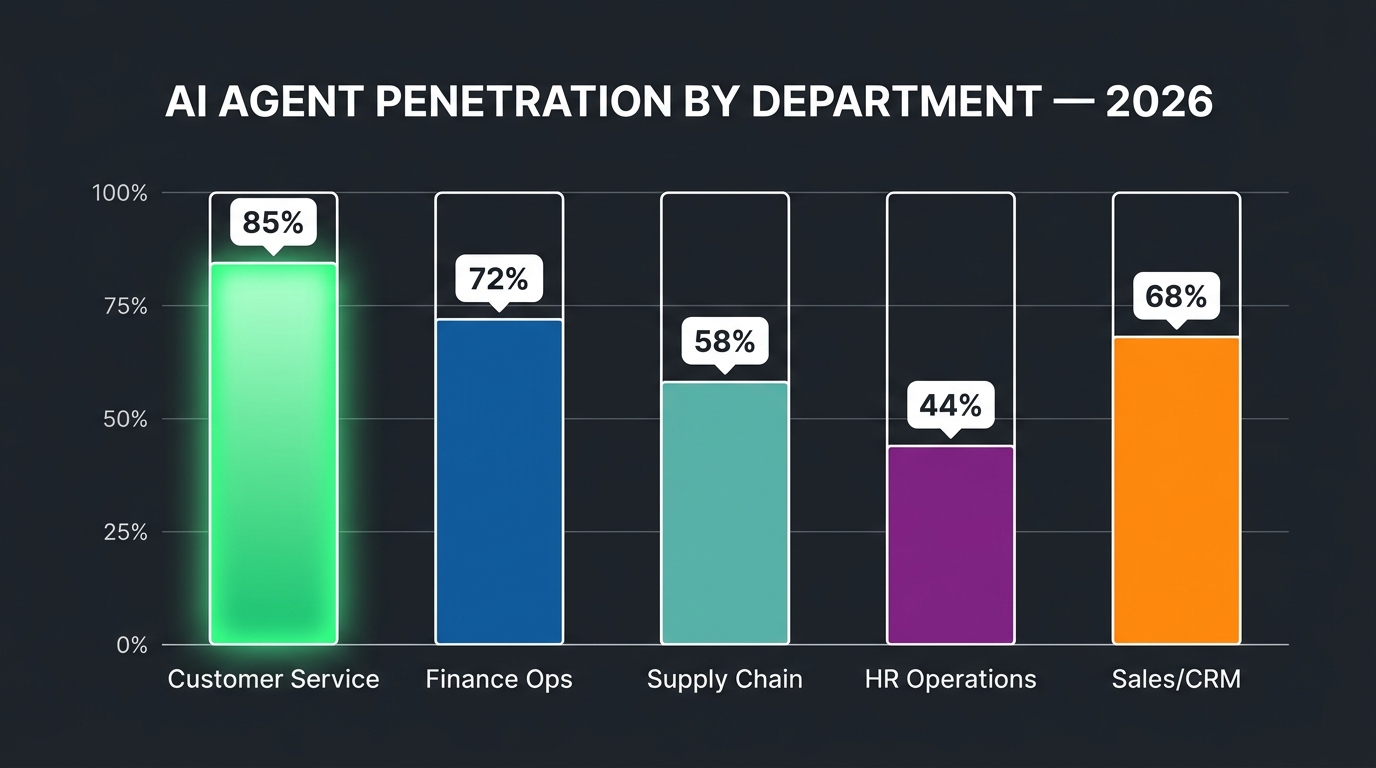
Not all departments are equal in this transition. The depth of AI agent penetration varies significantly based on how well-structured the underlying workflows are, how available and clean the relevant data is, and how much organizational tolerance exists for autonomous action in that function.
Customer Service: The Deepest Penetration
Customer service has the most mature, broadest AI agent deployment of any enterprise function. Platforms like Salesforce Agentforce, Zendesk AI, Intercom Fin, and others have moved well past chatbot functionality into agents that handle end-to-end ticket resolution. In practice, this means an agent that can receive a customer query, access account history, determine what action is warranted, take that action, communicate the outcome to the customer, and close the ticket — without human intervention for the majority of cases.
The economics are compelling. Contact centers typically see agents resolve 60–80% of inbound cases autonomously, reserving human agents for escalations that require genuine empathy, complex judgment, or regulatory sensitivity. The productivity gain is not incremental. For high-volume operations, it represents a structural cost reduction that changes the entire unit economics of the support function.
Critically, the success in customer service was built on a specific advantage: the workflows were already heavily documented, the decision rules were largely explicit (refund policies, SLA tiers, escalation criteria), and the data systems (CRM, order management, ticketing) were already integrated. Agents did not have to improvise — they had the scaffolding to execute against.
Finance Operations: The Fastest-Moving Back-Office Function
Finance is experiencing the most rapid shift toward agent ownership of any back-office function. Invoice processing, accounts payable, reconciliation, expense management, and financial reporting are all seeing significant automation through AI agents — not just rule-based RPA, but agents capable of handling the unstructured exceptions that traditional automation always choked on.
The benchmark data is striking. Enterprises using AI agents for invoice processing report 70–90% reductions in processing time per invoice. Organizations running agents on accounts reconciliation workflows report reducing cycle times from multiple days to under four hours. The core breakthrough is that modern AI agents can handle the messy middle of financial workflows: the vendor invoice that does not match the purchase order exactly, the expense report that requires checking multiple policy criteria, the reconciliation item that needs a human-readable explanation before it can be escalated.
Finance agents are also moving into financial forecasting support — not replacing the CFO’s judgment, but aggregating data across systems, running preliminary analyses, and presenting structured options with supporting data that used to require significant analyst time to prepare.
Supply Chain and Procurement: Rapidly Catching Up
Supply chain workflows are structurally well-suited for AI agents — high volume, rule-heavy, multi-system, with clear optimization objectives and measurable outcomes. Agents are being deployed across demand forecasting, purchase order processing, supplier communication, logistics coordination, and inventory management.
What makes supply chain interesting from an ownership perspective is the increasing deployment of agents that span organizational boundaries. An agent managing procurement does not just operate inside one company’s systems — it communicates with supplier APIs, monitors external signals like lead time data or commodity prices, and adjusts internal plans accordingly. This inter-organizational workflow ownership is a frontier that is just beginning to be explored at scale.
Sales and CRM: Agent-Augmented, Not Agent-Owned
Sales workflows have significant AI agent activity, but the ownership pattern is different. In high-touch B2B sales, agents augment rather than replace the human. They qualify leads, enrich prospect data, draft outreach sequences, schedule meetings, update CRM records, and surface buying signals — but the relationship and the close remain human-led. The exception is high-volume transactional sales, where end-to-end agent handling of the full cycle is increasingly viable.
HR: The Cautious Adopter
HR functions are adopting AI agents more slowly, primarily due to sensitivity around employment decisions and the regulatory complexity of labor law in different jurisdictions. Where agents have taken root is in clearly process-bound HR workflows: benefits enrollment administration, onboarding document processing, leave request handling, and first-level employee query resolution. Anything touching hiring decisions, performance assessment, or compensation is subject to much stricter human oversight requirements — and appropriately so.
The Decision Rights Problem Nobody Is Talking About
Here is the problem that most organizations deploying AI agents are not solving cleanly, and it is responsible for more project failures than poor model selection, bad data pipelines, or inadequate tooling combined.
When an AI agent owns a workflow, who is responsible for the decisions that workflow produces?
This is not a philosophical question. It is an operational one. If an AI agent processes a refund incorrectly, who is accountable? If an agent makes a procurement commitment on behalf of the company, who authorized it? If an agent sends a customer communication that misrepresents the company’s position, who is responsible for the compliance violation?
Traditional organizations have clear, if imperfect, answers to these questions because humans own every material decision. A procurement manager approves a purchase order. A finance director signs off on a refund above a threshold. A legal reviewer checks a customer communication before it goes out. When agents enter the picture, these ownership chains break down — and most organizations have not rebuilt them deliberately.
The Three Decision Rights Failures
Across the pattern of enterprise AI agent deployments, three decision rights failures recur consistently.
The assumption of equivalence. Organizations assume that an agent making a “routine” decision is the same as no decision being made — that automating a low-stakes action removes it from the governance framework. It does not. Even routine decisions, when executed at scale by an agent, can produce significant aggregate consequences. An agent that slightly misapplies a discount policy 10,000 times a day creates a very different problem than a human applying it incorrectly once.
The accountability vacuum. When something goes wrong with an agent-run workflow, organizations discover that no human was formally assigned responsibility for that process outcome. The agent does not have accountability. The engineer who built it does not typically own business outcomes. The process owner who used to run the workflow manually was “freed up” when the agent took over. Nobody owns the failure. This is not a hypothetical scenario — it has played out repeatedly in early production deployments.
The escalation design gap. Agents are commonly deployed with escalation paths that are either too narrow (the agent escalates almost nothing, creating unchecked autonomy) or too broad (the agent escalates so frequently that the human oversight is swamped and becomes rubber-stamping). Effective decision rights design requires precision: specific triggers, specific escalation channels, specific response time expectations, and specific consequences for when escalations are not resolved.
What Deliberate Decision Rights Design Looks Like
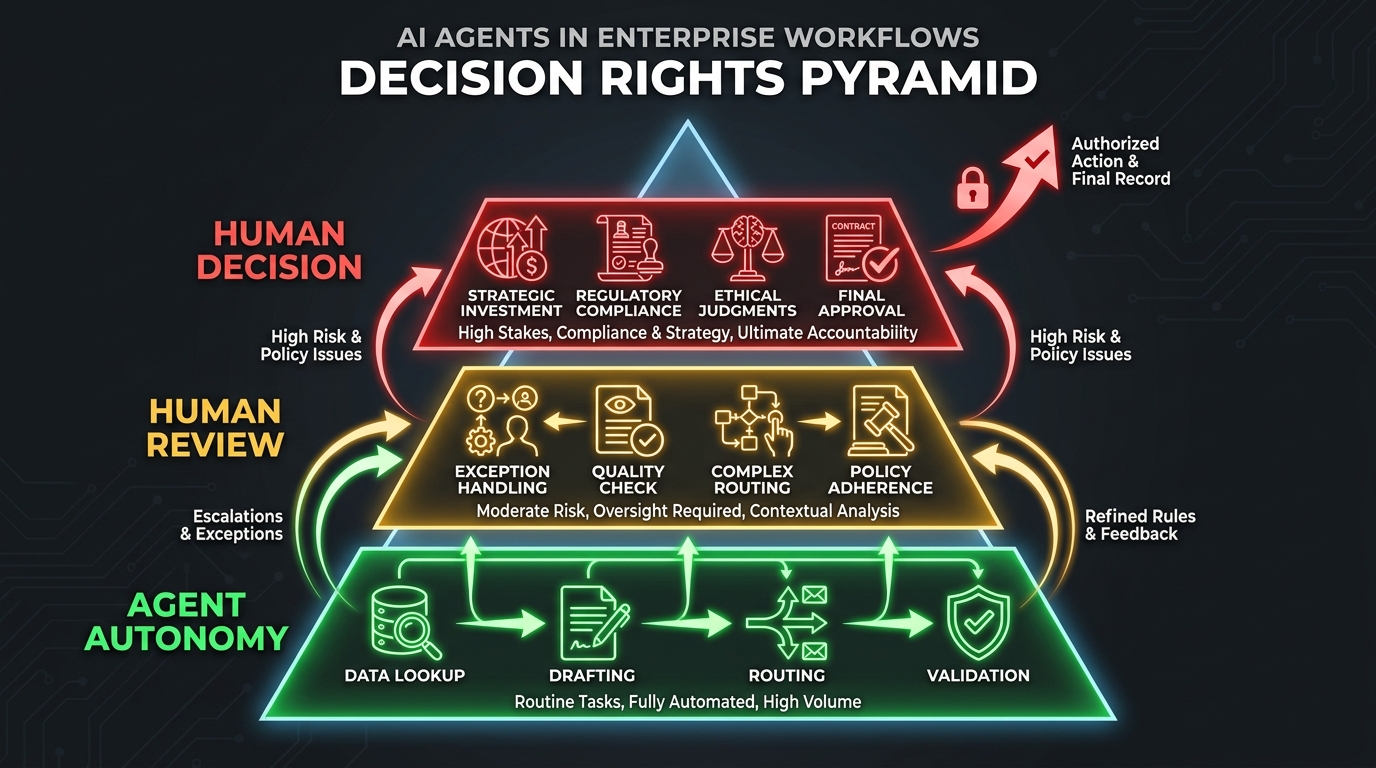
The organizations getting this right are building explicit decision rights frameworks before deploying agents, not after. They define three categories for every agent workflow: decisions the agent can make autonomously, decisions the agent can propose but a human must confirm, and decisions the agent cannot make at all and must route immediately. These are not default settings in any platform — they are deliberate design choices that require deep understanding of the workflow, the risk profile of each decision type, and the regulatory context.
Deloitte’s 2026 Global Human Capital Trends research specifically calls out “decision rights modernization for AI” as a core organizational design discipline — defining override privileges, escalation paths, and consensus rules so that humans and agents coordinate who decides, when, and on what basis. Organizations treating this as a technology configuration problem rather than an organizational design problem are consistently underperforming those who treat it as a governance priority.
Why Legacy Process Design Is an Agent Killer
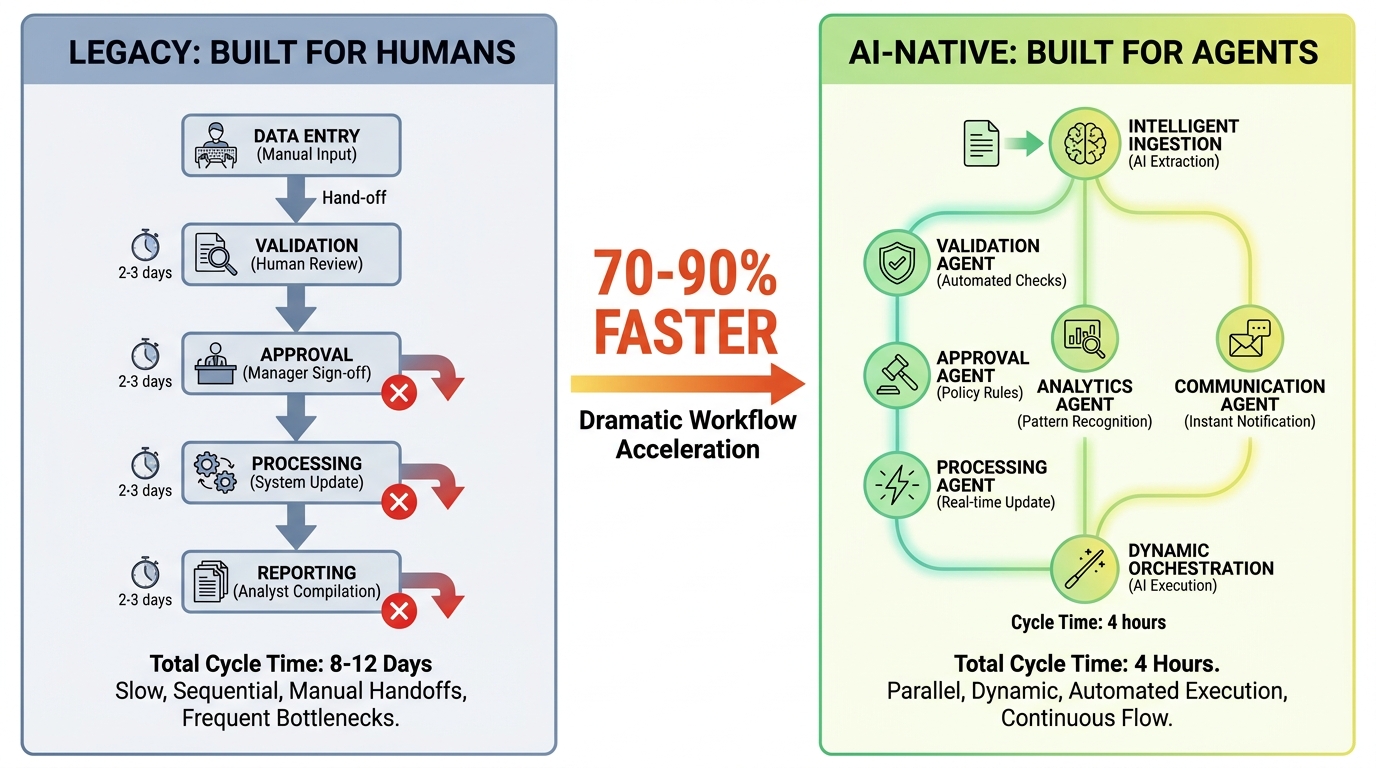
The single most predictable cause of enterprise AI agent project failure is not model quality, data availability, or technology integration. It is deploying an AI agent into a process that was designed to be run by humans.
This sounds obvious in retrospect but is routinely ignored in practice. An organization identifies a workflow they want to automate. They document the existing process. They configure an agent to follow those steps. And then they wonder why the agent produces worse outcomes than the human team it replaced.
The issue is that human-designed processes are full of implicit knowledge, informal coordination, and compensating behaviors that never appear in the process documentation. When a human accounts payable clerk sees an invoice that does not match a purchase order, they do not follow a rigid decision tree — they draw on institutional knowledge, pick up the phone, look at the vendor’s history, make a judgment call. The process documentation says “escalate exceptions.” The reality is that humans resolve most of those exceptions through informal channels that the documentation does not capture.
The “Automated Failure” Trap
When an AI agent executes a poorly designed process faster, it does not improve the process — it amplifies its failures. A workflow that produces exceptions because human compensating behaviors are masking structural flaws will produce more exceptions when an agent runs it, not fewer. The agent executes the documented process with fidelity. The undocumented human patches disappear. The result is what practitioners increasingly call “automated failure” — the same broken process, running at machine speed.
The research data confirms this pattern starkly. The most commonly cited failure points in enterprise agentic AI projects are not model quality or integration complexity — they are upstream data readiness, legacy workflow design, and governance sequencing gaps. These are organizational and process problems, not technology problems.
What AI-Native Process Design Requires
AI-native process design starts from a different premise: not “how do we automate this process?” but “if we were designing this process for an agent to own, what would it look like?”
That reframe has practical implications. AI-native workflows make all decision rules explicit — the informal patches become documented policies. They restructure data flows so agents receive structured inputs, not the ambiguous text-heavy handoffs that humans navigate intuitively. They redesign the exception taxonomy so that genuine exceptions that require human judgment are clearly distinguishable from routine complexity that an agent can handle with the right information.
Perhaps most importantly, AI-native process design separates the sequential, gate-based structure of human workflows — where one step cannot begin until a human completes the previous one — from parallel, concurrent architectures where multiple agent actions can proceed simultaneously. A process that took three days with humans not because the work was slow, but because humans had to pass approvals sequentially and wait for each other, can run in four hours when those sequencing constraints are removed.
Organizations that are seeing 70–90% cycle time reductions from AI agents are almost always doing this redesign work first. Those seeing marginal improvements are almost always skipping it.
Tiered Autonomy: The Governance Architecture That Actually Works
The governance question for AI agents is not binary. It is not “fully autonomous” versus “human-in-the-loop for everything.” Organizations that try to implement either extreme consistently fail — the fully autonomous deployment creates unchecked risk, and the “human approves everything” approach negates most of the efficiency gain and drowns human reviewers in a volume they cannot meaningfully process.
The governance model that is working in practice is tiered autonomy: a structured framework that assigns different levels of human involvement based on the risk profile of each decision type within a workflow.
The Three Tiers in Practice
Tier 1 — Full Agent Autonomy. Low-risk, high-volume, fully reversible actions that the agent executes without human review. Examples: querying data systems, generating internal drafts, routing tickets to queues, logging records, sending standard notifications based on confirmed triggers. The key criteria for Tier 1 are reversibility and materiality — actions that can be undone if wrong and that carry limited individual impact even at scale.
Tier 2 — Asynchronous Human Review. Moderate-risk actions where the agent proposes a course of action and a human confirms within a defined time window before execution. Examples: customer refunds above a threshold, vendor payments outside normal parameters, outbound customer communications with legal implications, configuration changes in production systems. The agent prepares everything — the rationale, the supporting data, the recommended action — and the human’s job is to confirm or redirect, not to re-do the analysis. This design keeps humans meaningfully in the loop without requiring them to be involved in real-time execution.
Tier 3 — Mandatory Human Decision. High-risk actions that the agent cannot execute and cannot propose without a full human review and explicit authorization. Examples: employment decisions, legal commitments above defined value thresholds, regulatory filings, public communications on sensitive topics, security-classified system changes. The agent’s role here is to prepare and organize the information that supports the human decision, not to make the decision or influence the outcome through its framing.
Risk Tiering Is a Living Document, Not a Static Configuration
One of the most important operational insights from organizations running mature AI agent governance programs is that risk tiers need to be revisited regularly. As agents demonstrate track records in production — as their error rates become quantifiable, their failure modes become understood, and their behaviors in edge cases become documented — the appropriate tier for specific decision types may shift. A decision type that required Tier 2 review for the first three months may earn Tier 1 status after accumulating a statistically significant track record with minimal errors. Conversely, a Tier 1 decision that produces an unexpected failure pattern may be temporarily elevated to Tier 2 pending investigation.
This dynamic recalibration is how organizations build justified confidence in their agents over time, rather than treating trust as an all-or-nothing proposition.
Multi-Agent Orchestration: The New Infrastructure Bottleneck
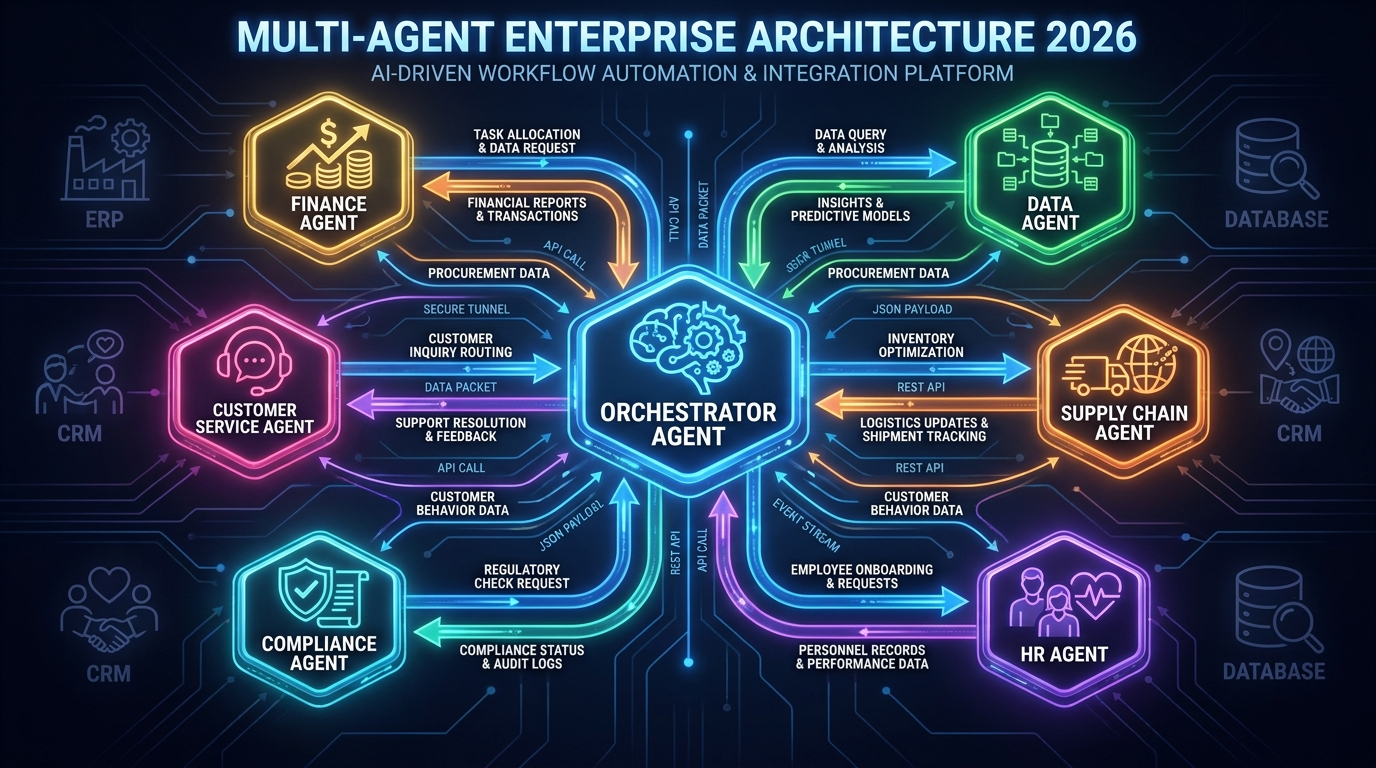
Single-agent deployments solve isolated workflow problems. The genuinely transformative deployments — the ones that are beginning to reshape how businesses operate at a structural level — involve multiple agents coordinating across different systems, functions, and data domains. And that coordination layer is where most of the hard problems live in 2026.
Databricks research published in 2026 reported over 300% growth in multi-agent workflow deployments as enterprises moved from pilots into production. Yet the same research showed that the primary barriers to scaling those deployments were not model performance issues — they were orchestration, observability, and cross-agent governance challenges.
What Multi-Agent Orchestration Actually Involves
In a multi-agent architecture, a primary orchestrating agent receives a high-level goal and decomposes it into sub-tasks that are assigned to specialized sub-agents. The customer service agent handles the interaction. The data agent queries the relevant systems. The compliance agent checks the proposed action against policy. The finance agent processes the transaction. The orchestrator integrates their outputs and determines what happens next.
The technical challenges of this architecture are significant. Agents need to communicate state reliably — if one agent’s action changes the state of a system, every agent working in that context needs to know about it. Failures need to be handled gracefully — if one sub-agent fails or returns an uncertain result, the orchestrator needs to handle that uncertainty appropriately rather than proceeding on flawed assumptions. Costs need to be tracked — multi-agent systems can consume significant compute resources, and runaway agent loops (where agents call each other in cycles that never resolve) are a real production risk.
The Observability Gap
One of the most practically significant challenges in multi-agent production deployments is observability — the ability to understand what an agent system actually did, why it made each decision, and where failures originated when something goes wrong.
In a single-agent deployment, tracing failures is relatively manageable. In a five-agent system where each agent is calling multiple tools, accessing multiple data sources, and making multiple intermediate decisions, the trace of a single workflow execution can involve hundreds of individual steps. When that workflow produces a wrong outcome, identifying which agent made which incorrect decision, based on what information, is not trivial. It requires purpose-built observability tooling — agent-specific logging and tracing systems that capture not just what happened but the intermediate reasoning that led to each action.
Organizations that are succeeding in multi-agent production deployments are investing in this observability infrastructure before scaling. Those that skip it find themselves unable to diagnose failures reliably, which means they cannot improve agent behavior systematically or satisfy audit requirements when issues occur.
Vendor Lock-In as a Strategic Risk
The orchestration layer has also become a significant vendor lock-in risk. Most enterprise AI agent platforms — Salesforce Agentforce, ServiceNow AI Agents, Microsoft Copilot Studio, and others — provide proprietary orchestration mechanisms that are not interoperable. An enterprise that builds a multi-agent workflow on one platform’s orchestration layer faces significant migration costs if it needs to change vendors or integrate agents built on different platforms.
Forward-looking architecture decisions in 2026 are therefore prioritizing standards-based integration patterns, abstraction layers between agents and their orchestration infrastructure, and modular agent designs that can be rehosted if the underlying platform changes. This is a more complex initial build, but it preserves strategic flexibility as the vendor landscape continues to consolidate and shift.
The Real Productivity Numbers vs. the Marketing Claims
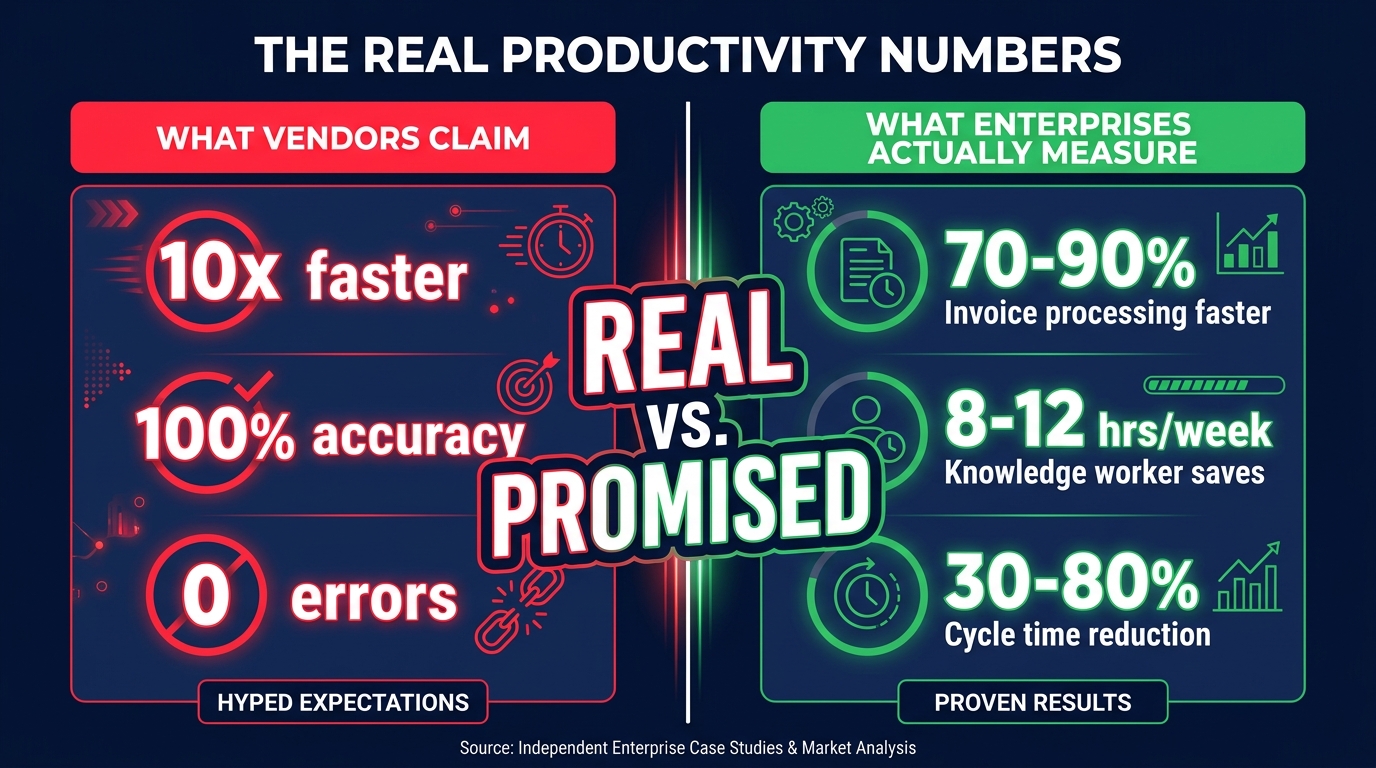
Enterprise technology has a long history of productivity claims that look spectacular in case studies and disappoint in production. AI agents are no exception, but the picture is more nuanced than either the enthusiast or the skeptic position suggests. There are real, significant productivity gains in specific contexts — and there is genuine exaggeration in others.
Where the Numbers Are Real
The most credible, consistently replicated productivity gains from AI agents in enterprise workflows cluster in specific types of tasks:
High-volume, rule-structured document processing. Invoice processing, contract review, onboarding document verification, expense report processing. Documented cycle time reductions of 70–90% are consistent and credible in this category because the baseline process is slow, the work is repetitive, and errors are measurable. An organization processing 50,000 invoices a month is not reporting a 70% cycle time reduction based on a 20-invoice pilot — they have statistically meaningful data.
Multi-channel customer query resolution. Organizations running AI agents on first-line customer support reliably report 60–80% autonomous resolution rates for structured query types. The productivity math is straightforward: if an agent handles 70% of the volume that previously required a human agent, and the agent’s accuracy rate on that 70% is 95%+, the economics are clearly positive even accounting for the cost of managing the remaining 30% with greater human attention.
Knowledge worker research and synthesis tasks. Research consistently shows that knowledge workers using AI agents for information gathering, synthesis, and structured output generation save 8–12 hours per week. This finding is robust across multiple independent studies and appears not to be heavily dependent on the specific domain or industry.
Where the Numbers Are Inflated
The productivity claims that are most frequently overstated fall into a different pattern:
End-to-end process ownership claims that omit the human work still required. An agent “owning” an end-to-end workflow often means the agent handles 70–80% of the steps, with humans still engaged in a meaningful portion of the exceptions, edge cases, and quality reviews. The marketing claim presents this as full automation. The operational reality includes a restructured human role that is less immediately visible but still resource-intensive.
Pilot-to-production extrapolations. A common pattern is a controlled pilot that operates on clean, pre-screened data and straightforward cases — which produces impressive metrics — followed by a production deployment that encounters the full messiness of real data and real edge cases, which produces markedly inferior performance. The cited figures are often from the pilot phase.
ROI calculations that exclude implementation and maintenance costs. Agent deployments require ongoing tuning, data pipeline maintenance, monitoring, and governance activities. These are real costs that are frequently excluded from the headline ROI figures in vendor case studies. A workflow that saves $500,000 annually in direct labor may require $200,000 in ongoing maintenance and oversight — still a positive ROI, but not the 5× figure the initial headline suggests.
The Role Redesign Imperative: What Humans Do in an Agent-Run Workflow
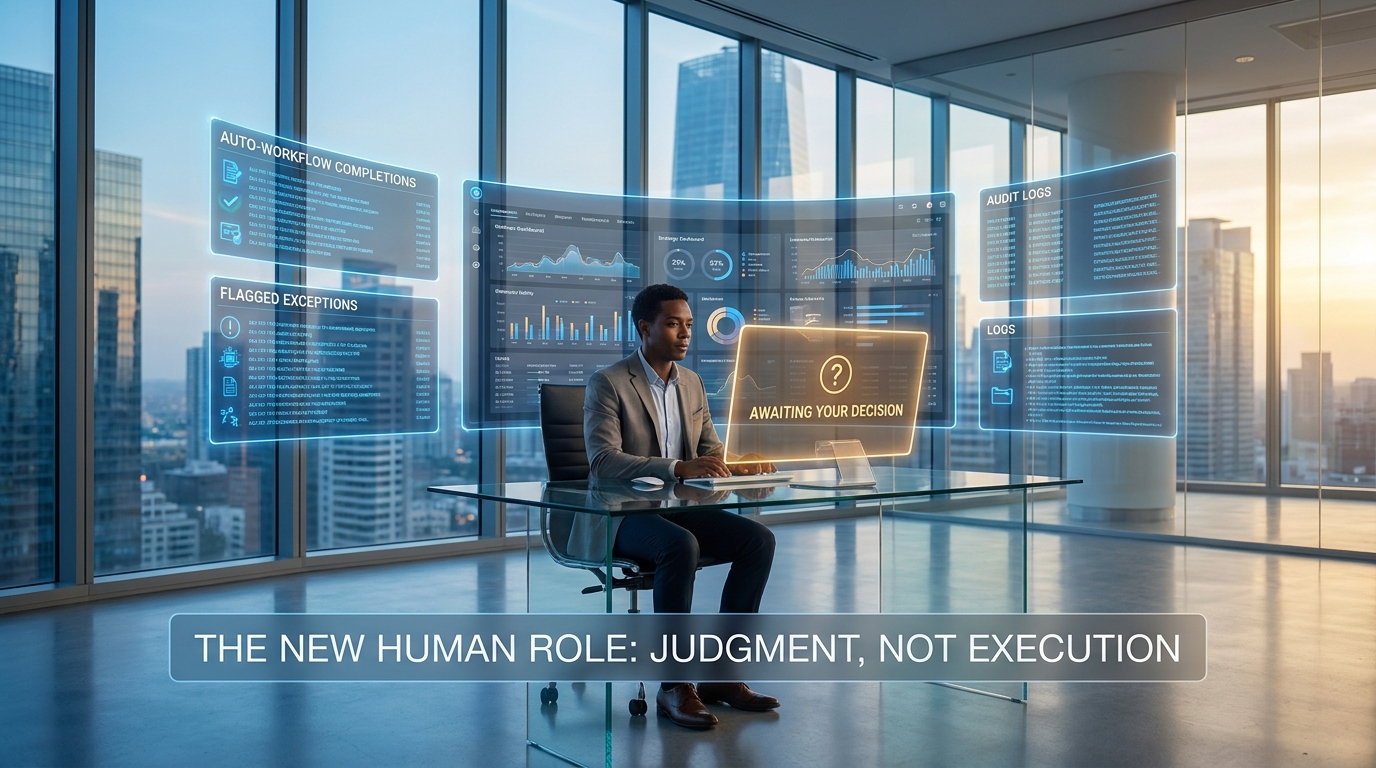
When an AI agent takes ownership of a workflow that a human previously owned, what does the human do? This question is being answered badly in most enterprises right now — either by not asking it at all (the human’s role evaporates and they are simply redeployed elsewhere with no structured transition) or by defining the human role reactively as “fix what the agent breaks.”
Neither answer produces a sustainable operating model. The organizations building durable agent-integrated operations are defining the post-agent human role deliberately, along three distinct dimensions.
Exception Judgment: The Cases Agents Cannot Handle
When agents own workflows, human work concentrates in the genuinely hard cases — situations that fall outside the decision rules, involve unusual context, require empathy or relationship knowledge, or carry regulatory implications that require accountable human sign-off. These are not the mundane exceptions that human workers spent most of their time on previously. They are the genuinely complex situations that require experience, judgment, and professional accountability.
This means that human roles in agent-integrated workflows tend to require higher competency, not lower. The routine work disappears. What remains demands more. Organizations that staff the “exception handler” role with their least experienced people, because it seems like a residual role, consistently find their exception queues degrading in quality and their agents failing to improve because the feedback loop that depends on good human judgments on exceptions is broken.
Intent Setting: Defining What Agents Are Trying to Achieve
AI agents execute toward goals. Someone has to define those goals — and more importantly, update them as business conditions change. The human role of “intent setter” — determining what outcomes the agent is optimizing for, what constraints apply, and when the objectives need to change — is one of the most valuable and least well-understood roles in agent-integrated operations.
This is not a technical role. It requires deep business knowledge, strategic clarity, and an understanding of how the agent’s behavior connects to business outcomes. When a customer service agent is optimized for resolution speed and begins making customers feel rushed, someone needs to recognize that the objective needs adjustment — and have the authority to make that adjustment. That is an intent-setting function, and it needs to be explicitly assigned to a person with both the knowledge and the authority to exercise it.
Governance and Accountability: Owning the Outcomes
As discussed in the decision rights section, agent workflows need human accountability for their outcomes — not for every individual action, but for the aggregate performance and compliance of the workflow over time. This “workflow steward” role monitors key performance indicators, investigates anomalies, ensures the agent’s behavior remains compliant with evolving policies and regulations, and owns the escalation when something materially goes wrong.
The workflow steward is not the engineer who built the agent and is not the operations manager who ran the process before. It is a new role that combines operational knowledge with enough technical literacy to interpret agent performance data and sufficient organizational authority to make consequential decisions about agent behavior.
Building the Human-AI Handoff Architecture
The mechanics of how work transitions between agents and humans — and back again — is where good governance theory meets operational reality. Poor handoff design is one of the most common sources of value destruction in otherwise well-conceived AI agent deployments.
Designing for Asymmetric Context
When an agent escalates to a human, the human typically does not have the context the agent has been accumulating throughout the workflow. The agent has queried multiple systems, considered multiple conditions, run multiple evaluations. The human sees the escalation notification. This asymmetry creates an information gap that, if not designed against, produces poor human decisions on escalated cases.
High-performing handoff architectures solve this by packaging the escalation. When an agent escalates to a human, it delivers not just the item requiring a decision, but a structured summary of the relevant context: what triggered the escalation, what the agent’s recommended action is, what information the agent considered, what options are available and their likely consequences, and what the agent will do next based on each decision path. The human’s cognitive load is minimized. The decision they are asked to make is scoped clearly. The time required is reduced.
This design principle — “never make the human reconstruct what the agent already knows” — dramatically improves both the quality of human decisions on escalated cases and the human’s experience of working alongside an agent. The resistance to agent-integrated workflows that comes from human team members is frequently not about the agent doing their job — it is about being given inadequate context to do the residual parts of the job effectively.
Handoff Latency and SLA Design
Agent workflows move at machine speed. When an agent escalates to a human, the workflow pauses — and the duration of that pause depends on how quickly the human responds. In customer-facing workflows, this pause is directly visible to the customer. In financial workflows, it may affect settlement timing or compliance deadlines. In supply chain workflows, it may impact procurement cycles.
Effective handoff architecture requires explicit SLA design for human response to escalations. When an agent escalates, what is the expected response time? What happens if that time is exceeded — does the agent take a default action, does the case get rerouted to a different human reviewer, does the customer receive an interim communication? These are not edge cases. They are routine operational scenarios that need to be designed for explicitly, with clear consequences specified in advance.
The Feedback Loop: How Humans Improve Agent Behavior
Human decisions on escalated cases represent the most valuable training signal available for improving agent performance. When a human overrides an agent’s recommended action, that is a data point. When the human resolution of an escalated case produces a better outcome than the agent’s proposed action would have, that difference is information. Capturing that information systematically and feeding it back into agent evaluation and tuning is how organizations build agents that improve over time rather than stagnating at their initial performance level.
Most enterprise agent deployments do not have this feedback loop built in. Human decisions are made, cases are closed, and the information disappears. The agent continues making the same pattern of mistakes on similar cases because nobody connected the dots between human override decisions and agent behavior patterns. This is a significant, correctable source of underperformance in deployed agent systems.
The Accountability Gap: The Risk Enterprises Are Not Pricing In
Enterprise AI agent deployments in 2026 are operating in a regulatory environment that has not fully caught up with the pace of deployment. The EU AI Act provides the most developed regulatory framework, but its agent-specific provisions are still being interpreted and enforced. In other jurisdictions, the regulatory picture is even less defined. Organizations are making significant operational commitments to agent-owned workflows in a governance landscape that will look meaningfully different in 12–24 months.
The Liability Assignment Problem
When an AI agent makes a decision that produces a harmful outcome — a discriminatory credit decision, a regulatory violation in a financial transaction, a safety-relevant error in a supply chain — who is liable? The current legal frameworks do not give a clean answer. The agent vendor may bear some responsibility for the model’s behavior. The enterprise deploying the agent bears responsibility for the deployment decisions and governance. The specific human who was supposed to oversee the relevant decision may bear individual professional liability.
These are not theoretical scenarios for 2030. They are happening in 2026, in early form, and the organizations that are exposed are those that deployed agents into consequential workflows without explicitly assigning human accountability for those workflows’ outcomes. The accountability vacuum described in the decision rights section is not just an operational problem. In the emerging regulatory environment, it is a legal exposure.
Audit Trail Design as a Non-Negotiable
Regardless of the specific regulatory framework an organization operates under, one requirement is consistent across all of them: the ability to explain, after the fact, what decisions were made, why, and by whom or what. This is the audit trail requirement, and it is one that AI agent deployments frequently underinvest in.
Agent actions need to be logged at a level of granularity that supports post-hoc explanation. Not just “the agent processed this invoice” but “the agent queried these three data sources, evaluated these four conditions, applied this policy rule, and took this action, at this time, with these inputs.” Building this level of logging into agent systems from the start is significantly less costly than retrofitting it after deployment — and the retrofit is painful, as several large enterprises discovered in early 2026 when audit requests arrived for agent-processed transactions that had inadequate logging.
Governance as Competitive Advantage, Not Compliance Overhead
The organizations framing agent governance as purely a compliance burden are systematically underinvesting in it. The organizations framing it as a source of competitive advantage are taking a different view: robust governance — clear accountability, documented decision logic, reliable audit trails, systematic feedback loops — is what allows agents to be trusted with progressively more consequential workflows over time. It is the organizational infrastructure that determines how quickly the trust in an agent system can be justified and extended.
An agent system that runs in a governance vacuum may produce impressive short-term results. But it cannot be verified, cannot be audited, cannot be defended in a regulatory examination, and cannot be trusted with higher-stakes decisions until the governance infrastructure is built. The investment in governance is not separate from the investment in agent capability — it is a multiplier on it.
What Separates Organizations That Are Getting This Right
Across the pattern of enterprise AI agent deployments in 2026, the organizations reaching sustainable production at scale share a set of characteristics that are distinguishable from those still cycling through failed pilots.
They treat workflow redesign as a prerequisite, not a parallel track. They do not deploy agents onto existing processes. They redesign the process for agent ownership first — making decision rules explicit, restructuring data flows for machine readability, eliminating informal human patches that agents cannot replicate, and designing the exception taxonomy that determines what goes to agents and what goes to humans.
They define decision rights before deployment, not in response to failures. Who is accountable for the outcomes of every agent-owned workflow is specified before the agent goes live. Override authorities, escalation paths, and response time requirements are documented and enforced. The accountability vacuum does not exist because they closed it deliberately.
They invest in observability infrastructure proportional to the stakes of the workflow. Agents running high-volume, lower-stakes workflows have standard logging. Agents making consequential decisions have comprehensive audit trails, performance monitoring, and anomaly detection. The observability investment is not uniform — it is risk-calibrated.
They build feedback loops that connect human override decisions back to agent improvement. Human judgments on escalated cases are captured systematically. Patterns in human overrides are analyzed. Agent behavior is updated based on what humans consistently decide differently. The agent gets better over time in production, not just in controlled test environments.
They staff the human residual roles deliberately. Exception handlers, intent setters, and workflow stewards are not afterthoughts — they are explicitly designed roles with clear responsibilities, appropriate seniority, and the organizational authority to act on what they see. The human roles that remain when agents take over workflow execution are treated as consequential, not residual.
The Organizational Rewiring Is Not Optional
The framing of AI agent adoption as a technology deployment decision misses the organizational reality. Deploying an AI agent that owns a core business workflow is an organizational redesign decision. It changes accountability structures, decision rights, human roles, and the operating model of the affected function. Organizations that approach it as a technology decision consistently underperform those that approach it as an organizational one.
The good news is that the organizational redesign work is achievable, and the enterprises that have done it are producing real, durable results — not pilot-phase metrics that evaporate in production, but sustained performance improvements that compound over time as agents improve and human roles evolve around them.
The question for every leadership team looking at AI agents in 2026 is not “do these tools work?” At this point, in the right context, with the right organizational infrastructure, they demonstrably do. The question is whether the organization is willing to do the harder work that makes the tools perform: redesigning the process, defining the decision rights, building the governance infrastructure, and deliberately shaping the human roles that remain.
The organizations that answer yes to that question are not just deploying better technology. They are building a fundamentally different operating model — one in which the boundaries between human work and machine work are explicit, governed, and deliberately designed to deliver outcomes that neither can produce alone.
Actionable Takeaways for Leadership Teams
- Audit your highest-volume workflows for AI agent candidacy — prioritize those where decision rules are explicit, data is structured, and cycle times are slow relative to theoretical minimums.
- Before deploying any agent into a core workflow, document who is accountable for that workflow’s outcomes post-deployment. Close the accountability vacuum before it becomes a liability.
- Build a decision rights framework for every agent deployment: Tier 1 (agent acts autonomously), Tier 2 (agent proposes, human confirms), Tier 3 (agent cannot act). Review and recalibrate this framework quarterly based on performance data.
- Do not treat workflow redesign as optional. Deploy agents into processes designed for agents, not processes designed for humans.
- Define the post-agent human roles explicitly. Exception judgment, intent setting, and workflow stewardship are real functions that require skilled people — not afterthoughts.
- Build feedback loops that connect human escalation decisions back to agent performance improvement. This is the fastest path to agents that get meaningfully better in production.
- Invest in observability and audit trail infrastructure proportional to the stakes of each agent workflow. This is both a governance requirement and the foundation of justified trust expansion over time.
Leave a Reply