Tag: SBV Campaigns

  • SBV Keyword Bloat After the Sale: A Data-Driven Cleanup Framework for Sponsored Brands Video

    SBV Keyword Bloat After the Sale: A Data-Driven Cleanup Framework for Sponsored Brands Video

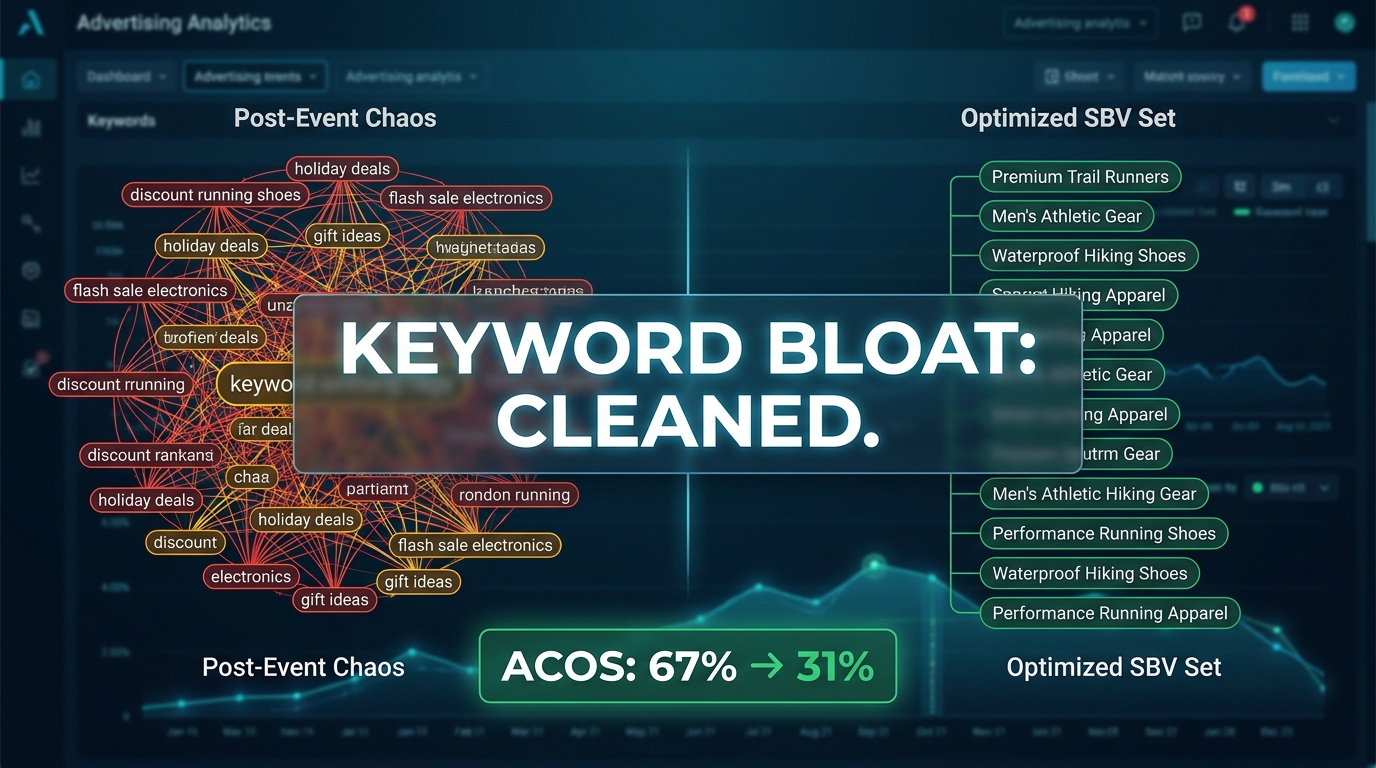
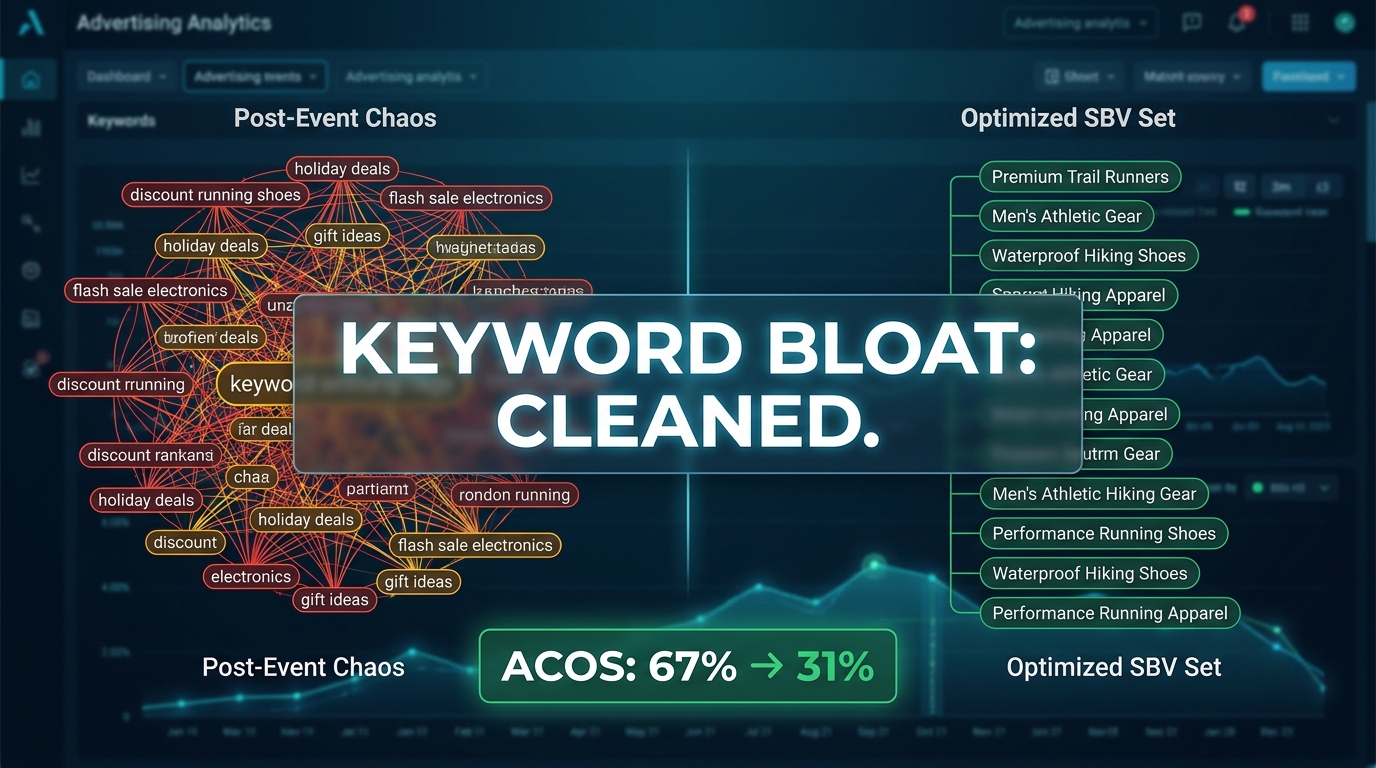
    Amazon SBV keyword bloat cleanup dashboard showing chaotic post-event keyword list transformed into lean optimized set with ACOS improvement from 67% to 31%

    The sale is over. The lightning deals ran. The video ads rolled. And for a brief, chaotic window, you threw broad terms, competitor conquesting keywords, seasonal phrases, and a handful of hopeful long-tails into your Sponsored Brands Video campaigns — because event traffic is too unpredictable to be precious about keyword selection, and leaving impressions on the table during Prime Day or Black Friday feels like a cardinal sin.

    Then the dust settles. You pull your reports. The spend number looks like a small car. The conversion rate has slid. Your ACoS is somewhere between uncomfortable and terrifying. And somewhere inside a campaign structure that made sense six weeks ago, there are now hundreds of search terms — many of which have absorbed real budget without returning a single sale.

    This is the SBV post-event hangover. And it is, without question, one of the most underestimated problems in Amazon advertising right now.

    Most sellers treat keyword cleanup as a secondary task — something to get to after the event debrief, the inventory recount, and the profitability review. But the longer bloated keyword sets sit untouched in your Sponsored Brands Video campaigns, the more expensive they become. Amazon’s serving algorithm uses recent performance signals. A campaign polluted with low-converting, high-spend search terms is actively teaching the system to keep delivering you the wrong traffic.

    This guide lays out a precise, repeatable framework for diagnosing bloated SBV keyword sets, making fast triage decisions backed by real data thresholds, restructuring what survives, and building the negative keyword architecture that prevents you from ending up here again after the next event. It is not a surface-level checklist. It is a working methodology built for sellers and agency operators who are managing live campaigns and cannot afford to make this up as they go.


    Why SBV Keyword Sets Balloon During Events — and Why You Let It Happen
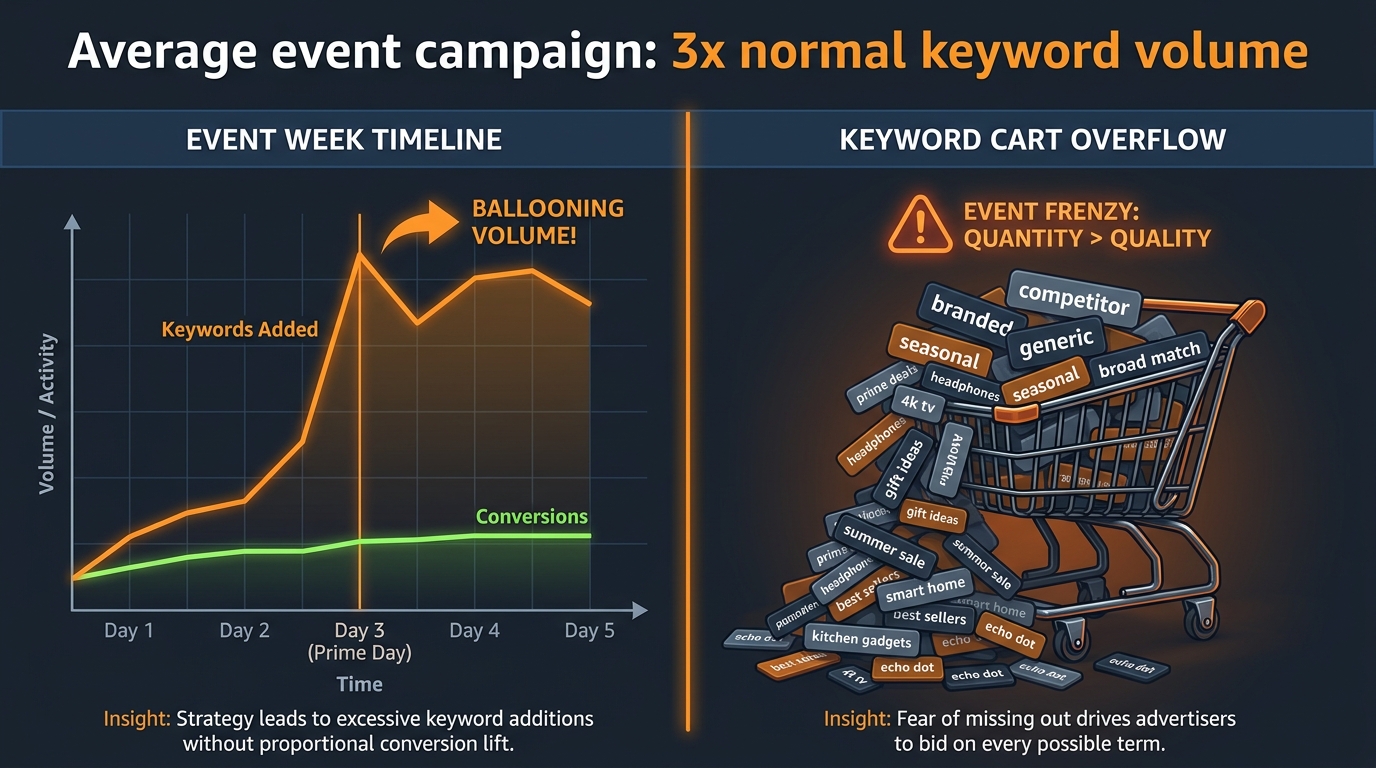
    Infographic showing how Amazon SBV keyword sets triple in size during Prime Day events with conversions failing to keep pace — keyword bloat visualized

    Understanding why keyword sets explode during events is important — not to assign blame, but because the root cause determines where and how you need to clean up afterward. There are three distinct drivers, and they compound on each other.

    The Defensive Expansion Instinct

    Event traffic is genuinely different from baseline traffic. Shoppers browse more broadly, compare more aggressively, and respond to price signals rather than brand loyalty. To capture that traffic, advertisers rationally expand their targeting — adding broader match types, reaching into adjacent categories, and bidding on competitor terms they would not normally touch. This is not irrational behaviour. During high-purchase-intent windows, wider nets do catch more fish.

    The problem is that very few teams remove those nets when the event ends. The broad-match terms stay live. The competitor conquesting keywords keep running. The discovery campaigns that were meant to surface new opportunities during a traffic spike continue serving ads to shoppers who have completely different intent profiles three weeks after the sale.

    Auto Campaign Contamination

    Many SBV campaigns use auto targeting or broad match as a feeder — Amazon surfaces the campaign against a wide range of search queries, the advertiser harvests converting search terms into manual exact match campaigns. During events, this feeder structure explodes in volume. Auto campaigns pick up enormous numbers of new search terms because event-period traffic is simply higher in total volume, more diverse in query structure, and spiking in ways that look relevant to Amazon’s matching logic even when they are not truly aligned with your product.

    Post-event, those harvested terms — many of which converted during the event spike precisely because intent was inflated by deals, not by genuine product fit — sit in your keyword list waiting to underperform against normal-baseline traffic.

    The “More is Safer” Bias

    There is a widely held assumption in Amazon PPC that having more keywords is a form of insurance. If one term dries up, another fills the gap. If you missed a trend, broad coverage will catch it. This logic is understandable for Sponsored Products campaigns where bid management at keyword level is highly granular. But for Sponsored Brands Video, it creates particular damage. SBV campaigns have a single creative and typically a single landing page. When a diverse, bloated keyword set drives heterogeneous traffic to one video and one destination, the creative-query mismatch signals pile up. Click-through rate drops. Conversion rate drops. And the campaign’s delivery efficiency — how Amazon prioritizes your bids in auction — deteriorates.

    Amazon’s 2026 ad environment has moved decisively toward rewarding creative relevance and intent alignment over sheer keyword volume. The more mismatched queries your SBV campaigns serve against, the more Amazon’s system learns to de-prioritize your bids even on the terms that should be winning.


    What Bloated SBV Keyword Sets Actually Cost in Real Numbers

    Before diving into the mechanics of cleanup, it is worth being concrete about what bloat actually costs. Vague concerns about “wasted spend” are easy to deprioritize. Specific numbers are harder to ignore.

    The Wasted Spend Calculation

    Practitioners across agency-managed Amazon accounts consistently find that between 35% and 45% of spend in post-event campaigns is attributable to search terms that generated zero attributed orders — not low-converting terms, but literally zero. These are not borderline performers that might come good with more data. They are dead weight that the algorithm is nevertheless serving against because no one has closed the door on them.

    On a campaign spending $10,000 per month post-event, that represents $3,500 to $4,500 in spend that returns nothing in attributed sales. Over a 90-day cleanup lag — which is common for teams without a structured audit process — that is $10,500 to $13,500 in recoverable budget that went to clicks with no commercial return.

    The ACoS Multiplier Effect

    Keyword bloat does not just inflate your ACoS through direct wasted spend. It also suppresses the performance of your best terms. When budget is being absorbed by low-quality queries, your high-intent, high-converting exact match terms are competing for the same daily budget cap. They lose impressions. They lose auction priority. Their performance data becomes harder to read because it is diluted by the noise around them.

    Agencies that have documented structured SBV cleanups consistently report ACoS reductions of 20% to 50% after aggressive pruning — not because they found magic new keywords, but because they stopped subsidizing the ones that were actively destroying their averages. A campaign that was running at 55% ACoS pre-cleanup can realistically hit 28–32% after a disciplined triage, simply by removing the drag.

    The Algorithm Signal Degradation

    This is the cost that does not show up directly in your spend report but compounds over time. Amazon’s Sponsored Brands serving algorithm is a learning system. It optimizes delivery based on which queries, placements, and audiences have historically driven conversions. When you feed it a signal set contaminated by event-period anomalies and low-quality search terms, it builds a distorted model of what “good traffic” looks like for your campaign. Fixing that model requires time and clean data — and the longer bloated campaigns run, the longer the recovery takes once you clean them up.


    The 48-Hour Triage: What to Pull First and What to Ignore

    When the event closes, the first instinct for most advertisers is to pull everything at once — all campaigns, all match types, the full 90-day search term report — and try to make sense of the entire picture simultaneously. This is a reliable path to analysis paralysis. A better approach is a disciplined 48-hour triage that identifies the highest-priority action items before going deep on the full audit.

    The Reports You Actually Need Immediately

    In the first 48 hours post-event, pull exactly two reports:

    • Sponsored Brands Search Term Report — filtered to the event window only (the 7 to 10 days of the event period). Do not pull 90-day data yet. You want to isolate what happened during the event before normalizing it against baseline performance.
    • Campaign Performance Report — at campaign level, not keyword level. This gives you a fast read on which campaigns have the worst spend-to-sales ratios post-event, so you know where the triage effort will have the highest impact.

    Do not pull keyword-level reports in the first 48 hours. You do not have enough clean data to make keyword-level decisions yet — the event attribution window has not fully closed (Amazon’s standard 7-day click attribution means sales from event-week clicks may still be attributing through the early post-event period). Making keyword pauses based on incomplete attribution data is a common mistake that removes terms that were actually working.

    The Four Things to Look For in the First Pass

    When you open the Sponsored Brands Search Term Report for the event window, you are looking for four specific patterns — not yet making decisions, just flagging what needs attention:

    1. High-spend, zero-order terms — Search terms with more than 15 clicks and no attributed orders during the event window. Flag these immediately. They are the highest-priority candidates for negating.
    2. Obvious intent misfires — Terms that are clearly not aligned with your product category. These often surface from auto campaigns matching on tangentially related queries during high-traffic event periods. They can be negated immediately without waiting for attribution to settle.
    3. Branded terms from competitor campaigns — If you were running competitor conquesting during the event, those terms need separate evaluation. Many will have poor economics at normal-traffic CPCs even if they seemed viable during event-period bidding.
    4. Event-specific modifier terms — Queries containing “Prime Day,” “deal,” “sale,” “discount,” “limited time,” and similar event modifiers. These terms were matching during the event because of shopper behavior specific to that moment. They should be monitored for pruning, not kept as permanent fixtures in your keyword set.

    What to Leave Alone for Now

    Do not touch your bids in the first 48 hours. Do not restructure ad groups. Do not pause keywords based on event-week data alone. The first 48 hours are for flagging and segmenting, not for acting on incomplete data. The time to make structural decisions is after the full attribution window has closed and you have at least 14 days of post-event performance data to compare against your pre-event baseline.


    Reading the Sponsored Brands Search Term Report Like a Surgeon
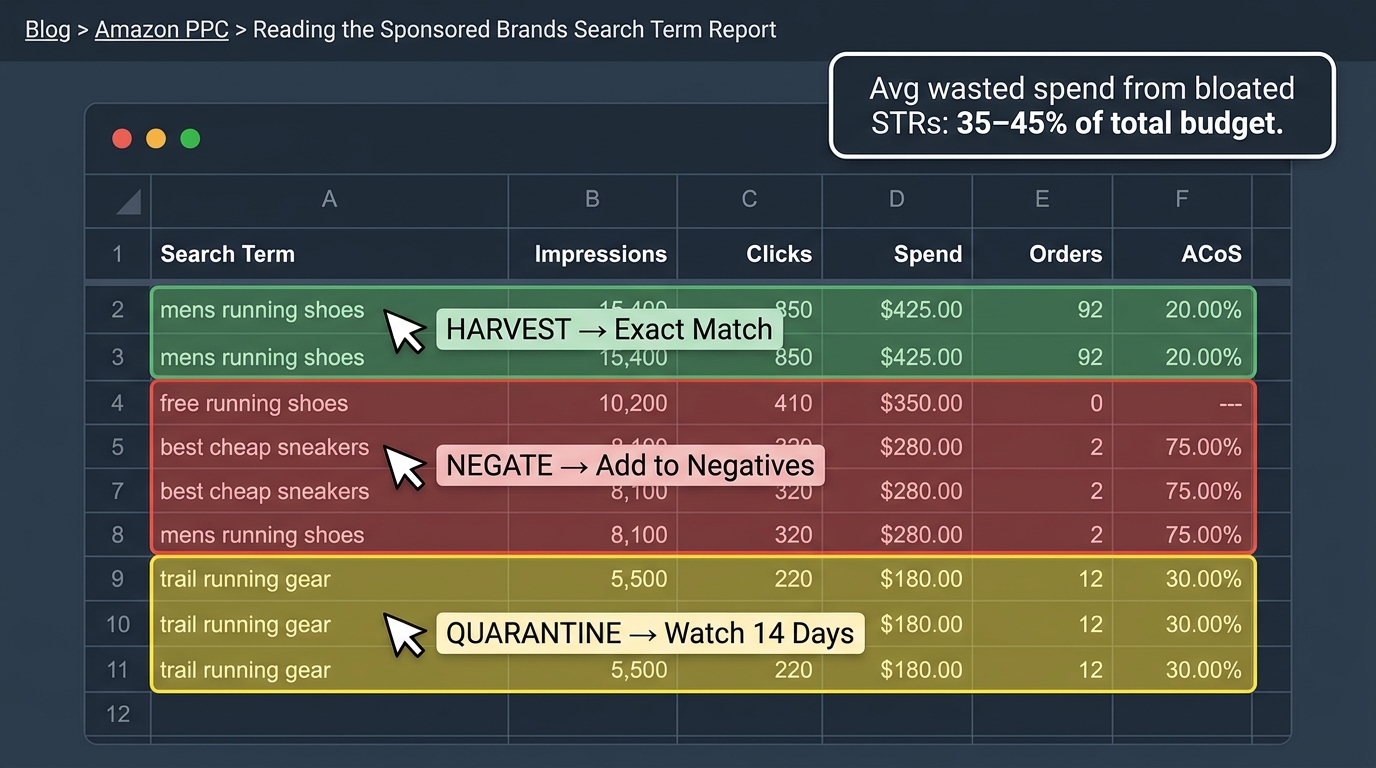
    Amazon Sponsored Brands Search Term Report with color-coded rows showing which terms to harvest into exact match, negate, or place in 14-day quarantine

    Once the attribution window has closed (at minimum 10 to 14 days post-event), you can go deep on the full search term data. This is the phase most advertisers rush or misread. The Sponsored Brands Search Term Report is not just a list of what people searched — it is a diagnostic tool that, when read correctly, tells you exactly where your campaign structure is leaking money.

    Setting Up Your Data Window Correctly

    Amazon’s Sponsored Brands Search Term Report currently supports a lookback window of up to approximately 65 days. For post-event analysis, you want to pull three overlapping windows and compare them against each other:

    • Pre-event baseline — 21 to 28 days before the event started. This is your “normal” campaign behavior.
    • Event window — The event period itself, typically 2 to 7 days depending on the promotion type.
    • Post-event recovery — 14 to 21 days after the event ended. This is where you are now, and this data is the most actionable.

    The comparison between pre-event baseline and post-event recovery reveals which terms have genuinely changed in performance — either improved because of sustained ranking lift from event traffic, or deteriorated because event-era intent has evaporated and CPCs have not adjusted accordingly.

    The Five Columns That Matter (and Two That Don’t)

    Most advertisers look at too many columns simultaneously and end up optimizing for the wrong things. For the SBV cleanup audit specifically, you need five columns and can largely ignore two:

    Columns that matter:

    1. Search Term — The actual query. Obviously essential.
    2. Impressions — Volume signal. Low-impression terms need more data before decisions can be made.
    3. Clicks — The primary pruning trigger. Terms with significant clicks and no orders are your biggest waste candidates.
    4. Spend — Weighted by click volume. High-spend, low-order terms are your most urgent priorities.
    5. Orders (14-day) — The conversion signal. This is your truth column.

    Columns to deprioritize in the initial cleanup:

    • Impressions Share — Useful for longer-term analysis but misleading in post-event periods when impression volumes were inflated.
    • Click-Through Rate (CTR) — Event-period CTR is anomalous. A term that showed strong CTR during Prime Day because shoppers were clicking everything will show a very different CTR once event behavior normalizes.

    N-Gram Analysis: The Cleanup Accelerator

    If you are managing a campaign with hundreds of search terms in the report, reading each one individually is not a viable workflow. N-gram analysis — breaking each search term into its component 1-word, 2-word, and 3-word phrases and aggregating performance across all terms containing each phrase — dramatically accelerates the decision-making process.

    Instead of evaluating 340 individual search terms, you evaluate patterns. If every search term containing the word “cheap” has generated clicks and no orders across the full report, you can make one negative keyword addition — negative phrase “cheap” — that addresses dozens of terms simultaneously. If every search term containing your product category name preceded by a competitor’s brand name has poor economics, one competitor brand negative phrase handles the entire cluster.

    N-gram analysis is not a feature inside Amazon’s native reporting, but it can be performed in Excel or Google Sheets in about 20 minutes using text parsing functions, or through third-party PPC tools that build it natively. For large accounts managing multiple SBV campaigns, it is one of the highest-leverage efficiency tools available during a cleanup sprint.


    The Three-Bucket Sorting System: Keep, Kill, and Quarantine
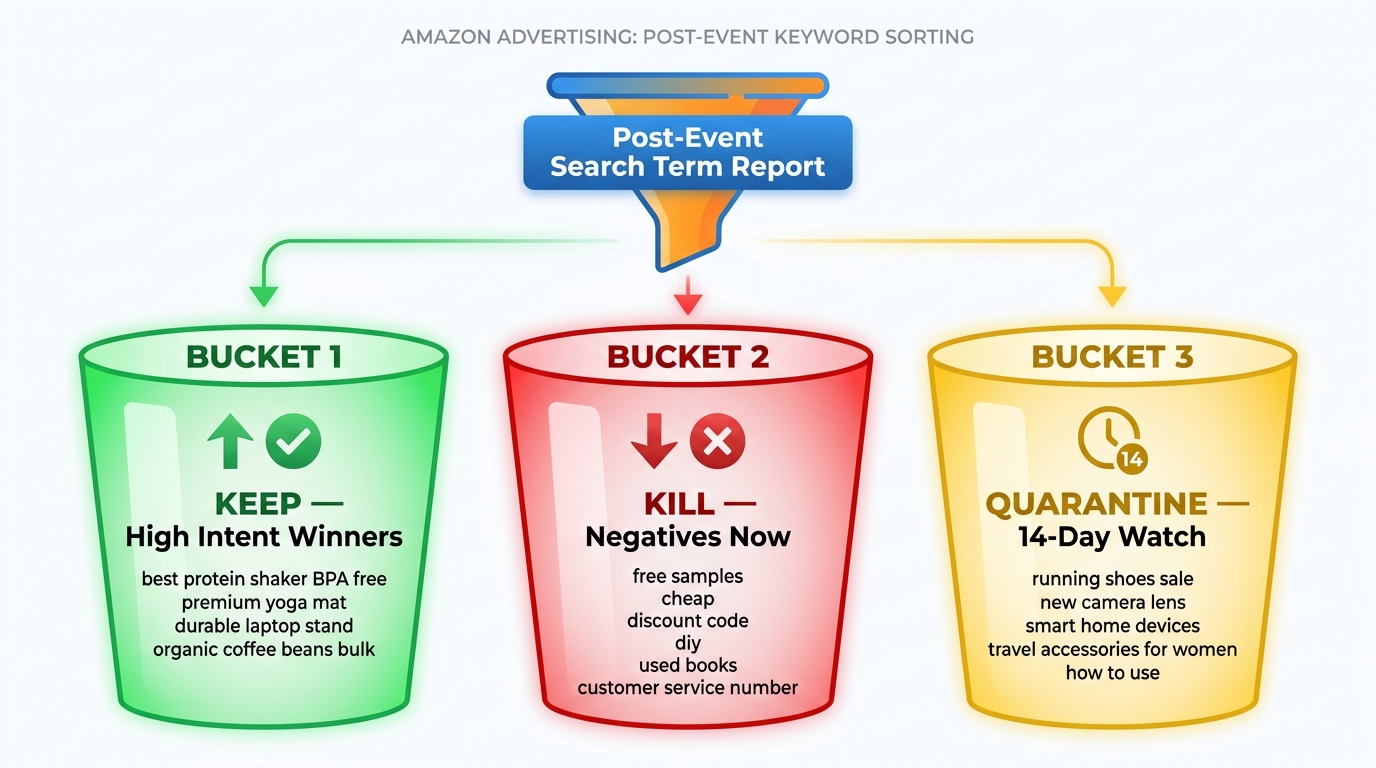
    Three-bucket sorting system diagram for post-event Amazon SBV keyword cleanup showing Keep, Kill, and Quarantine categories with example keywords in each

    Once you have your clean post-event search term data segmented by the three windows described above, every search term in your report needs to go into one of three buckets. The buckets are not vague categories — they each carry a specific action and a specific timeline.

    Bucket 1: Keep (Harvest Into Exact Match)

    These are search terms that demonstrated converting intent both during and after the event — they are not event-specific anomalies but genuine demand signals that your SBV creative is satisfying. To qualify for the KEEP bucket, a search term should meet two basic criteria:

    • Generated at least one order in the post-event baseline period (not just the event window)
    • ACoS is at or below your target ACoS for the campaign, or within 1.5× target with clear conversion trend

    KEEP terms are harvested into a dedicated exact match SBV campaign where they can receive precise bid management without competing against broad or auto traffic for the same budget. This is the opposite of the defensive expansion you did before the event — you are now building a tightly controlled, proven keyword set from the best signals that event traffic surfaced.

    Bucket 2: Kill (Negate Immediately)

    KILL terms are those with clear evidence of poor fit that does not need additional data to confirm. The criteria:

    • Generated 20+ clicks with zero attributed orders in the combined event and post-event window
    • Obvious intent misfire — the query is not commercially aligned with your product
    • Event-specific modifiers (“Prime Day deal,” “sale today,” “limited offer”) that have no value once the event is over
    • Terms that are consuming more than your maximum acceptable spend per conversion based on your margin

    KILL terms become negative keywords — either negative exact for precision control or negative phrase where the pattern itself (not just one specific query) is the problem. These get added immediately. Every day they stay live is money leaving your account without return.

    One important nuance: for Sponsored Brands campaigns specifically, negative keywords operate at the ad group level, not campaign level, in most account structures. Make sure you are adding negatives to the right ad group, not assuming campaign-level blocking applies uniformly across all ad groups under the same campaign.

    Bucket 3: Quarantine (14-Day Watch Period)

    QUARANTINE is the category that most cleanup frameworks skip entirely, and it is the category that causes the most problems when it is absent. Not every borderline term deserves an immediate verdict. Some search terms:

    • Generated clicks but attribution is still within the conversion window
    • Have reasonable intent but very low click volume (fewer than 8 clicks) — not enough data to decide
    • Converted during the event but not yet in the post-event baseline — potentially event-specific, potentially genuinely good
    • Show declining ACoS trend across the post-event period — improving, but not yet at target

    Quarantine terms go on a specific watch list with a 14-day review date. They do not get negated. They do not get promoted to exact match. They continue running in their current match type configuration while you collect more data. At the 14-day review, they either earn promotion to KEEP or get moved to KILL. The quarantine period also prevents the common cleanup mistake of negating terms too aggressively and accidentally removing keywords that would have recovered to profitability post-event.


    Thresholds That Actually Work for SBV Pruning Decisions

    The biggest gap in most post-event cleanup workflows is the absence of explicit, numeric thresholds for decision-making. Without them, every keyword evaluation becomes a judgment call, different operators make different decisions, and the cleanup is inconsistent. These thresholds give you a repeatable, defensible standard.

    The Click Threshold for Negating

    The standard practitioner recommendation for Amazon PPC is to negate a search term that has accumulated a meaningful number of clicks without generating an order. But what counts as “meaningful”? The answer depends on your expected conversion rate.

    For SBV campaigns, where creative-driven browsing behavior typically generates lower CVR than Sponsored Products (because shoppers are encountering your brand at a higher-funnel stage), a useful baseline threshold is:

    • 15–20 clicks with zero orders in the post-event baseline period = candidate for negating
    • 25+ clicks with zero orders across the combined event and post-event window = negate immediately

    These thresholds need to be adjusted upward for high-ticket products where conversion cycles are longer, or downward for impulse-purchase categories where CVR is typically higher and you have less tolerance for non-converting traffic.

    The Spend Threshold for Immediate Action

    Clicks alone are not sufficient for priority-setting — you also need a spend trigger that flags terms consuming budget at a rate that cannot be justified by any reasonable expected return. A practical formula:

    Maximum spend per term before negating = (Target CPA) × 2

    If your target cost-per-acquisition is $18 (based on your margin), any search term that has consumed $36 or more without a single order is a KILL candidate regardless of click count.

    This spend-based threshold catches high-CPC terms that might only generate a handful of clicks but have already consumed a disproportionate share of budget — common in competitive categories where event-period CPCs were elevated and have not fully normalized post-event.

    The ACoS Ceiling for Keeping Terms

    For terms that are converting but at above-target ACoS, the decision is less binary. A useful framework:

    • ACoS at 1× to 1.5× target — Keep, but reduce bid by 15 to 25% and monitor for 14 days.
    • ACoS at 1.5× to 2× target — Quarantine. Reduce bid significantly and collect 14 more days of data before deciding.
    • ACoS above 2× target — Kill or pause unless there is a specific strategic reason (brand awareness, competitive defense) to maintain the term at a loss.

    Strategic loss-tolerance is a legitimate consideration for some SBV campaigns — particularly competitor conquesting keywords where the goal is share capture rather than immediate ROAS. But that strategy needs to be explicit and budgeted, not an accidental outcome of not running the cleanup.


    Harvesting Winners Into Tight, Intent-Based Campaign Structures

    Cleanup is only half the work. The KEEP terms that survive your three-bucket sort need a proper home — and sending them back into the same bloated campaign structure they came from defeats the entire purpose of the exercise. Post-event keyword cleanup is an opportunity to rebuild SBV campaign architecture around proven intent signals rather than speculative broad coverage.

    The One Intent Per Campaign Rule

    Amazon’s own guidance for Sponsored Brands Video in 2026 is explicit on this point: each SBV campaign should serve a single product against a single intent theme. That means a campaign built around “best [category] for [use case]” queries should not also be targeting “[brand name] alternative” competitor terms and “[product type] under $30” price-conscious queries. The creative serves all of these — but the intent signals are entirely different, and a single video cannot be optimally relevant to all of them simultaneously.

    Post-cleanup restructuring means taking your KEEP terms and sorting them into intent clusters before building new exact match campaigns. Common intent cluster categories for SBV:

    • Problem-aware queries — Shoppers describing a problem your product solves (“knee pain running shoes,” “kitchen storage small apartment”)
    • Product-aware queries — Shoppers who know the product category they want (“stainless steel water bottle insulated 32oz”)
    • Brand-aware queries — Shoppers who know your brand or are comparing you (“[your brand] vs [competitor brand]”)
    • Deal-intent queries — Lower-intent, price-conscious searches. These should be evaluated very carefully for SBV; the format works best with higher-intent, considered shoppers.

    Bid Strategy for Freshly Harvested Exact Match Terms

    When you move proven search terms from a broad or auto-derived discovery campaign into a new exact match SBV campaign, resist the temptation to immediately set aggressive bids. The new campaign has no performance history. Amazon’s algorithm needs time to calibrate delivery before you bid competitively.

    A practical approach: start new exact match SBV campaigns at 70 to 80% of the bid you were winning at in the original broad campaign, then adjust upward in 10 to 15% increments every 7 to 10 days as performance data accumulates. This prevents overpaying for impressions before the algorithm has learned the campaign’s relevance signals, and it gives you a cleaner performance baseline to compare against.

    Align the Creative to the Intent Cluster

    If you are creating multiple intent-clustered SBV campaigns from your post-event harvest, this is the moment to evaluate whether your current SBV creative actually serves each cluster. A video that leads with a problem-solving narrative is well-suited to problem-aware queries. A video that leads with product features and specifications is better suited to product-aware queries who are already in comparison mode. If your creative does not match the intent cluster, the campaign will underperform regardless of how well the keyword set is structured.

    Post-event is therefore not just a cleanup opportunity — it is a creative alignment audit. Note which intent clusters your current video does not serve well, and flag those for creative production or adaptation in the next cycle.


    Building the Negative Keyword Architecture That Prevents Re-Bloat
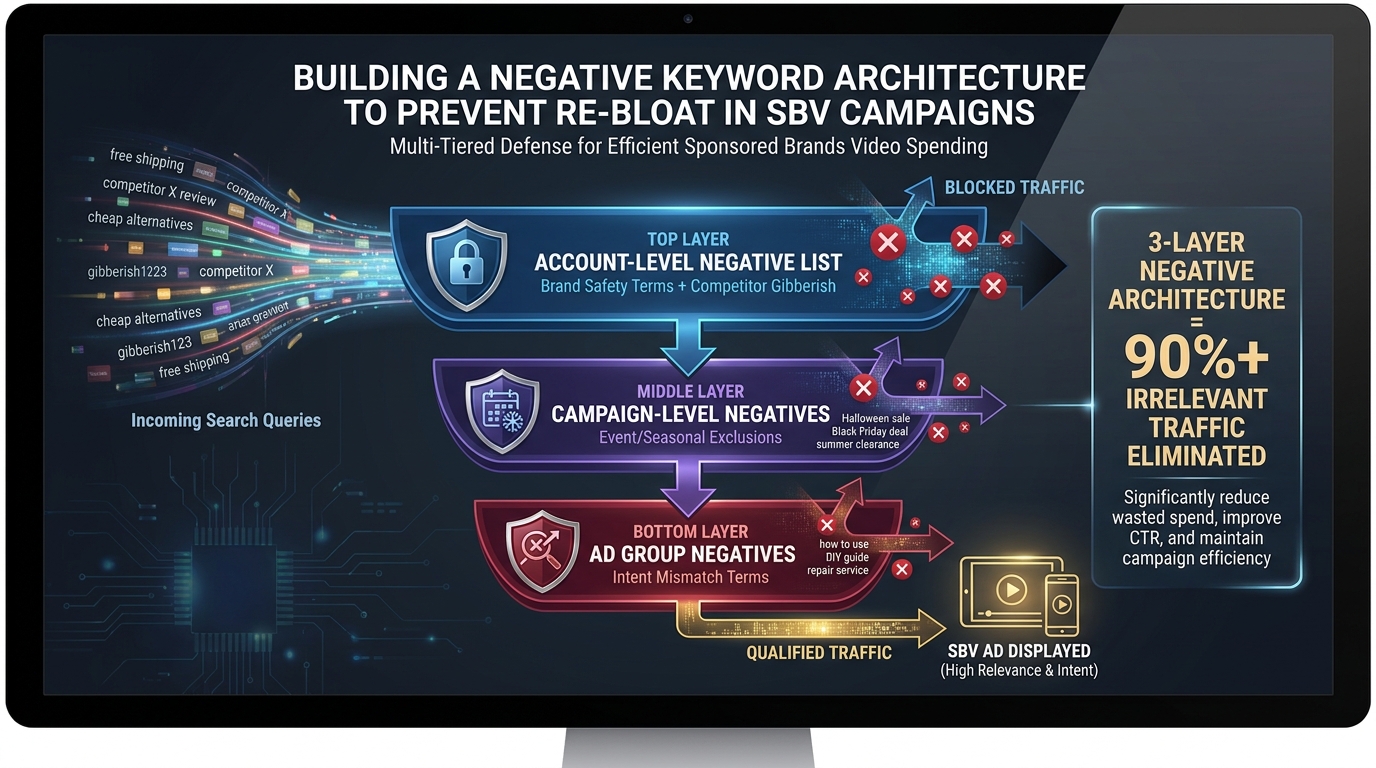
    Three-layer negative keyword architecture diagram for Amazon SBV campaigns showing account-level, campaign-level, and ad group negatives as a defense system against keyword bloat

    The reason most sellers end up doing emergency cleanup after every event is not that events are unusually disruptive — it is that they have no structural defense against the terms that events generate. A well-built negative keyword architecture is the infrastructure that makes every subsequent cleanup significantly faster and less expensive.

    The Three-Layer Negative System

    Effective negative keyword management for SBV campaigns operates across three distinct levels, each serving a different function:

    Layer 1: The Evergreen Brand Safety List

    This is a persistent negative list that lives at the account or portfolio level and covers terms that should never trigger your SBV campaigns under any circumstances — regardless of the event, the traffic level, or the targeting strategy. It includes: irrelevant category terms, brand safety exclusions (competitor brand names where you do not want to be conquesting), terms indicating non-commercial intent (“free,” “DIY how to,” “tutorial,” “review without purchase intent”), and your own brand’s exact match terms (if you have separate branded campaigns, you do not want broad campaigns cannibalizing them).

    This list should be reviewed quarterly but changes infrequently. It is the foundation.

    Layer 2: The Event Exclusion List

    This list is built before each major promotional event and activated in the post-event period. It contains event-specific query modifiers that have no value once the sale is over. Terms like “Prime Day,” “Cyber Monday,” “Black Friday deal,” “limited time offer,” “flash sale,” and similar event-anchored queries should go on the event exclusion list immediately after each event. This prevents post-event campaigns from serving against residual traffic that is searching for deals that no longer exist.

    The event exclusion list is temporary — it can be paused or removed before the next event if you want to re-engage event traffic — but it should be active in the 30 to 60 days following any major promotional period.

    Layer 3: Campaign and Ad Group Level Negatives

    These are the granular, campaign-specific negatives that emerge from each cleanup sprint. Terms that are irrelevant to the specific intent of a particular campaign, competitor keywords that you are actively excluding from certain campaigns (while keeping in others), and the specific low-quality search terms surfaced by the current cleanup. These are your most dynamic and frequently updated negatives — they grow after every event cleanup and every weekly audit.

    How to Build the Event Exclusion List Before the Next Event

    One of the most forward-looking moves you can make during post-event cleanup is to document the event-specific terms you are negating this time and save them as a pre-built exclusion list for the next event. Before Prime Day 2026 ends, you should be able to activate a “post-Prime Day exclusion package” that blocks the most common event-modifier search patterns within hours of the event closing — not two weeks later when you finally get around to the cleanup sprint.

    This event exclusion library grows in quality with each cycle. After three to four major events, you have a robust pre-built list that handles 70 to 80% of the negative keyword work automatically, and your manual cleanup time shrinks to the truly campaign-specific decisions.


    The Weekly Cadence: Making Cleanup a System, Not a Sprint
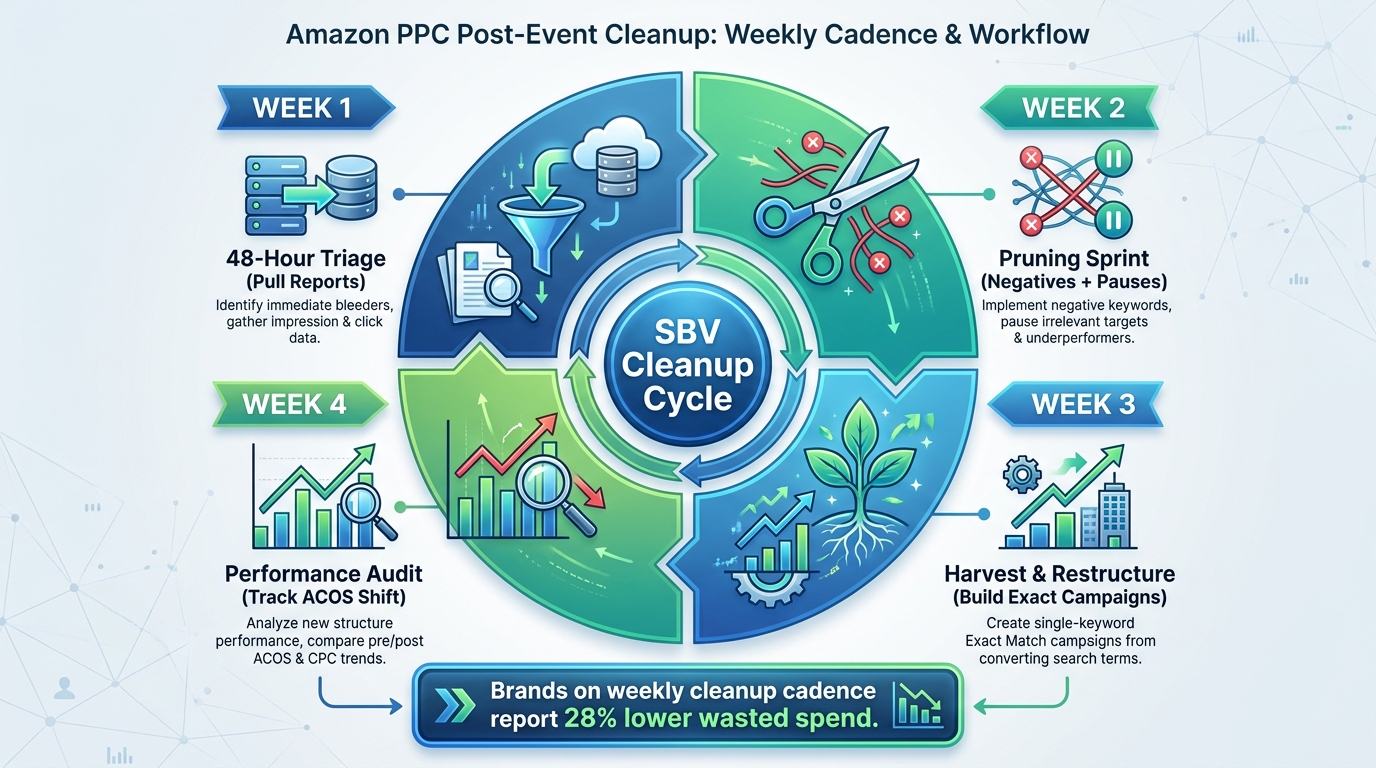
    Circular weekly cleanup workflow diagram for Amazon SBV campaigns showing four phases: 48-hour triage, pruning sprint, harvest and restructure, and performance audit

    Post-event cleanup should not be a reactive, once-and-done sprint that you run when things get bad enough to notice. The goal is to build it into a weekly cadence that keeps SBV keyword sets lean permanently — so the next event does not require a two-week emergency recovery but a relatively minor adjustment.

    Week One: The 48-Hour Triage Plus Deep Audit

    This is the week immediately following the event. The 48-hour triage described earlier happens on days one and two. The full search term report analysis — the three-window comparison, the n-gram review, the three-bucket sort — happens on days three through five. By end of week one, you should have:

    • All immediate KILL terms added as negatives
    • All QUARANTINE terms documented on a 14-day watch list
    • All KEEP terms identified and ready for campaign restructuring

    Week Two: Structural Cleanup and Initial Harvest

    With your negatives live and your KEEP list identified, week two focuses on campaign restructuring. Build the intent-clustered exact match campaigns for harvested terms. Adjust bids on the surviving broad or auto campaigns that are still in your structure (they should still run to continue surfacing new signals, but at reduced budget while clean data accumulates). Review your Quarantine list for any terms that have now had enough post-event data to graduate to a clear decision.

    Week Three and Onward: The Maintenance Cadence

    After the intensive two-week post-event sprint, the cleanup process transitions to a lighter weekly maintenance rhythm. Each week:

    1. Pull the 14-day search term report for all active SBV campaigns (not just those that were bloated during the event)
    2. Apply your click and spend thresholds to flag new negative candidates
    3. Review quarantined terms against their 14-day target date
    4. Check performance of newly harvested exact match campaigns and adjust bids as needed
    5. Review whether any terms from the event exclusion list are still showing impressions (they should not be)

    The weekly cadence typically takes 60 to 90 minutes per account once the systems are in place. Teams that invest in this regularity consistently report substantially lower wasted spend than those who only do cleanup reactively after events — not because they are finding dramatically different insights each week, but because they are catching small leaks before they become large ones.


    Common Cleanup Mistakes That Undo All Your Work

    A cleanup framework is only as effective as the discipline with which it is applied. These are the errors that appear most frequently — often made by experienced advertisers who understand the theory but slip on specific execution details.

    Negating Too Early or Too Broadly

    Over-negating is a real and under-discussed problem. Sellers who are frustrated by post-event bloat sometimes negate aggressively — blocking terms based on 3 to 5 clicks with no orders, or adding very broad negative phrase patterns that catch relevant queries they actually want. The result is a keyword set so tightly restricted that campaigns can no longer scale even on high-intent traffic.

    Stick to your thresholds. Do not negate below 15 clicks for zero-order terms unless the intent misfire is obvious. Do not use negative broad match for anything except the most clearly irrelevant patterns — it is too blunt an instrument for precision campaign management.

    Confusing Event-Period CVR With Permanent Performance

    This is the flip side of the above. Some advertisers look at event-period conversion rates and decide to keep terms that performed well during the spike — without checking whether those terms are still converting at acceptable rates in the post-event baseline. Event CVR is inflated. Deal-seeking shoppers convert more easily during promotions because price friction is temporarily removed. The same keyword at the same bid may produce 40% worse CVR two weeks after the event. Always validate event performance against the post-event baseline before making any KEEP decisions.

    Rebuilding the Same Structure You Just Cleaned

    The most ironic mistake: doing a thorough cleanup and then immediately reloading the same bloated keyword strategy into the newly clean campaigns. This happens when advertisers run keyword generation tools, see a large list of suggested terms, and add them wholesale without filtering for intent alignment or checking overlap with existing campaigns. Every keyword you add to an SBV campaign should be intentional. Ask: which intent cluster does this serve? Does my video creative satisfy this query? Is this term already covered by another campaign?

    Not Documenting What You Negated and Why

    Negative keywords added without documentation are a silent operational risk. Six weeks after a cleanup sprint, a different team member or a different agency adds a new campaign, runs the keyword suggestions tool, and adds back the exact terms you just negated — because there is no record of why they were removed. Every negative keyword addition should be logged with the date, the performance data that triggered it, and the match type applied. This is not bureaucracy — it is institutional memory that compounds in value with every event cycle.


    The Diagnostic Scorecard: How to Know Your SBV Set Is Clean

    At the end of a post-event cleanup, you need a way to assess whether the work is actually done — not just whether you completed the tasks, but whether the outcome is what you intended. A simple diagnostic scorecard answers this objectively.

    Five Metrics That Signal a Clean SBV Structure

    1. Spend concentration — The top 20% of your active keywords should be generating at least 60% of your attributed orders. If spend is spread roughly evenly across all terms, you still have too much variance in quality. Keywords should not all pull the same weight — the winners should be winning decisively.
    2. Zero-order term percentage — In any rolling 30-day window, no more than 10% of your click spend should be going to search terms with zero attributed orders. Above 20% is a red flag. Above 30% means the cleanup is not complete.
    3. Impression-to-click conversion by intent cluster — Each intent cluster campaign should show a CTR within 20% of your account average for that format. Significant outliers signal that the keyword set and creative are not aligned.
    4. ACoS trend — Post-cleanup ACoS should be falling or stable over a 14-day rolling window. If it is still rising after two weeks of cleanup, there are still significant waste drivers in the account that the cleanup has not reached.
    5. Negative keyword list growth rate — In the four weeks following a major cleanup, your negative keyword list should be growing slowly (as weekly maintenance surfaces new terms) but not explosively. Rapid negative list growth post-cleanup indicates that broad match campaigns are still generating high volumes of irrelevant traffic — which means the discovery targeting itself needs adjustment, not just more negatives.

    Lean SBV Keyword Sets as a Lasting Competitive Edge

    The argument for rigorous post-event SBV cleanup is often framed purely as a cost-reduction exercise — stop the waste, bring ACoS down, recover the budget. That framing is accurate but incomplete. The real competitive argument is about data quality and algorithmic advantage.

    Amazon’s Sponsored Brands Video system, like every modern ad-serving platform, gets better at serving your campaigns when it has clean, consistent, high-quality conversion signals to learn from. A lean, intent-coherent keyword set generates that signal. A bloated, noisy keyword set generates noise — and in a system that continuously updates its models based on recent performance, noise is poison.

    Brands that run tight SBV structures consistently — not just in the weeks after an event but as a permanent operational standard — are building a compounding advantage. Their campaigns learn faster. Their quality signals are cleaner. Their bids are more efficient because the algorithm is delivering against terms that actually convert. And when the next event arrives, they can expand into broad and auto discovery campaigns confidently, knowing that their foundation is clean enough to absorb the temporary chaos without permanently distorting their performance data.

    The sellers who treat keyword cleanup as a reactive emergency will always be behind. The sellers who treat it as a structural discipline — something that happens on a schedule, according to documented thresholds, with clear accountability for outcomes — are the ones whose SBV campaigns perform better in the 90 days after an event than they did in the 90 days before it.

    Actionable Takeaways

    • Run your 48-hour triage immediately post-event, but do not make keyword decisions until attribution windows close (10 to 14 days minimum).
    • Use the three-window comparison (pre-event baseline, event window, post-event recovery) for every cleanup audit — do not evaluate event performance in isolation.
    • Apply the three-bucket system (Keep, Kill, Quarantine) with specific, numeric thresholds — not judgment calls.
    • Harvest KEEP terms into intent-clustered exact match SBV campaigns, not back into the same broad structure they came from.
    • Build and maintain a three-layer negative keyword architecture: evergreen brand safety, event exclusion list, and campaign-specific negatives.
    • Document every negative keyword addition with the data that justified it — this prevents re-bloat in subsequent campaigns.
    • Adopt a 60 to 90-minute weekly maintenance cadence so that cleanup becomes a steady-state system rather than an emergency response.
    • Evaluate cleanup success against the five-metric diagnostic scorecard, not just task completion.

    The event is always going to generate noise. What separates efficient advertisers from wasteful ones is not how much noise they generate — it is how fast and how precisely they clean it up.
  • The SBV Placement Shift: How to Rebuild Your Amazon Search Funnel From the Ground Up

    The SBV Placement Shift: How to Rebuild Your Amazon Search Funnel From the Ground Up

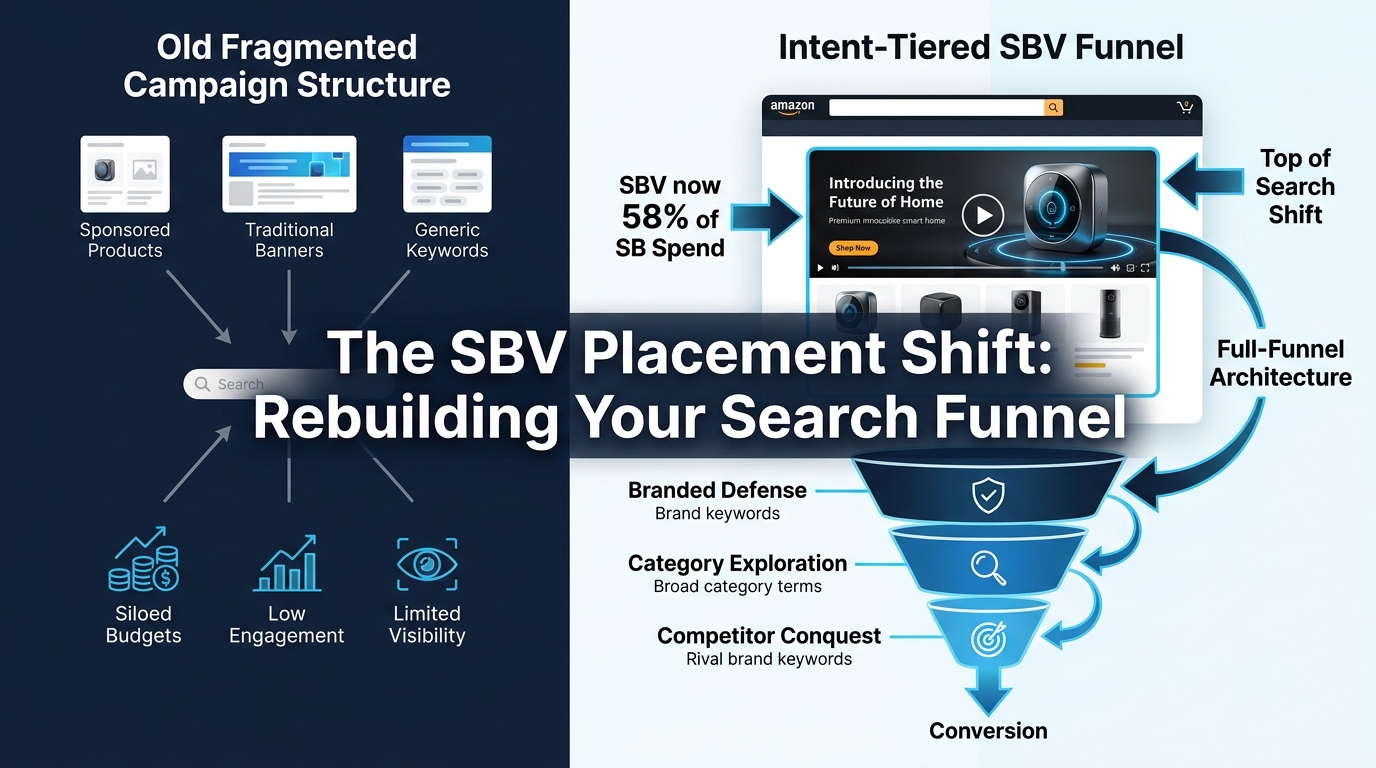
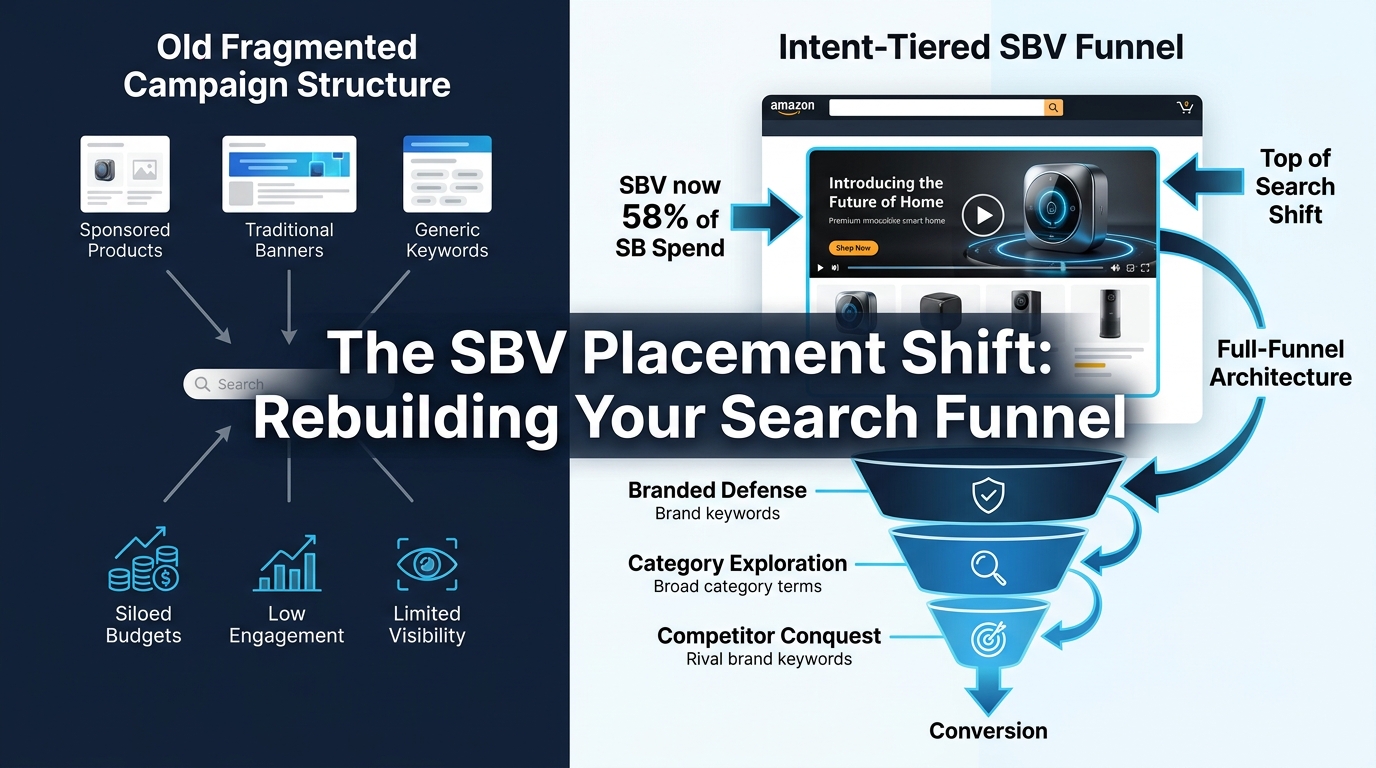
    Amazon SBV placement shift infographic showing the move to full-funnel intent-tiered campaign architecture

    For years, Sponsored Brands Video lived on the margins of most Amazon advertisers’ campaign hierarchies. It was the format you tacked onto a mature account once everything else was humming — a creative flex, a brand-awareness experiment, or a way to use up a budget surplus before quarter-end. Sophisticated? Sure. Essential? Most teams quietly said no.

    That calculation is now wrong. And the brands that haven’t updated it are bleeding impression share, paying inflated CPCs on their own branded terms, and watching competitors leapfrog them at the top of search using exactly the format they deprioritized.

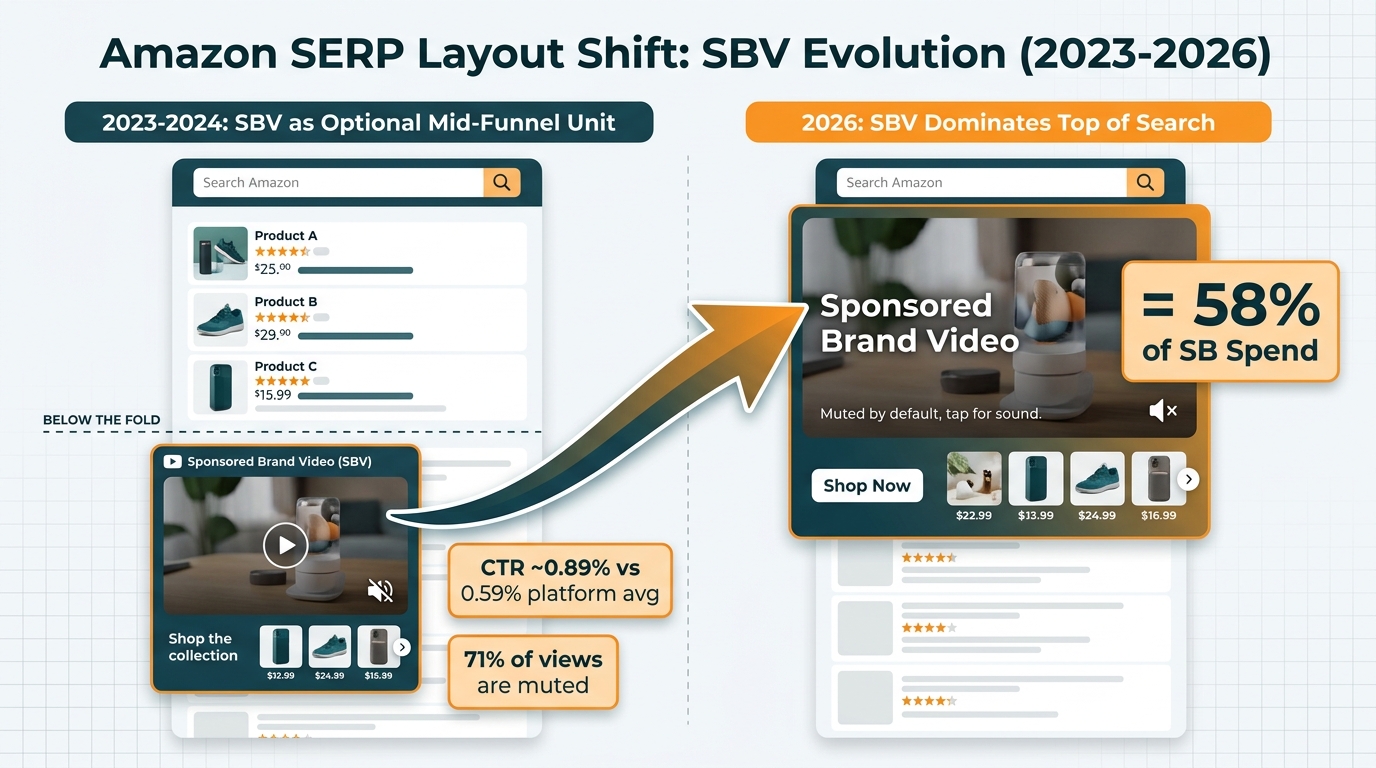
    Amazon’s Sponsored Brands Video has undergone a structural placement shift that fundamentally changes how the search results page (SERP) is organized, how shoppers encounter brands at the moment of intent, and what a healthy Amazon search funnel actually looks like in 2026. This isn’t an incremental update to SBV’s auction mechanics. It’s a wholesale change in how Amazon weights video in its ad stack — and by extension, how every other ad type on your roster performs.

    By Q1 2026, SBV represented approximately 58% of Sponsored Brands spend in large agency portfolios. That number tells you something important: the market has already voted. The question is whether your account structure has caught up with what the market already knows.

    This article breaks down exactly what changed with SBV placements, why the old search funnel architecture no longer works, and how to rebuild your campaigns from the ground up using an intent-tiered structure built for the way Amazon’s SERP actually looks today.

    What Actually Changed — The SBV Placement Shift Explained

    Before and after comparison of Amazon SERP layout showing SBV shift from optional mid-funnel unit to dominant top-of-search placement in 2026

    Before you can rebuild your search funnel, you need an accurate picture of the shift itself. It’s tempting to characterize this as a gradual, incremental evolution — but the data points suggest something more abrupt happened between late 2024 and early 2026 that has materially changed SERP architecture.

    From Inline Unit to SERP Anchor

    Historically, Sponsored Brands Video functioned as an inline search result unit. It appeared mid-page, typically below the first row of organic results and a couple of Sponsored Products. It was attention-catching when it played, but it wasn’t positioned as a primary discovery vehicle. Its reach was real but its strategic weight in most campaign structures was treated as secondary.

    What changed is placement priority. Amazon has progressively moved SBV into the top-of-search position — the most valuable real estate on the SERP — in many categories. The video unit now frequently appears above the organic results grid, above static Sponsored Brands headline ads, and above the fold on mobile. This isn’t consistent across every category or query type, but it’s now the dominant pattern in high-competition verticals.

    The practical consequence: if a competitor is running a well-structured SBV campaign targeting your category keywords and you aren’t, they’re occupying the space that shapes shopper perception before any other result is visible. The ad that plays first doesn’t just win the click — it anchors what the shopper’s baseline comparison looks like for everything they see next.

    The CPM and CPC Ripple Effect

    Placement elevation has a direct effect on auction economics. As SBV competes more aggressively for top-of-search slots, CPCs and CPMs across the Sponsored Brands format have risen in high-volume categories. Advertisers who had calibrated their SB bidding strategy based on historical benchmark data are finding their models no longer predict actual spend or impression share accurately.

    More importantly, static Sponsored Brands headline ads — the format most teams built their brand-awareness layer around — are getting displaced. When a video unit occupies the top slot, the static headline format either gets pushed down or doesn’t show at all. If your branded defense strategy relies primarily on static SB, you may not be showing up at all on branded searches that your competitors are actively targeting with SBV.

    Mobile as the Core Context

    The placement shift matters disproportionately on mobile. The majority of Amazon shopping now happens on mobile devices, and on smaller screens the top-of-search SBV placement dominates the visible viewport before any scroll. A 15-second autoplay video at the top of a mobile search result is not competing with other ads — it’s the entire screen.

    This mobile-first reality changes how SBV should be briefed, produced, and optimized. But it also changes how much creative lift the format can deliver when it’s well-executed versus how much damage a poor creative execution can do to perception at the top of your category search.

    Amazon’s Algorithmic Weighting

    The placement shift isn’t just a layout decision. It reflects how Amazon’s A10 algorithm is incorporating engagement signals from video. Click-through rates on SBV units that auto-play with product-in-action hooks tend to run higher than the platform-wide average CTR of approximately 0.59%. SBV benchmarks from agency data suggest CTRs in the 0.7–1.2% range, with well-optimized creatives hitting closer to 0.89%. That engagement differential feeds relevancy signals that affect how Amazon scores and ranks your campaigns overall — not just your SBV line items.

    Why Your Old Search Funnel Is Broken — and How to Diagnose It

    Most Amazon advertisers built their original search funnel structure around Sponsored Products as the conversion engine, with Sponsored Brands as a brand-halo layer sitting loosely on top. SBV, if it existed at all in the account, was typically a single campaign running a mix of branded and category terms without clear segmentation. Budgets were set relatively flat across all three ad types, and optimization happened primarily within Sponsored Products where return on ad spend (ROAS) attribution was clearest.

    That architecture was functional in a world where SBV was peripheral. It breaks down the moment SBV becomes the dominant SB format and the primary shaper of top-of-search real estate.

    The Five Symptoms of a Broken Search Funnel

    Rising branded CPCs with no corresponding impression share gains. If your brand-term CPCs have climbed 20–40% over the past year while your branded impression share has stayed flat or declined, competitors are likely running SBV campaigns against your brand terms and outbidding your static SB in the auction for top-of-search placement.

    Declining organic rank on core category terms despite stable sales velocity. SBV plays a documented role in driving click-velocity signals that can influence organic rank. If your organic positions are eroding on category terms while your Sponsored Products campaigns are stable, check whether your SBV presence on those terms is weaker than competitors’.

    Branded and non-branded terms mixed into the same SBV campaign. This is the most common structural mistake. When you mix branded, category, and competitor terms into one SBV campaign, Amazon’s bidding algorithm optimizes toward aggregate performance — which typically means over-investing in whatever term type drives the easiest conversions (usually branded) and under-investing in the terms that actually grow market share.

    Single SBV creative running across all keyword clusters. A brand logo video optimized for mid-funnel brand awareness performs differently against a high-intent buyer searching an exact category keyword versus a discovery searcher entering a broad category phrase. One creative cannot serve both contexts well. Running it undifferentiated across them means poor performance everywhere.

    No baseline for measuring SBV’s contribution beyond last-click attribution. Standard Amazon campaign reports show last-click attribution for SBV, which systematically undercounts the format’s role in assisted conversions. If you have no Amazon Marketing Cloud (AMC) queries running to capture multi-touch paths, you almost certainly have an inaccurate picture of what SBV is actually generating — and you’re making budget decisions based on flawed data.

    Running a Quick Structural Audit

    Before rebuilding, pull the last 90 days of data across your Sponsored Brands campaigns and answer these four questions: What percentage of your SB spend is in video format versus static? Are branded, category, and competitor terms separated across different campaigns or mixed together? Do you have distinct creative assets mapped to different intent levels? And are you running any AMC queries to capture SBV-assisted conversion paths? If the answers are “less than 40%,” “mixed,” “no,” and “no,” your funnel needs a full rebuild, not a tweak.

    Intent-Tiered Campaign Architecture — The New Structural Foundation

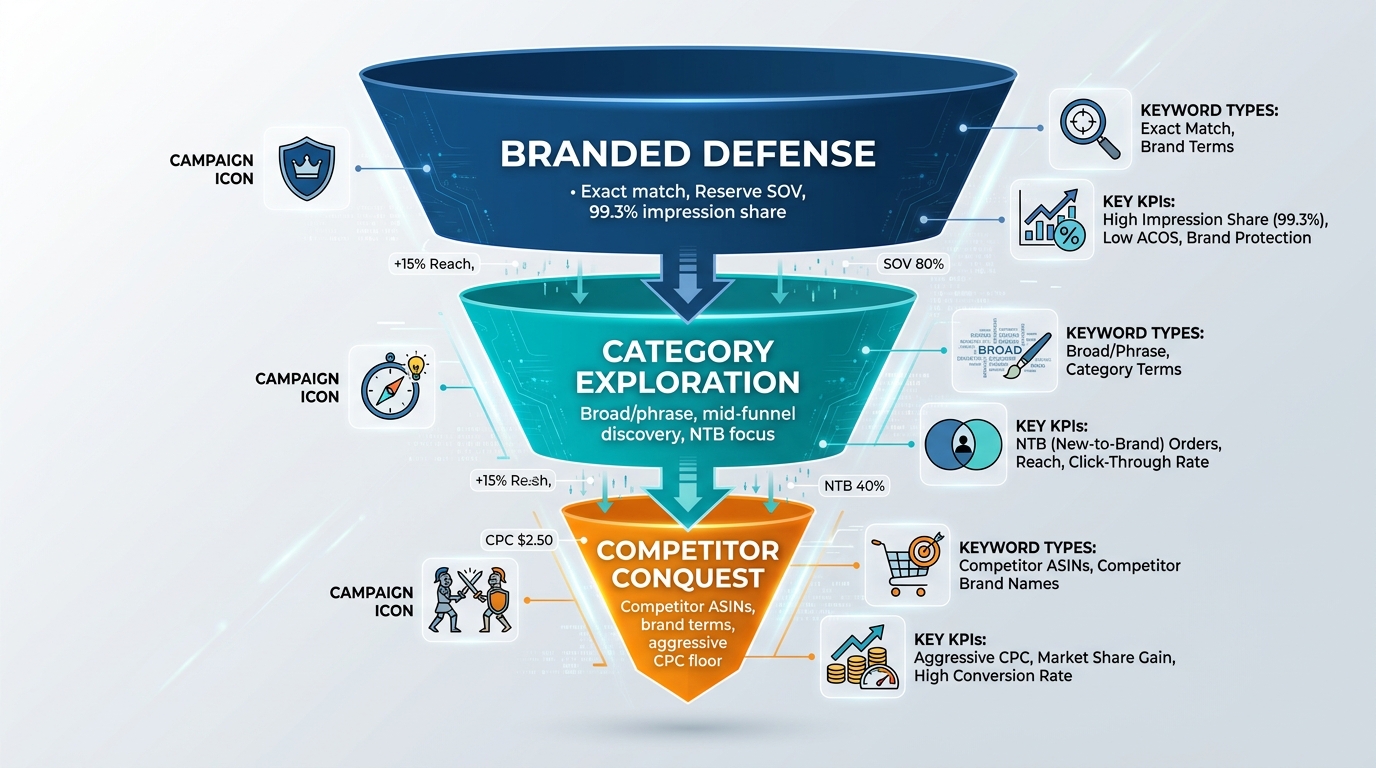
    Three-tier SBV campaign architecture funnel showing branded defense, category exploration, and competitor conquest tiers with KPIs

    The core structural change in a rebuilt SBV-led search funnel is the separation of campaigns by shopper intent rather than by keyword volume or ad format. The principle is straightforward: a shopper searching your brand name has a fundamentally different intent, conversion probability, and response to creative than a shopper searching a category phrase. Running the same SBV campaign against both obscures performance, degrades optimization, and burns budget on the wrong objectives.

    Intent-tiered architecture separates campaigns into three distinct groups, each with its own keyword set, creative asset, success metric, and bidding logic.

    Tier 1: Branded Defense

    Branded defense campaigns target your own brand name and close brand variants in exact match. The objective is owning top-of-search on your own terms — preventing competitor SBV units from occupying the slot a potential buyer sees when they search your name. The success metric here is not ROAS. It’s branded impression share and click-through rate on branded queries. A high ROAS branded campaign that’s showing up 40% of the time is failing at its job, even if the returns look clean.

    The creative brief for branded defense campaigns is different from other tiers. The shopper already knows your brand. They’re searching to find your product, compare your SKU range, or confirm a purchase decision. The video hook should reinforce why they made the right call — product quality, key differentiator, social proof, value proposition — rather than introducing the brand as a discovery moment.

    Tier 2: Category Exploration

    Category exploration campaigns target non-branded category terms — the broad and phrase-match keywords a shopper enters when they’re in the market but haven’t committed to a brand. These searches represent the most valuable new-to-brand opportunity in the funnel. They’re also the highest-volume, most competitive keyword tier, which means CPC efficiency matters more here than in the branded tier.

    The success metric for category exploration shifts to new-to-brand (NTB) percentage, not pure ROAS. SBV typically drives a high NTB rate — agency data suggests NTB rates of around 65–70% on well-structured category SBV campaigns, compared to lower rates on Sponsored Products for the same terms. That NTB premium justifies a higher CPC ceiling than last-click ROAS alone would support.

    Creative for this tier should open with a problem or use-case that maps to the category search intent. If someone searched “best running shoes for plantar fasciitis,” your SBV shouldn’t open with your logo — it should open with a person running comfortably, foot visible, with benefit text on screen: “Engineered for plantar fasciitis relief.” The hook earns the next five seconds of attention by directly answering the search query.

    Tier 3: Competitor Conquest

    Competitor conquest campaigns are the most aggressive tier and require the most surgical execution. These campaigns target competitor brand names, competitor product terms, or competitor ASIN-targeted placements. The objective is intercepting shoppers who’ve already shown intent toward a competitor and presenting a compelling reason to switch consideration.

    The success metric here is NTB rate and click-through rate — not conversion rate. Competitor conquest shoppers have a lower baseline conversion probability than branded or category searchers, because they started with different intent. Expecting ROAS parity with branded campaigns from a conquest SBV is a mistake that leads brands to cut budget from campaigns that are actually working at their proper objective.

    Creative execution for conquest campaigns is the most different of the three tiers. The video must create a credible comparison advantage — not by naming the competitor (Amazon’s advertising policies restrict comparative claims in most formats), but by visually demonstrating the differentiating features that matter to the category’s shoppers. If your main competitor’s key weakness is battery life and yours is genuinely superior, the conquest creative should feature battery performance in the first three seconds.

    The Separation Principle in Practice

    Each of these three tiers should be separate campaigns — not ad groups within one campaign. The reason is bidding control. Amazon’s campaign-level bidding rules and placement multipliers apply at the campaign level. If you mix branded and competitor terms in the same campaign, you cannot set different bidding strategies for each. When you separate them, you can optimize branded campaigns for impression share with more aggressive CPCs, set category campaigns with dynamic bidding targeting new-to-brand conversion, and manage conquest campaigns at controlled CPC floors without those decisions contaminating each other.

    Branded Defense: Reserve Share of Voice and the New Protection Layer

    The most significant structural tool Amazon has introduced for branded SBV strategy in 2026 is Reserve Share of Voice (Reserve SOV). For brand-registered advertisers, this feature allows you to pre-purchase a guaranteed allocation of top-of-search Sponsored Brands placement for specific branded keywords at a fixed price — bypassing the standard auction entirely for those placements.

    What Reserve SOV Actually Delivers

    The beta results Amazon shared when rolling out Reserve SOV are striking. Advertisers using the feature on branded keywords saw top-of-search impression share rise from 62.7% to 99.3%. That’s not an incremental gain — it’s the difference between showing up most of the time and showing up essentially all of the time.

    For branded SBV specifically, this matters because the top-of-search slot on a brand query is where competitor SBV campaigns are trying to intercept your shoppers. Without Reserve SOV, you’re competing in an auction against competitors who may be bidding aggressively on your brand name. With Reserve SOV, that auction is effectively taken off the table for the reserved placement.

    The Fixed Pricing Trade-Off

    Reserve SOV uses fixed upfront pricing rather than auction-based CPCs. This has a real trade-off: in periods where your competitor interest in your branded terms is low, you may pay more than you would in an open auction. The value of Reserve SOV is certainty and protection, not necessarily cost efficiency in every scenario.

    The right framing for Reserve SOV is insurance. You’re paying for the guarantee that your brand controls its own top-of-search appearance, regardless of what competitors are willing to bid at any given moment. For brands in highly competitive categories or categories with heavy competitor conquesting activity, the certainty premium is almost always worth paying. For brands in lightly contested niches where branded CPCs are already stable, the calculus is less clear-cut.

    Layering Reserve SOV with Auction-Based SBV

    Reserve SOV doesn’t replace auction-based SBV on branded terms — it supplements it. Reserve SOV typically covers the top-of-search SB placement. Auction-based SBV campaigns can still capture additional branded placements across the rest of the SERP, including product detail page (PDP) video placements and lower SERP positions. A complete branded defense layer uses both tools in tandem: Reserve SOV locks the top-of-search branded slot, while auction-based SBV campaigns provide additional branded coverage and help maintain bid competitiveness in the auction signals that influence organic relevancy.

    Category Exploration: SBV as Your Mid-Funnel Engine

    The category exploration tier is where most of SBV’s new-to-brand and market share growth potential lives — and it’s also the tier that requires the most creative and strategic investment to execute well. The reason category SBV is harder is that you’re competing for attention among shoppers who haven’t already self-selected toward your brand. You have to earn consideration from scratch in 15–20 seconds.

    Keyword Cluster Architecture for Category SBV

    Category exploration campaigns should be structured around tight keyword clusters, not broad swaths of category terms. A tight cluster means a small group of related keywords with similar search intent and similar conversion profiles. “Best protein powder for women” and “women’s protein powder unflavored” are related but they’re not the same intent. A shopper searching the first phrase is in early consideration; the second suggests they’ve already narrowed their requirements and may be closer to purchase.

    Separate clusters allow you to match creative more precisely to search intent. The broad consideration searcher needs an awareness-building hook that establishes category leadership. The specificity searcher needs a hook that confirms your product meets their specific requirement. Running one generic creative against both clusters wastes the specificity searcher’s attention and fails to capitalize on the purchase intent signal their query carries.

    Practical cluster sizes of three to seven closely related keywords tend to perform better than either single-keyword campaigns (which often lack enough auction volume to gather meaningful data) or large mixed clusters (which create the same intent-blur problem as mixing branded and category terms).

    Targeting the Discovery Moment

    Category SBV works best when it targets shoppers in the decision window — not too early (when they’re just browsing and have no purchase intent) and not so late in the funnel that they’re already deep in product comparison mode. The discovery window is typically captured by category-level search terms that include a use case or benefit qualifier (“joint support supplement for seniors,” “waterproof hiking boot for wide feet”) rather than purely generic category terms (“supplement,” “boot”) or highly specific product-feature terms (“supplement with 1500mg glucosamine”).

    Category terms with use-case qualifiers also tend to have better CPC efficiency than pure generic terms, because they attract less competition from brands that only target highest-volume head terms. This is one of the counterintuitive aspects of SBV category strategy: being slightly more specific in your keyword targeting often delivers better scale at better cost than going after the broadest terms in your category.

    Driving New-to-Brand Efficiently

    The NTB rate for category SBV is meaningfully higher than for Sponsored Products on the same terms, because SBV intercepts the shopper earlier in the visual decision process. When Amazon’s own data shows a shopper is new to a brand across the full attribution window (which AMC captures more accurately than the standard 14-day last-click window), category SBV consistently shows up as a touchpoint in the path to first purchase.

    To measure this accurately, the minimum AMC query you should be running is a path-to-conversion report that captures SBV impressions in the days before a Sponsored Products click and purchase. Even without a complex multi-touch model, seeing how often SBV appears in the lookback window before a conversion event gives you a meaningful view of the format’s assisted contribution that standard reporting completely misses.

    Competitor Conquest Campaigns — Offensive SBV Tactics That Don’t Waste Spend

    Competitor conquest SBV is the highest-risk, highest-potential tier in the funnel. When it works, it introduces your brand to shoppers who have demonstrated purchase intent in your category but arrived at a competitor first. When it doesn’t work, it burns budget on low-conversion traffic against a buyer who’s already committed elsewhere. The difference between the two outcomes is almost entirely in the specificity of execution.

    Targeting Strategy for Conquest

    There are two main targeting approaches for competitor SBV: keyword targeting on competitor brand names and product targeting on competitor ASINs. Each has different characteristics in the current SERP environment.

    Keyword targeting on competitor brand names (exact match to “CompetitorBrandName” or phrase match to “CompetitorBrandName [category term]”) places your SBV in the search results for shoppers who typed the competitor’s name. These shoppers know what they’re looking for, which means your creative needs to make the switching consideration very clear and very fast. A generic brand video won’t cut it here. You need to present a direct, relevant advantage in the first three seconds.

    Product targeting on competitor ASINs places your SBV on the product detail pages of specific competitor products. This is a longer-funnel placement — the shopper is deep in product evaluation on a competitor’s listing — and it tends to work better for higher-consideration purchases where shoppers compare multiple options before deciding. The creative brief for PDP conquest is different from search-results conquest: here, you have a shopper who just read your competitor’s listing, so your video should emphasize the specific dimension where you win the comparison.

    Budget Ceilings and Performance Expectations

    Conquest campaigns require a fundamentally different performance benchmark than branded or category campaigns. Expecting similar ROAS from conquest traffic as from branded traffic is a guaranteed path to cutting the wrong campaigns. A realistic conquest benchmark is a conversion rate 30–50% lower than your branded conversion rate and a ROAS that may be 40–60% lower than branded ROAS — but against a new-to-brand rate that approaches 90–100% (since by definition, competitor shoppers have never purchased your brand).

    Set a separate budget ceiling for conquest that’s justified by the lifetime value of a new-to-brand customer, not by the immediate ROAS of the conquest click. If your average customer lifetime value is three purchases at your product’s average order value, then paying a higher CPA to acquire a first purchase is rational as long as the math closes over the full customer cycle, not just the first 14 days.

    Creative Considerations for Conquest

    Amazon’s advertising policies restrict explicit comparative advertising in most formats, but this doesn’t prevent effective conquest creative. The key is demonstrating superiority through product action rather than stated comparison. Show your product doing what competitors’ products do poorly. Lead with the specific feature, use-case, or outcome that shoppers in your category most frequently cite as their unmet need — the one your competitor consistently fails to address. You don’t need to say “better than Brand X.” The shopper searching Brand X will recognize what you’re showing them.

    The Creative Layer — Rebuilding SBV Assets for the New Placement Reality

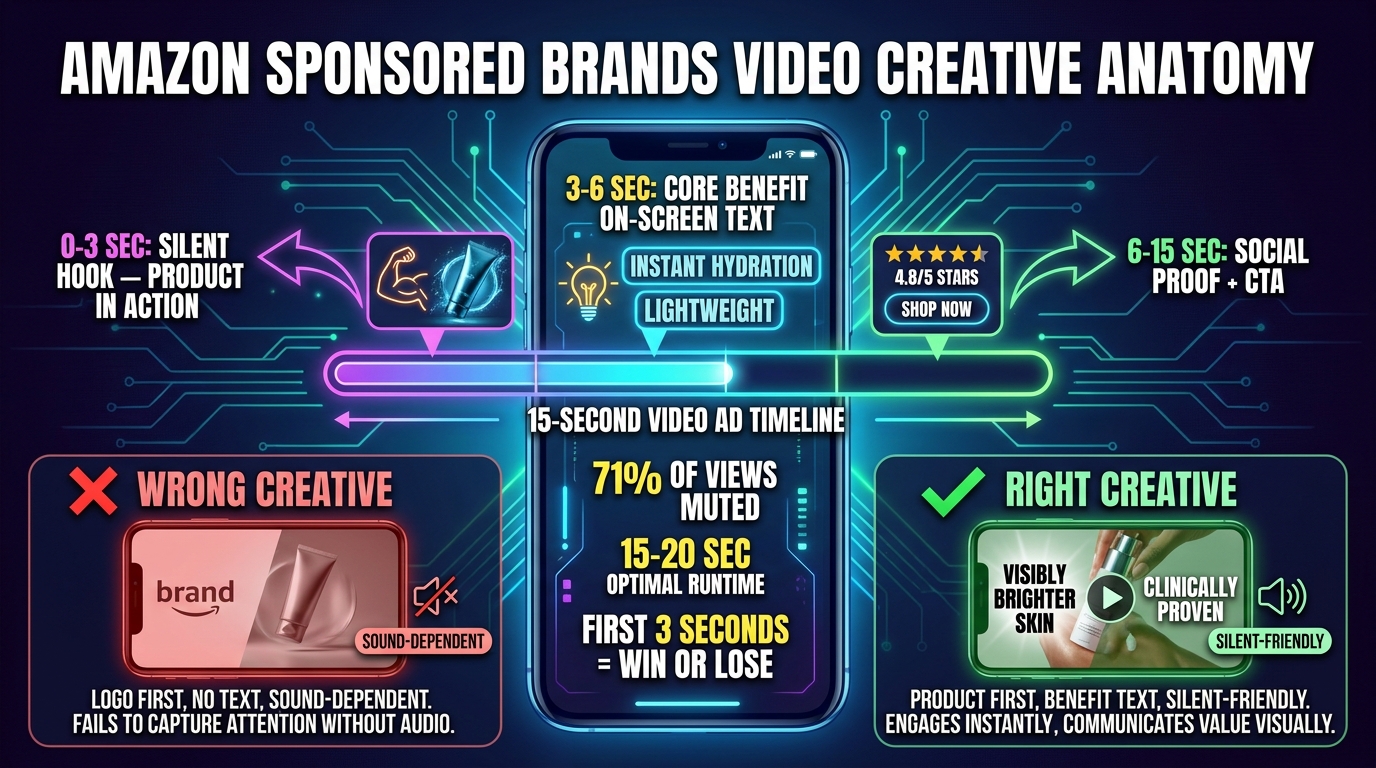
    Amazon SBV video creative anatomy showing the optimal 15-second structure with silent hook, benefit text, and CTA timeline breakdown

    Creative is where the placement shift creates the most immediate operational pressure for brands. It’s not enough to restructure campaign architecture around intent tiers if the creative assets feeding those campaigns were built for a world where SBV was a supplementary mid-page format. The top-of-search placement demands a completely different type of video.

    The Silent-First Imperative

    Agency data from 2026 consistently shows that approximately 71% of Sponsored Brands Video views are muted — up from around 64% in 2024. This trend continues to accelerate as mobile shopping grows and as more shopping happens in contexts where audio is off by default (commutes, office browsing, shared spaces). Any SBV creative that depends on audio to deliver its core message is losing its message with nearly three-quarters of viewers.

    Silent-first design is not just a best practice at this point — it’s a survival requirement. Every element of your SBV’s message that matters must be deliverable through visual elements alone: product visible in action, benefit text on screen, outcome demonstrated visually. Sound should enhance and reinforce rather than carry the communication load.

    The First Three Seconds — Where the Campaign Wins or Loses

    The hook window for SBV is approximately three seconds. This is not a creative guideline — it’s a behavioral data point. Shoppers who don’t have a reason to keep watching within the first three seconds scroll past, and the impression registers as a low-engagement signal. Over time, high skip rates at the three-second mark tell Amazon’s algorithm that this creative unit is not generating meaningful attention, which can affect placement priority in the auction.

    What works in the first three seconds: the product in active use (not a static product shot), a motion element that creates visual curiosity (opening a package, a before/after transition, a product in an aspirational setting), or a benefit text overlay that directly addresses the search query. What doesn’t work: brand logo animation, generic lifestyle footage that doesn’t show the product, or slow-burn scene-setting that asks the viewer to wait for the point.

    Optimal Runtime — The Case for 15–20 Seconds

    Amazon’s own guidelines allow SBV runtimes up to 45 seconds. Performance data suggests that 15–20 seconds is the sweet spot. Videos in this range consistently outperform both shorter (under 10 seconds) and longer (over 30 seconds) runtimes on key engagement metrics. The exception is high-consideration, high-price categories (professional equipment, furniture, complex technology products) where shoppers show more tolerance for longer runtimes if the content is genuinely demonstrative.

    A 15–20 second SBV structure that performs well typically follows this framework: seconds 0–3 for the hook (product in action, visual curiosity or benefit hook), seconds 3–8 for the core value proposition (one clear benefit claim, on-screen text, product demonstration), seconds 8–15 for supporting evidence (second feature, use-case demonstration, social proof signal), and a closing CTA frame (brand name + product name + simple call to action) in the final two to three seconds. This framework is deliberately simple — complexity in a 15-second video almost always loses to clarity.

    One Campaign, One Creative, One Query Cluster

    The most effective SBV creative strategy pairs one creative asset with one tight keyword cluster, not a broad library of generic videos pushed across all campaigns. This sounds more labor-intensive than it is in practice. You don’t need a different production shoot for each creative — you need different edits. A single product shoot day can generate raw material for three or four different 15-second cuts with different hooks, different benefit focuses, and different opening frames, each mapped to a different tier of your intent architecture.

    A branded defense creative cut leads with brand familiarity and quality signals. A category exploration creative cut leads with the use-case problem your product solves. A conquest creative cut leads with the specific differentiator that matters most to shoppers in that competitive context. Same product footage, same production quality, entirely different communication architecture — and each creative performs in its specific context in a way a generic video cannot.

    Bidding Strategy for the New SBV Landscape

    Bid strategy for SBV has grown meaningfully more sophisticated in the current placement environment. The old approach — set a manual CPC, adjust periodically based on ACoS — doesn’t capture the bidding nuance that the new intent-tiered structure requires.

    Branded Tier: Prioritize Impression Share Over Efficiency

    On branded campaigns, the optimization objective is impression share, not ROAS. Branded searches are high-intent, high-conversion moments with low incremental cost to win when you’re the brand being searched. Being aggressive in the branded auction is almost always the right call, because the counterfactual is a competitor’s SBV showing up in your slot. Set branded SBV campaigns to dynamic bids (up and down), with an aggressive top-of-search placement multiplier to ensure your branded SBV wins the top slot as often as possible.

    If your branded CPCs feel high, the answer is rarely to reduce bids on branded terms — it’s usually to add Reserve SOV to guarantee the placement independent of the auction, and to ensure your Quality Score signals (video completion rate, CTR, landing page relevance) are strong enough that Amazon’s algorithm prices you favorably within the branded auction.

    Category Tier: Balance Discovery Scale with CPA Discipline

    Category exploration campaigns require more nuanced bidding. These terms often have higher CPCs than branded terms but lower conversion rates, because the shopper isn’t committed to your brand yet. The right bidding framework here is dynamic bids (down only) with a CPC floor calibrated to your acceptable new-to-brand CPA — not your blended ROAS target, but the specific economics of acquiring a new customer through this channel.

    Segment your category campaigns further by match type to capture different price levels: exact match for the highest-intent, highest-converting category terms (where more aggressive bidding is justified) and broad/phrase match for discovery and scale (where lower CPCs are acceptable because the intent signal is weaker). Running these as separate campaigns rather than ad groups within one campaign gives you cleaner bidding control per segment.

    Conquest Tier: Set Floors and Protect Efficiency

    Conquest campaigns should run with fixed CPCs or dynamic bids (down only) with a conservative ceiling. These campaigns are not the place for aggressive up-bidding — the lower conversion probability of conquest traffic means you can lose a lot of money fast by letting Amazon’s dynamic bidding system push CPCs up on competitor brand terms. Set a CPC ceiling based on what a new-to-brand customer is worth to you, model the expected conversion rate on conquest traffic, and stick to those guardrails.

    Review conquest campaign performance monthly rather than weekly. Conquest results are noisier than branded or category results because the audience is less pre-qualified, which means week-over-week fluctuations will be larger. Optimizing too frequently in response to short-term noise leads to premature cuts of campaigns that are actually working their way through the longer conversion window typical of conquest traffic.

    Measuring What Matters — Attribution, AMC, and the Halo You’re Missing

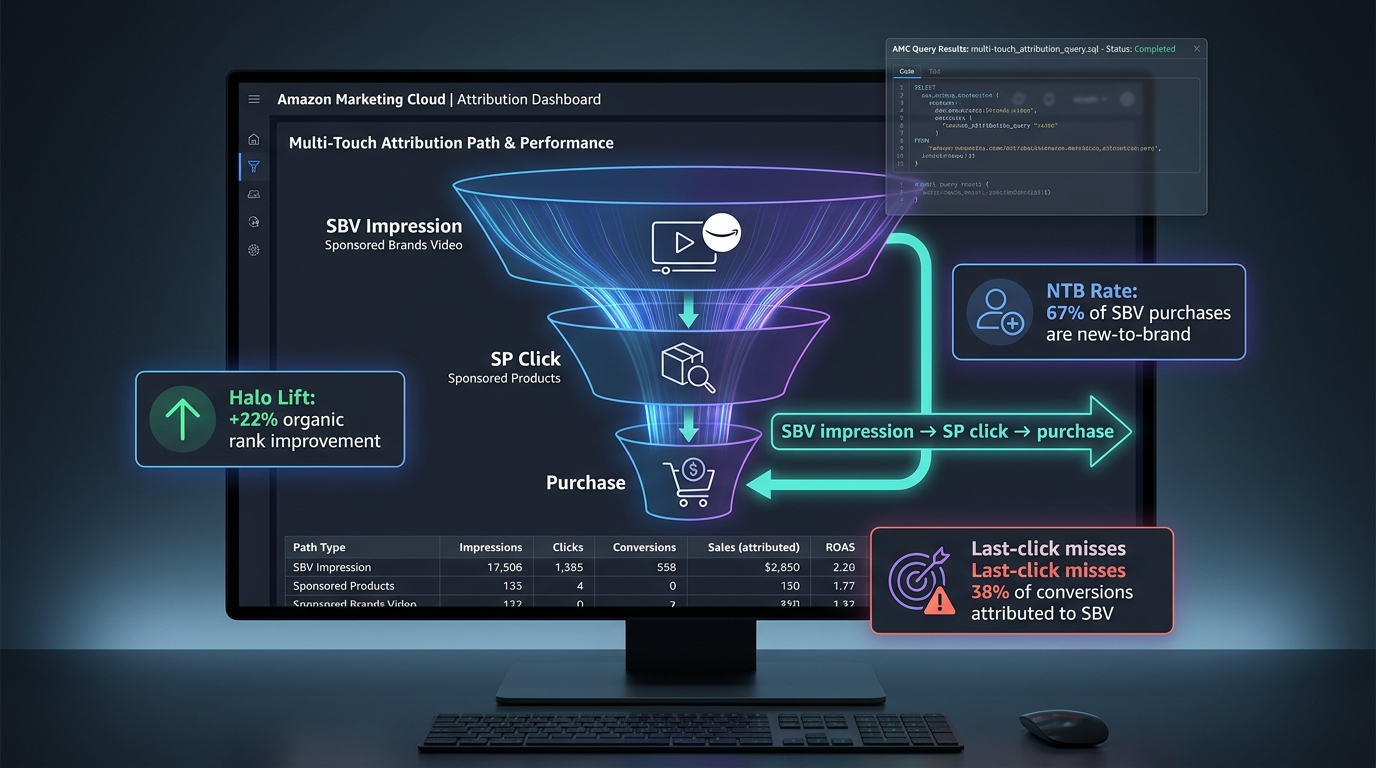
    Amazon Marketing Cloud attribution dashboard showing SBV multi-touch funnel paths with halo lift and new-to-brand rate data

    Attribution is where most SBV strategies fail silently. The standard Amazon campaign reporting dashboard measures last-click attribution within a 14-day window. For Sponsored Products, which typically captures conversion-intent clicks, that model is adequate. For SBV — which operates earlier in the decision journey, often driving awareness and consideration that converts through a different path later — last-click systematically undercounts the format’s contribution.

    The Last-Click Problem

    Consider a realistic shopper journey: a shopper searches a category term, sees your SBV, watches four seconds, and scrolls on. Three days later, they search your brand name, click a Sponsored Products ad, and purchase. In standard campaign reporting, the Sponsored Products campaign gets 100% credit for the conversion. The SBV campaign shows an impression but no attributed sale.

    Under last-click accounting, the rational conclusion is that the SBV campaign is generating spend with no return. The decision to cut or reduce SBV budget follows logically — and is completely wrong. The SBV impression created the brand awareness that made the branded search happen three days later. Cutting it removes the awareness engine that powers the branded conversion, but standard reporting makes that invisible.

    Agency data suggests that last-click attribution can miss 35–40% of conversions that have an SBV touchpoint in the pre-conversion window. That’s not a rounding error — it’s a material misallocation signal that consistently directs budget away from the format that’s driving upper-funnel activity toward the format that captures the final click.

    Amazon Marketing Cloud as the Measurement Fix

    Amazon Marketing Cloud (AMC) provides the multi-touch view that standard reporting lacks. AMC is a clean-room analytics environment that lets you run SQL queries across your full advertising data set, including impression data across formats, paths-to-conversion with all touchpoints, time-lag analysis between ad exposures and purchases, and new-to-brand customer identification across the full attribution window.

    The minimum AMC setup for SBV measurement should include three query types. First, a path-to-conversion report showing the frequency with which SBV impressions appear in the 7–30 day window before a Sponsored Products click and purchase. Second, a new-to-brand analysis showing what percentage of SBV-exposed purchasers are first-time brand buyers. Third, a time-lag analysis showing the average number of days between first SBV impression and eventual purchase — which helps you set appropriate attribution windows and conversion rate expectations per tier.

    Organic Rank Halo Effects

    The most discussed and least measured SBV impact is the halo effect on organic search ranking. Amazon’s organic ranking algorithm incorporates click-velocity and purchase-velocity signals from paid campaigns, though Amazon doesn’t publicly document the mechanics. The practitioner consensus, backed by AMC-based pre/post analyses, is that sustained SBV presence on category terms generates measurable organic rank improvement over 30–60 day windows.

    The mechanism is straightforward in principle: SBV drives incremental page visits and product detail page views. Those page views feed the click-velocity signals Amazon’s algorithm uses to determine organic relevance. More relevant organic positions drive more organic traffic, creating a compounding return from SBV investment that standard paid-only attribution never captures.

    Measuring organic halo requires pre/post design: establish organic rank baselines for target keywords before launching or expanding SBV on those terms, then track rank changes at 30-day intervals against a control group of keywords where SBV presence wasn’t changed. The comparison gives you a directional view of SBV’s organic contribution — and, more practically, a way to justify SBV budget increases to stakeholders who only see last-click ROAS in their dashboards.

    Rebuilding Your Search Funnel in 90 Days — A Phased Action Plan

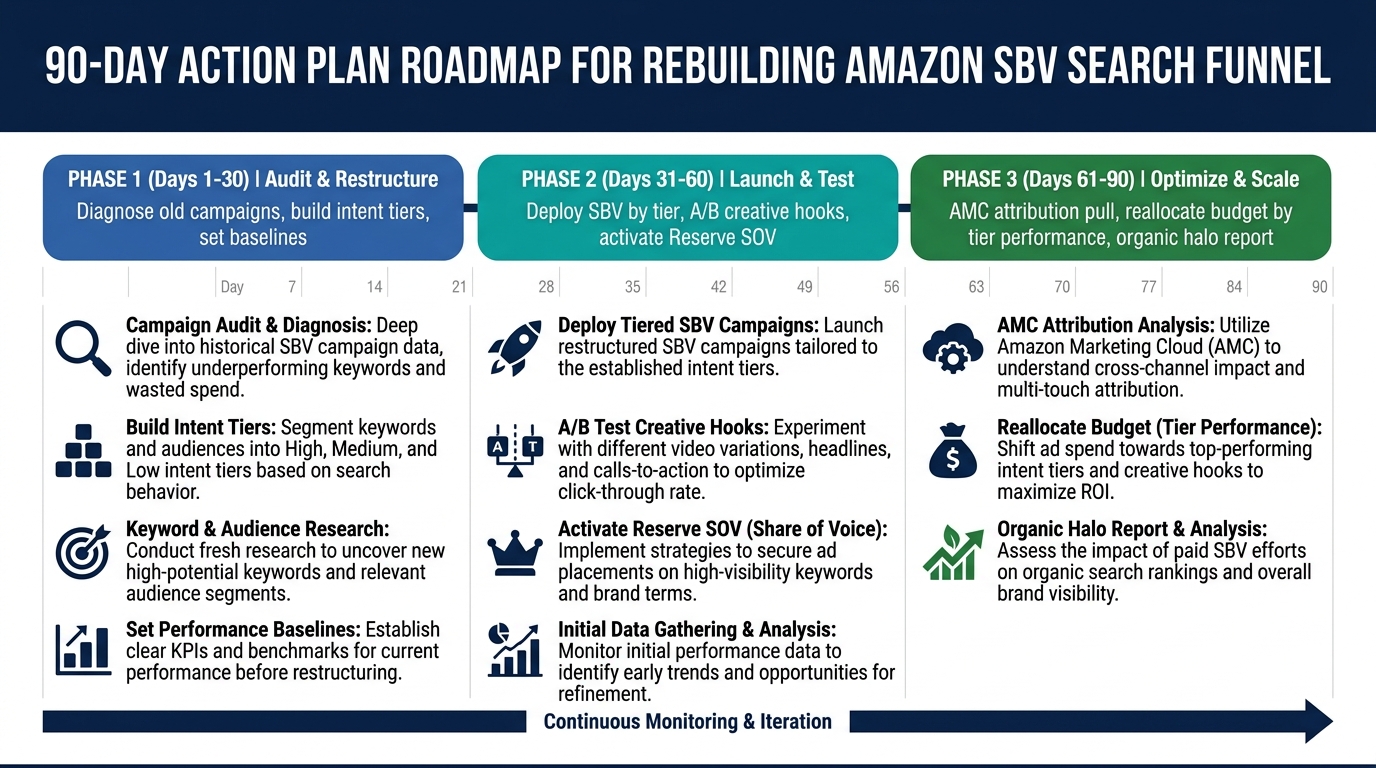
    90-day phased action plan roadmap for rebuilding Amazon SBV search funnel with three phases: audit, launch, and optimize

    The full rebuild of an SBV-led search funnel doesn’t need to happen overnight, and attempting to do it all at once typically leads to messy data and uncontrolled spend. A 90-day phased approach lets you build the structure correctly, gather clean data at each stage, and make budget decisions based on actual performance rather than projections.

    Phase 1 — Days 1–30: Audit, Restructure, and Baseline

    Week 1–2: Pull your current state data. Export the last 90 days of Sponsored Brands performance, broken down by campaign and ad group. Identify all current SBV campaigns and map which keyword types they’re targeting (branded, category, competitor). Calculate SBV as a percentage of total SB spend. Pull your branded impression share data and note any gaps. This is your baseline — the “before” that will make the rebuild’s results legible.

    Week 3–4: Build the new campaign architecture. Create separate campaigns for each intent tier (branded defense, category exploration, competitor conquest). Migrate keywords from your old campaigns into the correct new campaign homes. Do not launch these campaigns yet — set them to paused status and complete the creative audit first. Also, begin the AMC access setup if you don’t already have it, because you’ll need data flowing from launch day forward.

    During this phase, also identify whether Reserve SOV is available and appropriate for your branded keywords. If your branded CPCs have been elevated and you’re in a category with active competitor conquesting, this is the window to evaluate whether the fixed-cost Reserve SOV makes economic sense compared to the auction-based branded bidding you’re currently running.

    Phase 2 — Days 31–60: Launch, Test, and Calibrate

    Week 5–6: Launch the intent-tiered campaigns. Activate branded defense, category exploration, and competitor conquest campaigns in sequence rather than simultaneously. Start with branded defense (lowest risk, most straightforward to measure), then category exploration, then conquest. Launching in sequence gives you cleaner early data per tier and lets you course-correct on creative or bidding before adding more complexity.

    Creative A/B testing. For each tier, run two creative variants with different hooks in the first three seconds. The goal is not polished production — it’s rapid learning about which opening frame drives higher completion rates and CTR within each keyword cluster. Keep everything else constant (length, structure, CTA) and vary only the first-three-second hook. This tells you what the audience in each intent tier actually responds to, which is often different from what brand teams expect.

    Week 7–8: Bidding calibration. After two weeks of live data, review impression share, CTR, and conversion data by tier. On branded defense, check whether impression share is hitting target levels — if not, bid up. On category exploration, review CPA against your NTB benchmark and adjust bids if CPA is significantly above or below target. On conquest, check that CPCs are staying within your ceiling and that CTR is generating qualified traffic rather than just impressions.

    Phase 3 — Days 61–90: Optimize, Scale, and Measure Full-Funnel Impact

    AMC attribution pull. By day 60, you have enough data to run meaningful AMC path-to-conversion queries. Pull the multi-touch report for SBV-assisted conversions and compare the total attributed sales figure to your last-click campaign report. The delta is the “invisible” SBV contribution that your current reporting is missing — and it’s often large enough to justify a significant budget shift toward SBV.

    Creative winner rollout. Identify the winning hook variant from your Phase 2 A/B test and apply it across all campaigns in that tier. Begin shooting or editing any new creative variations needed to improve performance in underperforming tiers. The iteration cycle on SBV creative should run every 60–90 days, not every six months — video creative fatigue is real, and fresh hooks sustain completion rates that start to decline as audiences accumulate impressions on the same video.

    Organic rank tracking review. Compare organic rank positions for your SBV-targeted category keywords at day 90 against your pre-launch baselines. Look for rank improvements on terms where SBV was newly launched or significantly scaled. Document the correlation between SBV investment and organic rank movement — this is the evidence base you need to make the internal case for continued or expanded SBV investment to stakeholders who are primarily focused on last-click paid metrics.

    Budget reallocation based on full-funnel data. Use the combined picture — last-click campaign ROAS, AMC-attributed assists, NTB acquisition rates, and organic rank halo — to make a defensible reallocation of your total sponsored ads budget toward or away from each tier. Brands that complete this 90-day process typically find they’ve been underinvesting in category exploration SBV and overinvesting in static SB headline formats that are now getting displaced from top-of-search anyway.

    The Competitive Risk of Waiting

    The SBV placement shift is not a coming disruption — it’s already structurally in place. The brands that restructured their search funnels around SBV twelve to eighteen months ago already hold the advantage: they’ve established quality score signals from sustained video engagement, trained Amazon’s algorithm on their brand relevancy in the video format, and accumulated the historical performance data that gives them preferential positioning in the SBV auction.

    The cost of delay is not just higher CPCs. It’s the compounding disadvantage of entering the SBV auction later, when CPCs have already risen in response to growing advertiser competition, when the creative quality bar for the format has risen to meet higher advertiser investment, and when competitors have already captured the organic rank halo benefits that early SBV investment generates.

    There is still time to rebuild. The brands that complete the intent-tiered rebuild in the next 60–90 days will find the category exploration tier is not yet fully saturated in most niches, and the branded defense tier can be shored up quickly with the right combination of SBV and Reserve SOV. But the window where this rebuild is straightforward and relatively inexpensive is narrowing as more accounts complete their own transitions.

    Key Takeaways

    • SBV is now the dominant SB format, representing approximately 58% of Sponsored Brands spend in leading agency portfolios in Q1 2026. Accounts that treat it as supplementary are already behind.
    • Intent-tiered campaign architecture — separating branded defense, category exploration, and competitor conquest into distinct campaigns — is the structural foundation of a modern SBV search funnel.
    • Reserve Share of Voice raised branded impression share from 62.7% to 99.3% in Amazon’s beta. It’s the most effective branded defense tool available for protecting top-of-search on your own brand terms.
    • 71% of SBV views are muted. Silent-first creative design — with product in action and benefit text on screen in the first three seconds — is no longer optional.
    • 15–20 seconds is the optimal SBV runtime. Structure: hook (0–3s), core benefit (3–8s), supporting proof (8–15s), CTA (final 2–3s).
    • Last-click attribution misses 35–40% of SBV-assisted conversions. Amazon Marketing Cloud path-to-conversion queries are the minimum measurement standard for understanding what SBV is actually delivering.
    • The 90-day rebuild phasing — audit and restructure, launch and test, optimize and scale — gives you clean data at each stage and prevents the messy overlap that comes from trying to change everything at once.
    • The cost of waiting is compounding. Early movers in SBV already hold quality score advantages, organic rank halo benefits, and auction positioning that will be progressively more expensive to close.