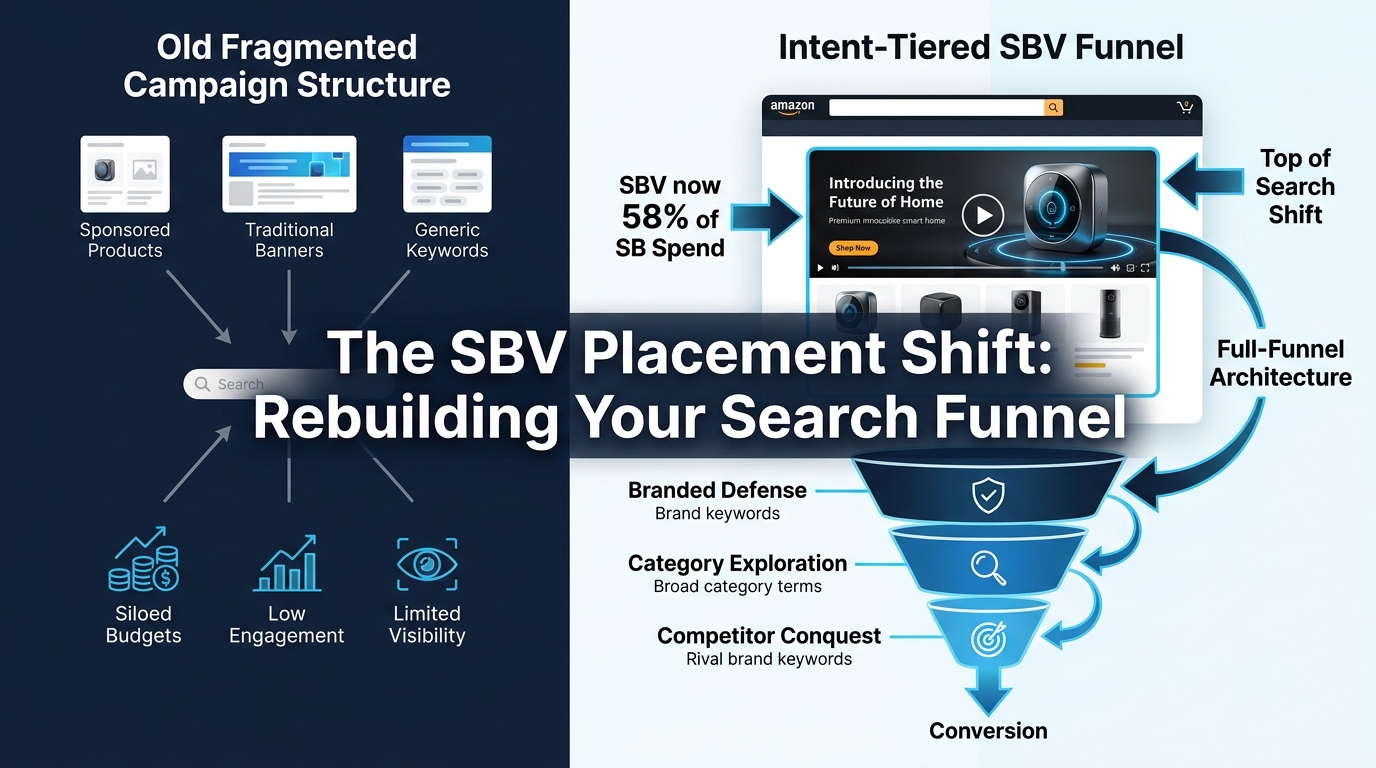
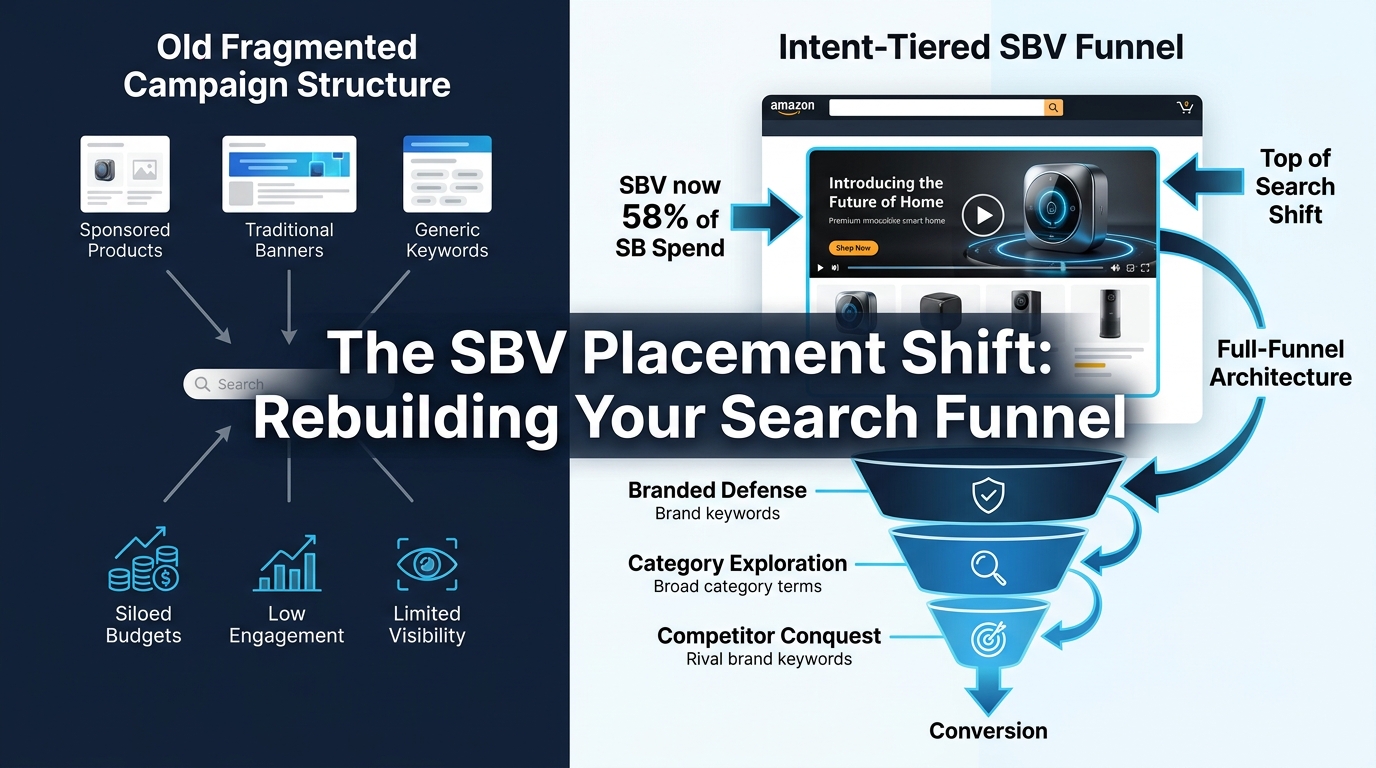
For years, Sponsored Brands Video lived on the margins of most Amazon advertisers’ campaign hierarchies. It was the format you tacked onto a mature account once everything else was humming — a creative flex, a brand-awareness experiment, or a way to use up a budget surplus before quarter-end. Sophisticated? Sure. Essential? Most teams quietly said no.
That calculation is now wrong. And the brands that haven’t updated it are bleeding impression share, paying inflated CPCs on their own branded terms, and watching competitors leapfrog them at the top of search using exactly the format they deprioritized.
Amazon’s Sponsored Brands Video has undergone a structural placement shift that fundamentally changes how the search results page (SERP) is organized, how shoppers encounter brands at the moment of intent, and what a healthy Amazon search funnel actually looks like in 2026. This isn’t an incremental update to SBV’s auction mechanics. It’s a wholesale change in how Amazon weights video in its ad stack — and by extension, how every other ad type on your roster performs.
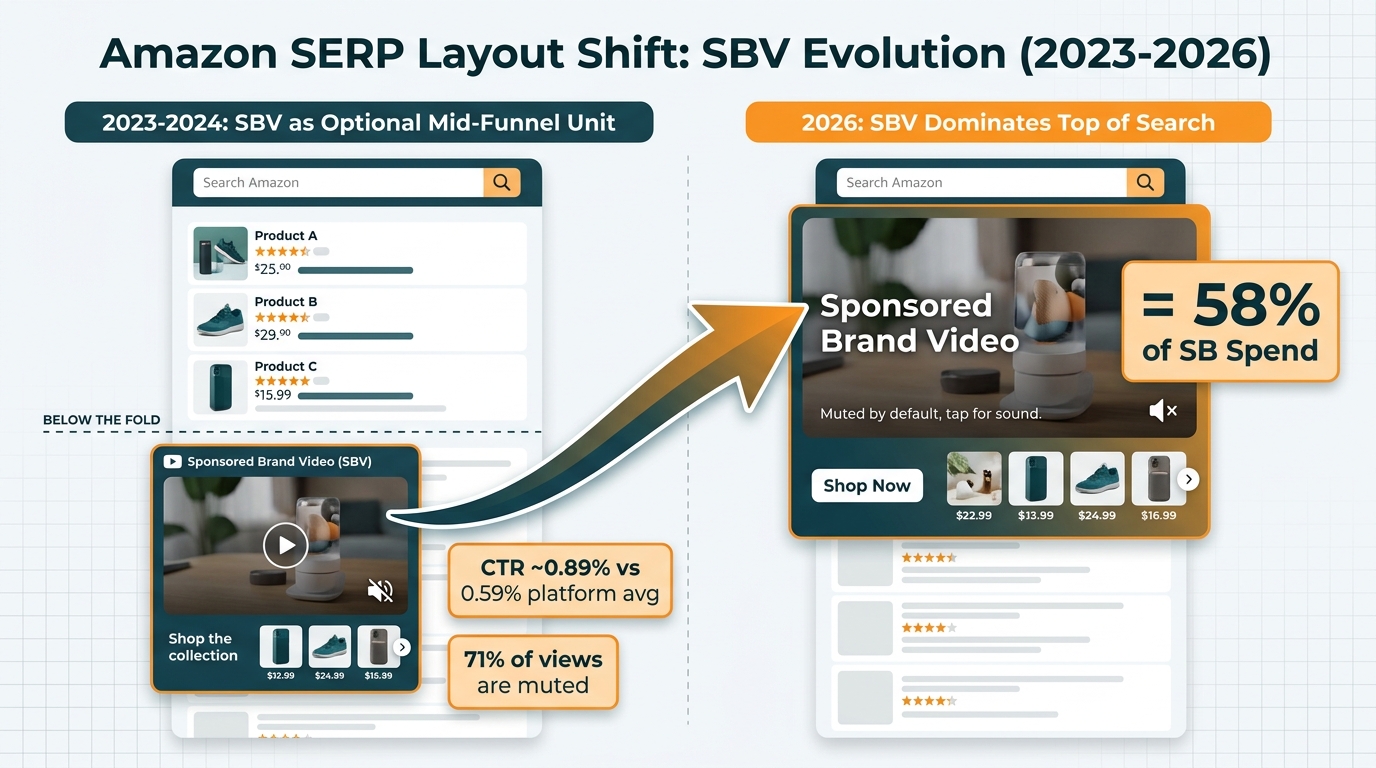
By Q1 2026, SBV represented approximately 58% of Sponsored Brands spend in large agency portfolios. That number tells you something important: the market has already voted. The question is whether your account structure has caught up with what the market already knows.
This article breaks down exactly what changed with SBV placements, why the old search funnel architecture no longer works, and how to rebuild your campaigns from the ground up using an intent-tiered structure built for the way Amazon’s SERP actually looks today.
What Actually Changed — The SBV Placement Shift Explained
Before you can rebuild your search funnel, you need an accurate picture of the shift itself. It’s tempting to characterize this as a gradual, incremental evolution — but the data points suggest something more abrupt happened between late 2024 and early 2026 that has materially changed SERP architecture.
From Inline Unit to SERP Anchor
Historically, Sponsored Brands Video functioned as an inline search result unit. It appeared mid-page, typically below the first row of organic results and a couple of Sponsored Products. It was attention-catching when it played, but it wasn’t positioned as a primary discovery vehicle. Its reach was real but its strategic weight in most campaign structures was treated as secondary.
What changed is placement priority. Amazon has progressively moved SBV into the top-of-search position — the most valuable real estate on the SERP — in many categories. The video unit now frequently appears above the organic results grid, above static Sponsored Brands headline ads, and above the fold on mobile. This isn’t consistent across every category or query type, but it’s now the dominant pattern in high-competition verticals.
The practical consequence: if a competitor is running a well-structured SBV campaign targeting your category keywords and you aren’t, they’re occupying the space that shapes shopper perception before any other result is visible. The ad that plays first doesn’t just win the click — it anchors what the shopper’s baseline comparison looks like for everything they see next.
The CPM and CPC Ripple Effect
Placement elevation has a direct effect on auction economics. As SBV competes more aggressively for top-of-search slots, CPCs and CPMs across the Sponsored Brands format have risen in high-volume categories. Advertisers who had calibrated their SB bidding strategy based on historical benchmark data are finding their models no longer predict actual spend or impression share accurately.
More importantly, static Sponsored Brands headline ads — the format most teams built their brand-awareness layer around — are getting displaced. When a video unit occupies the top slot, the static headline format either gets pushed down or doesn’t show at all. If your branded defense strategy relies primarily on static SB, you may not be showing up at all on branded searches that your competitors are actively targeting with SBV.
Mobile as the Core Context
The placement shift matters disproportionately on mobile. The majority of Amazon shopping now happens on mobile devices, and on smaller screens the top-of-search SBV placement dominates the visible viewport before any scroll. A 15-second autoplay video at the top of a mobile search result is not competing with other ads — it’s the entire screen.
This mobile-first reality changes how SBV should be briefed, produced, and optimized. But it also changes how much creative lift the format can deliver when it’s well-executed versus how much damage a poor creative execution can do to perception at the top of your category search.
Amazon’s Algorithmic Weighting
The placement shift isn’t just a layout decision. It reflects how Amazon’s A10 algorithm is incorporating engagement signals from video. Click-through rates on SBV units that auto-play with product-in-action hooks tend to run higher than the platform-wide average CTR of approximately 0.59%. SBV benchmarks from agency data suggest CTRs in the 0.7–1.2% range, with well-optimized creatives hitting closer to 0.89%. That engagement differential feeds relevancy signals that affect how Amazon scores and ranks your campaigns overall — not just your SBV line items.
Why Your Old Search Funnel Is Broken — and How to Diagnose It
Most Amazon advertisers built their original search funnel structure around Sponsored Products as the conversion engine, with Sponsored Brands as a brand-halo layer sitting loosely on top. SBV, if it existed at all in the account, was typically a single campaign running a mix of branded and category terms without clear segmentation. Budgets were set relatively flat across all three ad types, and optimization happened primarily within Sponsored Products where return on ad spend (ROAS) attribution was clearest.
That architecture was functional in a world where SBV was peripheral. It breaks down the moment SBV becomes the dominant SB format and the primary shaper of top-of-search real estate.
The Five Symptoms of a Broken Search Funnel
Rising branded CPCs with no corresponding impression share gains. If your brand-term CPCs have climbed 20–40% over the past year while your branded impression share has stayed flat or declined, competitors are likely running SBV campaigns against your brand terms and outbidding your static SB in the auction for top-of-search placement.
Declining organic rank on core category terms despite stable sales velocity. SBV plays a documented role in driving click-velocity signals that can influence organic rank. If your organic positions are eroding on category terms while your Sponsored Products campaigns are stable, check whether your SBV presence on those terms is weaker than competitors’.
Branded and non-branded terms mixed into the same SBV campaign. This is the most common structural mistake. When you mix branded, category, and competitor terms into one SBV campaign, Amazon’s bidding algorithm optimizes toward aggregate performance — which typically means over-investing in whatever term type drives the easiest conversions (usually branded) and under-investing in the terms that actually grow market share.
Single SBV creative running across all keyword clusters. A brand logo video optimized for mid-funnel brand awareness performs differently against a high-intent buyer searching an exact category keyword versus a discovery searcher entering a broad category phrase. One creative cannot serve both contexts well. Running it undifferentiated across them means poor performance everywhere.
No baseline for measuring SBV’s contribution beyond last-click attribution. Standard Amazon campaign reports show last-click attribution for SBV, which systematically undercounts the format’s role in assisted conversions. If you have no Amazon Marketing Cloud (AMC) queries running to capture multi-touch paths, you almost certainly have an inaccurate picture of what SBV is actually generating — and you’re making budget decisions based on flawed data.
Running a Quick Structural Audit
Before rebuilding, pull the last 90 days of data across your Sponsored Brands campaigns and answer these four questions: What percentage of your SB spend is in video format versus static? Are branded, category, and competitor terms separated across different campaigns or mixed together? Do you have distinct creative assets mapped to different intent levels? And are you running any AMC queries to capture SBV-assisted conversion paths? If the answers are “less than 40%,” “mixed,” “no,” and “no,” your funnel needs a full rebuild, not a tweak.
Intent-Tiered Campaign Architecture — The New Structural Foundation
The core structural change in a rebuilt SBV-led search funnel is the separation of campaigns by shopper intent rather than by keyword volume or ad format. The principle is straightforward: a shopper searching your brand name has a fundamentally different intent, conversion probability, and response to creative than a shopper searching a category phrase. Running the same SBV campaign against both obscures performance, degrades optimization, and burns budget on the wrong objectives.
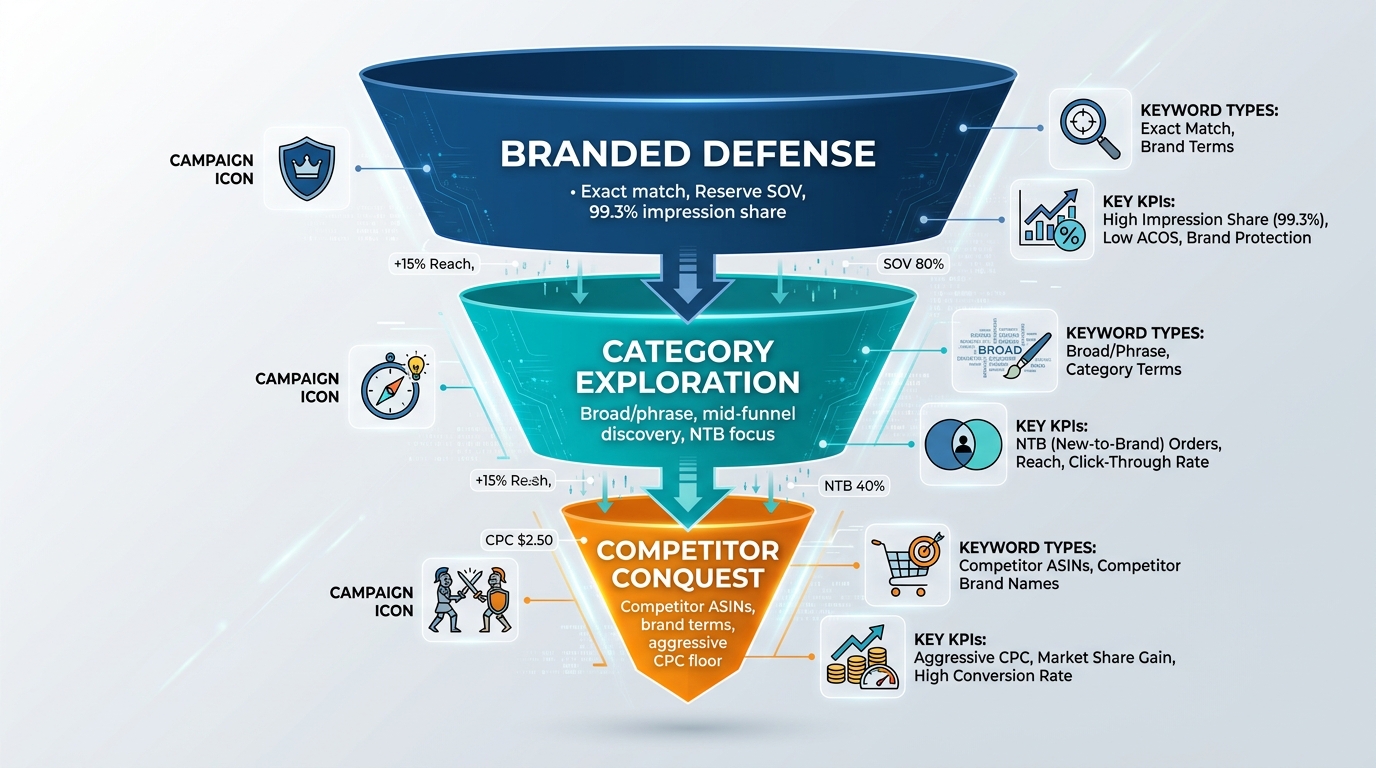
Intent-tiered architecture separates campaigns into three distinct groups, each with its own keyword set, creative asset, success metric, and bidding logic.
Tier 1: Branded Defense
Branded defense campaigns target your own brand name and close brand variants in exact match. The objective is owning top-of-search on your own terms — preventing competitor SBV units from occupying the slot a potential buyer sees when they search your name. The success metric here is not ROAS. It’s branded impression share and click-through rate on branded queries. A high ROAS branded campaign that’s showing up 40% of the time is failing at its job, even if the returns look clean.
The creative brief for branded defense campaigns is different from other tiers. The shopper already knows your brand. They’re searching to find your product, compare your SKU range, or confirm a purchase decision. The video hook should reinforce why they made the right call — product quality, key differentiator, social proof, value proposition — rather than introducing the brand as a discovery moment.
Tier 2: Category Exploration
Category exploration campaigns target non-branded category terms — the broad and phrase-match keywords a shopper enters when they’re in the market but haven’t committed to a brand. These searches represent the most valuable new-to-brand opportunity in the funnel. They’re also the highest-volume, most competitive keyword tier, which means CPC efficiency matters more here than in the branded tier.
The success metric for category exploration shifts to new-to-brand (NTB) percentage, not pure ROAS. SBV typically drives a high NTB rate — agency data suggests NTB rates of around 65–70% on well-structured category SBV campaigns, compared to lower rates on Sponsored Products for the same terms. That NTB premium justifies a higher CPC ceiling than last-click ROAS alone would support.
Creative for this tier should open with a problem or use-case that maps to the category search intent. If someone searched “best running shoes for plantar fasciitis,” your SBV shouldn’t open with your logo — it should open with a person running comfortably, foot visible, with benefit text on screen: “Engineered for plantar fasciitis relief.” The hook earns the next five seconds of attention by directly answering the search query.
Tier 3: Competitor Conquest
Competitor conquest campaigns are the most aggressive tier and require the most surgical execution. These campaigns target competitor brand names, competitor product terms, or competitor ASIN-targeted placements. The objective is intercepting shoppers who’ve already shown intent toward a competitor and presenting a compelling reason to switch consideration.
The success metric here is NTB rate and click-through rate — not conversion rate. Competitor conquest shoppers have a lower baseline conversion probability than branded or category searchers, because they started with different intent. Expecting ROAS parity with branded campaigns from a conquest SBV is a mistake that leads brands to cut budget from campaigns that are actually working at their proper objective.
Creative execution for conquest campaigns is the most different of the three tiers. The video must create a credible comparison advantage — not by naming the competitor (Amazon’s advertising policies restrict comparative claims in most formats), but by visually demonstrating the differentiating features that matter to the category’s shoppers. If your main competitor’s key weakness is battery life and yours is genuinely superior, the conquest creative should feature battery performance in the first three seconds.
The Separation Principle in Practice
Each of these three tiers should be separate campaigns — not ad groups within one campaign. The reason is bidding control. Amazon’s campaign-level bidding rules and placement multipliers apply at the campaign level. If you mix branded and competitor terms in the same campaign, you cannot set different bidding strategies for each. When you separate them, you can optimize branded campaigns for impression share with more aggressive CPCs, set category campaigns with dynamic bidding targeting new-to-brand conversion, and manage conquest campaigns at controlled CPC floors without those decisions contaminating each other.
Branded Defense: Reserve Share of Voice and the New Protection Layer
The most significant structural tool Amazon has introduced for branded SBV strategy in 2026 is Reserve Share of Voice (Reserve SOV). For brand-registered advertisers, this feature allows you to pre-purchase a guaranteed allocation of top-of-search Sponsored Brands placement for specific branded keywords at a fixed price — bypassing the standard auction entirely for those placements.
What Reserve SOV Actually Delivers
The beta results Amazon shared when rolling out Reserve SOV are striking. Advertisers using the feature on branded keywords saw top-of-search impression share rise from 62.7% to 99.3%. That’s not an incremental gain — it’s the difference between showing up most of the time and showing up essentially all of the time.
For branded SBV specifically, this matters because the top-of-search slot on a brand query is where competitor SBV campaigns are trying to intercept your shoppers. Without Reserve SOV, you’re competing in an auction against competitors who may be bidding aggressively on your brand name. With Reserve SOV, that auction is effectively taken off the table for the reserved placement.
The Fixed Pricing Trade-Off
Reserve SOV uses fixed upfront pricing rather than auction-based CPCs. This has a real trade-off: in periods where your competitor interest in your branded terms is low, you may pay more than you would in an open auction. The value of Reserve SOV is certainty and protection, not necessarily cost efficiency in every scenario.
The right framing for Reserve SOV is insurance. You’re paying for the guarantee that your brand controls its own top-of-search appearance, regardless of what competitors are willing to bid at any given moment. For brands in highly competitive categories or categories with heavy competitor conquesting activity, the certainty premium is almost always worth paying. For brands in lightly contested niches where branded CPCs are already stable, the calculus is less clear-cut.
Layering Reserve SOV with Auction-Based SBV
Reserve SOV doesn’t replace auction-based SBV on branded terms — it supplements it. Reserve SOV typically covers the top-of-search SB placement. Auction-based SBV campaigns can still capture additional branded placements across the rest of the SERP, including product detail page (PDP) video placements and lower SERP positions. A complete branded defense layer uses both tools in tandem: Reserve SOV locks the top-of-search branded slot, while auction-based SBV campaigns provide additional branded coverage and help maintain bid competitiveness in the auction signals that influence organic relevancy.
Category Exploration: SBV as Your Mid-Funnel Engine
The category exploration tier is where most of SBV’s new-to-brand and market share growth potential lives — and it’s also the tier that requires the most creative and strategic investment to execute well. The reason category SBV is harder is that you’re competing for attention among shoppers who haven’t already self-selected toward your brand. You have to earn consideration from scratch in 15–20 seconds.
Keyword Cluster Architecture for Category SBV
Category exploration campaigns should be structured around tight keyword clusters, not broad swaths of category terms. A tight cluster means a small group of related keywords with similar search intent and similar conversion profiles. “Best protein powder for women” and “women’s protein powder unflavored” are related but they’re not the same intent. A shopper searching the first phrase is in early consideration; the second suggests they’ve already narrowed their requirements and may be closer to purchase.
Separate clusters allow you to match creative more precisely to search intent. The broad consideration searcher needs an awareness-building hook that establishes category leadership. The specificity searcher needs a hook that confirms your product meets their specific requirement. Running one generic creative against both clusters wastes the specificity searcher’s attention and fails to capitalize on the purchase intent signal their query carries.
Practical cluster sizes of three to seven closely related keywords tend to perform better than either single-keyword campaigns (which often lack enough auction volume to gather meaningful data) or large mixed clusters (which create the same intent-blur problem as mixing branded and category terms).
Targeting the Discovery Moment
Category SBV works best when it targets shoppers in the decision window — not too early (when they’re just browsing and have no purchase intent) and not so late in the funnel that they’re already deep in product comparison mode. The discovery window is typically captured by category-level search terms that include a use case or benefit qualifier (“joint support supplement for seniors,” “waterproof hiking boot for wide feet”) rather than purely generic category terms (“supplement,” “boot”) or highly specific product-feature terms (“supplement with 1500mg glucosamine”).
Category terms with use-case qualifiers also tend to have better CPC efficiency than pure generic terms, because they attract less competition from brands that only target highest-volume head terms. This is one of the counterintuitive aspects of SBV category strategy: being slightly more specific in your keyword targeting often delivers better scale at better cost than going after the broadest terms in your category.
Driving New-to-Brand Efficiently
The NTB rate for category SBV is meaningfully higher than for Sponsored Products on the same terms, because SBV intercepts the shopper earlier in the visual decision process. When Amazon’s own data shows a shopper is new to a brand across the full attribution window (which AMC captures more accurately than the standard 14-day last-click window), category SBV consistently shows up as a touchpoint in the path to first purchase.
To measure this accurately, the minimum AMC query you should be running is a path-to-conversion report that captures SBV impressions in the days before a Sponsored Products click and purchase. Even without a complex multi-touch model, seeing how often SBV appears in the lookback window before a conversion event gives you a meaningful view of the format’s assisted contribution that standard reporting completely misses.
Competitor Conquest Campaigns — Offensive SBV Tactics That Don’t Waste Spend
Competitor conquest SBV is the highest-risk, highest-potential tier in the funnel. When it works, it introduces your brand to shoppers who have demonstrated purchase intent in your category but arrived at a competitor first. When it doesn’t work, it burns budget on low-conversion traffic against a buyer who’s already committed elsewhere. The difference between the two outcomes is almost entirely in the specificity of execution.
Targeting Strategy for Conquest
There are two main targeting approaches for competitor SBV: keyword targeting on competitor brand names and product targeting on competitor ASINs. Each has different characteristics in the current SERP environment.
Keyword targeting on competitor brand names (exact match to “CompetitorBrandName” or phrase match to “CompetitorBrandName [category term]”) places your SBV in the search results for shoppers who typed the competitor’s name. These shoppers know what they’re looking for, which means your creative needs to make the switching consideration very clear and very fast. A generic brand video won’t cut it here. You need to present a direct, relevant advantage in the first three seconds.
Product targeting on competitor ASINs places your SBV on the product detail pages of specific competitor products. This is a longer-funnel placement — the shopper is deep in product evaluation on a competitor’s listing — and it tends to work better for higher-consideration purchases where shoppers compare multiple options before deciding. The creative brief for PDP conquest is different from search-results conquest: here, you have a shopper who just read your competitor’s listing, so your video should emphasize the specific dimension where you win the comparison.
Budget Ceilings and Performance Expectations
Conquest campaigns require a fundamentally different performance benchmark than branded or category campaigns. Expecting similar ROAS from conquest traffic as from branded traffic is a guaranteed path to cutting the wrong campaigns. A realistic conquest benchmark is a conversion rate 30–50% lower than your branded conversion rate and a ROAS that may be 40–60% lower than branded ROAS — but against a new-to-brand rate that approaches 90–100% (since by definition, competitor shoppers have never purchased your brand).
Set a separate budget ceiling for conquest that’s justified by the lifetime value of a new-to-brand customer, not by the immediate ROAS of the conquest click. If your average customer lifetime value is three purchases at your product’s average order value, then paying a higher CPA to acquire a first purchase is rational as long as the math closes over the full customer cycle, not just the first 14 days.
Creative Considerations for Conquest
Amazon’s advertising policies restrict explicit comparative advertising in most formats, but this doesn’t prevent effective conquest creative. The key is demonstrating superiority through product action rather than stated comparison. Show your product doing what competitors’ products do poorly. Lead with the specific feature, use-case, or outcome that shoppers in your category most frequently cite as their unmet need — the one your competitor consistently fails to address. You don’t need to say “better than Brand X.” The shopper searching Brand X will recognize what you’re showing them.
The Creative Layer — Rebuilding SBV Assets for the New Placement Reality
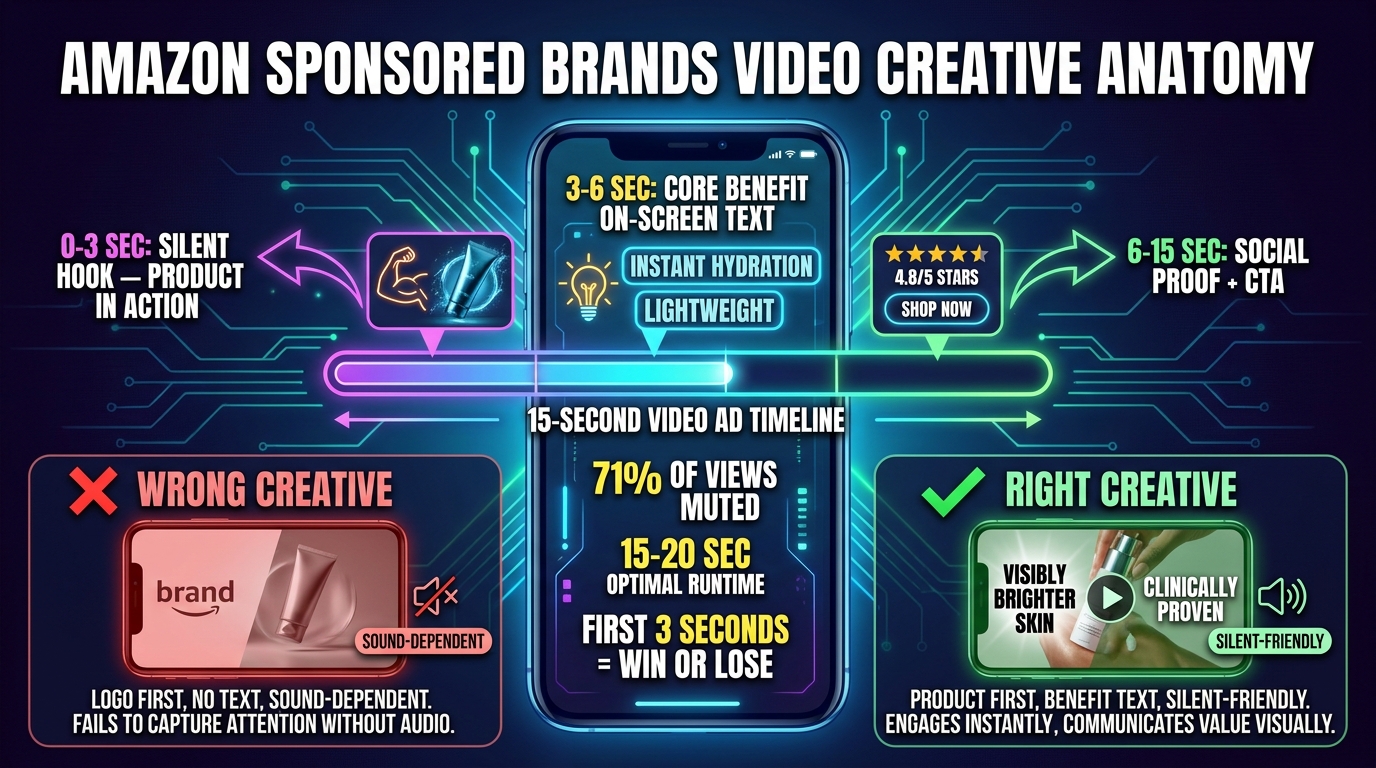
Creative is where the placement shift creates the most immediate operational pressure for brands. It’s not enough to restructure campaign architecture around intent tiers if the creative assets feeding those campaigns were built for a world where SBV was a supplementary mid-page format. The top-of-search placement demands a completely different type of video.
The Silent-First Imperative
Agency data from 2026 consistently shows that approximately 71% of Sponsored Brands Video views are muted — up from around 64% in 2024. This trend continues to accelerate as mobile shopping grows and as more shopping happens in contexts where audio is off by default (commutes, office browsing, shared spaces). Any SBV creative that depends on audio to deliver its core message is losing its message with nearly three-quarters of viewers.
Silent-first design is not just a best practice at this point — it’s a survival requirement. Every element of your SBV’s message that matters must be deliverable through visual elements alone: product visible in action, benefit text on screen, outcome demonstrated visually. Sound should enhance and reinforce rather than carry the communication load.
The First Three Seconds — Where the Campaign Wins or Loses
The hook window for SBV is approximately three seconds. This is not a creative guideline — it’s a behavioral data point. Shoppers who don’t have a reason to keep watching within the first three seconds scroll past, and the impression registers as a low-engagement signal. Over time, high skip rates at the three-second mark tell Amazon’s algorithm that this creative unit is not generating meaningful attention, which can affect placement priority in the auction.
What works in the first three seconds: the product in active use (not a static product shot), a motion element that creates visual curiosity (opening a package, a before/after transition, a product in an aspirational setting), or a benefit text overlay that directly addresses the search query. What doesn’t work: brand logo animation, generic lifestyle footage that doesn’t show the product, or slow-burn scene-setting that asks the viewer to wait for the point.
Optimal Runtime — The Case for 15–20 Seconds
Amazon’s own guidelines allow SBV runtimes up to 45 seconds. Performance data suggests that 15–20 seconds is the sweet spot. Videos in this range consistently outperform both shorter (under 10 seconds) and longer (over 30 seconds) runtimes on key engagement metrics. The exception is high-consideration, high-price categories (professional equipment, furniture, complex technology products) where shoppers show more tolerance for longer runtimes if the content is genuinely demonstrative.
A 15–20 second SBV structure that performs well typically follows this framework: seconds 0–3 for the hook (product in action, visual curiosity or benefit hook), seconds 3–8 for the core value proposition (one clear benefit claim, on-screen text, product demonstration), seconds 8–15 for supporting evidence (second feature, use-case demonstration, social proof signal), and a closing CTA frame (brand name + product name + simple call to action) in the final two to three seconds. This framework is deliberately simple — complexity in a 15-second video almost always loses to clarity.
One Campaign, One Creative, One Query Cluster
The most effective SBV creative strategy pairs one creative asset with one tight keyword cluster, not a broad library of generic videos pushed across all campaigns. This sounds more labor-intensive than it is in practice. You don’t need a different production shoot for each creative — you need different edits. A single product shoot day can generate raw material for three or four different 15-second cuts with different hooks, different benefit focuses, and different opening frames, each mapped to a different tier of your intent architecture.
A branded defense creative cut leads with brand familiarity and quality signals. A category exploration creative cut leads with the use-case problem your product solves. A conquest creative cut leads with the specific differentiator that matters most to shoppers in that competitive context. Same product footage, same production quality, entirely different communication architecture — and each creative performs in its specific context in a way a generic video cannot.
Bidding Strategy for the New SBV Landscape
Bid strategy for SBV has grown meaningfully more sophisticated in the current placement environment. The old approach — set a manual CPC, adjust periodically based on ACoS — doesn’t capture the bidding nuance that the new intent-tiered structure requires.
Branded Tier: Prioritize Impression Share Over Efficiency
On branded campaigns, the optimization objective is impression share, not ROAS. Branded searches are high-intent, high-conversion moments with low incremental cost to win when you’re the brand being searched. Being aggressive in the branded auction is almost always the right call, because the counterfactual is a competitor’s SBV showing up in your slot. Set branded SBV campaigns to dynamic bids (up and down), with an aggressive top-of-search placement multiplier to ensure your branded SBV wins the top slot as often as possible.
If your branded CPCs feel high, the answer is rarely to reduce bids on branded terms — it’s usually to add Reserve SOV to guarantee the placement independent of the auction, and to ensure your Quality Score signals (video completion rate, CTR, landing page relevance) are strong enough that Amazon’s algorithm prices you favorably within the branded auction.
Category Tier: Balance Discovery Scale with CPA Discipline
Category exploration campaigns require more nuanced bidding. These terms often have higher CPCs than branded terms but lower conversion rates, because the shopper isn’t committed to your brand yet. The right bidding framework here is dynamic bids (down only) with a CPC floor calibrated to your acceptable new-to-brand CPA — not your blended ROAS target, but the specific economics of acquiring a new customer through this channel.
Segment your category campaigns further by match type to capture different price levels: exact match for the highest-intent, highest-converting category terms (where more aggressive bidding is justified) and broad/phrase match for discovery and scale (where lower CPCs are acceptable because the intent signal is weaker). Running these as separate campaigns rather than ad groups within one campaign gives you cleaner bidding control per segment.
Conquest Tier: Set Floors and Protect Efficiency
Conquest campaigns should run with fixed CPCs or dynamic bids (down only) with a conservative ceiling. These campaigns are not the place for aggressive up-bidding — the lower conversion probability of conquest traffic means you can lose a lot of money fast by letting Amazon’s dynamic bidding system push CPCs up on competitor brand terms. Set a CPC ceiling based on what a new-to-brand customer is worth to you, model the expected conversion rate on conquest traffic, and stick to those guardrails.
Review conquest campaign performance monthly rather than weekly. Conquest results are noisier than branded or category results because the audience is less pre-qualified, which means week-over-week fluctuations will be larger. Optimizing too frequently in response to short-term noise leads to premature cuts of campaigns that are actually working their way through the longer conversion window typical of conquest traffic.
Measuring What Matters — Attribution, AMC, and the Halo You’re Missing
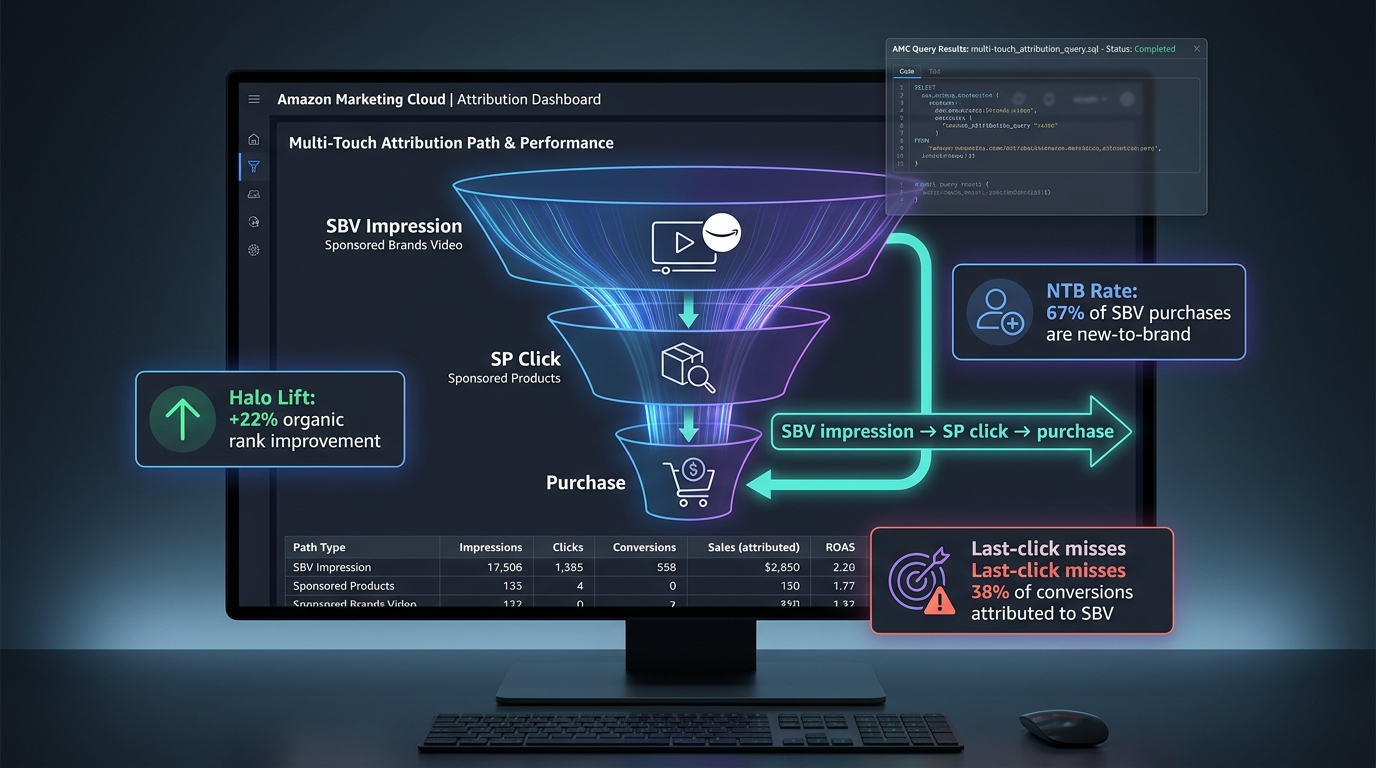
Attribution is where most SBV strategies fail silently. The standard Amazon campaign reporting dashboard measures last-click attribution within a 14-day window. For Sponsored Products, which typically captures conversion-intent clicks, that model is adequate. For SBV — which operates earlier in the decision journey, often driving awareness and consideration that converts through a different path later — last-click systematically undercounts the format’s contribution.
The Last-Click Problem
Consider a realistic shopper journey: a shopper searches a category term, sees your SBV, watches four seconds, and scrolls on. Three days later, they search your brand name, click a Sponsored Products ad, and purchase. In standard campaign reporting, the Sponsored Products campaign gets 100% credit for the conversion. The SBV campaign shows an impression but no attributed sale.
Under last-click accounting, the rational conclusion is that the SBV campaign is generating spend with no return. The decision to cut or reduce SBV budget follows logically — and is completely wrong. The SBV impression created the brand awareness that made the branded search happen three days later. Cutting it removes the awareness engine that powers the branded conversion, but standard reporting makes that invisible.
Agency data suggests that last-click attribution can miss 35–40% of conversions that have an SBV touchpoint in the pre-conversion window. That’s not a rounding error — it’s a material misallocation signal that consistently directs budget away from the format that’s driving upper-funnel activity toward the format that captures the final click.
Amazon Marketing Cloud as the Measurement Fix
Amazon Marketing Cloud (AMC) provides the multi-touch view that standard reporting lacks. AMC is a clean-room analytics environment that lets you run SQL queries across your full advertising data set, including impression data across formats, paths-to-conversion with all touchpoints, time-lag analysis between ad exposures and purchases, and new-to-brand customer identification across the full attribution window.
The minimum AMC setup for SBV measurement should include three query types. First, a path-to-conversion report showing the frequency with which SBV impressions appear in the 7–30 day window before a Sponsored Products click and purchase. Second, a new-to-brand analysis showing what percentage of SBV-exposed purchasers are first-time brand buyers. Third, a time-lag analysis showing the average number of days between first SBV impression and eventual purchase — which helps you set appropriate attribution windows and conversion rate expectations per tier.
Organic Rank Halo Effects
The most discussed and least measured SBV impact is the halo effect on organic search ranking. Amazon’s organic ranking algorithm incorporates click-velocity and purchase-velocity signals from paid campaigns, though Amazon doesn’t publicly document the mechanics. The practitioner consensus, backed by AMC-based pre/post analyses, is that sustained SBV presence on category terms generates measurable organic rank improvement over 30–60 day windows.
The mechanism is straightforward in principle: SBV drives incremental page visits and product detail page views. Those page views feed the click-velocity signals Amazon’s algorithm uses to determine organic relevance. More relevant organic positions drive more organic traffic, creating a compounding return from SBV investment that standard paid-only attribution never captures.
Measuring organic halo requires pre/post design: establish organic rank baselines for target keywords before launching or expanding SBV on those terms, then track rank changes at 30-day intervals against a control group of keywords where SBV presence wasn’t changed. The comparison gives you a directional view of SBV’s organic contribution — and, more practically, a way to justify SBV budget increases to stakeholders who only see last-click ROAS in their dashboards.
Rebuilding Your Search Funnel in 90 Days — A Phased Action Plan
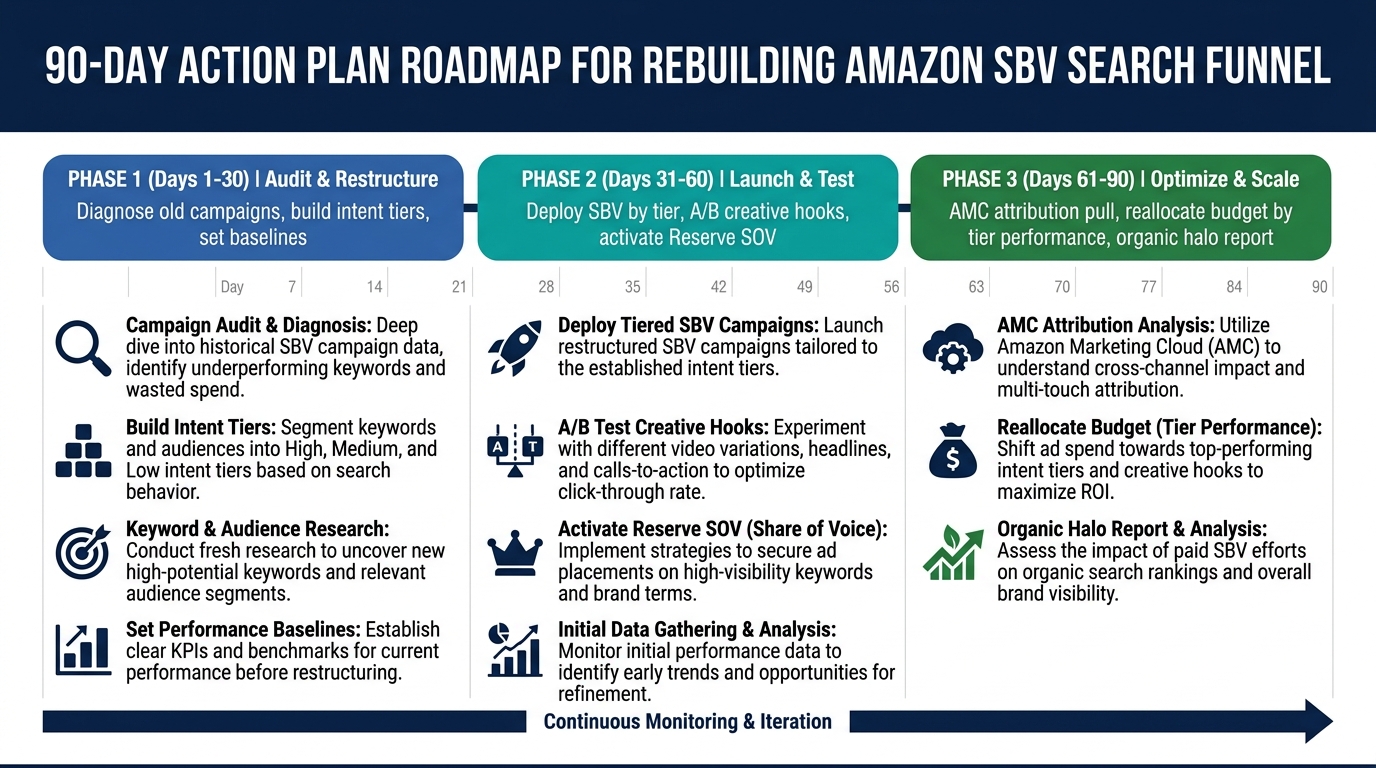
The full rebuild of an SBV-led search funnel doesn’t need to happen overnight, and attempting to do it all at once typically leads to messy data and uncontrolled spend. A 90-day phased approach lets you build the structure correctly, gather clean data at each stage, and make budget decisions based on actual performance rather than projections.
Phase 1 — Days 1–30: Audit, Restructure, and Baseline
Week 1–2: Pull your current state data. Export the last 90 days of Sponsored Brands performance, broken down by campaign and ad group. Identify all current SBV campaigns and map which keyword types they’re targeting (branded, category, competitor). Calculate SBV as a percentage of total SB spend. Pull your branded impression share data and note any gaps. This is your baseline — the “before” that will make the rebuild’s results legible.
Week 3–4: Build the new campaign architecture. Create separate campaigns for each intent tier (branded defense, category exploration, competitor conquest). Migrate keywords from your old campaigns into the correct new campaign homes. Do not launch these campaigns yet — set them to paused status and complete the creative audit first. Also, begin the AMC access setup if you don’t already have it, because you’ll need data flowing from launch day forward.
During this phase, also identify whether Reserve SOV is available and appropriate for your branded keywords. If your branded CPCs have been elevated and you’re in a category with active competitor conquesting, this is the window to evaluate whether the fixed-cost Reserve SOV makes economic sense compared to the auction-based branded bidding you’re currently running.
Phase 2 — Days 31–60: Launch, Test, and Calibrate
Week 5–6: Launch the intent-tiered campaigns. Activate branded defense, category exploration, and competitor conquest campaigns in sequence rather than simultaneously. Start with branded defense (lowest risk, most straightforward to measure), then category exploration, then conquest. Launching in sequence gives you cleaner early data per tier and lets you course-correct on creative or bidding before adding more complexity.
Creative A/B testing. For each tier, run two creative variants with different hooks in the first three seconds. The goal is not polished production — it’s rapid learning about which opening frame drives higher completion rates and CTR within each keyword cluster. Keep everything else constant (length, structure, CTA) and vary only the first-three-second hook. This tells you what the audience in each intent tier actually responds to, which is often different from what brand teams expect.
Week 7–8: Bidding calibration. After two weeks of live data, review impression share, CTR, and conversion data by tier. On branded defense, check whether impression share is hitting target levels — if not, bid up. On category exploration, review CPA against your NTB benchmark and adjust bids if CPA is significantly above or below target. On conquest, check that CPCs are staying within your ceiling and that CTR is generating qualified traffic rather than just impressions.
Phase 3 — Days 61–90: Optimize, Scale, and Measure Full-Funnel Impact
AMC attribution pull. By day 60, you have enough data to run meaningful AMC path-to-conversion queries. Pull the multi-touch report for SBV-assisted conversions and compare the total attributed sales figure to your last-click campaign report. The delta is the “invisible” SBV contribution that your current reporting is missing — and it’s often large enough to justify a significant budget shift toward SBV.
Creative winner rollout. Identify the winning hook variant from your Phase 2 A/B test and apply it across all campaigns in that tier. Begin shooting or editing any new creative variations needed to improve performance in underperforming tiers. The iteration cycle on SBV creative should run every 60–90 days, not every six months — video creative fatigue is real, and fresh hooks sustain completion rates that start to decline as audiences accumulate impressions on the same video.
Organic rank tracking review. Compare organic rank positions for your SBV-targeted category keywords at day 90 against your pre-launch baselines. Look for rank improvements on terms where SBV was newly launched or significantly scaled. Document the correlation between SBV investment and organic rank movement — this is the evidence base you need to make the internal case for continued or expanded SBV investment to stakeholders who are primarily focused on last-click paid metrics.
Budget reallocation based on full-funnel data. Use the combined picture — last-click campaign ROAS, AMC-attributed assists, NTB acquisition rates, and organic rank halo — to make a defensible reallocation of your total sponsored ads budget toward or away from each tier. Brands that complete this 90-day process typically find they’ve been underinvesting in category exploration SBV and overinvesting in static SB headline formats that are now getting displaced from top-of-search anyway.
The Competitive Risk of Waiting
The SBV placement shift is not a coming disruption — it’s already structurally in place. The brands that restructured their search funnels around SBV twelve to eighteen months ago already hold the advantage: they’ve established quality score signals from sustained video engagement, trained Amazon’s algorithm on their brand relevancy in the video format, and accumulated the historical performance data that gives them preferential positioning in the SBV auction.
The cost of delay is not just higher CPCs. It’s the compounding disadvantage of entering the SBV auction later, when CPCs have already risen in response to growing advertiser competition, when the creative quality bar for the format has risen to meet higher advertiser investment, and when competitors have already captured the organic rank halo benefits that early SBV investment generates.
There is still time to rebuild. The brands that complete the intent-tiered rebuild in the next 60–90 days will find the category exploration tier is not yet fully saturated in most niches, and the branded defense tier can be shored up quickly with the right combination of SBV and Reserve SOV. But the window where this rebuild is straightforward and relatively inexpensive is narrowing as more accounts complete their own transitions.
Key Takeaways
- SBV is now the dominant SB format, representing approximately 58% of Sponsored Brands spend in leading agency portfolios in Q1 2026. Accounts that treat it as supplementary are already behind.
- Intent-tiered campaign architecture — separating branded defense, category exploration, and competitor conquest into distinct campaigns — is the structural foundation of a modern SBV search funnel.
- Reserve Share of Voice raised branded impression share from 62.7% to 99.3% in Amazon’s beta. It’s the most effective branded defense tool available for protecting top-of-search on your own brand terms.
- 71% of SBV views are muted. Silent-first creative design — with product in action and benefit text on screen in the first three seconds — is no longer optional.
- 15–20 seconds is the optimal SBV runtime. Structure: hook (0–3s), core benefit (3–8s), supporting proof (8–15s), CTA (final 2–3s).
- Last-click attribution misses 35–40% of SBV-assisted conversions. Amazon Marketing Cloud path-to-conversion queries are the minimum measurement standard for understanding what SBV is actually delivering.
- The 90-day rebuild phasing — audit and restructure, launch and test, optimize and scale — gives you clean data at each stage and prevents the messy overlap that comes from trying to change everything at once.
- The cost of waiting is compounding. Early movers in SBV already hold quality score advantages, organic rank halo benefits, and auction positioning that will be progressively more expensive to close.
Leave a Reply