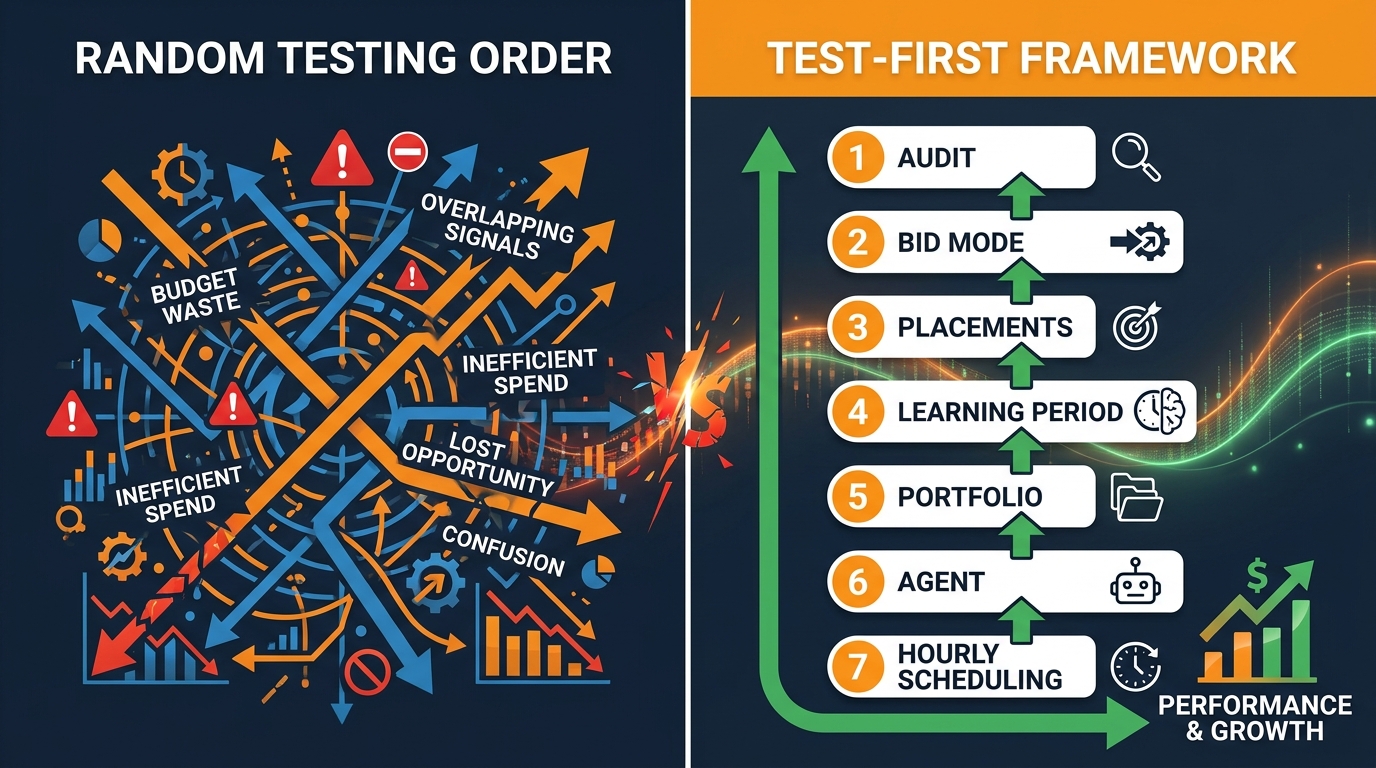
Here is the mistake most Amazon advertisers are making with AI bidding in 2026: they treat it as a feature to activate, not a system to build. They flip on dynamic bidding, wait a week, see mixed results, then chase the next lever — placement multipliers, a third-party tool, maybe the new Ads Agent — without ever knowing whether the first test actually worked.
The result is a campaign account that looks increasingly automated but performs no better than it did six months ago. Sometimes worse.
The core problem is not the tools. Amazon’s native AI bidding infrastructure has matured considerably. The problem is test sequencing. Each bidding layer you add to a campaign interacts with the ones already in place. If you run placement multipliers before you’ve established a stable bid mode, you cannot attribute the outcome to either variable. If you hand off to Ads Agent before you’ve established clean conversion signals, the agent learns from noise. The tests compound — but so do the errors.
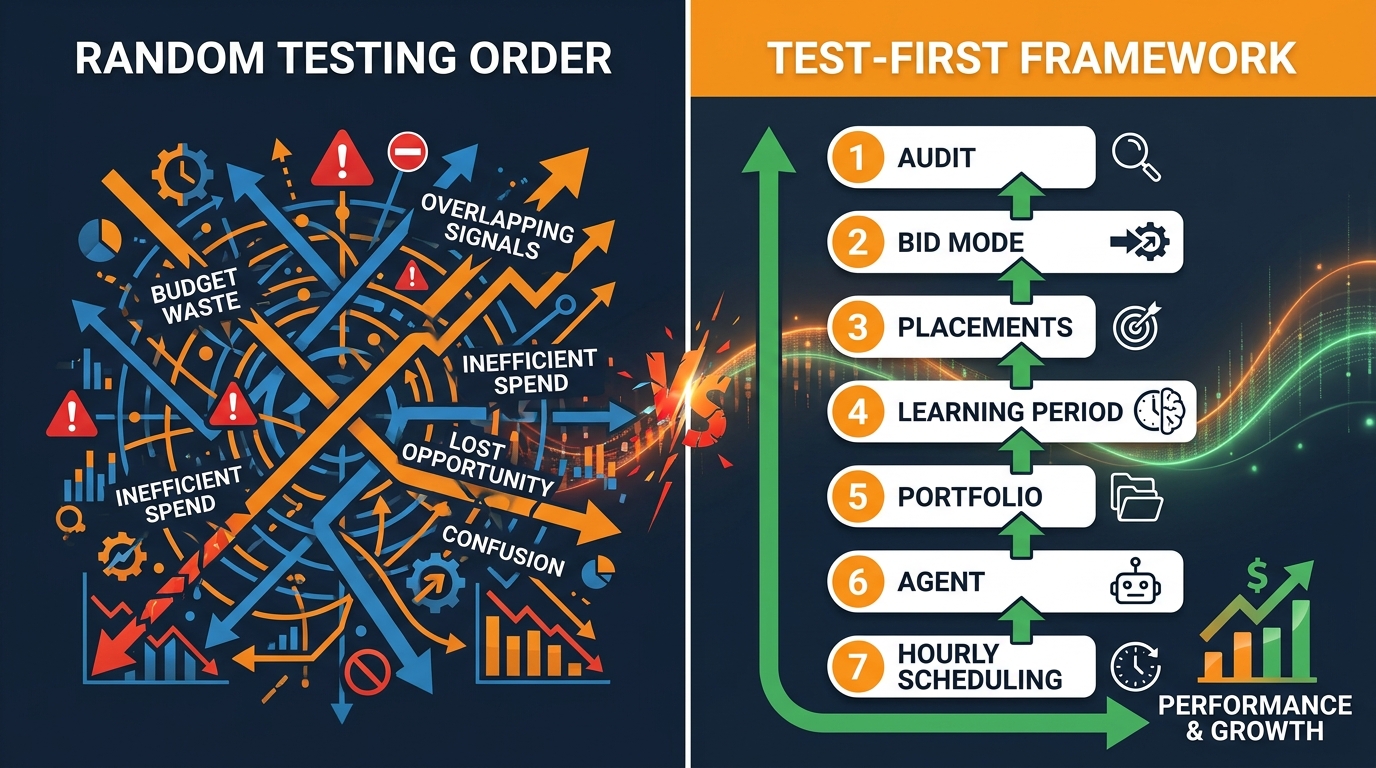
This article lays out a specific test order: what to run first, what each test actually measures, how long to wait before drawing conclusions, and what failure looks like at each stage. It draws on real campaign data, Amazon’s own documentation, and practitioner analysis from accounts managing thousands of Sponsored Products campaigns in 2026.
This is not a beginner’s overview of dynamic bidding. It is a sequenced testing framework for advertisers who already understand the basics and want to know how to build on top of them systematically — without breaking what is already working.
Why Test Order Matters More Than the Test Itself
Most Amazon PPC education treats each bidding feature as an independent dial. Turn this one up for volume, turn that one down for efficiency. In practice, these features are interdependent layers in a single auction system, and the order in which you activate them determines what signals each layer receives.
Consider a simple example. You run a Sponsored Products campaign on dynamic bidding — up and down. Amazon’s algorithm is now adjusting your bids in real time based on its estimate of the probability that any given impression will convert. You then add a 100% Top of Search placement multiplier. The result: on a high-intent search with strong conversion probability, Amazon bids up (say, 30% above your base), and then your multiplier pushes another 100% on top of that. Your effective CPC on top-of-search placements is now 2.6x your stated base bid — a number no efficiency model anticipated.
You now have two variables interacting in a way you cannot disentangle from a single report. If ACoS spikes, was it the bidding mode or the multiplier? You do not know, and you cannot know, unless you tested them separately in sequence.
The Compounding Signal Problem
This sequencing challenge becomes even more critical when AI is involved. Amazon’s bidding algorithms — whether native dynamic bidding or the newer Ads Agent — learn from the conversion data your campaigns generate. That learning is path-dependent: the AI builds a model based on the historical pattern of impressions, clicks, and conversions your campaign has produced. If that history contains periods where two variables changed simultaneously, the model’s understanding of cause and effect is degraded.
Introduce a third-party AI tool on top of an already-noisy foundation and the problem multiplies. The external tool is now learning from data that Amazon’s system already partially shaped — and both systems may be making competing bid adjustments on the same auction. Practitioner analysis from 2026 accounts consistently flags this as a primary cause of “AI drift,” where automated systems stabilize at a local optimum significantly below what disciplined manual management would have achieved.
The Right Mental Model: Layers, Not Levers
Think of Amazon Ads AI bidding as a layer cake. The base layer is your campaign structure and keyword match types. The second layer is your bid mode. The third is your placement modifiers. The fourth is your portfolio or budget controls. The fifth is any AI agent or third-party automation layer on top.
Each layer should be stable and understood before you add the next one. Stability does not mean perfect — it means you have enough data to have a directional read on performance. This is the foundation of the framework that follows.
Step One: The Pre-Test Audit — Diagnose Before You Automate
Before changing any bidding setting, there is a diagnostic step that most advertisers skip entirely. It takes roughly 30 minutes per campaign, but it determines whether AI bidding has any chance of working in the first place.
AI bidding systems learn from conversion signals. If those signals are weak, infrequent, or contaminated, the algorithm learns the wrong patterns and confidently executes on them. The diagnostic checks four things:
1. Conversion Volume Sufficiency
Amazon’s native AI bidding stabilizes with approximately 30 or more conversions over any 30-day window per campaign. Below that threshold, the algorithm does not have enough data to model conversion probability with any reliability. This is not a formal Amazon policy number — the company does not publish a universal minimum — but it reflects consistent practitioner experience and parallels the documented behavior of Amazon DSP Performance+, which officially requires a minimum conversion volume before the learning phase can conclude.
Check your last 30 days of conversion data at the campaign level. If you are running below 30 orders, AI bidding will not reliably outperform a well-structured manual bid. Fix conversion volume first: tighten match types, eliminate non-converting keywords, and improve listing conversion rate before touching bidding mode.
2. Attribution Cleanliness
Amazon’s 14-day attribution window means conversions show up in reports days after the click. If you have recently changed prices, run a coupon, or had a Buy Box loss, the conversion data in your current window is contaminated — it reflects a product state that no longer exists. AI bidding trained on that data will optimize for a context that has passed. Always audit your last 30 days for any external changes before running a bidding test.
3. Campaign Isolation
Each campaign you test should contain products with similar economics and conversion rates. Mixing high-margin, fast-selling ASINs with slow-moving commodity SKUs in a single campaign forces the AI to average across wildly different conversion patterns. The result is an algorithm that is perpetually confused and perpetually underperforming. Segment before you test.
4. Listing Quality Baseline
Bidding AI cannot fix a listing that does not convert. If your main image, title, price, or review count is meaningfully below category benchmarks, raising bids — automatically or otherwise — generates expensive impressions that do not convert. Document your listing conversion rate (orders divided by sessions from the Brand Analytics or Business Reports page) before starting any bidding test. If it is below 10% in a category where competitors average 15–20%, the problem is the listing, not the bids.
Step Two: Bidding Mode — Down Only vs Up and Down (The Data You Actually Need)
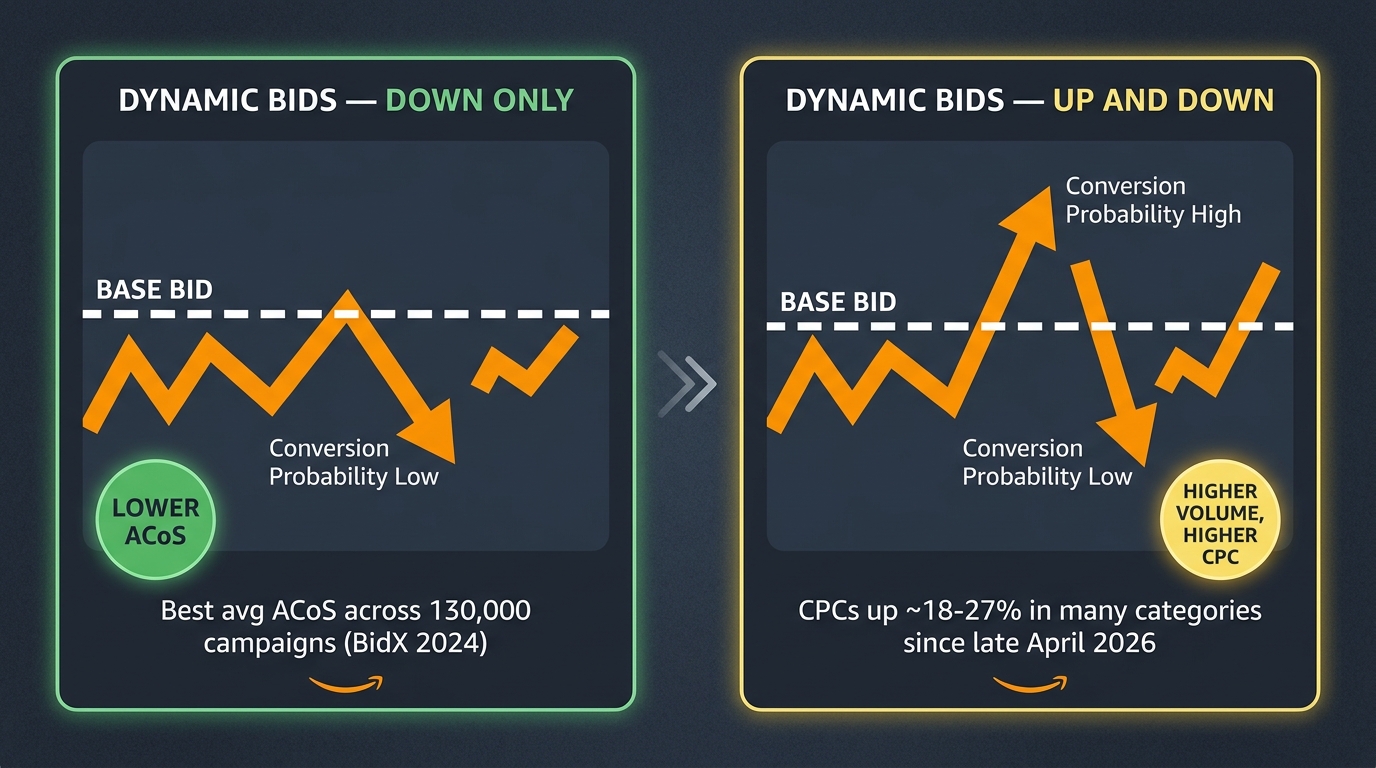
Bid mode is the first real test in the sequence, and the data on it is clearer than most advertisers realize. A BidX analysis of approximately 130,000 campaigns in 2024 found that dynamic bidding — down only produced the lowest average ACoS across the study group, with a click-through rate only 0.02% lower than up and down campaigns. The CTR difference was negligible; the ACoS difference was not.
In 2026, this picture has sharpened further. Multiple advertisers and agency reports have documented that the up-and-down engine has been retuned by Amazon, with CPCs running approximately 18–27% higher in many categories since late April 2026 compared to historical averages — while conversion rates remained largely flat. That combination is a direct efficiency hit to any campaign using up and down without a deliberate rationale for accepting higher costs.
When Down Only Is the Right Default
Down only should be your starting bid mode for the majority of Sponsored Products campaigns. It functions as a cost floor — Amazon can reduce your bid when conversion probability is low, but it cannot inflate your bid above your stated maximum. This gives the AI a real optimization lever (downward adjustment) while preventing the uncapped spend that damages ACoS in high-competition auctions.
This mode is particularly effective for mature campaigns with established conversion history, campaigns with tight margin constraints, and any ASIN in a category where CPCs have risen significantly in 2026. The algorithm’s downward adjustments can reduce wasted spend on low-intent impressions without requiring you to manually review every keyword bid daily.
When Up and Down Has a Specific Role
Up and down is not a universally bad choice — it has a specific, narrow use case: product launches and aggressive share-capture scenarios where you have pre-committed to higher short-term CPC in exchange for velocity and ranking signal. If you are launching a new ASIN and need to build conversion history quickly, or if you are running a time-limited conquest campaign against a key competitor, giving Amazon the ability to bid above your base to win high-intent auctions can be worth the cost.
The critical discipline is defining an exit condition before you start. Decide: after how many days, or at what ACoS threshold, does this campaign revert to down only? Without a predefined exit, up and down campaigns tend to accumulate cost and never get rationalized.
How to Run This Test Cleanly
To test bid mode in isolation, use Amazon’s Campaign Experiments tool (available within the Ads console under “Experiments”). This feature splits your campaign traffic between two configurations — a control and a treatment — and attributes outcomes to each. Run the experiment for a minimum of 28 days to capture enough conversion events for statistical reliability. The single variable to change is bid mode. Keep base bids, keyword lists, match types, and placement modifiers identical across both arms of the experiment.
Step Three: Placement Multipliers — The Lever Nobody Tests Correctly
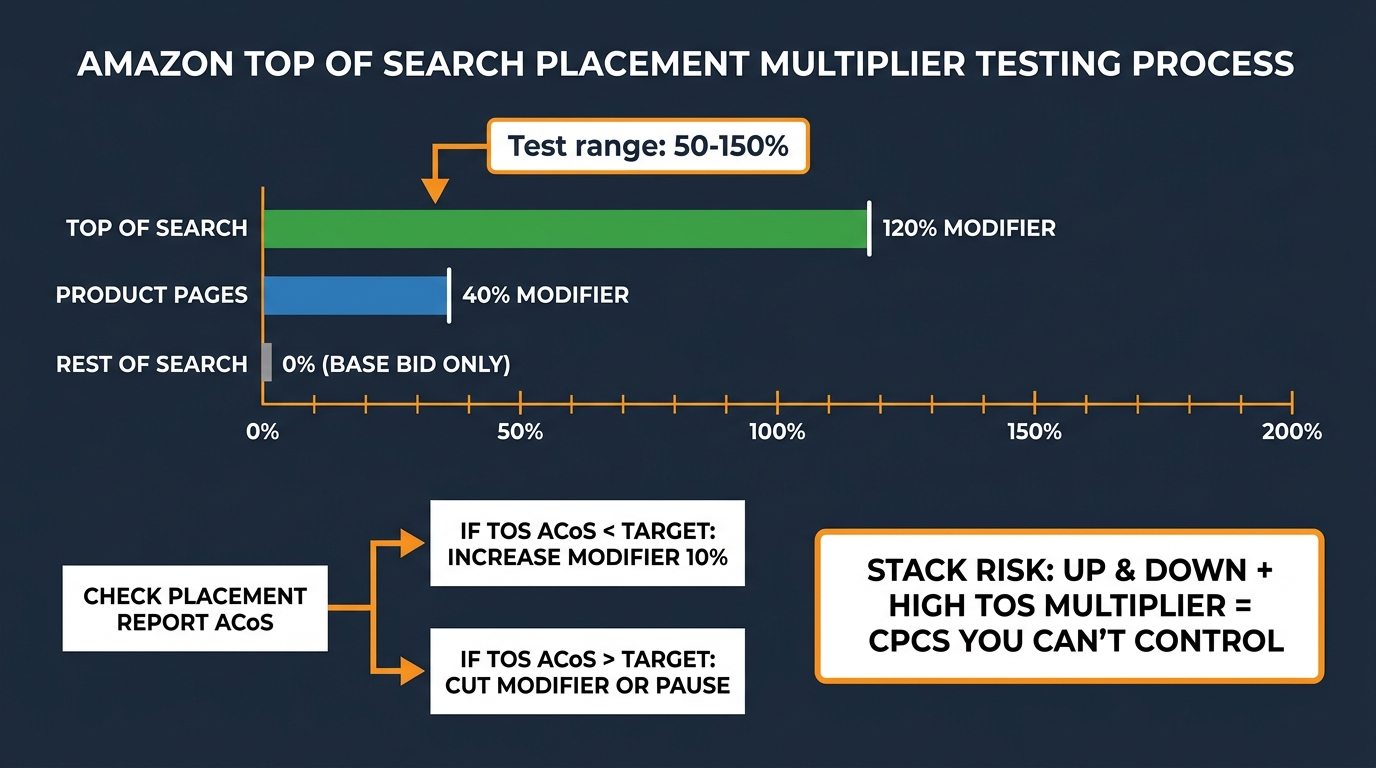
Placement multipliers are tested in Step Three because they operate on top of your bid mode. If your bid mode is not yet stable and understood, adding placement modifiers creates compounding uncertainty that you cannot resolve. Once you have established a stable bid mode — ideally down only — and have at least 28 days of clean data from that mode, placement multipliers become the next variable to isolate.
Amazon Sponsored Products allows you to set percentage bid modifiers for two placements: Top of Search (first page) and Product Pages. Rest of Search always uses your base bid with no modifier. Modifiers can go up to +900%, though anything above 150% is almost never justified outside extreme brand-defense scenarios.
The Stacking Problem
The most important thing to understand about placement multipliers is how they interact with dynamic bidding. If you are on dynamic bidding — up and down — and you add a 100% Top of Search multiplier, Amazon’s algorithm can bid above your base on a high-intent impression, and then your multiplier adds another 100% on top of that adjusted bid. The CPC you actually pay can reach multiples of your stated base bid, with zero notification from Amazon. This is the stacking risk that inflates spend silently.
On dynamic bidding — down only, stacking is less dangerous: the multiplier can push above your base for top-of-search placements, but Amazon cannot inflate the base beyond your stated maximum before the multiplier applies. The effective exposure is more predictable. This is one more reason to resolve your bid mode first.
How to Test Placement Multipliers Correctly
Start with your placement report, not with a multiplier adjustment. Pull the Placement Report from your campaign’s reports tab, filtered to the last 30 days. This report breaks out ACoS, CPC, conversions, and spend by placement type: Top of Search, Product Pages, and Rest of Search. This data tells you whether Top of Search is currently profitable for your campaigns — before you spend a dollar more amplifying it.
If your Top of Search ACoS is already below your target, a moderate multiplier (try 25–50% to start) will send more budget to your most profitable placement. Increase in 10-percentage-point increments every 10–14 days, checking placement-level ACoS after each adjustment. Expert consensus in 2026 puts the productive range for most accounts at 50–150% for Top of Search. Above 150%, CPC exposure typically erodes the efficiency gains from better placement.
If your Top of Search ACoS in the placement report is already above target, a multiplier will not fix that — it will amplify the problem. The issue is either keyword relevance, listing conversion, or a CPC floor set too high for your margin. Fix the underlying conversion issue before applying any positive multiplier.
Product Pages: The Underused Placement
Product page placements (your ads appearing on competitor or complementary product detail pages) often convert at lower rates than Top of Search but can deliver profitable scale at lower CPCs. Test product page multipliers separately from Top of Search multipliers using the same placement-report-first process. Many accounts find a moderate product page multiplier (20–40%) expands volume cost-effectively when top-of-search is expensive and competitive.
Step Four: The Learning Period Protocol — How to Protect the Algorithm’s Work
Every time you make a meaningful change to a campaign running AI-assisted bidding — bid mode, placement modifier, keyword addition, budget change — the learning period effectively resets. Amazon’s algorithm needs time to rebuild its conversion probability model under the new conditions. This is not unique to Amazon; it mirrors the documented behavior of Google’s Smart Bidding, which carries a formal 2-week learning period designation.
On Amazon, the learning period is not formally labeled as such in most campaign types (though Amazon DSP Performance+ explicitly documents up to four weeks), but practitioner data consistently shows performance instability in the first two to three weeks after a structural campaign change. The accounts that most commonly report “AI bidding doesn’t work” are the ones making changes every few days.
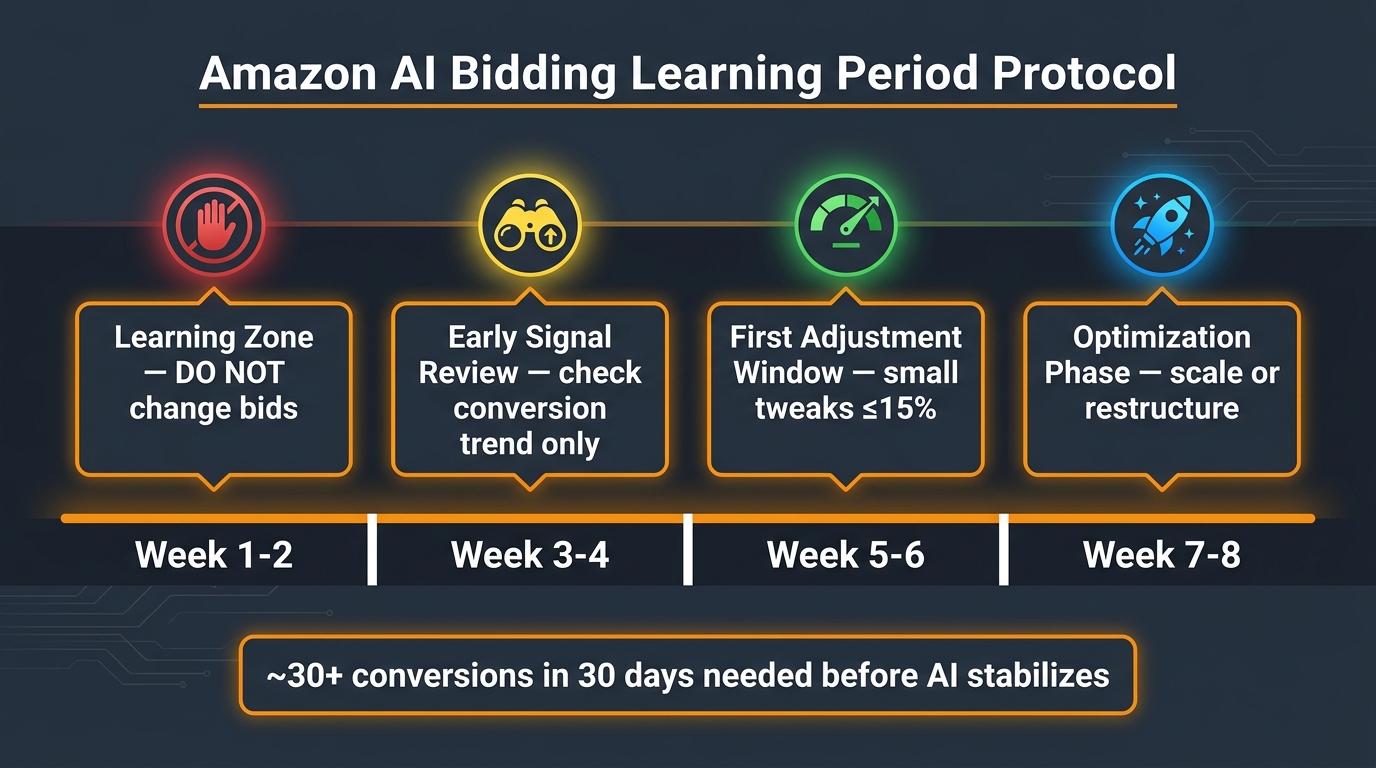
The Eight-Week Protocol
When you activate a new bidding configuration, commit to the following timeline:
Weeks 1–2 (Learning Zone): Do not change bids, match types, budgets, or placement modifiers. Monitor impressions and spend to confirm the campaign is active and within expected ranges, but resist any optimization impulse. The algorithm is building its baseline model. Any intervention at this stage teaches the system that its early signals were wrong — even if they weren’t.
Weeks 3–4 (Early Signal Review): Begin reviewing conversion trend data only. You are not yet optimizing — you are assessing whether the trajectory is directionally correct. Is ACoS trending downward compared to the pre-change baseline? Is conversion rate stable or improving? These are the questions to answer. Still no bid or structure changes.
Weeks 5–6 (First Adjustment Window): If the trajectory is positive, make incremental adjustments — small changes of 10–15% to base bids or placement modifiers, never multiple changes simultaneously. If performance has deteriorated materially from your pre-test baseline, evaluate whether the issue is the bidding configuration or an external factor (seasonality, listing change, inventory constraint).
Weeks 7–8 (Optimization Phase): You now have approximately 60 days of data under the new configuration. At this point you can make more confident decisions about scaling, restructuring, or moving to the next layer in the framework.
What Counts as a “Reset” Trigger
Not every campaign change resets the learning period equally. Minor changes — adding a single negative keyword, adjusting budget by less than 20% — typically do not cause significant disruption. Major changes — switching bid mode, adding or removing large keyword groups, changing campaign structure, enabling or disabling a third-party bidding tool — will reset the model’s confidence in its conversion estimates. Apply the full eight-week protocol after any major change.
Step Five: Portfolio Bidding and Budget Signals — Teaching the Algorithm What Matters
Once individual campaigns are stable under a tested bid mode with understood placement behavior, the next layer is portfolio-level optimization. Portfolio bidding on Amazon allows you to set shared budget caps and, for some ad types, target ACoS or ROAS goals at the portfolio level rather than managing each campaign individually.
This matters in 2026 because Amazon’s bidding engine increasingly looks at portfolio-level signals — not just individual campaign data — when modeling conversion probability. A campaign within a well-structured portfolio with a clear, consistent budget signal performs differently than the same campaign running in isolation. The algorithm uses budget pacing behavior, cross-campaign conversion patterns, and aggregate spend data as inputs alongside the keyword-level signals it has always processed.
Budget Signals the Algorithm Reads
Amazon’s AI bidding reads your budget behavior as a quality signal. Campaigns that run out of budget early in the day and go dark for hours create a fragmented performance history — the algorithm sees active-then-inactive patterns and struggles to model consistent conversion probability. Budget depletion events also suppress impression share during high-converting hours (typically mid-morning and early evening), replacing your AI-optimized bids with absence.
Before adding portfolio-level controls, audit your daily budget utilization. If any campaign is consistently hitting its daily cap before 3 PM, the budget constraint is limiting what the AI can learn. Either raise the budget or reduce it deliberately to a level where the campaign can run all day on its existing allocation. Partial days create partial data.
Portfolio ACoS Targets vs Campaign-Level ACoS Targets
A common mistake in 2026 is setting a portfolio-level ACoS target that averages out fundamentally different product economics. A $15 accessory with a 60% margin should not share an ACoS target with a $150 appliance running at 25% margin. The algorithm receives a blended efficiency goal that is wrong for both products.
Structure portfolios around products with similar margin profiles and similar business goals. Keep launch campaigns — where you deliberately accept higher ACoS to build conversion history — in separate portfolios from mature, efficiency-optimized campaigns. The portfolio’s ACoS target is a signal the AI uses to calibrate bid aggressiveness. A mixed signal produces mixed results.
The Budget Increase Protocol
When increasing campaign or portfolio budgets, Amazon’s guidance and practitioner consensus both suggest limiting single-step increases to approximately 20–30% of the current budget. Larger budget jumps can cause the AI to recalibrate its pacing model, temporarily overserving impressions in early-day hours and underserving in peak-conversion windows. Gradual increases preserve the pacing behavior the algorithm has learned and produce more stable performance through growth phases.
Step Six: Amazon Ads Agent — Where It Actually Helps and Where It Doesn’t
Amazon Ads Agent launched in early 2026 as an agentic AI campaign management layer built on Amazon’s Bedrock infrastructure. It allows advertisers to describe goals in plain English, receive proposed campaign setups, bid adjustments, keyword suggestions, and budget changes — then approve or reject those proposals before they go live. It is the closest thing Amazon has offered to a fully AI-managed campaign workflow within its native console.
The key word is “proposed.” Amazon Ads Agent does not make changes autonomously by default — it surfaces recommendations for human review and approval. This is meaningful: it means the agent operates as an informed advisor rather than an autonomous bidder, and it means its effectiveness depends entirely on the quality of the input signals it receives.
What Ads Agent Does Well
Ads Agent is genuinely useful for three specific tasks. First, search term harvesting: the agent can identify converting search terms from auto-targeting campaigns and recommend promotion into exact-match manual campaigns, a task that is time-consuming and easy to deprioritize manually. Second, bulk bid adjustments: for accounts with dozens or hundreds of campaigns, reviewing and proposing bid changes at scale is where the agent saves the most time, surfacing the same adjustments that a skilled human manager would make but across a larger surface area faster. Third, campaign creation from briefs: describing a new product launch goal in natural language and receiving a structured campaign draft (with suggested keyword groups, match types, and initial bids) materially reduces the time from product launch to active advertising.
Where Ads Agent Falls Short
Ads Agent does not currently understand your product economics, inventory position, or margin structure. It optimizes for the performance metrics it can see inside Amazon Ads — clicks, conversions, ACoS — without any awareness that your ASIN is low on stock, that your margin on this product is 12% rather than 35%, or that this campaign’s goal is new-to-brand acquisition rather than immediate profitability. These strategic inputs still require human specification.
The agent also performs significantly better when it is working with stable, clean campaign data. This brings us back to sequencing: Ads Agent should be introduced after you have established stable bid modes (Step Two), tested and calibrated placement multipliers (Step Three), and completed at least one full learning period (Step Four) on your primary campaigns. Activating the agent on a campaign that is still in its first 30 days of a new bidding configuration means the agent learns from noise and projects that noise forward into its recommendations.
A Practical Activation Checklist for Ads Agent
Before activating Ads Agent on any campaign, confirm: the campaign has at least 60 days of stable performance data; your ACoS target is explicitly documented and can be entered as a goal parameter; you have a human review cadence (minimum weekly) to evaluate proposed changes before approving them; and you have excluded any campaigns in active launch or experimental phases from the agent’s scope. Ads Agent is a force multiplier for stable, mature campaigns — not a replacement for the foundational work that makes those campaigns stable.
Step Seven: Hourly Bid Scheduling via Amazon Marketing Stream
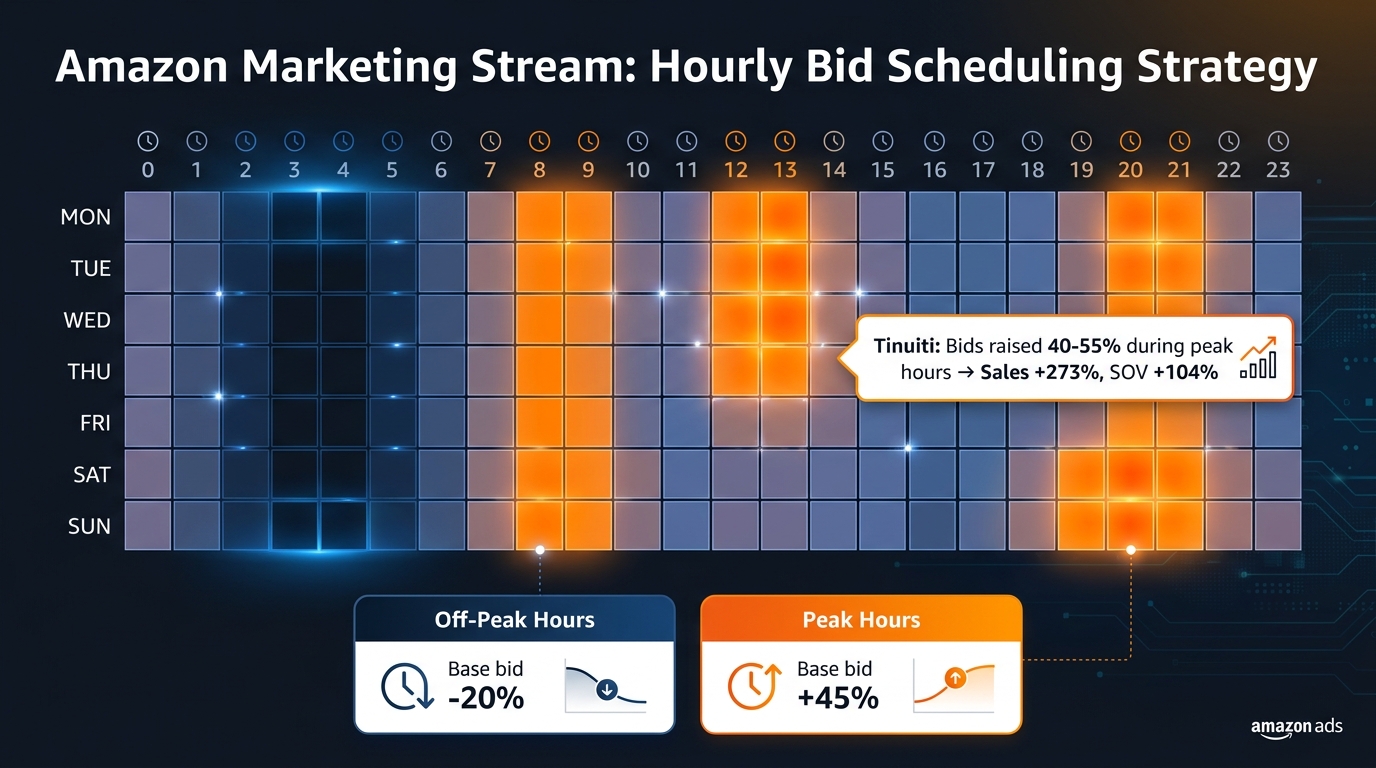
Hourly bid scheduling is the most operationally advanced layer in the framework — and the one with some of the most dramatic published results. Amazon Marketing Stream provides near-real-time hourly performance data (traffic, conversions, CPC, ACoS, budget consumption) via the Amazon Ads API, updated hourly across Sponsored Products, Sponsored Brands, Sponsored Display, and DSP. Accessing this data requires API integration — either via a third-party tool that has built Marketing Stream integration or via a custom technical build.
When Tinuiti applied historical hourly Marketing Stream data to identify peak conversion windows for a soda-category campaign and raised bids 40–55% during those windows, the results were notable: share of voice increased 104%, sales increased 273%, and new-to-brand units increased 570% at the account level. The test campaigns directly attributed 120% sales growth to the hourly optimization. These are extreme results in a particular category context, not a universal guarantee — but they illustrate the magnitude of value available when intraday conversion patterns are significant.
How to Build an Hourly Bid Schedule
The starting point is data collection, not adjustment. Before modifying any bids, you need at least four to six weeks of hourly Marketing Stream data to establish reliable conversion patterns. Most categories show identifiable peaks — commonly mid-morning (7–9 AM), lunch hours (12–2 PM), and evening windows (7–10 PM) — but these patterns vary significantly by product type, audience demographics, and category. Consumer electronics may peak differently from grocery; home goods may peak differently from automotive.
Once your hourly conversion data reveals clear high-converting and low-converting windows, structure bid adjustments through a third-party tool (most major Amazon PPC platforms including Perpetua, Intentwise, and Quartile offer Marketing Stream-based dayparting), or via API rules if you have technical resources in-house. A reasonable starting range: reduce bids 15–25% during consistently low-converting hours and increase bids 20–40% during consistently high-converting hours. Adjust in increments, not all at once, and re-evaluate after four weeks as the bid changes may themselves shift which hours generate the most volume.
When Hourly Scheduling Is Not Worth the Complexity
Hourly bid scheduling adds meaningful operational complexity. It requires Marketing Stream API access, a technical integration layer, and ongoing monitoring to ensure that bid schedules remain aligned with actual conversion patterns as they evolve. For accounts spending under approximately $500 per day, this complexity is unlikely to generate returns that justify the investment — the conversion volume at that spend level may not be large enough to make hourly patterns statistically significant. At higher spend levels, particularly $1,000 per day and above, the efficiency gains from routing budget away from low-converting hours and toward peak windows can deliver meaningful annual savings.
The Guardrail Stack: Bid Floors, Ceilings, and Exit Conditions
No AI bidding system — native or third-party — should operate without a defined guardrail stack. Guardrails are the human-set constraints that prevent automation from optimizing toward local maxima that destroy account health: bids that run to zero and kill impression share, or bids that spike unconstrained during competitive auctions and blow through margin.
Bid Floor: Your Non-Negotiable Minimum
A bid floor prevents your AI from bidding so low that you lose impression share entirely. Calculate your floor based on the minimum CPC needed to remain competitive for your top-priority keywords in your category. This is not a fixed number — it varies by category and changes as competitor behavior evolves — but as a starting rule, your bid floor should sit at approximately 70–80% of your current average CPC for high-priority keywords. Below that level, you become invisible in the auction; above it, the AI has meaningful room to optimize downward without eliminating your presence.
Bid Ceiling: The Protection Against Runaway Spend
A bid ceiling caps the maximum your AI can bid on any individual keyword or placement. This is most critical when using dynamic bidding — up and down combined with placement multipliers, where effective CPCs can reach multiples of your base bid. Set your ceiling at the maximum CPC that still delivers a profitable conversion given your margin and target ACoS. The formula: bid ceiling = (product price × target ACoS × conversion rate). Any bid above this ceiling cannot, on average, produce a profitable result. Feed this number explicitly into your bidding tool’s cap settings.
Exit Conditions: Knowing When to Turn It Off
Every AI bidding experiment needs a predefined exit condition — a specific, quantified threshold at which you stop the test and revert to your control configuration. Without this, poor performers accumulate spend indefinitely while you wait for the algorithm to “figure it out.”
Define exit conditions before each test, typically: if ACoS exceeds 150% of your target for more than 14 consecutive days after the initial learning period, revert to control; if conversion rate drops more than 30% relative to pre-test baseline and stays there for 7 days, revert; if campaign budget depletes before noon on more than 5 consecutive days, adjust budget before proceeding. These thresholds should be written down and checked systematically, not evaluated subjectively when you feel uncomfortable with the numbers.
When to Escalate to Third-Party AI Bidding Tools
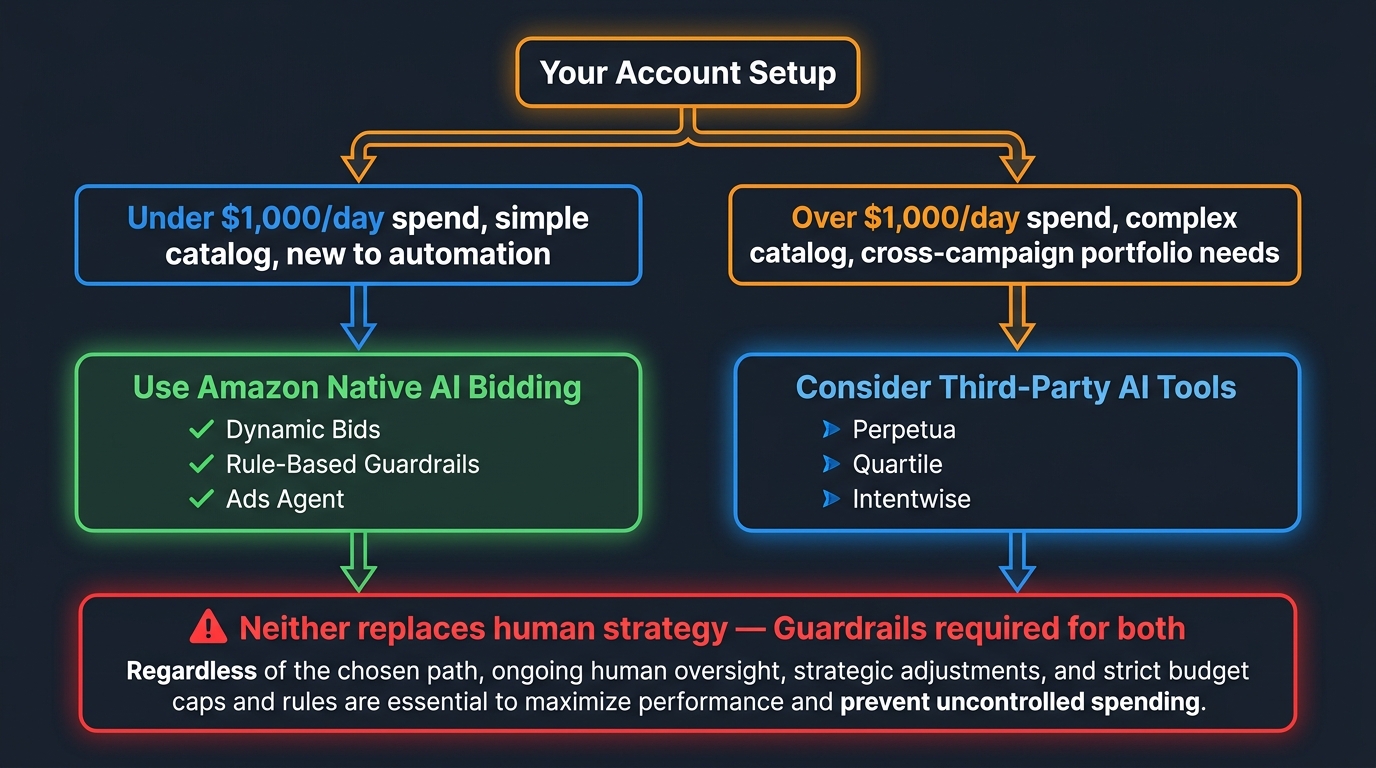
Amazon’s native AI bidding infrastructure — dynamic bidding modes, portfolio controls, Ads Agent, and Marketing Stream — covers the majority of optimization needs for most accounts. Third-party AI bidding tools offer incremental capabilities in specific situations, but they are not universally superior to the native stack, and they introduce operational complexity that should be justified by expected returns before adding.
In 2026, the gap between native Amazon AI and third-party AI tools has narrowed significantly. Amazon’s own algorithms have improved, Ads Agent has added meaningful automation, and Marketing Stream has brought intraday granularity that was previously only available via external integrations. For accounts under approximately $1,000 per day in spend with a catalog of fewer than 50 ASINs, the native stack is the rational starting point.
Cases Where Third-Party Tools Add Genuine Value
Third-party tools — platforms like Perpetua, Quartile, Intentwise, and several others — earn their place in three specific scenarios.
First, cross-campaign portfolio optimization at scale. For accounts managing hundreds of campaigns across dozens of ASINs, native tools require significant manual effort to coordinate budget reallocation across campaigns. Third-party platforms can rebalance spend across the entire portfolio in response to real-time performance signals — moving budget from underperforming campaigns to overperforming ones intraday. Amazon’s native portfolio tools offer some of this, but the external platforms generally operate with more sophistication at high campaign counts.
Second, margin-aware bidding. Native Amazon bidding optimizes to ACoS, ROAS, or click volume — it does not know your cost of goods, fulfillment fees, or net margin. Third-party tools that integrate product economics data can bid to true profitability rather than proxy metrics. For catalogs with highly variable margins, this distinction matters significantly.
Third, cross-marketplace coordination. Sellers active across multiple Amazon marketplaces (US, EU, UK, Japan) managing coordinated campaigns benefit from third-party platforms that can apply shared learning and budget coordination across geographies — something native Amazon tools cannot currently do.
The Overlay Risk
The most important caution with third-party tools is what happens when their bid adjustments conflict with or layer on top of Amazon’s native AI adjustments. If Amazon’s dynamic bidding algorithm is adjusting bids in real time and your third-party tool is also adjusting bids on a 15-minute cycle, both systems are operating on delayed information about what the other has just done. The result can be erratic effective CPCs and unstable learning data for both systems.
Best practice in 2026: when using a third-party bidding tool, set Amazon’s native bid mode to “fixed bids” for those campaigns, giving the external tool full control rather than running two competing AI systems simultaneously. Establish which layer has authority, and stick to it.
What Good Testing Infrastructure Looks Like in Practice
The framework above is a sequence of decisions. Making those decisions well requires a consistent measurement infrastructure that most Amazon advertisers do not have in place. Here is what that infrastructure needs to include.
A Documented Pre-Test Baseline
Before each test in the sequence, document your current performance metrics: average daily spend, ACoS, conversion rate, CPC, and impression share over the prior 30 days at the campaign level. Without this baseline, you cannot assess whether the test delivered an improvement, a degradation, or no measurable change. This sounds obvious, but a significant number of advertisers run tests without recording the starting state and then evaluate outcomes by feel rather than by comparison.
Consistent Reporting Cadence
During any active test, pull placement reports, search term reports, and campaign performance reports weekly — not daily. Daily data on Amazon is highly volatile due to attribution delays and normal auction variance. Weekly data provides a smoother, more reliable signal. Monthly data is too infrequent to catch issues before they compound. Weekly is the right cadence during active experiments.
One Variable at a Time — Enforced as a Rule
This principle appears in every PPC testing framework ever written, and it is violated in every account examined by every agency that has ever conducted an audit. The pressure to make multiple improvements at once is real — you have a list of things you want to fix, and changing one at a time feels slow. The cost is that you never know what worked, which means you cannot scale what works or avoid what doesn’t.
In AI bidding specifically, the cost of violating this principle is higher than in manual bidding, because each change resets the algorithm’s learning state. Multiple simultaneous changes do not reset the learning period once — they reset it into a configuration where the algorithm is building a model for a state that may change again before the model has stabilized. The compounding confusion can set performance back months.
An ACoS Waterfall by Product Lifecycle Stage
Document your ACoS targets explicitly by product lifecycle stage. Launch-phase ASINs should have a deliberately higher ACoS target (you are paying to build conversion history). Growth-phase ASINs should have a moderate target. Mature, high-volume ASINs should have a tight efficiency target. Each stage implies a different bidding mode, different exit conditions, and different intervention thresholds. Without this documentation, you will inevitably apply efficiency-phase thinking to launch campaigns and kill their velocity, or apply launch-phase thinking to mature campaigns and erode their margin.
The Sequence Is the Strategy
Amazon Ads AI bidding in 2026 is genuinely powerful. The algorithms have improved, the data infrastructure has deepened, and the tools — from Ads Agent to Marketing Stream hourly data — provide capabilities that required expensive third-party solutions or custom engineering just two years ago. The frustrating reality, however, is that power does not equal performance. The accounts that are extracting the most from these systems are not the ones with the most advanced tools. They are the ones that built the right foundation in the right order.
The sequence matters because each layer feeds the next. Clean conversion data makes AI bidding stable. A stable bid mode makes placement testing interpretable. Understood placement behavior makes portfolio ACoS targets accurate. Accurate targets make Ads Agent recommendations trustworthy. Trustworthy recommendations, combined with hourly Marketing Stream data, make intraday bid scheduling genuinely useful rather than just technically possible.
Running these steps out of order — or running them all at once — collapses the clarity that makes each step work. The accounts that report AI bidding “doesn’t deliver results” have almost universally skipped the audit, changed too many things at once, evaluated outcomes before learning periods completed, or added AI on top of a structurally broken campaign foundation.
The Practical Starting Point for This Week
If you are reading this with an active Amazon Ads account and want to know where to start, the answer is the pre-test audit in Step One. Pull your last 30 days of conversion data by campaign, check each campaign for the four diagnostic criteria, and identify which campaigns have the data quality to support AI bidding and which ones need foundational work first. That audit, completed honestly, will tell you more about your account’s current situation than any bidding tool or algorithm setting can.
From there, the framework gives you a sequence. Follow the sequence. Let each step complete before starting the next. Document your baseline before each change. Set exit conditions before you begin. And resist the pressure to accelerate — in AI bidding, patience at each step is not passivity. It is the mechanism by which the algorithm learns to deliver the results you are trying to measure.
Key takeaways: Complete your four-point pre-test audit before changing any bid setting. Start with dynamic bidding — down only as your default mode. Test placement multipliers only after bid mode is stable. Protect the learning period from interference for at least 4 weeks after any major change. Build portfolio structures around products with similar margins. Introduce Ads Agent only on mature, stable campaigns. Explore hourly scheduling at scale only after the preceding layers are working. Always define guardrails and exit conditions before starting any test.