For most of Amazon’s advertising history, the word “video” and the words “Sponsored Products” lived in completely different conversations. Video was for brand storytelling — the eye-catching banner at the top of the search results page that brand-registered sellers used for awareness campaigns. Sponsored Products were the workhorse: static, efficient, and responsible for the majority of ad revenue across the platform. The two formats coexisted but never truly merged.
That changed in 2026. Amazon officially rolled out Sponsored Products Video Ads (SPV) in Q1 of this year, inserting autoplay video directly into the search results grid — the very same placement where static product images have always competed for attention. This isn’t a cosmetic update. It’s a structural change to how Amazon’s search engine results page (SERP) works, and it has significant implications for every seller who runs PPC campaigns.
The timing is not accidental. Amazon is responding to a documented shift in shopper behavior. TikTok Shop, YouTube Shopping, and Instagram’s shoppable video features have conditioned a generation of buyers to expect motion when they browse. Static images are increasingly invisible to a scroll-trained eye. Amazon’s answer is to bring the feed-like discovery experience into its own search grid — and it’s doing it through the most conversion-focused ad type it has ever offered.
This guide is built specifically for sellers who are past the “what is it?” stage and want to know how to actually execute. We’ll cover the technical specs, the creative psychology, the campaign architecture, the bid mechanics, and the specific pitfalls that will bleed your budget if you’re not paying attention.
What Sponsored Products Video Ads Actually Are (And What They’re Not)
Confusion about Amazon’s video ad ecosystem is widespread, and it matters because getting the terminology wrong leads to choosing the wrong format for the wrong goal. Let’s clarify exactly what Sponsored Products Video Ads are and how they fit alongside Amazon’s other video placements.
Sponsored Products Video (SPV): The Conversion Engine
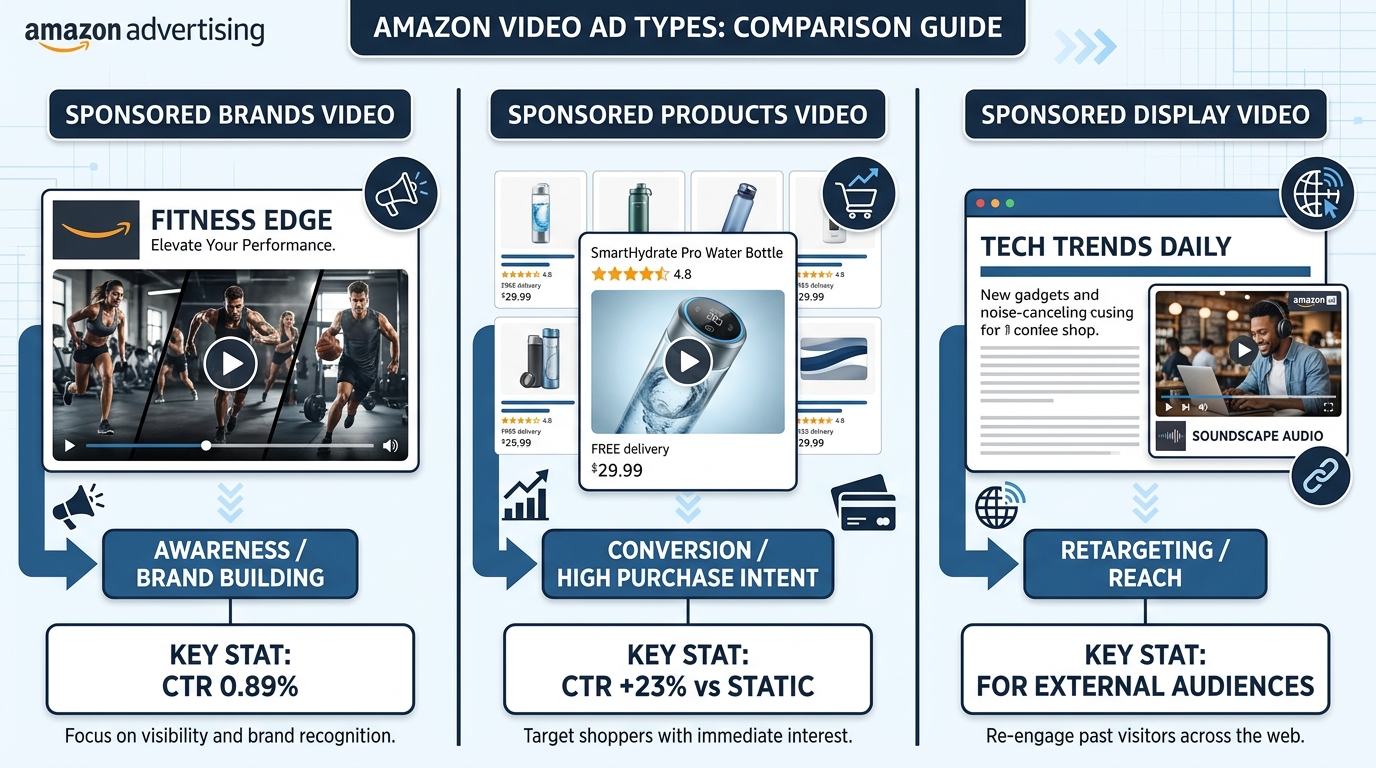
Sponsored Products Video Ads are video assets attached directly to individual ASIN campaigns inside the standard Sponsored Products framework. They appear inside the search results grid — not in a banner above it, not in a sidebar — in the same placement where static product images have always competed. When a shopper scrolls through Amazon search results, the video autoplays silently, displaying your product in motion.
Key characteristics of SPV:
- Placement: Within the organic-looking search grid (mid-page and in-feed), mobile and desktop search results, enhanced mobile app surfaces
- Autoplay behavior: Muted, silent autoplay — your video must work without sound
- Targeting: All standard Sponsored Products targeting options apply — auto campaigns, manual keyword targeting (broad/phrase/exact), and ASIN product targeting
- Eligibility: Available to all sellers, including those without Brand Registry — this is a major differentiator
- Billing: Standard CPC model, same auction mechanics as static Sponsored Products
- Videos per ASIN: Up to 5 short feature videos per ASIN, with shoppers able to tap between clips using clickable thumbnails
How It Differs From Sponsored Brands Video (SBV)
Sponsored Brands Video is a fundamentally different product. SBV ads sit at the top of search — above all organic listings — and require Brand Registry enrollment. They’re designed to tell a brand story with headline text, a logo, and a product card below the video. SBV is a brand-building and awareness tool that happens to convert reasonably well. Its average CTR is 0.89%, which is strong, but its conversion rate (1–3%) trails SPV’s conversion-focused placement.
SPV, by contrast, lands a shopper directly on the product detail page when clicked. There’s no brand story interlude. The click intent is almost always purchase-ready, which is why conversion rates for SPV trend toward the 2–5% range (with top performers significantly higher). SPV also isn’t limited to brand-registered sellers, meaning even newer accounts can use it immediately.
Sponsored Display Video: The Retargeting Layer
Sponsored Display Video is Amazon’s off-Amazon retargeting product. It serves video to shoppers who have previously viewed your product page, browsed similar categories, or visited your Amazon Storefront — both on Amazon and across external websites and apps. If SPV is about winning the moment of search, Sponsored Display Video is about re-engaging shoppers who were almost buyers but didn’t convert. Think of them as operating at different stages of the purchase funnel, not competing with each other.
The strategic takeaway: SPV wins at point-of-purchase; SBV builds brand equity; Sponsored Display Video handles retargeting. All three can work simultaneously in a sophisticated account, but they solve different problems.
The 2026 Performance Benchmarks: What the Data Actually Says
Before you can set meaningful targets for an SPV campaign, you need an accurate read on what the format is actually delivering in 2026. The numbers here are real, but they come with important context that most summaries gloss over.
Click-Through Rate (CTR)
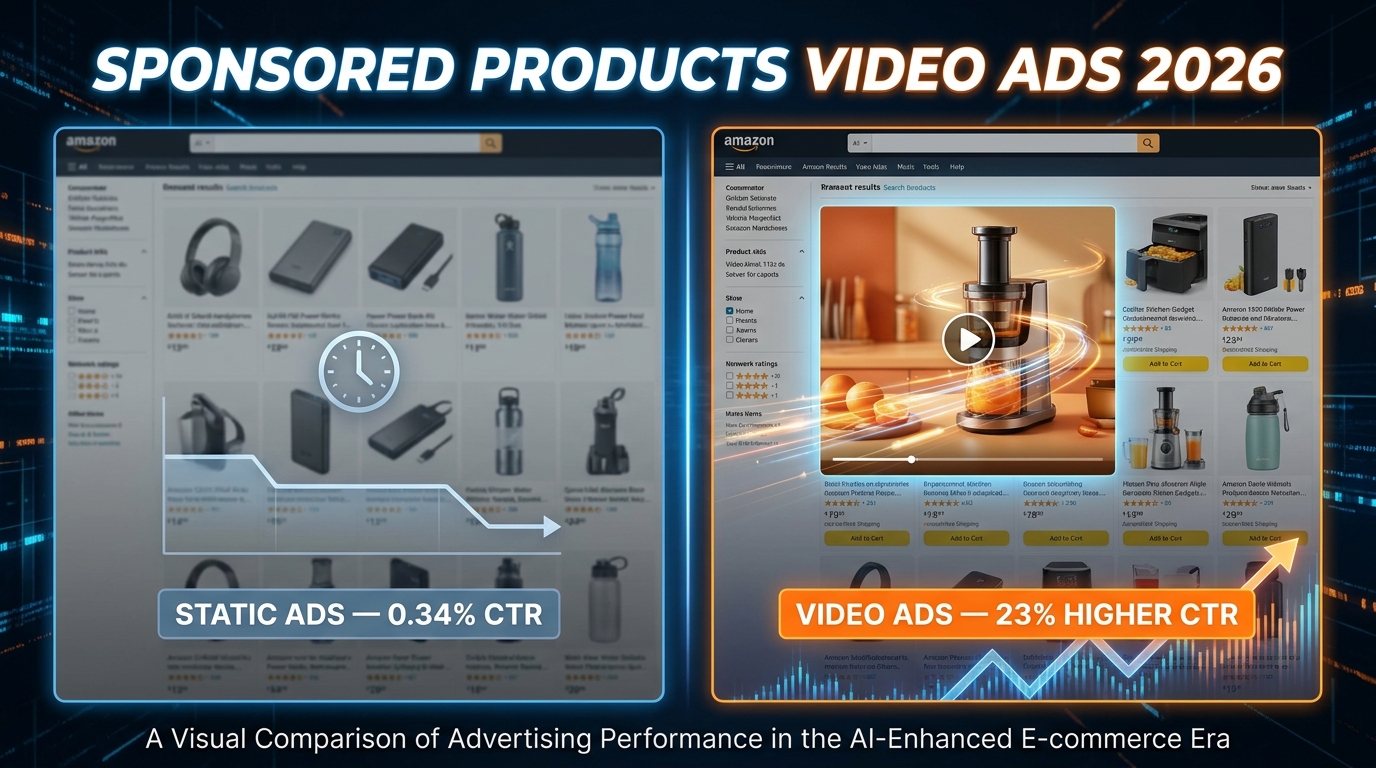
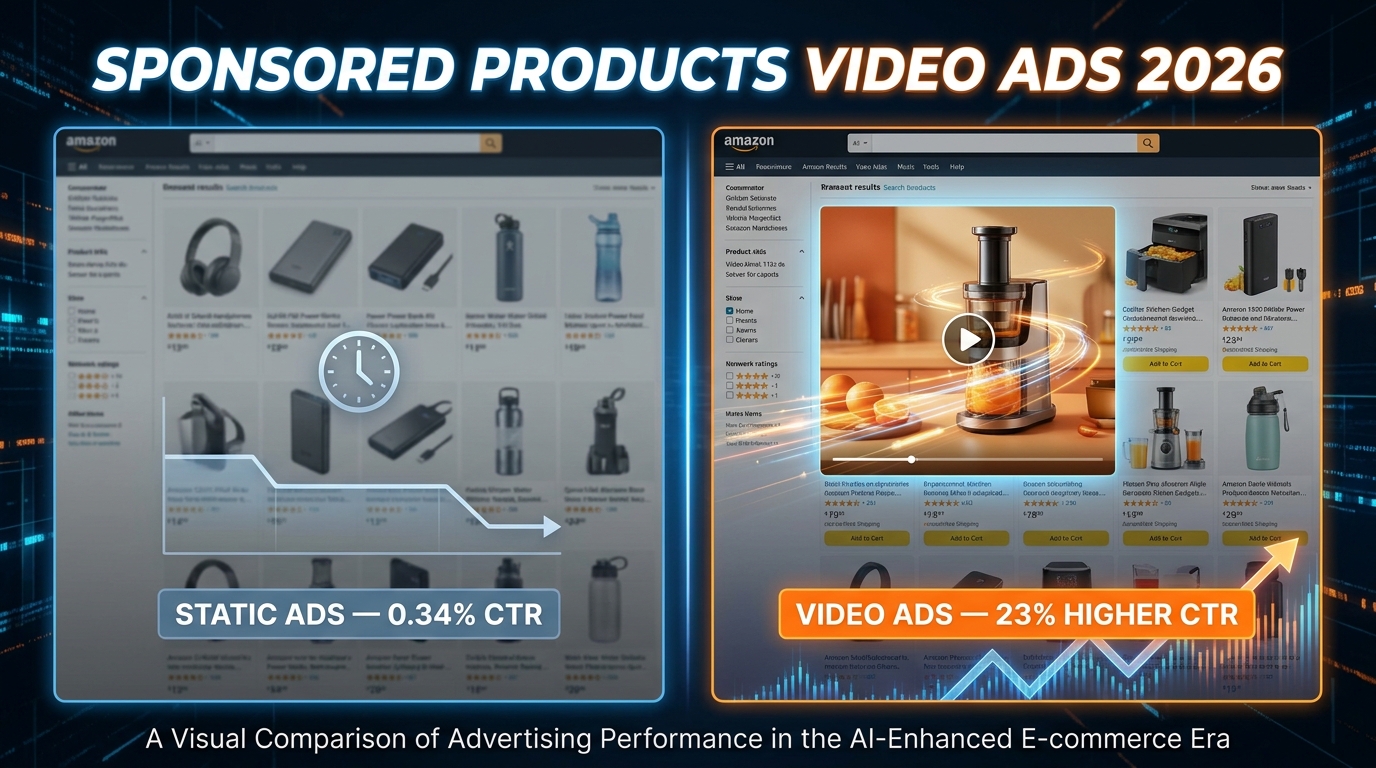
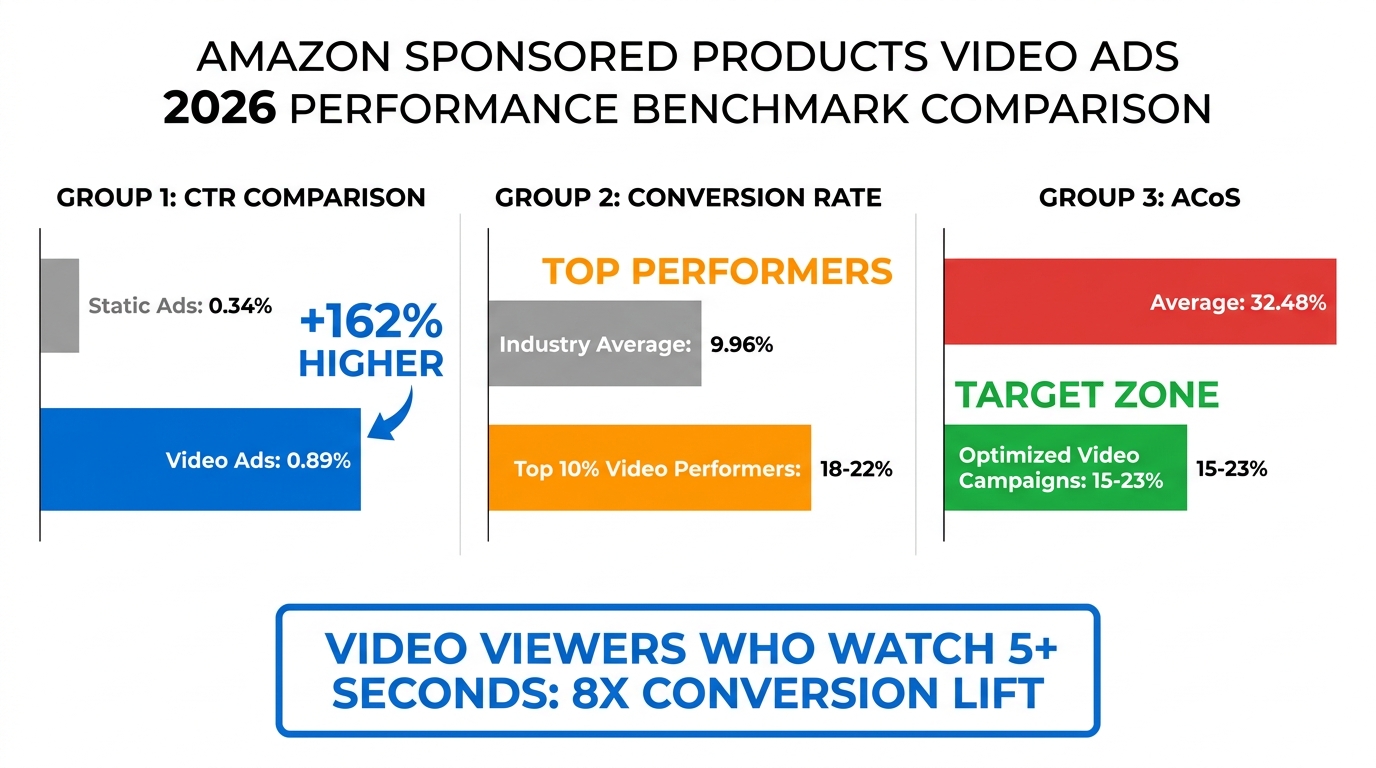
Static Sponsored Products ads average a CTR of 0.34% across the platform (Stormy.ai, 2026). Sponsored Products Video Ads, in Q1 2026 beta tests, posted 23% higher CTR than static image equivalents — putting average SPV CTR in the range of 0.42–0.60% when controlling for category and price point. Sponsored Brands Video, for comparison, averages 0.89% CTR, but it occupies the premium top-of-search placement rather than the mid-grid position where SPV competes.
The 23% lift is meaningful, but it’s an average across all SPV campaigns. The actual variance is enormous. Product categories where motion naturally demonstrates value — kitchen appliances, fitness equipment, personal care devices, cleaning tools, anything with a before/after story — see dramatically higher CTR lifts. Categories with low differentiation or commodity products (bulk paper, plain phone cables) see smaller gains.
Conversion Rate (CVR)
The more interesting number is CVR. The overall Amazon platform conversion rate averages around 9.96% (SequenceCommerce, 2026), which is already 7–8x higher than typical e-commerce. SPV campaigns average 10.2–11.5% CVR across all categories. Top-performing campaigns — typically in consumables, home goods, and personal care — achieve 18–22% CVR.
The critical variable is engagement depth. Shoppers who watch a Sponsored Products Video for more than 5 seconds convert at roughly 8x the rate of those who don’t engage with the video at all. This is the number that should drive your entire creative strategy: your goal isn’t just to stop the scroll. It’s to hold attention past the 5-second mark.
There’s a counterweight here: 70% of viewers drop off within the first 3 seconds (SellerMetrics, 2026). The gap between “scroll past” and “5-second viewer” is the creative problem that separates winning SPV campaigns from wasted spend.
ACoS Benchmarks
Average ACoS for Sponsored Products campaigns sits at approximately 32.48%. Well-optimized SPV campaigns target 15–23% ACoS, which requires both strong creative (high CTR) and targeted keyword selection (high CVR). Sellers who launch SPV without adjusting their keyword targeting or creative strategy often see ACoS spike initially — especially in the first 2–4 weeks while the algorithm gathers engagement signal data.
Category-Level Variance
Performance varies significantly by category. Consumables and repeat-purchase categories average CVR above 15%. Electronics hover around 5% due to longer consideration cycles. Health and personal care, kitchen and dining, and pet supplies all trend above the platform average. If you’re in a low-CVR category, SPV can still be worthwhile, but your creative needs to work harder on trust-building rather than impulse response.
Price Point Effect
Amazon’s 2026 data shows a clear inverse relationship between price and conversion rate across all ad types: products priced below $25 convert at 12.5%, $25–$50 at 10.2%, $50–$100 at 8.7%, and above $100 at 6.4%. SPV doesn’t eliminate this dynamic — it compresses the gap by using video to handle objections before the click — but it doesn’t reverse it. Higher-priced products benefit from SPV’s storytelling capacity but need longer, more detailed videos to move the needle.
Technical Specs and Creative Requirements for SPV in 2026
Getting rejected during the ad review process is an expensive delay. Amazon’s moderation team applies strict standards to video assets, and understanding the technical requirements before production begins saves time and budget. Here’s exactly what you need to know.
Video Specifications
- File format: MP4 or MOV
- Codec: H.264 (primary recommendation); H.265 also accepted
- Resolution: Minimum 1280×720px; recommended 1920×1080px; 4K (3840×2160px) accepted
- Aspect ratio: 16:9 horizontal (standard); 9:16 vertical now available in 2026 for mobile-first placements
- Frame rate: Minimum 15 fps; recommended 23–30 fps
- File size: Maximum 500MB
- Duration: Minimum 7 seconds; no hard maximum — recommended sweet spot is 15–30 seconds
- Audio: Not required; videos autoplay muted — your creative must work in silent mode
- Bitrate: Approximately 2 Mbps recommended
Creative Policy Requirements
Amazon’s content guidelines for SPV are more exacting than for static images. Common rejection reasons include:
- Black bars (letterboxing/pillarboxing): Videos must fill the frame completely. Any black bars are an automatic rejection.
- Unsubstantiated claims: Health claims (“cures,” “proven to”), performance superlatives (“best,” “#1”), or comparative claims without clear evidence will be flagged.
- External logos or competitor branding: Any identifiable competitor branding in frame violates policy.
- Low production quality: Excessively shaky footage, poor lighting, or obviously degraded resolution can result in rejection even if specs are met.
- Ending on a static frame: Videos that freeze on a still image at the end are typically rejected — your final frame should still be in motion or loop back to the beginning.
The Multi-Video Feature: 5 Assets Per ASIN
The most significant technical addition in 2026 is the ability to upload up to 5 short feature videos per ASIN. Amazon displays up to 3 thumbnail previews beneath the main video slot, allowing shoppers to tap between clips without leaving the search results page. Each video can focus on a different product feature, use case, or customer segment.
This changes the creative strategy substantially. Rather than trying to cram every product benefit into a single 30-second video, you can build a library of targeted short clips — one addressing portability, one demonstrating durability, one showing the setup process, one featuring real-world use. Amazon’s algorithm selects which thumbnail appears based on relevance signals tied to the search query. A search for “waterproof” might surface your durability clip; “easy assembly” might surface your setup video.
Vertical Video for Mobile (9:16)
Amazon’s 2026 rollout of 9:16 vertical format for SPV deserves attention from any seller whose analytics show high mobile traffic (which is most sellers — mobile accounts for over 60% of Amazon browse traffic). Vertical video fills the phone screen natively, eliminating the visual “shrink” effect of horizontal video on a mobile display. Early data suggests 2–3x higher CTR for vertical format vs. horizontal on mobile placements. If your production workflow can accommodate it, shoot vertical-first and crop for 16:9 as a secondary deliverable.
Creative Psychology: Building a Video That Earns the 5-Second Watch
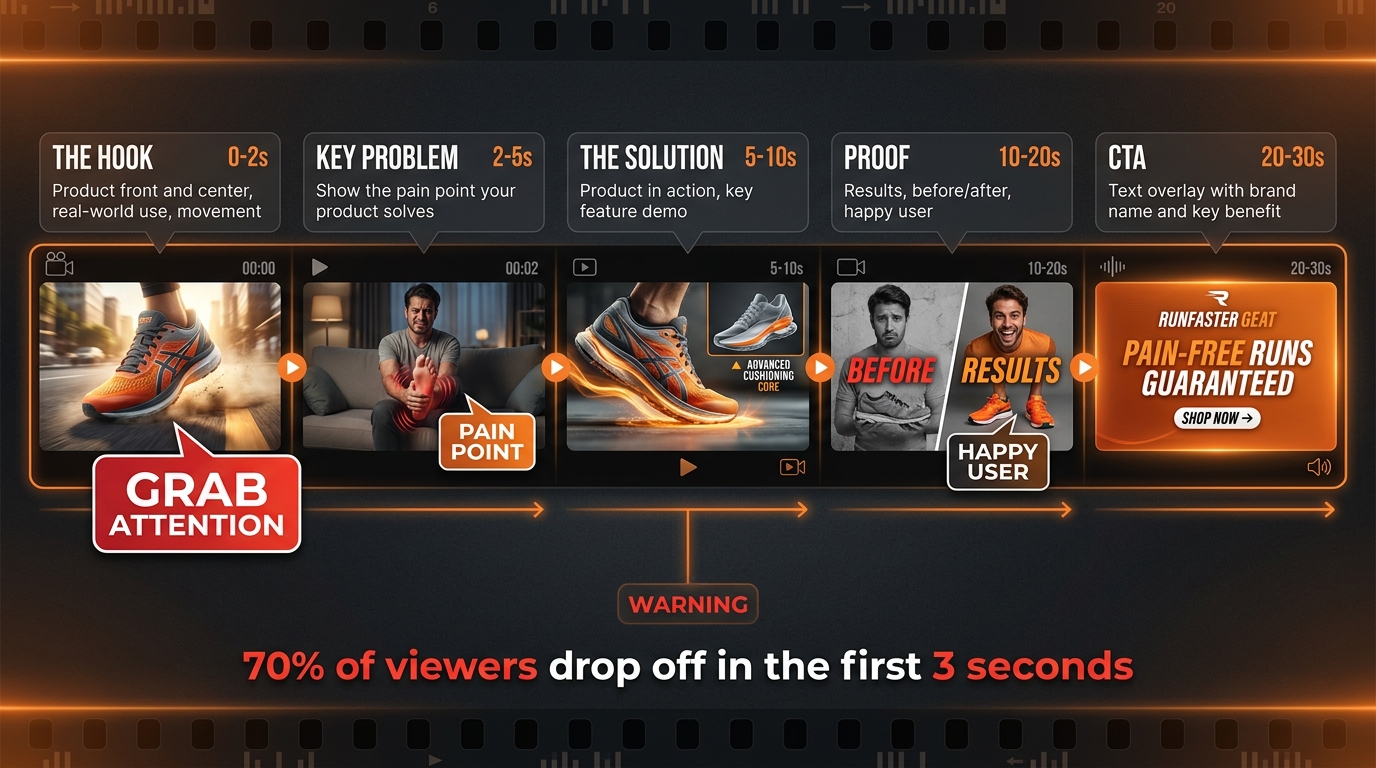
The 70% drop-off rate in the first 3 seconds is the single most important data point in this entire guide. It means most of the people who see your video ad don’t watch it long enough to receive the message. And the 8x conversion lift for viewers who reach 5 seconds tells you exactly what’s at stake in those first few seconds. This is a creative execution problem disguised as a data problem.
Frame One: Product Must Be Visible Immediately
Amazon’s own guidelines specify that the product should appear within the first 1–2 seconds. This isn’t a suggestion — it’s a direct performance driver. Videos that open with a branded intro card, a scenic establishing shot, or an abstract visual teaser perform measurably worse than videos that lead with the product itself. Remember: the shopper is already on Amazon with purchase intent. They don’t need brand awareness; they need product confidence. Give them the product immediately.
The best-performing first frames show the product in motion — being held, being used, being operated — not just sitting on a table. Motion is what makes the viewer stop scrolling in the first place.
The Hook Mechanics: Four Approaches That Work
Beyond leading with the product, your first 3 seconds need an additional “hook” layer that creates a reason to keep watching. Four hook types have demonstrated consistent performance:
- The Problem Statement: Show the problem your product solves visually, before you show the solution. A foot pain product that opens with someone wincing while walking is more arresting than a product sitting in a box. The viewer thinks, “I know that feeling.” That emotional match earns the continued watch.
- The Transformation Hook: A rapid before/after visual cut (dirty sink → spotless sink; tangled cord → organized desk) creates curiosity about the mechanism. The viewer watches to understand how the transformation happens.
- The “How Does That Work?” Hook: Show the mechanism of your product operating in a way that’s slightly surprising or satisfying. Satisfying mechanical motions, precise fits, or unexpected product behaviors exploit the brain’s natural attention to novelty.
- The Question Overlay: A text overlay posing a direct question (“Tired of your blender leaking?”) combined with matching visuals creates cognitive engagement — the viewer’s brain automatically seeks the answer by continuing to watch.
The Silent Video Rule
Because SPV autoplays muted, sound is effectively optional. Text overlays are not optional. Every key message in your video — the problem, the benefit, the product name, the primary feature — should be communicated through text on screen, not through narration or product voiceover. Assume every viewer is watching in a quiet library or on a bus with no earphones. If your video requires audio to make sense, you’ve lost the sale before the 5-second mark.
Text overlays should be brief (3–5 words maximum per frame), high-contrast against the background, and timed to appear as the relevant visual element enters frame. Don’t front-load all your text in the first 2 seconds — distribute it across the video timeline to give viewers a reason to keep watching.
Creative Frameworks That Consistently Underperform
The data also tells us what doesn’t work. Several creative approaches that perform well on YouTube or social media translate poorly to SPV’s context:
- Talking-head testimonials as the lead: A person speaking to camera (even without audio) reads as a social ad, not a product search result. Shoppers are in “product evaluation” mode, not “content consumption” mode. Open with product, transition to testimonial if needed later.
- Brand story openers: Your brand’s founding story is interesting to existing customers. To a first-time searcher on Amazon, it’s dead time in a format where dead time costs conversions.
- Lifestyle-first content: Beautiful cinematography of people in aspirational settings, with the product appearing at the 8-second mark, loses most viewers before they ever see the product. Amazon’s internal data shows product demos outperform lifestyle content 3-to-1 on SPV placements.
- Long list videos: Videos that cycle through 10+ product features without narrative structure result in viewers absorbing none of them. Focus each video on one or two features maximum.
Leveraging the 5-Video System Strategically
The multi-video asset capability isn’t just a technical convenience — it’s a segmentation tool. Different shoppers search with different intents, and your 5 videos can each speak to a distinct buying motivation:
- Video 1 (Primary): The “conversion” video — product in action, primary benefit, direct and fast
- Video 2: Feature deep-dive — demonstrates the most asked-about feature in detail
- Video 3: Use-case scenario — shows the product in the specific context your best customers use it
- Video 4: Social proof / review highlight — real customer moments, unboxing, or before/after results
- Video 5: Differentiation — a direct, factual comparison showing what makes your product different from alternatives (without naming competitors)
Amazon’s algorithm will surface the most relevant thumbnail based on search query signals. A shopper searching a more specific long-tail phrase is more likely to see a feature-specific video than a shopper doing a broad category search.
Campaign Architecture: Where Video Fits in Your Targeting Framework
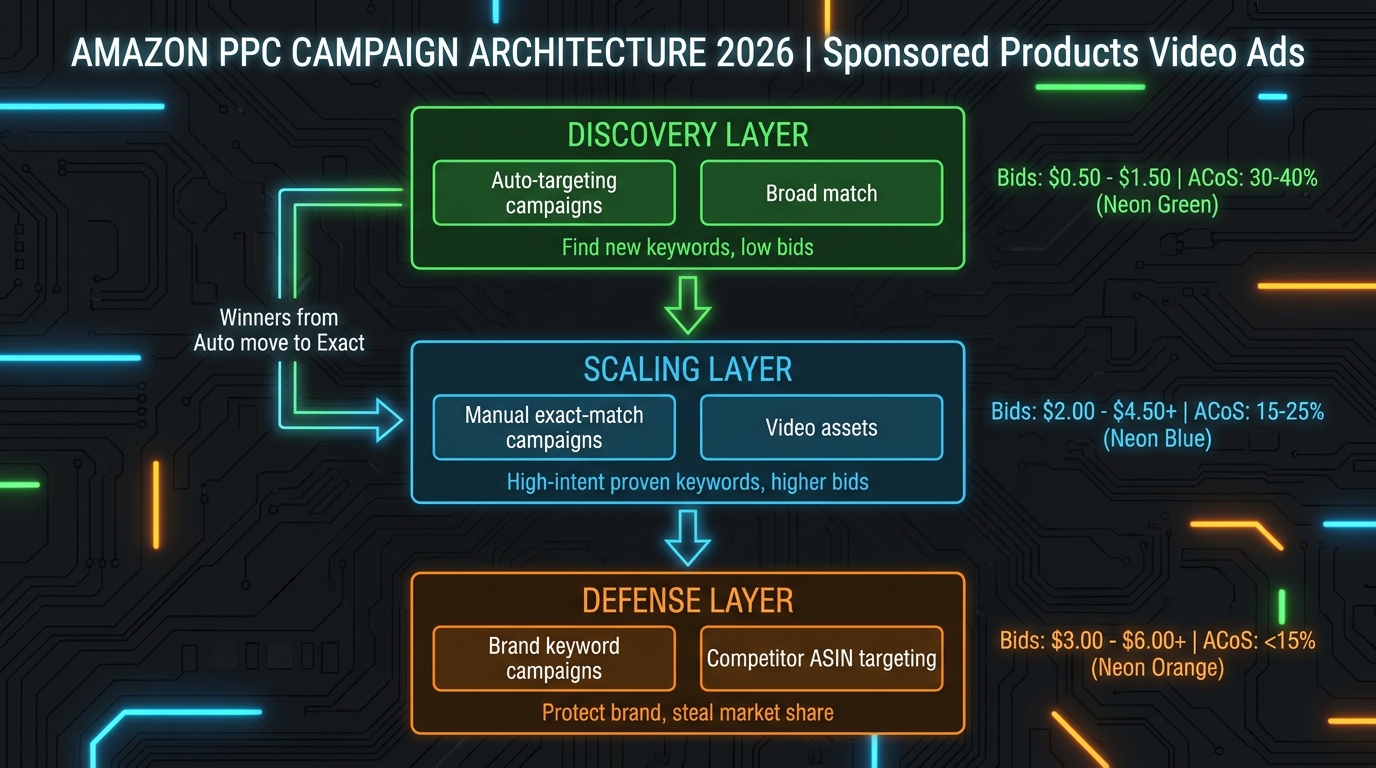
One of the most practical advantages of SPV is that you don’t need to create a separate campaign type. Video assets are added directly to existing Sponsored Products campaigns within Amazon Ads console. This means your existing campaign structure, keyword lists, and bid logic can stay intact — SPV is an enhancement layer, not a parallel system. That said, the way you deploy video across your campaign tiers matters significantly.
The Three-Layer Campaign Architecture
A well-structured Sponsored Products account in 2026 typically operates across three functional tiers, and video should be deployed differently in each:
Layer 1 — Discovery (Auto Campaigns): Automatic targeting campaigns are your keyword mining tool. Amazon’s algorithm matches your product against relevant searches, and you harvest converting search terms to promote to manual campaigns. SPV should be active here, but your video brief for discovery campaigns should be your most “universal” asset — the primary conversion video that appeals to the broadest interpretation of your product. Don’t over-invest video production effort on discovery campaigns; save the feature-specific videos for where you have keyword control.
Layer 2 — Scaling (Manual Exact Match): Your proven high-intent keywords live here. These are terms you know convert, you’ve confirmed they match buyer intent, and you’re willing to bid aggressively to win them. This is where SPV earns its keep. Allocate your best-performing video here — the one with the highest 5-second engagement rate from your discovery data. Apply video-specific placement adjustments to prioritize video delivery over static ads for these keywords.
Layer 3 — Defense (Brand + Competitor ASIN Targeting): Branded keyword campaigns protect your existing customer base; competitor ASIN targeting lets you appear on rival product detail pages. For brand defense, your video doesn’t need to sell hard — it needs to reinforce recognition and quality for shoppers who already know you. For competitor ASIN targeting, a differentiation-focused video (Video 5 in the 5-video system above) is highly effective here.
Keyword Strategy for SPV Campaigns
Video doesn’t change the fundamental logic of keyword selection, but it does change the ROI calculus for certain keyword types:
- Informational long-tail keywords (“how to store food without plastic,” “best insulated water bottle for hiking”) benefit disproportionately from video because the query implies a shopper early in the consideration phase. A video that directly addresses the query’s implicit question converts better than a static image that doesn’t “answer” anything.
- Category head terms (“water bottle,” “kitchen knife”) are extremely competitive. Adding video to your bids on these terms increases your effective quality score and may improve placement without requiring a proportional bid increase.
- Branded competitor terms require a different video — one that leads with your product’s clear differentiator from the competition without violating Amazon’s comparative advertising policy.
One important structural note: negative keyword hygiene becomes more critical with SPV. Because video serves as a quality signal to the algorithm, impressions on irrelevant searches can dilute your engagement rate data. A shopper who searches an irrelevant term and scrolls past your video without engaging is a data point that tells Amazon your video doesn’t resonate — even if the mismatch is purely about keyword relevance, not creative quality. Add aggressive negatives early.
Bid Strategy and Placement Modifiers: Getting Video in Front of the Right Shoppers
Amazon’s bidding system for Sponsored Products gives you three core strategies: dynamic bids (up and down), dynamic bids (down only), and fixed bids. With SPV, the choice of bid strategy interacts with placement modifiers in important ways.
Dynamic vs. Fixed Bids for Video Campaigns
Dynamic bids (up and down) allow Amazon to raise your bid by up to 100% when it predicts a high conversion probability, and lower it when probability is low. For SPV campaigns, this is generally the recommended starting point for new campaigns, because the video engagement signal is new data that Amazon is still learning. Letting the algorithm adjust gives it room to find the conversion patterns unique to your video creative.
Dynamic bids (down only) are useful once a campaign has 30+ days of video engagement data and you’ve identified the specific keywords and placements that convert. This protects your ACoS ceiling while still allowing Amazon to reduce spend when intent signals are weak.
Fixed bids give maximum control for exact-match campaigns on proven keywords. They’re most appropriate in Layer 2 campaigns where you have specific ranking goals and don’t want Amazon adjusting bids based on conversion probability scores that may not fully account for your video’s engagement contribution.
Video Placement Bid Adjustments
Amazon introduced video-specific bid adjustments for Sponsored Products in 2026, allowing sellers to apply a percentage increase specifically when video is eligible to serve (versus the fallback static image). This is a critical lever most sellers haven’t yet discovered. If you upload a video and your campaign has a +0% video placement modifier, Amazon will serve the video or the static image based purely on which it predicts will perform better. By increasing the video bid modifier to +20–40%, you tell the system to prioritize video delivery — meaning you’re paying slightly more per click, but you’re getting the higher-engagement format consistently.
Set the video placement modifier aggressively (40–60%) during the first 30 days to accelerate data collection. Once you have enough video engagement data to see clear performance patterns, reduce the modifier to a level that maintains video priority without over-bidding relative to your ACoS targets.
Top-of-Search vs. Rest-of-Search Placement
Sponsored Products can appear at the top of search results or within the mid-page grid. The conventional wisdom is that top-of-search placement costs more but converts better. With SPV, this dynamic shifts slightly: mid-page video placement captures shoppers who are still scrolling and comparing — a more consideration-phase moment — while top-of-search video captures early-session intent. Test both with separate placement modifier settings and evaluate ACoS independently. Don’t assume the performance hierarchy of static ads applies equally to video.
ACoS Control: Where Sellers Bleed Budget on SPV Campaigns
The most common failure mode for newly launched SPV campaigns isn’t creative quality — it’s budget management during the data collection phase. Video campaigns have a higher implicit cost structure than static campaigns, because the algorithm is learning new signals (video engagement metrics) that don’t exist for static ads. Here’s where the money leaks.
The First-30-Days Tax
In the initial month of a SPV campaign, expect ACoS to run 10–15 percentage points higher than your static campaign benchmarks for the same keywords. This is not evidence that video isn’t working — it’s the cost of signal acquisition. The algorithm is learning which queries, placements, and audience behaviors correlate with video engagement that converts. Cutting spend or pausing campaigns in the first 30 days destroys the data-gathering process and resets the learning curve.
Set a conservative weekly budget cap for the first month (roughly 20–30% higher than your equivalent static campaign spend) and commit to not adjusting bids downward for at least 3 weeks. Track video engagement rate in your campaign reports alongside the standard CTR and CVR metrics.
Keyword Concentration Risk
A common mistake is launching SPV campaigns with the same broad keyword list you use for static campaigns. Video has higher CPCs in competitive categories because you’re competing against other sellers who are also now bidding with video-quality multipliers. Running 200 keywords in a single SPV campaign dilutes your budget across too many low-volume terms and prevents any single keyword from accumulating enough data to optimize.
Start SPV with a focused list of 20–40 high-intent, proven-converting keywords. Once you’ve established performance baselines, expand. This is the opposite of the “spray and pray” approach that works well for static campaigns but burns video budgets.
The Engagement Rate Metric You Need to Track
Standard Amazon campaign reports don’t show video engagement metrics (watch time, 5-second rate) by default. You need to access these through the Amazon Ads console’s video-specific report section. Pull these reports weekly during the campaign’s first 90 days. The engagement rate at the 3-second and 5-second marks tells you whether your creative is working. If you have strong CTR but low 5-second engagement, your hook is getting the click but the video isn’t building purchase intent — meaning you’re paying for low-quality traffic. Fix the creative before scaling spend.
Negative ASIN Targeting for Video Campaigns
When running SPV with ASIN product targeting (appearing on competitor product pages), you’re visible to shoppers who are explicitly considering an alternative. The conversion intent is real, but the ACoS can be punishing if you’re targeting hundreds of competitor ASINs blindly. Prioritize competitor ASINs with similar price points (within 20% of yours) and similar review counts. Products significantly cheaper or more established than yours will drain spend with low conversion rates regardless of how good your video is.
Sponsored Products Video vs. Sponsored Brands Video: A Strategic Comparison
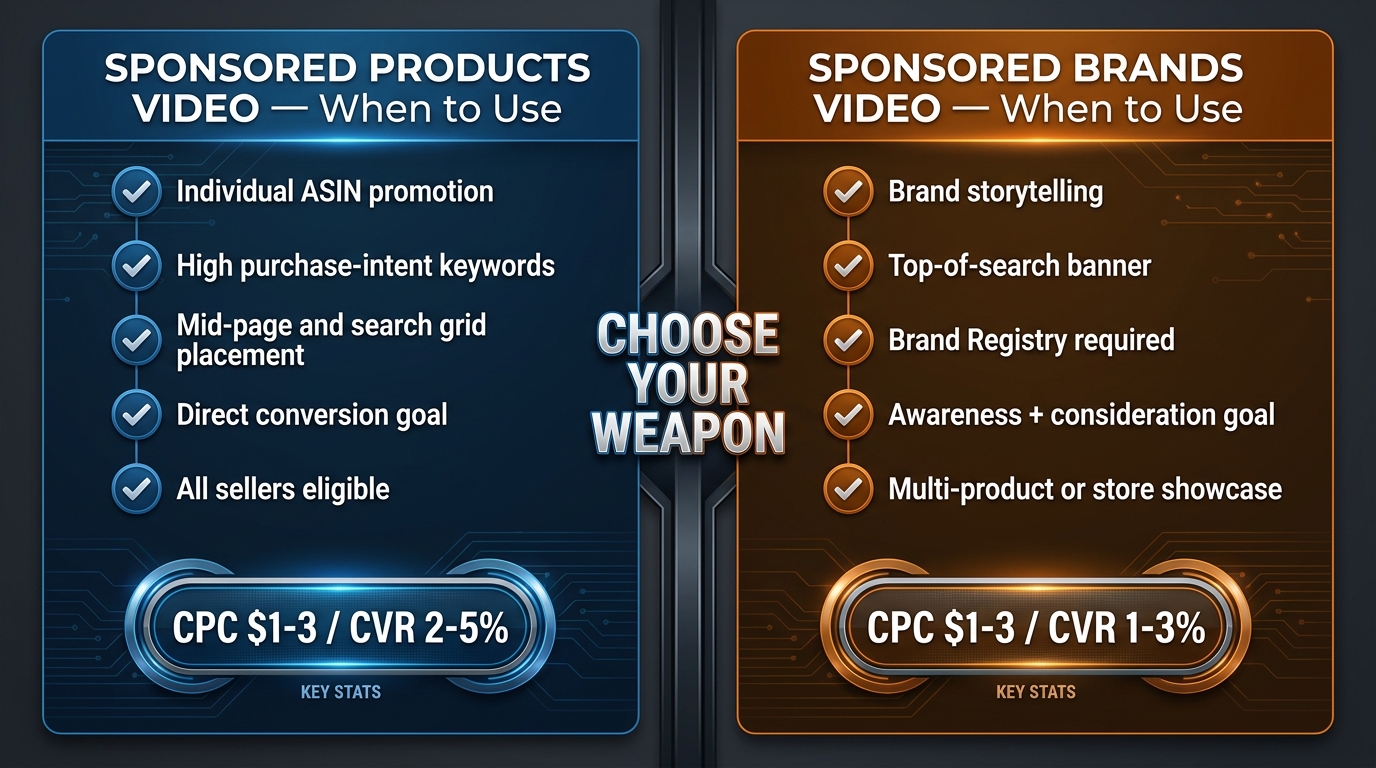
If you’re brand-registered and running both SPV and Sponsored Brands Video (SBV), the question of how to allocate creative effort and budget between them is real and consequential. They’re not interchangeable — they’re genuinely different tools for different jobs.
Where They Compete for Budget
Both SPV and SBV serve video in search results. For brand-registered sellers with limited production budgets, the temptation is to use the same video asset for both. Resist this. The creative requirements for each placement are meaningfully different, and a video optimized for one will underperform in the other.
SBV sits at the top of search, where shoppers see it before any products. The shopping mindset at that moment is “I’m about to start evaluating options.” The appropriate video for this moment has more time to set context, introduce the brand, and show the product range. SBV can be 30–45 seconds and use a slightly more cinematic opening.
SPV appears in the mid-grid, where shoppers are already in evaluation mode — they’ve been scanning products and comparing. The appropriate video here is faster, more direct, and more focused on differentiating your specific ASIN from the others in view. SPV should rarely exceed 20–25 seconds and needs to lead with the product benefit, not brand story.
Budget Allocation Between SPV and SBV
A practical starting framework for brand-registered sellers running both:
- Allocate 60–70% of video ad budget to SPV for established products with strong organic rankings and proven keyword sets. SPV operates at lower-funnel, higher-intent moments and generally delivers better direct ROAS on mature products.
- Allocate 30–40% to SBV for new product launches, seasonal campaigns, or brand-building around category keywords where you want top-of-search presence before shoppers form strong alternatives preferences.
This ratio flips for newer brands entering competitive categories: more SBV early to establish category awareness, transitioning to SPV-heavy allocation as the brand builds organic presence.
Creative Repurposing: What Works and What Doesn’t
If you must use one video for both formats, SPV requirements should drive the creative brief. A well-crafted SPV video (product-forward, fast hook, text overlays for silent viewing) will adapt to SBV with minor edits. The reverse is less true — an SBV video built around brand storytelling will lose viewers in SPV’s context before delivering its payload.
Measuring What Actually Matters: The Right Metrics for SPV
Amazon gives you a lot of data. Not all of it is equally useful for evaluating SPV performance. Here’s a disciplined approach to measurement that focuses on actionable signals rather than vanity numbers.
The Metrics That Drive Creative Decisions
5-Second Engagement Rate: The percentage of shoppers who watch at least 5 seconds of your video. This is the single most predictive metric for downstream purchase intent. Below 30% engagement rate: your hook is failing. Above 50%: your hook is strong, focus on the post-hook content. Pull this from the video campaign report section of Amazon Ads.
Video Completion Rate (VCR): For 15–30 second videos, a completion rate above 25% indicates strong creative resonance. Below 15% suggests pacing problems in the video’s middle section. Map your pacing edits to the drop-off timeline data that Amazon provides in video reports.
CTR relative to static baseline: Don’t evaluate your SPV CTR in isolation — compare it to your static campaign CTR for the same keywords. If SPV CTR is not at least 15% higher than static for the same keywords, either the creative needs work or the keywords are a poor match for the video’s messaging.
The Metrics That Drive Campaign Decisions
ACoS by keyword with video data overlay: Keywords where video engagement is high but ACoS is still elevated often indicate a listing problem — shoppers are engaging with the ad but finding something on the product detail page that kills the purchase. This diagnosis is impossible without looking at the keyword-level engagement data alongside CVR. It’s one of SPV’s most valuable hidden benefits: it forces you to see exactly where in the funnel the purchase breaks down.
New-to-Brand rate: Amazon Ads provides New-to-Brand (NTB) data for Sponsored Products campaigns. SPV’s search-grid placement makes it more effective at reaching net-new customers than repeat-purchase retargeting. Track your NTB rate for SPV campaigns separately — a high NTB rate at acceptable ACoS means SPV is genuinely expanding your customer base, not just recycling existing demand.
Organic rank correlation: Sales velocity generated by SPV contributes to organic ranking signals. After 60 days of running SPV on specific keywords, pull your organic rank position for those keywords and compare to a pre-campaign baseline. This is the “bonus ROI” of video campaigns — the paid ad is building the organic equity that eventually reduces your need for paid spend on that keyword.
Weekly Review Cadence
SPV campaigns require a weekly review structure during the first 90 days. The standard bi-weekly or monthly review cadence used for mature static campaigns is too slow for a format where creative performance is the primary variable. Structure your weekly review around three questions:
- Is the 5-second engagement rate above 30%? If not, what’s the hypothesis for why it’s failing?
- Are any keywords generating clicks with zero or near-zero engagement on the video? (This suggests a keyword-creative mismatch and is a candidate for negative listing.)
- Is ACoS trending down from the baseline established in week 1? If not, where in the funnel is the leak?
Who Should Launch SPV Now — and Who Should Wait
Not every seller is equally positioned to benefit from SPV at launch. There’s a meaningful difference between sellers for whom SPV is an immediate priority and sellers who need prerequisites in place first.
Launch Now If:
- You already have video assets created for other platforms (YouTube ads, social media) that can be adapted to SPV specs
- Your product has a clear visual benefit story — it does something that’s more compelling when shown than described
- You’re in a category with high scroll-and-compare behavior (kitchen, fitness, beauty, outdoor, pet)
- Your main static image is strong and your listings are already optimized — SPV amplifies a good listing; it can’t rescue a weak one
- You have budget tolerance for a 30–60 day learning period before expecting optimized ACoS
Build Prerequisites First If:
- You have no video production capability and no budget for even basic smartphone-quality content
- Your product detail page has under 4.0 stars or fewer than 25 reviews — video will drive traffic to a page that doesn’t convert
- Your static Sponsored Products campaigns have never achieved ACoS below 40% — the fundamental conversion problem is in the listing or pricing, not the ad format
- You’re in a category where purchase decisions are almost entirely price-driven (commodity goods) — video adds cost without a clear differentiation benefit
The Production Minimum Viable Bar
A question sellers frequently ask: does SPV require professional videography? The honest answer is that it requires intentional videography, which is different from expensive videography. A 20-second video shot on a modern smartphone in good lighting, with proper stabilization (a tripod costs under $30), a clean background, and well-designed text overlays will outperform a professionally shot video that doesn’t follow the hook-product-benefit-proof structure. The creative strategy matters more than the production budget at most price points. Categories above $150 may benefit from elevated production quality, but for the majority of Amazon product categories, execution of the creative brief is the differentiator.
What Comes Next: The SPV Feature Roadmap
Amazon rarely announces its ad product roadmap publicly, but based on current beta testing signals and the trajectory of the feature rollout, several developments are likely to arrive or fully roll out before the end of 2026:
Interactive Video Elements
Amazon has been testing “pause ads” on Prime Video — non-intrusive overlay ads that appear when a viewer pauses content, with a direct “Add to Cart” button. Similar interactive elements are being piloted for SPV, including in-video cart add overlays that allow shoppers to add a product to cart without clicking through to the product detail page. Early internal data suggests a 3.5x brand favorability lift for these formats. When this feature reaches general availability, it fundamentally changes SPV’s purchase funnel by eliminating the click barrier entirely.
AI-Assisted Video Creation
Amazon’s AI creative tools, already deployed for image optimization, are being extended to video. Within the Amazon Ads console, sellers will reportedly be able to generate short video clips from existing product images and A+ content — effectively creating an SPV-ready video without a production budget. This is already in limited beta and is expected to reach broader availability by late 2026. For sellers with no current video assets, this will reduce the barrier to entry significantly.
Vertical Video Full Rollout
The 9:16 vertical format for SPV is currently available in select placements. By Q4 2026, Amazon is expected to complete its rollout across all mobile SPV placements. Sellers who prepare vertical video assets now — even simple ones — will have a meaningful advantage as vertical becomes the dominant mobile format.
SPV Integration with Amazon DSP
Amazon is also reportedly testing cross-channel continuity between SPV and its Demand-Side Platform (DSP). This would allow a shopper who engaged with a SPV ad (but didn’t convert) to be retargeted with related video content through DSP placements off Amazon. This kind of cross-channel video attribution would make SPV’s upper-funnel contribution measurable in ways that current reporting doesn’t support.
Your 60-Day Launch Checklist for Sponsored Products Video Ads
Translating research into action requires a concrete sequence. Here’s a practical 60-day roadmap for launching your first SPV campaign with the highest probability of a positive ROI outcome:
Days 1–7: Production and Asset Preparation
- Identify your top 3–5 ASINs by organic conversion rate — launch SPV on proven products first
- Map the creative brief for Video 1 (primary conversion video) — define the hook type, key benefit to demonstrate, and text overlay copy
- Shoot and edit Video 1 to spec: 1920×1080px, 16:9, 15–25 seconds, silent-mode functional, product visible by second 1
- If mobile traffic is above 60%, also produce a 9:16 vertical version
- Submit for Amazon review (allow 3–5 business days for approval)
Days 8–14: Campaign Setup
- Add the approved video to your top-performing existing Sponsored Products campaigns (Layer 2: proven exact-match keywords)
- Set video placement bid modifier to +40% for the first 30 days
- Choose “dynamic bids up and down” for new SPV campaigns
- Pull your static campaign’s 90-day search term report and pre-populate 150+ negative keywords before launch
- Set weekly budget cap at 125% of your equivalent static campaign spend
Days 15–30: Data Collection (Do Not Optimize Yet)
- Check video engagement reports weekly but resist making bid changes for the first 21 days
- Note search terms generating clicks but zero video engagement — add these to a negative review list
- Track ACoS baseline — expect it to be elevated; document rather than react
Days 31–45: First Optimization Pass
- Pull the full 30-day video engagement report. Identify keywords where 5-second engagement rate is below 20% — pause or negate these terms
- Reduce video placement modifier to +20% for campaigns showing ACoS above target
- Begin production of Video 2 (feature deep-dive) based on which product features have the highest search query volume in your term report
- For auto campaigns, promote 3–5 converting search terms to a new exact-match campaign with SPV active
Days 46–60: Scale and Diversify
- Upload Video 2 and activate in the same campaigns as Video 1
- Enable competitor ASIN targeting with a focused list of 10–20 directly competitive products
- Set ACoS targets for 90 days: aim for within 5 percentage points of your static campaign benchmark
- Begin planning Video 3 (use-case scenario) based on 60 days of search query data showing customer intent patterns
The Bigger Picture: SPV as a Competitive Moat
Step back from the tactical detail and consider the structural dynamic at play. Amazon’s search results page is undergoing a format shift — from a static grid to a hybrid feed with motion content. This shift is happening now, while the majority of sellers are still operating with all-static creative strategies. The adoption gap is real, and it’s temporary.
In 12–18 months, Sponsored Products Video will be table stakes — something every category leader uses, and something that no longer confers first-mover advantage. The window where video gives you a measurable edge over non-video competitors (the 23% CTR lift, the lower effective CPC from quality score improvement, the 8x conversion lift for engaged viewers) is widest right now, while adoption is still below majority.
This isn’t about chasing a shiny new feature. It’s about recognizing that the format of Amazon advertising is changing at the structural level, and aligning your creative and campaign strategy with where the platform is actually going — before your competitors do.
The sellers who build a library of well-structured SPV assets now, who learn the creative frameworks that earn the 5-second watch, and who wire their campaign architecture to extract the maximum signal from video engagement data, will have a compounding advantage. The data they collect today will inform better creative tomorrow. The organic rank gains from video-driven sales velocity will reduce their paid spend requirements over time. And the creative production muscle they build now will be immediately applicable to every new video format Amazon introduces afterward.
The Amazon SERP is becoming a feed. Every seller who treats it like a catalog is slowly disappearing. The question isn’t whether to use Sponsored Products Video Ads — it’s whether you move now or wait until the advantage is gone.
Start with one product. Build one video. Launch one campaign. Collect 30 days of data. Then decide how aggressively to scale. The first video you produce will not be your best video — but it will generate data that makes every subsequent video better. That’s the compound return that early movers in this format are already building, and late movers will eventually have to catch up to.
Leave a Reply