Before you roll out the next AI agent, answer one question: how many agents do you already run? Most teams can’t answer it with confidence.
That isn’t a criticism. Agents arrive from many directions. A vendor switches on an assistant inside a SaaS tool. An analyst wires a workflow to an API key. An engineering team ships a pilot and moves on to the next project.
Each one looks small when it appears. Together they form a fleet that nobody owns, and every new rollout adds to a pile you can’t see. This article explains how to build an agent inventory first: what to record, how to find what’s hidden, who should own it, and how to turn it into a gate for future launches.
The Visibility Gap Is Wider Than Leaders Think
Recent survey figures show the same pattern: adoption is moving faster than record-keeping.
What the surveys report
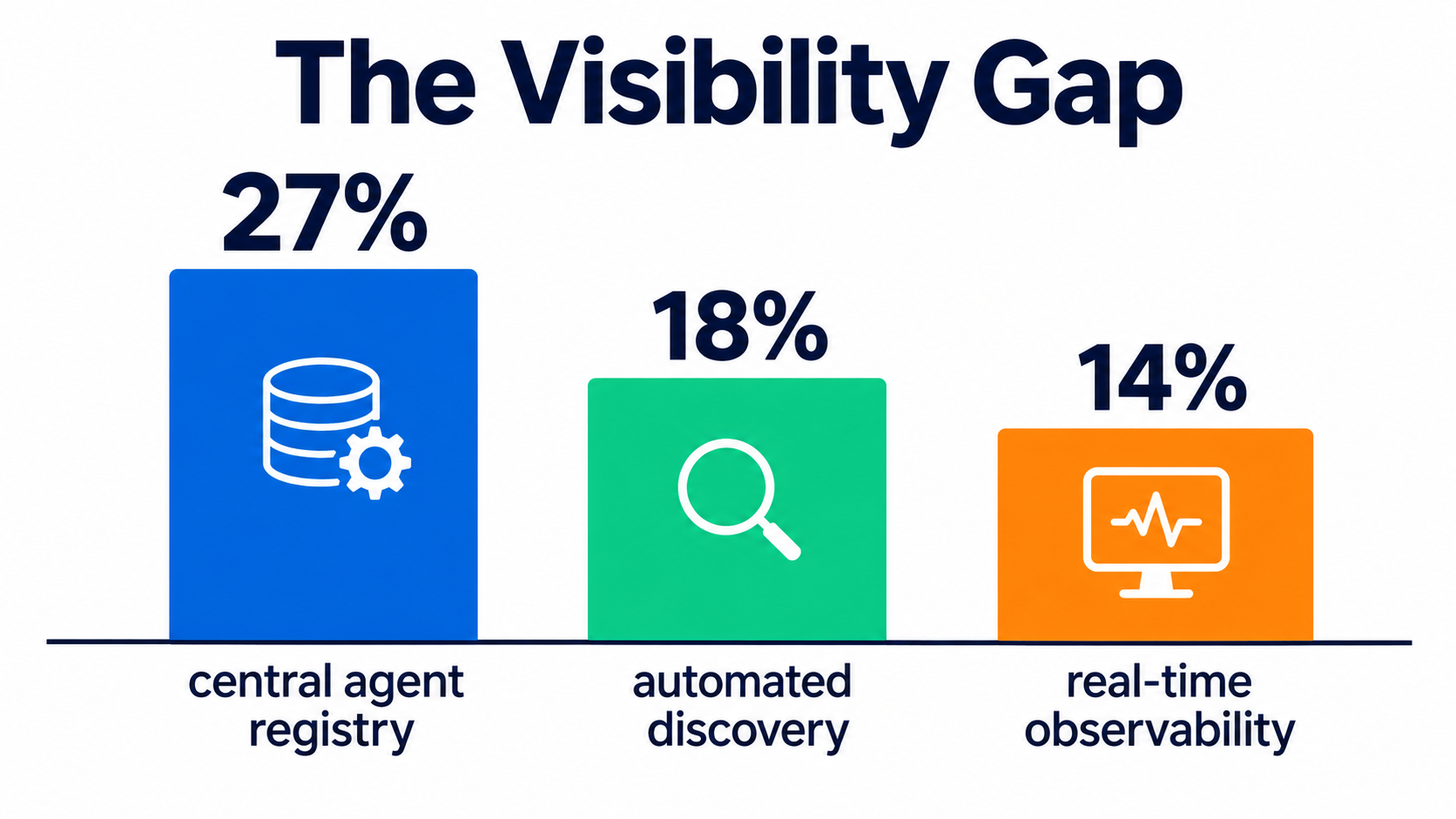
- A G2 survey of 1,019 software buyers found that 66% use agents in live business operations. Only 27% keep a central agent registry, 18% use automated discovery that covers unsanctioned agents, and 14% have real-time observability into unusual behavior, cost or risk.
- An EY survey of 202 senior AI decision-makers at large U.S. companies found 41% lacked sufficient visibility into AI use across the organization. 26% of agentic-AI users said they could not detect unauthorized agents.
- A Cloud Security Alliance and Strata survey reported that only 21% keep a real-time registry, and only 28% can reliably trace agent actions back to a human or system in every environment.
Other reports describe a confidence problem. One finding says 82% of organizations discovered AI agents they hadn’t known about, even though 68% said they had strong visibility. Treat the exact numbers cautiously, since methods and samples differ. The direction is consistent across sources.
Why the gap grows
Gartner analyst Max Goss has projected that the average Fortune 500 company could run over 150,000 agents by 2028, against fewer than 15 in 2025. In the same research, only 13% said their governance was adequate. Even if the real figure comes in far lower, the direction matters: counts grow quickly, and manual tracking doesn’t keep up.
What Actually Counts as an Agent
An inventory fails early if nobody agrees on what belongs in it. Pick a working definition and write it down.
A practical definition
For inventory purposes, an agent is any software that uses a model to decide what to do next and can take an action outside its own interface. Actions include calling a tool, writing to a system, sending a message or spending money. A chatbot that only answers questions from a fixed document is a lower-risk item. A workflow that reads email and updates your CRM is an agent.
Where agents hide
- Built in-house: scripts, notebooks and orchestration projects in code repositories.
- Vendor-embedded: assistants and automations inside SaaS products your teams already license.
- Low-code and no-code: flows built by business users in workflow tools.
- Personal and desktop: coding assistants and browser agents installed by individuals.
- Pilots that never ended: proofs of concept that kept running after the team moved on.
Include all five. The ones outside your engineering group are usually the ones with the least oversight.
The Fields Every Agent Record Needs
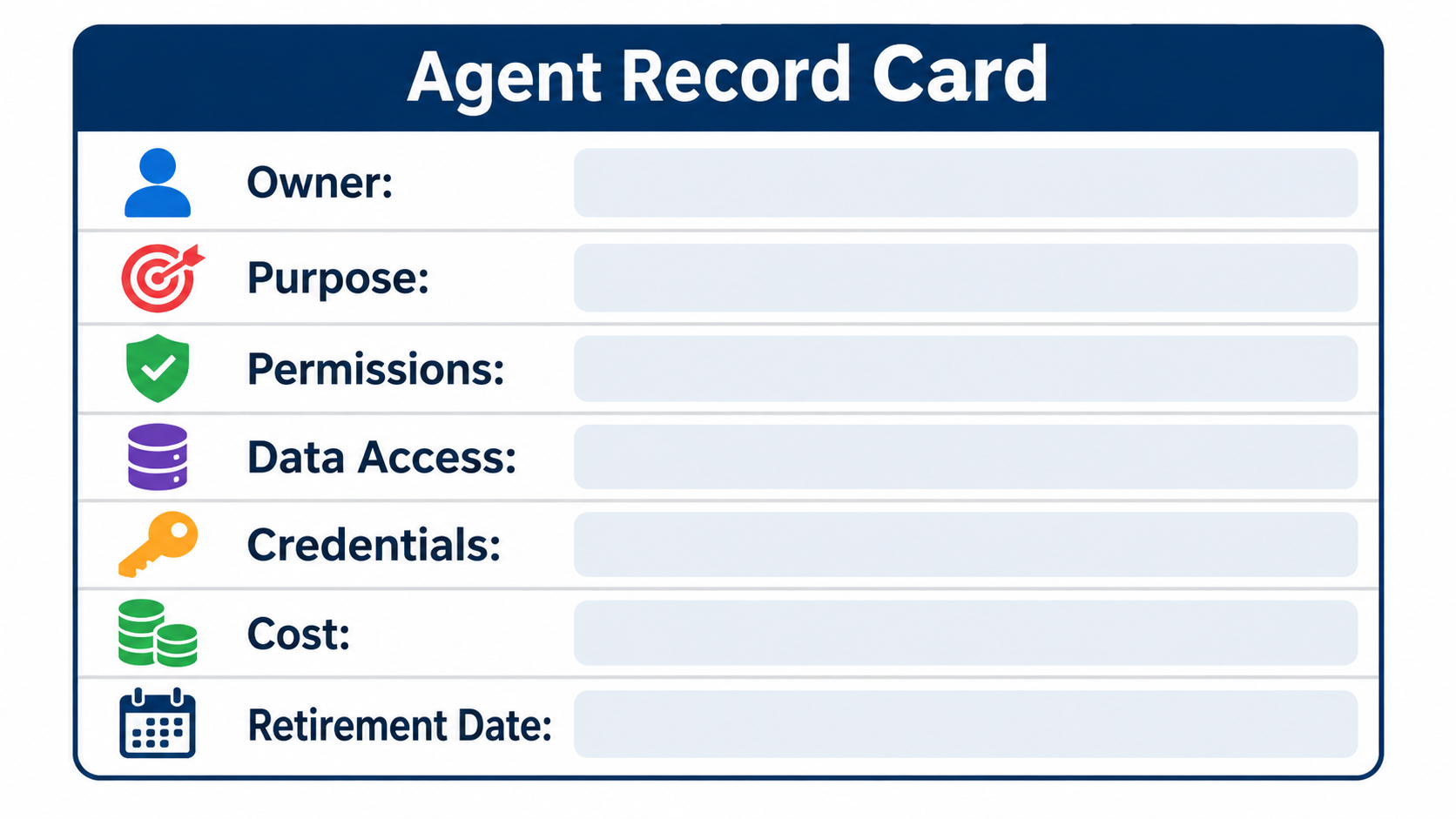
A spreadsheet row is enough to start. Current enterprise registries track discovery, identity, policy, monitoring, lifecycle and cost. You can map those into a simple set of fields.
Identity and accountability
- Name and unique ID. One name, used everywhere.
- Named human owner. A person, not a team alias. If the owner leaves, the record flags itself for reassignment.
- Business purpose. One sentence describing the job and who benefits.
- Status. Pilot, production, paused or retired.
Access and exposure
- Permissions. What the agent can read, write, send or delete.
- Data classes touched. Customer data, financial records, health information, internal documents.
- Credentials used. Which keys, tokens or service accounts, and who rotates them.
- Connected tools and models. The systems and model providers it calls.
Operations
- Where it runs. Cloud account, vendor platform or a laptop.
- Cost. Monthly model and infrastructure spend.
- Last reviewed and next review date.
- Retirement criteria. What would cause you to switch it off.
Resist adding thirty more columns. A short record that people maintain beats a rich one that goes stale.
Find What You Don’t Know About
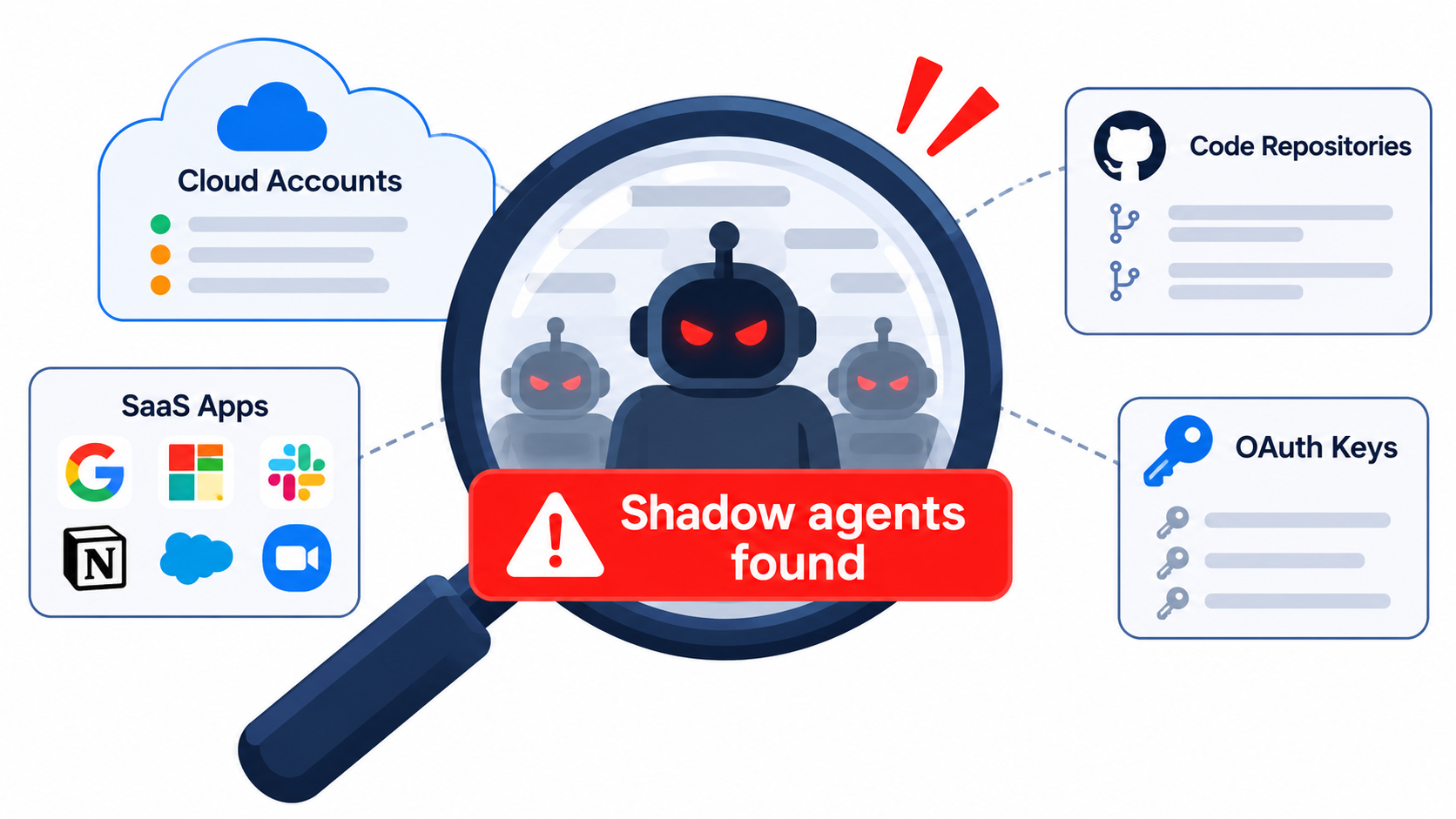
Asking teams to self-report is a good start, but it only catches agents people remember and are willing to mention. Pair it with technical discovery.
Sources to scan
- OAuth grants and app consents in your identity provider and SaaS tools. Agents need access, and access leaves a trail.
- Cloud accounts: model API usage, serverless functions and scheduled jobs.
- Code repositories and CI/CD pipelines: imports of agent frameworks and model SDKs.
- Billing data: invoices from model providers and expense reports for AI subscriptions.
- Network and endpoint logs: traffic to model APIs from unexpected places.
- Vendor admin consoles: feature toggles for built-in assistants.
Vendors now sell discovery that scans endpoints, pipelines, SaaS, cloud accounts and runtime telemetry rather than just gateway traffic. You can do a rough version manually before buying anything.
What discovery tends to turn up
Published case examples suggest the number is rarely small. Microsoft customer Regal Rexnord used a central inventory layer and identified roughly 2,000 agents. In a proof of concept reported by Geordie AI, Owkin found 327% more agents than it expected. These are vendor-reported cases, so read them as illustrations, not benchmarks. The lesson holds anyway: your first count will probably be wrong.
Assign Ownership Before You Assign Tooling
EY’s survey found nearly 60% said no single group oversees agents after deployment. Tools can’t fix that. A registry with no accountable owner becomes a stale list.
Two layers of ownership
- Agent owner: a named person responsible for what that agent does, its access and its review.
- Inventory steward: a small group, often security, IT or a platform team, that maintains the registry, runs discovery and enforces the gate.
The CSA and Strata survey found only 28% can trace agent actions to a human or system across all environments. A named owner per record is the simplest first step toward closing that gap.
Decide who can say no
Give the steward the authority to pause an agent that has no owner or is out of policy. Without that, the inventory is documentation, not control.
Tier Agents by Risk, Not by Hype
Not every agent deserves a heavyweight review. A tiering scheme keeps effort proportional.
A simple three-tier model
- Low: read-only access, no sensitive data, no external actions. Example: summarizing public documents for an internal team.
- Medium: writes to internal systems or touches internal data, with human review of outputs.
- High: acts without review, touches customer, financial or regulated data, moves money or communicates externally.
What each tier requires
- Low: register, name an owner, review yearly.
- Medium: add permission review, logging and quarterly checks.
- High: add security review, approval, monitoring with alerts, an incident plan and a tested shutdown path.
Regulation affects the high tier especially. Owkin’s proof of concept reportedly produced compliance evidence for the EU AI Act. An inventory is a basic input for that kind of documentation, because you can’t document systems you haven’t listed.
Turn the Inventory into a Rollout Gate
This is where the inventory pays off. Make registration a precondition for launch, so the registry is built from the front door instead of reconstructed later.
A pre-rollout checklist
- The agent has a registry entry with every required field filled.
- A named owner has accepted responsibility.
- Permissions follow least privilege and credentials are unique to this agent.
- Risk tier is assigned and its controls are in place.
- Logging is on, and actions can be traced to this agent’s identity.
- A budget cap or cost alert exists.
- A kill switch has been tested, and a retirement trigger is written down.
- You’ve checked the inventory for overlap. Does another agent already do this job?
The overlap check is underrated. Teams often build near-duplicate agents because nobody can see what exists. One inventory search can save a rollout.
Monitor What the Inventory Says Exists
A static list drifts. Enterprises are moving from one-off AI inventories toward registries that are continuously reconciled against what’s actually running. Only 14% report real-time observability, so even a modest alerting setup puts you ahead.
Start with three signals
- Cost spikes: a loop or runaway tool call shows up in spend first.
- Permission changes: an agent gaining new scopes without a registry update.
- Unregistered activity: model API calls or OAuth grants that match no record.
Reconcile on a schedule
Monthly, compare discovery output with the registry. Anything found but unregistered gets an owner or gets shut off. Anything registered but silent is a retirement candidate.
Manage the Whole Lifecycle, Including the End
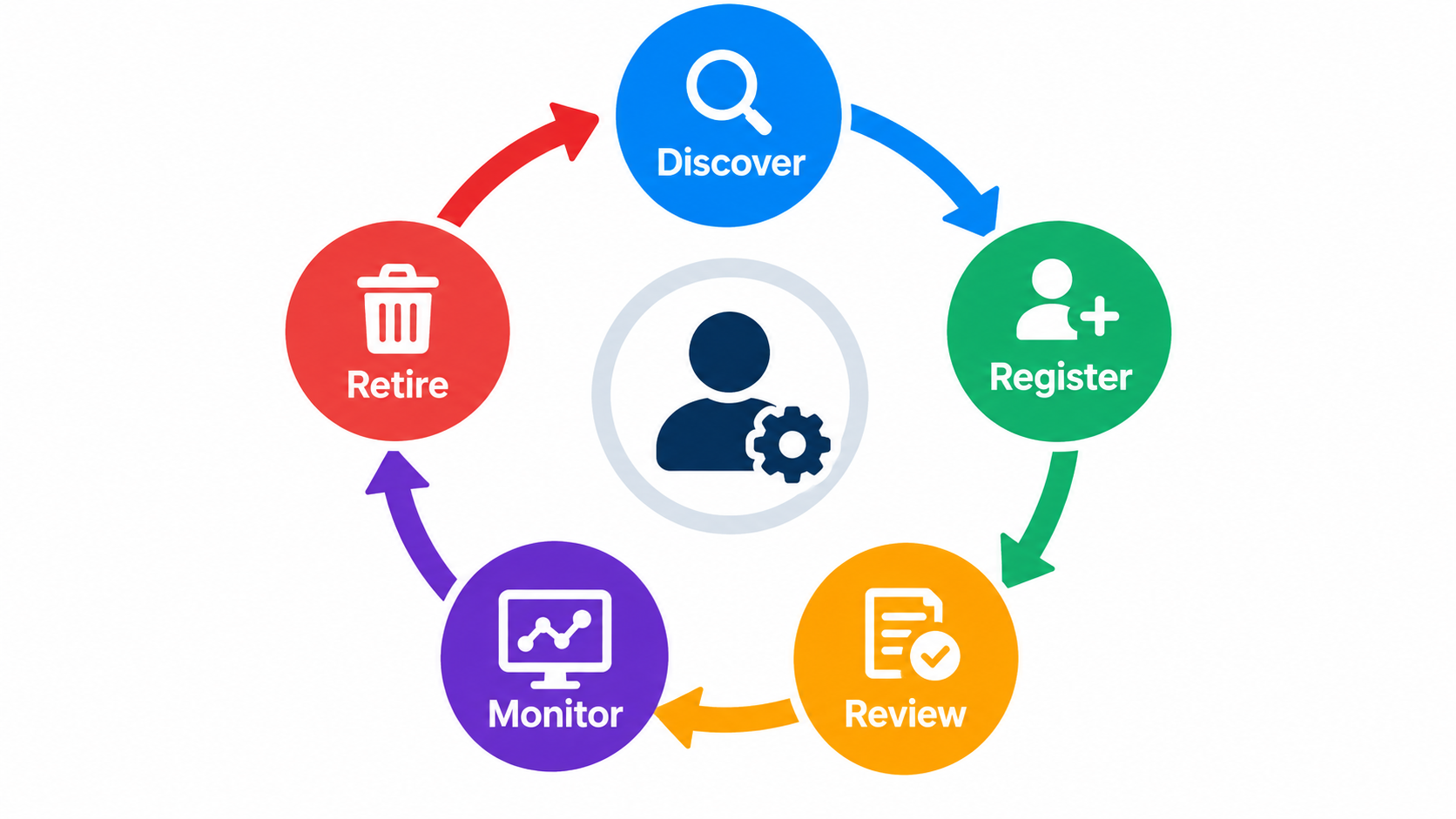
Most governance talk covers launch. Agents also need an exit. Abandoned pilots with live credentials are one of the easiest ways to create exposure.
What retirement involves
- Revoke credentials and OAuth grants.
- Remove scheduled jobs and webhooks.
- Archive logs for your retention period.
- Mark the record retired instead of deleting it. History helps with audits and with future design choices.
Handle owner changes
When someone changes roles or leaves, reassign their agents the same week. Tie this to HR offboarding so it doesn’t depend on memory.
A 30-Day Plan to Stand Up the Inventory
Week 1: Define and announce
Agree on the definition, the minimum fields and the steward. Tell teams that registration is coming and that early disclosure carries no penalty.
Week 2: Collect and scan
Send a short survey to department heads. At the same time, pull OAuth grants, model-provider billing and repository searches. Merge the results into one sheet.
Week 3: Tier and triage
Assign risk tiers. Fix the urgent items first: agents with no owner, shared credentials, or broad write access to sensitive systems.
Week 4: Install the gate
Add the pre-rollout checklist to your launch process. Schedule the first monthly reconciliation. Decide whether the volume justifies a dedicated registry platform. Microsoft, Google and security vendors all now offer registry or inventory products, but a spreadsheet and discipline work at the start.
Common Mistakes to Avoid
- Counting only sanctioned agents. The gap is in the unsanctioned ones.
- Treating inventory as a one-time project. It needs a schedule and an owner.
- Making registration punitive. If disclosure gets people in trouble, they stop disclosing.
- Over-designing the record. Complete short records beat empty long ones.
- Ignoring vendor-embedded agents. They act inside your systems with your data.
- Skipping cost. Spend is often the first visible sign of an agent you didn’t know about.
Conclusion: Count First, Then Scale
The surveys show a gap between how many agents organizations run and how many they can account for. Adding another rollout to that gap raises risk and cost without adding clarity.
The fix isn’t complicated. Define what an agent is, record a short set of fields, find the hidden ones, name an owner for each, tier by risk, and make registration the price of launching. Then reconcile monthly and retire what you no longer need.
Actions for this week
- Write a one-paragraph definition of an agent for your organization.
- Create the registry sheet with the fields above.
- Pull OAuth grants and model-provider invoices to find your first unknown agents.
- Name an inventory steward.
- Hold your next rollout until it passes the checklist.
Your next agent will be easier to launch, and easier to trust, when you know where it fits among the ones you already have.
Leave a Reply